

Claire Chatterton speaking at another presentation in 2024. Source: Festival of Ideas
Having spent a lot of time reading and writing about 18th and 19th century lunatic asylums in general and Chester’s public lunatic asylum in particular, it was a sincere pleasure for me to go to the Chester Town Hall to listen to Professor Claire Chatterton talking about the Cheshire Lunatic Asylum. The asylum opened in 1829 with a building designed by William Cole, and although it expanded over a vast area over the decades, most of which has since been demolished, the original 1829 building still stands in the grounds of the Countess of Chester hospital, of which it is now a functioning part.
Professor Chatterton is an excellent speaker. I recently listened to a daunting Radio 4 programme entitled “How to avoid death by PowerPoint,” and Professor Chatterton soared above all of the noted pitfalls, speaking with perfect fluency, bringing the audience along with her. It was good to see that there was a good turnout, reflecting an interest not only in Victorian Chester, but in mental health care. Professor Chatterton is a former mental health nurse, enabling her to comment with authority on a specialized and skilled profession that is not always well understood. We were asked not to take photographs, so I have no images of the presentation (the photograph at the top of the page was from a previous presentation), but the accompanying graphics and text were very good.
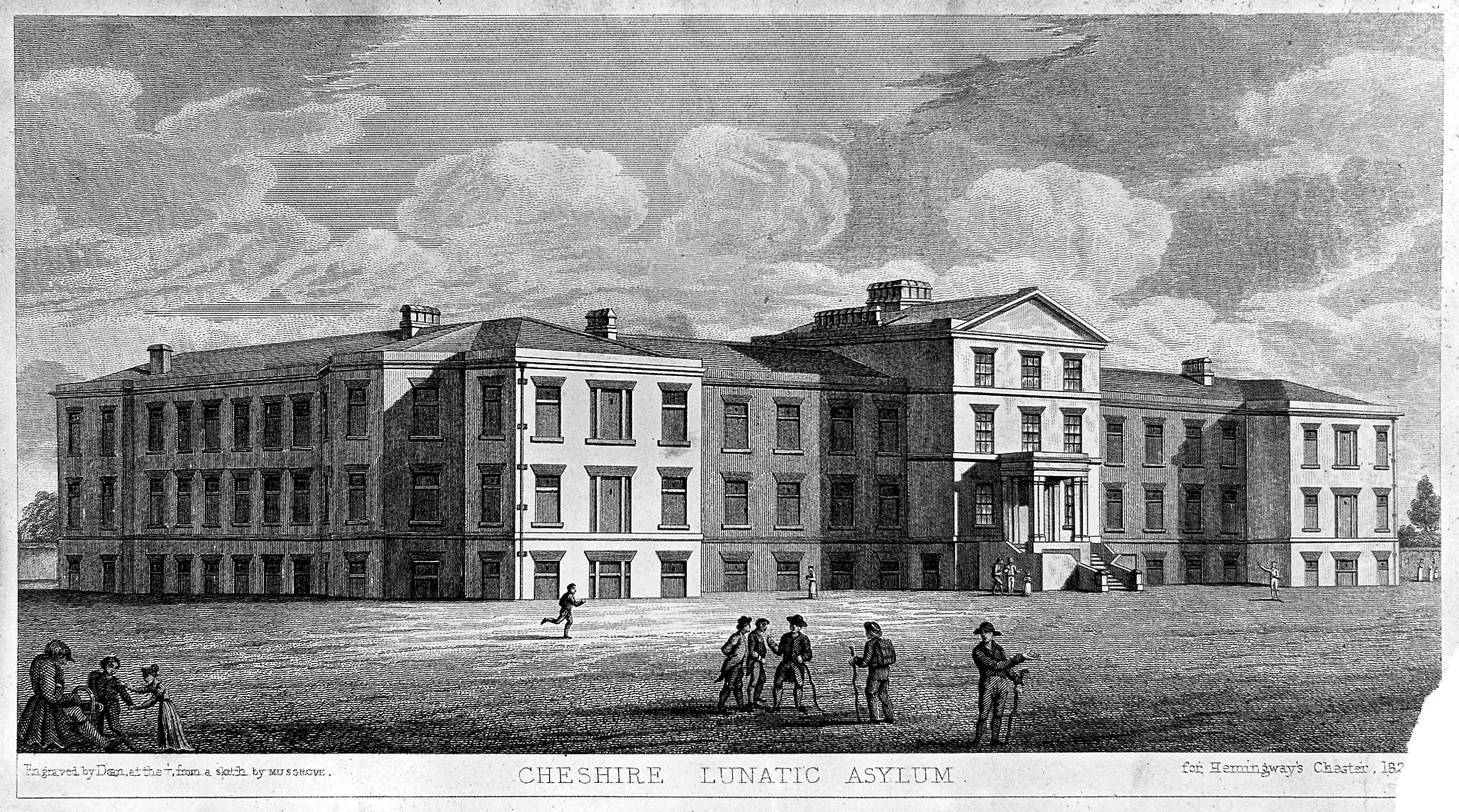
Chester Lunatic Asylum 1831. Wellcome Institute Library. Source: Historic Hospitals, Cheshire
The scope of the presentation was the first 100 years of the asylum, taking it from 1829 to 1929, which Professor Chatterton made clear was a period of considerable change in terms of both mental health legislation and medical ethics. The title of the presentation was “Tales from the Asylum: The First 100 Years,” and this captures an important aspect of the narrative, which placed emphasis not only on the general trends and policies of the time as they impacted the asylum, but on the individuals who ran the asylum, worked in it, and were contained within it.
Although the asylum had been established before counties were required by law to build asylums, making Chester one of a number of early pioneers in this area, there were clearly problems. Between 1829 and 1853 staffing of the hospital was somewhat thin on the ground, with no live-in staff and no night staff at all. Criticism by a board of inspectors resulted in the appointment of a new Superintendent in 1853, Dr Thomas Nadauld Brushfield, who implemented new standards of management and care, including the banning, wherever possible, of mechanical restraints. The professor described how Brushfield’s regime, between 1853 and 1865, appears to have been as humane as possible, with an emphasis on patient care rather than mere containment, but she also made it clear that the problems should not be underestimated, and whilst new admissions rose, the greater majority of patients could not be released.

The previous occupations of patients admitted in 1870
Professor Chatterton talked about the fragmentary nature of the available data from asylums. It is a hard fact that even though these were publicly funded institutions, many of the archives were considered excess to requirements when the mental healthcare system was overhauled at different times. Fortunately some of the documentation for the Chester asylum is held by the Cheshire Archives and Local Studies offices. These are closed at the moment for a major overhaul, but should be available for consultation once again in 2026. Professor Chatterton was able to access some of them before the closure, piecing together some of the many stories from inside the asylum.
Professor Chatterton took us through some of the statistics that were produced in the annual reports that provide a fascinating wealth of information about patients, such as their employment backgrounds and the state of their health and any particular conditions from which they suffered on admission, as well as suggesting causes for mental health issues. It is difficult, as the Professor made clear, to make comparisons from one asylum to another about what mental illness terminology actually means, because no reports define it and although the same terms might be used, definitions might differ, but some, like the end stages of syphilis (referred to as General Paralysis) are distressingly prevalent. She took us through some of the general health problems confronted in asylums, some of which can be cured today but were, at that time, incurable. It was often a bleak picture.

The Handbook for Attendants of the Insane. Source: Royal College of Nursing, “Out of the Asylum”
Unsurprisingly for the period, there was a division between male and female patients, who were divided physically within the asylum. At first both the male and female staff handling patients were referred to as attendants, with men attending male patients and women attending female patients, but eventually the women became known as nurses, reflecting a degree of professionalization of this work within the asylums. It took much longer for men to be recognized as nurses too. Professor Chatterton gave examples of some staff, male and female, who had been pensioned off after suffering acute stress, partly due to the nature of the job, and partly due to long hours. It was quite clearly one of those careers that took a heavy toll on those on the front line. I was particularly sad to learn that the Reverend Congreve, who had run schools for those patients who wished to attend them, and had operated a mobile library, was one of those who died, having had succumbed to stress.
It was interesting to see photographs (and actual objects that Professor Chatterton brought with her) of items that were used by nursing staff in their daily work. I had seen online scans of the annual reports produced by the asylum, but had never actually seen one in the flesh. In my mind’s eye they were A4-sized, big and bold, but actually they were around A5 sized, like small booklets, which seemed far too understated for the importance of the job at hand! Adverts for staff in the asylum were particularly interesting, showing top-level requirements and starting salaries. The increasing professionalization of mental healthcare nursing was demonstrated by a number of publications that not only advised nursing professionals, but helped them with the exams that from the late 19th century they were expected to pass. Psychiatric work eventually became one of the fields that the first women doctors could enter.
If you have the opportunity to hear Claire Chatterton speak in the future, I very much recommend it! A great lecture, with thanks.

The 1829 Building at the Countess of Chester Hospital, the former lunatic asylum
 Based in Churton
Sounds like it was a superb talk! Such an interesting topic too.
LikeLike
Hopefully Claire can be persuaded to talk more on the subject in the not too distant future. It really was excellent.
LikeLike