

The Reading Room at the British Museum
One of the things I write about on this blog is how viable day trips to specific places actually are. On Thursday December 5th my friend Helen and I went on a planned trip to London for the day to see two exhibitions and a quick touristy visit to Harrods Food Hall. The exhibitions are described briefly below, in case you are considering attending either and are interested in some insights, but this is mainly a story of an Avanti fiasco.
It’s the first time since moving to this area that I’ve been back to London by train, because on previous visits I took the car. Virgin was still in charge of the west coast line when I was last traveling by train to visit my parents in the Chester area (when I was living in London), and although people complained about it, I used it a lot and found both the prices and the service very acceptable. The line is now run by Avanti West Coast Trains. A single return journey does not provide a valid sample of the service on an everyday basis, and perhaps this was not typical, but on a typically alternating dry-wet English day, not only were both direct trains that we should have been booked on, there and back cancelled, but there were other complications too. It was a mess. Whether typical or not, this is certainly something to consider when planning a trip by train from Chester to London.
The Avanti Fiasco
A few weeks ago we both went to Chester to book the tickets on Chester railway station, in person, and that’s where the first problem occurred. We wanted a direct fairly early train, and that limited us to three services – the 0732, the 0832 and the 0920. Neither of us felt like an early rise for what was intended to be a very full but light-hearted day, so we selected the 0832, with return tickets booked on the 1902. We learned later that we were supposed to have received a print-out of the travel plans, put none was given to us. When we checked the tickets for the exact timings closer to the day of travel, we found that we had been booked on to the 0732. In spite of Helen’s efforts to get our tickets changed, in person at the station, all the bookable seats on the the 0832 were already taken. The person at the station was apparently really helpful and apologetic but we were stuck with the 0732. When we arrived we noticed that the 0832 had in fact been cancelled. The passengers were presumably either heading to Crewe on the shuttle, or hanging around for the next 50 minutes because there is no direct train until 0920 (if that too was not cancelled). On the upside, the train was clean and comfortable, stopping at Crewe and Stafford before arriving into Euston.

Avanti West Coast Train at Stafford. Source: Wikimedia Commons
When ready to take the train home, we returned to Euston with plenty of time to spare, and found that our train, the 1902, had been cancelled. A station employee suggested that we take the 1833 to Manchester Piccadilly and change at Crewe. We had to run for it but we made it. It was absolutely packed but after walking through four carriages of a very busy train to try to find two seats together, we eventually installed ourselves. The next bit of news, thanks to another passenger, was that no driver was currently available and we would not be leaving until 1900. There were no announcements to this effect in the half hour that we were sitting there, so my thanks to that passenger for the information. A few minutes after 1900 we slowly pulled off. Nearing Crewe, having lost another 15 minutes en route there was an incredibly garbled announcement about people wanting to go to Crewe and Holyhead that involved platforms 5 and 6. No Avanti personnel came through the train, so there was no-one to ask for clarification.
We opted for platform 6 and once we had left the train at Crewe crossed the foot bridge and found the platform. The overhead sign was reassuringly marked for Chester, leaving at 2103. Just minutes before it was due to arrive there was an announcement to say that it was now coming in on platform 11, so we were again legging it along the platform towards the stairs to locate another platform (thanks very much to the knowledgeable fellow traveler who pointed us in the right direction). We got back to Chester in the end, at something gone half past 9 (even that leg of the journey was late), rather later and much more stressed than we had planned.
In practice, both of the trains that we should have been on were cancelled. We were booked onto the wrong train on our outgoing journey, and on our return journey, instead of travelling direct to Chester in booked seats, we had to take pot luck on being able to sit together, and were forced to change and wait at wet and windy Crewe, adding yet more inconvenience to an already tiresomely unsatisfactory experience.
It is not yet over. There is now the hassle of seeing if we can negotiate for some form of compensation. I’ll update this post when the outcome has been decided.
The Great Mughals: Art, Architecture and Opulence at the V&A
 This is a lovely, informative and eye-opening exhibition if you are in London before the 5th May 2025. It has been on since November 9th 2024. I didn’t take my camera so please note that all the photos below were either from the V&A website or were taken by Helen Anderson on her iPhone (see captions).
The great age of Mughal art lasted from about 1580 to 1650 and spanned the reigns of three emperors: Akbar, Jahangir and Shah Jahan. Hindu and Muslim artists and craftsmen from the northern regions of the Indian subcontinent worked with Iranian masters in the masculine environment of the royal workshops. Their very different traditions were combined to produce a radically new, and rapidly evolving style of art for the court. (V&A)
The exhibition covers the art of the reigns of three successive rulers on the Indian subcontinent. Under each emperor the empire expanded and the resulting wealth funded a rich output of artistic work, including paintings, manuscripts, floor coverings, tiles, clothing, glass wear (including rock crystal) metalwork, jewellery, and other objects that made versatile use of gemstones and other raw materials such as mother of pearl and decorative stone. A gold-hilted dagger and scabbard, for example, are studded with 1685 rubies This is very much the output of power and wealth. The love of vibrant colour and glowing textures shines throughout.

Akbar’s entry into Surat in 1590-95. Source: V&A museum number IS.2:117-1896
Although it is a celebration of natural beauty, the overarching message is one of luxurious court living with its taste for the exotic and the religious all overlaid with by the idealism and expansionist determination of three imperial rulers. Jahangir’s name means “World Seizer”, ahd he gave his son Khurram the title Shah Jahan, meaning “King of the World,” leaving no doubt that this is a story not merely of art and the skilled craftsmen that created it, but of political and territorial ambition.
The most astonishing thing, apart from the beauty of the artwork, is the sheer number of influences that were at play, producing a rich variety of styles and motifs. Each region had its own characteristic approach to art and craft, as well as its own cultural motifs, but these were also mingled over time to create new portfolios of idea and expression.
The exhibition also includes pieces that express the influence of European ideas and art works on Mughal work. The presence of merchants, diplomats, and Christian missionaries sometimes created a blend of Mughal and European concepts in art.
Each of the items, and the paintings in particular, reward examination on at least two levels: the overall subject matter on display, and then the individual details that make up these scenes. There are layers upon layers of patterning and motifs contained within the larger narrative, and each individual person, animal, bird, plant and building is a work of art in its own right. This is clearly seen in the multiple layers of action, pattern and detail in Akbar’s entry into Surat above, and the glorious Squirrels in a tree, below. The sheer exoticism of some of the religious personalities are marvellous in their conceptualization. As history, they also reveal a lot about court life, activities and and taste, and how extravagant and sensuous this all was.

by Abu’I-Hasan and Mansur. British Library Collection. Photograph by Helen Anderson, who holds the copyright
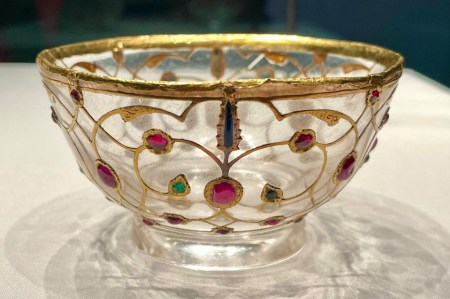
Rock crystal cup studded with precious gems and kingfisher feathers, c.1620. Photograph by Helen Anderson, who holds the copyright
The rock crystal cup is an astonishing example of how different raw materials can be drawn together to produce a work of both breathtaking beauty and elaborate luxury, which can be enjoyed both as a single item and for its individual parts. The rock crystal is set with rubies, emeralds and dark blue glass. On the interior, the turquoise is provided by kingfisher feathers sealed under slithers of rock crystal, and the reverse sides of some of the stones are painted with tiny faces. In spite of the luxurious components, all framed in gold, it miraculously conveys delicacy and charm rather than tipping into excessive ostentation and gaudiness.

Rock crystal cup showing interior with painted faces and kingfisher feathers, c.1620. Photograph by Helen Anderson, who holds the copyright
Some pieces seem much simpler at first sight, but contain such elegance and sophistication of design, form and shaping that they too sing out. The wine cup of Shah Jahan is a particularly fine example of simplicity of concept and intricacy of design.
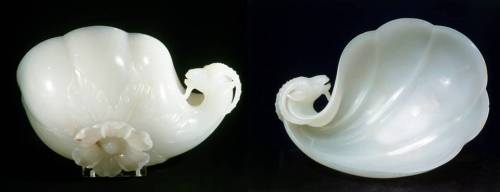
Wine cup of Shah Jahan, 1657. Source: V&A museum number IS.12-1962
This was a very well thought out and curated exhibition, making good use of the space in the several rooms and providing excellent information throughout. It was quite busy at 1pm on a Thursday afternoon, but there was no sense of having to queue to see an item. Whatever your taste in art, I would say that this is a must-see exhibition, because the quality of the objects is so high and the emphasis on natural beauty is delightful. It is on until May 5th, and if I make it back to London before then, I will certainly visit again.

Man’s hunting coat with delicate colouring and splendid detail. Source: V&A For 23 more images see the V&A website
There is an excellent background to the history of this period on the V&A website, accompanied by many images from the exhibition, at:
https://www.vam.ac.uk/articles/the-arts-of-the-mughal-empire
Visiting details are on the V&A website here:
Photos are permitted without flash.
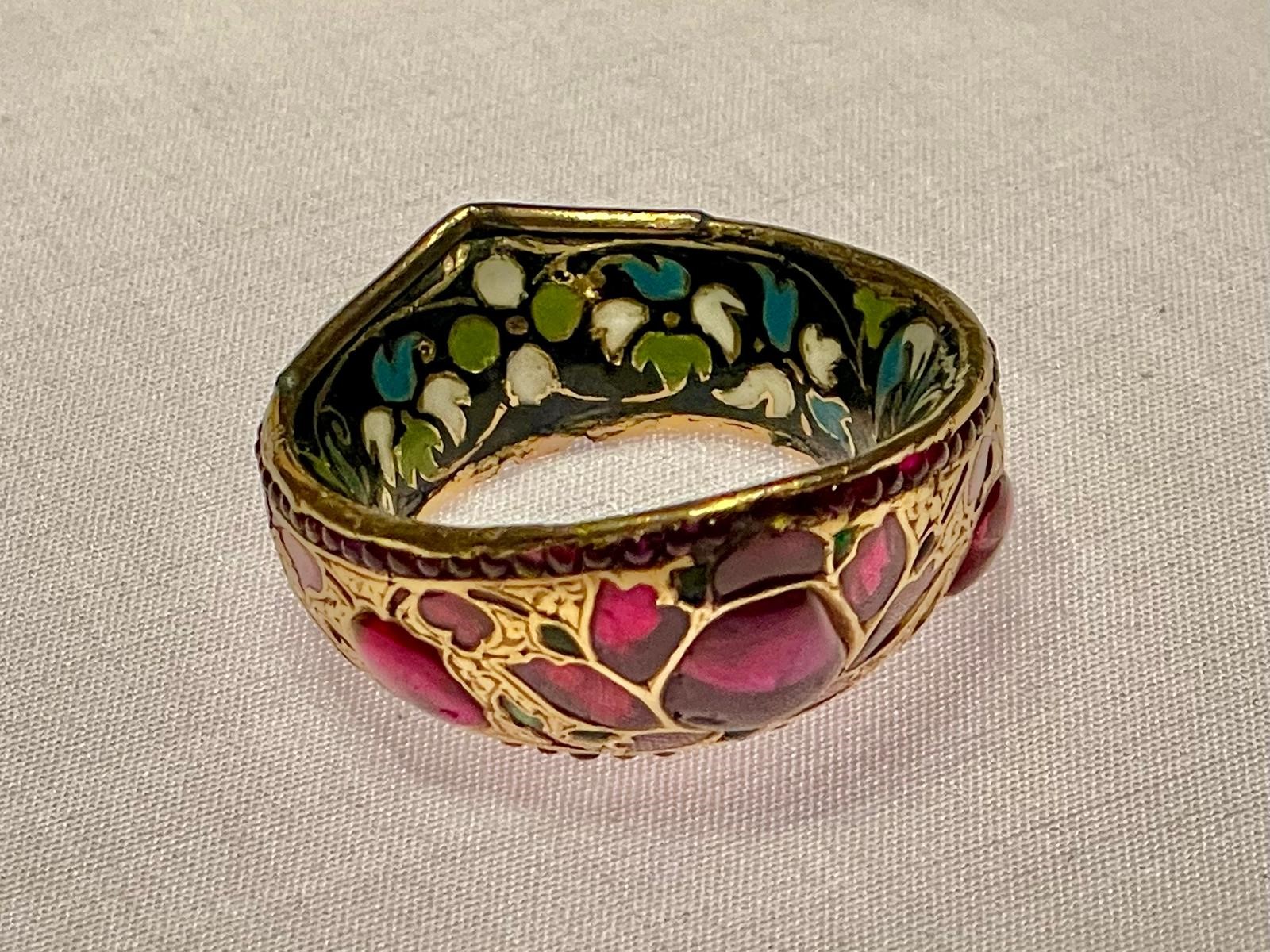
Gold thumb ring set with emeralds and rubies and enamelled on the inside, 1600 – 50, Mughal. V&A Museum no. IM.207-1920. Photograph by Helen Anderson, who retains the copyright
Silk Roads at the British Museum
 Rather than a single trade route from East to West, the Silk Roads were made up of overlapping networks linking communities across Asia, Africa and Europe, from East Asia to Britain, and from Scandinavia to Madagascar. This major exhibition unravels how the journeys of people, objects and ideas that formed the Silk Roads shaped cultures and histories. The Silk Roads were in use for millennia, but this visually stunning show focuses on a defining period in their history, from about AD 500 to 1000. (British Museum)
The Silk Roads exhibition at the British Museum began on 23rd September 2024 and runs until February 2025. Both Helen and I had reservations about it, each slightly different. These are my thoughts.
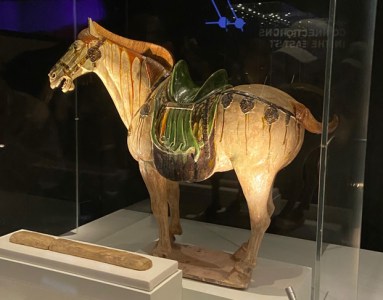
Tang Dynasty Horse
First, this was very busy at around 3pm on a Thursday afternoon, and the exhibition’s organization does not make the most of the space, which was not as extensive as I had expected for such a widely advertised event. Glass display cabinets only face one way, which does not help to break up the bunching of groups of people in front of them. If the objects had been visible and labled on both sides, it would have been much easier to get a view of them. Instead, it was a matter of queuing painfully slowly until visitors had read the signage or listened to the running commentary in their smartphones. The alternative was to dash between display cabinets as they became available, which I did, but completely breaks down the narrative value of the signage.
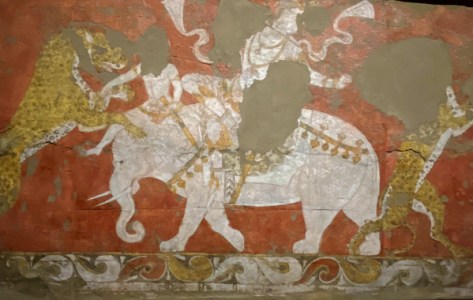
Section of a wall painting from the palace of Varakhsha Uzbek, c. AD730, showing a hero on an elephant fighting wild beasts. Collection of the State Museum of Uzbekistan
Because the silk roads cover a very wide area, and this was quite a small exhibition, there is not a great deal of connectivity between the objects on display, and there is a great deal of variety, meaning that the information boards are essential to tie everything together. This means that you really have to read the information boards in the order in which they are displayed to understand the role of the objects in the exhibition. The main problem was that it was far too busy at 3pm on a Thursday afternoon, with long slow crocodile queues of people trying to see objects and related signage. An earlier or later time might have made the exhibition a far more enjoyable experience.
 As well as the cultural-artistic aspect of the story, I had been hoping to learn more about the silk roads themselves, with the objects used to illustrate the commercial history of how the trade in silk operated and why it became so important, but there was very little on the subject. It was not about the silk routes themselves, focusing instead on how these routes lead to the dispersal of objects, religious ideas and technical skills over large areas, mainly between east and west. The narrative on the information boards does a good job of conveying the latter, if you are able to read them in the correct order, and there are some helpful maps.
To me, the narrative drawing all these objects together around the silk roads theme seemed rather forced. It felt more cobbled together than elegantly thought through, but as busy as it was, there were some very fine pieces on display, and if you see this as something of a kaleidoscope, an impressionistic view of the silk roads and the items and ideas that moved along it, there are some really nice individual pieces to enjoy.

For a more positive and much longer review see Jonathan Jones on The Guardian website gives The Silk Roads a big thumbs-up, There’s also a good and positive overview by Josephine Quinn on The London Review of Books.
The British Museum’s own introduction to the exhibition can be found here:
https://www.britishmuseum.org/blog/beyond-sand-and-spices-introduction-silk-roads
Visiting details are on the British Museum website here:
Photos are permitted without flash.
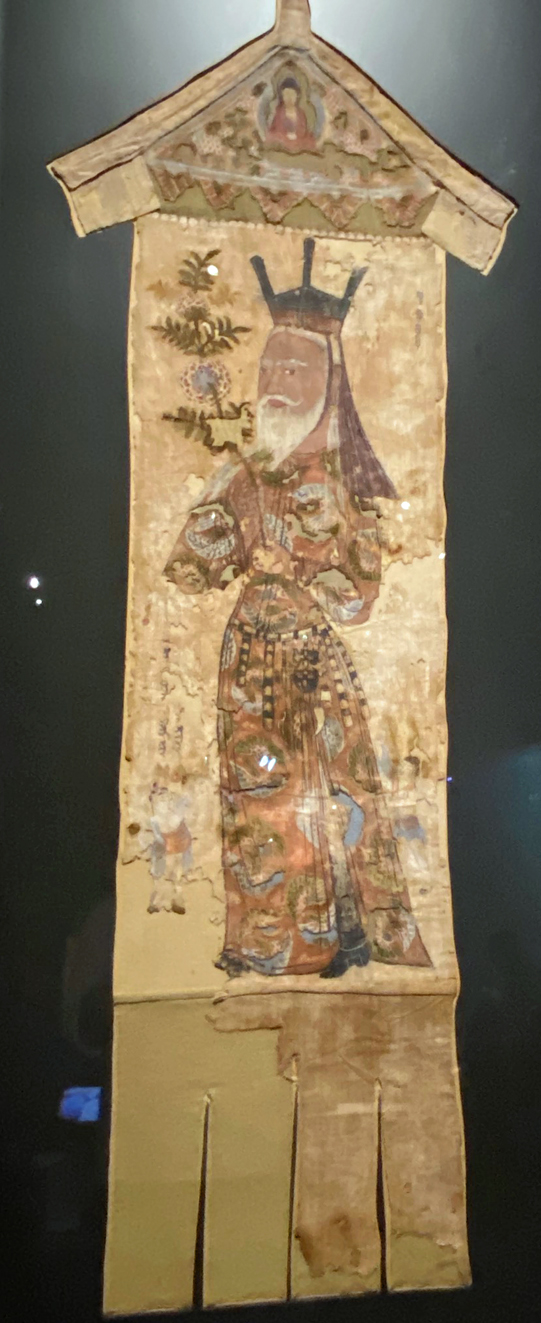
Funerary banner of a high-ranking Uyghur, perhaps a royal minister, named Kara Totok, wearing horse-riding attire. Museum fur Asiasfische Kunst.
—
Final Comments

Pilgrim vases from Abu Mina in Egypt AD 480-650. The one on the right is from Alexandria in Egypt; the one on the right was found in Kent. Both are in the British Museum collection (on show in the Silk Roads exhibition)
The booking of exhibition time slots makes the risk of train cancellations a more complex logistical factor than it should be. Nowadays time slots for an exhibition are standard, and it clearly makes sense to give yourself a lot of wiggle room unless you are a paid-up member of an organization that allows members to enter without booking a slot. Although most permanent collections (as opposed to temporary exhibitions) do not require you to book, the Courtauld Institute collection at Somerset House on The Strand is splendid but their website says that they will only let you visit their permanent collection with a booked, timed ticket. I did email them to question if this was really the case, but they did not reply. So I would suggest that after checking your destination museum or gallery, you book your train with a lot of wiggle-room built in.
 If you have never visited the Food Hall at Harrods, it’s a fun destination at Christmas. The prices are eye-watering, but as well as being stuffed full of indulgences, luxuries, it also stocks things that are very difficult to find elsewhere, and is a wonderful piece of pure tourism. For a particular celebration I had wanted to pop in for white asparagus, which I cannot source up here, and snaffled the last pack that they had. But after that vital piece of semi-sensible shopping, we then wandered through all the different rooms in the food hall, enjoying the beautiful displays, the fabulously packaged items and largely resisting the considerable number of temptations.
In spite of Avanti’s cancellation of both of the direct Chester ↔ Euston services that we chose, (which resulted in no seat bookings and the requirement to change at Crewe), it was a really good day and next time I will know that whatever I am / we are planning to do in London the best policy is to assume that the train service will go wrong, that Crewe will be involved even when you have tried to book a direct train, and that exhibition ticket slots need to be planned accordingly.
Good luck and enjoy!
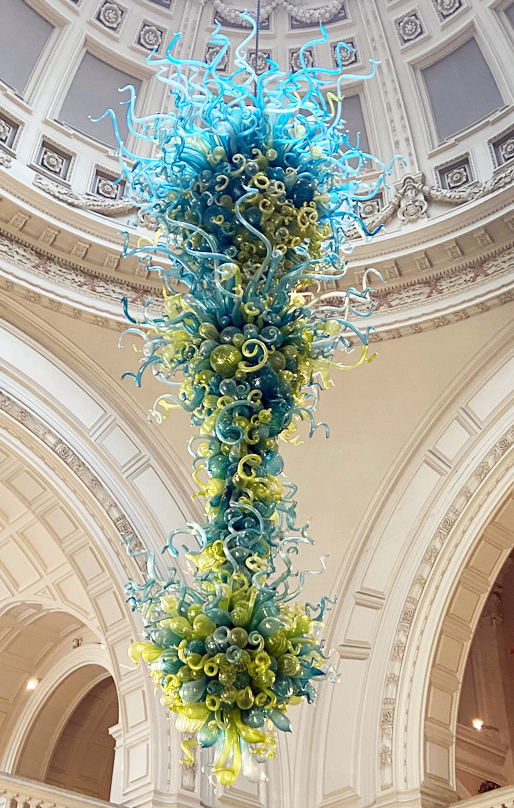
Dale Chihuly’s contemporary central glass sculpture under the dome at the V&A
 Based in Churton

Sounds like quite a day! I’m afraid your journey sounds typical for Avanti, from what i’ve heard, unfortunately. At least the exhibitions look like they were worth seeing! Such beautiful things!
LikeLike
The Mughal exhibition in particular was glorious, and worth the hoops through which Avanti made us jump. But the Avanti experience was all a bit of an unpleasant eye-opener.
LikeLike