
 I have been trying to find a publication of the excavations that took place when the profoundly ugly Chester HQ office development was built on the site of St Mary’s Nunnery and its cemetery. This lead me to the article by Professor Howard Williams below. Outside the Chester HQ buildings is a very odd permanent display area made of red sandstone displaying bits and pieces of random archaeology. I’ve thought it was peculiar for a very long time, one of these token gestures, neither fish nor fowl, that are usually funded by developers when they build over the top of heritage sites. It has no cohesive message, no coherent linkage between any of the objects, and is anyway missed by most passers-by. This excerpt from a very nicely written article by Professor Williams (University of Chester), posted in 2017, really gets to the nub of the matter.
https://howardwilliamsblog.wordpress.com/2017/03/22/unethical-medieval-nuns-on-display/:
I see the vision but I can’t really get my head around the reality in a sympathetic way. Rather than evoking a history of place, reporting on the contexts discovered and the rich and varied social, economic, political and religious history of the city and this site’s place within it, instead we get a transtemporal pastiche. This is little more than a banal and context-free open-air cabinet of curiosities that shamelessly aggrandises the corporate architecture of the 21st century and its construction facilitated by the rifling of past times.
 He goes on to discuss the display of one particular object, a truly lovely medieval stone grave cover with a fabulous decorative theme that represented the Tree of Life. It would have been laid horizontally over the grave, covering the deceased, but here is displayed vertically. This is really well worth a read if you are interested in heritage management, respect towards funerary monuments and contexts, the activities of developers with respect to the heritage they impact and the role of object histories. Loving the phrase ” transtemporal pastiche,” which gets it in one. Professor Williams never disappoints.
Back on the subject of the archaeological excavations, it was also interesting to note that in a 2013 article Professor Williams notes the following:
Archaeologist Mike Morris of Cheshire West and Chester Council was forced to announce that the developer – Liberty Properties – was in breach of their agreement [Cheshire Live] by not funding post-excavation adequately following the excavations at the HQ building revealing graves from Chester’s Benedictine nunnery. The website of Earthworks Archaeology – the commercial archaeologists who excavated the remains associated with the Benedictine Nunnery – says that post-excavation is ‘under way’.
The Cheshire Live article says that not only were there remains of 100 individuals from the cemetery at the nunnery site, but “foundations for at least one large Roman town house were discovered including an undisturbed mosaic floor – the first to be found in Chester since 1909.” The Earthworks Archaeology site announces: “The practice is currently on sabbatical.” There is no additional content and the website says nothing at all now. If anyone has any information about the excavations I would be grateful? But I suspect that it’s a horribly lost cause.

The last remaining structural feature of St Mary’s Nunnery – a 15th century archway that now stands in the Grosvenor Park.
Excavation without publication is an archaeological evil. If the remains carefully troweled out of the ground are not professionally published, the information is lost forever, the data never contributing to knowledge about the city as a whole and about the nunnery’s history in particular. It is the responsibility of an excavation not merely to extract data from the ground, but to share it. Anything else is an abdication of responsibility, and the loss of an important story. If the excavation results are never published, how will we ever understand what there was to know about St Mary’s? Where contracts are granted for this sort of work, surely the conditions of those contracts should be enforced.
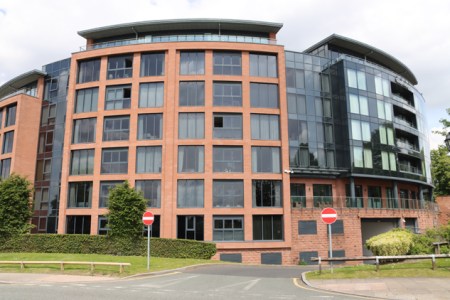
The Chester HQ building where the nunnery once stood
 Based in Churton
An intact mosaic floor and a 100 bodies? Wow, that sounds a significant find to me! I’m sure I must have read about this before at some stage, but only through reading your blogpost have I properly considered it. I have to admit I actually quite like the HQ building though, to me it pairs nicely with the castle across the road. It’s like two towers guarding the entrance to the city.
Also, I think it’s a pity that the installation in the central HQ forecourt is not always accessible. That, at least, has some context, as well as a glimpse of a Roman road, but I don’t think people tend to know about it.
LikeLike
Hi Clare. Great to hear from you. When I heard that hold police building was being knocked down and replaced, I was really looking forward to seeing the replacement building. I suppose that I was disappointed that with the castle on one side and the Architect (which I believe was the early 19th century St Martin’s villa built by Thomas Harrison as his own home) on the other, the opportunity was not taken to build something a little more sympathetic to both. Whether it has aesthetic merit is one of those subjective things – a new building is never going to please everyone – but it looks as though it was created by designers who had never visited Chester.
As to the mosaic and the cemetery, I have no way of verifying the truth of the reports, but that’s really my big whinge. Whatever was built there, there was a duty of care to the heritage (and to the dead, for that matter) to have reported the discoveries formally and professionally. A hobby-horse of mine 🙂 Best. Andie
LikeLiked by 1 person
really enjoyed reading this, Thankyou
LikeLike