

Full statue angels only arrive on the churchyard scene in the Victorian period.
This informal look at the monuments in Gresford’s All Saints’ church graveyard follows on from three previous posts about All Saints’, the first a general history of the interior, the second a quick look at the splendid gargoyles and grotesques on the exterior of the building. The third post looked at misericords (fascinatingly carved so-called mercy seats in choir stalls) in a three-part series about misericords in Gresford, Malpas, Bebington and Chester Cathedral.
I began writing this over a year ago, mainly for my own benefit when I was getting to grips with how churchyards develop, what sort of chronological markers can be found and the variety of monument types and themes that could be expected. I have just re-found the post in my drafts folder and thought that others might find it useful. This is no more than a very basic introductory starting point for investigating this and other churchyards in the area.
The churchyard surrounds the Gresford parish church of All Saints’ on all sides. The main part of the cemetery is to the south of the church. In parish churchyards the area to the north side of the church was usually the last to be occupied by the dead. This is partly because the brighter areas were favoured, but partly because the darker area was often reserved for church and community events until the 19th century when a requirement for more burial grounds resulted in the extension into all areas of a churchyard.
There is a variety of different tomb styles with the All Saints’ churchyard, mainly belonging to the late-18th, 19th centuries and 20th centuries. This includes chest tombs, table graves, ledger gravestones, vertical gravestones and sculptural monuments. Although most of the grave markers are relatively uniform in shape, size and motifs, reflecting standardization in the approach to gravestones, some are very personal and inevitably there are a few that stand out either because they are conspicuously larger than their neighbours, or because they are slightly unusual in some way.
Grave Types
 Terminology can differ slightly from publication to publication. Graves are, on this post at least, subterranean pits into which the deceased is placed. Grave stones, markers and monuments may sit over the grave to mark their positions and, if required, provide details of the deceased. Head stones are specifically the vertical slabs that sit at the head end of the grave, and may be accompanied by a short foot stone to mark the other end of the grave. Kerbs are low stone frames for the space occupied by the grave. Tombs are constructions, sometimes resembling buildings, that contain above-ground storage of the dead, but the term is often applied to false tombs, which are containers that sit on the ground but lie over a subterranean burial like the chest tombs and table tombs that are found at Gresford. Memorials commemorate the dead, but may not be associated with the grave where people are interred (like war memorials). There are no mausolea at Gresford or, indeed, at most parish churchyards, but these are standalone buildings, often highly ornate, that contain one or more tombs within.
The following photographs, all from All Saints’, show individual grave marker types that have been mentioned below. There are other types that do not appear in the All Saints’ churchyard, which are not included here. Click the image to enlarge so that the descriptions are legible:

The main types of grave marker present in Gresford All Saints’s churchyard, although there are other types too. Click image to enlarge.

Headstones
The dead are buried on their backs facing upwards, with heads to the west, feet to the east. Table tombs have inscriptions on the ledger (flat top) and the supports may be plain or more elaborate. Headstones face east, with the inscription on the eastern face. Because many inevitably face away from footpaths, in some cemeteries a name may be etched into the back of the headstone, to identify the deceased, whilst the full details are shown on the east-facing side. Chest tombs may have decorative components on the side panels, and text may be on both the ledger (flat top) or the side panels, or both.
Date Range
 The earliest graves at Gresford are located within the church itself in the north and south aisles, and have been mentioned on the first post about All Saints’, both dating to the 13th century. They consist of effigies, the inscribed or carved sculpted images of the deceased and represent two of the highest status and wealthiest individuals of local 13th century society.
Marked graves in British parish churchyards were a relatively late phenomenon, the first ones appearing in the 17th century. These are quite few and far between, and I have not yet seen mention of any in local or neighbouring churchyards. Grave monuments in the Gresford churchyard date mainly from the late 18th, 19th and early 20th centuries..
18th Century
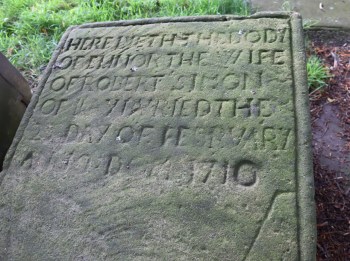
Ledger of 1710
The earliest graves that I have found are early 18th century, one of the earliest dating to 1710, although there may be earlier examples that I have not noticed, including some completely concealed by ivy. A number of examples from this period are ledgers, flat tablets that in this churchyard are usually carved from fine-grained yellow stone, often greyed with age, set horizontally into the ground, with large, simple text, and almost no decorative features. Later ledger stones were sometimes provided with small decorative embellishments.
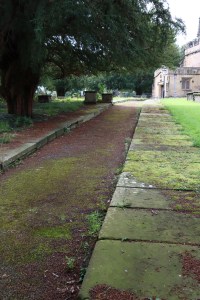 Some of the ledger gravestones flank walkways and paths, forming kerbs and revetments, such as the ones shown on the right that flank the main churchyard path. It is easy to forget that they are grave markers in their own right. This is apparently a particular feature of churchyards in Cheshire and Lancashire.
Other ledgers are laid between chest and table tombs, with which they are usually contemporary. Chest tombs are simply more elaborate versions of ledgers, with the horizontal slab raised off the ground, the space beneath enclosed with stone panels. Table tombs are also raised ledgers, but on four legs or on three cross-members. This raising of the ledgers may have been to create something more monumental, to provide more space for inscriptions where a grave is intended for more than one generation of family members, or to prevent the slab being encased in grass, moss, ivy and weeds.
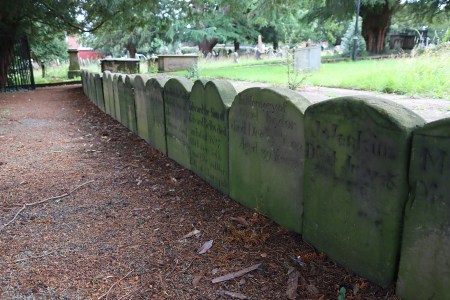
 Organized in a row alongside one of the paths, near the east end of the church, are the smallest (c.16in/ 41cm tall) upright grave markers. These are either footstones that have been separated from their corresponding headstones (only ever inscribed with initials and date if inscribed at all), or were purchased as gravestones by those with few means at their disposal. None have many inscribed details, and the one shown left, dating to 1778, is particularly minimalist, providing only the initials of the deceased, the year of death and the age at time of death. Others in the row are slightly more informative than this example but there is insufficient space for them to provide detailed information.

Red sandstone chest tomb (with decorative pilasters at each corner), sadly commemorating child deaths, just one month apart, of Robert Jones, aged 12, in July 1791 and Sarah Jones, aged 13, in August 1791, aged 13.
There are a number of chest tombs consisting of four stone panels with a ledger stone set on top. Chest tombs of all periods are merely monuments like gravestones, in the sense that they do not contain the burial themselves, but sit over the top of subterranean graves. There is something undeniably spooky about a breach in a chest tomb, but as Trevor Yorke says “Don’t be alarmed when you see a chest tomb with a cracked or missing side, a skeletal arm will not reach out to grab you! The body was always interred below the ground with the hollow interior empty.” Most are made of yellow sandstone, but there is one isolated chest tomb in red sandstone.
19th Century
Chest tombs are also a feature of the 19th century, and many of these are more elaborate than earlier forms and have side panels decorated by geometric shapes and small motifs.

Chest tomb dating to 1835, one of a kind within this cemetery

A yellow sandstone chest tomb with another sad inscription, commemorating the death of a 12 year old in 1846 and a 2 year old in 1849. These are by no means the only records of child and infant mortality in the churchyard. This grave later went on to house the children’s parents.

An elaborate chest tomb raised on feet and provided with a lid rather than a simple ledger, with decorated panels. The first-mentioned deceased was Bridget Hugo from Truro in Cornwall, who died aged 44 in 1820. It was used again in 1837 for the interment of Elizabeth Hugo, aged 88. Mother or sister?

A table tomb of 1879
Pedestal graves, essentially smaller square versions of chest tombs, also appear at this time. Like chest graves, pedestal graves could have inscriptions on more than one side. Some had inscriptions on all four sides, but others might have inscriptions on only one or two, depending on how many people were eventually interred and commemorated. The pedestal gravestone below is engraved on all four sides with the details of family members related to Timothy Parsonage of Wrexham, who were buried successively in 1811, 1817, 1831, 1839, 1872 and 1875.


Platform of stone paves, surrounded by railings, presumably the remnants of an elaborate monument.
Both chest and pedestal graves could be surrounded by iron railings in the 19th century, and there are several examples at All Saints’.
There are a couple of graves consisting of nothing more than sprawling platforms of paves with a higher raised section in the middle. It is very probable that the centre of the platform formerly supported some form of monument, now lost, possibly on a fairly narrow stand, such as a cross, that resulted in a fall when the platforms destabilized. Alternatively, there is a pedestal tomb on a similar platform, which could be an alternative arrangement, although it is more difficult to explain how such a monument could be lost, unless it was destroyed in a fall.


Headstone with kerb defining the area of the grave
The main 19th century cemetery is on the south side of the church and consists of tall headstones of the upright variety with an inscription on the main panel, a few decorative flourishes at the top, and sometimes an epitaph or other line of text at the base. On several of them the top of the headstone had been carved into a decorative sculptural component in its own right. These also contain introductory phrases and are often accompanied by religious symbols and motifs.
The area occupied by the body in front of the headstone could be demarcated with a stone kerb or a set of railings. Although it is difficult to tell because of the long grass, these seem to be confined to a relatively small number of graves, presumably because of the additional cost that would have been incurred. I noticed at Farndon’s St Chad’s churchyard that the plentiful kerbs accompanying headstones usually belonged to the early 20th century.
 Most of the headstones in this section of the churchyard were made of local sandstone, mainly superior fine-grained yellow sandstone, but a few, particularly towards the end of the 19th century, were also made of imported stone, such as rose granite, often highly polished to achieve a glossy surface, such as the 1891 coped stone shown below (interestingly one of the few to be inscribed in Welsh). Some were partially polished, with parts left unworked to provide contrasts in colour and texture, such as the 1908 example on the right. Similarly, some of the later grave stones combined different types of stone to draw attention to particular motifs or to highlight inscriptions. Colour inserts are unusual, but the headstone above includes a blue and white religious symbol, containing the letters IHS. These are usually interpreted as a Christogram, representing the first three letters of the name Jesus Christ’s in Greek, iota eta sigma. The H is the capitalization of “eta.”

Rose granite coped gravestone
Dotted amongst these more conventional 19th century headstones, and particularly popular in the Victorian periods, is the monumental grave stone, consisting of a large sculptural element supported on an inscribed plinth. Frequent types are crosses, angels and obelisks. One example, below far right, has a column on a plinth topped with the crucified Jesus on one side and Mary with the baby Jesus on the other, both protected by a roof. The relatively tiny cross at its base was dedicated to an infant.

The later 20th Century
At some point between the late 19th and early 20th century, highly polished imported black stone became desirable for gravestones. There are a couple of full-sized early versions of this stone in the Gresford churchyard, most of which have both polished and unpolished sections to create texture and contrast.
 As the 20th century proceeded, the same stone type was used to make tiny grave markers usually laid flat, with white or gold lettering. Because those commemorated by these stones are often within living memory of children or grandchildren, some of them may be visited and flowers often accompany them, real or artificial, a brightly coloured foil for the standardized lines of shiny black polished stone, quite unlike the earlier, upright headstones. Although very different from their monumental antecedents they give a sense of continuity from the 18th century.
Grave locations

The irregularly shaped churchyard
The wish for burial within a church or as close as possible to the church, demonstrated by the two 13th century examples in the north and south aisles of the church itself, was driven by the belief that proximity to holiness would confer some form of additional divine spirituality on the dead. The chancel, the east end section where the choir and high altar were located, was particularly desirable as a burial place. Throughout history, burial within church premises was reserved only for a limited number of people including senior clergy, those drawn from the upper echelons of society, and those who had provided financial support to the church. Others might be buried in private mausolea in their own premises, but most would be consigned to a churchyard or, later, a dedicated cemetery. The north side of a parish church was often the last to be used for burials, in some cases because the cemetery might have been used in early years for village community events, but also because it, or parts of it, were sometimes reserved for unconsecrated burials such as babies who died before baptism and suicides; but in some cases it appears to be simply because the darker north side was seen as less attractive and further away from the divine.
Designs and motifs in the churchyard

Elaborate monument to William Trevor Parkins, Chancellor of St Asaph, who died in 1908 and is also commemorated with a stained glass window in the church. His wife and son are also commemorated on the the monument.
Although gravestones were primarily used for recording details of the deceased, motifs, emblems and symbols were introduced in the late 17th century, and became popular in the 18th century, establishing memento mori and other themes as part of the language of the grave marker. Most of these helped to express ideas with which the deceased might wish to be connected, a visual reference to the connection between the living, the dead and the afterlife. The range of visual features in the Gresford churchyard is fairly limited, but they echo churchyard motifs in other local churchyards, suggesting that there was a limited range of ideas with which local people were familiar or felt comfortable, such as as crosses, floral motifs and the letters IHS that stand for the first three letters of the name of Jesus in Latin. Others are rather more specific, and convey a particular association, such as a cross showing the Star of David and a military grave showing the Canadian maple. If anyone can enlighten me about the multiple serpents wending their way through half-globes on the Celtic-influenced cross on the image to the right, the 1908 monument to William Trevor Parkins, I would be very grateful! There is a similar one in the Overleigh Old Cemetery in Chester.
Instead of looking at the limited range of symbols and motifs on gravestones at Gresford, a future post will look at some of these.
Challenges for grave architecture

Heavy central erosion to the headstone on the left; de-lamination of the sandstone of the headstone on the right, leaving a small part of the original surface containing the inscription in one corner
In all churchyards, some grave markers fare better than others, thanks to unavoidable natural processes. Most of the graves at All Saints’ are in good condition, and the churchyard as a whole is well maintained and cared for. Natural processes, however, can defy all attempts to conserve grave markers and there is no blame attached to this. The greater percentage of grave markers at All Saints’ are made of friable yellow sandstone, which is susceptible to damage by extremes of the weather, to the impact of concentrated dripping from trees and to the fumes from motor pollution. Some of this is mild erosion, some of it has rendered text illegible whilst leaving the basic form unharmed, but other cases are very severe, such as examples shown here, some of which have large patches resembling melted ice-cream, whilst others are suffering serious de-lamination.
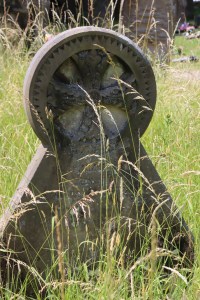 Like most rural churchyards, some of the churchyard is well manicured, and other parts of it have been left to develop a more natural feel. The dominant vegetation surrounding the 19th century headstones away from the trees is very tall grass, (very wet up to mid-thigh in some areas after rainfall – beware!). The tall grass appears to do little harm to the headstones, although it does inhibit visits to those gravestones, and the build up of foliage at the bases eventually creates topsoil that covers up inscriptions at the bases, particularly in the case of pedestals at the bottom of crosses, obelisks and similar statues, where text may be confined to the base of the monument.
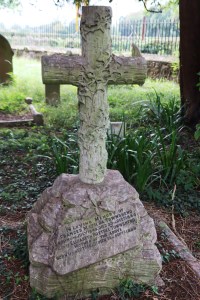
Carved ivy tendrils wrap around a rustic cross as real ivy on the ground just begins to encroach on the pedestal.
Under trees and in shaded areas invasive ivy does real damage, fastening itself to the stone, hiding inscriptions and, when removed, removes the friable surfaces of the stone. Ivy is very difficult to eradicate from an area once it establishes a network of roots, from which it sends out runners that in turn root themselves. It is resistant to just about every form of weed killer, even if that were desirable in a graveyard that strives to encourage a natural environment. One or two of the gravestones are carved with images of ivy spreading across their surfaces, which seems like an ironic acknowledgement of the inevitable blending of nature with death. The only way of dealing with it is to keep cutting it back when it it begins to climb the grave stones – a thankless and endless task!
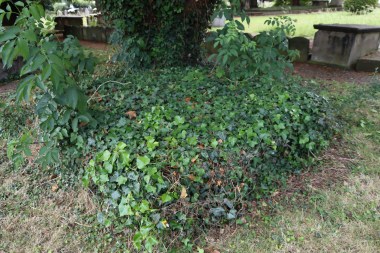
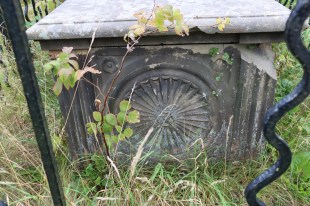
What appears to be one or more chest tombs, completely overrun and concealed by ivy.
A grave dedicated to Arthur Henry Leslie Soames M.C. and Légion d’Honneur, which had been partially hidden by ivy and other weeds, was uncovered in May 2018 by local historian Jimmy Jones, with the permission of the church. His account, and the before-and-after photographs used to be on the now defunct Wrexham-History website, and described how the central grave monument and a horizontal slab to one side were visible, but once the full monument was uncovered, a second slab on the opposite side was revealed, indicating that this was a family plot. This contributes to the biography of Arthur Soames, who died testing an experimental bomb for the army in 1915.
Moss is similarly invasive and destructive where conditions favour its growth and spread, and there are examples at All Saints’ where inscriptions on ledgers have been colonized and concealed.

Ledgers encroached on by moss as well as grass and lichen
Lichen is another natural invader of stone grave monuments, and is very difficult, if not impossible to tackle. Different types of lichen prefer different environmental conditions, so can be very widespread in a cemetery, even in the most cared-for sections. Where lichen spreads across inscriptions, it can obscure them completely, and it can eat away the friable surfaces grain by grain over the period of many decades, meaning that inscription, motifs and decorative features may be damaged, obscured or lost. It can also add to the more abrupt problem of certain types of sandstone de-laminating, which can eliminate big sections of text very suddenly.

Fairly minor lichen damage to a gravestone, dating to 1807. It has not completely obscured the inscription just yet, although the centre epitaph is illegible. but will probably become worse as time passes
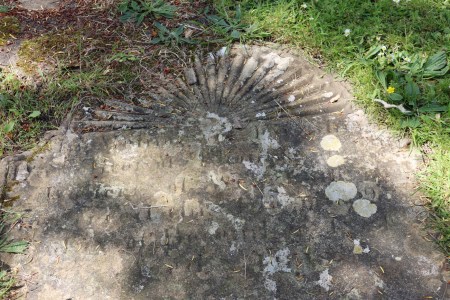
An example of damage inflicted on an inscription by a combination of weathering and lichen, making much of the the text, including the date, illegible.
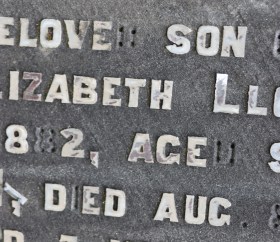
Lead lettering from 1882, some of which have parted company from the headstone leaving empty peg marks
A small number of the 19th century tombs were provided with lead lettering, hammered into peg holes in the stone. Some of the lettering has been lost from these grave stones, leaving behind some whole letters, some partial letters and some of the peg holes. Again, this is natural wear and tear over the centuries and in some ways it seems surprising that any of these lead inserts have actually managed to survive at all.
Some of the stonework of chest and table tombs has been damaged, with panels falling away and ledgers tipping to the side, but this is the usual wear and tear as trees grow and roots find new paths, and storms impose injuries.
Final Comments: The living, the dead and eternity
 Although there is some uniformity in the appearance of the churchyard, with certain forms, motifs and shapes being repeated, when you stand in the middle of it all, with the wet grass up to your knees, the great sweep of gravestones and monuments spreading to the limits of the churchyard provides a great sense of individual character and personal commitment. Each monument contains a fragmentary sense of how precious life could be. The inscriptions, whilst often fairly formulaic, also represent choices and decisions about what what best represented the interests of the deceased, the living and how this connected to belief in an afterlife. Churchyards are often places of sadness, but for a great many they also represented ideas of hope.
 The grave marker links the living, the dead and Christian belief in a relationship that, particularly when the text survives, may still be engaged with. Whoever made the decisions about the design of the grave marker, what stands out is how these inanimate objects, the material commemoration of the dead, reflect a wide range of understated emotional ideas a including love, commitment, devotion, fear, anxiety, grief and hope. Collectively they convey both the sadness that the living confront in death and the comfort they find in commemorating their lost loved ones. People find solace where they can.
If you want to find out more about the owner of a particular grave, the findagrave.com website is a terrific resource.
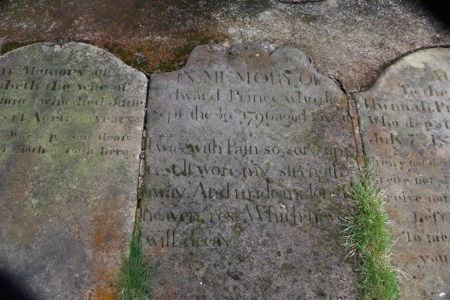
A ledger and inscription dating to 1796, describing the pain that the deceased suffered.
Sources:
Frisby, Helen 2019. Traditions of Death and Burial. Shire Library
Hayman, Richard 2019. Churches and Churchyards of England and Wales. Shire Library.
Heritage, Celia 2022. Cemeteries and Graveyards. A Guide for Family and Local Hstorians in England and Wales. Pen and Sword
Post, W. Ellwood 1962, 1974. A Concise Dictionary: Saints, Signs and Symbols. SPCK
Yorke, Trevor 2017 (2nd edition). Gravestones, Tombs and Memorials. Countryside Books
Websites:
Cemetery Symbolism
https://cemeterysymbolism.wordpress.com/

Interesting example of a chest tomb that has suffered de-lamination but where the carving of the inscription was so deep that even where it has de-laminated, some of it can still be read. The ivy is beginning to gain a foothold.
 Based in Churton