

Chirk aqueduct and viaduct on an old postcard. Source: History Points
Having engaged in a two-bridge extravaganza with a visit to the Cefn viaduct and the Pontcysyllte aqueduct via the footpaths in the Tŷ Mawr Country Park recently, I decided to complete the local big-bridge experience with the beautiful Chirk viaduct and aqueduct. The aqueduct (lower) and viaduct (higher) run parallel within a few feet of one another, high above the floodplain of the river Ceiriog. A towpath accompanies the LLlangollen Canal across the aqueduct, doubling as a footpath, giving great views over the viaduct and the valley below. Even better, the aqueduct and towpath vanish into a 1381ft / 420m tunnel under the hill. The railway, running alongside over the taller and slightly longer viaduct, does not vanish underground and carries on over the top of the hill, where there is a station. This was a short walk because I had an appointment elsewhere, although it didn’t have to be because once you are on the canal towpath you can simply keep walking in either direction until you feel that it’s time to get back to wherever you have abandoned your car.


Cleaning the Chirk aqueduct in 1954 showing the cast iron plates. Source: History Points
The aqueduct and viaduct, at different heights, seem like such a good pairing but they were not built at the same time, and nor were they designed by the same civil engineer or built by the same contractor.
The aqueduct was built to carry the Llangollen Canal, which was part of a complex plan, only partially realized, to connect north Wales to the large national canal network, about which I have already talked in detail on my post about the building of Pontcysyllte.

As typical with the Jessop and Telford partnership, the aqueduct had an innovative design. (https://www.pontcysyllte-aqueduct.co.uk)
As part of this immense canal project the Chirk aqueduct was built in 1801, four years earlier than the better known Pontcysyllte aqueduct. The aqueduct was a collaboration between William Jessop and the younger Thomas Telford, who had been hired to assist Jessop, but had proved himself an innovator in his own right, even though he had lacked canal experience when taken on. It is unsurprising, therefore, that the the aqueduct was an innovative design. The weight of the water and its traffic were carried on 10 masonry arches with hollow sections, and a water channel provided with a flat bed of iron plates, its brick sides sealed with hydraulic mortar. The successful deployment of iron plates inspired the construction of the even more innovative Pontcysyllte aqueduct. The canal travels under the hill via a tunnel to maintain its level, from where it parts company with the railway, which travels at a higher level than the aqueduct.

The railways came later than the canals, eventually replacing them as the primary form of transport, and the Chirk viaduct came 47 years after the aqueduct as part of this vast expansion and eventual domination of rail. The viaduct, designed by Henry Robertson who also designed the nearby Cefn viaduct, was built by Thomas Brassey for the Shrewsbury to Chester Railway in1848 (to whom a chapel is dedicated in Chester Cathedral). It was 710ft (220m) long and 70ft (20m) above the valley floor, with a total of 16 arches. Look out for the nice decorative niches at either end, the sort of flourish that demonstrated the pride with which such massive civil engineering enterprises were regarded. It must have felt as though they were changing the world, which they were.

The view from the aqueduct is mainly of the river Ceiriog floodplain, a vast grassy area. The Ceiriog runs to one side, like something of an afterthought. The vast expanse of green, although lacking any ooh-ah factor gives a real sense of how much land is being traversed by the arches, and how far above the ground level it is. And it’s a long way down! The peace seems so complete that a train suddenly rumbling so closely to the towpath is just a little disconcerting.


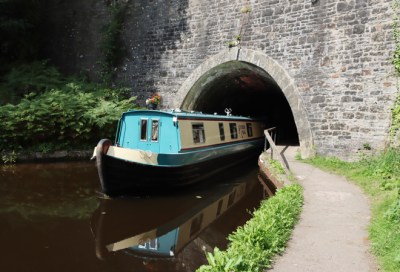
If you are planning to walk through the tunnel you absolutely must take a torch, but do note that you do not have to go through the tunnel to continue along the tow-path.


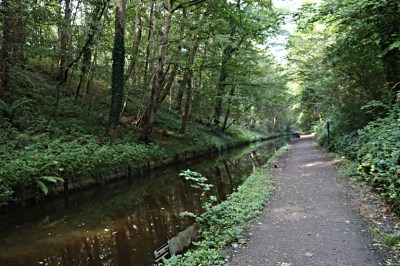
If you want to avoid the tunnel but proceed to the other side of towpath, stop at the information sign near the tunnel entrance. There’s a ramp up to the road, and you can walk the length of the tunnel over-ground (a couple of minutes along a quiet road) and rejoin the towpath on the other side. More about this over-ground route, and other visiting details, are below.

There’s a great view of the aqueduct from a viewing platform at the end of Station Road, if you walk back that way, and you can also reach it from the aqueduct side by going up the slope.


Visiting Details
 There are various options for parking, depending on how close to the bridges you want to be, and which side of the tunnel. You could park in Chirk itself or at the Chirk marina, for example, and head south towards the tunnel (the bridges are on the other side of the tunnel, north to south). Or you could park west of the bridges and head north, which means that you reach the bridges before the tunnel. I followed the latter strategy and parked in the small car park (10 cars max, no charge) actually on the towpath opposite Canal View, just before a very pretty canal bridge. Canal Way itself is on the towpath, but has homes along it and is strictly private parking. The photo of the information board above is fairly dismal due to the light and shade, but if you click it to enlarge it you should be able to make out the main parking areas, plus other features.
 If you park where I parked opposite Canal View, walk from the car park along the towpath, with your back to the road. If you park up and then cross the road on to the towpath opposite, you are going in the wrong direction. It’s a nice, stretch of metalled canal towpath through woods on either side, passing a couple of houses on the right. You will suddenly find yourself on the aqueduct over the Dee floodplain, with the viaduct running parallel a very short distance to your left. The tunnel is at the end of the aqueduct.
The towpath over the aqueduct has a nice safe railing with tightly woven wirework, preventing any chance of falling into the valley. Like Pontcysyllte, however, the canal trough has nothing on the other side. Those travelling by narrow-boat, kayak or canoe have a far more interesting time of it.

Signage on the towpath
I have mentioned that you do not have to walk through the tunnel to walk the full length of the canal towpath. When you reach the tunnel entrance (at both ends) there is a pathway up to a road that runs parallel, and another that runs back down to the towpath, so if you don’t fancy the pitch dark (no lighting unless you bring a torch), there is a perfectly viable alternative. I came from the Chirk Bank direction on the sign right, and vanished into the tunnel just after the You Are Here label and emerged with he blue arrow. I took the slope up from the towpath to the road, turned left across the railway and then right down Station Road, as far as the roundabout. Crossing the road at the roundabout, there is an excellent viewing point for the aqueduct (and a seat to sit on). Just to the left of the viewing point is the slope down to the aqueduct.
When you enter the tunnel, switch on your torch, and be prepared for drips from above even during fine weather. The towpath in the tunnel will let two people pass, and there is a handrail along the water’s edge. If you have small children you will probably want to go up to the road level instead, and rejoin the towpath on the other side of the tunnel because although there is a handrail to prevent adults falling into the canal, it is not a fence or barrier, just a handrail on posts. Dogs should be on a lead.
This is suitable for unwilling legs if you stick to the towpath because it is level all the way. If you want to avoid the tunnel and are up for some gentle slopes, the two ramps up from the towpath to the road should be okay and the roads themselves are on the flat.

 Based in Churton
As always you manage to dig up interesting places that many would just bypass, thanks Tony x Aberdfyi now J’burg South Africa
LikeLike
How super to hear from you. What are you doing in J’burg?
LikeLike