

Both sides of the broken sherd
For anyone new to this occasional series on objects extracted from my garden during everyday gardening activities, see the History in Garden Finds page. These are not objects used in the garden, but objects, usually fragments, lost or disposed of in the garden and found during digging, troweling and planting.
This maker’s mark, crossing all three sherds, was a happy find for me, because although we have dug up tons of broken china from the garden (which is in Churton, a few miles south of Chester), all of it interesting in its own way, few of the manufacturers can be identified. This piece, with a company trademark on one side and part of the pattern on the other, contains the name both of the manufacturer and the design.
Re-assembled, the original sherd is 9cm long and 3.5cm wide. The potter’s mark is split over three broken pieces. The clean breaks and pure what fabric that divided the sherd into three means that it was broken when one of us found it whilst gardening, with spade or pick-axe, straight through the middle. Fitting the three pieces together to form a single piece leaves the much grubbier original break around the former edges. The spidery cracks in the glaze, called crazing, have also allowed the garden earth to seep into the fabric.
Flip it over, and there are parts of the floral pattern on the reverse, a deliberately blurred design referred to as “flow blue,” about which more below. Interestingly, the other images I have seen of this particular design, “Forget Me Not,” are not in flow, but are very clearly delineated, as shown in the example further below, where the design is in green.
 What are we looking at in the manufacturer’s mark? Starting at the top is a crown sitting over the top of a Staffordshire Knot. This knot is a traditional symbol of Staffordshire and the town of Stafford, first used by the Stafford family in the 15th century. The words within the circle read “England’s S.W. Dean Burslem,” which encircle a seated greyhound, part of the company’s trademark, and damaged with dark scratches in this piece. In the banner (or swag) below this, and illegible here, this clearly reads on other examples “Royal Semi China” and beneath that is the design name “FORGET-ME-NOT” and the manufacturer’s registration number: RºNº350600. This mark is much clearer in the example shown below, which shows the same design applied using a different technique.
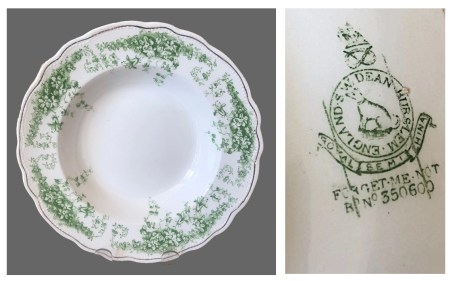
Green version of the S.W. Dean Forget-Me-Not pattern and trademark. Photos by Letsgoexplorin64 Source: Etsy.
S.W. Dean of the Newport Pottery, Burslem, in Staffordshire was the manufacturer. Samuel Webster Dean had been the chairman of ceramics manufacturer in Edge, Malkin & Co., which started life as Cork and Edge in Burslem, making teapots and operated from 1846 to 60) before going through various changes in partnership. When it closed in 1906, Dean declared an interest, and eventually took over the company in 1909, renaming it S.W. Dean. The greyhound at the heart of the maker’s mark was carried over from Edge & Malkin & Co, which had used it between 1873 and 1903. The new company still operated out of Burselm at the Newport Works, and its products were probably sold in a number of retail outlets. The company also appointed agents to sell its products at sales events in hotels in major cities, probably for bulk sales into retail and export. In the advert below an event at the Holborn Viaduct Hotel in London as announced. There are examples of the type of products that the company produced on the A-Z of Stoke on Trent Potters website. S.W. Dean ran into financial problems very quickly, and Samuel Dean was declared bankrupt in June 1910. Although the advert below mentions an export market, it seems unlikely that there was sufficient time for this to get fully underway before the company closed.

Advert from the Pottery Gazette of October 1908. Source: A-Z of Stoke On Trent Potters
Later in 1910, S.W. Dean was in turn purchased, and a new company was registered by J.D. Kerr. Kerr clearly thought that the Dean name had enough brand recognition amongst potential purchasers of the ceramics to retain the name, because the new company became Deans (1910) Ltd. A greyhound was retained in the log, but was on all fours, instead of seated, and was shown standing on an open crown.

The pattern side, showing the Forget-Me-Not design
The style and technique used on this pottery is called flow blue, and is a form of transferware. Transferware is a very swift way of transferring a design to the surface of an object. A copperplate engraved with the required design was inked, in this case with deep blue cobalt oxide, and pressed on to paper that, while still wet, was in turn pressed on to a ceramic surface. The design left on the piece of pottery is the transfer. With a complete object, the overlap between the transfers is usually visible as a seam, but this piece is too small to show this. The process speeded up the process of decorating ceramics, making them much less expensive to produce than hand-painted wares, permitting mass production, and creating cost-savings that were passed on to the customer.
The particular characteristic of flow blue is the appearance of blurred edges, giving them a soft and blousy look, quite unlike the precision of the green example of the same design above. When the pot was ready for a second firing, after the transfer design had been fixed into place, a flow-powder was added to the kiln. A typical mixture was 22% salt, 40% white lead, 30% calcium carbonate, and 8% borax, but there were variants. This gave off a chlorine gas which caused the cobalt in the transfer to diffuse into the glaze, creating the flow effect and the intense blue glow.

The Newport Works in Burslem, Staffordshire, where S.W. Dean’s pottery production was based. Source: A-Z of Stoke On Trent Potters
Flow blue appears from about 1830. Whether the effect was originally accidental or deliberate, it soon became very popular, first in the U.S., exported from Staffordshire factories, and later in Britain’s own households. During the Napoleonic Wars of 1803-15, the U.S. had become Britain’s most important export market until the onset of the American Civil War in 1860. The Registration of Design Act of 1842, which prevented factories from copying each others patterns without permission, resulted in new patterns, and sometimes specialization in particular types of design. By the mid 1800s British manufacturers were producing a variety of different genres, including more traditionally Victorian rural, garden and specifically floral designs, many of them very romanticized. The forget-me-not is a good example of a flower chosen because of its popularity in Victorian gardens and poems.
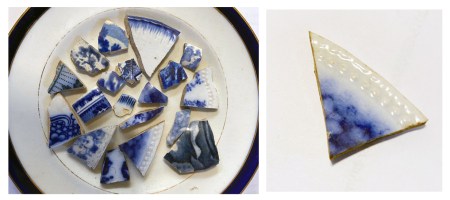
Flow blue from the garden, with the forget-me-not sherd both centre bottom on the plate, and on its own on the right
A lot of flow blue has come out of the garden, but nearly all of it in very small pieces. A sort through them has only found one piece that is consistent with the Forget-Me-Knot design, a very thin rim piece, much thinner than the pieces shown above. It may or may not come from the same item, perhaps thinning towards the edge, but it could also be a sherd from a different part of the same set. Some of the other pieces of flow blue display a characteristic feathering along the rims of ceramics, none of these gilded, although many feathered edges were. Those shown here are a selection of the bits pulled out of the garden, including the Forget-Me-Not rim piece.
Other object histories from my garden can be found
on the History in Garden Objects page
Sources:
Books and papers
Neale, G. 2005. Encyclopedia of British Transfer-Printed Pottery Patterns 1790-1930. Miller’s
Websites
The A-Z of Stoke On Trent Potteries
S.W. Dean
http://www.thepotteries.org/allpotters/347a.htm
The Glossop Cabinet of Curiosities
The Rough Guide to Pottery Pt.5 – Blue and White Bits.
https://glossopcuriosities.wordpress.com/2022/09/15/the-rough-guide-to-pottery-pt-5-blue-and-white-bits/
HobbyLark
Flow Blue: History and Value of Blue-and-White Antique China, by Dolores Monet, December 23rd 2022
https://hobbylark.com/collecting/FlowBlueHowtoIDandValuetheCollectibleBlueandWhiteAntiqueChina
House of Brinson
Transferware and Flow Blue
https://houseofbrinson.com/2021/04/28/thoughts-on-transferware-and-flow-blue/#:~:text=If%20you%20see%20a%20blue,were%20widely%20sold%20in%20America.


Another very informative post Andie. I didn’t know blue and white could be so interesting.
LikeLike
I was truly surprised when we started digging bits of ceramic out of the garden to find how much there was to say about it, even with just a few clues. Mostly it’s about finding out about the genres and styles (like flow blue or willow pattern) unfolding in the form of tiny broken sherds, but having a maker’s mark was a real treat. I am so glad that you found it interesting.
LikeLike
Where do you get all this information, and still have enough time to eat. WB.
LikeLike
Truth is, when I inspected all the exciting options on my list, for which I had done that massive shop, didn’t fancy a single thing so I had an uitsmijter instead. Amazing what you can achieve when you snack instead of cooking!
LikeLike