

The southeast tower of Edward I’s 1277 Flint Castle on the Dee estuary, complete with modern viewing platform at the top, reached by a modern spiral staircase. My photo.
This post started off as a modest little piece about Flint Castle accompanied by some nice photos (now posted here), with the intention of following up with other posts about Rhuddlan and Hawarden castles (all three started by Edward I in 1277). It quickly became clear that the background history that lead up to the establishment of Edward I’s castles in northeast Wales in such quick succession was far too complicated (and interesting) to condense into a couple of paragraphs. All three castles deserve context, so before posting about each castle in turn, this post looks at the complicated relationship between England and Wales that led to Edward’s ambitious and enduring Welsh castle-building programme. This is inevitably a wildly simplified story, focusing on only the key players and either ignoring or fuzzing over those details of English and Welsh history that have no or little bearing on the story of Llywelyn ap Gruffudd’s ambitions, Edward I’s debts and the resulting construction of Edward’s castles in Wales.
On the English side of the story, the royal succession of Henry III and Edward I is very straight forward, although marriages and changing aristocratic loyalties during this period are often a cat’s cradle of shifting allegiances. On the Welsh side, there are an awful lot of Llywelyns, Grufydds and Dafydds, particularly in the next few paragraphs, not only because sons were often named for their fathers and other male relations, but because their last names were the first names of their fathers. Hence, Llywelyn ap Grufydd means Llywelyn son of Grufydd and Grufydd ap Llywelyn means Grufydd sone of Llywelyn. Hopefully the family tree below will help with the potential confusion of similar Welsh names, and will also indicate which English and Welsh generations are contemporary. In purple is the Welsh male line at the heart of political dispute. In grey is the English line of royal inheritance. Other colours are used to show others who are connected to these lines.

Ancestry of Llywelyn ap Grufydd, also known as Llywelyn the Last (shown at centre, lowest level). Key players in the Edward I’s castle expansion into Wales are outlined in red. I have missed off Henry III’s wife (and Edward I’s mother), who was a French noblewoman, Eleanor of Provence (d.1291).

Henry III at his coronation. Source: Wikipedia
In the next few paragraphs I have also colour coded the generations of the Welsh players in the text immediately below to indicate generations. Llywelyn ap Iowerth (Llywelyn the Great) the Great is purple, the next generation is green and their children, including Llywelyn ap Grufydd (Llywelyn the Last or II), are orange.
Between 1218 and 1240 peaceful relations had been established and were maintained between Llywelyn ap Iowerth (Llywelyn the Great) and Henry III, but the situation deteriorated after Llywelyn the Great’s death. Llywelyn the Great died in April 1240 of natural causes, leaving two sons, his legitimate son Daffydd ap Llywelyn by his English wife Joan and his illegitimate son Gruffud ap Llywelyn by Tangwystyl. Llywelyn the Great had disinherited Gruffud ap Llywelyn in 1220 to ensure that Daffydd ap Llywelyn would succeed him, an arrangement that was rubber-stamped by the Pope, thanks to the intercedence of Henry III. When Dafydd ab Llywelyn inherited his father’s seat, Henry re-organized.

Llywelyn the Great on his deathbed, with his sons Gruffydd and Dafydd in attendance. By Matthew Paris, in or before 1259. Source: Wikipedia
Dafydd’s disinherited half brother Grufydd ap Llywelyn was handed over to Henry III for imprisonment in the Tower of London, together with his son Owain, to prevent any attempt to oust Dafydd and destabilize Gwynedd, and Dafydd’s own rights were severely curtailed. Grufydd died at the Tower in an escape attempt in 1244.
Frustrated by his lack of freedom, Dafydd formed an alliance with other Welsh leaders against Henry III. In 1245 Dafydd died of natural causes in 1246, but his sons continued the dispute until 1247 when the Treaty of Woodstock re-established peace. Dafydd had died without an heir, and Grufydd’s four sons inherited Gwynedd, all that was left of Llywelyn the Great’s legacy. This fragmentation of power suited Henry III perfectly. Under Welsh law, the land could have been divided four ways between the sons, and inevitably became the source of ongoing dispute. In the short term most of Gwynedd was divided between two of Grufydd’s sons: Llywelyn ap Grufydd (Llywelyn the Last or Llywelyn II) and Owain. A third brother, Dafydd, was also a minor beneficiary.
The Treaty of Woodstock came with a price to Gwynedd, which was required to make a provision of knights and foot soldiers to England and, most wounding, to relinquish the vast area of northeast Wales known as the Perfeddwlad (the Four Cantrefs), which lay between the Dee and Conwy rivers. Henry must have hoped that this would provide him with a permanent foothold in Wales. He passed the Perfeddwlad to his son Edward, and built two new castles to protect his territory at Dyserth (northeast of Rhuddlan) and Deganwy (just north of Conway). The remainder of Gwynedd was divided between Llywelyn the Last and Owain ap Gruffudd, with a promise to re-divide Gwynedd when Dafydd ap Gruffudd came of age.
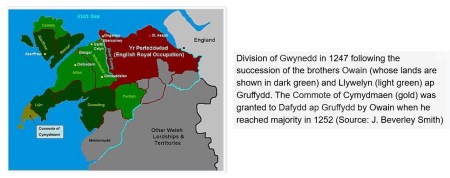
Map showing north Wales immediately after 1247. Click to enlarge or see on the following page. Source: Wikipedia
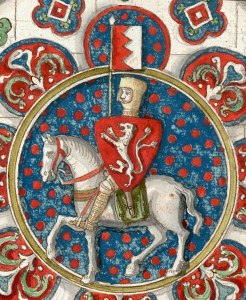
Drawing of a stained glass window in Chartres Cathedral showing Simon de Montfort. Source: Wikipedia
At the same time Henry III’s interests in what is now France were under review, and brought Simon de Montfort, who later had an important role in Welsh history, into the picture. Simon de Montfort, earl of Leicester had been appointed guardian of Henry’s duchy of Gascony in what is now France in 1248, a position of enormous trust and responsibility. de Montfort was married to King John’s daughter, Henry III’s sister Eleanor, reportedly a love match. Unfortunately, Simon de Montfort was ill-suited for a task in which diplomacy rather than brute force was required, and when conflict broke out in Gascony, covertly supported by Alfonso X of Castlile (now part of Spain), de Montfort responded not with negotiation but with military might. The way out of a rapidly escalating situation was to come to reach a diplomatic compromise with Alfonso X. In return for Alfonso X abandoning any claim on Gascony, a marriage was arranged between Alfonso’s half sister Eleanor and Henry’s son Edward, a condition of which was that Henry would endow Edward with lands worth £10,000 annually. Edward and Eleanor were married in November 1254 and Edward found himself master of Gascony, all royal lands in Ireland, the earldom of Chester, Bristol Castle, manors in the Midlands and, significantly for this story, all the royal lands in Wales. Edward, continually finding his independence squashed by Henry, was still subject to the king’s will in these territories, but they gave him a sense of purpose.
——–
The rise of Llywelyn the Last
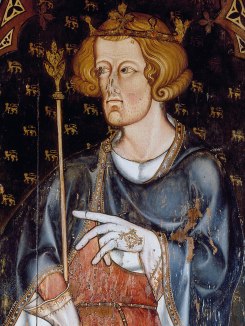
Edward I, from Westminster Cathedral. He was known as “Longshanks” and when his body was exhumed in modern times for research purposes, it was confirmed that he was 6ft 2″ (1.8m) tall. Source: Wikipedia
Wales remained subjugated and relatively unproblematic for the English until the three brothers who had inherited Gwynedd, came into conflict with each other. Llywelyn ap Grufydd (Lywelyn the Last / Llywelyn II) emerged triumphant and proceeded to take over the entire of Gwynedd. His success appears to have given him him confidence to sent up to Henry III. In November 1256 Llywelyn advanced on and took the Perfeddwlad (the Four Cantrefs), besieging Henry’s castles at Deganwy and Dyserth. Financial constraints prevented Edward from assembling an army immediately, while Llywelyn was gathering supporters by returning lands to the dispossessed. Now at full steam, he headed south on a land grab from the powerful Marcher lordships that straddled the English-Welsh borders and had taken over much of south Wales. Edward, with castles in Carmarthen and Cardigan, now sent an army, which Llywelyn eliminated with ease in June 1257. A second army was sent by Henry and Edward, which met the Welsh in north Wales in August 1257. Initial English successes were reversed by the failure of supplies to arrive to sustain the English, and Henry retreated, taking the army with him. Llywelyn had won the latest fight for control in Wales, and Edward was yet again frustrated by his father’s lack of support, a recurring theme in the relationship between the king and his son.
By March 1258, Llywelyn’s triumphs had earned him great popularity in Wales and gave him the confidence to style himself Prince of Wales. His triumph over some of the Marcher territories, however, pushed those aggrieved earls to align with Edward’s interests, and whilst Llywelyn was still congratulating himself, trouble was brewing at his new borders. Edward, in the meantime, was raising money by mortgaging some of his properties to the wealthy Marcher lords, and in doing so gained some independence from his father. Both Edward and Llywelyn were able to take a breather and reinforce their positions whilst Henry III was again struggling with his brother-in-law, the clever and slippery Simon de Montfort, this time accompanied by some of his most powerful peers. Initially, this was handled diplomatically, and the outcome was the remarkable Provisions of Oxford of 1258, a form of bloodless coup that created a council of 15 to mitigate the power of the king, reinstating some of the principles of the Magna Carta. Whenever the king’s seal of authority was used, it was only when the council of 15, or parliament, had agreed. At the same time, Henry was engaged in establishing long term peace in France, negotiating the Treaty of Paris, in which he withdrew his claims to Normandy, Anjou, Poitou and Maine, whilst securing Gascony.

Seal of Henry III. Source: Wikipedia
Edward, eternally frustrated by his father’s refusal to share his ambitions, found something of a kindred spirit in Simon de Montfort, not least in their joint opposition to the Treaty of Paris. The treaty was dependent on the agreement of Henry’s sister, de Montford’s wife, and this was withheld until December 1259, when de Montfort eventually relented. Whilst Henry was safely away in France, Edward and de Montfort attempted to hijack the annual council, in spite of Henry’s specific instructions that the council should await his return. It looked as though war might break out, prevented only by Henry’s return to England. Edward’s authority was stripped from him by his father, and de Montfort was imprisoned pending trial.
Attention was soon focused elsewhere however, when in 1260 Llywelyn, impatient of the delays and determined to gain English recognition and promises of security for his position, attacked the royal castle at Builth in Powys and annihilated it. It was a very risky strategy, and could have led to English invasion. Indeed, Edward was poised with an army in Chester for precisely this task. Llywelyn was lucky. Henry III called off the attack, and a two year ceasefire was put in place. Edward was furious and drew closer to Simon de Montfort. Together, they approached the earl of Gloucester and in the October of 1260, they mounted a bloodless coup against Henry III and took over the parliament. When peace was re-established, however tensely, Edward departed for France, apparently to recruit followers. Henry III, meanwhile had been scheming and in 1261 received a letter from the pope that allowed him to dissolve the Provisions of Oxford, and with it the council. All the much-needed reforms that had been introduced were swept aside.

Arms of the lords of Gwynedd. Source: Wikipedia
Whilst English politics were continuing to unravel, Llywelyn was on the simmer again, frustrated that the two year truce had been not been replaced by a permanent peace and recognition of his position. In particular, he was nursing a sense of betrayal that lands in south Wales granted to him in the truce were being attacked by the Marcher lords. In 1262 Llywelyn was on the march, and was soon claiming new territories in the far south. It is difficult to imagine what Llywelyn thought he could possibly achieve by antagonizing some of the most powerful and independent lords in the land, but author Marc Morris suggests that he may have seen a copy of a letter written by Henry III that stated that the truce was a mistake and that lands ceded to Llywelyn, at least for the duration of the truce, should be recovered by the Crown. The letter exists, could have been shown to Llywelyn to make mischief, and would certainly provide a plausible explanation for Llywelyn’s offensive.
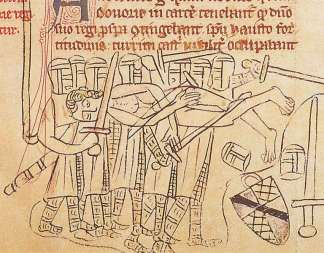
The death of Simon de Montfort. Source: English Heritage
By the time that Edward returned, accompanied by French knights, the Marcher lords and those disaffected by Henry III’s cancellation of years of reform had reached breaking point. Henry was unrealistic if he thought that the nation would sit by and watch him restore his unfettered and unpopular rule. The Marcher Lords turned to Simon de Montfort who was in exile, but returned in April 1262 to lead them. They gathered in Oxford to renew their commitment to the 1258 Provisions, warning that anyone who failed to follow suit would be in the line of fire. This message was directly primarily at Henry III. They were refused and, fully prepared, now launched into open armed rebellion. The royal family were defeated and submitted in London in July 1262. Unfortunately, Simon de Montfort was better at leading rebellions than running a country, and in spite of the council being reinstated, political and social chaos followed. The king of France was brought in as an arbitrator, and ruled in favour of Henry III, determining that the Provisions should again be set aside, but this failed to satisfy the rebels, and resulted in outright war. It was by no means a foregone conclusion who would win, and in 1264 it looked as though de Montfort was teetering on the edge of triumph after the Battle of Lewes. In 1265, however, at the Battle of Evesham the royalists overcame de Montfort’s armies, and de Montfort himself was killed.
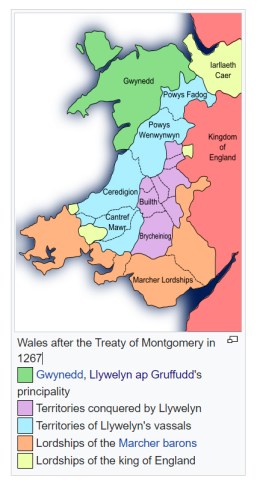
Wales after the Treaty of Montgomery in 1267. Source: Wikipedia
Llywelyn took advantage of the chaos to resume hostilities in support of his own ambition, retaking the Four Cantrefs in 1263, and in the process destroying Henry III’s castles of Deganwy and Dysterth. Amongst many other mistakes made by de Montfort was the formation an alliance with Llywelyn, formalized in the Treaty of Pipton in June 1265. Although Simon de Montfort was defeated and killed in battle only weeks after the treaty was signed, Henry III was advised to honour the Pipton agreement in the Treaty of Montgomeryshire in 1267. This not merely achieved peace, but also secured a significant financial contribution from Llywelyn for the privilege. With the principality of Wales now formed, Llywelyn the Last was officially recognized as Prince of Wales, with the right to homage of all the Welsh lords, and became a vasal of the king. It was the first time an English king had recognized a Welsh prince as Prince of Wales, but the cost to Llywelyn’s estates was a massive 25,000 marks (£16,666.00) payable in instalments. The National Archives Currency Convertor estimates that this figure is equivalent to £12,000,000 in today’s money. He was also required to settle land on his brother Dafydd.
Unsurprisingly, although Llywelyn had made his peace with Henry, the Marcher lords were not so sanguine about the land that they had lost in the negotiations. In particular the powerful Marcher lord and earl of Gloucester, Gilbert de Clare, was angered by the loss of land in Glamorgan, and in 1268 went into what were now Llywelyn’s territories and began to build a castle. Concerned that this blatant act of defiance would undermine the Treaty of Montgomery, Edward returned to the negotiating table, and ruled in Llywelyn’s favour. It would have been difficult to have done anything else, given the terms of the treaty.
Edward left on crusade in 1270, leaving Wales in the care of trusted caretakers, visiting the formidable French castle Aigues-Mort, which made a considerable impression on him. Back in Wales, with the treaty backing his position, Llywelyn entered Glamorgan in 1271 and destroyed de Clare’s castle, reclaiming his land. He reckoned without de Clare who, in spite of the ruling, took advantage of Edward’s absence and responded in kind, retaking the land and making a new start on the great castle of Caerphilly. Other Marcher lords, who must have been watching with interest, began to snatch bits of their own former territories back from Llywelyn, matters made easier by Edward’s absence on crusade and in Gascony until 1274 and Henry III’s apparent apathy on the matter. Edward’s English magnate caretakers were far more sympathetic to the Marcher lords than they were to Llywelyn, and stood by whilst the Treaty of Montgomery was violated.
————–
The ascent of Edward I and the decline of Llywelyn
Edward’s two year absence in a somewhat abortive crusade took place only after he had raised the finance for the expedition, with great difficulty. Henry III died on 16th November 1272 at the age of 65. Having narrowly survived an assassination attempt, Edward returned without haste, pausing to resolve issues in his Gascon estates, arriving in England on the 4th August 1274. His coronation took place on the 9th August 1274.

Coronation Throne of Edward I. Source: Westminster Abbey
One might have thought that with Edward’s return, Llywelyn would have had half a chance of arguing for the enforcement of the Treaty of Montgomery and the restitution of lands that had been awarded to him under that treaty. Instead, Llywelyn’s response to Edward’s return led not to resumption of the status quo but to renewed conflict between the two. Author Marc Morris puts this down to the state of the finances of both parties. Llywelyn had paid 5000 marks of his debt of 25,000 marks (£16,666) from the Treaty of Montgomery, and the rest was payable in annual instalments of £3000 a year, which was far more than the Welsh economy could generate, even without Llywelyn’s own costs as ruler of Wales. He had stopped paying in 1271, in violation of the treaty, and was three years in arrears by the time of Edward’s coronation. Letters to Llywelyn in 1272 demanding a resumption of payments failed to achieve this objective. As a matter of pride, he said that the stoppage in payments was for political reasons, rather than poverty, and he may indeed have felt some justification due to the violations of the treaty by the Marcher lords. Attending the coronation would have put himself in the position of having to answer directly to Edward for the outstanding money, and Llywelyn clearly decided not to run the risk. He did not attend the coronation.
Edward had his own pressing financial problems. He needed the money owed by Llywelyn to pay off his own debts, incurred mainly during his crusade. When Edward called Llywelyn to court to pay homage to him as the vassal of a newly appointed, and Llywelyn declined to appear, he realized that this source of income was in jeopardy, and that the peace with Wales might also be under threat. Although Edward could muster an army, it would have been costly, and such an outlay was something he must have been keen to avoid, particularly as it would have been difficult to enforce the repayment of the debt. A diplomatic solution was more attractive, and might see the resumption of payments, even if the sum was lower than had been originally agreed.
A planned meeting between the two in Shrewsbury had to be cancelled when Edward became ill. No-one will ever know for sure if Llywelyn would have turned up, but in the light of later events it seems unlikely. At the same time, Llywelyn’s popularity within Wales was on the wane, and he discovered that he had become the target of a well organized plot to remove him from power. It was led by his brother Dafydd, with particular support from Grufydd ap Gwenwynwyn, lord of Powys. Dafydd was a permanent source of simmering resentment against his brother’s rise to power at his own expense. The lands allocated to him in the Four Cantrefs had clearly not satisfied him. It was not the first time that Dafydd had switched sides, and it would not be the last. Realizing that Llywelyn had discovered the plot, both Grufydd and Dafydd fled to England, where requests for their return to meet Welsh justice were rejected. In 1275, Edward again made arrangements to meet Llywelyn, this time in Chester, where Llywelyn could make the required homage and discussions could begin. Again, he chose a border town that would have been easy for Llywelyn to reach. Llywelyn was near the border when he wrote to refuse the meeting, saying that he felt unsafe in England, which now housed those who had plotted against him. A week later Edward left Chester, angry both at the slight and the waste of his valuable time, but was still reluctant to force the issue and put peace in jeopardy.
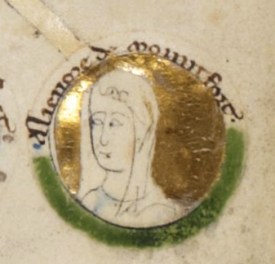
Eleanor de Montfort, daughter of Simon de Montfort and, from 1278, Princess of Wales. Source: Wikipedia
It was Llywelyn who tipped the balance. Single, and aged 50 years old, with no son, and with the treacherous Dafydd as his heir, he decided in 1275 to get married. He had left it late, but he might have had the choice of the best Welsh families for a bride. Instead, he chose an English one, and his choice seems reckless in the extreme, as it was certain to upset and infuriate Edward. It did. Llywelyn’s chosen bride was none other than Simon de Montfort’s daughter Eleanor. The earl of Leicester, Simon de Montfort, once Edward’s friend, had become his enemy prior to his death at the Battle of Evesham. Perhaps Eleanor’s connection to the English royal family as the niece of Henry III, by marriage, gave Llywelyn dynastic pretensions. Whatever the reasons for the marriage, Eleanor, living in exile in France, was en route to marry Llywelyn when agents captured the ship in which she was travelling, and took her to Edward who kept her captive in Windsor for three years. Llywelyn’s lack of judgment is difficult to explain. Edward lifted restrictions on the Marcher lords regarding the lands taken by Llywelyn in the Treaty of Montgomery and gave Llywelyn one final chance to pay homage in Westminster, at the annual parliament. Llywelyn, for the third time, failed to appear. In spite of Llywelyn’s offers and demands, peace was at an end, and war was inevitable.
In 1276 Llywelyn was declared a rebel and early in 1277 Edward’s war machine had started up and was on the move, spreading from Carmarthen in the south and Chester in the north. To undermine Welsh resistance, permission was given to the Marcher Lords to reclaim territories that they had lost. Edward himself, arriving in the frontier town of Chester in July 1277, complete with 800 mounted knights, ships carrying 700 sailors and over 3000 foot soldiers, prepared for war against the prince. Chester, loyal to Edward, provided a convenient launch-pad for the invasion, With very little delay, Edward took his army into Gwynedd. At Rhuddlan, his infantry was joined by another 12,000 soldiers, although by August, possibly because they were dismissed due to supply chain issues, only half remained.

Map of the Welsh Cantrefi. Source: Wikipedia.
During the campaign, Edward initiated his castle building programme, starting at Flint in June 1277, with Rhuddlan and Hawarden following soon afterwards. During previous encounters, Edward had found that his main bases of influence, from which military action could be initiated, were insufficiently close to the Welsh border. These included, from north to south, Chester, Shrewsbury, Montgomery and Hereford. Whenever the armies of Henry III or Edward I marched, they found themselves isolated from their home bases. Part of Edward’s strategy was to build bases on the edge of Welsh territory, and the within it, and to ensure that there were good lines of communication between these bases, all the way back to the English centres of power. Edward’s vision was that castles were only as strong as the network that connected them, and that these castles should serve him not merely during times of war, but at all times. Of the first of the new ring of castles, only Builth could not be reached by sea.
The priority at Flint in its initial phase was to create a road from Chester to the site, and surround the site with enormous ditches that could be defended. Although the castle was accessible by water, from both Chester and the coast, and at a push by foot across the tidal sands from the Wirral, Edward wanted to be able to access his new castle without unnecessary risk on horse and foot, and accordingly ordered the construction of a wide road from Chester to Flint. Flint was to be Edward’s first permanent foothold in north Wales, and there were to be no difficulties with either access or communication. Castles at Rhuddlan and Hawarden soon followed, and the Flint road was extended in to reach them. My post looking at Flint Castle in more detail is here.
Llywelyn, with perhaps 300 mounted men, and nothing in the way of a naval fleet, was vastly outnumbered. After losing the Four Cantrefs, he retreated to the mountains of Snowdonia, intent on using the terrain and guerrilla tactics to counter Edward’s advances. But Edward had learned from his previous experience in Wales in 1257. Llywelyn slowed Edward down, but he could not turn him back, particularly when Edward’s ships cut off the island of Anglesey, and with it Llywelyn’s primary source of grain. The grain not only denied Llywelyn his primary source of feeding his troops, but also provided Edward with the resources he needed to feed his own army.

Llywelyn at last paid homage to Edward, and here is shown sitting to the left of the king’s throne, with Alexander of Scotland at the king’s right.
Llywelyn submitted in November 1277 and Edward left the field and returned to Rhuddlan (shown below) where his second new castle was being built, also started earlier in 1277. The Treaty of Aberconwy of that year swept away Llywelyn the Last’s principality, leaving him with Gwynedd and his now somewhat meaningless title of Prince of Wales. Daffyd was rewarded for his loyalty to Edward with a small territory comprising Rhufoniog and Dyffryn Clwyd, two inland cantrefs of Perfeddwlad (the Four Cantrefs), which he considered to be small recompense given his ambitions to take over at least part of his brother Llywelyn’s principality. Edward retained the other two of the Perfeddwlad cantrefs, Rhos and Tegeingl, both on the coast. Flint, Rhuddlan and Hawarden castles together would protect the invaded territories in northeast Wales, replacing Henry III’s castles of Deganwy and Dyserth, destroyed by Llywelyn in 1263. On Christmas Day in Westminster Llywelyn at last made homage to Edward. It must have been a bitter pill.
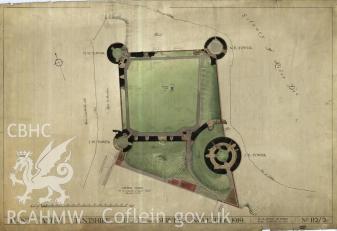
Plan of Flint Castle. Source: Coflein
The castle building project continued unabated, whilst Flint and Rhuddlan castles became both administrative hubs and new royal towns (bastides), as well as military outposts, providing a much-needed link between Chester and the more distant outposts that were next on Edward’s ambitious agenda. At a recent tour of St Werburgh’s Cathedral in Chester, cathedral expert Nick Fry explained that at least some of the stone masons had been removed from work on the St Werburgh’s (at that time a Benedictine monastery) to work on Edward’s castles, delaying modifications to the cathedral for a considerable period.
The idea of establishing towns around castles, allocated considerable commercial privileges as incentives to English traders, was an idea adopted from Gascony, where Edward had already founded a number of new defended towns, known as bastides. These reinforced the network of castles with economic as well as military foundations, and established enclaves of English commerce and tradition within Wales. Flint and Rhuddlan were two of the earliest examples.
Edward was sufficiently convinced by Llywelyn’s apparently passive response to the Treaty of Aberconwy to release Eleanor in 1278, to permit the marriage to go ahead, and to pay for the marriage feast in Worcester. In spite of these promising signs, matters deteriorated between the two. In particular, Llywelyn’s claims over a territory, Arwystli, currently lying within the territory of his rival Gruffudd ap Gwenwynwyn were, during 1280 and 1281, brought under Edward’s jurisdiction, and remained unresolved for at least four years, whilst severe repression was carried out in the rest of Wales, parts of it once Llywelyn’s realm. Llywelyn’s brother Daffyd appears to have had less specific but more regular causes for complaint. One of the most grinding and ongoing wounds of all Welsh lords was being subjected to significant portions of English law, which was felt to undermine both Welsh rights and national identity.
asdfdsfs
Renewed hostilities between Llywelyn and Edward 1282-3
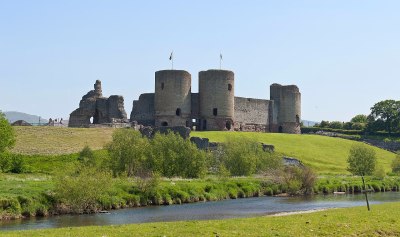
Rhuddlan Castle. Photograph by Julie Anne Workman. Source: Wikipedia
In 1282 it was neither Llywelyn nor Edward that was the instigator of the dispute that followed, in spite of ongoing tensions between the two. In March 1282 Llywelyn’s brother Dafydd ap Gruffudd, feeling that his contributions had been insufficiently rewarded by Edward, and seriously aggrieved by his treatment both at the hands of his neighbours on royal land and by the authorities in Chester, decided to take action. Dafydd once again switched sides and, not messing around this time, attacked the English castles and towns of Hawarden, Flint and Rhuddlan, supported by a number of Welsh lords who acted in their own right. Llywelyn was not among Dafydd’s initial supporters, but he joined forces with his brother later in the same year. If I had found myself in Llywelyn’s situation I’d have thought twice about sticking any fingers into a pie of Dafydd’s making. Perhaps Llywelyn felt he had to choose either to engage or be swept aside in the event of Dafydd’s victory. He had very recently lost his wife in childbirth, and with no male heir, and now 60 years old he may well have thought he had very little to lose. Whatever his thinking, it was a mistake. In spite of the arrival of the Archbishop of Canterbury, John Pecham, who attempted to negotiate for peace, no compromise could be reached. Edward’s subsequent suppression of the uprising came at a high cost for Edward’s own treasuries, his armies, and included the personal loss of friends and collaborators. Under such circumstances it was inevitable that when Edward prevailed, the results would be uncompromising.

Aerial view of Denbigh Castle, a Welsh castle which was rebuilt by the English in 1282. Source: Cadw, via Wikipedia
Llywelyn was killed in battle on 11th December in 1282 and Dafydd assumed the title Prince of Wales, but by early 1283 Edward I’s vast English army had the Welsh heartland hemmed in and troops were being supplied by ship from Ireland. Dafydd based himself at Dolwyddelan Castle in southwest Conwy whilst the English took Bangor, Caer-yn-Arfon and Harlech. Castell-y-Bere in Gwynedd, not far from the west coast, was the last of the Welsh strongholds to withstand Edward’s armies, falling in April 1283. Dafydd was captured in June 1283. Whilst other lives were spared by Edward, Dafydd’s betrayal rankled. He was tried for treason, tortured and put to a spectacularly grizzly death in Shrewsbury in October 1283, whilst Edward’s programme of castle building continued uninterrupted. In 1284, Edward returned to Wales in march to inaugurate his statue on how royal lands in Wales, including Llywelyn’s Snowdonia, would be managed and how law should be administered. He took no revenge against the Welsh people, but there was now no doubt that future transgressions would not be permitted and that the harshest reprisals would greet anyone who attempted to resist.
——-
After Llywelyn
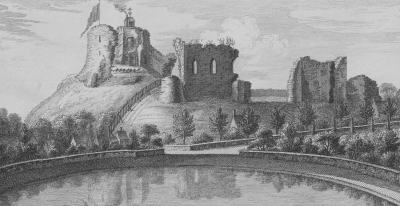
Hawarden Castle in 1742 by Samuel Buck
More and much greater castles than Flint, Rhuddlan, and Hawarden were built in north Wales. Aberystwyth, the southernmost in the arc of coastal forts was started in late 1277. Denbigh and Harlech were started in 1282, Caernarfon and Conwy in 1283, and both Chirk in northeast Wales and Beaumaris on Anglesey were started in 1295. The castles were eye-wateringly expensive to build, and Edward was able to extend his network only with the assistance of loans from the Ricciardi Bank of Lucca in Tuscany, supplemented by magnates loyal to Edward who invested in castles in their own right. The castles were connected not only by purpose and personnel, but by a growing network of roads, and were not merely a visual message to the potential insurgents of north Wales, nor simply used as operating as bases from which to launch potential counter-offensives, but a valuable communication network. One of their most important functions, just a day’s ride apart from one another, was to strengthen England’s ability to move freely between England and Wales, as well as keeping England informed, via Chester, about what was happening in Wales.

Castell y Bere in the Dysynni valley, southwest Gwynedd. Aerial photograph with my annotations showing key components of the castle (Source of photograph: Coflein website)
During the advance of Edward’s armies, control was reinforced throughout north Wales. Welsh castles were either destroyed by Edward’s forces, or rebuilt and garrisoned for Edward’s own purposes, establishing additional military presence at relatively low cost. An example is Castell y Bere in Gwynedd, which was built in 1221 by Llywelyn ab Iorwerth (also known as Llywelyn Fawr, or the Great, c.1173-1240). It was the site of Dafydd’s last stand. The castle having survived the assault, it was reinforced by Edward. My write-up of Castell y Bere is here.
With Llywelyn dead, and Edward with no distractions elsewhere, Wales had lost its momentum as a Welsh principality once and for all. Wales belonged to Edward and the Marcher lords. All other landholders held their lands in sufferance, and now knew to keep their heads down.
With Llywelyn dead in battle in 1282, and Dafydd captured, tortured and killed in 1283, there was no Prince of Wales, and there no serious opposition to Edward. Llywelyn had died without a male heir, and his baby daughter was sent to a convent in England. Dafydd’s daughters were also sent English to convents and his sons were incarcerated in Bristol Castle, where they died. Their brothers Owain and Rhordri survived, but Rhodri had sold his claims to the crown to the English and lived out his life in comfort. Owain, who had once been in dispute with Llywelyn for a share of Gwynedd, had been imprisoned by his brother. When he was released in 1277 he made no attempts to join forces with either brother against Edward, and died in around 1282. Rhodri’s grandson Owain Lawgoch had been brought up in England, and had a successful career as a mercenary, but a downturn in his fortunes lead him to contemplate pressing his own claims in Wales, but he was assassinated before he could take any action in 1378.
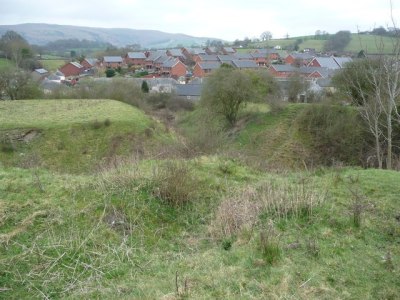
The sad remains of Builth Castle, Powys. Source: Photograph by Jeremy Bolwell, Geograph
A last-ditch rebellion by another would-be Prince of Wales, Madog al Llywelyn in 1294, a distant relative of Llywelyn the Last’s, took a year for Edward’s armies to suppress. Edward I gave the title Prince of Wales to his own son, Edward of Caernarfon, who was invested on 7 February 1301, at the age of 16. Although another, albeit short uprising had to be put down by Edward II in 1316, it was not until the early 15th century, when Owain Glyndŵr led a new rebellion, that serious conflict once again arose between Wales and England.
dafsdfs
Final comments
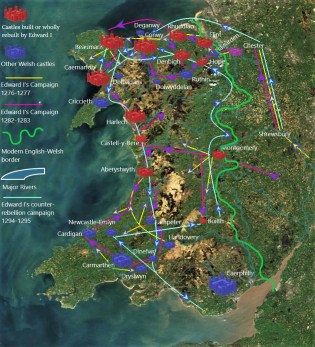
Map of Edward I’s campaigns in Wales. Source: History Matters at the University of Sheffield
Henry III had been both a weak and unpopular king, whose poor leadership led to the 1258 Provisions of Oxford, whereby a council of 15 men acted as a filter for all of Henry’s decisions, denying him what he saw as his divine right to sole and unfettered rule. In 1254, Henry III’s eldest son Edward had been married to King Alfonso X’s daughter Eleanor of Castile. To fulfil the terms of the marriage contract, Henry had granted Edward lands in Britain, including the royal estates in Wales, that made him the second biggest landholder in Britain. Although his father was still in overall control, Edward had a new sense of himself as a leader and protector of the lordships within those territories. It was not long before Edward began to get the measure of Llywelyn, but with Henry III still making the decisions, Llywelyn probably had little idea of the differences between father and son. Although Edward had been involved in a number of armed conflicts, and schemed against his father, he only seems to have gained real independence when on crusade.
Edward returned after his father had died, to take possession of a land in which the only really active thorn in his side was Llywelyn. Henry III, after failed attempts to engage Llywelyn with military might, had resorted to the lower cost and less demanding diplomatic approach to conflict with Wales. When Edward went to war in anger against Llywelyn in 1277 and 1284, Llywelyn was defeated. Edward on this occasion was magnanimous, and paid for Llywelyn’s wedding to the daughter of Simon de Montfort in Worcester. Had matters ended there, Llywelyn might have lived out the rest of his life dissatisfied but with nothing more than internal disputes to tackle, but when his brother Dafydd, with support from other important Welsh leaders, attacked Edward’s castles, Llywelyn joined him. Edward gave no quarter. When he went to war in Wales, he did not have it all his own way, and had he not had the Cinque Port ships to blockade Anglesey, he might not have prevailed, but when he did prevail he took no chances. He neutralized male heirs, mainly with imprisonment, and he placed Welsh daughters into English convents, where they could not produce sons who might grow up with a sense of injustice that could lead to thoughts of rebellion. He and his own son, Edward II, fought off two other rebellions, but it was not until Owain Glyndŵr in the early 15th century that another serious Welsh uprising was attempted.
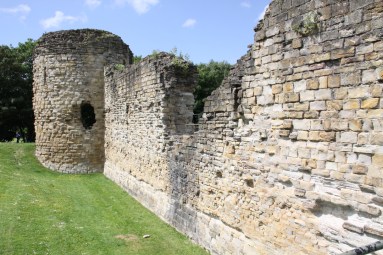
Flint Castle, southwest tower and curtain wall
Whilst writing this, I frequently wondered what it must have felt like to be Edward I, the descendant of kings who ruled in England and, thanks to their Norman ancestry, over swathes of what is now France. He had all the strength, confidence and strategic insight that both his grandfather King John and his father Henry III lacked, and he had plenty of ambition, but King John had lost much of England’s continental territories, and thanks to the Treaty of Paris, in which Henry III gave up even more, in 1274 Edward inherited a much smaller kingdom than his own father had inherited. Ironically, as a personality Edward probably had more in common with Llewelyn the Last than he did with his father. Both were experienced military leaders, well organized and ambitious men who believed in themselves. They were born into worlds where conflict was the norm and territory could be seized. They were also both sovereigns in their own lands, and believed absolutely in their right to rule and extend their rule. These very similarities might suggest that war rather than diplomacy was the most likely outcome when Edward turned his focus to Wales, but in fact diplomacy punctuated military engagements up until 1282. Neither brother survived this encounter with Edward, and Edward took advantage of the power vacuum in Wales to squash Welsh ambition for good, bringing Wales firmly under the English crown. Key to this strategy was his castle building programme.
——–
Sources
The most usual sources have been highlighted in bold
Books and papers
Davies, J. 2007 (3rd edition). A History of Wales. Penguin
Jenkins, G.H. 2007. A Concise History of Wales. Cambridge University Press
Morris, M. 2008. A Great and Terrible King. Edward I and the Forging of Britain. Penguin
Rowley, T. 1986. The High Middle Ages 1200-1550. Routledge and Kegan Paul
Saul, N. 1997. The Oxford Illustrated History of Medieval England. Oxford University Press
Vening, T. 2012. The Kings and Queens of Wales. Amberley
Walker, D. 1990. Medieval Wales. Cambridge Medieval Textbooks
Websites
Aberdovey Londoner
Castell-y-Bere (1221-1295) in the Dysynni Valley, west Wales (Andie Byrnes)
https://aberdoveylondoner.com/2018/10/31/a-visit-to-castell-y-bere-1221-1295-in-the-dysynni-valley/


Morning. Loved this, love Edward I, such rich history. I’m traveling the uk (when I can) visiting castles, monuments and battlefields. Thanks. Chris
LikeLike
Hi Chris. Having written up Flint Castle, next on my list to visit are Rhuddlan and Denbigh. My intention was to get round to all of Edward’s Welsh castles this year, but I have just been too busy. I envy you travelling the UK as a whole. At the moment I am confining myself to the places within an hour’s drive (give or take), but fortunately there are plenty of them. When I read a biog of Edward I, I was simply amazed at how much he managed to achieve in one lifetime. Makes me feel like something of a slacker :-). Best, Andie
LikeLike