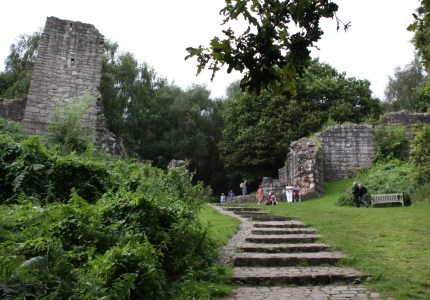
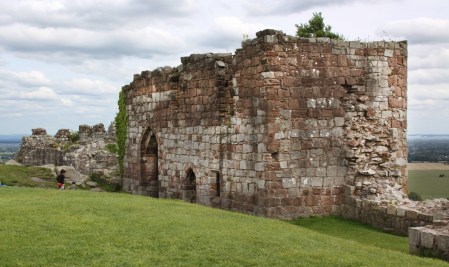
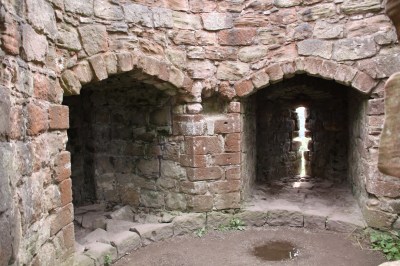
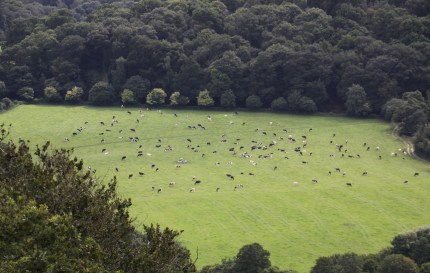
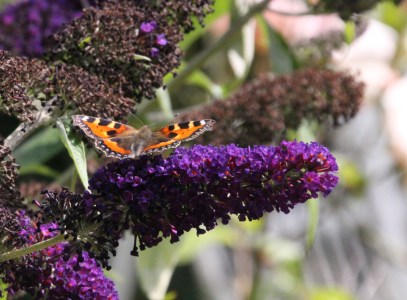
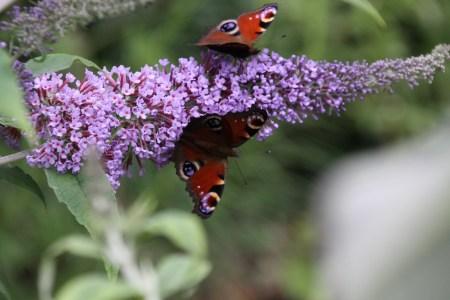
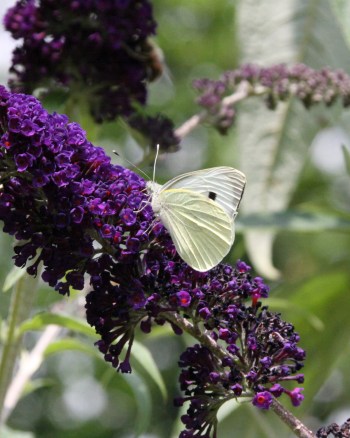
Some photos from my 15 minute contribution to the Big Butterfly Count

A couple of weeks ago I posted about the Big Butterfly Count.  It goes on for another two days, so if you want to participate, have a look at their website.  It is an initiative to learn about what is happening with butterfly populations in the UK.  Well worth contributing.

I’ve submitted my count for my 15 minute slot, staring fixedly at the bed in which my two buddleias reside, along with roses, poppies and various other floral beauties.  In 15 minutes the Black Knight buddleia won hands-down in both the butterfly and bee popularity stakes, and the scent of the flowers was almost overpowering.  Here are some of the photographs that I took.

It was interesting to note that apart from the comma, these showy, large butterflies were completely different from the ones that I saw the other day at the lower end of the footpath that heads to the Dee from Knowl Lane.  Those were small, more understated butterflies, enjoying the hedgerows, including gatekeepers, speckled woods, meadow browns and small coppers.  Photos of some of them are on my earlier post about that walk, but a lot of them refused to land and be photographed.

Small tortoiseshell

Comma

Peacock, conspicuously bigger than anything else that turned up

Small White

Holly Blue. I had just watered the rose bed, and the Holly Blue
seems to have landed to take a drink.

Red Admiral

I was amazed by how big the peacocks were, compared with other visitors. How super to be asked to do something so enjoyable that happens to be useful too.  The small whites were the dominant visitors, followed by the peacocks.  There was only one holly blue during the 15 minute section, although I see them quite regularly in a given week.  There was also only one red admiral.  Like the holly blue, they are not infrequent visitors to the garden, but I generally see more of them when out and about.  Their caterpillars like nettles, and I have gone to an awful lot of trouble to remove all traces of nettles from the garden.


The 1898 mile posts between Farndon, Churton, Aldford and Huntington

The milepost just outside Holly Bush Cottage, the nearest one to Farndon, close to the Barnston Monument. It sits at a slight tilt today.  This is the best one for seeing the manufacturer’s logo, which reads W.H. Smith and Co, Makers, Whitchurch. Milestone Society National ID: CH_CHTP08a.  What3Words ///dressing.sublime.lunge

Between Aldford and Farndon there are three very fine 1898 milestones dotted along the road, following the line of the Farndon branch of the old Chester to Worthenbury turnpike (toll road), all on the west side of the road. The photos here show those mileposts that remain between Farndon and Aldford along the B5130.  Other photos show milestones between Aldford and Huntington, plus one in Farndon, but I have no idea if there are some missing along that particular route.  At the moment they are in no particular order but I will eventually, when I have found a few more, organize them from north to south.

The photos of the milestones along the Farndon to Aldford stretch are mine, but the two to the north of Aldford, as the B5130 approaches Huntington, are by other people, found online, because I have not yet managed to track them down in the real world.  Please see the captions for image credits.  All photos can be clicked on to see the bigger image, in which the text on the mileposts can be read clearly (except, of course, where vegetation blocks the view).  For the ones I’ve seen myself, I have taken What Three Words readings to fix the location.  What Three Words is a smartphone app that assigns three words to uniquely describe areas a little smaller than the size of a parking space.  It’s simpler than other location systems, and fixes locations very precisely, world-wide.  It is particularly useful for finding people in emergencies, but I thought it would be useful for enabling people to relocate the mileposts when they become overgrown.  

Churton milepost, next to Greenfields, the last house in Churton at its north on the way to Aldford. Milestone Society Milestone Society National ID CH_CHTP07. What3Words ///blatnatly.backers.comic. My photos, CC BY-NC-ND 4.0

All English turnpike Acts, each created by a separate Act of Parliament, had expired by the end of the 19th Century.  The Local Government Act of 1888 put responsibility for roads into the hands of local councils, making nearly all of the remaining turnpikes redundant.  Sections 92 to 98 of the 1888 Act, however, provided for some exclusions and section 97 enabled Chester County Council to initially avoid taking responsibility for the Chester to Worthenbury turnpike.  Eventually, the Council was forced to take over all the local roads and in 1898 it erected a number of particularly handsome mileposts in Cheshire, including those along the route of the former Chester to Worthenbury turnpike, by then defunct, as well as the Farndon branch of the turnpike.  I have posted about the Chester to Worthenbury turnpike – part 1 about the background to turnpikes and part 2 about the Chester to Worthenbury turnpike in particular.

The milepost outside Glebe Farm, between Churton and Aldford. The red dot is apparently something to do with a cycle race.  Milestone Society National ID CH_CHTP06. What3Words ///decently.hatter.slide. My photos, CC BY-NC-ND 4.0

None of the  mileposts that must have been erected during the 1854 turnpiking of the road have survived.  Milestones or mileposts were erected from the first half of the 17th Century onwards, starting in southeast England, mainly for the benefit of mail coaches and other passenger vehicles.  Turnpikes were merely encouraged to install mile posts from the 1740s but they became a legal requirement from 1766 when it was found that as well as being useful for coachmen and passengers, it enabled accurate measuring of distances for the pricing of different routes.  It also helped to improve improved the reliability of timetables, something to which the turnpikes themselves, had enabled, particularly relevant in bad weather.  Assuming that mileposts were erected when the 1854 turnpike was established, they were presumably removed when the 1898 milestones were installed.

I was unable to find the Crook of Dee milestone, but in the Milestone Society’s survey (over 18 years ago) it is listed it as near Cheaveley Hall Farm, opposite Cheaveley Hall Cottages.  It is marked on the Ordnance Survey Map and on the above Public Map Viewer with the letters MP. Milestone Society National ID CH_CHTP04. Image sources: Geograph and the Cheshire West and Chester Public Map Viewer

The 1898 mileposts are all the same, painted white with black lettering, and consisting of hollow metal posts with two sides meting in the middle, topped with a triangular cap that is tipped towards the road.  The triangular cap says, in all cases, “Chester County Council 1898.”  The two sides, each facing into the oncoming traffic, give the number of miles to key destinations in each direction.  On the southernmost face, the manufacturer’s mark “W.H. Smith and Co., Makers, Whitchurch” is shown below the mileages.  There are no backs on the mileposts.  The ones shown here are in good condition. Being on the side of a very busy road, they are vulnerable to exhaust fumes and road dirt sprayed during rainy periods.  I don’t know who maintains them, but in other parts of Cheshire many have needed to undergo restoration, some having been in very poor condition.  A lot of this work has been lead by the Milestone Society in co-operation with the relevant council.

The Crook of Dee milestone at Cheavely Cottages. What3Words address: ///liner.apprehend.stitch

The survival of these mileposts is remarkable and a pleasure to see.  I have now found all of the ones on the former Chester to Worthenbury turnpike.   I only found the Crook of Dee milepost in November 2021, after hunting for it for ages.  It was completely concealed by undergrowth in the summer and it was only after leaf fall, and with the hedge cut back, that I eventually found it, covered in ivy but still there.  The photograph of the Crook of Dee shown above left, decoratively peeping through a fine show of dandelions and dead nettles is from the Geograph website, taken during the Milestone Society’s national survey over 18 years ago, and is a particularly nice photograph so I have left it here.  My own photograph is at right.  I cleared the ivy as best I could on a very dangerous stretch of road with no footpath and only a tiny verge, but it is in fair condition, albeit very rusty.  The What3Words address for it is shown on the image to the right.  It is located opposite the Cheaveley Hall Cottages,

Huntington milestone. What3Words ///shine.knee.reject

There is also one at Huntington, for which I kept an eye open for months, and found on the same day as the Cheaveley Hall one.  It is shown left, along with its What3Words location.  It is in excellent condition on a grass verge, just north of a pedestrian crossing.

The Ordnance Survey map, shows another run of mileposts between Churton and Worthenbury.  The first heading south from Churton towards Worthenbury should be somewhere along Sibbersfield Way (which I have repeatedly looked out for in the car when nothing has been behind me, but I still haven’t found)

The rest on the leg of the road south of the bypass that runs towards Worthenbury via Crewe by Farndon and Shocklach through blissful rural fields and past several estates and  farms. I made an attempt to locate them during the summer, few months later I found the one to the north of Crewe by Farndon, which had been revealed by hedge-cutting.  It is in the grass verge on the west side of the road, just before Caldecott Farm.

Not so shiny and new as some of them, but still hanging on in there!  It is located just short of a farm on the left heading south (the east), and is on the west side of the road about two or so metres to the right of a telegraph pole.  I will go back and get an exact What Three Words location for it next time I’m in that area, but for the time being it is roughly at ///rainfall.duplicity.proofs.

During the summer I was able to find the nice one in Shocklach, thankfully not hiding in a hedge and at that time pleasingly accompanied by some lovely roses.

The milepost at Shocklach, on the route to Worthenbury. Milestone Society National ID CH_CHTP12. My photo, CC BY-NC-ND 4.0

I suspect that the rest are still hiding in overgrown verges.  As with the Crook of Dee milepost, as the vegetation dies down this winter I will continue to look for them.  When I have the full set I’ll put them into north-south order.

The Sibbersfield Lane milepost, which is on the stretch of road from Churton towards Crewe-by-Farndon, about halfway down before reaching the bypass, is slowly diving into a ditch.  It’s a terrible photograph but I was not going to risk getting out of the car to take it, as it is a very nasty and fast stretch of road.  I forgot to take its What3Words location, but will go back and re-take the photograph and note the location on a quiet day, preferably when the road is closed!  Taken in March 2022:

In May 2022 I was diverted due to the Holt-Farndon bridge closure down Barton Road, the road that runs through Farndon from the bridge, and noticed a milestone on the south side of the road.  I was in a hurry so didn’t stop, but went back in early July, half expecting it to be completely subsumed into the hedge that stood behind it, but not a chance.  Someone is looking after it beautifully (with thanks).  It’s What3Words location is ///warned.tower.mascots, which you can see on a map at https://what3words.com/warned.tower.mascots.


Sources:

Books and papers

Benford, M. 2002. Milestones.  Shire Publications

Crosby, A.G. 2012.  New Roads for Old. Cheshire Turnpikes in the Landscape 1700-1850.  In (eds.) Varey, S.M. and White, G.J. Landscape History Discoveries in the North West.  University of Chester Press, p.190-223.

Local Government Act 1888 (51 and 52 Vict. c.41). Section 97, Saving as to liability for main roads.

Wright, G. N. 1992. Turnpike Roads. Shire Publications Ltd.

Websites

Milestone Society Restorations in Cheshire 2008-2009
The Milestone Society
https://www.milestonesociety.co.uk/archives/Downloads/In%202008%208-Cheshire%20County%20Council%20Highways%20Services%20were%20suc..pdf 

Turnpike Roads in England and Wales
Turnpikes.org.uk
http://www.turnpikes.org.uk/Tollhouse%20design.htm


Lovely footpaths through the fields between Churton and Farndon – Part 2

The return leg of the walk from Churton to Farndon, starting at Brewery Lane. Source of map: Public Map Viewer

The return leg of the walk from Churton to Farndon described in Part 1, heading back from Farndon to Churton, was just as lovely in the mid-July heatwave, but was not the same, and had some added extras.   It all looked very different from today’s endless drizzle, but at least the garden is deliriously happy.

On the return leg of my walk, instead of retracing my steps along Townfield Lane, I turned into Brewery Lane, just a little further to the north, which turned out to be a short stretch of road behind Brewery Motors with some nice views.  It segues into a the public footpath that is narrow but very safe underfoot before it joins up with the track along which I had originally walked into Farndon.  The footpath offers  a novel view over a gate of the wildflower field at the Barnston Monument to its east.  I have marked the route on the map on the left (from the Public Map Viewer website), a shorter route than on the first leg.  The red dots are explained in Part 1, marking the approximate positions of possible prehistoric sites.

At Knowl Plantation, a track is marked on the Public Map Viewer that skirts it to the west instead of heading back up the footpath to the east.  It links up with the Knowl Lane footpath that leads to the Dee.  After I returned home I realized that on the Public Map Viewer although marked as a track it is not shown as a public footpath, so I am not sure if it is actually a right of way, but I was careful to stick to the edges and do no damage.

Dove’s foot’s crane’s-bill, its leaves declaring it to be a form of geranium.  Like the speedwell below, all along the edge of the corn, it spreads in huge swathes.

Common field speedwell, which grows everywhere in great, low carpets.

Thistledown, spreading itself in carpets along the path and hanging in the nearby trees

Redshank

When I was a child, anything that looked like a flower, with lots of petals arranged around a clearly defined core, was accordingly categorized in my head as a flower, but anything that failed to look sufficiently floral was always a weed.  Redshank came firmly into my childhood  weed category.

Elder (Sambucus)

Reaching the main footpath back to Churton, that leads from the Dee to Knowl Lane. I was enchanted to be surrounded by butterflies.  They stubbornly refused to settle, and the few that did settle sat with their wings firmly closed, so there were very few photographs, but it was a lovely experience.

Small heath butterfly

Gatekeeper

Common red soldier beetle  (Rhagonycha fulva) on hogweed flowers

Comma

Speckled wood

It was on the return leg of the walk that that I noticed three lovely flowers on this walk that I had never seen before.  The tiny, tiny violas shown below, the flower just a few millimeter high (just a little bigger than speedwell flowers) is the field pansy (Viola arvensis).  They behave much like speedwells, spreading on straggling stems, but there were much fewer flowers per plant, and I only saw a small number of them.

Field pansy in company with common field speedwell

The Hedge Woundwort below, Stachys sylvatica, is a member of the Lamiaceae (mint) family.  It looks very like the common spotted orchid, but the leaves are wrong.  With the orchid, the leaves are smooth-sided and long and sprout from the base, but the woundwort has jagged- or serrated-edged leaves that are much shorter and sprout from all along the stem.  With the Hedge woundwort, the colour leans more towards purple or red than towards the common spotted orchid’s pink, and the woundwort lacks the “wings” that top the orchid flowers.  The distinctive white markings are thought to attract bees to help with pollination.

Hedge Woundwort

This creeping and climbing perennial, here wrapping itself around a blackberry bramble with a lovely pink flower, is White Bryony (Bryonia dioica).  It is not uncommon as a garden weed, and is beast to eliminate as it has long, deep tubers that have to be pulled out in their entirety to kill the plant.  In the wild, however, they are lovely, colonizing hedgerows and scrubland, spreading by coiled stem-tendrils that latch on to the stems of other plants to enable it to travel in all directions.  When it has finished flowering, the white/yellowish-green flower is replaced by a small red berry.
White Bryony

At no point on either walk can one actually see the river from the footpaths, so this is a matter of enjoying the fields in their own right.
 

The Big Butterfly Count 2021

The Big Butterfly Count runs i Britain between 16th July to the 8th August, so we are just in time to join in.  Every year I do the Big Garden Birdwatch, counting birds that land in the garden in a given hour.  It ran this year in January 2021, before I moved to Churton, but I’ll be talking about that next year when it comes around again.

I had not, however, heard of the Big Butterfly Count.  It was reported in the latest edition of the magazine New Scientist, so I fired up my web browser to get the details.

The Big Butterfly Count “is a UK-wide survey aimed at helping us assess the health of our environment simply by counting the amount and type of butterflies (and some day-flying moths) we see.”  The idea is to sit in a promising spot (for example, in your garden, in a park or along a footpath) for 15 minutes and take note of everything you see in that time.

You will need to register for an account, which is free, after which you can download and print off a butterfly identification chart (which also lists the species in which they are interested), and then send in your results.  You can do this via a free smartphone app or via your web browser (computer, tablet, etc).

I am going to spend my 15 minutes in front of my Black Knight buddleia, which is a great butterfly attractor.  A tremendously good excuse for abandoning the weeding and mellowing out with the wildlife 🙂  I had to chase out a peacock butterfly from the living room only this morning.  On a recent walk there were many types in the hedges flanking the footpath section of Knowl Lane at its western end as it approaches the Dee, and I suspect that I will find that the species that prefer those hedges and the ones gracing my garden will be very different.

Find out the details on the Big Butterfly Count website.


Early morning mist over my favourite tree

My favourite tree is over the road, usually visible from the room I use as a home office, often list up in full golden sun, sometimes pink in the sunrise or sunset, but occasionally shrouded in mist.  The mist always fascinates me because sometimes it forms in thin bands hanging bizarrely over the fields, but at other times it forms dense sheets.  First thing on Wednesday morning I watched the tree and the neighbouring field, complete with recumbent cows, drifting in and out of bands and sheets of mist that continually changed along a narrow colour continuum between pure white and pale grey that included faint shades of pink and olive green.  At about 5.30am the tree became almost invisible behind a discrete, almost impenetrable mantle.  Eventually a silver sun slowly lifted the pale, gentle veil and the monochrome scene was gradually transformed into its everyday guise.


Courgettes grown by 9-year-old Harry at the Aldford Village Store

Chatwin’s bread bought from the Aldford Village Store, and a sandwich made with warm home-made tarragon mayonnaise.  The tarragon mayonnaise is warmed by stirring freshly boiled and chopped eggs into it.  For the basic mayonnaise recipe see my earlier post

The managers of the Aldford Village Store, Emma and Will Jones, opened the Aldford Village Store in 2018.  Most Sundays I go up to the store to collect a loaf of brown bread.  It is by far the best brown bread in the area, rich, malty and slightly sweet and so fresh-tasting that it is almost moist, but with more than enough texture for the bread knife to go through it without a fight.  Utterly delicious and a wonderful compliment for egg mayonnaise (made with Churton honesty eggs of course).  The brand is Chatwins, a company based in Nantwich, established in 1913 and at that time their deliveries were made with horse and cart.  It’s not locally-made bread, but it tastes great.

One cannot quibble in any way about how local the store’s courgettes are.  Last Sunday, a basket in the shop had a great crop of green-striped globes and long banana-shaped yellow courgettes, and a label attached to the basket proclaimed them to be “Harry’s.”  I instantly formed a stereotypical vision of an elderly but upright smiling fellow with a deep sun tan, battered broad-brimmed hat, dungarees and probably a pitchfork (I grew up amongst Americans), who had been lovingly tending his courgettes for the last six or more decades.  Nope.  When I asked the friendly girl on the till who Harry might be, it turns out that he is the 9-year old son of the managers, Emma and Will.  Brilliant.

According to his Dad, who I was speaking to a couple of days later when I popped in with my father, Harry is saving up for a Lamborghini, not because his is interested in the brand’s celebrity status, or is impressed by the price tag, but because it is the epitome of fine engineering, and that is what fascinates him.  At a pound per courgette, that’s at least 160,000 courgette sales for a basic Lambo Huracan, 240,000 courgettes for the Spyder version and a horrifically substantial number more courgettes for the insurance, tax and ongoing servicing, and that’s without factoring in the start-up costs of seeds, compost, and his time 🙂   I love courgettes, but I’m not sure that I can eat that many, although we do have until his 17th birthday to try.

To honour Harry, here’s the first of three posts about what I cooked with Harry’s courgettes.  This first one is based on my Mum’s recipe, and has been one of my favourites forever.  Mum’s recipe was for stuffed marrow, but it translates beautifully for Harry’s stunning globe courgettes.

Stuffed Globe Courgette, with thanks to Harry Jones

Oh that globe courgette! What an absolute beauty.  Harry had grown various sizes that were for sale in the store, and this one was about the size of a small galia melon.  I sliced it in half and removed the soft centre, together with the seeds, using a spoon.  I chopped this ready to put it in the sauce that I was just about to cook.

Next, the stuffing and the sauce are both done in the same pan, because the stuffing is also the base of the accompanying sauce.  This is a two-part process.  The first part is simply sausage-meat (or sausages removed from their skins), a finely chopped onion onion, a little finely chopped garlic, the scooped out middle of the courgette, and a lot of sage (fresh or dry) gently all fried in olive oil.  A little liquid is added to prevent it drying out, either hot chicken stock or a mix of chicken stock and white wine.  I also add fennel seeds, just because I love them.  On this occasion I also had lovage growing in the garden and the diced remains of a fennel bulb from the Bellis farm shop in Holt, which always has them, so these went in too.

This rather wet stuffing is used to stuff the marrow, and you will have a lot left over.  The stuffing dries a little when cooking, particularly as 5 minutes before the end of the cooking time you grill it to let it brown slightly.  After heating this stuffing through, I spooned it carefully into the scooped-out reservoir in the courgette half.

To cook the courgette, it is placed in an oven-proof dish full of hot (just off the boil) chicken stock, which is then placed in an oven, either with either a proper lid or a foil tent.   I used an ancient oval Pyrex bowl and covered it in foil and put the whole thing in a baking tray in case the the stuffing leaked.  I take the foil off and grill the whole thing five minutes before serving.  A little butter stroked over the top helps it to brown and crisp, but is not actually necessary.  Normally I do this recipe with marrow rings, which takes about half an hour once the marrow rings are in the oven.  Cooking an entire half globe was always going to take longer, and it took an hour on 220C (static, not fan), plus the five minutes for grilling.

Lovage

The second part of the saucepan process is the sauce that is served alongside the stuffed courgette.  This is done by adding peeled tomatoes and, if you like a bit of heat, chillis to the stuffing.  The chillis can be either fresh or dried.  I find supermarket tomatoes almost completely tasteless, so I use the ripest vine tomatoes that I can find, add a squirt of tomato paste and then a good glug of Big Tom (a spiced tomato drink).  If you don’t mind tinned tomatoes, those would work but I gave up using them a long time ago as they are far too sweet for me.  I also add more hot stock or stock + white wine to the mix, because this is the sauce and needs to be rather more fluid than the stuffing.

Sage

As to quantities, I’m dreadful at writing out recipes, but I used a whole 450g pack of Waitrose sausagemeat as I wanted to make sufficient to freeze down for future meals.  For that amount of sausagemeat, I used a medium-large onion, two cloves of garlic, and added the herbs and liquid to taste.  The first part of the sauce doesn’t want to be too liquid,  as you are going to use it as stuffing, so the trick is to add it in increments and just stop it sticking.  When you start adding stock and tomato to the sauce, it becomes much more liquid, and that’s just a matter of taste.  Again, just add the tomato and stock incrementally until it looks the way you want it to.

The idea of separating out the stuffing and the sauce is to give the stuffing a mild, distinctive flavour all of its own based on the sausagemeat and sage.  In the second part, the addition of tomatoes, chillis and other herbs provides a lovely bold Mediterranean contrast when both are on the plate. You could grate Parmesan cheese over the top, or (before grilling) breadcrumbs for crunch.  I find it sufficiently filling in its own right, but Mum liked it served with a salad and my father likes it with plain white rice to soak up the juices.

It is not an elegant dish.  At least, I’ve never found a way of making it look particularly presentable on the plate, but the flavours rock.  If you are wondering why the stuffing and the sauce look the same in my photographs (congratulations on spotting the far from deliberate mistake), it is because I screwed up.  On this occasion, I forgot to separate the process into two parts and ended up putting the various tomato combinations into the sauce before I had stuffed the courgette with the basic mix, so found myself stuffing it with the tomato-enriched sauce.  That is because I often serve the part 2 version of the sauce over pasta and was working on auto-pilot.  I was more than a little miffed with myself, because it is much better if the two-part process is followed.

The outer peel or rind on the globe courgette is chewy but edible, but on another occasion I would peel it before cooking it.  To serve it, I halved the half-globe.  Short of eating it with a spoon, I wasn’t sure how else to tackle it!  But however it looks, it still tasted terrific, and the Mediterranean feel made it summery.

If you have any sauce left over, it freezes brilliantly, and goes wonderfully over tortellini.  If you have been defeated by the amount of courgette or marrow that emerged from the oven, this can be finely chopped into the sauce before freezing.

I rubbed lemon into the other half of the globe to stop the surface browning, and wrapped it in foil.  It is now in the cold draw in my fridge, awaiting another bout of courgette creativity.

Thank you Harry!

Ferrucio Lamborghini

Sources:

Aldford Village Store
(No website, but they do have a Facebook page):
https://www.facebook.com/aldfordvillagestore

Chatwin’s
https://www.chatwins.co.uk/

Cheshire Live
New village store at Aldford will sell day to day groceries and much more
https://www.cheshire-live.co.uk/news/chester-cheshire-news/new-village-store-aldford-sell-14786194


Lovely footpaths through the fields between Churton and Farndon – Part 1

I have been meaning to do this walk every since I moved here in February, but there is so much to do in the garden that I feel guilty abandoning it on nice days when I really should be working at it.  The stickiness of the otherwise delectable heat-wave meant that digging holes for plants and weeding on an industrial scale was becoming seriously unpleasant, so today I abandoned ship and walked the footpaths to the west of Churton, through the fields to Farndon. It was idyllic.

The route taken from Churton to Farndon. The red blobs are the approximate locations of (top) the proposed prehistoric barrow cemetery and (below) the proposed Neolithic long barrow.  Source of map:  The Public Map Viewer, rather untidily stitched together by me.

This is part one of the walk (Churton to Farndon).   The slightly different return leg of the walk (Farndon to Churton) is described in Part 2.

In both directions, this is going to be an incredibly useful way of avoiding Chester Road to walk into Farndon.  I did once walk in to Farndon along Chester Road and it felt incredibly unsafe as the pavement is so narrow, it was very overgrown and the traffic moves so fast.  On that occasion I cut my losses and took the bus back.

This route through the fields is a perfectly viable alternative with lots to see and some lovely views, although it will be interesting to see how soggy it becomes underfoot in autumn and winter.  A track called Knowl Lane extends from Hob Lane and eventually turns into a footpath that heads through a plantation and reaches the Dee.  There are two footpaths off it to the left (south towards Farndon).

I went into Farndon via one and came back on the other.  The route is shown on the map above, thanks to the Public Map Viewer.  A Barnston Estate signboard next to the first turn shows the route of the footpath and has some of the details about the wildlife to be seen.  This footpath is shown on the Public Map Viewer as a track, and it is indeed used by tractors to move from field to field, which means you may find yourself flattening yourself into a hedge to let one or more pass.  Other than a tractor on the way out, and two on the way back, I saw no-one.  Perfect peace.  I took far too many photographs.


Once out in the fields, there were lots of wild flowers, three of which I had never encountered before, all described in Part 2, and there were butterflies and bees were everywhere, as well as great carpets of wind-transported furry seed fluff that was new to me.  The views towards the Welsh foothills were gorgeous.  The fields were full of young sweetcorn, displaying every shade of green that one could possibly imagine, wonderful in the sun, occasionally swaying in the slightest of breezes.


One field was planted with wheat, a great sweep of palest gold, each ear so beautifully and precisely structured that it looked almost artificial, the whole field organizing itself like a military review.  It was a superb contrast to the floppy sweetcorn plants that, no matter how regularly spaced, still managed to look rakish, jaunty and determinedly laid back.

Proposed barrow cemetery at Knowl Plantation. Source: Google Maps (location marked by the Megalithic Portal)

In theory, this route passes two prehistoric sites, which I was keen to track down.  Both sites are known only from aerial photographs, having been completely ploughed out, but sites are not just about physical presence but context within the landscape, and that’s something one can only get a real feel for by going to the location.  The Knowl Plantation site is described on the Megalithic Portal as a “nucleated Bronze Age barrow cemetery consisting of four ring ditches.”   I’ve had a look at various aerial photographs (see above, for example), but it’s not terribly promising so far.  If it is indeed a site, it is on a fertile slope that runs down to the Dee with views over the Welsh foothills.

A proposed Neolithic long barrow next to the radio mast at Bowling Alley Plantation is rather more convincing, with a lot of other interesting pits and ditches visible from the air in the surrounding field.  It too was always going to be invisible from the footpath.  Still, when I rounded the corner to the field in which it is supposed to be located I laughed out loud: the corn was growing so tall that I couldn’t actually see anything of either the field or the view, in spite of climbing a gate.  It must overlook a very similar view to the Knowl Plantation site.  Winter will be more informative.  The Google Maps aerial view of the site is to the left, and today’s view of the field in which it is located is below.  I really need a drone to be my eyes with some of these sites!  I will be writing soon about the area’s prehistory, some of it verified (by survey and excavation) and some speculative (like the aerial photograph shown here), and will talk about what one might make of it all.

Field in which the possible remains of a Neolithic barrow are located

Happy, but a bit heat-weary, I stopped for a fizzy water and a divine flat white in Lewis’s, sitting outside on the terrace and watching the world go by.  I was updating some notes as my coffee cooled down, but I am like a truffle hound where clotted cream is concerned and looked up to see that the chap at the next table was being served a scone with strawberry jam and, of course, clotted cream.  It looked utterly irresistible.  I am so relieved that I didn’t see it on the blackboard when I went it, or I would have been there for a lot longer, and progress back to Churton would have been a great deal slower.  Next time.  Nice to see the progress being made opposite at The Raven. 

Suitably revived following my coffee, I secured some of the Farndon butcher’s (Griffiths) truly excellent pork and apple sausages (second only in my estimation to his pork and leek sausages) before wandering down to look at the Dee and then returning back up the hill to head back through the fields.  My return course followed a slightly different route, using some other footpaths, which I will post about soon.  Just as super.  In all, it is a superb walk that will be an excellent route into Farndon, at least in drier phases, and will provide a very nice insight into the changing seasons.


Himalayan balsam ((Impatiens glandulifera), a relative of the busy Lizzie but over head height, and a pernicious weed in the wrong place.

Sources:

Megalithic Portal

Churton Long Barrow
https://www.megalithic.co.uk/article.php/mapserve/mapserve/asbmap.php?sid=5584&desktop=true

Knowl Plantation
https://www.megalithic.co.uk/article.php?sid=40380


Who was Bishop Bennet and why do we travel his Way?

The official 10-page Bishop Bennet Way leaflet can be downloaded at the end of this post

Threading its way all around the immediate area is the Bishop Bennet Way.  It is completely unavoidable on maps of the area, picked out in the lines of green horizontal triangles that mark a “Recreational Route” on the OS map, or the pink diamonds on the Public Map Viewer.

The Bishop Bennet Way follows a most circuitous route incorporating both roads and footpaths, and has been established mainly for the benefit of horse riders and mountain bike riders, but is very also popular with walkers.

Section of the Bishop Bennet Way near Churton. Cheshire West and Chester Public Map Viewer.

I first noticed it when walking down Pump Lane in Churton.  Where the road takes an abrupt turn to the north, there are small brown signposts pointing north, along Edgerley Lane and east along Marsh Lane to something called the Bishop Bennet Way.  Whichever of the two options it takes, it loops and switches in all sorts of crazy directions, a diabolically inefficient way of getting from A to B, and eventually it falls off the edges of my OS map, still going.  Once you’ve noticed the little brown Bishop Bennet Way signposts, they seem to pop up all over the area.  So who was Bishop Bennet, where does the Bishop Bennet Way go and why, for that matter, has that route been so carefully preserved in maps and on signposts?

A signed letter from Bishop Bennet to his friend the Reverend Maurice

The first thing to establish was whether Bishop Bennet was a real person rather than a fictional character, and indeed he was.  William Bennet was a “prelate of high character and estimation.”  He was born, according to the Dictionary of National Biography, in the Tower of London on 4th March 1745. Clergymen were usually very well educated with a good academic knowledge of both Classical and British history, and many doubled up as antiquarians, explorers of all things ancient.  Although some of their excavations were distressingly destructive, their surveys often provided invaluable foundations for future work.  Bishop Bennet conformed to this model.  He was educated at Harrow School and then went on to study at Emanuel College, Cambridge, where he later became a fellow and tutor and “distinguished himself by his compositions in Latin, as well as in English, in which he discovered not only great fluency , but a lofty taste, both in prose and verse.”

Episcopal Palace, Cloyne in Cork, Ireland. Photograph by colin.boyle4.
Source: Flickr Photos.

One of his students, in whom he took a particular interest, was John Fane, the 10th Earl of Westmoreland.  The Earl went on to become Viceroy of Ireland and remembered his former mentor by appointing him first as chaplain, then promoted him to Bishop of Cork and Ross from 1790–1794 and finally Bishop of Cloyne from 1794–1820, resident in the Episcopal Palace of Cloyne.  The episcopal see (jurisdiction) of Cloyne eventually became united with that of Cork and Ross in 1835, after which the Palace was leased to a private tenant.

Bishop Bennet was a member of the House of Lords, was elected Fellow of the Society of Antiquaries in 1790 and married the daughter of a  fellow clergyman in 1791.  He died in London in 1820.  In his lovely, deeply affectionate and appreciative eulogy, his friend Dr Parr commented on this career path:  “From the retirement of a college he stepped at once in the circle of a court;  but has not been dazzled by its glory nor tainted by its corruptions.”

One of Bishop Bennet’s contributions to Magna Britannia, volume 2, part 2.

None of this, of course, explains what the Bishop Bennet Way was all about.  After some hunting around, I found that Bishop Bennet was a very early driving force behind the investigation and publication of some of England’s Roman roads, something that became his own personal mission, all carried out in his summer vacations.  He contributed valuable work on the subject to published histories, of various areas including those of Lincolnshire and Cornwall.  He also contributed to the multi-volume work produced by the Lysons brothers, Magna Britannia, in which they set out to explore most of England’s counties in a series of dedicated volumes.  In West Cheshire, one of the roads that he had surveyed was the path now taken by the A41, from Chester (Roman Deva) to Whitchurch (Roman Mediolanum), and his investigations were incorporated into the Roman section of the history of the Palatine City of Chester published in Magna Britannia volume 2, part 2, 1810.

Map from the official 10-page Bishop Bennet Way leaflet that can be downloaded at the end of this post

The Bishop Bennet Way was officially opened in May 1998 incorporating restored byways and bridleways, and includes sections of country roads.  It is  of course very popular with walkers too.  Cheshire Live says that it was the inspiration of Bernadette Harden who was working on a temporary basis at Beeston Castle and began to take an interest in Bishop Bennet and his exploration of the area. It took her the best part of twenty years to campaign for the restoration of bridle paths and byways, but the Bishop Bennet Way is a very suitable reward for all her hard work.

The Way starts near Beeston Castle and finishes near Wirswall on the Cheshire–Shropshire border, just to the north of Whitchurch, although it might be extended in the future.  The route covers 55km/34 miles, and 27km of that route are on minor roads, only some of which have pavements and verges.  If you are a walker trying to avoid traffic, it is worth checking the Ordnance Survey map for public footpaths along the route that bypass road.  There is often another route possible for those of us on two legs rather than four, albeit rather more circuitous.  The official route crosses some seriously busy roads, like the A41 at Milton Green, and anyone planning to do the whole route is advised to plot their track on OS Map Explorer 257.  In 2006 Bishop Bennet Way was linked to Jack Mytton Way in Shropshire, between them creating a 125km/78 mile route.

The official 10-page Bishop Bennet Way leaflet can be downloaded by clicking here (but do check for updates on the Visit Cheshire website if you are reading this after summer 2021, in case a new edition is issued). 

Section of the Bishop Bennet Way as it heads north along the edge of Middle Beachin Farm, part way between Churton and Coddington.

Sources:

Books and Papers:

The Annual Biography and Obituary for the Year 1821
No.XVI. The Right Reverend Father in God, William Bennett, D.D. MRIA. Lord Bishop of Cloyne. , Volume V, p.263-266.  Longman, Hurst, Rees, Orme and Brown
tinyurl.com/3vr2y4fh

Codrington, C. 1919.  Roman Roads in Britain. Society for Promoting Christian Knowledge.

Lysons, D., and Lysons, S. (eds.) 1810.  Cambridgeshire and the County Palatine of Chester.
Magna Britannia, being a concise topographical account of several counties of Britain, Vol 2, Part 2.
https://archive.org/details/magnabrittanicab02lyso/page/n3/mode/2up?view=theater
https://ia802608.us.archive.org/27/items/magnabrittanicab02lyso/magnabrittanicab02lyso.pdf

Websites:

Cheshire Live
Walker turns trail-blazer in route revamp
https://www.cheshire-live.co.uk/news/chester-cheshire-news/walker-turns-trail-blazer-route-revamp-5246941

Dictionary of National Biography
William Bennet
https://en.wikisource.org/wiki/Dictionary_of_National_Biography,_1885-1900/Bennet,_William_(1746-1820)

Fastest Known Time
Bishop Bennet Way
https://fastestknowntime.com/route/bishop-bennet-way-united-kingdom

Historical Autographs
William Bennet, Bishop of Cloyne
https://www.historicalautographs.co.uk/autographs/bennet-william-bishop-of-cloyne-17093/

North Wales Live
Campaign uncovers long lost bridleway
https://www.dailypost.co.uk/news/local-news/campaign-uncovers-long-lost-bridleway-2898100

Visit Cheshire
Bishop Bennet Way
https://www.visitcheshire.com/things-to-do/bishop-bennet-way-p176521


Adventures with Churton Honesty Eggs: A 3.5 minute soft-boiled egg

Not really an adventure on this occasion, just lunch, but the last time I cooked a soft-boiled egg is lost in the mists of time.  It must have been years ago.  So during a sunny interval after days of changeable weather, with a nice collection of Churton eggs on hand, I indulged.  I almost never have lunch, but the eggs were there, the sun was there, the egg cups were recently rediscovered following the move, and the moment was just perfect.

The egg cups were bought by my mother, because they were such fun, and we had them in the family holiday house for years.  Mum may never have seen the famous Egyptian Predynastic bowl shown below, also adorned with feet and complete with toes, but I would guess that whoever designed the egg cups probably had.

I like my eggs boiled for three and a half minutes, which just sets the egg whites and leaves the contents thoroughly runny.  Absolutely perfect for the dipping of toasted, buttered soldiers.  I remember exchanging animated views with a group of friends years ago about whether the top of the egg should be removed in a clean swipe with a knife,  tapped around the circumference with a spoon, or dismantled with a specialist scissor-like device with metal teeth.  I used a teaspoon to bash a line around the top before scooping it off.  I like a mixed mound of freshly ground sea salt and aromatic black pepper on the side, ready to stir in to the yolk.  Having forgotten the virtues of a  silky, liquid, daffodil-yellow soft-boiled egg, not having had one for such a long time, I really enjoyed the novelty value and it was utterly delicious.

Predynastic pottery sequence by Sir William Flinders Petrie, based on his 1898 – 1899 work in Egypt at the site of Hu (also known as Diospolis Parva)

The Egyptian Predynastic bowl takes a few more lines to explain.  The Predynastic period of Egypt is divided into three main phases, Naqada I, II and III and lasts from c.3690-3238BC.  The Predynastic is distinguished from the earlier prehistoric period by virtue of the fact that the subsistence economy is agricultural (domesticated cereals and livestock), as opposed to merely pastoral (livestock and wild plant resources).  It is the period during which Egypt made the transition from a series of loosely connected ephemeral sites experimenting with the first low-level mixed agriculture to a number of centres of power that eventually coalesced, by fair means or foul, into a single nation headed by a king.  This particular bowl, now in the New York Metropolitan Museum of Art, is unprovenanced (its origins are unknown because it was bought from a dealer in 1910) but stylistically it belongs to late Naqada I or Naqada II.  It is not the only bowl with feet from the Predynastic, but vessels with feet are very rare and this particular vessel’s form is unique.  If it was used for storing items, these were not preserved.  Very little work has been done on pot residues in Egypt, and most items in museums have been thoroughly cleaned anyway, so what it was used for remains unknown.  There’s more about the bowl on the Met’s website.  

As I have no idea where Mum bought the egg cups, those too are strictly speaking unprovenanced, but they have been with us for a very long time.  The eggs, however, are very precisely provenanced to a small army of hens just up the road 🙂

Churton honesty eggs

Object histories in my garden #5: Fragment of a Codd-neck bottle

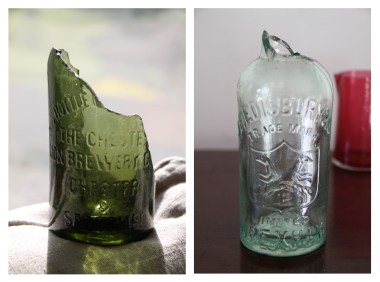
The things we find in the garden, digging out new beds and extending old ones, have added to my knowledge of all sorts of random things.  Until Joe found the Edisbury bottle in the garden (Edisbury was a 19th century Wrexham pharmacist), I had no idea that during the 19th century, when sparkling carbonated water was a new concept, special bottles had to be designed to keep in the fizz.  The Edisbury bottle that we found was not for sparkling water, but a fragment of a bottle that we found a few weeks ago, which was a complete puzzle, turns out to be part of the new carbonated water revolution.  It was stopped with a marble that was held in place in the neck by the pressure of the gas from below.  Fantastic.

It doesn’t look like much, and has to be seen in the context of complete examples for it to make any sense at all.  Sorting out books from my move in February (it is still taking forever to organize my books), I found a long-forgotten Shire Publications book entitled Bottles and Bottle Collecting, which I bought during my Thames mudlarking phase.  Just flipping through it before deciding where it should go, and noting that it covers stoneware as well as glass bottles, I spotted a photograph on page 12 showing three Codd bottles, and it was perfectly obvious that my fragment matched the neck of the one on the far right.  So what on earth is a Codd bottle?

Photograph on page 12 of “Bottles and Bottle Collecting” (Hedges 1988), annotated to show the section of a similar bottle found in the garden

In 1772 Joseph Priestley began to manufacture carbonized waters, which fizzed.  Stoneware was the traditional vessel for mineral-based drinks and tonics, but the gas leached out through the fabric.  Cork-stopped glass was the obvious solution, but the gas could built up to the point where the cork blew out, which both wasted the valuable product and created a considerable mess in the process.  One solution was the torpedo- or amphora-shaped bottle with a pointed base that had to be stored on its side, keeping the cork and the fluid in contact, which kept the cork moist, preventing shrinkage, which kept the cork in situ.  These were considerably unpopular, as storage was always a problem.  Wired-on corks were one solution, also unpopular, and in 1875 Hiram Codd came up with an entirely novel way of solving the problem that became very popular.

Hiram Codd. Source: Findagrave.com

Hiram Codd was very much a man of his era.  His father had been a carpenter, but by his early 20s, Codd was establishing himself as a mechanical engineer and went to work for the British and Foreign Cork Company, working to improve the cork production process.  As a specialist in bottle closures he realized that corks had certain limitations, and began to look at alternatives, carrying out experiments in a small mineral water works in Islington.  In 1872 he secured backing by Richard Barrett, whose two sons owned the Malvern Mineral Water Co. in Camberwell.  With this investment, he was able to develop his globe-stopper.

Banta bottle from Kerala, India. Source: Wikipedia

Codd’s innovation used a thick-walled bottle, a cleverly shaped neck with lugs, and a glass marble-sized globe as a stopper, which was forced towards the opening of the bottle by the gases, where it was stopped by a rubber ring.  In order for this to work, the bottle had to be filled upside down so that the marble could rise to the top to seal.  Two lugs were designed into the bottle, as shown in the fragment, and to pour the drink the marble had to be pushed down to the flanking lugs, where it became trapped, enabling the drink to be poured.  He patented many different versions of the basic scheme in order to try and find the perfect and definitive solution.

In spite of other innovations for stopping bottles, the design was still in common use throughout the 1920s, going out of use in the UK by the end of the 1930s. Dad says that he can remember them during the Second World War.  Superbly, the Codd bottle is still in popular use in India, popular for a drink called Banta.  One of the staggering things of the years of the Industrial Revolution until the late 19th Century was the tidal wave of innovation and the thousands of inventions that emerged, many of them small but fascinating like this one, and all devised to solve specific problems that arose as new products and new ideas emerged.

The survival rate of Codd bottles is poor, as many were deliberately broken by children trying to get at the marbles they contained.  It is has been suggested that the term codswallop (meaning nonsense, something that makes no sense) is derived from Hiram Codd’s bottles.  I’m absolutely not convinced, but you can Google it.

Photograph showing the neck of a Codd bottle with a marble in situ. The pale blue marbles were much in demand by small boys 🙂 Source: Drinking Cup

For anyone new to this occasional series on objects extracted from my garden during everyday gardening activities, see the History in Garden Finds page.  These are not objects used in the garden, but objects, usually fragments, lost or disposed of in the garden and found during digging, troweling and planting.

Sources:

Books and papers:

Hedges, A. A. C. 1988.  Bottles and Bottle Collecting.  Shire Album 6.

Munsey, C. 2010. Codd (Marble-In-The-Neck) Soda-Water Bottles, Then and Now!
https://sha.org/bottle/pdffiles/coddarticleMunsey.pdf

Websites:

Banta
Wikipedia
https://en.wikipedia.org/wiki/Banta

Codswallop
Phrases.org
https://web.archive.org/web/20080913063340/http://www.phrases.org.uk/meanings/235250.html

Drinking Cup
The invention of soda water
http://www.drinkingcup.net/1767-from-volcanos-to-soda-pop/

Hiram Codd
Findagrave.com
https://www.findagrave.com/memorial/24680991/hiram-codd