Category Archives: Walks suitable for unwilling legs

Day Trip: Wroxeter Roman City, near Shrewsbury

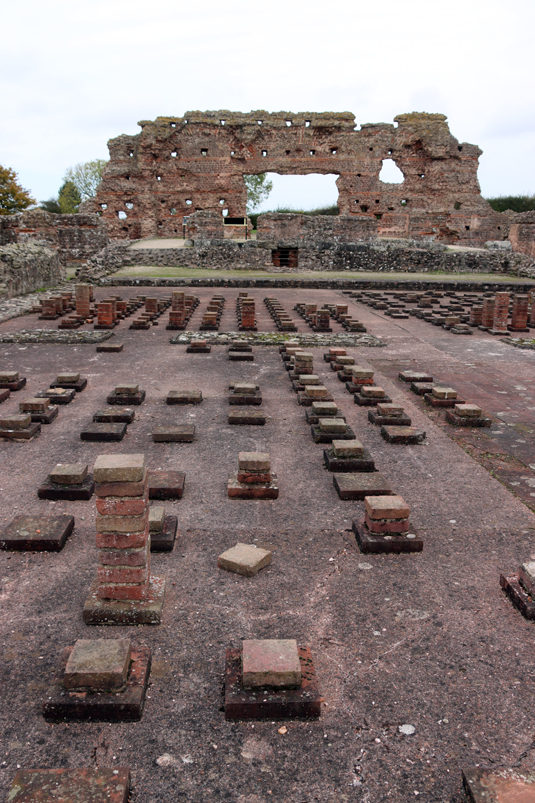
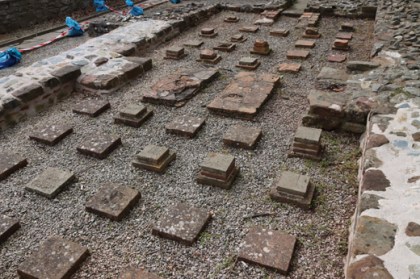
Hypocaust in the foreground with, in the background, the wall known as the Old Work, making one side of the former basilica.

Founded in the mid-1st century AD next to the point of the river Severn where it could be forded, Wroxeter (Viriconium) was built on land farmed by the Iron Age Cornovii.  It became a legionary fortress with the capacity to hold 5500 men in the 50s, becoming an urban centre towards the end of the 1st century, eventually becoming Britain’s fourth largest town, four times larger than the the legionary fortress.  The remains of the site lie in a rural landscape to the east of Shrewsbury and is managed by Historic England.  There is an imaginary reconstruction of a Roman villa.  Indoors there is a very nicely presented Visitor Centre with exhibits and displays, as well as a small shop.  Visiting details are at the end of this post.

Display in the Visitor Centre

There is little point repeating everything that the fact-filled guide book has to say about Wroxeter and its history, so this is just a short summary of what you can expect to see on a visit.

What remains of the site is a very small section of the original 192 acre (78 hectare) city, consisting of the lowest courses and foundations of the bath-house, part of a market-place and a row of column bases that marks one site of the forum.  The road that carries visitors into the town follows the line of the Roman road, Watling Street.  The city was surrounded by a 3-mile long circuit of ditches and banks originally topped with a timber palisade, now on farm land and not accessible to the public, but still visible on aerial photographs.

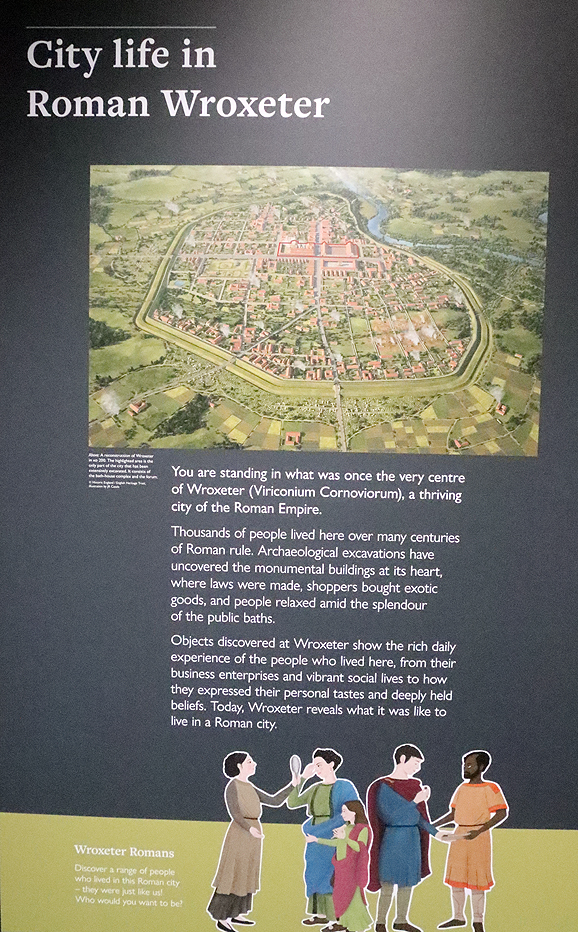
Information board in the Visitor Centre at Wroxeter

Unlike Chester, York, London and many other Roman urban developments that survived the departure of Rome, Viriconium was one of the Roman towns that were completely abandoned, beginning in the mid-3rd century.  Looking out over the surrounding fields towards the Wrekin, after which Viriconium may have been named, it is difficult to imagine a thriving urban mass of public and private buildings connected by a maze of roadways and alleys. A series of archaeological excavations, however, have provided insights into what used to be here, and the visitor centre and guide book do a good job of explaining it.

The town was divided by the mighty Watling Street that connected it to London in the south, and to Whitchurch to the north, where the road forked with one branch going to Chester and the other towards the northeast, York and beyond.

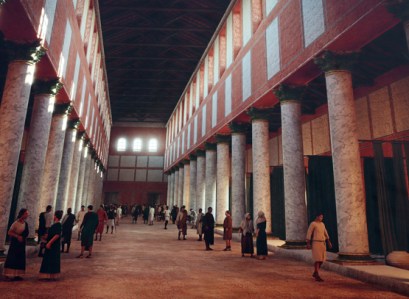
Artistic reconstruction of the basilica on an outdoor information board

The most conspicuous feature of the site is the single piece of surviving wall, known as the Old Work, shown at the top of this post, which is what remains of what was one of the walls of the basilica, which was shared with the rest of the bath-house.  The big opening in the wall marks where there were once double doors.  The layers of brick-like stone blocks and tile work were covered in pink plaster, some of which would have been painted with decorative scenes.

Information board showing the main architectural features at the site with the basilica shaded in blue, the shops and marketplace side by side in the foreground and the bath-house taking up the rest of the space.

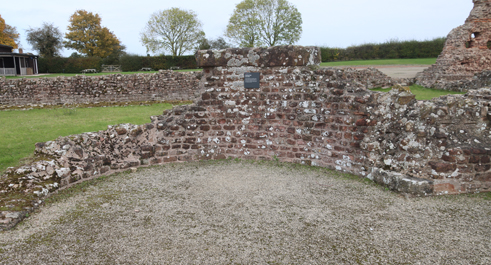
Changing rooms at the end of the basilica

The bath-house, which has been excavated in its entirety, is the most complete part of the site, with remains of one wall, sections of the the hypocaust (raised heated floor) and the footprint of the baths’ basilica, giving a clear indication of the scale of the original complex.  Bath-houses were an important part of Roman life, a component of civilized living and a good place to socialize and network. Even the small industrial base at Prestatyn had a tiny bath-house (posted about here).  The Roman visitor to a big bath complex would usually begin in the basilica, a long thin space flanked by columns, where exercise and sports could be carried out in the central area, whilst the side aisles could have been used for personal care activities like massages and hair dressing.  At the end of the basilica were two changing rooms.

The outdoor plunge pool

Then bathers moved through the baths in a sequence from an outdoor cold water plunge pool (heaven help them in this climate!) to an indoor cold water pool (natatio), an unheated room (frigidarium), a  warm room (tepidarium), and a number of both wet and dry hot rooms (an alveus, caldarium, and sudatorium).  Heat was provided in the warm and hot rooms via a hypocaust, consisting of regularly placed pillars of tiles that once supported a raised floor about 1 metre high, through which hot air was directed from three furnaces.  Hollow box-like flue tiles were used to capture the hot air as it rose from below.  A piece of decorated ceiling plaster from the hot room has been reconstructed, and copies are kept in both the Visitor Centre and the Shrewsbury Museum and Art Gallery.

Hot room

Reconstruction of ceiling plaster of the frigidarium in the Visitor Centre

Part of the western extension of the baths

Water from the baths was drained away beneath the bath-house and was used to flush out the latrines, the lower courses of which survive.

One of the shops that fronted onto Watling Street

Although the rest of the remains today lack the impact of the basilica wall section, mainly consisting of no more than two or three courses of stonework, these too were important parts of the civic quarter of the city, and there are explanatory information boards all over the site that explain what you are looking at and showing helpful artists’ reconstructions of how buildings may have been experienced by the Roman inhabitants.

Part of an information board showing the market place used by wealthy residents

Next to the bath-house is what remains of a market hall, with two storeys surrounding a central courtyard, containing shops that sold high quality food goods to the wealthy.  This building survived into the fifth century AD.  Nearby were other shops with open fronts overlooking Watling Street, which may have included food and drink for those using the baths, like modern take-away outlets or bars.

One of the ground floor shops in the marketplace

Colonnade of the forum, facing Watling Street

Over the road there is a line of column bases that are the remains of what must have been a very impressive forum, which was once covered 2.5 acres (1 hectare) and measured 80m x 120m (262 x 393ft).  This consisted of covered buildings arranged in a square around an open courtyard. The buildings served administrative, legal and mercantile functions, and the ruins represent a colonnade that faced onto Watling Street.  The central area was for an open market where stalls could be rented by local traders.

The reconstructed Roman house, a simplified version of excavated building “Site 6,” had a shop facing onto the street with accommodation at the rear.   It was built in 2010 for a television programme and provides a good way of visualizing what Watling Street and other areas of Viriconium may have looked like.

The forum

The reconstructed Roman house

A room in the villa

Next to the house, but not open to the public, is the model farm built in the mid 19th century by Lord Barnard, and incorporates considerable amounts of Roman stonework in its construction.  The farm is no longer in use but is maintained by Historic England.

The visitor centre and the lavishly illustrated guide book provide an excellent overview of the entire city’s history and what was found in archaeological excavations, with more information provided in the Shrewsbury Museum and Art Gallery.

Visiting

Prices and opening times can be found on the English Heritage website here.  There is plenty of parking.  The visit begins at the visitor centre, where tickets are purchased and you are given the option of taking an audio guide. I didn’t take one, but plenty of people were using them.  There is a small shop where you can purchase a detailed guide book, and although it is impractical to read this as you go around the site, there is a site plan and an aerial photograph with all key features marked, both of which great to have as you walk around.  The Visitor Centre is small but excellent, with plenty of helpful information boards and attractive displays of objects found at the site.  There is no cafe but there is a picnic area with a few benches.

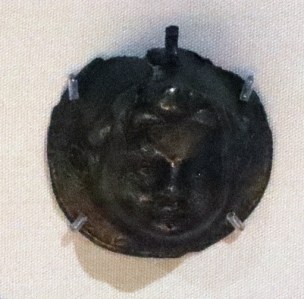
1st century harness mount showing Bacchus

The site itself is mostly on the flat, with pathways between all the main buildings and information boards explaining what you are looking at.  There was a coach-load of children there at the time I visited and it is clear that for children, the villa was easier to get to grips with than the ruins themselves.

Nearby is St Andrew’s Church, which I very annoyingly missed but is widely recommended with some attractive and unusual features, some dating back to the Norman period. Both the church and the model farm, the latter not open to the public, are described in English Heritage’s Wroxeter guide book.

St Bartholemew’s, Tong

If you are driving via the A41, both Lilleshall Abbey and Tong’s St Bartholemew’s Church are well worth the visit.  Tong is right on the A41, very convenient for a visit en route.

Near to Wroxeter is the 18th century National Trust Attingham Park property. Shrewsbury is not far, and has a really excellent museum and art gallery with a super Roman gallery with finds from Wroxeter. Shrewsbury itself is a lovely and apparently thriving town with a good mixture of architectural styles from the Medieval period onwards, including the vast church of the former Shrewsbury Abbey, some lovely half-timbered buildings and some fine Georgian architecture, as well as some great places to find lunch!

Sources

White, Roger H. 2023. Wroxeter Roman City. English Heritage (also includes St Andrew’s Church, the Victorian model farm and the reconstructed house)

Information displayed in the Wroxeter Visitor Centre

Information displayed in the Shrewsbury Museum and Art Gallery (Roman gallery)

Discovering Shropshire’s History (website)
Roman Shropshire – (AD 43 – AD 410)
http://www.shropshirehistory.org.uk/html/search/verb/GetRecord/theme:20061122101531


A walk from Waverton along the Shropshire Union Canal

I have driven over the canal bridge on Eggbridge Lane in Waverton so many times thinking that I really must take advantage of the little car park just before the bridge to go and take a stroll down the towpath.  Having woken up early on a sunny morning I decided to investigate. Waverton is just off the A41, so very easy to reach. The car park is quite small, but it was not full even on a bright and warm morning.  The What3Words address for the car park is ///fingertip.snored.deals

Victoria Mill, Waverton

Immediately opposite the car park, as you walk to the towpath, is a very attractive canal building, the Grade 2 listed, a mid-19th century Victoria Mill, a former steam-powered canal-side corn mill, with bays for loading and unloading narrowboats, and now converted for modern use. The Historic England description is here.  This is part of the heritage of the Shropshire Union Canal, which if you keep walking north eventually ends up at Ellesmere Port.  To the south, it eventually connects up with the rest of the main canal network at Hurleston Junction.  The Shropshire Union has quite a complicated history, as does Chester’s canal heritage as a whole, and was not completed until 1835.

As with most canal walks, there’s always a choice to turn right or left, and as I had no idea what to expect from either direction I decided to head north, leaving the walk south for another occasion. Out of the car park I turned left under the unprepossessing bridge no.119 and headed up the towpath.  This section is metalled, so it avoided the mud and sludge that I had been half expecting.

If you take this route you find yourself walking along a short row of houses with canal gardens along a metalled pathway.  Canal-side gardens are always fascinating.  I used to live on a narrow boat many years ago, and it is always a lot of fun to see how different minds have dealt with a garden that opens directly on to a canal.  These are always hugely individualistic and personal.  There is always much to see in the way of garden furniture, garden ornaments (someone will always have gnomes, and there is usually at least one example of traditional canal painting), sheds in various states of repair, a wide range of summer houses, varieties of approaches to terracing, often some very interesting specimen trees and shrubs, and different attitudes to garden seclusion, along a spectrum from solid barriers of hedging or fencing to a complete lack of interest in any form of privacy.  A real cultural treat.

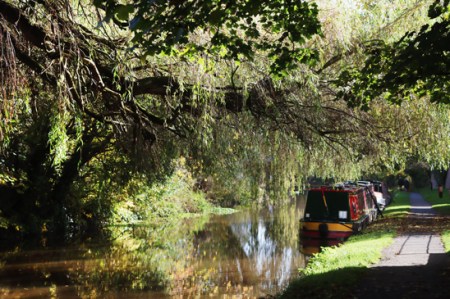
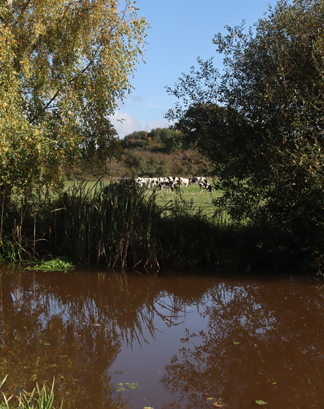
After just a minute or so the towpath enters a more rural section, and in the late season sun it was a real pleasure to take in all the autumnal colours on trees and shrubs that flank the canal.  I’ve posted some of the photos below. It’s a well-used section of towpath, with joggers, cyclists and plenty of dog walkers, but everyone is very civilized about moving over to make passing easy.  There was not much in the way of canal traffic, with just two narrowboats on the move, but I expect that it is much busier in summer.

Keep an eye out on your left as you leave the housing on your right and reach the more rural section.  Partly concealed by the grass next to the towpath, there is a short inscribed red sandstone Parish Boundary Marker. This section of the canal passes through the parish of Rowton, famous for the Civil War Battle of Rowton Heath (see the Wikipedia entry on the subject and a more detailed analysis by Historic England).  King Charles I is said to have watched his army lose that battle from the Phoenix Tower that still stands on Chester’s city walls. The stone marks the boundary between the parishes of Christleton (CP on the stone) and Rowton (RT).  The date commemorates the date of the battle in 1645 and, below the level of the grass, 1995, the 250th anniversary of the battle.
===

After this more countrified section there are more houses, all interesting, with some lovely weeping willows and other water-loving species, and a very attractive hump-backed bridge, that I have since discovered carries Rowton Bridge Road into Christleton.  I walked up as far as The Cheshire Cat, which sensibly has a gate onto the towpath, and carried on just a short way beyond it, but at that point the canal converges closely with the A41 (Whitchurch Road) and it becomes quite a noisy experience with the unremitting traffic, especially during the week.

Checking the map later (for example see the plotaroute.com website), I note that by coming off the towpath at Rowton Bridge it is possible to walk into the attractive village of Christleton, with its marvellous pond, and I would have done this had I realized.  Another time.  had to be somewhere else in the afternoon, so it was a short walk, probably an hour and a bit there and back at strolling pace, with pauses to let bicycles pass, and to take photographs.

For those with unwilling legs (see the blog’s Introduction for details about what this refers to), the towpath heading north from Waverton is metalled, but quite uneven.  No problem for most people, I would have thought but do keep an eye on it.  There are places where the edges of the surface are particularly uneven, but this just means that if you are with someone else you need to go in single file for short sections.  Otherwise, it’s on the flat and very enjoyable.

On the way back I followed the towpath beyond the car park for a few minutes to see how far the housing that backs onto the canal extended.  This part of the towpath is not metalled, was muddy and is single-track.  These houses and gardens are another interesting mixture – each of the sections of housing and gardens has its own personality, presumably reflecting both when it was built and the pricing.  These look as though the garden-canal margins were all designed with narrowboats or other canal vessels in mind. There was indeed one narrowboat moored up at a garden.  The housing stops after a couple of minutes and the towpath reverts to a far more rural appearance.  I’ll investigate further on another day.

Exhibition in Chester Cathedral: “Trena Cox: Reflections 100”

Introduction

The new exhibition at Chester Cathedral, Trena Cox: Reflections 100, which is on until the 8th November 2024, a scarily short window of opportunity for visitors, has pulled out all the stops to create a really imaginative  and absorbing examination of stained glass artist Trena Cox and an exploration of her legacy in more recent art works.

First, it was a new opportunity to learn more about an important local stained glass artist, a woman engaged in a form of art-craft that was usually the preserve of men.  She is, for example, one of only two female stained glass artists represented in the cathedral, and she has nine windows, one large (the St Christopher window in the slype shown below) and eight small ones in the cloisters (four of which are shown further down).
To appeal to different preferences for experiencing exhibitions, there are downloadable audio guides, online information sources via QR codes and real-world interactive screens, as well as beautifully designed and displayed posters and original works of art employing diverse materials in multiple styles.

Detail of Emily Lawler’s “Flock of Five Geese.” The entire composition, referencing the story of St Werburgh and her miracle, is shown below.

Second, it was terrific to see how the four different parts of the exhibition explored different aspects of Trena Cox’s legacy, because this is as much about the art and ideas that Trena inspired as it is about her own work.  In addition to  well known artists in different types of medium, the pre-exhibition project headed out into the community to involved different groups, including school children.  The sheer diversity of responses to Trena’s work is remarkable, many of them picking up not on the main themes of her work, but on the tiny details that make her work unique.

Third, it was fascinating to discover how the entire cathedral was employed in displaying the works on display, drawing visitors into different areas of the cathedral to experience new ideas in a medieval context.  The abbey has small, intimate spaces as well as large lofty ones, and the trail makes good use of the architecture.  By using the entire cathedral space, the art works could be separated, giving each one the opportunity to create its own impact.

The St Christopher window following restoration. Photograph by Helen Anderson (and copyright Helen Anderson)

Next, it was splendid to experience at first hand how beautifully the St Christopher window has been restored by Recclesia.  I attended a Chester Archaeological Society visit, lead by Artist in Residence Aleta Doran who is also the exhibition’s curator, and although thought it was stunning then, it has since been restored and it was fabulous to see not only how it has been repaired and restored, but how new details have been revealed.  This can be seen in the window itself, but is also the subject of a splendid video in the cloister that captures the work carried out.

Finally, I was with artist Helen Anderson, and we were given an informal tour of the exhibition by its curator, Artist in Residence Aleta Doran, who is always a joy for her knowledge and enthusiasm, which provided us with a terrific insight into how the entire exhibition came into being, a real learning curve into what it takes to pull together an exhibition that has so many aspects to it.  A real logistical tour de force, as well as a visual treat.
===

Finding your way

The exhibition is grouped into four different sections, each exploring a different aspect of Trena’s legacy.  As you enter the cloisters from the reception area (free of charge at this time of year), there is an information board that points you to the left, but pause to investigate as it also has QR codes, one of which is a map of the route that you can download to your phone, another an audio guide that relates to the numbered posters and exhibits.

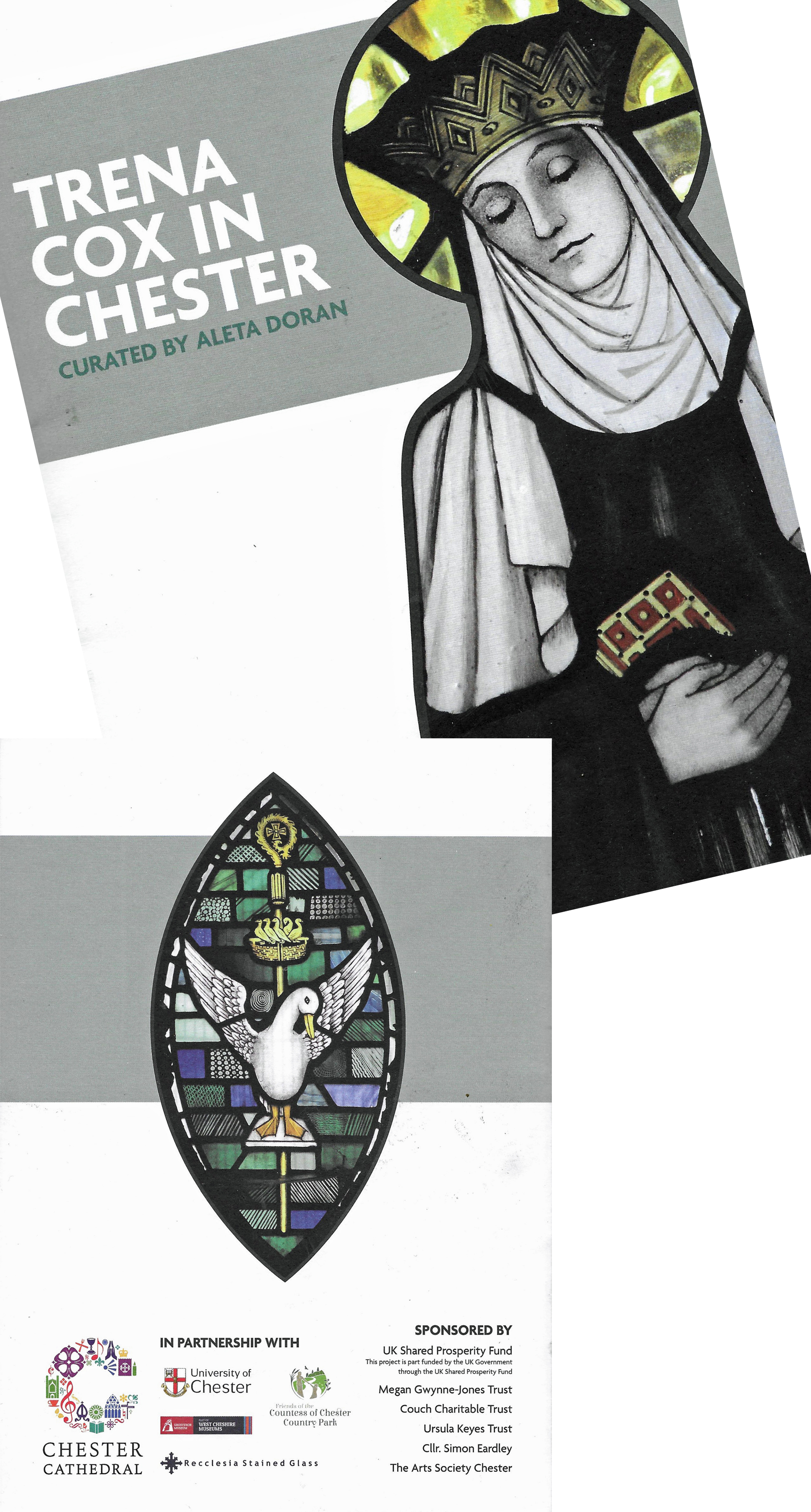
Don’t forget to pick up the booklet, the cover of which is shown at the top of the post, from the reception area.  There is some very useful information about the exhibition, its contributors and its partners and sponsors, as well as QR codes to more information online.

Learning about Trena Cox

The first part of the exhibition introduces the visitor to Trena Cox (1895-1980) using, depending on whether you downloaded the audio introduction, either posters or a combination of posters and Aleta’s audio tour.   The posters are beautifully designed, framed in slender black frames that emulate the leaded frames of stained glass, showing photographs of Trena Cox glass from many locations, accompanied by isolated motifs taken from her glass works. The only known photograph of her was taken when she was a young teenager and shows a direct gaze and a certain fearlessness.

Born on the Wirral, Trena Cox trained at the Laird School of Art in Birkenhead, receiving a traditional introduction to a broad range of techniques and skills before switching to stained glass. There are over 150 stained glass pieces known, but others may remain to be found.  Working mainly in the Cheshire and northeast Wales areas, her works are, however, in other areas, and most of them are in churches.  Trena’s story, which has sometimes been a challenge for Aleta to discover, emerges from both the posters and the audio track and demonstrates not only Trena’s talent but her willingness to modify her style to suit the times.

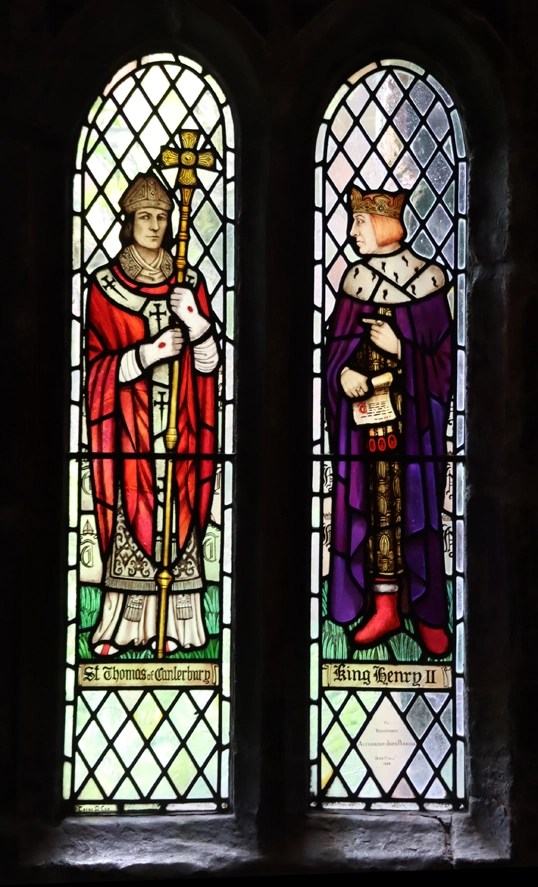
Trena Cox windows showing King Henry II on the right looking somewhat balefully toward Thomas Becket on the left

Trena Cox’s cathedral windows are an important part of the the exhibition and the route takes you first to those in the cloister (the walkway around the garden).  The cloister was windowless until the arrival at the cathedral of Dean Frank Bennett, whose energy and enthusiasm created the stained glass sensation that we see today.  Eight of Trena’s windows are small lights each side of a corner, in each case two above and two below.  My favourites are the paired Henry II and Thomas Becket of Canterbury.  There are other connections to St Thomas Becket within the cathedral, but what I particularly like about these two windows is the way that Henry looks out of his window towards Becket in his window, recreating something of the narrative of this impossibly difficult relationship, which resulted in the martyrdom of Becket, and a period of political difficulty for Henry II.  You can almost hear Henry thinking “Will no-one rid me of this meddlesome priest?” (almost certainly apocryphal). There is a QR code on one of the information boards for finding out more about all of the cloister windows on the Chester Cathedral website.

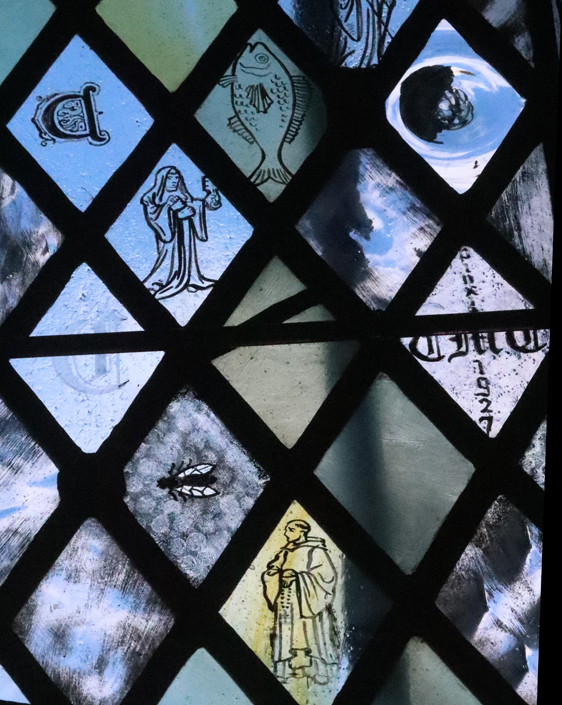
Detail of the St Christopher window shown at the end of the post, with Trena Cox’s signature and the bee surrounded by a pattern made of her fingerprints.

The recent restoration and professional cleaning of the main Trena Cox window in the cathedral, the St Christopher window in the slype, has returned from Recclesia with a glowing, incandescent and luminescent quality that is quite extraordinary.  Whether or not this is your sort of aesthetic, this is an extraordinary piece with charming details full of symbolism.  Minutiae that were not previously visible are now bright and sharp, and the richness of the entire composition can now be appreciated as Trena Cox first designed it.  I particularly melted at how Trena’s fingerprints were incorporated into a pattern around the bee in the window.  It was also revealed that the lead was used to create texture and relief at certain points, with St Christopher’s remarkable hair not merely painted on, but highlighted with sections of lead.  There is an interactive display in the slype (corridor) next to the window which allows you to explore the imagery and symbolism of the window, which are extensive, and this really helps to open up the secondary stories.

Video showing the skilled work carried out on the St Christopher window by Recclesia Stained Glass

A video in the cloisters describes how the restoration work was carried out.  It shows footage of the team at work, including the absolutely nail-biting process of putting the window back into its arches after restoration.  Aleta says that it was just as bad watching it being taken out, but somehow the sense of being at the finishing line after all that hard work was horribly tense even on a video!  But of course these people are experts and everything was fine.  Microscope analysis of the stained glass shows how in one section of the glass, which had become damaged simply due to its age, the edges of some of the painted text had begun to deteriorate, so the restoration work was incredibly timely.

Trena Cox in today’s Community

One of the really creative parts of the exhibition, and an admirable requirement for a part of the funding for the exhibition, was that the local community should be given the opportunity to respond to Trena Cox’s stained glass art with art works of its own.  I knew about this when I visited the Trena Cox windows with the Chester Archaeological Society, lead by Aleta, but was not at all clear about how this part of the project would manifest itself.  What a super surprise to see the inventiveness and imagination produced by local community groups and schools!  Here are some examples:

St Werburgh’s and St Columba’s Primary School

Heritage Engagement Window. During the 2024 Chester Heritage Festival in June, children as young as two years old painted panels that were incorporated into this splendid leaded panel, all based on the St Christopher window

Detail of the above Heritage Engagement Window.

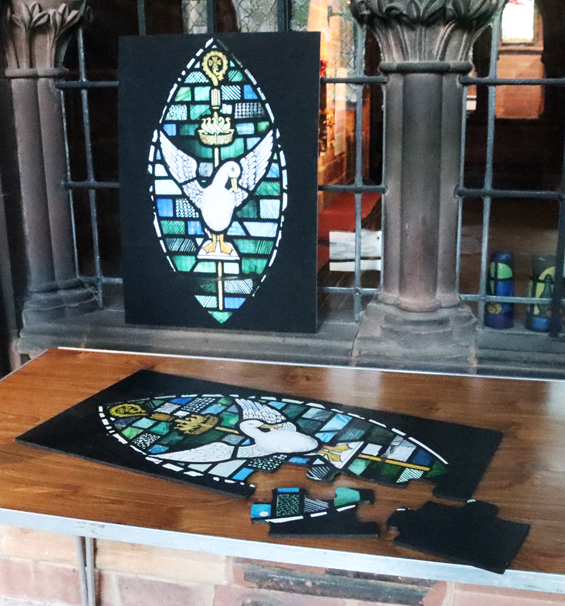
Jigsaw, a community artwork based on a Trena Cox window in St Werburgh’s Church, by 15 women of Chester

The Story of Stained Glass

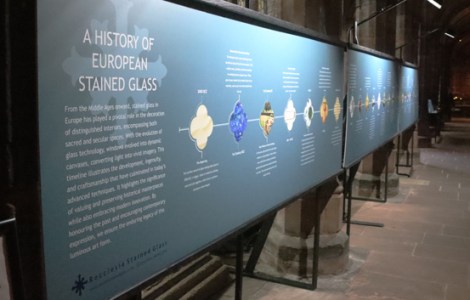
The creation of stained glass is probably one of the most poorly understood areas of art, craft and design.  Although it is widespread, and not only in religious buildings, its history and the processes of manufacture and repair are something of a mystery for most of us.  The process of demystification has been very much assisted by an enormous but easily digested set of information boards that lead down one part of the cloister, charting the chronological history of the artistic and technical advances in stained glass development. It’s a real revelation and is beautifully written and designed.

Artistic responses to Trena Cox

In Our Hands by April Pebble Owens.

How current artists have responded to Trena Cox is one of the innovative aspects of the exhibition, not only helping to highlight some of the unique features of the original stained glass creations, but also inspiring and forging new creations.  These new works of art, some in glass, others in paint and fabric, others engraved, some in mosaic, some in print, certainly demonstrate a wide range of skills but more importantly showcase the diversity of creative and empathetic responses to Trena Cox’s enormous catalogue of artistic expression.  I have copied a few of these below, chosen simply to show some of the range of different ideas and interpretations that emerged.  In the exhibition accompanying labels explain some of the ideas behind these works, one of which is shown below.

Tamsin Abbot. The Wolf Shall Dwell with the Lamb

Label explaining ideas behind the above panel by Tamsin Abbott. Each of the pieces on display in the exhibition is accompanied by a similar piece of explanatory text

By the River of Swirling Eddies by Linda Edwards, reminiscent of medieval bestiaries

Flock of Five Geese, by Emily Lawlor

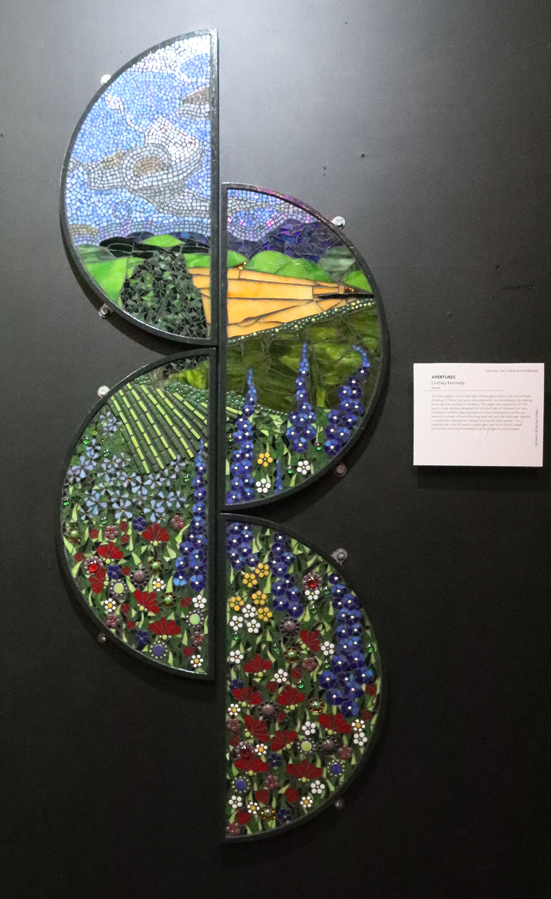
Apertures, by Lindsey Kennedy

Birds Without Borders by Gillian Curry

Final Thoughts

Detail of the St Christopher window

The idea for the exhibition was born around four years ago.  Work has been concentrated in the last two years.  There are so many different aspects to it that there it is difficult to do justice to it, but as a celebration of Trena Cox, of stained glass, and of how communities as well as individual artists can respond to an artist’s output, this was a revelation.   Even more than the work of Trena Cox herself, I found the whole conceptualization of the exhibition with its multiple strands of knowledge transfer, and its outreach to the local community and other artists, truly engaging.

The exhibition works, and it works brilliantly.  This was demonstrated perhaps more than anything else by the two elderly ladies who walked around it, arm in arm, discussing in depth all the modern responses to Trena Cox’s work.  Neither knew much about art, but both were fully absorbed with the narrative of the exhibition, from Trena Cox herself to the evidence of her legacy.  Splendid.

Detail of the newly restored St Christopher Window

Find out more

Detail of the Heritage Engagement Window

There is a “Trena Cox:Reflections 100” symposium, which has been arranged to coincide with the exhibition, on 25th October 2024:

“Using the life and legacy of Trena Cox as the focal point, attendees will hear from a variety of respected speakers from across the stained glass, heritage conservation, and art sectors. This evening keynote will conclude the day, looking at the past and future of women in stained glass.”

You can find details for the symposium on the Chester Cathedral website at:
https://chestercathedral.com/events/event/21607

You can follow Aleta Doran on Twitter (@StargazingAleta), or via her blog at https://www.aletadoran.co.uk/. 

For those wishing to investigate further afield, Green Badge Guide Katie Crowther is leading a “Trena Cox:Reflections 100” walking tour of Chester on 3rd November to complement the exhibition:

This walk will be a chance to get out onto the streets of the city where Trena lived and worked from 1924 until her death in 1980. We’ll take a look at some of the buildings where her distinctive work can be seen today and learn more of their history.  Trena was a passionate advocate for the preservation of her adopted home’s history and heritage. Along the walk, we’ll consider several of the streetscapes that changed quite dramatically during Trena’s time in Chester.
https://www.eventbrite.co.uk/e/trena-cox-reflections-100-chester-sunday-netwalk-tickets-1013497697897?utm-campaign=social&utm-content=attendeeshare&utm-medium=discovery&utm-term=listing&utm-source=wsa&aff=ebdsshwebmobile

The free booklet provided at the reception area also provides the following QR codes for those who want to find out more:

===

Websites with more information:

Chester Cathedral
Trena Cox: Reflections 100
https://chestercathedral.com/events/event/15207

The Trena Cox Project
By Aleta Doran, ongoing
https://www.aletadoran.co.uk/thetrenacoxproject

Recclesia Ltd
https://recclesia.com/
https://recclesiastainedglass.co.uk/

Chester Archaeological Society
An Interview with Chester Cathedral Artist in Residence Aleta Doran. For CAS, by Andie Byrnes, 7th July 2024
https://chesterarchaeolsociety.blog/2024/07/07/an-interview-with-chester-cathedral-artist-in-residence-aleta-doran/
Chester Archaeological Society visit to Chester Cathedral with Aleta Doran to learn about stained glass artist Trena Cox. For CAS, by Andie Byrnes June 13th 2024
https://chesterarchaeolsociety.blog/2024/06/13/our-visit-to-chester-cathedral-with-aleta-doran-to-learn-about-stained-glass-artist-trena-cox/

Based In Churton
A roof boss in Chester Cathedral: The Murder of Thomas Becket
https://basedinchurton.co.uk/2023/07/14/a-ceiling-boss-in-chester-cathedral-the-murder-of-thomas-becket/

Rhuddlan Castle and the Statute of Wales

Rhuddlan Castle from the air. Source: People’s Collection Wales.

The magnificent Rhuddlan Castle, and its predecessor Twthill motte-and-bailey castle (the latter now just a mound), are located just over 3 miles south of the point on the North Wales coast where the river Clwyd, which Edward I diverted to pass the foot of Rhuddlan, empties into the sea at Rhyl. Like all of Edward I’s newly built English castles in Wales, this has some features in common with its brethren, but is at the same time a unique entity, each with a highly distinctive, unmistakable appearance in its own right, building on previous creativity to create even more innovative defensive measures.

I visited Rhuddlan last week for the first time, taking spur-of-the-moment advantage of a cold but gloriously sunny morning to make the most of Rhuddlan’s striking looks and lovely location.  The castle is an impressive sight, particularly as it is bounded on its northeastern side by fairly dense village housing and one gets the sense of emerging abruptly from the bustling present into a peaceful and finely fossilized landscape of the past.

This is the third post in an occasional series about the history of Edward I’s earliest castles in northeast Wales.  The background history to Edward’s sudden launch into castle building in Wales from 1277 is the first part, and can be found here. It looks at the disputes between Edward I’s father Henry III, king of England, and his subsequent and far more personally felt disputes with Llywelyn ap Gruffud, Llywelyn the Last of Wales.  The second post in the series looked at Flint Castle, the first of Edward’s castles in Wales started in July 1277, with its accompanying new town.  Rhuddlan Castle was started in September 1277, and is covered below.  Denbigh built in 1282 is posted about here.

St Mary’s Rhuddlan

I combined Rhuddlan Castle with a look at the last surviving chunk of Edwardian defensive ditch that originally surrounded the town, and a wander around the exterior of the nearby St Mary’s Church (its opening times to visitors are limited to the summer months), which was built sometime after the granting of the town charter in 1278, both of which are mentioned below. I then skirted the castle and followed the track and footpath down to Twthill. The story of life at Rhuddlan before Edward I, both pre- and post-Norman, will be covered on another post, and will include the background to and history of Twthill.

St Asaph’s Cathedral

After Rhuddlan I drove the few miles south to visit St Asaph Cathedral, which has connections to both Rhuddlan Friary, originally located near the castle, and Valle Crucis Abbey, near Llangollen.  Valle Crucis is the subject of an ongoing series of posts on this blog.  Rhuddlan Friary has been discussed on the blog here, and St Asaph Cathedral will be discussed on a separate post at a later date.

To make it an official day-trip, the day not being warm enough for an ice cream, I stopped for a very self-indulgent glass in The Hare in Farndon on the way home, which was the cherry on top of a very good day!

Visitor information for Rhuddlan Castle is at the end of the post.

Rhuddlan during the reign of Henry III

Henry III (reigned 1216-1272), father of Edward I, had ongoing problems with self-styled Prince of Wales Llywelyn ap Gruffudd, also known as Llywelyn the Last, a grandson of Llywelyn ap Iorwerth (Llywelyn the Great).  Llywelyn was based in Gwynedd, his home territory, but had managed to establish some degree of unity within his own family (particularly his brothers Dafydd and Owain) and throughout Wales, historically a fragmented and constantly shifting set of territories.  The powerful Marcher lordships along the Welsh border formed an aggressive barrier between Wales and the rest of England, and trouble had rumbled continuously along the border during the reigns of previous kings, causing the official border between the two countries to move regularly.  The crown held territories within modern Wales, and these came under attack by Llywelyn the Last. This is all covered in the post that describes the background to the disputes between Edward and Llywellyn, complete with a family tree of the relevant participants.

A Dominican priory, described on the blog here, was founded by Llywelyn ap Gruffudd in 1258 during the reign of Henry III, and is discussed.  The building does not survive, but some of its materials were visibly incorporated into the farm that now sits on the original site of the priory.  It is quite likely that during the 13th century played host to Llywelyn ap Grufudd, and later to both Henry III and Edward I during their visits.  As with most monastic institutions, the Dominicans were obliged to show hospitality to guests, irrespective of their political allegiance, and it would have been in their interests to stay in the good graces of both Welsh and English leaders.  Edward had probably taken advantage of hospitality at Basingwerk Abbey during the construction of Flint Castle.

Edward I’s Rhuddlan Castle

Expanding the the “Ring of Iron”

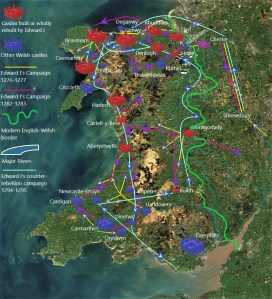
Map of Edward I’s campaigns in Wales. Source: History Matters at the University of Wales

Edward was granted the royal lands in Wales by Henry III on the occasion of his marriage to Eleanor of Castille, and took an active interest in the Welsh situation until his departure on crusade, during which his father died.  Edward inherited the dispute with Llywelyn, but was already very familiar with the the Welsh prince and his ambitions, and was also familiar with the Welsh landscape.  The expenses incurred during his crusade had left him with serious debts, and the terms of the agreement that Llywelyn had reached with Henry III involved a substantial annual payment by the Welsh prince to the Crown treasury, but there were problems.  Llywelyn was already three years in arrears, and was now refusing to pay homage to the new king.  Several treaties under Henry III had failed to achieve long term peace, and although the Treaty of Montgomery of 1267 had looked as though it might hold, Llywelyn ap Gruffud’s behaviour was intolerable to Edward who labelled Llywelyn an outlaw in 1276, and war was declared in 1277. A peace was brokered, but although Edward had every reason to believe that the treaty might secure peace between England and Wales, he began to build a series of castles in northeast Wales, eventually extending into northwest Wales, beginning at Flint in the July of 1277 and rolling out along the coastlines throughout the next two decades.  This was followed almost immediately by the foundation of Rhuddlan in the same year.

Artist’s impression of the Twthill motte-and-bailey castle by Terry Ball.  All that survives today is the motte. Source: Wikipedia

When Edward started building his castle at Rhuddlan in September 1277, Flint Castle and town were still under construction.  Flint had been virgin territory, and consisted of both a stone castle and a new defended town, an “implanted bastide.”  Although the site of Edward’s castle itself had not been occupied, Rhuddlan had been long-established, from the pre-Conquest period into the 13th century.  The existing wooden Twthill motte-and-bailey castle, a short distance from Rhuddlan probably served as a useful base from which to manage building works and campaigns as the new stone castle was built and the new town laid out and provided with perimeter defences.

Llywelyn, realizing that his cause was lost, surrendered  later in 1277 at Rhuddlan, several years before Edward’s castle was finished, and for a while it looked as though the resulting Treaty of Aberconwy would provide the basis for long-term peace.  Llywelyn had been granted the entire region of what is now known as Gwynedd, permitted to retain the title Prince of Wales, and his difficult brother Dafyddd was allocated territories in mid-north Wales whilst Owain was given control of the Llŷn peninsula.   Edward, however, was not taking any chances, and he continued with his castle building programme, unambiguously reinforcing his message that Wales was under English control, with Rhuddlan performing the role as the administrative headquarters for the region.  Should any attempts at rebellion be attempted in the future, Edward and his supporters would be ready.

Why Rhuddlan?

What were the strategic advantages that made Edward I choose Rhuddlan as the location for his third castle, his new administrative headquarters for north Wales?

First, the castle is right on the edge of the River Clywd, a fairly narrow but very attractive ribbon of blue threading its way between the fields, all the more impressive when you know that the river actually ran along a slightly different course until Edward canalized it and had it dredged to provide a deep-water channel for connecting the castle to the coast and the Dee Estuary. The River Clywd become un-navigable not far south of Rhuddlan.  The link to the estuary connected Rhuddlan both to Flint Castle and Chester to its east and then, later, to Edward’s castles at Conwy and Caernarvon in the west.

Photograph of Rhuddlan Castle in the context of the River Clwyd floodplain and the coast to the north. Rhuddlan Castle is at bottom left, near the rear foot of the RCAHMW dragon logo.  Source: Coflein, archive number 6356180 / AP_2007_2032

The castle itself sits above a very wide, low floodplain, on an area of raised land.  Standing on the battlements, reached by modern spiral staircases, the views over the surrounding landscape are remarkable, providing an excellent impression of how well the castle was positioned for sighting oncoming threats.  Economically, the wide floodplain was ideal for the development of a new town, with potential for raising livestock and agriculture.

Until Conwy was built, Rhuddlan was conveniently located as a regional HQ just on the edge of Llywelyn’s territory, and it was his most important base in Wales.  By the time Conwy Castle was up and running, Rhuddlan had become secondary in importance, but was still garrisoned and was very important in Edward’s chain of defences.

The Designers and the Design

The outer curtain wall, which only survives in very small sections, followed the perimeter of the revetted dry moat, and enabled archers in the battlements of the castle to fire over the heads of those protecting the outer defences.

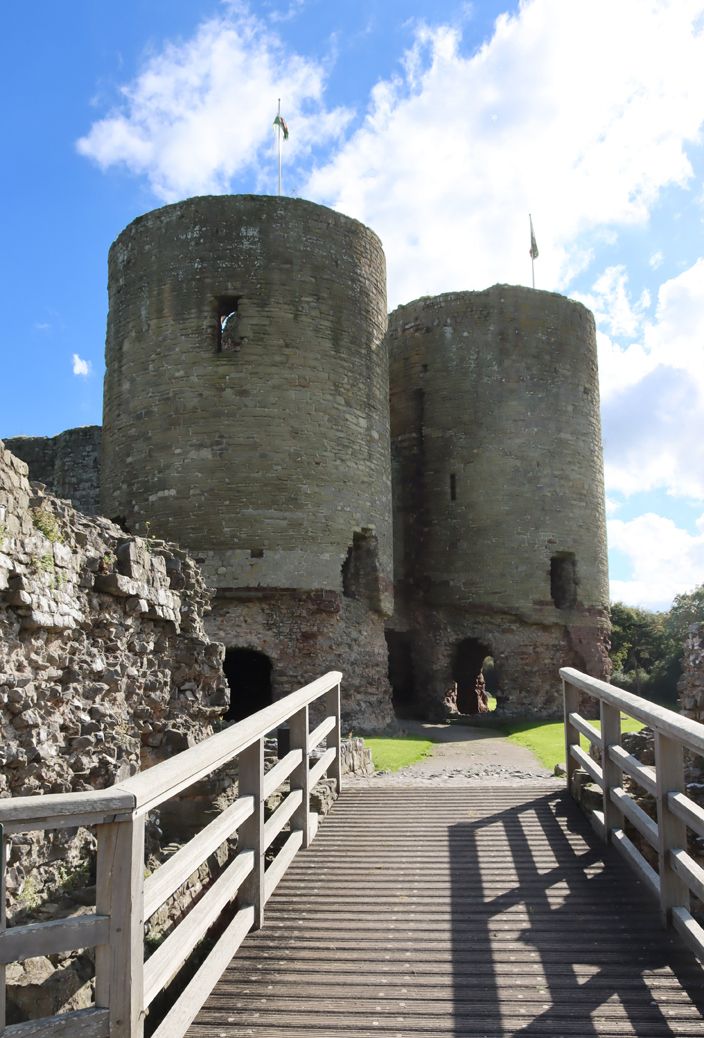
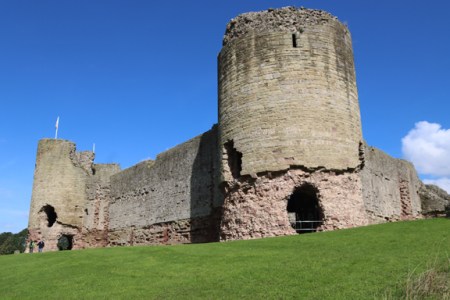
Rhuddlan has a very distinctive look and feel to it, containing some innovative features that were carried through to other castles in the northeast.  The first architect to work on Rhuddlan, who was probably responsible for its layout and some of its initial design elements, was king’s engineer Master Bertram, who had been employed by Henry III is Gascony, and who brought with him Gascon design principles.  He was replaced after six months by Master James of St George, whose work Edward had seen in France at the castle of St Georges d’Esperanche, and who went on to build Edward’s great castles at Conwy, Caernarvon, Harlech and Beaumaris.

The most obvious novel feature of the design, when compared to Flint, was the use of both an inner and a very short outer curtain wall, shown in the photograph above, a concentric arrangement of defences that formed the template for Edward’s later castles, including nearby Denbigh, built in 1282.  The lower outer curtain wall, which at Rhuddlan was installed along the inner perimeter of a revetted dry moat, itself impressively lined with stone, enabled archers on the battlements of the main castle to aim beyond those defending the outer curtain wall without endangering them, whilst providing two lines of defence for the castle and its defenders.

Nice to see part of the original gateway in this 19th century watercolour by David Cox. Source: Victoria and Albert Museum

Originally a formal gateway granted access across the moat and the short outer curtain wall into the riverside entrance between the first pair of distinctive twinned towers.  Diagonally across the inner ward a second pair of twinned towers gave access via a secondary entrance. On the other two corners of the main castle were another two towers, each single.  All the towers, including the river tower, were 4 storeys high, including a subterranean basement in each.

Building the castle

The first task was to build defensive ditches, which which would offer protection for the construction camp as the castle was built, and would later become the dry moat.  At Flint Castle 1800 ditchers, known as fossatores, were employed for thus task, as well as the digging of the ditch and banks for the town defences, and it is probable that a similar number was employed at Rhuddlan, sourced from all over England, some of whom were forced labour.  It is possible that a proportion of the fossatores who had been employed at Flint were now deployed at Rhuddlan.

As the castle began to take shape, skilled craftsmen were also imported, including carpenters and masons. Carpenters would have been vital for the build, as they were responsible for the scaffolding as well as various buildings in both inner and outer wards, and other architectural features.  Masons used a mixture of stone types for the construction, all available locally, including yellow and red sandstones, the latter more vulnerable to erosion over the centuries than the yellow, and the grey limestone.   Extensive robbing from the lower levels of the castle after it was slighted (damaged to prevent re-use) after the English Civil War in the 17th Century gives the impression of a serious attack of delamination, but as peculiar as it looks helpfully reveals the underlying construction, showing that the the more enduring limestone covered more vulnerable sandstones.

View of Rhuddlan from the west showing what it may have looked like by the beginning of the 14th century. Illustration by Terry Ball. Source: Taylor / Cadw 2004, p.3

In 1278 sufficient progress had been made for the king and queen to stay at the castle, and in 1280 the towers were roofed in lead and in 1281 the king’s hall was roofed with shingles.  A well was sunk into the centre of the inner ward, 50ft deep.

Whilst work on the castle proceeded, one of the most impressive of the civil engineering feats at Rhuddlan was completed simultaneously.  The river Clwyd was diverted from its natural course, and canalized for two miles (3.5km), the work of 968 workers who were imported to Rhuddlan for the task in 1277, providing the castle with deep channel access to the coast, suitable for sea-going vessels, avoiding the need for trans-shipping.  This met Edward’s requirement for a fluid and seamless communications network.

There was space by the riverside tower, known today as Gillot’s Tower, for a single vessel to put in to dock at high tide, and a river gate alongside the tower, improving efficiencies for loading and unloading.  As Rhuddlan always had a garrison, and was on a number of occasions the base from which forces departed towards Snowdonia, it was often provisioned from Ireland with livestock and grain.  A military cemetery was established at the castle, a clear indication that Edward was expecting casualties in his dealings with Wales.

Work was suspended during renewed hostilities in 1282, when Llywelyn’s brother Dafydd instigated another rebellion against Edward I.  Dafydd attacked Hawarden Castle on 21st March, Palm Sunday.  His action encouraged other Welsh landholders to retaliate in kind, but it was not until June that Llywelyn took the decision to join his brother’s rebellion.  Although the Welsh rebellion seemed to gain ground for a while, the English assembled a substantial force at Rhuddlan, consisting of around 9000 men, which advanced into Wales taking several Welsh castles as they proceeded.  The castle was re-provisioned by ship from Ireland with livestock and cereals.  This time there was no peace treaty, and Llywelyn was killed on the battle field in the same year, whilst Dafydd was eventually caught in June 1283 and held at Rhuddlan Castle before being put on trial in Shrewsbury for treason, after which he was tortured and executed.  The cost was massive, some £120,000 (£83,288,423.43 in today’s money, according to the National Archives Currency Converter) with £50,000 having been raised by a tax on English residents.  There was also a huge cost in terms of English life;  the military cemetery established at Rhuddlan had run out of space by October 1282.

Work had resumed on Rhuddlan following the conflict and although there are no records of damage to the castle at that time, records of repairs do survive and these suggest that Rhuddlan had come under attack.  A record survives for the payment of 64 shillings to “Adam the tailor” for red silk to make pennons and royal standards for Rhuddlan.  As if the massive castle itself was not a sufficient statement of English power in the region, it was to be adorned with the rich and brightly coloured symbols of English monarchy.

The 50ft / 15m well in the inner ward

Today it is difficult to conceive of a royal court that was constantly on the move, but in the Medieval period, royal authority was reinforced by the movement of the monarch to properties around his kingdom, both his own and those of favoured aristocrats.  After the execution of Dafydd, Edward took his court on a tour of various provincial areas, whilst work continued at Rhuddlan.  He was back at Rhuddlan for Christmas.  Between 1283 and 1286 further investment was made on the royal apartments and chapel, both of which would have been in the wooden buildings in the inner ward, together with the kitchens.  Beam holes in the walls of the castle’s interior show where the roof beams were installed.  A well was sunk in the centre of the inner ward.  The outer ward would also have been filled with buildings, of a more utilitarian variety, including at least one granary, a forge, stables and storage facilities.

Arnold Taylor quotes a figure of £9613 2s 8 3/4d for the building of Rhuddlan between 1277 and 1282.  According to the National Archives Currency Converter, this would be some £6,672,184.58 in today’s money (or 11,209 horses or 21,362 cows or 961,313 days of a skilled tradesman’s labour).

Edward’s new borough and town

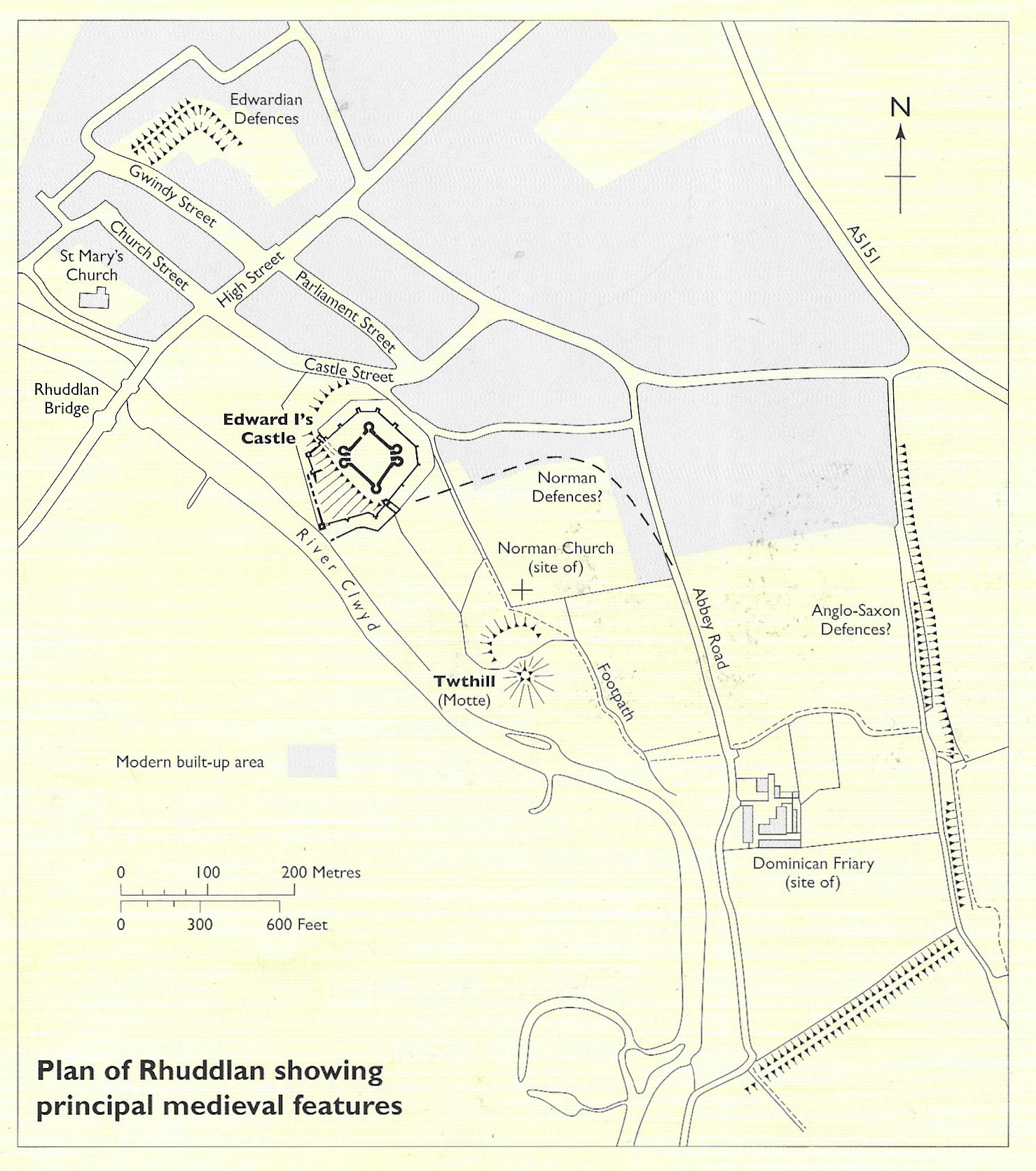
Plan of Rhuddlan. Source: Arnold Taylor/Cadw 2004, p.9

As at Flint a new borough was created and provided with defences and English settlers were incentivized to live and work there.  The new town, known as an “implanted bastide” after prototypes in Gascony, was built to the northwest of the the old town and was granted its charter in 1278.  This new-town bastide concept and its management are discussed in more detail on the post about Flint Castle.  Today’s town follows the original layout of the new town, its streets originally dividing the town into five sections leading down to a bridge across the river, with the High Street, Church Street, Castle Street, Parliament Street and Gwindy street being the key survivors.

The town was defended on three sides by a ditch with flanking banks, possibly topped with a timber palisade, a section of which survives off Gwindy Street, shown in the illustration and photograph below.  In the 1960s the complete length of the ditch survived north of the town, but by 1970 only the Gwindy Street section remained. Excavation of part of the defences, known as Plot 0, was undertaken when the land was due to be sold for development, but due to the heavily eroded state of the banks was unable to confirm if there were timber defensive features.  The fourth side of the defences was made up by a cliff running down to the river.

Source: Quinnell and Blockley 1994

====

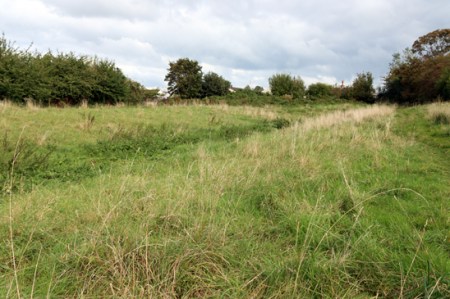
What remains of the double banks and ditch that surrounded the new town of Rhuddlan

Although it might have seemed like an unattractive proposition to be an immigrant English population living in a defended town in ostensibly hostile territory, there was a huge demand for land in England at that time, and the new towns in Wales represented great opportunity as well as risk, particularly as charters offered far more favourable conditions for the English than their Welsh neighbours.  Marc Morris refers to them as “those enclaves of English privilege, where the Welsh were obliged to trade but could not live and where the legal discrimination between the two peoples was a fact of every day existence.”  The risk for these settlers was very real, and it was the towns rather than the castles that were targeted by Dafydd in 1282, in Aberystwyth, Denbigh and Rhuddlan.
===

The Statute of Rhuddlan of March 1284

Peniarth MS 41 a 15th century copy of the Statute of Rhuddlan. Source: National Library of Wales, via Wikipedia

In 1284 Edward I formalized how Wales to was to be governed and ruled after the deaths of Llywelyn in 1282 and Dafydd in 1283 during Dafydd’s ill-conceived rebellion of 1282.  The document that captured his requirements was the Statute of Rhuddlan or Statue of Wales, which was issued by Edward I from Rhuddlan whilst he was in residence. Although Edward had been sufficiently diplomatic to recognize different interests and hierarchical claims within Wales after 1277 for the sake of peace, in 1282 his aim was to bring the entire of Wales into a single administrative system controlled by England.

The Statue of Rhuddlan, part territorial administration and part legal treatise, handled Wales as a single homogenous unit, an extension of England and her criminal legal system.  Wales was divided into new English-style shires:  Flint, Merioneth, Caernarvon, Anglesey, Cardigan and Carmarthen, a structure that endured until 1536 when the Act of Union was passed.  An English administrative hierarchy was put into place with officials and administrators answering to a new justiciar based in northwest Wales. Legally, the Statue was an interesting mixture of English law with some concessions to Welsh traditions.  Criminal law was English, but the Statute allowed for Welsh traditions of civil law to be maintained for matters like contracts, inheritance, land deals and debt handling.

Edward’s castle building continued unabated even as the statute was being written up in Rhuddlan, announced and enforced.  It is thought that it was at Rhuddlan that Edward declared that the title and role of prince of Wales would pass to his own son and to the future sons of English kings.  Edward’s first child, who became Edward II, was born at Caernarfon in April 1284, in the month following the statute, and was officially granted the title of Prince of Wales in 1301.   The title has been handed down from reigning monarch to eldest son ever since that date, most recently on the death of Queen Elizabeth II when, the former Prince of Wales, Charles, having acceded to the throne on 10th September 2022, the title passed to his eldest son, Prince William.

Rhuddlan Castle after Edward I

Rebellion of October 1294

Resentment in Wales continued to fester, and in October 1294 Madog ap Llywelyn, a relation of Llyweln the Great, and Morgan ap Maredudd, both important land owners in northwest Wales laid siege to Edward’s castles at Criccieth, Conwy and Harlech.  This followed particularly harsh taxes imposed by Edward, that discriminated against the Welsh, and also Edward’s demand for men to fight in Gascony.  Rhuddlan served as a jumping-off point for Edward’s response to this uprising in March 1295, but Conwy was by now at the heart of the action, and Edward’s new headquarters whilst Caernarfon Castle was still being built (and which was damaged during the attack).  By June 1295 the uprising had been put down and order was restored.

Owain Glyn Dŵr, 1400-c.1410

In 1400, during the reign of Henry IV, Owain Glyn Dŵr, having been declared Prince of Wales by a group of his followers met at Glyndyfrdwy, lead a new rebellion in response to harsh conditions imposed by the English crown, and Rhuddlan was one of the castles and towns that came under attack. Rhuddlan Castle held out against the assault, but the town itself was brutalized, and there are indications such as the failure to properly repair town defences that the borough never recovered.

The English Civil War, c.1642-51

In the Civil War of 1642-48, the castle was held by the king’s forces but although it initially held out, it was surrendered to the parliamentarian commander-in-chief Major-General Thomas Mytton, and a decision was made in the House of Commons to slight the castle (render it unusable), which was actioned in May 1648. This was the fate of several medieval castles that were employed during the Civil War.

Rhuddlan Castle in 18th and 19th century art

John Boydell (1720-1804). “A North West View of Rhuddlan Castle in Flintshire,” in 1749. Source: People’s Collection Wales

In my posts about Flint and Denbigh I had a look at some of the art works that were produced in the 18th and 19th centuries when medieval buildings with their air of romance and mystery found an enthusiastic audience amongst painters of all skill levels.  There are so many art works of Rhuddlan that it is almost impossible to pick and choose, so I have selected views that show different aspects of the castle, and have added a link at the end of Sources to some more examples.

John Boydell was a publisher, talented engraver and promoter of art, as well as doing a stint as Lord Mayor of London. His 1749 image above not only captures the castle but the attached village and the distinctive bridge and that captures something of village life, with men fishing, a barge pulled up at the river edge, and people approaching on horseback and foot.  The strongly featured bridge is typical of his work – in 1747 he published The Bridge Book, featuring six landscapes all of which showcased distinctive bridges.  He did a rather nice one of Denbigh Castle too.

From the 1781 edition of “A tour In Wales” by Thomas Pennant (1726-1798) Source: Wikipedia via the National Library of Wales

Thomas Pennant was born in Flintshire and is best known for his remarkable A Tour In Wales, which eventuallyran to eight illustrated volumes, capturing three journeys that he made in Wales between 1773 and 1776. The National Library of Wales says that one of his greates gifts was “his ability to foster friendships. His appreciation of people was very well-known and because of this he always received sensible and full answers to all his enquiries for information.”  He was a great collector, but his interest was always in the subject matter and the details captured, rather than particular artistic merit.  The painting of Rhuddlan below was in the 1781 edition, capturing something of the sense of the isolation of the castle in a wide landscape, a contrasting and more delicate approach to Boydell’s bright and lively image.

Rhuddlan Castle as captured by artist George Pickering (1794-1857) and engraved by George Hawkins the Younger (1819-1852). See the National Library of Wales catalogue for a bigger image in which details can be clearly seen.

A completely different approach was taken by lithographer George Pickering the Younger, who got up close and personal with the castle, sacrificing the general form of the castle in favour of picking out particular features.  He artist looks out over the river and the floodplain beyond, the sun low in the sky, with village buildings shown in the background, including St Mary’s Church.  The ivy clinging to the towers is also shown on Peter Ghent’s painting below.  Cattle are shown grazing on the foreshore, a small sailing vessel is pulled up on the other side of the bridge, and there are other visitors inspecting the site.

Rhuddlan Castle c.1885 by Peter Ghent (1857–1911). Williamson Art Gallery and Museum.  Source: ArtUK

The oil on canvas painting of Rhuddlan Castle by Peter Ghent, now at the Williamson Art Gallery and Museum in Birkenhead, is a rather more impressionistic view of the castle, showing the ivy and the surrounding trees, and cattle cooling themselves in the river.   The riverside tower is not shown, although part of the river wall is shown.  The russet and green palette is characteristic of Ghent’s work.  Ghent was born in Birkenhead and attended Birkenhead School of Art.  He moved to Conwy, which he used as a base for exploring Welsh landscapes in both oil and watercolour.
===

Rhuddlan Castle Today

The castle was given into state care in 1944 and conservation work began in 1947.  It was transferred from the Department of the Environment to the newly created Cadw, the Welsh Government’s historic environment service, in 1984.  It is beautifully cared for, without a single blade of grass out of place.  The ivy that once ran riot over its walls has been completely eliminated which given how invasive ivy is was a considerable task.  The castle continues to undergo conservation work as needed to prevent deterioration and to ensure that it remains safe.

The castle was deliberately slighted (i.e. partly demolished) at the end of the English Civil War in the 16th century so that it could not be reused in any future offensives, which accounts for its ruined state. This does not impede an understanding of the castle and its features, many of which remain.  Some of the damage is more recent.  The lower courses of stone have been extensively robbed since the 16th century for local construction projects, revealing the inner filling of the walls, and leaving it looking very denuded and rather peculiar at its ground floor level, but allowing the inner construction of the thick walls to be seen.

Although there are no floors left in the towers and inner walls, there are fireplaces and beam slots (the beams supporting the floors at each level) that show where each of the storeys was located.  Some of the fireplaces, like the one on the left, retain black burn marks, a really evocative link to the past.  Many of the fireplaces were quite huge and, given the diameter of the towers, must have provided substantial heat for the castle guardians and administrators who were based there even in the coldest Welsh winters, even if the space was a little cramped.

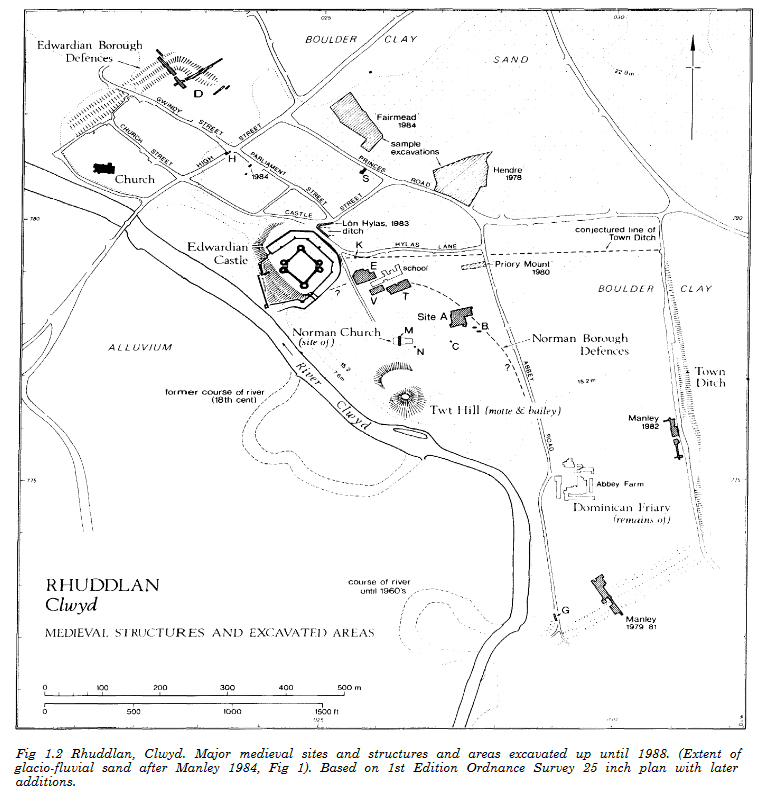
A number of modern excavations have been carried out at Rhuddlan, between 1973 and 1988 helping to clarify some details about the medieval history of Rhuddlan as well as information about earlier phases, particularly during the Norman and prehistoric periods (Neolithic, Bronze Age and Iron Age, including some particularly fine lithics and decorated pebbles dating to the Mesolithic).  These are summarized by Quinnell and Blockley in their 1994 publication, which can be downloaded from the Archaeology Data Service website.

Excavated Areas in Rhuddlan between 1969 to 1973. Click to expand.  Source: Quinnell and Blockley 1994, p4

Excavated object from Rhuddlan. Source: Quinnell and Blockley 1994, p.184


St Mary’s Church, Rhuddlan

St Mary’s, only a five minute walk from the castle, was closed when I visited, so I am going to cover it on another post next summer when it re-opens to visitors, but it is certainly worth mentioning here, as it looks as though it is a splendid piece of later medieval heritage.  An earlier Norman church was built to the east of the castle, but St Mary’s was first built in 1284 and was enlarged in the 15th century.  It has undergone changes over the years, and perennial multi-tasker Sir George Gilbert Scott had a go at it during his restoration of St Asaph’s Cathedral in the 1900s, but by all accounts the restoration appears to have been quite sympathetic. The gilbertscott.org website reports that “Scott treated the old building gently, lowering the floor in the nave and raising it in the chancel, providing some new windows, seating, a vestry and rebuilding the south porch.  He also provided a vestry screen, pulpit, an eagle lectern, altar rail and chancel seats.”  However, Quinnell and Blockley say that the church contains much of the original 13th century architecture in the nave and chancel.  They add that fragments from two different crosses, found during the demolition of a wall near the Vicarage in 1936, are now kept in the church.  Both have inter-laced decoration and have been dated stylistically to the late 10th or early 11th centuries.

If you are there when it is open, it should be well worth visiting at the same time as a trip to the castle (unfortunately the St Mary’s website does not currently show the times when it is open to visitors, but there is an email address).  Even though it was closed, I very much enjoyed a walk around the building and a poke around the churchyard.  Gravestones and their symbolism are eternally fascinating and there are some very good examples of churchyard monuments.

Final Comments

Rhuddlan is visually stunning, and retains plenty of its newly innovated  features to capture interest, demonstrating significant improvements in medieval castle design.  The canalized river showcases both Edward’s obsession with good communication links and the civil engineering skills that were available to him.  As a visitor attraction it is beautifully maintained by Cadw, which is particularly noticeable when comparing it with earlier images of the castle covered in ivy.  Rhuddlan attracted a serious amount of artistic interest, providing views of how it looked in the 18th and 19th centuries and, at the same time, demonstrating the fascination that artists had for medieval ruins. This is a site that really rewards a visit, particularly on a bright sunny day, when the red and yellow sandstones absolutely glow against a blue sky.


Visiting Rhuddlan Castle

Map of the Rhuddlan town trail from the North East Wales website

Rhuddlan is operated by Cadw, and is subject to an entry fee.  Details of opening times and entry charges are on the Cadw website.  There is a free car park, which also has a map of the main features of the town and the route down to Twthill, just five minutes away from the castle.  Beyond Twthill, the footpath passes the Abbey Farm and caravan park, the site of the former Rhuddlan Friary, which is on private land and cannot be visited.

As usual with Cadw venues, there is not much information about the history of Rhuddlan on the Cadw website, but there are plenty of online resources and there is an excellent short (9-page) Cadw guide book available from the ticket office, or from online book retailers, with a 3-D reconstruction and a site plan, as well as a history of the site and a numbered tour of the key features, each with a descriptive paragraph explaining what you’re looking at – well worth the £2.50 that it cost me in the Rhuddlan Castle gift shop.  You are also given a site plan as part of the ticket price, with 7 features picked out and described briefly (bi-lingual English and Welsh).

My battered copy of the Cadw leaflet that is provided with your ticket, showing some of the key features of the castle.  The reverse side shows the same details in Welsh.

===

The approach to the castle is on the flat, as is the interior and the walk around the castle, so this is suitable for those with unwilling legs.  As with Flint Castle, the towers are fitted with modern spiral staircases, which will probably not be suitable for unwilling legs, but there is plenty to see without scaling the heights, including excellent views over the floodplain.

The ticket office also has toilets and a small gift shop.  There are no coffee facilities but there is a freezer with ice-creams and a fridge with cold drinks, and there are some tables and chairs outside for a sit down.

It’s a seriously attractive site, and well worth a visit.

Sources

Books and papers

Davis, Paul R. 2021. Towers of Defiance.  The Castles of Fortifications of the Princes of Wales. Y Lolfa

Davies, John 2007 (3rd edition). A History of Wales. Penguin

Dean, Josh and Catherine Jones 2020. Archaeological Watching Brief report for Plas Llewelyn, Rhuddlan. Project code: A0209.1, report no. 0203. Aeon Archaeology
https://coflein.gov.uk/en/site/92914

Morris, M. 2008. A Great and Terrible King. Edward I and the Forging of Britain. Penguin

Quinnell, Henrietta and Marion R. Blockley with Peter Berridge 1994.  Excavations at Rhuddlan, Clwyd 1969-73. Mesolithic to Medieval. CBA Research Report No 95 (1994)
https://archaeologydataservice.ac.uk/archiveDS/archiveDownload?t=arch-281-1/dissemination/pdf/cba_rr_095.pdf

Rowley, T. 1986.  The High Middle Ages, 1200-1550.  Routledge and Kegan Paul

Shillaber, C. 1947. Edward I, Builder of Towns. Speculum, Vol. 22, No. 3 (Jul., 1947), p.297-309
https://www.jstor.org/stable/2856866

Spencer, Dan 2018. The Castle At War in Medieval England and Wales. Amberley Publishing

Stevens, Matthew Frank 2019. The Economy of Medieval Wales 1067 – 1536. University of Wales Press

Taylor, Arnold. 2004.  Rhuddlan Castle.  Abridged from a text by Arnold Taylor. Cadw

Websites

Abbey Farm Caravan and Camping Park
History
https://abbeyfarmrhuddlan.co.uk/portfolio-item/history/#top

Balfour Beatty
Balvac repaired this 13th century castle in North Wales
https://www.balfourbeatty.com/what-we-do/projects/rhuddlan-castle/

Cadw
Rhuddlan Castle
https://cadw.gov.wales/visit/places-to-visit/rhuddlan-castle
Rhuddlan, Norman Borough
https://coflein.gov.uk/en/site/303586

Coflein
Rhuddlan Castle
https://coflein.gov.uk/en/site/92914

Ecclesiastical and Heritage World
Rhuddlan Castle: Conservation of Castle River Dock
https://www.ecclesiasticalandheritageworld.co.uk/news/1038-rhuddlan-castle-conservation-of-castle-river-dock

Goldin Fine Art
John Boydell: The Enlightenment Man
https://www.goldinfineart.com/blogs/blog/john-boydell?srsltid=AfmBOop6p7_0_WrJ2Sx_WA4FEs0lZW09ZdoRzqo61Hc6WFokRC3aLG9h

National Library of Wales
A Tour In Wales. Thomas Pennant (eight digitized volumes)
https://www.library.wales/discover-learn/digital-exhibitions/pictures/a-tour-in-wales

Sulis Fine Art
Peter Ghent RCA (1857-1911)
https://www.sulisfineart.com/peter-ghent-rca-1857-1911-late-19th-century-watercolour-cottage-by-a-stream-qo859.html

Rhuddlan Castle in Art

Meisterdrucke
Rhuddlan Castle and Marshes, 1898, unknown artist
https://www.meisterdrucke.ie/fine-art-prints/Unbekannt/785633/Rhuddlan-Castle-and-Marshes.html

ArtUK
Rhuddlan Castle by John Lawson 1868 – 1909. Glasgow Museums Resource Centre
https://artuk.org/discover/artworks/rhuddlan-castle-84929

Darnely Fine Art
Rhuddlan Castle by Norman Wilkinson 1878-1971.
https://darnleyfineart.com/artwork/rhuddlan-castle/

Government Art Collection
Rhuddlan Castle by David Gentleman 1930 –
artcollection.dcms.gov.uk/artwork/17005/

Rhuddlan Castle in Art
Various examples – a good mix
https://jenikirbyhistory.getarchive.net/topics/rhuddlan+castle+in+art

The 1715 “Old Dock” – The earliest of Liverpool’s commercial docks, preserved beneath the Liverpool ONE shopping centre

Introduction

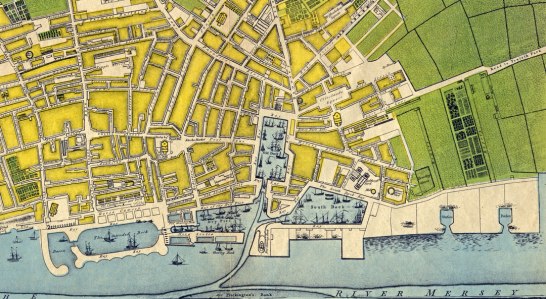
The Eyes map of Liverpool showing Old Dock on a previous tidal inlet and enclosed within the streets of an expanding Liverpool in 1765, 50 years after it first opened. Later docks were laid out along the foreshore. Source: National Museums Liverpool

Earlier in summer 2024 I went on the Old Dock tour in Liverpool when it was offered one Sunday.   Old Dock, of which only one corner remains to be visited, was perhaps Liverpool’s most important commercial and civil engineering initiative at a time when Chester’s port was going into decline and Liverpool had the opportunity to become the trading centre for the northwest.

Old Dock, Liverpool

Old Dock in Liverpool, the first of Liverpool’s impressive network of enclosed docks, opened in 1715, to the design of civil engineer Thomas Steers.  It is Europe’s oldest enclosed cargo-handling dock.  What remains of Old Dock is underground, beneath the “Liverpool ONE” shopping centre.  Its lock gates can no longer be visited, but remain under The Strand (the modern dual carriageway that runs along the line of the old foreshore).  Only the northeastern corner of the dock is accessible to visitors, and has been provided with a gantry and information panels, and its history is presented to pre-booked groups by an excellent guide.  I’ve added details about booking and the tour itself at the end of the post under “Visiting.” The following looks at some of the history of Old Dock.

The 1699 Howland Great Wet Dock in London. British Library HMNTS 10349.ff.9.. Source: Wikipedia

Old Dock was modelled on the Howland Great Wet Dock, shown right, built in 1699, which was built to shelter ships, mainly of the East India Company, in the days when ships over-wintering on the Thames were regularly subjected to both storm damage and piracy.  It was surrounded by a double planting of trees to help protect the ships within and had shipbuilding dry docks at its entrance. It was a convenient place to carry out repairs and to ready ships for the upcoming season, but was not used for handling cargo so was not a commercial trading dock.  The Howland Great Wet Dock was built in a rural space on the south of the Thames in what is now the residential Surrey Quays area of southeast London, and was replaced in the 18th century by Greenland Dock, which itself became part of the Surrey Commercial Docks.

The commercial argument for Old Dock

Liverpool was established by a charter of King John in 1207 and was provided with a castle in 1235.  At this time, however, Chester was the main northwestern port, and Liverpool did not become a commercial giant until the 18th and 19th centuries, and this required some pioneering Victorian thinking and civil engineering before it really took off as one of Britain’s leading ports.  Old Dock is at the heart of this story.

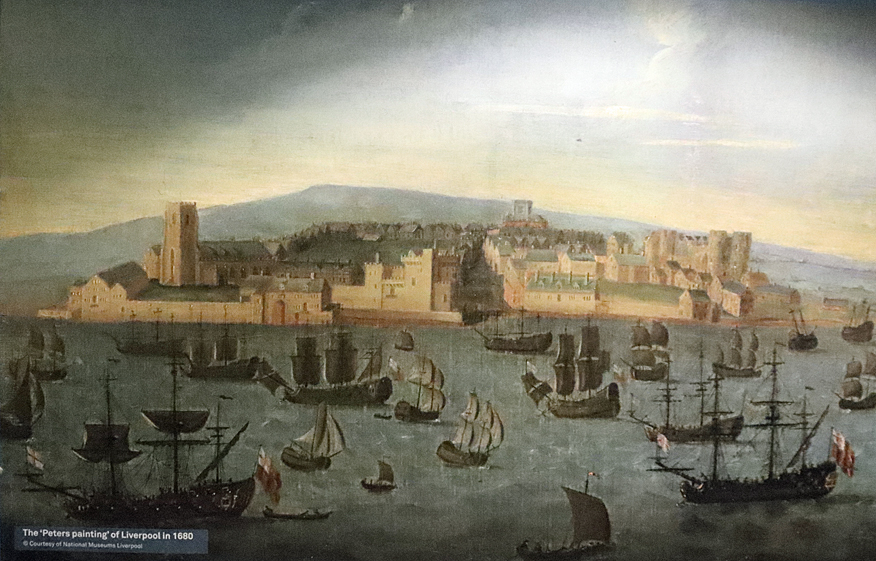
Painting of Liverpool in 1680, from the Old Dock display area. Unknown artist. The original is held by the National Maritime Museum. See more (and a better image) on ArtUK

Before the docks, the Mersey was not the easiest of rivers to use in an age of sail partly due to strong winds but also because of the twice-daily tidal events that swept down the estuary. An additional problem was that due to the dumping of rubbish and ships’ ballast along the river edges, deep-sea shipping was unable to approach the river banks to offload and reload.  It could also become very busy with river traffic of all shapes and sizes. The handling of cargo on the Mersey was achieved by mooring ships in the main channel and loading and offloading them with lighters – unpowered boats into which the cargo was loaded by hand, then rowed to shore, and offloaded by hand.  This could only be carried out between tidal events, confining the activity to around 5 hours a day. To empty a single ship averaging 150 tons could take between two and three weeks.

The engineering success of the Howland dock enterprise inspired MP Thomas Johnson, who was both a successful merchant a slave trader, to approach one of the engineers probably responsible for the Howland dock, George Sorocold, to discuss the viability of a similar dock for Liverpool.  Johnson, however, saw the greater potential of an enclosed inland dock, not for over-wintering ships but for creating a cargo-handling facility to radically improve speed and efficiency. Under The Dock Act of 1708 a Common Council of leading city figures was established to became trustees of the proposed dock, which they operated through council committees.  The risk of doing it this way rather than as a private enterprise was that failure could have put the entire city finances in jeopardy.  Thomas Steers from London was the civil engineer appointed in 1709 to make this a reality, only a decade after the opening of the Howland Great Wet Quay on which he had probably also worked.  Initially costs had been estimated at £6000, but this was a serious underestimation and eventually the dock cost more than double this amount.

Building and opening the dock

The dock was lined with bricks in the upper sections with local red sandstone in the lower courses.  I am accustomed to the later Surrey Commercial Docks in southeast London, where I used to live, which are lined with stone much like Liverpool’s Albert Dock, so the sight of a brick-lined dock seemed extraordinary to me.  The bricks were made on site from local clays, with a dedicated kiln built for the task, and a special mortar was used to resist the incursion of water.

At the base of Old Dock, Liverpool

The result of all the investment, civil engineering and labour was Old Dock, which opened in 1715 at the mouth of a former tidal inlet or creek.  Up to a hundred ships could be taken into the 3.5 acre dock via a 30ft wide entrance lock and could draw up against the quayside to offload without the use of lighters. Because of the tides, ships could only enter the dock at the top half of the tide, but a 1.5 acre tidal entrance basin was provided as a waiting area.  By drawing ships up against the quayside, three weeks could be reduced to just one to two days.  The proof of concept was soon confirmed.

The area around the dock was soon surrounded by residential, commercial, retail and service industry premises. Excerpt from a poster from the Old Dock exhibition area.

An entire new residential, commercial, retail and service industry quarter grew up around the dock, which became known as the Merchants’ Quarter.  As well as homes, warehousing and other commercial facilities there were lodging houses for sailors, and less salubrious businesses that catered to their needs.  This is a good illustration of the sort of process of urban sprawl that follows on from a specific industrial development.

Old Dock was such a notable success that new docks were soon opened, and the Liverpool foreshore began its transformation.  During the 18th century South Dock, also built by Thomas Steers (later Salthouse Dock) opened 1753, George’s Dock opened 1771, King’s Dock opened and Queen’s Dock opened in 1796.  It is a measure of the success of the dock concept, Old Dock having been established 53 years before Bristol’s first dock, that between 1772 and 1805 the total tonnage of shipping increased from 170,000 to 670,000, with foreign shipping increasing from 20,000 to 280,000.  By the end of the 19th century 9% of all world trade passed through the Liverpool docks, and there were 120 acres of enclosed docks along 10km (7 miles) of Liverpool’s foreshore.

Closure of the dock

Old Dock, Liverpool

Old Dock itself closed in 1826 mainly because as ship sizes increased, in terms of width, length and depth, it became increasingly obsolete.  It did not help either that the dock had become surrounded with other buildings and could not easily expand without considerable destruction.  Instead, the development of docks beyond the existing foreshore seemed like a better option and this is what happened.

This new use of enclosed docks for cargo-handling was pioneered at Old Dock in Liverpool, creating the first revolution in cargo handling in the UK.  To provide additional real estate for the rapidly growing city, most of the dock was infilled and built over, so this one remaining corner is a significant survivor from Liverpool’s early development as a major trading port.

Final Comments

Old Dock brickwork

Much of what is known about Liverpool’s earliest docks comes from the archaeological investigations that took place between 1976 and 2009. Old Dock was examined prior to the building of Liverpool One by Oxford Archaeology between 2001 and 2006. The remains of Old Dock are designated a site of Outstanding Universal Value.

It is difficult to over-emphasize how important London’s Howland Great Wet Dock and Liverpool’s Old Dock were to the development of maritime trade in Britain.  With an enclosed dock designed by Thomas Steers, the Old Dock set Liverpool firmly on the path for trading success throughout the 18th century and the commercial and architectural triumphs of the Victorian period.

Visiting

Booking details, opening times, ticket prices and everything else you need to know are on the Old Dock Tour website.

At the time of writing the meeting point shown on one place on Google Maps is in a different location from the one that is shown on the Old Dock Tours website, and the latter is the correct one.  I don’t know Liverpool at all and I was confused by the directions on the website, partly because I had no idea what a “Q-Park” might be when it escaped from its burrow, so I arrived early to make sure that I was in the right place, which was on the Thomas Steers Way entrance to the “Q-Park” (the Liverpool ONE car-park), on the left as you head up from the Mersey, near the base of the Sugar House Steps.  Here’s the What3Words address for that location, which is traffic-free, but do check on the website or your ticket that this remains the same meeting place: https://what3words.com/found.farm.gent. Have your ticket handy to be checked, either printed out or on your device.

This is a guided tour.  You receive an excellent lecture as you walk to the dock via a wall-sized map of old Liverpool, and then stand on the  gantry looking down into the dock. Our guide was informative, humorous and engaging, parting with a staggering amount of information in an easily digestible way.  It is always a mark of how well a guide does when there are questions afterwards, people wanting to explore specific aspects of the story, and there were lots of questions.  I used to live overlooking Greenland Dock in London, and the remnants of the Surrey Commercial Docks were my home for twenty years.  Opposite was Canary Wharf, where the former East India and West India quays are preserved and the Museum of London Docklands is located. It was a real dock heritage experience, so it was particularly nice to go to Liverpool and have someone bring this particular old dock to such vivid life.

If you are dealing with unwilling legs, there is a flight of steps with a banister to hold onto.  I forgot to count, but I would guess perhaps ten steps, down from the car park entrance into the dock area.  There is then a gantry (metal walkway) across the remaining part of the dock, with high sides to hang on to.  There is nowhere to sit, so a portable perch of some sort might be useful whilst you are listening to the talks.

I had not realized that it was the schools’ half term break.  Half-term was a poor day to visit Liverpool, and on the tour there were two completely uncontrolled young children running around and yelling their heads off.  A less child-intensive day would be better if it can be arranged.  There’s not a lot for young children to see on this walk anyway, although an older child seemed to be enjoying it very much.
———


—–

Sources

Most of the above details came from the guided tour.  I did not want to detract from that so I have not gone into greater detail here, but I did use some additional sources to check facts that I had not noted down at the time, and have provided some suggestions for further reading.

Books and Papers

Farrer, William, and Brownbill, J. (eds.) 1911. Liverpool: The docks, in “A History of the County of Lancaster: Volume 4,” p. 41-43. British History Online. Originally published by Victoria County History, London, 1911.
https://www.british-history.ac.uk/vch/lancs/vol4/pp41-43

Gregory, Richard A., Caroline Raynor, Mark H. Adams, Robert Philpott, Christine Howard-Davis, Nick Johnson, Vix Hughes, David A. Higgins 2014. Archaeology at the Waterfront vol 1: Liverpool Docks. Lancaster Imprints / Oxford Archaeology North

Stammers, M.K. 2007.  Ships and port management at Liverpool before the opening of the first dock in 1715.  Journal of the Historic Society of Lancashire and Cheshire, vol.56.
https://www.hslc.org.uk/journal/vol-156-2007/attachment/156-3-stammers/

Stephenson, Roderick A. 1955. The Liverpool Dock System.  Transactions of the Liverpool Nautical Research Society, Volume 8 1953-55 (1955)
https://liverpoolnauticalresearchsociety.org/wp-content/uploads/2019/03/Article-The-Liverpool-Dock-System.pdf

Websites

National Museums Liverpool
Ten fascinating facts about Liverpool’s Old Dock
https://www.liverpoolmuseums.org.uk/stories/ten-fascinating-facts-about-liverpools-old-dock

Historic Liverpool
1846: Plan of the Liverpool Docks, by Jesse Hartley, Dock Surveyor
https://historic-liverpool.co.uk/old-maps-of-liverpool/1846-plan-liverpool-docks-jesse-hartley-dock-surveyor/#4/65.79/-74.43

The Liverpolitan
Old Dock: a different view. Wednesday, 18 November 2015
https://theliverpolitan.com/blog_old_dock_a_different_view.php

That’s How The Light Gets In blog
Liverpool Old Dock: Down to the bedrock
https://gerryco23.wordpress.com/2010/09/14/liverpool-old-dock-down-to-the-bedrock/

Liverpool World Heritage
LIVERPOOL MARITIME MERCANTILE CITY WORLD HERITAGE SITE MANAGEMENT PLAN 2017 – 2024. Prepared by LOCUS Consulting Ltd. Liverpool City Council
www.liverpoolworldheritage.com/wp-content/uploads/2018/09/pmd-486-liverpool-whs-management-plan-final-version-as-at-27-sep-2017.pdf

A Rotherhithe Blog
The Howland Great Wet Dock 1699-1807
http://russiadock.blogspot.com/2008/06/rotherhithe-heritage-2-howland-great.html

—–

A visit to Basingwerk Abbey, Holywell

Introduction

The Chuch is at left, the Chapter House opposite and the ground floor monks’ day parlour whcih once had their dormitory overhead. The line of the cloister, a covered walkway with arcades, and the central garth are marked out by the stone foundations

I have been to Basingwerk Abbey a couple of times, but never got around to writing it up.  It’s a super site, and although it is now a ruin, it retains enough of its original structures to ensure that its layout is easily understood.  St Winifred’s Well, with its lovely late gothic shrine, is only a mile and a bit away, and an important part of Basingwerk’s property for most of its life, will be covered on another post.

Basingwerk Abbey is only a  few miles away from Flint Castle.  The abbey preceded the castle by over a century but when Edward I founded Flint Castle and its accompanying town in 1277, the histories of abbey and castle became entwined. A visit to the abbey is easily combined with a look-in at the attractive riverside remains of Flint Castle.  I have written about the history of Flint Castle on an earlier post.

Digital Aerial Photograph of Basingwerk Abbey. AP_2009_2896 – s, Archive Number
6355272. Source: Coflein
Savignacs and Cistercian Basingwerk Abbey

Remains of the church

The first Basingwerk abbey, dedicated to St Mary, was founded as a Savignac monastery Ranulf II (Ranulf de Gernons) (1099–1153), fourth earl of Chester and later merged with the Cistercian order. It is not known why the Savignac order was chosen by Ranulf, but the monks who were sent to Basingwerk were provided directly by the founding monastery of Savigny in southwest Normandy itself. It became Cistercian in 1147.  Most of the monks who served there subsequently, up until the 15th century, were English, aliens in territory that was a bone of contention between England and Wales.

A monastic order is formed of a shared set of spiritual ideals, often spelled out in considerable detail in rules that covered everything from how many times a day a monk should pray, communally or individually, to where and when they could speak, eat and sleep, and what work they should engage in. All orders involved, at least in theory, a degree of renunciation and isolation by communities of monks, but these ideals were eroded as the influence of monastic houses grew.  The trajectory of monastic history in Europe changed in the late 11th century and early 12th century with the establishment of the so-called reforming orders, who wanted a purer, less self-indulgent and more hard-working approach to cloistered living than other contemporary monastic institutions offered.  The reforming orders believed that the Rule of St Benedict, as it had been originally conceived and set down in the 6th Century Italy, was the key to recovering a holier and more disciplined approach to a communal life of worship. The Carthusian order was established in 1084, the Cistercian order in 1098, the Savignac order between 1109 and 1112.

12th Century links between Cistercian monasteries.Although Citeaux, the node for all Cistercian abbeys, established early new bases in France, it was Clairvaux under the lead of St Bernard that was responsible for the earliest new abbeys in Wales. Of these Whitland was the most important for the northward spread of monasticism. The green lines emanating from Savigny reflect the Savignac order, which merged with the Cistercians after only 20 years, in 1147. So although Basingwerk in the north and Neath in the south were founded as Savignac orders, after 1147 they were brought under the rule of the Cistercians at Citeaux.  Source: Evans, D.H. Evans 2008, Valle Crucis Abbey (Cadw).

In Wales one of the most successful of these orders was the Cistercian order, which left remains in north, mid and south Wales.  Valle Crucis in Llangollen is the nearest of the Cistercian abbeys to the Chester-Wrexham areas, established in 1201, and is discussed in a series of earlier posts, which begins here with Part 1.  The Savignac order is much less well represented throughout Britain, and the reason for this is that in 1147 it was amalgamated with the Cistercian order.  Basingwerk Abbey, established as a Savignac monastery, became Cistercian in that year.

Because of their similarities the Savignacs and Cistercians were a good match, but there were differences too, largely in terms of the constitutional framework and systems of accountability.  To ensure that these were understood after the fusion, Savignac monasteries were put under the supervision of an appropriately located and senior Cistercian order.  Basingwerk was put under authority of Buildwas Abbey in Shropshire, which had also originally been Savignac.  This was perfectly in keeping with the Cistercian hierarchical approach to monastic management with every new monastery answerable and accountable to a mother house.  The mother house for the entire order was Cîteaux, and Clairvaux was the mother abbey for Whitland in south Wales, which was established by monks from Clairvaux itself. Whitland in turn established other abbeys including Strata Marcella near Welshpool, and this abbey in turn established Valle Crucis.   This system created a network of houses that all linked back to the ultimate mother house at Cîteaux (Cistercium in Latin) in France, the founding monastery of the Cistercian order.  Every Cistercian abbot had to return from his abbey to Cîteaux every year for what was known as the General Chapter, a great conference of the Cistercian abbots. 

A more detailed history of monasticism, and the Cistercians in particular, is included in Part 1 of the series on Valle Crucis.

Cadw guardianship monument drawing of Basingwerk Abbey. Survey-plan. Cadw Ref. No. 216/9a4. Scale 1:192. Source: Coflein

The foundation and economic basis of Basingwerk Abbey at Holywell

Exterior of the refectory

The first Basingwerk Abbey was probably in wood, and was located at a different but nearby site possibly somewhere in the vicinity of Hên Blas in Coleshill, near a now-lost castle.  There is a reference to a fortification in the Annales Cambriae describing how, when Henry II advanced into Wales from Chester,  Owain Gwynedd prepared for the upcoming battle by digging a large ditch associated with a hastily built camp at a site called Dinas Basing.  It is thought that this was the castle known to have been in the area of Hên Blas, which lies on a ridge between two streams and overlooks the Dee estuary.  Excavations in the 1950s demonstrated the existence of a 12th century motte-and-bailey castle , which was flattened by Llewelyn the Great in the early 13th century, and was replaced with a defended courtyard with timber-framed buildings.

The central garth on a very moody day looking at the remains of the church. The tall upstanding ruin is the main remnant of the church at its east end. Photo taken from within the refectory

Basingwerk Abbey was later rebuilt in stone at the current site of the ruins, possibly in the 1150s, probably when Henry II granted a charter to the house and endowed it with the wealthy manor of Glossop in Derbyshire to assist with its financial future, 10 years after it became Cistercian.  The general location seems to have been strategic rather than purely spiritual.  The area of Tegeingl is located in the Four Cantrefs between the earldom of Chester and Welsh Gwynedd, always the subject of territorial dispute between England and Wales and a source of regional discontent until Edward I completed his invasion in the late 13th century.  The establishment of a large French monastery was probably part of this process of establishing a presence, and a holy one at that.  Although the monastery was later mainly populated by English monks, the Welsh too saw the benefit of patronizing a prestigious religious establishment and both Llywelyn ab Iorwerth (d. 1240) and his son, Dafydd ap Llywelyn (d. 1246) were benefactors. 

Detail of Map 12, page 91 in Williams 1990 showing Cistercian Lands in Wales, with those of Basingwerk marked in red. Click to enlarge.

When an abbey was founded, its endowment included a number of properties that included farmland or pasture that were intended to support it by the provision of produce to make it self sustaining and later by selling produce.  Some of these could be quite substantial manors, but others were smaller farms, which the Cistercians referred to as granges.  These could resemble mini monastic establishments and often had their own chapels. Later still, properties with their land could be rented out to tenants, but as late as the early 16th century, Abbot Nicholas Pennant was busy creating a new open enclosure in the mountains adjacent to the monastery apparently for agricultural development.

Gelli Chapel, from Thomas Pennant’s 18th Century Tour in Wales. Source: National Library of Wales, via Wikipedia

Based on the work of D.H. Williams in his 1990 Atlas, Silvester and Hankinson 2015 list all the known Basingwerk granges, shown on the above map produced by Williams. These were supplemented in 2001 by Williams in 2001.  Apart from two properties in Derbyshire these are all concentrated in northeast Wales and the Wirral and include, in alphabetical order:  Baggechurch /Beggesburch Grange, Bagillt; Calcot; Gelli Grange, either at Gelli or Gelli Fawr; lands in Whitford and the adjacent parish of Cwm; the Lordship of Greenfield, alias Fulbrook, including lands of Merton Abbot and party of Holywell town; and Over Grange, Holywell (all in Flintshire).  Lands with uncertain boundaries have also been identified elsewhere in the area, including Mostyn, Wake, Flint and Gwersylt as well as transhumant pasture close to property belonging to Valle Crucis Abbey at Moelfre-fawr in Denbighshire, at Boch-y-rhaiadr and Gwernhefin. They also owned Lake Tegid at Bala.

Beyond Wales, there were also three granges on the Wirral: Caldy Grange (West Kirby), Thornton Grange and Lache Grange (known as “La Lith”), as well as the granges in Charlesworth at Glossop, their mos profitable property, and leased land in Chapel le Frith. 

Over Grange, Holywell. Source: Williams 1990, plate 39, page 120. No indication of when the photograph was taken.

Of this list, only two buildings seem to have survived into relatively recent times, the remnants of two granges.  A chapel at Gelli Fawr in Whitford (Flints), apparently once belonging to Basingwerk Abbey was recorded in  a late 18th-century drawing which suggests that the chapel was part of a larger building complex. More can be found about the building and its possible function it in Silvester and Hankinson 2015.  Another grange, Over Grange, was listed by Cadw in 1991, according to Silverster and Hankinson, and was located located to the southwest of the modern farm house, and has been much-altered.  The photograph below shows it with small cross over the gable.

The Coflein website says that it is believed that Basingwerk Abbey originally constructed a windmill on this site, but the present structure probably dates to the late18 or early 19th century.  Now restored. Source: Coflein 804658 – NMR Site Files. Archive Number 6259181

To support its farming activities, the monastery built watermills, windmills and fulling mills.  Abbot Thomas Pennant (abbot from 1481 to 1522) appears to have been particularly active in the building of mills.  Records indicate that there were at least four windmills, at least three watermills, and at least two fulling mills, as well as a tithe barn in Coleshill.

The site of the Holywell windmill is thought to be preserved by the surviving windmill that can be seen today, shown right.  Two of the windmills were on the Wirral. Rowan Patel’s research has found that the Basingwerk windmill that stood at West Kirby area had been established at around 1152, and was probably upgraded and even replaced several times.  It stood on a high spot near the coast, an ideally windy location, and eventually featured on sea charts as a major landmark for coastal navigation.   It was mentioned in Henry VIII’s Valor Ecclesiasticus, the valuation of all monastic properties. Patel has found that after the Dissolution the mill became the property of the Crown and was rented to Thomas Coventree for an annual sum of 40s.  Rowan Patel’s research suggests that the second Basingwerk windmill was at Newbold, east of West Kirby, mentioned in the Taxatio of Pope Nicholas IV in 1291, where a Newbold windmill was referred to and valued at 40s a year.  Before the Dissolution it appears to have been rented out to Thomas Coyntre in 1525 on a 100 year lease at 40s a year.  By the time of the Dissolution, Thomas’s son Richard Coventry was apparently paying rent to the Crown, and in 1659 William Coventry, presumably a descendant of Richard’s, was still paying rent.  In 1664 it is next recorded having been sold to one Thomas Bennett in who donated it to the support of the poor.  Patel notes that in 1546 two men stole oats, barley and pease worth 10d, indicating the cereals proposed at the mill in the mid-16th century if not before.

Watermills continued to have a value well into the 20th century, and medieval mills will have been replaced over time, removing the visible remains of them, particularly along the valley that ran down the hill behind St Winifred’s Well and past Basingwerk before emptying into the Dee.
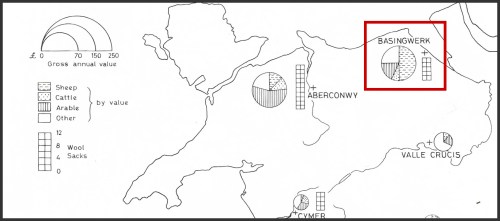
Economic Values excerpted from Williams 1990, map 21, p.105, showing the dominance of the agricultural contribution to the abbey’s income

Basingwerk had a large amount of livestock.  The hills and newly cleared meadows around Basingwerk were ideal for sheep in the uplands and cattle in river valleys and pastures.  The Welsh princes are also recorded as expecting two horses annually from Basingwerk which may indicate that the monks, like those of Cymer Abbey, were breeding horses.

As well as agriculture, which made up most of its income, Basingwerk was also involved in industrial activities, owning or leased industrial properties, Williams lists silver mining as a component of Basingwerk’s economic activities, and this is supported by Gerald of Wales whose trip through Wales in 1188 records leaving Conwy and heading east through Tegeingl through “a country rich in minerals of silver, where money is sought in the bowels of the earth” before spending the night at Basingwerk.  The abbey was also involved in the salt trade, with salt extraction enterprises in Northwich and possibly Middlewich.   Williams notes a coal mine leased from the Crown in Coleshill.  Lead was also mined at Basingwerk, probably making use of the same resources that had been exploited by the Romans in the area.

Economic resources excerpted from Williams 1990, map 22, p.105

Timber was taken from woodlands in Penllyn in Merionydd for housing, hedges, fuel and other requirements, as well as for sale.  Tenants were permitted to take a reasonable amount of firewood.  Assarting, the removal of woodland for conversion to agricultural land and other uses was a common activity in the middle ages.

Fishing probably made up a significant part of the diet, as it did at most Cistercian monasteries.  Basingwerk held the fishing rights for Lake Tegid at Bala, which it owned, and had a weir at West Kirby.  Prince Dafydd granted them one fifth of the catch at Rhuddlan in the 13th century.  They may also have purchased fish caught in the nearby coastal waters.

Basingwerk had a number of urban properties too, in Holywell, Flint, Chester, and Shrewsbury, which served as bases in town for the abbot and his representatives, which were probably loaned to friends of the monastery, but could also be leased out for additional income if required.  The Shrewsbury house was probably a legacy of the abbey’s connection with Buildwas Abbey after the amalgamation of the Cistercian and Savignac orders.
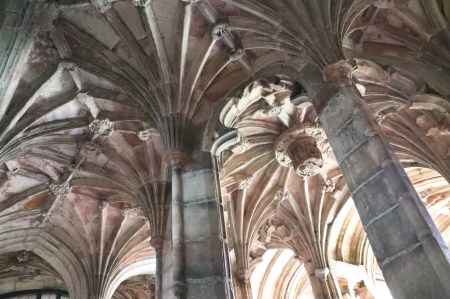
The fan vaulting in St Winifred’s Well at Holywell

A major feather in the financial cap of Basingwerk was St Winifred’s shrine with its beautiful natural spring.  The Holywell shrine of St Winifred was also another source of travelers requiring somewhere to stay and something to eat.  St Winifred’s shrine was granted in 1093 to St Werburgh’s Abbey in Chester, but was passed to Basingwerk in 1240, together with the living of Holywell church.  An abbey with a pilgrim shrine had a whole world of opportunities for income generation, and St Winifred’s was not only famous in its own right for its powers of healing and provision of miraculous cures, but was on the pilgrim trail to Bardsey Island at the end of the Llŷn peninsula and Ireland, via Anglesey.  In 1427 it was given a considerable boost when Pope Martin V granted indulgences for those visiting the shrine and giving alms to the chapel.  Indulgences rewarded certain behaviours, like pilgrimages, with a remission of sins, meaning less time in purgatory.  Royal visitors included King Henry V in around 1416 and Edward IV in 1461, helping to raise the profile of the shrine, which continues to welcome pilgrims today.  It became even more attractive from the late 15th – early 15th century when the shrine was provided with a spectacular gothic building that surrounded the spring.  I will cover Holywell in a separate post.

A traditional method of income acquisition for monasteries was appropriating a church and its income, sometimes to cover a particular expense, such as a major building project, and sometimes just to supplement income.  The Cistercians officially frowned on this practice, but the ban on appropriating church incomes did not survive very long.  Even so, Basingwerk had appropriated surprisingly few, just parish churches at Holywell, Glossop and a third at an unknown location, possibly to be identified with Abergele.

The fairs and markets granted to Basingwerk during Edward I’s reign in the 1290s are discussed below, and this must have been a considerable aid to their income.

Behind the monks’ day room and the dormitory above it was a block of buildings the function of which remains unclear. Suggestions include an extension of the abbot’s personal quarters, with rooms for special visitors, or a dedicated guest wing.

In spite of these various forms of income, Basingwerk sometimes found itself in financial stress. The monastery had been unable to provide a required payment to Edward III in 1346, and by way of explanation complained of the burdens of hospitality that came partly with being a Cistercian abbey, which put a great deal of emphasis on providing free hospitality, and partly from being near a major road, which had become increasingly busy after Edward I had moved forward into Wales, establishing market towns whose merchants moved between Wales and Chester for trade.  Even later in its history, in the late 15th/early 1gth century, it was reported that guests were so numerous that they had to take their meals in two sittings. Smith paints an evocative picture of other travelers in Wales who “cautiously flitted from one English settlement to the next, seeking safe overnight bases where food and shelter could be found “in a land in which rumors of insurrection abounded.” Basingwerk was by no means the only abbey to complain of this burden, which was a particular problem for Cistercian abbeys, but was shared by any monastic community that sat at a busy location.  Birkenhead Priory, which ran the ferry that allowed crossings between the Wirral and Lancashire for access to Chester and beyond (and later Liverpool), found itself in real difficulties due to the requirement to supply hospitality for ferry users who might be stuck at the monastery for several nights in bad weather.

A rather more specific problem was the expectation by the Welsh princes to use the abbey’s Boch-y-rhaiadr range for its annual hunting expeditions, during which the abbey was expected to provide bread, butter, cheese and fish for a hunting party of 300, expanding to 500, with money due in lieu when hunting did not take place.  This was abolished by Edward I after his conquest of Wales.

The Cistercian monasteries in Wales were not exempt from all taxes, or subsidies, and some of the abbots and their community were employed as tax collectors.  Other occasional charges were made on the abbey, such as a demand for financial contributions towards the marriage of Edward III’s sister.  Basingwerk provided £5 in 1333.

The abbey, being so active in economic production in the Holywell-Flint areas, was responsible for the management of its lands and the personnel who managed and worked the land, but was also required to function in a judicial role, its courts administering justice and meting out punishments.  Lekai says that the monastery had “a pillory, tumbrel and other instruments of punishment, although the penalty most often inflicted was a fine.”

The church is on the left and the two arches of the chapter house at right,.  All the buildings were arranged around the central green area, the garth. The stone foundations for the covered and arcaded walkway survive.

Most of the Cistercian abbeys in Wales, at one time or another, had a diplomatic role acting as intermediaries between the Welsh princes and the Crown, acting for either side, a role that was in their political interests to accept.  For example In 1241 Henry III used the Lache grange for a conference between himself and Prince Dafydd’s clerk.  In 1246 Henry III chose the abbot of Basingwerk to escort Prince Dafydd’s wife Isabella from Dyserth Castle to Godstow nunnery near Oxford.  A decade later, Prince Llywelyn ap Gruffyd used an abbot of Basingwerk to carry a letter to Henry III.

In 1291 the Taxatio Ecclesiastica of Pope Nicholas IV valued Basingwerk at £68 8s 0d, gross value (compared with Valle Crucis at £91 8s 0d, and Margam  at £255 27s 4½d).  In 1346 it claimed that its lands were sterile, and it went through some bad years, but in spite of the rebellion of Owain Glyn Dŵr in the early 1400s and a very troublesome period when a monk took the abbacy without being legally elected in the first half of the 15th century, with a similar problem in the later 15th century, the appointment of Thomas Pennant in the early 16th century seems to have turned things around.  In 1535, Henry VIII’s Valor Ecclesiasticus valued the monastery at £157 15s 2d.  Margam by this time was valued at £188 14s 0d, and Valle Crucis £214 3s 5d.
——

The layout of the monastery

Plan of Basingwerk Abbey. Source: Robinson, D. M., 2006. Basingwerk Abbey (Cadw).

The remains of the monastery conform to a standardized layout favoured by all the orders that followed the rule of St Benedict, clearly shown on the Cadw plan to the right, which helpfully colour-codes the dates for each part of the building. Few parts of the 12th century abbey are left.  Most date to the early 13th century, but the monk’s refectory was built in the mid-13th century.  Much of the abbey was rebuilt in the 13th century, which was not unusual when, for example, a new abbot might want to make a mark, but in this case it is possible that much of not most of it was done due to damage inflicted during the wars between the English and the Welsh, when Edward paid compensation to the abbey to enable it to carry out repairs, about which more below.

The cloister arcade was apparently remodelled in the late 14th century.  In the late 15th century Abbot Thomas Pennant carried out building work not only at the abbey but also at the shrine of St Winifred just up the road in Holywell.  There are various aspects of the site where both date and function remain unclear.  The western range, opposite the chapter house, would have been part of the original layout, used to house the lay brethren, discussed below, but may have gone out of use if a new use for them could be found when the lay brethren were no long featured in the community.  Although the above plan shows that the possible guest accommodation is undated, timbers from fire damage Basingwerk were saved for future analysis and tree-ring dating shows that the felling-date of the crown-post truss was c. 1385.  This is one of the earliest Welsh tree-ring dated.  The dating was commissioned by Cadw.

The church is at left, the chapter house to its right, the day room and the windows of the first floor dormitory next, and set to the far right is the refectory

Although every monastery differed in some aspects, the basic template of buildings surrounding a central square area, a garth (green area) with surrounding walkway (the cloisters) with the monastic church making up one side, was a universal arrangement.  The church was usually on the north side, as it was here, and often included two chapels in the transepts that flanked the crossing area where the choir was located.  Some churches featured towers either above the crossing or at one end.  The other buildings usually included a chapter house (the important monastic meeting room), day room with a dormitory on its first floor, a refectory, and sometimes an undercroft for storage. with an external door leading into the cloister on one side and the monastic precinct beyond. A sacristy was usually attached to the church, sandwiched between the church and the chapter house, which is how matters were arranged at both Basingwerk and Valle Crucis.  The cloisters were usually supplied with desks (called carrels) along the exterior wall of the church  where the monks could study and write.

The precinct, in which this arrangement of buildings sat, could include other structures like farm buildings, and visitor accommodation and often included a gatehouse, the whole surrounded by some form of boundary.  A key feature of Cistercian monasteries was good drainage, which supplied the kitchens and fish ponds, where present, and took away toilet waste, and various parts of the Basingwerk drainage system can be traced at the site.

Part of the abbey’s drainage system

Part of the abbey’s drainage system

The church, with its entrance at far left and the south transept at right

Many of these features can be found at Basingwerk.  The church is largely in ruins, but the layout is still visible in the very masonry walls that sit on the grass, including the columns that supported the roof and divided the church into a central nave with three aisles and seven bays, two side transepts each with a small transept and an eastern presbytery where the high altar would be located.  At around 50 metres in length the church would have been one of the smallest Cistercian churches in Wales. Only Cymer near Dolgellau is shorter, at just over 30m in length.  At the entrance to the presbytery a stone set into the floor may have supported a lectern.

What remains of the south transept, with the presbytery beyond

Basingwerk Abbey refectory wall

Opposite the former church, and one of the best preserved parts of the abbey, is south range with the refectory, which was built perpendicular to the cloister rather than lying along it on a north-south axis.  The refectory in Chester Cathedral, the former St Werburgh Abbey, was built along the length of the cloister, limiting its size, but the the refectory at Basingwerk as limited only by the size of the precinct.  This was probably a change introduced in the 13th century remodelling of much of the abbey, replacing a 12th century refectory that lay along the side of the cloister on an east-west axis.  It is a substantial building with many features preserved in its walls.  This includes the former entrance and stairway to the pulpit, now blocked off, from which religious texts would have been read during meals.  S series of tall windows would have let in a lot of light, and there was a hatch between the refectory and the kitchen for the convenient handing over of food, as well as a cupboard, which was apparently shelved, opposite.

The monks’ day parlour at ground floor level, with the dormitory on the first floor, the windows suggesting the original height of this building

The east range of buildings, again along the edge of the cloister, extends between the east range and the church.  As you face this range, running from right to left are the monks’ day parlour, over which was the dormitory, the length of which over-ran the cloister and ran parallel for a short distance with the refectory;  a long thin parlour is next, and then most importantly is the chapter house, where the monks met daily to discuss the business of the order.  To its left is the sacristy, which adjoined the south transept of the church.
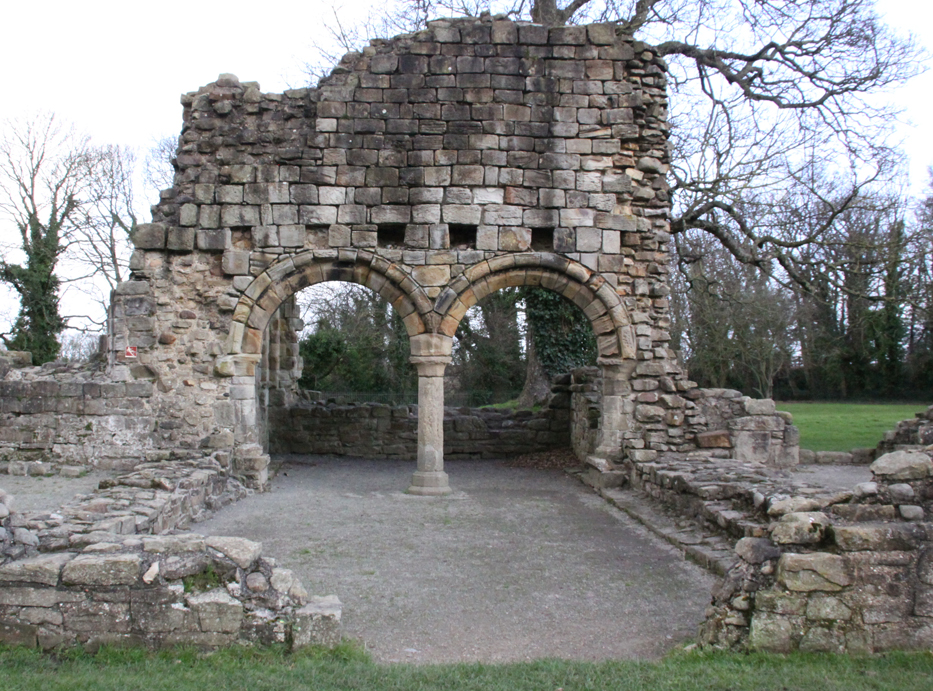
The Chapter House

The sacristy to the left of the chapter house, with doorway leading into the church to the left.

Looking towards where the western range would have been located. The building beyond is now the café.

Opposite this range was the western range, of which there is almost nothing left.  In a Cistercian monastery this was usually used, at least in the early decades, for the lay brethren.  These were members of the monastic community who worked the land, and were not required either to be as educated as the monks, or to dedicate a similar amount of time to worship.  They worked the land and were maintained by the monastery.  As properties were leased out, the lay brethren were increasingly redundant and the western range was usually put to different uses.  It is not known how it would have been used at Basingwerk.


Edward I and Basingwerk Abbey
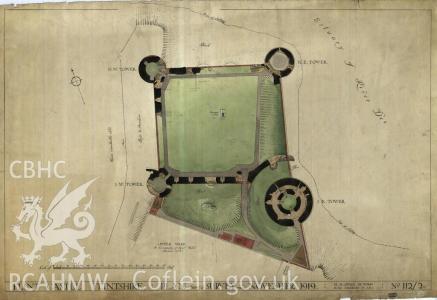
Plan of Flint Castle. Source: Coflein

When Edward I settled on his location for his new castle at Flint, Basingwerk Abbey was just a few miles west of the new site.  The monks of Basingwerk Abbey, which was established over 100 years earlier in 1132, must have wondered about the impact of the castle on their own security and their livelihood.  During the first few months of the castle construction process in the summer of 1277 Edward stayed near Basingwerk.  Edward saw himself as a religious man.  He had been on crusade, and had made a vow to establish a monastic house of his own, under the Cistercian order, and had selected a site for it in Cheshire.  Vale Royal Abbey was already underway in 1277 near Northwich, Edward having laid the first stone in early August.  It seems unlikely that Edward was not often a guest of the Basingwerk Cistercian Abbey during the building of Flint, which apart from being obliged under Cistercian rules to provide hospitality, was unlikely to reject a royal visitor.  Although Basingwerk had been founded by an English patron, Ranulf II it was probably more in tune with Welsh interests by the arrival of Edward.  Indeed, earlier in 1277 seven Cistercian abbots had written a letter to Pope Gregory X supporting Prince Llewellyn ap Gruffud against charges placed by the Bishop of St Asaph, although the abbot of Basingwerk was not amongst them.

Drainage at Basingwerk, from the refectory

Whatever their personal leanings, it would have been very much in the interests of the order for good relations to be maintained.  They may have offered advice about his plans for Vale Royal, and it is clear that some of the abbots in the Welsh-based monasteries, including Basingwerk, played an invaluable role as intermediaries between the Welsh and the English.  Fortunately for the monks at Basingwerk, Edward I chose the Cistercian abbey at Aberconwy for his headquarters, forcing that monastic community to eventually shift further south along the Conwy valley to a new home.

The monks of Basingwerk would have been less than astute, however, if they had not regarded the new castle with misgivings, and if they had concerns about being caught in the middle of a fight between Edward and Llywelyn, their worries would later be justified.  In the 1270s and 1280s the abbey suffered damage during the wars of Edward I, in spite of letters of protection issued to it in 1276,1278, and 1282 and in 1284 Edward granted £100 compensation to the monks after the army stole corn and cattle and the loss of workers who were abducted, presumably for labour.  An additional 132 4d was paid in damages to churches in Holywell.  Basingwerk was not the only abbey in the area to suffer and receive compensation.  Valle Crucis near Llangollen received a sum of £160.00, and nearby Aberconwy was occupied by Edward I’s forces and its monastic community was forced to move to a new home to the south, at Maenan.  Relations between the abbey and castle obviously continued to remain good, because when the castle was completed in 1280 a monk of Basingwerk was engaged as the chaplain to the royal garrison.
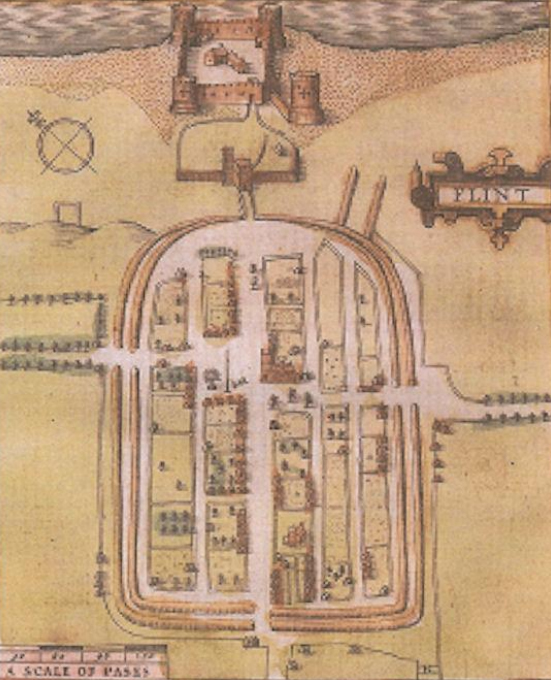
One of John Speed’s maps showing Flint Castle and town. The castle and town of Flint as mapped by John Speed in 1610, showing the original road layout and market place. Source: National Library of Wales

At Flint, Edward had established a Norman-style new town as part of his vision for colonizing various parts of Wales.  This was an English settlement, and any new burgesses prepared to live there was given numerous incentives.  In 1278 Edward granted it permission to hold weekly markets and an annual fair.  In 1292 he granted Basingwerk the same permissions for Holywell, having granted them permission to hold an annual fair at their Glossop manor in 1290.  The monks could charge market stall holders rent for the duration of the market, a nice source of income, as well as selling their own products.  Basingwerk, with its water mills, windmills and fulling mills and land under both grazing and grain, was certainly in a position to sell a number of products, including grain, livestock and livestock products including meat, skins and wool. Welsh wool was recognized as being of very high quality, sometimes superior to even that of the better known wool produced by the Yorkshire monastic producers.  The Taxatio ecclesiastica of Pope Nicholas IV in 1291 recorded that Basingwerk had 2000 sheep producing 10 sacks of wool, 53 cows (at a ratio of 37.1:1), and no goats. Even if it found itself in competition with Flint, Basingwerk’s fairs probably represented the opportunity to raise the abbey’s income.  Its industrial products, as well as some of its wool, may have been sold for export.

The 14th – 16th century

Burton and Stöber describe how by the mid 14th century there were reports that the abbey was in debt, and in the fifteenth century some of its abbots were a distinct liability:

in 1430 the house was seized by Henry Wirral, who made himself abbot, and the following year he was engaged in a legal dispute for the office with Richard Lee. Despite the court ruling in favour of Lee, Henry continued in power at Basingwerk until 1454 when he was arrested for various misdemeanours and deposed. Matters did not improve, for in the following decade Richard Kirby, monk of Aberconwy, disputed the abbacy with Edmund Thornbar. Although the General Chapter ordered that Edmund be recognized as abbot, Richard was still in office in 1476.

Manuscript by Gutan Owain, National Library of Wales, MS3026C. Source: The National Library of Wales

Fortunately the abbey’s fortunes improved under Welsh Abbot Thomas Pennant, who ruled the house for about forty years from around 1481 to 1523, although this was very much a last hurrah before Henry VIII dissolved the monasteries beginning in 1535. By the early 16th century Welsh bard Tudur Aled (died 1526) makes it clear that there was lead roofing and stained glass at the abbey.   Tudur Aled praised Abbot Thomas , commending his his learning but also his generosity, generally an indication that they were being sponsored by a given abbot, as at Valle Crucis.  Gutun Owain seems to have benefited from Basingwerk Abbey’s patronage.  Owain is notable for having addressed over fifteen poems to Cistercian abbots, and is known to have stayed as a guest at Valle Crucis and Strata Florida as well as Basingwerk.  Although the late fifteenth century manuscript known as the Black Book of Basingwerk (Llyfr Du Basing, now NLW MS 7006D, which was the mainly the work of Gutun Owain copied into a single volume) was probably held by Basingwerk at the time of the dissolution in around 1536, it is thought in fact to have been the work of copyist monks at Valle Crucis.

Thomas Pennant was not a man of undiluted virtue.  In an order where celibacy was required and monks were not permitted to marry, Pennant not only fathered a family, but his son Nicholas, became the last abbot of Basingwerk, which in theory was an act of simony banned by the order.  When the abbey closed, probably in 1536, with just three monks, Nicholas was the abbot.
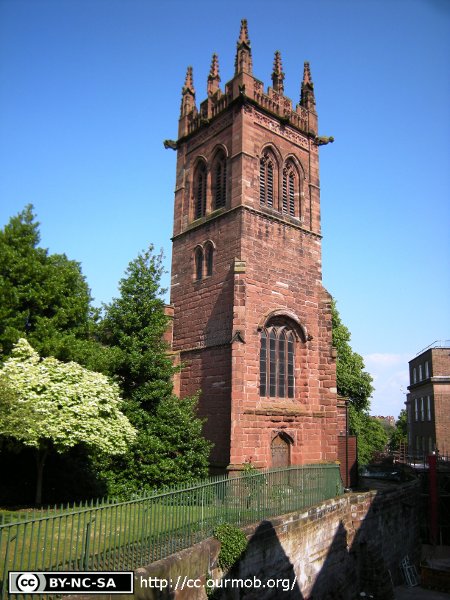
St Mary on the Hill, Chester. Source: GENUKI

After the Dissolution every valuable object and piece of structural material was stripped for Henry VIII’s treasury.  James says that part of the timber ceiling is at Cilcain, and that stained glass can be found at Llanasa.  Burton and Stöber add that the choir stalls from the abbey were transferred to the church of St Mary on the Hill in Chester.  Lead from the roof was removed, and may have been used for the repair of Holt Castle on the Dee and Dublin Castle. Williams adds that it may have been employed also in other crown buildings in Dublin, and that it is possible that the wooden sedilia in the parish church of St Mary, Nercwys, was from Basingwerk.  There is a tradition that the Jesse window was reinstalled in the parish church of St Dyfriog (Llanrhaeadr-yng-Nghinmeirch) but this remains unconfirmed.

I have been unable to get access to St Mary on the Hill, a comprehensive history of which is on the Chesterwiki. It was decomissioned in 1972 and now describes itself as a Creative Space and venue for a range of activities.  However, the Chesterwiki site says that the fittings, presumably including the Basinwerk choir stalls, were removed after the church was decomissioned, although it does not say where these fittings went.

From the 18th century the site attracted artists who recorded features that are now lost.  In the early 20th century a large section of the south transept collapsed.  In 1923 the site was put in State guardianship and in 1984 it was put into the car of Cadw.

Basingwerk Abbey miniature by Moses Griffiths, c.1778. Source: National Library of Wales, via Wikipedia

Final comments

The building that may be a guesthouse, has had burned timbers dendro-dated, which give the roof a date of c.1385. Source: RCAHMW Exhibitions: Dendrochronology Partnerships

Information about Basingwerk Abbey is fragmented and partial, but researchers have pieced together a history of the abbey that tells a story about abbey’s past, beginning as a Savignac establishment before being absorbed into the Cistercian network of monasteries.  The disputes between the Welsh princes and Henry III and Edward I caused grief for the north Wales monasteries, but they survived to rebuild and move forward.  Like other abbeys in Wales, the abbots of the abbey had a diplomatic role, often acting as intermediaries between Wales and England.  As members of the wider community with an important economic role, the abbey was often involved in local judicial matters. Financial difficulties in the 14th and 15th centuries are recorded and but again the monastery survived these difficulties.  In the early 16th century the abbey became a haven for Welsh bards, supporting their work. Throughout its history, its location on the main route through north Wales meant that it was obliged to provide more hospitality than more secluded monastic houses, whilst the shrine of St Winifred, whilst contributing to the prestige and financial value of the abbey, also required some management to prevent it becoming a drain on the abbey’s obligation to provide shelter and food.  After the Dissolution in 1536, the abbey was decommissioned, its valuables removed and its properties either sold off our leased out.  Today it is managed by Cadw and offers an excellent visitor experience.


Visitor Information

Find the captions and see the full-sized map at https://greenfieldvalley.com/greenfield-valley-zones/. There is an interactive version of the map at https://greenfieldvalley.com/explore/interactive-map/.

The site is free to visit.  There is no visitor information centre but a small modern shop sells guide books, postcards and souvenirs relating to Basingwerk, St Winifred’s Shrine and the Greenfield Valley Park. The abbey’s postcode is CH8 7GH and the car park is on Bagillt road, just to the west of the enormous railway bridge, opposite a small trade/industrial estate.

There is a big car park at the foot of the abbey, shown to the right left on the A548, just west of the enormous railway bridge, which has a fairly gentle metalled incline up to the abbey, with a bench and information map half way up.

There is also a café just outside the main gates, which in October 2022 was doing a good coffee and a splendid lunch.

Basingwerk Abbey is a component part of Greenfield Valley Park, and is popular with dog walkers and children, so if you want a quiet visit it is probably best to go on a weekday outside the holidays. The rest of Greenfield Valley Park is an excellent visit in its own right, with a remarkable amount of industrial archaeology within its borders, and plenty of interpretation boards.  I have posted about the industrial archaeology of the Green Valley Park here.

If you want to stay in the medieval period, St Winifred’s Well is about 1.5 miles through the park (shown as No.9 at the very top of the map right), or if you prefer to drive it has its own car park.  Flint Castle is only 4 or so miles down the A548 towards Chester, and makes for a great visit.  I wrote about the history of Flint Castle on an earlier post, Together, the three sites make a very fine medieval day.

Sources

Books and papers:

Burton, J. and Stöber, K. 2015.  Abbeys and Priories of Medieval Wales.  University of Wales Press.  https://www.jstor.org/stable/j.ctt9qhdvn.13

Davies, Paul R. 2021. Towers of Defiance. YLolfa

Elfyn Hughes, R., J. Dale, I. Ellis Williams and D. I. Rees. Studies in Sheep Population and Environment in the Mountains of North-West Wales I. The Status of the Sheep in the Mountains of North Wales Since Mediaeval Times. Journal of Applied Ecology , Apr., 1973, Vol. 10, No. 1 (Apr., 1973), p.113-132
https://www.jstor.org/stable/2404720

Evans D.H. 2008, Valle Crucis Abbey, Cadw

Knight, L. Stanley 1920. The Welsh monasteries and their claims for doing the education of later Medieval Wales. Archaeologia Cambrensis, 6th series, volume 2, 1920, p.257-276
https://journals.library.wales/view/4718179/4728984/314#?xywh=-63%2C345%2C2942%2C1730

Rhys, Ernest (ed.) 1908.  The Itinerary and Description of Wales with an introduction by W. Llewelyn Williams. Everyman’s Library. J.M. Dent and Co, London. and E.P. Dutton and Co (NY)
https://archive.org/details/itinerarythroug00girauoft

Huws, D. 2000.  Medieval welsh Manuscripts. University of Wales Press

James, M.R. 1925.  Abbeys. The Great Western Railway
https://archive.org/details/abbeys-great-western-railway

Jones, Owain, 2013. Historical writing in medieval Wales. PhD Thesis, University of Bangor.
https://research.bangor.ac.uk/portal/files/20577287/null&ved=2ahUKEwjxssbb0tvtAhWmxIsKHQgvBW0QFjAOegQICBAI&usg=AOvVaw2GbJiGy6Sl3SPiTX4K8RqZ

Lekai, Louis L. 1977. The Cistercians. Ideals and Reality. The Kent State University Press

Patel, Rowan 2016. The Windmills and Watermills of Wirral. A Historical Survey. Countyvise Ltd.

Robinson, D. M., 2006. Basingwerk Abbey. Cadw

Silvester, R.J., and Hankinson, R., 2015. The Monastic Granges of East Wales. The Scheduling Enhancement Programme: Welshpool. Clwyd-Powys Archaeological Trust (CPAT)
coflein.gov.uk/media/241/979/652240.pdf

Smith, Joshua Byron 2016. “Til þat he neӡed ful neghe into þe Norþe Walez”: Gawain’s Postcolonial Turn. The Chaucer Review, Vol.51, No.3 (2016), p.295-309
https://www.jstor.org/stable/10.5325/chaucerrev.51.3.0295

Williams, David H., 2001. The Welsh Cistercians, Gracewing

Williams, David H., 1990. Atlas of Cistercian Lands. University of Wales Press

Websites:

Coflein
Basingwerk Abbey
https://coflein.gov.uk/en/site/35649?term=basingwerk%20abbey%20holywell

Monastic Wales
Basingwerk Abbey
https://www.monasticwales.org/browsedb.php?func=showsite&siteID=24
Gutun Owain
https://www.monasticwales.org/person/72
The Black Book of Basingwerk
https://www.monasticwales.org/archive/24
Valle Crucis (Abbey)
https://www.monasticwales.org/browsedb.php?func=showsite&siteID=35

RCAHMW Exhibitions: Dendrochronology Partnerships
Bilingual exhibition panel entitled Partneriaethau Dendrocronoleg; Dendrochronolgy Partnerships, produced by RCAHMW 2013
https://coflein.gov.uk/media/200/524/rcex_026_01.pdf

RCAHMW List of Historic Placenames (searchable database)
https://historicplacenames.rcahmw.gov.uk/

University of Notre Dame
A Knight in St. Patrick’s Purgatory, by Haley Stewart. March 15, 2019
https://churchlifejournal.nd.edu/articles/a-knight-in-st-patricks-purgatory/

An Essay on Cistercian Liturgy by Dr Julie Kerr
Cistercians in Yorkshire, University of Sheffield
www.dhi.ac.uk/cistercians/cistercian_life/spirituality/Liturgy/Cistercian_liturgy.pdf 


The chapter house propped up during excavations when M.R. James visited in 1925.

Basingwerk Abbey from the South. 1929 postcard. Source: People’s Collection Wales

A visit to the 12th century Birkenhead Priory #1 – The Medieval buildings

Introduction

The chapter house

Birkenhead Priory is one of the most enjoyably unexpected places I have visited in the region, even more surprising than a Roman bath-house embedded in a 1980s Prestatyn housing estate.  The priory site incorporates both the remains of the 12th century monastic establishment and the ruins of St Mary’s 1822 parish church with its surviving tower and terrific views.  On all sides the site is surrounded by both heavy and light industry.  Cammell Lairds shipyard not only butts up against the south and east walls, but purchased part of the priory’s former churchyard and cemetery for its expansion and the building of Princess Dock.  On the other sides are warehouses and commercial units.  The result is that in spite of the clanging and banging from the vast ship under construction immediately next door (fascinating in its own right), the obvious and somewhat inescapable cliché is that the ruins of the priory and parish church are an oasis of peace in the midst of all the busy activity.  The small but quiet stretches of grass, the trees and the wild flowers contained within the remains of the priory site are a treat, and the splendid views from the top of St Mary’s tower are a powerful reminder of how the world has changed since the foundation of the priory.

I have divided this post into two parts, because there is so much to say.  A visit to Birkenhead Priory is really five visits in one.  In chronological order, a visit to the site provides you with the following heritage:

  • 1) The priory, established in the 12th century and built of red sandstone, is the oldest part of the site and the star turn with its vaulted undercroft and chapter house
  • 2) St Mary’s parish church was built next to the ruins in 1821 to serve the growing community, its gothic revival windows wonderfully featuring cast iron window tracery
  • 3) The priory’s scriptorium over the Chapter House, now with wood paneling over the sandstone walls, is the exhibition area for the Friends of the training ship HMS Conway,
  • 4) The Cammell-Laird shipyard is hard up against the priory’s foundations and fabulously visible from St Mary’s Tower. When it wished to expand into the church’s churchyard, it purchased the land and re-located the burials
  • 5) St Mary’s Tower, which is open to the public with amazing views from the top, is now a memorial to the 1939 HMS Thetis submarine disaster in the Mersey.

In this part, part 1 I am taking a look at the priory.  In part 2 I have looked at the post-dissolution history of the site; the 1821 construction of St Mary’s parish church; the memorial to HMS Thetis and the display area for HMS Conway.  I will tackle Cammell Laird’s separately, as I suspect that it will be very difficult to handle in a single post, and I need to do a lot more research before I make the attempt to summarize its history.

Birkenhead in the foreground with the manor and ruins of the monastery, and Liverpool in the background over the river, c.1767, showing just how isolated Birkenhead remained even in the 18th century. Attributed to Charles Eyes. Source: ArtUK

Foundation of the priory in the 12th Century

Artist’s impression of the priory done by E.W. Cox by 1896.

The priory was dedicated to St Mary and St James the Great.  There are no documents surviving from the priory, and none of its priors became important in other areas of the church or in life beyond the priory, so most of the information comes from other sources of documentation as well as from the architecture itself. Its principal biographer, R. Stewart-Brown, writing in 1925, commented that it was “not possible to compile anything in any degree resembling a history of this small and obscure priory,” but the result of his work was an impressive overview of the priory, its financial stresses and its involvement in the Wirral as a whole and the Mersey ferry in particular.  Much recommended if you can get hold of it.  Although not certain, is thought that the priory was founded in the mid-12th century by one of William the Conqueror’s Norman followers who was rewarded for his service to the new king and the local earl Hugh Lupus with land on the Wirral.  His name was Hamon (sometimes Hamo) de Massey from Dunham Massey, the second baron, who died in 1185, suggesting that the priory was founded before this date, probably in the middle of the 12th century.

Exterior of the west range, showing the two big windows that illuminated the guest quarters, the one on the left heavily modified.

The priory was established on an isolated headland, surrounded on three sides by water.  Hamon almost certainly took as his model for the priory the abbey of St Werburgh in Chester (now Chester Cathedral) which was founded in 1093 by Hugh d’Avranches, also known as Hugh Lupus.  Hugh Lupus had convinced St Anselm of Bec (later Archbishop of Canterbury and after his death canonized) to come and establish St Werburgh’s, and it was organized along classic Benedictine lines, about which more below.  The founding of a monastic establishment was seen as a Christian act, a statement of piety and devotion, and was most importantly a precautionary investment in one’s afterlife, securing the prayers of the monks, considered amongst the closest to God, throughout the entire lifetime of the monastery

A priory was smaller and inferior in status to an abbey and was was often dependent (i.e. a subset) of an abbey, and answerable to it.  It is possible that the much larger and infinitely more prestigious St Werburgh’s Abbey in Chester supplied the monks to establish Birkenhead Piory, but there is no sign in the cartularies (formal documents and charters) of St Werburgh’s that there was any ongoing formal connection between the two.  The difference between a non-dependent priory and an abbey was usually that the priory did not have sufficient numbers to be classified as an abbey, or that it had not applied for the royal stamp of approval required for the more senior status of an abbey. The minimum requirement for the foundation of a Benedictine abbey was 12-13 monks.  A 16th century historian suggested that there were 16 monks, but it is by no means clear where this figure came from.  Twice during the 14th century it is recorded that there were only five monks at the priory, and it is very likely that the priory remained too small to become an abbey.

The typical monastic day in a Benedictine monastery. Not a great photo, but a very nice representation from a display in the museum area in the undercroft

The Benedictine Order was not the oldest of the monastic orders in Britain, but following the Norman Conquest it became the most widespread.  It was named for St Benedict of Nursia who, in the 6th century, set out a Rule, or set of guidelines, for his own monastery.  This spread widely and became the basis of many monastic establishments setting out to follow his example.  The Benedictines had been well established in France at the time of the Conquest, and sponsorship by incoming Normans, granted land by William the Conqueror, ensured that they spread rapidly in England, and later Wales, Scotland and Ireland.  Benedictine monasteries were all built to a standard architectural layout, with minor deviations, based on both religious and administrative requirements.

The monastic buildings

Plan of the Birkenhead Priory site.  Source: Metropolitan Borough of Wirral leaflet (with my annotations in colour). North is left, south right.

If you take the guided tour, which I sincerely recommend, you begin your tour in the undercroft, now used as a museum / display space.  Most helpfully it has a scale model of the priory with Stewart-Brown’s 1925 site plan, both of which help you to orientate yourself and get a sense of how the ruins were once a complex of buildings that defined and enabled a monastic community, combining religious, administrative, domestic and other functions.  In the plan on the left, with the surviving remains of the priory outlined in red, the site of the priory church outlined in orange and remains of the 1822 St Mary’s Church outlined in green. The blue margin indicates the shipyard over the priory wall.  The numbers on the plan are referred to in the description below.  You can download a copy of the map (without the coloured additions) as a PDF here.

Like St Werburgh’s Abbey, the priory buildings were made of locally available red sandstone.  Like all monasteries based on Benedictine lines, the monastic site plan began with a square.  The bigger the monastery envisaged, the bigger the square.  This was known as the garth (1 in the plan on the left), and was either a grassed area or a garden.  Surrounding this was the cloister, a covered walkway that served as a link between the buildings that were erected around the garth, and where desks were usually arranged so that the monks could work.  This was a secluded space, confined to the inmates of the monastery.

Model of the priory church and claustral buildings in the priory’s museum space in the undercroft showing a possible layout of the church.  The chapter in this view is hidden behind the tower.

The most conspicuous of the buildings would have been the one that no longer stands:  the church and its tower (4 on the plan above, outlined in orange), which made up one side of the cloister.  Traditionally in Benedictine complexes this was built on the north side of the garth, making up an entire side of the cloister, in order protect the rest of the buildings and allow light into the garth and the other cloister buildings, but at Birkenhead Priory’s church was on the south, possibly to protect the claustral buildings from the winds whistling down and across the Mersey. The model and plan show that the 13th century church was built in the standard cross-shape.  It featured a long nave at the west end (where the public were permitted to observe religious ceremonies), and a surprisingly long east end (where the ceremonies were performed) with two side-transepts, which were usually used as chapels for commemorating the dead and a tower over the crossing. A pair of aisles flanked the south and north transepts as show above.  When it was first built in the 12th century, the church would have been much smaller and probably smaller than this footprint.

View of Birkenhead Priory by Samuel and Nathan Buck in 1726, showing the remains of the church’s northern arcade.  Source: Panteek

Lonely remainder of the church’s northern arcade

The entrance to the chapter house with its Norman arches. You can clearly see the difference between the 12th century chapter house masonry and the 14th century scriptorium above with its gothic window and tracery. The tower in the background belongs to the 19th century church.

The chapter house (2) is the oldest of the Birkenhead Priory buildings, the only one remaining that dates to the 12th century.  The building of the priory church, being the place where the main business of praising God took place, was usually started straight away, but the chapter house was often built in tandem as this was also of fundamental importance to a monastery.  This is where the everyday business of the priory was attended to, from the day-to-day administration and disciplinary matters, to the daily readings of chapters of St Benedict’s Rules or other improving texts such as excerpts from one of the many histories of saints (hagiographies).  The Birkenhead Priory’s original medieval chapter house is a gorgeous. The vaulted roof of the chapter house is superb (see the photo at the very top of this post), and although the windows have been altered over time, one of the deep Norman Romanesque window embrasures survives, and is a thing of real beauty (see below).  The stained glass is all modern, but all are nicely done, the one over the altar by Sir Ninian Cowper combining religious themes relevant to the house (St Mary and St James flanking Jesus) with two prestigious characters from the priory’s own history (its founder Hamo de Massey and its two-time visitor Edward I).  Gravestones from the medieval cemetery have been incorporated into the floor around the post-Dissolution altar.  In the medieval priory, there would have been no altar in the chapter house, but following the Dissolution the chapter house was converted into a chapel and is still used for weddings, funerals and baptisms. 

Over the top of the chapter house, a scriptorium was added in the 14th century. In theory this was where the copying of books took place, but it has been pointed out that this was a particularly large space for such an activity, and it may have been used for something else, or for a number of different activities.  Today it is the display area for the training ship HMS Conway, and at some point in the 19th or early 20th century was provided with panelling and has some very fine modern stained glass by David Hillhouse.  This modern usage will be discussed in part 2.

Opposite the chapter house the remains of the west range (7-11) survives, which was again a two-floor building separated into a number of different spaces  It seems to have been divided into two, with the northern end and its big fireplace reserved for guests, and the southern end, with an entrance into the cloister, seems to have been split into two floors, with a fireplace on each, for the prior’s personal quarters, which would have included a private parlour that he could use for entertaining VIP guests.  Although it’s not the most aesthetically stunning of the surviving claustral buildings today, the stonework displays a fascinating patchwork of different features and alterations that reflect many changes and refinements in use over time and are still something of a fascinating puzzle.

West Range

Remodelling in the 14th century created the undercroft and the refectory above it, as well as the kitchen.  The undercroft (14), once used as a storage space, with the original floor intact. The investment in the lovely architecture may indicate that before it was used as a storage area, it had a more high profile role, perhaps as a dining area for guests.  Above it was the refectory, unlike St Werburgh’s, Basingwerk Abbey or Valle Crucis Abbey, all of which had refectories at ground level.  It was reached by a spiral stone staircase leads up to this space today.

The kitchen was apparently to the north of the west range, and connected to it, as shown on the above plan (12).  This was convenient for the guest quarters, but not quite as convenient for the refectory over the undercroft, from which it was divided by a buttery (or store-room, 13), over which a guest room was also installed.   The kitchen was apparently a stand-alone structure made mainly of timber, and this may have been because kitchen fires were so common, and building the kitchen slightly apart from the main monastery would have been a sensible precaution.  Kitchen fires are thought to have been the cause of several devastating scenes of destruction in monastic establishments, spreading quickly via roof timbers and wooden furnishings.

Between the chapter house and the north range, which contained the undercroft and refectory, was an infirmary (19 on the plan) and the dormitory (18) side by side, each accessible from the cloister.  The infirmary was for the benefit of the monks, and was where those who were sick or injured or suffering the impacts of old age were cared for.

Sources of income and financial difficulties

Carved head in the side of the fireplace in the guest quarters on the ground floor of the west range

Monasteries were amongst the most important land-owners in medieval Britain, on a par with the aristocracy.  Their income came mainly from agricultural activities, both crops and livestock, as well as making and selling bread, beer, buttery and honey; but they might also own mills, mines, quarries and fisheries and the rights to anchorage, foreshore finds and the use of boats on rivers. For those with coastal and estuary locations with foreshore rights, there was, as Stewart-Brown lists, the benefits of flotsam (items accidentally lost from a boat or ship, jetsam (items deliberately tossed overboard), salvage from shipwrecks and keel toll.  The luckier (or most strategically inclined) monasteries and churches also had pilgrim shrines, sometimes reliquaries imported from overseas. St John’s Church in Chester had a miraculous rood screen, St Werburgh’s Abbey in Chester had the shrine containing the bones of St Werburgh herself, and Basingwerk Abbey had the neighbouring holy well of St Winifred.  These attracted donations and bequests and were good for the settlements in which they stood, because the pilgrims needed places to stay, food and drink, and would probably buy souvenirs.  Birkenhead Priory had no such shrine, but it probably felt the impact of the pilgrim route as the ferry crossing over the Mersey, which it ran free of charge, was an important link between Lancashire, west Cheshire and northeast Wales.

Some of the monastic landholdings on the Wirral. Source: Gill Chitty, on Merseyside Archaeology Society website

The original foundation of the monastery would have included both the land on which the monastery sat, funding for building it, and an economic infrastructure of landholdings as well as the income of some local churches. The long list of land-holdings sounds impressive, but most of them appear to have been quite small and scattered, some of which will have been wooded and some wasteland, not all of it suitable for cultivation or pasture. These include lands in Birkhenhead (including the home farm in Claughton with its mill), Moreton (with a mill and dovecote), Tranmere, Higher Bebington, Bidston, Heswall, Upton, Backford, Saughall, Chester, Leftwich, Burnden at Great Lever in Middleton, Newsham in Walton, Melling in Halsall, and Oxton.  Either at foundation or not long afterwards, the priory was granted the incomes of the churches of Bidston, Backford, Davenham and half of the church of Wallasey, and claimed rights of Bowdon church that were disputed.

Carving at the base of a window arch in the west range

The monastery did not flourish with these assets.  In spite of the claim that there were 16 monks at the time of its foundation, the records made by official church visitors suggests there were only a small number of monks at any one time (only five in 1379, 1381, and 1469, and seven, including two novices, in 1518 and 1524), and there is plenty of evidence to indicate that the priory struggled financially.  Monasteries had significant overheads including feeding the community, buying tools and supplies, repairing monastic and farm buildings, appointing stewards and other employees, providing charitable alms and providing hospitality free of charge.  Where they earned incomes from churches and chapels, they were also responsible for the provision of the clergy and shared part of the cost of maintaining the buildings.  Ambitious priors often invested in building projects, sometimes to improve the monastic offering, sometimes for prestige, and even with donations this was usually costly.  There were also occasional challenges to bequests made to churches from following generations, which involved costly legal proceedings.  Balancing the books was a frequent problem for monastic establishments, and the priors of Birkenhead Priory were no different.

There were quite limited means by which the priors of Birkenhead might increase their income.  The most obvious way of generating ongoing income was to acquire more land through gifts and bequests.  In this endevour the priory probably had a real disadvantage in being near to both St Werburgh’s Abbey in Chester and, across the river Dee, Basingwerk Abbey at Holywell.  Both abbeys had significant land-holdings on the Wirral, and both had pilgrim shrines and were on pilgrim routes.  Both were large and prestigious, and were far more likely to attract big gifts than a small and rather remote priory.  If Birkenhead hoped to attract gifts of land, it probably had to depend on local landowners and merchants who felt a personal connection with the priory but would not necessarily have had the wherewithal to significantly change the income-earning potential of the priory, providing personal items rather than swathes of land. For these very local gifts and legacies, it is entirely possible that the priory was also in competition with contemporary parish churches on the Wirral.  There are records in the early 16th century, not long before the monastery was closed during the Dissolution, that give an idea of the sort of bequests made by local people in return for requiem masses to be recited for their souls:  one will provided a painting of the Crucifixion for the priory church.  Another bequeathed the owner’s best horse, 10 shillings, and a ring of gold.

As the Middle Ages progressed, populations expanded and both new and old towns began to hold markets where everyday goods and more prestigious products could be traded, even once-isolated monasteries found themselves becoming integrated into the secular world and in competition with it.  It certainly did not initially help the monks at first that during the early 13th century Liverpool began to grow.  Under the Benedictine rules, monasteries had an obligation to provide hospitality to visitors when required, and the Birkenhead monks ran the ferry over the Mersey as a charitable service.  When the priory was first established, offering occasional hospitality and running the ferry free of charge were not onerous.  This changed rapidly after 1207 when Liverpool was granted burgh status by King John, as the following translation of the original Latin charter confirms (Translation from Picton 1884):

The 1207 charter of Liverpool by King John. Source: Royal Charters of Liverpool leaflet

John, by the grace of God King of England, Lord of Ireland, Duke of Normandy, Aquitain, and Earl of Anjou, to all his faithful subjects who may have wished to have burgages in the town of Liverpool greeting. Know ye that we have granted to all our faithful people who may have taken burgages at Liverpul that they may have all liberties and free customs in the town of Liverpul which any free borough on the sea hath in our land. And therefore we command you that securely and in our peace you come there to receive and inhabit our burgages. And in testimony hereof we transmit to you these our letters patent. Witness Simon de Pateshill at Winchester on the 28th day of August in the ninth year of our reign.

A little later Liverpool was granted the right to hold markets and fairs, and the links between Liverpool and the busy port of Chester grew to be increasingly important. There was no infrastructure to cope with this increase in human traffic. They were already offering a ferry service free of charge but even more pressing on their resources was the cost of housing guests.  There were no inns between Liverpool and Chester (showing a lack of commercial ambition on the part of both Liverpool and Chester medieval merchants!), so the monks found themselves obliged to offer accommodation and food, which the rules of the Benedictine order required them to offer free of charge.  This hospitality became particularly difficult if there was a spell of bad weather, during which those waiting to cross from Birkenhead to Liverpool would have to wait at the priory until the weather improved and crossings could resume.  They were also were troubled with all the through-traffic that travelled along a route that ran through the monk’s Birkenhead lands close to the priory buildings.

The spiral staircase from the undercroft into the former refectory

It must have exacerbated the monks’ financial situation when Edward I visited the monastery twice with his entourage during this period.  Edward’s first visit was in September 1275 for three nights, seeking a diplomatic solution to his dispute with the self-styled Prince of Wales, Llywelyn the Last of Gwynedd. His second was in 1277 for six days with the apparently dual motives of pursuing his campaign against Llywelyn and receiving a delegation from Scotland to settle a boundary dispute.  Although the king would pay the costs of his entourage and horses, the cost of entertaining the king and his most senior advisors fell to the monastery.  Hosting a royal entourage was notoriously expensive, and any contributions made by a visiting monarch to a monastic establishment only rarely compensated for the outlay.

One of the measures to improve their income in the 1270s involved the expense of serious litigation when incumbent prior claimed that the church had been presented in its entirety to the priory.  This was disputed by the Massey family, who triumphed in the courts.  Fortunately for the priory, in 1278 the 5th Hamon de Massey came to an agreement with the monks to their benefit.  Other litigation occurred over pasture rights in Bidston and Claughton.

In 1284 the priory received permission from Edward I, who had probably witnessed the priory’s problems at first hand in the 1270s, to divert the road that disrupted the priory “to the manifest scandal of their religion” and to provide the priory court with an enclosure, either a ditch, hedge or wall, to preserve its privacy.  This would have incurred costs, but would have eased one of the problems caused by the ferry.  Rather more significant for their finances, early in the 14th century the priory was granted a licence to build and charge for guest lodgings at the ferry at Woodside, and in 1311 they were granted the rights to sell food there.  It was at this time that the church was expanded, which would have been a significant project.

Chapter house building with scriptorium room added over the top in the 14th century.

The first half of the 14th century had been hard for most of western Europe, with both famine due to anomalous weather conditions that caused crops to fail, followed only a few decades later by  a plague that killed huge numbers of people.  In Britain the famine lasted from 1315-17 and the Black Death arrived in 1348. The priory survived both the famine and the plague, as did the settlement of Liverpool, now a century old.  At some point in the first half of the 14th century, the priory acquired land in Liverpool so that the monks could begin to trade their goods at market, building a granary or warehouse on Water Street (then known as Bank Street).

In 1316 the hospital of St John the Baptist in Chester was judged to be seriously mismanaged and was put into the hands of the priory, perhaps because of their experience running their own infirmary.  This was a failure, merely adding to the priory’s problems, and was removed from their care in 1341.

Multiple layers in the west range, with a  window added into the top of a former fireplace, blocking it, and a fireplace above it.

In 1333 Edward III requested monasteries to contribute to the expenses of the marriage of his sister Eleanor.  Local monasteries who contributed included Birkenhead, which contributed £3 6s 8d and Chester’s St Werburgh’s Abbey which, bigger and more prosperous, gave £13 6s 8d.  There were doubtless other payments of this sort, occasional and therefore unpredictable, and impossible to resist.  The priory was also liable for taxation.

The ferry from Woodside had continued to be supplied free of charge, but the priory appealed to Edward III and was permitted for the first time to charge tolls in 1330, setting a precedent that remains today.  A challenge to the monk to operate the ferry and claim the tolls, was challenged by the Black Prince in 1353, but the priory produced its charter and successfully resisted the removal of this privilege.  The tolls charged were recorded at that time:  2d for a man and horse, laden or not; 1/4d for a man on foot or 1/2d on a Saturday market dasy if he had a pack

Other ways of generating income from lands to which they had rights were also explored, and from records of litigation against them, they were often accused of infringing forest law.  Wirral had been defined as a forest by the Norman earls of Chester, which restricted how the land could be used.  The monks were clearly assarting (cutting down wood to convert to fields and pasture), reclaiming waterlogged land, enclosing certain areas and cutting peat for fuel. The priory was able to argue special exemptions for some of the charges, and produced the charters to prove it, but at other times they were fined for the infractions.  In 1357, for example, they were fined for keeping 20 pigs in the woods.

A number of monastic establishments seem to have responded to surviving the plague by redefining themselves via architectural transformations.  Whatever the reasons for this trend, Birkenhead Priory was no exception and the 14th century could have been an expensive time for the monks.  The frater range (including the elaborate vaulted undercroft and the refectory) was completely rebuilt and the west range was remodelled.  The room today described as a scriptorium was also added over the chapter house at this time.  Although Stewart-Brown suggests that much of this could have been accomplished with “pious industry . . . without much cost” with the assistance of donations of labour and money, that is probably somewhat optimistic, and there would have been an outlay.  Certainly, at the end of the century the priory was considered to be so impoverished that it was exempted from its tax contribution.

There is some evidence that for at least some of the Middle Ages the priory rented out land rather than working it themselves, except for their home farm at Cloughton. This had the benefit of providing a dependable income if tenants were reliable, and obviated the need to appoint managers or deal with labour and handle the sale of produce, but if the cost of living went up, the fixed income that no longer purchased what it had previously afforded, and this could represent a serious problem.

Dissolution

The opening page of the Valor Ecclesiasticus, showing Henry VIII. Source: Wikipedia

When Henry VIII’s demand for a divorce was rejected by the pope, the king severed Britain from the Catholic Church, creating the Church of England.  This provided him with the opportunity to acquire land and valuable assets by dissolving all monastic establishments, all of which had been subject to the papacy.  The spoils were to be used to fund Henry’s wars with France and Scotland, and some former monasteries were given to Henry’s supporters as rewards. To assess the potential of the monastic assets, Henry VIII commissioned the Valor ecclesiastis, a review of every monastery in the country.  All monastic establishments with an annual income of less than £200.00 were to be closed as soon as possible. The first monasteries were dissolved in 1536 and the process was more or less concluded by 1540, with a handful of the more prestigious abbeys, like St Werburgh’s in Chester, converted to cathedrals.  Birkenhead Priory was only earning £91.00 annually so it was amongst the first to be closed.  There was no resistance by the Birkenhead prior, who was provided with a pension of £12.00 annually.  The brethren were either dismissed or disseminated to non-monastic establishments.

Visiting

The car park is on Church Street, at the rear of the priory, where the cafe is also located.  There is some on-street parking on Priory Street at the front of the priory. Source: Birkenhead Priory website

This is a super place, and makes for a terrific visit.  Do go.  You won’t be disappointed!

Even with SatNav, the big thing to remember about finding your way to Birkenhead Priory, if you are arriving by car from the Chester direction, is to do whatever it takes NOT to end up at the Mersey tunnel toll-booths 🙂  They were very nice about it, let me out through a barrier, and gave me perfect directions to get to the priory once they had freed me from the tunnel concourse.  Very nice people.  If Edward III was looking down, I’m sure he would have rolled his eyes in despair, given that it was he who gave the monks the right to charge for their Mersey ferry crossings.

Do check the opening times on the website, as the priory is only open on certain days and for only a few hours on those days, mainly in the afternoons. There is dedicated parking on Church Street at SatNav What3Words reference ///super.punchy.report.  From there, the priory is up a short flight of steps.  You can also park on Priory Street, which is where the SatNav will take you if you simply type “Birkenhead Priory” into your SatNav (at What3Words ///indoor.vibes.hips), which offers step-free access but there is limited parking there, and it is a favourite place for van drivers to park and eat their lunches so may be better used as a drop-off point before going round the the car park.

Remnants of the decorative floor tiles, now in the priory’s undercroft, which is used as a museum space

At the time of writing, a visit is free of charge, and so are the guided tours.  My guide was the excellent Frank.  He covered not only the priory but St Mary’s, the HMS Conway room, and the HMS Thetis memorial and, when I headed up to the top of the tower of St Mary’s, directed me to out for the dry dock where the CSS Alabama (the US Confederate blockade runner) was built by John Laird, to be discussed in Part 2.  Frank was very skilled at providing sufficient knowledge to get a real sense of the place, but not so much that it became information overload.  I very much appreciated this, having always found it difficult myself to strike that particular balance.  I was lucky enough to have him to myself, having turned up at opening time, but I noticed that the next tour had a respectable group attending.

There is a small gift shop where you can also buy a really useful guide book with plenty of plans, illustrations and colour photographs.  Please note that they are not able to take cards, and payment is cash only.

There are toilets in St Mary’s tower, a picnic area behind the undercroft on sunny days, and the highly rated Start Yard café is almost next door on Church Street.

For those with unwilling legs, I would suggest that apart from the tower and its 101 steps, and a flight of around 10 steps up into the scriptoruim (the display area for HMS Conway) this is entirely do-able.  There are occasional single steps and uneven surfaces, and it is a matter of taking good care.  As mentioned above, if you park in the carpark at the rear on Church Street, there is a flight of steps into the priory, but even if there is no space in the limited street parking available at the front of the priory on Priory Street, it is a useful drop-off point for anyone needing step-free access.  You can find the SatNav references for both above.

I have posted a two-minute video of the priory, recorded on my iPhone, on YouTube:

Sources

Books, papers, and guidebooks

Baggs. A.P., Ann .J Kettle. S. J. Lander, A.T. Thacker, David Wardle 1980. Houses of Benedictine monks: The priory of Birkenhead, In (eds.) Elrington, C. R. and B. E. Harris. A History of the County of Chester: Volume 3, (London, 1980) pp. 128-132.
https://www.british-history.ac.uk/vch/ches/vol3/pp128-132

Burne, R.V.H. 1962. The Monks of St Werburgh. The History of St Werburgh’s Abbey. S.P.C.K.

Chitty, Gill 1978. Wirral Rural Fringes Survey. Journal of Merseyside Archaeological Society, vol.2 1978
https://www.merseysidearchsoc.com/uploads/2/7/2/9/2729758/jmas_2_paper_1.pdf

de Figueiredo, Peter 2018. Birkenhead Priory. A Guidebook. ISBN 978 1 9996424 0 2

Hughes, Tony. St Mary’s Parish Church, BIrkenhead, 1819-1977. n.d.
https://thebirkenheadpriory.org/wp-content/uploads/St-Marys-booklet.pdf

Picton, Sir James A. 1884.  Notes on the Charters of the Borough (now City) of Liverpool. The Historic Society of Lancashire and Cheshire, vol 36 (1884)
https://www.hslc.org.uk/wp-content/uploads/2017/07/36-5-Picton.pdf

Stewart-Brown, R. 1925.  Birkenhead Priory and the Mersey Ferry, and a Chapter on the Monastic Buildings. The Gift of the Directors of the State Assurance Company Ltd.

White, Carolinne 2008. The Rule of St Benedict. Penguin.


Websites

The Birkenhead Priory
https://thebirkenheadpriory.org/
Buildings of Birkenhead Priory
https://thebirkenheadpriory.org/about/
The medieval grave slabs of Birkenhead Priory
http://thebirkenheadpriory.org/wp-content/uploads/Graveslabs-of-Priory-Chapel.pdf

Mike Royden’s Local History Pages
The Monastic and Religious Orders in the Hundred of Wirral from the Saxons to the Dissolution of the Monasteries – A study of the Monastic history and heritage of Wirral by Norman Blake, April 2003
http://www.roydenhistory.co.uk/mrlhp/articles/students/monasticwirral/monasticwirral.htm
The Influence of Monastic Houses and Orders on the Landscape and locality of Wirral (with particular reference to Birkenhead Priory) by Robert Storrie, April 2003
http://www.roydenhistory.co.uk/mrlhp/articles/students/bheadpriory/bheadpriory.htm
The Medieval Landscape of Liverpool: Monastic Lands (with particular reference to the granges of Garston Hall and Stanlawe Grange) by Mike Royden, 1992
http://www.roydenhistory.co.uk/mrlhp/articles/mikeroyden/liverpool/monastic/mondoc.htm

ArchaeoDeath
Commemorating the Reburied Dead: Landican Cemetery
https://howardwilliamsblog.wordpress.com/2024/05/16/commemorating-the-reburied-dead/

Old Wirral
https://oldwirral.net/archaeology.html

Wirral Council
Making Our Heritage Matter. Wirral’s Heritage Strategy 2011-2014, 2013 Revision. Technical Services Department.
http://democracy.wirral.gov.uk/documents/s50009194/Wirral Heritage Strategy Appendix.pdf

Wirral History
Medieval Wirral (maps)
http://www.wirralhistory.uk/medieval.html

An online archive for for St Mary’s Church and the Priory, Birkenhead
History of the Priory and St. Mary’s Church Birkenhead
http://stmarysbirkenhead.blogspot.com/p/history-of-priory-and-st-marys-church.html


Leaflets

Birkenhead Priory Guide. Metropolitan Borough of Wirral.
Birkenhead Priory A4 leaflet Wirral

Liverpool’s Royal Charters
https://liverpool.gov.uk/media/ghdaoid3/liverpool-charter.pdf

St Mary’s Parish Church 1819-1977
https://thebirkenheadpriory.org/wp-content/uploads/St-Marys-booklet.pdf


The Roman Bath House at Prestatyn

Introduction

The Roman bath-house at Prestatyn, discovered in the 1930s, is located in a rather nice little housing estate on the edge of Prestatyn, which hems it in but does not overshadow it.  Today the site is pleasantly presented in its own space, accessed via a gate.  There are two information posters, and a raised area from which one can look down into the site before walking in and on it.  There has been a lot of work carried out to stabilize and preserve it with concrete and mortar, so it is a distinct mix of old and new, but the essential layout has been preserved.  On the day that we were there, a blue tarpaulin was lying over a small part of the walkway around the site, presumably either due to unsecured damage or to protect repairs.

Roman sites in Clwyd. Source: Blockley 1989, fig.5 p.9. Click image to enlarge

Excavations in the 1930s (Professor Robert Newstead), the 1970s and again in the 1980s (Kevin Blockley for CPAT) revealed an Iron Age farmstead (to be described on a future post) and a Roman and Romano-British (indigenous) settlement dating from the late 1st century AD, some time soon after AD 70.  The combined excavations revealed a Roman complex of structures over a number of periods.  The main period of Roman and Romano-British activity, spanned two periods, defined by Blockley as IIA and IIB.  This included eleven timber buildings, seven in Phase IIA and four in IIB, a water well, and three stone-built buildings, including the bath-house with its furnace and its water management system.  The bath-house itself was built in around AD 120, quite late into the history of the site, and was extended in AD 150.  The entire group of buildings appears to have gone out of use towards the end of the 2nd century.  Originally it was thought that the bath-house and other buildings may have been outliers of a fort.  There is no known fort in north-east Wales in spite of the existence of other Roman sites and three Roman roads, and it was hoped that this might fill a gap in the data.

The Bath House

Detail from one of the information boards at the site showing the various components on the ground

Today all that remains visible of this complex of buildings is the bath-house. When it was found, much of the bath house and surrounding area were covered with c.60cm (2ft) of rubble, described by Newstead as:  “tumbled masonry, broken roof tiles, bricks and quantities of tile-cement flooring etc” a well as box tiles and ridge tiles.

The foundations of the bath-house preserve the main features of a very small but classic Roman bath house, the plan of which is clearly visible on the ground. It measures c.11.7m x 4.5m (c.38 x c.15ft).  What you can see today was the under-floor part of the bath-house.  Over the top of most of these features, except for the D-shaped plunge pool, would have been a tiled floor.  The bath-house was built in two phases.

The bath-house in AD 120

Antefixes from the Roman bath house at Prestatyn. Source: Newstead 1937 (National Library of Wales)

The walls of the building consisted of three courses of ashlar (dressed stone, to present an attractive appearance) filled with rubble and mortar to create the thick walls visible today.  The rubble within the outer walls was locally sourced, probably picked out of glacial soils near the site.   Of the exterior ashlar, Newstead found purple micaceous sandstone blocks in situ along the base of the northern wall of the bath house, the nearest source of which was around 6 miles away (and can be seen in use today at Rhuddlan Castle and St Asaph’s Cathedral). Broken roof tiles were also used in the construction.  Inner walls might have been plastered and could have been decorated.  The roof was tiled, and provided with decorative triangular antefixes showed LEG XX V V legend as well as the legion’s wild boar emblem, which like the tiles were provided with stamps identifying them as work of the 20th Legion.  The 20th Legion’s tile-works at Holt near Chester clearly provided the tiles and bricks required or the bath-house in AD 120, and it is possible that they assisted with the construction works, but there is no sign that this was a legionary base, or that the 20th Legion controlled whatever activities took place at the site.  Apart from the tiles and bricks, all of the stone used at the site was sourced within a few miles of the site.

Information board in the Grosvenor Museum, Chester, showing how antefixes were used


The first phase of the bath-house with the hot room and warm room in Period IIA. Source: Blockley 1989

The plan to the left excludes the later cold room (frigidarium) with the D-Shaped plunge bath, showing the stone-built components of the bath-house in AD 120, when the bath house was built.  There is no sign of a stone-built cold room, which was was either missing, which would be very unusual, or was built of wood.  The two rectangular rooms, both of which sat over two hypocausts were both built in this first phase.  Hypocausts are artificial floors set on small pillars made of bricks and tiles (pilae) into which hot air, supplied by a furnace, is channelled.

In the tepidarium, Room B, Newstead found only two of the short hypocaust pillar bases, each bearing the stamp of the 20th Legion.  An internal doorway gave access to the Room C, the hot room or calidarium which was nearest to the furnace, where the remains of another fourteen pillars (pilae) survived.  The pillars were made of a c.28 x 28cm (11 x 11 inches) brick stamped with the 20th Legion’s name:  LEG XX V V (an abbreviation of Legio XX Valeria Victrix: 20th Legion, Valiant and Victorious). These were placed face down into the floor.  These was then topped with tiles c.19 by 19cm (7.5 x 7.5 inches) set into clay, none of which were stamped.  The hypocaust bricks and tiles were sourced from the specialist tile and brickworks at Holt on the Dee just south of Chester.

Tile bearing legionary stamp from Prestatyn. Source: Newstead 1937 (National Library of Wales)

Illustration of a 20th Legion stamp on one of the bath house tiles. Source: Roman Inscriptions of Britain (RIB-2463_29_xiv)

Praefurnium leading into the calidarium and the tepidarium beyond.

The technical challenge for the builders came in the heating process, which required a furnace to provide the required heat to the two rooms. The remains of the furnace were found by Newstead, built into the centre of west end of the building and projecting 1.4m (4ft 6inches) beyond it, providing heat via a channel known as a praefurnium.  Its floor was originally flagged with large blocks of purple sandstone. You can still stand in the praefurnium, shown left, to look into the hot room (caldarium, room C) and the warm room (tepidarium, room B) room beyond.  Ducts or flues conveyed heat from Room C to Room B.

Like feeding a steam engine, this furnace would have required a considerable amount of fuel to keep the heat supplied, and this would have required manpower both to collect the right sort of wood and to feed it into the furnace.  There would have been storage nearby to dry and store wood.

The video below is a 3-D animation of how the hypocaust at Brading Villa on the Isle of Wight functioned, which gives a good idea how the smaller example at Prestatyn worked too:

Also see the excellent video at the end of the past where the Roman hypocaust at the bath house at Bath are described.

Beyond the bath-house, to its east, was a stone-lined well, and a drain that was also partially stone-lined.  The well was 1.6m deep and 1.1m sq at its base, flaring to 2.5m wide at its top.  It was probably used to supply the bath-house and the two nearby buildings R4 and R5, both of which were copper-alloy workshops dating to IIA.

AD 150 – the extension of the bath-house

The cold room (left) and D-shaped plunge room, right.

The Bath house as it was found when Newstead excavated it. Rooms B and C were included in the original building of AD 120; Room A, the D-shaped plunge-pool, and the masonry drain under the cold-room floor and a drain out of the plunge-pool were added in AD 150.  Source: Newstead 1937 (National Library of Wales)

As already mentioned above, there is no sign that a cold room was included in the first phase of the bath house.  It may have been built in timber, now lost, or it may not have been built at all. Perhaps given the climate, a rectangular cold room and accompanying apse-shaped cold plunge pool, Room A, were not considered necessary, although this is not true for other bath-houses in Britain.  The stone-built cold room was only built 30 years after the original construction of the bath house, measuring 32m by 4m (104 x 13ft).  A new entrance was presumably provided in the cold room, with an internal doorway into the warm room.

Plan and hypothetical elevations of bath-house water supply. Source: Blockley 1989, fig.28 p.51. Click image to enlarge.

The accompanying D-shaped plunge pool was lined with a 12cm (c.4.5ins) thick layer of opus signinum (a type of waterproof pink mortar) on a base of limestone and mudstone fragments set in to clay.  It was around 1.4m (4.5ft) deep.  Blockley describes the water supply to this plunge-pool as the “most completely recovered layout known in Britain,” which included a stone and timber drainage channel, an aqueduct fed by a natural spring, and possibly water tanks.

The diagonal drainage channel crosses the cold room, originally under the floor of the cold room. Blockley believes that this was probably connected to an internal basin.  A second drain leads from the apex of the D-shape as shown on the diagram above, the first 1.6m (c.5ft) within the bath-house had a floor of 40cm sq (c.15.5cm) bricks and was lined with limestone. South of the masonry section it was made of wood, and extended for 14m (c.46ft).  The wooden uprights survive along one section, probably used to hold planks in place along the sides of the drain, which was 25cm deep and 70cm wide with stakes at c.20cm (c.8ins) intervals.

The line of the aqueduct, found in the 1980s excavations, was indicated by a row of parallel postholes.  It ran from the east of the bath-house into the plunge-room, running over the top of the external drain.  Nine of the postholes had timbers of alder-wood in situ, up to 65cm long and 35cm (c.13.5ins) diameter.  The distances between timbers varies along the route, between 1m (c.3ft) and 1.5m (c.5ft).  A water tank may have been sited part way along.  It is thought that a spring further up the slope would have taken the aqueduct over a gradient of some 3m.

Using the Roman bath-house

A section of one of the information boards at the site showing the hot room, far left next to the furnace, the warm room in the middle and the later cold room and plunge pool. Click to expand and see the text clearly.

Had you been lucky enough to be a Roman official with access to a local bath house, bathing followed a sequence of steps that was imported from the core of the Roman Empire.  Movement was through a sequence of warming and cooling experiences.

Roman bathing followed a specific process. Bathers would get changed, and in bigger bath-houses there was a room put aside for this.  They would then progress from the unheated cold room (frigidarium) to the warm room (tepidarium) to acclimatize and then to the hot room (caldarium) before heading back to the cold room to cool down and take a cold dip in the plunge-pool.  All well and good in southern Italy during a balmy Mediterranean summer, and perhaps even in a good Welsh summer, but that cold pool really didn’t look that appealing to me on a chilly day in April!  A bathhouse was often accompanied by an outside, walled exercise area, but there is no indication that the Prestatyn bathhouse offered such a facility.

The Melyd Avenue complex of buildings

1930s survey of the masonry buildings at the site, showing the stone buildings including the bath house (B3 near the bottom of the image) and the trial cuts cut across the site. Source: Newstead 1937 (National Library of Wales)

The bath house was part of a bigger complex of buildings, only some of which have survived.  The site was discovered and informally investigated in 1933 by Mr F. Gilbert Smith, who noted objects and carried out surveys.  It was thought that it might have been a component of a Roman fort.  It was excavated between 1934 and 1937 by Professor Robert Newstead, who found both the bath house (his Building 3) and two other stone-built buildings (Buildings 1 and 2).  He also investigated a section of “paved causeway” found by Smith, and made 9 “cuts” (investigative trenches) at other parts of the site.  The bath house has been described above.  Building 1 consisted of three rooms in a line, with what had once had a tiled floor at one end, and measured c.19 x c.7m (62ft 6ins by 23ft). It produced a coin of Vespasian dating to c. AD 71, as well as pieces of a Samian ware platter also dating to the late 1st century. Samian ware (terra Sigillata) is a bright, glossy red high-status pottery often highly decorated in relief, which is often stamped with the manufacturer’s mark, and is very useful for dating (see image further down the page, and the excellent video at the end of the post by Guy de la Bédoyère). Building 2 was less clearly defined and far less informative, at least c.11m long (36ft), producing a single undated piece of amphora, and had been damaged by fire.

Samian pottery found at the Prestatyn site. Source: Newstead 1938

The cut through the section of “paved causeway” identified by Smith and shown on the above plan revealed that it was made of flat sandstone slabs over large pine logs on top of “a  mess of brushwood in a peaty matrix.”  Within these layers there were Roman potsherds and pieces of window glass as well as animal bones.  The other cuts revealed no features but the one in front of building 3 produced a piece of millefiori glass, 7 pieces of window glass, some fragments of a glass flask and a small black counter as well as some samian ware.  In 1938 further excavations produced no more buildings, and consisted mainly of taking sample cuts through the site, and these produced Roman levels that contained fragments of Roman objects.  All of the data from the site over the years of excavation placed it within the later 1st to the later 2nd centuries AD. As well as tiles and antefixes stamped with 20th Legion stamps, diagnostic finds included a Vespasian coin, some distinctive pieces of samian,  other dateable types of pottery and fragments of decorative and glass as well as some fittings for horses and some jewellery.

The 1972-73 rescue excavations followed another building development in nearby Prestatyn Meadows, during which Roman materials were found, including a column base and tiles stamped with  LEG XX VV. Excavations could not take place at the precise location of the discovery due to building regulations, and were therefore carried out a little to the south, with three trial trenches opened to sample the area.  No structural remains were found, but there were plenty of objects dating to the late 1st and 2nd centuries AD, consisting of building fragments and domestic rubbish including samian, coarse ware, window glass, flint, animal bones and coal.

Period plans showing the location of major features. Source: Blockley 1989, fig.6 p.12

The 1984-5 excavations, undertaken and published by Kevin Blockley in 1989 on behalf of the Clwyd and Powys Archaeological Trust (CPAT), considerably expanded the view of what was going on at the site.  Excavations took place over two seasons, or 47 weeks, and uncovered 1544 sq m (c.5065) sq ft).  As well as both pre-Roman and post-Roman discoveries, he found eleven timber-built buildings over two phases of Roman occupation, most of them with both postholes and stakeholes, indicating a probable timber frame with wattle-and-daub wall construction.  Over 2000 small-finds were excavated.  Blockley and his team were also responsible for the discovery of the well and the water supply to the new cold room and plunge pool added in c.AD 150, described above.  Most importantly, the excavations were able to make more sense of the chronology of the site, making use primarily of pottery types to derive date-ranges for different buildings and phases.

Sequence diagram for Period II, and location plan. Source: Blockley 1989, fig 31 p.54. Click image to enlarge.

Blockley concludes that the earliest phase of the site was building R1, which, judging by Flavian date pottery and Vespasianic coins, both of which showed significant use-wear, suggest a start date somewhere in the AD 70s.  The bronze-smith workshops were first established in around AD 90-100 with buildings R3 and R4, and the site continued to develop until around AD 160, when it was abandoned.  The bath-house, established in AD 120, was therefore built when the site was already some 50 years old.

The data in the timber-built buildings included features (like postholes, wall trenches, hearths and floors) and finds (industrial tools, industrial waste, and manufactured objects like horse-ware fittings, whetstones, querns, millstones, spindle whorls, pestles and mortars, brooches and finger rings, tableware glass, window glass, both fine and coarse pottery, ceramic crucibles and moulds, items made of bone, leather, wood and clay, and bricks and tiles).  Pulling all the data from all of the timber buildings together, Blockley found that a picture of a copper-alloy works emerged, an industrial site that was producing goods that were probably purchased both locally and sent further afield, making use of the Roman communication network.

Brooches of copper alloy of the Colchester type. Source: Blockley 1989, fig 36 p.89

The metalwork, including some lead (including weights and pot rivets) and heavily corroded iron, was dominated by copper-alloy, a form of bronze.  This was used to make brooches, studs, plates, simple finger rings, pins, needles and shield-bindings.  Of particular interest are the enamelled brooches, with coloured enamel inlays in different patterns, of which a number of complete or near-complete examples were found.  These include Colchester, Headstud, trumpet, plate and penannular types, all popular fashion items in late 1st and 2nd century Britain, and some unclassified types.  Only one of the finger-rings stood out, and this was a copy, in tin, of a 2nd century Roman type of silver ring using yellow glass in place of a precious or semi-precious stone.

The glass includes 600 fragments, 377 of which were table- and kitchen-ware (the bulk of which were bottles) and 159 from window glass.  It all falls within the time-range of the first half of the 1st century AD to the end of the 2nd century.  Some of the table-ware was brightly coloured and highly prestigious, but most of it was blue-green.  The window glass is thought to have come mainly from the bath-house, and was notably smooth and of very high quality.

The pottery assemblage, consisting of broken pieces, included both fine wares and coarse wares.  It ncluded items made of local raw materials, making up 44% of the assemblage, and imports.  The imports included black-burnished ware from Dorset (10%), samian (14%) and amphorae from Spain and Italy (19%).  A small number of white-ware flagons from Mancetter were also found (1%).  Some were manufactured from the Holt kilns, near Chester, and others were probably made on the Cheshire plains.

Spelt. Source: Wikipedia

Botanical and faunal remains give some indication of diet.  Although botanical remains tend to be fairly rare, the waterlogged conditions in the well preserved 13 samples of plant remains that were sent for analysis, and included carbonized grain, chaff and seeds.  The well was abandoned after Period IIA, so these survivors probably belong to IIB, contemporary with the second phase of the bath-house.  Of the grain remains, spelt was the dominant species, followed by emmer wheat and small amounts of barley and oats, probably all crop-processing waste.  Spelt is particularly resistant to cold, wind, diseases and pests, so would have been the most suitable crop for an exposed area without good quality soil.   Weeds found in the samples represent those that grow in amongst crops, and are well adapted to disturbed conditions.

Animal remains, some of which retained butchery marks, include sheep, the dominant species, cattle and pig remains.  Some fowl were kept and horse bones were found in small numbers.  Wild species include red and roe deer, goose, duck and hare.

Interpretation – what did these buildings represent?

Coarse pottery from the Prestatyn site. Source: Newstead 1938 (National Library of Wales)

Although this all suggested a well-built if fairly modest settlement, neither Newstead nor Blockley discovered any indications of a potential fort.  A ditch with a clay “rampart” was found, but this was later interpreted as an enclosure for the settlement.  However, the idea that there may have been a fort at Prestatyn continued to linger, as this could have been a civilian settlement on the outside of a fort.  In 1973 Roman building rubble was found c. 30 to 40m south of the bath-house, and judged to date to not later than c. AD 150.  This rubble included a column base, some 20th Legion roof tiles, and fragments of building stones, pottery, window glass, fine and coarse pottery and flint, all dating to the 1st and 2nd centuries AD.  When planning permission was granted for the housing estate, it was excavated by archaeologists in the 1980s, published in 1989, discussed below, producing numerous timber buildings of 1st-2nd century Roman date.  Geophysical survey in the grounds of Ysgol y Llys in the mid-1980s and further evaluations in 2001 and 2003 failed to provide any Roman features or material.  Overall, the idea that the bath house was associated with a fort has now been rejected.

So what was the bath house doing in this particular location?  It so often happens that prominent Roman sites lie in unexpected places.  The one that springs to mind is Silchester (Calleva Atrebatum) which  was once a bustling walled town in Hampshire, an administrative capital with all the buildings, facilities and services that Roman Chester once had, but is now just a set of fields and ruined walls in agricultural land, which requires (and has received) research and explanation.  The Prestatyn settlement is very small by comparison, but equally requires contextualization and explanation.

Detail from one of the information boards, showing the relatve locations of the bath house and its associated buildings, the nearby lead mines and St Asaph, which may have been Roman Varis.

The buildings themselves and the objects found suggest that the site probably represents an industrial site with a Roman lead-mining operation and harbour, which attracted Romano-British metallurgists who set up workshops nearby.  There was certainly a lead ore mining operating dating to the Roman period in nearby Meliden, and this seems like a good match for the location the site, sitting between the mines and the sea.  It is not the only lead-mining operation in northeast Wales. The best known source of lead locally in the Roman period was Halkyn Mountain, which had rich veins of lead ore (galena).  Another site exploited by Roman miners was in the Pentre-Oakenholt area of Flint, accompanied by a number of masonry buildings, and another was found at Pentre Farm, where timber structures and 20th Legion stamped tiles were found.

David Mason has described the Prestatyn site as “most likely a transhipment centre if not the actual focus of ore-smelting.”  He believes that one of the ingots of lead found in Chester, dated to AD 74, probably originated in Prestatyn (see image below).  It was marked with the word “DECEANGL,” meaning “mined in the land of the Deceangli tribe,” in whose territory it was found.  According to Roman records, at the time of the Roman conquest, most of Britain was divided into tribal areas, and the Deceangli were based in northeast Wales, giving the area a geographical as well as a tribal identity.  The ingot (or pig) was discovered in 1886 in the remains of what is thought to have been a Roman timber quayside on the Dee in Chester.  This quayside location for the ingot, together with the 20 ingots of lead found in the river at Runcorn, thought to have been lost in a shipwreck, underline the importance of moving lead by boat.

Lead ingot from a river jetty site at the edge of Chester racecourse dating to 74AD. Source: David Mason’s “Roman Chester. The City of the Eagles,” p.45

Three lead pigs (ingots) in the Grosvenor Museum, Chester, including the example shown above

In fact, given the sheer quantities that David Mason estimates would have been needed for the building of the fort at Deva (Chester), it is difficult to imagine the significant amounts being moved any other way: 39 tons or 50 wagon-loads for water pipes, and 34 tons or 43 wagon-loads for reservoir linings.

Roman lead pipes in the Grosvenor Museum, Chester

Lead stamp used to mark bread. The abbreviated inscription reads “Made by Victor of the Century of Claudius Augustus”

The Coflein report suggests that “a vicus-like settlement associated with a harbour installation designed for the shipment of lead and silver from nearby the mines, though its precise nature is unclear.”  A vicus was a small settlement (plural vici), usually rural, that springs up on the edges of a centre of Roman activity such as a fort or mining or quarrying operation in order to sell goods and services.  It has been suggested that some of those connected with larger military forts were established intentionally, but at smaller military and industrial sites there may have been a more spontaneous development of such vici.

The mixture of Romano-British timber buildings and more official stone-built structures argues for a pragmatic working relationship between the Roman military, the Roman industrial team operating at Prestatyn and local metallurgists, each benefiting from the resources, skills and knowledge of the other, as well as the potentially extensive through-traffic – although whether a British copper-alloy worker ever had the opportunity to test out the joys of the bath-house is an other matter!

A Roman Road?

Information board at the site showing linkages between different sites in the Roman period. Click image to expand to read clearly.

Most of these proposals would make sense if the bath house and the related structures that must have accompanied it were on a road that connected into the road network; or that it was associated with a port, or both.  The Antonine Itinerary lists a route in north Wales as Iter IX, which ran between the legionary fortresses at Chester (Roman Deva) and Caernarfon (Roman Segontium) at the crossing to Anglesey.  This bypassed the north coast in favour of a more direct route, which still, however, had to skirt the Clwydian Range, nearing the coast at the northern end of the range, which would not have been too far from Prestatyn .  As the CPAT report puts it:

It is assumed that a major Roman road ran the length The Vale of Clwyd, linking military sites at Caer Gai near Bala and an assumed fort in the Corwen area with sites in the neighbourhood of Ruthin and St Asaph. The course of this road and its relationship with Roman settlements and possible military activity in the vale will no doubt be discovered in the future.

The Roman fort of Canovium at Caerhun with St Mary’s Church in one corner. Copyright Mark Walters, Skywest Surveys, CC BY-NC-DD 4.0. Source: Vici.org

The route is presumed to have proceeded to the fort at Caerhun (Roman Canovium) in the Vale of Clwyd before heading towards Segontium and Anglesey.  A bath house with a hypocaust was found in the Canovium fort, which was built in c.75 AD and destroyed in c.200, with tiles similarly stamped with Legio XX markings. The Antonine Itinerary’s description of Iter IX mentions a Roman way station named Varis. Although its precise location is unknown, and there were suggestions that this might have been located at Prestatyn, the most likely candidate at the moment is thought to be St Asaph. It is possible that a branch road could have connected a settlement at Prestatyn to this route, possibly at St Asaph, particularly if it was being used as a coastal port.  Looking at a map, Rhyl might seem a better choice for a port, but there may have been political as well as economic reasons why Prestatyn could have been more suitable.

A Roman milestone was found at Gwaenysgor in 1956, dated to AD 231-5.  The nearest known Roman road was 6km away, so it was either brought from there or an as-yet undiscovered off-shoot of that road.

The site and its objects in the 20th and 21st Centuries

The bath-house site

Although the site was opened up for excavation in 1937 and 1938, it was covered over afterwards to protect it.  When planning permission was granted for the building of the housing estate, which began in the 1980s, archaeologists were allowed in to excavate, after which the site was left uncovered and preserved for visits by the general public.

Screen grab of part of Steve Howe’s Chester Walls page showing what Melyd Avenue looked like on one of his visits, as well as one of the stamped tiles in situ. Source: A Virtual Stroll Around the Walls of Chester website . Click to expand.

The modern story of the Prestatyn Roman baths as a visitor attraction is described by Steve Howe on his A Virtual Walk Around The Walls website here.  Steve Howe visited in 1998, when the hypocaust was in good condition, preserving tiles stamped with the name and symbol of the 20th Legion.  In subsequent visits in 2001 and 2008, Steve Howe talks about the the deterioration of the site, the absence of the stamped tiles and the general state of degradation.  Writing in 2022, in County Voice (a Denbighshire County Council newsletter), Claudia Smith outlined a series of works being proposed in order to repair the site and to improve its public appeal.

At the end of the 1984-5 report, published in 1989, Blockley suggested that looking for the postulated harbour would be a logical follow-up project, in the Fforddisa area of Prestatyn, but this has not yet taken place.

In 2018 the Daily Post reported that an area of land earmarked for a housing development near Dyserth (to the south of Prestatyn) was under assessment by the Clwyd-Powys Archaeological Trust with a view to excavating it to attempt to find the elusive section of Roman road that it is thought must have connected Prestatyn with the wider world, but I have not yet tracked down any follow-up to this story.

Artefacts

Professor Newstead describes, in his 1937 publication, how some objects remained in the private collection of Mr Smith, the discoverer of the site, and how those that Newstead himself had excavated were removed to the National Museum of Wales in Cardiff.  The Roman Inscriptions of Britain website mentions that many of the inscribed objects from Prestatyn were in the Prestatyn Museum, but also notes that this appears to have closed down.  There is no note of where either Mr Smith’s collection or the Prestatyn Museum’s objects (perhaps one and the same) may have ended up.  I cannot find a record in Kevin Blockley’s account of the 1984-84 excavations of where the artefacts from that excavation were eventually sent.

Final Comments

Although the bath-house, built in around AD 120, was small, by AD 150 it contained the three main components required for a bath-house: the hot room, warm room and cold room with plunge pool.  This required two technical elements – a means of heating the two heated rooms (furnace, flues and hypocausts) and a means of channelling cold water to and from the cold room (aqueduct and drains, and possibly water tanks).  A store for wood would have been required adjacent to the bath-house.  The bath-house was the leisure-centre for a settlement dominated by industrial workshops, notably for the manufacture of objects made of copper-alloy (bronze).

The site is a bit like a glacial erratic – something unexpected left during a substantial invasion and after a substantial retreat.  There is not a great deal of Rome surviving above the ground in northeast Wales, and that gives the Prestatyn Bath House all the more kudos. As more sites are discovered and more stretches of road revealed, the picture should become clearer.  In spite of neglect in the past, during which some of the stamp-marked tiles were apparently removed, it is a great little site to visit, for which details are provided below.

Visiting

As mentioned above, this is right in the middle of a small housing estate, a cul-de-sac.  It is just off the A547 (Meliden Road) to Prestatyn on Melyd Avenue.  Its What3Words location is ///unfocused.detective.jetting. There are two car parking spaces at the site, and a limited amount of on-road parking, but this is not a busy destination.  It was nice that we were not the only people there when we arrived, and I am sure that there are occasional school trips to a local heritage celebrity, but it was a quiet visit whilst we were there.

The two information boards at the site were helpful, and each of them had a QR code.  Very sadly it comes up with a “404 Page Not Found” message.  Always a disappointment when this happens and a good idea to provide additional information is allowed to lapse.

The approach pathway to the bath house ends in three steps.

Always thinking about people with unwilling legs, I would give this a thumbs-up based on my Dad’s experiences (walking with a stick due to a dodgy leg, but okay for the three steps at the site if there was an arm to lean on).  There are no handrails accompanying the steps, and part of the circuit around the site was blocked by repair works.

If you are coming at it from Chester, and want a day trip, it is worth coming off the A55 at Junction 31 and taking the opportunity to visit Gop Cairn, Gop Cave (see details on the Coflein website – parking in Trelawnyd and reached via public footpath, and about which much more on a future post) and the stunning Dyserth waterfall as well, which is just a few seconds from the road (operating a 50p per person honesty payment system, with a small car park next door).  Take a raincoat or hat – the spray from the waterfall is considerable and we got quite a good soaking!

There seem to be plenty of places to stop for a coffee in the villages, and we had a very good lunch at the newly renovated The Crown public house in Trelawnyd after walking up to Gop cairn and cave.

Sources

Books and papers

The site under excavation by Newstead in the 1930s. Source: Newstead 1937 (National Library of Wales)

Arnold, Christopher J. and Jeffrey L. Davies, 2000.  Roman and Early Medieval Wales. Sutton Publishing

Blockley, Kevin. 1989. Prestatyn 1984-5. An Iron Age Farmstead and Romano-British Industrial Settlement in North Wales. BAR British Series 210

de la Bédoyère, Guy, 2001. The Buildings of Roman Britain. Tempus Publishing

de la Bédoyère, Guy, 1988. Samian Ware. Shire

Dark, Ken and Dark, Petra 1997. The Landscape of Roman Britain. Sutton Publishing

Mason, David J.P. 2001, 2007. Roman Chester. The City of the Eagles. Tempus Publishing

Newstead, Robert 1937. The Roman Station, Prestatyn. First Interim Report. Archaeologia Cambrensis vol.92), p.208-32

Newstead, Robert 1938. The Roman Station, Prestatyn. Second Interim Report.  Archaeologia Cambrensis vol.93), p.175-91.


Websites

Coflein
Prestatyn Roman Site
https://coflein.gov.uk/en/site/306722?term=prestatyn%20roman%20bath%20house

Clwyd and Powys Archaeological Trust (CPAT)
Historic Landscape Characterization. The Vale of Clwyd. Transport and Communications
https://www.cpat.org.uk/projects/longer/histland/clwyd/cltransp.htm

A Virtual Walk Around the Walls of Chester
The Roman Bath House near Prestatyn, North Wales by Steve Howe
Part 1, 1998
https://chesterwalls.info/baths.html
Part 2, 2001 and 2008
https://chesterwalls.info/baths2.html

County Voice, Denbighshire County Council
The Roman Baths: A Roman Mystery in Prestatyn? December 2022
https://countyvoice.denbighshire.gov.uk/english/county-voice-december-2022/countryside-services/the-roman-baths-a-roman-mystery-in-prestatyn

Roman Britain
Caerhun (Canovium) Roman Fort
https://www.roman-britain.co.uk/places/canovium/
St. Asaph (Varis) Roman Settlement. Possible Roman Fort and Probable Settlement
https://www.roman-britain.co.uk/places/st_asaph/
Ruthin Roman Fort
https://www.roman-britain.co.uk/places/ruthin/

The Roads in Roman Britain
Roman Roads in Cheshire > The Roman Road from Chester to North Wales
Margary Number 67a. By David Ratledge and Neil Buckley
https://www.romanroads.org/gazetteer/cheshire/M67a.htm

Deganwy History
Roman Roads in North-West Wales. A talk by David Hopewell (Gwynedd Archaeological Trust (GAT), October 17th 2019. Written up by Lucinda Smith.
https://www.deganwyhistory.co.uk/roman-roads-in-north-west-wales/

Roman Insciptions in Britain
RIB II.2404.31-2 lead ingot found in Dee at RooDee in 1886
https://romaninscriptionsofbritain.org/inscriptions/2404.31
Leg XX VV inscriptions found in Prestatyn both at the Baths and beyond

https://romaninscriptionsofbritain.org/inscriptions/search?qv=prestatyn&submit=

Wales Live (The Daily Post)
Archaeological dig could unearth Roman road on site earmarked for new homes. October 16th 2018. By Gareth Hughes
https://www.dailypost.co.uk/news/north-wales-news/archaeological-dig-could-unearth-roman-15285372

Vindolanda Charitable trust
A closer look at Samian pottery
https://www.vindolanda.com/blog/a-closer-look-at-samian-pottery

English Heritage
Baths and Bathing in Roman Britain
https://www.english-heritage.org.uk/learn/story-of-england/romans/roman-bathing/


April’s ‘Chester Archaeological Society’ visit to St Collen’s Church in Llangollen

The Chester Archaeological Society 2024 season of excursions started excellently today with the CAS visit to the Church of St Collen, who gave his name to Llangollen. It is the only church in Wales to have taken the saint’s name. Like most Medieval churches in Wales, St Collen’s has undergone considerable alterations, including an 18thcentury tower and a 19th century chancel, vestry and south nave, but there are some very fine 13th century features to be seen, in the Perpendicular Gothic style, including an impressive shrine canopy and mason’s marks. There are also intriguing signs that a Lady Chapel was once incorporated into north aisle. The most remarkable feature of the church is a really superb hammerbeam roof bedecked with ornamental sculptures, both religious and secular, from the early 16th century.
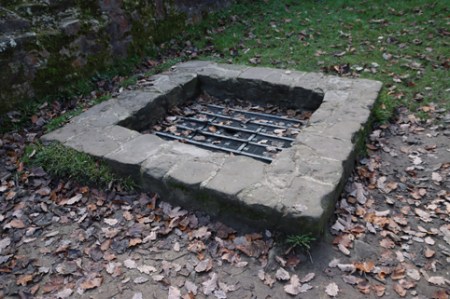
Today, to ensure the survival of the church as a living and breathing community asset, it is undergoing extensive but very sympathetic re-forming.  Suzanne Evans is the Project Manager of this massive task, and was our superb guide today. Suzanne described how the reinvented church will be fully inclusive, not only of the existing congregation who are much-attached to the church, but of the wider community as well, taking into account the needs of those currently unable to make the most of what St Collen’s has to offer. At the same time, the exciting opportunity will be taken to investigate as much of the church’s architectural and funerary history as possible, adding to the community’s understanding of this important contributor to the town’s impressive ecclesiastical heritage.

Suzanne guided us around both the key features and recent discoveries, explaining all the steps to be taken in the upcoming weeks and years. As well as replacement glass doors and the opening up of the nave to enable the interior to be visible by passers-by, there will be new lighting, heating, kitchen and toilet facilities, as well as a large stage, which will all contribute to enhancing the value of the space and improving the visibility of the superb architecture. All archaeological and architectural discoveries will be professionally recorded and published.
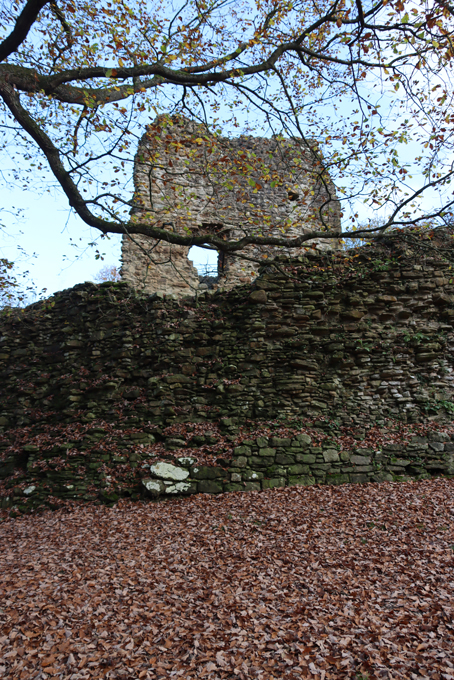
After a very welcome cup of tea, there was a round of applause as we thanked both Suzanne for being our terrific guide and Pauline for making all the arrangements. It was great to meet some of the other CAS members, and to hear all the questions and observations. There was a lot of information sharing, which is exactly what one expects of CAS members. What a great start to the year’s excursions! Many thanks again Suzanne and Pauline.

The 13th century exterior


Peterborough Cathedral (Overnight trip to Peterborough #1)

This is a slight departure for this blog, the usual premise of which is that every visit can be accomplished in a day, there and back, from where I live in Churton.  The visit to Peterborough required a stop overnight.  I have always wanted to see the Romanesque cathedral at Peterborough, which is a former Benedictine abbey.  I set out by car early on a Wednesday in November 2023 and stayed one night in Peterborough near the town centre, visiting the cathedral both on the Wednesday afternoon and again on the Thursday morning.  On my way home on Thursday afternoon I visited the lovely Normanton Church.  The routes taken and other visiting details are at the end.

Peterborough Cathedral is covered in part 1 (here) and a very brief snapshot of Normanton Church on its custom-made plinth on Rutland Water is in part 2. Needless to say, I have barely skimmed the surface of the cathedral’s history.

Introduction

South transept

Peterborough Cathedral is somewhere I have wanted to visit from the moment that I laid eyes on photos of it in a book. It has an almost split personality with its magnificent and unique 3-bay Gothic frontage, its sublime Norman-Romanesque interior, the stunning painted nave ceiling and the almost organic delicacy of the fan vaulting in the date eastern extension.

The abbey was terminated in Henry VIII’s dissolution of all the monasteries, but like Chester Cathedral was fortunate to escape some of the indignities of this process when it was converted to a cathedral. The building that visitors see today, dedicated to St Peter with St Paul and St Andrew, is the third abbey. The first abbey, Medeshamstede, was destroyed by Danish invaders.  The second abbey church, built over a century after the demolition of the first, burned down by accident although the cloisters survived.  The third abbey church was started from scratch, and is remarkable for the survival of the magnificent Romanesque vision.  All three abbeys were built on the same site, and there is some evidence for a Roman building beneath them.  The three phases are described very briefly below.   For detailed descriptions see one of the guide books available, or the cathedral website’s History page (details in Sources at the end).   If you go in person, I recommend the guided tour.

The 7th Century Abbey – Medeshamstede

Artist’s impression of Medhamstede, shown on an information poster in the cathedral

Bede’s 8th century Ecclesiastical History says that the first abbey on the site, Medehamstede, was established  in the 7th century, and it is now thought that it was founded in around 654, and was probably built of wood.  A later phase may have seen the rebuild of the wooden walls in stone, imported from a quarry to the west.  Very little is known about the building and its phases, although the artist’s impression to the right is a useful suggestion of what might have been on the site.  The first abbey was very isolated, deliberately divorced from human settlement to provide a suitable environment for contemplation and prayer.

The River Nene in Peterborough

Perched on the side of the River Nene and on the edge of the marshlands and mudflats of the Fens, it was an ideal location for peaceful contemplation and prayer.  For this and subsequent abbeys on the site the nearby marshy Fenlands provided one of the best resources for freshwater fish in England, offered a rich habitat for wildfowl and supported reed beds that provided the raw materials for thatching roofs.  The land also had the farming potential required for an expanding self-sufficient and isolationist community, providing summer pasture for livestock, and later on, when improved techniques of land drainage were mastered, the opportunity for agricultural development.  Communication links were provided by the River Nene and the nearby Roman road. 

The monastic community would have been organized along very austere lines adhering to the so-called Celtic tradition of monasticism.  The abbey became an important early religious centre, and founded a number of daughter houses in Leicestershire, Northamptonshire, Kent, Surrey, and Bermondsey (now in southeast London), which were important vanguards of the spread of Christianity.  I

The Hedda Stone

Housed today in the cathedral chancel / presbytery is the Hedda Stone shown above, a large and beautifully sculpted piece of limestone belonging to this period of the abbey’s history, showing Christ, Mary and the Apostles.  It is carved on both sides and pierced with holes that have no generally agreed purpose.  It is quite easy to miss, so do make a point of finding it, as it is delightful.

In 870 the abbey was plundered and destroyed during a Danish attack on the east coast, and the site, now abandoned, became part of the Danelaw territory.

The 10th Century Abbey – Gildenburgh

Plan of Saxon and Medieval Peterborough showing the outline of the second church. F is the site of the gate stormed by Hereward and the Danes. It is thought that E is the old marketplace, replaced by the new town in 1133-1155. The motte is thought today to have been built by Abbot Thorold. Source: Current Archaeology 89, 1983

In the 10th century, Æthelwold of Winchester had a vision of Christ in which he was instructed to rebuild the abbey of St Peter.  He was assisted in this challenge by Dunstan of Canterbury and by King Edgar and Queen Ælfthryth.  It was consecrated in the early 970s by Dunstan as a Benedictine monastery (i.e. one following the guidelines for monastic life developed in the 6th century by St Bendict of Nursia, Italy).  From fairly early on it was decided to provide it with a defensive wall, making it a fortified settlement or “burgh.”  The church was laid out along traditional lines with a nave, two transepts and a chancel at its east end.  It must have been provided with a belfry, because Æthelwold provided 10 bells for the church.  Although there were no sources of stone and wood close to the site, these were imported from Barnack and Rockingham Forest respectively. 

The prestige of the monastery rose when it acquired an important relic, the right arm of Oswald, a Saxon king and saint who was noted for his kindness to the poor and whose arm, with which he handed out so many alms, survived, perfectly preserved, after he was killed in battle.  The monastery’s position was again strengthened in 1041 when one of the monks, Æthelric, was chosen as Bishop of Durham.  The selection of the abbey as the final resting place for Ælfric Puttoc and subsequently Cynesige, both archbishops of York was an indication of how well regarded the abbey was in the 11th century.  Like many Benedictine monasteries, it became a major landowner, becoming wealthy and both economically and architecturally ambitious, accumulating books for a library, and fine objects for its ceremonies and liturgies.  It was so rich that it became known as the golden burgh, Gildenburgh.
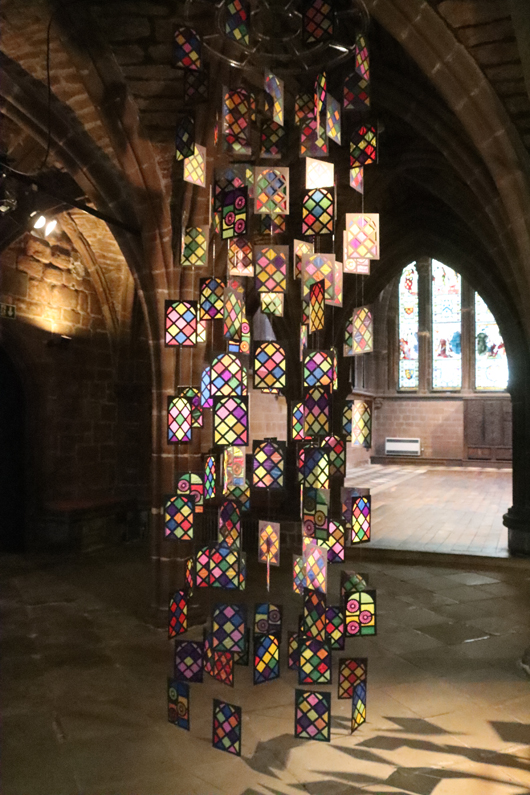
Reconstruction of the abbey precinct at the time of Hereward’s attack. Source: Peterborough Abbey

The second abbey was still standing proud when William the Conqueror landed in England.  Its abbot, Leofric, died in the Battle of Hastings.  Abbot Brand, who followed him, was also Saxon and supported opposition to the Norman invasion. This opposition was punished with heavy taxation, and when Brand died in 1069 the abbey was put into the hands of an abbot, Thorold, loyal to William. In the event, a local Saxon rebel, Hereward, had found an ally in King Swein of Denmark, and in 1070 the Saxons and the Danes marched on Peterborough and plundered it.  Although the arm of St Oswald was saved by the prior (second in command) the rest of the treasure vanished with the rebels.  The abbey itself was badly damaged, and what survived was occupied by the abbot and sixty knights and significant portions of land that had once formed the basis of the abbey’s wealth was now allocated to many of those knights, filling the formerly rebellious countryside with loyal Normans.

When Thorold died in 1098 he was replaced by two successive abbots who had very little impact, but the third abbot to be appointed, in 1107, was Ernulf who was prior of Canterbury, a scholar with a good understanding of political manoeuvring, who had plenty of ambition for his new posting.  He began by rebuilding the damage to the cloister buildings that had been largely destroyed by Hereward. In 1114 Ernulf moved on to Rochester and was replaced by Abbot John de Séez.

In early August 1116 when a fire broke out in the bakery and took most of what remained of the abbey church with it, although Ernulf’s new claustral buildings survived beyond the abbey church.  A new church was now not only desirable but necessary.

Today’s abbey, established in the 12th Century

The Romanesque architecture

Plan of Peterborough Cathedral. Click to expand.  NB – the “sanctuary” is referred to in most of  the Peterborough Abbey literature as “presbytery” so I have stuck with the latter throughout. Source: Sweeting 1899, Project Gutenberg

Abbot John de Séez oversaw the construction of a stunning new Romanesque building, complete with a vast vaulted presbytery.  The scale of his ambition saddled the abbey with such an enormous financial and logistical commitment that it took 120 years to complete.  Masons who had worked at Durham were brought in to ensure that the most up to date civil engineering techniques were employed, and what unfolded was a mixture of magnificent vision and superb skills.  The church was laid out on the usual cross-shape, with a long nave, side transepts (containing chapels) and a shorter east end.  The south wall of the church (the righ thand side of the plan) made up the north wall of the cloisters, the administrative and domestic buildings were located, arranged around a square garden called the garth.
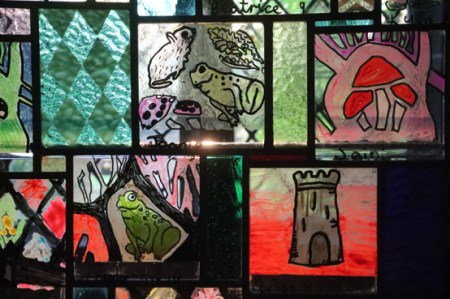
Entering the nave, the interior is light-filled and breathtaking. With windows on three levels, light pours in.   Cromwell’s soldiers destroyed the medieval stained glass, and the plain replacement glass allows in much more light than the stained glass would have permitted.  Of course it does help that the cathedral has installed artificial lighting, but even allowing for the changes, the layers of window and the soft, faintly reflective pallor of the Barnack limestone walls must have provided a degree of light that was remarkable in the Middle Ages.

View from just inside the west entrance to the end of the presbytery, with the pulpit in the foreground, and the modern rood (crucifix) hanging over the entrance to the Victorian choir

Because there is no surviving pulpitum (a stone division between nave and choir in monastic churches) or rood screen (again, between nave and choir), there is a very rare almost uninterrupted view from the west end entrance to the restored stained glass windows at the east end.  In spite of the 19th century marble edifice that sticks up in the middle of the presbytery, the impression of a vanishing point is dramatic and gives a real sense of the length of the building.  The walls soar upwards too, meeting a unique and fabulous painted ceiling.

On the death of Abbot John, the new Abbot Benedict, from Canterbury, persisted with the same vision.  This is interesting because at Canterbury new ideas from France, captured in the Gothic style, were being implemented, but for whatever long-lost reason, Benedict retained the Romanesque plan that Abbot John had initiated, including semi-circular apses at the east end, one of which survives within the rectangular “New Building” that surrounds it.  This apse is a rare survivor as most British churches had their apses removed for replacement by rectangular extensions such as Lady Chapels and similarly prestigious expansion projects.  Benedict extended the original design west by two bays, and if you stand at the west end and look at the arches of the aisles you can clearly see the difference.

Blind arcading in the north aisle beneath the great arches of the windows

The nave and the two transepts contain the bulk of the easily visible Romanesque architecture.  That within the east end presbytery is more difficult to view.  The long nave with its side aisles is monumental.  The massive arches of the aisles, with characteristic geometric decoration, are supported on vast octagonal piers.  They are topped with another set of arches, each of which contains twin arches separated by slender columns topped with square capitals.  The top level features rather smaller central arches, each flanked by even smaller blind arcades.  The transept ends are simpler, each with three levels of of arches, each of the same size, with unpainted roof panels in the same lozenge shapes as those in the nave.


The lost cloister and infirmary

Artist’s impression of the cloister on an information board in the remains of the abbey cloisters.

Today’s cathedral was once the abbey church, and is a wonderful survival, but it was only one part of the monastic establishment.  A cloister was always an integral part of the monastic establishment, with buildings along three sides of a courtyard or garden, with the church making up the fourth side.  This cloister was usually on the south side of the church, sheltering it from the worst weather and providing it with seasonal sun.  The central part of it was often a garden of some description, called the garth.  The buildings arranged along the three sides included the refectory, where the monks ate, the dormitory where they slept and the chapter house where they held daily meetings.  Some of these buildings could be very elaborate and ornate, particularly the chapter house.

If you leave through a door in the south side of the cathedral (on the right as you head from the entrance towards the end of the nave) or turn right in front of the cathedral and head down a narrow pathway, you will find yourself in what remains of the cloister.  There is some very fine stonework left behind, giving a hint at the magnificent buildings that once stood here, and many of the changes that the buildings clearly underwent.  The buildings were robbed for building materials following the Civil War.

Cloister wall, where it meets the abbey church

Beyond the cloister was the infirmary.  Many monastic establishments were furnished with an infirmary, mainly to take care of the elderly and unwell within the monastic community, but most of these are long gone, and again there is some attractive gothic arcading that indicates where the monastic ifirmary was located, to the east of the cloister.  It was built by Abbot John de Caux in around 1250.  It is worth mentioning, because it gives some idea of the scale of the monastic operation at Peterborough.

Relics

The 12th century Becket Casket (Height 29.5cm; Width 34.4cm; Depth 12.4cm). Source: V&A Museum

No important abbey was viable without relics of saints, which gave it great spiritual credibility, prestige and integrity.  Amongst the valuable relics collected were the arm of the Saxon saint Oswald of Northumbria. More prestigious by the 12th century were the bloodstained objects directly connected to the murder on 29th December 1170 of St Thomas Becket of Canterbury (the reliquary for which survives in the V&A museum).  A 12th century genuine British martyr, canonized in 1173, was a remarkable thing, and the snaffling of authenticated relics for Peterborough was a real coup.  Benedict did not witness the martyrdom, but he became an ardent collector and collator of Becket miracles. Becket had actually been to Peterborough, visiting with King Henry II in 1154.  A chapel was built to St Thomas at the abbey gate in 1174 to hold this and other relics, allowing pilgrims access to monastic relics without permitting them to disrupt the abbey church itself.

Painted walls and woodwork

Romanesque cathedrals in Europe often preserve painted decorative patterns on walls and ceilings, some emulating red mortar,  but only faint hints survive in Britain.  Fortunately, some very delicate paintwork in Peterborough survives.  As well as imitation mortar, and some lovely swirling curves, there is a truly charming section on the ceiling with tiny red flowers that may have been intended to evoke the Virgin Mary, who is often associated with red and white roses.

Within the apse, at the rear of the Presybytery, accessible from the New Building ambulatory,  there are coats of arms painted on the white walls.  Given that the eye is inevitably drawn first to the Hedda stone and the enormous marble high altar, it is easy not to notice the paintings.  I have been unable to find out anything about them either in the literature I have to hand or on the Peterborough Cathedral website, but they probably belonged to wealthy benefactors of the abbey or the later cathedral.

The chapels in the south transept were provided with wooden screens to provide access and entry, and provide privacy.  Remarkably, some of the decorative painting on these also survives.

The west front, the porch and the Lady Chapel

The Romanesque building did not escape the fashion for Gothic style embellishments.  Tracery in the window arches, for example, is Gothic, and the Romanesque interior was topped and tailed with a remarkable Early English west front and a stunning fan-vaulted rectangular ambulatory around the central semi-circular apse at the east end.

The unique 3-bay frontage was started in 1195 but progress was halted when King John, and England as a whole, were excommunicated from the Catholic church in 1209.  When the crisis was over, building resumed under Abbot Hugh, and it is thought that he made some changes the original design.  The result is three 29m high arches at the front, the central one narrower than the two flanking ones.  Inset into these are further arches.  Flanking the arche tops and and built into the triangular gables above were a total of 22 figures looking out from the front, although many have crumbled and have now replaced.  The three at the top of the gables are Saints Paul, Peter and Andrew.  The figure at the very top of the central gable is St Peter, overlooking the entrance, and marking the transition from the impure outdoor world to the heavenly space within.

Following the 13th century fashion for adding a Lady Chapel to a church, dedicated to the Virgin Mary, one was built at Peterborough 1272-1286 to the north of the presbytery, accessed from the north transept, and was still standing by the 17th century, when it was taken down during the Civil War. It was in the Gothic style and was probably elaborately decorated and furnished.

A later Gothic porch, dating to 1375, protrudes from the middle of the west front.  I was inclined to be more than a little judgmental about the porch, which looked like a very misguided vanity project, but I stand corrected.  It was found that the central arch of the west front was beginning to tip forward, and the engineering solution was to create a wedge to prop it up.  The structurally necessary wedge was designed as a Gothic style galilee porch with perpendicular windows, and although it breaks up the magnificent frontage, has done a great job of preventing its collapse.

The 15th century “New Building”

The so-called “New Building,” a sublime gothic vision, is in fact an eastward extension of the Romanesque cathedral.  The New Building was probably built between 1496 and 1508  by star architect John Wastell of Bury St Edmunds (later responsible for the fan vaulting at Westminster Abbe, under the abbey’s superior, Abbot Robert Kirkton.  This was no mere add-on, but a fabulously imagined and beautifully crafted piece of fan-vaulted delight.  The abbot who took the gamble of gluing on an extension to a perfectly conceived Romanesque delight lived up to the legacy of his predecessors.  The ceiling bosses, some of which are shown in the above photograph, were carved with both secular and religious themes showing coats of arms, symbols of the saints, and other familiar subjects.  The job of the extension was to enclose the central semi-circular apse within a rectangular extension, providing a low-level ambulatory around the inner sanctum, which rises above it, for ceremonial processions.  Ambulatories often contain additional chapels, but the cathedral’s architecture remains largely uninterrupted and therefore retains the impact of the fabulous fan-vaulting, which is one of the largest examples in England.

Ceiling boss showing the instruments of the passion

The New Building also, of course, delivered some fairly glossy feathers to the cap of the abbot who was so pleased with himself that he incorporated his name, a partial rebus, into the building itself.  Abbot Robert Kirkton was not a self-effacing man – his initials are also conspicuous in the elaborate Prior’s Gate that he built and which celebrated key royal figures in the form of their heraldry, and ornamented with Marian roses, managing to be both obsequious and self-congratulatory.

Prior’s Gate by Abbot Kirkham

The unique 13th century painted ceiling

Magnificent painted ceiling of the nave

Deserving a post in its own right, the wooden ceiling is a marvel.  Unique, it was started in around 1238 and was finsihed sometime in the 1240s.  It is made up of a series of lozenge-shaped panels, which one painted either with a small scene or with leaf and floral motifs.  The repeating pattern of the lozenges is dramatic from below.  Interpretation of the scenes has established that the individual subjects are arranged into a series of core themes, but there is much that it still unclear.  Obvioulsy religious scenes like the Creation, The Lamb of God, Saints Peter and Paul and the Anti-Christ are accompanied by historical clerics and kings, music, astronomy and the liberal arts. A scene showing a money riding backwards on a galloping goat whilst holding an owl is a representation of folly.  John Foyles  dedicates several pages to the ceiling in his book and there is a book about it by Jackie Hall and Susan Wright for those who want to delve deeper (see sources at the end).

Unpainted wooden ceilings over the apses are also arranged in lozenges, and are very fine in their own right.

Lozenge-shaped framed painting on the ceiling of the nave., showing St Paul holding a sword in his right hand and a book in his left (panel C7). The sword evokes the means of his martyrdom (beheading) and the book represents his epistles.

The Tudors before the Dissolution

The main contribution of the Tudors to the cathedral are the tombs of Katherine of Aragon, who died in 1536 and Mary Queen of Scots in 1587.

Katharine of Aragon had been married to the heir to the English throne, Arthur, elder brother of the future Henry VIII.  When Arthur died, Henry VIII married his widowed sister-in-law.  When the marriage failed to produce the necessary male heir, Henry decided to annul the marriage.  Unable to obtain papal permission to do so, he split from the papacy and established the Church of England.  Katherine was shuffled off to Kimbolton Castle, where Henry hoped that if she was out of sight of the public, she would also be out of mind.  When she died she provided, on Henry’s orders, with a tomb in Peterborough Abbey, the nearest important ecclesiastical building to Kimbolton.  Here she was identified as the widow of Henry’s  brother Arthur.  This was presumably Henry’s excuse for not granting her a place in Westminster Abbey.  Deposited under the floor up against the south side of the presbytery, where she would be close to God, she was provided with a monument above the grave.  This was destroyed in the Civil War, but the grave beneath remains in situ, marked by a stone slab and gold lettering. 

The Dissolution

The opening page of the Valor Ecclesiasticus (the survey of monastic establishments that paved the way to the Dissolution), showing Henry VIII. Source: Wikipedia

The New Building had only just been finished in the first years of the 1500s when Henry VIII fell out with the Catholic papacy.  Henry, having found a way to both dissolve a marriage that produced a daughter but no male heir to his throne, and simultaneously remove papal authority over both his personal affairs and the management of the church, also found that being the head of his own Church of England enabled him to raise substantial funds by laying claim to all the properties and goods of the monasteries, priories and friaries, by simply denying their ongoing right to exist.   The Dissolution caught up with Peterborough abbey in 1539, which had survived the first round of closures that took place in 1536.  The abbot at the time was John Chambers, and he was unusually fortunate.  He took no part in the protests in Lincoln or the Pilgrimage of Grace, and although initially pensioned off his meek resignation to the inevitable was rewarded.  Whether it was because of the creation of new dioceses at this time, or because Henry VIII’s first wife Katherine of Aragon was buried here in 1536, the abbey escaped demolition and was converted instead to a cathedral in 1541 with John Chambers as its first bishop.  Of all the 100s of abbeys, priories and friaries that were dissolved by Henry VIII, only a handful were converted to cathedrals, of which Chester Cathedral is another example.

Fifty years later Peterborough was again the royal choice of burial place for an embarrassing queen.  Executed in 1587, Mary Queen of Scots was buried on the opposite side of the presbytery from Queen Katharine.  She remained there for 25 years until her son, James I, removed her remains to Westminster Abbey

The Civil War

Peterborough, from Speed’s 1610 map, shortly before the Civil War. Source: Sweeting 1899, Project Gutenberg

During the English Civil War of 22 August 1642 – 3 September 1651, each side attempted to use the medieval castles to gain advantage.  The result was that many 13th century castles were slighted (demolished) to prevent re-use at the end of the Civil War.  Castles were fair game, but religious institutions were also targeted because they represented a different threat – the challenge to Puritan religious belief.  Henry VIII had rejected Catholic authority, but his Church of England was established for convenience, and the Church of England contained many lingering aspects of its Catholic ancestry.  Oliver Cromwell’s soldiers were given free reign to obliterate any of the artistic signs of lingering tendencies to papism to force through reform.  What they could reach they either maimed or destroyed.  What they could not reach they sometimes hit with musket fire.

One of three surviving misericords at Peterborough Cathedral

At Peterborough, as in so many places, the medieval stained glass was demolished.  Some of the stained glass windows at the east end today was formed of the fragments that people picked up and saved after the Puritans had left.  The painted ceiling over the east end apse was shot with muskets, but somehow the ceiling over the nave was missed.  The choir stalls, together with the misericords (the so-called mercy seats once in the choir stalls, all of which were carved with fascinating scenes on their undersides) were also destroyed at this time.  Only three of the misericords survive (at Chester there are 48 misericords, which gives some idea of the level of destruction at Peterborough).  The survivors are preserved in a chapel on the south side of the nave near the entrance, a sad reminder that something quite spectacular has been lost.  The high altar was also destroyed.  The cloister buildings were used as the raw materials for nearby Thorpe Hall.

The 17th and 18th centuries

This sub-heading would normally be an exercise in naming and shaming, but, amazingly, the abbey has not suffered the usual indignities of an important ecclesiastical building during this period.  There are no 17th and 18th century monuments jostling for position on the walls to undermine the sense of coherence and uniform splendour.  The soaring nave in Westminster Abbey, utterly spoiled by truly awful funerary memorials, is a good example of how badly a beautiful building can be dramatically undermined by later insensitivities. Although some of the monuments in Peterborough Cathedral were damaged during the Reformation, there seem to have been restrictions on the number permitted.

The biggest surviving monument is baroque, dedicated to wool merchant Thomas Deacon, former high sheriff of Northamptonshire and founder of a charity school for 20 boys.  He died in 1730.  His wife, who died 10 years later, is also commemorated on the monument.  I would much rather that it had not been built in the cathedral, at the entrance to the New Building, because it is such an alien presence, but it is a particularly fine example of its type.

The Victorians

Two of the most active restorers of the Victorian period were Sir George Gilbert Scott and John L. Pearson.  Unfortunately, although their ideas of restoration included the valuable rescue and repair of serious damage and decay, it also involved what they clearly thought of as improvements to the original vision of earlier architects and artists.  Enthusiasts of Chester Cathedral and Valle Crucis Abbey in Llangollen will probably have Gilbert Scott’s name ringing in their ears.

The crossing

In the late 1800s the tower was on the verge of collapse and it was Pearson who was responsible for dismantling and rebuilding it, a massive undertaking that saved the cathedral from irreparable harm.  His work altered the 14th century tower but was done to blend in with the existing architecture.  The twin sets of choir stalls, to the east of where the originals were located, the cathedra (bishop’s throne) and the pulpit are also Pearson’s work, and although clearly not medieval, are a skilled emulation of a medieval style quire.  Pearson’s, however, was the evil genius that created the temple-like marble high altar within the presbytery as well as the cosmati floor leading up to it.

Cosmati floor

Gilbert Scott was responsible for the painted ceiling over the apse, which he claimed at the time was based on the damaged example that he was replacing.  It is unmistakeably Victorian in its rendition and colouring.

Gilbert Scott’s ceiling in the apse

In this period the circular cast iron Gurney stoves were added, manufactured by The London Warming and Ventilating Company who bought the patent registered in 1856 by Goldsworth Gurney, surgeon turned engineer.  The stove looks like the filter in my wet-and-dry vacuum cleaner, with ribs standing out from a central cylinder, distributing heat in a full circle.  It was fired by anthracite, and the entire thing sat in a trough of water, helping to add humidity to the air.  Peterborough cathedral retains several of them, and they are in many other cathedrals too.  The Peterborough ones are powered by either as or oil, and they do a stunning job.

Modern additions

There has been some restoration work in the last few decades, but the emphasis has generally been on preservation rather than modernization. For example, many of the badly decaying figures on the west front were replaced by Alan Durst between 1949 and 1975.

A particularly noticeable modern addition is a hanging rood – a red crucifix with Christ in gold affixed to it, suspended from the ceiling at the east end of the nave, added in 1975. This hangs above the line that the rood screen would have taken across the nave.  Up against the south side of the presbytery some very fine gold lettering, was put in place to mark the burial place of Mary Queen of Scots, which works well.  In the New Building, someone has seen fit to place framed photographs on the walls between the fan-vaulting columns, which really doesn’t do the architecture any favours.  The entrance to the west end has automated glass doors, which add to the light, and there is of course the inevitable gift shop on your left as you enter.  Outside, Thomas Becket’s chapel is now a tea room.

Final Comments

The Romanesque is so comparatively rare in Britain, that this stunningly coherent and unfettered example is a particularly amazing treat.    When the decision was made to extend the east end in a contrasting style, the slender, delicate columns and fan-vaulting of the New Building provided contrasting but additional brilliance. Moving through the building from the Norman to gothic gives the sense of being in an ecclesiastical time machine, a transition from one perfect world to another.

There is so much more to be said about the abbey and its features, inside and out, so much that has been missed out here.  If you decide to visit, you won’t be disappointed.


Visiting

View from the choir to the east end

I am accustomed to driving to southeast London, so rather than looking at other options I took was my usual route, zipping down the A41, the M54, the M6 and the A14.  From the A14 the A605 goes straight to Peterborough and I was there, end to end with no delays, in just over three hours.  The A41 is always the joker in the pack because it is a long way from Chester to the M54, there are very few sections of dual carriageway and it can be difficult to overtake if you find yourself behind something slow.  The A5 to Shrewsbury and the M54 is sometimes quicker.

The cathedral opening times are on the website, where any special events and closures are shown.  Although I had done some top-level background reading I was lucky enough to arrive half an hour before a Highlights Tour was due to start, so I had a wander around on my own and then returned to the entrance for the tour.  I failed to get my guide’s name, which is particularly sad as I had her to myself, November being a quiet time of year, and we had a great chat.  She was splendidly knowledgable, encouraged my stream of questions and added multiple layers of detail and interpretation to my visit.

There was full-on white frost resembling snow over the days that I visited, and it was exceedingly cold, but thanks to the deployment of multiple Gurney stoves in the cathedral (fabulous heat-generating monsters like the ones in Chester Cathedral), I actually had to take off my top layer.  It is the first cathedral I’ve ever visited that actually felt cosy!

For those who are dealing with unwilling legs, Peterborough as a whole is on the flat.  The cathedral has very few steps to negotiate, automated doors provide access to the cathedral, a ramp is provided to get into the chancel from the New Building to visit the Hedda stone, and there are a great many places to sit down even beyond the nave.

I returned home via Normanton Church (see my short post with photos), for no better reason than it looked pretty and I do love a well-proportioned Georgian church, so my return journey was different, following the A606 to Melton Mowbray (I didn’t stop but it looks interesting), the A6006 and the A50 to Stoke on Trent and Nantwich, and the A534 home.  Thanks to a convoy of lorries on the A6006 it was slow going but it was a spectacularly beautiful day and the unfamiliar landscape showed to terrific advantage in the sunshine.  The A50 is dual carriageway, very unlovely but a smooth run.  The drive from Peterborough to Churton, via Normanton Church, took me just over four hours (not including the time wandering around at Normanton).

Sources

Books and papers

Pair of figures believed to be Roman, possibly late 2nd century. In the west wall of the south transept

Biddick, Kathleen. 1992. The Other Economy: Pastoral Husbandry on a Medieval Estate. University of California Press

Foyle, Jonathan. 2018. Peterborough Cathedral. A Glimpse of Heaven. Scala

Higham, Jack (Revd. Canon). 2001. Peterborough Cathedral. The Pitkin Guide.  Pitkin

Selkirk, Andrew and Selkirk, Wendy 1983. Peterborough. Current Archaeology, no.89, vol.VIII, October 1983, p.182-183

Sweeting, W.D. (Revd.) 1899 (second edition). The Cathedral Church of Peterborough. A Description of its fabric and a Brief History of the Episcopal See.  G. Bell and Sons Ltd.
https://www.gutenberg.org/files/13618/13618-h/13618-h.htm

Book about the nave’s painted ceiling (which I have not read, but is listed here for those who would like to find out more)
Jackie Hall and Susan Wright (eds.) 2015. Conservation & Discovery: Peterborough Cathedral Nave Ceiling and Related Structures. MOLA———

Websites

Peterborough Cathedral website
https://www.peterborough-cathedral.org.uk/
Visiting: https://www.peterborough-cathedral.org.uk/home/visiting.aspx
History: https://www.peterborough-cathedral.org.uk/history.aspx
The painted nave ceiling: https://peterborougharchaeology.org/peterborough-cathedral-nave-ceiling/
Abbot Benedict: https://peterboroughcathedral.wordpress.com/tag/abbot-benedict/
Katherine of Aragon: https://www.peterborough-cathedral.org.uk/home/katharine-of-aragon.aspx

National Character Area Profile: 46. The Fenlands
Natural England
https://publications.naturalengland.org.uk/file/5742315148673024

Books by Abbot Benedict of Peterborough available online
https://onlinebooks.library.upenn.edu/webbin/book/lookupname?key=Benedict%2C%20Abbot%20of%20Peterborough%2C%20%2D1193

Antarctic Heritage Trust
The Gurney Stove in Antarctica
https://nzaht.org/gurneystove/