Category Archives: Victorian Chester

Cheshire Lunatic Asylum: The development of lunatic asylums – Part 1.2

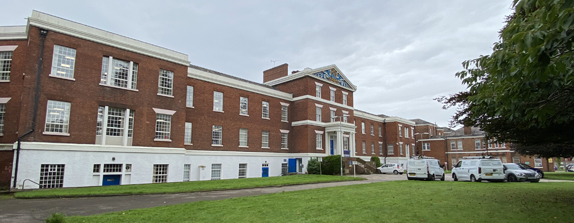
Cheshire Lunatic Asylum 2024

This is the second part of my post about the background to English lunatic asylums, prior to focusing on the Cheshire Lunatic Asylum in Chester.  To make the pages manageable, I have divided part 1, looking at the mental health background to the Cheshire Lunatic Asylum and other lunatic asylums into two.  Part 1.1 was posted here a few minutes agoPart 1.2 carries on below, following directly from part 1.1. A version of parts 1.1 and 1.2,without images, can be downloaded as a single PDF here  (27 pages of A4)   Sources and references for all posts can be found here.

Part 2 will focus on the Cheshire Lunatic Asylum at Upton in Chester and will be posted in the next month or so, when I’ve sorted out the images.

Timeline of reform after 1830

After the opening of a number of public asylums in the early 1800s, including the Cheshire Lunatic Asylum in Chester in 1829, several others began to be erected, including those in Dorset, Leicestershire, Shropshire and Montgomery and Devon, all by 1845, the year in which the County Asylums Act was passed.  Private asylums still outnumbered county and charity asylums, some small and catering for a handful of patients, whilst others like and Ticehurst in Sussex (opened 1792) the purpose-built Brislington House near Bristol (opened 1806) were fully comparable in size to county asylums.

The First Middlesex County Asylum, Hanwell. Source: London Historians’ Blog

The most important innovation in the early 19th century had been the “moral treatment” that had been introduced by Philippe Pinet in Paris and by William Tuke in York, was influential on other asylum owners and designers.  One of the most innovative of these was Methodist Dr William Ellis.  Having learned the practice of moral treatment at the Sculcoates Refuge in Hull, in 1817 he was employed as superintendent at West Riding Pauper Asylum at Wakefield, with his wife Mildred as matron, where he practised the same approaches. His successes led to his appointment at the new Hanwell Asylum in Middlesex in 1832, with his wife again employed as matron.  In each case patients were exposed to conditions that emulated family life and the manners of polite society, with treatment consisting of activities, entertainments and employment both indoors and out, using physical restraints only where strictly necessary. Social reformer Harriet Martineau, was impressed with how, when she visited, she saw a patient going to a garden to work with his tools in his hand, how a cheerful patient rolling in the grass with two other patients had been chained to her bed for seven years before arriving at Hanwell, and in shed in one of the gardens patients were cutting potatyes for seed “singing and amusing each other.”  Ellis resigned in 1838 in a disagreement with the overseers of the asylum over their decision to extend the asylum for a much greater patient intake, convinced that his methods could not be successful in a much larger institution, as well as their plans to change how the asylum was managed.

In 1832 the Royal Commission carried out a survey of how the Poor Law was generally implemented throughout all counties, and who benefitted.  The findings were published in 1834, and concluded that existing workhouses and almshouses were too sympathetic and generous, as well as too costly, to be sustainable. The report contained a long list of recommendations that set out to deter paupers from claiming relief by redefining the workhouse as a tool for reducing the costs of caring for the poor.  The survey formed the basis of the new 1834 poor law.

In terms of social reform the new Poor Law, which was introduced to replace the Elizabethan Poor Law of 1601, represented a backwards step.  The Act, adding to the 1723 General Workhouse Act and the 1774 Madhouse Act, lead to even more lunatics being absorbed into workhouses, where all inmates were treated far more punitively then before. According to the 1834 Poor Law Amendment Act (“the New Poor Law”) workhouses of a new type would be built to deter vagrancy and the dependency of able-bodied men, women and children on handouts, ensuring that only those who were suffering from desperate necessity would seek a workhouse place. The Act was introduced to reduce the cost of the poor by putting them to work in fixed indoor locations, removing beggars, vagrants and itinerant paupers from the streets, its main mechanism of which was the workhouse. However, although orphanages and infirmaries were also built, the workhouses were punitive places, built to discourage the idle from attending them.  They provided deliberately uncomfortable living conditions, splitting of husbands from wives and parents from their children.  To enable parishes to finance the new workhouses, the new poor law allowed for the creating of parish unions.  Over 350 new workhouses were built within five years of the Act to cope with those who were unable or unwilling to find work.

The 1834 Act also laid down that dangerous lunatics, insane people and imbeciles were not to be kept in workhouses and should be moved to new asylums that should be built without delay, as per the Act of 1828, to receive them.  In practice, however, partly because it cost less to house lunatics in workhouses than asylum, and partly because asylums were often overcrowded, an alarming number entered workhouses.  In some workhouses special wards within workhouses for the insane were added, and these were often used as repositories for the mentally ill, as well as imbeciles and idiots, the debilitated elderly (particularly those suffering from dementia) and the physically disabled.

The Chester Union Workhouse in 1861, recorded on workhouses.org, included 29 long-term inmates (continuous living for five years or over) of whom nine (31.03%) were deemed to be of “weak mind” and two (6.9%) were “subject to fits” (the latter relevant because epilepsy was considered to be a form of insanity until the late 19th century).  Interestingly, the incorporated union of Chester’s nine parishes was exempt from the 1834 act, and Chester did not accept a Chester new Poor Law Union until 1869.  There is clearly a lot more work to be done in Chester between the lunatic asylum and its workhouses.

The 1820 Lincoln Asylum. By Elliott Simpson, CC BY-SA 2.0. Source: Wikipedia

New reformist practitioners continued to make their mark in the treatment of lunatics, mainly in private asylums for the wealthy, but also in the county asylums. In 1820 the subscription-funded Lincoln Lunatic Asylum was opened, and in 1837, under Edward Parker Charlesworth and Robert Gardiner Hill, became notable for being the first English asylum to formally abolish the use of mechanical devices for restraint, with the results recorded in  the asylum’s annual reports. This approach was influenced by the death at the asylum in 1829 of patient William Scrivinger, who was strapped to his bed overnight in a straitjacket and was found dead from strangulation in the morning.   In 1838 Robert Gardiner Hill, who became house surgeon at the asylum, delivered a lecture to The Mechanics’s Institute, Lincoln, advocating the care of the mentally ill without recourse to restraints, which was subsequently published and circulated and became influential on other asylum superintendents who were interested in treating symptoms rather than merely detaining patients.

Tabulated records of restraint from the Lincoln Lunatic Asylum in 1830 (click to enlarge).  Wellcome Collection.

===
In 1839 John Conolly moved to Hanwell Asylum in Middlesex to take over from William Ellis as its third superintendent.  As superintendent he took Ellis’s policy of only using restraints when unavoidable even further, following Robert Gardiner Hell, and in his first report from the asylum claimed that the banning of restraints, replaced by “kindness and firmness” had produced a much better environment for patients. He believed that supervision by specially trained attendants and nurses, consistent regimes and pleasant surroundings were essential.  His treatment regime was reported by The Times on several occasions, an the asylum was visited by influential figures in society. Although many other alienists were sceptical about non-restraint, the positive publicity soon influenced other asylums who began to follow the lead originally set by Robert Gardiner Hill, but publicized by Conolly. Following his resignation from Hanwell in 1844, after a disagreement with the Metropolitan Commissioners in Lunacy, Conolly published his latest opinions on the subject of managing lunacy.  These included his 1847 The Construction and Government of Lunatic Asylums and Hospitals for the Insane and his 1856 The Treatment of the Insane without Mechanical Restraints.  His 1849 A remonstrance with the Lord Chief Baron touching the case Nottidge versus Ripley clearly stated his belief that eccentricity, excessive passion, signs of moral failure, gambling what should not be tolerated, and any person’s behaviour that was “inconsistent with the comfort of society and their own welfare” were sufficient to merit certification and committal to an asylum.  This position was one of intolerance to any behaviour that might contravene strict ideas of social conventions.

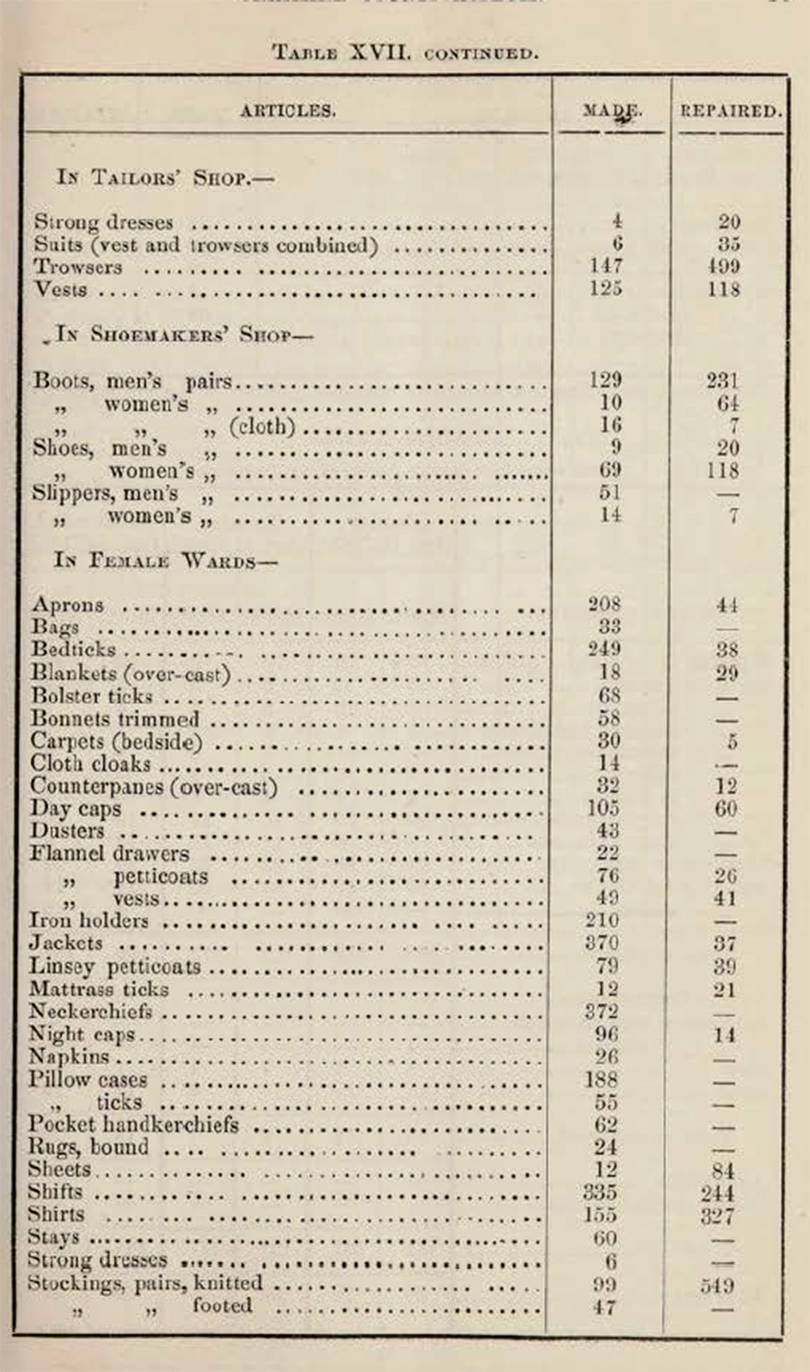
Male and female patient employment records at the Cheshire Lunatic Asylum for the year 1855 (click to enlarge) (Wellcome Collection).

The new forms of treatment that attempted to return people to society put great emphasis on the value of manual work, much like the influential 6th century Benedictine monastic ideal, so some asylums built and managed home farms in which patients worked, and indoors encouraged involvement in art, crafts, sewing of clothes and other items of use within the asylum, and help with the maintenance of the asylum buildings.  Airing courts provided leisure access to fresh air and vegetation, and sporting activities were arranged.  Indoor leisure activities included games, indoor sports, reading material, the ability to engage in art, music, dance and theatre, and there was in-house provision for access to religious guidance

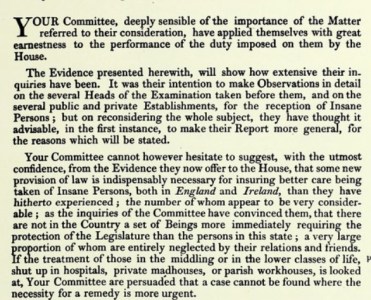
The 1842 Poor Law Commissioners Act introduced by social reformer Lord Ashley (later Lord Shaftesbury), extended the authority of London’s Metropolitan Commissions in Lunacy to the entire country and expanded its staff. Its remit was extended for a trial three-year period to all types of care institution in all parts of England and Wales where lunatics might be held, and this in turn led to the 1844 report of the Metropolitan Commission to the Lord Chancellor.  This report described poor conditions and treatment, and expressed concerns about illicit certification and the continued incarceration of those who had recovered.

Portrait of Harriet Martineu. Source: Wikipedia

An indication of how much work still needed to be done to care for the insane was an article published in 1834 by Harriet Martineau, one of Britain’s first sociologists, who asked whether lunatic asylums really needed to be as dreadful as they so often were, contrasting it with the pioneering attitude of Dr William Ellis and his wife Mildred at the new Hanwell Lunatic Asylum, which opened in 1831:

It is commonly agreed that the most deplorable spectacle which society presents, is that of a receptacle for the insane. In pauper asylums we see chains and strait-waistcoats, – three or four half-naked creatures thrust into a chamber filled with straw, to exasperate each other with their clamour and attempts at violence; or else gibbering in idleness, or moping in solitude. In private asylums, where the rich patients are supposed to be well taken care of in proportion to the quantity of money expended on their account, there is as much idleness, moping, raving, exasperating infliction, and destitution of sympathy, though the horror is attempted to be veiled by a more decent arrangement of externals. Must these things be? (my italics).

A two year investigation by the Metropolitan Lunacy Commissioners was followed by the 1844 Report to the Lord Chancellor which, like its predecessors, highlighted the abysmal conditions in many of the establishments that  that housed lunatics:  “Twenty-one counties in England and Wales had neither public nor private asylum. Profiteering was rife in the private sector; such public asylums as existed were often defective in terms of site, design or accommodation” [Mellett 1981]. The 1844 report seems to have had rather more significant impact than some of its predecessors, timed as it was with Lord Ashley’s continued and vigorous campaigning to provide for pauper lunatics.  The Socialist Health Association records that in 1844 there were around 20,600 lunatics in some form of institution or private care in England and Wales, of whom only 3800 were private patients.  Over 16,800 were classified as paupers.

Edward Wakefield’s 1815 statement about the value of recommending a change to the law to make new asylums compulsory. Source: Wellcome Collection

In 1845, following the 1844 report, Lord Ashley was able to push through the important Lunacy Act and the County Asylum Act.  Importantly, every county was given compulsory responsibility for the provision of a county asylum funded by rates, instead of making it optional as in the 1808 Wynn’s Law.  This was a measure that Edward Wakefield, reporting to the 1815 Select Committee had suggested be implemented, and it had taken 30 years for the recommendation to be acted upon.  The Act required the transfer of mentally ill people (defined as lunatics and idiots) from workhouses, where over 6000 were recorded in 1847, to these new or existing asylums.  It became a legal requirement that both a new Board of Commissioners for Lunacy and regional Justices throughout England and Wales should regularly visit places where lunatics were held, in prisons and workhouses as well as hospitals and both the old and new asylums, for both private and public institutions.  Locally appointed Committees of Visitors would oversee the ongoing operation of asylums, and an annual report would be submitted to the Lunacy Commissioners.  It was now also a legal requirement that asylums record admissions with basic demographic information about the patient, the reason for admission, details of the disorder, treatments and ultimate outcomes (i.e. discharge or death, including suicide).  These were to be inspected at least annually by the Commissioners and regional Justices.  In practice, the Act was not supported with funding or resources, and many of its measures proved difficult to implement and enforce, although it was responsible for the growing number of asylums throughout England and Wales.  Again, improvements to certification processes were made.  In 1847, reporting on their progress, the Commissioners noted how their workload had expanded, emphasising their role as a central resource for asylums:

Excerpt from the Table of Contents for the Further report of the Commissioners in Lunacy 1847

We have found it necessary to carry on an extensive correspondence with numerous parties, some demanding· the interposition of our authority, in reference to cases of supposed abuse; many requiring information, and many others neglecting or misinterpreting· the salutary provisions of the Acts of Parliament; and in the course of this correspondence, numerous questions (some of much nicety and difficulty) have been submitted to us;  we have also found it necessary to enter into long and difficult investigations.

The commissioners were undoubtedly patting themselves on the back in this piece of text, demonstrating the value of their new role, but the rest of the report suggests that since the passing of the 1845 Act they had been very busy assessing the network of public and private asylums for which they were now responsible, gathering extensive amounts of data to inform their decisions.

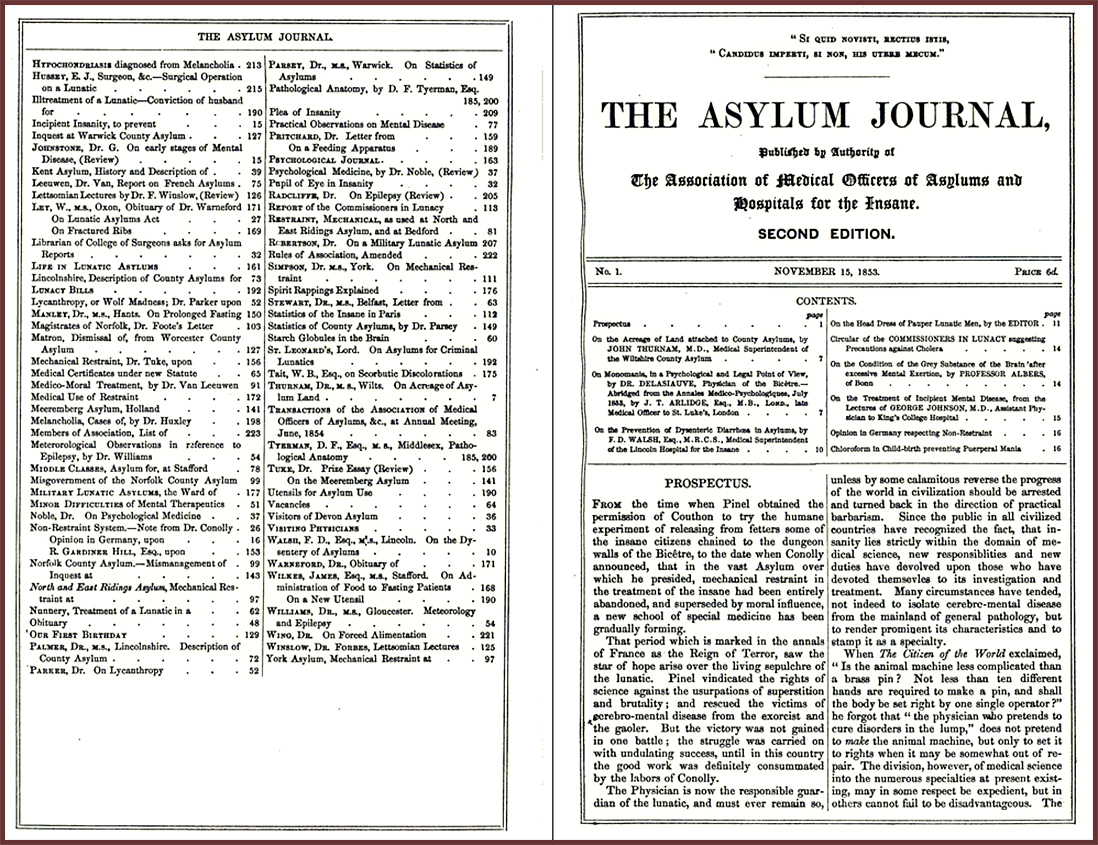
In 1853 John Bucknill (1817–1897) became the first editor of the Asylum Journal, which became the Journal of Mental Science.  Bucknill held the position until 1862.  The Journal eventually became the British Journal of Psychiatry and is still publishing today. This provided a forum for interested parties, mainly those connected with asylums, to put forward their ideas and instigate discussions.  Ideas about madness and lunatic asylums also filtered into the British Medical Journal.

Asylum Journal 1855. Source: Internet Archive

===
Another set of laws were introduced with the intention of improving matters throughout the second half of the 19th century.  The 1853 Lunacy Amendment Act outlawed hearsay evidence from the process of certification, meaning that doctors were no longer able to depend on the accounts of those who were asking for patients to be admitted to asylums.  The certification process required that doctors only included behaviour that they had themselves observed at first hand, another measure towards prevention of wrongful confinement.  The 1862 Lunacy Act enabled patients who had received care for mental illness in the past to enter asylums on a voluntary basis to receive treatment.  Special permission had to be sought from two lunacy commissioners, but this recognized that the treatment of mental health should not be exclusively enforced and custodial.  It also allowed for greater fluidity of transfer of patients between asylums and workhouses.  The Annual Report of the Lunacy Commission for the same year noted that physical restraints were no longer in common use and that isolation was preferred as a viable alternative.  In 1867 the Metropolitan Poor Bill was designed to recognize harmless “imbeciles”, those with learning difficulties in London workhouses and asylums, and to provide them with specialized establishments. In 1874 the rising costs of asylum management were recognized by the government who introduced a grant allocating 4 shillings per week per person sent to the asylum. This presumably also assisted with moving appropriate inmates from workhouses to asylums.

Unfortunately none of the above measures were successful in introducing genuine state-sponsored social responsibility and reform.  As late in the 19th century as 1873 the British Medical Association expressed its views on the existing state of asylums:

There are no public institutions which lie so open to attack as lunatic asylums.  They are necessary evils; they interfere with the liberty of the subject; they are costly in erection and maintenance; and they are, as a rule, managed with doors more closely shut than those of other hospitals.  There also hangs about them in the mind of the public an air of mystery, and the memory of bygone evils is by no means erase.  When all these factors of unpopularity are taken into account, it is not difficult to see why the complaints of those who have been subjected to their discipline are listened to with avidity. [BMA August 2nd 1873, p.120]

Sadly, as the century advanced and passed into the 20th century, the number of admissions into asylums increased and the earlier idealistic and more personalized approaches became impossible to implement.  The 29th Annual Local Government Report of 1900 stated that in 1860 50% of insane paupers were in county and borough asylums, and 25% of them in workhouses.  By 1900 there were 75% in asylums and just under 20% in workhouses.
xxx

Public anxiety about lunatic asylums in the mid-late 19th century

Louisa Lowe, incarcerated even though later judged to be completely sane. Source: a digitized copy of Blighted Life, in the Wellcome Collection

Whilst the role of lunatic asylums was widely discussed in Victorian medical journals and works produced by alienists, each promoting certain methodological and ideological approaches, there were also publications that spoke to the general public, representing concerns with the alienist profession and describing clear infringements of what we would now think of as the human rights of those who had been illicitly incarcerated.  Wrongful incarcerations fell into two main categories.  First, there were those individuals who had been incarcerated forcibly when sane, sometimes as the result of collusion between family members and medical professionals.  Secondly there were those who had been admitted to an asylum under a legitimate certificate, but continued to be detained long after they had recovered their senses.  Part of the problem lay in what did or did not qualify as sanity but, as discussed above, there were also cases of malicious incarceration and corrupt collusion for financial advantage.

There were two primary channels of information about such cases  to the general public.  Both national and local media took up the stories of those who had been illicitly confined in lunatic asylums, whilst some of the victims published their own accounts. Examples of the latter are John Perceval’s  A narrative of the treatment experienced by a gentleman during a state of mental derangement (1840), Rosina Bulwer-Lytton’s A Blighted Life (1880) and Louisa Lowe’s The Bastilles of England, Or The Lunacy Laws at Work (1883).  Some publications were anonymous, former mad-house inmates fearing derision or stigma.  One author, “A Sane Patient,” wrote My Experiences in a Lunatic Asylum (1879), and another was written by “A Clerical Ex-Lunatic:” The private asylum: how I got in an out: an autobiography (1889). As well as describing the circumstances under which they had been admitted and in which they lived, some also urged government change to existing laws.

News article excerpt about Lawrence Ruck in The Leader, no.440, August 28th 1858, p.862. Source: Nineteenth-Century Serials Edition

Although there were exceptions, the means by which the media became aware of such cases was largely via formal inquisitions. In 1858-1859 there were four cases that caused a media sensation and a public panic about illegitimate certification: Rosina Bulwer-Lytton, Mary Jane Hepworth, Reverend William Leach and Lawrence Ruck.  Inquisitions were legal mechanisms by which those held in private asylums could apply for permission to take their cases in front of a judge and jury to attempt to prove their sanity.  Witnesses could be called to give testimony for or against a patient’s sanity, both personal and professional. These were very expensive and the cost fell on the applicant, so was available only to the very wealthy.  Because these people often belonged to elite families or were associated with public figures, they could be of great public interest.   Inquisitions were held in public, in any venue large enough to accommodate them, in coffee houses, bars and taverns, and any member of the general public or media was free to attend.  Juries were men, often magistrates or others who were sufficiently educated to assess both medical and legal arguments.  In the cases of Bulwer-Lytton, Hepworth, Leach and Ruck, all four had been confined in asylums, but during inquisition had been judged sane.  Rosina Bulwer-Lytton had a particular gift for publicity and succeeded in winning many newspaper publications to her side to publicize her grievances.  The highly publicized scenario where a family member, colluding with an asylum owner and sent attendants to bundle a sane victim into a carriage to be locked up, their basic human rights denied them, caused real public anxiety.

Report of the Alleged Lunatics’ Friend Society 1851. Source for report: Wellcome Collection

The newspaper publications and first-hand accounts about individual cases were supplemented by the work of pressure groups. Three groups were formed to promote the causes of patients in asylums, more or less consecutively, all started by those who had direct experience of illegal detention in lunatic asylums: The Alleged Lunatics’ Friends Society (an informal grouping until 1845 when they became organized), the Lunacy Law Reform Association, and its splinter group The Lunacy Law Amendment Society.  At the same time, Georgina Weldon attracted many followers in her campaign against illegal incarceration and detainment in asylums, having gone into hiding when her estranged husband attempted to have her committed. Whist in hiding she was declared sane by two independent physicians. All these activists wrote letters to influential people, took out newspaper adverts, distributed pamphlets and spoke extensively in public in attempts to influence government action to reform lunacy laws.  Although they were rarely successful at pushing through legal reform, they were very good at generating publicity for their causes, drawing attention to the financial motivations of both those who might benefit from certifying a relative and the asylums admitting them, and the callous tyranny of some of the asylum owners and staff.  They also acted to take up individual cases where sane people remained locked up in asylums.

Inevitably, in spite of attempts to force through legal and social reform, changes in the law always lagged behind the need for reform.  For every energetic reformer there were many more places that continued to follow easier, less labour-intensive means of confinement, and although individual reformers and medical representatives attempted to improve asylum care, there were continuing problems of unnecessary and illegal incarceration and detainment, sometimes as a result of collusion between relatives and asylum owners, causing ongoing anxiety in contemporary society.
xxx

The criminally insane

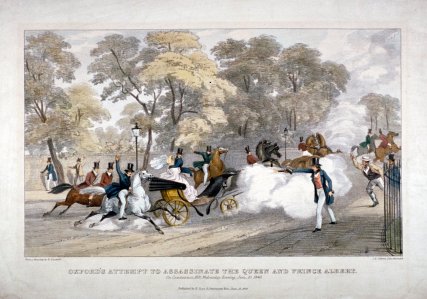
Lithograph by JR Jobbins in 1840 showing the assassination attempt by Edward Oxford on Queen Victoria. Source: Meisterdrucke

In 1800 when James Hadfield attempted to assassinate George III in the belief that the death of the king would initiate the Second Coming of the Messiah, he was charged with treason. However he was judged to be non compos mentis (not in his right mind) due to severe head injuries incurred during his service as a soldier.  This verdict of insanity was followed by the the Criminal Lunatics Act, which required that criminal lunatics should be detained in county jails, and lead to the addition of a new criminal wing be Bethlem to house the criminally insane.  A number of high profile cases followed, and in 1840 Edward Oxford fired a pistol at Queen Victoria and Prince Albert as they were travelling in an open carriage on Constitution Hill in London, and although he was tried for high treason, was found not guilty by reason of insanity.  He was sent to the criminal wing at Bethlem.

Daniel M’Naghten photographed by Henry Hering in around 1856. Source: Bethlehem Hospital Museum Archives via Wikipedia

A decisive case was that of Daniel M’Naghten who, in 1843, attempted to kill Prime Minister Robert Peel, but mistook Peel’s secretary for the Prime Minister, shooting and killing him.  M’Naghten suffered from paranoid delusions, thinking that the Tories were persecuting him and were planning to murder him. He was acquitted on the basis of insanity and confined to Bethlem asylum.  This lead to the M’Naghten Rule (or M’Naghten Test) which provided criteria for assessing whether or not someone was insane at the time that a serious crime was committed, to assess whether or not someone was criminal liable.  Only when the test has been completed in all its parts can a person be deemed to be criminally insane.

One of the best known 19th century inmates of both Bethlem was was the remarkable professional artist Richard Dadd R.A., who was incarcerated first in the ward for the criminally insane in Bethlem in 1843.  Dadd, after exhibiting signs of violent and delusional behaviour when travelling in the Middle East went to stay with his parents to recover but, believing that he was acting under the orders of the Egyptian God Osiris, murdered his father whom he was convinced was possessed by the Devil.

Richard Dadd, painting whilst incarcerated in an asylum in 1856. Source: Wikipedia

These cases paved the way for the establishment of the Broadmoor Criminal Lunatic Asylum, which opened in 1863 in Berkshire, and which remains in use today.  Oxford, M’Naghten and Dadd were all transferred to Broadmoor in 1864.  M’Naghten died in 1865 but Dadd continued to paint throughout there until his death in 1886 at the age of 68.  Edward Oxford, who showed no ongoing signs of insanity, was offered the opportunity to be relocated to Australia in 1867, and duly took up the offer, settling, marrying and living out his life in Melbourne, later publishing a book about the city.

Much of the intention of earlier laws in this respect was re-formalized in the Trial of Lunatics Act of 1883, in which any offence committed whilst a person was deemed to be insane, and therefore according to the law not responsible for his actions at the time when the act was committed, a special verdict of not guilty by reason of insanity should be returned. This law was updated several times, most recently in 1991.

Day room for male patients at the Asylum for Criminal Lunatics, Broadmoor, Sandhurst, Berkshire. Source: Wellcome Collection

A broken system

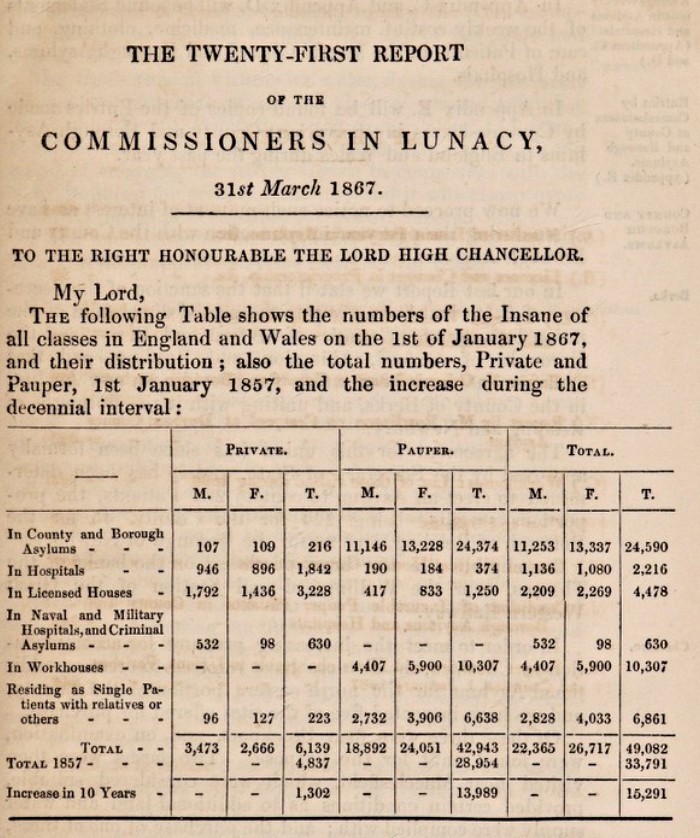
Excerpt for a page from the 21st Report of the Commissioners in Lunacy for 1866, published in 1867. Source: Wellcome Collection

In the later half of the 19th century, it was becoming clear that the optimism of both medical and legal professions the 1840s was dwindling fast, and that the asylum system was failing to keep up with demand.  The 21st Report of the Commissioners in Lunacy in 1867 indicated that 90% of patients in public asylums were considered to be incurable.  Writing only three years later in 1870, Dr Andrew Wynter, former editor of the British Medical Journal, commented that “Our whole scheme for the cure of lunatics has utterly broken down.”  Although it was convenient to hold large numbers in facilities where they could be dealt with in a consistent and organized way, the numbers of those who entered far exceeded the numbers of those who left.  Overcrowding was a serious problem for most public.  The emphasis inevitably shifted from treatment and cure to containment, order and bureaucracy.  This succeeded in dividing lunatics from society, but did not address the root cause of the the problem – the analysis and cure of mental illness.  Those who might have been treated and restored to their families were lost in the sheer volume of inmates who required maintenance and management.  Wynter referred to this as “brick and mortar humanity.”

Plan for Caterham and Leavesden 1868, both serving the London area. Both were opened by the Metropolitan Asylums Board in 1870, and within five years demand far exceeded capacity, requiring new building works to accommodate the influx of new patients . Source: Wellcome Collection

There were only two practical solutions to overcrowding in asylums.  The first was to return non-violent patients to their families or to send them to workhouses.  The second was to expand existing asylum buildings and facilities and to build new asylums.  Although workhouses continued to take in lunatics and idiots, expansion and new building were the most frequently adopted solutions.  It is to this period that the first of the vast dedicated developments were built, with their own water and gas works, their own fire brigades, cemeteries and other urban-type facilities.  These were located in rural locations, where asylums could be conveniently separated from the rest of society, and where land was relatively cheap. The earliest examples of these vast enterprises were built to serve London and its environs, and include Colney Hatch in Middlesex (opened in 1849 for 1000 patients), Leavesden and Caterham (both opened in 1870 for 2000 patients each), Caterham, and Claybury County Asylum (opened in 1894, also for 2000 patients).

Claybury County Asylum, now converted into apartments. Source: Wikipedia

It was not until nine years later that the 1886 Idiots Act created specialist asylums for individuals with learning difficulties beyond the London area.  Important distinctions were made between lunatics on the one hand and harmless idiots and imbeciles (those with learning difficulties) on the other.  The intention was to take the opportunity to care for them and provide basic education and training so that idiots were treated neither as lunatics that needed to be confined nor as indigent vagrants.  Following this, the 1890 Lunacy Act the certification of alleged lunatics was moved to the jurisdiction magistrates as well as doctors.  It also made the provision of free mental healthcare available, but as the majority of the population could only access free psychiatric care if they were certified insane and agreed to be admitted to an asylum, the stigma of certification and the requirement for confinement were significant deterrents to people volunteering to receive the help they needed.  More than any previous law, the 1890 Act helped to prevent medical collusion to incarcerate patients wrongfully.  Whereas only medical certification had been required before, a civic official such as a magistrate or Justice of the Peace was now required to certify madness.  The Act also took measures to prevent the licensing of new asylums, aiming to inhibit the further licensing of private asylums, which it was hoped would lead to the eventual demise of the private asylum.

An inspection of the formerly progressive Hanwell in 1893 described depressing conditions, concluding that it would be surprising if any of the patients were to recover given the type of care they were receiving in fairly dismal surroundings.  Even more regrettably, the untested idea that mental illness could be passed from one generation to the next fed into the horrible theory of eugenics.   New surveys continued to be carried out, reports continued to be submitted and new laws continued to be introduced, modified and implemented, but it is a sad fact that neither medicine nor the government, via changes to the law, managed to provide convincing support for a growing section of society that was still not well-understood.
===

After the Victorian period

Graphic to accompany the one-man play Shell Shock, performed at the National Army Museum to mark Mental Health Awareness Week in 2019. Source: National Army Museum

I have not ventured into post-Victorian approaches to mental health in this post, but it was very far from a story of continual improvement of care and cure.  There was still a very long way to go to even begin an understanding mental illness, and to standardize, in a scientific way, the treatment mental illness in psychiatric units. Sigmund Freud’s end-of-century theories of psychology were squabbled over for decades.  The First World War’s executions for “shell shock” as a judgement of cowardice remain deeply shaming.  In the inter-war years psychiatrists began to take a more experimental and interventionist approach to treating mental illness. Several new so-called “heroic” physical therapies were introduced, based on the belief that mental illness had a physical basis in the nervous system or the brain. These included insulin coma, chemical shock, electro-convulsive shock therapies and, most radically interventionist, lobotomization.  Egas Maniz’s experiments with prefrontal lobotomy remain profoundly disturbing.

The abandoned Denbigh Lunatic Asylum. Photograph by Steve R. Bishop. Source: Everywhere from Where You are Not

It will come as no surprise to those who follow the news that there are still serious problems, not merely in official provision of mental health care, but in care homes for the elderly, including those recuperating and convalescing, and those who had been persuaded to hand over power of attorney.  There were dreadful examples of people being released from long-term incarceration in the 1950s and 60s who had been admitted for minor criminality and socially disruptive behaviour, and although they had become institutionalized were found to be completely sane.  The use of vast repositories for the mentally unwell was abandoned without, however, a clear strategy for handling those who still needed help.  This was followed by a policy of caring for the mentally unwell within the community, pushed through during the 1980s, which often failed to provide families and local care centres with sufficient resources to make this fully viable, placing great strain on families and support mechanisms.  The tyranny of some institutions was revealed in a number of scandals and was a theme explored in relatively modern times in the 1975  film One Flew Over the Cuckoo’s Nest.  Documentaries in care homes in recent times demonstrate how this problem still persists in some places.

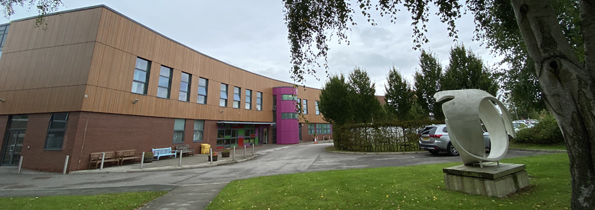
Ancona House. Child and Adolescent Mental Health Services unit at the Countess of Chester Hospital, Chester

Today the madhouse or lunatic asylum has become a psychiatric hospital or a psychiatric unit in a general hospital for those with manageable symptoms, or a specialist secure facility for the violent and criminally insane.  In the Victorian period medical understanding and psychiatric ideas were only beginning to be proposed and tested, and this continued well into the Edwardian period and beyond, with medicine and the law both playing  important parts in how mental illness and suicide were understood, diagnosed and treated.  The research remains ongoing.  There is still no viable solution, or set of solutions, to the problem of coping with mental illnesses. The subject of how to care for those suffering from mental illness is far from resolved.
===

Final Comments on parts 1.1 and part 1.2

William Tuke’s “The Retreat” in around 1796. Source: Wikipedia

In spite of being divided into two parts to make it easier to digest, this quick and dirty summary of the state of mental healthcare in the 18th and 19th centuries inevitably smooths out some of the kinks in that often convoluted story, over-simplifying some of the many subtleties.  This account represents a very short summary of a very complex topic.

From the late 18th century mental illness represented a growing issue for a society that was developing a broad social conscience. In spite of many reforms to poor laws and a number of new Acts of Parliament to govern asylums, governments were slow to respond to either public pressure or their own specially commissioned reports, and stories of unlawful detainment in some places and frightful conditions in others failed to produce change that was both meaningful and timely.  The role of workhouses in the handling of the mentally ill continued to be important, with patients shared between workhouses, workhouse infirmaries and asylums, in spite of legislation designed to make the responsibilities of each much more transparent, which is an area that needs to be much better understood.  It was only towards the end of the 19th century that those with learning difficulties, termed imbeciles and idiots, were seriously treated in the law as a separate problem requiring different types of care.  The topic of children in lunatic asylums is not much discussed, but records show that at least some were admitted, as they were to workhouses.

John Conolly, looking rather self-satisfied. Source: Wikipedia

Sometimes those who were supposed to represent the pinnacle of care and reform are described with a rose-tinted filter.  For example, Edward Long Fox and his sons, running one of the most expensive private asylums in the country, were accused in the writings of patient John Perceval, son of the murdered prime minister Spencer Perceval, of incarcerating their more troublesome patients in truly dreadful conditions where they were subjected to beatings, threats, manacles, strait-vests, freezing water baths and other punishments and indignities.  The alienist John Conolly, a national figurehead of ethical and human approaches, was found guilty in court of taking money for signing legally binding certificates that retained patients in private asylums to which he was employed as a paid consultant.  One of these patients was found, by jury to be sane and the investigation highlighted the risk of consultants being paid by asylums for certifying patients.  He also often took credit in public for introducing non-restraint in England, in fact an innovation of Robert Gardiner Hill at Lincoln, and at Hanwell asylum had a very low cure rate.  Another example is Lord Ashley, later Lord Shaftesbury, generally and fairly acknowledged as an important voice for mental healthcare reform but sometimes remarkably intransigent. He often blocked or delayed changes that would have made important differences that would have lead to improved quality of life and greater transparency and justice in the asylum system.  This was a particular problem given that Ashley had been elected the lifetime head of the Commission for Lunacy, a position that he did indeed hold until his death in 1885.

By the end of the century the dream of personalized care of the mentally ill by engaging them in social activities within attractive contexts was largely abandoned.  The “moral treatment” approach had depended not only on sufficient numbers of attendants to manage patients with kindness and empathy, but those who had a genuine interest in caring and treating.  The 1870 Annual Report of the Lunacy Commission recorded that 122 attendants had been dismissed in 1869 for manhandling patients roughly or violently, and it is not at all surprising that as new patients were admitted in increasing numbers, the sheer volume proved difficult to manage:

The number of people certified as ‘insane’ soared.  The asylum created demand for its own services.  Less and less people ever left, and more and more arrived.  In 1806 the average asylum housed 115 patients.  By 1900 the average was over 1,000.  Earlier optimism that people could be cured disappeared.  The asylum became simply a place of confinement. [Disability in Time and Place, Historic England, Simon Jarrett]

Leavesden Hospital in Abbots Langley, Herts., opened 1870. Source: Leavesden Hospital

Governments as well a local organizations began to invest in creating larger institutional solutions for paupers whose symptoms indicated the sort of social deviance and/or danger to self that could not be countenanced without intervention.  However. the recognition of mental illness and the acceptance that it should be handled by the state caused its own problems as more people were incarcerated and management of mental illness became, like contemporary prisons, more of an issue of how to maintain order than how to provide cures.  Unlike most prison sentences, there was no release date for mental patients, who could be held indefinitely and sometimes were.  An indication of how urban areas in Britain were overwhelmed by demand was the new Metropolitan District Asylum built between 1868 and 1870 as Leavesden Hospital in Hertfordshire, which was designed to house 1500 patients, after which it continued to expand to cope with the ever growing need to provide care for the mentally ill.  Like other asylums of this period, it is more like a small town than a hospital.  Sadly, many asylums once again became associated with confinement and bureaucracy rather than attempts at cure and rehabilitation.

The perception of mentally ill people changed over the course of the Victorian and Edwardian periods as psychiatry developed as a specialist branch of medicine, swinging between biological, congenital and neurological explanations on the one hand and emotional-psychological explanations on the other. The degree of subjectivity lead inevitably to disagreement and contradictory opinions, with very little indication of how to choose between the variety of different ideas held in different asylums.  The legacy of 19th century mental health medicine, law and care seems to be one of a continued struggle to fully comprehend the complexities of mental illness or to devise suitable ways of treating them sustainably.  As Mike Jay says in his book This Way Madness Lies, “While the asylum as an institution is now largely consigned to the past, many of the questions it struggled so hard to address still persist.”===

Click here for the references for this post


Full 1-hour documentary about the situation within mental asylums at the time of the closure of many of them

Out of Sight, Out of Mind – The Leavesden Asylum Story
Leavesden Hospital History Association


Cheshire Lunatic Asylum: The development of lunatic asylums – Part 1.1

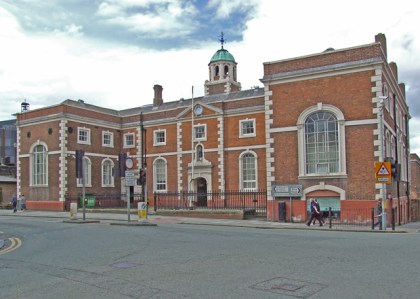
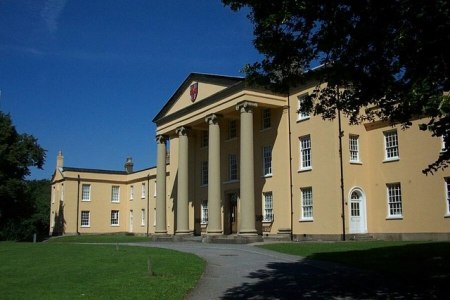
The 1829 Building, built as Cheshire’s first lunatic asylum


Beginning with nine voluntary institutions, the asylum movement rolled across the 19th century English landscape like an avalanche gathering pace. The ‘mentally unsound’ were moved in ever greater numbers from their communities to these institutions.  From 1808, parliament authorised publicly funded asylums for ‘pauper lunatics’, and 20 were built. From 1845 it became compulsory for counties to build asylums, and a Lunacy Commission was set up to monitor them. By the end of the century there were as many as 120 new asylums in England and Wales, housing more than 100,000 people.

Historic England:  The Growth of the Asylum – a Parallel World

==


Introduction

As part of my ongoing series looking at Overleigh Cemetery, I asked Christine Kemp of the Friends of Overleigh Cemetery about the suicides she knew of in Overleigh Old and New Cemeteries.  In the 19th century suicide was more often than not deemed to be the result of temporary insanity.  Looking into how suicide was handled in the 19th century lead me to the discovery, probably very familiar to most Chester residents, that there had been a “lunatic asylum” where the enormous site of the Countess of Chester Hospital is now located at Upton.

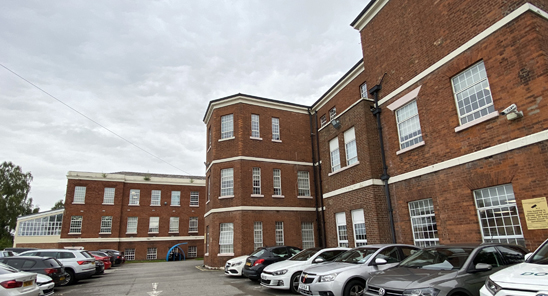
The rear of the 1829 Building today

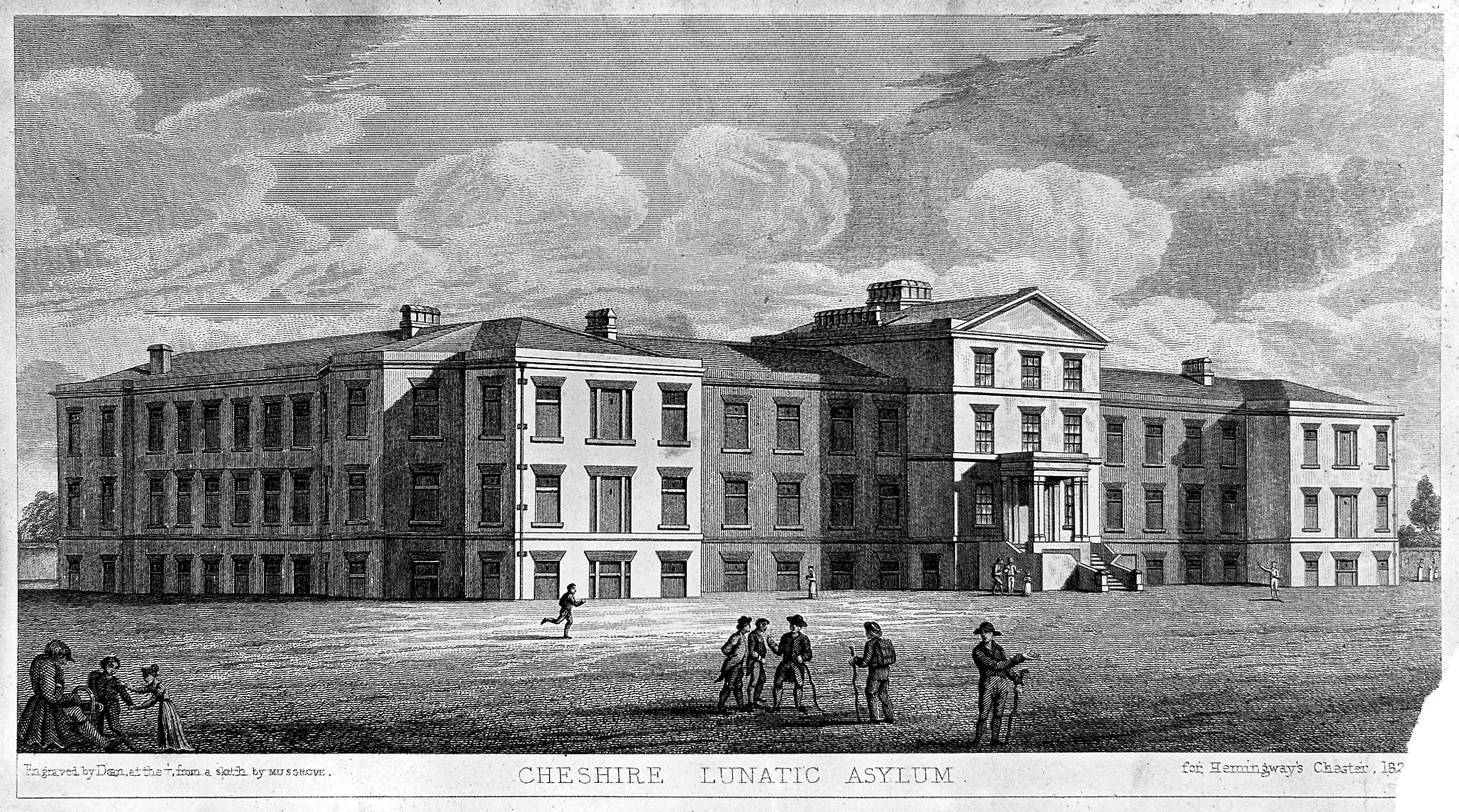
The Cheshire Lunatic Asylum was a public institution established to house pauper lunatics as well as a limited number of paying private patients in 1829.  The asylum opened on a 10 acre site in 1829 to accommodate 45 women and 45 men, reflecting the fairly even numbers of both at asylums in the 19th century.  It grew throughout the 19th century and eventually occupied a significant area of over more than 55 acres.

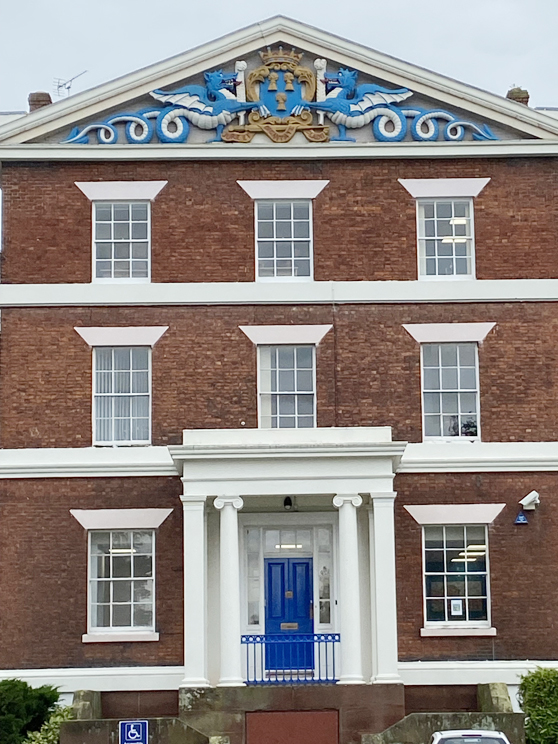
The exterior of the earliest building remains in situ, and has the appearance of an elegant and stately Georgian-style building with a small Classical portico, looking very much more like a the remnant of a country estate than the intimidating prison-type establishment that I had been expecting.  An elegant façade was typical of 19th century asylums.  Today the asylum building is still an active part of the Countess of Chester Hospital, officially named “The 1829 Building” (Grade 2 listed), housing a number of departments including Adult Mental Health, Physical Health and Brain Injury Services, as well as the GP Blood Test DepartmentWhen I was sent to the Blood Test department last year it was some consolation that I was being jabbed in the arm in a place of significant history.

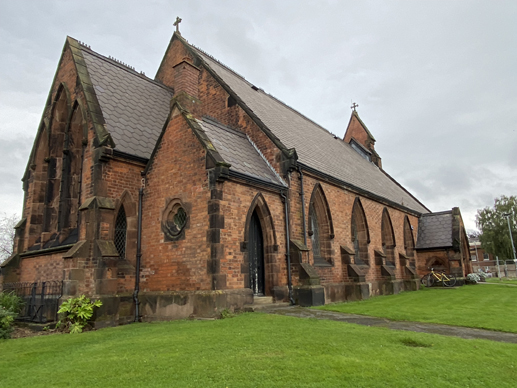
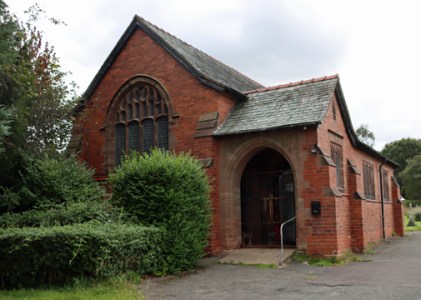
The chapel (Grade 2 listed) was built in 1856 to serve the lunatic asylum, and still on the site although used for a different purpose

Most of the other buildings associated with the asylum have now been demolished, but nearby are the asylum’s 1856 chapel (Grade 2 listed) and the fenced-off and boarded-up remains of what I believe was “the villa,” the 1912 building for treating epilepsy (which had been treated as a mental illness up until the early 20th century). The recently restored water tower also remains.

Although it would have been great to jump into the story of the Chester Lunatic Asylum without delay, the background information was absolutely necessary to make any sense of that story.  In part 1, I have tried to do provide a sufficiently detailed background to give a sense of how the Chester Lunatic Asylum fits into the full history of mental health care in the 19th century.  In part 1 (split into part 1.1 and part 1.2 to make it easier to manage, but both posted on the same day) I look at the background history of what were known as lunatic asylums in the 18th and 19th centuries, with some additional brief comments on how this overlapped with workhouses.  Sources and references for all parts can be found hereA version of parts 1.1 and 1.2,without images, can be downloaded as a single PDF here (27 pages of A4)

In part 2 (also split into two parts) I discuss the Chester asylum itself, built in 1829, the name of which changed many times over the period of its use as an establishment for treating mental illness. Part 2 has been written and will be posted as soon as I have added in the images, probably next week.

Many thanks to historian Mike Royden for sharing his knowledge about the Tudor and Victorian Poor Laws and workhouses.  You can find out more about Mike’s research on his History Pages website.
===

18th and 19th century terminology and its limitations

From at least the 17th century the terms “madhouse” and “lunatic asylum” were terms employed to indicate a place that confined the mentally ill.  These institutions were differentiated from hospitals that dealt with more conventional medical problems where attempts were made to treat rather than confine patients.  The term “asylum” was originally used to refer to places of refuge, retreat and sanctuary, but up until the late-18th century the lunatic asylums were generally custodial in character, often keeping inmates in very poor conditions, and were usually referred to as mad-houses. By the 19th century an asylum was generally an establishment that made claims to treat as well as confine inmates.

Terms such as “mad” and “lunatic,” as well as “idiot” and “imbecile” are now considered to be pejorative, as well as imprecise, and are no longer used in medical, psychiatric, sociological, legal or political contexts today.  In the Victorian and Edwardian periods, however, these were the standard terms used for those who suffered from some form of mental illness that incapacitated them emotionally or cognitively, temporarily or permanently, along a continuum from violent or otherwise harmful behaviour to mere learning difficulties.  The term “insanity” was also in common usage, but has not been entirely excluded from modern usage.  All terms are used throughout this post, reflecting the usage of the 18th and 19th centuries.

Insanity in the 18th and 19th centuries could include a vast array of conditions including delusions, paranoia, self-harm, hysteria, mood-swings, visions, speaking in tongues, irrational violence against others, senility, alcoholism, epileptic fits, dementia, mania, depression and suicidal behaviour. Even eccentricity, such as spiritualism or unconventional social behaviour, was sometimes interpreted as incipient lunacy and could lead to illicit confinement.

The earliest owners and overseers of mad-houses were known as “mad-doctors,” a term from which 19th century asylum owners attempted to distance themselves.  The later specialists in mental illness who claimed (and in some cases did) focus on treatment and cure, who were the predecessors of today’s psychologists and psychiatrists, were known as “alienists.”   The term derives from the idea of mental alienation.

When the only practical solution to lunacy was incarceration, it should have been a priority to establish a set of universal definitions for the unmanageable symptoms of lunacy, but without a centralized approach to this problem, none were forthcoming.  This lack of agreement about what did and did not constitute madness is exemplified by the case of Mrs Catherine Cumming who was abducted from her home and taken to York House Asylum near Battersea in London.  After a period of incarceration and a long legal battle, she was declared sane by a jury, and released.  When Thomas Wilmot, who had signed her lunacy certificate, was asked what he thought lunacy was, he replied that he had never seen a reasonable definition. One of the most notable features of the Cumming case was the number of medical experts called as witnesses, nineteen of them, including such notable names as John Conolly, Sir Alexander Morison and Dr Edward Monro.  As Sarah Wise summarized:

After the Cumming case, it was once again noted by most commentators how unsatisfactory it was that nineteen eminent medical men could give widely differing opinions of what constituted soundness of mind, tailoring their learning according to what ‘side’ in the dispute had hired them. One alienist had claimed that Mrs Cumming was a monomaniac, another that she was an imbecile, and yet another that she was perfectly sane. . . How safe was anyone when the experts had such divergent views of insanity? [Inconvenient People, p.177]

Individual conditions now required names so that patients could be labelled, statistics logged and cases discussed.  For example, research by Hill and Laughurne, based on 1870s records from St Lawrence’s Asylum in Bodmin (Cornwall), identified the most common conditions suffered by those admitted at the asylum.  Although the main reasons for admission were recorded as mania, dementia, melancholia, moral insanity and the combination of manic behaviour and dementia, it is not at all clear what these terms represent.  Hill and Laughurn tentatively apply the following attempts to suggest modern equivalents:  mania probably representing overactive episodes; dementia, which appeared to  include loss of cognition, memory loss, intellectual deficit, schizophrenia and losses of concentration; melancholia, which seems to have mainly indicated underactive episodes relating to depression; moral insanity (unspecified) and the combination of manic behaviour and dementia, which possibly describes bipolar disorder.

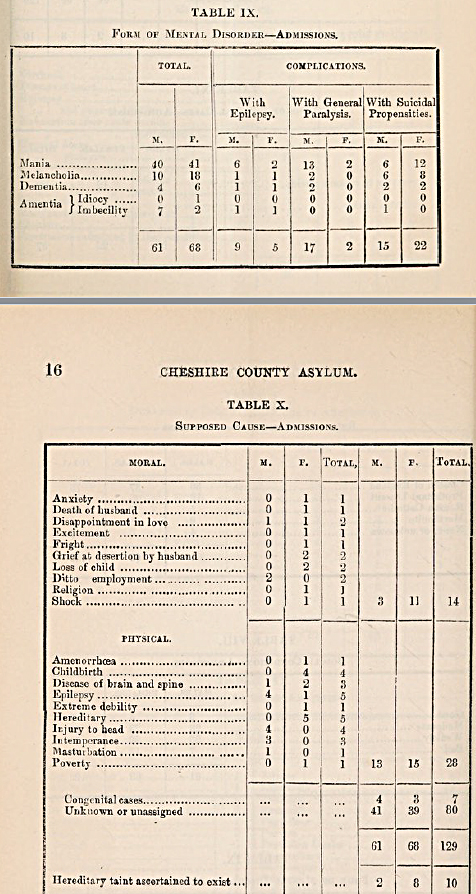
Similarly, a table from the 1855 report for the Cheshire Lunatic Asylum, for both males (M) and females (F), shown below, records that the overarching symptoms in that year were mania, melancholia, dementia and amentia (defined as idiocy and imbecility), and these were further sub-categorized by the presence of epilepsy, general paralysis (also known as general paresis), and suicidal propensity.

The “Committee of Visitors and Superintendent of the Cheshire Lunatic Asylum Report” of 1855, showing Reasons for Admission. Wellcome Collection

Unfortunately, the terms for mental illnesses are not used consistently from one institution to another, meaning that mapping them on to modern conditions can be very difficult.  The term dementia, for example, covered a variety of symptoms relating to mental illness at St Lawrence’s and Chester, but has become rather more precisely defined today.  Epilepsy was subsumed into the general category of mental illness until the later 19th and early 20th century when special epilepsy treatment centres were introduced, intended to be more domestic and less institutional.  Suicidal behaviour, with the multiplicity of potential causes and symptoms, even now sits in a somewhat liminal area between mental illness and the ability to make coherent decisions, blurring boundaries.

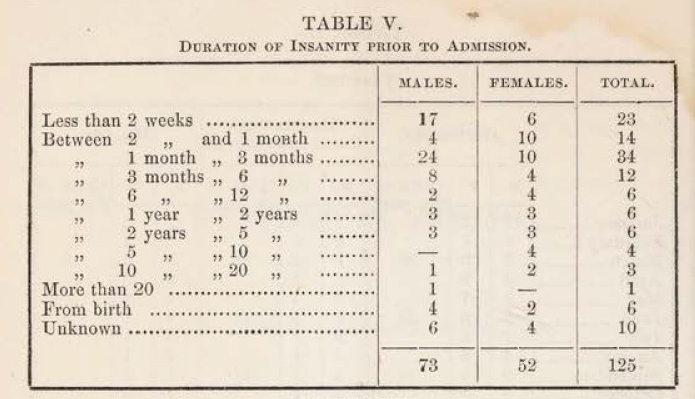
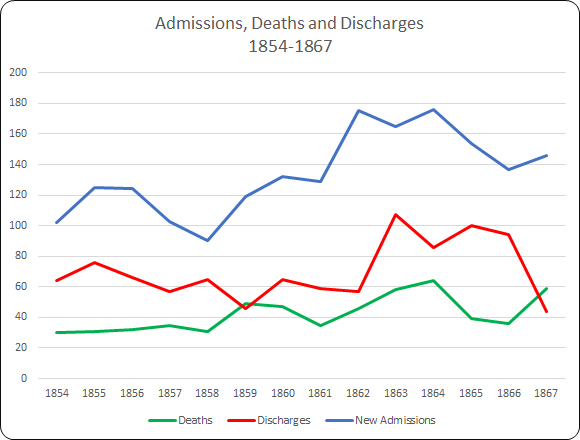
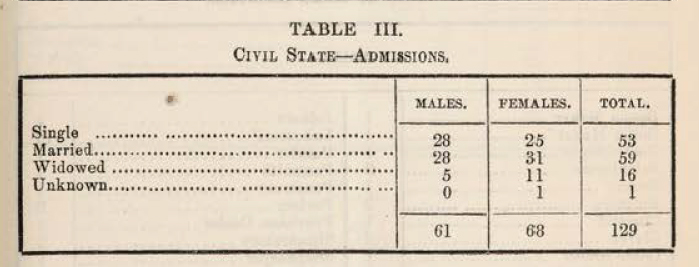
Admissions, Discharges (Cured and Relieved) and Deaths for Cheshire County Asylum, 1860. Source: Wellcome Collection

Another of the many challenges to understanding how lunatics were assessed was that there were no criteria for how a successful cure could be identified.  In York the Tuke’s compassionate asylum The Retreat, it was assumed that anyone who had been released was cured if they were not readmitted, but not only could this represent wishful thinking without additional data, but it sidestepped the task of creating behavioural or other measures that might be used in asylums to determine whether or not someone ought to be released or detained.  Like other asylums, the Cheshire Lunatic Asylum annual records show that each year a number of patients were released from the asylum, but it is impossible to know what this actually means, as there are no recorded criteria for determining whether or not a patient had been cured or, for example, sent home because they were not necessarily cured but were not dangerous to themselves or others (usually referred to as “relieved” rather than cured). The failure to define criteria to measure the success of treatment and recovery was a serious problem once patients were certified insane and committed to an asylum, because there was no universal agreement about how recovery could or should be recognized.  As well as being imprecise, the lack of clear definitions and criteria was potentially an invitation to corrupt or merely sceptical asylum owners to hold patients indefinitely.

For more on these and other terms see Historic England’s Glossary of Disability History.
===

Practical problems associated with early mental illness

Engraving by T. Bowles 1735. “In a lunatic asylum, and in the company of a variety of other deranged individuals, a half-naked Ramble Gripe, his wrists chained, is restrained by orderlies.” Wellcome Collection Reference 38347i

Depending on its severity many forms of mental illness, and conditions like epilepsy that were interpreted as occasional bouts of madness, could be intensely distressing for the families and friends concerned.  Not only were the symptoms apparently incomprehensible and might seem  to be completely random, but they contravened social norms and conventions in a society that placed great value on normative behaviour.  It might be very difficult to manage the situation if symptoms were particularly acute, requiring physical intervention. Mental illness drew unwanted attention, could attract derision and social stigma, and might prevent family members from marrying due to fears of hereditary contamination.  Depictions of insanity in drama, literature, art, newspapers and magazines only inflated stigma and misunderstanding.  Unfortunately, until the 18th century there was very little official support for mental illness.  In rural locations families who could not keep a mentally or otherwise disabled family member at home could pay for their mentally ill relatives, including those with learning difficulties, to be cared by villagers or at local farms in need of income, sometimes providing indigent widows with a means of generating income. There was no official record of mentally ill people cared for at home.

Wealthy families could either hire an appropriate person to join the household to care for the afflicted individual, or send them to a private home or a privately run asylum where a frequently unqualified person would charge a fee to take the problem off a family’s hands.  Families with middle class and reliable working class incomes might depend on any home-based family members, usually female, to provide care, but less expensive privately run houses might again provide a solution. Private mad-houses only began to become prevalent from the 17th century, and operated as lucrative businesses, unlicensed, unregulated and without oversight, there were mad-houses priced for most pockets.  They were often owned or managed by individuals with no qualifications and run without any medically qualified person in attendance.  Even when operated by physicians or surgeons, these titles covered a multitude of sins and might mean anything from someone who was genuinely attempting to treat ailments to a quack doctor who was little better than a profiteering snake-oil salesman.

At the main gates to Bethlem at Moorgate were two sculptures, which just about say it all: “Melancholia” and “Raving Madness” (in chains) in 1689 by Caius Gabriel Cibber. Source: Wellcome Institute via Wikipedia

For pauper families, a lunatic family member was an even greater burden.  Lunatics whose families could not support them were forced to resort to begging.  These were amongst the most isolated and vulnerable people in society. The pauper insane were undifferentiated from other paupers, including vagrants, tramps, beggars.  Many found themselves in workhouses, and workhouses continued to have a role housing those will mental illnesses well into the 19th century.  Other less fortunate pauper lunatics would be incarcerated in prisons, particularly when violent.

The first charitable mad-house was the 1247 Priory of Our Lady of Bethlehem in London, which had taken in the insane from the early 15th century as a monastic duty.  For most of its life it was a small institution, with a capacity of few more than 40 individuals, but by the mid 19th century it was suffering from overcrowding.  Following the Great Fire of London in 1666 the largest public asylum investment in dealing with lunacy was the 17th century was in the new Bethlehem (also known as Bethlem and Bedlam), which opened in Moorfields on the edge of London in 1676 for 120 patients, with additional extensions added as it reached capacity.  Conditions were notoriously dire until the early 19th century.

Outside London care was organized under local parishes in a highly decentralized way, and these would sometimes provide accommodation for those who, through no fault of their own, were unable to support themselves.  Charitable asylums began to appear throughout England in the early 18th century, first in Norwich and London, then in Newcastle and Manchester by the middle of the century and, towards the end of the 18th century, others in York, Leicester, Liverpool and Hereford.
===

Perceptions of lunacy in society in fiction and theatre

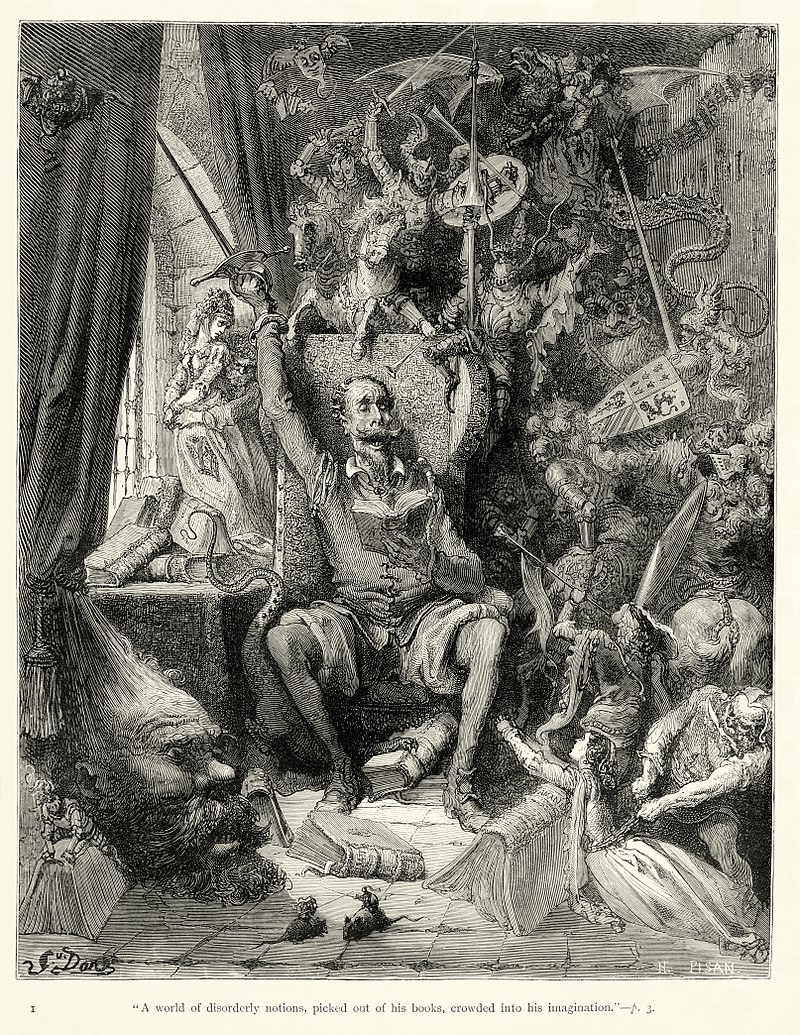
Gustave Doré illustration of Don Quixote in 1863. Source: Wikipedia

Accounts of madness appear in both Old and New Testaments, where they often provided a moral allegorical aspect to  religious narratives.  As literacy and theatre became increasingly popular, insanity became a major literary device in drama and poetry from the Elizabethan period.  This helped to spread an idea of insanity that was something both alien and dark, but at the same time eerily recognizable in the real world, creating both curiosity and fear.  The dramatization of madness appealed to the same sense of  fascination, aversion and suspense that horror and science fiction genres generate today.

Many playwrights used madness to add dramatic emphasis to a number of their plays including Christopher Marlowe’s Dr Faustus (first performed c.1594), Thomas Kyd’s The Spanish Tragedy (first performed 1587), Shakespeare’s Hamlet (first performed c.1601), King Lear (c.1606), and Macbeth (first performed c.1611),  Webster’s Duchess of Malfi (first performed 1614) and John Fletcher’s The Pilgrim (first performed 1621).  The novel Don Quixote (c.1605) by Miguel Cervantes, which depicted outright insanity as the main subject matter, was first translated into English in 1612, with a more popular version in 1700.   In the 18th century Tobias Smollett also translated Cervantes but also offered his own treatment of madness in Sir Launcelot Greaves (1760). Samuel Richardson explored his own versions of female madness in Clarissa (1748) and Sir Charles Grandison (1753).  In the late 18th and early 19th century George Crabbe’s poetry makes frequent reference to madness, and his poem Sir Eustace Grey (published in his collection of 1807), set in a “mad-house” and framed as a conversation between a patient, a doctor and a physician, examines the decline of a sane person into insanity. 

The more he felt misfortune’s blow;
Disgrace and grief he could not hide,
And poverty had laid him low:
Thus shame and sorrow working slow,
At length this humble spirit gave;
Madness on these began to grow,
And bound him to his fiends a slave.

Engravings of a series of William Hogarth’s The Rake’s Progress paintings, published in 1735, include this scene from a lunatic asylum, with wealthy female visitors looking on. Source: Wikipedia

Visual depictions are dominated by William Hogarth’s famous Rake’s Progress, which included a scene showing the Bethlem the asylum as a deranged and frenzied environment viewed by two wealthy ladies visiting the asylum to enjoy a spectacle of curiosity.  Although painted in the early 1730s it was engraved in 1755 after which it was widely distributed.  Satirical cartoonists, building on the work of Hogarth, became very popular in the 18th century, of whom James Gillray is by far the best known, although there were many others.  The satirical publication Punch shared many of these, and it was by no means unusual for them to depict politicians and other senior figures as madmen, some of them chained up in lunatic asylums, showing slapstick, scatological and often puerile visions of a flawed society.  As Cartoonist Martin Rowson says:

Bethlem Hospital, London: the incurables being inspected by a member of the medical staff, with the patients represented by political figures. By Thomas Rowlandson 1789. Source: Wellcome Collection Ref 536228i

Personally, I believe satire is a survival mechanism to stop us all going mad at the horror and injustice of it all by inducing us to laugh instead of weep. . .  That’s why, if we can, we laugh at both those things, as well as being disgusted and terrified by them. Beneath the veil of humour, there’s always a deep, disturbing darkness. [The Guardian, March 2015]

References to behaviour that seemed ill-suited to the rational world, particularly amongst politicians and the social elite, were easily ridiculed by reference to lunatic asylums, which played on the fears of society as well as on its inclination to deride the sane.

The Woman In White by Wilkie Collins, first serialized in 1859 before being published as a book. Source: Wilkie Collins Information Pages

Madness was a recurring theme in 19th century literature and British Victorian fictional literature continued to offer insights into how society perceived lunacy.  Works include Jane Eyre by Charlotte Brontë (1847); The Woman in White (1859) and the short story Fatal Future (1874) both by Wilkie Collins; Charles Reade’s Hard Cash (1863); Dr. Jekyll and Mr. Hyde by Robert Louis Stevenson (1886), and Oscar Wilde’s The Picture of Dorian Gray (1891), to name but a few.  Insanity also finds its way into many novels and stories by Charles Dickens including the short story A Madman’s Manuscript (1836, from The Pickwick Papers) and the novels Bleak House (early 1850s) and Great Expectations (1861).  

Madness was also featured in opera, particularly adaptations of Shakespeare’s plays, and those by Gaetano Donizetti who made particular use of madness as a device. Donizetti’s Anna Bolena of 1830, in which Anna (Anne Boleyn) goes mad in the Tower of London as she awaits execution, suffering delusions) was premiered in London 1831. Donizetti’s 1838 Lucia de Lammermoor, based on Sir Walter Scott’s 1819 novel The Bride of Lammermoor, in which the eponymous heroine goes mad when her brother forces her into a loveless marriage, was first performed in London in 1836, with a famous Eccola! mad scene.  Lucrezia Borgia, dates to 1833 and was premiered in London in 1839.  Other well known operas that feature insanity are Vincenzo Bellini’s I Puritani, in which the heroine goes mad when she is abandoned at the altar and in Wolgang Amadeus Mozart’s Idomeneo win which the vengeful Elettra, another woman unlucky in love, goes splendidly mad with grief and rage at the end of the opera.

The mad Bertha Mason as envisaged by F. H. Townsend for the second edition of Jane Eyre, published in 1847. Source: Wikipedia

The above-mentioned functional works by Charlotte Brontë, Wilkie Collins and Charles Reade dealt with wrongful detainment, either at home or in an asylum, bringing a new risk to public attention.  The impact of these fictional works were considerably exacerbated by real-life incidents of wrongful detainment.  Sarah Wise’s book Inconvenient People provides many examples of illicit incarceration and how these were handled.  An early 19th century example is the case of one Mrs Hawley.  It is worth quoting James Peller Malcolm’s 1808 account in Anecdotes of the Manners and Customs of London during the Eighteenth Century Including the Charities, Depravities, Dresses, and Amusements etc to give an example of how the sort of accounts that the public were reading:

Amongst the malpractices of the Century may be included the Private Mad-houses. At first view such receptacles appear useful, and in many respects preferable to Public; but the avarice of the keepers, who were under no other control than their own consciences, led them to assist in the most nefarious plans for confining sane persons, whose relations or guardians, impelled by the same motive, or private vengeance, sometimes forgot all the restraints of nature, and immured them in the horrors of a prison, under a charge of insanity.  Turlington kept a private Mad-house at Chelsea: to this place Mrs. Hawley was conveyed by her mother and husband, September 5, 1762, under pretense of their going on a party of pleasure to Turnham-Green. She was rescued from the coercion of this man by a writ of Habeas corpus, obtained by Mr. La Fortune, to whom the lady was denied by Turlington and Dr. Riddle; but the latter having been fortunate enough to see her at a window, her release was accomplished. It was fully proved upon examination, that no medicines were offered to Mrs. Hawley, and that she was perfectly sane.

This incident lead to a Select Committee investigation appointed by the House of Commons to investigate wrongful detention in private asylums, and lead to Madhouse Act of 1774 (on which more later), which recognized the problem and although it did not do nearly enough to tackle it, set a useful precedent for applying legal measures to madhouses.  Legislation throughout the 19th century attempted to prevent wrongful certification, but there were four highly publicized scandals on illegal incarceration in 1858 that fuelled public fear and even as late as 1890 laws were being introduced to prevent collusion between those attempting to admit sane patients and certain medical men incentivized to receive them.

Introduction to Nellie Bly’s account of her undercover work in an American asylum. Source: Internet Archive

The requirements for committing the poor in public asylums were less stringent.  This was not an elitist measure.  The wealthy were far more vulnerable to family manipulation for self-gain, and as Sarah Wise has demonstrated, men were just as vulnerable in this respect as women.  Pauper lunatics whose families had little financial incentive to incarcerate impoverished relatives, except to reduce the pressure on household costs.  On the other hand the wealthy were universally treated far more kindly than the poor.

In America, Nellie Bly’s late 19th century journalistic account of the ten days she spent on an undercover assignment, incarcerated in an American women’s asylum caused a public outcry similar to that attached to the repeated scandals at Bethlem, the York Lunatic Asylum scandals in 1790 and 1814 and the four highly publicized cases of 1858.  Bly’s experiences were published and widely distributed in book form in 1887.  Nellie Bly, the pen-name for Elizabeth Cochrane Seaman, was a correspondent on The New York World, and her articles and book served to raise awareness of the true horrors that still existed so late in the 19th century on both sides of the Atlantic.

All these different types of medium demonstrate that madness was a powerful artistic and dramatic device, eliciting feelings of both fascination and dread.
===

Approaches to lunacy before 1830

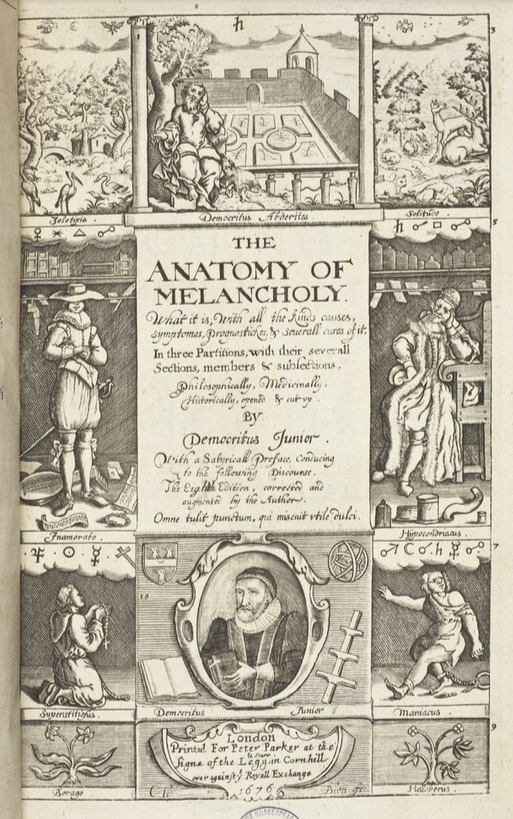
The 1676 front page from “The Anatomy of Melancholy” by Robert Burton, first published in 1621. Source: Shakespeare Birthplace Trust

One of the earliest non-fiction books to be published on the subject of mental instability was Robert Burton’s (1577 – 1640) startling and difficult 1621 The Anatomy of Melancholy which ranges freely through all aspects of religion, the Classics and literature to discuss, in a somewhat tangled narrative, a variety of behaviours that he brings together under “melancholy” that he generally equates to madness:

That men are so misaffected, melancholy, mad, giddy-headed, hear the testimony of Solomon, Eccl.ii.12. “And I turned to behold wisdom, madness and folly,” &c. And ver.23: “All his days are sorrow, his travel grief, and his heart taketh no rest in the night.” So that take melancholy in what sense you will, properly or improperly, in disposition or habit, for pleasure or for pain, dotage, discontent, fear, sorrow, madness, for part, or all, truly, or metaphorically, ’tis all one. Laughter itself is madness according to Solomon, and as St. Paul hath it, “Worldly sorrow brings death.” “The hearts of the sons of men are evil, and madness is in their hearts while they live,” Eccl.ix.3. “Wise men themselves are no better.” Eccl.i.18.

This is one of many publications that demonstrate that there was no science-based medical understanding of madness before the later 19th century, partly because there was little understanding of human anatomy or neurology, and partly because of the existence of well-honed model of human biology.  In the late 11th century the published research of Arab scholars came to the west, where it had a colossal impact on how the world was understood and interpreted, offering new explanatory models that were not dependent on Christian conventions or traditional folklore, but were still woefully inaccurate.

The Four Humours and their characteristics. Source: National Library of Medicine

The dominant medical model from the medieval period, echoes of which lasted well into the 19th century, derived from Greek thinking was medical, based on Hippocrates and modifications of Hippocrates by Galen.  Forming the foundation of medieval ideas of biology and the treatment of ailments, these beliefs were based on the theory that humans were were made up of four basic elements called humours, which were characterized by specific properties that had to be kept in balance in order for health and well-being to be maintained. Failure to balance these humours was thought to result in illness and/or mental instability.  This was a powerful explanatory model that appeared to offer solutions but although it avoided some often unpleasant divine, magical and superstitions approaches, with which it lived side by side, it represented a complete lack of understanding of human biology and anatomy.  Various often painful and harmful techniques were employed in attempts to restore equilibrium to these imaginary humours. Some of the treatments were quite literally torturous, intended to draw out or counteract imbalances. Together with explanations citing demonic influence, the humours were an important part of medieval belief that leaked into the 18th and early 19th centuries.  Treatments included restraints long periods of isolation and so-called treatments including purging, bloodletting, food deprivation, hot and cold water immersion and beating to attempt to treat madness with physical measures, and presumably to enforce better behaviour.

The issue of whether or not madness could be treated to reduce or eliminate symptoms became a matter of considerable importance to the royal family and the government at the end of the 18th century.  Beginning in the 1780s, King George III (1738-1820) experienced phases of severe mental disturbance.  This brought with it an interest in research into symptoms of madness at state level.  The king’s medical team included Francis Willis, a former clergyman who owned an asylum in Lincolnshire.  Willis’s treatment of King George indicates that the treatments employed in both private and public asylums were genuinely believed to have a beneficial impact because the king was subjected to the same type of treatment practised to rebalance humours, and which Willis used in his own asylum, including ice baths, purging, enforced vomiting, burns, denial of food, and restraints.  King George appeared to improve after treatment, and Willis was well-rewarded, but the king’s condition worsened again in the early 18900s.  In 1810, perhaps because his illness was exacerbated by the death of his daughter Princess Amelia, he withdrew from official duties, although lived for another 10 years.

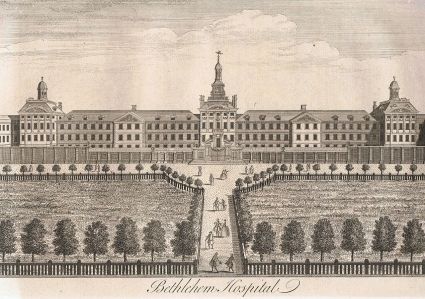
By far the most common solution for non-royal lunatics was some form of containment.  As Lucy Series puts it: “A key tenet of the law of institutions is that some people belong in ‘institutions’ (at least some of the time) and others do not.”  Those institutions were designed to separate the mad from their homes and communities “spatially, legally and socially.”  It was  from the late 17th century in London and the 18th century elsewhere in Britain that the problems associated with madness began to be approached by both private enterprise and, more slowly, charities.  Private asylums were unlicensed and unregulated, operating completely outside any legal framework, and as early as 1728 Daniel Defoe (writing under the pseudonym Andrew Moreton) referred to the “vile practice” of incarcerating family members for personal advantage.  Operated as commercial ventures, and often very profitable, they grew in great numbers.  The new 1676 public Bethlem hospital for 120 patients, was designed by Robert Hooke along impressively grandiose lines but it was poorly constructed and deteriorated rapidly, requiring extensive maintenance and repair.  It has become infamous for charging tourists a fee to view the mentally disturbed, a practice not stopped until 1770.  It treated the mentally ill as sub-human, barely better than chained animals, and conditions became notoriously dreadful, not tackled until a new reformist superintendent was installed in 1815.

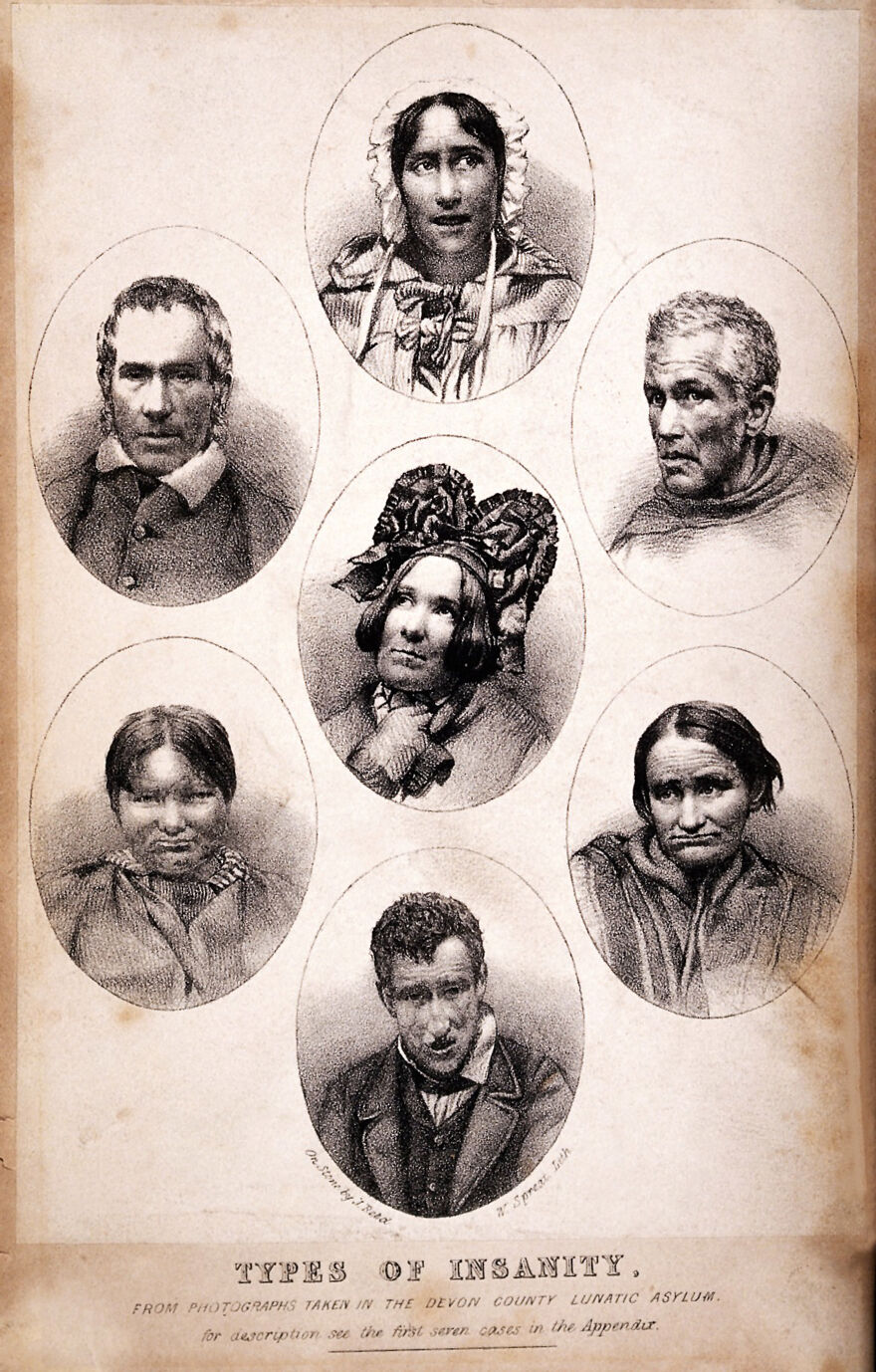
Seven vignettes of people suffering from different types of mental illness. Lithograph by W. Spread and J. Reed, 1858. Source: Wellcome Collection, Ref. 20076i

As the 19th century proceeded, lunacy or madness was interpreted in different ways, both medical and philosophical, drawing together the brain, the body and the mind in new exploratory but untested directions.  In Britain, as well as elsewhere, physical examination of the skull (phrenology) and the face (physiognomy) were approaches that attempted to find the source of madness in visible physical details, but there was little attempt to develop a scientific understanding of madness or how to treat it.  Britain’s alienist German counterparts, were more closely affiliated with universities and adopted academic approaches, and developed new ideas towards mental illness in laboratory environments where hypotheses formed and tested.  It is in Germany that the term “psychiatry” was first coined in the early 19th century, and from where  many of the innovations in understanding mental illness started to emerge.  In the late 19th century Emil Kraepelin, Professor of Psychiatry at the University of Heidelberg, recognized and described the mental illness dementia praecox, later renamed schizophrenia.  This type of research began to influence some British researchers, some of whose own work was recorded in the Journal of Mental Science.  Linkages between pathological conditions (such as infectious disease), and mental conditions were only recognized in the later 19th century.  For example, the connection between the sexually transmitted infection syphilis and its late-phase symptoms (including mood swings, antisocial behaviour, delusions and seizures) was only recognized in the late 1880s.

There were no medicines available to treat the causes of mental illness.  The only medications available were for the treatment of symptoms, not causes.  Tranquilizers, a certain amount of pain relief and the treatments for fever were the only available forms of relief for patients.  For very violent patients the only measures were sedatives, restraints and isolation.
===

The growth of the lunatic asylum 1751-1834

Sketch of the original plan of the Chester Union Workhouse. Source: Chester – A Virtual Stroll Around the Walls

The Old Poor Law (officially the Act for the Relief of the Poor) of 1601 had been instigated during the reign of Elizabeth I was modified but largely changed until the 1834.  It classified paupers as the able-bodied who were unable to find employment, the able-bodied who refused to find employment, and those who due to illness, old age, disability or other infirmities, including lunacy, were unfit for employment and needed relief.  In the 18th century the institutional mechanisms available for the mentally ill who had no family assistance were mainly hospitals, workhouses, almshouses, and prisons each set up to cater for different types of problem and accompanying symptoms.  Some parishes paid for lunatics to be housed in private house, where they could be confined, but public funding of lunatic confinement was unusual.

The problem of poverty and paupers is well represented by the multitude of poor laws that were introduced throughout the Tudor and Jacobean periods.  The church and charitable organizations might assist with payments and household supplies, and even housing for the poor, providing a accommodation and food in return for labour, but such resources were few and far between and did not apply to lunatics.  A much more familiar solution for the pauper insane became the workhouse, an early institution initially set up with the laudable intention of helping the poor on a parish by parish basis, partly funded by the “poor rate”, and which also took in the pauper insane.  Charitable public lunatic asylums, some raised by subscription, were introduced at the end of the 18th century, and became more important as workhouses became more penal in character, but workhouses were still acknowledged places of detention and safekeeping for the insane and the imbecile well into the 19th century.

The 1713 and 1744 Vagrancy Acts distinguished between lunatics and criminals, imposing much less severe treatment on the former, but providing for their detention.  In practice, this meant incarceration in a jail or Bridewell rather than a death sentence.  In 1723 the General Workhouse Act, intending to reduce the ongoing costs of maintenance of unemployed paupers, allowed parishes to erect a workhouse, and judge whether those who were out of work should be sent to the workhouse and to labour for their shelter and food.  They were built all over Britain in their 100s.  Paupers with learning difficulties or mental illnesses were regularly subsumed into the workhouse system due to the lack of any practical alternative. Although anyone could leave, at least in theory, the workhouse was not a place of rehabilitation, and was designed to be sufficiently ghastly to deter people from seeking state help.  Some workhouses had a wing for lunatics, but the conditions were very poor.  Whilst it probably did lead some to seek work, the system penalized those who were genuinely unable to work.

St Luke’s Hospital, Cripplegate, London: the facade from the east. Engraving after T. H. Shepherd. Source: Wellcome Collection, ref. 26120i

A new model of lunatic asylums is represented by St Luke’s Hospital for Lunatics, founded on Old Street in Cripplegate (London), which opened in 1751.  The neoclassical façade favoured by was emulated by several later institutions.  Its first head physician was Dr William Battie, who set himself up in opposition to the barbaric and punitive regime at Bethlem, and published his Treatise on Madness in 1758, describing his contrasting approach.  He distinguished between un-treatable congenital madness and that caused by a social environment, which might be treated.  He was unusual in preferring treatment to constraint, and although his methods were interventionist, his belief that mental illness was treatable and even curable was influential.  He ran a school at the hospital in the hope that this would disperse his teachings and approaches.  Although he took in pauper lunatics, Battie ran the hospital as a profitable commercial venture.

The 1774 Act for Regulating Private Madhouses (and sometimes referred to as the Lunacy Act or the Madhouse Act ) was an early attempt to regulate and manage private madhouses. Public asylums were not regulated by this Act. One of its achievements was the appointment of five Commissioners who were Fellows of the Royal College of Physicians who would inspect private asylums, and although these were only in the London area it was a step towards certification and licencing.  Another important measure was designed to ensure that anyone committed required two referrals by qualified doctors to ensure that individuals were not wrongfully confined by their families.

In 1782 The Act for the Relief and Employment of the Poor (also known as Gilbert’s Act) allowed parishes to form themselves into groups for the purpose of building workhouses exclusively for those unable to work. No able-bodied people were to be admitted.  Although this was not a successful measure, being entirely optional with a poor take-up, it did acknowledge a real need for providing for the physically and mentally infirm.

As William Battie had demonstrated, real change lay as much in philosophical, ideological and humanitarian ideas as medical and legal ones.  The Quaker movement had a strong influence on this idealized way of treating mental illness, and this grew partly out of the death of Quaker Hannah Mills in 1790, less then a month after being admitted to the York Lunatic Asylum (opened 1777), suffering from melancholy.  She was one of some 300 inmates who died there in the 37 years between 1777 and 1814.  Her case came to the attention of the Quaker and wholesale tea trader William Tuke (1732-1822).  Horrified by the facts of the matter, decided to raise funds to build an asylum in which members of the Quaker community suffering from mental health problems could be treated in a new and civilized way.  The result was his own asylum called The Retreat, which opened in 1792. His approach, referred to as the “moral” treatment, was altogether more compassionate and empathetic, based on the belief that a positive physical and emotional environment and good food were key to mental recovery.   A nurturing and therapeutic approach to care was adopted.  Instead of being treated as sub-human or bestial, those who entered the asylum were encouraged to lead lives emulating social norms.  Restraint was only used when strictly necessary, and although patients were confined within an institution, the Retreat attempted to reproduced ordinary home living and encouraged socializing amongst patients to help patients to recover. William Tuke’s son also worked at the asylum, and his grandson Samuel Tuke (1784-1847), published a description of The Retreat in 1813, describing the philosophy and activities of the asylum.  This publication helped to inform other mental illness reformers.

Depiction of “The Retreat,” established by William Tuke in 1792, by George Isaac Sidebottom, a patient at the retreat in the late 19th century. Source: Wellcome Collection RET/2/1/7/5

Following the 1808 County Asylum’s Act known as “Wynn’s Act” after Charles Williams-Wynn, the politician who did much to promote it, Justices of the Peace were given the authority to build county asylums, and to raise finance to do so.  This was optional, not compulsory, and local councils were under no obligation to build asylums. Although some new asylums were subsequently built to enable paupers with mental illnesses to be removed from workhouses and placed in appropriate establishments these were slow to arrive.  Many who suffered with mental illnesses or learning difficulties continued to be taken into workhouses and prisons.  The treatment of the poor continued to be a story of failure to respond to a serious need, whilst the rich were still regularly deposited in private institutions of very variable quality.

York Lunatic Asylum. Source: Wikipedia

In the meantime, the York Lunatic Asylum, first under physician Alexander Hunter, and after his death in 1809 under his assistant Dr Charles Best, continued to take a custodial, punitive and disgustingly neglectful approach to its patients, a fact that Tuke and other York philanthropists attempted to address, partly by reporting cases to the media and partly by infiltrating the board of governors and using this to demand access to the asylum to inspect patient care, finding that although wealthy patients were usually well treated, pauper lunatics were kept in dreadful conditions.  Godfrey Higgins, one of a number of social agitators in York at the time, who had taken a particular interest in the treatment of the insane, used his influence to demand an inspection in March 1814.  When he found locked doors he insisted that they be opened, threatening to break them down himself.  Inside one room he found female patients in what he referred to as “a number of secret cells in a state of filth, horrible beyond description . . . the most miserable objects I ever beheld.”  In another part of the asylum he found “more than 100 poor creatures shut up together, unattended and unsuspected by anyone”.  The case went to court, and a new committee was appointed in 1814, but problems continued to be reported.

Bethlehem (Bethlem) Hospital by William Henry Toms for William Maitland’s History of London, published 1739. Source: Wikipedia

The dire conditions at Bethlem in Moorfields continued to be a disgrace to London.   Even though a decision had been made to replace the Moorfields building with a new one, south of the Thames at Southwark, matters might have gone on as before if not for Edward Wakefield, a Quaker, like the Tukes, an advocate of lunacy reform whose mother had been confined in an asylum.  He had visited the Moorfields site in 1814 and reported on the inhuman conditions that he witnessed there.  Wakefield’s insights were an important part of the Select Committee investigation of 1815, which reported on the appalling conditions that Wakefield had found.

A sample of Wakefield’s contribution to the 305-page report is as follows, which is by no means the most distressing: In the early 1800s it was determined that the Bethlem Lunatic Asylum building in London was no longer fit for purpose, and it was demolished, replaced by a new building in Southwark (which today houses the Imperial War Museum).

American sailor James (sometimes called William) Norris as found in Bethlem in 1815, where he had been detailed for over a decade. Source: Wikipedia

We first proceeded to visit the women’s galleries: one of the side rooms contained about ten patients, each chained by one arm or leg to the wall; the chain allowing them merely to stand up by the bench or form fixed to the wall, or to sit down on it. The nakedness of each patient was covered by a blanket-gown only; the blanket-gown is a blanket formed something like a dressing-gown, with nothing to fasten it with in front; this constitutes the whole covering; the feet even were naked. One female in this side room, thus chained, was an object remarkably striking; She mentioned her maiden and married names, and stated that she had !been a teacher of languages; the keepers described her as a very accomplished lady, mistress of many languages, and corroborated her account of herself. The Committee can hardly imagine a human being in a more degraded and brutalizing situation than that in which I found this female, who held a coherent conversation with us, and was of course fully sensible of the mental and bodily condition of those wretched
beings, who, equally without clothing, were closely chained to the same wall with herself
. . . .
In the men’s wing in the side room, six patients were chained close to the wall, five handcuffed; and one locked to the wall by the right arm as well as by the right leg; he was very noisy; all were naked, except as to the blanket-gown or a small rug on the shoulders, and without shoes; one complained much of the coldness of his feet; one of us felt them, they were very cold. The patients in this room, except the noisy one, and the poor lad with cold feet, who was lucid when we saw him, were dreadful idiots ; their nakedness and their mode of confinement, gave this room the complete appearance of a dog-kennel.
[First report from the Committee on the State of Madhouses, 1815, p.46]


The new Bethlem of 1815. Source: BBC Culture

===
Wakefield himself was appointed as the new superintendent of the new Bethlem in Southwark and he introduced similar values as those employed by the Tukes at The Retreat.  The new Bethlem opened in 1815 with a wing for the criminally insane, the same year as the Select Committee report on the condition of lunatic asylums.
======

Excerpt from Committee Appointed to Consider of Provision Being Made for the Better Regulation of Madhouses in England, Parliament, House of Commons 1815-16. First report from the Committee on the State of Madhouses. London.  Source: Wellcome Collection

The 1815 First report from the Committee on the State of Madhouses of the House of Commons Select Committees highlighted the lack of oversight of lunatics, and the dismal conditions in which patients that pertained in far too many asylums, workhouses and other institutions where lunatics and imbeciles were confined.

The report’s findings are elegantly phrased, but make it abundantly clear that asylums, amongst them some of the most successful institutions of the day violated basic human rights.  The conditions for paupers and even those of better social standing who lacked visitors to make complaints were frequently filthy places of restraint, beatings and both physical and mental cruelty, with overcrowding, freezing cold conditions, lack of sufficient attendants, and poor admission procedures.  Some of the accounts make for really harrowing reading.  The most truly depressing aspect of the report is that although the committee had made heartfelt recommendations for improvements, matters remained largely unchanged because these did not pass into law.

A page from Mitford’s “Crimes and Horrors in the Interior of Warburton’s Private Mad-House at Hoxton.” Source: Internet Archive

Unsurprisingly, matters had not much improved seven years later in 1822 when John Mitford published his eye-opening A Description of the Crimes and Horrors in the Interior of Warburton’s Private Madhouse at Hoxton.  Mitford’s assessment of Mr Warburton, unqualified and cruel, concludes that “[on] a careful exposure of this diabolical establishment, I doubt not all will agree with me in opinion, that these ‘lawless houses under the law’ should be done away with entirely, as a disgrace to human nature. The angel of death moves through them with secret and murderous strides.”  As with Edward Wakefield’s earlier expose of Bethlem in 1815, it is a truly shocking read.

It took another decade before another Select Committee was appointed in 1827, partly due to a scandal concerning conditions and illegal incarceration at Warburton’s Mad-house in Hoxton, and partly due to campaigning by both social reformers M.P. Lord Anthony Ashley (as from 1851 Lord Shaftesbury), and Dorset magistrate Robert Gordon.  This time the Committee’s reports were taken into account and two new acts were passed in 1828. The Act to Regulate the Care and Treatment of Insane Persons in England (also known as The Madhouse Act) appointed a new Commission in Lunacy to improve centralized control over asylums, not merely in London but throughout England and Wales in an attempt to provide consistent oversight.  The Act attempted to tighten up the certification required before a person, either private or pauper, could be admitted to a lunatic asylum, and the Commission was given much greater powers to act in respect of private asylums.  The admission of pauper lunatics now required certification by a Justice of the Peace as well as a physician.  The County Lunatic Asylums (England) Act again encouraged counties to build asylums from ratepayer contributions, and also required that county asylums should send detailed reports on an annual basis to the Home Office.  The Act was updated in 1832, again to attempt to improve the certification process and prevent illegal detainment, making false or inaccurate certification a misdemeanour.

Following the 1808 and 1828 Acts, several new county asylums had been built.  Early examples were Nottingham, Bedford, Norfolk, Staffordshire, Cornwall, Gloucester and Suffolk all before 1830.  It is at this point, to slot it into its chronological context, that the new Cheshire Lunatic Asylum was built, in 1829.

Please click here to go to Part 1.2, the second part of this background to the Cheshire Lunatic Asylum.  The Cheshire Lunatic Asylum itself is discussed in Part 2.
===

The Tukes’ Retreat, a private asylum delivering “moral treatment” in York, which opened in 1792. Source: Wikipedia


Chester Lunatic Asylum 1831, a public asylum established for paupers, and a few private patients, which opened in 1829. Source: Wellcome Institute Library

====

Chester in art in two exhibitions at the Grosvenor Museum: George Cuitt and Louise Rayner


Two versions of Bishop Lloyd’s Palace on Watergate Street. On the left George Cuitt and on the right Louise Rayner


Lower Bridge Street looking south. Louise Rayner

There are two exhibitions running concurrently in the Grosvenor Museum in Chester, both showing highly individual interpretations of Chester’s architecture.  The first, The Romance of Ruins – the Etchings of George Cuitt (Gallery 1 on the ground floor, accessible to wheelchair users) runs until 12 January 2025.  The second, Louise Rayner: Victorian Watercolours (Gallery 2, upstairs with no lift) runs until 9 February 2025. Both came from artistic families.  Cuitt (1779-1854) was the only son of painter George Cuit the Elder, becoming an art teacher in Chester, and Rayner’s (1832-1924) parents and several of her siblings were also artists. Cuitt added a second “t” to his surname to distinguish himself from his father.  If you visit both exhibitions at the same time, the most obvious contrast is that George Cuitt’s etchings are monochrome, whereas Louse Rayner’s watercolours are characterized by vivid colours, but in spite of the time differences between their work, and the chronological distance between them, there are a lot of similarities in their perceptions of Chester.  Both artists focus on detail, and both lean towards a picturesque and somewhat romanticized view of Chester, populated not merely by buildings but by a myriad of people and livestock.  Cuitt’s work is by its nature more linear and less impressionistic than Rayner’s, but both highlight key details of individual buildings, capturing much of the minutiae that makes Chester’s architecture so engaging, and the skills demonstrated by both are well-honed.  Rayner makes particularly good use of perspective to draw her viewers into her paintings.  Although this was not always a feature of Cuitt’s work, a particularly nice view of the cathedral cloister uses the same technique.

The Cloisters, Chester Cathedral, 1811. George Cuitt

Quite apart from their value as artistic interpretations of Chester, both the Cuitt and Rayner exhibitions provide insights into architectural details that no longer survive, lending themselves to historical research as well as art appreciation.  From Cuitt’s portfolio, an 1827 view through a ruined arch towards Chester Castle captures a surviving in situ feature of the medieval St Mary’s Benedictine Nunnery.  It is entitled “Chester Castle from the Nun’s Gardens,” (shown below)  It is also a nice juxtaposition of two contrasting architectural styles, and two equally contrasting states of preservation.  The arch has been moved to Grosvenor Park, where it is accompanied by other orphaned pieces of gothic architecture.  Another of his etchings shows the cloisters before the windows were added.  Louise Rayner’s corpus has provide a great many examples of buildings that are no longer standing, but I found the one showing St Werburgh’s Mount of particular interest, shown below, where St Werburgh Row, is now located.  Her painting of Lower Bridge Street is an eye opener, shown above, looking towards the Dee with some lovely buildings now demolished and replaced by a 1960s monstrosity, and the Harvie’s almshouses, also below, must have been a very attractive feature.

St Werburgh’s Mount, c.1873. Louise Rayner

Both exhibitions provide full information about both artists, providing insights into the influences acting on their work and how their careers developed.  The pictures displayed have been chosen to highlight not only how they each interpreted Chester but how their skills have been applied to such a rich subject matter.

Find details about opening hours and other visiting details on the Grosvenor Museum website.

View from St Mary’s Nunnery arch to Chester Castle, 1827. George Cuitt

Harvie’s Almshouses, Duke Street. Built 1692, demolished 1892

St Michael’s Church Porch, 1809. George Cuitt

The King Charles Tower and the Shropshire Union Canal. Louise Rayner


Overleigh Cemetery, Chester #2 – The living, the dead and the visitor

In part 1 of this series on Overleigh Cemetery the economic background to Overleigh Old Cemetery was introduced briefly, and details of the reasons and execution of the foundation of Overleigh Old and New Cemeteries were discussed.  Here, in part 2, both Overleigh Old and New Cemeteries are explored in a little more depth.  There are a great many components that contribute to how a gravestone looks, what it says, and what it meant to the bereaved.  Between the sculptural forms, the symbols used on headstones and the inscriptions, as well as the design of the the cemetery itself and the ways in which it evolved and was used and perceived at different times in the past, Overleigh has a lot to contribute to how we think about Chester and its occupants.

Eliza Margaret Wall, died 1899, aged 30. Other family members were added in future years up to 1936

As a starting point, it is useful to look at who the main users of the cemetery were and are, both living and deceased, before moving on to a general guide to what to look out for if you are a visitor interested in learning about what the cemetery has to offer.

As in part 1, where I have included a photograph of a grave and there is information about it on the Find A Grave website, I have added a link.  For anyone using the database for their own investigations, note that Find A Grave treats Overleigh Old and New cemeteries as two different entities and you have to search under the correct one.

I have stuffed this full of photographs to help explain some of my points, so Part 2 looks bigger than it actually is.  You can click on any of the images to see a bigger version.

With many thanks again to Christine Kemp (Friends of Overleigh Cemetery) for her much-appreciated ongoing help.
====

People

Graves represent people, the living and the dead, both entangled in the complexities of funerary rites.

The bereaved

A funeral at Overleigh Old Cemetery. Detail of 19th century engraving of Overleigh Cemetery. Source: Wikipedia

Although this post is about a burial ground and its graves, funerary traditions and practices are all as much, if not infinitely more, about the living.  The need to recognize and commemorate loss, not merely at the funeral but prior to it and after it are essential to people, even today when the traumas associated with death tend to be handled in more internalized ways than in the pre-war periods.

Gravestone of Geoffrey Mascie Taylor, died 1879. If anyone has any idea what the symbol represents at the top of the gravestone, please let me know.

During the Victorian period there was an elaborate process of marking a death, a tradition of precise convention and ritual, expressed both within the family and communally.  When someone dies the living are left behind to handle a loss as best they can, and cemeteries and memorials are only one one part of that process.   The end to end process from death to mourning is all a part of the Victorian experience of bereavement.  Visiting and tending the grave, bringing flowers for the deceased, was part of this process, in which women had a key role, and demonstrating bereavement in public essentially brought the grave into the domestic sphere.  Several of the books listed in the references, go into some detail about the Victorian expressions of mourning, and books by James Stevens Curl in 1972 and Judith Flanders in her recent overview provide great insights, but if you want a much shorter book with a still very comprehensive and well written overview, Helen Frisby’s Traditions of Death and Burial offers an excellent overview of Victorian and later bereavement ceremonies.

John Owens JP, died 1853, age 72.  “A Merciful Man Whose /
Righteousness Shall / Not Be Forgotten.” There are no additional inscriptions on this impressive headstone

In the Victorian period it has been argued that the lead-up to a funeral, the funeral itself and its aftermath were all components of an intention to promote social status, wealth and the knowledge of and participation in deeply embedded social conventions that specified in detail how death should be handled and how mourning should take place.  The Industrial Revolution had created a new type of middle class, many of whom were making livings based on manufacturing and commerce, as well as roles in the growing legal, medical, administrative, banking, and similar sectors. Even though there were more opportunities for social mobility, and the ability for individuals to define themselves in new terms, the aristocracy still provided a model for those with social ambitions.  Conspicuous displays of personal and family identity and wealth had become fundamentally important in this need to establish a dignified and self-important identity at a location between the upper and working classes. It was also important for the lower middle classes to distinguish themselves from those who were less financially robust, doing what was perceived as more menial work, defining themselves as socially distinct from the working class. Hierarchy, with all its subtleties during the Victorian period, was important, deeply-felt, and complex, and much of this is reflected in funerary rituals.

More recently it has also been recognized that elaborate Victorian and early Edwardian funerary ceremonies were not merely social devices but reflected the great trauma associated with loss in a world where medicine was in its infancy and where where the middle class was defining itself within often smaller families than previously.  Sickness and death could be both frequent by comparison to today, and was often profoundly distressing.  At the same time, sanitation and health were slowly improving in the second half of the century, meaning that once childbirth and infancy had been survived, people physically lasted longer than they had done in the past, building relationships but more frequently succumbing to old-age problems, becoming invalids who were cared for within the home.  National and community diseases were frequent, some of them long-lasting, and the role of women in nursing their relatives became increasingly important where professional standards of nursing were, just as much as the professionalization of medicine, in their earliest incarnation.  Middle class family ties, and the Victorian and Edwardian sense of moral responsibility to relatives, ensured that sickness was a very frequent component of family life.

TThe monumental grave shrine of Henry Raikes, died 1854, aged 72, Chancellor of the Chester Diocese and one of the founders of the Chester “Ragged Schools.” Overleigh Old Cemetery..

Relatively recent research has also suggested that working class people felt no less strongly about the loss of their partners, siblings and children.  Many working class families were crowded into insanitary areas all over in Britain, and notable areas have been identified in Chester, forcing people into much closer proximity, and this promoted the transmission of sickness and disease with a consequent cost in terms of poor health. Sickness was handled within families, which caused many problems in household management, where women frequently worked for a living, often in domestic capacities.  This resulted in the occasional recourse to a new breed of hospitals as well as a frequently dubious type of pre-professional paid nursing care. The ease of disease transmission meant that those living so close together and in such insanitary conditions were most at risk of epidemics, and the mortality rate was much higher than in middle class households. There were clubs into which people could pay a subscription to save up for funerals, just as there were clubs to save up for Christmas, and there are several pauper graves at Overleigh. But for some the costs were too high, so many graves were unmarked, and the grief of some families was never recorded meaning that these losses are not captured.

The monument for Joseph Randles, died 1917, aged 65-66. Note the partially veiled urn, which will be mentioned later.

It is easy to forget that until the NHS was established in 1948, most people still died at home rather than in hospitals, hospices or nursing homes, and that families housed the deceased, until burial, within their homes, and those deceased, laid out in front parlours in their coffins, were visited by friends and families.  The introduction of the funerary Chapel of Rest in the later Victorian period helped to reduce the time when the deceased remained in the house, but it was still a common part of a death that the dead remained amongst the living until the funeral well into the 20th century.

The focus on ceremony and ritual altered over time, with a considerable change of direction from the elaborate ceremonies of the Victorians to the minimalist approaches taken today. This does not mean a growth of indifference to death, but it does indicate changes within society. The beginnings of this are to be found in the Edwardian period, particularly during and after the First World War, when the nation’s horses that traditionally pulled hearses were required for the war effort. Funerals became even less demonstrative after World War 2.  This will be discussed a little more in Part 3.

On this Armstrong family cenotaph and headstone in the Overleigh New Cemetery, three sons predeceased their parents aged 32 in 1917, 22 in 1918, and 39 in 1927, the first two of them at war, all of which must have been a shocking loss.  Their parents are commemorated here too.

In the cemetery itself, the most obvious incorporation of gravestones into the world of the living is the highly visible custom of flowers and other gifts having been left in front of a headstone.  Fresh flowers in particular give the sense of a grave being regularly tended but artificial flowers and other items also serve to mark the continued attention to a grave by those who wish to indicate their recognition and care.  My father, who was born in 1936 and grew up on the Wirral, says that when he was a small boy he was taken regularly to the graves of his relatives in Liverpool, where there was a flower shop outside the gates, and flowers were purchased, a visit was made to family graves, and a picnic was enjoyed nearby.  It was a visit of celebration, continuity and memory, a positive occasion.

The other most obvious indication of a gravestone continuing to have a role is the presence of multiple inscriptions on many memorials, as individual family members are lost and the living are compelled to update the inscriptions.  Many of these gravestones capture this passage of time and accumulated loss very effectively, telling long narratives of family loss, sometimes covering several decades, and suggesting multi-generational involvement with funerary activities and commemoration, the sense of a continuum between the past, the present and the potential future.

The Deceased

The deceased may seem to be passive and inanimate, but they have voices in at least three ways.  First, they may have had input into their own graves, including its location, its design and its use as a single plot or a family plot.   In this sense they are very much agents of their own burials.  Second, the very process of memorialization, whether by family or friends, gives the departed an enduring presence that lasts into the modern world, a very material presence.  Some of those who died may also have obituaries to be found in newspaper archives, and accounts of inquests into their deaths, filling out a much richer picture of former lives, and those who were in positions of influence will have had much more information captured in official documents and even preserved journals.  In this way they can contribute very significantly to modern research projects, as much as that may have surprised them.  Third, they occupy the living landscape of cemeteries, spaces that occupy often new places in modern life and that are valued today.  At Overleigh I have seen people walking from one end to the other pause to read an inscription, and dog walkers wandering around, pausing to take note of a particular grave.  The dead area still amongst the living, even when they are not even slightly connected today with their ancestors.  Those who care for their graves, and tours that bring visitors, all do their essential bit to keep the deceased amongst the living.

Art Deco style headstone of Ralph Esplin, died 1935, aged 67

It has been the experience of cemeteries since the beginning of the 17th century in Britain that graves are tended for perhaps three generations after which they fall out of use, as families move away or simply move on.  Genealogy makes some of them  briefly relevant, but the funerary landscape is a strange mixture of the abandoned and the perpetuated.  Local authorities and Friends societies contribute to the task of caring for abandoned graves, but this is a very different relationship from those that are still visited by family members.  In Victorian cemeteries, there is always a rather strange dynamic between the historical sections and those that are still the essence of loss, bereavement and and ongoing engagement.

The deceased in the early periods of the cemetery capture something of Chester’s evolving social, economic and cultural endeavors, as it attempted to secure its future and create a stable and prosperous community.  Those who are represented in the cemetery are largely those who were either already successful in establishing themselves within this community or were making the attempt to improve themselves and gain status; the unmarked pauper and cholera graves are amongst the hidden histories of Overleigh and of Chester itself.  There is time-depth here too, as we can track changes from 1848, when the Old cemetery was established, through the Edwardian period and both World Wars, and the changes during the post-war period up until the present day.  I have been learning how much work it takes to see beyond the sea of graves and to read history captured in the cemetery landscape and monuments, and it is all there to be found, the world of the dead contributing to an understanding of the transforming past and how society’s views on death and commemoration changed.  Parts 3 and 4 will go into this in more detail.
===

Visiting Overleigh for the first time – what to look out for

The central monument, in rose granite, is a truncated obelisk, indicating a life cut short and usually associated with the loss of younger people, although not invariably. In this case, Harry MacCabe who died aged 26.

I have started here with the most obvious way of getting to grips with a cemetery – how things look when you walk through for the first time.  This is about shapes, materials and the visual cues that you can pick up at first glance to give an indication of what the casual visitor may want to focus on during a first visit.

The majority of monuments at Overleigh are vertical, unlike the variety seen in local churchyards that include a variety of other horizontal and chest-type forms, as discussed in connection with the churchyard at Gresford, some 10 miles south of Chester.  The example below shows one of the  horizontal representations, which are less numerous, although of course by being less visible are more likely to be overlooked.

Although I discuss Overleigh as a site that helps us to connect with history, it is important to remember that both Old and New parts of Overleigh are still in use for new interments and cremation memorials, and that families and friends are still regular visitors to visit their departed and tend their plots.  All visits by those of us who are not connected with family or friends interred in the cemetery need to explore with respect and care for those other visitors who are at the cemetery for the purpose of connecting with the departed.

The horizontal gravestone of Major Richard Cecil Davies is one of the relatively few gravestones that are not vertical. Some, of course, have fallen over and are now just as horizontal as this one, but this was always intended to lie over the grave and face upwards.  These are always vulnerable to being taken over by grass and weeds, and need an eye kept on them.

Themes and symbols

Author James Curl (1975) found this advert in an 1860s guide to Highgate Cemetery in London, showing a range of grave monuments available for purchase. Most of these have equivalents at Overleigh.

How were headstones and monuments chosen?  From the 1830s onward stonemasons had catalogues from which headstones could be chosen, just as there are today.  Today there are also catalogues from which to choose, many of them online and offering a wide range of alternatives.  At the same time, some families might prefer a grave that is similar to that of other family members, and some might want to emulate styles admired in a local cemetery.  The imagery on the graves during the Victorian and Edwardian periods formed a rich language of meaning that is understood by all, including the illiterate.  Sometimes the imagery used on a gravestone may say as much if not more about the emotional relationship between the living and the deceased than the text inscription, including the hopes that the living had for their dearly departed.

Headstone of George Henry, with a lily, the symbol of mourning, purity and peace

When you are walking around, you will notice that certain themes are recurring in the designs of the gravestones in both halves of the cemetery.  These represent specific choices that people have made and the ideas that they wish to communicate.  These can either be sculptural memorials or more modest headstones that incorporate carved imagery.  Sometimes headstones just include text, and sometimes there is just a kerb with no headstone which usually lacks imagery, but the symbolic medium is often an important part of the message that a gravestone communicates, imparting a different type of information from the text, often rather more subtle and conceptual than what is written, sometimes capturing emotions and ideas rather more effectively than words.  There is a usually a minimalist formality in what is written, but this does not extend to imagery and symbols, which can be far more expressive.  The themes and symbols mentioned below are just examples that I have found in Overleigh Cemetery.

The memorial to Private Arthur Walton, died 1918 aged 27.

In the memorial to Private Arthur Walton shown left, the overall language of the iconography, seems to reflect the concepts of Christianity and the life of Jesus in response to the loss of a much-loved son in the First World War.  The crown can symbolize victory but is also the emblem of Jesus and Christian immortality. Beneath it, the Biblical quote “He died that we might live” refers to Jesus, but might also refer to the sacrifice of Arthur Walton himself.  The heart is a symbol of everlasting love of Christ and also of the charity espoused by St Paul, but also captures personal love. The grapes and vine-leaves are usually related to themes connected with Jesus including the blood of Christ, the Last Supper and the Holy Sacrament. Overall the iconography of the grave is probably one of personal sacrifice and its association with Christian values and the sacrifice of Christ himself, whilst at the same time demonstrating very deep personal loss.  As well as being very moving, this is a good example of how the imagery can contribute to the overall narrative of a headstone or memorial.

Hester Ann Clemence, died 1914, aged 62, with other members of the family commemorated on the pedestal  steps beneath the floral Celtic style cross. The steps often represent the steps representing Christ’s climb to Calvary.  All of the creativity and suggestion of emotion in the monument is in the design; the inscription is minimalist.  Although the encircled cross was originally associated with Irish graves, it became popular throughout Britain during the 19th century.

Of the overtly Christian-themed grave markers the dominant shapes are the crosses that re-appear for the first time since the Reformation during the 19th century, symbols both of Christ’s sacrifice and of resurrection, and proliferate at Overleigh, from the very simple to the seriously elaborate.  Crosses carved with decorated themes are widespread through the cemetery.  Although there had been very few crosses before the Victorian period, due to fear of association with papism.  A popular choice at Overleigh was the so-called Celtic cross, with Celtic-style designs covering the surface.  A popular variant has the top of the cross contained within a stone circle.  Although originally associated with Irish and Scottish graves, after 1890s in particular, when a Celtic cross was chosen by the celebrated art critic John Ruskin for his own memorial in Coniston, it became popular for burials of all religious persuasion.   A cross on a set of steps is often intended to represent the steps the Christ climbed to Calvary, but they might also simply be chosen for their monumental impact.  Flowers on a cross are indicative of immortality.  There are quite a few angels, messengers of God and the guardians of the dead who also transport the soul to heaven. The letters IHS often occur on graves in both urban and rural cemeteries and represent a Christogram, the three letters of the name of Jesus in Greek (iota, eta, sigma).

The truncated obelisk erected in memory of Francis Aylmer Frost. This photograph was taken by Christine Kemp when this area was not the overgrown jungle that it is now (you can see another photograph of this column, as it is today just below. Copyright Christine Kemp.

Many emblems are appropriated from earlier periods.  Pagan themes include the many Egyptian-style obelisks (more about which you can read on my post about the Barnston memorial in Farndon).  A splendid fluted truncated Doric column, a not uncommon cemetery icon but in this particular case perhaps a nod to Chester’s Roman past, is located just inside the River Lane gate to the Old Cemetery, its truncation indicating a life cut short, and generally indicating someone who died young, although in this case Francis Aylmer Frost was 68; another truncated column was dedicated to Harry MacCabe who was 26.  It is not the only one in the Old and New cemeteries, but it is by far the most impressive, shown at far left in the image below.  Its base is so badly overgrown with viciously thorny brambles that I couldn’t begin to find an engraving without losing half my hands and arms, and so remain ignorant as to who it commemorated.  I need some garden shears next time!

Truncated column; weeping woman; angel; Celtic crosses, temple-style gravestone. Click to enlarge


Floral themes on the grave of Thomas George Crocombe, died 1913 aged 20, the eldest of 9 children. Overleigh Old Cemetery.

Flowers are a popular carved theme on headstones.  Some have specific associations, such as the lily, standing for purity and a return to innocence; the rose, which indicates love (different coloured roses mean slightly different things), lilies of the valley, with connotations of innocence and renewal; daffodils that, flowering in spring, represent rebirth; and daisies, which symbolize innocence and were a popular choice for child graves.  A sprig of wheat often indicated someone who had lived to a good age.  Ivy, ironically, is representative of life everlasting and due to its enduring character. It is often show winding its way around cross headstones; today rampant ivy is one of the greatest causes of damage to graves in cemeteries and churchyards.  The most popular of birds shown on graves were doves, symbolizing either the Holy Spirit guiding the deceased to heaven, or general values of spirituality, hope and peace.  There are several at Overleigh.

Detail of the headstone of Harriett Garner and other family members with clasped hand motif. in this case it perhaps suggests father and daughter.  Harriett’s father, who gave evidence at the inquest into her suicide, was certainly very distressed by the loss of his daughter.  They are usually quite common in cemeteries, I have noticed only a few at Overleigh.

An urn is a very well represented motif, quite often topping a headstone as a sculptural component, and indicating the soul of the deceased; when draped with a veil they may indicate the soul departing or represent grief of mourners.  Angels are popular sculptural elements at Overleigh, indicating the soul of the deceased being accompanied to heaven.  Much less frequently shown than angels, but popular in many cemeteries, are images is that of a weeping woman, representing the loss of a person and the mourning of the bereaved.  Small statues of children often indicate the grave of a young child.  Clasped hands, common at some cemeteries but apparently not as well represented at Overleigh, indicate unity and may suggest the bonds of husband and wife, or of friendship or the hope to be reunited with loved ones; some have been carved to show the clothing and character of the hands as distinctly male or female.  An anchor may show that the deceased was professionally connected with the sea, but may also represent hope; a variation is the anchor with a woman, the embodiment of hope, although I have not seen an example of the latter at Overleigh.  Books may have many meanings – sometimes they are associated with the Bible of the clergy or the work of scholars, whilst others may mean knowledge or wisdom, or may simply represent chapters in life.

On the left, the headstone of Arthur Davies. The text wrapped around the anchor reads “Hope is the Anchor of the Soul.” The inscription contains other commemorations.  The headstone of Florence Taylor Battersby and other family members in the middle, topped with a dove.  The grave at far right shows the Christogram IHS, an abbreviation of the name of Jesus in Greek and Latin.  Click to enlarge

===

The child grave of Violet Patterson, died 1929, as well as other members of her family, one of whom, Edward Andrew Patterson, who died and was cremated in 2007, is inscribed on one page of the book. This is one of the longer enduring of the graves at Overleigh, in use for 78 years.

A book included on a gravestone may indicate any of a number of ideas.  Prosaically, the grave’s owner might be  involved in the printing, publishing or book-selling trades.  Alternatively they might be a scholar or, if the book is intended to be a Bible, a cleric or someone particularly devout.  In cemeteries one side of an open book often has the name of the husband or wife, whilst the other side remains blank until the other partner has also died, when the blank page can be completed. Sometimes the blank page is left incomplete, possibly because the former partner has remarried or moved out of the area, or has left no provision for the disposal of his or her remains.

There are also more modern emblems and themes that people have incorporated into grave carvings. In the Overleigh New Cemetery in particular there are Art Deco, Arts and Crafts and Art Nouveau themes.  Although often contained within crosses, the Art Nouveau decorations seem otherwise celebratory of life.  The combination of Christian crosses with modern themes perhaps positions religion within a modern context where there is no need to refer back to much older historical values in order legitimize Christian beliefs.  One of them, dedicated to Anna Maria Meredith, has a Biblical quote on it (fourth from the left, a most unusual headstone, although there is a second example in the cemetery).  The memorial to Frederick Coplestone, third from left, shows St Francis of Assisi.  It will be discussed further in Part 4.

Click to enlarge


Memorial in the cremation Garden of Reflection showing a locomotive. Roy Douggie, died 2010 aged 77, and his wife Beryl, died 2016, aged 79. That sycamore is going to need weeding out if it is not going to do permanent damage!

As can be seen on more modern gravestones and memorials, most of which can be seen in the Garden of Reflection in Overleigh Old Cemetery and at the very far end of Overleigh New Cemetery and even more dramatically at the post-war cemetery at Blacon, gravestone types and materials have become standardized, and the rich visual language of symbols and icons employed became much less varied over time, and are now often eliminated entirely, although secular themes are sometimes chosen instead.  In modern cemeteries, regulations about the nature of grave markers limit potential for developing new monumental statements, but the decline in religious involvement in everyday life is also a part of this trend.  The language of religious imagery to convey complex values (semiotics) now takes a back seat, even where commemoration is required, with modern secular images often chosen instead of Christian ones.  There are exceptions, and Roman Catholic memorials can still be quite elaborate.  Today modern gravestones and memorials can be less about choosing the perfect message for eternity than creating an appropriate personal message and style for the here and now, which is an attractive feature of many modern memorials.
====

There are many more symbols and themes on gravestones than those covered in my brief overview above, some quite common at cemeteries, some unique, and it is worth looking out for some interesting examples.
===

Inscriptions

Alice Maud Gwynne, died 1921 at the age of 42 which bears the inscription “There’s no pain in the homeland,” the monument topped with an urn

Inscriptions can be presented using various different fonts, sizes and colours all on the same monument, which creates a sense of texture.  Inscriptions are often filled with colour to make the text stand out from the background stone and make it easier to read.  Lead lettering was occasionally inset into stone to achieve the same impact.  The different styles of text create a great deal of variety in the visual impact of the cemetery.

Headstones in Overleigh tend to be fairly minimalist in terms of the information they provide, many simply naming family members and providing a date of birth and death, perhaps a note about the role of the deceased, particularly where this was a high status position. Most contain some sort of affectionate phrase or such as “In loving memory of,” “in affectionate remembrance of,” “beloved wife,” “dear husband,” etc. Others may contain a little more information.  Some may state the town or village name of the village, or even the property, where the deceased was resident.

The commemoration to 9 year old Walter Crocombe, his mother Sarah, 68, her husband George, 88, and their 4 year old grandson Eric.

Multiple dedications following the initial interment help to give a sense of the family context of both the first and and subsequent family members, and the longer they were in use, the more resonance they had for the family as successive generations interacted with the monument not merely to a single person but to a family commitment and tradition.  The child grave of Violet Patterson, died 1929, includes dedications to other members of her family, and was in use for 78 years, with the latest  inscription dedicated to a family member who died and was cremated in 2007.

Only war graves tend to give details of how death happened, such as “killed in action” or “killed in flying accident,” although there are never any details.  A great many refer to the deceased having fallen asleep, a euphemism for having died that skirts around and sometimes deliberately disguises how the death occurred.  Occasionally a grave will refer to the suffering of an individual, although I have seen fewer at Overleigh than in churchyards.  The commemoration of Sarah Crocombe at Overleigh reads “Her pain was great / She murmured not / But hung on to / Our Saviour’s cross.”  The monument to Alice Maud Gwynne comments “There’s no pain in the homeland,” which implies that she may have experienced some suffering towards the end of her life.

The memorial to Josephine Enid Whitlow in Overleigh New Cemetery (thanks Chris!) who died in 1938.

For obvious reasons, child graves can be more expressive than others about personal feelings of grief and loss.  The grave of 2-3 year old Josephine Enid Whitlow in Overleigh New Cemetery, for example, shown towards the top of this post, has a statue of a small child labled “JOSIE” (Josephine Enid Whitlow) accompanied by the the inscription “Jesus Walked Down The Path One Day / And Glanced At Josie On His Way / Come With Me He Softly Said / And On His Bosom Laid Her Head.”  She died in an isolation hospital in 1938.  The grave of the Crocombe family shown above records the loss of 9 year old Walter: “Little Walter was our darling / Pride of all the hearts at home / But the breezes floating lightly / Came and whispered Walter come.”

A few graves have Latin inscriptions. Latin is often used on Roman Catholic graves, and the letters RIP often indicate a Catholic grave, standing for the words “requiescat in pace,” meaning “rest in peace”, part of a prayer for the dead.  A nice little gravestone commemorating Thomas Hutchins, near the entrance on Overleigh Road has the legend “stabat mater dolorosa” inscribed along the line of the arch, meaning “the sorrowful mother was standing,” a reference to the Virgin Mary’s vigil during the crucifixion.  It is one of a number that ask the reader to pray for the soul of the deceased.

The small, relatively isolated gravestone of Thomas Hutchins, died 1879, aged 39–40

Perhaps the most minimalist of all the inscriptions, in terms of information imparted, is this curious woodland-style headstone topped with a downward-facing dove, shown below: “With Sweet Thoughts of Phyllis from Mother and Father and Aubrey.”  Given the lack of any useful information it is not surprising that there is no information on the entry for it on the Find A Grave website, but the headstone has charm, and the lack of data is really intriguing, because this was not an inexpensive monument.  Chris tells me that her last name was Elias.  There must have been a story here, but how to find it would need some extensive research that would require access to the original stonemason’s records.

“With Sweet Thoughts of Phyllis from Mother and Father and Aubrey,” Overleigh New Cemetery

Although it might be expected that headstones would give a wealth of information, this is rarely the case at Overleigh, although names, dates of birth and death and place names are a good place to begin with additional research.

There are several books and websites that list some of the most common cemetery themes and symbols, which are very helpful for decoding some gravestones and memorials.
===

Visually personalized headstones

Memorial to Richard Price, Dee salmon fisher, who died in 1960 aged 59. Overleigh Old Cemetery

Personally commissioned scenes, where they are shown, are very specific.  One of the most evocative is the gravestone that has a white marble section showing the Grosvenor Bridge, flanking trees on the river banks and a solitary, empty rowing boat moored in the middle of the river. It is dedicated to Richard Price, salmon fisherman, who died in 1960 aged 59.  Salmon fishing on the Dee has its own history, well worth exploring, and Richard Price was one of the last to make a living from it.  With Art Deco style wings either side, and an urn within the kerb, which could have been added at any time but appears to be in the same stone as the rest of the monument, it is an attractive and very personal dedication, becoming a little overgrown.  Richard’s wife Rose, who died in 1987 aged 81, is also commemorated on the stone.

One of the more startling graves when seen from a distance, but completely charming and evocative when seen up close, is the full-colour section of a headstone to Vincent John Hedley, with a scene showing a fly-fisherman in a river or estuary with a rural scene, a rustic bridge, flying geese, an evergreen woodland, a bare hillside and a sunset or sunrise. It seems probable that Vincent John Hedley was a keen fly fisherman.

Vincent John Hedley, died 1997, aged 70. Overleigh Old Cemetery

Small section of an elaborate grave to Annie Myfanwy Roberts, died 1986, aged 73-74, showing photographs of family members.

A very well-tended grave in Overleigh New Cemetery is extremely monumental in its scope and intention, and includes photographs of the deceased, far more elaborate than the Anglican tradition but in keeping with the idea of the personalized scenes above that include visual as well as textual references to the personal.  Whereas the two headstones above show evocative and nuanced scenes that suggest how lives were lived, the photographs of lost people show nothing of the lives that the people lived but are instant reminders of the faces of the departed, instantly emotive for the living, indicating a different way of thinking about and representing those who have been lost and are grieved for.

Materials

Although the most obvious thing about a grave is its shape, together with its ornamental elements, the choice of materials is also an essential part of the design of a monument, and helps to determine its appearance.  As Historic England pointed out in their report Paradise Preserved, “the rich variety of stone within cemeteries represents a valued resource for the understanding and appreciation of geology.”  The good news is that in 2012 Cheshire RIGS and the Northwest Geodiversity Partnership produced a five-page leaflet, Walking Through the Past: Overleigh Cemetery Geodiversity that describes some of the geological background to stone types used on gravestones at Overleigh Old Cemetery, which you can download as a PDF by clicking here.

Some of the many different stone types at Overleigh

Local red sandstone was a popular choice, the same material used to build Chester Cathedral.  Yellow sandstone, presumably much of which came from the Cefn quarries in northeast Wales, is finer-grained and often easier to sculpt, but is very vulnerable to pollution and, as a result, de-lamination.  Pale limestone and granite are available from British sources, and are scattered throughout the cemetery.  Limestone is a sedimentary stone like the sandstones, and relatively soft and easy to sculpt, whereas granite is an igneous rock, very hard and enduring, often with a very attractive flecked texture, but far more difficult to shape.  Imports from overseas include marble and various exotic granites, which are higher-status materials with smooth surfaces that lend themselves well to sculptural memorials.  Rose granite, so beloved of the ancient Egyptians, is well represented, usually polished to a high gloss.  The majority of modern headstones are in highly polished black granite.  Local schools would probably welcome a geology trail through the cemetery.

Cross made of a composite of two different materials, with pieces of stone inserted rather coarsely into what looks like concrete and was probably a low-cost solution to a burial memorial.

As the 19th century rolled into the 20th century and transportation costs declined, imported stones became more common, particularly marbles and coloured granites.  Closer to home,  reconstituted (powdered and reformed) stone became a lower cost alternative to real stone, a common type of which was called coade stone.  At first this resulted in an increased diversity of materials, forms and styles, but as the 20th century advanced, the whole business of burials became far more standardized.  This is not a reflection of falling standards, but it is an indication of cultural change in general, where Anglican Christianity in particular is of less importance in Britain and where society tends to internalize loss rather than expressing it.

The only grave marker that I have spotted so far that is neither stone nor pseudo-stone is a single metal cross in Overleigh New Cemetery, shown just below, although I am sure that there must be others.

Lead lettering on the fallen headstone of Harriet Benson, died 1909 aged 63

Some graves have inscriptions formed of lead letters, which makes them stand out to ensure that they are easy to read, but they have a very poor survival rate, with letters falling out, and only the pin-holes where they were affixed surviving.  This can be sufficient to work out the original inscription, but makes some of the the headstones look rather derelict.  In the example shown left, the lettering under the missing lead can still be made out, but this is rarely the case.

Combined, these different materials, with their very contrasting textures and colours, offer a far more diverse visual fare than the modern cemetery areas in both Overleigh and elsewhere, which are usually glossy black granite.  They help to contribute to the sense of individuality and personal expression in the cemetery.

Black-painted metal memorial to Frederick, aged 66-77, and Alice Wynne, John Meacock and Robert and Alice Taylor.

Memorabilia and gifts

Bird on a plinth at the foot of Harriett Garner‘s grave

A gravestone was a fixed point, although not invulnerable, whilst gift of flowers, immortelles and other objects are the ore transient but personal markers of ongoing memories or the establishment of new connections between people and graves.  As well as demonstrating a personal connection between the living and the dead, the offerings of all types help to keep the sense that the cemetery is still a place of relevance, where narratives continue to be written and rewritten, sometimes only in people’s individual minds, and sometimes shared amongst families and even amongst sections of specific communities.

In the next section, below, is a photograph of Mabel Francis Ireland-Blackburn, showing a three year old child lying in a bed.  It is surrounded by modern memorabilia, including flowers (fresh and everlasting) and a variety of toys and other items.

Although it does not attract the same devotion as Mabel, the grave of the suicide Harriett Garner features a charming little bird, probably a robin, on a thoughtful makeshift stand accompanying the grave.  It gives the grave a personal touch, something more intimate than the headstone itself, suggesting a sense of ongoing empathy and regret.

War grave of Marjorie Anne Tucker, Women’s Royal Air Force, died 1918 aged 32, with a textile  wreath placed by the members of Handbridge Women’s Institute

In the baby cemetery area and the cremation Garden of Reflection in Overleigh Old Cemetery and in the area of recent graves in Overleigh New Cemetery there are many graves with personal memorabilia and gifts from the living to the departed, and these speak to the realities of grief and the importance of reinforcing memory through small gifts and commemorations.


Examples that are cared for by today’s cemetery regulars

Not all graves are appreciated exclusively by their families and descendants.  Others have become interesting or even important to people who otherwise have no connections to the deceased. Some graves have attained something of a celebrity status, either because of their visual appeal or because of the reputation or story of their owners, and are particularly cared for by local people as well as by the Friends of Overleigh Cemetery.  These graves form a sense of how modern minds can connect on a personal and private level with graves with which they have no familial connection.

Grimsby News, September 11th 1908, reporting the coffin of William Biddulph Cross (The British Newspaper Archive)

The nicely shaped but otherwise unremarkable headstone of electrical engineer William Biddulph Cross, who died in 1908, conceals an amusing story of a coffin made entirely of matchboxes, thousands of them, by William himself over a ten year period, a fact mentioned on the gravestone: “WILLIAM BIDDULPH CROSS / Who Passed Away September 5th 1908 / Aged 85 Years / Known By His Galvanic Cures / And The Maker Of His Own Coffin.”  The “galvanic cures” refer to a somewhat scary electrical therapy device thought to be a cure-all for numerous ailments.  You can read more about the device and the theory behind it on the National Archives website. The coffin became something of a local tourist attraction in its own right before William was laid to rest, and was widely reported in newspapers all over Britain.  The newspaper paragraph to the right, for example, was reported in the Grimsby News.  It has been suggested that the electrical fittings were for lighting, but interment before death was a fear throughout the entire Victorian period, and there are some examples of coffins being fitted with devices to allow those who had been mistakenly certified dead to be given a means of raising the alarm, and perhaps this is an alternative explanation. The grave also commemorates six other members of the family who died between 1870 and 1904.  It is something of a puzzle to me as to why William BIddulph Cross was the first of these to be named but the last to die. 

Mabel Francis Ireland-Blackburn, died 1869. Overleigh Old Cemetery

A particularly notable example is “chewing-gum girl,” which is a rather frightful name for a clearly much-loved grave, explained in Part 4. The grave is a very good example of a modern phenomenon where people feel a strong connection to a grave in the past and demonstrate their sense of affinity and empathy by visiting the grave and leaving items to keep the deceased company.  The three year old girl, Mabel Francis Ireland-Blackburn, is represented in stone as a child lying in a bed, and is today surrounded by flowers (cut and artificial), small stone statuettes, toys, a teddy bear by her head, and other small gifts.  She died of whooping cough, but was reputed to have suffocated on chewing-gum, becoming a warning anecdote told by parents to their children, in the form of a poem, of the dangers of following in her footsteps.  Child grave memorials are discussed more in Part 4.  The visual impact of this grave, with the sleeping or dead girl lying in her small bed, propped up on a pillow, is clearly the impetus for the gifts, demonstrating the power of the sculptural funerary image, but also the connection that adults feel for deceased children.

Whilst some graves attract particular attention and are well cared for, The Friends of Overleigh Cemetery are trying to look after the cemetery as a whole, tackling individual problems as they identify them and attempting to rescue stones that can be freed from vegetation without doing them damage.


Cemeteries and the bereaved today

The only new interments in the Old Cemetery are baby burials, segregated with respect and sorrow in a separate garden of their own, or where rights are retained to be interred in a family plot.  The attractive cremation Garden of Reflection, with its hedges emulating ripples on the former lake, is also still in use, and it is possible that it will be extended.  Both are clearly distinguished from the majority of graves of the previous two centuries by virtue of the fresh flowers and other gifts that are regularly provided.  In the New Cemetery, the buildings are no longer in use for funerary activities, and the older part of the cemetery to a great extent resembles many parts of the Old Cemetery, but walk beyond these features and you will find yourself in a far more modern cemetery area, which is clearly frequently visited by family and friends.  This is the newer style lawn cemetery where a compromise has been sought between the needs of relatives and the problems of maintenance.  This will be discussed in Part 3.

Modern cemeteries issue rules and guidelines about the size and type of grave and grave marking permitted, in order to ensure that cemeteries are as easy to maintain as possible, whilst at the same time providing the bereaved with a place to visit and connect with their lost loved ones.  This is a very difficult balance to strike, and local authorities who find themselves with the costly task of maintaining old cemeteries as well as modern ones, have the unenviable task of finding cost-effective ways of caring for these important sites of both past and present commemoration and memorialization.  This is discussed further in Part 5.


Part 2 Final Thoughts

Yellow sandstone headstone of George Hamilton, son of Alexander and Mary, suffering from rather surrealistic de-lamination that looks like melting ice-cream, as well as a colonization of lichen. (Overleigh New Cemetery)

A graveyard is less about a place of the dead than a place of commemoration, the formation of individual, family and collective memories and the ongoing reinvention of ideas about how to deal with death. Those who have gone before us are still part of our lives, still form part of our physical landscape and can contribute to our inner ideas about mortality and the future. It is possible to get to know the dead than it is the living via their gravestones, their epitaphs and their stories.  Individually these are interesting but collectively they combine with other buildings and institutions to contribute to our understanding of the Victorian period and changing funerary traditions thereafter.  These changing fashions in funerary practice from the mid-19th century to the present day will be discussed in part 3.

Cemeteries have visitors who come to see particular graves, either due to regular tending of the grave and communion with the deceased, or to find a grave as part of genealogical research, or as for general or more formal interest into social history, art history and archaeological interest in death and memory.

Many of these graves, suffering from de-laminating or eroded inscriptions, and the invasion of ivy, as well as fallen headstones, highlight the importance not only of maintenance activities but of recording as many of the details on gravestones as possible in online, freely available databases.

Gothic style memorial to Thomas Ernest Hales, died 1906 aged 69. In the background are obelisks in rose granite, made popular when the antiquities of Egypt were first published

Cemeteries are fascinating places, and although modern sections are certainly rather understated and somber because of the signs of recent loss and sadness, older sections are very positive keepers of social history and human endeavor, reflecting choices and decisions by both the living and the deceased, in a wonderful arboretum of multiple tree species.  These grave monuments lend themselves to close inspection and appreciation not just of the materials, shapes and symbols, but of the stories that they capture about past lives and how we learn about a city’s past through both the material and conceptual cues that cemeteries retain.  The information on headstones can be a good place to start with an investigation in archives.  This type of information gives a sense both of the communal identity of a provincial town, and the individual identities that make up that community.  Of course, those who could not afford graves or were buried in communal graves that were the result of epidemics, are lost from this commemoration of the individual.

As before, my many thanks to Christine Kemp (Friends of Overleigh Cemetery) for all her practical help, her encyclopedic knowledge, and for checking over my facts.  Any/all mistakes are my own.  Do give me a yell if you find any.

I have quadruple-checked for typos etc, but some always get past me, for which my apologies.

References for all five parts are on a separate page on the blog here.

Overleigh Cemetery, Chester #1 – Introduction to its background and establishment

The Celtic cross style headstone of Robert Walter Russell (d.1909) and his wife Louisa Alma (d.1936) is on the left; the grave of Jane Whitley (d.1912), with its elaborate angel, topped with a cross and provided with a kerb and footstone (which is where the dedication is to be found), is on the right, erected by her husband Captain W.T Whitley, late Royal Artillery, who joined her there in 1936.

I have been to dozens of archaeological and historical burial sites, from prehistory onward, including famous monumental 19th century cemeteries in London, Paris and Havana, but the easiest by far to visit for someone based near Chester are local parish churchyards and the later dedicated Overleigh Old and New Cemeteries built during the Victorian period.  Ironically, I know much more about the burial traditions of ancient Egypt than I do about those on my own doorstep.  Up until now I have been repairing the gaps in my knowledge by visiting parish churchyards, but Overleigh Cemetery represents a different type of experience altogether, part graveyard and part public green space.  Overleigh reflects the growth of urban populations in towns and cities “which massed people on a hitherto unimaginable scale” (Julie Rugg, 2008) and put unmanageable pressure on urban parish churchyards.  It also demonstrates both a new idealism in the 19th century, the belief in the development of civic resources for the benefit of the general public, as well as the growing awareness of how disease was spread, the dangers of insanitary conditions, and the need for new approaches to public health.  The Victorian cemetery introduced into suburban environments the down-scaled aesthetics of 18th century estate parkland, often with their associated Classical architectural features, made popular by landscape designers like Capability Brown.  This touches on the complexities of the Victorian cemetery of which Overleigh was a smaller provincial form albeit clearly influenced by more elaborate examples.

Before I go any further, many thanks are due to Christine Kemp for her marvellous help when I started this mini-project.  It would have taken me at least twice as long without her, probably a lot longer, and I would have made errors that she has put right, so I am in her debt.  Chris has contributed 1000s of grave descriptions from this and other local cemeteries to findagrave.com, and is a founder member of the Friends of Overleigh Cemetery.

Where the findagrave.com website has an entry for a grave owner, I have added the hyperlink to the photographs used on this page for anyone who wants to read the inscriptions or find out more.

Overleigh Old Cemetery with its wonderful tree life, part cemetery and part arboretum

There will be five parts to this piece about Overleigh. Part 1 starts with a very brisk and short overview of Chester in the 19th Century and goes on to look at the establishment, in that context, of Overleigh Old Cemetery and Overleigh New Cemetery, followed by a short introduction to the objectives of research activities that can be carried out using cemetery material (discussed more in other parts) and some final comments.  At the end it also lists the sources for the entire five-part series, which will be added to as the series is posted.

  • Part 1:  Introduction to the background and the establishment of Overleigh Cemetery
  • Part 2:  The living, the dead and the visitor at Overleigh,
  • Part 3:  Shifting ideas – the move away from monumental cemeteries towards cremations and lawn cemeteries
  • Part 4:  The research potential of cemeteries; and Overleigh case studies
  • Part 5:  The Overleigh Old and New Cemetery today and in the future
    —-

Chester in the 19th century

Overleigh Old Cemetery opened in 1850, and the New Cemetery opened in 1879. To put this into some sort of context, here’s a very short gallop through Chester in the mid-19th century.

Chester Tramways Company Horsecar no.4 at Saltney. Source: Tramway Systems of the British Isles

Chester had been connected to the greater canal network in 1736, linking Chester with the Mersey, and was connected to the rail network by 1840, with today’s station opening in 1848.  The Grosvenor Bridge opened in 1832, taking the pressure off the Old Dee Bridge.  A horse-drawn tram was introduced in 1879 to link the railway station to Chester Castle and the racecourse.  This was replaced by an electric service in 1903 after Chester built an electricity plant in 1896, which also allowed the 1817 gas lighting to be replaced.  Improved communications brought more prosperity, and from the 1830s to the beginning of the 20th century, Chester had become an affluent town with a growing population.  To accommodate this rapidly growing population the city suburbs expanded to the south of the river, with Middle Class suburbs developing at Curzon Park and Queen’s Park, with  a new suspension bridge built  in 1852 (the current one replaced it in 1923) to connect the latter to the town.

Chester Town Hall of 1869. Photograph by Jeff Buck, CC BY-SA 2.0

Signs of prosperity were everywhere.  Commerce in the markets, shops and local trades thrived in the mid 19th century, and the sense of confidence and ambition was reflected in the expansion of the 18th century Bluecoat Hospital School, the building of the new Town Hall of 1869, the restoration of old buildings, and the establishment of new buildings, many in the style of earlier medieval half-timbering, as well as churches, including those for Dissenters.  With its extensive retail, its race course, its regatta and its medley of fascinating architecture, Chester was becoming a popular destination for visitors, and a series of hotels were built to support the growing tourist industry.

Although the Industrial Revolution did not revolutionize Chester in the same way that it did in other towns and cities, it left its mark, although in a rather piecemeal fashion.  As with most towns of the period it had light industry concentrated around the canal basin, as well as over the river in Saltney, and a declining shipbuilding industry.  Industries included new steam mills, a lead works, an anchor and chain works, three oil refineries and a chemical works amongst other enterprises.  Craft trades included tailoring, shoe-making, milliners, dressmaking, bookbinders, cabinet makers, jewelers and goldsmiths, amongst others.  In both town and suburban houses domestic service was an important source of employment for the less well off, as was gardening.  In line with the Victorian interest in civic works and promoting education and health, the Grosvenor Park opened in 1867 and the Grosvenor Museum in 1885.

Louise Rayner’s (1832–1924) painting of Eastgate Street and The Cross looking towards Watergate Street. Source: Wikipedia

Although the face of Chester seen by most people was a gracious attractive and prosperous one, there was also a lot of poverty. For those who were not quite on the breadline, but could not afford expensive accommodation a solution was provided by lodging houses of variable quality and pricing, which were growing in number to cater for both temporary visitors and more long-term residents.  Far more troubling, there were also slum areas known as “the courts,” which housed the city’s poor.  The St John’s parish became particularly notorious but these too were expanding, extending into the Boughton, Newtown and Hoole areas.  As agriculture made increasing use of labour-saving techniques, former agricultural labourers and their families moved to urban centres to find work.  At the same time, the appalling Irish Famine of 1845-52 drove starving people out of Ireland, and a large influx of impoverished Irish refugees, including entire families, expanded the poorest quarters of Chester and were a source of considerable concern to the authorities.  Although charity and church schools took in some of the poorer children, the most impoverished and vulnerable, sometimes the children of criminals and certainly in danger of becoming criminals themselves, were not at first provided for but the problem was acknowledged and three free schools for impoverished children known as “ragged schools” were built, of which more in Part 4.

According to John Herson there was an economic decline after 1870, during which population numbers fell, and Chester became more focused on its retail and service industries and the development of its tourism.  I recommend his chapter in Roger Swift’s Victorian Chester for more information about his discussion of the three phases of Chester’s Victorian past (see Sources at the end).


A solution to overflowing churchyards

Population in Chester and suburbs by year in 19th Century Chester. Source of data: John Herson 1996, Table 1.1, p.14

Polymath and diarist John Evelyn and architect Christopher Wren had both proposed out-of-town cemeteries in the 17th century, but their suggestions had fallen on deaf ears.  An exception was the famous Dissenter cemetery at Bunhill Fields, established from a sense of spiritual necessity.

The rising population that lead the living to move to new areas around Chester, was also a problem for churchyards.   The condition of Chester’s city churchyards was very poor, in common with other cities and towns throughout the country, and as the population expanded the situation in churchyards became somewhat desperate, and the new cemeteries were a necessity.  John Herson’s chapter in Roger Swift’s Victorian England provides a table of population figures for Chester and its suburbs from 1821 to 1911, and this shows that the population was rising rapidly.  Rising populations and the concentration of people in towns had lead to parish church cemeteries becoming problematic all over Britain.  This was infinitely worse in big-city urban environments where manufacturing industries had become major employers, where the lack of churchyard capacity led to some truly dreadful, squalid scenes representing appalling health risks, but even in a county town like Chester the problem was very real and churchyards there too were struggling to meet demand.

George Alfred Walker’s “Gatherings from Graveyards

Complaints were growing about the unsanitary condition of full intramural graveyards, and the risks that this represented.  Typhoid, typhus, scarlet fever, tuberculosis, measles, influenza and cholera, were all infectious diseases that were common in Victorian England, and the establishment of new graveyards for minimizing risk was becoming increasingly important as the links between health and sanitation were established.  Jacqueline Perry says that between 1841 and 1847 the annual average was 700 burials in Chester alone.

Those arguing for a new cemetery in Chester as a response to this problem were able to point to other specialized graveyards in Britain and overseas.  Bigger city cemeteries had been established earlier in the 19th century in Paris (in 1804 Père La Chaise was the first municipal cemetery in western Europe), Liverpool (Liverpool Low Hill opened in 1825 and St James’s Cemetery opened in 1829). In 1830 George Carden, after years of campaigning, organized a meeting to discuss how to improve the burial situation in London and Kensal Green opened in 1833, which initiated “The Magnificent Seven” ring of London cemeteries. Glasgow’s remarkable Necropolis followed in 1833.

In 1839 surgeon George Alfred Walker published his Gatherings from Graveyards (including the subtitle And a detail of dangerous and fatal results produced by the unwise and revolting custom of inhuming the dead in midst of the living), which drew uncompromising attention to some of the horrors of churchyards, encouraging burial reform and the wider adoption of the out-of-town cemetery.  I have provided a link to an online copy of this book in the Sources, but it is absolutely not for the faint-hearted. Although this trend was challenged by the Church of England, which derived an income from burial fees, the need was acute, and parish churches were compensated for their loss of income.  Most of these new cemeteries were commercial, charging for burials and paying dividends to investors from their profits.

Mourning clothes were a major investment in the Victorian funeral ceremonies. Source: Wikipedia

There was also clearly a psychological need for new cemeteries with neatly defined and delineated plots for individuals and families, and the space to commemorate and mourn loved ones.  As James Stevens Curl explains:  “It could never be said that the Victorians buried their dead without ceremony.  Apart from the immediate family, all the distant relatives would be present . . . Friends, business associated, acquaintances would all appear . . . A dozen or sometimes more coaches therefore followed the hearse.”  The acts of observance and the rituals associated with death in the Victorian period, and the traditions associated with the bereavement that followed interment were elaborate, encoded and important to Victorian religious beliefs and social conventions.  These beliefs and conventions were part of a deeply felt attitude to death and how it should be handled.  They were also opportunities to display wealth and status for those who had it.  The new landscape-style cemeteries offered the opportunity to carry out these various rituals at each stage of bereavement after loss with dignity and ceremony.

Following the new cemeteries and the success of the concept, cemetery design became a recognized field of endeavor for landscape designers and architects, and the best known cemetery designer, although by no means the first or even the best, was probably John Claudius Loudon, who consulted on a number of projects before publishing his 1843 On the Laying Out, Planting and Managing of Cemeteries, which became an important source of practical advice and creative ideas for many private enterprises. Loudon’s intentions are captured in these two statements from the beginning of his book:

Cemetery design for a hilly location by Thomas Loudon, 1834, showing a similarly sinuous arrangement as Overleigh, but with the building centred at the heart of the cemetery. Source: Loudon 1843

The main object of a burial-ground is, the disposal of the remains of the dead in such a manner as that their decomposition, and return to the earth from which they sprung, shall not prove injurious to the living; either by affecting their health, or shocking their feelings, opinions, or prejudices.

A secondary object is, or ought to be, the improvement of the moral sentiments and general taste of all classes, and more especially of the great masses of society.

The means by which Loudon proposed to address his “secondary object” was by introducing a sense of serenity, providing fresh air and a sense of nature, and encouraging contemplation.  At the time disease was thought to be conveyed by “miasmas” or vapours, not entirely unsurprising given how bad cesspits, uncovered drains and overfilled graveyards smelled, and trees were thought to assist with the absorption of miasmas, helping to promote good health and prevent the spread of disease.  Often his designs were based on a grid, like the 1879 Overleigh New Cemetery, but his above design for cemeteries on hills and slopes, like the Overleigh Old Cemetery was more forgiving.

Sculptural monument on a plinth dedicated to land agent and surveyor Henry Shaw Whalley, d.1904

After the 1850s commercial cemeteries were not the standard way of establishing new cemeteries.  The Metropolitan Interments Act allowed for burial grounds to be purchased by a civic authorities, which was itself replaced by a new Act of Parliament in 1852 when Burial Boards were established, after which publicly funded cemeteries became the norm.

One of the results of the new cemeteries, with individual plots dedicated to single individuals or to families, was that graves became part of the domestic sphere of families, part of their personal real estate.  In an elaborate cemetery this might include personal family mausolea and vaults, but at a more modest provincial cemetery like Overleigh, it usually consisted of a sculptural element or a headstone with a kerb and sometimes a footstone, although at Overleigh footstones are unusual (all the elements are in the grave shown at the top of the page, on the right).  This created a clearly defined space in which family and friends could commemorate their dead with gifts of flowers and sometimes additional memorabilia.  The main sculpture or headstone, usually of stone but occasionally of metal, was itself a medium for expression, combining shapes, symbolic and sentimental imagery, and text to express ideas about both the dead and their relationship to the living.  The kerbs were usually visited and the dead were gifted fresh flowers or immortelles (more permanent artificial flowers presented in suitable vessels or frames, sometimes under a glass dome).

Overleigh Old Cemetery

Grosvenor Bridge entrance to Overleigh Old Cemetery

Overleigh Old Cemetery, very convenient for Chester residents without intruding on the town itself, lies just across the Grosvenor Bridge, its northern border running along the south bank of the river Dee.  It has gateways from the Grosvenor Bridge, Overleigh Road and River Lane which converge on the monument of, cenotaph to William Makepeace Thackeray, a Chester doctor and benefactor.  Although this is the oldest of the two halves of the cemetery, it is still in use today for new cremation memorials in its maze-like hedged memorial area (actually designed to look like ripples on the lake that once occupied the space), as well as an enclosed area for interments and cremated ashes of babies, which is inevitably particularly sorrowful.  Overleigh Old Cemetery is often used as a short-cut from the Grosvenor Bridge to the walkway along the Dee, and presumably as its designer Thomas Penson originally intended, always has the feeling of a public park as much as a cemetery, although up until late August 2024, there has been nowhere to sit.  A bench supplied by the Friends of Overleigh Cemetery has helped to bring the cemetery further into the public domain.

First page of the The Chester Cemetery Act in 1848

The cemetery was established by The Chester Cemetery Act in 1848.  Chester’s City Surveyor, Mr Whally had held a public inquiry at the Town Hall to discuss the urgent need of a new extramural cemetery.  Overleigh was established by a private company named the Chester General Cemetery Company, which was formed by an Act of Parliament on 22nd July 1848. According to Historic England, the cemetery site was owned by the Marquis of Westminster who exchanged it for a shareholding in the company.  The cost of the cemetery was estimated at £5000 but the company blew its budget and in 1849 work was forced to stop for seven months until new shareholders could be found.  The thinking behind it was, much like the Grosvenor Park and the museum, as much a matter of civic pride as it was a practicality.  However, unlike the park or the museum, the cemetery was intended to turn a profit, and was essentially a retail operation, selling or renting burial plots, paying for its own maintenance and offering a return on shareholder investment, and providing a valuable service to residents at the same time.

Crypt Chambers, Eastgate Street. Source: Wikipedia

Overleigh Old Cemetery was designed by Thomas Mainwaring Penson (1818–1864), the surveyor and architect responsible for, amongst other Chester buildings, the 1858 Crypt Chambers and the 1868 Grosvenor Hotel, both on Eastgate Street.  The original layout of Overleigh Old Cemetery is preserved in an engraving from sometime after it opened, shown below, probably in the later 1850s.

Following the model already established in Paris, Belfast, Glasgow, Liverpool and London, this was a garden- or landscape-type cemetery, planned to emulate a large garden or small park.  When compared with some of the vast architectural entrances to the great Victorian cemeteries of Liverpool, Glasgow, London and elsewhere (see, for example, Kensal Green or, in a different style, the Glasgow Necropolis) the gates at Overleigh are a mere nod to a transitional zone between the busy outside world and the quiet necropolis within, with modest pillars and iron gates, shown above.  The buildings that were once just inside each gate, the entrance lodges, will have given more of sense of entry and exit than the entrances retain today.  Something of that effect can be seen over the road at Overleigh New Cemetery where the lodge building survives.  The funeral cortege would stop here to be formally received and recorded before proceeding to the burial site.

Overleigh Cemetery. Source: Wikipedia

The cemetery was landscaped with sinuous wide driveways winding down the hill towards a lake, laid out over an area of some 12 acres.  In the engraving to the right there are six buildings, none of which survive today.  I have no information about why they were taken down, but assume that they had fallen out of use and were becoming a problem to maintain.  Two of them are lodges at the Grosvenor Bridge and River Lane gates of the cemetery, used by cemetery superintendents and officials, and housing cemetery records. One of the lodges was apparently removed in 1967.  Chris has a plan of the cemetery dating to 1875 that identifies the church-like buildings at the top and the one by the lake as mortuary chapels (the one by the lake was for Dissenters), whilst the building behind the temple-style monument to Robert Turner was the Chaplain’s house.  It may have had rather good views over the bridge and the river.  The tiny building at centre left was probably a grounds-man’s hut, used for storing tools.

The headstone of Harriett Garner (d.1905) and other family members.  Harriett was a suicide, but because the inquest found her to be temporarily insane, and therefore innocent of crime, she was allowed to be buried in a consecrated grave

The 1847 Cemeteries Clause Act (section 36) stated that a new cemetery contain both consecrated and unconsecrated land and there were usually two chapels, one Anglican and one for Dissenters.  The provision for non-Anglican graves had become particularly important because of the Nonconformist movement, which had grown from strength to strength.  Non-denominational chapels of rest, where the deceased could be laid before interment, were a characteristic feature of the new cemeteries.  The idea of including unconsecrated land was to ensure that a cemetery should exclude no-one, including suicides who were declared sane at the time of their deaths (those judged to be insane when they committed suicide were considered to be innocent), unbaptized children and those of non-Anglican religions.  Chris showed me where, indicated by marker stones, there is a section for Roman Catholics and another for Dissenters, whilst pauper graves, some of which surprisingly have headstones, are dotted throughout the cemetery.  For those short of funds, there were burial club schemes, a little like life assurance today, where people could pay in a regular amount to save up for a proper ceremony and gravestone.

Plantings to give the garden cemetery its Arcadian feel included both deciduous and evergreen trees.  The use of deciduous trees was counter to Loudon’s advice, as in his view they grew too fast, became too big, dropped leaves that had to be cleared up, and looked ugly with bare branches in the winter, but at Overleigh the combination provides a marvelous mixture of colours, textures and shapes for most of the year.  The trees are worth a study in their own right, including some very unusual specimen varieties.  The now truly massive and splendid redwoods and traditional yew trees, both of them evergreen and long-lasting, often represent the hope for eternal life, and the sheer variety of specimen deciduous trees is remarkable and if anyone out there happens to be a tree expert and would like to help me out with some identifications, I would be grateful!

The William Thackeray cenotaph that sits at the conjunction of the cemetery drives. A huge beech tree stands behind it, and in front of it is a big horse chestnut; the trees in Overleigh are one of its most appealing features

The lake was eventually filled in, a very nice feature but presumably something of a problem to maintain and probably a risk to children and of course was using up land that could be used for more graves.  Partially in its place is a cremation area made of concentric hedging to emulate the ripples on the former lake.  The cremation memorial will be discussed in part 3.  The rustic bridge to the right of the lake on the engraving remains in situ, although the land either side of it is being used as a dumping ground for clearance works, which will eventually biodegrade and build up the soil level around the arch bases, which is a real shame.

The William Thackeray monument, at the confluence of the Old Cemetery drives has already been mentioned, but in the engraving above, the tall, slender temple-style monument shown at top right of the image, which commemorated brewer and wine merchant Robert Turner, who was Sheriff of Chester in 1848. The plinth now sits directly over the base,  with the fallen pillars at its side.  The engravings are on the floor of the base, which would once have been visible by walking into the monument and looking down, one for Robert Turner and one for his wife, which are shown on the findagrave.com website (by Chris Kemp). There’s a certain amount of irony in its demise, as over the course of the Victorian period the brewery industry also went into a state of terminal decline.  Work was done by Blackwells Stonecraft to prevent it sliding down the slope in 2022.

Robert Turner’s grave (d.1852) as it now appears in the oldest part of Overleigh Old Cemetery. Christine Kemp has posted a fascinating photograph of it under repair in 2022 on the findagrave website at https://www.findagrave.com/memorial/195750339/robert_hugh-turner/photo#view-photo=247132692

The pillars at the base of the monument, which once formed the temple

Overleigh New Cemetery

Overleigh New Cemetery, with the Greek Orthodox church, formerly a cemetery chapel, in the background

Overleigh New Cemetery, established in 1879, lies to the south of the Old Cemetery, with the Duke’s Drive running along its southern boundary, accessible via its entrance on Overleigh Road, opposite the entrance to the Old Cemetery, which gives some sense of continuity, and this too is still in use.  Overleigh New Cemetery, established in 1879, is a more obviously lower budget incarnation, all on the flat, its driveways laid out on a grid that divides the cemetery into raised rectangles.  Loudon’s book had layouts very like this in his 1843 book, although they weren’t amongst his more imaginative designs.  They did, however, have the essential idea that Loudon proposed of trees and shrubs to create a healthy and contemplative experience, and these are largely missing from Overleigh New Cemetery, except around the very edges.  By virtue of the fact that it does not serve as a route to anywhere else, and is essentially a cul-de-sac, it is more peaceful than the Old Cemetery but has less of a feeling of community.

*****

The section of Overleigh New Cemetery dedicated to the Commonwealth War Grave commission memorials

There is a small and beautifully maintained section dedicated to Commonwealth War Grave Commission graves, and managed by the Commonwealth War Grave Commission itself, is an important reminder of the sacrifices that were made, although graves dedicated to those who lost their lives in combat are also dotted through both the Old and New cemeteries.  These are planted with evergreen and flowering shrubs, and carry just the right balance of dignity, solemnity and floral tribute.  It was decided, when they were originally designed that there should be no distinction between graves of different rank so the headstones are all made according to a standardized template, differentiated by the regimental crest and or badge, the ranks and of course the names of the deceased.

One of the chapels in Overleigh New Cemetery, a Designated Heritage Asset in the Cheshire West and Cheshire “Chester Characterisation Study”

There are four buildings in the New Overleigh Cemetery.  The largest is the West Chapel, now Saint Barbara’s Orthodox Church. Historic England states that it was built in the style of John Douglas in the early 20th Century.  Chester Council made it available to the Greek Orthodox church in the 1980s and it opened its doors to congregations in 1987.  It attracts a congregation from a very wide area and prevents the site feeling entirely field-like.  Also assisting in this sense of place rather than space is a lodge that sits near the Overleigh Road entrance but is now apparently used as a private residence.  The small chapel, now used as a base for cemetery workers, is a lovely little thing with a few nice decorative features inside and out and some understated stained glass consisting of small square panels in quiet colours.  It was nicely thought through when it was built, and is now a Designated Heritage Asset.

The other building, recently fenced off presumably due to the sorry state of repair, making it look like a complete eyesore, is the former grave-digger’s hut, a charming brick-built building, described as “an important historical feature” in the Handbridge Neighbourhood Plan. It is clearly in urgent need of help.

The grave-diggers’ hut, fenced off.

—–

Headstone of Frederick Coplestone, d.1932 and members of his family by sculptor Eric Gill, showing St Francis of Assisi (Grade 2* listed)

When you first enter the New Cemetery, the initial impression given by the repeated lines of headstones is that the cemetery is less obviously interesting than the variety of shapes and sizes over the road.  This is, however, partly an illusion caused by the grid-like horizontal layout.  Closer inspection of the older sections, nearest to Overleigh Road, demonstrates that these too offer an enormous amount of variety that provides insights into personal preferences and choices, and certain very specific affiliations.  The graves here, many of them more recent than those at the Old Cemetery, offer a rather different sense of style and character, of different experiments with more personalized design and symbol as new trends emerged.  There are, for example, some interesting Art Nouveau and Art Deco examples that I have not noticed in the Old Cemetery.—-

As you head to the extremities furthest from the road, you will see less of these mainly earlier 20th century monuments and find yourself confronted with the more modern emblems of British commemoration of the dead.  These are generally smaller and plainer, often with flowers or other memorabilia, and reflect a changing attitude to memorializing the dead.  The further on you go, the more you find yourself in the sort of “lawn cemetery” concept that is becoming increasingly popular for public cemeteries, with small memorials.  Although this is much less aesthetically engaging than the older cemeteries, it does reflect an interesting change in mortuary practices that will be discussed further in parts 4 and 5.

Looking towards the far end of Overleigh New Cemetery, where new graves are still added

**
Family Research

Overleigh Old Cemetery

It does not take a great deal of imagination to see that a cemetery like Overleigh contains an enormous amount of information about people who have lived and died in and near Chester.  Most of this information comes from words on gravestones, although some general comments can be made about the imagery employed and the design of the grave monuments themselves.  There is as much fashion as there is tradition, all mingled together.  Classical elements, Gothic Revival, Art Deco, Art Nouveau are all here, and in Overleigh New Cemetery the differences between Anglican and Roman Catholic graves are often particularly striking.  One way of learning more about the cemetery as a whole is by taking the Stories in Stone walking tour with one of Chester’s excellent Green Badge Guides, which takes visitors on a tour of the main features and some particularly interesting graves.

Grave of William Pinches (d.1929), Overleigh New Cemetery

The most common motivation for conducting research at cemeteries is to find the grave of an ancestor or loved one, whilst others find real interest in the individual stories told by gravestones via design, symbol and inscription.  Although Overleigh is so large that it may all seem like a challenge to make sense of it all, if you know the name of the grave’s owner, the findagrave.com website is an excellent database containing details of the grave and its owner, where known, together with any interesting stories that might be connected with either the grave or the owner.  Chris Kemp alone has been responsible for researching and adding literally thousands of graves in Overleigh and elsewhere in the Chester area since she began to record them over 12 years ago.  There are other online databases that do something similar, but findagrave.com is probably the most accessible resource for Overleigh.  Note that findagrave.com divides the cemetery into the Old Cemetery and the New Cemetery for search purposes.  Chris points out that until 1879 when the Overleigh New Cemetery was built, the Overleigh Old Cemetery was at that time known and referred to in documents as the “new cemetery.”

The Cheshire Archives and Local Studies service has some excellent online resources, and as well as their Overleigh Cemetery 1850-1950 database (it’s not the most user-friendly interface, so do watch the video about how to use it here), there are many other sources of local information about individuals, institutions and business in their online Archive Collections, including parish records, the electoral register, business directories, court sessions and poor law and workhouse records.

Amongst many other activities, Chris Kemp receives emails from people looking for graves from outside the area, and sometimes overseas, and tracks down the graves for them, a valuable and time-consuming task, as she receives at least half a dozen every week, which she hunts down every Saturday, and which demonstrate how much the cemetery, on both sides of the road, continues to contribute to people’s investigations of their past and their sense of a link with their family history.
———–

Part 1 Final Comments

Many of the first out-of-town cemeteries were conceived of as memorial parklands that were designed to balance the natural and the man-made, to harmonize different needs and priorities.  Although at Overleigh each of the two halves of the cemetery has a different personality, both combine monument and commemoration within a designed space where the dead and the living can peacefully coexist.  The graves themselves, some of them impressive, others very modest, never reach the heady heights of London’s “Magnificent Seven” with their extravagant mausolea and world-famous names, but in the details, the variations and subtleties, and of course in the engravings, there is a very real sense for visitors of mingling with the lives of Chester residents and getting to know something about the population at large.

Detail from the headstone of Margaret Roberts (d.1900), Overleigh Old Cemetery

The gravestone is, just as much as items given pride of place in the home and passed between generations, both an object and a commodity.  It was manufactured, chosen, customized, purchased and curated.  Even within its own funerary landscape, the funerary monument had a role within the home, in that it formed part of a personal experience of the world, a form of mental mapping that includes places beyond the front door but are endowed with a personal value.  They become part of a much wider family and social landscape than their physical location in a cemetery.  This means that there is a social and cultural history component to be researched in large cemeteries that offers a different type of record from documentary resources.  I will talk more about the role of cemetery research in social and cultural history in Part 4.

Overleigh Old Cemetery

Overleigh is a place where relatives can visit their loved ones or carry out genealogical research into their ancestors and where social history can be investigated.  At the same time it needs to be respected and to be recognized as a vulnerable piece of local heritage.  One of the most important questions about any monument or object is what happens when it is no longer valuable to someone, when the useful life for which it was intended comes to an end.  At this point, so many bad decisions have been made in Britain about the value of buildings and objects to social and cultural history, and there is a need to ensure that cemeteries like Overleigh continue to both support and inform the living.  This will be discussed further in part 5.

Part 2, only part-written at the moment, will look at how the living and the deceased are both incorporated into a common language of the necropolis, and how gravestones are used to express complex ideas about the dead.
***

With sincere thanks again to Christine Kemp for giving me a guided tour of both parts of Overleigh Cemetery at the beginning of August 2024, and then guiding me to find specific graves and helping me to understand different aspects of the cemeteries when I met her again at the end of August, and for offering ongoing help.  In this and the following parts, she has been a splendid source of information, fact-checking and guidance.  Any errors are, of course, all my own work!

Sources:

Charles Edward Armitage, d.1930, Overleigh New Cemetery

The books and papers and websites used in all the parts are listed in their own page.  Splitting them up over the various parts does not make much sense because so many of them are used time and time again and listing the sources in one place makes it easier for anyone wanting to print off the full list.

The list of references for this post has become ridiculously long, so instead of listing them here on the page I have copied them onto their own page on the blog at
https://basedinchurton.co.uk/walking/overleigh/


The rustic bridge that was part of the original Penson design


A visit to The National Waterways Museum at Ellesmere Port

Although quite literally freezing cold, the sun was stunning yesterday so on the spur of the  moment, having just run an errand to Rossett, I plotted a route to the National Waterways Museum at Ellesmere Port on the Wirral.  It’s very easy to find, being just off the M53.  I have been meaning to visit ever since I moved to this area.  It is one of those places best done in dry weather, because there is as just as much, if not more, to see outside as indoors.  Visitor information details are at the end.

Background History

The museum occupies the 19th century canal and port complex, re-using the lovely brick-built buildings for exhibits and displays and using sections of the docks and basins for a number of fascinating canal and waterway vessels.   Ellesmere Port was the largest Inland Waterway dock complex in the United Kingdom.  The name Ellesmere Port refers to the town of Ellesmere, where many of the decisions about the Shropshire Union canal network were made.  There was no Ellesmere Port until the port was established in 1796 as a small base at the Mersey end of the Shropshire Union Canal.

The Shropshire Union Canal was one of a number of canals built at different times which, in 1846, were amalgamated into a single operational network.  The earliest part of this network was the Nantwich to Canal section.  The earliest part of the system was the Chester Canal which ran from Chester to Nantwich in 1772.  It was not until 1793 that a section connecting Chester to the Mersey was built, with its terminus at Ellesmere Port.  The section from Nantwich to Birmingham, the Birmingham and Liverpool Junction Canal, was the main north-south artery of this network, and was not completed until 1835, joining the national canal network for which Birmingham was the central hub.

By 1802 as well as a series of locks with a lock keeper’s house, there was also three basins, wet and dry docks, a small wharf, a clerk’s house and a canal lighthouse.  Over subsequent decades additional wharves were added and warehouses, workshops and sheds were built.  A scheme by Thomas Telford for a dock and entrance for seagoing vessels was completed in 1843, significantly improving the port’s suitability for transhipping.  During the 1850s the most important cargo was iron, followed by ceramics from the Potteries, and substantial facilities were provided for both.

The opening of the Manchester Ship Canal in 1894, and the simultaneous improvement in facilities at Ellesmere Port significantly improved the prosperity of the port.  Unfortunately this was something of a swansong for the canal port, and In 1921 the Shropshire Union Canal Company sold its fleet of barges and the commercial viability of the canal and the port for freight handling came to an end.  The railways replaced the canals throughout Britain, with many of the former wharves and ports falling into disuse and dereliction. Ellesmere Port managed to survive until the 1950s and became a museum in the 1970s.

More details of the history of the port, (together with some of the business and industries it attracted, the development of the surrounding settlement and details of the drainage of Stanlow marshes by German prisoners of war in the First World War), are available in Vince Devine and Jo Clark’s excellent survey (see Sources at end).

The Museum

The derelict port buildings became a museum in the 1970s after a heroic effort by a group of volunteers, and is now a conservation area with nineteen Grade II listed buildings.  It was originally known as the North West Museum of Inland Navigation and had various other names until it became The National Waterways Museum, with its emphasis on inland waterways, both rivers and canals, although coastal vessels are also included.  As well as boats and exhibition and display spaces, the site is also home to the Waterways Archive, and education centre, conference facilities, a shop and café and other amenities, all located within the port buildings.

Map of the museum. Sorry it’s a bit crumpled, but there does not appear to be a clean version online. Click image to expand.

Entrance is via the ticket office that sits between the shop and the café.  There is a 5 minute video to watch if required, and then access to the rest of the museum is on the other side of the shop, which sites on the side of the canal entrance to the port.  There were obligingly two narrowboats moored further up the quayside, hemmed in with ice, and this is a very good place to orientate oneself with the help of the excellent map that comes with your entry ticket.   It’s quite a complicated site, with several buildings containing exhibits, so the map is invaluable.

I started out by walking over the bridges towards the Exhibition Hall, former warehousing, taking in some of the historic boats moored up alongside the quays in the Upper Basin.

The big former warehouse, called the Island Warehouse, has displays on two floors.  The ground floor is a vast collection of objects connected to the waterways, including bits of engine, windlasses, tillers, rudders, sack barrows, buckets and lamps and a zillion other objects, parts and bits.  There’s very little information on display, although a QR code promised more details about some of the objects via your smartphone (I had left mine in the car by accident).

A really wonderful find on the ground floor was a long glass cabinet containing a prehistoric log boat found in Baddiley Mere in Cheshire, and made of a single, hollowed-out trunk of oak.  This is a nationally important object and it was splendid to see it.  I had no idea it was at Ellesmere Port.  Sadly, the cabinet was hemmed in on all sides with other objects. It was also covered in dust and the glass sides reflected the surroundings, so it was difficult to get close or see it properly and impossible to photograph well.  I do wish that it was on the first floor exhibition area, where it could be seen and appreciated properly.  According to the Heritage Gateway website, it is on loan from the Grosvenor Museum.

The prehistoric log canoe, which could be rather more conspicuously and sympathetically displayed.

—————-

The first floor is a more formal exhibition area.  There is a cut-away narrowboat called Friendship with its painted bow and stern and a tiny little cabin, the unimaginably small living quarters of the narrowboat’s operator and his family.  A delightful pleasure boat, the 1954 Amaryllis, glows with glossy mahogany and polished brass.  My favourite was an example of a long, slender boat called a “starvationer,” designed to run on the 46 miles (74km) of subterranean canal tunnels in the Duke of Bridgewater’s Worsley coal mines.  Other cabinets have model boats and ships showing a range of different types and sizes.  A couple of cabinets have examples of canal art associated with narrowboats.  Items commonly found in the dock and canal port are included.  There’s even a working model of the Anderton Boat Lift.  Information boards provide plenty of detail.

A “starvationer”

Sack chute

Out on the other side of this building, back outside, there are more boats.  Some of the boats that are usually out in the summer are under cover for winter, still visible but not as accessible.  This is particularly true of the valuable wooden narrowboats like Gifford and the ice-breaker Marbury.  Being under cover, they are also easier to work on.  The ongoing care and repair of wooden boats is a major part of the out of season work at the museum, and there information boards explaining what is being done to each.

The ice-breaker “Marbury”

Walking to the left, a splendid ship hull rests in a giant covered cradle, the remains of the Mersey flat barge Mossdale. According to the signage she is the only surviving all-timber Mersey flat.  She was initially named Ruby, in which guise she carried cargoes of up to 70 tons, towed by steam tug on canal, river and along the coast.  In spite of her flat base she was very stable. She was sold in 1920, after which she carried pottery, grain, flour and sugar along the Bridgewater canal.

Mossdale

Beyond this is the splendid Pump House with its 69ft (21m) chimney built in 1873.  This was closed to the public on the day I visited.

Heading back, the next place to visit is Porters Row, four terraced houses, each one fitted out with furniture, accessories, wallpaper, technology and kitchen equipment that would have been found in dock workers’ homes of the 1830s, 1900s, 1920s and 1950s.  This is such fun, a really evocative way of getting a sense of how past objects were deployed in ordinary homes, although some were clearly more prosperous than others, one with a piano, and more remarkably one with a organ!

Beyond and downhill (reached via a ramp, or by locks if you are in a boat) is the Lower Basin containing more boats, with the rather well disguised Holiday Inn hotel beyond.

Crossing to the other side of the port, there is another set of buildings that includes the old stables (for the horses that pulled the unpowered narrowboats), the blacksmith’s forge (still operational), and the Power Hall, which is a display of ship engines, one of which can be operated via a push-button.

FCB18 – a barge made of concrete

On the other side of the Power Hall are two more boats, one of which, the barge FCB18, is fascinatingly made of concrete, which is a crazily counter-intuitive concept. But there it is, happily afloat.  The information signage says that she was built in 1944 during the war, which was a time of steel shortage.  Concrete was readily available and cheap, and although steel was still required, only 18 tons was required, as opposed to the 56 for a steel barge with a carrying capacity of 200 tons.  Unfortunately, the resulting barge was heavy, difficult to steer, and brittle.

The other boat is Basuto, looking like something built of rusty Meccano, but again, still afloat in a sea of green weed.

Back up towards the exit is a sign pointing you to the slipway with its blue-painted wooden winch house, and from here you can see over to the channel that connects the Manchester Ship Canal to the River Weaver and Ellesmere Port.  When you leave the museum, you can turn left along the road that passes between the museum and the car park, and walk along the channel’s edge towards the Holiday Inn, where there are some great swing bridges and more canal-side buildings, including a unique port lighthouse.

The above is just a sample – there’s lots to see.  A great visit.

Visiting Information

A dry day is preferable for a visit, because there is a lot to see outside, and the buildings themselves are part of the attraction.  Opening times are on the Canal and River Trust website here.  At the time of writing (January 2024) the entrance fee was £11.75 for an adult, which seems quite steep but the ticket lasts for a year, and I will certainly be making use of mine for another visit.  Other entrance fees are on the museum’s website on the above link.  There is a nicely presented shop with books, toys and canal-themed ornaments, and a bright, comfortable café.  Outside there are plenty of picnic benches, and a play area.  The museum was amazingly quiet.  Given the bright sunshine I thought that it would be fairly busy, but the cold was obviously a deterrent, the docks being frozen solid.

I was warned at the ticket office about icy surfaces, which takes on a particular resonance when you are walking along the edges of frozen expanses of water with almost no-one around.  But they had done such a good job with the salt and grit that even in the cold shadows there was no ice on which to slip.

For those with unwilling legs, there are ramps nearly everywhere.  In the Island Warehouse there is an elevator to the first floor, but this was out of order when I visited so it might be a good idea to phone first if you need it.  There is a lot to see on the first floor, so it would be best to go when the elevator is working.  The Pump House was closed, but this appears to be accessible only via a short flight of steps (5 or 6 steps).   Otherwise, as far as I could see, the whole site seemed to be fully accessible for wheelchair users and those with unwilling legs.

Boat trips are available in the summer.


Sources

Books and papers

Vince Devine and Jo Clark. 2003.  Ellesmere Port Archaeological Assessment. Cheshire Historic Towns Survey
http://www.cheshirearchaeology.org.uk/wp-content/uploads/2013/06/HTS_Arch_Assess_EllesmerePort.pdf

Websites

The Ellesmere Port Canal Port Trail
The Mersey Forest
https://www.merseyforest.org.uk/things-to-do/walks-bike-rides-and-more/walks/ellesmere-port-canal-port-trail/

The Shropshire Union Canal
The Canal and River Trust
https://canalrivertrust.org.uk/canals-and-rivers/shropshire-union-canal
Virtual Tour of the Museum
https://canalrivertrust.org.uk/things-to-do/museums-and-attractions/national-waterways-museum-ellesmere-port/virtual-tour-of-the-national-waterways-museum

History of the Shropshire Union Canals
The Shropshire Union Canal Society
https://shropshireunion.org.uk/shropshire-union/early-history-of-the-shropshire-union-canals/

Postcard of a photograph from the museum archives. Lovely to see all those Fellows, Morton and Clayton narrowboats lined up. A real canal legend.

Object histories from my garden #8 – Pieces of 19th century clay tobacco pipe

A photograph of the collection of clay pipe pieces from the garden

Clay pipes are ubiquitous in Britain.  The small collection from my garden, extracted from all over the garden over several months, is meagre but the fact that those bits were there at all is still interesting.  Like willow pattern ceramics, I would be very surprised if there are not clay pipe pieces scattered in almost every garden in Churton, Aldford, Farndon and Holt.

For anyone new to this occasional series on objects extracted from my garden during everyday gardening activities, see the History in Garden Finds page.  These are not objects used in the garden, but objects, usually fragments, lost or disposed of in the garden and found during digging, troweling and planting.

The pieces of clay pipe found in my garden are shown in the photo above left.  I suspect that we missed quite a lot when we first started digging out old beds and introducing new beds.  The stem fragments, which survive better than the more fragile pipe bowls (see diagram below right for terminology), are far easier to spot on a river bank where they have been washed back to their original white, than in gardens.  In fields and gardens, they are earth-encrusted and the broken pieces of shaft look almost no different from short pieces of twig.  I was used to looking for pipe pieces on the Thames foreshore, so at first did not notice them in the garden.  After I spotted a broken pipe bowl in the garden, I realized that they were there to be found and started looking for them.  Several more emerged, all pieces of stem, one including a mouthpiece.  Most of the rest of the photos in this post are taken from elsewhere to illustrate the points made in the text.  I found the Thames foreshore examples shown below when I lived in London.

Clay pipe terminology by D.A. Higgins. Source: National Pipe Archive http://www.pipearchive.co.uk/howto/date.html

A clay pipe consists of a long tube of white clay, which makes up the shaft, finishing in a bowl, which often has a small heel (also known as a  spur) to keep it upright when placed on a table.  As clay pipes were prone to snapping and could be easily replaced, their remains are littered throughout the country, turning up in fields, gardens, rivers and on building sites.  When I lived in London I found many decorated pieces on the Thames foreshore, including two complete short pipes, but all of the bits I’ve found in the garden have been completely unmarked by either decoration or manufacturers’ marks.

Clay pipes first started being produced at the end of the 16th century, in the wake of Walter Raleigh’s introduction of tobacco as a luxury item from Virginia.  Although tobacco was new in English society, it had been adopted on ships and was known in many parts of western Europe.  Its rapid success after Walter Raleigh introduced it was due to his launch of it into the upper echelons of society. Much the same happened with Chinese tea in the late 17th Century.  The Worshipful Company of Tobacco Pipe Makers and Tobacco Blenders was granted a charter by King James I in 1619 and although a duty on the sale of tobacco pipes imposed between 1695 and 1699 appears to have lead to a hiatus in clay pipe manufacturing, this did not prevent its success spreading.  It rapidly found its way from the wealthiest to less privileged households.

Decorated bowl from the Thames foreshore with spur and floral decoration down the seam and on the bowl

The pipe making industry had spread throughout England by the end of the 17th Century, when there were very few towns without at least one pipe maker, and there were over 1000 clay pipe makers in London alone.   As prices of tobacco fell and consumption expanded, the size of the pipe bowl increased.  There was another hiatus in pipe manufacturing around in the 18th Century, this time due to interruption of tobacco imports during the American War of Independence.  They came back into fashion in the 19th Century, when all sorts of decorations were applied, some of them real works of art.  These more rarefied pipes became more collectable and less disposable, although plain, unmarked pipes still dominated in the less wealthy echelons of society.  For many more examples of the sort of decoration that was fairly common, see the What The Victorians Threw Away website.

Makers’ marks. The two at the top are a single stem, with the name H. Dudnam from Plumstead clearly shown. At the bottom is a maker’s mark, EW, on the heel of a clay pipe bowl. All found on the Thames foreshore.

Some pipes were marked with the maker’s stamp, either on the shaft or on the base of the heel, enabling the manufacturer to be identified and a date to be assigned.  Some manufacturers became particularly popular, their names a guarantee of quality, and their pipes were priced accordingly. Pipe-making dynasties sometimes emerged, with the skills being passed from one generation to another.  There’s more about pipe marking on the National Pipe Archive website.

Longer pipes were more expensive than shorter pipes, because they more were difficult to make, and used more clay, although the shorter types were more practical, were easier to smoke without holding up, and were less prone to breakage.  However, longer pipes were preferred by connoisseurs as they cooled the smoke as it travelled from the bowl.  Other factors that commanded a higher price include the above-mentioned decorative embellishments, which became particularly popular during the 19th Century.  Some very special ones had elaborate sculptural elements, but are very unlikely to be found in agricultural village gardens.  A far greater number are unmarked in any way and are found everywhere, rural and urban.  Of course, where only small pieces are found, it is entirely possible that a different portion of the same shaft would have been marked and its bowl decorated; there is no way of knowing.

Clay pipes began to be replaced by wooden ones in the early 20th Century, and all were largely replaced by cigarettes in the mid 20th Century.

Clay pipes were made in moulds, although they had to be pierced with a long metal rod before being fired.  Any decoration or manufacturer mark was incorporated into the mould.  The mould seam can usually be seen on the pipe’s underside and the front and back of the bowl.  Often, the seam is disguised by being incorporated into a decorative motif, as shown in the thorn pipe photograph below where the seam becomes the stem of a plant and is flanked by leaves (click to expand to see the decoration on the bowl).

A short pipe that has little decorative bumps on the bowl and stem called “thorns” (pipes featuring this are referred to as thorn pipes).  This one also has a button mouth piece and decorative leaf motifs along the mould seam at the front of the bowl.  Found on the Thames foreshore.

The pipes were then left to dry before being fired in a kiln.  Before being shipped, the mouth piece, the very end of which was often defined by an additional ring of clay, was painted with red or, less usually, yellow wax to prevent the smoker’s lips sticking to the clay.  The wax, which presumably wore off quite quickly, didn’t do much to prevent damage to the teeth.  Habitual pipe-smoking led to damage to the teeth, as well as the lungs.  A Museum of London study of skeletal remains excavated from a Victorian cemetery in Whitechapel found that in many cases teeth had been worn down by pipe-smoking, with some having a circular hole when the jaws were closed, formed in two or four teeth.

The oldest objects to emerge from the garden so far have been later 19th Century, and that seems a probable date for these pieces too.  It is impossible to extrapolate from a single pipe bowl, but that one example is so simple and basic, that it was not something that would have been singled out by someone wealthy.  This was an everyday item, nothing special, like a lot of the decorated ceramics and embossed glass found in this garden.

Piece of a bowl with spur, and piece of a stem with button mouthpiece. From my garden in Churton

Having found many really fascinating examples on the Thames foreshore, the small crop of unmarked clay pipe remains from my garden seem a little underwhelming by comparison, but the pipe pieces tell a more localized story of their own.  Without a maker’s mark to work with, there’s not a lot to be said about these specific examples, and that’s rather frustrating because there has been a lot of great research that has helped to develop clay pipes as archaeological tools to understand the pipe-making industry, the tobacco industry, and how both shed light on economic and social history over the centuries of their usage.  Even simple questions of source and distribution are unanswerable when the maker cannot be identified.  On the other hand, these pieces fit in with the general theme of the 19th century objects from my garden, which all of which are nicely made and look good, are robustly made and standardized, and fairly low cost.  Still, they were nice-to-have, not must-have items and suggest that the people who lived in the house were sufficiently well off to indulge themselves from time to time.

Broseley Clay Tobacco Pipe Museum. Source: Visit Bridgnorth

I initially thought that at least some of the pipes from which the pieces came could have been made in Chester, where there were multiple pipe-makers, some of them producing pipes of very high quality that were in demand both within and outside the immediate area.  Many were exported in great volume up until the 18th Century.  An example is the clay pipe works where the Roman Gardens now stand, with the kilns lined up along the side of the city walls.  It turns out, however, that by the early 19th Century the manufacture of clay tobacco pipes in Chester had collapsed.  The main source of clay pipes in the general area in the 19th Century was Broseley in Shropshire, a few miles to the south of Telford, which had been producing clay pipes since the 18th Century.  The Broseley Pipeworks, for example, was established late in pipe-making history, in 1881, and only closed in 1957, now a small museum.  Realistically, unless I find something more diagnostic, there’s no way of knowing where these odds and ends originally came from.

The National Pipe Archive website has some great resources for finding out more about clay pipes and finding out date ranges for anything you may find with diagnostic markings: http://www.pipearchive.co.uk/index.html.  They have a “how to date” web page, on which they provide links to a range of typologies (images of clay pipes and their key characteristics with date ranges) at http://www.pipearchive.co.uk/howto/date.html.

For those in the Chester /northwest area, their typology for the northwest, which is impressively comprehensive, is at http://www.pipearchive.co.uk/pdfs/howto/Typologies/LIVNP_2014_01_100_CHESTER.pdf.  The same website also provides recommended resources for Cheshire pipe studies, which you may be able to find through a library or the Chester Archives, and some may be available online if you do a Google search on the name of the title:

The County list shown above is a bibliography (at http://www.pipearchive.co.uk/archives/british.html#CHESHIRE).

If you are in the Churton, Aldford, Farndon and Holt general area, and you have found clay pipe remains in your garden, especially if there are any type of markings at all, it would be great to hear from you.

For other objects in the series,
see the History in Garden Objects page


Sources:

Books and papers

Another photographs of Churton clay pipes from my garden

Ayto, E.G. 1994 (3rd edition). Clay Tobacco Pipes.  Shire Publications

Cessford, C. 2001.  The archaeology of the clay pipe and the study of smoking.  Assemblage,  Issue 6, August 2001
https://archaeologydataservice.ac.uk/archives/view/assemblage/html/6/index.html

Dagnall, R.  1987.  Chester Pipes in Rainford. Society of Clay Pipe Research, Newsletter no.15, July 1987, p.10-12
http://scpr.co/PDFs/Newsletters/SCPR15.pdf

Davey, P. 1985. Clay pipes from Norton Priory, Cheshire. In (ed. Davey, P.) The Archaeology of the Clay Tobacco Pipe IX. More Pipes from the Midlands and Southern England British Archaeological Reports British Series 146i and ii. p.157-236.

Nevell, M.D. 2015.  The industrial archaeology of Cheshire: an overview. Journal of the Chester Archaeological Society, 85 (IV), p.39-82
http://usir.salford.ac.uk/id/eprint/37519/
http://usir.salford.ac.uk/id/eprint/37519/1/Nevell%202015%20JCAS_ns_085_IndustrialArchaeologyInCheshire_textonly.pdf

Pearce, J. 2007.  Living in Victorian London: The Clay Pipe Evidence.
Part of an Arts and Humanities Research Council funded study ‘Living in Victorian London: Material Histories of Everyday Life in the Nineteenth-Century Metropolis’ Award Number AH/E002285/1 led by Dr Alastair Owens in the Department of Geography at Queen Mary, University of London
https://www.academia.edu/737367/Living_in_Victorian_London_The_Clay_Pipe_Evidence

Sandy, J. 2019.  Clay Pipe Making: The Victorian Way. Beachcombing Magazine, volume 11, March/April 2019
https://www.beachcombingmagazine.com/blogs/news/clay-pipe-making-the-victorian-way

Victoria County History 2003.  Late Georgian and Victorian Chester 1762-1914: The economy, 1762-1840, the demise of old Chester. A History of the County of Chester: Volume 5 Part 1, the City of Chester: General History and Topography. Originally published by Victoria County History, London, 2003, p.172-177.

Websites

The National Pipe Archive
http://www.pipearchive.co.uk/

Victorian smokers had rotten teeth to match lungs
MOLA
https://www.mola.org.uk/blog/victorian-smokers-had-rotten-teeth-match-lungs


The 1854 turnpike from Chester to Worthenbury via Churton, with a branch to Farndon – Part 1, Background

Every now and again one of my posts turns into something that needs to be split into  two or more parts.  This is one of them.  I found the subject so gripping that the post acquired a momentum all of its own and has grown into something of a monster, more diplodocus than tyrannosaurus, but still a bit of a beast.  I have therefore divided it into two.

Former toll cottage, Cross Cottage, on the corner of Pump Lane and Chester Road (my photograph, CC BY-NC-ND 4.0)

This first part looks  at turnpikes (toll roads) in general, as a background to the Chester to Worthenbury turnpike.  If you wish to save or print this as a PDF, please click here.

The second part looks at the turnpike itself, which ran from Chester through Huntington, Aldford, Churton, Crewe By Farndon and south through the villages along that road to Worthenbury, with a branch that ran from Churton to Farndon.

Anyone pausing to look at Cross Cottage on the corner of Chester Road and Pump Lane in Churton might wonder why it was located with its façade facing diagonally across the corner of these two roads.  This diagonal aspect is typical of many toll-houses, some of which were hexagonal in other parts of the country, in order to provide the toll collector with the best view of the approaching traffic.  The rest of the building does not immediately suggest its role as a toll-house to anyone more familiar with the single-storey Welsh ones, which are generally tiny, charming and fairly easy to spot.  Cross Cottage is brick-built, has two storeys, and is a substantial albeit rather bijou structure (more about it below).  It was built on the turnpike (or toll road) that was established by an 1854 Act of Parliament to run between Chester and Worthenbury, via Aldford, Churton and Shocklach, with a branch to Farndon.

Turnpikes and tolls from the 17th to 19th Centuries

Although the wheel had been known from around 1000 BC during the later Bronze Age, for much of British prehistory and early history the easiest means of transporting goods was by water, either coastal or riverine.  Travel over land was much more challenging until at least the 16th Century, even though the Romans, with their superior planning and engineering, may appear to give lie to that statement.  Prior to Roman roads and once again following the withdrawal of Rome in the 5th Century, the condition of tracks and roads was fairly grim.

From Tudor and Stuart times the responsibility for roads had fallen on the parish or township.  The Highways Act of 1555 set this down in law.  Members of the parish were obliged to contribute labour and equipment for repairs, in batches of consecutive days.  For parishes in rural areas with no major byways this was not necessarily a problem, but parishes that hosted major routes were victim to very unfair financial burdens and the condition of roads from one parish to another became very inconsistent. During the 16th  and 17th Centuries matters deteriorated as oxen- and horse-drawn waggons and carts replaced packhorses, and carriages capable of travelling longer distances became more common.  In the first half of the 16th century the long wheelbase waggon had been introduced, which allowed much heavier cargoes to be carried.  The Highways Act of 1662 included measures to try to reduce the damage to major highways by prohibiting the use of more than 7 horse teams to pull vehicles, and by banning the use of wagons with wheel widths that were in excess of 4 inches.

The London to Birmingham Stage Coach by John Cordrey, 1801. Source: Birmingham in the 18th Century

Carriages and coaches were a particular phenomenon of the late 18th and early 19th Centuries, when improvements in design, particularly improving ride by use of spring-loaded, shock-absorbing suspension and much better reliability via improved wheel design meant that both public and private transportation was much more common, faster, and could be pulled by more horses, all of which inflicted damage on roads.  Post, mail coaches and stage coaches began to offer a network of passenger travel across Britain.  Pratt gives the following statistics:

Over 3000 coaches were then on the road, and half of these began or ended their journeys in London. Some 150,000 horses were employed in running them, and there were about 30,000 coachmen, guards, horse-keepers and hostlers, while many hundreds of taverns, in town or country, prospered on the patronage the coaches brought them. From one London tavern alone there went every day over eighty coaches to destinations in the north. From another there went fifty-three coaches and fifty-one waggons, chiefly to the west of England. Altogether coaches or waggons were going from over one hundred taverns in the City or in the Borough.

The development of the turnpike network from 1741 to 1770. Source: Langford 2000, p.34-5

The state of roads in England and Wales became so poor that some were almost impassable in the winter.  Connections between villages and market towns were threatened, some becoming virtually cut off in bad weather.  Collection of rents became difficult and long distance trade was always in jeopardy in some regions.  This situation was aggravated during the 18th Century as the population expanded, and the demand for goods and produce increased.  As the Industrial Revolution gained momentum and coal, building materials, textiles and more food began to be needed all over the country as well as for export markets, cargoes were moved both locally to town markets, and then on to river and canal wharves and coastal ports and for transport over long distances and people travelled far more widely on business.

To take control of important routes, and place the cost of maintenance on the users rather than the parish through which they passed, turnpike trusts were set up to manage the rebuilding of existing bits of the road network and to construct new linking sections of road.  An initial experiment was set up in Lincolnshire in 1663, and in 1706 an Act of Parliament established a turnpike along a stretch of the A5, that became a model for future turnpikes.  The first of these turnpikes, or toll roads, were rolled out during the 18th and early 19th centuries, peaking in the early 1800s.  The Acts of Parliament that were required to establish a turnpike endured for a fixed period, initially of 21 years.  When this period expired, the Act could be renewed or permitted to lapse (“disturnpiked”).  In 1741 new legislation gave trustees the right to install weigh-bridges, and any load over 3 tons carried a surcharge.

The Rebecca Riots. Illustrated London News 1843

Tolls were payable by users of the turnpikes to foot the bill for them in the long term, with toll rates based on usage of the road.  This meant that the cost of maintaining the road fell on those who used it, much like modern road tax, rather than on the often landless and impoverished members of the parish.  A single person on horseback would pay much less than someone taking animals or a cart of goods for sale at market.  Again, it’s a bit like modern road tax where a four-wheel-drive or a van is charged at a higher rate than a small runabout.  Some people were exempt from tolls, including those attending church on a Sunday, clergymen, voters attending elections, mail coaches and funerals.  Local gentry were not exempt, and nor was farm traffic.  Although often very unpopular, penalties for damaging turnpikes began as whippings and up to three months imprisonment but were escalated, as protests increased, to include the possibility of deportation.  This did not prevent a number of protests and even riots being organized, mostly by farmers.  The best known of these are the Welsh Rebecca Riots of 1839-1843, when farmers dressed up as women to avoid identification, but there had been many earlier examples too. Most everyday personal protests took the form of attempting to cheat the toll or evade it entirely, rather than inflicting any physical damage.  Toll cheating was a favourite pastime.

Others, however, were much more enthusiastic.  Daniel Defoe, writing in 1725, was a fan.  Travelling around Britain and writing his “A Tour Through the Whole Island of Great Britain” he described one section along Watling Street in ecstatic terms:  “The bottom is not only repaired, but the narrow places are widened, hills levelled, bottoms raised and the ascents and descents made easy.”

Each new turnpike trust was authorized by an individual Act of Parliament, which initially lasted for 21 years, after which they could be renewed until the decision was made after the first half of the 19th Century to allow all turnpikes Acts to expire.   The turnpike trusts were composed of local landowners and dignitaries, including clergy and the new class of professional men that included ambitious local merchants and manufacturers.  Although the trustees were not paid, it was absolutely in their interests to improve the economic infrastructure of their particular areas.

The trustees in turn appointed salaried officers, such as solicitors and bankers, to do the actual work of building and maintaining the road and managing the collection of tolls.  Turnpikes helped to establish reliable timetables and improved the dependability of the mail.  Ribbon developments grew up along them, particularly as they headed out of a town, or passed through a major intersection, and new coaching inns were established to meet the needs of passengers, horses and carriage crew.   In 1745 it had taken a fortnight to reach Edinburgh from London, but by 1796 this had been reduced to two and a half days, and by 1830 just 36 hours.  By the end of 1750 there were 166 turnpike trusts covering 3400 miles / 5500km.  By the 1870s turnpikes covered 19,000 road miles (30,000km).

Most turnpikes simply repaired existing roads and others reinvented existing roads in terms of their construction, sometimes rerouting them.  Only occasionally were entirely new roads were built.  The Chester to Worthenbury stretch was somewhere between the first two of these, improving the road surface and drainage whilst maintaining the original width and route of the old road.

The main activities required for the establishment of a turnpike were hard-surfacing and draining as well as signposting.  The surfacing was required to prevent animals and cart and carriage wheels from carving up the roads, and drainage, as the Romans had discovered, was required to maintain the surface and prevent it reverting to deeply indented mud.  Edwin Pratt’s 1912 study of inland transport (an invaluable source of information for this post), was most unflattering about the quality of the turnpikes before Thomas Telford and particularly John Loudon MacAdam began to standardize a better, reliable way of surfacing roads:

Although a vast amount of road-making or road-repairing was going on, at the very considerable expense of the road users, and to the advantage of a small army of attorneys, officials and labourers, it was not road-making of a scientific kind, but merely amateur work, done at excessive cost, either with unintelligent zeal or in slovenly style, and yielding results which mostly failed to give the country the type of road it required for the ever-increasing traffic to which expanding trade, greater travel, and heavier and more numerous waggons and coaches were leading. Before the adoption of scientific road-making, the usual way of forming a new road was, first to lay along it a collection of large stones, and then to heap up thereon small stones and road dirt in such a way that the road assumed the shape of the upper half of an orange, the convexity often being so pronounced that vehicles kept along the summit of the eminence because it was dangerous for them, especially in rainy weather, to go along the slope on either side.

John McAdam. Engraving by Charles Turner. Courtesy of the Trustees of the British Museum

This was probably not true of all turnpikes, but was clearly valid in a daunting number of cases.  In the early 19th Century McAdam’s first insight was that road surfaces needed to be impermeable so that water did not pass through to the soil beneath and begin to run away, collapse and otherwise undermine the road above.  His second insight was that stones laid as road surfaces should be  broken and angular, not rounded, so that when subjected to the weight of traffic they would consolidate, compact and bear weight.  He ran successful experiments to test his ideas.  This was the first strategic and standardized approach to road building in Britain since the Romans left.

Signage, much like the M6 Toll today, advertized the presence of a turnpike, and promoted its use, but also showed routes to villages along roads with which it intersected.  A gate was set up and a toll cottage or at the very least a hut was usually built.

Milestones

1898 milepost, just to the north of Churton (my photo, CC BY-NC-ND 4.0)

Milestones or mileposts were set from the first half of the 17th Century onwards, starting in southeast England, mainly for the benefit of mail coaches and other passenger vehicles.  Turnpikes were encouraged to install them from the 1740s and in 1766 became obligatory when it was found that as well as being useful for coachmen and passengers, it enabled accurate measuring of distances for the pricing of different routes.  It also helped to improve improved the reliability of timetables, something to which the turnpikes themselves, had enabled, particularly relevant in bad weather.

There are some very fine milestones dotted along the road along the line of the old Chester to Worthenbury turnpike, but all are dated to 1898, two decades after the expiration date of the 1854 Act.  They were erected by Chester County Council after it had accepted responsibility for the road.  A forthcoming post will talk about the milestones.  Sadly, if there were original milestones belonging to the 1854-1876 Chestser to Worthenbury turnpike, which in theory there should have been, none remain.  They may have been removed when the 1898 ones were put in place.  Looking around online for earlier mileposts in Cheshire, they were all made of stone, some of sandstone, engraved with the mileage details, and some are badly eroded.  Perhaps some fallen and lost ones will eventually turn up.

I am keeping a record of all the surviving 1898 mileposts, as I find them, and the condition that they are in on another post, here.

The end of the turnpikes

Arguments that turnpikes were an impediment to free trade were also beginning to be heard, and national infrastructure was gradually coming under more active government control.  The Local Government Act of 1888 put responsibility of roads into the hands of local councils, at which point many of the turnpikes became redundant, although sections 92-98 of the 1888 Act provided for some exclusions.

Railways of England and Wales 1825-1914. Source: Harvie and Matthew 2000

According to Crosby, by the mid 19th Century the network of turnpikes in Cheshire covered around 590 miles.  As the the railways began to cover more parts of the country, far more efficient at transporting both people and cargoes, including livestock, turnpikes were no longer as important.  In the 1840s, as railways took off, income from tolls fell dramatically.  From this time forward, and particularly from the 1860s, as turnpikes came up for renewal most were allowed to lapse, and the government decided to referred to as “disturnpiked.” In 1895 the last of the turnpikes closed down.

Some villages that had been bypassed by a major turnpike, suddenly became economically prosperous when railways were run through them.  For example, Aberdovey, a small but important port for the coastal trade in mid-West Wales (known to many of today’s West Cheshire residents for its golf course), was bypassed when an east-west turnpike was built following the Merioneth Turnpike Act of 1775, but when the railway arrived in the middle of the 19th Century it became an increasingly important port for the transportation of Irish livestock, and became a popular destination for tourists.  Rail fares began to undercut stagecoaches and were faster, and the stagecoaches rapidly went out of business as the reach of the railway network grew.  Most of the last turnpike survivors had become feeders to the railways.

However, one of the major reasons for turnpikes being disturnpiked was that they were always something of a headache.  Construction methods were not standardized until very late (and then only if the trust chose to go down that particular path), and care was highly variable.  Pratt puts this down in part to the way in which labour was sourced:

Managed or directed by trustees and surveyors . . .  the actual work on the turnpike roads was mainly carried out by statute labour, pauper labour or labour paid for out of the tolls, out of the receipts from the composition for statute duty, or, as a last resource, at the direct cost of the ratepayers, who were thus made responsible for the turnpike as well as for the parish roads.  Statute labour was a positive burlesque of English local government. Archdeacon Plymley says in his “General View of the Agriculture of Shropshire” (1803): “There is no trick, evasion or idleness that shall be deemed too mean to avoid working on the road: sometimes the worst horses are sent; at others a broken cart, or a boy, or an old man past labour, to fill: they are sometimes sent an hour or two too late in the morning, or they leave off much sooner than the proper time, unless the surveyor watch the whole day.

The milestone outside Glebe Farm, part way between Churton and Aldford

The piecemeal organization of the turnpikes meant that they served local interests but only sometimes contributed to long-distance travel and communication.  Even on a region by region basis, there were big gaps in good quality road infrastructure because a county as a whole was not of much interest to local trusts.  This significant failing in centralized strategy for inland communications was something that the government knew it needed to address, particularly as manufacturing became increasingly industrialized, demand grew and merchants wanted better access to a much wider geographical choice of markets.  In a period of expanding opportunities and spending power, turnpikes had helped to improve conditions for the economy and for passengers, but they had simply never been able to meet the needs imposed on them by the late 19th Century.

For two centuries turnpikes had been essential to the support of local links and longer distant trade and travel.  The toll houses established were usually added at each end of a turnpike and  sometimes in between, and some of those remain dotted around this and neighbouring counties.  Some of the mileposts and signposts also continue to be dotted around the modern rural landscape.  When Cheshire County Council was formed on 1st January 1889, it inherited an excellent network of roads linking all its key towns and villages, most of which had been turnpikes and soon began to position its own mileposts on major highways, many of them former turnpikes.

As always, please let me know if you have any questions
or if you have additional information to contribute

Part 2 can be found here

Sources for Parts 1 and 2:

Books and papers:

An Act for making a Turnpike Road from Chester, by Farndon, to Worthenbury, with a Branch therefrom to the Village of Farndon, 1854

Benford, M. 2002. Milestones.  Shire Publications

Crane, N. 2016.  The Making of the British Landscape.  From Ice Age to the Present.  Weidenfeld and Nicholson

Crosby, A.G. 2012.  New Roads for Old. Cheshire Turnpikes in the Landscape 1700-1850.  In (eds.) Varey, S.M. and White, G.J. Landscape History Discoveries in the North West.  University of Chester Press, p.190-223.

Cunningham Glen, R. 1895. Indictment presented before Lord Coleridge, C.J.  Reg. vs. Barker.  Reports of Cases in Criminal Law argued and determined in the courts of England and Ireland, vol.XVII, 1890-1895. Reported by R. Cunnigham Glen Esq., Barrister at Law. Horace Cox

Defoe, D. 1724–1726 (Rogers, P. ed.). A Tour Through the Whole Island of Great Britain Penguin (particularly, Volume II, 1725, and its appendix).

Harvie, C. and Matthew, H.C.G.  1984, 2000.  Nineteenth Century Britain. Oxford University Press

Hindle, P. 1998 (3rd edition).  Medieval Roads and Tracks.  Shire Publications Ltd

Keys, D. 2016. Discovery of huge Bronze Age wheel sheds light on transport in prehistoric Britain.  The Independent, Friday 19th February 2016
https://www.independent.co.uk/news/science/archaeology/prehistoric-britain-discovery-bronze-age-wheel-archaeology-a6882671.html

Langford, P. 1984, 2000. Eighteenth Century Britain.  Oxford University Press

Latham, F.A. 1981.  Farndon. The History of a Cheshire Village.  Local History Group.

Local Government Act 1888 (51 and 52 Vict. c.41). Section 97, Saving as to liability for main roads.

OS Landranger map 117 2016.  Chester and Wrexham.  Ordnance Survey

Phillips, A.D.M. and Phillips, C.B. 2002.  A New Historical Atlas of Cheshire. Cheshire County Council and Cheshire Community Council Publications Trust.

Pratt, E.A. 1912.  A History of Inland Transport and Communication in England. Kegan Paul, Trench, Trübner and Co Ltd.
Project Gutenburg: https://www.gutenberg.org/files/52087/52087-h/52087-h.htm

Pryor, F. 2010.  The Making of the British Landscape.  How We Have Transformed the Land from Prehistory to Today.  Allen Lane

Wright, G. N. 1992. Turnpike Roads. Shire Publications Ltd.

Websites

A Collection of Directories for Cheshire
Cheshire County Council
http://cheshiredirectories.manuscripteye.com/index.htm

British Listed Buildings
Cross Cottage, Churton
https://britishlistedbuildings.co.uk/101228714-cross-cottage-churton

Broughton Hall, Threapwood
Threapwood History Group
http://www.threapwoodhistory.org/broughtonhall.html

Cheshire Tithe Maps Online
Cheshire Archives and Local Studies
https://maps.cheshireeast.gov.uk/tithemaps/

Emral Hall, Worthenbury
Wrexham Online
https://www.wrexham-history.com/emral-hall-worthenbury/ 

Historic England
Cross Cottage, Churton
https://historicengland.org.uk/listing/the-list/list-entry/1228714

Dig Diary 19: Discovering Britain’s Oldest, Complete Wheel
February 29, 2016
Must Farm Dig Diaries
http://www.mustfarm.com/progress/site-diary-19-discovering-britains-oldest-complete-wheel/

National Archives
Chester and Whitchurch Turnpikes Trust
https://discovery.nationalarchives.gov.uk/details/r/11e8a8d6-43c5-4704-a93b-58fe6d0444a6

National Library of Scotland Mapfinder
OS 6-inch map, 1888-1913
https://maps.nls.uk/geo/explore/#zoom=15&lat=53.09734&lon=-2.86868&layers=6&b=1

Peterborough Archaeology
Must Farm Bronze Age Settlement
https://peterborougharchaeology.org/peterborough-archaeological-sites/must-farm/

Turnpike Roads in England and Wales
Turnpikes.org.uk
http://www.turnpikes.org.uk/Tollhouse%20design.htm


Eaton Hall Bridge (Iron Bridge) at Aldford, built by William Hazledine to a Thomas Telford design

An idyllic section of the river Dee passes through the Eaton Hall estate, itself part of the Grosvenor estate, with Eaton Hall one side of the river and Aldford on the other.  Connecting the two parts of the estate across the river is the Grade-1 listed Eaton Hall Bridge (otherwise known as Iron Bridge), built in cast iron by William Hazledine (1763–1840) to a design by Thomas Telford (1757–1834).  Like Aldford village itself, also part of the Eaton Hall estate, the bridge and its immediate surroundings are manicured, coiffured, and meticulously polished.  Funny to think of the gracefully decorative bridge as a direct outcome of the innovative Industrial Revolution, one of the dirtiest, noisiest and most polluting episodes in history.  

The first Marquis of Westminster, Robert Grosvenor.  Source:  Wikipedia

A public footpath crosses the bridge from the south and continues to follow the river north on the western bank towards Chester (a few days ago, I described a walk to the bridge along the footpath from Churton, heading north along the eastern bank of the Dee). The bridge is still used for road traffic today, but because it is on a private estate, the daily load has always been very limited, and the bridge had remained in good condition since it was completed in 1824.  Repairs were required in 1980, when some of the iron struts (load-bearing beams) were replaced with steel.

The Eaton Hall Bridge was commissioned by the Marquis of Westminster, Robert Grosvenor who reinvented Eton Hall in an imitation and extravagant Gothic style (by William Porden) and simultaneously restored the gardens and driveways.  It seems surprising that he chose a traditional aesthetic for his house but a modern iron bridge to connect the two parts of the estate, and that may account for the ecclesiastical-style ornamental flourishes that embellish the bridge’s design, also derived from Gothic architecture.

Model of Craigelachie Bridge at the National Museum of Scotland, Source: Grace’s Guide

The Eaton Hall bridge was modelled not on Thomas Telford’s more ambitious suspension bridge projects over the Menai Straits and Conwy river, but on his earlier Bonar (completed 1812) and Craigellachie (completed 1815)  bridges.  It was a formula that worked, and was used again after Eaton Hall Bridge had been completed, with Telford’s Mythe and Holt Fleet bridges.

Like its predecessors, Eaton Hall Bridge was made of cast iron that was produced in William Hazledine’s iron foundry at Plas Kynaston at Cefn Mawr before being sent by canal to Chester and down the Dee to Eaton Hall.  Hazledine and Telford had met when Hazledine had a small foundry in Shrewsbury.  Telford arrived in Shrewsbury to become county surveyor for Shropshire, responsible for all public building works, and the two men, both Freemasons, became friends and professional collaborators.  Hazledine trained as a millwright, but  his family owned a small foundry  and Hazeldine went on to grow his iron casting business with the large Coleham Foundry at Shrewsbury.  He established the Plas Kynaston foundry to service the construction of the Pontcysyllte aqueduct (1794-1805), thereafter taking advantage of the canal network to carry his cast iron in segments to be transhipped by river or sea to where it was needed.  The civil engineer and surveyor for the Eaton Hall Bridge job was William Crosley (b.1802-d.1838), a well-respected canal and railway engineer who is not recorded as a contributor in previous Telford-related projects. The construction of Eaton Hall Bridge was supervised by Hazledine’s right hand man, William Stuttle, who implemented most, if not all, of Hazledine’s works on behalf of Telford.

The bridge consists of a single 150ft (46m) arched span, the same as that of the Bonar and Craigellachie bridges, formed of four ribs (30 x 2 ft / 9.15m x 62cm) that were cast in seven sections.  The ribs are connected with wrought iron bolts and braced by transverse plates.  It has open spandrels (the roughly triangular sections between arch and bridge top) featuring lattice bracing.  Over the top of the arch, the bridge is fitted with cast iron deck plates, which support the metalled roadway.  These are bolted together and lie over the full width of the bridge, 17ft (5.2m) wide.

The stone abutments at either end are made of plain, pale yellow ashlar sandstone, and curve outwards to meet the river bank. At the entrance to the bridge at either end, and on both sides, are short octagonal posts.   These posts are consistent with other Telford bridges, most of which have some sort of carved stonework detail flanking each end of the bridge, usually considerably more elaborate.

The Bonar, Craigellachie and the later but very similar Mythe and Holt Fleet bridges were elegant but rather plain.  At Eaton Hall bridge a lively ornamental element was added.   The spandrels, spandrel struts and outer arch ribs were provided with decorative cast iron motifs that give it a slightly frivolous edge, consisting of trefoils, quatrefoils and mouchettes.  Cast iron fretwork  (a repeating design of interlaced linear elements) is also bolted to the outer bracings, something that was done at other bridges but generally with a much simpler motif.   I don’t know what the original colour arrangement was supposed to be, but today it looks excellent in light blue and white.  The build date is cast into a the crown of the arch on the south side.  

None of Telford’s earlier or later bridges have this delicate ornamentation.  The only exception of which I am aware is Waterloo Bridge at Betws y Coed (1815), which has themed ornamental components in its large corner panels, as well as a bold statement spanning the full arch, commemorating the defeat of Napoleon at Waterloo.

The gently arching road crossing the bridge is flanked with lovely white cast iron railings with short “dogbar” intervals between  decorative features and decorative details beneath the rail adding real elegance to the overall impact.  At the apex of the bridge are a pair of cast iron double gates made to the same design, that today are usually kept open.  The railings terminate in the octagonal sandstone pillars.

Gates at the crown of the bridge.

It seems clear that although it was built to a Telford design, Telford himself was so busy with other projects that he was not involved with the contract.  William Hazledine presumably took responsibility for the job, using the designs for Bonar and Craigellachie bridges, for which Hazledine had cast the iron and implemented the build.  Hazledine himself was probably also rather busy on Telford projects at this time, and the work itself seems to have been carried out by the civil engineer William Crosley, who performed the essential survey work, with William Stuttle, Hazledine’s trusted Clerk of Works and Stuttle’s son William Westaby Stuttle helping to implement the build. Being  experienced in the building of this type of bridge, Hazledine and the Stuttles would have needed minimal input from Telford.  

Telford’s workload was certainly immense at this time.  Just a few of these projects include ongoing on the Mythe Bridge over the Severn at Tewkesbury (started 1823 and completed 1826), the reinvented 3000 yard / 2743m Harecastle canal tunnel (started 1822 and completed 1827) and the Holyhead road (started 1810 and completed 1829) that included Holyhead harbour and two fabulous suspension bridges crossing the Conwy and Menai Straits.  He was also involved in a number or road and railway surveys.  Hazledine’s foundry provided the cast iron and the construction expertise for these as well.  This probably accounts for the presence of William Crosley, who was not usually employed by Hazledine and seems to have been brought in specially for this job.

By this point in both Telford’s and Hazledine’s careers, Eaton Hall Bridge was a very small  private project, but its decorative flourishes means that it stands out from other Telford and Hazledine bridges for its fragile beauty.  That it was the subject of much pride by those most closely involved with its construction is indicated by the incorporation of the names of its key builders  into the bridge’s design, preserved in raised cast iron lettering in the far corners of the delicate ironwork:  “William Hazledine Contractor” (in the northwest corner), “William Stuttle, Founder” (in the southwest corner), “William Crosley Surveyor” (at the northeastern corner) and “William Stuttle Junior Founder” (southeastern corner).  Unfortunately, apart from one corner that is clearly visible from the footpath (William Stuttle Junior), the other three are partially concealed by tree branches, so I was unable to get clear photographs.  The absence of Telford’s name in these credits also suggests that Telford was not directly involved in the construction of the bridge.

Next to the bridge and to its south, on the west bank of the river is Iron Bridge Lodge, a typically polished Grosvenor Estate building.  It was commissioned by the first Duke of Westminster, designed by the Chester firm of architects Douglas and Fordham and completed in 1895.  The plastic-topped black shed next to it doesn’t contribute anything positive to the aesthetic, but I assume that it is only temporary, and the Lodge is an otherwise very attractive addition to the bridge and its surrounding scenery.  There is a full description of it on the Historic England website.

View from the bridge to the north


Sources: 

Books and articles

Ching, F.D.K. 1995. A Visual Dictionary of Architecture. John Wiley and Sons Ltd.

Glover, J.  2017.  Man Of Iron.  Thomas Telford and the Building of Britain. Bloomsbury

Rolt, L.T.C. 1958, 2007.  Thomas Telford. The History Press.

Pattison, A.  n.d. William Hazledine (1763-1840): A Pioneering Shropshire Ironmaster.  West Midlands History https://historywm.com/articles/william-hazeldine-1763-1840  (Pattison’s full 278-page M.Phil, on which the article is based, is available here: https://etheses.bham.ac.uk/id/eprint/3358/1/Pattison12MPhil.pdf )

Website resources

Grace’s Guide
Eaton Hall Bridge https://www.gracesguide.co.uk/Eaton_Hall_Bridge
William Hazledine https://www.gracesguide.co.uk/William_Crosley_(1802-1838)

Historic England
Eaton Hall Bridge
https://historicengland.org.uk/listing/the-list/list-entry/1129943 
Iron Bridge Lodge
https://historicengland.org.uk/listing/the-list/list-entry/1138387

Engineering Timelines
Eaton Hall Iron Bridge
http://www.engineering-timelines.com/scripts/engineeringItem.asp?id=785