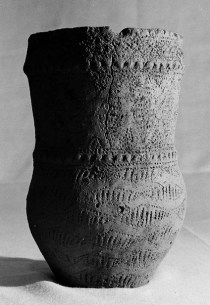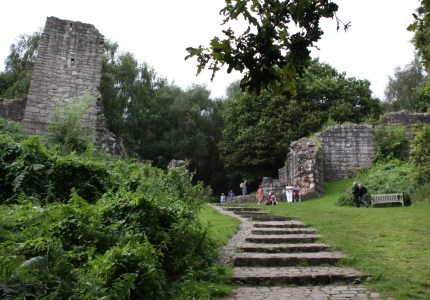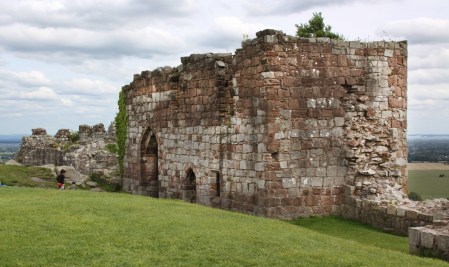
Category Archives: Prehistory

Part 1: Who was Brymbo Man, what was the Mold Cape and why do they matter?

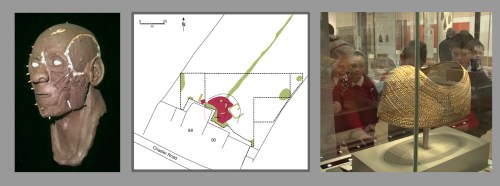
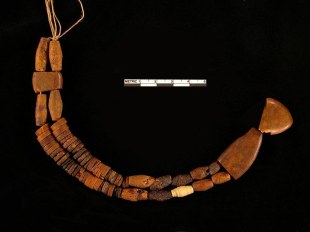
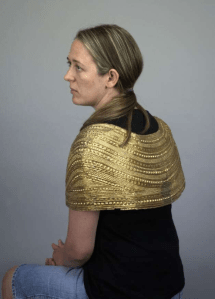
From left to right.  The Mold Cape and strings of amber beads superimposed on a digital sketch, which could be man or woman (Source: British Museum Partnership Programme); Photograph of the Wrexham County Borough Museum hologram of the reconstructed head of Brymbo Man (my photo); The recreated grave and capstone with original skeleton and grave goods of Brymbo Man in the Wrexham County Borough Museum (my photo).


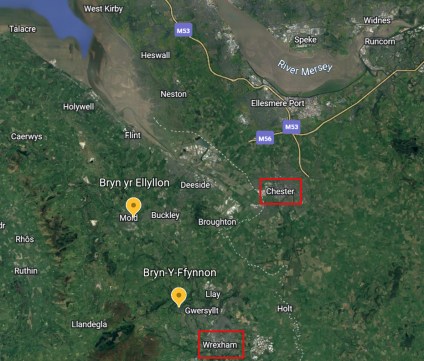
Bryn y Ffynon (Brymbo) and Bryn yr Ellyllon (Mold) indicated by yellow markers, shown in relation to Chester and Wrexham. courtesy of Google Earth. Click to enlarge.

This is part 1 of a four-part overview of two Early Bronze Age graves and how they contribute to an understanding of  the archaeology of the period in northeast Wales and the borders. All four parts have been written, and will be released over the next couple of weeks.

The series has been divided up as follows:

Part 1 (this post) – Introduction to the Late Neolithic and Early Bronze Age in northeast Wales:

  • Introduction
  • Some Background to the Late Neolithic and Early Bronze Age
  • A rich heritage in northeast Wales
  • Discovering the graves
  • Sources (bibliography) for all four parts 

Part 2 – What do we know about Bryn y Ffynnon, the grave of ‘Brymbo Man’?

Part 3 – What do we know about Bryn yr Ellyllon, where the Mold cape was found? 

Part 4 – Bringing the threads together, plus visiting details


Part 1: Introduction

The series is based on two burial finds in northeast Wales, Bryn yr Ellyllon, near Mold and Bryn y Ffynnon at Brymbo, Wrexham.  These two sites have been chosen 1) because excavated sites are comparatively unusual in northeast Wales, 2) the contents of both sites can be visited in museums, and 3) because of the differences between them, and the opportunity for assessing different types of knowledge about the Late Neolithic and Early Bronze Age in northeast Wales.  In spite of the differences between them, both represent variants of the broader burial tradition, and therefore have the potential to add their own unique voices to the discussion of how this period manifests itself in the region.

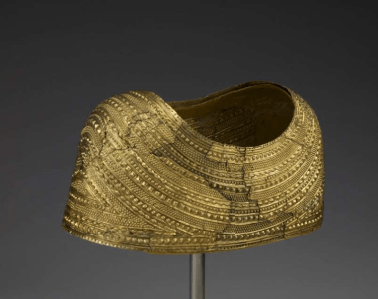
The Mold Cape (British Museum 188,0514.1) from Bryn yr Ellyllon near Mold. Source: British Museum

Bryn yr Ellyllon (which translates as Hill of Goblins or Fairies) was discovered by labourers in 1833 a few miles to the east of Mold.  It was a round cairn (a mound of stones) that contained a badly decayed skeleton together accompanied by a number of very fine artefacts, one of which is the magnificent gold Mold Cape made of paper-thin gold and embossed with a decorative theme that emulates multiple strings of beads.  The other objects included around 300 amber beads (the exact number found remains unknown, and only one survives), other pieces of gold that appear to have belonged to a second cape, and some poorly preserved items of bronze.  These are now in the British Museum in London and are discussed further below and in part 3.  Even though the objects were pulled from the site as pieces of treasure, the location of the site is known, and the objects form a relatively coherent assemblage.  These are valuable details when understanding how objects were chosen to accompany the dead, and where burial sites were located in the landscape.

The partial remains of Brymbo Man and his two grave goods from the Bryn y Ffynnon cist. Source: Peoples Collection Wales

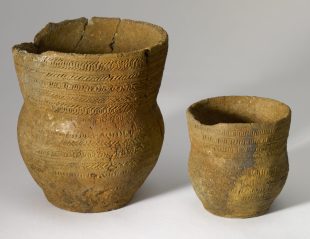
In 1958 a stone-line cist called Bryn y Ffynnon, was found 10 miles to the northwest of Wrexham at Brymbo, containing the well-preserved remains of a partial skeleton, a flint tool and a ceramic vessel known as a Beaker.  The name means Hill of the Well or Spring (with many thanks to Reginald Iain de Crawford-Griffin for the translation).  It seems to have been named for a small farm of the same name on Brymbo Hill.  The site was excavated in 1958, and the results published in an excavation report in 1959.  The man to whom the skeleton belonged, now nick-named Brymbo Man, was around 35 years old when he died some 3600 years ago.   The burial, including the skeletal remains, is now on display in the Wrexham County Borough Museum, together with a reconstruction of the skeleton’s face.  The site is discussed further below, and in detail in part 2.

Each burial offers contrasting insights into the Late Neolithic / Early Bronze Age, and they are worth looking at both individually and together to highlight how different sites may produced different types of knowledge.  Every individual site has something to say for itself, and as more sites are investigated, each feeds in turn into our knowledge about the period in which they were constructed, and during which they formed an integral part of the human landscape.  It is the  understanding of the period as a whole, rather than individual objects, that is important to archaeologists, who work to recreate past societies from the sites and objects that survive.

Some Background to the Late Neolithic and Early Bronze Age

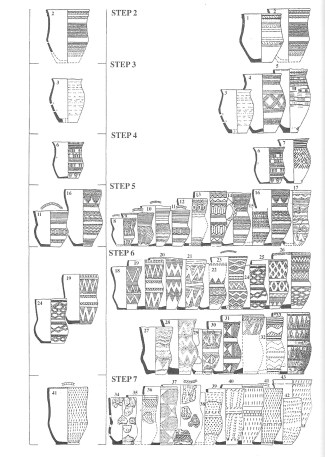
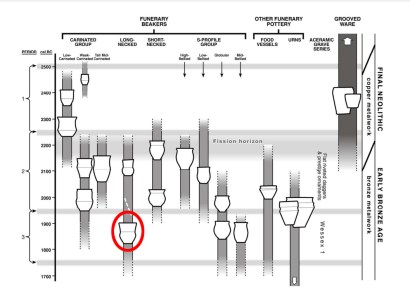
Chronology of ceramics in Britain, Late Neolithic and Early Bronze Age. Source: Parker-Pearson et al 2016

The Late Neolithic and Early Bronze Age are usually discussed together.  The period lasts from around 2900-1600 BC.   The division from the earlier Neolithic lies in transformations visible in the material record, which may in turn reflect revisions of ideology, social organization and/or economic activity.  These changes coincide with a period of climatic change.

Riverine connections during British prehistory, showing how the river network links from Wessex, the Thames valley and the Humber estuary. Source: Bradley 2019, p.20

The climate, cooler than in the earlier Neolithic, was still favourable for agriculture, and in particular may have supported agricultural development in hilly areas in the summer months.  Astrid Caseldine’s analysis of environmental indicators suggests that this was a period of deforestation in many parts of upland north Wales, probably indicative of agricultural expansion into these upland areas.  This is supported both by the notable increase in cereal pollen in these environments, and by the flowering of Late Neolithic – Early Bronze Age monuments across the upland landscape.  This expansion could not have lasted indefinitely; the soils were simply not of sufficiently robust quality to sustain long-term agricultural expansion.  Valleys were also popular locations for these sites, indicating that communities were adept at making the best of various different environments.  The valley of the river Alyn, along which several sites are located including Bryn yr Ellyllon and the Llong, is one example.

Foremost amongst the transformations in material culture, suggesting social as well as economic changes, is a different form of burial  practise, suggesting changes in the way that communities defined themselves and related to both others and the landscape.  Although there were a number of tomb styles prevalent in the earlier Neolithic, most burial sites contained the remains of multiple individuals, but at the end of the Neolithic and the beginning of the Bronze age, smaller round barrows and cairns were favoured, usually containing a single burial in a small subterranean chamber at its centre, sometimes with a new form of pottery known as a Beaker.  Sometimes additional burials added into the mound itself at a later date.  At the same time, settlements became less substantial, more ephemeral, and much less easy to find archaeologically, the sites often consisting of little more than household debris with few, if any, signs of the circular structures that once contained them.

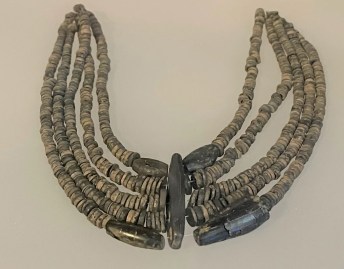
A suggested reconstruction of the 100s of beads found in the cairn at Llong, near Mold. Source: Curious Clwyd

Pottery styles also changed at this time, with the introduction of the new Beaker form from Europe and the replacement of earlier Neolithic styles with new home-grown Grooved Ware, Food Vessels and Collared Urns.  As the name Bronze Age suggests, this was also the period during which metal-working began, first copper and gold, and later bronze itself, an alloy of copper and tin.  North Wales was well placed as a base for the exploitation of mineral sources, an industry that gained momentum during the Early Bronze Age before becoming an important centre for copper and other resources in the Middle Bronze Age.  The earliest copper tools in Wales were flat axes that had been cast in an open mould, a basic technology that improved over time.  Decorative items, such as items of jewellery also appear much more frequently.  The amber beads in Bryn yr Ellyllon and the jet and shale beads in the necklace found in a cairn at Llong, near Mold, both in the valley of the river Alyn, are both examples from northeast Wales.

Although these are the top-level identifiers of the new Late Neolithic and Early Bronze Age material culture, there is considerable regional variation, and even within a region no two graves are identical.  Although inhumations (burials) are typical of barrow graves, cremation steadily gained momentum, eventually replacing inhumation as the preferred method for disposing of the dead.

A rich Early Bronze Age heritage in northeast Wales

The Maesmor Estate macehead from near Corwen (near Llangollen). Found in 1840. Source: National Museum of Wales

Northeast Wales was a recipient of these new ideas, perhaps deriving them from earlier versions in south Wales, or perhaps more plausibly from similar manifestations in northern England with which the northern Welsh material appears to have certain affinities.  The Bryn y Ffynnon Beaker, for example, bears a close resemblance to examples in northeast England, and stone maceheads from northeast Wales are comparable with those from the north of England, including a remarkable example from the Maesmor Estate at Llangwm near Corwen in the Ceirw river valley, not far from the Dee (shown left).  Good quality flint pieces for more mundane stone tools are unavailable in north Wales, and this appears to have been imported from elsewhere.  Yorkshire jet appears in northeast Wales during the Late Neolithic, as does amber. The nearest source of amber was the Baltic, but it also washed up on beaches along the Yorkshire coast.  Amber was found in Bryn yr Ellyllon with the golden cape;  jet (and black stone resembling jet) appears in the necklace, found scattered in a the stones of cairn at Llong, 1.5 miles (2.4km) southeast of Mold, overlying the burial of a crouched female skeleton. Although sea routes had dominated during the earlier Neolithic, the indications are that land and river routes now assumed a new importance, transforming networks of communication.

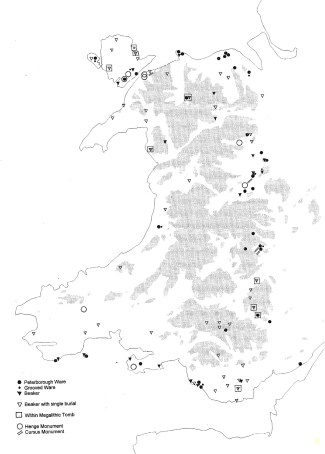
Distribution of round barrows and cairns in Wales. Source: Burrow 2011, p.106

However they arrived, the Early Neolithic and Early Bronze Age burial practices soon colonized northeast Wales, mainly round barrows (mounds of earth or turf) and cairns (mounds of stone) the majority of which, but by no means all, are thought to have been burial sites.  Here there were none of the earlier Neolithic monumental burials such as the so-called portal dolmens found in northwest Wales and on Anglesey.  There are 100s of mounds all over Wales, north and south, and there are particular concentrations in the northeast of Wales, and along the Welsh borders.  See the map right.  There are also a few other types of ceremonial monuments from the period, including stone circles and so-called henges.  Sadly, as explained above, there is a severe dearth of settlement sites.  Nearly all of the archaeological data available about the period in northeast Wales is derived from these round mounds, built of earth, turf, or stones.  Most have not been excavated, and many have become very overgrown over the millennia, making it difficult to differentiate between them.  Where they have been investigated, a number of different types have been identified, based on features like kerb stones, berms and ditches.  Some round barrows and cairns are completely empty of burials, but may perform a similar function in terms of looking like a burial site and establishing a presence in the landscape.

Source: Prehistoric Funerary and Ritual Monuments in Flintshire and Wrexham, by Frances Lynch 2003

Of the round barrows found in northeast Wales, some have been recorded but are no longer visible.  Others are visible, either as monuments or as crop marks in aerial photographs, but have not been examined.  Some were excavated before sound archaeological techniques were developed, and just a few have been subject to modern archaeological investigation.  In all, it’s a very mixed bag of data, but it all points to a very busy Welsh heritage during the Early Bronze Age period.

When Frances Lynch discussed the survey of Bronze Age monuments in Flintshire and Wrexham in 2003, she included a table that listed 284 monuments, capturing particular concentrations of Early Bronze Age burial activity on Ruabon Mountain and in the Alyn Valley. What is interesting about her list is the sheer number of round barrows when compared to any other type of contemporary monument.  A single stone circle and a possible henge (ceremonial monuments) are recorded.  Lynch makes the point that sites located side by side may or may not be directly related to one another, but even so, a landscape stuffed full or more or less contemporary monuments is a notable phenomenon.

1991 map showing the distribution of scheduled Bronze Age barrows and major finds spots in Clwyd.  Scheduled monuments are those that are under state protection, but there are many more that are not scheduled, so this shows only those sites deemed to be most important. Source: Manley et al 1991, p.66

To understand the Late Neolithic and Early Bronze Age, other types of site would normally be taken into consideration, a mix of domestic, funerary and ritual sites.  These include other ceremonial sites, industrial sites like kilns, quarries and mines, and settlements.   A combination of sites helps to create a sense of what the lived area was like.  The profusion of round mounds argues that northeast Wales was clearly well populated, but settlement and industrial sites remain very rare, although the copper mine at the Great Orme stands out as a notable and welcome exception.  In spite of these gaps, prehistorian Frances Lynch, who specializes in Welsh archaeology, suggests that these prolific barrow builders were far from insular, and that they were part of larger networks of communication

“Although the social character of Wales was perhaps more conservative than that of many parts of Britain, the country was not isolated.  The presence of exotic beads made of amber, faience and jet demonstrates that even quite remote communities could obtain luxuries from a distance and that fashions in clothes, as far as we can reconstruct them, changed in step with those elsewhere.” (Lynch 2000 p.138)

I will be talking more about grave distribution and how these two graves fit into the general picture in part 4.

Discovering the graves

The two sites under discussion were found 125 years apart.  That 125 years accounts for how differently each site was treated by its finders. Both sites were discovered by workmen.  Bryn yr Ellyllon, which contained the Mold Cape, was found in 1833 and Bryn y Ffynnon (Brymbo) was found in 1958.  The grave at Bryn yr Ellyllon on the eastern outskirts of Mold, was discovered on the banks of the River Alyn, by accident by workmen in 1833, using stones from the cairn (stone mound) that covered the cist and its contents to fill in a disused gravel pit at the side of a road.  Similarly, Bryn y Ffynnon, was found by workmen building a new housing estate.  They were laying pipes, for which they were digging a new trench  in Cheshire View in the village of Brymbo.

Bryn yr Ellyllon (containing the Mold Cape and accompanying grave goods)

Imaginative reconstruction of the discovery of the Mold Cape at Bryn yr Ellyllon by Tony Daly.  It is far more likely that the skeleton was lying on its side, and we know that the cape was in pieces.  Still, it is a useful way of visualizing how the site was uncovered.  Source: British Museum Partnership Programme

An early 19th century discovery is almost inevitably bad news for a site in terms of excavation techniques, the proper recording of archaeological finds and the finding and preservation of delicate organic remains, such as, for example, very small pieces of human skeletal material, animal bones, plant remains, foodstuffs and any fabrics or bits of basketry.  Even so, if the Bryn yr Ellyllon grave had been subjected to any form of contemporary archaeological investigation it would have fared better than it did.

When the labourers at the Bryn yr Ellyllon grave found the treasures that accompanied a decayed skeleton, they simply disposed of the bones and divided the spoils between themselves and the landowner John Longford.  No records were made of the skeleton, and any contents that could be expected within the cairn itself, such as any secondary burials or artefacts within its structure, were lost. It is possible that other more pedestrian objects like stone tools may have been in the grave but, like the skeleton, were disposed of at the time.  Had it not been for the Reverend Charles Butler Clough, the vicar of Mold, the find might never have come to academic light, and its discovery by a team of labourers would have been the kiss of death.  Fortunately, the Reverend Clough heard of the find and took great interest in it, writing a letter to John Gage, in which he described the find, referring to the cape as a corselet:

I regret to say, that the Corselet suffered considerable mutilation. Mr. Langford, upon its discovery, having no idea of its value, threw it into a hedge, and told the workmen to bring it with them when they returned home to dinner. In the mean time several persons broke small pieces off it, and after I saw it, one piece of gold, apparently a shoulder strap, which was entire (or piece passing over the shoulder from the front to the back of the arm) was taken away ; two small pieces, of what I believe to have been (from its similarity to what I had seen) the other shoulder strap, with several small pieces of copper upon which the gold was fixed, are still in Mr. Langford’s possession; several rings and breast pins have been made out of the pieces carried away.

Illustration of the Mold Cape  and fragments of a different cape from the same grave, all found in 1833. Source: Gage 1835

Hair-raising stuff.  It was common for the clergy to write up this sort of discovery, as they were frequently the most scholarly and informed people around, and often had a profound interest in history.  It is because of the Reverend Clough that anything at all is known about the grave beyond the surviving grave goods. His report was published in the journal Archaeologia in 1836, three years after the discovery, and the British Museum picked up on it and went to Mold to see if they could rescue the finds.  It took over a century for enough of the pieces of the cape to be assembled for a reconstruction to be made (in the 1960s).  Some fragments are still missing presumably those that Clough said had been recycled into rings and pins.

A geophysical survey was carried out in 2013, hoping to find either the site itself or anything associated with it, but its findings were limited to the discovery of the possible original site of the cairn, estimated at 25m in diameter.

The grave contents are now in the British Museum in London and the cape itself was featured in Neil MacGregor’s radio series (and the book that followed) “A History of the World in 100 Objects,” based on objects in the British Museum.  In 2013 it was loaned to Wrexham County Borough Museum where it was put on display for five weeks, together with Llong shale and jet necklace, discovered in another burial nearby.  It is is decorated with impressed designs, and absolutely remarkable for the skill required to work something so thin.

Bryn y Ffynnon (the grave of “Brymbo Man”)

The 1950s Brymbo housing estate, during the construction of which the Bryn y Ffynnon grave was found.  Its rural surroundings are clearly visible. Source: Archwilio

Bryn y Ffynnon was found in 1958, and was very soon the subject of professional excavation.  The workmen laying pipes for a new housing estate on the outskirts of Brymbo had stumbled across the corner of a vast slab of stone when they dug down to create a trench, about 30 cm (1ft) below the modern surface.  When they investigated further, they found that it was the roughly hewn capstone (lid) of a cist (stone-lined rectangular grave)., which contained a burial and two artefacts:  a pot and a flint tool.  They removed the long bones and the beaker, for reasons unknown, but left the rest undisturbed.

Even in 1958, archaeology had not come of age in Britain.  Radiocarbon dating had been invented but was still giving inaccurate dates, and was not calibrated (corrected) until 1967, after which many further modifications were made.  Field techniques had not yet been fully refined, although they were improving all the time.  Nor was there the same awareness that there is today of the value of leaving discoveries like this in situ, like a crime scene, so that they objects can be understood in relation to one another as they were deposited, in keeping with the intentions of those who interred the deceased and the grave goods.

The importance of relationships between objects, such as placement of finds near the head, hands or feet, help archaeologists to understand the lost language of ritual practises, just as the positioning of the skeleton itself, including its orientation (e.g. north-south) and the direction in which it was facing (e.g. east or west)  help to understand how widespread these traditions and ideas actually were.

It is particularly nice, therefore, that in spite of the fact that the burial was found in the middle of a construction site, the details were passed over to the Grosvenor Museum in Chester, who in turn passed the news over to the National Museum of Wales to enable them to send a team and excavate the site as a rescue dig.  The aim of rescue archaeology is to recover as much data and material as possible at a site in the allotted time before the halted construction or other activity must resume.  Many rescue digs were carried out in the countryside during the 1950s due to the expansion of housing on formerly rural land.  Without a cairn or barrow to signal its presence, the cist was only found whilst work was already underway, and work had to stop to allow the site to be excavated.

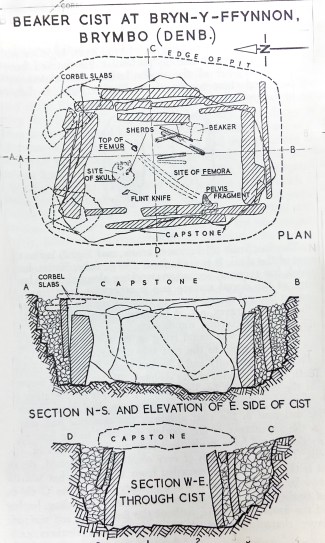
Plan and elevation by H.N. Savory published in 1959, showing the grave, together with its contents, as it was found in 1958.  Source: Transactions of Denbighshire Historical Society

When they arrived on site, the National Museum of Wales archaeologist H.N. Savory and his team were able to replace the bones in their original position and went on to record the entire grave in situ before removing the grave, slabs and all, to enable the pipe-laying to proceed.

The following year Savory published a short but comprehensive excavation report with illustrations in 1959 in the Transactions of Denbighshire Historical Society, not yet digitized but available today in the public library in Wrexham.  The plan and elevation of the grave is taken from that publication.

The grave and its contents were initially sent to Cardiff, where they were put on display in the National Museum of Wales, but are now in the Wrexham County Borough Museum.  The grave is excellently displayed.  The skeleton has been nick-named Brymbo Man.  A reconstruction of the head, based on the remains of the skull, gives Brymbo Man a possible face, also on display in the museum.

In Part 2, both Savory’s excavation, together with the later post-excavation work that took place, will be discussed.

Final Comments on Part 1

Northeast Wales is home to 100s of round barrows.  There are even two in Wrexham itself, miracle survivors of urban development.  Not enough sites have been excavated to be able to talk in terms of a typical site, but both both sites stand out for the quality of their artefacts.  Although the Beaker in Bryn yr Ffynon is not a rare piece, it is certainly unusual in this area, at least in the context of our current knowledge, and the Mold cape is acknowledged as a national treasure.

Photograph on display in the Wrexham County Borough Museum of Bryn y Ffynnon being excavated during the construction of a new housing estate.

Neither site was found under ideal circumstances, but Bryn y Ffynnon fared much better than Bryn yr Ellyllon, due almost entirely to the 125 years between the two discovery dates, and the much greater awareness of the value of archaeological sites, and their protection by law.  In a field where funding is always an uphill battle, it is often due to accidental findings during construction work that result in excavations.  Ironically, given that it signals the destruction of a site, rescue archaeology is enormously helpful in filling out the picture of archaeological periods, but it is relatively rare that such rescue work is required in rural areas.  It was only because of the expansion of Brymbo into the surrounding countryside that Bryn y Ffynnon was discovered and rescued.  What this means, in practical terms, is that the recovery of the archaeology of northeast Wales will inevitably remain piecemeal, as funding for excavation (and post-excavation analysis) is secured on a case by case basis, or as other rescue opportunities arise.

Each burial and its accompanying objects will be discussed in much greater depth in the next two posts, Bryn yr Ffynon (Brymbo) posted in part 2 and Bryn yr Ellyllon (Mold), posted in part 3.  In part 4 all the strands are brought together to talk about how the two sites contribute to what is known of the archaeology of northeast Wales and the borders.


Sources:

Books, booklets and papers:

Armit, I., and Reich, D. 2021. The return of the Beaker folk? Rethinking migration and population change in British prehistory. Antiquity, 95 (384), 1464-1477
https://www.cambridge.org/core/journals/antiquity/article/return-of-the-beaker-folk-rethinking-migration-and-population-change-in-british-prehistory/ABF13307796A0476353FA8D2DA38A21A

Bradley, R. 2019 (2nd edition).  The Prehistory of Britain and Ireland. Cambridge University Press

British Museum Partnership Programme, (no date). The Mold Cape. A Prehistoric Masterpiece from North-East Wales. (Dual language, Welsh and English). National Museum of Wales and Wrexham County Borough Museum.

Brück, J. 2004. Material Metaphors. The Relational Construction of Identity in Early Bronze Age Burials in Ireland and Britain.  Journal of Social Archaeology, vol.4(3), p.307-333

Brück, J. 2008. The Architecture of Routine Life.  In Pollard, J. (ed.) Prehistoric Britain. Blackwell, p.248-267

Brück, J., & Booth, T. 2022. The Power of Relics: The Curation of Human Bone in British Bronze Age Burials. European Journal of Archaeology, p.1-23
https://www.cambridge.org/core/journals/european-journal-of-archaeology/article/power-of-relics-the-curation-of-human-bone-in-british-bronze-age-burials/54F72F3A23123CE92393929753F6765D

Burrow, S. 2011.  Shadowland. Wales 3000-1500BC.  Oxbow Books / National Museum of Wales

Caseldine, A. 1990.  Environmental Archaeology in Wales. Department of Archaeology, St David’s University College, Lampeter
https://archive.org/details/environmentalarc0000case/page/n1/mode/2up

Clark, J. 1932. The Date of the Plano-Convex Flint-Knife in England and Wales. The Antiquaries Journal, 12(2), p.158-162.

Clarke, D.V., Cowie, T.G. and Foxon, A. 1985.  Symbols of Power at the Age of Stonehenge. National Museum of Antiquities, Scotland.

Clwyd-Powys Archaeological Trust.  Mold Gold! Newsletter Autumn 2007
https://cpat.org.uk/wp-content/uploads/2018/12/CPAT-Autumn-2007-1.pdf

Duhig, Corinne. n.d. The Skeleton from Bryn-Y-Ffynon, Brymbo (“Brymbo Man”), Unpublished, Wolfson College, Cambridge. (With many thanks to Rhiannon Pettitt for sending it to me)

Dutton, A., Fasham, P., Jenkins, D., Caseldine, A., & Hamilton-Dyer, S.,1994. Prehistoric Copper Mining on the Great Orme, Llandudno, Gwynedd. Proceedings of the Prehistoric Society, 60(1), p.245-286

Frieman, C. 2012. Going to pieces at the funeral: Completeness and complexity in early Bronze Age jet ‘necklace’ assemblages.  Journal of Social Archaeology, 0(0), p.1-22
https://www.researchgate.net/publication/258157952_Going_to_pieces_at_the_funeral_Completeness_and_complexity_in_early_Bronze_Age_jet_%27necklace%27_assemblages

Fowler, Chris, 2013.  The Emergent Past. A Relational Realist Archaeology of Early Bronze Age Mortuary Practices. Oxford University Press

Gage, J. 1835.  XXII. A Letter from JOHN GAGE, Esq. F.R.S., Director, to Sir HENRY ELLIS, K.H., F.R.S., Secretary, accompanying a Gold British Corselet exhibited to the Society, and since purchased by the Trustees of the British Museum.  Read 17th December, 1835
[includes extracts from Reverend Clough’s and Mr Langford’s letters]

Harris, C. and Kaiser, A. 2020. Burying the Hatchet.  Revue d’Économie Politique, November-December 2020/6 (vol.130), p.1025-1044
https://papers.ssrn.com/sol3/papers.cfm?abstract_id=3701375

Harris, S. 2019. Chapter 7 – The Challenge of Textiles in Early Bronze Age Burials: Fragments of Magnificence. In: The Textile Revolution in Bronze Age Europe.  Production, Specialisation, Consumption, ed. Sabatini S. and Bergerbrant, S. Cambridge University Press, p.154-196. 

Hoole, M, Sheridan, A, Boyle, A, Booth, T, Brace, S, Diekmann, Y, Olalde, I, Thomas, M, Barnes, I, Evans, J, Chenery, C, Sloane, H, Morrison, H, Fraser, S, Timpany, S and Hamilton, D 2018 ‘“Ava”: a Beaker-associated woman from a cist at Achavanich, Highland, and the story of her (re-)discovery and subsequent study’, Proceedings of the Society of Antiquaries of Scotland 147:
73-118.
http://journals.socantscot.org/index.php/psas/article/view/10106

Hurcombe, L.M. 2014. Perishable Material Culture in Prehistory. Investigating the Missing Majority. Routledge

Johnson, N. 2017.  Early Bronze Age Barrows of the Anglo-Welsh Border. BAR British Series 632

Jones, A. 2008. How The Dead Live:  Mortuary Practices, Memory and the Ancestors in Neolithic and Early Bronze Age Britain and Ireland.  In Pollard, J. (ed.) Prehistoric Britain. Blackwell, p.177-201

Jones, N.W. 2000. Prehistoric Funerary & Ritual Sites:  Flintshire and Wrexham. Project Report.  Clwyd-Powys Archaeological Trust, March 2000.
http://www.walesher1974.org/herumd.php?group=CPAT&level=3&docid=301338460

Lanting, J.N. and van der Waals, J.D. 1972. British Beakers as seen from the Continent, Helinium 12, p.20-46

Lewis A 1990, Underground exploration of the Great Orme copper mines in (eds.) Crew, P. and Crew, S., Early mining in the British Isles, Plas Tan y Bwlch, p.5-10

Lloyd, J.Y.W. 1885. The History of the Princes, the Lords Marcher and the ancient nobility of Powys Fadoc and the Ancient Lords of Arwystli, Cedewen and Merionydd.  Whiting and Co, London.
https://archive.org/details/historyofprinces05lloy

Lynch, F. 1983. Report on the Excavation  of a Bronze Age Barrow at Llong, near Mold.  Journal  of Flintshire Historical Society, 31, p.13-28

Lynch, F. 1991. The Bronze Age.  In Manley, J., Grenter, S and Gale, G. (eds.) The Archaeology of Clwyd. Archaeology Service Clwyd, p.55-81

Lynch, F. 2000.  The Later Neolithic and Earlier Bronze Age.  In. Lynch, F., Aldhouse-Green, S., and Davies, J.L. (eds.) Prehistoric Wales. Sutton Publishing

Lynch, F. 2003. Prehistoric Funerary and Ritual Monuments in Flintshire and Wrexham, Flintshire Historical Society Journal, Vol 36 (2003), p.19-31

MacGregor, N. 2020.  A History of the World in 100 Objects.  Penguin

Morgan, D.E.M. 1990. Bronze Age Metalwork from Flintshire. North West Archaeological Trust, Report No.4

Morgan, V. and Morgan, P. 2004.  Prehistoric Cheshire.  Landmark Collections Library

Needham, S. 2012, Putting capes into context: Mold at the heart of a domain. In Britnell, W. J. & Silvester, R. J. (eds.) Reflections on the past: essays in honour of Frances Lynch. Welshpool, Cambrian Archaeological Association, pp. 210-236

O’Brien, W. 1996.  Bronze Age Copper Mining in Britain and Ireland. Shire Archaeology.

Olalde, O. 2017. The Beaker Phenomenon and the Genomic Transformation of Northwest Europe.  bioRxiv May 2017
https://www.biorxiv.org/content/10.1101/135962v1.full.pdf

Parker-Pearson, M., Chamberlain, A., Jay, M., Richards, M., and Sheridan, A., Curtis, N., Evans, J., Gibson, A., Hutchison, M., Mahoney, P., Marshall, P. Montgomery, J. Needham, S. O’Mahoney,  S. Sandra, Pellegrini, M. and and Wilkin, N. 2016.  Bell Beaker people in Britain: migration, mobility and diet. Antiquity., 90 (351), p. 620-637
https://www.researchgate.net/publication/303316762_Beaker_people_in_Britain_Migration_mobility_and_diet

Powell, T.G.E. 1953. The Gold Ornament from Mold, Flintshire North Wales.  Proceedings of the Prehistoric Society 19, p.161-79

Ray, K. and Thomas, J. 2018.  Neolithic Britain. The Transformation of Social Worlds.  Oxford University Press

Savory, H. N. 1959. A Beaker Cist at Brymbo. Transactions of Denbighshire Historical Society, Iss. 8, Vol.8, p.11-17

Sheridan, A. 2008. Towards a fuller, more nuanced narrative of Chalcolithic and Early Bronze Age Britain 2500-1500 BC.  Bronze Age Review. vol.1, British Museum
https://britishmuseum.iro.bl.uk/concern/articles/28723733-e7b7-4726-aa04-1d89ad647048

Taylor, J. 1985. Gold and Silver. In (eds.) Clarke, D.V., Cowie, T.G. and Foxon, A.  Symbols of Power at the Age of Stonehenge. National Museum of Antiquities, Scotland
https://archive.org/details/symbolsofpowerat0000clar/page/n359/mode/2up

Taylor, J.A. 1980. Environmental changes in Wales during the Holocene period in Taylor, J.A. (ed.) Culture and Environment in Prehistoric Wales.  British Archaeological Reports British Series 76

Thomas, J. 1991.  Reading the Body.  Beaker Funerary Practice in Britain. In (eds.) Garwood, Jennings, D., Skeates, R and Toms, J.  Sacred and Profane: Proceedings of a Conference on Archaeology, Ritual and Religion, Oxford, 1989.  Oxbow Books

Thomas, J. 2007, Three Bronze Age Round Barrows at Cossington: A History of Use and Re-Use. Transactions of Leicestershire Archaeological and Historical Society 81 (2007), p.35-63
https://www.le.ac.uk/lahs/downloads/2007/2007%20(81)%2035-63%20Thomas.pdf

Timberlake, S. and Marshall, P. 2014.  The beginnings of metal production in Britain: a new light on the exploitation of ores and the dates of Bronze Age mines.  Historical Metallurgy 47(1), p.75-92
https://hmsjournal.org/index.php/home/article/download/112/109/109

Young, T. 2013.  GeoArch Report 2013/20, Geophysical survey of the supposed findspot of the ‘Gold Cape’, Bryn-yr-ellyllon, Mold, Flintshire (pt 2), 29th September 2013
https://museum.wales/media/30592/2013-20-Geophysical-survey-at-Mold-pt2.pdf

Waddinton, C. 2004. The Joy of Flint. Museum of Antiquities, University of Newcastle upon Tyne
https://www.archaeologicalresearchservices.com/wp-content/uploads/2022/06/JoyofFlint_1.pdf

Woodward, A. 2000.  British Barrows: A Matter of Life and Death.  Tempus.

Woodward, A. 2002. Beads and Beakers: heirlooms and relics in the British Early Bronze Age. Antiquity 76, p.1040-47

Websites:

Advanced Amber Kretaceous Zoologia (AAKZ)
British Amber
http://www.aakz.com/British-and-Irish-amber.html

ARCHAEO-death by Howard Williams
Questions for Brymbo Man
https://howardwilliamsblog.wordpress.com/2015/08/05/questions-for-brymbo-man/

Archwilio
CPAT Regional Historic Environment Record Mold: Bryn-yr-ellyllon, Geophysical survey, 2013
https://archwilio.org.uk/her/chi3/report/page.php?watprn=CPAT166880&dbname=cpat&tbname=event&sessid=CHI39bx3hf5&queryid=Q883547001681323677

BBC News
Great Orme: Rare Bronze Age axe mould declared treasure, June 1st 2022
https://www.bbc.co.uk/news/uk-wales-61663012

British Museum
Cape
https://www.britishmuseum.org/collection/object/H_1836-0902-1

Clwyd-Powys Archaeological Trust
Mold Gold!
CPAT Newsletter, Autumn 2007, p.6-8
https://cpat.org.uk/wp-content/uploads/2018/12/CPAT-Autumn-2007-1.pdf

Current Archaeology
December 1st 2016
The Cist on Whitehorse Hill
https://archaeology.co.uk/articles/features/cist-whitehorse-hill.htm
October 1st 2018
Spinning the tale of prehistoric textiles
https://archaeology.co.uk/articles/news/spinning-the-tale-of-prehistoric-textiles.htm

Dartmoor National Park
Whitehorse Hill
https://www.dartmoor.gov.uk/wildlife-and-heritage/heritage/bronze-age/whitehorse-hill

The Fire on the Hill
Index of Brymbo Placenames
https://thefireonthehill.wordpress.com/index-of-places/

Getty Museum
The Properties of Amber
https://www.getty.edu/publications/ambers/intro/6/

The Independent
Discovery of vast treasure trove of fine textiles shows importance of fashion to Bronze Age Britons by David Keys, 14th July 2016
https://www.independent.co.uk/news/science/archaeology/vast-treasure-trove-of-fine-textiles-shows-importance-of-fashion-to-bronze-age-britons-a7135786.html 

Mellor Archaeological Trust
Necklace of Amber Beads
https://www.mellorarchaeology-2000-2010.org.uk/archaeology/finds/amberbeads.htm

PBS Time Team America
Isotope Analysis
http://timeteam.lunchbox.pbs.org/time-team/experience-archaeology/isotope-analysis/

Wrexham County Borough Museums and Archives
Brymbo Man Revealed
https://www.wrexhamheritage.wales/brymbo-man/

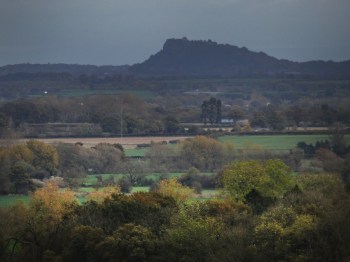
Beeston Crag Prehistory #1 – The Earlier Prehistory

Beeston crag is a superb landmark, a small outcrop of the Cheshire Sandstone Ridge that was first occupied by people during the post-glacial period. Today, Beeston crag’s main claim to fame is the ruined 13th Century castle of Ranulf III, 6th Earl of Chester, built to intimidate his enemies, impress his allies, and provide himself with a magnificent legacy.  Following the Ranulf III’s death in 1232 and the subsequent death of his heir in 1235, the castle was repaired and rebuilt on several occasions until the 17th century when it was deliberately destroyed.  After this, the romance of the ruins attracted artists and tourist alike.  Today it is managed by English Heritage and is an engaging visitor attraction.  This has all been covered on two previous posts. Ranulf III’s Beeston Castle Part 1 looks at the remarkable magnate Ranulf III;  Ranulf III’s Beeston Castle Part 2 describes the castle’s history and includes notes about visiting.
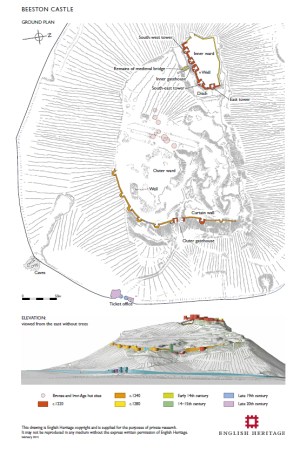
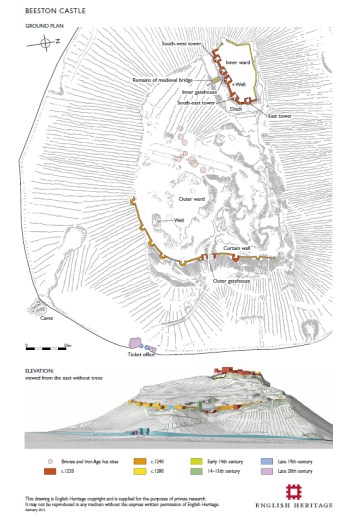
Beeston Castle, showing the excavated Bronze Age and Iron Age posthole locations, marking hut circles in the outer ward (pink circles).  The outer ward fortifications followed some of the lines of the Iron Age defences and the earlier Bronze Age banks.  Both contemporary and earlier prehistoric sites were also found in other parts of the site.  Source: Liddiard and Swallow 2007

Hidden beneath all of this rich Medieval and Civil War history is the archaeological story of the crag before history began.  The  impressive Medieval fortifications incorporate the remains of an invisible but remarkable prehistoric past, making the same use of a formidable location  that dominates the Cheshire plain, with clear views to the north, east and west, providing safety from predatory animals in what was dense woodland below.  Archaeologists between the 1960s and 1980s excavated these remains of the area’s prehistoric activity, some of it very exciting.

Although the Cheshire Sandstone Ridge as a whole is rich in prehistoric sites, in these two posts I simply want to get to grips with some of this particular crag’s prehistoric past.  I have divided Beeston’s prehistory into a post about the earlier  prehistory (in this part, part 1) and the later prehistory (in part 2).  Other sites on the ridge will be mentioned in passing, and future posts will discuss what all of the research on the Cheshire Sandstone Ridge contributes to our knowledge of prehistory in Cheshire.

For anyone wanting to find out more about each of the periods of British prehistory mentioned, some excellent books are listed in the Sources at the end of each of the two posts.

This post has been divided into the following sections:

  • Survey and excavation history
  • A note on the Three Age system
  • The role of the geology, geography and environment
  • The archaeological sequence at Beeston
  • Raw material acquisition at early prehistoric Beeston
  • Final comments
  • Next
  • Sources

Survey and excavation history

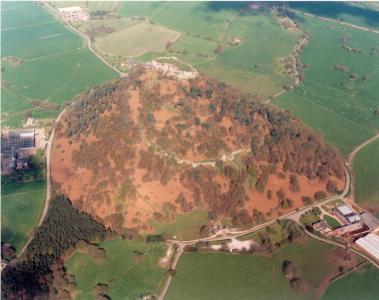
Aerial view over Beeston crag showing its prominent position over the landscape. Source: Sandstone Ridge Trust

Some of the hillforts on the Cheshire Sandstone Ridge were excavated in the mid-1930s by William Varley, an archaeologist with the University of Liverpool.  His excavations were focused on  hillforts, and although there were some inconsistencies is his approach, and his interpretations are sometimes questioned, he established that there was information under the ground along the ridge, and that it was worth investigating further.  Varley bypassed Beeston, but thirty years later new excavations filled this gap, focusing on both prehistoric and Mediaeval remains, a suitable endorsement of Varley’s initial exploratory work.
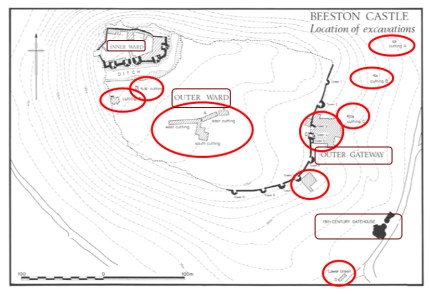
In the excavations of the 1960s-80s there were two main concentrations of excavation, one in the centre of the outer ward, and another by the outer gateway. Another fairly large area was opened to the south of the outer gateway, and some small cuttings were opened in other areas. Source: Ellis 1993 (with red circles added)

Two closely connected stretches of investigation are responsible for our understanding of the prehistory of the Beeston.  These are Laurence Keen’s work between 1968 and 1973 and Peter Hough’s work between 1975 and 1985.  These excavations found evidence of early as well as later prehistory, and made use of radiocarbon dating to establish a sound chronological sequence.    The account on this blog post makes extensive use of those excavations, reported in Beeston Castle, Cheshire. Excavations by Laurence Keen and Peter Hough, 1968-1985 edited by Peter Ellis and published by  English Heritage in 1993. Unfortunately, many of the tables and images were on microfiche, and although the core text is now available for download, the microfiches have presumably not been digitized.
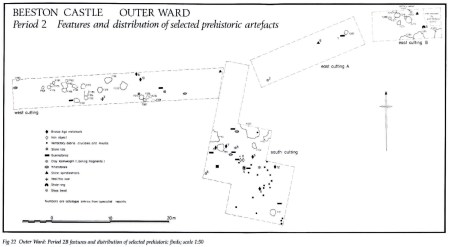
Plan of the Outer Ward excavation findings. Source: Ellis 1993

Although a lot of interpretive schemes in archaeology extrapolate from very small samples of big sites, particularly hillforts, in the case of the Keen and Hough excavations, there were two reasonably large areas where the work was concentrated, a smaller but still significant trench and several useful cuttings to sample other areas within the locale.  It is by no means straightforward to collate all this information into a coherent narrative, even if that is actually desirable with this sort of sampling, but some very useful findings were reported.

Some of the results of one of the sub-surface surveys in 2010. Source:  an unpublished report, via Garner 2016.

No recent excavation has taken place at Beeston, but a series of geophysical and LiDAR (Light Detection and Ranging) surveys were carried out by the Habitats and Hillforts Project in 2009 and 2010, at the outer ward and outer gateway.  Although these produced no definitive results, they did identify some anomalies that could indicate where future excavation projects might concentrate their attentions.  Much of the Habitats and Hillforts work has been published.  Dan Garner’s 2012 short introductory booklet  Hillforts of the Cheshire Sandstone Ridge, which looks at multiple periods of occupation, is very useful for becoming acquainted with the Cheshire Ridge archaeology.  Garner’s 2016 academic volume Hillforts of the Cheshire  Ridge is of considerable value for understanding both previous and current survey and excavation works at the other Cheshire Sandston Ridge sites in greater detail, particularly Eddisbury Hillfort.

A note on the Three-Age system
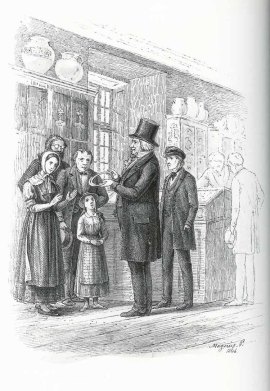
Thomsen explaining the Three-age System in Copenhagen, 1846. Drawing by Magnus Petersen, Thomsen’s illustrator. Source: Wikipedia

The 19th Century vision of a Three Age System, (Stone Age, Bronze Age and Iron Age), devised by Danish antiquarian Christian Jürgensen Thomsen and published in 1836,  was a spirited attempt to create a chronological framework for Danish prehistory that was widely adopted.  It became associated with the idea that technological innovations were inextricably linked to human progress and, by extension, the superiority of industrial nations.

Although ideas have now changed, the Three Age system is still the main organizing framework within which prehistory is discussed.  Having noted that the early Neolithic (New Stone Age) is an extension of the Mesolithic (Middle Stone Age), that the later Neolithic segues into the Early Bronze Age, as does the later Bronze Age into the early Iron Age, it is possible to move on.  These issues are all dealt with comprehensively in the academic literature.  The Three Age model still provides a framework within which most prehistoric archaeology is bashed out and bullied into shape, and as long as its limitations are kept to the fore, it need not be a wholly unyielding strait-jacket.

The role of geology, geography and environment
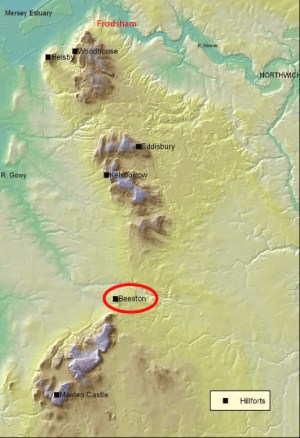
The location of Beeston within the Cheshire Sandston Ridge. Source: Garner 2012 (with red ring added)

Beeston is part of the fabulous Cheshire Sandstone Ridge, and those who selected it as an ideal place to settle, either temporarily or in the long-term, were presumably attracted by its height 150m above sea level, its location in a vast area of mixed deciduous woodland and, eventually, its defensive potential.

From a distance this prominent piece of geology looks like a complete anomaly, rising like a fossilized dinosaur’s spine out of the Cheshire Sandstone Ridge, knobbly and incomplete, but obviously the product of the same geological engine, the rocky components of the same machine.  Beeston sits towards the southern end of the ridge.  The Cheshire plain spreads from its base in all directions, the hills of the Welsh foothills to the west and the Peak district to the northeast, visible only in the far distance.  The Cheshire Sandstone Ridge is made up of desert sands and pebbles up to 225 million years old.  Questions about how the ridge formed and why it looks as it does are going to have to be the subject of a future post, written by someone else, but its upstanding presence in the otherwise flat landscape tell us, on its own, something about the prehistoric communities that, on and off over a period of nearly 8000 years, decided that it was a good place in which to camp or settle.
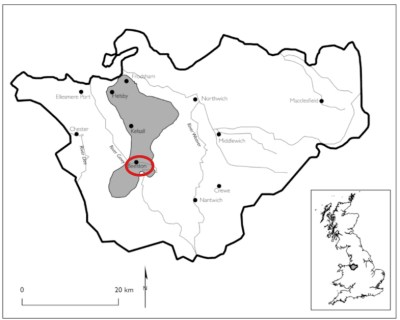
Archaeologically speaking, the sandstone composition is interesting because sandstone does not contain any of the stone types used used for the manufacture of stone tools.  This means that the flint and chert used for such tools was brought here from somewhere else.  This suggests not only that people were here for something other than the raw materials for tool manufacture but that they had to bring either the stone for tool manufacture with them, or the tools themselves.
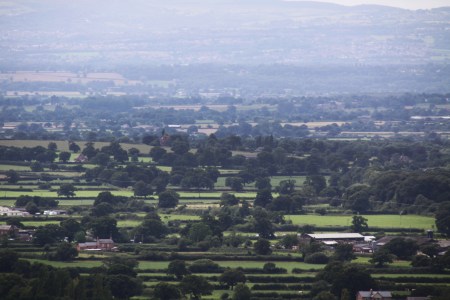
View from Beeston crag today west towards the Welsh foothills. In the Mesolithic and early Neolithic this would have been dense woodland. Clearance on the plain started in the later Neolithic but probably did not make significant changes to the patterns of vegetation until the mid Bronze Age to early Iron Age.

What the Cheshire Ridge has in abundance, other than sandstone, is height.  This provides truly impressive visibility across the landscape, as well as respite from the dense woodland below.  Whether or not the views across the plain would have been much use in earlier prehistoric phases is debateable, as the dense woodland would have disguised the approach of any but the largest groups of people.  Even after extensive woodland clearance had carved out agricultural fields,  this might have remained true.  On the other hand, lines of sight to other communities on other parts of the ridge might have been important, and clear views of weather fronts could also have been value.  Respite from dense woodland may have been relevant, especially when brown bear and wolves stalked the plains in hunt of meat of any description.  The best way to avoid becoming something else’s dinner is always to remove oneself from its preferred habitat.  It’s not a fool-proof strategy, but it’s certainly a step in the right direction.
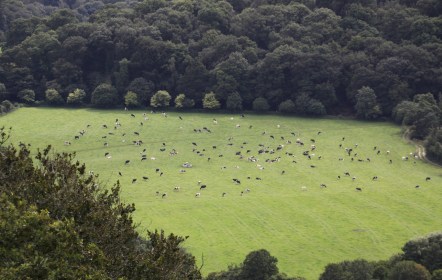
Cattle grazing in a field below Beeston.

According to the Sandstone Ridge Trust, farming remains the major land use, with livestock farming dominating the area.  This is interesting, as it tends to confirm the general impression that the damp clays of the Cheshire plain would have been difficult to cultivate in the past, particularly in early prehistory when the environment was much wetter and the area around the ridge included a network of freshwater springs.  Woodland cover today exceeds 13%, which is high compared to nearby areas, but low compared to the probable coverage throughout most of prehistory.

A multi-period location
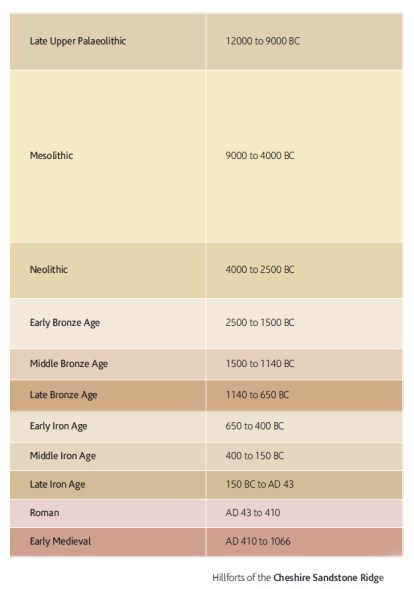
Archaeological chronology of the Cheshire Sandstone Ridge. Source: Garner 2012

Wherever there is a medieval castle perched on a hilltop, it is worth looking for an Iron  Age hillfort.  They are often there to be found.  It is also worth looking even further down the chronological funnel because some of the fortified prehistoric hilltops once synonymous with the Iron Age, are now known to have been built centuries before the Iron Age began.  So wherever there is an Iron Age hillfort, it is worth bearing in mind that there may be a late Bronze Age predecessor, as was the case at Beeston.   At Beeston the two phases of Iron Age hillfort were preceded by two phases of later Bronze Age settlement, one of which included an enclosing bank, and these were themselves preceded by even earlier prehistory – the Mesolithic, Neolithic and Early Bronze Age.

On the basis of previous work in the area, the excavators may have been hoping for prehistoric as well as Medieval finds, and they found evidence from the Mesolithic occupation from around 8000BC, dotted around all the way to the Romano-British period, which in Cheshire dates to c.70AD.  These were small outposts of earlier prehistoric activity Mesolithic (Middle Stone Age), Neolithic (New Stone Age) and Early Bronze Age, as well as more comprehensive discoveries of the later Bronze Age and Iron Age.  The earlier prehistoric phases will all be discussed below and the later prehistoric in Part 2.  Although there were discontinuities between the various occupations of Beeston, the crag was clearly of value to people of very different economic and social profiles over a very long period of time.
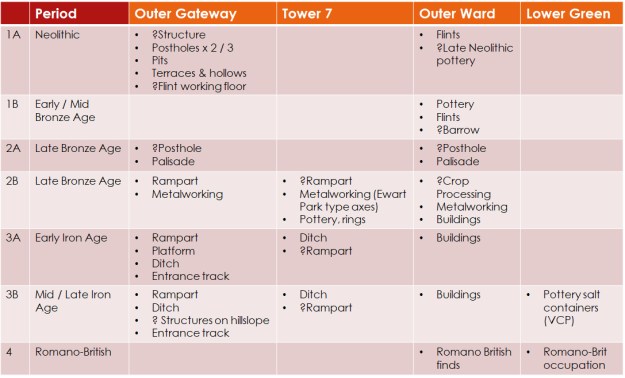
Archaeological periods at Beeston crag. Collated from Ellis 1993.

The Archaeological Sequence at Beeston

After the Ice Age, 9000-4000BC
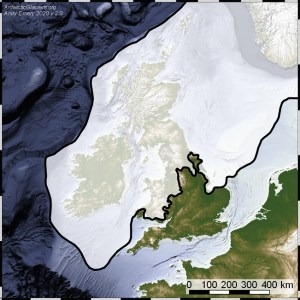
Maximum extent of the Devensian ice-sheet. Much of the rest of southern England will have been encased in permafrost which only began to melt as the ice sheets retreated, starting at around 10,000BC. Source: Antarctic Glaciers

During the last Ice Age, the Devensian, glacial ice-sheets extended in an uneven line towards southern England, covering Wales and Ireland.  The ice sheets carved out the u-shaped valleys that we all remember from school geography lessons, transporting huge amounts of debris from north to south, dropping thick deposits of soil and gravel, and creating meltwater channels.  Vegetation was demolished either by the ice or by the temperatures, animals and people departed, and most of Britain was empty of life.  Connected to the continent by a substantial land bridge, Britain only began to revive when the climate started to warm, and the ice began to melt.  Vegetation, consisting of  deciduous woodlands, shrubs and grasslands slowly returned to the lowlands, followed across the land-bridge by, amongst others, red deer, wild cattle (aurochs), reindeer, elk, brown bear, wolf and lynx.  In their wake followed small communities of people who lived by hunting game, foraging for wild vegetables, roots, seeds, herbs and fruit, and fishing on the coast and in rivers.  Today the period during which these groups of people returned and occupied post-glacial Britain is known as the Mesolithic, or Middle Stone Age. As the ice continued to melt and sea levels continued to rise, Britain was eventually physically cut off from the mainland, but that did not prevent other types of connection being established.
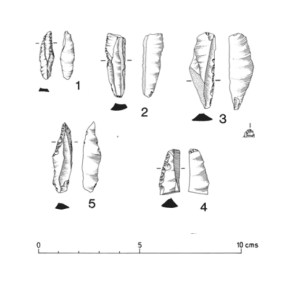
Mesolithic tools found from Beeston Castle, all less than 5cm long. Source: Ellis 1993

The Beeston Mesolithic finds are restricted to a small handful of stone tools that had been dislodged from their original context.  These are very typical of the period, consisting of microliths (tiny stone tools), and other very small pieces.  They do not say much on their own, but other Mesolithic sites in the area argue that the Beeston finds are a very small part of a much bigger Mesolithic story in the area.  In particular, Harrol Edge near Frodsham produced over 1500 tools from the period and will be discussed further below.  Other small sites are dotted along the Cheshire Ridge although most are as ephemeral as those at Beeston.  These include an earlier and later Mesolithic phase at Carden Park near Broxton; Riley Bank Farm, Alvanley Cliff (all at the northern outcrop); and Seven Lows on the east edge of the central outcrop (a Late Neolithic/Early Bronze Age site where around 100 pieces of worked flint were found).  These are all surface scatters, not clearly defined and stratified sites, but they are valuable for indicating the presence of people at this time, suggesting the size of  individual occupations and the period of time over which visits were made.  Together, they argue for small, temporary stopping off points as the landscape was exploited for food, craft and tool manufacturing resources.  They combine with other evidence to give an impression of a very busy pattern of landscape use in the Cheshire Ridge area, probably on a seasonal basis.

The Neolithic, 4000-2500BC

The later Mesolithic did not come to an abrupt end, any more than the Neolithic began as a rocket launch.  The long period of transition between the two livelihood strategies were influenced by processes taking place on the continent, themselves innovated in the Near East.  These presented opportunities and options, perhaps attractive to some and not to others, and take-up was no overnight phenomenon.
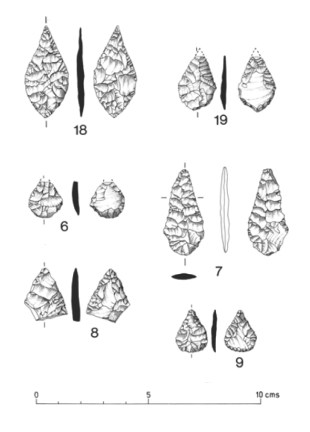
Neolithic stone tools from Beeston crag.  Numbers 18 and 19 at the top of the image are earlier Neolithic leaf-shaped arrowheads. Source:  Ellis 1993.

The changes that help to define the Neolithic (New Stone Age), when they began to gather momentum in around the third millennium BC, were characterized by a number of transformations that took place over the following 2500 years.  The spread of the main features generally characterizing the Neolithic did not spread at the same rate throughout Britain, and not all characteristics were adopted at the same time, even in neighbouring areas.  The main components defining the Neolithic are new forms of technology, a change of food acquisition practices, accompanied by new types of social statements.  Continuities and discontinuities between the Mesolithic and Neolithic are eternally under debate, because they are central to the question of how the domesticated crops and livestock, stone tool technology and more nebulous spiritual ideas were introduced from the continent, adopted in Britain and then spread.  Whatever the mechanism of their arrival in Britain, they became cornerstones of everyday life, and eventually found throughout Britain and Ireland, taking different forms in different areas, but based on a similar package livelihood opportunities, both economic and conceptual.

Early Neolithic of the Grimston/carinated tradition in northern Britain. Source: Malone 2001.

In parts of Britain, the Neolithic represents the first foray into mixed agriculture, with domesticated cereal crops and livestock and the adoption of pottery, which helped to introduce new cooking techniques, and to increase the variety of foodstuffs that could be consumed.  It also improved storage of both solids and liquids, protecting them from insect and vermin, and  took on cultural as well as economic roles. It is possible that after an initial foray into cereal production, pastoralism became the dominant approach to Neolithic food production.  This was probably particularly true in areas like Cheshire, where the clays, meres, mosses and heathlands would have been anything other than ideal for crop cultivation, and where dairy and other livestock farming dominate today.

As people began to manage their livelihoods in new ways, novel ceremonial and funerary monuments were built, and pottery and stone tools began to enter the realm of the dead as well as the living.  Long distance relationships, already a feature of some Mesolithic communities, extended, as the trade in axes and exotic materials expanded.
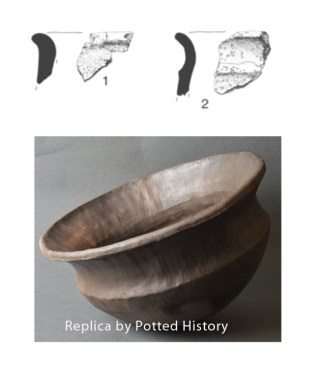
Grimston Ware sherds from Beeston (Royle and Woodward in Ellis 1993). The lovely replica showing what a complete carinated Grimston bowl would look like, is by Potted History

Information about the Neolithic in Cheshire, and particularly the Cheshire Ridge, is at best fragmentary, and it is not yet possible to pull together a coherent narrative of what is happening.  As with the Mesolithic, settlement data, rarely in the form of structural remains and usually in the form of  secondary scatters of objects on the surface, are generally small and dispersed but together contribute to  distribution maps to indicate, at the very least, where Neolithic people were present, and what form their presence took.  

At Beeston, objects of both the earlier and mid Neolithic were placed by Ellis in his 1A phase.  Objects diagnostic of the earlier Neolithic include leaf-shaped arrowheads (above), and carinated bowls (right) that used to be referred to as Grimston or Grimston-Lyles Hill ware, generally in circulation from c.3750BC.  The carination here is the rim that circles the centre of the vessel, and in general refers to a vessel’s wall making a sharp change of direction.  At Beeston both leaf-shaped arrowheads and sherds of carinated bowl are present, although the pottery is very fragmentary.  Because clay was fired at relatively low temperatures, and because temper in the fabric was often organic or composed of stone pieces, the pots were relatively fragile and once abandoned, were vulnerable to frost and heat damage and to erosive forces.  It is therefore comparatively rare to find Neolithic pottery found in tact.  Although Grimston carinated wares continued to be used for hundreds of years in some areas, in most they were replaced by more regionally distinct styles. 

The leaf-shaped arrowheads that were spread widely through Britain had no antecedents in the Mesolithic, they suggest that hunting still formed part of subsistence activities.  The hand-made (as opposed to wheel-thrown) carinated pottery.  Carinated bowls were found in a wide range of contexts in Britain, from pits and middens to early burial contexts, but there is no evidence of burial sites of this date either at Beeston or nearby.
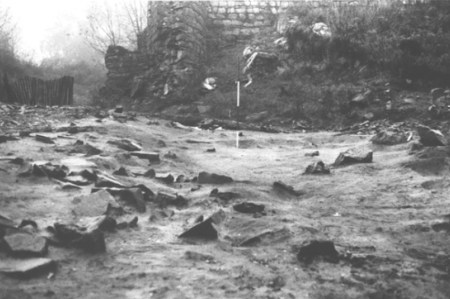
The early to mid Neolithic phase at Beeston’s outer entrance under excavation. You can see the stone walls of the Medieval castle in the background. This area is at the entrance to the outer ward, so when you pause to walk through the gap in the walls, remember that a Neolithic site was found underfoot. Source: Ellis 1993.

Another area of Neolithic at occupation at Beeston was found during the excavation at the outer gateway to the Medieval castle.  The Neolithic phase in this area was marked by terraces, hollows, pits and postholes.  There had clearly been an attempt to provide a level surface, implying some investment in the site, suggesting either the intention to stay put for some time, make repeat visits annually, or return at seasonally.  As well as this evidence of settlement, there were stone tools including small axe heads and the sherds of four types of Neolithic pottery, spanning the early to mid Neolithic. 

Additional Neolithic material was found on the plateau edge.  A deep pit cut into the bedrock and a smaller pit or posthole were accompanied by a single early-mid Neolithic sherd, at the base of the deep it.  It is difficult to assess, but the excavators suggest that it may mark a former entrance.  Finally, a single Late Neolithic sherd was found in Post-Medieval layers in the outer ward, where the Bronze Age and Iron Age hut circles were found.

Were these Neolithic occupants permanent cultivators who carved out fields in the woodland below, peripatetic livestock herders, or occasional visitors making use of the outcrop as a supplement to activities on the plain or elsewhere?  There are no plant or animal remains surviving to give us a hint.  The evidence from pollen analysis indicates that post-glacial Beeston developed in the context of mixed oak woodland and Ellis says that pollen data from north of Beeston suggests an initial clearance phase, but that this did not happen until the third millennium (i.e. between 3000BC and 2000BC, in the later Neolithic).   At Eddisbury hillfort, excavations in 2010 produced wood charcoal and other vegetation remains that suggest heath or moorland conditions that are generally associated with human manipulation of the landscape, in particular livestock grazing.  It is possible that the ridge outcrops were being used for seasonal upland herding activities.  Patches of grassland would have been ideal for grazing sheep, and coarse shrub for browsing goat, whilst cool woodland on the plain, particularly oak with its acorns, would have suited pigs perfectly.

Neolithic worked tools from Beeston Castle. Source: Liddiard and Swallow 2007

There are other explanations possible as well.  The small size of the assemblages may suggest scouting parties or small detachments engaged in resource aquisition tasks, heading east to west or north to south, and heading up hill for safety en route somewhere else.

All of the above is pure speculation, based on livelihoods practiced elsewhere, but it is the sort of speculation that ensures that when new data emerges, different models of occupation can be tested against the cumulative findings.

Although ceremonial and burial monuments are characteristic of some regions, nothing of this sort on the ridge or, to date, in the immediate landscape have been found in the early/mid Neolithic. Not until right at the end of the Neolithic and the beginning of the Early Bronze Age, when round barrows begin to appear on the sandstone ridge, and beaker remains were found at Beeston.  This is at least 2000 years after the leaf-shaped arrowheads that we looked at above.  I’ve covered beakers and round barrows in the Early Bronze Age section below, although they might just as well be termed Late or Final Neolithic.

Although only a small area of Neolithic land modification was identified, and there are only a handful of artefacts, it is worth remembering that only a small part of the entire crag was sampled.  That’s not anyone’s fault, because it would take decades to dig up the entire thing.  The excavation sample was actually impressive, and it does mean that there may well be other examples Neolithic land modification and objects to discover both on Beeston and other outcrops, as well as in the surrounding landscape.  Although it’s a trite analogy, every new site, however small, is an important part of the Neolithic jigsaw, not only allowing insights locally, but contributing to how we understand differences from and linkages between geographical areas in Britain.  Fortunately, excavation programmes are ongoing under Habitats and Hillforts Project and as all of this Cheshire Sandstone Ridge data is collated, it will hopefully provide an increasingly coherent understanding of Neolithic livelihoods on parts of the ridge and the surrounding area.

Early Bronze Age / Beaker period c.2500-1700BC
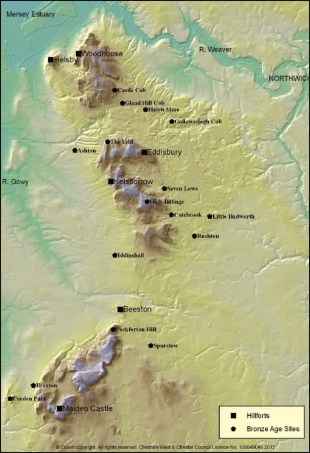
Earlier and Later Bronze Age sites along the Cheshire Ridge. Source: Garner 2012

In most parts of the country there is no clear delineation between the Late Neolithic and earliest version of the Bronze Age, sometimes referred to as the Copper Age or chalcolithic (roughly, the copper stone age) because copper appeared before bronze was introduced.  A new type of pottery, the Beaker, is also characteristic of this cross-over period, together with a range of associated objects.

It has been clear to archaeologists for a long time that the Beaker tradition was communicated to Britain and Ireland from the continent, where its geographical presence was widespread, found in Netherlands, Belgium, Germany, France, Italy, and the Iberian peninsula.  A  multi-disciplinary DNA analysis research project in 2017 proposed that a significant percentage of the indigenous population of Britain was, by the Middle Bronze Age, replaced by those who brought the Beaker tradition with them at the end of the Neolithic. Here’s an excerpt from the report (Olalde et al 2017).

The arrival of the Beaker Complex precipitated a profound demographic transformation in Britain, exemplified by the absence of individuals in our dataset without large amounts of Steppe-related ancestry after 2400 BCE. It is possible that the uneven geographic distribution of our samples, coupled with different burial practises between local and incoming populations (cremation versus burial) during the early stages of interaction could result in a sampling bias against local individuals. However, the signal observed during the Beaker period persisted through the later Bronze Age, without any evidence of genetically Neolithic-like individuals among the 27 Bronze Age individuals we newly report, who traced more than 90% of their ancestry to individuals of the central European Beaker Complex. Thus, the genetic evidence points to a substantial amount of migration into Britain from the European mainland beginning around 2400 BCE.

Cheshire’s only complete beaker, from Gawsworth. Source: Megalithic.co.uk

As is so often the case with this sort of DNA research, as highlighted in the study itself, there are questions remaining about the extent to which it is possible to extrapolate from the data used, including sampling issues (statistical, geographical and relating to the quality of the material).  However, although the question about how and why the continental Beaker objects and ideas became so popular remains open to some extent, it seems probable that as well as cultural dispersal of ideas and practices, some level of migration took place.  However it happened, at the end of the Neolithic the continental Beaker and associated objects did become desirable, and were found extensively under round barrows, as well as occasionally in other contexts, in many parts of Britain.  The cultivation of cereals also appears to have been resumed in some areas and intensified in others at this time, with new roundhouses being built in domestic contexts.

Distribution of some of the round barrows in Cheshire. Source: Morgan and Morgan 2004.

Beakers are not as common in northwest England as they were in the south, and only one complete Beaker, a long-necked type, has been found in Cheshire, in a round barrow burial Gawsworth, which is in the far east of the county, near Macclesfield.  The Beeston Beaker-related finds fall within Ellis’s 1B phase.   They were found at the Outer Gateway and in the Outer Ward.  In all cases they were found in amongst later material, within later prehistoric and Medieval material and postholes.  They consist of Beaker fragment, collared urn and/or pygmy cup fragments, a barbed and tanged arrowhead and four knife blades.  In Ellis’s collation of the excavations by Keen and Hough, the pottery analysis by Royle and Woodward interpreted the Beeston Beaker and its associated finds, as evidence for a vanished barrow burial.  There has been extensive use of the outer wards since prehistoric times with considerable quarrying and levelling on all areas of the plateau, so it is not impossible that a round barrow had been built and later destroyed. Beakers could, however, also be found as broken sherds in isolated pits, as well as in domestic contexts.  Other new forms of pottery followed in the Early Bronze Age, including food vessels, cordoned urns, collared urns and pygmy/accessory cups, of which a number of examples have been found along the Cheshire Ridge.
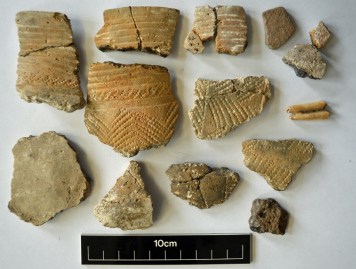
Seven Lows assemblage with Beaker sherds. British Museum 1862,0707.64. Source: British Museum

Round barrows with Early Bronze Age finds in them have been found in the Cheshire Ridge area.  Examples shown on the map above are Carden Park at Broxton, Castle Cob, Glead Hill Cob, Peckforton, High Billinge, Little Budworth and the Seven Lows barrow cemetery.  Few have been excavated in modern times, but most were cremations.  Only Clead Hill produced metal, in the form of a single bronze pin.  It was accompanied by two barbed and tanged arrowheads, collared urns and a pygmy/accessory cup, all consistent with Early Bronze Age burial assemblages.  The most common form of metal dating to the Early Bronze Age in the area was in the form of isolated finds of flat axe heads, but there are only four of those in the general vicinity.  The recent excavation report for Seven Lows has just been reported (it arrived through my letterbox yesterday) by Dan Garner in the Journal of the Chester Archaeological Society, so there will more on that site on a future post.

There is even less information for the Beaker-related presence at Beeston than the Neolithic, but what has been found is not inconsistent with other finds in the area, and it is to be hoped that further excavation will lead to a more complete understanding of the Beaker tradition in the Cheshire Ridge area.


Raw material acquisition at early prehistoric Beeston

Sourcing stone

Flint and chert were the materials used by the tool makers who left their tools at Beeston Crag.  Because of the way in which the stone fractures predictably when hit by a hard or soft object, flint and chert are favoured for flaked stone tool manufacture.  A remarkable amount of precision is achieved, meaning that multiple classes of foot types can be manufactured which, once identified by archaeologists, can be categorized and can contribute to an understanding of livelihood transformation and regional differentiation.

Mesolithic flint and chert tools from the Adams collection, collected at Harrol Edge, Frodsham. Source: Brooks, in Garner 2016

The sandstone ridge was not the source of the raw materials used in the earlier prehistoric period for stone tool manufacture.  At  Harrol Edge, near Woodhouse Hill at Frodsham, over 1500 pieces of Mesolithic worked stone pieces were gathered during unofficial fieldwalking in the 1950s by local resident J. Adams, since donated to the Grosvenor Museum in Chester.

For the flint, an analysis of the Harrol Edge tools by Ian Brooks identifies two sources, in chalk deposits of the Lincolnshire/Yorkshire wolds or Northern Ireland.  This does not necessarily mean that people had to go to either place or engage in trade to source the stone, because the ice-sheets transported considerable amounts of stone material to parts of the country to which it was not native, and Irish Sea till (unsorted material deposited by the movement of glacial ice) and associated gravels have been found in the valley of the River Weaver, which runs to the east of the sandstone ridge.

The nearest chert deposits were found in limestones in the Peak District and on the edge of the Vale of Clwyd (sometimes referred to as Gronant chert but properly part of the Pentre Chert Formation).  This means that however these stones were being sourced, they had to be transported to the site either as a raw material for working into tools, or as finished objects.
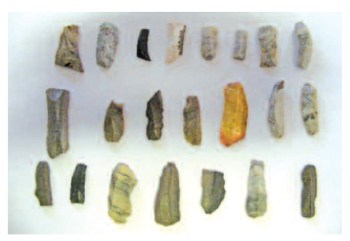
More Mesolithic stone tools from Harrol Edge, Frodsham. Source: Garner 2012

Hunter-forager-fishers of the Mesolithic were seasonally mobile, moving base camps to make the most of food and craft resources.  It is more than probable that in their seasonal rounds they were able to source chert and flint.  There is insufficient evidence from Beeston itself to suggest how stone was being processed, but of the 1500 pieces from the Harrol Edge collection, only 266 were actual artefacts, consisting of 232 blades and 34 scrapers, and the rest were by-products of the manufacturing process, representing multiple took making events.  This suggests that most of the artefacts were being made here, wherever the finished tools were eventually discarded, meaning that the raw material was brought to the site to be worked, rather than being worked where it was found.  Most of the objects were made on flint, mainly a distinctive banded variety, and only 8.6% were on a dark-coloured chert.  The chert tools may have been earlier in date than the flint examples.  Brooks says that the banded flint was not wholly ideal for knapping into shape, and probably would not have been the first choice if an alternative had been readily available.  Brooks felt that it probably came from the Peak District, but did not rule out north Wales as a possibility.
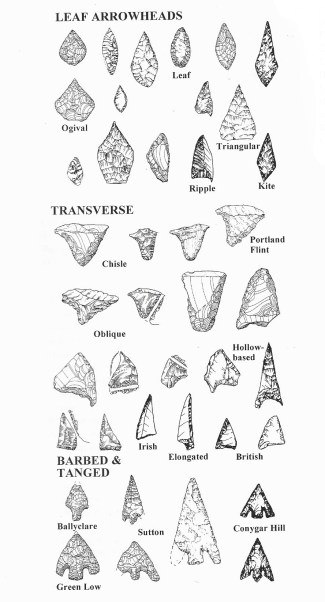
Knapped stone arrowheads from the Neolithic. Source: Malone 2001

In terms of the Neolithic stone use at Beeston, even early farmers were often far from sedentary, making their way through the landscape as they herded, seeking out craft materials on a seasonal basis and looking for new opportunities to exploit tracts of lowland and upland.  Early farmers were often far from sedentary, making their way through familiar landmarks of the landscape as they herded on a seasonal basis, seeking out craft materials on a and looking for new opportunities to exploit both lowland and upland environments.  It is possible that the local glacial tills provided the necessary flint for small tools, but even if travel had been required or the acquisition of raw materials, it would not have been necessary for the entire community to relocate.  For example, a dedicated resource acquisition group could have been dispatched from the group for this specialized task.  At the moment all we know for sure is that Neolithic groups were in the area, and that they imported flint and chert, either as raw material or as completed tools, from outside the area.

At Beeston the Early Bronze Age stone tool assemblage consists of a flint barbed and tanged arrowhead and four knives, all flint, and all nicely worked.  There is not much to be added to the above comments, but the knives were made of bigger pieces of flint than previous items, and it seems less likely that the raw material for such items would have been carried for any distances.  I have no idea whether or not flint pieces this size could have been found in the nearby valley gravels.

Sourcing materials for pottery
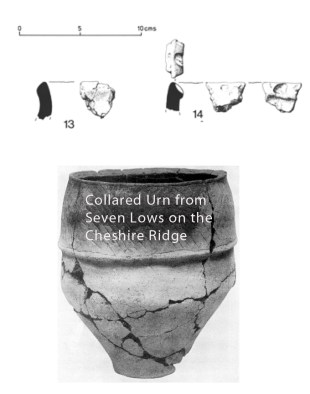
Collared urn sherds from Beeston (Royle and Woodward in Ellis 1993) and a photograph of collared urn from Seven Lows (source: Megalithic Portal)

The excavation report refers to three types of phase 1a and 1b pottery at Beeston.  All of them are made from local glacial drift clays characteristic of the Cheshire/Shropshire basin.  For example, the mineral inclusions (called temper) that were added to the collared urn clay during the pottery making process included quartz, sand, granite, rhyolite and basalt, all of which were common to other collared urns in Cheshire, and all of which could be sourced from local river valleys and glacial gravels in the area.  Because both the clay and the temper  were available locally, vessels could be manufactured within the immediate area, although there is no actual evidence to date for pottery manufacture at any of the Cheshire sites.  Although these vessels were hand formed rather than wheel-thrown, they still needed to be fired, and so far no evidence has emerged in the area for Neolithic kilns (usually simple pit kilns).


Final Comments

Although Beeston crag has produced the greatest evidence of early prehistoric occupation along the line of the Cheshire Ridge, this is probably due mainly to an accident of sampling.  Other hillforts were simply not excavated as extensively as Beeston, meaning that there could be plenty of early prehistory to be found at other Cheshire Ridge outcrops.  There have been some indications that there is more to be found.  At Eddisbury hillfort, for example, a possible late Neolithic cremation cemetery has been identified; at Seven Lows barrow cemetery at the eastern foot of the central outcrop, a recent excavation has just been published in the Chester Archaeological Journal (issue 8);  at Woodhouse  a small assemblage of Late Neolithic/Early Bronze Age stone tools were found, and at Helsby some early Neolithic activity has been identified.  Stray finds have been found elsewhere along the line of outcrops.
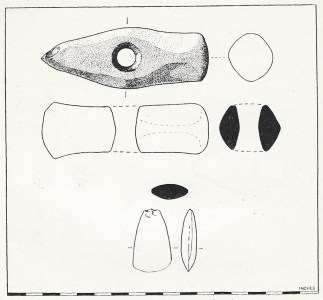
The so-called Beeston Hoard. Source: Varley and Jackson 1940

So far all the archaeological focus has been on the outcrops of the ridge, but that too is something of a sampling problem.  Because of the considerable agricultural value of the land across the Cheshire plain, it is unlikely that many upstanding sites are left to be found, and any settlement sites are likely to have been ploughed in. Aerial photography has proved to be of marginal value due to the water retentive properties of the glacial soil, which prevents it drying out sufficiently to show variations in the soil during dry weather.  However, there are hints that  prehistoric archaeology may yet be found.  On the plain not far from Beeston, the so-called “Beeston hoard” was found on the edge of a former freshwater spring, consisting of a Neolithic polished stone axe and an Early Bronze Age perforated stone axe-hammer.  The remains of a round barrow surrounded by a ring of stones and a circular ditch were found at Morreys garden centre at Kelsall, containing the cremated bones of a child in an inverted collared urn.  Unfortunately, discoveries like that have been few and far between.

Barbed and tanged arrowhead from Beeston – Late Neolithic/Early Bronze Age. Source: Ellis 1993

The discovery of earlier prehistoric sites along the course of the Cheshire Sandstone Ridge, many only excavated only briefly and some not excavated at all, establishes that there is the opportunity for further investigation, and hopefully further illumination.  There are a lot of questions remaining open about the earlier prehistory of both the ridge and the surrounding landscape.  Clearly, there is a lot of future potential for both non-invasive survey and excavation, should the funding be available.

Next

Following a visit to Beeston to enjoy the castle on a fine, sunny day last year, I became aware that Beeston had something of a prehistoric past, but I was surprised by how rich that past turns out to be, particularly when seen within the context of other sites on and around the Cheshire Sandstone Ridge.  At Beeston it begins with the Mesolithic occupation from around 9000BC, and then takes in the early Neolithic and the later Neolithic/earlier Bronze Age.  In Part 2, the very striking Bronze Age and Iron Age round-house and related discoveries on the Beeston crag take us all the way to the Romano-British period.


Sources for Parts 1 and 2:

Items in bold were used extensively in this post, with my thanks.

Books and papers:

Berridge, P. 1994. The Lithics.  In (ed.) Quinnell, H., Blockley, M.R. and Berridge, P. Excavations at Rhuddland, Clwyd, 1969-1973. Mesolithic to Medieval.  BAR 95, CBA.

Bradley, R. 2019 (2nd edition).  The Prehistory of Britain and Ireland. Cambridge University Press

Callaway, E. 2018.  Divided by DNA: The uneasy relationship between archaeology and ancient genomics.  Nature, March 28th 2018

Cunliffe, B. 1995. Iron Age Britain. English Heritage/Batsford

Cunliffe, B. 2005 (4th edition). Iron Age Communities in Britain. Routledge

Ellis, P. (ed.) 1993.  Beeston Castle, Cheshire. Excavations by Laurence Keen and Peter Hough, 1968-1985. English Heritage
https://archaeologydataservice.ac.uk/archiveDS/archiveDownload?t=arch-1416-1/dissemination/pdf/9781848021358.pdf 

Fairhurst, J. M. 1988.  A Landscape Interpretation of Delamere Forest. May 1988
http://delamereandoakmere.co.uk/wp-content/uploads/2017/03/fairhurst-delamere-landscape.pdf

Garner, D. 2012.  Hillforts of the Cheshire Sandstone Ridge. Cheshire West and Chester
https://www.sandstoneridge.org.uk/doc/D234636.pdf

Garner, D. and contributors 2016.  Hillforts of the Cheshire Ridge.  Archaeopress (appendices only available online)
http://www.archaeopress.com/ArchaeopressShop/Public/displayProductDetail.asp?id={2B433802-E7A0-4302-B2DD-95B7F3B2A493}

Garner, D. and contributors 2021. The Seven Lowes prehistoric barrow cemetery, Fishpool Lane, Delamere, Cheshire: a reassessment.  Journal of the Chester Archaeological Society, volume 91, 2021

Gibson, A. 2020. Beakers in Britain. The Beaker package reviewed. Préhistoires méditerranéennes no.8 (Ethnicity? Prestige? What else? Challenging views on the spread of Bell Beakers in Europe during the late 3rd millennium BC)
https://journals.openedition.org/pm/2077

Liddiard, R. and Swallow, R.E. 2007.  Beeston Castle.  English Heritage

LUC 2018. Cheshire East Landscape Character Assessment 2018. Land Use Consultants
https://www.cheshireeast.gov.uk/planning/spatial-planning/cheshire_east_local_plan/site-allocations-and-policies/sadpd-examination/documents/examination-library/ED10-Cheshire-East-LCA.pdf

Mackintosh, D. 1879.  Results of a systematic survey in 1878 of the direction and limits of dispersal, mode of occurrence and relation to drift deposits of erratic blocks our boulders of the west of England and east Wales, including a revision of many years’ previous observations.  The Quarterly Journal of the Geological Society of London 53, p.425-55

Malone, C. 2001.  Neolithic Britain and Ireland.  Tempus Publishing

Matthews, D. 2014.  Hillfort intervisibility in the northern and mid Marches.  In Saunders, T. (ed.) Hillforts in the Northwest and Beyond.  Archaeology NW new series, Vol.3, Iss.13 for 1998.  CBA NW.

Mayer, A. 1990. Fieldwalking in Cheshire.  Lithics 11, p.48-50
http://journal.lithics.org/wp-content/uploads/lithics_11_1990_May_48_50.pdf

Morgan, V.B. and Morgan, P.E. 2004.  Prehistoric Cheshire.  Landmark Publishing

Needham, S. 1993.  The Beeston Castle Bronze Age Metalwork and its Significance.  In Ellis, P. (ed.)  Beeston Castle, Cheshire. Excavations by Laurence Keen and Peter Hough, 1968-1985. English Heritage

Olalde, O. 2017. The Beaker Phenomenon and the Genomic Transformation of Northwest Europe.  bioRxiv May 2017
https://www.biorxiv.org/content/10.1101/135962v1.full.pdf

Ormerod, G. 1882.  The history of of the county palatine and city of Chester. Routledge

Ray, K. and Thomas, J. 2018.  Neolithic Britain. Oxford University Press

Royle, C. and Woodward, A. 1993.  The Prehistoric Pottery.  In Ellis, P. (ed.)  Beeston Castle, Cheshire. Excavations by Laurence Keen and Peter Hough, 1968-1985. English Heritage

Stuart, R. 1993. The flint.  In Ellis, P. (ed.)  Beeston Castle, Cheshire. Excavations by Laurence Keen and Peter Hough, 1968-1985. English Heritage

Varley, W.J. and Jackson, J.W. 1940.  Prehistoric Cheshire. Cheshire Community Council

Weaver, J. 1995 (second edition). Beeston Castle.  English Heritage


Websites

Habitats and Hillforts Project
https://www.sandstoneridge.org.uk/projects/habitats-hillforts.html

Sandstone Ridge Trust
Leaflets about the archaeology of the Cheshire Sandstone Ridge, available to download as PDFs
https://www.sandstoneridge.org.uk/about-sandstone-ridge-trust/publications.html

Archaeology

The Archaeology of Helsby Hill (PDF, 475KB)
The Archaeology of Woodhouse Hill (PDF, 487KB)
The Archaeology of Kelsborrow Castle (PDF, 495KB)
The Archaeology of Eddisbury Hill (PDF, 451KB)
The Archaeology of Beeston Crag (PDF, 498KB)
The Archaeology of Maiden Castle (PDF, 432KB)

Habitats

Broadleaf woodland (PDF, 352KB)
Meres and mosses (PDF, 391KB)
Lowland heath (PDF, 337KB)
Species-rich grassland (PDF, 331KB)

Insights Paper. The Sandstone Ridge Trust, 2018 (PDF, 7.6MB)
Sandstone Ridge Atlas. The Sandstone Ridge Trust (PDF, 22.3MB)
Delivery Model Options Appraisal. The Sandstone Ridge Trust (PDF, 2.4MB)

Ridge: Rocks and Springs

Ridge: Rocks and Springs Evaluation Report. The Sandstone Ridge Trust, 2017 (PDF, 37.4MB)
The Ridge: Rocks and Springs — a sandstone legacy. The Sandstone Ridge Trust, 2017 (PDF, 108.8MB)
Interim Report: Urchin’s Kitchen. The Sandstone Ridge Trust, 2017 (PDF, 67.5MB)
Ridge: Rocks and Springs Project Handbook 2015. A volunteer’s guide. The Sandstone Ridge Trust, 2015 (PDF, 7.7MB)

Habitats and Hillforts

Habitats and Hillforts Evaluation Report. Cheshire West and Chester Council, October 2012 (PDF, 12.5MB)
Hillforts of the Cheshire Sandstone Ridge. Dan Garner, Cheshire West and Chester Council, October 2012 (PDF, 10.8MB)
Captured Memories. Cheshire West and Chester Council, 2011 (PDF, 100.2MB)
Fertile Ground. Art & Photography inspired by Cheshire’s Sandstone Ridge. Cheshire West and Chester Council, 2012 (PDF, 66.5MB)

Geology
Introduction
Our Geological Heritage

https://www.sandstoneridge.org.uk/special-place/rural-land-uses.html


Ranulf III’s Beeston Castle #2 – The castle, the walk, the visit

The gateway to the inner ward seen from the outer ward

In Part 1, I introduced Ranulf III, the powerful descendant of King Henry I, who started building Beeston Castle in 1220, and during his lifetime was close to four kings of the Middle Ages:  Henry II, Richard I (“the Lionheart”), John (“lackland”) and Henry III.

Here, part 2 looks at the castle itself, the walk up to the castle, 18th and 19th Century artistic interpretations of the castle, and practical visit details, including notes on accessibility for those with less than cooperative legs. The two parts are designed to be read together, as many of the photographs of the castle are in Part 1.

Topographical plan showing the site elevation and key features, colour-coded to show different construction phases. Source: English Heritage. https://www.english-heritage.org.uk/siteassets/home/visit/places-to-visit/beeston-castle/history/serpentine/beeston-castle-phased-plan-1.pdf

With so much of its stonework intact, Beeston is entirely comprehensible as a functioning castle and, together with the stunning views, is worth a visit in its own right, but arming oneself with knowledge about the its builder makes for an even more rewarding experience.

Twelve years before he died after a rich and varied life, the magnate, military leader and crusader Ranulf, Earl of Chester, set about building three new castles to add to his existing tally, of which Beeston was the most impressive.

Beeston has been the subject of investigations since the 19th Century, encompassing both documentary research and fieldwork, and is one of the most comprehensively studied sites in the mid-Cheshire area.  This  research encompasses the impressive prehistoric remains at the site, the castle’s 13th Century origins, repairs in the 14th Century and, after a period of partial abandonment, a major renovation during the Civil War (17th Century).   After the final military abandonment of the castle in the 17th Century, it entered a new phase in the 18th Century as a growing tourist attraction, which expanded during the 19th Century when rail arrived.

These are all aspects of its past that are well worth exploring, and all are handled by Beeston’s small but informative visitor centre and the really excellent illustrated guidebook.  Supplementing these resources with other material, I have written up more details about the castle’s builder, Ranulf III, and described a few of the highlights of the castle’s history below.  I am saving an account of the multi-period record of prehistory for another post.  If you have even a little curiosity about prehistory, I hope that it will be worth waiting for 🙂

Today’s approach to the monumental gateway into the outer ward. The tall tower was a later addition to Ranulf’s original gatehouse

Before launching into the history of the castle, you might want to have a look at the castle’s site plan shown above left, which can be downloaded from the English Heritage website, showing the site’s elevations and colour-coded chronological phases.  It is also reproduced in the Beeston Castle guide book.

This page is divided up as follows:

  • Beeston Castle in the 13th Century
  • Beeston after Ranulf III
  • Beeston during the Civil War in the 17th Century
  • Beeston in the 18th and 19th Centuries
  • Visiting Beeston (with accessibility notes for those with unwilling legs)

If you would prefer to download parts 1 and 2 as single a PDF, please click here.

Ranulf’s 13th Century Castle

Probably springing from multiple motivations whirling around Ranulf’s busy head, the resulting castle at Beeston is awe-inspiring.  Strategically, Beeston is in an exceptional position, with views that would have provided sight of an approaching army miles (and hours) away, control of the valley below.  These views make for an excellent visit.

A reconstruction of the early 14th Century castle, showing both inner and outer wards. Source: English Heritage’s excellent Beeston Castle guidebook.  Click to see a bigger picture.

The English Heritage guidebook has an invaluable blow-by-blow description of all the features of the castle, which should not be missed by anyone who really wants to understand it.  Soden adds additional details about what features Beeston shared with the two other castles that he was building at the same time. Here, I’ve picked out the bits that I found most interesting.

The immediate impression one has of the castle on approach is that it consists of two main colours:  white-grey and red.  The red sandstone seems to have been used in the original construction but also seems to have been the main building material used during subsequent restoration works.  The original works were dominated by the grey-white stone.  I haven’t yet pinned down exactly what sort of sandstone this is, but unlike the usual local red sandstone it is very hard and dense, and very difficult to damage.

There are two main elements of the castle, the big outer ward (or bailey) and the smaller inner ward, each defined by a stone wall interrupted with D-shaped defensive towers (known as mural towers) arranged at intervals along tall curtain walls.  Each of these defensive curtain walls was provided with a single access point, almost identical heavily defended double-towered gateways.  To ensure that no-one unwanted gained access, every tower along the walls was furnished on the ground floor with arrow-slits, tall thin “windows” in the walls and the topmost level would have been manned by archers.  The outer ward followed the line of the defences of the Iron Age hillfort incorporating its accompanying defensive ditch.

Although archaeologists were let loose in the outer ward, they found no evidence of buildings contemporary with the castle, and there is little indication in the documentary sources either.   It is possible that work was clearly concentrating on the inner ward, with just the defensive elements of the outer ward being completed, but it is also a possibility that the area of archaeological investigation did not coincide with any buildings that had been erected.

The inner ward’s gatehouse from the inside

The inner ward, the heart of the castle complex, was separated from the outer ward by a deep ditch cut into the rock.  The ditch had a double function, being both the quarry for stone for the castle, and a line of defence in its own right.  This ditch was crossed by a wooden bridge, probably with a drawbridge and portcullis, the mechanisms for which would have been housed in one of the gatehouses as suggested in the above reconstruction.  There was no keep (a big central tower, a third level of defence that usually contained accommodation and prison cells) and it appears that a keep had never been part of Ranulf’s plan.

One of the gatehouse towers in the inner ward

The ground floor of the inner ward’s gatehouse was provided with chambers, each of which had a slit through which arrows could be fire.  The first floor of the inner ward’s gatehouse would have housed the guardian of the castle, known as the constable, and the top floor would have housed the gate and bridge mechanisms, the former lowered and the latter raised at times of threat, as well as archers who would have protected access through the gate.  Even though the main accommodation for the constable was probably in the main gatehouse, the only fireplace found was in the southwest tower, perhaps a daytime office for the constable.  Other rooms could have been heated by braziers when needed.

As with the gatehouses, the D-shaped towers of were provided with slits through which arrows could be fired, and also had upper floors that acted as platforms from which other soldiers could defend the castle.  Any stairways between these floors must have been made of wood because no staircases survive.  It is thought that the upper floor of the towers, including the gatehouses, were surrounded by wooden rather than stone defences in Ranulf’s day, because a much later record talks about the replacement of wood with the crenellated stone wall that is shown in the above reconstruction.

Well within the inner ward

Both upper and lower wards were provided with water wells, which would have helped the castle to hold out during a siege.  The well in the inner ward has a circular wall and has been provided with a lid to prevent children falling into it.  A legend that King Richard II left his treasure at the castle lead to several investigations of the well.  The investigations in the 1930s found that it went down to 110yds / 100m with the medieval masonry down to 61m.  The well in the outer ward, under a big tree, looks a bit like a quarry and it is suggested that this bizarre appearance was the result of attempts during the Civil War to enlarge it.  It has now been filled in, but its depth was recorded in 1623 as 240ft / 73m.

Remains of the well in the outer ward

Views from the inner ward across the Cheshire plain showing its strategic position

Detail of the inner ward at the southeastern end

Beeston Castle was unfinished at the time of Ranulf’s death.  The north curtain wall of the inner ward was not completed until the 1280s, by which time it was in the Crown’s ownership.  The centre of the upper ward feature big outcrops of bedrock, suggesting that it had never been levelled for the construction of an imposing entrance or the addition of inner buildings. Additionally, some key castle features were missing, like a kitchen and a great hall.  This was confirmed by archaeological work that found no sign of inner structures.

Ranulf employed many of the same features at his other new castles.  Although the plans were all distinct, they shared twin-towered gates, deep ditches, D-shaped towers, individual chambers within the towers (mural rooms) and “fish tailed” arrow loops.  Ranulf had a model of the perfect castle and he was working towards achieving three different versions using the same toolkit of modern defensive options.

After Ranulf

The top courses of stonework is clearly different from the lower, showing the 15th Century rennovation of the towers.

When Ranulf died in 1232, 12 years after he began the castle, his estates were inherited by his nephew John le Scot.  However, le Scot died five years later in 1237 and Henry III confiscated all of his land, redistributing some of it and retaining the better part for his son Edward, perhaps justifying Ranulf’s belief that the Crown was a greater threat to his territories than the Welsh.  The Chester estates, together with Beeston and Chester castles, were initially put into the custodianship of John de Lacy, earl of Lincoln (c.1192-1240).

Under the Crown, Beeston languished in second position to Chester Castle, but in the 1240s hostilities against the Welsh led to it being repaired, building on Ranulf’s work, presumably to prevent the Welsh attempting to take it and reinforce it themselves.  In c.1253 Henry III granted the earldom of Chester, together with Beeston, to his son Edward I and Edward’s subsequent heirs as Princes of Wales.

Early 14th Century records of investment in the castle indicate that crenellations were added to the towers, which were themselves raised to a higher level and were roofed with lead, and the gateway of the inner ward required repair.  The gateway was provided with a new wooden bridge, anchored on a massive stone plinth that is still visible between the 1970s bridge today.  The timber was carried 8 miles from Delamere forest on ox cart to Beeston.

The southwest end of the inner ward

The castle appears to have been allowed to fall into ruin during the 15th Century.  It was sold in 1602 to Sir Hugh Beeston, a local landowner, although his reasons for his wanting a ruined castle are unknown.

The Civil War 

Silver bowl and spoon dating the the Civil War period found at Beeston and now on display in the Beeston Visitor Centre

Forty years later the Civil War broke out.  Those Royalist forces took up position at Chester in 1642,  using as a base to provision themselves from the Dee, which was still a working port with river access via the Dee to the Irish Sea and Liverpool Bay.  Shortly afterwards, parliamentarians established themselves at Nantwich.  Beeston sat bang-splat in the middle, and the parliamentarians under Puritan Sir William Brereton installed a garrison there in February 1643 under Captain Thomas Steele.  Essential repair work took place to secure the ruined castle.  Brereton’s efforts were in vain.  Royalist men entered the castle in mid December and Steele surrendered.  He was later shot for his failure to defend the castle.  John Byron, leading the Royalist forces, installed his own garrison at Beeston and went on to defeat the parliamentarians at Middlewich.  Brereton, however, was not finished and in November 1644 besieged Chester and set about cutting off the royalists entrenched in Beeston with a blockade to prevent them re-provisioning.  The Royalists managed to breach the blockade twice, but the blockade was reinforced.

The king was defeated at Rowton Heath, south of Chester, on September 24th 1645 and Beeston Castle was given up to the parliamentarians on 15th November.  Royalist soldiers, half-starved, were allowed to depart.  Beeston was now systematically dismantled (an action known as “slighting”) so that defending it would be impossible without major rebuilding.   For the next two centuries it attracted only local attention.

Beeston in the 18th and 19th Centuries

Beeston Castle’s inner ward gatehouse, a romanticized view painted by George Barret in the mid 1770s.  Source:  Wikipedia

Now a ruin, in the 18th Century the castle, visible for miles around acquired a romantic air and become something of a visitor attraction, and a number of artists represented it, three of which are shown here, offering very contrasting views of the castle.

To the right is a highly romanticized version by relatively minor painter George Barret in the mid 1770s, highly coloured and dramatic.

The  famous J.M.W Turner (1775-1851) painted a scene in 1809, based on sketches he made in 1801, showing a woodland scene with Beeston as a faint silhouette in the distance.  Turner had initially wanted to train as an architect rather than a painter, but was pushed in the direction of painting by Sir Joshua Reynolds when Turner joined the Royal Academy at the age of 14.  His love of buildings remained with him throughout his life, and painted a great many architectural themes.  He particularly liked English castles.  Typical of his work, Beeston is a mere suggestion, a ghost of a place on the edge of the real world.  By employing the traditional narrative approach of painting that he would have learned at the Royal Academy, which draws the eye from left to right, the castle’s apparently subordinate position still results in its domination of the rural woodland scene.  Past and present are juxtaposed, but while the present takes up most of the canvas, it is the past that dominates the landscape.

Joseph Mallory William Turner’s view of Beeston Castle (far right) in 1809, based on sketches he made in 1801. Source: Sandstone Ridge Trust

Another painting worth seeing is by David Cox (1783-1859) a leader of the Birmingham School and renowned watercolour and landscape painter, showing yet another view, this time in 1849.  As with Turner’s painting the castle is shown against the sky with no discernible details, apart from the towers, but unlike Turner, it is placed centre stage, surrounded by Cox’s typical use of bright, vibrant colours with extremes of light and dark.

David Cox’s view of Beeston in 1849. Source: WikiArt


The Beeston Festival of 1851, from the Illustrated London News, showing tents and stalls in the inner ward, and people queuing at the 1846 entrance built in the style of the castle. Source: English Heritage guidebook, p.35

In 1840 the castle was sold to landowner John Tollemache as part of the Peckforton Estate, purchased with wealth derived from sugar plantations in Antigua, first purchased by his father.  It was Tollemache who built Peckforton Castle on the neighbouring hill and carried out restoration work on Beeston Castle, re-using original stonework.  When we were at Beeston I was puzzled by the fir trees in the outer word, and it turns out that these were exotic imports designed to reflect the new gardens and grounds at Peckforton Castle.  Deer were imported and contained within the outer ward, along with goats.  Somewhat more bizarrely, so were kangaroos.  What the three species made of each other is not recorded.  The railway between Chester and Crewe opened in 1846 and a station at Beeston greatly facilitated tourism and in 1844 a two-day annual festival was held in the outer ward.  In 1846 the current entrance to the ticket office, an imitation Medieval gateway, was built to handle the thousands of visitors and provide limited accommodation.

The castle passed into the hands of the Ministry of Works in 1959 and then, in 1984, was taken over by English Heritage, who have done a really splendid job of maintaining the site and introducing visitors to all aspects of its past.

Visiting Beeston Castle

Pieces of decorated ceramic on display in the Visitor Centre

There is a car park at the foot of the castle, opposite the entrance (pay-and-display or free for members), a café and a really nice picnic area.

English Heritage has done an excellent job of ensuring that the castle is as accessible and enjoyable as possible.  The site is beautifully maintained and feels cared for.  The staff are friendly and helpful, and the Visitor Centre, on the other side of the nice little shop, is excellent.  It mixes a few cabinets of objects with big information boards with lots of helpful illustrations, and feels modern, spacious and welcoming.   If you don’t anticipate wanting to buy the guide book (which I bought, thoroughly enjoyed and have used as the basis of this post together with Iain Soden’s biography of Ranulf) I do recommend reading up on the castle on the English Heritage website, and printing off the site plan PDF shown at the top of the post (links below).

In case the opening times and entry fees change, here is the link to the Beeston Castle page on the English Heritage website that should help you find all you need to know.
https://www.english-heritage.org.uk/visit/places/beeston-castle-and-woodland-park/prices-and-opening-times/

View from the inner gateway across the modern bridge across the plain

Accessibility for those with mobility challenges
This is an uphill walk, entirely suitable for anyone only averagely fit, taking perhaps 15-30 minutes depending on level of fitness, but you will anyway want to make many pauses to take in the views.  Although the walk consists of fairly easy slopes, this is not suitable for anyone who really can’t walk uphill, and there is understandably no access for wheelchair users.  Having said that, a lot of older people were doing the walk with the aid of walking sticks, pausing at benches along the way, and were doing it slowly but with enthusiasm.  Don’t forget that at the time of writing, English Heritage allows registered disabled people to bring a helper along free of charge, an “essential companion” in English Heritage terms.

There are a number of benches along the route, but all were well-used, so bringing along some form of portable stool might be an option for those with leg issues.  My Dad has a brilliant rucksack-cum-coldbag that has a hinged metal frame and folds out into a stool.  Suffering rucksack-stool envy, I’ve just ordered one for myself.

The walk up to the top of the castle can be described as a two-part enterprise.  There’s a slope up to the outer ramparts that can either be approached via a path with steps or a path without steps.   Once the outer ramparts are reached, there’s a short flight of stairs and then the approach to the upper ramparts that define the main castle are quite level for a while, followed by a fairly gentle slope up to the bridge across the ditch (what on a lowland site would be a moat).  The bridge itself is arched and quite steep for about 5-6 ft, but some good, solid railings were helpful for those with walking sticks.

For more about accessibility at Beeston, see the Beeston Castle Access page.

There’s a café at the site, but we chose to finish our visit with a very happy beer at the nearby Pheasant, a famous pub  with more great views.  The menu looks excellent.

The Pheasant, from the garden

Beeston Castle viewed from Churton, seen over the top of a field of corn.

Sources

Books and papers

Alexander, J. 1982. RANULF III OF CHESTER: An Outlaw of Legend?  Neuphilologische Mitteilungen, 83(2), p.152-157.
http://www.jstor.org/stable/43343443 (available free with registration)

Gillingham, J. and Griffiths, R.A. 1984. Medieval Britain.  A Very short Introduction.  Oxford University Press

Liddiard, R. and Swallow, R.E. 2007. Beeston Castle. English Heritage Guidebooks

Rubin, M. 2014.  The Middle Ages.  A Very Short Introduction.  Oxford University Press

Soden, I. 2021 (second edition). The First English Hero: The Life of Ranulf de Blondeville. Amberley

Ward, S. 2013 (second edition). Chester. A History.  The History Press

Websites

English Heritage
Description of Beeston Castle
https://www.english-heritage.org.uk/visit/places/beeston-castle-and-woodland-park/history/description/
Research
https://www.english-heritage.org.uk/visit/places/beeston-castle-and-woodland-park/history/research/
History
https://www.english-heritage.org.uk/visit/places/beeston-castle-and-woodland-park/history/
Sources for Beeston Castle
https://www.english-heritage.org.uk/visit/places/beeston-castle-and-woodland-park/history/sources/

Oxford Dictionary of National Biography (locked)
Ranulf (III) [Ranulf de Blundeville], sixth earl of Chester and first earl of Lincoln (1170–1232) by Richard Eales
https://www.oxforddnb.com/view/10.1093/ref:odnb/9780198614128.001.0001/odnb-9780198614128-e-2716;jsessionid=A550860211C96B6006DE6E8E327F88A1

Ranulf III’s Beeston Castle #1 – Who was Ranulf?

The approach to the inner ward (or bailey) seen from the bridge, with the vast ditch below, part quarry and part defensive device, and a slice of the superb panoramic view in the background.

The English Heritage Guidebook to Beeston Castle opens with the following statement:  “Standing on a rocky crag high above the Cheshire plain, Beeston is one of the most dramatically sited medieval castles in England.”  Organizations keen to puff off the virtues of their sites are often guilty of hyperbole, but in this case, the guide book speaks nothing but the truth.  On a bright mid-August day, with the sky a silvery pale blue, it was absolutely spectacular, both on the approach to the solidly impressive fortifications from below, and standing in the inner ward above the plain, gazing east to the Welsh foothills and northwest to the Pennines, with the floor of the world reaching out in all directions, lovely and fabulously impressive.  All this and history too.

This post has been split into two parts, with Part 1 looking at Ranulf III himself, and Part II tackling the castle itself, looking at how it was built, used and perceived, covering 600 years from the 13th to 19th Centuries.

If you would prefer to download parts 1 and 2 as single a PDF, please click here.

Ranulf III

Although Beeston Castle was altered several times since its original construction, it was the brainchild of Ranulf III (Ranulf de Blondeville), the 6th Earl of Chester and first Earl of Lincoln (1170-1232).  Ranulf’s castle building phase came fairly late in his very busy and dangerous life as the most powerful magnate in England.   The first work on Beeston Castle took place c.1220, only 12 years before his death, so this needs to be understood in the context of the rest of his life. 

Hugh de Kevelioc’s coat of arms, featuring five wheatsheaves.  Source:  Wikipedia

Ranulf was a descendent of the powerful Norman Marcher Lords installed by William the Conqueror to provide a buffer against the perceived chaos across the border in Wales.  Wales was at that time a set of territories controlled of powerful families headed by chieftains who were often in armed dispute with one another as well as with England  The Marcher lords, acting as guardians of the border, were incentivized with land, title and, perhaps most importantly, a great deal of autonomy.  Originally intending to shift the border further into Wales, the Marcher lords found the mountainous territory of the Welsh chieftains a serious impediment to progress and instead consolidated their positions in the lowlands.  However, the give and take of land and lives continued throughout Ranulf’s life, in spite of both reprisals and peace treaties.  It was not until after his death, during the reign of Edward I, that attacks by the Welsh chieftains were eventually squashed.  The loss of Crown lands in France by previous kings meant that Edward had had plenty of time to devote to the problem.

Ranulf’s official seal, reading “Seal of Ranulf Count of Chester and Lincoln.” The wheatsheaf emblems were later adopted by the Grosvenor family and can be seen on the outside of Churton-by-Aldford’s former school.  Source:  Wikipedia’s Ranulf III page

Ranulf, being of Norman stock, probably thought of himself primarily as Norman rather than English.  His mother was Bertrada de Montford, a cousin of Henry II from Evreux in eastern Normandy.  His father was the 5th Earl of Chester, Hugh de Kevelioc.  Hugh de Kevelioc was born in 1147, the son of Ranulf II, 4th Earl of Chester and Maud, the daughter of Robert the 1st Earl of Gloucester, who was an illegitimate son of King Henry I.  When his father died in 1181, Ranulf became a royal ward of Henry II and was sent to Henry’s court in Normandy, accompanied by his mother and four sisters.  When he came of age, knighted as Earl of Chester, he had inherited Chester Castle and the important trading port of Chester, together with valuable territories in Normandy until these were lost in 1204-5 by King John.  Sadly, there are no images of him.

Chester had been established as a palatine by William the Conqueror, granted special powers, removing it from of the direct control of the Crown, but Ranulf’s other estates could be redistributed at the whim of the king, to reward or punish, or merely reorganize.  Although Ranulf’s holdings expanded and contracted throughout his adult life he remained one of the most powerful men in England.  

Henry II

Henry II and his children.  From left to right – left to right: William, Henry, Richard, Matilda, Geoffrey, Eleanor, Joan and John.  Source:  Wikipedia

Ranulf, brought up in the court of Henry II, was loyal to the kings Henry II, Henry’s sons Richard I and (eventually) John, followed by John’s son Henry III.   These rulers were collectively known as the Angevin kings.  The period leading up to Henry II’s death was one of conflict, with his sons, Richard, Geoffrey and John turning on him due to the uncertainties of succession. 

At Henry II’s request Ranulf  married Constance of Brittany in 1189 at the age of 19, giving him the right to call himself Duke of Brittany.  Constance was widow of Geoffrey of Brittany, and mother of Arthur of Brittany who was next in line to the Duchy of Brittany.  Henry wanted to diffuse a situation in which Brittany was supporting his son Richard against him.  1189 was also the year in which Ranulf was knighted Earl of Chester by Henry.  Ranulf was now in control of his estates in England and Normandy.   Unfortunately, Ranulf and Constance soon developed a mutual loathing that lead to their separation within five years.  1189 was also the year in which Henry died and Richard I “the Lionheart” came to the throne, without further hostilities being required to assure the succession. 

Richard I

Richard I painted c.1250–55 by Matthew Paris in his Historia Anglorum. Source: Dorling Kindersley findout

Under Richard the Lionheart, the newly knighted Ranulf, connected to Richard via their relationship to Henry I, was given a role of key importance role in the coronation procession, carrying the jewel-encrusted crown.  Richard departed on crusade just a year later, having appointed a number of officers to oversee  his interests in England during his absence.   He also named his heir in case he perished during the crusade.  Instead of his younger brother John, he named Ranulf’s stepson, heir to Brittany, Constance’s son Arthur.  Unsurprisingly, Prince John’s nose was now firmly out of joint and he attempted to take the crown, supported by the king of France, Philip Augustus.  He was opposed by a number of powerful barons, including Ranulf.  Learning, weeks after the fact, of trouble at home, Richard decided to return, but he was humiliatingly delayed when he was recognized on the return leg of the journey, captured and held hostage in Germany.  Following an eye-watering payment Richard was freed, and his return settled the matter of John’s ambitions.  Richard underwent a second coronation just to push home the point.  Ranulf remained loyal to the king and followed Richard into war in Normandy and Brittany, where his estranged wife Constance was now stirring up rebellion.  In a rather botched attempt to split Arthur from Ranulf’s estranged wife Constance, both were ambushed in a trap set up by Richard with Ranulf’s help.  Constance was taken prisoner by Ranulf, who was now able to refer to himself one again as Duke of Brittany, but Arthur fled to the comparative safety of the King of France, Philip Augustus.

Whilst Ranulf was fixed in Normandy, Llewelyn the Great attacked and took Mold (then known as Montalt).  Mold was retaken but Ranulf’s trusted supporter, Ralph de Montalt, died in the conflict.  Ranulf was powerless to do anything about this, but it was just one more indication that something needed to be done about Wales.

Richard died in 1199 in a minor dispute (allegedly over rights to a Roman treasure), and with Arthur now allied with France, John succeeded to the throne. 

John

King John painted c.1250–55 by Matthew Paris in his Historia Anglorum. Source: TLS

Ranulf, having opposed John’s attempted coup, needed to prove his loyalty in the face of John’s notorious paranoia.  Ranulf was now about 29 years old.  He spent a lot of time early in the reign shifting between his territories in Normandy and England, while John reconciled himself with Arthur by naming him Duke of Brittany (ending Ranulf’s tenure) and Earl of Richmond.  The reconciliation was short-lived.  Arthur attacked Angers, taking a key Angevin castle, a terrible shock to John, who took instant revenge by taking the castle at neighbouring Le Mans, where Arthur’s mother Constance was staying.  He razed both castle and village to the ground. 

Arthur fled back to Philip Augustus.  Ranulf, joining John, swore loyalty to him at a big gathering in eastern Normandy in 1199, but John remained suspicious of him and it took time to win his trust.  This was not helped when, in 1200, Ranulf married Clemence de Fougeres, whose family had connections to both Brittany (via her father) and Normandy (via her mother).  John had a personal interest in Clemence himself, and was also concerned that Ranulf’s loyalties might be divided.  Ranulf doggedly pursuing his policy of demonstrating loyalty to John, stayed at court and accompanied the king on his travels throughout his territories. 

Arthur paying homage to Philip Augustus of France. Chroniques de St Denis, British Library.  Source:  Wikipedia

Constance, mother of Arthur, died in 1201 from leprosy.  Arthur, attacking another Brittany castle, was captured and imprisoned.  In 1202 he disappeared, probably having been murdered.  In response, Brittany rose up in revolt backed by Philip Augustus, king of France, who began to move against Normandy.  After an initial serious hiccough, when John charged Ranulf with treason, Ranulf was reinstated and his briefly confiscated estates returned to him.  He set about proving his loyalty during the campaigns in Brittany and French-occupied Normandy.

Staggered by the speed at which Philip Augustus was moving, and anticipating defeat, John left for England in December 1203, leaving his followers to defend his territories as best they might.  Ranulf followed shortly afterwards, similarly leaving his castles to defend themselves.   Although the war in France had continued in both John’s and Ranulf’s absences, Normandy was lost by 1205.  Ranulf, at court in England with John since late 2003, managed to weather the storms of John’s suspicions and continued to travel with the court, accompanied John in military expeditions to Poitou and Gascony and supported John in the face of the First Baron’s War.  Ranulf had, however, lost his five great castles in Normandy, together with the small private army that supported them. 

After another hiccough, when Ranulf’s loyalty was once again questioned in early 1205 by John, Ranulf again successfully challenged the accusations levelled at him.  Given John’s suspicions, it seems bizarre that only a year later John was so impressed by Ranulf’s loyalty that he rewarded him with so many titles and “honours” (estates) that he became the most powerful and wealthy man in England.  By 1208 Ranulf was not only Earl of Chester but also Earl of Lincoln, Earl of Richmond and had rights over Lancaster and Leicester.  The land and income associated with these honours were vast. 

Henry III

The coronation of Henry III. Source: Wikipedia

Following John’s death in 1216, the 46 year old Ranulf paid homage to the new king, the 9 year-old Henry III, and went to war in his name against Louis of France.  The king’s first Justiciar (effectively an acting regent) was Earl Marshall, a friend of Ranulf’s, and the transition seemed to go smoothly for Ranulf.  Fulfilling a promise to King John, Ranulf took an important part in the siege of Damietta in Egypt in 1218 during the 5th Crusade, returning after two years of battle.  He left Egypt in July 1220, arriving in England a month later.

Ranulf returned, having lost many friends to the crusade, to find that his friend Earl Marshall had been replaced as Justiciar by Hugh de Burgh, a long-standing enemy.  With two years of accumulated business to take care of, including repairs to some of his properties, he was kept busy with his own estates, but Henry also awarded him with new estates.  Disruptions over the rights to a number of castles involved Ranulf in military activity on behalf of the Crown in Northamptonshire, and then again on both his own and the Crown’s account at the Welsh borders, the latter at least partly resolved in the case of the Chester border with the marriage of Ranulf’s nephew John le Scot to Llewellyn’s daughter Helen in October 1223. 

Section of the outer ward’s curtain wall with remains of one of the D-shaped towers

Ranulf soon embarked on a major programme of castle-building, rebuilding castles at Bolinbroke Castle in Lincoln, Chartley in Staffordshire and  establishing a new castle Beeston in Cheshire.  Of the three, Beeston was by far the largest.  Ranulf’s reasons for wanting these castles, particularly Beeston Castle, which competed in scale and ambition with those of the kings themselves, have been much debated.  It has often been assumed that Beeston Castle, which was started in around 1220, was erected as a deterrent to the Welsh princes, but this was apparently not the case.  Not only is Beeston too far east of the Welsh border for this to be practical, but before building his castle, Ranulf had made his peace with Llewellyn the Great, whose territories met Ranulf’s along the Welsh border.  He felt sufficiently safe after the signing of this treaty to leave on the 5th Crusade in 1218 without any risk to his territory from Wales.  Although there had been a brief disruption after Ranulf’s return, this was at least partially resolved by the marriage of his nephew John le Scot to Llewellyn’s daughter, sealing peace if not actual friendship between Llewellyn and Ranulf.   Nor does Wales explain his other two castle-building enterprises.

The approach to the gateway to the inner ward with remains of the curtain walls and D-shaped towers

Perhaps surprisingly, the English crown represented a far greater risk to Ranulf’s security than Wales.  Henry III did not assume control of his government and territories until 1227, seven years after Ranulf started the building works at Beeston.  During this period control remained with Henry III’s Justiciar, Hubert de Burgh,  Ranulf’s enemy.  Disapproving of the way in which so much Crown territory had been given away as favours under previous reigns, Hubert de Burgh had started to claw back land and assets wherever he saw weakness.  It was now that Ranulf started to make improvements to his existing properties and to build his three new castles: Beeston Castle in Cheshire,  Bolinbroke Castle in Lincoln and Chartley in Staffordshire.  The new castles were probably intended to be Ranulf’s insurance against a royal land-grab happening to him, mainly acting as a statement of political authority and independence.

The great ditch around the inner ward, used for quarrying building fabric for the castle, as well as defence.

By raising taxes, Ranulf could easily afford these great projects.  Iain Soden describes Ranulf’s properties at this time:

Ranulf continued to hold the largest number of lands of any magnate in England; with them came the bulk of the armed forces.  Besides his ancestral earldom of Chester, the Honour of Chester stretched right across the Midlands, out into Gloucestershire and across Staffordshire and Warwickshire into Northamptonshire.  Outlying lands attached to the honour lay as far south as Devon and as far north as Derbyshire.  His earldom of Lincoln was intact, stretching from Yorkshire to Leicestershire, white the honour of Leicester linked his norther n lands with those in Northamptonshire.  To these, of course, could be added the family lands.  His brother-in-law Ferrers held the earldom of Derby and now the honour of Lancaster while his nephew was Earl of Huntingdon.

As his castles were being built, Ranulf continued to be in attendance at court and again returned to battle in France in 1230, this time against Louis IX, remaining until 1231, with a successful outcome.  He returned to England later that year.

Ranulf died on 26th October 1232 at the royal castle in Wallingford, 12 years after he began work on Beeston Castle.  Consistent with the traditions of the time, when he died his body was eviscerated (internal organs removed) so that it could buried in three locations.  His entrails were buried at Holy Trinity Priory at Wallingford.  His heart was buried at Dieulacrès Abbey, the Cisterian monastery that he had relocated, in 1214, from Poulton, south of Chester and just north of Rossett, to Leek in the Midlands.  His  embalmed body was then returned to Chester and buried in the chapter house of the Benedictine Abbey, St Werburgh’s, next to his father and grandfather. He had no children.

Ranulf was a really fascinating historical figure, a powerful magnate, and a key figure in the lives of the Angevine kings.  Although he was swept up in the royal imperative to hang on to existing territories, retrieve lost ones, and acquire new ones, as well as meet the crusading demands of the Pope, he stands out as someone who was immensely powerful in his own right, loyal to the Angevine kings but perfectly confident to engage in strategic planning on his own behalf.  In spite of the skilled work of his biographers, who have delved into difficult contemporary documents, Ranulf as a personality remains elusive, lost in the accounts of military and courtly engagements, actions and deeds.  He respected, cared for and supported his friends, detested his first wife, apparently rubbed along well with his second one, and engaged in bitter conflict with one of Henry III’s key advisors.  He had a passion for hunting, a quick temper, was an excellent project manager, a compelling leader of men and was unafraid of exposing himself to the genuine horrors of war, often engaging in fearsome hand-to-hand combat.  There is the suspicion that his final phase of castle building had as much to do with vanity as a fear of having his estates confiscated, but that remains pure speculation. There is no surviving image of him to give an impression of what he looked like.

For anyone wanting to read more about Ranulf III, whose extraordinary and complicated life cannot be more than touched upon in a post of this length, Iain Soden’s “The First English Hero” is a good read, details of which are in Sources, at the end of this post.

Part 2 looks at the castle itself, both how it was used and how it was perceived, from the 13th to 19th Centuries.

Sources

Books and papers

Alexander, J. 1982. RANULF III OF CHESTER: An Outlaw of Legend?  Neuphilologische Mitteilungen, 83(2), p.152-157.
http://www.jstor.org/stable/43343443 (available free with registration)

Gillingham, J. and Griffiths, R.A. 1984. Medieval Britain.  A Very short Introduction.  Oxford University Press

Liddiard, R. and Swallow, R.E. 2007. Beeston Castle. English Heritage Guidebooks

Rubin, M. 2014.  The Middle Ages.  A Very Short Introduction.  Oxford University Press

Soden, I. 2021 (second edition). The First English Hero: The Life of Ranulf de Blondeville. Amberley

Ward, S. 2013 (second edition). Chester. A History.  The History Press

Websites

English Heritage
Description of Beeston Castle
https://www.english-heritage.org.uk/visit/places/beeston-castle-and-woodland-park/history/description/
Research
https://www.english-heritage.org.uk/visit/places/beeston-castle-and-woodland-park/history/research/
History
https://www.english-heritage.org.uk/visit/places/beeston-castle-and-woodland-park/history/
Sources for Beeston Castle
https://www.english-heritage.org.uk/visit/places/beeston-castle-and-woodland-park/history/sources/

Oxford Dictionary of National Biography (locked)
Ranulf (III) [Ranulf de Blundeville], sixth earl of Chester and first earl of Lincoln (1170–1232) by Richard Eales
https://www.oxforddnb.com/view/10.1093/ref:odnb/9780198614128.001.0001/odnb-9780198614128-e-2716;jsessionid=A550860211C96B6006DE6E8E327F88A1

Lovely footpaths through the fields between Churton and Farndon – Part 1

I have been meaning to do this walk every since I moved here in February, but there is so much to do in the garden that I feel guilty abandoning it on nice days when I really should be working at it.  The stickiness of the otherwise delectable heat-wave meant that digging holes for plants and weeding on an industrial scale was becoming seriously unpleasant, so today I abandoned ship and walked the footpaths to the west of Churton, through the fields to Farndon. It was idyllic.

The route taken from Churton to Farndon. The red blobs are the approximate locations of (top) the proposed prehistoric barrow cemetery and (below) the proposed Neolithic long barrow.  Source of map:  The Public Map Viewer, rather untidily stitched together by me.

This is part one of the walk (Churton to Farndon).   The slightly different return leg of the walk (Farndon to Churton) is described in Part 2.

In both directions, this is going to be an incredibly useful way of avoiding Chester Road to walk into Farndon.  I did once walk in to Farndon along Chester Road and it felt incredibly unsafe as the pavement is so narrow, it was very overgrown and the traffic moves so fast.  On that occasion I cut my losses and took the bus back.

This route through the fields is a perfectly viable alternative with lots to see and some lovely views, although it will be interesting to see how soggy it becomes underfoot in autumn and winter.  A track called Knowl Lane extends from Hob Lane and eventually turns into a footpath that heads through a plantation and reaches the Dee.  There are two footpaths off it to the left (south towards Farndon).

I went into Farndon via one and came back on the other.  The route is shown on the map above, thanks to the Public Map Viewer.  A Barnston Estate signboard next to the first turn shows the route of the footpath and has some of the details about the wildlife to be seen.  This footpath is shown on the Public Map Viewer as a track, and it is indeed used by tractors to move from field to field, which means you may find yourself flattening yourself into a hedge to let one or more pass.  Other than a tractor on the way out, and two on the way back, I saw no-one.  Perfect peace.  I took far too many photographs.


Once out in the fields, there were lots of wild flowers, three of which I had never encountered before, all described in Part 2, and there were butterflies and bees were everywhere, as well as great carpets of wind-transported furry seed fluff that was new to me.  The views towards the Welsh foothills were gorgeous.  The fields were full of young sweetcorn, displaying every shade of green that one could possibly imagine, wonderful in the sun, occasionally swaying in the slightest of breezes.


One field was planted with wheat, a great sweep of palest gold, each ear so beautifully and precisely structured that it looked almost artificial, the whole field organizing itself like a military review.  It was a superb contrast to the floppy sweetcorn plants that, no matter how regularly spaced, still managed to look rakish, jaunty and determinedly laid back.

Proposed barrow cemetery at Knowl Plantation. Source: Google Maps (location marked by the Megalithic Portal)

In theory, this route passes two prehistoric sites, which I was keen to track down.  Both sites are known only from aerial photographs, having been completely ploughed out, but sites are not just about physical presence but context within the landscape, and that’s something one can only get a real feel for by going to the location.  The Knowl Plantation site is described on the Megalithic Portal as a “nucleated Bronze Age barrow cemetery consisting of four ring ditches.”   I’ve had a look at various aerial photographs (see above, for example), but it’s not terribly promising so far.  If it is indeed a site, it is on a fertile slope that runs down to the Dee with views over the Welsh foothills.

A proposed Neolithic long barrow next to the radio mast at Bowling Alley Plantation is rather more convincing, with a lot of other interesting pits and ditches visible from the air in the surrounding field.  It too was always going to be invisible from the footpath.  Still, when I rounded the corner to the field in which it is supposed to be located I laughed out loud: the corn was growing so tall that I couldn’t actually see anything of either the field or the view, in spite of climbing a gate.  It must overlook a very similar view to the Knowl Plantation site.  Winter will be more informative.  The Google Maps aerial view of the site is to the left, and today’s view of the field in which it is located is below.  I really need a drone to be my eyes with some of these sites!  I will be writing soon about the area’s prehistory, some of it verified (by survey and excavation) and some speculative (like the aerial photograph shown here), and will talk about what one might make of it all.
Field in which the possible remains of a Neolithic barrow are located

Happy, but a bit heat-weary, I stopped for a fizzy water and a divine flat white in Lewis’s, sitting outside on the terrace and watching the world go by.  I was updating some notes as my coffee cooled down, but I am like a truffle hound where clotted cream is concerned and looked up to see that the chap at the next table was being served a scone with strawberry jam and, of course, clotted cream.  It looked utterly irresistible.  I am so relieved that I didn’t see it on the blackboard when I went it, or I would have been there for a lot longer, and progress back to Churton would have been a great deal slower.  Next time.  Nice to see the progress being made opposite at The Raven. 

Suitably revived following my coffee, I secured some of the Farndon butcher’s (Griffiths) truly excellent pork and apple sausages (second only in my estimation to his pork and leek sausages) before wandering down to look at the Dee and then returning back up the hill to head back through the fields.  My return course followed a slightly different route, using some other footpaths, which I will post about soon.  Just as super.  In all, it is a superb walk that will be an excellent route into Farndon, at least in drier phases, and will provide a very nice insight into the changing seasons.


Himalayan balsam ((Impatiens glandulifera), a relative of the busy Lizzie but over head height, and a pernicious weed in the wrong place.

Sources:

Megalithic Portal

Churton Long Barrow
https://www.megalithic.co.uk/article.php/mapserve/mapserve/asbmap.php?sid=5584&desktop=true

Knowl Plantation
https://www.megalithic.co.uk/article.php?sid=40380