Category Archives: Prehistory

Exploring Maiden Castle Iron Age Hillfort, Bickerton Hill (mid-Cheshire Sandstone Ridge)

Introduction

Maiden Castle, Bickerton Hill, Cheshire

Artist’s imaginative interpretation of how Maiden Castle may have looked, based on information from both the site itself as well as from other excavated hillforts. As no excavations have taken place in the interior beyond the entrance area, the roundhouses and accompanying square structures are largely speculative.  Produced by the Habitats and Hillforts Project 2008-2012. Source: Sandstone Ridge Trust

Further to last week’s walk on Bickerton Hill, Maiden Castle sits on the route of the Sandstone Trail, on the northeast edge of Bickerton Hill (once known as Birds Hill), which is one of the Triassic red sandstone outcrops that make up the mid-Cheshire Sandstone Ridge.  It is the southernmost of six hillforts along the ridge (see topographical map below). A visit to the hillfort makes for a great walk with lovely views over the Cheshire Plain.

Traditionally hillforts were associated with the Iron Age, and in general the early and mid Iron Age periods, but modern excavations have revealed that many had their origins in the Late Bronze Age, that not all of them were contemporary, and some were re-used in the post-Roman period.  Some have a long sequence of occupation and abandonment, and many may have performed different functions, both in terms of geographical distinctions and even within localized areas.

Chronology of Sandstone Ridge hillforts. Source: Garner 2012

Chronology of Sandstone Ridge hillforts. Source: Garner 2012, p.9

All hillforts make use of the natural topography in order to provide their enclosures with good defensive potential, including good views over the landscape. Many strategic locations are also shared, either actually or conceptually, by medieval castles.

Some hillforts surround the very top of a hilltop, such as Beeston Castle on the Sandstone Ridge to the north (a location used by Ranulph III, 6th Earl of Chester, for his medieval castle), but others like Maiden Castle are located to take advantage of a natural drop on one or more sides to provide some of the defences.  These are usually referred to as promontory hillforts, and Maiden Castle is a good example. The built defences form a dog-leg curve that meets on either side of a slight projection over the steep drop of the Sandstone Ridge where it plunges down to the Cheshire Plain.  As well as reducing the amount of work required to provide defences for the site,  promontory forts could be just as visible as those that circled hilltops.  In the case of Maiden Castle, the height of the site (c. 698ft/212m AOD) and the views from its banks at the east of the hillfort also provide good views to the east.  Although it is at the highest point of Bickerton Hill, Maiden Castle only occupies a part of the high ground, presumably its size, smaller than most of its neighbours, sufficient for its needs.

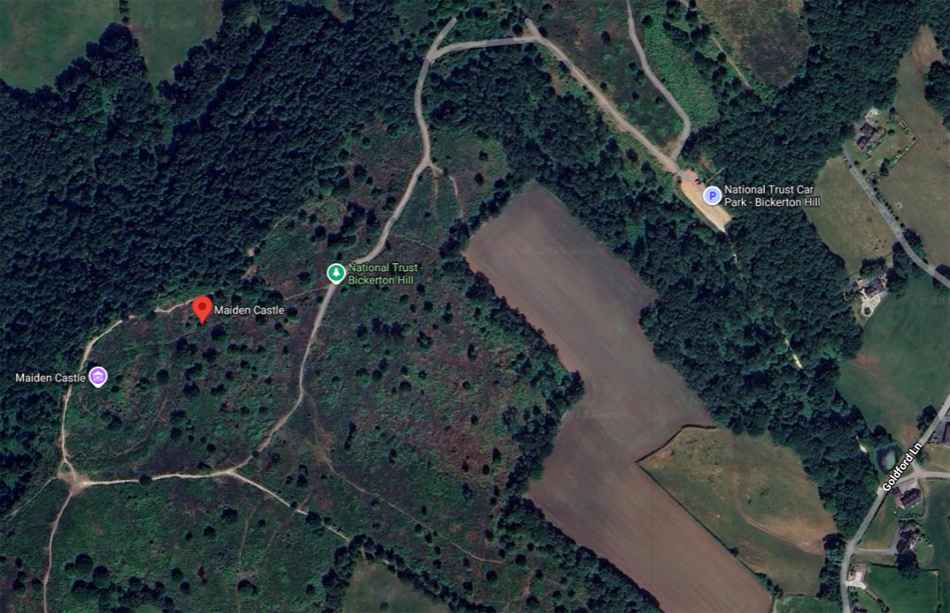
Google Map of Bickerton Hill and Maiden Castle

Google Map of Bickerton Hill and Maiden Castle. The purple marker shows the centre of the hillfort. The ditches between banks are visible as the darker arcing lines

Maiden Castle, in common with other hillforts, had no obvious source of water, and could not therefore withstand a prolonged siege, assuming that it had a defensive role.  In addition, any livestock herded on the outcrop would need to be returned to a water source.  Springs were available along other parts of the sandstone trail, many of which are now dry, and some wells mark access to water today, including Droppingstone Well at Raw Head, under 3km away, and the medieval well at Beeston Castle (now dry), but there were no rivers or streams nearby.  The nearest is Bickley Brook, around 2km to the east.  However, it is likely that there was a lot of standing water and ponds as well as a diversity of small and possibly seasonal wetland habitats that supported different types of wildlife, with a strong avian component.   It is interesting that of all the hillforts on the Sandstone Ridge, only Maiden Castle did not neighbour a river or well-sized mere, nor a well-fed stream or small mere.

Topographical map of the Cheshire Sandstone Ridge, showing Maiden Castle at the south end. Source: Garner et al 2012

The question of a water supply draws attention to the fact that the exact role of hillforts in this part of the country is not fully understood.  The often massive ditches and banks, the latter supporting additional structures such as palisades, were quite clearly intended to keep one set of people (and their possessions) in, and presumably another set of people out.  Specialized entrance designs reinforce this idea of controlled and limited access.  At some hillforts slingshot stones, usually interpreted as evidence of warfare, have been found including at the Sandstone Ridge hillforts Woodhouse and Eddibsury, made of rounded sandstone pebbles.  However, whether warfare is the correct model for the role of Cheshire hillforts is by no means clear.  Localized disputes such as cattle and grain raiding might be a more plausible scenario than all-out warfare, with the hillforts perhaps (speculatively) providing places of retreat from farmsteads dotted around the surrounding plains at times of threat.  The scale of investment in these structures certainly suggests that whatever their role, they were seen as necessary for local security, and probably for conveying territorial ownership and status as well.  An experiment to test inter-visibility between hillforts in northeast Wales and Cheshire, called the Hillfort Glow was undertaken in 2011 by the former Habitats and Hillforts. Sadly, the Habitats and Hillforts website is no longer available, but the experiment was reported on the BBC News website.  Ten Iron Age hillfort sites were included (on the Clwydian Range, Halkyn Mountain, the mid-Cheshire Sandstone Ridge, and at Burton Point on the Wirral).  It suggests that if allied groups wanted to communicate a threat to neighbours, they could do so quite easily, with Burton Point on the Wirral, for example, visible as far always as Maiden Castle 25km (15.5 miles) away, as well as nearer sites on the Clwydian Range.

Maiden Castle defences seen from the edge of the ridge

Maiden Castle defences as they look today, at the far south of the hillfort, seen from near the edge of the ridge, with the dark shadow marking the ditch, facing roughly to the east.

If you visit Maiden Castle in person (see Visiting details at the end for how best to locate it), you will find that the enclosure ditch between the two lines of rampart is clearly visible, although considerably less impressive than it would have been in the Iron Age, and you can walk along it very easily.  The photograph here shows it in late autumn afternoon light, with the ditch clearly marked by the line of shadow.

Excavations and surveys

Varley 1940, Maiden Castle plans, p.70-71

Varley 1940, Maiden Castle schematic plans, showing Varley’s illustrations of the defences, the entrance and the construction of the banks, showing the stone facings, figs.11 and 12, p.70-71

The Maiden Castle hillfort was first excavated by William Varley, (a geography lecturer at the University of Liverpool) and J.P. Droop (who was also involved in the Chester Amphitheatre excavations) over two seasons between 1934 and 1935, published promptly by Varley over two years in 1935 and 1936, after which Varley moved on to Eddisbury Hillfort near Frodsham.  In 1940, as the first of a new series of history books, The Handbooks to the History of Cheshire, he co-authored Prehistoric Cheshire with John Jackson, with illustrations, photographs, fold-out maps and a bibliography organized by archaeological period.

Varley’s published excavations at Maiden Castle were carried out to a very high standard.  As with the later book, he included plans and photographs of the entire site with particular emphasis on his excavations, which were focused on the northern end and included the entrance, and both outer and inner ramparts.

Maiden Castle showing how the inner bank was turned inwards to form a corridor entrance. Source: Varley 1936, Pl.XLIII

Maiden Castle, showing how the inner bank was turned inwards to form a corridor entrance. Source: Varley 1936

The excavations were very informative, confirming that there were two ramparts separated by a ditch and suggesting an additional ditch surrounding the entire defences.  A possible palisade trench under the outer of the two Iron Age ramparts is the only indication that he found of a possible pre-Iron Age line of defences.  The inner rampart was built using timber and sand, and was faced with stone on both sides.  The outer rampart was formed of sand and rubble, with the outer side also faced with stone.  The inner rampart enclosed an area of around 0.7ha, with an entrance at the northeast formed by turning both sides of part of the inner rampart inwards, to form a corridor c.17m long and 0.8m wide.  A pair of postholes set within the entrance area may have been gate posts.  The entrance in the outer rampart was a simple gap, lined up with the inner rampart entrance.  Varley believed that so-called guard chambers (by then identified at some other hillforts) once flanked the entrance, marked by archaeological surfaces, one of which produced a piece of Iron Age pottery.  However, no structural remains survived to substantiate this interpretation.  The ditch between the two ramparts is clearly visible today, particularly at the south end, but Varley also identified another ditch on the far side of the outer rampart, which appears to have been confirmed by the LiDAR survey carried out in 2010. Varley’s plans and photographs have contributed to more recent research and remain a useful resource.

William Varley’s photograph of the entrance of Maiden Castle. Source: Varley 1940, Plate VIII

xxx
Although no further excavations were carried out until 1980, a number of topographical surveys were undertaken in an attempt to clarify matters.  The 1980 excavation, published by Joan Taylor (University of Liverpool) in 1981, was undertaken in response to damage unintentionally inflicted on part of the ramparts by walkers, which revealed some of the internal burnt wooden construction material.  This was an opportunity to re-examine the construction methods and to send some of the charred wood for radiocarbon dating, which produced dates in two clusters, which were later calibrated (a form of correction) by Keith Matthews, then with the Chester Archaeology Service.  The results indicated that Varley’s instincts that the inner rampart predated the outer one were correct, producing a set around 860-330 cal.BC for the inner rampart and a set of 380-310 cal.BC on the outer rampart.

LiDAR clearly shows not only the banks and ditches but also the damage inflicted by stone quarrying both within and beyond the hillfort enclosure. Source: Garner 2012, p.50

LiDAR clearly shows not only the banks and ditches but also the damage inflicted by stone quarrying both within and beyond the hillfort enclosure. Source: Garner 2012, p.50

No further excavations have taken place at the site, but a the Habitats and Hillforts project undertook a number of non-invasive surveys of the site, reported in Garner’s 2016 publication.  The results of a LiDAR survey were reported, revealing that considerable damaged from later stone quarrying to the ramparts and the interior, as well as across the rest of the hill. It additionally confirmed that there were trenches from when the army had a training base and firing range at the site in the later 20th century.  Finally, geophysical surveys were carried out by Dr Ian Brooks in 2011, again reported in Garner 2016, which included both resistivity and magnetometry surveys, the latter producing signs of three possible roundhouses, one of which made up a full circle, their diameters measuring 6.9m, 7.8m and 9.2m.  This is a good indication of the potential of the site for producing further information, even with the probable  damage to parts of the archaeological layers from quarrying (marked on the LiDAR image below as irregularly shaped depressions), but not much else can be concluded without excavation.

Possible roundhouses revealed by geophysical survey. Source: Garner 2017, p.58

Possible roundhouses revealed by geophysical survey, shown in red, with irregularly shaped pits produced by later quarrying for stone. Source: Garner 2017, p.58

Summary of the amalgamated data

The structural character of the site

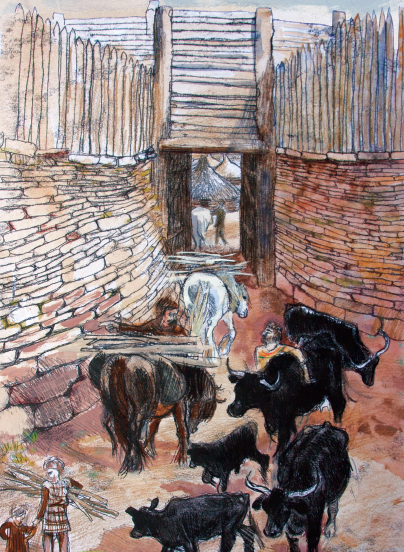
Artist's impression of how the main entrance into Maiden Castle may have looked.

Artist’s impression of how ta simple inturned entrance may have looked, with a palisade on what remains of the ramparts and a walkway over the gateway, with roundhouses just visible in the interior.  Source: Sandstone Ridge – Maiden Castle heritage leaflet

The site is defined by an interior sub-rectangular space enclosed on the east by a pair of ramparts, each with an external ditch, and on the west by an angled section of the precipice that once met up with either end of the ramparts, creating a complete defensible boundary.  There are good indications that when it was first built there was only one rampart.  A stone-faced entrance penetrated the ramparts at the northern end, with a corridor-style inturned section of the inner boundary, with postholes flanking the entrance suggesting that the interior was protected by gates.  Although the interior has been badly damaged by quarrying for stone, geophysical investigations have suggested that roundhouses were present within the enclosure.  The site had immensely clear views to the west, and good views to the east.

This is quite a small site compared to others nearby.  For example, it is around half the size of Helsby hillfort to which it is otherwise similar in appearance.  One suggestion is that it is more akin to an enclosed farmstead than a place for community aggregation and defence.  Having stone-lined ramparts, the site would have been both visible and impressive, perhaps a statement about social identity and affiliation with the land around the hill. Still, the addition of a second rampart argues that defence was an important aspect of the design.

Chronology

Walking along the ditch between the ramparts at Maiden Castle

Walking along the ditch between the ramparts at Maiden Castle

There is only faint evidence of a Late Bronze Age predecessor for the Iron Age hillfort, although this might be expected because Beeston Castle demonstrated clear Late Bronze Age structural features, and Woodhouse, Kelsborrow and Helsby all produced possible evidence of Late Bronze Age construction.  The only evidence is a possible palisade slot under the outer of the two Iron Age ramparts.  However, the level of disturbance created by stone quarrying in the interior may well have eliminated earlier data.  Unfortunately there were no diagnostic artefacts to assist with the question of dating but radiocarbon dates obtained during the excavations during the 1980s suggest that the inner rampart predates the outer rampart, with three radiocarbon dates from the inner rampart spanning 860 to 330 BC whilst those from the outer rampart included one of 380-10 BC.

Economic resources

There are few sites in the immediate area that provide insights into the economic activities in which the local communities were engaged, and what the local land might have supported, both in terms of lowland and upland exploitation of domesticated and wild resources.  The soil surrounding the outcrop was generally poorly drained leading to damp, sometimes seasonally waterlogged conditions.  That on the outcrop itself was shrubby heathland, good for livestock grazing but not for cultivation.

Beeston Castle as it might have appeared in the Iron Age. Source: Sandstone Ridge leaflet

Beeston Castle as it might have appeared in late prehistory. Source: Sandstone Ridge leaflet

There is no data about livelihood management and farming activity available from Maiden Castle, and it is anyway most likely that economic activity took place in the fields below, although it is possible that a site like Maiden Castle would be used to store edible and other resources.

A good idea of what might have been available to the occupants of all the hillforts on the Sandstone Ridge comes from excavations at Beeston Castle, the next hillfort to the north.  Between 1980 and 1985 soil samples were taken during the excavations, focusing on areas most likely to provide information about the use of structures. 60,000 cereal items were recovered.  Emmer and spelt wheat dominated.  Spelt is more tolerant of poor growing conditions, requires less nitrogen to grow, has better resistance to disease and pests, is more competitive against weeds, more tolerant of damp soil conditions, including waterlogging, and can be used to make bread without yeast.  On the other hand, the processing stage is very labour intensive.  Emmer wheat is only reasonably tolerant of damp growing conditions, makes a denser bread that is higher in protein, and is a lot easier to process.  They can be grown separately or as a mixed crop.  Grains of hulled barley were also found at Beeston, but in smaller numbers, possibly due to it being much less tolerant than either emmer or spelt to damp conditions.  Oat was found in the samples, although it is not know whether this was a domesticated or wild crop.  Wild species in the samples that could have been used as a food source were hazelnuts and fruits of the Rubus genus (blackberry, raspberry and/or damsons) and fruits of the Prunus genus (sloe, cheery, and/or plum) and elder berry.

View towards the Clwydian Range across the Cheshire Plain

View towards the Clwydian Range across the Cheshire Plain

There is a dearth of lowland sites known in the area.  Standing on the top of Maiden Castle’s ramparts and looking to the east and west, with views across both the flat stretches of the western part of the Cheshire Plain and the more undulating topography to the east, it is not difficult to imagine Iron Age farmsteads dotting the landscape in a similar way to modern farms today, either enclosed in a ditch and bank arrangement, or simply unenclosed. Even so, a number of such farmstead settlements are known to the west of the Cheshire Ridge as far as (and including) the Wirral, together with some very rare examples of field systems.

The nearest lowland site is Brook House Farm, Bruen Stapleford, around 11km (c.7 miles) away as the crow flies.  Very little animal bone was found, probably due to the acidic soil, but included a pig tooth, a piece of sheep/goat/roe deer-sized animal bone, and a few fragments of cow teeth.  The poorly drained damp plain would not have been suitable for sheep, although entirely suitable for cattle and pigs.  It is worth bearing in mind that the sort of higher ground represented by Bickerton Hill would have been ideal for allowing sheep to roam and feed off upland grasses and shrubs, representing a rare opportunity in Cheshire, should it have been required, for this type of economic diversification, but they would have required access to water when feeding lambs or if used for milk production.  Lowland conditions would also have favoured the herding of livestock, and would have been suitable too for raising pigs and horses.

Brook House Farm. Structures 3 and 4. Fairburn et al 2002, p.14, fig. III II.4

Brook House Farm. Structures 3 and 4. Fairburn et al 2002, p.14, fig. III II.4

Just as today, the underlying geology and soils would have placed limits on what could be grown agriculturally on the Cheshire Plain.  At Brook House Farm plant remains included bread-type wheat emmer or spelt, and some hulled barley.  There was a relatively high proportion of grassland species, suggesting that damp slow-draining grassland may have dominated in the area, which would be more suitable for hay production and livestock grazing than crop cultivation.

The combination of crops and livestock using both lowland and upland areas would have been a good way of diversifying economic output, making the most of the environment, and spreading the risk that subsistence strategies would have faced, even when planning on creating a certain amount of surplus for over-wintering and for trade. It has often been suggested that hillforts may have had multiple roles either simultaneously or consecutively over time, and one of those roles may have been storage of surplus grains, preserved meats, salt and items for trade.

Assuming that those sites to the west of Maiden Castle (and the other west-facing Sandstone Ridge hillforts) had clear lines of visibility to the lowland sites on the Cheshire Plain, and vice versa, it would have been just as straight forward to establish visual communication between the lowland sites and the hillfort, as it was between contemporary hillforts.

Final comments

View across to the east from the outer rampart

View across to the east from the outer rampart

At the moment, hillforts and lowland settlements during later prehistory are not well understood in the Cheshire area.  This is partly because relatively few have been comprehensively excavated, but also because lowland sites are particularly difficult to locate.  Where sites are excavated, local conditions are not favourable to the preservation of organic materials, and most of them produce few artefacts.

The relationship between hillforts and lowland settlements is also poorly understood.  As more of these small farmsteads are identified and excavated, the picture should eventually become a lot clearer, but a number of sites have been identified to date not by crop marks but by accidental discovery during construction works such as pipe and cable laying and housing developments.  It could be a long haul.

In the meantime, sites like Maiden Castle, with their earthworks dating back over 2000 years, are a pleasure to visit and to get to grips with.  When there are stunning views into the bargain, there is a lot to love!


Visiting

Google Map of Bickerton Hill and Maiden Castle

Google Map of Bickerton Hill and Maiden Castle approached from the Goldford Lane car park.

This is a very enjoyable and popular place to visit, managed by the National Trust, and provided with two car parks, one on each side of the hill.  Although not well sign-posted, there is plenty of parking provided by the National Trust.  I used the Goldford Lane car park, which is well-sized (copy over from my walk).  The hillfort can be incorporated into a circular walk that includes Brown Knowle.  The views from the top of the ridge are superb.  See full details, including the leaflet that describes the route for the Brown Knowle walk at the end of my previous post about walking on Bickerton Hill, including a What3Words address for the car park.

Information about Maiden Castle at the site. Click to enlarge.

Information panel at the site about Maiden Castle and the heathland in which it sits. Click to enlarge.

Finding the hillfort is a matter of keeping your eyes open for the information plinth where the footpath opens into in a wide clearing with a bench and terrific views, at the highest point of the hill. It can be seen in the Google satellite photograph above as the scuffed area to the bottom left of the picture.  If you take the lower of the two paths from the car park, skirting the bottom of the hillfort, you will see the information board easily, but if you take the upper path along the ridge, it is actually facing away from you downhill and is easy to miss.

Walking the ditch between the ramparts is easy enough, but note that the banks are covered in low shrubs and brambles that make it quite hard going underfoot, as the ground is completely invisible and very densely covered in a tight network of shrubby material.  However, the views to the east are impressive from the outer rampart.  The same can be said for the interior, which is also covered with dense low shrubs and bracken.  The thought of excavating it makes me ache all over!

You can read much more about Maiden Castle and other archaeology, geology and landscape on the Sandstone Ridge in the sources below.


Sources

Books and Papers

Driver, Toby 2013. Architecture Regional Identity and Power in the Iron Age Landscapes of Mid Wales: The Hillforts of North Ceredigion. BAR British Series 583

Ellis, P. (ed.) 1993.  Beeston Castle, Cheshire. Excavations by Laurence Keen and Peter Hough, 1968-1985. English Heritage
https://archaeologydataservice.ac.uk/archiveDS/archiveDownload?t=arch-1416-1/dissemination/pdf/9781848021358.pdf 

Fairburn, N., with D. Bonner, W. J. Carruthers, G.R. Gale, K. J. Matthews, E. Morris and M. Ward 2002. II: Brook House Farm, Bruen Stapleford. Excavation of a First Millennium BC Settlement.  Journal of the Chester Archaeological Society, new series 77, 2002, p.9–57
https://archaeologydataservice.ac.uk/archiveDS/archiveDownload?t=arch-2910-1/dissemination/pdf/JCAS_ns_077/JCAS_ns_077_008-057.pdf

Garner, D. (and contributors) 2012. Hillforts of the Cheshire Sandstone Ridge. Habitats and Hillforts Landscape Partnership Scheme. Cheshire West and Chester Council.
https://www.sandstoneridge.org.uk/lib/file-234636.pdf

Garner D. (and contributors) 2016. Hillforts of the Cheshire Ridge. Investigations undertaken by The Habitats and Hillforts Landscape Partnership Scheme 2009–2012. Archaeopress
Abridged version available online, minus appendices (there is no index in either print or online versions, but you can keyword search the PDF):
https://www.researchgate.net/profile/Peter_Marshall14/publication/313797404_Hillforts_of_the_Cheshire_Ridge_Investigations_undertaken_by_The_Habitats_and_Hillforts_Landscape_Partnership_Scheme_2009-2012/links/58a6860aa6fdcc0e078652a7/Hillforts-of-the-Cheshire-Ridge-Investigations-undertaken-by-The-Habitats-and-Hillforts-Landscape-Partnership-Scheme-2009-2012.pdf?__cf_chl_tk=hzbN0_un1j_np6Me4Z0bWxtROgI9juclGR.5XFzS5iY-1764184426-1.0.1.1-RsTsNKNPcI.Zt7JSR8rdabCJKMfRvmSXkjpGJZHx31c
Some of the unpublished reports commissioned during this project, as well as some of the tables that are too small to read properly in the printed versions are currently available at http://bit.ly/2ghWmze.

Matthews, Keith J. 2002. The Iron Age of Northwest England: A socio-economic model.  Journal of the Chester Archaeological Society 76, p.1-51
https://www.academia.edu/900876/The_Iron_Age_of_North_West_England_A_Socio_Economic_Model

Schoenwetter, James 1982. Environmental Archaeology of the Peckforton Hills. (2-page summary). Cheshire Archaeological Bulletin, No.8., p.

Schoenwetter, James 1983. Environmental Archaeology of the Peckforton Hills.
https://core.tdar.org/document/6256/environmental-archaeology-of-the-peckforton-hills

Smith, M., Russell, M., and Cheetham, P. 2025. Fraught with high tragedy: A contextual and chronological  reconsideration of the Maiden Castle Iron Age ‘War Cemetery’ (England). Oxford Journal of Archaeology, 44: p.270295
N.B. – This refers to Maiden Castle in Dorset.

Internet Archive: https://onlinelibrary.wiley.com/doi/epdf/10.1111/ojoa.12324

Taylor, Joan. 1981. Maiden Castle, Bickerton Hill, Interim Report. Cheshire Archaeological Bulletin 7, p.34-6

Varley, William 1935.  Maiden Castle, Bickerton: Preliminary Excavations, 1934. University of Liverpool Annals of Archaeology and Anthropology, vol.22, p.97-110 and plates XV-XXII
Internet Archive: https://archive.org/details/annals-of-archaeology-and-anthropology_1935_22_1-2/mode/2up

Varley, William 1936.  Further excavations at Maiden Castle, Bickerton 1935. University of Liverpool Annals of Archaeology and Anthropology, vol.23, p.101-112 and plates XLIII-L
https://dn720408.ca.archive.org/0/items/annals-of-archaeology-and-anthropology_1936_23_3-4/annals-of-archaeology-and-anthropology_1936_23_3-4.pdf

Varley, William 1948.  The Hillforts of the Welsh Marches.  The Archaeological Journal, vol. 105, p.41 – 66
https://archaeologydataservice.ac.uk/archiveDS/archiveDownload?t=arch-1132-1/dissemination/pdf/105/105_041_066.pdf

Varley, William and John Jackson 1940. Prehistoric Cheshire. Cheshire Rural Community Council

Websites

BBC News
North Wales hillfort test of Iron Age communication
https://www.bbc.co.uk/news/uk-wales-north-east-wales-11832323

Heritage Gateway
Maiden Castle, Bickerton, Hob Uid: 68844
https://www.heritagegateway.org.uk/Gateway/Results_Single.aspx?uid=68844&resourceID=19191

Historic England
Maiden Castle promontory fort on Bickerton Hill 700m west of Hill Farm
https://historicengland.org.uk/listing/the-list/list-entry/1013293?section=official-list-entry
Hillforts. Introductions to Heritage Assets
https://historicengland.org.uk/images-books/publications/iha-hillforts/heag206-hillforts/

Natural England
https://nationalcharacterareas.co.uk/

National Character Area 61 – Shropshire, Cheshire and Staffordshire Plain
Key Facts and Data

https://nationalcharacterareas.co.uk/shropshire-cheshire-and-staffordshire-plain/key-facts-data/
Analysis: Landscape Attributes and Opportunities
https://nationalcharacterareas.co.uk/shropshire-cheshire-and-staffordshire-plain/analysis-landscape-attributes-opportunities/
NE556: NCA Profile: 61 Shropshire, Cheshire and Staffordshire Plain, PDF
https://publications.naturalengland.org.uk/publication/6076647514046464?category=587130

National Character Area 62 – Cheshire Sandstone Ridge
Description

https://nationalcharacterareas.co.uk/cheshire-sandstone-ridge/description/
Key Facts and Data
https://nationalcharacterareas.co.uk/cheshire-sandstone-ridge/key-facts-data/
Analysis: Landscape Attributes and Opportunities
https://nationalcharacterareas.co.uk/cheshire-sandstone-ridge/analysis-landscape-attributes-opportunities/
NE551: NCA Profile: 62 Cheshire Sandstone Ridge, PDF
https://publications.naturalengland.org.uk/file/5228198174392320

Sandstone Ridge Trust
Maiden Castle: An Iron Age cliff edge fort (2-page PDF leaflet)
https://www.sandstoneridge.org.uk/lib/file-323322.pdf
Circular walks that include hillforts of the Cheshire Sandstone Ridge
https://www.sandstoneridge.org.uk/discovering/walks-february.html


“Landscape of Neolithic Axes” – A hugely enjoyable afternoon of talks at Penmaenmawr

Introduction

"Landscape of Neolithic Axes" talks in Penmaenmawr on 16th August 2025. Jane Kenney, Becky Vickers and Alison SheridanWhat a thoroughly enjoyable afternoon on Saturday 16th August organized by the Landscape of Neolithic Axes project, part of the Carneddau Landscape Partnership.  The subject matter,  “Landscape of Neolithic Axes,” focused on the production, distribution and role of axeheads made on stone sourced above Llanfairfechan and Penmaenmawr.  These shaped and polished axeheads were distributed to locations all over Britain.

Penmaenmawr, which hosted the event, is a lively little village perched above the north Wales coast, with fabulous views out to the sea, which was particularly jewel-like on the sunny day of our visit.  The sense of seascape and landscape merging almost seamlessly into one another, only faintly interrupted by the line of the village, was remarkable.  Brown signposts to “Druid’s Circle” (Cefn Coch prehistoric stone circle) and the immediacy of the rocky hills just above were incredibly tempting, but we were headed for the Community Hall that was hosting a series of public lectures.

It was a very well attended event.  The same three talks took place first in the morning starting at 10am, and then again in the afternoon at 2pm.  That was extremely generous as it gave those of us coming from further away the chance to leave home at a reasonable time, and the afternoon talks sounded just as fresh as if they were being delivered for the first time.

Key sites in the area of Neolithic axe production around Penmaenmawr and Llainfairfechan

A map of the area, showing all the key sites. From the temporary exhibition at Penmaenmawr Museum (click to enlarge)

Although outside visitors were invited to attend, the event was clearly organized, at least in part, in recognition of the volunteers and the community for all their support.  Many of the attendees had been volunteers on the extensive survey and excavation work that took place not only on Graig Lwyd itself but on nearby outcrops formed of the same intrusive rock.  The talks were designed to be fully accessible to all levels of familiarity with the subject, and were based not only on the latest local research, which has been conducted to the highest standards, but also on the most up to date academic findings in the rest of Britain and in Europe.  It was a genuinely impressive and thoroughly riveting trio of talks.

Apologies for the quality of the photos that I took on my smartphone at the exhibition, and which are dotted throughout this post – I have been unable to improve them much, in spite of tinkering in Photoshop.

A quick note on Neolithic axeheads

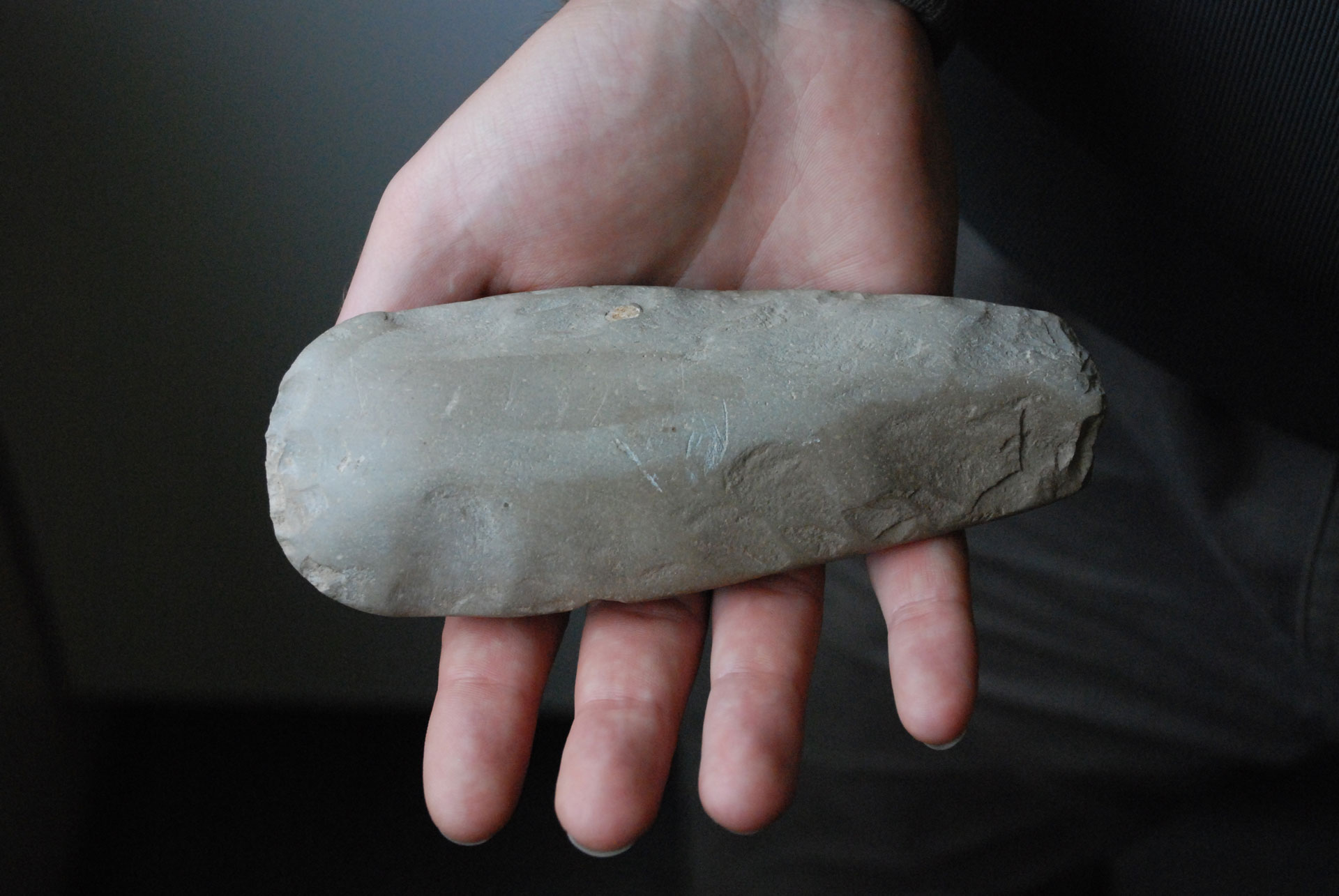
Polished Graig Lwyd Neolithic axehead

Polished Graig Lwyd Neolithic axehead. Photograph and copyright David Longley. Source: Carneddau Partnership

Just a quick note on the manufacture of axeheads for anyone reading this who is unfamiliar with the subject.  The Neolithic spans the time period from around 6000-4500BC and in part of this period axeheads made of particular types of stone, found only in certain geographic areas, became an important type of commodity, traded throughout Britain.  The stone axes made from the outcrops at Penmaenmawr and Llanfairfechan, a stone valued both for its durability and workability has been found all over Britain.  The working of the stone and the networks that distributed them were complex, not only logistically but in terms of inter-community co-operation and the development of relationships.  Axeheads, hafted on to wooden handles, were highly valued items, presumably not merely because of their value as utility tools, but as prestige items that were often difficult to obtain.  This idea is reinforced by finds of axeheads that were never used, and by the fact that some were apparently deliberately broken to take them out of circulation.

Digitized image of a drawing of Graig Lwyd axeheads as published in RCAHMW Caernarvonshire Inventory Volume I : East, Figure 10, 1956. Source: RCAHMW

xxx
xxx

The talks

"Landscape of Neolithic Axes" talks in Penmaenmawr, Carneddau PartnershipThere is, of course, no possibility of doing justice to the talks, and I have not tried to capture everything that was covered.  I hope that I have managed to capture just a little flavour of some aspects of the research discussed by the three speakers in the very short sketches below.   Thanks very much to the the three presenters who provided such a good summary of their work, the directions that their research is taking and how it all relates to the Penmaenmawr area.
xxx

Jane Kenney (Landscape of Neolithic Axes Project and Heneb)
About “The Landscape of Neolithic Axes Project”

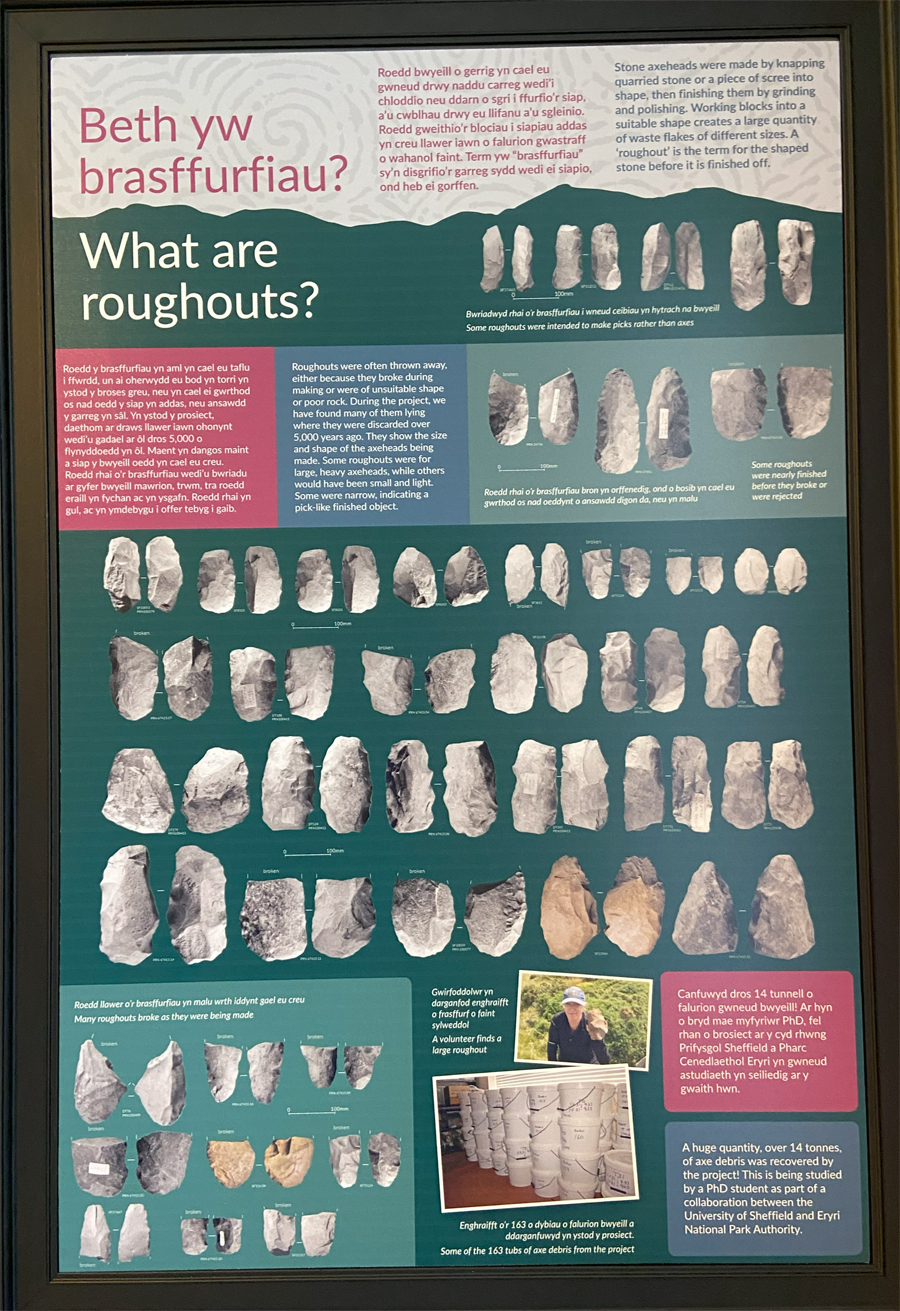
Graig Lwyd area roughouts

Roughouts (part-completed axeheads) from the Graig Lwyd area. Photographed in the temporary exhibition at the Penmaenmawr Museum

Dr Kenney, who has been running the project, explained that this is the 6th and final year of the project that is part of the part of the Carneddau Landscape Partnership Scheme, the overarching objectives of which are to protect and conserve natural and cultural heritage, engaging local people and visitors with that heritage.

The project covers the important period 4000-2500BC that sees the arrival of the earliest farmers, pottery and new funerary monuments, who began to move into the territories of Mesolithic groups who hunted, collected plant foods and fished.  Polished stone axe-heads were part of the new material assemblage that was required by these innovators.  Although wooden handles rarely survive, it is clear from the few that do that axe and adze heads were intended to be hafted.  The example on the poster at the top of the page, and also shown further down the page, is from Cumbria and is now at the British Museum. There were a number of places from which suitable stones were sourced and worked, and Graig Lwyd behind Penmaenmawr was one of these.  The wide distribution of axe heads throughout Britain and Ireland reflects not only the functional value of this type of tool, but their social significance too.

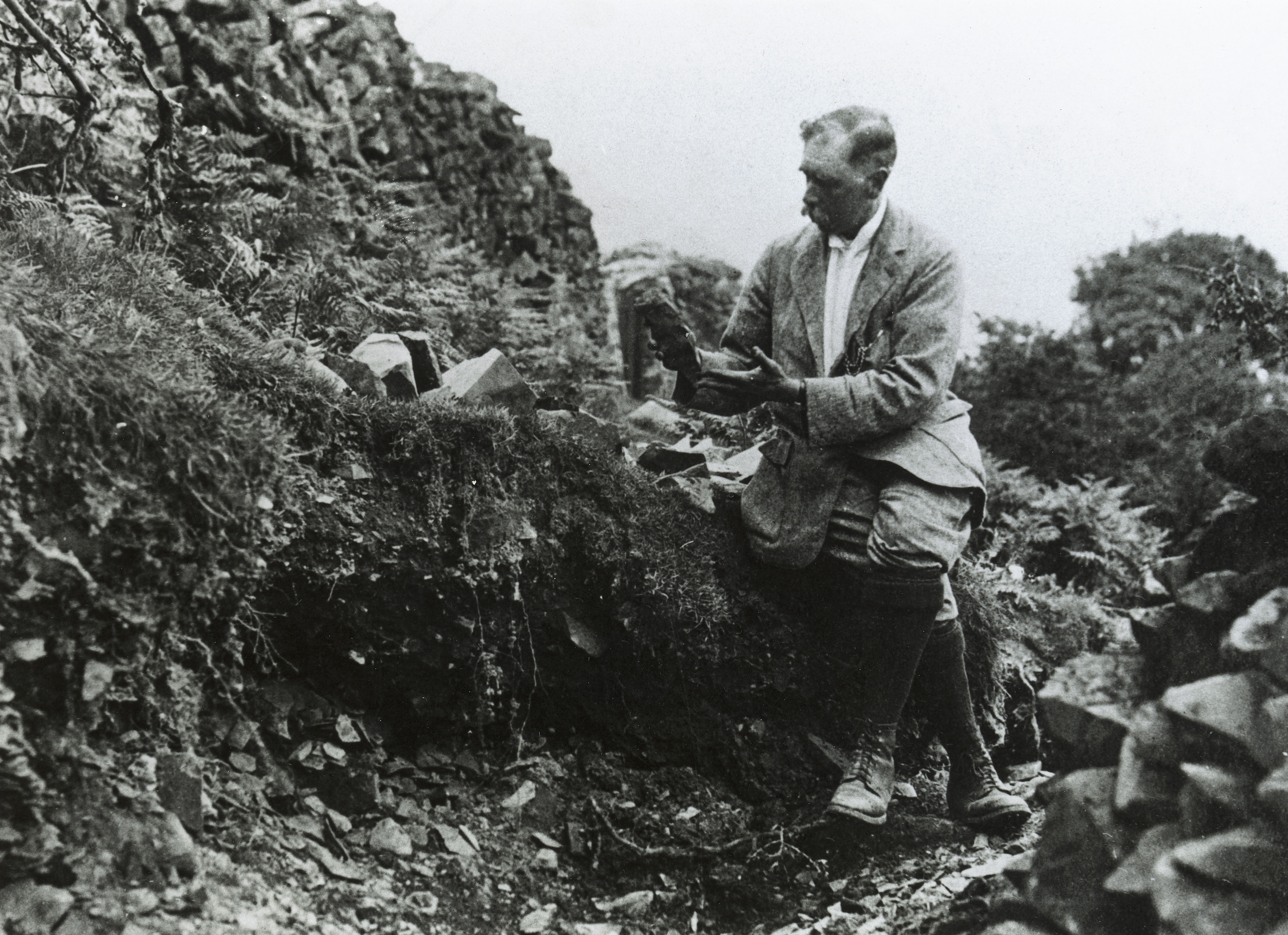
William Hazzledine Warren, who first discovered the Graig Lwyd site in 1821. Source: Peoples Collection Wales

Graig Lywyd was first discovered by Samuel Hazzledine Warren, who was both geologist and prehistorian, in 1919.  He found literally tons of worked material at the outcrop known as Graig Lwyd, made on an igneous microdiorite called augite granophyre, a type of rock formed of liquid magma intrusions that has the combined virtues of being hard enough to use for chopping wood, but also has a structure suitable for knapping into the required shapes.  He published his findings, starting over two centuries of archaeological research in the area.

Stone sources from around Penmaenmawr. From the temporary exhibition at the Penmaenmawr Museum. Click to enlarge.

The whole of Penmaenmawr is made out of this, with the rock around the exposed edges of Graig Lwyd and nearby outcrops, Dinas and Garreg Fawr, being the most suitable, precisely because they were so exposed, and after repeated freezing and thawing developed fractures that become scree that can be easily exploited.  Graig Lwyd, Dinas and Garreg Fawr became a very important source with examples distributed all the across England and Wales with at least one present in Scotland too.  Warren’s work was built upon by other independent local researchers, including David T. Jones with whom Kenney worked in the initial stages of the project to identify several possible sources of axe manufacturing.

As this became a wide-ranging landscape project, the team involved an army of volunteers to do the hard work, as well as children from local schools.  Different approaches were taken to excavation, beginning with 1m sq test pits, with everything bagged by layer and pit. Even at this early stage trend became noticeable, with flakes dominating and roughouts being found but later stages of manufacture, including completed objects, absent.  This was a pattern that was repeated at different outcrops.  Bigger trenches were opened that provided more detailed information, some of it near the outcrops themselves but others further down slopes where material had travelled over the centuries.  At the same time, more test pits were opened in newly identified areas.  The test pits, which investigated below the surface, supplemented the surface finds and showed that there was much more to be found.  As well as roughouts and waste materials, manufacturing tools like hammerstones were also found, helping to provide a more complete understanding of the manufacturing process.

Image showing the excavation of test pits forming part of the Carneddau Scheme. The workings were previously thought to be focussed only on the area of Graiglwyd axe factory but are now known to extend over a much wider area. Source: RCAHMW

Flint tool and flakes (waste materials from tool making) found at Maes-y- . Photographed at the temporary exhibition at the Penmaenmawr Museum

An exciting find above a a marshy area near Dinas that produced lots of axe-working debris and some finished axes may have been a settlement area, now called Maes y Bryn, where different activities took place. As well as axe debris, scattered over a wide area, there were lots of flint flakes scattered over the area, which are entirely consistent with a settlement site.  The flints were mainly flakes, the waste from domestic tool manufacture, which were probably domestic.

As well as the Neolithic findings, there were Bronze Age and Iron Age discoveries as well.  For example, not only has the Dinas outcrop produced plenty of Neolithic axe production data, but it has a very nice Iron Age hillfort on top, and there are plenty of Iron Age field systems in the area.  The early and later medieval use of the land is also of considerable interest.  The area clearly has a considerable amount of future potential, but for the immediate future the focus has to be on post-excavation work, with the challenge of dealing with the huge quantities of axe-making debris that was found:  163 buckets as of last year, and yet more of it this year!

The next talk, by PhD student Becky Vickers was a fascinating insight into how these 163+ buckets are beginning to be assessed.

Excavation of an axe production site in the Penmaenmawr-Llanfairfechan area

Investigating a test pit in the Penmaenmawr-Llanfairfechan area. Source: RCAHMW


Becky Vickers (PhD candidate, University of Sheffield)
New research on Axe-Making

Poster from the exhibition at the Penmaenmawr Museum showing some of the varieties of tool found on the outcrops on the Penmaenmawr mountain

The moment I saw that this talk was on the programme I was looking forward to it.  There are dozens of studies looking at flint and chert tool analysis and reconstruction, including how the waste flakes inform about the manufacturing process.  The essence of the approach is to look at how basic raw materials undergo a process of reduction, using stone and organic tools (wood, bone, antler etc) to strike a stone directly or indirectly (e.g. hitting an antler-made tool with a hammer stone to create a particular form). It is a lot less common for other types of stone tools to be analyzed using similar methods and perspectives, gaining an understanding of them from raw material to finished product and, beyond manufacturing, how they were used.

This was the main thrust of the first part of the presentation by Becky Vickers, and it was immensely informative.  She first took us through the anatomy of a tool and flakes, identifying key factors that indicate how the tools were made and how waste flakes can be distinguished from loose scree.  Three main stages of reduction were identified after the raw material had been sourced, which represent a process from rough-out (rough shaping of a piece of stone), through clearly identifiable shape, to final product.  Part of the research has been to study the waste flakes from the production process and the pieces of stone that were flaked away from what would become finished (or abandoned) tools.  Waste flakes can be just as informative as roughouts and finished products about the manufacturing process, an essential part of the production process, helping to answer questions about how flakes changed through various stages and where these stages took place.

Not only axes were made at the sites. From an interpretation board at the temporary exhibition.

Similarly, one of the many interesting points picked out here (amongst far too many to list in this post) is that not all of the axes produced in the Graig Lwyd and related areas were of the most traditional axe form.  Others were carved into shapes that could be used as both small and large general-purpose tools, as well as scrapers and picks. These give a sense of the versatility and different scales of the production process.  The hammerstones that would have assisted with the reduction of the stone to form tools are very rare, suggesting that they were valued items that were carried from the site when the work was done.

The analysis of the objects found suggests that these different processes took place at different locations.  Some of the initial work to create a tool from the raw material was found at the source of the stone.  Roughouts, the initial shaping of the stone into a piece that resembles the final tool, were also found at the source of the stone, but after that further refinement took place elsewhere, perhaps initially in at temporary, seasonal settlement sites that may also have been used as bases for pastoral activities, and were perhaps finished in specialized workshop areas.

A few of the 163 tubs of artefacts and waste flakes found during the project.  From the temporary exhibition at the Penmaenmawr Museum.

Another aspect of Becky Vickers’s work is experimental archaeology.  She has been working with experimental archaeologists Dr James Dilley and videographer and photographer Emma Jones, who have all worked together to carry out, record and understand the implications of end-to-end production processes.  See the video at the very end of this post.  Attempting to reproduce the original methodology to complete a final tool have been of real value to Becky Vickers. enabling her to to adapt her ideas. Experiments showed that 1700-3000 small flakes could be produced from one tool, depending on the reduction process chosen.  Interestingly, this is not at all well represented in the archaeological assemblage.  Many of the smaller flakes are now missing, either washed away by the weather or missed in the archaeological process.  Although she has over 163 huge tubs of finds to wade through, the job could have been much more challenging if all the very small waste flakes that must have been produced in the Neolithic had also been found!

Detail from an interpretation panel at the temporary exhibition

Sometimes is is clear that part-made axes deliberately destroyed, intentionally putting them out of action. This aspect of the research suggests that choices were being made about the suitability of a tool during the manufacturing process and, where an item was found to be wanting, it had to be disposed of in a particular way.

The analysis is to finish in spring 2016, and it will be very interesting to see some of the results.


We broke at this point for more tea and coffee.  Following both of the above lectures, a variety of questions were posed by the audience, and it was interesting to note that many of them centred on how the axeheads fitted into not only industrial and economic aspects of life, but on the wider question of how they were involved in how societies and individuals defined themselves and how such objects became culturally embedded with their own particular signficance.  It was handy, then, that the afternoon was wrapped up with the Headline Talk by one of Britain’s best known Neolithic specialists, Dr Alison Sheridan, who tackled these and other wide-ranging topics about axe manufacturing and the axe trade in Europe, Britain and Ireland.


Headline Talk: Alison Sheridan (Associate Researcher, National Museums of Scotland)
About the Wider World of the Axes

The Shulishader hafted axehead (Stornoway, Lewis)

The Shulishader hafted axehead (Stornoway, Lewis). Source: National Museum of Scotland

After hearing about the Penmaenmawr landscape, and its role in the axe trade, Dr Sheridan introduced the wider picture, and offering insights into the social importance of axes in Britain and Europe.

On a practical front, the axehead is an essential component of the toolkit for land clearance and for cutting and shaping wood for making houses, boats, other tools and weapons.  However, they were not all put to work.  Some were not destined to chop anything.  Both haft and axehead of the Shulishader axe, for example,found on the Isle of Lewis and dating c.3300-3000BC were beautifully shaped and seem to have been less for everyday use and more for display.  Whether valued for their utilitarian use or for the prestigious character of the item itself, they demonstrated a high level of interconnection between communities.  Some types of stone were obviously preferred and even when it was logistically challenging, items made of these preferred raw materials travelled over long networks.  The Irish Stone Axe Project, for example, has found at least 9000 porcellanite axes in Ireland.  The networks that distributed these tools presumably also helped to maintain social ties so that communities could support each other in times of need, for finding marriage partners, for exchanging ideas and for a great many other interconnections.

The distribution of axeheads from Penmaenmawr and Llanfairfechan

The distribution of axeheads from Penmaenmawr and Llanfairfechan across Britain. From the temporary exhibition at the Penmaenmawr Museum. Apologies that it is so lop-sided!

Dr Sheridan described how since the mid 1900s thin sections taken of rocks used for tool manufacture has enabled the study of mineral composition, helping to create a picture not only where these have been sourced, but how far these tools have travelled.  Although there were a number of quarries in Wales, axes were also imported from elsewhere, including one in southwest Wales from the Italian Alps.  The extent and complexity of these networks suggests that this was not just a case of economic models of supply and demand and factory-type production line manufacturing. Instead, Dr Sheridan argues that something more complicated was happening, with social and ideological factors driving production and movement.

In order to contextualize the axe trade, Dr Sheridan gave an overview of the establishment of farming and its associated new traditions with the arrival from Europe of livestock and crops.  Much of her work has been informed by DNA analysis of human remains, which suggests several periods of migration, resulting in the widespread adoption of pioneering new methods of farming by indigenous hunting populations.  Two strands in particular impacted Wales, one responsible for the types of megalithic tombs found on the west coasts of England, Wales and Scotland, and in Ireland and another responsible for the those who introduced the Carinated Bowl tradition.  They brought with them not only new economic activities, pottery and funerary traditions, but new domestic architecture based on farmsteads and new tool types.

Jadeitite axe, Kincraigy (Raymoghy) found in Co. Donegal, Ireland. Source: National Museum of Ireland

One of the remarkable aspects of the network of European trade, exchange and communication that grew up around axeheads is the arrival of polished green Jadeitite axeheads from high in the Italian Alps, which have been found as far away as the Scottish borders, County Mayo in Ireland, the Black Sea and Morocco.  These were special purpose objects that were never intended to be used.  The edges can be translucent when ground thin, so that when held up to the light the edges display a halo, and they can be polished to an almost mirror-like surface.  They were the subject of  the pan-European Projet JADE headed by Professor Pierre Pétrequin, a three year project from 2007-2010 that has produced four volumes of findings.  Dr Sheridan described how a strand of interesting ethnoarchaeological  work has been carried out in Papua New Guinea to gain insights into axe productions, where the highest mountains, being closest to the Gods, were seen as the ideal source of rocks for tool manufacture.  As Dr Sheridan said, every single axehead had an amazing biographical tale to tell, based on its perceived value as a prestige item.

Ehenside Tarn haft and axehead, Cumbria

Ehenside Tarn haft and axehead, Cumbria. Source: British Museum (POA.190.6)

One of the best-known sites for accessing the raw material for axeheads in Britain is Great Langdale in Cumbria, where a greenish rock was sought out.  Dr Sheridan suggested that both the choice of stone and its treatment were influenced by Alpine axeheads in terms of colour, shape, aesthetic beauty as well as its ability to take polish.  These were circulated long distance Britain and Ireland, with some performing a functional role whilst others seem to have performed a more ceremonial role.  The Great Langdale quarries were very heard to reach.  As with the Papua New Guinea example, the social value lies in the difficulty of obtaining stone in first place.

Dr Sheridan went on to describe other examples of British axehead finds, including the working of blue-green igneous riebeckite-felsite axeheads on Shetland, where people were making more axeheads than they could possibly use.  One site alone, a Neolithic house, produced a very unusual find of 12 axeheads, perhaps amassed as wealth to be exchanged with other communities.

The obvious question in discussion of exchange networks, is what Neolithic axeheads were exchanged for.  Dr Sheridan suggested that on the basis of evidence of extensive saltern production (salt made by evaporating sea water or brine from inland springs) axeheads could have been exchanged for salt.  Salt has always been a trade commodity, and although it can be difficult to detect archaeologically, it is a very intriguing line of potential research.

Seen in the context of Dr Sheridan’s talk, the Penmaenmawr axeheads are part of a much wider series of Neolithic networks that produced and distributed not only utilitarian tools, but items of status and prestige that could be preserved and curated to become components of more esoteric value systems.

xxx

The Exhibition at the Penmaenmawr Museum

Geology of the Penmaenmawr and Llanfairfechan outcrops

An incredibly helpful portion of an interpretation panel at the temporary exhibition in the museum explaining the geology of the Penmaenmawr and Llanfairfechan outcrops. Click to enlarge.

We had intended to arrive early enough to see the small exhibition on the same theme in the Penmaenmawr Museum, but the A55 crawled along at 30mph nearly the entire way, so we had arrived just in time to sit down with a complementary coffee and utterly delicious chocolate Hobnob.  Fortunately we were fabulously lucky that some of the museum personnel were packing up at the end of the day, and one of their number generously allowed us in to see the exhibition after they should have closed for the day.  Thank you Suryiah for letting us in!  The exhibition was beautifully done.  Seven interpretation boards covered the geology, the process of axe production on Graig Lwyd and other outcrops, the types of tool found, and provided a cabinet full of axes in various stages of construction, waste flakes and some flint implements to provide an excellent idea of the range of items that were being found on the mountain.  Photographs of the interpretation boards and their beautiful photographs and illustrations have been used throughout this post.  It will be good to go back and see the entire museum on another day.
xxx

Final Comments

The Graig Lwyd stone quarry as it looks today. Source: RCAHMW

It was a splendid afternoon of talks.  If you have the chance to hear any of the researchers speak in the future, do take advantage of the opportunity!  The lectures were being filmed, so hopefully they will become available online at some stage.

The sheer number of logos referencing so many organizations on the poster and on presentations says an awful lot about the complexities of funding and organizing something this complex, particularly in the long-term.  Thanks so much not only to the funders, organizers and speakers, but to the volunteers who provided cups of tea and coffee (life-saving), glasses of water and luxury biscuits, and to all the people who enabled the exhibition to happen, including the museum staff.  It was so well done.  The long round of applause at the end of the event said it all, but it was also great to see people queuing up to thank the organisers on the way out.

My thanks also to Helen Anderson not only for driving us, but for letting me know that the event was taking place.


A few selected pieces of further reading

These are bits and pieces from my own reading, not anything recommended by the organizers of the event.

Books and papers

A short list of general introductory reading

Polished axehead from Graig Lwyd stone found on Anglesey

Polished axehead from Graig Lwyd stone found on Anglesey. Source: Peoples Collection Wales

Burrow, Steve 2006. The Tomb Builders in Wales 4000-3000BC. National Museum of Wales

Edmonds, Mark 1995. Stone Tools and Society. Working Stone in Neolithic and Bronze Age Britain. Routledge

Malone, Caroline 2001. Neolithic Britain and Ireland. Tempus

Ray, Keith and Julian Thomas.  Neolithic Britain. The Transformation of Social Worlds.  Oxford University Press

Specific to Axehead Production (all available to view online)

Ennos, Roland and João Oliveira 2020. The mechanical properties of wood and the design of Neolithic stone axes. Journal of Lithic Studies. 8. p.11-24
https://www.researchgate.net/publication/359751898_The_mechanical_properties_of_wood_and_the_design_of_Neolithic_stone_axes

Pétrequin, Pierre and Alison Sheridan, Estelle Gauthier, Serge Cassen, Michel Errera,
Lutz Klassen 2015.  Projet JADE 2. ‘Object-signs’ and social interpretations of Alpine jade axeheads in the European Neolithic: theory and methodology.  In : T. Kerig and S. Shennan (eds.), Connecting networks . Oxford, Archaeopress, p.83-102
(Free to access, but you need a free Academia account):
https://www.academia.edu/13644414/PETREQUIN_P_SHERIDAN_et_al_2015_Projet_JADE_2_Object_signs_and_social_interpretations_of_Alpine_jade_axeheads_in_the_European_Neolithic_theory_and_methodology_in_T_Kerig_et_S_Shennan_ed_Connecting_networks_Oxford_Archaeopress_83_102

Sheridan, Alison and  Gabriel Cooney,  Eoin Grogan 1992.  Stone Axe Studies in Ireland. Proceedings of the Prehistoric Society 58, 1992, p.389-416
https://core.ac.uk/reader/325992590

Topping, Peter 2010. 3 Neolithic Axe Quarries and Flint Mines: Towards an Ethnography of Prehistoric Extraction.  In (eds.) Margaret Brewer-LaPorta, Adrian Burke and David Field. Ancient Mines and Quarries. A Trans-Atlantic Perspective. Oxbow Books, chapter 3.
(Free to access, but you need a free Academia account):
https://www.academia.edu/17310103/_2010_Neolithic_Axe_Quarries_and_Flint_Mines_Towards_an_Ethnography_of_Prehistoric_Extraction

Walker, Katherine 2015.  Axe-heads and Identity: an investigation into the roles of imported
axe-heads in identity formation in Neolithic Britain.  Unpublished PhD. University of Southampton, Faculty of Humanities (Archaeology), Volume 1 of 2
https://eprints.soton.ac.uk/383149/1/K.Walker%2520-%2520PhD%2520thesis.pdf

Williams, J.Ll.W. and Jane Kenney  2009.  Graig Lwyd (Group VII) Lithic Assemblages from the Excavations at Parc Bryn Cegin, Llandygai, Gwynedd, Wales – Analysis and Interpretation. Internet Archaeology 26
https://intarch.ac.uk/journal/issue26/williams_index.html


Websites and YouTube videos

Gwynedd Archaeological Trust
Group VII Axe-working Sites and Stone Sources, Llanfairfechan, Conwy. Report and gazetteer.  Project No. G2495. Cadw Report No. 1416. December 2017. By Jane Kenney
https://www.walesher1974.org/her/groups/GAT/media/GAT_Reports/GAT_report_1416_compressed.pdf
Landscape of Neolithic Axes: Report on fieldwork in 2021 at Llanfairfechan. Project No. G2495. Prepared for: Cadw. Report No. 1623. March 2022. By Jane Kenney and George Smith
walesher1974.org/her/groups/GAT/media/GAT_Reports/GATreport_1623_compressed_revised.pdf
Landscape of Neolithic Axes. Report on fieldwork in 2022 at Llanfairfechan. Project G2495. Prepared for: Cadw. Report No.1698. March 2023. By Jane Kenney and George Smith
https://walesher1974.org/her/groups/GAT/media/GAT_Reports/GATreport_1698_compressed.pdf

Heneb
Landscape of Neolithic Axes Project: Year 1 Test Pitting, Ty’n y Llwyfan, Llanfairfechan.
https://heneb.org.uk/wp-content/uploads/2024/11/fieldwork2019.pdf
Group VII Axe-working Sites and Stone Sources, Llanfairfechan, Conwy. Report and gazetteer.  Project No. G2495. Prepared for: Cadw. Report No. 1416. December 2017. By
Jane Kenney
https://heneb.org.uk/wp-content/uploads/2024/11/initialsurvey.pdf

A Research Framework for the Archaeology of Wales
Neolithic and Earlier Bronze Age. Version 03; Final Refresh Document February 2017
www.archaeoleg.org.uk/pdf/review2017/neolithicreview2017.pdf

Carneddau Landscape Partnership
Conserving and celebrating the landscape of the Carneddau
(The Carneddau landscape is an area stretching across almost 220 square kilometres in Northen Snowdonia. Its mountain uplands are dominated by Carnedd Llywelyn and Carnedd Dafydd – two of Wales’ five 1,000m peaks)
https://carneddaupartnership.wales/
Landscape of Neolithic Axes
https://carneddaupartnership.wales/project/landscape-of-neolithic-axes/

Penmaenmawr Historical Society and Museum
https://www.penmaenmawrmuseum.co.uk/

xxx


See the website at www.ancientcraft.co.uk 


xxx

Open Day of the CRAG excavations at Bryneglwys, Llantysilio Mountain

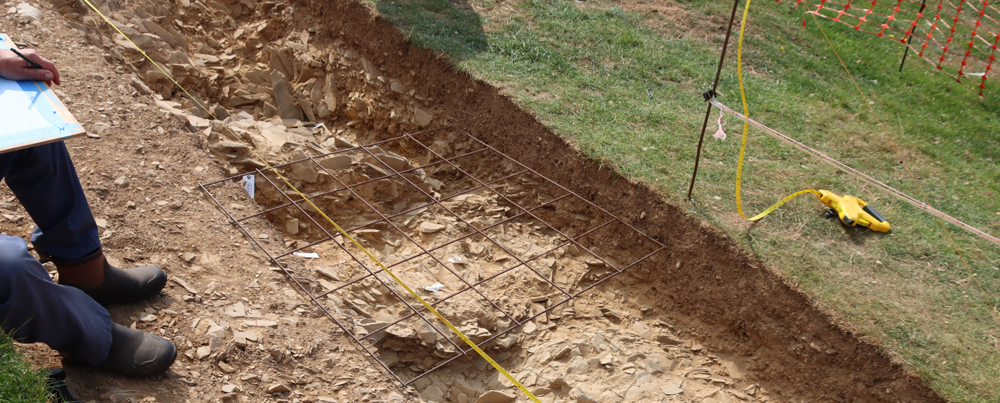
Many thanks to the Clwydian Range Archaeology Group (CRAG) for organizing an Open Day to the Bryneglwys excavations on 9th August 2025, and to Dr Ian Brooks of Engineering Archaeological Services (EAS), who is consulting for CRAG, for an excellent guided tour of the Bryneglwys archaeological site.  The volunteer excavators, all CRAG members, were remarkably tolerant of us peering into their trenches as they worked.  Thanks are due too to Dr Pauline Clarke for arranging for Chester Archaeological Society members to visit.  The site is on private land, so visits are by invitation only, and it was a great opportunity to get a feel not only for the pioneering nature of the excavations, but also for the way in which that particular landscape has been used over long periods of time.  I attended with another CAS member, Helen Anderson, and we both enjoyed it enormously.

The site sits on the west-facing lower slopes of the Llantysilio mountain near Bryneglwys, with views both across the valley and down the valley towards the southwest.  Unlike the Clwydian range, which runs broadly north to south, with a tilt towards the east, the main line of the Llantysilio mountain runs roughly northeast to southwest, with the valley of Afon Morwynion along its western edge, crossing below the end of the Clwydian Range. It is now followed by the A5104 from Llandegla to Corwen, with the A494 picking up the route of the River Dee, and following it to Bala and Lake Tegid, and beyond into midwest Wales.  This has almost certainly been an important route connecting northern and middle parts of Wales with the English northwest at least since the end of the last Ice Age, with Iron Age hillforts standing prominent guard over much of the route.

The undulating Llantisylio mountain rising above the village and site of Bryneglwys, its ridge marked by a prominent modern trackway

Research goals

When it was established, the remit of the Bryneglwys project was partly to investigate potential sites identified by the landowner, a keen supporter of the excavations.  It was thought that at least one of the sites might be an early-mid Bronze Age cairn.  As sites from the period are an important aspect of  northeast Wales, and there are very few known from the Llantysilio mountain, this was an opportunity to improve knowledge on the subject and extend an understanding of how these sites were distributed both locally and in northeast Wales.  Given the relative proximity of two Iron Age hillforts.  Given the proximity of an Iron Age hillfort, it was not out of the question that Iron Age data might be recovered.

View to the west of the lower Bryneglwys excavation area

The medieval history of the area was also taken into account.  Bryneglwys village is first mentioned by name in documents in 1284.  Its church, which dates to the late 15th or early 16th century, contains a 14th century slab.  Not far away, just outside Llangollen are the ruins of the 1201 the Cistercian abbey of Valle Crucis, established in 1201 and forced to close in 1537, which may have owned farm property in this location.  The economic activities of Valle Crucis Cistercian monastery near Llangollen are not well documented and any archaeological evidence contributing information would obviously be useful.  The Clwyd and Powys Archaeological Trust (CPAT) report on the subject of granges in northeast Wales collated the information available, but is far from definitive on the subject, and it would be very useful to know if a grange had indeed been established in the Bryneglwys area.

Finally, as usual in rural landscape investigations, seeing what else turned up in the process, including far more recent use of the landscape, was very much part of project scope and has produced some interesting results about changes agricultural land use and the challenges of dealing with drought conditions.
xxx

Survey and excavations

Initial surveys

The Bryneglwys project has produced some revealing results touching on some if not all of these areas of interest.  The initial investigation focused on non-invasive topographical and geophysical surveys, the combination of which determined where the initial excavations should take place.  The topographical investigations located areas where potential archaeological and historical features are visible to the eye, including field boundaries, trackways, a natural spring uphill from the known archaeological features, and evidence of ridge-and-furrow agriculture.  The online resource Archwilio was employed to supplement ground-level observations by providing a birds-eye view of the location.  The geophysical surveys, allowing the team to assess what might lie beneath the surface level, identified features that seemed non-natural and might be man-made.  The excavations have been following up on some of these initial investigations.

Like the Clwydian Range, the Llantisylio mountain has a ridge that is now covered in moorland scrub, although the remains ridge and furrow ploughing show that it was cultivated during the Middle Ages.  The lower slopes at Bryneglwys, having been cultivated and/or grazed for centuries, are largely fee of moorland scrub.  The geological bedrock over which all the Bryneglwys excavations are located is composed of the same cleaved Silurian siltstones that I mentioned on my Dinas Bran post, and look horrendous to excavate.  The current excavations have been taking place either side of a boundary marked by a low turfed stone wall topped with shrubs dating from at least 1740, fields that are now used for herding sheep, although they were ploughed in the past.  Although there were findings of a few Mesolithic tools, which are often found in the area, the main discoveries were far more substantial.

Bronze Age ring cairn and associated finds

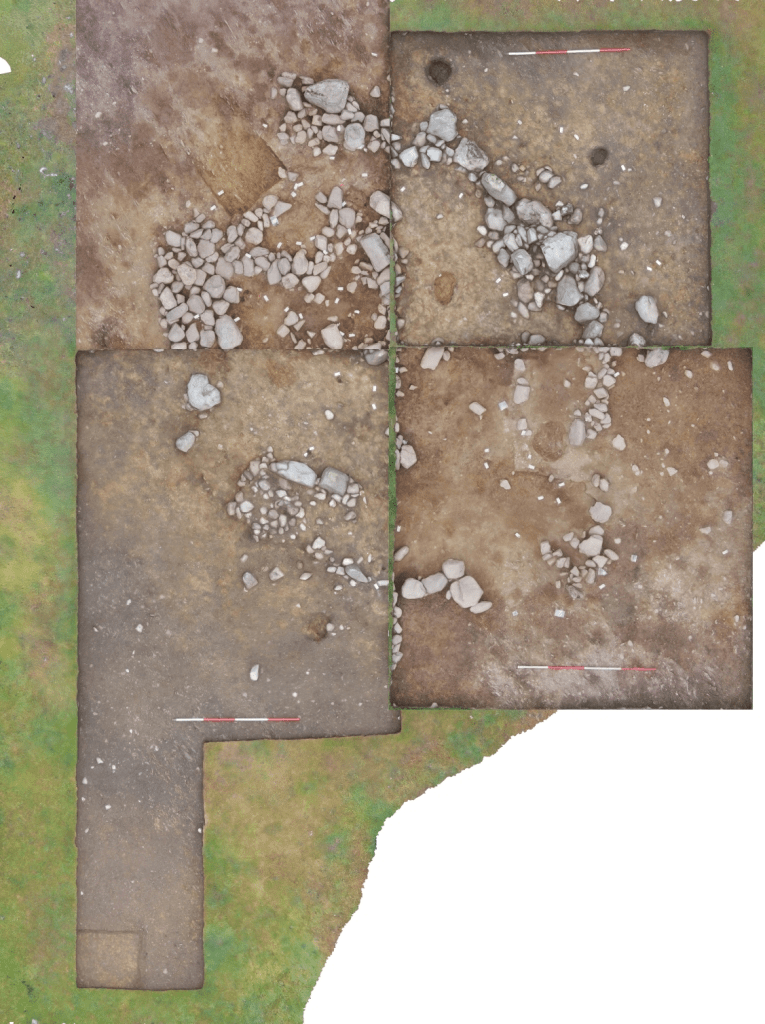
Bryneglwys composite photographs of the ring cairn, excavated over two seasons. Source: Clwydian Range Archaeology Group

On the upper side of the boundary wall, the furthest away from the valley floor, the most exciting find to date has been the discovery of a Bronze Age ring cairn, the diameter of which was around 7m.  All four quadrants were excavated over two seasons,

It is thought that the monument probably started life as a small stone circle with upright stones, some modified, and that the structure was later adapted into a banked ring into which the cremated bones and artefacts were deposited on a clay base before being topped with a low cairn.  There were four other deposits of cremated bone and charcoal.  The repeated use of cairns is a normal for the period, indicating the importance of these sites from one generation to the next.

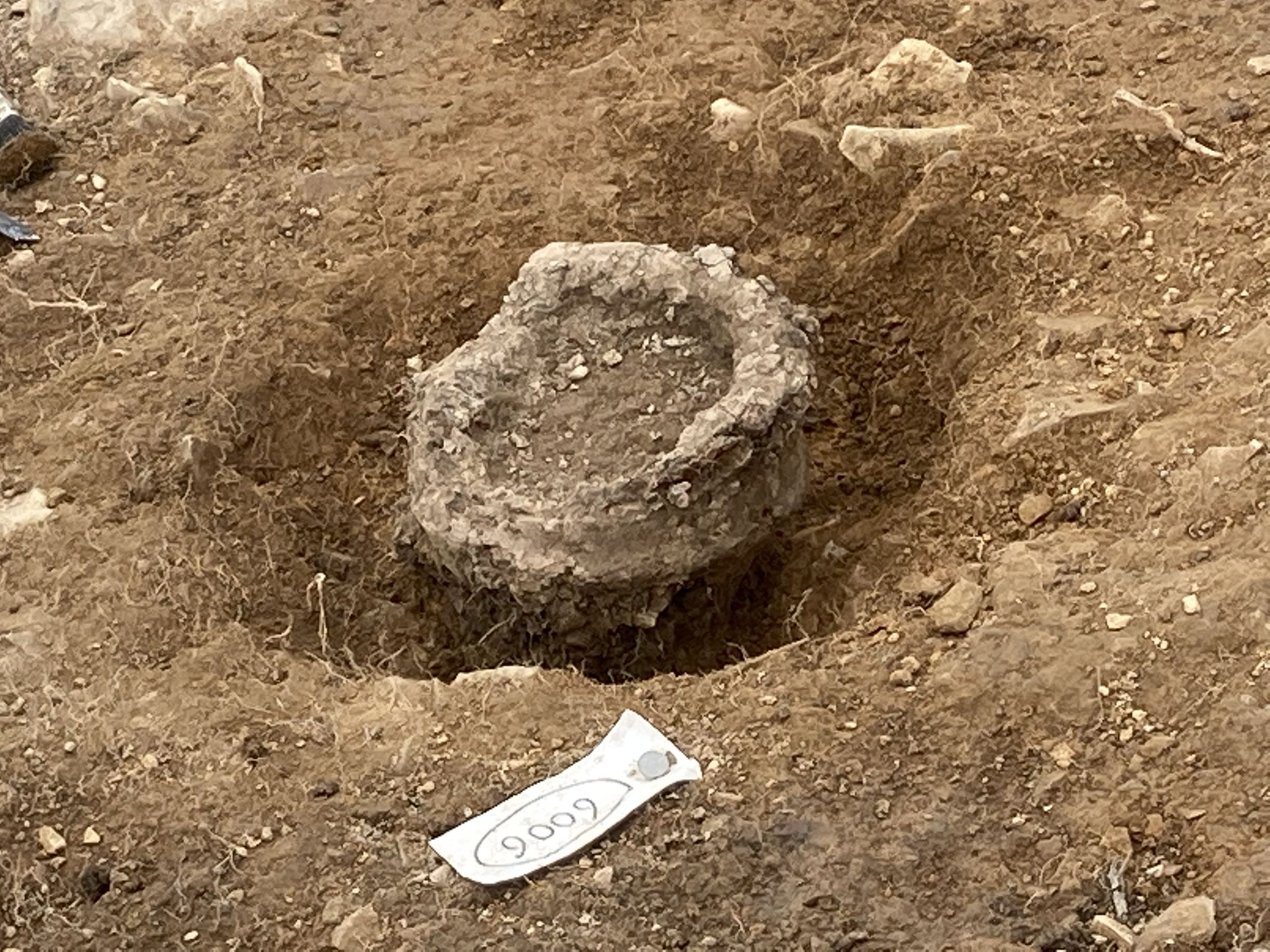
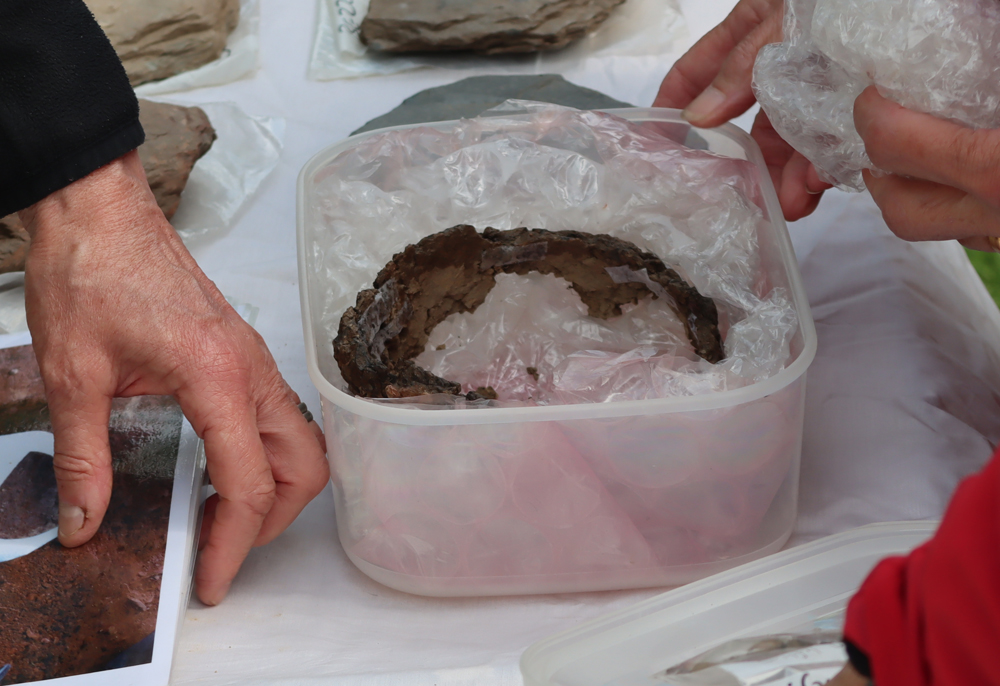
The cremated human remains were found together with some pieces of pottery.  One of these was a large but very poorly fired piece around 120mm in diameter, found upright in the ground just outside the main ring of boulders.  The rim was missing, probably due to plough activity.

Pottery vessel as it was found at the ring cairn, Bryneglwys. Source: Clwydian Range Archaeology Group


Although this poorly fired vessel with the rim missing does not look particularly exceptional today, it must have been an important contribution to the ring cairn


There were also around 40 sherds of other pottery in the cairn accompanying the cremated remains, some with attractive cord-impressed designs that were perhaps intended emulate basketry.


Pottery sherds from Bryneglwys ring cairn. Source: Clwydian Range Archaeology Group

xxx
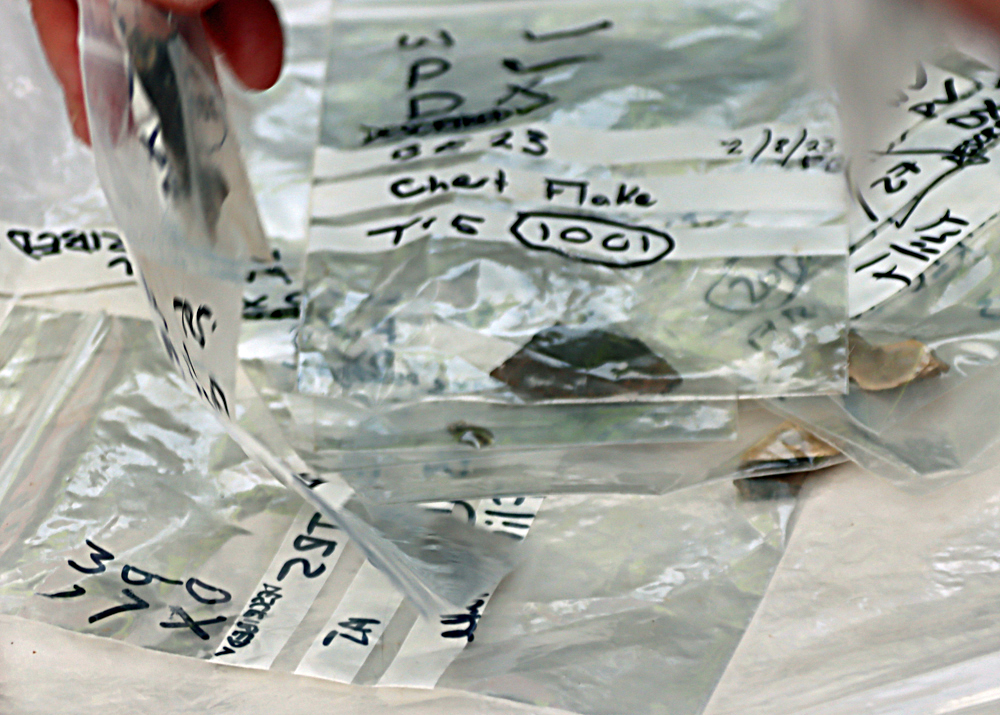
One of the cremations was deposited in a circle of stones, which was deposited with a quartz crystal and one of two flint arrowheads found at the site.  There were a number of tools made on flint and chert, including two barbed and tanged arrowheads, thumbnail scrapers and a small knife blade.  The flint was very fine and may have been imported.  Tools made on chert were also found.  As well as those in the ring cairn itself, there was also a flint scatter which is at present focused around the ring cairn.   The amount of flint has been unusual for the area, and is of particular interest.
xxx

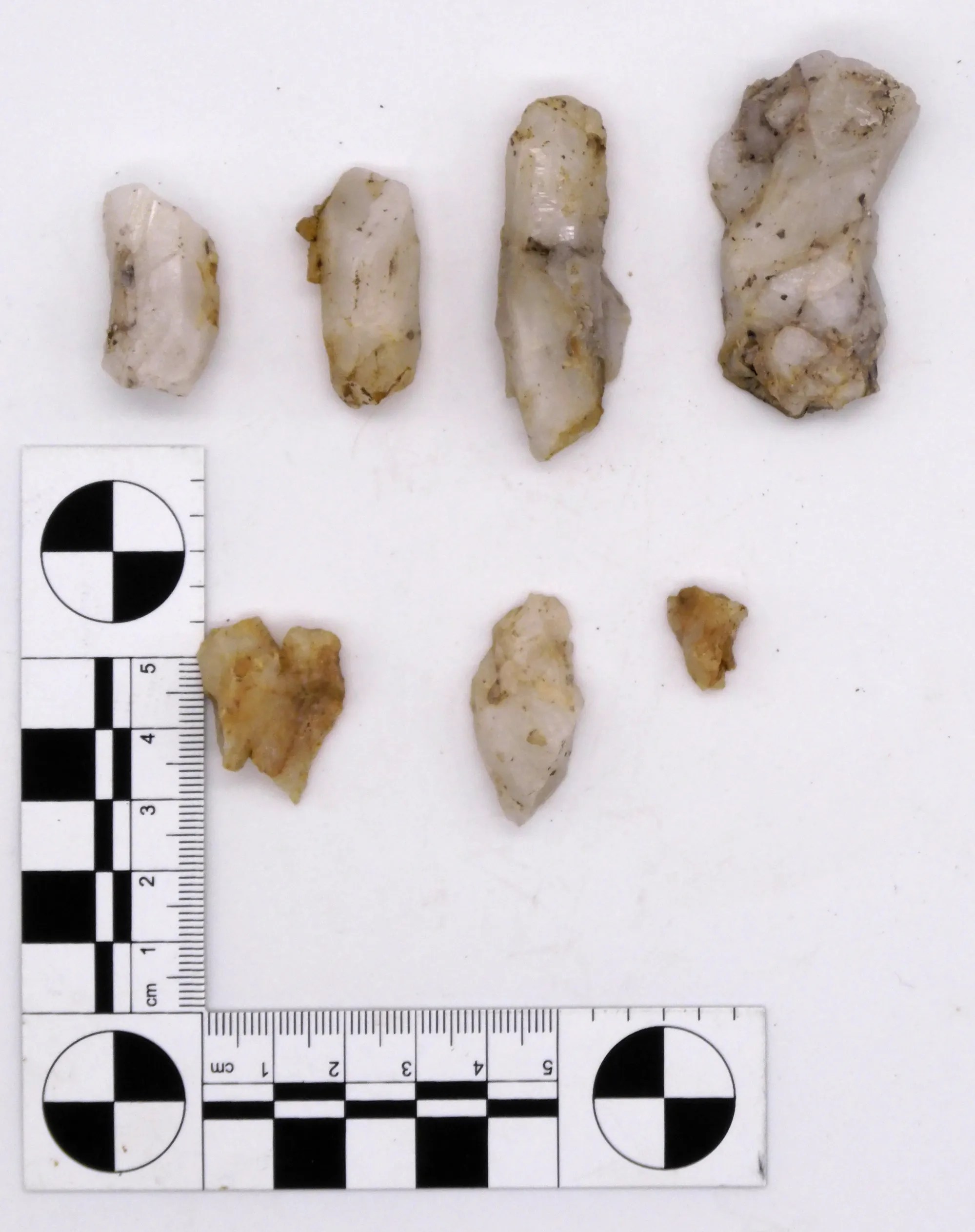
Remarkably, over 150 pieces of quartz were found in and around the circle, and include a range of different forms and types.


A sample of some of the quarts items found in the ring cairn. Source: Clwydian Range Archaeology Group

There were also a large number of other more general-purpose but important tools  like hammer stones and shale disk-shaped items, the function of which is uncertain but look rather like lids.  Most of the finds from the site are currently on show at a temporary exhibition in the Llangollen Museum but some were on display on a table in the field serving as a car park, together with photographs of those on loan to the exhibition.

The volume of finds in the site has clearly been both rewarding and very informative, providing new insights into the funerary and ceremonial tradition in the area.   The site has now been refilled.

Standing on the refilled excavation of the ring cairn, looking towards the southwest

As ring cairns are rarely found in isolation, the team immediately went looking for similar sites, and a little to the south opened a sample trench, which has unearthed the foundations of another circular cairn which needs to be fully excavated in order to reveal more details.

Lines of sight are an important element of landscape archaeology.  Because so little is known about what, if any, contemporary sites may have been located in the vicinity, this cannot yet be achieved.  Another reason for its position, however, may have been the views from across the valley to the west and down the valley towards Rhug, with distant hilltops figuring as prominent markers not only as landmarks in their own right but also as markers of important routes below that ultimately lead to northwest and midwest Wales, including the Cadair Idris and Snowdonia areas respectively.  The later hillforts, dating to the late Bronze Age and Iron Age that adorn some of these hilltops are indications of the importance of these routes and of the need to protect resources.

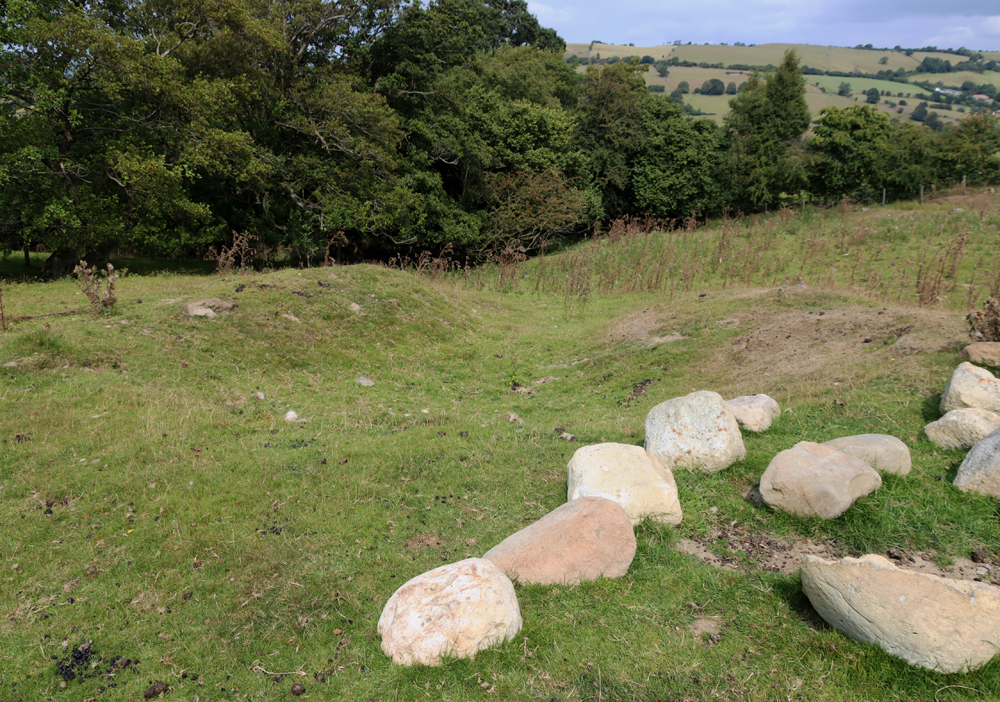
The horseshoe feature

The horse-shoe shaped feature, with boulders along one of the banks. Excavated but not yet understood, radiocarbon dates should at least help to establish when it was constructed

Another site that was excavated and has now been refilled was a horse-shoe shaped feature defined by a bank with what looked like an entrance interrupting it on its western side.  Apart from a small group of stones, a large one of which seems to have a cup mark, and some evidence of burning on the flat floor of the feature, this nearly sterile. Sufficient burnt debris has survived to be sent for radiocarbon dating.  Photographs of the cup-marked surface have been sent to an expert on the subject and it seems probable that this is indeed an example of a form of stone marking common to upland areas during the Bronze Age.

The horse-shoe shaped site produced what is probably a cup-marked stone. Source: CRAG Facebook page

The other excavated areas

In the final days of this year’s work, during which further geophysical survey has been carried out, three excavated areas were opened on the basis of previous geophysical survey results, and were being worked on by volunteers during our visit.  At the moment it is not at all clear what the features uncovered represent, and nor is it known when they may date to.  A piece of medieval pottery from one of the trenches is not particularly informative.

Although it would be very nice if some information about land management during prehistoric and medieval periods became available, this is clearly some way off at the moment, but by no means out of the scope of the project should it gain future funding.
xxx

General Context

There is no mention of the Llantysilio mountain in my fairly thorough collection of books about prehistoric Wales, and looking at the Ordnance Survey map, there are only two archaeological sites marked in the vicinity, both Iron Age hillforts.  One of these is Moel y Gaer, about 2km as the crow flies, but uphill all the way, roughly east from Bryneglwys village (not to be confused with either of the two of the same name on the Clwydian Range).  The other is Caer Drewyn (about which I have posted here) and is around 7km to the southwest.  The usually helpful Megalithic Portal had nothing else to add.  Archwilio is somewhat more informative, but makes it clear that this is still an area that is surprisingly short on recorded prehistoric data when compared with, for example, the Clwydian Range or the nearby Eglwyseg mountain.  Further information is provided by Heneb, which comments that there are “Bronze Age hilltop burial monuments on Moel y Gamelin and Gribin Oernant” (on their Llantysilio Mountain HLCA 1142 page).

The Archwilio website shows possible sites (unexcavated) in the Bryneglwys area, as well as the Iron Age hillfort Moel y Gaer (not to be confused with those of the same name on the Clywdian Range)

This emphasis on the survival of cairns and ceremonial sites in the archaeological record is typical.  Settlement data is very thin on the ground anywhere in Britain, because having been built in perishable materials, they have decayed into the ground.  Archaeological data is therefore skewed towards funerary sites, which probably also double as statements of identity and territorial affiliation.  Ceremonial sites are known throughout Wales, although in northeast Wales these are rarely found.  The function of henges (banked and ditched enclosures, with ditches on the inside) and stone or timber circles seems, in northeast Wales, to have been either irrelevant or was incorporated into cairn designs, like ring cairns, that combined funerary and ceremonial functions.

Distribution of round barrows and cairns in Wales after c.2100BC – c.1600BC. Source: Burrow 2011, p.106

Looking in general terms at the early to mid Bronze Age of northeast Wales, beginning a little before 2100BC and lasting to around 1600BC, there are plenty of round cairns on the Clwydian range, the Eglwyseg range, and Ruabon mountain, apparently coinciding with improvement in climatic conditions.  Writing in 2004 Steve Burrows noted that a survey by Cadw had identified 17 cairns on the Clwydian Range alone; and more have been identified since then.  These are just a small sample of the 1000s that have been found throughout Wales as a whole.  It is interesting to note that most of these are on, rather than above, worked land.  Although most of those remaining are on uplands, the presence of lowland and valley bottom locations indicates that even though many of those on land attractive to more recent farmers may have been ploughed out, they were certainly there.  On the least attractive land for cultivation, pastoral herding was probably favoured, requiring smaller groups and greater mobility for at least part of the year.

Most of the remains interred in cairns are cremated, and represent a tiny proportion of the population, indicating that communities were singling out particular individuals for burial.  Where sufficient bone has been preserved amongst the cremated remains, it has been determined that these may be adults, children or infants, male and female.  The presence of children may or may not suggest that a sense of family lineage was involved.  Unfortunately DNA testing techniques are problematic and so far no familial connections have been proved within Bronze Age cairns in Britain.

Barbed and tangled arrowhead from the Bryneglwys ringcairn. Source: Clwydian Range Archaeology Group

Grave goods accompanied many, but not all of the interments.  The Bryneglwys ring cairn burials were accompanied, probably added at different times, with pottery and flint tools and flakes, but some sites have produced no objects, whilst others contained more elaborate items.  The single most famous example of a grave object dominating the narrative is the Mold Cape (about which I have posted previously here) but less remarkable sites include some well preserved pottery, quantities of well-crafted stone tools and some objects made of copper and bronze.  Flint tools may seem more mundane, but many were beautifully crafted and, in the case of flint, the material itself may have had a certain amount of status.  Some raw flint can be found on beaches and in glacial deposits, it is only rarely of high quality, suggesting that where fine flint is found, like the Bryneglwys flint used for tool manufacture, it could have been imported.

In terms of landscape use in northeast Wales the proliferation of cairns suggests there was a requirement for display of belief and ideology, and perhaps identity or territoriality, in the positioning of highly visible funerary monuments in land that could also be employed for either crop growing or pastoral herding.  Although the western valley, slopes and heights of the Llantysilio mountain have not revealed much information about land use in the Bronze Age, the Bryneglwys excavations are beginning to add to this wider regional  knowledge base of information.


xxx

Final Comments

The mapped Llantysilio site data suggest that although the current Bryneglwys excavations by CRAG are not in completely virgin territory, there are considerable gaps in knowledge and the work is  pioneering in terms of starting to do a professional job of opening up the landscape archaeology of the Llantysilio mountain area.  There’s real knowledge buried in them there hills.

For those interested in exploring further, the Bryneglwys excavations are being carried out on private land, but to get a sense of the landscape there is a track across the Llantysilion mountain, taking in Moel y Gaer hillfort and offering wide views of the surrounding hills and valleys, which can be approached from the Horseshoe Pass.  Bryneglwys itself is bisected by the Welsh Cistercian Way, a modern creation, but an interesting one that focuses on monastic sites in Wales and is featured by the British Pilgrimage Trust.  The site is also located just south of the line of the 122 mile (196km) Clwydian Way, a long-distance walking trail that was established by members of the Ramblers’ Association as a Millennium Project in 2000.  Website links below.

Thanks again to the team for a great visit.
xxx


Sources

The guided tour by Dr Ian Brooks (Engineering Archaeological Services on behalf of CRAG) on 9th August 2025 was the primary source of information about the excavations, with particular thanks to Dr Brooks for taking time out of his busy life to go over my first draft and suggest corrections, and for forwarding CRAG suggestions regarding my account of the ring cairn excavation.  Much appreciated!

The Ordnance Survey map for this area is the Explorer 256, Wrexham and Llangollen


Books and papers

Brown, Ian. 2004. Discovering a Welsh Landscape.  Archaeology in the Clwydian Range. Windgather Press

Burrow, Steve. 2011.  Shadowland. Wales 3000-1500BC. Oxbow / National Museum of Wales

Jenkins, David A. 1991.  The Environment: Past and Present. In (eds.) John Manley, Stephen Grenter and Fiona Gale. The Archaeology of Clwyd. Clwyd County Council

Jones, Glanville 1991. Medieval Settlement. In (eds.) John Manley, Stephen Grenter and Fiona Gale. The Archaeology of Clwyd. Clwyd County Council

Lynch, Frances, 2000. The Later Neolithic and Earlier Bronze Age.  In (eds.) Frances Lynch, Stephen Aldhouse-Green and Jeffrey L. Davies.  Sutton, p.79-138.

Pratt, D., 2011. Valle Crucis abbey: lands and charters. Transactions of the Denbighshire Historical Society 59, p.9-55

Williams, D.H., 1990. Atlas of Cistercian Lands.  University of Wales Press
xxx

Websites

(in order of usefulness for this topic)

Clwydian Range Archaeology Group
Website
https://cragnorthwales.wordpress.com/
Facebook page
https://www.facebook.com/CRAGNorthWales

CBA Newsletters
No. 64. Autumn 2022:
Excavation of a Ring Cairn at Bryneglwys, Denbighshire From CBA Wales 
https://cragnorthwales.wordpress.com/wp-content/uploads/2023/03/newsletter-report-in-publisher.pdf
No. 66. Autumn 2023:
Excavation of a Ring Cairn at Bryneglwys, Denbighshire (Part 2) by The Clwydian Range Archaeology Group (CRAG), p.13-15
https://cragnorthwales.wordpress.com/wp-content/uploads/2024/01/20231017-cba-wales-newsletter-66-autumn-2023.pdf

Clwydian Range and Dee Valley
The Dee Valley
https://www.clwydianrangeanddeevalleyaonb.org.uk/projects/the-dee-valley/

Archwilio
Denbighshire (search under “Bryneglwys” to centre in on the area)
https://archwilio.org.uk/her/chi3/arch.php?county=Denbighshire&lang=eng

Clwyd and Powys Archaeological Trust (CPAT)
CPAT Report No. 1340. The Monastic Granges of East Wales. A Scheduling Enhancement Project. By R.J. Silvester and R. Hankinson, March 2015
https://coflein.gov.uk/media/241/979/652240.pdf
Historic Settlements in Denbighshire. CPAT Report no.1257
. By R.J. Silvester, C.H.R. Martin and S.E. Watson, March 2014, p.14-15
https://coflein.gov.uk/media/287/517/652224.pdf

Coflein
Moel y Gaer hillfort, Llantysilio mountain
https://coflein.gov.uk/en/site/306813/

Heneb
Llantysilio Mountain, Brynegleys, Corwen and Llantysilio Communities, Denbighshire (HLCA 1142)
https://heneb.org.uk/hcla/vale-of-llangollen-and-eglwyseg/llantysilio-mountain-brynegleys-corwen-and-llantysilio-communities-denbighshire-hlca-1142/
Llantysilio Mountain and Moel y Gaer Hillfort
(walk and background history)
https://heneb.org.uk/archive/cpat/walks/moelygaer.pdf

Megalithic Portal
Moel y Gaer, Llantysilio
https://www.megalithic.co.uk/article.php?sid=14086

Based In Churton
Who was Brymbo Man, what was the Mold Cape and why do they matter? (3-part series)
https://basedinchurton.co.uk/2023/03/18/part-1-who-was-brymbo-man-what-was-the-mold-cape-and-why-do-they-matter/
Caer Drewyn, Corwen
https://basedinchurton.co.uk/2023/09/11/sunshine-and-great-views-at-caer-drewyn-iron-age-hillfort-at-corwen/
Valle Crucis Cistercian Abbey
https://basedinchurton.co.uk/2021/11/23/monastic-northeast-wales-and-west-cheshire-2-valle-crucis/

The British Pilgrimage Trust
The Welsh Cistercian Way
British Pilgrimage Trust
https://www.britishpilgrimage.org/portfolio/welsh-cistercian-way
The Welsh Cistercian Way on Google
https://www.google.com/maps/d/viewer?mid=1nDf0d1rqf5P5uWJDDYvg2i8L8Lo&hl=en&femb=1&ll=53.02208569877805%2C-3.2900072936767533&z=15

The Clwydian Way
This area lies in section 9, but note that to follow the trail requires a paid subscription to the Ordnance Survey online.
https://www.clwydianway.co.uk/

Engineering Archaeological Services Ltd
http://eas-archaeology.co.uk/

The site of the ring cairn, refilled after the excavation

Thanks to Helen Anderson for this photograph of the 11am Open Day group standing by the ring cairn and the scene towards the southwest in the distance (copyright Helen Anderson)

Sun and Fire – Life and death at the dawn of history. Shrewsbury Museum and Art Gallery, 2/11/24 – 30/04/25

This looks like a must-see exhibition at the Shrewsbury Museum & Art Gallery. On my to-do list:

Sat 2 Nov, 2024 – Wed 30 Apr, 2025

From the museum’s website:

Experience life in Shropshire between 4500 and 2000 years ago. That’s roughly the time from 2500 BCE until the Romans invaded Britain in 43 CE.

Before the Romans came, people in Britain didn’t use writing. That means there’s a lot we don’t know about them. But they left many objects and other traces in the Shropshire landscape and by examining these closely, we can try to work out what their lives were like. Come and see how we can tell that heat was vital to them. Find out how they used fire to make beautiful and useful objects, to cook and to cremate their dead.

Explore our interactive exhibition and learn how we once celebrated the sun with huge stone circles and bright gold objects. We can’t be sure why they did some of these things. We can only guess what they thought and believed. But we do know that in lots of ways these people were like us, with bodies and senses like ours. They felt the heat of flames on their skin and the sun’s warmth on their faces. Their lives were full of sensations, sights, sounds and scents.

Full details, including opening times and ticket prices on the Museum’s website at:
https://www.shropshiremuseums.org.uk/event/sun-fire-life-and-death-at-the-dawn-of-history/

Gop Cave and Cairn near Prestatyn #3 – The vast cairn

Introduction

The cairn rising above the tree tops on Gop hill, with the cave visible as a dark line in the light limestone ridge below. Source: Coflein

Gop Cairn is at an elevation of 250m (c.820ft) above sea level  on the prow of a hill overlooking the Vale of Clwyd, just outside the village of Trelawnyd (formerly known as Newmarket).  It is oval rather than round, and measures roughly 101m x 78m (331 x 255ft).  It is the biggest man-made prehistoric mound in Wales, and in Britain as a whole it is second only to Silbury Hill in Wiltshire.

The cave has already been discussed in part 1 (Pleistocene and Mesolithic) and part 2 (Neolithic burials).

The Excavation

The plan of the cairn and excavations by Boyd Dawkins. Source: Boyd Dawkins 1901

Sir William Boyd Dawkins was hired by the landowner to excavate the cairn.  Boyd Dawkins had a simple, though labour-intensive strategy.  The plan that Boyd Dawkins made of the cairn shows the dip in the top that remains today.  Boyd Dawkins speculates that this could have been caused when the cairn was later used as a source of raw materials for local drystone walling, or alternatively by subsidence due to the collapse of an underlying chamber.

Although there is a thin covering of vegetation today, the cairn was found to be built of chunks of limestone.  Around the base of the cairn there seems to have been a more organized and well presented kerb of drystone walling.  Ian Brown suggests that when first built, and during the period when it still retained importance, it may have “shown a dramatic whiteness set against a blue or darkening site.”  The limestone ridge below, in which the cave is located and shown at the top of this post, certainly seems almost white in the sunshine, and the cairn may have had a similarly noticeable appearance, particularly given its great size.

Boyd Dawkins sunk a shaft (6ft 6 ins by 4ft / c.2m x 1.22m) vertically from the top of the cairn, which had to be shored up with timber to allow work to proceed safely.  The shaft reached the former ground surface, which was formed of bedrock.  A main “drift” (a mining term for a horizontal subterranean tunnel) was then tunnelled running 30ft (c.9m) to the northeast from the bottom of the vertical shaft towards the edge, followed by two shorter drifts.  The hope was to find a burial chamber at the centre.  It was not unreasonable to assume that there would be a burial chamber of some description.  Although Neolithic chambered cairns are not common in northeast Wales (examples are Tyddyn Bleiddyn near St Asaph and Tan y Coed in the Dee valley), there are many Early Bronze Age round barrows with cists, and there are several stone-built burial sites and a stone row on the Great Orme to the west.

Unfortunately, in spite of all the hard work, all that Boyd Dawkins and his team found were fragmented animal bones, which in spite of his considerable experience identifying animal remains, Boyd Dawkins was unable to identify with certainty: “hog, sheep or goat, and ox or horse, too fragmentary to be accurately determined.”  Overall, the suggestion is that these were domesticated species that could have been herded or penned in the area.

No artefacts were found.

Conditions were obviously very difficult, as Boyd Dawkins states: “The timbering necessary for our work was not only very costly, but rendered it very difficult to observe the condition of the interior even in the small space which was excavated.”  It is possible that the chamber, if there is one, is off-centre, and that any passage leading to it is in a different direction.  Until further survey or excavation work is carried out, there is no means of telling what lies beneath the surface.

Dating the Cairn

Neolithic arrowheads found on Gop Hill. Source: Glenn 1935

Data for the dating of the cairn is circumstantial.  Although domesticated animal species were found within the cairn, these could have been deposited at an any time from the Neolithic onwards.  On the other hand, arrowheads and other Neolithic stone tools have been found on Gop Hill. According to T. Allen Glenn in 1935, Gop Hill was known locally as Bryn-y-Saethau, the Hill of Arrows, due to the large number of Neolithic arrowheads found there over the decades.  Just below the cairn, just 43m (141ft) away, shown in the above photograph, is a shallow cave in the limestone ridge  that contained Neolithic burials.  There are ephemeral Neolithic sites nearby, identified by T. Allen Glenn during field walking during the 1920s, and there are other Neolithic cave sites in northeast Wales.  At the same time, nothing significant relating to the Bronze Age has been found in the immediate area.  Although Iron Age and Roman sites have been found in the area, Gop Cairn is not an Iron Age or Roman form of site, and there is no record of a medieval motte and bailey castle up on the hill.  On balance, accepting that it remains speculative, it seems probable that it will turn out to be a Neolithic site if it is ever properly investigated.

Myth: “Baseless Theories”

A local writer named Edward Parry, author of Royal Visits and Progresses into Wales, written in 1851, propagated the idea that Gop Hill and its cairn were connected with the battle between Boudicca and Suetonius Pauluins in A.D. 61.  It is a bizarre theory, that Ellis Davies, under the subheading “Baseless Theories” says in 1949 was a “false derivation” based on one of the names of the Gop, Cop Paulini.  It is otherwise incomprehensible why Parry should have come up with the theory, but it found its way into other pamphlets and local accounts.  As Davies points out in a rather aggrieved tone, “It would not be necessary to refer to these absurd stories about the association of Boudicca with Gop and neighbourhood were it not for the fact that locally they still persist!”

The Beacon

In his 1949 book “The Prehistoric and Roman Remains of Flintshire,” Ellis Davies notes that in the 17th century there was a beacon on Gop Hill, the purpose of which was to send up an alarm, when necessary, should pirates be spotted off the coast.  A small hut was built at the bottom of the cairn to store the combustible materials with which the fire would be lit.

Final Comments

It is a little ironic that there is such a lot to say about a rather small cave, and not a great deal to say about an absolutely enormous cairn on the prow of a hill that dominates the surrounding landscape.  It seems clear from the burials in the cave beneath the cairn, dated by association with distinctive artefacts, and supported by stone tools found on the hill, that this was an important location during the Neolithic. It seems likely that the cairn could have belonged to the same period, but it is also possible that it could belong to the following earlier Bronze Age.  Further investigation will be required to nail down the date of the site, and to establish if there are any additional structures, such as burial chambers, contained within.


Suggestions for the derivation of the name Gop. Source: Ellis Davies 1949, p.159

Sources and visiting details are shown in part 1


Gop Cave and Cairn near Prestatyn # 2 – The Neolithic burials

Part 2 – The Neolithic burials in the cave

Introduction

Main entrance to Gop Cave

In Part 1 I looked at the excavations carried out at Gop Cave in 1886-7, 1908-14, 1920-21 and 1956-57 and talked about the pre-glacial levels of Gop Cave, with its finds of woolly rhino, hyaena and wild horse, and the Mesolithic tools found outside the cave mouth.

In this second part, the cave is still the topic under discussion, with a shift in focus to the Neolithic layers, whilst the cairn on top of Gop Hill is tackled in part 3.  During the Neolithic, the cave was used to deposit a number of burials, two thirds of which were contained within a walled-off section of the cave, and the rest within a narrow passage that linked two parts of the cave.  These burials are the subject of this post.  References used for all three parts are listed in part 1, together with visiting details.

The Excavations

Modern plan of Gop Cave by Cris Ebbs. Source: Cambrian Caving Council Survey 2013

Just to recap briefly on the details from part 1, the earliest excavations in the cave were carried out by Sir William Boyd Dawkins, a well known and respected early archaeologist who excavated the cave site over two seasons in 1887 and 1887, having originally been asked to assess the cairn on top of the hill.  The lowest level was barren , but the next contained numerous bones of Pleistocene animals, many of them now extinct.  The top two layers contained mainly Neolithic material including human skeletal remains.

In 1908 John H. Morris began digging at the cave, and was joined by T. Allen Glenn, who took systematic notes and made a plan of the newly uncovered sections of the cave.  They opened up a passage missed by Boyd Dawkins, referred to as the northwest passage, which linked to a very small opening just to the east of the main cave entrance.  During these excavations a further six partial skeletons were found, two of them children.  The skeletal remains in both cases were associated with artefacts and animal bones.

Most of the bone collection collected by Boyd Dawkins, and stored in a pigeon house at Gop Farm, were disposed of in 1913 by the tenant of Gop Farm, who threw them down a local mine shaft – which is particularly sad as Glenn had just received permission to take charge of them.  Most of the Morris and Glenn finds, both bones and objects, were sent to the National Museum of Wales.  Some finds from Gop Cave are also retained by Manchester Museum and Aura Museum Services, and possibly by the Grosvenor Museum in Chester.

The Neolithic burials at Gop Cave

In total, at least 20 individuals were recorded in Gop Cave.  The 14  found by Boyd Dawkins and the 6 found by Morris and Glenn may have been deposited at slightly different times, due to the different character of the deposition.  Whereas the individuals discovered by Boyd-Dawkins  seem to have been buried whole, Glenn is fairly confident that the ones discovered by himself and Morris in a different part of the cave were only partial when they were interred.

Boyd-Dawkins excavations showing the chamber (feature B) above layer 3 and abutting layer 4, which contained skeletal remains of humans with artefacts. Source: Boyd Dawkins 1901.  See other cave plans in part 1.

Dawkins describes how he found a thick layer of charcoal over slabs of limestone at a depth of 4ft (c.1.2m) from the surface, which formed an old hearth.  Blackened slabs were found throughout the area excavated, and there were also burnt and broken bones of domestic animals and fragments of pottery.  “Intermingled with these were a large quantity of human bones of various ages, lying under slabs of limestone, which formed a continuous packing up to the roof.  On removing these a rubble wall became visible, regularly built of courses of limestone.”  These limestone blocks made up walls on three sides, with the cave wall itself making up the fourth wall, to form a chamber 4ft 6 by 5ft 4 (c.1.4m x 1.65m).  Inside the chamber was what Dawkins describes as “a mass of human skeletons of various ages, more than fourteen in number, closely packed together, and obviously interred at successive times.” Individuals were deposited in a crouched position, “with arms and legs drawn together and folded.”  His assessment was that the bodies were buried whole. When the chamber became full, another area of the cave was used as an overflow for new burials, identified on the section plan above as area A.  Because layer 3 was found beneath the burial chamber, as well as beneath layer 4, Boyd Dawkins concluded that layer 3 had formed a habitation area prior to the burials, in a similar way to two other cave sites in north Wales.

Glenn’s plan of the 1912 excavations. Source: Davies 1949

When Morris and Glenn opened up another passage, and found another six individuals, Although the view was confused by rock fall and a very uneven floor, it was thought that limestone slabs may have been used to create a wall around some of the skeletons.  Glenn describes the bones as fragmented and partial.  Glenn ascribes this to the remains having been brought from somewhere else, rather than having been depleted due to roof fall damage of fragile bones, or the work of the “burrowing animals” that caused disruption in the stratification within the passage.  He was methodical and a good observer, so presumably had good grounds for suggesting this, and it is certainly in keeping with other, more recent archaeological evidence for Neolithic burials where partial skeletons are found, apparently due to having died elsewhere and been moved to a particular site for burial.  Another possibility is that the body had been excarnated, a practice involving the ceremonial placement of a body in the open air to allow it to be processed naturally so that it was defleshed and partially disarticulated before being collected for interment, which often resulted in the bigger longbones and crania being collected whilst finger and foot bones were left behind.

Having opened the cave out and discovered the second entrance, Morris and Glenn found that it was blocked with limestone slabs, apparently deliberately, although it is by no means certain when this was done.  It is not unlike the blocking of entrances to Neolithic burial monuments towards the end of the Neolithic period.

The artefacts associated with the burials

Polished blade found by Boyd Dawkins in Gop Cave. Source: Dawkins 1901

The artefacts associated with both sets of skeletons are all Neolithic in date.  Boyd Dawkins assigned them to the Bronze Age on the basis of the pottery, but this has since been re-dated. Both the Boyd Dawkins and the Morris and Glenn excavations produced stone tools, most of which are fairly generic but can be assigned to the Neolithic.  One of the Boyd Dawkins discoveries was a long, curved blade, very carefully carved and polished to provide it with smooth surfaces, and showing no signs of usage.  He also identified quart pebbles, which he refers to as “luck stones.”  Another notable stone tool, this time found by Harris and Glenn in the part of the cave undiscovered by Boyd Dawkins, was a bifacially worked axe head made from Graig Lywyd stone from the well-known Neolithic stone mines at Penmaenmawr, which was apparently unused.

Objects found by Harris and Allen in Gob Cave, including the Graig Lwyd axe at top. Source: Davies 1949.

The pottery was Peterborough ware, and it has been determined that the Gop Cave type was the Mortlake variant of Peterborough ware,  which dates to between about 3350 and 2850 BC.  All were fragments, and were either grey or black or burnt red.

Pottery found in association with the skeletons by Boyd Dawkins, since identified as Mortlake Ware. Source: Boyd Dawkins 1901

Kimmeridge sliders. Source: Boyd Dawkins 1901

Two unusual items were referred to by Boyd Dawkins as “links,” which he thought were proably used to fasten clothing, and are referred to by some others as belt-sliders.  He described them as being made of “jet or Kimmeridge coal,” or “Kimmeridge shale.”  As these items are now lost, they cannot be tested (they were last known to be in Manchester Museum, but now cannot be found).  He gives the measurements as 54mm L x 22m W and 16mm H; and 70mm L, 22mm W and 27mm H.  Boyd Dawkins says that they showed no signs of any usage, and according to Alison Sheriden’s analysis of these object types, this is typical.  They appear to have been kept for show rather than being attached to clothing or employed in some other everyday capacity, much like the curved blade and the Graig Lwyd axe head.  As jet and Kimmeridge coal come from Yorkshire, and a third of all known sliders have been found in and around Yorkshire, they are certainly exotic goods in northeast Wales, and the rarity of the substance may have endowed it with a particular cachet.  Jet has the very unusual property of being electrostatic, so that when it is rubbed it can make one’s hair stand on end! If it was jet, this would certainly have added to its novelty value.   29 of them were known when Sheriden was surveying them in 2012, of which only 6 were certainly of jet, one of which was found in Wales.  12 or 13 were from burial contexts and distribution showed  “a marked tendency towards coastal and riverine finds” that are a reminder of the extensive networks that operated in the Neolithic. 

Although the objects in the cave are few and far between, some were unused suggesting that they highly valued and retained for special occasions or as prestige items.  It is unclear whether any artefacts were associated with any particular individuals, although Boyd-Dawkins describes the the jet sliders and the polished flint flake forming one group together.

Animal remains

Although he does not list numbers, Boyd Dawkins says that the remains of the domesticated species “were greatly in excess of those of the wild animals, and the most abundant were those of sheep.”  He also comments that the horse listed under wild fauna may actually be domesticated, and that foxes were using the vicinity of the cave area at the time of the excavation.  All bones were found in what he describes as “prehistoric refuse heaps and that nearly all were broken and burnt.


As all the bones were discarded in 1913, none of the identifications can be checked, but Boyd Dawkins was very experienced in the identification of animal remains, giving some confidence that his work reflected the reality of the situation.  Sheep and goat are notoriously difficult to tell part, so the question-mark against goat is not surprising.  That sheep are dominant is not a surprise, as the area around Gop would be ideal grazing for them.  The valley bottom would have been well-suited for cattle and horse.

Dating the skeletons

Mandibles used in radiocarbon dating of Gop Cave skeletons. Source: Schulting 2020

Although the artefacts found in the cave, loosely associated with the skeletal remains, are indicators of a mid-Neolithic date, as described above, in 2020 Rick Schulting was able to pull together 23 samples from a number of caves for radiocarbon dating, including three samples from Gop Cave, comprising two mandibles and one cranium.  Although some samples had been tested previously, an error in the sampling method had led to them being withdrawn in 2007.  For Gop, the new dates lie firmly with the Middle-Late Neolithic range, tending towards the middle of the Neolithic (between c.3100 and 2900 BC).

This date range backs up the findings of the Mortlake variants of the Peterborough ware, the jet sliders and the Graig Lwyd axe.

The practice of non-monumental burials

The main form of burial recognized throughout most of the Neolithic Britain is the long barrow or cairn, or the round passage grave.  In each case, there was usually an accumulation of burials over time, referred to as collective burials.  These were not, however, the only forms of burial during the Neolithic. Although less often found, because of the lack of monumental marker, flat interment cemeteries are known, burials in the ditches of the so-called causewayed enclosures are often recorded and there is some, uncertain data that there may have been burials in rivers.  During the later Neolithic, cremation became the norm.

Jawbone of skeleton from Gop Cave. Source: National Museum of Wales (47.97/104)

By far the most common non-monumental form of burial, however, is deposition within a cave.  Cave burials of various dates are known from all over Britain.  In his survey of cave burials in 2020, Rick Schulting noted examples from the Palaeolithic through to the Anglo-Saxon period.  From the Neolithic in north Wales, contemporary with Gop Cave, nearby Nanty-Fuach rock shelter above Dyserth produced five burials, all contracted, and without grave goods.  Outside the cave there were fragments of Neolithic pottery, a large barbed and tanged arrowhead and, nearby, some Peterborough ware.  In the Alyn valley 16 burials were deposited within Perthi Cawarae, and 6 within Rhos Ddigre, the latter associated with a Graig Lwyd axe and pottery fragments, both in the Alyn valley.  Other examples are known from Loggerheads and Mostyn with Neolithic flint implements.  It is clear that Gop Cave is by no means an isolated example, although the precise arrangement of the skeletal remains within containing walls may be unusual.  As many caves were excavated in the late 19th and early 20th centuries, when excavations lacked today’s precision, it is impossible to know what was missed by excavators.  Finally, Schulting notes that there is a gap of “several millennia” between the last Mesolithic cave burial and the first Neolithic ones, indicating that there is no continuity of burial tradition in caves between the two periods.

Meaning in collective burial

Frances Lynch suggests that the use of caves for burial, occurring in many areas at different periods “seems to be  a matter of convenience rather than cultural preference” but there are alternative views on the matter.  In his book on the materiality of stone – Christopher Tilley does not discuss caves, but he references almost every other aspect of stone as a natural material that becomes objectified by human uses and actions.  He comments that social identity requires “specific concrete material points of reference in the form of landscapes, places, artefacts and other persons.” Topographic and other natural features are often used by humans to anchor and fix memory and establish places of meaning in landscapes.  Carole Crumley highlights the phenomenological experience of features like caves, mountains and springs, and their role in connecting the mental with the material to create both individual and social identity.  In their chapter on the uses of landscape features like caves and springs by the Maya in Mesoamerica, James Brady and Wendy Ashmore describe how caves, eternally damp and dripping water, were connected with the sacred and the ritualization of water. By appropriating and modifying such natural features, people have embedded them with meaning to form bridges between the natural, supernatural and the manufactured, blurring the differences to confer special status on these dark places where the dead might be deposited safely.

Artist’s impression of what an excarnation platform might look like. By Jan Dunbar. Source: BBC

A number of authors have suggested that collective burial of humans, and in particular the mingling of bones rather than maintaining skeletons as delineated individuals, is an indication of the individual being subsumed into a collective identity, privileging the group identity over the authority or status of any one individual.  Of course, these collective burials, whether in monument or cave, are representatives of much larger communities, and the criteria used for selecting one person for burial over another are lost.  It is possible that in order to transform an individual into a representative of the community, a two-stage process was undertaken whereby an individual is excarnated or buried elsewhere, and then moved to a collective burial site, a transformative process during which the individual member of the community loses their individuality and becomes representative of a communal and ancestral link between the past and the present.   With the addition of each new individual to the cemetery, another layer of communal meaning was added to the cave, reinforcing the message that the existing burials already encapsulated.

In the contrast between the brightness of the light-coloured limestone reflecting in the sun, and the darkness of the hidden, secret interior there is a resemblance between the relationship between the visually striking chambered tomb and the sepulchre within.  Not forgetting, of course, that there is an enormous cairn on top of the hill, just 43m (141ft) away from the cave, which may in itself have been a marker rather than a grave.  The cairn is discussed in part 3.

Final Comments

Neolithic stone implements found in and near Gop Cave. Source: Davies 1949, p.283

Gop Cave is often left out of accounts of the Neolithic in Wales, or merely mentioned in passing, which is surprising given both the number of its human occupants and the unusual combination of artefacts found within the cave.  Cave burials are given secondary status to monumental constructions, but given the number of them in Wales, it is good to see that they are now being researched as valid contributors to the corpus of knowledge about the Neolithic both in Wales and the rest of Britain.

Graph from Jonathan Last showing the usage of caves at different periods in England (The Archaeology of English Caves and Rock-Shelters: A Strategy Document. Centre for Archaeology Report 2003)

Sources and visiting details are in part 1


Gop Cave and Gop Cairn near Prestatyn – # 1: Woolly rhinos and hungry hyaenas

Introduction

Gop Hill in northeast Wales, a few miles southeast of Prestatyn, and just above the village of Trelawnyd (formerly Newmarket from 1710 to 1954) is home to Gop Cave and Gop Cairn, just a few minutes apart from one another.  Gop Cairn has the distinction of being the largest man-made prehistoric mound in Wales, and when approached from a distance, its size really is impressive.  Although the cairn was investigated in the 19th century, with a vertical shaft sunk from the top to the level of the floor, and a “drift” tunnelled outward from the base of the shaft, no burial chamber or human remains were found.

The south-facing limestone cave was also investigated, producing Pleistocene zoological remains, Mesolithic stone tools and Neolithic human burials and contemporary artefacts and the bones of both domesticated and wild animals. In 1868 Boyd Dawkins excavated pre-glacial animal species such as woolly rhino and steppe bison in the cave deposits, which provided significant data about local ecological conditions. Excavations by T. Allen Glenn in the early 1920s discovered Mesolithic remains on the platform outside the cave.  Although this was a small assemblage, it is an important contributor of knowledge about the poorly understood North Wales Mesolithic.  The Boyd Dawkins excavations also produced an unusual and very important Neolithic burial chamber.  It was found in one of the upper layers, with walls made of layers of stone containing at least 14 burials.  Pottery and stone tools found with them were sufficiently distinctive to provide a chronological range, placing the burials within the Neolithic period.  Excavations conducted by John H. Morris and T.A. Glenn between 1908 and 1914 found another six burials in a previously undiscovered passageway, including two children as well as a Neolithic axe-head from the nearby Graig Lywyd axe factory and are considered to lie within the same date range as those found by Boyd Dawkins, taking the total count of individuals found up to 20.  It did not take a great leap of imagination to speculate that the Neolithic date for the cave could suggest a similar date for the cairn, although this remains unverified.

Over three posts, the Gop Hill sites are described and the work carried out summarized.  This post, Part 1, looks at the 19th century excavation of Gop Cave by Sir William Boyd Dawkins, a really rather remarkable early investigator of prehistoric habitats and fauna as well as archaeological remains. Visiting details are provided towards the end of Part 1, after which there is a list of references.  Part 2 looks in detail at the Neolithic burial within the cave, and part 3 looks at the cairn.

Sir William Boyd Dawkins, excavating 1886-1887

When I was working in caves with archaeological deposits in the mid- to late-1980s, 100 years after William Boyd Dawkins was excavating at Gop Cave, he was a very well-known name, and a respected one.  It is easy to be frustrated with the quality of the work carried out in those early investigations, some of which were far from systematic, and caves have some particular quirks of their own to contend with, but a few of these early investigators were impressive and Sir William Boyd Dawkins was one of them.

Born near Welshpool in 1837 Sir Wiliam Boyd Dawkins (1837-1929), developed a keen interest as a child in collecting fossils.  His initial field of interest was primarily geology, natural history and palaeontology, all of which have in common with archaeology a focus on stratified sequences and the relative positioning of fossils, bones and objects within those sequences.  Just as early archaeologists were interested in building up sequences of artefacts so that they could understand how human technology developed, early palaeontologists were interested in the developmental sequence of prehistoric animal and plant species. In 1860 he graduated in Natural Sciences and Classics from Oxford and in 1861 he was appointed to the Geological Survey of Great Britain. Fortunately, because Sir William found many archaeological remains during his investigations, he treated these more recent discoveries with equal interest and respect.  His earliest archaeological excavations were at Wookey Hole in Somerset where he discovered some of the first evidence of Palaeolithic (Old Stone Age) occupation.  These discoveries helped him to develop methodologies for excavating cave sites and to build up a good understanding of the type of environmental and human data that he was likely to encounter within particular geological and geomorphological contexts.  He wrote a number of important articles about extinct sub-species of rhinoceros that had once inhabited Britain. He became the first President of the Lancashire and Cheshire Antiquarian Society and President of the Cambrian Archaeological Association.  He excavated at a number of cave sites in north Wales, and his 1874 book “Cave Hunting: researches on the evidence of caves respecting the early inhabitants of Europe” became a classic.

The four phases of Gop Cave deposits

Figure 5 from Boyd Dawkins 1901, p.327 (the cavity marked as B was the Neolithic burial chamber)

When Boyd Dawkins first encountered Gop Cave, it was full to the brim with glacial, post-glacial and more recent debris and rock fall:

While the cairn was being explored my attention was attracted to a fox-earth at the base of a low scarp of limestone 141 feet to the  south-west of the cairn. It occupied a position which I have almost invariably found to indicate the presence of a cavern  used by foxes, badgers, and rabbits as a place for shelter. I therefore resolved to explore this, with the assistance of Mr. P. G. Pochin. The fox-earth led us into a cave completely blocked up at the entrance by earth and stones and large masses of limestone, which had fallen from the ledge of rock above. This accumulation of debris occupied a space 19 feet in width, and extended along the whole front of the cavern

Nothing loth, he set about clearing it in a top-down methodical way that would allow him to assess the chronological composition of the deposits.  It was a remarkable achievement, given the incredibly limited head space and the absence of more than a thin envelope of natural light.

Figure 4 showing the excavations of the cave in horizontal plan, with the sections through the deposits both outside and within the cave. Feature B is the Neolithic burial chamber. Source: Boyd Dawkins 1901, p.325

Boyd Dawkins identified four distinct phases within the cave.   These are shown in the table below and discussed beneath.  The terms Pleistocene and Holocene used in the table below refer to consecutive periods in the geological timescale.  The Pleistocene begins at around c.2.8 million years ago, covering the most recent period of repeated periods of major glaciation to 11,700 years ago, when the last glacier retreated and the planet entered its present inter-glacial phase, the Holocene. The Holocene levels at Gop Cave, which include the 14 burials (thought by Boyd Dawkins to be Bronze Age but now reassigned to the earlier Neolithic), will be discussed in Part 2.  Below is a discussion of the Pleistocene levels.

Geological Table Source: USGS

Figure 6 from Boyd Dawkins 1901, p.329

Boyd Dawkins noted that the layers were not as they would have been originally deposited: “They appear to have been washed out of the original hyaena floors by the action of water, and to have been redeposited at a time later than the occupation of the cave by hyaenas.”  The presence of stone of non-local origin also argues for different phases of water and glacial activity entering the cave, scouring the deposits and replacing them.

Boy Dawkins identified the Pleistocene fauna from the surviving bones and antlers found in the cave as follows.

  • Cave hyaena – Hycena spelaea
  • Bison – Bison priscus
  • Red deer – Cervus elaphus
  • Reindeer – Cervus tarandus
  • Roe deer – Cervus capreolus
  • Horse – Equus caballus
  • Woolly rhinoceros – Rhinoceros tichorhinus

Woolly Rhino. Source: Science

Woolly rhino (now designated Coelodonta antiquitatis), cave hyaena (now referred to as Crocuta crocuta , and sometimes Crocuta crocuta spelaea) and Bison priscus (steppe bison) are now extinct.  The steppe bison was the species painted in famous Upper Palaeolithic caves like Lascaux in France and Altamira in France.  Although Boyd Dawkins identified horse as Equus caballus, if the identification of horse was correct, it would probably have been the wild ancestor of caballus, Equus ferus. Reindeer are no longer found wild in Britain.  Of the species on his list, red deer and roe deer and horse are the only wild species that remain in Britain.  Boyd Dawkins observed that some of the remains, and particularly the antlers of “the reindeer, bore the teeth marks of hyaenas, and had evidently belonged to animals which had fallen victims to those bone-eating carnivores.”

20th Century Excavations
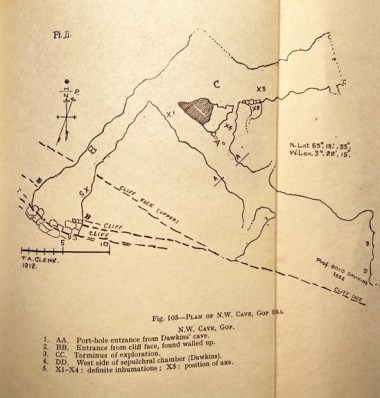
Glenn’s fold-out plan of the 1912 excavations. Source: Davies 1949

Further excavations took place during the earlier part of the 20th Century, contributing more information.

Between 1908 and 1914 John H. Morris and T. Allen Glenn investigated the northwest passage of the cave system, sometimes.  This was missed by Boyd Dawkins because it was hidden behind a blockage of clay and stalagmite.  This passage produced an additional six skeletons, two of which were children.  Glenn describes an excavation “carried out with extreme care and by modern methods” but says that due to burrowing animals there was no recognizable stratification byond determining Pleistocene and Neolithic levels.  The floor was covered to a depth of between 18 inches and 2ft “with cave earth and pieces of limestone over a hard floor of clay mixed with stalactite fragments and limestone rubble” over bedrock.   There is some indication that limestone slabs had been used to build low walls around some of these skeletons.  Finds within the cave, at the new entrance and near the cave between 1911 and 1917 were collected by Morris.  Neolithic human remains and artefacts were found, and will be discussed in Part 2.  Animal remains found were horse, sheep/goat, ox, pig, wolf, fox, bear, lynx, badger, fowl, hare, rabbit, frog, watervole, mole, stoat and fieldmouse.  The mixture of Pleistocene and Holocene species suggests that these were highly disturbed layers, probably due to the activity of burrowing animals mentioned by Allen.

The excavations linked the passage in which they were working to the second entrance, the very small opening for which is a little further along the ridge to the west, and shown on the plan at the top of this post. This is sometimes referred to as the North-West Cave, although it is part of the same cave system as the main Gop Cave.
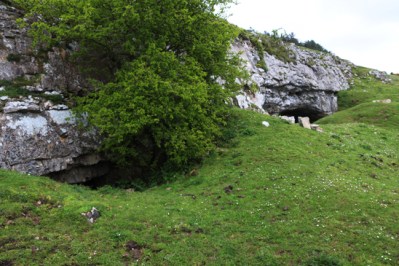
Both cave entrances in the limestone ridge.

T. Allen Glenn returned to the site between 1920 and 1921, funded by the National Museum of Wales.  He excavated the platform in front of the cave, which was largely untouched by Boyd Dawkins and found more human and animal remains, as well as Mesolithic stone tools, described below.  Glenn wrote up both his own and Morris’s excavations in one 1935 report.

In 1956 William H. Stead excavated at the site and amongst other animal remains found a lion tibia.  The reports are in the Proceedings of the Prehistoric Society, nos 23 (1957), 28 (1958) and 29 (1960).  Although I have listed them in the bibliography, I don’t have access online via the University of Chester, and the library does not have these volumes on the shelves, so I have been unable to read up on the findings.  If I get hold of them (please give me a yell if you have access to them!), I’ll update this section.

Dating the animal remains in the Pleistocene cave

Gop Cairn with the cave entrance visible on the limestone ridge just below.

There were only certain periods when Britain was actually habitable.  One reason is that harsh climatic conditions during glacial periods forced most life to leave all but the most southern areas.  For example, between c.160,00 and 80, 000 years ago the environment was too hostile for human occupation and for most animals.  Another reason is that, after 130,000 years ago the permanent chalk land-bridge between Britain and Europe was destroyed, and after this time Britain and Europe were only connected during glacial periods when the water level dropped sufficiently for land-bridges to be revealed, which enabled animal and human migratory movement.  Modern research into the climatic and environmental past has helped to clarify when land bridges between Europe and Britain enabled animals and humans to wander freely. With the final retreat of the ice sheets at around 10,000 BC the land bridges were permanently submerged. De Groote et al explain this very clearly:

Generalised reconstruction of the land surface and the extent of ice sheets of the British Isles. Source: De Groote et al 2017, fig.1 p.3

From the early Pleistocene, Britain was connected to main-land Europe by a land-bridge that enabled humans and fauna to migrate in and out (Fig. 1A). Until about 130,000 years ago, this narrow chalk isthmus, separating the north (North Sea) and southwest (English Channel) marine embayments, kept Britain connected to varying extents even when sea-levels were high during the warm interglacial periods; the eventual complete breaching of this chalk barrier was crucial in forming the island and the Dover Strait. During glacial periods, much of the earth’s water would have been trapped in the ice caps and when, during the later Pleistocene, the bed of the North Sea was exposed, a large land area known as Doggerland, created by geological uplift and sedimentation from rivers, also provided a route into the British Isles and fauna, including hominins, would have entered this way. The flooding of the shallow shelf areas of the English Channel and the North Sea are the consequence of the current high interglacial sea levels.

Even without modern scientific dating methods, reliable time-ranges can be assigned to animal bone assemblages on the basis of which species were found together in a certain place during a certain period. Boyd Dawkins had already assembled a considerable amount of data on the subject, some of which was published in his earlier work Early Man in Britain published in 1880.
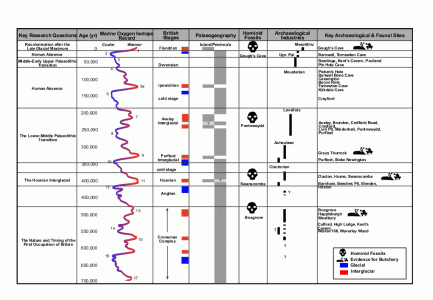
AHOB time chart showing periods of human absence and occupation. Click to enlarge or see original on the AHOB website

Improvements in palaeo-zoology have helped to clarify which species were present during which periods.  Some animals that are now either completely extinct or permanently migrated out of Britain provide a latest possible date for their presence.  Studies of prehistoric assemblages of fauna have also helped to fix date ranges for the presence of certain species, assigning them to marine isotope stages (also known as oxygen isotope stages).  Marine isotope stages measure oxygen isotopes in sea water that is absorbed into the skeletons of tiny single-celled organisms called foraminifera, which are preserved in sediments on the sea floor.  The oxygen isotopes contain information about the volume of ice present globally, and therefore provide a record of alternating glacial and interglacial periods. The faunal assemblage corresponds well to MIS 3, which falls into the Middle Palaeolithic archaeological period.  Woolly rhino, for example, had left Britain by around 30,000 years ago.  The entire assemblage probably puts Gop Cave in Marine isotope stage 3 (MIS 3).  MIS 3 lasts from between 60,000 and 25,000 years ago. The conditions were ideal for woolly rhinoceros, horse, bison, hyaena, and reindeer, which inhabited temperate but cold semi-arid steppe-like conditions with often hot summers and very cold winters.  Steppes are characterized by wide open treeless grasslands, with small shrubs, ideal for grazing species, and for carnivores preying on the grass-loving herbivores.

Pontnewydd Cave entrance. Source: National Museum of Wales

Even though the idea of woolly rhino, bison and hyaena roaming the hills of north Wales, all of them now extinct, may seem distinctly exotic, these time ranges are not particularly early for Britain.  Not far away, near St Asaph, the cave site of Pontnewydd produced stone tools and human remains in association with animal species for which sound scientific dates were obtained during modern excavations.  The human remains found in association with stone tools belonged to the branch of hominin known as Neanderthal (Homo neanderthalensis, named for the type site in the Neander Valley in Germany) and the dates cluster around 225,000 years ago.  If correct, the Gop Cave date ranges are relatively recent by comparison.

Although MIS 3 corresponds to periods of human occupation in Britain during the Middle Palaeolithic there was no human habitation identified within the Pleistocene levels of the cave.  Boyd Dawkins was experienced at identifying human artefacts and would almost certainly have recognized them had any been there to be found. a number of brief occupations of the country, Britain would have been occupied intermittently during this time, depending on the environmental conditions, and probably only by small groups.  The most probably candidate for any humans dodging lions and woolly rhinos and competing with hyaenas for dining on deer, may have been Homo Neanderthalensis (Neanderthals).  The oldest Neanderthal find in Britain was from Swanscombe in Kent, where a skull dates to c.400,000 years ago, a warm interglacial period.  Neanderthals left and re-entered Britain numerous times, their movements determined by glacial and interglacial conditions, until around 40,000 years ago when the Neanderthals became extinct.

The Mesolithic

Microliths from Gop Cave, excavated by Glenn in 1920-21. Source: Wainwright 1961

The Mesolithic, corresponding to the geological Holocene, represents settlement during the earliest post-glacial period.    Although the site was small, the Gop artefacts are very typical of Mesolithic finds in the area.   The stone tools found included 6 microliths (tiny stone tools usually 3cm or less long), a scraper, two other tools of undetermined types, possibly waste flakes, and twenty three microlith and blade cores.  A core is the original piece of stone after it has been worked.  When microliths, flakes and blades have been struck from it it is discarded, but still bears the marks of the tools that were removed from it.  Of the microliths, Geoffrey Wainwright describes two were obliquely blunted, two lanceolate, and four scalene triangles.  There was also one broad point retouched on both sides and a section of a bone pin.

Distribution of Mesolithic sites in Wales. Source: Heneb Dyfed

The earliest known Mesolithic site in Wales dates to c.8600 BC (some 10,500 years ago) at The Nab Head in southwest Wales (no.5 on the map to the right).  In 2021 a 9000 year old site was found on Castle Hill, off Hylas Lane in Rhuddlan, where over 13,000 stone tools and five decorated stone pebbles were found. Another well known site is at Trwyn Du on Anglesey where a Mesolithic occupation dates to between 8,000- 9,000 years ago, and was preserved beneath Bronze Age burial mound excavated when it was threatened by coastal erosion in 1974 (no.9 on the map).

With the withdrawal of the ice sheets, vegetation re-established itself, and whilst the land-bridge remained in tact, animals once again drifted across the land, with humans in their wake.  Once the ice had fully retreated, the land-bridge was submerged and Britain and Ireland became separated both from the continent and from each other.  The island was soon occupied by many small groups exploiting inland and coastal resources, hunting, collecting plant resources, fishing and collecting shellfish.
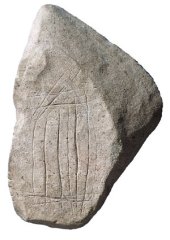
Decorated stone pebble from the Mesolithic deposits at Rhuddlan. Source: Dyfed Archaeology

Warmer and wetter than today, with a deciduous woodland landscape, the environment favoured different wild animal populations from the pre-glacial period, which required different hunting techniques.  Particularly characteristic of the Mesolithic toolkit was the microlith, a catch-all term for a large number of varieties of tiny stone artefact that could have been hafted into wood, bone or antler to make arrows, spears, harpoons and scythes.  Many Mesolithic communities were located on or near the the seashore. The seashore was a movable feast at this time as a) the ice continued to melt, raising sea levels, and b) land, which had been compressed under the pressure of the ice, began to rise.  The exploitation of marine resources included both fish and shellfish.  It was these settlers who, stranded on an island when the land-bridge was lost, were sufficiently stable and persistent to contribute to modern DNA.

Although permanent amelioration of the climate provided the ability to develop new patterns of living eventually lead to the expansion of populations and the modification of landscape, sites are difficult to locate, some were submerged during rising sea levels, and many are often highly disturbed, meaning that the period is still poorly understood.  Each new site therefore contributes important data to the overall picture, and Gop Cave contributes information about where such sites were to be found in north Wales and what sort of activities were pursued.

The location of the finds today

Neolithic stone implements found in and near Gop Cave. Source: Davies 1949, p.283

Davies, writing in 1949, says that most of the animal and human bones from the Dawkins excavations were stored at the pigeon house belonging to Gop Farm, but that some of these were sold in around 1912 to an archaeologist in Wrexham.  Davies himself saw “great quantities of bone” in the pigeon house in 1913 but in the same year, although T. Allen Glenn, who had excavated at the cave, had received permission from the estate manager to remove the archaeological remains, the tenant threw all of it “down an open mine-shaft nearby.”  He goes on: “In a letter dated, ‘The Manchester museum, The University, Nov.19, 1937,’ the keeper, Mr. R.U. Sayce, M.A., supplied the information that there were in the museum several of the remains from the cave; they included animal bones, human skulls, and limb bones; also some sherds of Neolithic ‘B’ pottery. The long flint implement and the Kimmeridge clay links have not been traced.”  The pottery, the flint implement and the Kimmeridge objects relate to the cairn and will be discussed in part 2.  Davies also says that the finds from the objects retained by Morris at his home in Rhyl (where Davies was able to inspect them) were bequeathed to the National Museum of Wales.  Those from the subsequent Glenn excavations in 1920-21 were also deposited in the National Museum of Wales, who had funded Glenn’s work.

According to Cris Ebbs, on the Cambrian Caving Council website, other zoological and archaeological remains that were not disposed of are now in the collections of Aura Museums Service, Grosvenor Museum in Chester.

Conclusions
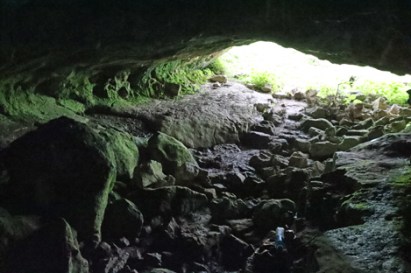
Although there were no human remains in the Pleistocene levels of Gop Cave, the faunal remains provide a fascinating insight of their own into the environmental conditions of north Wales, suggesting that a steppe environment prevailed, possibly at some stage between 60,000 and 30,000 years ago.  Understanding of the palaeozoology, palaeoecoloy and archaeology of the Pleistocene are all dependent on the work of palaeanthropologists, geologists, geomorphologists and climatologists, and many other specialists, all contributing very specialized research about how and when animals and humans would have been able to migrate to and from what is today an island.

The Mesolithic remains are the earliest evidence of human settlement in the immediate vicinity of the cave.  Although they represent a small group of people probably passing through, with no signs of seasonal returns to the site, this helps to contribute to the fragmentary picture of what was happening in Wales in the post-glacial period.  Both tools and tool cores were found, suggesting that tools were manufactured during the short stay at the site.


Visiting Details

When packing your rucksack or stuffing your pockets, do be sure to take a torch with a good, strong beam, and wear some solid footwear that will cope both with slippery mud and some very irregular stones and sharp rocks underfoot in the cave itself.  Caves are nearly always dripping with water, so unless it has been a very dry period, you may want to have a waterproof ready to drag on.  You cannot stand upright in the entrance of the cave, so you enter bent over, but it does open out so that you can explore some of the cave upright.  It is a good idea to get a sense of the internal plan before you go, because the dark is very disorientating and it is quite difficult to make out what is where.

The village of Trelawnyd showing the locations of the car park (red rectangle), and the small lane that leads to the footpath (red arrow). Click to expand.  Courtesy Apple Maps.

Gop Cave is a short walk from the village of Trelawnyd on the A5151 (itself a short drive from junction 31 on the A55).  It is a two-for-one scenario, as immediately above Gop Cave and only a minute or two away, and visible for miles around, is Gop Cairn.  I forgot to to take a What3Words reading for the cave, but the cairn is at ///searcher.sprint.wins,  Both are on public footpaths and are free of charge to access.  There is a car park on the little High Street in Trelawnyd, just off the A5151, or there is a limited amount of on-street parking a bit closer to the start of the small lane that leads to the footpath on the hillside, just up the slope from the car park.  The footpath is clearly marked, as shown in the photograph below.

The first part of the footpath is a small lane that takes you past a couple of houses, until it reaches a narrow path that makes its way along the side of a tall garden fence to your right.  This turns abruptly right and slightly uphill, leading to a low stone-built stile which takes you on to the hillside.  I was with Helen Anderson (well-known on Twitter as @Helenus_) and we were busy nattering and wild-flower spotting (complete with wild orchids) so weren’t paying too much attention to the pathway markers, but they are there if you keep an eye open.

We followed the well-worn track, which leads at this time of year, late April / early May, through bright yellow gorse until it opens onto higher ground, which is completely open, with stunning views over the surrounding valley to Iron Age hillforts on the Clwydian range and to the sea to the west.  You need to turn left beneath a shallow pale grey limestone ridge to reach the main cave entrance.  A very tiny secondary entrance is a little further along.  Retrace your steps to go up to the cairn, through a gate in a drystone wall.  For anyone wanting to stop for a breather, there’s a bench near the gate, somewhat bizarrely looking like an escapee from a Victorian arcade or promenade.
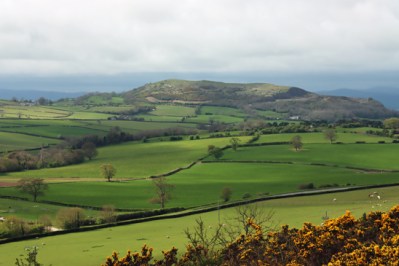
Moel Hiraddug

Although the walk is slightly steep for a short section, it is a mellow walk, and far from strenuous and there are some great views across the valley.  It took perhaps 10 minutes from the road to the cave, 15 minutes maximum, and another five minutes or so from the cave to the cairn.  The cave itself requires you to duck down and be very careful both to watch your footing on a very uneven and rocky surface, and to mind your head.  Best to leave your rucksack outside after liberating your torch.

If you are interested in the Iron Age heritage of the Clwydian Range, Moel Hiraddug is beautifully clear to the southwest, and other hillforts of the Clwydian Range, fading into the distance when we were there, are easily visible on a clear day,

The wildflowers were an added bonus, with a classical karst mix of tiny hardy species clinging to the almost non-existent topsoil above the limestone bedrock, including some really pretty succulents and lichens.  The Early Purple Orchids (Orchis mascula) were a particular bonus, and apparently fairly common in early spring  in the general area.  As well as the miniature slipper-orchid shaped flowers clustering at the top of the stems, their long pointed green leaves often have dark aubergine-coloured spots along them.  Read more about them on the Woodland Trust website.

Having visited, there’s the option of a very good lunch at The Crown Inn in Trelawnyd, which was filling up rapidly during our visit.  After lunch we went on to see the gorgeous Dyserth waterfall only a few miles away, which is very close to the road (a 50p honesty fee was required for access), and then went on to visit the small but fascinating Prestatyn Roman bath-house, which was again nearby.   I have posted about the bath-house here.

If you want to incorporate Gop Hill into a much longer walk (4-7 hours over 5miles / 10.5 kilometers) the Clwyd and Powys Archaeologial Trust has published what looks like an excellent one: https://www.cpat.org.uk/walks/gopcairn.pdf
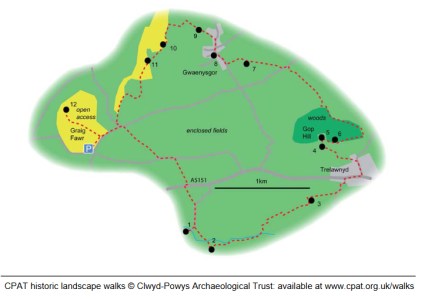
Sources for parts 1 – 3

Books and Papers

N.B. The reports by Stead and Bridgewood in the Proceedings of the Prehistoric Society are highlighted in green because although they are the record of the 1950s excavations, I have been unable to get access to them so I have not actually used them in this post. I have included them for the sake of completeness.  If you do have access to them and don’t mind scanning them, I’d be really grateful so that I can add them to the post!
Barton, Nicholas 1997.  Stone Age Britain. English Heritage / B.T, Batsford.

Brace, Selina, et al 2019. Ancient genomes indicate population replacement in Early Neolithic Britain – Supplementary Material. Nature Ecology and Evolution
https://reich.hms.harvard.edu/sites/reich.hms.harvard.edu/files/inline-files/2019_Brace_NatureEcologyEvolution_Supplement.pdf

Brady, James E. and Wendy Ashmore 1999.  Mountains, Caves and Water: Ideational Landscapes of the Ancient Maya. In (eds.) Wendy Ashmore and A. Bernard Knapp. Archaeologies of Landscape. Contemporary Perspectives. Blackwell Publishers.,. p.124-145

Britnell, William J. 1991. The Neolithic. In (eds.) John Manley, Stephen Grenter and Fiona Gale. The Archaeology of Clwyd, 9.55-64

Brown, Ian. 2004. Discovering a Welsh Landscape.  Archaeology in the Clwydian Range. Windgather Press

Burrow, Steve. 2011.  Shadowland. Wales 3000-1500BC. Oxbow / National Museum of Wales

Crumley, Carole, L. 1999. Sacred Landscapes: Constructed and Conceptualized.  In (eds.) Wendy Ashmore and A. Bernard Knapp. Archaeologies of Landscape. Contemporary Perspectives. Blackwell Publishers., p.269-276

Davies, Ellis. 1925. Hut circles and ossiferous cave on Gop Farm, Gwaunysgor, Flintshire. Archaeologia Cambrensis, 7th series, vol.5, p.436-438

Davies, Ellis 1949. The Prehistoric and Roman Remains of Flintshire with a Short Appendix to “The Prehistoric and Roman Remains of Denbighshire” (1929). Cardiff

William Boyd Dawkins: Cave Hunting

Dawkins, Sir William Boyd 1874. Cave hunting, researches on the evidence of caves respecting the early inhabitants of Europe. Macmillan
https://www.gutenberg.org/files/52424/52424-h/52424-h.htm
or https://archive.org/details/CaveHunting/dawkins-w-cave-1874-RTL002406-LowRes/

Dawkins, Sir William Boyd 1886. Early Man in Britain. Macmillan

Dawkins, Sir William Boyd 1901. On the Cairn and Sepulchral Cave at Gop, near Prestatyn. Archaeological Journal, Vol.58, vol.1

De Groote, I., Lewis, M. & Stringer, C. 2017. Prehistory of the British Isles: A tale of coming and going. Bulletins et mémoires de la Société d’anthropologie de Paris
https://link.springer.com/article/10.1007/s13219-017-0187-8

Dinnis, R. & Cris Ebbs. 2013. Cave deposits of North Wales: some comments on their archaeological importance and an inventory of sites of potential interest. Cave and Karst Science 40(1): 28-34.
https://www.academia.edu/5157200/Dinnis_R_and_Ebbs_C_2013_Cave_deposits_of_North_Wales_some_comments_on_their_archaeological_importance_and_an_inventory_of_sites_of_potential_interest_Cave_and_Karst_Science_40_1_28_34

Glenn, T. Allen, 1925. Distribution of the Graig Lwyd Axe and its Associated Cultures.  Archaeologia Cambrensis vol 90, p.190-218

Jenkinson, Rogan D.S. 2023. A North-Western Habitat: the Paleoethology and Colonisation of a European Peninsula. Internet Archaeology 61
https://intarch.ac.uk/journal/issue61/1/full-text.html

Last, Jonathan (compiler) 2003. The Archaeology of English Caves and Rock-Shelters: A Strategy Document. Centre for Archaeology Report 32/2003
https://historicengland.org.uk/research/results/reports/5231/TheArchaeologyofEnglishCavesandRock-Shelters_AStrategyDocument

Lynch, Frances 2000. The Earlier Neolithic. In (eds) Frances Lynch and Stephen Aldhous-Green.  Prehistoric Wales,  Sutton Publishing, p.42-78

Marsolier-Kergoat M-C, Palacio P, Berthonaud V, Maksud F, Stafford T, Bégouën R, et al. 2015. Hunting the Extinct Steppe Bison (Bison priscus) Mitochondrial Genome in the Trois-Frères Paleolithic Painted Cave. PLoS ONE 10(6)
https://journals.plos.org/plosone/article?id=10.1371%2Fjournal.pone.0128267

Parker-Person, Mike 1999, 2000. The Archaeology of Death and Burial. Texas A&M University Press

Ray, Keith and Julian Thomas. 2018.  Neolithic Britain. The Transformation of Social Worlds. Oxford University Press

Schulting, Rick J. 2007. Non-monumental burial in Britain: a (largely) cavernous view. In L. Larsson,
F. Lüth and T. Terberger (eds), Non-megalithic Practices in the Baltic: New methods and
research into the development of Stone Age society, 581–603. Bericht der Römisch-
Germanischen Kommission 88, Schwerin

Schulting, Rick J 2020. Claddedigaethau mewn ogofâu: Mesolithic to Romano-British human remains (mainly) from the caves of Wales. Proceedings of the University of Bristol Spelaeological Society, 28 (2), p.185-219

Shanks, Michael and Christopher Tilley 1982.  Ideology, symbolic power and ritual communication: a reinterpretation of Neolithic mortuary practices.  In (ed.) Ian Hodder, Symbolic and Structural Archaeology. Cambridge University Press, p.129-50

Sheriden, Alison 2012. The jet belt slider, Movers Lane.  In E. Stafford, D. Goodburn and M. Bates, Landscape and Prehistory of the East London Wetlands. Investigations Along the A13 DBFO Roadscheme, Tower Hamlets, Newham and Barking and Dagenham, 2000–2003, 192–202. Oxford: Oxford Archaeology (Monograph 17)

Sheriden, J.A. and Davis, M. 1998.  The Welsh Jest Set in Prehistory: A case of keeping up with the Joneses?  In (eds.) Gibson, Alex and Derek Simpson.  Prehistoric Ritual and Religion. Sutton Publishing, p.148-162.

Stead, W.H., and Bridgewood, R., 1957. Gop Cave, Newmarket and Nant-y-fuach,
Dyserth, Flintshire, Proceedings of the Prehistoric Society, 23, p.228

Stead, W.H., and Bridgewood, R., 1958. Gop Cave, Newmarket and Nant-y-fuach,
Dyserth, Flintshire, Proceedings of the Prehistoric Society, 24, p.219

Stead, W.H., and Bridgewood, R., 1959. Gop Cave, Newmarket and Nant-y-fuach,
Dyserth, Flintshire, Proceedings of the Prehistoric Society, 25, p.280

Tilley, Christopher 2004.  The Materiality of Stone: Explorations in Landscape Phenomenology: 1.  Berg

Wainwright, Geoffrey J. 1961
The Mesolithic Period in South and Western Britain. Unpublished PhD, UCL April 1961
Volume 1
https://discovery.ucl.ac.uk/id/eprint/1317731/1/282048_Vol_1.pdf
Volume 2
https://discovery.ucl.ac.uk/id/eprint/1317731/2/282048_Vol_2.pdf

Westbury, Michael V. et al.  2020. Hyena paleogenomes reveal a complex evolutionary history of cross-continental gene flow between spotted and cave hyena. Science. Vol.6, No.11.
https://www.science.org/doi/10.1126/sciadv.aay0456

White, Mark J. and Paul B. Pettitt 2011.  The British Late Middle Palaeolithic: An Interpretative Synthesis of Neanderthal Occupation at the Northwest Edge of the Pleistocene World.  Journal of World Prehistory 24, p.25-97

Wymer, John. (ed.) 1977.  Gazetteer  of Mesolithic Sites in England and Wales. CBA Research Report no.20. GeoAbstracts and The Council for British Archaeology.


Websites

Ancient Human Occupation of Britain
https://ahobproject.org/

Archaeology Data Service
A database of Mesolithic Sites based on Wymer JJ and CJ Bonsall, 1977
https://archaeologydataservice.ac.uk/archives/view/mesgaz_ma_2008/

Cambrian Caving Council
Gop Cave by Cris Ebbs. Based on “An Introduction to the Caves of Northeast Wales (2000, ISBN 0 9522242 1 6)) by Cris Ebbs, which is no longer available.
https://www.cambriancavingcouncil.org.uk/registry/CoNW/CoNW_04.htm#Gop

Dafyd Archaeology (Heneb)
Mesolithic
https://www.dyfedarchaeology.org.uk/wp/mesolithic-main-page/

Derbyshire County Council
William Boyd Dawkins – Chronology
https://www.derbyshire.gov.uk/site-elements/documents/pdf/leisure/buxton-museum/permanent-collections/dawkins-jackson/sir-william-boyd-dawkins/william-boyd-dawkins-chronology.pdf

Dictionary of Welsh Biography
Sir William Boyd Dawkins
https://biography.wales/article/s-DAWK-BOY-1837

Dyfed Archaeology
Mesolithic Wales
https://www.dyfedarchaeology.org.uk/lostlandscapes/trwyndu.html

A Maritime Archaeological Research Agenda for England
The Mesolithic. By Martin Bell and Graeme Warren with Hannah Cobb, Simon Fitch, Antony J Long, Garry Momber, Rick J Schulting, Penny Spikins, and Fraser Sturt
https://researchframeworks.org/maritime/the-mesolithic/

Natural History Museum
First Britons
https://www.nhm.ac.uk/discover/first-britons.html

Nation Cymru
Unearthed 9,000 year-old encampment ‘on a par with the oldest mesolithic site’ in Wales. By Jez Hemming, 17th February 2021
https://nation.cymru/news/unearthed-9000-year-old-encampment-on-a-par-with-the-oldest-mesolithic-site-in-wales/

A Research Framework for the Archaeology of Wales
Key Sites: Northeast Wales – Palaeolithic and Mesolithic 22/12/2003
https://www.archaeoleg.org.uk/pdf/paleolithic/KEY%20SITES%20NE%20WALES%20PALAEOLITHIC%20AND%20MESOLITHIC.pdf
A Research Framework for the Archaeology of Wales: Palaeolithic and Mesolithic, version 04 – October 2022. By Dr Elizabeth A. Walker, (Co-ordinator), Amgueddfa Cymru – National Museum Wales
https://www.archaeoleg.org.uk/pdf/review2024/VERSION%2004%20Palaeolithic%20and%20Mesolithic.pdf

Science
The Rise of the Woolly Rhino. New fossil discoveries may explain origin of several Ice Age creatures. 1st September 2011, by Sid Perkins.
https://www.science.org/content/article/rise-woolly-rhino

Smithsonian Magazine
An Evolutionary Timeline of Homo Sapiens
https://www.smithsonianmag.com/science-nature/essential-timeline-understanding-evolution-homo-sapiens-180976807/

South Yorkshire Historic Environment Research Framework
Palaeolithic. By Paul Pettitt
https://researchframeworks.org/syrf/palaeolithic/
Mesolithic. By Penny Spikins with a contribution by Ellen Simmons
https://researchframeworks.org/syrf/mesolithic/

UCL Blogs – Research in Museums
Migration Event: When did the first humans arrive in Britain? By Josie Mills, 24th February 2019
https://blogs.ucl.ac.uk/researchers-in-museums/2019/02/24/migration-event-when-did-the-first-humans-arrive-in-britain/

University of Manchester, Science and Engineering
Sir William Boyd Dawkins – An Extraordinary Study. By Joe Shervin, 28th January 2019
https://www.mub.eps.manchester.ac.uk/science-engineering/2019/01/28/sir-william-boyd-dawkins-an-extraordinary-study/
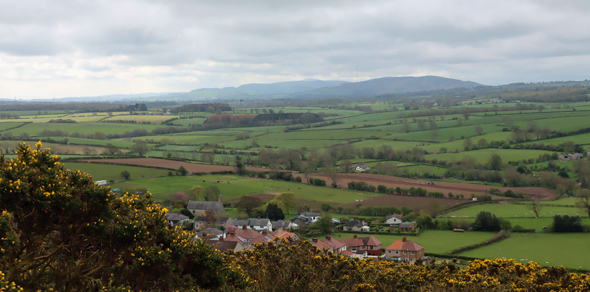
 

View across the valley


Field-walking and prehistory in Churton fields in 2006

Fieldwalking in Churton, supervised by Phllip Miles in 2006.

With many thanks to my friend Helen, who is shown second from the left in the very blurred image at the top of this 2006 article, for sending me a copy of this.  Phillip Miles , for the Chester Archaeological Society, supervised a field-walking expedition to two of the fields behind Churton, just north of Farndon, and made some very significant discoveries.

Aerial survey and metal detecting had already identified some interesting features in the fields above and to the east of the River Dee (see photos below), thought to belong to Neolithic, Bronze Age and Romano-British periods.  The fieldwork, carried out with permission from the landowner, confirmed that the land has a lot more prehistoric data to offer.

Although the Late Neolithic and Early Bronze Age in northeast Wales and the borders along the Dee are most noticeably represented in the landscape by burial and ceremonial monuments, the narrative of everyday working life in prehistory is embedded in the surface scatters of stone tools that remain in fields and on hillsides. These were the tools that people used every day in their subsistence strategies, and are the intimate toolkits of their livelihoods.

The analysis of the findings was underway at the time of the article, so no findings were reported, and it will be interesting to follow up on this to see what was concluded (if the analysis was published).  It was also suggested in the article that there could be scope for future work in Churton, although it is unclear at the moment if this took place.

Possible Neolithic enclosure in the fields behind Churton

Possible barrow cemetery near Knowl Plantation to the west of Churton


Archaeology of North Wales and Marches – Videos from the Darganfod-Discovery Conference 2021

Whilst looking for something else, I stumbled across the following page on the Cambrian Archaeological Association website, which has some impressive videos from the Darganfod-Discovery Conference 2021, some of which are relevant to North Wales and the Marches.
https://cambrians.org.uk/talks/darganfod-discovery-2021-talks/

Presentations from Darganfod-Discovery 2021 – a day dedicated to fascinating recent work on the archaeology of Wales and the Marches, held in conjunction with Cardiff University on 10th April 2021. This online conference is the first of a new series that showcases work supported by the Cambrian Archaeological Association Research Fund as well as providing an opportunity for early career academic and independent researchers to present research on Wales and the Marches.

Lectures on the above page include:

  • Prof Gary Lock of Kellogg College, Oxfor
    • ‘Moel y Gaer, Bodfari, a small hillfort in the Clwydians, Denbighshire’. (CAA Research Fund project)
  • Eirini Konstantinidi, PhD researcher at Cardiff University
    • ‘If the dead could talk: a taphonomic approach to Neolithic mortuary treatment in the caves of Wales’.
  • Adelle Bricking, PhD researcher at Cardiff University
    • ‘Life and death in Iron Age Wales: preliminary results from histological and stable isotope analysis from Dinorben and RAF St Athan’. (CAA Research Fund project)
  • Dr Rachel Swallow, Honorary Research Fellow at University of Liverpool
    • ‘A square peg in a round hole: new interpretations for the eleventh-century northern Anglo-Welsh border, as told by the misfit Dodleston Castle in Cheshire’.

There are other great lectures too, but those listed above are specific to north Wales and Cheshire.

Daytrip: The fabulous prehistoric copper mines at the Great Orme’s Head

Whether the visitor is an adult or a child, the prehistoric copper mine on the Great Orme’s Head next to Llandudno in northwest Wales is one of the best days out in Wales, and not only for those with a love of prehistory.  A visit carries with it a real sense of adventure and discovery, and it is an almost unique experience.

The Great Orme mines, which became one of the most successful mining operations in Bronze Age Britain, were worked at the mine-face by both adults and children.  Metallurgy revolutionized many aspects of industry and society in later prehistory before the arrival of the Romans.  As the use of bronze (a mixture of copper and tin) spread throughout Britain and Europe the Great Orme became part of a European network of metal distribution. Objects made with raw materials from the site were found not merely in Britain but as far away as the Netherlands, Sweden, Poland and France, indicating how important this supply of copper became be when combined with tin from southwest England to make bronze.

Some prehistoric copper mines in Britain have only been recognized in the last few decades, partly because they were worked in more recent times, disguising earlier mining operations, and partly because they do not stand out as obviously as other archaeological sites.  By contrast, the most familiar Bronze Age sites in north Wales are those that stand out clearly in the landscape, including round barrows (earth mounds) and cairns (stone mounds) in their 100s.  Stone circles, stone rows and menhirs (standing stones) are also found, and occasionally a lucky find will produce a settlement site. Thanks to a number of research projects, four major concentrations of copper mines have now been identified, one of which is in Ireland, two of which are in Wales, and one in northwest England.  These are now adding to the body of data not merely about copper mining but about the Bronze Age as a whole.  Many are still the subject of ongoing investigation.

The Great Orme. Llandudno is clearly visible where the Great Orme begins, forming a crescent, the end of which is marked by the Little Orme to the east.  On the right, heading west, is the opening of the river Conwy.  By Jay-Jerry. Source: Wikimedia Commons, CC_2.0_Generic.

The Great Orme mining enterprise, which operated from around 1700-900BC (Early Bronze Age to Early Iron Age), was at its busiest for a period of over 200 years between 1600 and 1400 BC (c.3600 to 3400 years ago).  In order to sustain itself for that long, the mines  required, as an absolute minimum:  a) a food-producing economy that could sustain a large group of miners on a permanent or semi-permanent basis, b) the knowledge, technical ability, and labour to tunnel through limestone, c) the technical ability and skills to process the ore, d) a long-term supply of wood for fire-setting and furnaces, e) a market for its products, and f) the development of long-distance connections to acquire the tin that was needed to make bronze and to distribute the finished product to its purchasers.  There was also certainly a requirement amongst the miners and smelters, just as there were amongst other members of society, to address their religious needs and their sense of identity.  These issues will all be touched on briefly below.

Location of the Great Orme’s Head. Courtesy Google Maps

This post will cover the following topics, all very briefly

  • Vital Statistics
  • The earliest British copper mining
  • Discovery and excavation at the Great Orme
  • Why copper and bronze?
  • The geological source of the Great Orme copper
  • Mining the ore
  • Processing the ore
  • Manufacture of copper and bronze tools
  • The development of the Great Orme Copper mines over time
  • The miners of the Great Orme
  • The copper and bronze trade in Britain
  • The end of Bronze Age copper mining in Britain
  • Final comments
  • Visiting
  • Sources

Some of the vital statistics

Part of the opencast mines and, at the base of the steps, access into the tunnels of the underground mines

The vital statistics for the Great Orme copper mines are sufficiently eye-popping to give a sense of how remarkable the mines were during the 500 years in which they were operational.  Bearing in mind that they are still under investigation, and will be for years to come, the following figures, summarized by Steve Burrow  of the National Museum of Wales in 2011, are merely guidelines, as they will have shifted upwards since then.  Burrow refers to the development of the bronze industry out of the beginnings of the copper industry “the first Industrial revolution,” and when you consider the figures for the Great Orme alone you can see why this claim can be made, as they represent a considerable demand for a new product.
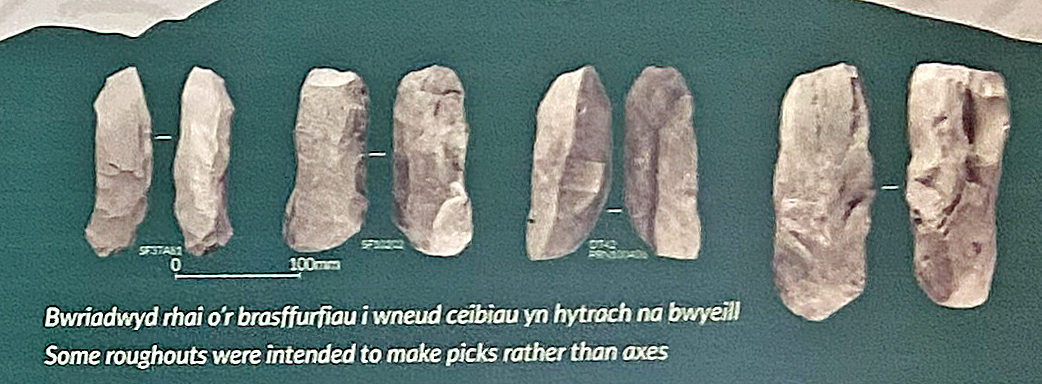
The opencast mines were dug from above, top-down, rather than horizontally through tunnels.  This left great upright remnants of hard rock behind, now rather eerily resembling some devastated dystopian city.  The soft rock could be removed with simple bone picks and hand-held hammers and it is estimated that using this tools the mine eventually covered an area 55m long, 23m wide and 8m deep.  It has been estimated that 28,000 tonnes of rock had been removed from it, in order to gather the copper ore it contained, before it was exhausted.

A simplified plan of the mines in 1992, before further investigations took place. Source: Burrow 2011, p.86

In the underground mines where miners tunnelled through the rock horizontally following seams of ore, 6.5km of tunnels had been investigated by 2011, with 8-10km more anticipated, and it had been discovered that the mines reached a depth of 70m over 9 separate levels.  An estimated 12,600 tonnes of ore-bearing rock were removed from them (on top of that removed from the opencast mines).  The illustration on the right provides an impression of how the mines were understood in 1992 and although this picture has been considerably expanded in the last 32 years, it demonstrates very nicely how the vertical shafts and horizontal tunnels were connected and how ambitious the tunneling was. 

Of the tools found, over 33,00 either whole or fragmentary bone objects were found, used as picks and shovels, and over 2400 stone hand-hammers and mauls were discovered, some of which can be seen on display at the site in the Archaeology Store.  The smallest of these could be hand-held, but the largest at over 20kg would have to have been incorporated into some sort of swinging device in order to smack it into the rock.  See below for details of these and other tools.

The magnificence of these numbers becomes entirely plausible on a visit to the mine when something of the extent of both opencast and underground mining operations can be experienced in person.

The earliest British copper mining

Neal Johnson’s useful visual timeline of the Early Metal Age, showing how bringing together excavated data can help archaeologists to understand when and how technological, economic and social changes occurred. Source: Neal Johnson 2017, p.7, fig.2 (in Sources at the end of Part 1). Click to enlarge and read clearly.

In the 19th century Three Age system, the Stone Age is followed by the Bronze Age, which is followed in turn by the Iron Age.  The Three-Age System was devised in 1836 by Christian Thomsen, Danish archaeologist and curator of the National Museum of Denmark who developed the scheme for his guidebook to the museum’s archaeology collection.  The scheme was very influential, and Thomsen can be commended for attempting to make chronological  sense of an archaeological record that had was poorly understood at this time.  Although these are now recognized as very crude categorizations, which exclude certain vital components of material data, they continue to be used and do represent the basic chronological truth that for hundreds of thousands of years utilitarian tools were made of stone and only then, in quick succession, by copper, bronze and iron.

Richard Bradley’s dating of the Chalcolithic and Bronze Age

In more recent systems, a Copper Age, or Chalcolithic, is inserted between the Neolithic (New Stone Age) and the Early Bronze Age and as Neal Johnson’s helpful timeline above shows, a far more nuanced understanding of this period of prehistory is now possible, incorporating pottery and the soft metals gold and silver.  There has also been a shift away from materials and objects towards understanding the people and the behaviours that they they help to represent. The Bronze Age itself has been subdivided into three main phases, which reflects social and economic differences as well as changes in raw material usage and tool types. Richard Bradley assigns the dates shown in the table to the right, above, to the various sub-periods of the Bronze Age, and in regional schemes these can be modified to suit local findings.

The Moel Arthur axehead hoard. Source: Frances Lynch, The Later Neolithic and Earlier Bronze Age in Prehistoric Wales, p. 101, figure 3.7

Copper mining was introduced from Europe.  Two possible sources are viable for its arrival in Ireland and England.  One is central Europe which was a major early producer, and the other is the Atlantic coast, with Iberia a plausible source of copper working to Killarney in southwest Ireland, where the earliest Irish and Britsh mines are found.  The early Ross Island copper mine was in use from around 2400BC, and is the earliest of the Irish and British copper mines, whilst Mount Gabriel was in use from around 1700BC.

Copper halberd from Tonfanau near Aberdyfi, mid-west Wales. Source: National Museum of Wales

In Wales the earliest copper objects to be found in Britain are axes, but they were not made in Wales.  A broken copper axe thought to be from south Gwynedd, and a collection of three copper axes from Moel Arthur are well known examples.  On the basis of metallurgical analysis they are thought to have been imported from southwest Ireland.  Copper axes were modelled on stone tools but were soon followed by an entirely new form, for which no precedent in stone is known, called a halberd.  It is thought that it may have been designed as a weapon, either actual or symbolic, but what is of primary interest here is that the value of copper for inventing new and special designs was being recognized at this time.

Chronology for Bronze Age mines in Britain. Source: Williams and de Veslud, 2019. Click image to enlarge to read more clearly

Dates for the Great Orme extend from c.1900 to 400 BC (Early Bronze age to Early Iron Age) but the main activity took place towards from the middle of the Early Bronze Age until towards the end of the Middle Bronze Age.  The phases described by R.Alan Williams in 2019 identify a main period of activity between c.1600 and 1400BC.  This “mining boom” peak coincides with the well-known Acton Park phase of metal production, first identified at Acton Park in Wrexham, which will be discussed on a future post.  The decline of metal working at Great Orme began to take place between 1400 and 1300 BC.  A “twilight period” lasted into the Early Iron Age.  Note that that Ross Island had already gone out of use by the time the Great Orme was opened, and that many of the other Early Bronze Age mines in mid-Wales and northwest England were also coming to an end by this time.  Some of the Irish mines survived into the Middle Bronze Age, but the Great Orme was he only site to continue into the Late Bronze Age.

Discovery and excavation of the Great Orme mines

Today it is recognized that Welsh copper mines are to be found concentrated in mid- and north Wales, the biggest of which were the Great Orme and Parys (Anglesey) mines, just 20 km apart.  Both were exploited for copper during the 18th and 19th centuries, and it is at this time, both in Wales and at Alderley Edge in Cheshire, that the earlier mines were first recognized and recorded when the miners found that their new shafts were colliding with pre-existing ones.  Antiquarian interest in some of these much earlier mine shafts resulted in some speculative reports about how old they might be.

In the case of the Great Orme, the first modern excavations took place in 1938-1939 when Oliver Davies, an expert on Roman mining in Europe, headed up a committee for The British Association for the Advancement of Science.  The remit of the committee was to investigate early metal mining.  In mid and north Wales it investigated mines on Parys (Anglesey), Cwmystwyth (Ceredigion), Nantyreira (Gwynedd) and the Great Orme’s Head. Although their attempts to date the mines assumed that they were probably “Celtic” (i.e. more recent than they actually are) the project successfully raised an awareness of prehistoric copper mining in Wales.

Archaeological excavations on the Great Orme in around 1900. Source: Peoples Collection Wales

Building on this initial research, the amateur archaeologist Duncan James carried out some excavations in the Great Orme area in the 1970s, and was able to obtain an radiocarbon date that indicated a Bronze Age date.  In the 1980s Andrew Lewis for the Great Orme Exploration Society and Andrew Dutton for the Gwynedd Archaeological Trust both undertook survey and excavation work that made considerable advances in knowledge about the copper mines.  Work by Simon Timberlake and the Early Mines Research Group greatly expanded knowledge of copper mining in the north- and mid-Wales area as a whole.  Since the 1980s work has continued to be carried out at the Great Orme and elsewhere, and a number of post-graduate research projects, some of which are available for download on the Research page of the Great Orme official website, have focused on particular aspects of the mines and related topics.  Most recently, the important PhD research undertaken by R. Alan Williams at the Great Orme was published by Archaeopress in 2023, and contains the most up to date information.

Why copper and bronze?

Simple stone reduction process from core to tool. Source: Grace 1997

Before the introduction of copper, the main materials for making tools were stone, wood and bone.  Whereas these were worked by reduction (knapping pieces of stone off a core or carving wood and bone to make shaped tools), copper was created by melting well-ground malachite using a pestle and mortar until it underwent a process of change, becoming molten.  This was poured into a mould to cool and create an object. This is discussed further below.  It was not an entirely alien production process, having something in common with kiln-fired pottery, which had been made since the Neolithic, but it was a new approach to tools-making.

Copper was not as strong or resilient as stone, and its primary value was the production of a particularly thin and very sharp blade.  Although stone tools could be very sharp, it was impossible to achieve the thin edge of a cast metal.  This edge was particularly useful for tree felling and branch cutting, as well as the shaping of wood. Although it would blunt quickly, because the metal was so soft, the blade could be easily sharpened after use. When damaged, it could be recast with other broken objects and used to create new tools.  However, because of its softens its uses continued to be limited.  In some cases, its value as a prestige item may have exceeded its value as a functional tool.

Group of damaged bronze objects probably originally destined for recycling.

Copper came into its own when blended with 10% tin to make bronze, which represented a new world of possibility and innovation.  By lowering the melting point of copper, the addition of tin made copper easier to handle and the resulting bronze was harder and stronger than copper, just as sharp, and less prone to damage.  Although the earliest bronze forms copied copper objects, designs soon emerged that represented significant departures from stone and copper antecedents, including adzes, halberds, knives, pins, ornaments and in the later Bronze Age swords and shields.  Like copper it could be recast and moulded into new shapes, providing them with a very long-term life cycle that outlived the lives of individual tools, conferring a particular and unique value on metal tools.  Where a stone tool would be reworked so many times that it had to be discarded, and a pot once broken could not be safely mended, metal could achieve a form of eternal life.  Many of the hoards of broken tools that have been found in Britain were clearly grouped together and retained in order to be recycled in this way, although others were clearly deposited in special locations for more spiritual purposes, perhaps partly because of this unique quality.

Bronze Age stone arrowheads from Merthyr Mawr Warren, Bridgend, Wales. Source: National Museum of Wales

Stone, wood and bone continued to be important in the Bronze Age.  Stone tools in particular, became the heavy-duty implements that complemented the new metal equipment.  Pestles and mortars continued to have an important role in the processing of cereals, pigments and ores, and small arrowheads continued to have a value in hunting during the Early Bronze Age.  Bone was still used for small, thin needles and pins, and wood was still vital for hafting tools of bone and stone. In the longer term, although stone retained a role in many parts of life, copper and bronze took over many of the roles that many organic materials had previous had for the manufacture of tools.

The source of the Great Orme copper

The Great Orme is a grey limestone promontory surrounded on three sides by the sea. It emerges from the main coastline of north Wales at Llandudno, and is the same rock system that sits so dramatically along the western edge of the Clwydian Range above Llangollen.  In a paper on the Great Orme research page, Cathy Hollis and Alanna Juerges explain some of the processes that took place to produce the mines on the Great Orme, of which the following summary is a much-simplified version.  Go to the above link to see the detailed overview.

The Great Orme limestone is a sedimentary rock formed of the accumulated remains of billions of calcium carbonate-secreting organic sea creatures that died and were laid down with rock salts in warm, shallow tropical seas during the Lower Carboniferous (c.335-330 million years ago).  These include shellfish, foraminifera and corals, some of which can be seen as fossils in sections of the limestone on the Great Orme.  There are multiple layers of the limestone on the Great Orme, often clearly visible, and each represents different phases of sediments as they were laid down.  Around 330 million years ago this deposition of carbonates stopped, and the landmass of which the Great Orme was a part was eventually buried beneath a kilometer of other materials.  In the late Carboniferous and early Permian periods, a collision between two shifting tectonic plates  lead to folding and uplift of the landscape in north Wales, with faults torn across the Great Orme.

The faults allowed molten rocks, minerals and gases to escape. Amongst these escapees was dolostone, which in some places on the Great Orme altered the character of the limestone, becoming dolomite,or dolomitic limestone.  The copper ores for which the miners were searching were found in veins that cross-cut the dolostone, meaning that they formed after it.  This formation probably occurred during a new period of tectonic activity that was responsible for the uplift of The Alps and other European landmasses, including the Great Orme.  The ores found their way into these new faults, and as this period of tectonic activity ended, and the atmosphere began to cool the molten materials, they slowly solidified where they lay.  On the Great Orme, chalcopyrite was the copper ore that had inserted itself into seams of the limestone, and this was oxidized and became malachite.  It was the malachite  that was used for the manufacture of copper objects.  Because much, but by no means all, of the limestone on the Great Orme was dolomitized, this created conditions that were favourable for mining.  This new rock was much softer than the parent rock and some of it was highly friable and quite easily removed by bone tools.

The extent of the Devensian ice sheets. Source: Nicholas Flemming 2002

A further relevant process was the geomorphological activity that took place during the last Ice Age, the Devensian.  The Irish Sea ice sheet that covered North Wales during the Devensian dragged down the surface of the Great Orme’s Head, scouring it of its upper surfaces as the ice sheet made its relentless way south.  When the ice sheets finally retreated at around 11,000 years ago, Wales had been reshaped and re-profiled, and the the copper-bearing seams of the Great Orme had been exposed.  The horizontal and vertical cracks in  and fissures the limestone were further expanded by  the subsequent action of rainwater erosion, groundwater and ice as the rock was subject to continual weathering.

For anyone interested in a full understanding of the geology, there are references at the end of this post in Sources.

Mining the ore

The copper mining process on Mount Gabriel at a similar date, by William O’Brien 1996, p.32 (see Sources at end).

As an industrial process, malachite had to be extracted first and then processed.  Malachite is not the only ore that can be used to make copper metalwork and bronze, but is one of the simpler ones to process.  As William O’Brien discusses, following his excavations at the Mount Gabriel copper mine in southwest Ireland, this requires prospecting, organizing mining teams, collecting raw materials and applying existing skills for the manufacture of tools to enable the extraction of ore and the specialized conversion of that ore to metal.  O’Brien has put some elements of these workstreams into a diagram shown right, which gives a good sense of some of the processes involved (click image to enlarge).  Although there are differences at the Great Orme, what this demonstrates very effectively is that there are three connected flows involved.  The first, on the left of the diagram, is the collection of raw materials and the preparation and manufacture of tools and equipment.  The second is the extraction cycle, and the third, in two stages, is the processing of ore.

Mining tools

The tools left behind in the Great Orme mines were mainly made of bone and stone, but there is evidence in the form of markings in the stone of bronze picks and chisels.  Metals were almost certainly recycled rather than abandoned.  Pottery was probably used for some tasks, although not much evidence of it is found at the mines, which suggests that other, more lightweight, less fragile and larger forms of carrier were preferred, made of basketry, leather or textile (such as sacking).  All organic materials that are vulnerable to decay over time and are only very rarely found on archaeological sites and usually only in exceptional environmental conditions.

By far the greatest number of tools, over 33,000 of whole and fragmentary pieces, were made of bone.  Over half of these were cattle bone, and the rest were a mix of sheep, goat, deer and wild boar or pig, mainly ribs, limbs and shoulder blades. The long thin bones were used as picks, whilst the wide-based shoulder blades were used as shovels.  Many of them were bright green when they were found, stained by the malachite.

Some of the stone hammers and mauls used in the mines, held today in the archaeological store on the site.

The majority of the stone tool collection is represented by over 2400 vast stone hammers with have been battered into their present shape by usage.   At least some of them were thought to have fallen from nearby harder outcrops that were more durable than the softer local sedimentary rocks.  Many of these were found on the local beaches, where they had been rolled and rounded.  They varied in size from pieces that could be held by hand to enormous “mauls” that could be up to 20lbs in weight and would have been employed using some form of sling so that the stone could be swung into the rock face.

Possible reconstruction of the hafting of a Copa Hill maul from mid Wales showing how it may have been used in a sling. Source: Burrow 2011, p.90


Opencast shaft mining

Helpful artist’s impression from the Great Orme mines of what the opencast mine would have looked like.

The earliest phase of Great Orme mining was  opencast mining that took place in the Pyllau valley, as shown in the artist’s reconstruction left, on one of the information boards. The scoured landscape that the retreating ice-sheets had revealed permitted the prospectors to recognize the malachite-rich seams in the limestone, and to access it with relative ease by open cast mining.  The techniques was to mine from the top down, removing the soft dolomitic limestone from in between the pieces of harder original limestone, creating the bizarre-looking landscape that remains today.  This could be done using picks and shovels manufactured from bone, aided with hand-held hammerstones.  A series of ladders, lifts and pulleys were probably required as the mines shafts became deeper, ready for copper processing on the surface. Eventually these stone shafts were exhausted and if the mines were to continue to provide copper, underground mining was the only solution.

Underground tunnel mining

“Deads” in one of the galleries on the tour

Underground mining would have been very hard.  Over the centuries eventually nine levels were excavated out of the limestone (of which two are included on the visit).

Some of the tunnels, like most of those shown in this post were tall and thin, allowing people to move down them upright in single-file.  Some were significantly smaller, long and thin that could only be mined lying down by the smallest members of society – perhaps women and certainly, given how tiny the passages were, children.  Others were opened out into large galleries like caverns, one of which is thought to be the largest surviving prehistoric man-made underground excavation in the world.  One of the hollowed out galleries on the visit is filled with what are known as “deads,” the large fragments of waste rock left behind after ore had been extracted.  It made more sense to backfill exhausted tunnels and galleries with waste then to remove it laboriously to the surface, where disposal would still have been a problem.

There were three methods of excavating malachite in the underground mines.  The first continued to be bone picks for softer rock, the dolomitic limestones, but harder rocks eventually had to be mined as well.  Harder rocks were excavated by a combination of fire-setting and stone tools.  Stone tools, described above, included hand-held hammers and large mauls that would have been fixed in a sling in order to swing it at the mine face, both requiring the the input of energy and strength in a very difficult environment filled with stone dust and sharp fragments.

Simulation of a fire in one of the narrow shafts that head off horizontally from the bigger tunnels, thankfully without the smoke

Fire-setting added to the discomfort and raised the risk of serious injury.  It consists of gathering a large pile of dead wood, which was placed against rock faces to be mined in order to make them more brittle and easier to work.  Sometimes water could be added to the hot rock to help with the fragmentation process.  The smoke created by the fire in such small spaces with no ventilation carried the risk of suffocating anyone in the vicinity, as well as the possibility of lung disease.  Presumably the mines were vacated during this process, but the risk must still have been high for those who set the fires.  In the long term, lung damage both from the smoke and the dust and fragments of stone must have been an ongoing problem.

Processing the ore

Cleaning the ore

The site of the ore cleaning site at Ffynnon Rhufeinig. Source: Wager and Ottaway 2018

In order to ensure that few impurities entered the smelting process, and that a good quality copper was obtained, the ore mined from the Great Orme had to be separated from the general waste material around it, called gangue.  This stage in copper manufacturing is called beneficiation.  When an ore was mined it was still attached to bits of rock and dust, and this had to be removed.  This involved grinding, cleaning and sorting.  Pestles and mortars were used to grind down the ore, and examples have been found at the Great Orme.  Once it had been reduced, the mixture of rock and ore had to be sorted both by hand and eye, and usually by straining through running water.  Once the cleaning process had been completed, it might be re-ground into a powder that could then be smelted.  On the Great Orme a cleaning site was discovered and excavated at Ffynnon Rhufeinig, a natural spring that was run into a series of channels and ponds.  the site was a kilometer away from the mines themselves, and it is suggested that the wider landscape was used during the Early Bronze Age phase of the site for processes connected with the mines, other than mining itself.

Copper smelting

Location of copper smelting site at Pentrwyn, Great Orme. Source: Williams 2014

Once the ore was sorted and cleaned, it underwent a process called smelting.  Smelting is a term that refers to an ore being converted to a metal by the application of heat up to and beyond melting point.  This took place above ground, and required specialized skills and equipment.  So far only one smelting site has been identified at the Great Orme, dating to around 900BC, well after the  copper mine’s main period of maximum exploitation, at a location some distance from the mine itself at Pentrwyn on the coast.  Copper can be found in a number of different forms, some more difficult to process than others, but the malachite (copper carbonate) at the Great Orme required a relatively simple production methodology.

Display of prehistoric smelting equipment in a shelter on the pathway at the top of the opencast mine at the Great Orme.

After the ore had been cleaned, a furnace had to be built and prepared.  The furnace was often formed by a pit with short walls.  To this a clay tuyère was fitted, which was a tube that interfaced between the furnace and a pair of bellows. The bellows helped to raise the heat by blowing oxygen to feed the flames. This was an important factor because malachite needs to be between heated to between 1100 and 1200ºC before it will become molten.  It runs the risk of mixing with the copper ore to become copper oxide, which cannot be used for metal production, so charcoal was also added into the furnace. The charcoal burns much hotter than wood, so contributed additional aid to the heating process but at the same time releases carbon dioxide as it burns, which helps to neutralize the impact of the oxygen on the ore, enabling it to become copper.  The ore was heated in the furnace within a crucible, which is a vessel that will handle the high temperatures required for melting metals.  The melted metal was then poured into a mould made of stone, pottery or bronze.

Bronze smelting

Bronze was a transformation of copper and tin into something entirely stronger and more resilient than either.  It usually consisted of 90% copper and 10% tin, although later cocktails produced slightly different results. Tin lowers the melting point of copper, making it easier to convert the copper ore to liquid form.  There were two methods used at the Great Orme.  The first was by combining both copper and tin ore in a single smelting process.  The second was adding tin or or to copper that had already been melted.  As with copper, the Bronze was then moulded to form different tools and weapons. 

The excellent video below shows a copper palstave under construction from the crushing of the ore using a pestle and mortar, via the smelting of the ore, to the moulding of the molten metal to the trimming of the final tool.

The manufacture of metal tools

Copper axe and stone mould from Durham. British Museum WG.2267. Source: British Museum

The earliest casting moulds in which the tools were formed were made of stone, and were open, with no top half.  An example of an open stone mould from north Wales was found at Betws y Coed.  The making of moulds became in itself a skilled task, creating the exact shape in stone that was required in the finished metal object, and they could create much more complex forms.  Later,moulds could be made of clay or bronze.  Once the copper or bronze had been poured into the mold and allowed to cool slowly, the object hardened and could be removed from the mould, to be finished by breaking off any excess metal and sharpening the blade.  Initially only solid items like flat axes and more complex palstaves (such as the one shown below) were made.  

A palstave found at the Little Orme

Two parts of moulds for a palstave were found in three miles from the Great Orme in 2017 by a metal detectorist, shown below

Palstave moulds found near the Great Orme in 2017. Source: BBC News

Soon hollow or socketed objects were made as well, with the use of double-moulds and by inserting cores made of clay or other materials, which created a new way of hafting tools.   and as these and the the socketed axe below shows, additional features like functional loops and decorative components could be added if required.

Bronze socketed axe head from Pydew, in the hills above Llandudno Junction, to the southeast of the Great Orme north Wales.

Socketed axe head on a haft, found at Must Farm, Cambridge. Source: Cambridge Archaeological Unit

The copper miners

An opening into one of the tiny shafts that only children would have been small enough to work

The early opencast miners would have been fit enough to undertake physical labour, and the first open cast mining required both knowledge and some basic skills, but once the knowledge was acquired, the rest would have been well within the capability of a farming or herding community.  The veins of malachite sandwiched within soft limestone had to be recognized, and a strategy for extracting it and processing it had to be learned, but the ores could be excavated from soft dolomitized limestone using bone picks.  The use of bone for tools rather than stone means that although it would have been a laborious task, it was not as back-breaking as tunnelling through solid rock.

This clearly changed.  As the mining activities plunged underground and tunnels had to be excavated in the limestone to give access to the malachite, the miners must have been selected for more than merely strength and fitness.  As stated above, it is entirely likely that women were employed in the task, being smaller than most men, and it is unquestionable that children were employed to excavate the slender warrens that only such small bodies could excavate and navigate.  The community must have been in a position to replace its miners, because this was not merely back-breaking work, but dangerous too.

Damaged vertebra from the skeleton of an 18-year old found in a cave burial on the Little Orme. Source: John Blore 2012.

The risk to lungs and life from smoke, dust and rock particles has already been mentioned.   Other dangers potentially included the collapse of walls and roofs, poor ventilation and the difficulties of lighting.  No evidence has been found so far to show how the mines were illuminated, although there are a number of alternatives possible.  As the mine went deeper, nearing the groundwater level, there may also have been danger of flooding.  Wet stone from constant dripping in rainy and weather and falling rock must have been responsible for their fair share of bruises, cuts, head injuries and bone breaks, a potential problem where minimal medical knowledge was available and when infections could result in serious difficulty.

Long-term repetitive strain and stress injuries must have been common as well, leading to defects, as well as certain debilities and disabilities.  A burial of four skeletons in the North Face Cave on the Little Orme, contemporary with the mines, shows that one of the individuals had sustained serious compression damage to his vertebrae, perhaps a result of extensive mining activity over a long period.

Visitor centre reconstruction of one of the Great Orme settlements.

Although a number of settlement sites have been recognized on the Great Orme, not all of them were necessarily associated with the mines, although the characteristic round houses would have been the type of settlement familiar to the miners.  It has been suggested that the mines may only have been worked on a seasonal basis, at least in the first decades, and that the miners belonged to farming communities whose main settlement sites were elsewhere, or that they were nomadic pastoralist who were either fully mobile or transhumant.  Later on, when the mines were more intensively worked, more permanent lodgings may have been required.  It is also possible that over the entire span of time during which the mines were used, settlements shifted positions.

Visual representation of domesticate bone elements found in the mine. Source: James 2011.

The miners were not ill-fed, if the available evidence represents ongoing dietary possibilities, and there is nothing to suggest that there is any reason why they would not have been well sustained for the hard work undertaken, although conditions were certainly unpleasant.  Sîan James has carried out post-graduate analysis of the bones found at the mines, which give some insight into what types of meat were consumed there. Sîan James’s research carried out at the Great Orme on the animal bones indicates that over cattle, which represent over 50% of the faunal remains, were butchered elsewhere and were brought to the site in manageable joints or portions.  Sheep/goat (difficult to distinguish from one another in the archaeological record) and pig are also represented, making up the other half of the domestic species.  No fish bones were found and only a handful of shellfish remains were discovered.  Coastal resources were obviously not much used, if at all, at least at the mine itself.  The picture that emerges is that the miners, at least whilst they were at the mines, relied on animal husbandry.  They either maintained their own herds, were provided meat by their communities or acquired it by exchange with other groups.

Mining is an extreme form of landscape modification and management that impacted not only the immediate area of the mines themselves, but the surrounding landscape.  Fire-setting and smelting would have required trees for burning on a much larger scale than previously known, and the miners would have required livestock in the vicinity for both food and raw materials.  There can be little doubt that just as humans modified the Great Orme, the miners and their surroundings became entangled with the identity of the mining community and those connected with it.  Although settlement and associated community activities may have been mobile, the mines were a fixed point on the Great Orme and an anchor that remained the same over multiple generations.  The transmission of specialized craft knowledge from one generation to another may have differentiated the miners and smelters as a group apart, in either a good way, as valued contributors to the local wealth, or in a negative way, as an isolated minority alienated from normal community living.  There is no way of knowing.

Drilled amber bead from the North Face Cave burial on the Little Orme (from one of the visitor information signs).

Although it is beyond the scope of this post, understanding who the miners were is a matter of looking not only at the mines and the resources that supported them but at the burial sites and other monuments in the surrounding landscape that incorporated their ideas and beliefs.  Their own burial  monuments inhabited this space.  On the Great Orme there are Bronze Age round cairns as well as a stone row and a possible stone circle.  On the Little Orme  the North Face Cave revealed the remains of four individuals buried at the time that the mines were worked, aged from 4 to 18 years old. A drilled amber bead was found with one of the burials.  The Great Orme is dotted with the sites of those who came before.  Neolithic sites and earlier Bronze Age sites are common here and throughout the uplands of north Wales, and the miners would have been aware of them. The landscape was inhabited not merely by the miners and by pastoralist herders but by their distant and recent ancestors, making this a spiritual as well as an economic landscape.

The Little Orme to the east of the Great Orme, seen from the Great Orme just above the copper mines.  Llandudno follows the crescent of the bay between the two promontories.

From left to right.  The Mold Cape superimposed on a digital sketch, which could be man or woman (Source: British Museum Partnership Programme); Photograph of the Wrexham County Borough Museum hologram of the reconstructed head of Brymbo Man (my photo); The recreated grave and capstone with original skeleton and grave goods of Brymbo Man in the Wrexham County Borough Museum (my photo).

There is a potential link between the Little Orme North Face Cave with the Bryn yr Ellyllon cairn.  As well as the gold cape and other fine objects, numerous amber beads were found.  One of the Little Orme burials was also accompanied by an amber bead, shown above.  Amber beads are in themselves evidence of communications over long distances as amber was not available locally.  It was sometimes washed up on beaches of northeast England, but otherwise had to be sourced from the Balkans and central Europe.My earlier series about two burial monuments in northeast Wales at Bryn yr Ffynnon (containing the remains of “Brymbo man” and a very fine Beaker) and Bryn yr Ellyllon (containing the Mold gold cape and other luxury objects) touches on some of these ideas.


The copper trade – selling and travelling

Trade and/or exchange

From a visitor centre sign showing the Voorhout hoard of bronze metalwork found in the Netherlands. 13 out of 17 of the objects were made with materials from the Great Orme

At the Great Orme the movement of goods falls into two parts.  The first concerns the acquisition of tin for the manufacture of bronze from southwest England.  The second concerns the distribution of metal or metalwork overseas.

The distribution of raw materials and tools in Britain was not unprecedented, and was a well known aspect of the Late Neolithic, where good quality flint from southern England (the uber-workable material for making small stone tools), and completed stone axe heads from Cumbria and north Wales, for example, had been conveyed from their geological sources to areas where they were unavailable. However, the linkages formed during the copper trade were new.

The copper trade probably started in response to local need, but by 1600BC it had upped its game to meet both a national and international need for bronze, which is made by the addition of tin.  Tin is only available in a very small number of locations in southwest England, and the two, copper and tin, had to be brought together.   Because the proportions of bronze were usually 90% copper to 10% tin, it made sense for the tin to be brought to the copper mining operation to be worked, and as a base for bronze mining the Great Orme became particularly successful.  Given the relative locations of southwest England and the Great Orme, is is probable that the trade in tin was sea-based.

River routes showing how Group I shield-patterned palstaves made of Great Orme ores may have been distributed throughout Britain. Source: Williams and de Veslud 2019. Enlarge to see more detail

There is a question about why, at 1600BC the Great Orme was suddenly more productive than it had been before.  One possibility is that other mines were exhausted at this time, some having been worked since the Chalcolithic and throughout most of the Early Bronze Age, but more data is required on this subject.  Another is that It also needed a market for its products, and the development of the Acton Park industry (dating to around 1500-1400BC) created sufficient demand to sustain a well-placed mine with good connections to other areas.
As an economic enterprise, the Great Orme needed to ensure that its product arrived in the areas where there was demand.   Using two types of data, a 2019 study investigated how Great Orme metals reached other parts of Britain and the continent.  First, the researchers, Williams and Le Carlier de Veslud identified that a metalwork tradition known as Acton Park (named for its type site in Wrexham), made of Great Orme metals, was found in particular concentration in both the Fenlands of southeast England and in northeast Wales as far as its borders with England.   The Fenlands help to demonstrate the reach of Great Orme metalwork to the east coast, whist the industry in northeast Wales presumably benefited from its relative proximity to the mine.  A second object type, the Group I shield-pattern palstave, has also been used to help determine other locations where Great Orme metals were found, together with the routes that distributed them.  The palstaves were found throughout most of Wales and southern Britain, as well as overseas, and the main concentrations seem to align with river systems, suggesting that the palstaves were distributed either by boat or by pack animals along river valleys.

Map at the visitor centre showing some of the European areas to which the Great Orme copper was sent

The presence of Great Orme copper and bronze overseas is particularly good evidence of sea-borne trade or exchange.  Items such as the Voorhaut hoard from the Netherlands have been found as far away as Denmark and Sweden in the northeast, Poland in the east and in France, perhaps taken along the rivers Seine and the Loire in France.

In archaeology it is often unclear how both sides of an exchange may have operated.  It is clear that metals were being manufactured and traded, but it is not quite as clear what the Great Orme miners were receiving in return.  One possibility is that they were receiving livestock and cereals, but although this is certainly viable as one income stream, it seems to understate the value of the products being sold.  Another option, which does not rule out the first, is that jet and amber, both of which are found in graves in north Wales were being sent west into Wales from the east coast, where these raw materials can be found, as prestige goods in return for Great Orme metals.

The only remaining bead, out of around 300, of a necklace of amber beads from the Mold Cape burial Bryn yr Ellyllon. British Museum 1852,0615.1. Source: British Museum

People are also often a little difficult to see  clearly in archaeological data, but the metalwork industry of the Great Orme must have had more than miners and metallurgists to sustain it.  It seems likely that when the processed metal and the finished artefacts were sent overseas, this must have involved middle-men who were not responsible for digging out the mines and smelting the ores, but were concerned with securing the tin from the southwest and sending the required products to wherever there was demand and payment.  It has been suggested that the owner of the Mold Cape at Bryn yr Ellyllon near Mold, which included amber as well as gold, may have benefited from the wealth of the copper trade in order to be in a position to be buried with such luxurious objects, removing them from circulation in the living world.

As well as miners and middle-men there must have been additional people involved in the network who carried the metalwork from the Great Orme to where they were needed, perhaps returning with scrap metal for recasting.  Although these people are usually, if not always impossible to identify with any confidence, they certainly existed. Some of them may have carried goods by pack animal, others by inland boats and coast-huggers, still others by vessels that were capable of crossing between England and the continent.


The end of copper mining in Britain

After the Early Bronze Age most of the copper mines went out of use in Britain and Ireland at around 1500-1600BC.  The Great Orme was the exception, lasting until c.1300BC.  As Richard Bradley says, it is not well understood why this and other changes in British mining occurred, “but they form part of a more general development in the distribution of metalwork which saw quite rapid oscillations between the use of insular copper and a greater dependence on Continental sources of supply.”  A possibility suggested by Timberlake and Marshall in 2013 is that the decline in production, if not associated with the exhaustion of British mines, may have been the arrival of plenty of recycled metal from the continent, and particularly from The Alps at around 1400BC.


Final Comments

The above account is a description of the Bronze Age mines, and it was marvelous to read up about them.  The copper mines at the Great Orme are one of the most vibrant places in Britain for getting a sense of people and their activities in our prehistoric past.  Assuming that you are not claustrophobic and don’t mind being underground (about which more in “Visiting” below), this is a superb and revelatory experience. There is a strong sense of the lengths to which people in the Middle Bronze Age would go to supply the demand for copper.  The sheer scale of the enterprise, as you literally rub shoulders with the past, is astounding.  There is real feel of intimacy about the experience that is difficult to replicate at most other prehistoric sites in the UK.  A visit is a powerful way of connecting with the miners, and a nearly unique insight into at least one aspect of Bronze Age living.  Fabulous. Don’t miss it.

Visting

The beginning of Marine Drive, seen from the Llandudno pleasure pier

The Great Orme is one of a great many places of substantial interest in the area, and is easily fitted into a visit to the Llandudno and Conwy areas.  Don’t miss Marine Drive, the road that runs around the Great Orme and allows you to get up close and personal with both the geology and the coastal scenery.  If you like walking, the Great Orme has many footpaths, some of which take in other prehistoric sites as well as the nice little church of St Tudno, and if you like Medieval history the nearby Conwy Castle and the city walls along which you can walk, are simply brilliant.  Conwy’s Elizabethan town-house Plas Mawr is one of Britain’s most remarkable Elizabethan survivors and is absolutely superb.

One of the Great Orme trams, also showing one of the cable car towers too. Photo taken just above the copper mine.

There is plenty of parking at the mines, but if you fancy taking the tram from Llandudno, which is a great option, the half way station is a five minute walk away.  The mines are closed off-season so check the website for when they re-open.  This year, 2024,they opened for the season on 16th March.

I visited at the end of March, not a peak time of year for visitors, and at 9.30am, which was opening time.  I was literally there alone.  By the time I returned to my car at 11.30am, having gone after my visit for a short walk to find a Neolithic burial site, it was beginning to get quite busy.  There was what was a long stream of children being herded by adults headed for the visitor centre as I was driving away, and although I am sure that they had a splendid time, I’m very glad that I had made it out before they had made it in!   If you don’t like crowds, I would suggest that avoiding school holidays and weekends would probably be a good idea.

Initially you go in via the visitor centre.  The Visitor Centre is small but provides a very good introduction to the mines.  There are information boards that do not go into great detail but still do an excellent job of introducing a complex subject, and there is a small cinema with a video running on a loop, which is a very helpful introduction to the mines.  There are also relevant objects on display that provide a good insight into the job of the copper mines.

The visit to the mines is a circular route that includes both the inner mines and a walk above the open cast mines.  In total, inside and out, it takes about 40 minutes.  Initially the visit takes you underground, along the narrow horizontal shafts that were dug during the Bronze Age, with even smaller and narrower tunnels visible along the route, which would have been too small for adults to work.

A note on claustrophobia and people with uncertain footing.  If you are not good in confined spaces, read on.  When they give you a non-optional adjustable hard hat to take in this is not a silly precaution to make you feel like an explorer – the head shield is very necessary.  I bumped my hard-hatted head several times against the tunnel tops, and was very glad of the protection. The photo on the left is Mum in 2005, (not the most flattering view) and you can see that her red hard hat was necessary in one of the shorter stretches of tunnel.  Underfoot you can be confident of a good, even surface, but it can be wet because limestone drips continually after rain.  Sensible footwear is required.  There are help buttons positioned around the walk, so there is the ability to call for help in an emergency, but this is not a place for someone who dislikes confined spaces or is worried about underfoot conditions.  There is a flight of around 35 steps at both start and finish.

When you emerge from the tunnels, you follow the wide path that takes you above the opencast mines where there are more information boards and videos to see about both the Bronze Age mines and the 19th century mining works that first discovered the evidence of the prehistoric mining works, and this gives you an insight into a completely different type of mining.

The route takes you back to the car park via the archaeological stores and the small gift shop.  There was no information booklet for sale when I was there, and there were no general background books for sale either (unless my truffle-hound ability to sniff out books failed me).  For anyone wanting to read up in advance, see my “Quick Wins” recommendations at the top of my list of Sources, just under the video below.


Sources

Quick wins

The list of books, papers and websites  below shows the references that were used for this post, but that was a matter of cobbling together the story from many different sources.  The official website for the Great Orme mines is a great resource for some very specific research papers but there is not a lot of background information.

If you want to read up about Bronze Age mining and the Great Orme’s Head in advance and don’t have the time or inclination to your own cobbling, here are a couple of recommendations. Shire always does a good job of finding authors who can present a lot of information succinctly and informatively, and William O’Brien’s Bronze Age Copper Mining in Britain and Ireland is no exception, being both short and stuffed full of very digestible information about the Great Orme and several other mines, although just a little out of date having been published in 1996.   There is a very good summary of the Great Orme mines in Steve Burrow’s well-illustrated and informative 2011 book Shadowlands, an introduction to Wales for the period 3000-1500BC (don’t be put off by the silly title – it is a National  Museum of Wales publication, excellently researched, well written and well worth reading from beginning to end).  Another good summary of the Great Orme can be found in Frances Lynch’s chapter in Prehistoric Wales published in 2000.  The best detailed single reference for anyone who has academic leanings is the really excellent but seriously expensive Boom and Bust in Bronze Age Britain: The Great Orme Copper Mine and European Trade by R. Alan Williams (Archaeopress 2023), based on his PhD research at the Great Orme, but you can get the gist of some of his ideas in the 2019 Antiquity paper, Boom and bust in Bronze Age Britain by R. Alan Williams and Cécile Le Carlier de Veslud, which is currently available to read online free of charge: https://tinyurl.com/2d54yhax.  Full details of all the above are shown below, in alphabetical order by author’s surname.

Books and papers

Where publications are available to read free of charge online I have provided the URL but do bear in mind the web address can change and that sometimes papers are taken down, so if you want to keep a copy of any paper, I recommend that you download and save it.

Blore, J. Updated 2012, Archaeological Excavation at North Face Cave, Little Ormes Head, Gwynedd 1962-1976.  Unpublished excavation report
https://www.academia.edu/11888529/Archaeological_Excavation_North_Face_Cave_Little_Ormes_Head_Gwynedd

Blore, J. 2017.  Radiocarbon Date for the Human Remains from North Face Cave, Little Orme’s Head, Gwynedd.  Unpublished report
https://www.academia.edu/33487432/Radiocarbon_Date_for_the_Human_Remains_from_North_Face_Cave_Little_Ormes_Head_Gwynedd

Bradley, R. 2019 (2nd edition).  The Prehistory of Britain and Ireland. Cambridge University Press

Burrow, Steve. 2011.  Shadowland. Wales 3000-1500BC.  Oxbow Books / National Museum of Wales

Burrow, Steve. 2012.  A Date with the Chalcolithic in Wales: a review of radiocarbon measurements for 2450–2100 cal BC.  In (eds.)  Allen, M J and Gardiner, J and Sheridan. Is there a British chalcolithic? People, place and polity in the late 3rd millennium. Oxbow Books,  p.172-192
https://www.researchgate.net/publication/314177072_A_Date_with_the_Chalcolithic_in_Wales_a_review_of_radiocarbon_measurements_for_2450-2100_cal_BC

Clarke, D.V., Cowie, T.G. and Foxon, A. 1985.  Symbols of Power at the Age of Stonehenge. National Museum of Antiquities, Scotland.

Davies, Oliver.  1948. The Copper Mines on Great Orme’s Head, Caernarvonshire. Archaeologia Cambrensis The Journal of the Cambrian Archaeological Association. Vol. 100, p.61-66
https://journals.library.wales/view/4718179/4740893/106#?xywh=-2279%2C240%2C7491%2C3707

Farndon, John. 2007.  The Illustrated Encylopedia of Rocks of the World. Southwater

Flemming, Nicholas. 2002. The scope of Strategic Environmental Assessment of North Sea areas SEA3 and SEA2 in regard to prehistoric archaeological remains The scope of Strategic Environmental Assessment of North Sea areas SEA3 and SEA2 in regard to prehistoric archaeological remains.  Department of Trade and Industry
https://www.researchgate.net/publication/265420489_The_scope_of_Strategic_Environmental_Assessment_of_North_Sea_areas_SEA3_and_SEA2_in_regard_to_prehistoric_archaeological_remains_The_scope_of_Strategic_Environmental_Assessment_of_North_Sea_areas_SEA3/citation/download

Gale, David. 1995. Stone tools employed in British metal mining. Unppublished PhD Thesis. University of Bradford 1995
https://bradscholars.brad.ac.uk/bitstream/handle/10454/17157/PhD%20Thesis.pdf?sequence=1&isAllowed=y

Grace, Roger. 1997 The `chaîne opératoire approach to lithic analysis, Internet Archaeology 2
https://intarch.ac.uk/journal/issue2/grace_index.html

Griffiths, Christopher J. 2023). Axes to axes: the chronology, distribution and composition of recent bronze age hoards from Britain and Northern Ireland. Proceedings of the Prehistoric
Society. Open Source.
https://centaur.reading.ac.uk/114422/1/axes-to-axes-the-chronology-distribution-and-composition-of-recent-bronze-age-hoards-from-britain-and-northern-ireland.pdf

Hollis, Cathy and Juerges, Alanna, Geology of the Great Orme, Llandudno. Great Orme Mines research page.
https://www.greatormemines.info/wp-content/uploads/2022/12/Geology-of-the-Great-Orme-University-of-Manchester.pdf

James, Sîan E. 2011.  The economic, social and environmental implications of faunal remains from the Bronze Age Copper Mines at Great Orme, North Wales. Unpublished PhD Thesis, University of Liverpool, March 2011. Great Orme research page
https://www.greatormemines.info/wp-content/uploads/2022/12/Sian-James.pdf

Johnson, Neal. 2017.  Early Bronze Age Barrows of the Anglo-Welsh Border. BAR British Series 632

Johnston, Robert. 2008. Later Prehistoric Landscapes and Inhabitation. In (ed.) Pollard, Joshua. Prehistoric Britain. Blackwell, p.268-287

Jowett, Nick. 2017.  Evidence for the use of bronze mining tools in the Bronze Age copper mines on the Great Orme, Llandudno.  May 2017, Great Orme Mines research page
https://www.greatormemines.info/wp-content/uploads/2022/12/article.pdf

Lynch, F. 2000.  The Later Neolithic and Earlier Bronze Age.  In. Lynch, F., Aldhouse-Green, S., and Davies, J.L. (eds.) Prehistoric Wales. Sutton Publishing, p.79-138

O’Brien, William. 1996.  Bronze Age Copper Mining in Britain and Ireland. Shire Archaeology. [Concentrates mainly on the site of Mount Gabriel, southwest Ireland]

Sheridan, A. 2008. Towards a fuller, more nuanced narrative of Chalcolithic and Early Bronze Age Britain 2500-1500 BC.  Bronze Age Review. vol.1, British Museum
https://britishmuseum.iro.bl.uk/concern/articles/28723733-e7b7-4726-aa04-1d89ad647048

Talbot, Jim and Cosgrove, John. 2011. The Roadside Geology of Wales.  Geologists’ Association Guide No.69.  The Geologists’ Association.

Timberlake, S. and Marshall, P. 2014.  The beginnings of metal production in Britain: a new light on the exploitation of ores and the dates of Bronze Age mines. Historical Metallurgy 47(1), p.75-92
https://hmsjournal.org/index.php/home/article/download/112/109/109

Wager, Emma and Ottaway, Barbara 2019. Optimal versus minimal preservation: two
case studies of Bronze Age ore processing sites. Historical Metallurgy 52(1) for 2018 (published 2019) p.22–32
https://hmsjournal.org/index.php/home/article/download/31/29/29

Williams, Alan R. 2014. Linking Bronze Age copper smelting slags from Pentrwyn on the Great Orme to ore and metal. Historical Metallurgy 47(1) for 2013 (published 2014), p.93–110
https://livrepository.liverpool.ac.uk/3004718/1/Pentrwyn%20paper%20(R)%20Dec2014.pdf

Williams, Alan R. and Le Carlier de Veslud, C. 2019. Boom and bust in Bronze Age Britain: major copper production from the Great Orme mine and European trade, c. 1600–1400 BC. Antiquity, Volume 93 , Issue 371 , October 2019 , pp. 1178 – 1196
https://www.cambridge.org/core/journals/antiquity/article/boom-and-bust-in-bronze-age-britain-major-copper-production-from-the-great-orme-mine-and-european-trade-c-16001400-bc/356E30145B1F6597D8AAA0DDBE69BD51/share/65e8e55c2c0c56fcf44096e0be28f1ff6f781f12

Williams, Alan R. 2023. Boom and Bust in Bronze Age Britain. The Great Orme Copper Mine and the European Trade.  Archaeopress

Williams, C.J. 1995,  A History of the Great Orme Mines from the Bronze Age to the Victorian Age. A Monograph of British Mining no.52. Northern Mine Research Society

Websites

Great Orme Copper Mines (official website)
Home page
https://www.greatormemines.info/
Research Page:
https://www.greatormemines.info/research/

BBC News
Great Orme: Rare Bronze Age axe mould declared treasure, June 1st 2022
https://www.bbc.co.uk/news/uk-wales-61663012

Coflein
North Face Cave, Little Orme’s Head
https://coflein.gov.uk/en/site/307851/archives/

The Megalithic Portal – prehistoric sites on the Great Orme
Hwylfa’r Ceirw stone alignment
https://www.megalithic.co.uk/article.php?sid=11133
Great Orme Head Cairn
https://www.megalithic.co.uk/article.php?sid=45137
Lletty’r Filiast burial cairn
https://www.megalithic.co.uk/article.php?sid=5300
Great Orme Round Barrow
https://www.megalithic.co.uk/article.php?sid=7075
Great Orme Lost Chamber
https://www.megalithic.co.uk/article.php?sid=7725
Coed Gaer Hut Circle
https://www.megalithic.co.uk/article.php?sid=24791
Lower Kendrick’s Cave
https://www.megalithic.co.uk/article.php?sid=10067
Upper Kendrick’s Cave
https://www.megalithic.co.uk/article.php?sid=24756
Pen Y Dinas hillfort
https://www.megalithic.co.uk/article.php?sid=7727

Conwy County Borough Council
Discovering the Great Orme
https://www.conwy.gov.uk/en/Resident/Leisure-sport-and-health/Coast-and-Countryside/Assets/documents/Discover-the-Great-Orme.pdf

Great Orme’s Marine Drive Audio Trail and Nature Information Sheet
https://www.visitconwy.org.uk/things-to-do/marine-drive-audio-trail-p316681

Environment Agency Wales
Metal Mine: Strategy for Wales
https://naturalresources.wales/media/680181/metal-mines-strategy-for-wales-2.pdf

Based in Churton
Who was Brymbo Man, what was the Mold Cape and why do they matter?
https://basedinchurton.co.uk/2023/03/18/part-1-who-was-brymbo-man-what-was-the-mold-cape-and-why-do-they-matter/