Category Archives: Object histories

Part 3: Who was Brymbo Man, what was the Mold Cape and why do they matter?

Part 3: What we know about Bryn yr Ellyllon (and the Mold Cape)

Detail of the Mold Cape showing not only the embossed decorative themes, resembling beads, but also the holes at the top, by means of which a textile garment and/or reinforcing copper pieces could have been attached.

In Part 1 of this four part series, the early Bronze Age sites of Bryn y Ffynon (Brymbo) and Bryn yr Ellyllon (Mold) were introduced, the circumstances of their discovery described, and the two graves were set in the context of some of the early Bronze Age sites in northeast Wales.  Part 2 discussed the Bryn y Ffynon (Hill of the Well) burial, probably better known as the grave of “Brymbo Man,” one of the star exhibits in the Wrexham County Borough Museum.

This third post follows a very similar format to part 2, and takes a detailed look at Bryn yr Ellyllon, sometimes referred to as “the gold barrow,” a grave that as well as the Mold Cape produced remains of what is thought to have been a second cape, as well as around 300 amber beads, some interesting bronze and copper objects and some traces of textile.

Unlike Bryn y Ffynnon at Brymbo, where some of the skeletal remains are preserved and provide important information about the individual and the burial rituals, the remains of the individual found under the big cairn at Bryn yr Ellyllon (Hill of the Goblins/Sprites/Ghosts) just outside Mold in the Alyn valley, were disposed of at the time of the grave’s discovery.  This means that nearly all the focus is on the limited information available from the grave’s construction and, more helpfully, what the accompanying artefacts may reveal if they are to be considered in terms of knowledge rather than art.

Approximate location of Bryn yr Ellyllon just outside Mold, and just off the A541 to Chester (now no longer extant). Source: Coflein (annotated)

This post is structured as follows:

  • The grave, including both the primary and secondary burials
  • The grave goods
  • The skeleton
  • Funerary rituals
  • Dating
  • Who was the owner of the Mold Cape?  Was he or she important?
  • How did the owner of the Mold Cape make a living?
  • Final comments on Part 2

The bibliographic sources for all four parts can be found at the end of Part 1.


The cairn, the primary grave and the secondary burial

Source: Frances Lynch 2003, table 3, p.28

The original the site of Bryn yr Ellyllon is in a field behind a row of houses just outside Mold and just off the A541.  The river Alyn runs only a short walk away, at the end of the field.  The cist (burial chamber) was concealed beneath a stone cairn (circular mound of stones), revealed when the stones of the cairn were removed for use as raw material to fill in a hole at the side of the road.  A geophysical survey carried out in 2013 may have identified the original site of the cairn, suggesting that it was around 25m in diameter.  The cairn was quite a large one, but according to Frances Lynch’s summary of cairns and barrows in the Flintshire and Wrexham areas (see table right), it is by no means the largest.  Nothing is known about how the cairn was built.  It is worth noting that the nearby and broadly contemporary Llong barrow was not merely thrown together but constructed in deliberate layers, and may have been expanded over time, subsequent to the initial burial.  A sense of design is a frequent feature of the cairns and barrows built over cists, but the data here has been lost.

Unlike Bryn y Ffynnon at Brymbo, where any burial mound failed to survive, the Bryn yr Ellyllon site near Mold was marked by a burial cairn that performed the role of a conspicuous visual prompt, a device that connected the living, the dead and the landscape.  The importance of this visual device was ongoing, as demonstrated by the later, secondary cremation burial also deposited in the cairn.  Throughout northeast Wales and other regions, the sheer number of these sites suggest that it was important to broadcast ideas that were widely understood, perhaps in connection with both ancestry and territory.

Underneath the cairn it is thought that there was almost certainly  a stone-lined cist, what landowner John Langford referred to as a “rough vault,” which contained the burial.  This excerpt from John Gage’s 1835 report explains the doubts about the exact nature of the discovery:

I think, from the details set forth by Mr. Clough as to the state in which the things were found, that the chief deposit must have been protected from crushing weight.  Is it not  therefore natural to suppose that some of the large stones were so disposed that they formed something of a rude cistvaen, such as is frequently found in carns (sic), and that the labourers employed in levelling the mound, being unconscious of what they were about, did not remark it?

A rarely mentioned secondary burial appears to have been made within the cairn itself.  The secondary burial is described as being two to three yards (6-9ft / 1.8 – 2.7m) “from the spot where he [the primary burial] lay.”  As well as the distance from the cist within what is thought to have been a 25m diameter cairn (which puts it well within the cairn’s diameter), another reason for thinking that this urn burial was deposited in the same cairn is Reverend Clough’s comment that “examples of cremation and inhumation of human bodies are sometimes met within the same barrow,” implying that in this case too, both of the burials were contained within the same cairn.  

To provide some sense of how cairns and barrows could have complex use-histories, this plan shows Barrow 1 at Trelystan, Powys, with its total of 6 burials in addition to the initial central inhumation (without grave goods). Source: Neal Johnson 2017, p.131, figure 90 (bibliography is in part 1)

In the Early Bronze Age, the re-use of a cairn for additional burials within the cairn itself is an important component of its use-history, and a common feature of Early Bronze Age cairns and barrows (see Trelystan Barrow 1, left).  The second burial consisted of an urn, broken to pieces by the workmen, “and more than a wheelbarrow full of the remnants of burnt bones and ashes with it” (Gage 1835).  The bones were identified at the time of the discovery as human by an experienced local surgeon.  A general understanding of the term “urn” at the time included large and distinctively shaped vessels found in later Early Bronze Age and earlier Middle Bronze Age cremation burials, containing the cremated remains.  The burnt wood was described as “like a sponge,” which “when pressed, discharged a black fluid”.   As above, re-use may have been connected with ancestry, or with the continued importance of monuments as indicators of land-holdings. It is not known how many individuals were represented by this cremation.


The grave goods in the main burial

Confining comments to the primary burial in the cist, rather than the secondary urn cremation burial, the individual buried in the grave was accompanied by some spectacular grave goods, the famous gold cape, some additional gold pieces that may have been part of a second cape, around 300 amber beads, some bronze fragments and some fragments of textile.

Objects were not necessarily seen as passive by those that buried them, but as something containing meaning both individually and as an assemblage of artefacts by virtue of their links to the living.  Often these links will have been positive, linking the deceased to the landscape and the multi-layered experiences of living.  If, on the other hand, the meaning came to be perceived as dangerous or inappropriate, imbuing objects with a certain spiritual energy, then certain objects may have been seen as better off laid to rest with the dead, allowing new identities and ideas to emerge.  Either scenario, as well as many others, is possible here.

The capes

When you see the Mold Cape at the British Museum or in photographs, you are looking at the outcome of tenacious conservation and restoration work.  The cape was found in pieces of feather-thin crushed gold.  On discovery, the landowner and the workmen divided it amongst themselves.  The gold turned out to represent two objects.  The first turned out to be an item of clothing, rather like a short, tight-fitting poncho, that was made from a single sheet of gold, beaten out from a golf-ball sized ingot, and punched with repeating motifs that appear, at first glance, to be thousands of gold beads of different shapes and sizes, all of which looked like multiple strings of necklaces.  This is a sophisticated form of skeuomorph (an item made in one material to look like an item made in another material).  Skeuomorphs often capture in a new form an older craft (for example basket designs on pottery) or an expensive object captured in a less costly material (for example pottery vessels imitating stone vessels).  In this case, however, one of the most elite materials, gold, was used to capture and evoke the essence of other elite materials that made up bead necklaces (such as amber, jet, and even faience).  It is an extraordinary piece of display.

The cape with holes in the top and bottom pointed out.

When the cist was uncovered, the finders made references to textile, “a coarse cloth or serge” or “braiding,” to which the cape could have been attached via the holes in top and bottom to make a much more complex garment than we see today, perhaps full-length.  It has been suggested that the cape could have been lined with either leather or textile:  “properly speaking, it is an ornament that was attached to the body garment beneath by means of holes pierced through the edges” (John Gage, 1835).

The extreme thinness of the gold represents an attempt to make this valuable material go as far as possible, and may have been reinforced with copper or bronze in key places to help it to maintain its shape.  Reverend Clough observed that there were pieces of copper in the grave, “upon which the gold had been rivetted with small nails, and which had served as a stiffening or inner case of the armour.”  This fragility means that the cape would probably have been used only for special occasions.  Its design would have confined the upper arms to the side of the body, allowing only the lower arms to move.  This again argues that it could only realistically have been used for special occasions, because the activities in which the wearer could participate would have been minimal.  The British Museum’s Neil MacGregor likens the craftsman who made the cape to a Cartier or Tiffany, a world-class artisan, designer and producer of luxury goods.

The pieces of what are thought to have been a second cape, showing a different punched design. Source: British Museum

Pieces of gold sheet that were not part of the cape were also found, featuring a different, simpler punched pattern, and it is thought that these may have been part of another cape.  Stuart Needham’s reconstruction above shows how one of these pieces might have been incorporated into a cape design.  There is no suggestion that other parts of the cape would have been present in the grave to make up a second entire cape; they clearly were not.  Recent studies of other incomplete objects in Early Bronze Age graves, particularly jet necklaces and ceramics, have led to suggestions that objects could be split between the worlds of living and dead, functioning in each case as heirlooms.  This is discussed further in Part 4.

Other gold pieces belonging to one or other of the capes, as well as the only surviving amber bead.  Source: British Museum

The gold in the main cape weighs 700g /1 1/2 lbs, which makes it the heaviest single gold object in Early Bronze Age Britain.  The gold may have been mined and saved, or objects already in existence may have been melted down for recycling into the cape.  Gold was found in rivers and streams in Wales and Ireland, but to collect this amount would have taken a considerable amount of time.  Archaeologist and metallurgy specialist Stuart Needham attempted to locate the source of the gold employed in the the Mold cape. A potential location is the Afon Trystion and its tributary Nant-y-lladron in the Berwyn Hills, which produced low yields of panned alluvial gold.  The highest concentration of panned gold was near the headwaters of the Nant-y-lladron, not far from a cluster of sites at Moel Ty-uchaf.  In spite of the low yields, which may have been due to the exhaustion of the gold in prehistory, this remains the most probable source at the moment.

The beads

It is thought that around 300 amber beads were discovered when the grave was uncovered.  Only one of those beads survives, and is now in the British Museum.  Jewellery became more common in prehistoric graves during the Early Bronze Age, and bead necklaces made of different materials were popular in richer graves.  Exotic materials became very desirable, including gold, jet and amber.

The only remaining bead, out of around 300, of a necklace of amber beads. British Museum 1852,0615.1. Source: British Museum

Amber has specific properties, apart from its colour and translucency, that were almost certainly of particular interest to those who assembled and worked  into wearable ornaments.  Although it looks hard, it is quite soft and easily worked. According to the Getty Museum:

It has a melting-point range of 200 to 380°C, but it tends to burn rather than melt. Amber is amorphous in structure and, if broken, can produce a conchoidal, or shell-like, fracture. It is a poor conductor and thus feels warm to the touch in the cold, and cool in the heat. When friction is applied, amber becomes negatively charged and attracts lightweight particles such as pieces of straw, fluff, or dried leaves. Its ability to produce static electricity has fascinated observers from the earliest times . . . . As a result of the action of oxygen upon the organic material, amber will darken: a clear piece will become yellow; a honey-colored piece will become red, orange-red, or red-brown, and the surface progressively will become more opaque.
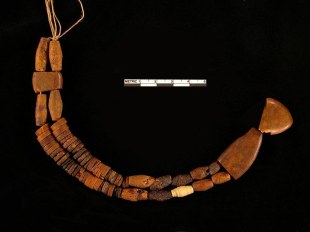
Photograph of amber beads from Shaw Cairn, Mellor (Stockport, Greater Manchester), which show spacer beads, dividing the necklace into two strings, and showing how the necklace could be fastened at the back. This stringing of the necklace does not claim to show how it would have looked in prehistory. Source (and more details about the site and the necklace): Mellor Archaeological Trust

It is not known whether the number of beads originally found were the total number that made up the original necklace, or if the original necklace consisted only of beads.  Early Bronze Age amber and jet necklaces often included beads of other shape.  Strings were often divided by spacer plates and had devices to connect both ends at the back of the neck.  Although the necklace shown left, from Shaw Cairn in Greater Manchester, does not claim to represent the original arrangement of the beads found in that grave, it does show some of the usual features of an amber necklace, including the spacer plates, which in this case divided the necklace into two strings.  The approximately 300 Bryn yr Ellyllon amber beads might originally have been strung into rather more strands, not unlike the arrangement of the Llong jet necklace shown further below.  The lack of spacer plates and end-piece may suggest that like the pieces of a possible second cape, the Bryn yr Ellyllon beads represent only part of another necklace, and that both parts, one remaining in the world of the living to be supplemented by new beads, the other in the world of the dead, each taking on an individual role.

The nearest source of amber was the Baltic, although it may have been available along the east coast of England too, brought from the Baltic by the ice sheets of the previous glaciation, from where it eroded out of coastal cliff faces on to beaches below.  Like the cape itself, its burial in the grave withdrew it from the world of the living, confining it to the realm of the dead.  The amber would have looked sensational, particularly under sunshine or firelight.  Whether imported from the Baltic or the east coast of England, amber can be classified as a luxury good.

The bronze fragments

Bronze pieces from Bryn yr Ellyllon. Source: British Museum

The sixteen bronze fragments form another partial jigsaw.  Bronze, an alloy of tin and copper, was almost never used for the manufacture of jewellery during the Early Bronze Age, and these are more likely to be knives or similar hand-held weapons or tools.  As already mentioned, Clough also surmised that some pieces of copper nailed to bits of gold may have helped to reinforce the flimsy cape.

The copper required to manufacture the  bronze was sourced from the Great Orme, the most important copper mine in Wales, and is thought to have been the largest copper mine in northwest Europe from 1800-1600 BC.  although estimates vary, its vital statistics are always remarkable.  In the 1990s, Andrew Lewis estimated that 12,600 tons were excavated from the tunnels and 28,000 from the open cast mine.  More tunnels have been found since then, so these estimates will have risen.  To make bronze, a coper-tin alloy, copper was combined with tin, all of which came from southwest England, particularly Cornwall, and was traded to various parts of Europe as well as other parts of Britain.  The dependency of bronze on both southwest English tin and northeast Wales copper, argues for some long-used routes along the coasts of west Wales and southwest England.

Copper alloy pieces from Bryn yr Ellyllon. Source: British Museum

The pieces of bronze were fragmented, but some are thought to have represented the business ends of tools or weapons.  Bronze was only very rarely used for making ornaments.  In the British Museum photograph above they have been arranged to show how at least one set of fragments could represent a curved blade.  It is not known whether or not the objects were broken prior to their addition to the grave, or whether they represent either normal decay or rough handling when they were discovered. If they were blades, they may have been broken deliberately prior to deposition. 

It has also been suggested that some of these bronze fragments may have formed a reinforcing backing for the gold.

Other objects?

The metal and amber objects were taken from the grave by the workmen, but what about any other grave goods?  Apart from the known but lost skeletal remains, pieces of gold (some of which were taken away at the time and made into rings and breast pins), and some textiles remnants, there is no record of anything else in the grave.  Although there is no way of knowing for sure, it is entirely possible that objects that would have been archaeologically valuable but would have seemed mundane to the Victorian discoverers, such as stone tools and pieces of pottery, may have been disposed of in the same rough and ready way as the skeleton.  It is clear that in the Early Bronze Age, burials were often accompanied by partial objects as well as whole ones, and this type of fragmentary data, such as pottery sherds, may have been rejected by the grave’s finders.

An example of Early Bronze Age textile from Over Barrow, Cambridgeshire. Source: Cambridgeshire Archaeology Unit, via Current Archaeology magazine

The loss of the perishable textile remains is particularly agonizing, partly because perishable items in British prehistory are so rare.  Linda Hurcombe refers to this lost dataset as “the missing majority” because the greater percentage of objects and domestic building materials in prehistoric Britain would have been perishable.  The textile would have added invaluable knowledge not just on Bryn yr Ellyllon but on the subject of both textile manufacture and ceremonial garments in general.  It is difficult to imagine that any garment that was attached to the cape would have been anything other than remarkable.  Only one of the few known textile items from Britain was made of cow hair; the rest were made of plant materials, including wild nettle fibre, which produces a soft and silky texture, and cultivated flax, which produces linen.

Nothing can be done with these thoughts, except to acknowledge that the manner in which the site was discovered may have left us without other objects that could have contributed additional knowledge.  With all sites we are dealing with partial information, but this is particularly worth bearing in mind for sites that were plundered rather than excavated, like Bryn yr Ellyllon.


The skeleton

A skeleton was found in the grave under the cairn in 1833, described by the landowner who saw it as “the bones of a man,” although he cannot possibly have known whether the bones represented male or female remains, the description suggests components of a recognizable skeleton, even if only the skull and a few additional bones.  Reverend Clough describes how the cape

contained within it a considerable number of small bones, vertebrae etc, but none of them longer than from two to three inches. The scull [sic], of no unusual size, lay at the upper end, but no bones of the extremities were noticed.

The skeletal remains were disposed of at the time, potentially meaning that an enormous amount of information has been lost.  The British Museum apparently holds “small fragments of skull remaining after laboratory analysis” (museum number 1881,0516.2).  Whether this refers to the skeleton associated with the cape, or the second burial found nearby is not stated, but it is implied by the entry for the skull fragments on the Museum’s database, which describes the cape rather than the bones.  There is no indication of what the “laboratory analysis” may have been.

The questions that remain unanswered include:  whether the skeleton was male or female; whether there were any congenital defects; if he or she had experienced any injuries or illnesses during life; how old the person was at the time of death; the cause of death; or how well-built or tall he or she was.  There is also no possibility of any scientific analysis of the sort potentially available for Brymbo Man, such as radiocarbon dating, DNA testing or oxygen isotope analysis.

The cape being positioned on a woman to demonstrate how it would have looked on someone of her size, male or female, and demonstrating how the upper arms would have been pinned down, leaving only the lower arms free to move. Source: British Museum

The only remaining clue about the physical character and appearance of the owner of the cape is the cape itself.  It was small (18ins/46.5cm wide x 9ins/23.5cm high) and could not have been worn by someone of, for example, Brymbo Man’s stature.  Instead, it must have been worn by a woman, a teenager or a man who was small in stature and build.  In an era where the average age of death was much younger than today and children were expected to participate in work (as demonstrated by some of the tunnels at the Bronze Age Great Orme copper mine, into which only a child could fit) a teenager, male or female, was likely to be a fully functional member of society.

We know that there was a secondary burial within the cairn in the form of a burial urn containing a cremation, but what about the possibility of other less obviously identifiable burials within the cairn?

Funerary rituals

A snapshot from the Geophysical survey report, showing a summary interpretation of major features. Source: Tim Young, 2013

Reverend Clough noted that whatever remained of the human bones, there were no signs of fire.  He suggests that because no extremities of the skeleton were observed where they would have been expected, “the figure had been doubled up.”  These are the only statements that Clough makes on the subject but both are consistent with an Early Bronze Age crouched inhumation. The inability to analyze the bones means that it is not known whether the body was laid facing east or west; how the bones were arranged in the grave;  whether any bones had been excluded or deliberately removed at a later date;  whether the bones were arranged in a particular way; how the artefacts were positioned in relation to the body; and whether there was any ritual treatment of the bones like excarnation or de-fleshing (such as in the case of the Brymbo burial).  

It is certain that the deposition of such a remarkable collection of grave goods with the dead was accompanied by formal ceremonies in which both the person and the objects were transitioned from the world of the living into the world of the dead.  Many of the activities connected with this transition could well have place elsewhere, with only the final stages taking place at the cairn itself, and this itself may have been subject to various spiritually inspired activities to prepare it for its role.

The first task, other than any ceremonies to prepare the ground, would have been to source the slabs making up base, sides and capstone (stone lid) or other form of lid of the cist (stone chamber), and dig the hole that these stones were to line.  The dead person could then be laid to rest.  In the Early Bronze Age the body would be typically crouched, with knees to chest, laid on his or her side.  The dead may have been clothed or covered, but the perishability of textiles means that this remains speculation.  Grave goods could then be deposited with the dead, before the grave was covered with a lid, if used.  If a lid was used, this was probably wood or another perishable material, because there is no record of it in any of the contemporary documents.  The cairn could then be built over the top, often to a particular plan with layers distinguished within the construction.  Each one of these steps, including layering the cairn, could have been accompanied with activities to mark each stage of the transition.  When the cairn was finished, and was a feature of the landscape, it would have stood out as a new element in the landscape for some time before becoming integrated into human memory as a component of the landscape of the past and present.

Early Bronze Age grave goods vary from grave to grave, but it would be idle to deny that those in Bryn yr Ellyllon were anything other than remarkable.  Even today, the surviving metalwork yells wealth, luxury and status, particularly as it was taken out of social and economic circulation by being deposited in the ground with the dead.  Once buried, and not retrieved, these goods could not be inherited, gifted or traded, or even melted down and re-used.  This magnificent collection was lost forever to the living, confined to the realm of the dead.  The burial of such a magnificent and rare piece was a statement, an important ceremonial act, and probably incorporated a series of ritual activities, themselves tools of transition.


Dating

Although bone did survive in the cairn the majority of organic remains were disposed of at the time.  The British Museum records having a piece of skull in its collection (museum number 1881,0516.2), but although I have been unable to find out anything about it, it appears to have been the only survivor, and this was clearly not used for radiocarbon dating (which requires partial sacrifice of the sample).  Instead, a date range of 1900-1600 BC has been proposed for the site by Stuart Needham, based on comparison with objects at other sites that have more secure dating material.  In spite of the embossed decoration on the cape, which might suggest a later date, the presence of jet, amber and the composition of the gold itself, as well as the organization of the burial, suggest an earlier date, perhaps in the final Early Bronze Age.  This date, however, is not secure and could be modified by the discovery of comparable sites that might also produce more secure radiocarbon dates that could help assign a more directly comparable time-range.

Who was the owner of the Mold Cape? Was she/he important?
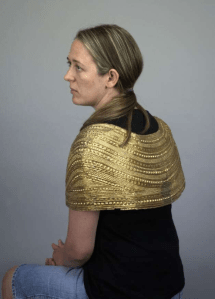
The cape being modelled, showing how upper arm movement would have been restricted. Source: British Museum

The short answer is certainly yes.  The loss of anyone in a tight-knit community would have been a blow to a community where each individual was an important contributor to health, wealth, communal knowledge and well-being. However, the discovery of something so beautiful and luxurious as the cape has led to a lot of speculation about who or what its owner may have been.  Leadership roles, both secular (chief/prince/king) and religious (priest), have been proposed.  In each case the cape and other objects were suggested as the prehistoric equivalent of symbols of power or badges of office.  The burial of Queen Elizabeth II is a good example of how a community might mark the transition from living to dead of an individual representing a prominent hierarchical position.  Does the deposition of the Bryn yr Ellyllon capes, beads and bronze items represent a comparable situation, suggesting that the relationship between the person and the capes was so fundamental that the two could not be separated in death?  Was each so bound up in the identity of the other that the capes and other goods could not be inherited by, or transferred to another person in the community?

Although these ideas of individual importance and hierarchical significance are entirely plausible, emphasising the role of the individual in an important role in a way very that equates to ways in which European society is arranged with political, social and religious leaders this may be an over-simplification based on modern experiences and expectations of monarchies, political entities and religious authorities.  Not all societies, however, particularly small communities, are organized along the same lines, particularly when there is an enormous amount of inter-dependence of skills and economic activities that are not centrally organized.  As I suggested in Part 2, Early Bronze Age burials may have been about a lot more than a single person.  Even when a single individual takes up the central cist, secondary burials may be made within the burial cairn, and the original individual may represent an anchor for ideas about territory, ancestry and memory.  Again, in the case of Bryn yr Ellyllon, there is the question of why not only one cape but two are thought to have been represented.

Some items in history acquire a meaning and value all of their own which transcend the time-limited personality or role of any given individual.  Instead, these items help to define their role in relation to others (people, social/religious structures and political institutions) and even to frame ideas about the future.  Examples of such objects that transcend either an individual or a specific role but represent unity are the Olympic flame, the Remembrance Day poppy, or a national flag.  Burying a symbol may say a lot about what was happening in the world at that time, and less about the specifics of who was lying there, particularly given that two capes suggest not just that more than a single identity was involved.

Detail of an ivory box lid, showing Tutankhamen receiving flowers from his wife Ankhesenamun. Source: Wikipedia

The relationship between a dead person, the objects and the living world are complex.  An illustration of this sort of complexity is the burial of the Pharaoh Tutankhamen in Egypt, who was also interred with objects of great richness and beauty, including exotic items unavailable locally, most of which were artistically characteristic of the preceding heretical Amarna period, of which Tutankhamen was the last male descendent.  Even though Tutankhamen renounced his father’s heretical ideas, the king was tainted with his family’s recent past.  The grave in which the king was deposited in a wadi (dry valley) reserved for royal burials was not the ambitious grave that Tutankhamen had been building for himself; that was appropriated by one of the officials who buried the king.  Instead, the tomb in which he was buried was small, incomplete, very poorly decorated and vastly inferior to those belonging both to his ancestors and those who ruled subsequently.  The highly distinctive Amarna style items that accompanied him may have been deposited with the king to dispose of them for good.  It is very probable that many of the hastily assembled goods jumbled in the tiny tomb were inserted by those who wished to dispose of the discordant memories of the Amarna period with more speed than dignity.  What are to us things of invaluable beauty so characteristic of the Amarna period were seen at that time as representing everything that the new governing elite wished to eliminate from history.  

This is a very specific example, but it serves to illustrate how even very rich burials may have any number of themes running through them.  Colin Harris and Adam Kaiser, for example, proposed in 2020 that some particularly rich burials may represent a form of conflict resolution, and offer a persuasive discussion, using Viking data as a test case.

Although it cannot be ruled out that the Bryn yr Ellyllon burial was of an important individual who had the cape made for herself or himself, it is by no means the only answer when the burying is done not by the dead but by the living according to criteria that has as much to do with the ideas incorporated in the objects themselves and their role in the community as a whole, of whom the dead might continue to be, or not continue to be a representative.

How did the owner of the Mold Cape make a living?

The Llong Necklace (a speculative recreation of the original design). Source: Curious Clwyd

Bryn yr Ellyllon was not the only site near Mold that produced exotic (non-local) and ornamental items.  The nearby Llong grave near Bryn yr Ellyllon, where a multi-stranded necklace was found, this time made of jet (and some shale), contribute to the impression that this was an area where people could leverage their own resources to purchase luxury goods, and there may have been many aspects to their economic life to build such purchasing power.

Unlike Bryn y Ffynnon in Brymbo, which was on a hillside overlooking the valley of the river Alyn, Bryn yr Ellyllon sat in the river valley itself.  This was a potentially good place for  agrarian activity, but was also in easy reach of uplands that would have been ideal for livestock grazing.  However, the investment in the cape, both in terms of acquisition of gold and particularly the specialized skill needed to work it argue that this was a high value item, and was the product of something other than localized farming activities.  Similarly, the means to assemble 300 amber beads that were not available locally argues for considerable influence and resources that would enable negotiations to take place in trading transactions.

Looking around for a possible source of unusual wealth, the most obvious candidate to strike most writers is the Great Orme copper mining industry, and the networks that connected that industry to the world beyond north Wales.   The copper mines were 40 miles (64km away), so not on the doorstep, which requires some form of explanation, but if the inhabitants of this area of the Alyn valley were also involved in agrarian and livestock management activities, aspects of both sedentism and mobility could have been incorporated into livelihoods that also included longer distance links.

Final Comments on Part 3

Both Bryn y Ffynnon (Brymbo) and Bryn yr Ellyllon have produced some unusual objects in association with primary cist burials in northeast Wales.  These are not typical of the greater majority of sites in northeast Wales, but both serve to illustrate how disparate datasets offer different insights into the past.  Without a skeleton, the cape still gives a sense of the dimensions of the wearer, but many other details have been lost.  The objects themselves are so unusual that it is difficult to fit them into a general pattern of livelihoods and activities in northeast Wales, but they do represent substantially specialized skills and the ability to source unusual raw materials, both of which argue the ability of the community to accumulate a form of wealth.  There are more questions than answers regarding the site, but although it appears to stand out, it must still be understood in the wider context of the Early Bronze Age of northeast Wales, which will be discussed further in Part 4 (upcoming).

Perhaps the biggest lesson of Bryn yr Ellyllon is that there are many reasons why rich objects may be buried in graves, and these are not all to do with the importance of an individual as a chief or priest, or other specific role.  It is risky to draw conclusions of this sort, when there are many other possible explanations to consider.

The second important point that this site highlights is the importance of publication of any excavation activity.  Excavation is by definition destructive, and what remains for posterity is the record of that excavation, which must be published in order to become available to researchers.  Whereas Bryn y Ffynnon was subject to excavation by the National Museum of Wales, and published only a few years later in 1946, Bryn yr Ellyllon was ransacked in the early 1800s, not excavated.  It it is only thanks to the Reverend Clough taking an interest that many of the grave goods were rescued, and to John Gage’s letter to Sir Henry Ellis, that we know what we do.

In the next and final part, part 4, some of the various strands are brought together, which discusses the sites in terms of key themes of the Early Bronze Age, and provides details of the museums where the objects from the two sites can be visited.


St Werburgh, Queen Æthelflæd, pilgrim badges and the shrine in Chester Cathedral

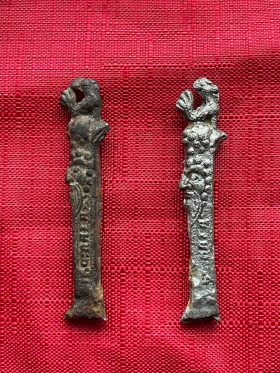
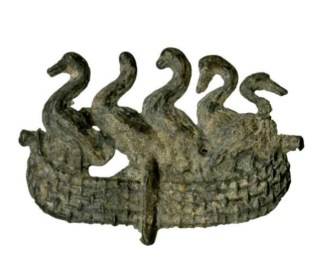
St Werburgh pilgrim badge, possibly 14th century, cast in lead alloy, purchased by the British Museum from a London dealer in curiosities, medals and coins. British Museum 1836,0610.73

Had you been a pilgrim in the middle ages, undertaking a journey to Chester to visit the miracle-performing shrine of St Werburgh, you might have been tempted to buy yourself a pilgrim’s badge to commemorate a job well done and to communicate your achievement to others. Most importantly, however, you would have had the opportunity to touch that badge to the saint’s shrine in order to absorb some of the saint’s divine power into the badge itself.  That’s what you are looking at on the left – a pilgrim’s badge associated with the Abbey of St Werburgh, which would have been sold to pilgrims either as they arrived, or as they left via the gift shop.  Badges like this were associated with many of the major shrines and could be added to an existing personal collection, representing the piety implied by many pilgrimages.

When I first came to live in the Chester area, just a couple of years ago, I knew the name St Werburgh and recognized that it was Anglo-Saxon, but it was a surprise to realize that she was a female saint, and that there was a pilgrim shrine dedicated to her in the former abbey (now the cathedral).  Nor did I know that the pilgrims who came to visit the abbey might purchase a badge as a token of their visit, a pious badge of honour, sometimes the signal of  the many discomforts or difficulties that had been overcome to enable a pilgrimage to be successfully completed.
Chester Cathedral, formerly St Werburgh’s Benedictine Abbey, from the east. Photograph by Stephen Hamilton.

What I particularly like about pilgrim badges is that there are so many threads to the story. An anonymous pilgrim once owned the above token of his or her journey to the shrine, now in the British Museum (albeit not on display). The British Museum purchased it in 1836 from a dealer in medals and coins called Harry Cureton.  The story of this particular badge between the time of its manufacture to its purchase by a dealer before being accessioned into the British Museum’s collections is lost, but its story is embedded in other, much older histories, including the actions of the Anglo-Saxon queen who moved that saint from Staffordshire to Chester in the 10th century, and the subsequent centuries of pilgrim visits to the abbey to experience St Werburgh for themselves.

So who was the  Anglo-Saxon saint, where was she from, why did she become central to Benedictine worship in Chester after her death, what is the geese-in-a-basket pilgrim badge all about, and what role did the shrine of St Werburgh play in the economic life of Chester’s abbey?

  • St Werburgh and her family
  • St Werburgh’s posthumous arrival in Chester
  • St Werburgh in the Benedictine monastery of 1093
  • The miracles of St Werburgh at the monastery
  • The 14th century shrine
  • Pilgrims to the shrine in the later Middle Ages – a nice little earner
  • How pilgrim badges were made, sold, worn and used
  • The Dissolution and subsequent events
  • The shrine in the 19th century
  • From Harry Cureton to the British Museum
  • Final Comments
  • Videos
  • Sources

St Werburgh and her family

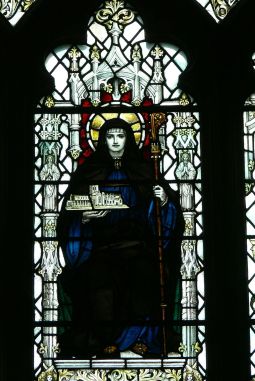
Werburgh was born a Mercian princess in around AD650.  Her father was Wulfhere, king of Mercia and her mother Ermengild, who became a nun on the death of Wulfhere, first at Minster-in-Sheppey and then at Ely, where she succeeded her mother Seaxburgh as abbess.  Werburgh was educated at home by Chad, who became Bishop of Lichfield.  Although St Werburgh is depicted in a couple of the stained glass windows in the cathedral, these are modern, romanticized visualizations.  There are no contemporary depictions, and apart from having an idea of what she may have worn, her appearance is unknown.  Medieval accounts of her life probably incorporate older material, and almost certainly include quite a bit of myth and conjecture. 

Saint Æthelreda of Ely from the 10th century Benedictional of St. Æthelwold, illuminated manuscript in the British Library. Source: Wikipedia

On the death of her father, Werburgh went as a nun to the convent of Ely founded by her great aunt Æthereda (also known as Æthelthryth), who became its abbess.  St Æthelreda was the daughter of Anna, king of East Anglia, sister of Seaxburgh and the virgin wife of Egfrith, the king of Northumbria.  Werburgh’s father was succeeded by his brother Æthelred, Werburgh’s uncle, who eventually asked Werburgh to take charge of and organize nunneries in the Midlands, including Weedon in Northamptonshire, Hanbury in Staffordshire and Threckingham in Lincolnshire (or alternatively Trentham in Staffordshire).  She was so pure and good that she could hang her veil on a sunbeam.  She died at Threckingham / Trentham in around 700, and was buried at Hanbury, at her own request.  Unfortunately, the nuns at Threckingham were unwilling to release the remains, and a delegation was sent from Hanbury to retrieve her.

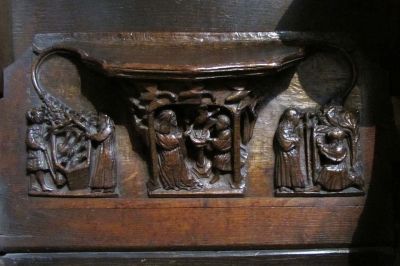
Saints were not canonized by the papacy until the 12th century, but had to be verified by bishops.  The miracle that caused Werburgh to be recognized as a saint was an unusual one.  Although there are a number of versions of the story, the differences are minor.  One version says that St Werburgh had enjoyed watching a visiting flock of geese in a neighbouring meadow of the convent in which she was staying.  One of them was particularly large and had a black ring of feathers around his neck.  She became fond of him and called him Grayking.  The convent steward, Hugh, had also noticed Grayking but his interest had little to do with aesthetically pleasing plumage.  Angry with the geese for devastating his field of corn, Hugh soon had Grayking in the pot.  One version says that Werburgh was away when this happened, and when she returned the remaining geese formed a delegation to inform her of the event and ask for her help.  Werbugh acted immediately, ordering that the bones and feathers of the carcass should be gathered up. When she commanded the bones of the dead goose to rise again, they assembled themselves and Grayking was reborn.

Late 14th century misericord in Chester Cathedral showing St Werburgh performing miracles. Photo by Stephen Hamilton. Source: Wikipedia

Dr Thomas Pickles (Senior Lecturer, Medieval History) recounts a slightly different version of the story in the video at the end of the post.  He goes on to discuss why other similar stories in across Europe may have developed in response to sacrifices at the time of harvests, which may have became Christianized via labourers who worked the land belonging to religious organizations, giving the St Werburgh miracle story wider relevance.

Nine years after her burial, St Werburgh’s nephew Coelred, now King of Mercia, decided to move the saint to a less modest tomb in Hanbury. When she was removed from her coffin she was found to be “in whole and perfect form,” a certain mark of sainthood.

St Werburgh’s posthumous arrival in Chester

A 13th century imaginative representation of Æthelflæd. Source: Medieval Manuscripts blog

St Werburgh never visited Chester during her lifetime, and her arrival in the Anglo-Saxon burh (fortified settlement) in around 907, over 200 years after her death, requires another thread of history that starts, for the practical purposes of this post, with Alfred the Great, King of Wessex (848 – 899AD).  Alfred’s daughter was the princess Æthelflæd who, at the age of around 15, was married for political reasons to Æthelred, king of Mercia. Æthelflæd grew up in a time of disruption and war, during the Viking incursions, and the associated competition for territory.  She was also familiar with the arts of diplomacy and negotiation.  She was well suited for the role of queen of Mercia.  Although subordinate to her husband, with duties and responsibilities, she also had rights, privileges and a position of respect that she clearly built on, being recognized as partner to her husband in many of their joint enterprises, including the establishment of new burghs at Worcester and Gloucester, whilst improving existing towns such as Hereford and Winchcombe. 

Æthelflæd’s father, Alfred the Great, died on 26th October 899, and was succeeded as King of Wessex by his eldest son, Edward the Elder, brother of Æthelflæd.  Edward was forced to fight off a counter claim from his cousin Æthelwold.  He was triumphant but was forced to address the situation again in 902 when Æthelwold unsuccessfully mounted another campaign against Edward. In the same year Æthelflæd’s mother died, probably in St Mary’s Abbey in Winchester, which she had founded, and a threat was made to the northwestern territory of Mercia at Chester.  It was only now, when the vulnerability of the old town threatened the security of the kingdom of Mercia that it drew attention from Æthelred and his Æthelflæd.   In the last decade of his life Æthelred suffered a recurring illness, and he had succumbed to a bout of this affliction when Chester came under threat. Æthelflæd assumed authority during the crisis.

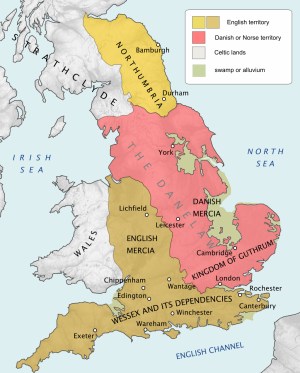
Kingdoms in England in AD878, by Hel-hama. Source: Wikipedia

In the 890s Chester was described in the Anglo-Saxon Charters as “a deserted city in Wirral.”  It still had much of its Roman walls, but the interior was in ruins.  Mercia had been a much larger and more powerful kingdom in its past, but the Viking (Scandinavian) invasions had taken control of the eastern reaches of the former kingdom.  In the south, Wessex was the most powerful kingdom, whilst in the northeast the king of Northumbria still held land on the east half of the island, extending well into present-day Scotland.  The Dane-controlled land ran down much of the east coast south of Northumbria, and there was a significant Scandinavian presence in Ireland.

It was from Ireland that the threat to Chester emerged.  In 902 the Irish kings formed an alliance to rid themselves of the Vikings, capturing Norse Dublin and forcing many to leave as groups of refugees in need of new lands to colonize.  One of these refugees was Ingimund, who lead one of these ousted groups onto Anglesey.  Forcibly ejected by the Welsh, they followed the Dee inland towards Chester.  According to one source, they requested a meeting with the Mercian royalty.  With Æthelred still sick, Æthelflæd met with Ingimund who proposed a peaceful solution to the dilemma.  Æthelflæd was pragmatically willing to negotiate a home for them on the north of the Wirral peninsula, perhaps believing that they might provide a protective buffer against other Viking interests seeking to find new territory to colonize.  Here they could have lived in peace by farming and trading via the sea routes, but they had been settled for only a few years when Ingimund broke faith with Æthelflæd and began to amass troops.  Hearing of the threat, Æthelflæd assembled forces of her ow within the Chester walls.  The town was besieged but the Mercians emerged triumphant.

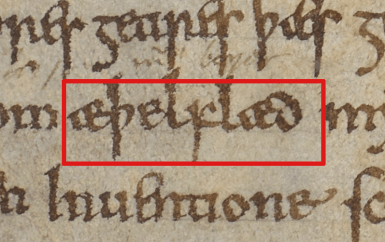
Æthelflaed’s name (spelled Æþelflæd), in the B-text of the Anglo-Saxon Chronicle: Cotton MS Tiberius A VI, f. 30r. Source: Medieval Manuscripts Blog

In 907 the Anglo-Saxon Charter says that Chester was “restored,” the work usually credited to Æthelflæd.  With Æthelred temporarily restored to health, they couple established Chester as a new burgh within the 5m (16ft) tall walls encompassing an area of 26 hectares (65 acres).  It was far bigger than their previous burhs, and represented a significant investment in the border town.  At the same time, Æthelflæd took the decision to move the relics of St Werburgh from Hanbury to Chester.  The timing was probably driven by the threat to the relics of St Werburgh at Hanbury by advancing Danish forces. This echoes Æthelflæd’s decision to move the relics of St Oswald from lands under Danish occupation, which took place under similar circumstances.  The decision to move St Werburgh to Chester may have been motivated by the need to give Chester an authentic, stabilizing Christian focus with links back to a noble Mercian past.  The creation of a prominent settlement in a vulnerable borderline position needed to attract people with the same features familiar from other towns.

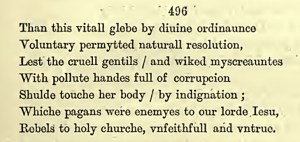
According to St Weburgh monk Henry Bradshaw, writing in c.1513, but probably referencing much earlier sources, when the saint was removed to Chester, her body was found to be ‘resolued unto powder’, which was seen not in terms of decay or corruption of the remains, but as a divine miracle performed to protect the saint’s holy remains:

Lest the cruell gentils / and wiked myscreantes
With pollute handes full of corrupcion
Shulde touche her body / by indignation

Excerpt from Henry Bradshaw’s “The Life of St Wereburge of Chester,” originally 1513, re-edited and published 1887

Although there is no incontrovertible data to support the presence of a church on the site of St Werburgh’s Abbey, there is a tradition that a wooden church dedicated to Saints Peter and Paul had been founded there by Æthelflæd’s father Wulfhere, King of Mercia, which would have housed her remains.  This church would have been rededicated to St Werburgh when the saint became resident.  Archaeological excavations produced pre-Norman building materials, but it is not possible to assign an early 10th century date to them.  Wherever the church was located, the patronage of the queen ensured the initial success, and it received additional grants throughout the 10th century, including one from King Edgar in 958.  In the 1086 Domesday survey records the monastery and its possessions, indicating that the Anglo-Saxon St Werburgh’s was upgraded from church to monastery sometime before that date.

In 911 Æthelred died of unknown causes probably related to his recurring illness.  He was buried in Gloucester.  Many previous royal widows of the period had retired to a convent to live out the rest of their lives.  There was plenty of precedent in Æthelflæd’s own family for monastic service.  One great aunt was the founder of Ely Abbey, another was the founder of Minster-in Sheppey abbey, and Æthelflæd’s own mother had retired on the death of Wulfhere to a nunnery, eventually becoming abbess of Ely.  Æthelflæd, however, took the reigns of the Mercian government into her own hands, ruling as myrcna hlæfdige, Lady of the Mercians.  The church-monastery of St Werburgh continued to house the saint’s remains, and seems to have survived the military action that took place in and around Chester following the Conquest.

St Werburgh in the Benedictine monastery of 1093

Coat of arms of Hugh d’Avranche. Source: Wikipedia

In 1093, only 27 years after the Norman Conquest, the abbey was refounded as an Anglo-Norman Benedictine abbey by the notorious knight and magnate Hugh d’Avranches, also known as Hugh Lupus.  Hugh and been granted Chester as Earl by William I, and was one of the most powerful men in England.  His appointment followed William I’s vengeful retaliation against Chester for two rebellions, which had left the city in disarray.  Hugh’s task was to ensure that the city remained docile after William departed, serving the crown as the northenmost marcher town, a buffer zone between Wales and England, and an increasingly important commercial port.

There were many possible reasons for landowners to found monastic establishments, including convention (it was often seen as the duty of the nobility to promote religious houses), political maneovering, simple piety, and fear of the ever-approaching perils of the afterlife.  Hugh’s decision to refound the abbey was probably  two-fold.  Whilst making a conspicuous contribution to a deeply resentful city for which he was now responsible, and in which he needed to maintain the peace, he was also looking after his own spiritual interests.  He managed to secure one of the most high status bishops in the country, Anselm to come and supervise the project, and Anselm left his clerk Richard to become the first abbot.  Hugh endowed his shiny new monastery with rich and prosperous lands to ensure its self-sufficiency.  These were not merely charitable acts.  Hugh Lupus, for example, was heading perilously towards the end of a far from virtuous life.  John Hicklin, writing in 1852, gives an evocative summary of the situation

Hugh Lupus, following the example of most of his predecessors, lived a life of the wildest luxury and rapine.  At length, falling sick from the consequence of his excesses, and age and disease coming on, the old hardened soldier was struck with remorse; and—an expiation common enough in those days—the great Hugh Lupus took the cowl, retired in the last state of disease into the monastery, and in three days was no more.

By founding a monastery and committing himself to a brief period as a monk at the last possible moment, Hugh attempted to provide himself with some after-life insurance.  The logic of this is somewhat difficult to compute today.

The curvilinear Romanesque remains of the abbey financed by Hugh Lupus, seen through a later gothic arch.

Monks were considered to be closer to Heaven than any other human on earth, and their prayers were thought to be heard with undiluted clarity by God.  The idea of pleasing God by founding a monastery, and then reaching closer to Heaven by being buried within the monastic cloister seems suspiciously like inducement today, and one would have thought that God would have been wise to such manoeuvring.  Given the sheer number of wealthy men and women founding abbeys and priories, however, this aspect of the matter does not appear to have occurred to them.  Matters had became much more contractual during the 11th, when the idea of purgatory was taught in the church.  This intermediate area between heaven and hell allowed redeemable sinners to suffer a hell-like experience to work off their crimes against Christianity before eventually entering Heaven.   From this time onward, substantial efforts were made to negotiate for reduced time spent in purgatory, including the buying of “indulgences,” and gifts from the lower echelons to monasteries.

After the original endowment, the abbey continued to receive many properties over the centuries from wealthy local landowners, and smaller gifts in the wills of those who were not quite as well positioned, all attempting to win the good will of the monks, and through them, the divine.  Those with less purchasing power would not anticipate having the same negotiating power, but every contribution might help.  In the process of all this human fear and negotiations to minimize the inevitable punishments after death, monasteries became substantially wealthy, some of the richest landowners in the kingdom.  Land was not, however, their only form of income.  Not all monasteries were lucky enough to secure the bones, blood or hair of a saint that might attract pilgrims, but the abbey of St Werburgh still retained the bones of St Werburgh after its rebuild in 1093.

The miracles of St Werburgh at the abbey in Chester

Neither Goscelin de St-Bertin writing in the late 11th century, nor William of Malmesbury, writing in the 12th century were able to provide many details about the earlier miracles that St Werburgh was supposed to have performed at Chester, but William of Malmesbury has the following to say:  “The merits of this virgin are proclaimed at Chester and her miracles extolled.  Although she is promptly favourable to the petitions of all, she is especially quick to give heed to the prayers of women and children.”  Her girdle, held by the abbey, was apparently particularly popular with pregnant women.

Basingwerk Abbey today

In 1500 a monk at St Werburgh’s Abbey wrote a life of St Werburgh in which he credits her with a miracle on behalf of Richard, Earl of Chester in around 1120.  Richard made a pilgrimage to St Winifrede’s Well at Holywell in around 1120 but attacked by hostile Welsh men, he was forced to shelter at nearby Basingwerk Abbey.  Before William, Constable of Chester, set forth to search for the earl, he prayed to St Werburgh, who parted the river Dee because no boat was available, permitting William and his men to walk across the river bed and rescue the earl.  In another story, St Werburgh intervened during an unexpected Welsh attack on Chester.  She blinded the attackers, forcing them to retreat.  This military aspect to the saint is underlined by the tradition of taking the shrine on procession around the city when it was considered to be under threat, setting her down briefly on parts of the city walls.

In the 15th century the Welsh poets Maredudd ap Rhys and Guto’r Glyn called there, the one to pray to ease the pains in his legs, which was apparently a successful visit, and the other to pray for the alleviation of the ills of a friend.

The 14th century shrine

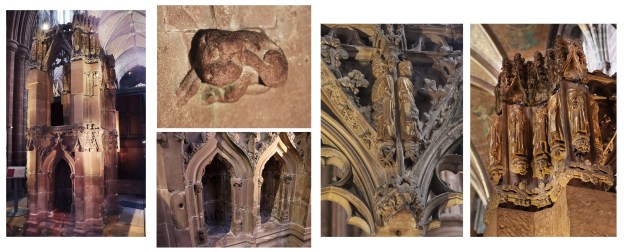
The reconstructed shrine of St Werburgh at the west end of the Lady Chapel in St Werburgh’s Cathedral, Chester.  It was reassembled in the 19th Century from broken -up parts, and it is impossible to say how closely it resembles the original 14th century shrine.  The warm lighting is as it would have been seen by candle-light.

Nearly 250 years after Hugh’s foundation, in around 1340 (just before the Black Death) a new red sandstone shrine was built for the saint, an elaborate gothic affair around 7ft (2.1m) tall, built to look like a chapel.  The new shrine, on two levels, contained whatever remained of the relics in the upper layer, whilst the lower half was provided with niches into which pilgrims could fold themselves to get even closer to the spirituality of the saint.  The top was decorated with statuettes for former Anglo-Saxon monarchs, most of whom are missing their heads today.  Little carved animals formed a line around the middle, images of the natural world that were as much part of God’s creation as people.  Today, the only one of these natural world carvings left is a tiny dog, scratching his ear with a hind leg.  The shrine was also, in all likelihood, bedecked with elaborate precious stones, its architectural details finished in gold.

Although today it is located in the 13th century Lady Chapel, it was originally located in the easternmost bay of the presbytery, behind the high altar.  The relics of the saint were encased very safely within the very top of the shrine, but the spiritual power of the bones themselves emanated from the relics, permeating the stone, so that touching the shrine was equivalent to touching the saint’s essence.  This was a powerful concept, and a vibrant presence in the monastery.   This substantial monument was a permanent fixture.  There would be no carrying the shrine through the town in times of threat or stress.

St Werburgh’s shrine showing the niches, the dog scratching it’s ear and gilded statuettes, some without their heads, of Anglo-Saxon kings. Click to enlarge

Pilgrims to the shrine in the later Middle Ages – a nice little earner

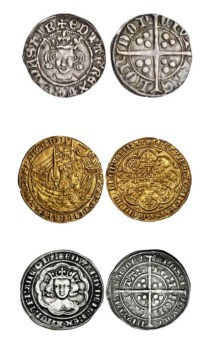
Mid 14th century coins. Source: Medieval Britain

Monks needed to make a living.  Monastic communities became more expensive as the centuries rolled forward, as the trappings of seclusion and self-denial fell away towards the 16th century.  Guests, who were not expected to pay for their upkeep, were always a drain on popular monastic establishments, and alms to the poor still had to be paid.  Expenses too accrued from the management of extensive estates, including wages for bailiffs and labourers, repairs to buildings and boundaries, and the costs involved in agricultural production.  Churches appropriated by the monastery for their incomes still involved costs, including the provision of an incumbent priest.  St Werburgh’s was often involved in legal disputes with Chester citizens, and this too was costly.  After the stricter earlier middle ages, standards began to slip in Benedictine monasteries.  Abbots rolled out ambitious extension plans for the monastic church, and required larger and more luxurious  quarters, which included spaces where VIP guests could be lavishly entertained, costly vanity projects that formed part of their legacy.  Provisions became more luxurious and more expensive.  The upkeep of a vast monastic architectural complex could be eye-watering, even without the occasional devastating fire or flood.  Balancing the books was a constant headache for monastic establishments.

Cripples collecting healing oil at the shrine of St William of York, York Minster, North Choir Transept. Early 15th century. Source: The Becket Story (© Dean & Chapter York).

By the later middle ages, when imaginative ways of generating income were increasingly critical to monastic wellbeing, pilgrims were a great way of generating income.  Pilgrimages were usually journeys of meaning, sometimes deeply spiritual and personal, characterized by any number of aspirations including cures for illnesses and defects, expressions of penitence, a wish to feel the presence of something holy, and the urge to give thanks for a prayer answered;  but pilgrimages could also be timed to enjoy feasts, fairs and markets, and as such were not merely pious and spiritual, but could be a sociable and enjoyable liberation from the mundane.  When pilgrims visited shrines, tombs and reliquaries to satisfy personal needs, the monastery expected pilgrims to show their gratitude to the saint and to Heaven by gifting a contribution to the monastic coffers in the form of “altarage.”  This was usually money, but sometimes it took the form of valuable gifts.  

Clusters of shrines were good news for everyone.  Pilgrims to a particular shrine would frequently do the rounds of all the other major religious sites and shrines in the immediate area, as well as those further afield in the region, soaking up all the divinity available.  In Chester itself, St Werburgh’s shrine was in competition with the miracle-performing Holy Rood (a sculpture of Christ on the cross) in St John’s the Baptist’s Church (next to the amphitheatre), which was reputed to  include a piece of the true cross, reputed to have been found by Helen, the mother of the Emperor Constantine.  It was installed in around 1250.  Although St Werburgh became a secondary attraction after this date, the rood at St John’s was far better known and carried more weight because the power of the crucifix of Christ himself was rather more compelling to pilgrims than an Anglo-Saxon saint.  It was to the Holy Rood of St John’s that Edward I took the nobility of Gwynedd men to swear fealty before himself and God. 

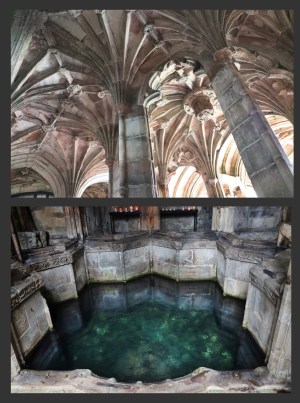
The glorious 15th century vaulting above the clear water of the inner reservoir of St Winifrede’s Well, Holywell.

Some shrines were more revered than others and had great pulling power, which could generate satisfying levels of income.  The ownership of St Winifrede’s Well in Holywell (northeast Wales), for example, alternated between St Werburgh’s Abbey and Basingwerk Abbey just down the hill from the well, depending on whether the English or Welsh were in control of the area, and this represented a useful form of income for whichever abbey was in command of its resources.  It is also probable that many of the pilgrims visiting Chester were en route to the Cathedral of St Asaph (Llanelwy), which contained the 6th century relics of the eponymous saint, renowned for his healing miracles, and St Winifrede’s sacred Well, enclosed by some superb gothic architecture.  These were located 28 (45km) and 14 miles (22km) away from Chester respectively, and 16 miles (26km) from each other.  The east-west pilgrim route between Holywell and St Asaph was well known by the later medieval period, making use of the Deva-Varis-Canovium-Segontium (Chester to Caernarfon) Roman road, which was crossed by Offa’s Dyke and took in the beautifully carved late 10th century Maen Achyfan cross, which still stands today.  At St Winefrede’s Well, the nearby Cistercian monks of Basingwerk Abbey provided all the facilities that the pilgrims might need to make the most of the experience.  The 7th century saint’s remains had actually been removed to Shrewsbury Abbey in 1138, but Holywell was the site of the miracle in which she died by beheading and was brought back to life, and was imbued with miraculous potency.  

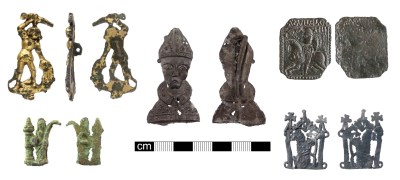
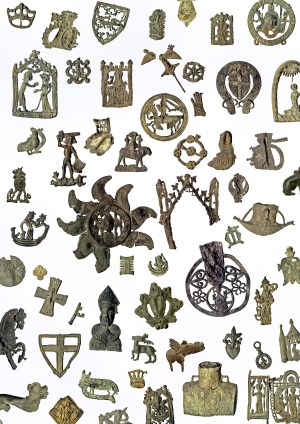
A selection of Medieval and post-Medieval pilgrim badges. Source: British Museum

Because pilgrims travelled to specific shrines, it is easy to think of pilgrimages exclusively in terms of destinations, but the act of making a pilgrimage was as much about the journey as the destination, and pilgrim routes could be both sociable experiences shared with like-minded individuals, and essential to the spiritual character of the undertaking.  As pilgrim routes became fixed in the religious round, they became special places in the landscape, with identities of their own, and features that singled them out as part of the greater network of pilgrim experience.

Although St Werburgh’s Abbey  would undoubtedly have preferred to be the most important of the local shrines, and would have done its best to attract pilgrims, it certainly benefited from the proximity of more fashionable and perhaps more relatable pilgrim destinations nearby, and the network of routes that connected them.  The 14th century shrine was almost certainly built to jump on the bandwagon of pilgrim visits to Chester, and to provide a more impressive and inclusive experience for pilgrims, without losing the connection with the Anglo-Saxon past. 

St Thomas Becket pilgrim badge. Source: Museum of London

There are no records surviving from St Werburgh’s to indicate what sort of income the monastery derived from pilgrims, but nearby  St John the Baptist’s Holy Rood was the second most important source of three primary sources of income for the church, amounting to in excess of £50.00 per annum in the 14th century (the National Archives Currency Convertor equates this, for 1350, to £29,361 in modern money or, for example, 72 horses or 135 cows.  This is half the value of the nationally important Ethelreda’s shrine at Ely, which in 1408/9 earned £19 9s 10d, and is a drop in the ocean to what St Thomas Becket’s shrines could attract from both British and western European pilgrims:  £120 in 1411 and a staggering £360 in the Jubilee year of 1420, which equates to day to around £231,483, which could have purchased 83 horses or 620 cows. St Winifrede’s Well earned an annual revenue by the time of the Reformation of £157 15s 2d, which probably included the sale of indulgences.

Altarage was also payable on saints feast days by anyone attending the celebration.  For St Werburgh, this day was 3rd February.  Again, we have no records for St Werburgh, but at Selby Abbey in Yorkshire, which held a shrine of St Germain, the festival of the Burial of St German on the 1st October in 1446-1447 earned the abbey 16s.8d., and the offerings for the festival of the Death of the saint on 31st July earned 6s.  The money-box (stipite) of St Germain accumulated £9. 14s 10d for the year.  Again, these were useful contributions to an abbey’s financial resources, amounting to £6790 in modern money, which would purchase 14 horses or 27 cows.

St Werburgh’s would have been a long way down the pilgrimage and altarage income scale, but the earnings would still have been valuable.

How pilgrim badges were made, sold, worn and used

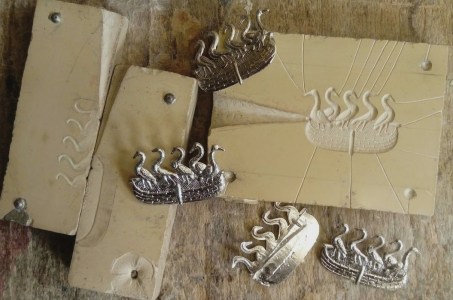
St Werburgh’s pilgrim badges being made in stone moulds. Photograph by Colin Torode of Lionheart Replicas, with my thanks to Colin for sending it to me.

Before badges were available, pilgrims might collect earth from around a shrine, or chip of small pieces off the shrine itself.  Small vessels could be used to carry holy water or oils.  Low-cost badges were a far more satisfying and permanent memento of a pilgrimage successfully undertaken, and first appear during the 12th century.  Decorated metal ampullae too, were manufactured to hold liquids, but in smaller numbers.  Wealthier pilgrims might order a custom-made item, which might be made of a more expensive material, but the less expensive materials are by far the most frequently represented in museum and personal collections.  By the 15th century they might cost as little as a penny for twelve.  One of the appealing aspects of the pilgrim badges is that the majority that survive today were clearly made for those who did not have much surplus cash to spend on souvenirs.

A selection of pilgrim badges. Source: The Digital Pilgrim website.

The badges were cast in moulds, which would have required careful crafting.  The mould was usually made of stone, preferably limestone.  A liquid alloy was poured into it to set, usually comingling lead with either pewter or tin.  Lead was locally available, and the other ores were inexpensive and could be imported.  Once solidified, the object was removed from its mould, trimmed, polished and was then ready to sell.  The photograph above  shows one of Colin Torode’s stone moulds, in use for making St Werburgh pilgrim badges for Lionheart Historical Pewter Replicas, which sells many replica pilgrim badges (I have their lovely St Werburgh geese-in-the-basket).  See the brief video by the Digital Pilgrims Project at the end of the post to see how some of these objects were made.

The pilgrim badges were sold at the abbey gates, or in stalls in town markets.  If purchased before a visit to the shrine, the pilgrim badge could be touched to the shrine, so that it would permeate the badge itself with its spiritual energy.  It could then be dipped into a liquid to be swallowed as a health cure or rubbed onto a wound as a salve.  Given its portability, it could also be carried back to someone who was unfit to make the pilgrimage so that they could benefit from the power of the shrine.

The pilgrim badges were usually worn with great pride, sewn on to items of outer clothing like hats or coats, or on bags.  Over time, as they became familiar and were transferred from old to new clothing, they probably became apotropaic lucky talismans, as well as items of religious meaning.  Sometimes they were pinned to walls of homes.

The Dissolution and subsequent events

The opening page of the Valor Ecclesiasticus, the beginning of the Dissolution of the monasteries, showing Henry VIII presiding over the nation’s extaordinary religious shake-up. Source: Wikipedia

Although Henry VIII ordered the dissolution of the abbey in 1536, its conversion into a cathedral saved it from wholescale destruction.  Although it retained most of its key components, some features fell victim to reformers.  Henry VIII’s withdrawal from the Catholic church was only realistically viable because of a movement in Europe that challenged what it saw as the papal hierarchy’s abuse of the core ideals of Christianity.  In 1517, nearly 20 years before the Dissolution, Martin Luther at the University of Wittenberg in Germany, disgusted by the financial corruption of the papacy and the clergy, began to  promote the emergence of a more honest, less moderated religion in which men and women could worship in their homes as well as in their churches and build a more direct relationship with Christ and God.  The existence of Purgatory was rejected, the appeal to saints for their intercession was deemed idolatrous, religious images that had been the focal points of worship were condemned, and the role of the clergy as a bridge between people and God was challenged.

In England the reform movement was politically and socially necessary both  to usher in Henry’s new era and to avoid the new religious house being labelled heretical.  Using Martin Luther’s reforming as a launch pad, an older, purer version of religion was sought.  As part of the process, effigies and saints were to be removed with extreme prejudice.  Targets of this reforming zeal included emblems of the later Anglo-Saxon period as well as those of the medieval period.  The 14th century shrine of St Werburgh really did not stand a chance.  The shrine was dismantled and parts were used to build a tomb for the first bishop.  Later, in 1635, elements were incorporated into an episcopal throne.

St Werburgh’s shrine in the 19th century

Sir Arthur William Blomfield at his drawing board. Source: Falklandsbiographies.org

When some pieces of the shrine were rediscovered in the 19th century, Sir Arthur Blomfield attempted a reconstruction, which is what stands in the Lady Chapel today.  The small statues of the Saxon kings do survive, but their heads are missing;  of the little figures that adorned it, only a dog scratching its ear with a hind leg now survives.  It was reassembled in the Lady Chapel.

Although St Werburgh no longer attracts pilgrims, the well of St Winefrede at Holywell, near Basingwerk Abbey on the north Wales coast, still does.  Although more usual in Catholic parts of Europe than in Anglican Britain, pilgrimage continues to offer the option of a spiritual journey today, and pilgrim badges continue to be collected by those who make the journey.  The gift shop at St Winifrede’s well contains a wide and colourful selection of religious memorabilia. See the Encountering a Pilgrim’s Medal video at the end of the post for comments on a modern pilgrim badge.

From Harry Cureton to the British Museum

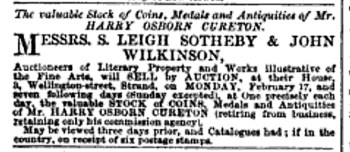
There’s one last thread to the story.  According to the British Museum’s records, in 1836 it purchased the badge at the top of this post from one Henry (Harry) Osborne Cureton who conducted his trade in London variously as a curiosity dealer, a medallist and coin dealer.   In the February 1851 edition of the Athenaeum an advert was placed, announcing that Cureton’s entire stock was being sold off due to his retirement. The British Museum’s web page about Harry Cureton suggests that that after this he may have been employ in some capacity at the Museum.  If the British Museum was one of the buyers of the collection advertised in the Athenaeum, Cureton may have been hired to catalogue the objects, of which the St Werburgh pilgrim badge may have been one.

Athenaeum no.1215, February 8th 1851 advert by Messrs S. Leigh Sotheby and John Wilkinson for the sale at auction of Harry Osborn Cureton’s stock of coins, medals and antiquities. Source:  Google Books

The badge is not on display at the British Museum, which is a shame but not terribly surprising.  As the British Museum’s Fact Sheet explains, it’s collection totals at least 8 million objects, of which roughly roughly 80,000 (1%) are on public display at any one time, the rest remaining in storage.

Just as one expects pilgrims to travel, one expects pilgrim badges to travel.  Margery Kempe, early 14th century wife, mother of fourteen children, visionary and pilgrim, managed to fit in pilgrimages to the Holy Land via Italy, to Santiago de Compostela in Spain, and to Danzig in Prussia.  We have no idea where the owner of the St Werburgh badge might have worn it on his or her travels, but it is not at all surprising to find that it ended its travels in London.

Final Comments

1916 window in St Werburgh’s in the refectory, showing an imaginative, romantic view of the saint. Photograph by Wolfgang Sauber. Source: Wikipedia

This post started with an image of geese in a basket, an emblem of St Werburgh that was cast and sold to pilgrims as a totem of their enterprising pilgrimage to the shrine of a Mercian princess, St Werburgh, within the abbey at Chester. By exploring the connection between a 7th century saint who was buried in Staffordshire and a 10th century Mercian queen who translated (transferred) the remains of the saint to Chester, we encounter the Viking colonisation of Britain.  The new shrine containing the saint’s relics in Chester was a powerful new emblem of Christian faith, using affinity to the earlier Anglo-Saxon past to provide meaning and reassurance in the very turbulent present.

In 1093, when Hugh Lupus, first Earl of Chester decided to put his stamp on Chester and, at the same time, pave his way to a comfortable afterlife by founding an impressive Benedictine monastery, the saint was provided with a new home, echoing Æthelflæd’s own intentions.  St Werburgh’s original Anglo-Saxon shrine was built to evoke both the past and the present, using history to provide a sense of continuity and stability as Chester entered a new era.  Some of this sense of the present being reinforced by the past was carried forward into the 14th century shrine as well.  St Werburgh went on to generate income for the monastery throughout the middle ages.    

Pilgrims on the road to Canterbury. John Lydgate’s Prologue of the Siege of Thebes c. 1457–1460: Royal MS 18 D II, f. 148r.Few pilgrimages would have been so comfortably and elegantly undertaken.  Source:  British Library

A pilgrim badge, even if it was mass-produced and relatively inexpensive, was an attractive symbol, and one to wear with pride, but was not merely an inanimate souvenir.  By touching it to the shrine, it became a conduit of spirituality, transmitting the essence, goodness and potentially curative powers of the saint within.  In an era in which Christ was universally accepted as being embedded in the Eucharist via transubstantiation, a Church-given reality, the idea of objects like pilgrim badges as agents of transformation was not a theoretical matter but another everyday Christian reality.  Intrinsically the badge had an active, multi-functional role as a medium of the shrine’s essence, and as a symbol of hope, piety, charity, perseverance and / or status. The medieval period offered pilgrims a fluid, multi-layered religious existence in which, if they were deserving, the secular and spiritual could mingle in certain places under certain conditions.  In a sense, whilst the shrine cannot be divided and shared, the pilgrim badge, the emblem of the shrine and sometimes the vessel holding the essence of the shrine, is a way of dividing the shrine infinitely amongst those who invested it with their beliefs and hopes.

Detail of St Werburgh’s shrine

The static 14th century shrine and the multiple, travelling pilgrim badges were firmly linked.  The shrine, unmoving, connected to a long-lost Anglo-Saxon past, was rooted to its particular spot. The pilgrim badges, by contrast, were all about the here and now, both for the craftsmen who made them and for the visiting pilgrims who purchased them.  The shrine would have existed without the pilgrim badges, but the badges were dependent on both the shrine and the pilgrims.  Whilst the memory was alive, the badge containing the memory remained a connected to the shrine via the pilgrim.  The shrine, acting as the anchor for such experiences, stayed firmly put, but its tendrils extended into the secular world via the tales told by the pilgrims who had visited, encouraging others to replicate the experience. 

At some point, the pilgrim badge was parted from the pilgrim.  Perhaps the pilgrim died and it was inherited by one of his or her children.  Later in its history it encountered another point of departure and re-entered into the world of commercial transactions.  Eventually, it found its way into the ownership of a dealer in portable objects, like medals and coins, and in the 1860s was accessioned into the collection of the British Museum, where it is now buried in storage.  Perhaps one day it will emerge to perform a role as a piece of valued heritage, but for the time being, it is divorced from any of the realities that it once served. 

St Werburgh’s replica pilgrim badge made by Lionheart Historical Pewter Replicas (photograph from their website)

Quite apart from looking great on my favourite black coat, my own replica St Werburgh’s badge (shown right) can be seen as an aspect of the St Werburgh shrine’s new identity.  Today the shrine finds itself as part of the discussion about modern contexts, including conservation, tourism, academic research and local history, where current perspectives reinvent churches, cathedrals and shrines in many different, novel ways, and contribute to ongoing narratives.  My newly purchased badge has become part of that ongoing story.  It’s a nice thought.  The reassembled shrine in the Lady Chapel does not contain St Werburgh’s relics, but the saint remains irrefutably embedded into the fabric of the cathedral and is central to its identity.

—–_______—


Videos:

Why did St Werburgh of Chester Resurrect a Goose?

By Dr Thomas Pickles, University of Chester

—-
Video: Metal Casting – Pilgrim Badge

By the Digital Pilgrims Project


Video
modern pilgrim token from Pilgrim Flask page

Piers Baker-Bates of the Open University talks about the value of his own pilgrimage memento

Click to play. Source: Open University

Staffordshire Moments: St Werburgh’s story

A tongue-in-cheek but remarkably effective version of St Werburgh’s story.


Sources:

Books and papers

Blair, J. 2005. The Church in Anglo-Saxon Society. Oxford University Press

Bond, J. 2010.  Monastic Landscapes. The History Press

Bradshaw, H. 1513 (edited and republished by Horstmann, C. 1887).  The Life of St Werberge of Chester. The Early English Text Society
https://ia800208.us.archive.org/23/items/lifeofsaintwerbu00braduoft/lifeofsaintwerbu00braduoft.pdf

Burne, R.V.H. 1962.  The Monks of Chester. The History of St Werburgh’s Abbey. SPCK

Clarke, C.  2011.  Remembering Anglo-Saxon Mercia in late medieval and early modern Chester. In Clarke, C. (ed.) Mapping Medieval Chester: place and identity in an English borderland city c.1200-1500, p.201-218

Varnam, L. 2013. Sanctity and the City. Sacred Space in Henry Bradshaw,’s Life of St Werburge. In Clarke, C. (ed.) Mapping Medieval Chester: place and identity in an English borderland city c.1200-1500, p.114-130

Claassen, C. 2011.  Waning pilgrimage paths and modern roadscapes: moving through  landscape in northern Guerrero, Mexico. World Archaeology, vol.43, iss.3, p.493-504

Clarkson, T. 2018. Æthelflæd. The Lady of the Mercians. John Donald

Hahn, H.P. and Weiss, H. 2013. Introduction:  Biographies, travels and itineraries of things.  In Hahn, H.P and Weiss, H. (eds.) Mobility, Meaning and Transformations of Things.  Shifting contexts of material culture through time and space. Oxbow Books

Hicklin, J. 1852.  A History of Chester Cathedral with biographical notices of the Bishops and Deans. George Prichard

Jones, D. 1957. The Church in Chester 1300-1540. Chetham Society

Garland, L.M. 2005. Aspects of Welsh Saints’ Cults and Pilgrimage c.1066-1530.  Unpublished PhD, Kings College London

Gilchrist, R. 2013. The materiality of medieval heirlooms:  From biographical to sacred objects.  In Hahn, H.P and Weiss, H. (eds.) Mobility, Meaning and Transformations of Things.  Shifting contexts of material culture through time and space. Oxbow Books

Goscelin de St-Bertin 1974 (N. J. Munday, translator). The Life of St. Werburg by Goscelin.  Friends of Chester Cathedral

Kempe, M. (translated with introduction by Windeatt, B. 1985) The Book of Margery Kempe.  Penguin Classics

Locker, M.D. 2015.  Landscapes of Pilgrimage in Medieval Britain.  Archaeopress

Lynch, J.H. 1992. The Medieval Church. A Brief History. Longman.

Mason, D. 2007.  Chester AD400-1066. From Roman Fortress to English Town. Tempus

Moreland, J. 2010.  Archaeology, Theory and the Middle Ages.  Understanding the Early Medieval Past.  Duckworth.

Schmoelz, M. 2017. Pilgrimage in medieval East Anglia. A regional survey of the shrines and pilgrimages of Norfolk and Suffolk. Unpublished PhD, University of East Anglia

Tillotson, J.H. 1988.  Monastery and Society in the Late Middle Ages.  Selected Account Rolls from Selby Abbey, Yorkshire 1398-1537. The Boydell Press

Turner Camp, C. 2011. Inventing the Past in Henry Bradshaw’s ‘Life of St Werburge’, Exemplaria, vol.23, iss.3, p244-267

Webb, D. 2000.  Pilgrimage in Medieval England. Hambledon and London

Whitehead, A. 2020.  Mercia. The Rise and Fall of a Kingdom. Amberley

Websites

The Becket Story
Medieval pilgrimage
https://thebecketstory.org.uk/

British Library – Medieval Manuscripts Blog
Pilgrimages: Medieval Summer Holidays?  By Chantry Westwell 29th July 2018
https://blogs.bl.uk/digitisedmanuscripts/2018/07/pilgrimages-medieval-summer-holidays.html

British Museum
St Werburgh Pilgrim Badge 1836,061.73
https://www.britishmuseum.org/collection/object/H_1836-0610-73
Fact Sheet: British Museum Collection
https://www.britishmuseum.org/sites/default/files/2019-10/fact_sheet_bm_collection.pdf
Harry Osborn Cureton
https://www.britishmuseum.org/collection/term/BIOG67986

The Electronic Sawyer
Online Catalogue of Anglo-Saxon Charters
https://esawyer.lib.cam.ac.uk/about/index.html

Kemble – The Anglo-Saxon Charters Website
Chester
http://dk.robinson.cam.ac.uk/node/25

Mapping Medieval Chester
Henry Bradshaw, Life of St Werburge by Catherine Clarke 2008
https://www.medievalchester.ac.uk/texts/introbradshaw.html

Medieval London
Pilgrim Badge
https://medievallondon.ace.fordham.edu/collections/show/28

Museum of London
Medieval pilgrim souvenirs
https://collections.museumoflondon.org.uk/online/group/19998.html

Paul Mellon Centre
The Digital Pilgrim Project
https://www.paul-mellon-centre.ac.uk/whats-on/forthcoming/digital-pilgrim-project
and sketchfab.com/britishmuseum/collections/digital-pilgrim

The Pilgrims Guide
Thomas Becket Badges: Developments and Interpretations of His Cult since the Twelfth Century
thepilgrimsguide.com/projects/thomas-becket-badges-developments-and-interpretations-of-his-cult-since-the-twelfth-century/

University of London. Department of History of Art
The Digital Pilgrim Project
https://www.hoart.cam.ac.uk/research/past-projects/the-digital-pilgrim-project


Exhibition: “The Tailor’s Tale” at Tŷ Pawb gallery, Wrexham

Image source: Tŷ Pawb website, with original image © Amgueddfa Cymru (National Museum Wales). The giraffe is sublime, but the panther is bliss.

The Tailor’s Quilt, by James Williams. Click to see the larger, clearer image. Image source: Tŷ Pawb website, with original image © Amgueddfa Cymru (National Museum Wales).

The Tailor’s Tale exhibition, at the Tŷ Pawb gallery in Wrexham, is on until September 24th 2022.  It is a rare opportunity to see the mid-19th century “Tailor’s Quilt” without having to go to south Wales to see it in its usual home.  The exhibition is showing at the same time as the exhibition Blanket Coverage, in the same gallery, about which I have already written here.

The Tailor’s Quilt was made by master military tailor James Williams of Wrexham (c.1818 – 1895). It is on loan from the St Fagan’s National Museum of History in Cardiff.  The museum bought it in 1935 from Williams’s grandson during the economic depression, where it joined a national folk art collection, which now has over 200 examples of Welsh quilting and patchworks.   

As well as the quilt itself, which is a complete joy, the exhibition features modern art works, including designer clothing and accessories by Sarah Burton (fashion house Alexander McQueen) and fashion designer Adam Jones;  a range of items  by Mark Herald, based on the quilt and commissioned by Tate Britain; and a set of four small pieces by Quilter’s Guild of the British Isles members Judy Fairless, Anne Gosling, Barbara Harrison and Helen Lloyd.  It is one of the pleasures of The Tailor’s Tale, that 19th and 21st century approaches to patchwork and quilting by local textile specialists can be seen side by side, with all the implications of social and economic change that each implies.
afdasfsd

The Tailor’s Quilt

First, a bit of terminology.  A quilt is generally defined as at least two layers of fabric with padding, called wadding, between them, all stitched together either with straight lines crossing each other to form squares or diamonds, or in more elaborate designs.  A patchwork consists of pieces of fabric sewn together.  A patchwork quilt is a patchwork that has been provided with a wadding and backing, and has been sewn together at multiple places across the surface to connect all three levels, to form a patchwork quilt.  The Tailor’s Quilt, technically, is a patchwork, because it is made up of different fabrics sewn together but is not sewn over to join all the layers together.  It is made using the intarsia method, as described by Dr Clare Rose of the V&A:  “This technique, also known as ‘cloth intarsia’, ‘mosaic needlework’, ‘inlaid patchwork’, ‘inlay patchwork’ and ‘stitched inlay’, involves cutting motifs out of wool cloth and stitching them directly to each other with no seam allowances and no backing fabric.”  Features like the panther’s very smug smile, are picked out in silk thread.

James Williams, Draper, located opposite another draper and a boot maker at the gates to the church. Source: @Tiffypox on Twitter

As modern as it looks, and as imaginative as it is, the Tailor’s Quilt was crafted by James Williams in his downtime over a period of 10 years between 1842 and 1852, using leftover fabrics from the suits and military outfits that he made, as well as from textile sample books that were no longer of use.  It is truly astounding for its scale, imagination and the splendid combination of representational scenes and abstract designs.  The quilt is surprisingly huge, and framed behind glass it is a real presence.

It is thought that Williams was born in 1818.  His name is listed in trade directories between 1850 and the year of his death in 1895.  A photograph survives of his shop sign with the church in the background, which is supposed to show a shopfront on 8 College St., Wrexham.  I went to have a look to see if the original building is still there.  The view shown left, which shows a sign with the legend “J. Williams Draper,” cannot possibly be College Street, which approaches at a very awkward side angle to the church tower.  This is without question Church Street.  Perhaps Williams moved from one premises to another at some point in his business life.

A view down Church Street today.

The Tailor’s Quilt measures 2.34m high by 2m wide (7.6 x 6.5ft) and contains over 4,525 pieces of material.  It is far bigger than I was expecting, even knowing the measurements.  It uses a fairly limited but perfectly harmonized palette of colours, drawn from what Williams had to hand.  It shows scenes from the Bible such as Adam naming the animals, Noah’s Ark,  Jonah and the whale (fabulously, with only the legs showing out of the whale’s mouth), and Cain and Abel, with the sky filled with lightning.  It also features motifs symbolizing Wales (a leek), England (a rose), Scotland (a thistle), and Ireland (a shamrock).  Giving the composite scene a really modern twist, the Menai Suspension Bridge and Cefn Viaduct (with a steam engine and two carriages passing over it) are also prominently featured.  The significance of the Chinese pagoda seems to escape most commentators, but perhaps (speculating recklessly) it was inspired by Chinese ceramics, which had become mainstream in 19th century Britain at the time. Part of the fun of the piece, with a huge, self-satisfied black panther dominating the composition, is looking for the vignettes and enjoying the details in each one.

Image source: Tŷ Pawb website, with original image © Amgueddfa Cymru (National Museum Wales).


The combination of abstract, symbolic and representational takes time to absorb, and it works perfectly both on the level of the detailed vignettes and as a complex composition that instantly creates an attractive and appealing impression.  It is difficult to imagine how, over a 10 year period, Williams was able to keep hold of the compositional elements to create something so beautifully balanced and proportioned. 
As the Tŷ Pawb website puts it, “The quilt is now widely regarded as one of the best surviving examples of Welsh folk art.”

It was exhibited at the Art Treasures Exhibition of North Wales in 1876 and the National Eisteddfod in 1933, both held in Wrexham, and in the British Empire Exhibition in Wembley in 1925.  Although its travels were put on hold for conservation work, it is now fit for travel once again, and was displayed in the Victoria and Albert Museum’s Quilts 1700-2010 exhibition in 2010, and was loaned to the Wrexham Museum for a temporary exhibition in 2017.  Its return to Wrexham at Tŷ Pawb in 2022 is very welcome.

Modern Responses to the Tailor’s Quilt

One of the reasons that this exhibition is so appealing is that it explores how The Tailor’s Quilt influenced and inspired other artists working in the same medium. It offers an opportunity not merely to see a sublime example of the genre, but to see how modern textile artists have incorporated design elements of the quilt in their own work.

The most original of the contributions is that made by fashion designer Adam Jones, who was commissioned by Tŷ Pawb to make a quilt of his own to be displayed adjacent to the Tailor’s Quilt.  It works superbly, because Adam Jones has a style that is quite unlike that of James Williams.  His bright, often garish clothes are attention-grabbing and regularly make use of clashing colours, textual elements and pub-themed motifs to make often loud, sometimes kitschy and frequently humorous statements.  Adam Jones is from Froncysyllte near Wrexham, but is now based in London.   Although there are garments from Adam’s collection in the exhibition, to demonstrate some of his creative range, his quilt is particularly interesting in this context.  It combines the inspiration of the Tailor’s Quilt with a unique vision of Wrexham, its football team and pubs, and has its own intense personality.  The composition is set against a bright, shiny red background (Wrexham FC’s dominant colour), and is full of references to Wrexham, and in particular Wrexham Lager.  Contrasting textures, like lace and towelling, and everyday objects like a butcher’s apron and a pair of gloves are intertwined with abstract geometric shapes inspired by the Tailor’s Quilt.  Instead of all four nations, Wales is given pride of place with the dragon at its base.  Flanking Jones’s quilt are huge photographs of the quilt with local people, one man sitting on it, another draping it around her shoulders, removing textile art from the clean walls of the gallery and taking it back to its spiritual home.  Great fun.

fasdfs
Painter and printmaker Mark Herald was commissioned by Tate Britain to create some pieces based on the Tailor’s Quilt for the Tate’s shop.  Mark’s sketchbook is displayed here, together with some of the items that he created for Tate Britain (some of which are currently for sale in the Wrexham Museum, a short walk away).  His pieces include pictures, mugs, plates and bags.  He takes motifs and themes from the Tailor’s Quilt, gives them a bright hit of colour, and arranges them in harmony on the new surfaces.  They work superbly, echoing the Quilt, the motifs unmistakeably lifted from its progenitor, but given a bright, modern twist on the surface of everyday objects.  Although none of his other works are shown in the exhibition, a quick web search shows why Tate Britain chose him.  His own artworks are similarly full of light, often referencing the animal world, full of bright colours and dynamic shapes.


The name that pops up repeatedly when you do a search on the Tailor’s Quilt is clothes Sarah Burton, Creative Director of the fashion house Alexander McQueen.  Sarah Burton was inspired by the Tailor’s Quilt on a visit to St Fagan’s Museum, and incorporated its themes into her Autumn/Winter 2020 collection.

Her work provides yet another contrast.  Just as the Tailor’s Quilt is the product of a professional tailor working in Wrexham, and Adam Jones’s quilt and clothing specifically reference the small town environment of the 70s and 80s that were part of his upbringing, Sarah Burton’s clothing is self-consciously aimed at the catwalk and is the product of the couture design world.  Angular shapes and big panels of fabric are imprinted with motifs lifted directly from the Tailor’s Quilt, but given a new colour palette and an entirely new feel.

Four small pieces exhibited together are by Judy Fairless, Anne Gosling, Barbara Harrison and Helen Lloyd, who each made a piece as a response to the Tailor’s Quilt for the Llangollen Quiltfest in 2017.

From top left, clockwise: Ann Gosling “What a busy life I lead;” Helen Lloyd. “Jump,” Barbara Harrison, “The world around me,” and Judy Fairless, “All Stitched Up”

Although every exhibition has a curator and a team of skilled assistants, the general public does not often hear much about them.  This exhibition was the brainchild of the late Ruth Caswell, to whom the exhibition is dedicated.  She was a very remarkable and award-winning costumier, designer, artist and teacher, as well as a skilled curator of exhibitions, of which this was her last.  The Tŷ Pawb website explains how she started out:

Ruth moved to London in the 1960s, when she met and married her husband actor Eddie Caswell. Ruth said: “When we married and moved to London, we had only £12.50 to our name so I made clothes in my back bedroom and sold them in Kensington Market on a stall next to Freddie Mercury’s. I delivered them on the 73 bus each Friday and they sold instantly.”  Ruth’s clothes were photographed for Vogue and worn by model Jean Shrimpton.

There is a video in the exhibition showing Ruth talking at fascinating length about textile design, and her enthusiasm, eloquence and generosity of spirit are very evident.
rewrwe

Final Comments

Quilting and patchwork, as craft activities, have a long tradition in domestic contexts, either for daily use or to mark special occasions from the Medieval period onwards.  The Tailor’s Quilt, imagined and hand-stitched by a professional tailor, was very much the product of a professional skill, but was also created within a domestic context.  The exhibition makes it clear how craft activities are now gaining traction in the fields of design and textile arts, featuring on catwalks and in art galleries.  The liminal position held by textile arts for at least a century, is slowly being eroded, and textile is coming of age in a number of commercial contexts where they are recognized as both design and art.

It was a particular stroke of genius to organize The Tailor’s Tale and Blanket Coverage at the same time, and provide them with a single space to share.  Whilst quite different in their content and their style of display, both raise questions about how textiles are regarded today, and what they bring to the world of art.  Both of the exhibitions, the one exploring the impact of a single magnificent piece (the patchwork quilt) and the other exploring the multiple facets of a single genre (blanket weaving), work beautifully both in isolation and together.

With this new exhibition, the Tŷ Pawb gallery has again provided the perfect venue for bringing together modern art and local history, whilst also exploring more universal themes.  The exhibitions The Tailor’s Tale and Blanket Coverage run at Tŷ Pawb until September 24th 2022 between 10am and 4pm Monday to SaturdayEntry is free of charge.


Sources:

Books and papers

Jones, J. 2016. Welsh Quilts. Seren

Rose, C. 2011. A patchwork panel ‘shown at the Great Exhibition.  V&A Online Journal, Issue No. 3 Spring 2011
http://www.vam.ac.uk/content/journals/research-journal/issue-03/a-patchwork-panel-shown-at-the-great-exhibition/#:~:text=This%20technique%2C%20also%20known%20as,allowances%20and%20no%20backing%20fabric.

Ty Pawb handouts, 2022.
– Artist Biographies
– Ruth Caswell

Websites

175 Heroes
Ruth Caswell
https://175heroes.bradfordcollege.ac.uk/ruth_caswell.html

Build Hollywood
Your Space or Mine: Adam Jones
https://www.buildhollywood.co.uk/work/adam-jones/

National Museum of Wales
Patchwork Bedcover
https://museum.wales/collections/online/object/4ce80b8d-182e-3822-8038-54080af6b0b8/Patchwork-bedcover/

Tŷ Pawb
https://www.typawb.wales
The Tailor’s Tale / Blanket Coverage at Tŷ Pawb 02/07/22 – 24/09/22
https://www.typawb.wales/exhibitions/the-tailors-tale-blanket-coverage/

Based in Churton
Exhibition write-up: The luxuriant “Blanket Coverage” at Tŷ Pawb gallery, Wrexham. By Andie Byrnes
https://wp.me/pcZwQK-2F8

An impressive exhibit of decorated Roman tombstones in Chester’s Grosvenor Museum

Introduction

Chester’s role as an important Roman military headquarters surrounded by a growing settlement, known as Deva, is very well understood, but there is not a great deal to see on the ground.  This means that Chester’s Roman legacy is largely preserved in excavated archaeological remains, some of which are on display in local museum spaces.  There is a small gallery of Roman objects in the Grosvenor Museum in Chester showing a wide variety of artefact types, from elite pottery to drainage pipes, but to display some of the large number of Chester tombstones, a special exhibition space was was created for them in a dedicated room in the museum, showing them off to great effect.

The display opens with a Roman style couch under a canopy, setting the scene for a walk down a path between the tombstones, emulating one of the Roman roads heading out of Deva.  The walls behind the tombstones capture the sense of the surrounding landscape, part military installation, part civilian settlement, and part rural vistas.  The tombstones are organized either side of the “road,” each one facing out towards the visitor.  Low level information boards, great for wheelchair users and children, show useful illustrations of key examples, together with translations of the texts.

In the discussion of tombstones below, each example is accompanied by an RIB (Roman Inscriptions of Britain) number.  Each inscription in Britain has been given a unique number.  When I was at university studying the Antonine Wall, the Roman Inscriptions In Britain were recorded in print, but this was obviously the sort of content that was best suited to a database, and one of the best online resources for Roman Britain is Roman Inscriptions in Britain online.  As a resource it has been developed and expanded, and the user interface is excellent.  If you want to know more about any of the tomb stones mentioned below, this is a great place to start, with translations, illustrations and further references all available.

Burials and memorials

Altar RIB 3149, found at the Chester amphitheatre

The Romans disposed of their dead in a variety of ways that included both inhumation (deposition in the ground) and cremation.  Wealthier Roman inhumation burials in Britain were traditionally accompanied by this sort of memorial, and might include tomb stones and commemorative slabs.  In terms of how they were used, tombstones are much like the grave stones and chest-like tombs found in Christian churchyard cemeteries today, but dedicated to different deities and with far more elaborate scenes depicting the owners of the graves engaged in activities that showed them in activities that they enjoyed, or which highlighted particular qualities.

Collectively, these memorials are a useful source of information about Roman life and death in Britain, but individual memorials also have the potential to tell their own stories about the owners, the way in which the owners wanted to be remembered and the ideas with which they wanted to be associated.  Although the Grosvenor Museum’s display primarily features tombstones, there are some altars too.  Altars could be found in similar contexts, but might also be found in homes, public buildings and at religious sites.  The above example from the museum’s exhibit, RIB 3149, was found in a room behind the amphitheatre arena’s wall during excavations in 1966, and reads, in translation, “To the goddess Nemesis, (from) Sextius Marcianus, centurion, in consequence of a vision.”

Roman cemeteries

Roman Chester with modern roads superimposed (click to enlarge). Source: British History Online

The area around the fortress was under military control and the location of the cemeteries was decided by the Praefectus castorum (camp prefect), who decided where civilian quarters and various facilities were to be located.  Roman law was very strict on the matter of refusing burial with in urban and residential areas.  Roman cemeteries were built outside towns and cities, and depending on the size of the urban centre there might be a number of them.  The earliest tombstones and altars were erected along the sides of roads, but more formal cemeteries would have been established over time.   These will have been destroyed as Chester spread out in all directions during subsequent centuries.  Most of the stones in the museum, sculpted or inscribed, or both, had therefore originally come from one or more Roman cemeteries, and were probably dumped somewhere together to make space for urban spread.

Plan of part of the Infirmary Field excavation. Source: Chester ShoutWiki

One cemetery was revealed during rescue excavations carried out between 1912 and 1917 by Professor Robert Newstead.  It was located at Infirmary Field to the west of the fortress, the site of a planned new wing for Chester Royal Infirmary.  The presence of a possible cemetery  had been known since the mid 19th century due to the discovery of burials adjacent to the Infirmary in 1858 and 1863.  During his excavations Newstead found that the cemetery contained men, women and children who, judging from the objects in graves, were both military and civilian.   

The tombstones in the walls

Section of the Chester City walls thought to be Roman, sitting on bedrock above the canal.

The high sandstone walls that surround the city of Chester were originally established in the Roman period, but were built upon in subsequent periods to repair damage and to raise the overall height of the walls.   There are only a few places where Roman phases can be clearly identified with confidence, such as that shown on the right.  The repair of the walls over time incorporated both newly quarried stone, and whatever stone was lying around from earlier collapses.

Although tombstones and altars are known from various locations around Chester, most of the Chester tomb stones in the Grosvenor display are from a cache found incorporated into the Chester city walls, completely divorced from their original funerary context, but would once have come from one or more cemeteries. The re-use of ancient building materials is common the world over.  In ancient Egypt, the Pharaoh Horemheb re-used painted blocks from palace buildings of the heretic Pharaoh Akhenaten as rubble fill to create the thick walls of his monumental gateway at the temple of Karnak on the Nile.   In both the Chester and Karnak cases, these items used as building materials have enormous historical value to us today as information about the past, but were simply unwanted rubbish when they were employed as building materials.

Plate A from Cox’s publication of his excavations in 1891

In 1883 the Chester City Surveyor Mr Matthew Jones was overseeing repairs to a section of the lower courses of stonework in the walls and the fill behind them near to Morgan’s Mount.  As they prepared the site for the work he realized that he was looking at pieces of Roman stonework and that one was clearly part of a tomb stone, and he retrieved what he could see.  Although no further investigations were carried out in1883, further repair work was required in 1887 between Northgate and the King Charles Tower, this time rather more extensive, and more Roman funerary pieces were found.  Again, they had been used to repair the lower courses of the wall.  So many were found this time that it was decided to extend the work and locate more of Chester’s Roman heritage.  The Chester Archaeological Society, founded in 1849 (and still going strong today), was brought in to supervise the investigation of the wall to the west of the Northgate between 1890 and 1892.  Taking all the finds from 1883, 1887 and the 1890-92 excavations, more than 150 stones were found, of which the Grosvenor exhibit is a tiny sample showing some of the best of the examples.

Key features of tombstones

Tombstone of Flavius Callimorphus and Serapion. RIB 558

The earliest tombstones and altars known from Chester date to the 1st century.  For example, the tombstone of Flavius Callimorphus showing him with his son or nephew Serapion (aged 42 and 3 ½ years old respectively) was discovered at the Roodee in 1874, in situ over a grave, and was erected by Flavius’s brother Thesaeus (RIB 558).  These are Greek names which may indicate that they were freedman and/or traders who had settled in Chester.  Flavius is shown reclining on a funeral couch, and the elaborate nature of the decoration indicates that this was a wealthy family.  Within the grave were two skeletons accompanied by a gold ring and a coin of the emperor Domition, dating to the latter half of the 1st Century A.D.  Callimorphus and Serapion, the former lying on a couch with the latter in his arms, shown in the photograph to the left.  On a small table in the foreground is a bird, which is a metaphor for the journey into the afterlife.  Next to the table is an amphora that may or may not suggest that Callimorphus was an importer of wine.  Although it is speculation that he was a wine importer, the family names indicate that they were of eastern Mediterranean origin, where Greek was preferred to Latin, and could well have been traders who settled locally.  The name Serapion is of particular interest, as it refers to the god Serapis, who was venerated during the Ptolemaic (Greek) and subsequent Roman occupation of ancient Egypt.

Altar from Watergate Street. RIB 445. Source: British Museum BM 1836,0805.1.

Amongst other Roman finds, a 2nd Century A.D. stone altar was found in lower Watergate Street when Georgian terraces were built in 1778.  It was dedicated to Fortuna Redux (Fortune, who brings travellers home safely, including soldiers and traders) and gods of healing and health Aesculapius and Salus.  It was raised by freedmen and slaves of a Roman imperial legate, perhaps a provincial governor, who has the longest recorded name in Roman Britain:  Titus Pomponius Mamilianus Rufus Antistianus Funisulanus Vettonianus.  This is the only example shown here not on display in the Grosvenor Museum. It is now in the British Museum (BM 1836,0805.1; RIB 445)

Nearly all the memorials on display in the Grosvenor are made of red sandstone.  The quality of the stone chosen was important, both for engraving scenes and text, and for durability.  The raw material selected was not the most locally available sandstone, but according to Wilding was sourced some 8 miles away where better quality red sandstone was available.

The tombstone of Caecilius Avitus, RIB 492. On the left is the original as it was found. On the right is the replica with its bright paint, both on display in the museum.

The stones would originally have been brightly painted, which is a strange thought.  A cemetery would have been a colourful place, new memorials brighter than older ones, creating a dazzling visual spectacle.  At the entrance to the Grosvenor Museum exhibit there is a facsimile of one of the Chester grave stones showing how it might have looked in full colour, and when compared with the original unpainted version that is also on display, it is a completely different entity.  It shows an optio (junior officer who was an accountant-adminstrator, second in command to a centurion) called Caecilius Avitus, wearing a cloak, a staff of office, a legionary sword and  a writing tablet (RIB 492).  It is like seeing the Lady Chapel in Chester Cathedral, painted to show how it would have looked in the Medieval period, or the glorious 17th century decoration of Rug Chapel at Corwen, near Llangollen, both of which are similar eye-openers, revising how we look at past objects and architecture.  To modern eyes, so accustomed to seeing the past in subtle monochrome, the bright paintwork of Caecilius’s tombstone is almost shocking, but Roman life was anything but dull, either at work or at play, and the colours of the stones reflected this multi-hued existence.

Between the moment of death and the burial itself there were ceremonies, rituals and processions that marked the transition from this world to the next.  For the very rich, this could be ostentatious and elaborate, involving music and theatrical performances, but for the poor it was a much more mundane affair.  Often a Roman might provide for their funeral in his or her will, but if not the responsibility fell to the person who inherited the rest of the property of the deceased.  When the deceased was buried, graves could be visited by the living, and at the end of February during the Feralia festival offerings were made to dead ancestors at their graves.

Tombstone of Curatia Dinysia. RIB 562, described below

Popular themes on the Chester tombstones are dedications to certain deities, symbolism surrounding the afterlife and depictions of the deceased lying along a banqueting couch.  Reclining on a couch was a popular eating position used by wealthy Romans, and the couch represents a banquet in the afterlife, indicating eternal wellbeing.  Some objects in scenes may hint at the profession of the deceased.  Where an inscription is included, in Latin, the names can give an indication of the origins of the individual.

Text on tombstones is always highly abbreviated, which would not have been a problem for literate contemporaries (or for researchers today) because the abbreviations were standardized and the texts were highly formulaic.  Many of the inscriptions begin DM, standing for Dis Manibus (To the spirits of the departed), and finish HFC, standing for Heres Faciendum Curavit (the heir had the stone made). The heir often adds his or her name and relationship to the deceased.  Between these topping and tailing devices there may be additional information about who died including, for example, the name of the deceased, the age at which they died, who erected the stone in their honour, the place from which the person originated, the role that the person performed, a legion or auxiliary unit in which a soldier served and the number of years for which he served.

The Grosvenor Museum tombstones

Showing some of these features is a woman reclining on a couch, framed within two columns and an arch. She is shown in the photograph immediately above.  Her name is Curatia Dinysia (perhaps a mason’s error for the name Dionysia), holding a drinking cup, with a three-legged table in the foreground (RIB 562).  Sadly the head and face are damaged. She sits between two garlands or swags of ivy leaves, sacred to the deity Bacchus, each of which supports a dove, signifying the release of the soul.  Above this scene, incorporated into the architecture of the arch, are two tritons (half men, half fish, like male mermaids, but sometimes shown with horse forelegs) blowing trumpets, representing the journey to the Isles of the Blessed where Bacchus resided.  The drinking cup, probably filled with wine, may also reference Bacchus.  As with Calimporphus and Serapion, the name Dinysia/Dionysia is  thought to be Greek.   The inscription reads, in translation, “To the spirits of the departed, Curatia Dinysia lived 40 years; her heir had this erected.”

The illustration on the right is by Dai Owen (Grosvenor Museum 2010)

Another woman is shown on a very worn tombstone, also cleverly recreated by illustrator Dai Owen (RIB 568).  The woman’s name is damaged, but ends “-mina”  She reclines on the banqueting couch with the familiar three-legged table in the foreground, a drinking cup in hand and a ring on the little finger of her left hand.  Most remarkably, behind her, on the the high-backed couch, is a giant sea shell flanked by dolphins, again a reference to her journey to the Isles of the Blessed.  Only part of the inscription has survived, with the DM of Dis Manibus (to the spirits of the departed) legend just beneath the three-legged table, and the end of the lady’s name just below that at far right.

Tombstones featuring women are usually found in this sort of military context, where many were wives, (more rarely mothers or daughters) of soldiers, and could communicate their own status alongside their husband’s, making statements about their own identity.  It is good to have these as they are a distinct minority. Allason-Jones, for example, estimates that inscriptions dedicated to women make up only around 10% of the total inscriptions found in Roman Britain.  These represent only the middle and upper echelons of those living in Roman areas.  As with low status men, those women who could not afford any form of memorial have been lost.

The auxiliary cavalryman (equitis) Aurelius Lucius, who has a Latin name, but was probably not of pure Roman origins is an interesting case (RIB 552).  Aurelius is shown with a moustache, beard and big hair.  Again, he is reclining on a couch, and like Curatia Dionysia, he holds a drinking cup in one hand, whilst in the other he holds a scroll of paper that represents his will.  Behind his legs are his plumed helmet and the top of his sword, and in the foreground is a small three-legged table and a boy holding a detached head.  Auxiliaries were often recruited from conquered lands and were not Roman citizens.  After 25 years in service they could apply for Roman citizenship. The uncharacteristic hair and the severed head, perhaps a war trophy, may refer to a background from one of these conquered regions, but Aurelius also chose to depict himself in a traditional Roman pose, with a traditional Latin inscription.  Perhaps he had become a citizen, incorporating his career as a foreign cavalryman but opting for a Roman afterlife.

One of the most remarkable of the Grosvenor’s tombstones is this rider on a horse carrying a flying standard.  It is thought to represent a a Sarmatian from an area now occupied by southern Ukraine and northern Romania.  The Sarmatians were nomadic hunters and pastoralists, excellent horse breeders and riders and formidable warriors.  No inscription survives, but he was almost certainly an auxiliary, as the Sarmatians were conquered in AD 175, and some are known to have been present in Britain.  Although none are known from Chester, there were Sarmatians in a regiment deployed at Ribchester in Lancashire, and it is not unlikely that a detachment of that regiment was present in Chester when this individual died.  The tall helmet is distinctive, and he holds a standard which he holds in both hands.  If he was indeed Sarmatian, this would have been topped with a fearsome dragon’s head with brightly coloured fabric flying to its rear.  When wind ran through the dragon’s jaws at speed, it made a terrifying noise to put fear into the hearts of the enemy.  His sword is in its scabbard at his side.

Another cavalryman is depicted on a scene that has lost its inscription, other than the letters DM (Dis Manibus) (RIB 550).  It is very worn, and the top of the head and the hand (and whatever it is holding) are missing but the scene is full of energy.  The horse, with its bridle and a blanket serving as a saddle clearly visible, is galloping with its mane blown back, and the rider’s legs hold tightly to its flanks.  The rider’s right arm is raised above his head, probably holding a spear, whilst his left hand, hidden from view, holds the rein or the bridle.  Trodden beneath the hooves of the horse is a naked victim who lies gripping a six-sided shield that has demonstrably failed to protect him.

Marcus Aurelius Nepos and his wife. RIB 491

A rather more domestic scene is provided by Marcus Aurelius Nepos and his wife.  The stone is right at the rear of the exhibit, and the inscription is difficult to see (it was not particularly clearly engraved in the first place) and is confined to the left, beneath the figure of Marcus Aurelius, centurion of the XXth Legion Valera Victrix, who died aged 50 years old.  There is a space beneath the figure of his wife for an inscription, but for reasons unknown this was never added.  As it was she who commissioned the stone, she was clearly still alive when the carving was made and may have left the space for an inscription of her own when she herself died, but perhaps she died elsewhere.  Marcus Aurelius is bearded, carrying a staff and has a prominent belt, a cloak over his shoulders with a small brooch attached.  His wife is holding a cup, and lefts the hem of her dress with one hand to reveal the skirt beneath.  Not visible in the photograph is an engraving on the side that shows a mason’s hammer and set square and the words SVB ASCIA D[edicatum], meaning “dedicated under the axe,” perhaps a formula to deter vandals. The tombstone dates to the 3rd century AD.

RIB 560. Tombstone of the child slaves Atilianus, Antiatilianus and Protus

The tombstones with elaborate or contained scenes are plentiful, but are still a minority in the context of British funerary memorials, representing only the most wealthy purchasers. Some tombstones merely showed a little decorative work to accompany the text.  This example (RIB 560), although still very fine, was provided with ornamental features but no elaborate scene.  It was dedicated by a master to three young slaves.  It reads, in translation, “To the spirits of the departed, Atilianus and Antiatilianus, 10 years old; and Protus, 12 years old.  Pompeius Optatus their master had this made.”  It is possible that the 10 year olds were twins. Although the thought of slavery always sits uncomfortably in today’s world, it should not be forgotten that in a period when slavery was the norm, it was by no means uncommon for masters and slaves to develop relationships of mutual affection and respect.  Perhaps that is what we are seeing here.

sdffsa

Final Comments

Architectural detail showing a male gorgon, with four snakes emanating from each side of his head.

The tombstones described above represent only a a small sample of the total number of engraved stones preserved from Chester.  Of those that were not tombstones, some were pieces of altars and others were fragments of bigger pieces of architecture, many of which also came out the 19th century excavations in the Chester walls, some showing Roman deities.  They are out of the scope of this post but, do watch out for those too in the display if you visit the museum.

The tombstones are particularly evocative and hopefully the small sample provided here gives an idea of what sort of themes were common, and how people like to have themselves depicted.  Death in the Roman empire was an integral part of a soldier’s life, and in the military life of Chester, death had its own role and its own places, with its own objects and iconography.  Most of the individuals represented here were of relatively high status, except for the slaves of their master Pompeius Optatus, but they came from a variety of backgrounds, all either stationed here or drawn here for commercial reasons by the military stronghold, and it is good to be able to see some of the variety that made up Deva society.

19th century illustrations from Chester Archaeological Society reports of the tombstones and other engraved stones excavated from the walls (click image to enlarge). Sources, left to right: de Gray Birch 1887, Watkin 1887, de Gray Birch 1888, Jones 1887, all in the Journal of the Chester Archaeological Society volume 2 (references below).

fdfsdfsd
For those who are interested in seeing something of Rome under foot in Chester, to supplement what can be found in museums, there are a number of guided tours available (some lead by Roman Centurions!).  If you prefer a self-guided tour, the Royal Geographic Society’s “Discovering Britain” website provides one, which can be downloaded as a a PDF or as an app for your mobile device: https://www.discoveringbritain.org/activities/north-west-england/trails/chester-trail.html.


Sources:

Those that were of particular use for this post are shown in bold

Books and papers

Allason-Jones, L. 2012.  Chapter 34, Women in Roman Britain. In (eds.) James, S.L. and Dillon, S. A Companion to Women in the Ancient World. Wiley

Bell, C.E. 2020. Investigating the Autonomy of Power: Epigraphy of Women in Roman Britain. Dissertation Submitted for the Master’s Degree in Archaeology, University of Liverpool
https://www.academia.edu/44879704/Investigating_the_Autonomy_of_Power_Epigraphy_of_Women_in_Roman_Britain

Brock, E. P Loftus. 1888) The age of the walls of Chester, with references to recent discussions; The discussion on the above paper; Mr Brock’s reply to the various speakers. Journal of the Chester Archaeological Society 2. Vol 2, p. 40-97.
https://archaeologydataservice.ac.uk/archiveDS/archiveDownload?t=arch-2910-1/dissemination/pdf/JCAS_ns_002/JCAS_ns_002_040-097.pdf

Cox, E.W. 1891. Notes on the sculptures of the Roman monuments recently found in Chester. The Historic Society of Lancashire and Cheshire, vols.43044, 1891-92, p.91-102

Eckardt, H. 2014. Objects and Identities. Roman Britain and the North-Western Provinces.  Oxford University Press

de Gray Birch, W. 1888. Notes on a sculptured stone recently found in the North Wall of the city of Chester. Journal of the Chester Archaeological Society 2. Vol 2, p. 25-39.
https://archaeologydataservice.ac.uk/archiveDS/archiveDownload?t=arch-2910-1/dissemination/pdf/JCAS_ns_002/JCAS_ns_002_025-039.pdf

de Grey Birch, W. 1888. The inscribed Roman stones recently found at Chester, during the second series of repairs to the North Wall.  Journal of the Chester Archaeological Society, vol.2, p. 98-131.
https://archaeologydataservice.ac.uk/archiveDS/archiveDownload?t=arch-2910-1/dissemination/pdf/JCAS_ns_002/JCAS_ns_002_098-131.pdf

Grosvenor Museum 2010. A Guide to Roman Stones at the Grosvenor Museum Chester. Illustrations by Dai Owen.

Henig, M. 2002.  Tales from the Tomb. In (ed.) Carrington, P.  Deva Victrix; Roman Chester Re-Assessed  papers from a weekend conference held at Chester College 3-5 September 1999.  Chester Archaeology
https://archaeologydataservice.ac.uk/archiveDS/archiveDownload?t=arch-2910-1/dissemination/pdf/CAS_DevaVictrix/CAS_DevaVictrix_075-078.pdf

Jones, I. Matthews. 1888. Official report on the discoveries of Roman remains at Chester, during the first repairs to the North Wall, in 1887. Journal of the Chester Archaeological Society 2. Vol 2, p. 1-10.
https://archaeologydataservice.ac.uk/archiveDS/archiveDownload?t=arch-2910-1/dissemination/pdf/JCAS_ns_002/JCAS_ns_002_001-010.pdf

Mason, D.J.P. 2007 (2nd edition). Roman Chester. City of the Eagles. Tempus

Thompson Watkin, W. T. 1888. The Roman inscriptions discovered at Chester, during the first repairs to the North Wall, in 1887. Journal of the Chester Archaeological Society 2. Vol 2, p.11-24.
https://archaeologydataservice.ac.uk/archiveDS/archiveDownload?t=arch-2910-1/dissemination/pdf/JCAS_ns_002/JCAS_ns_002_011-024.pdf

Wilding, R. 2006. Graham Webster Gallery of Roman Stones at the Grosvenor Museum, Chester: Explore the Hidden Mysteries of the ‘lost’ Roman Gravestones.


Websites

Roman Inscriptions of Britain (RIB)
https://romaninscriptionsofbritain.org/

Chester Archaeological Society
Professor Robert Newstead F. R. S. Lecture given to Chester Archaeological Society, 5th December 2009.  By Elizabeth Royles, Keeper of Early History, Grosvenor Museum
http://chesterarchaeolsoc.org.uk/wp-content/uploads/2016/11/LRoyles-NewsteadLecture_05-12-09.pdf

Roman Baths
You can decode tombstones at the Roman Baths, Bath
https://www.romanbaths.co.uk/sites/roman_baths/files/heritage/SECONDARY%20SCHOOL%20Decoding%20Roman%20tombstone%20leaflet_0.pdf

Encylopedia Britannica
“Sarmatian.” The Editors of Encyclopaedia, 29 Mar. 2018. https://www.britannica.com/topic/Sarmatian

Object histories from my garden #11 – Fragment of a bisque porcelain doll

Fragment at a bisque ware doll head with painted lips

One of the eeriest pieces that we have dug out of the garden is this fragment of a doll’s head.  It was no ordinary child’s doll, but an expensively crafted item, its head and limbs made of bisque porcelain.  It would have been dressed in opulent, often period-themed clothes, and its eyes may have opened and closed, via hinged eyelids, as it was tilted. 

For anyone new to this occasional series on objects extracted from my garden during everyday gardening activities, see the History in Garden Finds page.  These are not objects used in the garden, but objects, usually fragments, lost or disposed of in the garden and found during digging, troweling and planting.

Bisque ware dolls either appeal to you or don’t, and in my case they sit with clowns and golliwogs in the category of the downright unpleasant. We found a piece of china showing a golliwog  in the garden too.  The bisque ware dolls are collectors items today, and you can usually find a few examples on eBay.  Bisque ware or biscuit porcelain is made in a mould, and fired but left unglazed, giving its surface a matte finish.  When skilfully painted, it can look from a distance like human skin.  Each colour is painted on to the surface and fired separately, building up the layers to create the skin-like effect.  The head and limbs of the doll were formed in moulds.  The unseen body of the doll, hidden by clothes, could be made of much less expensive materials.  Limbs were sometimes articulated, so that they bent at elbows, hips and/or knees.  

A doll head that gives some idea of what the rest of the garden fragment doll may have looked like. “Floradora” by Armand Marseille of Germany. Source: What The Victorians Threw Away

The bisque dolls were made from around 1860 to around 1915, although similar dolls were made from other materials before that date. The earliest were intended to represent fashionable women, and the child dolls only came in later, after around 1880.  Their popularity spread initially in France during the 1880s, but the German market soon competed, making dolls that looked just as expensive but were far more reasonably priced.  By 1900, Germany was dominating in the bisque doll market.  Names like J.D. Kestner, Armand Marseille and the Heubach brothers are still popular in the collector market.   The best known producers marked their dolls where they would not normally be seen, now of great value for collectors, but a head fragment like this would not have been marked.

There is an example of an elaborately kitted out Kestner doll at the end of the post, but to the right is the equally eerie head of another broken doll, from the What The Victorians Threw Away website, showing what the rest of the head of the fragment in my garden may have looked like.  Although some dolls had mouths that moved when the doll was tilted, this one did not, and it does not looks at though the garden fragment did either.  It has eyelashes  like the ones on the one from my garden, but shorter.

There is little to say about the piece from the garden, other than it was made of a thin porcelain, carefully shaped in a mould.  It was very skilfully painted, the cheeks a gentle rosy colour, the thin, bow-shaped lips a bright scarlet, with the ends of long dark eyelashes at top right.  The clump of grey substance on the reverse side suggests that someone had made an attempt to repair the doll, presumably following a previous breakage.  It seems to have been a very unlucky individual.

The fragment is at top left of this photo, shown with a few of the other garden fragments in an old printer’s tray, hung on a wall.

Looking at it, I cannot help but wonder what on earth happened to the rest of the doll and why this bit of it was isolated from the rest of its head and its body?  It was found to the rear of a wide flower bed that was completely dug out, its soil disposed of and replaced due to a particularly virulent and un-killable form of grass, before being replanted. If the rest of the doll had been there, we would have found it, but there was no sign of anything remotely like it.  Perhaps it was dropped, broke on the spot, and this fragment was lost at the time, with the rest of the doll picked up and disposed of elsewhere.  Who knows :-).  It is one of the few hints of any high quality pieces owned by previous householders that we have dug out of the garden.  Most of those items are of domestic use, and very commonplace, although each has its own history as a representative of a certain type of object fashionable at the time of its production.

J.D. Kestner bisque doll with accessories (for sale at over $1000.00). Source: eBay

For other objects in the series,
please see the History in Garden Objects page


Sources:

History of Dolls
History of Porcelain Dolls
http://www.historyofdolls.com/doll-history/history-of-porcelain-dolls/

Houston Texas University
Bisque Dolls 1890-1915
https://hbu.edu/museums/museum-of-american-architecture-and-decorative-arts/theo-redwood-blank-doll-collection/bisque-dolls-1890-1915/

The Spruce Crafts
Top 5 German Antique Doll Brands (by Denise van Patten)
https://www.thesprucecrafts.com/top-german-antique-doll-brands-774906


Objects histories from my garden #10 – 19th century mocha and annular ware sherds

Mochaware sherd from the garden

This satisfyingly chunky piece of glazed earthenware, featuring a roughly beaded rim, was once a fairly large, open vessel, probably a pot or a tall-sided bowl.  Mocha ware, produced between the mid 1700s and the early 1900s, was relatively cheap and cheerful, pottery for using rather than admiring.  Its defining features include its colouring, the linear decoration (usually combined with panels of colour or white background) and the “dendritic” design. “Dendritric” means “branching,” and in mochaware refers to a pattern consisting of a feathery fern-like tendrils, usually emanating from a main stem, typically coloured either black or blue.  Vessels without the dendritic design are usually referred to simply as banded creamware or annular (ring-like) ware, in both cases due to the encircling bands of colour.  It is only those vessels with the dendritic design that are supposed to be referred to as mochaware.   We have found both in the garden, but the piece of mochaware is the most impressive, both in terms of solidity and distinctiveness.

Polished moss agate pebble. Source: Wikipedia

The name mocha derives from an imported stone known as moss agate, which was also known as mocha stone due to its export from the port of Mocha (al Mukha) in Yemen, on the southwestern end of the Arabian peninsula.  The stone is not actually found in that part of the world, and was imported from India and some parts of central Europe. Many of the first examples to find their way into western Europe were brought back by the East India Companies of Britain and the Netherlands.  Although the appearance suggested to its European admirers that plant remains had been preserved in the stone, moss agate consists of quarts with mineral inclusions, usually manganese and iron oxides.  It is not actually an agate at all.  

Fabergé box with moss agate lid. Source: Royal Collection Trust

In the 18th century the belief that the stone preserved plant remains indefinitely suggested that it had special health-preserving properties, providing good luck to the wearer.  Many were accordingly turned into jewellery, particularly as polishing techniques improved, and they were often accompanied by gemstones in settings.  The ability to cut the stone into thin sheets that could be polished encouraged its incorporation into various decorative objects.  The Royal Collection Trust has in its collection a piece of sliced moss agate formed into the lid of a box, by Fabergé, which shows clearly how the pottery emulates the stone, and how it might be used in luxury goods.  There are many similar examples.

The Greengates Works in Tunstall during the 1780s. Source: thepotteries.org

It is thought that the comparatively humble mochaware pottery was first made by William Adams of the Greengates factory, Tunstall, England (1745-1805).  Production moved to the factory of his cousin, also William Adams, at Brickhouse, Burselm and later at Cobridge Hall in Cobridge.  Many English factories were soon turning out large quantities of mocha, mainly in Staffordshire into the early years of the 20th Century.  Other factories were set up in Bristol, Hull, Leeds, Glasgow, Swansea and Llanelly.

Banded Creamware. Source: Lot-Art

Annular and mochaware vessels usually combine a limited repertoire of colours.  The concentric rings include yellow,  yellow ochre, blue, black and and beige.  More rarely some feature terracotta, orange and green bands.  The background is usually cream or white, and the dendritic design is usually blue or black. In some cases the mochaware decoration remained purely abstract, but on some vessels the acidic solution is controlled to create images representing trees.  Some examples of both abstract and more representational uses of the style are shown below.

Being so inexpensive, and at the same time so attractive, it became extremely widespread.  It was often used to make pint mugs for pubs, marked with an imperial symbol confirming the correct volume, and ordinary domestic items like cups, mugs jugs, jars, lidded pots and mixing bowls, and even chamber pots.   It was almost never used for flat items like dishes, plates or platters.  Because the patterns made could be influenced but not precisely determined, each piece was unique. Mocha and banded creamware were exported in large amounts to the United States, which was soon manufacturing its own mochaware.

Mochaware mixing bowl. Source: 1stDibs

On the pottery, the tendril effect of the moss agate is achieved by dripping a dark acidic colouring (which could include urine, tobacco juice, lemon juice, ground iron scale, hops or vinegar) onto the alkaline slip (mixture of water and clay) of the pot, whilst still wet.  The alkaline liquid splits, and the result was thought to resemble the moss agate.  Here’s a description of the technique from the University of Toronto’s Physics department:

The original recipe involves a “tea” made by boiling tobacco, which is then colored with e.g. Iron oxide. The piece is first coated with a wet “slip” (very runny clay/water mixture). Then the tea mixture is touched onto the wet surface. The acidic tea reacts with the alkaline slip and the dendrites grow quickly from the point of contact.  The dendritic pattern is clearly the result of a dynamic process in which the contact line between the two liquids, tea and slip, becomes unstable. The surface tension of the tea is less than that of the slip. The instability is probably driven by a combination of capillary and Marangoni (surface tension gradient) stresses, coupled somehow to the acid/base chemical reaction. Similar looking instabilities are known in surfactant driven flows.

A decisive contributor to the production of both mochaware and annular ware was the rose-and-crown engine-turning lathe, developed by Josiah Wedgwood.  There was a hefty up-front cost, but it allowed a mechanized approach to the otherwise hand-applied concentric rings of coloured slip.

Experiments described by The Ceramic Arts Network website, explain how the techniques have been used to make modern mochaware in modern experiments:

Pint tankard with an imperial stamp. Source: 1stDibs

The mixture that is used to form the patterns is called “mocha tea.” It was originally made by boiling tobacco leaves and forming a thick sludge that was then thinned with water and mixed with colorant. However, nicotine solutions are only one form of mild acid; many others will work, such as citric acid, lemon juice, urine, coffee or vinegar, particularly natural apple-cider vinegar. One of these would be mixed with colorant. Most colorants work quite well, although carbonates and stains are usually better than oxides, since they are typically a physically lighter precipitate than oxides. Heavy materials such as black copper oxide, black cobalt oxide and black iron oxide do not work well, because the acid can’t adequately hold them in suspension. A ratio of about one heaping teaspoon of colorant to a quarter cup of mild acid is usually a good starting point. However, a good deal of individual testing has to be done to get the two liquids to work together to create significant dendritic formations or diffusions. 

The Copeland (formerly Spode) pottery works in 1834. Source: Spode Museum Trust

The Colonial Sense website tells how Charles Dickens visited the Copeland Pottery Works at Stoke on Trent in the Potteries:

I am well persuaded that you bear in mind how those particular jugs and mugs were once set upon a lathe and put in motion, and how a man blew the brown color (having a strong natural affinity with the material in that condition) on them from a blow pipe as they twirled; and how his daughter, with a common brush, dropped blotches of blue upon them in the right places; tilting the blotches upside down, she made them run into rude images of trees.

Mochaware sherd from the garden

The sherd from my garden shows a band of yellow ochre on and beneath the rim with a beaded or rouletted design impressed into the surface below the rim, produced by using an embossed rouletting wheel.  The beading was achieved by a simple cylinder attached to a handle and rolled onto the surface of the ceramic.  It took a very steady hand.  Some rouletting is very subtle and complex, but this is clearly not.  Still, it is another decorative aspect to the vessel.   A segment of black dendritic patterning is visible on a cream background, separated from the wide band of yellow ochre by a thin band of blue.  It is a solid, utilitarian piece of earthenware, almost 1cm (a third of an inch) thick at the rim, narrowing into the body of the vessel.  The vessel originally had a diameter of 25.5cm (10 ins), which makes it a fairly substantial object.  Its walls show very little vertical curvature, unlike most mixing bowls, so it may have been a large pot of some description.

Yellow ochre reverse side (interior) and section of the sherd showing the fabric and glaze

Today,whole and undamaged items of  mochaware attracts collectors on both sides of the Atlantic.  My sherd, though part of a fascinating story, is of course worthless.  As usual, apart from trying to find out information about the odds and ends in the garden, together these objects are combining to form a sense of who lived here before and what sort of livings they may have had.

There’s a truly illuminating video of dendritic mochaware being produced by a modern artisan on YouTube, showing how the acid reacts when it meets the alkaline, as follows:


For anyone new to this occasional series on objects extracted from my garden during everyday gardening activities, see the History in Garden Finds page.  These are not objects used in the garden, but objects, usually fragments, lost or disposed of in the garden and found during digging, troweling and planting.


Sources:

Books and papers

Wright, K.F. 2021. Artifacts.  In Loske, A. (ed.) A Cultural History of Color in the Age of Industry.  Bloomsbury Academic.

Websites

Ceramic Arts Network
Mocha Diffusion Acid/Color Mixture
https://ceramicartsnetwork.org/daily/article/Slipware-Decoration-Mocha-Diffusion-and-Slip-Dotting-Pottery

Colonial Sense website
Mochaware – The Hidden Utiitarian Gem. By Bryan Wright
http://www.colonialsense.com/Antiques/Other_Antiques/Mochaware.php

The Potteries
Greengates Pottery, Tunstall
http://www.thepotteries.org/potworks_wk/027.htm

Regency Redingote
Moss agates: pictures and power. By Kathryn Kane
https://regencyredingote.wordpress.com/2018/02/09/moss-agates-pictures-and-power/

Ceramic – Pottery Dictionary
Roulette wheel
http://ceramicdictionary.com/en/r/513/roulette-wheel-roller+tools

Royal Collection Trust
Box with moss agate panel 1903-08
https://www.rct.uk/collection/40155/box-with-moss-agate-panel

St Mary’s University
Mocha Ware
https://www.smu.ca/academics/departments/anthropology-mocha-ware.html

University of Toronto, Physics Department
Dendritic patterns on mochaware pottery
https://www.physics.utoronto.ca/~smorris/edl/mochaware/mochaware.html


Objects histories from my garden #9 – A Golliwog on a child’s cup

It never occurred to me that I would find any politically incorrect objects in the garden, but this is certainly a contender.  I dug it out of one of the flower beds when doing some planting last summer, and for a moment couldn’t figure out what it was I was looking at, partly because I was holding it upside down, but partly because it was so unexpected.

I remember that Robertson marmalade and other Robertson products were everywhere, with the distinctive Golliwog logo on their labels, with its bright clothing and crudely caricatured face.  ln spite of the Golliwog’s big red smile, or perhaps because of it, I found it threatening.  For others, however, it was (and still is) a cheerful and entertaining character, rather absurd but benign.

The Golliwogg as it first appeared in Florence Kate Upton’s “The Adventures of Two Dutch Dolls” of 1895. Source: Wikipedia

The name “Golliwogg” (with the double g at the end) was invented by Florence Kate Upton, whose parents had emigrated from England to New York in 1870, and who had a black minstrel soft toy as a child, which was at the heart of many childhood games.  When the family returned to England in the late 1880s, Upton began to illustrate children’s books to raise money to attend art school, with verses for the books written by her mother Bertha.   The Golliwogg was introduced in their 1895 book The Adventures of Two Dutch Dolls, complete with the shaggy hair, clown-like grin, bright clothes and bow tie.  This was the first of fourteen very popular books that featured Golliwogg as a central character, a jolly, benevolent, and good-natured friend who embarked on international adventures.

The name and character invented by the Uptons were not copyrighted, and the character was incorporated into works by other authors.  It became a popular home-made rag doll, but it soon went into production as a soft toy, mainly in Germany and Britain, marketed as a “Golliwog” (without the final g). The German Steiff Company became the first to mass produce them in 1908, going on to produce a female version of the doll.

Robertson’s Golden Shred Golly Badge, Pre-War Issue dating from 1937 commemorating the coronation of King George VI. Source: Portable Antiquities Scheme via Wikipedia

In the 1910 James Robertson and Sons  (based in Droylsden in Greater Manchester) first adopted the “Golly” on its branding after James’s son John had seen them being played with on a trip to the U.S., and by the early 1920s had been rolled out to many of their products.  In 1928, the company began to offer Golly brooches in return for tokens printed on product labels as a marketing gimmick.  The first were a series of Gollies engaged in different sporting activities and the Golly became a runaway success for Robertson’s.

It was only in the 1960s when increasing issues surrounding attitudes to race and the growth of  racism became dominant that the role and significance of the Golly became questionable, and began to seem like very bad taste, offensive to many, potentially encouraging unconscious bias in children.  In some countries today the word, either in its entirety or split into “golly” or “wog” is categorized as a racial slur, and the image of the Golliwog has been banned from some of them.  At the same time, Golliwog-themed items, particularly vintage ones, have become collectable.  Indeed, the Robertson’s Golly was not actually retired until 2001.  The BBC reported that it was to be replaced by characters from Roald Dahl books, illustrated by Quentin Blake.  Robertson’s Brand Director Ginny Knox commented on the changeover:

We sell 45 million jars of jam and marmalade each year and they have pretty much all got Golly on them.  We also sell 250,000 Golly badges to collectors and only get 10 letters a year from people who don’t like the Golly.  Whereas we are concerned about those people and it’s not our intention to be offensive with the Golly, we have to look at what our research says and what the sales say.  The feedback has consistently been that for the vast majority of people, the Golly is a positive thing that they like.

One wonders what, in particular, people said that they liked about the Golly.

The very battered sherd from my garden was probably part of a child’s teacup or similar.  The fabric is just over 2mm thick, and the diameter is probably something a little in excess of 7cm diameter.  This would be more accurate if this as a rim piece, which can be measured by laying the rim on a simple map of concentric circles, (a rim chart or radius chart) but even though this is just a body sherd, the curvature is obvious and it is unlikely that it will have been much wider at the top.

The head of the Gollywog is typical, with the big round eyes, spiky hair and wide red mouth.  The bow tie is yellow and the waistcoat or jacket is blue, fastened with a big white button.  Just visible across the base of the waistcoat/jacket is a splash of red, which could either be a jacket buttoned across the base of a waistcoat or the top of the trousers.

The eyes look slightly down to its left, which was a standard feature of the Robertson’s Golly.  The most familiar Robertson’s Golly was usually shown with a bright yellow waistcoat, red bow tie, blue jacket and red trousers but there variants.  In spite of making myself substantially uncomfortable by paging through dozens of images on specialist websites, as well as paging through Google Images, I have not found one that looks like the piece from the garden.

The  paragraphs looking at the history of the Golliwog on this post were based on Dr. David Pilgrim’s detailed article The Golliwog Caricature on the Ferris State University / Jim Crow Museum website (dated November 2000, edited 2012), which includes a full bibliography.   For the really fascinating, if often disturbing full story, with a useful discussion of the racism issue,  see the link below.   Dr Pilgrim is Professor of Sociology at the Ferris State University.  https://www.ferris.edu/HTMLS/news/jimcrow/golliwog/homepage.htm

The above-mentioned story about the end of the Golly as a Robertson’s brand in 2001 is on the BBC website.

Updated 13th April 2023, Thursday: The Guardian newspaper reported that toy Golligwogs were being banned from eBay and Etsy “amid new evidence that more people now regard the toys as racist.” I’m amazed that it took so long:

safdfas

For anyone new to this occasional series on objects extracted from my garden during everyday gardening activities, see the History in Garden Finds page.  These are not objects used in the garden, but objects, usually fragments, lost or disposed of in the garden and found during digging, troweling and planting.


dsfdfs

Telling Stories from Handling Medieval and Early Modern Objects

Many thanks to Chester Archaeological Society for circulating the news that Dr Katherine Wilson (Associate Professor in Later Medieval European History, University of Chester) was inviting CAS members to see and handle medieval objects in Chester from the Grosvenor Museum’s collections at two pop-up events.  Both were part of the Mobility of Objects Across Boundaries initiative.  The first event was on the day that I attended, the 3rd March at the Garret Theatre in the Story House, and another on the 4th March.  We were all greeted warmly by the team from Chester University, which included students who were seated in front of trays full of objects for us to go and investigate and learn about.

The format was very straightforward and worked perfectly.  A number of trays containing the objects were organized on a u-shaped table layout, so that we could easily move between them without being on top of each other.  In front of each tray was a University of Chester student, all of them helping us to explore the objects, encouraging discussions and real involvement with the objects in front of us and how they might lead us to understand more about the lives that left them behind.  Each tray had a selection of very different objects, so in each case there was a lot to talk about.  I didn’t catch the names of the students, but they were excellent.

Chester has a rich Medieval past, but as the team made clear, most people thinking about Medieval Chester focus almost exclusively in terms of the Cathedral and the half-timbered shop fronts, when there are not only other great buildings, like St John’s Church (Chester’s first cathedral), but there are also all the objects that have been excavated over the years, the items of every day life that people used, wore, carried with them or used in their daily work.  These items bring to life, at least in the imagination, the people who owned them.

Sole of a leather shoe, beautifully shaped. Source and copyright: The Mobility of Objects Across Boundaries (MOB)

Each object has a knack of opening windows into other parts of Medieval life that are no longer easily visible or reproducible.  The shoes were particularly evocative.  The first tray at which I sat down contained fragments of a black material, some very thin, one rather thick.  When I was asked what I thought they were, I said the first thoughts that came into my head: leather, protective, item of clothing.  I guessed a hood, perhaps because I was drenched from rain 🙂  They were, of course, fragments of shoes.  In the other boxes there were far more complete items, one sole with an additional patch of leather attached over the heel as a protective layer, much like a flat shoe today.  All of them bore the signs of wear, most of them were marked by tiny holes where one piece had been connected to another, and there was even a fabulous child’s shoe with an open toe.  These shoes, preserved in a waterlogged ditch just outside Chester, posed so many questions – how expensive were they (a goose, a sheep?), and in turn were they high status objects?  Were they everyday wear or were they only worn for best?  Where did their owners wear them?  How far did their owners, wearing their leather shoes, travel for trade, as messengers, or on pilgrimage?

Two of the keys in the object handling trays. Source and copyright: The Mobility of Objects Across Boundaries (MOB)

There were several keys, some of which had remarkably patterned and intricate ends or bits.  For every huge key there must have been a vast door, opening into home or business premises, whole worlds within worlds.  For every tiny key, each fascinating in its own complexity, there is a missing lock, a missing box and the missing contents to contemplate.  Perhaps such keys, each either looped or perforated at the tops, were carried on a string, worn around the neck when small enough or tied to a belt or locked in a draw, along with other keys.  Whilst the keys themselves were portable, and the small keys may have opened small and very portable chests, the big keys probably opened big doors, either room doors or cupboard doors, and whilst the keys themselves were portable, what they were opening was much less so.

The pieces of wheel-thrown pottery were impressively large and well made.  There was no sign of glazing, so these were probably very practical, every day items.  Being rim sherds, the diameters could be calculated to give an idea of the size of the pots.  There were no bases, so it was not possible to see if there was any sign of the sort of charring that would be expected for cooking.  Perhaps they were used for storage.  They were solid and designed to be moved around, re-used and to do a reliable, practical job.  A piece of handle probably belonged to an even bigger vessel, looking very like a Roman amphora handle, thick and ribbed, impressively chunky.  The contents of the vessel must have been heavy to require such big handles, perhaps a liquid of some sort.  If these items travelled, and were broken in the process, it was probably in the process of being shifted across a room or in the case of the thick-handled vessel, perhaps being carted from farm or port to market.

Medieval floor tile. Source and copyright: The Mobility of Objects Across Boundaries (MOB)

Medieval floor tiles seem like the antithesis of mobility or portability, but they too had travel tales to tell, as one of the students pointed out very vividly.  Between the pattern designers, the clay diggers, the mould-makers, the artisans and those who laid the floors, these pieces passed from hand to hand until they were eventually laid on the ground.  They are thick, about 3.5 cms from memory, and as the lady sitting next to me pointed out at one of the trays, there was little sign of inclusions in the fabric.  This presumably made them less prone to cracking, more able to bear the weight of people walking over them.  The tiles were splendid, the glazed ones with the indented moulded decoration capturing light as we moved them.  In candle light, the images, lions and griffins, must have appeared to shift and shimmer, providing them with a type of dynamism beyond the pattern that the contributed to on the floor.  I was looking at the Victorian floor tiles in Chester Cathedral last week, for which I have a guilty liking based on the hallways of countless terraced houses around the country, but when compared to the Medieval ones they seem very two-dimensional and glossy.  The Medieval ones have a texture, luminosity and energy that are truly remarkable.

There was one piece, possibly a tile, that was neither rectangular or glazed, but perfectly round with a lion’s head looking out.  The puzzle, the student told me, was that the rectangular ones were all mass-produced, because they would be laid on floor, just like modern ones, but round ones were most unusual.  This was small, only about 10cm in total diameter, and deeper than the square ones.  It was also, if memory serves, made of stone.  The lion’s head was painted on, not moulded, and although the disk itself would have been fairly tolerant of feet, I wonder about that lion.  A possibility is that it was the centre of a radiating design, but the radiating pieces would also have to be specially shaped, and if so, where are they?  As he said, a puzzle, but a very nice one.

A remarkable ampulla. Source and copyright: The Mobility of Objects Across Boundaries (MOB)

Some of the objects came from outside of Britain.  A gorgeous little cross within a circle, just a few centimetres across, was from Siena in Italy, and was probably sewn on to a piece of clothing, and would have looked like a brooch.  Other items may have worked their ways all the way down the Silk Road, eventually finding their way to Chester.  One particularly startling piece, featuring a very austere male face, is a tiny St Thomas Becket flask for containing holy water, called an ampulla (ampullae in the plural), the ears forming little loops for string attachment to a belt or clothing.  Its weight suggests that it was made of lead.  Some of these long-travelled objects were moulded, and easy to mass produce, but owning them would still have been precious, often representing a serious achievement, something to which others might aspire, and making the owner visibly one of a circle of similar achievers, irrespective of birth or background.
asdfasdfsd

Silver spoon handle with face of St Peter topped by a cockerel. Source and copyright: The Mobility of Objects Across Boundaries (MOB)

In another tray was a tiny but highly decorative little piece of metal, a devotional token. It is in the face of a head, and was broken below the neck, so certainly had once been somewhat longer.  It probably had something of a similar role to a pilgrim’s badge – the souvenir or, rather more importantly, an indication of pride, the sense of achievement with which a particular devotional religious task is associated.  There was also a very, very thin copper ring on the same tray that had a wide section at the front, with tiny little carved symbols marking it, thought to have been different events in the owner’s life.  In another tray was a silver spoon handle from Rome showing the face of St Peter and topped with a cockerel, representing Peter’s denial of Christ three times. These three items were so small and personal that they spoke of how people who made long journeys, perhaps people who did not have sufficient silver pennies to make many such journeys, valued these objects as emblems that declared numerous concepts – achievement, affiliation with an idea or an ideal, veneration of a religion or a preferred saint.  One student (wish I had known any of their names) had on his own jacket a replica pilgrim’s badge of geese in a basket, the symbol of St Werburgh, whose remains were moved to Chester Abbey (now Cathedral) in the 10th century, attracting  pilgrims.

Poppy worn by thousands of British people each year in memory of those lost and wounded in war. Photograph by Philip Stephens. Source: Wikipedia

Taking this a step further, people have been using objects to signify identity, nationality and membership since prehistory, and we still wear objects to communicate similar ideas.  Examples are badges of membership of a particular association or society; shirts supporting a particular sporting team; sweatshirts declaring an affiliation to a particular university; handbags advertising how elite they are by displaying their designers’ logos; poppies on Remembrance Sunday expressing our debt to those injured in war and, just recently MPs in the symbol-laden House of Commons wearing Ukrainian flag ribbons.  Today some of these icons and symbols travel the globe very easily, but travel was more difficult in the past, and some images that found there ways into Medieval society travelled from other parts of the planet via trade and pilgrim routes, copied and re-interpreted as they travelled.  The emblems of association with guilds, religions and the signals of achievement must have had a much greater depth to them, and new images and their ideas must have been both challenging and fascinating.

National Archives Currency Converter showing the results for the estimated value of £1.00 in 1440

Distributed through a number of the trays  were coins, tiny silver pennies, so thin that they were terrifying to handle and difficult to read.  One was a Henry VI penny, so beautiful and so subtle that it looked more like a piece of ornamentation than something one would do business with.  The question of how one measures value came up.  Many exchanges were done in kind, trading one set of skills or products for another in the form of services, foodstuffs and finished products but for  assessing those who had coinage, the National Archives has a fabulous Currency Convertor, enables you to put in a year, a monetary value (like a penny, pound or £10, 3s, 1d and press a button to calculate how many horses, heads of cattle, sheep wool, days of labour etc you would get for your money.  It goes back to 1270 and gives a vivid sense of what value something may have been in the past, and since I found it about 10 years ago has always made me think of historical coins in terms of what that would have purchased. If we plonk ourselves down somewhere in the middle of the king’s first reign, say 1440, when there were about 240 pennies to the pound, what would £1.00 have bought you? One horse, two cows or seven stones of wool.  That also equates to 33 days of a skilled tradesman’s labour.   All those little pennies added up to something very significant if only, just as today, you could save enough of them.

It’s amazing how one can get things so badly wrong.  One object, with a very sharp point and spurs of different sizes, I speculated might have been a device for cleaning sheep hooves.  I am a bit livestock-orientated, having specialized in livestock management in my own research.  On rethinking, I thought that it might have been used for both piercing and shaping leather or other materials.  Turns out that it was another key, presumably incredibly well worn 🙂  One of the great things about the object handling event was that there was absolutely no derision.  All ideas were welcomed.  Handling the objects, talking about them, thinking about them was a great way of bringing all that reading to life and imagining how people’s lives actually looked and felt.

Grosvenor Museum. Photograph by Dennis Turner. Source: Geograph via Wikipedia

There will be an exhibition based on a similar theme at the Grosvenor Museum in Chester beginning at the end of April.  I used to volunteer there, working on finds during the 1980s.  Dates and top-level details for the upcoming exhibition, which will probably be added to in the future as the exhibition nears, are at:
https://events.westcheshiremuseums.co.uk/event/medieval-chester-retold/

Repeated thanks to Dr Katherine Wilson and her excellent team, who did such an excellent job of talking us through the objects on the trays in front of them.  Thanks again too to Chester Archaeological Society for the email that told me that it was happening.  A great couple of hours.  For more about the Mobility of Objects Across Boundaries project, see the website at:
https://mob.chester.ac.uk/
https://mobilityofobjectsacrossboundaries.wordpress.com/

I went for a second wander around the cathedral afterwards, and was lucky enough to catch the organ in full swing.  Glorious.  Although this is a 19th century organ, with bunches of pipes popping up everywhere, there are records of an organ in the abbey since before the Dissolution, perhaps contemporary with some of the objects that we were handling today.
asdfsdfsdfsd

Links connected with Thursday’s event:

Mobility of Objects Across Boundaries website
https://mobilityofobjectsacrossboundaries.wordpress.com/

Mobility of Objects: Pilgrim badges and devotional tokens from the Grosvenor Museum, Chester (video)
https://www.openartsarchive.org/resource/mobility-objects-pilgrim-badges-and-devotional-tokens-grosvenor-museum-chester

Object Videos Pilgrimage Badges and Devotional Tokens (video)
https://mobilityofobjectsacrossboundaries.wordpress.com/object-videos-handling-session-2-pilgrimage-badges-and-devotional-tokens/

Education Object Boxes
https://mob.chester.ac.uk/activities/education-object-boxes-for-schools/

Other sources

Useful details about ampullae
Ampulla
https://medievallondon.ace.fordham.edu/collections/show/90

Object histories from my garden #8 – Pieces of 19th century clay tobacco pipe

A photograph of the collection of clay pipe pieces from the garden

Clay pipes are ubiquitous in Britain.  The small collection from my garden, extracted from all over the garden over several months, is meagre but the fact that those bits were there at all is still interesting.  Like willow pattern ceramics, I would be very surprised if there are not clay pipe pieces scattered in almost every garden in Churton, Aldford, Farndon and Holt.

For anyone new to this occasional series on objects extracted from my garden during everyday gardening activities, see the History in Garden Finds page.  These are not objects used in the garden, but objects, usually fragments, lost or disposed of in the garden and found during digging, troweling and planting.

The pieces of clay pipe found in my garden are shown in the photo above left.  I suspect that we missed quite a lot when we first started digging out old beds and introducing new beds.  The stem fragments, which survive better than the more fragile pipe bowls (see diagram below right for terminology), are far easier to spot on a river bank where they have been washed back to their original white, than in gardens.  In fields and gardens, they are earth-encrusted and the broken pieces of shaft look almost no different from short pieces of twig.  I was used to looking for pipe pieces on the Thames foreshore, so at first did not notice them in the garden.  After I spotted a broken pipe bowl in the garden, I realized that they were there to be found and started looking for them.  Several more emerged, all pieces of stem, one including a mouthpiece.  Most of the rest of the photos in this post are taken from elsewhere to illustrate the points made in the text.  I found the Thames foreshore examples shown below when I lived in London.

Clay pipe terminology by D.A. Higgins. Source: National Pipe Archive http://www.pipearchive.co.uk/howto/date.html

A clay pipe consists of a long tube of white clay, which makes up the shaft, finishing in a bowl, which often has a small heel (also known as a  spur) to keep it upright when placed on a table.  As clay pipes were prone to snapping and could be easily replaced, their remains are littered throughout the country, turning up in fields, gardens, rivers and on building sites.  When I lived in London I found many decorated pieces on the Thames foreshore, including two complete short pipes, but all of the bits I’ve found in the garden have been completely unmarked by either decoration or manufacturers’ marks.

Clay pipes first started being produced at the end of the 16th century, in the wake of Walter Raleigh’s introduction of tobacco as a luxury item from Virginia.  Although tobacco was new in English society, it had been adopted on ships and was known in many parts of western Europe.  Its rapid success after Walter Raleigh introduced it was due to his launch of it into the upper echelons of society. Much the same happened with Chinese tea in the late 17th Century.  The Worshipful Company of Tobacco Pipe Makers and Tobacco Blenders was granted a charter by King James I in 1619 and although a duty on the sale of tobacco pipes imposed between 1695 and 1699 appears to have lead to a hiatus in clay pipe manufacturing, this did not prevent its success spreading.  It rapidly found its way from the wealthiest to less privileged households.

Decorated bowl from the Thames foreshore with spur and floral decoration down the seam and on the bowl

The pipe making industry had spread throughout England by the end of the 17th Century, when there were very few towns without at least one pipe maker, and there were over 1000 clay pipe makers in London alone.   As prices of tobacco fell and consumption expanded, the size of the pipe bowl increased.  There was another hiatus in pipe manufacturing around in the 18th Century, this time due to interruption of tobacco imports during the American War of Independence.  They came back into fashion in the 19th Century, when all sorts of decorations were applied, some of them real works of art.  These more rarefied pipes became more collectable and less disposable, although plain, unmarked pipes still dominated in the less wealthy echelons of society.  For many more examples of the sort of decoration that was fairly common, see the What The Victorians Threw Away website.

Makers’ marks. The two at the top are a single stem, with the name H. Dudnam from Plumstead clearly shown. At the bottom is a maker’s mark, EW, on the heel of a clay pipe bowl. All found on the Thames foreshore.

Some pipes were marked with the maker’s stamp, either on the shaft or on the base of the heel, enabling the manufacturer to be identified and a date to be assigned.  Some manufacturers became particularly popular, their names a guarantee of quality, and their pipes were priced accordingly. Pipe-making dynasties sometimes emerged, with the skills being passed from one generation to another.  There’s more about pipe marking on the National Pipe Archive website.

Longer pipes were more expensive than shorter pipes, because they more were difficult to make, and used more clay, although the shorter types were more practical, were easier to smoke without holding up, and were less prone to breakage.  However, longer pipes were preferred by connoisseurs as they cooled the smoke as it travelled from the bowl.  Other factors that commanded a higher price include the above-mentioned decorative embellishments, which became particularly popular during the 19th Century.  Some very special ones had elaborate sculptural elements, but are very unlikely to be found in agricultural village gardens.  A far greater number are unmarked in any way and are found everywhere, rural and urban.  Of course, where only small pieces are found, it is entirely possible that a different portion of the same shaft would have been marked and its bowl decorated; there is no way of knowing.

Clay pipes began to be replaced by wooden ones in the early 20th Century, and all were largely replaced by cigarettes in the mid 20th Century.

Clay pipes were made in moulds, although they had to be pierced with a long metal rod before being fired.  Any decoration or manufacturer mark was incorporated into the mould.  The mould seam can usually be seen on the pipe’s underside and the front and back of the bowl.  Often, the seam is disguised by being incorporated into a decorative motif, as shown in the thorn pipe photograph below where the seam becomes the stem of a plant and is flanked by leaves (click to expand to see the decoration on the bowl).

A short pipe that has little decorative bumps on the bowl and stem called “thorns” (pipes featuring this are referred to as thorn pipes).  This one also has a button mouth piece and decorative leaf motifs along the mould seam at the front of the bowl.  Found on the Thames foreshore.

The pipes were then left to dry before being fired in a kiln.  Before being shipped, the mouth piece, the very end of which was often defined by an additional ring of clay, was painted with red or, less usually, yellow wax to prevent the smoker’s lips sticking to the clay.  The wax, which presumably wore off quite quickly, didn’t do much to prevent damage to the teeth.  Habitual pipe-smoking led to damage to the teeth, as well as the lungs.  A Museum of London study of skeletal remains excavated from a Victorian cemetery in Whitechapel found that in many cases teeth had been worn down by pipe-smoking, with some having a circular hole when the jaws were closed, formed in two or four teeth.

The oldest objects to emerge from the garden so far have been later 19th Century, and that seems a probable date for these pieces too.  It is impossible to extrapolate from a single pipe bowl, but that one example is so simple and basic, that it was not something that would have been singled out by someone wealthy.  This was an everyday item, nothing special, like a lot of the decorated ceramics and embossed glass found in this garden.

Piece of a bowl with spur, and piece of a stem with button mouthpiece. From my garden in Churton

Having found many really fascinating examples on the Thames foreshore, the small crop of unmarked clay pipe remains from my garden seem a little underwhelming by comparison, but the pipe pieces tell a more localized story of their own.  Without a maker’s mark to work with, there’s not a lot to be said about these specific examples, and that’s rather frustrating because there has been a lot of great research that has helped to develop clay pipes as archaeological tools to understand the pipe-making industry, the tobacco industry, and how both shed light on economic and social history over the centuries of their usage.  Even simple questions of source and distribution are unanswerable when the maker cannot be identified.  On the other hand, these pieces fit in with the general theme of the 19th century objects from my garden, which all of which are nicely made and look good, are robustly made and standardized, and fairly low cost.  Still, they were nice-to-have, not must-have items and suggest that the people who lived in the house were sufficiently well off to indulge themselves from time to time.

Broseley Clay Tobacco Pipe Museum. Source: Visit Bridgnorth

I initially thought that at least some of the pipes from which the pieces came could have been made in Chester, where there were multiple pipe-makers, some of them producing pipes of very high quality that were in demand both within and outside the immediate area.  Many were exported in great volume up until the 18th Century.  An example is the clay pipe works where the Roman Gardens now stand, with the kilns lined up along the side of the city walls.  It turns out, however, that by the early 19th Century the manufacture of clay tobacco pipes in Chester had collapsed.  The main source of clay pipes in the general area in the 19th Century was Broseley in Shropshire, a few miles to the south of Telford, which had been producing clay pipes since the 18th Century.  The Broseley Pipeworks, for example, was established late in pipe-making history, in 1881, and only closed in 1957, now a small museum.  Realistically, unless I find something more diagnostic, there’s no way of knowing where these odds and ends originally came from.

The National Pipe Archive website has some great resources for finding out more about clay pipes and finding out date ranges for anything you may find with diagnostic markings: http://www.pipearchive.co.uk/index.html.  They have a “how to date” web page, on which they provide links to a range of typologies (images of clay pipes and their key characteristics with date ranges) at http://www.pipearchive.co.uk/howto/date.html.

For those in the Chester /northwest area, their typology for the northwest, which is impressively comprehensive, is at http://www.pipearchive.co.uk/pdfs/howto/Typologies/LIVNP_2014_01_100_CHESTER.pdf.  The same website also provides recommended resources for Cheshire pipe studies, which you may be able to find through a library or the Chester Archives, and some may be available online if you do a Google search on the name of the title:

The County list shown above is a bibliography (at http://www.pipearchive.co.uk/archives/british.html#CHESHIRE).

If you are in the Churton, Aldford, Farndon and Holt general area, and you have found clay pipe remains in your garden, especially if there are any type of markings at all, it would be great to hear from you.

For other objects in the series,
see the History in Garden Objects page


Sources:

Books and papers

Another photographs of Churton clay pipes from my garden

Ayto, E.G. 1994 (3rd edition). Clay Tobacco Pipes.  Shire Publications

Cessford, C. 2001.  The archaeology of the clay pipe and the study of smoking.  Assemblage,  Issue 6, August 2001
https://archaeologydataservice.ac.uk/archives/view/assemblage/html/6/index.html

Dagnall, R.  1987.  Chester Pipes in Rainford. Society of Clay Pipe Research, Newsletter no.15, July 1987, p.10-12
http://scpr.co/PDFs/Newsletters/SCPR15.pdf

Davey, P. 1985. Clay pipes from Norton Priory, Cheshire. In (ed. Davey, P.) The Archaeology of the Clay Tobacco Pipe IX. More Pipes from the Midlands and Southern England British Archaeological Reports British Series 146i and ii. p.157-236.

Nevell, M.D. 2015.  The industrial archaeology of Cheshire: an overview. Journal of the Chester Archaeological Society, 85 (IV), p.39-82
http://usir.salford.ac.uk/id/eprint/37519/
http://usir.salford.ac.uk/id/eprint/37519/1/Nevell%202015%20JCAS_ns_085_IndustrialArchaeologyInCheshire_textonly.pdf

Pearce, J. 2007.  Living in Victorian London: The Clay Pipe Evidence.
Part of an Arts and Humanities Research Council funded study ‘Living in Victorian London: Material Histories of Everyday Life in the Nineteenth-Century Metropolis’ Award Number AH/E002285/1 led by Dr Alastair Owens in the Department of Geography at Queen Mary, University of London
https://www.academia.edu/737367/Living_in_Victorian_London_The_Clay_Pipe_Evidence

Sandy, J. 2019.  Clay Pipe Making: The Victorian Way. Beachcombing Magazine, volume 11, March/April 2019
https://www.beachcombingmagazine.com/blogs/news/clay-pipe-making-the-victorian-way

Victoria County History 2003.  Late Georgian and Victorian Chester 1762-1914: The economy, 1762-1840, the demise of old Chester. A History of the County of Chester: Volume 5 Part 1, the City of Chester: General History and Topography. Originally published by Victoria County History, London, 2003, p.172-177.

Websites

The National Pipe Archive
http://www.pipearchive.co.uk/

Victorian smokers had rotten teeth to match lungs
MOLA
https://www.mola.org.uk/blog/victorian-smokers-had-rotten-teeth-match-lungs


Object histories in my garden #7: Little fragments of willow pattern china – what are the stories?

Willow Pattern sherds found in a Churton garden

I defy any gardener, even in a modern home, to do any digging without finding a few pieces of willow pattern china.  It is so common that one barely notices it, whether it is found as garden fragments, encountered in antique shops or viewed as eBay listings.  It comes in all forms – plates, jugs, bowls, cups, saucers, tureens in all sorts of shapes and sizes, varying in quality from fine early examples to increasingly poor imitations as well as a few modern reinventions on fine china.  Early examples were hand-painted on porcelain, but as it became popular, transfers (described below) were used to cheaply replicate their finer predecessors.

Pieces of willow pattern found in a garden in Darland

The examples shown in the photo at above left were all found in my garden, and could date to any time between the 19th Century to relatively recent times.  None of them are fine porcelain, all stoneware, which means that they were built to be durable.  This does not mean that they were any less valued by their owners than finer bone china pieces, which are almost translucent, but either that their purchasers were unable to afford finer pieces, or that these were intended for everyday use.  In either case the sheer volume of china that we have dug out of the garden argues that if finer pieces were purchased, they were kept safely on display or only used for special occasions, because so far we have only found two finer pieces of translucent china.  It is a similar story with china dug out of a Darland garden by my parents (shown right).  In that early Georgian garden, belonging to a large house built by a prosperous land-owner, the pottery was all fairly coarse, although there is no reason to suppose that the owners did not purchase finer wares that were better cared for.

1930s willow pattern in red on white

In America, willow pattern is known as “blue willow,” but although the vast majority produced was in cobalt blue on white, there are also examples of red or brown, and even green on white, and there are some much later examples that were painted with multiple colours (and look both exceedingly odd and rather unpleasant).  Today willow pattern has fallen out of fashion, presumably because it is so formulaic and so commonplace, in spite of  attempts by some modern producers to reinvent it, but the history of willow pattern is an interesting one, even if the design itself has become rather tedious to the modern eye.

There are two strands to the invention of willow pattern, three stories to tell.  The first is how and when willow pattern developed, what influenced it, and why it became so ubiquitous.  The second story concerns the tale told by the pattern itself, which narrates a forbidden romance, a dictatorial father and an unwanted, ultimately vengeful suitor.

At the end I have a look at why the tale embedded into the willow pattern is fundamentally in opposition to Chinese morality, using two examples from Chinese literature.

I have already used the terms “china” and “porcelain,” and will go on to mention stoneware, so here are some quick and dirty definitions:

  • Ceramics:  all items made by clay and hardened by heat.  A generic term used interchangeably with pottery.
  • China:  another generic term, referring to ceramics that have a pure white fabric, of the sort first seen in Europe on items imported from China
  • Porcelain:  from the Italian “porcellana.”  Porcelain is made of fine-grained clay which is then fired at very high temperatures that causes a transformation of the material called vitrification.  It is very thin, and semi-translucent.
  • Pottery:  objects made of fired clay
  • Stoneware:  fired at much lower temperatures than porcelain using inferior clays, and made into much thicker fabrics without any translucence.  Similar to earthenware, which is also made with coarse clays but fired at a higher temperature than earthenware and is superior in quality.
  • Transfers (discussed in more detail below):  Replacing hand-painting to speed up the process of pottery manufacture, transfers produce a cheaper, less refined method of decorating ceramics.  A copperplate engraved with the required design is inked and pressed on to paper that, while still wet, is in turn pressed on to a ceramic surface.  The design left on the piece of pottery is the transfer.

The development and spread of the willow pattern design

This or a similar type of Nanking ware scene could have been the prototype for English willow pattern. Source: The Culture Concept Circle

I had always assumed that the willow pattern design was invented in China for the European export market in the late 18th Century, but this is not true.  It is certainly true that decorated china had been finding its way into Europe and America for two centuries before willow pattern was invented.  The East India Company began to purchase Chinese blue and white ceramics for the British market in the 16th Century when it was a luxury item.  It swiftly became very popular and continued to be in high demand even after the East India Company was deprived of its right to trade in 1833.  Private ships that began to import Chinese tea, still a high value import during the 19th Century, also brought back ceramics that were increasingly standardized and mass-produced for the European market.  Chinese producers had swiftly developed a sense of what themes, colours and designs Europeans and Americans liked, and they began to make them in great quantities.  Willow pattern was inspired by a type of blue and white porcelain called Nanking or Nankin Pattern.  It was made at Ching-te-chen / Jingdezhen and then sailed down the river Yangtze to the coastal port of Nanking from where it was shipped to Canton.  Canton was the main port at which foreign ships were allowed to trade, (the sole trading port until 1842) and here it was loaded on to European and American ships for the export market.  

An early design similar to the willow pattern on a creamware teapot.  Attributed to John Warburton, Staffordshire, England, c. 1800. Victoria and Albert Museum, London.  Source: Encyclopaedia Britannica

Although influenced by Nanking,  willow pattern was not imported from China; it was an English invention based on Chinese patterns.  The first version appears to have been produced in 1779 for Thomas Turner and his Caughley works in Shropshire, originally for a teapot, and then in the late 1780s on other objects, probably by apprentice Thomas Minton. 

Robert Copeland, in Spode’s Willow Pattern, acknowledges Caughley but points out that this was not the standard willow pattern, which he argues persuasively was developed by Josiah Spode, and initially called the Mandarin pattern.  It is not known if Turner, Minton or Spode had a particular story in mind when they began to produce their versions of the formulaic pattern, but a story soon emerged, and probably helped sales, raising the decoration from the level of a  mere pattern to the encapsulation of an exotic legend (albeit one thought up in an English porcelain factory).  It would otherwise be difficult to account for how popular the design became.  Other manufacturers also went on to make willow pattern.


The main features of the willow pattern design

The plates shown above exemplify the most common arrangement of the motifs that make up the willow pattern design, although there are sometimes minor variations.

A 19th century anonymous poem, of which there are numerous versions, summarizes the main themes as follows:

Two birds flying high,
A Chinese vessel, sailing by.
A bridge with three men, sometimes four,
A willow tree, hanging o’er.
A Chinese temple, there it stands,
Built upon the river sands.
An apple tree, with apples on,
A crooked fence to end my song.

The story behind the features on the plate can be fairly short or tediously long, but the essentials of the story can be summarized quite briefly.  Let’s have a closer look first at the main motifs that provide the cues for narrating the story.

The main anchoring feature of the composition is a two- or occasionally three-storey pagoda, usually just right-of-centre, approached by a path and a short flight of steps.  To the left of it is a smaller pagoda on the edge of the river.  A fence zig-zags across the front of the scene, blocking access to the approach path to the pagoda in its garden.

Behind the pagodas is a tree with big round discs that look like enormous pizzas.  Susan Ferguson has researched these and concludes that although they are usually referred to as apples (heaven help you if an apple of that size landed on you), and sometimes oranges, they are probably abstractions of circular spans of a Chinese conifer (needle clusters), a design that over the centuries has become so simplified that on the willow pattern the species of tree is completely unidentifiable.  In the absence of any other explanation that makes sense, I’m convinced.  A lush arboretum surrounds the pagoda.

A huge willow tree leans over the bridge, to the left of the pagoda, which gives the design its name, and usually has some sort of rosette- or round-shaped growths on the trunk.  Its long branches appear to blow lightly in the breeze.

The bridge crosses a narrow strait of water, met by a small building on the other side.  The bridge is being crossed by a woman at the front, a man in the middle holding a long thin box, and another man raising a stick at the rear.

Above left of the willow is a large expanse of water crossed by a man navigating a boat, heading towards the pagoda.  One or more cabins on the boat suggests that another person is inside.

In the distance at top left is an island with another pagoda, again surrounded by lush vegetation.

Overhead in the sky are a pair of birds facing each other, their wings spread to catch the breeze.

If the composition graces a plate, a tureen or a lid, the whole thing is usually circled with a loosely Chinese-themed geometric pattern, sometimes elaborated with leaves and flowers.  On teapots, cups and jugs only favoured portions of the entire composition may be shown.


The story of a forbidden romance and how to read a plate

The story is an invention, and English interpretation of scenes on Chinese export ceramics that had no such narrative.  It is probable that the story gained momentum as the willow pattern became more popular, becoming more elaborate over time.  The basics are these, although there are multiple alternatives:

  1. The pagoda, right-of-centre, the garden, and the weeping willow:  Once upon a time, there was a beautiful girl named Koong-see who lived in a palace in China, a delightful sprawling pagoda in lovely ornamental gardens, with cherry blossom, apple trees, willows, streams, wildlife and birdsong.  Hidden within the pagoda, she is in love with a lowly office clerk named Changwho serves her father, a mandarin (senior official), and is far beneath her social standing. They meet every night beneath the willow.  Forbidden to marry by the Mandarin, she and Chang are in despair.  Both console themselves by caring for the birds in the garden, to which they are devoted and which are, in turn, devoted to them
  2. The mandarin’s daughter is promised to a warrior duke against her wishes:  The Mandarin has arranged for Koong-see to be married to the warrior Duke (a Ta-jin), who is even now approaching.  Much older than Koong-see, he brings a treasure chest as a gift for his future bride.  Deaf to Koong-see’s pleas, her father insists on the marriage, erects a huge fence around the house and garden and imprisons her in a small pagoda overlooking the lake.  When the cherry blossom eventually blooms on the tree in the garden, the marriage will take place. 
  3. Three individuals are seen crossing the bridge.  When the Duke arrives, he, the Mandarin and guests celebrate with an excess of food and alcohol.  Chang enters the compound and seeing that the inebriated gathering has fallen asleep, he goes to Koong-see and they flee, taking with them the duke’s treasure, crossing the bridge over the river.  Koong-see is at the front, carrying a staff, the emblem of virtue.  Chang follows her, carrying the stolen treasure in a rectangular box.  They are pursued by the mandarin, brandishing a whip.  Sometimes a a fourth figure is shown, and this is the duke seeking to retrieve both his bride and, probably more importantly, his treasure.
  4. The pagoda in a distant land, top left.  Chang steals a small boat, and they couple sail to the north.  Having made good their escape, the couple sell the duke’s treasure and buy a pagoda in a distant place.  Having failed to find his daughter in spite of employing spies to track her down, the mandarin has the brilliant idea of releasing the birds that were so loved by Koong-see and Chang. The birds fly straight to the couple, with the mandarin’s warriors following close behind.  When the warriors discover the hideaway they set it alight. 
  5. The turtle doves in the sky.  Koong-see and Chang die in the flames, but unspecified gods looking down on the scene take pity on the devoted couple and transform them into birds so that they can remain together for eternity. 

The boat shown crossing the sea is alternatively interpreted as the approach of the duke, steered by a boatman, or as the departure of the lovers, steered by Chang.

An extended version, tears-and-all version of the tale, was published in The Family Friend, volume I, in 1849, and is extremely long-winded and tedious (as well as slightly sickly), but obviously pushed some of the right buttons in the 19th Century.  As well as the anonymous poem quoted above, there were a number of others as well, some of which are posted on the Potteries website here and the Willow Collectors website here.

Chinese morality versus English romanticism

The willow pattern design that grew out of these imports was not merely an English invention, but the romantic tale of runaway lovers that was developed to sell the design would almost certainly have offended Chinese morality.  The story was born of an unmistakeably western tradition, recognizable in the narrative concerns of star-crossed lovers, persecution by unwanted suitors and unreasonable parents, all of which are solidly  familiar from the Classical Greek tale of Hero and Leander, the 16th Century Os Lusíadas by Luís de Camões, Shakespeare’s 1597 Romeo and Juliet, and many, many more.

The Butterfly Lovers. Source: ShenYunShop

There are some tales from Chinese literature that are superficially somewhat similar, but a closer look at them reveals culturally significant differences.  Two good examples are “The Butterfly Lovers” and “Han Ping and His Wife.”  

The story of the butterfly lovers concerns a rather complicated story about a woman disguised as a man, Zhu Yingtai, and her unsuspecting friend Liang Shanbo who eventually fall in love with one another.   Although women were usually prevented from becoming scholars, Zhu was allowed to study in the guise of a young man.  She meets a fellow scholar, and they become close friends, studying together for the following three years.  Liang remains none the wiser, but Zhu begins to fall in love with him.   Although tolerant enough to allow his daughter to study as a man, Zhu’s father expects her to return when he writes to tell her that he is ill.  She departs, and Liang accompanies his dear friend for part of the route.  Although she drops hints about her true sex, Zhu is unable to reveal her secret to Liang directly and intend invents a sister to whom she proposes that Liang should become betrothed.  She offers to set up a meeting.  Liang eventually visits Zhu, and finds that there is no sister and that Zhu is a woman.  Liang realizes he loves Zhu and they are both overjoyed for a brief period, but Zhu now reveals that her father’s illness was a ruse and he has betrothed her to a wealthy merchant.  Liang leaves, heartbroken, and although he tries to lead a normal life, soon dies.  Zhu, meanwhile, is prepared for her wedding.  The wedding procession forms, its route due to pass Liang’s grave.  As they reach the grave, a great wind blows up, stopping the marriage party in its tracks.  Taking the opportunity to pay her final respects to Liang at his grave, she begs for the grave to swallow her too, and in response to her pleas, it opens up and takes her in.  Zhu and Liang rise as butterflies, and fly away together for eternity.  

A second tragic romance, from a collection of early legends (The Man Who Sold A Ghost), is the tale of Han Ping and his wife also concerns lovers who were transformed into birds following the successful completion of their suicide pact.  Han Ping and his wife were deeply in love.  Han Ping worked for Prince Xang as steward.  His wife was very beautiful and the king, inevitably attracted, took her for himself.   Han Ping’s anguished protests were answered with imprisonment and hard labour.  Eventually his wife managed to send Han Ping a letter, a cryptic message written using allusions to lay out her plan for suicide, which each carried out.  In a separate letter to the king, she requested burial alongside her husband, but this was denied her.  They were buried in the same cemetery but far apart.  All was not lost. Two trees sprung up overnight and within only days were tall and strong, leaning towards each other, their branches intertwining.  Two inseparable lovebirds nested in the branches of the entwined trees, the spirits of the wronged Han Ping and his  wife.

A silk bed covering from Canton, showing the type of artistic device used to represent clusters of fir spines.  This might be the source of the enormous disks in the trees behind the pagoda in the willow pattern design  Source: Ferguson 2017

Although Chinese literature has stories of star-crossed lovers, acting on a forbidden love was counter to Chinese ideas of obedience and arranged marriage and would never be celebrated.  In the first case, even though Zhu is in love with someone else, she obediently, albeit unhappily, accepts marriage.  The gods intervene to allow the couple to live together as butterflies, but only after Zhu has behaved with honour according to her father’s wishes.  Although the couple were not married, they came to represent fidelity in marriage.  In the story of Han Ping and his wife, the two are already married and it is only when the wife is dishonoured by the prince that they are reunited as birds, again demonstrating the power of marital fidelity.

All of this is far more subtle than the rather simplistic willow pattern narrative, which celebrates love conquering all, but ignores the Chinese morality that would have seen the willow pattern story and its outcome as abhorrent.  Daughterly disobedience and unmarried, prohibited love would have been a serious breach of decency and integrity.  Fleeing paternal control would have been unthinkable, particularly as it left behind and honourable and broken-hearted father.  The theft of the Duke’s treasure would have appalled most Chinese people; the Duke, after all, was not the bad guy in the scenario, because arranged marriages were perfectly normal and his gift to his prospective bride was a gesture of great generosity.  A happy-ever-after outcome for the disobedient and ungrateful runaways, even in the form of turtle doves, would not have been sanctioned by Chinese moralists or the authors of Chinese literature.

Stoneware and transfers

Mid 19th Century transferware willow pattern trivet. Source: Inessa-Stewart’s

All of the willow pattern from my garden is robust transferware.  We have found porcelain pieces in other designs, some of them very fine, but the vast majority of it, including all of the willow pattern, is transfers applied to stoneware and earthenware.  Porcelain, almost translucent, was time-consuming to produce, often shattered during production, was usually hand-decorated and was therefore expensive to buy.  Stoneware an earthenware were much easier to manufacture, fired at lower temperatures and not hand-painted.  These solid wares were far more robust and suitable for everyday domestic use.  

It is often possible to find the edge of the transfer on bigger pieces of transferware, as on this corner of a large 1930s red-on-white Royal Venton plate.

Replacing hand-painting to speed up the process of pottery manufacture in the second half of the 18th Century, transfers produce a cheaper, less refined method of decorating ceramics that could be produced by relatively unskilled workers rather than craft specialists.  Chinese-influenced ceramics, like many product that were once luxury products due to their exotic source and/or their expensive manufacturing process, began to be produced in inferior fabrics, became more affordable, and were therefore in more demand, both in Britain and America.  Once an appropriate fabric was developed, a quicker way of decorating the ceramics was required, and transfers were developed to meet this need.  A copperplate engraved with the required design is inked and pressed on to paper that, while still wet, is in turn pressed on to a ceramic surface.  The design left on the piece of pottery is the transfer.  The meeting of the demand for transfer wares was helped by the roll-out of the canal network and the improvement of trade networks that accompanied the Industrial Revolution.  

Final Comments

A more recent interpretation of willow pattern (microwave safe, dishwasher proof).  Although it is a nice, clean design, there is a gap in the fence in front of the path to the pagoda, which rather defeats the object (and is more evocative of an English country cottage than a defensive barrier to prevent a daughter escaping).

The history of the willow pattern design is far more interesting than the design itself and its narrative.  Some of the earliest patterns, evoking original Chinese designs, had considerable charm, but very soon a fairly rigid formula was developed that was repeated over and over again, with only a little occasional variation from one piece to the next.  As such it is more than a little tiresome.

It is anything but tiresome when the story emerges piece by piece from one’s garden, all of them minute fragments contributing to the house’s own narrative.  Over time, the people who lived here broke an awful lot of pottery!  The house, originally two neighbouring cottages, was probably occupied by families working for the local farms in the 19th and early 20th centuries, with a sign of increased prosperity when the two cottages were linked up to become a single building.   The earliest finds from the garden belong to the later 19th Century, well into the period when most willow pattern was stoneware.   Not the sort of thing that a farm labourer’s family would be able to indulge in, but probably affordable as Sunday Best for a slightly more affluent rural family.  I need to find out a lot more about who lived in the house before speculating further. 

Pealrich clock in the form of a willow pattern plate. Source: Amazon UK

It is interesting that willow pattern continues to be made and purchased.  The above picture shows a simplified version of the traditional formulaic design, much less elaborate than earlier versions, much cleaner but also more sterilized.  I would not have thought that it is  the sort of story that would carry much appeal today, but the design itself obviously continues to be attractive to a modern audience.  A quick search on Amazon produced willow pattern oven gloves, a willow pattern mug that could be personalized, an embroidery kit, a large tea set, a “collectible” thimble, a cushion cover and even a clock in the form of a willow pattern plate (shown left).  A company called PRSC specializes in “deconstructed” willow pattern products, which take the motifs and arrange them in aesthetically pleasing combinations that abandon the narrative completely.

Deconstructed willow pattern. Source: PRSC

In the 18th, 19th and early 20th centuries, willow pattern obviously spoke to something in people’s imaginations.  Perhaps the very standardization and mass-production of the design enabled the more exotic to become both familiar and comprehensible, even offering some level of reassurance by its very familiarity.  By developing new and improved ways of manufacturing pottery and decorating it, and taking advantage of new modes of transport and communication, potteries making ceramics in the English Midlands were able to spread willow pattern throughout the UK and into America.  A decorative phenomenon, it is difficult to account for its success, but a success it certainly was.  It has left a legacy that continues to attract collectors and re-interpreters alike.

For anyone new to this occasional series on objects extracted from my garden
during everyday gardening activities, see the History in Garden Finds page.
These are not objects used in the garden, but objects, usually fragments,
lost or disposed of in the garden and found during digging, troweling and planting.


Sources:

Books and papers

Copeland, R. 1999 (3rd edition). Spode’s Willow Pattern And Other Designs After the Chinese.  Studio Vista

Ferguson, S. 2017.  “Blue Willow”: Apples or Oranges?  Transferware Collectors Club Bulletin, 2017 Vol. XVIII No. 1.
https://www.transferwarecollectorsclub.org/bulletin_previews/articles/17_TCC_XVIII_No1_Blue_Willow_Apples_or_Oranges.pdf

Hsien-Yi, Y. and Yang, G. 1958.  The Man Who Sold A Ghost.  Foreign Language Press
Available online at:  https://www.bannedthought.net/China/MaoEra/Arts/Literature/TheManWhoSoldAGhost-ChineseTalesOfThe3rd-6thCenturies-1958.pdf

O’Hara.  P.  “The Willow Pattern That We Knew”: The Victorian Literature of Blue Willow.  Victorian Studies. Vol. 36, No. 4 (Summer, 1993), pp. 421-442
Available online with the academic site JSTOR digital library if you register (free): https://www.jstor.org/stable/3828644?seq=1

Websites

East India company at home 1757-1857, University College London
The Willow Pattern Case Study:  The Willow Pattern Explained
https://blogs.ucl.ac.uk/eicah/the-willow-pattern-dunham-massey/the-willow-pattern-case-study-the-willow-pattern-explained/comment-page-1/

Encyclopaedia Britannica
Willow pattern pottery
https://www.britannica.com/art/Willow-pattern#ref235738

Popular Culture in Modern China
The Butterfly Lovers – Response.  By Dr Liang Luo
http://chi430.blogspot.com/2014/01/the-butterfly-lovers-response.html

The Potteries – An A-Z of Stoke on Trent Potteries
The Willow Pattern Story
http://www.thepotteries.org/patterns/willow.html

Spode History
Spode and Willow Pattern. By Pam Woolliscroft
https://spodehistory.blogspot.com/2013/06/spode-and-willow.html

Transferware Collectors Club
What is transferware?
https://www.transferwarecollectorsclub.org/news-information/faqs

Victoria Gallery and Museum, University of Liverpool
Story of the Willow Pattern, 15 January 2021 by Amanda Draper
https://vgm.liverpool.ac.uk/blog/2021/willow-pattern/