
Tŷ Pawb, meaning “Everyone’s House,” is a small but well thought out community and arts hub in the heart of Wrexham. I had never been to Tŷ Pawb before, simply because I didn’t know of its existence. Although I have been permanently installed in Churton for over a year now, I am still finding my way around. The photographs below are my own unless otherwise stated in the caption.
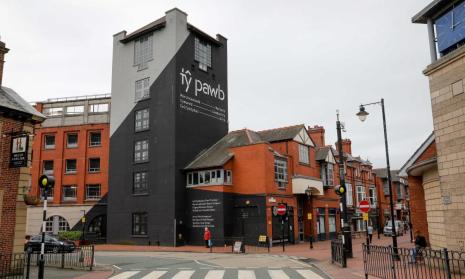
Ty Pawb in Wrexham. Source: Wrexham Leader
For those who have never encountered Tŷ Pawb, it was formerly a covered market with a car park on top. Apparently the market was hanging on to life by a thread before it was closed and as usual with this sort of change, the plans unsurprisingly met with some resistance. Often, the words “arts” and “community” when put together in the same sentence are enough to set any number of warning bells ringing, but in this particular case, there has been a strong dose of common sense and a real feel for the town thrown into the mix. The car park and the open space occupied by the market are still there, but the exterior and the former market space have been given a very smart and modern facelift. Small retail units and a food hall and modern benches and chairs making it an an excellent place to meet and grab a bite. It is an impressive initiative, and looking at it today, it seems to be working very well.
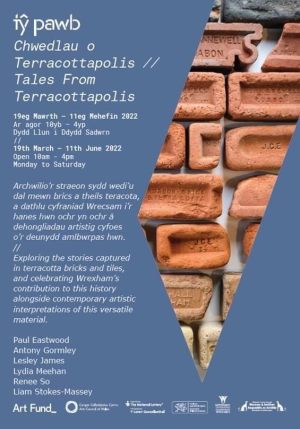
Source: Ty Pawb
The gallery fits in very nicely into this arrangement. The market space with its creatively designed modern signage and bright frontages and furnishings give the whole place a contemporary edge, which segues nicely with the inclusion of the gallery, which is so well blended into the space that at first we couldn’t see it.
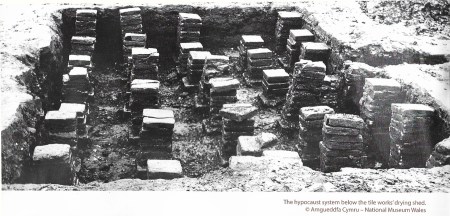
We were there to see Tales from Terracottapolis. It is on until 4th June (open Monday to Saturday, 10-4, free of charge), and I recommend it wholeheartedly. It is a small exhibit, a single gallery, but makes brilliant use of the space with its excellent light. Using objects from the Wrexham Museum and elsewhere, together with art works from a number of local artists, it combines 19th Century with 21st Century ideas to explore the local production of architectural flourishes and glazed tiles that formed the character of an older, more confident and prosperous Wrexham. Some of the decorative twiddles, like capitals, finials and long decorative panels, could be ordered from catalogues, but others were custom made.
There is an excellent video that provides the background to the industry, and explains how the terracotta was made, from kneading the clay by hand via being formed into moulds before firing, a highly skilled process from beginning to end. It would have been really great to be able to re-see the video online.
asfsdfsdfsd

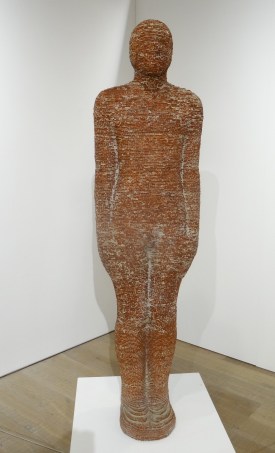 The front part of the gallery, where you walk in, is dominated by the modern pieces, many of which are very striking and engaging, and which aim to complement the story of Wrexham’s brick, tile and terracotta industry by offering new responses to it.
The first thing that draws the eye is The Brick Man by Antony Gormley, best known for his Angel of the North. It is (or would have been) one of his most tactile pieces, and a true celebration of brick. This is a scale model of a piece that was originally planned as a 120ft (36.5m) monument in the run down Holbrook area of Leeds, near the Leeds City Station. There was some public outcry against it, which is such a shame, as it resulted in the planning application being rejected by city planners. As well as the scale model, itself a solidly impressive celebration of brickwork, there is an archive of documentation following the sources of the statue, from the original proposal to the official rejection of the the proposal.
 There is a fascinating letter from the Partnership Manager of the British Railways Board, who supported the idea of the project, to a disgruntled objector, which really hits the nail on the head for me. You can click on the image to see a legible version. I am often amongst the first to grumble about inappropriate and poorly thought out modern sculpture installed in urban or rural locations as some form of random art statement, because such initiatives can actually alienate people from art and frequently undermine the impact of the heritage in which they are being installed. By contrast, The Brick Man actually had real merit (originally, I typed “legs”), not only as an art work, but as a way of contributing to urban regeneration, both by drawing attention to the monument and the area, and by attracting visitors. It is also a good piece of art, which is important. I was previously unaware of The Brick Man, and it was a really good opportunity to see the scale model and some of Gormley’s original plans.

Display of pottery sherds by Paul Eastwood
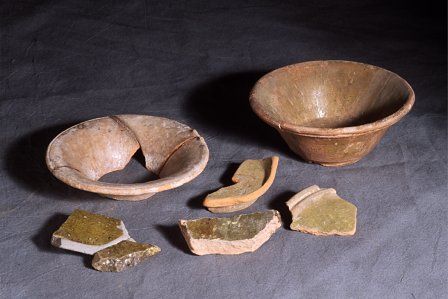
Immediately on the right as you walk in to the gallery is a section of wall covered by rows of ceramic sherds that the artist, Paul Eastwood, had collected from riverside locations during lockdown. It was so familiar, looking eerily like some of the stuff I have been collecting from my garden, and posing exactly the same sort of questions. Eastwood, based in Wales, specializes in capturing how memory is created through objects and language and, in this case, what abandoned sherds tell us about the people who discarded them and the places they were found. There were other pieces of his work on the same wall.
A set of large stand-alone pieces in the main space of the gallery, hanging panels and tall curving sections, captured the images of walls and arches, surface-traced like brass-rubbings from the derelict walls of buildings that had produced the bricks, moulded works and tiles. I had not worked my way round to these Lesley James pieces when I was welcomed to the exhibit by one of the curators, who pointed them out to me, and I was glad she had as I would certainly have missed their textural connection with the 19th century manufacturers:

Lesley James surfaces traces
At the far end of the gallery is a floor-to-ceiling map showing the location of all the major brickworks. It is an excellent way of showing just how important the area was for the production of bricks, tiles and terracotta.
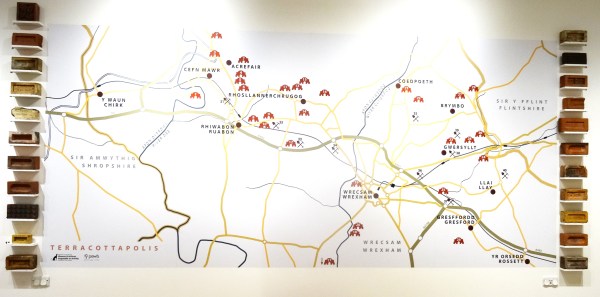
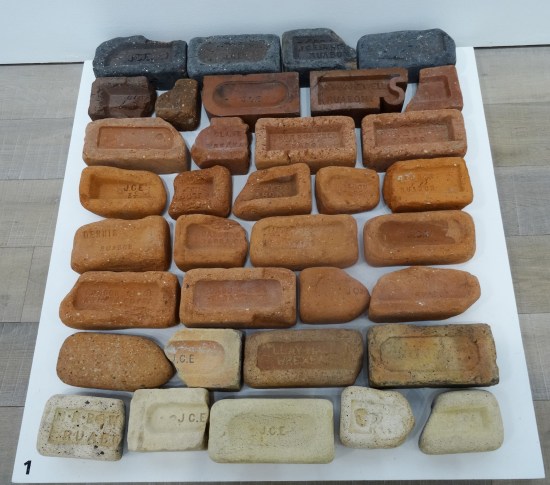
In this section of the gallery, the focus shifts from present to past, and some of the marvellous tiles and moulded terracotta pieces are located here, together with the video. This is where the exhibition makes a slight gear change from modern art gallery to beautifully displayed items of heritage. Both flanking the map and at its foot, are examples of locally made bricks, each one marked with the name of the works that produced it, with a key to identify which name related to which manufacturing works. In Farndon, on Brewery Lane, there is a Llay Hall brick more or less randomly incorporated into the left side of the road, all on its own, face up. I have no idea what it is doing there, but it was great to see two of its relatives on display, from Llay Hall Brickworks in Sydallt.
 sdfsadfasdf

J.C. Edwards ceramic tiles, rescued from a condemned property on the Air Products factory site in 1989, and restored and reconstructed in 1993.
The main manufacturers represented at the exhibition are Dennis Ruabon Ltd and J.C. Edwards of Ruabon, both important local producers of bricks, tiles and terracotta.
J.C. Edwards tiles were particularly valued and were installed locally at Liverpool’s Pier Head, and at the Lever Brothers village Port Sunlight on the Wirral, and were bought from as far away as Singapore, Egypt, Panama and India. Edwards also provided the floor tiles for the kitchens on the Titanic. There is at least one of his tiles in the British Museum, designed by Lewis Foreman Day.
Examples of Dennis Ruabon Ltd terracotta work can be seen locally in Chester at the Westminster Motor Car and Coach Works and the Central Arcade in Hope Street, Wrexham. Further afield, the Grand Metropole Hotel in Blackpool and Wellington House, at Buckingham Gate in London are high profile examples of Dennis Ruabon Ltd work. Whilst Edwards specialized in brickworks based on the Etruria Marl unique to the area, Dennis had interests in a variety of industries, including quarries, coal pits, waterworks, brickworks and a tramway.

Tiles by J.C. Edwards

Tiles by J.C. Edwards, Henry Dennis, Monk and Newell and the Pant Works
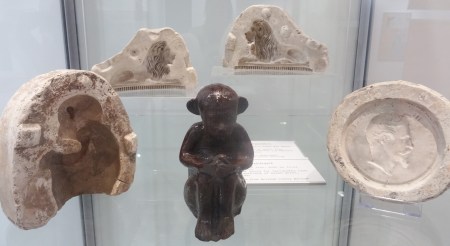 The use of clay pressed into moulds was an excellent way of enlivening buildings, giving them celebratory flourishes without all the costs involved in stone masonry. The use of moulds that could be re-used many times, enabled manufacturers to produce catalogues for architects, from which their customers could choose appropriate features, which not only made decorative flourishes affordable, but resulted in their proliferation, particularly on roofs. Once you have seen the items on display, as well as those more elaborate versions shown in the video, it encourages you to look up in places like Wrexham and surrounding villages to spot the terracotta work that gave many local towns a real sense of pride.
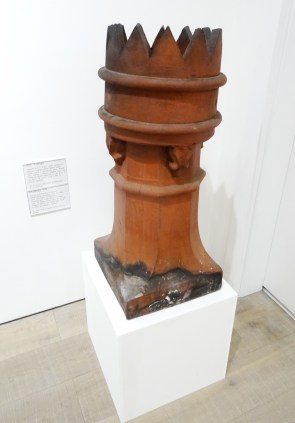
Dennis Ruabon Ltd chimney


 The layout of the works was elegant and well thought out, with each item widely spaced from the next, allowing it to be appreciated without distraction. The combination of modern art works and 19th century heritage objects worked beautifully.
All the signage was in Welsh and English, and there was a handout introducing the modern artists whose works were on display, together with the 19th century manufacturers J.C. Edwards and Dennis Ruabon Ltd. I picked up the Welsh version, assuming that it was bilingual; presumably there was an English version as well, so if you don’t read Welsh, look out for it. I was rescued by Google Translate 🙂
 The friendly and helpful curator of the exhibition, whose name I failed to catch, told me that over 2000 people had visited since the exhibition opened in March, with a number of them either former workers or their families sharing experiences. Certainly, from my own perspective of things I have found in my garden, the Llay Hall brick randomly set into the side of a lane in Farndon, and my enormous affection for 19th century tiles in general and the Westminster Car and Coachworks (now the public library) in Chester in particular, it was very easy to relate to this exhibition. The modern art pieces also work really well, balancing the older pieces and offering a new way of looking at this type of heritage, as well as engaging the visitor in their own right with thoughts about how heritage can be remembered, explored and, when necessary, lamented.
There was a school party arriving as we left, and on the table by the door I noticed that there was a pile of A4 sheets showing illustrations of three different statues, with an empty space for children to add their ideas for a monumental work. We flipped through the completed sheets, and they were brilliantly inventive. They made me remember what it was like to be a child with all that flying, chaotic, no-holds-barred imagination. I particularly liked the giant robin with a big mouth in its side were its wing should be, complete with a healthy set of teeth. The giant jelly fish statue was also rather terrific, but they all had something to offer. Some were surprisingly very abstract. It was a marvellous idea.
The gallery is a welcoming place, completely unintimidating. I both admired and enjoyed the entire feel of the place. My only actual grumble about it is that apart from seating for watching the video there was no seating in the gallery for those who have less than perfectly functioning legs, or who just want to sit and soak up the exhibits.
Practicalities:
 The gallery is open 10-4, Monday to Saturday and the exhibition is free to visit. We didn’t investigate what else the gallery has to offer, so it would be worth checking what else is available and whether there is a ticket charge if you want to visit anything other than the exhibition space (Gallery 1). Full details for visitors and future exhibits are at https://www.typawb.wales/plan-your-visit. You can also follow them on Twitter at https://twitter.com/TyPawb
We parked in the multi-storey carpark on Market Street, which has lifts down to the ground floor where the gallery and the food /retail space are located. It was easy to find, and unlike some multi-storeys, the spaces were generous. Do not leave your carpark ticket in the car – the pay station is on the ground floor outside the doors to the elevators, and access to the elevators requires you to put your car park ticket into a ticket reader by the side of the door.
Tŷ Pawb has been shortlisted for Art Fund Museum of the Year, the winner of which will be announced in July 2022. Here’s hoping!
afadfs

Source: Ty Pawb
Sources:
Ty Pawb
Exhibition: Tales from Terracottapolis
www.typawb.wales/tales-from-terracottapolis
Exhibition handout in Welsh: Chwedlau o Terracottapolis 19/03/22 – 11/06/22
More re Wrexham’s brick, tile and terracotta manufacturing history:
Wrexham Leader
There was gold in the red of Dennis Ruabon
https://www.leaderlive.co.uk/news/20131331.gold-red-dennis-ruabon/
Old Bricks – History at your feet
Ruabon Area
https://www.brocross.com/Bricks/Penmorfa/Pages/ruabon1.htm
Coflein
Hafod Red Brick Works; Dennis Ruabon Brickworks, Rhosllanerchrugog
https://coflein.gov.uk/en/site/40776/
Wrexham History
Henry Dyke Dennis and the Red Works, by John Davies
https://www.wrexham-history.com/henry-dyke-dennis-red-works/
Pontcysyllte
Brickworks
https://www.pontcysyllte-aqueduct.co.uk/object/brickworks/
Hansard 1803 – 2005
Brick and Tile Industry, Wrexham Area: Motion made, and Question proposed, That this House do now adjourn.—[Colonel J. H. Harrison.] – Mr. J. Idwal Jones (Wrexham)
https://api.parliament.uk/historic-hansard/commons/1958/jun/10/brick-and-tile-industry-wrexham-area
More on Ty Pawb:
Ty Pawb
“About” page
https://www.typawb.wales/about/
The Guardian
Tŷ Pawb review – an art gallery that truly is everybody’s house. By Rowan Moore
https://www.theguardian.com/artanddesign/2018/sep/01/ty-pawb-review-art-gallery-everybodys-house-wrexham-market
Architect’s Journal
Something for everybody: Ty Pawb art gallery by Featherstone Young
https://www.architectsjournal.co.uk/buildings/something-for-everybody-ty-pawb-art-gallery-by-featherstone-young
Wrexham Leader
Ty Pawb, Wrexham, shortlisted for Art Fund museum of the year
https://www.leaderlive.co.uk/news/20126804.ty-pawb-shortlisted-museum-year/
More on artists in the exhibition mentioned in this post
Paul Eastwood
https://www.paul-eastwood.net/
Lesley James
https://www.lesley-james.com/
Antony Gormley
https://www.antonygormley.com/






 Based in Churton