Category Archives: Modern History

Hillforts and amazing views, and why is there an Egyptian temple on the top of Moel Famau?

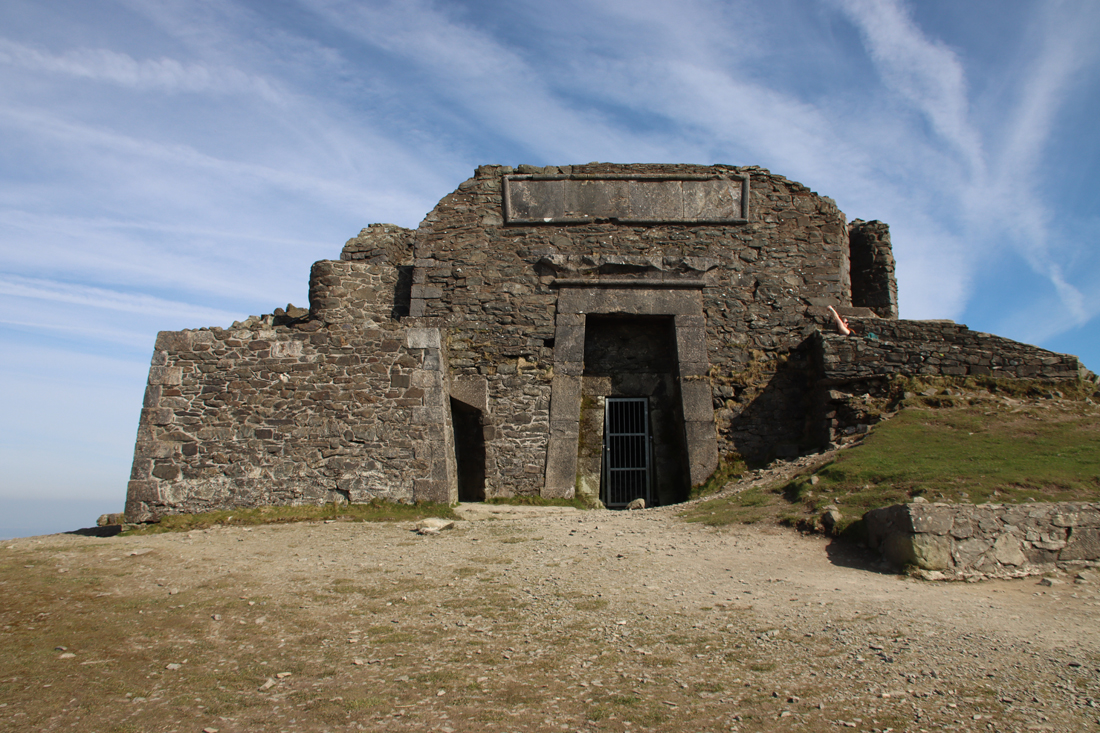
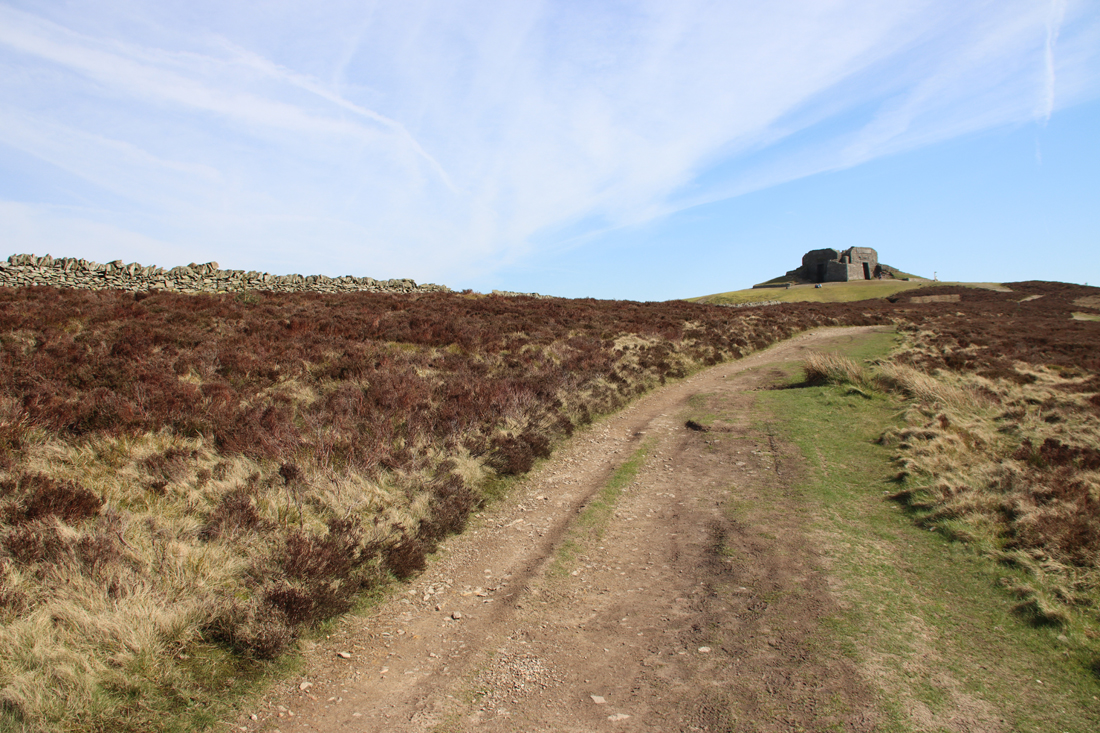
The Jubilee Tower

The Jubilee Tower

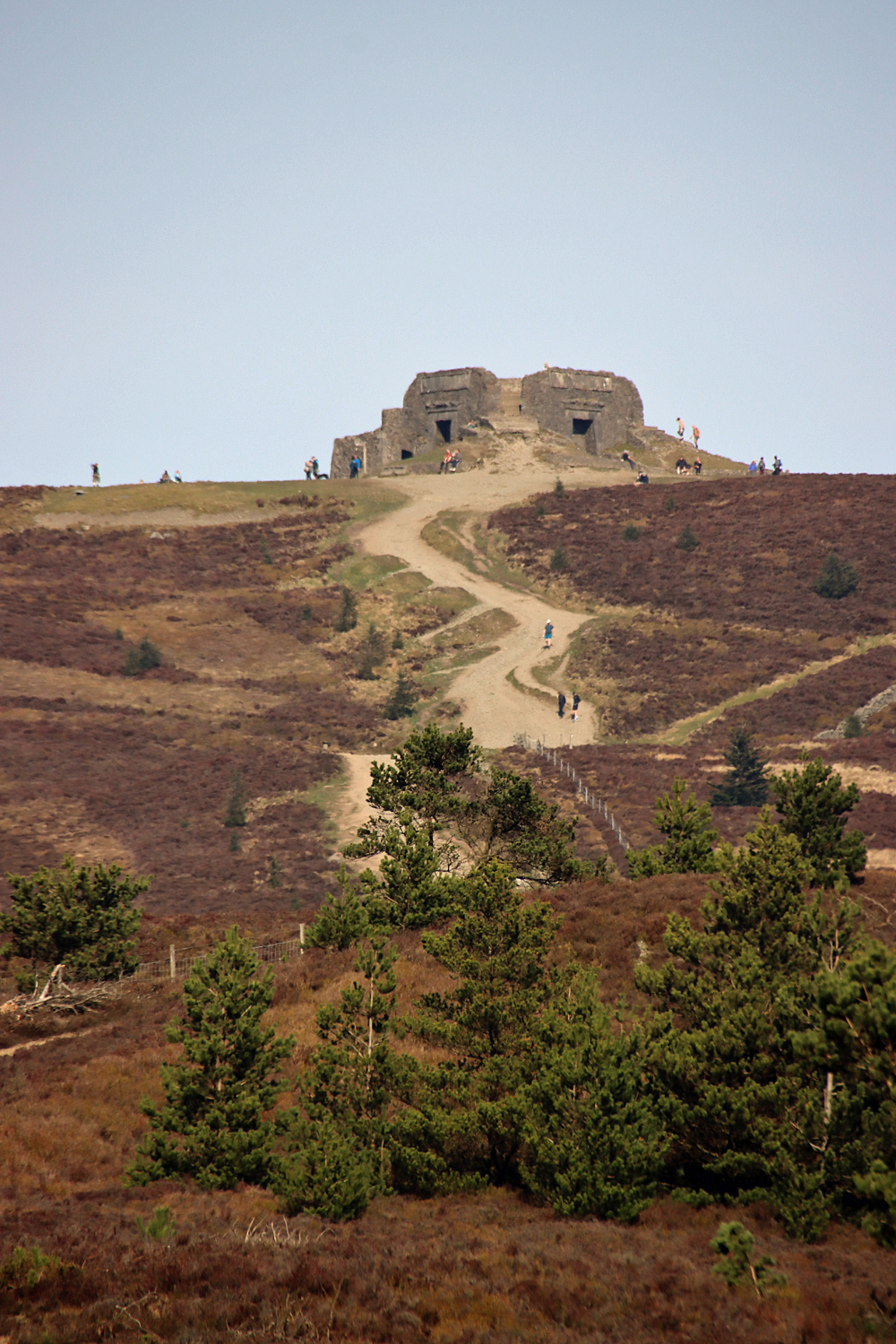
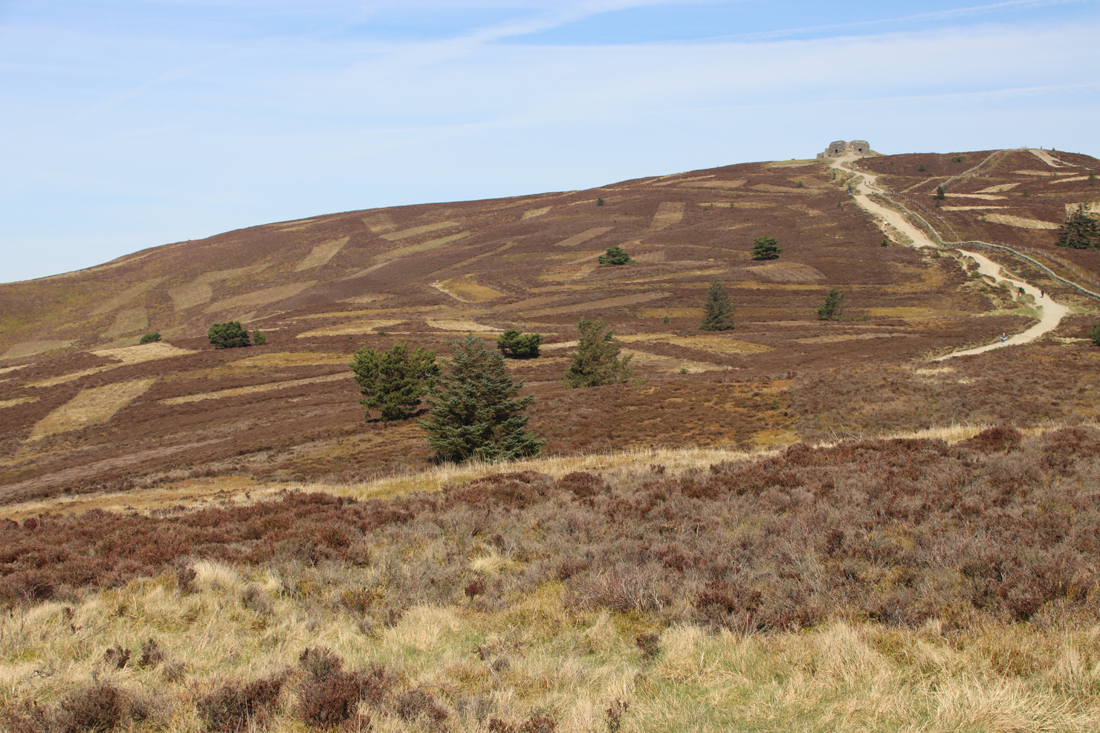
It was something of a surprise when I walked up to the top of Moel Famau during the week and found myself face to face with a building that was clearly based on an ancient Egyptian temple, the Grade II listed Jubilee Tower.  People talk about the views, the hillforts, the heather, the bilberries and the bird life, but no-one had mentioned that there was a rather unexpected slice of Egyptomania on the peak.  One would certainly, thankfully, not be permitted to build on a national beauty spot these days, but I suppose that it could be a lot worse, like the hideous, overpriced café on Snowdon.  The Jubilee Tower is not elegant, it is not authentic, and it is anything but pretty, but it did make me smile, and other walkers were clearly enjoying it too.  Heritage comes in various forms, some of them most unexpected.  The Egyptian Revival produced some splendid buildings and monuments, and although this one is not amongst the most accomplished, its location singles it out as a fairly remarkable example, a genuine curiosity.


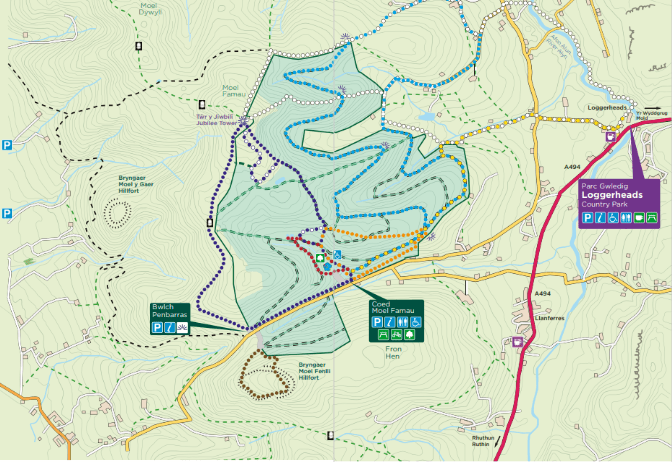
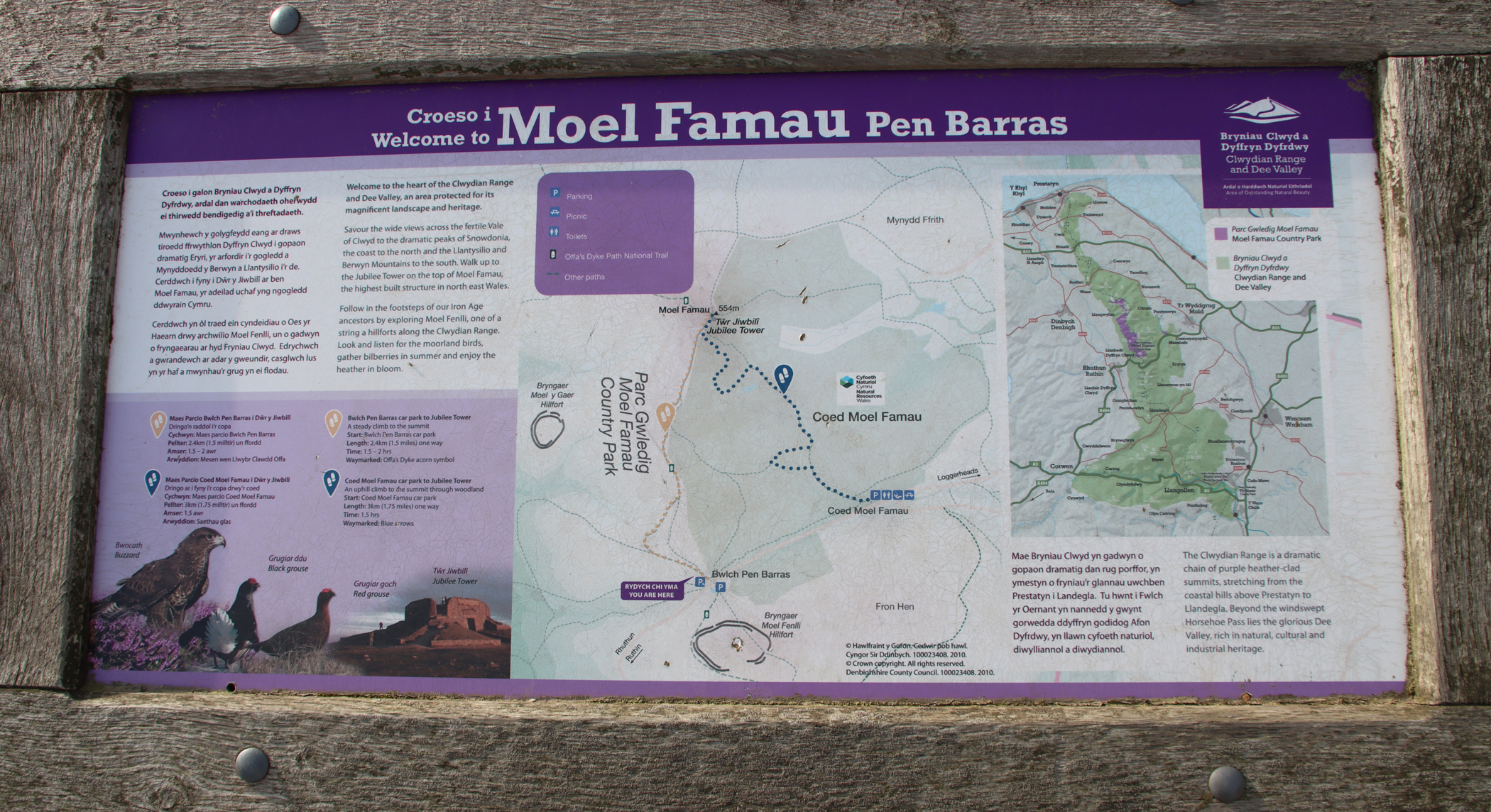
Map of Moel Famau footpaths

Map of Moel Famau footpaths, as well as the locations of Moel y Gaer and Foel Fenlli hillforts. Source: Nearly Uphill

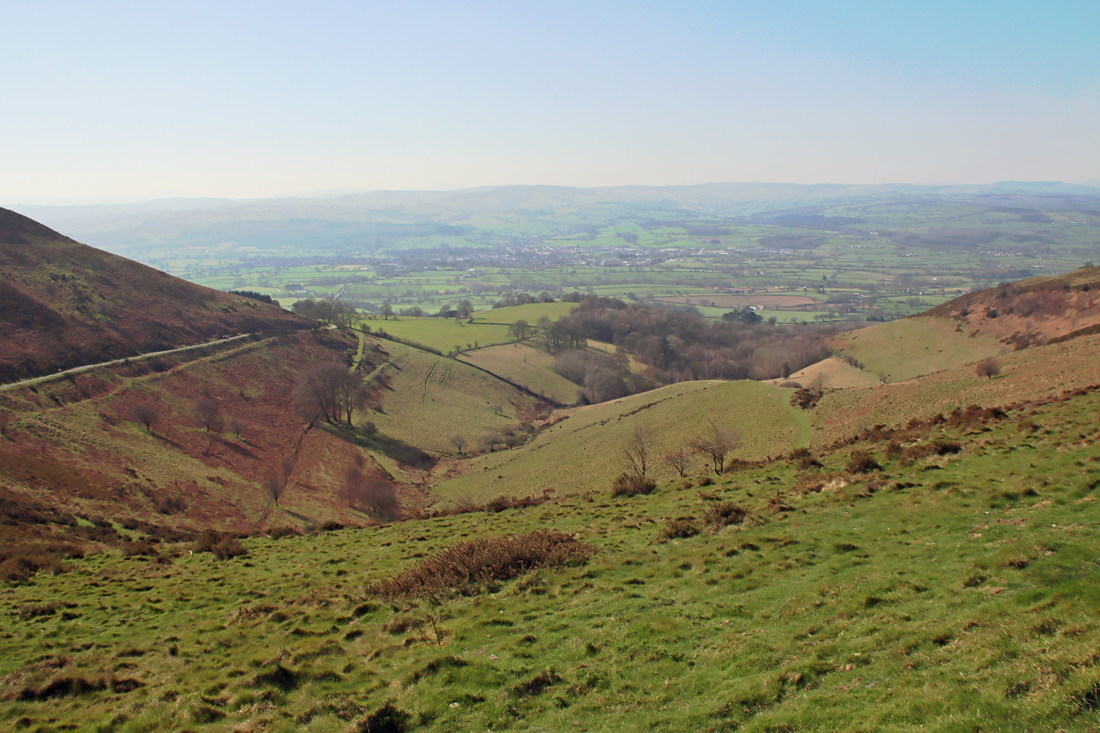
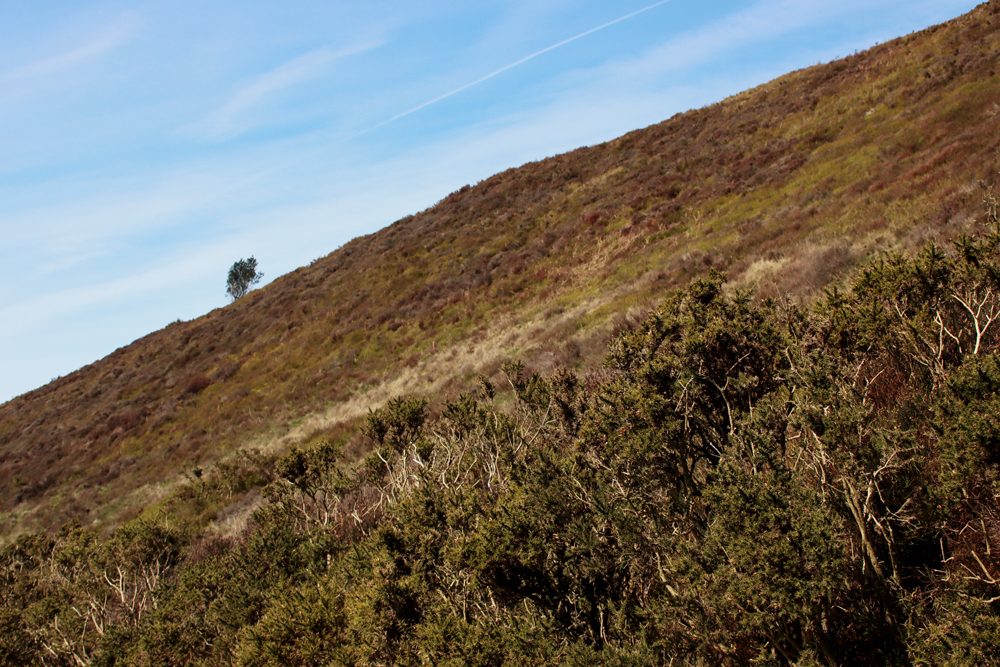
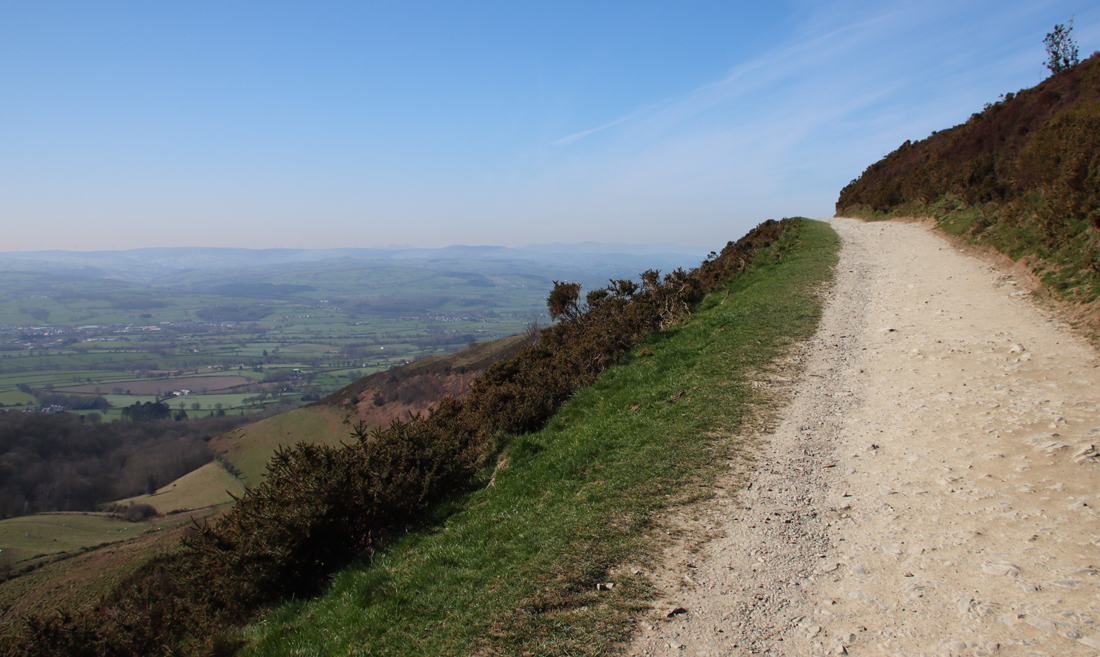
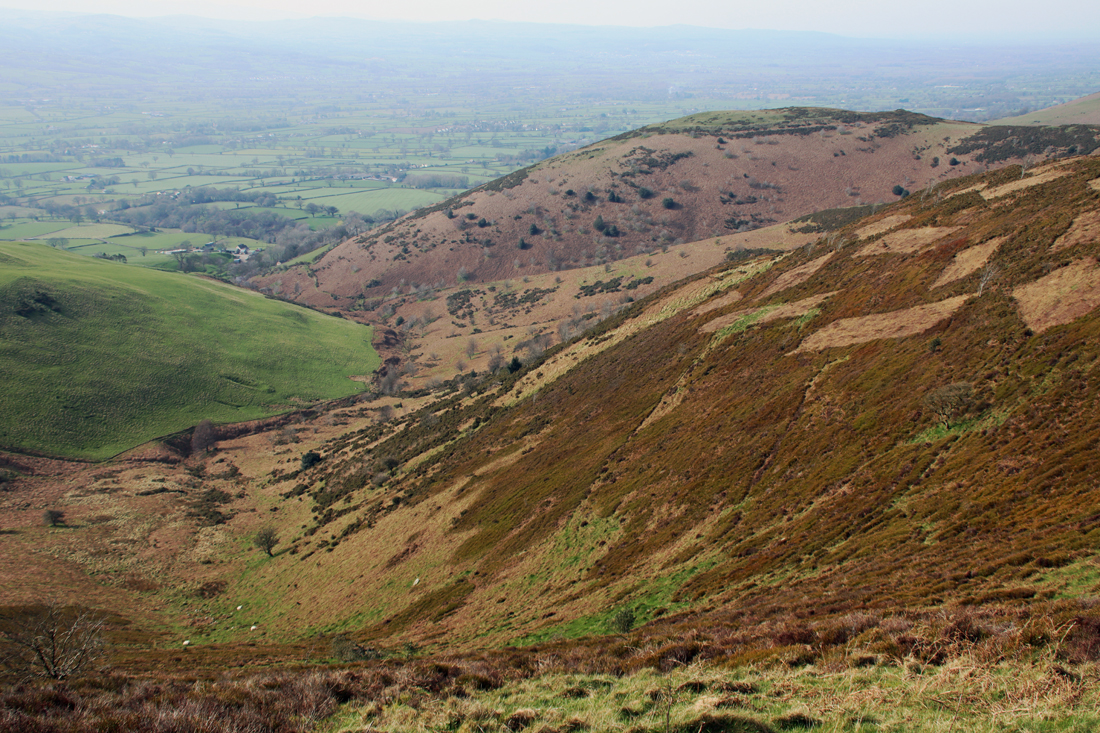
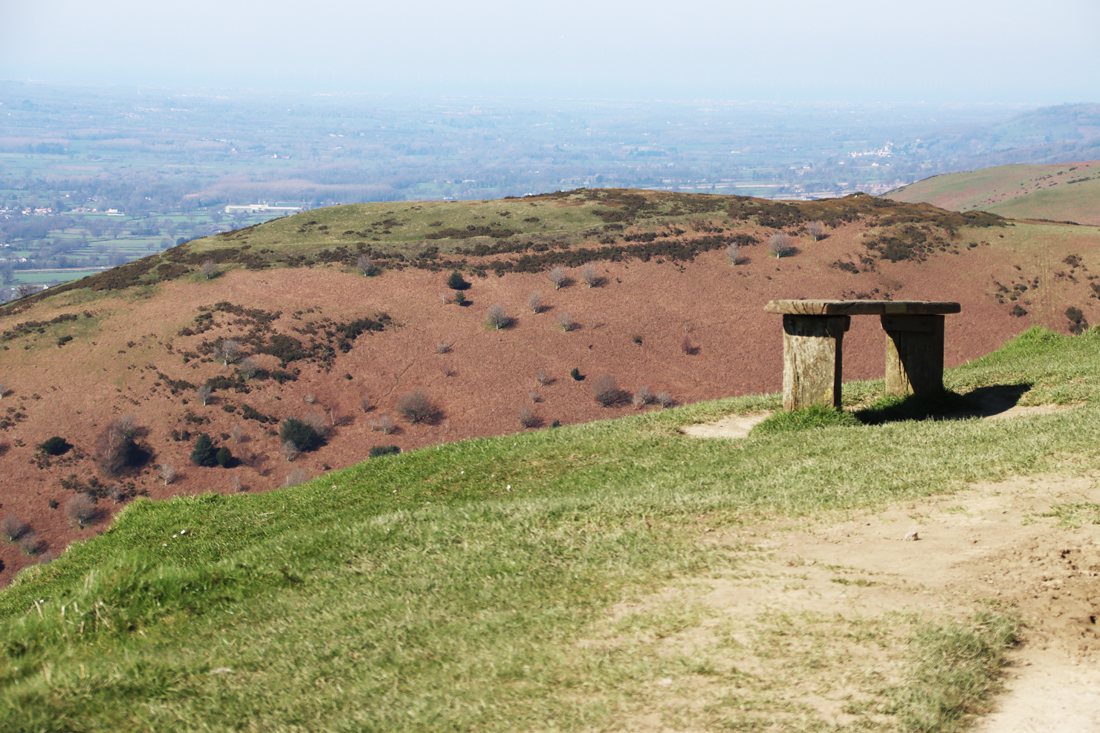
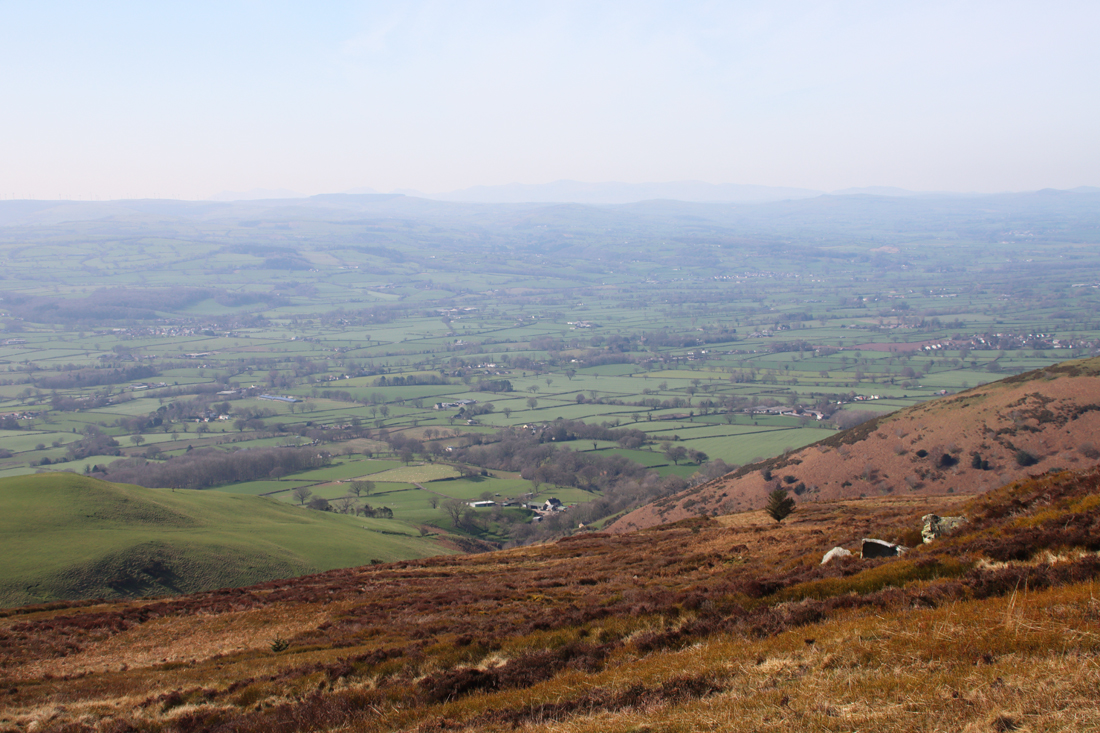
Moel Famau, on the Clwydian Range, is lovely.  It is the highest peak on the Clwydians and a very popular destination for hikers and dog walkers alike.  I don’t really remember my first visit, so it was very much like visiting for the first time.  There are a number of different approaches to the peak. I went along the Bwlch Pen Barras road, a pass through the Clwydian Range where there are two official starting points with car parks.  one of which takes you through the coed (wood), but it was far too gloriously sunny to be under cover, which means that that the best starting point was the large amount of lay-by parking (which I believe is free) or the Bwlch Pen Barras car park (payment required) .  The What3Words address for the Bwlch Pen Barras car park is ///hobble.passwords.device.  You are already very high up at this point, with terrific views over the Vale of Clwyd before you even start, and the footpath that I took (the purple track at far left of the above map) provides superb views over the Vale of Clwyd.

The walk, along a wide, well maintained path, starts very gently and for the first 20 minutes or so is very easy.  It becomes much steeper for a fairly short section leading up to the peak, but people of all levels of fitness seemed to be tackling it, some stopping frequently for a breather.  It’s worth that last push because the 360º views are breathtaking.


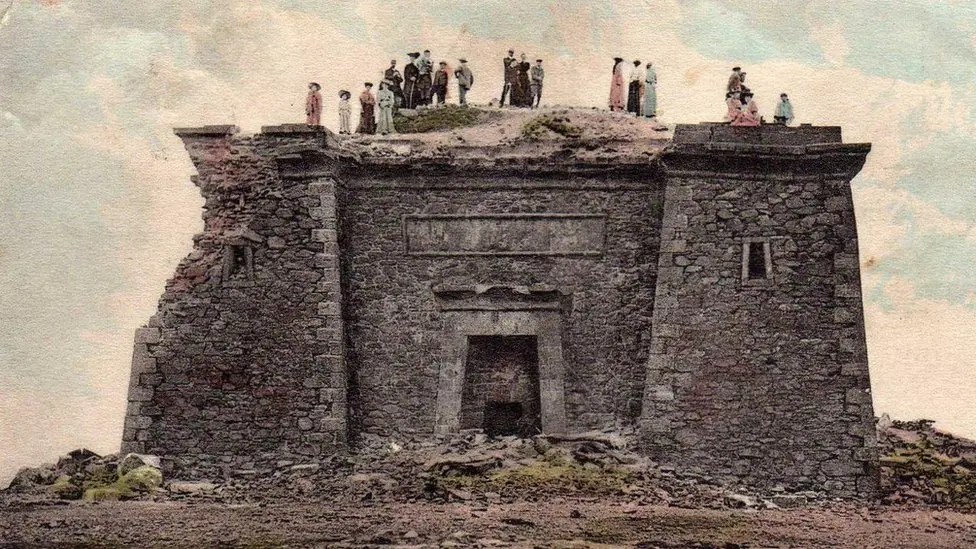
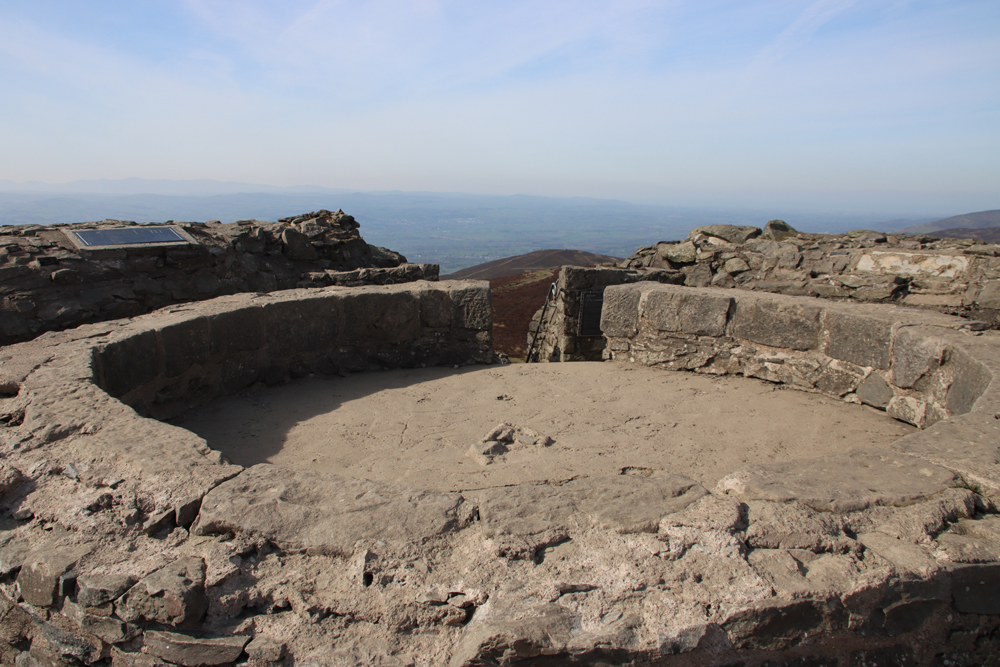
If you climb up the steps to the top of the Egyptian Revival “temple” there are metal plaques explaining the building.  It turns out that what we see today is just the stump of a much more ambitious project, the Jubilee Tower, which included an obelisk.  It was designed by architect Thomas Harrison, and was built to celebrate the Golden Jubilee of George III in 1810, paid for by public subscription, with Flintshire magistrate Lord Kenyon laying the foundation stone in October of that year.  Harrison’s buildings in Chester are far less frivolous, with most of his work in the Neoclassical style, including the Grosvenor Bridge and the Propylaeum (monumental gateway) into Chester Castle and the Neoclassical building that is now owned by the university but was previously occupied by the council as its Shire Hall.  The building materials were taken up by horse and cart. The design of the obelisk was modified during construction, with a shorter and stumpier version being completed in about 1817 after a break in work due to financial difficulties and a dispute between Harrison and the builder. Unfortunately the obelisk soon started to deteriorate, and eventually collapsed in a storm in 1862.  The rest of the structure continued to decay until 1970 when it underwent restoration, and in 2013 it again required significant restoration work.  Here’s the Coflein description of the Jubilee Tower:

The Jubilee Tower in the Edwardian period

The Jubilee Tower in the Edwardian period. Source:  BBC News

The monument now survives as a battered plinth, 12-15m diameter, of roughly coursed rubble stone. Located on a mound which may be artificial. Each face has a central blind doorway of dressed stone, in simple Egyptian style, under a roll-moulded lintel; roughly hewn cornice or hoodmould.  Above these blind openings are broad rectangular panels of dressed freestone with roll-moulded surrounds. The corners of the monument have stone and concrete steps, starting from low square projections, which lead to the centre of the monument. Inside are the circular rubble stone footings of a former higher section of tower, 6m in diameter.  Around the outside of the monument is a renewed retaining wall 0.5-1m high, open at the corners. A plaque reads ‘Cefn Gwlad award 1970’, with Prince of Wales emblems.

The Egyptian Revival followed Napoleon’s invasion of Egypt in 1798.  He took with him over 100 specialists, the “savants,” amongst whom were artists and draughtsmen who recorded the ancient Egyptian temples.

One of the first and very popular books to publish these images was Dominique Vivant-Denon’s “Journeys in Upper and Lower Egypt” published in 1802.  Even before Jean-François Champollion’s translation of hieroglyphs in 1822, and over a century before Howard Carter’s discovery of the tomb of Tutankhamen in 1922, Egypt had wriggled its way firmly into the British imagination.  Even so, I would love to have been at the meeting where plonking a pseudo-Egyptian monument on the top of a remote beauty spot in honour of the king’s jubilee was presented as a such a good idea that people invested in it.


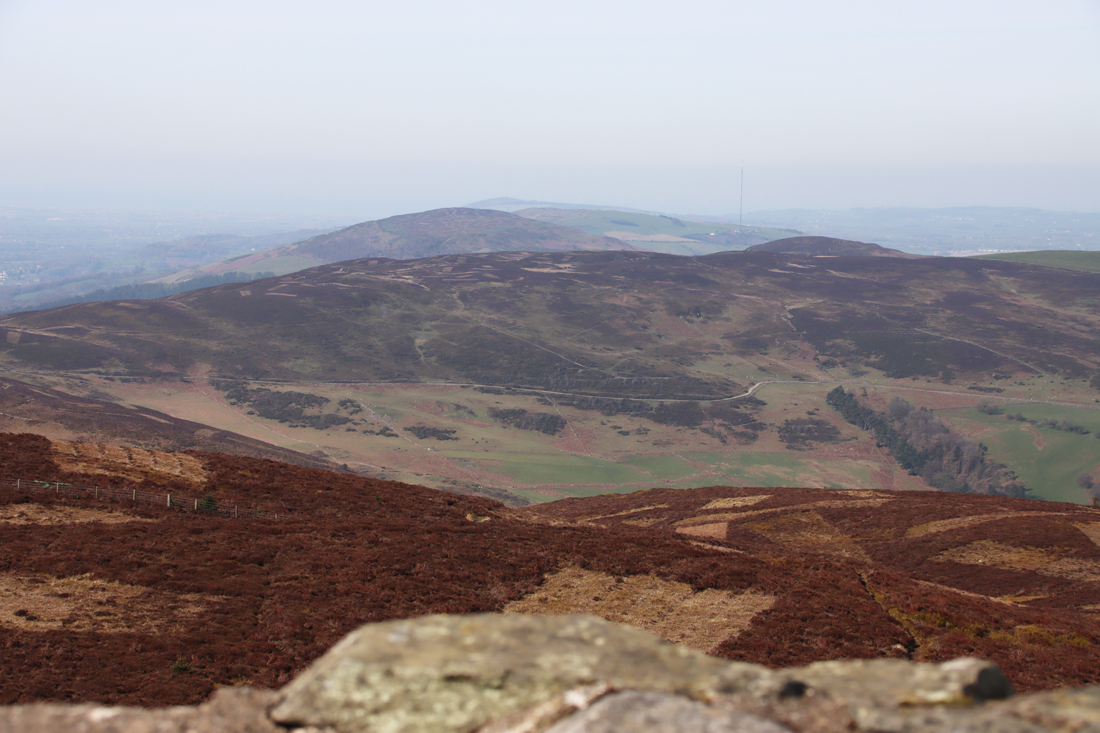
Also on the top of the temple are plaques showing the names of the hills all around, with Cadair Idris and Snowdonia visible as silvery silhouettes through the slight haze, and the Moel Arthur hillfort next along on the Clwydian Range.

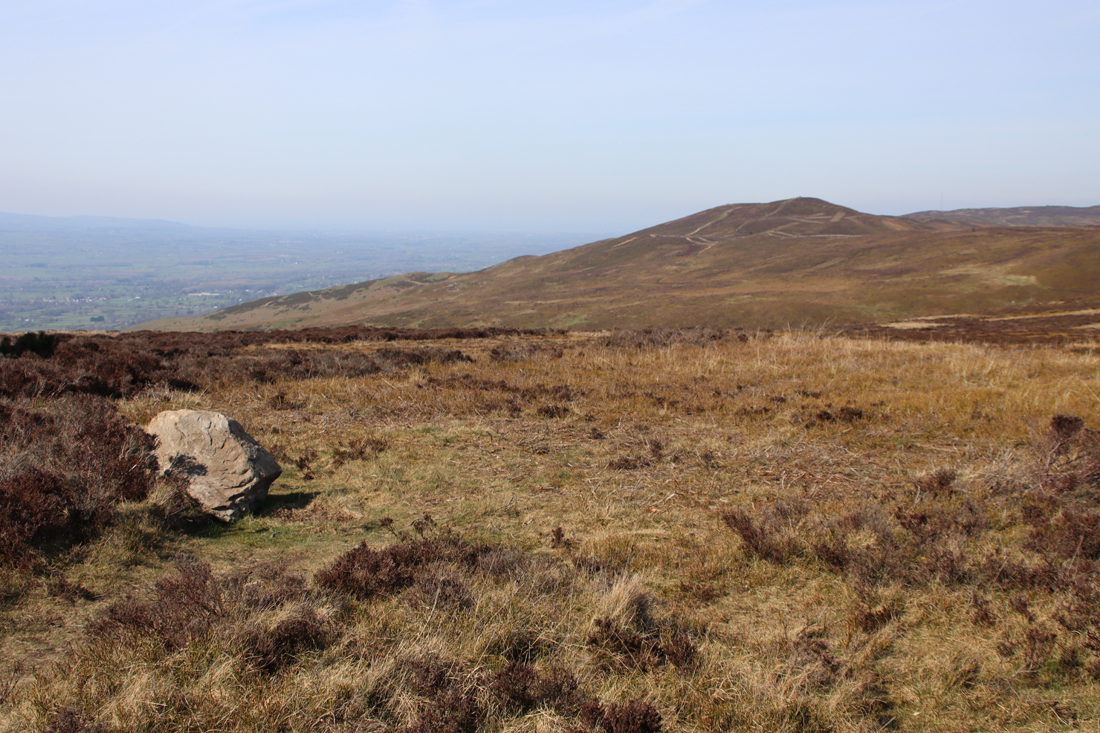
Looking northeast towards Prestatyn across Moel Arthur and Penycloddiau hillforts from the top of Jubilee Tower

Moel y Gaer hillfort

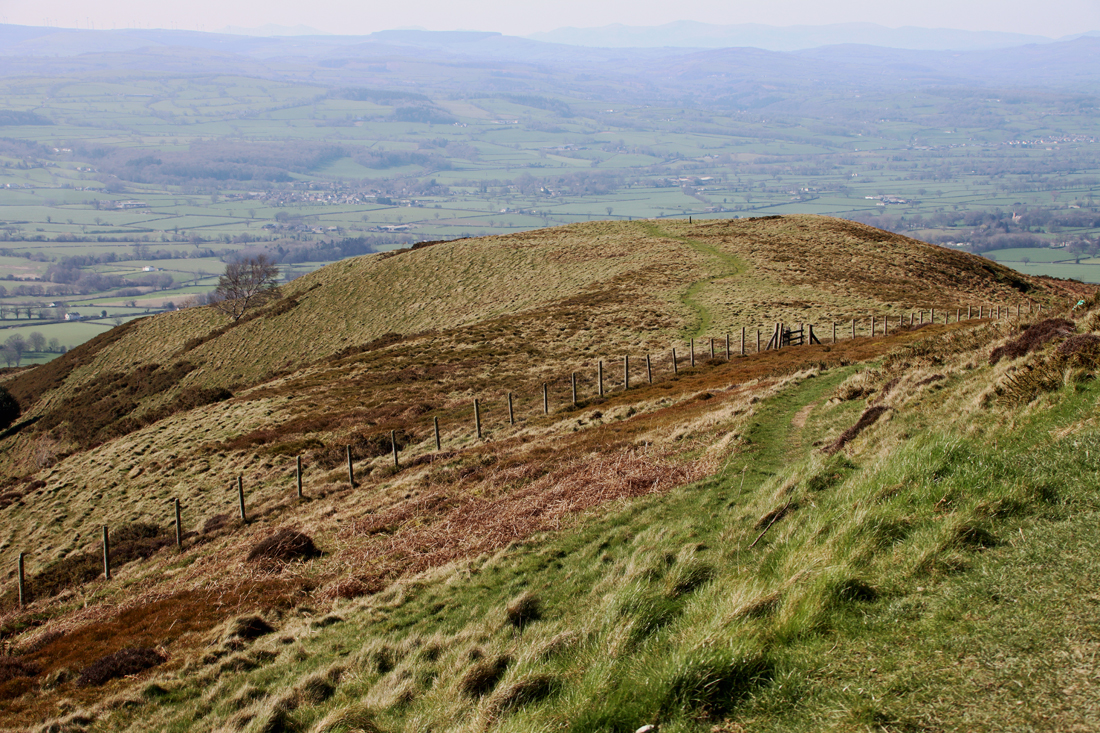
If you are a fan of the Iron Age this is a terrific walk.  The path passes Moel y Gaer, which sits on a spur of the hillside, and is a piece of absolute perfection.  It is not on a public footpath, but it is clearly visible from the main route up Moel Famau.  Its banks and ditches form an elegant tiara, and its position overlooking the Vale of Clwyd is superb.  Once you have reached the peak of Moel Famau, the hill housing the Moel Arthur hillfort is clearly visible, with Penycloddiau beyond.  Foel Fenlli is a walk in its own right, but it is an important part of the walk back down from Moel Famau, because its vast banks and ditches are clearly outlined against a bright sky, yelling its late prehistoric credentials, a far more aggressive and prominent statement than Moel y Gaer.

Impressive fortifications of Foel Fenlli

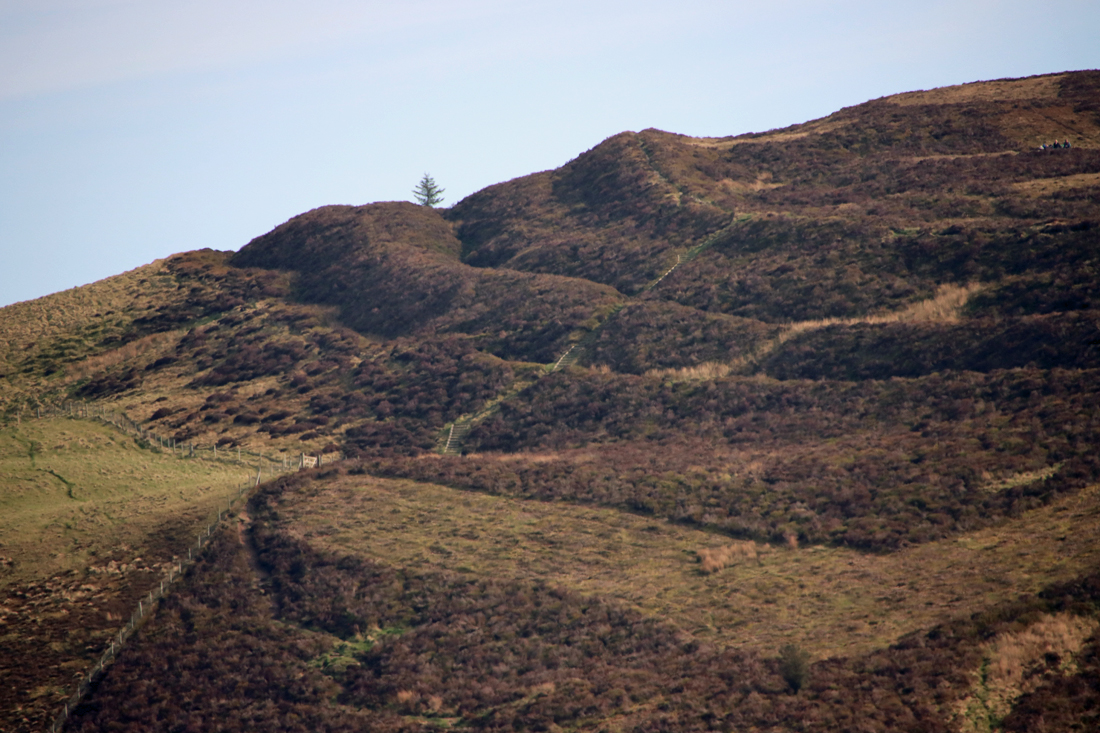
The impressive fortifications of Foel Fenlli, as seen from the Moel y Gaer path

Apart from the acres of dark brown heather and the bright spring green of the valley below, there is not a lot of plant life to see at this time of year, although it is very striking without a floral contribution.  The heather, dark chestnut brown and lifeless at this time of year, has been cut into a peculiar pattern of rectangles to encourage new growth, apparently for the benefit of wildlife.  There is not much in the way of shrubs and the trees in the wood are conifer plantations. There are plenty of birds of prey if you have equipped yourself with binoculars.  I look forward to visiting again when the heather is in flower in late summer, which should be stunning.

It is about a 40 minute walk up, although I forgot to take a note of the times in either direction and have the impression that it took me only about half an hour back down, with extra time added for pausing to enjoy the views and for lazy mellowing and exploring the monument at the top.  I am something of a route-marcher, so that needs to be taken into account.  You can walk on beyond Moel Famau in various directions on public footpaths.  Most obviously the path continues, in a much narrower form, across the Clwydian Range, which looks like an absolutely splendid option.  If you have the energy, you can walk to the village of Bodfari, in another pass through the Clwydian Range, whilst the Offa’s Dyke Trail goes all the way to Prestatyn.  In the opposite direction, you can follow the route over Foel Fenlli all the way to Chirk, skirting the dramatic Eglyseg Mountain and passing Castell Dinas Bran and the Pontcysyllte aqueduct.

It was one of those spring days when everyone looked as though they had been released from a cage, shedding winter like a bad memory.  Super.  To read more about the environment and archaeology of the Clwydian Range and Llantysilio Mountains see the PDF produced by the Heather and Hillforts project. 


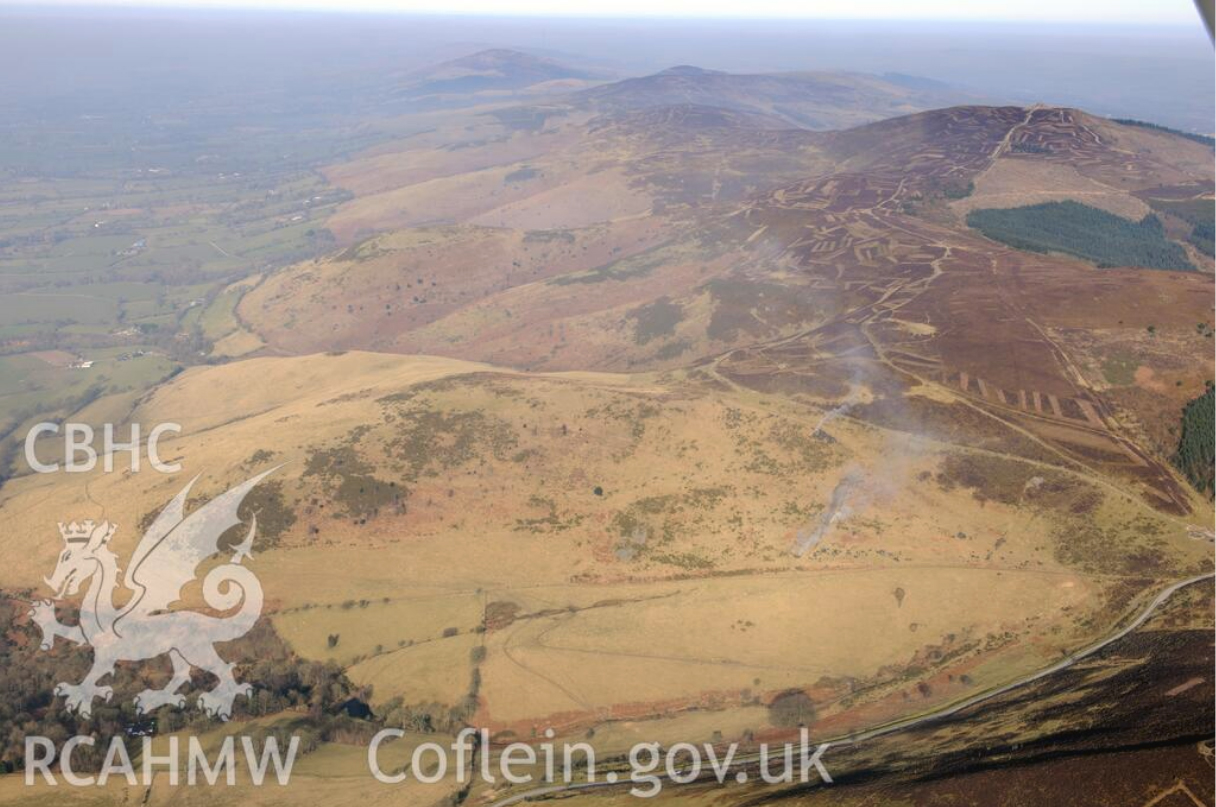
Aerial view of the Clwydian Range. Coflein image 662395. Source: Coflein


Walking the history of Chester’s canals, from the river Dee to Boughton #1 – Short History

This post is divided into two. Part 1 (this part) looks in brief at some of the history of the Chester city canals, mainly to untangle the complicated story of what is happening at the Tower Wharf Basin, where the Chester and Ellesmere Canals came together.  Part 2 is a mainly photographic account of the walk along the canals from the river Dee to the Chester Boughton Hall Cricket Club, just beyond Tarvin Bridge.

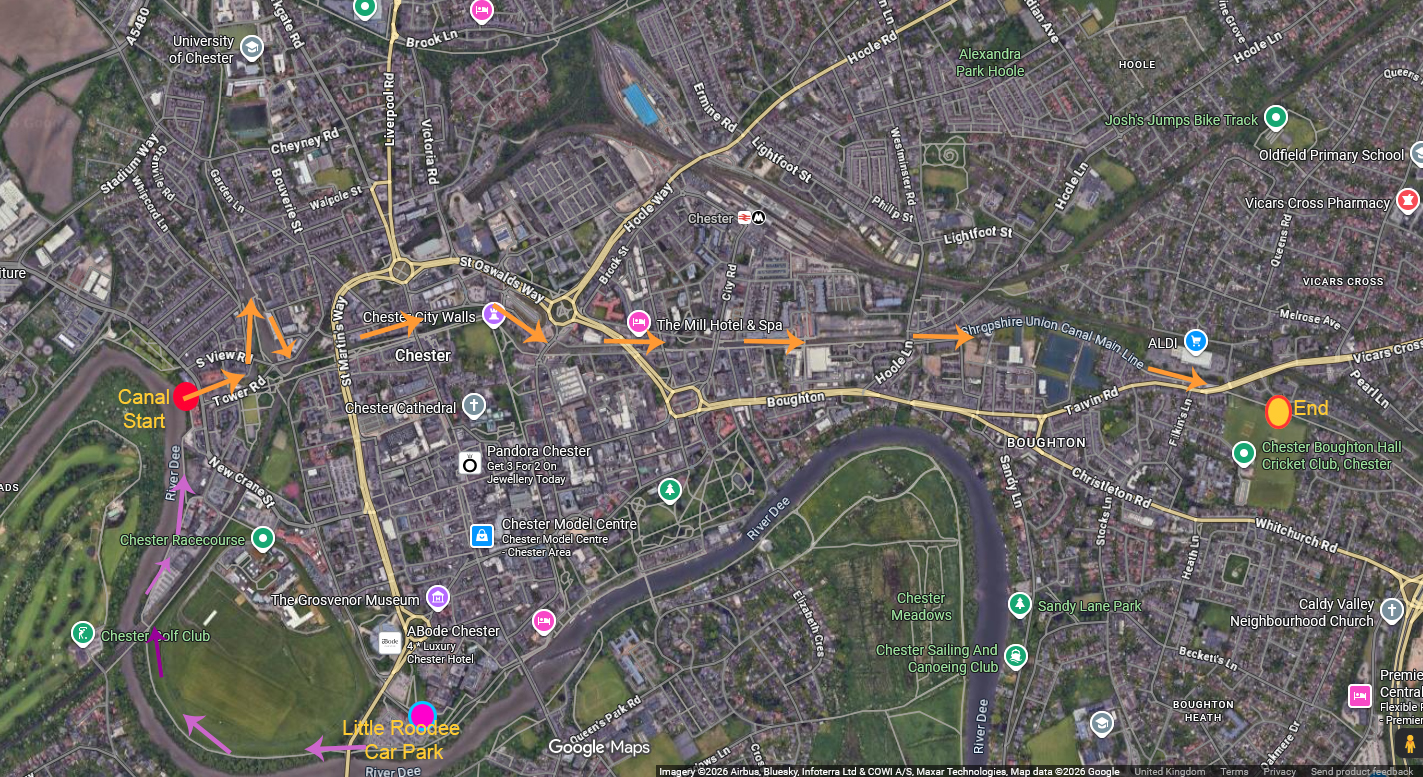
The pink arrows are my route from the Little Roodee car park to the start of the canal. The orange arrows are the route taken from the start of the canal at the river Dee to Chester Boughton Hall Cricket Club. Details of the walk are in Part 2.

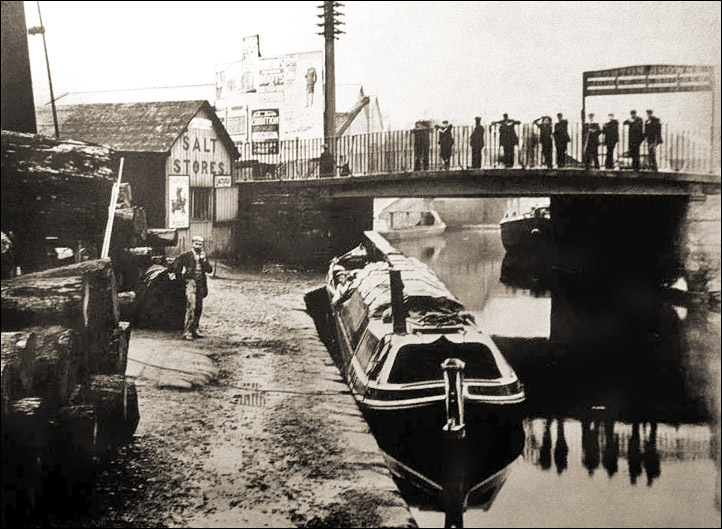
Cow Lane Bridge 1880s

Cow Lane Bridge in the 1880s. Source: chesterwallsinfo

This post begins with a short description of the history of the Shropshire Union Canal, describes why the intersections just beyond the Northgate staircase lock is so complicated, and goes on to describe the walk.

The Shropshire Union Canal runs today from the Mersey and the Manchester Ship Canal at Ellesmere Port, to Autherley Junction near Wolverhampton on the Staffordshire and Worcestershire Canal over a distance of 66.5 miles (107km).  Because it runs beyond the city walls, only making its presence felt to tourists where it crosses Northgate and along the base of the city walls, it does not feature on the city’s usual tourist routes.  Unlike Chester’s well known medieval, Georgian and Victorian architectural attractions, the canal is more directly a component part of the city’s industrial past, but is just as essential in the city’s story.

The history of the Shropshire Union Canal

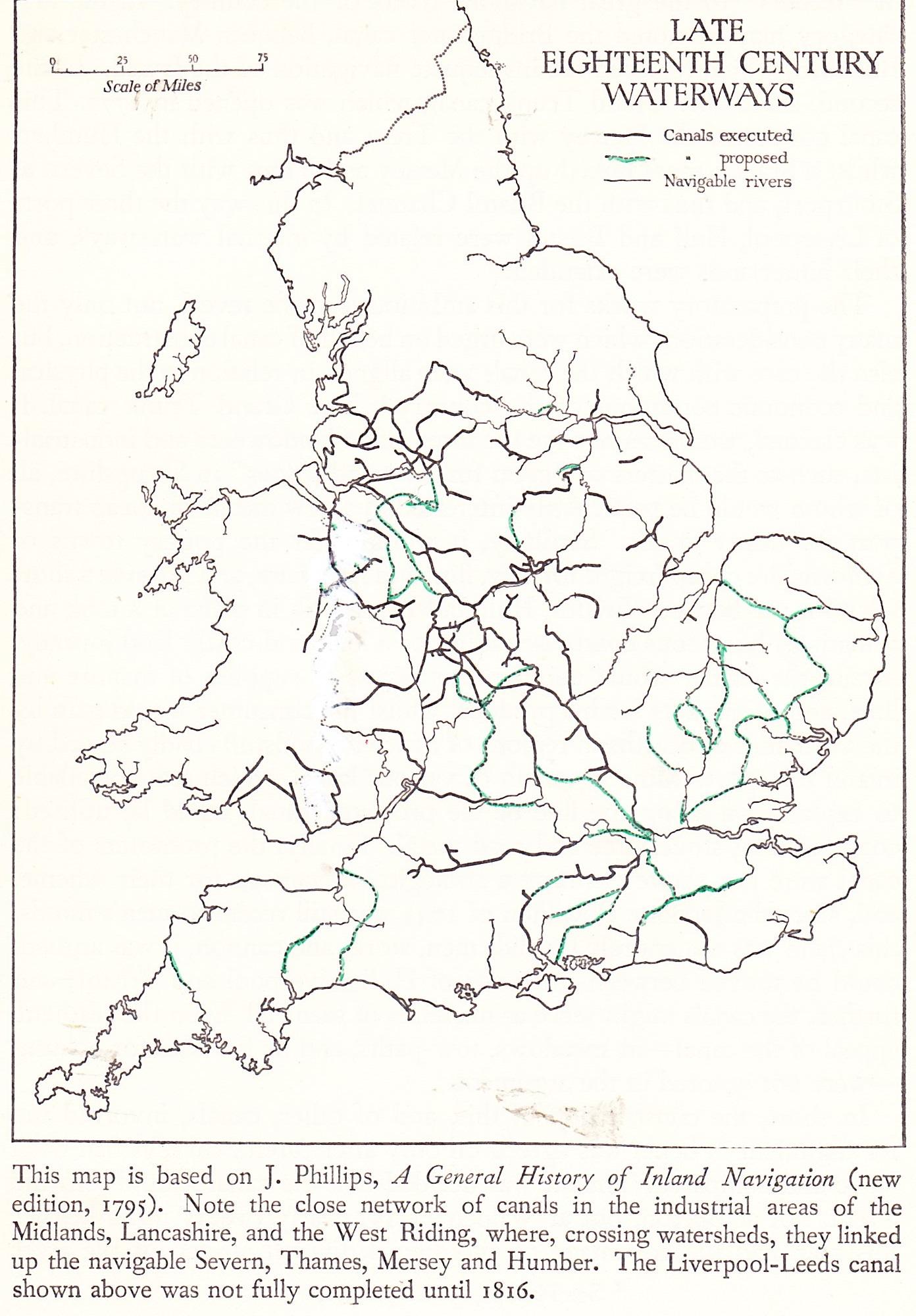
During the 18th century civil engineer James Brindley (1716-1772) was responsible for building over 365 miles of canals.  Brindely realized that any inland waterway network would need to connect to all the great navigable rivers that connected to the sea, including the Thames, the Mersey, the Severn and the Trent, incorporating other important navigable rivers like the the Avon and the Dee.  The network was a sprawling affair, but it revolutionized transport, avoiding roads that would become mired and impassable in winter, as well as unnavigable sections of rivers, and the riverine problems of tides, drought and flood.  Water into and out of the canal system was regulated and therefore predictable, and allowed year-round transport.  The advantages became very clear very quickly, and manufacturing and trading businesses began to locate themselves at critical points on the canal network.  Eagerness to invest in infrastructure resulted in a canal boom in the mid to late 1700s.  Each new section of canal required an Act of Parliament, subject to Royal Assent, and Act after Act was passed as the network expanded.

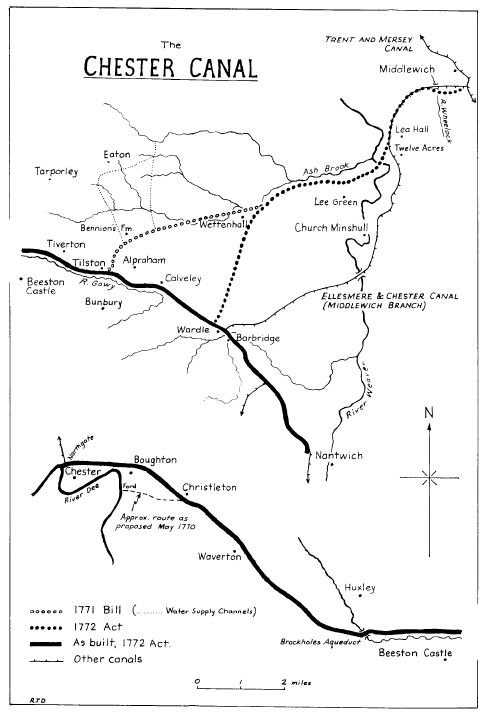
The Chester Canal. Source: Shearing 1985, p.150

The  execution of the canal project for Chester was deeply flawed.  Jumping on the canal bandwagon, entrepreneurs and investors envisaged a money-making venture that would bring Shropshire and Cheshire into the mainstream trade network with Birmingham, the nation’s canal hub and centre of industry, via a junction at Middlewich with the 1777 Trent and Mersey Canal.  Unfortunately, the builders of the Chester Canal did not have agreements in place to connect their new Chester Canal either to the Trent and Mersey Canal, which denied them permission to build a junction, or with the River Dee Company, which also put barriers in their way leading to several years of negotiation before a satisfactory solution was reached.  The Chester Canal, opening in 1779, was not built to Middlewich, where it had been planned for the Chester to join the Trent and Mersey, and instead stopped at Nantwich, segregated from the rest of the national canal network.  With little traffic carrying low-value cargoes, as well as a packet boat service, the canal was a fairly substantial failure.  In 1787 the Beeston staircase locks collapsed and there were insufficient funds to pay for repairs.  The Chester Canal hovered on the verge of bankruptcy.

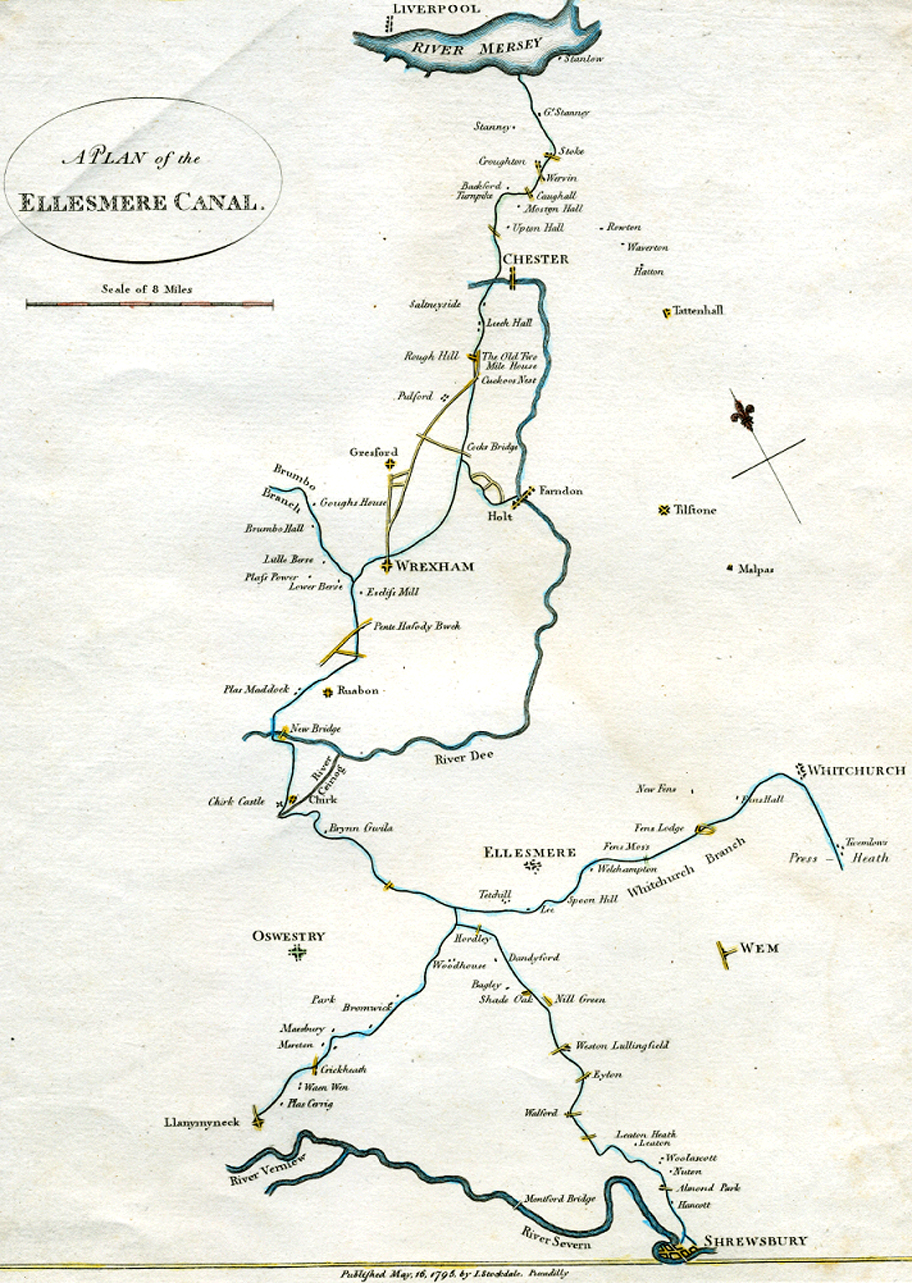
The complex arrangement of the Ellesmere Canal

The complex arrangement of the Ellesmere Canal and its branches is shown as thin blue winding lines. The thick blue line from Chester is the Dee. The yellow lines are roads. Click to see a bigger version. Source: Wikipedia

If it had not been for the 1791 Ellesmere Canal project, the Chester Canal would not have managed to limp on much longer.  The proposal for sections of canal to link the Mersey at Netherpool (now Ellesmere Port) to both the river Dee at Chester and the Severn at Shrewsbury was ambitious, but attracted sufficient support for a surveyor to be hired and possible routes to be explored.  The Ellesmere Canal proposal was presented to parliament and received its Royal Assent in April 1793.   Although shortages in funding prevented the realization of the full vision, shown right, Chester was at last brought into the national canal network. Part of this necessitated the addition of a new branch of canal from Chester to Ellesmere Port, which connected with the Chester Canal in what is now the Tower Wharf Basin.  The two companies merged in 1813, becoming the Ellesmere and Chester Canal Companh.  In 1833 the Middlewich branch was added, as the Chester Canal company had originally planned, and was connected to the rest of the network via the Trent and Mersey.

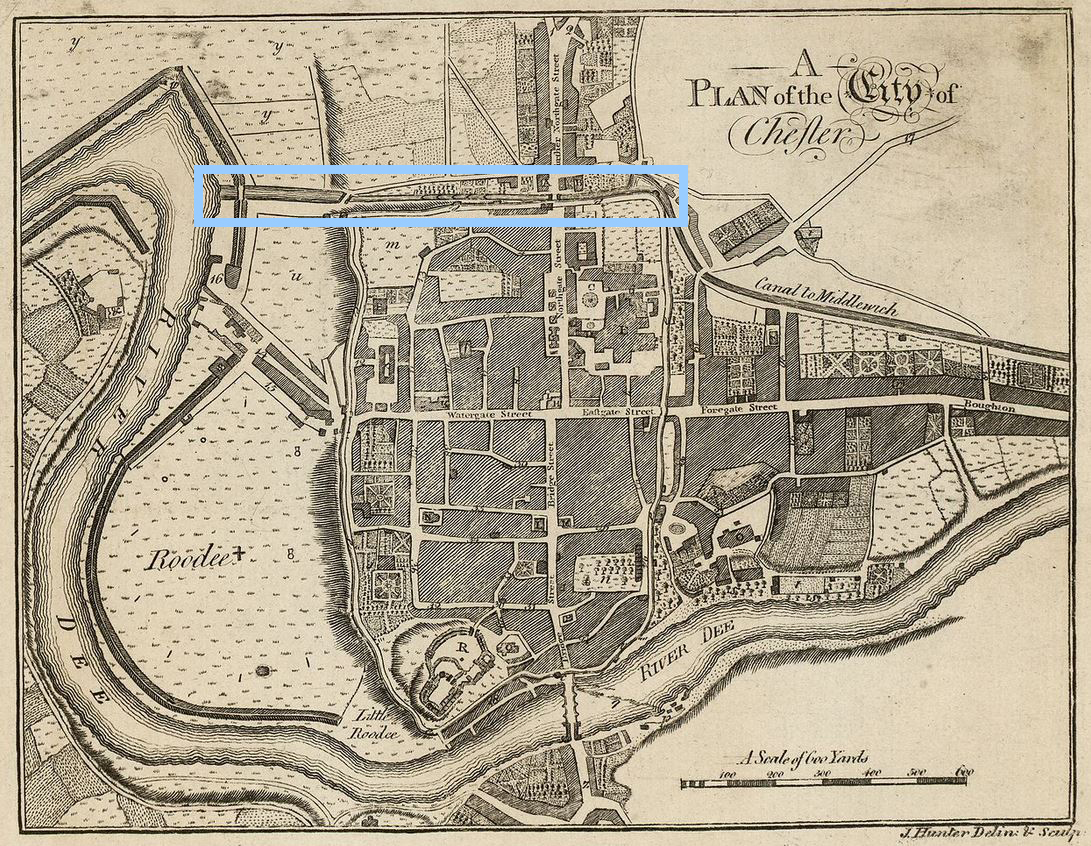
Hunter 1782 map with canal

Hunter 1782 map with the canal before the basins were added for the Wirral Line

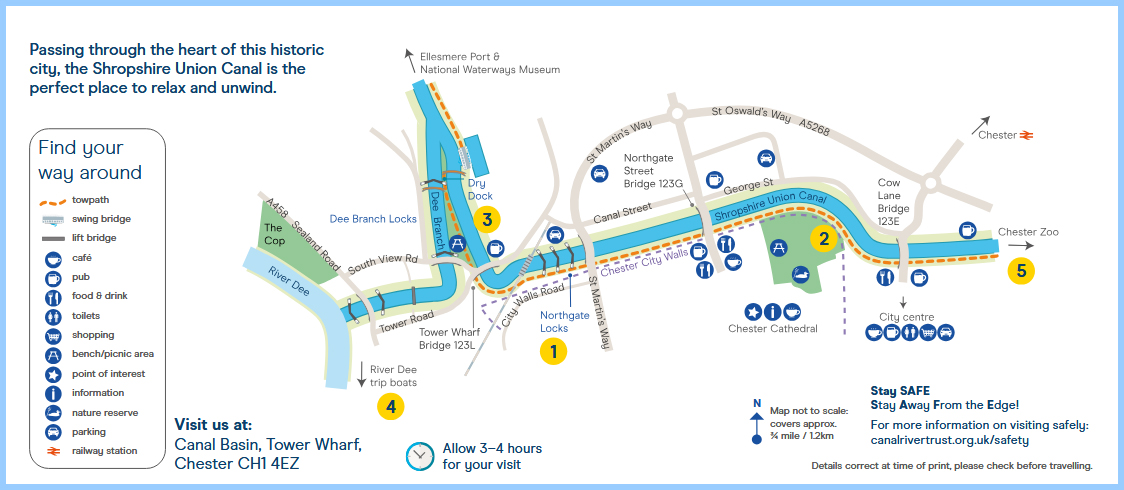
These changes required major infrastructure changes in Chester itself that are still clearly visible today.  Starting from the former interface between the river and the canal, just off Sealand Road, the derelict remains of the river-canal lock are clearly visible as industrial archaeology.  The gates have long gone and this section of the lock and the branch that once lead into the Dee Basin, along Tower Road on the map below, on its way to the Dee Branch, is full of aquatic plant life.  As you walk along towards the Dee Branch, rounding the corner and passing under the bridge, you find yourself in the basin complex, the Ellesmere Canal Company’s solution to how best to incorporate the Wirral Line north to Ellesmere Port.  However before the Ellesmere Canal Company was involved, the Chester Canal simply ran straight ahead, running directly along the Dee Basin into a set of five staircase locks before heading east towards Boughton.

Canal and River Trust map of the basin and wharves, showing the complex arrangement of locks and basins required to incorporate the Wirral branch of the canal to Ellesmere Port.


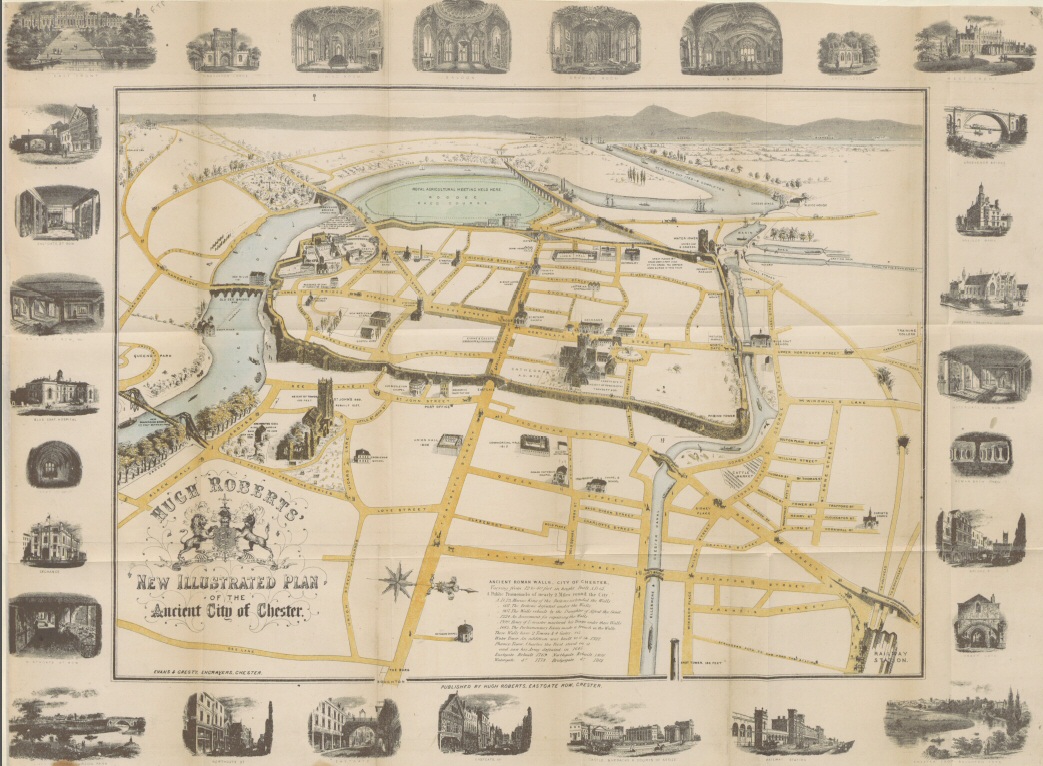
Map from the 1858 Roberts Chester Guide

Map from the 1858 Roberts Chester Guide, showing the big Dee Basin at the far end where locks connected it to the Dee. Click image to enlarge

The set of basins and wharves that became necessary when the Chester Canal was incorporated into the Ellesmere Canal Company’s plans capture the fascinating history of how the area’s canal system was forced to evolve.  Three different sections of the canal are involved in this complex arrangement, shown above.  The earliest of these phases belongs to the original Chester Canal, which begins at the river Dee and once headed straight along into a series of five locks that climbed the hill to the dramatic sandstone cut and onwards to Hoole and Boughton before turning south to Christleton and beyond.  The second phase is the Ellesmere Canal Company’s civil engineering work to incorporate the new “Wirral Line,” which headed in a roughly northerly direction out of Chester.  This now chopped off the Chester Canal at the base of the locks, demolishing two of the five locks, to create the Tower Wharf Basin.  The new arrangement cut off the canal from the river, meaning that another section of canal, called the Dee Branch, had to be created parallel to the main basin and accessed via a lock, to allow vessels to travel between the main line, the Wirral line and the Dee.  It is not an elegant solution, but it worked.  The rest of the canal is very straight forward as you walk towards Hoole, Boughton and beyond.  The historical interest in those sections of the canal is more about the bridges and the flanking architecture that grew up around the canal.

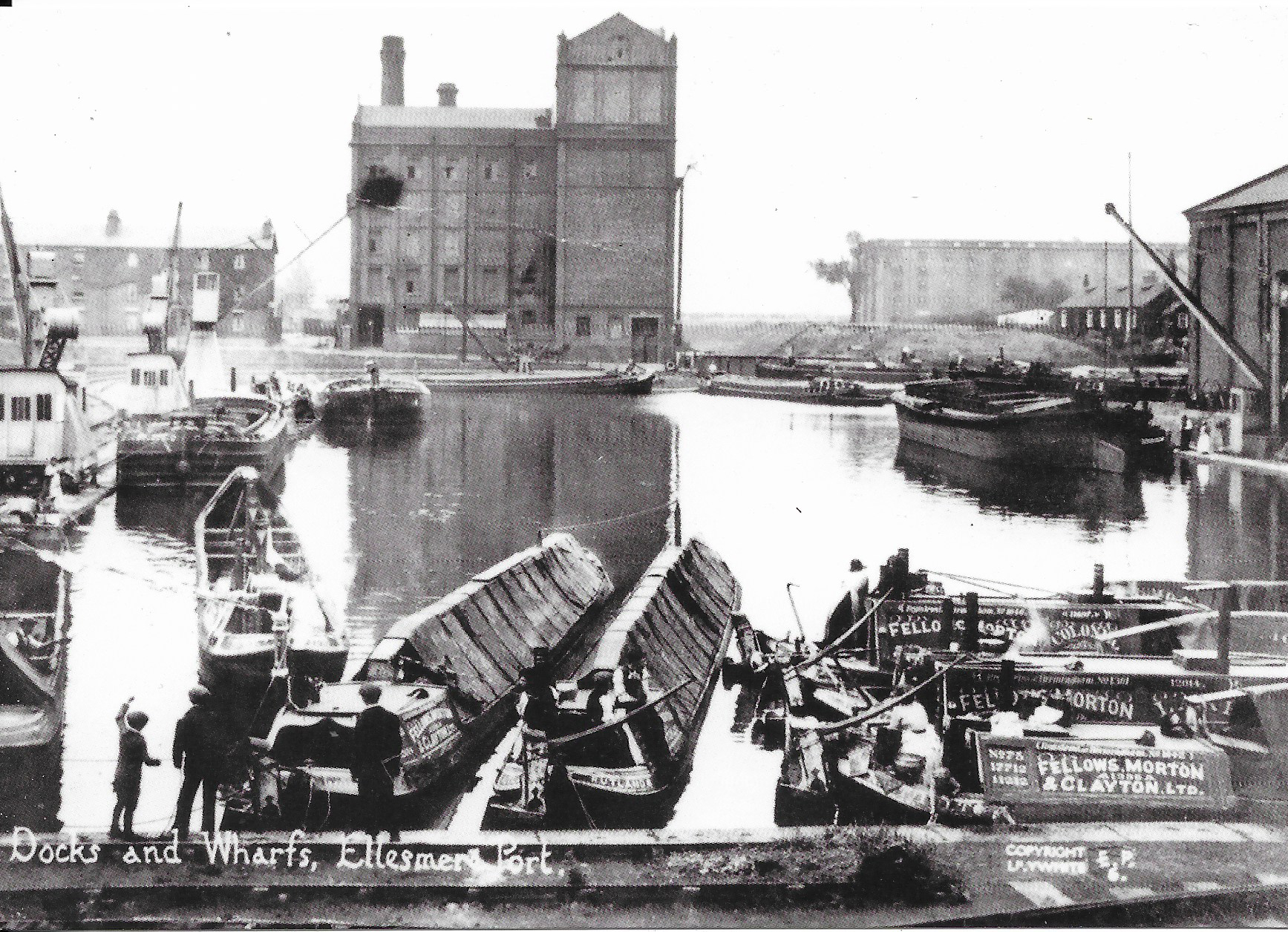
The docks at Ellesmere Port during the 19th century

The docks and wharves at Ellesmere Port during the 19th century, from the Ellesmere Port canal museum archives

In 1846 the decision was made to bring together the various canal and railway interests together under one umbrella organization, the Shropshire Union Railways and Canals Company, providing the different sections of canal from Ellesmere Port to Wolverhampton with a single name:  the Shropshire Union Canal.  In 1894 the Manchester Ship Canal opened, and the Ellesmere Port access to the Mersey was now via the new shipping channel.

In spite of canalization of the Dee in the 1730s was intended to make the rapidly silting river navigable and to make Chester competitive once again with Liverpool, but in spite of these measures silting continued and the river became impractical for serious commercial shipping and shipbuilding, particularly in the face of Liverpool’s rapid expansion.  The last ships were built on the Dee in the early 20th century, ending a centuries old industry, and the connection between the Shropshire Union and the river went out of use.

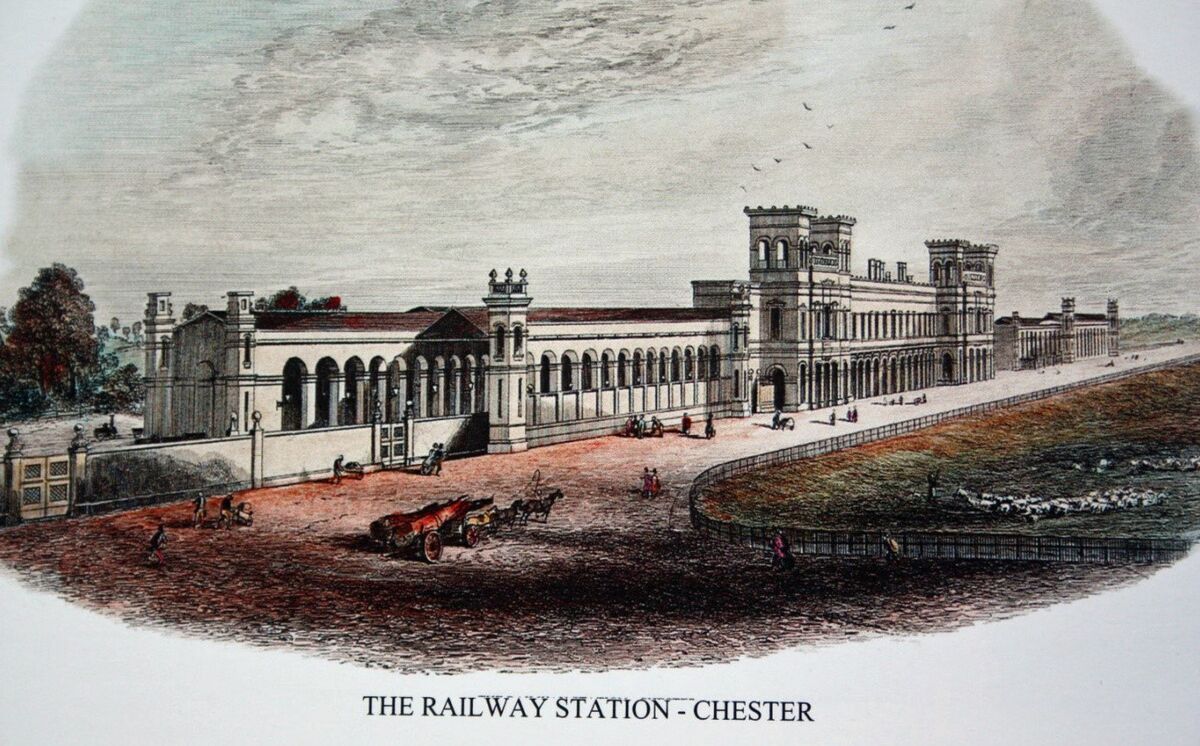
Chester Railway Station

Chester Railway Station 1848. Source: Hoole History and Heritage Society

The railway came to Chester in 1840, picking up some of the slack, but Chester’s days as a centre for trade and industry were over and the main financial opportunity that the railway brought was tourism.  The canal, however, continued to be used as part of the canal network, connecting to maritime trade via the Mersey.  Eventually, as rail replaced the canals, many of them became derelict, only reviving as leisure resources in the later 20th century.

The canal attracted many businesses along its edges, and today the canal preserves a considerable amount of commercial and industrial heritage, adding a welcome extra dimension to Chester’s historic legacy.  The canal network today is used for pleasure, mainly in the form of cruising, walking and cycling.  It still covers a vast region of England and Wales and is managed by a mixture of state organizations and by both regional and local charities.

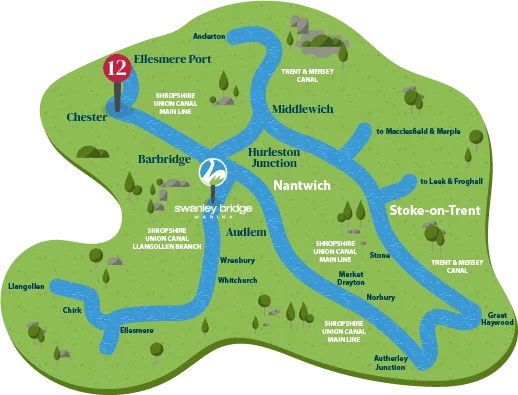
Schematic map showing how Chester relates to the canal network

Schematic map showing how Chester relates to the canal network today. Source: Swanley Bridge Marina

As canals have become attractive for residential development, new housing has also been erected, some developments more sympathetic than others, but all interesting.  The mixture is captured in the walk in Part 2. Apart from a few isolated examples, most of the warehousing that once flanked the basins and the canal has long gone, replaced by modern apartments, including student accommodation and retail outlets.

The Dee no longer connects to the canal network.  The lock between the river and the Dee Branch of the canal, lying just over Sealand Road, is completely derelict.  One of the locks further along is padlocked shut. The old swing bridge that had allowed vessels to interrupt road traffic to enter the canal network was replaced by the fixed road bridge in the 1960s.   Today the leg of the Dee branch of the canal running parallel to the Basin, once used for access to the river, is used for mooring privately owned narrowboats.

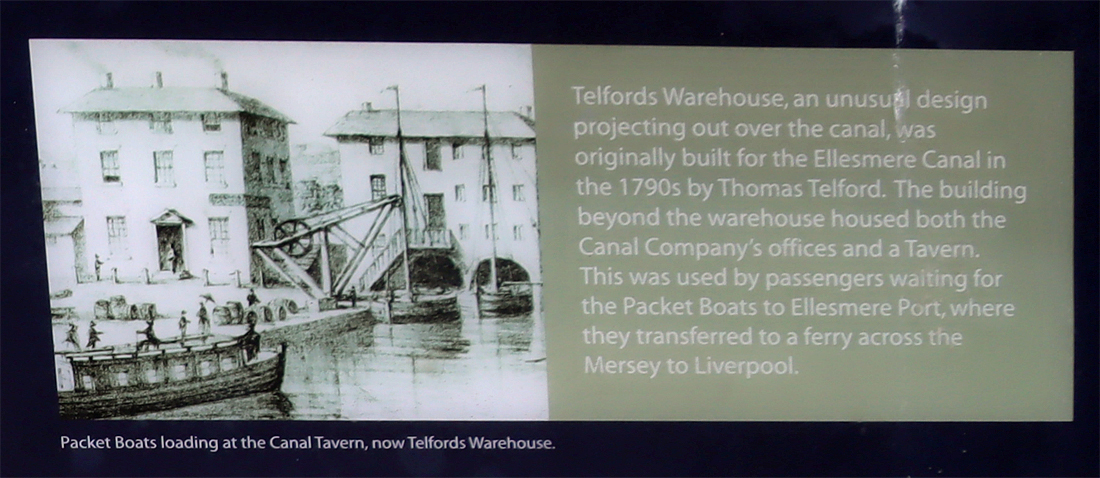
Signage at the canal basin showing information about Telford's Warehouse

Signage at the canal basin showing information about Telford’s Warehouse

I have kept this history brief, merely to introduce the walk.  Rather than reinventing the wheel, please see the Sources below, which contain much more information.  The three video links also provide an excellent overview, between them, of the canal, its history, and some of the buildings and businesses associated with it.  The first is by John Herson, one of whose guided canal walks I have done and thoroughly enjoyed, which focuses on Tower Wharf, the Canal Basin and the relationship of the canal with the Dee.  The second is by Stuart Shuttleworth and looks at the main line of the canal as it passes through Chester.  Together they form a brilliant introduction to the subject, showing the key places to visit.  At the end, underneath Sources, there is another video by “Pastfinder,” which is longer and explores what remains today in more depth, walking and talking at the same time, making it quite easy to retrace his footsteps.  There are some fascinating additional pieces of information in this.

John Herson:

Stuart Shuttleworth:


Sources:

A lot of information is contained in the two videos above and the one at the end of the post.

Other sources of information are as follows:

Books and papers

Carrington, Peter 1994. English Heritage Book of Chester.  Batsford / English Heritage

Martin, Richard 2018. Ships of the Chester Rivers.  Shipbuilding on the Dee from Chester to the Point of Ayr 1800-1942. Bridge Books

Mosse, J., David Lobband and Judith Pile 2023 (9th edition).  Collins Nicholson Waterways Guide 4. Four Counties and the Welsh Canals.  HarperCollins

Nicholson, R. 1989 (4th edition). Nicholson/Ordnance Survey Guide to the Waterways 2: Central. Robert Nicholson Publications and Ordnance Survey

Shearing, Edwin A. 1985. Chester Canal Projects: Part I. Journal of the Railway and Canal Historical Society. Vol XXVIII, no.3, November 1984. p.98-103

Shearing, Edwin A. 1985. Chester Canal Projects: Part II. Journal of the Railway and Canal Historical Society. Vol XXVIII, no.4, March 1985. p.146-154

Ward, Simon 2013 (2nd edition). Chester. A History. The History Press

Websites

Canal and River Trust
Welcome to Chester. Escape the city on this tranquil waterway (PDF)
https://canalrivertrust.org.uk/media/document/0z8YCnXdfYHg_am-LmUGSg/p22Wl115w_dWrQTRa-XYJd5Q5nl2UR6N17EY2G1JFyc/aHR0cHM6Ly9jcnRwcm9kY21zdWtzMDEuYmxvYi5jb3JlLndpbmRvd3MubmV0L2RvY3VtZW50Lw/0192bddd-4001-76ad-a95b-0ad3662ccdcc.pdf

Canal Routes
Chester Canal History
https://www.canalroutes.net/Chester-Canal.html
Chester Canal Route
https://www.canalroutes.net/Shropshire-Union-Canal.html#Chester-Canal-Route
Ellesmere Canal – Wirral Line
https://www.canalroutes.net/Shropshire-Union-Canal.html#Ellesmere-Canal-Wirral-Line
Shropshire Union Canal
https://www.canalroutes.net/Shropshire-Union-Canal.html

Cheshire West and Cheshire
Chester Canal Conservation Area Character Appraisal Ellesmere Port to Nantwich (PDF)
https://www.cheshirewestandchester.gov.uk/documents/planning-and-building-consultancy/total-environment/conservation-and-design/conservation-area-appraisals/canal-conservation-area-elesmere-port-to-nantwich-latest-version-261118.pdf
Chester Characterization Study
https://www.cheshirewestandchester.gov.uk/your-council/policies-and-performance/council-plans-policies-and-strategies/planning-policy/chester-characterisation-study

chesterwalls.info
Photographs of the Chester Canal Old and New, parts 1-5
https://chesterwalls.info/gallery/canalgallery.html

Chesterwiki
(with a lot of adverts interspersed)
Canalside
https://chester.shoutwiki.com/wiki/Canalside
Canal and Boatyard
https://chester.shoutwiki.com/wiki/Canal_and_Boatyard

Grace’s Guide to British Industrial History
James Brindley
https://www.gracesguide.co.uk/James_Brindley
William Jessop
https://www.gracesguide.co.uk/William_Jessop

Heritage Chester
Bite-Sized Wonder – The Lead Shot Tower
YouTube video

Historic England
Bridge of Sighs, Upper Northgate Street
https://historicengland.org.uk/listing/the-list/list-entry/1375967
Telfords Warehouse, Raymond Street

https://historicengland.org.uk/listing/the-list/list-entry/1375919?section=official-list-entry

Inland Waterways Association, Chester and Merseyside Branch
Chester Heritage Port Designation Document (PDF)
https://70cf2f03-3eb2-43c8-889f-b8f841fc3757.usrfiles.com/ugd/70cf2f_64e6633c34b9420f8c06a368857d1a42.pdf

UK Waterways Guide
Map of the Shropshire Union Canal
https://www.ukwaterwaysguide.co.uk/map/shropshire-union-canal/all-branches

“Pastfinder”:

A revealing talk and guided tour: The Churchill Building and the Western Command 1937 – Today

The Churchill Building portico dates from 1997, but the original Neo-Georgian military Western Command building can be seen behind it.

The portico dates from 1997, but the original Neo-Georgian military Western Command building can be seen behind it.

With many thanks to Chantal Bradburn for an excellent lecture in the Churchill Building in the University of Chester’s Queen’s Campus.   Chantal is the University’s Outreach representative, with a strong background in art history and a particular interest in architecture in its social context.  Her talk, entitled “Western Command (Churchill Building),” covered the design and original purpose of the building as the headquarters of the Western Command, including the fascinating underground bunkers, and the building’s subsequent phases of use.  The presentation and the subsequent walk around the building’s exterior brought the Western Command to life.  Chantal’s ability to convey an impression of the building as it was in military times, based partly on her research and partly on feedback from people who have attended the talk or contacted her over the years, was of critical importance, because the interior had been completely re-envisioned in grandiose style by the subsequent bank, and converted once again in more pragmatic terms into the University of Chester’s Business School.  Only the exterior retains the essential character of the Western Command building.

The eastern wing of the Western Command (Churchill Building) gives a good impression of how the building appeared when it was first built

The eastern wing of the Western Command (Churchill Building) gives a good impression of how the building appeared when it was first built

The building, then known as Capital House, was completed in around 1938, almost certainly in response to the threat of war.  Neo-Georgian is not my favourite of the various architectural experiments in Chester.  I have grumbled on and off about the Wheeler Building on the blog for years, and there are a number of more modest buildings dotting the streets of the historic city whose architects seem to believe that slapping some symmetrical rectangular windows into plain blocks of undifferentiated brickwork will do the trick nicely, completely missing the point of refined elegance and delicate embellishments that characterized Georgian harmonies.  On the other hand, as Chantal pointed out, at least in the case of the Churchill Building there are good reasons for this style, which is better than most of its siblings, relating not merely to the practicalities of budget constraints for such a large building.

The eastern entrance to the Churchill Building with subtle nods to Art Deco 

The eastern entrance to the Churchill Building with subtle nods to Art Deco

The importance of establishing a dignified military presence referenced the power and prestige of the city’s Georgian predecessors, which were themselves influenced by Classical architecture, whilst some low-key features nod to both the medieval military past and, in an even more subtle way, other contemporary styles.  I would not have noticed these had Chantal not pointed them out.  Although the subsequent Northwest Securities bank slapped a gigantic Classical-style portico on the front, the original building consisted of flat-roofed blocks that provided an impressive frontage, which relies for its impact on the size of its footprint rather than the height of its two-storey walls.  Chantal pointed out that the position of the building was strategically very fine, with its views over the river and the city beyond, only matched in its vantage points by the site chosen for the castle.

As the northwest HQ for intelligence on what was quite literally Britain’s western front during the war, the personnel serving in the Western Command building had a critical role not only leading up to and during the war, but for a surprising amount of time after it.  Chantal told us a great many stories about the role of the building and the people who worked there, highlighting the complexities that different levels of security caused for both employees and contractors, and emphasizing the degree of secrecy that was associated with the activities that took place within the Churchill Building.

Bunkers excavated into the sandstone at the Churchill Building. Source: 28DaysLater

To the east of the building, up-river, the remarkable and extensive underground bunkers were built to provide shelter and a command centre should it become necessary, both during and after the Second World War.  They extend from the level of the building down towards the river.  It is reputed that Churchill, who is known to have visited the building, may have met there with President Dwight D. Eisenhower and General Charles de Gaulle.  No documentation supports this view, but there are apparently anecdotal accounts that support the possibility.  The bunkers are now too dangerous to visit (see a photograph of a point of collapse on the 28DaysLater website).  The sandstone through which former miners in the army excavated to create the bunkers is sponge-like, attracting damp that is not helping with the stability of the underground structures.  Chantal showed photographs and explained past survey work and future plans (dependent as always on funding).

The building passed to the Royal Army Pay Corps in 1972, and from 1972 it was taken over as offices for a banking corporation.  The presentation took place in a huge room with an enormous table, all very glossy and highly polished, and heavily influence by Art Deco designs.  This was part of the bank’s improbable legacy.  It is quite staggering how the bank took over a military building and turned it into an extrovert and financially corrosive expression of self-indulgent excess.  Where these details have survived, the legacy is huge fun, but quite mad.  The bank’s vast portico, converting the Neo-Georgian blocks into a pseudo Classical temple, is equally pretentious. I am very fond of the University, having had a great time doing some post-graduate research there a couple of years back, but it really does seem to have saddled itself with buildings that for all their scale and practicality are amongst the least aesthetically charming of the various Cestrian styles.  In their favour, the University does make the most of them.

The opening of the Churchill Building by John Spencer Churchill (centre in grey suit), when it became part of the University of Chester in October 2015. Source: Cheshire Live

It is interesting to note that in the case of both military base and commercial bank, the building was off-limits to the public, not only physically but visually.  The arrangement of buildings at the time meant that the view through the gates, then in a different position, blocked any view of the heart of the complex.  It has been particularly interesting for local people who have lived in the area for a number of decades to have access to the building at last, and to be able to see what was so long hidden from view, perhaps particularly when family members and friends worked there.

The building had been out of use for a decade when the University took it over in 2015 to make it the centre for their Business School, with most of the building adapted to this task with the usual collection of teaching, research and computer rooms, areas for socializing and a café.  Wisely, the decision was made to preserve some of the more elaborate flourishes of the bank’s idea of good taste, and there are some distinctly New York style decorative features in the foyer.  More to the point, the building’s foundation stone and its frame, appropriately made of carved stone rather than the less expensive brick, has been preserved and is now installed above the reception desk as a very welcome piece of the building’s material heritage.  The exterior, now sporting a leaded dormer roof, still retains the essence of its stern and uncompromising military purpose, but its survival first as a bank and then as a major component of a university campus is a testimony to its durability.

It is impossible to do justice to Chantal’s talk, which was stuffed full of information.  Chantal does these talks quite frequently, and I do recommend that you keep an eye open for her next ones, because she provides a vivid insight into a world that is not normally associated with Chester, and which was clearly a very important part of the city’s social and economic profile from the 1930s onwards.  More than any other talk that I have attended since moving to the area, this is the one that surprised me most, and left me with a new set of insights into Chester’s less publicized wartime and post-war history.  Splendid.

North-facing aspect of the Churchill Building

Day Trip: The RAF Museum Midlands at Cosford, near Telford

Sopwith 1 1/2 Strutter (replica) in Hangar 2

Even if aircraft and aviation history are not really the first things that spring to your mind when you are looking for a museum to visit on a day out in the general area, the RAF Museum at Cosford offers a thoroughly absorbing experience.  Aeronautical development has progressed so rapidly since the early 20th century that the first engineers and pilots might well find all the new innovations, capabilities and capacities that are on display at the museum fairly miraculous, and these have been significantly surpassed by much newer models.

This was my third visit.  The first visit was with my father who as a school boy at Calday Grammar on the Wirral had loved being in the Air Cadets, and went on to do his National Service in the RAF.  The second was with a friend whose father had served as a  Flight Engineer from before his 20th birthday during the Second World War, working and flying on Avro Lancasters.  Both my father and my friend brought away very personal experiences of the museum, but even without  these intimate connections, the RAF museum at Cosford is a rich journey into aeronautical history.  There is splendid innovation, superb technology, surprisingly aesthetic appeal and, in some cases, the sheer immensity of some of these vast monsters.  The full-life biographies of the aircraft themselves are themselves compelling, but the museum also tells dozens of stories about the people whose lives were embedded in the RAF, as well as in commercial travel, both in times of war and peace.===
===

===
===

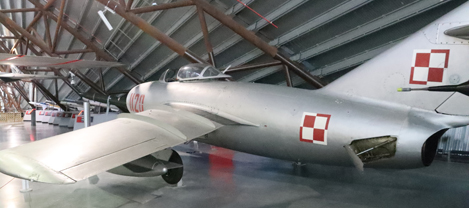
Hangar 4. Mikoyan-Guevich “MiG” 15bis.  Single seater jet intercept fighter, Russian-designed and notable for its use in Korea where its superior performance came as a shock to American pilots.  Maximum speed 688 mph. 1949-1970s

The aircraft are not exclusively British. There are American, German and Russian planes, as well as those built as joint enterprises.  The information boards compare and contrast them with contemporary British aircraft that they came up against, in terms of maneuverability, speed and technical specifications.  As well as planes there are also a couple of helicopters, staggeringly massive things that don’t seem even remotely aerodynamic, as well as some supporting ground vehicles including tanks, cars and aircraft tugs.  Although less obviously comprehensible, the range of aircraft engines on display also contributes to the story of aviation and its development, with information panels explaining how the engines improved the viability of aircraft.

Hangar 4. Hawker Siddley Vulcan in the foreground. A fabulous-looking long-range medium delta-wing bomber that was eventually converted for use as an air-to-air refuelling tanker

The focus on aircraft is not exclusively military.  Although there are a lot of those, several of the planes on display were commercial airliners of different sizes, built for carrying passengers, and the history of some of these early pioneers is well explained.

The museum is immense, taking up four gigantic hangars, each one with its own particular themes.  Although each of the Hangars is themed, there are some aircraft that don’t fit neatly into the themes, allowing for the inclusion of a lot of variety throughout all the hangars.

Bristol Britannia 312 turboprop aircraft known as The Whispering Giant due to is comparatively quiet engines. It first flew in August 1952. Due problems with the turbine engine less than 90 were made and sold to both civilian airlines, like the now defunct BOAC passenger carrier, and the RAF.

The Hangars

It is worth taking some time before you start your tour to have a look at the wall maps in the reception area, which provide details of how the different hangars connect. The numbering of the hangars is a little counter intuitive, because the first of the four that you visit is Hangar 2 (H2), then Hangar 3 (H3), then Hangar 4 (H4) and the last hangar that you visit is Hangar 1 (H1). The maps are dotted throughout the hangars but in order not to miss anything it is a good idea to sort it all out in your head in advance.  It is easy, for example, to completely miss the second hangar on your visit, because it is connected to the first hangar that you reach via two small doors that are relatively unobtrusive.  There is a guide book that has a copy of this map, copied below.  More visiting details are at the end as usual.

The site map from the Souvenir Guide (2024, Royal Air Force Museum), page 72

Hangars 2 and 3

The first hangar that you visit is Hangar 2, or H2.  To reach Hangar 2 the route takes visitors outside, passing between three magnificent aircraft, each with information boards, before passing a fourth, the innovative, versatile and very successful PBY Catalina flying boat and amphibious aircraft, at the entrance into Hangar 2.

On the other side of the door is a gallery dedicated to stories about RAF experiences between 1918 and 2018, before you pass into the hangar itself.

1940 wooden emergency exit hatch from the cockpit of Hawker Hurricane P2798 showing the cartoon cat Figaro, the personal marking of Wing Commander Ian Gleed, pilot and Second World War fighter ace

The function of the RAF, the world’s first independent air farce, remains unchanged across a hundred years: its mission is to defend the UK, to attack if required, to support in times of humanitarian crisis and to move people and equipment quickly across the world.

Like the other small galleries in the four hangars, this displays information about the immense variety of men and women who have served and continue to serve, with the vast range of skills that are required to make this military machine function. They also display the objects that related to those people, both formal and very personal.  This is an excellent way of using objects to connect people to their personal biographies and their official careers and the honours they were awarded.  Be sure to enter H3 from one door and return to H2 via the other so that you visit both galleries.

Page from the Souvenir Guide (Royal Air Force Museum 2024, p.32) talking about some of the highly personal measures that RAF personnel took to help them face the tasks before them.  Objects like these are just as much a part of RAF history as the aircraft in the museum

The main hangars in H2 and H3 focus on War in the Air and Test Flight, a mix of wartime and post-war aircraft.  Some of those on display are such icons that it is almost impossible not to reach out and touch.  In the First and Second World Wars, many planes were employed before it was possible to put them through their paces before they were needed in combat, and they were essentially put to the test in active service.

==

The iconic Spitfire MK1, the oldest surviving example


The Boulton Paul Defiant was vulnerable to Luftwaffe fighters. Instead of being withdrawn from service, these were painted black and moved to night operations, although they were eventually withdrawn altogether.
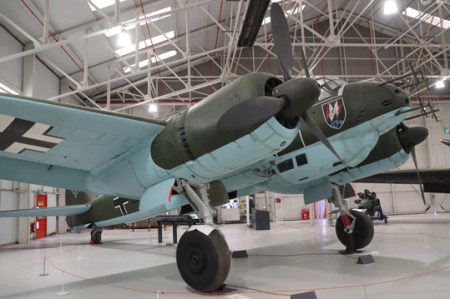
 

TheGerman Junkers JU-88R-I

Although it is  not possible to convey the sheer immensity of the Avro Lincoln, it is an absolute giant of a thing.  Its design was based on the Lancaster, but although it was too late for a combat role in the Second World War, it served the RAF until 1963, long after the first jet engines had come into use.  Cosford doesn’t have a Lancaster, but this is an imposing creation in its own right.
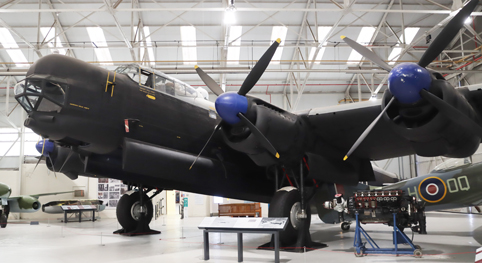
An Avro Lincoln, giving no impression in this photograph of how massive it truly is

After the Second World War significant investment was made in developing technologies to provide specialized requirements, and testing became increasingly important.  Whilst some aircraft took on important roles in the RAF, others either failed to make it into production or were significantly modified before they were adopted.  The history of aircraft is as much about those that failed, or were not entirely successful, as it is about those that became either fundamental icons or invaluable workhorses of aviation history.  It is this mixture of aircraft biographies and narratives that define Hangars 2 and 3.


British Aircraft Corporation TSR2, Combat Prototype

Details of the British Aircraft Corporation TSR2, Combat Prototype

BAe Experimental Aircraft Project


Hangar 4
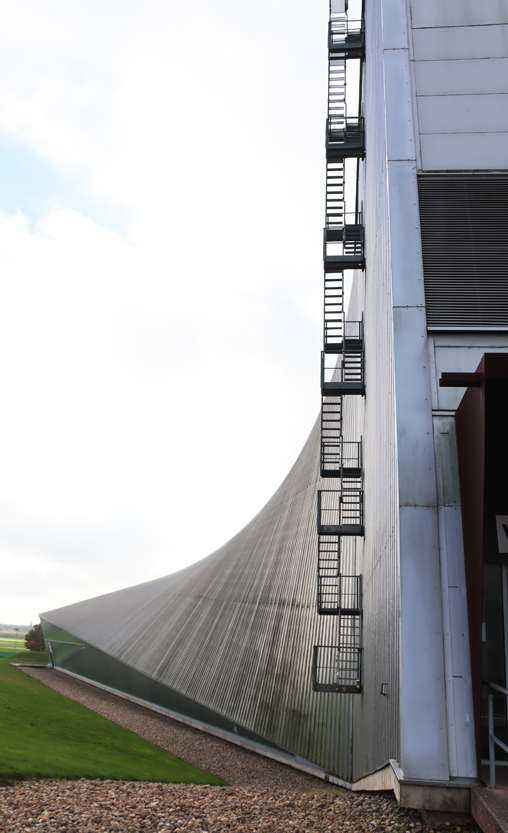
H4 is next, a soaring modern building themed around The Cold War.  It is a truly spectacular building in its own right, both outside and in, a functional and striking space for displaying a huge number of aircraft to best advantage.  This is all about a new generation of fighter and surveillance aircraft, missiles and drones, as well as support vehicles.  Entered from H2 at ground level, you find yourself confronting aircraft overhead, on the same level and below, with lifts as well as stairs to get down to the the lower level.  One of the novelties, apart from the aircraft overhead, is being able to walk along the gallery and view some of the vast machines that are sitting on the lower level face to face.

It is a magnificent visual display but as in the other hangars also has plenty of information about why each type of aircraft was built, and what makes them unique, plus information about the men and women who worked in these different contexts.  At the same time, it addresses the important and often vexed subject of conflicting ideologies and why such ideologies erupt into military action, making military assets a necessary aspect of modern life.  The focus is, as the name of the hangar indicates, the Cold War, and the opposing ideologies that resulted not merely in defensive strategies but also in both armed conflict and, in an attempt to reduce the likelihood of war, such initiatives as the North Atlantic Treaty Organization (NATO).
===
===

The Vickers Valiant of 1955, designed for nuclear strikes, and withdrawn form service in 1965. Group Captain Ken Hubbard, caption if Vickers Valiant XD818 remembers its first drop of a British thermonuclear bomb with the resulting mushroom cloud “a sight of such majesty and grotesque beauty that it defies description.”

==

Douglas Dakota

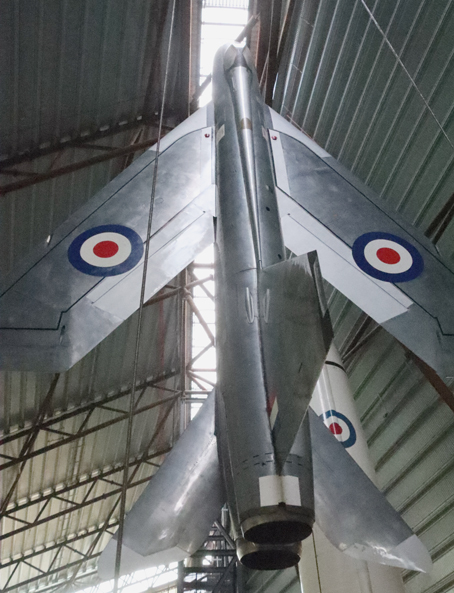
The Lightning, the first RAF fighter capable of flying at twice the speed of sound, but with short operational range

Details of a personalized Handley Page Victor, which entered service in 1958

Sikorsky MH53 Pave Low long range combat, search and rescue helicopter

Sikorsky MH53 Pave Low interior

==

Scottish Aviation Twin Pioneer light transport


Hangar 1

The last of the hangars, H1, is themed along the lines of Transport and Training.  Transport of equipment, personnel and supplies is a major element of airforce logistics, and aircraft designed specifically for these tasks may be either passenger carriers or sometimes gigantic warehouses on wings designed to carry whole platoons or heavy armoured vehicles and armaments.  Training aircraft may be tiny by comparison with some of the vast aircraft in tis hangar, used for acclimatizing trainee pilots and building up the skills of both trainee pilots and other air and ground crew, including engineers.  This hangar also has an excellent display of engines, which also required the training of aircraft engineers, giving insights into the anatomy of these power houses propel aircraft off the ground and keep them in the air.

Fairchild Argus II light transport, which entered service in 1932

Hawker Siddeley Andover E.3A. Originally designed as a transport aircraft, it was converted to carry out calibration duties on radar and radio navigation aids

Percival Pembroke, which entered service in 1953 for light transport and communications and was withdrawn only in 1988

Hawker Siddeley Harrier GR.3

If the size of the Lincoln was the first of the aircraft to blow my mind, the Armstrong Whitworth Argosy is seriously humongous.  It is impossible to convey its scale, with its twin tails and its enormous wing span. It entered service in 1962 and could carry up to 69 troops or 13,000kg of equipment including armoured vehicles. It is two storeys tall from ground level to the cockpit.  The lens on my camera couldn’t fit anything like the whole thing in, and gives no sense of what this aircraft actually looks like, so see the image below the one in the museum of one of these crazy-looking things in flight.

Armstrong Whitworth Argosy

===

Armstrong Whitworth AW660 Argosy C1 XP445 in RAF Near East markings from the BAE Systems website.


Rolls Royce RB211 22C engine used in the Lockheed Tristar, and the Boeing 747 and 767. Compare with the size of the edge of the doorway immediately to its right. Huge!

Vickers VC10 C1K long range transport

Final Comments

My father in typically mellow mode after he chose the RAF for his National Service, looking awfully youthful.

Anyone who visits will take something different away from Cosford, depending on their interests and their personal connections with aircraft.  We left the UK when I was a child, returning in late 1979, and part of my experience of living overseas was flying to and from Britain to visit family, first as an “unaccompanied minor” and then on my own, making it a routine form of travel.  Once, flying from Heathrow to Liverpool with my father in a propeller plane, he warned me about coming in to land and the noise and vibration that I, having only flown in jets, would probably find startling.  I did, but what fun! Years later, in a passenger plane taxiing down a Heathrow runway, the captain told those of us on the right side of the plane to look out of the window to see a Harrier jump-jet do a vertical take-off.  Fantastic.  Twenty or so years ago I saw a Vulcan flying at the Farnborough Air Show and have never forgotten it, and at the same show saw a vast commercial passenger plane being put through extraordinarily acrobatic paces, and that too remains in my mind as a very different but remarkable sight.  Two years ago I was at RAF Duxford with my father, and was lucky enough to be there just as a whole series of vintage biplanes were taxiing down the field and taking to the sky. Magical.  Aircraft do have their own special sorts of aura, some darker and some brighter than others.

The aircraft at Cosford are beautifully displayed, and while you can just stand and admire the sheer magnificence of these astonishing beasts, the signage is all thoroughly educational without in any way talking down to the visitor.  The sheer amount of information delivered in a digestible way is genuinely impressive.

Visiting
The museum is free of charge, but parking is charged (at the time of writing) at £7.50.  You can check for updates on charges and opening times on the museum’s website here.  The museum hosts a number of events throughout the year, including an air show and corporate events, so do make sure that the entire museum is open on the day you want to go, and that none of the hangars are closed for any reason.

The car park is huge, and payment of the set fee is via machines that are dotted around.  There is a really nice cafe in the reception area, which offers drinks, snacks and lunches, and everything is bright, clean and modern.  You will need to stop at what looks like a ticket stand to confirm that you have paid for parking, and so that you can be counted, because the museum’s funding depends on the volume of footfall.

The museum’s shop is in the third hangar, with some fun stuff for sale, but you can buy a souvenir guide in the reception area.  I did buy this, with some considerable doubt in my mind because anything that refers to itself as a souvenir doesn’t inspire confidence, but this 73-page booklet, full of great photos and information, was really enjoyable and when I arrived home I read it cover to cover.  Just like the museum itself, this mixes stories of planes and people, and the result is admirable.

The museum recommends that you allow four hours to get around all four hangars, including walking around the outside aeroplanes.  Not being an expert, and not stopping to listen to the many audio recordings or watch the video displays, I did it in a leisurely two and a half hours, stopping to read a lot of the excellent signage and to take photographs.  I took an additional half hour afterwards to consume a heavenly coffee and a bite to eat.  So for me, including my snack break, it was a three hour visit, which I enjoyed phenomenally.

Lockheed Hurcules C Mk 3P medium-range tactical transport aircraft that could operate from short runways.

If it looks like rain take a brolly or a raincoat with a hood, because you will have to walk from the reception area outside to the first hangar, and there are aeroplanes to see in the grounds as well.  The first two hangars, 2 and 3, are physically linked, but it is easy to miss that there are doors letting you through.  From there, it is a matter of going outside again, into Hangar 4, and again across a small access road into Hangar 1.  If you want a coffee or something to eat afterwards, it’s few minutes to walk back to the reception area via another two outdoor planes.

There is disabled access throughout, including H3’s viewing gallery, lower level and shop.  Signage is all at a level that can be read by wheelchair users.
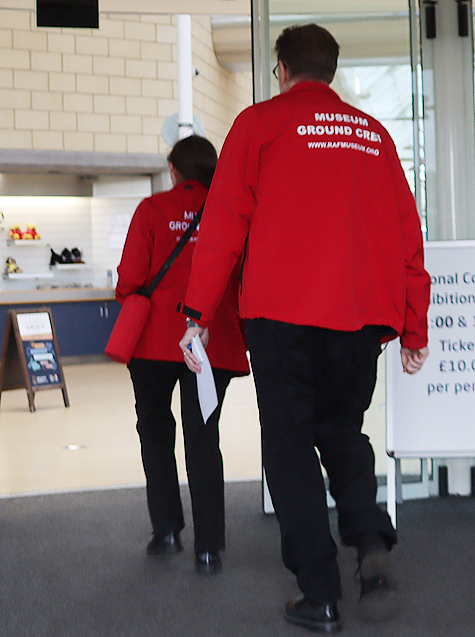
Museum Ground Crew

Only one of the aircraft, at least on my three visits, allows visitor access, and this was a guided tour for a fee at restricted times, so experiencing the planes is a matter of viewing either from the floor or, in the third hangar, from both floor level and via a viewing gallery.

If you don’t want to be inundated with children, avoid weekends and school holidays.  School trips mean that they are not completely avoidable, but you stand half a chance.

Every time I have been there, especially last month (October) when I turned up at opening time, there were volunteers everywhere who are there to offer knowledge and help you with any visiting information.  They are a hugely knowledgeable and friendly bunch.

If you have even a marginal interest in aircraft or the history of technology, this makes for a very rewarding day out.

Hawker Cygnet, 1924-29