Category Archives: Llangollen

Valle Crucis Abbey #3 – The architectural history of Valle Crucis Abbey

Inside the rib-vaulted slype (or passage) passing through the east range of the cloister, to the rear of the abbey. Source: Coflein

In part 1 of this series, the establishment of the Cistercian order of monks, a branch of break-away houses based on the rule of St Benedict is explained, and its spread into Wales during the 12th century is discussed.  Within this context, the foundation of Valle Crucis Abbey by Prince Madog of Powys Fadog is introduced, establishing the abbey as a member of a unique family of Cistercian houses that had its own particular Welsh character.

Part 2 looked at what each of the monastic buildings was for and how each room was used by the community of monks that lived at the abbey, potentially for the duration of their lives.  It is discussed how the layout of each abbey was unique, but was guided by the basic Cistercian model of mixing domestic and religious buildings around a square, the cloister, and how this is demonstrated at Valle Crucis.

This post, part 3, takes a look at the history of the abbey buildings, pointing out how how certain architectural features indicate developments between the time of the foundation of the abbey in 1201 to its dissolution in 1537.  Over this time, the occupants of the abbey responded to disasters, including fire and war; fluctuating economic conditions; changes of abbey leadership, and evolving outlooks, including eroding values, within the Cistercian order.  The architecture of the claustral buildings reflects many of these changes, whether imposed upon or chosen by the community, capturing them uncompromisingly in stone.

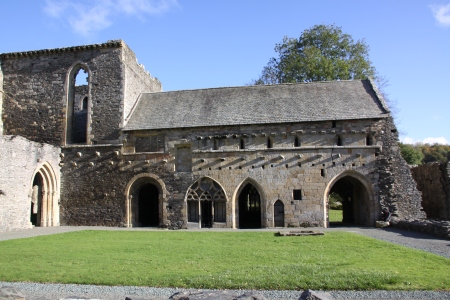
The row of arches that define the eastern range of buildings surrounding the cloister.

The entire abbey is a narrative of time passing, and the east range of the cloister is a good example.  In the photograph of the east range  to the left, this small but well preserved section of the abbey reveals an immense profusion of architectural change, during the lifespan of the monastery and beyond its closure by Henry VIII.  The  combination of the row of arches above the window frames, lines of holes and protrusions and the slate-tiled roof above it all, capture how change over time is revealed in the abbey’s architecture.  A simple list of just some of the architectural changes visible in the east range helps to illustrate the point.

  • The rounded entrance at the left is early 13th century, one of the earliest parts of the abbey, leading into the early 13th century sacristy.
  • Next to it, the ornate entrance to the book room in the middle is mid 14th century.
  • At the far right is a very elaborate passage from the cloister to the eastern part of the monastery precinct, and although this incorporates an earlier 13th century arch from elsewhere in the monastery, its construction dates to the late 15th or early 16th century, only a matter of decades before closure
  • The first floor was originally the monks’ dormitory when the abbey was first builtin the 13th century
  • Excavations found that the east range had been much longer in the 13th century, but for reasons unknown was later reduced in size, and when this happened the latrine (marked on the above photograph by rough masonry) must have been added
  • The row of holes are beam holes that supported the roof of an arcade (a covered walkway)
  • The two rows of stone protrusions, corbels, that stick out of the east range above arch level date to different periods.  The upper set supported the base of an ornamental parapet belonging to the early 15th century, whereas the lower set supported the roof of the arcade of the 14th century
  • The blocked doorway on the first floor is 16th century, but this in turn replaces a 15th century doorway that followed the demolition of the roof that covered the walkway, when the abbot converted the dormitory into his personal apartments; a wooden staircase would have led down into the cloister
  • The slate roof visible today was put on after the monastery had been abandoned, and when the east range had been converted into a farm house, as is the square window to the left of the top floor’s blocked 16th century doorway.

See the excellent booklet by D.H. Evans (B.A., F.S.A) for more in the same vein as the above (Valle Crucis Abbey by D.H. Evans, Cadw 2008).  Evans walks visitors through Valle Crucis building by building, room by room, picking out features from different periods in each.  In this post, I have used Evans as my main source for architectural change, looking at what happened at different periods in chronological order, so that the development of the abbey as a whole can be understood as a historical narrative.

The arrival of the Cistercians at Llanegwestl in 1201

The meagre surviving remains of Strata Marcella. Source: Coflein

The first abbey to be established in Wales was Tintern in 1131, in Monmouthshire, South Wales, only the second abbey to be established in the British Isles.  It was followed in 1151 by Whitland Abbey in Monmouthshire (also in south Wales, on the borders of Pembrokeshire and Carmarthenshire), founded with monks from Clairvaux Abbey, of the Cistercian order in France.  Both were founded by Cambro-Normans, a bare century after the Conquest, but whereas Tintern remained firmly under Norman control, Whitland was adopted by the Lord Rhys, the Welsh prince of Deheubarth, who also adopted Whitland’s offspring, the abbey Strata Florida.  The Lord Rhys established a new tradition of monasticism in Wales, referred to as Pura Wallia.   As well as Strata Florida, Whitland provided the monks for Strata Marcella in 1170 and Cwmhir in 1176, which in turn provided abbots and monks for their own off-springs, resulting in three branches of Cistercian abbeys in Wales, spreading from south to north, an eastern branch a central branch and a western branch.   In the eastern branch, Whitland founded Strata Marcella in 1170, and Strata Marcella in turn founded Valle Crucis, at the top of the western branch, in 1201.

Map of the cantrefi of Wales showing Powys Fadog. Source: Wikipedia

By the end of the 12th century, northern Powys (Powys Fadog) was the only territory or cantref in Wales to be without a Cistercian monastery, a matter of some discontent amongst the other monasteries in the Whitland network, including Whitland itself, Cwmhir, Strata Florida and Strata Marcella.  Their abbots joined forces to persuade Prince Madog ap Gruffudd Maelor, ruler of northern Powys (Powys Fadog) to make the endowments required for the foundation of a new Cistercian monastery in northeast Wales.  As described in part 1, when Prince Madog founded Valle Crucis in the commute of Iâl, it was in partnership with the Strata Marcella Abbey in mid Wales.  Strata Marcella (founded 1170) provided the abbot and monks, and Prince Madog provided upland and lowland estates, mills, fishing rights and the agricultural infrastructure to enable Valle Crucis to establish and maintain itself.

Nant Eglwseg, running to the east of Valle Crucis

The site chosen by Madog and the Cistercians for the new abbey was remote from urban life, but was not an untamed wilderness.  There was, in fact, a settlement already there called Llanegwestl, and the abbey was often referred to thereafter by the former settlement’s name rather than by its official Latin name. The site was ideal for village life.  On the edge of a fast-flowing and generous stream it was sheltered by tall hillsides and benefited from both upland and lowland ranges, ideal for grazing sheep and cattle respectively, and was even sufficiently fertile on the floodplains for some agricultural or horticultural activity.  It was near enough to the village of Llangollen for local trade to be practical, and was within reach of outlying farms (granges) that belonged to it.  

The east face of Valle Crucis. View from the other side of the monastic fish pond. Source: Coflein

For the Cistercians, the proximity of water was integral not only to drinking, cooking and washing, but to their liturgies.  At all Cistercian monasteries, a complex and often impressive network of subterranean drains and sluices was established, by which water was moved around each abbey to where it was needed.  Water was also diverted form fish ponds.  Inevitably, in order for the monks to move in, the villagers were forced to move out, and this was the first step taken to establish the new abbey.  This was by no means an unusual, if unpopular event when a Cistercian abbey moved in, and Madog provided the dispossessed residents of Llanegwestl with land to the east, at Northcroft and Stansty (Bromfield) near Wrexham.  

In 1201, the abbot and monks supplied by Strata Marcella arrived at their newly vacated destination, and started work.  Although the following account is by no means not exhaustive, I have picked out some of the key points about the abbey’s architectural past  to give an idea of how the abbey began, what happened to it in the course of its history, and how both accident and design led to physical changes in the function and appearance of the abbey’s surviving buildings.
safasdfa

The early 13th Century

Butler’s 1970 excavation was published in Archaeologia Cambrensis in 1976.

Archaeological excavations by Lawrence Butler in 1970 shows that once the villagers had been resettled, the site was cleared so that an initial set of essential buildings could be built rapidly in wood, probably including a small church, chapter house (where the monks met each morning), and sleeping and eating quarters, the core infrastructure that St Benedict had determined was the bare minimum for a monastic community.  Whilst living in the temporary buildings, the Valley Crucis monks set about overseeing the construction of their stone church, starting at the east end.  The church, as the focus of abbey life, was always the first building to be started, although others could subsequently start to be developed simultaneously.

The early Cistercian order required choir monks to engage in manual labour as part of their daily duties, but it is unlikely that they engaged in any significant work on building activities due to the demands of their seven daily prayer sessions.  Instead, specialist joiners, masons and labourers, perhaps with the assistance of any of the conversi (lay bretheren) not actively engaged in farming and related activities, will have carried out the bulk of the work.  It is thought that many of these craftsmen were itinerant, making a living out of building and repairing ecclesiastical buildings.

Each Cistercian abbey’s floorplan was an echo of the Cistercian order’s “Bernadine” plan, promoted by St Bernard of Clairvaux abbey, which itself echoed the layout of earlier Benedictine monastic establishments.  All Cistercian abbeys were guided by the principal of opus Dei, God’s work, and were organized to meet the needs of regular devotion in church, scholarly activity, economic self-sufficiency, personal poverty, communal support, all embedded in routines and activities that brought these ideas together and ensured their sustainability.  As Cistercian monks took a Vow of Stability, which bound them to a given monastery for life, unable to leave it without good reason and then only with the permission of the abbot, a strict regime of route and reinforcement of core values was essential, all embodied in the claustral arrangement.

Valle Crucis ground plan. Source: Valley Crucis Abbey by D.H. Evans (Cadw 2008)

The west front of Valley Crucis abbey church

As the church continued to go up and attention could be turned to the rest of the monastic complex around the cloister, one of the first tasks will have been to have laid out the claustral plan and to put in drains that would run under rooms and subsequently be covered with floors.  Butler’s excavation of the site, published in 1976, found several sections of stone-lined drains that passed under floors and under the garth, but he was unable to trace sufficient stretches to map them as a network.  Therefore, how they functioned as a network is still not fully understood, although they almost certainly led, at a minimum, to the kitchen, the lavatorium (water basin) in the garth, and to clear the latrine drains.

fdsfsadfasdfa

As you leave the car park, look up, and you are confronted by the impressive west face, shown in the photograph above left.  It is evident, when you pause to take it in, that there are considerable differences in the masonry, which mark work carried out at different periods.  There is very little of the early 13th century remaining. The most noticeable features date to over 100 years after the abbey was founded, including the lancet windows and the arch that frames them, the doorway, the rose window and the finely dressed yellow sandstone ashlar (covering stone) in which the rose window sits, and will be discussed below.  The earliest parts of the west face are, unsurprisingly, at the base, where a dressed plinth in preserved, and rather severe dressed buttresses (supporting squared pillars built against the walls) rise from the ground to support the tall west face.

Vaulting shaft shown in red, string course between the two periods of masonry shown with the blue arrow, and one of the church windows, of which only the bases remain along the north wall, is shown in green. click to expand the image.

Moving inside the church, more of this earliest phase is visible in the north aisle (the wall at far left).  In the early 13th Century the walls were built  roughly faced rubble held in place by  a lot of mortar, combining bigger and smaller pieces that would have been plastered over when finished.  There is a clear change in the style of this construction, visible in the photograph to the right.  The lighter, lower part of the wall, consisting of poorly sorted masonry below is the earlier wall, and the darker, more regimented masonry above the stringcourse (row of projecting stones at the top of the lighter looking stonework) followed a fire that swept through the abbey at around 1240.  Also in the photograph, in the centre at ground level, is one of several “vaulting shafts,” the bases of small pillars built against the wall.  These too were part of the early 13th century vision.  Had fire not have swept through the part-built abbey, they would have supported stone-vaulted roofs over both aisles.  Instead, the early 13th century aisle roofs were built in wood.

There are five pairs of piers, or columns.  The first four of these help to mark out the original footprint of the nave, where the conversi, any guests and corrodians (paying residents) attended church services.  They were separated from the east end of the church, and the abbey’s choir monks, by a stone screen, called a pulpitum. The eastern end, where the choir monks carried out liturgies and services, with the presbytery, high alter, and two chapels in each of the two transepts, was started first.  The nave lay on the other side of the pulpitum.  The remains of the pulpitum today are where they were moved at a later date, and this later position is marked by the base of a spiral staircase.  However, the base of the spiral staircase has features that date to the early 13th century, so it looks as though that both this and the original pulpitum were simply moved one bay along, extending the nave and reducing the eastern end.  Originally it will have crossed the nave at the previous set of piers.  It is thought that the staircase probably led up to an organ loft.

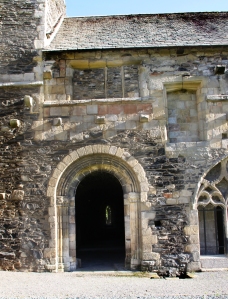
The fabulous sacristy was also built at this time, shown in the photographs below.  The sacristy had doorways into the church and into the cloister.  Its role was to house the vestments and altar furnishings, and any other paraphernalia required during the liturgies and services.  It is an extraordinary part of the building, with a marvellous tunnel-vaulted stone roof, which is shown below, is a unique part of the abbey.   Seen from the cloister, the entrance to the sacristy also dates from the early 13th Century and retains the round-topped arch of the Romanesque style (see photograph below), which sits rather strangely against the pointed arches of most of the abbey’s early and later Gothic styles, but echoes the sacristy’s interior tunnel vaulting.  Today church sacristies and vestries are often rather dismal  spaces, little more than untidy cupboards, but at Valle Crucis the magnificently built room was also an interface between church and cloister, and was given an appropriately dignified character.

On the left: The entrance to the sacristy with its rounded arch, dating to the early 13th century. Above it is a hotch-potch of later changes of direction. Note the pieces of facing stone above the arch and beneath the square window, coloured red by the later fire (my photo); On the right: the interior of the sacristy (source: Coflein)

All of the north transept is early 13th century.  Although alterations were made at a later date, none of these survive.  The north transept incorporates two chapels, each with some nice features original to its construction, including two small cupboards (aumbries) where communion vessels would have been stored, and a stone basin (piscina) for cleaning them following use.  The south transept and its chapels also belong to the early 13th century, but all of its upper levels belong to the period after the fire.  The entrance between the dormitory and the night stairs in the south transept dates to the 13th Century.  This doorway led directly from the first floor dormitory to the east end of the church via a flight of wooden stairs (10ft / 3m) above the ground level of the church) for access to the church for the night-time liturgy.

South transept. The door to the day stairs is at far right, the stairs now long gone. To its left is the entrance to the sacristy. The big arch at the far left is the entrance to one of the two chapels.

Out in the cloister, the base of the water basin (lavatorium) is still in situ, and was almost certainly there since the establishment of the abbey.  Excavations found that the east range of the cloister found that it extended for another 12m (40ft).

The east end of the abbey church, seen from the other side of the fish pond.  The early 13th century pilasters with quoins are framed in red

Walking through the slype, the passageway at the end of the east range (itself of a later date), and heading outside to look back at the eastern end of the abbey, there are more original 13th century features.  The lower level of walls and pointed lancet windows date to this time, although the central lancet window would have been taller, reflecting the arrangement of the west end windows.  The church buttresses that lie flat against the walls (pilasters) are later in date.  However, the buttresses that are visible to the left of the church, against the south transept.  Instead of being completely covered in stone dressing, like the church buttresses, they are  built of rubble and provided with dressed stone, quoins, on the corners.

The 12th and early 13th century Cistercians valued simplicity and rejected ostentation, associating it with adulation of the material, wealth, self-indulgence and a tendency to succumb to luxury.  However, even in the early 13th century one or two pieces of decorative stonework were erected and have survived.  One of the very few pieces of early ornamentation is the ceremonial arch that leads from the church in the north corridor of the cloister into the cloister, and has very beautiful sculpted columns topped with stiff-leaf capitals, which can be seen on the photograph below.
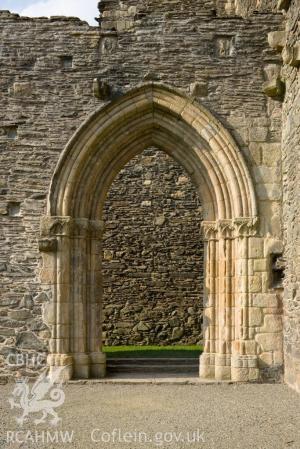
South transept arch with stiff-leaf capitals. Source: Coflein

The cemetery was also established in the early 13th Century.  The abbey’s abbots and its most conspicuous contributors to the abbey’s property, possibly its founder Prince Madog, whose gravestone was found at the site would have been buried within the church.  Ordinary monks would have been laid to rest in the cemetery that grew to the north and east of the abbey within the abbey precinct.    A 13th century tombstone was used, post-dissolution to make a fireplace in the dormitory, which by then had been converted into a farmhouse, but is evidence for high profile 13th Century burials both within the abbey and in the abbey precinct.

Evans says that by around 1225 the eastern half of the church was well advanced, work had started on building the stone roof over the presbytery, transepts and crossing.  By about 1240 the western church had been laid out and the lower parts of the walls and piers were underway.

The monastic precinct must have been growing at the same time.  The full extent of the abbey’s immediate precinct is unknown, but must have been home to a number of ancillary buildings, as discussed in part 2.  The core buildings that exist today did not live in a vacuum, although its full extent is unknown,  The main entrance into the abbey precinct, was probably overseen by a gatehouse on the outer edges of the abbey precinct, perhaps were the buildings at the top of the lane leading to the abbey are now located.   Once within the abbey precinct, visitors could attend the church to participate in services in the nave (the long, west end of the abbey church).  Just as it is today, in 1201 the main entrance to the abbey church was in the west, nowadays approached from the car park.

The mid-13th Century fire and its consequences

The fire in the first half of the 13t Century swept through the abbey church, changing some of the yellow sandstone pink. The design of the church had to be changed to a rather more modest design with a wooden roof, rather than the vaulted stone roof originally envisaged

When Madog, the founder of Valle Crucis, died in 1236, his son Gruffudd II Maelor (d.1269) confirmed his father’s gifts to the monastery in a new charter, rather like renewing a contract, ensuring that the abbey retained its lands and continued to be viable.

Around 40 years after its establishment in 1201, the abbey was coming along nicely, with the stone walls rising impressively from the ground.  The community must have had a very real sense of progress and achievement.  The eastern end of the abbey church was approaching completion.  The short presbytery at the east end of the church, where the most sacred liturgies took place, was complete.  So too were the transepts, the two eastern piers and the two eastern chapels.  The west end of the church was probably laid out and work was underway on the walls and piers of the nave. Buttress bases were established, ready to support the tall walls on all sides of the church.  The entire building must have been a cat’s cradle of wooden scaffolding.  The refectories and other south and west range buildings were probably built, but made of wood.

Although it is not recorded in any surviving documentation, it is clear that there was a major fire at Valle Crucis.  It was fierce and spread fast through the wooden scaffolding, turning yellow sandstone features pink.  Given that the source of the fire seems to have been the kitchen area, it is probable that the fire was connected with the preparation of food for the refectories.  The refectories were probably the first to burn down.

Entrance to the nave at the west end of the church.  The shape of the arch is early Gothic, but the decoration imitates Norman predecessors

Repairs were immediately implemented, but the overall design was subjected to a rethink.  Instead of vaulted stone ceilings, the church aisles were provided with wooden roofs.  The same walls continued to go up, but instead of mixed sizes of stone, only smaller, flatter and thinner pieces were selected, laid flat.  Romanesque curves were largely eliminated, and early Gothic features dominated.  It was all about height and drawing attention to it with tall, pointed lancet windows and doorways with pointed arches.

Some of these features, far more ornamental than the early 13th century vision, are clearly seen on the west front.  The arched ceremonial doorway that was added to the earlier west face dates to after the fire and is also early Gothic in style.  It was inserted into the west front, probably replacing an earlier and simpler version.  The wall had only just reached the level of the windows by the time of the fire.  When work resumed, tall lancet windows were provided with elaborate “lights” (ornamental dividers) that divided each into two.

Wall support for bell tower after the fire at the right, at the end of the south aisle and in front of an arch that opens into the cloister. Source: Wikimedia Commons, J. Armagh

The structural integrity of the bell tower that rose above the crossing point beneath the two transepts and the main axis of the church was apparently undermined by the fire.  A new wall was built along the south aisle where it approached the south transept, and a filled relieving arch was added to the south wall of the tower, at the end of the south aisle.  

Looking at the exterior of the east end of the church, which can be reached by passing through the passage at the end of the east range, the buttresses that lie flat, but sit flat between and either side of the church windows form a remarkable arch at the top.  The upper windows, thin lancets, echo the lower windows but are incorporated into the buttresses.  These feature all date to the mid 13th century , when the rebuilding took place.  

The east and south ranges also had to be rebuilt and the opportunity was taken to build it of stone.  Postholes within the lowest surviving course of the refectory walls show the position of the timber supports for the roof of the building.  The refectory pulpit may have predated the fire, but by only a short time.  The kitchen was also rebuilt at this time.  The western range appears to have had relatively insubstantial stone courses, which has led to suggestions that first storey half-timbered and therefore more lightweight and requiring less support.

The later 13th Century and Edward I

Edward I, from Westminster Cathedral. Source: Wikipedia

One of the challenges that the Welsh monastic houses confronted in the latter half of the 13th Century, was the military ambition of Edward I (1239-1307) in Wales.  Edward’s grandfather King John (1166-1216) had lost the bulk of the French territories that kings of England had sought to retain since the arrival of William the Conqueror.  Edward I had both the leisure and the inclination to  bring the rest of the island under his control.  In 1276-77 and again in 1282-83 Edward concentrated his energies on Wales, allowing nothing to stand in his path, including religious houses, a few of which he made use of and some of which experienced severe damage to buildings, land and agricultural resources.  Some monasteries were  occupied, and many suffered financial loss due to damage of the main abbey or its related granges (farms) and by devastation of its herds and crops.  At least one Cistercian abbey’s entire community, Aberconwy, was forcibly moved to new premises and its old premises were occupied by Edward’s troops.  In spite of its proximity to the well-sited Castell Dinas Brân (Castle of the Crow), the ruins of which continue to overlook the Vale of Llangollen and Valle Crucis itself, Valle Crucis  was subjected to the indignities of war.  Interestingly, there is little evidence that the abbey core buildings. The evidence underlying the suggestion that property owned by Valle Crucis had suffered some form of financial harm comes from payments made to the abbey by Edward I following the conquest of Wales, by way of compensation.  It is possible, therefore, that whilst Valle Crucis properties were damaged, the core of the abbey itself was protected.

Cadw signage showing the layout and possible appearance of Castell Dinas Brân

The stone castle was built in the late 1260s by Prince Gruffudd ap Madog (c.1220-1270), but may have been preceded by a wooden structure, and it is uncertain whether Valle Crucis was built under the eye of the castle, or whether the castle came later.  Dinas Brân was passed on the death of Madog to his four sons in 1236.  Although it is not known which of the brothers made the decision to resort to a desperate measure, when confronted by English attack, under the Early of Lincoln, the castle was burnt by the the Welsh soldiers who held the castle in 1277, perhaps to prevent the English taking it.  In fact, the English found that it could be repaired and, greatly admiring it, retained it and held it until 1282, after which it was abandoned.

Edward, a veteran of the eighth crusade, was a solid supporter of religious establishments, founding the Cistercian abbey of Vale Royal in Cheshire in 1270.  Valle Crucis received £26 13s 4d in 1238 and £160 in 1284.  In the absence of signs of damage to the abbey itself at that time, it seems likely that either abbey granges had been damaged, or that abbey resources, including crops and livestock, were pillaged by Edward’s armies.

Page from Peniarth Ms. 20, folio 260v. (c.1330), the earliest copy of Brut y Tywysogion. Source: Wikipedia

At some time during the later 13th Century, Valle Crucis began to be an important source of scholarly texts.  Cistercians were often formidable scholars and had a mission to perpetrate both religious and historical literature.  Valle Crucis is thought to have been one of the important centres of literary output, possible the primary centre, for the copying and distribution of a series of historical and religious, of which more on a future post.  One of these documents is known as Peniarth MS 20 (its National Library of Wales reference number), is the one that is thought by some to have been copied at Valle Crucis.  It consists of a number of different texts, including a version of the Brut y Tywysogian (Chronicle of the Princes), Y Bibl ynghymraec’, (a version of The Bible in Welsh), Kyvoesi Myrddin a Gwenddydd (the prophecy of Merlin and his sister Gwenddydd) and a summary of bardic grammar, as taught to fledgling poets.

The 14th Century

View of Valle Crucis from 1905, with gravestones in the foreground at the east end of the church, with the west front at the end. Source: Wikipedia ( Illustrations and photographs of places and events in Welsh history from a childrens book called ‘Flame Bearers of Welsh History’)

In the late 13th and early 14th centuries, Valle Crucis was apparently still supported by Madog ap Gruffudd’s descendants.  A 1290 tombstone from the site names “Gweirca daughter of Owain,” who may have been Madog’s great granddaughter, and in 1306 Madog’s great grandson, another Prince Madog ap Gruffudd, was buried at the abbey.  In 1956 his grave stone, with his grave beneath were found in front of the church’s high altar, a very high honour.  The beautifully carved slab includes a heraldic shield showing a lion rampant, a sword, a spear and a riot of fruit and foliage.  The inscription surrounding the shield names the prince.  These grave stones were shifted from their original locations and placed in the former eastern range dormitory.

It is in the east range that the 14th century changes are most obvious.  Although  individual monks took a vow of poverty, the reality is that many monastic establishments  could become very wealthy if they were well endowed and well managed.  Individual abbots could become very highly regarded, and abbeys noted for particular achievements might host important guests.  Throughout the late 14th and 15th Centuries, the role of Valle Crucis and its abbots in particular, began to change, becoming both more worldly and more prestigious, and some of the signs of these changes are visible in the architectural embellishments at this time.

Inscription on the west face of Valle Crucis, above the rose window

The west front of the abbey was rebuilt under the abbacy of Abbot Adam, c.1330-44.  Just above the rose window, is an inscription in Latin, with Lombardic lettering that reads ADAM ABBAS CECIT HOC OPUS IN PACE QUIESCAT AMEN (Abbot Adam carried out this work; may her rest in peace.  Amen).  The repair work restored the arch that contained all three lancet windows on the exterior, but failed to do so on the interior. The rose window was added , a popular architectural convention at this time, with eight lights, providing an ornamental focal point for the west face, inside and out.  At the same time the surrounding gable was elegantly faced with sandstone blocks.

In the east range there were a number of changes.  First, the entire east range was reduced from its early 13th century length by some 40ft (12m).  Although the east range had a chapter house from day one, in the mid-14th century it was rebuilt and replaced with something far more ambitious than the early 13th century monastery would probably never have attempted or approved of.  The entrance was replaced with something much more impressive, and the door to the book cupboard, with its ornate tracery, is now one of the most remarkable features of the ruined abbey, perhaps accompanying the rising importance of Valle Crucis as a literary centre.  The ornate detail of the east range with its impressive chapter house would certainly have drawn the attention of important guests, including other monastic scholars, who came to contribute to or learn from the work of the Valle Crucis monks.  It should be noted that the windows at the rear of the chapterhouse were reconstructed in the Victorian period and the flagstone floor was probably laid in the 18th century.

Artist’s reconstruction of the east range as it might have looked in the mid 14th Century, complete with the book room entrance, the arcade and a dormitory separated into individual cells by wooden dividers. The lean-to latrine is at the end. By Chris Jones-Jenkins. Source: Evans 2008

This trend to incorporate ornate gothic elements that had become so popular in ecclesiastical buildings was found throughout the Cistercian tradition at this time.

The lovely rib-vaulted passageway at the far end of the east range, the slype, was either completely new or, more probably, was an extension or rebuild of an earlier version.  There is a photograph of it at the top of this post.  A 13th Century arch was incorporated into the end of the passage, perhaps moved from the chapter house to make room for the new chapter house door.  The elaborate character of the passageway is unusual, and it has been suggested that although a passage located in this position would originally have lead to the cemetery, this more ostentations version may have led to the abbot’s personal house, marking his increasingly public role at the abbey.
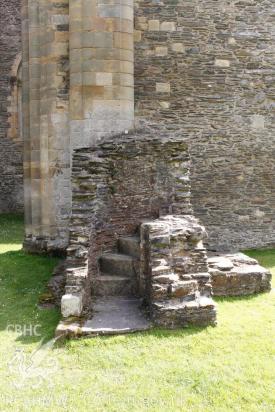
Stairs built into the relocated pulpitum, perhaps leading to an organ loft. Source: RCHAMW

In  the late 14th or early 15th century, within the abbey church the pulpitum and east end choir were moved an entire bay east towards the end of the church, so that it now sat between the two piers immediately in front of the transepts. At the same time, a stone screen was added as an extension to the pulpitum across the north aisle.  This  happens at other monastic churches at this time, and may be because the space at the west end was no longer needed for lay congregations, or perhaps because there were fewer choir monks.  At around the same time, the cloister arcade was probably built or rebuilt.  Excavations were unable to shed any light on the subject.

During the mid-14th Century the Black Death tore through Britain, wiping out much of the population, including the conversi (lay brotherhood), which had already been on the wane during the late 13th Century.  Managers and servants had to be employed to do their work.  The western range, discussed in part 2, was no longer required for the conversi, and must have been adapted for other uses.  Unfortunately, so little of it left that even excavations have been unable to cast much light on the subject.

The 15th and to the early 16th Century

Owain Glydwr’s coat of arms, found in Harlech. Source: National Museum of Wales

Further damage was thought to have been inflicted on the  abbey during Owain Glyndŵr’s uprising between c.1400 and 1410.  Excavations found evidence of another fire early in the century, which destroyed much of the western and southern ranges, the latter containing kitchen and refectory, which may or may not have been an outcome of the Owain Glyndŵr rebellion.  However the fire started, both ranges were apparently rebuilt under Abbot Robert of Lancaster, who arrived in 1409 and was simultaneously bishop of St Asaph.  The kitchen was supplied with a new fireplace with a large external chimney.

The abbey seems to have struggled in the following years.  Unlike Edward I, Glyndŵr appears to have made no provisions to the Welsh abbeys to compensate them for damage caused, probably because although he made some short term progress, he was ultimately unsuccessful, vanishing in around 1412.  It also seems as though the incumbent abbots in the years after these events, between 1419 to 1438, were unable to turn the abbey’s fortunes around.  It was not until later in the century, between 1455-1527, that new abbots and new patronage combined to inaugurate a new era for Valle Crucis, again as a centre for Welsh literature and poetry, this time with an emphasis on the work of the Welsh bards rather than more scholarly historical or religious texts.  Further elaboration to the design of the abbey, giving it yet another ornamental flourish, was the addition of a parapet to the church, as well as to the east range.  Corbels, the protruding stone supports that remain visible today, are all that is left of this.
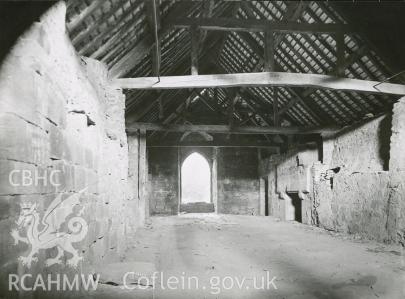
Valle Crucis dormitory on the first floor of the east range. Source: Coflein

It is always difficult to stifle ambition, and the abbots of Valle Crucis became increasingly differentiated from the choir monks.   Three abbots in particular, attracted attention to themselves as patrons of Welsh literature and poetry between 1455 and 1527, building a scholarly reputation for Vale Crucis.  These activities may be been enabled or at least assisted by the patronage of the Stanley family who were granted Bromfield and îal  (today known as Yale) in 1484.  Once the princes had ceased to support the abbeys, after the conquest of Wales by Edward I at the end of the 13th Century, the monasteries were forced either to make the most of their existing assets or to find new ways of generating income.  This will be discussed in a future post.  However, finding a new patron so late in its history was an important and very lucky break for Valle Crucis.

In the early 16th Century the dormitory had been converted into a great hall for the abbot, and at least part of the arcade had been removed to allow a staircase to be added to the former dormitory. By Chris Jones-Jenkins. Source: Evans 2008

In the 12th and 13th Centuries the Cistercian custom had been for the abbot as well as all of the brothers to share a dormitory on the first floor of the east range, but the abbot became more isolated, often moving into a private dwelling on the precinct, near to the core abbey buildings.  In the 15th century at Valle Crucis the dormitory in the first floor of the east range was replaced with a new suite of rooms for the abbot, and possibly accommodation for  particularly important guests.  Cistercian monasteries were committed to providing for guests, but it is probably that most guests were quartered somewhere else within the precinct.  Only the most prestigious of guests would have been accommodated in the east range.  This required the removal of at least one side of the arcade to allow a staircase to be built from the upper storey of the east range down into the cloister.

The monks who had inhabited the dormitory must have been accommodated elsewhere in the abbey, perhaps in the west range, which had been abandoned during the mid-14th century.  Although they had been housed in an open-plan dormitory in the early 13th century, this custom changed over time throughout the Cistercian order, and monks were given some privacy by separating their beds by divisions, into separate cells.  As other rules were relaxed and the dormitory was co-opted by the abbot, more comfortable quarters might have become available.

By the 16th Century it was not only the living arrangements that had changed.  The style of architecture now included decorative elements, and stained glass is thought to have been added to some windows. Most of the stricter Cistercian rules were relaxed.   As Greene puts it “Valle Crucis had become unrecognisable as a Cistercian abbey in comparison with its early thirteenth century beginnings” (p,108).

Unfortunately, its comfortable lifestyle seems to have attracted quite the wrong sort of abbot  between 1528 and 1535, of which more in the next post.  The abbey had to be put under the care of the prior of Neath, but before he had time to make any significant input, Valle Crucis fell victim to Henry VIII’s dissolution of the monasteries.  In January 1537, it was wound up.  Although parts of the building were re-used for secular activities, and the church survived as a ruin, it would never again serve as a monastic establishment.  The details of the dissolution and the former abbey’s subsequent history will be looked at in a later post.

Final comments

One of the striking things about Valle Crucis is the process of change visible in the architecture.  People with archaeological training tend to be a bit change-fixated but at Valle Crucis the architectural developments mirror changing ideas about how strictly Cistercian rules should be obeyed, how the abbot was perceived, and what sort of role the abbey should perform in cultural terms.  At the same time, traces and subsequent impacts of the mid 14th century fire can be tracked throughout the abbey.  Changes to the east range, for example, reflect the switch from the early Cistercian focus on austerity and simplicity to a far less demanding approach to monastic life, which included ornamental display and the expansion of the abbot’s quarters.  Modifications of the west face of the abbey church, which included the addition of an ornamental doorway and a rose window, followed damage inflicted on the building, but the opportunity was taken to add ornamental flourishes to a previously plain façade.

By the time of Henry VIII and the reformation of the Church, which resulted in the suppression of Valle Crucis in the first round of monastic closures, the abbey had developed in fits and starts from a strictly governed house of the Cistercian order to a community living under a less regulated, more nonchalant interpretation of Cistercian rules, barely differentiated from other monasteries that were nominally but not actually practising in the original Benedictine tradition.  The monks no longer worked the land themselves, and a much more elaborate selection of foodstuffs than the Cistercian order originally permitted was consumed, including meat.  Meat had been banned by St Benedict because he thought that it would inflame passions, but passions were perhaps no longer quite as worrying as they had been in the 11th Century.  The plagues of the 14th Century wiped out what remained of the lay brethren, and their work was now carried out by paid servants.  Income was derived not from hard work but from tithes and rent.  The abbot was provided with finely specified quarters incorporating a room for entertaining, and .  Although the monastic community at Valle Crucis experienced deep troughs, including fire, war, conquest and rebellion, as well as its own troubled leadership, it was also a centre of literary output and became a lodging for some of the great Welsh bards.  Ambition and display had replaced austerity, self-discipline and communal privation, but the abbey had also left its mark on history with its literary output and its lovely buildings.

Next

Part 4 looks at how life was lived within the abbey, what individual responsibilities were, how the monks were organized and what sort of problems they experienced over a period of 376 years of political, social and ecclesiastical change.  All parts are available, as they are written by clicking on the following link: https://basedinchurton.co.uk/category/valley-crucis-abbey/
dasdasd

Bibliographic sources for parts the Vale Crucis series:

For sources see the end of part 1.

Today in 1201: The foundation of Valle Crucis Abbey

Happy Birthday, Valle Crucis!

Had it survived Henry VIII’s nation-changing tantrum, otherwise known as the dissolution of the monasteries and the birth of the Church of England, the Cistercian monastic order’s abbey at Valle Crucis would be 821 years old today.  Today its lovely ruins are managed by Cadw and although a caravan park has been plonked right on its doorstep, it is still a glorious place to visit, sitting on the edge of a classically bubbling brook and overseen by the brilliant colours of the hills above.

I have already written first about the background to the abbey and then about how each of the monastic buildings was employed, and there are more parts to come.

In the meantime, here are a couple of photographs of one of my top favourite places, taken on 26th January.  I should mention that although the Cadw page for Valle Crucis says that it is open, it is actually currently closed to the public due to Covid, with a big, chunky padlock barring access.  The Cistercian monks would probably have applauded 🙂


Valle Crucis Abbey #1 – An introduction to the Cistercians and Valle Crucis

Valle Crucis, founded in 1201, is a superb example of a ruined Cistercian abbey, located less than an hour’s drive from the Chester-Wrexham area, in a lovely valley on the edge of a quiet stream that flows into the Dee.  It has been extensively surveyed, the few documents relating to the site and its antecedents have been studied and the site has been excavated both in the 19th Century and in the 1970s.  Importantly, most of the main features of the core buildings are identifiable, and can be discussed in terms of how the monastery was planned and used.  All of  these resources form a good basis for understanding how Valle Crucis was established and used, and what happened to it after it was “suppressed” or decommissioned following Henry VIII’s dissolution of most of Britain’s monasteries.

This is the first of a series of posts looking at the monastery.  These posts are quite long.  Valle Crucis, is used in this series of posts to introduce not only this particular abbey, but also the ideas that lead to monasticism, different monastic orders and the  distinctive architecture that defines most of the monastic orders in Britain.

An “order” is a shared monastic tradition, a set of spiritual ideals often spelled out in considerable detail in rules that covered everything from how many times a day a monk should pray, communally or individually, to where and when they could speak, eat and sleep, and what work they should engage in.  All orders involve a degree of renunciation and isolation by communities of monks.  Monastic architecture reflects both the need to gather a community in one establishment, adhering to a single set of rules, and the need to divorce that establishment from the rest of the world.  Unlike monks, friars could leave the monastic community (friary) to preach and tend to the poor, and were often located in urban contexts, but other orders chose to confine themselves to an abbey to focus their attentions on worship and scholarly activities that celebrated God.  Some chose to locate themselves far from other human habitation.  All were what is now termed Catholic, and all owed allegiance to the Pope, as well as to the heads of their own order, and to the founders who endowed their properties with land and resources.  The religious orders of the 12th and 13th Centuries in Britain were differentiated from one another based not on their religious beliefs, but on their ideas about how best to worship and celebrate God.  They dedicated themselves to spirituality and worship in different ways, based on traditions established in the history of monasticism.

St Pachomius in St Shenouda Monastery, Egypt. Source: St Shenouda Monastery website

Monasticism grew out of an early tradition in 3rd-4th Century A.D. Egypt where the devout might abandon their communities to live as hermits in the desert hills and mountains, divorced from anyone else.  They had as their models St John the Baptist and Jesus, both of whom had engaged in devout isolation in the desert.  Hermits began to organize themselves into communities that focused on offering guidance and communal prayer whilst still offering isolation from the distractions of secular life.   In the 4th Century, former soldier Pachomius, having followed the eremitic path in the Egyptian desert to live the life of a hermit, heard a voice telling him to establish a community for hermits like himself, a coenobitic (“common living”) way of combining isolation from the outside world with communal support and guidance.  This acknowledged that whilst individuals might seek out a life divorced from the material, they could well need help to achieve the sort of enlightenment that they were seeking.  These communities were therefore sources of knowledge, wisdom and education as well as worship.   He established his monastery in Tabennisi in Egypt, and simultaneously began to develop the first set of formal rules for guiding life in a monastery, which grew over time.  The rules combined prayer, solitude and work in a communal and very isolated environment, a difficult balance to strike.  This  was successful and soon spread.  Monasteries began to appear throughout the Mediterranean from where they spread into Europe.

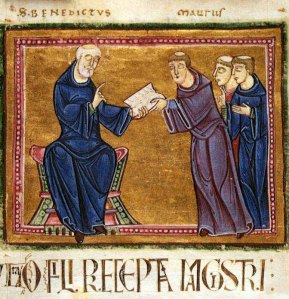
A 12th Century interpretation of St Benedict delivering his monastic rule in the 6th Century AD. Source: Wikipedia, via Monastery of St. Gilles, Nimes France (1129)

In 6th Century Italy, St Benedict developed another set of rules for monastic living that required not only individual prayer and communal worship, but outlined a strict regime of living that included eating merely for fuel rather than enjoyment, a largely vegetarian and very narrow diet, and the requirement for manual work, including contributing to building projects and labouring in the fields.  The concept of an abbey emerged, a religious establishment consisting of both a monastery and a church in a single complex, housing a community of monks who do not leave the premises.  St Benedict’s form of monasticism was popular and spread throughout Europe.

As Benedictine monasticism spread and developed its own personality over the centuries, the strictness of St Benedict’s rules was often abandoned to enable a much more comfortable lifestyle, with an emphasis on liturgy rather than work, a varied and rich diet that included meat, and an emphasis on glorifying God through rich works of art and generous patronage.  Some abbots became involved in religious and state politics beyond the abbey walls, and became influential in their own right, far from the unworldly vision of  monks that St Benedict had promoted.  In the 12th Century this more opulent version of Benedictine monasticism was epitomized by the Cluniac order of monks (named after their abbey at Cluny in France).  The Cluniac order was the apogee of this desire to express devotion through liturgy and art, the elaborate and rich monasteries home to opulent treasures, art works, tapestries and fabulous stained glass that were intended to both reflect and celebrate the glory of God, and the monks entertained lavishly, rubbing shoulders with the rich and powerful.  This trend sat ill with those who sought a simpler, modest, withdrawn and hard-working way of serving God, true to St Benedict.

Johann Petr Molitor, Cistercian monks, murals in the Capitular Hall, Cistercian Abbey Osek, North Bohemia, before 1756. Source: Wikipedia, from the Cistercian Abbey of Osek, North Bohemia

During the early Middle Ages, the Cistercians, named after their first abbey, the 1098 New Monastery at Cîteaux (Cistercium in Latin) in France, set about returning to the values of St Benedict, which led to the reformation of some branches of Benedictine-based monasticism.   New Cistercian abbeys were established as a network of child abbeys, each secondary to its own mother, and all owing allegiance to the founding house at its core, Cîteaux.  Each new abbey could spawn one or more other abbeys.  The third abbot of the new Cistercian order, Stephen Harding, wrestling with the problem of how to ensure that the Cistercian principles would not submit to similar decay, retained the Cluniac’s governing principle of the first abbey being the mother for all subsequent houses of the order, to ensure consistency and standardization throughout the order.  This contrasted with Benedictine abbeys that adhered to the same 6th Century monastic rules proposed by St Benedict, but were wholly independent of one another.

Harding’s own guidelines, building on those of St Benedict, also included obligations that had to be acted upon on a regular basis by the entire family of abbeys.  One of these was that all the same liturgies should be used in all abbeys.  A unique requirement was that all abbots should attend, annually, the General Chapter at Citeaux, a meeting of all the abbots that discussed changes, challenges and difficulties, and enforced discipline.  Another innovation was that when an existing abbey founded a new house, the mother abbey was obliged to arrange annual visits to its daughter houses to ensure that the standards, values and rules of the Cistercian order were being maintained.  In this way, for the 11th,12th and much of the 13th centuries, the Cistercians maintained control and uniformity over a vast family of monastic houses, including Valle Crucis.  The monks wore undyed habits, unlike the other Benedictine orders whose habits were dark brown or black.  Accordingly, they became commonly known as the White Monks.  

Citeaux Abbey. Source: Wikipedia

The Cistercians combined worship with hard work in remote places that encouraged contemplation, eliminated distractions and enabled focus on a communal but pared down livelihood that was far more in keeping with St Benedict’s more spartan ideals.  After Cîteaux, the most important Cistercian monastery, responsible for evangelizing on behalf of the Cistercians, was Clairvaux (founded 1115), which was the home base of abbot St Bernard.  St Bernard was a restless and vocal monastic propogandist of the 12th Century who, in contradiction to the rules of the order, travelled far and wide to bring the Cistercian message to the western world, and whose sayings are still widely quoted: “Arouse yourself, gird your loins, put aside idleness, grasp the nettle and do some hard work.”  He was an advocate of crusades, connected with monarchs, politicians and other religious hierarchy, promoted the cult of the Virgin Mary, and became an unexpected and influential celebrity and icon, the poster-child of the Cistercian message.  Gascoigne calls him “the most influential monk of the Middle Ages.”

St Bernard in his white robes holding a delightfully improbable demon at his feet.  Marcello Baschenis, c.1885. Source: Wikipedia

Very quickly, new Cistercian abbeys proliferated in Europe and across Britain, always in isolated locations, each connected as a daughter to its mother abbey, to which it owed homage and loyalty.  Clairvaux was the mother abbey for Whitland in south Wales, which was established by monks from Clairvaux itself.  Whitland in turn established other abbeys including Strata Marcella near Welshpool, and this abbey in turn established Valle Crucis.  It took 86 years from the foundation of Clairvaux until the foundation of Valle Crucis, but it was only four monastic steps from St Bernard, and that sense of proximity must have resonated at Valle Crucis, as with all the abbeys in Wales.

Every Cistercian abbot had to return from his abbey to Citeaux every year for what was known as the General Chapter, a great conference of abbots.  This was the case even for abbeys that were located overseas, and the British abbeys were subject to this costly and time-consuming annual trek.  Also on an annual basis, the abbot or his prior if he had one (the abbot’s second in command) would visit a given abbey’s daughter abbeys to ensure that everything was running according to the original Benedictine plan.  This led to a degree of standardization and adherence to the order’s rules that was not necessarily seen in the other orders.

The remains at Valle Crucis offer a great opportunity for discussing the main points of Cistercian architecture, life and economic strategy.  It is a site that reinforces many of the observations that have been made about Cistercian monastic traditions throughout Britain, but which is also interesting in its own right.  The Welsh abbeys provide a particular opportunity for considering how their circumstances may have differed from their English counterparts, due to a series of factors including the patronage of Welsh abbeys by the Welsh princes, the wars fought on monastic land by Edward I and Owain Glyndŵr, and the character of the landscape in which the abbeys were built.  Other orders will be discussed in the future.

Introducing Valle Crucis

The East Range

In 1201 bValle Crucis was built in a scenic valley beneath the Horseshoe Pass near Llangollen, on the banks of Nant Eglwyseg, a fast-moving stream that ran into the Dee and now feeds the Llangollen canal. 

Both choir (or quire) monks and lay brothers were housed at Valle Crucis.  The choir monks and lay brothers lived different lives.  Their refectories, dormitories and latrines were all quite separate, and their roles within the abbey were clearly delineated.  Although the lay brothers would worship in the church, they were confined to the nave and a screen separated them from the choir brothers.  The lay brothers ate more advantageously, as they needed a better diet to support them in their daily work.  Cistercian orders worshiped seven times a day and once at night, and engaged in scholarly pursuits, but were also expected to engage in manual labour, contributing to the work carried out by lay monks.  Lay monks (conversi) were illiterate and worked the land, but were resident at the monastery.  They had their own separate quarters for sleeping and eating, and were confined to a section of the church that was divided from the parts of the church used by the quire monks.  Their church worship was much less frequent than that undertaken by quire monks, as most of their day was taken up by agriculture, crafts and building works.

The name of Valle Crucis is Latin, meaning Valley of the Cross, a reference to the 9th Century inscribed Pillar of Eliseg that was erected to commemorate the ancestors of Concenn of Powys, a  Welsh chieftain who died on pilgrimage to Rome in 858.  Eliseg was Concenn’s great-grandfather.  The inscription is now illegible but was recorded in 1696 and lists great deeds of ancestors, presumably with a view to establishing an incontrovertible connection to the lands on which the cross was constructed.

Survey, excavation, restoration and modern research

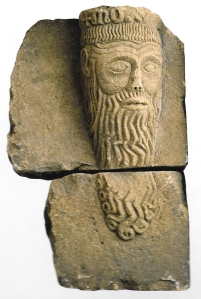
Carved head found in the refectory during excavations, and now rather a long way from home in the National Museum in Cardiff.  Source: Evans 2008, p.47

Documentary resources are few and far between for Valle Crucis, so other ways of exploring the history of the site have been employed.  The documentary archives of other monasteries and of related properties have helped to provide some additional information, but the documentary picture remains very threadbare.

Because of the architectural and functional standardization of monastic establishments, it has been possible to extrapolate the roles of much of the site’s key buildings by comparison to other Cistercian abbeys, but this only takes one so far.

Observing the above-ground architecture has taken matters a lot further, telling a story of a major fire forty years after the foundation of the abbey, and the changes in architectural direction that had to be taken as a result.  As the decades and centuries passed, changes in Cistercian values and ideas are captured in the architectural features and new decorative motifs.  This rich source of information has been supplemented by data that has come from the ground.

One of the illustrations from Butler’s 1970 excavations, published in 1976

One of the fads of the 19th Century was antiquarianism, the investigation of ancient sites of all ages.  Excavations became popular activities, although often hair-raising in the level of destruction achieved in the process of the pursuit of dazzling objects.  Valle Crucis did not escape this attention, and a series of archaeological excavations were carried out in both the middle of the 19th century, and in its latter half.   An anonymous letter to Archaeologia Cambrensis dating to 1863 by a visitor to Valle Crucis condemned the mid 19th Century excavations by W.W.E. Wynne, but the subsequent excavations by Harold Hughes appear to have been carried out with rather more integrity.

In 1970 the site was excavated by Lawrence Butler.  He reported on the findings, including the chronological sequences from the site, and full details of the pottery in 1976.  The pottery was limited in type and form but covered the full range of the site from construction to dissolution.  The faunal remains were analyzed by the ever excellent Graeme Barker as part of that project’s post-excavation work, to provide information about diet and economic activities, and his report was published in the same year.  The results of this particular project are of great interest as Butler found evidence of the earliest clearance of the site and was able to clarify details of fire, flood and alterations to the architecture in line both with these events and in response to the relaxation of Cistercian rules.

Because work has been concentrated on the core abbey buildings, it is less clear how the larger monastic precinct was organized.  This is the area surrounding and beyond the abbey’s heart, that were essential to the abbey’s economic survival, in which agricultural and activities took place, and in which vital supplies were stored for consumption or trade.  

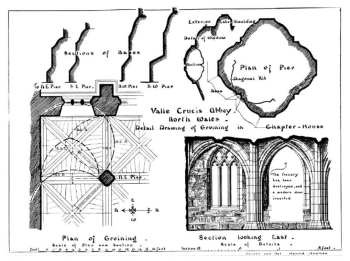
Illustration from the 1895 excavation report by Harold Hughes.

Restoration work began with clearance of the site for excavation, but more ambitious work followed.  Sir Gilbert Scott, the renowned Victorian architect, was employed to repair the west front of the church in 1872, and Sir Theodore Martin restored part of the east end in 1896.  The difference in the stonework at the  and the site has been made safe for visitors.

After passing into the hands of the Ministry of Works in 1950, Valle Crucis was eventually transferred into the care of Cadw in 2008, which retains responsibility for the site.  Between them the site was made safe for visitors and Cadw has expended some effort on information signage to help visitors understand some of the site’s history.


How Valle Crucis and other Welsh abbeys were founded

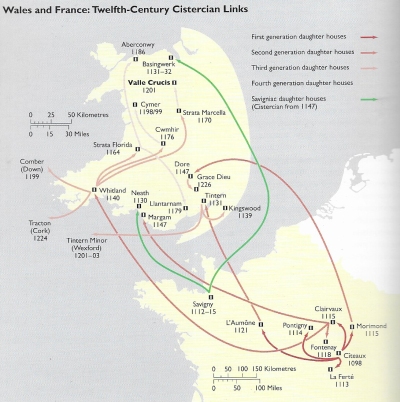
12th Century links between Cistercian monasteries. Source: Evans, D.H. Valle Crucis Abbey (Cadw). Although Citeaux, the node for all Cistercian abbeys, established early new bases in France, it was Clairvaux under the lead of St Bernard that was responsible for the earliest new abbeys in Wales. Of these Whitland was the most important for the northward spread of monasticism. The green lines emanating from Savigny reflect the Savignac order, which merged with the Cistercians after only 20 years, in 1147. So although Basingwerk in the north and Neath in the south were founded as Savignac orders, after 1147 they were brought under the rule of the Cistercians at Citeaux.

Valley Crucis was at the northeastern end of a branch of a monastic chain that spread from south Wales to the north over a period of some 60 years during the 12th Century, building on a much older European monastic tradition.  The Cistercian order of monks spread through Wales during the 12th Century AD from the of Wales where it was established by monks from the French monastery Clairvaux, forming an eastern and a western chain of monasteries.

The first new Cistercian abbeys were established in Wales in the wake of the Norman conquest, the earliest at Tintern in 1131, and had a distinctly Anglo-Norman flavour.  However, a second strand of Cistercian monasticism spread in Wales.  It began at Whitland (Abaty Hendy-gwyn ar Daf), founded in 1140 by monks from St Bernard’s abbey at Clairvaux, second only to the Cistercians’ founding abbey at Citeaux.  Whitland spawned a series of abbeys that were funded by the native Welsh princes and were populated mainly by Welsh monks, a pura Wallia (Welsh Wales) version of Cistercian monasticism that nurtured Welsh literature and learning.  This spread into the poorer and more remote areas of Wales.

Valle Crucis was founded in 1201, the daughter house of Strata Marcella Abbey (Abaty Ystrad Marchell) near Welshpool, founded by Owain Cyfeiliog, prince of southern Powys, itself a daughter house of Whitland.   Establishing an abbey was an expensive undertaking, both in terms of its construction and providing it with the resources to ensure ongoing economic security. Accordingly, every new abbey required an endowment by a donor, someone with enough land and wealth to give some of it away in return for divine good will and the prayers offered by the monks for the souls of the donor and his family.  The donor usually required a guarantee that they would be buried within the abbey church, and that their family would be buried either within the church itself or within the monastery precinct.  Monks were considered to have a hotline to God.  Having dedicated their lives to Him, and living sin-free lives, they built up a surplus of virtue and influence that could be employed on behalf of the living in order to provide for them in the afterlife, an intercession to minimize the impact of sins committed in life.  Valle Crucis Abbey was founded by Prince Madog ap Gruffydd. 

Original sacristy entrance, 13th Century.

Prince Madog ap Gruffydd controlled the territory of Powys Fadog from the Tanat valley in the south to the edge of Chester from 1191 until his death in 1236, and was an ally of his cousin Llywelyn ap Iorwerth (Llywelyn the Great), prince of Gwynedd, d.1240.  In accordance both with tradition, and to fulfil the terms of his original financing and support of the abbey, he was buried in the abbey church at Valle Crucis, although the exact site of the grave has been lost.  The map above left shows the territorial divisions in Wales in 1267, with Powys Fadog bordering Chester, Gwynedd, southern Powys (Powys Wenwynwyn) and England. 

Valle Crucis was supplied with at least twelve monks (considered by St Benedict to be the minimum number for founding a monastery, following the twelve apostles), possibly thirteen, who were installed in temporary accommodation with a wooden church.  Work would have begun immediately on the stone church, the sacristy and the accommodation, and the 1970 excavation found unmistakeable signs of this work.

Choice of location

The map to the left (Ordnance Survey SJ24/34) shows the relative locations of Valle Crucis Abbey, the Pillar of Eliseg and Castell Dinas Brân, all a short drive from Llangollen, which was probably a large village that would have benefitted from the proximity of the monastery and its associated farms (known as granges).

Ordnance Survey map SJ24/34, showing the relative locations of Valle Crucis Abbey, the Pillar of Eliseg and Castell Dinas Brân (the latter not built until 1270, 69 years after the foundation of Valle Crucis)

The Cistercian ideal of a contemplative existence away from distractions meant that new abbeys were sited where monks could practise their devotions in relative seclusion, although not in complete isolation.  They were often near to well-established routes, and they always located themselves near to water that would be used for drinking, cooking, cleaning, ritual purification, as well as fishing and sometimes for powering water mills.  Abbeys were supposed to be economically self-sufficient, so abbeys still needed to be near enough to manors and villages to enable them to trade their produce, mainly agricultural, in exchange for the basics required for sustaining the abbey, both the choir monks (the dedicated monks within the monastery) and the conversi or lay brotherhood.

Although little is known about Llangollen in the late 12th Century, there was some type of settlement recorded there based around a church, and in 1284, Edward I granted the manor of Llangollen to Roger Mortimer, together with the rights for a weekly market and two annual fairs.  Llangollen was far enough away for monks to feel that they were isolated from civilization, but near enough to a village to enable contacts to be established if required for sourcing produce, raw materials and other goods.  The site of the abbey was clearly idyllic.  The following is an evocative excerpt from a paper by John Williams, who reported on the abbey in 1846 in the journal Archaeologia Cambrensis:  

Luxuriantly watered by a clear stream and sheltered by high hills, the sides of which are gracefully ornamented by trees, the place altogether appears as if especially intended to be the home of peace and happiness – a paradise for restored man, where he might securely worship his Creator and cultivate the graces of heaven implanted in his soul.

The sad remains of Strata Marcella Abbey, which supplied the founding monks of Valle Crucis.  Source: Coflein website – RCAHMW, taken by C.R. Musson, 2/1/1995.

The founding monks of Valle Crucis from Strata Marcella near Welshpool certainly thought so.  They moved the residents of the existing hamlet of Llanegwest to a new location in order to establish themselves in this particular paradise in the form of a fine abbey.  Llanegwest was probably a fairly tiny settlement, and it was relocated to Maelor Gymraeg (on the far northeastern border).  This was by no means unusual, and there are enough records of hamlets and villages being moved to make way for a monastic establishment for this to be seen as a fairly standard (if somewhat ruthless) act in the establishment of a new Cistercian abbey.

The fish pond at Valle Crucis

The Cistercians were renowned for their use of water, which in some abbeys included sophisticated networks of sunken drains that fed into and out of monastic buildings.  The siting of Valle Crucis next to the Eglwyseg was essential for sourcing water that was used for cooking, cleaning, washing, for use in rituals and for creating a fish pond and a drainage system to flush both the choir monks’ and lay brothers’ latrines.

The pond is an expanded version of the original one, and is the only one surviving in Wales.  As early Cistercians could not eat meat under St Benedict’s rules, except on certain nominated days, fish was often an important component of the diet.  As the rules relaxed, meat found its way into the diet on more than just special days, but in the early abbeys fish was often responsible for providing much-needed protein.

The latrines, located on the first floor at the end of the dormitories, were flushed by drains below, which diverted fast-moving stream water to clear waste back into the stream,  presumably downriver of the monastery.  Cleanliness was an important component of monastic life, with monks washing their hands before each meal, and latrines associated with the devil.

Pillar of Eliseg by David Parkes 1809. Source: National Library of Wales

Finally, the Pillar of Eliseg may or may not have influenced the location of the abbey, even though it provided the abbey with its name.  It is, however, entirely possible that the presence of the ancient cross as a clear and ancient statement of Christian affiliation would have been particularly attractive to the new abbot and his monks.  Perhaps more significantly, it was probably particularly resonant for the founder-patron of the abbey, Prince Madog ap Gruffydd, embedded as the monument was with memories of the past inhabitants of the region who sought to defend it against all-comers.  With the Marcher Lords at the borders and the English beyond, Madog probably felt a close affinity with Concenn and his predecessors.   The cross still stands to the north of the abbey, but is considerably shorter, with bits missing, including the top, base and arms of the cross.  In the view to the right by David Parkes, dated 1809, the remains of Valle Crucis are visible at the lower left of the image.

I had initially assumed that the siting of Valle Crucis took into account the proximity of Dinas Brân, a Medieval castle that was also located in the Vale of Llangollen and can be seen from the abbey.  The castle was not, however, built until 1270.

View from the interior of Valle Crucis. I find it hard to get my head around the idea that this and other very narrow views were all that the monks would have seen. They could not explore the environment in which their abbey was located, because they were confined to the monastic precinct.  They could merely see it, never truly experience it.


The remains of Valle Crucis

Valley Crucis provides a very useful template for understanding other monasteries in the Benedictine tradition, all incorporating a church and the main monastic buildings arranged around a square cloister, consisting of a walkway connecting the buildings around a garden or “garth.”

Cadw site plan, with photographs of mine added to show the relative location of some of the key features (click to expand).

Above is a site plan of Valle Crucis, which adopted the typical layout of a Benedictine abbey that the Cistercians had adopted, basing themselves on the Benedictine rule.  The earliest known abbey in Britain that adopted this basic layout was Glastonbury Abbey.  Part 2 will show this image again, and look at these and other features in detail, discussing how they reflect historical developments from the foundation of the abbey at the beginning of the 13th Century, via fire, flood, fluctuating fortunes and changing ideas to its dissolution in the mid 16th century.

As I mentioned at the start of this post, Valle Crucis is not merely of interest as a component of the Vale of Llangollen landscape, but is a useful representative of both Welsh and English Cistercian traditions.  It both exemplifies many of the historical details that have been assembled about Cistercian monasticism in Britain, and provides an impressive volume of data that both reinforces existing knowledge and adds to it.  Some of this will be explored further in the next three posts.

This post, Part 1, has introduced the Cistercian order and explained why Valle Crucis was located where it is.  The next post, part 2 looks at the organization of the abbey in terms of its purpose and how it was built to meet the needs of the monastic community, looking at each room in turn.   All parts are available, as they are written, by clicking on the following link: https://basedinchurton.co.uk/category/valley-crucis-abbey/


Sources for the Valle Crucis series

Resources that were of particular use are picked out in bold.

Books and papers

Anonymous (A. Traveller) 1863.  Valle Crucis Abbey – Correspondence To the Editor of Archaeologia Cambrensis.  Archaeologia Cambrensis, 3rd series, No.33, January 1863, p.68-72
https://journals.library.wales/view/2919943/2995788/67#?xywh=-1466%2C103%2C5111%2C3522

Aston, M. 2000. Monasteries in the Landscape.  Tempus

Barker, G. 1976.  Diet and Economy at Valle Crucis:  The Report on the Animal Bones.  Archaeologia Cambrensis 125 (1976), p.117-126

Butler, L.A.S. 1976.  Valle Crucis Abbey:  An Excavation in 1970.  Archaeologia Cambrensis 125 (1976), p.80-116
https://journals.library.wales/view/4718179/4747123/95#?xywh=-1521%2C-15%2C5975%2C3940

Burton, J. and Kerr, J. 2011.  The Cistercians in the Middle Ages.  Boydell Press
Burton, J. and Ströber, K. 2015.  Abbeys and Priories of Medieval Wales. University of Wales Press

Cantor, N. 2002. In the Wake of the Black Death and the World it Made.  Perennial

Carr, A.D. 1970. An Aristocracy in Decline: the Native Welsh Lords after the Edwardian Conquest.  Wesh History Review 5 (1970), p.103-29

Clwyd and Powys Archaeological Trust.  Historic Settlement Survey – Denbighshire – 2014.  Llangollen SJ 2150 4190, 105978.
https://cpat.org.uk/ycom/denbigh/llangollen.pdf

Coppack, G. 1990.  Abbeys and Priories. Batsford.

Davies, J. 2007 (3rd edition).  A History of Wales.  Penguin

Evans D.H. 2008, Valle Crucis Abbey, Cadw

Edwards, N. 2008.  The Pillar of Eliseg.  In: Evans D.H., Valle Crucis Abbey, Cadw

Gascoigne, B. 2004 (revised edition).  A Brief History of Christianity. Constable and Robinson

Greene, J.P. 1992.  Medieval Monasteries.  Leicester University Press

Gresham, C.A. 1968. Medieval stone carving in North Wales: Sepulchral slabs and effigies of the thirteenth and fourteenth centuries. University of Wales Press

Hughes, H. 1894, Valle Crucis Abbey. Archaeologia Cambrensis, 5th series, 11:43 (1894), p.69-85, 257-75
https://journals.library.wales/view/2919943/3009987/#?xywh=-853%2C-196%2C3885%2C3913

Hughes, H. 1895. Valle Crucis Abbey. Archaeologia Cambrensis, 5th series, 12:45 (1895), pp. 5-17
https://journals.library.wales/view/2919943/3010260/#?xywh=-853%2C-196%2C3885%2C3913

Huws, D. 2000.  Medieval welsh Manuscripts. University of Wales Press

Jenkins, G.H. 2007.  A Concise History of Wales.  Cambridge University Press

Jones, O.W. 2013. Historical writing in Medieval Wales.  PhD thesis, Bangor University
https://research.bangor.ac.uk/portal/files/20577287/null

Jones, O.W. 2020. The Most Excellent Princes: Geoffrey of Monmouth and Medieval Welsh
Historical Writing.  In Henley, G. and Smith, J.B. (eds.) A Companion to Geoffrey of Monmouth.  Brill

Kelley, J. 2006.  The Great Mortality.  An intimate history of the Black Death. Harper Perennial

Kerr, J. 2006. Life in the Medieval Cloister. Continuum

Lewis, S. 1849.  Holt in A Topographical Dictionary of Wales: ‘Heyop – Holyhead’, p.418-430.
Available on British History Online https://www.british-history.ac.uk/topographical-dict/wales/pp418-430#h3-0009

Long, J.F. 1992.  1147 Rejected: A study of Cistercian and Savignac Possessions in England and Wales 1127-1176.  Master of Arts Dissertation, University of Manitoba, December 1992

Miller, D. 2017.  Sing a New Song. The Spirit of Cistercian Liturgical Reform and the 1147 Hymnal. M.A. Thesis, Central European University, Budapest. https://www.etd.ceu.edu/2017/miller_dane.pdf

Morris, R.M. 1987. Bare Ruined Choirs. The Fate of a Welsh Abbey. Stanley Thornes Ltd.

Platt, C. 1984.  The Abbeys and Priories of Medieval England. Chancellor Press

Pratt, D. 2011.  Valle Crucis abbey:  lands and charters.  Denbighshire Historical Society Transactions

Price, G.V. 1952, Valle Crucis Abbey. Hugh Evans and Sons / The Brython Press

Rees, W. 1920.  The Black Death in England and Wales, as Exhibited in Manorial Documents.  Transactions of the Royal History Society.  vol.3, Dec.1920, p.115-135

Robinson, D. 2006.  The Cistercians in Wales. Architecture and Archaeology 1130-1540.  Society of Antiquaries London

Rogers, M. 1992.  The Marcher Lordship of Bromfield and Yale.  Unpublished PhD.  University College Wales, Aberystwyth.  Available on EThOS at
https://ethos.bl.uk/OrderDetails.do?uin=uk.bl.ethos.262474

Silvester, R.J., and Hankinson, R., 2015. The Monastic Granges of East Wales. The Scheduling Enhancement Programme: Welshpool. Clwyd-Powys Archaeological Trust (CPAT)

Southern, R.W. 1970. Western Society and the Church in the Middle Ages. Penguin

Stephenson, D. 2016. Medieval Powys.  Kingdom, Principality and Lordship 1132-1293. Boydell and Brewer

Ströber, K. 2008. Social Networks of Late Medieval Monasteries.  In Burton, J. and Ströber, K. Monastery and Society in the British Isles in the Late Medieval Period.  Boydell and Brewer

Venning, T. 2015 (second edition). The Kings and Queens of Wales. Amberley

Waddell, C., 1993. Towards a new provisional edition of the Statutes of the Cistercian General Chapter, c. 1119-1198. In (eds.) F. R. Swietek and J. Sommerfeldt.  Studiosorum Speculum: Studies in Honour of Louis J. Lekai.  Kalamazoo, p.384-419.

Williams, D. 1984.  The Welsh Cistercians.  Cyhoeddiadau Sistersiaidd

Williams, D. 1990.  Atlas of Cistercian Lands in Wales.  University of Wales Press

Williams, G. 1976 (second edition). The Welsh Church from Conquest to Reformation.  University of Wales Press

Williams, H., Smith, G, Crane D. and Watson, A.  2018.  The Smiling Abbot: Rediscovering a Unique Medieval Effigial Slab. Archaeological Journal, 175, 2, p.255-291
DOI: 10.1080/00665983.2017.1366705

Williams, J.  1846.  Valle Crucis Abbey.  Archaeologia Cambrensis, 1 , 1846 p.17-32, 151-153, 279-280
https://journals.library.wales/view/2919943/2989093/17#?xywh=-893%2C45%2C3900%2C3929

Wynne, W. W. E. 1848. Valle Crucis Abbey.  Archaeologia Cambrensis, 3:11 (1848), p.228-229
https://journals.library.wales/view/2919943/2991333/41#?xywh=-913%2C-241%2C3920%2C3949

Wynne, W. W. E. 1849. Excavations at Valle Crucis Abbey.  Archaeologia Cambrensis, 4:13 (1849), p.22-27
https://journals.library.wales/view/2919943/2991554/21#?xywh=-849%2C-1035%2C3920%2C3949

Wynne, W. W. E.  1851. Excavations at Valle Crucis Abbey.  Archaeologia Cambrensis, new series, 8 (1851), p.282-284
https://journals.library.wales/view/2919943/2990655/21#?xywh=-893%2C-221%2C3920%2C3949

Wynne, W. W. E. 1852. Excavations at Valle Crucis Abbey.  Archaeologia Cambrensis, new series, 10 (1852), pp. 93-96
https://journals.library.wales/view/2919943/2990849/12#?xywh=-893%2C-199%2C3900%2C3929

Yorke, T. 2004.  The English Abbey Explained.  Monasteries – Priories.  Countryside Books

Ziegler, P. 1969. The Black Death.  William Collins, Sons and Co.

Websites

Ancient and Medieval Architecture
Llantysilio – Valle Crucis Abbey
https://tinyurl.com/8fuybma9

ArchaeoDeath – Death and Memory, Past and Present (blog)
Valle Crucis – Reused Ruins, Water and Death In Absentia by Professor Howard Williams
https://howardwilliamsblog.wordpress.com/2014/02/12/valle-crucis-reused-ruins-water-and-death-in-absentia/
The Smiling abbot of Valle Crucis
https://howardwilliamsblog.wordpress.com/2016/03/31/the-smiling-abbot-of-valle-crucis-an-archaeodeath-exclusive/
Valle Crucis tags
https://howardwilliamsblog.wordpress.com/tag/valle-crucis/

Coflein
Valle Crucis
https://coflein.gov.uk/en/site/95205/

English Heritage
Valle Crucis Abbey
https://cadw.gov.wales/visit/places-to-visit/valle-crucis-abbey

An Essay on Cistercian Liturgy by Dr Julie Kerr
Cistercians in Yorkshire, University of Sheffield
www.dhi.ac.uk/cistercians/cistercian_life/spirituality/Liturgy/Cistercian_liturgy.pdf 

Monastic Wales
Valle Crucis (Abbey)
https://www.monasticwales.org/browsedb.php?func=showsite&siteID=35

The Cistercians in Yorkshire Project
https://www.dhi.ac.uk/cistercians/

WordProject
Psalms (audio readings)
https://www.wordproject.org/bibles/audio/01_english/b19.htm

afsdfsdfs

A visit to the Pontcysyllte Aqueduct near Llangollen – Thomas Telford’s iron trough 126ft over the Dee

It is without question a marvel of modern engineering and a remarkable sight, but what strikes most people when they first see the 1000ft (c.305m) Pontcysyllte  canal aqueduct is that the handrail along the pedestrian walkway 127ft (38.5m) over the river Dee is only a few steps away from the other side of the narrow canal trough, which has no handrail at all to separate a boat user from a straight drop into the valley bottom.  Until you lean over the towpath’s handrail and look straight down, 127ft is a rather abstract number.  The photograph on the right shows me crossing it on a 40ft narrowboat in the 1990s on a two week canal holiday.  What you cannot see are the white knuckles with which I am gripping the tiller for dear life, in spite of having absolutely no fear of heights, because there was absolutely nothing between me and that drop.  The aqueduct, Grade I listed, and a UNESCO World Heritage Site since 2009, is the longest and highest in Britain.  It’s a long way down.

The Pontcysyllte Aqueduct passing over the Dee valley at Trevor. Source: Dronepics Wales

Seen from below or from a distance, the Pontcysyllte aqueduct is a fabulous sight, not pretty but truly awe-inspiring, and it shows exactly what Pontcysyllte is:  an iron trough built on 18 vast tapering brick piers, with 19 arches.  It was all about function, nothing to do with aesthetics, and has no ornamentation to soften it, but the sheer ambition of it grips the imagination and makes one look beyond the factual details of the thing.  It really is superb.  There is a path leading down along the side of the approach to the aqueduct into the valley below, a long but well maintained track to the valley bottom, where you can walk along the Dee and get a long at the aqueduct from a distance.  That’s one for another day.

It was a beautiful day, absolutely flawless, with cerulean blue skies, a golden sun warming one’s face, and a brightness of autumnal colours that takes some beating.  After attending the Remembrance Day commemoration at the Churton war memorial, with a memorable and moving address, and a two-minute silence filled with birdsong, I collected the car first, the parent next, and we proceeded towards Trevor, on the A539 to Llangollen.  There’s a brown signpost pointing to the aqueduct’s pay-and-display car park at the Trevor Basin, which is the home of a number of canal boat companies today, but when it was built was used for the transhipment of coal, building stone, iron products, timber and bricks, much of which was brought to the canal wharf by horse-drawn waggons.

Map of the key canal features in the Vale of Llangollen. I have added a red arrow to show the best car park for Pontcysyllte. Click to enlarge. Source: Pontcysyllte Aqueduct & Canal World Heritage Site

Thomas Telford and his chosen team

Portrait of Thomas Telford, who chose to be painted with the Pontcysyllte aqueduct in the background. Engraved by W. Raddon from a painting by S. Lane.

The aqueduct (built (1794-1805) was part of the Ellesmere Canal project.  It is one of the many British civil engineering projects that has the names of Thomas Telford (1757-1834), ironmaster William “Merlin” Hazeldine (1763-1840) and master stonemason John Simpson (1755-1815) attached to it, three men who had brought their particular skills to many different joint projects and in doing so had developed an invaluable relationship of trust and mutual respect.

Thomas Telford started his career as a stone mason, working in London on buildings such as Somerset House, and had ambitions to develop his career as an architect.  When he became the County Surveyor for Shropshire, he worked on a great variety of building projects including, by his own estimation, 40 road bridges between 1790 and 1796, two of which employed iron in their construction.   Hazledine had initially trained as a millwright, but  his family owned a small foundry  and Hazeldine went on to grow his iron casting business with the large Coleham Foundry at Shrewsbury.  Hazledine and Telford, both Freemasons, had met at Salopian Lodge  in Shrewsbury in 1789 and become friends and professional collaborators.  On one of his earliest projects in Shrewsbury Telford hired a childhood friend Matthew Davidson to oversee works, and Davidson employed master stonemason John Simpson who worked on many of Telford’s projects. Telford described Simpson as “a treasure of talents and integrity.”

Although Telford is by far the best known of the three, he, Hazledine and Simpson worked together frequently on many different projects to produce some of the great civil engineering constructions of their era, mainly bridges.  All three were involved with the Pontcysyllte aqueduct, where  Matthew Davidson also joined them, but the story of the canal starts before any of them were recruited to work for the Ellesmere Canal project.

Background to the aqueduct

The Trevor Basin today.

The big name in canal construction was James Brindley (1716-1772), who was responsible for building over 365 miles of canals by the time he died.  Brindely realized that any inland waterway network would need to connect to all the great navigable rivers that connected to the sea, including the Thames, the Mersey, the Severn and the Trent, incorporating other important navigable rivers like the the Avon and the Dee.  Most of his canals were contour canals, wherever possible built on the level and avoiding slopes so that locks and lifts could be avoided.  The network was therefore a sprawling affair, but it revolutionized transport, avoiding roads that would become mired and impassable in winter, as well as unnavigable sections of rivers, and the riverine problems of drought and flood.  Water into and out of the canal system was regulated and therefore predictable, and allowed year-round transport.  The advantages became very clear very quickly, and manufacturing and trading businesses began to locate themselves at critical points on the canal network.  Eagerness to invest in infrastructure resulted in a canal boom in the late 1780s and 1790s.  Each new section of canal required an Act of Parliament, subject to Royal Assent, and Act after Act was passed as the network expanded.

The complex arrangement of the Ellesmere Canal and its branches is shown as a think blue winding line. The thick blue line is the Dee. The yellow lines are roads. Click to see a bigger version. Source: Wikipedia

In 1791 a proposal for a canal to link the Mersey at Netherpool (later renamed Ellesmere Canal) to the river Dee at Chester and the Severn at Shrewsbury was discussed by three Shropshire entrepreneurs, carrying mainly coal, iron and lime, supported by other goods as well.  It was decided that a branch would be needed to Wrexham and Ruabon and onwards, via Chirk, bypassing Oswestry at its west, to Shrewsbury in the south with a branch to Whitchurch in the east and another to Llanymynech.  Originally it was planned to run a branch from Ruabon to reach the Irenant slate quarries near Llantysilio, via Llangollen, but this was at first dropped and later revived for different reasons (discussed below).  That branch would in turn connect to the Montgomery Canal from Frankton Junction via Welshpool to Newtown in mid Wales (for carrying limestone, coal, timber, stone and slates).

This seriously ambitious plan found sufficient support for a surveyor to be hired and possible routes to be explored.   William Jessop, an experienced canal engineer, was hired to head up the project and oversee all of its different components.  After disagreements over the final route were resolved (albeit not to everyone’s satisfaction), the Ellesmere Canal proposal went through parliament and received its Royal Assent in April 1793.  There were still a lot of technical and logistical details to resolve, including how the canal was to cross the Dee and Ceiriog valleys.

It was clear that Jessop needed help, and although the internal promotion of William Turner was Jessop’s first choice, Telford was brought in without his input. It is not certain how Telford, increasingly bored with life as a county surveyor, managed to insert himself into this ambitious engineering project, but the canal was already generating considerable excitement in the area and it looks as though he heard of the position and sought the support of one of Britain’s most prominent industrialists, John Wilkinson, to help him secure it.  Jessop made it clear in his letters what he thought of having Telford, who he had never met, brought in against his wishes as his right hand man, and refused to attend the meeting that appointed Telford to the Ellesmere Canal Company.  In spite of this rocky start, Jessop and Telford seem to have hammered out a decent working relationship, with Jessop teaching Telford what he needed to know about canal construction, and Telford injecting some ideas into the project.  Like Jessop, Telford managed to broker a deal to enable him to carry out other projects when his personal presence was not necessary, and this enabled him to work on other civil engineering works whilst the Ellesmere Canal was being built.

Building the aqueduct

Work began at Netherpool on the Mersey, renamed Ellesmere Port, in 1793.  The 9-mile canal ran down the Wirral to meet the Dee at Chester, and went so well that it opened for traffic in 1795 and was an immediate success.  While this section was underway, discussions were underway about how the canal might cross the Dee.  The original idea presented to the directors by Jessop and Turner, and apparently not opposed by Telford, was a relatively low level stone channel crossing three stone arches, with step locks either side to manage the ascent to and descent from the level of the canal to the aqueduct.   This would have been an expensive option, requiring not only the locks but the management of the water that would feed the locks.  Even after this had been agreed in principle, concerns resulted in a new plan for an iron channel on stone columns.  It is likely that it was proposed by Telford and supported by Jessop partly because it would have reduced the cost as iron was lighter, easier to work and move, and cost less.  A sketch by Telford from March 1794 survives showing an early version of this aqueduct design.

Telford’s Grade 1 listed Longdon-on-Tern aqueduct in Shropshire, 1796. Source: Chris Allen, Wikimedia

In early 1795 Telford had the opportunity to try out a smaller, less ambitious version of the design at Longdon-on-Tern on the new Shrewsbury Canal, on which Telford was also working, as replacement for the incumbent engineer who had died mid-project.  Later in the same year he had built a fully navigable iron aqueduct on a canal that had none of the problems of leakage or shattering that had worried other engineers.  Whether or not this was taken into account by the directors of the Ellesmere Canal Company, they decided in the same year to go for the iron trough on immense stone piers that was eventually built.

Telford’s friend and frequent collaborator, master mason John Simpson soon joined him on the project.  Telford also brought in Matthew Davidson, his childhood friend of Telford, a stone mason, civil engineer and excellent organizer, to oversee the bridge works.  Telford and Davidson had worked successfully together on Telford’s Montford Bridge project of 1790 – 1792.  Shortly afterwards, William Hazledine arrived to establish an ironworks and take charge of the construction work for the iron ribs and the trough.  By assembling three men that he had worked with before and trusted absolutely, Telford was not only ensuring that the project was in good hands, but that he had a team who could operate in his absence. The foundation stone for the aqueduct was laid on 25th July 1795.

Jessop and Telford made wooden models to test the design for the trough, finding that 1000s of iron parts would be needed.  The cast iron for the aqueduct was made of cast iron that was produced in William Hazledine’s new iron foundry nearby at Plas Kynaston, Cefn Mawr.  Hazledine established the Plas Kynaston foundry to service the construction of the Pontcysyllte aqueduct, thereafter taking advantage of the canal network to carry his cast iron in segments to be transhipped by river or sea to where it was needed.  When he built the Eaton Hall Iron Bridge at Aldford on the river Dee (described on an earlier post) it was from Plas Kynaston that the iron was shipped by canal.

After 1801 Jessop was much less involved and Telford also had interests elsewhere, and Telford was also involved in other projects, leaving Davidson, Hazledine and Simpson to run with the project.  The piers rose steadily, each built in turn from south to north by, at the peak of the project, over 500 men.  Jessop had been desperately worried from the beginning by the dangers to workmen’s lives of such tall piers, and safety precautions were taken very seriously, with the loss of only one life.  The iron parts were manufactured as needed at Plas Kynaston, and were numbered according to the order in which they would be needed so that only pieces needed at any one time would be delivered to the site.  First, ribs of iron were fitted to the piers, and then the trough was bolted on top, after which a wooden towpath was fitted to the side.  The entire project was finished in 1805, and opened on a sunny afternoon on November 26th 1805 at a grandiose ceremony followed by a lavish feast.  The entire cost for the aqueduct project was £47,018, which in today’s money translates as around £617,855 (National Archives Currency Convertor).

Metalwork over and under the arch at the left-hand Rhos y Coed bridge.

Although not as visible in the finished design, iron was also used in the Chirk aqueduct on the Llangollen canal where ten semi-circular masonry arches were crossed by a water channel with an iron bed plate and brick sides sealed using hydraulic mortar.  As well as in the aqueducts, iron was used in various ancillary structures too.  for example, Bridge 29, Rhos y Coed, at the Trevor Basin has visible iron metalwork supplementing the stone arch, and iron was used to cap the weir at the Horseshoe Falls.

The role of the aqueduct

Map from Nicholson’s Guide to the Central canal system, showing the stump end (framed in orange) of the planned Ruabon to Chester section of the canal, which was never built and now houses the attractive Trevor boatyard where the visitor centre is located. Source: Nicholson 1989

The Pontcysyllte aqueduct was almost immediately  in danger of becoming something of a white elephant, because its original role as a direct route to Wrexham and Chester was never fulfilled.  The section that led past Trevor Basin over the aqueduct was supposed to run straight on to the west of Ruabon, via Wrexham and on to Chester where it would link with the Wirral stretch leading to the Mersey and to the  Dee and the Shropshire Union Canal.  All that is left of the Trevor-Ruabon-Wrexham-Chester branch is a stump end occupied by the Trevor Basin, where the car park is located.  This is clearly visible on Nicholson’s map left, where the main line of the canal comes to a sudden, abrupt end.

The abandonment of this important part of the original plan was due to both engineering problems and financial issues.  There were only  two obvious engineering options – an enormous tunnel or a series of locks climbing towards Wrexham and another descending into the Cheshire plain where the canal could run along the flat plain to Chester.  The tunnel would have been appallingly costly, and it was difficult to know how the locks, by no means a low-cost option themselves, could have been supplied with the sufficient water.  Although other technologies were considered, they were rejected for reasons of practicality and cost.  This left the problem of where the water was to come from to feed the rest of the Ellesmere Canal and its branches.

Horseshoe Falls

At the far end of the Llangollen canal is Telford’s great arc of a weir, today known as the “Horseshoe Falls,” marking the point at which the Dee begins to feed the Llangollen canal.  An original survey had considered using the water of the Dee as it fell from Snowndonia via Lake  Tegid at Bala and through the Vale of Llangollen as a water source for the canal.  The idea had been to link the canal to a slate works, feeding the canal at the same time.  This proposal was now revisited.  The owner of Lake Tegid gave his permission and the plan was actioned.  At the Horseshoe Falls the canal is fed with water from the Dee via a sluice and meter, and today carries over 11 million gallons of Dee water a day, emptying it into Hurleston reservoir, just north of Nantwich, where the Llangollen Canal meets the Shropshire Union Canal.  I will be posting more about the Horseshoe Falls weir on another day.  There is no turning point for vessels over 10ft long beyond Llangollen, so the final stretch is only used by minimal traffic today.

This means that the vast aqueduct, such a remarkable feat of civil engineering, would only ever lead to the relatively unimportant narrow section of canal and feeder to a complete dead end at Llantisilio after passing high through Llangollen.  This navigable channel is approached from the aqueduct by negotiating a sharp left-hand corner just beyond the exit of the trough.  Although this seems like a sad role for an aqueduct that should have carried many times the traffic that it eventually did, without the aqueduct there would have been no water to feed the rest of the system.

Even without the Ruabon – Chester link, those wishing to carry all their goods by canal were still able to connect to the main canal system, although to reach Chester they had to take a very long way round, and Wrexham was excluded completely.  The Llangollen canal still linked to the Shrophsire Union at its eastern end, from which the rest of the vast canal network could be reached.

  • Chester could still be reached by travelling the full length of the Llangollen canal to Hurleston Junction, just north of Nantwich, on the Shropshire Union Canal.  From here Chester was nearly 16 miles away.
  • Just to the north of Hurleston Junction was the Middlewich Branch, which headed east and linked to the Trent and Mersey Canal, from where Manchester, Stoke on Trent, the eastern Midlands and Yorkshire could all be reached.
  • In the opposite direction, from Hurleston Junction the Shropshire Union ran directly to Birmingham, which was a vast junction for canals in all directions, including London on the Thames and Gloucester on the Severn.

The Cefn Mawr railway viaduct, which opened in 1848.

Along the line that the original canal would have taken, a cast iron tramway was built to connect local collieries and ironworks with the canal, the iron supplied by Hazledine.  This made the Trevor Basin a particularly important hub of activity, taken delivery of bricks, tiles, coal, iron limestone, slate and sandstone for transhipping along the canal.  It was also a boatyard, with  working narrowboats being built and repaired by Hills Boatyard in the dry dock next to the Visitor Centre (now occupied by a floating take-away café).  Later, there was an interchange with the steam railway.

Visiting Pontcysyllte

A small pay-and-display car park is available for visitors at the Trevor Basin, now the home of some canal trip and holiday companies.  There is also a pub with outdoor seating, and a take-away small café on a little boat next to the visitor centre.  There is a lot of disabled parking provided for in the small car park, which is reached from the A539 in Trevor, clearly signposted with brown heritage signposting.   The aqueduct is a very short walk from the car park, and the towpath heads for miles in both directions.

If, before or after crossing the aqueduct, you are interested in finding out more about the general context of the aqueduct and its location in relation to other parts of the canal, at the Trevor Basin there is a visitor centre, a small but nicely put together display space.  As well as a map of the area that takes up a wall and shows all the main features of the landscape and the canal system itself, there is a display of some of the tools that were used in the construction of the aqueduct, which are startlingly basic, and photographs and artists’ impressions of some of the supporting works, including the foundry at Plas Kynaston.  There are ring folders full of additional information, including facts and figures, that you can look through.

Walking the aqueduct itself is not for everyone.  The towpath is rock solid, with a tall handrail on the valley side, but only wide enough for two people, so there is a lot of stopping still to allow others to pass and there is nothing to stop you falling into the canal.  The canal is only just over 6ft (1.8m) wide, and beyond that is an unrestricted (no handrail, no nothing) drop 127ft to the valley floor.  A couple who I passed told me that they were determined to walk the full length and back, but were conquering their fears to do so, and they were gripping firmly to the handrail.

An alternative to walking is to cross by boat.  There are a number of short cruises that leave the Trevor Basin and run for about 20 minutes before turning and coming back (depending on which one you take and the time of year).

For those with uncooperative legs, everything is on the flat, so it is a very good walk for those who find uphill sections of walks difficult.  After rainfall, towpaths always become a bit muddy, and can be slippery, but even though we’ve had some rainfall recently, it was fine.  The towpath between Trevor and Llangollen is beautiful, and a good choice if you can face the aqueduct.

I noticed that one of the passenger boats said that it was suitable for disabled passengers, but I would recommend getting in touch with them first to find out about timings, prices and suitability for different types of disability.

Sources

Books and papers

Glover, J.  2017.  Man Of Iron.  Thomas Telford and the Building of Britain. Bloomsbury

Lynn, P. A. 2019.  World Heritage Canal.  Thomas Telford and the Pontcysyllte Aqueduct.  Whittles Publishing.

Nicholson, R. 1989 (4th edition). Nicholson/Ordnance Survey Guide to the Waterways 2: Central. Robert Nicholson Publications and Ordnance Survey

Rolt, L.T.C. 1958, 2007.  Thomas Telford. The History Press.

Pattison, A.  n.d. William Hazledine (1763-1840): A Pioneering Shropshire Ironmaster.  West Midlands History https://historywm.com/articles/william-hazeldine-1763-1840  (Pattison’s full 278-page M.Phil, on which the article is based, is available here: https://etheses.bham.ac.uk/id/eprint/3358/1/Pattison12MPhil.pdf )

Websites

Canal and River Trust
Montgomery Canal
https://canalrivertrust.org.uk/enjoy-the-waterways/canal-and-river-network/montgomery-canal?gclid=CjwKCAiAp8iMBhAqEiwAJb94z7aIVzLoaYuqtwbDdRQsaUL73ssnmF_u1LpoURZmI9YxVUlrKi15whoCtxoQAvD_BwE

DronePics Wales
Pontcysyllte
https://dronepics.wales/pontcysyllte/

Engineering Timelines
Longdon-on-Tern aqueduct
http://www.engineering-timelines.com/scripts/engineeringItem.asp?id=308

Grace’s Guide to British Industrial History
James Brindley
https://www.gracesguide.co.uk/James_Brindley
William Hazledine
https://www.gracesguide.co.uk/William_Crosley_(1802-1838)
William Jessop
https://www.gracesguide.co.uk/William_Jessop

Pontcysyllte Aqueduct and Canal World Heritage Site
https://www.pontcysyllte-aqueduct.co.uk/


Object Histories in my garden #2: A bottle by J.F. Edisbury and Co. Ltd. (Wrexham)

Damaged J.F. Edisbury bottle found in my garden

Last week I posted about a Chester Lion Brewery Co. bottle that we found in the garden, dating to the final years of the 19th Century, one of two bottles that were found in a part of the garden that was completely invisible beneath a tangle of dead trees, shrubs and weeds.  On the right is the second one that we found, labelled J.F. Edisbury and Co. Limited, Wrexham.

The J.F. Edisbury and Co. Ltd bottle is made of clear green-tinted glass, with seam lines running up each side.  The text “J.F. EDISBURY & CO. LIMITED WREXHAM is embossed in raised glass on one side of the bottle, as is the trademark, consisting of two crossed foxes within a frame in the shape of a shield.  The shield shape was a traditional frame for displaying the name of ingredients on jars that lined the shelves of pharmacy shop interiors.  The base has some slight damage, obscuring some raised text, but appears to end in the numbers 80 (or to start with the numbers 08).  Opposite it, on an undamaged section of the base, more raised text is clearly visible, and appears to read, C.S. and Co. Ltd. on one side of the base, about which more later.  Unlike the Chester Lion Brewery bottle, for which I could find no duplicate online, there are plenty of examples of Edisbury bottles of this type, with the same long necks.

James Edisbury , father of James Fisher Edisbury

The Edisbury family has a long connection with the Wrexham area, and the name pops up repeatedly, mainly because of Josiah / Joshua Edisbury, High Sheriff of Denbighshire, who was responsible for building the earliest version of Erddig Hall c.1684 overlooking the river Clywedog.  He went bankrupt in the process of building it.   The Dictionary of Welsh Biography says that Edisbury’s brother John Edisbury (c.1646 – 1713), ruined himself by misappropriating funds to help his brother. In 1716 Erddig was sold to a successful London lawyer Sir John Meller who bought out the mortgage and debts that Edisbury had incurred, finished the work and added two wings that remain today.

Bersham Hall, Wrexham, which is still standing. Source: Francis Frith Collection

The owner of J.F. Edisbury Co. Ltd., to whom the bottle belonged, was James Fisher Edisbury,  born in 1837.  His father James was very commercially successful first as a retailer in Holywell and then in Wrexham as an auctioneer.  James Edisbury senior was born in 1803, and in 1829 married Elizabeth Walker Ratcliffe, eldest daughter of the late Henry Walker Ratcliff, a grocer.  She died in 1832 and James was remarried in 1834 to Sarah Ratcliffe.  In the 1835 North Wales Directory for the Holywell & Bagillt areas,  James Edisbury is listed as “High St. Grocer &/or dealer in sundries, and tobacconist:  Tallow Chandler, Wine and Spirit merchant.”  A daughter, Emily Walker Edisbury, was born in 1834  and James Fisher Edisbury was born in 1837.  Emily died in 1839  and Sarah died a year later in 1840.  James Edisbury had more than his fair share of loss.  At some point before 1855, when he is next recorded, he made the decision to move to the outskirts of Wrexham, purchasing Bersham Hall, which sat in 11 acres of land.  In 1857 he decided to move into the town for business reasons, letting out Bersham Hall. He appears to have had a major career change, becoming an auctioneer and appraiser, living and working at Brook Street in Wrexham.  He died on 21st September 1859, leaving Bersham Hall to his son James Fisher Edisbury.

The pharmacy business in the 19th Century

Jacob Bell, founder of the Pharmaceutical Society in 1841. Source: Pharmaceutical Journal.

Pharmacies began to rise in importance in local communities as scientific research into the relationship between diseases, ailments and potential treatments began to make real improvements to medical knowledge in 19th century Europe.  The Pharmaceutical Society was established in 1841, which moved to establish schools to standardize training and to regulate the sale of pharmaceuticals, but apprenticeship remained the principal form of learning until the end of the century.  Synthetic drugs were being developed, but traditional remedies based on herbal preparations were still dominant.

Pharmacists combined the roles of chemists, health consultants and dispensaries.  They worked alongside and often in competition with physicians to develop treatments for an enormous range of real and imagined conditions, frequently undercutting their more formally trained and qualified colleagues.  As the adverts on this page demonstrate, the public were becoming increasingly interested in their own symptoms and any treatments that might alleviate them.  Ailments at all levels of society represented lucrative business opportunities.

A recreation of a 19th Century chemist at the York Castle Museum’s “Kirkgate Victorian Street,” York. Source and copyright: Crinoline Robot, Miriam McDonald

Every town had at least one pharmacy, sometimes more.  For example, as well as J.F. Edisbury and Co., another Wrexham pharmacy Francis and Co., with premises at 53 Hope Street and 22 Town Hill in Wrexham.   The shops were lined with shelves and cabinets that held clearly labelled glass and ceramic jars full of the raw materials for the manufacture of pills, potions, gels, ointments and medicines, looking much like a traditional sweet shop.  A workshop in the rear usually contained the equipment for assembling these products.  The above photograph by Miriam McDonald shows a recreation of an actual pharmacy in contemporary York, giving an excellent idea of what sort of experience a customer would have had when they walked through the door of a British pharmacy in the 19th Century.

James Fisher Edisbury, chemist and pharmacist 

In this 1916 family photograph published in the Wrexham Leader, James Fisher Edisbury is at far right, four years before his death. Source: Wrexham History website

Top: 3 High St, Wrexham. Bottom: 4 Grosvenor Road. Source: Google Maps.

James Fisher Edisbury established himself as a pharmacist at 3 High Street, Wrexham.  The building is a remarkable survivor sandwiched between two deeply unattractive modern buildings.  By 1861 he is recorded as a master chemist and pharmacist in Wrexham.  James Fisher Edisbury married Harriet Jones in 1863.  She gave birth to a stillborn child in May 1864 and died herself two weeks later.  James Fisher remarried, to Minnie Jones, in 1867 and the couple lived in Bersham Hall, now sitting in only in 4.5 acres of land.  Like James Senior, they moved their home to Wrexham for business reasons, letting out Bersham Hall and settling at 4 Grosvenor Road.   In total they had seven children, one of whom died, and Minnie herself died at the age of 35 in 1882.   

These two generations of family history highlight the risk of death for mother and child during childbirth, as well as the high ongoing risk for babies and toddlers, demonstrating one aspect of how improved medical assistance was very much required.  For a long time the medical profession had been little better than the provision of quackery, but during the second half of the 19th Century health care was beginning to develop in new and eventually more scientifically exacting directions.

(Thanks to Annette Edwards for her article on the Wrexham History website for the information about two generations of the family’s history – please see that page for more James Fisher Edisbury’s family details).

James Fisher Edisbury’s business interests were embedded in the pharmaceutical industry, and he was a Member of the Pharmaceutical Society, (M.P.S.). The fascinating advert to the left gives a very comprehensive idea not just of the products that he was selling but the high quality of customer service that he offered to his valued customers.   The pharmacy offered a 24 hour service.  Although the shop was shut at night, those in need could obtain the services of the pharmacist by ringing the doorbell.  I don’t know what Chinese Floating Soap might be, but I want some!

According to his advertising, at some point in the late 1870s or early 1880s J.F. Fisher  and Co. became the proprietors of the North Wales Mineral Water Factory at Horse Market, Wrexham and seem to have owned the Penadur Spring Works also in Wrexham, perhaps towards the end of the century.   The company may  have bought the business from R. Evans and Co., as one advert refers to “J.F. Fisher and Co. (Late R. Evans and Co.)”.

By 1881 the company was producing mineral waters in Llangollen in a building adjoining the Cambrian Hotel, a coaching house in Berwyn Street, called the Mineral Water Manufactory.  Late Victorian Llangollen was enjoying an economic boom building on its existing stone and slate quarrying, manufacture of woollens and fabrics and tourist industry.  The canal network, the arrival of the railway and the construction of Telford’s Holyhead road all contributed to the success story, The Mineral Water Manufactory was a soft drinks business, which produced  aerated (fizzy) versions that were something of a late 19th Century novelty.  Edisbury bought the mineral drinks operation from Zoedone, together with nine vans, which delivered throughout Wales and had depots at Chester, Oswestry, and Birmingham.  In 1903 the Cambrian Hotel, Cambrian House and the mineral water factory premises were sold at auction in Llangollen but I do not know what happened to the drinks business, which may have moved elsewhere or have been absorbed into one or other of the Wrexham operations.

Back in Wrexham, adverts placed in various newspapers indicate that James Fisher Edisbury had a cure for just about every ailment from corns, warts and bunions to shortness of breath, bronchial problems, nervous afflictions and neuralgia.  An advert dating to 1883 indicates that he had also diversified into animal cures as the agent for a farm suppliers:  “IMPORTANT TO FARMERS. -J. F. EDISBURY is the authorised agent for the Pix Compo, Down’s Farmer’s Friend, and manufactures the celebrated Wheat Dressing for destroying slug, grub, and wire worm, and preventing the ravages of birds, 3, High-street, Wrexham.”  He also sold personal grooming and bathing products, such as hair brushes, tooth brushes, nail brushes, sponges and sponge-bags.  In one 1885 advert advertising sponges and gloves, there was also the mention of Cyprus Insect Powder as “the best exterminator of moths, beetles, fleas, &c.-non- poisonous and effectual, in Id, 2d, and 3d, packets, 6d and 9d tins.”  Another advert lists the “paints, oils, colours and varnishes” available to purchase from 3 High Street.

In 1887 J.F. Edisbury and Co. purchased a ginger beer company, A1 Stone Ginger Beer.  On last week’s post about the Chester Lion Brewery the topic of trademark infringement came up in connection with beer sales, and here is a similar example, with the company placing a notice in a local newspaper warning that the firm’s bottles were being used to pas off “very feeble and unpalatable imitations.”  A reward was offered to anyone bringing examples of such fraudulent products to the factory for testing.

In 1895 Ellis and Son from Ruthin ran a large advert in the Wrexham Advertiser and North Wales News advertising their own mineral waters.  They were mainly advertising their own operation in Ruthin, but in smaller letters also featured J.F. Fisher and Co. as an outlet for their products.  In the same newspaper, and next to the Ellis and Son advert, J.F. Fisher and Co. also had a large advert, focusing on their North Wales Mineral Water Co, which sold Penadur Spring Waters.  The latter advert mentions that the water had been exhibited in the Paris Exhibition and the London International Exhibition of 1891, reinforcing the sense of high-tech novelty.  At the same time, it emphasizes that this new product was very accessible, available not only via retail outlets, but also at railway station buffets at Chester, Birkenhead, Chester and Ruabon.  By diversifying, Edisbury may have been looking for a competitive edge to consolidate his position as he was not the only pharmacist operating in Wrexham in the late 19th Century.

Edisbury was also involved in the Aerated Water Manufacturing Company, which appears to have been another profitable Wrexham-based business.  The company’s Third Ordinary General Meeting in 1891 was held at the Wynnstay Arms, a few doors down from Edisbury’s premises at 3 High Street, and was reported in the Wrexham and Denbighshire Advertiser and Cheshire Shropshire and North Wales Register.  It was announced that the company was doing well. “On the year there was an increase, and due care having been exercised in the matter of expenses the net profit had proved to be in excess of what was stated in the prospectus. . . . That would be satisfactory to the shareholder.”  At the same time, it was revealed that “the Company had commenced the manufacture of British wines under Mr Hutchinson, who had special experience in the work, and he thought the wines produced were of high quality.”  These wines were medicinal rather than epicurean.  By 1895 James was selling the wines in his Wrexham premises:  “MEDICATED WINES.  J. F. Edisbury, M.P.S., 3, High-street, Wrexham. Coca Wine @ 2s 6d per bottle; Extract of Meat. and Malt Wine, ls 6d per bottle.”

James Fisher had a very strict record system for the supply of bottles of his products to customers, some of which were very expensive to manufacture, as explained in the second page below, taken from a J.F. Edisbury Co “pass book.”  The first and last pages of the pass book provided details of some of the company’s products, and the rest of it was a record of a customer’s account, tracking product deliveries and returns. You can flip through the pages of the book on the Internet Archive website here.  The outer envelope and cover of beautifully preserved pass book from the National Trust’s Erddig is shown below.

This sort of bottle return policy operated by Edisbury and other drinks suppliers probably accounts for why only two 19th Century bottles have so far been unearthed in my garden.

Green leatherette account book in a red leather-covered cardboard case. The account book is marked dated on the first page 1871.  Source: National Trust Collections

There are plenty of references to James Fisher Edisbury in the Wrexham local newspapers in the context of a number of civic activities.  He was a Justice of the Peace, was on a committee to organize the planning and building of a new retail arcade, which still stands, and was a Provincial Grand Officer of the Freemasons.   As well as a successful business entrepreneur and a Member of the Pharmaceutical Society, (M.P.S.), with fingers in several pies, he was clearly a solid and influential pillar of the Wrexham community.  James Fisher Edisbury died on 20th October 1920 at the age of 83.

Back to the bottle

J.F. Edisbury and Co trademark.

The bottle from my garden was unlikely to have been used for one of the aerated drinks, because these, being fizzy, had special storage requirements.  They were delivered in bottles with pointed bases that had to be laid horizontally, ensuring that the liquid inside would prevent the cork from drying out, ensuring that the gas was retained in the bottle.

This bottle, with its flat base, was not one of those  and could have contained any number of other J.F Edisbury products.  A the moment there it has not possible to narrow down which of the various wines, oils, medicines, tonics, and other potions that it may have contained.  Nor has it been possible to narrow down a date for the bottle.

Markings on the base of the bottle

The crossed foxes trademark is very distinctive and appears on many of J.F. Edisbury and Co. bottles and jars.  I was unable to find out where it came from or what, if anything, it refers to, but Adam Mercer, from the Wrexham Antique Bottles website (which launched in spring 2022) suggests that the crossed foxes were derived from the family crest of the Williams-Wynn family of the Wynnstay Estate, with the cross foxes coming from the Williams side.  I was also unable when I first posted this to discover what the markings on the base might refer to.  My guess that it was a bottle manufacturer was turns out to be correct.  My thanks to both Adam and to Maurice Handley for letting me know that C.S. and Co on the base stands for Cannington Shaw of St Helens.  Malcolm says that this was, at the time, the world’s largest makers of bottles during the late nineteenth century.  It as established in 1866 and amalgamated with other bottle makers to form United Glass Bottles or UGB.  For more about Cannington Shaw see https://www.canningtonshaw.org.uk.

The shape of the bottle, the presence of the cross-foxes trademark and the quality of the glass itself might help to narrow down a more specific date range for the bottle.  I do hope that some of these details will eventually emerge, and if you are reading this and have more information please get in touch.

Final Comments

This is a rather different story from the one I told last week about the Chester Lion Brewery bottle, and not merely because of the contrast between health drinks and beer.  Last week’s bottle was the story of big factory-style breweries, big investments in future technologies and large ambitions, and even a case of minor trademark fraud.  The Edisbury bottle, by contrast is the story of high street retail where success was achieved by offering wide product ranges and providing excellent customer service.  James Fisher Edisbury’s advertising speaks of a man who was highly organized, ambitious and driven to look for new ways to use his skills to find new markets, or to find new products for existing markets.  Where expedient he joined forces with other companies to retail their products and he invested in new infrastructure when required.  He saw the potential for health drinks and invested heavily in providing this to families who wanted to improve the quality of their lives and their overall well-being, and were attracted by novelty.  Looking around today at the proliferation of health-food stores and the growing interest in vegan diets, it is a far from unfamiliar story.

For other objects in the series,
see the History in Garden Objects page

Sources:

Books and papers

Robinson, J. 2016. Looking back at 175 years of the Royal Pharmaceutical Society. The Pharmaceutical Journal April 15th 2016, Vol. 296, No.7888, p.296
https://pharmaceutical-journal.com/article/feature/looking-back-at-175-years-of-the-royal-pharmaceutical-society

Wilson’s Trades Directory of Wales, 1885. William Wilson & Sons.
https://www.jstor.org/stable/10.2307/community.30136288

Cadw 2016. Llangollen. Understanding Urban Character.

Websites

Wrexham History, founded by Graham Floyd
James Fisher Edisbury, by Annette Edwards, August 2019
https://www.wrexham-history.com/james-fisher-edisbury-2/ 
Francis The Chemist by Annette Edwards, October 2018
https://www.wrexham-history.com/francis-chemist/ 

The Internet Archive
The North Wales Mineral Company. Pass Book
https://archive.org/details/b3047775x/mode/2up

The National Trust
Erddig, The Whole Story
https://www.nationaltrust.org.uk/erddig/features/erddig-the-whole-story

Welsh Newspapers Online.  National Library of Wales
https://newspapers.library.wales/

History Points
Former Cambrian Hotel, Berwyn Street, Llangollen
https://historypoints.org/index.php?page=former-cambrian-hotel-llangollen

The Dictionary of Welsh Biography
EDISBURY family, of Bedwal, Marchwiel, Pentre-clawdd, and Erddig (Denbighshire)
https://biography.wales/

Gravestones.info
J.F. Edisbury and Co.
https://www.gravestones.info/data/edisbury-j-f-co/ 

Center for the History of Medicine
Jars of “Art and Mystery”:  Pharmacists and Their Tools in the Mid-Nineteenth Century 
https://collections.countway.harvard.edu/onview/exhibits/show/apothecary-jars