Category Archives: History

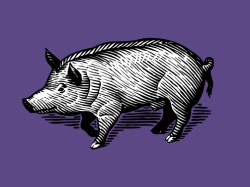
Cheshire Proverbs 5: We shall live till we die if the pigs don’t eat us


“We shall live till we die if the pigs don’t eat us”

J.C. Bridge no.382, page 149


J.C. Bridge does not say why this proverb is supposed to be characteristic of Cheshire, and nor is he at all helpful as to its origins and meaning.  One of the puzzles in the proverb is the idea implicit in the phrasing that being eaten by a pig does not necessarily result in instant death. Alternatively, the phrase might be interpreted as suggesting that we will live until we are supposed to die unless the pigs get to us first, suggesting an interruption to the divine plan that would otherwise see us die on a certain date.  How to get nearer to the actual meaning?

Tantrabobus

Bridge, apparently in an attempt to elucidate the situation, makes the sole comment “We shall live till we die like Tantrabobus” and leaves us to make of that what we may.  I remained unenlightened.  I had no idea what or who a Tantrobobus might be, and the matter is still more than a little opaque.  The word was certainly a late 18th century colloquial term used in the U.S. state of Vermont.  The Only in Arkansas website describes it as follows:

A modern interpretation of the Tantrabobus. Source: Oxford University Press blog

A Tantrabobus, or ‘Haint’ was an evil monster rumored to live inside wells. According to Philip Steele’s book Ozark Tales and Superstitions, children were encouraged to never look inside wells lest the monsters place a spell on them and draw them down into the darkness forever.
[Ozark is an area shared between neighbouring Arkansas, Missouri and Oklahoma]

This story is echoed in various Arkansas-related websites and books, and was clearly a widespread legend, perhaps dreamed up and disseminated by parents to warn children against the dangers of deep wells.  Painting the ceiling of a house porch blue was supposed to scare off the haint.

Unless the origins of the well-inhabiting monster were in England, it’s difficult to see how it relates to a Cheshire proverb.  A slightly different word, however, does originate in England. “Tantarabobs” was apparently a Devonshire name for the devil, and the Oxford University Press’s blog offers another devil-related version:

Tantrumbobus is a relative of Flibbertigibbet, Hoberdidance, and Obidicut (also known as Haberdicut), the fiends mentioned in King Lear. I wonder whether English dander “to walk around; to talk inherently” and especially Old High German tantaron “to be out of one’s mind” are kin of the British devils, and, if so, whether those devils were also known on the continent.

All very interesting, but I still had no idea why anyone might be eaten by a pig before the date in Death’s personal organizer.

The country of the Gadarenes

Part of Newberry’s 1928 analysis of Seth as a black pig

In ancient Egypt, the pig is associated with Seth, the ambivalent but mainly trouble-making deity, in direct opposition to the good god Osiris, who Seth killed and dismembered, scattering his remains in the Nile (but don’t panic; he was re-assembled and resurrected by the goddess Isis). Following the Egyptian idea of evil and pigs being identified with one another, I had a look around and sure enough, the Christian devil is sometimes equated to a pig.  According to the Open Bible website, there are numerous verses that concern themselves with pigs.  One in particular, in Matthew 8:28-32, tells a story of transmogrification, whereby humans are converted into pigs (English Standard Version):

And when he came to the other side, to the country of the Gadarenes, two demon-possessed men met him, coming out of the tombs, so fierce that no one could pass that way. And behold, they cried out, “What have you to do with us, O Son of God? Have you come here to torment us before the time?” Now a herd of many pigs was feeding at some distance from them. And the demons begged him, saying, “If you cast us out, send us away into the herd of pigs.” And he said to them, “Go.” So they came out and went into the pigs, and behold, the whole herd rushed down the steep bank into the sea and drowned in the waters.

Fascinating and horrifying, but not an explanation of being eaten, unless “eat” is a metaphor for being transmogrified / transmigrated.  This is what Richard Jefferies (1848-1887) inferred in the late 19th Century.  His longer version of the proverb is “Ah well, we shall live till we die, if the pigs don’t eat us, and then we shall go acorning.”  He writes that the proverb is “a clear survival of the belief in transmigration, for he who is eaten by a pig becomes a pig, and goeth with the swine to eat acorns.” 

The story Jeffries recounts to illustrate this is the nearest I have found to an explanation of the proverb.  He tells the tale of a village elder who had been generous to everyone around him, but had suffered persecution.  He magnanimously ignored the offenses against him, but his rather less forgiving family consoled themselves with this proverb.  I take it from this that the family thought that the perpetrators would suffer some form of retribution roughly comparable to being consumed by pigs and forced to eat acorns. 

In other words, what goes around comes around.

All of that offers some sort of answer about the connection between the Tantrabobus, the pig and the devil, and also gets close to what the proverb may mean, but it doesn’t get us anywhere near to explaining why this proverb was considered by Bridge to have some peculiar connection to Cheshire.  So my final question concerned the role of pig in Cheshire farming through the centuries prior to Bridge’s 1917 book.

Pigs in Cheshire

Generically, because pigs are omnivorous, will eat agricultural and household waste and will happily forage in woodland, and because they have big litters of piglets that can be eaten or sold, they offer a useful complement to the big three livestock breeds: cattle, sheep and goat.  The big three give birth to only one or two infants at a time, and although these too can be eaten or traded, their great value lies in the fact that the females can be milked and used to produce dairy products.  In terms of both meat and dairy, livestock represents storage on the hoof.  If disease hits any of the big three herds, the recovery time can take many, many years.  The big three are therefore curated with great care, whilst pigs, being both easier to feed and producing multiple offspring, are inherently much more disposable.

Men knocking down acorns to feed swine, from the 14th century English Queen Mary Psalter, MS. Royal 2 B VII f.81v. Source: British Library via Wikipedia

During the Anglo-Saxon period, the pannage system involved the seasonal driving of pigs into woodland to feed upon acorns, nuts, rhizomes and roots.  In some areas this persisted well into the Medieval period.  Cheshire, once full of rich forests, was ideal pig territory, offering shade, food and shelter, because pigs, in their natural environment, are woodland dwellers.  Although often seen in Britain today in open fields, in their preferred habitat they forage with their leathery snouts for roots and nuts under trees, and they nest in hollowed-out depressions.  They cannot perspire, so they wallow in woodland mud and pools of water to keep cool in the summer.  Sociable creatures, they tend to form communities.

Image from the Hunterian Psalter folio 6r. Gathering acorns for pigs in November. Source: Glasgow University Library

In the later Middle Ages, there is plenty of evidence that pigs were increasingly managed as a resource, making use of their singularly indiscriminating appetites to trim down agricultural stubble, devour household waste (including food leftovers and household rubbish) and the by-products of dairying, and in Cheshire this was particularly related to cheese-making.   Many became enclosed in fields, gardens and even sheds.  A single pig could be kept by even the poorest householder, and the owner of several pigs could generate a good income by selling both piglets and fattened pigs for slaughter.  As late as 1550 it is recorded that pigs still roamed the streets in Chester, and they were probably even more prominent in everyday village life.

In the latter part of the 18th Century, pig keeping was usually an essential part of farming practise, even on farms dedicated to cheese-making.  Geoffrey Scard gives the example of a 25 acre dairy farm majoring on cheese, which had the following holding of livestock in the latter part of the 18th Century:

 9 crossbred Cheshire shorthorns, 2 yearling heifers, 2 heifer calves, 10 pigs and 20 hens.

Pigs were clearly an essential part of the economic profile of the farm.  Scard next gives the example of the much larger 243 acre dairy farm at Cholmondeley in the 19th Century.  The following animals were kept:

2 ponies, 3 carthorses, 51 milking cows, 16 two-year heifers, 17 yearling heifers, 15 heifer calves, 1 bull, 66 Shropshire ewes and lambs, 55 half-breed withers and 100 pigs.

Piglets of the Welsh pig breed. Source: British Pig Association

In simple numbers, pigs dominated, but as a balance to cattle and sheep.  In the late 19th Century, a breed known as the Welsh became popular.  A very pale pink-white, with big lop-ears, it was first mentioned in the 1870s when, according to the British Pig Association, there was a considerable trade in Welsh and Shropshire pigs into Cheshire, specifically for fattening on milk by-products, from cattle (and possibly sheep).  The milk by-products would have had to be disposed of and wasted if not consumed, so it was essentially free to feed pigs who became fatter and more valuable and were handy waste disposal units to boot.  By contrast, the feeding of cattle was expensive, so using milk by-products to feed pigs helped to pay for the upkeep of cattle.

From this we can conclude that the pig had an important role in Cheshire, and that this may account for why Bridge considered the proverb to be peculiarly appropriate in a book of Cheshire proverbs.

All of this is pure speculation, but what an awful lot of fun 🙂

For more about J.C. Bridge and this Cheshire Proverbs series, see Cheshire Proverbs 1.

An index of all posts in the Cheshire Proverbs series can be found
on the Archaeology,
Heritage and Art page

Sources:

Books and papers

Bridge, J.C. 1917,  Cheshire Proverbs and Other Sayings and Rhymes Connected with the City an County Palatine of Chester Phillipson and Golder (Chester)

Hamilton, J.  and Thomas, R. 2012.  Pannage, Pulses and Pigs: Isotopic and Zooarchaeological Evidence for Changing Pig Management Practices in Later Medieval England.  Medieval Archaeology 56(1), p.234-259
https://www.academia.edu/15571794/Pannage_Pulses_and_Pigs_Isotopic_and_Zooarchaeological_Evidence_for_Changing_Pig_Management_Practices_in_Later_Medieval_England

Jeffries, R. 1948Field and Hedgerow: Being the Last Essays of Richard Jefferies.  Lutterworth Press
https://www.gutenberg.org/ebooks/7030

Newberry, P.E. 1928. The Pig and the Cult-Animal of Set. The Journal of Egyptian Archaeology
Vol. 14, No. 3/4 (Nov., 1928), p.211-225

Scard, G. 1981.  Squire and Tenant:  Rural Life in Cheshire 1760-1900.  Cheshire Community Council

Websites

British History Online
Later medieval Chester 1230-1550: Economy and society, 1350-1550
https://www.british-history.ac.uk/vch/ches/vol5/pt1/pp64-80

The British Pig Association
The Welsh
https://www.britishpigs.org.uk/welsh

Only In Arkansas.com
Arkansas Superstitions: The Tantrabobus in Grandpa’s Well by Liz Harrell
https://onlyinark.com/culture/arkansas-superstitions-tantrabobus/

OpenBible.info
Pigs
https://www.openbible.info/topics/pigs

Oxford University Press blog
A few bogus etymologies: “tantrum,” “dander,” “dandruff,” and “dunderhead,” along with “getting one’s goat” by Anatoly Liberman
https://blog.oup.com/2017/09/tantrum-dandruff-dander-etymology/

Wordfoolery blog
The history of the word “bogus”
https://wordfoolery.wordpress.com/tag/word-origin/


Ranulf III’s Beeston Castle #2 – The castle, the walk, the visit

The gateway to the inner ward seen from the outer ward

In Part 1, I introduced Ranulf III, the powerful descendant of King Henry I, who started building Beeston Castle in 1220, and during his lifetime was close to four kings of the Middle Ages:  Henry II, Richard I (“the Lionheart”), John (“lackland”) and Henry III.

Here, part 2 looks at the castle itself, the walk up to the castle, 18th and 19th Century artistic interpretations of the castle, and practical visit details, including notes on accessibility for those with less than cooperative legs. The two parts are designed to be read together, as many of the photographs of the castle are in Part 1.

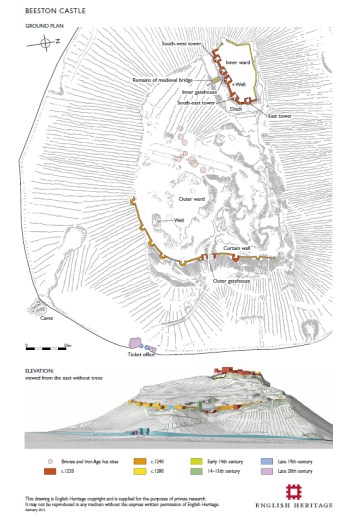
Topographical plan showing the site elevation and key features, colour-coded to show different construction phases. Source: English Heritage. https://www.english-heritage.org.uk/siteassets/home/visit/places-to-visit/beeston-castle/history/serpentine/beeston-castle-phased-plan-1.pdf

With so much of its stonework intact, Beeston is entirely comprehensible as a functioning castle and, together with the stunning views, is worth a visit in its own right, but arming oneself with knowledge about the its builder makes for an even more rewarding experience.

Twelve years before he died after a rich and varied life, the magnate, military leader and crusader Ranulf, Earl of Chester, set about building three new castles to add to his existing tally, of which Beeston was the most impressive.

Beeston has been the subject of investigations since the 19th Century, encompassing both documentary research and fieldwork, and is one of the most comprehensively studied sites in the mid-Cheshire area.  This  research encompasses the impressive prehistoric remains at the site, the castle’s 13th Century origins, repairs in the 14th Century and, after a period of partial abandonment, a major renovation during the Civil War (17th Century).   After the final military abandonment of the castle in the 17th Century, it entered a new phase in the 18th Century as a growing tourist attraction, which expanded during the 19th Century when rail arrived.

These are all aspects of its past that are well worth exploring, and all are handled by Beeston’s small but informative visitor centre and the really excellent illustrated guidebook.  Supplementing these resources with other material, I have written up more details about the castle’s builder, Ranulf III, and described a few of the highlights of the castle’s history below.  I am saving an account of the multi-period record of prehistory for another post.  If you have even a little curiosity about prehistory, I hope that it will be worth waiting for 🙂

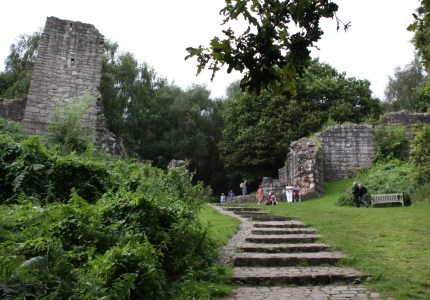
Today’s approach to the monumental gateway into the outer ward. The tall tower was a later addition to Ranulf’s original gatehouse

Before launching into the history of the castle, you might want to have a look at the castle’s site plan shown above left, which can be downloaded from the English Heritage website, showing the site’s elevations and colour-coded chronological phases.  It is also reproduced in the Beeston Castle guide book.

This page is divided up as follows:

  • Beeston Castle in the 13th Century
  • Beeston after Ranulf III
  • Beeston during the Civil War in the 17th Century
  • Beeston in the 18th and 19th Centuries
  • Visiting Beeston (with accessibility notes for those with unwilling legs)

If you would prefer to download parts 1 and 2 as single a PDF, please click here.

Ranulf’s 13th Century Castle

Probably springing from multiple motivations whirling around Ranulf’s busy head, the resulting castle at Beeston is awe-inspiring.  Strategically, Beeston is in an exceptional position, with views that would have provided sight of an approaching army miles (and hours) away, control of the valley below.  These views make for an excellent visit.

A reconstruction of the early 14th Century castle, showing both inner and outer wards. Source: English Heritage’s excellent Beeston Castle guidebook.  Click to see a bigger picture.

The English Heritage guidebook has an invaluable blow-by-blow description of all the features of the castle, which should not be missed by anyone who really wants to understand it.  Soden adds additional details about what features Beeston shared with the two other castles that he was building at the same time. Here, I’ve picked out the bits that I found most interesting.

The immediate impression one has of the castle on approach is that it consists of two main colours:  white-grey and red.  The red sandstone seems to have been used in the original construction but also seems to have been the main building material used during subsequent restoration works.  The original works were dominated by the grey-white stone.  I haven’t yet pinned down exactly what sort of sandstone this is, but unlike the usual local red sandstone it is very hard and dense, and very difficult to damage.

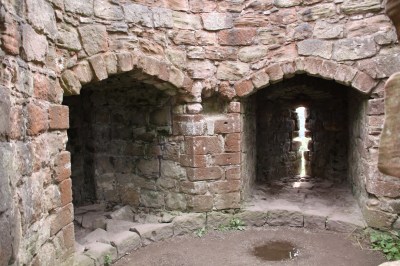
There are two main elements of the castle, the big outer ward (or bailey) and the smaller inner ward, each defined by a stone wall interrupted with D-shaped defensive towers (known as mural towers) arranged at intervals along tall curtain walls.  Each of these defensive curtain walls was provided with a single access point, almost identical heavily defended double-towered gateways.  To ensure that no-one unwanted gained access, every tower along the walls was furnished on the ground floor with arrow-slits, tall thin “windows” in the walls and the topmost level would have been manned by archers.  The outer ward followed the line of the defences of the Iron Age hillfort incorporating its accompanying defensive ditch.

Although archaeologists were let loose in the outer ward, they found no evidence of buildings contemporary with the castle, and there is little indication in the documentary sources either.   It is possible that work was clearly concentrating on the inner ward, with just the defensive elements of the outer ward being completed, but it is also a possibility that the area of archaeological investigation did not coincide with any buildings that had been erected.

The inner ward’s gatehouse from the inside

The inner ward, the heart of the castle complex, was separated from the outer ward by a deep ditch cut into the rock.  The ditch had a double function, being both the quarry for stone for the castle, and a line of defence in its own right.  This ditch was crossed by a wooden bridge, probably with a drawbridge and portcullis, the mechanisms for which would have been housed in one of the gatehouses as suggested in the above reconstruction.  There was no keep (a big central tower, a third level of defence that usually contained accommodation and prison cells) and it appears that a keep had never been part of Ranulf’s plan.

One of the gatehouse towers in the inner ward

The ground floor of the inner ward’s gatehouse was provided with chambers, each of which had a slit through which arrows could be fire.  The first floor of the inner ward’s gatehouse would have housed the guardian of the castle, known as the constable, and the top floor would have housed the gate and bridge mechanisms, the former lowered and the latter raised at times of threat, as well as archers who would have protected access through the gate.  Even though the main accommodation for the constable was probably in the main gatehouse, the only fireplace found was in the southwest tower, perhaps a daytime office for the constable.  Other rooms could have been heated by braziers when needed.

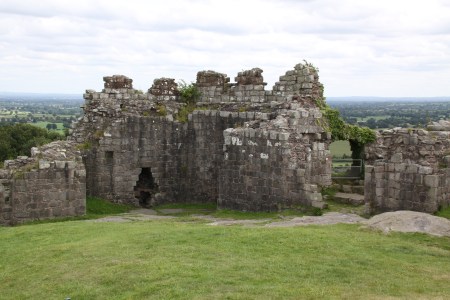
As with the gatehouses, the D-shaped towers of were provided with slits through which arrows could be fired, and also had upper floors that acted as platforms from which other soldiers could defend the castle.  Any stairways between these floors must have been made of wood because no staircases survive.  It is thought that the upper floor of the towers, including the gatehouses, were surrounded by wooden rather than stone defences in Ranulf’s day, because a much later record talks about the replacement of wood with the crenellated stone wall that is shown in the above reconstruction.

Well within the inner ward

Both upper and lower wards were provided with water wells, which would have helped the castle to hold out during a siege.  The well in the inner ward has a circular wall and has been provided with a lid to prevent children falling into it.  A legend that King Richard II left his treasure at the castle lead to several investigations of the well.  The investigations in the 1930s found that it went down to 110yds / 100m with the medieval masonry down to 61m.  The well in the outer ward, under a big tree, looks a bit like a quarry and it is suggested that this bizarre appearance was the result of attempts during the Civil War to enlarge it.  It has now been filled in, but its depth was recorded in 1623 as 240ft / 73m.

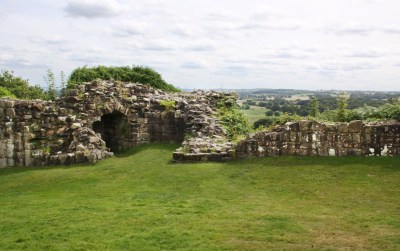
Remains of the well in the outer ward

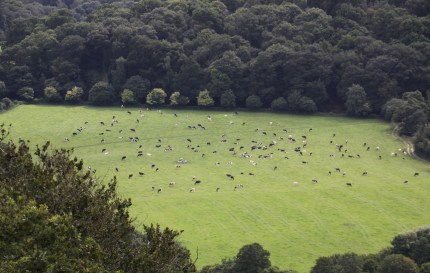
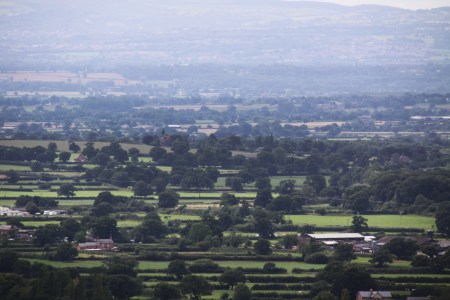
Views from the inner ward across the Cheshire plain showing its strategic position

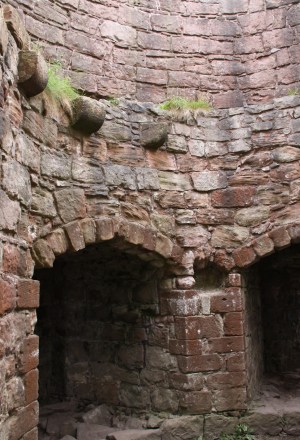
Detail of the inner ward at the southeastern end

Beeston Castle was unfinished at the time of Ranulf’s death.  The north curtain wall of the inner ward was not completed until the 1280s, by which time it was in the Crown’s ownership.  The centre of the upper ward feature big outcrops of bedrock, suggesting that it had never been levelled for the construction of an imposing entrance or the addition of inner buildings. Additionally, some key castle features were missing, like a kitchen and a great hall.  This was confirmed by archaeological work that found no sign of inner structures.

Ranulf employed many of the same features at his other new castles.  Although the plans were all distinct, they shared twin-towered gates, deep ditches, D-shaped towers, individual chambers within the towers (mural rooms) and “fish tailed” arrow loops.  Ranulf had a model of the perfect castle and he was working towards achieving three different versions using the same toolkit of modern defensive options.

After Ranulf

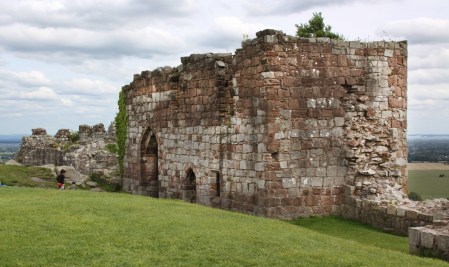
The top courses of stonework is clearly different from the lower, showing the 15th Century rennovation of the towers.

When Ranulf died in 1232, 12 years after he began the castle, his estates were inherited by his nephew John le Scot.  However, le Scot died five years later in 1237 and Henry III confiscated all of his land, redistributing some of it and retaining the better part for his son Edward, perhaps justifying Ranulf’s belief that the Crown was a greater threat to his territories than the Welsh.  The Chester estates, together with Beeston and Chester castles, were initially put into the custodianship of John de Lacy, earl of Lincoln (c.1192-1240).

Under the Crown, Beeston languished in second position to Chester Castle, but in the 1240s hostilities against the Welsh led to it being repaired, building on Ranulf’s work, presumably to prevent the Welsh attempting to take it and reinforce it themselves.  In c.1253 Henry III granted the earldom of Chester, together with Beeston, to his son Edward I and Edward’s subsequent heirs as Princes of Wales.

Early 14th Century records of investment in the castle indicate that crenellations were added to the towers, which were themselves raised to a higher level and were roofed with lead, and the gateway of the inner ward required repair.  The gateway was provided with a new wooden bridge, anchored on a massive stone plinth that is still visible between the 1970s bridge today.  The timber was carried 8 miles from Delamere forest on ox cart to Beeston.

The southwest end of the inner ward

The castle appears to have been allowed to fall into ruin during the 15th Century.  It was sold in 1602 to Sir Hugh Beeston, a local landowner, although his reasons for his wanting a ruined castle are unknown.

The Civil War 

Silver bowl and spoon dating the the Civil War period found at Beeston and now on display in the Beeston Visitor Centre

Forty years later the Civil War broke out.  Those Royalist forces took up position at Chester in 1642,  using as a base to provision themselves from the Dee, which was still a working port with river access via the Dee to the Irish Sea and Liverpool Bay.  Shortly afterwards, parliamentarians established themselves at Nantwich.  Beeston sat bang-splat in the middle, and the parliamentarians under Puritan Sir William Brereton installed a garrison there in February 1643 under Captain Thomas Steele.  Essential repair work took place to secure the ruined castle.  Brereton’s efforts were in vain.  Royalist men entered the castle in mid December and Steele surrendered.  He was later shot for his failure to defend the castle.  John Byron, leading the Royalist forces, installed his own garrison at Beeston and went on to defeat the parliamentarians at Middlewich.  Brereton, however, was not finished and in November 1644 besieged Chester and set about cutting off the royalists entrenched in Beeston with a blockade to prevent them re-provisioning.  The Royalists managed to breach the blockade twice, but the blockade was reinforced.

The king was defeated at Rowton Heath, south of Chester, on September 24th 1645 and Beeston Castle was given up to the parliamentarians on 15th November.  Royalist soldiers, half-starved, were allowed to depart.  Beeston was now systematically dismantled (an action known as “slighting”) so that defending it would be impossible without major rebuilding.   For the next two centuries it attracted only local attention.

Beeston in the 18th and 19th Centuries

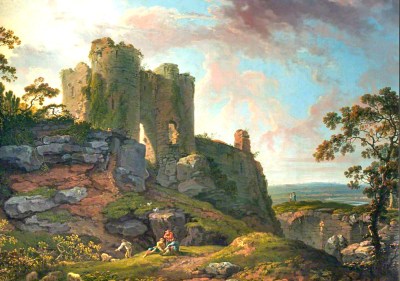
Beeston Castle’s inner ward gatehouse, a romanticized view painted by George Barret in the mid 1770s.  Source:  Wikipedia

Now a ruin, in the 18th Century the castle, visible for miles around acquired a romantic air and become something of a visitor attraction, and a number of artists represented it, three of which are shown here, offering very contrasting views of the castle.

To the right is a highly romanticized version by relatively minor painter George Barret in the mid 1770s, highly coloured and dramatic.

The  famous J.M.W Turner (1775-1851) painted a scene in 1809, based on sketches he made in 1801, showing a woodland scene with Beeston as a faint silhouette in the distance.  Turner had initially wanted to train as an architect rather than a painter, but was pushed in the direction of painting by Sir Joshua Reynolds when Turner joined the Royal Academy at the age of 14.  His love of buildings remained with him throughout his life, and painted a great many architectural themes.  He particularly liked English castles.  Typical of his work, Beeston is a mere suggestion, a ghost of a place on the edge of the real world.  By employing the traditional narrative approach of painting that he would have learned at the Royal Academy, which draws the eye from left to right, the castle’s apparently subordinate position still results in its domination of the rural woodland scene.  Past and present are juxtaposed, but while the present takes up most of the canvas, it is the past that dominates the landscape.

Joseph Mallory William Turner’s view of Beeston Castle (far right) in 1809, based on sketches he made in 1801. Source: Sandstone Ridge Trust

Another painting worth seeing is by David Cox (1783-1859) a leader of the Birmingham School and renowned watercolour and landscape painter, showing yet another view, this time in 1849.  As with Turner’s painting the castle is shown against the sky with no discernible details, apart from the towers, but unlike Turner, it is placed centre stage, surrounded by Cox’s typical use of bright, vibrant colours with extremes of light and dark.

David Cox’s view of Beeston in 1849. Source: WikiArt


The Beeston Festival of 1851, from the Illustrated London News, showing tents and stalls in the inner ward, and people queuing at the 1846 entrance built in the style of the castle. Source: English Heritage guidebook, p.35

In 1840 the castle was sold to landowner John Tollemache as part of the Peckforton Estate, purchased with wealth derived from sugar plantations in Antigua, first purchased by his father.  It was Tollemache who built Peckforton Castle on the neighbouring hill and carried out restoration work on Beeston Castle, re-using original stonework.  When we were at Beeston I was puzzled by the fir trees in the outer word, and it turns out that these were exotic imports designed to reflect the new gardens and grounds at Peckforton Castle.  Deer were imported and contained within the outer ward, along with goats.  Somewhat more bizarrely, so were kangaroos.  What the three species made of each other is not recorded.  The railway between Chester and Crewe opened in 1846 and a station at Beeston greatly facilitated tourism and in 1844 a two-day annual festival was held in the outer ward.  In 1846 the current entrance to the ticket office, an imitation Medieval gateway, was built to handle the thousands of visitors and provide limited accommodation.

The castle passed into the hands of the Ministry of Works in 1959 and then, in 1984, was taken over by English Heritage, who have done a really splendid job of maintaining the site and introducing visitors to all aspects of its past.

Visiting Beeston Castle

Pieces of decorated ceramic on display in the Visitor Centre

There is a car park at the foot of the castle, opposite the entrance (pay-and-display or free for members), a café and a really nice picnic area.

English Heritage has done an excellent job of ensuring that the castle is as accessible and enjoyable as possible.  The site is beautifully maintained and feels cared for.  The staff are friendly and helpful, and the Visitor Centre, on the other side of the nice little shop, is excellent.  It mixes a few cabinets of objects with big information boards with lots of helpful illustrations, and feels modern, spacious and welcoming.   If you don’t anticipate wanting to buy the guide book (which I bought, thoroughly enjoyed and have used as the basis of this post together with Iain Soden’s biography of Ranulf) I do recommend reading up on the castle on the English Heritage website, and printing off the site plan PDF shown at the top of the post (links below).

In case the opening times and entry fees change, here is the link to the Beeston Castle page on the English Heritage website that should help you find all you need to know.
https://www.english-heritage.org.uk/visit/places/beeston-castle-and-woodland-park/prices-and-opening-times/

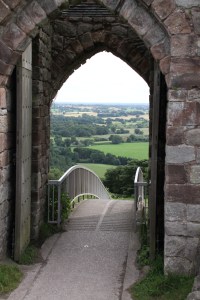
View from the inner gateway across the modern bridge across the plain

Accessibility for those with mobility challenges
This is an uphill walk, entirely suitable for anyone only averagely fit, taking perhaps 15-30 minutes depending on level of fitness, but you will anyway want to make many pauses to take in the views.  Although the walk consists of fairly easy slopes, this is not suitable for anyone who really can’t walk uphill, and there is understandably no access for wheelchair users.  Having said that, a lot of older people were doing the walk with the aid of walking sticks, pausing at benches along the way, and were doing it slowly but with enthusiasm.  Don’t forget that at the time of writing, English Heritage allows registered disabled people to bring a helper along free of charge, an “essential companion” in English Heritage terms.

There are a number of benches along the route, but all were well-used, so bringing along some form of portable stool might be an option for those with leg issues.  My Dad has a brilliant rucksack-cum-coldbag that has a hinged metal frame and folds out into a stool.  Suffering rucksack-stool envy, I’ve just ordered one for myself.

The walk up to the top of the castle can be described as a two-part enterprise.  There’s a slope up to the outer ramparts that can either be approached via a path with steps or a path without steps.   Once the outer ramparts are reached, there’s a short flight of stairs and then the approach to the upper ramparts that define the main castle are quite level for a while, followed by a fairly gentle slope up to the bridge across the ditch (what on a lowland site would be a moat).  The bridge itself is arched and quite steep for about 5-6 ft, but some good, solid railings were helpful for those with walking sticks.

For more about accessibility at Beeston, see the Beeston Castle Access page.

There’s a café at the site, but we chose to finish our visit with a very happy beer at the nearby Pheasant, a famous pub  with more great views.  The menu looks excellent.

The Pheasant, from the garden

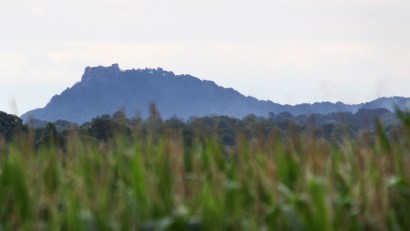
Beeston Castle viewed from Churton, seen over the top of a field of corn.

Sources

Books and papers

Alexander, J. 1982. RANULF III OF CHESTER: An Outlaw of Legend?  Neuphilologische Mitteilungen, 83(2), p.152-157.
http://www.jstor.org/stable/43343443 (available free with registration)

Gillingham, J. and Griffiths, R.A. 1984. Medieval Britain.  A Very short Introduction.  Oxford University Press

Liddiard, R. and Swallow, R.E. 2007. Beeston Castle. English Heritage Guidebooks

Rubin, M. 2014.  The Middle Ages.  A Very Short Introduction.  Oxford University Press

Soden, I. 2021 (second edition). The First English Hero: The Life of Ranulf de Blondeville. Amberley

Ward, S. 2013 (second edition). Chester. A History.  The History Press

Websites

English Heritage
Description of Beeston Castle
https://www.english-heritage.org.uk/visit/places/beeston-castle-and-woodland-park/history/description/
Research
https://www.english-heritage.org.uk/visit/places/beeston-castle-and-woodland-park/history/research/
History
https://www.english-heritage.org.uk/visit/places/beeston-castle-and-woodland-park/history/
Sources for Beeston Castle
https://www.english-heritage.org.uk/visit/places/beeston-castle-and-woodland-park/history/sources/

Oxford Dictionary of National Biography (locked)
Ranulf (III) [Ranulf de Blundeville], sixth earl of Chester and first earl of Lincoln (1170–1232) by Richard Eales
https://www.oxforddnb.com/view/10.1093/ref:odnb/9780198614128.001.0001/odnb-9780198614128-e-2716;jsessionid=A550860211C96B6006DE6E8E327F88A1

Ranulf III’s Beeston Castle #1 – Who was Ranulf?

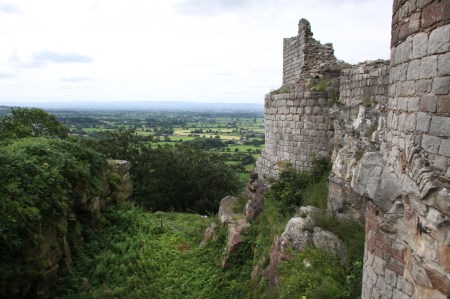
The approach to the inner ward (or bailey) seen from the bridge, with the vast ditch below, part quarry and part defensive device, and a slice of the superb panoramic view in the background.

The English Heritage Guidebook to Beeston Castle opens with the following statement:  “Standing on a rocky crag high above the Cheshire plain, Beeston is one of the most dramatically sited medieval castles in England.”  Organizations keen to puff off the virtues of their sites are often guilty of hyperbole, but in this case, the guide book speaks nothing but the truth.  On a bright mid-August day, with the sky a silvery pale blue, it was absolutely spectacular, both on the approach to the solidly impressive fortifications from below, and standing in the inner ward above the plain, gazing east to the Welsh foothills and northwest to the Pennines, with the floor of the world reaching out in all directions, lovely and fabulously impressive.  All this and history too.

This post has been split into two parts, with Part 1 looking at Ranulf III himself, and Part II tackling the castle itself, looking at how it was built, used and perceived, covering 600 years from the 13th to 19th Centuries.

If you would prefer to download parts 1 and 2 as single a PDF, please click here.

Ranulf III

Although Beeston Castle was altered several times since its original construction, it was the brainchild of Ranulf III (Ranulf de Blondeville), the 6th Earl of Chester and first Earl of Lincoln (1170-1232).  Ranulf’s castle building phase came fairly late in his very busy and dangerous life as the most powerful magnate in England.   The first work on Beeston Castle took place c.1220, only 12 years before his death, so this needs to be understood in the context of the rest of his life. 

Hugh de Kevelioc’s coat of arms, featuring five wheatsheaves.  Source:  Wikipedia

Ranulf was a descendent of the powerful Norman Marcher Lords installed by William the Conqueror to provide a buffer against the perceived chaos across the border in Wales.  Wales was at that time a set of territories controlled of powerful families headed by chieftains who were often in armed dispute with one another as well as with England  The Marcher lords, acting as guardians of the border, were incentivized with land, title and, perhaps most importantly, a great deal of autonomy.  Originally intending to shift the border further into Wales, the Marcher lords found the mountainous territory of the Welsh chieftains a serious impediment to progress and instead consolidated their positions in the lowlands.  However, the give and take of land and lives continued throughout Ranulf’s life, in spite of both reprisals and peace treaties.  It was not until after his death, during the reign of Edward I, that attacks by the Welsh chieftains were eventually squashed.  The loss of Crown lands in France by previous kings meant that Edward had had plenty of time to devote to the problem.

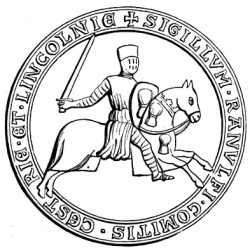
Ranulf’s official seal, reading “Seal of Ranulf Count of Chester and Lincoln.” The wheatsheaf emblems were later adopted by the Grosvenor family and can be seen on the outside of Churton-by-Aldford’s former school.  Source:  Wikipedia’s Ranulf III page

Ranulf, being of Norman stock, probably thought of himself primarily as Norman rather than English.  His mother was Bertrada de Montford, a cousin of Henry II from Evreux in eastern Normandy.  His father was the 5th Earl of Chester, Hugh de Kevelioc.  Hugh de Kevelioc was born in 1147, the son of Ranulf II, 4th Earl of Chester and Maud, the daughter of Robert the 1st Earl of Gloucester, who was an illegitimate son of King Henry I.  When his father died in 1181, Ranulf became a royal ward of Henry II and was sent to Henry’s court in Normandy, accompanied by his mother and four sisters.  When he came of age, knighted as Earl of Chester, he had inherited Chester Castle and the important trading port of Chester, together with valuable territories in Normandy until these were lost in 1204-5 by King John.  Sadly, there are no images of him.

Chester had been established as a palatine by William the Conqueror, granted special powers, removing it from of the direct control of the Crown, but Ranulf’s other estates could be redistributed at the whim of the king, to reward or punish, or merely reorganize.  Although Ranulf’s holdings expanded and contracted throughout his adult life he remained one of the most powerful men in England.  

Henry II

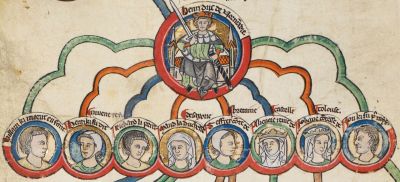
Henry II and his children.  From left to right – left to right: William, Henry, Richard, Matilda, Geoffrey, Eleanor, Joan and John.  Source:  Wikipedia

Ranulf, brought up in the court of Henry II, was loyal to the kings Henry II, Henry’s sons Richard I and (eventually) John, followed by John’s son Henry III.   These rulers were collectively known as the Angevin kings.  The period leading up to Henry II’s death was one of conflict, with his sons, Richard, Geoffrey and John turning on him due to the uncertainties of succession. 

At Henry II’s request Ranulf  married Constance of Brittany in 1189 at the age of 19, giving him the right to call himself Duke of Brittany.  Constance was widow of Geoffrey of Brittany, and mother of Arthur of Brittany who was next in line to the Duchy of Brittany.  Henry wanted to diffuse a situation in which Brittany was supporting his son Richard against him.  1189 was also the year in which Ranulf was knighted Earl of Chester by Henry.  Ranulf was now in control of his estates in England and Normandy.   Unfortunately, Ranulf and Constance soon developed a mutual loathing that lead to their separation within five years.  1189 was also the year in which Henry died and Richard I “the Lionheart” came to the throne, without further hostilities being required to assure the succession. 

Richard I

Richard I painted c.1250–55 by Matthew Paris in his Historia Anglorum. Source: Dorling Kindersley findout

Under Richard the Lionheart, the newly knighted Ranulf, connected to Richard via their relationship to Henry I, was given a role of key importance role in the coronation procession, carrying the jewel-encrusted crown.  Richard departed on crusade just a year later, having appointed a number of officers to oversee  his interests in England during his absence.   He also named his heir in case he perished during the crusade.  Instead of his younger brother John, he named Ranulf’s stepson, heir to Brittany, Constance’s son Arthur.  Unsurprisingly, Prince John’s nose was now firmly out of joint and he attempted to take the crown, supported by the king of France, Philip Augustus.  He was opposed by a number of powerful barons, including Ranulf.  Learning, weeks after the fact, of trouble at home, Richard decided to return, but he was humiliatingly delayed when he was recognized on the return leg of the journey, captured and held hostage in Germany.  Following an eye-watering payment Richard was freed, and his return settled the matter of John’s ambitions.  Richard underwent a second coronation just to push home the point.  Ranulf remained loyal to the king and followed Richard into war in Normandy and Brittany, where his estranged wife Constance was now stirring up rebellion.  In a rather botched attempt to split Arthur from Ranulf’s estranged wife Constance, both were ambushed in a trap set up by Richard with Ranulf’s help.  Constance was taken prisoner by Ranulf, who was now able to refer to himself one again as Duke of Brittany, but Arthur fled to the comparative safety of the King of France, Philip Augustus.

Whilst Ranulf was fixed in Normandy, Llewelyn the Great attacked and took Mold (then known as Montalt).  Mold was retaken but Ranulf’s trusted supporter, Ralph de Montalt, died in the conflict.  Ranulf was powerless to do anything about this, but it was just one more indication that something needed to be done about Wales.

Richard died in 1199 in a minor dispute (allegedly over rights to a Roman treasure), and with Arthur now allied with France, John succeeded to the throne. 

John

King John painted c.1250–55 by Matthew Paris in his Historia Anglorum. Source: TLS

Ranulf, having opposed John’s attempted coup, needed to prove his loyalty in the face of John’s notorious paranoia.  Ranulf was now about 29 years old.  He spent a lot of time early in the reign shifting between his territories in Normandy and England, while John reconciled himself with Arthur by naming him Duke of Brittany (ending Ranulf’s tenure) and Earl of Richmond.  The reconciliation was short-lived.  Arthur attacked Angers, taking a key Angevin castle, a terrible shock to John, who took instant revenge by taking the castle at neighbouring Le Mans, where Arthur’s mother Constance was staying.  He razed both castle and village to the ground. 

Arthur fled back to Philip Augustus.  Ranulf, joining John, swore loyalty to him at a big gathering in eastern Normandy in 1199, but John remained suspicious of him and it took time to win his trust.  This was not helped when, in 1200, Ranulf married Clemence de Fougeres, whose family had connections to both Brittany (via her father) and Normandy (via her mother).  John had a personal interest in Clemence himself, and was also concerned that Ranulf’s loyalties might be divided.  Ranulf doggedly pursuing his policy of demonstrating loyalty to John, stayed at court and accompanied the king on his travels throughout his territories. 

Arthur paying homage to Philip Augustus of France. Chroniques de St Denis, British Library.  Source:  Wikipedia

Constance, mother of Arthur, died in 1201 from leprosy.  Arthur, attacking another Brittany castle, was captured and imprisoned.  In 1202 he disappeared, probably having been murdered.  In response, Brittany rose up in revolt backed by Philip Augustus, king of France, who began to move against Normandy.  After an initial serious hiccough, when John charged Ranulf with treason, Ranulf was reinstated and his briefly confiscated estates returned to him.  He set about proving his loyalty during the campaigns in Brittany and French-occupied Normandy.

Staggered by the speed at which Philip Augustus was moving, and anticipating defeat, John left for England in December 1203, leaving his followers to defend his territories as best they might.  Ranulf followed shortly afterwards, similarly leaving his castles to defend themselves.   Although the war in France had continued in both John’s and Ranulf’s absences, Normandy was lost by 1205.  Ranulf, at court in England with John since late 2003, managed to weather the storms of John’s suspicions and continued to travel with the court, accompanied John in military expeditions to Poitou and Gascony and supported John in the face of the First Baron’s War.  Ranulf had, however, lost his five great castles in Normandy, together with the small private army that supported them. 

After another hiccough, when Ranulf’s loyalty was once again questioned in early 1205 by John, Ranulf again successfully challenged the accusations levelled at him.  Given John’s suspicions, it seems bizarre that only a year later John was so impressed by Ranulf’s loyalty that he rewarded him with so many titles and “honours” (estates) that he became the most powerful and wealthy man in England.  By 1208 Ranulf was not only Earl of Chester but also Earl of Lincoln, Earl of Richmond and had rights over Lancaster and Leicester.  The land and income associated with these honours were vast. 

Henry III

The coronation of Henry III. Source: Wikipedia

Following John’s death in 1216, the 46 year old Ranulf paid homage to the new king, the 9 year-old Henry III, and went to war in his name against Louis of France.  The king’s first Justiciar (effectively an acting regent) was Earl Marshall, a friend of Ranulf’s, and the transition seemed to go smoothly for Ranulf.  Fulfilling a promise to King John, Ranulf took an important part in the siege of Damietta in Egypt in 1218 during the 5th Crusade, returning after two years of battle.  He left Egypt in July 1220, arriving in England a month later.

Ranulf returned, having lost many friends to the crusade, to find that his friend Earl Marshall had been replaced as Justiciar by Hugh de Burgh, a long-standing enemy.  With two years of accumulated business to take care of, including repairs to some of his properties, he was kept busy with his own estates, but Henry also awarded him with new estates.  Disruptions over the rights to a number of castles involved Ranulf in military activity on behalf of the Crown in Northamptonshire, and then again on both his own and the Crown’s account at the Welsh borders, the latter at least partly resolved in the case of the Chester border with the marriage of Ranulf’s nephew John le Scot to Llewellyn’s daughter Helen in October 1223. 

Section of the outer ward’s curtain wall with remains of one of the D-shaped towers

Ranulf soon embarked on a major programme of castle-building, rebuilding castles at Bolinbroke Castle in Lincoln, Chartley in Staffordshire and  establishing a new castle Beeston in Cheshire.  Of the three, Beeston was by far the largest.  Ranulf’s reasons for wanting these castles, particularly Beeston Castle, which competed in scale and ambition with those of the kings themselves, have been much debated.  It has often been assumed that Beeston Castle, which was started in around 1220, was erected as a deterrent to the Welsh princes, but this was apparently not the case.  Not only is Beeston too far east of the Welsh border for this to be practical, but before building his castle, Ranulf had made his peace with Llewellyn the Great, whose territories met Ranulf’s along the Welsh border.  He felt sufficiently safe after the signing of this treaty to leave on the 5th Crusade in 1218 without any risk to his territory from Wales.  Although there had been a brief disruption after Ranulf’s return, this was at least partially resolved by the marriage of his nephew John le Scot to Llewellyn’s daughter, sealing peace if not actual friendship between Llewellyn and Ranulf.   Nor does Wales explain his other two castle-building enterprises.

The approach to the gateway to the inner ward with remains of the curtain walls and D-shaped towers

Perhaps surprisingly, the English crown represented a far greater risk to Ranulf’s security than Wales.  Henry III did not assume control of his government and territories until 1227, seven years after Ranulf started the building works at Beeston.  During this period control remained with Henry III’s Justiciar, Hubert de Burgh,  Ranulf’s enemy.  Disapproving of the way in which so much Crown territory had been given away as favours under previous reigns, Hubert de Burgh had started to claw back land and assets wherever he saw weakness.  It was now that Ranulf started to make improvements to his existing properties and to build his three new castles: Beeston Castle in Cheshire,  Bolinbroke Castle in Lincoln and Chartley in Staffordshire.  The new castles were probably intended to be Ranulf’s insurance against a royal land-grab happening to him, mainly acting as a statement of political authority and independence.

The great ditch around the inner ward, used for quarrying building fabric for the castle, as well as defence.

By raising taxes, Ranulf could easily afford these great projects.  Iain Soden describes Ranulf’s properties at this time:

Ranulf continued to hold the largest number of lands of any magnate in England; with them came the bulk of the armed forces.  Besides his ancestral earldom of Chester, the Honour of Chester stretched right across the Midlands, out into Gloucestershire and across Staffordshire and Warwickshire into Northamptonshire.  Outlying lands attached to the honour lay as far south as Devon and as far north as Derbyshire.  His earldom of Lincoln was intact, stretching from Yorkshire to Leicestershire, white the honour of Leicester linked his norther n lands with those in Northamptonshire.  To these, of course, could be added the family lands.  His brother-in-law Ferrers held the earldom of Derby and now the honour of Lancaster while his nephew was Earl of Huntingdon.

As his castles were being built, Ranulf continued to be in attendance at court and again returned to battle in France in 1230, this time against Louis IX, remaining until 1231, with a successful outcome.  He returned to England later that year.

Ranulf died on 26th October 1232 at the royal castle in Wallingford, 12 years after he began work on Beeston Castle.  Consistent with the traditions of the time, when he died his body was eviscerated (internal organs removed) so that it could buried in three locations.  His entrails were buried at Holy Trinity Priory at Wallingford.  His heart was buried at Dieulacrès Abbey, the Cisterian monastery that he had relocated, in 1214, from Poulton on northeast Wirral to Leek in the Midlands.  His  embalmed body was then returned to Chester and buried in the chapter house of the Benedictine Abbey, St Werburgh’s, next to his father and grandfather. He had no children.

Ranulf was a really fascinating historical figure, a powerful magnate, and a key figure in the lives of the Angevine kings.  Although he was swept up in the royal imperative to hang on to existing territories, retrieve lost ones, and acquire new ones, as well as meet the crusading demands of the Pope, he stands out as someone who was immensely powerful in his own right, loyal to the Angevine kings but perfectly confident to engage in strategic planning on his own behalf.  Sadly, in spite of the skilled work of his biographers, who have delved into difficult contemporary documents, Ranulf as a personality remains elusive, lost in the accounts of military and courtly engagements, actions and deeds.  He respected, cared for and supported his friends, detested his first wife, apparently rubbed along well with his second one, and engaged in bitter conflict with one of Henry III’s key advisors.  He had a passion for hunting.  He had a quick temper, was an excellent project manager, a compelling leader of men and was unafraid of exposing himself to the genuine horrors of war, often engaging in fearsome hand-to-hand combat.  There is the suspicion that his final phase of castle building had as much to do with vanity as a fear of having his estates confiscated, but that remains pure speculation. There is not even a surviving image of him to give one an impression of what he looked like.  What Ranulf was is fairly clear.  Who he was remains veiled.

For anyone wanting to read more about Ranulf III, whose extraordinary and complicated life cannot be more than touched upon in a post of this length, I recommend Iain Soden’s “The First English Hero,” details of which are in Sources, at the end of this post.

Part 2 looks at the castle itself, both how it was used and how it was perceived, from the 13th to 19th Centuries.

Sources

Books and papers

Alexander, J. 1982. RANULF III OF CHESTER: An Outlaw of Legend?  Neuphilologische Mitteilungen, 83(2), p.152-157.
http://www.jstor.org/stable/43343443 (available free with registration)

Gillingham, J. and Griffiths, R.A. 1984. Medieval Britain.  A Very short Introduction.  Oxford University Press

Liddiard, R. and Swallow, R.E. 2007. Beeston Castle. English Heritage Guidebooks

Rubin, M. 2014.  The Middle Ages.  A Very Short Introduction.  Oxford University Press

Soden, I. 2021 (second edition). The First English Hero: The Life of Ranulf de Blondeville. Amberley

Ward, S. 2013 (second edition). Chester. A History.  The History Press

Websites

English Heritage
Description of Beeston Castle
https://www.english-heritage.org.uk/visit/places/beeston-castle-and-woodland-park/history/description/
Research
https://www.english-heritage.org.uk/visit/places/beeston-castle-and-woodland-park/history/research/
History
https://www.english-heritage.org.uk/visit/places/beeston-castle-and-woodland-park/history/
Sources for Beeston Castle
https://www.english-heritage.org.uk/visit/places/beeston-castle-and-woodland-park/history/sources/

Oxford Dictionary of National Biography (locked)
Ranulf (III) [Ranulf de Blundeville], sixth earl of Chester and first earl of Lincoln (1170–1232) by Richard Eales
https://www.oxforddnb.com/view/10.1093/ref:odnb/9780198614128.001.0001/odnb-9780198614128-e-2716;jsessionid=A550860211C96B6006DE6E8E327F88A1

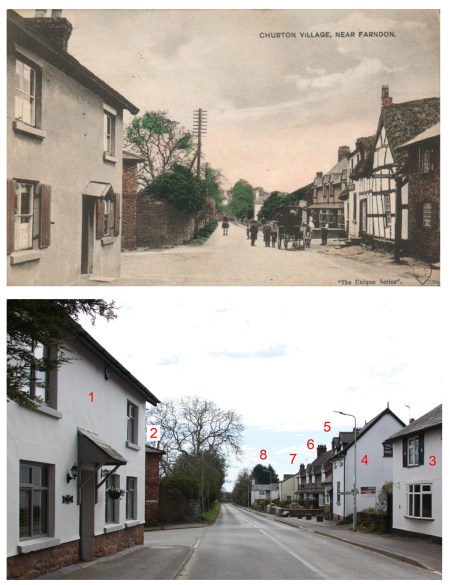
Comparing a Churton village postcard, the 1911 map and a modern photograph

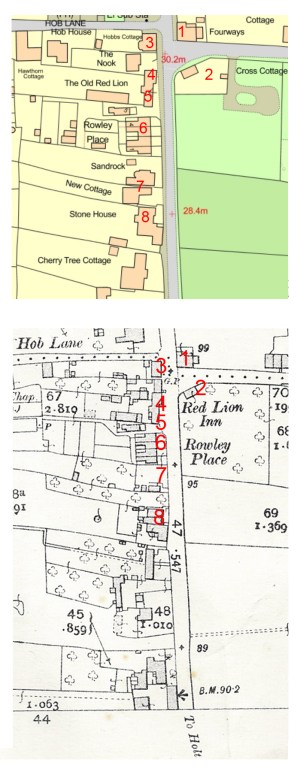
1, Fourways. 2, Cross Cottage. 3, Hob Cottage. 4, The Old Red Lion, extension or combined with the earlier building?. 5, The Old Red Lion (former pub with half-timbered section, barely visible here but marked by three square planters). 6, Rowley Place (1-4). 7, New Cottage. 8, Stone House (formerly Stone Cottage and Lilac Cottage, now one house). On the other side of Stone House, and out of view in both postcard and photograph, is Cherry Tree Cottage, dating to 1610 and beyond it Wayside Farmhouse, Highway Farm and The Byre.

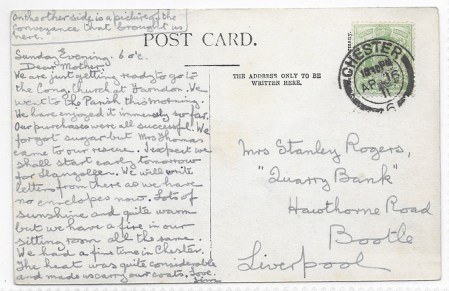
This is a tinted version of a black and white photograph used for this distinctive postcard of Churton.  I have seen several for sale on eBay, but all of them were unposted and unmarked, whereas I like to see the stamp, post mark, recipient address and to read the message.   This is a particularly good example.  The postcard was printed in Germany as many early postcards were. It has a Edward VII Halfpenny stamp (Edward VII came to the throne on the death of his mother, Queen Victoria, on 22 January, 1901, and died on 6 May 1910) and bears a Chester postmark dated April 16th 1911.  It was destined for an address in Bootle.  See the message at the end of the post.

On the photograph above and on the maps below, the red numbers have been added for ease of identification, but do not relate in any real-world way to the buildings themselves, none of which, apart from the homes that make up Rowley Place, were allocated Chester Road numbers, and all of which are known instead by their house names.  Several buildings are set back from the road today, and are not visible in the postcard, so have not been mentioned here but are shown on the top of the two maps below.  Note that numbers 4 and 5 refer to what make up the same residence today, but were clearly built at different times in the past.

Modern map of Churton from the Public Map Viewer, compared with the 1911 map (Cheshire Sheet LIII-3, a 1909 revision of the 1872-4 and 1897 -1898 surveys).  Between 3 (Hobbs Cottage) and 4 (part of the Old Red Lion), the thatched half-timbered house is still shown.

Many of the buildings and features shown in the photograph are still present today, but there is one notable omission. Eventually I hope to get to grips with the histories of individual buildings, including my own, but for the time being I have confined myself to playing “spot the difference” between the early 20th century postcard and the photograph I took in March 2021.

The most notable of the buildings that was in the postcard but is absent in the photograph is the half-timbered thatched building that sits between Hobbs Cottage (3)  and the Red Lion (4 + 5) on the photograph, a wonderful looking place that may date to the same period as Churton Hall Farm (in Pump Lane).  It was built directly onto the red sandstone bedrock, and has a small flight of stairs over the bedrock to reach the front door.  If anyone has any information about it, please get in touch.  Its site is now the driveway that gives access to The Nook, which is set back from the road.  A startling sight in the postcard is the regiment of telegraph polls, with seven rows of crossarms.

Almost completely hidden in the postcard is the Old Red Lion, which seems to have been thatched at that time.

Two buildings post-date the 1911 map:  Sandrock and New Cottage on the plot marked 7.   Most other changes are cosmetic, but like the the usual modernizations of window frames but a A  number of minor embellishments have been made to existing properties. The shutters have been removed from Fourways (1).  A sympathetic roof conversion has been fitted to  part of the former Red Lion (4), the porch over Fourways (1), has been changed for something a bit more effective and Hobbs Cottage (3) has been fitted with a small bay window on the ground floor and its brickwork has been rendered and painted.  A road sign for Pump Lane has been added to Cross Cottage since the photo in the postcard was taken (2).  At first glance I thought that the  same signpost pointing down Pump Lane to Coddington had been retained, but it has either been replaced or moved, because it is no longer in front of Hobbs Cottage.

Do get in touch if you have further insights.

As to transport, a novelty of the image compared to today is that there is no traffic thundering up and down!  Instead, there is a one man on horseback retreating down the road at a plodding pace, and a horse-drawn carriage with a small group of people around it, together presenting a very peaceful rural scene.  Ron Parker, who was born in the village, told me that when he was a child they used to play ball in the road.  Heaven help anyone who tried it now.

The note on the postcard was written on a Sunday evening at 6pm in April 1911 by one Jim (presumably Jim Rogers) to his mother Mrs Stanley Rogers.  It  says that they were just going out to attend the Congregational Church at Farndon, having been to “the Parish” in the morning.  This was presumably the Congregational chapel built in 1853, now a home named Chapel House.  The Parish church would have been either St Chad’s in Farndon or St John the Baptist Church in Aldford, depending on whether they were staying in Churton by Farndon or Churton by Aldford.  The two civil parishes were only combined to form a single parish in 2015.  The visitors had already been to Chester on a sunny day, when it was so warm that they had had to carry their coats, and on the following day they were making an early start for a trip to Llangollen.  It must have been quite a trek by horse-drawn carriage. Even with the warm weather, they were enjoying a fire in their sitting room on that Sunday evening.  Jim finishes the card by pointing out that “on the other side is a picture of the conveyance that brought us here”.

Churton seems like a rather remote spot for a holiday break, particularly when the means of getting there was horse and carriage, but that’s very much what this message appears to indicate.  It would be interesting to know the details of the end-to-end journey that ended in a horse and carriage ride into Churton.

If you own a used copy of this postcard (i.e. one that has been posted and has a stamp, postal mark and message), do share the details of it either by commenting here, or by getting in touch with me.  It would be good to build up a picture of the sort of experiences people had when they visited Churton, and to know why they visited in the first place.


Hidden Holt: An illuminating must-visit exhibition currently at Wrexham Museum

Cover of the free English/Welsh booklet accompanying the exhibition published by Wrexham Heritage Service, 2021.

My thanks to Brian Payne of the Holt Local History Society for alerting me to the fact that the Hidden Holt exhibition has been launched at the Wrexham County Borough Museum, running until 29th January 2022.  I went last week my father, and we were both bowled over by how good it was.

The exhibition introduces the Roman tile, brick and pottery works that were spread across a number of fields to the northwest of Holt, next to the river Dee.  It uses an excellent combination of original artefacts, video,  information boards and both old and new photographs and diagrams to track the twin stories of the site itself and the history of its discovery and excavation.  Holt Local History Society has a long-standing interest in the Roman works, and commissioned the most recent geophysical survey work at the site, so it’s great to see their contribution to the story being celebrated.

The exhibition (free to enter) is in Gallery 3, to the left as you move beyond reception and the café to enter the display areas.  I’ve given an overview below, but I seriously recommend that you just go – it is a tremendous, professionally-produced and beautifully designed little exhibition with some superb objects on display and some excellent information boards that explain what you are looking at.  You won’t regret it.  If you’re in the mood, the café serves a great coffee and what looks like a rather delicious lunch 🙂

Survey and excavation

Arthur Acton –  page 5 of the booklet accompanying the exhibition.  Source: Wrexham Heritage Service, 2021

The story of how the site was recognized and investigated begins in the early 1600s when landowner Thomas Crue of Holt Hill suffered repeated damage to his plough on broken brickwork and eventually discovered a series of fifty 2ft-tall posts and recorded this in a letter now in the British Museum.  The letter was mentioned in the book Roman Cheshire by W. Thompson Watkins (1886).  Retired chemist and keen amateur historian Alfred Neobard Palmer read the book, and in 1905 decided to hunt for the remains that Crue had found.  He tracked down the original letter and accompanied by local vicar Jenkyn Jones, and with the permission of the landowner Mr Beard, he engaged in a series of fieldwalking expeditions that found plenty of fragments of Roman bricks, roof tiles and pottery over an area of some 20 acres.

Fold-out plan of the kilns at Holt, published by Grimes in 1930. (Scanned from my copy of “Holt, Denbighshire”)

Palmer was not an archaeologist, and the task of excavating the site was taken on by Wrexham solicitor and amateur archaeologist Arthur Acton.  Work began in 1907,  in Wall Lock Field, and continued until 1915.  Although he lectured prolifically about the site, Acton never published his work.  Fortunately some of his records survived, and he sold the finds to the National Museum of Wales.  After five years of admirable work, the Assistant Keeper of Archaeology at the National Museum, William F. Grimes who was better known as a prehistorian, published a comprehensive 235-page report on the site, complete with site plans, photographs and object illustrations.

Photograph and logo from the Archaeological Survey West website: http://www.archaeologicalsurveywest.co.uk/

Work did not stop there, and during the 1970s Geoffrey Bevan conducted both field walking activities and an excavation, finding Roman material that filled dozens of boxes, which were donated to the Grosvenor Museum in Chester.  Most recently, Holt Local History Society commissioned Archaeological Survey West to carry out a geophysical survey of the site,  to accurately fix the positions of the known buildings and to identify any unexcavated and previously unknown structures.  This was successfully completed in 2018, and demonstrated that the Holt complex was even bigger and more complex than Grimes, via Acton, had been able to determine.  There is, of course, the potential for future field research.

The exhibition

Piece of a colander manufactured at Holt, on display at the exhibition

The exhibition is based mainly around discoveries made during the Acton excavations, using the Grimes and later reports to explain what was found and what has been discovered since.  Between them, Crue, Palmer, Acton, Grimes, Bevan, Holt Local History Society and Archaeological Survey West have produced a history of what lies beneath those lush green fields, and this is what the exhibition introduces.

As usual usual the exhibition’s narrative is arranged in a clockwise direction, so turn left as you walk in to Gallery 3.  The exhibition begins with a video that explains the history of survey and excavation and then talks about the site itself.  It is well worth taking a seat and watching.  It lasts about 15-20 minutes and is chock-full of information with some terrific photographs, diagrams and artist impressions of what various structures may have looked like.   The technique of superimposing building plans over a modern aerial view of the fields is particularly useful for understanding how the site was composed and what each element consisted of.   From there, the excellently designed displays take the visitor through the site’s history.

Site plan of the Roman tile and pottery work displayed in the exhibition. Also in the excellent booklet accompanying the exhibition, full details in Sources below. Click to see a bigger version with fully legible text.  Source: Wrexham Heritage Service, 2021

The site was more elaborate than I realized, composed of a number of buildings as well as the kilns.  The image on the right is shown at full size in the exhibition, and shows how big a complex the Holt tile, brick and pottery works actually was.  This is a bang-up-to-date site plan, combining the information provided by Grimes in 1930 with the details obtained by Archaeological Survey West in 2018. What this and a lot of Acton’s photographs makes clear, is that the site was a fully integrated operation combining industrial, public and domestic architectural components. A senior manager had his own house, complete with hypocaust (under-floor) central heating, there was a public bath house, presumably for workers, a series of kilns for the manufacture of mainly tiles and pottery, and a barracks that may have housed workers, or alternatively a detachment of the Roman army based at Chester at this time.  The features shown in blue are unrecorded / unexcavated.  Those in dark brown are the building locations fixed in 2018, and those in paler brown those estimated by Grimes based on Acton’s work.

The main kiln plant at Holt, published by William Grimes in 1930. Scanned from my copy.

Although now the archaeological remains are covered with fields, Acton used photography extensively, and his site plans were detailed, many published by Grimes, and used in the exhibition to reveal and explain the different components of the site.  This is very helpful not only for understanding how the site worked as an end to end operation, but is invaluable for putting the objects into context.  Objects on their own tell a limited story, but when contextualized in terms of the buildings in which they were produced and used, come to life.  The exhibition does this brilliantly.

It was a good location for a tileworks.  Building stone was available in the immediate locality thanks to the Bunter sandstone, alluvial clay was available locally, woodlands were present for the provision of fuel to feed the kilns, and the river Dee provided direct access to Chester, 12 miles / 19km away, passing the civic settlement at Heronbridge.  The generally flat environment meant that building of roads was not particularly laborious.

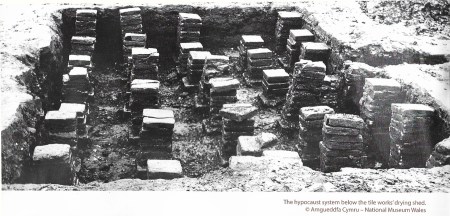
The visitor is taken step-by-step through the production process, explaining how the kilns and drying sheds  were built and how they functioned. The kilns formed two main units, a larger (139ft / 52m long, consisting of a row of six kilns) and smaller twin-kiln built on the natural bed-rock.  Each kiln was rectangular and tile-lined with an arched stoke-hole for access.  A round pottery kiln was also located on the edge of the main kiln complex.  The oven floor was fascinating, consisting of a raised floor of tiles plastered with clay that were pierced with holes that acted as vents.  I was fascinated to see that the drying shed was provided with a hypocaust, better known as the under-floor heating system that was used in villas and bath houses.  These, like the kilns, were stoked and kept hot to ensure that the tiles, pottery and bricks were dried through after firing.

The exhibition displays a number of artefacts, including a roof tile, a brick and a triangular atefix tile marked with the letters LEGXXVV, an abbreviation for the twentieth legion, known as Valeria Victrix (valiant and victorious).  The antefix tile, one of which is shown in the exhibition (photo left and illustration below) also shows Legio XX’s dramatic running boar symbol.   Legio XX was stationed at Chester from AD87, and the Holt works appears to have been established shortly afterwards, reaching its peak output at around AD135, and falling out of use in the mid 3rd Century.

Antefix tiles from Holt. Source: Grimes 1930

A display board shows the vast range of products that were made at the site, including floor and roof tiles, and a variety of different pottery forms.  There is a good explanation of how the roof tiles, called imbrex and tegula (plural imbrices and tegulae), worked.  A good memory for me – I dug up a lot of these tiles at my first ever dig in Silchester.  The arched imbrices, sit snugly over the upright edges of two facing tegula tiles, as shown in the above photograph, and the the triangular antefix tiles were placed to cover the ends of the imbrex.

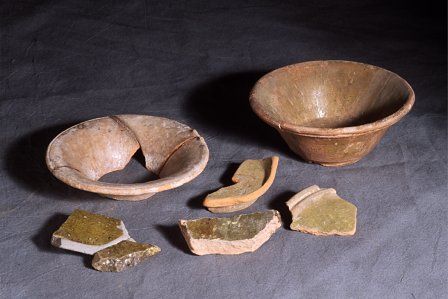
Green-glazed ware found at Holt. Source: National Museum of Wales

Examples of the pottery found at the site are on display, with some really fine examples, including ollae (jars), urcei (jugs), lagenae (flagons), cattili (plates), calices (drinking bowls), and testa (lids).  I particularly liked a partly preserved ceramic colander and a mortarium (the latter working like a modern mortar, but with bits of stone embedded into the interior base of the pot to create a rough surface for grinding spices and seeds).  Green-glazed pottery, a luxury ware that I had never come across before, was also made at the site.  It is rare in Britain, so it was excellent to see examples of it on show.  A photograph of the green glazed pottery found at Holt (from the National Museum of Wales website) is shown below.

The workers also turned their hands to other types of objects made from clay – one cabinet shows a marvellous piece of shaped water pipe that was manufactured at the site.

Section of water pipe manufactured at Holt

All of the output manufactured at the works was sent by boat downriver to Chester, the exhibition suggests that a short may have been dug out at Holt in order to make loading the ceramics easier, its course marked today by annual floodwaters that, as they recede, leave a line of floodwater in what could well be a Roman channel.

Samian pottery found at Holt. Source: Grimes 1930

Interestingly, the exhibition shows that even though huge amounts of pottery was being made on-site, there were particularly favoured types of ceramic being imported.  Samian (terra sigillata), a truly gorgeous luxury dark red ware that has moulded decoration on its lustrous surfaces, was found in surprising quantities.  This was usually imported from south-eastern Gaul (France); a Roman experiment with samian production in southern England produced inferior pottery and was very short-lived.

Imported black-burnished ware was also found at Holt, which the exhibition explains was made in Dorset.  At sites in southern England it is common (we found bucket-loads of it at Silchester), but when found at northern sites, it was probably imported to fulfil a particular need or desire.  The works manager might have wanted high-status ceramics, and any soldiers at the site may have craved the comforts of home, but another option is that it was being imported for use by a nearby settlement.  One of the findings of the 2018 geophysical survey was the presence of a possible Roman fort or marching camp to the west of the site, suggesting that the site may have been on the edge of an unidentified vicus settlement, or village.

Coins on display in the exhibition.

The coins at the site are invaluable for their contribution to creating a timeline for development of the site, but are works of art in their own right.

The exhibition provides another insight into the inhabitants of the site by displaying some of the other objects they owned, like small pieces of jewellery made of bronze, manicure equipment, a beautifully crafted needle and a delectably delicate silver spoon.  These are objects that people chose and kept on them, intimate reminders that these were real people who lived complicated lives in which personal appearance had an important role.

Silver spoon from Holt on display at the exhibition. Source: Grimes 1930

A map at the end of the exhibition was riveting, showing how widespread Roman presence in northeast Wales actually was, showing everything from single find-sites to industrial sites like that at Holt, the settlements at Heronbridge and Plas Coch, and the villa at Rossett, the latter two sites both recent discoveries.  It looks as though there will be more Roman discoveries in the future, filling out a picture not merely about the activities of Romans in Britain, but on their interactions with local communities, something which remains poorly understood.

Museum details

The museum is an excellent resource, a small but modern with excellent displays and a lot of great information on professionally produced display boards into context. At the time of writing (August 2021) masks must be worn and you need to leave your name and telephone number with reception.  For opening days and times, plus directions, see the Wrexham County Borough website:
http://old.wrexham.gov.uk/english/heritage/wrexham_museum.htm

A booklet accompanying the exhibition is available both in the museum foyer and under the video screen in Gallery 3.  The cover and some of the pages from the booklet are shown at the top of the post, and full details are in Sources, below.   A leaflet, Holt: Legacy of the Legions, is also available from the museum, or can be downloaded.

It is a real shame that the Hidden Holt gallery is only a temporary feature, but Wrexham Museum has a lot more to see, and I will be posting about some its permanent displays in the future.

Sources:

Books and papers

Grimes, W.F. 1930.  Holt, Denbighshire:  Twentieth Legion at Castle Lyons.  Y Cymmrodor.  Society of Cymmrodorion.

Ward, M. 1998. A collection of samian from the legionary works-depot at Holt.  In (ed.) Bird, J. Form and Fabric.  Oxbow Monographs 80.
https://www.researchgate.net/publication/333155555_A_collection_of_samian_from_the_legionary_works-depot_at_Holt

Ward, M. 1998. Some finds from the Roman works-depot at Holt.  Studia Celtica 32:43-65
https://www.researchgate.net/publication/311789557_Some_finds_from_the_Roman_works-depot_at_Holt

Booklets / leaflets

Wrexham Heritage Service 2021.  Hidden Holt.  The Story of a Roman Site.  The Discovery of a Roman Legionary Tile and Pottery Works at Holt, near Wrexham.  (Booklet accompanying the exhibition in both English and Welsh)

Holt Castle Conservation and Interpretation Project.  Holt. Legacy of the Legions.  An introduction to the history of the Legionary Works Depot at Holt. (Leaflet, including site plan, available from the museum)
http://old.wrexham.gov.uk/assets/pdfs/heritage/holt_castle/holt_legacy.pdf

Websites

Hidden Holt
Wrexham Museum
https://www.wrexhamheritage.wales/?exhibition=hidden-holt-the-story-of-a-roman-site

Hidden Holt – Roman history revealed in a new Wrexham Museum exhibition
Wrexham Council News
https://news.wrexham.gov.uk/hidden-holt-roman-history-revealed-in-new-wrexham-museum-exhibition/

Holt Local History Society
https://holtlhs.weebly.com/

National Museum of Wales
https://museum.wales/

Roman Glazed Pottery from North Wales
National Museum of Wales
https://museum.wales/articles/1327/Roman-glazed-pottery-from-North-Wales/

The Pottery Kilns of Roman Britian by Vivien Swan (database)
https://romankilns.net/

The 1898 mile posts between Farndon, Churton, Aldford and Huntington

The milepost just outside Holly Bush Cottage, the nearest one to Farndon, close to the Barnston Monument. It sits at a slight tilt today.  This is the best one for seeing the manufacturer’s logo, which reads W.H. Smith and Co, Makers, Whitchurch. Milestone Society National ID: CH_CHTP08a.  What3Words ///dressing.sublime.lunge

Between Aldford and Farndon there are three very fine 1898 milestones dotted along the road, following the line of the Farndon branch of the old Chester to Worthenbury turnpike (toll road), all on the west side of the road. The photos here show those mileposts that remain between Farndon and Aldford along the B5130.  Other photos show milestones between Aldford and Huntington, plus one in Farndon, but I have no idea if there are some missing along that particular route.  At the moment they are in no particular order but I will eventually, when I have found a few more, organize them from north to south.

The photos of the milestones along the Farndon to Aldford stretch are mine, but the two to the north of Aldford, as the B5130 approaches Huntington, are by other people, found online, because I have not yet managed to track them down in the real world.  Please see the captions for image credits.  All photos can be clicked on to see the bigger image, in which the text on the mileposts can be read clearly (except, of course, where vegetation blocks the view).  For the ones I’ve seen myself, I have taken What Three Words readings to fix the location.  What Three Words is a smartphone app that assigns three words to uniquely describe areas a little smaller than the size of a parking space.  It’s simpler than other location systems, and fixes locations very precisely, world-wide.  It is particularly useful for finding people in emergencies, but I thought it would be useful for enabling people to relocate the mileposts when they become overgrown.  

Churton milepost, next to Greenfields, the last house in Churton at its north on the way to Aldford. Milestone Society Milestone Society National ID CH_CHTP07. What3Words ///blatnatly.backers.comic. My photos, CC BY-NC-ND 4.0

All English turnpike Acts, each created by a separate Act of Parliament, had expired by the end of the 19th Century.  The Local Government Act of 1888 put responsibility for roads into the hands of local councils, making nearly all of the remaining turnpikes redundant.  Sections 92 to 98 of the 1888 Act, however, provided for some exclusions and section 97 enabled Chester County Council to initially avoid taking responsibility for the Chester to Worthenbury turnpike.  Eventually, the Council was forced to take over all the local roads and in 1898 it erected a number of particularly handsome mileposts in Cheshire, including those along the route of the former Chester to Worthenbury turnpike, by then defunct, as well as the Farndon branch of the turnpike.  I have posted about the Chester to Worthenbury turnpike – part 1 about the background to turnpikes and part 2 about the Chester to Worthenbury turnpike in particular.

The milepost outside Glebe Farm, between Churton and Aldford. The red dot is apparently something to do with a cycle race.  Milestone Society National ID CH_CHTP06. What3Words ///decently.hatter.slide. My photos, CC BY-NC-ND 4.0

None of the  mileposts that must have been erected during the 1854 turnpiking of the road have survived.  Milestones or mileposts were erected from the first half of the 17th Century onwards, starting in southeast England, mainly for the benefit of mail coaches and other passenger vehicles.  Turnpikes were merely encouraged to install mile posts from the 1740s but they became a legal requirement from 1766 when it was found that as well as being useful for coachmen and passengers, it enabled accurate measuring of distances for the pricing of different routes.  It also helped to improve improved the reliability of timetables, something to which the turnpikes themselves, had enabled, particularly relevant in bad weather.  Assuming that mileposts were erected when the 1854 turnpike was established, they were presumably removed when the 1898 milestones were installed.

I was unable to find the Crook of Dee milestone, but in the Milestone Society’s survey (over 18 years ago) it is listed it as near Cheaveley Hall Farm, opposite Cheaveley Hall Cottages.  It is marked on the Ordnance Survey Map and on the above Public Map Viewer with the letters MP. Milestone Society National ID CH_CHTP04. Image sources: Geograph and the Cheshire West and Chester Public Map Viewer

The 1898 mileposts are all the same, painted white with black lettering, and consisting of hollow metal posts with two sides meting in the middle, topped with a triangular cap that is tipped towards the road.  The triangular cap says, in all cases, “Chester County Council 1898.”  The two sides, each facing into the oncoming traffic, give the number of miles to key destinations in each direction.  On the southernmost face, the manufacturer’s mark “W.H. Smith and Co., Makers, Whitchurch” is shown below the mileages.  There are no backs on the mileposts.  The ones shown here are in good condition. Being on the side of a very busy road, they are vulnerable to exhaust fumes and road dirt sprayed during rainy periods.  I don’t know who maintains them, but in other parts of Cheshire many have needed to undergo restoration, some having been in very poor condition.  A lot of this work has been lead by the Milestone Society in co-operation with the relevant council.

The Crook of Dee milestone at Cheavely Cottages. What3Words address: ///liner.apprehend.stitch

The survival of these mileposts is remarkable and a pleasure to see.  I have now found all of the ones on the former Chester to Worthenbury turnpike.   I only found the Crook of Dee milepost in November 2021, after hunting for it for ages.  It was completely concealed by undergrowth in the summer and it was only after leaf fall, and with the hedge cut back, that I eventually found it, covered in ivy but still there.  The photograph of the Crook of Dee shown above left, decoratively peeping through a fine show of dandelions and dead nettles is from the Geograph website, taken during the Milestone Society’s national survey over 18 years ago, and is a particularly nice photograph so I have left it here.  My own photograph is at right.  I cleared the ivy as best I could on a very dangerous stretch of road with no footpath and only a tiny verge, but it is in fair condition, albeit very rusty.  The What3Words address for it is shown on the image to the right.  It is located opposite the Cheaveley Hall Cottages,

Huntington milestone. What3Words ///shine.knee.reject

There is also one at Huntington, for which I kept an eye open for months, and found on the same day as the Cheaveley Hall one.  It is shown left, along with its What3Words location.  It is in excellent condition on a grass verge, just north of a pedestrian crossing.

The Ordnance Survey map, shows another run of mileposts between Churton and Worthenbury.  The first heading south from Churton towards Worthenbury should be somewhere along Sibbersfield Way (which I have repeatedly looked out for in the car when nothing has been behind me, but I still haven’t found)

The rest on the leg of the road south of the bypass that runs towards Worthenbury via Crewe by Farndon and Shocklach through blissful rural fields and past several estates and  farms. I made an attempt to locate them during the summer, few months later I found the one to the north of Crewe by Farndon, which had been revealed by hedge-cutting.  It is in the grass verge on the west side of the road, just before Caldecott Farm.

Not so shiny and new as some of them, but still hanging on in there!  It is located just short of a farm on the left heading south (the east), and is on the west side of the road about two or so metres to the right of a telegraph pole.  I will go back and get an exact What Three Words location for it next time I’m in that area, but for the time being it is roughly at ///rainfall.duplicity.proofs.

During the summer I was able to find the nice one in Shocklach, thankfully not hiding in a hedge and at that time pleasingly accompanied by some lovely roses.

The milepost at Shocklach, on the route to Worthenbury. Milestone Society National ID CH_CHTP12. My photo, CC BY-NC-ND 4.0

I suspect that the rest are still hiding in overgrown verges.  As with the Crook of Dee milepost, as the vegetation dies down this winter I will continue to look for them.  When I have the full set I’ll put them into north-south order.

The Sibbersfield Lane milepost, which is on the stretch of road from Churton towards Crewe-by-Farndon, about halfway down before reaching the bypass, is slowly diving into a ditch.  It’s a terrible photograph but I was not going to risk getting out of the car to take it, as it is a very nasty and fast stretch of road.  I forgot to take its What3Words location, but will go back and re-take the photograph and note the location on a quiet day, preferably when the road is closed!  Taken in March 2022:

In May 2022 I was diverted due to the Holt-Farndon bridge closure down Barton Road, the road that runs through Farndon from the bridge, and noticed a milestone on the south side of the road.  I was in a hurry so didn’t stop, but went back in early July, half expecting it to be completely subsumed into the hedge that stood behind it, but not a chance.  Someone is looking after it beautifully (with thanks).  It’s What3Words location is ///warned.tower.mascots, which you can see on a map at https://what3words.com/warned.tower.mascots.


Sources:

Books and papers

Benford, M. 2002. Milestones.  Shire Publications

Crosby, A.G. 2012.  New Roads for Old. Cheshire Turnpikes in the Landscape 1700-1850.  In (eds.) Varey, S.M. and White, G.J. Landscape History Discoveries in the North West.  University of Chester Press, p.190-223.

Local Government Act 1888 (51 and 52 Vict. c.41). Section 97, Saving as to liability for main roads.

Wright, G. N. 1992. Turnpike Roads. Shire Publications Ltd.

Websites

Milestone Society Restorations in Cheshire 2008-2009
The Milestone Society
https://www.milestonesociety.co.uk/archives/Downloads/In%202008%208-Cheshire%20County%20Council%20Highways%20Services%20were%20suc..pdf 

Turnpike Roads in England and Wales
Turnpikes.org.uk
http://www.turnpikes.org.uk/Tollhouse%20design.htm


Who was Bishop Bennet and why do we travel his Way?

The official 10-page Bishop Bennet Way leaflet can be downloaded at the end of this post

Threading its way all around the immediate area is the Bishop Bennet Way.  It is completely unavoidable on maps of the area, picked out in the lines of green horizontal triangles that mark a “Recreational Route” on the OS map, or the pink diamonds on the Public Map Viewer.

The Bishop Bennet Way follows a most circuitous route incorporating both roads and footpaths, and has been established mainly for the benefit of horse riders and mountain bike riders, but is very also popular with walkers.

Section of the Bishop Bennet Way near Churton. Cheshire West and Chester Public Map Viewer.

I first noticed it when walking down Pump Lane in Churton.  Where the road takes an abrupt turn to the north, there are small brown signposts pointing north, along Edgerley Lane and east along Marsh Lane to something called the Bishop Bennet Way.  Whichever of the two options it takes, it loops and switches in all sorts of crazy directions, a diabolically inefficient way of getting from A to B, and eventually it falls off the edges of my OS map, still going.  Once you’ve noticed the little brown Bishop Bennet Way signposts, they seem to pop up all over the area.  So who was Bishop Bennet, where does the Bishop Bennet Way go and why, for that matter, has that route been so carefully preserved in maps and on signposts?

A signed letter from Bishop Bennet to his friend the Reverend Maurice

The first thing to establish was whether Bishop Bennet was a real person rather than a fictional character, and indeed he was.  William Bennet was a “prelate of high character and estimation.”  He was born, according to the Dictionary of National Biography, in the Tower of London on 4th March 1745. Clergymen were usually very well educated with a good academic knowledge of both Classical and British history, and many doubled up as antiquarians, explorers of all things ancient.  Although some of their excavations were distressingly destructive, their surveys often provided invaluable foundations for future work.  Bishop Bennet conformed to this model.  He was educated at Harrow School and then went on to study at Emanuel College, Cambridge, where he later became a fellow and tutor and “distinguished himself by his compositions in Latin, as well as in English, in which he discovered not only great fluency , but a lofty taste, both in prose and verse.”

Episcopal Palace, Cloyne in Cork, Ireland. Photograph by colin.boyle4.
Source: Flickr Photos.

One of his students, in whom he took a particular interest, was John Fane, the 10th Earl of Westmoreland.  The Earl went on to become Viceroy of Ireland and remembered his former mentor by appointing him first as chaplain, then promoted him to Bishop of Cork and Ross from 1790–1794 and finally Bishop of Cloyne from 1794–1820, resident in the Episcopal Palace of Cloyne.  The episcopal see (jurisdiction) of Cloyne eventually became united with that of Cork and Ross in 1835, after which the Palace was leased to a private tenant.

Bishop Bennet was a member of the House of Lords, was elected Fellow of the Society of Antiquaries in 1790 and married the daughter of a  fellow clergyman in 1791.  He died in London in 1820.  In his lovely, deeply affectionate and appreciative eulogy, his friend Dr Parr commented on this career path:  “From the retirement of a college he stepped at once in the circle of a court;  but has not been dazzled by its glory nor tainted by its corruptions.”

One of Bishop Bennet’s contributions to Magna Britannia, volume 2, part 2.

None of this, of course, explains what the Bishop Bennet Way was all about.  After some hunting around, I found that Bishop Bennet was a very early driving force behind the investigation and publication of some of England’s Roman roads, something that became his own personal mission, all carried out in his summer vacations.  He contributed valuable work on the subject to published histories, of various areas including those of Lincolnshire and Cornwall.  He also contributed to the multi-volume work produced by the Lysons brothers, Magna Britannia, in which they set out to explore most of England’s counties in a series of dedicated volumes.  In West Cheshire, one of the roads that he had surveyed was the path now taken by the A41, from Chester (Roman Deva) to Whitchurch (Roman Mediolanum), and his investigations were incorporated into the Roman section of the history of the Palatine City of Chester published in Magna Britannia volume 2, part 2, 1810.

Map from the official 10-page Bishop Bennet Way leaflet that can be downloaded at the end of this post

The Bishop Bennet Way was officially opened in May 1998 incorporating restored byways and bridleways, and includes sections of country roads.  It is  of course very popular with walkers too.  Cheshire Live says that it was the inspiration of Bernadette Harden who was working on a temporary basis at Beeston Castle and began to take an interest in Bishop Bennet and his exploration of the area. It took her the best part of twenty years to campaign for the restoration of bridle paths and byways, but the Bishop Bennet Way is a very suitable reward for all her hard work.

The Way starts near Beeston Castle and finishes near Wirswall on the Cheshire–Shropshire border, just to the north of Whitchurch, although it might be extended in the future.  The route covers 55km/34 miles, and 27km of that route are on minor roads, only some of which have pavements and verges.  If you are a walker trying to avoid traffic, it is worth checking the Ordnance Survey map for public footpaths along the route that bypass road.  There is often another route possible for those of us on two legs rather than four, albeit rather more circuitous.  The official route crosses some seriously busy roads, like the A41 at Milton Green, and anyone planning to do the whole route is advised to plot their track on OS Map Explorer 257.  In 2006 Bishop Bennet Way was linked to Jack Mytton Way in Shropshire, between them creating a 125km/78 mile route.

The official 10-page Bishop Bennet Way leaflet can be downloaded by clicking here (but do check for updates on the Visit Cheshire website if you are reading this after summer 2021, in case a new edition is issued). 

Section of the Bishop Bennet Way as it heads north along the edge of Middle Beachin Farm, part way between Churton and Coddington.

Sources:

Books and Papers:

The Annual Biography and Obituary for the Year 1821
No.XVI. The Right Reverend Father in God, William Bennett, D.D. MRIA. Lord Bishop of Cloyne. , Volume V, p.263-266.  Longman, Hurst, Rees, Orme and Brown
tinyurl.com/3vr2y4fh

Codrington, C. 1919.  Roman Roads in Britain. Society for Promoting Christian Knowledge.

Lysons, D., and Lysons, S. (eds.) 1810.  Cambridgeshire and the County Palatine of Chester.
Magna Britannia, being a concise topographical account of several counties of Britain, Vol 2, Part 2.
https://archive.org/details/magnabrittanicab02lyso/page/n3/mode/2up?view=theater
https://ia802608.us.archive.org/27/items/magnabrittanicab02lyso/magnabrittanicab02lyso.pdf

Websites:

Cheshire Live
Walker turns trail-blazer in route revamp
https://www.cheshire-live.co.uk/news/chester-cheshire-news/walker-turns-trail-blazer-route-revamp-5246941

Dictionary of National Biography
William Bennet
https://en.wikisource.org/wiki/Dictionary_of_National_Biography,_1885-1900/Bennet,_William_(1746-1820)

Fastest Known Time
Bishop Bennet Way
https://fastestknowntime.com/route/bishop-bennet-way-united-kingdom

Historical Autographs
William Bennet, Bishop of Cloyne
https://www.historicalautographs.co.uk/autographs/bennet-william-bishop-of-cloyne-17093/

North Wales Live
Campaign uncovers long lost bridleway
https://www.dailypost.co.uk/news/local-news/campaign-uncovers-long-lost-bridleway-2898100

Visit Cheshire
Bishop Bennet Way
https://www.visitcheshire.com/things-to-do/bishop-bennet-way-p176521


Object histories in my garden #5: Fragment of a Codd-neck bottle

The things we find in the garden, digging out new beds and extending old ones, have added to my knowledge of all sorts of random things.  Until Joe found the Edisbury bottle in the garden (Edisbury was a 19th century Wrexham pharmacist), I had no idea that during the 19th century, when sparkling carbonated water was a new concept, special bottles had to be designed to keep in the fizz.  The Edisbury bottle that we found was not for sparkling water, but a fragment of a bottle that we found a few weeks ago, which was a complete puzzle, turns out to be part of the new carbonated water revolution.  It was stopped with a marble that was held in place in the neck by the pressure of the gas from below.  Fantastic.

It doesn’t look like much, and has to be seen in the context of complete examples for it to make any sense at all.  Sorting out books from my move in February (it is still taking forever to organize my books), I found a long-forgotten Shire Publications book entitled Bottles and Bottle Collecting, which I bought during my Thames mudlarking phase.  Just flipping through it before deciding where it should go, and noting that it covers stoneware as well as glass bottles, I spotted a photograph on page 12 showing three Codd bottles, and it was perfectly obvious that my fragment matched the neck of the one on the far right.  So what on earth is a Codd bottle?

Photograph on page 12 of “Bottles and Bottle Collecting” (Hedges 1988), annotated to show the section of a similar bottle found in the garden

In 1772 Joseph Priestley began to manufacture carbonized waters, which fizzed.  Stoneware was the traditional vessel for mineral-based drinks and tonics, but the gas leached out through the fabric.  Cork-stopped glass was the obvious solution, but the gas could built up to the point where the cork blew out, which both wasted the valuable product and created a considerable mess in the process.  One solution was the torpedo- or amphora-shaped bottle with a pointed base that had to be stored on its side, keeping the cork and the fluid in contact, which kept the cork moist, preventing shrinkage, which kept the cork in situ.  These were considerably unpopular, as storage was always a problem.  Wired-on corks were one solution, also unpopular, and in 1875 Hiram Codd came up with an entirely novel way of solving the problem that became very popular.

Hiram Codd. Source: Findagrave.com

Hiram Codd was very much a man of his era.  His father had been a carpenter, but by his early 20s, Codd was establishing himself as a mechanical engineer and went to work for the British and Foreign Cork Company, working to improve the cork production process.  As a specialist in bottle closures he realized that corks had certain limitations, and began to look at alternatives, carrying out experiments in a small mineral water works in Islington.  In 1872 he secured backing by Richard Barrett, whose two sons owned the Malvern Mineral Water Co. in Camberwell.  With this investment, he was able to develop his globe-stopper.

Banta bottle from Kerala, India. Source: Wikipedia

Codd’s innovation used a thick-walled bottle, a cleverly shaped neck with lugs, and a glass marble-sized globe as a stopper, which was forced towards the opening of the bottle by the gases, where it was stopped by a rubber ring.  In order for this to work, the bottle had to be filled upside down so that the marble could rise to the top to seal.  Two lugs were designed into the bottle, as shown in the fragment, and to pour the drink the marble had to be pushed down to the flanking lugs, where it became trapped, enabling the drink to be poured.  He patented many different versions of the basic scheme in order to try and find the perfect and definitive solution.

In spite of other innovations for stopping bottles, the design was still in common use throughout the 1920s, going out of use in the UK by the end of the 1930s. Dad says that he can remember them during the Second World War.  Superbly, the Codd bottle is still in popular use in India, popular for a drink called Banta.  One of the staggering things of the years of the Industrial Revolution until the late 19th Century was the tidal wave of innovation and the thousands of inventions that emerged, many of them small but fascinating like this one, and all devised to solve specific problems that arose as new products and new ideas emerged.

The survival rate of Codd bottles is poor, as many were deliberately broken by children trying to get at the marbles they contained.  It is has been suggested that the term codswallop (meaning nonsense, something that makes no sense) is derived from Hiram Codd’s bottles.  I’m absolutely not convinced, but you can Google it.

Photograph showing the neck of a Codd bottle with a marble in situ. The pale blue marbles were much in demand by small boys 🙂 Source: Drinking Cup

For anyone new to this occasional series on objects extracted from my garden during everyday gardening activities, see the History in Garden Finds page.  These are not objects used in the garden, but objects, usually fragments, lost or disposed of in the garden and found during digging, troweling and planting.

Sources:

Books and papers:

Hedges, A. A. C. 1988.  Bottles and Bottle Collecting.  Shire Album 6.

Munsey, C. 2010. Codd (Marble-In-The-Neck) Soda-Water Bottles, Then and Now!
https://sha.org/bottle/pdffiles/coddarticleMunsey.pdf

Websites:

Banta
Wikipedia
https://en.wikipedia.org/wiki/Banta

Codswallop
Phrases.org
https://web.archive.org/web/20080913063340/http://www.phrases.org.uk/meanings/235250.html

Drinking Cup
The invention of soda water
http://www.drinkingcup.net/1767-from-volcanos-to-soda-pop/

Hiram Codd
Findagrave.com
https://www.findagrave.com/memorial/24680991/hiram-codd


Cheshire Proverbs 3: “To grin like a Cheshire cat chewing green gravel”

“To Grin Like a Cheshire Cat Chewing Green Gravel”


J.C. Bridge no. 342, p.125


John tenniel’s illustration of the Cheshire Cat, for Lewis Carroll’s Alice’s Adventures in Wonderland, (published 1865).  Source of photograph:  Wikipedia

Bridge’s version of this proverb is the one that I always knew, quite simply stating “To grin like a Cheshire cat.”   Bridge adds that variants of the proverb regarding the familiar grinning cat involved it chewing gravel or green gravel, which is the version that I’ve included in the header, merely for its novelty value, although Bridge is dubious regarding the authenticity of either variant.

Lewis Carroll (1832 – 1898), who lived in Daresbury in east Cheshire, was responsible for the popularity of this particular proverb, and it was made famous by John Tenniel’s illustrations in Carroll’s 1865 book Alice in Wonderland.  Carroll, however, did not invent the grinning Cheshire cat proverb.

During my short time looking at proverbs, I have learned that although their meanings sometimes survive, in many other cases the origins of the proverbs are long-lost in the quagmire of oral history, itself a tale of Chinese whispers.  Proverbs fascinate people not merely because they are striking, but because they are multi-layered.  As well as meaning, they have history, and as well as history, they capture a tone of the oral vernacular past that has been largely lost. Carroll’s entertaining appropriation of the Cheshire cat in 1865 presumably had very little to do with the proverb itself, but acquired an energy and life all of its own.  As time passes and Alice in Wonderland fades from the reading lists of current and future generations, Carroll’s reinvention of the Cheshire cat may also fade, much like the cat itself, which slowly vanishes to leave behind nothing but the grin itself.  That would be a shame.

Bridge is rather severe about the proverb.  He says that it is must be made clear that it is not an old saying “and no old writer or old collection of Proverb gives it” (Bridge’s italics).  He says that the oldest example is in the works of Peter Pindar dating to c.1794/1801:  “Lo! like a Cheshire cat our court will grin.”  He points out that it is not “and never has been” a very common saying in the Cheshire county.  Finally, he says that to date (and his date was 1917) none of the numerous attempts to elucidate it had been successful.

Bridge devotes another two and a half pages to this lack of success.  He begins with the unsubstantiated story of an unskilled sign-painter whose attempt to depict a lion-rampant looked more like a grinning cat, and the rest runs along similar lines.  It is a highly entertaining discourse between different writers on the possible origins of the proverb, but none of it is, as Bridge points out, verifiable or even plausible.  I particularly like the idea posed in 1850 that some Cheshire cheeses were sold in the form of a cat with bristles inserted to represent whiskers.  An indignant Bridge comments “I feel sure that the writer was mistaken.  Good Cheshire Cheese could not be made, and certainly never was made in the shape of Cats, or it would have ceased to be high class and to command the market.”  In the end Bridge thinks that a theory put forward by one Egerton Leigh is most likely to represent the reality:  “one need not go far to account for a Cheshire cat grinning.  A cat’s paradise must naturally be placed in a County like Cheshire, flowing with milk.”

Heat sensitive Cheshire cat-themed mug. Source: Amazon.

Carroll’s imaginative revival of the proverb has been incorporated into many popular contexts.  My family lived in Nantwich for a couple of years, and there was a very famous pub there called The Cheshire Cat, a half-timbered building that was originally built in the 17th Century. It had gone out of business when I was last there a few years ago, but there’s a website that indicates that it is back up and running, which is good news.

I was amused to see that the concept of the Cheshire cat has infiltrated itself into scientific lore.  Wikipedia has a list of examples, and a nice one from quantum mechanics has a phenomenon named “The Cheshire Cat,” in which a particle and its property behave as if they are separated.  Just as much fun, although infinitely less sophisticated, is the heat-sensitive mug that I found on Amazon, where the John Tenniel illustration of the cat vanishes as the mug warms through, leaving just the grin behind.

For more about J.C. Bridge and this Cheshire Proverbs series, see Cheshire Proverbs 1.

Sources:

Carroll, L. 1865. Alice’s Adventures in Wonderland.

Wikipedia: Cheshire Cat
https://en.wikipedia.org/wiki/Cheshire_Cat


The 1854 turnpike from Chester to Worthenbury via Churton, with a branch to Farndon – Part 2: The Turnpike

View west from the turnpike.

This is part 2 of the story about the Chester to Worthenbury turnpike, a rural toll road that ran peacefully through Huntington, Aldford, Churton (with a branch to Farndon), Crewe-by-Farndon, and Shocklach before terminating at lovely Worthenbury.   Part 1, posted the day before yesterday, looked at the background to turnpikes (toll roads) in the 17th to 19th Centuries, and their roles in everyday life as a setting for the Chester to Worthenbury turnpike.  Part 2 looks at the turnpike itself.  As I said in Part 1, the reason for splitting the post into two is that it turned out to be a fairly mammoth topic.  If you prefer to read it as a PDF or print it, you download the PDF by clicking here.

Most former turnpikes are still busy.  For example, when you wait patiently at Milton Green to turn on to the A41 that runs from Chester to Whitchurch, the thundering HGVs that happily ignore the “please drive carefully through our village” signs make it is difficult to imagine it populated with quietly plodding horses and carts.  It is a different story once you have driven from Crewe-By-Farndon via Shocklach to Worthenbury, because an entirely different leap of the imagination is required.  This time, it’s a case of wondering why such a quiet and rural stretch of road could ever have been sufficiently busy to require turnpiking.  Churton, Shocklach and Worthenbury are all well-defined villages, but other places marked on the map, such as Crewe-by-Farndon, Castletown and Caldecott Green are little more than a single big house and/or farm with a couple of associated buildings.

Scenery flanking the road that was turnpiked in 1854.


The route of the Chester to Worthenbury turnpike

In many areas, the presence of a Roman road dictated the line of Medieval and later roads, but the Roman road that once ran from Chester through Aldford fell out of use.  As you head south from Aldford, a small lane to the left, Lower Lane, indicates where the path of the Roman road splits from the B5130 and thereafter becomes a series of farm tracks and footpaths, its route sitting in between today’s A41 (Chester to Whitchurch) and A483 (Chester to Wrexham).  This Roman road, known today as Watling Street West (or more prosaically 6A), passed through Ecclestone, Heronbridge and Aldford then veered to the east of Churton, bypassing both Churton and Farndon  (I have written about the Roman road in an earlier post, here).  

The bending course of the road that was turnpiked in 1854. My photograph CC BY-NC-ND 4.0

Later, however, the establishment of Farndon as an important crossing to Holt and the rest of north and mid Wales meant that the path of the Roman road southeast of Aldford, was abandoned during the Middle Ages, and the line of the road shifted instead west towards the Dee, passing through what is now Churton before reaching Farndon.  This route was established at least during the reign of Edward I, (reigned 1272-1307), who followed it on one of his peripatetic Royal Itineraries, heading south from Chester through Ecclestone and Malpas.  Rachel Swallow says that a toll gate was documented at Shocklach at around 1291, all traces now vanished. 

The Chester to Worthenbury turnpike followed a path from Chester through Huntington, Aldford and Churton before heading down what is now Sibbersfield Lane and across the modern bypass before vanishing down the quiet, wending country B-road to Worthenbury.  As with every turnpike, an Act of Parliament was required before Trustees could be appointed, and this was the Chester, Farndon and Worthenbury Turnpike Road Act 1854, “An Act for making a Turnpike Road from Chester, by Farndon, to Worthenbury, with a Branch therefrom to the Village of Farndon,” which passed into law on 3rd July of that year.  The exact wording of the first part of the Act is shown below the bibliography, Sources, right at the end of this post.  It was the last road in Cheshire to be turnpiked.  Here is the description of the route from the 1854 Act:

A Turnpike Road to commence in Boughton in the Parishes of Saint Oswald and Saint John the Baptist, or One of them, within the Parliamentary Borough of Chester, by a Junction with the Road leading from the City of Chester to Whitchurch opposite and near to a Public House called the “Jolly Gardener,” and to terminate in the Township and Parish of Worthenbury in the County of Flint by Two Junctions with the Whitchurch and Marchwiel Turnpike Road, one thereof at or near to a certain Farm House called “Broughton Lodge,” and the other thereof at or near the Finger Post at the Junction of the present Highway from Shocklach with the Whitchurch and Marchwiel Turnpike Road : A- Branch Turnpike Road to commence from and out of the said intended Turnpike Road in the Township of Churton, by Farndon and Parish of Farndon, at or near the Point where the existing Highways leading from Churton to Farndon and from Churton by Crewe and Shocklach to Worthenbury respectively diverge, and to terminate in the Village, Township, and Parish of Farndon by a Junction with the Turnpike Road leading from Wrexham to Barnhill near to the Raven Inn, all in the County of Chester.

A court case that followed the demise of the turnpike is useful for describing the state of the road before it was turnpiked

“Before and until the passing of the Chester, Farndon and Worthenbury Turnpike Road act of 1854, it consisted of an ordinary fenced road, varying in width from about 20-30ft, of which nine feet wide only was paved with stones along the centre;  the sides not being metalled were of grass or earth.  The stone of which the pavement was formed was got in the township from the lands alleged in the indictment . . . . The road, which was an ordinary carriage highway was at that time repaired by John Brock Wood, the owner of the said lands.”

The stones of the old pavement were used in the construction and macadam was brought from Penmaenmawr to lay along its surface.  The width was not expanded beyond the original fences that flanked it.

The Chester to Worthenbury turnpike trust

The sheer number of trustees appointed in the 1854 Act staggered me, as I had been imagining something in the region of ten or twenty responsible dignitaries.  There were 66 (give or take – I may have lost one or two in the process of counting).  After including “All Her Majesty’s Justices of the Peace for the Time being acting for the County of Chester, for the County of the City of Chester, and for the County of Flint respectively” the Act goes on to name individual trustees, and here they all are:

Sir Richard Puleston of Emral Hall. Source: Puleston Ancestry.

The Honourable Hugh Lupus Grosvenor commonly called Earl Grosvenor, the Honourable Richard de Aquila Grosvenor commonly called Lord Richard de Aquila Grosvenor, the Honourable Henry Cholmondeley commonly called Lord Henry Cholmondeley, Sir Robert Henry Cunlife Baronet, Robert Ellis Cunliffe, Sir Watkin Williams Wynn Baronet, Sir Philip de Malpas Grey Egerton Baronet, Philip Le Bel- ward Egerton, Samuel Aldersey, Thomas Aldersey, the Rector of Aldford for the Time being, Roger Barnston, Harry Barnston, Thomas Boyden Clerk, Richard Barker, Francis Henry Barker, Thomas Chorlton Glutton, Charles Colley, Hugh Colley, Henry Crane, Tanat Wynne Denton, Thomas Dixon, Thomas Dixon the younger, James Dixon, the Minister of Farndon for the Time being, William Wynne Ffoulkes, Edward Francis French, Alexander Price French, Philip Stapleton Humberston, Thomas Cowper Hincks, Thomas Cowper Hincks the younger, Thomas Hignett, John Hignett, Robert Broadhurst Hill, the Minister of Holt for the Time being, Robert Howard, Francis James Hughes, Townsend Ince, Thomas Jones, John Hurleston Leche, Sir William Lloyd, Richard Massie, John Finchett Maddock, Thomas Finchett Maddock, Townshend Mainwaring, Henry Water Meredith, Robert Buckley Orton, Sir Richard Puleston Baronet, Francis Richard Puleston, Theophilus Puleston, Charles Potts, Henry Potts, Charles William Potts, William Parker, John Parker, Richard Powdrell, William Rowe, Samuel Rowe, John Rogers, Thomas Vernon Royle; Joseph Sparkes, John Townshend, Charles Townshend, John Williams, Edward Tilston, John Brock Wood, William Henry Wood, the Rector of Worthenbuiy

Pratt’s 1912 study offered the following comment on the sheer number of trustees that could be in charge of a turnpike:

One result of the excessive localisation of the turnpike system was that trusts of absurdly large proportions were created to look after absurdly small stretches of road. “The fundamental principle,” says a writer in the “Edinburgh Review” for October, 1819, “is always to vest the whole management in the hands of the country gentlemen; and, as they act gratuitously, it has been the policy of the law to appoint in each act a prodigious number of commissioners—frequently from one hundred to two hundred, for the care of ten or fifteen miles of road; and thus a business of art and science is committed to a promiscuous mob of peers, squires, farmers and shopkeepers, who are chosen, not for their fitness to discharge the duties of commissioners, but from the sole qualification of residence within a short distance from the road to be made or repaired. . . .

The whole time of the meetings of turnpike trusts was “occupied in tumultuous and unprofitable discussions, and in resolving on things at one meeting which run a good chance of being reversed at the next; that the well informed and civilized commissioners become very soon disgusted with the disorderly uproar, or the want of sense, temper or honesty of some of their companions; and that the management finally falls into the hands of a few busy, bustling, interested persons of low condition, who attend the meetings with no idea of performing a public duty, but for the purpose of turning their powers, by some device or other, to the profit of themselves or of their friends or relations.

Scenery flanking the road that was turnpiked in 1854. My photograph CC BY-NC-ND 4.0

Local landowners could invest their own funds to improve a road, but generally loans were taken out to meet the initial set-up costs, with the interest theoretically being paid back from the income derived from tolls, or at least that left over after paying salaried staff and carrying out frequent repairs.  Even where the accounts tallied, which they often did not, huge debts were accrued.  The Select Committee on Turnpike Trusts in 1839 reported that eighty four trusts had paid no interest in years, and that the total estimated debt of English and Welsh turnpike trusts together exceeded £9,000,000, a staggering sum in those days. It seems remarkable, under these conditions, that a new turnpike Act was passed in favour of the Chester to Worthenbury turnpike so late in the turnpike era.

The reasoning behind the creation of the turnpike

One of the many farms that lines the turnpike’s route. My photograph CC BY-NC-ND 4.0

The Chester to Worthenbury road wended its bendy way at its own leisure through agricultural land, connecting a number of villages, including Churton, Crewe-by-Farndon and Shocklach.  A drive down that section of the road south of Sibbersfield Lane confirms it as a winding, rural road with a few farm buildings along its routes, the few villages very small and quiet.  A branch ran from Churton into Farndon.   Worthenbury, a rural village that has changed very little since the 19th Century, was not an obvious destination for traders, merchants, carriers or passenger vehicles, traditionally the main users of turnpikes.   The destructive impact of the transportation of heavy loads of cheese was given as a primary reason for the creation of a turnpike between Chester and Whitchurch.  The production of Cheshire cheese was certainly of great importance to the county, as Defoe explains in 1725:

This county, however remote from London, is one of those which contributes most to its support, as well as to several other parts of England, and that is by its excellent cheese, which they make here in such quantities, and so exceeding good, that as I am told from very good authority, the city of London only take off 14000 ton every year; besides 8000 ton which they say goes every year down the Rivers Severn and Trent, the former to Bristol, and the latter to York; including all the towns on both these large rivers: And besides the quantity ship’d both here, and at Leverpool [Liverpool], to go to Ireland, and Scotland. So that the quantity of cheese made in this country, must be prodigious great. Indeed, the whole county is employ’d in it, and part of its neighbourhood too.

However, this situation was over a century before the Chester to Worthenbury turnpike was mooted and there’s no indication either in contemporary newspapers or in the Act itself whether the carriage of Cheshire cheese or any other particular problem was a reason why the Chester to Worthenbury turnpike was deemed worth the cost and effort.  The Act merely says that the turnpike “would be of great public value,” which is somewhat unhelpful.  Crosby suggests “the rather remote possibility of abstracting traffic from the Chester-Wrexham and Chester-Wrexham roads,” but the encyclopaedic New Historical Atlas of Cheshire (2002) is silent on the subject, as is Latham’s Farndon

Scan of map showing turnpike roads in Cheshire, from the New Atlas of Cheshire (Phillips and Phillips 2002, p.77).  The Chester to Worthenbury turnpike is shown in green at the far left, crossing the Broxton to Wrexham Turnpike (in yellow).

Perhaps the object of the exercise was to improve the quality of the road network in this part of West Cheshire. This area was rather isolated.  The canal network bypassed the Dee, south of Chester, with the 1772 Chester Canal (now part of the Shropshire Union) heading southeast from Chester via Beeston to Nantwich to Birmingham, linking into other parts of the canal and turnpike networks as it went, and the Dee itself was only navigable by very light traffic. By the end of the 18th Century there were already serviceable turnpikes between Chester and Whitchurch and Chester and Wrexham, which accounted for most of the market-bound and commercial traffic.   

The turnpike  linked up with Whitchurch after passing through Worthenbury, but it was a very rambling route, and the Chester to Whitchurch turnpike would have been a much better option unless you were starting from somewhere like Churton, Farndon or Holt.  The New Atlas shows an intersection with the Wrexham to Broxton turnpike (now the A534), which was opened in the period 1760-1789, linking the Chester to Wrexham and Chester to Whitchurch roads.  There was a turnpike between Bangor On Dee and Malpas, which opened in 1767.  Although the road between Worthenbury and Bangor on Dee (the B5069) does not appear to have been turnpiked, it was a short stretch and would have been easy enough to maintain in good condition if there was sufficient motivation.

Emral Hall, Worthenbury.  The lower photo shows the ballroom, now preserved (thank goodness) in the Town Hall at Portmeirion.  Source: Wrexham Online.

A number of large estates and prosperous farms were located along the route of the turnpike.  The largest of these were Crewe Hill in Crewe-by-Farndon, Boughton Hall near Threapwood and the magnificent Emral Hall just to the south of Worthenbury.  Crewe Hill was the principal home of the Barnston family, and the base of their wide-ranging and profitable estate that included land in and around Farndon and extending north to the middle of Churton.  The lovely half-timbered Broughton Hall was sadly demolished in 1961, but at the time was the home of the Howards.  Emral Hall also tragically demolished in the 1930s, was the home and estate of the Pulestons throughout the 18th and 19th Centuries.  Others along the route, from north to south, are Aldford Hall, Churton Hall, Sibbersfield Hall, Crewe Hall, Shocklach Hall,  Kingslee and Caldecott Hall.  Trustees included community members from all areas through which the turnpike passed, so members of the family present on the trustees list does not prove that they were driving forces behind the turnpike, but it is still interesting to see (where these family names can be traced) which estates provided family members as trustees.  

  • Broughton Hall, demolished 1961. Source: Threapwood History Group.

    • Aldford Hall:  The Earl of Westminster and Lord Richard de Aquila Grosvenor
    • Churton Hall:  Roger Barnston and Harry Barnston
    • Sibbersfield Hall:  William Rowe and Samuel Rowe
    • Crewe Hill:  Roger Barnston and Harry Barnston
    • Caldecott Hall:  Philip Stapleton Humberston
    • Broughton Hall:  Robert Howard
    • Emral Hall: Sir Richard Puleston (baronet), Francis Richard Puleston, and Theophilus Puleston


Sibbersfield Hall, just outside Churton. Ordnance Survey 1888-1913.  Source: National Library of Scotland

Other trustees on the above list with a vested interest in being able to get around were the Rectors of Aldford and Worthenbury and the Ministers of Farndon and Holt.  Trustees Samuel Aldersey and Thomas Aldersey of Aldersey Hall, would also have benefitted from the tunrpike road, to which the road on which Aldersey Hall was located was linked.  And so it goes on.

There are apparently some omissions and question marks too.  Although a large building is shown on the site of Churton Lodge, no details are available on the Tithe map.  Shocklach Hall was only built in the 1850s, so was perhaps itself under construction at the time, or built partly because the turnpike was there.  In the 1840s tithe maps the land on which it as located was owned by Emral Hall.  Crewe Hall (as opposed to Crewe Hill) was owned and occupied by the Bennion family when the 1838 tithe map was published, but they do not appear as trustees.  

Crewe Hill from the garden. Source: Landed Families of Britain and Ireland website

Some of the very few buildings along the turnpike route at Crewe-by-Farndon and Shocklach.  From left: Crewe Hall, one of the buildings in the village of Shocklach, the Bull in Shocklach and Kingslee.  My photograph CC BY-NC-ND 4.0

Toll cottages along the route

The tollgate was usually accompanied by a toll cottage.  The Grade-2 listed, two-storey brick-built Cross Cottage in Churton is built across the junction between Chester Road and Pump Lane and, by virtue of the fact that it was built to serve the turnpike, must have been built at around 1854.  It is strategically located just to the north of where the road splits into two, one road going into Farndon and the other proceeding via Stannage Lane, to Crewe-by-Farndon and on to Worthenbury.  Both roads were part of the turnpike, with the Farndon section a branch of the main turnpike to Worthenbury.  The attractive recessed arch, which is at both front and rear, was once centred in the middle of the building, and was provided with a slender band of sandstone between the upper and lower floors.  An extension of uncertain date, possibly the 1930s, breaks down this symmetry, although it was done sympathetically using almost identical bricks to the originals but does not repeat the sandstone band.

The rear view of Cross Cottage. Source: mylisting365.

The roof is currently hipped (converging in from four sides onto a central ridge), but before the addition of the extension, the roof was probably pyramidal, converging from four sides onto a single point.  The original roof was probably also made of slate, as today.  There are two chimneys today, but there will only have been the one in the 19th Century, with a central flue.  Although it was Grade II listed in 1984, there are no details on the Historic England website about the interior, and whether any of the 19th Century interior survives in tact.

The listing details are as follows:

  • NGR 4180856444
  • List number 1228714
  • First listed 28th December 1984

Toll collectors could improve their wellbeing by keeping livestock and growing fruit and vegetables in the confines of their properties, and some toll cottages were provided with a small amount of land that could be used for either the keeping of livestock or the development of small horticultural plots.   Cross Cottage was provided with a large garden that could have been used for either.
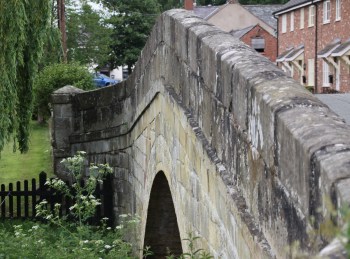
The bridge at Worthenbury. My photograph CC BY-NC-ND 4.0

I went looking for any other toll cottages that might have been built along the road.  On some turnpikes additional toll gates were added as a way of trusts earning more revenue, but there was nothing that looked remotely like a toll cottage.  There should have been one at Worthenbury, the end of the turnpike.  In cases where a river crossing was present, toll gates were often set up against a bridge, making it more difficult to evade, but although there is a beautiful old bridge in Worthenbury, the western side of it is open fields, and the eastern side is now the site of a modern home, part of a housing estate.  The bridge replaces one that was damaged by floods in 1872, and was built in 1872-3.  This was the period when the Chester-Worthenbury turnpike was amalgamated with the Chester-Whitchurch.  Still, tolls would have required ongoing collection, and if there was a toll gate here, there’s no sign of it now.

The toll collectors

There is a toll-house at Churton so it of course follows that there must have been at least one toll collector, possibly accompanied by his family.  Regrettably, I have not yet worked out who he/they might have been, because the commercial directories available online don’t mention a Churton toll collector during this period (the1857 Post Office Directory of Cheshire and the 1864 Morris & Co.’s Directory of Cheshire).  Whilst the Delta variant of Covid is still at large, it’s probably not a good idea to start hitting the record offices, but perhaps someone who has checked into the available resources can illuminate me.  Speculating, this absence from the directories may be because although early turnpikes were manned by manor employees and then by specially hired toll collectors, the appointment of later collectors was given into the hands of specialist contractors, who would bid for the lease at auction.  It may be that under such conditions, the toll collectors were deemed to be transient members of the community.

Toll collectors had an ambivalent position in local society.  Because toll charges were lengthy and complex, incorporating a large number of variables, a toll collector needed to be both literate and numerate, and hopefully (but not always) trustworthy. As people of responsibility, often living in custom-built homes with their families, toll collectors might be people of high status within a community.  Although in many ways, toll collectors were about as popular as tax collectors are today, they provided a vital role.  A toll house could bring prestige to an otherwise fairly nondescript community, even attracting the building of inns where passengers could purchase refreshments and where carriage horses could be rested or changed, meaning that gentry and clergy could be regular visitors, raising the status of an entire village.  

The 1898 mile post at Shocklach. My photograph CC BY-NC-ND 4.0

The toll charges for Chester-Worthenbury are probably described in the 1854 Act, but this too is not available without tramping the real-world archive trail, and I will update this post when I have the chance to check this out, as a copy is apparently available locally.  Each turnpike Act set out the maximum toll chargeable for each animal and category and size of vehicle, and all the multiple variables of each.

As I said in Part 1, the mile posts that dot the western verges of the former turnpike post-date the end of the Cheshire turnpikes.  Disturnpiked in the 1870s, there must have been mile posts because they were a legal requirement, but when Chester County Council was created on 1st January 1889 and was given the job of maintaining highways, it presumably replaced the original milestones with its own iron ones, all dating to 1898.  I have found some of these, marked on the Ordnance Survey map, but not others.  The one shown in Part 1 is in Churton and the one shown above is in Shocklach.

The final days of the Chester to Worthenbury turnpike

The lovely Georgian St Deiniol’s Church in Worthenbury. My photograph CC BY-NC-ND 4.0

The Chester-Worthenbury turnpike was never much of a success and was amalgamated with the Whitchurch Trust in 1871.  The joint body expired in 1877.  Presumably, and not very surprisingly, the Worthenbury turnpike failed to justify its costs, and the Whitchurch turnpike was probably put out of business by the London and North Western Railway.  The railway’s important route to London via Crewe had opened by 1840, and the branch that ran from Chester to Whitchurch opened between 1870 and 1879.

An indictment concerning repairs to the road following the lapse of the Act

Rural landscape to the east of the once-turnpiked stretch of road that passes through Churton. My photograph CC BY-NC-ND 4.0

The most interesting part of the turnpike’s history, or at least the most interesting bit to survive, refers to what happened when the Act for the Chester to Worthenbury section had been disturnpiked, and a question arose over responsibility for its ongoing care arose.  In 1890 an indictment was raised in Crown Court for failure to repair a highway.  The issue was by no means straightforward.  The law stated that responsibility for repair of a road that had formerly come under a turnpike trust would revert to common law liability on the lapse of the trust, but only if “the highway remains similar in character to what it was up to the time of the passing of the Turnpike Act.”  For those roads that were significantly altered, “as to destroy what was the old highway, the common law liability is put to an end by operation of the law.”  In addition, there were ambiguities about the responsibilities for occupiers versus mere owners, where roads were concerned.

The indictment covered several stretches of road that had become “miry, deep, broken and in great decay,” due to “such want of due reparation and amendment.”   This included the stretch from Huntington to Farndon.  The same allegation was made against stretch from Chester to Saighton.  The text from the court case is damning.

“The liege subjects of the Queen could not and still could not go, return, pass, repass, ride or labour on foot with their horses, coaches, carts and other carriages in, through, and along the said public highway aforesaid as they ought and were wont and accustomed to do, without great danger and common nuisance of all the liege subjects of our said Lady the Queen, her crown and dignity, and that the defendant, by reason of his tenure of certain lands and tenements situate in the said township of Huntington, ought to repair and mend the same.”

It goes on:

“As to the road mentioned in the first count [Saighton was the second] it was proved that before and until the passing of the Chester, Farndon and Worthenbury Turnpike Road Act of 1854, it consisted of an ordinary fenced road.”

The individual who had taken responsibility for repairing the road before it was converted to a turnpike was John Brock Wood, who is recorded in the list of trustees for the turnpike.  The record of the indictment states that there was no evidence that he had contributed to its maintenance during the continuance of the Act, but on its expiry in 1876 he resumed repair work, continuing to do so until his death in 1888.  The person who inherited John Brock Wood’s responsibilities “the devisee in trust of the said lands” continued to repair the road in the belief that he was legally liable.  He provided proof that he had expended £155, £224 and £206 in 1887, 1888 and 1889 respectively.

View from the former turnpike over the fields to Worthenbury

The prosecution (Tatham and Proctor for Carrington and Baker, Chester) claimed that as John Brock Wood had accepted responsibility before the establishment of the Trust, it was now the devisee in trust’s responsibility following the expiry of the Act.  However, the law stated that if significant alternation had taken place during the conversion of a road to a turnpike, the original owner was no longer responsible for maintenance.  In fact, Chester County Council had been approached with a view to taking on responsibility for the road, but they had refused to do so under Section 97 of the Local Government Act 1888.   The estimated costs were in excess of £400 and may have been as much as 1000.

The defense (the company Cunliffe and Dawn for Churton, Chester) claimed that the alternations to the road when it was converted to  a turnpike were so extensive as to destroy any liability that either he, or for that matter John Brock Wood, should have had.  In response, the prosecution argued that by repairing the road, the defendant had acknowledged the liability and could be indicted for non-repair.

The judge overseeing the proceedings, Lord Coleridge C.J. ruled in favour of the defendant.  In his view, citing Rolle’s Abridgement from the reign of Charles I, the occupier and not the owner is the person responsible for repairs, and the defendant was the owner but not the occupier.   In addition, he found that the road had been significantly altered, and therefore liability for the repairs should not fall on the original owner or occupier.  The indictment was quashed.  The judge was concerned that under these circumstances, the “graver question” was if any person was actually liable to repair the road.  He does not, however, come to any conclusion about how to resolve the problem.

In the end, Chester County Council must have adopted the road, but this may have been at a much later date.  Section 97, “Saving as to liability for main roads,” which they used to avoid the responsibility, falls within Sections 92-98 “Savings.”  It reads “Nothing in this Act with respect to main roads shall alter the liability of any person or body of persons, corporate or unincoprorate, not being a highway authority, to maintain and repair any road or part of a road.”

As always, please let me know if you have any questions
or have some more information to contribute


Sources for parts 1 and 2:

Books and papers:

An Act for making a Turnpike Road from Chester, by Farndon, to Worthenbury, with a Branch therefrom to the Village of Farndon, 1854

Benford, M. 2002. Milestones.  Shire Publications

Crane, N. 2016.  The Making of the British Landscape.  From Ice Age to the Present.  Weidenfeld and Nicholson

Crosby, A.G. 2012.  New Roads for Old. Cheshire Turnpikes in the Landscape 1700-1850.  In (eds.) Varey, S.M. and White, G.J. Landscape History Discoveries in the North West.  University of Chester Press, p.190-223.

Cunningham Glen, R. 1895. Indictment presented before Lord Coleridge, C.J.  Reg. vs. Barker.  Reports of Cases in Criminal Law argued and determined in the courts of England and Ireland, vol.XVII, 1890-1895. Reported by R. Cunnigham Glen Esq., Barrister at Law. Horace Cox

Defoe, D. 1724–1726 (Rogers, P. ed.). A Tour Through the Whole Island of Great Britain Penguin (particularly, Volume II, 1725, and its appendix).

Harvie, C. and Matthew, H.C.G.  1984, 2000.  Nineteenth Century Britain. Oxford University Press

Hindle, P. 1998 (3rd edition).  Medieval Roads and Tracks.  Shire Publications Ltd

Keys, D. 2016. Discovery of huge Bronze Age wheel sheds light on transport in prehistoric Britain.  The Independent, Friday 19th February 2016
https://www.independent.co.uk/news/science/archaeology/prehistoric-britain-discovery-bronze-age-wheel-archaeology-a6882671.html

Langford, P. 1984, 2000. Eighteenth Century Britain.  Oxford University Press

Latham, F.A. 1981.  Farndon. The History of a Cheshire Village.  Local History Group.

Local Government Act 1888 (51 and 52 Vict. c.41). Section 97, Saving as to liability for main roads.

OS Landranger map 117 2016.  Chester and Wrexham.  Ordnance Survey

Phillips, A.D.M. and Phillips, C.B. 2002.  A New Historical Atlas of Cheshire. Cheshire County Council and Cheshire Community Council Publications Trust.

Pratt, E.A. 1912.  A History of Inland Transport and Communication in England. Kegan Paul, Trench, Trübner and Co Ltd.
Project Gutenburg: https://www.gutenberg.org/files/52087/52087-h/52087-h.htm

Pryor, F. 2010.  The Making of the British Landscape.  How We Have Transformed the Land from Prehistory to Today.  Allen Lane

Swallow, R. 2013-14. Two For One:  the Archaeological Survey of Shocklach, Castle, Cheshire. Cheshire History Journal, No.53, 2013-4
https://www.academia.edu/4577267/Two_for_One_The_Archaeological_Survey_of_Shocklach_Castle_Cheshire_in_Cheshire_History_Journal_No_53_2013_4_Cheshire_Local_History_Association_2013_

Wright, G. N. 1992. Turnpike Roads. Shire Publications Ltd.

Websites

A Collection of Directories for Cheshire
Cheshire County Council
http://cheshiredirectories.manuscripteye.com/index.htm

British Listed Buildings
Cross Cottage, Churton
https://britishlistedbuildings.co.uk/101228714-cross-cottage-churton

Broughton Hall, Threapwood
Threapwood History Group
http://www.threapwoodhistory.org/broughtonhall.html

Cheshire Tithe Maps Online
Cheshire Archives and Local Studies
https://maps.cheshireeast.gov.uk/tithemaps/

Emral Hall, Worthenbury
Wrexham Online
https://www.wrexham-history.com/emral-hall-worthenbury/ 

Historic England
Cross Cottage, Churton
https://historicengland.org.uk/listing/the-list/list-entry/1228714

Dig Diary 19: Discovering Britain’s Oldest, Complete Wheel
February 29, 2016
Must Farm Dig Diaries
http://www.mustfarm.com/progress/site-diary-19-discovering-britains-oldest-complete-wheel/

National Archives
Chester and Whitchurch Turnpikes Trust
https://discovery.nationalarchives.gov.uk/details/r/11e8a8d6-43c5-4704-a93b-58fe6d0444a6

National Library of Scotland Mapfinder
OS 6-inch map, 1888-1913
https://maps.nls.uk/geo/explore/#zoom=15&lat=53.09734&lon=-2.86868&layers=6&b=1

Peterborough Archaeology
Must Farm Bronze Age Settlement
https://peterborougharchaeology.org/peterborough-archaeological-sites/must-farm/

Turnpike Roads in England and Wales
Turnpikes.org.uk
http://www.turnpikes.org.uk/Tollhouse%20design.htm

The 1854 Act (excerpt)

Most of the Act is in big undifferentiated chunks, so the paragraphs in the following excerpt are mine, simply to aid with digestion.  The URL of the source of this excerpt is at the end, but if you want to see the entire Act, paid subscription is required.

[3rd July 1854]
Chester, Farndon and Worthenbury Turnpike Road Act 1854
(17 & 18 Vict.) c. lxxxvi
An Act for making a Turnpike Road from Chester, by Farndon, to Worthenbury, with a Branch therefrom to the Village of Farndon.

ANNO DECIMO SEPTIMO & DECIMO OCTAVO VICTORIA REGINA. ********.*****************.********************* Cap. lxxxvi. An Act for making a Turnpike Road from Chester, by Farndon, to Worthenbury, with a Branch therefrom to the Village of Farndon. [3d July 1854.]

WHEREAS the Formation and Maintenance of a Turnpike Road from Chester, by Farndon in the County of Chester, to Worthenbury in the County of Flint, with a Branch therefrom to the Village of Farndon in the said County of Chester, would be of great public Advantage: And whereas certain of the Highways in the Line of the said intended Road and Branch, or Portions thereof, might advantageously be made available for the Purposes of such Road and Branch ; but the same cannot be effected without the Aid and Authority of Parliament : May it therefore please Your Majesty that it may be enacted ; and be it enacted by the Queen’s most Excellent Majesty, by and with the Advice and Consent of the Lords Spiritual and Temporal, and Commons, in this present Parliament assembled, and by the Authority of the same.

That in citing this Act for any Purpose whatsoever it shall be Short Title. sufficient to use the Expression ” The Chester, Farndon, and Worthenbury Turnpike Road Act, 1854.” H. That in this Act the following Words and Expressions shall Interpreta have the several Meanings hereby assigned to them, unless there be tion of [Local.] 15 D something Terms. 1302 Appointment of Trustees. Power to appoint additional Trustees. 17 & 18 VICTORUE, Cap.lxxxvi. 171e Chester, Farndon, and Worthenbury Turnpike Road Act,1854. Something in the Subject or Context repugnant to such Construction ; (that is to say,) The Expression ” the Trustees,” or ” the said Trustees,” shall respectively mean the Trustees for the Time being acting in the Execution of this Act : The Word Lands ” shall include Messuages, Tenements, and Hereditaments of any Tenure : The Expression ” Toll Gate ” or ” Toll Gates” shall respectively include Turnpikes, Bars, and Chains. III.

That all Her Majesty’s Justices of the Peace for the Time being acting for the County of Chester, for the County of the City of Chester, and for the County of Flint respectively, together with the Honourable Hugh Lupus Grosvenor commonly called Earl Grosvenor, the Honourable Richard de Aquila Grosvenor commonly called Lord Richard de Aquila Grosvenor, the Honourable Henry Cholmondeley commonly called Lord Henry Cholmondeley, Sir Robert Henry Cunlife Baronet, Robert Ellis Cunliffe, Sir Watkin Williams Wynn Baronet, Sir Philip de Malpas Grey Egerton Baronet, Philip Le Bel- ward Egerton, Samuel Aldersey, Thomas Aldersey, the Rector of Aldford for the Time being, Roger Barnston, Harry Barnston, Thomas Boyden Clerk, Richard Barker, Francis Henry Barker, Thomas Chorlton Glutton, Charles Colley, Hugh Colley, Henry Crane, Tanat Wynne Denton, Thomas Dixon, Thomas Dixon the younger, James Dixon, the Minister of Farndon for the Time being, William Wynne Ffoulkes, Edward Francis French, Alexander Price French, Philip Stapleton Humberston, Thomas Cowper Hincks, Thomas Cowper Hincks the younger, Thomas Hignett, John Hignett, Robert Broadhurst Hill, the Minister of Holt for the Time being, Robert Howard, Francis James Hughes, Townsend Ince, Thomas Jones, John Hurleston Leche, Sir William Lloyd, Richard Massie, John Finchett Maddock, Thomas Finchett Maddock, Townshend Mainwaring, Henry Water Meredith, Robert Buckley Orton, Sir Richard Puleston Baronet, Francis Richard Puleston, Tlieophilus Puleston, Charles Potts, Henry Potts, Charles William Potts, William Parker, John Parker, Richard Powdrell, William Rowe, Samuel Rowe, John Rogers, Thomas Vernon Royle; Joseph Sparkes, John Townshend, Charles Townshend, John Williams, Edward Tilston, John Brock Wood, William Henry Wood, the Rector of Worthenbuiy for the Time being, and their Successors, being duly qualified to act as Trustees of Turnpike Roads in England, shall be Trustees for putting this Act into execution.

That it shall be lawful for the said Trustees, at any Meeting under this Act, to elect any Number of Persons, duly qualified to act as Trustees of Turnpike Roads in England, not exceeding Three in the whole, to be Trustees for, the Purposes of this Act, in addition to the 17 & 18 VICTORIAE, Cap.lxxxvi. 1303 The Chester, Farndon, and Worthenbury Turnpike Road Act, 1854. the Trustees hereby nominated, and such Trustees so elected shall have the same Powers and Authorities for executing this Act as if they had been hereby appointed. V. That the said Trustees shall meet together on the Twenty-first Meetings of Day after the passing of this Act, or as soon after as conveniently Trustees. may be, at the Exchange in the City of Chester aforesaid, or at some other convenient Place in Chester, and shall then and from Time to Time afterwards adjourn to and meet at such Times, and at such Places on or near to the said Roads, as they shall think proper. VI.

That the said Trustees may appoint Committees out of their Power to take the Care and Management of any particular Part point Committees. of the Roads, or to execute any of the other Purposes of this Act, according to such Instructions and Regulations as shall be laid down by the said Trustees at any General or Special Meeting ; and the said Committees and their Officers may proceed and act according to such Appointment, but subject always to the Authority and Control of the said Trustees. VII. That this Act shall be put into execution for the Purpose of Roads to making and maintaining, according to the Provisions of this Act, the which Act is applicable. Turnpike Road and Branch herein-after mentioned ; (that is to say,) A Turnpike Road to commence in Boughton in the Parishes of Saint Oswald and Saint John the Baptist, or One of them, within the Parliamentary Borough of Chester, by a Junction with the Road leading from the City of Chester to Whitchurch opposite and near to a Public House called the “Jolly Gardener,” and to terminate in the Township and Parish of Worthenbury in the County of Flint by Two Junctions with the Whitchurch and Marchwiel Turnpike Road, one thereof at or near to a certain Farm House called “Broughton Lodge,” and the other thereof at or near the Finger Post at the Junction of the present Highway from Shocklach with the Whitchurch and Marchwiel Turnpike Road : A- Branch Turnpike Road to commence from and out of the said intended Turnpike Road in the Township of Churton, by Farndon and Parish of Farndon, at or near the Point where the existing Highways leading from Churton to Farndon and from Churton by Crewe and Shocklach to Worthenbury respectively diverge, and to terminate in the Village, Township, and Parish of Farndon by a Junction with the Turnpike Road leading from Wrexham to Barnhill near to the Raven Inn, all in the County of Chester. VIII. And whereas Plans and Sections describing the Lines and Power to Levels of the said intended Roads, and the Lands through which the make Roads &c. according to deposited Plan, &c. Power to deviate from Plan to a certain Extent. 17 & 18 VICTORIAE, Cap.lxxxvi.

The Chester, Farndon, and Worthenbury Turnpike Road Act, 1854. Same are to be carried, together with Books of Reference containing the Names of the Owners or reputed Owners, Lessees or reputed Lessees, and Occupiers of such Lands, have been deposited with the Clerk of the Peace for the County of Chester, with the Clerk of the Peace for the County of the City of Chester, and with the Clerk of the Peace for the County of Flint respectively : Be it therefore enacted, That it shall be lawful for the Trustees to make and maintain the intended Turnpike Roads.

https://vlex.co.uk/vid/chester-farndon-and-worthenbury-808261441