Category Archives: History

St Winefride’s striking fan-vaulted pilgrim shrine at Holywell, c.1480

Introduction

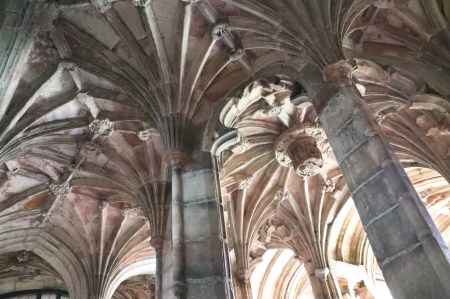
15th century fan vaulting in St Winefride's well

15th century fan vaulting in the under chapel at St Winefride’s well. late 15th – early 16th century

On Friday I took advantage of a sunny cold day to revisit St Winefride’s Well and its late Medieval chapels.  During the Middle Ages it was a major draw for pilgrims to north Wales,  with its shrine, beautiful bubbling spring and the Basingwerk Abbey a few minutes away.  St Winefride’s (Welsh Gwenfrewi) shrine and the Holywell (Treffynnon) parish church were granted in 1093 to St Werburgh’s Abbey in Chester for them to manage and from which to derive an income.  It was later consigned to Basingwerk Abbey.

Nothing is known about what sort of buildings preceded the late medieval building that we see today, but there are details about Saint Winefride, a list of some of the well’s most notable earlier medieval visitors and details about the measures that were taken to promote the interests of the shrine throughout its history following the Norman Conquest.  The role of the abbey in the success of the well can also be seen.

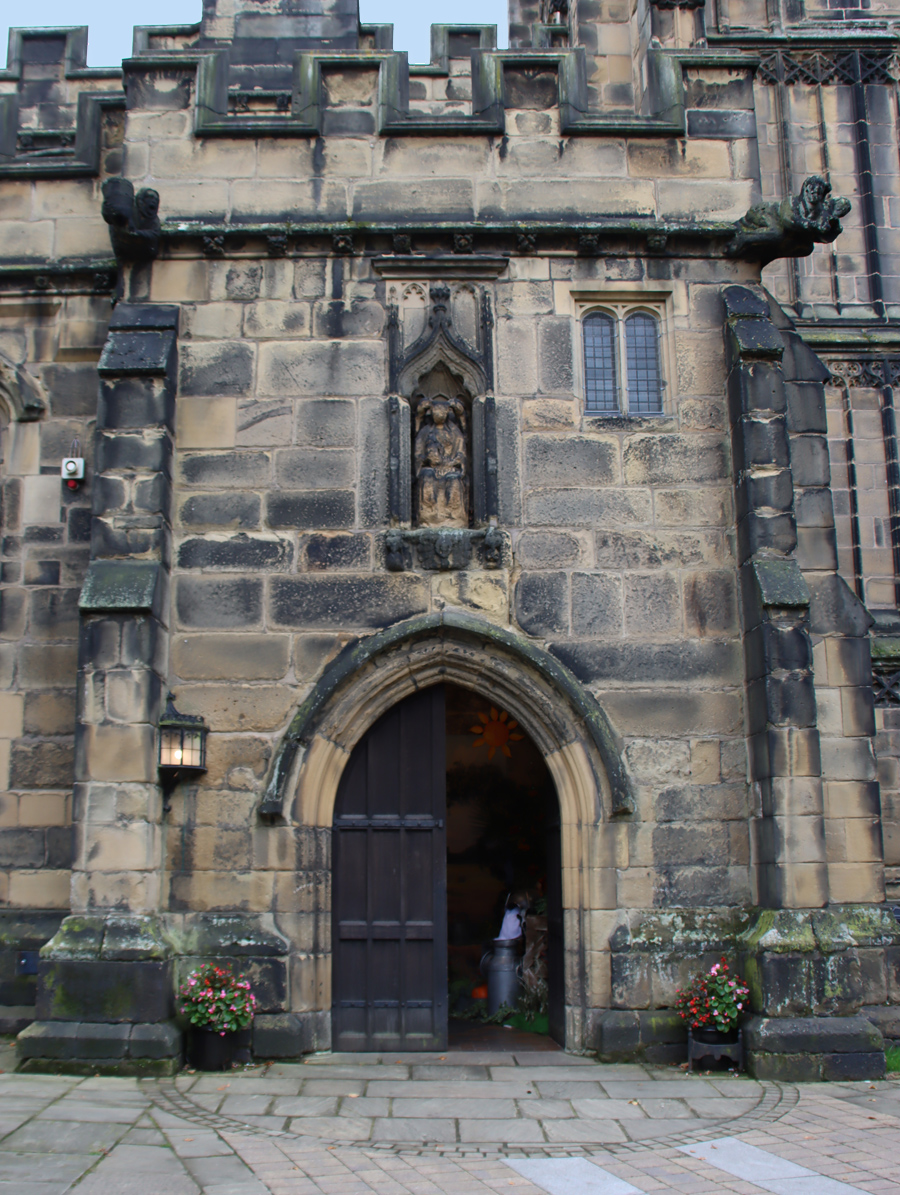
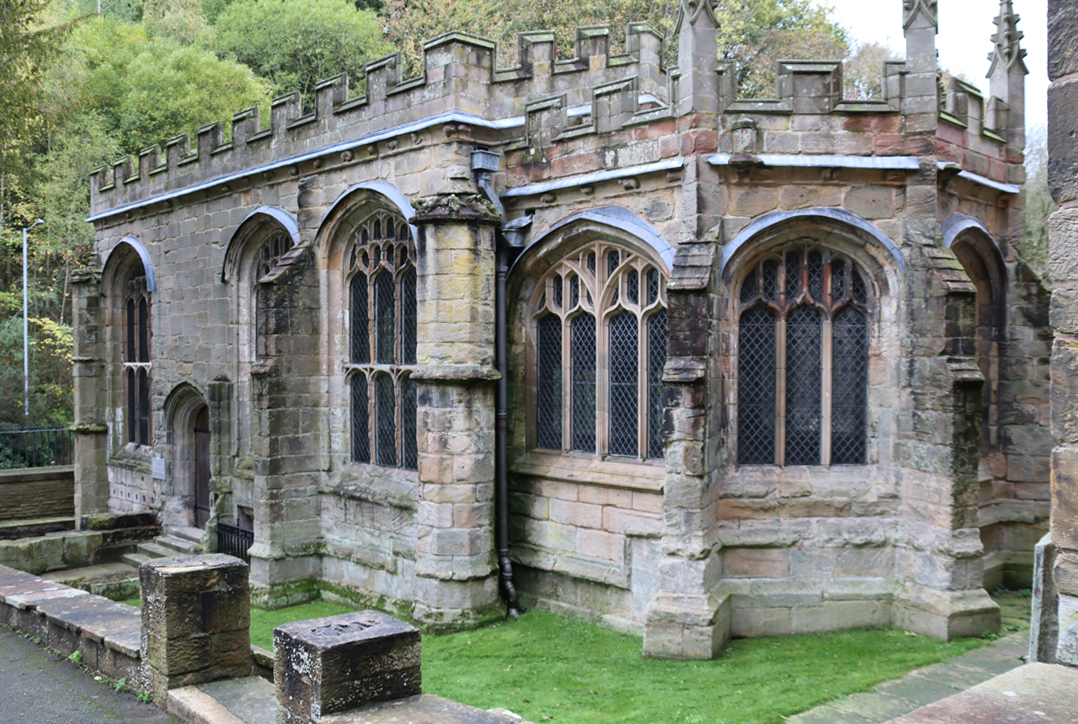
View of the chapel from the south. The chapel is over two floor. The fan-vaulted ground floor has three bays, with the central one containing the well itself. The upper chapel is fully enclosed and its entrance is on the same level as the entrance of the parish church.

An abbey with a pilgrim shrine had a range of opportunities for income generation, and St Winifred’s was famous for its powers of healing and provision of miraculous cures for centuries.  In around 1480 a wealthy patron, possibly Henry VII’s mother Lady Margaret Beaufort, invested in the shrine, providing the miraculous spring with a gorgeous, lofty fan-vaulted open-fronted chapel, as well as an enclosed chapel overhead.  Today both parts of the chapel are very well cared for, located on the edge of the Green Valley Park, which has a superb industrial heritage trail wending through it (see my earlier post here).  There is plenty of parking at both the well and at the abbey, described at the end of this post.

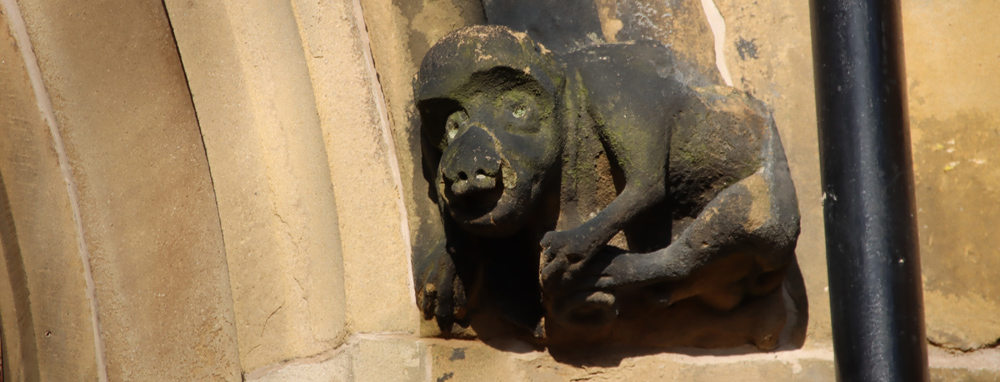
Fan vaulting with roof bosses. From left to right, the rebus of Elizabeth Hopton, two monkeys, a fleur de lys.

Fan vaulting with roof bosses in the lower chapel. From left to right, the rebus of Elizabeth Hopton (showing a rebus of her name, with a hop plant emerging from a barrel or tun); two monkeys, which may have a number of interpretations; and a fleur de lys (representing chastity, often used for the Virgin Mary but also suitable for St Winefride).

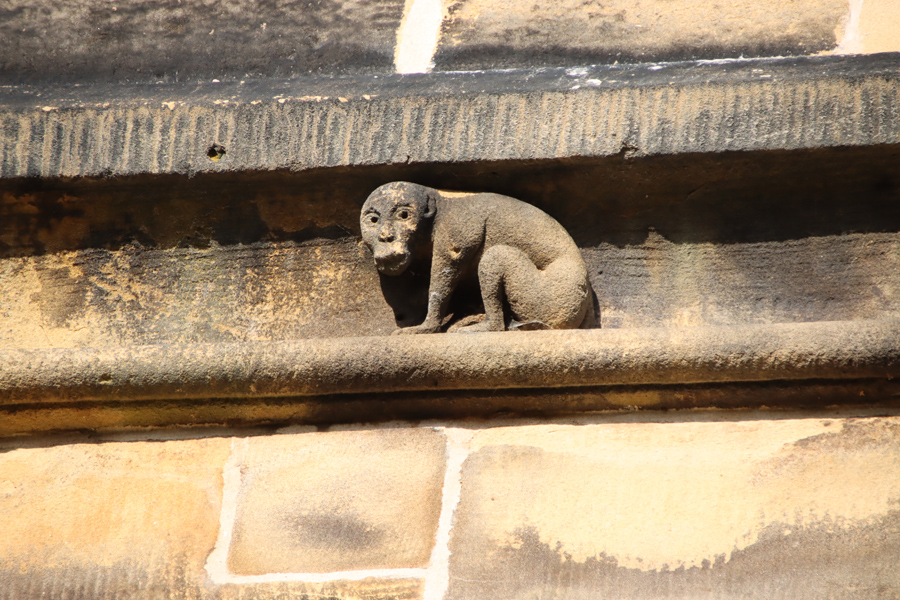
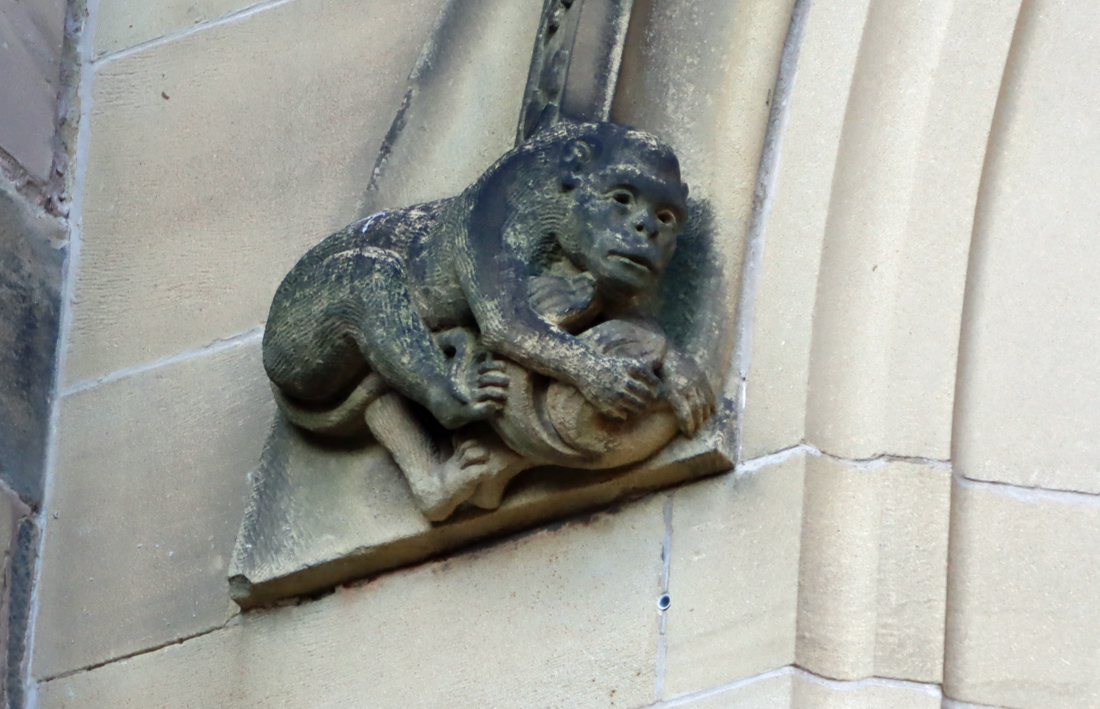
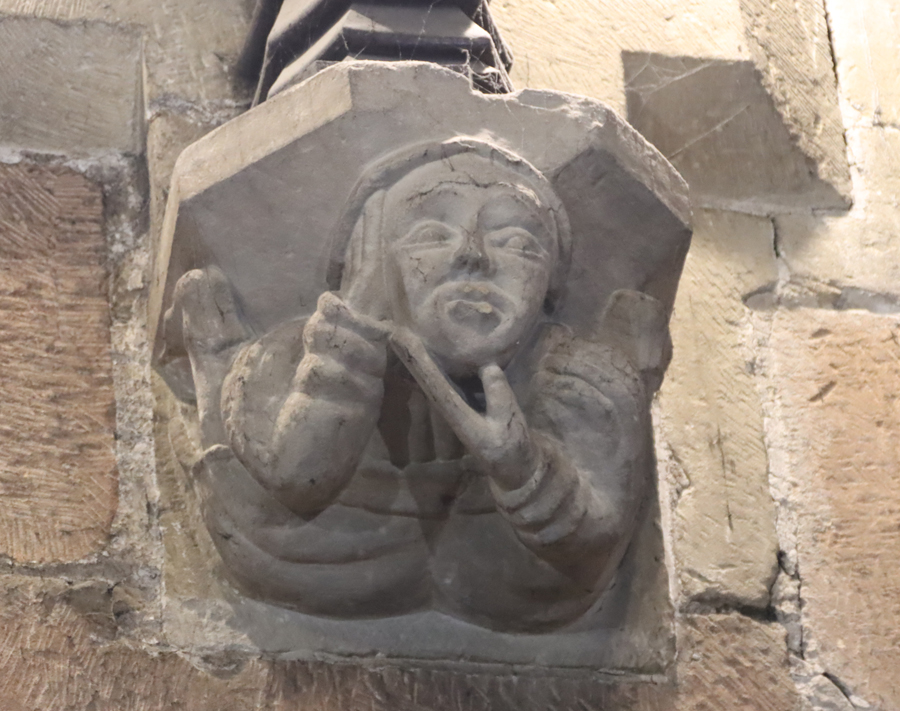
There’s a real sense of this being a costly but personal project, particularly in the vaulted lower chapel, which in terms of elaborate ecclesiastical architecture is tiny, although its height gives a sense of heading heavenwards.  Although no documentation survives to say who was responsible for funding the building, the Stanley family’s crests and symbols give an impression of a cherished project and the sheer amount of other imagery are reminiscent of cathedrals and large churches of the period.  It manages to be both impressive and intimate, which is quite a trick.  The chapel upstairs is more conventional in terms of both its size and its layout.  What I missed on my first visit is that the wooden ceiling supports all have sculptural elements sitting on their corbels, as well as more easily visible stone ones lower down.  In both upper and lower chapels, as well as the inherent beauty of the architecture, there is humour as well as religious, pagan, family and royal themes in the imagery.
xxx


xxx

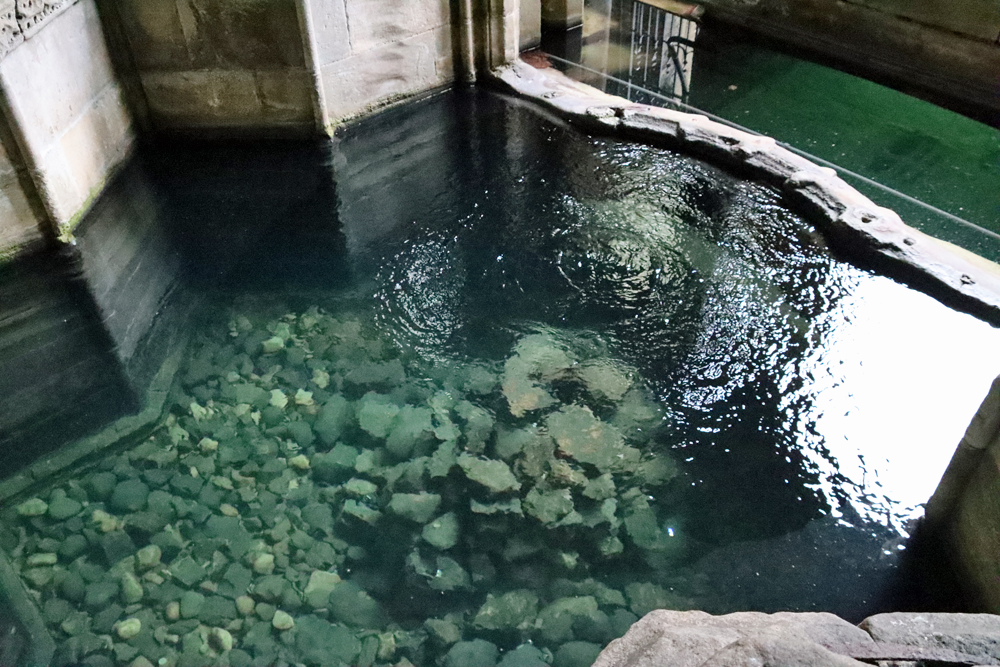
St Winefride's well, c.1480

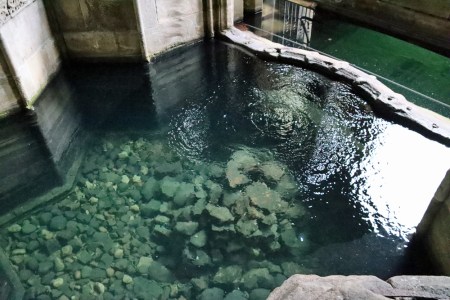
St Winefride’s well, in the star-shaped basin late 15th – early 16th century

St Winefride and St Beuno

There are a number of versions of the story of the miracle of St Winefride or Welsh Gwenfrewi (also spelled Winefred and Winifred), and her uncle and tutor St Beuno.  The earliest that remain preserved date to the 12th century, and excerpts have been translated and published by T.W. Pritchard in his detailed 2009 book about the well.

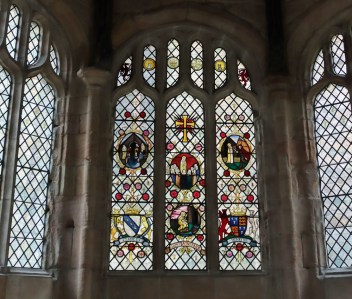
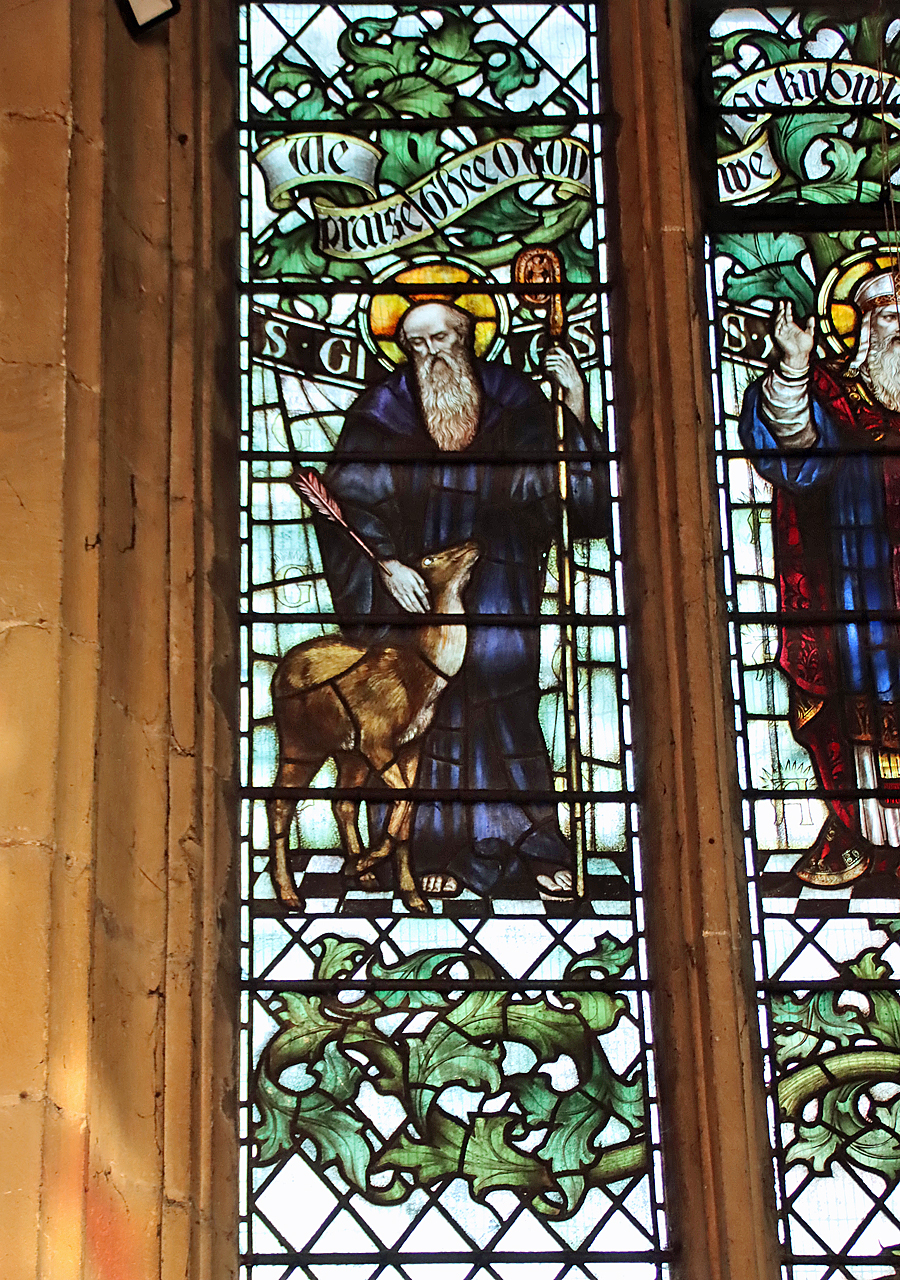
Modern stained glass in the little prayer chapel next to the main chapels

Winefrede and Beuno in the modern stained glass in the little prayer chapel for worshippers today, next to the main chapels. The palm represents the spiritual victory of martyrdom, whilst the crozier (staff) symbolizes teaching, wisdom and guidance.

Winefride was born towards the beginning of the 7th century in the cantref of Tegeingl, in northeast Wales, the only child of Tyfid and his wife Gwenlo, or Wenlo, who were landholders in the area.  One of the 12th century accounts says that Tyfid’s estate was made up of four manors.

Winefride had decided to renounce marriage and to dedicate herself to God and the teachings of Christ.  Christianity was well established throughout Britain, partly due to missionaries who were often commemorated as saints for their work.  One of these was St Beuno, who had moved to the area from mid Wales and was engaged by Tyfid to teach Winefride, in return for land on which to build a church.  St Beuo built a church in a valley called Sychnant (dry valley), which is now Greenfield Valley, Holywell, where the well is located.

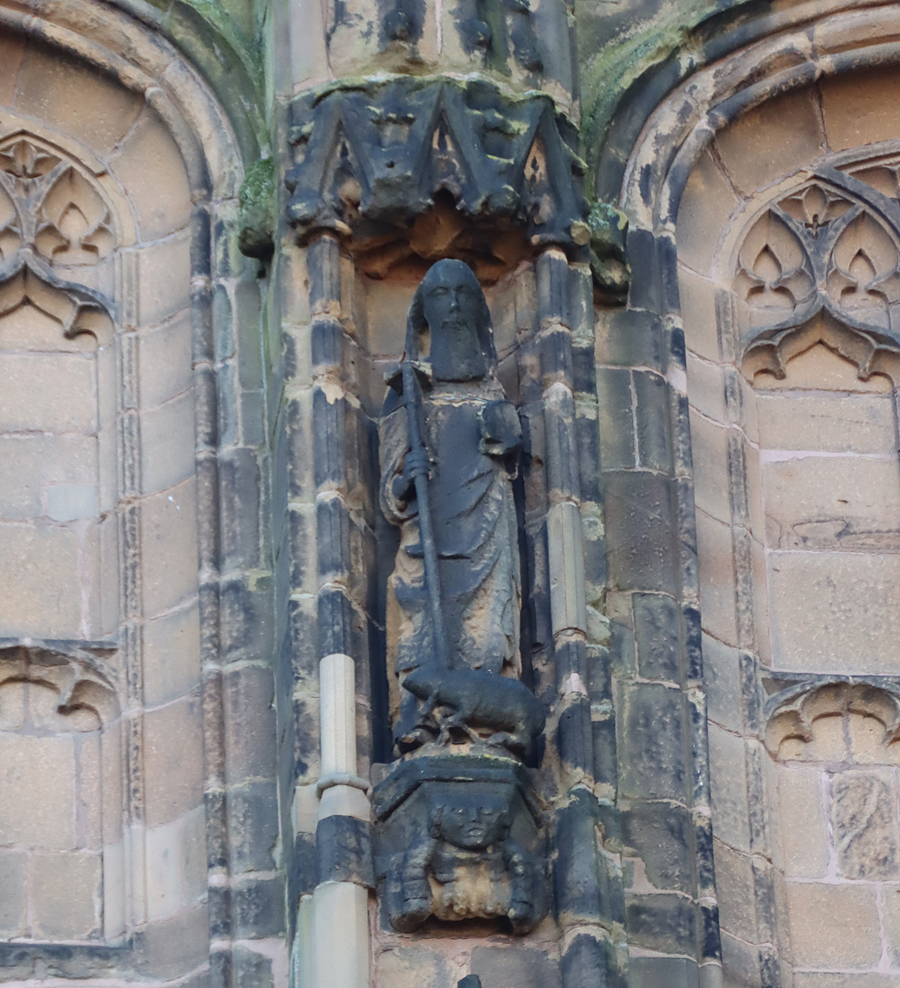
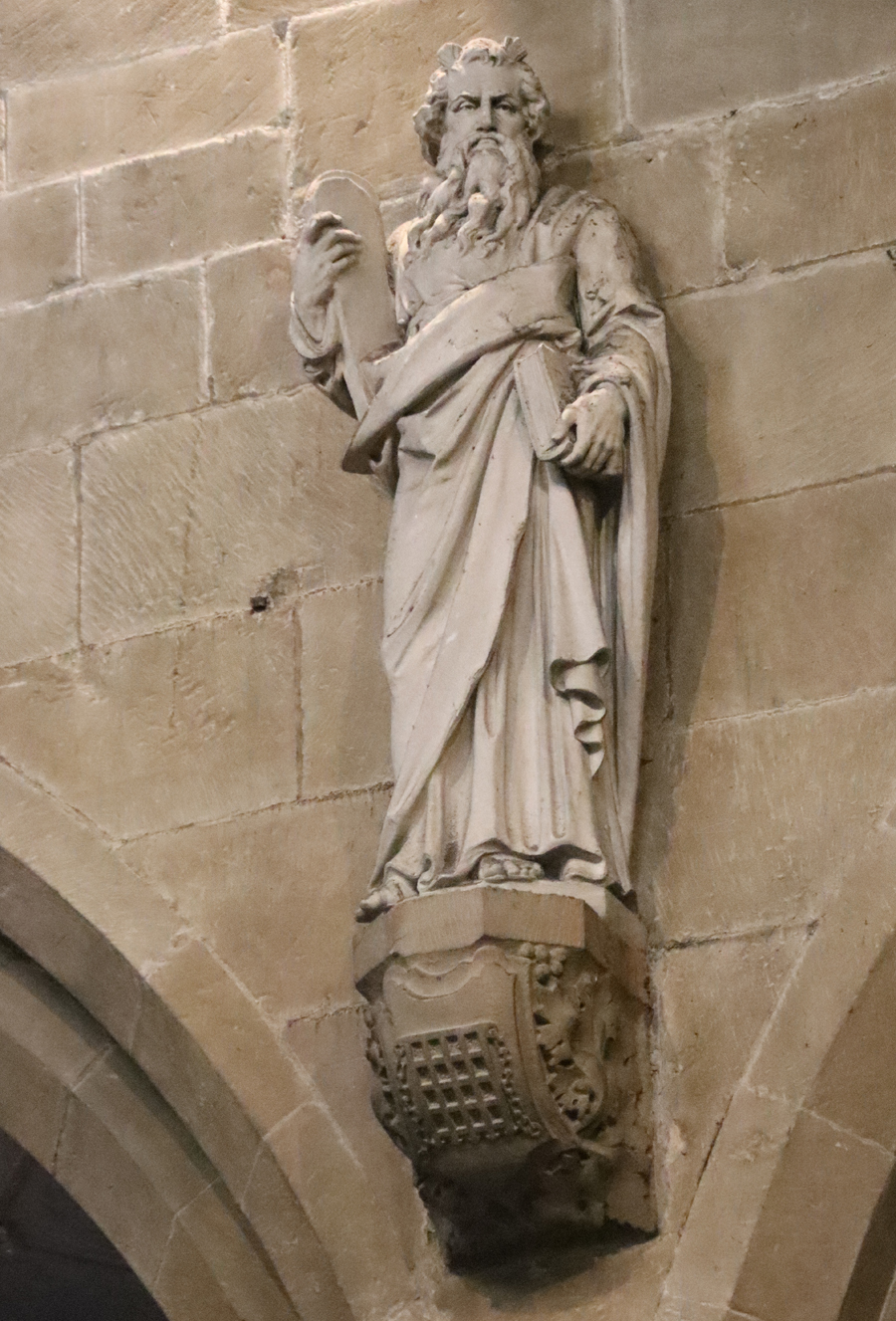
Sculpted figure

Sculpted figure, possibly St Beuno

One day, Winefride was at home alone whilst her parents were attending mass at the church, and a local prince, Caradog, knocked on the door.  She suggested he return later, but he became determined to marry the girl (who was of course beautiful).  Pretending to go and get changed, she ran to the church.  Caradog, realizing that he had been deceived, set out in pursuit and when he caught up with her near the door to the church, decapitated her in a fit of rage.  Beuno, hearing the noise, rushed out of the church and, finding a terrible scene, began to pray for help.  His prayers were answered.   Caradog melted into the ground, never to be seen again, and Beuno picked up her head and placed it back on her neck.  She came back to life, with only a slender white scar showing where the injury had been.  Instantly a spring erupted at the spot where her blood had been spilled.  The stones in the spring were said to be permanently red, the moss that grew around it had an aroma of incense and the waters produced miraculous cures.  The story continues, but the abbreviated version is that Winefride became a nun, moving from Holywell to Gwytherin to oversee 11 nuns as abbess, where she died and was buried.
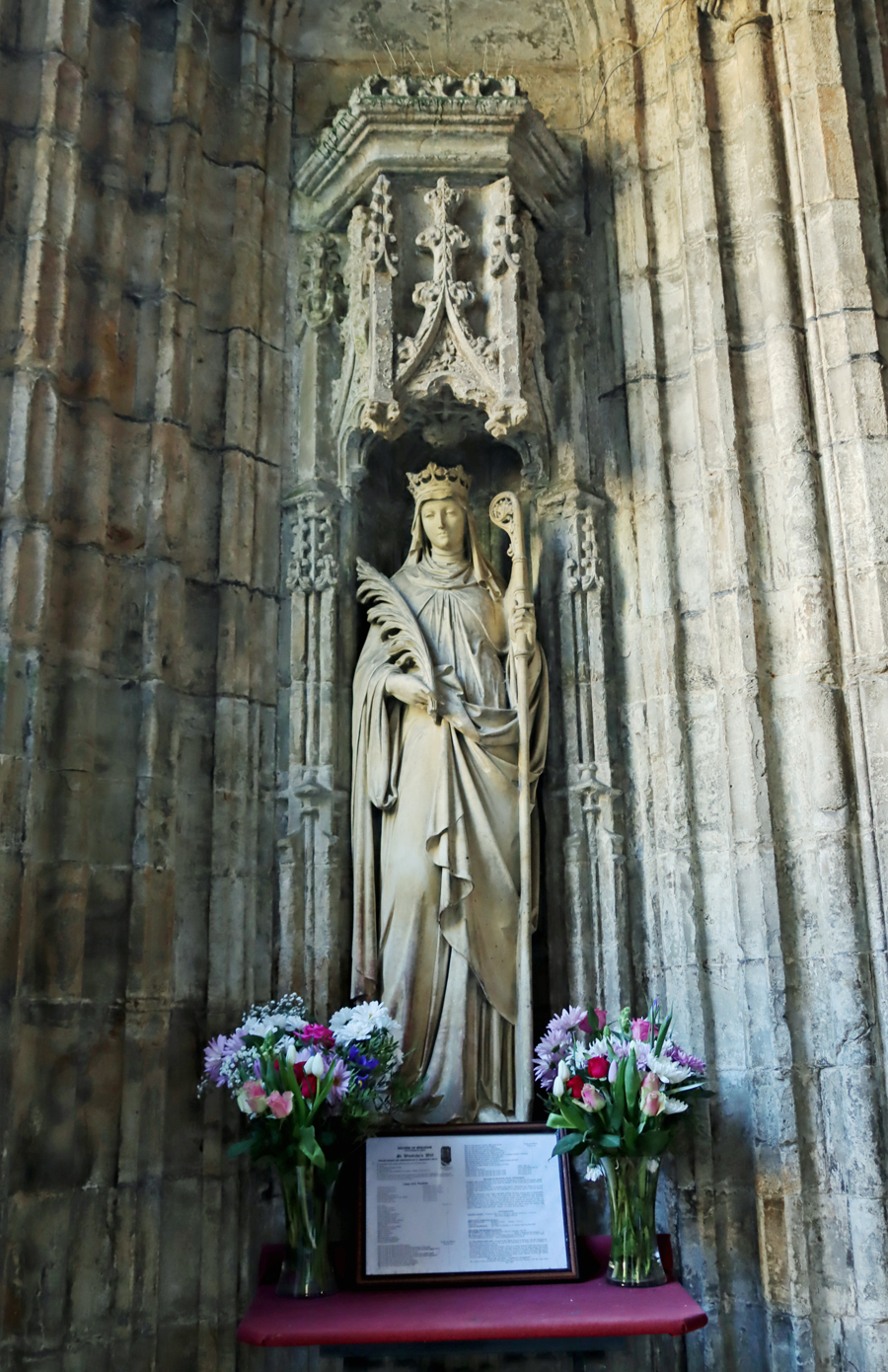
Statue of St Winefride within the lower chapel, dating to 1886

Statue of St Winefride within the lower chapel. The niche with its elaborate and intricate canopy is original, but the medieval statue was lost, and this dates to 1886

The basics of the story, a pure and noble virgin who died rather than surrender her virtue, is a familiar one.  The spring, too, erupting where pure blood was spilled, is not unique. When St Paul the Apostle was executed by decapitation his head is said to have bounced three times, and at each place where it touched the ground a spring erupted. The linkage of springs, wells and purity are long established, and the added connection with baptism gave water particular potency in Christian thought.  Interestingly, Winefride combined the virtues of a martyr saint and a confessor saint, having first died for her beliefs and then having been resurrected to live for those beliefs and values.

Miraculous events and morality tales of this sort became a form of oral history, a mechanism by which the ideology, morality, values and essential beliefs of early Christianity, were spread and understood.  The partly fictional “lives” of saints purporting to be biographies (hagiographies) were particularly popular when distributed after the innovation of printing in England in the 1470s. St Winefride’s story, written down and transmitted via word of mouth, the monasteries, and later by the printing press, became a popular saint  and her miraculous healing well became a pilgrim destination.

The remains of the shrine to St Winefrede in Shrewsbury Abbey

The remains of the later 14th century shrine to St Winefride, Shrewsbury Abbey showing St John the Baptist at left, St Beuno at right and Winefride in the middle.

In the 1130s an account by one of the monks of Shrewsbury Abbey states that the monks had “lamented that they were very deficient in relics of saints and applied their minds to the problem of obtaining some.”  One of the monks, during a spate of sickness, had a dream that St Winefride had appeared to him and said that the monk would be cured if a mission were to be sent to Holywell to say mass at her well.  Convinced that Winefride was their patron, they decided to retrieve her bones and take them to Shrewsbury.  In 1138, over 300 years after St Winefride’s death, a contingent of monks duly went to Gwytherin. They dug up and translated (transferred) Winefride’s remains from her grave and took them back to Shrewsbury, where a shrine had been built to receive her. Legend states that during the journey a spring appeared at Woolston near Oswestry, where her bier was briefly placed on the ground during the journey (a photo of this is shown further below).  A new shrine was built to house her relics at Shrewsbury Abbey in the late 14th century, a fragment of which survives and is shown above. It was destroyed during one of the attacks on the monastery.
xxx 

The Shrewsbury Abbey church

The Shrewsbury Abbey church (the rest of the abbey was demolished, now replaced by a road and a car park)

The Spring that feeds St Winefride’s Well

St Winefride’s well is built over the point at which an ancient spring, an underground stream, erupted to the surface, producing a quite dramatic spectacle of fiercely rushing water, particularly after rainfall.  That was not the same spring that is seen today.

St Winefride's well

St Winefride’s well

In 1917 mining activities at Halkyn cut through the stream, causing a change in flow direction so that the stream now emerges at Bagillt on the edge of the Dee estuary, causing both dramatic change to the industries along the valley and to the well itself, which dried up.  The current spring water that enters the star-shaped basin beneath the vaulted roof now bubbles delightfully, but this comes from another spring that was diverted for the purpose, and has none of the vigour or volume of the original spring.
xxx

The History of the Well

Hugh Lupus and the Abbey of St Werburgh

Romanesque elements surviving from the first Abbey of St Werburgh

Romanesque elements surviving from the first Abbey of St Werburgh

Today Chester Cathedral is a largely Gothic vision, with pointed arches and vaulting with roof bosses, but when it was built as St Werburgh’s Benedictine Abbey in around 1093 it must have been a superb example of the Romanesque curves and rounded arches brought to England by the Normans.  The abbey’s founder was Hugh d’Avranches (better known as Hugh Lupus, c.1047-1101), Earl of Chester, who had been appointed to Chester by William the Conqueror.

Holywell, including St Winefride’s Well and the parish church, were part of Hugh’s new territory. Earl Hugh gave Holywell to his wife, Adeliza, and she in turn awarded it to the abbots of St Werburgh’s Abbey.  A religious attraction like Holywell, with its miracle-producing shrine and its attached church cold produce a good income for an abbey, which took control of the tithes (a sort of religious tax) owed to the church, and to the oblations (gifts from pilgrims and visitors) to the holy shrine.

Transfer of ownership:  Basingwerk Abbey and subsequent transfers

The building that may have been part of the guest quarters at Basingwerk Abbey. Its burned timbers were dendro-dated, giving the roof a date of c.1385

Because it was located in a region that was a territorial bone of contention between the Welsh princes and the English kings during the 13th century, Holywell could be in either English or Welsh territory.  When Basingwerk Abbey was founded in 1131 by Ranulf II Gernon, Earl of Chester, it must have been a source of some discontent to the new abbot that such a rich potential source of income was sitting on the doorstep and benefiting a rival monastic order in Chester.

Fortune smiled on Basingwerk Abbey.  Holywell was granted to it in the 12th century.  It was briefly back in the hands of St Werburgh but in 1196 it was once again assigned to the monks at Basingwerk by the Welsh prince of Gwynedd, Llywelyn the Great (ap Iorwerth, c.1173-1240), who had pushed his frontiers east.  This gift was confirmed in 1240 by Llywelyn’s grandson Dafydd ap Gruffudd (and younger brother of Llywellyn ap Gruffudd known as Llywelyn the Last), who in a turncoat deal with Edward I had been given lands in northeast Wales following the Treaty of Aberconwy. Basingwerk then retained Holywell and its religious assets for nearly 300 years until Henry VIII suppressed the monasteries in the 1530s.  Although they suffered under Edward I’s final conquest of Wales, Baswingwerk and Holywell survived, which is more than either Llywelyn or Dafydd managed to achieve, being killed in 1282 and 1283 respectively.

St Winefrede Well at Woolston

St Winefride Well at Woolston. Source: Shrewsbury Orthodox Church

It is not known what the Holywell pilgrim shrine looked like throughout the changes of ownership between the two abbeys, as no descriptions or images survive.  The shrine and temple would have been built of wood in its earliest years.  In one of its doubtless numerous iterations it is quite likely to have looked something like the small pilgrim shrine at Woolston near Oswestry, shown on the left, also dedicated to St Winefride.  Wooden buildings were replaced by stone buildings when those buildings began to be well used. The first stone parish church at Holywell is thought to date to around the 14th century, and it is possible that the shrine was revamped at the same time.

Promoting the interests of the Holywell shrine

Statue of St Winefrede in a niche in the Henry VII Chapel, Westminster Abbey

Statue of St Winefride in a niche in Henry VII’s early 16th century Lady Chapel at Westminster Abbey. Source: Pritchard 2009, p.71

The task of ensuring the continuing success of St Winefride and the holy well, important both for monastic income and the economy of the Holywell, was occasionally given an official helping hand.

In 1253, for example, a request was made to the Cistercian General Chapter (the governing body of the Cistercian monastic order) to allow a “Feast of 12 Lessons” to be held annually on the saint’s Feast Day at Buildwas Abbey in Shropshire, and Basingwerk Abbeys, the two of which had become connected in a hierarchical relationship some time after Basingwerk was absorbed into the Cistercian order.  The normal feast was of 9 lessons (prayers and readings), and the fact that this was of 12 indicates the respect in which Winefride was held.  The request was authorized, meaning that St Winefride’s Feast was more likely to attract pilgrims to both of the abbeys as well as the Holywell shrine.

In 1398 the annual feast of St Winefride, which had been confined to north Wales and the Marches, was extended to the entire Canterbury area  by Archbishop Roger Walden.  In 1415 his successor Henry Chichele who had a particular interest in Welsh saints having been Bishop of St David’s, a centre for pilgrimage in south Wales, raised the profile of St Winefride’s cult still further.

Richard II established a chantry (payment to a member of the clergy in return for prayers and the saying of mass for the dead of a particular family) in 1377.  This was renewed annually by each subsequent king until the Dissolution, after which chantries and the mass were no longer legal.

An example of an Indulgence, this one issued in London. Source and details: Essex Records Office.

An example of an Indulgence, this one dated 1480 and issued in London. Source and details: Essex Records Office.

In 1427 the shrine’s popularity was assured when Pope Martin V granted indulgences over a ten year period for those who made the pilgrimage to the shrine and gave oblations to the chapel.  Indulgences were mechanisms for rewarding certain activities, mainly those that generated income for the Church, including pilgrimages, by reducing the time an individual spent in purgatory by a specific number of years and days.  In this case the time reduced was a year and forty days.  It was a way of trading off human fear of what followed death, but a ruthless way of raising funds, later famously condemned by Christian revisionist Martin Luther in his Ninety Five Theses.

The role of the well in the Middle Ages

North entrance to the under-chapel at St Winefrede's Well.

North entrance to the under-chapel at St Winefrede’s Well.  The barriers detract from the aesthetics but do prevent people falling in.

The well can be understood in a number of ways, all from different viewpoints.

From the point of view of Basingwerk Abbey, which had authority over the well and its shrine, it was both a source of prestige and income.  The prestige of having the miracle directly connected with an Anglo-Saxon saint was considerable, giving it a historical validity with real time-depth, with roots in the distant past.  Not only was Winefride a miracle-working virgin saint, but she had gone on to become a nun, and then an abbess.  Her credit and sanctity were flawless.  This status and prestige attracted pilgrims, and with them a source of potentially considerable income. The  importance of miraculous places of pilgrimage grew in the medieval period, and pilgrims not only brought donations (alms) but those with money also contributed to the local economy, meaning that the abbey was a contributor to that economy.  However, pilgrims could be a double-edged sword, as they also required some management to prevent them becoming a drain on the abbey’s obligation to provide shelter and food under the general heading of “hospitality,” to which the Cistercian order was committed and which included some form of accommodation and the supply of meals.

Rebus of Elizabeth Hopton's last name (a hop plant emerging from a tun, a type of Barrel

Rebus of Elizabeth Hopton’s last name (a hop plant emerging from a tun, a type of Barrel

From the point of view of pilgrims, miraculous venues offered a range of opportunities, depending on the motives for visiting.  The natural spring was said to have miraculous healing properties, and many will have travelled to be cured, whether rich or poor.  Others were engaged in a form of spiritual tourism, visiting all the most important shrines and relics either in a given area, throughout Britain and sometimes overseas.  Within the Welsh and border areas, Holywell was part of a pilgrim circuit with Basingwerk (with the Holywell shrine), St Asaph (Llanelwy, the church of the 6th century miracle-performing saint), Chester (with the Holy Rood of St John’s and St Werburgh’s shrine in the Abbey), together with other churches and monuments, and this could also be extended to reach the sacred Bardsey Island.

Archway leading to the steps into the well

Archway leading to the steps into the well

The medieval world was very concerned with the challenge of how to manage an afterlife that began with the terrors of Judgement Day and Purgatory.  Visiting saints’ shrines, or just being in close proximity to them, was a way of gaining proximity, at a little distance, to the divine, with the hope that some of it might, in some mystical way, rub off.  Just by touching a shrine, a little of the incredible divine energy could pass into a person; immersion in the spring that emerged from the spilling of a virgin saint’s blood must have seemed like being wrapped in the saint’s divinity.  This did no harm to nearby residents, who must have had a sense of the power of the shrine.

Likewise, monasteries that were filled to the brim with those devoted to Christian worship, whose virtue made them next in godliness to saints, were considered to be invaluable assets to those who lived in their vicinity.  The wealthy chose to be buried within monastic precincts, as close as possible to the most sacred areas.  In churches people wanted to be at the interior east end of churches or, if they were not sufficiently influential to be buried inside, as close outside to the east end as possible. The presence of the abbey so close to the shrine gave Holywell a particular religious vigour.

As well as religious benefits to outsiders, there were economic benefits to the local population.  Basingwerk Abbey had various agricultural (mainly livestock) and industrial (including silver mining) interests in the immediate area that would have employed many rural people, but as the medieval period shook off the manorial control that bound people to the land, the Holywell shrine offered potential for new opportunities, including hospitality and, if other pilgrim centres are anything to go by, the manufacture and sale of souvenirs.

Visitors and patrons in the Middle Ages

Pilgrim being carried to the healing waters of the spring

Pilgrim being carried to the healing waters of the spring. The 15th-early 16th century well shrine.

In the Middle Ages there was no clear dividing line between physical and spiritual health.  The idea of illness was embedded into the belief that the body was composed of a series of complex components that required balancing what were understood to be the essential fluids (blood, phlegm, black bile and yellow bile) with the elements (air, water, fire and earth) and their key characteristics (hot, cold, wet and dry) as well as astrology. Deficiencies and excesses in any one component might put the entire complex equation for stability and harmony in jeopardy.  When attempts to achieve balance these failed, and the person remained sick in body, mind or, for that matter, sin, pilgrimage was often seen as the most logical next step.  Pilgrims understood that this was a two-way street and that they would have to make some sort of sacrifice, part of which might be the difficulty of undertaking the journey, but gifts and promises of reform were also part of the negotiation.  Pilgrimages were undertaken for many other reasons too, but the healing properties of St Winefride’s shrine were probably the main attraction to most visitors.

Medieval ampulla for carrying liquids or earth from a pilgrim site

Example of a medieval ampulla used for carrying liquids or earth from a pilgrim site. Source: The Mobility of Objects across Boundaries

St Winefride’s recorded visitors and patrons are a roll-call of the celebrities of the era, the royal and the aristocratic, who were major marketing coups for Basingwerk.  Although those few known by name are listed below, the everyday participants along the pilgrim routes were more often ordinary people.  Reasons for their travels varied, including seeking to undertake a spiritual journey for personal improvement (perhaps one of many journeys);  to offer thanks for prayers that were answered; or to seek divine assistance for problems and maladies by asking a specific saint to intercede for them with God.  Some pilgrims also acted for those who were unable to attend themselves, offering prayers on their behalf, and returning home with garlands of the sacred moss or filling small flasks with the miraculous water.  These ordinary pilgrims from a wide variety of backgrounds always get lost in documented history, the Middle Ages being just as concerned with celebrity endorsements as the west is today, but were nevertheless the most essential components, the bread and butter raison d’être of a living shrine and the institution that managed it.

Ranulph II, Earl of Chester. Source: Wikipedia

Between 1115 and 1119 the second earl of Chester, Richard d’Avranches, son of Hugh Lupus made pilgrimages to the well.  With the shrine of St Werburgh within the Chester city walls, it might have been thought that he would look closer to home, but Richard is thought to have fallen out with the monks of the abbey.  In addition, it is not really a pilgrimage if it is only a ten minute walk, and Richard may have felt the need to make more of a gesture.  Ironically, a miracle took place during the pilgrimage, when Richard became cut off from his forces and his constable in Wirral prayed for assistance but as St Werburgh had been chosen rather than St Winefride, this was chalked up to a win for the Chester abbey.

In 1131 Ranulf II Gernons (1099-1153), fourth earl of Chester, founded the new Savignac (later Cistercian) Basingwerk Abbey somewhere in the area, presumably made of wood.  It is thought that it was moved to its current location in around 1157 to be rebuilt in stone, and this new location was very probably influenced by the presence of the nearby holy well, even though it was at that time part of the landholding of St Werburgh’s Abbey.

It is said that in 1188 or 1189 Richard I, the Lionheart (ruled 1189-1199), made a pilgrimage to Holywell.  Quite where he would have found the time is anyone’s guess.

Flint Castle

Flint Castle on the Dee Estuary, construction having begun in 1277

There is no record of Edward I (reigned 1272 to 1307) making a pilgrimage, but he presumably had no need to put himself to any real effort to visit either the abbey or the shrine, as by the 1270s he was already in the area.  In 1277 he began to build Flint Castle 6.9km/4.3 miles down the road from Basingwerk.  Whilst the castle was under construction it seems reasonable to assume that Edward was a frequent guest at the nearby monastery, and that he took the opportunity to visit the shrine.  In fact, Edward’s castle in Flint may have resulted in a busy time all round for the abbey, the church and the shrine, as the 100s of workers at the castle would have had at least some downtime and would doubtless have sought out a powerful religious shrine so close by.

In 1282 Edward’s armies returned to northeast Wales to engage with the Welsh princes once again, doing substantial damage to monastic lands in the process.  It is recorded that part of Holywell was burned, but it is not stated whether this was the village, the shrine or nearby buildings.  The abbey estates were certainly harmed, with the lost of crops and livestock, and Edward found himself compensating both Basingwerk and other Welsh abbeys that had come under fire during the fighting.  Pilgrims were presumably rather short on the ground at this time, but Edward and his armies probably formed part of the narrative of the abbey told to future pilgrims.

Miniature of Henry V

Miniature of Henry V, c.1411. Source: Wikipedia

According to chronicler Adam of Usk, Henry V (reigned 1413-1422) visited in around 1416, following his success at Agincourt, to give thanks, walking on foot to Holywell from the Shrewsbury abbey to which Winefride’s remains had been translated (moved) in 1138 from where she was originally buried in Gwytherin.  I have not found any reason why Henry would have singled her out to request support in battle, but apparently he prayed to her for assistance and his pilgrimage was an offering of thanks, which created a considerable stir.  Perhaps he had encountered the shrine as Prince of Wales during the military campaigns against Owain Glyndŵr that began in his father’s reign and which he ultimately suppressed.

The Earl and Countess of Warwick made gifts to the shrine in the 1400s there is is not stated that they ever visited.

Henry IV Bolingbroke (reigned 1399-1413) took the throne from Richard II (reigned 1377-1399), with Richard surrendering to Henry at Flint Castle in 1399.  It is possible that whilst he was in the area, Edward took the opportunity to visit St Winefride’s shrine, probably connecting with the monks at the same time.

In 1461 the Welsh bard Tudur Aled wrote that Edward IV (reigned twice in 1442-1483 and 1471-1483) had visited the shrine, but quite why is unclear.  He was a member, by descent, of the Mortimer family who had extensive properties in the Welsh Marches, in Chirk and Denbigh. There was, in fact, considerable resistance to Edward IV in areas of north Wales, including the rebellion of Owain Glyndŵr.  There is nothing in general events of that year that would seem to account for him being in Holywell, although Pritchard suggests that it might be connected with renewing the royal chantry, which seems like the most plausible reason.

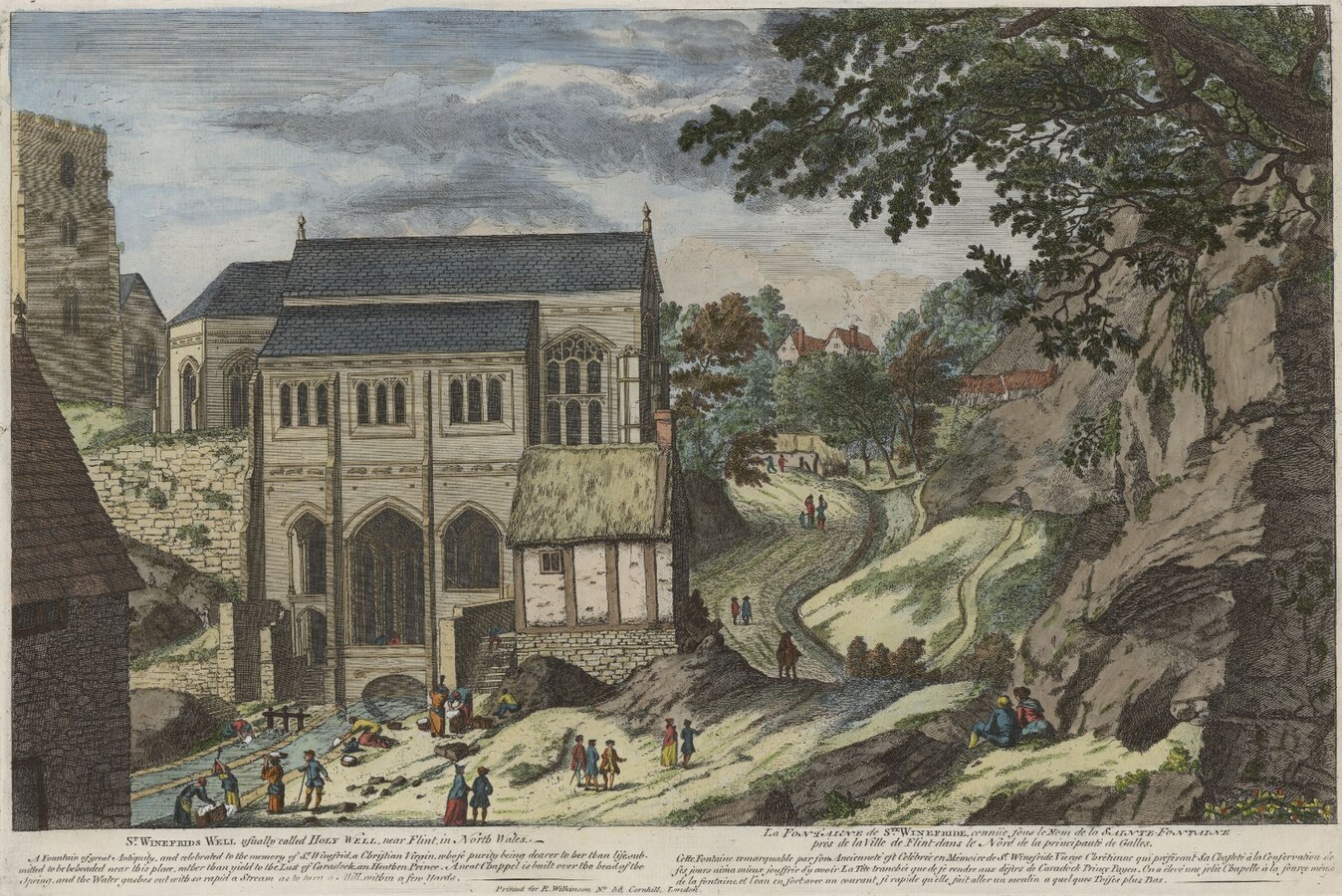
St Winifrede's well by John Ingleby. Source: National Library of Wales via Zone47

St Winefrede’s well by John Ingleby (1749-1808) showing crutches slotted into the stonework above the spring.  Note the gallery at the left, and the mill wheel through the doorway.  Source: National Library of Wales via Zone47

Whether royal, aristocratic or of more humble origins, pilgrims continued to visit throughout the medieval period, and pilgrims continue to visit continue today.  As well as the sculpture on the left in the well chapel, showing a pilgrim being carried to the spring on an other man’s back (one in need, the other showing compassion) the visitor centre has examples of later wooden crutches that were apparently discarded after miracle cures had  been received.  In 18th and 19th century engravings crutches are shown slotted into the stone structure of the pilgrim shrine presumably as a record of successes and gestures of thanks (see the John Ingleby coloured engraving towards the end of the page).

For visitors to Holywell and the shrine in the post-medieval periods, which are not covered here, see the Early Visitors in Wales page dedicated to Holywell.

The late Gothic chapels

The patrons of the new chapels

Ceiling boss showing Lady Margaret and the Earl of Derby

Ceiling boss in the lower chapel allegedly showing Lady Margaret with her husband Thomas Stanley, the Earl of Derby

It has passed into tradition that the founder of the chapel that we see today was Lady Margaret, née Beaufort.  Lady Margaret was the mother, by her first husband, of the future King Henry VII who was the founder of the fan-vaulted Lady Chapel in Westminster Abbey, designed by Robert Vertue.  Lady Margaret, born 1443 had married three times by the time she died in 1509, her last husband being Thomas Stanley, Earl of Derby, a member of an important and wealthy local family in the Wrexham area.  She is thought to have patronized St Giles in Wrexham, St Mary the Virgin in Mold and St Chad’s in Farndon.  She sponsored two publishers, both of whom (possibly at her suggestion) published lives of St Winefride.  The involvement of the Stanley family, whether Lady Margaret was involved or not, is suggested quite strongly by the number of relevant carvings in the chapel, including:

  • A sculptural portrait thought to represent Lady Margaret and her husband Thomas Stanley (1435-1504), Earl of Derby (although with very little data, if any, to substantiate the identification)
  • Over the outside of the door to the gallery there is a the portcullis emblem that Henry VII (reigned 1485-1509) derived from Lady Margaret
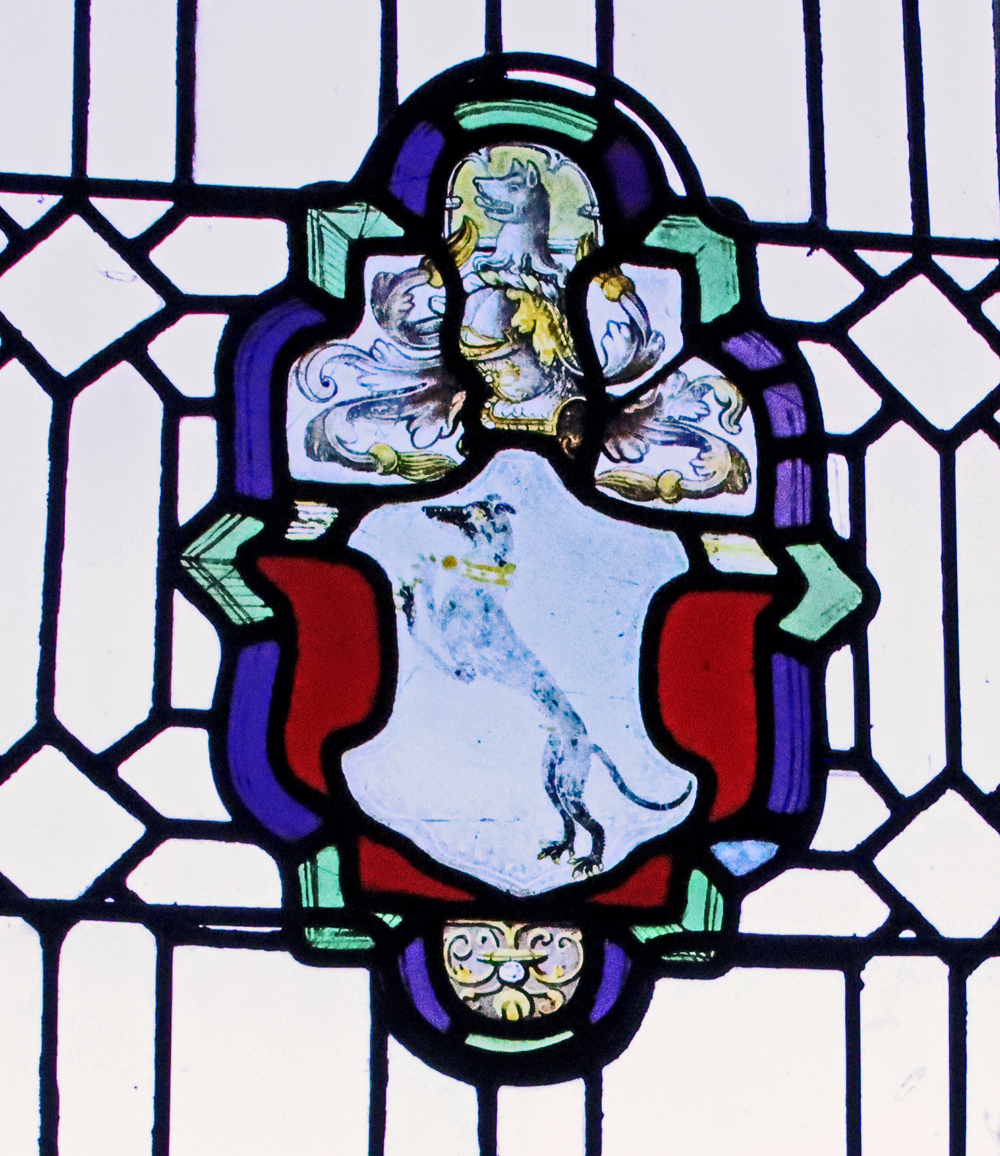
  • The arms of Sir William Stanley (died 1495), brother of Thomas Stanley showing a wolf’s head enclosed in a garter (rewarded by Henry VII for his role in the Battle of Bodsworth of 1485 but executed in 1495 for conspiracy)
  • The arms of Sir William Stanley’s wife Elizabeth Hopton (died 1498) showing a barrel and a plant, forming a rebus – hop and tun – of her name
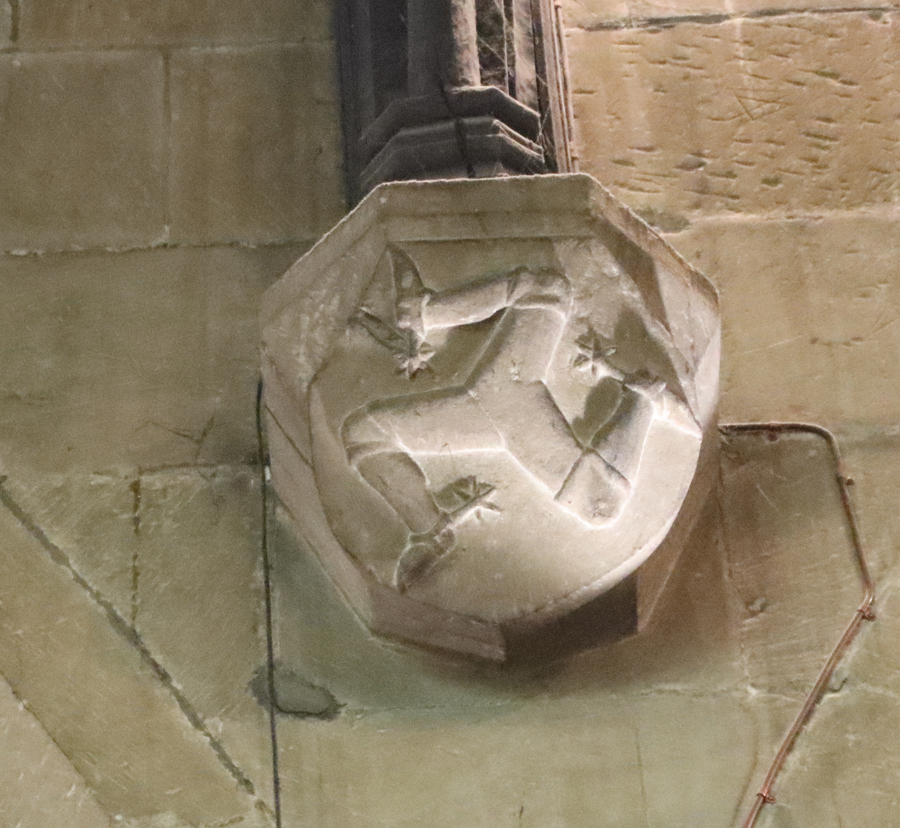
  • The 3-leg symbol of the Isle of Man reflects Sir John Stanley’s new title of Lord of Man, gifted to him in 1405 by Henry VII for his support during the War of the Roses
  • Other Stanley emblems including a stag’s head and eagle’s legs
  • Tudor emblems, including the dragon and greyhound in the spandrels of one of the doorways
  • The Royal arms of England and Wales at the end of the pendant ceiling boss over the spring
  • The coat of arms of Queen Katherine of Aragon (1485-1536), the wife of Henry VII’s son Arthur before Arthur’s death in 1502, featuring three pomegranates topped with a crown. Lady Margaret was her grandmother-in-law, dying in the same year as Katherine’s marriage to Arthur’s brother Henry VIII (reigned 1509-1547) in 1509

In addition, Henry VII chose to include a statue of St Winefride in a niche in the north apse of his own Lady Chapel in Westminster Abbey.  She is shown with her head on her shoulders, but there is also a small head on its side at her feet, sitting on the top of the well.

Lower chapel roof bosses.

Lower chapel roof bosses. Clockwise from top left:  Arms of Katherine of Aragon; Wolf-head shield of Hugh I or Richard d’Avranches (probably the latter); Either St Winefride or the Virgin Mary, very battered but originally two angels placed a crown on her head; the base of the pendant boss shows the royal arms of England and Wales whilst the pendant itself shows scenes from the life of St Winefride (very worn); the legs of the Isle of Man, off centre; greyhound and to its left dragon, both symbols of the Tudors (on opposing doorway spandrels).

xxx
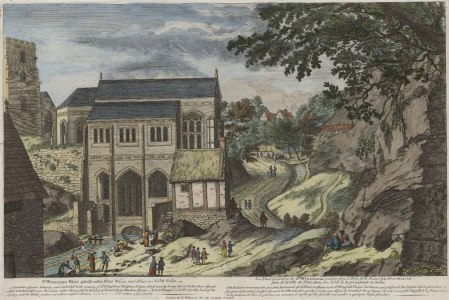
St Winefride's Well. NLW 1129695. National Library of Wales.

St Winefride’s Well c.1790. NLW 1129695. National Library of Wales via Zone47 Zone47.

The construction of the two chapels, above and below, seems to have been overseen by Abbot Thomas Pennant of Basingwerk, who held the abbacy from 1480 – c.1522.  T.W. Pritchard has argued that there is evidence form contemporary Welsh bardic-style poetry to assign the patronage and building to Abbot Thomas, but the weakness in this interpretation is that the bards connected with, and often living at, monastic properties were often effusive, fulsome and sycophantic, and not necessarily truthful.  The poets were making no attempt to capture history, creating a highly partial view of the world as they experienced it in hyperbolic language as an art form. Nor is it at all clear whether Abbot Thomas would have known of the fan vaulting style, or where he would have found an architect to produce it.  On the whole, given that I have seen no argument that the above family-related topics were added at a later date, the data seems to favour the Stanley family as the creators of the chapel, with Abbot Thomas managing the build locally, and perhaps investing in some of its creation.  Without documentary data this remains uncertain.

The concept

Plan and elevation of St Winefrede's Well. Source: Journey to the Past

Plans and elevations of St Winefride’s Well, lower and upper chapels. Source: Journey to the Past (a collaboration between Bangor University, the University of Wales Centre for Advanced Welsh and Celtic Studies (CAWCS) and the Royal Commission on the Ancient and Historic Monuments of Wales)

The late Gothic buildings that we see today came late in the well’s medieval history.  The style, late Perpendicular, comes towards the end of the 15th and beginning of the 16th century, only a couple of decades before Basingwerk Monastery was suppressed in Henry VIII’s Dissolution, shortly after which Edward VI began a policy of suppressing Catholicism.  It is not know what the chapel and well looked like before this time, because there are no images or descriptions, but the new architectural conceptualization design, consisted of two parts, the lower fan-vaulted well chapel, and over the top of this a more conventional church-like structure with a nave, side aisle, chancel and stained glass windows, with more sculptural elements.  These are discussed further below.

Holywell upper chapel and parish church

The parish church on the right and the upper chapel of St Winifride’s Well on the left, showing their proximity

The design was governed by how pilgrims used both the well and the neighbouring church.  Pilgrims would arrive in Holywell at the abbey.  Some of them would take advantage of the abbey’s hospitality.  In the late medieval period the abbot was responsible for new stone-built accommodation for visitors, but there must have been provision previously, perhaps built in wood.  For those who wanted to stay elsewhere, the late medieval town would have offered alternatives.

The upper chapel, looking west

For pilgrims staying at the abbey, a walk to the holy well would have been guided by a monk who would lend monastic authority to the event.  On arrival at the shrine, pilgrims would have been taken up to the chapel to pray and receive guidance before they could proceed to the shrine itself.  The upper chapel was designed to hold large numbers of people in a church-like layout and environment.  It was only a few steps away from the parish church where visitors could also attend services.  The placing of the upper chapel over the top of the well was a clever way both of making the most of the steep hill, and of linking the well with the parish church.  The design of the three bays of the shrine took pilgrims in a procession that entered through one entrance, proceeded around the shrine and lead either out the other side.  There were steps down into the well itself.

Lower Chapel

The well with the ceiling pendant boss overhead, which showed scenes from the life of St Winefrede around it, and the Royal arms of England and Wales at its base

The well with the ceiling pendant boss overhead, which showed scenes from the life of St Winefrede around it, and the Royal arms of England and Wales at its base.

At the level of the spring is a tall, narrow open-fronted well chapel, with a lofty fan-vaulted ceiling on slender compound piers over three bays of which the middle, encompassing the well, is the largest.  The chapel defines a processional area where people could enter at one side, circle the star-shaped basin where the spring emerges, and light candles before and leaving at the other side.  One theory is that the almost star-shaped well represented the Pool of Bethesda.  A staircase led to a gallery where people could look down into the well.  A rectangular pool received the spring waters outside, in a similar way as it does today, but images from the 18th century suggest that the much greater volume also allowed it to run out of the other end of the pool as a strong stream flowing down the hill.

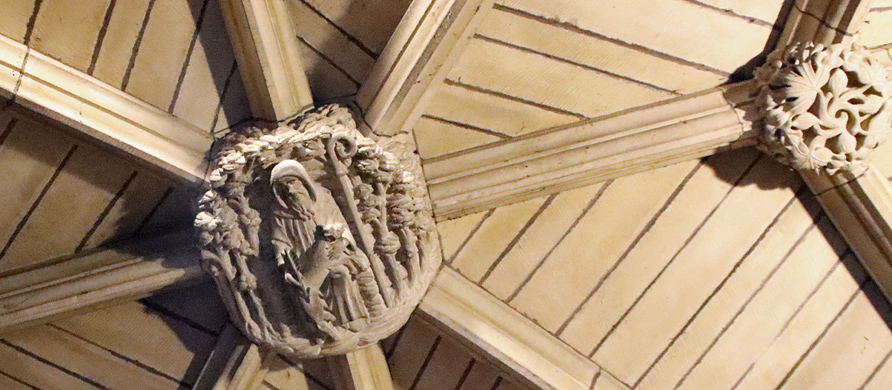
The fan vaulting had sculptural roof bosses wherever there were joints.  The opportunity was taken with nearly all of them, big and small, to create sculptural elements, some of which are shown below.  The main pendant roof boss, suspended over the centre of the spring well, has the royal coat of arms of England and Wales on the base, whilst the sides shown scenes from the life of St Winefride. The columns around the well are now broken, the remaining stumps at two levels shown in the photograph above, but once formed an intricate screen, with filigree-style details in the spandrels.  The string-course of decorated stone along the top of the well was also decorated in the same way.

The entire effect must have been very like a tiny, sublime cathedral in rural northeast Wales.
xx


xxx

The themes on the ceiling bosses and other areas of the lower chapel show some interesting choices.  As well as the heraldry relating to the Stanleys listed above, there are some ceiling bosses relating to Winefride, Beuno and other religious themes, other families, and plant and animal motifs.

Upper Chapel
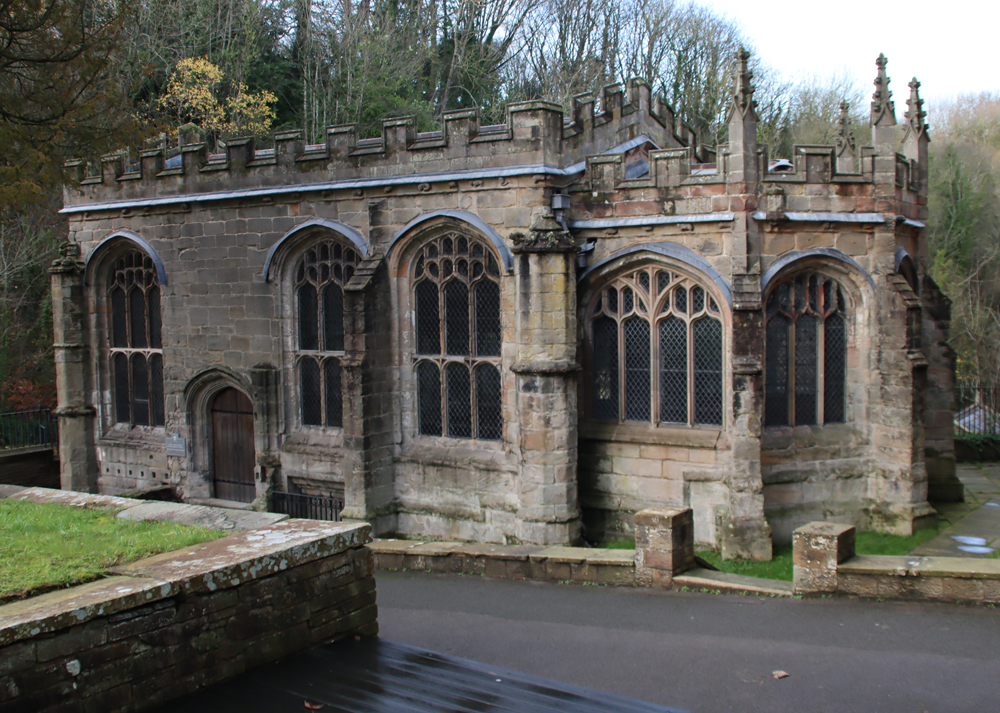
The upper chapel

xxx

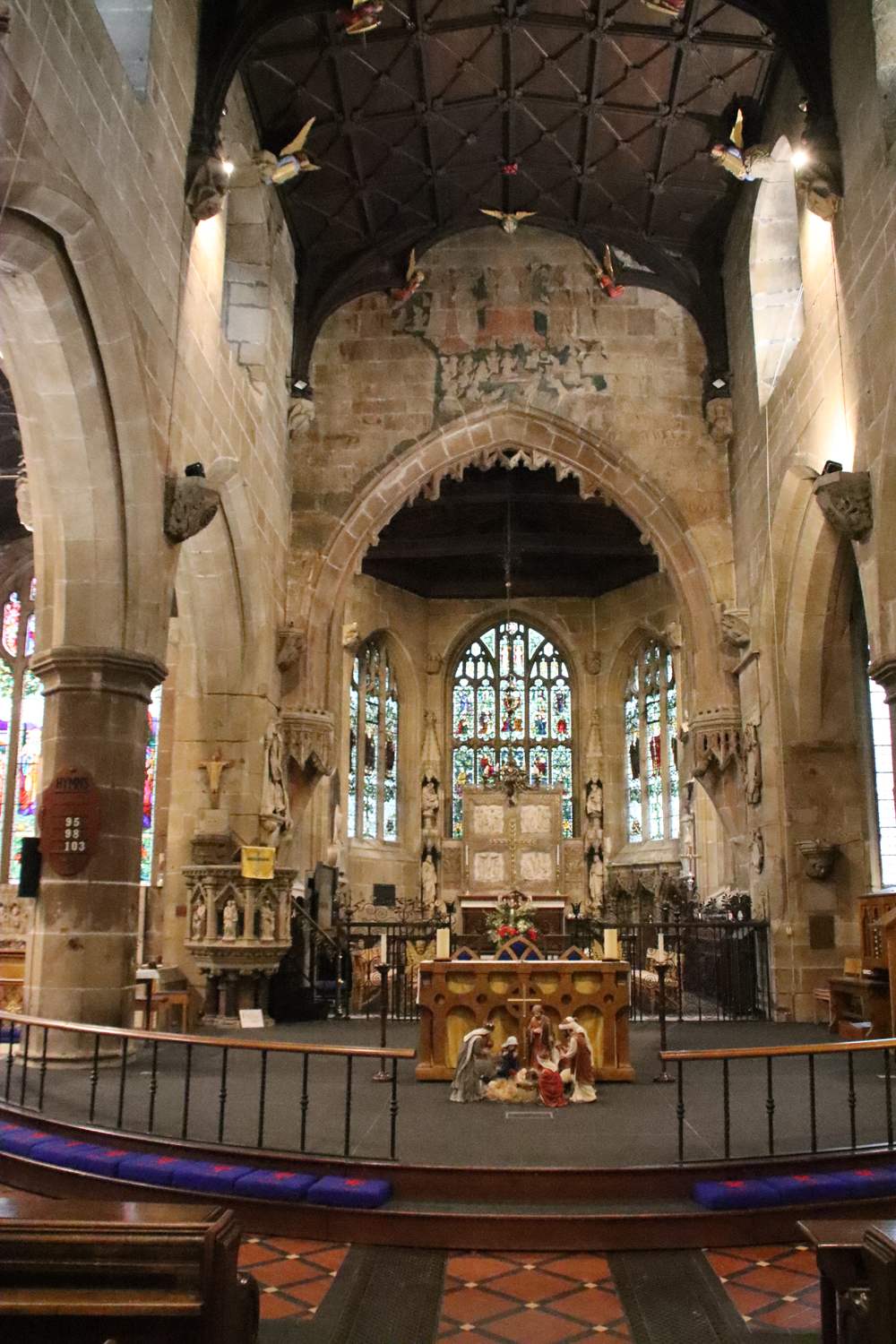
The upper chapel, looking east to the chancel

The upper chapel, looking east to the chancel

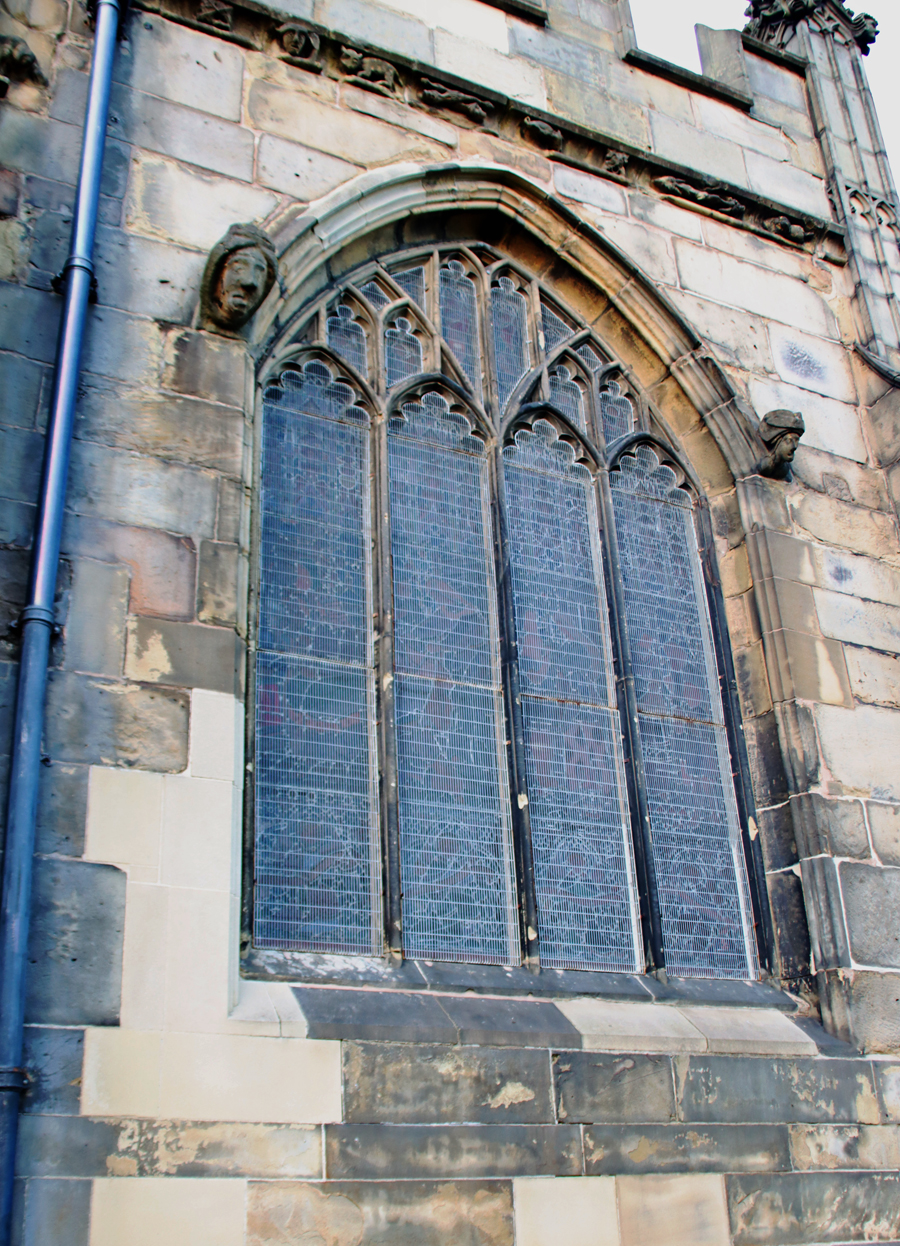
Over the top of the lower well chapel was an enclosed chapel, designed with a conventional nave and chancel, with one truncated side aisle, to which pilgrims could proceed following their experience at the spring to worship and hear services. The design of window openings and arches is Perpendicular with wide, flattened arches and tall mullioned windows that allow plenty of light into the space.  side aisle sits directly over the well, whilst the chancel at the east end extends beyond the space enclosed by the lower chapel.

The north aisle, overlooking the pool

The north aisle, over the top of the well and overlooking the pool. Only one aisle was built.

The camberbeam roof over the nave

The camber-beam roof over the nave

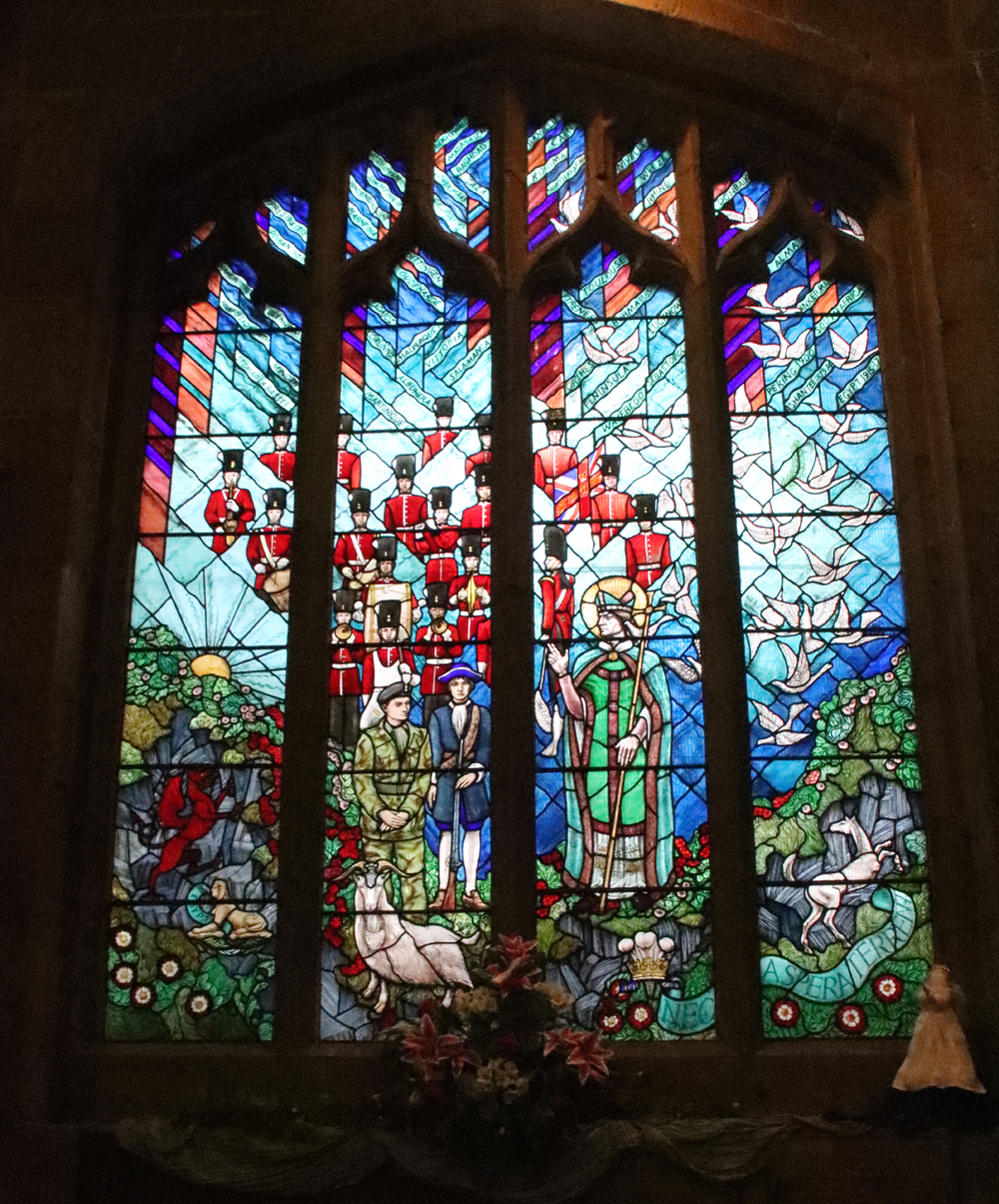
Modern stained glass window in the chancel

Modern stained glass window in the chancel

xxx
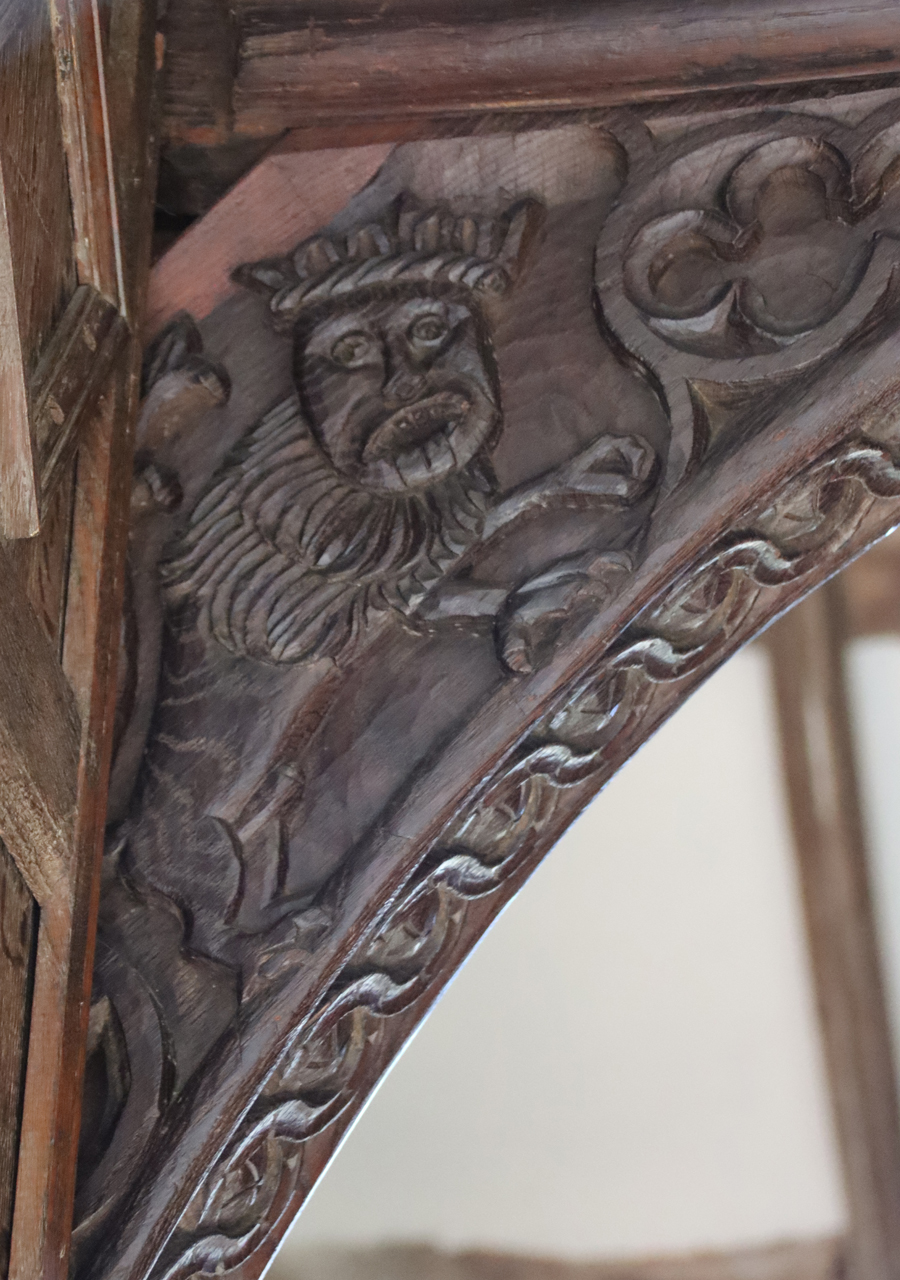
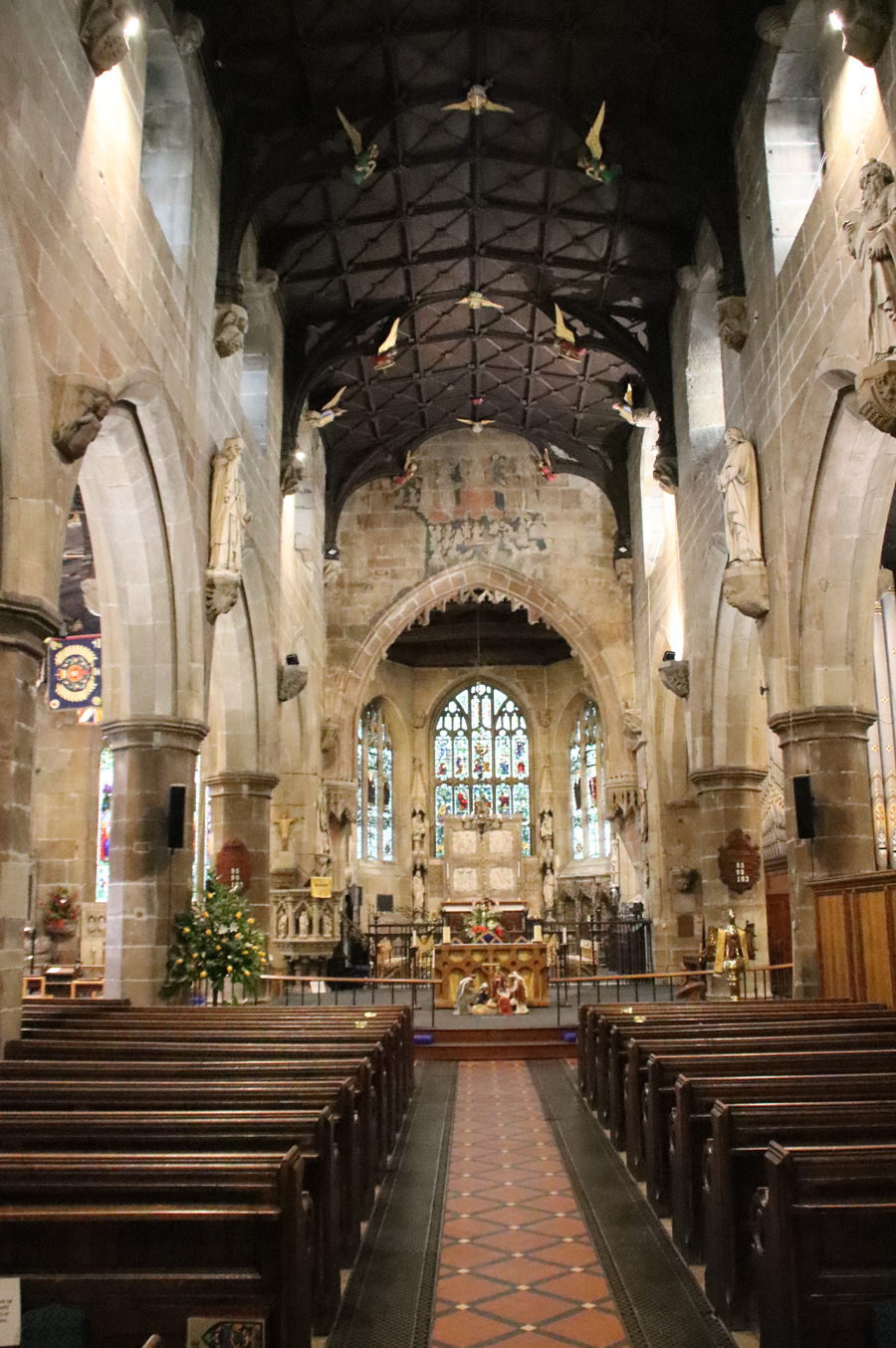
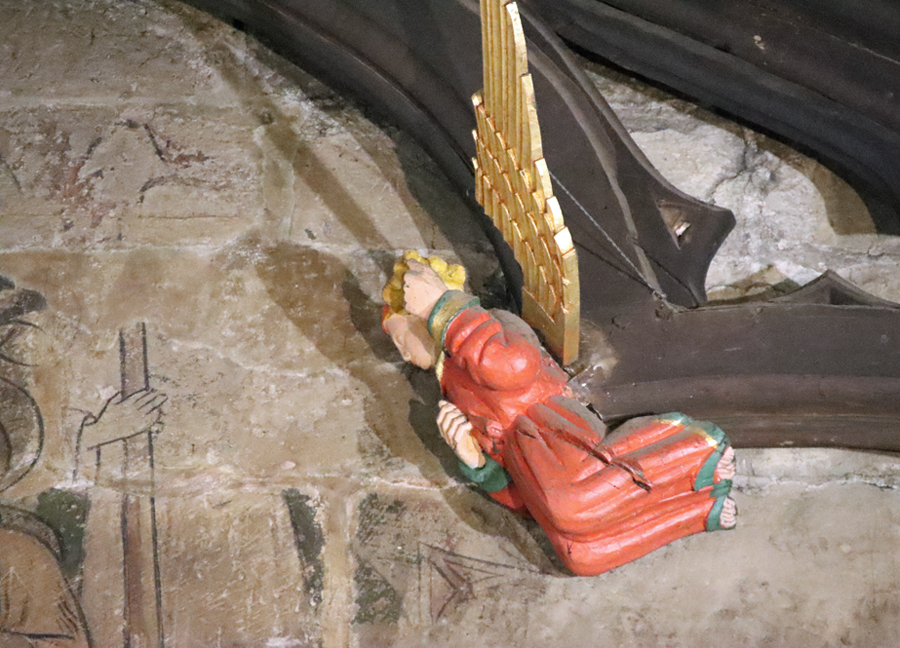
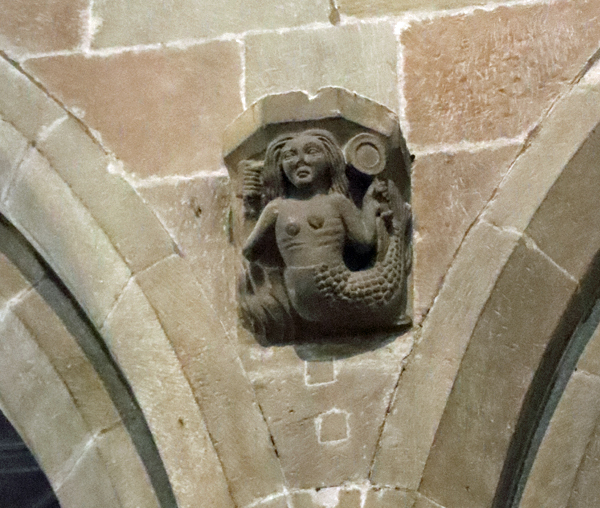
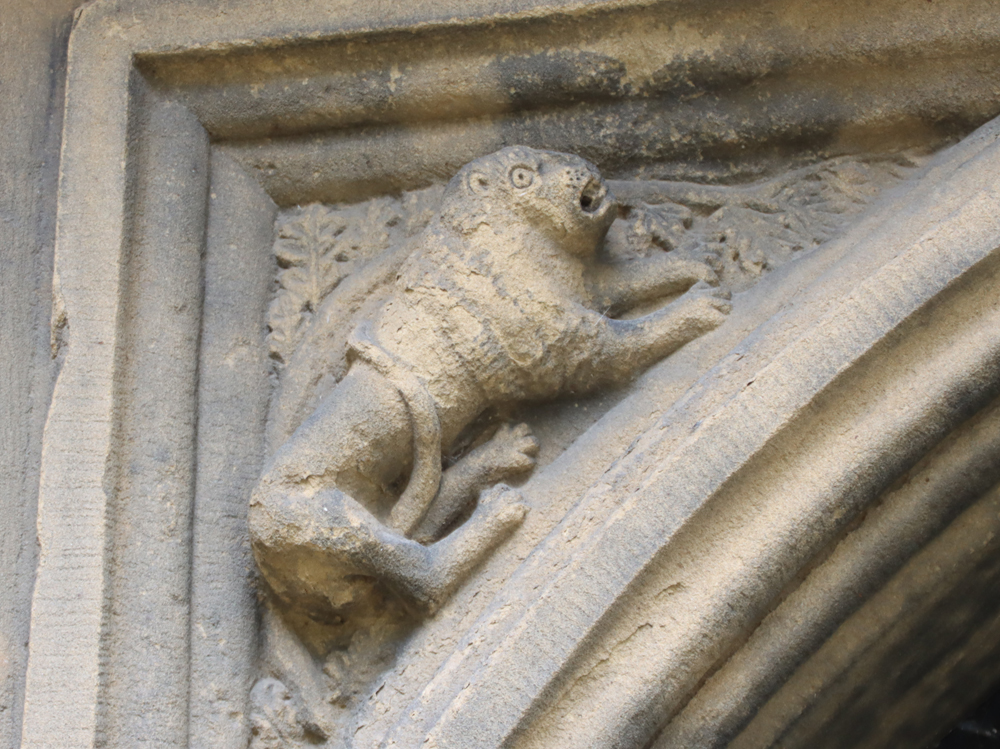
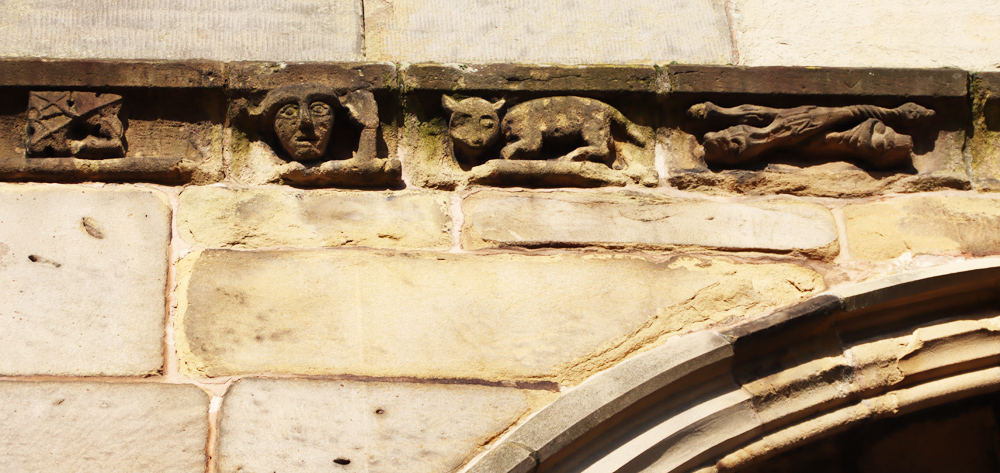
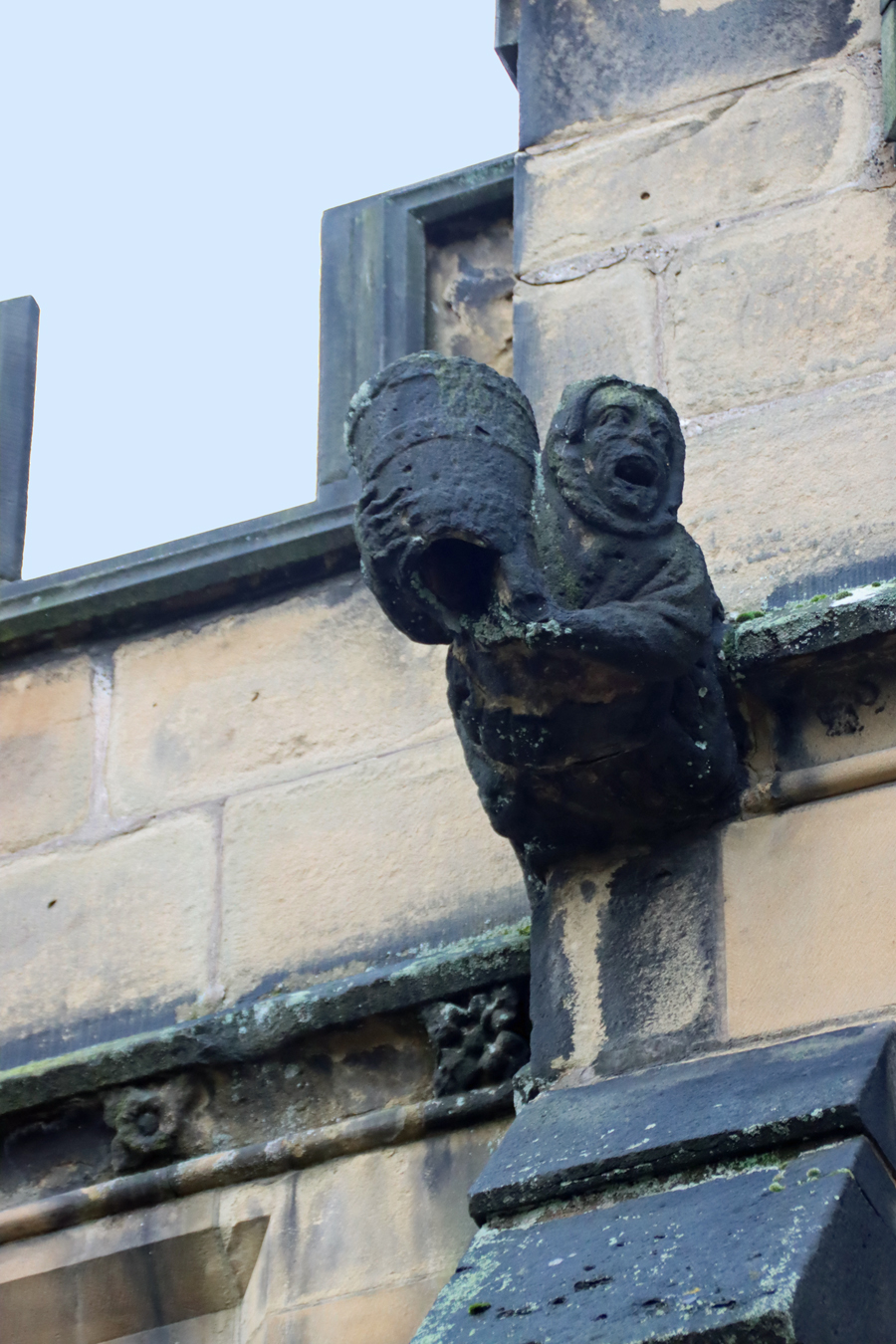
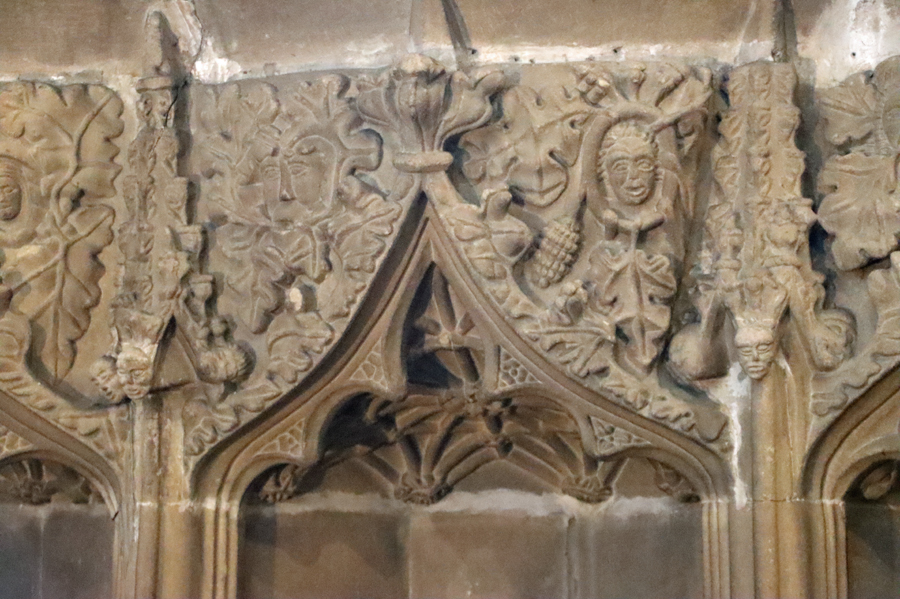
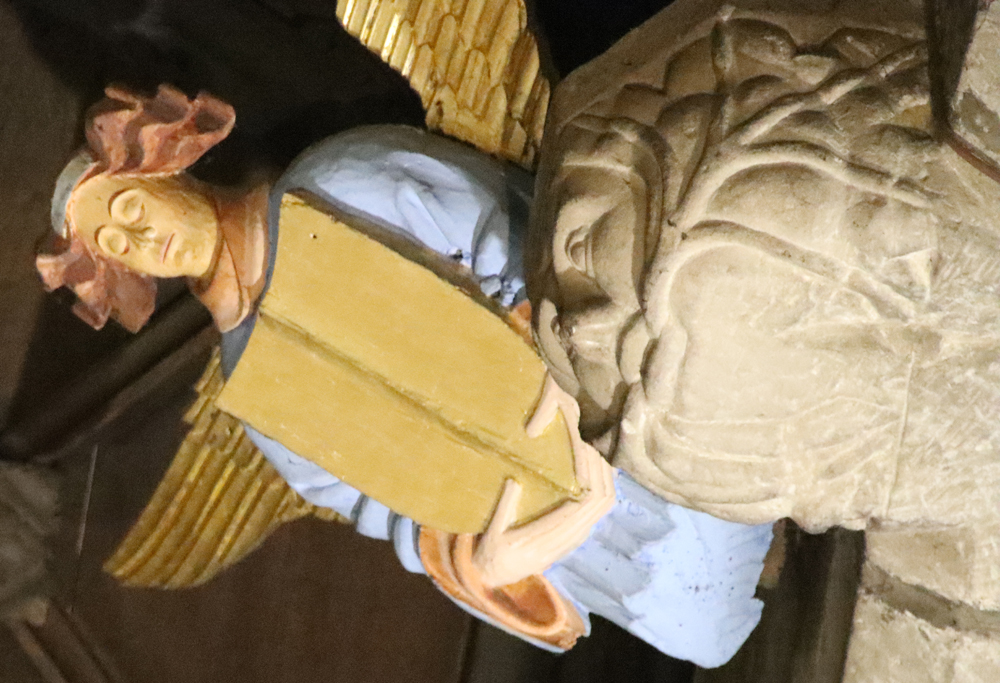
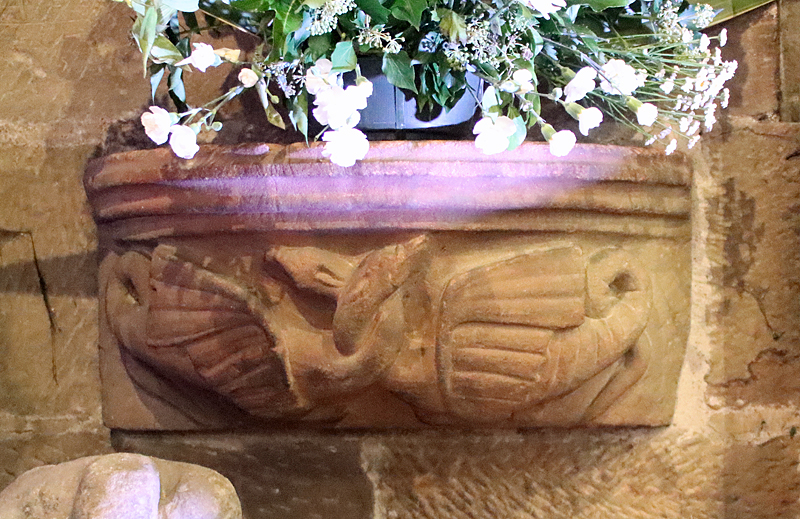
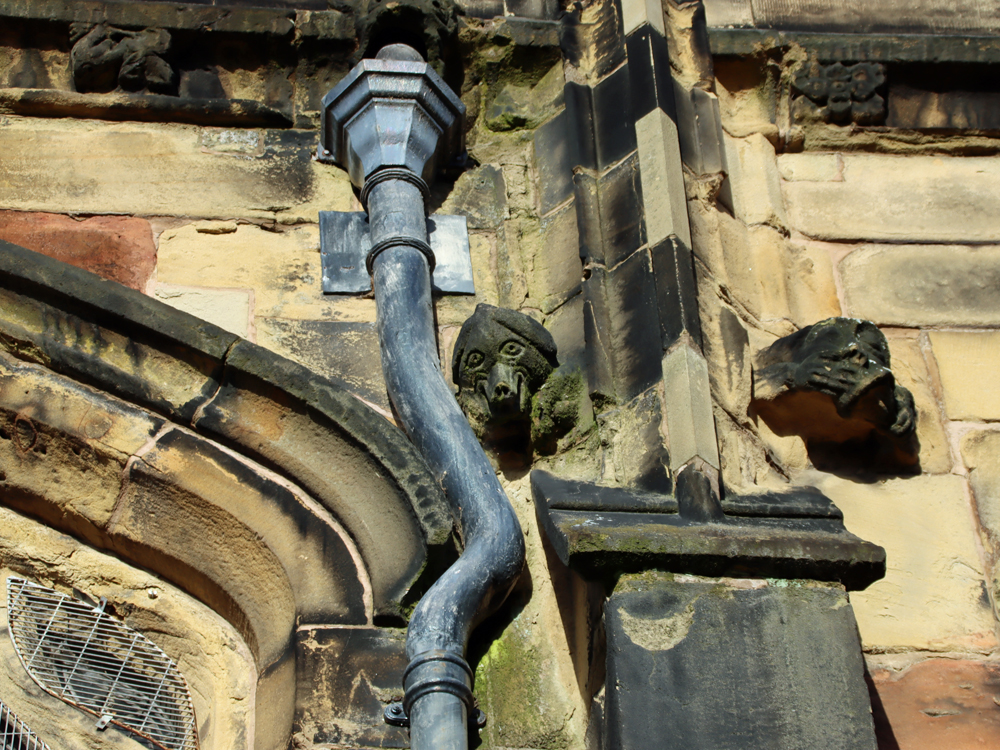
As with the lower chapel, the upper chapel has some rather wonderful sculptural elements, with much less emphasis on family symbolism, and much more on the sort of themes that are found in the margins of illuminated manuscripts, on misericords, and in the roof areas of churches.  They include scenes of everyday life; pagan, mythological and religious motifs; and two humourous grotesques.  The wood carvings, high in the chancel and the nave on stone corbels are difficult to see due to their height and the lack of light.  The stone carvings, which are lower down, are quite easy to make out.

My photos of the wood carvings were frankly diabolical.  I couldn’t actually see what I was photographing in the chancel, so just pointed the camera and hoped for the best.  Even after applying Photoshop, in some cases I am still none the wiser.  Apologies, therefore, that there are so few of them.  A torch would be a handy accessory if you are thinking of visiting.

Sculptural elements from the upper chapel.

Sculptural elements from the upper chapel.

The chapel was considerably altered in the 1700s but has since been restored to something close to its previous appearance.
xxx

The Dissolution of the Monasteries
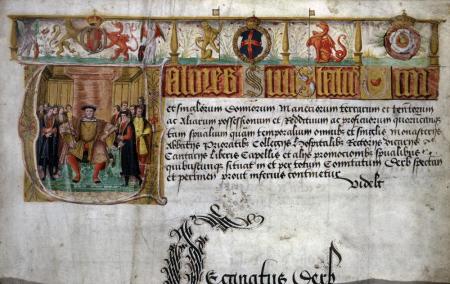
The opening page of the Valor Ecclesiasticus, showing Henry VIII.

The opening page of the Valor Ecclesiasticus, which valued each of the main monasteries, showing Henry VIII. Source: Wikipedia

The suppression of the monastic houses from 1535 was Henry VIII’s multi-pronged strategy to gain a divorce from Katherine of Aragon, denied to him by the Pope (Katherine was fortunate enough to retain her head); to escape the authority of the Pope and the bishops and place himself as the head of the Church; to strip monasteries and priories of their valuables to raise funds for the Crown; and to release estates from formerly powerful monastic landholders, which enabled him to redistribute land, wealth and power, which he could use to generate money and to negotiate for long-term political support.  In order to assess the value of the nation’s monastic holdings, his hench-man Thomas Cromwell ordered the Valor Ecclesiasticus (a an assessment of the income and assets of each monastic house) and assessors were duly sent out to all parts of the kingdom.  All of those worth less than £200.00 were immediately suppressed, which included all the Welsh houses.  The remaining monks and nuns were dispersed, willingly or unwillingly.  They were often granted reasonably generous pensions if they left without a fight.  Abbot Nicholas Pennant, the last abbot of Basingwerk, clearly gave no trouble to the administrators because he left with a pension.  Monastic properties were sold, gifted or broken up and otherwise disposed of by Henry’s administrators.

All that remains of the monastic church at Basingwerk

All that remains of the monastic church at Basingwerk today

The impact on St Winefride’s Well was felt both immediately and incrementally thereafter.  With the loss of the abbey, the shrine no longer had monastic support and oversight.  Whatever funding, maintenance and care the shrine received were withdrawn.  The shrine would now be the responsibility of the church and the village.  Pilgrims were deprived of monastic hospitality.  With no monastic guidance to the shrine when they arrived, a lot of the ceremony and sense of a special occasion were removed, perhaps making a pilgrimage less attractive and rewarding.  Certainly the oblations (pilgrim donations) began to decline significantly.  At the same time, political and religious instability may well have deterred pilgrims.  The loss of the monks as managers of the abbey’s landholdings and industrial properties may not have been felt immediately, but whatever processes were in place may have required a new approach to estate management by those actually working the land and this may have had an impact on the local economy, particularly Holywell itself, undermining the economic stability and prosperity of the village at least for some time afterwards.
XXX

After Henry VIII

The Devil selling Indulgences. Jenksy Kodex, c.1500. Source: Wikipedia

Splendidly evocative depiction of the Devil selling Indulgences, from a Czech illuminated manuscript called the Jenksy Kodex, c.1500. Source: Wikipedia

Quite what Henry VIII planned for the future of the new Church of England is not clear. He probably had very little strategic idea himself, but it is certain that the Archbishop of Canterbury, Thomas Cranmer (1489-1556), an advisor to Henry, had plans, which included maximizing his influence has the clerical head of the Church of England. One of Henry VIII’s particular obsessions was the destruction of all traces of the veneration of St Thomas Becket.  For Henry VIII, Archbishop of Canterbury Thomas Becket (1119/20-1556) had been the ultimate Church challenge to “royal supremacy” in which the king rather than the Church held ultimate authority.  Becket was murdered over the question.  The horror with which Becket’s murder was received forced King Henry II to back down and make the peace with a powerful clergy who were backed by the papacy and who had ultimately won the day.  In Henry’s similar battle with church supremacy, with the Pope refusing to condone the annulment of his marriage to Katherine of Aragon, Becket was the embodiment of Church interference with royal right to rule without challenge.  There are only a few representations of Becket today in churches.

After Henry VIII died, Archbishop Cranmer had great influence over Henry’s young son, Edward VI (reigned 1547-1553) during Edward’s six-year reign.  The result was a Tudor clamp-down on Papism, its rules and its traditions, including indulgences, the veneration of saints, and the worship of icons, a policy that went through phases of persecution and lapses of energy.  Edward was not pulling his punches, as this excerpt from Edward VI’s Royal Injunctions of 1547, demonstrates, commanding

. . . that they shall take away, utterly extinct and destroy all shrines, covering of shrines, all tables, trundles or rolls of wax, pictures, paintings and all other monuments of feigned miracles, pilgrimages, idolatry and superstition, so that there remain no memory of the same in walls, glasses, windows or elsewhere within their churches or houses.  And they shall exhort all their parishioners to do the like within their several houses. [See University of Michigan in Sources]

The instruction to erase all reminders of the recent religion, focusing specifically on objects, is an impressive measure of Edward VI’s understanding of the power of objects and how they mediate people’s ideologies, beliefs and sense of both security and identity.  The enormous destruction of objects and art during the Reformation was a strategy to systematically erase the tangible links between people and their beliefs, suppressing in every sense the way in which people understood, expressed and experienced their sense of the connection between the physical and spiritual world in which they lived and which defined their existence.  The result was often exactly what Edward VI would have wanted.  It is astonishing that St Winefride’s chapels were able to escape.

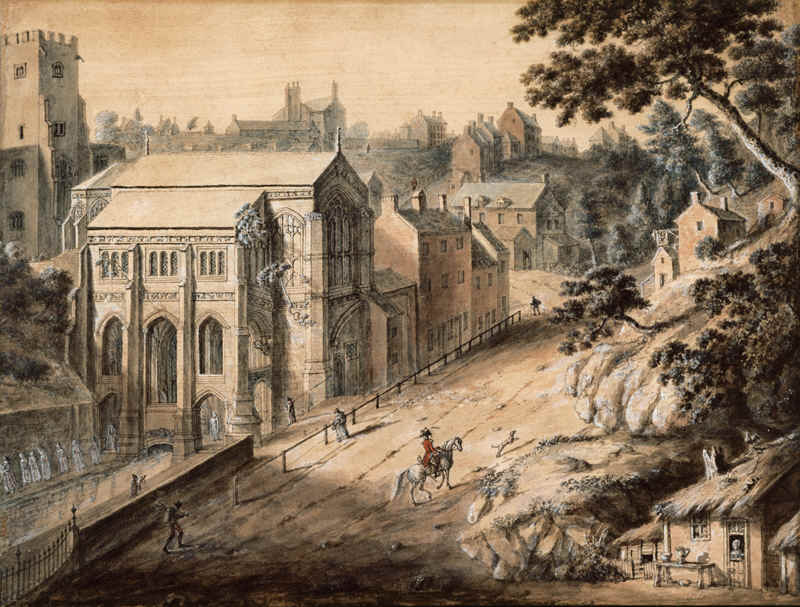
St Winefride's Well with Holywell in the background

St Winefride’s Well with Holywell in the background, 18th century. Watercolour by John Ingleby. Source: People’s Collection Wales

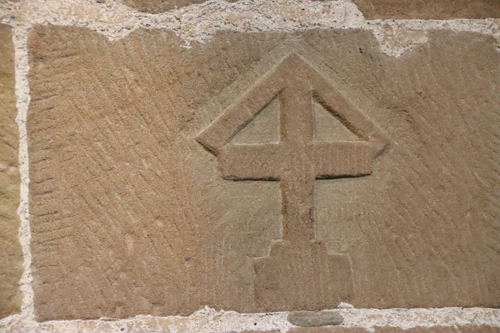
After the Dissolution the well began to become the focus of Catholic (specifically Jesuit) sedition.  In Holywell, Basingwerk Abby had now been stripped of its roof lead, always the beginning of ruin, and although part of it is thought to have been occupied as a house for a while, it was ultimately abandoned.  However, the well and the accompanying church continued to be an illicit focus of Catholic devotion, and St Winefride’s chapel continued to be maintained and visited, often at enormous risk to both residents and visitors, sometimes resulting in imprisonment or execution.  Perhaps directly linked to this illicit expression of devotion, and a way of bonding with the shrine, are many, many carved pieces of graffiti, mostly alphabetic, some dates and a few unexplained pictograms.  That’s all another story, and a really interesting one for another day, but it is really quite remarkable that the shrine survived centuries of religious intolerance to eventually experience a revival of pilgrim and tourist attention in 18th and 19th centuries, at which time the buildings underwent restoration.

Lead repair of stonework along the side of the well


Final Comments

Ceiling boss in the lower chapel

Ceiling boss in the lower chapel

St Winefrede, a 7th century saint, is one of the best known saints in Wales.  The miracle-working shrine with its gushing natural spring became so popular and important throughout the medieval period that in the late 15th or early 16th century it was provided with a brand new pair of chapels, upper and lower, that provided a building of late gothic splendour to frame the well and provide spaces for experiencing the spring and for worshipping in a church-like environment.  It welcomed pilgrims, was an asset to its owners and contributed to the economy of Holywell itself.

The site was awarded the status of a National Shrine in 2023.  It continues to be a significant draw for both pilgrims and tourists, and makes for a very attractive day out when combined with both Basingwerk Abbey and the industrial heritage park, continuing to make its presence felt.
Visiting

With parking nearby, a visit to St Winefride’s Well can take no longer than an hour or so to visit, but it can be combined with the Greenfield Valley Heritage Park to make a full day out, particularly when the small town at the top of the hill is included in the trip.

On the map of Greenfield Valley to the right, the Holywell spring and chapel are at the very top (the car park is just down the hill at the What3Words address ///scanning.smarting.brisk or a lay-by just up the hill at W3W ///fidgeting.grain.nail). Alternative parking is at Basingwerk Abbey at the very bottom of the park, bigger than that for the chapel, at W3W ///assess.origin.flicks). There is also plenty of parking in the town at the top of the hill.

The other sites on the map shown here are described on the post about Greenfield Valley’s industrial heritage.  The church of St James has been closed on the three occasions when I have visited, but it lies behind the chapel, just uphill from it.  There is a cafe next to the abbey, on the bottom right of the map, but check the website listed below, because at the time of writing it is under refurbishment.

The Visitor Centre, ticket office and souvenir shop are on the left as you enter the grounds, and it is from here that you collect the key for the upstairs chapel as well (they ask that you leave your keys as a deposit).  The Visitor Centre is a single large room, with some excellent interpretation boards and some original objects on display (note that there is a sign saying that it is not permitted to take photographs in the Visitor Centre).
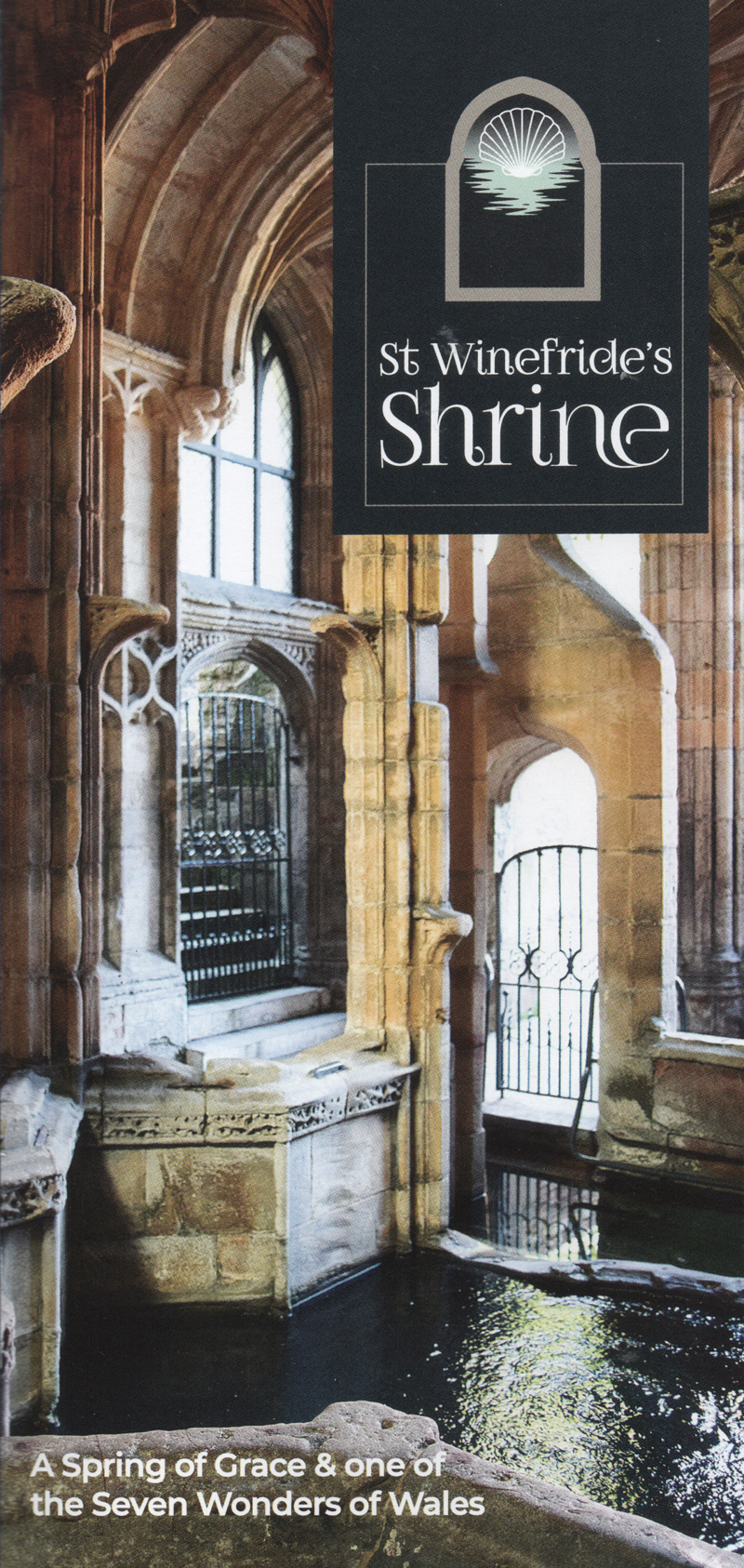
The spring and the fan-vaulted well chapel are on the same level as the Visitor Centre via a door to the left of the ticket office. The overhead chapel, which sits over the top of the well chapel, is a little way uphill, on the footpath along the road.  To reach it you need to go back out of the Visitor Centre and turn left up the road.  Turn left again along the path that leads from the road to the church. The door faces uphill.

There is a free leaflet with a map, which you can collect from the ticket office.  I have scanned it and posted it here for download as a PDF, but note that the leaflet was longer than A4, so I’ve split it up and arranged it in portrait rather than landscape to fit it on two pages.  My version is not a thing of beauty, so it would be much better to pick up the leaflet when you visit!

I strongly recommend that if you don’t have a telephoto lens or very good zoom function on your phone, you take binoculars so that you can get a much better view of the carvings on the ceilings in the lower shrine and on corbel tops in the upper chapel.  A powerful torch would certainly help too, particularly in the upper chapel.

Finally, do note that this is still a place of pilgrimage and prayer, and you may run into people having a quiet moment in front of the statue of Winefride within the lower chapel, or even having a dip in the outer pool.  A lady did so when I was last there on a freezing cold day, and after drying off she went pray in front of the statue just inside the entrance of the lower chapel.  I carried on with what I was doing, but gave her space.
xxx

Sources

Books and Papers
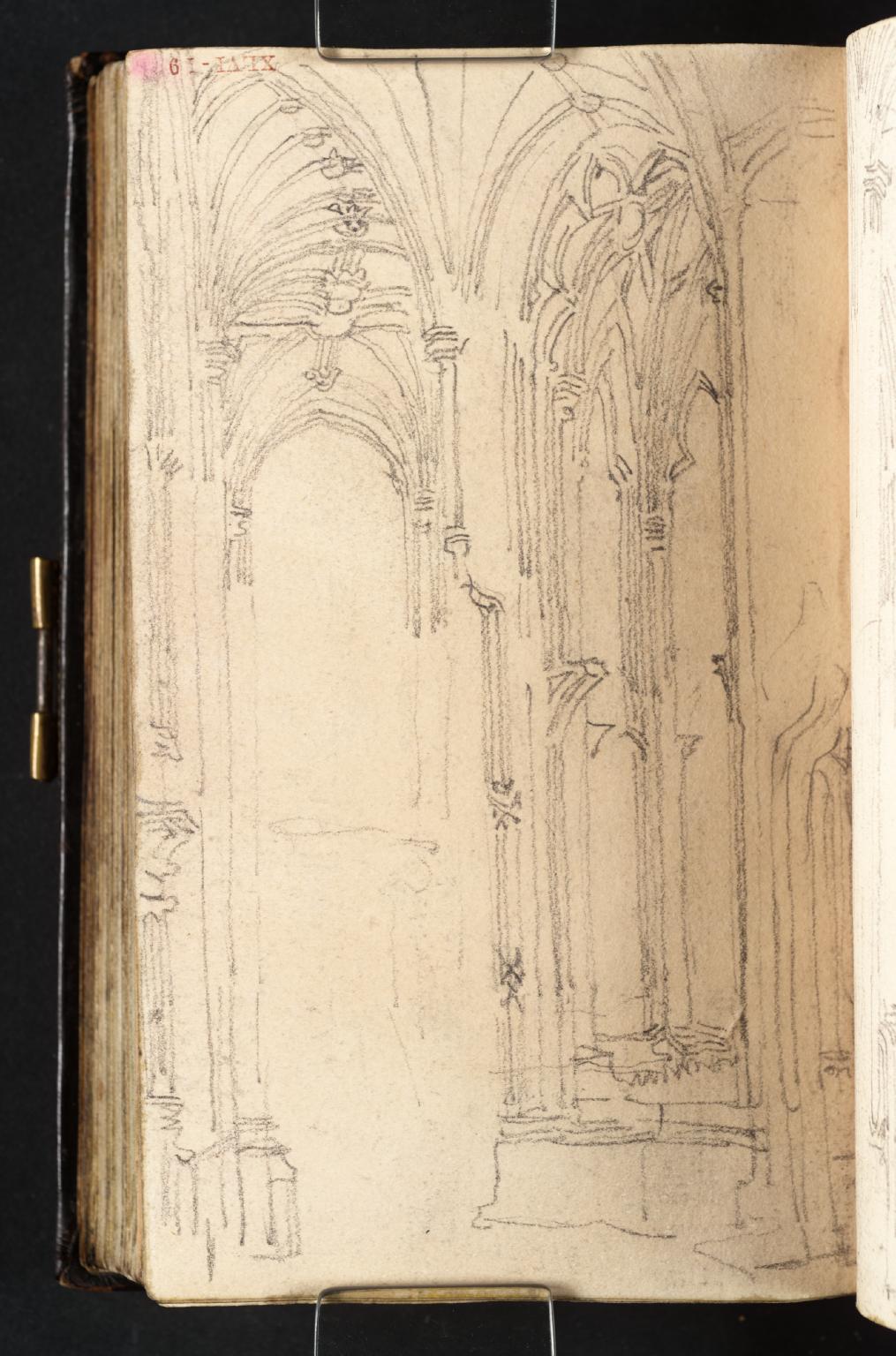
Joseph Mallord William Turner, Holywell: The Interior of the Cloisters, St Winifred's Well 1799


Joseph Mallord William Turner, Holywell: The Interior of the Cloisters, St Winifred’s Well 1799. Source: The Tate

Baker, Nigel 1998. Shrewsbury Abbey. A Medieval Monastery. Shropshire Books.

Barraclough, Geoffrey 1988. The Charters of the Anglo-Normal Earls of Chester c.1071-1237.  The Record Society of Lancashire and Cheshire, vol. CXXVI

Bartlett, Robert 2013. Why Can the Dead Do Such Great Things?  Saints and Worshippers from the Martyrs to the Reformation.  Princeton University Press.

Burne, R.V.H. 1962. The Monks of Chester. The History of St Werburgh’s Abbey. SPCK

David, Christopher 1969, 2002 (2nd edition). St Winefride’s Well.  A History and Guide

Farmer, David 2011 (5th edition). The Oxford Dictionary of Saints. Oxford University Press

Given-Wilson, C. (ed.) 1977.  The Chronicle of Adam Usk 1377-1421. Clarendon Press
https://archive.org/details/chronicleofadamu0000adam/page/n5/mode/2up

Garland, Lisa M. 2005.  Aspects of Welsh Saints’ Cults and Pilgrimage c.1066-1532. Unpublished PhD, King’s College London
https://kclpure.kcl.ac.uk/ws/files/2935809/420753.pdf

Gray, Madeleine 2007.  Welsh Saints in Westminster Abbey.  Transactions of the Honourable Society of Cymmrodorion 2006, New Series, 13 (2007), p.5-30
https://www.cymmrodorion.org/wp-content/uploads/2017/07/2_Welsh-Saints-in-Westminster-Abbey.pdf

Hubbard, Edward 1986. The Buildings of Wales: Clwyd (Denbighshire and Flintshire). Penguin

Pritchard, T.W. 2009. St Winefride, Her Holy Well and the Jesuit Mission, c.650-1930. Bridge Books

Tait, James 1920. The Chartulary or Register of the Abbey of St Werburgh. Chartulary of Chester, part 1. Chetham Society

Turner, Rick 2019. The Architecture, Patronage and Date of St Winefride’s Well, Holywell. Archaeologia Cambrensis 168, p.245-275
https://archaeologydataservice.ac.uk/archiveDS/archiveDownload?t=arch-3493-1/dissemination/168-2019/10-Arch_Camb_168_Turner_245-275.pdf

Webb, Diana 2000. Pilgrimage in Medieval England.  Hambledon and London

Williams, David H. 2001. The Welsh Cistercians. Gracewing


Websites

Based In Churton
Basingwerk Abbey
https://wp.me/pcZwQK-2Ju
Greenfield Valley (industrial heritage)
https://wp.me/pcZwQK-3eL
St Werburgh’s Abbey (multiple posts)
https://basedinchurton.co.uk/category/chester-cathedral/
A roof boss of Thomas Becket in the Abbey of St Werbergh (Chester Cathedral)

https://basedinchurton.co.uk/2023/07/14/a-ceiling-boss-in-chester-cathedral-the-murder-of-thomas-becket/

Early Tourists in Wales
Holywell and St Winifred’s well
https://sublimewales.wordpress.com/attractions/2231-2/

Essex Record Office
Salvation for sale
https://www.essexrecordofficeblog.co.uk/document-of-the-month-august-2017-salvation-for-sale/

Greenfield Valley Heritage Park
https://greenfieldvalley.com/

Greenfield Valley Café
At time of writing closed for refurbishment – check link below
https://greenfieldvalley.com/visit/greenfield-valley-cafe/

Heneb
Holywell
https://heneb.org.uk/archive/cpat/ycom/flints/holywell.pdf

Landmark Trust
St Winifred’s Well (Woolston)
https://cms.landmarktrust.org.uk/globalassets/3.-images-and-documents-to-keep/history-albums/st-winifreds-well-2025.pdf

Shrewsbury Orthodox Church
Saint Winefride (Gwenffrewi) (with a photograph of the St Winefrede chapel and spring at Woolston)
https://shrewsburyorthodox.com/local-saints/saint-winefride-gwenffrewi/

streetsofsalem
Monarchs and Monkeys
https://streetsofsalem.com/2014/03/26/monarchs-and-monkeys/

St Winefride’s Shrine and Visitor Centre
https://www.stwinefridesshrine.org/blank-1

University of Michigan – Digital collections
A collection of articles injunctions, canons, orders, ordinances, and constitutions ecclesiastical: with other publick records of the Church of England; chiefly in the times of K. Edward. VIth. Q. Elizabeth. and K. James. Published to vindicate the Church of England and to promote uniformity and peace in the same. And humbly presented to the Convocation.
https://quod.lib.umich.edu/e/eebo2/A79649.0001.001/1:7?rgn=div1;view=fulltext


Statue outside the shrine

Statue of St Winefride outside the shrine


Modern and Roman Repairs of a Samian Bowl in the Grosvenor Museum, Chester

A recent Bluesky post by Nina Willburger (drnwillburger.bsky.social) about a 1st century AD Samian ware vessel found in Ladenburg, Germany, repaired in antiquity with lead rivets, reminded me of one of my favourite objects in the Grosvenor Museum in Chester.

Repaired Roman vessel from Chester in the Newgate Room in the Grosvenor Museum, Chester

Repaired Roman vessel from Chester in the Newgate Room in the Grosvenor Museum, Chester

It is always a good moment in a museum, especially a small local one, when one looks into a display cabinet and finds something completely unexpected.  In the Grosvenor Museum in Chester, there is a high quality Samian bowl that was reconstructed in modern times with deliberately lighter pieces of matt clay added to make it perfectly clear what is old and what is new.  What is more interesting is that this elegantly decorated bowl was originally repaired in the Roman period with lead rivets, and this really seizes the attention.  It has no label, so there are no details about its date, provenance, history or subject matter, but it appears to show two hunting dogs facing towards each other with a stylized floral motif between them, with other stylized floral and animal forms circling the bowl beneath them.  This is a common type of subject matter for Samian ware.  Samian (terra sigillata) was the prestige table-ware of the Roman world.  It was manufactured between the 1st and 3rd centuries, mainly in Gaul (today parts of France, Belgium and western Germany), and has a distinctive reddish-orange and glossy surface, with a very fine fabric texture.  Although Samian could be undecorated, the most prestigious examples featured raised decoration, sometimes showing animal and floral motifs drawn from nature with more elaborate items representing gladiatorial events and simplified narratives drawn from Classical mythology.

Samian sherds from Silchester

Samian sherds from Silchester, a few of dozens rejected by Victorian excavators and thrown onto their spoil heap

Often all that is left of pottery at Roman sites are broken sherds that had been disposed of when a pot was broken.  It is a fact of archaeological work that during excavations archaeologists are always in the position of finding the component parts of objects, the broken pieces that once made up a whole item.  Today the majority of these are collected and weighed as a source of data about site usage, but in earlier periods of archaeological exploration, smaller and unremarkable sherds were often discarded.  More remarkable sherds have always been privileged for collection and recording, as demonstrated by the pages from the excavation report of the Holt tileworks shown below.  Where it is clear that sherds belonged to a single vessel attempts might be made to reconstruct the entire vessel, enabling the original appearance of an item to be understood by attempting to restore it to something resembling its original condition.  Because of its inherent beauty and complexity, Samian pottery is often the recipient of modern reconstructions. Professor Robert Newstead (1859-1947), curator of the the Grosvenor Museum, was responsible for many of the museum’s reconstructions, using a lighter shade of clay to make it clear that modern repairs had been made.

Samian pottery found at the Chester tileworks at Holt. Source: Grimes 1930

Samian pottery found at the Chester tileworks at Holt. Source: Grimes 1930

Fascinatingly, in several parts of the world high value vessels were often repaired during antiquity, enabling broken items to continue in use, although perhaps for a new purpose.  In recent years archaeologists and conservationists have shown considerable interest in preserving ancient repairs, recognising them as part of the life-history of an object, and an indication of how such objects were perceived and valued in the past.

Prehistoric repair of a Badarian pot. BM EA62175. Source: British Museum CC BY-NC-SA 4.0

Prehistoric repair of a Badarian pot. BM EA62175. Source: British Museum CC BY-NC-SA 4.0

In some parts of the world ancient repairs may date back to prehistoric periods.  In around 4400-4000 BC, for example, repairs of bowls of Egyptian prehistoric Badarian ware, a very finely made ceramic belonging to nomadic sheep herders, were often achieved by drilling broken pieces to provide holes that could then bound together with cord, sinew or strips of leather.  The Badarian pottery was some of the finest quality ware ever produced in Egypt, requiring considerable artistic flair and manufacturing skill, and was therefore certainly worth repairing.

A ceramic vessel may be broken in many ways at any point during its lifecycle from kiln, via transportation to purchase and usage and finally to breakage.  As Angelika Kuettner (Chipstone Foundation) explains:

The Samian bowl in the Grosvenor Museum, clearly showing the lead rivets

The Samian bowl in the Grosvenor Museum, clearly showing the lead rivets

Whether broken by shipment, cataclysmic weather event, a clumsy servant, a rowdy guest, unsupervised children or animals, or impassioned religious or political zealots, the owner of the ill-fated ceramic object then had to decide whether to repair the dish or dispose of it as waste, as something devalued to the point where it was completely worthless.

The reasons for repairing an item may depend on a number of variables, including such practical considerations as income and geography.  Perhaps the owner of the bowl could not afford to purchase a replacement, or there was nowhere nearby to purchase anything similar at the particular time of its breakage.  Perhaps the theme had particular significance and nothing equivalent was available locally.   As well as practical reasons for a repair, there may have been sentimental reasons attached to a vessel, either because it was connected with a special person or event, perhaps because it was a gift or a family heirloom.  It is even possible that the item was discarded by its owner when broken and retrieved by a servant in the household who took the opportunity to repair and own a luxury item.  There is no way of knowing what motives were involved in this or any other ancient repair, each one having its own story.  In this and other cases it is curious that the repair was so conspicuous, with no attempt at disguise, leading to the  appearance of a luxury item being severely compromised.

Lead ingot from a river jetty site at the edge of Chester racecourse dating to 74AD. Source: David Mason’s “Roman Chester. The City of the Eagles,” p.45

Lead ingot from a river jetty site at the edge of Chester racecourse dating to 74AD. Source: David Mason’s “Roman Chester. The City of the Eagles,” p.45

The repaired pieces of Samian in the Grosvenor Museum  were joined together using lead staples or rivets. As with the Badarian example shown above, the Samian repair technique required holes to be drilled into the object concerned before the rivet or staple could be applied.  There is a video at the end that shows how this may have been achieved.   Lead was used as a standard building material in Chester, for pipes and as waterproof lining for cisterns and reservoirs, and was mined from places like Halkyn mountain and Meliden near Flint, both in northeast Wales.  David Mason estimates that 39 tons or 50 wagon-loads for water pipes, and 34 tons or 43 wagon-loads for reservoir linings were used during the building of Chester.  Lead was readily available and would not have been difficult to source for the repair.  Research has demonstrated that decorated platters, dishes and bowls are by the the most frequently repaired pieces of Samian in Britain, at both military and civil centres.  Unsurprisingly, the number of repairs are highest in remote and upland areas

Bronze  cauldron at the Grosvenor Museum

Bronze  cauldron at the Grosvenor Museum

Another example of Roman repair work in the Grosvenor Museum is is a particularly nice  bronze cauldron in the Newstead Gallery, shown right.  According to the accompanying label, it was found in Chester’s Roman barracks by Professor Newstead, squashed almost flat, and was found to be made of a single sheet of bronze.  Fascinatingly, it had been repaired 14 times during the period of its use, indicating how much it was valued.  It was conserved and remounted by York Archaeological Trust in 2009, and looks stunning.  As well as this story of ancient repairs this demonstrates a very imaginative and evocative approach to using the remaining parts discovered in an excavation to provide a very evocative reconstruction of the original form.

Repairs of favoured objects have continued to be made throughout history, still to be found sometimes centuries later in people’s homes.  Stapling was common in the 19th century for the repair of valued ceramic items like the ornamental dish shown below.  Cleverly, the rivets are clearly visible on the underside but do not actually pierce the main surface when turned over.

Repaired 19th century dish

Repaired 19th century dish

A more extreme example is this piece of Kutani, obviously very much-loved by its owner judging from the number of rivets used to repair it.

The repair of a Kutani cup. Photograph by Helen Anderson, with thanks

The left hand image shows the multiple staples used in the repair of a Kutani cup, preserving the vessel so that the main design, right, can still be displayed. Photograph by Helen Anderson, with thanks


Kintsugi repaired vessel. Photograph by Haragayato. Source: Wikimedia Commons BY-SA 4.0

Interestingly, in spite of  easy access to endless retail products at relatively low cost today, we often choose to  repair items that we hold dear or which would cost too much to replace, rather than purchasing new versions.  Ceramics are stapled or glued together, like the 19th century dish above, and the now international fashion for a technique called kintsugi (“golden joinery”) pioneered in Japan has given new life to broken objects by combining gold with an adhesive agent to provide a vessel with an entirely new life-force whilst retaining something of its original essence.  This has become a skilled craft in its own right, and some kintsugi items now have a unique and precious value of their own. Having had a go at this with a lovely but broken dish that I found in my parents’ loft, I can attest to how much skill is required to produce something both beautiful and functional, skills that I apparently don’t have in any abundance 🙂

The Samian bowl in the Grosvenor Museum, showing both ancient repairs and modern repairs to allow reconstruction and provide a good sense of the original object

The Samian bowl in the Grosvenor Museum, showing both ancient repairs and modern repairs to allow reconstruction and provide a good sense of the original object

The repaired Samian bowl in the Grosvenor Museum, reveals both ancient repairs and modern reconstruction work.  Both are part of its life history.  There are just as many stories to be found in repaired items as in perfect ones, perhaps more.  Although we are often accustomed to seeing only the brightest, best and most complete objects in museum collections, sometimes it is those that were broken and then repaired or otherwise curated by their owners that give us a personal sense of a connection with the past.  Archaeology always includes unknowns, and there is never going to be an answer as to why this particular bowl was repaired, but it evokes a sense of the personal in a way that more perfect, undamaged objects in museum collections may not.

Discarded dinner set found in a ditch at Vindolanda

Discarded dinner set found in a ditch at Vindolanda on Hadrian’s  Wall. Source: Vindolanda Charitable Trust

Vessels that had been repaired, whether lashed, stapled and/or glued would probably never be able to carry liquids without at least some leakage, but they could happily carry dried goods, continue to have decorative and sentimental and even prestige value and to be considered by their owners to retain a useful life.

Just as interesting as all the Samian items that have been repaired, is a single remarkable case of disposal from Vindolanda, which engagingly provides evidence of one of the biggest temper-tantrums recorded in British archaeology.  The Vindolanda Charitable Trust website explains:

In our Museum at Vindolanda we have an almost complete dinner set of Samian Ware which was imported from the famous La Graufesenque potteries (near the modern French town of Millau at the southern end of the Gorges du Tarn). Using the potters stamps we have dated this collection to the late AD80s. The pottery had been broken in transit and was thrown, unused, into the ditch of the fort. . . . Imagine how disappointing it would be to finally get your delivery only for it to be broken!

It puts breakages received from Amazon into perspective.
xxx

Professor Newstead and some of his restored Samian items, in the Newstead Gallery of the Grosvenor Museum.

Professor Newstead and some of his restored Samian items, in the Newstead Gallery of the Grosvenor Museum.

At the end of the post see a nice video by Guy de la Bédoyère who, amongst other things, discusses the variable quality of Samian found in Britain and elsewhere; and another one that shows how, in the Roman period, mending holes may have been made in Samian using a manual drill that uses a simple but effective technology deriving from the use of spindle whorls.


Sources:

Books and papers

Albert, Kasi 2012. Ceramic rivet repair: History, technology, and conservation approaches. Studies in Conservation, 57(sup1), S1–S8.

Hsieh, Julia 2016. The Practice of Repairing Vessels in Ancient Egypt. Methods of Repair and Anthropological Implications.  Near Eastern Archaeology, Vol. 79, No. 4 (December 2016), pp. 280-283

Dooijes, Renske and Olivier Nieuwenhuyse 2007.  Ancient Repairs: Techniques and Social Meaning.  In (eds):  M. Benz and U. Kästner (red.), Konservieren oder restaurieren, die Restaurierung griechischer Vasen von der Antike bis heute (3rd suppl. to the CVA Germany), Beck Publishers, 15-20
https://www.academia.edu/13881341/Ancient_repairs_techniques_and_social_meaning

Garachon, Isabelle 2010. Old Repairs of China and Glass. Rijksmuseum Bulletin, 15th March 2010., Vol. 58 No.
https://www.academia.edu/10120934/Old_repairs_of_China_and_glass

Gosden, Chris and Yvonne Marshall 1999. The Cultural Biography of Objects. World Archaeology 31(2), October 1999, p.169-178

Grimes, W.F. 1930.  Holt, Denbighshire:  Twentieth Legion at Castle Lyons Y Cymmrodor.  Society of Cymmrodorion.

Kopytoff, Igor 1986.  The cultural biography of things: commoditization as process.  In (ed.) Arjun Appadurai. The Social Life of Things. Commodities in cultural perspective. Cambridge University Press

Mason, David J.P.  2001, 2007. Roman Chester. The City of the Eagles. Tempus Publishing

Ramakers, Hanneke  2013. Historic Repairs. Conservation Journal Autumn 2013 Issue 61
http://www.vam.ac.uk/content/journals/conservation-journal/spring-2013-issue-61/historic-repairs/

Willis, Steven 2004 Samian Pottery, a Resource for the Study of Roman Britain and Beyond: the results of the English Heritage funded Samian Project. An e-monograph. Internet Archaeology 17.
https://intarch.ac.uk/journal/issue17/willis_toc.html
Chapter 11, 1-7 – Samian Repaired
https://intarch.ac.uk/journal/issue17/1/11.1_2.html

Websites

BlueSky – Dr Nina Willburger
Fascinating glimpse into everyday Roman life
https://bsky.app/profile/drnwillburger.bsky.social/post/3m73bxsbs4k2n

Chipstone Foundation
Simply Riveting: Broken and Mended Ceramics by Angelika R. Kuettner, 2016
https://chipstone.org/images.php/742/Ceramics-in-America-2016/Simply-Riveting:-Broken-and-Mended-Ceramics

Field Museum
Restoring Pottery
https://www.fieldmuseum.org/science/research/area/conserving-our-collections/treatment/restoring-pottery

Alice T. Miner Museum
Conserving the Collection: Ceramic Repair Techniques by Ellen E. Adams, Thursday, August 26, 2021
http://minermuseum.blogspot.com/2021/08/conserving-collection-ceramic-repair.html

Vindolanda Charitable Trust
A Closer Look at Samian Pottery
https://www.vindolanda.com/blog/a-closer-look-at-samian-pottery


Exploring Maiden Castle Iron Age Hillfort, Bickerton Hill (mid-Cheshire Sandstone Ridge)

Introduction

Maiden Castle, Bickerton Hill, Cheshire

Artist’s imaginative interpretation of how Maiden Castle may have looked, based on information from both the site itself as well as from other excavated hillforts. As no excavations have taken place in the interior beyond the entrance area, the roundhouses and accompanying square structures are largely speculative.  Produced by the Habitats and Hillforts Project 2008-2012. Source: Sandstone Ridge Trust

Further to last week’s walk on Bickerton Hill, Maiden Castle sits on the route of the Sandstone Trail, on the northeast edge of Bickerton Hill (once known as Birds Hill), which is one of the Triassic red sandstone outcrops that make up the mid-Cheshire Sandstone Ridge.  It is the southernmost of six hillforts along the ridge (see topographical map below). A visit to the hillfort makes for a great walk with lovely views over the Cheshire Plain.

Traditionally hillforts were associated with the Iron Age, and in general the early and mid Iron Age periods, but modern excavations have revealed that many had their origins in the Late Bronze Age, that not all of them were contemporary, and some were re-used in the post-Roman period.  Some have a long sequence of occupation and abandonment, and many may have performed different functions, both in terms of geographical distinctions and even within localized areas.

Chronology of Sandstone Ridge hillforts. Source: Garner 2012

Chronology of Sandstone Ridge hillforts. Source: Garner 2012, p.9

All hillforts make use of the natural topography in order to provide their enclosures with good defensive potential, including good views over the landscape. Many strategic locations are also shared, either actually or conceptually, by medieval castles.

Some hillforts surround the very top of a hilltop, such as Beeston Castle on the Sandstone Ridge to the north (a location used by Ranulph III, 6th Earl of Chester, for his medieval castle), but others like Maiden Castle are located to take advantage of a natural drop on one or more sides to provide some of the defences.  These are usually referred to as promontory hillforts, and Maiden Castle is a good example. The built defences form a dog-leg curve that meets on either side of a slight projection over the steep drop of the Sandstone Ridge where it plunges down to the Cheshire Plain.  As well as reducing the amount of work required to provide defences for the site,  promontory forts could be just as visible as those that circled hilltops.  In the case of Maiden Castle, the height of the site (c. 698ft/212m AOD) and the views from its banks at the east of the hillfort also provide good views to the east.  Although it is at the highest point of Bickerton Hill, Maiden Castle only occupies a part of the high ground, presumably its size, smaller than most of its neighbours, sufficient for its needs.

Google Map of Bickerton Hill and Maiden Castle

Google Map of Bickerton Hill and Maiden Castle. The purple marker shows the centre of the hillfort. The ditches between banks are visible as the darker arcing lines

Maiden Castle, in common with other hillforts, had no obvious source of water, and could not therefore withstand a prolonged siege, assuming that it had a defensive role.  In addition, any livestock herded on the outcrop would need to be returned to a water source.  Springs were available along other parts of the sandstone trail, many of which are now dry, and some wells mark access to water today, including Droppingstone Well at Raw Head, under 3km away, and the medieval well at Beeston Castle (now dry), but there were no rivers or streams nearby.  The nearest is Bickley Brook, around 2km to the east.  However, it is likely that there was a lot of standing water and ponds as well as a diversity of small and possibly seasonal wetland habitats that supported different types of wildlife, with a strong avian component.   It is interesting that of all the hillforts on the Sandstone Ridge, only Maiden Castle did not neighbour a river or well-sized mere, nor a well-fed stream or small mere.

Topographical map of the Cheshire Sandstone Ridge, showing Maiden Castle at the south end. Source: Garner et al 2012

The question of a water supply draws attention to the fact that the exact role of hillforts in this part of the country is not fully understood.  The often massive ditches and banks, the latter supporting additional structures such as palisades, were quite clearly intended to keep one set of people (and their possessions) in, and presumably another set of people out.  Specialized entrance designs reinforce this idea of controlled and limited access.  At some hillforts slingshot stones, usually interpreted as evidence of warfare, have been found including at the Sandstone Ridge hillforts Woodhouse and Eddibsury, made of rounded sandstone pebbles.  However, whether warfare is the correct model for the role of Cheshire hillforts is by no means clear.  Localized disputes such as cattle and grain raiding might be a more plausible scenario than all-out warfare, with the hillforts perhaps (speculatively) providing places of retreat from farmsteads dotted around the surrounding plains at times of threat.  The scale of investment in these structures certainly suggests that whatever their role, they were seen as necessary for local security, and probably for conveying territorial ownership and status as well.  An experiment to test inter-visibility between hillforts in northeast Wales and Cheshire, called the Hillfort Glow was undertaken in 2011 by the former Habitats and Hillforts. Sadly, the Habitats and Hillforts website is no longer available, but the experiment was reported on the BBC News website.  Ten Iron Age hillfort sites were included (on the Clwydian Range, Halkyn Mountain, the mid-Cheshire Sandstone Ridge, and at Burton Point on the Wirral).  It suggests that if allied groups wanted to communicate a threat to neighbours, they could do so quite easily, with Burton Point on the Wirral, for example, visible as far always as Maiden Castle 25km (15.5 miles) away, as well as nearer sites on the Clwydian Range.

Maiden Castle defences seen from the edge of the ridge

Maiden Castle defences as they look today, at the far south of the hillfort, seen from near the edge of the ridge, with the dark shadow marking the ditch, facing roughly to the east.

If you visit Maiden Castle in person (see Visiting details at the end for how best to locate it), you will find that the enclosure ditch between the two lines of rampart is clearly visible, although considerably less impressive than it would have been in the Iron Age, and you can walk along it very easily.  The photograph here shows it in late autumn afternoon light, with the ditch clearly marked by the line of shadow.

Excavations and surveys

Varley 1940, Maiden Castle plans, p.70-71

Varley 1940, Maiden Castle schematic plans, showing Varley’s illustrations of the defences, the entrance and the construction of the banks, showing the stone facings, figs.11 and 12, p.70-71

The Maiden Castle hillfort was first excavated by William Varley, (a geography lecturer at the University of Liverpool) and J.P. Droop (who was also involved in the Chester Amphitheatre excavations) over two seasons between 1934 and 1935, published promptly by Varley over two years in 1935 and 1936, after which Varley moved on to Eddisbury Hillfort near Frodsham.  In 1940, as the first of a new series of history books, The Handbooks to the History of Cheshire, he co-authored Prehistoric Cheshire with John Jackson, with illustrations, photographs, fold-out maps and a bibliography organized by archaeological period.

Varley’s published excavations at Maiden Castle were carried out to a very high standard.  As with the later book, he included plans and photographs of the entire site with particular emphasis on his excavations, which were focused on the northern end and included the entrance, and both outer and inner ramparts.

Maiden Castle showing how the inner bank was turned inwards to form a corridor entrance. Source: Varley 1936, Pl.XLIII

Maiden Castle, showing how the inner bank was turned inwards to form a corridor entrance. Source: Varley 1936

The excavations were very informative, confirming that there were two ramparts separated by a ditch and suggesting an additional ditch surrounding the entire defences.  A possible palisade trench under the outer of the two Iron Age ramparts is the only indication that he found of a possible pre-Iron Age line of defences.  The inner rampart was built using timber and sand, and was faced with stone on both sides.  The outer rampart was formed of sand and rubble, with the outer side also faced with stone.  The inner rampart enclosed an area of around 0.7ha, with an entrance at the northeast formed by turning both sides of part of the inner rampart inwards, to form a corridor c.17m long and 0.8m wide.  A pair of postholes set within the entrance area may have been gate posts.  The entrance in the outer rampart was a simple gap, lined up with the inner rampart entrance.  Varley believed that so-called guard chambers (by then identified at some other hillforts) once flanked the entrance, marked by archaeological surfaces, one of which produced a piece of Iron Age pottery.  However, no structural remains survived to substantiate this interpretation.  The ditch between the two ramparts is clearly visible today, particularly at the south end, but Varley also identified another ditch on the far side of the outer rampart, which appears to have been confirmed by the LiDAR survey carried out in 2010. Varley’s plans and photographs have contributed to more recent research and remain a useful resource.

William Varley’s photograph of the entrance of Maiden Castle. Source: Varley 1940, Plate VIII

xxx
Although no further excavations were carried out until 1980, a number of topographical surveys were undertaken in an attempt to clarify matters.  The 1980 excavation, published by Joan Taylor (University of Liverpool) in 1981, was undertaken in response to damage unintentionally inflicted on part of the ramparts by walkers, which revealed some of the internal burnt wooden construction material.  This was an opportunity to re-examine the construction methods and to send some of the charred wood for radiocarbon dating, which produced dates in two clusters, which were later calibrated (a form of correction) by Keith Matthews, then with the Chester Archaeology Service.  The results indicated that Varley’s instincts that the inner rampart predated the outer one were correct, producing a set around 860-330 cal.BC for the inner rampart and a set of 380-310 cal.BC on the outer rampart.

LiDAR clearly shows not only the banks and ditches but also the damage inflicted by stone quarrying both within and beyond the hillfort enclosure. Source: Garner 2012, p.50

LiDAR clearly shows not only the banks and ditches but also the damage inflicted by stone quarrying both within and beyond the hillfort enclosure. Source: Garner 2012, p.50

No further excavations have taken place at the site, but a the Habitats and Hillforts project undertook a number of non-invasive surveys of the site, reported in Garner’s 2016 publication.  The results of a LiDAR survey were reported, revealing that considerable damaged from later stone quarrying to the ramparts and the interior, as well as across the rest of the hill. It additionally confirmed that there were trenches from when the army had a training base and firing range at the site in the later 20th century.  Finally, geophysical surveys were carried out by Dr Ian Brooks in 2011, again reported in Garner 2016, which included both resistivity and magnetometry surveys, the latter producing signs of three possible roundhouses, one of which made up a full circle, their diameters measuring 6.9m, 7.8m and 9.2m.  This is a good indication of the potential of the site for producing further information, even with the probable  damage to parts of the archaeological layers from quarrying (marked on the LiDAR image below as irregularly shaped depressions), but not much else can be concluded without excavation.

Possible roundhouses revealed by geophysical survey. Source: Garner 2017, p.58

Possible roundhouses revealed by geophysical survey, shown in red, with irregularly shaped pits produced by later quarrying for stone. Source: Garner 2017, p.58

Summary of the amalgamated data

The structural character of the site

Artist's impression of how the main entrance into Maiden Castle may have looked.

Artist’s impression of how ta simple inturned entrance may have looked, with a palisade on what remains of the ramparts and a walkway over the gateway, with roundhouses just visible in the interior.  Source: Sandstone Ridge – Maiden Castle heritage leaflet

The site is defined by an interior sub-rectangular space enclosed on the east by a pair of ramparts, each with an external ditch, and on the west by an angled section of the precipice that once met up with either end of the ramparts, creating a complete defensible boundary.  There are good indications that when it was first built there was only one rampart.  A stone-faced entrance penetrated the ramparts at the northern end, with a corridor-style inturned section of the inner boundary, with postholes flanking the entrance suggesting that the interior was protected by gates.  Although the interior has been badly damaged by quarrying for stone, geophysical investigations have suggested that roundhouses were present within the enclosure.  The site had immensely clear views to the west, and good views to the east.

This is quite a small site compared to others nearby.  For example, it is around half the size of Helsby hillfort to which it is otherwise similar in appearance.  One suggestion is that it is more akin to an enclosed farmstead than a place for community aggregation and defence.  Having stone-lined ramparts, the site would have been both visible and impressive, perhaps a statement about social identity and affiliation with the land around the hill. Still, the addition of a second rampart argues that defence was an important aspect of the design.

Chronology

Walking along the ditch between the ramparts at Maiden Castle

Walking along the ditch between the ramparts at Maiden Castle

There is only faint evidence of a Late Bronze Age predecessor for the Iron Age hillfort, although this might be expected because Beeston Castle demonstrated clear Late Bronze Age structural features, and Woodhouse, Kelsborrow and Helsby all produced possible evidence of Late Bronze Age construction.  The only evidence is a possible palisade slot under the outer of the two Iron Age ramparts.  However, the level of disturbance created by stone quarrying in the interior may well have eliminated earlier data.  Unfortunately there were no diagnostic artefacts to assist with the question of dating but radiocarbon dates obtained during the excavations during the 1980s suggest that the inner rampart predates the outer rampart, with three radiocarbon dates from the inner rampart spanning 860 to 330 BC whilst those from the outer rampart included one of 380-10 BC.

Economic resources

There are few sites in the immediate area that provide insights into the economic activities in which the local communities were engaged, and what the local land might have supported, both in terms of lowland and upland exploitation of domesticated and wild resources.  The soil surrounding the outcrop was generally poorly drained leading to damp, sometimes seasonally waterlogged conditions.  That on the outcrop itself was shrubby heathland, good for livestock grazing but not for cultivation.

Beeston Castle as it might have appeared in the Iron Age. Source: Sandstone Ridge leaflet

Beeston Castle as it might have appeared in late prehistory. Source: Sandstone Ridge leaflet

There is no data about livelihood management and farming activity available from Maiden Castle, and it is anyway most likely that economic activity took place in the fields below, although it is possible that a site like Maiden Castle would be used to store edible and other resources.

A good idea of what might have been available to the occupants of all the hillforts on the Sandstone Ridge comes from excavations at Beeston Castle, the next hillfort to the north.  Between 1980 and 1985 soil samples were taken during the excavations, focusing on areas most likely to provide information about the use of structures. 60,000 cereal items were recovered.  Emmer and spelt wheat dominated.  Spelt is more tolerant of poor growing conditions, requires less nitrogen to grow, has better resistance to disease and pests, is more competitive against weeds, more tolerant of damp soil conditions, including waterlogging, and can be used to make bread without yeast.  On the other hand, the processing stage is very labour intensive.  Emmer wheat is only reasonably tolerant of damp growing conditions, makes a denser bread that is higher in protein, and is a lot easier to process.  They can be grown separately or as a mixed crop.  Grains of hulled barley were also found at Beeston, but in smaller numbers, possibly due to it being much less tolerant than either emmer or spelt to damp conditions.  Oat was found in the samples, although it is not know whether this was a domesticated or wild crop.  Wild species in the samples that could have been used as a food source were hazelnuts and fruits of the Rubus genus (blackberry, raspberry and/or damsons) and fruits of the Prunus genus (sloe, cheery, and/or plum) and elder berry.

View towards the Clwydian Range across the Cheshire Plain

View towards the Clwydian Range across the Cheshire Plain

There is a dearth of lowland sites known in the area.  Standing on the top of Maiden Castle’s ramparts and looking to the east and west, with views across both the flat stretches of the western part of the Cheshire Plain and the more undulating topography to the east, it is not difficult to imagine Iron Age farmsteads dotting the landscape in a similar way to modern farms today, either enclosed in a ditch and bank arrangement, or simply unenclosed. Even so, a number of such farmstead settlements are known to the west of the Cheshire Ridge as far as (and including) the Wirral, together with some very rare examples of field systems.

The nearest lowland site is Brook House Farm, Bruen Stapleford, around 11km (c.7 miles) away as the crow flies.  Very little animal bone was found, probably due to the acidic soil, but included a pig tooth, a piece of sheep/goat/roe deer-sized animal bone, and a few fragments of cow teeth.  The poorly drained damp plain would not have been suitable for sheep, although entirely suitable for cattle and pigs.  It is worth bearing in mind that the sort of higher ground represented by Bickerton Hill would have been ideal for allowing sheep to roam and feed off upland grasses and shrubs, representing a rare opportunity in Cheshire, should it have been required, for this type of economic diversification, but they would have required access to water when feeding lambs or if used for milk production.  Lowland conditions would also have favoured the herding of livestock, and would have been suitable too for raising pigs and horses.
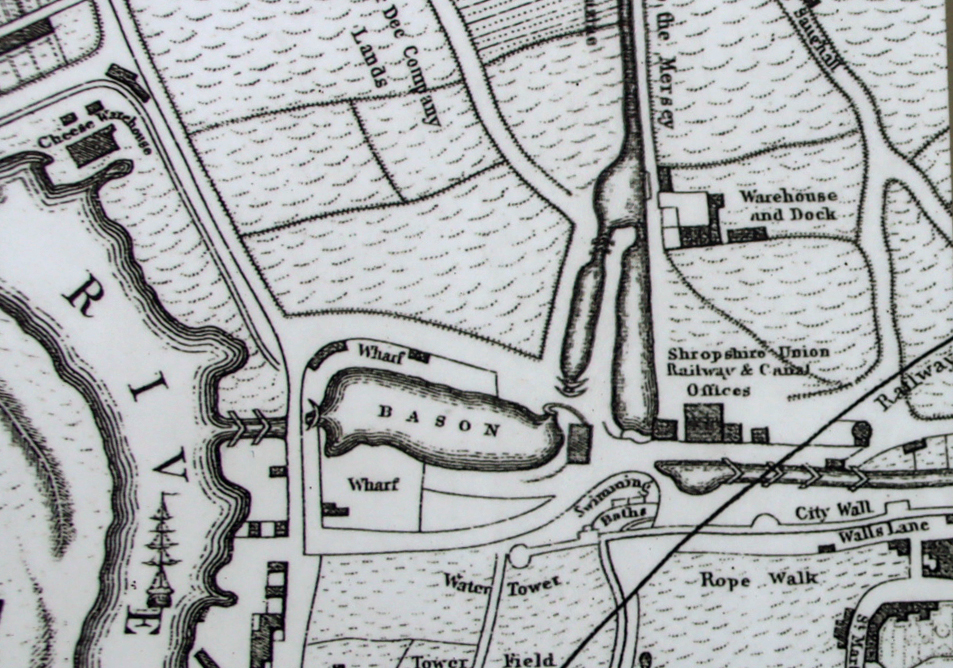
Brook House Farm. Structures 3 and 4. Fairburn et al 2002, p.14, fig. III II.4

Brook House Farm. Structures 3 and 4. Fairburn et al 2002, p.14, fig. III II.4

Just as today, the underlying geology and soils would have placed limits on what could be grown agriculturally on the Cheshire Plain.  At Brook House Farm plant remains included bread-type wheat emmer or spelt, and some hulled barley.  There was a relatively high proportion of grassland species, suggesting that damp slow-draining grassland may have dominated in the area, which would be more suitable for hay production and livestock grazing than crop cultivation.

The combination of crops and livestock using both lowland and upland areas would have been a good way of diversifying economic output, making the most of the environment, and spreading the risk that subsistence strategies would have faced, even when planning on creating a certain amount of surplus for over-wintering and for trade. It has often been suggested that hillforts may have had multiple roles either simultaneously or consecutively over time, and one of those roles may have been storage of surplus grains, preserved meats, salt and items for trade.

Assuming that those sites to the west of Maiden Castle (and the other west-facing Sandstone Ridge hillforts) had clear lines of visibility to the lowland sites on the Cheshire Plain, and vice versa, it would have been just as straight forward to establish visual communication between the lowland sites and the hillfort, as it was between contemporary hillforts.

Final comments

View across to the east from the outer rampart

View across to the east from the outer rampart

At the moment, hillforts and lowland settlements during later prehistory are not well understood in the Cheshire area.  This is partly because relatively few have been comprehensively excavated, but also because lowland sites are particularly difficult to locate.  Where sites are excavated, local conditions are not favourable to the preservation of organic materials, and most of them produce few artefacts.

The relationship between hillforts and lowland settlements is also poorly understood.  As more of these small farmsteads are identified and excavated, the picture should eventually become a lot clearer, but a number of sites have been identified to date not by crop marks but by accidental discovery during construction works such as pipe and cable laying and housing developments.  It could be a long haul.

In the meantime, sites like Maiden Castle, with their earthworks dating back over 2000 years, are a pleasure to visit and to get to grips with.  When there are stunning views into the bargain, there is a lot to love!


Visiting

Google Map of Bickerton Hill and Maiden Castle

Google Map of Bickerton Hill and Maiden Castle approached from the Goldford Lane car park.

This is a very enjoyable and popular place to visit, managed by the National Trust, and provided with two car parks, one on each side of the hill.  Although not well sign-posted, there is plenty of parking provided by the National Trust.  I used the Goldford Lane car park, which is well-sized (copy over from my walk).  The hillfort can be incorporated into a circular walk that includes Brown Knowle.  The views from the top of the ridge are superb.  See full details, including the leaflet that describes the route for the Brown Knowle walk at the end of my previous post about walking on Bickerton Hill, including a What3Words address for the car park.

Information about Maiden Castle at the site. Click to enlarge.

Information panel at the site about Maiden Castle and the heathland in which it sits. Click to enlarge.

Finding the hillfort is a matter of keeping your eyes open for the information plinth where the footpath opens into in a wide clearing with a bench and terrific views, at the highest point of the hill. It can be seen in the Google satellite photograph above as the scuffed area to the bottom left of the picture.  If you take the lower of the two paths from the car park, skirting the bottom of the hillfort, you will see the information board easily, but if you take the upper path along the ridge, it is actually facing away from you downhill and is easy to miss.

Walking the ditch between the ramparts is easy enough, but note that the banks are covered in low shrubs and brambles that make it quite hard going underfoot, as the ground is completely invisible and very densely covered in a tight network of shrubby material.  However, the views to the east are impressive from the outer rampart.  The same can be said for the interior, which is also covered with dense low shrubs and bracken.  The thought of excavating it makes me ache all over!

You can read much more about Maiden Castle and other archaeology, geology and landscape on the Sandstone Ridge in the sources below.


Sources

Books and Papers

Driver, Toby 2013. Architecture Regional Identity and Power in the Iron Age Landscapes of Mid Wales: The Hillforts of North Ceredigion. BAR British Series 583

Ellis, P. (ed.) 1993.  Beeston Castle, Cheshire. Excavations by Laurence Keen and Peter Hough, 1968-1985. English Heritage
https://archaeologydataservice.ac.uk/archiveDS/archiveDownload?t=arch-1416-1/dissemination/pdf/9781848021358.pdf 

Fairburn, N., with D. Bonner, W. J. Carruthers, G.R. Gale, K. J. Matthews, E. Morris and M. Ward 2002. II: Brook House Farm, Bruen Stapleford. Excavation of a First Millennium BC Settlement.  Journal of the Chester Archaeological Society, new series 77, 2002, p.9–57
https://archaeologydataservice.ac.uk/archiveDS/archiveDownload?t=arch-2910-1/dissemination/pdf/JCAS_ns_077/JCAS_ns_077_008-057.pdf

Garner, D. (and contributors) 2012. Hillforts of the Cheshire Sandstone Ridge. Habitats and Hillforts Landscape Partnership Scheme. Cheshire West and Chester Council.
https://www.sandstoneridge.org.uk/lib/file-234636.pdf

Garner D. (and contributors) 2016. Hillforts of the Cheshire Ridge. Investigations undertaken by The Habitats and Hillforts Landscape Partnership Scheme 2009–2012. Archaeopress
Abridged version available online, minus appendices (there is no index in either print or online versions, but you can keyword search the PDF):
https://www.researchgate.net/profile/Peter_Marshall14/publication/313797404_Hillforts_of_the_Cheshire_Ridge_Investigations_undertaken_by_The_Habitats_and_Hillforts_Landscape_Partnership_Scheme_2009-2012/links/58a6860aa6fdcc0e078652a7/Hillforts-of-the-Cheshire-Ridge-Investigations-undertaken-by-The-Habitats-and-Hillforts-Landscape-Partnership-Scheme-2009-2012.pdf?__cf_chl_tk=hzbN0_un1j_np6Me4Z0bWxtROgI9juclGR.5XFzS5iY-1764184426-1.0.1.1-RsTsNKNPcI.Zt7JSR8rdabCJKMfRvmSXkjpGJZHx31c
Some of the unpublished reports commissioned during this project, as well as some of the tables that are too small to read properly in the printed versions are currently available at http://bit.ly/2ghWmze.

Matthews, Keith J. 2002. The Iron Age of Northwest England: A socio-economic model.  Journal of the Chester Archaeological Society 76, p.1-51
https://www.academia.edu/900876/The_Iron_Age_of_North_West_England_A_Socio_Economic_Model

Schoenwetter, James 1982. Environmental Archaeology of the Peckforton Hills. (2-page summary). Cheshire Archaeological Bulletin, No.8., p.

Schoenwetter, James 1983. Environmental Archaeology of the Peckforton Hills.
https://core.tdar.org/document/6256/environmental-archaeology-of-the-peckforton-hills

Smith, M., Russell, M., and Cheetham, P. 2025. Fraught with high tragedy: A contextual and chronological  reconsideration of the Maiden Castle Iron Age ‘War Cemetery’ (England). Oxford Journal of Archaeology, 44: p.270295
N.B. – This refers to Maiden Castle in Dorset.

Internet Archive: https://onlinelibrary.wiley.com/doi/epdf/10.1111/ojoa.12324

Taylor, Joan. 1981. Maiden Castle, Bickerton Hill, Interim Report. Cheshire Archaeological Bulletin 7, p.34-6

Varley, William 1935.  Maiden Castle, Bickerton: Preliminary Excavations, 1934. University of Liverpool Annals of Archaeology and Anthropology, vol.22, p.97-110 and plates XV-XXII
Internet Archive: https://archive.org/details/annals-of-archaeology-and-anthropology_1935_22_1-2/mode/2up

Varley, William 1936.  Further excavations at Maiden Castle, Bickerton 1935. University of Liverpool Annals of Archaeology and Anthropology, vol.23, p.101-112 and plates XLIII-L
https://dn720408.ca.archive.org/0/items/annals-of-archaeology-and-anthropology_1936_23_3-4/annals-of-archaeology-and-anthropology_1936_23_3-4.pdf

Varley, William 1948.  The Hillforts of the Welsh Marches.  The Archaeological Journal, vol. 105, p.41 – 66
https://archaeologydataservice.ac.uk/archiveDS/archiveDownload?t=arch-1132-1/dissemination/pdf/105/105_041_066.pdf

Varley, William and John Jackson 1940. Prehistoric Cheshire. Cheshire Rural Community Council

Websites

BBC News
North Wales hillfort test of Iron Age communication
https://www.bbc.co.uk/news/uk-wales-north-east-wales-11832323

Heritage Gateway
Maiden Castle, Bickerton, Hob Uid: 68844
https://www.heritagegateway.org.uk/Gateway/Results_Single.aspx?uid=68844&resourceID=19191

Historic England
Maiden Castle promontory fort on Bickerton Hill 700m west of Hill Farm
https://historicengland.org.uk/listing/the-list/list-entry/1013293?section=official-list-entry
Hillforts. Introductions to Heritage Assets
https://historicengland.org.uk/images-books/publications/iha-hillforts/heag206-hillforts/

Natural England
https://nationalcharacterareas.co.uk/

National Character Area 61 – Shropshire, Cheshire and Staffordshire Plain
Key Facts and Data

https://nationalcharacterareas.co.uk/shropshire-cheshire-and-staffordshire-plain/key-facts-data/
Analysis: Landscape Attributes and Opportunities
https://nationalcharacterareas.co.uk/shropshire-cheshire-and-staffordshire-plain/analysis-landscape-attributes-opportunities/
NE556: NCA Profile: 61 Shropshire, Cheshire and Staffordshire Plain, PDF
https://publications.naturalengland.org.uk/publication/6076647514046464?category=587130

National Character Area 62 – Cheshire Sandstone Ridge
Description

https://nationalcharacterareas.co.uk/cheshire-sandstone-ridge/description/
Key Facts and Data
https://nationalcharacterareas.co.uk/cheshire-sandstone-ridge/key-facts-data/
Analysis: Landscape Attributes and Opportunities
https://nationalcharacterareas.co.uk/cheshire-sandstone-ridge/analysis-landscape-attributes-opportunities/
NE551: NCA Profile: 62 Cheshire Sandstone Ridge, PDF
https://publications.naturalengland.org.uk/file/5228198174392320

Sandstone Ridge Trust
Maiden Castle: An Iron Age cliff edge fort (2-page PDF leaflet)
https://www.sandstoneridge.org.uk/lib/file-323322.pdf
Circular walks that include hillforts of the Cheshire Sandstone Ridge
https://www.sandstoneridge.org.uk/discovering/walks-february.html


Norman heritage on the doorstep: St Edith’s Church, Shocklach, near Farndon

Introduction

The tiny Grade-1 listed 12th century Church of St Edith (Historic England 1228322) is located just over four miles (c.6km) south of Farndon, retaining its lovely Norman arch.  Together with its mellow red sandstone walls, the twin bellcote, and its small churchyard it has considerable charm and personality.  It has been very well maintained, and a number of changes over the centuries were made, some later removed and some still in situ.
Although there are no signs that there was a village nearby, St Edith’s was built in the same period as the nearby twin motte-and-bailey castle at Castletown (see my earlier post here), and the two would have been part of the same set of community resources.  Given the state of the castle now, reduced to simple earthworks, the survival of the church seems all the more impressive.  It also probably served farms and hamlets in the general area, becoming the main place for regular get-togethers throughout the medieval period, particularly after the castle went out of use.

The biography of patron saint Edith is at best vague, but what is perhaps most interesting about her patronage is that she was an Anglo-Saxon saint, pre-dating the Norman Conquest (and the Norman arch), perhaps suggesting that the name was inherited from an earlier foundation on the same site.  Edith (or Eadgyth, Eadida or Edyva) is thought to have been an illegitimate daughter of King Edgar who became a nun at Wilton Benedictine Abbey in Wiltshire.  The Oxford Dictionary of Saints states that she was “conspicuous for her personal service of the poor and her familiarity with wild animals.”  She died at the age of 23, and miracles at her tomb resulted in a cult following.  Quite why she became a patron saint of a tiny rural church in west Cheshire remains unknown.

Building exterior

St Edith's Shocklach

St Edith’s, Shocklach

The Grade-II Norman arch is lovely, featuring chevron and cable designs, and was entirely in proportion to the Norman building.  Each end of the arch terminates in a little sculptural element, each depicting a human head, both are very worn.  Pevsner and Hubbard describe the arch as “very crudely decorated,” but the dismissive statement fails to acknowledge the considerable charm and authenticity of the ambitious archway on such a tiny church, as well as its determined fidelity to a particular stylistic paradigm. The main source of information about the church, Margery Waddams, who conducted research at the Chester Records Office, suggests that some of the upper chevron carvings may have been replaced.

Detail of the Norman arch

Detail of the Norman arch, right

Detail of the Norman arch, left

Detail of the Norman arch, left

The north wall is thought to date to the 13th century, although I have seen nothing to explain why the original wall might have been replaced.  There is a single sculptural grotesque above the former entrance, now a window.  Waddams suggests that there may have been a second Norman arch in the past in the south wall, due to the presence of “a small piece of chevron carving high in the south exterior wall which does not fit the present doorway.”  The chancel was added in the early 14th century.  An earlier arch is shown in the photograph above, although the date is uncertain.

North wall of the nave, with old entrance and grotesque

North wall of the nave, with old entrance and grotesque, thought to be 13th century

St Edith’s, Shocklach

Interior

Horse and rider carving

The interior consists of the original nave with a newer chancel on a slightly raised platform.  Some of the structure undoubtedly belongs to the 12th century, and there is a single carving that may date even earlier.  Located on one of the stone blocks of the north wall, close to where it meets the west wall, is an intriguing depiction of what appears to be a horse with a rider holding a shield. Although Waddams suggests that it was probably carved no earlier than the 17th century, the similarity to another carving at St Dochwy’s at Llandough, reported by George Bell in an issue of Country Life, may suggest an earlier date.  The article led the church to contact the author, who confirmed that such carvings are very rare in Wales and and that he has seen no others similar to those at St Dochwys or St Edith’s.  He points out that it could easily be an import from another site, and that it might (very tentatively) be as early as the 10th or 11th century in date.  The matter remains unresolved.

In the interior, according to the Historic England listing, the north wall of the nave may be 13th century, the chancel arch, the east window and the north doorway are, according to Pevsner and Hubbard, all features of the 14th century, although Historic England places the chancel in the 15th century.  Waddams points out that the top of the east window is missing, indicating that it has been cut to fit, suggesting either that it was taken down and refitted, or that it was brought from another church.  The 15th century stone font is still in situ, but was re-cut at a later date, probably in the 17th century.

Pevsner and Hubbard comment that “the odd west baptistery squeezed between the two buttresses looks a rustic c17 job” (Pevsner and Hubbard), a date also confirmed by Historic England.  Also from the 17th century and the pulpit has part of the base of an octagonal pillar, marked with the date 1678 in brass-topped nails. Some of the pews in the nave date to around 1697.

The font

Very endearingly, a pane of the east window is scratched: “I, Robert Aldersey, was here on 1st day of October 1756 along with John Massie and Mr Derbyshire. The roads were so bad that we were in danger of our lives”.

The arced plaster ceiling over the nave is 18th or early 19th century, very attractively decorated with little rosettes.   It slightly truncates the top of the original arch where it enters the chancel.  The communion rail dates to the same period, as does the “table of commandments” in the chancel (with the abbreviation of Jevhoval, IHVH, mis-spelled as VHVH) and a “Credence table” that was installed on the site of a recess that had been walled up in the past.

A major restoration took place in 1878, including the addition of a wooden floor above the original beaten earth floor, which required the shortening of the wooden door under the Norman arch.  Old high pews were replaced, and a gallery was removed.  In 1887 the celebration of Queen Victoria’s Jubilee sounds like a real celebration (the Vicar Edward E. Hodgson quoted in Waddams): “Children and people marched to the Church with flags and banners of the Cross singing. Service was held at 2pm fully Choral.  The Altar was decorated with 8 candles and 8 vases of flowers and floral cross, the windows with ferns etc.  The Children returned to tea at 3pm.  Adults had teat at 5.  Then sports, dancing with Brass Band, closed a thoroughly enjoyable day.”

Flanking the west end entrance to the babtistry, above the font, are the Royal Arms of George III, dated 1760, and the hatchment (funerary board) of one of the Pulestons, a local family, with their motto “Clarior es Tenebris” (More light out of darkness)

In 1903 two oak seats were presented to the church and placed in the chancel for the choir, whilst another six more oak seats were added to the nave.

Another major restoration took place in 1974, during which the small semi-circular window with its geometric stained glass was added at the west end below the bellcote.  To commemorate the year 2000 a new stained glass window was added to the north wall, directly opposite the Norman archway, based on the designs of children from the local Shocklach Primary School.  At the same time a new lighting system and an audio loop were also installed.

The church continues to remain in use, and organizes events throughout the year, based on the religious calendar, including the rushbearing ceremony.  In Pennine Magazine, Vera Adams describes the ceremony in the northwest:

Rushes have been used as a floorcovering for many centuries, and on  certain feast days fresh rushes were  strewn on the earth floors of churches.

A special festival, surrounding this  ancient custom, grew up in the north  west of England during the 17th century. In Lancashire, Cheshire and the  Calderdale area of West Yorkshire,  special rushcarts, pulled by a team of  stalwart men, were used to distribute  the rushes to the churches.  The building of rushcarts developed  into an elaborate ceremonial during  the 18th and 19th centuries, and great  rivalry grew up between the supporters  and the builders of different carts. This  was, at times, very intense and open  brawls occasionally broke out, due,  no doubt, to the amount of strong  drink which was consumed. This led  to some of the more puritanical clergy  refusing to allow the rushbearers into  their churches.

The two-wheeled rushcarts carried  bolts or bundles of rushes built, very  skilfully, into a tall pyramid, almost  like thatching, on top of the carts.  They were then decorated with flowers,  rosettes, scarves, ribbons, tinsel and  silverware. These trinkets were all  loaned by local people.

See Sources for the entire article.

Window below bells made during the 1974 restoration

Churchyard

The churchyard has always fully surrounded the church, but was extended twice, in 1905 (consecrated in the same year) and 1922 (consecrated in 1993).

The Grade II listed red sandstone cross shaft and steps is missing its top, with the cross-shaft, presumably the victim of the two periods of 16th or 17th century iconoclasm.  It stands on its original plinth of four steps.  The lower three are made up of several blocks (the lowest of which is 7ft x 7ft square (2.13m), and the top one 3ft by 3ft (0.91m).  A section removed from the top step was probably a kneeling platform.  The shaft of the cross is octagonal.  In the late 1890s it was found to be in a poor state of preservation as a memorial to the wife of the Reverend George Mathias, Esther Sophia.  It was restored with a base piece 14×14 inches (0.35m) square and 11 inches (0.27m) deep.  However, the idea was to restore it without succumbing to the temptation to make any attempt to otherwise improve upon it: “All this has been carefully done, no old stones having been misplaced, refaced, or in anywise injured.”

Oddly, there are only a handful of pre-20th century gravestones. I found none earlier than the 19th century, which include both table and chest types, the earliest dating to 1816.  Most churches founded in the medieval period that have continued in use in this area will usually have some 18th century gravestones as well.  Most of the the churchyard sloping away from the west end of the church is taken up with 20th century graves, dominated by the polished black style that remains popular in churchyards and cemeteries.

Visting

The church is not currently open to the general-interest public, although it is still a fully functioning church on a Sunday, but the exterior of the church with its Norman arch, charming bellcote and its peaceful churchyard makes for an enjoyable detour if you are in the area.  It is at What3Words address ///initiates.recent.diamonds, or at the very end of Church Road, just off the B5069 to the right, a few minutes before you arrive at Shocklach village if you are heading north to south.

Sources

The main source of information for this post was Margery Waddams, who went through the church records and undertook research at the Chester Records Office.

The letter from Graham Bell concerning the north wall carving is shown in a frame in the interior of the church.

Books, papers and articles

Adams, Vera 1984.  Rushbearing Revived. Pennine Magazine. Vol 5, No. 6, Aug/Sept1984
https://penninemagazine.wordpress.com/vol-5-no-6-aug-sept1984-rushbearing-revived/

Farmer, David 2011 (5th edition). Oxford Dictionary of Saints. Oxford University Press

Haswell, George W. 1899. Shocklach churchyard cross. Journal of Chester Archaeological Society, Volume VI, part 2
https://archaeologydataservice.ac.uk/archiveDS/archiveDownload?t=arch-2910-1/dissemination/pdf/JCAS_ns_006_02/JCAS_ns_006_02_163-166.pdf

Pevsner, Nikolaus and Edward Hubbard 1971.  The Buildings of England: Cheshire. Penguin

Waddams, Margery 2015 (revised version). St Edith’s Church, Shocklach, Cheshire. Printed by St Edith’s Church and available to purchase on site (8 page booklet)


Websites

Based In Churton
Shocklach Motte-and Bailey Castle at Castletown 
https://basedinchurton.co.uk/2021/09/14/shocklach-castletown-motte-and-bailey-castles/

Geograph
St Edith’s Shocklach
https://www.geograph.org.uk/photo/3064132

Historic England
St Edith’s Church
https://historicengland.org.uk/listing/the-list/list-entry/1228322?section=official-list-entry
Medieval cross in St Edith’s churchyard
https://historicengland.org.uk/listing/the-list/list-entry/1228350?section=official-list-entry

St Mary’s and St Edith’s (Tilston)
https://tilstonandshocklachchurch.co.uk/


St Edith's, Shocklach


Cheshire Proverbs 9: “A face like a Buckley Panmug”

“A face like a Buckley panmug”

Bridge, J.S., no.6, p.2

I love this proverb, although Bridge, in irritatingly understated mode, comments simply “Buckley in Flintshire, a few miles from Chester, produces a good deal of coarse red earthenware.”

Buckley wares in the Grosvenor Museum collection

Buckley wares in the Grosvenor Museum collection

This is the sixth of Bridge’s proverbs, on only the second page of his collection, and although it clearly failed to impress Bridge with any sense of historical depth and interest, the Buckley ceramic potteries near Mold in north Wales were major producers of a number of different types of pottery, nearly all coarseware, produced in great volume.  There is not a field or garden in the area that does not produce at least a few sherds of Buckley ware, and many of them produce a great deal.  I have unearthed tons of it in the form of sherds from my garden.

The earliest potteries were established in the Middle Ages and continued to produce coarsewares well into the 20th century.  Nearly all of the potteries have been lost, as the Buckley area has been expanded via large housing developments, although archaeological excavations have been carried out in recent decades that have helped to supplement documentary information.

Different examples of Buckley pottery. Source: CPAT Report no.1246.

The Buckley potteries were established to take advantage of the underlying on Westphalian (Coal Measure) clays where crops of Ruabon Marl appear on the surface, comprising mudstones, siltstones and sandstones that formed from waterlogged alluvial floodplain silts and provided the fireclays used in the potteries.

First, what on earth is a “panmug” when it escapes from domestic captivity?  I could not find a picture of one but thankfully, amongst other sources, here’s a description from Egerton-Leigh’s 1877 glossary of Cheshire dialect, which makes it quite clear that it was indeed made of the Buckley coarse red pottery, that it was used primarily for dairy products, and goes on to explain the “face like a panmug” reference:

Panmug, s. – (pronounced paanmoog) . . .  The coarse red crockery  used in family operations for cheese milk, butter, &c., and any rough use. A girl who was taken to see Capesthorne Hall, which contains (or contained before the fire), amongst many curiosities, a valuable collection of Etruscan vases, described to her mother on her return how beautiful everything was, but that she had been surprised to see “the paanmoogs kept in the house place” i.e. the best sitting room).  Our Cheshire panmugs are manufactured mostly at Buckley, in the neighbouring county of Flint. A man with a red, coarse, blotchy countenance (not unfrequently the result of hard drinking) is said to have “a feace like a Buckley paanmug.” [Leigh 1877]

Beehive kiln base Lewis Pottery

The base of the beehive kiln at Lewis’s Pottery during excavations in 2000. Source: Earthworks Archaeology, via CPAT Report 1246.

Although established in the Middle Ages, the Buckley industry began to expand significantly in the 18th century, becoming a major producer in the 19th century.  Well-known travel writer Thomas Pennant visited in 1786 and described 14 potteries that produced coarse earthenware “such as pans, jugs, great pots for butter, plates, dishes, ovens, flower pots, etc,” with a significant export trade to Ireland and the Welsh coast.  Research since then has identified at least 31 potential potteries, all small family industries.  The range of items produced was considerable.  As well as household and garden items, specialized products were also manufactured, like door handles, as well as items for the tourist industry, such as teapots and novelty items specific to particular resorts showing placenames and phrases in Welsh.  Industrial output included heat-resistant refractory bricks which could be used in kilns, crucibles and blast furnace linings.

Other areas made very similar coarse wares, including Stoke-on- Trent, South Lancashire (including Liverpool), Whitehaven, and the Glasgow. Each of these produced black-glazed, red-bodied earthenwares using very similar clays and techniques to those at Buckley.  Although when found locally it can be confidently assigned to Buckley, when found further afield it may be difficult to distinguish from pottery made by these other centres.  A classic example is the richly glazed dark coarseware decorated with curving lines of yellow slip, often referred to as “Staffordshire ware” but, in this area, much more likely to be Buckley ware.

Although Buckley ware was commonplace, many types are now collected, and it may be found in museum collections and can reach fairly high prices in antique shops and at auction.

For more about J.C. Bridge and this Cheshire Proverbs series,
see Cheshire Proverbs 1.

For the other proverbs in the series, click on the Cheshire Proverbs label
in the right hand margin, or see the end of the Archaeology, Heritage and Art page, where they are listed.

xxx

Sources:

Books and papers

Bridge, J.C. 1917.  Cheshire Proverbs and Other Sayings and Rhymes Connected with the City an County Palatine of Chester.  Phillipson and Golder (Chester)

Jones, Nigel, W. 2019. The Buckley Potteries Recent Research and Excavation. Archaeopress

Leigh, Lt-Col Egerton M.P 1877. A glossary of words used in the dialect of Cheshire founded on a similar attempt by Roger Wilbraham F.R.S. and F.S.A. Contributed to the Society of Antiquaries.  Minshull and Hughes
ia801204.us.archive.org/0/items/glossaryofwordsu00leigrich/glossaryofwordsu00leigrich.pdf

Websites

Clwyd-Powys Archaeological Trust (CPAT)
CPAT report No. 1246 The Buckley Potteries: an assessment of survival and potential
https://coflein.gov.uk/media/263/618/652220.pdf
CPAT Report No. 1476 Brookhill Pottery, Buckley
https://coflein.gov.uk/media/291/13/652259.pdf

People’s Collection Wales
Buckley Pottery
https://www.peoplescollection.wales/collections/376938

Pilgrims and Posies blog
The Cheshire Prophet
https://pilgrimsandposies.blogspot.com/2013/01/the-cheshire-prophet.html


St Chad’s Church, Farndon, originally medieval but largely rebuilt in 1658 due to war damage

Not for the first time I am writing about somewhere that I really ought to have talked about a long time ago because it is so near to me, in this case the Grade II* listed St Chad’s Church just down the road in Farndon. It is a lovely church, with a rather unexpected history, surrounded by a churchyard and enclosed by an irregularly shaped curving wall.  Apart from the tower, there is very little of the medieval church remaining, having been almost completely rebuilt in 1658 following the damage inflicted during the Civil War, but it followed a broadly gothic template and is charming in its own right with a number of nice features, some influenced by the gothic, and others departing in interesting directions.  It is particularly well known for the Civil War window installed by William Barnston.

St Chad's Farndon

St Chad’s Farndon

The congregation traditionally included those who were on the English side of the river, with burials from Churton-by-Farndon and Churton-by-Aldford, Crewe-by-Farndon, Barton, Leche, and Caldecott, and other nearby villages and farms.  After 1866 residents of Churton-by-Aldford were often buried in at the Church of St John in Aldford.

During the summer I posted an account of St Chad’s Church in Holt, opposite Farndon on the other side of the river Dee, with its medieval links to Holt Castle and the Lordship of Bromfield and Yale.  It is larger and more elaborate than St Chad’s in Farndon, and the two churches each has its own distinctive character with a lot to offer the visitor.  Both churches were involved in the Civil War, due to the importance of the crossing here, and both bear musket ball damage as a result, but Farndon’s St Chad’s came off much worse than St Chad’s in Holt.
xxxxxx

Saint Chad, 1st Bishop of Lichfield

Early Medieval Mercia

Early Medieval Mercia. Source: medievalists.net

According to Bede (writing in the 8th century) St Chad was one of four brothers who entered the church in the 7th century, and started his training at Lindisfarne Monastery under St Aiden.  He was ordained in Ireland and became a leading light in the Anglo-Saxon church, rising through the ecclesiastical ranks on the kingdoms of Northumbria and Mercia and under King Wulfhere, one of the earliest Christian kings. He was appointed Bishop of Northumbria, including York, and became the first Bishop of Lichfield in the new diocese of Lichfield, at the heart of Mercia. Mercia was one of seven British kingdoms of 7th century Britain and occupied most of central England. Chad died in AD c.672 and was buried in Lichfield Monastery, now Lichfield Cathedral.  Regarded as a pioneer who helped to spread Christian teaching in and beyond Mercia, he became a popular icon during the Middle Ages in the Midlands and its borders.
xxx

The Medieval Church

It is remarkable to think that the Civil War obliterated so much of the medieval church in 1643 that most of it had to be rebuilt in the 17th century.  The Domesday book records a village priest, as well as two other priests locally, strongly suggesting the presence here of an earlier church, probably wood-built.

Today’s church has a nave and tower that are thought to have followed the original medieval footprint dating to the14th century building.  All that obviously remains of the 14th century is the tower, of which three storeys date to around 1343.  Everything else appended to this basic structure on north, east and south sides are later in date.  Although you enter the church through an 18th century yellow sandstone porch, the thick wooden door itself is actually medieval, a quite astonishing survival.

Lines of the old roof of St Chad's in Farndon marked in white

Lines of the old roof of St Chad’s in Farndon marked on this photograph in white.

Inside, looking towards the tower from the nave, you can see the converging lines at which the old church roof met the tower, considerably lower down than the current roof, and terminating further down than the current arch.  This suggests that the medieval church was both shorter and darker.  Within the tower there are three chambers with one each for bell-ringers, another for the clock-works and the belfry itself, containing the bells, originally three, at the top.

In the north aisle in the interior of the church is a 14th century funerary effigy showing a knight in armour holding a shield carved with a Latin inscription reading “Here lies Patrick of Barton. Pray for Him.”  Sir Patrick holds a sword in his other hand, and has some form of animal at his feet, now too badly worn to be identified with any certainty.  This effigy is one of three that was found, but the other two were ground down to make white sand.  Although Sir Patrick survived this particular indignity, he was used as a step into the belfry in in the 1900s, which accounts for the wear and tear to his face and the animal.  Latham says that one of the other effigies was inscribed with the word “Madocusdaur” and a third was inscribed with a wolf.

xxx

John Speed, Tailor and Mapmaker

John Speed's 1610 Map of Cheshire

John Speed’s 1610 map of Cheshire. Source: Wikimedia Commons

John speed was the Farndon tailor’s son and was baptised in St Chad’s in 1552.  There’s a good biography of him on the New World Cartographic website explaining how Speed followed his father into tailoring at a time when fashion was of growing importance, doing very well in the business, whilst at the same time pursuing his interests in history, geography, cartography, antiquities and genealogies.  It was not until he moved to London that he gained a patron and was able to abandon tailoring and launch a new career.  His map of the County of the Palatine of Chester was completed in 1610-11, and was used by both sides during the Civil War.  He died in 1629 and is buried in London.
xxx

The Civil War

Musket ball and cannon ball marks in the walls of the medieval tower.

The tower in Farndon’s church shows musket-ball and cannon shot damage to the exterior, to the right of the main porch, but the fact that the rest of the church had to be rebuilt in 1658 makes it clear that it experienced a much worse time of it than its counterpart in Holt.  In 1643 the commander of the Cheshire and Lancashire Parliamentarian troops used Farndon and its church as a headquarters and barracks, assembling a force of around 2000 to force their way across the bridge, through Royalist defences. The subsequent fighting entered the churchyards at both Holt and Farndon.  During the fighting in Farndon churchyard the roof was somehow set alight.  In spite of the damage to the roof, the Parliamentarians reoccupied the church until they were ousted in winter 1645.
xxx

The 17th Century Rebuild

Apart from the tower at the west end, the current red sandstone church with its slate-tiled roof is largely the result of the post-Civil War rebuild in 1658, presumably re-using some of the original medieval stonework.  The main body of the church consists of a nave with clerestories (a run of windows above the nave below roof level to allow in light) and two aisles, terminating in the chancel at the east end. The 5-bay arcade separating the nave from the aisles consists of round piers (columns) with simple capitals and pointed arches.  Over 40 different mason marks are dotted throughout the church, each one identifying a separate mason, giving a hint of the scale of the workforce required to rebuild St Chad’s.  There used to be a musician’s gallery at the tower end, but this was removed in the 19th century.

Mason’s mark on the arch between the nave and the tower


The nave, looking towards the chancel, of the 1658 nave

The nave of the 1658 nave, arcade and overhead clerestory. The entrance to the Barnston chapel is shown at lower far right.

The new church was taller than the old one, with the clerestory and the large Gothic-style lancet windows letting in much more light.  The  tower was provided with a new top section at this time.

Adding to the footprint of the old church, the Barnston family, major landowners in the area, built a small chapel off the chancel end of the south aisle, for their private use and to bury and commemorate family members.  According to the church’s history booklet, there are records mentioning Barnstons in Churton during the reign of Henry VI in the 15th century.  In the 17th century William Barnston was a major contributor to the rebuild of the church, and requested that he be buried under a gravestone in the south aisle of the church that has already been placed ready.  His 1663 will left a substantial bequest to the church for its upkeep. He died in 1664.

The Civil War window, St Chad’s, Farndon

An adviser to Charles I at the Siege of Chester, William Barnston was responsible for the famous Civil War window in the chapel.  What surprises most people who see it for the first time is how small it is, but it is full of details that show Royalist participants, including Barnston himself, and a variety of items of contemporary clothing and equipment used in the Siege of Chester. Pevsner and Hubbard say that the technique is “decidedly Dutch” and Latham adds that “Its artist took his design for the armour from a military work by Thomas Cookson (1591-1636) and for the bottom border from prints by Abraham Bosse (1632).”  My photo, left, is very poor due to the lack of light, but have a look at the Visit Stained Glass website for a much better image and a close-up of the depiction of William Barnston.

There are many features of interest to look out for in the 17th century church.  In the south aisle there is a rather fine sculpted wooden beam support.  The church’s booklet questions whether it is a human or an animal but it looks very like the lions with curly manes that are familiar from Tudor and Jacobean carvings.  It is surprising that it is on its own.  The damaged medieval font was repaired by Samuel Woolley of Churton but the current octagonal font is thought to date to 1662, replacing the repaired one.
XXXxxx

18th, 19th and early 20th century alterations

Georgian style porch, St Chad’s

According to Frank Latham, by 1735 “St. Chad was surrounded by green fields and the houses were few and far between,” and the Massie family seems to have been important to the congregation at this time, with six pews allocated to Richard Massie Esq., and his family.  He adds that the east wall was demolished in the 18th century and shifted 10ft (c.3m) further to the east, providing a much larger chancel.  Towards the end of the century repairs to the roof were made between 1793 and 1798.  Today the red sandstone church is entered via a Georgian-style porch built in yellow sandstone, although I have seen no mention of a precise date for this, and inside there is a large 18th century oak chest that housed the church plate and the parish records.

Memorial to Francis Fletcher 1782

The eastern end of the church was remodelled to include today’s chancel in 1853, not by the Barnstons this time but by the Marquess of Westminster.  The carved reredos behind the altar shows the Last Supper and was installed in 1910, with the carvings on the pulpit were added in 1911, showing St Chad accompanied by the usual pulpit team of Saints Matthew, Mark, Luke and John, represented by their emblems.  In 1927 the original three bells were joined by another five.  The church booklet says that they were rung to mark nationally important occasions, including the defeat of Napoleon in Egypt in 1799, and his defeat at Trafalgar in 1805.

Of the various memorials, one that may be of interest to those familiar with the Barnston obelisk just outside Farndon, is the marble memorial to the Major Roger Barnston (died 1847) in the Barnston chapel.  The obelisk in the field on Churton Road, now a natural burial ground, is also a memorial to Major Barnston (died 1847) discussed on the blog here,

The north aisle, like nearly all churches in this area, used to have a clear run to the end of the nave, but the presence of an organ since the 19th century regrettably meant that a gallery just in front of the tower’s arch, where musicians located, became redundant and was removed.  The present organ dates to 1949.

St Werburgh and St Chad stained glass in the chancel

St Werburgh and St Chad stained glass in the chancel

The windows are often round-topped, set within rectangular frames that give the exterior an unusual appearance.  Exceptions are the large east window behind the altar, installed in 1858 and showing the Sermon on the Mount, installed in memory of church benefactors William and Anne Plumpton, and the south window in the Barnston chapel, both gothic-style.

Most of the stained glass is interesting for the contrasting styles.  Following the Trena Cox: Relections 100 exhibition in Chester last year I have become quite interested in 19th century stained glass.  On the north side of the chancel, to the left as you face the altar, is a window showing St Chad and St Werburgh (to whom Chester Cathedral was dedicated when it was a Benedictine monastery), by Trena Cox.  A look at Aleta Doran’s website devoted to Trena Cox confirmed that this was one of hers, from the 1950s (1953 to be exact).  Those windows immediately opposite are similar in style but were clearly crafted by a different artist and show St David (patron saint of Wales) and St Cecilia.  Most of the other stained glass was added in the 19th century, with many of the larger window openings being decorated with romantic takes on the gothic, whilst smaller ones are more minimalist.  It was a little sad not to be able to learn something about the makers of the glass either at the church or after a hunt through my books and around the Internet.

Window dedicated to the memory of Harry Barnston installed by his sisters after he died in 1929

Window dedicated to the memory of Harry Barnston installed by his sisters after he died in 1929, in somewhat Pre-Raphaelite style

Stained glass in the Barnston chapel, emulating gothic tracery and themes

At the rear (south side) of the building you can see a substantial addition at the west end (near the tower) and I assume that this was a 20th or 21st century add-on, presumably acting as a vestry and storage.
xxx

The Churchyard

The churchyard includes a mixture of different types of grave, including chest, table and ledger tombs and vertical headstones, some accompanied by kerbs, mainly of good quality yellow sandstone.  A particularly fine example is a Grade II listed double-chest grave made of yellow sandstone and dating to the early 18th century :

West ends of tombs have recessed round-headed panels; that to north contains an hourglass, that to south a skull and crossbones above an inscription Mors S… Omnium [i.e. Mors Sola Omnia,” meaning Death Conquers All]. North side of north tomb has a square central panel containing an encircled quatrefoil in a lozenge with a vertical panel right and a decayed panel left. The east end of each tomb has a fielded panel; south side of south tomb has 3 fielded panels in bolection moulded borders (Historic England – list entry number 1228746)

It was sobering to notice just how many of the chest grave inscriptions commemorate infants and children.  I always spend an hour or so reading grave inscriptions and don’t remember seeing so many very young children commemorated, often from the same family in the same generation.   As you would expect, the earlier graves  are nearest to the church, although unusually many of these are on the north side, which is normally the last to be filled.

Red sandstone gravestone covered in yew berries


Moving away from the immediate area surrounding church building, to its south, the traditional upright gravestones of the later 19th century begin to dominate, with many examples of 19th century funerary symbolism on the headstones.  Although many of the headstones are lancet-shaped and much of a muchness in terms of size, there was clearly a lot of choice available in terms of the symbolic motifs that decorated the tops of the graves.

Art deco style headstone

Art deco style headstone

Through a small gate beyond the headstones, the churchyard has been extended for modern use.  The 1922 War Memorial in the form of a stone cross commemorates eighteen men killed in the First World War and four in the Second World War.
xxx

Final Comments

This medieval church, almost completely rebuilt in the 17th century, has a character of its own, reflecting various periods of restoration and intended improvement, with a strong gothic influence throughout.  There are many more features than those described above, including benefaction boards, a list of incumbents, and memorials, and the church booklet produced by Cheshire County Council in 1989 is a good guide.

The church website contains no information about visiting, and the Facebook page hasn’t been updated since 2019, but at the moment the church has an open door policy.  On my two recent visits (October 2025) I was able to walk in.  There is a contact page on the site, so if you are coming from any distance it might be worth double-checking.

It is splendid to have two really impressive churches, one either side of the river connected by a splendid 14th century bridge, with very different personalities and features, and both very well cared for and open to visit.


Sources:

Books and papers

Cheshire County Council 1989. The Parish church of St Chad, Farndon. (10-page booklet available for purchase at the church)

Latham, Frank 1981. Farndon. Local History Group

Pevsner, Nikolaus and Edward Hubbard 1971. The Buildings of England: Cheshire. Penguin Books

Websites

Based In Churton
Medieval ambition and Civil War musket ball holes at the Church of St Chad’s in Holt (Grade 1 listed)
https://basedinchurton.co.uk/2025/05/31/medieval-ambition-and-musket-ball-holes-at-the-church-of-st-chads-in-holt-grade-1-listed/
Exhibition in Chester Cathedral: “Trena Cox: Reflections 100”
https://basedinchurton.co.uk/2024/10/19/exhibition-in-chester-cathedral-trena-cox-reflections-100/

Historic England
Pair of Adjacent Table Tombs in Churchyard
https://historicengland.org.uk/listing/the-list/list-entry/1228746?section=official-list-entry

New World Cartographic
Map Maker Biography: John Speed (1552 – 1629)
https://nwcartographic.com/blogs/essays-articles/map-maker-biography-john-speed-1542-1629

St Chad’s Farndon
https://www.stchadschurchfarndon.org.uk/index.php

The Trena Cox Project
https://www.aletadoran.co.uk/

Visit Stained Glass
St Chad’s Farndon (just the Civil War window)
https://www.visitstainedglass.uk/location/church-of-st-chad-farndon-cheshire


Ancient Churchyards of Cheshire – St Chad’s Church Farndon
Tvpresenter4history (James Balme)

Cheshire Proverbs 8: “As Bare as the Bishop of Chester” (15th Century)

“As Bare as the Bishop of Chester”

J.C. Bridge, no.33, p.9


This comes from a poem that Bridge believes dates to the time of Edward IV (28 April 1442 – 9 April 1483), and he suggests that it may belong to the period between the 1460s and 70s.  There are two versions of it surviving in contemporary manuscripts (which I have massaged into modern English).

Hearken to my tale that I shall show
For of such marvels I have heard four
If any of them be  a lie that I tell after
I would I were as bare as the Bishop of Chester

The second version reads as follows:

Hearken to my message that I shall to you show
For of such marvels you have heard but few
If any of them be untrue that I shall tell you after,
Then become I as poor as the Bishop of Chester

As Bridge points out, this refers to the first Chester Bishopric at St John the Baptist’s, not the one founded by Henry VIII in 1541 that converted the dissolved Benedictine Abbey of St Werburgh to become Chester’s new cathedral.


A bit of background

Lead seal of Peter, Bishop of Chester

Lead seal mould of Peter, Bishop of Chester 1075-1085 (Chester Archaeology). Source: The Medieval Period Resource Assessment 2007

In the 11th century Archbishop of Canterbury Lanfranc decreed that bishops should locate themselves in the largest and most impressive provincial centre within their area of responsibility (called a see).  Accordingly, in 1075 the Bishop Peter of Lichfield moved his power base to Chester and began to build a new cathedral commensurate with the importance of his status in his newly adopted town in a monumental Romanesque style, dedicated to St John the Baptist.  Quite why he decided to build outside the walls could be explained in a number of ways, but may have had something to do with Hugh d’Avranches, the first Earl of Chester, who may already have had plans for an ecclesiastical institution within the city walls on an existing church site (St Werburgh’s Abbey, founded in 1093);  or it may have been something to do with a shortage of space for such a large project.  Whatever the reason, by establishing it where he did, on the site of a church that is thought to have been established in the 7th century, he provided his own foundation with a sense of longstanding religious heritage that reinforced its validity as a primary Christian house.

On the death of Bishop Peter in 1095, the role passed to Robert de Limsey.  Bishop Robert abandoned the Chester cathedral in 1102, shifting the see to Coventry, probably to take advantage of the considerable wealth of the Priory of St Mary, which became a new cathedral.  Work foundered on Chester’s St John’s Cathedral which, in spite of no incumbent bishop, retained its role, with subsequent bishops of Coventry and Lichfield terming themselves, when convenient, Bishop of Chester at least into the 16th century.

Work resumed on St John’s a century after the death of Bishop Peter, and was completed sometime in the late 1200s, becoming a successful collegiate church.  It is to this period that the upper storeys belong.  Today’s tower replaces the one that partially collapsed in 1881 after a lightning strike.  The cathedral was included in the local pilgrimage route, along with the Abbey of St Werburgh, when it acquired what was claimed to be a relic of the true cross during the Crusades.
xxx

Back to the proverb

The glorious Romanesque interior of St John's, Chester

The glorious Romanesque interior of St John’s, Chester

There are four possible interpretations of the poem.  The first is that posed by Bridge himself, which is that it was a “sarcastic” reference to the sheer wealth of the Bishops of Coventry and Lichfield.  Douglas Jones highlights how the livings earned by those appointed to different roles at St John’s were doing very nicely, and were far more wealthy than all local churches other than the Rectory of St Mary’s.  Between 1300 and 1430 six out of ninety-one canons of St John’s were presented by the King and three by the Prince of Wales, with twelve by the Pope. Twenty-seven were arranged by the Bishop, and when he was free to make his own choices, he “seems often to have regarded the prebendal status of the collegiate church as providing a source of additional pocket money for his relatives, his friends and his clerks” (Jones, p.17).  Some of those appointed to St John’s rose to positions of great regional and national influence.

In a second possible scenario, the word “bare” could equate to “threadbare,” referring to the fact that the title of “Bishop of Chester” was no more than nominal, nothing more than the smoke and mirrors promoted by the bishopric of Coventry and Litchfield which, having abandoned Chester in favour of more profitable regions, had retained its rights over title to it, and had left St John’s as nothing more than a sinecure.

In a third possible interpretation, it is distinctly possible that it was a matter of considerable amusement within Chester that there was an ongoing quarrel between St John’s and St Werburgh’s, both wealthy institutions that stood above and over the general populace.  In general, monastic institutions were obliged to pay an annual sum to the Bishopric, by whom they were overseen, and to whom they had to account for themselves.  It was the ambition of many monasteries to escape both the financial obligation and the ongoing interference, and Chester had petitioned the pope for just such a relief.  It was granted an exemption in 1363, but nothing at St Werburgh’s ever ran smoothly, and the ongoing fight to retain independence was always at odds with the interests of the Bishops, still nominally of St John’s, to resume its position of influence.  This ongoing failure to entirely subdue St Werburgh’s and bring it back into the financial fold may also have been a source of amusement and comment amongst Chester’s populace about both St John’s and St Werburgh’s.

St John's Chester 1881 after tower collapse

The cathedral in 1881 after the collapse of the top of the 16th century tower. Now in the Grosvenor Museum, Chester. Artist unknown.

The final possible interpretation (unless someone else has other ideas) could also refer to a loss of financial income for St John’s in the 15th century.  Jones says that Owen Glyndŵr’s rebellion had had a considerable impact on ecclesiastical finances after 1430.  It is again pure speculation, but it is possible that St John’s, like other ecclesiastical institutions in Chester, was suffering an unaccustomed shortage of funds, and that this was a source of some amusement in the local community.

In any one of these scenarios, the Bishop of Chester could be said to be “bare,” either in tones of irony due to his extreme wealth, or actually reflecting a documented change in the financial fortunes of Chester’s St John’s that was responded to in Chester with a distinct sense of schadenfreude.
xxx

Final Comments

I particularly like two aspects of this proverb.  The first is that it recalls a part of Chester’s history that is often forgotten, which is that St John’s was not only established as a cathedral but continued to perform the role into the 16th century.  Secondly, I love that this proverb is fundamentally embedded in what must have been a topic of real controversy in Chester:  a bishopric that provided its various incumbents and administrators with a high wage, but whose leaders were absent, claiming rights over Chester and drawing status from it without being any part of the city.  When St John’s and its employees went through less profitable times, there was probably very little sympathy in the city.  In fact, there was almost certainly a distinct sense of justice having been served.  Whether the proverb refers to greater or less profitable times, there is a distinct sense that the relationship between the St John’s and the City was often far from harmonious and that the bishops themselves were bare of any form of substance.  However it may be interpreted, this proverb captures the fact that Chester’s ecclesiastical past was not merely a barely remarked upon fact of life, but something that was noticed and discussed, not always in favourable terms.


For more about J.C. Bridge and this Cheshire Proverbs series,
see Cheshire Proverbs 1.

For the other proverbs in the series, click on the Cheshire Proverbs label
in the right hand margin, or see the end of the Archaeology, Heritage and Art page, where they are listed.


The east end of St John's, walled off from the main church after the Dissolution

The east end of St John’s, walled off from the main church after the Dissolution


Sources:

Books and papers

Boughton, Peter 1997.  Picturesque Chester. The City in Art. Chester City Council and Phillimore

Bridge, J.C. 1917.  Cheshire Proverbs and Other Sayings and Rhymes Connected with the City an County Palatine of Chester.  Phillipson and Golder (Chester)

Carrington, Peter 1994.  Book of Chester.  B.T. Batsford / English Heritage

Jones, Douglas 1957.  The Church in Chester 1300-1540. Chetham Society

Pevsner, Nikolaus and Edward Hubbard 1971. The Buildings of England: Cheshire. Penguin Books

Websites

St John the Baptist
A History of St John’s
https://stjohnschester.uk/history-of-st-johns-chester/


A material connection between Plas Newydd (Llangollen) and Brynkinalt (Chirk)? (Plas Newydd #5)

Introduction

Brynkinalt, near Chirk

Brynkinalt, just outside Chirk

I went with a friend on a guided tour of the house, partly because it looked stunning, but also because I have been exploring the places with which Lady Eleanor Butler and Sarah Ponsonby might have had connections that either influenced or directly contributed to Plas Newydd.  By “influence” I mean the decorative styles that could have had an impact on the way in which the decorative vision of Plas Newydd in Llangollen was born and developed.  By “direct contribution” I mean the acquisition of the pieces of wood, glass, tiling, etc that make up the fabulous pastiche of decorative arts at Plas Newydd.  Photographs were permitted outside, but banned in the interior (which is still a family home) so I have been unable to include anything much to supplement the descriptions below.  xxx

Plas Newydd in Llangollen

Brynkinalt was of particular interest not only because, thanks to the excerpts from diaries and letters of Lady Eleanor and Miss Ponsonby, I knew that the ladies had been visitors to the house, but because reading up on the house informed me that it had been a Jacobean creation that had been radically altered in 1808 whilst the ladies were resident at Plas Newydd.  If I understand Lady Eleanor correctly, she would not have been shy about asking for unwanted decorative features if they became available.  My introductory piece about Plas Newydd is here, and the full series of five posts can be found here (including this one).
xxxx

Brynkinalt

The Coflein description of Brynkinalt, is as follows:

Brynkinalt, 1808 wing

Brynkinalt, with the new wing added in 1808

[T]his 1612 building now forms the central portion of the present brick built hall. The additions of 1808 include the single-storey wings on either side of the south front, which were further lengthened to include a billiard room and conservatory on either side. Two conservatories, now gone, were inserted into the south front between the cross wings. The west front was extended northwards to include an extensive service wing. All the extensions were castellated and the entire building was stuccoed. Work began in 1928 and stopped during the war to be taken up again in the 1950’s to reduce or remove the nineteenth century additions: the stucco was removed, except at the end of the east wing, and the large service wing which housed the kitchen at the rear was demolished except for the outer range which remains.

Brynkinallt consists of two principal floors with recessed bays, forward wings and a central porch. The doorway is has a Gothic pointed arch with a studded oak door and crest over, set below a label mould which rises to a string which extends between floors completely around the front elevation. The windows are ogee-moulded behind a chamfered surround, mullioned and transomed: 5-light to the porch chamber, 4-light to the ground floor of the wings, 3-light above and 3-light without transoms to the attics.

The interior is largely in a heavy Classical style. Of specific interest is a fine marble seventeenth century chimneypiece with a heraldic over-mantel with carvings. There is a great stair hall of 1808, with a gallery, Tuscan columns

The description gives something of a sense of how much Brynkinalt has changed since it was built in 1612. The Great Hall, for example, replaced a courtyard surrounded by some 50 rooms, so as large as it is, the house is now much more modest than it was originally.

Brynkinalt rear aspect

Brynkinalt from the rear, showing some of the gothic-style lancet windows installed in around 1808

The exterior retains much of its Jacobean appearance, albeit with the addition of some Gothic-inspired elaborations.  Removal of most of the 19th century external rendering has restored the splendid brickwork to view on the most visible parts of the house, although there is still much to be done at the rear, which gives a very good sense of the task that has already been undertaken.  The interior has been radically remodelled, with only the oak-panelled hall providing a sense of the Jacobean house.  Nearly all of the other Jacobean decorative arts and furnishings vanished due to Lady Charlotte’s re-imagining of Brynkinalt, and although the current interior is attractive and imaginative, it retains only pockets of its Jacobean heritage and it is not known what was done with the stripped-out Jacobean interior when those rooms were replaced.
xxx

Links between the owners of the two houses

Anne Wellesley Countess of Mornington

Anne Wellesley, Countess of Mornington, mother of Arthur Wellesley,who became the Duke of Wellington. Source: Wikipedia

The connections that tie these two houses together were very confusing at first.  Family histories make my head spin, and not in an enjoyable way, but it was necessary to get to grips with the essentials. This was firstly because if the ladies were actively collecting when the house was being refurbished they might have benefitted from the unwanted decorative features and furnishings, and secondly because when Arthur Wellesely, the first Duke of Wellington, visited his grandmother Anne Hill-Trevor at Brynkinalt he also visited Eleanor and Sarah and, on at least one occasion, is said to have brought them decorative gifts.

The Viscountess Dungannon Anne Hill-Trevor (1715-1799), née Anne Stafford, wife of Arthur Hill-Trevor, the First Viscount of Dungannon (second creation, the first title having expired) lived at Brynkinalt and was partially responsible for introducing Lady Eleanor and Miss Ponsonby into local society, sharing both family and friends in Ireland with the two ladies.  Anne’s daughter, also Anne (1742-1831), married the first Earl of Mornington, Garrett Welsley (1735-1781) with whom she had nine children, one of whom was Arthur Wellesley (1769-1852) who became the first Duke of Wellington.  As mentioned above, Wellesley, before he was awarded his title, visited the ladies when on visits to his grandmother at Brynkinalt.

Dungannon (Brynkinalt) visits to Plas Newydd. Source: Early Tourists in Wales.

Dungannon (Brynkinalt) visits to Plas Newydd. Source: Copied from the Early Tourists in Wales website.

When the first Viscount died, Anne remained at Brynkinalt.  Their only son having died, the title passed to one of their grandsons, who became the the second Viscount of Dungannon, another Arthur Hill-Trevor (1763-1837).  It was his wife Charlotte (1763-1823) who initiated transformations of Brynkinalt, beginning in 1808, which removed much of the Jacobean architecture and interiors and added new kings featuring spacious rooms, large windows, tall ceilings, a plethora of ornamental columns and lightly coloured walls to replace dark panelling. Anne and Charlotte, between the date of Charlotte’s marriage (1795) and the first Viscountess Anne’s death (1799), were briefly contemporaries at Brynkinalt.

The diaries of Lady Eleanor report that even after Anne’s death in 1799 (the year that they received a gift of a cow from the estate, as well as venison and partridges sent with a messenger), visits to Brynkinalt continued.  Elizabeth Mavor says that in 1805 “there were jaunts to Porkington, Brynkinalt [and] Aston,” and an earlier reference in the journal to playing cards at Brynkinalt suggest that they were still welcome visitors. Certainly in January 1805 they were at Brynkinalt when the journal provides a short account of meeting someone who had arrived in St Petersburg the day after the assassination of “Emperor Paul.”  Other visits may well have coincided with the period in which Charlotte, the second Lady Dungannon (died 1823), was beginning to make her transformations in 1808.  Mary Carryll, who had accompanied Lady Eleanor and Miss Ponsonby from Ireland as their servant and good friend, was on visiting terms with Lady Dungannon’s upper servants.  The visits were probably less frequent, but there are clear indications that they continued, and Michael Freeman’s EArly Tourists in Wales website records that Lord and Lady Dungannon continued to visit the ladies at Plas Newydd.
xxx

Direct contributions?

The removal of Jacobean features by Lady Charlotte probably included panelling, overmantels, doors, and furnishings that would not have fitted into her hybridized Neoclassical vision.  Unwanted carvings and furnishings could have been snapped up by local dealers and salvage companies, and some of it may have been purchased by private collectors.  As I have already mentioned above, if there were items going spare, it seems entirely likely that Lady Eleanor would not have been at all shy about asking for any unwanted decorative items.

Library window in Plas Newydd, with wyvern closely resembling that of Brynkinalt in the landing window at Brynkinalt at bottom left.

Sadly, in spite of the strong suggestion of the timings of Brynkinalt being remodelled as a fashionable country house over the period when Plas Newydd was becoming a showcase for earlier decorative arts, it is impossible, from the very few remaining pieces of Jacobean carving left at Brynkinalt to do anything more than speculate that some stripped-out pieces of Brynkinalt carving may now adorn the walls of Plas Newydd.

The stained glass, however, may be another story.  Plas Newydd is stuffed with stained glass fragments that are patchworked together to fit particular spaces (I have written about the stained glass here, based on the survey by Mostyn Lewis).  There is one tiny corner of Plas Newydd, a single quarry/tiny pane of glass that suggests that a piece of Brynkinalt stained glass has found its way to Plas Newydd (see photo above).  In the Plas Newydd library there is a black wyvern (dragon with two legs) with a gold crown around its neck, standing on a red cushion, which had formerly been framed in a gold lozenge.  This is such a good match for one at the top of the Great Hall staircase at Brynkinalt that it seems likely that the Plas Newydd fragment does derive, however it was acquired, from Brynkinalt.  It would be interesting to see if there are other connections of this sort between the stained glass fragments at Plas Newydd and the surviving stained glass panes at Brynkinalt.
xxx

Influence?

Strawberry Hill House, Twickenham.

Strawberry Hill House, Twickenham. Source: Wikipedia

The absence of any formal research into any possible relationship between the two houses means that the evidence for direct influence is minimal at the moment, but the indirect influence in the form of the communication of ideas, could well be detected in Plas Newydd, and this lies in both the shape of the lancet windows and the stained glass.

When Plan Newydd is discussed, it is often in the same breath as Strawberry Hill in Twickenham, where Sir Hugh Walpole created an imaginative extravaganza to celebrate past styles, reinventing the Gothic to produce something that emulated architectural features but took a far more light-hearted, frivolous tone.  The same comment was made on the Brynkinalt guided tour concerning the changes made by Charlotte, Viscountess of Dungannon.  Lady Charlotte introduced Gothic-style window tracery in some rooms, arcading in the conservatory, castle-style turrets and crenellations, lending Gothic flourishes to a dominantly Neoclassical vision.  Whether or not the Ladies ever saw images from Strawberry Hill is not clear at the moment.  They had an a voracious appetite for experiencing the world vicariously via books and newspapers, so it is entirely possible.   It is extremely likely, however, that they could have had first hand experience of the new Gothic windows and the other modifications at Brynkinalt.


Prismatic arch, Plas Newydd, Llangollen

Library side of the prismatic arch, Plas Newydd

The most obvious potential influence on the stained glass is the large window on a landing at the top of the stairs leading from the Great Hall to the gallery, in which the glass is arranged in a similar way to that in the bedrooms at Plas Newydd.  There are also over-door panels of stained glass that would have been good models for the “prismatic arch” between the dining room and library at Plas Newydd.
xxxxxx

General Yorke and George Hunter Robertson

Although General Yorke owned Plas Newydd between 1876 and 1890 and George Robertson owned it between 1890 and 1910, and both contributed to the decorative features of the house, it seems unlikely that either were linked in any material way with Brynkinalt.  Any connections are likely to have been purely sociable.  General Yorke was a member of the Yorke’s of Erddig, another aristocratic family on the Wales-England borders, so there may have been polite connections.  George Robertson was a wealthy cotton trader from Liverpool, an outsider to the area with no previous links to Llangollen or Chirk.  Although he was an important resident in Llangollen, there is no sign of any synergy between the two houses.  In short, there is no indication that Brynkinalt or its owners had contributed anything to Plas Newydd after the deaths of Anne Hill-Trevor and Charlotte Hill-Trevor.
xxx

Final Comments

Wyvern, Plas Newydd stained glass

Closer view of the wyvern at Plas Newydd. Apologies for the poor quality of the image, which is partly behind a curtain and on the wrong side of a rope barrier.

It will require a far more detailed investigation than my quick visit to attempt to unravel whether the connections between the owners of the two houses resulted in the transfer of any of the decorative arts from Brynkinalt to Plas Newydd.  At the moment the presence of any direct and indirect influences are purely speculative.  It probably occurs to anyone reading this that the most obvious thing to do would be to contact the Brynkinalt office to see if they have any additional input on the subject.  I did try, but received no reply, so if anyone else has anything to contribute on the subject, please do get in touch.

The visit to Brynkinalt was interesting in its own right, with a lovely exterior including a small formal garden that was meticulously manicured, and was showing splendid late summer colour.  There are many treats in store for the visitor in the interior, but the feature that completely stole my heart was the tiny first floor stone-built conservatory overlooking the valley below, an extravaganza of floral bliss with arcades and pillars.  The bougainvillea alone was wonderfully exotic.  For movie enthusiasts, the house was the the setting for Lady Chatterley’s Lover, and the stories about how this happened and the steps required to make the house ready for filming are a real eye-opener.  It was more than somewhat daunting to hear about the sheer amount of work and the corresponding costs associated with renovating and maintaining the building, and there is still much to be done, particularly to the exterior.  It was a good couple of hours well spent, and I recommend one of their open days.
xxx

Panel commemorating the 1808 alterations at Brynkinalt

Panel on the rear of the house commemorating the 1808 alterations at Brynkinalt


Sources

Books and papers

Mavor, Elizabeth 1971, 2011 (2nd edition). The Ladies of Llangollen. A Study in Romantic Friendship. Moonrise Press.

Mavor, Elizabeth 1984.  Life with the Ladies of Llangollen. Viking (hardback).

Websites

Age of Revolution – Making the World Over 1775-1848
Wellington’s Places: Brynkinalt Hall. Some Welsh and Irish connections. By Dr. Mick Crumplin
ageofrevolution.org/themes/society/wellingtons-places/

Based In Churton
Splendid stained glass patchworks at Plas Newydd, Llangollen (Plas Newydd #2)
https://basedinchurton.co.uk/2025/05/16/spendid-stained-glass-patchworks-at-plas-newydd-llangollen/
Introduction to Plas Newydd in Llangollen: A packed extravaganza of the decorative arts (#1)
https://basedinchurton.co.uk/category/llangollen/plas-newydd-llangollen/

Brynkinalt
Home page
https://www.brynkinalt.co.uk/
(Brief details are also included in Brynkinalt advertising leaflets)

Coflein
Brynkinalt; Brynkinallt Hall; Bryncunallt, Chirk
https://coflein.gov.uk/en/site/26866

Early Tourists in Wales
The Ladies of Llangollen
https://sublimewales.wordpress.com/attractions/mansions-and-grounds/ladies-of-llangollen/
Descriptions of Plas Newydd and the Ladies of Llangollen
https://sublimewales.wordpress.com/attractions/mansions-and-grounds/ladies-of-llangollen/descriptions-of-plas-newydd-and-the-ladies-of-llangollen/
Visitors to Plas Newydd
https://sublimewales.wordpress.com/attractions/mansions-and-grounds/ladies-of-llangollen/visitors-to-plas-newydd/
Plas Newydd: List of Visitors, Alphabetical Order
https://sublimewales.wordpress.com/attractions/mansions-and-grounds/ladies-of-llangollen/visitors-to-plas-newydd/plas-newydd-list-of-visitors-alphabetical-order/

xxx

“Gladiators of Britain” at the Grosvenor Museum, Chester, 20th September 2025- 25th January 2026

Introduction

The new Gladiators of Britain exhibition at the Grosvenor Museum fits the archaeology of a huge story very cleverly into a relatively small space, with a great many remarkable objects that have been very well chosen to illustrate the topic.

Thanks to Chester Archaeological Society I was lucky enough to be one of a group who were invited to a guided preview of the exhibition in late September 2025, just as it was opening.  Many thanks to Pauline Clarke (Excursions Officer at Chester Archaeological Society) and Elizabeth Montgomery (Grosvenor Museum) for organizing our visit.  Liz took us around the exhibit in two groups, and explained how the original exhibition had been organized by Glynn Davis, Senior Collections & Learning Curator from Colchester and Ipswich Museums, who had arranged for the loan of objects from both Chester’s Grosvenor Museum and London’s British Museum, partly to contextualize the remarkable and substantially important find of the Colchester Vase, shown both in the above poster and in photographs below.  When this exhibition had closed, the various parties who had contributed to the Colchester exhibition were approached with a view to loaning the same objects to enable a travelling exhibition, which is what we see at the Grosvenor today, using objects and interpretation boards to introduce gladiatorial contests in Britain.
xxx

The Chester Amphitheatre

Before talking about the exhibition I though that it might be useful to put it into the context of the Chester amphitheatre.  For those completely happy with the history of the Chester amphitheatre, what amphitheatres were for and the roles they performed, do skip ahead.

Colosseum Rome, opened AD 80; a sestertius coin, on display at the Gladiators of Britain the exhibition

Rome’s Colosseum, which opened in AD 80, shown on a sestertius coin, on display at the Gladiators of Britain exhibition

Gladiatorial conquests took place in amphitheatres.  The best known amphitheatre in Europe is Rome’s own stone-built Colosseum, which remains even today a  stunning piece of architectural ambition, remarkably preserved and awe-inspiringly vast.  The exhibition has a video running on a small tablet that shows a super 3-D reconstruction of what the Colosseum may have looked like in the past (by Aleksander Ilic).  It provides a sense not only of an amphitheatre’s structural components but also of its monumental grandeur, reflecting its importance to Roman ideas of the necessities of urban infrastructure and social identity.
Like all other Roman military centres and towns, Chester (Roman Deva), established c.AD 74/75 was provided with an amphitheatre, currently the largest known in Britain.  As the museum curator, Elizabeth Montgomery, made clear when guiding us around the exhibit, that statement comes with the caveat that at the important northern centre of York (Eboracum) the amphitheatre has not yet been located, but the scale of the Chester amphitheatre is a very impressive feather in Deva’s cap.  Located just beyond the southeast corner of the fortification, just beyond the city walls and the New Gate (formerly the Wolf Gate) on Little St John’s Street.

The Chester amphitheatre as it is today

The Chester amphitheatre as it is today, showing the small room that housed the shrine to Nemesis at bottom right

Britain was attractive to Rome as a target for invasion partly because, at the edge of the known world, it was an quick win for both Julius Caesar and then Claudius.  It was far more prestigious to expand the Empire to its geographical limit than to merely curate its existing holdings.  It is clear too that by the first century AD the Romans stationed on the Rhine had begun to become materially aware of Britain via her trading relationship with Gaul, benefitting from her produce, raising an awareness of her resources, and providing a strong secondary reason both for the Claudian invasion and for sustained occupation.  Although Britain remained a peripheral province in a world where Rome was the centre of the geographical and cultural universe, the province had successive governors who were responsible for maintaining Britain as a component part of the Empire, with most of the infrastructure to mark it out as Roman territory.  Every major fortress and town boasted an amphitheatre and Chester had one from shortly after the establishment of the legionary fortress in the first century AD.
A wall map from the exhibition showing the location of 17 known amphitheatre or amphitheatre-like structures in Britain

An amphitheatre such as the one we have in Chester was multi-functional.  Although usually exclusively associated in people’s mind with spectacular and often gory action, where trained gladiators fought both other humans and wild animals, it was also used to execute criminals, to host military displays, to offer less lethal forms of entertainment and to display religious ceremonies and rituals.  It also doubled up as an additional training space for the military, only a very short march from the parade ground that was on today’s Frodsham Street, where training and drilling, manoeuvres and tactics, to prepare soldiers for the realities of military engagement against a potentially fractious population; and at the same time kept large numbers of men sufficiently busy to minimize the disputes that might break out.

Because many of the activities, particularly the gladiatorial events, attracted large audiences (in their 1000s), they had in common with football stadiums that they were designed to accommodate a large number of spectators, funnelling them via staircases and ramps to the raked seating, providing them with ease of access and clear visibility of the spectacle that unfolded below, a major task of civil engineering based on an understanding of crowd control.  The large number of entrances at the Chester amphitheatre is indicative of this understanding of how people flowed into a central location.

Gladiatorial event shown on a 2nd century slate found in Chester, on display at the exhibition

Sadly, although the Chester amphitheatre may have been used following the abandonment of Britain in AD 410 as a local defensive enclosure, the amphitheatre’s vast walls were subsequently robbed for building materials so thoroughly that it was reduced to it to nothing more than its foundations and the arena floor.  This denuded space was subsequently used as a dump, slowly filling in, and eventually becoming completely covered over and forgotten.  Buildings and gardens obliterated all evidence, with only Little St John’s Street, bending in a puzzling way, following the old line of the amphitheatre walls.  Perhaps the first hint that an amphitheatre may have been part of the Roman footprint of Chester was a slate plaque found in 1738  that showed a gladiatorial scene.

The Chester amphitheatre was rediscovered in 1929 when a new extension to the the Georgian and Victorian Dee House Ursuline Convent School, still sitting over the southern part of the amphitheatre, (and now known simply as Dee House), required a new basement for heating equipment, and the works that followed encountered Roman remains.  These were quickly recognised by W.J. Williams of the Chester Archaeological Society, who knew of the slate plaque, and shortly afterwards trial trenches were excavated by the Grosvenor Professor Robert Newstead of the Grosvenor Museum and Professor J.P. Droop, confirming that this was indeed the Roman city’s amphitheatre. 

Area of the amphitheatre in Detail of John McGahey's 1852 painting of Chester

Detail of John McGahey’s 1852 painting of Chester from an air balloon (with my rough indicator of location of amphitheatre in red show how completely the amphitheatre area was covered over).  Source: Ainsworth and Wilmott 2005 / Chester City Council

The site was already under threat from a new road, preparatory work for which had already taken place to run it across the centre of what was now known to be the amphitheatre.  The public and heritage organizations instantly responded, and different sources of pressure caused the plan to be cancelled.  Chester Archaeological Society (C.A.S.) took the lead in raising funds to clear the site and enable access for further excavations.  Although these plans were interrupted by the Second World War (during which air raid shelters were dug into the amphitheatre, destroying archaeological material), these excavations took place in the 1960s, lead by F. Hugh Thompson, who proposed a phased build for the amphitheatre.  In the 1990s a proposal to develop the site as a heritage destination led to planning permission for the Grade II listed Dee House to be knocked down to enable the excavation of the land beneath, but this met with financial problems, the plans faded and the planning permission lapsed in 1995 (a real lost opportunity).  In 2000  the site was again excavated, this time by Keith Matthews of Chester Archaeology, who revealed more data and came to different conclusions about the phasing the amphitheatre.

In January 2003 Chester City Council joined forces with English Heritage to initiate the Chester Amphitheatre Project, covering both the amphitheatre and flanking areas.  Objectives included non-invasive survey, excavation where appropriate and publication of the findings.  The work took place between 2004 and 2007, led by Dan Garner (Chester City Council) and Tony Wilmott (English Heritage).  The survey and excavations between 2005-2006 led by Tony Wilmott and Dan Garner, published in 2018, were particularly informative. The presence of the listed building Dee House on the other side of the site, although derelict, has prevented any further progress being made.

Phasing of the amphitheatre shown in blue (first amphitheatre) and orange (second amphitheatre). Source: Ainsworth and Wilmott 2005, p.23

The outcome of all this work has been a narrative of the large oval (rather than elliptical) amphitheatre’s two-phase construction.  The first phase was erected early in the fortress’s history probably shortly after the establishment of the legionary fortress after AD 74/75.  The early date of the amphitheatre at around AD80 is not unusual, with other early examples known from, for example, Dorchester, Silchester, Cirencester and Caerleon.  The second amphitheatre has destroyed some of the evidence of the first. The first amphitheatre was built in more than one phase, but it appears to have matured as a wooden scaffold holding seating, with a wall at its back, and another wall separating the seating from the arena.  The access to upper levels was via an external staircase, an arrangement that is otherwise only known from Pompeii at a similar date.  An interesting feature of the early amphitheatre phase is a small painted shrine dedicated to the deity Nemesis, which was retained in the second amphitheatre.

The second main phase of amphitheatre construction resulted in Britain’s biggest example of this type of building.  A new outer wall was built following the line of the earlier amphitheatre, a vast 2m (6ft 7ins) thick and 1.8m (5ft 11in) outside the outer wall of the first structure.  The original four entrances identified in the first amphitheatre were retained but new entrances were added that lead to the interior (vomitoria) to allow access to upper seating, suggsting that the outer wall was much higher than the earlier amphitheatre, an impression that is reinforced by the sheer size of the new outer wall.  As Willmot and Garner say (2018) “its size; the number, complexity and organization of entrances and the treatment of the exterior facade all place it in an architectural class beyond that of the other amphitheatres in the province.” It is estimated that the new amphitheatre could have accommodated up to between 7500-8000 spectators.  It is to this phase that the tethering stone belongs, as well as a coping stone (rounded stone topping for a wall) that contains the inscription “SERANO LOCUS” (see photo of both at the end of the post).

Julian Baum's reconstruction of Roman Chester, showing the dominance of the amphitheatre. Copyright Julian Baum, used with permission

Julian Baum’s incredibly life-like reconstruction of Roman Chester, showing the dominance of the amphitheatre, with the parade ground to its north.  See more details of the amphitheatre on Julian Baum’s site at https://jbt27.artstation.com/projects/bKDayr?album_id=332464 Copyright Julian Baum, used with kind permission (click to expand)

As well as being essentially a part of the urban townscape, albeit excluded from the fortress, the tall, impressive structure that would have made an impression far beyond the immediate environs of the city.  The surrounding landscape would have been in no doubt that the Ro mans had arrived, settled, and were here to stay, their amphitheatre not unlike a medieval cathedral in its powerful messaging.  This is abundantly clear in Julian Baum’s reconstructions, such as the one here, demonstrating how the amphitheatre could act as a symbol of Roman presence, sophistication and power.  Another of Julian’s reconstructions, showing the city at sunset, is on display in the exhibition, and both clearly demonstrate how dominant a feature the amphitheatre must have been and how important it was to the inhabitants of the fortress.
xxx

The Gladiators of Britain Exhibition

As there are no written records of the events that took place in Britain’s amphitheatres, the focus of the exhibition is on archaeological data and its interpretation.  There are some very short inscriptions in stone  that hint at the importance of the gladiatorial events, but the bulk of the data that informs ideas of what remains are the amphitheatres of Britain themselves, and the objects that record the spectacles that people attended. The exhibition has brought together some very evocative pieces.  All the photos below are from the exhibition.

The exhibition does not attempt to analyse the  Chester amphitheatre and nor does it set out to answer the bigger questions about how gladiators were trained, where they came from, or how they were deployed.  What it does superbly well is demonstrate how the gladiatorial spectacle was captured both in massive architectural endeavour and in material remains preserved in the archaeological record.

The Colchester Vase

The Colchester Vase

The exhibition opens with some details about the amphitheatres in which gladiatorial confrontations took place.  Not only is there a video by Alexander Illci showing a reconstruction of Rome’s magnificent Colosseum, but there is a fabulous, splendidly detailed coin showing the amphitheatre in raised relief, dating from AD 80.  The exhibition then goes on to explore the world of gladiators via specially chosen objects that reflect the impact how amphitheatres and gladiators contributed to o Roman urban life, even far from the heartland of the Roman Empire.

The Colchester Vase, being perhaps the key object that inspired the exhibition, is worth taking time over when you visit.  Apart from the fact that it is superbly well crafted, a piece of real excellence, it tells more than one story, with each component moulded in high relief. To ensure that the vessel can be appreciated in its entirety, a mirror has been placed behind it, and the lighting highlights the relief figures very clearly.  It shows a gladiator versus another gladiator, a gladiator versus a beast, and beasts chasing beasts.

Gladiatorial Helmet from Hawkedon, Suffolk

Another key object in the exhibition is the helmet from Hawkedon in Suffolk, one of the most important objects to be found in connection with the history of gladiators in Britain. Unlike the Colchester Vase, or any of the other objects depicting gladiatorial action discussed below, this was design to participate in the action, worn to protect the gladiator and give him the best chance of survival.  The frontpiece is modern, added to give a complete impression of what the original item looked like.  Analysis of the metal suggests that it was made on the continent and hints that both it and perhaps its owenr may have travelled to Britain for participation in the amphtheatre.

Amongst many other discoveries during the excavations , the one that confirms that gladiatorial bouts undoubtedly took place in the Chester amphitheatre was a huge sandstone tethering stone, which tied animals and some human contestants alike to a central point to prevent them seeking refuge at the sidelines where they could not be viewed by the full circle of spectators (shown at the end of the post).  This somewhat daunting object is on display in the exhibition.  Although by far the crudest of the many lovely objects on view, it is the one that moves the exhibition from art-works to action, forcing the visitor to engage with the the very savage and bloody nature of the contests.  It is one thing to look at a pretty scene on a vase or stone; it is quite another to be confronted with the block that physically chained the victim to its unavoidable fate.

Second century pottery lamp from Italy in the Gladiators of Britain exhibition

Although the gladiators were the stars of the events, the members of the audience were just as important for the success and ambience of the amphitheatres, and many of the other objects in the exhibition reflect the sense of involvement and enjoyment that individuals took from amphitheatre events.  One item that clearly demonstrates this sense of involvement is  A coping stone, inscribed SERANO LOCUS (shown at the very end of this post), may have been part of the arena wall, perhaps marking the place (“locus”) of a spectator named Seranus.  Although the more remarkable of the items in the exhibition, such as the Colchester Vase, were probably specially commissioned, other items are far less prestigious.  The many oil lamps in the exhibition, showing scenes of gladiators in action, were probably purchased like souvenirs when peformances were taking place.  It is thought that traces of outer buildings and the remains of food items at Chester represent snack stalls, and it is entirely likely that souvenirs could also have been sold in the same vicinity, or after the event in marketplaces.

Altar dedicated to Nemesis by Sextius Marcianus, found in a shrine at the amphitheatre.

Also on display is the shrine to the goddess Nemesis, apparently retained in the second amphitheatre after being built for the first one, adds a religious dimension to proceedings, a feature known from other amphitheatres in the Empire as well.  Representing fate, Nemesis was appropriate to the prospective fortunes of both winner and loser.  Nemesis was particularly appropriate for a gladiatorial outlook, whether winner or loser, representing fate. It was dedicated by the centurion Sextius Marcianus who had it made after experiencing a vision.

There are a great many more objects in the exhibition.  Each has been well chosen to show different aspects of the gladiatorial experience, and each is well explained in the labelling.  A wide variety of materials are represented, including stone, metals, wood and pottery, and many are decorated with great imagination.  Some were component parts of the amphitheatres themselves.  Others were items used in the arena, whilst a wide range of items were designed for the home.  Most of these were the objects that people chose to commission or purchase, took into their homes and cared for, maintaining them in beautiful condition.  As the exhibition demostrates so clearly, when they were buried, broken or lost in transit, they became archaeological remnants, and in doing so became threads of several different lines of investigation that continue to feed into broader research about the Roman occupation of Britain.

As well as the objects themselves, the information labels and interpretation boards not only inform, but create an all-encompassing experience that helps visitors to get to grips with a fascinating if gory subject matter.  The interpretation boards are beautifully designed, giving the exhibition a good sense of coherence.  Fortunately there is no gore on show, so this is entirely child-friendly (with games and dress-up outfits available for children) and whilst the exhibition does not judge, it leaves visitors in little doubt that this was a form of entertainment that potentially had a life or death outcome, whether for human or animal.

The exhibition may be small but it makes a terrific impact, making superb use of the space available, and seeking at every turn to inform and involve.  The art work on the interpretation boards is attractive, and there is a lightness of touch to the whole presentation and the delicate artwork that manages to complement rather than overwhelm the exhibits and the themes.  It is really well done.  Don’t miss it!

With many thanks to the Grosvenor Museum’s Liz Montgomery for a really engaging guided tour of the exhibition.

The exhibition is free of charge to enter, and the museum opening times are shown on its website:  https://grosvenormuseum.westcheshiremuseums.co.uk/visit-us/. Do note, as shown above, that group tours are available on Mondays, and you can phone up to arrange them. The exhibition is on in Chester until January 25th 2026.

Enjoy!

For anyone wanting to gain an impression of what the Chester amphitheatre may have looked like, the following YouTube video by 3-D modeller Julian Baum in collaboration with archaeologist Tony Willmot may help to visualize the building:


Sources and further reading:

Books and Papers

Hunt cup from Colchester

Hunt cup from Colchester

Ainsworth, Stewart and Tony Wilmott 2005.  Chester Amphitheatre. From Gladiators to Gardens. Chester City Council and English Heritage

de la Bédoyère, Guy 2001. The Buildings of Roman Britain. Tempus

de la Bédoyère, Guy 2013. Roman Britain: A New History. Thames and Hudson

Carrington, Peter1994. Chester. B.T. Batsford / English Heritage

Fitzpatrick-Matthews, Keith 2001. Chester amphitheatre excavations in 2000. Chester City Council
https://www.academia.edu/4403653/Chester_amphitheatre_excavations_in_2000 (open access but requires free log-in)

Mason, David, J.P. 2001, 2007 (2nd edition). Roman Chester. City of Eagles. Tempus

Neubauer, Wolfgang; Christian Gugl, Markus Scholz, Geert Verhoeven, Immo Trinks, Klaus Löcker, Michael Doneus, Timothy Saey and Marc Van Meirvenne 2014. The Discovery of the School of Gladiators at Carnuntum, Austria. Antiquity. Antiquity. 2014, 88 (339), p173-190.  Published online 2nd January 2015
https://www.cambridge.org/core/journals/antiquity/article/discovery-of-the-school-of-gladiators-at-carnuntum-austria/4ACC29C5CC928A88A8A4F5ADC3E989CB

Salway, Peter 1984. Roman Britain. A Very Short Introduction. Oxford University Press

Thompson, F.H. 1976, The excavation of the Roman amphitheatre at Chester, Archaeologia 1976, 105, p.127–239

Wilmott, Tony; Dan Garner and Stewart Ainsworth. The Roman Amphitheatre at Chester: An Interim Account. English Heritage Historical Review, Volume 1, 2006, 7
https://moscow.sci-hub.st/4860/8932e6265dd8765296a9986ccfcd3dcd/wilmott2006.pdf

Wilmott, Tony and Dan Garner 2018. The Roman Amphitheatre of Chester. Volume 1, The Prehistoric and Roman Archaeology. Oxbow  (also available on Kindle, although not all of the tables are fully legible)

xxx
Websites

artnet
A Roman-Era Vase, Once Considered a Cremation Vessel, Turns Out to Be an Early Form of Sports Memorabilia for a Gladiator Fan. April 13th 2023
https://news.artnet.com/art-world/colchester-vase-sports-memorabilia-2270088

Based in Churton 
Peter Carrington’s excellent guided walk of Roman Chester during the Festival of Ideas. Andie Byrnes, July 6th 2025
https://wp.me/pcZwQK-7OD

Colchester City Council
Historic Colchester Vase goes on tour with the British Museum. 19th November 2024
https://www.colchester.gov.uk/info/cbc-article/?id=KA-04817

Grosvenor Museum Chester
Gladiators of Britain exhibition 
https://events.westcheshiremuseums.co.uk/event/gladiators-of-britain/

Julian Baum, VXF Artist and Illustrator
Chester’s Roman Amphitheatre
https://jbt27.artstation.com/projects/bKDayr?album_id=332464

Beast fighting. Found in Ephesus (British Museum).

Beast fighting. Found in Ephesus, Turkey (British Museum).

Tethering stone, Chester amphitheatre

Tethering stone from Chester amphitheatre

The SERANO LOCUS coping stone

A very beautiful autumnal sunshine walk along the Wirral estuary from Burton to Parkgate

Bird of prey, Burton, Wirral

Beautiful feathers on a bird of prey at Burton, Wirral

Yesterday seemed, at first, to have been doomed from the start.  I was supposed to be driving to Aberdyfi in mid-Wales to do something specific, but 20 minutes from home, already running very late, realized that I had left two components essential to the task on the kitchen table.  Having returned home and collected the required items, I was leaving the house and went to take a quick snapshot in my garden of a squirrel running upside down along a power line and rapidly closing on an oblivious turtle dove, and found to my dismay that the camera couldn’t read the SD card. Nooooooo!  I knew I had a spare somewhere, but where?  Ridiculous to go to Aberdyfi on a sunny blue-skied day like this without a camera.  After half an hour of fruitless searching I picked up the phone and cancelled my visit.  Twenty minutes later I had found the wretched thing.  Instead of the planned expedition, I found myself grabbing the camera and car keys before heading up the Wirral to Burton to park up along the estuary and go for a very fine walk along part of the Wirral section of the King Charles III England Coast Path.  I hadn’t even got out of the car when I saw the above bird of prey, which politely held position whilst I scrambled out of the car.  A perfect way to turn around a very unpromising start to the day.

I have made a short visit to the estuary cycle track and walk in the past, simply to get a good look at the purported Iron Age promontory fort on Burton Point, but although it was enjoyable, it was a short stroll because the skies opened and I got drenched.  Today, with no risk of rain, I decided to walk from Burton towards Parkgate, which I guessed to be about an hour’s walk each way.  When I reached the “You are Here” board (with which the walk is dotted at key points) at Moorside, alongside Parkgate Spring and on the very edge of Parkgate, this was a full hour.

Parking is easy along the section of Station Road that lies along the estuary for the Burton to Moorside (near Parkgate) section of the "King Charles III England Coast Path"

Parking is easy along the section of Station Road that lies along the estuary for the Burton to Moorside (near Parkgate) section of the “King Charles III England Coast Path” (What3Words: ///glows.lung.headsets). Source: Google Maps

Parking for this particular walk is along the section of Station Road that runs along the side of the estuary, indicated by the red circle on the map.

The walk itself begins along the section of Denhall Lane that turns along the side of the estuary and passes a café, as indicated by the black arrow on the map.  Although vehicles are permitted as far as the café (just beyond the left edge of the map), they are banned beyond this point.

This first stretch of metalled lane is dominated by dog walkers and cyclists. Do keep an ear open for the cyclists as they can pick up a lot of speed along the lane and don’t always give a lot of notice of their impending arrival.  The path goes through various changes.  After some time it parts from the lane and becomes much more of a footpath with rough stone underfoot, which probably accounts for why the cyclists vanish from the scene at this point.  At one stage it becomes a track across a field, although there is a route around this in wet weather that diverts inland for a while.  The entire walk is well maintained with pedestrian gates and bridges where needed.  One field had horses in it, so do take care if you are walking dogs.

Scenically, the walk is always split between two different experiences to left and right.  The views across both wetlands and former wetlands to the Welsh foothills to the southwest are lovely on a sunny day, and you can keep an eye open for bird life.  On the other side of the path, immediately hugging its edges, there is an almost uninterrupted run of very fine hedgerows and trees.  At this time of year there is not a great deal to see on the estuary, although I was delighted to see lovely white egrets in a distant blue pool, as well as a couple of birds of prey hovering splendidly overhead. Most of the flowers in the estuary have gone over, but the autumnal leaves, berries, rose-hips and other fruits of the shrubs and hedges and the multiple colours of the changing leaves on trees along the paths were endless and superb, really gorgeous against a blue sky with the sun shining on them.

xxx

Nearing Neston I spotted a line of vast red sandstone blocks extending out into the estuary vegetation, and a small spur of land also extends out at this point.  An information board explains that this is part of the Neston Colliery, Denhall Quay.  There is a particularly good book about the collieries, The Neston Collieries, 1759–1855: An Industrial Revolution in Rural Cheshire (Anthony Annakin-Smith, second edition), published by the University of Chester, which I read and enjoyed a few years ago.  The sandstone blocks are massive, and as well as retaining original metalwork, one of them has become a memorial stone, as has one of the trees on the small spur of land.  The line of sandstone, now a piece of industrial archaeology, is a very small hint of the extensive work that once took place here, but is an important one.  The author of the above-mentioned book refers to it in a short online page here, from which the following is taken:

There are still some signs today of the old mining operations. Most prominent is Denhall Quay, the remains of which still jut out into the Dee Estuary. This was built in 1791 and was used to ship coal to North Wales, Ireland and occasionally to foreign countries, as well as inland via newly-built canals.  Also, if you know where to look it is possible to trace the location of many of the shafts that were once in use, including one hidden behind a brick wall in Riverside Walk. Easier and arguably more rewarding to find is The Harp Inn! The building was standing in the mines’ earliest days and records show it was a public house for the miners no later than 1813 and probably much earlier. It has several photos on its walls from the mines’ later days.


This is the point that I turned around and walked back. The image immediately above the  map shows point where the Parkgate Spring emerges, very audible but  not actually visible.


xxx

There are very few places to sit down along the walk, so I would recommend that if you need to rest your legs occasionally, you take your own portable seating.  Regarding refreshments, I have mentioned Net’s Café, near the Burton end.  I haven’t visited and apparently there’s no website, but it is just off Denhall Lane and it is listed on Trip Advisor here.  There is also a very good pub called The Harp, which I actually have visited, with outdoor tables immediately overlooking the wetlands towards the Welsh hills, just outside Little Neston.  The food being served there looked excellent, and I can give a solid thumbs-up for the cider.  The pub was particularly well situated for my return from Parkgate as the zoom lens on my camera, a particular beauty that has been worryingly on the twitch for weeks, suddenly stopped working and was now, just to ram home the overall message, rattling.  A glass of cider and a seat in the sun were perfect for jury-rigging the wretched thing so that the zoom now worked like an old-fashioned telescope and the camera’s autofocus, which was refusing point-blank to engage in conversation with the lens, could be operated manually on the lens itself.  Sigh.  New lens on order.

If you can do this walk in September when the berries are at their best, do take the opportunity, because it is stunning, particularly on a sunny day.  And all on the flat too, so entirely appropriate for unwilling legs.
xxx