Category Archives: Heritage

Industrial Archaeology: The 19th Century Birkenhead Docks in the mid-late 1980s

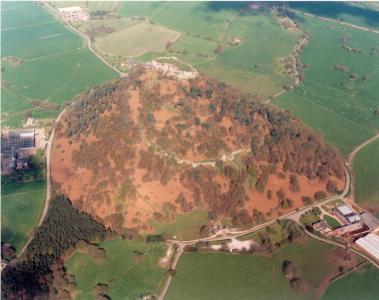
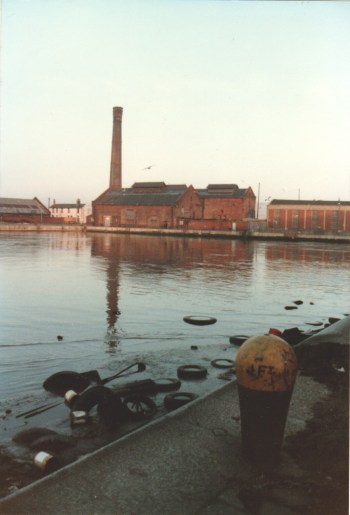
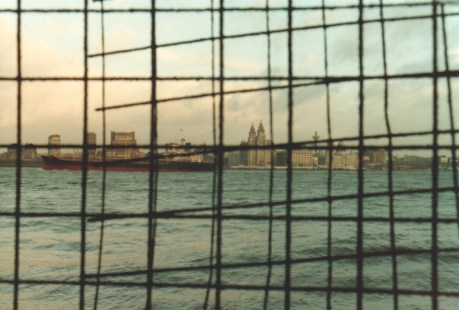
I found these photos the other day in an old file and thought that they ought to be shared.  I cannot remember the exact date, but it was somewhere in the mid to late 1980s when Jack Edwards, who ran the Cavendish Enterprise Agency in Birkenhead, gave me the most brilliant work experience opportunity after I left university, one of the best times of my life.  Up until that time, my work experience consisted of digging up archaeological sites around Britain, and Cavendish was a real insight into another world. There were so many superb projects.  Jack noticed that I photographed anything that came my way, so one of the projects that he set me was to take photographs of the derelict Birkenhead docks and its wharves.  This was pre-digital,  all slide and print film.  It was always a bit of an anxious moment when photographs came back from the film processors, to find out whether they were any good.  I have resisted the temptation to tweak them in Photoshop.

Jack was collecting tram rails at the time, in the yard at Cavendish, because there was a lot of conversation about restoring the docks along the lines of the Albert Dock in Liverpool, and he thought that it would be terrific to run replica trams through it.  When I went to the docks, my beloved Nikon in hand, I took the incumbent boyfriend with me, on the grounds that the derelict docks were probably not the best place to be wandering around alone, but we encountered no-one.  Not merely derelict, but deserted.  The photographs were never used for anything,  although Jack loved them, but I am so glad that he sent me to take them, because this is something that no-one will ever see again.  A moment in time, captured.

Jack was my Dad’s great friend, and thanks to my ruthless custom of gate-crashing their many lunches, he became a lifelong friend of mine too.  We lost Jack last year.  In the tornado of questions that I failed to ask him over the many happy and boozy lunches, one of the big ones was – Jack, what on earth did you do with all those tram rails?
afaf


Today in 1201: The foundation of Valle Crucis Abbey

Happy Birthday, Valle Crucis!

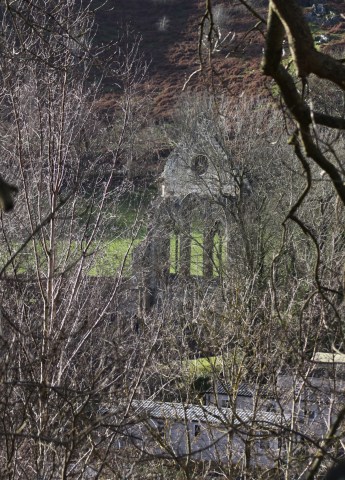
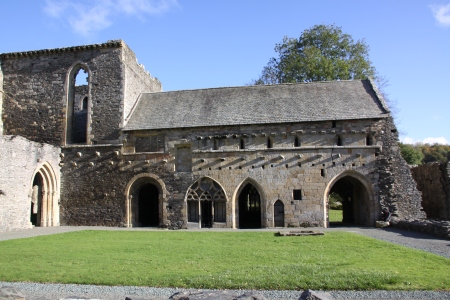
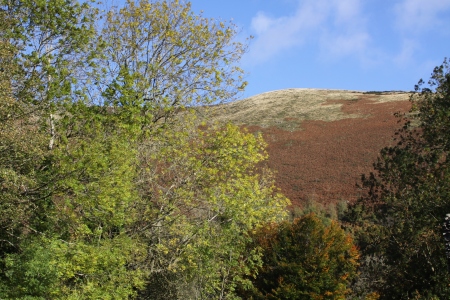
Had it survived Henry VIII’s nation-changing tantrum, otherwise known as the dissolution of the monasteries and the birth of the Church of England, the Cistercian monastic order’s abbey at Valle Crucis would be 821 years old today.  Today its lovely ruins are managed by Cadw and although a caravan park has been plonked right on its doorstep, it is still a glorious place to visit, sitting on the edge of a classically bubbling brook and overseen by the brilliant colours of the hills above.

I have already written first about the background to the abbey and then about how each of the monastic buildings was employed, and there are more parts to come.

In the meantime, here are a couple of photographs of one of my top favourite places, taken on 26th January.  I should mention that although the Cadw page for Valle Crucis says that it is open, it is actually currently closed to the public due to Covid, with a big, chunky padlock barring access.  The Cistercian monks would probably have applauded 🙂


Beeston Crag Prehistory #1 – The Earlier Prehistory

Beeston crag is a superb landmark, a small outcrop of the Cheshire Sandstone Ridge that was first occupied by people during the post-glacial period. Today, Beeston crag’s main claim to fame is the ruined 13th Century castle of Ranulf III, 6th Earl of Chester, built to intimidate his enemies, impress his allies, and provide himself with a magnificent legacy.  Following the Ranulf III’s death in 1232 and the subsequent death of his heir in 1235, the castle was repaired and rebuilt on several occasions until the 17th century when it was deliberately destroyed.  After this, the romance of the ruins attracted artists and tourist alike.  Today it is managed by English Heritage and is an engaging visitor attraction.  This has all been covered on two previous posts. Ranulf III’s Beeston Castle Part 1 looks at the remarkable magnate Ranulf III;  Ranulf III’s Beeston Castle Part 2 describes the castle’s history and includes notes about visiting.
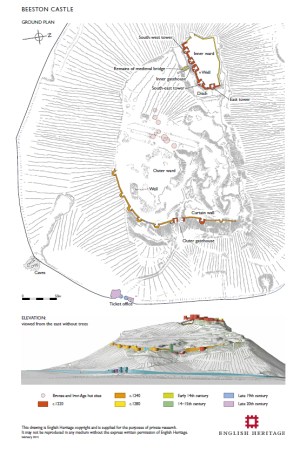
Beeston Castle, showing the excavated Bronze Age and Iron Age posthole locations, marking hut circles in the outer ward (pink circles).  The outer ward fortifications followed some of the lines of the Iron Age defences and the earlier Bronze Age banks.  Both contemporary and earlier prehistoric sites were also found in other parts of the site.  Source: Liddiard and Swallow 2007

Hidden beneath all of this rich Medieval and Civil War history is the archaeological story of the crag before history began.  The  impressive Medieval fortifications incorporate the remains of an invisible but remarkable prehistoric past, making the same use of a formidable location  that dominates the Cheshire plain, with clear views to the north, east and west, providing safety from predatory animals in what was dense woodland below.  Archaeologists between the 1960s and 1980s excavated these remains of the area’s prehistoric activity, some of it very exciting.

Although the Cheshire Sandstone Ridge as a whole is rich in prehistoric sites, in these two posts I simply want to get to grips with some of this particular crag’s prehistoric past.  I have divided Beeston’s prehistory into a post about the earlier  prehistory (in this part, part 1) and the later prehistory (in part 2).  Other sites on the ridge will be mentioned in passing, and future posts will discuss what all of the research on the Cheshire Sandstone Ridge contributes to our knowledge of prehistory in Cheshire.

For anyone wanting to find out more about each of the periods of British prehistory mentioned, some excellent books are listed in the Sources at the end of each of the two posts.

This post has been divided into the following sections:

  • Survey and excavation history
  • A note on the Three Age system
  • The role of the geology, geography and environment
  • The archaeological sequence at Beeston
  • Raw material acquisition at early prehistoric Beeston
  • Final comments
  • Next
  • Sources

Survey and excavation history

Aerial view over Beeston crag showing its prominent position over the landscape. Source: Sandstone Ridge Trust

Some of the hillforts on the Cheshire Sandstone Ridge were excavated in the mid-1930s by William Varley, an archaeologist with the University of Liverpool.  His excavations were focused on  hillforts, and although there were some inconsistencies is his approach, and his interpretations are sometimes questioned, he established that there was information under the ground along the ridge, and that it was worth investigating further.  Varley bypassed Beeston, but thirty years later new excavations filled this gap, focusing on both prehistoric and Mediaeval remains, a suitable endorsement of Varley’s initial exploratory work.
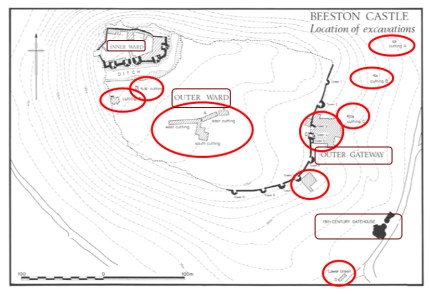
In the excavations of the 1960s-80s there were two main concentrations of excavation, one in the centre of the outer ward, and another by the outer gateway. Another fairly large area was opened to the south of the outer gateway, and some small cuttings were opened in other areas. Source: Ellis 1993 (with red circles added)

Two closely connected stretches of investigation are responsible for our understanding of the prehistory of the Beeston.  These are Laurence Keen’s work between 1968 and 1973 and Peter Hough’s work between 1975 and 1985.  These excavations found evidence of early as well as later prehistory, and made use of radiocarbon dating to establish a sound chronological sequence.    The account on this blog post makes extensive use of those excavations, reported in Beeston Castle, Cheshire. Excavations by Laurence Keen and Peter Hough, 1968-1985 edited by Peter Ellis and published by  English Heritage in 1993. Unfortunately, many of the tables and images were on microfiche, and although the core text is now available for download, the microfiches have presumably not been digitized.
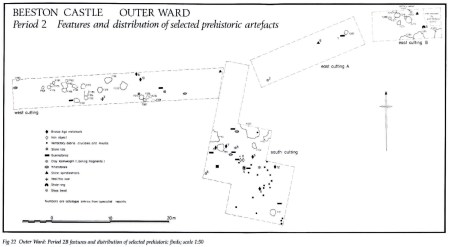
Plan of the Outer Ward excavation findings. Source: Ellis 1993

Although a lot of interpretive schemes in archaeology extrapolate from very small samples of big sites, particularly hillforts, in the case of the Keen and Hough excavations, there were two reasonably large areas where the work was concentrated, a smaller but still significant trench and several useful cuttings to sample other areas within the locale.  It is by no means straightforward to collate all this information into a coherent narrative, even if that is actually desirable with this sort of sampling, but some very useful findings were reported.

Some of the results of one of the sub-surface surveys in 2010. Source:  an unpublished report, via Garner 2016.

No recent excavation has taken place at Beeston, but a series of geophysical and LiDAR (Light Detection and Ranging) surveys were carried out by the Habitats and Hillforts Project in 2009 and 2010, at the outer ward and outer gateway.  Although these produced no definitive results, they did identify some anomalies that could indicate where future excavation projects might concentrate their attentions.  Much of the Habitats and Hillforts work has been published.  Dan Garner’s 2012 short introductory booklet  Hillforts of the Cheshire Sandstone Ridge, which looks at multiple periods of occupation, is very useful for becoming acquainted with the Cheshire Ridge archaeology.  Garner’s 2016 academic volume Hillforts of the Cheshire  Ridge is of considerable value for understanding both previous and current survey and excavation works at the other Cheshire Sandston Ridge sites in greater detail, particularly Eddisbury Hillfort.

A note on the Three-Age system
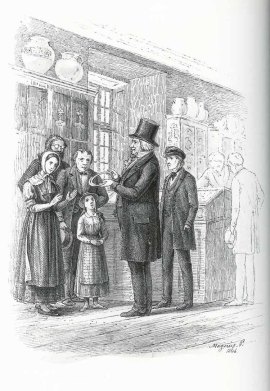
Thomsen explaining the Three-age System in Copenhagen, 1846. Drawing by Magnus Petersen, Thomsen’s illustrator. Source: Wikipedia

The 19th Century vision of a Three Age System, (Stone Age, Bronze Age and Iron Age), devised by Danish antiquarian Christian Jürgensen Thomsen and published in 1836,  was a spirited attempt to create a chronological framework for Danish prehistory that was widely adopted.  It became associated with the idea that technological innovations were inextricably linked to human progress and, by extension, the superiority of industrial nations.

Although ideas have now changed, the Three Age system is still the main organizing framework within which prehistory is discussed.  Having noted that the early Neolithic (New Stone Age) is an extension of the Mesolithic (Middle Stone Age), that the later Neolithic segues into the Early Bronze Age, as does the later Bronze Age into the early Iron Age, it is possible to move on.  These issues are all dealt with comprehensively in the academic literature.  The Three Age model still provides a framework within which most prehistoric archaeology is bashed out and bullied into shape, and as long as its limitations are kept to the fore, it need not be a wholly unyielding strait-jacket.

The role of geology, geography and environment
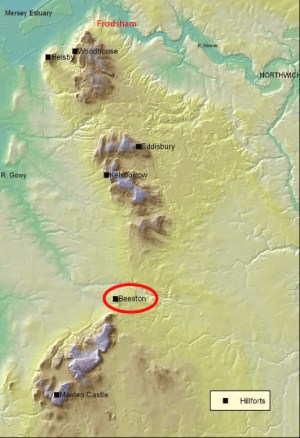
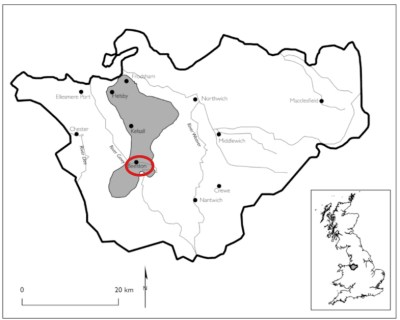
The location of Beeston within the Cheshire Sandston Ridge. Source: Garner 2012 (with red ring added)

Beeston is part of the fabulous Cheshire Sandstone Ridge, and those who selected it as an ideal place to settle, either temporarily or in the long-term, were presumably attracted by its height 150m above sea level, its location in a vast area of mixed deciduous woodland and, eventually, its defensive potential.

From a distance this prominent piece of geology looks like a complete anomaly, rising like a fossilized dinosaur’s spine out of the Cheshire Sandstone Ridge, knobbly and incomplete, but obviously the product of the same geological engine, the rocky components of the same machine.  Beeston sits towards the southern end of the ridge.  The Cheshire plain spreads from its base in all directions, the hills of the Welsh foothills to the west and the Peak district to the northeast, visible only in the far distance.  The Cheshire Sandstone Ridge is made up of desert sands and pebbles up to 225 million years old.  Questions about how the ridge formed and why it looks as it does are going to have to be the subject of a future post, written by someone else, but its upstanding presence in the otherwise flat landscape tell us, on its own, something about the prehistoric communities that, on and off over a period of nearly 8000 years, decided that it was a good place in which to camp or settle.
Archaeologically speaking, the sandstone composition is interesting because sandstone does not contain any of the stone types used used for the manufacture of stone tools.  This means that the flint and chert used for such tools was brought here from somewhere else.  This suggests not only that people were here for something other than the raw materials for tool manufacture but that they had to bring either the stone for tool manufacture with them, or the tools themselves.
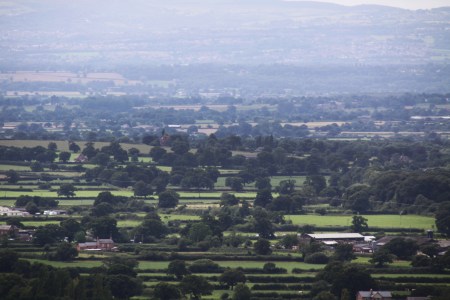
View from Beeston crag today west towards the Welsh foothills. In the Mesolithic and early Neolithic this would have been dense woodland. Clearance on the plain started in the later Neolithic but probably did not make significant changes to the patterns of vegetation until the mid Bronze Age to early Iron Age.

What the Cheshire Ridge has in abundance, other than sandstone, is height.  This provides truly impressive visibility across the landscape, as well as respite from the dense woodland below.  Whether or not the views across the plain would have been much use in earlier prehistoric phases is debateable, as the dense woodland would have disguised the approach of any but the largest groups of people.  Even after extensive woodland clearance had carved out agricultural fields,  this might have remained true.  On the other hand, lines of sight to other communities on other parts of the ridge might have been important, and clear views of weather fronts could also have been value.  Respite from dense woodland may have been relevant, especially when brown bear and wolves stalked the plains in hunt of meat of any description.  The best way to avoid becoming something else’s dinner is always to remove oneself from its preferred habitat.  It’s not a fool-proof strategy, but it’s certainly a step in the right direction.
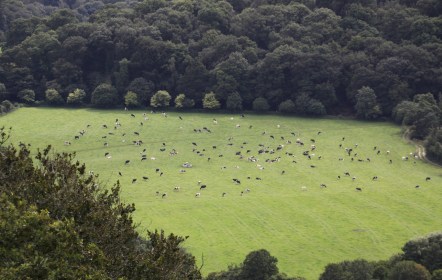
Cattle grazing in a field below Beeston.

According to the Sandstone Ridge Trust, farming remains the major land use, with livestock farming dominating the area.  This is interesting, as it tends to confirm the general impression that the damp clays of the Cheshire plain would have been difficult to cultivate in the past, particularly in early prehistory when the environment was much wetter and the area around the ridge included a network of freshwater springs.  Woodland cover today exceeds 13%, which is high compared to nearby areas, but low compared to the probable coverage throughout most of prehistory.

A multi-period location
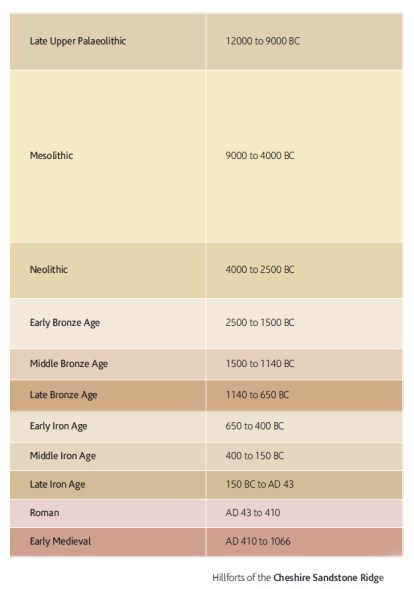
Archaeological chronology of the Cheshire Sandstone Ridge. Source: Garner 2012

Wherever there is a medieval castle perched on a hilltop, it is worth looking for an Iron  Age hillfort.  They are often there to be found.  It is also worth looking even further down the chronological funnel because some of the fortified prehistoric hilltops once synonymous with the Iron Age, are now known to have been built centuries before the Iron Age began.  So wherever there is an Iron Age hillfort, it is worth bearing in mind that there may be a late Bronze Age predecessor, as was the case at Beeston.   At Beeston the two phases of Iron Age hillfort were preceded by two phases of later Bronze Age settlement, one of which included an enclosing bank, and these were themselves preceded by even earlier prehistory – the Mesolithic, Neolithic and Early Bronze Age.

On the basis of previous work in the area, the excavators may have been hoping for prehistoric as well as Medieval finds, and they found evidence from the Mesolithic occupation from around 8000BC, dotted around all the way to the Romano-British period, which in Cheshire dates to c.70AD.  These were small outposts of earlier prehistoric activity Mesolithic (Middle Stone Age), Neolithic (New Stone Age) and Early Bronze Age, as well as more comprehensive discoveries of the later Bronze Age and Iron Age.  The earlier prehistoric phases will all be discussed below and the later prehistoric in Part 2.  Although there were discontinuities between the various occupations of Beeston, the crag was clearly of value to people of very different economic and social profiles over a very long period of time.
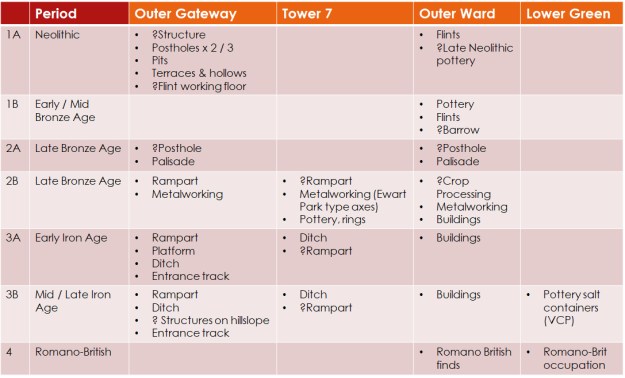
Archaeological periods at Beeston crag. Collated from Ellis 1993.

The Archaeological Sequence at Beeston

After the Ice Age, 9000-4000BC
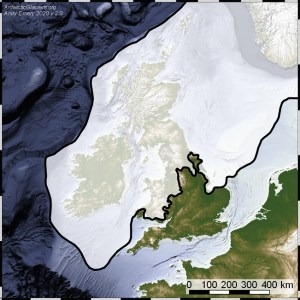
Maximum extent of the Devensian ice-sheet. Much of the rest of southern England will have been encased in permafrost which only began to melt as the ice sheets retreated, starting at around 10,000BC. Source: Antarctic Glaciers

During the last Ice Age, the Devensian, glacial ice-sheets extended in an uneven line towards southern England, covering Wales and Ireland.  The ice sheets carved out the u-shaped valleys that we all remember from school geography lessons, transporting huge amounts of debris from north to south, dropping thick deposits of soil and gravel, and creating meltwater channels.  Vegetation was demolished either by the ice or by the temperatures, animals and people departed, and most of Britain was empty of life.  Connected to the continent by a substantial land bridge, Britain only began to revive when the climate started to warm, and the ice began to melt.  Vegetation, consisting of  deciduous woodlands, shrubs and grasslands slowly returned to the lowlands, followed across the land-bridge by, amongst others, red deer, wild cattle (aurochs), reindeer, elk, brown bear, wolf and lynx.  In their wake followed small communities of people who lived by hunting game, foraging for wild vegetables, roots, seeds, herbs and fruit, and fishing on the coast and in rivers.  Today the period during which these groups of people returned and occupied post-glacial Britain is known as the Mesolithic, or Middle Stone Age. As the ice continued to melt and sea levels continued to rise, Britain was eventually physically cut off from the mainland, but that did not prevent other types of connection being established.
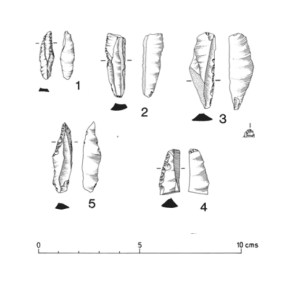
Mesolithic tools found from Beeston Castle, all less than 5cm long. Source: Ellis 1993

The Beeston Mesolithic finds are restricted to a small handful of stone tools that had been dislodged from their original context.  These are very typical of the period, consisting of microliths (tiny stone tools), and other very small pieces.  They do not say much on their own, but other Mesolithic sites in the area argue that the Beeston finds are a very small part of a much bigger Mesolithic story in the area.  In particular, Harrol Edge near Frodsham produced over 1500 tools from the period and will be discussed further below.  Other small sites are dotted along the Cheshire Ridge although most are as ephemeral as those at Beeston.  These include an earlier and later Mesolithic phase at Carden Park near Broxton; Riley Bank Farm, Alvanley Cliff (all at the northern outcrop); and Seven Lows on the east edge of the central outcrop (a Late Neolithic/Early Bronze Age site where around 100 pieces of worked flint were found).  These are all surface scatters, not clearly defined and stratified sites, but they are valuable for indicating the presence of people at this time, suggesting the size of  individual occupations and the period of time over which visits were made.  Together, they argue for small, temporary stopping off points as the landscape was exploited for food, craft and tool manufacturing resources.  They combine with other evidence to give an impression of a very busy pattern of landscape use in the Cheshire Ridge area, probably on a seasonal basis.

The Neolithic, 4000-2500BC

The later Mesolithic did not come to an abrupt end, any more than the Neolithic began as a rocket launch.  The long period of transition between the two livelihood strategies were influenced by processes taking place on the continent, themselves innovated in the Near East.  These presented opportunities and options, perhaps attractive to some and not to others, and take-up was no overnight phenomenon.
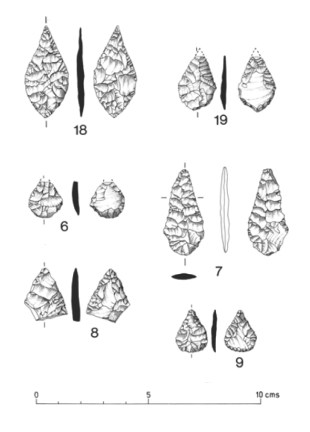
Neolithic stone tools from Beeston crag.  Numbers 18 and 19 at the top of the image are earlier Neolithic leaf-shaped arrowheads. Source:  Ellis 1993.

The changes that help to define the Neolithic (New Stone Age), when they began to gather momentum in around the third millennium BC, were characterized by a number of transformations that took place over the following 2500 years.  The spread of the main features generally characterizing the Neolithic did not spread at the same rate throughout Britain, and not all characteristics were adopted at the same time, even in neighbouring areas.  The main components defining the Neolithic are new forms of technology, a change of food acquisition practices, accompanied by new types of social statements.  Continuities and discontinuities between the Mesolithic and Neolithic are eternally under debate, because they are central to the question of how the domesticated crops and livestock, stone tool technology and more nebulous spiritual ideas were introduced from the continent, adopted in Britain and then spread.  Whatever the mechanism of their arrival in Britain, they became cornerstones of everyday life, and eventually found throughout Britain and Ireland, taking different forms in different areas, but based on a similar package livelihood opportunities, both economic and conceptual.

Early Neolithic of the Grimston/carinated tradition in northern Britain. Source: Malone 2001.

In parts of Britain, the Neolithic represents the first foray into mixed agriculture, with domesticated cereal crops and livestock and the adoption of pottery, which helped to introduce new cooking techniques, and to increase the variety of foodstuffs that could be consumed.  It also improved storage of both solids and liquids, protecting them from insect and vermin, and  took on cultural as well as economic roles. It is possible that after an initial foray into cereal production, pastoralism became the dominant approach to Neolithic food production.  This was probably particularly true in areas like Cheshire, where the clays, meres, mosses and heathlands would have been anything other than ideal for crop cultivation, and where dairy and other livestock farming dominate today.

As people began to manage their livelihoods in new ways, novel ceremonial and funerary monuments were built, and pottery and stone tools began to enter the realm of the dead as well as the living.  Long distance relationships, already a feature of some Mesolithic communities, extended, as the trade in axes and exotic materials expanded.
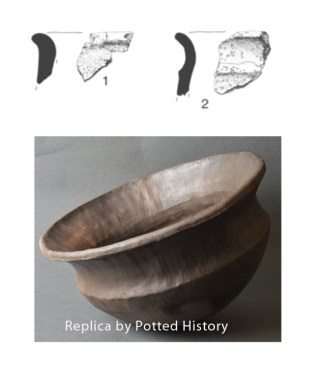
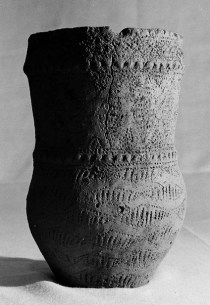
Grimston Ware sherds from Beeston (Royle and Woodward in Ellis 1993). The lovely replica showing what a complete carinated Grimston bowl would look like, is by Potted History

Information about the Neolithic in Cheshire, and particularly the Cheshire Ridge, is at best fragmentary, and it is not yet possible to pull together a coherent narrative of what is happening.  As with the Mesolithic, settlement data, rarely in the form of structural remains and usually in the form of  secondary scatters of objects on the surface, are generally small and dispersed but together contribute to  distribution maps to indicate, at the very least, where Neolithic people were present, and what form their presence took.  

At Beeston, objects of both the earlier and mid Neolithic were placed by Ellis in his 1A phase.  Objects diagnostic of the earlier Neolithic include leaf-shaped arrowheads (above), and carinated bowls (right) that used to be referred to as Grimston or Grimston-Lyles Hill ware, generally in circulation from c.3750BC.  The carination here is the rim that circles the centre of the vessel, and in general refers to a vessel’s wall making a sharp change of direction.  At Beeston both leaf-shaped arrowheads and sherds of carinated bowl are present, although the pottery is very fragmentary.  Because clay was fired at relatively low temperatures, and because temper in the fabric was often organic or composed of stone pieces, the pots were relatively fragile and once abandoned, were vulnerable to frost and heat damage and to erosive forces.  It is therefore comparatively rare to find Neolithic pottery found in tact.  Although Grimston carinated wares continued to be used for hundreds of years in some areas, in most they were replaced by more regionally distinct styles. 

The leaf-shaped arrowheads that were spread widely through Britain had no antecedents in the Mesolithic, they suggest that hunting still formed part of subsistence activities.  The hand-made (as opposed to wheel-thrown) carinated pottery.  Carinated bowls were found in a wide range of contexts in Britain, from pits and middens to early burial contexts, but there is no evidence of burial sites of this date either at Beeston or nearby.
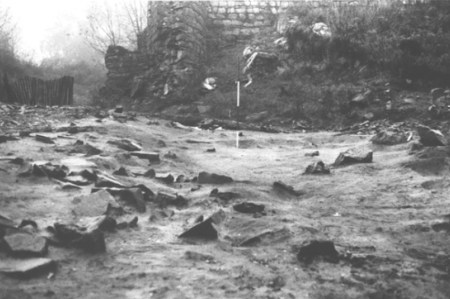
The early to mid Neolithic phase at Beeston’s outer entrance under excavation. You can see the stone walls of the Medieval castle in the background. This area is at the entrance to the outer ward, so when you pause to walk through the gap in the walls, remember that a Neolithic site was found underfoot. Source: Ellis 1993.

Another area of Neolithic at occupation at Beeston was found during the excavation at the outer gateway to the Medieval castle.  The Neolithic phase in this area was marked by terraces, hollows, pits and postholes.  There had clearly been an attempt to provide a level surface, implying some investment in the site, suggesting either the intention to stay put for some time, make repeat visits annually, or return at seasonally.  As well as this evidence of settlement, there were stone tools including small axe heads and the sherds of four types of Neolithic pottery, spanning the early to mid Neolithic. 

Additional Neolithic material was found on the plateau edge.  A deep pit cut into the bedrock and a smaller pit or posthole were accompanied by a single early-mid Neolithic sherd, at the base of the deep it.  It is difficult to assess, but the excavators suggest that it may mark a former entrance.  Finally, a single Late Neolithic sherd was found in Post-Medieval layers in the outer ward, where the Bronze Age and Iron Age hut circles were found.

Were these Neolithic occupants permanent cultivators who carved out fields in the woodland below, peripatetic livestock herders, or occasional visitors making use of the outcrop as a supplement to activities on the plain or elsewhere?  There are no plant or animal remains surviving to give us a hint.  The evidence from pollen analysis indicates that post-glacial Beeston developed in the context of mixed oak woodland and Ellis says that pollen data from north of Beeston suggests an initial clearance phase, but that this did not happen until the third millennium (i.e. between 3000BC and 2000BC, in the later Neolithic).   At Eddisbury hillfort, excavations in 2010 produced wood charcoal and other vegetation remains that suggest heath or moorland conditions that are generally associated with human manipulation of the landscape, in particular livestock grazing.  It is possible that the ridge outcrops were being used for seasonal upland herding activities.  Patches of grassland would have been ideal for grazing sheep, and coarse shrub for browsing goat, whilst cool woodland on the plain, particularly oak with its acorns, would have suited pigs perfectly.

Neolithic worked tools from Beeston Castle. Source: Liddiard and Swallow 2007

There are other explanations possible as well.  The small size of the assemblages may suggest scouting parties or small detachments engaged in resource aquisition tasks, heading east to west or north to south, and heading up hill for safety en route somewhere else.

All of the above is pure speculation, based on livelihoods practiced elsewhere, but it is the sort of speculation that ensures that when new data emerges, different models of occupation can be tested against the cumulative findings.

Although ceremonial and burial monuments are characteristic of some regions, nothing of this sort on the ridge or, to date, in the immediate landscape have been found in the early/mid Neolithic. Not until right at the end of the Neolithic and the beginning of the Early Bronze Age, when round barrows begin to appear on the sandstone ridge, and beaker remains were found at Beeston.  This is at least 2000 years after the leaf-shaped arrowheads that we looked at above.  I’ve covered beakers and round barrows in the Early Bronze Age section below, although they might just as well be termed Late or Final Neolithic.

Although only a small area of Neolithic land modification was identified, and there are only a handful of artefacts, it is worth remembering that only a small part of the entire crag was sampled.  That’s not anyone’s fault, because it would take decades to dig up the entire thing.  The excavation sample was actually impressive, and it does mean that there may well be other examples Neolithic land modification and objects to discover both on Beeston and other outcrops, as well as in the surrounding landscape.  Although it’s a trite analogy, every new site, however small, is an important part of the Neolithic jigsaw, not only allowing insights locally, but contributing to how we understand differences from and linkages between geographical areas in Britain.  Fortunately, excavation programmes are ongoing under Habitats and Hillforts Project and as all of this Cheshire Sandstone Ridge data is collated, it will hopefully provide an increasingly coherent understanding of Neolithic livelihoods on parts of the ridge and the surrounding area.

Early Bronze Age / Beaker period c.2500-1700BC
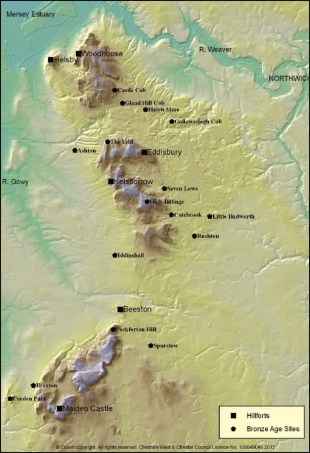
Earlier and Later Bronze Age sites along the Cheshire Ridge. Source: Garner 2012

In most parts of the country there is no clear delineation between the Late Neolithic and earliest version of the Bronze Age, sometimes referred to as the Copper Age or chalcolithic (roughly, the copper stone age) because copper appeared before bronze was introduced.  A new type of pottery, the Beaker, is also characteristic of this cross-over period, together with a range of associated objects.

It has been clear to archaeologists for a long time that the Beaker tradition was communicated to Britain and Ireland from the continent, where its geographical presence was widespread, found in Netherlands, Belgium, Germany, France, Italy, and the Iberian peninsula.  A  multi-disciplinary DNA analysis research project in 2017 proposed that a significant percentage of the indigenous population of Britain was, by the Middle Bronze Age, replaced by those who brought the Beaker tradition with them at the end of the Neolithic. Here’s an excerpt from the report (Olalde et al 2017).

The arrival of the Beaker Complex precipitated a profound demographic transformation in Britain, exemplified by the absence of individuals in our dataset without large amounts of Steppe-related ancestry after 2400 BCE. It is possible that the uneven geographic distribution of our samples, coupled with different burial practises between local and incoming populations (cremation versus burial) during the early stages of interaction could result in a sampling bias against local individuals. However, the signal observed during the Beaker period persisted through the later Bronze Age, without any evidence of genetically Neolithic-like individuals among the 27 Bronze Age individuals we newly report, who traced more than 90% of their ancestry to individuals of the central European Beaker Complex. Thus, the genetic evidence points to a substantial amount of migration into Britain from the European mainland beginning around 2400 BCE.

Cheshire’s only complete beaker, from Gawsworth. Source: Megalithic.co.uk

As is so often the case with this sort of DNA research, as highlighted in the study itself, there are questions remaining about the extent to which it is possible to extrapolate from the data used, including sampling issues (statistical, geographical and relating to the quality of the material).  However, although the question about how and why the continental Beaker objects and ideas became so popular remains open to some extent, it seems probable that as well as cultural dispersal of ideas and practices, some level of migration took place.  However it happened, at the end of the Neolithic the continental Beaker and associated objects did become desirable, and were found extensively under round barrows, as well as occasionally in other contexts, in many parts of Britain.  The cultivation of cereals also appears to have been resumed in some areas and intensified in others at this time, with new roundhouses being built in domestic contexts.

Distribution of some of the round barrows in Cheshire. Source: Morgan and Morgan 2004.

Beakers are not as common in northwest England as they were in the south, and only one complete Beaker, a long-necked type, has been found in Cheshire, in a round barrow burial Gawsworth, which is in the far east of the county, near Macclesfield.  The Beeston Beaker-related finds fall within Ellis’s 1B phase.   They were found at the Outer Gateway and in the Outer Ward.  In all cases they were found in amongst later material, within later prehistoric and Medieval material and postholes.  They consist of Beaker fragment, collared urn and/or pygmy cup fragments, a barbed and tanged arrowhead and four knife blades.  In Ellis’s collation of the excavations by Keen and Hough, the pottery analysis by Royle and Woodward interpreted the Beeston Beaker and its associated finds, as evidence for a vanished barrow burial.  There has been extensive use of the outer wards since prehistoric times with considerable quarrying and levelling on all areas of the plateau, so it is not impossible that a round barrow had been built and later destroyed. Beakers could, however, also be found as broken sherds in isolated pits, as well as in domestic contexts.  Other new forms of pottery followed in the Early Bronze Age, including food vessels, cordoned urns, collared urns and pygmy/accessory cups, of which a number of examples have been found along the Cheshire Ridge.
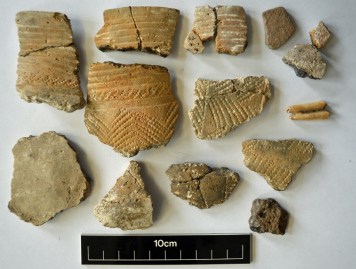
Seven Lows assemblage with Beaker sherds. British Museum 1862,0707.64. Source: British Museum

Round barrows with Early Bronze Age finds in them have been found in the Cheshire Ridge area.  Examples shown on the map above are Carden Park at Broxton, Castle Cob, Glead Hill Cob, Peckforton, High Billinge, Little Budworth and the Seven Lows barrow cemetery.  Few have been excavated in modern times, but most were cremations.  Only Clead Hill produced metal, in the form of a single bronze pin.  It was accompanied by two barbed and tanged arrowheads, collared urns and a pygmy/accessory cup, all consistent with Early Bronze Age burial assemblages.  The most common form of metal dating to the Early Bronze Age in the area was in the form of isolated finds of flat axe heads, but there are only four of those in the general vicinity.  The recent excavation report for Seven Lows has just been reported (it arrived through my letterbox yesterday) by Dan Garner in the Journal of the Chester Archaeological Society, so there will more on that site on a future post.

There is even less information for the Beaker-related presence at Beeston than the Neolithic, but what has been found is not inconsistent with other finds in the area, and it is to be hoped that further excavation will lead to a more complete understanding of the Beaker tradition in the Cheshire Ridge area.


Raw material acquisition at early prehistoric Beeston

Sourcing stone

Flint and chert were the materials used by the tool makers who left their tools at Beeston Crag.  Because of the way in which the stone fractures predictably when hit by a hard or soft object, flint and chert are favoured for flaked stone tool manufacture.  A remarkable amount of precision is achieved, meaning that multiple classes of foot types can be manufactured which, once identified by archaeologists, can be categorized and can contribute to an understanding of livelihood transformation and regional differentiation.

Mesolithic flint and chert tools from the Adams collection, collected at Harrol Edge, Frodsham. Source: Brooks, in Garner 2016

The sandstone ridge was not the source of the raw materials used in the earlier prehistoric period for stone tool manufacture.  At  Harrol Edge, near Woodhouse Hill at Frodsham, over 1500 pieces of Mesolithic worked stone pieces were gathered during unofficial fieldwalking in the 1950s by local resident J. Adams, since donated to the Grosvenor Museum in Chester.

For the flint, an analysis of the Harrol Edge tools by Ian Brooks identifies two sources, in chalk deposits of the Lincolnshire/Yorkshire wolds or Northern Ireland.  This does not necessarily mean that people had to go to either place or engage in trade to source the stone, because the ice-sheets transported considerable amounts of stone material to parts of the country to which it was not native, and Irish Sea till (unsorted material deposited by the movement of glacial ice) and associated gravels have been found in the valley of the River Weaver, which runs to the east of the sandstone ridge.

The nearest chert deposits were found in limestones in the Peak District and on the edge of the Vale of Clwyd (sometimes referred to as Gronant chert but properly part of the Pentre Chert Formation).  This means that however these stones were being sourced, they had to be transported to the site either as a raw material for working into tools, or as finished objects.
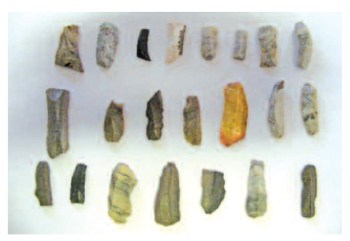
More Mesolithic stone tools from Harrol Edge, Frodsham. Source: Garner 2012

Hunter-forager-fishers of the Mesolithic were seasonally mobile, moving base camps to make the most of food and craft resources.  It is more than probable that in their seasonal rounds they were able to source chert and flint.  There is insufficient evidence from Beeston itself to suggest how stone was being processed, but of the 1500 pieces from the Harrol Edge collection, only 266 were actual artefacts, consisting of 232 blades and 34 scrapers, and the rest were by-products of the manufacturing process, representing multiple took making events.  This suggests that most of the artefacts were being made here, wherever the finished tools were eventually discarded, meaning that the raw material was brought to the site to be worked, rather than being worked where it was found.  Most of the objects were made on flint, mainly a distinctive banded variety, and only 8.6% were on a dark-coloured chert.  The chert tools may have been earlier in date than the flint examples.  Brooks says that the banded flint was not wholly ideal for knapping into shape, and probably would not have been the first choice if an alternative had been readily available.  Brooks felt that it probably came from the Peak District, but did not rule out north Wales as a possibility.
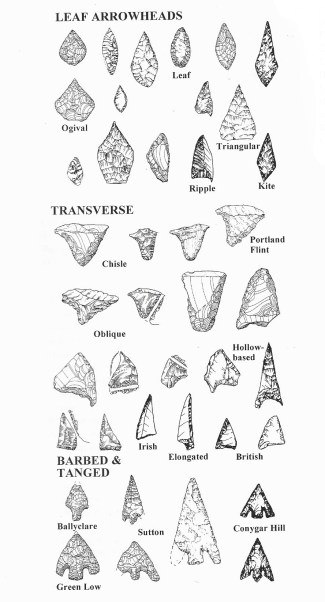
Knapped stone arrowheads from the Neolithic. Source: Malone 2001

In terms of the Neolithic stone use at Beeston, even early farmers were often far from sedentary, making their way through the landscape as they herded, seeking out craft materials on a seasonal basis and looking for new opportunities to exploit tracts of lowland and upland.  Early farmers were often far from sedentary, making their way through familiar landmarks of the landscape as they herded on a seasonal basis, seeking out craft materials on a and looking for new opportunities to exploit both lowland and upland environments.  It is possible that the local glacial tills provided the necessary flint for small tools, but even if travel had been required or the acquisition of raw materials, it would not have been necessary for the entire community to relocate.  For example, a dedicated resource acquisition group could have been dispatched from the group for this specialized task.  At the moment all we know for sure is that Neolithic groups were in the area, and that they imported flint and chert, either as raw material or as completed tools, from outside the area.

At Beeston the Early Bronze Age stone tool assemblage consists of a flint barbed and tanged arrowhead and four knives, all flint, and all nicely worked.  There is not much to be added to the above comments, but the knives were made of bigger pieces of flint than previous items, and it seems less likely that the raw material for such items would have been carried for any distances.  I have no idea whether or not flint pieces this size could have been found in the nearby valley gravels.

Sourcing materials for pottery
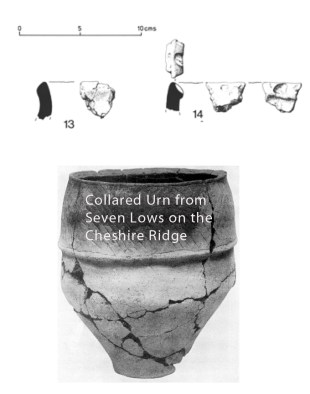
Collared urn sherds from Beeston (Royle and Woodward in Ellis 1993) and a photograph of collared urn from Seven Lows (source: Megalithic Portal)

The excavation report refers to three types of phase 1a and 1b pottery at Beeston.  All of them are made from local glacial drift clays characteristic of the Cheshire/Shropshire basin.  For example, the mineral inclusions (called temper) that were added to the collared urn clay during the pottery making process included quartz, sand, granite, rhyolite and basalt, all of which were common to other collared urns in Cheshire, and all of which could be sourced from local river valleys and glacial gravels in the area.  Because both the clay and the temper  were available locally, vessels could be manufactured within the immediate area, although there is no actual evidence to date for pottery manufacture at any of the Cheshire sites.  Although these vessels were hand formed rather than wheel-thrown, they still needed to be fired, and so far no evidence has emerged in the area for Neolithic kilns (usually simple pit kilns).


Final Comments

Although Beeston crag has produced the greatest evidence of early prehistoric occupation along the line of the Cheshire Ridge, this is probably due mainly to an accident of sampling.  Other hillforts were simply not excavated as extensively as Beeston, meaning that there could be plenty of early prehistory to be found at other Cheshire Ridge outcrops.  There have been some indications that there is more to be found.  At Eddisbury hillfort, for example, a possible late Neolithic cremation cemetery has been identified; at Seven Lows barrow cemetery at the eastern foot of the central outcrop, a recent excavation has just been published in the Chester Archaeological Journal (issue 8);  at Woodhouse  a small assemblage of Late Neolithic/Early Bronze Age stone tools were found, and at Helsby some early Neolithic activity has been identified.  Stray finds have been found elsewhere along the line of outcrops.
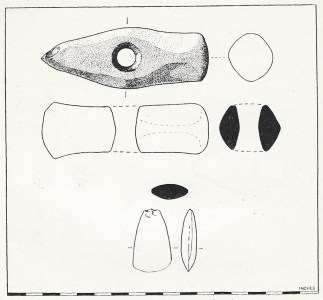
The so-called Beeston Hoard. Source: Varley and Jackson 1940

So far all the archaeological focus has been on the outcrops of the ridge, but that too is something of a sampling problem.  Because of the considerable agricultural value of the land across the Cheshire plain, it is unlikely that many upstanding sites are left to be found, and any settlement sites are likely to have been ploughed in. Aerial photography has proved to be of marginal value due to the water retentive properties of the glacial soil, which prevents it drying out sufficiently to show variations in the soil during dry weather.  However, there are hints that  prehistoric archaeology may yet be found.  On the plain not far from Beeston, the so-called “Beeston hoard” was found on the edge of a former freshwater spring, consisting of a Neolithic polished stone axe and an Early Bronze Age perforated stone axe-hammer.  The remains of a round barrow surrounded by a ring of stones and a circular ditch were found at Morreys garden centre at Kelsall, containing the cremated bones of a child in an inverted collared urn.  Unfortunately, discoveries like that have been few and far between.

Barbed and tanged arrowhead from Beeston – Late Neolithic/Early Bronze Age. Source: Ellis 1993

The discovery of earlier prehistoric sites along the course of the Cheshire Sandstone Ridge, many only excavated only briefly and some not excavated at all, establishes that there is the opportunity for further investigation, and hopefully further illumination.  There are a lot of questions remaining open about the earlier prehistory of both the ridge and the surrounding landscape.  Clearly, there is a lot of future potential for both non-invasive survey and excavation, should the funding be available.

Next

Following a visit to Beeston to enjoy the castle on a fine, sunny day last year, I became aware that Beeston had something of a prehistoric past, but I was surprised by how rich that past turns out to be, particularly when seen within the context of other sites on and around the Cheshire Sandstone Ridge.  At Beeston it begins with the Mesolithic occupation from around 9000BC, and then takes in the early Neolithic and the later Neolithic/earlier Bronze Age.  In Part 2, the very striking Bronze Age and Iron Age round-house and related discoveries on the Beeston crag take us all the way to the Romano-British period.


Sources for Parts 1 and 2:

Items in bold were used extensively in this post, with my thanks.

Books and papers:

Berridge, P. 1994. The Lithics.  In (ed.) Quinnell, H., Blockley, M.R. and Berridge, P. Excavations at Rhuddland, Clwyd, 1969-1973. Mesolithic to Medieval.  BAR 95, CBA.

Bradley, R. 2019 (2nd edition).  The Prehistory of Britain and Ireland. Cambridge University Press

Callaway, E. 2018.  Divided by DNA: The uneasy relationship between archaeology and ancient genomics.  Nature, March 28th 2018

Cunliffe, B. 1995. Iron Age Britain. English Heritage/Batsford

Cunliffe, B. 2005 (4th edition). Iron Age Communities in Britain. Routledge

Ellis, P. (ed.) 1993.  Beeston Castle, Cheshire. Excavations by Laurence Keen and Peter Hough, 1968-1985. English Heritage
https://archaeologydataservice.ac.uk/archiveDS/archiveDownload?t=arch-1416-1/dissemination/pdf/9781848021358.pdf 

Fairhurst, J. M. 1988.  A Landscape Interpretation of Delamere Forest. May 1988
http://delamereandoakmere.co.uk/wp-content/uploads/2017/03/fairhurst-delamere-landscape.pdf

Garner, D. 2012.  Hillforts of the Cheshire Sandstone Ridge. Cheshire West and Chester
https://www.sandstoneridge.org.uk/doc/D234636.pdf

Garner, D. and contributors 2016.  Hillforts of the Cheshire Ridge.  Archaeopress (appendices only available online)
http://www.archaeopress.com/ArchaeopressShop/Public/displayProductDetail.asp?id={2B433802-E7A0-4302-B2DD-95B7F3B2A493}

Garner, D. and contributors 2021. The Seven Lowes prehistoric barrow cemetery, Fishpool Lane, Delamere, Cheshire: a reassessment.  Journal of the Chester Archaeological Society, volume 91, 2021

Gibson, A. 2020. Beakers in Britain. The Beaker package reviewed. Préhistoires méditerranéennes no.8 (Ethnicity? Prestige? What else? Challenging views on the spread of Bell Beakers in Europe during the late 3rd millennium BC)
https://journals.openedition.org/pm/2077

Liddiard, R. and Swallow, R.E. 2007.  Beeston Castle.  English Heritage

LUC 2018. Cheshire East Landscape Character Assessment 2018. Land Use Consultants
https://www.cheshireeast.gov.uk/planning/spatial-planning/cheshire_east_local_plan/site-allocations-and-policies/sadpd-examination/documents/examination-library/ED10-Cheshire-East-LCA.pdf

Mackintosh, D. 1879.  Results of a systematic survey in 1878 of the direction and limits of dispersal, mode of occurrence and relation to drift deposits of erratic blocks our boulders of the west of England and east Wales, including a revision of many years’ previous observations.  The Quarterly Journal of the Geological Society of London 53, p.425-55

Malone, C. 2001.  Neolithic Britain and Ireland.  Tempus Publishing

Matthews, D. 2014.  Hillfort intervisibility in the northern and mid Marches.  In Saunders, T. (ed.) Hillforts in the Northwest and Beyond.  Archaeology NW new series, Vol.3, Iss.13 for 1998.  CBA NW.

Mayer, A. 1990. Fieldwalking in Cheshire.  Lithics 11, p.48-50
http://journal.lithics.org/wp-content/uploads/lithics_11_1990_May_48_50.pdf

Morgan, V.B. and Morgan, P.E. 2004.  Prehistoric Cheshire.  Landmark Publishing

Needham, S. 1993.  The Beeston Castle Bronze Age Metalwork and its Significance.  In Ellis, P. (ed.)  Beeston Castle, Cheshire. Excavations by Laurence Keen and Peter Hough, 1968-1985. English Heritage

Olalde, O. 2017. The Beaker Phenomenon and the Genomic Transformation of Northwest Europe.  bioRxiv May 2017
https://www.biorxiv.org/content/10.1101/135962v1.full.pdf

Ormerod, G. 1882.  The history of of the county palatine and city of Chester. Routledge

Ray, K. and Thomas, J. 2018.  Neolithic Britain. Oxford University Press

Royle, C. and Woodward, A. 1993.  The Prehistoric Pottery.  In Ellis, P. (ed.)  Beeston Castle, Cheshire. Excavations by Laurence Keen and Peter Hough, 1968-1985. English Heritage

Stuart, R. 1993. The flint.  In Ellis, P. (ed.)  Beeston Castle, Cheshire. Excavations by Laurence Keen and Peter Hough, 1968-1985. English Heritage

Varley, W.J. and Jackson, J.W. 1940.  Prehistoric Cheshire. Cheshire Community Council

Weaver, J. 1995 (second edition). Beeston Castle.  English Heritage


Websites

Habitats and Hillforts Project
https://www.sandstoneridge.org.uk/projects/habitats-hillforts.html

Sandstone Ridge Trust
Leaflets about the archaeology of the Cheshire Sandstone Ridge, available to download as PDFs
https://www.sandstoneridge.org.uk/about-sandstone-ridge-trust/publications.html

Archaeology

The Archaeology of Helsby Hill (PDF, 475KB)
The Archaeology of Woodhouse Hill (PDF, 487KB)
The Archaeology of Kelsborrow Castle (PDF, 495KB)
The Archaeology of Eddisbury Hill (PDF, 451KB)
The Archaeology of Beeston Crag (PDF, 498KB)
The Archaeology of Maiden Castle (PDF, 432KB)

Habitats

Broadleaf woodland (PDF, 352KB)
Meres and mosses (PDF, 391KB)
Lowland heath (PDF, 337KB)
Species-rich grassland (PDF, 331KB)

Insights Paper. The Sandstone Ridge Trust, 2018 (PDF, 7.6MB)
Sandstone Ridge Atlas. The Sandstone Ridge Trust (PDF, 22.3MB)
Delivery Model Options Appraisal. The Sandstone Ridge Trust (PDF, 2.4MB)

Ridge: Rocks and Springs

Ridge: Rocks and Springs Evaluation Report. The Sandstone Ridge Trust, 2017 (PDF, 37.4MB)
The Ridge: Rocks and Springs — a sandstone legacy. The Sandstone Ridge Trust, 2017 (PDF, 108.8MB)
Interim Report: Urchin’s Kitchen. The Sandstone Ridge Trust, 2017 (PDF, 67.5MB)
Ridge: Rocks and Springs Project Handbook 2015. A volunteer’s guide. The Sandstone Ridge Trust, 2015 (PDF, 7.7MB)

Habitats and Hillforts

Habitats and Hillforts Evaluation Report. Cheshire West and Chester Council, October 2012 (PDF, 12.5MB)
Hillforts of the Cheshire Sandstone Ridge. Dan Garner, Cheshire West and Chester Council, October 2012 (PDF, 10.8MB)
Captured Memories. Cheshire West and Chester Council, 2011 (PDF, 100.2MB)
Fertile Ground. Art & Photography inspired by Cheshire’s Sandstone Ridge. Cheshire West and Chester Council, 2012 (PDF, 66.5MB)

Geology
Introduction
Our Geological Heritage

https://www.sandstoneridge.org.uk/special-place/rural-land-uses.html


A short walk along the Dee at Holt, taking in Holt Castle

Holt Castle

After a morning of shifting logs, the sad remnants of an enormous fallen tree, from one end of the garden to the other and stacking them in the shed, I was fairly stiff and very bored.  It was a lovely day, so even though there is an immense pile still sitting there, I put the wheelbarrow back in the garage and decided to go and walk along the river, taking in Holt Castle.

A number of people have asked me if I’ve visited the castle yet, and my answer that the last time I saw it was probably 30 years ago always seems a tad lame, given how close it is.  I will talk about the castle on another post, but it was interesting today to see how much it has changed.  When I was last there, it was inaccessible and covered in ivy.  I remember the doorway hanging in the side of the wall, and remembered that it was built on a sandstone base, and that local sandstone was quarried from around the castle to provide building material and form a moat, but I had forgotten anything else that I knew about it.  Today, I was so pleased to see how well it has been served since I last saw it.  There is now a staircase leading to the top of the castle, from which the views of the Dee and the fields beyond are excellent, and there is plenty of signage to explain all the features remaining, and to show what existed in the Middle Ages.  I must try to find the photographs I took 30 years ago for comparison.

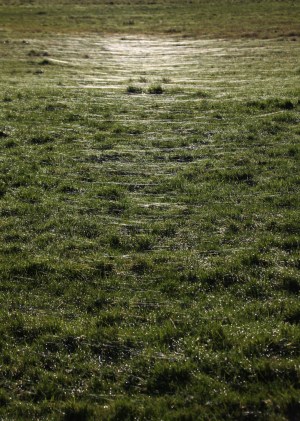
I was walking straight into the sun, which was beautiful but blinding, so after visiting the castle I retraced my steps and headed instead towards the bridge, crossed the road just before it, and went through the gate into the grass field that flanks the Dee to its west, heading north in the direction of Chester.  It was only a short walk.  I did not pass out of the field onto the track, which was covered with deep pools of muddy water, but the sun on the grass made it glow, the reflections in the river were lovely, and the cobwebs forming silver nets on the ground were glorious, and all in all it was a really rewarding stroll.


Visiting and accessibility notes

There is no carpark for the castle, but during the week there is plenty of on-road parking.  The footpath leading down to the Dee is well maintained, but as it opens into the open grass it is muddy and a little slippery after rainfall.  That is true for the worn footpaths around the castle too, so suitable footwear is required.  The path leading up to the top of the castle is gravel set into a plastic matrix, and felt very safe underfoot.  The metal staircase up tot he top of the castle is also well-textured underfoot, with a good handrail.  It’s only a short flight.  Do note that the noise from the bypass is considerable, so if you were thinking of carrying on along the Dee to the south after seeing the castle, do bear that in mind.

The walk along the Dee has no car park on the Holt side, but cross the bridge and there is a small car park on the Farndon side, to the south of the river (to the right as you cross from Holt into Farndon).  You can then return across the bridge on the narrow footpath to do the walk on the west of the river heading north.  As you open the gate, you may again find that the converging feet and paws have muddied the approach from the field, making it slippery.  The rest of the walk through the field is slip-free, and on the flat.

The late 19th century Churton village pump

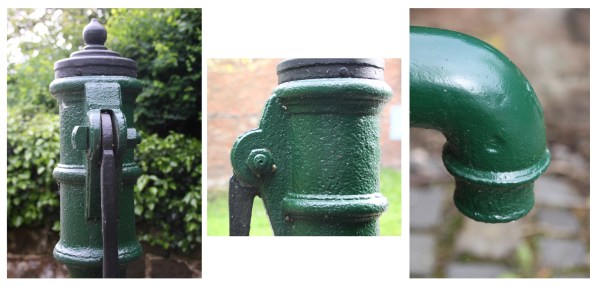
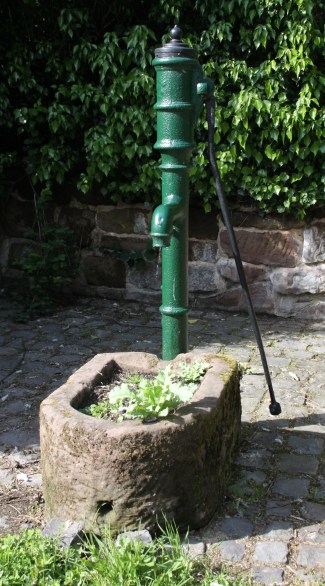
A little way down Pump Lane, opposite Churton Hall in the village of Churton is a cast iron hand-activated water pump, in an alluring shade of bottle green.  Its original manufacturer marking is almost illegible, but apparently reads “G. INGOLD B. STORTFORD,” referring to G. Ingold of Bishop’s Stortford.  The modern paintwork makes this illegible today.  I haven’t found any photographs of the pump prior to 2005 when it was renovated and reinstalled, but there must be plenty in local collections, so perhaps some will turn up.  It looks as though it is in very good condition, at least externally, its paintwork glossy and its structure intact.  Its What Three Words location is ///lance.alas.prune.

Pumps were installed from the 18th century, and began to replace wells in the  latter half of the 19th Century.  Wells in Churton are recorded at Churton Hall, Pump Lane, inside and out, and inside Cherry Tree Cottage on Chester Road, discovered during renovation work, the latter now sealed over.  Latham says that well water was very hard in the Farndon area, and that most houses had some form of rainwater storage as a common supplement to use of the well, for washing clothes and other tasks were softer water was required.

There were two primary types of upright pump commonly installed in Britain in the mid-late 19th Century: the lift pump and the force pump.  The Churton pump is probably a lift type.  These are relatively simple, with two valves opening and closing as a piston is lifted and dropped with the lever.  When the handle is lifted, the lower vale opens and the upper valve closes.  The barrel draws the water up the downpipe, filling the barrel below the piston.  When the handle is pushed down, the lower valve closes and the upper one opens, forcing water into the barrel about the piston.  The next upward pull of the handle pushes the water out of the spout, with water again filling the barrel below the piston.

Pumps relied on bringing water up from local aquifers via boreholes, which were the biggest part of pump installation.  A simple screw-shaped auger could be used for soft soils (I use a small one for planting daffodil bulbs), but percussion drilling was required for sinking a borehole through stone, a far more laborious and expensive process.   

The first village standpipe pumps were made of wood, which inevitably rotted, and later lead.  Lead was malleable and enabled smaller pumps to be made, but it was expensive and was targeted by thieves for melting down for resale, in spite of the threat of transportation, which was the standard punishment for theft of village pumps. Cast iron, a new technology in the 18th century that spread during the 19th century, replaced both.   Cast iron pumps were cheap to produce and far less prone to decay.  They spread rapidly into villages that had not previously been able to afford a pump, and found their way into homes, inns, farms and public institutions such as schools and hospitals.

Public pumps were not merely water sources but, much like the office water fountain today, places where people bumped into one another and where information, news and gossip were exchanged.  Some activities were easier to carry out at the pump itself rather than carrying the water back to home or business, whilst some better-off residents paid for the water to be delivered to them.  Comings and goings at the pump made it a social as well as a functional resource, and probably changed the dynamic of village life quite substantially once installed.

Servicing the pump was important, replacing the more vulnerable parts to ensure that it stayed functional.  The pump would sometimes be out of commission during the winter months due to frozen water, and the pumps themselves might be chained up to prevent use, and wrapped against the cold to protect them from frost damage.  I do much the same (wrapping, not chaining) with my high-tech hose reel and my outdoor taps.


fdfsdfsd

So far a precise date for the installation of the Churton pump eludes me. Latham says that the village pump at Crewe-by-Farndon was installed by William and Mary Barnston in the 1850s, and the one in Farndon by Mary Barnston in about 1877.   However the Churton pump is on the Churton-by-Aldford side of the road, inset into a field on that side of the road.  This is relevant because Churton was divided at that time into two parts, Churton-by-Aldford and Churton-by-Farndon, the division between the two running down the middle of Pump Lane.  Churton-by-Aldford came under the Grosvenor family’s Eaton Hall estate, and Churton-by-Farndon came under the Barnstons of Farndon, so the pump, if not paid for by public subscription, is more likely to have been donated by the Grosvenor family rather than the Barnstons of Crewe-by-Farndon.  On the other hand, I can find no record of a village pump in Aldford at around the same time.  Aldford, of course, was a model village, built from scratch by the 2nd Marquess of Westminster in the mid-19th Century, and the houses may have been supplied with running water.  So the question of how and precisely when the Churton pump arrived remains, for the time being, unanswered, but there are clues to establishing a rough date.  

G. Ingold of Bishop’s Stortford (Hertfordshire), made pumps for a variety of locations, although usually in the south, including villages in Essex and Cambridge.  The company had been founded in 1851 by John Ingold for sinking wells and manufacturing pumps.  He was based at Rye Street with a workshop in Apton Road in Bishops Stortford.  Following the death of John Ingold, the business was taken over by his son George, but the latter was marking pumps “G. Ingold” well before his father’s death.  This seems to put our pump quite late in the 19th Century.  This is born out by a number of wells and pumps in Uttlesford in Essex, where the date was recorded.  The earliest marked as “G. Ingold” as opposed to merely “Ingold,” was in 1873, then 1886, with a cluster of five in the 1890s.

Where images are available, all of the Ingold pumps looked very similar. As far as I can tell from the Essex and Cambridge examples posted on the web, most Ingold pumps had handles to the rear, with only some, like the Churton pump, fitted with handles at the side.  The Ingold spouts often had a thorn-like feature at the top of the bend, a bucket hook, often decorated.  This is absent on the Churton pump, although there is an indentation where one might have been located, visible in the photograph above left.

There are two modern signs on the walls flanking the Churton pump.  One is a disclaimer notice drafted by a local solicitor, commenting on the quality of the water available from the pump, saying that  it derives/derived from an artesian aquifer and warning that one drinks at one’s own risk.  I did try to activate the pump, giving it a really good go after heavy rainfall when the aquifers were all filling up, but it produced nothing.  Although I’ve never tried to use a village pump before, there was no feeling of resistance as you might expect of a lever raising a piston.  Thanks very much to Irene Mundy and John Gallagher for the information that When the renovated pump was reinstalled it was discovered that the pipe delivering water up to the pump was deeper than expected. Half way down the pipe towards the water reservoir another, secondary pumping mechanism had been attached in the past.  Although the pump initially drew water, it eventually ceased to function.  It’s nice that it did work for a while, and it still looks great.

The other sign refers to the restoration.  Although it says that it was a Millennium project, commemorating the arrival of the 2000s, Latham comments that the renovated pump was not actually installed until 2005.  The sign records that the project was supported by both Barnston and Grosvenor estates, both with vested interests in the village, as well as the Chester City Council.  The engineering and installation work was carried out by A.E. and K.E. Jones, farmers near Pant yr Ochain (Gresford), and the welding by J. Vale.  Someone must have a record of the project and the installation of the pump, including photographs of the installation and official opening, which would be really good to see.  The Eaton estate repaired the stone wall that encompassed the pump.  If any more details come to light, I will cover the restoration project on another post.

It was super, late last summer, to see that the sandstone trough beneath the pump had been planted out, and that a very attractive display of bedding plants had replaced the straggling weeds (see also the photo at the top of this post).  Many thanks to whoever took the trouble.  It was great to see it looking so good.  The photograph was taken in August 2021.  The other photos on this post were taken in May 2021.

—-
For more information on village pumps
I recommend the short book, Village Pumps by Richard K. Williams and the Village Pumps website (details of both below), both of which provided a lot of the general information in this post and are comprehensive resources on the subject of all types of village pump.
______


Sources:

Books and papers

Latham, F. 1981.  Farndon: the History of a Cheshire Village. Farndon Local History Society

Williams, R.K. 2009.  Village Pumps.  Shire Library

Websites

The Recorders of Uttlesford History
https://www.recordinguttlesfordhistory.org.uk/

Village Pumps website
http://www.villagepumps.org.uk
Village Pumps: Churton entry
http://www.villagepumps.org.uk/pumpsChesh.htm#C10C

Waymarking.com
Village Pump, Widdington, Essex
https://staging.waymarking.com/waymarks/wmC4MW_Village_Pump_Widdington_Essex_UK


Valle Crucis #2 – How the abbey buildings were used

Ivor Mervyn Pritchard illustration showing elevation view of Valle Crucis. Source: Coflein

When I first visited Valle Crucis, I was so bound up in the architecture and its complexity that it took me some time to get to grips with the idea that this was a place not merely where people spent time in worship, but where they spent their entire lives, an enormous amount of it taken up with liturgies.  The entire abbey complex is all about how those people’s lives were lived.

The foundation of Valle Crucis is covered in part 1.  Monastic communities conformed to a vision of life in the 13th century that had been first conceived in the 6th century.  The Cistercians were one of a number of reforming orders that were attempting to return to the 6th Century values of St Benedict.  St Benedict was long on attention to detail, but devoted less time to the bigger picture, so there was plenty of scope for incorporating his Rule into a broader vision of monastic life.  Each order approached the task differently, and the Cistercians did it by establishing remote communities where they could live out their lives, bound together by vocation, devotion and the cohesive regulations that laid down how their lives should be lived.

Plan of Valle Crucis. The buildings on the plan beyond the core abbey unit are all post-Medieval, mostly modern caravans and holiday chalets.  Source: Coflein

The Cistercians, with their centralized approach to the management of their European network of abbeys, understood all about the bigger picture, and knew how to impose its vision via standardization and conformity.  They had a system of government, and when they colonized a new country or region, they had mechanisms for ensuring that their operational procedures and their beliefs endured.  One abbey supplied the abbot and monks of the next, and the new abbey was answerable both to its parent abbey and to the founding abbey in Citeaux.  This was not just an idea; it was implemented.  The abbots of all abbeys went to Citeaux each year to attend the General Chapter where all Cistercian decisions concerning the order were made, and each parent abbey was responsible for visiting its daughter abbeys each year to inspect and judge it.  The Cistercian system was one not merely of self-discipline but of accountability.

The organization of the abbey, both its hierarchy and the functional components embedded into its architecture, promoted the Cistercian vision of monastic life.  It was ambitious and powerful, and it attracted both founders and members.

The organization of the abbey

Early pencil sketch showing archway at Valle Crucis Abbey. Source: Coflein

An abbey, priory or nunnery combined a church with monastic buildings, making up a community in which all the residents chose to devote themselves not merely to religious observance, but to a set of commitments that seems fairly daunting today.  Some must have been unnerving to the prospective novice even in the Middle Ages.  Once a novice had passed through a number of stages and was ready to make this final vows, he or she entered a life of devotion, self-denial and hard work.  The vows of personal poverty, celibacy and obedience were accompanied by the vow of stability, perhaps the most daunting vow of all.  It was a commitment to remain at the abbey for life.  All the vows were binding, and breaking them could result in punishments, including imprisonment for the most serious infractions.

As a novice, the future monk would experience the monastic code in practice, based on prayer (ora), manual labour (labora) and contemplative reading of religious texts (lectio divina).  The Cistercian order was guided by the principle of opus Dei, God’s work, and their abbeys were laid out to meet the needs of regular devotion in church, scholarly activity, economic self-sufficiency, communal support, and, when required, punishment for transgressions.

Detail of a 13th Century illuminated manuscript depicting St Benedict of Nursia, showing him with a tonsure. Source: Cover of Carolinne White’s The Rule of St Benedict (Penguin Classics)

As well as providing a church, the abbey had to make provision for its inmates.  The Cistercian hierarchy within each monastery was headed by the abbot or abbess, responsible for the smooth running of the abbey and the well-being of the monks.  The strict discipline, clear regulations and multiple routines were essential for cohesion, consistency, reassurance and morale.  Often there was a prior who was deputy to the abbot.  The main community of abbeys like Valle Crucis was made up by “choir monks.” Like other Benedictine-based orders, the Cistercian choir monks were tonsured, meaning that the top of their heads were shaved bare, leaving a ring of hair that represented Christ’s crown of thorns.  Up until the mid-14th Century, at the lowest level of the Cistercian abbey hierarchy, were the lay monks, conversi, who were allocated their own quarters within the monastic precinct.  Some had supervisory duties, but the main body of the conversi carried out most of the agricultural labour.  They did not have the tonsure. These roles, and others, will be discussed in part 4.

Aerial view of Valle Crucis (with caravan park).  Source:  Coflein

Each Cistercian abbey’s floorplan was an echo of the order’s founding abbey, Citeaux, which itself echoed the layout of earlier Benedictine monasteries.  The earliest abbey in Britain to conform to this layout was St Dunstan’s at Glastonbury in the 10th Century.   Although every abbey and priory is unique, all conform to the basic template.  Valle Crucis provides a very useful example of this template, simple enough to illustrate the principles of the Benedictine model, but elaborate enough to demonstrate some the options exercised by individual abbots over time.

Annotated plan of Valle Crucis showing the central cloister around which all the other buildings were focused, including the church, the south wall of which makes up the north wall of the cloister.  Source:  Evans 2008

The above plan of Valle Crucis shows the main organizational elements of the abbey, with the church at the north, and the rest of the buildings arranged around the cloister.  The monastic buildings surrounding one or more cloisters are called “ranges.”  Each range consisted of several rooms with doorways out into the cloister.  At the centre of the cloister was a garden or “garth.”  Around the garth was a walkway, usually termed an alley or walk, linking all the rooms in all the ranges. The monks’ formal and domestic buildings made up two sides, to the east and south, and in Cistercian abbeys the rooms for the conversi made up the fourth, western side until the mid-14th century, after which the west range was used for different functions.  Both the east and west ranges, facing each other across the cloister garth, were two-storey buildings.  This formulaic plan was a very effective organizing principle.

Standing at the east end looking west.   The dark block at centre marks the position of the original pulpitum, which divided the west end nave from the east end

In an ideal world, an abbey church would be orientated east-west, with the main entrance at the west opening into the nave, where general worshippers such as lay brothers and guests would attend services.  The nave was separated from the east end choir, chapels and presbytery (the domain of the choir monks) by a stone screen called a pulpitum or a rood screen.

The church’s south wall would make up the north wall of the cloister.  The cloister would ideally be located on the south side of the church to protect it from the wind and expose it to the sun.  Valle Crucis exemplifies this arrangement, but there are monasteries where it was not possible to orientate the church west-east or to position the cloister to the south of the church, such as Tintern in south Wales, founded in 1131, the second Cistercian abbey in Britain and the first in Wales.

14th Century window tracery in the chapter house, east range, Valle Crucis. Source: Coflein

The early Cistercians valued simplicity and rejected ostentation, associating decorative features with adulation of the material, wealth, self-indulgence and a tendency to succumb to luxury.  Monks who were supposed to be engaged on scholarly religious reading and profound, introspective contemplation needed no distractions, so the earliest buildings of the 13th Century had very few decorative flourishes.  From the mid-14th Century, however, more elaborate architectural features common to other monastic orders were added, such as window tracery and stained glass.  The chapter house in the east range, shown left, is an example of this elaboration of style.

No two abbeys were alike, which could be due to any number of variables including the richness of the original endowment, the preferences of the founding abbot, the accessibility of building materials, the availability of skilled craftsmen, financial constraints, changes in direction during the initial building phases, later re-building after fires or floods (common phenomena) and the incorporation of new ideas and technologies.  However, all abbeys share enough features to make their layout instantly familiar, with the function of many of their main rooms immediately identifiable.  Once you have got to grips with the layout of one abbey, you have the essentials for finding yourself around any other one.

The exterior

Rear view of the abbey’s east range.  From left to right, the grand passage leading from the cloister towards the fish pond, the rear view of the east range with its three tracery windows of the chapter house (with the monks dormitory overhead), and the ground floor window of the sacristy

Valle Crucis west front. Source: Coflein

For Medieval monks and modern visitors alike, the main experience of Valle Crucis takes place in the interior, but the first impression was provided by the impressive west front.  In the 376 years of the abbey’s life, local people will have seen little more than the imposing walls and tower, whilst pilgrims, guests and novices (trainee monks), will have had all the layered responses of a first impression when they arrived.  Most had probably seen other abbeys, or at least substantial churches.  For all, the view of Valle Crucis in its isolated valley setting was one of height, solidity and worthiness.  The 12th and early 13th Century Cistercians eschewed most architectural decoration, their focus on the serious business of doing God’s work without distraction.  The restored west front (which is the end at which today visitors enter the church) has the rose window and elaborate arch that were probably added after the fire that swept through the church 40 years after its foundation, and would have been considered trivia by those who founded the abbey in 1201.  For those invited to enter the church, the early 13th Century doorway would have been big, but relatively plain.  The overall impact of the ornamental details was more impressive, but less Cistercian. The east face, shown below, with its almost grim austerity, is far more consistent with early Cistercian ideas.
The innovative and austere east end of the abbey church, with the rose window of the west end showing through the left lancet window

On all of the church’s outer walls there are buttresses, long, flat vertical sections that sit against the wall, sometimes to its full height.  You can see them right, imaginatively incorporated into the design of the east end of the church. and below on the north wall, in both cases with splayed bases.  A buttress supports and reinforces a tall masonry wall, sometimes to the full height.  It counteracts the outward force of a wall to prevent it buckling by providing a counteracting force, preventing a wall from bulging by pushing against it.  These are often faced with fine stone (ashlar) or at least cornered with it (quoins).  The photograph below shows the buttress bases along the north wall of the nave of the abbey church.

Ashlar covers most of the church and monastic buildings, although some was robbed for building material after the dissolution.  The smooth surfaces, neatly carved lines, tightly fitting corners and fine joins give a much finer appearance to a building.  Being far more expensive to make and install than the roughly carved interior stone, its use also communicate something about the abbey’s status.  It really must have been quite a sight when first built.


The Virgin Mary

St Bernard of Clairvaux by Juan Correa de Vivar, 16th Century

Cistercian abbeys were dedicated to the Virgin Mary.  St Bernard, the charismatic and highly influential abbot of the 12th Century Cistercian abbey, Clairvaux, promoted Mary as a personage who encompassed all the most important Christian virtues.  She had a central role in the Christian story, she was sacred, approachable, empathetic and she had the ear of both Christ and God.  “If you fear the Father, there is Christ the Mediator.  If you fear Him, there is His Mother.  She will listen to thee, the Son will listen to her, the Father to him.”  This was St Bernard’s view of the matter, and one that he promoted energetically.

In spite of this, there is little sign of Mary in early Cistercian monastic establishments due to a Cistercian mistrust of effigies.  In most of the other monastic orders there would have been architectural carvings, paintings, tapestries and sculptures to commemorate the most venerated religious figures, but in accordance with St Benedict’s view of monastic life as pared down and austere, Cistercians rejected art works and instead venerated the Virgin only in their liturgies and rituals.  She was revered in their worship, and presumably in their hearts, but only occasionally in their architecture or art.  When the abbey was dissolved, all its possessions were sold off to raise funds for the crown.  It is thought that two chandeliers, one now at Llandegla parish church, and another at Llanarmon yn Ial may have been sourced from Valle Crucis.  I have not seen a picture of the one at Llanarmon yn Ial, but the one at Llandegla is topped with a statuette of the Virgin Mary.  If it was indeed from Valle Crucis, the depiction was from late in the abbey’s history, dating to the late 15th or early 16th Century.

Procession and Horarium

Artist’s impression by G.Pickering of monks in the east end of the Valle Crucis abbey church, having filtered down the night stairs from their dormitory, at far right.  Source:  Coflein

All buildings, whether religious or not, are about access, movement and visibility.   Doorways, walls, screens, corridors, passages and stairways all constrain and direct the sort of movement possible.  It is sometimes difficult to remember, when wandering around a roofless abbey, that the presence of windows, or the absence of them, impacts not only what can be seen from the inside out, but how clearly interiors can be seen based on the amount of light available, and whether candle light would be needed in key areas.  With the Benedictine plan,  control of movement and lighting were all about the main activities of the abbey.  All abbey activities had to be scheduled around the daily liturgies, which were at fixed times of the day.

The canonical hours or horarium scheduled the daily liturgies.  There were seven daytime gatherings, and one night-time gathering in the abbey church for prayer, psalms, chants, lessons, readings and hymns, as described by St Benedict in the Rule.  Attendance was obligatory.  In the Cistercian order these began at daybreak with Lauds, which was followed by Prime, Terce, Sext, None, Vespers (at around 6pm) and Compline (at Sunset) with Vigils (known in some orders as Matins) at night.  Between these liturgical assemblies were the daily meeting in the chapter house, mass (once a day and twice on Sundays and feast days), eating (once a day in winter, twice in summer), manual labour and intermittent sleeping.

Cistercian monks shown on a mural in the Cistercian Abbey Osek, North Bohemia, before 1756. Source: Wikipedia, from the Cistercian Abbey of Osek, North Bohemia

Every Sunday, and on feast days, the abbot led a procession of the entire community from the east end of the church around the cloister.  In larger abbey communities this must have been a spectacular sight as they monks lined up in pairs behind the abbot in their white habits and proceeded along the alleys of the cloister.  First holy water was blessed at the high alter, and then the abbot led the whole procession through the eastern part of the church, spreading holy water on altars in chapels.  Then they proceeded into the eastern alley of the cloister and walk the full circuit, sprinkling holy water into each of the rooms, before entering the nave at the west end of the church, again sprinkling altars with holy water, and finally returning, through the pulpitum, to the east end of the church.

Valle Crucis ground plan. Source: Valley Crucis Abbey by D.H. Evans (Cadw 2008)

In the order in which the procession visited them, here are the rooms at Valle Crucis, at least as it was when the abbey was suppressed in 1537, although the configuration was quite clearly somewhat different during the 13th Century.  It might be worth opening the above site plan in a new window so that you can follow the descriptions on the plan.

The Abbey Church

Cadw sign at Valle Crucis showing a cutaway of how the church may have appeared, with the nave where the lay brothers worshiped, separated by a pulpitum from the area used exclusively by the monks.

The procession began and ended in the abbey church.  The Valle Crucis church walls are preserved to a reasonable height throughout, and it is easy to see that its footprint was cruciform and orientated along the preferred east-west axis.  St Bernard of Clairvaux is usually given the credit for certain aspects of the Cistercian plan, particularly popular during the second half of the 12th Century,  which includes a short squared-off presbytery, low transepts, an aisled nave and a short tower.

The church was divided, physically, functionally and spiritually, into two main sections.  The west end of the church was the nave, flanked by two aisles, achieved by building two runs of walls supported on arches of which only the piers (columns) remain.  This is where the conversi, guests, and corrodians (permanent residents who were not choir monks) would attend services.

Cadw signage at Valle Crucis showing how the east end of the church may have looked in the early 16th Century. Note the undyed habits worn by Cistercian monks, giving them the name the “white monks.”

A screen, the pulpitum, divided the west end from the east end, the domain of the choir monks.  Beyond this screen was the choir and the presbytery, where the monks would have carried out their liturgical ceremonies eight times a day (including one at night).  Here there were a number of important architectural details shared by most Cistercian abbey churches.  The base of a spiral staircase may have led to an organ.  The pulpitum was moved towards the east end later in the church’s history, perhaps reflecting the decline in numbers of the resident choir monks.

The two arms of the cross formed wings to the south and north, the transepts.   Each  transept contained two chapels, side by side, originally both with rib-vaulted roofs, very beautiful.  The south transept chapels are still present with much of the vaulting in tact.  Chapels were required for ordained monks to give mass.  Most monks were not ordained, and although many liturgies were required, mass performed separately.  It was the duty of the ordained priest-monk, and had to be catered for with one or more chapels, each with its own altar.

Between the transepts is the crossing, the section at which the north-south and east-west axes cross.  Here a short tower was built overhead.  Beyond this section, forming the top of the cross, was the most sacred part of the church, the high altar.  If you stand in the crossing facing the east end of the church, look right and there is a doorway hanging 10ft\3m above the ground.  A flight of stairs from the first floor dormitory gave access to the east of the church for the night time liturgy. Offset from the dormitory entrance at ground level is the entrance into the sacristy.

The sacristy

13th Century sacristy

If you walk through the entrance into the sacristy, the room that housed the religious vessels and other items used in the liturgy and other ceremonies, you will find yourself in a remarkable barrel-vaulted room, worth a visit to the abbey in its own right.  It is lit by two windows, a lancet window at the end and a peculiarly oblique square window in the opposite wall to the entrance from the south transept. In some Benedictine layouts this in turn had an entrance into the chapter house, but in this case it opens instead into the cloister at one end.

The cloister

Lavatorium in the garth, with a view to the remains of the west range on the far side, and the south wall of the abbey church, together with its west end

The cloister is the core organizing element of the abbey.  It is made up of the garth (the lawn or garden) and the cloister alleys or walks that run along all four sides of the garth.  The garth still contains the base of the base of the lavatorium, a raised stone basin, used by the monks to wash before proceeding to the refectory to eat.  Drains under the west range were found during the 1970 excavation, running in the direction of the basin, perhaps fed by a hillside spring.  The cloister walkway, which surrounded the garth and linked the buildings that surrounded it, is thought to have been covered by the 14th Century, with the roof fittings still visible on the wall of the east range.  The left-hand illustration below by Chris John-Jenkins shows how it might have looked when the roofed arcade was first built.  Later, it seems as though part of the roofed section was removed to enable a door and staircase to be added to the top floor of the east range, when it was the private quarters of the abbot.  Again, Chris John-Jenkins’s illustration below shows how this may have looked.

Reconstruction of Valle Crucis east range and cloister in the mid-14th and early-16th centuries, showing how both the cloister walk and the upstairs dormitory may have changed over time. On the left, the cloister is surrounded by a roofed arcade, but this has been removed in the early 16th century and a staircase to the abbot’s new quarters has been added.  By Chris John-Jenkins, in Evans 2008, pages  41 and 43.

Like the layout of the church, the buildings that surrounded the garth also conformed to the basic Benedictine model and contained the functions of daily life, organized around the cloister in “ranges,” often in exactly the same order from one abbey to the next, with the chapter house and dormitory on the east range, the refectory on the south range and the conversi and cellarer (in charge of the monastic stores) occupying the west range.  The ranges at Valle Crucis are described below.  The east range is the most complete, partly protected by its use as a farmhouse after the dissolution, but the rest was robbed for stone, and only a few courses of stonework survive, which is just enough to give an idea of the layout just before the monastery was abandoned.

The East Range

Vaulted roof of the chapter house

The Sunday procession, having exited the church proceeded along the east range of buildings, which still stands to the original two storeys thanks to post-dissolution roofing.   The ground floor has one of the most important room in the complex – the chapter house.  Here the monks gathered daily to listen to the abbot read a chapter from the Rules of St Benedict, or a hagiography (the biography of a particular saint), to discuss the work of the day, and to hear confession and mete out punishments.  Readings about saints could focus on any saint from anywhere in the Christian world, but it is likely that in a Welsh abbey populated mainly by Welsh monks, hagiographies would have focused mainly on the numerous Welsh saints.  This beautiful room is rib-vaulted and contains various large niches, one of which was a fireplace.  Windows at front and back, with fine tracery, provided views over the cloister and the narrow stretch of land that ran down to the river.

The ornate door leading into the book cupboard and, beyond, into the chapter house. The main entrance to the chapter house, for daily use, is on the right. The entrance to the sacristy, which also has access to the abbey church, is partly visible on the left.

Accessed from the chapter house was the book room, which at Valle Crucis could be seen through an arched window with elaborate tracery.   This embellished entrance dates to the mid-14th century, and a simpler version of this would have been in place during the 13th century.   The cupboard is where the most important documents belonging to the monastery were held, some of which may have been borrowed from other monasteries either for studying or copying.  Two of the Valle Crucis books survive.

In the photograph below, the book room is flanked by the the entrance to the sacristy on the left and the main entrance to the chapter house at the right.  The next entrance to the right, much smaller, led to the dormitory.  Finally, the big arch at the end is a passage to the rear of the abbey, known as the slype.  The roof was removed after the dissolution in 1536, but replaced in the later 16th century.

The east range

Over the top of the sacristy and chapter house were the 13th Century dormitory and the latrines.  The dormitory can be seen in the illustration by Chris John-Jenkins above, at far left.  The latrines were built over a drain that was intended to flush away the waste (see photograph below).  These upper levels are still accessible but behind a locked door and would require special permission to visit.  They are much altered from monastic times, due to having been used as a farm house after the dissolution, and one fireplace has a 13th century gravestone incorporated into its design.  At the time of construction the dormitory was a communal room used by all of the monks.  Initially it was one large open space, but in the later Middle Ages a demand for more privacy usually led to divisions between beds that provided individual spaces.  The stone-lined  drain that ran along the base of the latrines still survives at the south end of the east range.

Stone-lined latrine drain

Later in its history the dormitory was converted into a private dwelling area and grand hall for the abbot, heated with fire places.  Evans makes the comment that so few monks were left that they could have lodged elsewhere within the monastic complex.  An obvious candidate would have been the west wing, which had formerly housed the lay brethren.  It seems peculiar that the abbey could have sustained the conversion of the dormitory into an ambitious private space for the abbot and his guests if there were so few monks remaining, but Evans does not comment on this.

The passageway at the end of the east range is located where  the “parlour” was usually located, where the monks could meet up, but here it seems to have been merely a passageway.  Originally it may have led to an infirmary, although no infirmary has yet been located.  In its later form it is much more elaborate than usual passageways.  Evans speculates that this was because it may have led to the abbot’s quarters at a time when the abbot was becoming a far more prominent figure.  This end of the range was longer in the 13th century and it was clearly modified extensively.  The far end, where it gives access to the rear of the monastery, the stream and the fish pond, has a 13th century arch that was removed from another part of the abbey and put in place here.   Whatever the incumbent abbot’s reasons, he went to some trouble.

The part of the east range on the other side of the passage, which looks like a wall of unsorted rubble, is the inner stonework of the latrine.  The latrines were on the first floor, at the end of the dormitory, and waste fell into the drain, where it was flushed away with water.

The South Range

Monks’ refectory with spiral staircase in the opposite wall. This will have lead to a pulpit for reading to the monks as they ate. Monks were rarely allowed to converse in the Cistercian refectory, but readings accompanied the meal.

Again following the procession, having turned right into the south range, the small room on your left may have been the calefactory, or warming room, in which the monks could warm themselves after work outdoors or in unheated parts of the abbey. No hearth was found here, so if it was indeed a warming room, it must have been heated by braziers. Alternatively, it may have been the access to the location of the day stair (the stairs that gave access from the dormitory to the cloister), later relocated.

The main room of note in the south range is the refectory, where the monks met to eat.  In earlier claustral layouts the refectory was parallel to the walkway, but from around 1170, the refectory could be built perpendicular to the walkway, allowing for more seating, more windows for light, and the positioning of the kitchen alongside.  The lavatorium, usually a raised basin in the garth containing water (for which the base survives at Valle Crucis), was always situated close by because the monks always washed before eating.  Conversation at mealtimes was forbidden.  Instead, readings might be delivered during meals.  The remains of a short 13th century spiral staircase are visible, leading to a pulpit where a monk would have read from a religious text which, as in the chapter house, was often a hagiography.

A very finely sculpted head was found during excavations of the refectory. Source: Evans 2008

A carving of a human head was found during the 1970 refectory excavations, now considered to be one of the finest pieces of Welsh Cistercian sculpture carved from sandstone that was used for all decorative features at the site.  It may have fallen from the pulpit.  It has an inscribed crown that reads “+MORVS.”  It has been much debated, and in the absence of any princes or other local leaders with a similar name, is thought to represent either St Maurus, or early medieval religious scholar Rabamus Maurus.  The excavator says that its style suggests a 13th Century date, and is a good example of the north Welsh school of stone carving.  As with many objects of significant archaeological value deriving from North Wales, it was removed to the National Museum of Wales in Cardiff.

The last room in the south range was usually the kitchen, and this is no different at Valle Crucis where the kitchen not only linked to the south range refectory, but being on a corner, also served the west range refectory built for the conversi.  In some refectories, such as Basingwerk in Holywell, the refectory was linked to the kitchen by a hatch, through which food could be passed, and it is possible that at Valle Crucis, built after Basingwerk and in a position to copy some of its most useful features, hatches in two of the kitchen walls were included for delivery of food to both south range and west range refectories.

The West Range

Part of the west range, showing the south wall of the abbey church at far right

There are only very few courses of the stonework left in the west range, making it difficult to get to grips with how it was used and what it looked like.  In his 1976 excavation report, Lawrence Butler says that the west range was badly disturbed by Ministry of Works clearance of the site after they took it over, enthusiastically destroying archaeological levels and making it very difficult to determine historical sequences, and to tie sequences in with each other across the site.

In a typical Cistercian monastery, the west range was the domain of the conversi, at least at the time that the abbey was built in 1201.  Butler’s 1970 excavations found four rooms, and parts of the abbey’s drainage system passing under the floors, one of which probably drew water from a natural spring further up the hill to make use of gravity to flush through the monastery’s drainage system.  Most of the rooms were floored with small slate tiles.

There was a passage, and there was probably a day room.  It is not entirely clear how day rooms were employed, but it is possible that when weather was poor or when an indoor location was required for the type of tasks carried out, they were where monks undertook craft work and other indoor activities.  There was a refectory and there was a ground-floor cellar at the end of the range that served both conversi and choir brothers.  Mirroring the east range, a second storey, which may have been half-timbered, contained a dormitory and latrine for the conversi.

The Black Book of Basingwerk, National Library of Wales reference NLW MS 7006D, probably copied at Valle Crucis.  .Source:  National Library of Wales

The tradition of using lay workers for maintaining abbey lands went into decline in the late 13th Century and early 14th century, and the Black Death wiped them out by the end of the century, so these premises would have undergone a change of use after that time.  The dormitory probably served as sleeping quarters for the choir monks when the abbot took over the top storey of the east range.  Some abbeys used the west range for extending their book collections and for copying books.  As Valle Crucis was clearly an important centre for the production of Medieval literature, the west range may have been the most obvious place for the monks to work, once the conversi had left.  The Black Book of Basingwerk, mainly containing the work of Welsh bard  Gutun Owain, was kept at Basingwerk Abbey at the dissolution but is thought to have been copied at Valle Crucis.  Remarkably it survives, and is the National Library of Wales

The North Range

The southern wall of the abbey church nave, marking the north alley of the cloister

The north alley of the cloister, which ran along the outer wall of the church, would have been  fitted with desks along one wall, and used for reading Cistercian, hagiographic, historical and biblical texts.  Reading, copying and  meditating took up much of the monks’ time.  Silent reading was uncommon, so a gentle murmur of sound would have accompanied the reading of texts, one of the few unregulated sounds that would have emanated from the otherwise quiet, if not completely silent Cistercians.  There was an entrance here into the nave of the abbey church, into which the monks proceeded during their procession, and from there they returned to the east end, and their own inner sanctum.

The cemetery

There is very little left  to see of the cemetery.  The best of the surviving tomb stones were moved into the former dormitory in the east range, and only a few token examples remain outside.

For 376 years monks had been living and dying at Valle Crucis, all of whom were granted burial rights within the abbey’s own cemetery, which lay to the south and east of the main buildings.

Original founding monks of the abbey, sent from their home abbey of Strata Marcella, would have been permitted to return to their home monastery to be buried, should they wish to do so.  The abbots, priors and most notable donors would have been buried in the abbey itself.

Cleanliness and hygiene were built into the Cistercian way of life, and this will have helped avoid disease and illness, but the close proximity of monks leading the cloistered life must have led to much higher risks of transmission than those living in the surrounding countryside. Even with a infirmary on the doorstep, medicine was still in its very early infancy, and illness must have been endemic.

The abbey precinct

Artist’s impression of the Newry Abbey precinct.  Newry was also Cistercian, another daughter of Whitland Abbey, founded nearly 50 years before Valle Crucis. Source: Philarm.com

Valle Crucis as it stands today, with its abbey church and four ranges, was the core of a much larger abbey precinct that would have contained a number of other buildings and features.  A well house and a fishpond were preserved, but this is likely to be the tip of the iceberg.  Unfortunately, no  surveys or excavations have extended beyond the abbey itself.

A standard component of Cistercian monastic precincts was an infirmary, often with its own cloister, near to the main cloister, usually to the southeast.  It would have been unusual for a Cistercian monastery to be without an infirmary, but so far none has been identified.

Typically, the precinct might include any of the following:  a formal gatehouse; guest quarters; stables; a home farm with barns, dairy, hen house, animal sheds and slaughter house; a granary; a bakehouse; one or more mills; herb and vegetable gardens; an orchard; a smithy; a dovecot; and a brewhouse with malting lofts.  Not all precincts with have had all of these, and some only a handful of them.   Sometimes the entire precinct was surrounded by some sort of boundary that was more symbolic than defensive.  Some abbeys and priories even had moats.  Unfortunately it is not known whether Valle Crucis had any of these within its precinct.

Final Comments

The abbey’s fish pond. It is the only surviving monastic fish pond in Wales.

With an impressive church, substantial monastic ranges, a cemetery and a fish pond, Valle Crucis was a well built and admirably self-contained unit.  It was built along the lines adopted by most Benedictine orders, and whilst it served the three main concerns of the Cistercian ethos:  ora, labora, and lectio divina, it also served the economic, administrative and domestic needs of a community of monks bound together by the vow of stability for the duration of their lives.

The character of the rest of the abbey precinct remains unknown.  There may have been an infirmary nearby, and there must have been a much larger precinct that could have included farm-related and other buildings, but it is not known where they were or how they were organized.  A caravan park now covers part of the precinct area, and there is farmland on the other side of the stream, where other parts of the precinct may have been located.

There is considerable scope for future field investigations to understand at least some of the precinct and its limits.

Postcard of the interior of the abbey church, looking west, with gravestones lined up in the foreground (now in the former dormitory over the east range). Photochrom Print Collection. Source: Wikimedia.

Although the above description of the church and the ranges is a fair stab at the way in which the abbey was designed for monastic activities to be carried out, there are many unanswered questions about the exact layout in the abbey’s early history and how its drainage was organized (an important aspect of Cistercian monasteries).  It is also unclear exactly how the west range was used after the demise of the conversi.

The next post, Part 3, takes a chronological romp through the architecture to see how the monastery changed physically over time, reflecting changes not only in Valle Crucis but in the Cistercian order itself during the 376 years of the abbey’s life.  All parts are available, as they are written, by clicking on the following link: https://basedinchurton.co.uk/category/valley-crucis-abbey/

Bibliographic sources for parts the Vale Crucis series:

For sources see the end of part 1.  Although I usually include a bibliography at the end of each post, the Valle Crucis posts have been rather long, so it seemed sensible to post all the sources used in the series on only the first and last posts.

The redevelopment of Chester Marketplace – more imminent changes

Yesterday I posted about the vision for the new shopping and parking complex in Chester based around the Town Hall and the former library (a.k.a. the Motor Works).  Today I wandered into another relevant website, which describes the upcoming move of the market to a new location in 2022.

This website is entitled Chester Market and can be found at https://newchester.market.  Their vision is captured in a poem of sorts on their home page.  Here’s an excerpt:

“Tune in to the modern vibe… and the tribes of butchers and bakers, artists and makers… Creating the reasons for trying and buying, playing and staying… Sharing and caring…for people and planet.
Balancing learning, entertaining…and playing tasting the best – not wasting what’s left…in our city we invest.
The heartbeat and art-beat of Chester combine… Reaching out and drawing in… The young and the old… the shy and the bold. Fathers and mothers… Significant others… 

Most of the website is a bit like that, full of chunky soundbites and big colourful blocks of texts and organic, leafy motifs (Matisse might have done a somewhat aggrieved double-take at bits of it).

On the other hand, the history page has this wonderful photograph in its favour.

Here’s the description that goes with it, genuinely interesting if a tad brief:

Chester’s market charter was granted in 1159.  The markets were originally hosted on the streets and Rows, with the focus in Market Square, outside the current Forum entrance.

The first permanent building was the Exchange, built in the square in 1692 until it burned down in 1862. It was replaced by a grand Victorian construction in 1865, designed to complement the new Town Hall next door, although sadly this was demolished in 1967 and replaced by the current Forum building.

A second photograph below, from Wikipedia, but without attribution to an original source, is also excellent.  What it was replaced with was really bad, but even if it had been something halfway acceptable, the loss of this façade was tragic, a lapse of judgement and a thorough abdication of cultural responsibility.  Heritage was simply swept aside, and for what?  One wonders what went on behind closed doors.

The 1865 marketplace façade, next to the town hall, torn down in 1967. Absolute tragedy. Source: Chester ShoutWiki

Quite by coincidence, a few weeks ago I took this photograph as I was attending the Local List  Workshop, and was on the lookout for anything slightly unusual or amusing.  This turned out to be the tragic sole remainder of that wonderful façade.

I am just hoping that the 2022 version of the market and town hall square heads us in the right direction.  Here’s their stated ambition:

“The vision driving the new market is to be a ‘modern traditional market’ that takes the best of the new breed of thriving city produce markets such as Borough Market in London, Barcelona market, combined with communal foodhall markets such as Altrincham and Liverpool’s Baltic.”

The entrance to the market as it looks at the moment

It’s a laudable ambition, but we will just have to see how it looks and feels when it comes to using itThe website states:  “Applications have now closed to trade at the new Chester Market. We expect to announce which traders have been successful over the summer.”  When the market moves, I sincerely hope that Mr Fernyhough the butcher, from where I buy game, is going with them.  I’ll ask him when I see him.

I am all in favour of a programme change for the more demoralized corners of Chester, including removal of some of the ugliest  previous attempts to revive it.  In this particular convergence of some great buildings, (Chester Cathedral, the Motor Works, the Town Hall and even the Story House) the space between them should be a vibrant and attractive place for people to enjoy, a  Cestrian piazza, so the hope is all there.  I am balancing optimism against past experience, but crossing fingers that the change will be substantially better, and will deliver something that everyone can feel good about.  

Architect’s impression of what the new marketplace will look like.  Source:  Chester Market website

The redevelopment of Chester Northgate: the imminent future

Architect’s view of two aspects of the new arcade, with the motor works at top.  Source: https://chesternorthgate.com

A couple of days ago I was trying to find out what the construction works were all about at the delightful Westminster Coach and Motor Car Works building next to the Town Hall on Northgate, its façade formerly fronting the library.  I found a whole website dedicated to the redevelopment of Northgate at https://chesternorthgate.com.

Too late to have any influence on the outcome, because the public consultation is over, but for those wondering what the redevelopment is going to look like, there are indications on the above site, including many more details and architects’ illustrations of what’s being planned.

It’s a matter of waiting and seeing what it looks like when it’s up, although one or two of the proposed new buildings seem completely out of keeping with Chester’s personality.  The new multi-storey car park, in particular, looks like a step in quite the wrong direction.

Architect’s view of the new car park. Source: https://chesternorthgate.com

The FAQs are well worth a look.  There’s also a history section with some interesting details about past developments intended to improve the marketplace itself.

Although there is always the worry that new shopping centres and arcades will concentrate shopping activities in new locations at the expense of older ones, I do hope that it brings renewed life to Chester.  The number of shop-fronts boarded up or simply abandoned in Chester is sad, including the former Browns/Debenhams, Patisserie Valerie, Edinburgh Woollen Mill and the entire of the Grade II listed St Werburgh’s Row.

Architect’s view of the new market place at the rear of the Town Hall.  The view below shows it as it is at the moment.  Source: https://chesternorthgate.com

A Chester Local List Workshop – what is local listing all about?

A few weeks ago, Chester Archaeological Society forwarded a request from Cheshire West and Chester (CWAC) for participants to attend a Local List Workshop.  I volunteered, but at that time I had only the fuzziest idea of what a local list actually is.  This post aims to clarify the subject of local lists and provides an account what happened during the fascinating Chester workshop.

A lot of county and city councils have programmes dedicated to local listing, and are running their own workshops and other forms of interaction with the public in order to launch their own local lists.  So what is a local list when it emerges from its burrow?

What Local Listing is not

The Grade 1 nationally-listed Chester Cathedral. Shame about the big purple sign, which completely destroys the first impression.  One of the lessons of Chester is that inappropriate signage and shop frontages can intrude very negatively on an otherwise beautiful city.

First, it’s useful to understand what local listing is not.  Local listing is not the same as the more familiar sense of the term listing, which is where a building or monument is “graded.”  Most of us are aware that when a building is officially listed and allocated a grade (Grade 1, grade 2 etc), it is given a special status and there are limits on what can be done to it and how it can be used.  Here’s part of the English Heritage explanation:  “Listing marks and celebrates a building’s special architectural and historic interest, and also brings it under the consideration of the planning system, so that it can be protected for future generations.  The older a building is, and the fewer the surviving examples of its kind, the more likely it is to be listed.”  There are currently 511 listed buildings (Grade 1, Grade 2* and Grade 2) in Chester City Ward alone.  Chester Cathedral, for example, is Grade 1 listed.  This is a national designation, and usually referred to as National Listing.

Local Listing

Local listing is different.  For a start, it is not a national designation and is not determined by a centralized national unit.  It is organized on a local basis by the council.  Here are some of the details on the Cheshire Local List Project website:

“In addition to the National designations, (including Listed Buildings, Scheduled Monuments, Registered Parks and Gardens and Registered Battlefields) local heritage can also be identified through the production of Local Heritage Lists of non-designated heritage assets. These enable the significance of any building or site on the list to be better taken into account in planning applications affecting the building or site or its setting.”

As I discovered when contesting a planning application in London a couple of years ago, one of the sticking points in objecting to any planning application is the concept of a “material consideration.”  A material consideration is something that a planning department takes into consideration when accepting or rejecting a planning application.  More to the point, anything that is not a material consideration is ignored when objections are made.  Local listing ensures that even those aspects of the built environment that are not nationally listed and have no grading are included as a matter of material consideration, which may make all the difference to communities attempting to care for their assets.

National, graded listing is designed to protect buildings and other sites, and ensures that when changes are proposed, a process of consultation takes place, but there are many other buildings, sites and objects that are not nationally listed, but nevertheless have an important role in communities, either because they contribute to community identity, or represent significant markers of local history.   As locally listed entities, these become subject to material consideration in the planning process.

The Cheshire Local List Project (CLLP) website goes on:

The Cheshire Local List gives importance to local heritage within the planning system, but also allows the expression of community identity, both through the list itself and through engagement in the research and designation process. It is a key component of conservation area management and Neighbourhood Plan development, and allows numerous stakeholders to better understand and appreciate the heritage of the county and its communities.

It would have been helpful if the word “listing” had been confined to national graded listing (such as when we refer to something as Grade 1-listed)  to avoid any confusion, but hey-ho, we’re stuck with it, and whatever it is called it is a really good idea, assuming that it is well implemented and becomes an integrated part of local planning procedures.  Local listing is a government initiative that sits at a level beneath graded listing, and is a much less formal designation, but could be just as important for communities if they work with councils to identify important local sites that cannot be nationally listed.  It puts the onus on councils to engage with the idea, but my hour on Google suggests that many have taken up the gauntlet.

The idea of the workshop

One of the Project’s aims is to be community-lead.  Here’s the official wording:  “We see the Cheshire Local List as a community-driven dataset. Rather than impose detailed criteria, which may be restrictive and exclusive, we have developed non-asset-specific criteria which we hope will enable local communities to define local heritage significance on their own terms.”

The term “community-driven” is often an indication that an organization intends to do nothing at all unless poked firmly in the ribs by some community-based pressure group, but here we had excellent James Dixon, Built Environment Officer (Conservation and Design) at CWAC, reaching out to Chester Archaeology Society, amongst other groups, for people to come and participate in a series of workshops.  The objective, ongoing, is to understand sensory experiences of small groups of people walking the same route through Chester to see how this might help to build an idea of what the concept of local listing might contribute to a city that already has 511 nationally designated listed buildings.   Rather than looking at the merit of individual buildings, this approach sought to develop an idea of how people respond to and interact with the city as a whole.

The approach is evidence-based.  Evidence-based approaches have become popular in all sorts of research that involves human interaction, including archaeology, social science and economic development as well as urban planning.  They have largely emerged from the basic idea of phenomenology – the way in which different living spaces are experienced and interpreted by individuals and communities – but are now a tool for developing  strategies or policies.  It takes the idea that how people live their lives and how they perceive their built, natural and cultural environment should influence what decisions should be made about those environments.  First, of course, is the requirement to understand people’s responses, both conscious and subconscious to the context under discussion, in this case the city of Chester.  In our workshop group at least, it produced some interesting results.

Another concept that has been incorporated into the Cheshire approach is “group value.”  This divorces heritage in its own right from other things we appreciate, such as assets, objects and spaces and how we experience all of these in a sensory way.  Valuable buildings are easy to put a finger on, describe and evaluate, but the open spaces in front of them, the odds and ends of  modern sculpture, ancient architectural lumps and bumps, and the occasional well-positioned tree or cobbled footpath are more difficult to evaluate.  And yet, they too are part of the heritage landscape, the built environment, the cultural context or whatever else we are calling it this year.  My above whinge about the purple sign in front of Chester Cathedral is just as important to people’s perception of how we move through our cultural space as the building we want to engage with, because signage is an attention grabber, and it manages expectations.

Archaeologists and historians are always flipping between what a site, building or object might have meant in the past and what it means in the present and how that distinction influences how we interpret the past.  That’s the archaeologist in me talking, but it works for any entity that we look back on from the perspective of time.  Cities and towns are accumulations, so we are reacting not to a single slice of time, but to an amalgamation that spans the oldest to the newest building and and is generally  experienced by the user (shopper, visitor, worker) as something that instead of having many multi-layered and multi-temporal identities, has one single identity in their own minds, in this case the identity of being Chester.

Because we humans are all so different from one another, a Chester identity is no single thing, because different people will respond to it in different ways depending on, for example, nationality, familiarity, personal interests, and the way in which they are intending to interact with it.  So Chester actually has multiple identities, each person perceiving the city as single cohesive entity but each doing so from a different perspective,  meaning that there are multiple identities of Chester, all of them compressing the complexities built up by time into a hurried present-day reality through which we pass, often in a tearing hurry.

In order to move beyond this sense of Chester being any single thing, James has come up with a method of directing participants in the workshop to look at Chester in an alternative way, something that had nothing to do with arranging its buildings chronologically or by function, but by asking us to think about how we reacted to different sensory aspects of it.

Participating in the workshop

Post-Covid there are a lot of empty shops, looking abandoned and derelict, dragging down the image of their neighbouring shops. The entire of the St Werburgh Row is devoid of life, and tragic. This initiative, however, where empty shop windows are provided with imaginative Chester-themed boards is excellent, raising a smile. The one here is the former Patisserie Valerie on Bridge Street.

On the 18th of November, the 90 minute workshop started at the bottom of Bridge Street, where we received our instructions from James, an excellent, reassuring communicator who turns out to have a natural gift for herding cats.  From the bottom of Bridge Street to The Cross, and then from The Cross to the top of Northgate Street, the workshop set out to build an evidence base of sensory experiences including, for example, colour, sound, smell and texture, and more elusive concepts like fun and solitude.

James handed each of us a 6x4inch card, at the top of which was written a single word.  There were eight of us in the group, which was a good number for exploring some of the concepts, and enabled us to exchange notes on three occasions, once after we had walked Bridge Street, once after Northgate Street, and once in the town square, outside the town hall.  The topics were, in no order, were texture, colours, sound, stillness, views, words, and mine was fun.

There were Covid-aware latex gloves for those of us who wanted to explore texture by touch.  We could partner up with someone else, we could proceed en masse, or we could go off individually.  Apart from that we were given no direction so that the thoughts that came to us were not influenced in any way by James, or by the council’s objectives.

The idea was to write down words that occurred to us in relation to the given topic on the card.  I have to say my heart sank because I had no idea how I was supposed to interpret “fun,” but it was hugely enjoyable once I got into the swing of it.  The photos on this post are snaps that I took as I was walking around and thinking about my target word.  It came in very handy for consolidating my thinking as I went along.  If I had had a different word on my card, the photos would have been entirely different, which is an interesting thought in its own right.  For example, if I had had “stillness” or “texture,” both my words and photos would of course have been quite different.

The record cards

The keywords are clever, because they avoid simple reductionist descriptions based on liking or disliking, positives and negatives and instead focus on more nuanced responses and descriptions.

When he set us off on our own, James said that there was no right or wrong thing to write down, that the whole point was to let us react and write accordingly.  We had a card for Bridge Street and either the reverse side or a new card for Northgate Street.  One of mine is shown here, annotated to make it legible.  As well as capturing our thoughts so that we didn’t have to remember them, they helped us to marshal our thoughts when we gathered to discuss our findings.  We handed the record cards in at the end, so that James could collate them with those of other workshops.  The cards were an important part of the workshop.  Several of us had to apologize for our handwriting 🙂

Discussing the keywords

James was great at getting us together, on four separate occasions.  Two of the discussions were about what we had written on our record cards.  Here’s just a bit of  that, but I am sure that James received radically different comments when running different workshop groups, so this is just a sample of a sample.

In all the discussions it was clear is that we were all looking in different directions, and that’s partly because of the keywords, which directed attention to different parts of the built environment, and partly because of how we interpreted those keywords and what took our interest.

The Cross

Our first stop to exchange notes was at The Cross, where Bridge Street meets with the other three primary roads preserved from the legionary fortress, Eastgate Street, Watergate Street and Northgate Street.  We had at that stage walked only up Bridge Street.  James asked us what struck as what we found surprising about Bridge Street, within the parameters of the keywords on our cards.   I didn’t know anyone’s names, so these comments are all anonymous, and are shorter, simplified versions of what was discussed:

The Rows. There is a lot more stillness here than down on the streets, at least at the moment.  It makes for a nicer experience, but I am sure that the shops would prefer greater footfall.

Views:  As one looks up towards the Cross, the impression is of a great complexity pattern of walls and facades of buildings that forms an incredibly intricate pattern that frames the view from the floor up.  Some bits stick out, some don’t, and all the buildings have their own character, but they lead unambiguously to The Cross, along a road that is surprisingly wide given its Medieval past.  The rows give the whole thing a very distinctive feel, and means that the shops on those level are set back from the road. Everything converges on St Peter’s church, which is a big red sandstone building that draws the eye.  The path from one end to the other, seen as a view, is almost too much for the eye to make sense of.

Touches of colour in the old buildings above shop level stand out and are welcome.

Colours:  The biggest surprise was the contrast between the more or less uniform character of the builds above the shop frontages versus the brightly multi-coloured shop frontages themselves.  There were only a few details in colour on the older half-timbered buildings, which made the colour stand out.  Chester at street level is a torrent of colour, but when one captures a little of it in the buildings that soar above the shops, it is a lovely piece of deliciousness.

Sound:  In this area, the biggest surprise was what could not be heard.  There was such a cacophony of clinks, roadworks and street music, that the things that one could see going on around one, were lost in the other noise.  A pair of hard heels could be heard, but trainers and other soft-soled shoes were lost in the overall sound.  Even individual voices were difficult to make out.

Words:  At shop level the impact of words, in the form of text, was impossible to avoid, and overwhelming.  Branding and signage dominate, in a variety of lights and colours, and it is difficult to differentiate one from another.  Silent, in terms of audibility, they still manage to form a cacophony.

Different ideologies expressed in different building materials, different approaches, different design ideas,  different colours and textures.

Texture:  Texture occurs at every level.  It changes underfoot, but is most obvious in the walls, which are red sandstone, yellow sandstone, brick, wood, concrete and many other materials, which each has its own personality.  Decorative plasterwork is very distinctive and very fine, but not always noticed.  Each texture has its own character – granular, soft, smooth, slippery etc.  Each adds to the diversity of the buildings.

Stillness:  This one was rather sad in many ways at this point.  The main stillness was embedded in failed, closed-down shops.  There had been several before Covid, but there have been some tragic losses since.  These were all devoid of movement and interaction, dead areas that people walked past without looking.  More amusingly, anywhere not selling coffee had a certain stillness, by contrast to those places that were, which were busy, noisy and drew attention to themselves.

Fun:  There is not a lot of fun at foot level because it is all shops with unlovely frontages, but look up and there is a lot to make one smile in the decorative architectural elements that embellish the buildings, particularly the 19th century facades, a bit like excessively ornate wedding cake decoration, and improbable towers and incredibly ornate ironwork.  Often OTT, and very confident, these flourishes  are always very finely crafted.  They are both fine and truly great fun.

The Story House

The Story House is a thing of real ugliness, but even so I would defend it energetically if anyone were to threaten it because it is a monument to its era.  Not all heritage is pretty.  The same could be said for the telephone box in the foreground.  The bollards, however, at the edge of the road, were agreed by all to be cultural as well as physical barriers.

Our next stop was at the Story House.  Northgate Street had started out very like Bridge Street, with lots of engaging architecture similar to Bridge Street, again sitting on top of ordinary shop frontages, but as one proceeds, it opens out and there’s a lot of more architecture to see, some from more recent times, not all terribly positive.  The four most dominant buildings as one filters through the narrow entry to the market square are Chester Cathedral, the Town Hall, the Motor Works, and the Story House.  There is also a very conspicuous frontage to The Forum Shopping Centre, which incorporates the market.  At the moment, the Christmas market dominates the public space, closely clustered and overwhelmingly full of cooking smells.  We walked past the market and gathered in front of the Story House to discuss the walk up Northgate Street.

Inevitably and fascinatingly, we all talked about how interesting it was to compare the walk from the bottom of Bridge Street to The Cross with the walk from The Cross to the Story House.

Views:  This was a story of constriction within fairly narrow confines to a sense of release in the big space in front of the Market Square and the Town Hall, but it was also a story of disappointment.  The sense of being lead somewhere by views of trees beyond the narrow start of Northgate Street lead to nothing more than an untidy space that was undefined and offered nothing like the oasis that was suggested by the trees.  At this time of year, particularly, the trees lend very little because they are deciduous and have dropped all of their leaves untidily onto the ground.  The Christmas market did not improve matters.  The cathedral, to one side, was a pleasant presence but did not dominate.  The main dominating factor, in terms of being lead forward, was actually the Story House, not Chester’s most aesthetically pleasing building.  Beyond the Story House, the symmetry collapses and there is nothing to tempt one forward.

Colours:  This is so dependent, just as it was on Bridge Street, on where you happen to look.  Ground level is bright and full of aggressive colours, but although on Bridge Street these were very jarring, they are more restrained on Northgate Street.  Looking up things are far simpler with black and white facades, and reddish-brown brickwork that provide a warmer feel.  The Christmas decorations were felt, by everyone who expressed an opinion, to be just right, not overstated or understated, but entirely suitable for the job in hand.

Sound:  In contrast with Bridge Street, Northgate Street was a far richer audio experience.  There was tapping, humming, rattling, the sound of wheeled suitcases on cobbles, a bicycle, and more human traffic, as well as the inevitable street music.  The sound of heeled shoes versus trainers was again particularly noticeable.  Reaching the marketplace, the noise of people talking increased enormously, and there was more traffic.

Words:  The plethora of promotional messages at street level was again dominant.  It was all very urban and vibrant, but there was also text in the historic buildings above the shops, where there were other messages to be seen that were resonant of the past.

Textures:  There were so many textures to be seen including the old versus the new, tiles versus glass, wood versus brickwork and the incorporation of carvings and sculptures into building facades.  As well as buildings, there were plants and trees to take into account, including moss on cobbles next to the cathedral.

Stillness:  The cathedral, a former abbey, is an oasis of stillness in the city, and offers a gateway into an inner peace, including its gardens.  The interface between the city and the peace beyond is provided by the Abbey Gate, and was probably the only entirely still place in the part of Chester that we walked on that day.

Fun:  Again there were a lot of excellent architectural details that were functionally unnecessary but expressed real exuberance.  Examples are the little sculptures in niches above the row of shops that includes Lakeland and Zara, little towers at the top of buildings and ornamental plasterwork on all sorts of buildings.  The overall impression of certain attention-grabbing buildings, like the town hall and the motor works lift the spirits, and both these draw attention to the positive impact of colour in building materials.

We did not, of course, explore internal spaces, but the idea of exploring interfaces between external spaces and internal spaces is an interesting one.  Little corridors leading from one space to another gave an almost secret feel to some of the city.

The good, the bad, and the highly nuanced

The other two discussions took place first in the public space in front of the Town Hall and the entrance to the market (The Forum Shopping Centre) and then at the point of Bridge Street where it becomes traffic-free and were less on what was on our cards than on our overall impressions.

Market / Town Hall Square

When we paused in front of the Town Hall, in what is usually an open area, we were asked what our impressions were of that public space.  The Christmas market was setting up, obscuring a sense of what it is like of most days of the week, but some interesting comments emerged.

Two of the dominant buildings, the Town Hall and the old Motor Works were exuberant, and were terrific examples of how whole buildings can express the enthusiasm and enjoyment (as well as ambition and pride) of those who created them.  They, together with the Story House and the Cathedral, surround the public open space.  The chap who was looking at “views” drew attention to how we had been funnelled from the lower end of Northgate Street, between buildings similar to those in Bridge Street into a space that, from a distance, with trees visible, had led to a sense of anticipation, but had very little to offer.  There were random odds and ends dotted around, leading to the sense that there was no cohesion in the space.  A very grubby Roman column here, a modern sculpture there, and an anti-terrorism barrier across the road.  I think that we all had the sense that nothing seemed properly integrated, and that a public space that might have had real potential was actually very drab, in spite of being surrounded by some great buildings, each of a very different but superb character.  We also looked at a bike rack that was very intrusive but could be placed somewhere less conspicuous and still be useful.  This was no piazza or plaza, and there was really nothing to celebrate.

The entrance to the indoor market.  A reminder of Chester’s Roman heritage, or just ugly?

I found myself almost back to back with a Roman soldier who was explaining something to a small group of visitors. I love the soldiers, who certainly come under the heading of “fun,” because wherever they go they raise a smile, but these soldiers, whether giving guided tours to adults or leading long strings of children wearing cardboard armour and carrying cardboard Legio XX shields, are a terrific innovation.  Some of us were also facing a Roman column that usually looks a little forlorn and isolated, and for which I have affection, but on that day looked more than a little farcical hemmed in on all sides by the Christmas market.   In Chester, a great effort has been made to incorporate the city’s Roman past, and there are constant, excellent reminders that help to reinforce the fact that as well as the built environment, the buried environment also plays an important role.  But that column could do with a rethink and a clean.

Little flourishes are worth looking out for.

Although the keywords on the record cards avoid simplistic likes and dislikes, positives and negatives, we found that in discussions value judgements were inevitable, because for every example of “fun” there is probably a “dull” in the next street, and for every ten tactile and aesthetically enjoyable examples of “texture” there is probably an edifice of brutal concrete nearby (the Pepper Street multi-storey car park springs to mind for both examples).  One of the interesting things from the discussions was that there are so many positives that the negatives stand out as noticeable intrusions on the positives.  One of the workshop members pointed out that anti-terrorist bollards, for example, are not only very ugly with their modern appearance and big lights, but give a misleading sense that there are better bits and less desirable bits of the city, separating  areas in which one is safe and where there are good thing to visit from those which may be not quite as safe, and not quite as worth visiting.  Once this was pointed out, everyone agreed, and we all understood that the city should not be seen in terms of what lies within and  what lies beyond those bollards, but that the perception is difficult to avoid.

Upstairs or downstairs – where does the fun lie?

Response to the keywords is a hugely personal thing.  I am guessing that many workshops would be required to capture even a small sample of what an entire community might think and feel about their living environment.  I interpreted “fun” as anything that would make me smile spontaneously.  I automatically looked away from the street level shopfronts to the upper levels where time, imagination and skill have wrought wonders. Some shop road level frontages are better than others, but for me all are brash, most of them frightfully ugly, and I hate shopping anyway, so nothing fun is to be found there.  But I have friends for whom shopping is hugely enjoyable, and the bright lights and colourful window dressings are all part of the enjoyment, and some of them would be puzzled by me describing architectural exuberance and decorative flourishes as “fun.”  So my interpretation of fun, confined to the upper levels where history looks down at me and I look back at it, would not be someone else’s.

Pausing again on Bridge Street

We paused again on Bridge Street, just on the uphill side of the anti-terrorist bollards, to discuss our views.  We were on borrowed time, as we had eaten up most of our 90 minutes, but we were all eager to point out the negatives of our immediate environment, because we all wanted to see improvement to encourage businesses to invest in that part of town.  Everyone agreed that the anti-terrorist bollards seemed, again, to cut one part of the street from another, and that the area north of Bridge Street was rather more prestigious than that to the south of them.  We also looked at some truly awful shop frontages, text-heavy, with lurid colours, tacky.  We asked about planning permission for frontages, as we were standing in front of a particular shocker at the time, and it turns out that they are indeed subject to planning permission, but that some retail outlets do not follow the procedures.  There is a lot of work to check up on those who ignore the rules, and it takes even longer to enforce the violated regulations.

The future

James said that he will feed back to Chester Archaeological Society about the results of the workshops once they have all been completed, and I really look forward to that.  Particularly, it will be interesting to know the answer to James’s own question – what can the local list do that designated graded listing does not already do in somewhere like Chester, which has listed buildings everywhere you turn?

The good news, even before the workshops have been completed and their findings collated, is that the Local List facility is already up and running and you can nominate an “asset” for local listing if you feel that it has particular community value and should be taken into account when planning and other issues are raised that might place it under threat.  You can find out full details on the Chester Local List Project website at the following address:
https://local-heritage-list.org.uk/cheshire/guidance:

The Proposal Process

When you make a proposal or proposals for the Cheshire Local List, you will first have the option of creating and revising a draft that will not be reviewed until you submit it. When you submit your proposal, a Conservation Officer will check it to see if more information is needed. If so, it will come back to you for revision, and if not it will be moved forward for approval.

Make a proposal for the Cheshire Local List here

Approvals for nominations to the Cheshire Local List will be done by a panel of Conservation, Planning and Built Environment officers from Halton, Cheshire West and Chester and Cheshire East.

The final list will be put forward for formal adoption by each of the three boroughs in due course as part of the development of new Supplementary Planning Documents for local heritage.

The Assessment Criteria are here:
https://local-heritage-list.org.uk/cheshire/assessment-criteria

The top-level asset categories are Buildings; Parks & Gardens; Landmarks, Art Works and Way Finders; Other Sites, Structures & Landscapes, but see the following page for more information on each category:
https://local-heritage-list.org.uk/cheshire/assessment-criteria-asset-type

If or when I hear more about the project, I’ll post about it on the blog.

Valle Crucis Abbey #1 – An introduction to the Cistercians and Valle Crucis

Valle Crucis, founded in 1201, is a superb example of a ruined Cistercian abbey, located less than an hour’s drive from the Chester-Wrexham area, in a lovely valley on the edge of a quiet stream that flows into the Dee.  It has been extensively surveyed, the few documents relating to the site and its antecedents have been studied and the site has been excavated both in the 19th Century and in the 1970s.  Importantly, most of the main features of the core buildings are identifiable, and can be discussed in terms of how the monastery was planned and used.  All of  these resources form a good basis for understanding how Valle Crucis was established and used, and what happened to it after it was “suppressed” or decommissioned following Henry VIII’s dissolution of most of Britain’s monasteries.

This is the first of a series of posts looking at the monastery.  These posts are quite long.  Valle Crucis, is used in this series of posts to introduce not only this particular abbey, but also the ideas that lead to monasticism, different monastic orders and the  distinctive architecture that defines most of the monastic orders in Britain.

An “order” is a shared monastic tradition, a set of spiritual ideals often spelled out in considerable detail in rules that covered everything from how many times a day a monk should pray, communally or individually, to where and when they could speak, eat and sleep, and what work they should engage in.  All orders involve a degree of renunciation and isolation by communities of monks.  Monastic architecture reflects both the need to gather a community in one establishment, adhering to a single set of rules, and the need to divorce that establishment from the rest of the world.  Unlike monks, friars could leave the monastic community (friary) to preach and tend to the poor, and were often located in urban contexts, but other orders chose to confine themselves to an abbey to focus their attentions on worship and scholarly activities that celebrated God.  Some chose to locate themselves far from other human habitation.  All were what is now termed Catholic, and all owed allegiance to the Pope, as well as to the heads of their own order, and to the founders who endowed their properties with land and resources.  The religious orders of the 12th and 13th Centuries in Britain were differentiated from one another based not on their religious beliefs, but on their ideas about how best to worship and celebrate God.  They dedicated themselves to spirituality and worship in different ways, based on traditions established in the history of monasticism.

St Pachomius in St Shenouda Monastery, Egypt. Source: St Shenouda Monastery website

Monasticism grew out of an early tradition in 3rd-4th Century A.D. Egypt where the devout might abandon their communities to live as hermits in the desert hills and mountains, divorced from anyone else.  They had as their models St John the Baptist and Jesus, both of whom had engaged in devout isolation in the desert.  Hermits began to organize themselves into communities that focused on offering guidance and communal prayer whilst still offering isolation from the distractions of secular life.   In the 4th Century, former soldier Pachomius, having followed the eremitic path in the Egyptian desert to live the life of a hermit, heard a voice telling him to establish a community for hermits like himself, a coenobitic (“common living”) way of combining isolation from the outside world with communal support and guidance.  This acknowledged that whilst individuals might seek out a life divorced from the material, they could well need help to achieve the sort of enlightenment that they were seeking.  These communities were therefore sources of knowledge, wisdom and education as well as worship.   He established his monastery in Tabennisi in Egypt, and simultaneously began to develop the first set of formal rules for guiding life in a monastery, which grew over time.  The rules combined prayer, solitude and work in a communal and very isolated environment, a difficult balance to strike.  This  was successful and soon spread.  Monasteries began to appear throughout the Mediterranean from where they spread into Europe.

A 12th Century interpretation of St Benedict delivering his monastic rule in the 6th Century AD. Source: Wikipedia, via Monastery of St. Gilles, Nimes France (1129)

In 6th Century Italy, St Benedict developed another set of rules for monastic living that required not only individual prayer and communal worship, but outlined a strict regime of living that included eating merely for fuel rather than enjoyment, a largely vegetarian and very narrow diet, and the requirement for manual work, including contributing to building projects and labouring in the fields.  The concept of an abbey emerged, a religious establishment consisting of both a monastery and a church in a single complex, housing a community of monks who do not leave the premises.  St Benedict’s form of monasticism was popular and spread throughout Europe.

As Benedictine monasticism spread and developed its own personality over the centuries, the strictness of St Benedict’s rules was often abandoned to enable a much more comfortable lifestyle, with an emphasis on liturgy rather than work, a varied and rich diet that included meat, and an emphasis on glorifying God through rich works of art and generous patronage.  Some abbots became involved in religious and state politics beyond the abbey walls, and became influential in their own right, far from the unworldly vision of  monks that St Benedict had promoted.  In the 12th Century this more opulent version of Benedictine monasticism was epitomized by the Cluniac order of monks (named after their abbey at Cluny in France).  The Cluniac order was the apogee of this desire to express devotion through liturgy and art, the elaborate and rich monasteries home to opulent treasures, art works, tapestries and fabulous stained glass that were intended to both reflect and celebrate the glory of God, and the monks entertained lavishly, rubbing shoulders with the rich and powerful.  This trend sat ill with those who sought a simpler, modest, withdrawn and hard-working way of serving God, true to St Benedict.

Johann Petr Molitor, Cistercian monks, murals in the Capitular Hall, Cistercian Abbey Osek, North Bohemia, before 1756. Source: Wikipedia, from the Cistercian Abbey of Osek, North Bohemia

During the early Middle Ages, the Cistercians, named after their first abbey, the 1098 New Monastery at Cîteaux (Cistercium in Latin) in France, set about returning to the values of St Benedict, which led to the reformation of some branches of Benedictine-based monasticism.   New Cistercian abbeys were established as a network of child abbeys, each secondary to its own mother, and all owing allegiance to the founding house at its core, Cîteaux.  Each new abbey could spawn one or more other abbeys.  The third abbot of the new Cistercian order, Stephen Harding, wrestling with the problem of how to ensure that the Cistercian principles would not submit to similar decay, retained the Cluniac’s governing principle of the first abbey being the mother for all subsequent houses of the order, to ensure consistency and standardization throughout the order.  This contrasted with Benedictine abbeys that adhered to the same 6th Century monastic rules proposed by St Benedict, but were wholly independent of one another.

Harding’s own guidelines, building on those of St Benedict, also included obligations that had to be acted upon on a regular basis by the entire family of abbeys.  One of these was that all the same liturgies should be used in all abbeys.  A unique requirement was that all abbots should attend, annually, the General Chapter at Citeaux, a meeting of all the abbots that discussed changes, challenges and difficulties, and enforced discipline.  Another innovation was that when an existing abbey founded a new house, the mother abbey was obliged to arrange annual visits to its daughter houses to ensure that the standards, values and rules of the Cistercian order were being maintained.  In this way, for the 11th,12th and much of the 13th centuries, the Cistercians maintained control and uniformity over a vast family of monastic houses, including Valle Crucis.  The monks wore undyed habits, unlike the other Benedictine orders whose habits were dark brown or black.  Accordingly, they became commonly known as the White Monks.  

Citeaux Abbey. Source: Wikipedia

The Cistercians combined worship with hard work in remote places that encouraged contemplation, eliminated distractions and enabled focus on a communal but pared down livelihood that was far more in keeping with St Benedict’s more spartan ideals.  After Cîteaux, the most important Cistercian monastery, responsible for evangelizing on behalf of the Cistercians, was Clairvaux (founded 1115), which was the home base of abbot St Bernard.  St Bernard was a restless and vocal monastic propogandist of the 12th Century who, in contradiction to the rules of the order, travelled far and wide to bring the Cistercian message to the western world, and whose sayings are still widely quoted: “Arouse yourself, gird your loins, put aside idleness, grasp the nettle and do some hard work.”  He was an advocate of crusades, connected with monarchs, politicians and other religious hierarchy, promoted the cult of the Virgin Mary, and became an unexpected and influential celebrity and icon, the poster-child of the Cistercian message.  Gascoigne calls him “the most influential monk of the Middle Ages.”

St Bernard in his white robes holding a delightfully improbable demon at his feet.  Marcello Baschenis, c.1885. Source: Wikipedia

Very quickly, new Cistercian abbeys proliferated in Europe and across Britain, always in isolated locations, each connected as a daughter to its mother abbey, to which it owed homage and loyalty.  Clairvaux was the mother abbey for Whitland in south Wales, which was established by monks from Clairvaux itself.  Whitland in turn established other abbeys including Strata Marcella near Welshpool, and this abbey in turn established Valle Crucis.  It took 86 years from the foundation of Clairvaux until the foundation of Valle Crucis, but it was only four monastic steps from St Bernard, and that sense of proximity must have resonated at Valle Crucis, as with all the abbeys in Wales.

Every Cistercian abbot had to return from his abbey to Citeaux every year for what was known as the General Chapter, a great conference of abbots.  This was the case even for abbeys that were located overseas, and the British abbeys were subject to this costly and time-consuming annual trek.  Also on an annual basis, the abbot or his prior if he had one (the abbot’s second in command) would visit a given abbey’s daughter abbeys to ensure that everything was running according to the original Benedictine plan.  This led to a degree of standardization and adherence to the order’s rules that was not necessarily seen in the other orders.

The remains at Valle Crucis offer a great opportunity for discussing the main points of Cistercian architecture, life and economic strategy.  It is a site that reinforces many of the observations that have been made about Cistercian monastic traditions throughout Britain, but which is also interesting in its own right.  The Welsh abbeys provide a particular opportunity for considering how their circumstances may have differed from their English counterparts, due to a series of factors including the patronage of Welsh abbeys by the Welsh princes, the wars fought on monastic land by Edward I and Owain Glyndŵr, and the character of the landscape in which the abbeys were built.  Other orders will be discussed in the future.

Introducing Valle Crucis

The East Range

In 1201 bValle Crucis was built in a scenic valley beneath the Horseshoe Pass near Llangollen, on the banks of Nant Eglwyseg, a fast-moving stream that ran into the Dee and now feeds the Llangollen canal. 

Both choir (or quire) monks and lay brothers were housed at Valle Crucis.  The choir monks and lay brothers lived different lives.  Their refectories, dormitories and latrines were all quite separate, and their roles within the abbey were clearly delineated.  Although the lay brothers would worship in the church, they were confined to the nave and a screen separated them from the choir brothers.  The lay brothers ate more advantageously, as they needed a better diet to support them in their daily work.  Cistercian orders worshiped seven times a day and once at night, and engaged in scholarly pursuits, but were also expected to engage in manual labour, contributing to the work carried out by lay monks.  Lay monks (conversi) were illiterate and worked the land, but were resident at the monastery.  They had their own separate quarters for sleeping and eating, and were confined to a section of the church that was divided from the parts of the church used by the quire monks.  Their church worship was much less frequent than that undertaken by quire monks, as most of their day was taken up by agriculture, crafts and building works.

The name of Valle Crucis is Latin, meaning Valley of the Cross, a reference to the 9th Century inscribed Pillar of Eliseg that was erected to commemorate the ancestors of Concenn of Powys, a  Welsh chieftain who died on pilgrimage to Rome in 858.  Eliseg was Concenn’s great-grandfather.  The inscription is now illegible but was recorded in 1696 and lists great deeds of ancestors, presumably with a view to establishing an incontrovertible connection to the lands on which the cross was constructed.

Survey, excavation, restoration and modern research

Carved head found in the refectory during excavations, and now rather a long way from home in the National Museum in Cardiff.  Source: Evans 2008, p.47

Documentary resources are few and far between for Valle Crucis, so other ways of exploring the history of the site have been employed.  The documentary archives of other monasteries and of related properties have helped to provide some additional information, but the documentary picture remains very threadbare.

Because of the architectural and functional standardization of monastic establishments, it has been possible to extrapolate the roles of much of the site’s key buildings by comparison to other Cistercian abbeys, but this only takes one so far.

Observing the above-ground architecture has taken matters a lot further, telling a story of a major fire forty years after the foundation of the abbey, and the changes in architectural direction that had to be taken as a result.  As the decades and centuries passed, changes in Cistercian values and ideas are captured in the architectural features and new decorative motifs.  This rich source of information has been supplemented by data that has come from the ground.

One of the illustrations from Butler’s 1970 excavations, published in 1976

One of the fads of the 19th Century was antiquarianism, the investigation of ancient sites of all ages.  Excavations became popular activities, although often hair-raising in the level of destruction achieved in the process of the pursuit of dazzling objects.  Valle Crucis did not escape this attention, and a series of archaeological excavations were carried out in both the middle of the 19th century, and in its latter half.   An anonymous letter to Archaeologia Cambrensis dating to 1863 by a visitor to Valle Crucis condemned the mid 19th Century excavations by W.W.E. Wynne, but the subsequent excavations by Harold Hughes appear to have been carried out with rather more integrity.

In 1970 the site was excavated by Lawrence Butler.  He reported on the findings, including the chronological sequences from the site, and full details of the pottery in 1976.  The pottery was limited in type and form but covered the full range of the site from construction to dissolution.  The faunal remains were analyzed by the ever excellent Graeme Barker as part of that project’s post-excavation work, to provide information about diet and economic activities, and his report was published in the same year.  The results of this particular project are of great interest as Butler found evidence of the earliest clearance of the site and was able to clarify details of fire, flood and alterations to the architecture in line both with these events and in response to the relaxation of Cistercian rules.

Because work has been concentrated on the core abbey buildings, it is less clear how the larger monastic precinct was organized.  This is the area surrounding and beyond the abbey’s heart, that were essential to the abbey’s economic survival, in which agricultural and activities took place, and in which vital supplies were stored for consumption or trade.  

Illustration from the 1895 excavation report by Harold Hughes.

Restoration work began with clearance of the site for excavation, but more ambitious work followed.  Sir Gilbert Scott, the renowned Victorian architect, was employed to repair the west front of the church in 1872, and Sir Theodore Martin restored part of the east end in 1896.  The difference in the stonework at the  and the site has been made safe for visitors.

After passing into the hands of the Ministry of Works in 1950, Valle Crucis was eventually transferred into the care of Cadw in 2008, which retains responsibility for the site.  Between them the site was made safe for visitors and Cadw has expended some effort on information signage to help visitors understand some of the site’s history.


How Valle Crucis and other Welsh abbeys were founded

12th Century links between Cistercian monasteries. Source: Evans, D.H. Valle Crucis Abbey (Cadw). Although Citeaux, the node for all Cistercian abbeys, established early new bases in France, it was Clairvaux under the lead of St Bernard that was responsible for the earliest new abbeys in Wales. Of these Whitland was the most important for the northward spread of monasticism. The green lines emanating from Savigny reflect the Savignac order, which merged with the Cistercians after only 20 years, in 1147. So although Basingwerk in the north and Neath in the south were founded as Savignac orders, after 1147 they were brought under the rule of the Cistercians at Citeaux.

Valley Crucis was at the northeastern end of a branch of a monastic chain that spread from south Wales to the north over a period of some 60 years during the 12th Century, building on a much older European monastic tradition.  The Cistercian order of monks spread through Wales during the 12th Century AD from the of Wales where it was established by monks from the French monastery Clairvaux, forming an eastern and a western chain of monasteries.

The first new Cistercian abbeys were established in Wales in the wake of the Norman conquest, the earliest at Tintern in 1131, and had a distinctly Anglo-Norman flavour.  However, a second strand of Cistercian monasticism spread in Wales.  It began at Whitland (Abaty Hendy-gwyn ar Daf), founded in 1140 by monks from St Bernard’s abbey at Clairvaux, second only to the Cistercians’ founding abbey at Citeaux.  Whitland spawned a series of abbeys that were funded by the native Welsh princes and were populated mainly by Welsh monks, a pura Wallia (Welsh Wales) version of Cistercian monasticism that nurtured Welsh literature and learning.  This spread into the poorer and more remote areas of Wales.

Valle Crucis was founded in 1201, the daughter house of Strata Marcella Abbey (Abaty Ystrad Marchell) near Welshpool, founded by Owain Cyfeiliog, prince of southern Powys, itself a daughter house of Whitland.   Establishing an abbey was an expensive undertaking, both in terms of its construction and providing it with the resources to ensure ongoing economic security. Accordingly, every new abbey required an endowment by a donor, someone with enough land and wealth to give some of it away in return for divine good will and the prayers offered by the monks for the souls of the donor and his family.  The donor usually required a guarantee that they would be buried within the abbey church, and that their family would be buried either within the church itself or within the monastery precinct.  Monks were considered to have a hotline to God.  Having dedicated their lives to Him, and living sin-free lives, they built up a surplus of virtue and influence that could be employed on behalf of the living in order to provide for them in the afterlife, an intercession to minimize the impact of sins committed in life.  Valle Crucis Abbey was founded by Prince Madog ap Gruffydd. 

Original sacristy entrance, 13th Century.

Prince Madog ap Gruffydd controlled the territory of Powys Fadog from the Tanat valley in the south to the edge of Chester from 1191 until his death in 1236, and was an ally of his cousin Llywelyn ap Iorwerth (Llywelyn the Great), prince of Gwynedd, d.1240.  In accordance both with tradition, and to fulfil the terms of his original financing and support of the abbey, he was buried in the abbey church at Valle Crucis, although the exact site of the grave has been lost.  The map above left shows the territorial divisions in Wales in 1267, with Powys Fadog bordering Chester, Gwynedd, southern Powys (Powys Wenwynwyn) and England. 

Valle Crucis was supplied with at least twelve monks (considered by St Benedict to be the minimum number for founding a monastery, following the twelve apostles), possibly thirteen, who were installed in temporary accommodation with a wooden church.  Work would have begun immediately on the stone church, the sacristy and the accommodation, and the 1970 excavation found unmistakeable signs of this work.

Choice of location

The map to the left (Ordnance Survey SJ24/34) shows the relative locations of Valle Crucis Abbey, the Pillar of Eliseg and Castell Dinas Brân, all a short drive from Llangollen, which was probably a large village that would have benefitted from the proximity of the monastery and its associated farms (known as granges).

Ordnance Survey map SJ24/34, showing the relative locations of Valle Crucis Abbey, the Pillar of Eliseg and Castell Dinas Brân (the latter not built until 1270, 69 years after the foundation of Valle Crucis)

The Cistercian ideal of a contemplative existence away from distractions meant that new abbeys were sited where monks could practise their devotions in relative seclusion, although not in complete isolation.  They were often near to well-established routes, and they always located themselves near to water that would be used for drinking, cooking, cleaning, ritual purification, as well as fishing and sometimes for powering water mills.  Abbeys were supposed to be economically self-sufficient, so abbeys still needed to be near enough to manors and villages to enable them to trade their produce, mainly agricultural, in exchange for the basics required for sustaining the abbey, both the choir monks (the dedicated monks within the monastery) and the conversi or lay brotherhood.

Although little is known about Llangollen in the late 12th Century, there was some type of settlement recorded there based around a church, and in 1284, Edward I granted the manor of Llangollen to Roger Mortimer, together with the rights for a weekly market and two annual fairs.  Llangollen was far enough away for monks to feel that they were isolated from civilization, but near enough to a village to enable contacts to be established if required for sourcing produce, raw materials and other goods.  The site of the abbey was clearly idyllic.  The following is an evocative excerpt from a paper by John Williams, who reported on the abbey in 1846 in the journal Archaeologia Cambrensis:  

Luxuriantly watered by a clear stream and sheltered by high hills, the sides of which are gracefully ornamented by trees, the place altogether appears as if especially intended to be the home of peace and happiness – a paradise for restored man, where he might securely worship his Creator and cultivate the graces of heaven implanted in his soul.

The sad remains of Strata Marcella Abbey, which supplied the founding monks of Valle Crucis.  Source: Coflein website – RCAHMW, taken by C.R. Musson, 2/1/1995.

The founding monks of Valle Crucis from Strata Marcella near Welshpool certainly thought so.  They moved the residents of the existing hamlet of Llanegwest to a new location in order to establish themselves in this particular paradise in the form of a fine abbey.  Llanegwest was probably a fairly tiny settlement, and it was relocated to Maelor Gymraeg (on the far northeastern border).  This was by no means unusual, and there are enough records of hamlets and villages being moved to make way for a monastic establishment for this to be seen as a fairly standard (if somewhat ruthless) act in the establishment of a new Cistercian abbey.

The fish pond at Valle Crucis

The Cistercians were renowned for their use of water, which in some abbeys included sophisticated networks of sunken drains that fed into and out of monastic buildings.  The siting of Valle Crucis next to the Eglwyseg was essential for sourcing water that was used for cooking, cleaning, washing, for use in rituals and for creating a fish pond and a drainage system to flush both the choir monks’ and lay brothers’ latrines.

The pond is an expanded version of the original one, and is the only one surviving in Wales.  As early Cistercians could not eat meat under St Benedict’s rules, except on certain nominated days, fish was often an important component of the diet.  As the rules relaxed, meat found its way into the diet on more than just special days, but in the early abbeys fish was often responsible for providing much-needed protein.

The latrines, located on the first floor at the end of the dormitories, were flushed by drains below, which diverted fast-moving stream water to clear waste back into the stream,  presumably downriver of the monastery.  Cleanliness was an important component of monastic life, with monks washing their hands before each meal, and latrines associated with the devil.

Pillar of Eliseg by David Parkes 1809. Source: National Library of Wales

Finally, the Pillar of Eliseg may or may not have influenced the location of the abbey, even though it provided the abbey with its name.  It is, however, entirely possible that the presence of the ancient cross as a clear and ancient statement of Christian affiliation would have been particularly attractive to the new abbot and his monks.  Perhaps more significantly, it was probably particularly resonant for the founder-patron of the abbey, Prince Madog ap Gruffydd, embedded as the monument was with memories of the past inhabitants of the region who sought to defend it against all-comers.  With the Marcher Lords at the borders and the English beyond, Madog probably felt a close affinity with Concenn and his predecessors.   The cross still stands to the north of the abbey, but is considerably shorter, with bits missing, including the top, base and arms of the cross.  In the view to the right by David Parkes, dated 1809, the remains of Valle Crucis are visible at the lower left of the image.

I had initially assumed that the siting of Valle Crucis took into account the proximity of Dinas Brân, a Medieval castle that was also located in the Vale of Llangollen and can be seen from the abbey.  The castle was not, however, built until 1270.

View from the interior of Valle Crucis. I find it hard to get my head around the idea that this and other very narrow views were all that the monks would have seen. They could not explore the environment in which their abbey was located, because they were confined to the monastic precinct.  They could merely see it, never truly experience it.


The remains of Valle Crucis

Valley Crucis provides a very useful template for understanding other monasteries in the Benedictine tradition, all incorporating a church and the main monastic buildings arranged around a square cloister, consisting of a walkway connecting the buildings around a garden or “garth.”

Cadw site plan, with photographs of mine added to show the relative location of some of the key features (click to expand).

Above is a site plan of Valle Crucis, which adopted the typical layout of a Benedictine abbey that the Cistercians had adopted, basing themselves on the Benedictine rule.  The earliest known abbey in Britain that adopted this basic layout was Glastonbury Abbey.  Part 2 will show this image again, and look at these and other features in detail, discussing how they reflect historical developments from the foundation of the abbey at the beginning of the 13th Century, via fire, flood, fluctuating fortunes and changing ideas to its dissolution in the mid 16th century.

As I mentioned at the start of this post, Valle Crucis is not merely of interest as a component of the Vale of Llangollen landscape, but is a useful representative of both Welsh and English Cistercian traditions.  It both exemplifies many of the historical details that have been assembled about Cistercian monasticism in Britain, and provides an impressive volume of data that both reinforces existing knowledge and adds to it.  Some of this will be explored further in the next three posts.

This post, Part 1, has introduced the Cistercian order and explained why Valle Crucis was located where it is.  The next post, part 2 looks at the organization of the abbey in terms of its purpose and how it was built to meet the needs of the monastic community, looking at each room in turn.   All parts are available, as they are written, by clicking on the following link: https://basedinchurton.co.uk/category/valley-crucis-abbey/


Sources for the Valle Crucis series

Resources that were of particular use are picked out in bold.

Books and papers

Anonymous (A. Traveller) 1863.  Valle Crucis Abbey – Correspondence To the Editor of Archaeologia Cambrensis.  Archaeologia Cambrensis, 3rd series, No.33, January 1863, p.68-72
https://journals.library.wales/view/2919943/2995788/67#?xywh=-1466%2C103%2C5111%2C3522

Aston, M. 2000. Monasteries in the Landscape.  Tempus

Barker, G. 1976.  Diet and Economy at Valle Crucis:  The Report on the Animal Bones.  Archaeologia Cambrensis 125 (1976), p.117-126

Butler, L.A.S. 1976.  Valle Crucis Abbey:  An Excavation in 1970.  Archaeologia Cambrensis 125 (1976), p.80-116
https://journals.library.wales/view/4718179/4747123/95#?xywh=-1521%2C-15%2C5975%2C3940

Burton, J. and Kerr, J. 2011.  The Cistercians in the Middle Ages.  Boydell Press

Burton, J. and Ströber, K. 2015.  Abbeys and Priories of Medieval Wales. University of Wales Press

Cantor, N. 2002. In the Wake of the Black Death and the World it Made.  Perennial

Carr, A.D. 1970. An Aristocracy in Decline: the Native Welsh Lords after the Edwardian Conquest.  Wesh History Review 5 (1970), p.103-29

Clwyd and Powys Archaeological Trust.  Historic Settlement Survey – Denbighshire – 2014.  Llangollen SJ 2150 4190, 105978.
https://cpat.org.uk/ycom/denbigh/llangollen.pdf

Coppack, G. 1990.  Abbeys and Priories. Batsford.

Davies, J. 2007 (3rd edition).  A History of Wales.  Penguin

Evans D.H. 2008, Valle Crucis Abbey, Cadw

Edwards, N. 2008.  The Pillar of Eliseg.  In: Evans D.H., Valle Crucis Abbey, Cadw

Gascoigne, B. 2004 (revised edition).  A Brief History of Christianity. Constable and Robinson

Greene, J.P. 1992.  Medieval Monasteries.  Leicester University Press

Gresham, C.A. 1968. Medieval stone carving in North Wales: Sepulchral slabs and effigies of the thirteenth and fourteenth centuries. University of Wales Press

Hughes, H. 1894, Valle Crucis Abbey. Archaeologia Cambrensis, 5th series, 11:43 (1894), p.69-85, 257-75
https://journals.library.wales/view/2919943/3009987/#?xywh=-853%2C-196%2C3885%2C3913

Hughes, H. 1895. Valle Crucis Abbey. Archaeologia Cambrensis, 5th series, 12:45 (1895), pp. 5-17
https://journals.library.wales/view/2919943/3010260/#?xywh=-853%2C-196%2C3885%2C3913

Huws, D. 2000.  Medieval welsh Manuscripts. University of Wales Press

Jenkins, G.H. 2007.  A Concise History of Wales.  Cambridge University Press

Jones, O.W. 2013. Historical writing in Medieval Wales.  PhD thesis, Bangor University
https://research.bangor.ac.uk/portal/files/20577287/null

Jones, O.W. 2020. The Most Excellent Princes: Geoffrey of Monmouth and Medieval Welsh
Historical Writing.  In Henley, G. and Smith, J.B. (eds.) A Companion to Geoffrey of Monmouth.  Brill

Kelley, J. 2006.  The Great Mortality.  An intimate history of the Black Death. Harper Perennial

Kerr, J. 2006. Life in the Medieval Cloister. Continuum

Lewis, S. 1849.  Holt in A Topographical Dictionary of Wales: ‘Heyop – Holyhead’, p.418-430.
Available on British History Online https://www.british-history.ac.uk/topographical-dict/wales/pp418-430#h3-0009

Long, J.F. 1992.  1147 Rejected: A study of Cistercian and Savignac Possessions in England and Wales 1127-1176.  Master of Arts Dissertation, University of Manitoba, December 1992

Miller, D. 2017.  Sing a New Song. The Spirit of Cistercian Liturgical Reform and the 1147 Hymnal. M.A. Thesis, Central European University, Budapest. https://www.etd.ceu.edu/2017/miller_dane.pdf

Morris, R.M. 1987. Bare Ruined Choirs. The Fate of a Welsh Abbey. Stanley Thornes Ltd.

Platt, C. 1984.  The Abbeys and Priories of Medieval England. Chancellor Press

Pratt, D. 2011.  Valle Crucis abbey:  lands and charters.  Denbighshire Historical Society Transactions

Price, G.V. 1952, Valle Crucis Abbey. Hugh Evans and Sons / The Brython Press

Rees, W. 1920.  The Black Death in England and Wales, as Exhibited in Manorial Documents.  Transactions of the Royal History Society.  vol.3, Dec.1920, p.115-135

Robinson, D. 2006.  The Cistercians in Wales. Architecture and Archaeology 1130-1540.  Society of Antiquaries London

Rogers, M. 1992.  The Marcher Lordship of Bromfield and Yale.  Unpublished PhD.  University College Wales, Aberystwyth.  Available on EThOS at
https://ethos.bl.uk/OrderDetails.do?uin=uk.bl.ethos.262474

Silvester, R.J., and Hankinson, R., 2015. The Monastic Granges of East Wales. The Scheduling Enhancement Programme: Welshpool. Clwyd-Powys Archaeological Trust (CPAT)

Southern, R.W. 1970. Western Society and the Church in the Middle Ages. Penguin

Stephenson, D. 2016. Medieval Powys.  Kingdom, Principality and Lordship 1132-1293. Boydell and Brewer

Ströber, K. 2008. Social Networks of Late Medieval Monasteries.  In Burton, J. and Ströber, K. Monastery and Society in the British Isles in the Late Medieval Period.  Boydell and Brewer

Venning, T. 2015 (second edition). The Kings and Queens of Wales. Amberley

Waddell, C., 1993. Towards a new provisional edition of the Statutes of the Cistercian General Chapter, c. 1119-1198. In (eds.) F. R. Swietek and J. Sommerfeldt.  Studiosorum Speculum: Studies in Honour of Louis J. Lekai.  Kalamazoo, p.384-419.

Williams, D. 1984.  The Welsh Cistercians.  Cyhoeddiadau Sistersiaidd

Williams, D. 1990.  Atlas of Cistercian Lands in Wales.  University of Wales Press

Williams, G. 1976 (second edition). The Welsh Church from Conquest to Reformation.  University of Wales Press

Williams, H., Smith, G, Crane D. and Watson, A.  2018.  The Smiling Abbot: Rediscovering a Unique Medieval Effigial Slab. Archaeological Journal, 175, 2, p.255-291
DOI: 10.1080/00665983.2017.1366705

Williams, J.  1846.  Valle Crucis Abbey.  Archaeologia Cambrensis, 1 , 1846 p.17-32, 151-153, 279-280
https://journals.library.wales/view/2919943/2989093/17#?xywh=-893%2C45%2C3900%2C3929

Wynne, W. W. E. 1848. Valle Crucis Abbey.  Archaeologia Cambrensis, 3:11 (1848), p.228-229
https://journals.library.wales/view/2919943/2991333/41#?xywh=-913%2C-241%2C3920%2C3949

Wynne, W. W. E. 1849. Excavations at Valle Crucis Abbey.  Archaeologia Cambrensis, 4:13 (1849), p.22-27
https://journals.library.wales/view/2919943/2991554/21#?xywh=-849%2C-1035%2C3920%2C3949

Wynne, W. W. E.  1851. Excavations at Valle Crucis Abbey.  Archaeologia Cambrensis, new series, 8 (1851), p.282-284
https://journals.library.wales/view/2919943/2990655/21#?xywh=-893%2C-221%2C3920%2C3949

Wynne, W. W. E. 1852. Excavations at Valle Crucis Abbey.  Archaeologia Cambrensis, new series, 10 (1852), pp. 93-96
https://journals.library.wales/view/2919943/2990849/12#?xywh=-893%2C-199%2C3900%2C3929

Yorke, T. 2004.  The English Abbey Explained.  Monasteries – Priories.  Countryside Books

Ziegler, P. 1969. The Black Death.  William Collins, Sons and Co.

Websites

Ancient and Medieval Architecture
Llantysilio – Valle Crucis Abbey
https://tinyurl.com/8fuybma9

ArchaeoDeath – Death and Memory, Past and Present (blog)
Valle Crucis – Reused Ruins, Water and Death In Absentia by Professor Howard Williams
https://howardwilliamsblog.wordpress.com/2014/02/12/valle-crucis-reused-ruins-water-and-death-in-absentia/
The Smiling abbot of Valle Crucis
https://howardwilliamsblog.wordpress.com/2016/03/31/the-smiling-abbot-of-valle-crucis-an-archaeodeath-exclusive/
Valle Crucis tags
https://howardwilliamsblog.wordpress.com/tag/valle-crucis/

Coflein
Valle Crucis
https://coflein.gov.uk/en/site/95205/

English Heritage
Valle Crucis Abbey
https://cadw.gov.wales/visit/places-to-visit/valle-crucis-abbey

An Essay on Cistercian Liturgy by Dr Julie Kerr
Cistercians in Yorkshire, University of Sheffield
www.dhi.ac.uk/cistercians/cistercian_life/spirituality/Liturgy/Cistercian_liturgy.pdf 

Monastic Wales
Valle Crucis (Abbey)
https://www.monasticwales.org/browsedb.php?func=showsite&siteID=35

The Cistercians in Yorkshire Project
https://www.dhi.ac.uk/cistercians/

WordProject
Psalms (audio readings)
https://www.wordproject.org/bibles/audio/01_english/b19.htm

afsdfsdfs