Category Archives: Ecclesiastical History

A roof boss in Chester Cathedral: the murder of Thomas Becket

The Thomas Becket ceiling boss in the Lady Chapel, Chester Cathedral. Photograph by Andie Byrnes

  • Introduction
  • Who was Thomas Becket?
  • The Becket Boss in the Lady Chapel of St Werburgh’s Abbey
  • Final Comments
  • Sources

Introduction

Chester Cathedral plan (annotated). Source: Wikipedia

In the 13th century, Abbot Simon de Whitchurch (1265-1291) began the construction of Lady Chapel in St Werburgh’s Abbey (which is today Chester Cathedral, and about which I have posted here, with visiting information including accessibility).  It was dedicated to the Virgin Mary. In the ceiling, where the vaulting ribs meet, three round ceiling bosses high above the floor show religious themes.  One shows the Holy Trinity and the second shows the Virgin Mary and the baby Jesus.  The third, shown above, shows shows the murder of Thomas Becket, Archbishop of Canterbury, by four knights loyal to Henry II on 29th December 1170 in Christ Church Cathedral in Canterbury.  It is one of only two Becket ceiling bosses known to survive in Britain; the other is at Exeter Cathedral (shown below left).

Exeter Cathedral’s Thomas Becket ceiling boss. Source: Feasts, Fasts, Saints and the Medieval Church blog

What these two busy little scenes in Chester and Exeter depict was a brutal and savage act of great violence.  The murder of Becket was a violation one of England’s holiest precincts, a modern martyrdom, and an affront not only to the ecclesiastical hierarchy in England but to the papacy itself.  All eyes turned towards Henry II.  This was not the sort of attention that Henry wanted, and he spent the rest of his reign attempting to distance himself from the event.

The news of the murder spread swiftly and was deeply shocking to 12th century English and European society.  The terrible events were captured by eye witness accounts, not least that of the clerk Edward Grim who attempted to intervene and protect Becket. Almost immediately miracles were attributed to Becket, and only three years later he was canonized by the pope, becoming St Thomas.  His story was told in biographies of the saint, and his scenes of his life, martyrdom and miracles were rendered in wood, stone and paint, whilst relics were assiduously collected and displayed. In a world where martyrs and their deeds were factual events but remote, the real-time martyrdom of the head of the English church by representatives of the king was religious persecution in action, fresh and alarming in a way that past events might not be.  It was unthinkable.

Document dating to around 1180, around a decade after the event, showing the murder of Becket, from an eye-witness account by John of Salisbury (Cotton MS Claudius BII f.341r). Source: British Library.

From the moment of his murder, people were attracted to Christ Church cathedral to commemorate Becket.  His canonization made Christ Church Cathedral a formal and very desirable pilgrim destination.  The shrine itself, completed 50 years after Becket’s death, became one of Europe’s top pilgrim sites.

The saint was still attracting pilgrims in the 16th century when Henry VIII, identifying the cult of Becket as a challenge to his absolute control over religious as well as secular matters, ordered that every image of the martyr should be destroyed.  The systematic annihilation of Becket shrines and images contributed to the demise of Becket’s legacy, which was reinforced by further systematic defacements of Catholic artistic and architectural themes during the Reformation, including various monuments in Chester Cathedral, including the St Werburgh shrine.

Who was Thomas Becket?

Becket’s early career

Map of Medieval Cheapside, Medieval London in the 1560s. Source: Medieval London, Fordham University

Thomas Becket was the son of a Norman merchant who moved from Normandy (northwest France) to take up opportunities in London following the invasion of William I in 1066.  Gilbert and his wife Matilda lived in commercial area of London called Cheapside.  Gilbert rose to the position of sheriff, climbing several rungs on the social and political ladder.  It is thought that Thomas Becket was born around 1118-1120.

Becket was was born into the period of civil war between King Stephen and the Empress Matilda (mother of Henry II).  He received a good formal education, first at Merton Priory (now in southwest London), and later at a school in London.  In his late teenage years he went to Paris to study, in a Parisian heyday of scholarship and artistic endeavour.  His studies included some of the most popular scholastic topics, including grammar, rhetoric and canon (church) law, which were essential tools for anyone wanting to make their mark on the world, but did not include any formal religious education.  He returned to England in the early 1140s under the reign of Henry II, who was crowned as monarch on the death of Stephen in December 1154.

Seals of Archbishop Theobald and of Christ Church, Canterbury. Source: “Theobald. Archbishop of Canterbury” by Avrom Saltman via the Internet Archive

In the mid 1140s Becket was recommended to the Archbishop of Canterbury Theobold of Bec (c.1090-1116) and obtained a role as a clerk in the cathedral, a mainly administrative position which, however, offered opportunities for advancement. A cathedral is both the principal church of the diocese and the seat of the bishop and, as at Christ Church, often included a monastic establishment.  Becket’s Paris education was probably attractive to Theobold, who had a number of similarly educated young men in his employ.  Like most incumbents of the Canterbury archbishopric, Theobold was both a cleric and a diplomat, closely involved in crown matters, but had twice been exiled by King Stephen due to his intervention in political matters.  He sent Becket to Auxerre in France and Bologna in Italy to study law.  Law, divided into Church (canon) law and state law, was rapidly becoming an important topic in Medieval England.

Becket’s rise to power

The 12th-century Topographica Hiberniae (Topology of Ireland) by Gerald of Wales shows a rare contemporary image of the king. Source: Wikipedia

In 1154 Becket was promoted to the role of Archdeacon of Canterbury. As well as the financial rewards that enabled him to satisfy his love of luxury, his new position was sufficiently prestigious for Theobold to recommend Becket to the 21-year old Henry II as the new royal chancellor.  Henry’s coronation at Westminster Abbey, following the death of Stephen, had taken place in the same year.  Their professional relationship evolved into a friendship over a period of eight years as Becket flourished in a position of enormous responsibility.  It was a mark of Becket’s success in this role that on the death of Theobold in 1161 Henry moved to appoint him Archbishop of Canterbury, to hold both positions simultaneously.  Becket had no religious ambitions, had received no clerical training and consequently had never been ordained into the priesthood.  In spite of these drawbacks, Becket was elected to the role by the monks of Canterbury and the bishops of southern England.  Ordination was rushed through, and Becket was consecrated as Archbishop on 3rd June 1162.  His appointment was confirmed by Pope, who sent him a pallium, a vestment that symbolized his new office and status.

Needless to say, the appointment was not universally celebrated.  Quite apart from the fact that Becket had made enemies on his rise to power, decisions such as the appointment of an archbishop was one of the areas of conflict between Crown and Church.  The Church thought that it should have complete autonomy over its own affairs, answerable only to the papacy and  to God; but the Crown, conscious of the power and wealth wielded by the ecclesiastical institutions, wanted to exercise its own authority over the activities of the most important institutions, including Canterbury.  The right to appoint the most senior ecclesiastical personnel, was only one bone of contention.  The right of the Church to operate under its own canon law was another.

King Henry II and Thomas Becket arguing. Peter of Langtoft’s Chronicle, Royal 20 A II, f.7v. Source: British Library

There was no reason to think that Thomas Becket would not continue to remain completely committed and loyal to the Crown.  It was therefore a very unpleasant surprise to Henry II when Becket began to take his new role seriously, resigning his position as chancellor to focus on promoting the rights of the Church and representing the authority of the papacy.  From this point forward, Becket and Henry had opposing interests.  Becket’s training in law put him in an excellent position for arguing that the Church, rather than the Crown, should be in charge of ecclesiastical justice, in which Church clerics who committed even violent crime would be judged not by secular courts but by the far more lenient ecclesiastical courts.  There were many other disputes between the two, when Becket took a stand not only where ecclesiastical interests were involved, but in matters of state as well.  Henry attempted to resolve the situation by imposing a set of “customs,” or rules adhered to in the era of Henry I, Henry II’s grandfather, assembled in the Constitutions of Clarendon to which he commanded that Becket and all the bishops defer.  Although Becket at first refused to ratify the document, he and the bishops eventually submitted to pressure and signed.  However, Henry was seriously annoyed and began to investigate Becket, finding grounds for ordering him to court to address a number of charges.  When Becket refused first to accept the charges against him and then to reject the resulting sentence, he made the decision to flee to France.

The Abbey Church of the monastery of Pontigny. Photo by Mediocrity. Source: Wikipedia

Becket lived in exile at the Cistercian monastery of Pontigny in France from November 1164 until 1170.  In exile he attempted to drum up support, but alienated Henry still further by excommunicating a number of his advisers. Pope Alexander sent papal legates to try to resolve the dispute instructing Becket to refrain from taking any more actions against the king and his court, but in April 1169 Becket excommunicated another ten royal officials.  In 1170 Henry’s son Henry was crowned as the Young King, in a secondary role to Henry II order to settle any potential succession disputes.  The coronation was presided over by the Archbishop of York, Roger de Pont L’Évêque.  It was the right of the Archbishop of Canterbury to preside over coronations, and Becket responded to this insult by laying an interdict on England, with the pope’s permission.  This forced Henry back to the negotiating table, and he came to terms with Becket on 22nd July 1170.  Becket returned to England in the December of that year. One might have thought that Becket would count his blessings, but before he arrived he could not resist excommunicating the three individuals most closely associated with the coronation of the Young King, one of whom was the Archbishop of York.  The three appealed to the king, who was in his Normandy territory, and it was at this point that Henry, in a rage, expressed his frustrations about Becket’s latest act of rebellion.  What Henry II actually said is not recorded, but it spurred four of his knights to set off for Canterbury from Normandy.
———-

Murder in the cathedral

One of the earliest known representations of the murder of Becket (c.1175–1225). British Library Harley MS 5102, f.32. Source: Wikipedia

The knights rode from London to Canterbury.  They left their armour and weapons outside the cathedral precinct, intending to arrest Becket and return him to London for trial.  Becket was having none of it.  Eye-witness accounts state unambiguously that Becket’s behaviour was that of a very angry man under serious threat, confronting the knights on the steps of the cathedral.  Goaded by Becket’s verbal retaliation and refusal to back down, they retreated to put on their armour and retrieve their weapons, returning to slaughter the unarmed archbishop in rage.  Blows of the sword to his head killed him relatively swiftly, producing an alarming amount of gore that spilled onto the floor around him.  One of the swords struck him so powerfully that the sheer momentum carried it to the ground, snapping the end off the blade.  Edward Grim, who attempted to intervene, was badly injured.

His murderers were Reginald FitzUrse, William de Tracy, Richard Brito (or le Breton) and Hugh de Morville.  FitzUrse, whose name means “son of bear,” is often marked out on images of the murder with the image of a bear’s head on his shield.  He is shown on both the Chester and Exeter bosses.   Having committed the crime, the knights headed for Yorkshire where they remained for a year.  Curiously, Henry made no move against them, but in 1171 Pope Alexander III excommunicated them, and 1172 they headed for Rome to seek absolution from the pope.  It is thought that they were probably sent on crusade, and either died on their way, or in battle, although there are a number of unsubstantiated traditions about their ultimate fates.

The Christ Church was closed for nearly a year so that Pope Alexander III could be consulted on how to proceed so that the cathedral could be re-consecrated and returned to normal use, rejuvenated as a destination for pilgrims.

Miracles and legacy

Detail of the Canterbury Christ Church Cathedral miracle window, which shows some of Becket’s miracles. Source: Reverend Mark R Collins blog

Until his death, Becket had been a political creature, and a representative of ecclesiastical interests.  He did not position himself as a man of the people, but as a newly inspired champion of the rights of the Church.  This did not prevent the place of his death becoming a destination for pilgrims of all social scales, even before he was officially canonized.  Curiously, Becket was not merely an emblem of devotion to the Church and a promoter of its rights in the face of opposition from the Crown, but a saint who produced miracles for the everyday person, becoming an unlikely saint to act on behalf of the general populace.
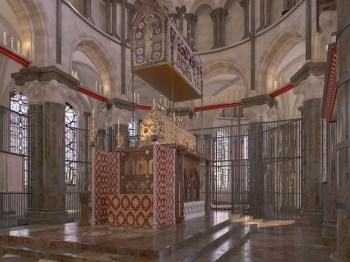
A reconstruction of the Thomas Becket shrine in Canterbury Cathedral. Source: Smithsonian Magazine

The first miracles reported following the death of Becket took place at his tomb.  Hundreds of others soon followed, 703 being reported within the first 10 years, many recorded by Benedict of Peterborough.  Within twenty years of the murder, no less than twenty biographies had been written about the saint including contemporary accounts including, for example, those by John of Salisbury, Edward Grim and Benedict of Peterborough, the latter listing many of his miracles.  Images of him in various media appeared all over Europe, and his relics spread just as far.  As the Oxford History of Saints comments laconically, “His faults were forgotten and he was hailed as a martyr for the cause of Christ and the liberty of the Church.”  In short, Becket and the miracles associated with him went viral.

Thomas Becket pilgrim badge. Source: Museum of London

Fifty years after his death, a new shrine was opened with great ceremony, and St Thomas was moved into a new tomb within the shrine.  It was a spectacle of gold and precious gems, and was surrounded by stained glass windows telling the story of his life and miraculous works. At the height of its popularity, it attracted over 100,000 pilgrims a year. In the Jubilee year of 1420 the shrine earned £360 for Canterbury Cathedral, which equates today to around £231,483, which could have purchased 83 horses or 620 cows (data from the National Archive’s Currency Convertor) or could have been used to build a new section of cathedral.  Images and symbols of St Thomas were moulded into ampullae and badges for the hundreds of pilgrims who visited his Canterbury shrine.  The shrine no longer survives; it was destroyed in 1538  under the orders of Henry VIII.
——–

The Becket boss at St Werburgh’s Abbey

The Lady Chapel

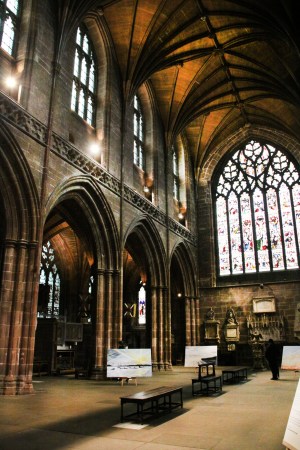
The Lady Chapel, Chester Cathedral

St Werburgh’s Abbey featured many architectural-sculptural elements which embellish the core structure of the building, providing focal points, colour and a hint of glamour.   The Lady Chapel was built under Abbot Simon de Whitchurch (1265-1291).  In Burne’s words, “He was evidently an outstanding character and under him the abbey flourished exceedingly.”  It was a period of great prosperity for the abbey, with an income derived from, amongst other things, church pensions (a sort of tax), appropriated church tithes, gifts of houses and lands, and possibly pilgrimage to the reliquary-shrine of St Werburgh, although the new shrine  to the saint was not built until the 14th century, and it is unclear how important it was as a pilgrim destination before then.

Although the earliest known Lady Chapel predates the Norman invasion, the Lady Chapel became particularly important in the 13th century when the Virgin Mary was undergoing a resurgence of devotion.  The elegant, vaulted Lady Chapel St Werburgh’s was built in the 13th century.  Like most Lady Chapels it was built to the east of the High Altar, projecting from the main building.  Here clerics performed daily services to the Virgin Mary. It is easy to forget that most architectural elements would have been brightly painted, but the Lady Chapel in Chester Cathedral, restored to a typical colour scheme of green, blue, red and gold in the 1960s, provides an excellent example of how these components would have looked.  The lancet windows at the end of the chapel date to 1869, when Gilbert Scott removed the later Perpendicular window to be more faithful to the 13th century vision.

The Holy Trinity, with God holding the arms of the crucifix in his hands

Some Lady Chapels are large and ornate, but in some cases they form smaller, more private and tranquil spaces than other chapels within a monastery or cathedral.  The Chester example is delectable, its small footprint and relative height giving a sense of both intimacy and space.  The reconstructed shrine of St Werburgh, a victim of the Reformation’s hostility to reliquaries and idolatry, is located at its east end, but according to Jessica Hodge was probably originally at the east end of the quire.
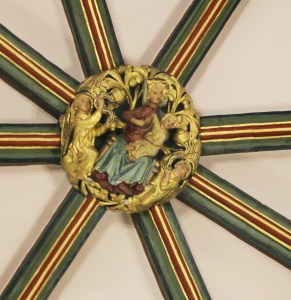
The ceiling bosses form a row across the centre of the chapel, from east to west.  The east end was symbolically the most sacred, and it is at the east end of the chapel that the ceiling boss showing the Holy Trinity is located.  In the centre is, the Virgin Mary is depicted, and at the west end is the Becket boss.  The chapel was created during a period of great religious significance during the reign of Henry III, who had been crowned for the second time in 1220, the same year in which Becket’s remains were moved to a custom-built shrine on July 7th 1220, reinvigorating the already vibrant cult. The spectacular event was used by both the Archbishop of Canterbury, Stephen Langton, and the king to help to heal the ongoing rift between the Church and the king.  In 1225 Henry ratified the Magna Carta, granting the freedom of the Church.  This was a momentous decade in the Church’s history and religious houses throughout Medieval England rode the crest of this remarkable period during the rest of the century with new architectural projects, rebuilding, expanding and celebrating.  By 1260-1280 when the Chester Lady Chapel was built, it was the centenary of Becket’s death.  It is possible that the Becket boss was installed to commemorate this event following an ecclesiastically bright start to the century.

The St Thomas ceiling boss

Ceiling bosses are both architectural and sculptural elements, usually circular or sub-circular, positioned in the ceiling where the vaulting ribs that form arches meets, either to hide the join, or acting as keystones to add structural integrity to the complex set of tensions and stresses. There can be much more to them than first glance suggests, and behind the decorated end, an undecorated portion of the boss may be inserted into the join.  Examples on the floor of the cloisters provide a good idea of this, showing the decorated section that would face down, and the plain stump that would be inserted into the join.

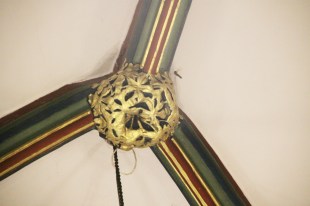
Three relatively large stone vaulting bosses were provided at the point where seven or eight stone ribs of the slender vaulting meets, each carved and painted with a different aspect of Christian iconography.  Smaller bosses were also added to at vault joins, where three or four ribs meet, sculpted into beautiful foliage, and gilded.  Corbels, where the vaulting ribs begin, are also decorated with foliage.  These carved stone features would all have been carved and painted prior to installation.  The white painted ceiling and walls between the brightly coloured features are the perfect foil for them, providing them with reflected light and emphasizing the  rich colours.

The Becket scene offers a sanitized version of the traumatic event on 29th December 1170, recycling a scene that bears only a passing resemblance to the terrible violence of reality, one version of a standardized formula for representing this event, an overstuffed and static little scene that looks rather like a posed portrait, with all of the protagonists shown full face, as though looking towards a camera. The composition is curious.  Three knights dominate the scene.  Sir Reginald FitzUrse is identifiable, as he is in the Exeter ceiling boss of this scene, by the bear’s head on his shield.  One knight at the front strikes at Becket’s head.  At the back of the group is clerk Edward Grim holding a cross and appears to preside over the scene.  Becket is squashed into the lower right hand section of the scene, kneeling behind an altar, his hands held, palms outwards, in front of him.  Behind him, even more squashed and barely visible, is the fourth knight, striking at Becket’s head, his sword converging with the sword of the knight in the foreground.  In spite of all four swords, the most dynamic element of the scene is the way in which Becket’s hands are raised in front of him, either in prayer, supplication or in a gesture of surrender.

Exeter Cathedral ceiling boss. Source: Feasts, Fasts, Saints and the Medieval Church blog

By contrast, the Exeter ceiling boss, which Burne says is about a century later, makes rather more compositional sense, placing Becket at the centre of the scene, looking out at the viewer with his hands raised, whilst the knights crowd in on him, intent on their deadly purpose while Grim does his best to ward them off.  It has far more dramatic impact, and is easier to understand as a narrative.  Both bosses share the same formulaic approach to the event.

When the chapel was built between c.1260 and 1280, over a century had passed since the martyrdom of Becket, and the detail of the real event had become less important than its symbolism and the theological narrative built around it.  Becket shown praying in front of an altar conveyed the sense of Becket’s purity and holiness far more efficiently than the actual scene of anger, shouting and resistance that preceded the murder. Similarly, the Grim was not a cross-bearer clerk.  However, there is an obvious dramatic advantage to showing him holding the cross as he confronted the knights in support of Becket.  It remains a peculiarity of the scene that the knights and Grim are the central characters, whilst Becket is squeezed to the side.

Who was the intended audience?

Lady Chapel, Chester Cathedral

In the 13th century the eastern end of the abbey church was the exclusive domain of the abbey monks, and it is unlikely that the Lady Chapel was seen by anyone else.  By the 14th century, the pilgrim status of Chester, with the miraculous holy rood in St John’s, and nearby pilgrim destinations at Holywell and St Asaph, lead to a reinvigorated interest in the Anglo-Saxon St Werburgh.  A new shrine to St Werburgh was built in the 1300s and according to Jessica Hodge, was situated at the east end of the quire, presumably accessed via the nave and the north aisle.  Pilgrims to the shrine would therefore have been granted access to the usually private east end, and they may have been shown the neighbouring Lady Chapel and the Becket boss as part of their pilgrimage.  Some of them may have included a visit to the Nunnery of St Mary in their travels, which possessed a relic in the form of the girdle of Thomas Becket.

Lady Chapel corbel

When they were new, the monks would have been well aware of the subject matter of the ceiling bosses.  As time went by they may have been repainted and repaired, but there will have been periods when they receded into the background.  Even today, people don’t always look up, and even when they do, they are not always sure what they are looking at.  Even if access had been generally available, the ceiling bosses are so high up that it is difficult to see the detail without either a telephoto lens or a ladder.  When I was last there, I pointed the Becket boss out to a lady who asked what I was photographing, and the only way that she could make it out, even with her distance glasses on, was to see the enlarged image on the screen of my digital camera.  Similarly, I only really got to grips with the subject matter on the other two bosses by photographing them and bringing them up on my computer screen later.

If one factors in the available lighting in the Middle Ages, which was confined to any light that passed through the stained glass windows, supplemented by candles, it is unlikely that these bosses were generally very visible from the ground.  Compare them with those in the enclosed walkway (cloister), which are much closer to the ground and therefore much easier to appreciate.

Why were images of Becket purged during the 16th century?

The Becket boss prior to restoration. Source: Godfrey W. Matthews, The Becket Boss in the Lady Chapel, Chester Cathedral

Chester became a cathedral after the Benedictine monastery of St Werburgh was dissolved by Henry VIII.    In spite of this lucky escape, it is possible that the ceiling boss was deliberately defaced at this time. Godfrey W Matthews, writing in 1934, described it as follows:  “It is very badly worn, which is curious, as the two bosses to the east of it are in a good state of reservation.  It is possible that some attempt had been made to deface it, for the figures suggest chipping.” Henry VIII imposed a policy of extreme prejudice against Becket, ordering all images of him to be destroyed.  The tomb and pilgrim shrine in Canterbury were removed in 1538 and Becket’s mortal remains disposed of.  Images throughout the country were removed.

Chester Cathedral also came under fairly savage review during the Reformation, when various architectural features and monuments were maimed or destroyed to remove overtly Catholic themes.   Most of the survivors are in high places that were difficult to reach.

Are ceiling bosses works of art, or mere architectural flourishes?

Stonemason, artist and researcher Alex Woodcock, whose PhD focuses on Exeter stone sculptures, highlights how the bright colours and dark shadows at Exeter were contrasted to give reveal a sense of depth and to emphasise the three dimensional character of the bosses and corbels.  This can be seen at Chester as well, where the depth of the three dimensional aspect of the sculpted forms provides a sense of theatre and allows simple shapes to be very skilfully highlighted.  Woodcock points out that architectural sculpture “is often assumed to be secondary to free-standing sculpture, possibly because of its very architectural function” and that because the boss would have been there anyway, the images are seen less as art than mere decoration.  As he points out, however, “in terms of the hours needed to complete the carving using hand tools, their production would appear almost prohibitive in terms of expense today.”  Not all ceiling bosses and corbels are good art, but many of them are tremendous and well worth the time taken to appreciate them as stand-alone works.

Final Comments

The Lady Chapel in the 1870s. Source: Blomfield 1879

Most of us learned a version of the “turbulent priest” story at school.  This was a man who stirred up hornets’ nests in his role as Archbishop of Canterbury, both within the royal court and within the cathedral.  He divided opinion in his own lifetime, finding friends and making enemies.  His immediate legacy was to generate a healthy income for Canterbury Cathedral, as pilgrims flocked to share in the wonders of the miracle-worker.  Politically, he became an ongoing reminder of the conflict between royalty and the Church, a symbol not merely of spiritual martyrdom, but carried with him a morality tale about the dangers of the crown having absolute power over both the church and the people.

On a vaulting boss in Chester Cathedral, accompanied by the Virgin Mary and the Holy Trinity, Becket and his murderers look down on the visitor.  Representing a scene of appalling violence, Becket, Grim and the errant knights are a reminder that throughout the early Middle Ages, the Church and the King were equally powerful, and serious conflicts ran the risk of monstrous outcomes.
After nearly 400 years of popularity, Becket and his legacy were terminally undermined by Henry VIII and the Reformation, destroying his images in cathedral, church, monastery and private residence.  Queen Mary briefly restored both Catholicism and Becket’s status, but Elizabeth I followed her father’s lead.  Although Becket is remembered today, the split from the papacy and the tidal wave of the Reformation swept away his significance and his popularity in Britain.  Having said that, the lady I was chatting to in the Lady Chapel in Chester Cathedral told me that in the congregation of her Liverpool Anglo-Catholic church they follow the missal, and continue to commemorate the date of Becket’s murder.  Although he survives mainly as a historical figure, Thomas Becket has not vanished from view.

Sources:

Books and papers

Bartlett, R. 2013. Why Can the Dead Do Such Great Things? Saints and Worshippers from the Martyrs to the Reformation.  Princeton University Press

de Beer, Lloyd, and Speakman, Naomi 2021. Thomas Becket,  Murder and the Making of a Saint.  The Trustees of the British Museum

Blomfield, Reverend Canon 1859. On the Lady Chapel in Chester Cathedral. Courant Office. Digitized by Project Gutenberg
https://www.gutenberg.org/files/61922/61922-h/61922-h.htm

Burne, R.V.H. 1962. The Monks of Chester. The History of St Werburgh’s Abbey. SPCK.

Crouch, D. 2017. Medieval Britain, c.1000-1500. Cambridge University Press

Farmer, D. 2011 (5th edition). The Oxford Dictionary of Saints. Oxford University Press

Guy, J. 2013. Thomas Becket. Warrior, Priest, Rebel, Victim.  A 900-Year-Old Story Retold.  Penguin

de Hamel, C. 2020.  The Book in the Cathedral. The Last Relic of Thomas Becket. Allen Lane

Hamilton, B. 2003.  Religion in the Medieval West.  Arnold.

Hamilton, S. 2021. Responding to Violence: Liturgy, Authority and Sacred Places c.900-c.1150.  Transactions of the Royal Historical Society 2021, 31 (202), p.23-47.

Hodge, Jessica 2017.  Chester Cathedral. Scala Arts and Heritage

Jenkins, J. 2023. Who Put the ‘a’ in ‘Thomas a Becket? The History of a Name from the Angevins to the Victorians, Open Library of Humanities 9(1) https://olh.openlibhums.org/article/id/9353/

Luxford, Julian 2005. The Art and Architecture of English Benedictine Monasteries, 1300-1540.  A Patronage History. The Boydell Press p.21-27

Matthews, G.W. The Becket Boss in the Lady Chapel, Chester.  Historic Society of Lancaster and Cheshire 86, 1934, p.41-46

Orme, N. 2017. The History of England’s Cathedrals. Impress

Schmoelz, M. 2017. Pilgrimage in medieval East Anglia.  A regional survey of the shrines and pilgrimages of Norfolk, Suffolk, volume 1.  Unpublished PhD thesis, University of East Anglia, June 2017

Webster, P. 2016. Introduction. The Cult of St Thomas Becket: An Historiographical Pilgrimage.  In Gelin, M and Webster P. (eds.) The Cult of St Thomas Becket in the Plantagenet World, c.1170-1220.  Boydell and Brewer.

Williams, Godfrey W. 1934.  The Becket Boss in the Lady Chapel, Chester.  Historic Society of Lancaster and Cheshire 86, 1934, p.41-46

Woodcock, A. 2018 (2nd edition). Of Sirens and Centaurs.  Medieval Sculpture at Exeter Cathedral. Impress Books

Websites

British Museum
A Timeline of Thomas Becket’s Life and Legacy
https://www.britishmuseum.org/exhibitions/thomas-becket-murder-and-making-saint/timeline-thomas-beckets-life-and-legacy
Who Killed Thomas Becket? (by curators Lloyd de Beer and Naomi Speakman)
https://www.britishmuseum.org/blog/who-killed-thomas-becket

Museum of London
Thomas Becket: a life and death in badges. By Kirstin Barnard.  13th February 2020
https://www.museumoflondon.org.uk/discover/thomas-becket-life-and-death-badges#/

Smithsonian Magazine
Researchers Digitally Reconstruct Thomas Becket’s Razed Canterbury Cathedral Shrine. By Meilan Solly.  9th July 2020.
https://www.smithsonianmag.com/smart-news/researchers-digitally-reconstruct-thomas-beckets-lost-canterbury-cathedral-shrine-180975280/
St Werburgh, Queen Æthelflæd, pilgrim badges and the shrine in Chester Cathedral

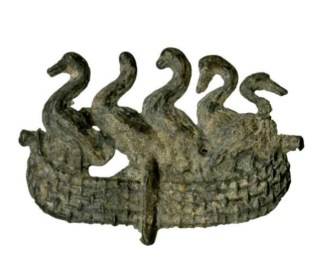
St Werburgh pilgrim badge, possibly 14th century, cast in lead alloy, purchased by the British Museum from a London dealer in curiosities, medals and coins. British Museum 1836,0610.73

Had you been a pilgrim in the middle ages, undertaking a journey to Chester to visit the miracle-performing shrine of St Werburgh, you might have been tempted to buy yourself a pilgrim’s badge to commemorate a job well done and to communicate your achievement to others. Most importantly, however, you would have had the opportunity to touch that badge to the saint’s shrine in order to absorb some of the saint’s divine power into the badge itself.  That’s what you are looking at on the left – a pilgrim’s badge associated with the Abbey of St Werburgh, which would have been sold to pilgrims either as they arrived, or as they left via the gift shop.  Badges like this were associated with many of the major shrines and could be added to an existing personal collection, representing the piety implied by many pilgrimages.

When I first came to live in the Chester area, just a couple of years ago, I knew the name St Werburgh and recognized that it was Anglo-Saxon, but it was a surprise to realize that she was a female saint, and that there was a pilgrim shrine dedicated to her in the former abbey (now the cathedral).  Nor did I know that the pilgrims who came to visit the abbey might purchase a badge as a token of their visit, a pious badge of honour, sometimes the signal of  the many discomforts or difficulties that had been overcome to enable a pilgrimage to be successfully completed.

Chester Cathedral, formerly St Werburgh’s Benedictine Abbey, from the east. Photograph by Stephen Hamilton.

What I particularly like about pilgrim badges is that there are so many threads to the story. An anonymous pilgrim once owned the above token of his or her journey to the shrine, now in the British Museum (albeit not on display). The British Museum purchased it in 1836 from a dealer in medals and coins called Harry Cureton.  The story of this particular badge between the time of its manufacture to its purchase by a dealer before being accessioned into the British Museum’s collections is lost, but its story is embedded in other, much older histories, including the actions of the Anglo-Saxon queen who moved that saint from Staffordshire to Chester in the 10th century, and the subsequent centuries of pilgrim visits to the abbey to experience St Werburgh for themselves.

So who was the  Anglo-Saxon saint, where was she from, why did she become central to Benedictine worship in Chester after her death, what is the geese-in-a-basket pilgrim badge all about, and what role did the shrine of St Werburgh play in the economic life of Chester’s abbey?

  • St Werburgh and her family
  • St Werburgh’s posthumous arrival in Chester
  • St Werburgh in the Benedictine monastery of 1093
  • The miracles of St Werburgh at the monastery
  • The 14th century shrine
  • Pilgrims to the shrine in the later Middle Ages – a nice little earner
  • How pilgrim badges were made, sold, worn and used
  • The Dissolution and subsequent events
  • The shrine in the 19th century
  • From Harry Cureton to the British Museum
  • Final Comments
  • Videos
  • Sources

St Werburgh and her family

Werburgh was born a Mercian princess in around AD650.  Her father was Wulfhere, king of Mercia and her mother Ermengild, who became a nun on the death of Wulfhere, first at Minster-in-Sheppey and then at Ely, where she succeeded her mother Seaxburgh as abbess.  Werburgh was educated at home by Chad, who became Bishop of Lichfield.  Although St Werburgh is depicted in a couple of the stained glass windows in the cathedral, these are modern, romanticized visualizations.  There are no contemporary depictions, and apart from having an idea of what she may have worn, her appearance is unknown.  Medieval accounts of her life probably incorporate older material, and almost certainly include quite a bit of myth and conjecture. 

Saint Æthelreda of Ely from the 10th century Benedictional of St. Æthelwold, illuminated manuscript in the British Library. Source: Wikipedia

On the death of her father, Werburgh went as a nun to the convent of Ely founded by her great aunt Æthereda (also known as Æthelthryth), who became its abbess.  St Æthelreda was the daughter of Anna, king of East Anglia, sister of Seaxburgh and the virgin wife of Egfrith, the king of Northumbria.  Werburgh’s father was succeeded by his brother Æthelred, Werburgh’s uncle, who eventually asked Werburgh to take charge of and organize nunneries in the Midlands, including Weedon in Northamptonshire, Hanbury in Staffordshire and Threckingham in Lincolnshire (or alternatively Trentham in Staffordshire).  She was so pure and good that she could hang her veil on a sunbeam.  She died at Threckingham / Trentham in around 700, and was buried at Hanbury, at her own request.  Unfortunately, the nuns at Threckingham were unwilling to release the remains, and a delegation was sent from Hanbury to retrieve her.

Saints were not canonized by the papacy until the 12th century, but had to be verified by bishops.  The miracle that caused Werburgh to be recognized as a saint was an unusual one.  Although there are a number of versions of the story, the differences are minor.  One version says that St Werburgh had enjoyed watching a visiting flock of geese in a neighbouring meadow of the convent in which she was staying.  One of them was particularly large and had a black ring of feathers around his neck.  She became fond of him and called him Grayking.  The convent steward, Hugh, had also noticed Grayking but his interest had little to do with aesthetically pleasing plumage.  Angry with the geese for devastating his field of corn, Hugh soon had Grayking in the pot.  One version says that Werburgh was away when this happened, and when she returned the remaining geese formed a delegation to inform her of the event and ask for her help.  Werbugh acted immediately, ordering that the bones and feathers of the carcass should be gathered up. When she commanded the bones of the dead goose to rise again, they assembled themselves and Grayking was reborn.

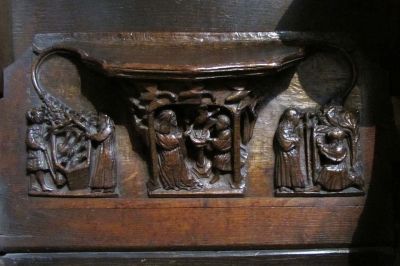
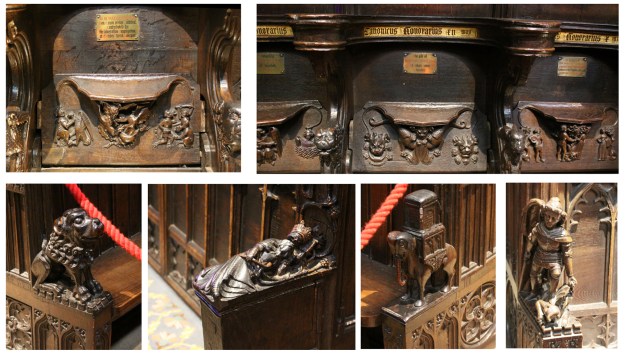
Late 14th century misericord in Chester Cathedral showing St Werburgh performing miracles. Photo by Stephen Hamilton. Source: Wikipedia

Dr Thomas Pickles (Senior Lecturer, Medieval History) recounts a slightly different version of the story in the video at the end of the post.  He goes on to discuss why other similar stories in across Europe may have developed in response to sacrifices at the time of harvests, which may have became Christianized via labourers who worked the land belonging to religious organizations, giving the St Werburgh miracle story wider relevance.

Nine years after her burial, St Werburgh’s nephew Coelred, now King of Mercia, decided to move the saint to a less modest tomb in Hanbury. When she was removed from her coffin she was found to be “in whole and perfect form,” a certain mark of sainthood.

St Werburgh’s posthumous arrival in Chester

A 13th century imaginative representation of Æthelflæd. Source: Medieval Manuscripts blog

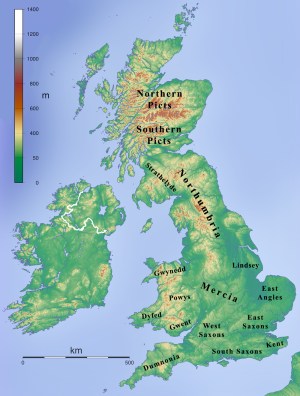
St Werburgh never visited Chester during her lifetime, and her arrival in the Anglo-Saxon burh (fortified settlement) in around 907, over 200 years after her death, requires another thread of history that starts, for the practical purposes of this post, with Alfred the Great, King of Wessex (848 – 899AD).  Alfred’s daughter was the princess Æthelflæd who, at the age of around 15, was married for political reasons to Æthelred, king of Mercia. Æthelflæd grew up in a time of disruption and war, during the Viking incursions, and the associated competition for territory.  She was also familiar with the arts of diplomacy and negotiation.  She was well suited for the role of queen of Mercia.  Although subordinate to her husband, with duties and responsibilities, she also had rights, privileges and a position of respect that she clearly built on, being recognized as partner to her husband in many of their joint enterprises, including the establishment of new burghs at Worcester and Gloucester, whilst improving existing towns such as Hereford and Winchcombe. 

Æthelflæd’s father, Alfred the Great, died on 26th October 899, and was succeeded as King of Wessex by his eldest son, Edward the Elder, brother of Æthelflæd.  Edward was forced to fight off a counter claim from his cousin Æthelwold.  He was triumphant but was forced to address the situation again in 902 when Æthelwold unsuccessfully mounted another campaign against Edward. In the same year Æthelflæd’s mother died, probably in St Mary’s Abbey in Winchester, which she had founded, and a threat was made to the northwestern territory of Mercia at Chester.  It was only now, when the vulnerability of the old town threatened the security of the kingdom of Mercia that it drew attention from Æthelred and his Æthelflæd.   In the last decade of his life Æthelred suffered a recurring illness, and he had succumbed to a bout of this affliction when Chester came under threat. Æthelflæd assumed authority during the crisis.

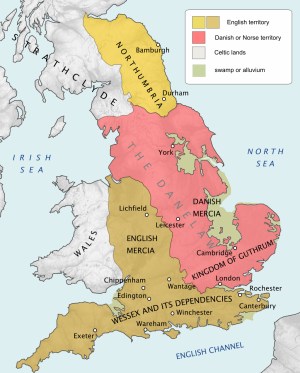
Kingdoms in England in AD878, by Hel-hama. Source: Wikipedia

In the 890s Chester was described in the Anglo-Saxon Charters as “a deserted city in Wirral.”  It still had much of its Roman walls, but the interior was in ruins.  Mercia had been a much larger and more powerful kingdom in its past, but the Viking (Scandinavian) invasions had taken control of the eastern reaches of the former kingdom.  In the south, Wessex was the most powerful kingdom, whilst in the northeast the king of Northumbria still held land on the east half of the island, extending well into present-day Scotland.  The Dane-controlled land ran down much of the east coast south of Northumbria, and there was a significant Scandinavian presence in Ireland.

It was from Ireland that the threat to Chester emerged.  In 902 the Irish kings formed an alliance to rid themselves of the Vikings, capturing Norse Dublin and forcing many to leave as groups of refugees in need of new lands to colonize.  One of these refugees was Ingimund, who lead one of these ousted groups onto Anglesey.  Forcibly ejected by the Welsh, they followed the Dee inland towards Chester.  According to one source, they requested a meeting with the Mercian royalty.  With Æthelred still sick, Æthelflæd met with Ingimund who proposed a peaceful solution to the dilemma.  Æthelflæd was pragmatically willing to negotiate a home for them on the north of the Wirral peninsula, perhaps believing that they might provide a protective buffer against other Viking interests seeking to find new territory to colonize.  Here they could have lived in peace by farming and trading via the sea routes, but they had been settled for only a few years when Ingimund broke faith with Æthelflæd and began to amass troops.  Hearing of the threat, Æthelflæd assembled forces of her ow within the Chester walls.  The town was besieged but the Mercians emerged triumphant.

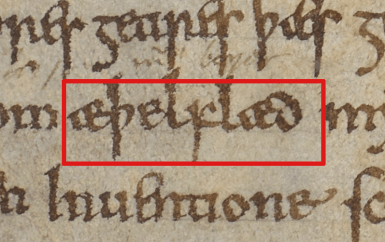
Æthelflaed’s name (spelled Æþelflæd), in the B-text of the Anglo-Saxon Chronicle: Cotton MS Tiberius A VI, f. 30r. Source: Medieval Manuscripts Blog

In 907 the Anglo-Saxon Charter says that Chester was “restored,” the work usually credited to Æthelflæd.  With Æthelred temporarily restored to health, they couple established Chester as a new burgh within the 5m (16ft) tall walls encompassing an area of 26 hectares (65 acres).  It was far bigger than their previous burhs, and represented a significant investment in the border town.  At the same time, Æthelflæd took the decision to move the relics of St Werburgh from Hanbury to Chester.  The timing was probably driven by the threat to the relics of St Werburgh at Hanbury by advancing Danish forces. This echoes Æthelflæd’s decision to move the relics of St Oswald from lands under Danish occupation, which took place under similar circumstances.  The decision to move St Werburgh to Chester may have been motivated by the need to give Chester an authentic, stabilizing Christian focus with links back to a noble Mercian past.  The creation of a prominent settlement in a vulnerable borderline position needed to attract people with the same features familiar from other towns.

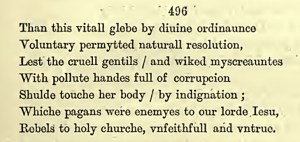
According to St Weburgh monk Henry Bradshaw, writing in c.1513, but probably referencing much earlier sources, when the saint was removed to Chester, her body was found to be ‘resolued unto powder’, which was seen not in terms of decay or corruption of the remains, but as a divine miracle performed to protect the saint’s holy remains:

Lest the cruell gentils / and wiked myscreantes
With pollute handes full of corrupcion
Shulde touche her body / by indignation

Excerpt from Henry Bradshaw’s “The Life of St Wereburge of Chester,” originally 1513, re-edited and published 1887

Although there is no incontrovertible data to support the presence of a church on the site of St Werburgh’s Abbey, there is a tradition that a wooden church dedicated to Saints Peter and Paul had been founded there by Æthelflæd’s father Wulfhere, King of Mercia, which would have housed her remains.  This church would have been rededicated to St Werburgh when the saint became resident.  Archaeological excavations produced pre-Norman building materials, but it is not possible to assign an early 10th century date to them.  Wherever the church was located, the patronage of the queen ensured the initial success, and it received additional grants throughout the 10th century, including one from King Edgar in 958.  In the 1086 Domesday survey records the monastery and its possessions, indicating that the Anglo-Saxon St Werburgh’s was upgraded from church to monastery sometime before that date.

In 911 Æthelred died of unknown causes probably related to his recurring illness.  He was buried in Gloucester.  Many previous royal widows of the period had retired to a convent to live out the rest of their lives.  There was plenty of precedent in Æthelflæd’s own family for monastic service.  One great aunt was the founder of Ely Abbey, another was the founder of Minster-in Sheppey abbey, and Æthelflæd’s own mother had retired on the death of Wulfhere to a nunnery, eventually becoming abbess of Ely.  Æthelflæd, however, took the reigns of the Mercian government into her own hands, ruling as myrcna hlæfdige, Lady of the Mercians.  The church-monastery of St Werburgh continued to house the saint’s remains, and seems to have survived the military action that took place in and around Chester following the Conquest.

St Werburgh in the Benedictine monastery of 1093

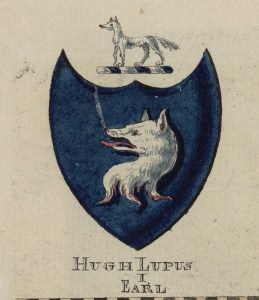
Coat of arms of Hugh d’Avranche. Source: Wikipedia

In 1093, only 27 years after the Norman Conquest, the abbey was refounded as an Anglo-Norman Benedictine abbey by the notorious knight and magnate Hugh d’Avranches, also known as Hugh Lupus.  Hugh and been granted Chester as Earl by William I, and was one of the most powerful men in England.  His appointment followed William I’s vengeful retaliation against Chester for two rebellions, which had left the city in disarray.  Hugh’s task was to ensure that the city remained docile after William departed, serving the crown as the northenmost marcher town, a buffer zone between Wales and England, and an increasingly important commercial port.

There were many possible reasons for landowners to found monastic establishments, including convention (it was often seen as the duty of the nobility to promote religious houses), political maneovering, simple piety, and fear of the ever-approaching perils of the afterlife.  Hugh’s decision to refound the abbey was probably  two-fold.  Whilst making a conspicuous contribution to a deeply resentful city for which he was now responsible, and in which he needed to maintain the peace, he was also looking after his own spiritual interests.  He managed to secure one of the most high status bishops in the country, Anselm to come and supervise the project, and Anselm left his clerk Richard to become the first abbot.  Hugh endowed his shiny new monastery with rich and prosperous lands to ensure its self-sufficiency.  These were not merely charitable acts.  Hugh Lupus, for example, was heading perilously towards the end of a far from virtuous life.  John Hicklin, writing in 1852, gives an evocative summary of the situation

Hugh Lupus, following the example of most of his predecessors, lived a life of the wildest luxury and rapine.  At length, falling sick from the consequence of his excesses, and age and disease coming on, the old hardened soldier was struck with remorse; and—an expiation common enough in those days—the great Hugh Lupus took the cowl, retired in the last state of disease into the monastery, and in three days was no more.

By founding a monastery and committing himself to a brief period as a monk at the last possible moment, Hugh attempted to provide himself with some after-life insurance.  The logic of this is somewhat difficult to compute today.

The curvilinear Romanesque remains of the abbey financed by Hugh Lupus, seen through a later gothic arch.

Monks were considered to be closer to Heaven than any other human on earth, and their prayers were thought to be heard with undiluted clarity by God.  The idea of pleasing God by founding a monastery, and then reaching closer to Heaven by being buried within the monastic cloister seems suspiciously like inducement today, and one would have thought that God would have been wise to such manoeuvring.  Given the sheer number of wealthy men and women founding abbeys and priories, however, this aspect of the matter does not appear to have occurred to them.  Matters had became much more contractual during the 11th, when the idea of purgatory was taught in the church.  This intermediate area between heaven and hell allowed redeemable sinners to suffer a hell-like experience to work off their crimes against Christianity before eventually entering Heaven.   From this time onward, substantial efforts were made to negotiate for reduced time spent in purgatory, including the buying of “indulgences,” and gifts from the lower echelons to monasteries.

After the original endowment, the abbey continued to receive many properties over the centuries from wealthy local landowners, and smaller gifts in the wills of those who were not quite as well positioned, all attempting to win the good will of the monks, and through them, the divine.  Those with less purchasing power would not anticipate having the same negotiating power, but every contribution might help.  In the process of all this human fear and negotiations to minimize the inevitable punishments after death, monasteries became substantially wealthy, some of the richest landowners in the kingdom.  Land was not, however, their only form of income.  Not all monasteries were lucky enough to secure the bones, blood or hair of a saint that might attract pilgrims, but the abbey of St Werburgh still retained the bones of St Werburgh after its rebuild in 1093.

The miracles of St Werburgh at the abbey in Chester

Neither Goscelin de St-Bertin writing in the late 11th century, nor William of Malmesbury, writing in the 12th century were able to provide many details about the earlier miracles that St Werburgh was supposed to have performed at Chester, but William of Malmesbury has the following to say:  “The merits of this virgin are proclaimed at Chester and her miracles extolled.  Although she is promptly favourable to the petitions of all, she is especially quick to give heed to the prayers of women and children.”  Her girdle, held by the abbey, was apparently particularly popular with pregnant women.

Basingwerk Abbey today

In 1500 a monk at St Werburgh’s Abbey wrote a life of St Werburgh in which he credits her with a miracle on behalf of Richard, Earl of Chester in around 1120.  Richard made a pilgrimage to St Winifrede’s Well at Holywell in around 1120 but attacked by hostile Welsh men, he was forced to shelter at nearby Basingwerk Abbey.  Before William, Constable of Chester, set forth to search for the earl, he prayed to St Werburgh, who parted the river Dee because no boat was available, permitting William and his men to walk across the river bed and rescue the earl.  In another story, St Werburgh intervened during an unexpected Welsh attack on Chester.  She blinded the attackers, forcing them to retreat.  This military aspect to the saint is underlined by the tradition of taking the shrine on procession around the city when it was considered to be under threat, setting her down briefly on parts of the city walls.

In the 15th century the Welsh poets Maredudd ap Rhys and Guto’r Glyn called there, the one to pray to ease the pains in his legs, which was apparently a successful visit, and the other to pray for the alleviation of the ills of a friend.

The 14th century shrine

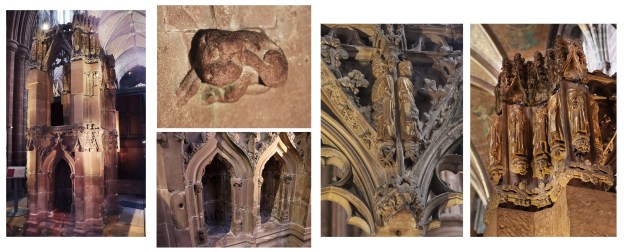
The reconstructed shrine of St Werburgh at the west end of the Lady Chapel in St Werburgh’s Cathedral, Chester.  It was reassembled in the 19th Century from broken -up parts, and it is impossible to say how closely it resembles the original 14th century shrine.  The warm lighting is as it would have been seen by candle-light.

Nearly 250 years after Hugh’s foundation, in around 1340 (just before the Black Death) a new red sandstone shrine was built for the saint, an elaborate gothic affair around 7ft (2.1m) tall, built to look like a chapel.  The new shrine, on two levels, contained whatever remained of the relics in the upper layer, whilst the lower half was provided with niches into which pilgrims could fold themselves to get even closer to the spirituality of the saint.  The top was decorated with statuettes for former Anglo-Saxon monarchs, most of whom are missing their heads today.  Little carved animals formed a line around the middle, images of the natural world that were as much part of God’s creation as people.  Today, the only one of these natural world carvings left is a tiny dog, scratching his ear with a hind leg.  The shrine was also, in all likelihood, bedecked with elaborate precious stones, its architectural details finished in gold.

Although today it is located in the 13th century Lady Chapel, it was originally located in the easternmost bay of the presbytery, behind the high altar.  The relics of the saint were encased very safely within the very top of the shrine, but the spiritual power of the bones themselves emanated from the relics, permeating the stone, so that touching the shrine was equivalent to touching the saint’s essence.  This was a powerful concept, and a vibrant presence in the monastery.   This substantial monument was a permanent fixture.  There would be no carrying the shrine through the town in times of threat or stress.

St Werburgh’s shrine showing the niches, the dog scratching it’s ear and gilded statuettes, some without their heads, of Anglo-Saxon kings. Click to enlarge

Pilgrims to the shrine in the later Middle Ages – a nice little earner

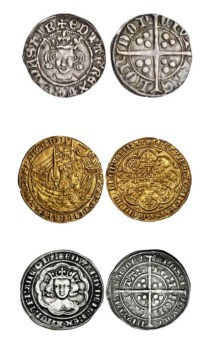
Mid 14th century coins. Source: Medieval Britain

Monks needed to make a living.  Monastic communities became more expensive as the centuries rolled forward, as the trappings of seclusion and self-denial fell away towards the 16th century.  Guests, who were not expected to pay for their upkeep, were always a drain on popular monastic establishments, and alms to the poor still had to be paid.  Expenses too accrued from the management of extensive estates, including wages for bailiffs and labourers, repairs to buildings and boundaries, and the costs involved in agricultural production.  Churches appropriated by the monastery for their incomes still involved costs, including the provision of an incumbent priest.  St Werburgh’s was often involved in legal disputes with Chester citizens, and this too was costly.  After the stricter earlier middle ages, standards began to slip in Benedictine monasteries.  Abbots rolled out ambitious extension plans for the monastic church, and required larger and more luxurious  quarters, which included spaces where VIP guests could be lavishly entertained, costly vanity projects that formed part of their legacy.  Provisions became more luxurious and more expensive.  The upkeep of a vast monastic architectural complex could be eye-watering, even without the occasional devastating fire or flood.  Balancing the books was a constant headache for monastic establishments.

Cripples collecting healing oil at the shrine of St William of York, York Minster, North Choir Transept. Early 15th century. Source: The Becket Story (© Dean & Chapter York).

By the later middle ages, when imaginative ways of generating income were increasingly critical to monastic wellbeing, pilgrims were a great way of generating income.  Pilgrimages were usually journeys of meaning, sometimes deeply spiritual and personal, characterized by any number of aspirations including cures for illnesses and defects, expressions of penitence, a wish to feel the presence of something holy, and the urge to give thanks for a prayer answered;  but pilgrimages could also be timed to enjoy feasts, fairs and markets, and as such were not merely pious and spiritual, but could be a sociable and enjoyable liberation from the mundane.  When pilgrims visited shrines, tombs and reliquaries to satisfy personal needs, the monastery expected pilgrims to show their gratitude to the saint and to Heaven by gifting a contribution to the monastic coffers in the form of “altarage.”  This was usually money, but sometimes it took the form of valuable gifts.  

Clusters of shrines were good news for everyone.  Pilgrims to a particular shrine would frequently do the rounds of all the other major religious sites and shrines in the immediate area, as well as those further afield in the region, soaking up all the divinity available.  In Chester itself, St Werburgh’s shrine was in competition with the miracle-performing Holy Rood (a sculpture of Christ on the cross) in St John’s the Baptist’s Church (next to the amphitheatre), which was reputed to  include a piece of the true cross, reputed to have been found by Helen, the mother of the Emperor Constantine.  It was installed in around 1250.  Although St Werburgh became a secondary attraction after this date, the rood at St John’s was far better known and carried more weight because the power of the crucifix of Christ himself was rather more compelling to pilgrims than an Anglo-Saxon saint.  It was to the Holy Rood of St John’s that Edward I took the nobility of Gwynedd men to swear fealty before himself and God. 

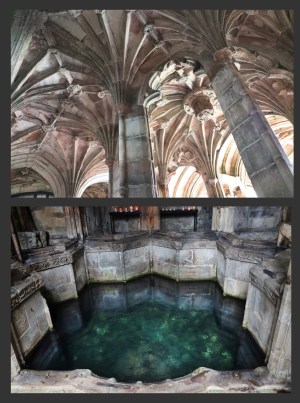
The glorious 15th century vaulting above the clear water of the inner reservoir of St Winifrede’s Well, Holywell.

Some shrines were more revered than others and had great pulling power, which could generate satisfying levels of income.  The ownership of St Winifrede’s Well in Holywell (northeast Wales), for example, alternated between St Werburgh’s Abbey and Basingwerk Abbey just down the hill from the well, depending on whether the English or Welsh were in control of the area, and this represented a useful form of income for whichever abbey was in command of its resources.  It is also probable that many of the pilgrims visiting Chester were en route to the Cathedral of St Asaph (Llanelwy), which contained the 6th century relics of the eponymous saint, renowned for his healing miracles, and St Winifrede’s sacred Well, enclosed by some superb gothic architecture.  These were located 28 (45km) and 14 miles (22km) away from Chester respectively, and 16 miles (26km) from each other.  The east-west pilgrim route between Holywell and St Asaph was well known by the later medieval period, making use of the Deva-Varis-Canovium-Segontium (Chester to Caernarfon) Roman road, which was crossed by Offa’s Dyke and took in the beautifully carved late 10th century Maen Achyfan cross, which still stands today.  At St Winefrede’s Well, the nearby Cistercian monks of Basingwerk Abbey provided all the facilities that the pilgrims might need to make the most of the experience.  The 7th century saint’s remains had actually been removed to Shrewsbury Abbey in 1138, but Holywell was the site of the miracle in which she died by beheading and was brought back to life, and was imbued with miraculous potency.  

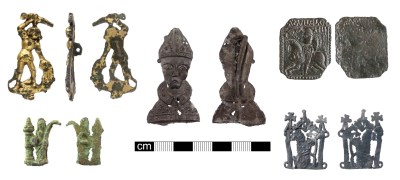
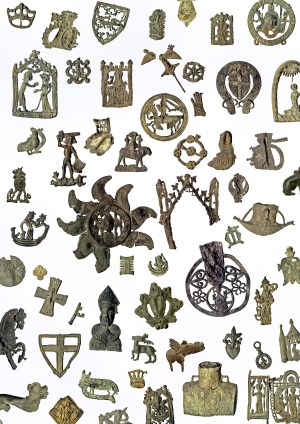
A selection of Medieval and post-Medieval pilgrim badges. Source: British Museum

Because pilgrims travelled to specific shrines, it is easy to think of pilgrimages exclusively in terms of destinations, but the act of making a pilgrimage was as much about the journey as the destination, and pilgrim routes could be both sociable experiences shared with like-minded individuals, and essential to the spiritual character of the undertaking.  As pilgrim routes became fixed in the religious round, they became special places in the landscape, with identities of their own, and features that singled them out as part of the greater network of pilgrim experience.

Although St Werburgh’s Abbey  would undoubtedly have preferred to be the most important of the local shrines, and would have done its best to attract pilgrims, it certainly benefited from the proximity of more fashionable and perhaps more relatable pilgrim destinations nearby, and the network of routes that connected them.  The 14th century shrine was almost certainly built to jump on the bandwagon of pilgrim visits to Chester, and to provide a more impressive and inclusive experience for pilgrims, without losing the connection with the Anglo-Saxon past. 

St Thomas Becket pilgrim badge. Source: Museum of London

There are no records surviving from St Werburgh’s to indicate what sort of income the monastery derived from pilgrims, but nearby  St John the Baptist’s Holy Rood was the second most important source of three primary sources of income for the church, amounting to in excess of £50.00 per annum in the 14th century (the National Archives Currency Convertor equates this, for 1350, to £29,361 in modern money or, for example, 72 horses or 135 cows.  This is half the value of the nationally important Ethelreda’s shrine at Ely, which in 1408/9 earned £19 9s 10d, and is a drop in the ocean to what St Thomas Becket’s shrines could attract from both British and western European pilgrims:  £120 in 1411 and a staggering £360 in the Jubilee year of 1420, which equates to day to around £231,483, which could have purchased 83 horses or 620 cows. St Winifrede’s Well earned an annual revenue by the time of the Reformation of £157 15s 2d, which probably included the sale of indulgences.

Altarage was also payable on saints feast days by anyone attending the celebration.  For St Werburgh, this day was 3rd February.  Again, we have no records for St Werburgh, but at Selby Abbey in Yorkshire, which held a shrine of St Germain, the festival of the Burial of St German on the 1st October in 1446-1447 earned the abbey 16s.8d., and the offerings for the festival of the Death of the saint on 31st July earned 6s.  The money-box (stipite) of St Germain accumulated £9. 14s 10d for the year.  Again, these were useful contributions to an abbey’s financial resources, amounting to £6790 in modern money, which would purchase 14 horses or 27 cows.

St Werburgh’s would have been a long way down the pilgrimage and altarage income scale, but the earnings would still have been valuable.

How pilgrim badges were made, sold, worn and used

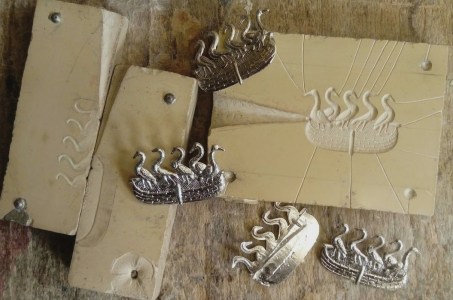
St Werburgh’s pilgrim badges being made in stone moulds. Photograph by Colin Torode of Lionheart Replicas, with my thanks to Colin for sending it to me.

Before badges were available, pilgrims might collect earth from around a shrine, or chip of small pieces off the shrine itself.  Small vessels could be used to carry holy water or oils.  Low-cost badges were a far more satisfying and permanent memento of a pilgrimage successfully undertaken, and first appear during the 12th century.  Decorated metal ampullae too, were manufactured to hold liquids, but in smaller numbers.  Wealthier pilgrims might order a custom-made item, which might be made of a more expensive material, but the less expensive materials are by far the most frequently represented in museum and personal collections.  By the 15th century they might cost as little as a penny for twelve.  One of the appealing aspects of the pilgrim badges is that the majority that survive today were clearly made for those who did not have much surplus cash to spend on souvenirs.

A selection of pilgrim badges. Source: The Digital Pilgrim website.

The badges were cast in moulds, which would have required careful crafting.  The mould was usually made of stone, preferably limestone.  A liquid alloy was poured into it to set, usually comingling lead with either pewter or tin.  Lead was locally available, and the other ores were inexpensive and could be imported.  Once solidified, the object was removed from its mould, trimmed, polished and was then ready to sell.  The photograph above  shows one of Colin Torode’s stone moulds, in use for making St Werburgh pilgrim badges for Lionheart Historical Pewter Replicas, which sells many replica pilgrim badges (I have their lovely St Werburgh geese-in-the-basket).  See the brief video by the Digital Pilgrims Project at the end of the post to see how some of these objects were made.

The pilgrim badges were sold at the abbey gates, or in stalls in town markets.  If purchased before a visit to the shrine, the pilgrim badge could be touched to the shrine, so that it would permeate the badge itself with its spiritual energy.  It could then be dipped into a liquid to be swallowed as a health cure or rubbed onto a wound as a salve.  Given its portability, it could also be carried back to someone who was unfit to make the pilgrimage so that they could benefit from the power of the shrine.

The pilgrim badges were usually worn with great pride, sewn on to items of outer clothing like hats or coats, or on bags.  Over time, as they became familiar and were transferred from old to new clothing, they probably became apotropaic lucky talismans, as well as items of religious meaning.  Sometimes they were pinned to walls of homes.

The Dissolution and subsequent events

The opening page of the Valor Ecclesiasticus, the beginning of the Dissolution of the monasteries, showing Henry VIII presiding over the nation’s extaordinary religious shake-up. Source: Wikipedia

Although Henry VIII ordered the dissolution of the abbey in 1536, its conversion into a cathedral saved it from wholescale destruction.  Although it retained most of its key components, some features fell victim to reformers.  Henry VIII’s withdrawal from the Catholic church was only realistically viable because of a movement in Europe that challenged what it saw as the papal hierarchy’s abuse of the core ideals of Christianity.  In 1517, nearly 20 years before the Dissolution, Martin Luther at the University of Wittenberg in Germany, disgusted by the financial corruption of the papacy and the clergy, began to  promote the emergence of a more honest, less moderated religion in which men and women could worship in their homes as well as in their churches and build a more direct relationship with Christ and God.  The existence of Purgatory was rejected, the appeal to saints for their intercession was deemed idolatrous, religious images that had been the focal points of worship were condemned, and the role of the clergy as a bridge between people and God was challenged.

In England the reform movement was politically and socially necessary both  to usher in Henry’s new era and to avoid the new religious house being labelled heretical.  Using Martin Luther’s reforming as a launch pad, an older, purer version of religion was sought.  As part of the process, effigies and saints were to be removed with extreme prejudice.  Targets of this reforming zeal included emblems of the later Anglo-Saxon period as well as those of the medieval period.  The 14th century shrine of St Werburgh really did not stand a chance.  The shrine was dismantled and parts were used to build a tomb for the first bishop.  Later, in 1635, elements were incorporated into an episcopal throne.

St Werburgh’s shrine in the 19th century

Sir Arthur William Blomfield at his drawing board. Source: Falklandsbiographies.org

When some pieces of the shrine were rediscovered in the 19th century, Sir Arthur Blomfield attempted a reconstruction, which is what stands in the Lady Chapel today.  The small statues of the Saxon kings do survive, but their heads are missing;  of the little figures that adorned it, only a dog scratching its ear with a hind leg now survives.  It was reassembled in the Lady Chapel.

Although St Werburgh no longer attracts pilgrims, the well of St Winefrede at Holywell, near Basingwerk Abbey on the north Wales coast, still does.  Although more usual in Catholic parts of Europe than in Anglican Britain, pilgrimage continues to offer the option of a spiritual journey today, and pilgrim badges continue to be collected by those who make the journey.  The gift shop at St Winifrede’s well contains a wide and colourful selection of religious memorabilia. See the Encountering a Pilgrim’s Medal video at the end of the post for comments on a modern pilgrim badge.

From Harry Cureton to the British Museum

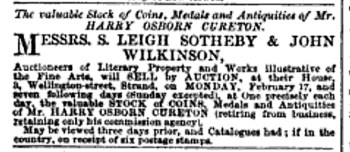
There’s one last thread to the story.  According to the British Museum’s records, in 1836 it purchased the badge at the top of this post from one Henry (Harry) Osborne Cureton who conducted his trade in London variously as a curiosity dealer, a medallist and coin dealer.   In the February 1851 edition of the Athenaeum an advert was placed, announcing that Cureton’s entire stock was being sold off due to his retirement. The British Museum’s web page about Harry Cureton suggests that that after this he may have been employ in some capacity at the Museum.  If the British Museum was one of the buyers of the collection advertised in the Athenaeum, Cureton may have been hired to catalogue the objects, of which the St Werburgh pilgrim badge may have been one.

Athenaeum no.1215, February 8th 1851 advert by Messrs S. Leigh Sotheby and John Wilkinson for the sale at auction of Harry Osborn Cureton’s stock of coins, medals and antiquities. Source:  Google Books

The badge is not on display at the British Museum, which is a shame but not terribly surprising.  As the British Museum’s Fact Sheet explains, it’s collection totals at least 8 million objects, of which roughly roughly 80,000 (1%) are on public display at any one time, the rest remaining in storage.

Just as one expects pilgrims to travel, one expects pilgrim badges to travel.  Margery Kempe, early 14th century wife, mother of fourteen children, visionary and pilgrim, managed to fit in pilgrimages to the Holy Land via Italy, to Santiago de Compostela in Spain, and to Danzig in Prussia.  We have no idea where the owner of the St Werburgh badge might have worn it on his or her travels, but it is not at all surprising to find that it ended its travels in London.

Final Comments

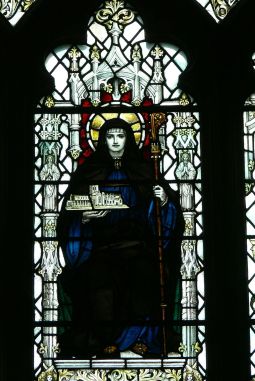
1916 window in St Werburgh’s in the refectory, showing an imaginative, romantic view of the saint. Photograph by Wolfgang Sauber. Source: Wikipedia

This post started with an image of geese in a basket, an emblem of St Werburgh that was cast and sold to pilgrims as a totem of their enterprising pilgrimage to the shrine of a Mercian princess, St Werburgh, within the abbey at Chester. By exploring the connection between a 7th century saint who was buried in Staffordshire and a 10th century Mercian queen who translated (transferred) the remains of the saint to Chester, we encounter the Viking colonisation of Britain.  The new shrine containing the saint’s relics in Chester was a powerful new emblem of Christian faith, using affinity to the earlier Anglo-Saxon past to provide meaning and reassurance in the very turbulent present.

In 1093, when Hugh Lupus, first Earl of Chester decided to put his stamp on Chester and, at the same time, pave his way to a comfortable afterlife by founding an impressive Benedictine monastery, the saint was provided with a new home, echoing Æthelflæd’s own intentions.  St Werburgh’s original Anglo-Saxon shrine was built to evoke both the past and the present, using history to provide a sense of continuity and stability as Chester entered a new era.  Some of this sense of the present being reinforced by the past was carried forward into the 14th century shrine as well.  St Werburgh went on to generate income for the monastery throughout the middle ages.    

Pilgrims on the road to Canterbury. John Lydgate’s Prologue of the Siege of Thebes c. 1457–1460: Royal MS 18 D II, f. 148r.Few pilgrimages would have been so comfortably and elegantly undertaken.  Source:  British Library

A pilgrim badge, even if it was mass-produced and relatively inexpensive, was an attractive symbol, and one to wear with pride, but was not merely an inanimate souvenir.  By touching it to the shrine, it became a conduit of spirituality, transmitting the essence, goodness and potentially curative powers of the saint within.  In an era in which Christ was universally accepted as being embedded in the Eucharist via transubstantiation, a Church-given reality, the idea of objects like pilgrim badges as agents of transformation was not a theoretical matter but another everyday Christian reality.  Intrinsically the badge had an active, multi-functional role as a medium of the shrine’s essence, and as a symbol of hope, piety, charity, perseverance and / or status. The medieval period offered pilgrims a fluid, multi-layered religious existence in which, if they were deserving, the secular and spiritual could mingle in certain places under certain conditions.  In a sense, whilst the shrine cannot be divided and shared, the pilgrim badge, the emblem of the shrine and sometimes the vessel holding the essence of the shrine, is a way of dividing the shrine infinitely amongst those who invested it with their beliefs and hopes.

Detail of St Werburgh’s shrine

The static 14th century shrine and the multiple, travelling pilgrim badges were firmly linked.  The shrine, unmoving, connected to a long-lost Anglo-Saxon past, was rooted to its particular spot. The pilgrim badges, by contrast, were all about the here and now, both for the craftsmen who made them and for the visiting pilgrims who purchased them.  The shrine would have existed without the pilgrim badges, but the badges were dependent on both the shrine and the pilgrims.  Whilst the memory was alive, the badge containing the memory remained a connected to the shrine via the pilgrim.  The shrine, acting as the anchor for such experiences, stayed firmly put, but its tendrils extended into the secular world via the tales told by the pilgrims who had visited, encouraging others to replicate the experience. 

At some point, the pilgrim badge was parted from the pilgrim.  Perhaps the pilgrim died and it was inherited by one of his or her children.  Later in its history it encountered another point of departure and re-entered into the world of commercial transactions.  Eventually, it found its way into the ownership of a dealer in portable objects, like medals and coins, and in the 1860s was accessioned into the collection of the British Museum, where it is now buried in storage.  Perhaps one day it will emerge to perform a role as a piece of valued heritage, but for the time being, it is divorced from any of the realities that it once served. 

St Werburgh’s replica pilgrim badge made by Lionheart Historical Pewter Replicas (photograph from their website)

Quite apart from looking great on my favourite black coat, my own replica St Werburgh’s badge (shown right) can be seen as an aspect of the St Werburgh shrine’s new identity.  Today the shrine finds itself as part of the discussion about modern contexts, including conservation, tourism, academic research and local history, where current perspectives reinvent churches, cathedrals and shrines in many different, novel ways, and contribute to ongoing narratives.  My newly purchased badge has become part of that ongoing story.  It’s a nice thought.  The reassembled shrine in the Lady Chapel does not contain St Werburgh’s relics, but the saint remains irrefutably embedded into the fabric of the cathedral and is central to its identity.

—–_______—


Videos:

Why did St Werburgh of Chester Resurrect a Goose?

By Dr Thomas Pickles, University of Chester

—-
Video: Metal Casting – Pilgrim Badge

By the Digital Pilgrims Project


Video
modern pilgrim token from Pilgrim Flask page

Piers Baker-Bates of the Open University talks about the value of his own pilgrimage memento

Click to play. Source: Open University

Staffordshire Moments: St Werburgh’s story

A tongue-in-cheek but remarkably effective version of St Werburgh’s story.


Sources:

Books and papers

Blair, J. 2005. The Church in Anglo-Saxon Society. Oxford University Press

Bond, J. 2010.  Monastic Landscapes. The History Press

Bradshaw, H. 1513 (edited and republished by Horstmann, C. 1887).  The Life of St Werberge of Chester. The Early English Text Society
https://ia800208.us.archive.org/23/items/lifeofsaintwerbu00braduoft/lifeofsaintwerbu00braduoft.pdf

Burne, R.V.H. 1962.  The Monks of Chester. The History of St Werburgh’s Abbey. SPCK

Clarke, C.  2011.  Remembering Anglo-Saxon Mercia in late medieval and early modern Chester. In Clarke, C. (ed.) Mapping Medieval Chester: place and identity in an English borderland city c.1200-1500, p.201-218

Varnam, L. 2013. Sanctity and the City. Sacred Space in Henry Bradshaw,’s Life of St Werburge. In Clarke, C. (ed.) Mapping Medieval Chester: place and identity in an English borderland city c.1200-1500, p.114-130

Claassen, C. 2011.  Waning pilgrimage paths and modern roadscapes: moving through  landscape in northern Guerrero, Mexico. World Archaeology, vol.43, iss.3, p.493-504

Clarkson, T. 2018. Æthelflæd. The Lady of the Mercians. John Donald

Hahn, H.P. and Weiss, H. 2013. Introduction:  Biographies, travels and itineraries of things.  In Hahn, H.P and Weiss, H. (eds.) Mobility, Meaning and Transformations of Things.  Shifting contexts of material culture through time and space. Oxbow Books

Hicklin, J. 1852.  A History of Chester Cathedral with biographical notices of the Bishops and Deans. George Prichard

Jones, D. 1957. The Church in Chester 1300-1540. Chetham Society

Garland, L.M. 2005. Aspects of Welsh Saints’ Cults and Pilgrimage c.1066-1530.  Unpublished PhD, Kings College London

Gilchrist, R. 2013. The materiality of medieval heirlooms:  From biographical to sacred objects.  In Hahn, H.P and Weiss, H. (eds.) Mobility, Meaning and Transformations of Things.  Shifting contexts of material culture through time and space. Oxbow Books

Goscelin de St-Bertin 1974 (N. J. Munday, translator). The Life of St. Werburg by Goscelin.  Friends of Chester Cathedral

Kempe, M. (translated with introduction by Windeatt, B. 1985) The Book of Margery Kempe.  Penguin Classics

Locker, M.D. 2015.  Landscapes of Pilgrimage in Medieval Britain.  Archaeopress

Lynch, J.H. 1992. The Medieval Church. A Brief History. Longman.

Mason, D. 2007.  Chester AD400-1066. From Roman Fortress to English Town. Tempus

Moreland, J. 2010.  Archaeology, Theory and the Middle Ages.  Understanding the Early Medieval Past.  Duckworth.

Schmoelz, M. 2017. Pilgrimage in medieval East Anglia. A regional survey of the shrines and pilgrimages of Norfolk and Suffolk. Unpublished PhD, University of East Anglia

Tillotson, J.H. 1988.  Monastery and Society in the Late Middle Ages.  Selected Account Rolls from Selby Abbey, Yorkshire 1398-1537. The Boydell Press

Turner Camp, C. 2011. Inventing the Past in Henry Bradshaw’s ‘Life of St Werburge’, Exemplaria, vol.23, iss.3, p244-267

Webb, D. 2000.  Pilgrimage in Medieval England. Hambledon and London

Whitehead, A. 2020.  Mercia. The Rise and Fall of a Kingdom. Amberley

Websites

The Becket Story
Medieval pilgrimage
https://thebecketstory.org.uk/

British Library – Medieval Manuscripts Blog
Pilgrimages: Medieval Summer Holidays?  By Chantry Westwell 29th July 2018
https://blogs.bl.uk/digitisedmanuscripts/2018/07/pilgrimages-medieval-summer-holidays.html

British Museum
St Werburgh Pilgrim Badge 1836,061.73
https://www.britishmuseum.org/collection/object/H_1836-0610-73
Fact Sheet: British Museum Collection
https://www.britishmuseum.org/sites/default/files/2019-10/fact_sheet_bm_collection.pdf
Harry Osborn Cureton
https://www.britishmuseum.org/collection/term/BIOG67986

The Electronic Sawyer
Online Catalogue of Anglo-Saxon Charters
https://esawyer.lib.cam.ac.uk/about/index.html

Kemble – The Anglo-Saxon Charters Website
Chester
http://dk.robinson.cam.ac.uk/node/25

Mapping Medieval Chester
Henry Bradshaw, Life of St Werburge by Catherine Clarke 2008
https://www.medievalchester.ac.uk/texts/introbradshaw.html

Medieval London
Pilgrim Badge
https://medievallondon.ace.fordham.edu/collections/show/28

Museum of London
Medieval pilgrim souvenirs
https://collections.museumoflondon.org.uk/online/group/19998.html

Paul Mellon Centre
The Digital Pilgrim Project
https://www.paul-mellon-centre.ac.uk/whats-on/forthcoming/digital-pilgrim-project
and sketchfab.com/britishmuseum/collections/digital-pilgrim

The Pilgrims Guide
Thomas Becket Badges: Developments and Interpretations of His Cult since the Twelfth Century
thepilgrimsguide.com/projects/thomas-becket-badges-developments-and-interpretations-of-his-cult-since-the-twelfth-century/

University of London. Department of History of Art
The Digital Pilgrim Project
https://www.hoart.cam.ac.uk/research/past-projects/the-digital-pilgrim-project


A visit to St Deiniol’s Parish Church, Worthenbury

The approach to St Deiniol’s from the road.

Worthenbury, a small village on the border between England and Wales seems an unlikely location for a really superb Grade-1 listed Georgian church built on such an ambitious scale, but the two fit very well together.  The village is picturesque, the scenery peaceful and the church stunning.  It was built between between 1735 and 1739 by Richard Trubshaw, financed by the local Puleston family of Emral Hall, and the church was consecrated, with all due ceremony, by the Bishop of Chester on Palm Sunday 1739.  It is thought to be one of the most impressive Georgian churches in Wales, if not the best.  It has been beautifully maintained by its Worthenbury custodians.

The church is dedicated to St Deiniol (pronounced day-nee-ol, the Welsh form of Daniel, died c.584).  The saint has a certain local interest, although the details are far from clear.  It is generally agreed that he was the son of St Dunawd, who may or may not have been the first abbot of a monastery at Bangor on Dee known today as Bangor Monachorum, meaning “Bangor of the Monks.”  The origins of the monastery are buried in a cloud of myth, and it is by no means clear whether a monastery was actually built there.  According to the Clwyd and Powys Archaeological Trust (CPAT) the name Bangor Monachorum actually appears in documents no earlier than 1607.   Popular history has it that the current church of St Dunawd was built on its remains but I have seen no documentary or archaeological data to support this, meaning that there either isn’t any, or that it is doing a good job of hiding. 

Rather than looking for solid data, here’s a brief version of the usual story of St Deiniol, paraphrased from the lengthy entries in the The Dictionary of Welsh Biography and the Oxford Dictionary of Saints.  One version has it that St Dunawd joined forces with his three sons, one of whom was Deiniol, to found a monastery of on the banks of the Dee, at Bangor on Dee, becoming its first abbot.  Another version suggests that Deiniol was the first abbot, having first established a parent monastery in Bangor in northwest Wales. Whatever the case, St Deiniol is best known for being a monk and bishop, who is credited by Bede for having established a monastery with over 2000 monks, the most famous in Britain at the time, nearly half of whom were slaughtered by the Anglo-Saxons.  It is not entirely clear why he was canonized.   

Domesday’s record of Hurdingberie (the Anglo-Saxon name for Worthenbury), highlighted in red. Source: Open Domesday

Worthenbury sits on the Anglo-Welsh border that lies around 10km southeast of Wrexham, and is 3km west of Bangor on Dee.   The Worthenbury Brook runs a short distance to the south of the church.  The village is surrounded by undulating fields.  Probably a small nucleated settlement in the 10th century, it was apparently little bigger by the time of Domesday, when  it appears under the name “Hurdingberie,” a name of Anglo-Saxon origin, and came under the tenancy of one “Robert, son of Hugh,” the Norman baron Robert FitzHugh, who held it from the crown, amongst many other properties. At the time of Domesday, 1086, its inhabitants consisted of 3 villagers, 1 slave and 4 “other” (information sourced from the Open Domesday project).  Its holdings included 10 ploughlands,  2 lord’s plough teams, 4 men’s plough teams, a meadow of 1 acre and a mill.   There are some beautiful medieval ridge-and-furrow fields in the vicinity, shown in the photograph below.

Worthenbury village. The church is at bottom left and ridge-and-furrow fields are at top right. Source: CPAT – photo 04-c-0049

It is thought that the first religious house on the site was a chapel, first mentioned in 1388, perhaps attached to the elusive  monastery of Bangor Monachorum.   In 1277 century  Edward I (ruled 1272-1307), in the throes of his territorial disputes with Llywelyn ap Gruffyd,  dispossessed the owner of Emral Hall, Emma Audley, who had married a Welsh prince, and moved her back to her family home in Shropshire.  Worthenbury was at that time in Maelor Saesenag, and found itself shifting between English and Welsh ownership, depending on who was in the ascendancy.  Edward gave Emral instead Sir Roger Puleston.  The Pulestons came from near Newport in Shropshire, where they had settled during the reign of Henry III (ruled 1216-1272).   They had Norman roots, had proven themselves in battle, and could be relied upon to stand up against Welsh hostilities in the frontier position in which Worthenbury found itself.  Emral Hall remained in the Puleston family for over 700 years.  The architect Robert Trubshaw was hired to remodel Emral Hall for the Puleston family, but even afterwards it retained many earlier features.

Richard Trubshaw obviously did a good job for the Puleston family,  because he was hired to build today’s church between 1735 and 1739 at a cost of £955.00.  It is always difficult to know what a sum of money actually means in the past, but fortunately the National Archives has a currency convertor provides equivalents.  In today’s money, £955 equates to £112,897.  Alternatively, it was equivalent to the price of 139 horses or 205 head of cattle.  The gothic architectural ideal had dominated British architecture for such a long time, that the Georgian aesthetic, when done this well, comes as a breath of fresh air.  St Deiniol’s is a superb example of refined Georgian ideas.

Palazzo Thiene, Vicenza, Italy 1542–1558.  Source: Wikipedia

Georgian architecture is named for four kings named George who reigned in succession, from the accession of George I in 1714 to 1830, when George IV (“Prinny”) died.  Georgian architectural principles, employed for domestic, institutional and ecclesiastical architecture, were typified by attractive symmetry, space and light, the latter requiring many large windows.  Georgian architects were greatly influenced by the Renaissance architect Andrea Palladio (1508-1580), whose governmental palace, Palazzo Thiene, was characterized by vast, symmetrically aligned windows with semi-circular tops and is a clear antecedent of Georgian aesthetics.

The 3-storey church tower, showing the dramatic contrast of the creamy-coloured sandstone and the deep red brick

Trubshaw’s new church was established on the site of at least two pre-existing churches, one of wattle and daub in 544AD and another, in 1557, built of brick and timber, both belonging to the Bangor on Dee parish.  Worthenbury only became the centre of its own parish in 1689 when Sir Roger Puleston succeeded in separating it from Bangor.  Its rectory, at the opposite end of the village, had been built in 1657 by Judge Puleston for the minister to Worthenbury who was also tutor to the judge’s two sons.  Whilst the new church was being built, the congregation worshipped at Emral Hall’s private chapel.

The footprint is that of a traditional church, with an east-west orientation.  It includes the usual components of a bell tower, a nave for the public, and a chancel for the clergy with an altar, all beautifully preserved.  The Georgian style simply yells a new type of self-confidence and a pride in the here-and-now. The semi-circular chancel, a revival of the Romanesque, is a particularly nice touch, softening the angles and giving the church a real air of distinction.

The brickwork of the church was arranged in header-and-stretcher or Flemish bond (alternating long and short), and it was provided with a slated roof.  The sandstone is from the Cefn Mawr quarries in north Wales, which produces yellow sandstone, varying in both colour and quality.  The sandstone at St Deiniol’s is a very fine-grained creamy colour that contrasts beautifully with the warm red of the brick.  The urn finials on the corners at the top of the tower are replicas of those at the main entrance to Emral Park, which are apparently now at Eccleston Church, on the Duke of Westminster’s estate.  They support weather vanes. The finials mid-way along the balustrade are topped with crucifixes.  The tower also has arched windows at top and bottom, and circular windows at centre, with radiating keystones.  It was also fitted with blue-faced clock with golden numerals, made by Joyce’s of Whitchurch.

Georgian churches, being so much newer than medieval predecessors, stand some hope of surviving changes of fashion and fortunately, the interior of St Deiniol’s church has been infinitely better respected than many of its predecessors.  Many medieval churches have been disfigured on the inside, barely reconcilable with the original conception.Later  architectural embellishments and the addition of inappropriate funerary monuments may disguise original beautiful lines, and the installation of modern paraphernalia can be ruinous to a church’s interior. Westminster Abbey, for example, retains much of its essential dignity on the exterior, but has been battered into often vulgar submission inside.  St Deiniol’s retains its fine lines.  It has a fabulous interior, retaining its extraordinary and lovely box-pews, which I have never seen before, each with a family crest painted on the side.  These provide a sense of what it must have been like to form one of the congregation, all together in one space, but physically divided by family and status.  Rather than the seating being lined up in rows, the boxes give a sense both of intimacy and social division.  The box-pews of the Pulestons, the most important family, were those nearest the altar, and were furnished with chairs rather than pews, and hearths.  One of these currently contains a small display showing the history of the church.  The minister was allocated the pew below the three-tier pulpit.  Less important families sat in the boxes behind these positions, and the church wardens were confined to the rear of the church.  Some of the pews for the lower orders were not installed until 1810, and were sourced from Gresford parish church. 

A gallery was added in 1830 to accommodate musicians and an organ, and displays the royal coat of arms.  It is full-width, with tiered seating for the choir.  It is supported on slender cast iron columns, and its panelled front displays the royal coat of arms.  

——–
There are four stained glass windows.  That in the south of the nave shows St Michael and is in memory of Captain Summers who died in the First World War and lived at Emral.  To the south of the chancel is a window given by Catherine Theodosia Puleston, in memory of her parents and sisters.  The origin of the east window is a somewhat muddled story.  When Emma Corbet married Richard Puleston and moved into Emral, she recorded finding a collection of stained glass fragments and when she died in 1797, her will asked that the pieces should be made up into a new window at Worthenbury.  Quite where the glass came from, or why the pieces were kept at Emral, is uncertain, although it is speculated that it may have come from from a 14th century window in Westminster College, or from the demolished Emral Hall chapel.  Interestingly, the new window was built inside the original plain window.  The small circular window was installed in 1913 in memory of Violet Parry, another connection with the Puleston family.

Don’t forget to look up.  The plaster ceiling has been given some really fine baroque – rococo decorative features.  As well as some attractive ornamentation it features a gilded dove and sunburst, and small grey clouds.  My photograph makes it look rather brash, but from ground level, it looks charming.


Of the smaller fixtures and fittings, the vestry doors and small collecting boxes inscribed with “Remember the Poor” were made from wood that was rescued from the previous church.   The font dates to around 1745, and above it is a shelf, which was designed to receive bread for the poor.  This tradition survived up until 1939, when soup, cloth and coal were still distributed to those in need.  The bells were cast in 1746, and were recast and hung in 1958.  The rather battered cross in the chancel is the Emral Cross, formerly in the chapel in Emral Park, which was demolished in 1775.  The two-tiered chandelier was installed in 1816, and the single-tiered chandelier was installed in 1898.  there are numerous funerary memorials, mainly to members of the Puleston family, but other local families are also represented.  Family connections to the church are also preserved in the three Puleston funerary hatchments set up along the west end of the church. Hatchments are diamond-shaped, made of wood, and contain the components of the coat of arms that has been earned by the deceased, and which he is entitled to display. There is modern lighting and heating, but it is very well done.

Large scale repairs were undertaken in 1851, which included re-roofing the building due to damage by deathwatch beetle.  

Within the church, the earliest burial known is that of Mrs Anne Puleston, wife of John Puleston, dating to 1742.  John Puleston was buried in 1746.  The earliest of the churchyard’s graves cluster around the apse, made of yellow sandstone.  The inscriptions are badly eroded and many are illegible, but a chest tomb of 1768 is the earliest of those that can be deciphered.  There are a number of different styles of grave markers, including chests, table tombs and tablets, and they continue into the 19th century, indicating that people from surrounding villages were also buried there.

Emral Hall was sadly demolished in 1936, although the magnificent Jacobean ceiling of the banqueting hall, together with the mullion windows, were purchased by Sir William Clough-Ellis and installed in the town hall of of Portmeirion, where they remain preserved.  Today Emral Park serves as a horse stud, dairy farm and caravan park.

The church no longer holds congregations, but this is of very recent date.  It is anticipated that the church will be transferred to the jurisdiction of the Friends of Friendless Churches, who do such an excellent job of caring for churches without owners, amongst whom are those like St Deiniol’s, which are no longer in a position to pay the Anglican authorities for their services, but retain real value as heritage.

My sincere thanks to Catherine Starkey for arranging access during very icy weather, when the church would usually have been closed.
—-

East window

___

—–
Visiting:

The church is no longer in active service for congregations, and at the time of writing it is expected that the Friends of Friendless Churches will take it over.  This means that its opening times are uncertain at the moment, but these may be forthcoming.  Local people have done a great job of keeping it open for visitors, and they very kindly opened it for me (with my sincere thanks) just before Christmas when, although it was usually open during the day, it had been temporarily closed due to the abysmal weather conditions.

It is easy to find.  There is one road through Worthenbury, and the church is clearly visible heading north to south, on the right, and if you are heading south to north, it is at left on the right-hand corner past the bridge.

Thinking of it in terms of those with mobility issues, there are two steps leading up from the road through the gate into the churchyard, with a rail on the left as you face the church, and there are a small number of steps in the church itself.

Sources:

Books and papers:

Farmer, David. 2011 (5th edition, revised). The Oxford Dictionary of Saints.  Oxford University Press.

Pamphlets:

Anon, n.d. The Parish Church of St Deiniol, Worthenbury. A Guide for Visitors.

Harrison, Sunter. 1990.  Worthenbury Church, Emral Chapel and the Pulestons. Published privately.

Websites:

British Listed Buildings
Parish Church of St Deiniol
https://britishlistedbuildings.co.uk/300001705-parish-church-of-st-deiniol-willington-worthenbury#.Y8xxkHbP3IU

Clywd and Powys Archaeological Trust (CPAT).  Historic Landscape Characterization, Maelor Saesneg.  Wrexham County Borough
https://www.wrexham.gov.uk/sites/default/files/2020-09/worthenbury-cons-area-assessment.pdf

Clwyd and Powys Archaeological Trust (CPAT). Worthenbury: Historic Settlement Survey.  Wrexham County Borough
https://cpat.org.uk/ycom/wrexham/worthenbury.pdf

Coflein
St Deiniol’s Church, Worthenbury
https://coflein.gov.uk/en/site/307972/

Dictionary of Welsh Biography
Dunawd
https://biography.wales/article/s-DUNA-BWR-0505
Deiniol
https://biography.wales/article/s-DEIN-IOL-0584

Open Domesday: Worthenbury
(by Powell-Smith, Anna)
https://opendomesday.org/place/SJ4246/worthenbury/

Puleston family, Emral, Flintshire
National Library of Wales
https://archives.library.wales/index.php/puleston-family-emral-flintshire

Worthenbury Conservation Area Assessment and Management Plan
Wrexham County Borough Council 2009
https://www.wrexham.gov.uk/sites/default/files/2020-09/worthenbury-cons-area-assessment.pdf

The Dominican Friary at Rhuddlan

Introduction

Rhuddlan Friary by Samuel and Nathaniel Buck 1742.  Click to see the larger image. Source: Coflein

Prior to visiting Edward I’s 1277 Rhuddlan Castle (upcoming) I was having a look on the Ordnance Survey map of Rhuddlan, and saw that a little way downriver from Edward I’s castle, and beyond the earlier motte-and-bailey castle of Twthill, there is a site marked as “remains of a friary.”  I was unaware of anything there, so I had a look through my books and on the Coflein website.  Sure enough, there was a substantial Dominican friary there, established in 1258 by Llywelyn ap Grufudd (Llywelyn the Last), 19 years prior to Edward I’s castleIt went the way of the greater percentage of monastic establishments, and was dissolved by Henry VIII in 1538.  In some texts it is referred to as a priory, but the friaries were originally quite different from abbeys and priories.

The site of the Rhuddlan Dominican Friary today. The farm in the foreground lies over the site, and some of the buildings incorporate elements from the Medieval building. Source: Coflein

Today there is almost no sign that it ever existed.  This is by no means an isolated case of a monastic or mendicant building being erased from the landscape.  Of around 270 friaries of the different orders, only 15 in England and Wales have survived well enough to determine their layout and appearance.  Some are known only from their archaeological remains and others have yet to be investigated archaeologically and therefore appear, for all intents and purposes, to have vanished.  In the case of Rhuddlan Friary, there are details of its past that can be recovered even without any ruins to examine, although it has been a jigsaw assembled by many people and published in different places.  The earliest useful account, by Harry Longueville Jones in 1847, worked hard to pull together the various tenuous threads, as its author describes:  “The unsatisfactory complaint, of fewness of materials for the history of Religious Houses in Wales, applies with peculiar force to that of the Priory of Rhuddlan; and the utmost that can, at present, be attempted, towards an account of it must consist in the stringing together of various brief uncorrected relics, scattered up and down in various books and a few manuscripts.”  It still feels a bit like that, but it is work like that of Jones that paved the way for people like me.

Over the site where it once stood there is now a working farm and caravan park, formerly Plas Newydd and currently called Abbey Farm.  It does, however, incorporate some stonework from the former friary, and parts of it are therefore of considerable interest.  The farm is private property and not open to visits from the general public, although a public footpath skirts it.  Fortunately, there are various accounts and photographs available of the surviving masonry and tomb slabs.  In addition, much of the friary church was still standing in the middle of the 18th century, when a drawing of it was made by Buck (above) showing a simple but substantial layout with gothic styling, with Rhuddlan Castle in the background, and this has allowed assessment of what was there at the time of the dissolution.  It has also been mentioned in a number of Medieval documents.

Rhuddlan. The map on the left shows the location of Rhuddlan (source: Google Maps). The map on the right shows the location of Rhuddlan Priory in relation to the 11th century Twthill motte-and-bailey castle and Edward I’s 1277 stone castle (source: Ordnance Survey Explorer 264 – Vale of Clwyd)———–

The Dominicans

Saint Dominic (c.1170–1221), portrayed in the Perugia Altarpiece by Fra Angelico. Galleria Nazionale dell’Umbria, Perugia. Source: Wikipedia

The Order of Preachers (Ordinis Praedicatorum), better known as the Dominicans, Black Friars or Preaching Friars were founded in Toulouse, France, in the early 13th century by Spanish priest Dominic of Caleruega.  Attwater describes a Dominican friar as “one who combines elements of the earlier monasticism – its dedicatory vows, its communal life, its daily round of praise of God in church – with the manifold works of the pastoral ministry.”  In a pre-plague era where overpopulation was a serious problem, and the poor and uneducated were clustered into many  towns, the role of the mendicant orders was conspicuous and often impressive.

The order of St Dominic (c.1170-1221) was officially recognised by the papacy in 1216.  Like the other monastic and mendicant orders they had strict rules, but unlike the majority of other British monastic establishments, they based themselves not on the rules of St Benedict but on the Rule of St Augustine.  They were therefore much closer in their practises and values to the Austins, Franciscans and Carmelites, also mendicants, than any of the orders based on the Rule of St Benedict that dotted the British rural landscape.  The three main focal points of the Dominicans were:

  1. Scholarship and intellectual integrity were seen as essential to salvation for heretics and the poor, whose ignorance led them astray.  Dominicans recruited amongst graduates and clerics. Robust theological training was given to all new Dominican friars, and education was essential to their ethos
  2. A vow of corporate as well as personal poverty was also integral, meaning that, at least in the first century of their activities, they could not engage in commercial activities and were dependent on charity for their survival, and would accept land and houses with which to establish themselves, or money with which to purchase them (unlike the Franciscans who rejected the ownership of property)
  3. A mission to both preach to and lend aid to the poor, weeding out heresy was fundamental to their ideas, following the example of the apostles to evangelize, leading the misguided and disadvantaged to salvation

St Dominic’s house, Maison Seilha,n at Place du Parlement Chapelle, Toulouse, France. Source: Wikipedia

The Dominicans organized themselves with a system of centralized government, an elected body that resembled the General Chapter of the Cistercian order (an annual conference to administer and rule the order).  The Dominican friaries were divided into provinces, each of which was headed by an elected provincial prior.  These answered to a master-general who was himself elected.  Each friary had a prior at its head who was elected by the chapter, and not only attended the annual chapter but was also accompanied by another member of the same priory whose role was, somewhat disconcertingly, to report on the prior’s performance.  This type of performance review and downward as well as upward accountability is very modern in concept.  It was this organization and accountability that turned the Dominicans from wandering clerics into a force to be reckoned with, which became important as the different mendicant orders found themselves increasingly in competition for donations, both with each other and the older institutions.

The Dominicans arrived in England in around 1221, and were known as the Black Friars or Friars Preacher.  They spread first to Ireland and then, in 1230, to Scotland. There were five Dominican houses in Wales, two of which, Bangor and Rhuddlan, were in north Wales.  By 1260 the Dominicans had persuaded both wealthy and poor that there was much to recommend them.  They had around thirty six houses in England, nine in Scotland and the five in Wales, and by the end of the 13th century there were around 60 in total.

The earliest preaching took place in public places like market squares where a sizeable audience could be gathered.  As they became established and increasingly popular, and were able to use donations to found churches to which audiences could be attracted, they began to preach on their own premises.  They tailored their preaching to their audience, and presented themselves as men of the people, sharing their poverty, quite distinct from both the upper echelons of society and the more established Benedictine monasteries.  At the same time they also appealed to the new commercial classes in the urban centres that they favoured.

Dominicans believed that ignorance was at the heart of heresy and defection from God, and that education would provide the ignorant and the poor with the tools to achieve salvation.  Throughout Europe the teaching of theology and logic continued to be of importance to the Dominicans, and each Dominican priory was responsible for setting up its own school to teach the basics, while they also set up regional schools for the further education of those friars who were academically promising. Leading Dominicans increasingly contributed to the development of Medieval universities.  Their mission to educate the laity was given an extra relevance by the decision of the Fourth Lateran Council of 1215, which required that every person should make confession to a priest at least once a year.  This required the general public to understand exactly what was required for a blameless life, and what steps were required in order to make a valid confession.

The extensive ruins of the massive Fountains Cistercian Abbey in Yorkshire. Source: Wikipedia, photograph by Mike Peel

Whereas Benedictine monks renounced all personal possessions and properties, the monastic houses in which they lived and worshipped could be very wealthy indeed, and were often fairly massive and elaborate structures.  Fountains Abbey (Benedictine, Yorkshire), Glastonbury (Benedictine, Somerset) and Lewes Priory (Cluniac, Sussex) are good examples.  The mendicants, by contrast, were permitted only to acquire enough resources to survive, via begging for alms or through charitable donations and bequests.  Even so, the friars of different orders were so popular, amongst the wealthy as well as the poor, that churches grew from simple places of worship to much grander affairs.  As J. Patrick Greene puts it “the more successfully the friars gave enabled the wealthy to gain spiritual grace through the vicarious experience of poverty, the less it became a reality for the friars themselves.”  This can be seen at the Franciscan friary in Oxford and the Dominican friary in Chester. Hinnebusch expands on this, and suggests that in the 13th century the Dominicans were also able to generate income of their own:  “Most houses had gardens, orchards, groves, and sometimes vineyards and fish ponds. Undoubtedly some houses were able to sell part of the produce from these sources and thus supplement the alms of the people.”  At least in the early years of their mission, their properties were not rented out, certainly as this was in direct violation of Dominican rules, which were strictly enforced.  There is more on this in connection with Rhuddlan Friary, below.  In the later Medieval period, however, matters changed as Hinnebusch explains:

Pope Gregory X. Source: Wikipedia

In 1261, a papal bull allowed the Order to accept revenues for the purchase of ecclesiastical ornaments, vestments, and books. In 1266 friars were allowed to accept inheritances which would have come to them if they had remained in the world. These could be held or converted into money for the maintenance of the community. In 1274 after the attack on the mendicant orders at the Council of Lyons, Gregory X declared that the friars could “accept properties with a safe conscience.” The bull Supra Cathedram of Boniface VIII, 1299, in obliging the friars to give a fourth of all legacies, bequests, funeral charges, and other donations to the parish church struck a death blow to mendicant poverty. Under these conditions the quest and voluntary gifts were no longer sufficient, and the Order was obliged to seek for fixed sources of income.

Inevitably the mendicants stepped on the toes of the secular clergy, those bishops and parish priests whose congregations and incomes were under threat by the arrival of the mendicants, particularly as the mendicant churches grew and incorporated larger congregations.  Papal intervention was sought on several occasions, but the tensions continued.

——–

The Dominican Friary at Rhuddlan

The foundation of the friary

The Dominican Friary at Rhuddlan was established by Llywelyn ap Gruffud (Llywelyn the Last) in 1258, 19 years before work began on Edward I’s castle nearby.  He is also thought to have founded the priory at Bangor in the mid-13th century.  It was a tradition amongst the Welsh princes to found monasteries.  Although Cistercian monasteries were particularly prestigious amongst the princes, with one in each of the main cantrefs, Llywelyn was not a lavish spender on elaborate monastic projects, although he occasionally made financial gifts to those houses established by his ancestors.  He became a benefactor of the very small Cistercian monastery at Cymer near Dolgellau that had been established by Gruffudd ap Cynan of Gwynedd in 1198, as well as of Beddgelert Augustinian Priory near Bangor, thought to have been established by one or more of the lords of Gwynedd in 1200.  He made a loan to an abbot of Valle Crucis Cistercian Abbey near Llangollen, which had been founded by Madog ap Gruffydd Maelor, ruler of Powys (north), in 1201.  Perhaps when it came to founding his own houses, he preferred the ideologies and practices of the Dominicans; it is also possible that they represented a rather less eye-watering investment.  It should be noted that Samuel Lewis, in his 1849 Topographical History of Wales, believed that it had been established in 1197 by Ranulf III of Chester, but he gives no explanation for his thinking.  

Rhuddlan Friary was established on the River Clwyd, 4.8km (3 miles) to the sea on the cost of North Wales, set above the floodplain, with a short cliff separating it from the valley below.  A town had been here since the Anglo-Saxon period, taking advantage of the best pace to ford the river.  William the Conqueror is thought to have ordered the building of the Twthill motte-and-bailey castle which was built in the 11th century and was probably still maintained for defensive purposes when the Dominicans set up their friary.

Inscribed tomb slab. Source: Coflein

There were only two Dominican houses in north Wales, the other being in Bangor, established in 1251, seven years earlier than Rhuddlan, again probably by Llywelyn ap Gruffud.  Wales was not strong on mendicant orders in general, primarily because they favoured urban areas, and Wales in the 13th century lacked the busy towns that were growing up in England.  There was only one Franciscan house in north Wales, on Anglesey, and a single Carmelite house, at Denbigh.  Given that there were so few mendicant orders represented in north Wales it would be interesting to understand why Rhuddlan, of all the possible towns in Wales, was selected as an attractive site for the Dominicans.  Although it may have had something to do with Llywelyn himself, it is also possible that the founding friar may have had input, and may have had a connection to Rhuddlan.

Whether parish church, abbey, priory or friary, all religious establishments came under the wing of a regional ecclesiastical body, a diocese, headed by a bishop.  By 1291 Rhuddlan Friary came under the diocese of St Asaph (in English), Llanelwy (in Welsh), together with other ecclesiastical deaneries (groups of parishes) like Aberconwy Cistercian Abbey, Strata Marcella Cistercian Abbey near Conwy, Valle Crucis Cistercian Abbey near Llangollen and Basingwerk Cistercian Abbey near Holywell.  Rhuddlan Friary, Valle Crucis Abbey and Aberconwy Abbey all provided St Asaph with bishops.  Rhuddlan’s Prior Anian II (or Einion II) became the bishop of St Asaph in 1268.

It is not known where the friars came from.  Dominican scholarship was an important component of their ethos, and the Rhuddlan friars would have received training when they joined the order, although Latin would have formed a common language, and a common bond.  Rhuddlan had passed between the English and Welsh through its history, but because friars mingled with communities, it is probable that at least some of the friars must have been Welsh speakers.  Attwater points to the dozen Dominican bishops that he knows of with English names, but says that the impression they give is misleading, and that Welsh friars predominantly had Welsh names.  Potential sources for friars to populate a new friary could have included the other Welsh friaries, but also reasonably nearby was Chester, where a Dominican friary had been established in 1236 and was doing very well.

The friary architecture

Although there is almost nothing left of the Dominican friary at Rhuddlan, it will have been built on the lines of other Dominican communal establishments.  Like the more numerous Benedictine monasteries and priories, a Dominican friary consisted of a church, which made up one side of a complex of buildings that were arranged in  square or rectangle around a garden, the garth.  The church would usually be on the north, and the domestic and administrative buildings were incorporated into the other buildings over one or two storeys.  The image below shows the layout of the mainly 14th century Dominican friary at Norwich, as an example, in this case fairly elaborate but, like most Dominican friaries, the church had no side transepts which makes them look significantly different from Benedictine-style abbeys and priories.

Ground plan of Norwich Friary. Source: Giraud, E.J. and Linde, .J.C. 2021 – via Google Books

The drawing by Buck shown at the top of the page and shown again below has been invaluable to architectural experts who have been able to clarify the main features.  The following is taken from Clapham, published in 1927, who has done an excellent job of deconstructing the image and reconstructing the friary, and concludes that the friary was built on a “much more ambitious scale than was usual among lesser friaries.”

Rhuddlan Friary by Buck. Source: Coflein

The whole length of the building shown was no doubt occupied by the dorter [dormitory] on the first floor and at its north end is some indication of the junction with the church, though even then this building had been entirely destroyed. Projecting eastwards from the range is a gabled structure, with three lancet-windows in the east end and three in the south return wall; this was undoubtedly the chapter-house with a room above it. Further south, in the main range, is the archway of a passage from the cloister, and still further south a chimney-stack, probably that of the fireplace in the warming-house.
At the south end of the range is a large doorway, at the dorter-level, evidently that leading to the rere-dorter [latrines], the ruins of which, with its connecting bridge, are also shown. Of the southern range of the cloister court, the eastern part of the inner or north wall is still standing and contains four small square-headed windows of red Chester stone, set high in the wall, above a string-course which probably marked the level of the cloister-roof. The rest of the range seems to have been rebuilt, but the south side of it is shown in
steep perspective in Buck’s view. The only other ancient portion of the existing buildings is the northern portion of the outer wall of an outbuilding on the west of the yard.
It appears to have projected westward from the original western range, as there is a return angle at the south end. It contains two pointed windows, probably of the fourteenth century, and blocked with ashlar. The rest of this range contains other pointed windows, but they appear not to be original and the walls themselves to be of post-suppression date.

Inscribed stones in vicarage wall at the Friary near Rhuddlan Church, taken by Leonard Monroe. Source: Coflein

At Abbey Farm today, the farmyard is thought to occupy the site of the cloister garth and part of the south cloister range, with the farmhouse occupying the site of the church, and the southern range perhaps incorporated into another farm building where blocked windows probably date to the 14th century.  Modern buildings have obscured what was probably the cloister, c.26-28m square.  Medieval building materials have been identified and in one of the farm buildings at the east of the farm complex, with some sepulchral slab fragments  incorporated into the walls, as well as a niche with a heavily eroded 14th century effigy still visible in it, shown below.  Clapham picks out details that were incorporated into the farm buildings that sit over the site, including bits of architectural and sepulchral masonry (tomb slabs).  Some of the tomb slabs are shown on this page, thanks to a digitization programme by Coflein, but with no attempt to put them in any particular order.  See captions for credits and links.

Built into the garden-wall, to the north of the yard, are portions of a moulded and cusped arch of early fourteenth-century date and probably part of a tomb recess. Of the various funeral monuments built into the walls of the buildings round the yard . . . .

Engraving incorporated into a wall.  Photograph taken by Leonard Monroe. Source: Coflein

On the east side of the yard: (a) effigy in high relief of a civilian in hood with flap, belt with skirt of gown tucked into it and holding in both hands a baton, or possibly a mace, probably fourteenth-century; (b) part of a coffin-lid with inscription.

On south side of yard: (a) incised slab with figure of an archbishop1 in mass-vestments with cross-staff and marginal inscription to William Freney, archbishop of Rages, c. 1290.
This slab has now been removed to the parish church; (b) slab with raguly cross in relief, head in a quatrefoil, sword at side and inscription to Robert, son of Robert de Bridelton, early fourteenth-century.

On west side of yard: coffin-lid with elaborately enriched cross on stem inscribed ‘Hie jacet [here lies] Snaisii,’ the rest of the inscription destroyed, thirteenth-century. The inventory of goods taken at the suppression mentions the quire with a table of alabaster on the altar and new stalls, two bells in the steeple and the kitchen.

There are references to the friary church having a particularly magnificent rood screen, which attracted pilgrims, about which more below.  In 1849, Samuel Lewis writes that “near it [the friary] is a fine spring, from which the priory derived water, conveyed to it by leaden pipes, that were taken up not many years ago: from this spring the town of Rhuddlan is now supplied during seasons of drought”

Unlike the better known Cistercian monasteries of north Wales, which were built in areas where the monks could worship in isolation, as separate from the world beyond the cloister as possible, the Dominicans always intended to be part of the local community and their friaries were built either on the edge of towns, like Rhuddlan, or within them, like Chester’s Dominican friary.  The friars’ lives were a balance between the communal living and worship that too place within their monastic premises and the preaching that they carried out in neighbouring communities.  They built their friaries in or near towns and the friars would have been familiar figures around the town of Rhuddlan where they would have mingling with townspeople and recruiting support in their missionary roles.

How the friary sustained itself

Inscribed stones in vicarage wall at the Friary near Rhuddlan Church, taken by Leonard Monroe. Source: Coflein

The friary appears to have been well provided for throughout the 13th century, and must have had significant status locally.  By 1283 there were 23 friars at Rhuddlan, a very healthy number.  In Cardiff and Haverfordwest, both Dominican friaries, numbers are recorded in 1285 as 30 and 39 respectively, but Rhuddlan was rather more remote.  In 1268 Rhuddlan Friary’s prior “Anian (Einion) of Nanneu” became Bishop of St Asaph, a significant honour.  It is unlikely that such an appointment would have been made from a minor establishment, a suggestion supported by other appointments to the position from the big Cistercian abbeys of Aberconwy and Valle Crucis in north Wales.  Records of payments to the monastery also give a sense of its importance, including a payment in 1281/1282 at the time of the birth of the princess Elizabeth at Rhuddlan, Edward and Eleanor’s 5th child, of 7s 8d to the friars of Rhuddlan and 1s 1d for the brethren of the hospital of Rhuddlan (about which more below); a bequest in the will of Bishop Gervase de Castro in 1370 of 60 shillings and another bequest, this time of 20 shillings, from Llewelyn ap Madoc, bishop of St Asaph, in 1373. 

The friary also appears to have been taking steps, beyond accepting alms and bequests, to care of itself.  Hinnebusch comments “At Rhuddlan in 1534, the prior leased several gardens and an apple orchard ; two years later a second apple orchard was leased. When the house was sup pressed, the sale of the effects of the priory included kine and pigs.”  Kine were a type of cattle.

Map showing Rhuddlan on the Welsh pilgrim routes, which link north and south Wales. See the following link for the full UK map. Source: The British Pilgrimage Trust

The excellently researched academic Monastic Wales Project website states that “Pilgrims flocked to visit the rood at Rhuddlan,” but does not expand on the comment.  The rood is the screen that divides the nave (where the public worship) from the chancel (the sanctuary at the eastern end of the church that was confined to the friars).  It is usually ornate, and made of open tracery in wood or stone (more likely wood at a Dominican friary like Rhuddlan, as it was much less expensive).  It was usually topped with a beam that held the rood (a depiction of the crucifixion), often accompanied by other key figures from the Christian story.  At Bangor, part of the rood survives, and symbols of the evangelists, the ox, eagle, lion and man, accompanied Christ.  Some rood screens attracted pilgrims either because of their particular design or because of associated miracles, In her PhD thesis, Lisa Garland says that many depictions of Christ became objects of pilgrimage, particularly in the 15th century, many gilded.  In north Wales, both Rhuddlan and Bangor had rood screens that attracted pilgrims, were celebrated in Welsh bardic poetry, and and were located on Welsh pilgrim routes, as shown on the map above right.  Pilgrims might be depended upon for offerings to a religious institution, helping to support them.  The rood at Rhuddlan was celebrated by the poet Gruffudd ab Ieuan ap Llywelyn Fychan, which would probably have been good PR for the friary.

The Impact of Rhuddlan Castle

Edward I saw himself as a devout Christian.  He had been on crusade, and he had made a vow to build a Cistercian monastery, which he founded in east Cheshire at Vale Royal in c.1270.  Edward I’s military activities often dragged monastic establishments in Wales into the conflict.  Being devout, or at least concerned about his status in the eyes of God, Edward compensated a number of monastic establishments in north Wales, both big and small, with significant sums of money and other gifts.  These included Basingwerk (near Flint Castle), Valle Crucis (near Llangollen), Aberconwy (near Conwy), and Cymer (near Dolgellau).

Inscribed tomb slab incorporated into the wall above a doorway. Source: Coflein

There is no surviving record of Rhuddlan Friary suffering damage to building or losing resources such as grain or livestock, but Llywelyn surrendered at Rhuddlan Castle in November 1277 and it seems improbable that the friary escaped entirely unscathed during the conflict.  The friars of Rhuddlan are credited with having organized the care of the wounded at that time, so were clearly in the thick of it.  Whether from guilt about harm inflicted or from appreciation of the Dominicans, Edward continued to finance the friary after Llywelyn’s death in 1282.  This is not particularly surprising, as both Edward’s father Henry III and Edward I himself were supporters of the mendicants in England, providing them with the much-valued stamp of royal approval.  In addition, Edward had a policy of compensating religious houses for damage inflicted during his conflicts with Llywelyn in Wales. By way of thanks for royal support, Rhuddlan Friary supplied Queen Eleanor with honey from its own hives. Queen Eleanor died in 1291, Rhuddlan Friary was a beneficiary from her will, which included a grant of 100 shillings each to the Dominican houses of Wales and England.  Rhuddlan Friary was also allocated 2 and 1/2 acres of land.

The community of Rhuddlan friary

The Danse Macabre or Dance of Death (1493) by Michael Wolgemut, from the Nuremberg Chronicle of Hartmann Schedel. Source: Wikipedia

Very little is known about the individuals who lived within the community of Rhuddlan Friary or any of the activities that were carried out, including their preaching.  Rhuddlan is considered to be a probable source of a version of the danse macabre (dance of death, also known as the dance of Paul’s). Several of the mendicant orders used the danse in their sermons, and the Dominicans were particularly enthusiastic about its terrifying imagery, often featuring death as a cadaver coming to claim the living, which was a warning of perils to come, and a reminder of the need to prepare one’s soul for the inevitable.  Here’s a flavour from a paper by Gray and Hale, translated from the Welsh, by poet Dafydd Ddu Hiraddug:

The corpse that was full of excess in a dirty closed place
As food for insects without worthy blessing …
The beautiful eyes now rounded holes
Full of maggots, in truth;
The comely mouth, which was so playful,
And was haughty, sad its form
A sardonic black hole, unlikely to be loved,
Black sorrowful nape, pathetic loneliness:
And the white teeth like old pegs
Dirty grey putrid bones
The long arms and the beautiful legs
Are sticks with gristle: offensive and putrid!

Enough to put the fear of God into anyone.

Only one of the community members is known for certain, and that is because he achieved prominence outside the friary’s walls as Bishop of St Asaph.  I have included his biographical details below because it is some indication of the level of seniority that the friary could attract.

Effigy of Anian in St Asaph Cathedral. Source: Wikipedia

Anian, the Rhuddlan prior who  became Bishop of St Asaph in 1268, was often a chosen intermediary between Llywelyn ap Gruffudd and both Henry III and Edward I, but he became alienated from Llywelyn as the relationship between the prince and Edward I deteriorated.  Towards the end of 1273 Anian he wrote to Pope Gregory X to make charges against the prince.  This put him in confict with the Cistercian order in Wales, whose abbots in turn wrote to the pope, on 7 March 1274 in defence of Llywelyn. His loyalties remained with the king and he continued to represent Edward’s interests against Llywelyn.  When Edward was defeated in 1277, Anian’s diocese, St Asaph passed to the control of the English Crown.  In 1281 Anian was given support from Edward in his bid to the papacy to move bishopric from St Asaph to the new royal castle and its accompanying town at Rhuddlan, a far higher status location, but this came to nothing.   During the resumption of hostilities between Wales and England in 1282, the cathedral of St Asaph was burned, infuriating Anian, who refused to lend the king further support and excommunicated the soldiers who attacked the cathedral.  The king seized his goods and denied him the diocese.  The rift was repaired in 1284 with the intercession of the Archbishop of Canterbury, Pecham.  Anian was granted the advowson (vacant ecclesiastical appointment) of Rhuddlan in return for a good will gesture of 500 marks.  Throughout this period he fell out with many other secular and religious dignitaries.  He died on 5th February 1293.

In 1284 some indication of the status of the friary is provided by the appointment of the prior of Rhuddlan by Archbishop Pecham to the commission of inquiry tasked with assessing the need for rebuilding and repair of churches damaged during the Edwardian wars in Wales.  This was not Anian, who was by now the bishop of St Asaph, but I have not yet tracked down his name.

St Mary’s Church on the River Clwyd, Rhuddlan, which now houses the tomb of William de Freney.  Edward I’s Rhuddlan Castle is shown in the bacground.  Source: photograph by Mike Searle on Geograph.

There would have been  cemetery at Rhuddlan Friary, where the inmates would have been buried.  There are various pieces of tombstone incorporated into stone walls at Rhuddlan, re-used as building materials.  Only one of the burials has been identified for sure, dating to c.1290: when William de Freney, archbishop of Edessa (Upper Mesopotamia), was buried at Rhuddlan.  His tomb was saved because it was removed to St Mary’s Church in the town, where it remains.  If this was done at the dissolution it is something of a puzzle why none of the other tombs were moved at the same time.  William de Freney was a Dominican monk, but although he was buried at Rhuddlan, his career unfolded far from north Wales, and although it is possible that he ended his days at the friary it is by no means certain.  He was a diplomat and skilled orator and linguist.  It is possible that when Edward went on crusade in 1270, de Freney went with him, but his movements are unclear until his death at Rhuddlan.  Edward I spent a lot of time in the 1270s and 1280s in Rhuddlan, and the presence of de Freney at Rhuddlan was almost certainly connected with Edward’s own movements.  The tomb slab is inscribed with a legend in Norman French:PRIEZ PVR LALME FRERE WILLIAM DE FRENEY ERCHEVESHE DE RAGES (Pray for the soul of Brother William de Freney Archbishop of Rages).  The name Rages appears to have been identified with Edessa.

The friary and the town

There are no records about interactions between the friary and the town, although they must have been frequent and various.  The friars must have been impacted just as much as the townspeople by the famine and then the plague, both of which swept through England and Wales in the first half of the 14th century.

Rhuddlan Castle. Source: Mike Searle, Geograph

Where Edward built castles in Wales, he changed the entire character of each of those areas. Oddly, the friary was not included in the new borough established by Edward in 1278, which went against usual practice.  I have read nothing to explain this.  Perhaps the exclusion was at the request of the friary itself, to maintain its independence, or for other reasons of its own.  The town that the friars attended before the arrival of Edward I in 1277 was a very different place from the one that Edward built for English immigrants, a Gascon-inspired planned town called a bastide, and the friary presumably extended its reach to the English newcomers, although it is very probable that the majority of the Dominican friars were in fact Welsh.  This could of course have changed over the decades as the town changed and new members were accepted in to the friary.

When Edward’s engineers and labourers had finished straightening out and deepening 2 miles of the River Clwyd to enable seagoing ships to reach the castle, the friars may have benefitted.  As soldiers and sailors arrived by ship, the friars would certainly have had new audiences for their preaching might, which might very well have been welcome as they contemplated war with Llywelyn, the privations of the terrain and the weather and their own mortality.

Unsurprisingly, given the order’s pastoral mission, during the Black Death of the 14th century, the order was very nearly wiped out as the friars throughout Europe mixed with their communities, attempting to bring support, and placing themselves at the highest possible risk.  Figures are highly elusive for Wales, but one estimate suggests that by the end of the 14th century the population of Wales had been reduced from a total of around 300,000 to under 200,000, a reduction of some 100,000 people. Although an earlier famine had some part to play in that figure, successive resurgences of the plague were the main cause.  Most of these would have been in the minority of lowland urban centres like Rhuddlan, rather than in the upland areas where the population was more dispersed, but its impact was still ferocious.

It is not known exactly how the Black Death impacted Rhuddlan, but enough of the population survived to enable both town and friary to survive. Under 100 years later, the senior occupants of the burgess and their land are recorded in a document dated 1428.  Most of the survivors noted are English names, probably those descended from Edward I’s settlers.  As well as recording that a community of burgesses had formed a landholding corporation, and that St Mary’s itself had land holdings.  No mention is made of the friary, but this was excluded from Edward’s new borough.

A public footpath connects the friary to the still-surviving motte of the 1073 Twthill motte-and-bailey castle, and Edward I’s 1277 stone castle beyond.   This part of the valley must have been quite a sight in the 13th and 14th centuries, with the canalized river running at the foot of friary and the cliff below both castles, new and old, with ships moored against the river.

The dissolution

The opening page of the Valor Ecclesiasticus, showing Henry VIII presiding over the valuation of the religious houses prior to their dissolution. Source: Wikipedia

The friary was dissolved in 1538, when six friars signed the Act of Surrender.  The surviving details of the abbey, as meagre as they are, have been discussed above.  The process of dividing the assets for sequestration and sale was overseen by Richard Ingworth, Bishop of Dover, who was ironically Dominican.  He recorded that he sold “cows and pigs for 22./-; paid for servants, and carried off a little chalice.”  The chalice would have contributed to the treasure trove being amalgamated from the dissolution by Henry VIII.  The premises additional to the church and cemetery are recorded at that time as a hall with three chambers, two other chambers, a kitchen and a stable.
——–

A monastic hospital?

Rhuddlan Castle in 1749 by John Boydell. Source: National Library of Wales via Wikipedia

There is considerable confusion about the presence of a hospital during the 13th century, when the friary was founded.  There are two references to it in documentation associated with Edward I, but it is by no means certain that it belonged to the Dominican friary.

In 1848 Harry Longueville Jones, in the second part of his piece on Rhuddlan Priory, gives a description of the hospital’s location, although he still gives no further idea of why he thought that a hospital was located here:  “The Hospital stood about a quarter of a mile to the NE of the priory on the southern side of the road leading to Diserth;  an old building, although perhaps not original, was standing here until within a few years.  It is now replaced by an ordinary cottage, in which all features of antiquity are disappeared.  Leaden pipes and conduits, leading from the hospital to the priory, have been dug up in the fields near that latter building” (p.48),  He goes on to suggest that it was “not improbable” that it could have been a “Lazarhouse” (a hospice for lepers), but this seems simply to be speculation.

Effigy in a wall at Abbey Farm. Source: Jones 1847

One of Edward I’s edicts states that the burial ground at the church of Rhuddlan had become inadequate, and that another site near the hospital should therefore be made available, suggesting at the very least that a hospital was in the vicinity.  One possibility is that references to a hospital refer not to a permanent facility, but to the work that the Dominicans are recorded as having carried out during the 1277 war, tending the wounded on a temporary basis.  The friars must have been involved again in Dafydd’s rebellion of 1282, and there is reference to money being granted to a hospital in the same listing where a much larger sum was also granted to the priory.  The friars were probably spared the violence in the national uprising led by Madog ap Llywelyn (in the north) and Morgan ap Marededd (in the south) in 1294-5 when English troops were garrisoned at Rhuddlan, but the castle was not one of those that was attacked by the rebels.

One idea, repeated by Harry Longueville Jones in July 1847, is that there might have been a Templar hospital at the site, perhaps adopted by the Dominicans after the closure of the Templar order.  A piece of data discussed in this context is the presence of a farmhouse near the friary that was called Spittal or Ysbythy, although the word Ysbyty (hospital) can simply identify land that belonged to the Knights Hospitallers or Templars, and does not always indicate the presence of an actual hospital. 

Excavations carried out to the east of the castle in 1978 as well as beyond Edward’s borough defences found no traces of a hospital, and so far remains have not showed up on aerial photographs.   It was presumably completely robbed out for building materials. 


Final Comments

It is easy to see why the mendicants, who combined secluded worship and pious austerity with community involvement the religious education and salvation of the poor would be attractive to the wealthy, their offering far more visible and easier to relate to than the older, more remote orders.

The remnant of a lovely tomb slab at the Abbey Farm (also shown above in black and white). Source: Geograph, by Mike Searle

The stories of Rhuddlan and former Rhuddlan friar Anian, who became Bishop of St Asaph, show how religion and politics are inevitably intertwined.  The Dominicans had no way of Knowing, when they established their new friary in Rhuddlan, that Edward I would follow a decade later, and the new royal castle and town would have changed the entire profile of the area, introducing not only a garrison but English settlers, and drawing a target on the town for the wars of 1277 and 1282, although it appears to have escaped attack in the uprising of 1294.  This would have raised the importance of the Dominican friars as a source of Christian values and salvation within a war zone, but in times of peace, a perhaps even more important role was attempting to help cement the different elements of the royal town and the local Welsh interests.

At the moment, there are many more questions than answers about the Rhuddlan Friary, but answers may lie under the surface.  Further excavations around Rhuddlan may clarify the remains of the friary, help to date of some of the fortifications, and clarify what other buildings may have existed during the Medieval period.

The surrounding former abbey precinct that once extended across the surrounding fields has suffered the same indignity as Valle Crucis Abby in Llangollen, being used a caravan and chalet park.  The friars would probably have been turning in their graves, had their graves survived.

Rhuddlan Abbey Farm. Over the lintel of the blue door on the far left the above tomb slab has been incorporated into the stonework of the wall.  Source: Geograph, by Mike Searle

There are no visitor details on this post, because the remains of the friary are on private land, and are not open to the general public, so I was unable to visit.  There is a footpath that runs around the outside of the farm. 

I have not yet visited Rhuddlan for well over a decade, and am looking forward to a visit to the castles.  The friary is a real insight into how much one can learn from published and online resources without visiting the site.  A big hats-off to those early illustrators and writers who have captured so much that later writers have used to recreate past buildings and landscapes.  I wrote this entire piece without leaving my house, and that’s a massive reflection on how much work others have done.


Sources

The sources that I have used are listed below.  For a full bibliography for Rhuddlan Friary, see the Monastic Wales Project website at
https://www.monasticwales.org/browsedb.php?func=showsite&siteID=61

Books and papers

Attwater, D. 1949.  The Black Friars in Wales.  Blackfriars, Vol. 30, No. 354 (September 1949), p.421-424 https://www.jstor.org/stable/43812856

Burton, J. 1994. Monastic and Religious Orders in Britain, 1000-1300. Cambridge Medieval Textbooks. Cambridge University Press

Clapham, A. W. 1927.  The architectural remains of the mendicant orders in Wales. Archaeological Journal, 84 (1927), p.96-7
https://archaeologydataservice.ac.uk/archives/view/archjournal/contents.cfm?vol=84&CFID=3f7f06e0-94cc-44a1-8b8d-c7796029e9c7&CFTOKEN=0

Clwyd Powys Archaeological Trust 2014.  Rhuddlan.  Historic Settlement Survey – Denbighshire – 2014. CPAT
https://cpat.org.uk/ycom/denbigh/rhuddlan.pdf

Cule, J. 1977. Early hospital development in Wales.  National Library of Wales journal. 1977, Winter Volume XX/2.
“Extracted onto the pages of GENUKI with the kind permission of the National Library of Wales. This is a complete extract of this article (Gareth Hicks May 2003):”
https://www.genuki.org.uk/big/wal/Archives/NLWjournals/EarlyHospitals.

Davies, J. 2007 (3rd edition).  A History of Wales.  Penguin.

Garland, L.M.2005.  Aspects of Welsh Saints’ Cults and Pilgrimage c.1066-1530.  Unpublished PhD Thesis, Kings College London
https://kclpure.kcl.ac.uk/portal/files/2935809/420753.pdf

Giraud, E.J.  and Linde, J.C. 2021.  A Companion to the English Dominican Province: From Its Beginnings to the Reformation.  Brill
Sample:  https://books.google.co.uk/books?id=8BkgEAAAQBAJ&printsec=frontcover&source=gbs_atb#v=onepage&q&f=false

Gray, M. and Hale, D. 2021. Dancing and Dicing with Death: literary evidence for some lost wall paintings in Wales. Ancient Monuments Society Transactions Volume 65 (2021), p.7-19

Greene, J.P. 1992. Medieval Monasteries. Leicester University Press

Gumbley, W. 1915. The Dominican Priory of Rhuddlan. Flintshire Historical Publications 5 (1915), p.34-35
https://journals.library.wales/view/1256711/1257147/46#?xywh=-936%2C-227%2C4106%2C4136

Gumbley, W. 1915. The Dominican Bishops of St Asaph. Flintshire Historical Publications 5 (1915), p.31-33
https://journals.library.wales/view/1256711/1257147/46#?xywh=-936%2C-227%2C4106%2C4136

Gumbley, W. 1915. The Dominican Friary of Rhuddlan. Flintshire Historical Publications 5 (1915), p.43-44
https://journals.library.wales/view/1256711/1257147/46#?xywh=-936%2C-227%2C4106%2C4136

Hayman, R. 2018. Rood Screens. Shire Library

Hinnebusch, W.A. 1944.  The Domestic Economy of the Early English Dominicans.  The Catholic Historical Review , Oct., 1944, Vol. 30, No. 3 (Oct., 1944), p. 247-270

Jackson, P. 2005. Freney, William (fl. 1263–1286). Oxford Dictionary of National Biography (Online [2014] ed.). Oxford University Press.
https://www.oxforddnb.com/view/10.1093/ref:odnb/9780198614128.001.0001/odnb-9780198614128-e-92436;jsessionid=11E5391F2DD975CD06FDDFAA92E58B14

Jones, H.L. 1847.  Priory of Dominican Friars, Rhuddlan, Flintshire. Archaeologia Cambrensis, July 1847, p.250-259
https://journals.library.wales/browse/2919943

Jones, H.L. 1848.  Rhuddlan Priory, No.II.  Archaeologia Cambrensis, January 1848, p.46-49
https://journals.library.wales/browse/2919943

Lewis, B.J. Gray, M., Jones, D.C. and Morgan, D.D. 2022.  A History of Christianity in Wales.  University of Wales Press

Lloyd, J.E. 1959.  Anian II (died 1293), bishop of St Asaph.  Dictionary of Welsh Biography.

Morris, M. 2008.  A Great and Terrible King.  Edward I and the Forging of Britain.  Penguin.

Platt, C. 1995 (2nd edition).  The Medieval Abbeys and Priories of Medieval England.  Chancellor Press

Taylor, A. 2004.  Rhuddlan Castle (abridged from a text by Arnold Taylor). Cadw

Walker, D. 1990.  Medieval Wales.  Cambridge University Press

Websites

Abbey Farm Caravan and Camping Park
History
https://abbeyfarmrhuddlan.co.uk/portfolio-item/history/#top

Based In Churton
Valle Crucis abbey (ongoing series of posts about the abbey). By Andie Byrnes
https://basedinchurton.co.uk/category/valley-crucis-abbey/

British History Online
A Topographical Dictionary of Wales. Originally published by S Lewis, London, 1849.
https://www.british-history.ac.uk/topographical-dict/wales/pp345-356

Cadw
Rhuddlan Castle
https://cadw.gov.wales/visit/places-to-visit/rhuddlan-castle
Rhuddlan, Norman Borough
https://coflein.gov.uk/en/site/303586

Coflein
Rhuddlan Friary (Dominican); Abbey Farm
https://coflein.gov.uk/en/site/157155/

Monastic Wales
Rhuddlan Friary
https://www.monasticwales.org/site/61


Heritage Festival Tour: Chester Cathedral’s Medieval Architecture by Nick Fry

The Grade 1 listed Chester Cathedral. .

As part of Chester Heritage Festival, this tour of Chester Cathedral lead by tour guide and cathedral expert Nick Fry took us through the architecture of what was the Benedictine abbey (then known as St Werburgh’s) from 1092, when it was founded by Earl of Chester Hugh d’Avranches (known as Hugh Lupus), until 1539, when it was closed by Henry VIII.  The abbey was saved from most of the indignities inflicted on other suppressed abbeys by its conversion to a cathedral in 1541, when the wide-ranging architectural changes being implemented by the abbey’s Benedictine inhabitants were brought to a close.  This tour was the story of the abbey, rather than the later cathedral that underwent its own changes and was particularly fiddled around with in the Victorian period.

Viewed through a later gothic arch, the Romanesque arches just beneath the former roof level, with re-used Roman columns, look very attractive but archaic

Nick talked us through how, between 1092 and 1539, the abbey underwent a number of architectural innovations, from its Romanesque origins, through the innovations of gothic design, to its final days as a monastery. Key Romanesque features are rounded arches, and columns that instead of being incorporated into the arches stand slightly apart from them.  The gothic was innovated in France, specifically notable at Saint Denis in Paris, but spread rapidly to Britain, and its influence is visible in the the increasingly formal, elaborate and technologically more efficient pointed arches, rib vaulting and decorative window tracery.  

The talk was wrapped up with master mason Tom in the abbey garth, the central square garden around which the abbey cloisters were arranged.  Tom was an excellent speaker and talked us through the tools of the trade and the key characteristics of the raw materials used for different parts of the building, demonstrating the use the tools, and his skills, on a piece of ornamental sandstone on which he was working.  Both the tour by Nick Fry and the masonry demonstration by Tom Livingstone were excellent.  

The Romanesque is distinguished by its curves and its monumental solidity.  There are only pieces of it remaining from the former abbey, before the monks started to modernise, but enough to give an idea of the different architectural paradigm of the period.  The north transept is remarkable not merely for its Romanesque arches and windows, but the re-use of Roman columns in their manufacture.  This portion of the cathedral looks the most instinctively old, and gives the best idea of what the rest of the abbey must have looked like, with a footprint not that much different from the cathedral’s.  The small windows were typical of the Romanesque, as bigger windows would have undermined the strength of the walls that was required to support the big arches. Another section that preserves the Romanesque is the cellar (above ground; undercrofts were under ground) that is now used as the ticket office and reception, with great, stumpy pillars with scalloped decoration supporting vast ribs over which many layers of material provided the vaulted ceiling.  Other Romanesque features have been incorporated into the later gothic architecture, primarily doorway arches, in some cases seamlessly, in other cases rather peculiarly.  See Buildwas Abbey in Shropshire for an idea of what St Werburgh’s Abbey may have looked like in its Romanesque phase.  There is also an excellent 3D artist’s reconstruction of a typical Romanesque Church, which is very reminiscent of the north transept at Chester Cathedral, on the Historiographies On the Evolution of Art website.  

Romanesque arches in Chester Cathedral

Looking in particular at the rounded arches of the north transept one can understand why the Romanesque must have seemed suddenly old fashioned and under specified when the senior members of the monastery saw the new gothic features, enabling slender, seamless columns, soaring arches and vast windows with complex tracery.  The photograph to the right shows one of the earliest experiments with the gothic arch, a slight point at the top of the streamlined arch over a more ornate decorative arch below.

One of the earliest gothic arches in the abbey with a curving profile but a pointed tip, sitting over an elaborate decorative feature. The slender columns, however, stand proud of the stonework, a very Romanesque trait.

Nick emphasised that because abbeys were designed as homes not primarily for monks but for God, they had to be the biggest and best that the available money could buy.  The possibilities of the gothic, allowing the light of God to enter the cathedral, and elaborate decorative features to be added, were all in the interest of this celebration of the divine. This is quite different from the Romanesque conceptualization where the darkness of the church, forced by the small windows that could be no bigger due to the strong walls required by the arches, added to the mystery and unknowable nature of the divine.  I suspect that the new gothic designs were probably also in the interests of the incumbent abbots and the abbey, as a place of prestige, pilgrimage and conspicuous display.  The redesign started at the east end and worked towards the west.

The advantages of the gothic were not merely dictated by fashion, devotion and prestige, but were technologically superior as well, meaning that they offered significant improvements over the Romanesque for the master masons who both designed and built ecclesiastical buildings, vaulted spaces using multiple supporting ribs requiring less raw materials to make the magnificent ceilings of, for example, the slype, the vestibule, the chapter house and the Lady Chapel.

The Early English gothic Lady Chapel, painted during the 1960s in the colours that would have adorned it when it was built c.1270

There are three main periods of British gothic architecture – Early English (roughly 1190-1260), Decorated (c.1260 – 1360, itself sometime subdivided into the Geometrical and the Curvilinear) and Perpendicular (c.1350 – 1500s).  Nick made it clear that although they are traditionally assigned to certain date spans, there are really no clear divisions between them. Although the Early English is broadly earlier than the Decorated, which was itself followed by the Perpendicular, there were overlaps, with older styles sometimes maintained in the face of new fashions and innovations.  There are examples of all of these in the cathedral, although the perpendicular is confined to one window; the fashion-conscious plans for St Werburgh’s Abbey were cut off in their prime by Henry VIII.

The Early English is exemplified by the Lady Chapel, where a daily mass was held in honour of the Virgin Mary at a period when her cult was particularly popular.

The Decorated is most evident in the quire stalls, each one unique, made of thousands of pieces of beautifully carved oak, which took twenty master craftsmen a mere two years to complete in situ. The craftsmen were probably also responsible for the quire stalls in Lincoln Cathedral, to which they are very similar.  There are also windows in the south transept chapels and the south wall of the nave that feature elaborate tracery from this phase.  The glass is all modern, the Medieval stained glass having been destroyed, but the finely worked tracery reflects the taste for increasing decorative complexity.

The Perpendicular is confined to the big stained glass window at the west end of the cathedral, with mullions (upright stone dividers) that extend all the way from the base of the window to its top, the emphasis on long, tall shapes that soar heavenwards.

A window in the Decorated style at right (south wall) and Perpendicular style (west end, over main entrance)

The abbey was designed and built by master masons, who had at their disposal a repertoire of ideas and visualizations that they could build into stone.  There are portraits of two of them high in the quire, one of them bearded with his plans folded in his lap.  Abbeys on this scale take decades to build, and as fashions change are almost always under reconstruction, with older sections being replaced and new sections added.  Matters were complicated during the gothic period of the abbey by Edward I, who had his own priorities.  Although Edward was conscious of the role of abbeys in Medieval society, compensating Welsh abbeys for the damage inflicted during the conquest of Wales, this respect did not prevent him raiding the master masons of Chester Cathedral for his castle building projects in the late 13th century.  Similarities between the abbey architecture and that of Caernarfon castle considered to be indicative of the presence of the same master masons at both.  This discontinuity of design and build shows in a number of  flaws and oddities in the cathedral today, which give the building real personality.

The arches on the right (south) were built in around 1360, 130 years earlier than those on the left (north).

One of the remarkable features of the cathedral today is to be found in the abbey nave, where the two parallel lines of arches flanking the main body of the nave, which at first glance appear to mirror one another, were in fact built 130 years apart.  The interruption between them was thanks to the Black Death of the mid 14th century, which plunged the nation into both humanitarian and economic crisis.  Only 130 years after the first set was built on the south side could the project be completed on the north side, which says something about the attitude of the abbot.  The abbot and master mason between them, as Nick pointed out, could have decided to implement an entirely new design in order to put their own personality on the nave, but they decided to emulate the original design, with only some of the decorative flourishes on the capitals showing major differences.   The earlier decorative details on the south side are simpler and more subtle, those on the north side more elaborate.

We finished the tour in the garth (the garden at the heart of the abbey complex), where mast mason Tom Livingstone gave us an excellent lecture on how the Medieval masons designed the stonework in the abbey, and how this work was then implemented.  The range of tools, including chisels and mallets, was remarkably small given how sophisticated the carving needs to be.  Tom said that the essential skill in a mason’s armoury was being able to chisel perfectly straight lines.  The question of whether a circle is a curve or a million straight lines is not one a mason needs to worry about – the answer is always a million straight lines.  Tom showed us how different methods of quarrying created different marks on the stone, and why different grain types were more suitable for certain architectural roles.  Tom’s own kit contains chisels reinforced by tungsten carbide and nylon as well as pear wood mallets, because without a blacksmith to hand, the original tools, blunting constantly, would require frequent repairs that would be very inconvenient.  I would really like to see more of the team’s work in action.  You can follow Tom and the members of the team on Twitter at https://twitter.com/chesterworks

If you get the chance to go on one of Nick Fry’s guided tours, I recommend him.  There is nothing dry about his talks, which are both informative and humorous and stuffed full of fascinating details about architectural quirks and unusual features.

Thanks too to Green Badge Guide Katie Crowther, who let me know that this tour was being organized.

My previous post about Chester Cathedral, under Katie’s guidance in March 2022, takes in the Anglo-Saxon origins, the Benedictine abbey years and the cathedral years.


Valle Crucis Abbey #5 – The monastic community

This follows on directly from Part 4, which looked at what is known about the patrons, abbots and priors at the Cistercian Valle Crucis Abbey near Llangollen.  Parts 4, 5 and 6 were originally written as a single piece, but grew to excessive proportions and had to be split into three (the third part, looking at how life was lived on a daily basis, will be Part 6).  At the same time, this post looks a little different from its predecessors.  When I was writing this Valle Crucis remained closed.  As I have been unable to take any new photographs to accompany this post,  I have mainly used artists’ reconstructions, showing visual interpretations of various monastic sites, all similar to Valle Crucis in terms of basic operations.

Introduction

Modern view of Valle Crucis by J.Banbury. Source: Medieval Heritage website

Because patrons and abbots were important people, not merely locally but sometimes with wide-ranging national and international duties, historical records often mention them.  For Valle Crucis details can be pieced together to create a narrative, admittedly fragmentary, about those individuals and their roles both within the abbey and beyond its walls.  This was attempted in part 4.  For the wider monastic community, however, matters are rather more difficult to piece together.  It is probably a measure of the success of a monastery that a community was sufficiently stable not to draw attention to itself.  When nothing happened, there was nothing to report.  When trouble occurred, records might be preserved.  For example, under Abbot Robert of Lancaster there were clearly ructions within the Valle Crucis community, because a papal letter to the abbey stressed that the monks must obey the abbot.  It can also be inferred that under the disastrous Abbot Robert Salusbury there was profound discontent, as over half of the remaining community abandoned Valle Crucis in favour of other monasteries.  A good illustration of a Cistercian community that came to light rather too often for the Order’s comfort was Hailes Abbey near Cheltenham, where many misdemeanours were recorded.

In spite of the limitations of surviving records from Valle Crucis, the rules governing life in Cistercian abbeys, which were enforced throughout the Cistercian network, indicate how life should have been lived. During an annual meeting at Cîteaux (the General Chapter), which most of the Cistercian abbots attended, some existing rules were reinforced, others were changed as the world in which the Cistercian Order existed changed, and the outcomes were recorded.  These documents, combined with the telling architectural changes to the abbey itself, help to capture some of the details about how life would have been lived at Valle Crucis by the greater part of the community.

Valle Crucis in 1800. Source: Wikipedia

Although the founder, patrons, and the abbot and prior were ultimately the drivers of financial security and good management, it was the role of the monastic community as a whole that enabled monastic orders to flourish and proliferate.  The spread of monastic houses throughout Britain provided an ecclesiastical footprint that was itself a measure of the importance of prayer to the secular community.  The prayers of monks were the key to secular salvation.  In a sin-obsessed world, one way of mitigating the unenviable outcomes of personal sin in the afterlife was to invest in prayer.   Richard Southern sums up the situation beautifully:

Founders and benefactors saw in the ‘cowled champions’ of the monasteries the spiritual equivalent of secular soldiers.  The monks fought battles quite as real, and more important, than the battles of the natural world; they fought to cleanse the land from supernatural enemies.  To say that they prayed for the well-being of the king and kingdom is to put the matter altogether too feebly.  They fought as a disciplined elite, and the safety of the kingdom depended on their efforts. (R.W. Southern, Western Society and the Church in the Middle Ages, 1970)

This provides the essence of monastic value to the living.  Even though the Valle Crucis monks were isolated within their cloisters, and only certain of its community interacted with the outside world for practical reasons, their prayers were an essential part of the profit and loss equations of spiritual life.  Cistercian houses, once founded, might benefit from donations, gifts and sources of regular income from those who wished to purchase a better quality life after death, but essentially they were committed to maintaining themselves by economic endeavour, and this meant that the monastery was part of an economic network of production, markets and re-investment of revenue that defined much of life in the Middle ages.

Choir monks

Cloister and lavatorium of Tintern Abbey in south Wales. Reconstruction by Terry Ball. Source: Medieval History website

The main body of the monastic establishment was made up of choir monks, who were supervised by the abbot and the prior.  St Benedict’s Rule required an initial twelve monks for the founding of a new abbey, equating to the number of Christ’s apostles, and these monks and the abbot were provided from Strata Marcella. All the monks in Valle Crucis appear to have been of Welsh origin at this time, and probably were for most of its duration.

The main body of the monastic establishment was made up of choir monks, who were supervised by the abbot and the prior.  St Benedict’s Rule required an initial twelve monks for the founding of a new abbey, equating to the number of Christ’s apostles, and these monks and the abbot were provided from Strata Marcella. All the monks in Valle Crucis appear to have been of Welsh origin at this time, and probably were for most of its duration.

Cymer Abbey. Source: Cadw signage at Cymer

Politically and culturally, if not linguistically, it would have been difficult to incorporate English monks into a Welsh community.  In so far as language was concerned, Latin, required for membership of the Cistercian Order, could have been used as a lingua franca, but politically and culturally matters might have been rather more difficult.  Before the conquest of Edward I, the Welsh monasteries had a strong sense of Welsh identity and at different times Valle Crucis contributed to contemporary Welsh histories and hosted Welsh poets. Politically, even though the Cistercians as an Order had provided Edward I with financial support, and even though Welsh monastic patrons changed sides from time to time, at least in the 13th century the Welsh Cistercian monasteries of mid and North Wales were solidly behind Llywelyn ap Gruffudd  of Gwynedd (c.1223 – 1282).  In a letter to the pope in 1275, the Cistercian abbeys Aberconwy, Whitland, Strata Florida, Cwmhir, Strata Marcella, Cymer and Valle Crucis all supported Llywelyn against charges made by the Bishop of St Asaph.  This emphasis on Welsh personnel may, from time to time, have resulted in recruitment difficulties, particularly after the succession of plagues that followed the arrival of the Black Death in the mid 14th Century.  Even following Edward I’s conquest of Wales, the close association of Valle Crucis with Welsh poets in the 14th and 15th centuries argues that a Welsh outlook was never fully diluted at Valle Crucis.

14th century psalter (book of psalms) of Sir Geoffrey Luttrel.  Sou8rce: British Library, Catalogue of Illuminated Manuscripts, MS Additional 42130, via Wikipedia

The Cistercians did not accept children as novices into their community, a practice that had once been common in the Benedictine order where children were accepted as “oblates” (offerings) by their parents at least until the practice was abolished by the 4th Lateran Council of 1215 of Pope Innocent III in Rome.  The term can be confusing today because it survives in the Benedictine order, but now refers to laity who, outside a monastic house, are affiliated to it and supportive of it.  St Benedictine himself had supported the practice of accepting child oblates, but the Cistercians believed that choice was an essential factor in the moral standing and ongoing stability of the Order.  New entrants had to be at least 15 years of age, with a year’s novitiate before making their vows at the age of 16.  After the Black Death of the 14th century, when many brethren had been lost and new recruits were harder to find, the minimum age was dropped to 14 years by the General Chapter of 1349, and the year’s novitiate could be shortened providing that the novice could recite the psalms by heart.

Although in theory the monks all had equal status, reflected in shared dormitories and communal refectories, and all were subject to the same rules and disciplinary action, there were inevitably complex layers of experience and interaction within the abbey walls, based on  age, seniority, skills, experiences, roles and personality.  Although some of a monastery’s monks may have entered as novices, others much later in life either in response to a calling, or as a form of retirement.  Senior monks might act as guides to novices and younger brethren, whilst patrolling the cloister to maintain silence, and minimize social contact.

Manual work beyond the cloister might include working with crops in the fields, or with livestock, employment in crafts, gardening, and general DIY, essential to the maintenance of abbey and abbey precinct buildings and fittings.  This work took place once or twice a day depending on the time of year, and was envisaged by St Benedict not merely as a good discipline, but an aspect of daily living that would prevent boredom.  During the harvest it was all hands on deck, and many of the monks were excused at least some of the offices in order to participate.

Cistercian monks gathered daily in the chapter house, as an artist’s reconstruction shows here at Shap Abbey. Source: English Heritage

Life within the cloister was by no means a uniform, undifferentiated existence, and it was by no means unknown for disagreements and conflicts, which the senior monks, the prior and the abbot were required to resolve.  Daily meetings in the chapter house were part of the system of maintaining harmony and discipline within the monastery, at which time disciplinary issues were discussed and punishments for any infringements were handed out.

There are very few details about the monks at Valle Crucis.  What few references to them suggest that at various times, if not always, the community of monks was Welsh.  During the tenure of Abbot Robert Lancaster in the early 15th century papal correspondence to the monastery reminded the monks of their vows of obedience to the abbot, implying that there were difficulties within the Valle Crucis community, perhaps because the abbot was dividing his attentions between the abbacy and the bishopric of St Asaph, which he held simultaneously.

Although Cistercians were only supposed to leave the monastery on important business, and only abbots ever travelled very far afield, very few monks ventured far afield.  They were not permitted to go on pilgrimage or seek cures at holy shrines, but there is one record of a monk from Valle Crucis called Richard Bromley arriving in Rome in 1504, towards the end of the abbey’s life, as a pilgrim.

Obedientiaries

Although no two abbeys were exactly alike, and a lot depended upon the financial resources available to the community, as well as the individual talents of the abbot and the brethren, there is a commonality of community organization between them, including the allocation of roles, obediences, to individual monks, called obedientiaries.  This was a Benedictine tradition, not unique to the Cistercians, but which was formalized within the Cistercian’s own rules.

Benedictine monks in the cellar at Dunfermline. Source: Historic Environment Scotland

Obedientiaries were monks within the abbey who were allocated particular roles in order to assist with the smooth running of the community.  Although some tasks were rotated amongst the brethren, it made sense for the abbot to ensure that some continuity was adhered to for important tasks, particularly in positions where contact with the outside world might be required, and particularly high standards of self-discipline might be depended upon.  The use of obedientiaries was not a Cistercian invention, and although there were differences from order to order, many of the same functions inevitably overlapped, and they changed over time as the demands of individual abbeys changed.  Some of the key positions are as follows:

  • Cellarer  A key official who was responsible for the community’s centralized stores, both food and drink.  Of all the obedientiaries, this individual is likely to have had regular contact with the lay brethren and, when they were no longer employed, the outside world.  the cellarer was also responsible for interacting with the abbey granges, the farms that supplied the monastery with its food for consumption and its surplus.  It is notable that in 1212, when the Cisterican Order asked for senior staff to be exempt from outside obligations to the Pope Innocent III’s crusades and missionary activities, the cellarer was singled out amongst the senior staff, together with priors and sub-priors, that the Cistercians wished to retain
  • Precentor.  In charge of church services, the hymns, chants, prayers and antiphons (the latter song alternating between two parts of the choir). He might be supported by an assistant, the succentor
  • Sacrist, responsible for the church, its maintenance, as well as the care of the vessels and implements used in the liturgies and the vestments that were kept in the sacristy.  He was also responsible for time-keeping, using a bell or tabula (the latter a wooden board) to mark the offices and draw the monks to the abbey church.  As mechanical clocks were not invented until the late 13th century, and were even then very expensive, monastic time-keeping relied mainly on the sun, stars, and occasionally water clocks.
  • Guestmaster, responsible for welcoming and taking care of any guests, from dignitaries to pilgrims.  Hospitality was an important part of the Benedictine vision, and separate quarters were usually provided within the abbey precinct but beyond the cloister until the 14th century, when VIPs might be accommodated within special apartments within the east range of the cloister.
  • Infirmerer.  Where an infirmary was one of the monastic buildings, the infirmerer was in charge, overseeing the care of unwell and ailing monks.  Although they were standard components of Cistercian abbey complexes, there is some question about whether Valle Crucis included one or not.
  • Novicemaster.  The brother who oversaw the induction, ongoing care and overall wellbeing of the novices who entered the abbey, prior to taking their vows.
  • Refectorer. The brother in charge of the refectory, or dining hall, responsible for laying and clearing the tables, usually assisted by other brethren.
  • Kitchener. The brother who oversaw the kitchen, working closely with the refectorer and the cellarer to ensure that the monastery was fed according either to Cistercian guidelines or the abbot’s preferences.  Meals prepared for the abbot’s table, guests, the choir and lay brethren and for the infirm might be rather different for one another. There was also a safety element, as all meals were cooked over a fire, and it is thought distinctly possible that the mid 13th century fire at Valle Crucis originated in the monastic kitchen in the south range
  • Porter, who managed the gatehouse, responsible for permitting or barring entry to the monastic precinct.  The porter would also have been the first point of interaction with the monastic precinct for visitors, before they were handed over to the guest-master.  In the Benedictine Order there was also an almoner, who was responsible for allocating alms to the poor, but in Cistercian establishments, the porter doubled up as almoner. Quite how many visitors of this type would have been in the neighbourhood of Valle Crucis is yet to be determined.

Peter Dunn reconstruction of a kitchen in full swing at Rievaulx. Source: English Heritage

There is an assumption in the above that sufficient monks would have been required to complete all the daily tasks, and also that there were sufficient brethren available to fulfil these and other roles when required.  In the case of Valle Crucis, which may never have exceeded 12 choir monks,  life would have been less complex even when working together with the lay brethren; after the 14th century, when the lay brethren had vanished and the abbey leased out rather than working its lands, life was probably even less complicated.

Although the abbey was essentially silent whenever possible, the interaction required between these different roles would have sat outside that guideline, meaning that realistically, different levels of negotiation, conversation and silence would have been the daily norm, with strict silence only practised at certain times in specific places.

A chunk of the abbey’s budget was traditionally divided between each the obedientiaries to cover the costs of their activities, each given what was deemed to be an appropriate amount to manage their monastic duties.  It is not known  if all of these roles would have been fulfilled at Valle Crucis.  Although it is assumed that there was probably a gatehouse, nothing of it survives.  Similarly, if there was an infirmary at the abbey, no trace of it has been found.

Stairs built into the relocated pulpitum, perhaps once leading to an organ loft. Source: RCHAMW

The governing body of the Cistercians resisted musical instruments until 1486, when the General Chapter at Cîteaux decided that the organ was an acceptable adjunct to an abbey church.  It is thought that there was an organ loft late in the abbey’s history in the vicinity of the pulpitum, so an organist would evidently have been a member of the community, answerable to the precentor.

Even without a full-sized organ, beautiful musical accompaniment could be achieved by a portable “portative” organ, which is one of a number of instruments that could be used when an abbey could not afford an organ.  A portative organ can be seen in use by virtuosa Catalina Vicens in the YouTube video at the end of this post, producing the most unexpectedly rich, and enchanting sound, truly fabulous, slightly raw.  I’ve never heard anything quite like it.

Some monks were also given particular roles of responsibility within the monastery, known as obediences, each representing an aspect of monastic life, discussed below.

What is interesting is the degree to which the monastic organization formalizes functions, with both internal and external interactions formalized just as job descriptions are today.  Knowing what someone should be doing and how they should be doing it would have helped the abbot to monitor both the performance of the monastery as a whole and the effectiveness of the individual monks that contributed to its smooth running.   By ensuring that those with particular skillsets were put into suitable roles, the abbot could allocate his resources efficiently.  The founding monks were presumably chosen from the mother abbey with a view to fulfilling at least some of these roles from day one.  Young novice monks would have learned from their elders, and those who entered the community later in life might have brought other relevant experience and skills with them.  Balancing the books must have been a constant headache for the abbot, his prior and the cellarer.

Ordained priest-monks

Artist’s impression of one of the chapel pairs at Valle Crucis, based on the existing architecture, in the north and south transepts. By C. Jones-Jenkins

The two pairs of chapels in the Valle Crucis transepts were completed in the late 13th century, and were for the performance of mass by ordained priests.  The trend in abbey life for monks began to be ordained as priests met the specific need of conducting masses for the dead.  Although this was originally strictly forbidden by the early Cistercians, it became one of the important income streams of abbeys.  Donation of funds were made by those wishing to have masses said for themselves and their families in perpetuity.  Masses could only be conducted by those who had been trained and received the sacrament of Holy Orders, ordained by a bishop.  As masses were usually held daily, separate chapels became increasingly important within the abbey church to prevent interruption of other monastic activities, and were at first usually located in the transepts.  Valle Crucis only ever had four, but other monasteries might extend their abbey churches to add more.

Lay brothers (conversi)

Hailes Abbey showing the nave of the abbey church with conversi (lay brethren) divided from the more rarefied area occupied by choir monks.  By Peter Urmston. Source: English Heritage

The Cistercians were faced with a dilemma when the order was established.  Although the reforming order wanted to engage in both work and prayer (ora et labora) in good balance they also knew how much physical work was required to work the lands required to support a monastic house.   An early Cistercian document (Exordium Parvum XV, translated in Waddell’s Narrative and Legislative Texts, p. 435) expresses this dilemma very clearly:

Having spurned this world’s riches, behold! The new soldiers of Christ, poor with the poor Christ, began discussing by what planning, by what device, by what management they would be able to support themselves in this life, as well as their guests who came, both rich and poor, whom the Rule commands to welcome as Christ. It was then that they enacted a definition to receive, with their bishop’s permission, bearded lay-brothers, and to treat them as themselves in life and death – except that they might not become monks – and also hired hands; for without the assistance of these they did not understand how they could fully observe the precepts of the Rule day and night.

The lay brethren, conversi, were given a year, as novices, to make up their minds before they took the vows that bound them to the abbey and its estates.  The coversi were were not literate and were therefore not qualified to enter the abbey as fully fledged choir monks, but were an essential part of the Cistercian vision of economic self-sufficiency, and lived in a dormitory opposite that of the choir monks on the first floor of the west range.  They were not tonsured (the top of the head shaved), and were usually bearded.  They usually outnumbered the choir monks, particularly in abbeys with large land-holdings.  This model, based on the traditional manorial management of land, allowed the choir monks to remain within the monastic precinct, whilst the lay members of the community farmed and otherwise worked the monastic estates, and undertook general repairs of the monastery itself as well as related buildings and granges.  Of great importance, some of them were also the interface between the cloister and the outside world for matters concerning grange management, the replenishment of the monastery’s stores and the sale of any surplus at market.  Both choir and lay brethren were considered to be integral to Cistercian monasticism.

Artist’s impression of conversi in their refectory, showing lack of tonsure and beards. Source: Cistercians in Yorkshire

The conversi were apparently attracted by a number of features that were preferable to the alternative of working for a secular manor.  For one thing, they were members of a community that not only valued them, fed them and clothed them, but looked to their spiritual well-being.  For hard-working farming labourers who had little time to worry about such matters, this may have been a real draw.  In addition, in the face of poverty, the monastery provided security and stability.  Although their commitment to the abbey was directed towards sustaining it physically and economically rather than spiritually, the commitment of the lay brethren to the monastery’s lands was fundamental to the spiritual well-being of the monastery.

The use of conversi as farmers and herdsmen had gone into decline by the end of the 13th century.  There is some debate as to why this should have occurred.  The usual view is that the Black Death of 1349 largely wiped out the lay brethren, and this may well have been the case, but there is also an argument that lay brethren were becoming increasingly dissatisfied with their lot, and that some of the abbeys were already moving towards leasing out their lands  by the mid 14th century, meaning that it was possible that the role of the conversi was already being undermined before the arrival of the plague.

Corrodians 

Corrodians seem like something of an anomaly in terms of the general running of a Cistercian establishment.  In return for a financial contribution or property, including land, a man might  buy a corrody, a type of pension, and retire within the monastic community.  They were common within the Benedictine order, a convention adopted by the Cistercians.  In return for corrodies, the corrodian would receive specified amounts of food, drink and clothing. It was not a glamorous way to see out life, but it offered safety, stability, some degree of company, the care of the monks during illness, and, immediately to hand, the provision of the last rites.  Proximity to all that monastic activity was also, as death approached, a step closer to salvation, as was burial within the monastic precinct. 

An example from 1530 is one John Howe who, in return for £20.00 (in modern terms £8,825.54 /4 horses /16 cows, according to the National Archives Currency Convertor) was entitled to a bed chamber, candles, food and drink twice daily, and items of clothing which were laundered at the monastery.  Given the date, only six years before Henry VIII suppressed the monasteries in 1536, if John Howe was still alive at the time, he must have felt seriously aggrieved and may not have had the funds to find himself a new care home, unless he was able to persuade the authorities to compensate him.  Even then, it is unclear where he could have gone.

Final Comments on Parts 4 and 5

Monks in procession through Rievaulx Abbey in the 14th century (artist’s impression). Source: English Heritage

The religious life in an early Cistercian abbey was a combination of church services (liturgical offices and masses for the souls of the dead), scholarly activity and some manual labour.  Monks were generally not allowed to leave the monastic precinct, and unless they left to form a new monastery, might spend their entire lives in the company of their brethren.  It was important, therefore, that life in a Cistercian abbey was highly regulated, because rules and routines held the community together and allowed for transgressions and disputes to be resolved, usually by a mixture of encouragement, punishment and an awful lot of prayer.  In spite of attempts to maintain the standards of the Cistercian Order, there was a slow erosion of standards.

Although Valle Crucis was designed as a closed unit, like other Cistercian monasteries, there were limits to the extent to which this could be achieved.  Abbots and their seconds-in-command, priors, had rather more freedom because they were required to venture into the outside world on abbey business.  At least two abbots at Valle Crucis combined the job with the bishopric of St Asaph, a strange division between the cloistered life of the monastery and the more public life of the diocese.  This must have had an impact on the community as a whole, which must have been more dependent on the prior than was usual.  In so far as the rest of the community was concerned, individual monks might be thoroughly cloistered within the abbey, but others would have to interact with the outside world in order to maintain the abbey’s economic self-sufficiency. 

The combination of being withdrawn from the world, but simultaneously enmeshed in its political, economic and social complexities required dedicated interfaces between the monastery and the world beyond, not always a comfortable idea for monastic houses.  This apparent conflict between a mandate for seclusion and necessary connections with the world beyond the cloister was a defining feature of Cistercian abbeys.  Initially resolved by the incorporation of conversi into the monastic community, difficulties were presented when the conversi were no longer available.
fasfsadf

Next 

Part 6 will take a look at everyday activities at the monastery, to give an idea of how the monks lived their lives from day to day and year to year.

All parts of this Valle Crucis series of posts are available, as they are written by clicking on the following link: https://basedinchurton.co.uk/category/valley-crucis-abbey/.

Sources for all parts

The bibliography for all of the Valle Crucis posts are in Part 1.
adsfsdfsd


Chester Abbey and Cathedral – A first visit and an outline history

Introduction

Chester Cathedral from the south-east. Photograph by Stephen Hamilton.  Source: Wikipedia

First, my sincere thanks to Katie Crowther Chester Green Badge tourist guide, who initiated me into the multi-layered and complex history of the cathedral and its environs.  On holidays in the past I have experienced horrible tour guides, primed to stuff visitors to the eyebrows with indigestibly voluminous facts and figures, until the will to live id vanishing fast, sanity is being eroded by the nanosecond, and absolutely nothing sticks.  Katie, by contrast, imparted exactly the right amount of information to make sense of how the building had evolved and how it had functioned in the course of its daily existence, pointed out unmissable features from every period, talked through key figures in the cathedral’s distant and more recent past, and answered all my questions., It was not a wall of sound.  It was a relaxed stroll, not a route march, and I came away feeling bright, alert and informed, rather than resentfully crushed and exhausted 🙂  Needless to say, any opinions and any errors below are my own, and nothing to do with Katie’s excellent narrative.  

The rib-vaulted cloister

It is quite impossible to do justice to Chester Cathedral in a single blog post, so I have had to cherry-pick just a handful of features.  There is so much to see, and it is a place that rewards repeat visits.

Although the title of the post refers to this being my first visit, I had in fact visited the cathedral many years ago, but I had no clear recollection of the appearance of the interior which is infinitely more impressive then I remembered.  The red sandstone, beautifully carved and finely finished, gives it a warmth and personality that I had forgotten, and there were features like the the utterly superb quire and misericords (mercy seats) and the consistory court that were so surprisingly original and unique that I blush for the fact that I had failed to appreciate it all on my previous visit.

We arrived at the cathedral on Friday 25th February, a bright and sunny day that filled the place with light.  I had a head stuffed with a complete tangle of questions.  Who was the cathedral dedicated to?  Who was St Werburgh and why is she featured so strongly in the cathedral’s iconography?  I remember being surprised some time ago that she was female.  Her name is clearly Anglo-Saxon, so how does that fit in to a Christian context?  The cathedral was previously an abbey, and most monastic houses were dissolved by Henry VIII, so how did it survive to become the most important ecclesiastical establishment in Chester?  And, in passing, why on earth is the south transept so ridiculously enormous?  Katie explained all.

St Werburgh

7th Century Britain. Source: Wikipedia

The story starts not in Cheshire, but Mercia.  Mercia no longer exists, but what we call Cheshire today is a small northern part of the vast Mercian hegemony, which peaked during the 8th Century, when it covered a huge portion of England south of the line of the Mersey.  Christianity had not replaced older religious beliefs at this time, but it was making inroads.  Pope Gregory the Great had sent a mission to convert England in the 6th century, and his envoy Augustine was given permission by the King of Kent, whose wife Bertha was Christian, to establish himself in Canterbury and to preach the Christian message.  The message was slowly disseminated throughout England, and the monastic tradition began to gather real momentum during the 7th century. 

Werburgh, or Werberga, was a royal princess, born in Stone in today’s Staffordshire in the mid 7th century at around 650.  Her parents were King Wulfhere and Queen Ermenilda, herself daughter of King Eorcenberht of Kent, where Augustine had first established himself.  Werburgh’s maternal aunt was Etheldreda, Abbess of the Abbey of Ely.  Options were limited for an aristocratic woman in the 7th century, and rather than chosing marriage Werburgh opted for the conventual life, following in her aunt’s footsteps and eventually rising to the position of Abbess of all the nunneries in Mercia.

Lovely pilgrim badge showing the geese of St Werburgh, probably bought in the 14th century by a pilgrim to the abbey. Source: British Museum

Saints, as part of their job description, perform miracles, evidence of being touched by God.  Werburgh’s main miracle is somewhat unusual. As well as the usual miracles “to alleviate sickness, trouble, pain or personal problems” (Nick Fry 2009), her main claim to miraculous fame was the episode with the goose.  When Werburgh heard that geese were attacking attacking the abbey’s fields, she asked a servant to round them up and secure them.  He was unable to resist temptation, and cooked and consumed one of them.  When Werburgh returned and set about releasing the geese, its companions asked for their missing friend to be returned to them.  Touched by their pleas, she gathered up the carcass and feathers of the eaten goose, and brought the bird back to life.  This story may incorporate the reality of flocks of migratory geese devastating crops, with placatory sacrifices made to prevent such devastation.  These, when combined with ideas of resurrection, were all folded into the interface between the still partially pagan community and the Christian church, formalized in communal secular rites of gleaning (leftover crops collected by the poor) and the Christian celebration of the harvest (in which fruit, vegetables and grain crops were donated to the poor), which Thomas Pickles refers to as “the moral economy.”

Shrine to St Werburgh

Werburgh died on February 3rd in 706 and was buried at Hanbury in Staffordshire.  This was not, however, her final resting place.  Viking incursions in the 9th Century led to the decision to move Werburgh to greater safety.  When her tomb was opened, she was found to be perfectly preserved, absolute confirmation that she was indeed a saint.  Werburgh was brought to Chester, a fortified and much more secure urban location than Hanbury.  It is thought that there was a wooden church dedicated to Saints Peter and Paul founded here by Wulfhere, which would have housed her remains, and over which the abbey was later built.  When the abbey was erected, she  was rehoused within its walls and remained safe until Henry VIII’s suppression of the monastic houses, when her shrine was destroyed and her remains lost.  The remnants of her shrine were reconstructed in the 19th Century, and remain today within the cathedral, but Werburgh’s remains were never recovered.  Werburgh continues in her role as the patron saint of Chester, which is one of a handful of English cities to have a female patron saint (including Ely, whose patron saint is Werburgh’s aunt Etheldreda).

Hugh “Lupus” d’Avranches and the Benedictine Abbey

Coat of arms of Hugh d’Avranche. Source: Wikipedia

The history of any ecclesiastical establishment is greatly influenced by its patrons and by the aristocracy that owned the land on which it was built.  Early pre-Norman monasteries were dependent upon initial royal patronage and ongoing interest.

After the Norman conquest under William in 1066, Norman aristocrats were put into positions of power, particularly along the Welsh borders, and they too began to found monastic houses.  In Chester, which had given William considerable trouble in the 1070, William installed his nephew Hugh d’Avranches (1047-1101), as Earl of Chester, an immensely powerful position with powers second only to the king.  He was known as Hugh Lupus (Hugh the Wolf) in earlier life, and later on (and much less flatteringly) Hugh the Fat.  His first major investment was the building of Chester Castle.  Having already founded two Benedictine monasteries in Normandy, in 1092 Hugh set about creating a new abbey in Chester, inviting the great theologian and philosopher Anselm (Archbishop of Canterbury from 1093 to 1109) to advise him.  The new Abbey of Saint Werburgh provided a new home for the saint, whose remains had attracted pilgrims from the moment of her death, and gave Hugh Lupus the hope not only that monastic prayers would ensure his salvation, but that pilgrims would help to support the abbey’s upkeep.  In tones of some austerity and disapproval, John Hicklin summarizes his final years:

Hugh Lupus, following the example of most of his predecessors, lived a life of the wildest luxury and rapine.  At length, falling sick from the consequence of his excesses, and age and disease coming on, the old hardened soldier was struck with remorse; and—an expiation common enough in those days—the great Hugh Lupus took the cowl, retired in the last state of disease into the monastery, and in three days was no more.

Plan of Chester Cathedral, showing how the layout is arranged around the abbey cloister, and providing an idea of how the building developed from the Norman period onwards. Click to expand, but also have a look at the source page, where the numbers are tied in to a key.  Source: Wikipedia

An abbey, headed by an abbot or abbess and occupied by monks or nuns, is a monastic establishment, incorporating a church, chapels, administrative and domestic buildings, all arranged around a covered walkway that encloses a square garth, or garden.  This walkway and garth, the cloister, was the focal point of British Benedictine and St Benedict-inspired monasteries.  Chester’s abbey gave its character to the subsequent cathedral, with the abbey church forming one side of a four-sided architectural complex that surrounded a square cloister and “garth” or garden.  The early abbey church was built along traditional lines, in the form of a cross.  The long part of the cross was the nave, where the lay brothers (and later the general public) sat.  This terminated at a stone screen (now a 19th century wooden screen), on the other side of which was the crossing, the section immediately under the tower.  On either side of the crossing were the two short arms of the cross, called transepts.  Beyond was the chancel, the private area where the monks performed their liturgies.  As time went on, this basic plan became more elaborate as suggested on the above multi-period plan.

Interestingly, the abbey’s plan is, like Tintern in south Wales, flipped, counter to the Benedictine plan.  In an ideal world the abbey church was built to the north of the cloister, putting the administrative and domestic buildings of the monastery around the cloister facing south, into the sun and warmth, the tall church building providing some shelter from the wind and rain.  At Chester, however, the church was built to the south, and the other cloister buildings to the north.  I can’t see any reason why this should be so, but sometimes the practicalities of sourcing water or building drainage caused this type of inversion where no topographical reason was obvious.  The conventional arrangement of the abbey church has been retained, with an east-west axis in which the nave at the west end.

Lovely remnants of the Norman north transept

Although the Gothic style, first introduced into the monastery in the 13th century dominates today, early Norman Romanesque features are found at various points throughout the Cathedral.  The most substantial and most arresting can be seen in the north transept, a great chunk of wall and arches thought to incorporate earlier Roman building materials.  The Norman abbey church’s floorplan was big.  Built in the shape of a cross, the long section, the nave, is thought to have been the size that it is today.  The walls were shorter in height than the current cathedral, probably little more than half the height, and the east end was probably apsidal (semi-circular).  The north transept (the left arm of the cross) sits on the original footprint of Hugh’s abbey church and retains some of its Romanesque features, with the rounded rather than pointed arches, with a row of small arched arcades perched on top of the great arch, representing the top level of the Norman abbey.  The little row of arches may be Roman in origins.  At the west end of the nave, the baptistry also features some superb Romanesque arches.  The present day refectory dates mainly to the late 13 or early 14th century, but the arch leading into it from the cloister is Norman, its arch featuring scalloped shaping.

Norman arches from the abbey’s pre-Gothic period

I thought I should say, before proceeding, that when I went back to take photographs on another day, the nave was filled with a purple light, and there was a raised platform, presumably for some upcoming event.  Apologies, therefore, for the slightly surreal purple lighting in one or two of the shots that follow.

The Gothic Abbey

Although the Norman abbey defined the layout of the cathedral complex, it grew upwards and outwards as new demands were made of it and new abbots (and restorers) wanted to put their own stamp on it.  The abbots and patrons of Chester, confronted with new abbeys being built all over England and Wales in the newly fashionable Gothic style with its soaring, upwardly mobile character, must have looked at their short walls and Norman curves and found them very dated.  Major programmes of modernization began in the 12th Century and carried on throughout the abbey’s life until the late 1530s, not in a smooth programme of architectural revision, but in fits and starts as energy and funds permitted.  One of the earliest of these transformations was the arch and window that accompanied the day stairs (leading from the former monks’ dormitory) in the east walkway, which are probably 12th century and are decorative but bold and unfussy.  In 1282 the abbey remarkably introduced running water, which was piped from Christleton, two miles away.

The chapter house

The mid 13 century remodelling of the important chapter house, where the monks met daily to discuss their work, address disciplinary matters and to hear a reading of a chapter from the Rule of St Benedict, included an impressive rib-vaulted roof, each vault slender and elegant.  The vestibule, the approach to the chapter house, has a lower and less elegant still very impressive stone rib-vaulted ceiling as does the neighbouring slype (a passageway, which acted as a meeting place for the monks, sometimes referred to as a parlour).

From the earliest history of the abbey, those who were important to the abbey were buried there.  An example is Ranulf de Blondeville, 6th Earl of Chester, descendant of Hugh Lupus, and the builder of Beeston Castle.  He died at Wallingford on 26 October 1232.  According to one of his biographers, Iain Soden, Ranulf’s remains were divided between different places. His viscera were buried at Wallingford Castle, and his heart was taken to and buried at the abbey he had founded, Dieulacres, near Leek in Staffordshire.  The remainder was carried to St Werburgh’s.  Today this seems bizarre, but it was not at all unusual in the 13th century.  (See my post about Ranulf here). The abbots of the abbey had the right to be buried at the site, and some of them were buried under the arches along the wall shared between the cloister and the church.  This cloister was used for reading and writing, and it must have been unnerving for the monks to be watched over in their work by the former abbots.

The Lady Chapel was one of the first major additions to be completed during the abbey’s reinvention of itself, completed in the late 13th century, providing a new eastern extension of the south aisle.  The “Lady” refers to the Virgin Mary, for whom a Mass was dedicated daily.  George Gilbert Scott had a hand in its 19th century modernization, but the colours date to a  sympathetic 1969  restoration of the chapel and are designed to replicate the types of colours that would have been used in in the medieval period.  One of the surviving ceiling bosses is an usual and terrific scene showing the murder of Thomas Becket.  Henry VIII ordered most of the scenes showing this event to be destroyed, making it a very rare survivor.  All of these roof bosses, showing some similarly fascinating scenes, are well worth taking the time to appreciate.

Perhaps the most remarkable feature of the Gothic abbey is the quire area at the east end of the abbey church, where the monks delivered their liturgies, their songs and delivered their prayers, the opus dei  (God’s work) laid down by St Benedict in his monastery in Monte Cassino, Italy, in the 6th century, which were performed seven times during the day and once at night.  The Rule of St Benedict century states clearly that the opus dei should be delivered standing, which was a challenge for the elderly or otherwise impaired.

From the 12th century onwards a small ledge began to be added to cathedral quires, providing support for the monks, particularly valuable for the elderly or infirm.  Not a chair, more a prop to rest on, the misericords were the perfect opportunity to add decorative flourishes, and those at Chester are particularly splendid featuring scenes from a number of sources.  They were constructed in around 1380, probably by the craftsmen who were responsible for the quire stalls in Lincoln Cathedral.  It is worth taking some time to explore them.  The elephant with horse’s hooves and a castle on his back is a particularly well known favourite, but all of them have massive charm and merit.  If you are interested in the quire sculptures, a leaflet in the gift shop has an amazingly useful site plan of the quire, showing where to find each of the most interest corbels, misericords and bench ends.

The enormous south transept of the church, complete with side aisles, was a mid 14th century extension of the original south transept.  Originally the south and north transepts, the short arms of the cross, will have mirrored one another.  The extension was built to incorporate four new chapels for ordained monks to practise masses for the souls of the dead.  In the mid-14th century, the time of the Black Death and subsequent phases of plague, the subjects of death and the reception of the dead were very much on the minds of all people.

The pulpit and the stairs that lead up to it in the refectory, now used as a café

Another feature of the abbey that survives today is the refectory, where the monks gathered to eat, most of which dates to the late thirteenth or early 14th century.  One of my favourite details in the cathedral is the magnificent pulpit, built into the wall in stone, and reached via a stone staircase fronted by a row of five arches and itself framed by a pair of arches.  The arches, although clearly gothic in inspiration, also appear to echo the scalloping of the Norman archway that opens into the refectory from the cloister.  Meals were eaten in silence but, much like Cuban cigar factories, the silence was alleviated by readings.  Religious texts and hagiographies (biographies of saints) were favourite subjects.  The roof dates to 1939, and should not be missed.

As with the rest of Europe, the 14th century was scarred by successive plagues, the city was in crisis, labour was difficult to secure, the economy was under enormous strain.  There was a hiatus in work in the abbey between 1360 and 1490. 

Chester Cathedral garth. Photograph by Jeff Buck. Source: Geograph.

The garth, which would have been used for growing medicinal plants and herbs, is framed by a stone arcade, that today is sheltered by much later glass, about which more below.  The cloister, its rib-vaulted arcade, with ornamental bosses where the ribs meet, and its arcade are very fine indeed, and although built first in the late 11th century, it was modified several times over the centuries, including the 19th and early 20th centuries.  In spite of the different styles and ideas, it still manages to provide a sense of peace and orderliness.  All the walkways were used for processional purposes, but each of the walkways could be used for different activities.  In the north walkway, the lavatorium was located, a water trough in which the monks washed their hands before entering the refectory to eat.

In this cloister walkway, between the columns on the left, there were desks called carrels where the monks wrote and copied from other texts. A modern version has been placed there as an example.  The arches on the right mark the burial places of former abbots.

During the medieval period, the role of literature became important in monastic establishments.  The copying of books, both religious and historical, to build libraries and to disseminate knowledge, was an important part of many abbatial activities, carried out in the south walkways of the cloister, between its pillars, at desks called carrels.  It is thought that the Chester “mystery plays” (dramatizations of episodes from either Old or New Testament) were written here and enacted by the monks up until the 14th century, when the Chester Guilds, of which 23 survive, took over, each performing a different play in the streets of Chester.  The Ironmongers Guild performed The Crucifixion, for example, whilst the Guild of Grocers, Bakers and Millers performed The Last Supper.  Opposite the carrels are arched recesses, which once housed tombs.  

There are two pieces of glass thought to be original are fragments, tiny details.  One shows a resurrected figure on Judgement Day, which is quite frankly the stuff of nightmares, and the other a man, crowned and bearded with a halo.  The light was too dim for me to even make the attempt to photograph, so the two below are by Jeff Buck, from the Geograph website.

Medieval glass fragments incorporated into a modern design with plain glass. Photograph by Jeff Buck. Source: Geograph

Originally the abbey was supposed to have two big towers at the west front, in the style of Notre Dame in Paris or Kölner Dom in Cologne, but the early stump of the southwest tower, started at around 1508, was blocked off.  It is interesting that ambitious construction was carrying on so late.  Not only was the wealth to do this available, but there appears to have been no sense, at least at Chester, that the monastic system was under any threat, a threat that became a reality only 30 years later.  The consistory court (see later) sits under the proposed site of the southwest tower and the baptistry under the northwest.

The abbey occupied 6 hectares of the town’s land, and was enclosed by walls with access controlled by gatehouses.  This was a source of ongoing dispute between the abbey and the town, and as late as 1480 seems to have resulted in something of a brawl between monks and tradesmen.  Greene comments that “the wall failed to prevent the monks from going out into the town to frequent taverns and consort with prostitutes,” behaviour that would not have endeared the monks to either the Church or to the townspeople.

The original monastic structure may have been quite neatly planned, but its growth over the centuries was clearly organic, responding to specific needs and ambitions, and even today continues to be modified as restoration and conservation require ongoing modifications. 

Henry VIII’s new England and the founding of the Cathedral

What children of my generation all knew about Henry VIII was that his physical appearance was quite unmistakeable, and that he chopped off the heads of his wives.  I am sure that our teachers tried to stuff us full of more relevant information, such as the importance of Henry’s decision to establish the Church of England, but rolling heads have a way of grabbing the attention in ways that ecclesiastical reform does not.  I confess that the chopped heads still horrify me, but history turns its attention to the consequences of one particular beheading, that of Catherine of Aragon, who failed to deliver an heir to the crown.  Henry wanted to divorce her but was denied permission by the Pope.  In order to legalize his marriage to Anne Boleyn, he pushed through the Act of Supremacy, putting himself and his heirs at the head of the Church of England.  Looking back at the earlier legacy of Henry I, whose only male heir had drowned, plunging the country into civil war on the king’s death, it was perfectly clear to kings that a legitimate male heir was essential for succession.  Elizabeth I proved them wrong, but the legacy of the civil war between Henry I’s chosen successor, his daughter Matilda (often referred to as the Empress Maud), and Henry’s nephew Stephen, who took the throne on Henry’s death, would not have encouraged anyone to have high hopes of a stable country under parentally-sponsored female succession.

Valle Crucis Abbey near Llangollen, founded in 1201, was dissolved in 1536 and thoroughly pillaged by Henry VIII, as well as being robbed for building stone by local people, and is now a ruin. This postcard shows it in 1905.

Henry VIII, now freed from Papal obligations, took the opportunity to “suppress,” or eliminate the monasteries.  He saw them on the one hand as a disruptive legacy of the Papal regime, potentially undermining his new order, and on the other as a source of much-needed wealth.  Some abbeys were merely pillaged for their leaded roofs, their valuable fittings and their treasures before everything else was auctioned off.  Some were converted into parish churches, and still others were gifted to Henry’s followers and became elaborate homes.  Other abbeys were less fortunate, and were razed to the ground.  Chester Abbey experienced none of these humilities, being one of the rare ecclesiastical survivals of Henry VIII’s rampage of pillage and, in some cases, persecution. 

As part of Henry’s reorganization of his lands, central England was divided into new regions.  Whereas formerly Chester had been part of the enormous diocese of Lichfield (a diocese being an ecclesiastical unit, including parishes, over which a bishop had authority), Chester became a diocese in its own right, and it needed a cathedral of its own with a bishop at its helm.  The former abbey was the perfect choice for fulfilling the role of an icon of Henry’s Church of England, stamping out the old and ushering in the new with the same sweeping wave of the royal hand in 1541.  It became the Cathedral Church of Christ and the Blessed Virgin Mary.  

The Cathedral Church of Christ and the Blessed Virgin Mary

Chester Cathedral in 1656. Source: British History Online

The post-monastic cathedral in the later 16th century to the beginning of the 19th century is worthy of more than a small section on a single post.  Chester Cathedral is so big and there is so much to see that it is difficult to pick out just a couple of features to talk about, but here are some that seem important to its role and its development.  Interestingly, most of the cathedral’s footprint belongs to the abbey, and only a few extensions were made.  That surprised me, but it is possible that an abbey that was home to an entire community of monks was more than enough for a non-residential cathedral.

The only Consistory Court to have survived history in Britain is now at the west end of the nave, a truly remarkable thing.  It was originally built in the late 16th century, and located in the Lady Chapel.  It was moved to the end of the nave in 1636, losing part of the canopy over the main chair in order to fit it in.  Although tiny by modern court standards, there is something about it that remains seriously intimidating.  The diocese had a significant role in legal issues, not merely wills and probate as one might expect, but also dealt with libel, witchcraft and heresy.  They were also responsible for fining those who failed to attend church.  It was a time-consuming role, and the chancellor was supported by to clerks, who flanked him, and an apparitor who sat in the seat raised at the corner to oversee the paperwork on the table below. 

A splendid memorial dating to 1602 is still in situ between the south transept and the crossing, brightly coloured and completely engaging.  It depicts Thomas Greene, Sheriff of Chester in 1551 and mayor in 1569, with both of his wives, both of whom he outlived. All of their hands were originally clasped before them in prayer, but during the Civil War in the middle of the 17th century, the hands were chopped off because they were considered to be popish, and it is something of a miracle that the rest of the memorial survived. 

The Civil War had a serious impact on Chester, culminating with the Siege of Chester that took place over 16 months between September 1644 and February 1646.  It must have been a time of great trauma for the cathedral, which must at the same time have supported the local community to the beast of its abilities.  The cathedral’s medieval windows, deemed to be idolatrous, were all smashed.  A tragedy.  It was all replaced with plain glass until modern stained glass was added.

The south transept

Nick Fry tells how the huge south transept effectively became a church in its own right towards the end of the 15th century, a story of some perseverance by the parishioners of the collegiate church of St Oswalt who had been given the right to use the south transept in the 11th century.  In the 13th century, the abbey decided to usher them into their own premises very close to the cathedral, in what is now Superdrug, but they managed to reclaim the south transept in the late 15th century, coming full circle.  Wooden screens were erected between the south transept and the rest of the church, effectively segregating it, and these were only removed in the late 1880s, when the south transept resumed its role as a component part of the cathedral proper.

Another, very fine feature of the cathedral, is an ornamental lantern dating to the 17th century that hangs in the baptistry over the 19th century font.  Both lantern and font are framed between two lovely Norman arches.
afafafd

The 19th Century Cathedral 

The 19th century modifications are pretty much as you would expect.  There are some rather unlovable features like some of the mosaics and some of the highly coloured stained glass windows that are teetering right on the perilous edge of being a step too far.  These are very consistent with a society that often valued lavishly rich and romanticized themes.  But there is also much to admire.  There are some imitation medieval windows, that capture at least something of the essence of the earlier periods, and there are some unexpectedly attractive ceilings.

Old Testament themed mosaics dating from the 19th Century in the north aisle of the nave

There are several mosaics from this period in the cathedral, some better than others.  Most are contained within relatively limited spaces, but the north aisle of the nave has an entire sequence dedicated to scenes from the Old Testament.  The one shown here from the 1880s shows the Pharaoh’s daughter finding the baby Moses in his basket on the Nile.  Others, behind the High Altar (showing the Last Supper showing Judas, isolated from the group and minus a halo) and the ones in the St Erasmus Chapel, patron saint of sailors and also known as St Elmo, which was co-opted as a memorial to Sir Thomas Brassey by his family, were designed by J.R. Clayton and feature a lot of gold and very bright colouring.

Thomas Brassey was an important personality in Britain’s head over heals expansion of the railways.  He was a civil engineer and railway entrepreneur who was such a prolific investor that by the time of his death in 1870 he is credited with having built one in every twenty miles of railway in Britain.  He had worked under Thomas Telford when he was young, on the London to Holyhead Road, and he later became a major investor in the company that was formed to rescue Isambard Kingdom Brunel’s enormous ship, Great Eastern after she was launched having bankrupted her owners (see my post about Great Eastern here).  He was born in Aldford, south of Chester, and the chapel of St Erasmus, includes a marble bust of Brassey by M. Wagmiller.

Not part of the aesthetic design but unmissable and absolutely endearing in the unfathomable way that so much 19th century engineering is, is the 19th century heating system.  In 1999 underfloor heating was installed in the cathedral, but it was not the first heating to be installed.  In the 19th century circular cast iron Gurney stoves were added, manufactured by The London Warming and Ventilating Company who bought the patent registered in 1856 by Goldsworth Gurney, surgeon turned engineer.  The stove looks like the filter in my wet-and-dry vacuum cleaner, with ribs standing out from a central cylinder, distributing heat in a full circle.  It was fired by anthracite, and the entire thing sat in a trough of water, helping to add humidity to the air.  The cathedral retains severalof them, and they are in at least 22 other cathedrals too.  One wonders what the monks would have made of it.  A smaller but still sizeable version was installed in Captain Scott’s hut in Antarctica, carried there by ship.  The mind boggles.  An interesting modification of Scott’s was the addition of a water tank about the radiator, to heat water, vital for the freezing conditions (for photos see the page dedicated to the stoves on the Antarctic Heritage Trust website).    

The most irritating aspect of the 19th century work was George Gilbert Scott, who clearly loved medieval architecture and sculpture, but could not prevent himself making what he believed were improvements on the original conceptualization.  Scott was given a regrettably free hand with the renovation work, and reimagined much of the original architecture with his own vision.  One cannot argue that he was attempting to do anything but good, albeit with a lot of self-indulgence coming into play, but he often got it rather dreadfully wrong.  On the other hand, I am a pushover for 19th century floor tiles, and he produced some rather good ones, including the rectangular section of the Crossing (beneath the tower).  He was also responsible for the current organ, which incorporated elements from an earlier 19th Century organ, and has been extended since.  It sounds marvellous.

Located next to the Romanesque arch in the north transept is a tiny and extraordinary back-lit copy of a painting by Lucas Cranach the Elder.  What makes it extraordinary is that it was painted onto a caterpillar net, like a cobweb.  I had never heard of this 19th century tradition, but it apparently became very popular in Austria and there are only around 60 examples remaining in existence.

There are a lot of sculptural memorials to the deceased hanging from the walls, most of them relating to tombstones below, under the cathedral floor.  All of them are interesting, but some of them have slightly unusual inscriptions, of which three are shown below, and are side by side in the cathedral, all in the north quire aisle (number 15 on the plan at the top).

The Cathedral in the 20th – 21st Centuries

There was no sudden break between the 19th and 20th centuries, but the onset of war in 1914, and then again in 1936, must have raised the cathedral’s role as a place of solace and support.  In the south transept there are a number of memorials  commemorating military sacrifice from various periods, but those from the two World Wars are characterized by a brevity and understatement that makes them particularly touching.

At the same time, the cathedral continued to be developed architecturally.  One of the most remarkable innovations of the early 20th century, and one of its best, was the glazing of the cloister arcades the personal mission, in 1920, of the new Dean, Frank Bennett.  As well as the main window lights, which show saints, including St Werburgh and her aunt St Ethelreda, archbishops of Canterbury, holy days or important festivals, there are also little memorials that are far more personal and provide a link with some of the people who were part of Chester’s everyday life:  one commemorates the Cheshire mountaineers George Mallory and Andrew Irvine.  Another is dedicated to John Elliott “Physician of this City.”

  dfasdaf

Moving more firmly into modern times, more recent experiments with modern sculpture and stained glass are worth thinking about.  How you feel about any of the modern contributions to Chester Cathedral is a very personal thing.  Some of the modern stained glass is inoffensive, some of it is a lot less successful.  The garth has been beautifully planted with spring bulbs, but its dominating feature is a substantial modern sculpture in the centre, and I would have preferred the monastic peace without the contrived intrusion, although I loved the sound of the fountain.  I could also seriously live without the big flat-screens, which show as white rectangles in the photograph on the left at the top of this section.  I mentioned above that there was purple lighting in the nave when I returned to take photographs on March 3rd.  The overall impact was distinctly weird, but probably had relevance to an upcoming event, and was only temporary.  

One of the modern touches does a good job of linking past and present, and draws some attention from visitors, a fascinating American quilted representation of the Mystery Plays.  Katie says that it was once kept in an inlet at the approach to the main entrance, and that it was stolen.  The police were involved and it was eventually returned and is now safely installed in the body of the cathedral.  We stood and looked at it for a while, picking out scenes that are particularly intriguing or amusing.  The Mystery Plays are still enacted today every five years, and are coming up again in 2023.

The former monks’ dormitory is now the Song School.  The dormitory had been replaced by a concrete roof by the time that the decision was made to build the Song School over the  rib-vaulted chapter house vestibule, the slype and the song practise room, and is accessed from the day stairs, by which the monks entered the cloister when it was still an abbey.  It has been very sympathetically done from the outside view.  The red sandstone is very new and clean, but will weather in time and I like that it is differentiated from the older stone, not pretending to be something that it is not.

Addleshaw Tower. Photograph by Mike Peel. Source: Wikipedia

Not part of the cathedral building, but in its surrounding gardens and best seen from the Chester Walls is the Grade II-listed standalone bell tower, the Addleshaw Tower, something that is likely to divide opinion.  I rather like it, although a lot of people don’t.  It was built to house the bells after they had been renovated, and when the original bell tower was deemed to be rather too fragile to support the weight without additional structural work that could have been excessively intrusive.  The idea of an external bell tower was a neat solution, but of course the design was controversial.  The design by George Pace was displayed at the Royal Academy of Art’s annual Summer Exhibition in 1969, and the foundation stone was laid by Lord Leverhulme in 1973.  The main external building materials are pink sandstone and Welsh slate, which hide a reinforced concrete frame.  It has been well maintained and still looks brand new.
asfadsfasf

Those who are working behind the scenes today to sustain Chester Cathedral for the modern world have done an excellent job of making the transition from place of worship to tourist attraction, whilst ensuring that there are still spaces available for private prayer, with plenty of quiet areas in which to light candles.  I was particularly touched by the prayer for Ukraine placed in St Werburgh’s Chapel at the east end of the north aisle (number 16 on the plan above).  

Chester Cathedral works, and it is a good example of how to get it right.  I have always struggled a little with churches and cathedrals, mainly because the blend of old and new is often (but not at Chester) so jarring, and so difficult to process.  Tatty vestries, rows of plastic chairs, and aged sun-bleached pinboards with dog-eared notices often make for a dismal experience. In spite of modern seating, there is nothing remotely dismal about Chester Cathedral, which balances modern lighting (not usually purple) and underfloor heating with daily services, and a nice blend of dignity, heritage, practicality and the divine, celebrating its more remote past and retaining a sense of purpose.  I’m not quite sure how it has been pulled off. 

At the moment the far west end of the name is being restored, and that is one of the most notable and admirable signs of modern activity, but although this is just one restoration project, this is probably a never-ending story with small pockets and larger programmes of of work being undertaken all the time, and there are probably many more underway out of sight of the public.

Final Comments

Later pillar somewhat ruthlessly positioned in front of one of the Norman archways in the cloister. My favourite bit of the cathedral, because it is so human

It is interesting that when it comes to describing the cathedral today, it is the abbey that stands out as the main influence on everything that happened subsequently, even the 19th century attempts to give it a new touch.   I was expecting more 16th-18th century interventions, but even though the Norman has largely been eliminated by the abbey’s Gothic phases, it is the pre-Dissolution abbey that still speaks out, even through a veil of 19th century and even more recent modifications.

I tend to bang on about multi-layered experiences when talking about enduring archaeological and historical buildings, because the sense of time being both visible and concealed, thick and thin, horizontal and vertical, subtle and brash usually hits me like a tidal wave.  Chester Cathedral, incorporating the remains of the 7th Century shrine and remains of Saint Werburgh, was built, rebuilt, renovated and reinvented over 600 years, and is still in use today as both a place of worship and a tourist resort.  It fills the head with temporal chaos, but it’s a good chaos because it represents the accumulation of history, and even though it scrambles the brain, that historical scramble has an awful lot to say.  The challenge is to get to grips with the narrative.  

I am colossally aware of the futility of making the attempt to do justice to the cathedral in a single post.  The guide books help enormously, doing an excellent job of trying to compress a staggering amount of information into something digestible, but it’s still a big ask to contain centuries of change within a restricted format.  If you are are going, I recommend either booking a tour or buying a guide book online before you go and reading it first.

The organ, which dates to the 19th century, was being played whilst I was there to take photos, a stunning sound, and if you want to get a sense of how wonderful it is, have a look and listen at this YouTube video of an hour-long concert held in Chester Cathedral, beginning with the Overture to Mozart’s Magic Flute, in which the cathedral’s is being played by the remarkable Jonathan Scott, who talks about how the organ delivers its sound via keys, pedals and stops.  There is some great footage of Jonathan Scott’s finger work on all four tiered keyboards, and for me it was a particular revelation to see the amazing foot work required. I had no idea. There are also some great internal views of the cathedral on the video.  It lasts for an hour, and is a truly illuminating insight into organ music.


Visiting and accessibility

We drove in to Chester, and parked at the Little RooDee car park on Grosvenor Road, just round the back of Chester Castle.  It is a long-term car park, £5.00 for the whole day, and worth it for a visit to the cathedral, where there is so much to see, particularly when you are planning on lunch as well.

Full details of the cathedral’s opening times etc are at www.chestercathedral.com, and should be checked in case things change.  Photography is permitted, although lighting is very low. I didn’t check about flash and cannot find any reference to it on the website.  Access is currently free, but suggested £4.00 donations are very much appreciated and deserved – you can donate in the reception area by popping money into an enormous glass coffer, by handing it to the person on the till, or by buying Lego blocks of the superb Lego cathedral in the nave, which is such fun (a pound a block) and very useful for getting a birdseye view on the cathedral buildings.  All the contributions go to repairs, conservation and restoration.

Regarding accessibility, there is not much to worry about.  It has not been converted throughout for wheelchair access, at the time of writing, but there is a ramp from the reception area into the main cathedral and there is still a lot to be seen without tackling steps.  For those on foot, there are only a few stone steps here and there, and for most people these are too few to worry about.  Most are very shallow and easy to tackle, and those that are likely to trip you up in the low light are painted white along the edges.  Like all old buildings, however, keeping an eye on where your feet are going is a very good idea.

If you are keen on stained glass, be warned that nearly all of it is 19th Century and modern, and that if you want to get a good idea of it, a bright day helps.

On both visits I was very lucky to be trdated to live music.  There was choral singing in the south transept when I was there with Katie, the singers informal in jeans and comfy clothes, filling the entire cathedral with a gentle but lovely sound.  This happens between 10.30 and 12.00 on Fridays in the south transept, led by Ella Speirs.  According to her website, sing.dance.love., the music was developed by Taize, an ecumenical  community in France founded after the Second World War, which creates a harmony  in song using short phrases from scripture.  It was a fabulous accompaniment to the visit, for which my thanks to those who took the trouble to lend their voices to the morning.  On the day when I was taking photographs, the following week, an organist was playing, and the sound was glorious.

Our final stop was the monastic refectory, a tall, light-filled space, now a really good coffee shop/café where we had lunch.  Very appropriate.  As you wait for your food to arrive you can admire the glorious 1939 hammer-beam ceiling, the Gothic architecture, the modern stained glass window, and soak up the atmosphere.  I had latte and a Welsh rarebit, the latter served with a gorgeous coleslaw that tasted anything but synthetic and a light and ultra-fresh salad with crispy oak-leaf lettuce, crunchy cucumber and firm but juicy little cherry tomatoes, all tossed in just the right amount of balsamic dressing. The cheese was golden, perfectly melted, deliciously browned in places and gorgeous.  I’ll be stopping there again.

The garth within the cloister, a completely secluded area. The Water of Life sculpture is in the foreground, and the new sandstone of the Song School is clearly visible behind the cloister arcade. Photograph by Harry Mitchell,  Source: Wikipedia

We exited through the gift shop, as you do, where there are postcards, books, booklets, choral music, DVDs, jewellery, games and other items.  If you are interested in exploring the subject of the cathedral’s stained glass, you can buy a booklet about it, and the same with the misericords.  The shop is very nicely done, and you can buy your stamps for postcards at the same time.  I came away clutching postcards, stamps, a guide book and the little leaflets about the misericords and the cloister windows.

There are “Cathedral at Height” tours that take you to upper layers in the cathedral, all the way to the top of the tower, and although I haven’t yet done this, Katie says that a reasonable amount of fitness is required (216 steps), and anyone suffering from claustrophobia or vertigo may want to think twice.  I suffer from neither, and am seriously looking forward to the experience and the views from the top of the tower.  Find out more on the Chester Cathedral website.
fasfasfasd

Sources

When the bells were removed, George Pace designed a ceiling decoration in gold on wood in 1973, to seal the bell tower, that still draws the eye and looks stunning

For the first time, my main source cannot be pinned down to a publication.  Thanks very much again  to Katie Crowther, Chester Green Badge tourist guide for introducing me to Chester Cathedral, who says that Nick Fry’s generous contribution of his expertise on the cathedral’s history was a great source of information for all those on the Green Badge course.  His guide book is listed below. I did not take notes, and the following sources helped me to nail down facts that I had half-remembered.  Any errors in the above are, as usual, all my own work 🙂

fdasfsdafasf

Books and papers

Burton, J. and Kerr, J. 2011. The Cistercians in the Middle Ages.  The Boydell Press

Fry, N. 2009.  Chester Cathedral.  Scala

Greene, J.P. 1992.  Medieval Monasteries. Leicester University Press

Hiatt, C. 1898. The Cathedral Church of Chester.  A Description of the Fabric and A Brief History of the Episcopal See.  George Bell and Sons. Available on the Internet Archive

Hodge, J. 2017. Chester Cathedral. Scala

Smalley, S. 1994. Chester Cathedral. Pitkin Guides

Soden, I. 2021 (second edition). The First English Hero: The Life of Ranulf de Blondeville. Amberley

Pamphlets

Brooke, J., Fry, N., Ingram, B., Moncreiff, E. and Thomson, J.  (no date).  The Windows of the Cloister.  Chester Cathedral

Smalley, S. (additional research, Fry, S.) 1996. Chester Cathedral Quire Misericords. The Pitkin Guide. Chester Cathedral.

Uncredited 2010, with an introduction by the Dean of Chester.  Refectory Treasures. Chester Cathedral

Websites

Antarctic Heritage Trust
The Gurney Stove in Antarctica
https://nzaht.org/gurneystove/

British History Online
Chester Cathedral 
A History of the County of Chester: Volume 3. Originally published by Victoria County History, London 1980, pages 188-195
https://www.british-history.ac.uk/vch/ches/vol3/pp188-195

Chester Cathedral
https://chestercathedral.com 

Historic England
Cathedral Church of Christ and the Blessed Virgin Mary 
https://historicengland.org.uk/listing/the-list/list-entry/1376398?section=official-list-entry

Chester Mystery Plays
About the Plays. Keeping History Alive and Well
https://chestermysteryplays.com/discover/history/

Earls of Chester Family Tree
Chester ShoutWiki http://chester.shoutwiki.com/wiki/File:EarlsTree2.jpg

Dr Thomas Pickles
Why did St. Werburgh of Chester Resurrect a Goose?
www.youtube.com/watch?v=GhWq2ZS3XkE

Historic England
Official list entry
https://historicengland.org.uk/listing/the-list/list-entry/1376398?section=official-list-entry

JPP (CDM) Ltd
Song School, Chester Cathedral
https://jppcdm.co.uk/project/new-song-school-constructed-on-medieval-cloisters-at-chester-cathedral/

Sing.Dance.Love
Fridays 10.30-12 at Chester Cathedral in the South Transept
https://www.singdancelove.co.uk/taize-at-st-peters

Valle Crucis Abbey #3 – The architectural history of Valle Crucis Abbey

Inside the rib-vaulted slype (or passage) passing through the east range of the cloister, to the rear of the abbey. Source: Coflein

In part 1 of this series, the establishment of the Cistercian order of monks, a branch of break-away houses based on the rule of St Benedict is explained, and its spread into Wales during the 12th century is discussed.  Within this context, the foundation of Valle Crucis Abbey by Prince Madog of Powys Fadog is introduced, establishing the abbey as a member of a unique family of Cistercian houses that had its own particular Welsh character.

Part 2 looked at what each of the monastic buildings was for and how each room was used by the community of monks that lived at the abbey, potentially for the duration of their lives.  It is discussed how the layout of each abbey was unique, but was guided by the basic Cistercian model of mixing domestic and religious buildings around a square, the cloister, and how this is demonstrated at Valle Crucis.

This post, part 3, takes a look at the history of the abbey buildings, pointing out how how certain architectural features indicate developments between the time of the foundation of the abbey in 1201 to its dissolution in 1537.  Over this time, the occupants of the abbey responded to disasters, including fire and war; fluctuating economic conditions; changes of abbey leadership, and evolving outlooks, including eroding values, within the Cistercian order.  The architecture of the claustral buildings reflects many of these changes, whether imposed upon or chosen by the community, capturing them uncompromisingly in stone.

The row of arches that define the eastern range of buildings surrounding the cloister.

The entire abbey is a narrative of time passing, and the east range of the cloister is a good example.  In the photograph of the east range  to the left, this small but well preserved section of the abbey reveals an immense profusion of architectural change, during the lifespan of the monastery and beyond its closure by Henry VIII.  The  combination of the row of arches above the window frames, lines of holes and protrusions and the slate-tiled roof above it all, capture how change over time is revealed in the abbey’s architecture.  A simple list of just some of the architectural changes visible in the east range helps to illustrate the point.

  • The rounded entrance at the left is early 13th century, one of the earliest parts of the abbey, leading into the early 13th century sacristy.
  • Next to it, the ornate entrance to the book room in the middle is mid 14th century.
  • At the far right is a very elaborate passage from the cloister to the eastern part of the monastery precinct, and although this incorporates an earlier 13th century arch from elsewhere in the monastery, its construction dates to the late 15th or early 16th century, only a matter of decades before closure
  • The first floor was originally the monks’ dormitory when the abbey was first builtin the 13th century
  • Excavations found that the east range had been much longer in the 13th century, but for reasons unknown was later reduced in size, and when this happened the latrine (marked on the above photograph by rough masonry) must have been added
  • The row of holes are beam holes that supported the roof of an arcade (a covered walkway)
  • The two rows of stone protrusions, corbels, that stick out of the east range above arch level date to different periods.  The upper set supported the base of an ornamental parapet belonging to the early 15th century, whereas the lower set supported the roof of the arcade of the 14th century
  • The blocked doorway on the first floor is 16th century, but this in turn replaces a 15th century doorway that followed the demolition of the roof that covered the walkway, when the abbot converted the dormitory into his personal apartments; a wooden staircase would have led down into the cloister
  • The slate roof visible today was put on after the monastery had been abandoned, and when the east range had been converted into a farm house, as is the square window to the left of the top floor’s blocked 16th century doorway.

See the excellent booklet by D.H. Evans (B.A., F.S.A) for more in the same vein as the above (Valle Crucis Abbey by D.H. Evans, Cadw 2008).  Evans walks visitors through Valle Crucis building by building, room by room, picking out features from different periods in each.  In this post, I have used Evans as my main source for architectural change, looking at what happened at different periods in chronological order, so that the development of the abbey as a whole can be understood as a historical narrative.

The arrival of the Cistercians at Llanegwestl in 1201

The meagre surviving remains of Strata Marcella. Source: Coflein

The first abbey to be established in Wales was Tintern in 1131, in Monmouthshire, South Wales, only the second abbey to be established in the British Isles.  It was followed in 1151 by Whitland Abbey in Monmouthshire (also in south Wales, on the borders of Pembrokeshire and Carmarthenshire), founded with monks from Clairvaux Abbey, of the Cistercian order in France.  Both were founded by Cambro-Normans, a bare century after the Conquest, but whereas Tintern remained firmly under Norman control, Whitland was adopted by the Lord Rhys, the Welsh prince of Deheubarth, who also adopted Whitland’s offspring, the abbey Strata Florida.  The Lord Rhys established a new tradition of monasticism in Wales, referred to as Pura Wallia.   As well as Strata Florida, Whitland provided the monks for Strata Marcella in 1170 and Cwmhir in 1176, which in turn provided abbots and monks for their own off-springs, resulting in three branches of Cistercian abbeys in Wales, spreading from south to north, an eastern branch a central branch and a western branch.   In the eastern branch, Whitland founded Strata Marcella in 1170, and Strata Marcella in turn founded Valle Crucis, at the top of the western branch, in 1201.

Map of the cantrefi of Wales showing Powys Fadog. Source: Wikipedia

By the end of the 12th century, northern Powys (Powys Fadog) was the only territory or cantref in Wales to be without a Cistercian monastery, a matter of some discontent amongst the other monasteries in the Whitland network, including Whitland itself, Cwmhir, Strata Florida and Strata Marcella.  Their abbots joined forces to persuade Prince Madog ap Gruffudd Maelor, ruler of northern Powys (Powys Fadog) to make the endowments required for the foundation of a new Cistercian monastery in northeast Wales.  As described in part 1, when Prince Madog founded Valle Crucis in the commute of Iâl, it was in partnership with the Strata Marcella Abbey in mid Wales.  Strata Marcella (founded 1170) provided the abbot and monks, and Prince Madog provided upland and lowland estates, mills, fishing rights and the agricultural infrastructure to enable Valle Crucis to establish and maintain itself.

Nant Eglwseg, running to the east of Valle Crucis

The site chosen by Madog and the Cistercians for the new abbey was remote from urban life, but was not an untamed wilderness.  There was, in fact, a settlement already there called Llanegwestl, and the abbey was often referred to thereafter by the former settlement’s name rather than by its official Latin name. The site was ideal for village life.  On the edge of a fast-flowing and generous stream it was sheltered by tall hillsides and benefited from both upland and lowland ranges, ideal for grazing sheep and cattle respectively, and was even sufficiently fertile on the floodplains for some agricultural or horticultural activity.  It was near enough to the village of Llangollen for local trade to be practical, and was within reach of outlying farms (granges) that belonged to it.  

The east face of Valle Crucis. View from the other side of the monastic fish pond. Source: Coflein

For the Cistercians, the proximity of water was integral not only to drinking, cooking and washing, but to their liturgies.  At all Cistercian monasteries, a complex and often impressive network of subterranean drains and sluices was established, by which water was moved around each abbey to where it was needed.  Water was also diverted form fish ponds.  Inevitably, in order for the monks to move in, the villagers were forced to move out, and this was the first step taken to establish the new abbey.  This was by no means an unusual, if unpopular event when a Cistercian abbey moved in, and Madog provided the dispossessed residents of Llanegwestl with land to the east, at Northcroft and Stansty (Bromfield) near Wrexham.  

In 1201, the abbot and monks supplied by Strata Marcella arrived at their newly vacated destination, and started work.  Although the following account is by no means not exhaustive, I have picked out some of the key points about the abbey’s architectural past  to give an idea of how the abbey began, what happened to it in the course of its history, and how both accident and design led to physical changes in the function and appearance of the abbey’s surviving buildings.
safasdfa

The early 13th Century

Butler’s 1970 excavation was published in Archaeologia Cambrensis in 1976.

Archaeological excavations by Lawrence Butler in 1970 shows that once the villagers had been resettled, the site was cleared so that an initial set of essential buildings could be built rapidly in wood, probably including a small church, chapter house (where the monks met each morning), and sleeping and eating quarters, the core infrastructure that St Benedict had determined was the bare minimum for a monastic community.  Whilst living in the temporary buildings, the Valley Crucis monks set about overseeing the construction of their stone church, starting at the east end.  The church, as the focus of abbey life, was always the first building to be started, although others could subsequently start to be developed simultaneously.

The early Cistercian order required choir monks to engage in manual labour as part of their daily duties, but it is unlikely that they engaged in any significant work on building activities due to the demands of their seven daily prayer sessions.  Instead, specialist joiners, masons and labourers, perhaps with the assistance of any of the conversi (lay bretheren) not actively engaged in farming and related activities, will have carried out the bulk of the work.  It is thought that many of these craftsmen were itinerant, making a living out of building and repairing ecclesiastical buildings.

Each Cistercian abbey’s floorplan was an echo of the Cistercian order’s “Bernadine” plan, promoted by St Bernard of Clairvaux abbey, which itself echoed the layout of earlier Benedictine monastic establishments.  All Cistercian abbeys were guided by the principal of opus Dei, God’s work, and were organized to meet the needs of regular devotion in church, scholarly activity, economic self-sufficiency, personal poverty, communal support, all embedded in routines and activities that brought these ideas together and ensured their sustainability.  As Cistercian monks took a Vow of Stability, which bound them to a given monastery for life, unable to leave it without good reason and then only with the permission of the abbot, a strict regime of route and reinforcement of core values was essential, all embodied in the claustral arrangement.

Valle Crucis ground plan. Source: Valley Crucis Abbey by D.H. Evans (Cadw 2008)

The west front of Valley Crucis abbey church

As the church continued to go up and attention could be turned to the rest of the monastic complex around the cloister, one of the first tasks will have been to have laid out the claustral plan and to put in drains that would run under rooms and subsequently be covered with floors.  Butler’s excavation of the site, published in 1976, found several sections of stone-lined drains that passed under floors and under the garth, but he was unable to trace sufficient stretches to map them as a network.  Therefore, how they functioned as a network is still not fully understood, although they almost certainly led, at a minimum, to the kitchen, the lavatorium (water basin) in the garth, and to clear the latrine drains.

fdsfsadfasdfa

As you leave the car park, look up, and you are confronted by the impressive west face, shown in the photograph above left.  It is evident, when you pause to take it in, that there are considerable differences in the masonry, which mark work carried out at different periods.  There is very little of the early 13th century remaining. The most noticeable features date to over 100 years after the abbey was founded, including the lancet windows and the arch that frames them, the doorway, the rose window and the finely dressed yellow sandstone ashlar (covering stone) in which the rose window sits, and will be discussed below.  The earliest parts of the west face are, unsurprisingly, at the base, where a dressed plinth in preserved, and rather severe dressed buttresses (supporting squared pillars built against the walls) rise from the ground to support the tall west face.

Vaulting shaft shown in red, string course between the two periods of masonry shown with the blue arrow, and one of the church windows, of which only the bases remain along the north wall, is shown in green. click to expand the image.

Moving inside the church, more of this earliest phase is visible in the north aisle (the wall at far left).  In the early 13th Century the walls were built  roughly faced rubble held in place by  a lot of mortar, combining bigger and smaller pieces that would have been plastered over when finished.  There is a clear change in the style of this construction, visible in the photograph to the right.  The lighter, lower part of the wall, consisting of poorly sorted masonry below is the earlier wall, and the darker, more regimented masonry above the stringcourse (row of projecting stones at the top of the lighter looking stonework) followed a fire that swept through the abbey at around 1240.  Also in the photograph, in the centre at ground level, is one of several “vaulting shafts,” the bases of small pillars built against the wall.  These too were part of the early 13th century vision.  Had fire not have swept through the part-built abbey, they would have supported stone-vaulted roofs over both aisles.  Instead, the early 13th century aisle roofs were built in wood.

There are five pairs of piers, or columns.  The first four of these help to mark out the original footprint of the nave, where the conversi, any guests and corrodians (paying residents) attended church services.  They were separated from the east end of the church, and the abbey’s choir monks, by a stone screen, called a pulpitum. The eastern end, where the choir monks carried out liturgies and services, with the presbytery, high alter, and two chapels in each of the two transepts, was started first.  The nave lay on the other side of the pulpitum.  The remains of the pulpitum today are where they were moved at a later date, and this later position is marked by the base of a spiral staircase.  However, the base of the spiral staircase has features that date to the early 13th century, so it looks as though that both this and the original pulpitum were simply moved one bay along, extending the nave and reducing the eastern end.  Originally it will have crossed the nave at the previous set of piers.  It is thought that the staircase probably led up to an organ loft.

The fabulous sacristy was also built at this time, shown in the photographs below.  The sacristy had doorways into the church and into the cloister.  Its role was to house the vestments and altar furnishings, and any other paraphernalia required during the liturgies and services.  It is an extraordinary part of the building, with a marvellous tunnel-vaulted stone roof, which is shown below, is a unique part of the abbey.   Seen from the cloister, the entrance to the sacristy also dates from the early 13th Century and retains the round-topped arch of the Romanesque style (see photograph below), which sits rather strangely against the pointed arches of most of the abbey’s early and later Gothic styles, but echoes the sacristy’s interior tunnel vaulting.  Today church sacristies and vestries are often rather dismal  spaces, little more than untidy cupboards, but at Valle Crucis the magnificently built room was also an interface between church and cloister, and was given an appropriately dignified character.

On the left: The entrance to the sacristy with its rounded arch, dating to the early 13th century. Above it is a hotch-potch of later changes of direction. Note the pieces of facing stone above the arch and beneath the square window, coloured red by the later fire (my photo); On the right: the interior of the sacristy (source: Coflein)

All of the north transept is early 13th century.  Although alterations were made at a later date, none of these survive.  The north transept incorporates two chapels, each with some nice features original to its construction, including two small cupboards (aumbries) where communion vessels would have been stored, and a stone basin (piscina) for cleaning them following use.  The south transept and its chapels also belong to the early 13th century, but all of its upper levels belong to the period after the fire.  The entrance between the dormitory and the night stairs in the south transept dates to the 13th Century.  This doorway led directly from the first floor dormitory to the east end of the church via a flight of wooden stairs (10ft / 3m) above the ground level of the church) for access to the church for the night-time liturgy.

South transept. The door to the day stairs is at far right, the stairs now long gone. To its left is the entrance to the sacristy. The big arch at the far left is the entrance to one of the two chapels.

Out in the cloister, the base of the water basin (lavatorium) is still in situ, and was almost certainly there since the establishment of the abbey.  Excavations found that the east range of the cloister found that it extended for another 12m (40ft).

The east end of the abbey church, seen from the other side of the fish pond.  The early 13th century pilasters with quoins are framed in red

Walking through the slype, the passageway at the end of the east range (itself of a later date), and heading outside to look back at the eastern end of the abbey, there are more original 13th century features.  The lower level of walls and pointed lancet windows date to this time, although the central lancet window would have been taller, reflecting the arrangement of the west end windows.  The church buttresses that lie flat against the walls (pilasters) are later in date.  However, the buttresses that are visible to the left of the church, against the south transept.  Instead of being completely covered in stone dressing, like the church buttresses, they are  built of rubble and provided with dressed stone, quoins, on the corners.

The 12th and early 13th century Cistercians valued simplicity and rejected ostentation, associating it with adulation of the material, wealth, self-indulgence and a tendency to succumb to luxury.  However, even in the early 13th century one or two pieces of decorative stonework were erected and have survived.  One of the very few pieces of early ornamentation is the ceremonial arch that leads from the church in the north corridor of the cloister into the cloister, and has very beautiful sculpted columns topped with stiff-leaf capitals, which can be seen on the photograph below.

South transept arch with stiff-leaf capitals. Source: Coflein

The cemetery was also established in the early 13th Century.  The abbey’s abbots and its most conspicuous contributors to the abbey’s property, possibly its founder Prince Madog, whose gravestone was found at the site would have been buried within the church.  Ordinary monks would have been laid to rest in the cemetery that grew to the north and east of the abbey within the abbey precinct.    A 13th century tombstone was used, post-dissolution to make a fireplace in the dormitory, which by then had been converted into a farmhouse, but is evidence for high profile 13th Century burials both within the abbey and in the abbey precinct.

Evans says that by around 1225 the eastern half of the church was well advanced, work had started on building the stone roof over the presbytery, transepts and crossing.  By about 1240 the western church had been laid out and the lower parts of the walls and piers were underway.

The monastic precinct must have been growing at the same time.  The full extent of the abbey’s immediate precinct is unknown, but must have been home to a number of ancillary buildings, as discussed in part 2.  The core buildings that exist today did not live in a vacuum, although its full extent is unknown,  The main entrance into the abbey precinct, was probably overseen by a gatehouse on the outer edges of the abbey precinct, perhaps were the buildings at the top of the lane leading to the abbey are now located.   Once within the abbey precinct, visitors could attend the church to participate in services in the nave (the long, west end of the abbey church).  Just as it is today, in 1201 the main entrance to the abbey church was in the west, nowadays approached from the car park.

The mid-13th Century fire and its consequences

The fire in the first half of the 13t Century swept through the abbey church, changing some of the yellow sandstone pink. The design of the church had to be changed to a rather more modest design with a wooden roof, rather than the vaulted stone roof originally envisaged

When Madog, the founder of Valle Crucis, died in 1236, his son Gruffudd II Maelor (d.1269) confirmed his father’s gifts to the monastery in a new charter, rather like renewing a contract, ensuring that the abbey retained its lands and continued to be viable.

Around 40 years after its establishment in 1201, the abbey was coming along nicely, with the stone walls rising impressively from the ground.  The community must have had a very real sense of progress and achievement.  The eastern end of the abbey church was approaching completion.  The short presbytery at the east end of the church, where the most sacred liturgies took place, was complete.  So too were the transepts, the two eastern piers and the two eastern chapels.  The west end of the church was probably laid out and work was underway on the walls and piers of the nave. Buttress bases were established, ready to support the tall walls on all sides of the church.  The entire building must have been a cat’s cradle of wooden scaffolding.  The refectories and other south and west range buildings were probably built, but made of wood.

Although it is not recorded in any surviving documentation, it is clear that there was a major fire at Valle Crucis.  It was fierce and spread fast through the wooden scaffolding, turning yellow sandstone features pink.  Given that the source of the fire seems to have been the kitchen area, it is probable that the fire was connected with the preparation of food for the refectories.  The refectories were probably the first to burn down.

Entrance to the nave at the west end of the church.  The shape of the arch is early Gothic, but the decoration imitates Norman predecessors

Repairs were immediately implemented, but the overall design was subjected to a rethink.  Instead of vaulted stone ceilings, the church aisles were provided with wooden roofs.  The same walls continued to go up, but instead of mixed sizes of stone, only smaller, flatter and thinner pieces were selected, laid flat.  Romanesque curves were largely eliminated, and early Gothic features dominated.  It was all about height and drawing attention to it with tall, pointed lancet windows and doorways with pointed arches.

Some of these features, far more ornamental than the early 13th century vision, are clearly seen on the west front.  The arched ceremonial doorway that was added to the earlier west face dates to after the fire and is also early Gothic in style.  It was inserted into the west front, probably replacing an earlier and simpler version.  The wall had only just reached the level of the windows by the time of the fire.  When work resumed, tall lancet windows were provided with elaborate “lights” (ornamental dividers) that divided each into two.

Wall support for bell tower after the fire at the right, at the end of the south aisle and in front of an arch that opens into the cloister. Source: Wikimedia Commons, J. Armagh

The structural integrity of the bell tower that rose above the crossing point beneath the two transepts and the main axis of the church was apparently undermined by the fire.  A new wall was built along the south aisle where it approached the south transept, and a filled relieving arch was added to the south wall of the tower, at the end of the south aisle.  

Looking at the exterior of the east end of the church, which can be reached by passing through the passage at the end of the east range, the buttresses that lie flat, but sit flat between and either side of the church windows form a remarkable arch at the top.  The upper windows, thin lancets, echo the lower windows but are incorporated into the buttresses.  These feature all date to the mid 13th century , when the rebuilding took place.  

The east and south ranges also had to be rebuilt and the opportunity was taken to build it of stone.  Postholes within the lowest surviving course of the refectory walls show the position of the timber supports for the roof of the building.  The refectory pulpit may have predated the fire, but by only a short time.  The kitchen was also rebuilt at this time.  The western range appears to have had relatively insubstantial stone courses, which has led to suggestions that first storey half-timbered and therefore more lightweight and requiring less support.

The later 13th Century and Edward I

Edward I, from Westminster Cathedral. Source: Wikipedia

One of the challenges that the Welsh monastic houses confronted in the latter half of the 13th Century, was the military ambition of Edward I (1239-1307) in Wales.  Edward’s grandfather King John (1166-1216) had lost the bulk of the French territories that kings of England had sought to retain since the arrival of William the Conqueror.  Edward I had both the leisure and the inclination to  bring the rest of the island under his control.  In 1276-77 and again in 1282-83 Edward concentrated his energies on Wales, allowing nothing to stand in his path, including religious houses, a few of which he made use of and some of which experienced severe damage to buildings, land and agricultural resources.  Some monasteries were  occupied, and many suffered financial loss due to damage of the main abbey or its related granges (farms) and by devastation of its herds and crops.  At least one Cistercian abbey’s entire community, Aberconwy, was forcibly moved to new premises and its old premises were occupied by Edward’s troops.  In spite of its proximity to the well-sited Castell Dinas Brân (Castle of the Crow), the ruins of which continue to overlook the Vale of Llangollen and Valle Crucis itself, Valle Crucis  was subjected to the indignities of war.  Interestingly, there is little evidence that the abbey core buildings. The evidence underlying the suggestion that property owned by Valle Crucis had suffered some form of financial harm comes from payments made to the abbey by Edward I following the conquest of Wales, by way of compensation.  It is possible, therefore, that whilst Valle Crucis properties were damaged, the core of the abbey itself was protected.

Cadw signage showing the layout and possible appearance of Castell Dinas Brân

The stone castle was built in the late 1260s by Prince Gruffudd ap Madog (c.1220-1270), but may have been preceded by a wooden structure, and it is uncertain whether Valle Crucis was built under the eye of the castle, or whether the castle came later.  Dinas Brân was passed on the death of Madog to his four sons in 1236.  Although it is not known which of the brothers made the decision to resort to a desperate measure, when confronted by English attack, under the Early of Lincoln, the castle was burnt by the the Welsh soldiers who held the castle in 1277, perhaps to prevent the English taking it.  In fact, the English found that it could be repaired and, greatly admiring it, retained it and held it until 1282, after which it was abandoned.

Edward, a veteran of the eighth crusade, was a solid supporter of religious establishments, founding the Cistercian abbey of Vale Royal in Cheshire in 1270.  Valle Crucis received £26 13s 4d in 1238 and £160 in 1284.  In the absence of signs of damage to the abbey itself at that time, it seems likely that either abbey granges had been damaged, or that abbey resources, including crops and livestock, were pillaged by Edward’s armies.

Page from Peniarth Ms. 20, folio 260v. (c.1330), the earliest copy of Brut y Tywysogion. Source: Wikipedia

At some time during the later 13th Century, Valle Crucis began to be an important source of scholarly texts.  Cistercians were often formidable scholars and had a mission to perpetrate both religious and historical literature.  Valle Crucis is thought to have been one of the important centres of literary output, possible the primary centre, for the copying and distribution of a series of historical and religious, of which more on a future post.  One of these documents is known as Peniarth MS 20 (its National Library of Wales reference number), is the one that is thought by some to have been copied at Valle Crucis.  It consists of a number of different texts, including a version of the Brut y Tywysogian (Chronicle of the Princes), Y Bibl ynghymraec’, (a version of The Bible in Welsh), Kyvoesi Myrddin a Gwenddydd (the prophecy of Merlin and his sister Gwenddydd) and a summary of bardic grammar, as taught to fledgling poets.

The 14th Century

View of Valle Crucis from 1905, with gravestones in the foreground at the east end of the church, with the west front at the end. Source: Wikipedia ( Illustrations and photographs of places and events in Welsh history from a childrens book called ‘Flame Bearers of Welsh History’)

In the late 13th and early 14th centuries, Valle Crucis was apparently still supported by Madog ap Gruffudd’s descendants.  A 1290 tombstone from the site names “Gweirca daughter of Owain,” who may have been Madog’s great granddaughter, and in 1306 Madog’s great grandson, another Prince Madog ap Gruffudd, was buried at the abbey.  In 1956 his grave stone, with his grave beneath were found in front of the church’s high altar, a very high honour.  The beautifully carved slab includes a heraldic shield showing a lion rampant, a sword, a spear and a riot of fruit and foliage.  The inscription surrounding the shield names the prince.  These grave stones were shifted from their original locations and placed in the former eastern range dormitory.

It is in the east range that the 14th century changes are most obvious.  Although  individual monks took a vow of poverty, the reality is that many monastic establishments  could become very wealthy if they were well endowed and well managed.  Individual abbots could become very highly regarded, and abbeys noted for particular achievements might host important guests.  Throughout the late 14th and 15th Centuries, the role of Valle Crucis and its abbots in particular, began to change, becoming both more worldly and more prestigious, and some of the signs of these changes are visible in the architectural embellishments at this time.

Inscription on the west face of Valle Crucis, above the rose window

The west front of the abbey was rebuilt under the abbacy of Abbot Adam, c.1330-44.  Just above the rose window, is an inscription in Latin, with Lombardic lettering that reads ADAM ABBAS CECIT HOC OPUS IN PACE QUIESCAT AMEN (Abbot Adam carried out this work; may her rest in peace.  Amen).  The repair work restored the arch that contained all three lancet windows on the exterior, but failed to do so on the interior. The rose window was added , a popular architectural convention at this time, with eight lights, providing an ornamental focal point for the west face, inside and out.  At the same time the surrounding gable was elegantly faced with sandstone blocks.

In the east range there were a number of changes.  First, the entire east range was reduced from its early 13th century length by some 40ft (12m).  Although the east range had a chapter house from day one, in the mid-14th century it was rebuilt and replaced with something far more ambitious than the early 13th century monastery would probably never have attempted or approved of.  The entrance was replaced with something much more impressive, and the door to the book cupboard, with its ornate tracery, is now one of the most remarkable features of the ruined abbey, perhaps accompanying the rising importance of Valle Crucis as a literary centre.  The ornate detail of the east range with its impressive chapter house would certainly have drawn the attention of important guests, including other monastic scholars, who came to contribute to or learn from the work of the Valle Crucis monks.  It should be noted that the windows at the rear of the chapterhouse were reconstructed in the Victorian period and the flagstone floor was probably laid in the 18th century.

Artist’s reconstruction of the east range as it might have looked in the mid 14th Century, complete with the book room entrance, the arcade and a dormitory separated into individual cells by wooden dividers. The lean-to latrine is at the end. By Chris Jones-Jenkins. Source: Evans 2008

This trend to incorporate ornate gothic elements that had become so popular in ecclesiastical buildings was found throughout the Cistercian tradition at this time.

The lovely rib-vaulted passageway at the far end of the east range, the slype, was either completely new or, more probably, was an extension or rebuild of an earlier version.  There is a photograph of it at the top of this post.  A 13th Century arch was incorporated into the end of the passage, perhaps moved from the chapter house to make room for the new chapter house door.  The elaborate character of the passageway is unusual, and it has been suggested that although a passage located in this position would originally have lead to the cemetery, this more ostentations version may have led to the abbot’s personal house, marking his increasingly public role at the abbey.

Stairs built into the relocated pulpitum, perhaps leading to an organ loft. Source: RCHAMW

In  the late 14th or early 15th century, within the abbey church the pulpitum and east end choir were moved an entire bay east towards the end of the church, so that it now sat between the two piers immediately in front of the transepts. At the same time, a stone screen was added as an extension to the pulpitum across the north aisle.  This  happens at other monastic churches at this time, and may be because the space at the west end was no longer needed for lay congregations, or perhaps because there were fewer choir monks.  At around the same time, the cloister arcade was probably built or rebuilt.  Excavations were unable to shed any light on the subject.

During the mid-14th Century the Black Death tore through Britain, wiping out much of the population, including the conversi (lay brotherhood), which had already been on the wane during the late 13th Century.  Managers and servants had to be employed to do their work.  The western range, discussed in part 2, was no longer required for the conversi, and must have been adapted for other uses.  Unfortunately, so little of it left that even excavations have been unable to cast much light on the subject.

The 15th and to the early 16th Century

Owain Glydwr’s coat of arms, found in Harlech. Source: National Museum of Wales

Further damage was thought to have been inflicted on the  abbey during Owain Glyndŵr’s uprising between c.1400 and 1410.  Excavations found evidence of another fire early in the century, which destroyed much of the western and southern ranges, the latter containing kitchen and refectory, which may or may not have been an outcome of the Owain Glyndŵr rebellion.  However the fire started, both ranges were apparently rebuilt under Abbot Robert of Lancaster, who arrived in 1409 and was simultaneously bishop of St Asaph.  The kitchen was supplied with a new fireplace with a large external chimney.

The abbey seems to have struggled in the following years.  Unlike Edward I, Glyndŵr appears to have made no provisions to the Welsh abbeys to compensate them for damage caused, probably because although he made some short term progress, he was ultimately unsuccessful, vanishing in around 1412.  It also seems as though the incumbent abbots in the years after these events, between 1419 to 1438, were unable to turn the abbey’s fortunes around.  It was not until later in the century, between 1455-1527, that new abbots and new patronage combined to inaugurate a new era for Valle Crucis, again as a centre for Welsh literature and poetry, this time with an emphasis on the work of the Welsh bards rather than more scholarly historical or religious texts.  Further elaboration to the design of the abbey, giving it yet another ornamental flourish, was the addition of a parapet to the church, as well as to the east range.  Corbels, the protruding stone supports that remain visible today, are all that is left of this.

Valle Crucis dormitory on the first floor of the east range. Source: Coflein

It is always difficult to stifle ambition, and the abbots of Valle Crucis became increasingly differentiated from the choir monks.   Three abbots in particular, attracted attention to themselves as patrons of Welsh literature and poetry between 1455 and 1527, building a scholarly reputation for Vale Crucis.  These activities may be been enabled or at least assisted by the patronage of the Stanley family who were granted Bromfield and îal  (today known as Yale) in 1484.  Once the princes had ceased to support the abbeys, after the conquest of Wales by Edward I at the end of the 13th Century, the monasteries were forced either to make the most of their existing assets or to find new ways of generating income.  This will be discussed in a future post.  However, finding a new patron so late in its history was an important and very lucky break for Valle Crucis.

In the early 16th Century the dormitory had been converted into a great hall for the abbot, and at least part of the arcade had been removed to allow a staircase to be added to the former dormitory. By Chris Jones-Jenkins. Source: Evans 2008

In the 12th and 13th Centuries the Cistercian custom had been for the abbot as well as all of the brothers to share a dormitory on the first floor of the east range, but the abbot became more isolated, often moving into a private dwelling on the precinct, near to the core abbey buildings.  In the 15th century at Valle Crucis the dormitory in the first floor of the east range was replaced with a new suite of rooms for the abbot, and possibly accommodation for  particularly important guests.  Cistercian monasteries were committed to providing for guests, but it is probably that most guests were quartered somewhere else within the precinct.  Only the most prestigious of guests would have been accommodated in the east range.  This required the removal of at least one side of the arcade to allow a staircase to be built from the upper storey of the east range down into the cloister.

The monks who had inhabited the dormitory must have been accommodated elsewhere in the abbey, perhaps in the west range, which had been abandoned during the mid-14th century.  Although they had been housed in an open-plan dormitory in the early 13th century, this custom changed over time throughout the Cistercian order, and monks were given some privacy by separating their beds by divisions, into separate cells.  As other rules were relaxed and the dormitory was co-opted by the abbot, more comfortable quarters might have become available.

By the 16th Century it was not only the living arrangements that had changed.  The style of architecture now included decorative elements, and stained glass is thought to have been added to some windows. Most of the stricter Cistercian rules were relaxed.   As Greene puts it “Valle Crucis had become unrecognisable as a Cistercian abbey in comparison with its early thirteenth century beginnings” (p,108).

Unfortunately, its comfortable lifestyle seems to have attracted quite the wrong sort of abbot  between 1528 and 1535, of which more in the next post.  The abbey had to be put under the care of the prior of Neath, but before he had time to make any significant input, Valle Crucis fell victim to Henry VIII’s dissolution of the monasteries.  In January 1537, it was wound up.  Although parts of the building were re-used for secular activities, and the church survived as a ruin, it would never again serve as a monastic establishment.  The details of the dissolution and the former abbey’s subsequent history will be looked at in a later post.

Final comments

One of the striking things about Valle Crucis is the process of change visible in the architecture.  People with archaeological training tend to be a bit change-fixated but at Valle Crucis the architectural developments mirror changing ideas about how strictly Cistercian rules should be obeyed, how the abbot was perceived, and what sort of role the abbey should perform in cultural terms.  At the same time, traces and subsequent impacts of the mid 14th century fire can be tracked throughout the abbey.  Changes to the east range, for example, reflect the switch from the early Cistercian focus on austerity and simplicity to a far less demanding approach to monastic life, which included ornamental display and the expansion of the abbot’s quarters.  Modifications of the west face of the abbey church, which included the addition of an ornamental doorway and a rose window, followed damage inflicted on the building, but the opportunity was taken to add ornamental flourishes to a previously plain façade.

By the time of Henry VIII and the reformation of the Church, which resulted in the suppression of Valle Crucis in the first round of monastic closures, the abbey had developed in fits and starts from a strictly governed house of the Cistercian order to a community living under a less regulated, more nonchalant interpretation of Cistercian rules, barely differentiated from other monasteries that were nominally but not actually practising in the original Benedictine tradition.  The monks no longer worked the land themselves, and a much more elaborate selection of foodstuffs than the Cistercian order originally permitted was consumed, including meat.  Meat had been banned by St Benedict because he thought that it would inflame passions, but passions were perhaps no longer quite as worrying as they had been in the 11th Century.  The plagues of the 14th Century wiped out what remained of the lay brethren, and their work was now carried out by paid servants.  Income was derived not from hard work but from tithes and rent.  The abbot was provided with finely specified quarters incorporating a room for entertaining, and .  Although the monastic community at Valle Crucis experienced deep troughs, including fire, war, conquest and rebellion, as well as its own troubled leadership, it was also a centre of literary output and became a lodging for some of the great Welsh bards.  Ambition and display had replaced austerity, self-discipline and communal privation, but the abbey had also left its mark on history with its literary output and its lovely buildings.

Next

Part 4 looks at how life was lived within the abbey, what individual responsibilities were, how the monks were organized and what sort of problems they experienced over a period of 376 years of political, social and ecclesiastical change.  All parts are available, as they are written by clicking on the following link: https://basedinchurton.co.uk/category/valley-crucis-abbey/
dasdasd

Bibliographic sources for parts the Vale Crucis series:

For sources see the end of part 1.

Today in 1201: The foundation of Valle Crucis Abbey

Happy Birthday, Valle Crucis!

Had it survived Henry VIII’s nation-changing tantrum, otherwise known as the dissolution of the monasteries and the birth of the Church of England, the Cistercian monastic order’s abbey at Valle Crucis would be 821 years old today.  Today its lovely ruins are managed by Cadw and although a caravan park has been plonked right on its doorstep, it is still a glorious place to visit, sitting on the edge of a classically bubbling brook and overseen by the brilliant colours of the hills above.

I have already written first about the background to the abbey and then about how each of the monastic buildings was employed, and there are more parts to come.

In the meantime, here are a couple of photographs of one of my top favourite places, taken on 26th January.  I should mention that although the Cadw page for Valle Crucis says that it is open, it is actually currently closed to the public due to Covid, with a big, chunky padlock barring access.  The Cistercian monks would probably have applauded 🙂


Valle Crucis #2 – How the abbey buildings were used

Ivor Mervyn Pritchard illustration showing elevation view of Valle Crucis. Source: Coflein

When I first visited Valle Crucis, I was so bound up in the architecture and its complexity that it took me some time to get to grips with the idea that this was a place not merely where people spent time in worship, but where they spent their entire lives, an enormous amount of it taken up with liturgies.  The entire abbey complex is all about how those people’s lives were lived.

The foundation of Valle Crucis is covered in part 1.  Monastic communities conformed to a vision of life in the 13th century that had been first conceived in the 6th century.  The Cistercians were one of a number of reforming orders that were attempting to return to the 6th Century values of St Benedict.  St Benedict was long on attention to detail, but devoted less time to the bigger picture, so there was plenty of scope for incorporating his Rule into a broader vision of monastic life.  Each order approached the task differently, and the Cistercians did it by establishing remote communities where they could live out their lives, bound together by vocation, devotion and the cohesive regulations that laid down how their lives should be lived.

Plan of Valle Crucis. The buildings on the plan beyond the core abbey unit are all post-Medieval, mostly modern caravans and holiday chalets.  Source: Coflein

The Cistercians, with their centralized approach to the management of their European network of abbeys, understood all about the bigger picture, and knew how to impose its vision via standardization and conformity.  They had a system of government, and when they colonized a new country or region, they had mechanisms for ensuring that their operational procedures and their beliefs endured.  One abbey supplied the abbot and monks of the next, and the new abbey was answerable both to its parent abbey and to the founding abbey in Citeaux.  This was not just an idea; it was implemented.  The abbots of all abbeys went to Citeaux each year to attend the General Chapter where all Cistercian decisions concerning the order were made, and each parent abbey was responsible for visiting its daughter abbeys each year to inspect and judge it.  The Cistercian system was one not merely of self-discipline but of accountability.

The organization of the abbey, both its hierarchy and the functional components embedded into its architecture, promoted the Cistercian vision of monastic life.  It was ambitious and powerful, and it attracted both founders and members.

The organization of the abbey

Early pencil sketch showing archway at Valle Crucis Abbey. Source: Coflein

An abbey, priory or nunnery combined a church with monastic buildings, making up a community in which all the residents chose to devote themselves not merely to religious observance, but to a set of commitments that seems fairly daunting today.  Some must have been unnerving to the prospective novice even in the Middle Ages.  Once a novice had passed through a number of stages and was ready to make this final vows, he or she entered a life of devotion, self-denial and hard work.  The vows of personal poverty, celibacy and obedience were accompanied by the vow of stability, perhaps the most daunting vow of all.  It was a commitment to remain at the abbey for life.  All the vows were binding, and breaking them could result in punishments, including imprisonment for the most serious infractions.

As a novice, the future monk would experience the monastic code in practice, based on prayer (ora), manual labour (labora) and contemplative reading of religious texts (lectio divina).  The Cistercian order was guided by the principle of opus Dei, God’s work, and their abbeys were laid out to meet the needs of regular devotion in church, scholarly activity, economic self-sufficiency, communal support, and, when required, punishment for transgressions.

Detail of a 13th Century illuminated manuscript depicting St Benedict of Nursia, showing him with a tonsure. Source: Cover of Carolinne White’s The Rule of St Benedict (Penguin Classics)

As well as providing a church, the abbey had to make provision for its inmates.  The Cistercian hierarchy within each monastery was headed by the abbot or abbess, responsible for the smooth running of the abbey and the well-being of the monks.  The strict discipline, clear regulations and multiple routines were essential for cohesion, consistency, reassurance and morale.  Often there was a prior who was deputy to the abbot.  The main community of abbeys like Valle Crucis was made up by “choir monks.” Like other Benedictine-based orders, the Cistercian choir monks were tonsured, meaning that the top of their heads were shaved bare, leaving a ring of hair that represented Christ’s crown of thorns.  Up until the mid-14th Century, at the lowest level of the Cistercian abbey hierarchy, were the lay monks, conversi, who were allocated their own quarters within the monastic precinct.  Some had supervisory duties, but the main body of the conversi carried out most of the agricultural labour.  They did not have the tonsure. These roles, and others, will be discussed in part 4.

Aerial view of Valle Crucis (with caravan park).  Source:  Coflein

Each Cistercian abbey’s floorplan was an echo of the order’s founding abbey, Citeaux, which itself echoed the layout of earlier Benedictine monasteries.  The earliest abbey in Britain to conform to this layout was St Dunstan’s at Glastonbury in the 10th Century.   Although every abbey and priory is unique, all conform to the basic template.  Valle Crucis provides a very useful example of this template, simple enough to illustrate the principles of the Benedictine model, but elaborate enough to demonstrate some the options exercised by individual abbots over time.

Annotated plan of Valle Crucis showing the central cloister around which all the other buildings were focused, including the church, the south wall of which makes up the north wall of the cloister.  Source:  Evans 2008

The above plan of Valle Crucis shows the main organizational elements of the abbey, with the church at the north, and the rest of the buildings arranged around the cloister.  The monastic buildings surrounding one or more cloisters are called “ranges.”  Each range consisted of several rooms with doorways out into the cloister.  At the centre of the cloister was a garden or “garth.”  Around the garth was a walkway, usually termed an alley or walk, linking all the rooms in all the ranges. The monks’ formal and domestic buildings made up two sides, to the east and south, and in Cistercian abbeys the rooms for the conversi made up the fourth, western side until the mid-14th century, after which the west range was used for different functions.  Both the east and west ranges, facing each other across the cloister garth, were two-storey buildings.  This formulaic plan was a very effective organizing principle.

Standing at the east end looking west.   The dark block at centre marks the position of the original pulpitum, which divided the west end nave from the east end

In an ideal world, an abbey church would be orientated east-west, with the main entrance at the west opening into the nave, where general worshippers such as lay brothers and guests would attend services.  The nave was separated from the east end choir, chapels and presbytery (the domain of the choir monks) by a stone screen called a pulpitum or a rood screen.

The church’s south wall would make up the north wall of the cloister.  The cloister would ideally be located on the south side of the church to protect it from the wind and expose it to the sun.  Valle Crucis exemplifies this arrangement, but there are monasteries where it was not possible to orientate the church west-east or to position the cloister to the south of the church, such as Tintern in south Wales, founded in 1131, the second Cistercian abbey in Britain and the first in Wales.

14th Century window tracery in the chapter house, east range, Valle Crucis. Source: Coflein

The early Cistercians valued simplicity and rejected ostentation, associating decorative features with adulation of the material, wealth, self-indulgence and a tendency to succumb to luxury.  Monks who were supposed to be engaged on scholarly religious reading and profound, introspective contemplation needed no distractions, so the earliest buildings of the 13th Century had very few decorative flourishes.  From the mid-14th Century, however, more elaborate architectural features common to other monastic orders were added, such as window tracery and stained glass.  The chapter house in the east range, shown left, is an example of this elaboration of style.

No two abbeys were alike, which could be due to any number of variables including the richness of the original endowment, the preferences of the founding abbot, the accessibility of building materials, the availability of skilled craftsmen, financial constraints, changes in direction during the initial building phases, later re-building after fires or floods (common phenomena) and the incorporation of new ideas and technologies.  However, all abbeys share enough features to make their layout instantly familiar, with the function of many of their main rooms immediately identifiable.  Once you have got to grips with the layout of one abbey, you have the essentials for finding yourself around any other one.

The exterior

Rear view of the abbey’s east range.  From left to right, the grand passage leading from the cloister towards the fish pond, the rear view of the east range with its three tracery windows of the chapter house (with the monks dormitory overhead), and the ground floor window of the sacristy

Valle Crucis west front. Source: Coflein

For Medieval monks and modern visitors alike, the main experience of Valle Crucis takes place in the interior, but the first impression was provided by the impressive west front.  In the 376 years of the abbey’s life, local people will have seen little more than the imposing walls and tower, whilst pilgrims, guests and novices (trainee monks), will have had all the layered responses of a first impression when they arrived.  Most had probably seen other abbeys, or at least substantial churches.  For all, the view of Valle Crucis in its isolated valley setting was one of height, solidity and worthiness.  The 12th and early 13th Century Cistercians eschewed most architectural decoration, their focus on the serious business of doing God’s work without distraction.  The restored west front (which is the end at which today visitors enter the church) has the rose window and elaborate arch that were probably added after the fire that swept through the church 40 years after its foundation, and would have been considered trivia by those who founded the abbey in 1201.  For those invited to enter the church, the early 13th Century doorway would have been big, but relatively plain.  The overall impact of the ornamental details was more impressive, but less Cistercian. The east face, shown below, with its almost grim austerity, is far more consistent with early Cistercian ideas.

The innovative and austere east end of the abbey church, with the rose window of the west end showing through the left lancet window

On all of the church’s outer walls there are buttresses, long, flat vertical sections that sit against the wall, sometimes to its full height.  You can see them right, imaginatively incorporated into the design of the east end of the church. and below on the north wall, in both cases with splayed bases.  A buttress supports and reinforces a tall masonry wall, sometimes to the full height.  It counteracts the outward force of a wall to prevent it buckling by providing a counteracting force, preventing a wall from bulging by pushing against it.  These are often faced with fine stone (ashlar) or at least cornered with it (quoins).  The photograph below shows the buttress bases along the north wall of the nave of the abbey church.

Ashlar covers most of the church and monastic buildings, although some was robbed for building material after the dissolution.  The smooth surfaces, neatly carved lines, tightly fitting corners and fine joins give a much finer appearance to a building.  Being far more expensive to make and install than the roughly carved interior stone, its use also communicate something about the abbey’s status.  It really must have been quite a sight when first built.


The Virgin Mary

St Bernard of Clairvaux by Juan Correa de Vivar, 16th Century

Cistercian abbeys were dedicated to the Virgin Mary.  St Bernard, the charismatic and highly influential abbot of the 12th Century Cistercian abbey, Clairvaux, promoted Mary as a personage who encompassed all the most important Christian virtues.  She had a central role in the Christian story, she was sacred, approachable, empathetic and she had the ear of both Christ and God.  “If you fear the Father, there is Christ the Mediator.  If you fear Him, there is His Mother.  She will listen to thee, the Son will listen to her, the Father to him.”  This was St Bernard’s view of the matter, and one that he promoted energetically.

In spite of this, there is little sign of Mary in early Cistercian monastic establishments due to a Cistercian mistrust of effigies.  In most of the other monastic orders there would have been architectural carvings, paintings, tapestries and sculptures to commemorate the most venerated religious figures, but in accordance with St Benedict’s view of monastic life as pared down and austere, Cistercians rejected art works and instead venerated the Virgin only in their liturgies and rituals.  She was revered in their worship, and presumably in their hearts, but only occasionally in their architecture or art.  When the abbey was dissolved, all its possessions were sold off to raise funds for the crown.  It is thought that two chandeliers, one now at Llandegla parish church, and another at Llanarmon yn Ial may have been sourced from Valle Crucis.  I have not seen a picture of the one at Llanarmon yn Ial, but the one at Llandegla is topped with a statuette of the Virgin Mary.  If it was indeed from Valle Crucis, the depiction was from late in the abbey’s history, dating to the late 15th or early 16th Century.

Procession and Horarium

Artist’s impression by G.Pickering of monks in the east end of the Valle Crucis abbey church, having filtered down the night stairs from their dormitory, at far right.  Source:  Coflein

All buildings, whether religious or not, are about access, movement and visibility.   Doorways, walls, screens, corridors, passages and stairways all constrain and direct the sort of movement possible.  It is sometimes difficult to remember, when wandering around a roofless abbey, that the presence of windows, or the absence of them, impacts not only what can be seen from the inside out, but how clearly interiors can be seen based on the amount of light available, and whether candle light would be needed in key areas.  With the Benedictine plan,  control of movement and lighting were all about the main activities of the abbey.  All abbey activities had to be scheduled around the daily liturgies, which were at fixed times of the day.

The canonical hours or horarium scheduled the daily liturgies.  There were seven daytime gatherings, and one night-time gathering in the abbey church for prayer, psalms, chants, lessons, readings and hymns, as described by St Benedict in the Rule.  Attendance was obligatory.  In the Cistercian order these began at daybreak with Lauds, which was followed by Prime, Terce, Sext, None, Vespers (at around 6pm) and Compline (at Sunset) with Vigils (known in some orders as Matins) at night.  Between these liturgical assemblies were the daily meeting in the chapter house, mass (once a day and twice on Sundays and feast days), eating (once a day in winter, twice in summer), manual labour and intermittent sleeping.

Cistercian monks shown on a mural in the Cistercian Abbey Osek, North Bohemia, before 1756. Source: Wikipedia, from the Cistercian Abbey of Osek, North Bohemia

Every Sunday, and on feast days, the abbot led a procession of the entire community from the east end of the church around the cloister.  In larger abbey communities this must have been a spectacular sight as they monks lined up in pairs behind the abbot in their white habits and proceeded along the alleys of the cloister.  First holy water was blessed at the high alter, and then the abbot led the whole procession through the eastern part of the church, spreading holy water on altars in chapels.  Then they proceeded into the eastern alley of the cloister and walk the full circuit, sprinkling holy water into each of the rooms, before entering the nave at the west end of the church, again sprinkling altars with holy water, and finally returning, through the pulpitum, to the east end of the church.

Valle Crucis ground plan. Source: Valley Crucis Abbey by D.H. Evans (Cadw 2008)

In the order in which the procession visited them, here are the rooms at Valle Crucis, at least as it was when the abbey was suppressed in 1537, although the configuration was quite clearly somewhat different during the 13th Century.  It might be worth opening the above site plan in a new window so that you can follow the descriptions on the plan.

The Abbey Church

Cadw sign at Valle Crucis showing a cutaway of how the church may have appeared, with the nave where the lay brothers worshiped, separated by a pulpitum from the area used exclusively by the monks.

The procession began and ended in the abbey church.  The Valle Crucis church walls are preserved to a reasonable height throughout, and it is easy to see that its footprint was cruciform and orientated along the preferred east-west axis.  St Bernard of Clairvaux is usually given the credit for certain aspects of the Cistercian plan, particularly popular during the second half of the 12th Century,  which includes a short squared-off presbytery, low transepts, an aisled nave and a short tower.

The church was divided, physically, functionally and spiritually, into two main sections.  The west end of the church was the nave, flanked by two aisles, achieved by building two runs of walls supported on arches of which only the piers (columns) remain.  This is where the conversi, guests, and corrodians (permanent residents who were not choir monks) would attend services.

Cadw signage at Valle Crucis showing how the east end of the church may have looked in the early 16th Century. Note the undyed habits worn by Cistercian monks, giving them the name the “white monks.”

A screen, the pulpitum, divided the west end from the east end, the domain of the choir monks.  Beyond this screen was the choir and the presbytery, where the monks would have carried out their liturgical ceremonies eight times a day (including one at night).  Here there were a number of important architectural details shared by most Cistercian abbey churches.  The base of a spiral staircase may have led to an organ.  The pulpitum was moved towards the east end later in the church’s history, perhaps reflecting the decline in numbers of the resident choir monks.

The two arms of the cross formed wings to the south and north, the transepts.   Each  transept contained two chapels, side by side, originally both with rib-vaulted roofs, very beautiful.  The south transept chapels are still present with much of the vaulting in tact.  Chapels were required for ordained monks to give mass.  Most monks were not ordained, and although many liturgies were required, mass performed separately.  It was the duty of the ordained priest-monk, and had to be catered for with one or more chapels, each with its own altar.

Between the transepts is the crossing, the section at which the north-south and east-west axes cross.  Here a short tower was built overhead.  Beyond this section, forming the top of the cross, was the most sacred part of the church, the high altar.  If you stand in the crossing facing the east end of the church, look right and there is a doorway hanging 10ft\3m above the ground.  A flight of stairs from the first floor dormitory gave access to the east of the church for the night time liturgy. Offset from the dormitory entrance at ground level is the entrance into the sacristy.

The sacristy

13th Century sacristy

If you walk through the entrance into the sacristy, the room that housed the religious vessels and other items used in the liturgy and other ceremonies, you will find yourself in a remarkable barrel-vaulted room, worth a visit to the abbey in its own right.  It is lit by two windows, a lancet window at the end and a peculiarly oblique square window in the opposite wall to the entrance from the south transept. In some Benedictine layouts this in turn had an entrance into the chapter house, but in this case it opens instead into the cloister at one end.

The cloister

Lavatorium in the garth, with a view to the remains of the west range on the far side, and the south wall of the abbey church, together with its west end

The cloister is the core organizing element of the abbey.  It is made up of the garth (the lawn or garden) and the cloister alleys or walks that run along all four sides of the garth.  The garth still contains the base of the base of the lavatorium, a raised stone basin, used by the monks to wash before proceeding to the refectory to eat.  Drains under the west range were found during the 1970 excavation, running in the direction of the basin, perhaps fed by a hillside spring.  The cloister walkway, which surrounded the garth and linked the buildings that surrounded it, is thought to have been covered by the 14th Century, with the roof fittings still visible on the wall of the east range.  The left-hand illustration below by Chris John-Jenkins shows how it might have looked when the roofed arcade was first built.  Later, it seems as though part of the roofed section was removed to enable a door and staircase to be added to the top floor of the east range, when it was the private quarters of the abbot.  Again, Chris John-Jenkins’s illustration below shows how this may have looked.

Reconstruction of Valle Crucis east range and cloister in the mid-14th and early-16th centuries, showing how both the cloister walk and the upstairs dormitory may have changed over time. On the left, the cloister is surrounded by a roofed arcade, but this has been removed in the early 16th century and a staircase to the abbot’s new quarters has been added.  By Chris John-Jenkins, in Evans 2008, pages  41 and 43.

Like the layout of the church, the buildings that surrounded the garth also conformed to the basic Benedictine model and contained the functions of daily life, organized around the cloister in “ranges,” often in exactly the same order from one abbey to the next, with the chapter house and dormitory on the east range, the refectory on the south range and the conversi and cellarer (in charge of the monastic stores) occupying the west range.  The ranges at Valle Crucis are described below.  The east range is the most complete, partly protected by its use as a farmhouse after the dissolution, but the rest was robbed for stone, and only a few courses of stonework survive, which is just enough to give an idea of the layout just before the monastery was abandoned.

The East Range

Vaulted roof of the chapter house

The Sunday procession, having exited the church proceeded along the east range of buildings, which still stands to the original two storeys thanks to post-dissolution roofing.   The ground floor has one of the most important room in the complex – the chapter house.  Here the monks gathered daily to listen to the abbot read a chapter from the Rules of St Benedict, or a hagiography (the biography of a particular saint), to discuss the work of the day, and to hear confession and mete out punishments.  Readings about saints could focus on any saint from anywhere in the Christian world, but it is likely that in a Welsh abbey populated mainly by Welsh monks, hagiographies would have focused mainly on the numerous Welsh saints.  This beautiful room is rib-vaulted and contains various large niches, one of which was a fireplace.  Windows at front and back, with fine tracery, provided views over the cloister and the narrow stretch of land that ran down to the river.

The ornate door leading into the book cupboard and, beyond, into the chapter house. The main entrance to the chapter house, for daily use, is on the right. The entrance to the sacristy, which also has access to the abbey church, is partly visible on the left.

Accessed from the chapter house was the book room, which at Valle Crucis could be seen through an arched window with elaborate tracery.   This embellished entrance dates to the mid-14th century, and a simpler version of this would have been in place during the 13th century.   The cupboard is where the most important documents belonging to the monastery were held, some of which may have been borrowed from other monasteries either for studying or copying.  Two of the Valle Crucis books survive.

In the photograph below, the book room is flanked by the the entrance to the sacristy on the left and the main entrance to the chapter house at the right.  The next entrance to the right, much smaller, led to the dormitory.  Finally, the big arch at the end is a passage to the rear of the abbey, known as the slype.  The roof was removed after the dissolution in 1536, but replaced in the later 16th century.

The east range

Over the top of the sacristy and chapter house were the 13th Century dormitory and the latrines.  The dormitory can be seen in the illustration by Chris John-Jenkins above, at far left.  The latrines were built over a drain that was intended to flush away the waste (see photograph below).  These upper levels are still accessible but behind a locked door and would require special permission to visit.  They are much altered from monastic times, due to having been used as a farm house after the dissolution, and one fireplace has a 13th century gravestone incorporated into its design.  At the time of construction the dormitory was a communal room used by all of the monks.  Initially it was one large open space, but in the later Middle Ages a demand for more privacy usually led to divisions between beds that provided individual spaces.  The stone-lined  drain that ran along the base of the latrines still survives at the south end of the east range.

Stone-lined latrine drain

Later in its history the dormitory was converted into a private dwelling area and grand hall for the abbot, heated with fire places.  Evans makes the comment that so few monks were left that they could have lodged elsewhere within the monastic complex.  An obvious candidate would have been the west wing, which had formerly housed the lay brethren.  It seems peculiar that the abbey could have sustained the conversion of the dormitory into an ambitious private space for the abbot and his guests if there were so few monks remaining, but Evans does not comment on this.

The passageway at the end of the east range is located where  the “parlour” was usually located, where the monks could meet up, but here it seems to have been merely a passageway.  Originally it may have led to an infirmary, although no infirmary has yet been located.  In its later form it is much more elaborate than usual passageways.  Evans speculates that this was because it may have led to the abbot’s quarters at a time when the abbot was becoming a far more prominent figure.  This end of the range was longer in the 13th century and it was clearly modified extensively.  The far end, where it gives access to the rear of the monastery, the stream and the fish pond, has a 13th century arch that was removed from another part of the abbey and put in place here.   Whatever the incumbent abbot’s reasons, he went to some trouble.

The part of the east range on the other side of the passage, which looks like a wall of unsorted rubble, is the inner stonework of the latrine.  The latrines were on the first floor, at the end of the dormitory, and waste fell into the drain, where it was flushed away with water.

The South Range

Monks’ refectory with spiral staircase in the opposite wall. This will have lead to a pulpit for reading to the monks as they ate. Monks were rarely allowed to converse in the Cistercian refectory, but readings accompanied the meal.

Again following the procession, having turned right into the south range, the small room on your left may have been the calefactory, or warming room, in which the monks could warm themselves after work outdoors or in unheated parts of the abbey. No hearth was found here, so if it was indeed a warming room, it must have been heated by braziers. Alternatively, it may have been the access to the location of the day stair (the stairs that gave access from the dormitory to the cloister), later relocated.

The main room of note in the south range is the refectory, where the monks met to eat.  In earlier claustral layouts the refectory was parallel to the walkway, but from around 1170, the refectory could be built perpendicular to the walkway, allowing for more seating, more windows for light, and the positioning of the kitchen alongside.  The lavatorium, usually a raised basin in the garth containing water (for which the base survives at Valle Crucis), was always situated close by because the monks always washed before eating.  Conversation at mealtimes was forbidden.  Instead, readings might be delivered during meals.  The remains of a short 13th century spiral staircase are visible, leading to a pulpit where a monk would have read from a religious text which, as in the chapter house, was often a hagiography.

A very finely sculpted head was found during excavations of the refectory. Source: Evans 2008

A carving of a human head was found during the 1970 refectory excavations, now considered to be one of the finest pieces of Welsh Cistercian sculpture carved from sandstone that was used for all decorative features at the site.  It may have fallen from the pulpit.  It has an inscribed crown that reads “+MORVS.”  It has been much debated, and in the absence of any princes or other local leaders with a similar name, is thought to represent either St Maurus, or early medieval religious scholar Rabamus Maurus.  The excavator says that its style suggests a 13th Century date, and is a good example of the north Welsh school of stone carving.  As with many objects of significant archaeological value deriving from North Wales, it was removed to the National Museum of Wales in Cardiff.

The last room in the south range was usually the kitchen, and this is no different at Valle Crucis where the kitchen not only linked to the south range refectory, but being on a corner, also served the west range refectory built for the conversi.  In some refectories, such as Basingwerk in Holywell, the refectory was linked to the kitchen by a hatch, through which food could be passed, and it is possible that at Valle Crucis, built after Basingwerk and in a position to copy some of its most useful features, hatches in two of the kitchen walls were included for delivery of food to both south range and west range refectories.

The West Range

Part of the west range, showing the south wall of the abbey church at far right

There are only very few courses of the stonework left in the west range, making it difficult to get to grips with how it was used and what it looked like.  In his 1976 excavation report, Lawrence Butler says that the west range was badly disturbed by Ministry of Works clearance of the site after they took it over, enthusiastically destroying archaeological levels and making it very difficult to determine historical sequences, and to tie sequences in with each other across the site.

In a typical Cistercian monastery, the west range was the domain of the conversi, at least at the time that the abbey was built in 1201.  Butler’s 1970 excavations found four rooms, and parts of the abbey’s drainage system passing under the floors, one of which probably drew water from a natural spring further up the hill to make use of gravity to flush through the monastery’s drainage system.  Most of the rooms were floored with small slate tiles.

There was a passage, and there was probably a day room.  It is not entirely clear how day rooms were employed, but it is possible that when weather was poor or when an indoor location was required for the type of tasks carried out, they were where monks undertook craft work and other indoor activities.  There was a refectory and there was a ground-floor cellar at the end of the range that served both conversi and choir brothers.  Mirroring the east range, a second storey, which may have been half-timbered, contained a dormitory and latrine for the conversi.

The Black Book of Basingwerk, National Library of Wales reference NLW MS 7006D, probably copied at Valle Crucis.  .Source:  National Library of Wales

The tradition of using lay workers for maintaining abbey lands went into decline in the late 13th Century and early 14th century, and the Black Death wiped them out by the end of the century, so these premises would have undergone a change of use after that time.  The dormitory probably served as sleeping quarters for the choir monks when the abbot took over the top storey of the east range.  Some abbeys used the west range for extending their book collections and for copying books.  As Valle Crucis was clearly an important centre for the production of Medieval literature, the west range may have been the most obvious place for the monks to work, once the conversi had left.  The Black Book of Basingwerk, mainly containing the work of Welsh bard  Gutun Owain, was kept at Basingwerk Abbey at the dissolution but is thought to have been copied at Valle Crucis.  Remarkably it survives, and is the National Library of Wales

The North Range

The southern wall of the abbey church nave, marking the north alley of the cloister

The north alley of the cloister, which ran along the outer wall of the church, would have been  fitted with desks along one wall, and used for reading Cistercian, hagiographic, historical and biblical texts.  Reading, copying and  meditating took up much of the monks’ time.  Silent reading was uncommon, so a gentle murmur of sound would have accompanied the reading of texts, one of the few unregulated sounds that would have emanated from the otherwise quiet, if not completely silent Cistercians.  There was an entrance here into the nave of the abbey church, into which the monks proceeded during their procession, and from there they returned to the east end, and their own inner sanctum.

The cemetery

There is very little left  to see of the cemetery.  The best of the surviving tomb stones were moved into the former dormitory in the east range, and only a few token examples remain outside.

For 376 years monks had been living and dying at Valle Crucis, all of whom were granted burial rights within the abbey’s own cemetery, which lay to the south and east of the main buildings.

Original founding monks of the abbey, sent from their home abbey of Strata Marcella, would have been permitted to return to their home monastery to be buried, should they wish to do so.  The abbots, priors and most notable donors would have been buried in the abbey itself.

Cleanliness and hygiene were built into the Cistercian way of life, and this will have helped avoid disease and illness, but the close proximity of monks leading the cloistered life must have led to much higher risks of transmission than those living in the surrounding countryside. Even with a infirmary on the doorstep, medicine was still in its very early infancy, and illness must have been endemic.

The abbey precinct

Artist’s impression of the Newry Abbey precinct.  Newry was also Cistercian, another daughter of Whitland Abbey, founded nearly 50 years before Valle Crucis. Source: Philarm.com

Valle Crucis as it stands today, with its abbey church and four ranges, was the core of a much larger abbey precinct that would have contained a number of other buildings and features.  A well house and a fishpond were preserved, but this is likely to be the tip of the iceberg.  Unfortunately, no  surveys or excavations have extended beyond the abbey itself.

A standard component of Cistercian monastic precincts was an infirmary, often with its own cloister, near to the main cloister, usually to the southeast.  It would have been unusual for a Cistercian monastery to be without an infirmary, but so far none has been identified.

Typically, the precinct might include any of the following:  a formal gatehouse; guest quarters; stables; a home farm with barns, dairy, hen house, animal sheds and slaughter house; a granary; a bakehouse; one or more mills; herb and vegetable gardens; an orchard; a smithy; a dovecot; and a brewhouse with malting lofts.  Not all precincts with have had all of these, and some only a handful of them.   Sometimes the entire precinct was surrounded by some sort of boundary that was more symbolic than defensive.  Some abbeys and priories even had moats.  Unfortunately it is not known whether Valle Crucis had any of these within its precinct.

Final Comments

The abbey’s fish pond. It is the only surviving monastic fish pond in Wales.

With an impressive church, substantial monastic ranges, a cemetery and a fish pond, Valle Crucis was a well built and admirably self-contained unit.  It was built along the lines adopted by most Benedictine orders, and whilst it served the three main concerns of the Cistercian ethos:  ora, labora, and lectio divina, it also served the economic, administrative and domestic needs of a community of monks bound together by the vow of stability for the duration of their lives.

The character of the rest of the abbey precinct remains unknown.  There may have been an infirmary nearby, and there must have been a much larger precinct that could have included farm-related and other buildings, but it is not known where they were or how they were organized.  A caravan park now covers part of the precinct area, and there is farmland on the other side of the stream, where other parts of the precinct may have been located.

There is considerable scope for future field investigations to understand at least some of the precinct and its limits.

Postcard of the interior of the abbey church, looking west, with gravestones lined up in the foreground (now in the former dormitory over the east range). Photochrom Print Collection. Source: Wikimedia.

Although the above description of the church and the ranges is a fair stab at the way in which the abbey was designed for monastic activities to be carried out, there are many unanswered questions about the exact layout in the abbey’s early history and how its drainage was organized (an important aspect of Cistercian monasteries).  It is also unclear exactly how the west range was used after the demise of the conversi.

The next post, Part 3, takes a chronological romp through the architecture to see how the monastery changed physically over time, reflecting changes not only in Valle Crucis but in the Cistercian order itself during the 376 years of the abbey’s life.  All parts are available, as they are written, by clicking on the following link: https://basedinchurton.co.uk/category/valley-crucis-abbey/

Bibliographic sources for parts the Vale Crucis series:

For sources see the end of part 1.  Although I usually include a bibliography at the end of each post, the Valle Crucis posts have been rather long, so it seemed sensible to post all the sources used in the series on only the first and last posts.