Category Archives: Cistercian Way

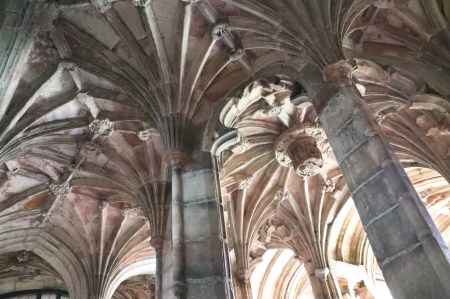
St Winefride’s striking fan-vaulted pilgrim shrine at Holywell, c.1480

Introduction

15th century fan vaulting in St Winefride's well

15th century fan vaulting in the under chapel at St Winefride’s well. late 15th – early 16th century

On Friday I took advantage of a sunny cold day to revisit St Winefride’s Well and its late Medieval chapels.  During the Middle Ages it was a major draw for pilgrims to north Wales,  with its shrine, beautiful bubbling spring and the Basingwerk Abbey a few minutes away.  St Winefride’s (Welsh Gwenfrewi) shrine and the Holywell (Treffynnon) parish church were granted in 1093 to St Werburgh’s Abbey in Chester for them to manage and from which to derive an income.  It was later consigned to Basingwerk Abbey.

Nothing is known about what sort of buildings preceded the late medieval building that we see today, but there are details about Saint Winefride, a list of some of the well’s most notable earlier medieval visitors and details about the measures that were taken to promote the interests of the shrine throughout its history following the Norman Conquest.  The role of the abbey in the success of the well can also be seen.

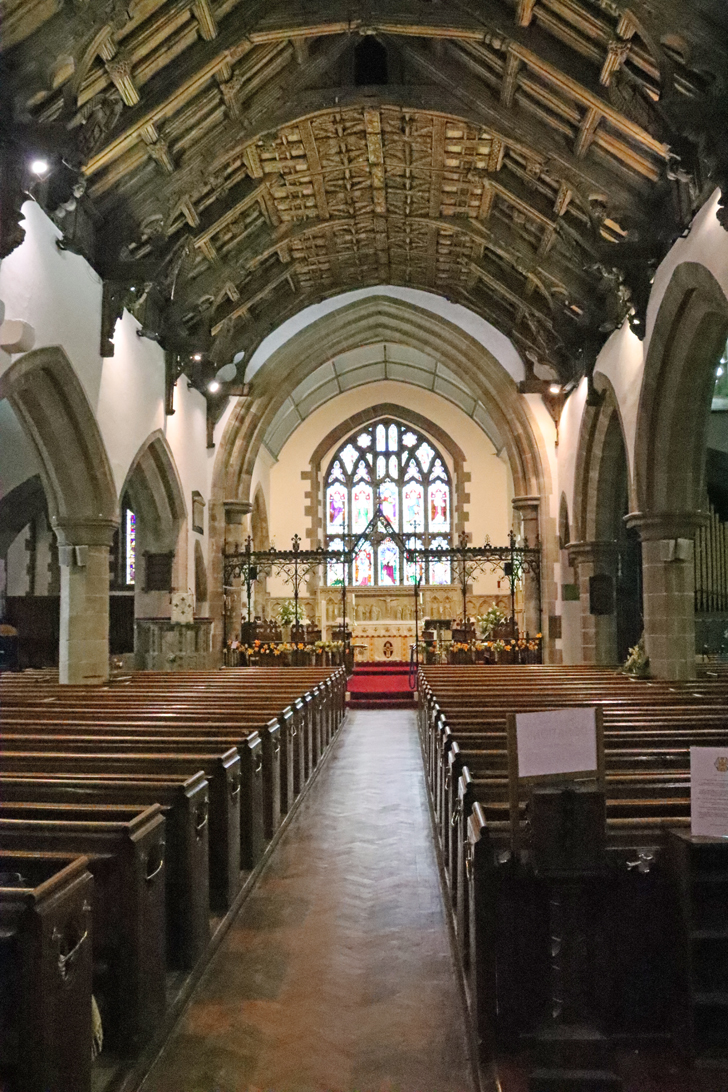
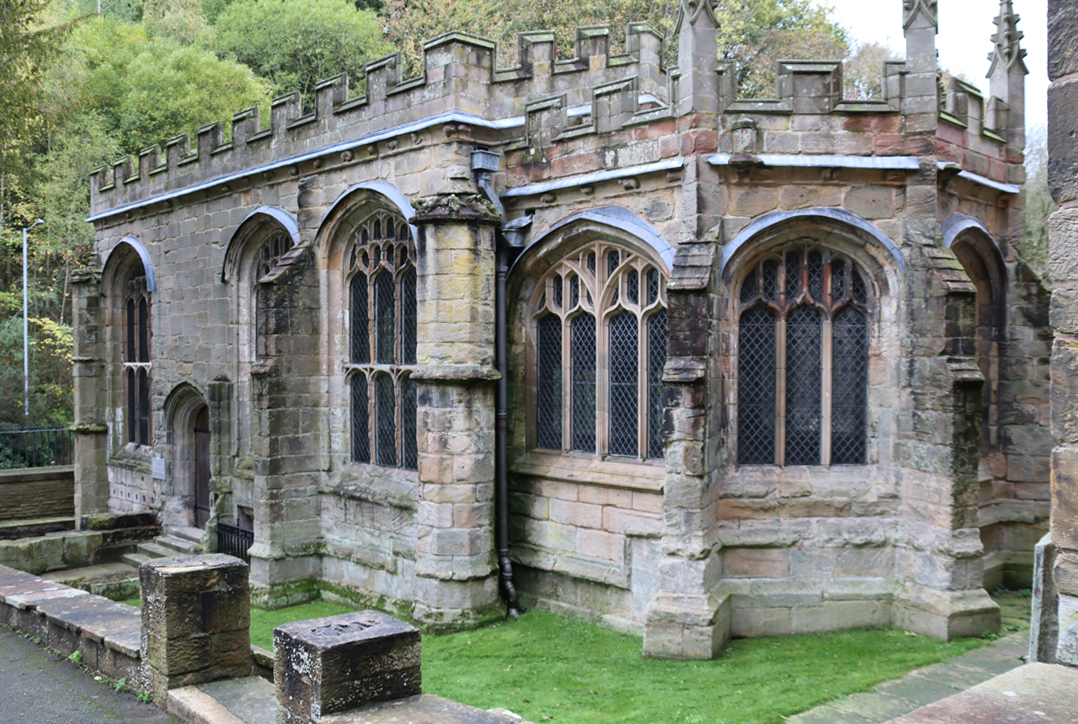
View of the chapel from the south. The chapel is over two floor. The fan-vaulted ground floor has three bays, with the central one containing the well itself. The upper chapel is fully enclosed and its entrance is on the same level as the entrance of the parish church.

An abbey with a pilgrim shrine had a range of opportunities for income generation, and St Winifred’s was famous for its powers of healing and provision of miraculous cures for centuries.  In around 1480 a wealthy patron, possibly Henry VII’s mother Lady Margaret Beaufort, invested in the shrine, providing the miraculous spring with a gorgeous, lofty fan-vaulted open-fronted chapel, as well as an enclosed chapel overhead.  Today both parts of the chapel are very well cared for, located on the edge of the Green Valley Park, which has a superb industrial heritage trail wending through it (see my earlier post here).  There is plenty of parking at both the well and at the abbey, described at the end of this post.

Fan vaulting with roof bosses. From left to right, the rebus of Elizabeth Hopton, two monkeys, a fleur de lys.

Fan vaulting with roof bosses in the lower chapel. From left to right, the rebus of Elizabeth Hopton (showing a rebus of her name, with a hop plant emerging from a barrel or tun); two monkeys, which may have a number of interpretations; and a fleur de lys (representing chastity, often used for the Virgin Mary but also suitable for St Winefride).

There’s a real sense of this being a costly but personal project, particularly in the vaulted lower chapel, which in terms of elaborate ecclesiastical architecture is tiny, although its height gives a sense of heading heavenwards.  Although no documentation survives to say who was responsible for funding the building, the Stanley family’s crests and symbols give an impression of a cherished project and the sheer amount of other imagery are reminiscent of cathedrals and large churches of the period.  It manages to be both impressive and intimate, which is quite a trick.  The chapel upstairs is more conventional in terms of both its size and its layout.  What I missed on my first visit is that the wooden ceiling supports all have sculptural elements sitting on their corbels, as well as more easily visible stone ones lower down.  In both upper and lower chapels, as well as the inherent beauty of the architecture, there is humour as well as religious, pagan, family and royal themes in the imagery.
xxx

xxx

St Winefride's well, c.1480

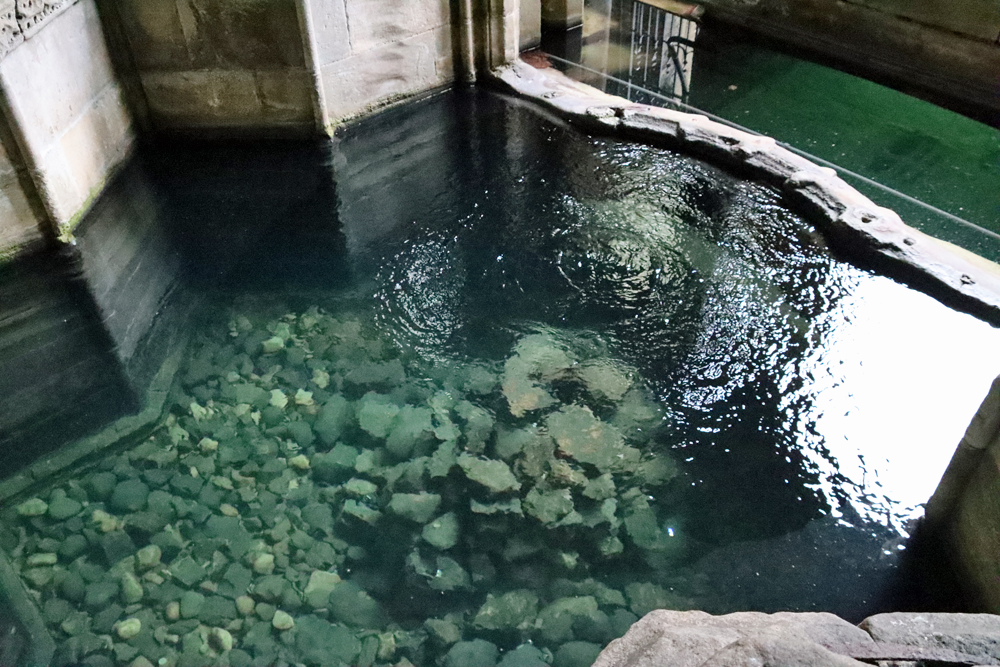
St Winefride’s well, in the star-shaped basin late 15th – early 16th century

St Winefride and St Beuno

There are a number of versions of the story of the miracle of St Winefride or Welsh Gwenfrewi (also spelled Winefred and Winifred), and her uncle and tutor St Beuno.  The earliest that remain preserved date to the 12th century, and excerpts have been translated and published by T.W. Pritchard in his detailed 2009 book about the well.

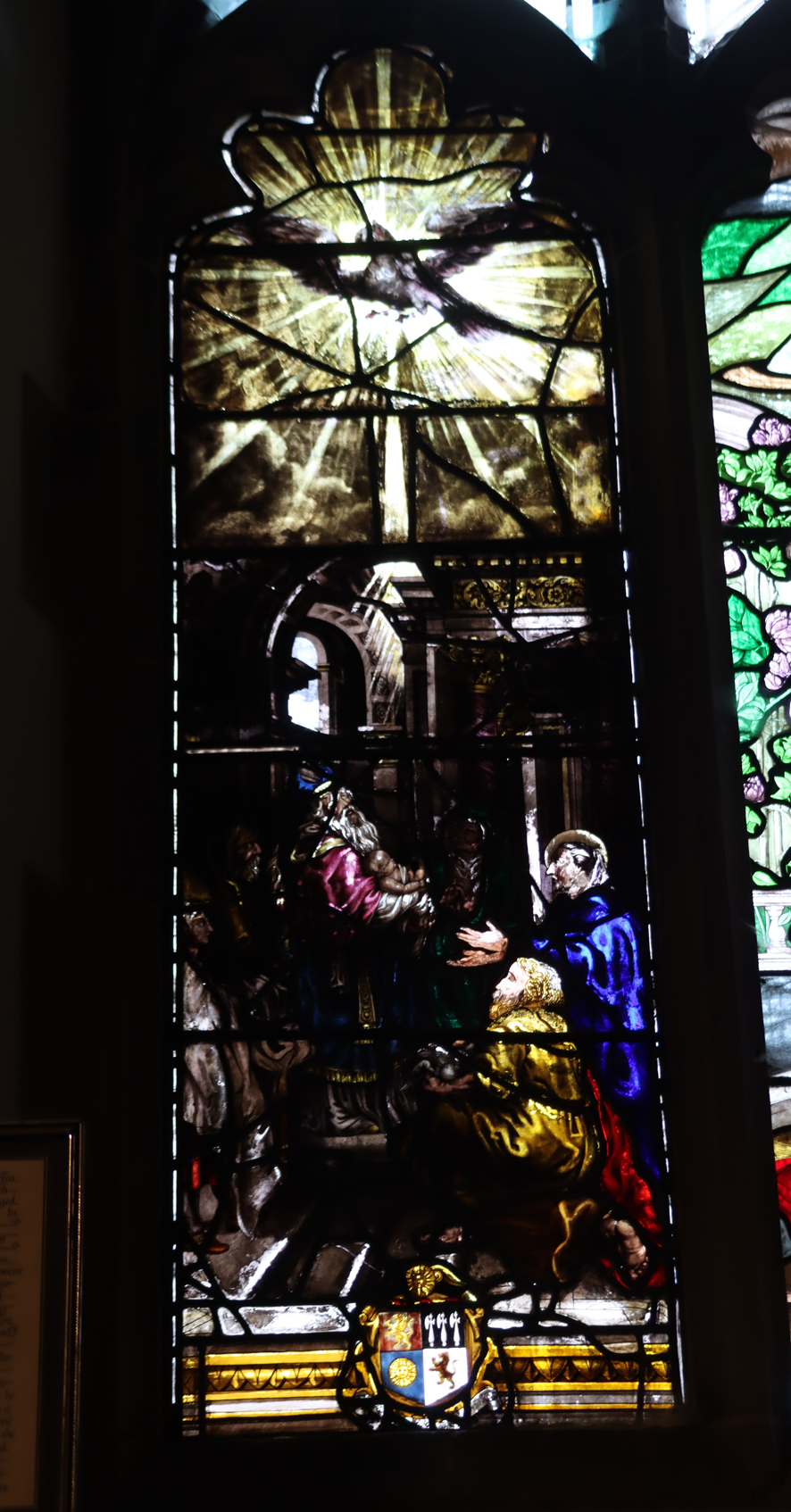
Modern stained glass in the little prayer chapel next to the main chapels

Winefrede and Beuno in the modern stained glass in the little prayer chapel for worshippers today, next to the main chapels. The palm represents the spiritual victory of martyrdom, whilst the crozier (staff) symbolizes teaching, wisdom and guidance.

Winefride was born towards the beginning of the 7th century in the cantref of Tegeingl, in northeast Wales, the only child of Tyfid and his wife Gwenlo, or Wenlo, who were landholders in the area.  One of the 12th century accounts says that Tyfid’s estate was made up of four manors.

Winefride had decided to renounce marriage and to dedicate herself to God and the teachings of Christ.  Christianity was well established throughout Britain, partly due to missionaries who were often commemorated as saints for their work.  One of these was St Beuno, who had moved to the area from mid Wales and was engaged by Tyfid to teach Winefride, in return for land on which to build a church.  St Beuo built a church in a valley called Sychnant (dry valley), which is now Greenfield Valley, Holywell, where the well is located.

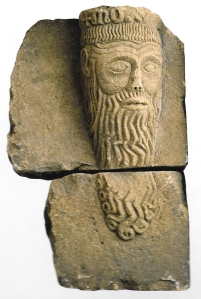
Sculpted figure

Sculpted figure, possibly St Beuno

One day, Winefride was at home alone whilst her parents were attending mass at the church, and a local prince, Caradog, knocked on the door.  She suggested he return later, but he became determined to marry the girl (who was of course beautiful).  Pretending to go and get changed, she ran to the church.  Caradog, realizing that he had been deceived, set out in pursuit and when he caught up with her near the door to the church, decapitated her in a fit of rage.  Beuno, hearing the noise, rushed out of the church and, finding a terrible scene, began to pray for help.  His prayers were answered.   Caradog melted into the ground, never to be seen again, and Beuno picked up her head and placed it back on her neck.  She came back to life, with only a slender white scar showing where the injury had been.  Instantly a spring erupted at the spot where her blood had been spilled.  The stones in the spring were said to be permanently red, the moss that grew around it had an aroma of incense and the waters produced miraculous cures.  The story continues, but the abbreviated version is that Winefride became a nun, moving from Holywell to Gwytherin to oversee 11 nuns as abbess, where she died and was buried.
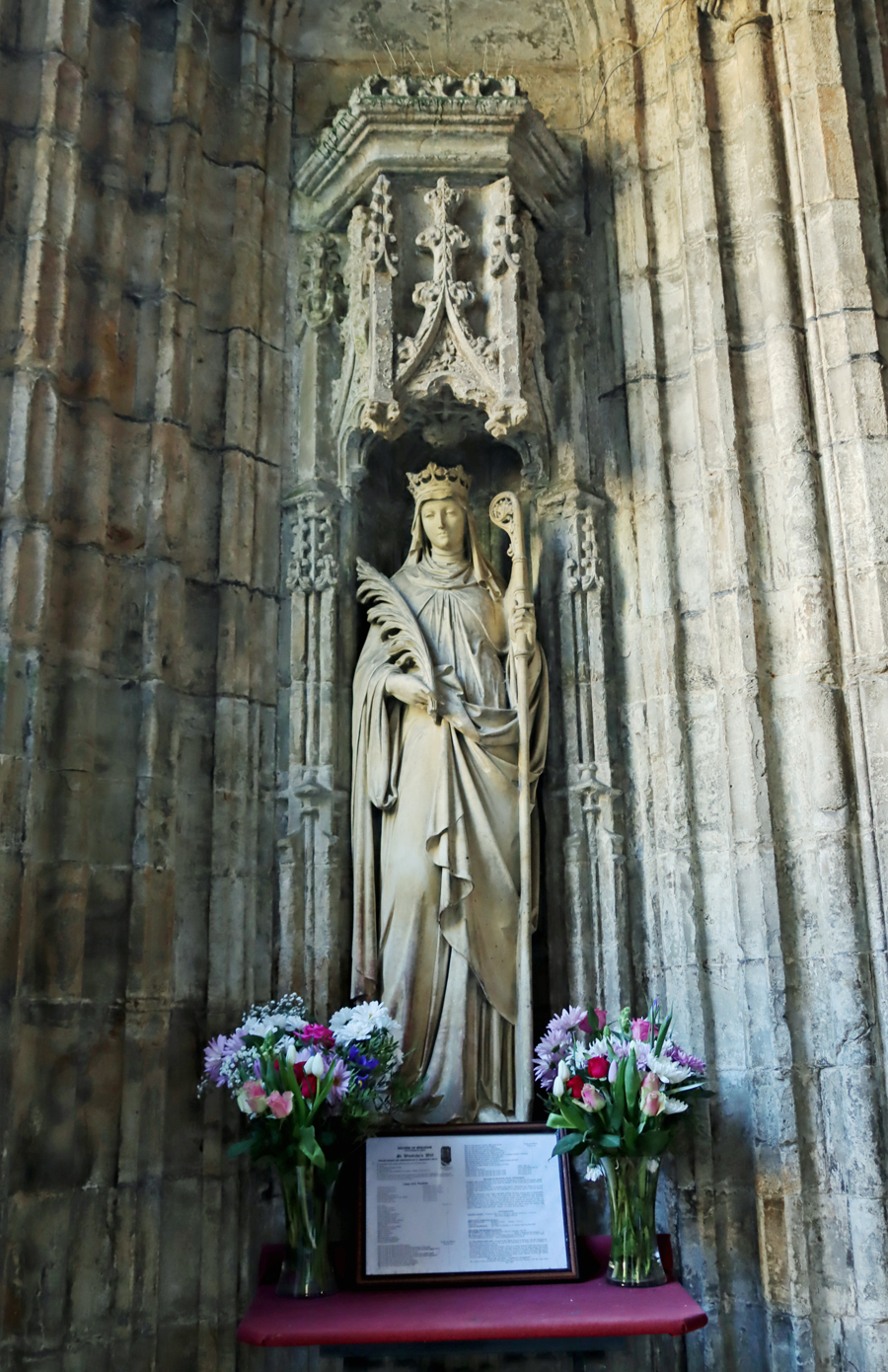
Statue of St Winefride within the lower chapel, dating to 1886

Statue of St Winefride within the lower chapel. The niche with its elaborate and intricate canopy is original, but the medieval statue was lost, and this dates to 1886

The basics of the story, a pure and noble virgin who died rather than surrender her virtue, is a familiar one.  The spring, too, erupting where pure blood was spilled, is not unique. When St Paul the Apostle was executed by decapitation his head is said to have bounced three times, and at each place where it touched the ground a spring erupted. The linkage of springs, wells and purity are long established, and the added connection with baptism gave water particular potency in Christian thought.  Interestingly, Winefride combined the virtues of a martyr saint and a confessor saint, having first died for her beliefs and then having been resurrected to live for those beliefs and values.

Miraculous events and morality tales of this sort became a form of oral history, a mechanism by which the ideology, morality, values and essential beliefs of early Christianity, were spread and understood.  The partly fictional “lives” of saints purporting to be biographies (hagiographies) were particularly popular when distributed after the innovation of printing in England in the 1470s. St Winefride’s story, written down and transmitted via word of mouth, the monasteries, and later by the printing press, became a popular saint  and her miraculous healing well became a pilgrim destination.

The remains of the shrine to St Winefrede in Shrewsbury Abbey

The remains of the later 14th century shrine to St Winefride, Shrewsbury Abbey showing St John the Baptist at left, St Beuno at right and Winefride in the middle.

In the 1130s an account by one of the monks of Shrewsbury Abbey states that the monks had “lamented that they were very deficient in relics of saints and applied their minds to the problem of obtaining some.”  One of the monks, during a spate of sickness, had a dream that St Winefride had appeared to him and said that the monk would be cured if a mission were to be sent to Holywell to say mass at her well.  Convinced that Winefride was their patron, they decided to retrieve her bones and take them to Shrewsbury.  In 1138, over 300 years after St Winefride’s death, a contingent of monks duly went to Gwytherin. They dug up and translated (transferred) Winefride’s remains from her grave and took them back to Shrewsbury, where a shrine had been built to receive her. Legend states that during the journey a spring appeared at Woolston near Oswestry, where her bier was briefly placed on the ground during the journey (a photo of this is shown further below).  A new shrine was built to house her relics at Shrewsbury Abbey in the late 14th century, a fragment of which survives and is shown above. It was destroyed during one of the attacks on the monastery.
xxx 

The Shrewsbury Abbey church

The Shrewsbury Abbey church (the rest of the abbey was demolished, now replaced by a road and a car park)

The Spring that feeds St Winefride’s Well

St Winefride’s well is built over the point at which an ancient spring, an underground stream, erupted to the surface, producing a quite dramatic spectacle of fiercely rushing water, particularly after rainfall.  That was not the same spring that is seen today.

St Winefride's well

St Winefride’s well

In 1917 mining activities at Halkyn cut through the stream, causing a change in flow direction so that the stream now emerges at Bagillt on the edge of the Dee estuary, causing both dramatic change to the industries along the valley and to the well itself, which dried up.  The current spring water that enters the star-shaped basin beneath the vaulted roof now bubbles delightfully, but this comes from another spring that was diverted for the purpose, and has none of the vigour or volume of the original spring.
xxx

The History of the Well

Hugh Lupus and the Abbey of St Werburgh

Romanesque elements surviving from the first Abbey of St Werburgh

Romanesque elements surviving from the first Abbey of St Werburgh

Today Chester Cathedral is a largely Gothic vision, with pointed arches and vaulting with roof bosses, but when it was built as St Werburgh’s Benedictine Abbey in around 1093 it must have been a superb example of the Romanesque curves and rounded arches brought to England by the Normans.  The abbey’s founder was Hugh d’Avranches (better known as Hugh Lupus, c.1047-1101), Earl of Chester, who had been appointed to Chester by William the Conqueror.

Holywell, including St Winefride’s Well and the parish church, were part of Hugh’s new territory. Earl Hugh gave Holywell to his wife, Adeliza, and she in turn awarded it to the abbots of St Werburgh’s Abbey.  A religious attraction like Holywell, with its miracle-producing shrine and its attached church cold produce a good income for an abbey, which took control of the tithes (a sort of religious tax) owed to the church, and to the oblations (gifts from pilgrims and visitors) to the holy shrine.

Transfer of ownership:  Basingwerk Abbey and subsequent transfers

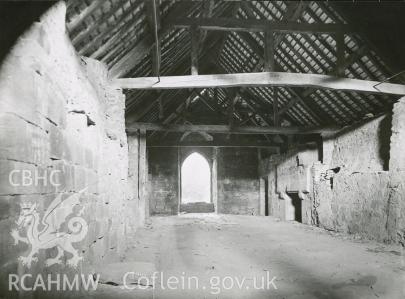
The building that may have been part of the guest quarters at Basingwerk Abbey. Its burned timbers were dendro-dated, giving the roof a date of c.1385

Because it was located in a region that was a territorial bone of contention between the Welsh princes and the English kings during the 13th century, Holywell could be in either English or Welsh territory.  When Basingwerk Abbey was founded in 1131 by Ranulf II Gernon, Earl of Chester, it must have been a source of some discontent to the new abbot that such a rich potential source of income was sitting on the doorstep and benefiting a rival monastic order in Chester.

Fortune smiled on Basingwerk Abbey.  Holywell was granted to it in the 12th century.  It was briefly back in the hands of St Werburgh but in 1196 it was once again assigned to the monks at Basingwerk by the Welsh prince of Gwynedd, Llywelyn the Great (ap Iorwerth, c.1173-1240), who had pushed his frontiers east.  This gift was confirmed in 1240 by Llywelyn’s grandson Dafydd ap Gruffudd (and younger brother of Llywellyn ap Gruffudd known as Llywelyn the Last), who in a turncoat deal with Edward I had been given lands in northeast Wales following the Treaty of Aberconwy. Basingwerk then retained Holywell and its religious assets for nearly 300 years until Henry VIII suppressed the monasteries in the 1530s.  Although they suffered under Edward I’s final conquest of Wales, Baswingwerk and Holywell survived, which is more than either Llywelyn or Dafydd managed to achieve, being killed in 1282 and 1283 respectively.

St Winefrede Well at Woolston

St Winefride Well at Woolston. Source: Shrewsbury Orthodox Church

It is not known what the Holywell pilgrim shrine looked like throughout the changes of ownership between the two abbeys, as no descriptions or images survive.  The shrine and temple would have been built of wood in its earliest years.  In one of its doubtless numerous iterations it is quite likely to have looked something like the small pilgrim shrine at Woolston near Oswestry, shown on the left, also dedicated to St Winefride.  Wooden buildings were replaced by stone buildings when those buildings began to be well used. The first stone parish church at Holywell is thought to date to around the 14th century, and it is possible that the shrine was revamped at the same time.

Promoting the interests of the Holywell shrine

Statue of St Winefrede in a niche in the Henry VII Chapel, Westminster Abbey

Statue of St Winefride in a niche in Henry VII’s early 16th century Lady Chapel at Westminster Abbey. Source: Pritchard 2009, p.71

The task of ensuring the continuing success of St Winefride and the holy well, important both for monastic income and the economy of the Holywell, was occasionally given an official helping hand.

In 1253, for example, a request was made to the Cistercian General Chapter (the governing body of the Cistercian monastic order) to allow a “Feast of 12 Lessons” to be held annually on the saint’s Feast Day at Buildwas Abbey in Shropshire, and Basingwerk Abbeys, the two of which had become connected in a hierarchical relationship some time after Basingwerk was absorbed into the Cistercian order.  The normal feast was of 9 lessons (prayers and readings), and the fact that this was of 12 indicates the respect in which Winefride was held.  The request was authorized, meaning that St Winefride’s Feast was more likely to attract pilgrims to both of the abbeys as well as the Holywell shrine.

In 1398 the annual feast of St Winefride, which had been confined to north Wales and the Marches, was extended to the entire Canterbury area  by Archbishop Roger Walden.  In 1415 his successor Henry Chichele who had a particular interest in Welsh saints having been Bishop of St David’s, a centre for pilgrimage in south Wales, raised the profile of St Winefride’s cult still further.

Richard II established a chantry (payment to a member of the clergy in return for prayers and the saying of mass for the dead of a particular family) in 1377.  This was renewed annually by each subsequent king until the Dissolution, after which chantries and the mass were no longer legal.

An example of an Indulgence, this one issued in London. Source and details: Essex Records Office.

An example of an Indulgence, this one dated 1480 and issued in London. Source and details: Essex Records Office.

In 1427 the shrine’s popularity was assured when Pope Martin V granted indulgences over a ten year period for those who made the pilgrimage to the shrine and gave oblations to the chapel.  Indulgences were mechanisms for rewarding certain activities, mainly those that generated income for the Church, including pilgrimages, by reducing the time an individual spent in purgatory by a specific number of years and days.  In this case the time reduced was a year and forty days.  It was a way of trading off human fear of what followed death, but a ruthless way of raising funds, later famously condemned by Christian revisionist Martin Luther in his Ninety Five Theses.

The role of the well in the Middle Ages

North entrance to the under-chapel at St Winefrede's Well.

North entrance to the under-chapel at St Winefrede’s Well.  The barriers detract from the aesthetics but do prevent people falling in.

The well can be understood in a number of ways, all from different viewpoints.

From the point of view of Basingwerk Abbey, which had authority over the well and its shrine, it was both a source of prestige and income.  The prestige of having the miracle directly connected with an Anglo-Saxon saint was considerable, giving it a historical validity with real time-depth, with roots in the distant past.  Not only was Winefride a miracle-working virgin saint, but she had gone on to become a nun, and then an abbess.  Her credit and sanctity were flawless.  This status and prestige attracted pilgrims, and with them a source of potentially considerable income. The  importance of miraculous places of pilgrimage grew in the medieval period, and pilgrims not only brought donations (alms) but those with money also contributed to the local economy, meaning that the abbey was a contributor to that economy.  However, pilgrims could be a double-edged sword, as they also required some management to prevent them becoming a drain on the abbey’s obligation to provide shelter and food under the general heading of “hospitality,” to which the Cistercian order was committed and which included some form of accommodation and the supply of meals.

Rebus of Elizabeth Hopton's last name (a hop plant emerging from a tun, a type of Barrel

Rebus of Elizabeth Hopton’s last name (a hop plant emerging from a tun, a type of Barrel

From the point of view of pilgrims, miraculous venues offered a range of opportunities, depending on the motives for visiting.  The natural spring was said to have miraculous healing properties, and many will have travelled to be cured, whether rich or poor.  Others were engaged in a form of spiritual tourism, visiting all the most important shrines and relics either in a given area, throughout Britain and sometimes overseas.  Within the Welsh and border areas, Holywell was part of a pilgrim circuit with Basingwerk (with the Holywell shrine), St Asaph (Llanelwy, the church of the 6th century miracle-performing saint), Chester (with the Holy Rood of St John’s and St Werburgh’s shrine in the Abbey), together with other churches and monuments, and this could also be extended to reach the sacred Bardsey Island.

Archway leading to the steps into the well

Archway leading to the steps into the well

The medieval world was very concerned with the challenge of how to manage an afterlife that began with the terrors of Judgement Day and Purgatory.  Visiting saints’ shrines, or just being in close proximity to them, was a way of gaining proximity, at a little distance, to the divine, with the hope that some of it might, in some mystical way, rub off.  Just by touching a shrine, a little of the incredible divine energy could pass into a person; immersion in the spring that emerged from the spilling of a virgin saint’s blood must have seemed like being wrapped in the saint’s divinity.  This did no harm to nearby residents, who must have had a sense of the power of the shrine.

Likewise, monasteries that were filled to the brim with those devoted to Christian worship, whose virtue made them next in godliness to saints, were considered to be invaluable assets to those who lived in their vicinity.  The wealthy chose to be buried within monastic precincts, as close as possible to the most sacred areas.  In churches people wanted to be at the interior east end of churches or, if they were not sufficiently influential to be buried inside, as close outside to the east end as possible. The presence of the abbey so close to the shrine gave Holywell a particular religious vigour.

As well as religious benefits to outsiders, there were economic benefits to the local population.  Basingwerk Abbey had various agricultural (mainly livestock) and industrial (including silver mining) interests in the immediate area that would have employed many rural people, but as the medieval period shook off the manorial control that bound people to the land, the Holywell shrine offered potential for new opportunities, including hospitality and, if other pilgrim centres are anything to go by, the manufacture and sale of souvenirs.

Visitors and patrons in the Middle Ages

Pilgrim being carried to the healing waters of the spring

Pilgrim being carried to the healing waters of the spring. The 15th-early 16th century well shrine.

In the Middle Ages there was no clear dividing line between physical and spiritual health.  The idea of illness was embedded into the belief that the body was composed of a series of complex components that required balancing what were understood to be the essential fluids (blood, phlegm, black bile and yellow bile) with the elements (air, water, fire and earth) and their key characteristics (hot, cold, wet and dry) as well as astrology. Deficiencies and excesses in any one component might put the entire complex equation for stability and harmony in jeopardy.  When attempts to achieve balance these failed, and the person remained sick in body, mind or, for that matter, sin, pilgrimage was often seen as the most logical next step.  Pilgrims understood that this was a two-way street and that they would have to make some sort of sacrifice, part of which might be the difficulty of undertaking the journey, but gifts and promises of reform were also part of the negotiation.  Pilgrimages were undertaken for many other reasons too, but the healing properties of St Winefride’s shrine were probably the main attraction to most visitors.
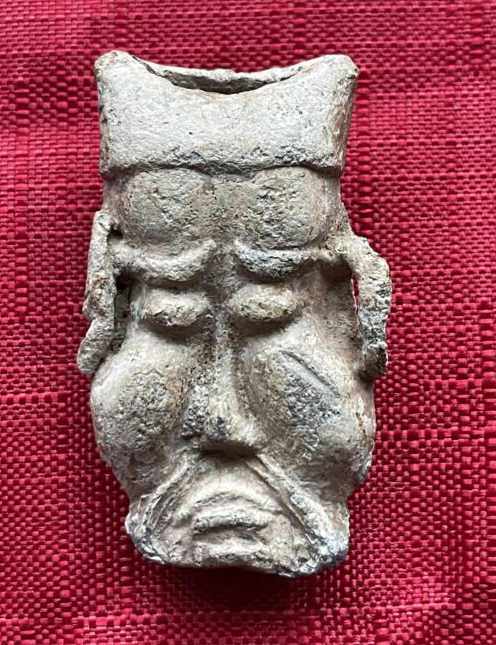
Medieval ampulla for carrying liquids or earth from a pilgrim site

Example of a medieval ampulla used for carrying liquids or earth from a pilgrim site. Source: The Mobility of Objects across Boundaries

St Winefride’s recorded visitors and patrons are a roll-call of the celebrities of the era, the royal and the aristocratic, who were major marketing coups for Basingwerk.  Although those few known by name are listed below, the everyday participants along the pilgrim routes were more often ordinary people.  Reasons for their travels varied, including seeking to undertake a spiritual journey for personal improvement (perhaps one of many journeys);  to offer thanks for prayers that were answered; or to seek divine assistance for problems and maladies by asking a specific saint to intercede for them with God.  Some pilgrims also acted for those who were unable to attend themselves, offering prayers on their behalf, and returning home with garlands of the sacred moss or filling small flasks with the miraculous water.  These ordinary pilgrims from a wide variety of backgrounds always get lost in documented history, the Middle Ages being just as concerned with celebrity endorsements as the west is today, but were nevertheless the most essential components, the bread and butter raison d’être of a living shrine and the institution that managed it.

Ranulph II, Earl of Chester. Source: Wikipedia

Between 1115 and 1119 the second earl of Chester, Richard d’Avranches, son of Hugh Lupus made pilgrimages to the well.  With the shrine of St Werburgh within the Chester city walls, it might have been thought that he would look closer to home, but Richard is thought to have fallen out with the monks of the abbey.  In addition, it is not really a pilgrimage if it is only a ten minute walk, and Richard may have felt the need to make more of a gesture.  Ironically, a miracle took place during the pilgrimage, when Richard became cut off from his forces and his constable in Wirral prayed for assistance but as St Werburgh had been chosen rather than St Winefride, this was chalked up to a win for the Chester abbey.

In 1131 Ranulf II Gernons (1099-1153), fourth earl of Chester, founded the new Savignac (later Cistercian) Basingwerk Abbey somewhere in the area, presumably made of wood.  It is thought that it was moved to its current location in around 1157 to be rebuilt in stone, and this new location was very probably influenced by the presence of the nearby holy well, even though it was at that time part of the landholding of St Werburgh’s Abbey.

It is said that in 1188 or 1189 Richard I, the Lionheart (ruled 1189-1199), made a pilgrimage to Holywell.  Quite where he would have found the time is anyone’s guess.

Flint Castle

Flint Castle on the Dee Estuary, construction having begun in 1277

There is no record of Edward I (reigned 1272 to 1307) making a pilgrimage, but he presumably had no need to put himself to any real effort to visit either the abbey or the shrine, as by the 1270s he was already in the area.  In 1277 he began to build Flint Castle 6.9km/4.3 miles down the road from Basingwerk.  Whilst the castle was under construction it seems reasonable to assume that Edward was a frequent guest at the nearby monastery, and that he took the opportunity to visit the shrine.  In fact, Edward’s castle in Flint may have resulted in a busy time all round for the abbey, the church and the shrine, as the 100s of workers at the castle would have had at least some downtime and would doubtless have sought out a powerful religious shrine so close by.

In 1282 Edward’s armies returned to northeast Wales to engage with the Welsh princes once again, doing substantial damage to monastic lands in the process.  It is recorded that part of Holywell was burned, but it is not stated whether this was the village, the shrine or nearby buildings.  The abbey estates were certainly harmed, with the lost of crops and livestock, and Edward found himself compensating both Basingwerk and other Welsh abbeys that had come under fire during the fighting.  Pilgrims were presumably rather short on the ground at this time, but Edward and his armies probably formed part of the narrative of the abbey told to future pilgrims.

Miniature of Henry V

Miniature of Henry V, c.1411. Source: Wikipedia

According to chronicler Adam of Usk, Henry V (reigned 1413-1422) visited in around 1416, following his success at Agincourt, to give thanks, walking on foot to Holywell from the Shrewsbury abbey to which Winefride’s remains had been translated (moved) in 1138 from where she was originally buried in Gwytherin.  I have not found any reason why Henry would have singled her out to request support in battle, but apparently he prayed to her for assistance and his pilgrimage was an offering of thanks, which created a considerable stir.  Perhaps he had encountered the shrine as Prince of Wales during the military campaigns against Owain Glyndŵr that began in his father’s reign and which he ultimately suppressed.

The Earl and Countess of Warwick made gifts to the shrine in the 1400s there is is not stated that they ever visited.

Henry IV Bolingbroke (reigned 1399-1413) took the throne from Richard II (reigned 1377-1399), with Richard surrendering to Henry at Flint Castle in 1399.  It is possible that whilst he was in the area, Edward took the opportunity to visit St Winefride’s shrine, probably connecting with the monks at the same time.

In 1461 the Welsh bard Tudur Aled wrote that Edward IV (reigned twice in 1442-1483 and 1471-1483) had visited the shrine, but quite why is unclear.  He was a member, by descent, of the Mortimer family who had extensive properties in the Welsh Marches, in Chirk and Denbigh. There was, in fact, considerable resistance to Edward IV in areas of north Wales, including the rebellion of Owain Glyndŵr.  There is nothing in general events of that year that would seem to account for him being in Holywell, although Pritchard suggests that it might be connected with renewing the royal chantry, which seems like the most plausible reason.

St Winifrede's well by John Ingleby. Source: National Library of Wales via Zone47

St Winefrede’s well by John Ingleby (1749-1808) showing crutches slotted into the stonework above the spring.  Note the gallery at the left, and the mill wheel through the doorway.  Source: National Library of Wales via Zone47

Whether royal, aristocratic or of more humble origins, pilgrims continued to visit throughout the medieval period, and pilgrims continue to visit continue today.  As well as the sculpture on the left in the well chapel, showing a pilgrim being carried to the spring on an other man’s back (one in need, the other showing compassion) the visitor centre has examples of later wooden crutches that were apparently discarded after miracle cures had  been received.  In 18th and 19th century engravings crutches are shown slotted into the stone structure of the pilgrim shrine presumably as a record of successes and gestures of thanks (see the John Ingleby coloured engraving towards the end of the page).

For visitors to Holywell and the shrine in the post-medieval periods, which are not covered here, see the Early Visitors in Wales page dedicated to Holywell.

The late Gothic chapels

The patrons of the new chapels

Ceiling boss showing Lady Margaret and the Earl of Derby

Ceiling boss in the lower chapel allegedly showing Lady Margaret with her husband Thomas Stanley, the Earl of Derby

It has passed into tradition that the founder of the chapel that we see today was Lady Margaret, née Beaufort.  Lady Margaret was the mother, by her first husband, of the future King Henry VII who was the founder of the fan-vaulted Lady Chapel in Westminster Abbey, designed by Robert Vertue.  Lady Margaret, born 1443 had married three times by the time she died in 1509, her last husband being Thomas Stanley, Earl of Derby, a member of an important and wealthy local family in the Wrexham area.  She is thought to have patronized St Giles in Wrexham, St Mary the Virgin in Mold and St Chad’s in Farndon.  She sponsored two publishers, both of whom (possibly at her suggestion) published lives of St Winefride.  The involvement of the Stanley family, whether Lady Margaret was involved or not, is suggested quite strongly by the number of relevant carvings in the chapel, including:

  • A sculptural portrait thought to represent Lady Margaret and her husband Thomas Stanley (1435-1504), Earl of Derby (although with very little data, if any, to substantiate the identification)
  • Over the outside of the door to the gallery there is a the portcullis emblem that Henry VII (reigned 1485-1509) derived from Lady Margaret
  • The arms of Sir William Stanley (died 1495), brother of Thomas Stanley showing a wolf’s head enclosed in a garter (rewarded by Henry VII for his role in the Battle of Bodsworth of 1485 but executed in 1495 for conspiracy)
  • The arms of Sir William Stanley’s wife Elizabeth Hopton (died 1498) showing a barrel and a plant, forming a rebus – hop and tun – of her name
  • The 3-leg symbol of the Isle of Man reflects Sir John Stanley’s new title of Lord of Man, gifted to him in 1405 by Henry VII for his support during the War of the Roses
  • Other Stanley emblems including a stag’s head and eagle’s legs
  • Tudor emblems, including the dragon and greyhound in the spandrels of one of the doorways
  • The Royal arms of England and Wales at the end of the pendant ceiling boss over the spring
  • The coat of arms of Queen Katherine of Aragon (1485-1536), the wife of Henry VII’s son Arthur before Arthur’s death in 1502, featuring three pomegranates topped with a crown. Lady Margaret was her grandmother-in-law, dying in the same year as Katherine’s marriage to Arthur’s brother Henry VIII (reigned 1509-1547) in 1509

In addition, Henry VII chose to include a statue of St Winefride in a niche in the north apse of his own Lady Chapel in Westminster Abbey.  She is shown with her head on her shoulders, but there is also a small head on its side at her feet, sitting on the top of the well.

Lower chapel roof bosses.

Lower chapel roof bosses. Clockwise from top left:  Arms of Katherine of Aragon; Wolf-head shield of Hugh I or Richard d’Avranches (probably the latter); Either St Winefride or the Virgin Mary, very battered but originally two angels placed a crown on her head; the base of the pendant boss shows the royal arms of England and Wales whilst the pendant itself shows scenes from the life of St Winefride (very worn); the legs of the Isle of Man, off centre; greyhound and to its left dragon, both symbols of the Tudors (on opposing doorway spandrels).

xxx
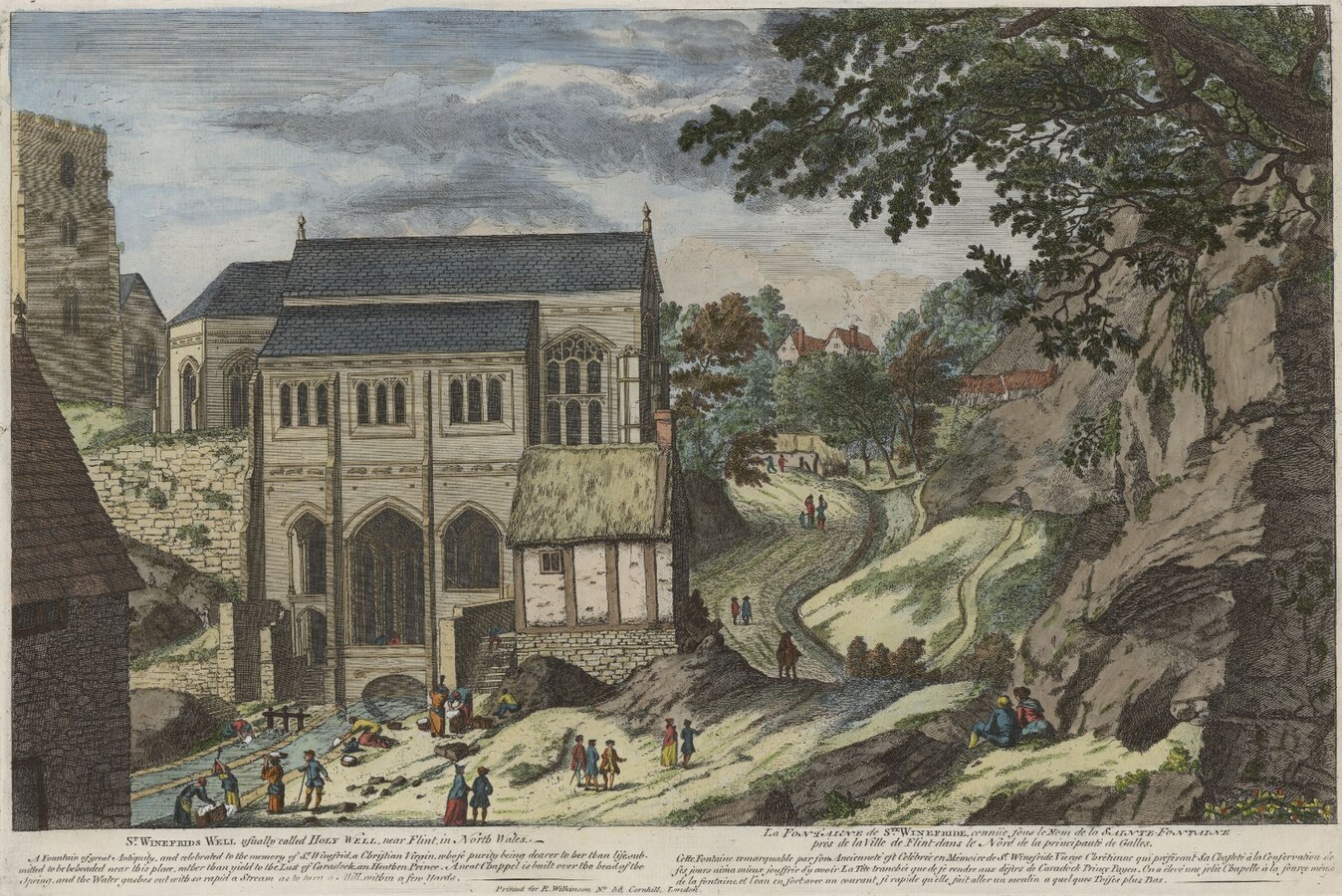
St Winefride's Well. NLW 1129695. National Library of Wales.

St Winefride’s Well c.1790. NLW 1129695. National Library of Wales via Zone47 Zone47.

The construction of the two chapels, above and below, seems to have been overseen by Abbot Thomas Pennant of Basingwerk, who held the abbacy from 1480 – c.1522.  T.W. Pritchard has argued that there is evidence form contemporary Welsh bardic-style poetry to assign the patronage and building to Abbot Thomas, but the weakness in this interpretation is that the bards connected with, and often living at, monastic properties were often effusive, fulsome and sycophantic, and not necessarily truthful.  The poets were making no attempt to capture history, creating a highly partial view of the world as they experienced it in hyperbolic language as an art form. Nor is it at all clear whether Abbot Thomas would have known of the fan vaulting style, or where he would have found an architect to produce it.  On the whole, given that I have seen no argument that the above family-related topics were added at a later date, the data seems to favour the Stanley family as the creators of the chapel, with Abbot Thomas managing the build locally, and perhaps investing in some of its creation.  Without documentary data this remains uncertain.

The concept

Plan and elevation of St Winefrede's Well. Source: Journey to the Past

Plans and elevations of St Winefride’s Well, lower and upper chapels. Source: Journey to the Past (a collaboration between Bangor University, the University of Wales Centre for Advanced Welsh and Celtic Studies (CAWCS) and the Royal Commission on the Ancient and Historic Monuments of Wales)

The late Gothic buildings that we see today came late in the well’s medieval history.  The style, late Perpendicular, comes towards the end of the 15th and beginning of the 16th century, only a couple of decades before Basingwerk Monastery was suppressed in Henry VIII’s Dissolution, shortly after which Edward VI began a policy of suppressing Catholicism.  It is not know what the chapel and well looked like before this time, because there are no images or descriptions, but the new architectural conceptualization design, consisted of two parts, the lower fan-vaulted well chapel, and over the top of this a more conventional church-like structure with a nave, side aisle, chancel and stained glass windows, with more sculptural elements.  These are discussed further below.

Holywell upper chapel and parish church

The parish church on the right and the upper chapel of St Winifride’s Well on the left, showing their proximity

The design was governed by how pilgrims used both the well and the neighbouring church.  Pilgrims would arrive in Holywell at the abbey.  Some of them would take advantage of the abbey’s hospitality.  In the late medieval period the abbot was responsible for new stone-built accommodation for visitors, but there must have been provision previously, perhaps built in wood.  For those who wanted to stay elsewhere, the late medieval town would have offered alternatives.

The upper chapel, looking west

For pilgrims staying at the abbey, a walk to the holy well would have been guided by a monk who would lend monastic authority to the event.  On arrival at the shrine, pilgrims would have been taken up to the chapel to pray and receive guidance before they could proceed to the shrine itself.  The upper chapel was designed to hold large numbers of people in a church-like layout and environment.  It was only a few steps away from the parish church where visitors could also attend services.  The placing of the upper chapel over the top of the well was a clever way both of making the most of the steep hill, and of linking the well with the parish church.  The design of the three bays of the shrine took pilgrims in a procession that entered through one entrance, proceeded around the shrine and lead either out the other side.  There were steps down into the well itself.

Lower Chapel

The well with the ceiling pendant boss overhead, which showed scenes from the life of St Winefrede around it, and the Royal arms of England and Wales at its base

The well with the ceiling pendant boss overhead, which showed scenes from the life of St Winefrede around it, and the Royal arms of England and Wales at its base.

At the level of the spring is a tall, narrow open-fronted well chapel, with a lofty fan-vaulted ceiling on slender compound piers over three bays of which the middle, encompassing the well, is the largest.  The chapel defines a processional area where people could enter at one side, circle the star-shaped basin where the spring emerges, and light candles before and leaving at the other side.  One theory is that the almost star-shaped well represented the Pool of Bethesda.  A staircase led to a gallery where people could look down into the well.  A rectangular pool received the spring waters outside, in a similar way as it does today, but images from the 18th century suggest that the much greater volume also allowed it to run out of the other end of the pool as a strong stream flowing down the hill.

The fan vaulting had sculptural roof bosses wherever there were joints.  The opportunity was taken with nearly all of them, big and small, to create sculptural elements, some of which are shown below.  The main pendant roof boss, suspended over the centre of the spring well, has the royal coat of arms of England and Wales on the base, whilst the sides shown scenes from the life of St Winefride. The columns around the well are now broken, the remaining stumps at two levels shown in the photograph above, but once formed an intricate screen, with filigree-style details in the spandrels.  The string-course of decorated stone along the top of the well was also decorated in the same way.

The entire effect must have been very like a tiny, sublime cathedral in rural northeast Wales.
xx


xxx

The themes on the ceiling bosses and other areas of the lower chapel show some interesting choices.  As well as the heraldry relating to the Stanleys listed above, there are some ceiling bosses relating to Winefride, Beuno and other religious themes, other families, and plant and animal motifs.

Upper Chapel
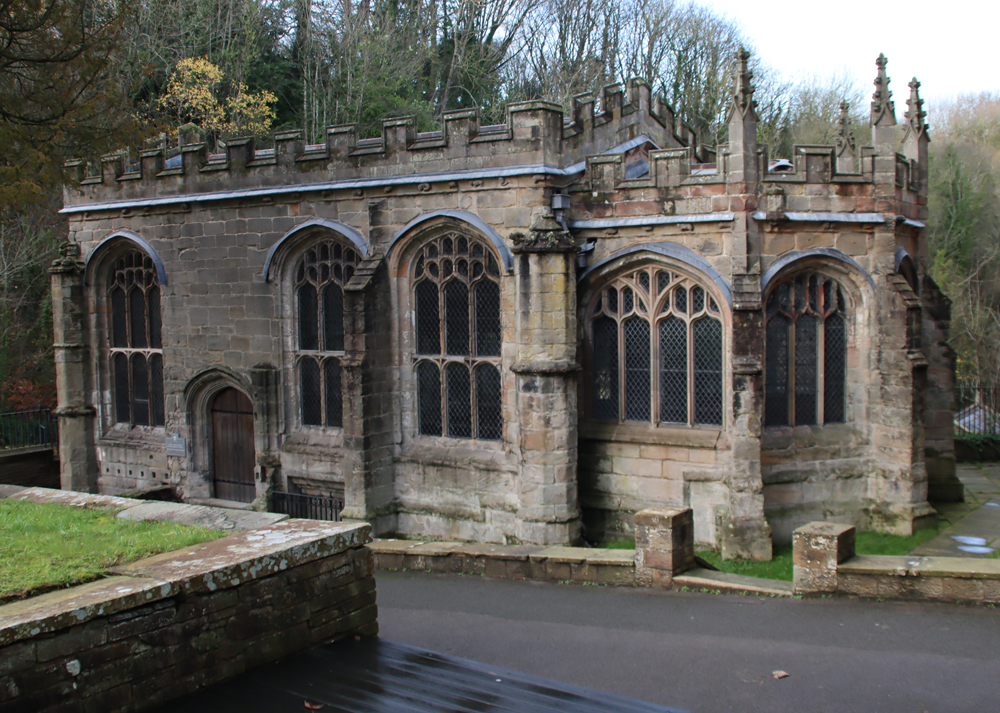
The upper chapel

xxx

The upper chapel, looking east to the chancel

The upper chapel, looking east to the chancel

Over the top of the lower well chapel was an enclosed chapel, designed with a conventional nave and chancel, with one truncated side aisle, to which pilgrims could proceed following their experience at the spring to worship and hear services. The design of window openings and arches is Perpendicular with wide, flattened arches and tall mullioned windows that allow plenty of light into the space.  side aisle sits directly over the well, whilst the chancel at the east end extends beyond the space enclosed by the lower chapel.

The north aisle, overlooking the pool

The north aisle, over the top of the well and overlooking the pool. Only one aisle was built.

The camberbeam roof over the nave

The camber-beam roof over the nave

Modern stained glass window in the chancel

Modern stained glass window in the chancel

xxx
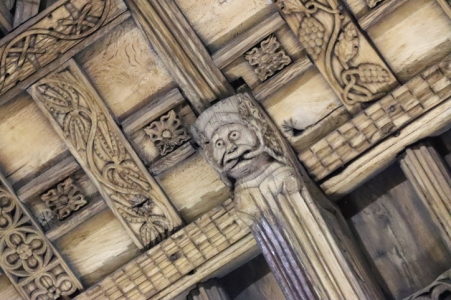
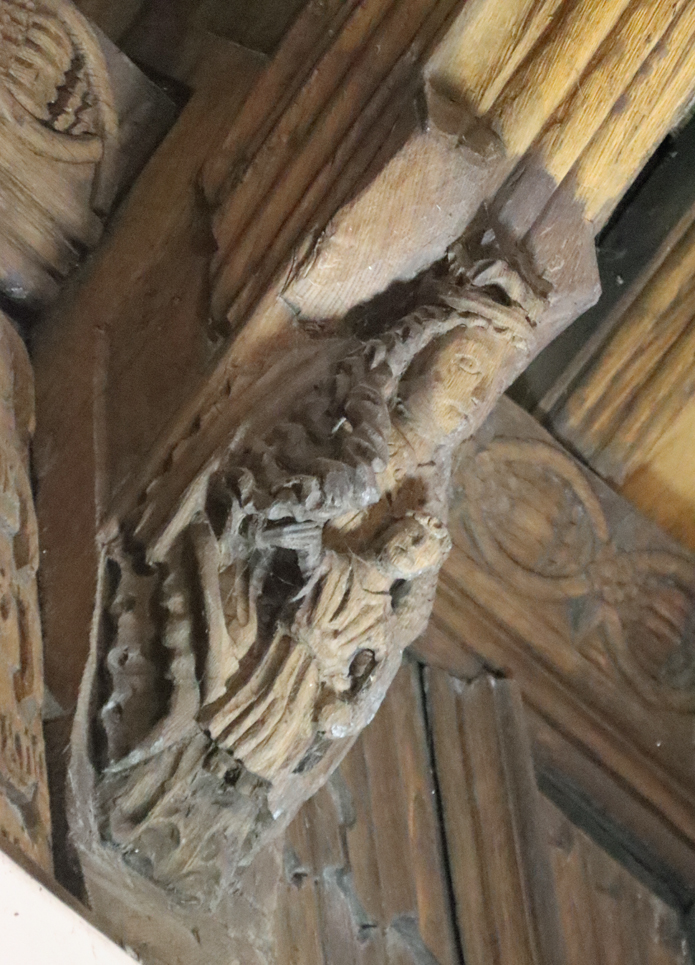
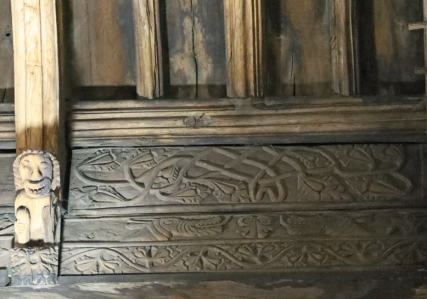
As with the lower chapel, the upper chapel has some rather wonderful sculptural elements, with much less emphasis on family symbolism, and much more on the sort of themes that are found in the margins of illuminated manuscripts, on misericords, and in the roof areas of churches.  They include scenes of everyday life; pagan, mythological and religious motifs; and two humourous grotesques.  The wood carvings, high in the chancel and the nave on stone corbels are difficult to see due to their height and the lack of light.  The stone carvings, which are lower down, are quite easy to make out.

My photos of the wood carvings were frankly diabolical.  I couldn’t actually see what I was photographing in the chancel, so just pointed the camera and hoped for the best.  Even after applying Photoshop, in some cases I am still none the wiser.  Apologies, therefore, that there are so few of them.  A torch would be a handy accessory if you are thinking of visiting.

Sculptural elements from the upper chapel.

Sculptural elements from the upper chapel.

The chapel was considerably altered in the 1700s but has since been restored to something close to its previous appearance.
xxx

The Dissolution of the Monasteries

The opening page of the Valor Ecclesiasticus, showing Henry VIII.

The opening page of the Valor Ecclesiasticus, which valued each of the main monasteries, showing Henry VIII. Source: Wikipedia

The suppression of the monastic houses from 1535 was Henry VIII’s multi-pronged strategy to gain a divorce from Katherine of Aragon, denied to him by the Pope (Katherine was fortunate enough to retain her head); to escape the authority of the Pope and the bishops and place himself as the head of the Church; to strip monasteries and priories of their valuables to raise funds for the Crown; and to release estates from formerly powerful monastic landholders, which enabled him to redistribute land, wealth and power, which he could use to generate money and to negotiate for long-term political support.  In order to assess the value of the nation’s monastic holdings, his hench-man Thomas Cromwell ordered the Valor Ecclesiasticus (a an assessment of the income and assets of each monastic house) and assessors were duly sent out to all parts of the kingdom.  All of those worth less than £200.00 were immediately suppressed, which included all the Welsh houses.  The remaining monks and nuns were dispersed, willingly or unwillingly.  They were often granted reasonably generous pensions if they left without a fight.  Abbot Nicholas Pennant, the last abbot of Basingwerk, clearly gave no trouble to the administrators because he left with a pension.  Monastic properties were sold, gifted or broken up and otherwise disposed of by Henry’s administrators.

All that remains of the monastic church at Basingwerk

All that remains of the monastic church at Basingwerk today

The impact on St Winefride’s Well was felt both immediately and incrementally thereafter.  With the loss of the abbey, the shrine no longer had monastic support and oversight.  Whatever funding, maintenance and care the shrine received were withdrawn.  The shrine would now be the responsibility of the church and the village.  Pilgrims were deprived of monastic hospitality.  With no monastic guidance to the shrine when they arrived, a lot of the ceremony and sense of a special occasion were removed, perhaps making a pilgrimage less attractive and rewarding.  Certainly the oblations (pilgrim donations) began to decline significantly.  At the same time, political and religious instability may well have deterred pilgrims.  The loss of the monks as managers of the abbey’s landholdings and industrial properties may not have been felt immediately, but whatever processes were in place may have required a new approach to estate management by those actually working the land and this may have had an impact on the local economy, particularly Holywell itself, undermining the economic stability and prosperity of the village at least for some time afterwards.
XXX

After Henry VIII

The Devil selling Indulgences. Jenksy Kodex, c.1500. Source: Wikipedia

Splendidly evocative depiction of the Devil selling Indulgences, from a Czech illuminated manuscript called the Jenksy Kodex, c.1500. Source: Wikipedia

Quite what Henry VIII planned for the future of the new Church of England is not clear. He probably had very little strategic idea himself, but it is certain that the Archbishop of Canterbury, Thomas Cranmer (1489-1556), an advisor to Henry, had plans, which included maximizing his influence has the clerical head of the Church of England. One of Henry VIII’s particular obsessions was the destruction of all traces of the veneration of St Thomas Becket.  For Henry VIII, Archbishop of Canterbury Thomas Becket (1119/20-1556) had been the ultimate Church challenge to “royal supremacy” in which the king rather than the Church held ultimate authority.  Becket was murdered over the question.  The horror with which Becket’s murder was received forced King Henry II to back down and make the peace with a powerful clergy who were backed by the papacy and who had ultimately won the day.  In Henry’s similar battle with church supremacy, with the Pope refusing to condone the annulment of his marriage to Katherine of Aragon, Becket was the embodiment of Church interference with royal right to rule without challenge.  There are only a few representations of Becket today in churches.

After Henry VIII died, Archbishop Cranmer had great influence over Henry’s young son, Edward VI (reigned 1547-1553) during Edward’s six-year reign.  The result was a Tudor clamp-down on Papism, its rules and its traditions, including indulgences, the veneration of saints, and the worship of icons, a policy that went through phases of persecution and lapses of energy.  Edward was not pulling his punches, as this excerpt from Edward VI’s Royal Injunctions of 1547, demonstrates, commanding

. . . that they shall take away, utterly extinct and destroy all shrines, covering of shrines, all tables, trundles or rolls of wax, pictures, paintings and all other monuments of feigned miracles, pilgrimages, idolatry and superstition, so that there remain no memory of the same in walls, glasses, windows or elsewhere within their churches or houses.  And they shall exhort all their parishioners to do the like within their several houses. [See University of Michigan in Sources]

The instruction to erase all reminders of the recent religion, focusing specifically on objects, is an impressive measure of Edward VI’s understanding of the power of objects and how they mediate people’s ideologies, beliefs and sense of both security and identity.  The enormous destruction of objects and art during the Reformation was a strategy to systematically erase the tangible links between people and their beliefs, suppressing in every sense the way in which people understood, expressed and experienced their sense of the connection between the physical and spiritual world in which they lived and which defined their existence.  The result was often exactly what Edward VI would have wanted.  It is astonishing that St Winefride’s chapels were able to escape.
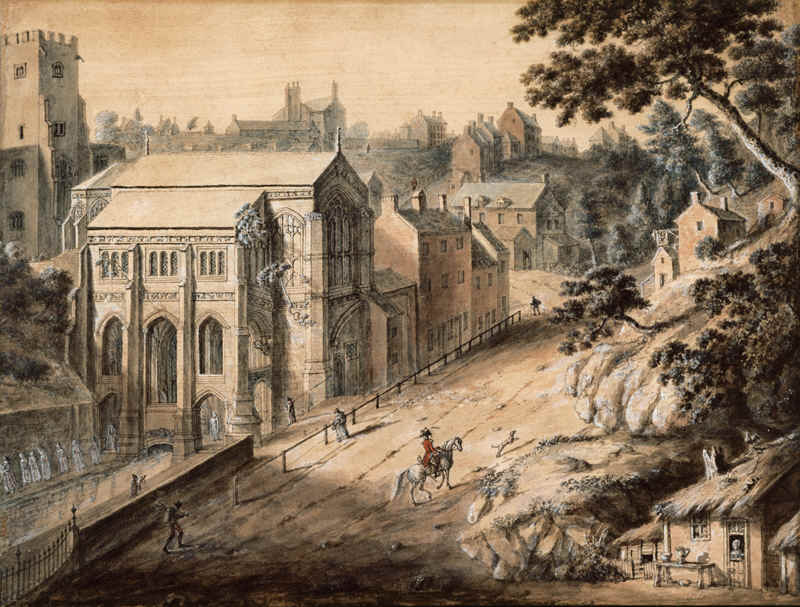
St Winefride's Well with Holywell in the background

St Winefride’s Well with Holywell in the background, 18th century. Watercolour by John Ingleby. Source: People’s Collection Wales

After the Dissolution the well began to become the focus of Catholic (specifically Jesuit) sedition.  In Holywell, Basingwerk Abby had now been stripped of its roof lead, always the beginning of ruin, and although part of it is thought to have been occupied as a house for a while, it was ultimately abandoned.  However, the well and the accompanying church continued to be an illicit focus of Catholic devotion, and St Winefride’s chapel continued to be maintained and visited, often at enormous risk to both residents and visitors, sometimes resulting in imprisonment or execution.  Perhaps directly linked to this illicit expression of devotion, and a way of bonding with the shrine, are many, many carved pieces of graffiti, mostly alphabetic, some dates and a few unexplained pictograms.  That’s all another story, and a really interesting one for another day, but it is really quite remarkable that the shrine survived centuries of religious intolerance to eventually experience a revival of pilgrim and tourist attention in 18th and 19th centuries, at which time the buildings underwent restoration.

Lead repair of stonework along the side of the well


Final Comments

Ceiling boss in the lower chapel

Ceiling boss in the lower chapel

St Winefrede, a 7th century saint, is one of the best known saints in Wales.  The miracle-working shrine with its gushing natural spring became so popular and important throughout the medieval period that in the late 15th or early 16th century it was provided with a brand new pair of chapels, upper and lower, that provided a building of late gothic splendour to frame the well and provide spaces for experiencing the spring and for worshipping in a church-like environment.  It welcomed pilgrims, was an asset to its owners and contributed to the economy of Holywell itself.

The site was awarded the status of a National Shrine in 2023.  It continues to be a significant draw for both pilgrims and tourists, and makes for a very attractive day out when combined with both Basingwerk Abbey and the industrial heritage park, continuing to make its presence felt.
Visiting

With parking nearby, a visit to St Winefride’s Well can take no longer than an hour or so to visit, but it can be combined with the Greenfield Valley Heritage Park to make a full day out, particularly when the small town at the top of the hill is included in the trip.

On the map of Greenfield Valley to the right, the Holywell spring and chapel are at the very top (the car park is just down the hill at the What3Words address ///scanning.smarting.brisk or a lay-by just up the hill at W3W ///fidgeting.grain.nail). Alternative parking is at Basingwerk Abbey at the very bottom of the park, bigger than that for the chapel, at W3W ///assess.origin.flicks). There is also plenty of parking in the town at the top of the hill.

The other sites on the map shown here are described on the post about Greenfield Valley’s industrial heritage.  The church of St James has been closed on the three occasions when I have visited, but it lies behind the chapel, just uphill from it.  There is a cafe next to the abbey, on the bottom right of the map, but check the website listed below, because at the time of writing it is under refurbishment.

The Visitor Centre, ticket office and souvenir shop are on the left as you enter the grounds, and it is from here that you collect the key for the upstairs chapel as well (they ask that you leave your keys as a deposit).  The Visitor Centre is a single large room, with some excellent interpretation boards and some original objects on display (note that there is a sign saying that it is not permitted to take photographs in the Visitor Centre).
The spring and the fan-vaulted well chapel are on the same level as the Visitor Centre via a door to the left of the ticket office. The overhead chapel, which sits over the top of the well chapel, is a little way uphill, on the footpath along the road.  To reach it you need to go back out of the Visitor Centre and turn left up the road.  Turn left again along the path that leads from the road to the church. The door faces uphill.

There is a free leaflet with a map, which you can collect from the ticket office.  I have scanned it and posted it here for download as a PDF, but note that the leaflet was longer than A4, so I’ve split it up and arranged it in portrait rather than landscape to fit it on two pages.  My version is not a thing of beauty, so it would be much better to pick up the leaflet when you visit!

I strongly recommend that if you don’t have a telephoto lens or very good zoom function on your phone, you take binoculars so that you can get a much better view of the carvings on the ceilings in the lower shrine and on corbel tops in the upper chapel.  A powerful torch would certainly help too, particularly in the upper chapel.

Finally, do note that this is still a place of pilgrimage and prayer, and you may run into people having a quiet moment in front of the statue of Winefride within the lower chapel, or even having a dip in the outer pool.  A lady did so when I was last there on a freezing cold day, and after drying off she went pray in front of the statue just inside the entrance of the lower chapel.  I carried on with what I was doing, but gave her space.
xxx

Sources

Books and Papers
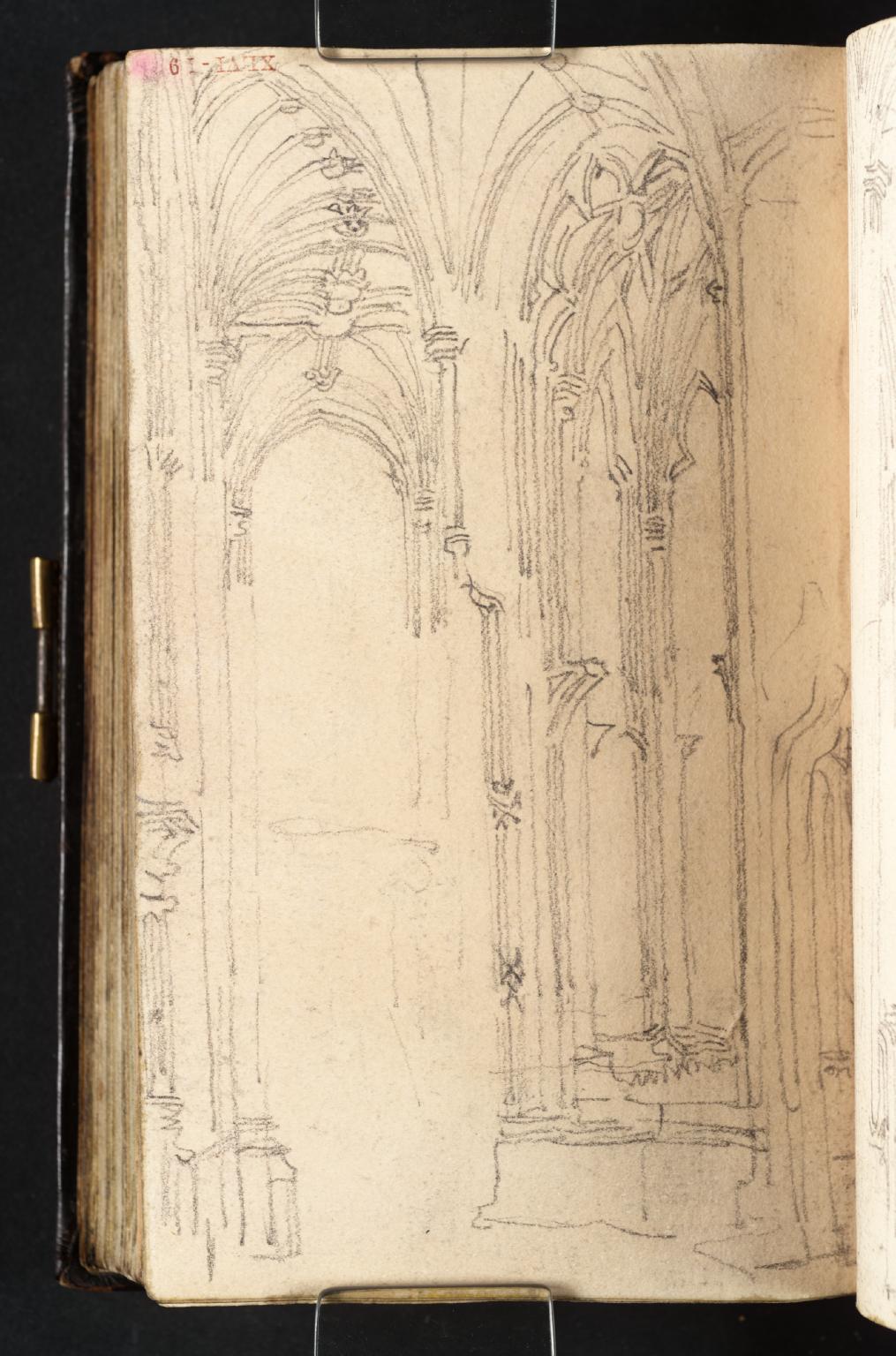
Joseph Mallord William Turner, Holywell: The Interior of the Cloisters, St Winifred's Well 1799


Joseph Mallord William Turner, Holywell: The Interior of the Cloisters, St Winifred’s Well 1799. Source: The Tate

Baker, Nigel 1998. Shrewsbury Abbey. A Medieval Monastery. Shropshire Books.

Barraclough, Geoffrey 1988. The Charters of the Anglo-Normal Earls of Chester c.1071-1237.  The Record Society of Lancashire and Cheshire, vol. CXXVI

Bartlett, Robert 2013. Why Can the Dead Do Such Great Things?  Saints and Worshippers from the Martyrs to the Reformation.  Princeton University Press.

Burne, R.V.H. 1962. The Monks of Chester. The History of St Werburgh’s Abbey. SPCK

David, Christopher 1969, 2002 (2nd edition). St Winefride’s Well.  A History and Guide

Farmer, David 2011 (5th edition). The Oxford Dictionary of Saints. Oxford University Press

Given-Wilson, C. (ed.) 1977.  The Chronicle of Adam Usk 1377-1421. Clarendon Press
https://archive.org/details/chronicleofadamu0000adam/page/n5/mode/2up

Garland, Lisa M. 2005.  Aspects of Welsh Saints’ Cults and Pilgrimage c.1066-1532. Unpublished PhD, King’s College London
https://kclpure.kcl.ac.uk/ws/files/2935809/420753.pdf

Gray, Madeleine 2007.  Welsh Saints in Westminster Abbey.  Transactions of the Honourable Society of Cymmrodorion 2006, New Series, 13 (2007), p.5-30
https://www.cymmrodorion.org/wp-content/uploads/2017/07/2_Welsh-Saints-in-Westminster-Abbey.pdf

Hubbard, Edward 1986. The Buildings of Wales: Clwyd (Denbighshire and Flintshire). Penguin

Pritchard, T.W. 2009. St Winefride, Her Holy Well and the Jesuit Mission, c.650-1930. Bridge Books

Tait, James 1920. The Chartulary or Register of the Abbey of St Werburgh. Chartulary of Chester, part 1. Chetham Society

Turner, Rick 2019. The Architecture, Patronage and Date of St Winefride’s Well, Holywell. Archaeologia Cambrensis 168, p.245-275
https://archaeologydataservice.ac.uk/archiveDS/archiveDownload?t=arch-3493-1/dissemination/168-2019/10-Arch_Camb_168_Turner_245-275.pdf

Webb, Diana 2000. Pilgrimage in Medieval England.  Hambledon and London

Williams, David H. 2001. The Welsh Cistercians. Gracewing


Websites

Based In Churton
Basingwerk Abbey
https://wp.me/pcZwQK-2Ju
Greenfield Valley (industrial heritage)
https://wp.me/pcZwQK-3eL
St Werburgh’s Abbey (multiple posts)
https://basedinchurton.co.uk/category/chester-cathedral/
A roof boss of Thomas Becket in the Abbey of St Werbergh (Chester Cathedral)

https://basedinchurton.co.uk/2023/07/14/a-ceiling-boss-in-chester-cathedral-the-murder-of-thomas-becket/

Early Tourists in Wales
Holywell and St Winifred’s well
https://sublimewales.wordpress.com/attractions/2231-2/

Essex Record Office
Salvation for sale
https://www.essexrecordofficeblog.co.uk/document-of-the-month-august-2017-salvation-for-sale/

Greenfield Valley Heritage Park
https://greenfieldvalley.com/

Greenfield Valley Café
At time of writing closed for refurbishment – check link below
https://greenfieldvalley.com/visit/greenfield-valley-cafe/

Heneb
Holywell
https://heneb.org.uk/archive/cpat/ycom/flints/holywell.pdf

Landmark Trust
St Winifred’s Well (Woolston)
https://cms.landmarktrust.org.uk/globalassets/3.-images-and-documents-to-keep/history-albums/st-winifreds-well-2025.pdf

Shrewsbury Orthodox Church
Saint Winefride (Gwenffrewi) (with a photograph of the St Winefrede chapel and spring at Woolston)
https://shrewsburyorthodox.com/local-saints/saint-winefride-gwenffrewi/

streetsofsalem
Monarchs and Monkeys
https://streetsofsalem.com/2014/03/26/monarchs-and-monkeys/

St Winefride’s Shrine and Visitor Centre
https://www.stwinefridesshrine.org/blank-1

University of Michigan – Digital collections
A collection of articles injunctions, canons, orders, ordinances, and constitutions ecclesiastical: with other publick records of the Church of England; chiefly in the times of K. Edward. VIth. Q. Elizabeth. and K. James. Published to vindicate the Church of England and to promote uniformity and peace in the same. And humbly presented to the Convocation.
https://quod.lib.umich.edu/e/eebo2/A79649.0001.001/1:7?rgn=div1;view=fulltext


Statue outside the shrine

Statue of St Winefride outside the shrine


A visit to Basingwerk Abbey, Holywell

Introduction

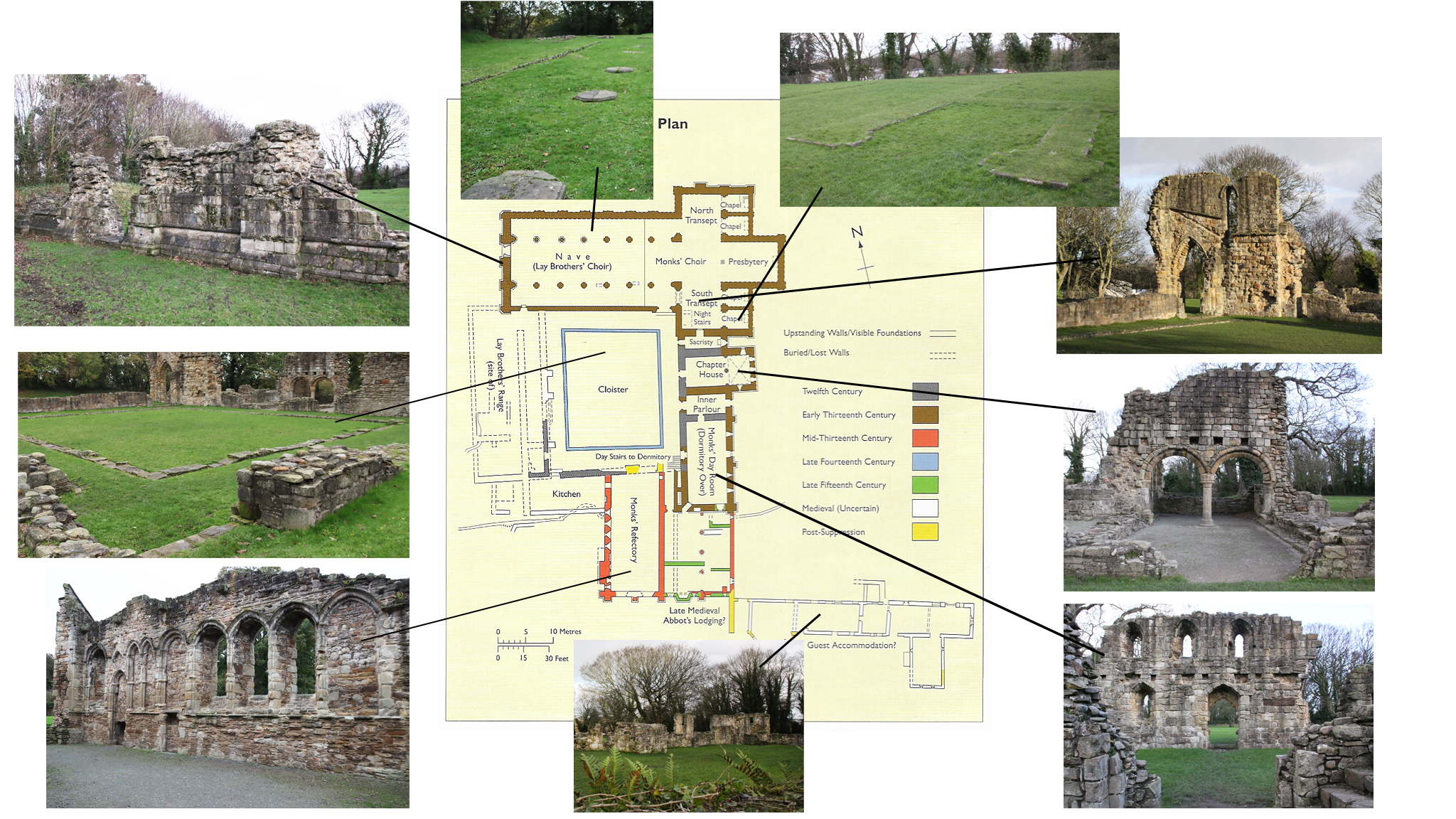
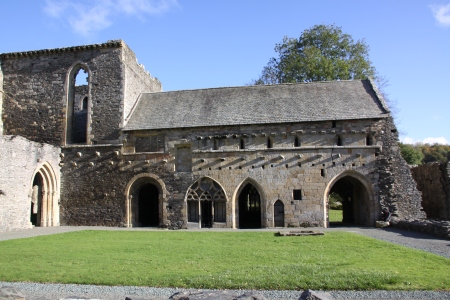
The Chuch is at left, the Chapter House opposite and the ground floor monks’ day parlour whcih once had their dormitory overhead. The line of the cloister, a covered walkway with arcades, and the central garth are marked out by the stone foundations

I have been to Basingwerk Abbey a couple of times, but never got around to writing it up.  It’s a super site, and although it is now a ruin, it retains enough of its original structures to ensure that its layout is easily understood.  St Winifred’s Well, with its lovely late gothic shrine, is only a mile and a bit away, and an important part of Basingwerk’s property for most of its life, will be covered on another post.

Basingwerk Abbey is only a  few miles away from Flint Castle.  The abbey preceded the castle by over a century but when Edward I founded Flint Castle and its accompanying town in 1277, the histories of abbey and castle became entwined. A visit to the abbey is easily combined with a look-in at the attractive riverside remains of Flint Castle.  I have written about the history of Flint Castle on an earlier post.

Digital Aerial Photograph of Basingwerk Abbey. AP_2009_2896 – s, Archive Number
6355272. Source: Coflein

Savignacs and Cistercian Basingwerk Abbey

Remains of the church

The first Basingwerk abbey, dedicated to St Mary, was founded as a Savignac monastery Ranulf II (Ranulf de Gernons) (1099–1153), fourth earl of Chester and later merged with the Cistercian order. It is not known why the Savignac order was chosen by Ranulf, but the monks who were sent to Basingwerk were provided directly by the founding monastery of Savigny in southwest Normandy itself. It became Cistercian in 1147.  Most of the monks who served there subsequently, up until the 15th century, were English, aliens in territory that was a bone of contention between England and Wales.

A monastic order is formed of a shared set of spiritual ideals, often spelled out in considerable detail in rules that covered everything from how many times a day a monk should pray, communally or individually, to where and when they could speak, eat and sleep, and what work they should engage in. All orders involved, at least in theory, a degree of renunciation and isolation by communities of monks, but these ideals were eroded as the influence of monastic houses grew.  The trajectory of monastic history in Europe changed in the late 11th century and early 12th century with the establishment of the so-called reforming orders, who wanted a purer, less self-indulgent and more hard-working approach to cloistered living than other contemporary monastic institutions offered.  The reforming orders believed that the Rule of St Benedict, as it had been originally conceived and set down in the 6th Century Italy, was the key to recovering a holier and more disciplined approach to a communal life of worship. The Carthusian order was established in 1084, the Cistercian order in 1098, the Savignac order between 1109 and 1112.

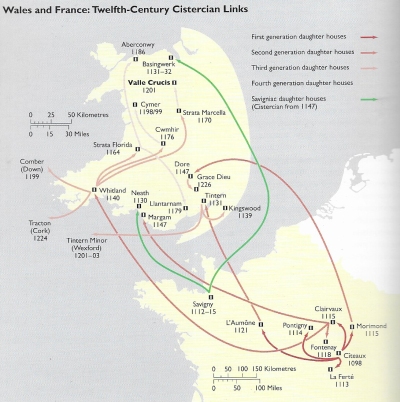
12th Century links between Cistercian monasteries.Although Citeaux, the node for all Cistercian abbeys, established early new bases in France, it was Clairvaux under the lead of St Bernard that was responsible for the earliest new abbeys in Wales. Of these Whitland was the most important for the northward spread of monasticism. The green lines emanating from Savigny reflect the Savignac order, which merged with the Cistercians after only 20 years, in 1147. So although Basingwerk in the north and Neath in the south were founded as Savignac orders, after 1147 they were brought under the rule of the Cistercians at Citeaux.  Source: Evans, D.H. Evans 2008, Valle Crucis Abbey (Cadw).

In Wales one of the most successful of these orders was the Cistercian order, which left remains in north, mid and south Wales.  Valle Crucis in Llangollen is the nearest of the Cistercian abbeys to the Chester-Wrexham areas, established in 1201, and is discussed in a series of earlier posts, which begins here with Part 1.  The Savignac order is much less well represented throughout Britain, and the reason for this is that in 1147 it was amalgamated with the Cistercian order.  Basingwerk Abbey, established as a Savignac monastery, became Cistercian in that year.

Because of their similarities the Savignacs and Cistercians were a good match, but there were differences too, largely in terms of the constitutional framework and systems of accountability.  To ensure that these were understood after the fusion, Savignac monasteries were put under the supervision of an appropriately located and senior Cistercian order.  Basingwerk was put under authority of Buildwas Abbey in Shropshire, which had also originally been Savignac.  This was perfectly in keeping with the Cistercian hierarchical approach to monastic management with every new monastery answerable and accountable to a mother house.  The mother house for the entire order was Cîteaux, and Clairvaux was the mother abbey for Whitland in south Wales, which was established by monks from Clairvaux itself. Whitland in turn established other abbeys including Strata Marcella near Welshpool, and this abbey in turn established Valle Crucis.   This system created a network of houses that all linked back to the ultimate mother house at Cîteaux (Cistercium in Latin) in France, the founding monastery of the Cistercian order.  Every Cistercian abbot had to return from his abbey to Cîteaux every year for what was known as the General Chapter, a great conference of the Cistercian abbots. 

A more detailed history of monasticism, and the Cistercians in particular, is included in Part 1 of the series on Valle Crucis.

Cadw guardianship monument drawing of Basingwerk Abbey. Survey-plan. Cadw Ref. No. 216/9a4. Scale 1:192. Source: Coflein

The foundation and economic basis of Basingwerk Abbey at Holywell

Exterior of the refectory

The first Basingwerk Abbey was probably in wood, and was located at a different but nearby site possibly somewhere in the vicinity of Hên Blas in Coleshill, near a now-lost castle.  There is a reference to a fortification in the Annales Cambriae describing how, when Henry II advanced into Wales from Chester,  Owain Gwynedd prepared for the upcoming battle by digging a large ditch associated with a hastily built camp at a site called Dinas Basing.  It is thought that this was the castle known to have been in the area of Hên Blas, which lies on a ridge between two streams and overlooks the Dee estuary.  Excavations in the 1950s demonstrated the existence of a 12th century motte-and-bailey castle , which was flattened by Llewelyn the Great in the early 13th century, and was replaced with a defended courtyard with timber-framed buildings.

The central garth on a very moody day looking at the remains of the church. The tall upstanding ruin is the main remnant of the church at its east end. Photo taken from within the refectory

Basingwerk Abbey was later rebuilt in stone at the current site of the ruins, possibly in the 1150s, probably when Henry II granted a charter to the house and endowed it with the wealthy manor of Glossop in Derbyshire to assist with its financial future, 10 years after it became Cistercian.  The general location seems to have been strategic rather than purely spiritual.  The area of Tegeingl is located in the Four Cantrefs between the earldom of Chester and Welsh Gwynedd, always the subject of territorial dispute between England and Wales and a source of regional discontent until Edward I completed his invasion in the late 13th century.  The establishment of a large French monastery was probably part of this process of establishing a presence, and a holy one at that.  Although the monastery was later mainly populated by English monks, the Welsh too saw the benefit of patronizing a prestigious religious establishment and both Llywelyn ab Iorwerth (d. 1240) and his son, Dafydd ap Llywelyn (d. 1246) were benefactors. 

Detail of Map 12, page 91 in Williams 1990 showing Cistercian Lands in Wales, with those of Basingwerk marked in red. Click to enlarge.

When an abbey was founded, its endowment included a number of properties that included farmland or pasture that were intended to support it by the provision of produce to make it self sustaining and later by selling produce.  Some of these could be quite substantial manors, but others were smaller farms, which the Cistercians referred to as granges.  These could resemble mini monastic establishments and often had their own chapels. Later still, properties with their land could be rented out to tenants, but as late as the early 16th century, Abbot Nicholas Pennant was busy creating a new open enclosure in the mountains adjacent to the monastery apparently for agricultural development.

Gelli Chapel, from Thomas Pennant’s 18th Century Tour in Wales. Source: National Library of Wales, via Wikipedia

Based on the work of D.H. Williams in his 1990 Atlas, Silvester and Hankinson 2015 list all the known Basingwerk granges, shown on the above map produced by Williams. These were supplemented in 2001 by Williams in 2001.  Apart from two properties in Derbyshire these are all concentrated in northeast Wales and the Wirral and include, in alphabetical order:  Baggechurch /Beggesburch Grange, Bagillt; Calcot; Gelli Grange, either at Gelli or Gelli Fawr; lands in Whitford and the adjacent parish of Cwm; the Lordship of Greenfield, alias Fulbrook, including lands of Merton Abbot and party of Holywell town; and Over Grange, Holywell (all in Flintshire).  Lands with uncertain boundaries have also been identified elsewhere in the area, including Mostyn, Wake, Flint and Gwersylt as well as transhumant pasture close to property belonging to Valle Crucis Abbey at Moelfre-fawr in Denbighshire, at Boch-y-rhaiadr and Gwernhefin. They also owned Lake Tegid at Bala.

Beyond Wales, there were also three granges on the Wirral: Caldy Grange (West Kirby), Thornton Grange and Lache Grange (known as “La Lith”), as well as the granges in Charlesworth at Glossop, their mos profitable property, and leased land in Chapel le Frith. 

Over Grange, Holywell. Source: Williams 1990, plate 39, page 120. No indication of when the photograph was taken.

Of this list, only two buildings seem to have survived into relatively recent times, the remnants of two granges.  A chapel at Gelli Fawr in Whitford (Flints), apparently once belonging to Basingwerk Abbey was recorded in  a late 18th-century drawing which suggests that the chapel was part of a larger building complex. More can be found about the building and its possible function it in Silvester and Hankinson 2015.  Another grange, Over Grange, was listed by Cadw in 1991, according to Silverster and Hankinson, and was located located to the southwest of the modern farm house, and has been much-altered.  The photograph below shows it with small cross over the gable.

The Coflein website says that it is believed that Basingwerk Abbey originally constructed a windmill on this site, but the present structure probably dates to the late18 or early 19th century.  Now restored. Source: Coflein 804658 – NMR Site Files. Archive Number 6259181

To support its farming activities, the monastery built watermills, windmills and fulling mills.  Abbot Thomas Pennant (abbot from 1481 to 1522) appears to have been particularly active in the building of mills.  Records indicate that there were at least four windmills, at least three watermills, and at least two fulling mills, as well as a tithe barn in Coleshill.

The site of the Holywell windmill is thought to be preserved by the surviving windmill that can be seen today, shown right.  Two of the windmills were on the Wirral. Rowan Patel’s research has found that the Basingwerk windmill that stood at West Kirby area had been established at around 1152, and was probably upgraded and even replaced several times.  It stood on a high spot near the coast, an ideally windy location, and eventually featured on sea charts as a major landmark for coastal navigation.   It was mentioned in Henry VIII’s Valor Ecclesiasticus, the valuation of all monastic properties. Patel has found that after the Dissolution the mill became the property of the Crown and was rented to Thomas Coventree for an annual sum of 40s.  Rowan Patel’s research suggests that the second Basingwerk windmill was at Newbold, east of West Kirby, mentioned in the Taxatio of Pope Nicholas IV in 1291, where a Newbold windmill was referred to and valued at 40s a year.  Before the Dissolution it appears to have been rented out to Thomas Coyntre in 1525 on a 100 year lease at 40s a year.  By the time of the Dissolution, Thomas’s son Richard Coventry was apparently paying rent to the Crown, and in 1659 William Coventry, presumably a descendant of Richard’s, was still paying rent.  In 1664 it is next recorded having been sold to one Thomas Bennett in who donated it to the support of the poor.  Patel notes that in 1546 two men stole oats, barley and pease worth 10d, indicating the cereals proposed at the mill in the mid-16th century if not before.

Watermills continued to have a value well into the 20th century, and medieval mills will have been replaced over time, removing the visible remains of them, particularly along the valley that ran down the hill behind St Winifred’s Well and past Basingwerk before emptying into the Dee.

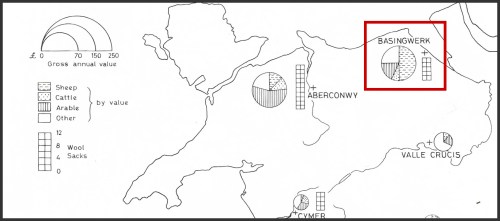
Economic Values excerpted from Williams 1990, map 21, p.105, showing the dominance of the agricultural contribution to the abbey’s income

Basingwerk had a large amount of livestock.  The hills and newly cleared meadows around Basingwerk were ideal for sheep in the uplands and cattle in river valleys and pastures.  The Welsh princes are also recorded as expecting two horses annually from Basingwerk which may indicate that the monks, like those of Cymer Abbey, were breeding horses.

As well as agriculture, which made up most of its income, Basingwerk was also involved in industrial activities, owning or leased industrial properties, Williams lists silver mining as a component of Basingwerk’s economic activities, and this is supported by Gerald of Wales whose trip through Wales in 1188 records leaving Conwy and heading east through Tegeingl through “a country rich in minerals of silver, where money is sought in the bowels of the earth” before spending the night at Basingwerk.  The abbey was also involved in the salt trade, with salt extraction enterprises in Northwich and possibly Middlewich.   Williams notes a coal mine leased from the Crown in Coleshill.  Lead was also mined at Basingwerk, probably making use of the same resources that had been exploited by the Romans in the area.

Economic resources excerpted from Williams 1990, map 22, p.105

Timber was taken from woodlands in Penllyn in Merionydd for housing, hedges, fuel and other requirements, as well as for sale.  Tenants were permitted to take a reasonable amount of firewood.  Assarting, the removal of woodland for conversion to agricultural land and other uses was a common activity in the middle ages.

Fishing probably made up a significant part of the diet, as it did at most Cistercian monasteries.  Basingwerk held the fishing rights for Lake Tegid at Bala, which it owned, and had a weir at West Kirby.  Prince Dafydd granted them one fifth of the catch at Rhuddlan in the 13th century.  They may also have purchased fish caught in the nearby coastal waters.

Basingwerk had a number of urban properties too, in Holywell, Flint, Chester, and Shrewsbury, which served as bases in town for the abbot and his representatives, which were probably loaned to friends of the monastery, but could also be leased out for additional income if required.  The Shrewsbury house was probably a legacy of the abbey’s connection with Buildwas Abbey after the amalgamation of the Cistercian and Savignac orders.

The fan vaulting in St Winifred’s Well at Holywell

A major feather in the financial cap of Basingwerk was St Winifred’s shrine with its beautiful natural spring.  The Holywell shrine of St Winifred was also another source of travelers requiring somewhere to stay and something to eat.  St Winifred’s shrine was granted in 1093 to St Werburgh’s Abbey in Chester, but was passed to Basingwerk in 1240, together with the living of Holywell church.  An abbey with a pilgrim shrine had a whole world of opportunities for income generation, and St Winifred’s was not only famous in its own right for its powers of healing and provision of miraculous cures, but was on the pilgrim trail to Bardsey Island at the end of the Llŷn peninsula and Ireland, via Anglesey.  In 1427 it was given a considerable boost when Pope Martin V granted indulgences for those visiting the shrine and giving alms to the chapel.  Indulgences rewarded certain behaviours, like pilgrimages, with a remission of sins, meaning less time in purgatory.  Royal visitors included King Henry V in around 1416 and Edward IV in 1461, helping to raise the profile of the shrine, which continues to welcome pilgrims today.  It became even more attractive from the late 15th – early 15th century when the shrine was provided with a spectacular gothic building that surrounded the spring.  I will cover Holywell in a separate post.

A traditional method of income acquisition for monasteries was appropriating a church and its income, sometimes to cover a particular expense, such as a major building project, and sometimes just to supplement income.  The Cistercians officially frowned on this practice, but the ban on appropriating church incomes did not survive very long.  Even so, Basingwerk had appropriated surprisingly few, just parish churches at Holywell, Glossop and a third at an unknown location, possibly to be identified with Abergele.

The fairs and markets granted to Basingwerk during Edward I’s reign in the 1290s are discussed below, and this must have been a considerable aid to their income.

Behind the monks’ day room and the dormitory above it was a block of buildings the function of which remains unclear. Suggestions include an extension of the abbot’s personal quarters, with rooms for special visitors, or a dedicated guest wing.

In spite of these various forms of income, Basingwerk sometimes found itself in financial stress. The monastery had been unable to provide a required payment to Edward III in 1346, and by way of explanation complained of the burdens of hospitality that came partly with being a Cistercian abbey, which put a great deal of emphasis on providing free hospitality, and partly from being near a major road, which had become increasingly busy after Edward I had moved forward into Wales, establishing market towns whose merchants moved between Wales and Chester for trade.  Even later in its history, in the late 15th/early 1gth century, it was reported that guests were so numerous that they had to take their meals in two sittings. Smith paints an evocative picture of other travelers in Wales who “cautiously flitted from one English settlement to the next, seeking safe overnight bases where food and shelter could be found “in a land in which rumors of insurrection abounded.” Basingwerk was by no means the only abbey to complain of this burden, which was a particular problem for Cistercian abbeys, but was shared by any monastic community that sat at a busy location.  Birkenhead Priory, which ran the ferry that allowed crossings between the Wirral and Lancashire for access to Chester and beyond (and later Liverpool), found itself in real difficulties due to the requirement to supply hospitality for ferry users who might be stuck at the monastery for several nights in bad weather.

A rather more specific problem was the expectation by the Welsh princes to use the abbey’s Boch-y-rhaiadr range for its annual hunting expeditions, during which the abbey was expected to provide bread, butter, cheese and fish for a hunting party of 300, expanding to 500, with money due in lieu when hunting did not take place.  This was abolished by Edward I after his conquest of Wales.

The Cistercian monasteries in Wales were not exempt from all taxes, or subsidies, and some of the abbots and their community were employed as tax collectors.  Other occasional charges were made on the abbey, such as a demand for financial contributions towards the marriage of Edward III’s sister.  Basingwerk provided £5 in 1333.

The abbey, being so active in economic production in the Holywell-Flint areas, was responsible for the management of its lands and the personnel who managed and worked the land, but was also required to function in a judicial role, its courts administering justice and meting out punishments.  Lekai says that the monastery had “a pillory, tumbrel and other instruments of punishment, although the penalty most often inflicted was a fine.”

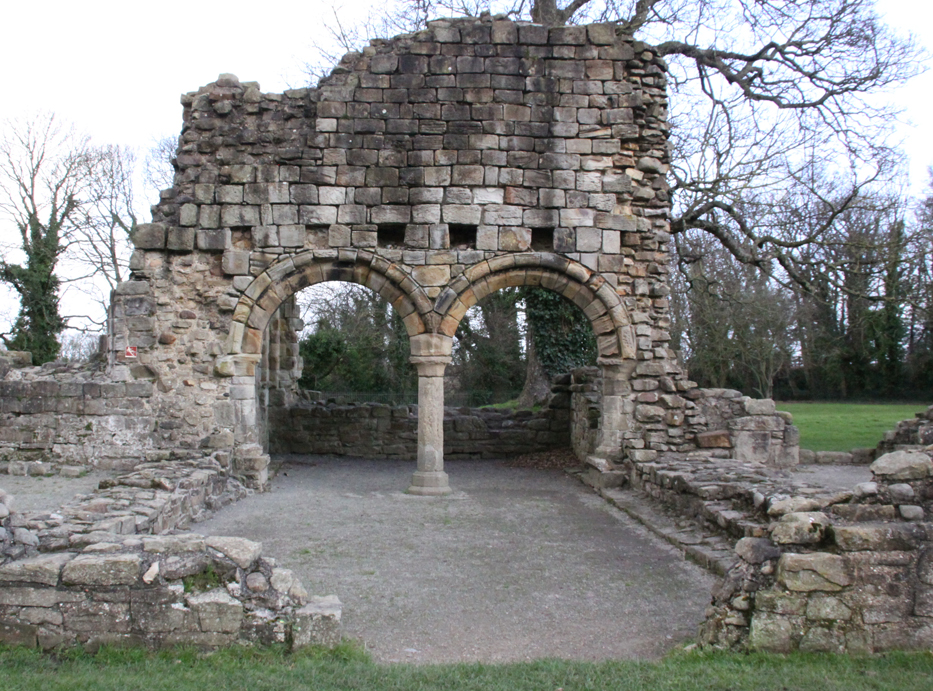
The church is on the left and the two arches of the chapter house at right,.  All the buildings were arranged around the central green area, the garth. The stone foundations for the covered and arcaded walkway survive.

Most of the Cistercian abbeys in Wales, at one time or another, had a diplomatic role acting as intermediaries between the Welsh princes and the Crown, acting for either side, a role that was in their political interests to accept.  For example In 1241 Henry III used the Lache grange for a conference between himself and Prince Dafydd’s clerk.  In 1246 Henry III chose the abbot of Basingwerk to escort Prince Dafydd’s wife Isabella from Dyserth Castle to Godstow nunnery near Oxford.  A decade later, Prince Llywelyn ap Gruffyd used an abbot of Basingwerk to carry a letter to Henry III.

In 1291 the Taxatio Ecclesiastica of Pope Nicholas IV valued Basingwerk at £68 8s 0d, gross value (compared with Valle Crucis at £91 8s 0d, and Margam  at £255 27s 4½d).  In 1346 it claimed that its lands were sterile, and it went through some bad years, but in spite of the rebellion of Owain Glyn Dŵr in the early 1400s and a very troublesome period when a monk took the abbacy without being legally elected in the first half of the 15th century, with a similar problem in the later 15th century, the appointment of Thomas Pennant in the early 16th century seems to have turned things around.  In 1535, Henry VIII’s Valor Ecclesiasticus valued the monastery at £157 15s 2d.  Margam by this time was valued at £188 14s 0d, and Valle Crucis £214 3s 5d.
——

The layout of the monastery

Plan of Basingwerk Abbey. Source: Robinson, D. M., 2006. Basingwerk Abbey (Cadw).

The remains of the monastery conform to a standardized layout favoured by all the orders that followed the rule of St Benedict, clearly shown on the Cadw plan to the right, which helpfully colour-codes the dates for each part of the building. Few parts of the 12th century abbey are left.  Most date to the early 13th century, but the monk’s refectory was built in the mid-13th century.  Much of the abbey was rebuilt in the 13th century, which was not unusual when, for example, a new abbot might want to make a mark, but in this case it is possible that much of not most of it was done due to damage inflicted during the wars between the English and the Welsh, when Edward paid compensation to the abbey to enable it to carry out repairs, about which more below.

The cloister arcade was apparently remodelled in the late 14th century.  In the late 15th century Abbot Thomas Pennant carried out building work not only at the abbey but also at the shrine of St Winifred just up the road in Holywell.  There are various aspects of the site where both date and function remain unclear.  The western range, opposite the chapter house, would have been part of the original layout, used to house the lay brethren, discussed below, but may have gone out of use if a new use for them could be found when the lay brethren were no long featured in the community.  Although the above plan shows that the possible guest accommodation is undated, timbers from fire damage Basingwerk were saved for future analysis and tree-ring dating shows that the felling-date of the crown-post truss was c. 1385.  This is one of the earliest Welsh tree-ring dated.  The dating was commissioned by Cadw.
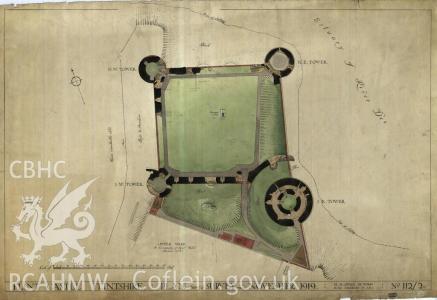
The church is at left, the chapter house to its right, the day room and the windows of the first floor dormitory next, and set to the far right is the refectory

Although every monastery differed in some aspects, the basic template of buildings surrounding a central square area, a garth (green area) with surrounding walkway (the cloisters) with the monastic church making up one side, was a universal arrangement.  The church was usually on the north side, as it was here, and often included two chapels in the transepts that flanked the crossing area where the choir was located.  Some churches featured towers either above the crossing or at one end.  The other buildings usually included a chapter house (the important monastic meeting room), day room with a dormitory on its first floor, a refectory, and sometimes an undercroft for storage. with an external door leading into the cloister on one side and the monastic precinct beyond. A sacristy was usually attached to the church, sandwiched between the church and the chapter house, which is how matters were arranged at both Basingwerk and Valle Crucis.  The cloisters were usually supplied with desks (called carrels) along the exterior wall of the church  where the monks could study and write.

The precinct, in which this arrangement of buildings sat, could include other structures like farm buildings, and visitor accommodation and often included a gatehouse, the whole surrounded by some form of boundary.  A key feature of Cistercian monasteries was good drainage, which supplied the kitchens and fish ponds, where present, and took away toilet waste, and various parts of the Basingwerk drainage system can be traced at the site.

Part of the abbey’s drainage system

Part of the abbey’s drainage system

The church, with its entrance at far left and the south transept at right

Many of these features can be found at Basingwerk.  The church is largely in ruins, but the layout is still visible in the very masonry walls that sit on the grass, including the columns that supported the roof and divided the church into a central nave with three aisles and seven bays, two side transepts each with a small transept and an eastern presbytery where the high altar would be located.  At around 50 metres in length the church would have been one of the smallest Cistercian churches in Wales. Only Cymer near Dolgellau is shorter, at just over 30m in length.  At the entrance to the presbytery a stone set into the floor may have supported a lectern.

What remains of the south transept, with the presbytery beyond

Basingwerk Abbey refectory wall

Opposite the former church, and one of the best preserved parts of the abbey, is south range with the refectory, which was built perpendicular to the cloister rather than lying along it on a north-south axis.  The refectory in Chester Cathedral, the former St Werburgh Abbey, was built along the length of the cloister, limiting its size, but the the refectory at Basingwerk as limited only by the size of the precinct.  This was probably a change introduced in the 13th century remodelling of much of the abbey, replacing a 12th century refectory that lay along the side of the cloister on an east-west axis.  It is a substantial building with many features preserved in its walls.  This includes the former entrance and stairway to the pulpit, now blocked off, from which religious texts would have been read during meals.  S series of tall windows would have let in a lot of light, and there was a hatch between the refectory and the kitchen for the convenient handing over of food, as well as a cupboard, which was apparently shelved, opposite.

The monks’ day parlour at ground floor level, with the dormitory on the first floor, the windows suggesting the original height of this building

The east range of buildings, again along the edge of the cloister, extends between the east range and the church.  As you face this range, running from right to left are the monks’ day parlour, over which was the dormitory, the length of which over-ran the cloister and ran parallel for a short distance with the refectory;  a long thin parlour is next, and then most importantly is the chapter house, where the monks met daily to discuss the business of the order.  To its left is the sacristy, which adjoined the south transept of the church.

The Chapter House

The sacristy to the left of the chapter house, with doorway leading into the church to the left.

Looking towards where the western range would have been located. The building beyond is now the café.

Opposite this range was the western range, of which there is almost nothing left.  In a Cistercian monastery this was usually used, at least in the early decades, for the lay brethren.  These were members of the monastic community who worked the land, and were not required either to be as educated as the monks, or to dedicate a similar amount of time to worship.  They worked the land and were maintained by the monastery.  As properties were leased out, the lay brethren were increasingly redundant and the western range was usually put to different uses.  It is not known how it would have been used at Basingwerk.


Edward I and Basingwerk Abbey

Plan of Flint Castle. Source: Coflein

When Edward I settled on his location for his new castle at Flint, Basingwerk Abbey was just a few miles west of the new site.  The monks of Basingwerk Abbey, which was established over 100 years earlier in 1132, must have wondered about the impact of the castle on their own security and their livelihood.  During the first few months of the castle construction process in the summer of 1277 Edward stayed near Basingwerk.  Edward saw himself as a religious man.  He had been on crusade, and had made a vow to establish a monastic house of his own, under the Cistercian order, and had selected a site for it in Cheshire.  Vale Royal Abbey was already underway in 1277 near Northwich, Edward having laid the first stone in early August.  It seems unlikely that Edward was not often a guest of the Basingwerk Cistercian Abbey during the building of Flint, which apart from being obliged under Cistercian rules to provide hospitality, was unlikely to reject a royal visitor.  Although Basingwerk had been founded by an English patron, Ranulf II it was probably more in tune with Welsh interests by the arrival of Edward.  Indeed, earlier in 1277 seven Cistercian abbots had written a letter to Pope Gregory X supporting Prince Llewellyn ap Gruffud against charges placed by the Bishop of St Asaph, although the abbot of Basingwerk was not amongst them.

Drainage at Basingwerk, from the refectory

Whatever their personal leanings, it would have been very much in the interests of the order for good relations to be maintained.  They may have offered advice about his plans for Vale Royal, and it is clear that some of the abbots in the Welsh-based monasteries, including Basingwerk, played an invaluable role as intermediaries between the Welsh and the English.  Fortunately for the monks at Basingwerk, Edward I chose the Cistercian abbey at Aberconwy for his headquarters, forcing that monastic community to eventually shift further south along the Conwy valley to a new home.

The monks of Basingwerk would have been less than astute, however, if they had not regarded the new castle with misgivings, and if they had concerns about being caught in the middle of a fight between Edward and Llywelyn, their worries would later be justified.  In the 1270s and 1280s the abbey suffered damage during the wars of Edward I, in spite of letters of protection issued to it in 1276,1278, and 1282 and in 1284 Edward granted £100 compensation to the monks after the army stole corn and cattle and the loss of workers who were abducted, presumably for labour.  An additional 132 4d was paid in damages to churches in Holywell.  Basingwerk was not the only abbey in the area to suffer and receive compensation.  Valle Crucis near Llangollen received a sum of £160.00, and nearby Aberconwy was occupied by Edward I’s forces and its monastic community was forced to move to a new home to the south, at Maenan.  Relations between the abbey and castle obviously continued to remain good, because when the castle was completed in 1280 a monk of Basingwerk was engaged as the chaplain to the royal garrison.

One of John Speed’s maps showing Flint Castle and town. The castle and town of Flint as mapped by John Speed in 1610, showing the original road layout and market place. Source: National Library of Wales

At Flint, Edward had established a Norman-style new town as part of his vision for colonizing various parts of Wales.  This was an English settlement, and any new burgesses prepared to live there was given numerous incentives.  In 1278 Edward granted it permission to hold weekly markets and an annual fair.  In 1292 he granted Basingwerk the same permissions for Holywell, having granted them permission to hold an annual fair at their Glossop manor in 1290.  The monks could charge market stall holders rent for the duration of the market, a nice source of income, as well as selling their own products.  Basingwerk, with its water mills, windmills and fulling mills and land under both grazing and grain, was certainly in a position to sell a number of products, including grain, livestock and livestock products including meat, skins and wool. Welsh wool was recognized as being of very high quality, sometimes superior to even that of the better known wool produced by the Yorkshire monastic producers.  The Taxatio ecclesiastica of Pope Nicholas IV in 1291 recorded that Basingwerk had 2000 sheep producing 10 sacks of wool, 53 cows (at a ratio of 37.1:1), and no goats. Even if it found itself in competition with Flint, Basingwerk’s fairs probably represented the opportunity to raise the abbey’s income.  Its industrial products, as well as some of its wool, may have been sold for export.

The 14th – 16th century

Burton and Stöber describe how by the mid 14th century there were reports that the abbey was in debt, and in the fifteenth century some of its abbots were a distinct liability:

in 1430 the house was seized by Henry Wirral, who made himself abbot, and the following year he was engaged in a legal dispute for the office with Richard Lee. Despite the court ruling in favour of Lee, Henry continued in power at Basingwerk until 1454 when he was arrested for various misdemeanours and deposed. Matters did not improve, for in the following decade Richard Kirby, monk of Aberconwy, disputed the abbacy with Edmund Thornbar. Although the General Chapter ordered that Edmund be recognized as abbot, Richard was still in office in 1476.

Manuscript by Gutan Owain, National Library of Wales, MS3026C. Source: The National Library of Wales

Fortunately the abbey’s fortunes improved under Welsh Abbot Thomas Pennant, who ruled the house for about forty years from around 1481 to 1523, although this was very much a last hurrah before Henry VIII dissolved the monasteries beginning in 1535. By the early 16th century Welsh bard Tudur Aled (died 1526) makes it clear that there was lead roofing and stained glass at the abbey.   Tudur Aled praised Abbot Thomas , commending his his learning but also his generosity, generally an indication that they were being sponsored by a given abbot, as at Valle Crucis.  Gutun Owain seems to have benefited from Basingwerk Abbey’s patronage.  Owain is notable for having addressed over fifteen poems to Cistercian abbots, and is known to have stayed as a guest at Valle Crucis and Strata Florida as well as Basingwerk.  Although the late fifteenth century manuscript known as the Black Book of Basingwerk (Llyfr Du Basing, now NLW MS 7006D, which was the mainly the work of Gutun Owain copied into a single volume) was probably held by Basingwerk at the time of the dissolution in around 1536, it is thought in fact to have been the work of copyist monks at Valle Crucis.

Thomas Pennant was not a man of undiluted virtue.  In an order where celibacy was required and monks were not permitted to marry, Pennant not only fathered a family, but his son Nicholas, became the last abbot of Basingwerk, which in theory was an act of simony banned by the order.  When the abbey closed, probably in 1536, with just three monks, Nicholas was the abbot.

St Mary on the Hill, Chester. Source: GENUKI

After the Dissolution every valuable object and piece of structural material was stripped for Henry VIII’s treasury.  James says that part of the timber ceiling is at Cilcain, and that stained glass can be found at Llanasa.  Burton and Stöber add that the choir stalls from the abbey were transferred to the church of St Mary on the Hill in Chester.  Lead from the roof was removed, and may have been used for the repair of Holt Castle on the Dee and Dublin Castle. Williams adds that it may have been employed also in other crown buildings in Dublin, and that it is possible that the wooden sedilia in the parish church of St Mary, Nercwys, was from Basingwerk.  There is a tradition that the Jesse window was reinstalled in the parish church of St Dyfriog (Llanrhaeadr-yng-Nghinmeirch) but this remains unconfirmed.

I have been unable to get access to St Mary on the Hill, a comprehensive history of which is on the Chesterwiki. It was decomissioned in 1972 and now describes itself as a Creative Space and venue for a range of activities.  However, the Chesterwiki site says that the fittings, presumably including the Basinwerk choir stalls, were removed after the church was decomissioned, although it does not say where these fittings went.

From the 18th century the site attracted artists who recorded features that are now lost.  In the early 20th century a large section of the south transept collapsed.  In 1923 the site was put in State guardianship and in 1984 it was put into the car of Cadw.

Basingwerk Abbey miniature by Moses Griffiths, c.1778. Source: National Library of Wales, via Wikipedia

Final comments

The building that may be a guesthouse, has had burned timbers dendro-dated, which give the roof a date of c.1385. Source: RCAHMW Exhibitions: Dendrochronology Partnerships

Information about Basingwerk Abbey is fragmented and partial, but researchers have pieced together a history of the abbey that tells a story about abbey’s past, beginning as a Savignac establishment before being absorbed into the Cistercian network of monasteries.  The disputes between the Welsh princes and Henry III and Edward I caused grief for the north Wales monasteries, but they survived to rebuild and move forward.  Like other abbeys in Wales, the abbots of the abbey had a diplomatic role, often acting as intermediaries between Wales and England.  As members of the wider community with an important economic role, the abbey was often involved in local judicial matters. Financial difficulties in the 14th and 15th centuries are recorded and but again the monastery survived these difficulties.  In the early 16th century the abbey became a haven for Welsh bards, supporting their work. Throughout its history, its location on the main route through north Wales meant that it was obliged to provide more hospitality than more secluded monastic houses, whilst the shrine of St Winifred, whilst contributing to the prestige and financial value of the abbey, also required some management to prevent it becoming a drain on the abbey’s obligation to provide shelter and food.  After the Dissolution in 1536, the abbey was decommissioned, its valuables removed and its properties either sold off our leased out.  Today it is managed by Cadw and offers an excellent visitor experience.


Visitor Information

Find the captions and see the full-sized map at https://greenfieldvalley.com/greenfield-valley-zones/. There is an interactive version of the map at https://greenfieldvalley.com/explore/interactive-map/.

The site is free to visit.  There is no visitor information centre but a small modern shop sells guide books, postcards and souvenirs relating to Basingwerk, St Winifred’s Shrine and the Greenfield Valley Park. The abbey’s postcode is CH8 7GH and the car park is on Bagillt road, just to the west of the enormous railway bridge, opposite a small trade/industrial estate.

There is a big car park at the foot of the abbey, shown to the right left on the A548, just west of the enormous railway bridge, which has a fairly gentle metalled incline up to the abbey, with a bench and information map half way up.

There is also a café just outside the main gates, which in October 2022 was doing a good coffee and a splendid lunch.

Basingwerk Abbey is a component part of Greenfield Valley Park, and is popular with dog walkers and children, so if you want a quiet visit it is probably best to go on a weekday outside the holidays. The rest of Greenfield Valley Park is an excellent visit in its own right, with a remarkable amount of industrial archaeology within its borders, and plenty of interpretation boards.  I have posted about the industrial archaeology of the Green Valley Park here.

If you want to stay in the medieval period, St Winifred’s Well is about 1.5 miles through the park (shown as No.9 at the very top of the map right), or if you prefer to drive it has its own car park.  Flint Castle is only 4 or so miles down the A548 towards Chester, and makes for a great visit.  I wrote about the history of Flint Castle on an earlier post, Together, the three sites make a very fine medieval day.

Sources

Books and papers:

Burton, J. and Stöber, K. 2015.  Abbeys and Priories of Medieval Wales.  University of Wales Press.  https://www.jstor.org/stable/j.ctt9qhdvn.13

Davies, Paul R. 2021. Towers of Defiance. YLolfa

Elfyn Hughes, R., J. Dale, I. Ellis Williams and D. I. Rees. Studies in Sheep Population and Environment in the Mountains of North-West Wales I. The Status of the Sheep in the Mountains of North Wales Since Mediaeval Times. Journal of Applied Ecology , Apr., 1973, Vol. 10, No. 1 (Apr., 1973), p.113-132
https://www.jstor.org/stable/2404720

Evans D.H. 2008, Valle Crucis Abbey, Cadw

Knight, L. Stanley 1920. The Welsh monasteries and their claims for doing the education of later Medieval Wales. Archaeologia Cambrensis, 6th series, volume 2, 1920, p.257-276
https://journals.library.wales/view/4718179/4728984/314#?xywh=-63%2C345%2C2942%2C1730

Rhys, Ernest (ed.) 1908.  The Itinerary and Description of Wales with an introduction by W. Llewelyn Williams. Everyman’s Library. J.M. Dent and Co, London. and E.P. Dutton and Co (NY)
https://archive.org/details/itinerarythroug00girauoft

Huws, D. 2000.  Medieval welsh Manuscripts. University of Wales Press

James, M.R. 1925.  Abbeys. The Great Western Railway
https://archive.org/details/abbeys-great-western-railway

Jones, Owain, 2013. Historical writing in medieval Wales. PhD Thesis, University of Bangor.
https://research.bangor.ac.uk/portal/files/20577287/null&ved=2ahUKEwjxssbb0tvtAhWmxIsKHQgvBW0QFjAOegQICBAI&usg=AOvVaw2GbJiGy6Sl3SPiTX4K8RqZ

Lekai, Louis L. 1977. The Cistercians. Ideals and Reality. The Kent State University Press

Patel, Rowan 2016. The Windmills and Watermills of Wirral. A Historical Survey. Countyvise Ltd.

Robinson, D. M., 2006. Basingwerk Abbey. Cadw

Silvester, R.J., and Hankinson, R., 2015. The Monastic Granges of East Wales. The Scheduling Enhancement Programme: Welshpool. Clwyd-Powys Archaeological Trust (CPAT)
coflein.gov.uk/media/241/979/652240.pdf

Smith, Joshua Byron 2016. “Til þat he neӡed ful neghe into þe Norþe Walez”: Gawain’s Postcolonial Turn. The Chaucer Review, Vol.51, No.3 (2016), p.295-309
https://www.jstor.org/stable/10.5325/chaucerrev.51.3.0295

Williams, David H., 2001. The Welsh Cistercians, Gracewing

Williams, David H., 1990. Atlas of Cistercian Lands. University of Wales Press

Websites:

Coflein
Basingwerk Abbey
https://coflein.gov.uk/en/site/35649?term=basingwerk%20abbey%20holywell

Monastic Wales
Basingwerk Abbey
https://www.monasticwales.org/browsedb.php?func=showsite&siteID=24
Gutun Owain
https://www.monasticwales.org/person/72
The Black Book of Basingwerk
https://www.monasticwales.org/archive/24
Valle Crucis (Abbey)
https://www.monasticwales.org/browsedb.php?func=showsite&siteID=35

RCAHMW Exhibitions: Dendrochronology Partnerships
Bilingual exhibition panel entitled Partneriaethau Dendrocronoleg; Dendrochronolgy Partnerships, produced by RCAHMW 2013
https://coflein.gov.uk/media/200/524/rcex_026_01.pdf

RCAHMW List of Historic Placenames (searchable database)
https://historicplacenames.rcahmw.gov.uk/

University of Notre Dame
A Knight in St. Patrick’s Purgatory, by Haley Stewart. March 15, 2019
https://churchlifejournal.nd.edu/articles/a-knight-in-st-patricks-purgatory/

An Essay on Cistercian Liturgy by Dr Julie Kerr
Cistercians in Yorkshire, University of Sheffield
www.dhi.ac.uk/cistercians/cistercian_life/spirituality/Liturgy/Cistercian_liturgy.pdf 


The chapter house propped up during excavations when M.R. James visited in 1925.

Basingwerk Abbey from the South. 1929 postcard. Source: People’s Collection Wales

April’s ‘Chester Archaeological Society’ visit to St Collen’s Church in Llangollen

The Chester Archaeological Society 2024 season of excursions started excellently today with the CAS visit to the Church of St Collen, who gave his name to Llangollen. It is the only church in Wales to have taken the saint’s name. Like most Medieval churches in Wales, St Collen’s has undergone considerable alterations, including an 18thcentury tower and a 19th century chancel, vestry and south nave, but there are some very fine 13th century features to be seen, in the Perpendicular Gothic style, including an impressive shrine canopy and mason’s marks. There are also intriguing signs that a Lady Chapel was once incorporated into north aisle. The most remarkable feature of the church is a really superb hammerbeam roof bedecked with ornamental sculptures, both religious and secular, from the early 16th century.
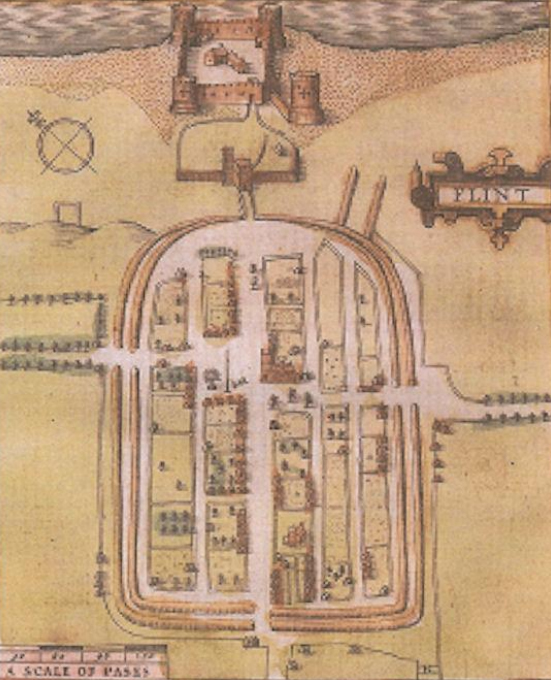
Today, to ensure the survival of the church as a living and breathing community asset, it is undergoing extensive but very sympathetic re-forming.  Suzanne Evans is the Project Manager of this massive task, and was our superb guide today. Suzanne described how the reinvented church will be fully inclusive, not only of the existing congregation who are much-attached to the church, but of the wider community as well, taking into account the needs of those currently unable to make the most of what St Collen’s has to offer. At the same time, the exciting opportunity will be taken to investigate as much of the church’s architectural and funerary history as possible, adding to the community’s understanding of this important contributor to the town’s impressive ecclesiastical heritage.

Suzanne guided us around both the key features and recent discoveries, explaining all the steps to be taken in the upcoming weeks and years. As well as replacement glass doors and the opening up of the nave to enable the interior to be visible by passers-by, there will be new lighting, heating, kitchen and toilet facilities, as well as a large stage, which will all contribute to enhancing the value of the space and improving the visibility of the superb architecture. All archaeological and architectural discoveries will be professionally recorded and published.

After a very welcome cup of tea, there was a round of applause as we thanked both Suzanne for being our terrific guide and Pauline for making all the arrangements. It was great to meet some of the other CAS members, and to hear all the questions and observations. There was a lot of information sharing, which is exactly what one expects of CAS members. What a great start to the year’s excursions! Many thanks again Suzanne and Pauline.

The 13th century exterior


A great day out at Greenfield Valley Park, Holywell

On visit to Basingwerk Abbey a few months ago, we noticed signage indicating that the abbey was at the south end of the Greenfield Valley Park, the north end of which is Holywell just to the south of Holywell town centre.  The Greenfield Valley Park had been on my to-do list for ages, but it was my friend Katie’s suggestion that we go today, and she brought David Berry’s guide book with her, which included a map that we followed to make the most of the park (details below).

Map from Greenfield Valley Visitor Centre

The park, which includes the ruined abbey and St Winifred / Winefrede’s Well follows both the line of the Holywell Stream that erupts in bubbles at St Winifred’s Well, as well as the line of a former railway track that ran from Holywell to Greenfield Dock.  It is one and a half miles as the crow flies from north to south, but covers 70 acres and consists of a network of metalled paths (marked on the map) and tracks, beautifully maintained, connecting some remarkably preserved industrial heritage.  Each one of these buildings was accompanied by large tracts of water that were used to power water wheels that were built in the late 18th century and continued to be used well into the 19th century.

As well as being fascinating, the tree-filled park is a lovely place to walk, particularly appealing in its multi-coloured autumnal garb.  In the summer there are birds and butterflies, and even at this time of year there was the occasional woodland flower.  There is also the little Bakehouse café in Basingwerk House at the  south end of the park, next to Basingwerk  Abbey, which serves good coffee, cake and a small, imaginative menu of nicely presented and very enjoyable food.

This post is confined to the really gripping industrial heritage.  I’ll talk about Basingwerk Abbey on another post, and St Winifred’s well, both of which we visited on the same day, will also be dealt with separately.  The following highlights of the walk start in the north and head south ending at Greenfield Dock.  The numbers in the text refer to the map above.
sdafasdfas

The Holywell Rail Line and bridge

The wide metalled footpath that links Holywell in the north with the A548 to the south follows the line of a standard gauge railway built in 1868.  Its purpose was to carry minerals from the Greenfield Wharf, now known as Greenfield Dock, and to ship products made at Greenfield Valley to Liverpool for sending further afield. In 1912 it was converted to carry passengers, and became known as the Little Train.   It claims to have been the steepest conventional passenger railway line in Britain, with a 1:27 gradient.  At the top of the path, near Holywell, there is a massively constructed railway bridge (10) with two wide arches.  Today, charmingly, it is a footpath, leading from Tesco to a housing estate.
asfasdfsd

Greenfield Valley 1792. Source: Davies and Williams 1986

Battery Works

Established in 1776, the Battery Works (8), also known as Greenfield Mills, was built to manufacture pots and pans from brass sheets.  Davies and Williams describe the process (p.28-9):  Each of the four copper and brass battery mills “consisted of large hammers raised by a cog on a rotating beam.  The beam extended from the axle of the waterwheel so that each waterwheel worked up to six hammers.  Once the cog had passed, the hammer fell, striking an anvil.  Workmen would hold sheets of plates of metal on the anvils and as the hammer hit them, shape them into pans, bowls and other articles.”

fdfdsfsd
The troughs that held the water to turn the wheels can still be seen.  One of the pits where the waterwheel turned can still be seen in the photograph below, together with a section of wall with a circular hole where the wheel once turned. Like all the main industrial operations along the river, it was backed with a large body of water at its northern (upriver) side.  The water is now full of bull rushes.  Even though it is impossible, just by looking at the ruined remains, to see exactly how all the different elements fitted together, this is a massively impressive piece of the Greenfield site.  The finished products were shipped to  Africa via Liverpool and exchanged for West African slaves.  

Meadow Mill

In 1787, eleven years after the Battery Works, a new mill (7) was built by the Greenfield Copper and Brass Company to produce rolled copper sheets, and to make copper rollers for printing patterns on to cloth.  The main building was a sizeable affair, 86 x 69ft (26 x 21m), with two pillars 11.5ft (3.5m) apart supporting a roof made of copper sheet.  It was  fitted with three cast iron wheels, each 20ft (6m) in diameter.  Copper ingots were melted and moulded into plates 3 (0.9m) x 4ft (1.2m) and about 1/2 inch (1.27cm) thick, which were cut into strips, that were in turn fed between pairs of rollers to create sheets of various thicknesses.   These could be turned into wire or other products.  When this work came to a close, the site was used by a number of other smaller-scale industries, including a tin plate works.

Meadow Mill  is backed by a basin of water that fed the water wheel that powered the mill.  It is now marshy and full of algae, making life rather interesting for the moorhens, and the surrounding foliage is now home to several species of butterfly. On the other side of the water wheel, the water was taken down to the next level of the valley down a purpose-built run-off.  

In the 1850s it was taken over by Newton Keates as a lead works.  This was followed by a tinplate works, then a brass rolling and wire works, and in 1890 was leased to William Eyre for rubber grinding and processing.

Lower Cotton Mill

There were a number of cotton mills along the Greenfield Valley, built for the manufacture of cotton textiles, all water-powered, in a period when cotton was one of Britain’s primary exports. John Smalley, one of the backers of Richard’s Arkwright’s ground-breaking spinning frame, established a mill with his colleague John Chambers. Their company was the Cotton Twist Company.  The earliest mill was built from stones taken from the nearby Basingwerk Abbey, and was called the Yellow Mill.  The business was declared bankrupt in 1780 and Smalley died in 1782, but Smalley’s window Elizabeth was able to find partners to push the business forward, and the business went from strength to strength.  Upper Mill was built inn 1983, Lower Mill (6) In 1785 (in just 10 weeks) and Crescent Mill in 1790.  All were fitted with Arkwright’s spinning frames and were worked by many local people, including young children.  The six-storey mill that survives today is the Lower Cotton Mill, its spinning frame once powered by a waterwheel 18ft high (5.5m) and 7ft (2.1m) wide with a 16ft (4.8m)  fall of water.  You can see the culverts that were built to carry the water beneath the buildings and feed them further down the valley.

From where we were walking, on the upper path, we could look down into the ruined warehouse’s, which was impressive.   In the 1850s it was taken over by a flour merchang and renamed the Victorian Corn Mill; the water basin is still called the Flour Mill Pond. Later it was the premises of a wheelwright and a brickworks.

If you were on the lower path, one of the buildings (which we did not know about) has apparently been restored and now houses a steam bottling plant, a railway museum and an exhibition on the industries of the Valley.  It was something of an omission that we missed this!  A good excuse to go back.  At the time of writing, admission is free.

Abbey Wire Mill

The Abbey Wire Mill overshot waterwheel in pit. Source: Chris Allen, Geograph

The site of the former copper and brass wire factory (5), the main output of which was  pins and bolts, has little to see.  It originally covered about an acre, and was the site of the wire mills of the Parys Mine Company, where rods of copper and brass were pulled through a series of holdes of decreasing size and then heated and cooled until wire was produced.  The site does contain an original waterwheel pit in which a waterwheel is still located, now renovated and capable of producing electricity for the museum.

In 1856, Newton Keates and Co leased the site and raised the level of the dam to create a larger pool.  This was a mistake.  Water broke through and flooded in 1857 and 1858, so the height of the water behind the dam had to be lowered.  The works closed in 1894 and the machinery was auctioned off.

Apparently, at a later date in the early 20th century, a small soap-works was built on the site which produced, presumably amongst other themes, soap imprinted with images of St Winifred, the first batch of which were sent to the Pope.  The mind boggles.  Today there is a small bandstand at its edge.

Further down the path, and the Bakehouse Café is located in Basingwerk House, a fine 1930s building.   We had a very good lunch there.  Beyond that is Basingwerk Abbey (about which more on another post) and beyond that is a car park and the A458, which you need to cross to reach Greenfield Dock, which is off the above map.

Greenfield Dock

Greenfield Dock is beyond the Green Valley Park, but is only a short walk away, reached by going through the car park beneath the abbey, crossing the main road, heading left for a short distance and taking the first on the right.  This is Dock Lane, which takes you to Greenfield Dock and the Wales Coast Path.  There’s not a lot to see, just a couple of tiny fishing boats in an inlet, and views (on a less grey day) across to the Wirral, but the dock was an important contributor to the Green Valley industries, linking with the Holywell Rail Line.

The Wales Coast Path, however, looks excellent in both directions, and a great destination for a sunny day.  It starts in Chester, and can be followed continuously around the entire Welsh coastline, but can be done in short chunks.  From here, for example, one could head upriver to Flint along the Path, and visit Flint Castle (which I have written about here), which is a walk of 4.3 miles (6.9 km) from Greenfield Dock to Flint Castle, but don’t forget the return journey.
——-

Wales Coast Path: Flint to Holywell. Source: Wales Coast Path

Visitor Information:

This is an excellent place to visit, with stacks to see.  If you are interested in industrial archaeology, wildlife on land and water, and woodland walks, you will not be disappointed.

To give some idea of how long it took us, we started out from Churton (about 15 minutes drive south of Chester) at 1030, arriving in Holywell at about 1115, having taken the most direct route along the A55, and we left at 1530, with a short stop for coffee and a snack in the park.  This is a dry-day walk, because there is nowhere to shelter.

In the Greenfield Valley everything is open and free to see other than the Green Valley Park Museum and St Winifred’s Well and Chapel.  We didn’t visit the museum, which is behind the visitor centre but details are available here.  Details for St Winifred’s Well can be found here.  The museum and visitor centre are closed from the end of October onwards.  There are also details about children’s activities on the Greenland Valley website here.

From a mobility point of view, a number of tracks, including the one that follows the line of the old railway are wide and metalled, but there is a distinct downhill gradient from Holywell to the abbey, and of course there’s the uphill gradient on the return journey.

Sources:

Berry, David, 2012. Walks around Chester and the Dee Estuary.  Kittiwake Books

Davies, K. and Williams, C.J., 1986. The Greenfield Valley. An Introduction to the History and Industrial Archaeology of the Greenfield Valley, Holywell, North Wales.  Holywell Town Centre

Greenfield Valley visitor’s Guide and Map (A3 fold-out)

The Industrial Heritage of Greenfield Valley. KS2 and KS3 Teaching Resource
cadw.gov.wales/sites/default/files/2022-02/Industrial%20Heritage%20-%20Greenfield%20valley%20resource%20-%20English.pdf

Greenfield Valley Park:  www.greenfieldvalley.com

Valle Crucis Abbey #5 – The monastic community

This follows on directly from Part 4, which looked at what is known about the patrons, abbots and priors at the Cistercian Valle Crucis Abbey near Llangollen.  Parts 4, 5 and 6 were originally written as a single piece, but grew to excessive proportions and had to be split into three (the third part, looking at how life was lived on a daily basis, will be Part 6).  At the same time, this post looks a little different from its predecessors.  When I was writing this Valle Crucis remained closed.  As I have been unable to take any new photographs to accompany this post,  I have mainly used artists’ reconstructions, showing visual interpretations of various monastic sites, all similar to Valle Crucis in terms of basic operations.

Introduction

Modern view of Valle Crucis by J.Banbury. Source: Medieval Heritage website

Because patrons and abbots were important people, not merely locally but sometimes with wide-ranging national and international duties, historical records often mention them.  For Valle Crucis details can be pieced together to create a narrative, admittedly fragmentary, about those individuals and their roles both within the abbey and beyond its walls.  This was attempted in part 4.  For the wider monastic community, however, matters are rather more difficult to piece together.  It is probably a measure of the success of a monastery that a community was sufficiently stable not to draw attention to itself.  When nothing happened, there was nothing to report.  When trouble occurred, records might be preserved.  For example, under Abbot Robert of Lancaster there were clearly ructions within the Valle Crucis community, because a papal letter to the abbey stressed that the monks must obey the abbot.  It can also be inferred that under the disastrous Abbot Robert Salusbury there was profound discontent, as over half of the remaining community abandoned Valle Crucis in favour of other monasteries.  A good illustration of a Cistercian community that came to light rather too often for the Order’s comfort was Hailes Abbey near Cheltenham, where many misdemeanours were recorded.

In spite of the limitations of surviving records from Valle Crucis, the rules governing life in Cistercian abbeys, which were enforced throughout the Cistercian network, indicate how life should have been lived. During an annual meeting at Cîteaux (the General Chapter), which most of the Cistercian abbots attended, some existing rules were reinforced, others were changed as the world in which the Cistercian Order existed changed, and the outcomes were recorded.  These documents, combined with the telling architectural changes to the abbey itself, help to capture some of the details about how life would have been lived at Valle Crucis by the greater part of the community.

Valle Crucis in 1800. Source: Wikipedia

Although the founder, patrons, and the abbot and prior were ultimately the drivers of financial security and good management, it was the role of the monastic community as a whole that enabled monastic orders to flourish and proliferate.  The spread of monastic houses throughout Britain provided an ecclesiastical footprint that was itself a measure of the importance of prayer to the secular community.  The prayers of monks were the key to secular salvation.  In a sin-obsessed world, one way of mitigating the unenviable outcomes of personal sin in the afterlife was to invest in prayer.   Richard Southern sums up the situation beautifully:

Founders and benefactors saw in the ‘cowled champions’ of the monasteries the spiritual equivalent of secular soldiers.  The monks fought battles quite as real, and more important, than the battles of the natural world; they fought to cleanse the land from supernatural enemies.  To say that they prayed for the well-being of the king and kingdom is to put the matter altogether too feebly.  They fought as a disciplined elite, and the safety of the kingdom depended on their efforts. (R.W. Southern, Western Society and the Church in the Middle Ages, 1970)

This provides the essence of monastic value to the living.  Even though the Valle Crucis monks were isolated within their cloisters, and only certain of its community interacted with the outside world for practical reasons, their prayers were an essential part of the profit and loss equations of spiritual life.  Cistercian houses, once founded, might benefit from donations, gifts and sources of regular income from those who wished to purchase a better quality life after death, but essentially they were committed to maintaining themselves by economic endeavour, and this meant that the monastery was part of an economic network of production, markets and re-investment of revenue that defined much of life in the Middle ages.

Choir monks

Cloister and lavatorium of Tintern Abbey in south Wales. Reconstruction by Terry Ball. Source: Medieval History website

The main body of the monastic establishment was made up of choir monks, who were supervised by the abbot and the prior.  St Benedict’s Rule required an initial twelve monks for the founding of a new abbey, equating to the number of Christ’s apostles, and these monks and the abbot were provided from Strata Marcella. All the monks in Valle Crucis appear to have been of Welsh origin at this time, and probably were for most of its duration.

The main body of the monastic establishment was made up of choir monks, who were supervised by the abbot and the prior.  St Benedict’s Rule required an initial twelve monks for the founding of a new abbey, equating to the number of Christ’s apostles, and these monks and the abbot were provided from Strata Marcella. All the monks in Valle Crucis appear to have been of Welsh origin at this time, and probably were for most of its duration.

Cymer Abbey. Source: Cadw signage at Cymer

Politically and culturally, if not linguistically, it would have been difficult to incorporate English monks into a Welsh community.  In so far as language was concerned, Latin, required for membership of the Cistercian Order, could have been used as a lingua franca, but politically and culturally matters might have been rather more difficult.  Before the conquest of Edward I, the Welsh monasteries had a strong sense of Welsh identity and at different times Valle Crucis contributed to contemporary Welsh histories and hosted Welsh poets. Politically, even though the Cistercians as an Order had provided Edward I with financial support, and even though Welsh monastic patrons changed sides from time to time, at least in the 13th century the Welsh Cistercian monasteries of mid and North Wales were solidly behind Llywelyn ap Gruffudd  of Gwynedd (c.1223 – 1282).  In a letter to the pope in 1275, the Cistercian abbeys Aberconwy, Whitland, Strata Florida, Cwmhir, Strata Marcella, Cymer and Valle Crucis all supported Llywelyn against charges made by the Bishop of St Asaph.  This emphasis on Welsh personnel may, from time to time, have resulted in recruitment difficulties, particularly after the succession of plagues that followed the arrival of the Black Death in the mid 14th Century.  Even following Edward I’s conquest of Wales, the close association of Valle Crucis with Welsh poets in the 14th and 15th centuries argues that a Welsh outlook was never fully diluted at Valle Crucis.

14th century psalter (book of psalms) of Sir Geoffrey Luttrel.  Sou8rce: British Library, Catalogue of Illuminated Manuscripts, MS Additional 42130, via Wikipedia

The Cistercians did not accept children as novices into their community, a practice that had once been common in the Benedictine order where children were accepted as “oblates” (offerings) by their parents at least until the practice was abolished by the 4th Lateran Council of 1215 of Pope Innocent III in Rome.  The term can be confusing today because it survives in the Benedictine order, but now refers to laity who, outside a monastic house, are affiliated to it and supportive of it.  St Benedictine himself had supported the practice of accepting child oblates, but the Cistercians believed that choice was an essential factor in the moral standing and ongoing stability of the Order.  New entrants had to be at least 15 years of age, with a year’s novitiate before making their vows at the age of 16.  After the Black Death of the 14th century, when many brethren had been lost and new recruits were harder to find, the minimum age was dropped to 14 years by the General Chapter of 1349, and the year’s novitiate could be shortened providing that the novice could recite the psalms by heart.

Although in theory the monks all had equal status, reflected in shared dormitories and communal refectories, and all were subject to the same rules and disciplinary action, there were inevitably complex layers of experience and interaction within the abbey walls, based on  age, seniority, skills, experiences, roles and personality.  Although some of a monastery’s monks may have entered as novices, others much later in life either in response to a calling, or as a form of retirement.  Senior monks might act as guides to novices and younger brethren, whilst patrolling the cloister to maintain silence, and minimize social contact.

Manual work beyond the cloister might include working with crops in the fields, or with livestock, employment in crafts, gardening, and general DIY, essential to the maintenance of abbey and abbey precinct buildings and fittings.  This work took place once or twice a day depending on the time of year, and was envisaged by St Benedict not merely as a good discipline, but an aspect of daily living that would prevent boredom.  During the harvest it was all hands on deck, and many of the monks were excused at least some of the offices in order to participate.

Cistercian monks gathered daily in the chapter house, as an artist’s reconstruction shows here at Shap Abbey. Source: English Heritage

Life within the cloister was by no means a uniform, undifferentiated existence, and it was by no means unknown for disagreements and conflicts, which the senior monks, the prior and the abbot were required to resolve.  Daily meetings in the chapter house were part of the system of maintaining harmony and discipline within the monastery, at which time disciplinary issues were discussed and punishments for any infringements were handed out.

There are very few details about the monks at Valle Crucis.  What few references to them suggest that at various times, if not always, the community of monks was Welsh.  During the tenure of Abbot Robert Lancaster in the early 15th century papal correspondence to the monastery reminded the monks of their vows of obedience to the abbot, implying that there were difficulties within the Valle Crucis community, perhaps because the abbot was dividing his attentions between the abbacy and the bishopric of St Asaph, which he held simultaneously.

Although Cistercians were only supposed to leave the monastery on important business, and only abbots ever travelled very far afield, very few monks ventured far afield.  They were not permitted to go on pilgrimage or seek cures at holy shrines, but there is one record of a monk from Valle Crucis called Richard Bromley arriving in Rome in 1504, towards the end of the abbey’s life, as a pilgrim.

Obedientiaries

Although no two abbeys were exactly alike, and a lot depended upon the financial resources available to the community, as well as the individual talents of the abbot and the brethren, there is a commonality of community organization between them, including the allocation of roles, obediences, to individual monks, called obedientiaries.  This was a Benedictine tradition, not unique to the Cistercians, but which was formalized within the Cistercian’s own rules.

Benedictine monks in the cellar at Dunfermline. Source: Historic Environment Scotland

Obedientiaries were monks within the abbey who were allocated particular roles in order to assist with the smooth running of the community.  Although some tasks were rotated amongst the brethren, it made sense for the abbot to ensure that some continuity was adhered to for important tasks, particularly in positions where contact with the outside world might be required, and particularly high standards of self-discipline might be depended upon.  The use of obedientiaries was not a Cistercian invention, and although there were differences from order to order, many of the same functions inevitably overlapped, and they changed over time as the demands of individual abbeys changed.  Some of the key positions are as follows:

  • Cellarer  A key official who was responsible for the community’s centralized stores, both food and drink.  Of all the obedientiaries, this individual is likely to have had regular contact with the lay brethren and, when they were no longer employed, the outside world.  the cellarer was also responsible for interacting with the abbey granges, the farms that supplied the monastery with its food for consumption and its surplus.  It is notable that in 1212, when the Cisterican Order asked for senior staff to be exempt from outside obligations to the Pope Innocent III’s crusades and missionary activities, the cellarer was singled out amongst the senior staff, together with priors and sub-priors, that the Cistercians wished to retain
  • Precentor.  In charge of church services, the hymns, chants, prayers and antiphons (the latter song alternating between two parts of the choir). He might be supported by an assistant, the succentor
  • Sacrist, responsible for the church, its maintenance, as well as the care of the vessels and implements used in the liturgies and the vestments that were kept in the sacristy.  He was also responsible for time-keeping, using a bell or tabula (the latter a wooden board) to mark the offices and draw the monks to the abbey church.  As mechanical clocks were not invented until the late 13th century, and were even then very expensive, monastic time-keeping relied mainly on the sun, stars, and occasionally water clocks.
  • Guestmaster, responsible for welcoming and taking care of any guests, from dignitaries to pilgrims.  Hospitality was an important part of the Benedictine vision, and separate quarters were usually provided within the abbey precinct but beyond the cloister until the 14th century, when VIPs might be accommodated within special apartments within the east range of the cloister.
  • Infirmerer.  Where an infirmary was one of the monastic buildings, the infirmerer was in charge, overseeing the care of unwell and ailing monks.  Although they were standard components of Cistercian abbey complexes, there is some question about whether Valle Crucis included one or not.
  • Novicemaster.  The brother who oversaw the induction, ongoing care and overall wellbeing of the novices who entered the abbey, prior to taking their vows.
  • Refectorer. The brother in charge of the refectory, or dining hall, responsible for laying and clearing the tables, usually assisted by other brethren.
  • Kitchener. The brother who oversaw the kitchen, working closely with the refectorer and the cellarer to ensure that the monastery was fed according either to Cistercian guidelines or the abbot’s preferences.  Meals prepared for the abbot’s table, guests, the choir and lay brethren and for the infirm might be rather different for one another. There was also a safety element, as all meals were cooked over a fire, and it is thought distinctly possible that the mid 13th century fire at Valle Crucis originated in the monastic kitchen in the south range
  • Porter, who managed the gatehouse, responsible for permitting or barring entry to the monastic precinct.  The porter would also have been the first point of interaction with the monastic precinct for visitors, before they were handed over to the guest-master.  In the Benedictine Order there was also an almoner, who was responsible for allocating alms to the poor, but in Cistercian establishments, the porter doubled up as almoner. Quite how many visitors of this type would have been in the neighbourhood of Valle Crucis is yet to be determined.

Peter Dunn reconstruction of a kitchen in full swing at Rievaulx. Source: English Heritage

There is an assumption in the above that sufficient monks would have been required to complete all the daily tasks, and also that there were sufficient brethren available to fulfil these and other roles when required.  In the case of Valle Crucis, which may never have exceeded 12 choir monks,  life would have been less complex even when working together with the lay brethren; after the 14th century, when the lay brethren had vanished and the abbey leased out rather than working its lands, life was probably even less complicated.

Although the abbey was essentially silent whenever possible, the interaction required between these different roles would have sat outside that guideline, meaning that realistically, different levels of negotiation, conversation and silence would have been the daily norm, with strict silence only practised at certain times in specific places.

A chunk of the abbey’s budget was traditionally divided between each the obedientiaries to cover the costs of their activities, each given what was deemed to be an appropriate amount to manage their monastic duties.  It is not known  if all of these roles would have been fulfilled at Valle Crucis.  Although it is assumed that there was probably a gatehouse, nothing of it survives.  Similarly, if there was an infirmary at the abbey, no trace of it has been found.

Stairs built into the relocated pulpitum, perhaps once leading to an organ loft. Source: RCHAMW

The governing body of the Cistercians resisted musical instruments until 1486, when the General Chapter at Cîteaux decided that the organ was an acceptable adjunct to an abbey church.  It is thought that there was an organ loft late in the abbey’s history in the vicinity of the pulpitum, so an organist would evidently have been a member of the community, answerable to the precentor.

Even without a full-sized organ, beautiful musical accompaniment could be achieved by a portable “portative” organ, which is one of a number of instruments that could be used when an abbey could not afford an organ.  A portative organ can be seen in use by virtuosa Catalina Vicens in the YouTube video at the end of this post, producing the most unexpectedly rich, and enchanting sound, truly fabulous, slightly raw.  I’ve never heard anything quite like it.

Some monks were also given particular roles of responsibility within the monastery, known as obediences, each representing an aspect of monastic life, discussed below.

What is interesting is the degree to which the monastic organization formalizes functions, with both internal and external interactions formalized just as job descriptions are today.  Knowing what someone should be doing and how they should be doing it would have helped the abbot to monitor both the performance of the monastery as a whole and the effectiveness of the individual monks that contributed to its smooth running.   By ensuring that those with particular skillsets were put into suitable roles, the abbot could allocate his resources efficiently.  The founding monks were presumably chosen from the mother abbey with a view to fulfilling at least some of these roles from day one.  Young novice monks would have learned from their elders, and those who entered the community later in life might have brought other relevant experience and skills with them.  Balancing the books must have been a constant headache for the abbot, his prior and the cellarer.

Ordained priest-monks

Artist’s impression of one of the chapel pairs at Valle Crucis, based on the existing architecture, in the north and south transepts. By C. Jones-Jenkins

The two pairs of chapels in the Valle Crucis transepts were completed in the late 13th century, and were for the performance of mass by ordained priests.  The trend in abbey life for monks began to be ordained as priests met the specific need of conducting masses for the dead.  Although this was originally strictly forbidden by the early Cistercians, it became one of the important income streams of abbeys.  Donation of funds were made by those wishing to have masses said for themselves and their families in perpetuity.  Masses could only be conducted by those who had been trained and received the sacrament of Holy Orders, ordained by a bishop.  As masses were usually held daily, separate chapels became increasingly important within the abbey church to prevent interruption of other monastic activities, and were at first usually located in the transepts.  Valle Crucis only ever had four, but other monasteries might extend their abbey churches to add more.

Lay brothers (conversi)

Hailes Abbey showing the nave of the abbey church with conversi (lay brethren) divided from the more rarefied area occupied by choir monks.  By Peter Urmston. Source: English Heritage

The Cistercians were faced with a dilemma when the order was established.  Although the reforming order wanted to engage in both work and prayer (ora et labora) in good balance they also knew how much physical work was required to work the lands required to support a monastic house.   An early Cistercian document (Exordium Parvum XV, translated in Waddell’s Narrative and Legislative Texts, p. 435) expresses this dilemma very clearly:

Having spurned this world’s riches, behold! The new soldiers of Christ, poor with the poor Christ, began discussing by what planning, by what device, by what management they would be able to support themselves in this life, as well as their guests who came, both rich and poor, whom the Rule commands to welcome as Christ. It was then that they enacted a definition to receive, with their bishop’s permission, bearded lay-brothers, and to treat them as themselves in life and death – except that they might not become monks – and also hired hands; for without the assistance of these they did not understand how they could fully observe the precepts of the Rule day and night.

The lay brethren, conversi, were given a year, as novices, to make up their minds before they took the vows that bound them to the abbey and its estates.  The coversi were were not literate and were therefore not qualified to enter the abbey as fully fledged choir monks, but were an essential part of the Cistercian vision of economic self-sufficiency, and lived in a dormitory opposite that of the choir monks on the first floor of the west range.  They were not tonsured (the top of the head shaved), and were usually bearded.  They usually outnumbered the choir monks, particularly in abbeys with large land-holdings.  This model, based on the traditional manorial management of land, allowed the choir monks to remain within the monastic precinct, whilst the lay members of the community farmed and otherwise worked the monastic estates, and undertook general repairs of the monastery itself as well as related buildings and granges.  Of great importance, some of them were also the interface between the cloister and the outside world for matters concerning grange management, the replenishment of the monastery’s stores and the sale of any surplus at market.  Both choir and lay brethren were considered to be integral to Cistercian monasticism.

Artist’s impression of conversi in their refectory, showing lack of tonsure and beards. Source: Cistercians in Yorkshire

The conversi were apparently attracted by a number of features that were preferable to the alternative of working for a secular manor.  For one thing, they were members of a community that not only valued them, fed them and clothed them, but looked to their spiritual well-being.  For hard-working farming labourers who had little time to worry about such matters, this may have been a real draw.  In addition, in the face of poverty, the monastery provided security and stability.  Although their commitment to the abbey was directed towards sustaining it physically and economically rather than spiritually, the commitment of the lay brethren to the monastery’s lands was fundamental to the spiritual well-being of the monastery.

The use of conversi as farmers and herdsmen had gone into decline by the end of the 13th century.  There is some debate as to why this should have occurred.  The usual view is that the Black Death of 1349 largely wiped out the lay brethren, and this may well have been the case, but there is also an argument that lay brethren were becoming increasingly dissatisfied with their lot, and that some of the abbeys were already moving towards leasing out their lands  by the mid 14th century, meaning that it was possible that the role of the conversi was already being undermined before the arrival of the plague.

Corrodians 

Corrodians seem like something of an anomaly in terms of the general running of a Cistercian establishment.  In return for a financial contribution or property, including land, a man might  buy a corrody, a type of pension, and retire within the monastic community.  They were common within the Benedictine order, a convention adopted by the Cistercians.  In return for corrodies, the corrodian would receive specified amounts of food, drink and clothing. It was not a glamorous way to see out life, but it offered safety, stability, some degree of company, the care of the monks during illness, and, immediately to hand, the provision of the last rites.  Proximity to all that monastic activity was also, as death approached, a step closer to salvation, as was burial within the monastic precinct. 

An example from 1530 is one John Howe who, in return for £20.00 (in modern terms £8,825.54 /4 horses /16 cows, according to the National Archives Currency Convertor) was entitled to a bed chamber, candles, food and drink twice daily, and items of clothing which were laundered at the monastery.  Given the date, only six years before Henry VIII suppressed the monasteries in 1536, if John Howe was still alive at the time, he must have felt seriously aggrieved and may not have had the funds to find himself a new care home, unless he was able to persuade the authorities to compensate him.  Even then, it is unclear where he could have gone.

Final Comments on Parts 4 and 5

Monks in procession through Rievaulx Abbey in the 14th century (artist’s impression). Source: English Heritage

The religious life in an early Cistercian abbey was a combination of church services (liturgical offices and masses for the souls of the dead), scholarly activity and some manual labour.  Monks were generally not allowed to leave the monastic precinct, and unless they left to form a new monastery, might spend their entire lives in the company of their brethren.  It was important, therefore, that life in a Cistercian abbey was highly regulated, because rules and routines held the community together and allowed for transgressions and disputes to be resolved, usually by a mixture of encouragement, punishment and an awful lot of prayer.  In spite of attempts to maintain the standards of the Cistercian Order, there was a slow erosion of standards.

Although Valle Crucis was designed as a closed unit, like other Cistercian monasteries, there were limits to the extent to which this could be achieved.  Abbots and their seconds-in-command, priors, had rather more freedom because they were required to venture into the outside world on abbey business.  At least two abbots at Valle Crucis combined the job with the bishopric of St Asaph, a strange division between the cloistered life of the monastery and the more public life of the diocese.  This must have had an impact on the community as a whole, which must have been more dependent on the prior than was usual.  In so far as the rest of the community was concerned, individual monks might be thoroughly cloistered within the abbey, but others would have to interact with the outside world in order to maintain the abbey’s economic self-sufficiency. 

The combination of being withdrawn from the world, but simultaneously enmeshed in its political, economic and social complexities required dedicated interfaces between the monastery and the world beyond, not always a comfortable idea for monastic houses.  This apparent conflict between a mandate for seclusion and necessary connections with the world beyond the cloister was a defining feature of Cistercian abbeys.  Initially resolved by the incorporation of conversi into the monastic community, difficulties were presented when the conversi were no longer available.
fasfsadf

Next 

Part 6 will take a look at everyday activities at the monastery, to give an idea of how the monks lived their lives from day to day and year to year.

All parts of this Valle Crucis series of posts are available, as they are written by clicking on the following link: https://basedinchurton.co.uk/category/valley-crucis-abbey/.

Sources for all parts

The bibliography for all of the Valle Crucis posts are in Part 1.
adsfsdfsd


Valle Crucis Abbey #4 – Patrons, abbots and priors

Cadw sign at the site showing a cutaway of how the interior of the Valle Crucis abbey church may have appeared

Part 1 of this series about Valle Crucis Abbey near Llangollen introduced the background to 12th Century monasticism in Britain, via St Pachomius and St Benedict, and talked about the Cistercians, the spread of the Cistercian order in Wales and why Valle Crucis was located where it was.  Part 2 looked at how the buildings at Valle Crucis were used and how the monastic community functioned.  Part 3 looked the architectural development of the abbey, an architectural jigsaw of a story from foundation in 1201 to dissolution in 1536.

Part 4 and upcoming part 5 look at how the patrons, abbots, priors and monks of the Cistercian Order contributed to life at Valle Crucis.  In Part 4, the top levels of the abbatial hierarchy are introduced, and in Part 5 the main body of the monastic community is described, all helping to build a view of what sort of people were to be found at the abbey, and what life was like within the cloister.

It is the way of the literate world that more is known about those at the top of the hierarchy than those of the main body of the community, because it is the patrons and abbots whose names were on formal documentation, and who were accountable to the mother abbey at Strata Marcella, to the General Chapter at Cîteaux, to the pope, and ultimately to God. More mundanely, the abbots were also subject to the vagaries of political activity and war, and as leaders of the abbey were named as its representatives.  Even so, there are considerable gaps in the list of abbots at Valle Crucis, many of whom are simply unrecorded and others are known only by their names, and even then not always with certainty, and sometimes only partially.
dsfsdfsdfs

Normans, Cistercians and Welsh princes

The remains of Strata Florida in midwest Wales. Photograph by Jeremy Bolwell. Source: Wikimedia

Although Wales had its own monastic tradition both before and after the Norman invasion in 1066, by 1150 Norman lords had established houses attached to a number of monastic orders in Wales, connected with French orders.   The Normans also set about normalizing the priesthood, bringing it under the archdiocese of Canterbury, and a number of new dioceses were established, each under a new, Norman-sponsored bishop.  Welsh Cistercian monasteries were spawned by  the Anglo-Norman abbeys in Tintern and Whitland in the south.  Whilst Tintern remained embedded in the Norman-Marcher tradition, Whitland’s fortunes became bound up with the Welsh princes in the 12th century when the Lord Rhys ap Gruffudd restored the fortunes of Deheubarth by claiming it from the Anglo-Norman Robert fitz Stephen.  Lord Rhys assumed patronage of both Whitland (founded with monks from Clairvaux) and Strata Florida in mid-west Wales (founded with monks from Whitland), the latter initially founded by fitz Stephen.  The new Welsh monasteries spawned by Whitland spreading from south to north, were all founded with this sense of being true to the Cistercian order, the spirts of St Benedict, the Virgin Mary and Christ, but were, at the same time, Pura Wallia, pure Welsh.

The regulations and charters of the Cistercians formalized the original intentions of St. Robert of Molesme Benedictine Abbey, who founded the Cistercian order in 1098.  Robert was was conscious that the  labora component of the Benedictine motto “ora et labora” (prayer and work) had been largely abandoned.  In the Cluniac order in particular there was too much comfort, a lot of elaborate and time-consuming ora and very little labora.  Cistercian abbeys were intended to be self-sufficient, combining work, prayer and solitude, distant from the distractions of urban areas.  This was Robert’s vision for the New Abbey at Cîteaux.  Robert was recalled somewhat forcibly to Molesme to resume his role, but was succeeded as abbot at the New Monastery by Alberic (1099-1109), who built on Robert’s initial work and successfully obtained papal privilege for the new abbey and its community in 1100.  Alberic was in turn succeeded by Stephen Harding in 1109, an English monk and theologian who consolidated his predecessors’ work over the next 25 years.

The New Monastery at Citeaux as it is today. Source: European Charter of the Cistercian Abbeys and Sites

Abbot Stephen Harding is usually credited with much of the underlying structure that ensured the success of the Cistercian order.  He appears to have understood that new abbeys, each one its own world isolated from its predecessors and peers, meant that standards would be difficult to maintain.  One of his priorities was to standardize life throughout the Cistercian network of abbeys, to ensure conformity to both the Benedictine Rule and Cistercian values, and it is generally thought that he produced the official constitution for the Order, the Carta Caritatis (Charter of Care), ratified by the Pope in 1119.  Amongst other regulations were a number that dealt with governance and accountability.  The governance was to ensure that all abbeys had the resources to conform to the Cistercian vision.  The accountability was the means by which abbeys were monitored, disciplined and assisted.  

Aerial view of Valle Crucis. Source: Coflein

Records of life at Valle Crucis are sketchy.  To complicate matters, as the centuries passed and the Cistercian order relaxed some of the more severe of its dictums, daily life changed accordingly.  This means that there is no single Valle Crucis way of life because as ideological decay set in, so did the way in which lives were lived.  This phenomenon of gradual departure from early Cistercian values is by no means unique to Valle Crucis, and was remarkably consistent across the Cistercian abbeys and across the centuries.  Some of this is visible at Valle Crucis, and the records that do survive give some insights into a few of the peaks and troughs at Valle Crucis.  Between what is known about Valle Crucis and what is known about Cistercian abbeys in general, we can make a fair stab at getting to know some of the people and their roles.
asfdasdf

Patronage of the abbey

The founder and first patron of Valle Crucis

Cistercians might seek relatively remote locations, but they never made any decisions about founding new abbeys without the input of the Cistercian order, local senior clergy and influential secular local dignitaries.  The most important of these secular authorities was the patron who put up the money for the building of the core monastic buildings, including the church, and provided the abbey with lands to secure its income.  Welsh monasteries were not merely religious but had a political and territorial role.

Valle Crucis Abbey in its valley setting today. Source: Archwilio

Prince Madog ap Gruffudd Maelor of Powys Madog (north Powys, northeast Wales) was the last of the major landholders in Wales to invest in a Cistercian establishment, and was convinced by four of the nearest abbots that he should found a monastery in his territory, extending the reach of the Cistercians in Wales.  Investing in Valle Crucis was not a light-hearted undertaking.  As well as land on which to establish the monastic precinct (the monastery buildings, the abbey church, the gatehouse, storage facilities and possibly farm buildings), the abbey had to be allocated lands to ensure that it could at least achieve self-sufficiency and, ideally, to make a profit to fund future activities.  Although monks took a vow of poverty, some abbeys and priories became very wealthy in their own right.  In the case of Valle Crucis, endowment  first meant relocating the village that already occupied the land chosen for the abbey, and providing it with land and other properties, such as mills and fishing rights.  The lands subsequently allocated to the abbey, both highland and lowland, suitable for livestock grazing and agricultural development respectively, had previously fed into Madog’s own coffers.

Depiction of purgatory in the 15th Century Les Très Riches Heures du duc de Berry. Source: Wikimedia

In return, what did Madog acquire to compensate himself for the ill-will of villagers and farmers, the loss of a useful revenue stream?  The position, prestige and identify of the Welsh princes in the 12th Century was dependent not merely upon political power, but also on spiritual security, which could be secured by investment in monastic establishments and the prayers that would be dedicated to them by the monks.  Richard Southern’s epic narrative about the Middle Ages emphasises the importance of monasteries to patrons (p.225):

The battle for the safety of the land was closely associated with the battle for the safety of the souls of their benefactors.  It was this double objective that induced great men to alienate large portions of their property for monastic uses.  They and their followers and families . . . believed that their temporal and eternal welfare equally depended on the warfare of the monks.

At the same time, his personal prestige would grow along with the monastery.  He had achieved a new status, a validation of his authority and a connection into the wider European world of erudition, culture and divine integrity represented by the spread of the Cistercians and their influence.  With a Cistercian abbey in his heartland, no-one could accuse any ruler of presiding over an uncivilized land.  The spread of the Cistercians in Wales was often connected with reinforcing power, prestige and identity, whilst still maintaining a Welsh personality all wrapped up in a nicely Christian package.  A neat trick.

By investing in a monastic establishment, Madog also stayed on the good side of the Church.  More importantly, what he obtained for himself and his family was the most important direct commodity that the abbey had to offer – its prayers.  As the horrors of purgatory loomed ever closer, patrons hoped that the strength and integrity of monastic prayer would offer powerful intercession.  The prayers of monks who were so close to the divine might work wonders on behalf of the deceased and his family.  Although the Cistercians initially banned burial of secular people within monastic premises, no matter how important, this rule was not observed at many Cistercian monasteries, and certainly at Valle Crucis part of the arrangement seems to have included the burial of Madog and members of his family within the monastic precinct, yet another step nearer to God.

Patrons descended from Madog ap Gruffudd Maelor

When Madog ap Gruffudd Maelor, prince of Powys Fadog (north Powys) died in 1236, his son Gruffudd Maelor ap Madog (c.1220-1269/70), appears to have taken over most of the responsibilities of Madog’s role, although the domains were split between all five of Madog’s sons.  It was Gruffudd who in the year of his father’s death re-confirmed the founding charter, meaning that Valle Crucis retained the properties and assets that had been bestowed upon it by Madog.  He had two sons, Gruffydd Ial ap Madog and Madog ap Gruffydd Maelor.  The family had complicated allegiances, swapping sides between the Welsh and the English, but retained their lands until Edward I took Powys Fadog in 1277.  Gruffudd’s sons were both buried at Valle Crucis, and had presumably taken over the patronage as their father had done before them.

Patronage under English rule

Map showing Bromfield and Iâl (Yale). Source: Rogers 1992, p.444

Valle Crucis, located in a part of Powys known as Bromfield and Iâl, found itself in the middle of several political tugs of war and it is difficult to know what sort of patronage followed between the death of Gruffyd and the suppression of Valle Crucis in 1536.  The answer lies somewhere in the history of Bromfield and Iâl, which had become something of a diplomatic bargaining chip. It seems worth recounting some of that history in order to highlight how political complexities could impact both Valle Crucis and other monastic establishments in Wales.  

Following Edward I’s conquest of Wales Edward I’s reparations to Valle Crucis were generous, but these were intended for replacement of stock, repairs to property, and general compensation for the injury to the dignity of the monastery, but Edward did not replace the Powys princes as patron.  Madog ap Gruffyd, the great-grandson of founder Madog ap Gruffudd Maelor, was buried in the abbey in 1306, as was his cousin Gweirca, implying that they continued to support the abbey even after Edward I.  However, on the death of Madog ap Gruffyd everything changed.

Much of the following has been based on information from the 1992 doctoral thesis The Welsh Marcher Lordship of Bromfield and Yale 1282-1485 by Michael Rogers (any errors are, of course, my own).  Rogers quotes a charter of Edward I from 7th October 1282 at Rhuddlan:

Notification that the king, for the greater tranquillity and common benefit of him and his heirs and of all his realm of England, has granted by this charter to John de Warenne, earl of Surrey, the castle of Dinas Bran, which was in the king’s hands at the commencement of the present war in Wales, and all the lands of Bromfield, which Gruffudd and Llywelyn, sons of Madog Fychan, held at the beginning of the said war . . . saving to the king the castle and land of Hope . . . ; and the king also grants to the earl the land of Yale, which belonged to Gruffudd Fychan, son of Gruffudd de Bromfield, the king’s enemy; doing therefor the service of four knights’ fees for all service custom and demand . . .

Seal of John de Warenne, 6th Earl of Surrey. Source: Wikipedia

Two years later in 1284, John de Warenne granted Bromfield and Iâl to his son William, who died young in 1286.  The crown once again took possession whilst John tried to claim his rights to the lands, but in the following year Bromfield and Iâl were restored to John, in spite of possible claims of William’s baby son, also John, born in 1286.  When John de Warenne died on 27th September 1304, his grandson and heir, William’s son John was still a minor and became a ward of the king, with Bromfield and Iâl remaining in crown hands until 1306.

The history of Bromfield and Iâl was tied closely to the history of the village of Holt, which was also given to John Warren on Madog’s death, and which also passed to William.  John began the castle, which William subsequently continued to build.  Holt and its castle passed by marriage into the hands of the Earl of Arundel, who fell foul of Richard II and was executed.  After reverting to the crown and again being granted to the Earls of Arundel, Holt and its castle were granted by Richard III to Sir William Stanley, together with Chirk Castle the lordship of Bromfield and Iâl (now known as Yale) in 1484. It is this family that appear to have taken on the patronage of Valle Crucis.  Unfortunately Stanley was himself executed for treason in 1495.  Holt Castle next passed to William Brereton, who was apparently also a patron of Valle Crucis, before being executed in 1536 under Henry VIII for most foolishly tinkering with Ann Boleyn.  Bromfield and Iâl was then transferred to the crown under Henry VII and subsequently Henry VIII.

Sir William Stanley. Source: Wikipedia

In 1536 the Act of Union withdrew the special status of the Marcher lordships, and Bromfield and Iâl were incorporated into the new county of Denbighshire, together with Chirkland, Denbigh and Dyffryn Clwyd. 1536 was a momentous year for Bromfield and Iâl, and marked the dissolution of Valle Crucis.

After the death of Madog, with Bromfield and Iâl passing to John de Warenne, Valle Crucis had now of passed from the Welsh line to the English.  In spite of its location in the territory of Bromfield and Iâl, it is by no means clear whether Valle Crucis received any real material support from de Warenne or subsequent owners of the land.  On the other hand, it seems as though the descendants of the former Welsh ruler of Powys Madog still took an active interest in the abbey, and that local landowning patrons may have been involved with the abbey’s writing of Welsh history and its connection with Welsh poets, whom local gentry also supported.  The Trefor family, from whom two of the 15th century abbots as well as bishops of St Asaph were derived, is one example.

It was not until the arrival of Sir William Stanley in the picture that clear support for the abbey is once again demonstrated.  Whilst it is possible that the Stanley family may have continued to support the abbey on a private basis after Sir William’s death, it is more likely that reversion to the ownership of the crown changed the abbey’s circumstances yet again.  Eventually Bromfield and Iâl passed to Henry Fitzroy, duke of Richmond and Somerset, who became the patron of Valle Crucis and who was involved in untangling the problems that ensued, not long before the dissolution, under Abbot Robert Salusbury.

I suspect that there is a lot more to be said on the above, and hope to dig out some more details as I continue to look into Valle Crucis.

Abbots of Valle Crucis

One of the ways in which Cistercian standards were maintained was in the strict hierarchy of the abbey.  The senior position was abbot, who was supported by a prior and, at larger establishments a sub-prior.  Beneath them were the choir monks who made up the primary community of the monastery.  Although monks were in theory equal in status, many of them had particular responsibilities, and the requirement for self-sufficiency meant that these roles were very clearly delineated and were of importance to the smooth running of the abbey.  The monks assigned certain roles were called obedientiaries.  The monks will be discussed in part 5.

The role of the abbot

The remains of Strata Marcella, the abbey from which Valle Crucis was founded. Source: Coflein

The most important person in the abbey was the abbot (from the Greek abbas, father).  He would normally be assisted by a prior, the second in command.  The abbot was responsible for maintaining order according to the Cistercian regulations.  He was accountable to both the mother abbey, Strata Marcella in mid Wales, as well as the founding abbey, Cîteaux, for the abbey’s performance and adherence to Cistercian standards, as well as for internal morale and discipline.  An abbot could have been a prior or an experienced monk before being elevated to the most senior position within a new abbey.  He could be promoted internally from within his own abbey or another Cistercian abbey on the retirement, death or elevation of a predecessor. Alternatively, when a new abbey was established the mother house provided the abbot and monks, and the new abbot was responsible for managing not only the monks but also for overseeing the building of the monastery and its church, a process that could take 40 years or more.

Most importantly, the abbot was responsible for ensuring that salvation was ensured for all of of the monks under his authority.  Salvation could only be achieved by undivided focus on God, achieved by adhering to the Order’s rules, including obedience, commitment and remarkable self-discipline.  Individual breaches of internal order would be profoundly disruptive to the community as a whole and, depending on the nature of the transgression, could place the individual’s soul in jeopardy.  Even the most dedicated and devout might find frustrations and difficulties associated with such a life.  Maintaining strict discipline, albeit with compassion, empathy and care, was of fundamental importance for a community that lived together, usually for life, and the abbot was responsible for the wellbeing of both individual monks and the community as a whole, the father of his community.

Salvation.  God seated in glory with angels to either side, proclaims salvation; the archangel Michael fights the 7-headed dragon as devils are hurled by other angels from the sky.  From the Cistercian Abbey of Citeaux. Source: Wikipedia

The abbot was also responsible for the welfare of the monastery’s finances and its economic  self-sufficiency.  Each abbey received land and associated assets to ensure that it was self sufficient, but these resources did not manage themselves and, with assistance from key obedientiaries, the abbot was responsible for ensuring that the abbey achieved ongoing financial security.  Obedientiaries, monks with specific roles within the community, were each allocated a budget to finance their particular area of responsibility, and the abbot would have been responsible for overseeing how to allocate funds, and how these individual budgets, once allocated, were employed.  The running of a monastic establishment was equivalent to running a business, and the abbot was its managing director.

Each year, abbots were obliged to proceed to the heart of the Cistercian order, the New Monastery at Cîteaux, to attend a meeting called the General Chapter, which discussed matters of policy, changes to the rules and statutes, and disciplinary matters and ensured that standards were maintained. Sometimes abbots at lesser abbeys such as Cymer near Dolgellau, or abbeys going through economically rough patches, were forced to borrow the funds required for this long trip, which might place a heavy burden on the economic resources of the monastery.    

Abbots of Valle Crucis

The abbey took its tone from the abbot, and there were both successes and failures recorded at Valle Crucis.  Nothing much could be done about the war waged by Edward I on the abbey’s properties, and although reparations were made by Edward twice in the late 13th Century, the financial constraints and perhaps even some privation within the community may have been felt.  It would have been the job of the abbot at that time of these and other difficulties to mitigate the impacts of the worries and any challenges that the abbey experienced.

There are no likenesses of any of the abbots of Valle Crucis, with the possible exception of a stone effigy that may have been Abbot Hywel, shown below and discussed further in part 5.  The Cistercians did not believe in adorning their monasteries with art works, and even though later Cistercian abbots might have indulged themselves with portraits, during the dissolution of the monasteries, Henry VIII commanded that all the assets of the monasteries be sold or destroyed.  Only a few Cistercian portraits therefore survive, and none of them were from Valle Crucis.

Sculpted face at the far end of the slype. Source: Wikimedia

Valle Crucis, founded in 1201 with monks and an abbot, Abbot Philip, from Strata Marcella, received an annual visitation from the abbot of Strata Marcella, or his proxy, throughout its life to ensure that it was conforming to the rules and values of the Cistercians.  Nothing is known of Abbot Philip, except that his appointment as abbot of an important new house marks him out as a highly responsible and suitably motivated individual, in all ways suitable for the daunting task of bringing up a monastery and its economic infrastructure from scratch.  Certainly the architectural development of the abbey argues that Abbot Philip was very capable in at least that respect, but a statute issued early in his tenure refers to him rarely celebrating Mass or receiving the Holy Eucharist.  He was apparently not alone, as the Abbots of Aberconwy and Carleon were also found guilty of the same lax behaviour.   

There is mention of an an Abbot Tenhaer in 1227 and again in 1234.  Nothing about him is known, but three dates tie in roughly with his tenure.  In the mid 1225 and 1227 Valle Crucis was recorded as being in dispute with neighbouring monasteries Strata Marcella and Cwmhir respectively, probably in connection with grazing rights.  In 1234 the General Chapter recorded that the incumbent abbot had allowed women to enter the monastic precinct.  The name of the abbot is not given, so the guilty party could have been either Tenhaer or his immediate successor whose name is not recorded.

Between approximately 1274 and 1284 an Abbot Madog or Madoc is known, his name recorded in two notable documents.  The first was a letter to the Pope in 1275, in which seven of the Welsh Cistercian abbots defended the reputation of Llywelyn against charges made by Anian, Bishop of St Asaph. The other six abbeys were Aberconwy, Whitland, Strata Florida, Cwmhir, Strata Marcella and Cymer.  Valle Crucis is recorded in the same year as having only 5 monks.  The second document is a document dating to December 1282, which notes a loan from Prince Llywelyn ap Gruffud of £40.00 to “expedite and sustain Abbot Madog” on abbey business.  That was a substantial sum – the National Archives Currency Convertor estimates that today this would equate to £27,762.78 (or 47 horses, 88 cows or 173 stones of sheep wool) It may well have had something to do with Edward’s two major assaults on Wales in 1277 and 1282–83 respectively.  Edward’s generous compensations to Valle Crucis and other northern abbeys indicate the level of damage inflicted on the monastic establishments, allocated to Valle Crucis in 1283 and 1284 (£26 13s  4d and 160 respectively – the latter the highest sum paid to a Welsh Cistercian monastery).

Fragment of a gravestone, possibly from Valle Crucis and perhaps showing Abbot Hywel. Photograph by Professor Howard Williams. Source: ArchaeoDeath blog

An Abbot Hywel is mentioned in February 1294 and July 1295. The dates tie in with a record showing that Edward I placed the estates of Roger of Mold in the care of the abbey in 1294 (whilst Roger was on Crown work in Gascony), and then visited in person in in 1295, making oblations (religious gifts) of “two cloths.”  It is possible that he is the same Hywel Abbas shown in the fragment of a gravestone effigy showing a tonsured monk, first recorded in 1895 and now in Wynnstay Hall near Ruabon, which was on loan for a period to Llangollen Museum. A photograph of the effigy is shown left.  Professor Howard Williams and colleagues have researched the fragment, the style of which is consistent with the late 13th century, and believe that it probably came from Valle Crucis.  Whilst it may have been one of the choir monks, the investment in the carving of the slab argues that it was someone of more importance.  

Abbot Hywel was succeeded by a number of abbots about whom, again, almost nothing is known, but in 1330 Abbot Adam was appointed and is apparently mentioned on several occasions until perhaps January 1344.  It is thought that the inscription that remains clearly visible on the rebuilt gable on the west façade of the abbey church belongs to this abbot, claiming credit for the restoration work.  His inscription was not consonant with Cistercian ideas of modesty and humility, but this type of autograph was by no means unknown in the Cistercian Order.

St Asaph Cathedral, which dates back to the 13th Century. Source: Wikipedia

Again there are some names or partial names recorded, but this was the period of the Black Death that arrived in 1349, when keeping up to date records was probably the last thing on most people’s minds, and it is not until Abbot Robert Lancaster that more details are again available.  Abbot Robert was installed as abbot of Valle Crucis in about 1409, the year in which the papacy was reunited under pope Alexander V after the Great Schism of 1378.  Shortly afterwards he was elevated to the bishopric of St Asaph.  He held the positions of Abbot and Bishop simultaneously, until September 1419.  His is an interesting case, although not unique.  In that same year, 1419, a petition to the pope records that he had undertaken repairs to the monastery following a fire possibly inflicted during the Owain Glyndŵr rebellion.  Another extension to his twin role was granted In June 1424 for another fifteen years.  The conflicting demands of St Asaph and Valle Crucis may have tested his leadership skills because there is papal correspondence to the monastery, reminding the monks of their vows of obedience to the abbot, implying that there had been at least one serious breach of discipline or a challenge to his authority.  Abbot Robert may have retained the abbacy of Valle Crucis up to the time of his death in March 1433.  It is somewhat ironic that 6 generations on from Madog ap Gruffudd Maelor, the founder of Valle Crucis, the damage inflicted on the abbey during the Welsh rebellion between 1400 and 1410, was lead by Madog’s own descendent Owain Glyndŵr.  This time, there was no compensation, and it is not known how Valle Crucis, under Abbot Robert, was able to fund its own recovery.

The English Richard or John Mason held the position of abbot, for a period period lasting between February 1438 and July 1448, which may have been a period of neglect, although the evidence for this has not been clearly stated.  Abbot Mason was English, which may have caused difficulties within a Welsh context.  Although 18 years after the end of Owain Glyndŵr’s rebellion, nearly a generation on, there must have been residual resentment and a sense of loss amongst the Welsh gentry of Powys Fadog, if not amongst those monks of the Valle Crucis community who retained a sense of Welsh identity.

Sculpted head at the far end of the slype. Photograph by Llywelyn2000 Source: Wikimedia

There is a gap of some seven years in the records, but the three abbots that followed, Sîon ap Rhisiart (John ap Richard, 1455-1461), Dafydd ab Leuan ab Iorwerth (1480-1503) and Sîon Llwyd (John Lloyd) seem to have engineered a turnaround in the fortunes of the abbey, which now came under the patronage of the Stanley family who have been discussed above.  Under these abbots, Valle Crucis became a centre for literature and poetry.  At the same time, it seems to have become a rather more gregarious establishment than in previous centuries, entertaining high profile guests in fairly lavish style, praised in verse by Welsh poets Guto’r Glyn, Gutun  Owain and Tudur Aled.

Abbot Sîon ap Rhisiart (John ap Richard) was abbot between c.1455 and 1461.  David Williams refers to him as an “abbot-restorer,” who was from an important local family, the Trefors.  He is best known for the enthusiasm with which his hospitality was received by the poet Gutun Owain who described Valle Crucis as “a palace of diadem.”

Abbot Dafydd ab Leuan ab Iorwerth seems to have become abbot in February 1484.  He may have come from the Aberconwy monastery, and was again a member of the important local Trefor family.  He too was being praised by the Welsh poet Gutun Owain for his hospitality, commenting, with hindsight somewhat ambivalently “how good is the lord who loves to store his wealth and spend it on Egwestl’s noble church.”  Owain also praised Dafydd’s architectural achievements, including a fretted ceiling in the abbot’s house.  The village of Egwestl was the one that Valle Crucis had supplanted, and the abbey was still known locally by the village name.  Abbot Dafydd became deputy reformator of the Cistercian Order in England and Wales in 1485, a position of considerable importance.  Between 1500 and 1503 he was raised to the position of Bishop of St Asaph in Wales which, like Abbot Robert Lancaster earlier in the same century, he held concurrently (in commendam) with the the abbacy of Valle Crucis.  He died in about 1503.

Abbot Sîon Llwyd (John Lloyd) became abbot in about 1503 and stayed in the position until about 1527.  He became one the overseers of the compilation of the Welsh pedigree of Henry VII, a royal appointment, and in 1518 he was described as “king’s chaplain and doctor of both laws.”  Like his two predecessors, he was praised in verse for his hospitality by a well known poet, this time Tudur Aled.  Although he was buried at Valle Crucis, his tombstone was moved after the suppression and placed outside the church of Llanarmon yn Iâl.

Henry Fitzroy, duke of Richmond and Somerset, and patron of Valle Crucis during the abbacy of Robert Salusbury and during the dissolution of the abbey. Source: Wikipedia

Unfortunately but interestingly, this relatively brief period of glory was followed by disgrace.  The richness of the abbey in its late years, and its comfortable lifestyle, seems to have attracted quite the wrong sort of abbot, of which more in the next post.  The member of a local family was appointed to the post of abbot, although it is far from clear how he was able to obtain the position.  The family was prominent and well respected, but Abbot Robert Salusbury, who held the position from 1528-35 has been implicated in a number of crimes and felonies and appears to have had no training as a monk.  As Evans puts it (Valle Crucis Abbey, Cadw 2008):  “He was a totally unsuitable candidate, who appears to have been imposed upon the abbey;  he was probably under age, never served a proper novitiate as a monk, and does not seem to have been properly professed or elected.” Five monks left, leaving just two behind, forcing Robert Salusbury to acquire seven more from other monasteries, who he paid to serve.  In February 1534, with matters clearly out of control at the abbey, Henry Fitzroy, duke of Richmond and Somerset, Lord of Bromfield and Iâl, and patron of Valle Crucis, sent a visitation (inspection) to Valle Crucis, headed by Abbot Lliesion of Neath (reformator of the Cisternian order in Wales), and accompanied by the abbots of Aberconwy, Cwmhir and Cymer.  Things were soon set in motion for change.  In June 1534, the abbey was put under the care of the Abbot of Neath. in 1534, assisted by the prior Robert Bromley.  Salusbury was sent to Oxford for re-education, with a generous allowance, but the order’s good intentions were wasted.  Salusbury was eventually imprisoned in the Tower of London for leading a band of highwaymen in Oxford.

Abbot John Herne/Heron/Durham had the unenviable task of succeeding Robert Salusbury.  He had been a monk of the Abbey of St Mary Graces, Smithfield, London. It must have been something of a culture shock transferring from one of the Cistercian order’s few urban locations to the rural splendours of Valle Crucis, especially as he found the finances in such a poor state that he was forced to borrow £200 to meet the expenses of his own installation.  He was abbot of Valle Crucis from June 1535 until August 1536.  He was abbot when the Valor Ecclesiasticus, Henry VIII’s valuation of all the abbeys in the  realm, was carried out.  All monastic establishments valued at less than £200.00 were listed for immediate suppression and and the abbey was closed accordingly in 1536.  Henry Fitzroy, patron of Valle Crucis, died in the same year, at the age of 17.  After the suppression of the abbey, it is recorded in March 1537 that Abbot John was granted a pension.
fsdfasdf

Priors and sub-priors

The opening page of the Valor Ecclesiasticus, showing Henry VIII. Source: Wikipedia

The prior was secondary only to the abbot, was usually promoted from within the abbey’s own ranks and could rise to abbot of the same or another establishment, particularly a new, daughter establishment.  

The only prior to receive  attention in records associated with Valle Crucis is Prior Robert Bromley, who had been at Valle Crucis since about 1504 was passed over in favour of Robert Salusbury in 1528, a clearly very bad decision.  Williams says that he was given several privileges, perhaps as compensation for being passed up for the abbacy in 1528:  “He was now absolved from ecclesiastic censure due (if any) for not wearing the habit; he was permitted (because of infirmity) to wear linen next to his skin, long leggings of a decent colour (the monks were normally hare legged beneath their habit, and a ‘head warmer’ under his hood; he was allowed to talk quietly in the dorter [dormitory] . . . . and to eat and drink in his own (prior’s) chamber” (The Welsh Cistercians, p.68).  Such concessions were usually allowed only to the abbot.  When Salusbury was ousted by the Abbot of Neath in 1534, it was put in Bromley’s care temporarily, but he had no desire to become abbot of such a neglected establishment.  He too was a victim of the Valor Ecclesiasticus, and was respectably pensioned off.
fsdfasdf

Final comments on part 4

Valle Crucis from the south

As I was trying to untangle the stories of Powys Fadog and Bromfield and Iâl with a view to determining how they impacted patronage of the monastery, and to see what sort of political world surrounded and incorporated the abbey, it became increasingly clear why there were peaks and troughs in its career.  Whilst there were  periods of investment in architecture and scholarly output, it was also clear, and perfectly understandable, that the abbey had been through periods of downturn and neglect.  

The Black Death of 1349 raised questions in secular minds about the value of the clergy and of monastic prayer, whilst the Hundred Years War between 1337 and 1453 and the Great Schism of 1378-1409 inevitably challenged more than the idea of a unified Cistercian identity, placing Britain and France (the homeland of the Cistercians), in opposing camps.  For the entire period of the Great Schism, the annual General Chapter at Cîteaux was cancelled, with a papal bull from Urban VI releasing the Cistercians outside France from their obedience to the abbot of Cîteaux.  The General Chapter resumed in 1411, but the tone of Europe, the perception of the Church and the character of the Cistercian order had changed. It was during the late 14th and 15th centuries that the abbots of Valle Crucis became more worldly, less committed to the original ideals of either St Benedict or the earliest Cistercians.

The penultimate abbot, Robert Salusbury, was clearly a very poor decision, but demonstrates how both the abbey’s current patron, Henry Fitzroy, and the Cistercian order mobilized together to resolve the undoubtedly embarrassing problem.  They might not have bothered had they known how soon their world was to come tumbling down.

Next

Part 5 is coming shortly, and will talk about the monastic community below the level of abbot and prior, and how the monks and their colleagues lived their lives.  All parts are available, as they are written by clicking on the following link: https://basedinchurton.co.uk/category/valley-crucis-abbey/
fsdfasdf

Sources for part 4:

Tying in various bits of data would have been a lot more difficult without the excellent Monastic Wales website, a brilliant resource for all monastic establishments in Wales, which lists a number of abbot names mentioned in documents, highlighting gaps in the sequence and allowing a clear impression of what is and is not known about both the abbey and its abbots.  I used this as my starting point for reading about the personnel at Valle Crucis.  As usual, The Welsh Cistercians by David Williams (2001) and the booklet Valle Crucis Abbey by D.H. Evans (2008) have been invaluable.  

All sources for the series are listed in part 1.


Valle Crucis Abbey #3 – The architectural history of Valle Crucis Abbey

Inside the rib-vaulted slype (or passage) passing through the east range of the cloister, to the rear of the abbey. Source: Coflein

In part 1 of this series, the establishment of the Cistercian order of monks, a branch of break-away houses based on the rule of St Benedict is explained, and its spread into Wales during the 12th century is discussed.  Within this context, the foundation of Valle Crucis Abbey by Prince Madog of Powys Fadog is introduced, establishing the abbey as a member of a unique family of Cistercian houses that had its own particular Welsh character.

Part 2 looked at what each of the monastic buildings was for and how each room was used by the community of monks that lived at the abbey, potentially for the duration of their lives.  It is discussed how the layout of each abbey was unique, but was guided by the basic Cistercian model of mixing domestic and religious buildings around a square, the cloister, and how this is demonstrated at Valle Crucis.

This post, part 3, takes a look at the history of the abbey buildings, pointing out how how certain architectural features indicate developments between the time of the foundation of the abbey in 1201 to its dissolution in 1537.  Over this time, the occupants of the abbey responded to disasters, including fire and war; fluctuating economic conditions; changes of abbey leadership, and evolving outlooks, including eroding values, within the Cistercian order.  The architecture of the claustral buildings reflects many of these changes, whether imposed upon or chosen by the community, capturing them uncompromisingly in stone.

The row of arches that define the eastern range of buildings surrounding the cloister.

The entire abbey is a narrative of time passing, and the east range of the cloister is a good example.  In the photograph of the east range  to the left, this small but well preserved section of the abbey reveals an immense profusion of architectural change, during the lifespan of the monastery and beyond its closure by Henry VIII.  The  combination of the row of arches above the window frames, lines of holes and protrusions and the slate-tiled roof above it all, capture how change over time is revealed in the abbey’s architecture.  A simple list of just some of the architectural changes visible in the east range helps to illustrate the point.

  • The rounded entrance at the left is early 13th century, one of the earliest parts of the abbey, leading into the early 13th century sacristy.
  • Next to it, the ornate entrance to the book room in the middle is mid 14th century.
  • At the far right is a very elaborate passage from the cloister to the eastern part of the monastery precinct, and although this incorporates an earlier 13th century arch from elsewhere in the monastery, its construction dates to the late 15th or early 16th century, only a matter of decades before closure
  • The first floor was originally the monks’ dormitory when the abbey was first builtin the 13th century
  • Excavations found that the east range had been much longer in the 13th century, but for reasons unknown was later reduced in size, and when this happened the latrine (marked on the above photograph by rough masonry) must have been added
  • The row of holes are beam holes that supported the roof of an arcade (a covered walkway)
  • The two rows of stone protrusions, corbels, that stick out of the east range above arch level date to different periods.  The upper set supported the base of an ornamental parapet belonging to the early 15th century, whereas the lower set supported the roof of the arcade of the 14th century
  • The blocked doorway on the first floor is 16th century, but this in turn replaces a 15th century doorway that followed the demolition of the roof that covered the walkway, when the abbot converted the dormitory into his personal apartments; a wooden staircase would have led down into the cloister
  • The slate roof visible today was put on after the monastery had been abandoned, and when the east range had been converted into a farm house, as is the square window to the left of the top floor’s blocked 16th century doorway.

See the excellent booklet by D.H. Evans (B.A., F.S.A) for more in the same vein as the above (Valle Crucis Abbey by D.H. Evans, Cadw 2008).  Evans walks visitors through Valle Crucis building by building, room by room, picking out features from different periods in each.  In this post, I have used Evans as my main source for architectural change, looking at what happened at different periods in chronological order, so that the development of the abbey as a whole can be understood as a historical narrative.

The arrival of the Cistercians at Llanegwestl in 1201

The meagre surviving remains of Strata Marcella. Source: Coflein

The first abbey to be established in Wales was Tintern in 1131, in Monmouthshire, South Wales, only the second abbey to be established in the British Isles.  It was followed in 1151 by Whitland Abbey in Monmouthshire (also in south Wales, on the borders of Pembrokeshire and Carmarthenshire), founded with monks from Clairvaux Abbey, of the Cistercian order in France.  Both were founded by Cambro-Normans, a bare century after the Conquest, but whereas Tintern remained firmly under Norman control, Whitland was adopted by the Lord Rhys, the Welsh prince of Deheubarth, who also adopted Whitland’s offspring, the abbey Strata Florida.  The Lord Rhys established a new tradition of monasticism in Wales, referred to as Pura Wallia.   As well as Strata Florida, Whitland provided the monks for Strata Marcella in 1170 and Cwmhir in 1176, which in turn provided abbots and monks for their own off-springs, resulting in three branches of Cistercian abbeys in Wales, spreading from south to north, an eastern branch a central branch and a western branch.   In the eastern branch, Whitland founded Strata Marcella in 1170, and Strata Marcella in turn founded Valle Crucis, at the top of the western branch, in 1201.

Map of the cantrefi of Wales showing Powys Fadog. Source: Wikipedia

By the end of the 12th century, northern Powys (Powys Fadog) was the only territory or cantref in Wales to be without a Cistercian monastery, a matter of some discontent amongst the other monasteries in the Whitland network, including Whitland itself, Cwmhir, Strata Florida and Strata Marcella.  Their abbots joined forces to persuade Prince Madog ap Gruffudd Maelor, ruler of northern Powys (Powys Fadog) to make the endowments required for the foundation of a new Cistercian monastery in northeast Wales.  As described in part 1, when Prince Madog founded Valle Crucis in the commute of Iâl, it was in partnership with the Strata Marcella Abbey in mid Wales.  Strata Marcella (founded 1170) provided the abbot and monks, and Prince Madog provided upland and lowland estates, mills, fishing rights and the agricultural infrastructure to enable Valle Crucis to establish and maintain itself.

Nant Eglwseg, running to the east of Valle Crucis

The site chosen by Madog and the Cistercians for the new abbey was remote from urban life, but was not an untamed wilderness.  There was, in fact, a settlement already there called Llanegwestl, and the abbey was often referred to thereafter by the former settlement’s name rather than by its official Latin name. The site was ideal for village life.  On the edge of a fast-flowing and generous stream it was sheltered by tall hillsides and benefited from both upland and lowland ranges, ideal for grazing sheep and cattle respectively, and was even sufficiently fertile on the floodplains for some agricultural or horticultural activity.  It was near enough to the village of Llangollen for local trade to be practical, and was within reach of outlying farms (granges) that belonged to it.  

The east face of Valle Crucis. View from the other side of the monastic fish pond. Source: Coflein

For the Cistercians, the proximity of water was integral not only to drinking, cooking and washing, but to their liturgies.  At all Cistercian monasteries, a complex and often impressive network of subterranean drains and sluices was established, by which water was moved around each abbey to where it was needed.  Water was also diverted form fish ponds.  Inevitably, in order for the monks to move in, the villagers were forced to move out, and this was the first step taken to establish the new abbey.  This was by no means an unusual, if unpopular event when a Cistercian abbey moved in, and Madog provided the dispossessed residents of Llanegwestl with land to the east, at Northcroft and Stansty (Bromfield) near Wrexham.  

In 1201, the abbot and monks supplied by Strata Marcella arrived at their newly vacated destination, and started work.  Although the following account is by no means not exhaustive, I have picked out some of the key points about the abbey’s architectural past  to give an idea of how the abbey began, what happened to it in the course of its history, and how both accident and design led to physical changes in the function and appearance of the abbey’s surviving buildings.
safasdfa

The early 13th Century

Butler’s 1970 excavation was published in Archaeologia Cambrensis in 1976.

Archaeological excavations by Lawrence Butler in 1970 shows that once the villagers had been resettled, the site was cleared so that an initial set of essential buildings could be built rapidly in wood, probably including a small church, chapter house (where the monks met each morning), and sleeping and eating quarters, the core infrastructure that St Benedict had determined was the bare minimum for a monastic community.  Whilst living in the temporary buildings, the Valley Crucis monks set about overseeing the construction of their stone church, starting at the east end.  The church, as the focus of abbey life, was always the first building to be started, although others could subsequently start to be developed simultaneously.

The early Cistercian order required choir monks to engage in manual labour as part of their daily duties, but it is unlikely that they engaged in any significant work on building activities due to the demands of their seven daily prayer sessions.  Instead, specialist joiners, masons and labourers, perhaps with the assistance of any of the conversi (lay bretheren) not actively engaged in farming and related activities, will have carried out the bulk of the work.  It is thought that many of these craftsmen were itinerant, making a living out of building and repairing ecclesiastical buildings.

Each Cistercian abbey’s floorplan was an echo of the Cistercian order’s “Bernadine” plan, promoted by St Bernard of Clairvaux abbey, which itself echoed the layout of earlier Benedictine monastic establishments.  All Cistercian abbeys were guided by the principal of opus Dei, God’s work, and were organized to meet the needs of regular devotion in church, scholarly activity, economic self-sufficiency, personal poverty, communal support, all embedded in routines and activities that brought these ideas together and ensured their sustainability.  As Cistercian monks took a Vow of Stability, which bound them to a given monastery for life, unable to leave it without good reason and then only with the permission of the abbot, a strict regime of route and reinforcement of core values was essential, all embodied in the claustral arrangement.

Valle Crucis ground plan. Source: Valley Crucis Abbey by D.H. Evans (Cadw 2008)

The west front of Valley Crucis abbey church

As the church continued to go up and attention could be turned to the rest of the monastic complex around the cloister, one of the first tasks will have been to have laid out the claustral plan and to put in drains that would run under rooms and subsequently be covered with floors.  Butler’s excavation of the site, published in 1976, found several sections of stone-lined drains that passed under floors and under the garth, but he was unable to trace sufficient stretches to map them as a network.  Therefore, how they functioned as a network is still not fully understood, although they almost certainly led, at a minimum, to the kitchen, the lavatorium (water basin) in the garth, and to clear the latrine drains.

fdsfsadfasdfa

As you leave the car park, look up, and you are confronted by the impressive west face, shown in the photograph above left.  It is evident, when you pause to take it in, that there are considerable differences in the masonry, which mark work carried out at different periods.  There is very little of the early 13th century remaining. The most noticeable features date to over 100 years after the abbey was founded, including the lancet windows and the arch that frames them, the doorway, the rose window and the finely dressed yellow sandstone ashlar (covering stone) in which the rose window sits, and will be discussed below.  The earliest parts of the west face are, unsurprisingly, at the base, where a dressed plinth in preserved, and rather severe dressed buttresses (supporting squared pillars built against the walls) rise from the ground to support the tall west face.

Vaulting shaft shown in red, string course between the two periods of masonry shown with the blue arrow, and one of the church windows, of which only the bases remain along the north wall, is shown in green. click to expand the image.

Moving inside the church, more of this earliest phase is visible in the north aisle (the wall at far left).  In the early 13th Century the walls were built  roughly faced rubble held in place by  a lot of mortar, combining bigger and smaller pieces that would have been plastered over when finished.  There is a clear change in the style of this construction, visible in the photograph to the right.  The lighter, lower part of the wall, consisting of poorly sorted masonry below is the earlier wall, and the darker, more regimented masonry above the stringcourse (row of projecting stones at the top of the lighter looking stonework) followed a fire that swept through the abbey at around 1240.  Also in the photograph, in the centre at ground level, is one of several “vaulting shafts,” the bases of small pillars built against the wall.  These too were part of the early 13th century vision.  Had fire not have swept through the part-built abbey, they would have supported stone-vaulted roofs over both aisles.  Instead, the early 13th century aisle roofs were built in wood.

There are five pairs of piers, or columns.  The first four of these help to mark out the original footprint of the nave, where the conversi, any guests and corrodians (paying residents) attended church services.  They were separated from the east end of the church, and the abbey’s choir monks, by a stone screen, called a pulpitum. The eastern end, where the choir monks carried out liturgies and services, with the presbytery, high alter, and two chapels in each of the two transepts, was started first.  The nave lay on the other side of the pulpitum.  The remains of the pulpitum today are where they were moved at a later date, and this later position is marked by the base of a spiral staircase.  However, the base of the spiral staircase has features that date to the early 13th century, so it looks as though that both this and the original pulpitum were simply moved one bay along, extending the nave and reducing the eastern end.  Originally it will have crossed the nave at the previous set of piers.  It is thought that the staircase probably led up to an organ loft.

The fabulous sacristy was also built at this time, shown in the photographs below.  The sacristy had doorways into the church and into the cloister.  Its role was to house the vestments and altar furnishings, and any other paraphernalia required during the liturgies and services.  It is an extraordinary part of the building, with a marvellous tunnel-vaulted stone roof, which is shown below, is a unique part of the abbey.   Seen from the cloister, the entrance to the sacristy also dates from the early 13th Century and retains the round-topped arch of the Romanesque style (see photograph below), which sits rather strangely against the pointed arches of most of the abbey’s early and later Gothic styles, but echoes the sacristy’s interior tunnel vaulting.  Today church sacristies and vestries are often rather dismal  spaces, little more than untidy cupboards, but at Valle Crucis the magnificently built room was also an interface between church and cloister, and was given an appropriately dignified character.

On the left: The entrance to the sacristy with its rounded arch, dating to the early 13th century. Above it is a hotch-potch of later changes of direction. Note the pieces of facing stone above the arch and beneath the square window, coloured red by the later fire (my photo); On the right: the interior of the sacristy (source: Coflein)

All of the north transept is early 13th century.  Although alterations were made at a later date, none of these survive.  The north transept incorporates two chapels, each with some nice features original to its construction, including two small cupboards (aumbries) where communion vessels would have been stored, and a stone basin (piscina) for cleaning them following use.  The south transept and its chapels also belong to the early 13th century, but all of its upper levels belong to the period after the fire.  The entrance between the dormitory and the night stairs in the south transept dates to the 13th Century.  This doorway led directly from the first floor dormitory to the east end of the church via a flight of wooden stairs (10ft / 3m) above the ground level of the church) for access to the church for the night-time liturgy.

South transept. The door to the day stairs is at far right, the stairs now long gone. To its left is the entrance to the sacristy. The big arch at the far left is the entrance to one of the two chapels.

Out in the cloister, the base of the water basin (lavatorium) is still in situ, and was almost certainly there since the establishment of the abbey.  Excavations found that the east range of the cloister found that it extended for another 12m (40ft).

The east end of the abbey church, seen from the other side of the fish pond.  The early 13th century pilasters with quoins are framed in red

Walking through the slype, the passageway at the end of the east range (itself of a later date), and heading outside to look back at the eastern end of the abbey, there are more original 13th century features.  The lower level of walls and pointed lancet windows date to this time, although the central lancet window would have been taller, reflecting the arrangement of the west end windows.  The church buttresses that lie flat against the walls (pilasters) are later in date.  However, the buttresses that are visible to the left of the church, against the south transept.  Instead of being completely covered in stone dressing, like the church buttresses, they are  built of rubble and provided with dressed stone, quoins, on the corners.

The 12th and early 13th century Cistercians valued simplicity and rejected ostentation, associating it with adulation of the material, wealth, self-indulgence and a tendency to succumb to luxury.  However, even in the early 13th century one or two pieces of decorative stonework were erected and have survived.  One of the very few pieces of early ornamentation is the ceremonial arch that leads from the church in the north corridor of the cloister into the cloister, and has very beautiful sculpted columns topped with stiff-leaf capitals, which can be seen on the photograph below.

South transept arch with stiff-leaf capitals. Source: Coflein

The cemetery was also established in the early 13th Century.  The abbey’s abbots and its most conspicuous contributors to the abbey’s property, possibly its founder Prince Madog, whose gravestone was found at the site would have been buried within the church.  Ordinary monks would have been laid to rest in the cemetery that grew to the north and east of the abbey within the abbey precinct.    A 13th century tombstone was used, post-dissolution to make a fireplace in the dormitory, which by then had been converted into a farmhouse, but is evidence for high profile 13th Century burials both within the abbey and in the abbey precinct.

Evans says that by around 1225 the eastern half of the church was well advanced, work had started on building the stone roof over the presbytery, transepts and crossing.  By about 1240 the western church had been laid out and the lower parts of the walls and piers were underway.

The monastic precinct must have been growing at the same time.  The full extent of the abbey’s immediate precinct is unknown, but must have been home to a number of ancillary buildings, as discussed in part 2.  The core buildings that exist today did not live in a vacuum, although its full extent is unknown,  The main entrance into the abbey precinct, was probably overseen by a gatehouse on the outer edges of the abbey precinct, perhaps were the buildings at the top of the lane leading to the abbey are now located.   Once within the abbey precinct, visitors could attend the church to participate in services in the nave (the long, west end of the abbey church).  Just as it is today, in 1201 the main entrance to the abbey church was in the west, nowadays approached from the car park.

The mid-13th Century fire and its consequences

The fire in the first half of the 13t Century swept through the abbey church, changing some of the yellow sandstone pink. The design of the church had to be changed to a rather more modest design with a wooden roof, rather than the vaulted stone roof originally envisaged

When Madog, the founder of Valle Crucis, died in 1236, his son Gruffudd II Maelor (d.1269) confirmed his father’s gifts to the monastery in a new charter, rather like renewing a contract, ensuring that the abbey retained its lands and continued to be viable.

Around 40 years after its establishment in 1201, the abbey was coming along nicely, with the stone walls rising impressively from the ground.  The community must have had a very real sense of progress and achievement.  The eastern end of the abbey church was approaching completion.  The short presbytery at the east end of the church, where the most sacred liturgies took place, was complete.  So too were the transepts, the two eastern piers and the two eastern chapels.  The west end of the church was probably laid out and work was underway on the walls and piers of the nave. Buttress bases were established, ready to support the tall walls on all sides of the church.  The entire building must have been a cat’s cradle of wooden scaffolding.  The refectories and other south and west range buildings were probably built, but made of wood.

Although it is not recorded in any surviving documentation, it is clear that there was a major fire at Valle Crucis.  It was fierce and spread fast through the wooden scaffolding, turning yellow sandstone features pink.  Given that the source of the fire seems to have been the kitchen area, it is probable that the fire was connected with the preparation of food for the refectories.  The refectories were probably the first to burn down.

Entrance to the nave at the west end of the church.  The shape of the arch is early Gothic, but the decoration imitates Norman predecessors

Repairs were immediately implemented, but the overall design was subjected to a rethink.  Instead of vaulted stone ceilings, the church aisles were provided with wooden roofs.  The same walls continued to go up, but instead of mixed sizes of stone, only smaller, flatter and thinner pieces were selected, laid flat.  Romanesque curves were largely eliminated, and early Gothic features dominated.  It was all about height and drawing attention to it with tall, pointed lancet windows and doorways with pointed arches.

Some of these features, far more ornamental than the early 13th century vision, are clearly seen on the west front.  The arched ceremonial doorway that was added to the earlier west face dates to after the fire and is also early Gothic in style.  It was inserted into the west front, probably replacing an earlier and simpler version.  The wall had only just reached the level of the windows by the time of the fire.  When work resumed, tall lancet windows were provided with elaborate “lights” (ornamental dividers) that divided each into two.

Wall support for bell tower after the fire at the right, at the end of the south aisle and in front of an arch that opens into the cloister. Source: Wikimedia Commons, J. Armagh

The structural integrity of the bell tower that rose above the crossing point beneath the two transepts and the main axis of the church was apparently undermined by the fire.  A new wall was built along the south aisle where it approached the south transept, and a filled relieving arch was added to the south wall of the tower, at the end of the south aisle.  

Looking at the exterior of the east end of the church, which can be reached by passing through the passage at the end of the east range, the buttresses that lie flat, but sit flat between and either side of the church windows form a remarkable arch at the top.  The upper windows, thin lancets, echo the lower windows but are incorporated into the buttresses.  These feature all date to the mid 13th century , when the rebuilding took place.  

The east and south ranges also had to be rebuilt and the opportunity was taken to build it of stone.  Postholes within the lowest surviving course of the refectory walls show the position of the timber supports for the roof of the building.  The refectory pulpit may have predated the fire, but by only a short time.  The kitchen was also rebuilt at this time.  The western range appears to have had relatively insubstantial stone courses, which has led to suggestions that first storey half-timbered and therefore more lightweight and requiring less support.

The later 13th Century and Edward I

Edward I, from Westminster Cathedral. Source: Wikipedia

One of the challenges that the Welsh monastic houses confronted in the latter half of the 13th Century, was the military ambition of Edward I (1239-1307) in Wales.  Edward’s grandfather King John (1166-1216) had lost the bulk of the French territories that kings of England had sought to retain since the arrival of William the Conqueror.  Edward I had both the leisure and the inclination to  bring the rest of the island under his control.  In 1276-77 and again in 1282-83 Edward concentrated his energies on Wales, allowing nothing to stand in his path, including religious houses, a few of which he made use of and some of which experienced severe damage to buildings, land and agricultural resources.  Some monasteries were  occupied, and many suffered financial loss due to damage of the main abbey or its related granges (farms) and by devastation of its herds and crops.  At least one Cistercian abbey’s entire community, Aberconwy, was forcibly moved to new premises and its old premises were occupied by Edward’s troops.  In spite of its proximity to the well-sited Castell Dinas Brân (Castle of the Crow), the ruins of which continue to overlook the Vale of Llangollen and Valle Crucis itself, Valle Crucis  was subjected to the indignities of war.  Interestingly, there is little evidence that the abbey core buildings. The evidence underlying the suggestion that property owned by Valle Crucis had suffered some form of financial harm comes from payments made to the abbey by Edward I following the conquest of Wales, by way of compensation.  It is possible, therefore, that whilst Valle Crucis properties were damaged, the core of the abbey itself was protected.

Cadw signage showing the layout and possible appearance of Castell Dinas Brân

The stone castle was built in the late 1260s by Prince Gruffudd ap Madog (c.1220-1270), but may have been preceded by a wooden structure, and it is uncertain whether Valle Crucis was built under the eye of the castle, or whether the castle came later.  Dinas Brân was passed on the death of Madog to his four sons in 1236.  Although it is not known which of the brothers made the decision to resort to a desperate measure, when confronted by English attack, under the Early of Lincoln, the castle was burnt by the the Welsh soldiers who held the castle in 1277, perhaps to prevent the English taking it.  In fact, the English found that it could be repaired and, greatly admiring it, retained it and held it until 1282, after which it was abandoned.

Edward, a veteran of the eighth crusade, was a solid supporter of religious establishments, founding the Cistercian abbey of Vale Royal in Cheshire in 1270.  Valle Crucis received £26 13s 4d in 1238 and £160 in 1284.  In the absence of signs of damage to the abbey itself at that time, it seems likely that either abbey granges had been damaged, or that abbey resources, including crops and livestock, were pillaged by Edward’s armies.

Page from Peniarth Ms. 20, folio 260v. (c.1330), the earliest copy of Brut y Tywysogion. Source: Wikipedia

At some time during the later 13th Century, Valle Crucis began to be an important source of scholarly texts.  Cistercians were often formidable scholars and had a mission to perpetrate both religious and historical literature.  Valle Crucis is thought to have been one of the important centres of literary output, possible the primary centre, for the copying and distribution of a series of historical and religious, of which more on a future post.  One of these documents is known as Peniarth MS 20 (its National Library of Wales reference number), is the one that is thought by some to have been copied at Valle Crucis.  It consists of a number of different texts, including a version of the Brut y Tywysogian (Chronicle of the Princes), Y Bibl ynghymraec’, (a version of The Bible in Welsh), Kyvoesi Myrddin a Gwenddydd (the prophecy of Merlin and his sister Gwenddydd) and a summary of bardic grammar, as taught to fledgling poets.

The 14th Century

View of Valle Crucis from 1905, with gravestones in the foreground at the east end of the church, with the west front at the end. Source: Wikipedia ( Illustrations and photographs of places and events in Welsh history from a childrens book called ‘Flame Bearers of Welsh History’)

In the late 13th and early 14th centuries, Valle Crucis was apparently still supported by Madog ap Gruffudd’s descendants.  A 1290 tombstone from the site names “Gweirca daughter of Owain,” who may have been Madog’s great granddaughter, and in 1306 Madog’s great grandson, another Prince Madog ap Gruffudd, was buried at the abbey.  In 1956 his grave stone, with his grave beneath were found in front of the church’s high altar, a very high honour.  The beautifully carved slab includes a heraldic shield showing a lion rampant, a sword, a spear and a riot of fruit and foliage.  The inscription surrounding the shield names the prince.  These grave stones were shifted from their original locations and placed in the former eastern range dormitory.

It is in the east range that the 14th century changes are most obvious.  Although  individual monks took a vow of poverty, the reality is that many monastic establishments  could become very wealthy if they were well endowed and well managed.  Individual abbots could become very highly regarded, and abbeys noted for particular achievements might host important guests.  Throughout the late 14th and 15th Centuries, the role of Valle Crucis and its abbots in particular, began to change, becoming both more worldly and more prestigious, and some of the signs of these changes are visible in the architectural embellishments at this time.

Inscription on the west face of Valle Crucis, above the rose window

The west front of the abbey was rebuilt under the abbacy of Abbot Adam, c.1330-44.  Just above the rose window, is an inscription in Latin, with Lombardic lettering that reads ADAM ABBAS CECIT HOC OPUS IN PACE QUIESCAT AMEN (Abbot Adam carried out this work; may her rest in peace.  Amen).  The repair work restored the arch that contained all three lancet windows on the exterior, but failed to do so on the interior. The rose window was added , a popular architectural convention at this time, with eight lights, providing an ornamental focal point for the west face, inside and out.  At the same time the surrounding gable was elegantly faced with sandstone blocks.

In the east range there were a number of changes.  First, the entire east range was reduced from its early 13th century length by some 40ft (12m).  Although the east range had a chapter house from day one, in the mid-14th century it was rebuilt and replaced with something far more ambitious than the early 13th century monastery would probably never have attempted or approved of.  The entrance was replaced with something much more impressive, and the door to the book cupboard, with its ornate tracery, is now one of the most remarkable features of the ruined abbey, perhaps accompanying the rising importance of Valle Crucis as a literary centre.  The ornate detail of the east range with its impressive chapter house would certainly have drawn the attention of important guests, including other monastic scholars, who came to contribute to or learn from the work of the Valle Crucis monks.  It should be noted that the windows at the rear of the chapterhouse were reconstructed in the Victorian period and the flagstone floor was probably laid in the 18th century.

Artist’s reconstruction of the east range as it might have looked in the mid 14th Century, complete with the book room entrance, the arcade and a dormitory separated into individual cells by wooden dividers. The lean-to latrine is at the end. By Chris Jones-Jenkins. Source: Evans 2008

This trend to incorporate ornate gothic elements that had become so popular in ecclesiastical buildings was found throughout the Cistercian tradition at this time.

The lovely rib-vaulted passageway at the far end of the east range, the slype, was either completely new or, more probably, was an extension or rebuild of an earlier version.  There is a photograph of it at the top of this post.  A 13th Century arch was incorporated into the end of the passage, perhaps moved from the chapter house to make room for the new chapter house door.  The elaborate character of the passageway is unusual, and it has been suggested that although a passage located in this position would originally have lead to the cemetery, this more ostentations version may have led to the abbot’s personal house, marking his increasingly public role at the abbey.

Stairs built into the relocated pulpitum, perhaps leading to an organ loft. Source: RCHAMW

In  the late 14th or early 15th century, within the abbey church the pulpitum and east end choir were moved an entire bay east towards the end of the church, so that it now sat between the two piers immediately in front of the transepts. At the same time, a stone screen was added as an extension to the pulpitum across the north aisle.  This  happens at other monastic churches at this time, and may be because the space at the west end was no longer needed for lay congregations, or perhaps because there were fewer choir monks.  At around the same time, the cloister arcade was probably built or rebuilt.  Excavations were unable to shed any light on the subject.

During the mid-14th Century the Black Death tore through Britain, wiping out much of the population, including the conversi (lay brotherhood), which had already been on the wane during the late 13th Century.  Managers and servants had to be employed to do their work.  The western range, discussed in part 2, was no longer required for the conversi, and must have been adapted for other uses.  Unfortunately, so little of it left that even excavations have been unable to cast much light on the subject.

The 15th and to the early 16th Century

Owain Glydwr’s coat of arms, found in Harlech. Source: National Museum of Wales

Further damage was thought to have been inflicted on the  abbey during Owain Glyndŵr’s uprising between c.1400 and 1410.  Excavations found evidence of another fire early in the century, which destroyed much of the western and southern ranges, the latter containing kitchen and refectory, which may or may not have been an outcome of the Owain Glyndŵr rebellion.  However the fire started, both ranges were apparently rebuilt under Abbot Robert of Lancaster, who arrived in 1409 and was simultaneously bishop of St Asaph.  The kitchen was supplied with a new fireplace with a large external chimney.

The abbey seems to have struggled in the following years.  Unlike Edward I, Glyndŵr appears to have made no provisions to the Welsh abbeys to compensate them for damage caused, probably because although he made some short term progress, he was ultimately unsuccessful, vanishing in around 1412.  It also seems as though the incumbent abbots in the years after these events, between 1419 to 1438, were unable to turn the abbey’s fortunes around.  It was not until later in the century, between 1455-1527, that new abbots and new patronage combined to inaugurate a new era for Valle Crucis, again as a centre for Welsh literature and poetry, this time with an emphasis on the work of the Welsh bards rather than more scholarly historical or religious texts.  Further elaboration to the design of the abbey, giving it yet another ornamental flourish, was the addition of a parapet to the church, as well as to the east range.  Corbels, the protruding stone supports that remain visible today, are all that is left of this.

Valle Crucis dormitory on the first floor of the east range. Source: Coflein

It is always difficult to stifle ambition, and the abbots of Valle Crucis became increasingly differentiated from the choir monks.   Three abbots in particular, attracted attention to themselves as patrons of Welsh literature and poetry between 1455 and 1527, building a scholarly reputation for Vale Crucis.  These activities may be been enabled or at least assisted by the patronage of the Stanley family who were granted Bromfield and îal  (today known as Yale) in 1484.  Once the princes had ceased to support the abbeys, after the conquest of Wales by Edward I at the end of the 13th Century, the monasteries were forced either to make the most of their existing assets or to find new ways of generating income.  This will be discussed in a future post.  However, finding a new patron so late in its history was an important and very lucky break for Valle Crucis.

In the early 16th Century the dormitory had been converted into a great hall for the abbot, and at least part of the arcade had been removed to allow a staircase to be added to the former dormitory. By Chris Jones-Jenkins. Source: Evans 2008

In the 12th and 13th Centuries the Cistercian custom had been for the abbot as well as all of the brothers to share a dormitory on the first floor of the east range, but the abbot became more isolated, often moving into a private dwelling on the precinct, near to the core abbey buildings.  In the 15th century at Valle Crucis the dormitory in the first floor of the east range was replaced with a new suite of rooms for the abbot, and possibly accommodation for  particularly important guests.  Cistercian monasteries were committed to providing for guests, but it is probably that most guests were quartered somewhere else within the precinct.  Only the most prestigious of guests would have been accommodated in the east range.  This required the removal of at least one side of the arcade to allow a staircase to be built from the upper storey of the east range down into the cloister.

The monks who had inhabited the dormitory must have been accommodated elsewhere in the abbey, perhaps in the west range, which had been abandoned during the mid-14th century.  Although they had been housed in an open-plan dormitory in the early 13th century, this custom changed over time throughout the Cistercian order, and monks were given some privacy by separating their beds by divisions, into separate cells.  As other rules were relaxed and the dormitory was co-opted by the abbot, more comfortable quarters might have become available.

By the 16th Century it was not only the living arrangements that had changed.  The style of architecture now included decorative elements, and stained glass is thought to have been added to some windows. Most of the stricter Cistercian rules were relaxed.   As Greene puts it “Valle Crucis had become unrecognisable as a Cistercian abbey in comparison with its early thirteenth century beginnings” (p,108).

Unfortunately, its comfortable lifestyle seems to have attracted quite the wrong sort of abbot  between 1528 and 1535, of which more in the next post.  The abbey had to be put under the care of the prior of Neath, but before he had time to make any significant input, Valle Crucis fell victim to Henry VIII’s dissolution of the monasteries.  In January 1537, it was wound up.  Although parts of the building were re-used for secular activities, and the church survived as a ruin, it would never again serve as a monastic establishment.  The details of the dissolution and the former abbey’s subsequent history will be looked at in a later post.

Final comments

One of the striking things about Valle Crucis is the process of change visible in the architecture.  People with archaeological training tend to be a bit change-fixated but at Valle Crucis the architectural developments mirror changing ideas about how strictly Cistercian rules should be obeyed, how the abbot was perceived, and what sort of role the abbey should perform in cultural terms.  At the same time, traces and subsequent impacts of the mid 14th century fire can be tracked throughout the abbey.  Changes to the east range, for example, reflect the switch from the early Cistercian focus on austerity and simplicity to a far less demanding approach to monastic life, which included ornamental display and the expansion of the abbot’s quarters.  Modifications of the west face of the abbey church, which included the addition of an ornamental doorway and a rose window, followed damage inflicted on the building, but the opportunity was taken to add ornamental flourishes to a previously plain façade.

By the time of Henry VIII and the reformation of the Church, which resulted in the suppression of Valle Crucis in the first round of monastic closures, the abbey had developed in fits and starts from a strictly governed house of the Cistercian order to a community living under a less regulated, more nonchalant interpretation of Cistercian rules, barely differentiated from other monasteries that were nominally but not actually practising in the original Benedictine tradition.  The monks no longer worked the land themselves, and a much more elaborate selection of foodstuffs than the Cistercian order originally permitted was consumed, including meat.  Meat had been banned by St Benedict because he thought that it would inflame passions, but passions were perhaps no longer quite as worrying as they had been in the 11th Century.  The plagues of the 14th Century wiped out what remained of the lay brethren, and their work was now carried out by paid servants.  Income was derived not from hard work but from tithes and rent.  The abbot was provided with finely specified quarters incorporating a room for entertaining, and .  Although the monastic community at Valle Crucis experienced deep troughs, including fire, war, conquest and rebellion, as well as its own troubled leadership, it was also a centre of literary output and became a lodging for some of the great Welsh bards.  Ambition and display had replaced austerity, self-discipline and communal privation, but the abbey had also left its mark on history with its literary output and its lovely buildings.

Next

Part 4 looks at how life was lived within the abbey, what individual responsibilities were, how the monks were organized and what sort of problems they experienced over a period of 376 years of political, social and ecclesiastical change.  All parts are available, as they are written by clicking on the following link: https://basedinchurton.co.uk/category/valley-crucis-abbey/
dasdasd

Bibliographic sources for parts the Vale Crucis series:

For sources see the end of part 1.

Today in 1201: The foundation of Valle Crucis Abbey

Happy Birthday, Valle Crucis!

Had it survived Henry VIII’s nation-changing tantrum, otherwise known as the dissolution of the monasteries and the birth of the Church of England, the Cistercian monastic order’s abbey at Valle Crucis would be 821 years old today.  Today its lovely ruins are managed by Cadw and although a caravan park has been plonked right on its doorstep, it is still a glorious place to visit, sitting on the edge of a classically bubbling brook and overseen by the brilliant colours of the hills above.

I have already written first about the background to the abbey and then about how each of the monastic buildings was employed, and there are more parts to come.

In the meantime, here are a couple of photographs of one of my top favourite places, taken on 26th January.  I should mention that although the Cadw page for Valle Crucis says that it is open, it is actually currently closed to the public due to Covid, with a big, chunky padlock barring access.  The Cistercian monks would probably have applauded 🙂


Valle Crucis #2 – How the abbey buildings were used

Ivor Mervyn Pritchard illustration showing elevation view of Valle Crucis. Source: Coflein

When I first visited Valle Crucis, I was so bound up in the architecture and its complexity that it took me some time to get to grips with the idea that this was a place not merely where people spent time in worship, but where they spent their entire lives, an enormous amount of it taken up with liturgies.  The entire abbey complex is all about how those people’s lives were lived.

The foundation of Valle Crucis is covered in part 1.  Monastic communities conformed to a vision of life in the 13th century that had been first conceived in the 6th century.  The Cistercians were one of a number of reforming orders that were attempting to return to the 6th Century values of St Benedict.  St Benedict was long on attention to detail, but devoted less time to the bigger picture, so there was plenty of scope for incorporating his Rule into a broader vision of monastic life.  Each order approached the task differently, and the Cistercians did it by establishing remote communities where they could live out their lives, bound together by vocation, devotion and the cohesive regulations that laid down how their lives should be lived.

Plan of Valle Crucis. The buildings on the plan beyond the core abbey unit are all post-Medieval, mostly modern caravans and holiday chalets.  Source: Coflein

The Cistercians, with their centralized approach to the management of their European network of abbeys, understood all about the bigger picture, and knew how to impose its vision via standardization and conformity.  They had a system of government, and when they colonized a new country or region, they had mechanisms for ensuring that their operational procedures and their beliefs endured.  One abbey supplied the abbot and monks of the next, and the new abbey was answerable both to its parent abbey and to the founding abbey in Citeaux.  This was not just an idea; it was implemented.  The abbots of all abbeys went to Citeaux each year to attend the General Chapter where all Cistercian decisions concerning the order were made, and each parent abbey was responsible for visiting its daughter abbeys each year to inspect and judge it.  The Cistercian system was one not merely of self-discipline but of accountability.

The organization of the abbey, both its hierarchy and the functional components embedded into its architecture, promoted the Cistercian vision of monastic life.  It was ambitious and powerful, and it attracted both founders and members.

The organization of the abbey

Early pencil sketch showing archway at Valle Crucis Abbey. Source: Coflein

An abbey, priory or nunnery combined a church with monastic buildings, making up a community in which all the residents chose to devote themselves not merely to religious observance, but to a set of commitments that seems fairly daunting today.  Some must have been unnerving to the prospective novice even in the Middle Ages.  Once a novice had passed through a number of stages and was ready to make this final vows, he or she entered a life of devotion, self-denial and hard work.  The vows of personal poverty, celibacy and obedience were accompanied by the vow of stability, perhaps the most daunting vow of all.  It was a commitment to remain at the abbey for life.  All the vows were binding, and breaking them could result in punishments, including imprisonment for the most serious infractions.

As a novice, the future monk would experience the monastic code in practice, based on prayer (ora), manual labour (labora) and contemplative reading of religious texts (lectio divina).  The Cistercian order was guided by the principle of opus Dei, God’s work, and their abbeys were laid out to meet the needs of regular devotion in church, scholarly activity, economic self-sufficiency, communal support, and, when required, punishment for transgressions.

Detail of a 13th Century illuminated manuscript depicting St Benedict of Nursia, showing him with a tonsure. Source: Cover of Carolinne White’s The Rule of St Benedict (Penguin Classics)

As well as providing a church, the abbey had to make provision for its inmates.  The Cistercian hierarchy within each monastery was headed by the abbot or abbess, responsible for the smooth running of the abbey and the well-being of the monks.  The strict discipline, clear regulations and multiple routines were essential for cohesion, consistency, reassurance and morale.  Often there was a prior who was deputy to the abbot.  The main community of abbeys like Valle Crucis was made up by “choir monks.” Like other Benedictine-based orders, the Cistercian choir monks were tonsured, meaning that the top of their heads were shaved bare, leaving a ring of hair that represented Christ’s crown of thorns.  Up until the mid-14th Century, at the lowest level of the Cistercian abbey hierarchy, were the lay monks, conversi, who were allocated their own quarters within the monastic precinct.  Some had supervisory duties, but the main body of the conversi carried out most of the agricultural labour.  They did not have the tonsure. These roles, and others, will be discussed in part 4.

Aerial view of Valle Crucis (with caravan park).  Source:  Coflein

Each Cistercian abbey’s floorplan was an echo of the order’s founding abbey, Citeaux, which itself echoed the layout of earlier Benedictine monasteries.  The earliest abbey in Britain to conform to this layout was St Dunstan’s at Glastonbury in the 10th Century.   Although every abbey and priory is unique, all conform to the basic template.  Valle Crucis provides a very useful example of this template, simple enough to illustrate the principles of the Benedictine model, but elaborate enough to demonstrate some the options exercised by individual abbots over time.

Annotated plan of Valle Crucis showing the central cloister around which all the other buildings were focused, including the church, the south wall of which makes up the north wall of the cloister.  Source:  Evans 2008

The above plan of Valle Crucis shows the main organizational elements of the abbey, with the church at the north, and the rest of the buildings arranged around the cloister.  The monastic buildings surrounding one or more cloisters are called “ranges.”  Each range consisted of several rooms with doorways out into the cloister.  At the centre of the cloister was a garden or “garth.”  Around the garth was a walkway, usually termed an alley or walk, linking all the rooms in all the ranges. The monks’ formal and domestic buildings made up two sides, to the east and south, and in Cistercian abbeys the rooms for the conversi made up the fourth, western side until the mid-14th century, after which the west range was used for different functions.  Both the east and west ranges, facing each other across the cloister garth, were two-storey buildings.  This formulaic plan was a very effective organizing principle.

Standing at the east end looking west.   The dark block at centre marks the position of the original pulpitum, which divided the west end nave from the east end

In an ideal world, an abbey church would be orientated east-west, with the main entrance at the west opening into the nave, where general worshippers such as lay brothers and guests would attend services.  The nave was separated from the east end choir, chapels and presbytery (the domain of the choir monks) by a stone screen called a pulpitum or a rood screen.

The church’s south wall would make up the north wall of the cloister.  The cloister would ideally be located on the south side of the church to protect it from the wind and expose it to the sun.  Valle Crucis exemplifies this arrangement, but there are monasteries where it was not possible to orientate the church west-east or to position the cloister to the south of the church, such as Tintern in south Wales, founded in 1131, the second Cistercian abbey in Britain and the first in Wales.

14th Century window tracery in the chapter house, east range, Valle Crucis. Source: Coflein

The early Cistercians valued simplicity and rejected ostentation, associating decorative features with adulation of the material, wealth, self-indulgence and a tendency to succumb to luxury.  Monks who were supposed to be engaged on scholarly religious reading and profound, introspective contemplation needed no distractions, so the earliest buildings of the 13th Century had very few decorative flourishes.  From the mid-14th Century, however, more elaborate architectural features common to other monastic orders were added, such as window tracery and stained glass.  The chapter house in the east range, shown left, is an example of this elaboration of style.

No two abbeys were alike, which could be due to any number of variables including the richness of the original endowment, the preferences of the founding abbot, the accessibility of building materials, the availability of skilled craftsmen, financial constraints, changes in direction during the initial building phases, later re-building after fires or floods (common phenomena) and the incorporation of new ideas and technologies.  However, all abbeys share enough features to make their layout instantly familiar, with the function of many of their main rooms immediately identifiable.  Once you have got to grips with the layout of one abbey, you have the essentials for finding yourself around any other one.

The exterior

Rear view of the abbey’s east range.  From left to right, the grand passage leading from the cloister towards the fish pond, the rear view of the east range with its three tracery windows of the chapter house (with the monks dormitory overhead), and the ground floor window of the sacristy

Valle Crucis west front. Source: Coflein

For Medieval monks and modern visitors alike, the main experience of Valle Crucis takes place in the interior, but the first impression was provided by the impressive west front.  In the 376 years of the abbey’s life, local people will have seen little more than the imposing walls and tower, whilst pilgrims, guests and novices (trainee monks), will have had all the layered responses of a first impression when they arrived.  Most had probably seen other abbeys, or at least substantial churches.  For all, the view of Valle Crucis in its isolated valley setting was one of height, solidity and worthiness.  The 12th and early 13th Century Cistercians eschewed most architectural decoration, their focus on the serious business of doing God’s work without distraction.  The restored west front (which is the end at which today visitors enter the church) has the rose window and elaborate arch that were probably added after the fire that swept through the church 40 years after its foundation, and would have been considered trivia by those who founded the abbey in 1201.  For those invited to enter the church, the early 13th Century doorway would have been big, but relatively plain.  The overall impact of the ornamental details was more impressive, but less Cistercian. The east face, shown below, with its almost grim austerity, is far more consistent with early Cistercian ideas.

The innovative and austere east end of the abbey church, with the rose window of the west end showing through the left lancet window

On all of the church’s outer walls there are buttresses, long, flat vertical sections that sit against the wall, sometimes to its full height.  You can see them right, imaginatively incorporated into the design of the east end of the church. and below on the north wall, in both cases with splayed bases.  A buttress supports and reinforces a tall masonry wall, sometimes to the full height.  It counteracts the outward force of a wall to prevent it buckling by providing a counteracting force, preventing a wall from bulging by pushing against it.  These are often faced with fine stone (ashlar) or at least cornered with it (quoins).  The photograph below shows the buttress bases along the north wall of the nave of the abbey church.

Ashlar covers most of the church and monastic buildings, although some was robbed for building material after the dissolution.  The smooth surfaces, neatly carved lines, tightly fitting corners and fine joins give a much finer appearance to a building.  Being far more expensive to make and install than the roughly carved interior stone, its use also communicate something about the abbey’s status.  It really must have been quite a sight when first built.


The Virgin Mary

St Bernard of Clairvaux by Juan Correa de Vivar, 16th Century

Cistercian abbeys were dedicated to the Virgin Mary.  St Bernard, the charismatic and highly influential abbot of the 12th Century Cistercian abbey, Clairvaux, promoted Mary as a personage who encompassed all the most important Christian virtues.  She had a central role in the Christian story, she was sacred, approachable, empathetic and she had the ear of both Christ and God.  “If you fear the Father, there is Christ the Mediator.  If you fear Him, there is His Mother.  She will listen to thee, the Son will listen to her, the Father to him.”  This was St Bernard’s view of the matter, and one that he promoted energetically.

In spite of this, there is little sign of Mary in early Cistercian monastic establishments due to a Cistercian mistrust of effigies.  In most of the other monastic orders there would have been architectural carvings, paintings, tapestries and sculptures to commemorate the most venerated religious figures, but in accordance with St Benedict’s view of monastic life as pared down and austere, Cistercians rejected art works and instead venerated the Virgin only in their liturgies and rituals.  She was revered in their worship, and presumably in their hearts, but only occasionally in their architecture or art.  When the abbey was dissolved, all its possessions were sold off to raise funds for the crown.  It is thought that two chandeliers, one now at Llandegla parish church, and another at Llanarmon yn Ial may have been sourced from Valle Crucis.  I have not seen a picture of the one at Llanarmon yn Ial, but the one at Llandegla is topped with a statuette of the Virgin Mary.  If it was indeed from Valle Crucis, the depiction was from late in the abbey’s history, dating to the late 15th or early 16th Century.

Procession and Horarium

Artist’s impression by G.Pickering of monks in the east end of the Valle Crucis abbey church, having filtered down the night stairs from their dormitory, at far right.  Source:  Coflein

All buildings, whether religious or not, are about access, movement and visibility.   Doorways, walls, screens, corridors, passages and stairways all constrain and direct the sort of movement possible.  It is sometimes difficult to remember, when wandering around a roofless abbey, that the presence of windows, or the absence of them, impacts not only what can be seen from the inside out, but how clearly interiors can be seen based on the amount of light available, and whether candle light would be needed in key areas.  With the Benedictine plan,  control of movement and lighting were all about the main activities of the abbey.  All abbey activities had to be scheduled around the daily liturgies, which were at fixed times of the day.

The canonical hours or horarium scheduled the daily liturgies.  There were seven daytime gatherings, and one night-time gathering in the abbey church for prayer, psalms, chants, lessons, readings and hymns, as described by St Benedict in the Rule.  Attendance was obligatory.  In the Cistercian order these began at daybreak with Lauds, which was followed by Prime, Terce, Sext, None, Vespers (at around 6pm) and Compline (at Sunset) with Vigils (known in some orders as Matins) at night.  Between these liturgical assemblies were the daily meeting in the chapter house, mass (once a day and twice on Sundays and feast days), eating (once a day in winter, twice in summer), manual labour and intermittent sleeping.

Cistercian monks shown on a mural in the Cistercian Abbey Osek, North Bohemia, before 1756. Source: Wikipedia, from the Cistercian Abbey of Osek, North Bohemia

Every Sunday, and on feast days, the abbot led a procession of the entire community from the east end of the church around the cloister.  In larger abbey communities this must have been a spectacular sight as they monks lined up in pairs behind the abbot in their white habits and proceeded along the alleys of the cloister.  First holy water was blessed at the high alter, and then the abbot led the whole procession through the eastern part of the church, spreading holy water on altars in chapels.  Then they proceeded into the eastern alley of the cloister and walk the full circuit, sprinkling holy water into each of the rooms, before entering the nave at the west end of the church, again sprinkling altars with holy water, and finally returning, through the pulpitum, to the east end of the church.

Valle Crucis ground plan. Source: Valley Crucis Abbey by D.H. Evans (Cadw 2008)

In the order in which the procession visited them, here are the rooms at Valle Crucis, at least as it was when the abbey was suppressed in 1537, although the configuration was quite clearly somewhat different during the 13th Century.  It might be worth opening the above site plan in a new window so that you can follow the descriptions on the plan.

The Abbey Church

Cadw sign at Valle Crucis showing a cutaway of how the church may have appeared, with the nave where the lay brothers worshiped, separated by a pulpitum from the area used exclusively by the monks.

The procession began and ended in the abbey church.  The Valle Crucis church walls are preserved to a reasonable height throughout, and it is easy to see that its footprint was cruciform and orientated along the preferred east-west axis.  St Bernard of Clairvaux is usually given the credit for certain aspects of the Cistercian plan, particularly popular during the second half of the 12th Century,  which includes a short squared-off presbytery, low transepts, an aisled nave and a short tower.

The church was divided, physically, functionally and spiritually, into two main sections.  The west end of the church was the nave, flanked by two aisles, achieved by building two runs of walls supported on arches of which only the piers (columns) remain.  This is where the conversi, guests, and corrodians (permanent residents who were not choir monks) would attend services.

Cadw signage at Valle Crucis showing how the east end of the church may have looked in the early 16th Century. Note the undyed habits worn by Cistercian monks, giving them the name the “white monks.”

A screen, the pulpitum, divided the west end from the east end, the domain of the choir monks.  Beyond this screen was the choir and the presbytery, where the monks would have carried out their liturgical ceremonies eight times a day (including one at night).  Here there were a number of important architectural details shared by most Cistercian abbey churches.  The base of a spiral staircase may have led to an organ.  The pulpitum was moved towards the east end later in the church’s history, perhaps reflecting the decline in numbers of the resident choir monks.

The two arms of the cross formed wings to the south and north, the transepts.   Each  transept contained two chapels, side by side, originally both with rib-vaulted roofs, very beautiful.  The south transept chapels are still present with much of the vaulting in tact.  Chapels were required for ordained monks to give mass.  Most monks were not ordained, and although many liturgies were required, mass performed separately.  It was the duty of the ordained priest-monk, and had to be catered for with one or more chapels, each with its own altar.

Between the transepts is the crossing, the section at which the north-south and east-west axes cross.  Here a short tower was built overhead.  Beyond this section, forming the top of the cross, was the most sacred part of the church, the high altar.  If you stand in the crossing facing the east end of the church, look right and there is a doorway hanging 10ft\3m above the ground.  A flight of stairs from the first floor dormitory gave access to the east of the church for the night time liturgy. Offset from the dormitory entrance at ground level is the entrance into the sacristy.

The sacristy

13th Century sacristy

If you walk through the entrance into the sacristy, the room that housed the religious vessels and other items used in the liturgy and other ceremonies, you will find yourself in a remarkable barrel-vaulted room, worth a visit to the abbey in its own right.  It is lit by two windows, a lancet window at the end and a peculiarly oblique square window in the opposite wall to the entrance from the south transept. In some Benedictine layouts this in turn had an entrance into the chapter house, but in this case it opens instead into the cloister at one end.

The cloister

Lavatorium in the garth, with a view to the remains of the west range on the far side, and the south wall of the abbey church, together with its west end

The cloister is the core organizing element of the abbey.  It is made up of the garth (the lawn or garden) and the cloister alleys or walks that run along all four sides of the garth.  The garth still contains the base of the base of the lavatorium, a raised stone basin, used by the monks to wash before proceeding to the refectory to eat.  Drains under the west range were found during the 1970 excavation, running in the direction of the basin, perhaps fed by a hillside spring.  The cloister walkway, which surrounded the garth and linked the buildings that surrounded it, is thought to have been covered by the 14th Century, with the roof fittings still visible on the wall of the east range.  The left-hand illustration below by Chris John-Jenkins shows how it might have looked when the roofed arcade was first built.  Later, it seems as though part of the roofed section was removed to enable a door and staircase to be added to the top floor of the east range, when it was the private quarters of the abbot.  Again, Chris John-Jenkins’s illustration below shows how this may have looked.

Reconstruction of Valle Crucis east range and cloister in the mid-14th and early-16th centuries, showing how both the cloister walk and the upstairs dormitory may have changed over time. On the left, the cloister is surrounded by a roofed arcade, but this has been removed in the early 16th century and a staircase to the abbot’s new quarters has been added.  By Chris John-Jenkins, in Evans 2008, pages  41 and 43.

Like the layout of the church, the buildings that surrounded the garth also conformed to the basic Benedictine model and contained the functions of daily life, organized around the cloister in “ranges,” often in exactly the same order from one abbey to the next, with the chapter house and dormitory on the east range, the refectory on the south range and the conversi and cellarer (in charge of the monastic stores) occupying the west range.  The ranges at Valle Crucis are described below.  The east range is the most complete, partly protected by its use as a farmhouse after the dissolution, but the rest was robbed for stone, and only a few courses of stonework survive, which is just enough to give an idea of the layout just before the monastery was abandoned.

The East Range

Vaulted roof of the chapter house

The Sunday procession, having exited the church proceeded along the east range of buildings, which still stands to the original two storeys thanks to post-dissolution roofing.   The ground floor has one of the most important room in the complex – the chapter house.  Here the monks gathered daily to listen to the abbot read a chapter from the Rules of St Benedict, or a hagiography (the biography of a particular saint), to discuss the work of the day, and to hear confession and mete out punishments.  Readings about saints could focus on any saint from anywhere in the Christian world, but it is likely that in a Welsh abbey populated mainly by Welsh monks, hagiographies would have focused mainly on the numerous Welsh saints.  This beautiful room is rib-vaulted and contains various large niches, one of which was a fireplace.  Windows at front and back, with fine tracery, provided views over the cloister and the narrow stretch of land that ran down to the river.

The ornate door leading into the book cupboard and, beyond, into the chapter house. The main entrance to the chapter house, for daily use, is on the right. The entrance to the sacristy, which also has access to the abbey church, is partly visible on the left.

Accessed from the chapter house was the book room, which at Valle Crucis could be seen through an arched window with elaborate tracery.   This embellished entrance dates to the mid-14th century, and a simpler version of this would have been in place during the 13th century.   The cupboard is where the most important documents belonging to the monastery were held, some of which may have been borrowed from other monasteries either for studying or copying.  Two of the Valle Crucis books survive.

In the photograph below, the book room is flanked by the the entrance to the sacristy on the left and the main entrance to the chapter house at the right.  The next entrance to the right, much smaller, led to the dormitory.  Finally, the big arch at the end is a passage to the rear of the abbey, known as the slype.  The roof was removed after the dissolution in 1536, but replaced in the later 16th century.

The east range

Over the top of the sacristy and chapter house were the 13th Century dormitory and the latrines.  The dormitory can be seen in the illustration by Chris John-Jenkins above, at far left.  The latrines were built over a drain that was intended to flush away the waste (see photograph below).  These upper levels are still accessible but behind a locked door and would require special permission to visit.  They are much altered from monastic times, due to having been used as a farm house after the dissolution, and one fireplace has a 13th century gravestone incorporated into its design.  At the time of construction the dormitory was a communal room used by all of the monks.  Initially it was one large open space, but in the later Middle Ages a demand for more privacy usually led to divisions between beds that provided individual spaces.  The stone-lined  drain that ran along the base of the latrines still survives at the south end of the east range.

Stone-lined latrine drain

Later in its history the dormitory was converted into a private dwelling area and grand hall for the abbot, heated with fire places.  Evans makes the comment that so few monks were left that they could have lodged elsewhere within the monastic complex.  An obvious candidate would have been the west wing, which had formerly housed the lay brethren.  It seems peculiar that the abbey could have sustained the conversion of the dormitory into an ambitious private space for the abbot and his guests if there were so few monks remaining, but Evans does not comment on this.

The passageway at the end of the east range is located where  the “parlour” was usually located, where the monks could meet up, but here it seems to have been merely a passageway.  Originally it may have led to an infirmary, although no infirmary has yet been located.  In its later form it is much more elaborate than usual passageways.  Evans speculates that this was because it may have led to the abbot’s quarters at a time when the abbot was becoming a far more prominent figure.  This end of the range was longer in the 13th century and it was clearly modified extensively.  The far end, where it gives access to the rear of the monastery, the stream and the fish pond, has a 13th century arch that was removed from another part of the abbey and put in place here.   Whatever the incumbent abbot’s reasons, he went to some trouble.

The part of the east range on the other side of the passage, which looks like a wall of unsorted rubble, is the inner stonework of the latrine.  The latrines were on the first floor, at the end of the dormitory, and waste fell into the drain, where it was flushed away with water.

The South Range

Monks’ refectory with spiral staircase in the opposite wall. This will have lead to a pulpit for reading to the monks as they ate. Monks were rarely allowed to converse in the Cistercian refectory, but readings accompanied the meal.

Again following the procession, having turned right into the south range, the small room on your left may have been the calefactory, or warming room, in which the monks could warm themselves after work outdoors or in unheated parts of the abbey. No hearth was found here, so if it was indeed a warming room, it must have been heated by braziers. Alternatively, it may have been the access to the location of the day stair (the stairs that gave access from the dormitory to the cloister), later relocated.

The main room of note in the south range is the refectory, where the monks met to eat.  In earlier claustral layouts the refectory was parallel to the walkway, but from around 1170, the refectory could be built perpendicular to the walkway, allowing for more seating, more windows for light, and the positioning of the kitchen alongside.  The lavatorium, usually a raised basin in the garth containing water (for which the base survives at Valle Crucis), was always situated close by because the monks always washed before eating.  Conversation at mealtimes was forbidden.  Instead, readings might be delivered during meals.  The remains of a short 13th century spiral staircase are visible, leading to a pulpit where a monk would have read from a religious text which, as in the chapter house, was often a hagiography.

A very finely sculpted head was found during excavations of the refectory. Source: Evans 2008

A carving of a human head was found during the 1970 refectory excavations, now considered to be one of the finest pieces of Welsh Cistercian sculpture carved from sandstone that was used for all decorative features at the site.  It may have fallen from the pulpit.  It has an inscribed crown that reads “+MORVS.”  It has been much debated, and in the absence of any princes or other local leaders with a similar name, is thought to represent either St Maurus, or early medieval religious scholar Rabamus Maurus.  The excavator says that its style suggests a 13th Century date, and is a good example of the north Welsh school of stone carving.  As with many objects of significant archaeological value deriving from North Wales, it was removed to the National Museum of Wales in Cardiff.

The last room in the south range was usually the kitchen, and this is no different at Valle Crucis where the kitchen not only linked to the south range refectory, but being on a corner, also served the west range refectory built for the conversi.  In some refectories, such as Basingwerk in Holywell, the refectory was linked to the kitchen by a hatch, through which food could be passed, and it is possible that at Valle Crucis, built after Basingwerk and in a position to copy some of its most useful features, hatches in two of the kitchen walls were included for delivery of food to both south range and west range refectories.

The West Range

Part of the west range, showing the south wall of the abbey church at far right

There are only very few courses of the stonework left in the west range, making it difficult to get to grips with how it was used and what it looked like.  In his 1976 excavation report, Lawrence Butler says that the west range was badly disturbed by Ministry of Works clearance of the site after they took it over, enthusiastically destroying archaeological levels and making it very difficult to determine historical sequences, and to tie sequences in with each other across the site.

In a typical Cistercian monastery, the west range was the domain of the conversi, at least at the time that the abbey was built in 1201.  Butler’s 1970 excavations found four rooms, and parts of the abbey’s drainage system passing under the floors, one of which probably drew water from a natural spring further up the hill to make use of gravity to flush through the monastery’s drainage system.  Most of the rooms were floored with small slate tiles.

There was a passage, and there was probably a day room.  It is not entirely clear how day rooms were employed, but it is possible that when weather was poor or when an indoor location was required for the type of tasks carried out, they were where monks undertook craft work and other indoor activities.  There was a refectory and there was a ground-floor cellar at the end of the range that served both conversi and choir brothers.  Mirroring the east range, a second storey, which may have been half-timbered, contained a dormitory and latrine for the conversi.

The Black Book of Basingwerk, National Library of Wales reference NLW MS 7006D, probably copied at Valle Crucis.  .Source:  National Library of Wales

The tradition of using lay workers for maintaining abbey lands went into decline in the late 13th Century and early 14th century, and the Black Death wiped them out by the end of the century, so these premises would have undergone a change of use after that time.  The dormitory probably served as sleeping quarters for the choir monks when the abbot took over the top storey of the east range.  Some abbeys used the west range for extending their book collections and for copying books.  As Valle Crucis was clearly an important centre for the production of Medieval literature, the west range may have been the most obvious place for the monks to work, once the conversi had left.  The Black Book of Basingwerk, mainly containing the work of Welsh bard  Gutun Owain, was kept at Basingwerk Abbey at the dissolution but is thought to have been copied at Valle Crucis.  Remarkably it survives, and is the National Library of Wales

The North Range

The southern wall of the abbey church nave, marking the north alley of the cloister

The north alley of the cloister, which ran along the outer wall of the church, would have been  fitted with desks along one wall, and used for reading Cistercian, hagiographic, historical and biblical texts.  Reading, copying and  meditating took up much of the monks’ time.  Silent reading was uncommon, so a gentle murmur of sound would have accompanied the reading of texts, one of the few unregulated sounds that would have emanated from the otherwise quiet, if not completely silent Cistercians.  There was an entrance here into the nave of the abbey church, into which the monks proceeded during their procession, and from there they returned to the east end, and their own inner sanctum.

The cemetery

There is very little left  to see of the cemetery.  The best of the surviving tomb stones were moved into the former dormitory in the east range, and only a few token examples remain outside.

For 376 years monks had been living and dying at Valle Crucis, all of whom were granted burial rights within the abbey’s own cemetery, which lay to the south and east of the main buildings.

Original founding monks of the abbey, sent from their home abbey of Strata Marcella, would have been permitted to return to their home monastery to be buried, should they wish to do so.  The abbots, priors and most notable donors would have been buried in the abbey itself.

Cleanliness and hygiene were built into the Cistercian way of life, and this will have helped avoid disease and illness, but the close proximity of monks leading the cloistered life must have led to much higher risks of transmission than those living in the surrounding countryside. Even with a infirmary on the doorstep, medicine was still in its very early infancy, and illness must have been endemic.

The abbey precinct

Artist’s impression of the Newry Abbey precinct.  Newry was also Cistercian, another daughter of Whitland Abbey, founded nearly 50 years before Valle Crucis. Source: Philarm.com

Valle Crucis as it stands today, with its abbey church and four ranges, was the core of a much larger abbey precinct that would have contained a number of other buildings and features.  A well house and a fishpond were preserved, but this is likely to be the tip of the iceberg.  Unfortunately, no  surveys or excavations have extended beyond the abbey itself.

A standard component of Cistercian monastic precincts was an infirmary, often with its own cloister, near to the main cloister, usually to the southeast.  It would have been unusual for a Cistercian monastery to be without an infirmary, but so far none has been identified.

Typically, the precinct might include any of the following:  a formal gatehouse; guest quarters; stables; a home farm with barns, dairy, hen house, animal sheds and slaughter house; a granary; a bakehouse; one or more mills; herb and vegetable gardens; an orchard; a smithy; a dovecot; and a brewhouse with malting lofts.  Not all precincts with have had all of these, and some only a handful of them.   Sometimes the entire precinct was surrounded by some sort of boundary that was more symbolic than defensive.  Some abbeys and priories even had moats.  Unfortunately it is not known whether Valle Crucis had any of these within its precinct.

Final Comments

The abbey’s fish pond. It is the only surviving monastic fish pond in Wales.

With an impressive church, substantial monastic ranges, a cemetery and a fish pond, Valle Crucis was a well built and admirably self-contained unit.  It was built along the lines adopted by most Benedictine orders, and whilst it served the three main concerns of the Cistercian ethos:  ora, labora, and lectio divina, it also served the economic, administrative and domestic needs of a community of monks bound together by the vow of stability for the duration of their lives.

The character of the rest of the abbey precinct remains unknown.  There may have been an infirmary nearby, and there must have been a much larger precinct that could have included farm-related and other buildings, but it is not known where they were or how they were organized.  A caravan park now covers part of the precinct area, and there is farmland on the other side of the stream, where other parts of the precinct may have been located.

There is considerable scope for future field investigations to understand at least some of the precinct and its limits.

Postcard of the interior of the abbey church, looking west, with gravestones lined up in the foreground (now in the former dormitory over the east range). Photochrom Print Collection. Source: Wikimedia.

Although the above description of the church and the ranges is a fair stab at the way in which the abbey was designed for monastic activities to be carried out, there are many unanswered questions about the exact layout in the abbey’s early history and how its drainage was organized (an important aspect of Cistercian monasteries).  It is also unclear exactly how the west range was used after the demise of the conversi.

The next post, Part 3, takes a chronological romp through the architecture to see how the monastery changed physically over time, reflecting changes not only in Valle Crucis but in the Cistercian order itself during the 376 years of the abbey’s life.  All parts are available, as they are written, by clicking on the following link: https://basedinchurton.co.uk/category/valley-crucis-abbey/

Bibliographic sources for parts the Vale Crucis series:

For sources see the end of part 1.  Although I usually include a bibliography at the end of each post, the Valle Crucis posts have been rather long, so it seemed sensible to post all the sources used in the series on only the first and last posts.

Valle Crucis Abbey #1 – An introduction to the Cistercians and Valle Crucis

Valle Crucis, founded in 1201, is a superb example of a ruined Cistercian abbey, located less than an hour’s drive from the Chester-Wrexham area, in a lovely valley on the edge of a quiet stream that flows into the Dee.  It has been extensively surveyed, the few documents relating to the site and its antecedents have been studied and the site has been excavated both in the 19th Century and in the 1970s.  Importantly, most of the main features of the core buildings are identifiable, and can be discussed in terms of how the monastery was planned and used.  All of  these resources form a good basis for understanding how Valle Crucis was established and used, and what happened to it after it was “suppressed” or decommissioned following Henry VIII’s dissolution of most of Britain’s monasteries.

This is the first of a series of posts looking at the monastery.  These posts are quite long.  Valle Crucis, is used in this series of posts to introduce not only this particular abbey, but also the ideas that lead to monasticism, different monastic orders and the  distinctive architecture that defines most of the monastic orders in Britain.

An “order” is a shared monastic tradition, a set of spiritual ideals often spelled out in considerable detail in rules that covered everything from how many times a day a monk should pray, communally or individually, to where and when they could speak, eat and sleep, and what work they should engage in.  All orders involve a degree of renunciation and isolation by communities of monks.  Monastic architecture reflects both the need to gather a community in one establishment, adhering to a single set of rules, and the need to divorce that establishment from the rest of the world.  Unlike monks, friars could leave the monastic community (friary) to preach and tend to the poor, and were often located in urban contexts, but other orders chose to confine themselves to an abbey to focus their attentions on worship and scholarly activities that celebrated God.  Some chose to locate themselves far from other human habitation.  All were what is now termed Catholic, and all owed allegiance to the Pope, as well as to the heads of their own order, and to the founders who endowed their properties with land and resources.  The religious orders of the 12th and 13th Centuries in Britain were differentiated from one another based not on their religious beliefs, but on their ideas about how best to worship and celebrate God.  They dedicated themselves to spirituality and worship in different ways, based on traditions established in the history of monasticism.

St Pachomius in St Shenouda Monastery, Egypt. Source: St Shenouda Monastery website

Monasticism grew out of an early tradition in 3rd-4th Century A.D. Egypt where the devout might abandon their communities to live as hermits in the desert hills and mountains, divorced from anyone else.  They had as their models St John the Baptist and Jesus, both of whom had engaged in devout isolation in the desert.  Hermits began to organize themselves into communities that focused on offering guidance and communal prayer whilst still offering isolation from the distractions of secular life.   In the 4th Century, former soldier Pachomius, having followed the eremitic path in the Egyptian desert to live the life of a hermit, heard a voice telling him to establish a community for hermits like himself, a coenobitic (“common living”) way of combining isolation from the outside world with communal support and guidance.  This acknowledged that whilst individuals might seek out a life divorced from the material, they could well need help to achieve the sort of enlightenment that they were seeking.  These communities were therefore sources of knowledge, wisdom and education as well as worship.   He established his monastery in Tabennisi in Egypt, and simultaneously began to develop the first set of formal rules for guiding life in a monastery, which grew over time.  The rules combined prayer, solitude and work in a communal and very isolated environment, a difficult balance to strike.  This  was successful and soon spread.  Monasteries began to appear throughout the Mediterranean from where they spread into Europe.

A 12th Century interpretation of St Benedict delivering his monastic rule in the 6th Century AD. Source: Wikipedia, via Monastery of St. Gilles, Nimes France (1129)

In 6th Century Italy, St Benedict developed another set of rules for monastic living that required not only individual prayer and communal worship, but outlined a strict regime of living that included eating merely for fuel rather than enjoyment, a largely vegetarian and very narrow diet, and the requirement for manual work, including contributing to building projects and labouring in the fields.  The concept of an abbey emerged, a religious establishment consisting of both a monastery and a church in a single complex, housing a community of monks who do not leave the premises.  St Benedict’s form of monasticism was popular and spread throughout Europe.

As Benedictine monasticism spread and developed its own personality over the centuries, the strictness of St Benedict’s rules was often abandoned to enable a much more comfortable lifestyle, with an emphasis on liturgy rather than work, a varied and rich diet that included meat, and an emphasis on glorifying God through rich works of art and generous patronage.  Some abbots became involved in religious and state politics beyond the abbey walls, and became influential in their own right, far from the unworldly vision of  monks that St Benedict had promoted.  In the 12th Century this more opulent version of Benedictine monasticism was epitomized by the Cluniac order of monks (named after their abbey at Cluny in France).  The Cluniac order was the apogee of this desire to express devotion through liturgy and art, the elaborate and rich monasteries home to opulent treasures, art works, tapestries and fabulous stained glass that were intended to both reflect and celebrate the glory of God, and the monks entertained lavishly, rubbing shoulders with the rich and powerful.  This trend sat ill with those who sought a simpler, modest, withdrawn and hard-working way of serving God, true to St Benedict.

Johann Petr Molitor, Cistercian monks, murals in the Capitular Hall, Cistercian Abbey Osek, North Bohemia, before 1756. Source: Wikipedia, from the Cistercian Abbey of Osek, North Bohemia

During the early Middle Ages, the Cistercians, named after their first abbey, the 1098 New Monastery at Cîteaux (Cistercium in Latin) in France, set about returning to the values of St Benedict, which led to the reformation of some branches of Benedictine-based monasticism.   New Cistercian abbeys were established as a network of child abbeys, each secondary to its own mother, and all owing allegiance to the founding house at its core, Cîteaux.  Each new abbey could spawn one or more other abbeys.  The third abbot of the new Cistercian order, Stephen Harding, wrestling with the problem of how to ensure that the Cistercian principles would not submit to similar decay, retained the Cluniac’s governing principle of the first abbey being the mother for all subsequent houses of the order, to ensure consistency and standardization throughout the order.  This contrasted with Benedictine abbeys that adhered to the same 6th Century monastic rules proposed by St Benedict, but were wholly independent of one another.

Harding’s own guidelines, building on those of St Benedict, also included obligations that had to be acted upon on a regular basis by the entire family of abbeys.  One of these was that all the same liturgies should be used in all abbeys.  A unique requirement was that all abbots should attend, annually, the General Chapter at Citeaux, a meeting of all the abbots that discussed changes, challenges and difficulties, and enforced discipline.  Another innovation was that when an existing abbey founded a new house, the mother abbey was obliged to arrange annual visits to its daughter houses to ensure that the standards, values and rules of the Cistercian order were being maintained.  In this way, for the 11th,12th and much of the 13th centuries, the Cistercians maintained control and uniformity over a vast family of monastic houses, including Valle Crucis.  The monks wore undyed habits, unlike the other Benedictine orders whose habits were dark brown or black.  Accordingly, they became commonly known as the White Monks.  

Citeaux Abbey. Source: Wikipedia

The Cistercians combined worship with hard work in remote places that encouraged contemplation, eliminated distractions and enabled focus on a communal but pared down livelihood that was far more in keeping with St Benedict’s more spartan ideals.  After Cîteaux, the most important Cistercian monastery, responsible for evangelizing on behalf of the Cistercians, was Clairvaux (founded 1115), which was the home base of abbot St Bernard.  St Bernard was a restless and vocal monastic propogandist of the 12th Century who, in contradiction to the rules of the order, travelled far and wide to bring the Cistercian message to the western world, and whose sayings are still widely quoted: “Arouse yourself, gird your loins, put aside idleness, grasp the nettle and do some hard work.”  He was an advocate of crusades, connected with monarchs, politicians and other religious hierarchy, promoted the cult of the Virgin Mary, and became an unexpected and influential celebrity and icon, the poster-child of the Cistercian message.  Gascoigne calls him “the most influential monk of the Middle Ages.”

St Bernard in his white robes holding a delightfully improbable demon at his feet.  Marcello Baschenis, c.1885. Source: Wikipedia

Very quickly, new Cistercian abbeys proliferated in Europe and across Britain, always in isolated locations, each connected as a daughter to its mother abbey, to which it owed homage and loyalty.  Clairvaux was the mother abbey for Whitland in south Wales, which was established by monks from Clairvaux itself.  Whitland in turn established other abbeys including Strata Marcella near Welshpool, and this abbey in turn established Valle Crucis.  It took 86 years from the foundation of Clairvaux until the foundation of Valle Crucis, but it was only four monastic steps from St Bernard, and that sense of proximity must have resonated at Valle Crucis, as with all the abbeys in Wales.

Every Cistercian abbot had to return from his abbey to Citeaux every year for what was known as the General Chapter, a great conference of abbots.  This was the case even for abbeys that were located overseas, and the British abbeys were subject to this costly and time-consuming annual trek.  Also on an annual basis, the abbot or his prior if he had one (the abbot’s second in command) would visit a given abbey’s daughter abbeys to ensure that everything was running according to the original Benedictine plan.  This led to a degree of standardization and adherence to the order’s rules that was not necessarily seen in the other orders.

The remains at Valle Crucis offer a great opportunity for discussing the main points of Cistercian architecture, life and economic strategy.  It is a site that reinforces many of the observations that have been made about Cistercian monastic traditions throughout Britain, but which is also interesting in its own right.  The Welsh abbeys provide a particular opportunity for considering how their circumstances may have differed from their English counterparts, due to a series of factors including the patronage of Welsh abbeys by the Welsh princes, the wars fought on monastic land by Edward I and Owain Glyndŵr, and the character of the landscape in which the abbeys were built.  Other orders will be discussed in the future.

Introducing Valle Crucis

The East Range

In 1201 bValle Crucis was built in a scenic valley beneath the Horseshoe Pass near Llangollen, on the banks of Nant Eglwyseg, a fast-moving stream that ran into the Dee and now feeds the Llangollen canal. 

Both choir (or quire) monks and lay brothers were housed at Valle Crucis.  The choir monks and lay brothers lived different lives.  Their refectories, dormitories and latrines were all quite separate, and their roles within the abbey were clearly delineated.  Although the lay brothers would worship in the church, they were confined to the nave and a screen separated them from the choir brothers.  The lay brothers ate more advantageously, as they needed a better diet to support them in their daily work.  Cistercian orders worshiped seven times a day and once at night, and engaged in scholarly pursuits, but were also expected to engage in manual labour, contributing to the work carried out by lay monks.  Lay monks (conversi) were illiterate and worked the land, but were resident at the monastery.  They had their own separate quarters for sleeping and eating, and were confined to a section of the church that was divided from the parts of the church used by the quire monks.  Their church worship was much less frequent than that undertaken by quire monks, as most of their day was taken up by agriculture, crafts and building works.

The name of Valle Crucis is Latin, meaning Valley of the Cross, a reference to the 9th Century inscribed Pillar of Eliseg that was erected to commemorate the ancestors of Concenn of Powys, a  Welsh chieftain who died on pilgrimage to Rome in 858.  Eliseg was Concenn’s great-grandfather.  The inscription is now illegible but was recorded in 1696 and lists great deeds of ancestors, presumably with a view to establishing an incontrovertible connection to the lands on which the cross was constructed.

Survey, excavation, restoration and modern research

Carved head found in the refectory during excavations, and now rather a long way from home in the National Museum in Cardiff.  Source: Evans 2008, p.47

Documentary resources are few and far between for Valle Crucis, so other ways of exploring the history of the site have been employed.  The documentary archives of other monasteries and of related properties have helped to provide some additional information, but the documentary picture remains very threadbare.

Because of the architectural and functional standardization of monastic establishments, it has been possible to extrapolate the roles of much of the site’s key buildings by comparison to other Cistercian abbeys, but this only takes one so far.

Observing the above-ground architecture has taken matters a lot further, telling a story of a major fire forty years after the foundation of the abbey, and the changes in architectural direction that had to be taken as a result.  As the decades and centuries passed, changes in Cistercian values and ideas are captured in the architectural features and new decorative motifs.  This rich source of information has been supplemented by data that has come from the ground.

One of the illustrations from Butler’s 1970 excavations, published in 1976

One of the fads of the 19th Century was antiquarianism, the investigation of ancient sites of all ages.  Excavations became popular activities, although often hair-raising in the level of destruction achieved in the process of the pursuit of dazzling objects.  Valle Crucis did not escape this attention, and a series of archaeological excavations were carried out in both the middle of the 19th century, and in its latter half.   An anonymous letter to Archaeologia Cambrensis dating to 1863 by a visitor to Valle Crucis condemned the mid 19th Century excavations by W.W.E. Wynne, but the subsequent excavations by Harold Hughes appear to have been carried out with rather more integrity.

In 1970 the site was excavated by Lawrence Butler.  He reported on the findings, including the chronological sequences from the site, and full details of the pottery in 1976.  The pottery was limited in type and form but covered the full range of the site from construction to dissolution.  The faunal remains were analyzed by the ever excellent Graeme Barker as part of that project’s post-excavation work, to provide information about diet and economic activities, and his report was published in the same year.  The results of this particular project are of great interest as Butler found evidence of the earliest clearance of the site and was able to clarify details of fire, flood and alterations to the architecture in line both with these events and in response to the relaxation of Cistercian rules.

Because work has been concentrated on the core abbey buildings, it is less clear how the larger monastic precinct was organized.  This is the area surrounding and beyond the abbey’s heart, that were essential to the abbey’s economic survival, in which agricultural and activities took place, and in which vital supplies were stored for consumption or trade.  

Illustration from the 1895 excavation report by Harold Hughes.

Restoration work began with clearance of the site for excavation, but more ambitious work followed.  Sir Gilbert Scott, the renowned Victorian architect, was employed to repair the west front of the church in 1872, and Sir Theodore Martin restored part of the east end in 1896.  The difference in the stonework at the  and the site has been made safe for visitors.

After passing into the hands of the Ministry of Works in 1950, Valle Crucis was eventually transferred into the care of Cadw in 2008, which retains responsibility for the site.  Between them the site was made safe for visitors and Cadw has expended some effort on information signage to help visitors understand some of the site’s history.


How Valle Crucis and other Welsh abbeys were founded

12th Century links between Cistercian monasteries. Source: Evans, D.H. Valle Crucis Abbey (Cadw). Although Citeaux, the node for all Cistercian abbeys, established early new bases in France, it was Clairvaux under the lead of St Bernard that was responsible for the earliest new abbeys in Wales. Of these Whitland was the most important for the northward spread of monasticism. The green lines emanating from Savigny reflect the Savignac order, which merged with the Cistercians after only 20 years, in 1147. So although Basingwerk in the north and Neath in the south were founded as Savignac orders, after 1147 they were brought under the rule of the Cistercians at Citeaux.

Valley Crucis was at the northeastern end of a branch of a monastic chain that spread from south Wales to the north over a period of some 60 years during the 12th Century, building on a much older European monastic tradition.  The Cistercian order of monks spread through Wales during the 12th Century AD from the of Wales where it was established by monks from the French monastery Clairvaux, forming an eastern and a western chain of monasteries.

The first new Cistercian abbeys were established in Wales in the wake of the Norman conquest, the earliest at Tintern in 1131, and had a distinctly Anglo-Norman flavour.  However, a second strand of Cistercian monasticism spread in Wales.  It began at Whitland (Abaty Hendy-gwyn ar Daf), founded in 1140 by monks from St Bernard’s abbey at Clairvaux, second only to the Cistercians’ founding abbey at Citeaux.  Whitland spawned a series of abbeys that were funded by the native Welsh princes and were populated mainly by Welsh monks, a pura Wallia (Welsh Wales) version of Cistercian monasticism that nurtured Welsh literature and learning.  This spread into the poorer and more remote areas of Wales.

Valle Crucis was founded in 1201, the daughter house of Strata Marcella Abbey (Abaty Ystrad Marchell) near Welshpool, founded by Owain Cyfeiliog, prince of southern Powys, itself a daughter house of Whitland.   Establishing an abbey was an expensive undertaking, both in terms of its construction and providing it with the resources to ensure ongoing economic security. Accordingly, every new abbey required an endowment by a donor, someone with enough land and wealth to give some of it away in return for divine good will and the prayers offered by the monks for the souls of the donor and his family.  The donor usually required a guarantee that they would be buried within the abbey church, and that their family would be buried either within the church itself or within the monastery precinct.  Monks were considered to have a hotline to God.  Having dedicated their lives to Him, and living sin-free lives, they built up a surplus of virtue and influence that could be employed on behalf of the living in order to provide for them in the afterlife, an intercession to minimize the impact of sins committed in life.  Valle Crucis Abbey was founded by Prince Madog ap Gruffydd. 

Original sacristy entrance, 13th Century.

Prince Madog ap Gruffydd controlled the territory of Powys Fadog from the Tanat valley in the south to the edge of Chester from 1191 until his death in 1236, and was an ally of his cousin Llywelyn ap Iorwerth (Llywelyn the Great), prince of Gwynedd, d.1240.  In accordance both with tradition, and to fulfil the terms of his original financing and support of the abbey, he was buried in the abbey church at Valle Crucis, although the exact site of the grave has been lost.  The map above left shows the territorial divisions in Wales in 1267, with Powys Fadog bordering Chester, Gwynedd, southern Powys (Powys Wenwynwyn) and England. 

Valle Crucis was supplied with at least twelve monks (considered by St Benedict to be the minimum number for founding a monastery, following the twelve apostles), possibly thirteen, who were installed in temporary accommodation with a wooden church.  Work would have begun immediately on the stone church, the sacristy and the accommodation, and the 1970 excavation found unmistakeable signs of this work.

Choice of location

The map to the left (Ordnance Survey SJ24/34) shows the relative locations of Valle Crucis Abbey, the Pillar of Eliseg and Castell Dinas Brân, all a short drive from Llangollen, which was probably a large village that would have benefitted from the proximity of the monastery and its associated farms (known as granges).

Ordnance Survey map SJ24/34, showing the relative locations of Valle Crucis Abbey, the Pillar of Eliseg and Castell Dinas Brân (the latter not built until 1270, 69 years after the foundation of Valle Crucis)

The Cistercian ideal of a contemplative existence away from distractions meant that new abbeys were sited where monks could practise their devotions in relative seclusion, although not in complete isolation.  They were often near to well-established routes, and they always located themselves near to water that would be used for drinking, cooking, cleaning, ritual purification, as well as fishing and sometimes for powering water mills.  Abbeys were supposed to be economically self-sufficient, so abbeys still needed to be near enough to manors and villages to enable them to trade their produce, mainly agricultural, in exchange for the basics required for sustaining the abbey, both the choir monks (the dedicated monks within the monastery) and the conversi or lay brotherhood.

Although little is known about Llangollen in the late 12th Century, there was some type of settlement recorded there based around a church, and in 1284, Edward I granted the manor of Llangollen to Roger Mortimer, together with the rights for a weekly market and two annual fairs.  Llangollen was far enough away for monks to feel that they were isolated from civilization, but near enough to a village to enable contacts to be established if required for sourcing produce, raw materials and other goods.  The site of the abbey was clearly idyllic.  The following is an evocative excerpt from a paper by John Williams, who reported on the abbey in 1846 in the journal Archaeologia Cambrensis:  

Luxuriantly watered by a clear stream and sheltered by high hills, the sides of which are gracefully ornamented by trees, the place altogether appears as if especially intended to be the home of peace and happiness – a paradise for restored man, where he might securely worship his Creator and cultivate the graces of heaven implanted in his soul.

The sad remains of Strata Marcella Abbey, which supplied the founding monks of Valle Crucis.  Source: Coflein website – RCAHMW, taken by C.R. Musson, 2/1/1995.

The founding monks of Valle Crucis from Strata Marcella near Welshpool certainly thought so.  They moved the residents of the existing hamlet of Llanegwest to a new location in order to establish themselves in this particular paradise in the form of a fine abbey.  Llanegwest was probably a fairly tiny settlement, and it was relocated to Maelor Gymraeg (on the far northeastern border).  This was by no means unusual, and there are enough records of hamlets and villages being moved to make way for a monastic establishment for this to be seen as a fairly standard (if somewhat ruthless) act in the establishment of a new Cistercian abbey.

The fish pond at Valle Crucis

The Cistercians were renowned for their use of water, which in some abbeys included sophisticated networks of sunken drains that fed into and out of monastic buildings.  The siting of Valle Crucis next to the Eglwyseg was essential for sourcing water that was used for cooking, cleaning, washing, for use in rituals and for creating a fish pond and a drainage system to flush both the choir monks’ and lay brothers’ latrines.

The pond is an expanded version of the original one, and is the only one surviving in Wales.  As early Cistercians could not eat meat under St Benedict’s rules, except on certain nominated days, fish was often an important component of the diet.  As the rules relaxed, meat found its way into the diet on more than just special days, but in the early abbeys fish was often responsible for providing much-needed protein.

The latrines, located on the first floor at the end of the dormitories, were flushed by drains below, which diverted fast-moving stream water to clear waste back into the stream,  presumably downriver of the monastery.  Cleanliness was an important component of monastic life, with monks washing their hands before each meal, and latrines associated with the devil.

Pillar of Eliseg by David Parkes 1809. Source: National Library of Wales

Finally, the Pillar of Eliseg may or may not have influenced the location of the abbey, even though it provided the abbey with its name.  It is, however, entirely possible that the presence of the ancient cross as a clear and ancient statement of Christian affiliation would have been particularly attractive to the new abbot and his monks.  Perhaps more significantly, it was probably particularly resonant for the founder-patron of the abbey, Prince Madog ap Gruffydd, embedded as the monument was with memories of the past inhabitants of the region who sought to defend it against all-comers.  With the Marcher Lords at the borders and the English beyond, Madog probably felt a close affinity with Concenn and his predecessors.   The cross still stands to the north of the abbey, but is considerably shorter, with bits missing, including the top, base and arms of the cross.  In the view to the right by David Parkes, dated 1809, the remains of Valle Crucis are visible at the lower left of the image.

I had initially assumed that the siting of Valle Crucis took into account the proximity of Dinas Brân, a Medieval castle that was also located in the Vale of Llangollen and can be seen from the abbey.  The castle was not, however, built until 1270.

View from the interior of Valle Crucis. I find it hard to get my head around the idea that this and other very narrow views were all that the monks would have seen. They could not explore the environment in which their abbey was located, because they were confined to the monastic precinct.  They could merely see it, never truly experience it.


The remains of Valle Crucis

Valley Crucis provides a very useful template for understanding other monasteries in the Benedictine tradition, all incorporating a church and the main monastic buildings arranged around a square cloister, consisting of a walkway connecting the buildings around a garden or “garth.”

Cadw site plan, with photographs of mine added to show the relative location of some of the key features (click to expand).

Above is a site plan of Valle Crucis, which adopted the typical layout of a Benedictine abbey that the Cistercians had adopted, basing themselves on the Benedictine rule.  The earliest known abbey in Britain that adopted this basic layout was Glastonbury Abbey.  Part 2 will show this image again, and look at these and other features in detail, discussing how they reflect historical developments from the foundation of the abbey at the beginning of the 13th Century, via fire, flood, fluctuating fortunes and changing ideas to its dissolution in the mid 16th century.

As I mentioned at the start of this post, Valle Crucis is not merely of interest as a component of the Vale of Llangollen landscape, but is a useful representative of both Welsh and English Cistercian traditions.  It both exemplifies many of the historical details that have been assembled about Cistercian monasticism in Britain, and provides an impressive volume of data that both reinforces existing knowledge and adds to it.  Some of this will be explored further in the next three posts.

This post, Part 1, has introduced the Cistercian order and explained why Valle Crucis was located where it is.  The next post, part 2 looks at the organization of the abbey in terms of its purpose and how it was built to meet the needs of the monastic community, looking at each room in turn.   All parts are available, as they are written, by clicking on the following link: https://basedinchurton.co.uk/category/valley-crucis-abbey/


Sources for the Valle Crucis series

Resources that were of particular use are picked out in bold.

Books and papers

Anonymous (A. Traveller) 1863.  Valle Crucis Abbey – Correspondence To the Editor of Archaeologia Cambrensis.  Archaeologia Cambrensis, 3rd series, No.33, January 1863, p.68-72
https://journals.library.wales/view/2919943/2995788/67#?xywh=-1466%2C103%2C5111%2C3522

Aston, M. 2000. Monasteries in the Landscape.  Tempus

Barker, G. 1976.  Diet and Economy at Valle Crucis:  The Report on the Animal Bones.  Archaeologia Cambrensis 125 (1976), p.117-126

Butler, L.A.S. 1976.  Valle Crucis Abbey:  An Excavation in 1970.  Archaeologia Cambrensis 125 (1976), p.80-116
https://journals.library.wales/view/4718179/4747123/95#?xywh=-1521%2C-15%2C5975%2C3940

Burton, J. and Kerr, J. 2011.  The Cistercians in the Middle Ages.  Boydell Press

Burton, J. and Ströber, K. 2015.  Abbeys and Priories of Medieval Wales. University of Wales Press

Cantor, N. 2002. In the Wake of the Black Death and the World it Made.  Perennial

Carr, A.D. 1970. An Aristocracy in Decline: the Native Welsh Lords after the Edwardian Conquest.  Wesh History Review 5 (1970), p.103-29

Clwyd and Powys Archaeological Trust.  Historic Settlement Survey – Denbighshire – 2014.  Llangollen SJ 2150 4190, 105978.
https://cpat.org.uk/ycom/denbigh/llangollen.pdf

Coppack, G. 1990.  Abbeys and Priories. Batsford.

Davies, J. 2007 (3rd edition).  A History of Wales.  Penguin

Evans D.H. 2008, Valle Crucis Abbey, Cadw

Edwards, N. 2008.  The Pillar of Eliseg.  In: Evans D.H., Valle Crucis Abbey, Cadw

Gascoigne, B. 2004 (revised edition).  A Brief History of Christianity. Constable and Robinson

Greene, J.P. 1992.  Medieval Monasteries.  Leicester University Press

Gresham, C.A. 1968. Medieval stone carving in North Wales: Sepulchral slabs and effigies of the thirteenth and fourteenth centuries. University of Wales Press

Hughes, H. 1894, Valle Crucis Abbey. Archaeologia Cambrensis, 5th series, 11:43 (1894), p.69-85, 257-75
https://journals.library.wales/view/2919943/3009987/#?xywh=-853%2C-196%2C3885%2C3913

Hughes, H. 1895. Valle Crucis Abbey. Archaeologia Cambrensis, 5th series, 12:45 (1895), pp. 5-17
https://journals.library.wales/view/2919943/3010260/#?xywh=-853%2C-196%2C3885%2C3913

Huws, D. 2000.  Medieval welsh Manuscripts. University of Wales Press

Jenkins, G.H. 2007.  A Concise History of Wales.  Cambridge University Press

Jones, O.W. 2013. Historical writing in Medieval Wales.  PhD thesis, Bangor University
https://research.bangor.ac.uk/portal/files/20577287/null

Jones, O.W. 2020. The Most Excellent Princes: Geoffrey of Monmouth and Medieval Welsh
Historical Writing.  In Henley, G. and Smith, J.B. (eds.) A Companion to Geoffrey of Monmouth.  Brill

Kelley, J. 2006.  The Great Mortality.  An intimate history of the Black Death. Harper Perennial

Kerr, J. 2006. Life in the Medieval Cloister. Continuum

Lewis, S. 1849.  Holt in A Topographical Dictionary of Wales: ‘Heyop – Holyhead’, p.418-430.
Available on British History Online https://www.british-history.ac.uk/topographical-dict/wales/pp418-430#h3-0009

Long, J.F. 1992.  1147 Rejected: A study of Cistercian and Savignac Possessions in England and Wales 1127-1176.  Master of Arts Dissertation, University of Manitoba, December 1992

Miller, D. 2017.  Sing a New Song. The Spirit of Cistercian Liturgical Reform and the 1147 Hymnal. M.A. Thesis, Central European University, Budapest. https://www.etd.ceu.edu/2017/miller_dane.pdf

Morris, R.M. 1987. Bare Ruined Choirs. The Fate of a Welsh Abbey. Stanley Thornes Ltd.

Platt, C. 1984.  The Abbeys and Priories of Medieval England. Chancellor Press

Pratt, D. 2011.  Valle Crucis abbey:  lands and charters.  Denbighshire Historical Society Transactions

Price, G.V. 1952, Valle Crucis Abbey. Hugh Evans and Sons / The Brython Press

Rees, W. 1920.  The Black Death in England and Wales, as Exhibited in Manorial Documents.  Transactions of the Royal History Society.  vol.3, Dec.1920, p.115-135

Robinson, D. 2006.  The Cistercians in Wales. Architecture and Archaeology 1130-1540.  Society of Antiquaries London

Rogers, M. 1992.  The Marcher Lordship of Bromfield and Yale.  Unpublished PhD.  University College Wales, Aberystwyth.  Available on EThOS at
https://ethos.bl.uk/OrderDetails.do?uin=uk.bl.ethos.262474

Silvester, R.J., and Hankinson, R., 2015. The Monastic Granges of East Wales. The Scheduling Enhancement Programme: Welshpool. Clwyd-Powys Archaeological Trust (CPAT)

Southern, R.W. 1970. Western Society and the Church in the Middle Ages. Penguin

Stephenson, D. 2016. Medieval Powys.  Kingdom, Principality and Lordship 1132-1293. Boydell and Brewer

Ströber, K. 2008. Social Networks of Late Medieval Monasteries.  In Burton, J. and Ströber, K. Monastery and Society in the British Isles in the Late Medieval Period.  Boydell and Brewer

Venning, T. 2015 (second edition). The Kings and Queens of Wales. Amberley

Waddell, C., 1993. Towards a new provisional edition of the Statutes of the Cistercian General Chapter, c. 1119-1198. In (eds.) F. R. Swietek and J. Sommerfeldt.  Studiosorum Speculum: Studies in Honour of Louis J. Lekai.  Kalamazoo, p.384-419.

Williams, D. 1984.  The Welsh Cistercians.  Cyhoeddiadau Sistersiaidd

Williams, D. 1990.  Atlas of Cistercian Lands in Wales.  University of Wales Press

Williams, G. 1976 (second edition). The Welsh Church from Conquest to Reformation.  University of Wales Press

Williams, H., Smith, G, Crane D. and Watson, A.  2018.  The Smiling Abbot: Rediscovering a Unique Medieval Effigial Slab. Archaeological Journal, 175, 2, p.255-291
DOI: 10.1080/00665983.2017.1366705

Williams, J.  1846.  Valle Crucis Abbey.  Archaeologia Cambrensis, 1 , 1846 p.17-32, 151-153, 279-280
https://journals.library.wales/view/2919943/2989093/17#?xywh=-893%2C45%2C3900%2C3929

Wynne, W. W. E. 1848. Valle Crucis Abbey.  Archaeologia Cambrensis, 3:11 (1848), p.228-229
https://journals.library.wales/view/2919943/2991333/41#?xywh=-913%2C-241%2C3920%2C3949

Wynne, W. W. E. 1849. Excavations at Valle Crucis Abbey.  Archaeologia Cambrensis, 4:13 (1849), p.22-27
https://journals.library.wales/view/2919943/2991554/21#?xywh=-849%2C-1035%2C3920%2C3949

Wynne, W. W. E.  1851. Excavations at Valle Crucis Abbey.  Archaeologia Cambrensis, new series, 8 (1851), p.282-284
https://journals.library.wales/view/2919943/2990655/21#?xywh=-893%2C-221%2C3920%2C3949

Wynne, W. W. E. 1852. Excavations at Valle Crucis Abbey.  Archaeologia Cambrensis, new series, 10 (1852), pp. 93-96
https://journals.library.wales/view/2919943/2990849/12#?xywh=-893%2C-199%2C3900%2C3929

Yorke, T. 2004.  The English Abbey Explained.  Monasteries – Priories.  Countryside Books

Ziegler, P. 1969. The Black Death.  William Collins, Sons and Co.

Websites

Ancient and Medieval Architecture
Llantysilio – Valle Crucis Abbey
https://tinyurl.com/8fuybma9

ArchaeoDeath – Death and Memory, Past and Present (blog)
Valle Crucis – Reused Ruins, Water and Death In Absentia by Professor Howard Williams
https://howardwilliamsblog.wordpress.com/2014/02/12/valle-crucis-reused-ruins-water-and-death-in-absentia/
The Smiling abbot of Valle Crucis
https://howardwilliamsblog.wordpress.com/2016/03/31/the-smiling-abbot-of-valle-crucis-an-archaeodeath-exclusive/
Valle Crucis tags
https://howardwilliamsblog.wordpress.com/tag/valle-crucis/

Coflein
Valle Crucis
https://coflein.gov.uk/en/site/95205/

English Heritage
Valle Crucis Abbey
https://cadw.gov.wales/visit/places-to-visit/valle-crucis-abbey

An Essay on Cistercian Liturgy by Dr Julie Kerr
Cistercians in Yorkshire, University of Sheffield
www.dhi.ac.uk/cistercians/cistercian_life/spirituality/Liturgy/Cistercian_liturgy.pdf 

Monastic Wales
Valle Crucis (Abbey)
https://www.monasticwales.org/browsedb.php?func=showsite&siteID=35

The Cistercians in Yorkshire Project
https://www.dhi.ac.uk/cistercians/

WordProject
Psalms (audio readings)
https://www.wordproject.org/bibles/audio/01_english/b19.htm

afsdfsdfs