Category Archives: Churton Eggs

Courgettes grown by 9-year-old Harry at the Aldford Village Store

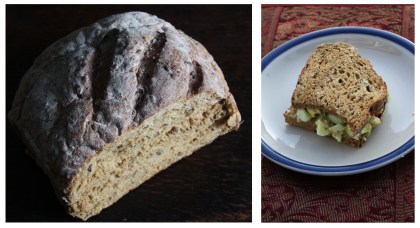
Chatwin’s bread bought from the Aldford Village Store, and a sandwich made with warm home-made tarragon mayonnaise.  The tarragon mayonnaise is warmed by stirring freshly boiled and chopped eggs into it.  For the basic mayonnaise recipe see my earlier post

The managers of the Aldford Village Store, Emma and Will Jones, opened the Aldford Village Store in 2018.  Most Sundays I go up to the store to collect a loaf of brown bread.  It is by far the best brown bread in the area, rich, malty and slightly sweet and so fresh-tasting that it is almost moist, but with more than enough texture for the bread knife to go through it without a fight.  Utterly delicious and a wonderful compliment for egg mayonnaise (made with Churton honesty eggs of course).  The brand is Chatwins, a company based in Nantwich, established in 1913 and at that time their deliveries were made with horse and cart.  It’s not locally-made bread, but it tastes great.
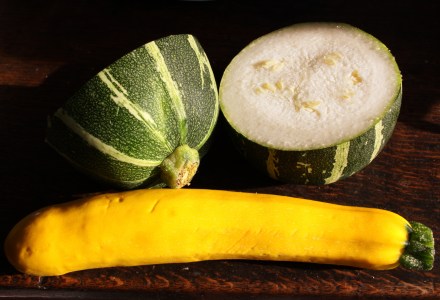
One cannot quibble in any way about how local the store’s courgettes are.  Last Sunday, a basket in the shop had a great crop of green-striped globes and long banana-shaped yellow courgettes, and a label attached to the basket proclaimed them to be “Harry’s.”  I instantly formed a stereotypical vision of an elderly but upright smiling fellow with a deep sun tan, battered broad-brimmed hat, dungarees and probably a pitchfork (I grew up amongst Americans), who had been lovingly tending his courgettes for the last six or more decades.  Nope.  When I asked the friendly girl on the till who Harry might be, it turns out that he is the 9-year old son of the managers, Emma and Will.  Brilliant.
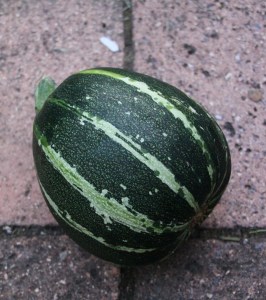
According to his Dad, who I was speaking to a couple of days later when I popped in with my father, Harry is saving up for a Lamborghini, not because his is interested in the brand’s celebrity status, or is impressed by the price tag, but because it is the epitome of fine engineering, and that is what fascinates him.  At a pound per courgette, that’s at least 160,000 courgette sales for a basic Lambo Huracan, 240,000 courgettes for the Spyder version and a horrifically substantial number more courgettes for the insurance, tax and ongoing servicing, and that’s without factoring in the start-up costs of seeds, compost, and his time 🙂   I love courgettes, but I’m not sure that I can eat that many, although we do have until his 17th birthday to try.

To honour Harry, here’s the first of three posts about what I cooked with Harry’s courgettes.  This first one is based on my Mum’s recipe, and has been one of my favourites forever.  Mum’s recipe was for stuffed marrow, but it translates beautifully for Harry’s stunning globe courgettes.

Stuffed Globe Courgette, with thanks to Harry Jones
Oh that globe courgette! What an absolute beauty.  Harry had grown various sizes that were for sale in the store, and this one was about the size of a small galia melon.  I sliced it in half and removed the soft centre, together with the seeds, using a spoon.  I chopped this ready to put it in the sauce that I was just about to cook.

Next, the stuffing and the sauce are both done in the same pan, because the stuffing is also the base of the accompanying sauce.  This is a two-part process.  The first part is simply sausage-meat (or sausages removed from their skins), a finely chopped onion onion, a little finely chopped garlic, the scooped out middle of the courgette, and a lot of sage (fresh or dry) gently all fried in olive oil.  A little liquid is added to prevent it drying out, either hot chicken stock or a mix of chicken stock and white wine.  I also add fennel seeds, just because I love them.  On this occasion I also had lovage growing in the garden and the diced remains of a fennel bulb from the Bellis farm shop in Holt, which always has them, so these went in too.

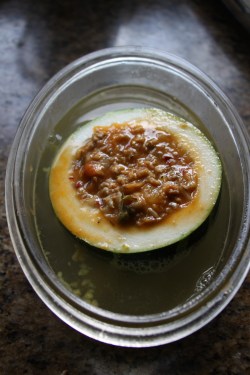
This rather wet stuffing is used to stuff the marrow, and you will have a lot left over.  The stuffing dries a little when cooking, particularly as 5 minutes before the end of the cooking time you grill it to let it brown slightly.  After heating this stuffing through, I spooned it carefully into the scooped-out reservoir in the courgette half.
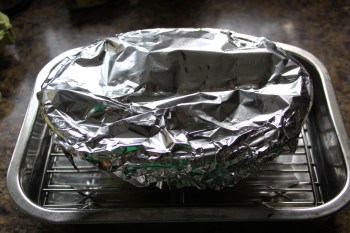
To cook the courgette, it is placed in an oven-proof dish full of hot (just off the boil) chicken stock, which is then placed in an oven, either with either a proper lid or a foil tent.   I used an ancient oval Pyrex bowl and covered it in foil and put the whole thing in a baking tray in case the the stuffing leaked.  I take the foil off and grill the whole thing five minutes before serving.  A little butter stroked over the top helps it to brown and crisp, but is not actually necessary.  Normally I do this recipe with marrow rings, which takes about half an hour once the marrow rings are in the oven.  Cooking an entire half globe was always going to take longer, and it took an hour on 220C (static, not fan), plus the five minutes for grilling.
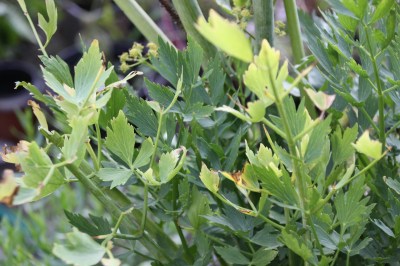
Lovage

The second part of the saucepan process is the sauce that is served alongside the stuffed courgette.  This is done by adding peeled tomatoes and, if you like a bit of heat, chillis to the stuffing.  The chillis can be either fresh or dried.  I find supermarket tomatoes almost completely tasteless, so I use the ripest vine tomatoes that I can find, add a squirt of tomato paste and then a good glug of Big Tom (a spiced tomato drink).  If you don’t mind tinned tomatoes, those would work but I gave up using them a long time ago as they are far too sweet for me.  I also add more hot stock or stock + white wine to the mix, because this is the sauce and needs to be rather more fluid than the stuffing.

Sage

As to quantities, I’m dreadful at writing out recipes, but I used a whole 450g pack of Waitrose sausagemeat as I wanted to make sufficient to freeze down for future meals.  For that amount of sausagemeat, I used a medium-large onion, two cloves of garlic, and added the herbs and liquid to taste.  The first part of the sauce doesn’t want to be too liquid,  as you are going to use it as stuffing, so the trick is to add it in increments and just stop it sticking.  When you start adding stock and tomato to the sauce, it becomes much more liquid, and that’s just a matter of taste.  Again, just add the tomato and stock incrementally until it looks the way you want it to.

The idea of separating out the stuffing and the sauce is to give the stuffing a mild, distinctive flavour all of its own based on the sausagemeat and sage.  In the second part, the addition of tomatoes, chillis and other herbs provides a lovely bold Mediterranean contrast when both are on the plate. You could grate Parmesan cheese over the top, or (before grilling) breadcrumbs for crunch.  I find it sufficiently filling in its own right, but Mum liked it served with a salad and my father likes it with plain white rice to soak up the juices.
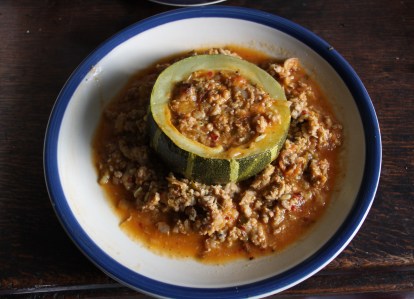
It is not an elegant dish.  At least, I’ve never found a way of making it look particularly presentable on the plate, but the flavours rock.  If you are wondering why the stuffing and the sauce look the same in my photographs (congratulations on spotting the far from deliberate mistake), it is because I screwed up.  On this occasion, I forgot to separate the process into two parts and ended up putting the various tomato combinations into the sauce before I had stuffed the courgette with the basic mix, so found myself stuffing it with the tomato-enriched sauce.  That is because I often serve the part 2 version of the sauce over pasta and was working on auto-pilot.  I was more than a little miffed with myself, because it is much better if the two-part process is followed.
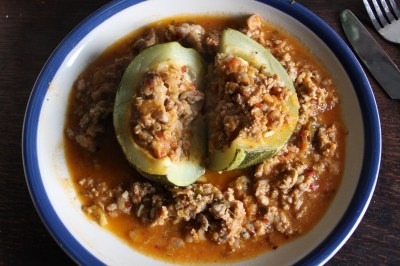
The outer peel or rind on the globe courgette is chewy but edible, but on another occasion I would peel it before cooking it.  To serve it, I halved the half-globe.  Short of eating it with a spoon, I wasn’t sure how else to tackle it!  But however it looks, it still tasted terrific, and the Mediterranean feel made it summery.

If you have any sauce left over, it freezes brilliantly, and goes wonderfully over tortellini.  If you have been defeated by the amount of courgette or marrow that emerged from the oven, this can be finely chopped into the sauce before freezing.

I rubbed lemon into the other half of the globe to stop the surface browning, and wrapped it in foil.  It is now in the cold draw in my fridge, awaiting another bout of courgette creativity.

Thank you Harry!

Ferrucio Lamborghini

Sources:

Aldford Village Store
(No website, but they do have a Facebook page):
https://www.facebook.com/aldfordvillagestore

Chatwin’s
https://www.chatwins.co.uk/

Cheshire Live
New village store at Aldford will sell day to day groceries and much more
https://www.cheshire-live.co.uk/news/chester-cheshire-news/new-village-store-aldford-sell-14786194

 

Adventures with Churton Honesty Eggs: A 3.5 minute soft-boiled egg

Not really an adventure on this occasion, just lunch, but the last time I cooked a soft-boiled egg is lost in the mists of time.  It must have been years ago.  So during a sunny interval after days of changeable weather, with a nice collection of Churton eggs on hand, I indulged.  I almost never have lunch, but the eggs were there, the sun was there, the egg cups were recently rediscovered following the move, and the moment was just perfect.

The egg cups were bought by my mother, because they were such fun, and we had them in the family holiday house for years.  Mum may never have seen the famous Egyptian Predynastic bowl shown below, also adorned with feet and complete with toes, but I would guess that whoever designed the egg cups probably had.

I like my eggs boiled for three and a half minutes, which just sets the egg whites and leaves the contents thoroughly runny.  Absolutely perfect for the dipping of toasted, buttered soldiers.  I remember exchanging animated views with a group of friends years ago about whether the top of the egg should be removed in a clean swipe with a knife,  tapped around the circumference with a spoon, or dismantled with a specialist scissor-like device with metal teeth.  I used a teaspoon to bash a line around the top before scooping it off.  I like a mixed mound of freshly ground sea salt and aromatic black pepper on the side, ready to stir in to the yolk.  Having forgotten the virtues of a  silky, liquid, daffodil-yellow soft-boiled egg, not having had one for such a long time, I really enjoyed the novelty value and it was utterly delicious.

Predynastic pottery sequence by Sir William Flinders Petrie, based on his 1898 – 1899 work in Egypt at the site of Hu (also known as Diospolis Parva)

The Egyptian Predynastic bowl takes a few more lines to explain.  The Predynastic period of Egypt is divided into three main phases, Naqada I, II and III and lasts from c.3690-3238BC.  The Predynastic is distinguished from the earlier prehistoric period by virtue of the fact that the subsistence economy is agricultural (domesticated cereals and livestock), as opposed to merely pastoral (livestock and wild plant resources).  It is the period during which Egypt made the transition from a series of loosely connected ephemeral sites experimenting with the first low-level mixed agriculture to a number of centres of power that eventually coalesced, by fair means or foul, into a single nation headed by a king.  This particular bowl, now in the New York Metropolitan Museum of Art, is unprovenanced (its origins are unknown because it was bought from a dealer in 1910) but stylistically it belongs to late Naqada I or Naqada II.  It is not the only bowl with feet from the Predynastic, but vessels with feet are very rare and this particular vessel’s form is unique.  If it was used for storing items, these were not preserved.  Very little work has been done on pot residues in Egypt, and most items in museums have been thoroughly cleaned anyway, so what it was used for remains unknown.  There’s more about the bowl on the Met’s website.  

As I have no idea where Mum bought the egg cups, those too are strictly speaking unprovenanced, but they have been with us for a very long time.  The eggs, however, are very precisely provenanced to a small army of hens just up the road 🙂

Churton honesty eggs

Adventures with Churton Honesty Eggs – Ham Horns

In a previous post I talked about the super honesty system in Churton that enables local people to buy free range Churton eggs from a barrow by the side of the road.   On that post I showed photos of how I used one of the eggs in a Middle Eastern lamb baharat, and another two to make a lovage and lime mayonnaise.  On this occasion it is all about ham horns.

This is the weather for al-fresco dining, and I love to eat outdoors so today I made a ham horn with salad for lunch.  The ham horn was an invention of my Mum’s and quite apart from the fact that I like to use Mum’s inventions, it is very easy to make and amazingly filling.  So filling, in fact, that I had to change my plans for my evening meal to something significantly smaller than originally planned.

A ham horn is quite simply a tube of ham stuffed with chopped eggs (and herbs if you fancy them) in mayonnaise.  Sometimes the simplest things are the most delicious.  The ham horn is supposed to be wider at one end than the other to give it the horn shape, and Mum’s were always proper horns, but mine always come out uncompromisingly pancake-shaped.

You can make ham horns with mayo from a jar, of course, but there is nothing that you can purchase in a supermarket that looks or tastes remotely like home-made mayonnaise, especially when additional flavours are added to give it an extra hit of something special.   Unlike the supermarket white mayo, a home made one based on eggs yolks, which are of course deep yellow, transforms the ingredients into a lovely primrose colour.  Mayonnaise is so quick and easy to make that it is well worth taking out five minutes to do it.  If you want a herb mayonnaise, the herbs have to be fresh; dried ones simply don’t work.  The only exception I have found is dried tarragon, which can be soaked in vinegar to release the flavour, and then both the vinegar and the dried tarragon can be used as part of the base for the mayonnaise.  Another way of adding flavour is to used flavoured oil, which can be home made.

I do my mayonnaise in a mini food processor.  Most mini processors have a hole in the lid for precisely this purpose, but mine is ancient and I had to drill a hole into it.  I know that some people use plastic blades for mayo, but I’ve never had any trouble with a metal blade.  I start with a good dollop of Dijon, Senf (German mustard) or tarragon mustard, with a good squeeze of lemon or lime juice or white wine vinegar (depending on what it is to accompany).  On this occasion it was Dijon mustard and lemon juice, with a good turn of black pepper and a sprinkling of sea salt.

The eggs are separated and the whites retained for a future use (and can be frozen).  I have the whites earmarked for a tempura dish, but they are also great for souffles and meringues.  I then chuck the eggs into the bottom of the food processor with the mustard, lemon juice and seasoning and give it a quick spin.  The trick, and it’s the only serious trick, is to add the oil terribly, terribly slowly.  I was using a  Filippo Berio “mild and lighter in colour” oil into which a few weeks ago I had added some sliced lemon, chilli, garlic and lovage, and was a gorgeous shade of sunshine yellow.  If you are new to making mayonnaise, I would suggest that you use olive oil (any) or sunflower oil rather than rapeseed, as the latter is much more difficult to emulsify (thicken).

When you begin to add the oil, the mix in the bottom of the food processor is a dark yellow (thanks to the yolks and mustard).  As you add the oil, in a very slow, very thin stream, the oil and egg yolks gradually emulsify and the dark yellow starts to lighten as the mayonnaise thickens.  This lightening process is the emulsification taking place.  The more oil you add, the thicker it gets.  I have occasionally become so engrossed in adding the oil that I’ve forgotten to stop now and again to check it for thickness, and have ended up with something that can be carved like butter!  On this occasion I stopped on time, with a nice, soft texture to which I added chopped herbs to the food processor and gave it a good pulse.

If, after tasting, you find that you want to add more lemon juice or wine vinegar to add a bit more acidity, just be aware (the second trick) that this will loosen the emulsion, so unless it was already very stiff, you may have to add more oil.  You can also add salt to help thicken it up (the third and final trick).  Do this incrementally so that it is not over-salty, and keep tasting as you do it, but it works.

You can use any herbs that you like, of course (parsley, spring onions, chives and dill are all good options, and tarragon is terrific), but I have recently discovered that lovage and coriander, both strong, highly  aromatic herbs, go superbly together in some contexts.  I’ve always been a fan of coriander in egg mayonnaise, ever since buying a gourmet sandwich in a Turkish café on Leather Lane, near where I worked in Clerkenwell (London), but the idea of lobbing in some lovage was new, and I was so pleased when it worked so well. Lovage is very powerful so be a bit careful with it.  In the mayonnaise, the flavour of the herbs is brought out by the lemon juice (or vinegar if using that instead) in the mayo.

To prevent the top forming a skin, I store my mayo in the fridge with the clingfilm actually resting on the surface until it is needed.  An hour before I am ready to assemble the ham horn, I take the mayonnaise out of the fridge and let it come to room temperature.  This is because it becomes more solid in the fridge, and at room temperature it loosens back to the original texture that it had when scooped out of the mini processor.   Just before assembly I peel the egg, chop it up and stir it into the mayo.

The ham I had to hand was thinly-sliced Italian porchetta, which has a lovely flavour but is ultra-thin and very difficult to extract in one piece from the wrapping.  A thicker ham would have  been better, but I didn’t have one.  So instead of a smooth, elegant horn, I ended up with a battered and patched flattened tube.  Still, it tasted delicious.

I made a salad from three types of lettuce that I grow in pots on the patio, and lots of herbs, again from patio pots, chosen with care because I didn’t want an unholy clash with the lovage and coriander in the mayo.  Parsley, oregano, sorrel, and mint accompanied the lettuce and were joined by some delicious little oval yellow tomatoes that Dad gets for me (brand name Natoora), that are tart instead of sickly sweet, and full of amazing flavour.  I like them straight from the fridge, ultra cold.  A dampened piece of kitchen roll laid over the top keeps everything fresh.  I always have a jar of home made French-style vinaigrette in the cupboard (mustard, white wine vinegar, olive oil, garlic clove, freshly ground black pepper, all given a seriously good shake), and I served that on the side to be stirred in at the last minute to prevent the salad going soggy.

When I had finished, and took it all out into the garden on a tray, I had a ham horn, a herb salad and chilled yellow baby tomatoes on a plate with the vinaigrette in a little dish on the side and a tall glass of lovely still lemonade, very cold (not home made but divine).  It was all rather delightful.

The Churton egg continues to rock.
If you want to check out more of my Churton egg adventures, click on
the Churton Eggs label in the right hand margin.
More will be added soon 🙂

Churton Honesty Eggs

When I first started working in the garden at Churton, one of the truly delightful sounds was the brash crowing of a cockerel somewhere to the northwest of my house.

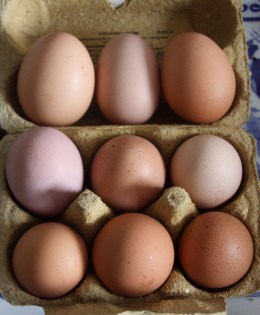
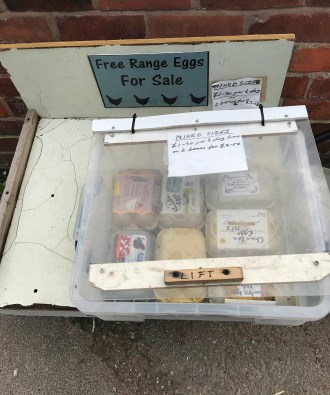
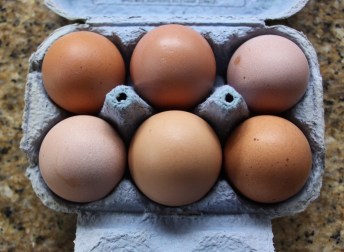
A few weeks later I was walking to the White Horse, which had just re-opened (prior to closing again during the pandemic), and found that at the end of the super row of late 19th Century terraced houses, Rowley Place, there was a wheelbarrow full of eggs in pre-used boxes.  It is an honesty system and lots of people in cars pull up alongside to pop the required coins in the lock box and take away their fresh eggs.  Since the beginning of the pandemic I had fallen out of the habit of using cash, so the first time I bought my eggs there I had to rifle through various jacket pockets and the eternal chaos at the bottom of my handbag to find the right amount of coinage (£1.30 per half dozen or £2.50 for a dozen, at time of writing).  There’s a separate tub on the side for unwanted egg-boxes that are used for boxing up the new eggs.  The sign says that they are mixed sizes, but they have all been of a good, usable size to date, the smallest of them on the larger size of medium and the bigger ones large.  I started to buy them and cook with them, and they now make up my occasional “Adventures with Churton Honesty Eggs” recipe posts.

A couple of months ago my neighbour told me that she and her other neighbour had found hen eggs buried in their gardens.  Both her research and mine suggested that they were deposited by foxes.  I have never found any buried eggs, but twice this spring I have found broken hen eggs in the middle of my lawn.  It does beg the question why the fox might steal the egg and not the chicken.  It turns out that I know remarkably little about chickens.  Another scoot around the web delivered me to the American Chicken-Keeping Secrets website, which informs me that free-range chickens roost overnight in the hen-house but can lay their eggs wherever they feel comfortable at the time, so even though the hens themselves may be resting safely behind fox/coyote-proof barriers at night, the eggs may not be:

“For a long time we kept our chickens in a run due to coyotes in the area. At some point we decided to let them out to roam the property.  The longer they were out, the fewer eggs we found in their nesting boxes.  Each day we’d all have to go out searching for eggs. We found them in the dog house, under the children’s slide, way down at the bottom where the slide and the ground meet, inside a cabinet in the woodshop where a cabinet door had been left open  . . . our chickens were creative.”

To celebrate these splendid local eggs, here are two examples of how I have used them.

Lamb baharat with Churton honesty eggs

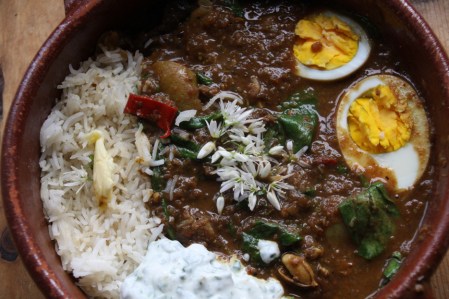
First, a picture of Thursday’s Middle Eastern lamb baharat, slow-cooked with baharat spices supplemented on this occasion with fresh red chilli and wild garlic (ramsons), both from my garden, spinach, tiny preserved lemons and the Churton eggs, which are hard-boiled and have gorgeous deeply- yellow centres (and I promise that no Photoshop tweaking was employed).  It is superb with okra if you can find them (sometimes available at the Sainsbury’s in Wrexham and the Waitrose in Chester). Hard boiled eggs are traditional in some Indian curries and essential in the fabulous traditional Doro Wat and Sega Wat (Ethiopian curry, chicken and beef respectively).  The edible flowers on top of the dish, as well as some of the green leaves, are ramsons from a pot in my garden, and the puddle of sauce next to the plain white basmati rice is Greek yogurt with a good squeeze of lime together with chopped garden mint and chives.  I’ve had the Churton eggs soft-boiled, poached and as a French fennel and cheese omelette, but this dish showcases my first hard-boiled ones, which flaunt the deep yellow yolks, a much richer colour than any I have ever bought in supermarkets, and they have a fabulous flavour.

Lovage and lime mayonnaise made with Churton honesty eggs

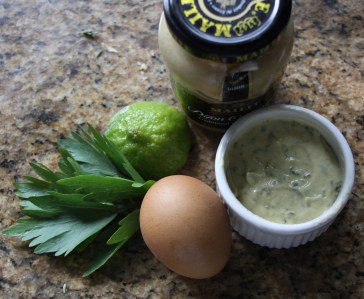
The second is a mayonnaise made of a single Churton egg yolk, a teaspoon of Dijon mustard, fresh lovage (which I grow in a pot on my patio), sea salt, lime juice and mild-flavoured olive oil.  Unlike the ivory-coloured Hellman’s this was a beautiful primrose yellow before I added the herbs and lime, which turned it green.  I like Hellmans and always have a bottle of it in the fridge, using it splurged on sandwiches or on the side of a quick salad as a guilty kitchen essential like HP sauce and Heinz ketchup, but it has precious little relationship with either the appearance or flavour of real mayonnaise.  The process of emulsifying egg with oil lightens the colour, but it is still unmistakeably yellow.  How can mayonnaise possibly be ivory-white, when based on egg yolks?  Nowadays, the relevant shelf in a supermarket is full of copycat bottles of white emulsion.  Unilever (the producer of Hellman’s) must be grinning from ear to ear, but it somewhat reminds me of the  futuristic film Demolition Man, in which our hero from a previous century, having been invited in hushed tones to dine in the restaurant Taco Bell in gratitude for a life-saving act, is informed that “Taco Bell was the only restaurant to survive the franchise wars. Now all restaurants are Taco Bell.”

Churton honesty eggs