Category Archives: Chester

Modern and Roman Repairs of a Samian Bowl in the Grosvenor Museum, Chester

A recent Bluesky post by Nina Willburger (drnwillburger.bsky.social) about a 1st century AD Samian ware vessel found in Ladenburg, Germany, repaired in antiquity with lead rivets, reminded me of one of my favourite objects in the Grosvenor Museum in Chester.

Repaired Roman vessel from Chester in the Newgate Room in the Grosvenor Museum, Chester

Repaired Roman vessel from Chester in the Newgate Room in the Grosvenor Museum, Chester

It is always a good moment in a museum, especially a small local one, when one looks into a display cabinet and finds something completely unexpected.  In the Grosvenor Museum in Chester, there is a high quality Samian bowl that was reconstructed in modern times with deliberately lighter pieces of matt clay added to make it perfectly clear what is old and what is new.  What is more interesting is that this elegantly decorated bowl was originally repaired in the Roman period with lead rivets, and this really seizes the attention.  It has no label, so there are no details about its date, provenance, history or subject matter, but it appears to show two hunting dogs facing towards each other with a stylized floral motif between them, with other stylized floral and animal forms circling the bowl beneath them.  This is a common type of subject matter for Samian ware.  Samian (terra sigillata) was the prestige table-ware of the Roman world.  It was manufactured between the 1st and 3rd centuries, mainly in Gaul (today parts of France, Belgium and western Germany), and has a distinctive reddish-orange and glossy surface, with a very fine fabric texture.  Although Samian could be undecorated, the most prestigious examples featured raised decoration, sometimes showing animal and floral motifs drawn from nature with more elaborate items representing gladiatorial events and simplified narratives drawn from Classical mythology.

Samian sherds from Silchester

Samian sherds from Silchester, a few of dozens rejected by Victorian excavators and thrown onto their spoil heap

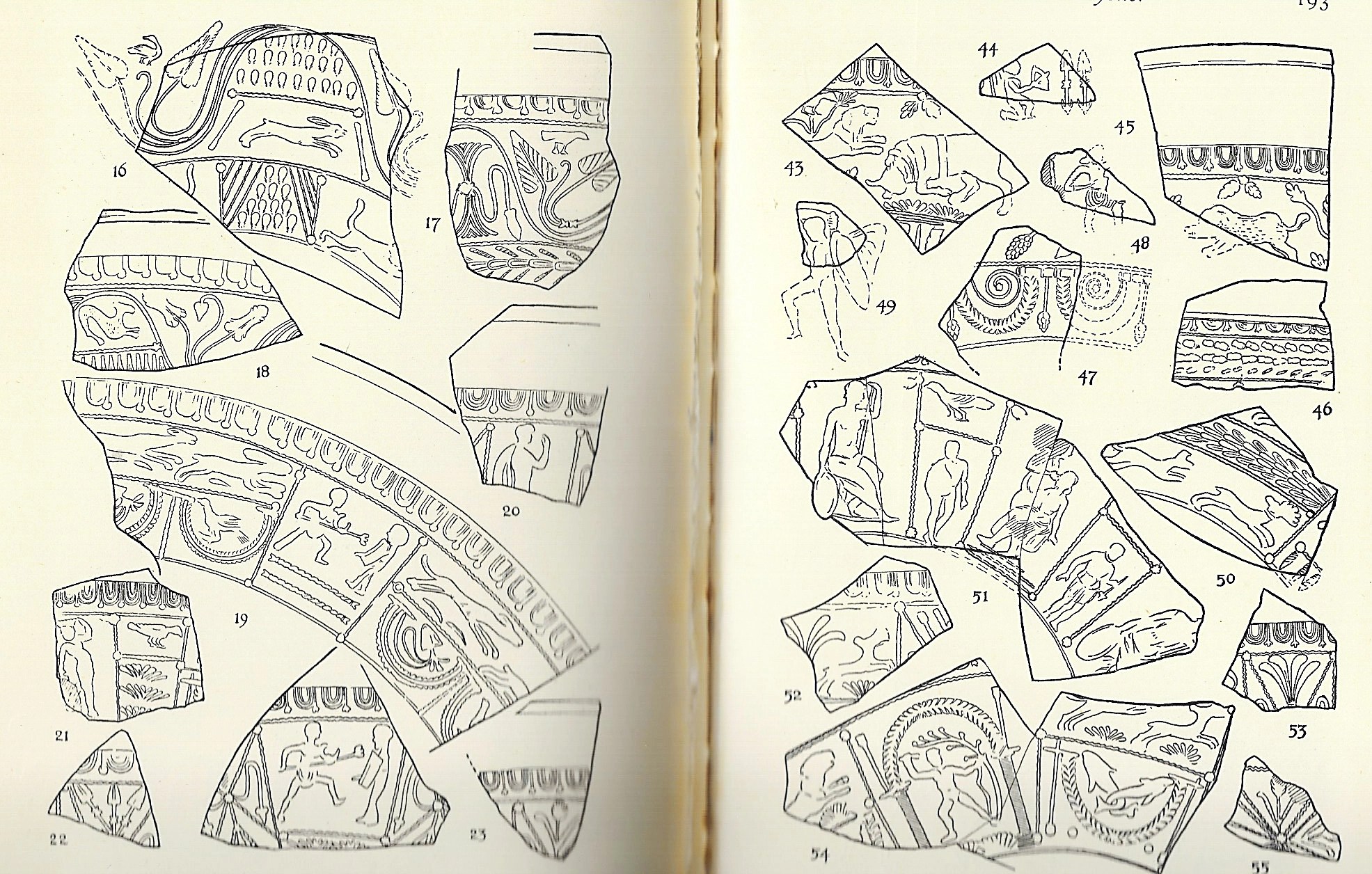
Often all that is left of pottery at Roman sites are broken sherds that had been disposed of when a pot was broken.  It is a fact of archaeological work that during excavations archaeologists are always in the position of finding the component parts of objects, the broken pieces that once made up a whole item.  Today the majority of these are collected and weighed as a source of data about site usage, but in earlier periods of archaeological exploration, smaller and unremarkable sherds were often discarded.  More remarkable sherds have always been privileged for collection and recording, as demonstrated by the pages from the excavation report of the Holt tileworks shown below.  Where it is clear that sherds belonged to a single vessel attempts might be made to reconstruct the entire vessel, enabling the original appearance of an item to be understood by attempting to restore it to something resembling its original condition.  Because of its inherent beauty and complexity, Samian pottery is often the recipient of modern reconstructions. Professor Robert Newstead (1859-1947), curator of the the Grosvenor Museum, was responsible for many of the museum’s reconstructions, using a lighter shade of clay to make it clear that modern repairs had been made.

Samian pottery found at the Chester tileworks at Holt. Source: Grimes 1930

Samian pottery found at the Chester tileworks at Holt. Source: Grimes 1930

Fascinatingly, in several parts of the world high value vessels were often repaired during antiquity, enabling broken items to continue in use, although perhaps for a new purpose.  In recent years archaeologists and conservationists have shown considerable interest in preserving ancient repairs, recognising them as part of the life-history of an object, and an indication of how such objects were perceived and valued in the past.

Prehistoric repair of a Badarian pot. BM EA62175. Source: British Museum CC BY-NC-SA 4.0

Prehistoric repair of a Badarian pot. BM EA62175. Source: British Museum CC BY-NC-SA 4.0

In some parts of the world ancient repairs may date back to prehistoric periods.  In around 4400-4000 BC, for example, repairs of bowls of Egyptian prehistoric Badarian ware, a very finely made ceramic belonging to nomadic sheep herders, were often achieved by drilling broken pieces to provide holes that could then bound together with cord, sinew or strips of leather.  The Badarian pottery was some of the finest quality ware ever produced in Egypt, requiring considerable artistic flair and manufacturing skill, and was therefore certainly worth repairing.

A ceramic vessel may be broken in many ways at any point during its lifecycle from kiln, via transportation to purchase and usage and finally to breakage.  As Angelika Kuettner (Chipstone Foundation) explains:

The Samian bowl in the Grosvenor Museum, clearly showing the lead rivets

The Samian bowl in the Grosvenor Museum, clearly showing the lead rivets

Whether broken by shipment, cataclysmic weather event, a clumsy servant, a rowdy guest, unsupervised children or animals, or impassioned religious or political zealots, the owner of the ill-fated ceramic object then had to decide whether to repair the dish or dispose of it as waste, as something devalued to the point where it was completely worthless.

The reasons for repairing an item may depend on a number of variables, including such practical considerations as income and geography.  Perhaps the owner of the bowl could not afford to purchase a replacement, or there was nowhere nearby to purchase anything similar at the particular time of its breakage.  Perhaps the theme had particular significance and nothing equivalent was available locally.   As well as practical reasons for a repair, there may have been sentimental reasons attached to a vessel, either because it was connected with a special person or event, perhaps because it was a gift or a family heirloom.  It is even possible that the item was discarded by its owner when broken and retrieved by a servant in the household who took the opportunity to repair and own a luxury item.  There is no way of knowing what motives were involved in this or any other ancient repair, each one having its own story.  In this and other cases it is curious that the repair was so conspicuous, with no attempt at disguise, leading to the  appearance of a luxury item being severely compromised.

Lead ingot from a river jetty site at the edge of Chester racecourse dating to 74AD. Source: David Mason’s “Roman Chester. The City of the Eagles,” p.45

Lead ingot from a river jetty site at the edge of Chester racecourse dating to 74AD. Source: David Mason’s “Roman Chester. The City of the Eagles,” p.45

The repaired pieces of Samian in the Grosvenor Museum  were joined together using lead staples or rivets. As with the Badarian example shown above, the Samian repair technique required holes to be drilled into the object concerned before the rivet or staple could be applied.  There is a video at the end that shows how this may have been achieved.   Lead was used as a standard building material in Chester, for pipes and as waterproof lining for cisterns and reservoirs, and was mined from places like Halkyn mountain and Meliden near Flint, both in northeast Wales.  David Mason estimates that 39 tons or 50 wagon-loads for water pipes, and 34 tons or 43 wagon-loads for reservoir linings were used during the building of Chester.  Lead was readily available and would not have been difficult to source for the repair.  Research has demonstrated that decorated platters, dishes and bowls are by the the most frequently repaired pieces of Samian in Britain, at both military and civil centres.  Unsurprisingly, the number of repairs are highest in remote and upland areas

Bronze  cauldron at the Grosvenor Museum

Bronze  cauldron at the Grosvenor Museum

Another example of Roman repair work in the Grosvenor Museum is is a particularly nice  bronze cauldron in the Newstead Gallery, shown right.  According to the accompanying label, it was found in Chester’s Roman barracks by Professor Newstead, squashed almost flat, and was found to be made of a single sheet of bronze.  Fascinatingly, it had been repaired 14 times during the period of its use, indicating how much it was valued.  It was conserved and remounted by York Archaeological Trust in 2009, and looks stunning.  As well as this story of ancient repairs this demonstrates a very imaginative and evocative approach to using the remaining parts discovered in an excavation to provide a very evocative reconstruction of the original form.

Repairs of favoured objects have continued to be made throughout history, still to be found sometimes centuries later in people’s homes.  Stapling was common in the 19th century for the repair of valued ceramic items like the ornamental dish shown below.  Cleverly, the rivets are clearly visible on the underside but do not actually pierce the main surface when turned over.

Repaired 19th century dish

Repaired 19th century dish

A more extreme example is this piece of Kutani, obviously very much-loved by its owner judging from the number of rivets used to repair it.

The repair of a Kutani cup. Photograph by Helen Anderson, with thanks

The left hand image shows the multiple staples used in the repair of a Kutani cup, preserving the vessel so that the main design, right, can still be displayed. Photograph by Helen Anderson, with thanks


Kintsugi repaired vessel. Photograph by Haragayato. Source: Wikimedia Commons BY-SA 4.0

Interestingly, in spite of  easy access to endless retail products at relatively low cost today, we often choose to  repair items that we hold dear or which would cost too much to replace, rather than purchasing new versions.  Ceramics are stapled or glued together, like the 19th century dish above, and the now international fashion for a technique called kintsugi (“golden joinery”) pioneered in Japan has given new life to broken objects by combining gold with an adhesive agent to provide a vessel with an entirely new life-force whilst retaining something of its original essence.  This has become a skilled craft in its own right, and some kintsugi items now have a unique and precious value of their own. Having had a go at this with a lovely but broken dish that I found in my parents’ loft, I can attest to how much skill is required to produce something both beautiful and functional, skills that I apparently don’t have in any abundance 🙂

The Samian bowl in the Grosvenor Museum, showing both ancient repairs and modern repairs to allow reconstruction and provide a good sense of the original object

The Samian bowl in the Grosvenor Museum, showing both ancient repairs and modern repairs to allow reconstruction and provide a good sense of the original object

The repaired Samian bowl in the Grosvenor Museum, reveals both ancient repairs and modern reconstruction work.  Both are part of its life history.  There are just as many stories to be found in repaired items as in perfect ones, perhaps more.  Although we are often accustomed to seeing only the brightest, best and most complete objects in museum collections, sometimes it is those that were broken and then repaired or otherwise curated by their owners that give us a personal sense of a connection with the past.  Archaeology always includes unknowns, and there is never going to be an answer as to why this particular bowl was repaired, but it evokes a sense of the personal in a way that more perfect, undamaged objects in museum collections may not.

Discarded dinner set found in a ditch at Vindolanda

Discarded dinner set found in a ditch at Vindolanda on Hadrian’s  Wall. Source: Vindolanda Charitable Trust

Vessels that had been repaired, whether lashed, stapled and/or glued would probably never be able to carry liquids without at least some leakage, but they could happily carry dried goods, continue to have decorative and sentimental and even prestige value and to be considered by their owners to retain a useful life.

Just as interesting as all the Samian items that have been repaired, is a single remarkable case of disposal from Vindolanda, which engagingly provides evidence of one of the biggest temper-tantrums recorded in British archaeology.  The Vindolanda Charitable Trust website explains:

In our Museum at Vindolanda we have an almost complete dinner set of Samian Ware which was imported from the famous La Graufesenque potteries (near the modern French town of Millau at the southern end of the Gorges du Tarn). Using the potters stamps we have dated this collection to the late AD80s. The pottery had been broken in transit and was thrown, unused, into the ditch of the fort. . . . Imagine how disappointing it would be to finally get your delivery only for it to be broken!

It puts breakages received from Amazon into perspective.
xxx

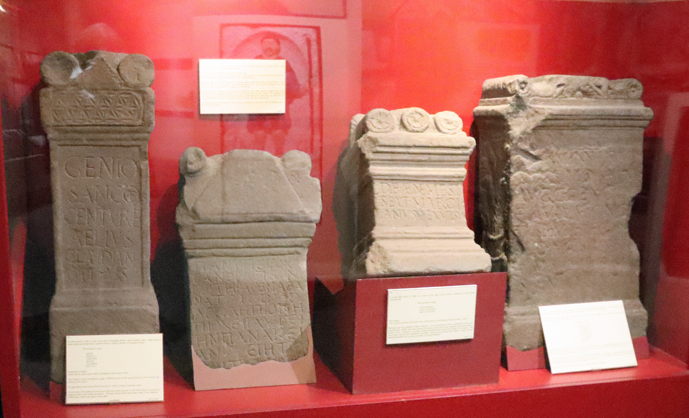
Professor Newstead and some of his restored Samian items, in the Newstead Gallery of the Grosvenor Museum.

Professor Newstead and some of his restored Samian items, in the Newstead Gallery of the Grosvenor Museum.

At the end of the post see a nice video by Guy de la Bédoyère who, amongst other things, discusses the variable quality of Samian found in Britain and elsewhere; and another one that shows how, in the Roman period, mending holes may have been made in Samian using a manual drill that uses a simple but effective technology deriving from the use of spindle whorls.


Sources:

Books and papers

Albert, Kasi 2012. Ceramic rivet repair: History, technology, and conservation approaches. Studies in Conservation, 57(sup1), S1–S8.

Hsieh, Julia 2016. The Practice of Repairing Vessels in Ancient Egypt. Methods of Repair and Anthropological Implications.  Near Eastern Archaeology, Vol. 79, No. 4 (December 2016), pp. 280-283

Dooijes, Renske and Olivier Nieuwenhuyse 2007.  Ancient Repairs: Techniques and Social Meaning.  In (eds):  M. Benz and U. Kästner (red.), Konservieren oder restaurieren, die Restaurierung griechischer Vasen von der Antike bis heute (3rd suppl. to the CVA Germany), Beck Publishers, 15-20
https://www.academia.edu/13881341/Ancient_repairs_techniques_and_social_meaning

Garachon, Isabelle 2010. Old Repairs of China and Glass. Rijksmuseum Bulletin, 15th March 2010., Vol. 58 No.
https://www.academia.edu/10120934/Old_repairs_of_China_and_glass

Gosden, Chris and Yvonne Marshall 1999. The Cultural Biography of Objects. World Archaeology 31(2), October 1999, p.169-178

Grimes, W.F. 1930.  Holt, Denbighshire:  Twentieth Legion at Castle Lyons Y Cymmrodor.  Society of Cymmrodorion.

Kopytoff, Igor 1986.  The cultural biography of things: commoditization as process.  In (ed.) Arjun Appadurai. The Social Life of Things. Commodities in cultural perspective. Cambridge University Press

Mason, David J.P.  2001, 2007. Roman Chester. The City of the Eagles. Tempus Publishing

Ramakers, Hanneke  2013. Historic Repairs. Conservation Journal Autumn 2013 Issue 61
http://www.vam.ac.uk/content/journals/conservation-journal/spring-2013-issue-61/historic-repairs/

Willis, Steven 2004 Samian Pottery, a Resource for the Study of Roman Britain and Beyond: the results of the English Heritage funded Samian Project. An e-monograph. Internet Archaeology 17.
https://intarch.ac.uk/journal/issue17/willis_toc.html
Chapter 11, 1-7 – Samian Repaired
https://intarch.ac.uk/journal/issue17/1/11.1_2.html

Websites

BlueSky – Dr Nina Willburger
Fascinating glimpse into everyday Roman life
https://bsky.app/profile/drnwillburger.bsky.social/post/3m73bxsbs4k2n

Chipstone Foundation
Simply Riveting: Broken and Mended Ceramics by Angelika R. Kuettner, 2016
https://chipstone.org/images.php/742/Ceramics-in-America-2016/Simply-Riveting:-Broken-and-Mended-Ceramics

Field Museum
Restoring Pottery
https://www.fieldmuseum.org/science/research/area/conserving-our-collections/treatment/restoring-pottery

Alice T. Miner Museum
Conserving the Collection: Ceramic Repair Techniques by Ellen E. Adams, Thursday, August 26, 2021
http://minermuseum.blogspot.com/2021/08/conserving-collection-ceramic-repair.html

Vindolanda Charitable Trust
A Closer Look at Samian Pottery
https://www.vindolanda.com/blog/a-closer-look-at-samian-pottery


Organist Jonathan Scott playing and talking about Chester Cathedral’s 19th century organ

Chester Cathedral organ pipes seen over the top of the choir

Chester Cathedral’s 19th century organ pipes seen over the top of the medieval choir

This is a really remarkable recording of Jonathan Scott playing the organ at Chester Cathedral, filmed by his brother Tom, who clearly understands what goes in to achieving the sounds that the organ, with Jonathan at its helm, is capable of producing.

The organ, which dates to the 19th century, has a rich, vibrant voice.  I often feel that the addition of organs to medieval churches and cathedrals destroys something (sometimes a considerable amount) of the internal harmony, with very little in the way of gain, but this video argues that at least in this particular case, there might be great compensation for architectural alterations.

This is an hour-long concert held in Chester Cathedral, beginning with the Overture to Mozart’s Magic Flute, in which the cathedral’s is being played by the remarkable Jonathan Scott, who talks about how the organ delivers its sound via keys, pedals and stops.  There is some great footage of Jonathan Scott’s finger work on all four tiered keyboards, and for me it was a particular revelation to see the amazing foot work required. I had no idea. There are also some great internal views of the cathedral on the video.  It is a truly illuminating insight into organ music.

YouTube channel Scott Brothers Duo: https://www.youtube.com/@scottbrothersduo


Cheshire Proverbs 8: “As Bare as the Bishop of Chester” (15th Century)

“As Bare as the Bishop of Chester”

J.C. Bridge, no.33, p.9


This comes from a poem that Bridge believes dates to the time of Edward IV (28 April 1442 – 9 April 1483), and he suggests that it may belong to the period between the 1460s and 70s.  There are two versions of it surviving in contemporary manuscripts (which I have massaged into modern English).

Hearken to my tale that I shall show
For of such marvels I have heard four
If any of them be  a lie that I tell after
I would I were as bare as the Bishop of Chester

The second version reads as follows:

Hearken to my message that I shall to you show
For of such marvels you have heard but few
If any of them be untrue that I shall tell you after,
Then become I as poor as the Bishop of Chester

As Bridge points out, this refers to the first Chester Bishopric at St John the Baptist’s, not the one founded by Henry VIII in 1541 that converted the dissolved Benedictine Abbey of St Werburgh to become Chester’s new cathedral.


A bit of background

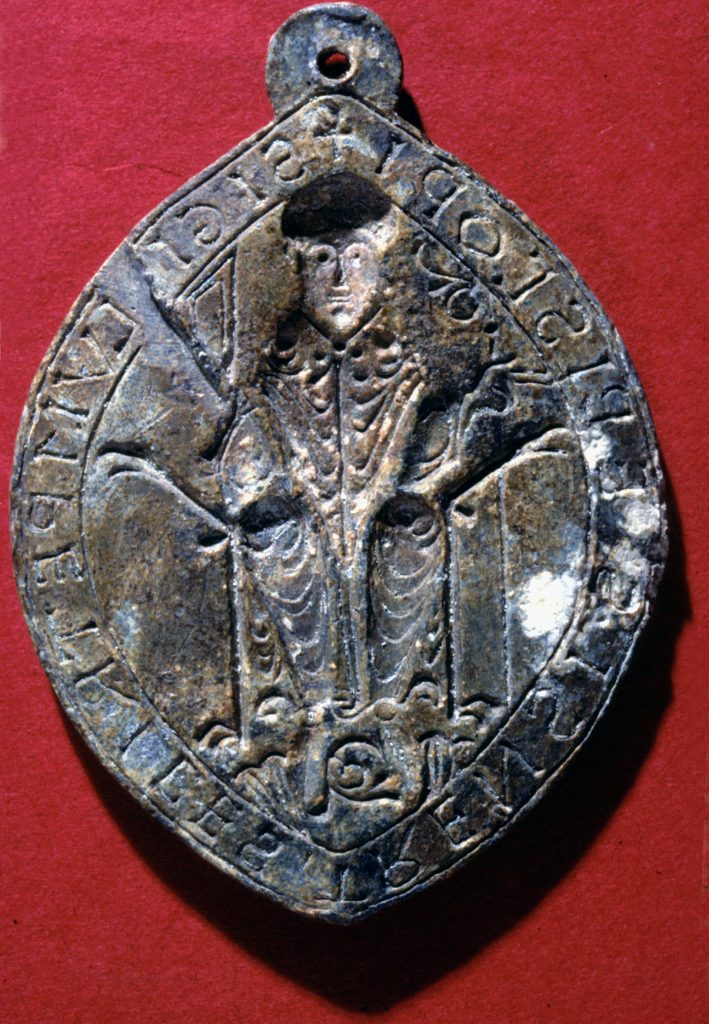
Lead seal of Peter, Bishop of Chester

Lead seal mould of Peter, Bishop of Chester 1075-1085 (Chester Archaeology). Source: The Medieval Period Resource Assessment 2007

In the 11th century Archbishop of Canterbury Lanfranc decreed that bishops should locate themselves in the largest and most impressive provincial centre within their area of responsibility (called a see).  Accordingly, in 1075 the Bishop Peter of Lichfield moved his power base to Chester and began to build a new cathedral commensurate with the importance of his status in his newly adopted town in a monumental Romanesque style, dedicated to St John the Baptist.  Quite why he decided to build outside the walls could be explained in a number of ways, but may have had something to do with Hugh d’Avranches, the first Earl of Chester, who may already have had plans for an ecclesiastical institution within the city walls on an existing church site (St Werburgh’s Abbey, founded in 1093);  or it may have been something to do with a shortage of space for such a large project.  Whatever the reason, by establishing it where he did, on the site of a church that is thought to have been established in the 7th century, he provided his own foundation with a sense of longstanding religious heritage that reinforced its validity as a primary Christian house.

On the death of Bishop Peter in 1095, the role passed to Robert de Limsey.  Bishop Robert abandoned the Chester cathedral in 1102, shifting the see to Coventry, probably to take advantage of the considerable wealth of the Priory of St Mary, which became a new cathedral.  Work foundered on Chester’s St John’s Cathedral which, in spite of no incumbent bishop, retained its role, with subsequent bishops of Coventry and Lichfield terming themselves, when convenient, Bishop of Chester at least into the 16th century.

Work resumed on St John’s a century after the death of Bishop Peter, and was completed sometime in the late 1200s, becoming a successful collegiate church.  It is to this period that the upper storeys belong.  Today’s tower replaces the one that partially collapsed in 1881 after a lightning strike.  The cathedral was included in the local pilgrimage route, along with the Abbey of St Werburgh, when it acquired what was claimed to be a relic of the true cross during the Crusades.
xxx

Back to the proverb

The glorious Romanesque interior of St John's, Chester

The glorious Romanesque interior of St John’s, Chester

There are four possible interpretations of the poem.  The first is that posed by Bridge himself, which is that it was a “sarcastic” reference to the sheer wealth of the Bishops of Coventry and Lichfield.  Douglas Jones highlights how the livings earned by those appointed to different roles at St John’s were doing very nicely, and were far more wealthy than all local churches other than the Rectory of St Mary’s.  Between 1300 and 1430 six out of ninety-one canons of St John’s were presented by the King and three by the Prince of Wales, with twelve by the Pope. Twenty-seven were arranged by the Bishop, and when he was free to make his own choices, he “seems often to have regarded the prebendal status of the collegiate church as providing a source of additional pocket money for his relatives, his friends and his clerks” (Jones, p.17).  Some of those appointed to St John’s rose to positions of great regional and national influence.

In a second possible scenario, the word “bare” could equate to “threadbare,” referring to the fact that the title of “Bishop of Chester” was no more than nominal, nothing more than the smoke and mirrors promoted by the bishopric of Coventry and Litchfield which, having abandoned Chester in favour of more profitable regions, had retained its rights over title to it, and had left St John’s as nothing more than a sinecure.

In a third possible interpretation, it is distinctly possible that it was a matter of considerable amusement within Chester that there was an ongoing quarrel between St John’s and St Werburgh’s, both wealthy institutions that stood above and over the general populace.  In general, monastic institutions were obliged to pay an annual sum to the Bishopric, by whom they were overseen, and to whom they had to account for themselves.  It was the ambition of many monasteries to escape both the financial obligation and the ongoing interference, and Chester had petitioned the pope for just such a relief.  It was granted an exemption in 1363, but nothing at St Werburgh’s ever ran smoothly, and the ongoing fight to retain independence was always at odds with the interests of the Bishops, still nominally of St John’s, to resume its position of influence.  This ongoing failure to entirely subdue St Werburgh’s and bring it back into the financial fold may also have been a source of amusement and comment amongst Chester’s populace about both St John’s and St Werburgh’s.

St John's Chester 1881 after tower collapse

The cathedral in 1881 after the collapse of the top of the 16th century tower. Now in the Grosvenor Museum, Chester. Artist unknown.

The final possible interpretation (unless someone else has other ideas) could also refer to a loss of financial income for St John’s in the 15th century.  Jones says that Owen Glyndŵr’s rebellion had had a considerable impact on ecclesiastical finances after 1430.  It is again pure speculation, but it is possible that St John’s, like other ecclesiastical institutions in Chester, was suffering an unaccustomed shortage of funds, and that this was a source of some amusement in the local community.

In any one of these scenarios, the Bishop of Chester could be said to be “bare,” either in tones of irony due to his extreme wealth, or actually reflecting a documented change in the financial fortunes of Chester’s St John’s that was responded to in Chester with a distinct sense of schadenfreude.
xxx

Final Comments

I particularly like two aspects of this proverb.  The first is that it recalls a part of Chester’s history that is often forgotten, which is that St John’s was not only established as a cathedral but continued to perform the role into the 16th century.  Secondly, I love that this proverb is fundamentally embedded in what must have been a topic of real controversy in Chester:  a bishopric that provided its various incumbents and administrators with a high wage, but whose leaders were absent, claiming rights over Chester and drawing status from it without being any part of the city.  When St John’s and its employees went through less profitable times, there was probably very little sympathy in the city.  In fact, there was almost certainly a distinct sense of justice having been served.  Whether the proverb refers to greater or less profitable times, there is a distinct sense that the relationship between the St John’s and the City was often far from harmonious and that the bishops themselves were bare of any form of substance.  However it may be interpreted, this proverb captures the fact that Chester’s ecclesiastical past was not merely a barely remarked upon fact of life, but something that was noticed and discussed, not always in favourable terms.


For more about J.C. Bridge and this Cheshire Proverbs series,
see Cheshire Proverbs 1.

For the other proverbs in the series, click on the Cheshire Proverbs label
in the right hand margin, or see the end of the Archaeology, Heritage and Art page, where they are listed.


The east end of St John's, walled off from the main church after the Dissolution

The east end of St John’s, walled off from the main church after the Dissolution


Sources:

Books and papers

Boughton, Peter 1997.  Picturesque Chester. The City in Art. Chester City Council and Phillimore

Bridge, J.C. 1917.  Cheshire Proverbs and Other Sayings and Rhymes Connected with the City an County Palatine of Chester.  Phillipson and Golder (Chester)

Carrington, Peter 1994.  Book of Chester.  B.T. Batsford / English Heritage

Jones, Douglas 1957.  The Church in Chester 1300-1540. Chetham Society

Pevsner, Nikolaus and Edward Hubbard 1971. The Buildings of England: Cheshire. Penguin Books

Websites

St John the Baptist
A History of St John’s
https://stjohnschester.uk/history-of-st-johns-chester/


“Gladiators of Britain” at the Grosvenor Museum, Chester, 20th September 2025- 25th January 2026

Introduction

The new Gladiators of Britain exhibition at the Grosvenor Museum fits the archaeology of a huge story very cleverly into a relatively small space, with a great many remarkable objects that have been very well chosen to illustrate the topic.

Thanks to Chester Archaeological Society I was lucky enough to be one of a group who were invited to a guided preview of the exhibition in late September 2025, just as it was opening.  Many thanks to Pauline Clarke (Excursions Officer at Chester Archaeological Society) and Elizabeth Montgomery (Grosvenor Museum) for organizing our visit.  Liz took us around the exhibit in two groups, and explained how the original exhibition had been organized by Glynn Davis, Senior Collections & Learning Curator from Colchester and Ipswich Museums, who had arranged for the loan of objects from both Chester’s Grosvenor Museum and London’s British Museum, partly to contextualize the remarkable and substantially important find of the Colchester Vase, shown both in the above poster and in photographs below.  When this exhibition had closed, the various parties who had contributed to the Colchester exhibition were approached with a view to loaning the same objects to enable a travelling exhibition, which is what we see at the Grosvenor today, using objects and interpretation boards to introduce gladiatorial contests in Britain.
xxx

The Chester Amphitheatre

Before talking about the exhibition I though that it might be useful to put it into the context of the Chester amphitheatre.  For those completely happy with the history of the Chester amphitheatre, what amphitheatres were for and the roles they performed, do skip ahead.

Colosseum Rome, opened AD 80; a sestertius coin, on display at the Gladiators of Britain the exhibition

Rome’s Colosseum, which opened in AD 80, shown on a sestertius coin, on display at the Gladiators of Britain exhibition

Gladiatorial conquests took place in amphitheatres.  The best known amphitheatre in Europe is Rome’s own stone-built Colosseum, which remains even today a  stunning piece of architectural ambition, remarkably preserved and awe-inspiringly vast.  The exhibition has a video running on a small tablet that shows a super 3-D reconstruction of what the Colosseum may have looked like in the past (by Aleksander Ilic).  It provides a sense not only of an amphitheatre’s structural components but also of its monumental grandeur, reflecting its importance to Roman ideas of the necessities of urban infrastructure and social identity.

Like all other Roman military centres and towns, Chester (Roman Deva), established c.AD 74/75 was provided with an amphitheatre, currently the largest known in Britain.  As the museum curator, Elizabeth Montgomery, made clear when guiding us around the exhibit, that statement comes with the caveat that at the important northern centre of York (Eboracum) the amphitheatre has not yet been located, but the scale of the Chester amphitheatre is a very impressive feather in Deva’s cap.  Located just beyond the southeast corner of the fortification, just beyond the city walls and the New Gate (formerly the Wolf Gate) on Little St John’s Street.

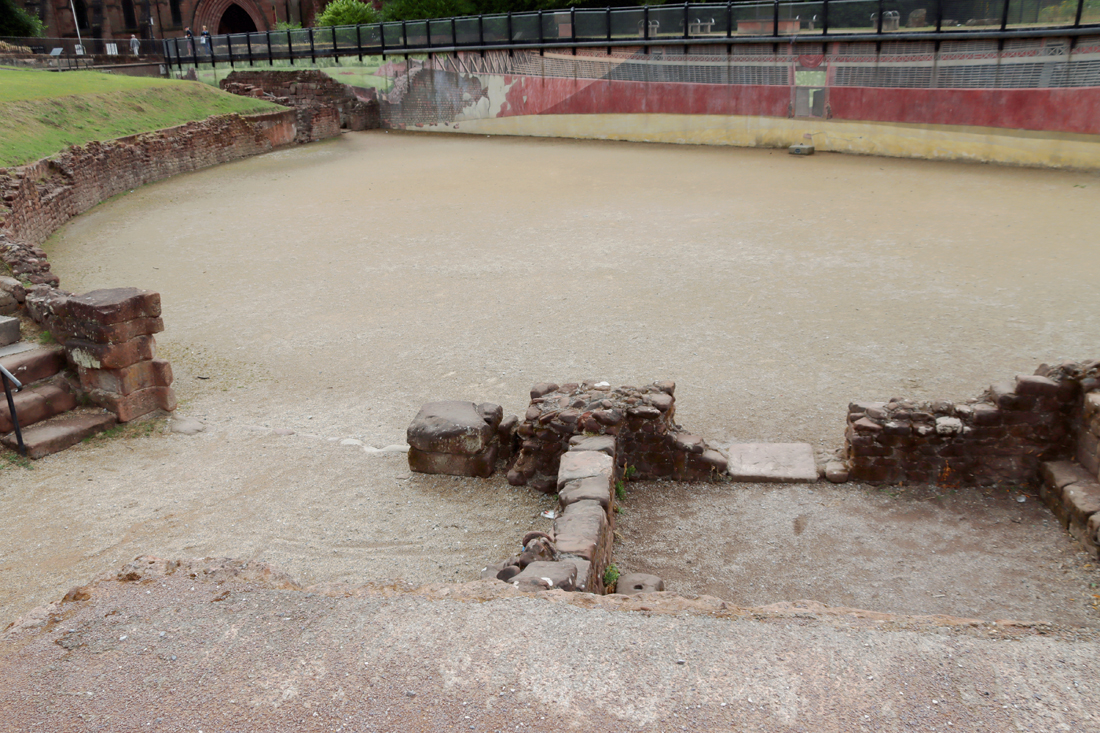
The Chester amphitheatre as it is today

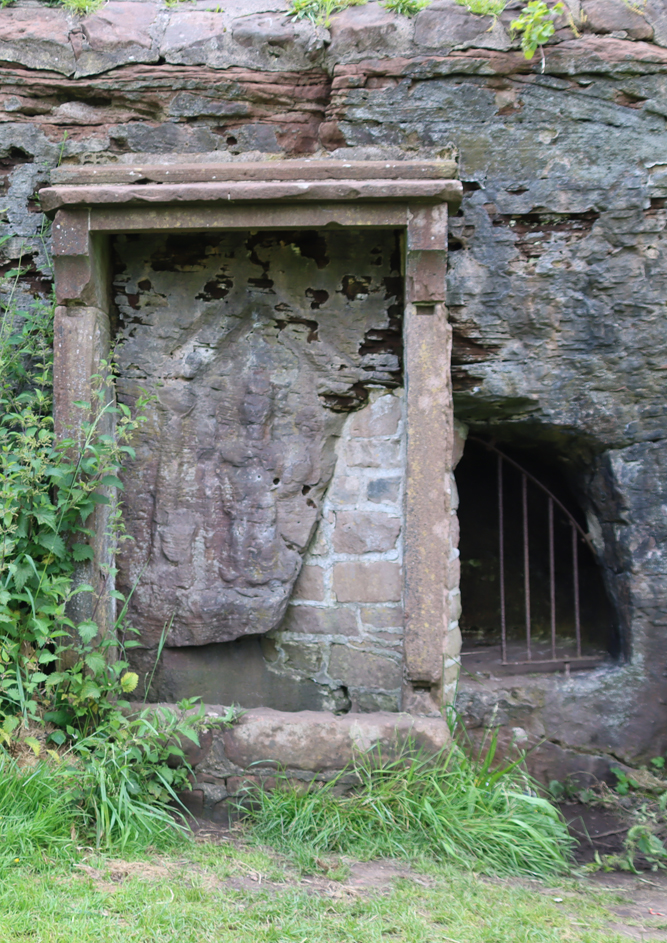
The Chester amphitheatre as it is today, showing the small room that housed the shrine to Nemesis at bottom right

Britain was attractive to Rome as a target for invasion partly because, at the edge of the known world, it was an quick win for both Julius Caesar and then Claudius.  It was far more prestigious to expand the Empire to its geographical limit than to merely curate its existing holdings.  It is clear too that by the first century AD the Romans stationed on the Rhine had begun to become materially aware of Britain via her trading relationship with Gaul, benefitting from her produce, raising an awareness of her resources, and providing a strong secondary reason both for the Claudian invasion and for sustained occupation.  Although Britain remained a peripheral province in a world where Rome was the centre of the geographical and cultural universe, the province had successive governors who were responsible for maintaining Britain as a component part of the Empire, with most of the infrastructure to mark it out as Roman territory.  Every major fortress and town boasted an amphitheatre and Chester had one from shortly after the establishment of the legionary fortress in the first century AD.

A wall map from the exhibition showing the location of 17 known amphitheatre or amphitheatre-like structures in Britain

An amphitheatre such as the one we have in Chester was multi-functional.  Although usually exclusively associated in people’s mind with spectacular and often gory action, where trained gladiators fought both other humans and wild animals, it was also used to execute criminals, to host military displays, to offer less lethal forms of entertainment and to display religious ceremonies and rituals.  It also doubled up as an additional training space for the military, only a very short march from the parade ground that was on today’s Frodsham Street, where training and drilling, manoeuvres and tactics, to prepare soldiers for the realities of military engagement against a potentially fractious population; and at the same time kept large numbers of men sufficiently busy to minimize the disputes that might break out.

Because many of the activities, particularly the gladiatorial events, attracted large audiences (in their 1000s), they had in common with football stadiums that they were designed to accommodate a large number of spectators, funnelling them via staircases and ramps to the raked seating, providing them with ease of access and clear visibility of the spectacle that unfolded below, a major task of civil engineering based on an understanding of crowd control.  The large number of entrances at the Chester amphitheatre is indicative of this understanding of how people flowed into a central location.

Gladiatorial event shown on a 2nd century slate found in Chester, on display at the exhibition

Sadly, although the Chester amphitheatre may have been used following the abandonment of Britain in AD 410 as a local defensive enclosure, the amphitheatre’s vast walls were subsequently robbed for building materials so thoroughly that it was reduced to it to nothing more than its foundations and the arena floor.  This denuded space was subsequently used as a dump, slowly filling in, and eventually becoming completely covered over and forgotten.  Buildings and gardens obliterated all evidence, with only Little St John’s Street, bending in a puzzling way, following the old line of the amphitheatre walls.  Perhaps the first hint that an amphitheatre may have been part of the Roman footprint of Chester was a slate plaque found in 1738  that showed a gladiatorial scene.

The Chester amphitheatre was rediscovered in 1929 when a new extension to the the Georgian and Victorian Dee House Ursuline Convent School, still sitting over the southern part of the amphitheatre, (and now known simply as Dee House), required a new basement for heating equipment, and the works that followed encountered Roman remains.  These were quickly recognised by W.J. Williams of the Chester Archaeological Society, who knew of the slate plaque, and shortly afterwards trial trenches were excavated by the Grosvenor Professor Robert Newstead of the Grosvenor Museum and Professor J.P. Droop, confirming that this was indeed the Roman city’s amphitheatre. 

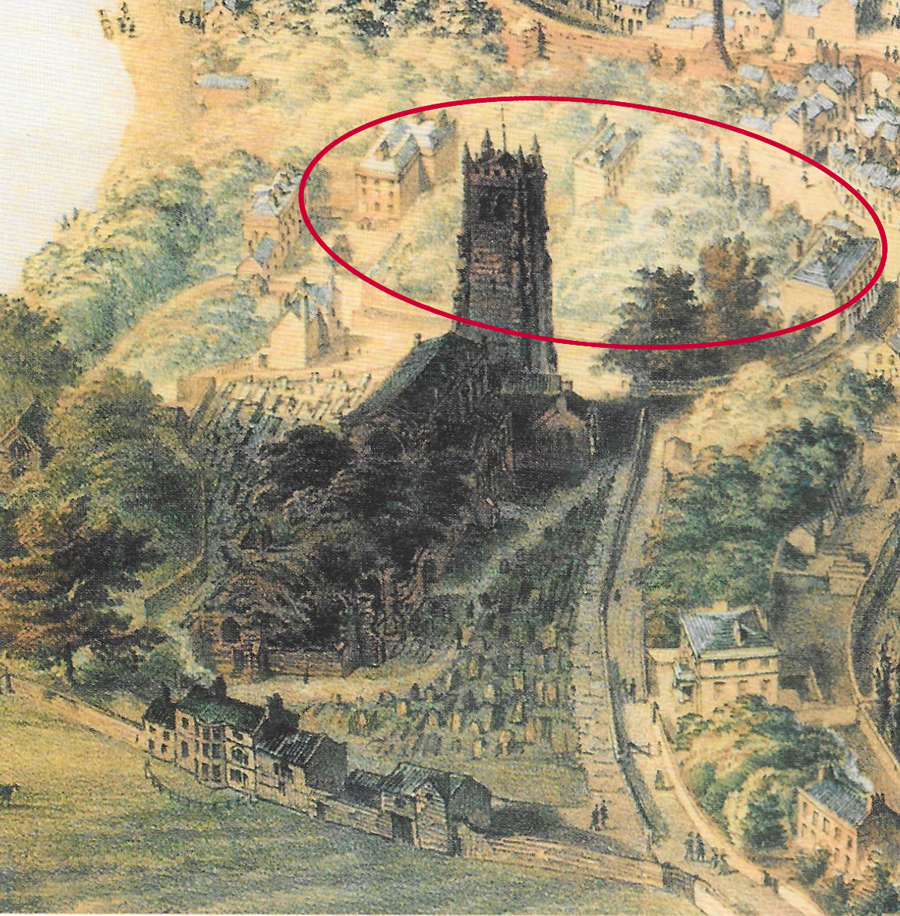
Area of the amphitheatre in Detail of John McGahey's 1852 painting of Chester

Detail of John McGahey’s 1852 painting of Chester from an air balloon (with my rough indicator of location of amphitheatre in red show how completely the amphitheatre area was covered over).  Source: Ainsworth and Wilmott 2005 / Chester City Council

The site was already under threat from a new road, preparatory work for which had already taken place to run it across the centre of what was now known to be the amphitheatre.  The public and heritage organizations instantly responded, and different sources of pressure caused the plan to be cancelled.  Chester Archaeological Society (C.A.S.) took the lead in raising funds to clear the site and enable access for further excavations.  Although these plans were interrupted by the Second World War (during which air raid shelters were dug into the amphitheatre, destroying archaeological material), these excavations took place in the 1960s, lead by F. Hugh Thompson, who proposed a phased build for the amphitheatre.  In the 1990s a proposal to develop the site as a heritage destination led to planning permission for the Grade II listed Dee House to be knocked down to enable the excavation of the land beneath, but this met with financial problems, the plans faded and the planning permission lapsed in 1995 (a real lost opportunity).  In 2000  the site was again excavated, this time by Keith Matthews of Chester Archaeology, who revealed more data and came to different conclusions about the phasing the amphitheatre.

In January 2003 Chester City Council joined forces with English Heritage to initiate the Chester Amphitheatre Project, covering both the amphitheatre and flanking areas.  Objectives included non-invasive survey, excavation where appropriate and publication of the findings.  The work took place between 2004 and 2007, led by Dan Garner (Chester City Council) and Tony Wilmott (English Heritage).  The survey and excavations between 2005-2006 led by Tony Wilmott and Dan Garner, published in 2018, were particularly informative. The presence of the listed building Dee House on the other side of the site, although derelict, has prevented any further progress being made.

Phasing of the amphitheatre shown in blue (first amphitheatre) and orange (second amphitheatre). Source: Ainsworth and Wilmott 2005, p.23

The outcome of all this work has been a narrative of the large oval (rather than elliptical) amphitheatre’s two-phase construction.  The first phase was erected early in the fortress’s history probably shortly after the establishment of the legionary fortress after AD 74/75.  The early date of the amphitheatre at around AD80 is not unusual, with other early examples known from, for example, Dorchester, Silchester, Cirencester and Caerleon.  The second amphitheatre has destroyed some of the evidence of the first. The first amphitheatre was built in more than one phase, but it appears to have matured as a wooden scaffold holding seating, with a wall at its back, and another wall separating the seating from the arena.  The access to upper levels was via an external staircase, an arrangement that is otherwise only known from Pompeii at a similar date.  An interesting feature of the early amphitheatre phase is a small painted shrine dedicated to the deity Nemesis, which was retained in the second amphitheatre.

The second main phase of amphitheatre construction resulted in Britain’s biggest example of this type of building.  A new outer wall was built following the line of the earlier amphitheatre, a vast 2m (6ft 7ins) thick and 1.8m (5ft 11in) outside the outer wall of the first structure.  The original four entrances identified in the first amphitheatre were retained but new entrances were added that lead to the interior (vomitoria) to allow access to upper seating, suggsting that the outer wall was much higher than the earlier amphitheatre, an impression that is reinforced by the sheer size of the new outer wall.  As Willmot and Garner say (2018) “its size; the number, complexity and organization of entrances and the treatment of the exterior facade all place it in an architectural class beyond that of the other amphitheatres in the province.” It is estimated that the new amphitheatre could have accommodated up to between 7500-8000 spectators.  It is to this phase that the tethering stone belongs, as well as a coping stone (rounded stone topping for a wall) that contains the inscription “SERANO LOCUS” (see photo of both at the end of the post).

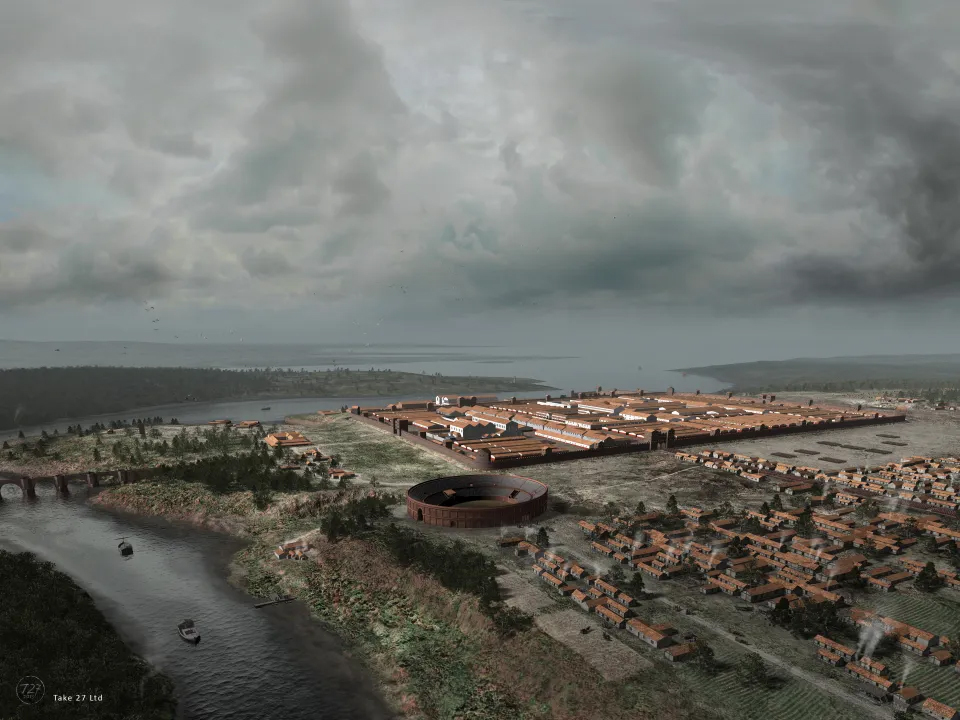
Julian Baum's reconstruction of Roman Chester, showing the dominance of the amphitheatre. Copyright Julian Baum, used with permission

Julian Baum’s incredibly life-like reconstruction of Roman Chester, showing the dominance of the amphitheatre, with the parade ground to its north.  See more details of the amphitheatre on Julian Baum’s site at https://jbt27.artstation.com/projects/bKDayr?album_id=332464 Copyright Julian Baum, used with kind permission (click to expand)

As well as being essentially a part of the urban townscape, albeit excluded from the fortress, the tall, impressive structure that would have made an impression far beyond the immediate environs of the city.  The surrounding landscape would have been in no doubt that the Ro mans had arrived, settled, and were here to stay, their amphitheatre not unlike a medieval cathedral in its powerful messaging.  This is abundantly clear in Julian Baum’s reconstructions, such as the one here, demonstrating how the amphitheatre could act as a symbol of Roman presence, sophistication and power.  Another of Julian’s reconstructions, showing the city at sunset, is on display in the exhibition, and both clearly demonstrate how dominant a feature the amphitheatre must have been and how important it was to the inhabitants of the fortress.
xxx

The Gladiators of Britain Exhibition

As there are no written records of the events that took place in Britain’s amphitheatres, the focus of the exhibition is on archaeological data and its interpretation.  There are some very short inscriptions in stone  that hint at the importance of the gladiatorial events, but the bulk of the data that informs ideas of what remains are the amphitheatres of Britain themselves, and the objects that record the spectacles that people attended. The exhibition has brought together some very evocative pieces.  All the photos below are from the exhibition.

The exhibition does not attempt to analyse the  Chester amphitheatre and nor does it set out to answer the bigger questions about how gladiators were trained, where they came from, or how they were deployed.  What it does superbly well is demonstrate how the gladiatorial spectacle was captured both in massive architectural endeavour and in material remains preserved in the archaeological record.

The Colchester Vase

The Colchester Vase

The exhibition opens with some details about the amphitheatres in which gladiatorial confrontations took place.  Not only is there a video by Alexander Illci showing a reconstruction of Rome’s magnificent Colosseum, but there is a fabulous, splendidly detailed coin showing the amphitheatre in raised relief, dating from AD 80.  The exhibition then goes on to explore the world of gladiators via specially chosen objects that reflect the impact how amphitheatres and gladiators contributed to o Roman urban life, even far from the heartland of the Roman Empire.

The Colchester Vase, being perhaps the key object that inspired the exhibition, is worth taking time over when you visit.  Apart from the fact that it is superbly well crafted, a piece of real excellence, it tells more than one story, with each component moulded in high relief. To ensure that the vessel can be appreciated in its entirety, a mirror has been placed behind it, and the lighting highlights the relief figures very clearly.  It shows a gladiator versus another gladiator, a gladiator versus a beast, and beasts chasing beasts.

Gladiatorial Helmet from Hawkedon, Suffolk

Another key object in the exhibition is the helmet from Hawkedon in Suffolk, one of the most important objects to be found in connection with the history of gladiators in Britain. Unlike the Colchester Vase, or any of the other objects depicting gladiatorial action discussed below, this was design to participate in the action, worn to protect the gladiator and give him the best chance of survival.  The frontpiece is modern, added to give a complete impression of what the original item looked like.  Analysis of the metal suggests that it was made on the continent and hints that both it and perhaps its owenr may have travelled to Britain for participation in the amphtheatre.

Amongst many other discoveries during the excavations , the one that confirms that gladiatorial bouts undoubtedly took place in the Chester amphitheatre was a huge sandstone tethering stone, which tied animals and some human contestants alike to a central point to prevent them seeking refuge at the sidelines where they could not be viewed by the full circle of spectators (shown at the end of the post).  This somewhat daunting object is on display in the exhibition.  Although by far the crudest of the many lovely objects on view, it is the one that moves the exhibition from art-works to action, forcing the visitor to engage with the the very savage and bloody nature of the contests.  It is one thing to look at a pretty scene on a vase or stone; it is quite another to be confronted with the block that physically chained the victim to its unavoidable fate.

Second century pottery lamp from Italy in the Gladiators of Britain exhibition

Although the gladiators were the stars of the events, the members of the audience were just as important for the success and ambience of the amphitheatres, and many of the other objects in the exhibition reflect the sense of involvement and enjoyment that individuals took from amphitheatre events.  One item that clearly demonstrates this sense of involvement is  A coping stone, inscribed SERANO LOCUS (shown at the very end of this post), may have been part of the arena wall, perhaps marking the place (“locus”) of a spectator named Seranus.  Although the more remarkable of the items in the exhibition, such as the Colchester Vase, were probably specially commissioned, other items are far less prestigious.  The many oil lamps in the exhibition, showing scenes of gladiators in action, were probably purchased like souvenirs when peformances were taking place.  It is thought that traces of outer buildings and the remains of food items at Chester represent snack stalls, and it is entirely likely that souvenirs could also have been sold in the same vicinity, or after the event in marketplaces.

Altar dedicated to Nemesis by Sextius Marcianus, found in a shrine at the amphitheatre.

Also on display is the shrine to the goddess Nemesis, apparently retained in the second amphitheatre after being built for the first one, adds a religious dimension to proceedings, a feature known from other amphitheatres in the Empire as well.  Representing fate, Nemesis was appropriate to the prospective fortunes of both winner and loser.  Nemesis was particularly appropriate for a gladiatorial outlook, whether winner or loser, representing fate. It was dedicated by the centurion Sextius Marcianus who had it made after experiencing a vision.

There are a great many more objects in the exhibition.  Each has been well chosen to show different aspects of the gladiatorial experience, and each is well explained in the labelling.  A wide variety of materials are represented, including stone, metals, wood and pottery, and many are decorated with great imagination.  Some were component parts of the amphitheatres themselves.  Others were items used in the arena, whilst a wide range of items were designed for the home.  Most of these were the objects that people chose to commission or purchase, took into their homes and cared for, maintaining them in beautiful condition.  As the exhibition demostrates so clearly, when they were buried, broken or lost in transit, they became archaeological remnants, and in doing so became threads of several different lines of investigation that continue to feed into broader research about the Roman occupation of Britain.

As well as the objects themselves, the information labels and interpretation boards not only inform, but create an all-encompassing experience that helps visitors to get to grips with a fascinating if gory subject matter.  The interpretation boards are beautifully designed, giving the exhibition a good sense of coherence.  Fortunately there is no gore on show, so this is entirely child-friendly (with games and dress-up outfits available for children) and whilst the exhibition does not judge, it leaves visitors in little doubt that this was a form of entertainment that potentially had a life or death outcome, whether for human or animal.

The exhibition may be small but it makes a terrific impact, making superb use of the space available, and seeking at every turn to inform and involve.  The art work on the interpretation boards is attractive, and there is a lightness of touch to the whole presentation and the delicate artwork that manages to complement rather than overwhelm the exhibits and the themes.  It is really well done.  Don’t miss it!

With many thanks to the Grosvenor Museum’s Liz Montgomery for a really engaging guided tour of the exhibition.

The exhibition is free of charge to enter, and the museum opening times are shown on its website:  https://grosvenormuseum.westcheshiremuseums.co.uk/visit-us/. Do note, as shown above, that group tours are available on Mondays, and you can phone up to arrange them. The exhibition is on in Chester until January 25th 2026.

Enjoy!

For anyone wanting to gain an impression of what the Chester amphitheatre may have looked like, the following YouTube video by 3-D modeller Julian Baum in collaboration with archaeologist Tony Willmot may help to visualize the building:


Sources and further reading:

Books and Papers

Hunt cup from Colchester

Hunt cup from Colchester

Ainsworth, Stewart and Tony Wilmott 2005.  Chester Amphitheatre. From Gladiators to Gardens. Chester City Council and English Heritage

de la Bédoyère, Guy 2001. The Buildings of Roman Britain. Tempus

de la Bédoyère, Guy 2013. Roman Britain: A New History. Thames and Hudson

Carrington, Peter1994. Chester. B.T. Batsford / English Heritage

Fitzpatrick-Matthews, Keith 2001. Chester amphitheatre excavations in 2000. Chester City Council
https://www.academia.edu/4403653/Chester_amphitheatre_excavations_in_2000 (open access but requires free log-in)

Mason, David, J.P. 2001, 2007 (2nd edition). Roman Chester. City of Eagles. Tempus

Neubauer, Wolfgang; Christian Gugl, Markus Scholz, Geert Verhoeven, Immo Trinks, Klaus Löcker, Michael Doneus, Timothy Saey and Marc Van Meirvenne 2014. The Discovery of the School of Gladiators at Carnuntum, Austria. Antiquity. Antiquity. 2014, 88 (339), p173-190.  Published online 2nd January 2015
https://www.cambridge.org/core/journals/antiquity/article/discovery-of-the-school-of-gladiators-at-carnuntum-austria/4ACC29C5CC928A88A8A4F5ADC3E989CB

Salway, Peter 1984. Roman Britain. A Very Short Introduction. Oxford University Press

Thompson, F.H. 1976, The excavation of the Roman amphitheatre at Chester, Archaeologia 1976, 105, p.127–239

Wilmott, Tony; Dan Garner and Stewart Ainsworth. The Roman Amphitheatre at Chester: An Interim Account. English Heritage Historical Review, Volume 1, 2006, 7
https://moscow.sci-hub.st/4860/8932e6265dd8765296a9986ccfcd3dcd/wilmott2006.pdf

Wilmott, Tony and Dan Garner 2018. The Roman Amphitheatre of Chester. Volume 1, The Prehistoric and Roman Archaeology. Oxbow  (also available on Kindle, although not all of the tables are fully legible)

xxx
Websites

artnet
A Roman-Era Vase, Once Considered a Cremation Vessel, Turns Out to Be an Early Form of Sports Memorabilia for a Gladiator Fan. April 13th 2023
https://news.artnet.com/art-world/colchester-vase-sports-memorabilia-2270088

Based in Churton 
Peter Carrington’s excellent guided walk of Roman Chester during the Festival of Ideas. Andie Byrnes, July 6th 2025
https://wp.me/pcZwQK-7OD

Colchester City Council
Historic Colchester Vase goes on tour with the British Museum. 19th November 2024
https://www.colchester.gov.uk/info/cbc-article/?id=KA-04817

Grosvenor Museum Chester
Gladiators of Britain exhibition 
https://events.westcheshiremuseums.co.uk/event/gladiators-of-britain/

Julian Baum, VXF Artist and Illustrator
Chester’s Roman Amphitheatre
https://jbt27.artstation.com/projects/bKDayr?album_id=332464

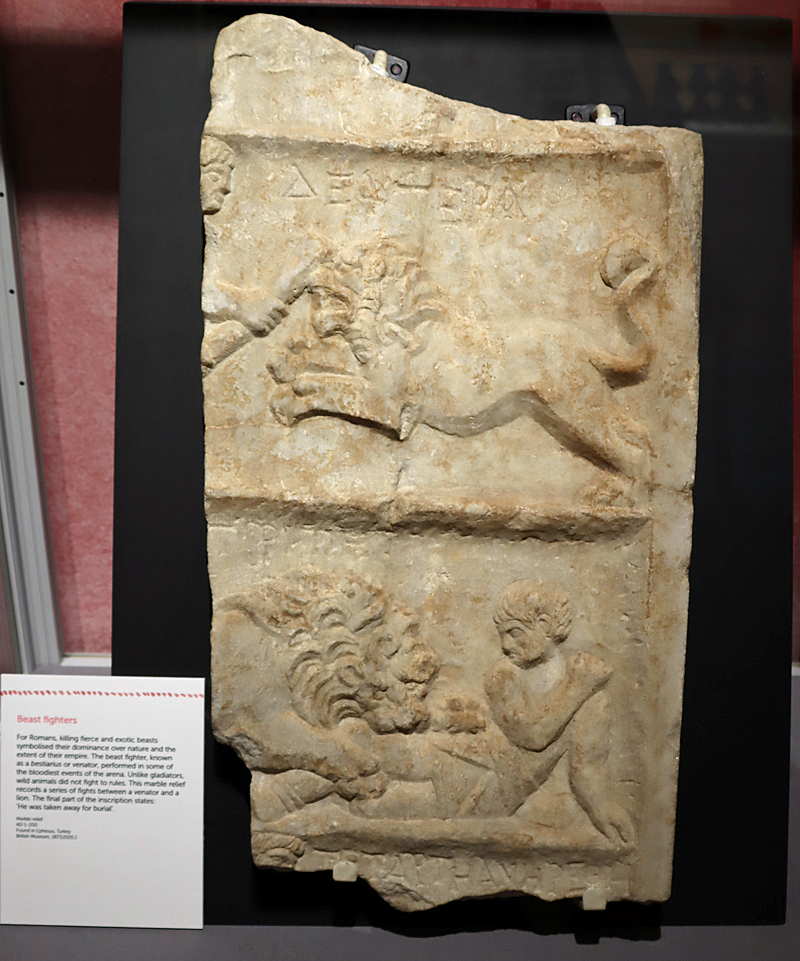
Beast fighting. Found in Ephesus (British Museum).

Beast fighting. Found in Ephesus, Turkey (British Museum).

Tethering stone, Chester amphitheatre

Tethering stone from Chester amphitheatre

The SERANO LOCUS coping stone

A guided walk to learn about the distinctive architectural creativity of John Douglas in Chester

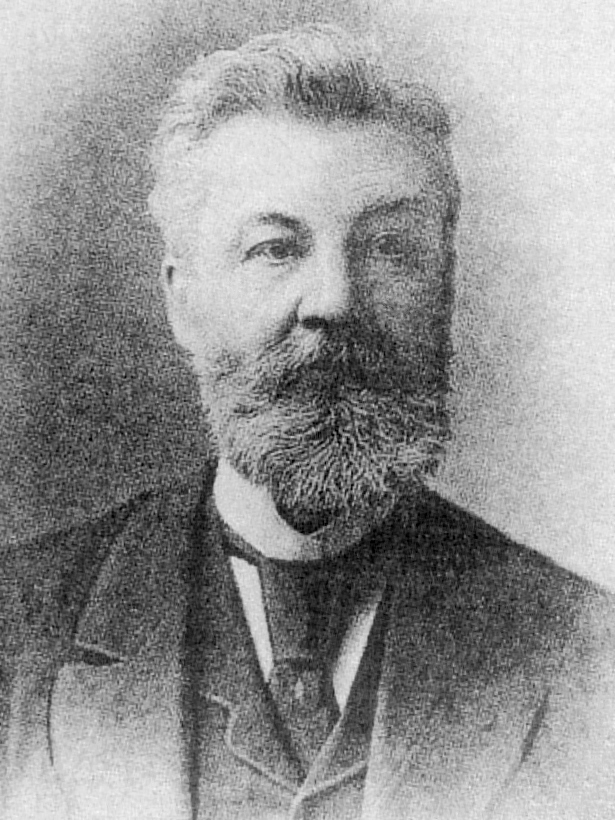
John Douglas. A photograph that apparently first appeared in “Building News” in 1890. Source: Wikipedia

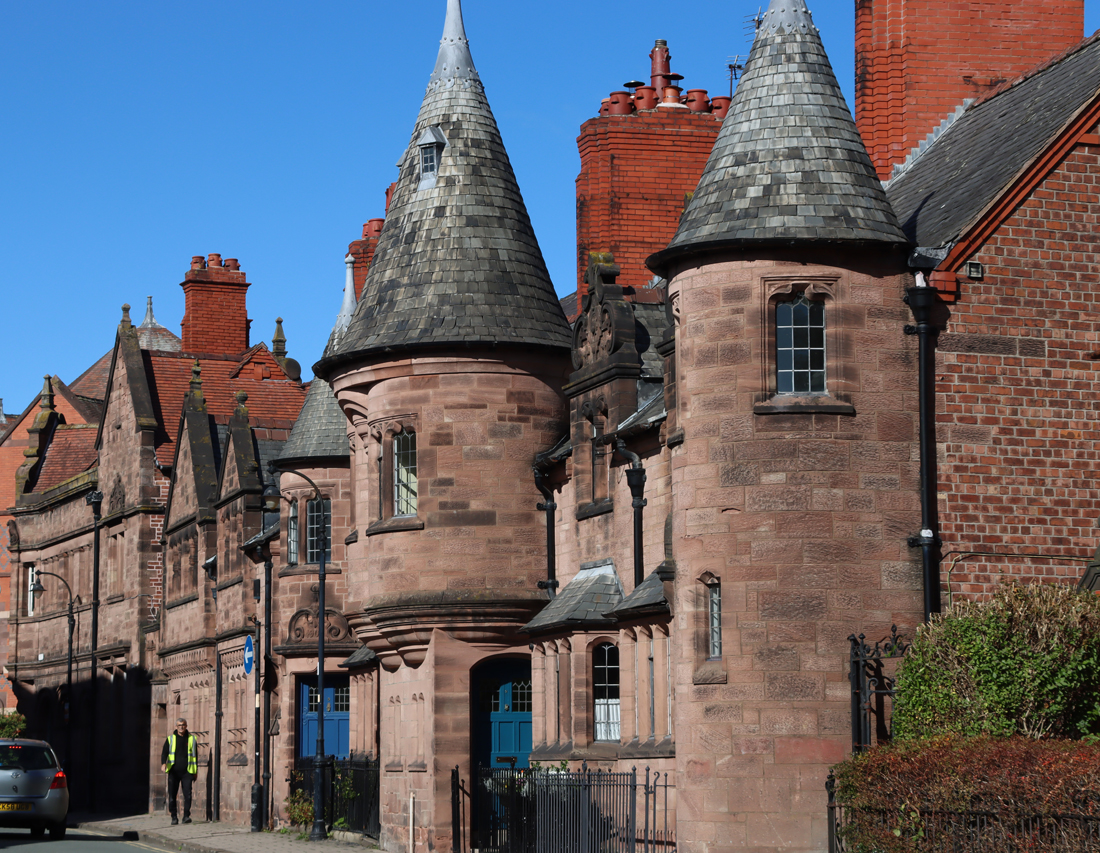
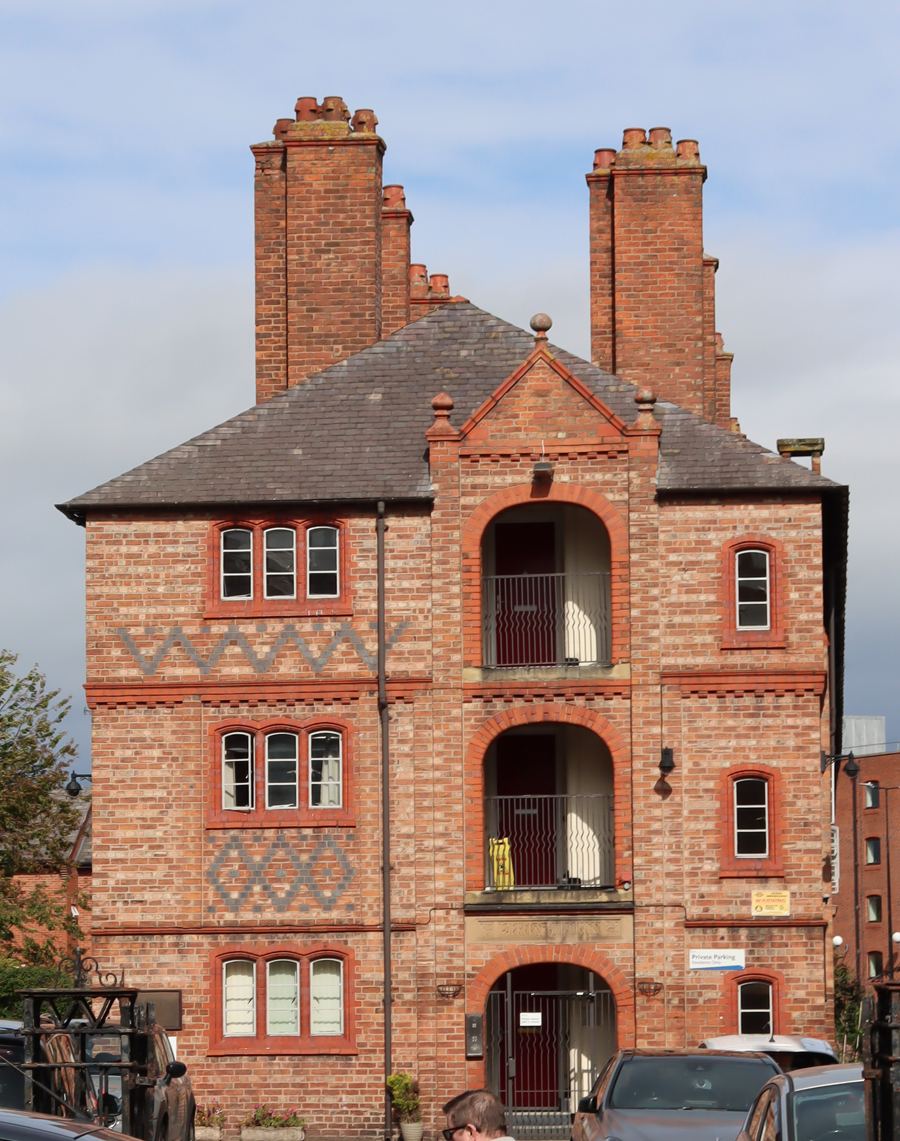
For those who are interested in local heritage, it is probably not possible to live in or near Chester without knowing the name of the architect John Douglas.  John Douglas (1830-1911) was a prolific architect, working right at the end of the Victorian era but demonstrating a fundamental affiliation with Victorian architectural ideals.  According to Chantal’s research, between the buildings he built and those that he renovated and adapted, he contributed to over 500 buildings in Britain.  Not much is known about him, but he trained in Lancashire where a new middle class, rising in both wealth and influence, was creating an unprecedented demand for domestic, commercial and civic architecture.  His are some of the most imaginative and and engaging of Chester’s Victorian buildings, providing the city with an important additional layer of interest and texture.  He was also responsible for other local buildings at Eaton Hall (including Eccleston), Aldford and Port Sunlight, as well as many other UK locations.  Although never bowing to the past in his architectural inventions, Douglas incorporated elements of Chester’s earlier architectural styles into his unique creations, remaining sensitive to the original city whilst leaving a highly distinctive and creative legacy of his own.

Grosvenor Park Street

Our guide on the Heritage Open Day walk was Chantal Bradburn, art historian and head of Outreach at the University of Chester, who had done such a splendid job several days previously, introducing a large group of us to the Western Command at the Churchill Building.  Called “John Douglas in Chester,” this was a brand new walk, and a great idea to add it to the many events offered last week.  Instead of taking us on a route-march of every building that Douglas built in Chester, Chantal selected a representative few, which both captured different aspects of his work and at the same time demonstrated an underlying thread between them all.  By choosing a careful sample of Douglas’s total Chester output, she was able to impart far more knowledge about both Douglas and the individual buildings than if she had tried to include more, although she did finish up the tour with recommendations for other buildings to inspect nearby.  As with her Churchill Building talk, and perhaps even more so, it is impossible to do any sort of justice to all the facts that she imparted, and particularly to do any justice at all to her ability to contextualise the architecture within its social and economic environment, as well as discussing it in art-historical terms, so this is just a short taster of a really great guided walk.

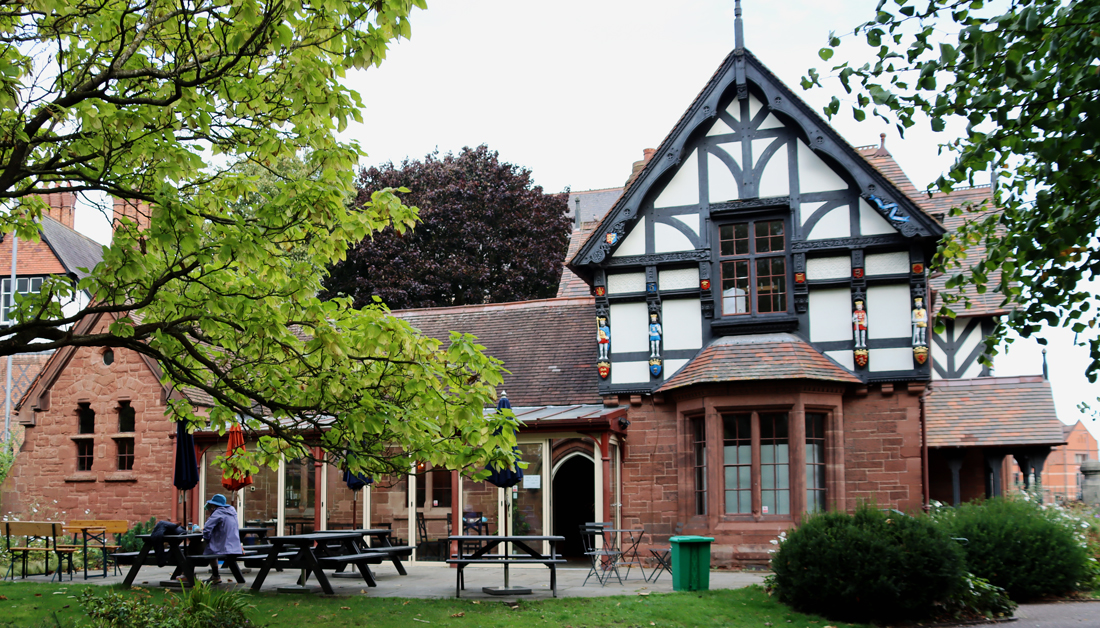
We started at the lodge in the Grosvenor Park, an obviously Victorian take on the Tudor half-timbered buildings that partly define Chester’s heritage, commissioned by the Grosvenor estate to provide a touch of additional elegance to the second Marquess of Westminster’s 1867 philanthropic donation of the land to create a park.

Grosvenor Park Lodge, Chester

Grosvenor Park Lodge

The Grosvenor Park Lodge by John Douglas

Grosvenor Park Lodge from the rear

Grosvenor Park Lodge from the rear

xxx

Grosvenor Park Lodge

Detail of carved woodwork on the Grosvenor Park Lodge: “Nobilitatis virtus non stemma character”

With Ruabon brick at its base and half-timbering at first floor level, it features sculptural elements and carvings that provide it with real charm.  Douglas apparently thought it entirely appropriate to add a medieval-style sandstone extension to his building, which as Chantal pointed out, reflects the multi-period character of many of Chester’s buildings.

It became clear as we proceeded on the walk that this willingness to go with the flow of Chester architecture by echoing some of its variety and diversity, without ever trying to replicate it, was a key characteristic of Douglas’s approach. He always preferred local materials, and this too indicates a real wish to connect with Chester’s earlier architectural heritage.  It’s great to see it being used as a café, providing a useful service on the edge of the park.

xxx


xxx

Our next stop was just over the road, on Grosvenor Park Street.  The 1872 Grade II* listed houses, numbers 6-11 on Grosvenor Park Street make up of a row of terraced houses and a Zion Chapel have long been a favourite of mine.  Together they are a fabulous, wildly imaginative mixture of different elements all of Ruabon red brick, including gothic style features, turrets, and a dozen other twiddly bits.  It is always wonderful to see how brick can be used to create elements that are more conventionally associated with stonework in this country.  Whether the mullioned windows, some with original leading, let in a lot of light I doubt, but they are wonderfully ornamental.  It was particularly interesting that Douglas built these houses on land that he owned, renting them out afterwards.  He did not skimp on materials or architectural design in order to make a bigger profit.  This set of buildings argues that he really cared about not only the quality of his own work, but about what he as an individual could contribute to Chester.FULL RUN HERE

xxx

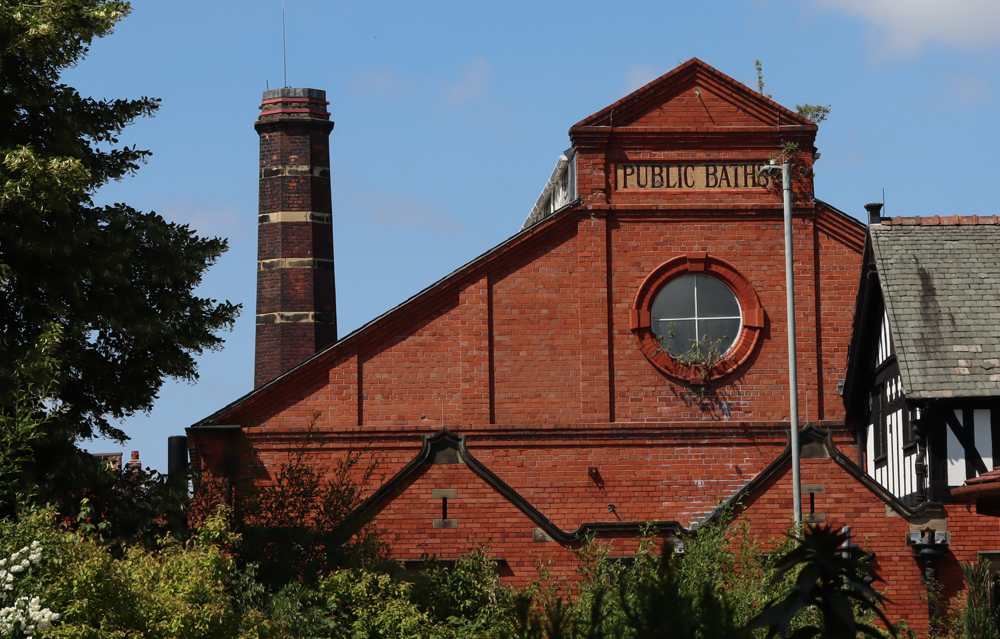
Perhaps one of his best known buildings in this part of extramural Chester is quite unlike either his lodge or his fantastic domestic extravaganza.  However, as Chantal pointed out, the Chester Public Baths are still in proportion, a good fit with the domestic buildings in this part of Chester in spite of its being a public leisure facility.  Chantal positioned the idea of swimming and the provision of a public baths in the social context of Victorian values and ideals, but made it clear that Douglas had put his own particular spin on the resulting building.  Both practical and decorative, it is a very fine example of a building that is at once distinctively Victorian but also takes admired aspects from Chester’s past.


xxx

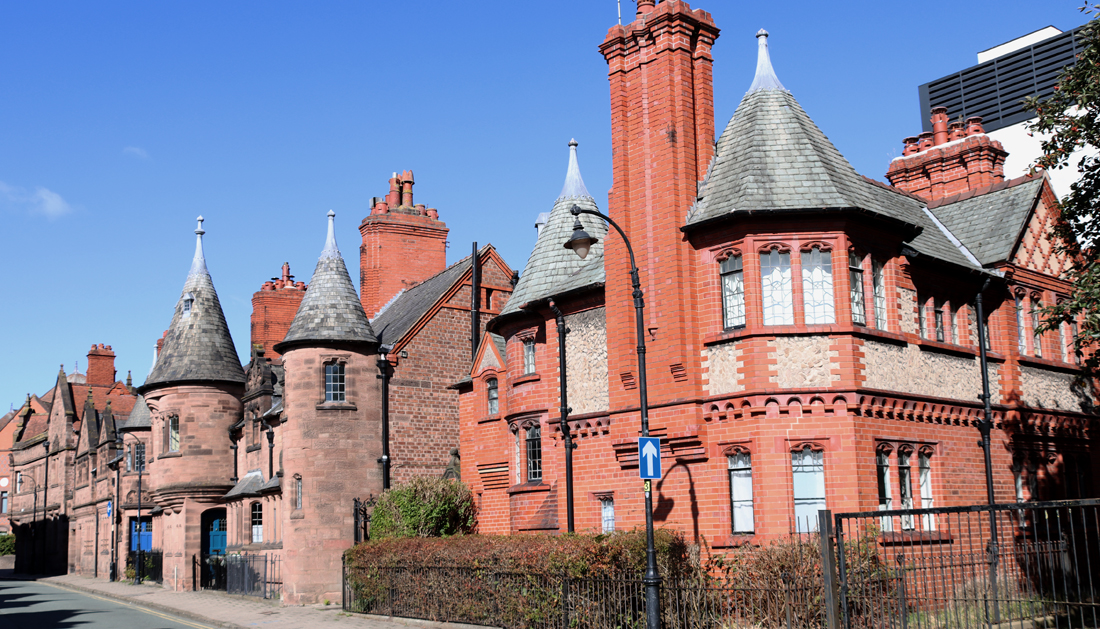
Further down Bath Street, I would not have guessed at first sight that the Grade II listed buildings on the right were another Douglas innovation, but the signs are there when you pause to look more closely, and particularly when you have Chantal’s expertise to provide detailed knowledge and insights.  Except for the building at the far south, nearest to the Baths, which is more typical of other Douglas buildings nearby, the main run of houses is built of buff sandstone, quite different in material, colour, and texture from other Douglas buildings and, for that matter, from anything else that I recall seeing in Chester.  It dates to 1903, quite late in Douglas’s life, and perhaps this accounts for some of the distinctive features discussed by Chantal.  There is an echo of the buildings on Grosvenor Park Street, but this has a much more monumental feeling to it and even with the decorative features and the short spires, seems less light-hearted and, in spite of the ornamental features, a little more monumental in feel.


If you follow the building all the way round the corner you will see that the houses link to a building built by Douglas to house Prudential Assurance.  It’s name today, Lombard House, reflects a later use by the eponymous bank.  To the left of the entrance, just around the corner, there is a charming female statue inset into a niche holding a snake and book.  This is Prudence, one of the four cardinal virtues (the others being Justice, Fortitude and Temperance), adopted by Prudential Assurance as their emblem in 1848 for her qualities of foresight, intelligence, thoughtfulness and knowledge.  Although more traditionally shown with a mirror representing self-awareness, a book is also part of her iconography, representing knowledge, wisdom and and good judgement.
xxx

xxx
Our final stop for the day took in two architectural features, bringing us into the city within the walls – the wrought iron extravaganza that sits on top of the Georgian East Gate, with its splendid clock, and the former Grosvenor Club building immediately to its west.  These both speak of late Victorian Chester’s ambition and its delight in ornament and display, giving an unmistakeably Victorian sparkle to this part of the city.  Chantal gave us details about the clock that I hadn’t heard before concerning its construction, as well as an entertaining factoid about the date of construction, reminding me that it is very easy to become complacent about even such a dominant landmark.  I had known nothing about the Grosvenor Club (including its name and purpose) so this too was a learning curve.

The Grosvenor Club by John Douglas

The Grosvenor Club

Grosvenor Club and Eastgate St

The Grosvenor Club on the right with the rest of Eastgate Street taken from the top of the East Gate bridge, under the clock.

When the tour was over, and Chantal had pointed us at other Douglas buildings in the vicinity so that we could investigate further on our own, she was still surrounded by a group of people asking many questions, and this had been the trend of the entire walk, with tons of information being imparted and lots of questions following.  Keep an eye open for this walk being offered in the future.  It’s a good one!

The nearby Parker’s Buildings

xxx

Grosvenor Park Lodge

Grosvenor Park Lodge detail

Thinking about John Douglas and his work over the following few days, and looking up other examples of his work, his buildings generally aim to provide an attractive environment of well-being, based on the idea that past and present reinforce one another in a very comfortable and attractive way.  Although many of the John Douglas buildings were impressive, and some of them were intended to be imposing, others were homes along streets that made use of vernacular features both from Chester, with inspiration taken from European cities, and from the medieval period onwards.  His preference for local materials is clearly demonstrated, and his love of decorative features is a real celebration of life.  He took a modern approach to architecture, incorporating traditional styles into his new interpretive schemes, as well as Germanic and French ideas that gave his work a rather more cosmopolitan edge than other architecture in the city, and in doing so added real value to Chester.  The best of the Victorian architecture of Chester simply oozes a sense of excitement and self-confidence about their lived present and their anticipated future, and John Douglas reflects this unfurling era with real exuberance.   His contributions to places like wealthy Eccleston and Aldford are also attractive, but perhaps Douglas is at his most appealing when contributing to Port Sunlight, the village built in the late 1880s by Lord Lever for his factory workers, contributing his skills with around 30 other architects, to create a very different type of community.  It must have been a real pleasure to live in one of his remarkable houses.  It is very nice to see that the ones that I have found to date seem to be very well maintained.  It is only a shame that subsequent architectural projects in Chester have only occasionally managed to live up to both his high standards and his creativity.


“Cheshire’s Archives: A Story Shared.” Great to learn about the new Cheshire Archives, opening next year

The Cheshire Archives building in Chester. Source: Cheshire Archives: A Story Shared

On Wednesday 17th September, as part of Heritage Open Day, Paul Newman from the Cheshire Archives and Tim Brown from the architectural firm Ellis Williams, explained to a well-attended audience at the Grosvenor Museum how the new archive project had been rolled out and what we can expect next year when the new Chester building opens.  I am dying to get my hands on the Cheshire Lunatic Asylum records that they hold, having already written a long screed about the asylum between 1854 and 1870 (across four posts here), so I was attending the event with a real sense of anticipation.

The Cheshire Archives, which since 1986 have been located in Duke St in Chester, closed in 2022, having won a Lottery grant to build two brand new buildings.  The former Duke Street premises of the Archives were in a set of lovely Victorian buildings, which were once warehouses of the legendary Browns Department Store, but the Archives were beginning to outgrow them.  The archive collections go back to the mid 12th century, and continue to be added today, representing different aspects of community life, working and domestic, at different periods.  As its role became more important, the Archive outgrew the building, with boxes that would reach 8km if laid end to end, and it had a number of environmental issues as well as providing less than ideal facilities for both staff and researchers.  Targets to reach a larger and more diverse audience were difficult, and it became clear that a move was the only realistic solution.

The new Crewe Cheshire Archives building. Source: Cheshire’s Archive: A Story Shared

An initial investment of National Lottery money to explore the project in 2020 was successful, and a full National Lottery Fund grant was subsequently allocated, with work began in earnest in 2022.  The locations in Crewe and Chester will spread the collection between east and west sides of Cheshire to provide accessible storage for the archive collections in conditions that are much more favourable. Outreach programmes will be more viable, reaching a much wider audience of different ages and backgrounds. Digital access will be much improved, with new ways to access local collections and historical data, including a postcode search and community-selected highlights referred to as “Gems.”  At the same time, the salt mines in Winsford will continue to store other records, which are available to order to either location with a one-week turnaround.  A permanent exhibition will be set up, and exhibition spaces will eventually be available for those using the archives.  The new offices will open in 2026, and the project will continue as a measuring and monitoring exercise into 2027.

Location of the site on Lightfoot Street. Source: Cheshire West and Chester

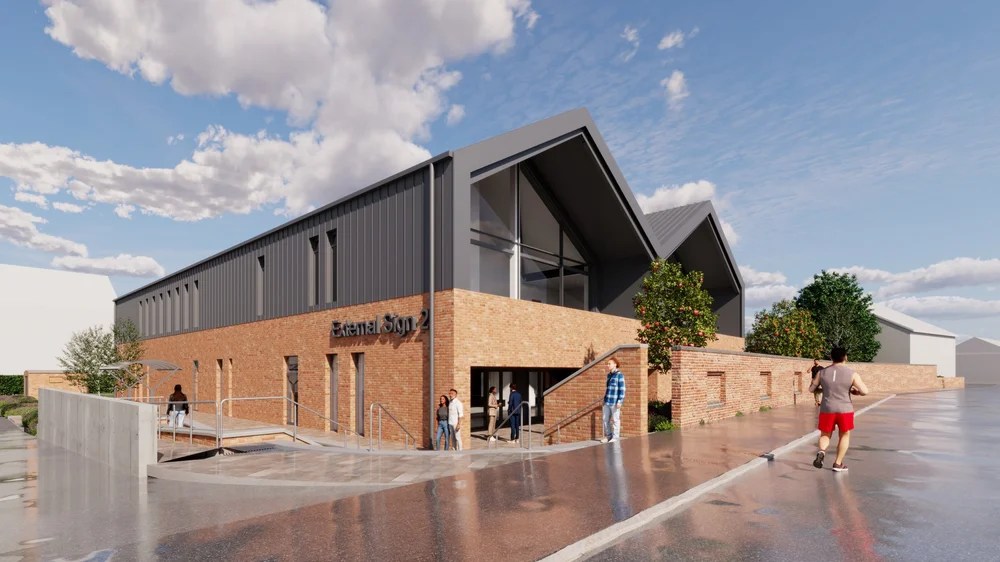
The architectural firm Ellis Williams, who had undertaken the ambitious and successful conversion of Chester’s Story House, was appointed to develop both of the new buildings.  Interestingly, although they have many of the same internal features, their appearance is very dissimilar.  Both have very modern appearances, but each has been adapted to its own immediate neighbourhood.  Initial design ideas were more radical, but certainly in the Chester case the emphasis soon shifted towards meeting planning requirements for some degree of continuity between the proposed new building and the surrounding architectural context and local character. Documents detailing some of the plans can be found here: https://www.cheshirestoryshared.org/home/the-plan

The new archive building in Chester will be located on the mainly residential Lightfoot Street, which runs along the railway line behind the Chester railway station.  This has created some challenges in terms of accessibility, and the Council were unwilling to sell the entire site, so parking is confined to 35 spaces.

A low wall with indented panels on Chester Lightfoot Street, which separates the archive site from the road. Source: Google Maps.

The site is divided from the road by a low wall with indented sections, and it was a planning requirement that this should be preserved.  The idea here is to knock through some of the indented panels, whilst leaving others in tact, replacing those that are to be knocked through with wrought iron artwork, so that the Archive site is visible through the panels, creating a linkage between both sides of the wall.  There is a slight slope of around 2.5m downhill from the road level, which requires stairs and slopes to enable ease of access.  Parking will include spaces for school coaches and there will be a loading bay at the rear.  The shape of the building itself will echo the twin-gabled shape of railway sheds and platform roofs, but is super-modern in design, and it will feature an “active frontage,” a term that refers to the integration of the building with the street onto which it faces.  Work began in 2017.

Inside, the two-storey Chester building will be split between a public-facing space on the ground floor and a more staff-orientated space on the first floor.  It will total 3000 sq ft (c.270 sq m).  The ground floor foyer, which although north-facing should be light-filled, will be an exhibition space, and will include a theatre area with movable walls, lighting and seating, to ensure maximum flexibility.  A help desk will be located at the rear.  The research rooms will have desks for research, with a total of six computers available at any one time (most people apparently bring their own kit) and there will also be a chill-out area.  The first floor will include, with archive storage in rolling racks, offices and meeting rooms.  Energy considerations have been factored in, making best possible use of the available technologies, and various levels of security and fire-safety measures are part of the overall plans.

The foundations have been established and work is underway on the lower level brickwork, whilst a steel frame and roof have also been erected.  Archaeologists from Oxford Archaeology had been given time to carry out an assessment, but found very little of interest beyond sundry 19th century railway features.  The resulting report can be found here.

The archives will probably be open for a 5-day week.  I should have asked whether this was Monday to Friday, or whether a weekend day would also be included, but it did not occur to me at the time.  I am really looking forward to visiting the new Cheshire Archives building when it opens in late summer 2026, and experimenting with some of their upcoming digital services.  In the meantime there is a website showcasing some of the Archive’s activities at Cheshire’s Archives: A Story Shared.

Thanks very much to Paul Newman and Tim Brown for not only delivering a terrifically informative presentation but for answering the numerous audience questions.


A revealing talk and guided tour: The Churchill Building and the Western Command 1937 – Today

The Churchill Building portico dates from 1997, but the original Neo-Georgian military Western Command building can be seen behind it.

The portico dates from 1997, but the original Neo-Georgian military Western Command building can be seen behind it.

With many thanks to Chantal Bradburn for an excellent lecture in the Churchill Building in the University of Chester’s Queen’s Campus.   Chantal is the University’s Outreach representative, with a strong background in art history and a particular interest in architecture in its social context.  Her talk, entitled “Western Command (Churchill Building),” covered the design and original purpose of the building as the headquarters of the Western Command, including the fascinating underground bunkers, and the building’s subsequent phases of use.  The presentation and the subsequent walk around the building’s exterior brought the Western Command to life.  Chantal’s ability to convey an impression of the building as it was in military times, based partly on her research and partly on feedback from people who have attended the talk or contacted her over the years, was of critical importance, because the interior had been completely re-envisioned in grandiose style by the subsequent bank, and converted once again in more pragmatic terms into the University of Chester’s Business School.  Only the exterior retains the essential character of the Western Command building.

The eastern wing of the Western Command (Churchill Building) gives a good impression of how the building appeared when it was first built

The eastern wing of the Western Command (Churchill Building) gives a good impression of how the building appeared when it was first built

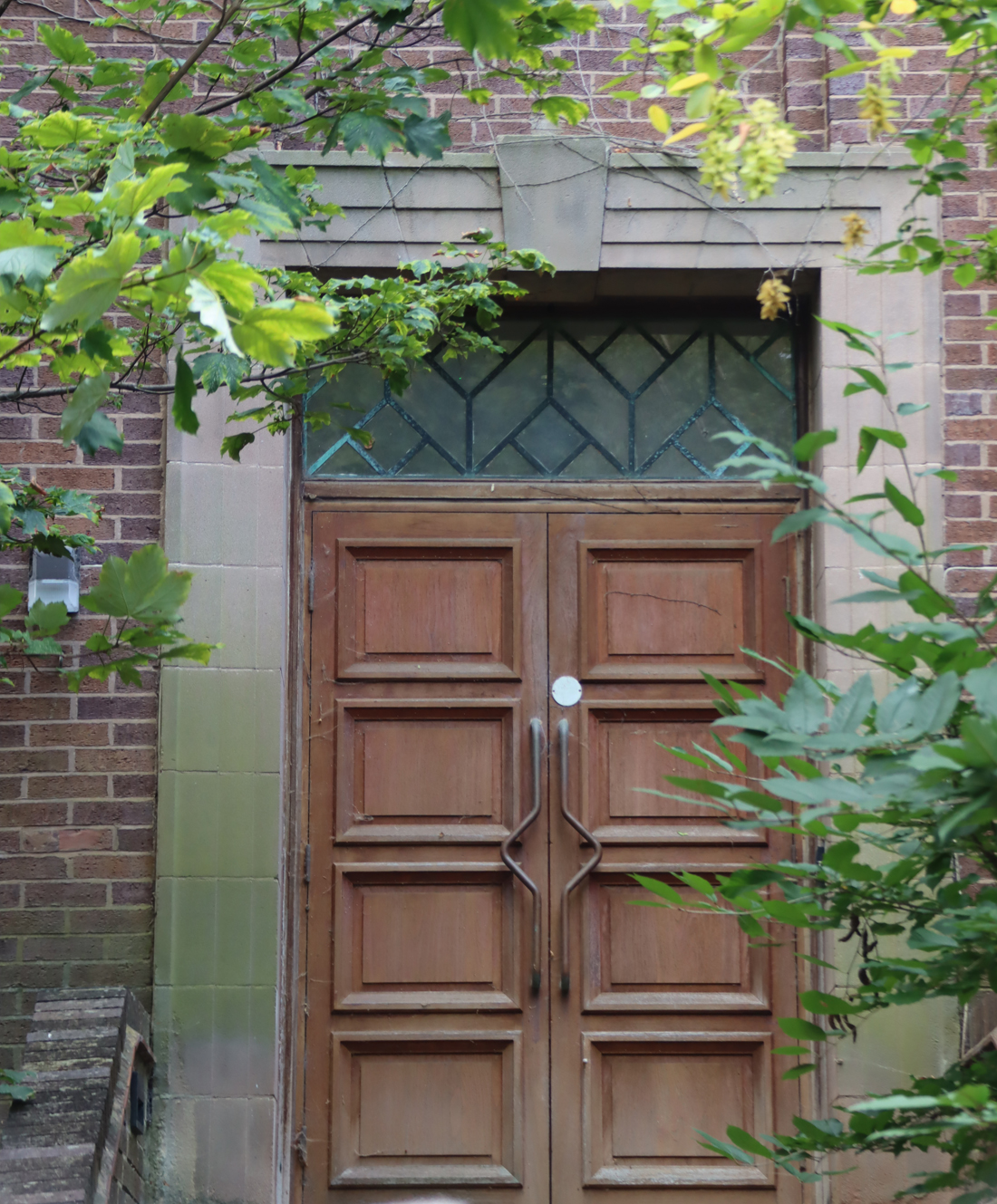
The building, then known as Capital House, was completed in around 1938, almost certainly in response to the threat of war.  Neo-Georgian is not my favourite of the various architectural experiments in Chester.  I have grumbled on and off about the Wheeler Building on the blog for years, and there are a number of more modest buildings dotting the streets of the historic city whose architects seem to believe that slapping some symmetrical rectangular windows into plain blocks of undifferentiated brickwork will do the trick nicely, completely missing the point of refined elegance and delicate embellishments that characterized Georgian harmonies.  On the other hand, as Chantal pointed out, at least in the case of the Churchill Building there are good reasons for this style, which is better than most of its siblings, relating not merely to the practicalities of budget constraints for such a large building.

The eastern entrance to the Churchill Building with subtle nods to Art Deco 

The eastern entrance to the Churchill Building with subtle nods to Art Deco

The importance of establishing a dignified military presence referenced the power and prestige of the city’s Georgian predecessors, which were themselves influenced by Classical architecture, whilst some low-key features nod to both the medieval military past and, in an even more subtle way, other contemporary styles.  I would not have noticed these had Chantal not pointed them out.  Although the subsequent Northwest Securities bank slapped a gigantic Classical-style portico on the front, the original building consisted of flat-roofed blocks that provided an impressive frontage, which relies for its impact on the size of its footprint rather than the height of its two-storey walls.  Chantal pointed out that the position of the building was strategically very fine, with its views over the river and the city beyond, only matched in its vantage points by the site chosen for the castle.

As the northwest HQ for intelligence on what was quite literally Britain’s western front during the war, the personnel serving in the Western Command building had a critical role not only leading up to and during the war, but for a surprising amount of time after it.  Chantal told us a great many stories about the role of the building and the people who worked there, highlighting the complexities that different levels of security caused for both employees and contractors, and emphasizing the degree of secrecy that was associated with the activities that took place within the Churchill Building.

Bunkers excavated into the sandstone at the Churchill Building. Source: 28DaysLater

To the east of the building, up-river, the remarkable and extensive underground bunkers were built to provide shelter and a command centre should it become necessary, both during and after the Second World War.  They extend from the level of the building down towards the river.  It is reputed that Churchill, who is known to have visited the building, may have met there with President Dwight D. Eisenhower and General Charles de Gaulle.  No documentation supports this view, but there are apparently anecdotal accounts that support the possibility.  The bunkers are now too dangerous to visit (see a photograph of a point of collapse on the 28DaysLater website).  The sandstone through which former miners in the army excavated to create the bunkers is sponge-like, attracting damp that is not helping with the stability of the underground structures.  Chantal showed photographs and explained past survey work and future plans (dependent as always on funding).

The building passed to the Royal Army Pay Corps in 1972, and from 1972 it was taken over as offices for a banking corporation.  The presentation took place in a huge room with an enormous table, all very glossy and highly polished, and heavily influence by Art Deco designs.  This was part of the bank’s improbable legacy.  It is quite staggering how the bank took over a military building and turned it into an extrovert and financially corrosive expression of self-indulgent excess.  Where these details have survived, the legacy is huge fun, but quite mad.  The bank’s vast portico, converting the Neo-Georgian blocks into a pseudo Classical temple, is equally pretentious. I am very fond of the University, having had a great time doing some post-graduate research there a couple of years back, but it really does seem to have saddled itself with buildings that for all their scale and practicality are amongst the least aesthetically charming of the various Cestrian styles.  In their favour, the University does make the most of them.

The opening of the Churchill Building by John Spencer Churchill (centre in grey suit), when it became part of the University of Chester in October 2015. Source: Cheshire Live

It is interesting to note that in the case of both military base and commercial bank, the building was off-limits to the public, not only physically but visually.  The arrangement of buildings at the time meant that the view through the gates, then in a different position, blocked any view of the heart of the complex.  It has been particularly interesting for local people who have lived in the area for a number of decades to have access to the building at last, and to be able to see what was so long hidden from view, perhaps particularly when family members and friends worked there.

The building had been out of use for a decade when the University took it over in 2015 to make it the centre for their Business School, with most of the building adapted to this task with the usual collection of teaching, research and computer rooms, areas for socializing and a café.  Wisely, the decision was made to preserve some of the more elaborate flourishes of the bank’s idea of good taste, and there are some distinctly New York style decorative features in the foyer.  More to the point, the building’s foundation stone and its frame, appropriately made of carved stone rather than the less expensive brick, has been preserved and is now installed above the reception desk as a very welcome piece of the building’s material heritage.  The exterior, now sporting a leaded dormer roof, still retains the essence of its stern and uncompromising military purpose, but its survival first as a bank and then as a major component of a university campus is a testimony to its durability.

It is impossible to do justice to Chantal’s talk, which was stuffed full of information.  Chantal does these talks quite frequently, and I do recommend that you keep an eye open for her next ones, because she provides a vivid insight into a world that is not normally associated with Chester, and which was clearly a very important part of the city’s social and economic profile from the 1930s onwards.  More than any other talk that I have attended since moving to the area, this is the one that surprised me most, and left me with a new set of insights into Chester’s less publicized wartime and post-war history.  Splendid.

North-facing aspect of the Churchill Building

Julian Baum’s fascinating Festival of Ideas presentation about the geology and archaeology of the Dee

Many thanks to professional visual effects and 3-D graphics modeller and independent researcher Julian Baum for a really fascinating presentation about new research into the River Dee.

One of Julian Baum’s beautiful reconstructions of Deva and its outer buildings in the mid 3rd Century, based on data from archaeological excavations, showing the Roman town in the context of the river and the widening estuary beyond.

The talk focused on how the Dee’s formation, archaeology and several historic maps have raised a number of questions about the Roman river.  Julian made it very clear that the presentation would consist of a number of hypothetical scenarios based on observable features, none of which can yet be fully supported by the available data.  He and his fellow investigators Rod Hobbs and Peter France have been compiling their data for the last six years, and have produced a 17,000 word paper that has been sent out to experts on Roman stonework and hydraulic engineering for consideration.  As they continue to assemble responses to their proposals, the team are also looking for opportunities to work with other specialists to extract more data from the field.  So, accepting that these ideas need more data to test the hypotheses presented today, what are the questions being asked?

The presentation followed the formation of a new research group, which met in June for the first time and included specialists in a number of relevant fields.  A great many questions were asked at that meeting, but the two overarching research questions are as follows:

1) What do we know about the geology and geomorphology of the Dee valley in the Chester area? Although multiple glaciations impacted the underlying geology of Britain, it was the impact of the last glaciation that is of most interest for the second question.

2) What do we know about Chester and the nearby archaeology, from the prehistoric to early Medieval periods, with particular focus, initially, on the Roman period?

Julian Baum’s presentation then went on to introduce the geology and glacial history of the Dee valley before going on to describe three key archaeological questions.

The Chester weir

First, how old is Chester’s remarkable weir?  Traditionally it has been dated  to the Norman period when the notorious Hugh d’Avranches, better known as Hugh Lupus, began to introduce substantial architectural and civil engineering works to develop a strong economic, religious and social foundation for Chester.  There can be no doubt that Hugh Lupus undertook works on the weir.  What is less certain is if he was the first to establish a weir here.  The proposal by Julian Baum, Rod Hobbs and Peter France, just an intriguing theory at this stage, is that the weir may have been a Roman innovation, mirroring hydraulic works elsewhere in the empire, required to raise the level of the river upstream to enable the vast barges carrying essential building materials from Holt.  The initial round of research described in the presentation has produced considerable quantities of data about the river bed, about post-glacial sea levels and tidal information, as well as looking at all the available archaeological data published to date.  Divers have been consulted and the river boat captains have provided invaluable information about their own experiences with the river depth today, as well as seasonal variations in the navigability of the river.  As the presentation emphasized, much more research is required to test this proposal.  An academic paper has been written by the three researchers and is currently being circulated amongst specialist in the field, who have all expressed an interest in assessing the hypothesis.

The Braun map of 1571

The second question concerns two 16th century maps of the Roodee that show that the north western edge was an almost straight line. How can this straight line be explained?  Building on earlier archaeological discoveries the same researchers propose that this edge may have marked the position of a very long Roman timber jetty.  The line of wall usually identified as the old Roman quay near the modern HQ building at the east of the Roodee has been widely discredited, so the question of where the Roman quay was located remains open.  This proposal makes a great deal of sense, but it too needs testing, and Julian Baum proposed a number of ways in which this could be done using specialist equipment and taking advantage of the upcoming building works at the Roodee.  An interesting corollary to the proposal is that if there was indeed a jetty there, supported on presumably vast timbers, and of a width to enable wheeled vehicles and horses to reach ships moored up along its length, its collapse would have created a major disruption to river flow, and could have had a considerable impact on the silting of the river.

Chester amphitheatre

The third question concerns the archaeology of Chester and its environs prior to the arrival of the Romans.  Iron Age remains were found during the amphitheatre excavations of the 1980s, and there are other indications that there was a healthy Iron Age presence in the area before (and when) the Romans arrived.  This data needs to be collated before it can be assessed, and this is another aim of the research group.

All findings will be made available online on a dedicated website that is currently being built.  The website address will be made available as soon as it is launched.

With many thanks to Julian Baum and other team members, who were present on the day, for such a fascinating presentation.


Peter Carrington’s excellent guided walk of Roman Chester during the Festival of Ideas

Dr Peter Carrington, an experienced archaeologist specializing in Roman history, author of the English Heritage book Chester, and editor of the Journal of the Chester Archaeological Society always heads a guided walk as part of the city’s two annual festivals.  This year he introduced a large group of us to what remains of Roman Deva.  We had all received an introductory handout beforehand by email, which as well as outlining the history of the city, included maps and images of aspects of Roman Chester that could only be represented visually.  We met up at the canal bridge just outside the Northgate, so that we could look back towards the stretch of city wall that extends east, high above the bedrock channel that contains the 18th century canal.

Here, just on the other side of the bridge over the canal, a line of Roman wall is still clearly visible, originally topped by an ornamental cornice, the remains of which still survive, bizarrely incorporated into the later walls.  It is thought that the wall originally stood to around 15ft (c.4.5m).  It was news to me that the original defences had been turf-built, and that single layers of stone walling, leaning up against the turf wall, were subject to subsidence and patches of collapse.  The inward-leaning profile of that surviving section above the canal may be explained by that process of subsidence, and this is probably responsible for much of the rebuilding necessary around the walls.  We went up on to the walls and as we proceeded clockwise towards the cathedral, looking over the edge at key points along the way, some of the complexity of the original Roman design was explained.

Walks around the walls are always popular with tourists and residents alike, but sometimes it is what we can see at the base of the walls that tell us most about the Roman past.  When we left the walkway along the top of the walls to examine sections of Roman wall at the foot of the later walls, in Northgate gardens and the Kaleyard and opposite the amphitheatre we learned about the difference between the massive, uncompromising blocks of Roman stonework and the later medieval and Victorian sections of much smaller, sometimes rounded stonework.

The amphitheatre itself is one of Chester’s most well-known tourist attractions but because nearly half of it remains buried under a hideously decaying eyesore of a building, part of which is Georgian and all of which has been abandoned (shocking tourists), the story is only partially told.  Even so, two sets of excavations have revealed an enormous amount of details about the chronological history of the site, which was the biggest Roman amphitheatre built in Britain, with clearly visible phases of enlargement preserved in what remains today.   Peter talked us through the different phases, and explained how the interior would have looked and how the timber sections of seating would have been built and arranged, painting a verbal picture of a much more elaborate building than we see today.  As Peter pointed out throughout the walk, understanding the vertical past of Chester is far more challenging than getting to grips with its horizontal footprint.  It is hoped that the report on the post-Roman history of the site, also of profound interest, will be published in the upcoming months.

The Roman Gardens, which connect the amphitheatre area with The Groves, represent a particularly nice way of bringing together various features of Roman Chester in one place.  The signage explains how much of it relates to the original city, and explains how the hypocaust looked and worked and how the reconstructed mosaics were based on those found in excavations.

By the end of the walk the group had been given a great sense of where Deva is still to be found, and what the fragmentary remains represent.  Given the importance of the town and the scale of the architecture both within and outside the walls, it is remarkable how completely Medieval and more recent Chester have eliminated Rome’s once considerable footprint.

With many thanks to Peter Carrington for a fascinating introduction to Roman Chester.

Claire Chatterton on the first 100 years of the Cheshire Lunatic Asylum at the Festival of Ideas

Claire Chatterton speaking at another presentation in 2024. Source: Festival of Ideas

Having spent a lot of time reading and writing about 18th and 19th century lunatic asylums in general and Chester’s public lunatic asylum in particular, it was a sincere pleasure for me to go to the Chester Town Hall to listen to Professor Claire Chatterton talking about the Cheshire Lunatic Asylum.  The asylum opened in 1829 with a building designed by William Cole, and although it expanded over a vast area over the decades, most of which has since been demolished, the original 1829 building still stands in the grounds of the Countess of Chester hospital, of which it is now a functioning part.

Professor Chatterton is an excellent speaker.  I recently listened to a daunting Radio 4 programme entitled “How to avoid death by PowerPoint,” and Professor Chatterton soared above all of the noted pitfalls, speaking with perfect fluency, bringing the audience along with her.  It was good to see that there was a good turnout, reflecting an interest not only in Victorian Chester, but in mental health care.  Professor Chatterton is a former mental health nurse, enabling her to comment with authority on a specialized and skilled profession that is not always well understood.  We were asked not to take photographs, so I have no images of the presentation (the photograph at the top of the page was from a previous presentation), but the accompanying graphics and text were very good.

Chester Lunatic Asylum 1831. Wellcome Institute Library. Source: Historic Hospitals, Cheshire

The scope of the presentation was the first 100 years of the asylum, taking it from 1829 to 1929, which Professor Chatterton made clear was a period of considerable change in terms of both mental health legislation and medical ethics.  The title of the presentation was “Tales from the Asylum: The First 100 Years,” and this captures an important aspect of the narrative, which placed emphasis not only on the general trends and policies of the time as they impacted the asylum, but on the individuals who ran the asylum, worked in it, and were contained within it.

Although the asylum had been established before counties were required by law to build asylums, making Chester one of a number of early pioneers in this area, there were clearly problems. Between 1829 and 1853 staffing of the hospital was somewhat thin on the ground, with no live-in staff and no night staff at all.  Criticism by a board of inspectors resulted in the appointment of a new Superintendent in 1853, Dr Thomas Nadauld Brushfield, who implemented new standards of management and care, including the banning, wherever possible, of mechanical restraints.  The professor described how Brushfield’s regime, between 1853 and 1865, appears to have been as humane as possible, with an emphasis on patient care rather than mere containment, but she also made it clear that the problems should not be underestimated, and whilst new admissions rose, the greater majority of patients could not be released.

The previous occupations of patients admitted in 1870

Professor Chatterton talked about the fragmentary nature of the available data from asylums.  It is a hard fact that even though these were publicly funded institutions, many of the archives were considered excess to requirements when the mental healthcare system was overhauled at different times.  Fortunately some of the documentation for the Chester asylum is held by the Cheshire Archives and Local Studies offices. These are closed at the moment for a major overhaul, but should be available for consultation once again in 2026.  Professor Chatterton was able to access some of them before the closure, piecing together some of the many stories from inside the asylum.

Professor Chatterton took us through some of the statistics that were produced in the annual reports that provide a fascinating wealth of information about patients, such as their employment backgrounds and the state of their health and any particular conditions from which they suffered on admission, as well as suggesting causes for mental health issues.  It is difficult, as the Professor made clear, to make comparisons from one asylum to another about what mental illness terminology actually means, because no reports define it and although the same terms might be used, definitions might differ, but some, like the end stages of syphilis (referred to as General Paralysis) are distressingly prevalent.  She took us through some of the general health problems confronted in asylums, some of which can be cured today but were, at that time, incurable.  It was often a bleak picture.

The Handbook for Attendants of the Insane. Source: Royal College of Nursing, “Out of the Asylum”

Unsurprisingly for the period, there was a division between male and female patients, who were divided physically within the asylum.  At first both the male and female staff handling patients were referred to as attendants, with men attending male patients and women attending female patients, but eventually the women became known as nurses, reflecting a degree of professionalization of this work within the asylums.  It took much longer for men to be recognized as nurses too.  Professor Chatterton gave examples of some staff, male and female, who had been pensioned off after suffering acute stress, partly due to the nature of the job, and partly due to long hours.  It was quite clearly one of those careers that took a heavy toll on those on the front line.  I was particularly sad to learn that the Reverend Congreve, who had run schools for those patients who wished to attend them, and had operated a mobile library, was one of those who died, having had succumbed to stress.

It was interesting to see photographs (and actual objects that Professor Chatterton brought with her) of items that were used by nursing staff in their daily work.  I had seen online scans of the annual reports produced by the asylum, but had never actually seen one in the flesh.  In my mind’s eye they were A4-sized, big and bold, but actually they were around A5 sized, like small booklets, which seemed far too understated for the importance of the job at hand!  Adverts for staff in the asylum were particularly interesting, showing top-level requirements and starting salaries.  The increasing professionalization of mental healthcare nursing was demonstrated by a number of publications that not only advised nursing professionals, but helped them with the exams that from the late 19th century they were expected to pass.   Psychiatric work eventually became one of the fields that the first women doctors could enter.

If you have the opportunity to hear Claire Chatterton speak in the future, I very much recommend it!  A great lecture, with thanks.

The 1829 Building at the Countess of Chester Hospital, the former lunatic asylum