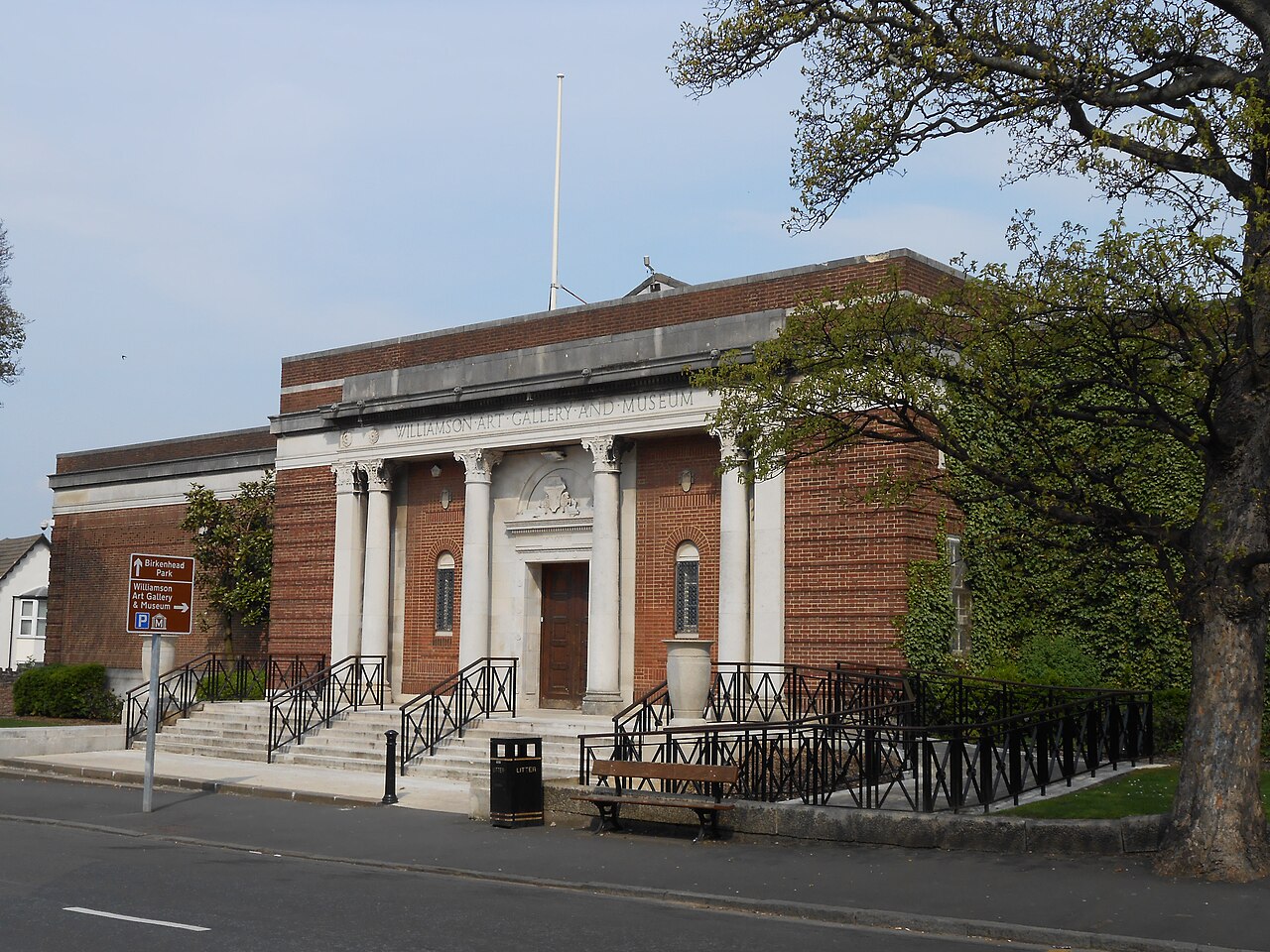
A traditional art gallery and museum in Birkenhead seems unexpected, but when the Williamson Art Gallery and Museum opened in 1928, Birkenhead had not yet fallen into the decline that eventually followed the 19th century economic industrial expansion created by the ship building industry. The gallery was funded by philanthropists John Williamson and his son Patrick Williamson. John Williamson was a shop owner and merchant who became a director of Cunard when it formed as a public company, serving until 1902. He was also on the board of Standard Marine Insurance and served on the Merseyside Docks and Harbours Board. His son does not appear to have had a career but co-operated with his father on philanthropic activities. The museum’s design is a simple brick-built square, with a prominent facade that references Classical features. The steps dominate in the above photo, but there is a ramp at the side for easy access. The gallery is all on one floor, so this too provides ease of access.
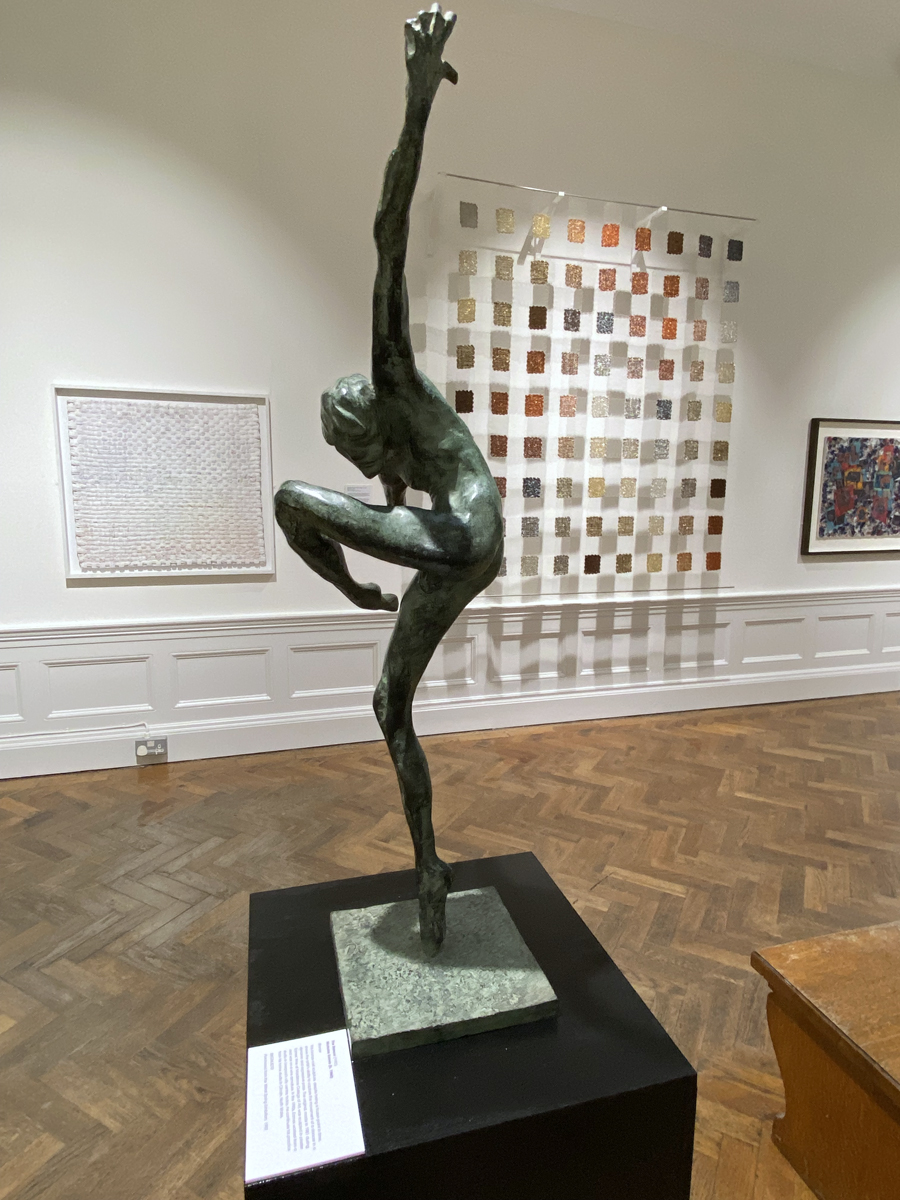
Nicholas Eames, The Dancer (1983) with two textile works by Anna Sutton behind it
I visited with my friend Julian in December 2025. We drove guided by the SatNav, which was needed as the Williamson is surrounded by something of a residential rabbit warren (with some very attractive Victorian terracing if you keep an eye open). There is a free car park on Mather Road that had plenty of spaces. Full visiting details, both for drivers and those using public transport, are at https://williamsonartgallery.org/visit/. Apologies for the quality of the photos inside the gallery, taken on my smartphone. As always in galleries there is reflection from protective glass in many of the photos, but hopefully they will give a good idea of the exhibits.
The gallery is all on a single storey, arranged in a square of linked galleries around what is now the café (with artworks on the walls) and a sculpture garden. A pre-visit inspection of the site plan indicated that around half of it is used for permanent collections, whilst the rest is home to temporary exhibitions. The twin focal points are, in the main, 19th and early 20th century and modern, including furnishings, ceramics, paintings, textiles, sculptures and, on this occasion, a modern video installation. The inclusion of temporary exhibitions is probably very attractive to local people who have reason to visit on repeat occasions.
The first of the galleries that we visited was a temporary exhibition showing the results of the 31st exhibition of the annual Trinity Buoy Wharf Drawing Prize (2025). The exhibition “celebrates the role and value of drawing with creative practice and provides a forum to test, evaluate and share current drawing practice.” There is a wide variety of styles and subjects along a continuum from representational to abstract. The skill on display was impressive, and some of the pieces were visually stunning. The mainly monochrome entries drew attention to different combinations of line and texture, with the analytical, humorous and occasionally alarming all demonstrating the versatility of the medium.
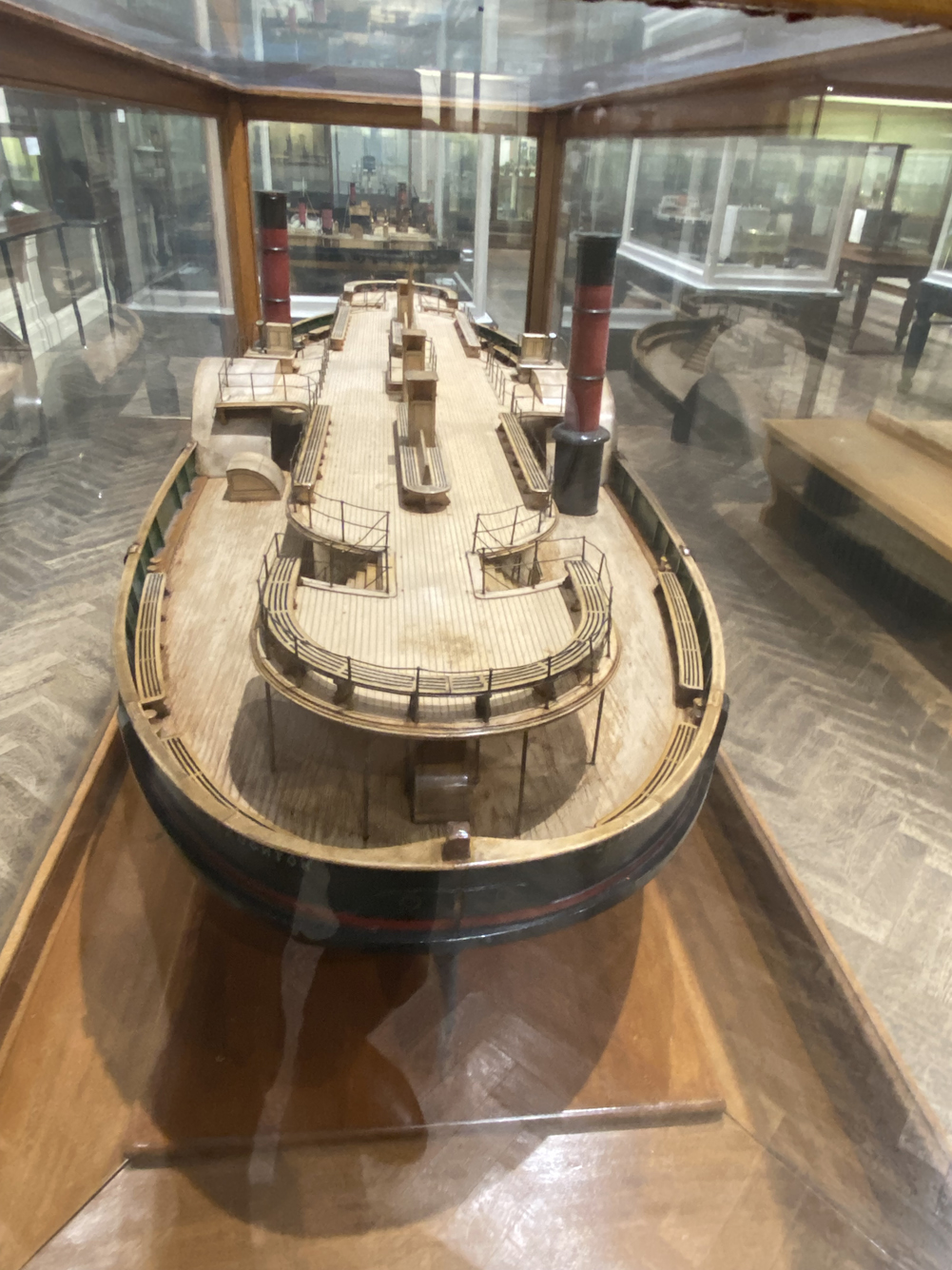
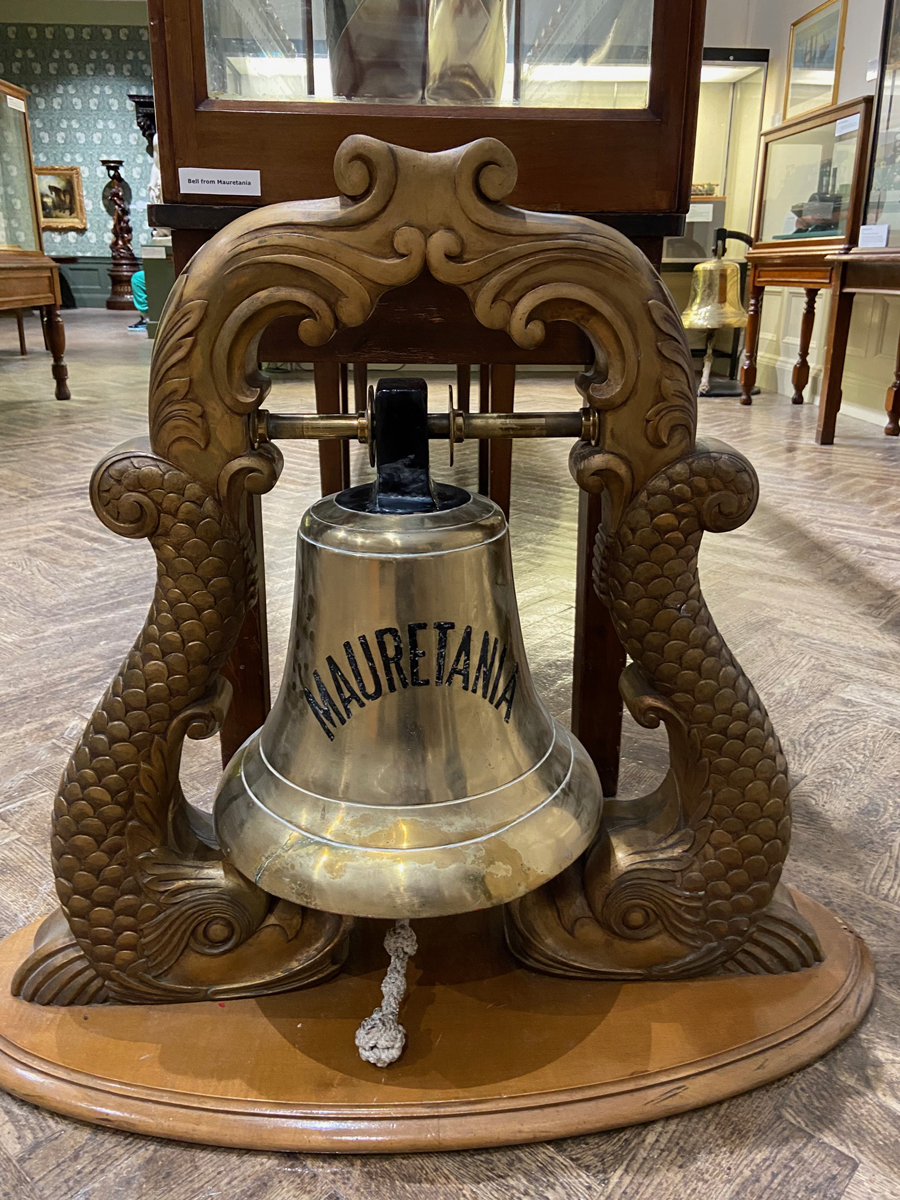
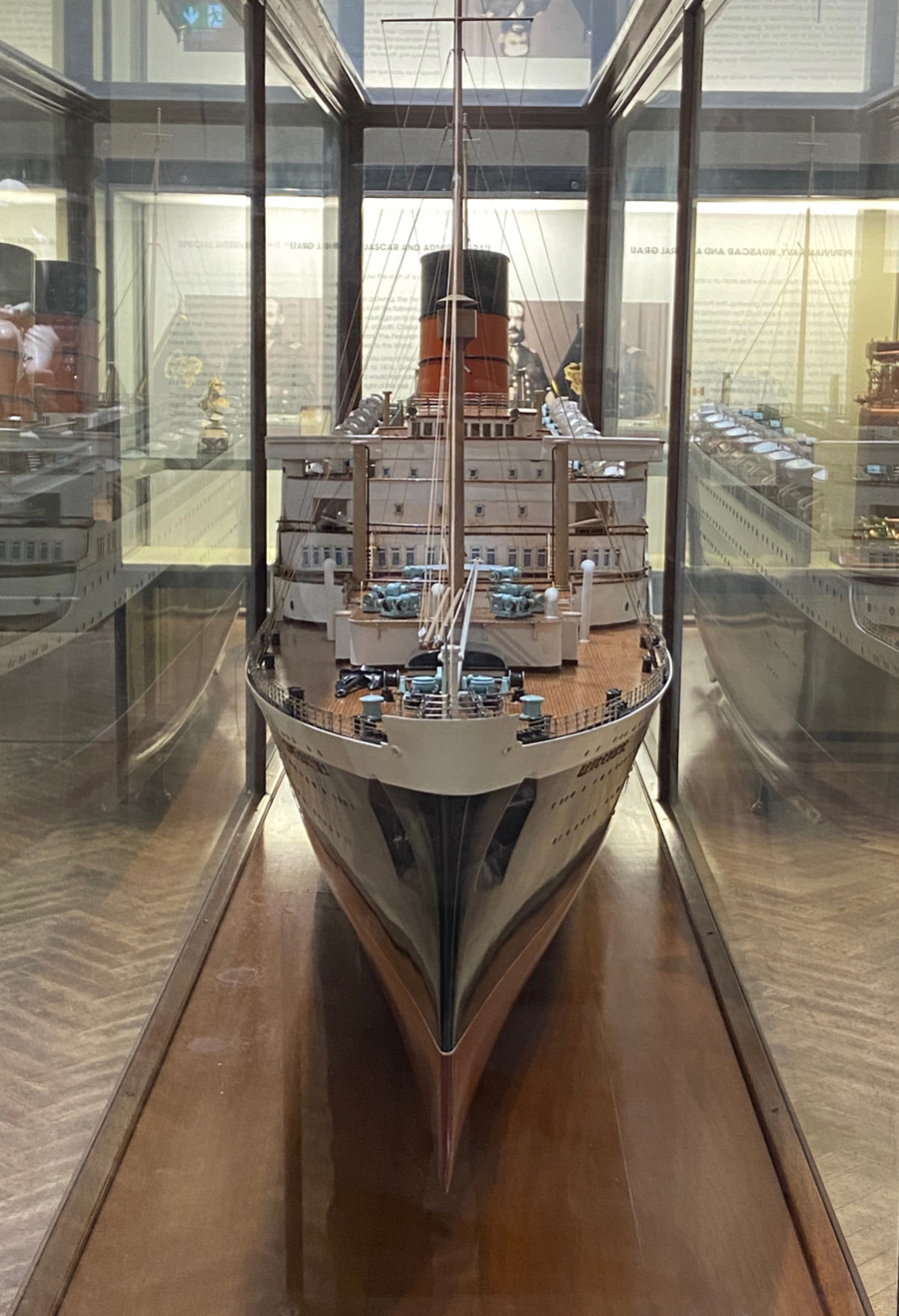
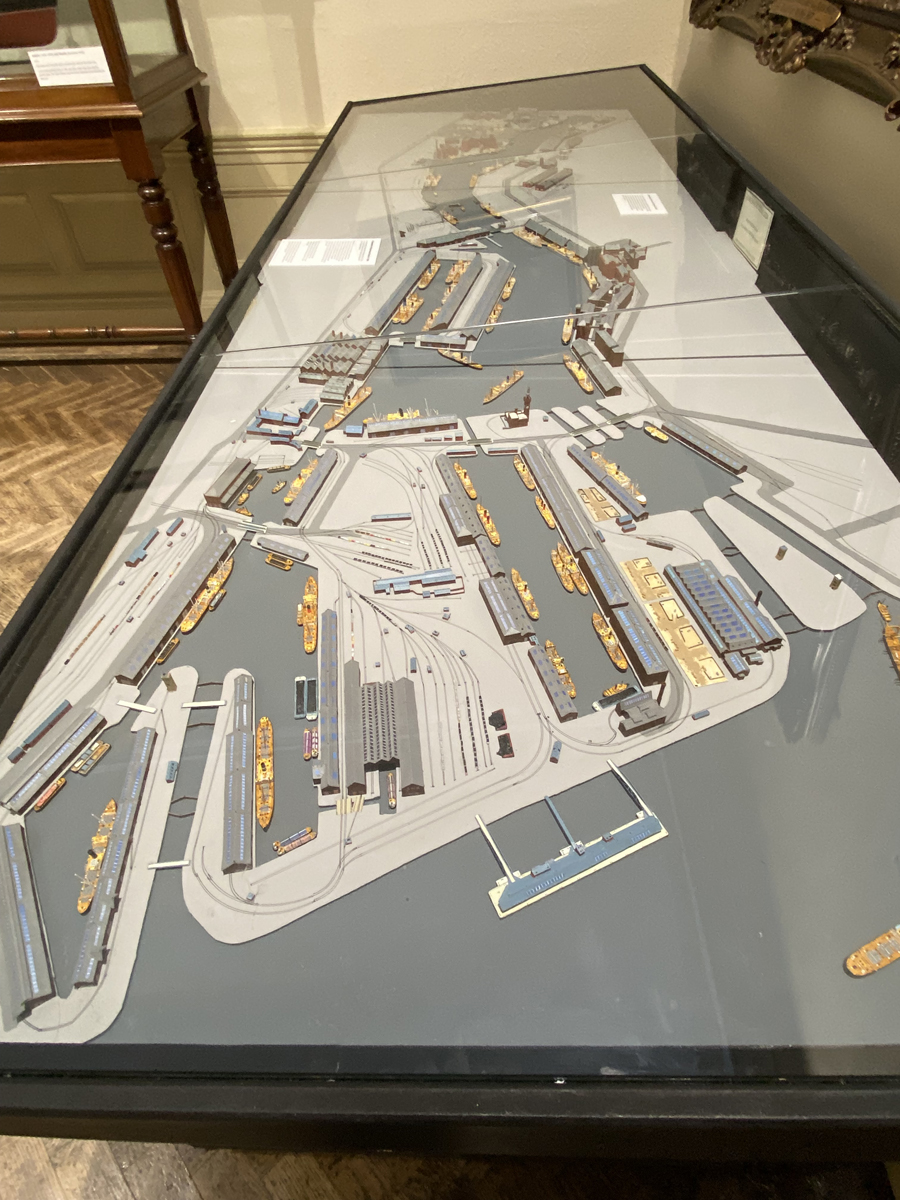
For me, the highlight of the permanent collection was the Maritime room, which is filled with models of ships built locally, as well as the actual fittings from some of the ships depicted by the models. A model of the Birkenhead Docks is really evocative of the size and scale of the operation (shown at the end of the post). The models of Mersey ferries are truly splendid, including a deliciously curvaceous Art Deco-flavoured example. It was a genuine delight to see a model of the S.S. Mauretania, as well as objects that furnished her, because my grandad was quartermaster and helmsman on the ship. It turns out that my friend Julian’s grandfather was a marine engineer, so there was a particular sense of connection for both of us with these beautifully crafted insights into Birkenhead and Mersey shipping. The whole room is redolent of local maritime history. Given that the Liverpool Maritime Museum is disappointingly closed indefinitely whilst funding is being sought, this gallery in the Williamson offers the best available local insight into Mersey shipbuilding and shipping.
Models of some of the Mersey ferries
The ship’s bell from the Mauretania
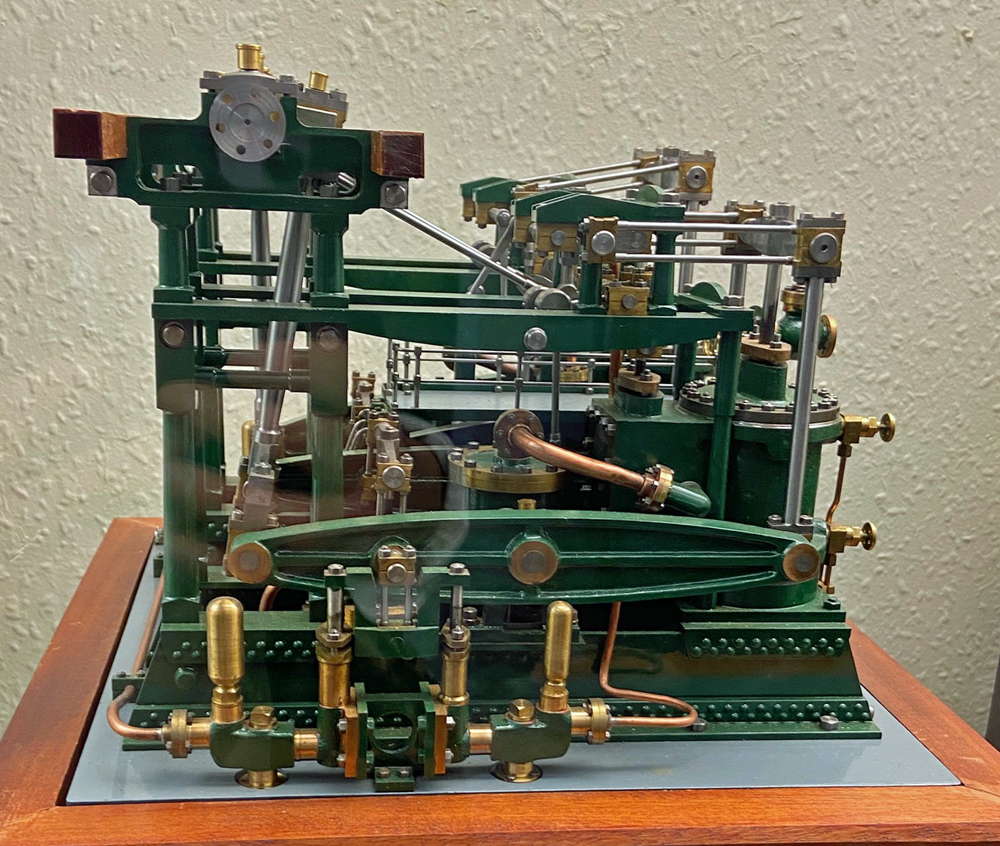
Side lever paddle steam engine, representing an engine of about 1840
Birkenhead Corporation Ferries poster
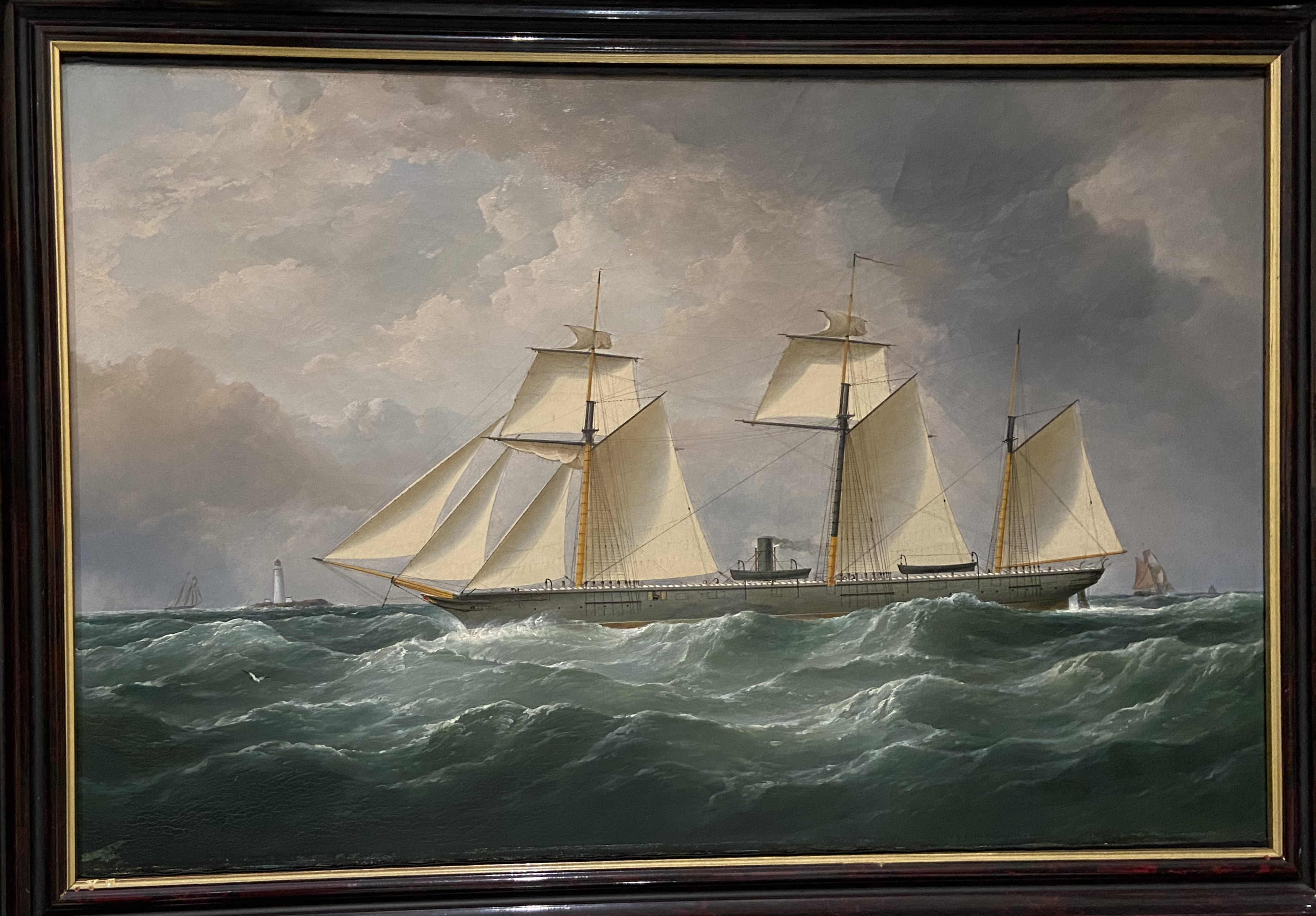
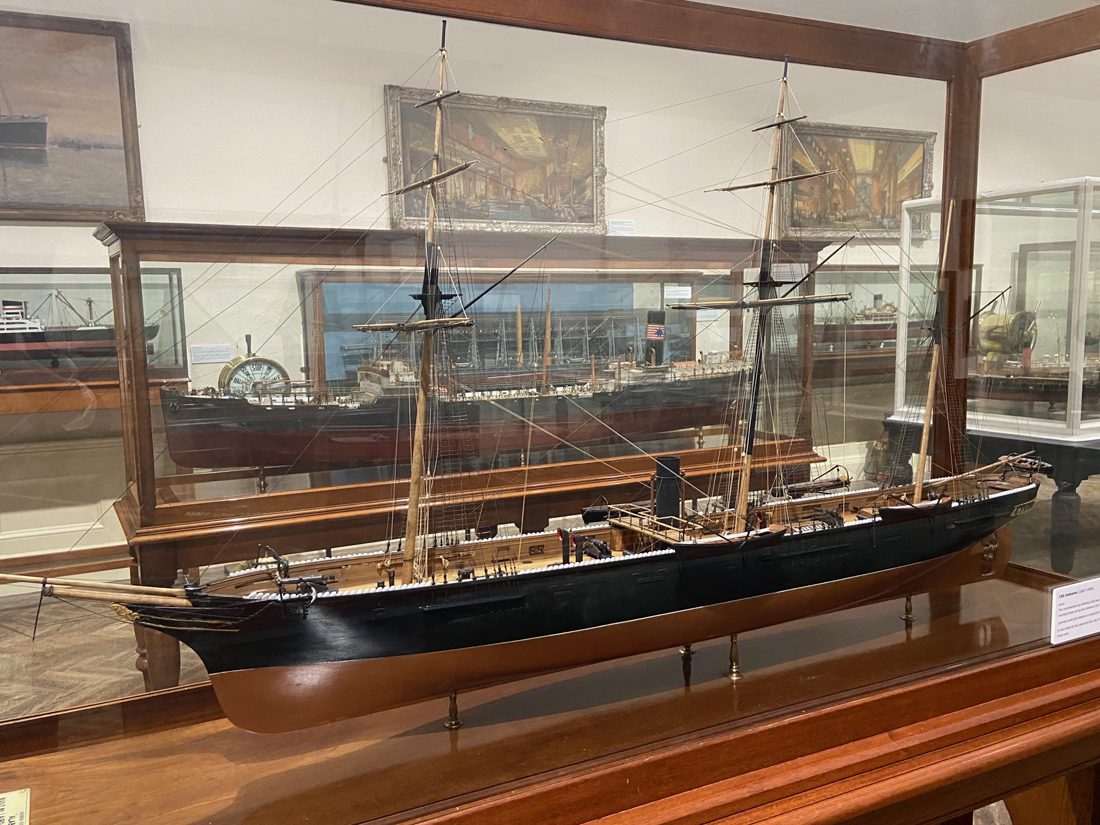
The C.S.S. Alabama, built Camell Laird’s shipyard, in theoretical violation of official Government neutrality in the American Civil War, is represented at the Williamson by both an oil painting and a model (the latter shown at the very end of this post).
Oil painting of the CSS Alabama by Samuel Walters (1811-1882), painted after 1862
Piece of furniture, a sideboard, from Arrowe park. None of the Arrowe Park furniture can be ascribed to a particular carver or workshop. Diana is at centre, possibly an earlier French panel. The cupid-like boys flanking her represent food and drink.
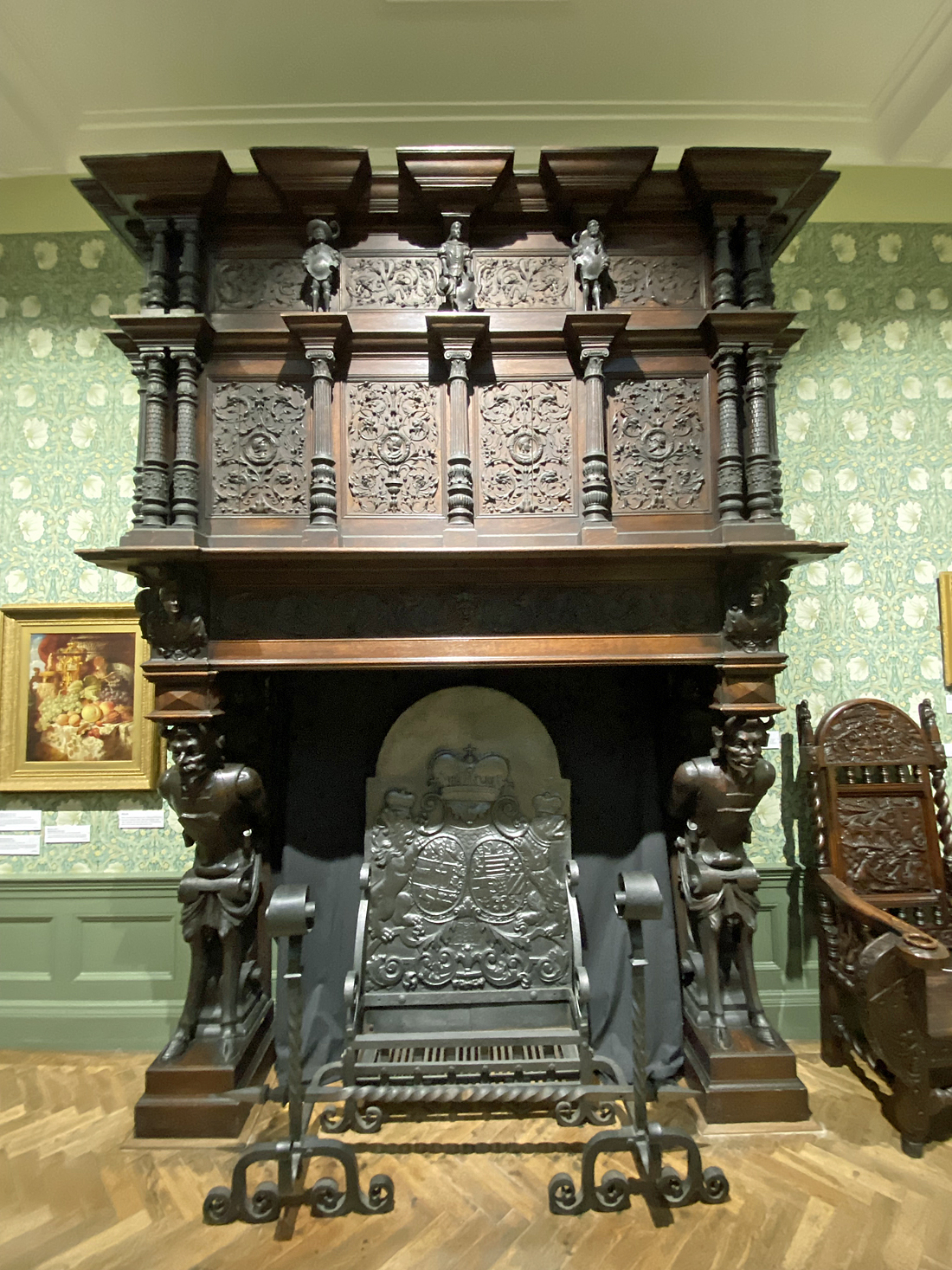
Entirely in step with this growth of maritime industry and the rise of commerce, was Arrowe Hall. The name is now associated with as a hospital, it was originally built in 1935 for John Ralph Nicholson Shaw, who inherited Arrowe Park from his uncle John Shaw, Liverpool Mayor and slave trader. A small gallery is devoted to reconstructing one of the Arrowe Hall rooms, with some truly astonishing, beautifully crafted, enormous and aesthetically rather appalling pieces of furniture and ornamentation, a mish-mash of medieval, Tudor and Jacobean styles executed with enthusiastic Victorian panache. The information board says that most of the pieces of furniture date to the 1880s, but were carved with earlier dates: “This deceit, and staining the oak very dark, was meant to give the owner a heritage and respectability that they didn’t really have.” The detail in the fireplace overmantel below shows considerable skill imitating earlier Renaissance style friezes. At the time of writing, the house is now a home for adults with learning difficulties.
sdfsd
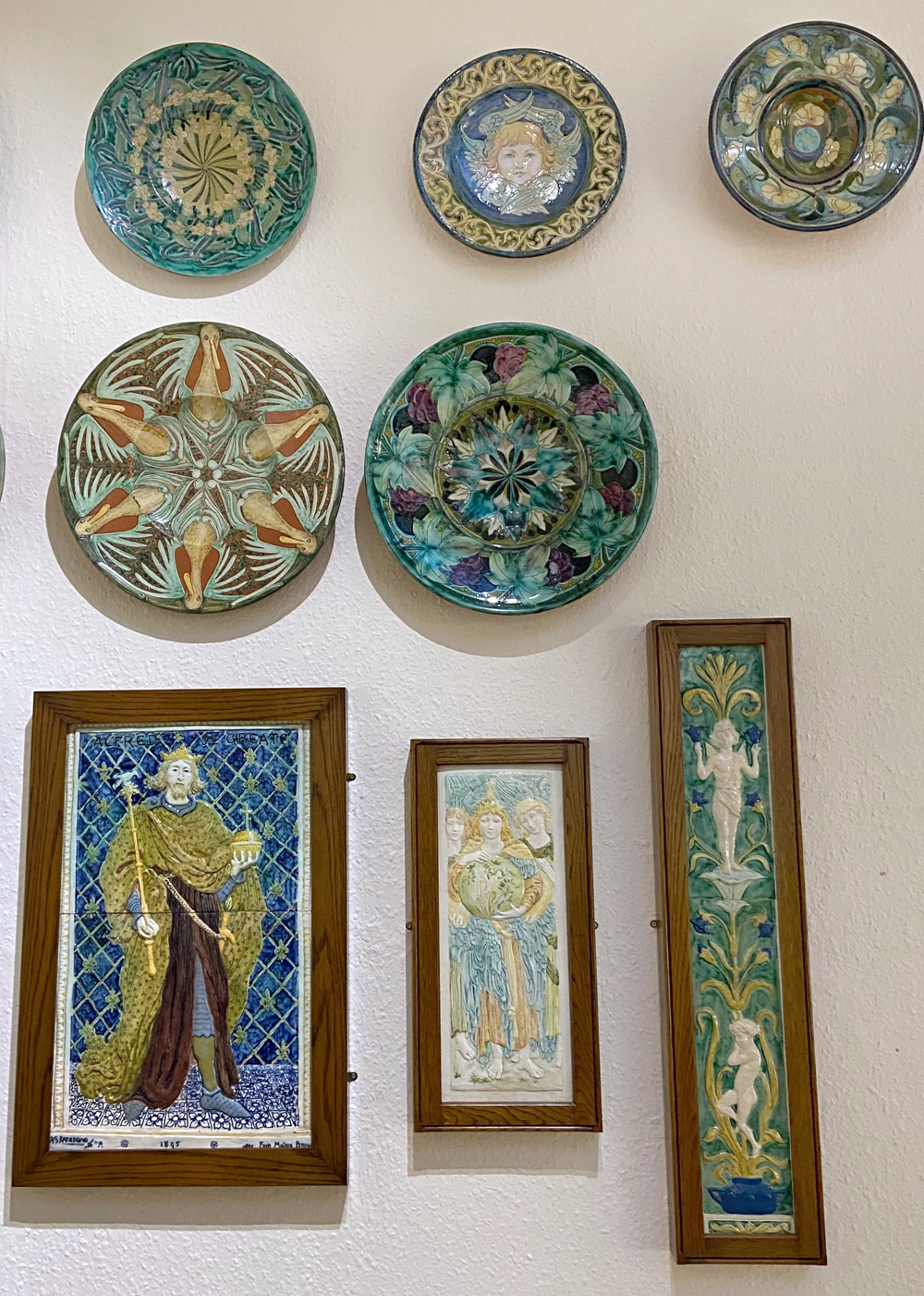
Pieces from the Della Robbia Pottery, Birkenhead
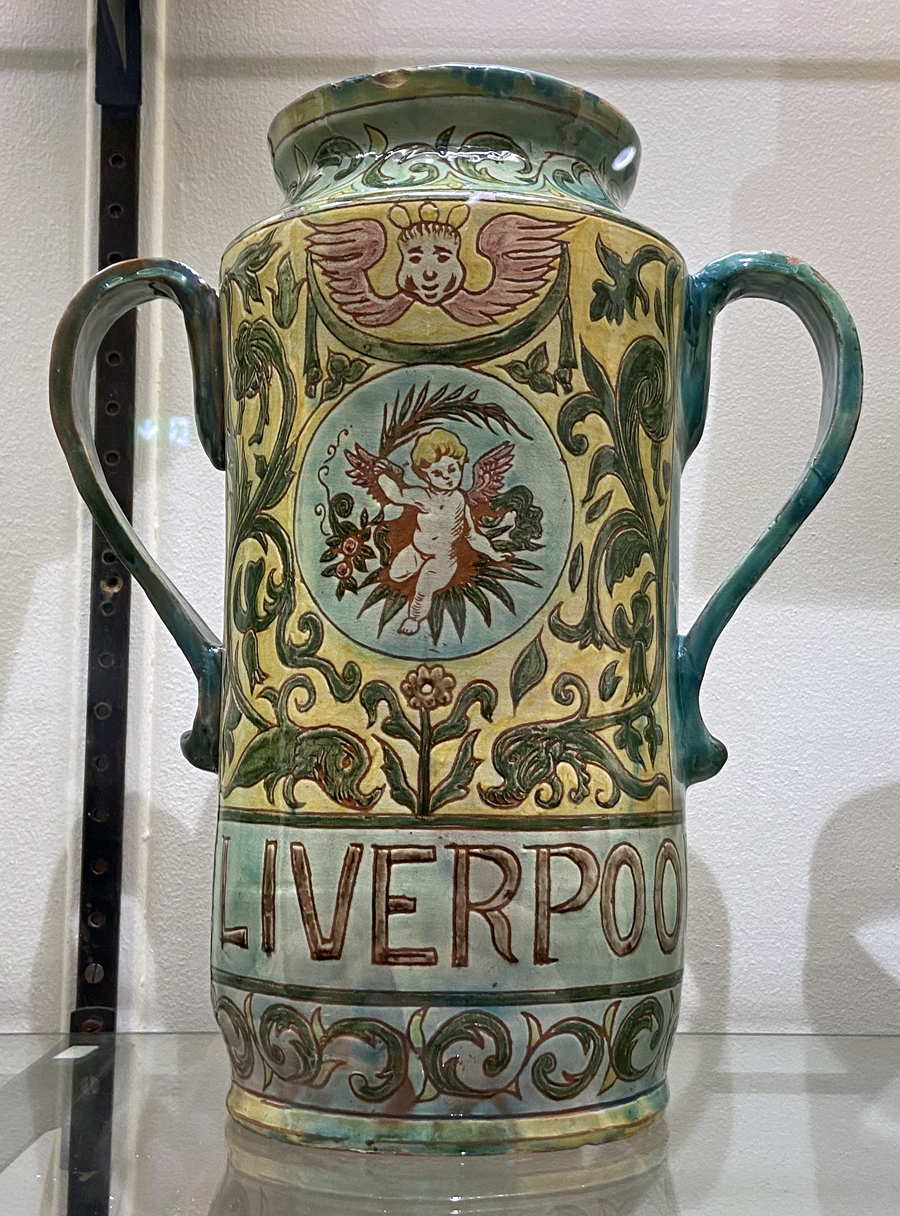
Similarly, the Della Robbia Pottery room is bound to split aesthetic opinion. Della Robbia Pottery, taking the name from Luca Della Robbia (1400-1481), and on whose style it is loosely based, was a remarkably successful Birkenhead enterprise for a short period of time between 1894 and 1906. It was established by Harold Rathbone (1858-1929), who worked with professional designers but also hired young people locally who he trained up. It is lavish, ornate, brightly coloured, glossy, often with multiple textures and sculptural components. Rathbone strained at the Slade School of Art and became a pupil of Ford Madox Brown, and the influence of the Pre-Raphaelites is clear in many of his pieces. Many of the themes of pieces produced by the pottery feature angels, cupids and mythological figures, as well as elaborate and complex patterns.
sdsfds
xxx
xx
Another small room focuses on ceramics that were either made and used in Merseyside or were imports, brought back to the Mersey docks from the far east to meet the demand of local consumers. Chinese ceramicists cottoned on very quickly to the types of decorative themes that were popular in the west, and produced specific types of design, including specific types of shape, for the European market. The mix is diverse, but there are one or two pieces that directly reference the maritime. The influence of Chinese ceramics is very clear, made either locally or imported, in some of the examples, but there are more localized themes as well. There were seven different sites in Liverpool that were making porcelain, all operating between the mid and late 1700s. Unfortunately, none of the factories used manufacturing marks so it is difficult to determine which factory produced which pieces.
xxx
Maria Prymachenko – Autumn is Riding on Horeseback
Paintings by Ukrainian children, produced since the start of the war, from the Sunflower Dreams Project were on display during our visit, alongside paintings by Maria Prymachenko. The exhibitions produced by Sunflower Dreams are displayed in Britain, North America and Europe. Although the Sunflower Dreams Project exhibition at the Williamson ended in December 2025, at the time of writing you can still find full details about the project, with samples of the paintings produced by this admirable initiative on https://sunflowerdreamsproject.org/. Maria Prymachenko (1909-1977) specialized in Ukrainian folklore and was awarded a gold medal at the World Exhibition in Paris in 1937 for her wonderful, brightly imagined paintings. She was largely forgotten after the Second World War, but there was a resurgence of interest in her work in the 1960s and she is now featured in a number of international museums.
Philip Wilson Steer. A Girl at her Toilet, 1892-3
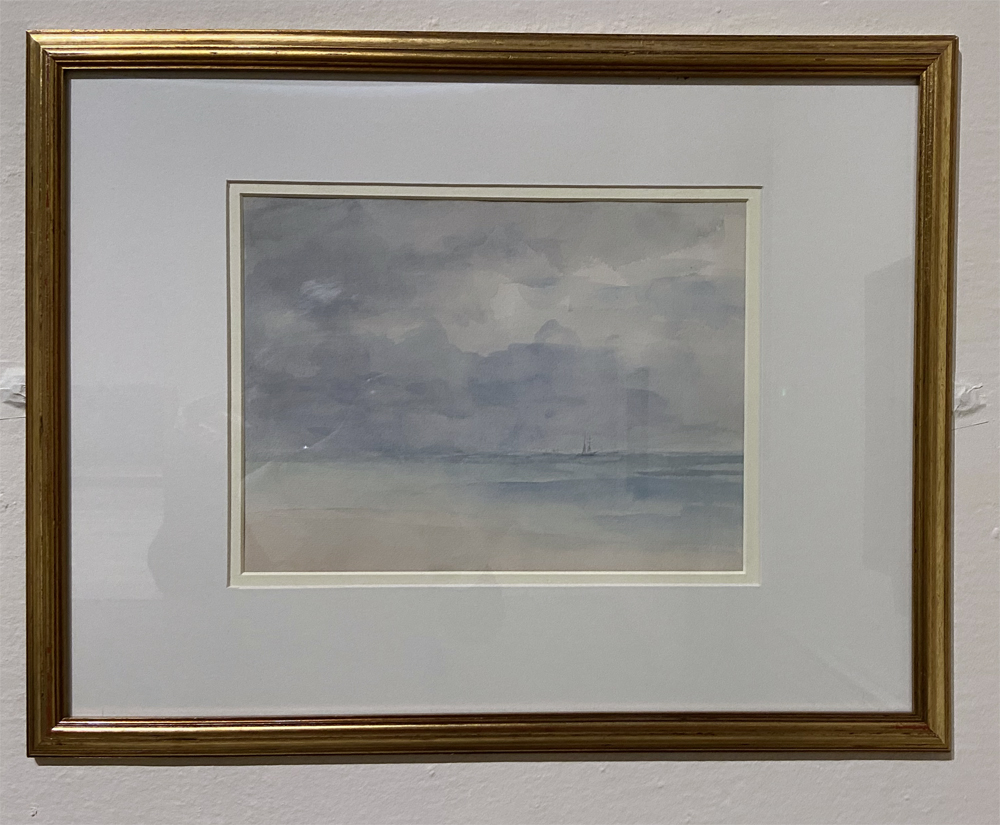
The painting collection on display during our visit strongly featured the landscape and seascape artist Philip Wilson Steer (1860-1942), who was born in Birkenhead, although grew up elsewhere. He had spent time in Paris and was strongly influenced by the Impressionists and other contemporary artists. In his A Girl at Her Toilet of 1992-3, the theme of women engaging in personal behind-the-doors activities, so popular with Impressionist painters, is given a more dramatic overlay of contrasting colours, clearly inspired by Éduard Manet. the label says that the “intimate or even voyeuristic” tone of his painting was “ridiculed by English critics partly for the perceived indecency of his choices of subject matter.” By complete contrast, his Seascape off Walmer of 1930 was painted as he began to lose his eyesight, retaining only peripheral vision by 1935 when he moved almost completely over to watercolour. The entire composition is made up of thin washes of pale blue that create a delicate, almost abstract seascape with a single small boat in the distance, creating the only sense of depth.
Seascale off Walmer, 1930 by Philip Wilson Steer, 1860-1942
There were a set of paintings by Albert Richards (1919-1945), who has the sad distinction of being the youngest official War Artist to be killed in action in the Second World War, just two months before VE Day when the jeep in which he was travelling ran over a landmine. He was born in Liverpool but moved to Wallasey when young, training at the Wallasey School of Art.
Albert Richards – Della, c.1938. Painted when the artist was attending Wallasey School of Art. Gouache on paper.
Many of the other paintings on display by other artists from the period, both watercolours and oils, are obviously influenced by more accomplished Impressionist and Post-Impressionist works, but are interesting as examples of how local artists were influenced by the latest trends.
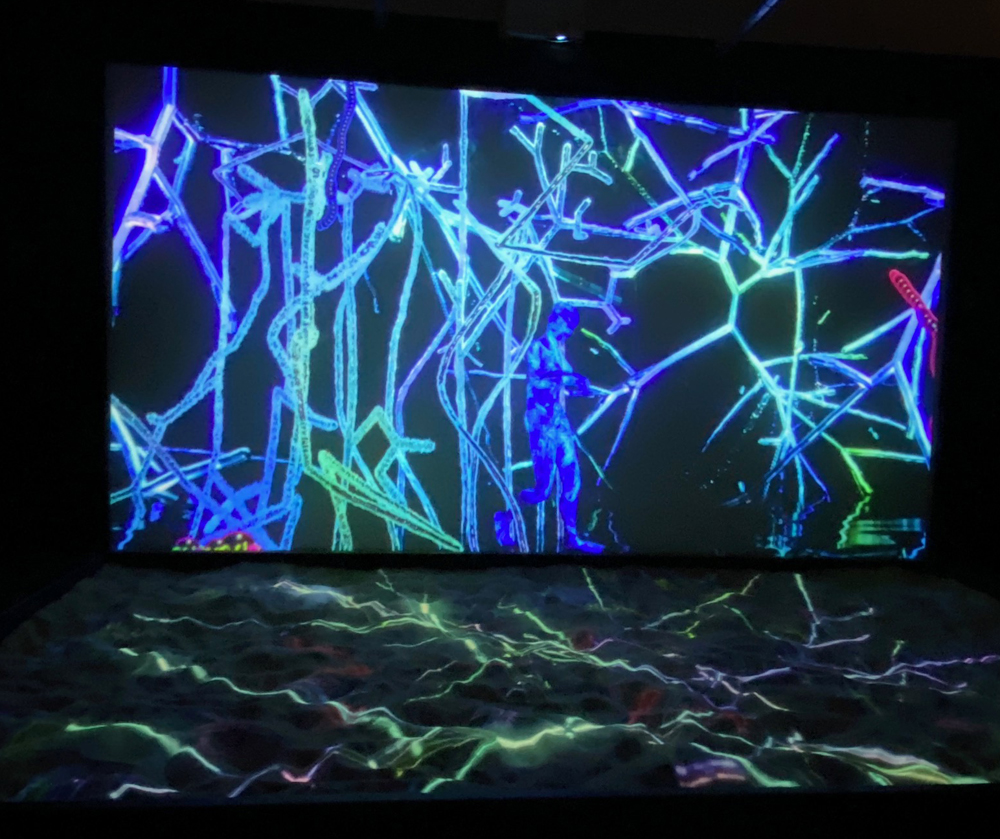
Temporary installation – Di Mainstone’s “Subterranean Elevator,” which shows continually throughout the day. On until the end of January.
Because at least half of the Williamson is dedicated to temporary collections, a lot of the paintings are in storage. None of the better known examples from the permanent collection were on display when we visited, including the glorious watercolour of Brunel’s S.S. Great Eastern beached on the Mersey for repair work by William Gawin Herdman in 1863 and the Joseph Mallord William Turner’s dramatic watercolour Vesuvius Angry, both of which I was really hoping to see. I checked with the information desk after our visit, but the consensus was that they were both in storage. The comprehensive and very nicely presented online catalogue shows what the Williamson holds, but it does not indicate what is or is not on display. xxx
Liverpool and Birkenhead, attributed to Charles Eyes 1767, showing Birkenhead Manor and Priory. This photo is taken from the Williamson’s online catalogue at https://williamsonartgallery.org/item/1580053/
The café, with more paintings on the walls was producing some very good-looking meals and bakes, and the coffee was excellent. One of the paintings was a very evocative one of pre-industrial Birkenhead showing the manor and the ruined priory, the sister paining of one in Liverpool’s Walker Art Gallery. I couldn’t get to it without trampling some diners underfoot, so the picture to the right is taken from the online catalogue. There is also a small shop area with books against one wall, and a few postcards. The sculpture garden, which can be reached from the café, looks interesting, but it was pouring with rain, so we abstained.
The Williamson represents Birkenhead and the Mersey, both past and present. The policy of the gallery is to mix its core collection of 19th and early 20th century art and decorative arts, with temporary exhibitions, often featuring contemporary works, and it is well worth keeping an eye on what their temporary exhibitions offer, either by checking the Williamson website or signing up to the email newsletter.
Frozen Fabric: Spectrum 1983 by Anna Sutton OBE (b.1935), British textile artist and designer. In this example she transforms a simple weave into a sculptural object, “merging textile traditions with minimalist abstraction.”
17th century Japanese temple bell, in the Arrowe Hall room. If it ever goes missing, you will know where to look!
Many thanks to Aleta Doran, Artist in Residence at Chester Cathedral for today’s introduction to stained glass artist Trena Cox, who was based in Chester for most of her long career. Aleta is a brilliant and engaging presenter, currently working hard on the upcoming Trena Cox exhibition, which she is curating. Although this was organized specially for Chester Archaeological Society, Aleta is doing more presentations during the Heritage Festival and if you get the chance to attend, do go. It will give you a completely new insight into the world of 20th Century stained glass, as well as introducing you to a really creative part of the cathedral’s history. I’ll keep this relatively short so as not to spoil the event for those of you who have tickets.
Trena Cox, apparently the least photographed artist in modern history, was born on the Wirral and trained at Birkenhead’s Laird School of art, learning her skills in traditional media before switching to stained glass. She has created over 150 stained glass pieces that are known, but there are probably many more to be identified. She worked mainly in the Cheshire and northeast Wales areas but her works are found further afield. There are many in Chester itself, mainly in churches. There are nine Trena Cox windows in the cathedral, one in the slype (a corridor) and the others arranged in groups of four, two at the top, two at the bottom, in adjacent aisles in the cloister (the walkway around the central garth or garden).
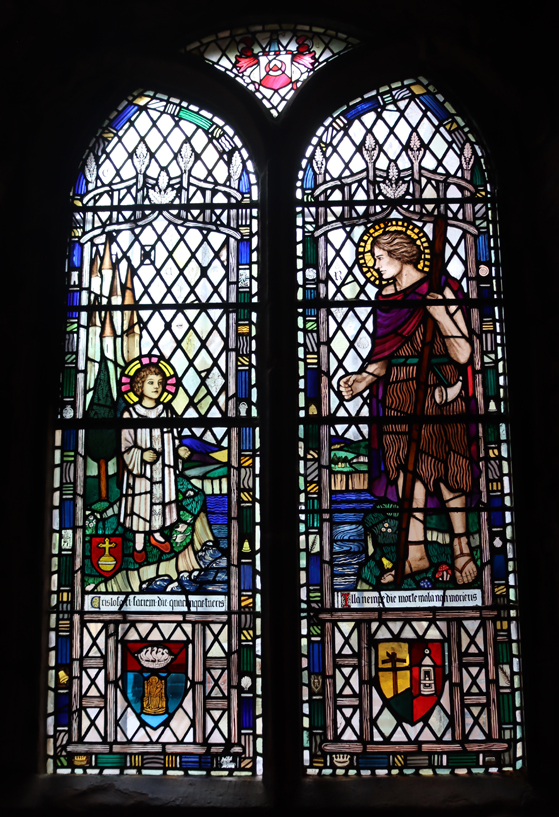
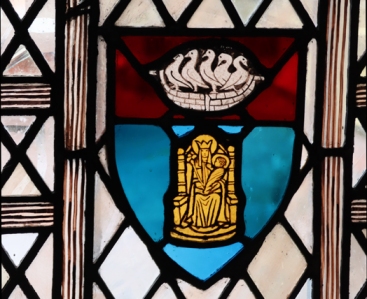
The big window in the slype shows the child Christ on one river bank, and St Christopher on the other. This is very unconventional, as Christ is usually depicted being carried across the water on the shoulders of St Christopher. Aleta described how this window clearly demonstrates many of the features of Trena Cox’s work, with the beautifully executed details of both figures, the surrounding landscape and the flowers, birds and animals that sit at the feet of the two figures. Also typical are the portrait-style faces, which seem incredibly life-like. The colouring of the glass, as in all her work, is vibrantly jewel-like and the background semi-opaque glass concentrates the eye on colours whilst allowing in light. There are many emblems of international pilgrimage, known from badges purchased from the Middle Ages by pilgrims to commemorate their achievements. As well as many others, these include St Thomas of Canterbury, St James of Santiago de Compostella, and of course Chester Cathedral’s own St Werburgh herself, her symbol being five geese in a basket. It is a rich and symbol-laden piece that rewards time taken to appreciate it.
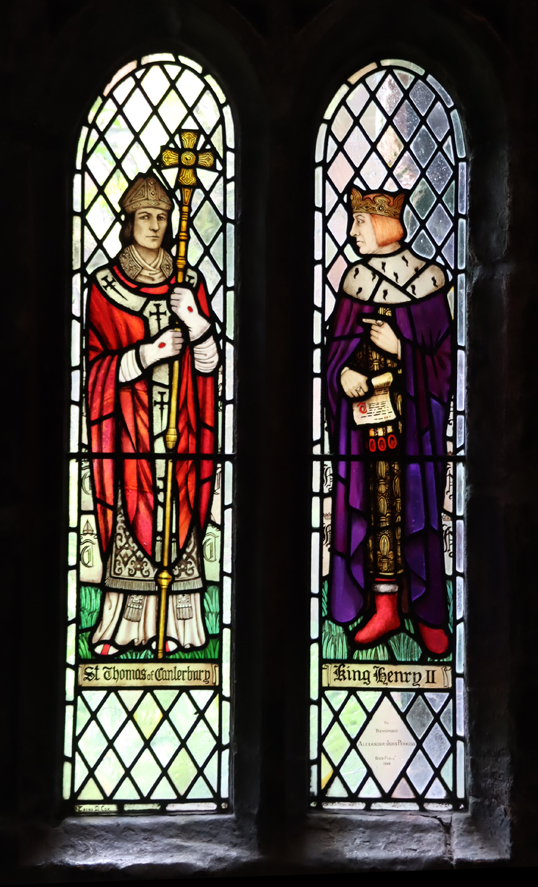
The cloister used to open out onto the garth, with a stone arcade forming a corridor with the buildings that surround the cloister. In 1920 Dean Frank Bennet was appointed as the new head of the cathedral, and decided to take measures to improve the cathedral’s fortunes. In order to glaze the arcade that surrounded the garth, the dean decided to raise public funds. It is thought that some funds were raised by allowing donors for the cloister glass to add commemorations to loved ones in panes withing the windows, which survive today. Each window represents a saint, religious festival or holy day. Trena Cox contributed eight panels in two adjacent sections of the cloister, showing eight different saints. In one set of four, the two at the top are Hugh Lupus who founded the abbey and St Werburgh’s mother St Ermengild In the lower section are St Thomas Becket and King Henry II. In the other set, the two figures at the top are Abbot Witchurch and Ralph Higden and the two below King Alfred and St Piegmund. Aleta talked us through the significance of each of these saints, and why there were chosen. These are much smaller and therefore much simpler compositions, but again the colours are vibrant, and the faces resemble portraiture.
Aleta wrapped up by telling us something about Trena Cox and her influence on Chester life, not only as an artist but as something of an activist for the protection of local heritage. It seems remarkable that she is not better known, at least in Chester where she lived nearly all her life. Hopefully, the upcoming the exhibition “Trena Cox: Reflections 100”, which begins on the 7th October, will bring this under-sung local personality and talented, prolific artist to much wider public attention. Do take advantage of a tour of the glass with Aleta Doran if you have the opportunity. As an artist herself, she offers a unique insight into the work of Trena Cox.
This is a bit of an experiment, using my iPhone, which I’ve never tried before for video. I did a lot of camcorder videos of scenery when I lived in Aberdovey on the west coast of Wales, but fell out of the habit when I moved to the Chester area, so I am out of practice, feel very peculiar using an iPhone to do video, and hate the sound of my voice, but here we go. So here’s my two-minute introduction to the wonderful priory of St Mary and St James, aka Birkenhead Priory, for better or for worse. I’ll get better!
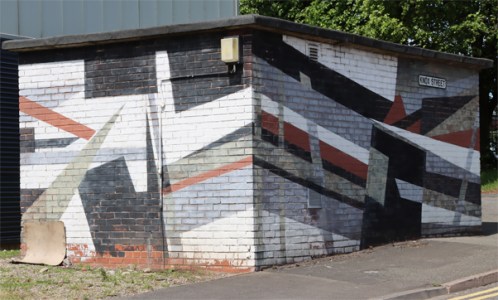
At Birkenhead Priory the other day I very much liked this small building on Knox Street, very close to both Birkenhead Priory and the Cammell Laird shipyard. It has been painted in the style of dazzle camouflage, used in the First World War, and to a lesser extent in the Second World War, primarily to confuse submarines. “The primary object of this scheme was not so much to cause the enemy to miss his shot when actually in firing position, but to mislead him, when the ship was first sighted, as to the correct position to take up. Dazzle was a method to produce an effect by paint in such a way that all accepted forms of a ship are broken up by masses of strongly contrasted colour, consequently making it a matter of difficulty for a submarine to decide on the exact course of the vessel to be attacked” (Norman Wilkinson, 1969, A Brush with Life, Seeley Service, p.79, quoted on Wikipedia).
The moment I saw it, it reminded me of a 1919 painting by Edward Wadsworth (1889 – 1949) that I have hanging in my spare bedroom, showing a ship in dry dock in Liverpool receiving its new paint job. Wadsworth painted in the style of the Vorticists, whose best known proponent was Wyndham Lewis, inspired by machinery and industry, and focused on clean lines, hard edges and planes of strong colour. The dazzle ship was a near perfect subject matter for this style of painting, and Wadsworth was in an ideal position to get up close and personal with his subject matter, as in the First World War he worked as an intelligence officer, and one of this responsibilities was implementing dazzle camouflage designs for the Royal Navy.
I would love to know who came up with painting the building on Knox Street in the same style. If you know anything about it, do let me know.
Below is a painting from the Merseyside Maritime Museum showing the Walmer Castle painted in her dazzle camouflage. “The Walmer Castle was launched in 1901 for the recently created Union Castle Mail Steamship Company. The ship sailed between Southampton and Cape Town and in 1917 was requisitioned by the British Government. It is seen here dazzle painted for use as a troop ship in the North Atlantic. Walmer Castle survived the war and was broken up in 1932″ (National Museums Liverpool).
Birkenhead Priory is one of the most enjoyably unexpected places I have visited in the region, even more surprising than a Roman bath-house embedded in a 1980s Prestatyn housing estate. The priory site incorporates both the remains of the 12th century monastic establishment and the ruins of St Mary’s 1822 parish church with its surviving tower and terrific views. On all sides the site is surrounded by both heavy and light industry. Cammell Lairds shipyard not only butts up against the south and east walls, but purchased part of the priory’s former churchyard and cemetery for its expansion and the building of Princess Dock. On the other sides are warehouses and commercial units. The result is that in spite of the clanging and banging from the vast ship under construction immediately next door (fascinating in its own right), the obvious and somewhat inescapable cliché is that the ruins of the priory and parish church are an oasis of peace in the midst of all the busy activity. The small but quiet stretches of grass, the trees and the wild flowers contained within the remains of the priory site are a treat, and the splendid views from the top of St Mary’s tower are a powerful reminder of how the world has changed since the foundation of the priory.
I have divided this post into two parts, because there is so much to say. A visit to Birkenhead Priory is really five visits in one. In chronological order, a visit to the site provides you with the following heritage:
1) The priory, established in the 12th century and built of red sandstone, is the oldest part of the site and the star turn with its vaulted undercroft and chapter house
2)St Mary’s parish church was built next to the ruins in 1821 to serve the growing community, its gothic revival windows wonderfully featuring cast iron window tracery
3) The priory’s scriptorium over the Chapter House, now with wood paneling over the sandstone walls, is the exhibition area for the Friends of the training ship HMS Conway,
4) The Cammell-Laird shipyard is hard up against the priory’s foundations and fabulously visible from St Mary’s Tower. When it wished to expand into the church’s churchyard, it purchased the land and re-located the burials
5) St Mary’s Tower, which is open to the public with amazing views from the top, is now a memorial to the 1939 HMS Thetis submarine disaster in the Mersey.
In this part, part 1 I am taking a look at the priory. In part 2 I have looked at the post-dissolution history of the site; the 1821 construction of St Mary’s parish church; the memorial to HMS Thetis and the display area for HMS Conway. I will tackle Cammell Laird’s separately, as I suspect that it will be very difficult to handle in a single post, and I need to do a lot more research before I make the attempt to summarize its history.
Birkenhead in the foreground with the manor and ruins of the monastery, and Liverpool in the background over the river, c.1767, showing just how isolated Birkenhead remained even in the 18th century. Attributed to Charles Eyes. Source: ArtUK
Foundation of the priory in the 12th Century
Artist’s impression of the priory done by E.W. Cox by 1896.
The priory was dedicated to St Mary and St James the Great. There are no documents surviving from the priory, and none of its priors became important in other areas of the church or in life beyond the priory, so most of the information comes from other sources of documentation as well as from the architecture itself. Its principal biographer, R. Stewart-Brown, writing in 1925, commented that it was “not possible to compile anything in any degree resembling a history of this small and obscure priory,” but the result of his work was an impressive overview of the priory, its financial stresses and its involvement in the Wirral as a whole and the Mersey ferry in particular. Much recommended if you can get hold of it. Although not certain, is thought that the priory was founded in the mid-12th century by one of William the Conqueror’s Norman followers who was rewarded for his service to the new king and the local earl Hugh Lupus with land on the Wirral. His name was Hamon (sometimes Hamo) de Massey from Dunham Massey, the second baron, who died in 1185, suggesting that the priory was founded before this date, probably in the middle of the 12th century.
Exterior of the west range, showing the two big windows that illuminated the guest quarters, the one on the left heavily modified.
The priory was established on an isolated headland, surrounded on three sides by water. Hamon almost certainly took as his model for the priory the abbey of St Werburgh in Chester (now Chester Cathedral) which was founded in 1093 by Hugh d’Avranches, also known as Hugh Lupus. Hugh Lupus had convinced St Anselm of Bec (later Archbishop of Canterbury and after his death canonized) to come and establish St Werburgh’s, and it was organized along classic Benedictine lines, about which more below. The founding of a monastic establishment was seen as a Christian act, a statement of piety and devotion, and was most importantly a precautionary investment in one’s afterlife, securing the prayers of the monks, considered amongst the closest to God, throughout the entire lifetime of the monastery
A priory was smaller and inferior in status to an abbey and was was often dependent (i.e. a subset) of an abbey, and answerable to it. It is possible that the much larger and infinitely more prestigious St Werburgh’s Abbey in Chester supplied the monks to establish Birkenhead Piory, but there is no sign in the cartularies (formal documents and charters) of St Werburgh’s that there was any ongoing formal connection between the two. The difference between a non-dependent priory and an abbey was usually that the priory did not have sufficient numbers to be classified as an abbey, or that it had not applied for the royal stamp of approval required for the more senior status of an abbey. The minimum requirement for the foundation of a Benedictine abbey was 12-13 monks. A 16th century historian suggested that there were 16 monks, but it is by no means clear where this figure came from. Twice during the 14th century it is recorded that there were only five monks at the priory, and it is very likely that the priory remained too small to become an abbey.
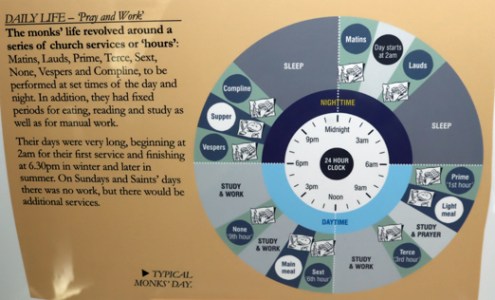
The typical monastic day in a Benedictine monastery. Not a great photo, but a very nice representation from a display in the museum area in the undercroft
The Benedictine Order was not the oldest of the monastic orders in Britain, but following the Norman Conquest it became the most widespread. It was named for St Benedict of Nursia who, in the 6th century, set out a Rule, or set of guidelines, for his own monastery. This spread widely and became the basis of many monastic establishments setting out to follow his example. The Benedictines had been well established in France at the time of the Conquest, and sponsorship by incoming Normans, granted land by William the Conqueror, ensured that they spread rapidly in England, and later Wales, Scotland and Ireland. Benedictine monasteries were all built to a standard architectural layout, with minor deviations, based on both religious and administrative requirements.
The monastic buildings
Plan of the Birkenhead Priory site. Source: Metropolitan Borough of Wirral leaflet (with my annotations in colour). North is left, south right.
If you take the guided tour, which I sincerely recommend, you begin your tour in the undercroft, now used as a museum / display space. Most helpfully it has a scale model of the priory with Stewart-Brown’s 1925 site plan, both of which help you to orientate yourself and get a sense of how the ruins were once a complex of buildings that defined and enabled a monastic community, combining religious, administrative, domestic and other functions. In the plan on the left, with the surviving remains of the priory outlined in red, the site of the priory church outlined in orange and remains of the 1822 St Mary’s Church outlined in green. The blue margin indicates the shipyard over the priory wall. The numbers on the plan are referred to in the description below. You can download a copy of the map (without the coloured additions) as a PDF here.
Like St Werburgh’s Abbey, the priory buildings were made of locally available red sandstone. Like all monasteries based on Benedictine lines, the monastic site plan began with a square. The bigger the monastery envisaged, the bigger the square. This was known as the garth (1 in the plan on the left), and was either a grassed area or a garden. Surrounding this was the cloister, a covered walkway that served as a link between the buildings that were erected around the garth, and where desks were usually arranged so that the monks could work. This was a secluded space, confined to the inmates of the monastery.
Model of the priory church and claustral buildings in the priory’s museum space in the undercroft showing a possible layout of the church. The chapter in this view is hidden behind the tower.
The most conspicuous of the buildings would have been the one that no longer stands: the church and its tower (4 on the plan above, outlined in orange), which made up one side of the cloister. Traditionally in Benedictine complexes this was built on the north side of the garth, making up an entire side of the cloister, in order protect the rest of the buildings and allow light into the garth and the other cloister buildings, but at Birkenhead Priory’s church was on the south, possibly to protect the claustral buildings from the winds whistling down and across the Mersey. The model and plan show that the 13th century church was built in the standard cross-shape. It featured a long nave at the west end (where the public were permitted to observe religious ceremonies), and a surprisingly long east end (where the ceremonies were performed) with two side-transepts, which were usually used as chapels for commemorating the dead and a tower over the crossing. A pair of aisles flanked the south and north transepts as show above. When it was first built in the 12th century, the church would have been much smaller and probably smaller than this footprint.
View of Birkenhead Priory by Samuel and Nathan Buck in 1726, showing the remains of the church’s northern arcade. Source: Panteek
Lonely remainder of the church’s northern arcade
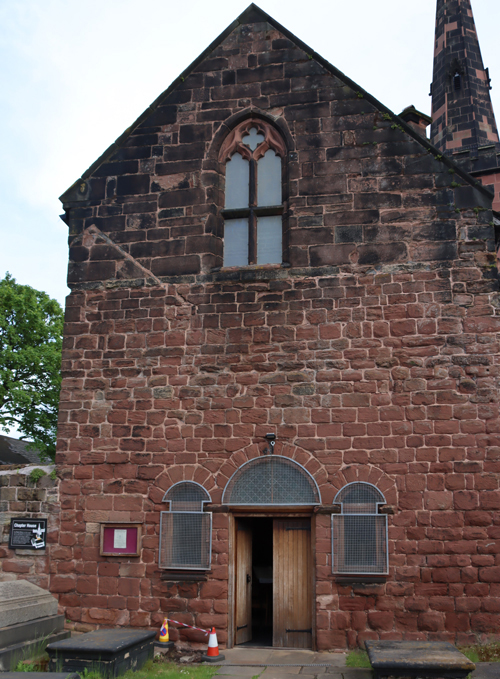
The entrance to the chapter house with its Norman arches. You can clearly see the difference between the 12th century chapter house masonry and the 14th century scriptorium above with its gothic window and tracery. The tower in the background belongs to the 19th century church.
The chapter house (2) is the oldest of the Birkenhead Priory buildings, the only one remaining that dates to the 12th century. The building of the priory church, being the place where the main business of praising God took place, was usually started straight away, but the chapter house was often built in tandem as this was also of fundamental importance to a monastery. This is where the everyday business of the priory was attended to, from the day-to-day administration and disciplinary matters, to the daily readings of chapters of St Benedict’s Rules or other improving texts such as excerpts from one of the many histories of saints (hagiographies). The Birkenhead Priory’s original medieval chapter house is a gorgeous. The vaulted roof of the chapter house is superb (see the photo at the very top of this post), and although the windows have been altered over time, one of the deep Norman Romanesque window embrasures survives, and is a thing of real beauty (see below). The stained glass is all modern, but all are nicely done, the one over the altar by Sir Ninian Cowper combining religious themes relevant to the house (St Mary and St James flanking Jesus) with two prestigious characters from the priory’s own history (its founder Hamo de Massey and its two-time visitor Edward I). Gravestones from the medieval cemetery have been incorporated into the floor around the post-Dissolution altar. In the medieval priory, there would have been no altar in the chapter house, but following the Dissolution the chapter house was converted into a chapel and is still used for weddings, funerals and baptisms.
Over the top of the chapter house, a scriptorium was added in the 14th century. In theory this was where the copying of books took place, but it has been pointed out that this was a particularly large space for such an activity, and it may have been used for something else, or for a number of different activities. Today it is the display area for the training ship HMS Conway, and at some point in the 19th or early 20th century was provided with panelling and has some very fine modern stained glass by David Hillhouse. This modern usage will be discussed in part 2.
Opposite the chapter house the remains of the west range (7-11) survives, which was again a two-floor building separated into a number of different spaces It seems to have been divided into two, with the northern end and its big fireplace reserved for guests, and the southern end, with an entrance into the cloister, seems to have been split into two floors, with a fireplace on each, for the prior’s personal quarters, which would have included a private parlour that he could use for entertaining VIP guests. Although it’s not the most aesthetically stunning of the surviving claustral buildings today, the stonework displays a fascinating patchwork of different features and alterations that reflect many changes and refinements in use over time and are still something of a fascinating puzzle.
West Range
Remodelling in the 14th century created the undercroft and the refectory above it, as well as the kitchen. The undercroft (14), once used as a storage space, with the original floor intact. The investment in the lovely architecture may indicate that before it was used as a storage area, it had a more high profile role, perhaps as a dining area for guests. Above it was the refectory, unlike St Werburgh’s, Basingwerk Abbey or Valle Crucis Abbey, all of which had refectories at ground level. It was reached by a spiral stone staircase leads up to this space today.
The kitchen was apparently to the north of the west range, and connected to it, as shown on the above plan (12). This was convenient for the guest quarters, but not quite as convenient for the refectory over the undercroft, from which it was divided by a buttery (or store-room, 13), over which a guest room was also installed. The kitchen was apparently a stand-alone structure made mainly of timber, and this may have been because kitchen fires were so common, and building the kitchen slightly apart from the main monastery would have been a sensible precaution. Kitchen fires are thought to have been the cause of several devastating scenes of destruction in monastic establishments, spreading quickly via roof timbers and wooden furnishings.
Between the chapter house and the north range, which contained the undercroft and refectory, was an infirmary (19 on the plan) and the dormitory (18) side by side, each accessible from the cloister. The infirmary was for the benefit of the monks, and was where those who were sick or injured or suffering the impacts of old age were cared for.
Sources of income and financial difficulties
Carved head in the side of the fireplace in the guest quarters on the ground floor of the west range
Monasteries were amongst the most important land-owners in medieval Britain, on a par with the aristocracy. Their income came mainly from agricultural activities, both crops and livestock, as well as making and selling bread, beer, buttery and honey; but they might also own mills, mines, quarries and fisheries and the rights to anchorage, foreshore finds and the use of boats on rivers. For those with coastal and estuary locations with foreshore rights, there was, as Stewart-Brown lists, the benefits of flotsam (items accidentally lost from a boat or ship, jetsam (items deliberately tossed overboard), salvage from shipwrecks and keel toll. The luckier (or most strategically inclined) monasteries and churches also had pilgrim shrines, sometimes reliquaries imported from overseas. St John’s Church in Chester had a miraculous rood screen, St Werburgh’s Abbey in Chester had the shrine containing the bones of St Werburgh herself, and Basingwerk Abbey had the neighbouring holy well of St Winifred. These attracted donations and bequests and were good for the settlements in which they stood, because the pilgrims needed places to stay, food and drink, and would probably buy souvenirs. Birkenhead Priory had no such shrine, but it probably felt the impact of the pilgrim route as the ferry crossing over the Mersey, which it ran free of charge, was an important link between Lancashire, west Cheshire and northeast Wales.
The original foundation of the monastery would have included both the land on which the monastery sat, funding for building it, and an economic infrastructure of landholdings as well as the income of some local churches. The long list of land-holdings sounds impressive, but most of them appear to have been quite small and scattered, some of which will have been wooded and some wasteland, not all of it suitable for cultivation or pasture. These include lands in Birkhenhead (including the home farm in Claughton with its mill), Moreton (with a mill and dovecote), Tranmere, Higher Bebington, Bidston, Heswall, Upton, Backford, Saughall, Chester, Leftwich, Burnden at Great Lever in Middleton, Newsham in Walton, Melling in Halsall, and Oxton. Either at foundation or not long afterwards, the priory was granted the incomes of the churches of Bidston, Backford, Davenham and half of the church of Wallasey, and claimed rights of Bowdon church that were disputed.
Carving at the base of a window arch in the west range
The monastery did not flourish with these assets. In spite of the claim that there were 16 monks at the time of its foundation, the records made by official church visitors suggests there were only a small number of monks at any one time (only five in 1379, 1381, and 1469, and seven, including two novices, in 1518 and 1524), and there is plenty of evidence to indicate that the priory struggled financially. Monasteries had significant overheads including feeding the community, buying tools and supplies, repairing monastic and farm buildings, appointing stewards and other employees, providing charitable alms and providing hospitality free of charge. Where they earned incomes from churches and chapels, they were also responsible for the provision of the clergy and shared part of the cost of maintaining the buildings. Ambitious priors often invested in building projects, sometimes to improve the monastic offering, sometimes for prestige, and even with donations this was usually costly. There were also occasional challenges to bequests made to churches from following generations, which involved costly legal proceedings. Balancing the books was a frequent problem for monastic establishments, and the priors of Birkenhead Priory were no different.
There were quite limited means by which the priors of Birkenhead might increase their income. The most obvious way of generating ongoing income was to acquire more land through gifts and bequests. In this endevour the priory probably had a real disadvantage in being near to both St Werburgh’s Abbey in Chester and, across the river Dee, Basingwerk Abbey at Holywell. Both abbeys had significant land-holdings on the Wirral, and both had pilgrim shrines and were on pilgrim routes. Both were large and prestigious, and were far more likely to attract big gifts than a small and rather remote priory. If Birkenhead hoped to attract gifts of land, it probably had to depend on local landowners and merchants who felt a personal connection with the priory but would not necessarily have had the wherewithal to significantly change the income-earning potential of the priory, providing personal items rather than swathes of land. For these very local gifts and legacies, it is entirely possible that the priory was also in competition with contemporary parish churches on the Wirral. There are records in the early 16th century, not long before the monastery was closed during the Dissolution, that give an idea of the sort of bequests made by local people in return for requiem masses to be recited for their souls: one will provided a painting of the Crucifixion for the priory church. Another bequeathed the owner’s best horse, 10 shillings, and a ring of gold.
As the Middle Ages progressed, populations expanded and both new and old towns began to hold markets where everyday goods and more prestigious products could be traded, even once-isolated monasteries found themselves becoming integrated into the secular world and in competition with it. It certainly did not initially help the monks at first that during the early 13th century Liverpool began to grow. Under the Benedictine rules, monasteries had an obligation to provide hospitality to visitors when required, and the Birkenhead monks ran the ferry over the Mersey as a charitable service. When the priory was first established, offering occasional hospitality and running the ferry free of charge were not onerous. This changed rapidly after 1207 when Liverpool was granted burgh status by King John, as the following translation of the original Latin charter confirms (Translation from Picton 1884):
John, by the grace of God King of England, Lord of Ireland, Duke of Normandy, Aquitain, and Earl of Anjou, to all his faithful subjects who may have wished to have burgages in the town of Liverpool greeting. Know ye that we have granted to all our faithful people who may have taken burgages at Liverpul that they may have all liberties and free customs in the town of Liverpul which any free borough on the sea hath in our land. And therefore we command you that securely and in our peace you come there to receive and inhabit our burgages. And in testimony hereof we transmit to you these our letters patent. Witness Simon de Pateshill at Winchester on the 28th day of August in the ninth year of our reign.
A little later Liverpool was granted the right to hold markets and fairs, and the links between Liverpool and the busy port of Chester grew to be increasingly important. There was no infrastructure to cope with this increase in human traffic. They were already offering a ferry service free of charge but even more pressing on their resources was the cost of housing guests. There were no inns between Liverpool and Chester (showing a lack of commercial ambition on the part of both Liverpool and Chester medieval merchants!), so the monks found themselves obliged to offer accommodation and food, which the rules of the Benedictine order required them to offer free of charge. This hospitality became particularly difficult if there was a spell of bad weather, during which those waiting to cross from Birkenhead to Liverpool would have to wait at the priory until the weather improved and crossings could resume. They were also were troubled with all the through-traffic that travelled along a route that ran through the monk’s Birkenhead lands close to the priory buildings.
The spiral staircase from the undercroft into the former refectory
It must have exacerbated the monks’ financial situation when Edward I visited the monastery twice with his entourage during this period. Edward’s first visit was in September 1275 for three nights, seeking a diplomatic solution to his dispute with the self-styled Prince of Wales, Llywelyn the Last of Gwynedd. His second was in 1277 for six days with the apparently dual motives of pursuing his campaign against Llywelyn and receiving a delegation from Scotland to settle a boundary dispute. Although the king would pay the costs of his entourage and horses, the cost of entertaining the king and his most senior advisors fell to the monastery. Hosting a royal entourage was notoriously expensive, and any contributions made by a visiting monarch to a monastic establishment only rarely compensated for the outlay.
One of the measures to improve their income in the 1270s involved the expense of serious litigation when incumbent prior claimed that the church had been presented in its entirety to the priory. This was disputed by the Massey family, who triumphed in the courts. Fortunately for the priory, in 1278 the 5th Hamon de Massey came to an agreement with the monks to their benefit. Other litigation occurred over pasture rights in Bidston and Claughton.
In 1284 the priory received permission from Edward I, who had probably witnessed the priory’s problems at first hand in the 1270s, to divert the road that disrupted the priory “to the manifest scandal of their religion” and to provide the priory court with an enclosure, either a ditch, hedge or wall, to preserve its privacy. This would have incurred costs, but would have eased one of the problems caused by the ferry. Rather more significant for their finances, early in the 14th century the priory was granted a licence to build and charge for guest lodgings at the ferry at Woodside, and in 1311 they were granted the rights to sell food there. It was at this time that the church was expanded, which would have been a significant project.
Chapter house building with scriptorium room added over the top in the 14th century.
The first half of the 14th century had been hard for most of western Europe, with both famine due to anomalous weather conditions that caused crops to fail, followed only a few decades later by a plague that killed huge numbers of people. In Britain the famine lasted from 1315-17 and the Black Death arrived in 1348. The priory survived both the famine and the plague, as did the settlement of Liverpool, now a century old. At some point in the first half of the 14th century, the priory acquired land in Liverpool so that the monks could begin to trade their goods at market, building a granary or warehouse on Water Street (then known as Bank Street).
In 1316 the hospital of St John the Baptist in Chester was judged to be seriously mismanaged and was put into the hands of the priory, perhaps because of their experience running their own infirmary. This was a failure, merely adding to the priory’s problems, and was removed from their care in 1341.
Multiple layers in the west range, with a window added into the top of a former fireplace, blocking it, and a fireplace above it.
In 1333 Edward III requested monasteries to contribute to the expenses of the marriage of his sister Eleanor. Local monasteries who contributed included Birkenhead, which contributed £3 6s 8d and Chester’s St Werburgh’s Abbey which, bigger and more prosperous, gave £13 6s 8d. There were doubtless other payments of this sort, occasional and therefore unpredictable, and impossible to resist. The priory was also liable for taxation.
The ferry from Woodside had continued to be supplied free of charge, but the priory appealed to Edward III and was permitted for the first time to charge tolls in 1330, setting a precedent that remains today. A challenge to the monk to operate the ferry and claim the tolls, was challenged by the Black Prince in 1353, but the priory produced its charter and successfully resisted the removal of this privilege. The tolls charged were recorded at that time: 2d for a man and horse, laden or not; 1/4d for a man on foot or 1/2d on a Saturday market dasy if he had a pack
Other ways of generating income from lands to which they had rights were also explored, and from records of litigation against them, they were often accused of infringing forest law. Wirral had been defined as a forest by the Norman earls of Chester, which restricted how the land could be used. The monks were clearly assarting (cutting down wood to convert to fields and pasture), reclaiming waterlogged land, enclosing certain areas and cutting peat for fuel. The priory was able to argue special exemptions for some of the charges, and produced the charters to prove it, but at other times they were fined for the infractions. In 1357, for example, they were fined for keeping 20 pigs in the woods.
A number of monastic establishments seem to have responded to surviving the plague by redefining themselves via architectural transformations. Whatever the reasons for this trend, Birkenhead Priory was no exception and the 14th century could have been an expensive time for the monks. The frater range (including the elaborate vaulted undercroft and the refectory) was completely rebuilt and the west range was remodelled. The room today described as a scriptorium was also added over the chapter house at this time. Although Stewart-Brown suggests that much of this could have been accomplished with “pious industry . . . without much cost” with the assistance of donations of labour and money, that is probably somewhat optimistic, and there would have been an outlay. Certainly, at the end of the century the priory was considered to be so impoverished that it was exempted from its tax contribution.
There is some evidence that for at least some of the Middle Ages the priory rented out land rather than working it themselves, except for their home farm at Cloughton. This had the benefit of providing a dependable income if tenants were reliable, and obviated the need to appoint managers or deal with labour and handle the sale of produce, but if the cost of living went up, the fixed income that no longer purchased what it had previously afforded, and this could represent a serious problem.
Dissolution
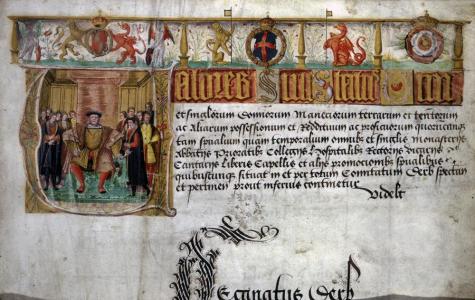
The opening page of the Valor Ecclesiasticus, showing Henry VIII. Source: Wikipedia
When Henry VIII’s demand for a divorce was rejected by the pope, the king severed Britain from the Catholic Church, creating the Church of England. This provided him with the opportunity to acquire land and valuable assets by dissolving all monastic establishments, all of which had been subject to the papacy. The spoils were to be used to fund Henry’s wars with France and Scotland, and some former monasteries were given to Henry’s supporters as rewards. To assess the potential of the monastic assets, Henry VIII commissioned the Valor ecclesiastis, a review of every monastery in the country. All monastic establishments with an annual income of less than £200.00 were to be closed as soon as possible. The first monasteries were dissolved in 1536 and the process was more or less concluded by 1540, with a handful of the more prestigious abbeys, like St Werburgh’s in Chester, converted to cathedrals. Birkenhead Priory was only earning £91.00 annually so it was amongst the first to be closed. There was no resistance by the Birkenhead prior, who was provided with a pension of £12.00 annually. The brethren were either dismissed or disseminated to non-monastic establishments.
Visiting
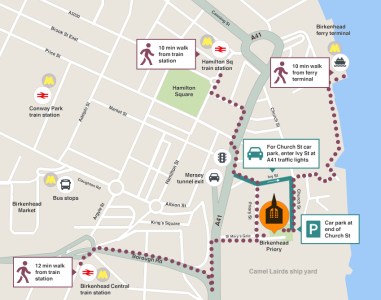
The car park is on Church Street, at the rear of the priory, where the cafe is also located. There is some on-street parking on Priory Street at the front of the priory. Source: Birkenhead Priory website
This is a super place, and makes for a terrific visit. Do go. You won’t be disappointed!
Even with SatNav, the big thing to remember about finding your way to Birkenhead Priory, if you are arriving by car from the Chester direction, is to do whatever it takes NOT to end up at the Mersey tunnel toll-booths 🙂 They were very nice about it, let me out through a barrier, and gave me perfect directions to get to the priory once they had freed me from the tunnel concourse. Very nice people. If Edward III was looking down, I’m sure he would have rolled his eyes in despair, given that it was he who gave the monks the right to charge for their Mersey ferry crossings.
Do check the opening times on the website, as the priory is only open on certain days and for only a few hours on those days, mainly in the afternoons. There is dedicated parking on Church Street at SatNav What3Words reference ///super.punchy.report. From there, the priory is up a short flight of steps. You can also park on Priory Street, which is where the SatNav will take you if you simply type “Birkenhead Priory” into your SatNav (at What3Words ///indoor.vibes.hips), which offers step-free access but there is limited parking there, and it is a favourite place for van drivers to park and eat their lunches so may be better used as a drop-off point before going round the the car park.
Remnants of the decorative floor tiles, now in the priory’s undercroft, which is used as a museum space
At the time of writing, a visit is free of charge, and so are the guided tours. My guide was the excellent Frank. He covered not only the priory but St Mary’s, the HMS Conway room, and the HMS Thetis memorial and, when I headed up to the top of the tower of St Mary’s, directed me to out for the dry dock where the CSS Alabama (the US Confederate blockade runner) was built by John Laird, to be discussed in Part 2. Frank was very skilled at providing sufficient knowledge to get a real sense of the place, but not so much that it became information overload. I very much appreciated this, having always found it difficult myself to strike that particular balance. I was lucky enough to have him to myself, having turned up at opening time, but I noticed that the next tour had a respectable group attending.
There is a small gift shop where you can also buy a really useful guide book with plenty of plans, illustrations and colour photographs. Please note that they are not able to take cards, and payment is cash only.
There are toilets in St Mary’s tower, a picnic area behind the undercroft on sunny days, and the highly rated Start Yard café is almost next door on Church Street.
For those with unwilling legs, I would suggest that apart from the tower and its 101 steps, and a flight of around 10 steps up into the scriptoruim (the display area for HMS Conway) this is entirely do-able. There are occasional single steps and uneven surfaces, and it is a matter of taking good care. As mentioned above, if you park in the carpark at the rear on Church Street, there is a flight of steps into the priory, but even if there is no space in the limited street parking available at the front of the priory on Priory Street, it is a useful drop-off point for anyone needing step-free access. You can find the SatNav references for both above.
I have posted a two-minute video of the priory, recorded on my iPhone, on YouTube:
Sources
Books, papers, and guidebooks
Baggs. A.P., Ann .J Kettle. S. J. Lander, A.T. Thacker, David Wardle 1980. Houses of Benedictine monks: The priory of Birkenhead, In (eds.) Elrington, C. R. and B. E. Harris. A History of the County of Chester: Volume 3, (London, 1980) pp. 128-132. https://www.british-history.ac.uk/vch/ches/vol3/pp128-132
Burne, R.V.H. 1962. The Monks of St Werburgh. The History of St Werburgh’s Abbey. S.P.C.K.
Stewart-Brown, R. 1925. Birkenhead Priory and the Mersey Ferry, and a Chapter on the Monastic Buildings. The Gift of the Directors of the State Assurance Company Ltd.
White, Carolinne 2008. The Rule of St Benedict. Penguin.
On a recent visit to Birkenhead Priory, which I am still writing up, I arrived some time before the Priory opened, and went for a wander. There are some great things to see in the area, but this combined monument and street light really drew the eye. I decided not to risk life and limb by flinging myself across the very busy road to read the inscription at its base, so did a web search when I returned home. It is a monument to the building of the Queensway Tunnel under the Mersey. It is Grade II listed (1217871), was designed by Herbert Rowse and erected in 1934. It was shifted from its original position in 1970 due to changes in the road layout at the tunnel approach, but originally illuminated the first concourse / plaza.
The monument has the fluted elements of a Doric column clad in impressive black granite, hints at ancient Egyptian lotus-top capitals, has a light on top, and simply yells Art Deco creativity and optimism, with a touch of eccentricity. It is such a hybrid of different ideas, incorporating ancient art and contemporary technology, and happily combining the functions of both monument and lighthouse that it has no chance of being rationally categorized. Like Greek and Roman columns or ancient Egyptian obelisks, it looks as though it ought to be in company, not standing all on its own.
The monument did in fact have a twin, but instead of standing alongside its sibling was erected over the river in Liverpool, lighting the other entrance to the tunnel.Sadly this was taken down in the 1960s, a period when so many bad decisions were made regarding architectural heritage. There was some talk in the media this time last year about erecting a replica, but I don’t know if that plan went anywhere or has been abandoned.
The inscriptions on the bronze plaques on the base display the names of the engineer responsible for the civil engineering of the tunnel, Sir Basil Mott J.A. Brodie and the architect Herbert Rowse, as well as the names of the team who built the bridge and the construction teams and committee members who oversaw proceedings. The commemorative declaration reads:
Queensway, opened by His Majesty King George V, 18th July 1934 accompanied by Her Majesty Queen Mary. The work on this tunnel was commenced on 16th December by Her Royal Highness Princess Mary Viscountess Lascelles, who started the pneumatic boring drills at St George’s Dock Liverpool MCMXXXIV
I love the monument. It has a real sense of joie de vivre. It is a shame that it is no longer located closer to its original position as part of the tunnel’s original architectural vision. On the upside, at least it has been preserved and not demolished like its twin. Other aspects of the original Art Deco vision do survive insitu at the tunnel entrance, shown above right.

 The first of the galleries that we visited was a temporary exhibition showing the results of the 31st exhibition of the annual Trinity Buoy Wharf Drawing Prize (2025). The exhibition “celebrates the role and value of drawing with creative practice and provides a forum to test, evaluate and share current drawing practice.” There is a wide variety of styles and subjects along a continuum from representational to abstract. The skill on display was impressive, and some of the pieces were visually stunning. The mainly monochrome entries drew attention to different combinations of line and texture, with the analytical, humorous and occasionally alarming all demonstrating the versatility of the medium.
 For me, the highlight of the permanent collection was the Maritime room, which is filled with models of ships built locally, as well as the actual fittings from some of the ships depicted by the models. A model of the Birkenhead Docks is really evocative of the size and scale of the operation (shown at the end of the post). The models of Mersey ferries are truly splendid, including a deliciously curvaceous Art Deco-flavoured example. It was a genuine delight to see a model of the S.S. Mauretania, as well as objects that furnished her, because my grandad was quartermaster and helmsman on the ship. It turns out that my friend Julian’s grandfather was a marine engineer, so there was a particular sense of connection for both of us with these beautifully crafted insights into Birkenhead and Mersey shipping. The whole room is redolent of local maritime history. Given that the Liverpool Maritime Museum is disappointingly closed indefinitely whilst funding is being sought, this gallery in the Williamson offers the best available local insight into Mersey shipbuilding and shipping.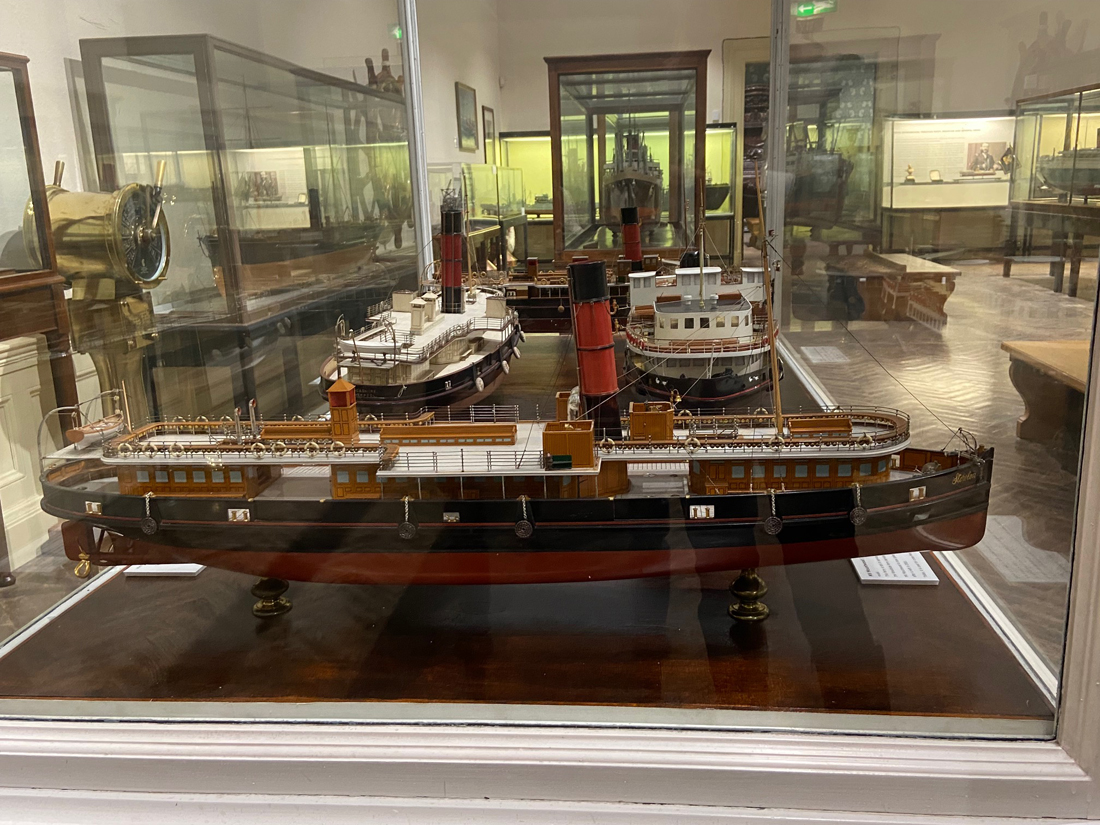


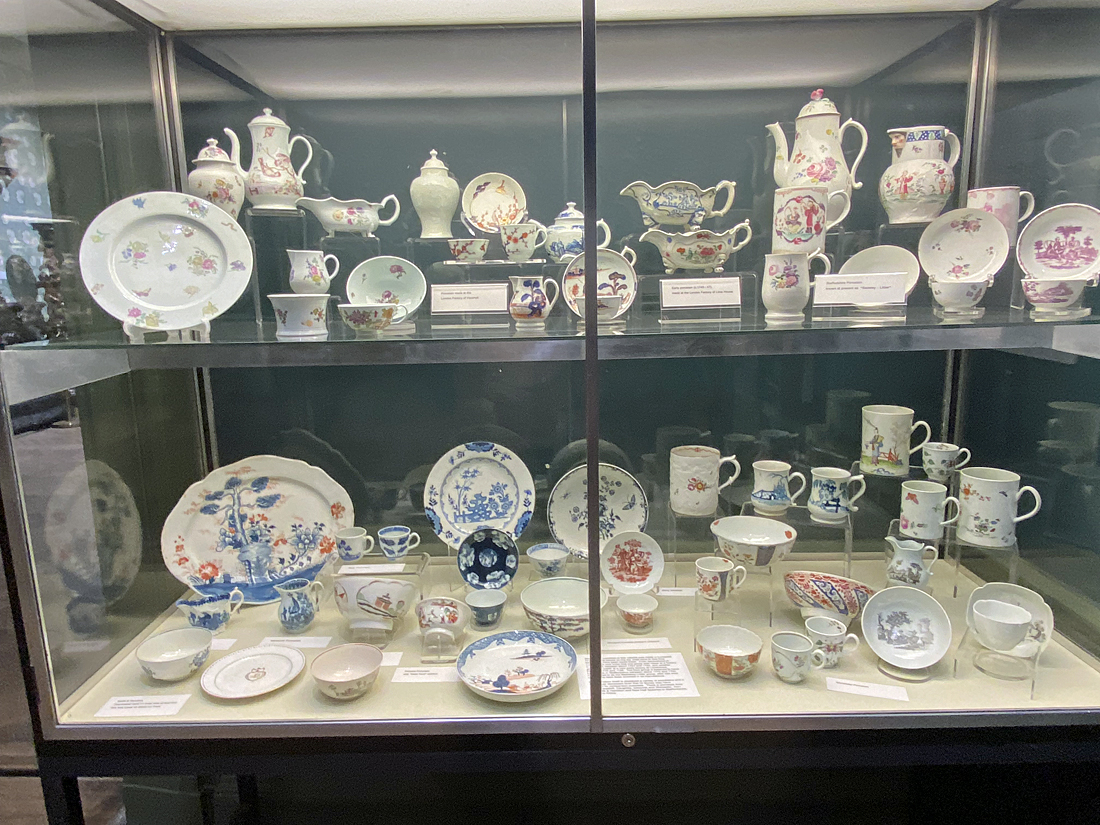 Another small room focuses on ceramics that were either made and used in Merseyside or were imports, brought back to the Mersey docks from the far east to meet the demand of local consumers. Chinese ceramicists cottoned on very quickly to the types of decorative themes that were popular in the west, and produced specific types of design, including specific types of shape, for the European market. The mix is diverse, but there are one or two pieces that directly reference the maritime. The influence of Chinese ceramics is very clear, made either locally or imported, in some of the examples, but there are more localized themes as well. There were seven different sites in Liverpool that were making porcelain, all operating between the mid and late 1700s. Unfortunately, none of the factories used manufacturing marks so it is difficult to determine which factory produced which pieces.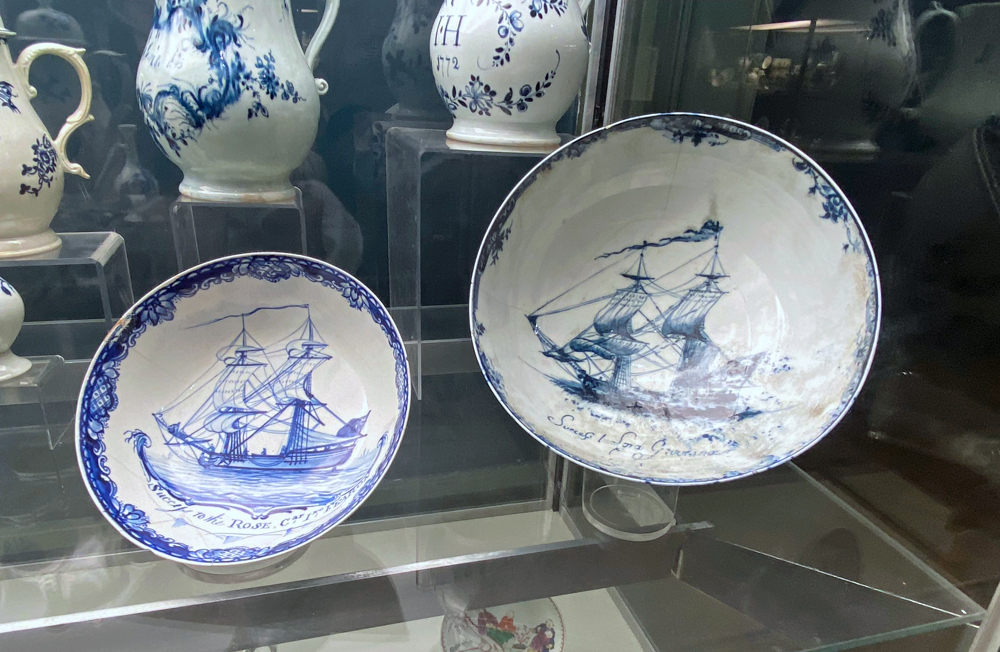
















 Based in Churton
