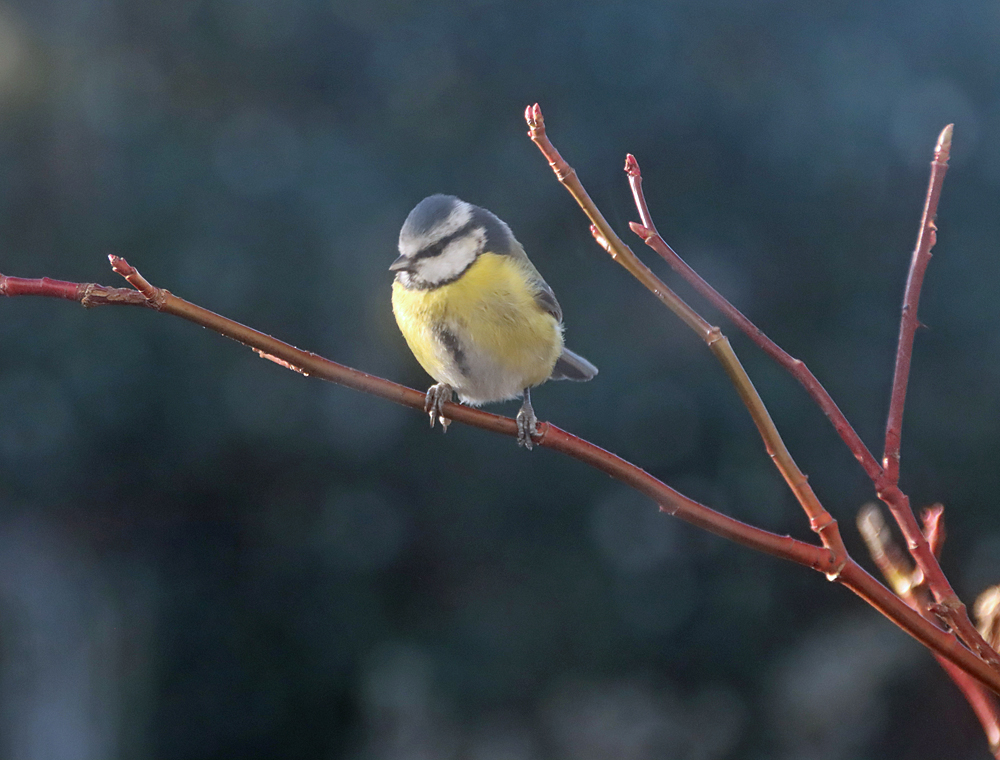
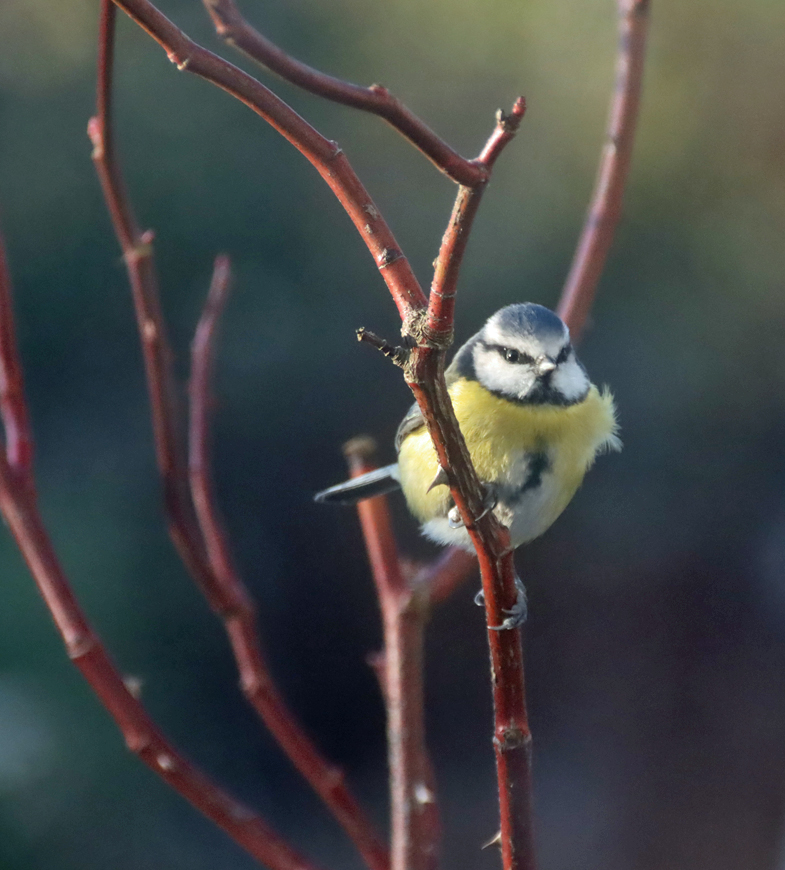
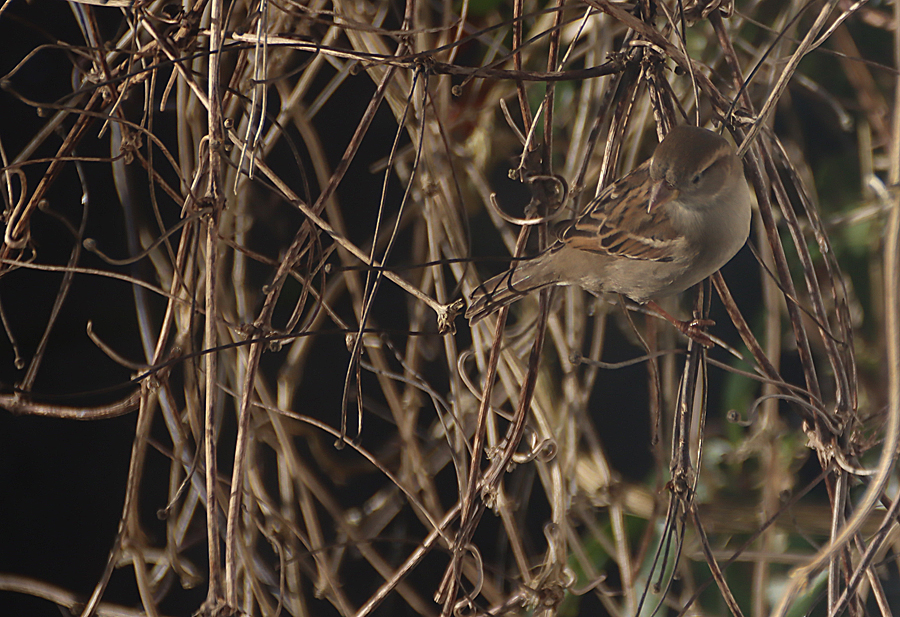
Blue Tit on a rose bush in my garden, January 2026
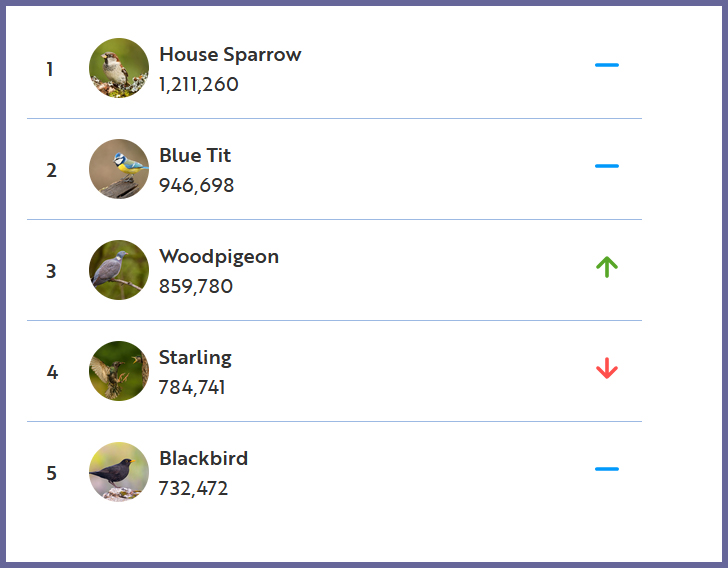
I have been doing the RSPB Big Garden Gardenwatch for about 10 years, but it has been going since 1979, collecting the same data each year so that the analysis of birds can be sensitive to time as well as geography, charting alterations in bird populations throughout the UK. These changes can be considerable. As climate change impacts both regional and highly localized environments, the distribution and numbers of different animal and plant species alter accordingly. Overall the UK has lost 38 million birds in the last 60 years, and although House Sparrows were the “most spotted” bird during 2025, comparing actual numbers with previous years shows that this figure is down 64% since 1979. This means that House Sparrows are now on the red list, which is the highest level of conservation concern.
Most spotted in 2025, from the current Birdwatch webpage
You can enter your results online or by post, making it very easy to participate. Instructions for participating are at the Big Garden Birdwatch page here, but it’s a simple task. On either 23rd, 24th or 25th January simply select a convenient hour to do some birdwatching in your garden, local park or wherever you settle yourself down. The idea is to count only the maximum birds you see at any one time in that hour, and only those that land, not birds flying overhead. You can download the bird identification sheet in English or Welsh here.
I’ve always vaguely wondered why the survey is done in the winter, when we would all rather be tucked up indoors, but the answer makes a lot of sense:
Because that’s the time of the year garden birds need us most – if it’s really cold, it’s likely more birds will come into our gardens looking for shelter and food. This makes is easier to count the birds. Because the Birdwatch takes place at the same time every year, we can look back through the years to see if anything has changed.
I will be doing mine from the nice, safe warmth of the kitchen, from where I can watch the bird-feeders and the birdbath without suffering from hypothermia!
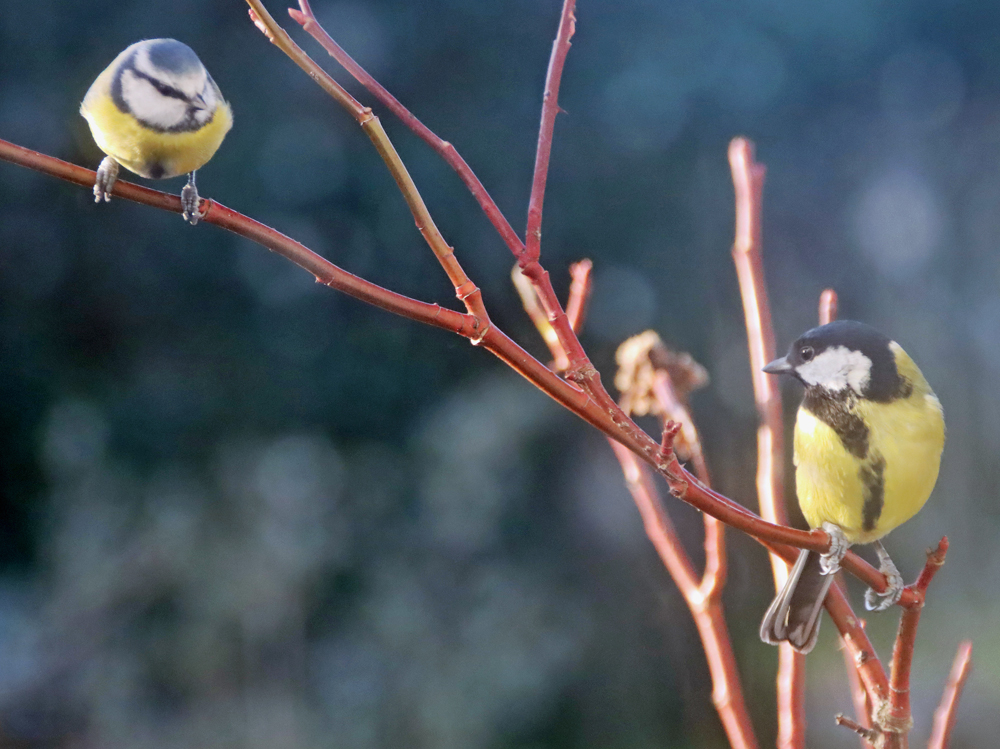
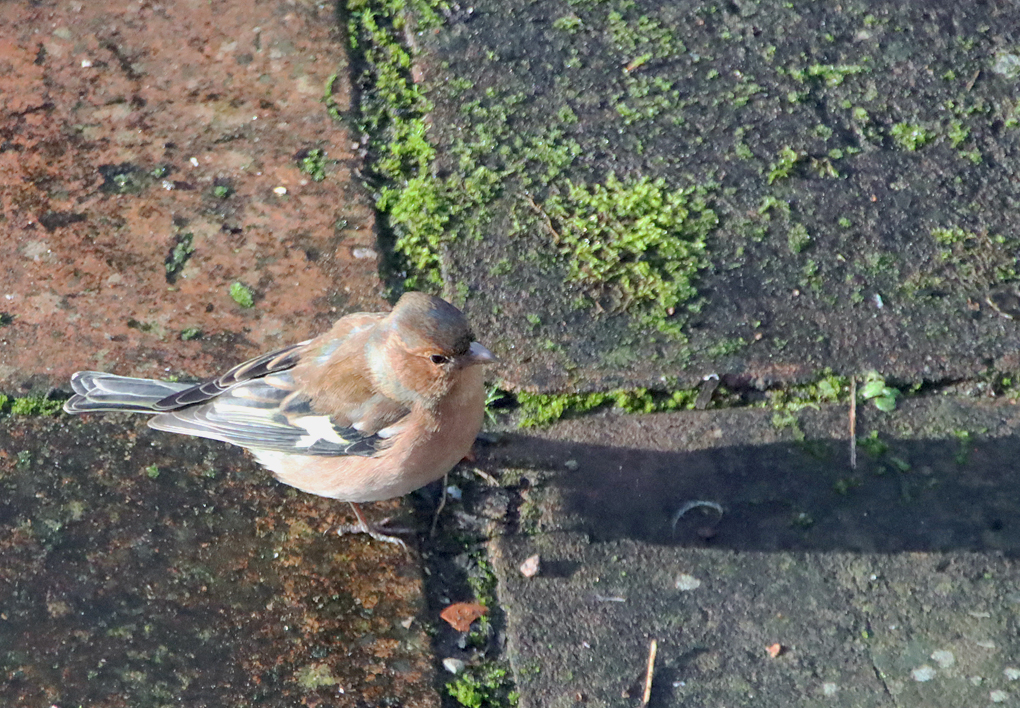
Most of the birds taking advantages of the bird feeders are small – blue tits, great tits, sparrows, the occasional dunnock, a few long-tailed tits, and quite a few very shy chaffinches. It is impressive how the sparrows and chaffinches are so at home on the bird feeders, not as gymnastic as the tits, but perfectly happy perching on the outer cage. Black birds and collared doves, and even some of the local community of jackdaws and the occasional magpie scavenge underneath the feeders because the small birds are all messy eaters and drop a lot.
Unexpectedly, a couple of weeks ago I was in the kitchen making a coffee and looked out of the window to see a Great Spotted Woodpecker, at first hanging nearly upside down on one of the bird-feeders but making a really good job of arching its neck around to get at the mixed sunflower hearts, dried mealworms, suet pellets and peanuts, before it adjusted itself into a more convenient upright position. Gorgeous. It has been back several times since, always on the bird feeder furthest from the house. It answers the very puzzling question of why the bird feeder at the far end is always emptied much more quickly than the others, as the small birds don’t seem to mind where they feed. I could never have imagined a more efficient vacuuming operation. I’ve heard it in my neighbour’s garden throughout the summer, tapping away at a tree, but only had fleeting glimpses of it.
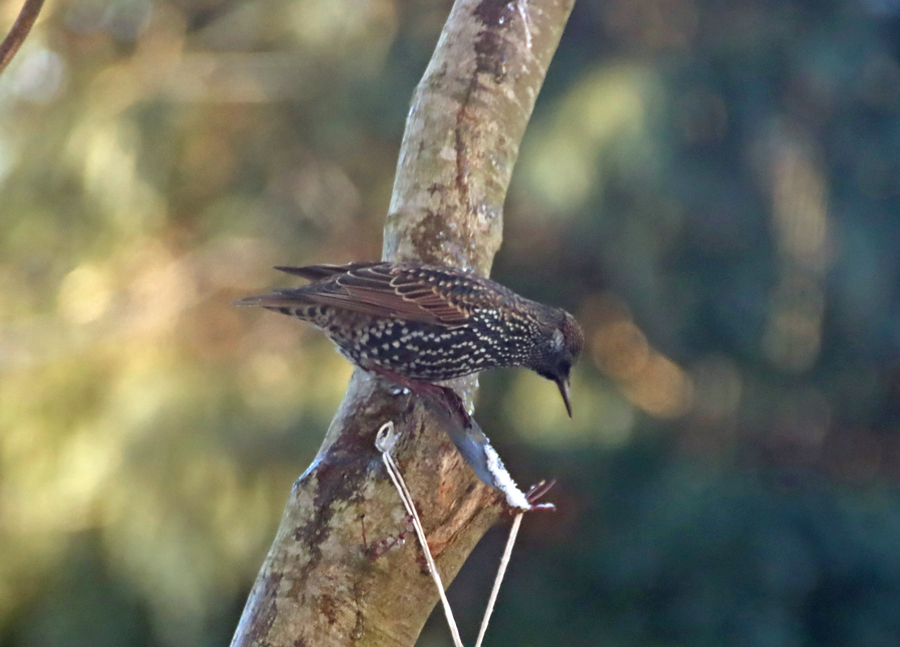
Most of my birdfeeders are like the one in the above woodpecker photo, but I have had great success with some very ugly ones that stick to windows with suckers, particularly with the robins and sparrows. I take all the bird feeders down during the course of early spring, one at a time, so that my winter visitors return to fending for themselves, passing on their natural foraging skills to their young, so on the whole I don’t mind a bit of ugliness over the winter. The window feeders supply the birds that don’t do well on the hanging feeders, particularly robins and sparrows, but the tits and finches also enjoy them. A more surprising visitor is a single starling, which simply cannot get the knack of the hanging feeders. I have never seen starlings in the garden before. It is almost impossible to take a good photograph of anything in the window feeders, thanks to the suckers and the general mess that the birds somehow manage to make, but here’s my visitor, taking up all of the available space.
Beautiful feathers on a bird of prey at Burton, Wirral
Yesterday seemed, at first, to have been doomed from the start, but after an unpromising start, instead of the planned expedition I found myself grabbing the camera and car keys before heading up the Wirral to Burton to park up along the estuary and go for a very fine walk along part of the Wirral section of the King Charles III England Coast Path. I hadn’t even got out of the car when I saw the above bird of prey, which politely held position whilst I scrambled out of the car. A perfect way to turn around a failed start to the day.
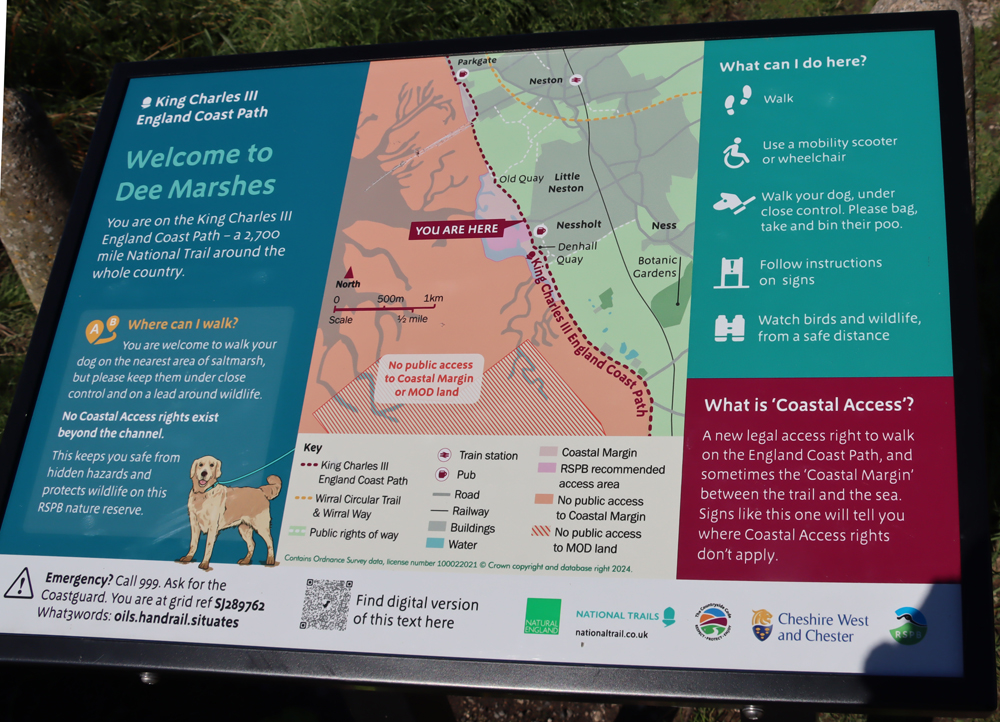
I have made a short visit to the estuary cycle track and walk in the past, simply to get a good look at the purported Iron Age promontory fort on Burton Point, but although it was enjoyable, it was a short stroll because the skies opened and I got drenched. Today, with no risk of rain, I decided to walk from Burton towards Parkgate, which I guessed to be about an hour’s walk each way. When I reached the “You are Here” board (with which the walk is dotted at key points) at Moorside, alongside Parkgate Spring and on the very edge of Parkgate, this was a full hour.
Parking is easy along the section of Station Road that lies along the estuary for the Burton to Moorside (near Parkgate) section of the “King Charles III England Coast Path” (What3Words: ///glows.lung.headsets). Source: Google Maps
Parking for this particular walk is along the section of Station Road that runs along the side of the estuary, indicated by the red circle on the map.
The walk itself begins along the section of Denhall Lane that turns along the side of the estuary and passes a café, as indicated by the black arrow on the map. Although vehicles are permitted as far as the café (just beyond the left edge of the map), they are banned beyond this point.
This first stretch of metalled lane is dominated by dog walkers and cyclists. Do keep an ear open for the cyclists as they can pick up a lot of speed along the lane and don’t always give a lot of notice of their impending arrival. The path goes through various changes. After some time it parts from the lane and becomes much more of a footpath with rough stone underfoot, which probably accounts for why the cyclists vanish from the scene at this point. At one stage it becomes a track across a field, although there is a route around this in wet weather that diverts inland for a while. The entire walk is well maintained with pedestrian gates and bridges where needed. One field had horses in it, so do take care if you are walking dogs.
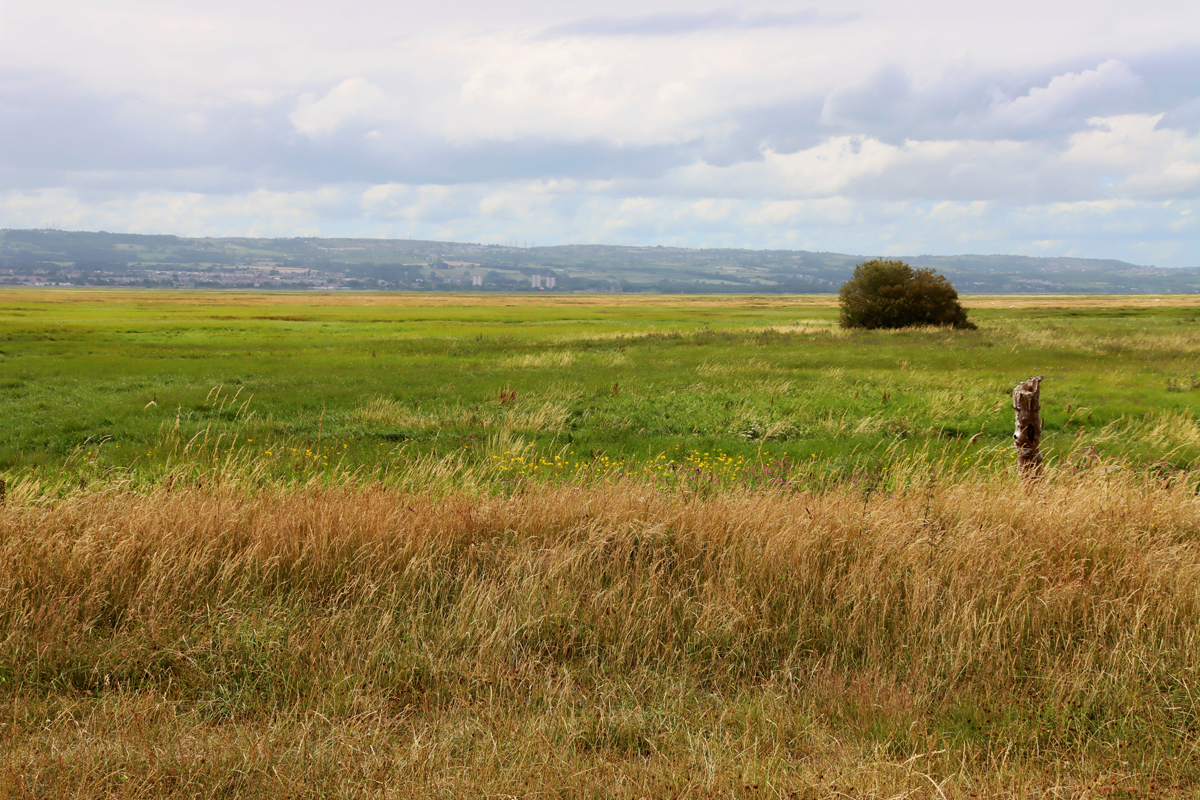
Scenically, the walk is always split between two different experiences to left and right. The views across both wetlands and former wetlands to the Welsh foothills to the southwest are lovely on a sunny day, and you can keep an eye open for bird life. On the other side of the path, immediately hugging its edges, there is an almost uninterrupted run of very fine hedgerows and trees. At this time of year there is not a great deal to see on the estuary, although I was delighted to see lovely white egrets in a distant blue pool, as well as a couple of birds of prey hovering splendidly overhead. Most of the flowers in the estuary have gone over, but the autumnal leaves, berries, rose-hips and other fruits of the shrubs and hedges and the multiple colours of the changing leaves on trees along the paths were endless and superb, really gorgeous against a blue sky with the sun shining on them.
xxx
Nearing Neston I spotted a line of vast red sandstone blocks extending out into the estuary vegetation, and a small spur of land also extends out at this point. An information board explains that this is part of the Neston Colliery, Denhall Quay. There is a particularly good book about the collieries, The Neston Collieries, 1759–1855: An Industrial Revolution in Rural Cheshire (Anthony Annakin-Smith, second edition), published by the University of Chester, which I read and enjoyed a few years ago. The sandstone blocks are massive, and as well as retaining original metalwork, one of them has become a memorial stone, as has one of the trees on the small spur of land. The line of sandstone, now a piece of industrial archaeology, is a very small hint of the extensive work that once took place here, but is an important one. The author of the above-mentioned book refers to it in a short online page here, from which the following is taken:
There are still some signs today of the old mining operations. Most prominent is Denhall Quay, the remains of which still jut out into the Dee Estuary. This was built in 1791 and was used to ship coal to North Wales, Ireland and occasionally to foreign countries, as well as inland via newly-built canals. Also, if you know where to look it is possible to trace the location of many of the shafts that were once in use, including one hidden behind a brick wall in Riverside Walk. Easier and arguably more rewarding to find is The Harp Inn! The building was standing in the mines’ earliest days and records show it was a public house for the miners no later than 1813 and probably much earlier. It has several photos on its walls from the mines’ later days.
This is the point that I turned around and walked back. The image immediately above the map shows point where the Parkgate Spring emerges, very audible but not actually visible.
xxx
There are very few places to sit down along the walk, so I would recommend that if you need to rest your legs occasionally, you take your own portable seating. Regarding refreshments, I have mentioned Net’s Café, near the Burton end. I haven’t visited and apparently there’s no website, but it is just off Denhall Lane and it is listed on Trip Advisor here. There is also a very good pub called The Harp, which I actually have visited, with outdoor tables immediately overlooking the wetlands towards the Welsh hills, just outside Little Neston. The food being served there looked excellent, and I can give a solid thumbs-up for the cider. The pub was particularly well situated for my return from Parkgate as the zoom lens on my camera, a particular beauty that has been worryingly on the twitch for weeks, suddenly stopped working and was now, just to ram home the overall message, rattling. A glass of cider and a seat in the sun were perfect for jury-rigging the wretched thing so that the zoom now worked like an old-fashioned telescope and the camera’s autofocus, which was refusing point-blank to engage in conversation with the lens, could be operated manually on the lens itself. Sigh. New lens on order.
If you can do this walk in September when the berries are at their best, do take the opportunity, because it is stunning, particularly on a sunny day. And all on the flat too, so entirely appropriate for unwilling legs. xxx
When I got up this morning and saw what a beautiful day awaited, I decided on the spur of the moment to go to the RSPB nature reserve on the Dee estuary at Burton.
Burton village, well-kept and firmly manicured, is located on the southwest of the Wirral, about 20 minutes drive out of Chester, an area now better known for giving its name to the nearby wetlands. The wetlands are divided into two separate entities. The first is the splendidly well organized and laid out nature reserve operated by the Royal Society for the Protection of Birds (the RSPB) which was specially set up for the benefit of birds and bird watchers, but accommodates general visitors too. There is also a route through the wetlands on the far side of the RSPB reserve, and extending well beyond it, which is the Sustrans route number 568, developed for cyclists but welcoming walkers. It crosses the wetlands from Connah’s Quay, meeting the Wirral peninsula at just above Burton Point, and continuing on to Neston. They provide two very different but both marvellous experiences of the wetland scenery. I have already posted a short piece about my short visit to the Sustrans cycle and walking route in the Burton Point area, although I want to walk the whole thing eventually.
A lapwing stretching its wings, whilst a common sandpiper stands by unimpressed
The RSPB wetland reserve
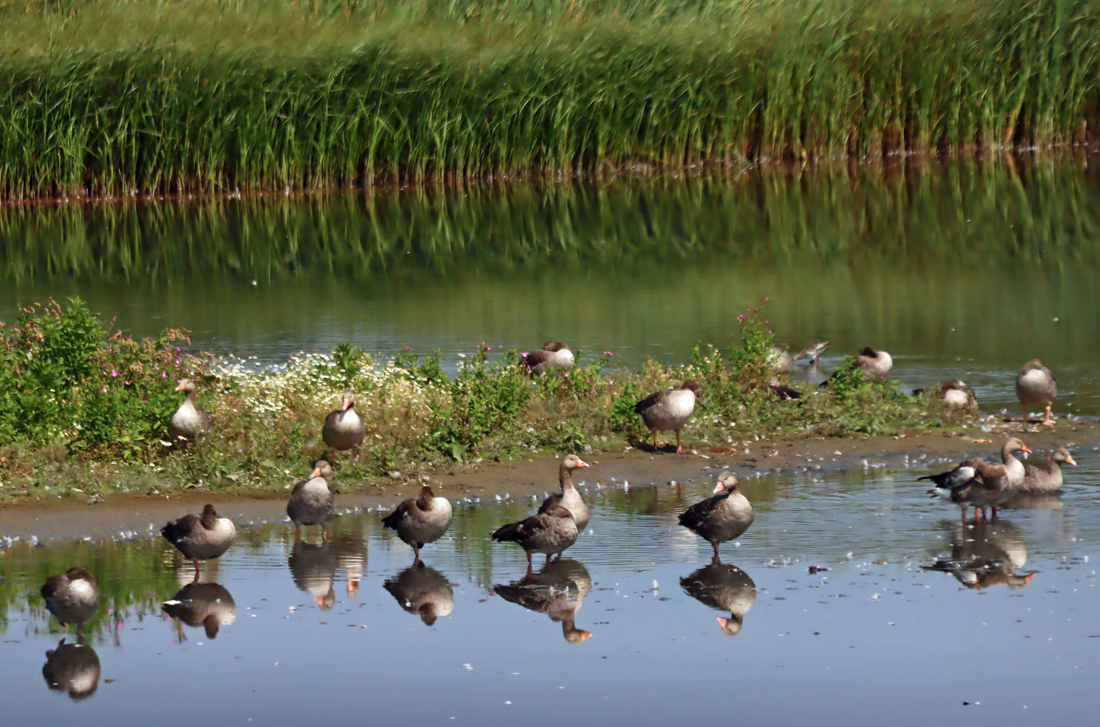
Greylag geese with their bright orange beaks at the RSPB’s Burton Mere
Several miles of wetland are enclosed within the RSPB reserve, which attract thousands of birds of many different species, with the river Dee invisible along the far edge of north Wales. The canalization of the Dee, completed in 1737, completely changed the environmental conditions of this part of the estuary, forcing the river to run along the Welsh edge of the estuary. The canalized channel of the Dee is not visible from the nature reserve, but the miles of wetland are lovely. There are huge expanses of pond and small lake, as well as flooded wetlands in the distance. On a bright day with blue skies overhead it is gorgeous. The reserve backs on to farmland at the rear, includes a woodland walk, and has a very attractive red sandstone railway bridge crossing the tracks below and even boasts the remains of an Iron Age hillfort which, if somewhat puzzling as an archaeological entity, has lovely views along the estuary towards Hilbre Island and across to north Wales.
xxx
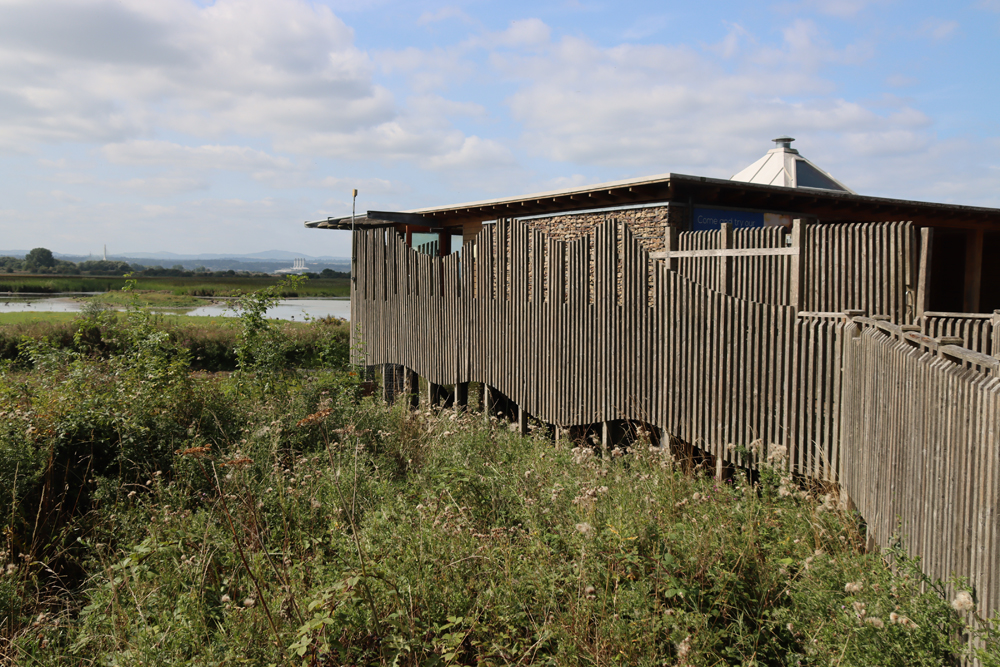
For bird watchers there is an enclosed viewing room where the ticket office is located, and throughout the reserve there are coverts and hides like the one above, all of them with benches, and all with windows suitable for both seated and standing visitors, and there are also viewing screens and viewing platforms dotted throughout.
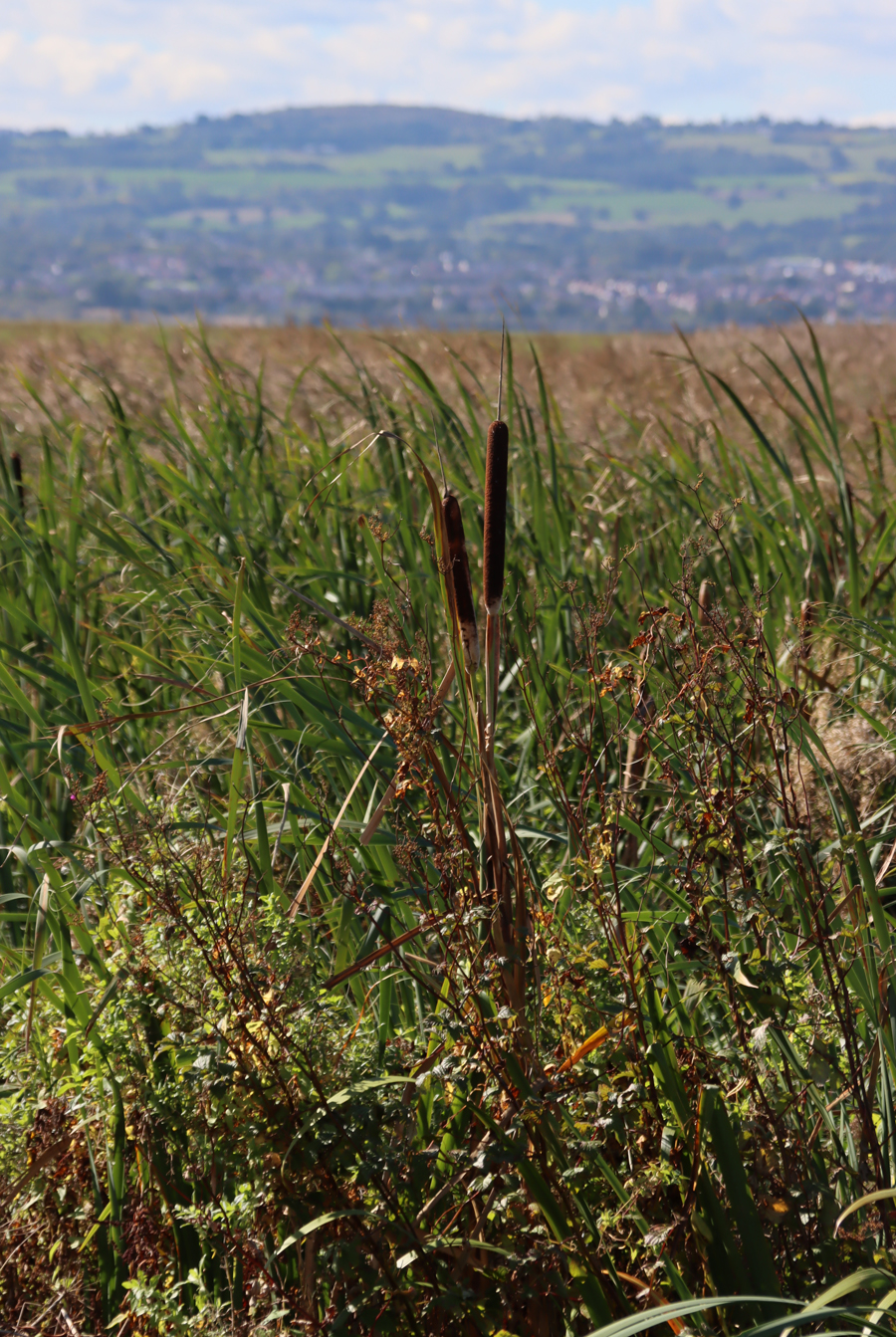
For less specialist visitors there are some splendid wending walks through the reserve, where water-loving plant and tree species abound, many in flower or producing berries at this time of year, and all providing a myriad of colours and textures over a base of deep greens and rich browns, which provide excellent resources for insect life. The plants are so dense that where there is water running beneath boardwalks the water is scarcely visible.
The walks are all nice and even underfoot, many of the boardwalks coated in wire mesh to prevent them becoming slippery, and it is all beautifully maintained. Being located on the side of the estuary, the nature reserve is nearly all on the flat. All the main walks are wheelchair friendly, as are the hides and coverts. There are actually four miles of signposted walks, as well as the woodland walk, which takes about half an hour. There are plenty of benches dotted around for a moment of relaxation and contemplation. Burton Point, at the furthest end of the nature reserve, is a tiny headland, which involves walking a short way up a slight slope and an informal footpath, and offers some great views along the estuary. It is supposed to be the site of a small Iron Age promontory hillfort, but the evidence for this is difficult to see, although an interpretation sign does its best to offer a visualization of how it may have looked.
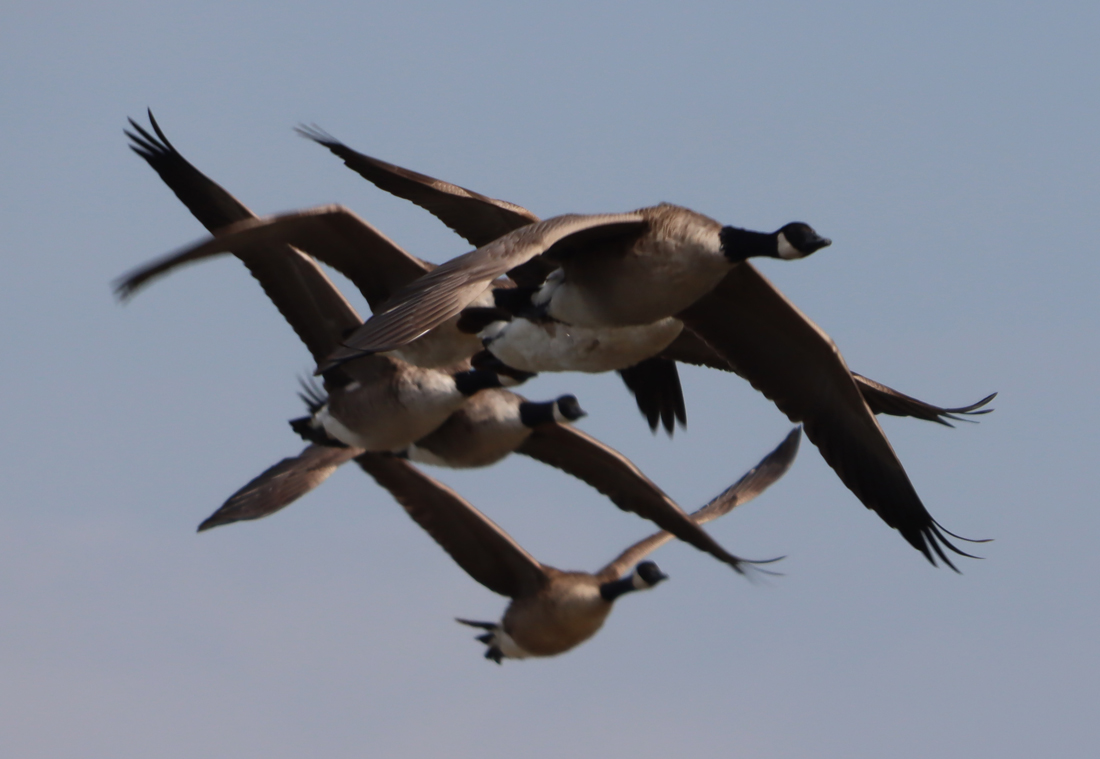
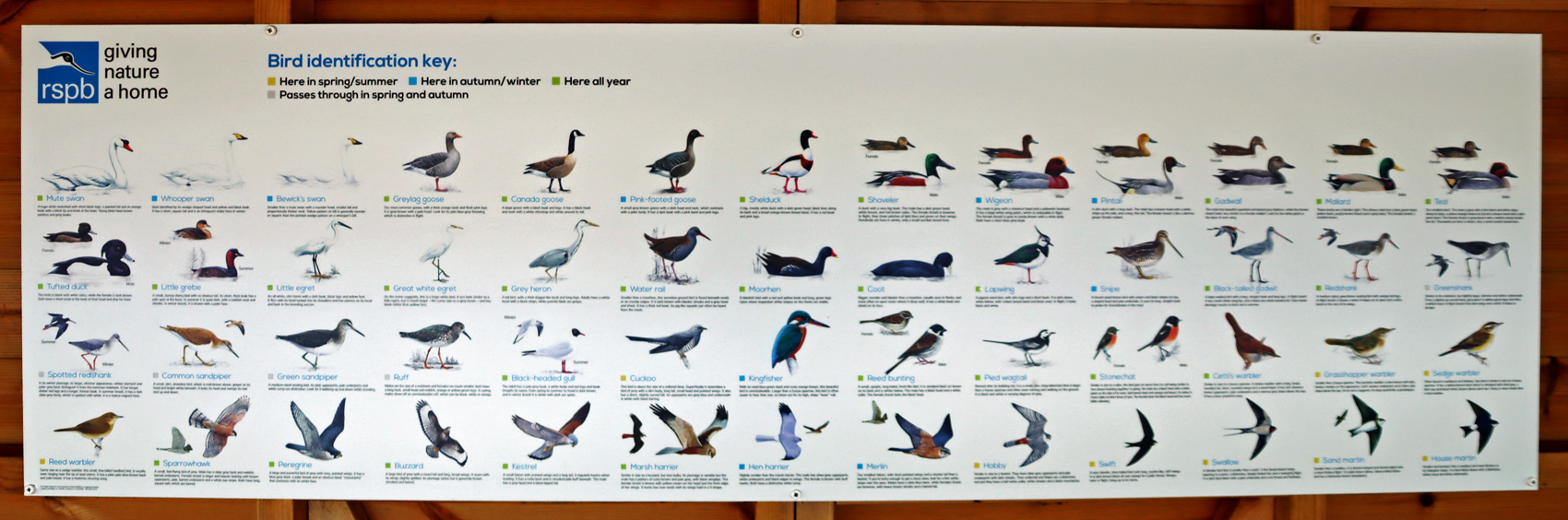
Even if you are not a regular bird watcher, the water birds are fascinating. There are plenty of information boards showing what you are likely to see, and there is a whiteboard in the reception area showing a list of what has been spotted on a given and previous days. Binoculars and cameras with enormous lenses (one of them in camouflage colours!) were very much in evidence and I soon found at why – my nice all-round lens, a 28-300mm zoom, was struggling desperately at its top end, and something much more powerful would have been helpful. Do note that you can hire or buy binoculars from the reception area to get a better view of what birdlife is spending its time on the wetlands. At this time of year the geese dominate, both in numbers and in voice. Their honking can be heard wherever you are in the reserve, even when you can’t see them, There were Canada and greylag geese in great numbers, and a handful of Egyptian geese sunbathing on the far side of one of the stretches of open water, but there are plenty of other species too.
There was something distinctly conversational, and rather cross, going on here, and you should have heard the honking!
Of the smaller water birds, as well as the familiar moorhens, coots and mallards, there were gorgeous lapwings and a variety of small wading birds, with slender legs and long beaks, including a common sandpiper that was distinguished by its rusty coloured plumage. There were multiple grey herons looking like statues, waiting patiently for unsuspecting fish to swim by, and I spotted some tiny little fish in one of the ponds near the cafe which are presumably a popular part of the herons’ dietary intake. There must be lots of reed-loving birds hidden in the wetlands, successfully shielding themselves from prying eyes. There was apparently a spotted redshank, which was causing some excitement among the better informed bird watchers in one covert, but although I followed the directions that a father was giving his son (along the lines of – left of that greylag goose walking in front of that moorhen and then two back and one over) I was unable to spot it. Bird feeders dotted around were attracting blue tits and great tits in great numbers and there were pied wagtails in some of the many trees that line the edges of some of the paths. There’s an A-Z of bird species on the RSPB website.
One of many grey herons, on the hunt for unsuspecting fish
This is a super place to visit, and seasonal changes in bird and plant life mean that there will always be something new to see, and there are plenty of butterflies, bees, dragonflies, damsonfiles and other insects to observe if you look carefully. The grasshopper in the image below was particularly well camouflaged, and apparently there are sometimes lizards sunbathing in the sunnier patches. On Burton Point there are rabbit warrens, and according to some of the signage (much of it directed at children, but still informative to older visitors) the local animals have a vibrant night life.
Spot the grasshopper
Regarding the hillfort on the promontory, Burton Point, there are websites that say that the small headland on which the site is located is privately owned and should not be entered without permission, but this is in fact now included in the RSPB reserve and is served by good footpaths and includes interpretation signage to give visitors some idea of what was here. I’ll talk more about this site on a separate post.
Burton Point, a low promontory that overlooks the Dee estuary and is the possible site of an Iron Age Hillfort. In this photograph the footpath at far right leads into the woodland, where a vantage point looks down on the fortifications, but you can also see what remains of the fortifications at the far left of the photo where an earthwork is clearly visible
xxx
Visiting the RSPB reserve
Meadow Brown butterfly beautifully camouflaged
The RSPB reserve is very easy to find, although if you rely on that Google SatNav, please note that mine, having been asked to find “RSPB Burton” informed us we had reached our destination before we had actually arrived. Fortunately, if you use the What3Words smartphone ap, which is stupendous (narrowing locations down to metre-sized locations) you can find it at ///readings.sideburns.handicaps. Other details can be found on the RSPB website which includes the address, postcode, as well as details of the current ticket price and full details about what the nature reserve offers the visitor: https://www.rspb.org.uk/days-out/reserves/dee-estuary-burton-mere-wetlands.
The RSPB site has been very well thought out, and is very welcoming. A single lane road from Puddington Lane has speed bumps and plenty of passing places, leading to a well-sized car park. Entrance is via a building with a look-out over the estuary. The entrance fee is £7.00 at the time of writing (July 2025), which helps to support the charity. There is a nice modern cafe on site, which sells tea, very good coffee, cold drinks and snacks. This is also where the toilets are located. There is a small shop next to the ticket desk that sells gifts, books and bird food.
I have been following the RSPB Burton reserve on Twitter for a couple of years, without ever having managed to get there, and every day they take a photograph of their whiteboard to give you an idea of what species have been observed recently so that you know what to look out for. You can find this at https://x.com/RSPB_BurtonMere. There is a placeholder for them on Bluesky but no content just yet.
I rarely give an opinion about wheelchair use, but there were actually several wheelchairs users out and about today. It would not be possible to get wheelchairs up to the Burton Point hill fort, or navigate them down one or two of the little tracks that run at the back of the reserve, but all of the coverts and hides are wheelchair friendly and, for both wheelchair users and children, the viewing windows extend from low to high for both seated and standing visitors. The same comments go for those with unwilling legs.
Dogs are not permitted, and nor are drones.
Excerpt from the RSPB’s leaflet about Burton Mere, showing the top things to do on a seasonal basis
In 2013 a track across the wetlands from Connah’s Quay via Burton Point to Neston was opened. As part of the Sustrans cycle network it is known as Route 568 or The Burton Marsh Greenway, and an information board at the point where the route meets Station Road (see map at end) says that this section is now also part of the “King Charles III England Coast Path.” This section of the route, Burton Marsh, is partly made up of metalled lane, and partly boardwalk, and is a terrific walk. I had never heard of it until I was standing in what remains of the hillfort on Burton Point headland, part of the RSPB reserve, and saw it passing almost at our feet and beyond into the distance. It is an extraordinary sight, a mainly straight track across the landscape, and such a brilliant idea.
I parked on the section of Station Road that runs parallel to the estuary, which is part of the cycle route to Chester, and is separated from the rest of the Burton Marsh stretch of track by a gate to keep the sheep in. There’s a map showing where the parking is located towards the end of this post. This walks is all particularly beautiful on a sunny day with a blue sky stretching to the horizon. A shifting sky, which one moment produced sun and the next light shade, brought out the textures and colours for miles around. Because the estuary is so flat and vast it can be very breezy or windy, which was no bad thing on a particularly sticky July day!
I headed through the gate in the Chester direction. Starting out from this point you are on a metalled lane and have fields rising on your left, currently planted with palest yellow barley, whilst on your right are marshland habitats stretching all the way to the river Dee running along the Welsh side of the estuary, with every shade of green you can imagine, dotted with bright clumps of flowering plants and layer upon layer of different textures.
The barley fields are soon replaced by a fairly short red sandstone cliff edge, which has been heavily quarried over the centuries. Where this red sandstone becomes much more uneven and comes out towards the lane, there is a sign on your right that explains that here are the remains of an Iron Age hillfort at the top of this small headland. This is fenced off, as it is RSPB land.
Burton Point
The lane pulls away from the headland heading out into the wetlands, and soon you find yourself on a long section of boardwalk, which rattles splendidly when cyclists come along, with the marsh habitats either side of you.
On a clear day the views seem endless as far as the way to the Clwydian Range of Wales. The track gives a sense of how big that landscape actually is, and why it is such a special environment for wildlife, with aquatic plant life as far as the eye can see, and bird life launching itself in and out at surprising and random moments. As well as plenty of Canada and greylag geese, both on the ground and in the air, there were dozens of skylarks, terns flying overhead and birds of prey too high to identify. Unsurprisingly there were plenty of seagulls too. Beneath the surface, there must be an awful lot more going on.
The intention was to walk for an hour and a half, see where that took me, and then turn back to retrieve the car, but the sudden onset of fairly heavy rain both greyed out the landscape and blocked the view so I only walked for around half an hour before turning around. Even during that short walk, the views were superb and the environment absorbing, and one of the nice things about this is that however far you want to go, and from wherever you start, it lends itself to any length of walk. I was chatting to a man on a bike who had stopped to watch a group of greylag geese, who had cycled from the middle of Chester and was going to visit his father in Neston before turning around and coming back, and by contrast there were a couple who were just out walking a short way with their dog and a child in a pushchair. All very civilized and a great way of introducing a wide range of people to an entirely new environment in a very easy way.
xxx
Visiting from near Burton Point
You can access the track free of charge from anywhere along its route. Because it is all on the flat, it is suitable not only for walkers and cyclists but those with pushchairs, buggies, and wheelchairs. There was even a man on one of those push-it-with-one-leg adult scooters. There are gates at interfaces with roads because of the sheep. Also because of the sheep there are frequent signs asking owners to keep dogs on short leads. Having been followed for about half a mile by one particular sheep, which stopped and looked fixedly at me every time I turned around to see if it was still following me, I can confirm that sheep are a very likely to be encountered.
I have only done this from just north of Burton Point so far, a short drive from the A540 via the village of Burton, and you can park on the straight section of Station Road that runs along the estuary, and where there is plenty of room to park along the road (what3words: ///recur.films.dream if you have the Google-compatible app on your smartphone). Station Road, as it leads back inland, also has some parking along its edges near to the estuary. I have highlighted the main parking-friendly area on Station Road in the pink box below.
Convenient road-side parking near Burton Point marked in pink. Source: Streetmap.co.uk
If you fancy starting in Chester, you can set off from the Little Roodee car park, go around the Roodee itself, and then follow the track to Connah’s Quay and go from there. Fortunately you don’t have to depend on my finger-in-the-air directions, because Sustrans has its own website with full details for Route 568, which you can find here. It shows the sections where the route meets roads, and where it intersects with other routes in the network.
A large group of jackdaws is currently reigning supreme in my garden. They are here every late morning when they spread out across my lawn and forage in the grass and occasionally the flower beds, usually in harmony with one another, but occasionally with minor internal disputes. Their relationships with other wildlife in the garden are rather less amiable, but on the whole mutual caution seems to be the rule. The most I counted in one go was 16 jackdaws, but there are rarely less than 10 when they arrive en masse. A group of this sort is known as a train or clattering. One or two individuals sometimes return in the afternoon, but the jackdaws only visit my lawn en masse in the late morning.
The jackdaw is, at first glance, a large, and undistinguished black bird much like a crow, but when observed more closely is a rather beautiful thing. It has remarkable silver eyes that stand out against the black pupils. The head and beak are black, but the hood, nape and neck are silvery-charcoal, like a mane, which becomes pure silver in bright sunlight. They have a self-important rocking-horse motion, but walk one leg at a time, rather than bouncing along on both legs like smaller birds. Their skinny-looking legs are well able to support their large bodies during periods of extensive walking over the expanse of the lawn. They use their wings to supplement their legs to pick up speed when seeing off transgressors or moving a safe distance away from their more aggressive family members. Young jackdaws have brown irises that only become silver grey as they become more mature.
Jackdaws (Corvus monedula) are part of the same 120-species corvid family as crows, ravens, rooks, magpies, and jays, and are the smallest member of that family in the UK, at about 34cm long. Carl Linnaeus provided the name “monedula,” deriving from the Latin word for money, and chosen for the brightness of the things that the jackdaw, like the magpie, is fond of collecting. Every creature on the planet, in the western scientific world, owes its two-part Latin formal name to Carl Linnaeus (1707-1778). Biologists have since elaborated this system, and now rely on DNA to establish relationships, but Linnaeus provided them with the basics of the taxonomy that we continue to use.
Sometimes all one can see is the bird’s rear end, because the head is so deeply and busily buried in the grass. Like other members of the corvid family, jackdaws are omnivores. Whatever they are plucking out of my lawn and flower beds is probably insect life, like leather jackets, worms, beetles, caterpillars and ants. They are also partial to slugs and small snails, and supplement their diet with fruit and seeds. Jackdaws also steal the eggs and offspring of smaller birds and, like all corvids, will eat carrion when they find it. The diversity of their diet has helped their numbers to rise in Britain.
Many insect eaters can derive most of their water requirement from this food, and I have only seen them (and the magpies) drink from any of the bird baths in the garden which the other bird species use frequently during periods of drought. During normal conditions they may, of course, be sourcing their liquids from outside the garden.
They don’t sing; they squawk and chatter. It is often a rather disharmonious sound, unappealing to the human ear, nothing like the blissful melodies of the blackbird or thrush. You can hear a sample on the British Birdsong website here, or the RSPB website here.
Birds that form lifelong monogamous relationships often have the largest brains relative to their body size, and they are certainly smart, regularly defeating my small-birds-only weight-detecting winter bird feeder, using every form of trickery at their disposal, including flapping wings madly, like gigantic humming birds, to hold position whilst poking their heads through the hole to reach the bird seed. In the days when milkmen left bottles with foil caps by front doors, jackdaws were notorious for pecking through the foil to get to the creamy milk within, thereby rendering themselves seriously unpopular by contaminating and ruining the milk.
There is no externally visible difference between the male and female. Jackdaws breed between April and June, raising one brood each year. Their nests are untidy. They simply fill a hole or recess with sticks, and line it with wool, hair, string or grass and weeds. A 2021 research paper found that although a pair will behave similarly and generally cooperate to build their nests, their roles are not identical. Females contribute more to the build of the nest, and call more frequently, but the males are more assiduous guardians of the nest once it is built. The eggs are blue-grey with dark speckles. Once the eggs are laid in separate batches, usually up to a maximum of six or seven per nest, more usually four or five, they are incubated for up to 20 days. They hatch at different times, with the oldest having a much better chance of survival than the youngest. The female tends the nest whilst the male sources food and brings it to the female and the chicks. The chicks remain in the nest for up to five weeks, before leaving the nest and learning to fly and feed for themselves.
Jackdaws on chimneys in Cornwall. Source: Hudson 1908
As far as I can tell, as of 2025 five generations of the family have been born in one of my chimney pots. One of the colloquial names for the jackdaw is the “chimney bird” due to their affinity for this particular type of home, which are becoming less available to them year by year, due to chimney caps and central heating. Fortunately, as well as chimneys and holes in roofs, they also like rock shelves, cliff faces, tree holes and the abandoned nests of bigger birds. Some will even nest in abandoned rabbit burrows.
The chimney at the front of my house, together with that section of the slate-tiled roof, formed the hub of their activities when the nest was still occupied, but they still use it as a home base, where they can sit and bicker and gather their energies for the next foray into my garden or, in the afternoons, into the surrounding fields. Right now, in mid June, a cacophony of noise in the chimney is confined to mornings and early evenings, meaning that the youngsters are fully fledged and that the family are out all day.
Jackdaws move seasonally. Family units will focus on a breeding site in the spring and summer, often returning to it in subsequent years, but in the winter they will leave and join communities of several hundred other corvids, not just jackdaws but also rooks and carrion crows, roosting high in trees. These winter roosts are rarely too far from their breeding grounds. Communal roosting is both sociable and solitary. Although the birds gather together in the trees, they are well spaced from one another, not huddled together. Research into corvid intelligence and communication suggests that roosts provide a context for learning and for the exchange of information. What this means in bird terms is obviously very different from what it means to human groups, but there is little doubt that the calls made are a form of communication and signalling. Larger roosts attract predators, and although a few losses might be seen as a sacrifice worth making for the benefit of the group as a whole, it is an easy and vulnerable target for multiple predators. Still, those perched in the inner sections of the greater group are likely to be protected, and the better positions in the roost are, like other aspects of corvid life, dictated by hierarchy and status.
Research into jackdaw behaviour builds on the foundational 1930s work by Konrad Lorenz. The jackdaw population might have been flattered had it known that Lorenz, a renowned Austrian ornithologist, is also credited today with being the Nobel Prize-winning founder of modern ethology(the biological study of behaviour), and observed the jackdaw with a view to understanding innate behaviour in animal and human communities. Lorenz was the first to observe that jackdaw groups operated within a strict social hierarchy based on sex, breeding status and seniority.
All wild jackdaw couples are monogamous, paired for life. In a social order where the male chooses the female, and where breeding pairs have a higher status than unpaired individuals, it is inevitable that a single female will be lower in status than a paired female or a single male. This means that females without partners are at the bottom of the social heap. This has consequences. If a female is unpaired, she will often find herself disadvantaged, particularly when times are hard. She is the last to eat, the first to be denied shelter in the nest at times of stress, will be pushed to the risky outside edges of a communal roost, and is not permitted to retaliate when picked on by other members of the community, who may peck at her to reinforce their own status. Matters change when a female is selected by a male as his mate for life. Her status is equal to that of her mate, and she then has the authority to treat junior members of the community in the same way that she was herself treated.
More complex relations occur amongst males, as a 2014 research project discovered, concluding that larger male jackdaws attained higher ranks and that social rank increased with age. It also found that high-ranked individuals had a shorter lifespan suggesting that maintaining or achieving high rank and associated benefits comes at a cost. The project also found that social rank declined substantially in the last year an individual was observed in the colony, because of deterioration in performance related to age, which reversed the former benefits of seniority, knowledge and experience.
Jackdaws often come up in the context of “social behaviour” research. Instead of focusing on which bird is likely to be the most dominant in a particular hierarchy, the focus in this type of research is on how the entire group acts as a decision-making unit. For example, when big groups roost overnight in huge numbers and then split up into smaller groups during the day to feed in various locations, there is a question about how the decision is taken to take flight. Research in Cornwall, recording the sounds of bird calls before, during and after they have taken flight is key to understanding this process. The calls reach an intensity immediately before the birds take to the wing, as though they are declaring a level of confidence that reaches a peak, a threshold that indicates that the group is ready to take to the skies. A major evolutionary advantage would equate to herbivore herd behaviour, creating a block of fast and confusing movement to deter predators, which would otherwise pick off lone individuals with comparative ease.
At least some of this behaviour can be observed in the garden. There is plenty of antagonism when one jackdaw ranges too close to another, presumably a senior making it clear to a junior or unpaired female that there are boundaries to be observed. Sometimes a few of them will walk in line, like schoolchildren following a teacher. For the most part, they are evenly spread across the lawn and only occasionally do a small number bunch in close proximity.
They are perfectly happy to share my lawn with the robins and blackbirds that also forage in the lawn at the same time, as long as they don’t come too close. On the other hand, war breaks out when a squirrel emerges, quivering all over, its tail tightly curled, pausing to strategize before taking up the offensive and chasing off the jackdaws. When the magpies arrive, a wary stand-off is practised on both sides. When the magpies, singly or in a pair, stay at a very safe distance all is well, but if the magpies infringe too far on the area occupied by the jackdwas, hostilities are quick to erupt. The magpies will often dive-bomb the jackdaws at such times. Even though the jackdaws should be able to win the numbers game, they usually take to the wing, but so do the magpies. It’s a lose-lose scenario.
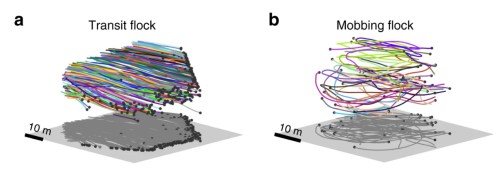
Transit and mobbing flock patterns. Source: Nature
Jackdaws, like starlings, occasionally form flocks. Recent research has shown that there are two different types of flocking behaviour: those flying to their winter roosts and those joining forces to scare off potential predators. In the first case, transit flocking, there is an element of predictability because the size of the winter roost flocks is fixed, and the jackdaws organize themselves in relation to one another in an orderly manner. In the second case, referred to as mobbing, the sudden gathering to scare off predators is a far more chaotic and unplanned event until the flock has achieved a certain number, when the jackdaws start to behave more like a roosting flock, with their motion through the sky co-ordinated and spatially organized. Jackdaws flocking before roosting offer some of the most spectacular aerial displays.
The jackdaw has only a faint footprint in myth and history suggesting that whilst an occasional nuisance it has not been sufficiently systematic as a pest to make its mark in folklore and superstition. Henry VIII, never one to pull his punches, added jackdaws, rooks and crows to the Vermin Act of 1532 in response to poor grain harvests that were blamed, in part, on foraging corvids. Elizabeth I echoed this in 1566 with another act intended to preserve the nation’s grain production against scavenging birds. Perhaps this reputation for pillaging grain accounts for why they were sometimes considered to be bad luck. Although a jackdaw on a roof might once have been taken to signify a new arrival, it might just as well have been an ill omen, sometimes a portent of death. Several decades later, in May 1604, Members of Parliament in the London Houses of Parliament were debating the third reading a bill when a young jackdaw flew into the chamber, upsetting a number of those present who interpreted it as a bad omen for the bill. Jackdaws had long been associated with ill fortune. Although there had ben confidence that the bill would pass, it went on to be defeated by 118 votes to 99. The clerk of the Commons was sufficiently impressed by the incident that he recorded it in the Commons Journal.
In the 19th Century, the jackdaws of Bodmin Jail on Bodmin Moor in southwest England were thought to be on the cusp of fulfilling a curse. It is said that a spinster living in woods on the edge of Bodmin, shunned as a witch, depended on jackdaws to bring her trinkets, and trained them to steal items of value, enabling her to survive. When she was found guilty of the jackdaw thefts, she was incarcerated in Bodmin Jail, where she died, cursing her jailers, the jail, and the town of Bodmin, whose inhabitants had rejected her so cruelly. The jackdaws, having followed her to the jail, remained, and the curse stated that “should the last Jackdaw be born at Bodmin Gaol, so the spirits of the condemned shall rise and bring misfortune and chaos to all that reside within.”
The Vain Jackdaw by Harrison Weir in 1881
In literature, a Greek and Roman adage that “the swans will speak when the Jackdaws are silent” (in Latin, tunc canent cygni, cum tacebunt graculi) advises that the wise should speak only when the foolish have finished their chatter. The jackdaw puts in an appearance in a version of Aesop’s Fables, representing unwise behaviour including vanity and greed. In The Bird with the Borrowed Feathers, the jackdaw borrows the peacock’s feathers to become one of this superior enclave, but on being recognized as a fraud has the borrowed feathers stripped from him and is so badly mauled that his own species do not recognize him, and reject him. It is a moral against social climbing.
In the 18th century, A poem by William Cowper (1731-1800) is dedicated to the jackdaw:
There is a bird who, by his coat
And by the hoarseness of his note,
Might be supposed a crow;
A great frequenter of the church,
Where, bishop-like, he finds a perch,
And dormitory too.
Above the steeple shines a plate,
That turns and turns, to indicate
From what point blows the weather.
Look up — your brains begin to swim,
‘Tis in the clouds — that pleases him,
He chooses it the rather.
Fond of the speculative height,
Thither he wings his airy flight,
And thence securely sees
The bustle and the rareeshow,
That occupy mankind below,
Secure and at his ease.
You think, no doubt, he sits and muses
On future broken bones and bruises,
If he should chance to fall.
No; not a single thought like that
Employs his philosophic pate,
Or troubles it at all.
He sees that this great roundabout,
The world, with all its motley rout,
Church, army, physic, law,
Its customs and its businesses,
Is no concern at all of his,
And says — what says he? — Caw.
Thrice happy bird! I too have seen
Much of the vanities of men;
And, sick of having seen ’em,
Would cheerfully these limbs resign
For such a pair of wings as thine
And such a head between ’em.
Perhaps a better known poem about jackdaws is the 19th century The Jackdaw of Rheims by Richard Harris Barham (who used the pen-name Thomas Ingoldsby, 1788 – 1845). It’s a lengthy affair, so I haven’t reproduced it here, but you can find it on the All Poetry website here. It is another humourous poem that tells how a jackdaw stole the cardinal’s ring, but wound up being made a saint.
Because jackdaws often favour steeples and holes in roofs of church buildings, the Jackdaw can be valued as a holy bird, shunned by the Devil because of its pious choice of residence, a tradition that was particularly prevalent in Wales. I suspect that those responsible for the care of the churches concerned might have a less charitable view on the subject.
On the whole, history has judged the jackdaw without overt hostility, but it still comes under suspicion. They are are still legally classified as vermin in the Wildlife and Countryside Act of 1981, and numerous pest control companies offer the removal of jackdaws as one of their services. This is partly because of the noise and disruption of their chimney, roof and church occupancies (and I can vouch for the fact that they are seriously noisy) but also because of their perceived threat to the conservation of smaller bird populations and the ongoing damage that they can inflict on cereals crops.
As of 2022 there are some 1,400,000 breeding pairs in Britain and in the region of 30 million across Europe. In 1984, they were first identified in north America. The Big Garden Birdwatch, organized annually by the RSPB, found that jackdaws were ranked 15th in birds observed in English gardens in 2022, and 11th in Welsh gardens. In both cases most of the birds higher up in the ranking were small varieties, but they also came in behind magpies and wood pigeons.
When the jackdaws first appeared in 2022, which is when I first wrote this post, whenever I walked out of the back door the jackdaws would take to the air without hesitation. Unlike the blackbirds and the robins that take a look at me, hop a short distance away and then ignore me, or the sparrows and tits that take instant flight, but only as far as the nearest tree from which they can monitor my activities, the jackdaws glimpsed one hint of movement and were gone. Now, updating this in spring 2025, the jackdaws and I share the garden in much closer proximity. They regard my presence as a fact of life. If I walk up the garden when they are in the middle, they will sometimes move a couple of bounces away from me but often they will simply pause and keep an eye on my activities, and resume their own activities when I am at a safe distance. If I am seated quietly with a book when they touch down, they note my presence and get on with life, often coming very close but never too close.
I feed them at the top end of the garden in the winter, well away from the small birds on the patio. When the frosts have ended in late spring I leave them to their own devices, along with all the other birds. It was my mother’s philosophy that birds should be sustained during the months of hardship but should not be encouraged to stuff peanuts down their chicks’ necks (which can kill them) and should be teaching their offspring to forage naturally rather than to rely on bird feeders. That has always seemed liked a sound policy and I follow it.
Although the jackdaws and I share the garden in independent harmony, we all take care not to get too close. There have, however, been numerous examples of jackdaws having a very close affinity with particular humans. Usually this is after the bird has been injured and cared for by the person with whom the relationship is formed (broken wings seem to be the most common example), but not always. There’s a great video of a man feeding a jackdaw with a grape at Rhuddlan Castle below, which shows that formidable beak in action (I would be seriously worried for my fingers, but the jackdaw never misses its target):
Sources:
Books
Bruun, B. 1970. The Hamlyn Guide to the Birds of Britain and Europe. Hamlyn Publishing
Couzens, D.2004. The Secret Lives of Garden Birds. RSPB
Nathan J. Emery, Amanda M. Seed, Auguste M. P. von Bayern and Nicola S. Clayton, 2007. Cognitive adaptations of social bonding in birds. Philosophical Transactions of the Royal Society B (2007) 362, 489–505
Ira G. Federspiel, M. Boeckle, A. M. P. von Bayern and N. J. Emery 2019. Exploring individual and social learning in jackdaws (Corvus monedula). Learning & Behavior volume 47, pages 258–270 https://link.springer.com/article/10.3758/s13420-019-00383-8
Alison L. Greggor, Guillam E. McIvor, Nicola S. Clayton and Alex Thornton 2016. Contagious risk taking: social information and context influence wild jackdaws’ responses to novelty and risk.
Scientific Reports volume 6, Article number: 27764 (2016) https://www.nature.com/articles/srep27764
Hangjian Ling, Guillam E. Mclvor, Joseph Westley, Kasper van der Vaart, Richard T. Vaughan, Alex Thornton & Nicholas T. Ouellette 2019. Behavioural plasticity and the transition to order in jackdaw flocks. Nature Communications volume 10, Article number: 5174 https://www.nature.com/articles/s41467-019-13281-4
Simon Verhulst, Moniek Geerdink, H. Martijn Salomons, and Jelle J. Boonekamp 2014 . Social life histories: jackdaw dominance increases with age, terminally declines and shortens lifespan. Proceedings of Biological Science, September 22nd 2014; 281(1791): 20141045. https://www.ncbi.nlm.nih.gov/pmc/articles/PMC4132676/
Lies Zandberg, Jolle W. Jolles, Neeltje J. Boogert, Alex Thornton 2014. Jackdaw nestlings can discriminate between conspecific calls but do not beg specifically to their parents. Behavioral Ecology, Volume 25, Issue 3, May-June 2014, pp.565–573 https://academic.oup.com/beheco/article/25/3/565/513806

 You can enter your results online or by post, making it very easy to participate. Instructions for participating are at the Big Garden Birdwatch page here, but it’s a simple task. On either 23rd, 24th or 25th January simply select a convenient hour to do some birdwatching in your garden, local park or wherever you settle yourself down. The idea is to count only the maximum birds you see at any one time in that hour, and only those that land, not birds flying overhead. You can download the bird identification sheet in English or Welsh here.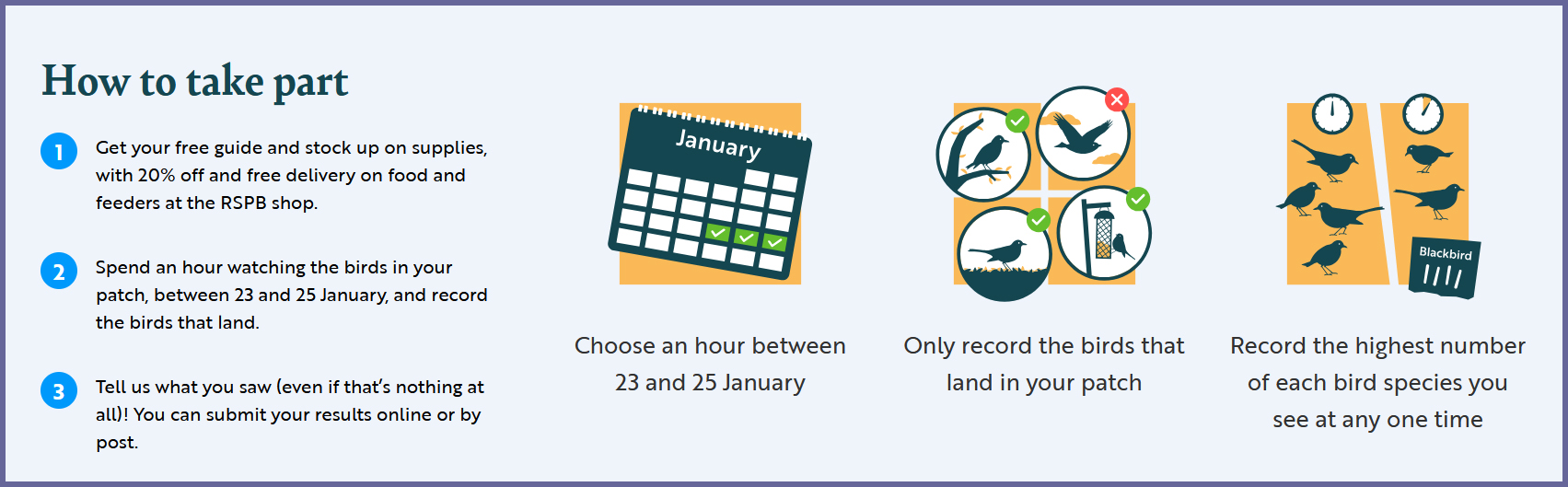
 I’ve always vaguely wondered why the survey is done in the winter, when we would all rather be tucked up indoors, but the answer makes a lot of sense:
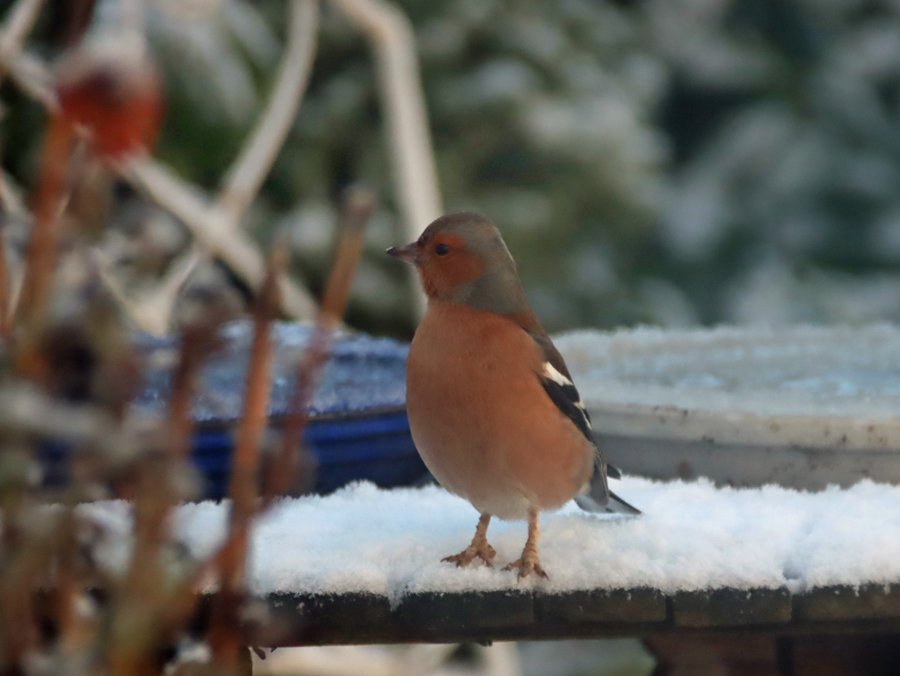 Most of the birds taking advantages of the bird feeders are small – blue tits, great tits, sparrows, the occasional dunnock, a few long-tailed tits, and quite a few very shy chaffinches. It is impressive how the sparrows and chaffinches are so at home on the bird feeders, not as gymnastic as the tits, but perfectly happy perching on the outer cage. Black birds and collared doves, and even some of the local community of jackdaws and the occasional magpie scavenge underneath the feeders because the small birds are all messy eaters and drop a lot.
 Unexpectedly, a couple of weeks ago I was in the kitchen making a coffee and looked out of the window to see a Great Spotted Woodpecker, at first hanging nearly upside down on one of the bird-feeders but making a really good job of arching its neck around to get at the mixed sunflower hearts, dried mealworms, suet pellets and peanuts, before it adjusted itself into a more convenient upright position. Gorgeous. It has been back several times since, always on the bird feeder furthest from the house. It answers the very puzzling question of why the bird feeder at the far end is always emptied much more quickly than the others, as the small birds don’t seem to mind where they feed. I could never have imagined a more efficient vacuuming operation. I’ve heard it in my neighbour’s garden throughout the summer, tapping away at a tree, but only had fleeting glimpses of it.
 Most of my birdfeeders are like the one in the above woodpecker photo, but I have had great success with some very ugly ones that stick to windows with suckers, particularly with the robins and sparrows. I take all the bird feeders down during the course of early spring, one at a time, so that my winter visitors return to fending for themselves, passing on their natural foraging skills to their young, so on the whole I don’t mind a bit of ugliness over the winter. The window feeders supply the birds that don’t do well on the hanging feeders, particularly robins and sparrows, but the tits and finches also enjoy them. A more surprising visitor is a single starling, which simply cannot get the knack of the hanging feeders. I have never seen starlings in the garden before. It is almost impossible to take a good photograph of anything in the window feeders, thanks to the suckers and the general mess that the birds somehow manage to make, but here’s my visitor, taking up all of the available space.






























 Based in Churton