In Part 1 I looked at the excavations carried out at Gop Cave in 1886-7, 1908-14, 1920-21 and 1956-57 and talked about the pre-glacial levels of Gop Cave, with its finds of woolly rhino, hyaena and wild horse, and the Mesolithic tools found outside the cave mouth.
In this second part, the cave is still the topic under discussion, with a shift in focus to the Neolithic layers, whilst the cairn on top of Gop Hill is tackled in part 3. During the Neolithic, the cave was used to deposit a number of burials, two thirds of which were contained within a walled-off section of the cave, and the rest within a narrow passage that linked two parts of the cave. These burials are the subject of this post. References used for all three parts are listed in part 1, together with visiting details.
Just to recap briefly on the details from part 1, the earliest excavations in the cave were carried out by Sir William Boyd Dawkins, a well known and respected early archaeologist who excavated the cave site over two seasons in 1887 and 1887, having originally been asked to assess the cairn on top of the hill. The lowest level was barren , but the next contained numerous bones of Pleistocene animals, many of them now extinct. The top two layers contained mainly Neolithic material including human skeletal remains.
In 1908 John H. Morris began digging at the cave, and was joined by T. Allen Glenn, who took systematic notes and made a plan of the newly uncovered sections of the cave. They opened up a passage missed by Boyd Dawkins, referred to as the northwest passage, which linked to a very small opening just to the east of the main cave entrance. During these excavations a further six partial skeletons were found, two of them children. The skeletal remains in both cases were associated with artefacts and animal bones.
Most of the bone collection collected by Boyd Dawkins, and stored in a pigeon house at Gop Farm, were disposed of in 1913 by the tenant of Gop Farm, who threw them down a local mine shaft – which is particularly sad as Glenn had just received permission to take charge of them. Most of the Morris and Glenn finds, both bones and objects, were sent to the National Museum of Wales. Some finds from Gop Cave are also retained by Manchester Museum and Aura Museum Services, and possibly by the Grosvenor Museum in Chester.
The Neolithic burials at Gop Cave
In total, at least 20 individuals were recorded in Gop Cave. The 14 found by Boyd Dawkins and the 6 found by Morris and Glenn may have been deposited at slightly different times, due to the different character of the deposition. Whereas the individuals discovered by Boyd-Dawkins seem to have been buried whole, Glenn is fairly confident that the ones discovered by himself and Morris in a different part of the cave were only partial when they were interred.
Boyd-Dawkins excavations showing the chamber (feature B) above layer 3 and abutting layer 4, which contained skeletal remains of humans with artefacts. Source: Boyd Dawkins 1901. See other cave plans in part 1.
Dawkins describes how he found a thick layer of charcoal over slabs of limestone at a depth of 4ft (c.1.2m) from the surface, which formed an old hearth. Blackened slabs were found throughout the area excavated, and there were also burnt and broken bones of domestic animals and fragments of pottery. “Intermingled with these were a large quantity of human bones of various ages, lying under slabs of limestone, which formed a continuous packing up to the roof. On removing these a rubble wall became visible, regularly built of courses of limestone.” These limestone blocks made up walls on three sides, with the cave wall itself making up the fourth wall, to form a chamber 4ft 6 by 5ft 4 (c.1.4m x 1.65m). Inside the chamber was what Dawkins describes as “a mass of human skeletons of various ages, more than fourteen in number, closely packed together, and obviously interred at successive times.” Individuals were deposited in a crouched position, “with arms and legs drawn together and folded.” His assessment was that the bodies were buried whole. When the chamber became full, another area of the cave was used as an overflow for new burials, identified on the section plan above as area A. Because layer 3 was found beneath the burial chamber, as well as beneath layer 4, Boyd Dawkins concluded that layer 3 had formed a habitation area prior to the burials, in a similar way to two other cave sites in north Wales.
Glenn’s plan of the 1912 excavations. Source: Davies 1949
When Morris and Glenn opened up another passage, and found another six individuals, Although the view was confused by rock fall and a very uneven floor, it was thought that limestone slabs may have been used to create a wall around some of the skeletons. Glenn describes the bones as fragmented and partial. Glenn ascribes this to the remains having been brought from somewhere else, rather than having been depleted due to roof fall damage of fragile bones, or the work of the “burrowing animals” that caused disruption in the stratification within the passage. He was methodical and a good observer, so presumably had good grounds for suggesting this, and it is certainly in keeping with other, more recent archaeological evidence for Neolithic burials where partial skeletons are found, apparently due to having died elsewhere and been moved to a particular site for burial. Another possibility is that the body had been excarnated, a practice involving the ceremonial placement of a body in the open air to allow it to be processed naturally so that it was defleshed and partially disarticulated before being collected for interment, which often resulted in the bigger longbones and crania being collected whilst finger and foot bones were left behind.
Having opened the cave out and discovered the second entrance, Morris and Glenn found that it was blocked with limestone slabs, apparently deliberately, although it is by no means certain when this was done. It is not unlike the blocking of entrances to Neolithic burial monuments towards the end of the Neolithic period.
The artefacts associated with the burials
Polished blade found by Boyd Dawkins in Gop Cave. Source: Dawkins 1901
The artefacts associated with both sets of skeletons are all Neolithic in date. Boyd Dawkins assigned them to the Bronze Age on the basis of the pottery, but this has since been re-dated. Both the Boyd Dawkins and the Morris and Glenn excavations produced stone tools, most of which are fairly generic but can be assigned to the Neolithic. One of the Boyd Dawkins discoveries was a long, curved blade, very carefully carved and polished to provide it with smooth surfaces, and showing no signs of usage. He also identified quart pebbles, which he refers to as “luck stones.” Another notable stone tool, this time found by Harris and Glenn in the part of the cave undiscovered by Boyd Dawkins, was a bifacially worked axe head made from Graig Lywyd stone from the well-known Neolithic stone mines at Penmaenmawr, which was apparently unused.
Objects found by Harris and Allen in Gob Cave, including the Graig Lwyd axe at top. Source: Davies 1949.
The pottery was Peterborough ware, and it has been determined that the Gop Cave type was the Mortlake variant of Peterborough ware, which dates to between about 3350 and 2850 BC. All were fragments, and were either grey or black or burnt red.
Pottery found in association with the skeletons by Boyd Dawkins, since identified as Mortlake Ware. Source: Boyd Dawkins 1901
Kimmeridge sliders. Source: Boyd Dawkins 1901
Two unusual items were referred to by Boyd Dawkins as “links,” which he thought were proably used to fasten clothing, and are referred to by some others as belt-sliders. He described them as being made of “jet or Kimmeridge coal,” or “Kimmeridge shale.” As these items are now lost, they cannot be tested (they were last known to be in Manchester Museum, but now cannot be found). He gives the measurements as 54mm L x 22m W and 16mm H; and 70mm L, 22mm W and 27mm H. Boyd Dawkins says that they showed no signs of any usage, and according to Alison Sheriden’s analysis of these object types, this is typical. They appear to have been kept for show rather than being attached to clothing or employed in some other everyday capacity, much like the curved blade and the Graig Lwyd axe head. As jet and Kimmeridge coal come from Yorkshire, and a third of all known sliders have been found in and around Yorkshire, they are certainly exotic goods in northeast Wales, and the rarity of the substance may have endowed it with a particular cachet. Jet has the very unusual property of being electrostatic, so that when it is rubbed it can make one’s hair stand on end! If it was jet, this would certainly have added to its novelty value. 29 of them were known when Sheriden was surveying them in 2012, of which only 6 were certainly of jet, one of which was found in Wales. 12 or 13 were from burial contexts and distribution showed “a marked tendency towards coastal and riverine finds” that are a reminder of the extensive networks that operated in the Neolithic.
Although the objects in the cave are few and far between, some were unused suggesting that they highly valued and retained for special occasions or as prestige items. It is unclear whether any artefacts were associated with any particular individuals, although Boyd-Dawkins describes the the jet sliders and the polished flint flake forming one group together.
Animal remains
Although he does not list numbers, Boyd Dawkins says that the remains of the domesticated species “were greatly in excess of those of the wild animals, and the most abundant were those of sheep.” He also comments that the horse listed under wild fauna may actually be domesticated, and that foxes were using the vicinity of the cave area at the time of the excavation. All bones were found in what he describes as “prehistoric refuse heaps and that nearly all were broken and burnt.
As all the bones were discarded in 1913, none of the identifications can be checked, but Boyd Dawkins was very experienced in the identification of animal remains, giving some confidence that his work reflected the reality of the situation. Sheep and goat are notoriously difficult to tell part, so the question-mark against goat is not surprising. That sheep are dominant is not a surprise, as the area around Gop would be ideal grazing for them. The valley bottom would have been well-suited for cattle and horse.
Dating the skeletons
Mandibles used in radiocarbon dating of Gop Cave skeletons. Source: Schulting 2020
Although the artefacts found in the cave, loosely associated with the skeletal remains, are indicators of a mid-Neolithic date, as described above, in 2020 Rick Schulting was able to pull together 23 samples from a number of caves for radiocarbon dating, including three samples from Gop Cave, comprising two mandibles and one cranium. Although some samples had been tested previously, an error in the sampling method had led to them being withdrawn in 2007. For Gop, the new dates lie firmly with the Middle-Late Neolithic range, tending towards the middle of the Neolithic (between c.3100 and 2900 BC).
This date range backs up the findings of the Mortlake variants of the Peterborough ware, the jet sliders and the Graig Lwyd axe.
The practice of non-monumental burials
The main form of burial recognized throughout most of the Neolithic Britain is the long barrow or cairn, or the round passage grave. In each case, there was usually an accumulation of burials over time, referred to as collective burials. These were not, however, the only forms of burial during the Neolithic. Although less often found, because of the lack of monumental marker, flat interment cemeteries are known, burials in the ditches of the so-called causewayed enclosures are often recorded and there is some, uncertain data that there may have been burials in rivers. During the later Neolithic, cremation became the norm.
Jawbone of skeleton from Gop Cave. Source: National Museum of Wales (47.97/104)
By far the most common non-monumental form of burial, however, is deposition within a cave. Cave burials of various dates are known from all over Britain. In his survey of cave burials in 2020, Rick Schulting noted examples from the Palaeolithic through to the Anglo-Saxon period. From the Neolithic in north Wales, contemporary with Gop Cave, nearby Nanty-Fuach rock shelter above Dyserth produced five burials, all contracted, and without grave goods. Outside the cave there were fragments of Neolithic pottery, a large barbed and tanged arrowhead and, nearby, some Peterborough ware. In the Alyn valley 16 burials were deposited within Perthi Cawarae, and 6 within Rhos Ddigre, the latter associated with a Graig Lwyd axe and pottery fragments, both in the Alyn valley. Other examples are known from Loggerheads and Mostyn with Neolithic flint implements. It is clear that Gop Cave is by no means an isolated example, although the precise arrangement of the skeletal remains within containing walls may be unusual. As many caves were excavated in the late 19th and early 20th centuries, when excavations lacked today’s precision, it is impossible to know what was missed by excavators. Finally, Schulting notes that there is a gap of “several millennia” between the last Mesolithic cave burial and the first Neolithic ones, indicating that there is no continuity of burial tradition in caves between the two periods.
Meaning in collective burial
Frances Lynch suggests that the use of caves for burial, occurring in many areas at different periods “seems to be a matter of convenience rather than cultural preference” but there are alternative views on the matter. In his book on the materiality of stone – Christopher Tilley does not discuss caves, but he references almost every other aspect of stone as a natural material that becomes objectified by human uses and actions. He comments that social identity requires “specific concrete material points of reference in the form of landscapes, places, artefacts and other persons.” Topographic and other natural features are often used by humans to anchor and fix memory and establish places of meaning in landscapes. Carole Crumley highlights the phenomenological experience of features like caves, mountains and springs, and their role in connecting the mental with the material to create both individual and social identity. In their chapter on the uses of landscape features like caves and springs by the Maya in Mesoamerica, James Brady and Wendy Ashmore describe how caves, eternally damp and dripping water, were connected with the sacred and the ritualization of water. By appropriating and modifying such natural features, people have embedded them with meaning to form bridges between the natural, supernatural and the manufactured, blurring the differences to confer special status on these dark places where the dead might be deposited safely.
Artist’s impression of what an excarnation platform might look like. By Jan Dunbar. Source: BBC
A number of authors have suggested that collective burial of humans, and in particular the mingling of bones rather than maintaining skeletons as delineated individuals, is an indication of the individual being subsumed into a collective identity, privileging the group identity over the authority or status of any one individual. Of course, these collective burials, whether in monument or cave, are representatives of much larger communities, and the criteria used for selecting one person for burial over another are lost. It is possible that in order to transform an individual into a representative of the community, a two-stage process was undertaken whereby an individual is excarnated or buried elsewhere, and then moved to a collective burial site, a transformative process during which the individual member of the community loses their individuality and becomes representative of a communal and ancestral link between the past and the present. With the addition of each new individual to the cemetery, another layer of communal meaning was added to the cave, reinforcing the message that the existing burials already encapsulated.
In the contrast between the brightness of the light-coloured limestone reflecting in the sun, and the darkness of the hidden, secret interior there is a resemblance between the relationship between the visually striking chambered tomb and the sepulchre within. Not forgetting, of course, that there is an enormous cairn on top of the hill, just 43m (141ft) away from the cave, which may in itself have been a marker rather than a grave. The cairn is discussed in part 3.
Final Comments
Neolithic stone implements found in and near Gop Cave. Source: Davies 1949, p.283
Gop Cave is often left out of accounts of the Neolithic in Wales, or merely mentioned in passing, which is surprising given both the number of its human occupants and the unusual combination of artefacts found within the cave. Cave burials are given secondary status to monumental constructions, but given the number of them in Wales, it is good to see that they are now being researched as valid contributors to the corpus of knowledge about the Neolithic both in Wales and the rest of Britain.
Graph from Jonathan Last showing the usage of caves at different periods in England (The Archaeology of English Caves and Rock-Shelters: A Strategy Document. Centre for Archaeology Report 2003)
Gop Hill in northeast Wales, a few miles southeast of Prestatyn, and just above the village of Trelawnyd (formerly Newmarket from 1710 to 1954) is home to Gop Cave and Gop Cairn, just a few minutes apart from one another. Gop Cairn has the distinction of being the largest man-made prehistoric mound in Wales, and when approached from a distance, its size really is impressive. Although the cairn was investigated in the 19th century, with a vertical shaft sunk from the top to the level of the floor, and a “drift” tunnelled outward from the base of the shaft, no burial chamber or human remains were found.
The south-facing limestone cave was also investigated, producing Pleistocene zoological remains, Mesolithic stone tools and Neolithic human burials and contemporary artefacts and the bones of both domesticated and wild animals. In 1868 Boyd Dawkins excavated pre-glacial animal species such as woolly rhino and steppe bison in the cave deposits, which provided significant data about local ecological conditions. Excavations by T. Allen Glenn in the early 1920s discovered Mesolithic remains on the platform outside the cave. Although this was a small assemblage, it is an important contributor of knowledge about the poorly understood North Wales Mesolithic. The Boyd Dawkins excavations also produced an unusual and very important Neolithic burial chamber. It was found in one of the upper layers, with walls made of layers of stone containing at least 14 burials. Pottery and stone tools found with them were sufficiently distinctive to provide a chronological range, placing the burials within the Neolithic period. Excavations conducted by John H. Morris and T.A. Glenn between 1908 and 1914 found another six burials in a previously undiscovered passageway, including two children as well as a Neolithic axe-head from the nearby Graig Lywyd axe factory and are considered to lie within the same date range as those found by Boyd Dawkins, taking the total count of individuals found up to 20. It did not take a great leap of imagination to speculate that the Neolithic date for the cave could suggest a similar date for the cairn, although this remains unverified.
Over three posts, the Gop Hill sites are described and the work carried out summarized. This post, Part 1, looks at the 19th century excavation of Gop Cave by Sir William Boyd Dawkins, a really rather remarkable early investigator of prehistoric habitats and fauna as well as archaeological remains. Visiting details are provided towards the end of Part 1, after which there is a list of references. Part 2 looks in detail at the Neolithic burial within the cave, and part 3 looks at the cairn.
Sir William Boyd Dawkins, excavating 1886-1887
When I was working in caves with archaeological deposits in the mid- to late-1980s, 100 years after William Boyd Dawkins was excavating at Gop Cave, he was a very well-known name, and a respected one. It is easy to be frustrated with the quality of the work carried out in those early investigations, some of which were far from systematic, and caves have some particular quirks of their own to contend with, but a few of these early investigators were impressive and Sir William Boyd Dawkins was one of them.
Born near Welshpool in 1837 Sir Wiliam Boyd Dawkins (1837-1929), developed a keen interest as a child in collecting fossils.His initial field of interest was primarily geology, natural history and palaeontology, all of which have in common with archaeology a focus on stratified sequences and the relative positioning of fossils, bones and objects within those sequences. Just as early archaeologists were interested in building up sequences of artefacts so that they could understand how human technology developed, early palaeontologists were interested in the developmental sequence of prehistoric animal and plant species. In 1860 he graduated in Natural Sciences and Classics from Oxford and in 1861 he was appointed to the Geological Survey of Great Britain. Fortunately, because Sir William found many archaeological remains during his investigations, he treated these more recent discoveries with equal interest and respect. His earliest archaeological excavations were at Wookey Hole in Somerset where he discovered some of the first evidence of Palaeolithic (Old Stone Age) occupation. These discoveries helped him to develop methodologies for excavating cave sites and to build up a good understanding of the type of environmental and human data that he was likely to encounter within particular geological and geomorphological contexts. He wrote a number of important articles about extinct sub-species of rhinoceros that had once inhabited Britain. He became the first President of the Lancashire and Cheshire Antiquarian Society and President of the Cambrian Archaeological Association. He excavated at a number of cave sites in north Wales, and his 1874 book “Cave Hunting: researches on the evidence of caves respecting the early inhabitants of Europe” became a classic.
The four phases of Gop Cave deposits
Figure 5 from Boyd Dawkins 1901, p.327 (the cavity marked as B was the Neolithic burial chamber)
When Boyd Dawkins first encountered Gop Cave, it was full to the brim with glacial, post-glacial and more recent debris and rock fall:
While the cairn was being explored my attention was attracted to a fox-earth at the base of a low scarp of limestone 141 feet to the south-west of the cairn. It occupied a position which I have almost invariably found to indicate the presence of a cavern used by foxes, badgers, and rabbits as a place for shelter. I therefore resolved to explore this, with the assistance of Mr. P. G. Pochin. The fox-earth led us into a cave completely blocked up at the entrance by earth and stones and large masses of limestone, which had fallen from the ledge of rock above. This accumulation of debris occupied a space 19 feet in width, and extended along the whole front of the cavern
Nothing loth, he set about clearing it in a top-down methodical way that would allow him to assess the chronological composition of the deposits. It was a remarkable achievement, given the incredibly limited head space and the absence of more than a thin envelope of natural light.
Figure 4 showing the excavations of the cave in horizontal plan, with the sections through the deposits both outside and within the cave. Feature B is the Neolithic burial chamber. Source: Boyd Dawkins 1901, p.325
Boyd Dawkins identified four distinct phases within the cave. These are shown in the table below and discussed beneath. The terms Pleistocene and Holocene used in the table below refer to consecutive periods in the geological timescale. The Pleistocene begins at around c.2.8 million years ago, covering the most recent period of repeated periods of major glaciation to 11,700 years ago, when the last glacier retreated and the planet entered its present inter-glacial phase, the Holocene. The Holocene levels at Gop Cave, which include the 14 burials (thought by Boyd Dawkins to be Bronze Age but now reassigned to the earlier Neolithic), will be discussed in Part 2. Below is a discussion of the Pleistocene levels.
Boyd Dawkins noted that the layers were not as they would have been originally deposited: “They appear to have been washed out of the original hyaena floors by the action of water, and to have been redeposited at a time later than the occupation of the cave by hyaenas.” The presence of stone of non-local origin also argues for different phases of water and glacial activity entering the cave, scouring the deposits and replacing them.
Boy Dawkins identified the Pleistocene fauna from the surviving bones and antlers found in the cave as follows.
Woolly rhino (now designated Coelodonta antiquitatis), cave hyaena (now referred to as Crocuta crocuta , and sometimes Crocuta crocuta spelaea) and Bison priscus (steppe bison) are now extinct. The steppe bison was the species painted in famous Upper Palaeolithic caves like Lascaux in France and Altamira in France. Although Boyd Dawkins identified horse as Equus caballus, if the identification of horse was correct, it would probably have been the wild ancestor of caballus, Equus ferus. Reindeer are no longer found wild in Britain. Of the species on his list, red deer and roe deer and horse are the only wild species that remain in Britain. Boyd Dawkins observed that some of the remains, and particularly the antlers of “the reindeer, bore the teeth marks of hyaenas, and had evidently belonged to animals which had fallen victims to those bone-eating carnivores.”
20th Century Excavations
Glenn’s fold-out plan of the 1912 excavations. Source: Davies 1949
Further excavations took place during the earlier part of the 20th Century, contributing more information.
Between 1908 and 1914 John H. Morris and T. Allen Glenn investigated the northwest passage of the cave system, sometimes. This was missed by Boyd Dawkins because it was hidden behind a blockage of clay and stalagmite. This passage produced an additional six skeletons, two of which were children. Glenn describes an excavation “carried out with extreme care and by modern methods” but says that due to burrowing animals there was no recognizable stratification byond determining Pleistocene and Neolithic levels. The floor was covered to a depth of between 18 inches and 2ft “with cave earth and pieces of limestone over a hard floor of clay mixed with stalactite fragments and limestone rubble” over bedrock. There is some indication that limestone slabs had been used to build low walls around some of these skeletons. Finds within the cave, at the new entrance and near the cave between 1911 and 1917 were collected by Morris. Neolithic human remains and artefacts were found, and will be discussed in Part 2. Animal remains found were horse, sheep/goat, ox, pig, wolf, fox, bear, lynx, badger, fowl, hare, rabbit, frog, watervole, mole, stoat and fieldmouse. The mixture of Pleistocene and Holocene species suggests that these were highly disturbed layers, probably due to the activity of burrowing animals mentioned by Allen.
The excavations linked the passage in which they were working to the second entrance, the very small opening for which is a little further along the ridge to the west, and shown on the plan at the top of this post. This is sometimes referred to as the North-West Cave, although it is part of the same cave system as the main Gop Cave.
Both cave entrances in the limestone ridge.
T. Allen Glenn returned to the site between 1920 and 1921, funded by the National Museum of Wales. He excavated the platform in front of the cave, which was largely untouched by Boyd Dawkins and found more human and animal remains, as well as Mesolithic stone tools, described below. Glenn wrote up both his own and Morris’s excavations in one 1935 report.
In 1956 William H. Stead excavated at the site and amongst other animal remains found a lion tibia. The reports are in the Proceedings of the Prehistoric Society, nos 23 (1957), 28 (1958) and 29 (1960). Although I have listed them in the bibliography, I don’t have access online via the University of Chester, and the library does not have these volumes on the shelves, so I have been unable to read up on the findings. If I get hold of them (please give me a yell if you have access to them!), I’ll update this section.
Dating the animal remains in the Pleistocene cave
Gop Cairn with the cave entrance visible on the limestone ridge just below.
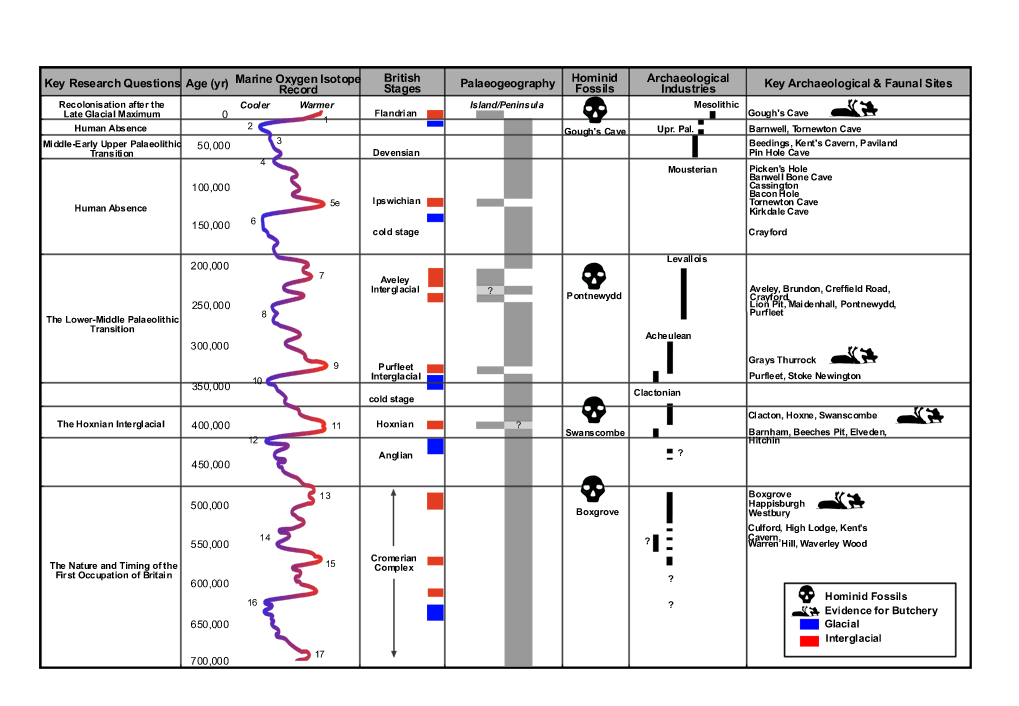
There were only certain periods when Britain was actually habitable. One reason is that harsh climatic conditions during glacial periods forced most life to leave all but the most southern areas. For example, between c.160,00 and 80, 000 years ago the environment was too hostile for human occupation and for most animals. Another reason is that, after 130,000 years ago the permanent chalk land-bridge between Britain and Europe was destroyed, and after this time Britain and Europe were only connected during glacial periods when the water level dropped sufficiently for land-bridges to be revealed, which enabled animal and human migratory movement. Modern research into the climatic and environmental past has helped to clarify when land bridges between Europe and Britain enabled animals and humans to wander freely. With the final retreat of the ice sheets at around 10,000 BC the land bridges were permanently submerged. De Groote et al explain this very clearly:
Generalised reconstruction of the land surface and the extent of ice sheets of the British Isles. Source: De Groote et al 2017, fig.1 p.3
From the early Pleistocene, Britain was connected to main-land Europe by a land-bridge that enabled humans and fauna to migrate in and out (Fig. 1A). Until about 130,000 years ago, this narrow chalk isthmus, separating the north (North Sea) and southwest (English Channel) marine embayments, kept Britain connected to varying extents even when sea-levels were high during the warm interglacial periods; the eventual complete breaching of this chalk barrier was crucial in forming the island and the Dover Strait. During glacial periods, much of the earth’s water would have been trapped in the ice caps and when, during the later Pleistocene, the bed of the North Sea was exposed, a large land area known as Doggerland, created by geological uplift and sedimentation from rivers, also provided a route into the British Isles and fauna, including hominins, would have entered this way. The flooding of the shallow shelf areas of the English Channel and the North Sea are the consequence of the current high interglacial sea levels.
Even without modern scientific dating methods, reliable time-ranges can be assigned to animal bone assemblages on the basis of which species were found together in a certain place during a certain period. Boyd Dawkins had already assembled a considerable amount of data on the subject, some of which was published in his earlier work Early Man in Britain published in 1880.
AHOB time chart showing periods of human absence and occupation. Click to enlarge or see original on the AHOB website
Improvements in palaeo-zoology have helped to clarify which species were present during which periods. Some animals that are now either completely extinct or permanently migrated out of Britain provide a latest possible date for their presence. Studies of prehistoric assemblages of fauna have also helped to fix date ranges for the presence of certain species, assigning them to marine isotope stages (also known as oxygen isotope stages). Marine isotope stages measure oxygen isotopes in sea water that is absorbed into the skeletons of tiny single-celled organisms called foraminifera, which are preserved in sediments on the sea floor. The oxygen isotopes contain information about the volume of ice present globally, and therefore provide a record of alternating glacial and interglacial periods. The faunal assemblage corresponds well to MIS 3, which falls into the Middle Palaeolithic archaeological period. Woolly rhino, for example, had left Britain by around 30,000 years ago. The entire assemblage probably puts Gop Cave in Marine isotope stage 3 (MIS 3). MIS 3 lasts from between 60,000 and 25,000 years ago. The conditions were ideal for woolly rhinoceros, horse, bison, hyaena, and reindeer, which inhabited temperate but cold semi-arid steppe-like conditions with often hot summers and very cold winters. Steppes are characterized by wide open treeless grasslands, with small shrubs, ideal for grazing species, and for carnivores preying on the grass-loving herbivores.
Even though the idea of woolly rhino, bison and hyaena roaming the hills of north Wales, all of them now extinct, may seem distinctly exotic, these time ranges are not particularly early for Britain. Not far away, near St Asaph, the cave site of Pontnewydd produced stone tools and human remains in association with animal species for which sound scientific dates were obtained during modern excavations. The human remains found in association with stone tools belonged to the branch of hominin known as Neanderthal (Homo neanderthalensis, named for the type site in the Neander Valley in Germany) and the dates cluster around 225,000 years ago. If correct, the Gop Cave date ranges are relatively recent by comparison.
Although MIS 3 corresponds to periods of human occupation in Britain during the Middle Palaeolithic there was no human habitation identified within the Pleistocene levels of the cave. Boyd Dawkins was experienced at identifying human artefacts and would almost certainly have recognized them had any been there to be found. a number of brief occupations of the country, Britain would have been occupied intermittently during this time, depending on the environmental conditions, and probably only by small groups. The most probably candidate for any humans dodging lions and woolly rhinos and competing with hyaenas for dining on deer, may have been Homo Neanderthalensis (Neanderthals). The oldest Neanderthal find in Britain was from Swanscombe in Kent, where a skull dates to c.400,000 years ago, a warm interglacial period. Neanderthals left and re-entered Britain numerous times, their movements determined by glacial and interglacial conditions, until around 40,000 years ago when the Neanderthals became extinct.
The Mesolithic
Microliths from Gop Cave, excavated by Glenn in 1920-21. Source: Wainwright 1961
The Mesolithic, corresponding to the geological Holocene, represents settlement during the earliest post-glacial period. Although the site was small, the Gop artefacts are very typical of Mesolithic finds in the area. The stone tools found included 6 microliths (tiny stone tools usually 3cm or less long), a scraper, two other tools of undetermined types, possibly waste flakes, and twenty three microlith and blade cores. A core is the original piece of stone after it has been worked. When microliths, flakes and blades have been struck from it it is discarded, but still bears the marks of the tools that were removed from it. Of the microliths, Geoffrey Wainwright describes two were obliquely blunted, two lanceolate, and four scalene triangles. There was also one broad point retouched on both sides and a section of a bone pin.
Distribution of Mesolithic sites in Wales. Source: Heneb Dyfed
The earliest known Mesolithic site in Wales dates to c.8600 BC (some 10,500 years ago) at The Nab Head in southwest Wales (no.5 on the map to the right). In 2021 a 9000 year old site was found on Castle Hill, off Hylas Lane in Rhuddlan, where over 13,000 stone tools and five decorated stone pebbles were found. Another well known site is at Trwyn Du on Anglesey where a Mesolithic occupation dates to between 8,000- 9,000 years ago, and was preserved beneath Bronze Age burial mound excavated when it was threatened by coastal erosion in 1974 (no.9 on the map).
With the withdrawal of the ice sheets, vegetation re-established itself, and whilst the land-bridge remained in tact, animals once again drifted across the land, with humans in their wake. Once the ice had fully retreated, the land-bridge was submerged and Britain and Ireland became separated both from the continent and from each other. The island was soon occupied by many small groups exploiting inland and coastal resources, hunting, collecting plant resources, fishing and collecting shellfish.
Decorated stone pebble from the Mesolithic deposits at Rhuddlan. Source: Dyfed Archaeology
Warmer and wetter than today, with a deciduous woodland landscape, the environment favoured different wild animal populations from the pre-glacial period, which required different hunting techniques. Particularly characteristic of the Mesolithic toolkit was the microlith, a catch-all term for a large number of varieties of tiny stone artefact that could have been hafted into wood, bone or antler to make arrows, spears, harpoons and scythes. Many Mesolithic communities were located on or near the the seashore. The seashore was a movable feast at this time as a) the ice continued to melt, raising sea levels, and b) land, which had been compressed under the pressure of the ice, began to rise. The exploitation of marine resources included both fish and shellfish. It was these settlers who, stranded on an island when the land-bridge was lost, were sufficiently stable and persistent to contribute to modern DNA.
Although permanent amelioration of the climate provided the ability to develop new patterns of living eventually lead to the expansion of populations and the modification of landscape, sites are difficult to locate, some were submerged during rising sea levels, and many are often highly disturbed, meaning that the period is still poorly understood. Each new site therefore contributes important data to the overall picture, and Gop Cave contributes information about where such sites were to be found in north Wales and what sort of activities were pursued.
The location of the finds today
Neolithic stone implements found in and near Gop Cave. Source: Davies 1949, p.283
Davies, writing in 1949, says that most of the animal and human bones from the Dawkins excavations were stored at the pigeon house belonging to Gop Farm, but that some of these were sold in around 1912 to an archaeologist in Wrexham. Davies himself saw “great quantities of bone” in the pigeon house in 1913 but in the same year, although T. Allen Glenn, who had excavated at the cave, had received permission from the estate manager to remove the archaeological remains, the tenant threw all of it “down an open mine-shaft nearby.” He goes on: “In a letter dated, ‘The Manchester museum, The University, Nov.19, 1937,’ the keeper, Mr. R.U. Sayce, M.A., supplied the information that there were in the museum several of the remains from the cave; they included animal bones, human skulls, and limb bones; also some sherds of Neolithic ‘B’ pottery. The long flint implement and the Kimmeridge clay links have not been traced.” The pottery, the flint implement and the Kimmeridge objects relate to the cairn and will be discussed in part 2. Davies also says that the finds from the objects retained by Morris at his home in Rhyl (where Davies was able to inspect them) were bequeathed to the National Museum of Wales. Those from the subsequent Glenn excavations in 1920-21 were also deposited in the National Museum of Wales, who had funded Glenn’s work.
Although there were no human remains in the Pleistocene levels of Gop Cave, the faunal remains provide a fascinating insight of their own into the environmental conditions of north Wales, suggesting that a steppe environment prevailed, possibly at some stage between 60,000 and 30,000 years ago. Understanding of the palaeozoology, palaeoecoloy and archaeology of the Pleistocene are all dependent on the work of palaeanthropologists, geologists, geomorphologists and climatologists, and many other specialists, all contributing very specialized research about how and when animals and humans would have been able to migrate to and from what is today an island.
The Mesolithic remains are the earliest evidence of human settlement in the immediate vicinity of the cave. Although they represent a small group of people probably passing through, with no signs of seasonal returns to the site, this helps to contribute to the fragmentary picture of what was happening in Wales in the post-glacial period. Both tools and tool cores were found, suggesting that tools were manufactured during the short stay at the site.
Visiting Details
When packing your rucksack or stuffing your pockets, do be sure to take a torch with a good, strong beam, and wear some solid footwear that will cope both with slippery mud and some very irregular stones and sharp rocks underfoot in the cave itself. Caves are nearly always dripping with water, so unless it has been a very dry period, you may want to have a waterproof ready to drag on. You cannot stand upright in the entrance of the cave, so you enter bent over, but it does open out so that you can explore some of the cave upright. It is a good idea to get a sense of the internal plan before you go, because the dark is very disorientating and it is quite difficult to make out what is where.
The village of Trelawnyd showing the locations of the car park (red rectangle), and the small lane that leads to the footpath (red arrow). Click to expand. Courtesy Apple Maps.
Gop Cave is a short walk from the village of Trelawnyd on the A5151 (itself a short drive from junction 31 on the A55). It is a two-for-one scenario, as immediately above Gop Cave and only a minute or two away, and visible for miles around, is Gop Cairn. I forgot to to take a What3Words reading for the cave, but the cairn is at ///searcher.sprint.wins, Both are on public footpaths and are free of charge to access. There is a car park on the little High Street in Trelawnyd, just off the A5151, or there is a limited amount of on-street parking a bit closer to the start of the small lane that leads to the footpath on the hillside, just up the slope from the car park. The footpath is clearly marked, as shown in the photograph below.
The first part of the footpath is a small lane that takes you past a couple of houses, until it reaches a narrow path that makes its way along the side of a tall garden fence to your right. This turns abruptly right and slightly uphill, leading to a low stone-built stile which takes you on to the hillside. I was with Helen Anderson (well-known on Twitter as @Helenus_) and we were busy nattering and wild-flower spotting (complete with wild orchids) so weren’t paying too much attention to the pathway markers, but they are there if you keep an eye open.
We followed the well-worn track, which leads at this time of year, late April / early May, through bright yellow gorse until it opens onto higher ground, which is completely open, with stunning views over the surrounding valley to Iron Age hillforts on the Clwydian range and to the sea to the west. You need to turn left beneath a shallow pale grey limestone ridge to reach the main cave entrance. A very tiny secondary entrance is a little further along. Retrace your steps to go up to the cairn, through a gate in a drystone wall. For anyone wanting to stop for a breather, there’s a bench near the gate, somewhat bizarrely looking like an escapee from a Victorian arcade or promenade.
Moel Hiraddug
Although the walk is slightly steep for a short section, it is a mellow walk, and far from strenuous and there are some great views across the valley. It took perhaps 10 minutes from the road to the cave, 15 minutes maximum, and another five minutes or so from the cave to the cairn. The cave itself requires you to duck down and be very careful both to watch your footing on a very uneven and rocky surface, and to mind your head. Best to leave your rucksack outside after liberating your torch.
If you are interested in the Iron Age heritage of the Clwydian Range, Moel Hiraddug is beautifully clear to the southwest, and other hillforts of the Clwydian Range, fading into the distance when we were there, are easily visible on a clear day,
The wildflowers were an added bonus, with a classical karst mix of tiny hardy species clinging to the almost non-existent topsoil above the limestone bedrock, including some really pretty succulents and lichens. The Early Purple Orchids (Orchis mascula) were a particular bonus, and apparently fairly common in early spring in the general area. As well as the miniature slipper-orchid shaped flowers clustering at the top of the stems, their long pointed green leaves often have dark aubergine-coloured spots along them. Read more about them on the Woodland Trust website.
Having visited, there’s the option of a very good lunch at The Crown Inn in Trelawnyd, which was filling up rapidly during our visit. After lunch we went on to see the gorgeous Dyserth waterfall only a few miles away, which is very close to the road (a 50p honesty fee was required for access), and then went on to visit the small but fascinating Prestatyn Roman bath-house, which was again nearby. I have posted about the bath-house here.
If you want to incorporate Gop Hill into a much longer walk (4-7 hours over 5miles / 10.5 kilometers) the Clwyd and Powys Archaeologial Trust has published what looks like an excellent one: https://www.cpat.org.uk/walks/gopcairn.pdf
Sources for parts 1 – 3
Books and Papers
N.B. The reports by Stead and Bridgewood in theProceedings of the Prehistoric Society are highlighted in green because although they are the record of the 1950s excavations, I have been unable to get access to them so I have not actually used them in this post. I have included them for the sake of completeness. If you do have access to them and don’t mind scanning them, I’d be really grateful so that I can add them to the post!
Barton, Nicholas 1997. Stone Age Britain. English Heritage / B.T, Batsford.
Brady, James E. and Wendy Ashmore 1999. Mountains, Caves and Water: Ideational Landscapes of the Ancient Maya. In (eds.) Wendy Ashmore and A. Bernard Knapp. Archaeologies of Landscape. Contemporary Perspectives. Blackwell Publishers.,. p.124-145
Britnell, William J. 1991. The Neolithic. In (eds.) John Manley, Stephen Grenter and Fiona Gale. The Archaeology of Clwyd, 9.55-64
Brown, Ian. 2004. Discovering a Welsh Landscape. Archaeology in the Clwydian Range. Windgather Press
Burrow, Steve. 2011. Shadowland. Wales 3000-1500BC. Oxbow / National Museum of Wales
Crumley, Carole, L. 1999. Sacred Landscapes: Constructed and Conceptualized. In (eds.) Wendy Ashmore and A. Bernard Knapp. Archaeologies of Landscape. Contemporary Perspectives. Blackwell Publishers., p.269-276
Davies, Ellis. 1925. Hut circles and ossiferous cave on Gop Farm, Gwaunysgor, Flintshire. Archaeologia Cambrensis, 7th series, vol.5, p.436-438
Davies, Ellis 1949. The Prehistoric and Roman Remains of Flintshire with a Short Appendix to “The Prehistoric and Roman Remains of Denbighshire” (1929). Cardiff
Lynch, Frances 2000. The Earlier Neolithic. In (eds) Frances Lynch and Stephen Aldhous-Green. Prehistoric Wales, Sutton Publishing, p.42-78
Marsolier-Kergoat M-C, Palacio P, Berthonaud V, Maksud F, Stafford T, Bégouën R, et al. 2015. Hunting the Extinct Steppe Bison (Bison priscus) Mitochondrial Genome in the Trois-Frères Paleolithic Painted Cave. PLoS ONE 10(6) https://journals.plos.org/plosone/article?id=10.1371%2Fjournal.pone.0128267
Parker-Person, Mike 1999, 2000. The Archaeology of Death and Burial. Texas A&M University Press
Ray, Keith and Julian Thomas. 2018. Neolithic Britain. The Transformation of Social Worlds. Oxford University Press
Schulting, Rick J. 2007. Non-monumental burial in Britain: a (largely) cavernous view. In L. Larsson,
F. Lüth and T. Terberger (eds), Non-megalithic Practices in the Baltic: New methods and
research into the development of Stone Age society, 581–603. Bericht der Römisch-
Germanischen Kommission 88, Schwerin
Schulting, Rick J 2020. Claddedigaethau mewn ogofâu: Mesolithic to Romano-British human remains (mainly) from the caves of Wales. Proceedings of the University of Bristol Spelaeological Society, 28 (2), p.185-219
Shanks, Michael and Christopher Tilley 1982. Ideology, symbolic power and ritual communication: a reinterpretation of Neolithic mortuary practices. In (ed.) Ian Hodder, Symbolic and Structural Archaeology. Cambridge University Press, p.129-50
Sheriden, Alison 2012. The jet belt slider, Movers Lane. In E. Stafford, D. Goodburn and M. Bates, Landscape and Prehistory of the East London Wetlands. Investigations Along the A13 DBFO Roadscheme, Tower Hamlets, Newham and Barking and Dagenham, 2000–2003, 192–202. Oxford: Oxford Archaeology (Monograph 17)
Sheriden, J.A. and Davis, M. 1998. The Welsh Jest Set in Prehistory: A case of keeping up with the Joneses? In (eds.) Gibson, Alex and Derek Simpson. Prehistoric Ritual and Religion. Sutton Publishing, p.148-162.
Stead, W.H., and Bridgewood, R., 1957. Gop Cave, Newmarket and Nant-y-fuach, Dyserth, Flintshire, Proceedings of the Prehistoric Society, 23, p.228
Stead, W.H., and Bridgewood, R., 1958. Gop Cave, Newmarket and Nant-y-fuach, Dyserth, Flintshire, Proceedings of the Prehistoric Society, 24, p.219
Stead, W.H., and Bridgewood, R., 1959. Gop Cave, Newmarket and Nant-y-fuach, Dyserth, Flintshire, Proceedings of the Prehistoric Society, 25, p.280
Tilley, Christopher 2004. The Materiality of Stone: Explorations in Landscape Phenomenology: 1. Berg
Westbury, Michael V. et al. 2020. Hyena paleogenomes reveal a complex evolutionary history of cross-continental gene flow between spotted and cave hyena. Science. Vol.6, No.11. https://www.science.org/doi/10.1126/sciadv.aay0456
White, Mark J. and Paul B. Pettitt 2011. The British Late Middle Palaeolithic: An Interpretative Synthesis of Neanderthal Occupation at the Northwest Edge of the Pleistocene World. Journal of World Prehistory 24, p.25-97
Wymer, John. (ed.) 1977. Gazetteer of Mesolithic Sites in England and Wales. CBA Research Report no.20. GeoAbstracts and The Council for British Archaeology.
A Maritime Archaeological Research Agenda for England
The Mesolithic. By Martin Bell and Graeme Warren with Hannah Cobb, Simon Fitch, Antony J Long, Garry Momber, Rick J Schulting, Penny Spikins, and Fraser Sturt https://researchframeworks.org/maritime/the-mesolithic/
The Roman bath-house at Prestatyn, discovered in the 1930s, is located in a rather nice little housing estate on the edge of Prestatyn, which hems it in but does not overshadow it. Today the site is pleasantly presented in its own space, accessed via a gate. There are two information posters, and a raised area from which one can look down into the site before walking in and on it. There has been a lot of work carried out to stabilize and preserve it with concrete and mortar, so it is a distinct mix of old and new, but the essential layout has been preserved. On the day that we were there, a blue tarpaulin was lying over a small part of the walkway around the site, presumably either due to unsecured damage or to protect repairs.
Roman sites in Clwyd. Source: Blockley 1989, fig.5 p.9. Click image to enlarge
Excavations in the 1930s (Professor Robert Newstead), the 1970s and again in the 1980s (Kevin Blockley for CPAT) revealed an Iron Age farmstead (to be described on a future post) and a Roman and Romano-British (indigenous) settlement dating from the late 1st century AD, some time soon after AD 70. The combined excavations revealed a Roman complex of structures over a number of periods. The main period of Roman and Romano-British activity, spanned two periods, defined by Blockley as IIA and IIB. This included eleven timber buildings, seven in Phase IIA and four in IIB, a water well, and three stone-built buildings, including the bath-house with its furnace and its water management system. The bath-house itself was built in around AD 120, quite late into the history of the site, and was extended in AD 150. The entire group of buildings appears to have gone out of use towards the end of the 2nd century. Originally it was thought that the bath-house and other buildings may have been outliers of a fort. There is no known fort in north-east Wales in spite of the existence of other Roman sites and three Roman roads, and it was hoped that this might fill a gap in the data.
The Bath House
Detail from one of the information boards at the site showing the various components on the ground
Today all that remains visible of this complex of buildings is the bath-house. When it was found, much of the bath house and surrounding area were covered with c.60cm (2ft) of rubble, described by Newstead as: “tumbled masonry, broken roof tiles, bricks and quantities of tile-cement flooring etc” a well as box tiles and ridge tiles.
The foundations of the bath-house preserve the main features of a very small but classic Roman bath house, the plan of which is clearly visible on the ground. It measures c.11.7m x 4.5m (c.38 x c.15ft). What you can see today was the under-floor part of the bath-house. Over the top of most of these features, except for the D-shaped plunge pool, would have been a tiled floor. The bath-house was built in two phases.
The bath-house in AD 120
Antefixes from the Roman bath house at Prestatyn. Source: Newstead 1937 (National Library of Wales)
The walls of the building consisted of three courses of ashlar (dressed stone, to present an attractive appearance) filled with rubble and mortar to create the thick walls visible today. The rubble within the outer walls was locally sourced, probably picked out of glacial soils near the site. Of the exterior ashlar, Newstead found purple micaceous sandstone blocks in situ along the base of the northern wall of the bath house, the nearest source of which was around 6 miles away (and can be seen in use today at Rhuddlan Castle and St Asaph’s Cathedral). Broken roof tiles were also used in the construction. Inner walls might have been plastered and could have been decorated. The roof was tiled, and provided with decorative triangular antefixes showed LEG XX V V legend as well as the legion’s wild boar emblem, which like the tiles were provided with stamps identifying them as work of the 20th Legion. The 20th Legion’s tile-works at Holt near Chester clearly provided the tiles and bricks required or the bath-house in AD 120, and it is possible that they assisted with the construction works, but there is no sign that this was a legionary base, or that the 20th Legion controlled whatever activities took place at the site. Apart from the tiles and bricks, all of the stone used at the site was sourced within a few miles of the site.
Information board in the Grosvenor Museum, Chester, showing how antefixes were used
The first phase of the bath-house with the hot room and warm room in Period IIA. Source: Blockley 1989
The plan to the left excludes the later cold room (frigidarium) with the D-Shaped plunge bath, showing the stone-built components of the bath-house in AD 120, when the bath house was built. There is no sign of a stone-built cold room, which was was either missing, which would be very unusual, or was built of wood. The two rectangular rooms, both of which sat over two hypocausts were both built in this first phase. Hypocausts are artificial floors set on small pillars made of bricks and tiles (pilae) into which hot air, supplied by a furnace, is channelled.
In the tepidarium, Room B, Newstead found only two of the short hypocaust pillar bases, each bearing the stamp of the 20th Legion. An internal doorway gave access to the Room C, the hot room or calidarium which was nearest to the furnace, where the remains of another fourteen pillars (pilae) survived. The pillars were made of a c.28 x 28cm (11 x 11 inches) brick stamped with the 20th Legion’s name: LEG XX V V (an abbreviation of Legio XXValeria Victrix: 20th Legion, Valiant and Victorious). These were placed face down into the floor. These was then topped with tiles c.19 by 19cm (7.5 x 7.5 inches) set into clay, none of which were stamped. The hypocaust bricks and tiles were sourced from the specialist tile and brickworks at Holt on the Dee just south of Chester.
Tile bearing legionary stamp from Prestatyn. Source: Newstead 1937 (National Library of Wales)
Illustration of a 20th Legion stamp on one of the bath house tiles. Source: Roman Inscriptions of Britain (RIB-2463_29_xiv)
Praefurnium leading into the calidarium and the tepidarium beyond.
The technical challenge for the builders came in the heating process, which required a furnace to provide the required heat to the two rooms. The remains of the furnace were found by Newstead, built into the centre of west end of the building and projecting 1.4m (4ft 6inches) beyond it, providing heat via a channel known as a praefurnium. Its floor was originally flagged with large blocks of purple sandstone. You can still stand in the praefurnium, shown left, to look into the hot room (caldarium, room C) and the warm room (tepidarium, room B) room beyond. Ducts or flues conveyed heat from Room C to Room B.
Like feeding a steam engine, this furnace would have required a considerable amount of fuel to keep the heat supplied, and this would have required manpower both to collect the right sort of wood and to feed it into the furnace. There would have been storage nearby to dry and store wood.
The video below is a 3-D animation of how the hypocaust at Brading Villa on the Isle of Wight functioned, which gives a good idea how the smaller example at Prestatyn worked too:
Also see the excellent video at the end of the past where the Roman hypocaust at the bath house at Bath are described.
Beyond the bath-house, to its east, was a stone-lined well, and a drain that was also partially stone-lined. The well was 1.6m deep and 1.1m sq at its base, flaring to 2.5m wide at its top. It was probably used to supply the bath-house and the two nearby buildings R4 and R5, both of which were copper-alloy workshops dating to IIA.
AD 150 – the extension of the bath-house
The cold room (left) and D-shaped plunge room, right.
The Bath house as it was found when Newstead excavated it. Rooms B and C were included in the original building of AD 120; Room A, the D-shaped plunge-pool, and the masonry drain under the cold-room floor and a drain out of the plunge-pool were added in AD 150. Source: Newstead 1937 (National Library of Wales)
As already mentioned above, there is no sign that a cold room was included in the first phase of the bath house. It may have been built in timber, now lost, or it may not have been built at all. Perhaps given the climate, a rectangular cold room and accompanying apse-shaped cold plunge pool, Room A, were not considered necessary, although this is not true for other bath-houses in Britain. The stone-built cold room was only built 30 years after the original construction of the bath house, measuring 32m by 4m (104 x 13ft). A new entrance was presumably provided in the cold room, with an internal doorway into the warm room.
Plan and hypothetical elevations of bath-house water supply. Source: Blockley 1989, fig.28 p.51. Click image to enlarge.
The accompanying D-shaped plunge pool was lined with a 12cm (c.4.5ins) thick layer of opus signinum (a type of waterproof pink mortar) on a base of limestone and mudstone fragments set in to clay. It was around 1.4m (4.5ft) deep. Blockley describes the water supply to this plunge-pool as the “most completely recovered layout known in Britain,” which included a stone and timber drainage channel, an aqueduct fed by a natural spring, and possibly water tanks.
The diagonal drainage channel crosses the cold room, originally under the floor of the cold room. Blockley believes that this was probably connected to an internal basin. A second drain leads from the apex of the D-shape as shown on the diagram above, the first 1.6m (c.5ft) within the bath-house had a floor of 40cm sq (c.15.5cm) bricks and was lined with limestone. South of the masonry section it was made of wood, and extended for 14m (c.46ft). The wooden uprights survive along one section, probably used to hold planks in place along the sides of the drain, which was 25cm deep and 70cm wide with stakes at c.20cm (c.8ins) intervals.
The line of the aqueduct, found in the 1980s excavations, was indicated by a row of parallel postholes. It ran from the east of the bath-house into the plunge-room, running over the top of the external drain. Nine of the postholes had timbers of alder-wood in situ, up to 65cm long and 35cm (c.13.5ins) diameter. The distances between timbers varies along the route, between 1m (c.3ft) and 1.5m (c.5ft). A water tank may have been sited part way along. It is thought that a spring further up the slope would have taken the aqueduct over a gradient of some 3m.
Using the Roman bath-house
A section of one of the information boards at the site showing the hot room, far left next to the furnace, the warm room in the middle and the later cold room and plunge pool. Click to expand and see the text clearly.
Had you been lucky enough to be a Roman official with access to a local bath house, bathing followed a sequence of steps that was imported from the core of the Roman Empire. Movement was through a sequence of warming and cooling experiences.
Roman bathing followed a specific process. Bathers would get changed, and in bigger bath-houses there was a room put aside for this. They would then progress from the unheated cold room (frigidarium) to the warm room (tepidarium) to acclimatize and then to the hot room (caldarium) before heading back to the cold room to cool down and take a cold dip in the plunge-pool. All well and good in southern Italy during a balmy Mediterranean summer, and perhaps even in a good Welsh summer, but that cold pool really didn’t look that appealing to me on a chilly day in April! A bathhouse was often accompanied by an outside, walled exercise area, but there is no indication that the Prestatyn bathhouse offered such a facility.
The Melyd Avenue complex of buildings
1930s survey of the masonry buildings at the site, showing the stone buildings including the bath house (B3 near the bottom of the image) and the trial cuts cut across the site. Source: Newstead 1937 (National Library of Wales)
The bath house was part of a bigger complex of buildings, only some of which have survived. The site was discovered and informally investigated in 1933 by Mr F. Gilbert Smith, who noted objects and carried out surveys. It was thought that it might have been a component of a Roman fort. It was excavated between 1934 and 1937 by Professor Robert Newstead, who found both the bath house (his Building 3) and two other stone-built buildings (Buildings 1 and 2). He also investigated a section of “paved causeway” found by Smith, and made 9 “cuts” (investigative trenches) at other parts of the site. The bath house has been described above. Building 1 consisted of three rooms in a line, with what had once had a tiled floor at one end, and measured c.19 x c.7m (62ft 6ins by 23ft). It produced a coin of Vespasian dating to c. AD 71, as well as pieces of a Samian ware platter also dating to the late 1st century. Samian ware (terra Sigillata) is a bright, glossy red high-status pottery often highly decorated in relief, which is often stamped with the manufacturer’s mark, and is very useful for dating (see image further down the page, and the excellent video at the end of the post by Guy de la Bédoyère). Building 2 was less clearly defined and far less informative, at least c.11m long (36ft), producing a single undated piece of amphora, and had been damaged by fire.
Samian pottery found at the Prestatyn site. Source: Newstead 1938
The cut through the section of “paved causeway” identified by Smith and shown on the above plan revealed that it was made of flat sandstone slabs over large pine logs on top of “a mess of brushwood in a peaty matrix.” Within these layers there were Roman potsherds and pieces of window glass as well as animal bones. The other cuts revealed no features but the one in front of building 3 produced a piece of millefiori glass, 7 pieces of window glass, some fragments of a glass flask and a small black counter as well as some samian ware. In 1938 further excavations produced no more buildings, and consisted mainly of taking sample cuts through the site, and these produced Roman levels that contained fragments of Roman objects. All of the data from the site over the years of excavation placed it within the later 1st to the later 2nd centuries AD. As well as tiles and antefixes stamped with 20th Legion stamps, diagnostic finds included a Vespasian coin, some distinctive pieces of samian, other dateable types of pottery and fragments of decorative and glass as well as some fittings for horses and some jewellery.
The 1972-73 rescue excavations followed another building development in nearby Prestatyn Meadows, during which Roman materials were found, including a column base and tiles stamped with LEG XX VV. Excavations could not take place at the precise location of the discovery due to building regulations, and were therefore carried out a little to the south, with three trial trenches opened to sample the area. No structural remains were found, but there were plenty of objects dating to the late 1st and 2nd centuries AD, consisting of building fragments and domestic rubbish including samian, coarse ware, window glass, flint, animal bones and coal.
Period plans showing the location of major features. Source: Blockley 1989, fig.6 p.12
The 1984-5 excavations, undertaken and published by Kevin Blockley in 1989 on behalf of the Clwyd and Powys Archaeological Trust (CPAT), considerably expanded the view of what was going on at the site. Excavations took place over two seasons, or 47 weeks, and uncovered 1544 sq m (c.5065) sq ft). As well as both pre-Roman and post-Roman discoveries, he found eleven timber-built buildings over two phases of Roman occupation, most of them with both postholes and stakeholes, indicating a probable timber frame with wattle-and-daub wall construction. Over 2000 small-finds were excavated. Blockley and his team were also responsible for the discovery of the well and the water supply to the new cold room and plunge pool added in c.AD 150, described above. Most importantly, the excavations were able to make more sense of the chronology of the site, making use primarily of pottery types to derive date-ranges for different buildings and phases.
Sequence diagram for Period II, and location plan. Source: Blockley 1989, fig 31 p.54. Click image to enlarge.
Blockley concludes that the earliest phase of the site was building R1, which, judging by Flavian date pottery and Vespasianic coins, both of which showed significant use-wear, suggest a start date somewhere in the AD 70s. The bronze-smith workshops were first established in around AD 90-100 with buildings R3 and R4, and the site continued to develop until around AD 160, when it was abandoned. The bath-house, established in AD 120, was therefore built when the site was already some 50 years old.
The data in the timber-built buildings included features (like postholes, wall trenches, hearths and floors) and finds (industrial tools, industrial waste, and manufactured objects like horse-ware fittings, whetstones, querns, millstones, spindle whorls, pestles and mortars, brooches and finger rings, tableware glass, window glass, both fine and coarse pottery, ceramic crucibles and moulds, items made of bone, leather, wood and clay, and bricks and tiles). Pulling all the data from all of the timber buildings together, Blockley found that a picture of a copper-alloy works emerged, an industrial site that was producing goods that were probably purchased both locally and sent further afield, making use of the Roman communication network.
Brooches of copper alloy of the Colchester type. Source: Blockley 1989, fig 36 p.89
The metalwork, including some lead (including weights and pot rivets) and heavily corroded iron, was dominated by copper-alloy, a form of bronze. This was used to make brooches, studs, plates, simple finger rings, pins, needles and shield-bindings. Of particular interest are the enamelled brooches, with coloured enamel inlays in different patterns, of which a number of complete or near-complete examples were found. These include Colchester, Headstud, trumpet, plate and penannular types, all popular fashion items in late 1st and 2nd century Britain, and some unclassified types. Only one of the finger-rings stood out, and this was a copy, in tin, of a 2nd century Roman type of silver ring using yellow glass in place of a precious or semi-precious stone.
The glass includes 600 fragments, 377 of which were table- and kitchen-ware (the bulk of which were bottles) and 159 from window glass. It all falls within the time-range of the first half of the 1st century AD to the end of the 2nd century. Some of the table-ware was brightly coloured and highly prestigious, but most of it was blue-green. The window glass is thought to have come mainly from the bath-house, and was notably smooth and of very high quality.
The pottery assemblage, consisting of broken pieces, included both fine wares and coarse wares. It ncluded items made of local raw materials, making up 44% of the assemblage, and imports. The imports included black-burnished ware from Dorset (10%), samian (14%) and amphorae from Spain and Italy (19%). A small number of white-ware flagons from Mancetter were also found (1%). Some were manufactured from the Holt kilns, near Chester, and others were probably made on the Cheshire plains.
Botanical and faunal remains give some indication of diet. Although botanical remains tend to be fairly rare, the waterlogged conditions in the well preserved 13 samples of plant remains that were sent for analysis, and included carbonized grain, chaff and seeds. The well was abandoned after Period IIA, so these survivors probably belong to IIB, contemporary with the second phase of the bath-house. Of the grain remains, spelt was the dominant species, followed by emmer wheat and small amounts of barley and oats, probably all crop-processing waste. Spelt is particularly resistant to cold, wind, diseases and pests, so would have been the most suitable crop for an exposed area without good quality soil. Weeds found in the samples represent those that grow in amongst crops, and are well adapted to disturbed conditions.
Animal remains, some of which retained butchery marks, include sheep, the dominant species, cattle and pig remains. Some fowl were kept and horse bones were found in small numbers. Wild species include red and roe deer, goose, duck and hare.
Interpretation – what did these buildings represent?
Coarse pottery from the Prestatyn site. Source: Newstead 1938 (National Library of Wales)
Although this all suggested a well-built if fairly modest settlement, neither Newstead nor Blockley discovered any indications of a potential fort. A ditch with a clay “rampart” was found, but this was later interpreted as an enclosure for the settlement. However, the idea that there may have been a fort at Prestatyn continued to linger, as this could have been a civilian settlement on the outside of a fort. In 1973 Roman building rubble was found c. 30 to 40m south of the bath-house, and judged to date to not later than c. AD 150. This rubble included a column base, some 20th Legion roof tiles, and fragments of building stones, pottery, window glass, fine and coarse pottery and flint, all dating to the 1st and 2nd centuries AD. When planning permission was granted for the housing estate, it was excavated by archaeologists in the 1980s, published in 1989, discussed below, producing numerous timber buildings of 1st-2nd century Roman date. Geophysical survey in the grounds of Ysgol y Llys in the mid-1980s and further evaluations in 2001 and 2003 failed to provide any Roman features or material. Overall, the idea that the bath house was associated with a fort has now been rejected.
So what was the bath house doing in this particular location? It so often happens that prominent Roman sites lie in unexpected places. The one that springs to mind is Silchester (Calleva Atrebatum) which was once a bustling walled town in Hampshire, an administrative capital with all the buildings, facilities and services that Roman Chester once had, but is now just a set of fields and ruined walls in agricultural land, which requires (and has received) research and explanation. The Prestatyn settlement is very small by comparison, but equally requires contextualization and explanation.
Detail from one of the information boards, showing the relatve locations of the bath house and its associated buildings, the nearby lead mines and St Asaph, which may have been Roman Varis.
The buildings themselves and the objects found suggest that the site probably represents an industrial site with a Roman lead-mining operation and harbour, which attracted Romano-British metallurgists who set up workshops nearby. There was certainly a lead ore mining operating dating to the Roman period in nearby Meliden, and this seems like a good match for the location the site, sitting between the mines and the sea. It is not the only lead-mining operation in northeast Wales. The best known source of lead locally in the Roman period was Halkyn Mountain, which had rich veins of lead ore (galena). Another site exploited by Roman miners was in the Pentre-Oakenholt area of Flint, accompanied by a number of masonry buildings, and another was found at Pentre Farm, where timber structures and 20th Legion stamped tiles were found.
David Mason has described the Prestatyn site as “most likely a transhipment centre if not the actual focus of ore-smelting.” He believes that one of the ingots of lead found in Chester, dated to AD 74, probably originated in Prestatyn (see image below). It was marked with the word “DECEANGL,” meaning “mined in the land of the Deceangli tribe,” in whose territory it was found. According to Roman records, at the time of the Roman conquest, most of Britain was divided into tribal areas, and the Deceangli were based in northeast Wales, giving the area a geographical as well as a tribal identity. The ingot (or pig) was discovered in 1886 in the remains of what is thought to have been a Roman timber quayside on the Dee in Chester. This quayside location for the ingot, together with the 20 ingots of lead found in the river at Runcorn, thought to have been lost in a shipwreck, underline the importance of moving lead by boat.
Lead ingot from a river jetty site at the edge of Chester racecourse dating to 74AD. Source: David Mason’s “Roman Chester. The City of the Eagles,” p.45
Three lead pigs (ingots) in the Grosvenor Museum, Chester, including the example shown above
In fact, given the sheer quantities that David Mason estimates would have been needed for the building of the fort at Deva (Chester), it is difficult to imagine the significant amounts being moved any other way: 39 tons or 50 wagon-loads for water pipes, and 34 tons or 43 wagon-loads for reservoir linings.
Roman lead pipes in the Grosvenor Museum, Chester
Lead stamp used to mark bread. The abbreviated inscription reads “Made by Victor of the Century of Claudius Augustus”
The Coflein report suggests that “a vicus-like settlement associated with a harbour installation designed for the shipment of lead and silver from nearby the mines, though its precise nature is unclear.” A vicus was a small settlement (plural vici), usually rural, that springs up on the edges of a centre of Roman activity such as a fort or mining or quarrying operation in order to sell goods and services. It has been suggested that some of those connected with larger military forts were established intentionally, but at smaller military and industrial sites there may have been a more spontaneous development of such vici.
The mixture of Romano-British timber buildings and more official stone-built structures argues for a pragmatic working relationship between the Roman military, the Roman industrial team operating at Prestatyn and local metallurgists, each benefiting from the resources, skills and knowledge of the other, as well as the potentially extensive through-traffic – although whether a British copper-alloy worker ever had the opportunity to test out the joys of the bath-house is an other matter!
A Roman Road?
Information board at the site showing linkages between different sites in the Roman period. Click image to expand to read clearly.
Most of these proposals would make sense if the bath house and the related structures that must have accompanied it were on a road that connected into the road network; or that it was associated with a port, or both. The Antonine Itinerary lists a route in north Wales as Iter IX, which ran between the legionary fortresses at Chester (Roman Deva) and Caernarfon (Roman Segontium) at the crossing to Anglesey. This bypassed the north coast in favour of a more direct route, which still, however, had to skirt the Clwydian Range, nearing the coast at the northern end of the range, which would not have been too far from Prestatyn . As the CPAT report puts it:
It is assumed that a major Roman road ran the length The Vale of Clwyd, linking military sites at Caer Gai near Bala and an assumed fort in the Corwen area with sites in the neighbourhood of Ruthin and St Asaph. The course of this road and its relationship with Roman settlements and possible military activity in the vale will no doubt be discovered in the future.
The Roman fort of Canovium at Caerhun with St Mary’s Church in one corner. Copyright Mark Walters, Skywest Surveys, CC BY-NC-DD 4.0. Source: Vici.org
The route is presumed to have proceeded to the fort at Caerhun (Roman Canovium) in the Vale of Clwyd before heading towards Segontium and Anglesey. A bath house with a hypocaust was found in the Canovium fort, which was built in c.75 AD and destroyed in c.200, with tiles similarly stamped with Legio XX markings. The Antonine Itinerary’s description of Iter IX mentions a Roman way station named Varis. Although its precise location is unknown, and there were suggestions that this might have been located at Prestatyn, the most likely candidate at the moment is thought to be St Asaph. It is possible that a branch road could have connected a settlement at Prestatyn to this route, possibly at St Asaph, particularly if it was being used as a coastal port. Looking at a map, Rhyl might seem a better choice for a port, but there may have been political as well as economic reasons why Prestatyn could have been more suitable.
A Roman milestone was found at Gwaenysgor in 1956, dated to AD 231-5. The nearest known Roman road was 6km away, so it was either brought from there or an as-yet undiscovered off-shoot of that road.
The site and its objects in the 20th and 21st Centuries
The bath-house site
Although the site was opened up for excavation in 1937 and 1938, it was covered over afterwards to protect it. When planning permission was granted for the building of the housing estate, which began in the 1980s, archaeologists were allowed in to excavate, after which the site was left uncovered and preserved for visits by the general public.
Screen grab of part of Steve Howe’s Chester Walls page showing what Melyd Avenue looked like on one of his visits, as well as one of the stamped tiles in situ. Source: A Virtual Stroll Around the Walls of Chester website . Click to expand.
The modern story of the Prestatyn Roman baths as a visitor attraction is described by Steve Howe on his A Virtual Walk Around The Walls website here. Steve Howe visited in 1998, when the hypocaust was in good condition, preserving tiles stamped with the name and symbol of the 20th Legion. In subsequent visits in 2001 and 2008, Steve Howe talks about the the deterioration of the site, the absence of the stamped tiles and the general state of degradation. Writing in 2022, in County Voice (a Denbighshire County Council newsletter), Claudia Smith outlined a series of works being proposed in order to repair the site and to improve its public appeal.
At the end of the 1984-5 report, published in 1989, Blockley suggested that looking for the postulated harbour would be a logical follow-up project, in the Fforddisa area of Prestatyn, but this has not yet taken place.
In 2018 the Daily Post reported that an area of land earmarked for a housing development near Dyserth (to the south of Prestatyn) was under assessment by the Clwyd-Powys Archaeological Trust with a view to excavating it to attempt to find the elusive section of Roman road that it is thought must have connected Prestatyn with the wider world, but I have not yet tracked down any follow-up to this story.
Artefacts
Professor Newstead describes, in his 1937 publication, how some objects remained in the private collection of Mr Smith, the discoverer of the site, and how those that Newstead himself had excavated were removed to the National Museum of Wales in Cardiff. The Roman Inscriptions of Britain website mentions that many of the inscribed objects from Prestatyn were in the Prestatyn Museum, but also notes that this appears to have closed down. There is no note of where either Mr Smith’s collection or the Prestatyn Museum’s objects (perhaps one and the same) may have ended up. I cannot find a record in Kevin Blockley’s account of the 1984-84 excavations of where the artefacts from that excavation were eventually sent.
Final Comments
Although the bath-house, built in around AD 120, was small, by AD 150 it contained the three main components required for a bath-house: the hot room, warm room and cold room with plunge pool. This required two technical elements – a means of heating the two heated rooms (furnace, flues and hypocausts) and a means of channelling cold water to and from the cold room (aqueduct and drains, and possibly water tanks). A store for wood would have been required adjacent to the bath-house. The bath-house was the leisure-centre for a settlement dominated by industrial workshops, notably for the manufacture of objects made of copper-alloy (bronze).
The site is a bit like a glacial erratic – something unexpected left during a substantial invasion and after a substantial retreat. There is not a great deal of Rome surviving above the ground in northeast Wales, and that gives the Prestatyn Bath House all the more kudos. As more sites are discovered and more stretches of road revealed, the picture should become clearer. In spite of neglect in the past, during which some of the stamp-marked tiles were apparently removed, it is a great little site to visit, for which details are provided below.
Visiting
As mentioned above, this is right in the middle of a small housing estate, a cul-de-sac. It is just off the A547 (Meliden Road) to Prestatyn on Melyd Avenue. Its What3Words location is ///unfocused.detective.jetting. There are two car parking spaces at the site, and a limited amount of on-road parking, but this is not a busy destination. It was nice that we were not the only people there when we arrived, and I am sure that there are occasional school trips to a local heritage celebrity, but it was a quiet visit whilst we were there.
The two information boards at the site were helpful, and each of them had a QR code. Very sadly it comes up with a “404 Page Not Found” message. Always a disappointment when this happens and a good idea to provide additional information is allowed to lapse.
The approach pathway to the bath house ends in three steps.
Always thinking about people with unwilling legs, I would give this a thumbs-up based on my Dad’s experiences (walking with a stick due to a dodgy leg, but okay for the three steps at the site if there was an arm to lean on). There are no handrails accompanying the steps, and part of the circuit around the site was blocked by repair works.
If you are coming at it from Chester, and want a day trip, it is worth coming off the A55 at Junction 31 and taking the opportunity to visit Gop Cairn, Gop Cave (see details on the Coflein website – parking in Trelawnyd and reached via public footpath, and about which much more on a future post) and the stunning Dyserth waterfall as well, which is just a few seconds from the road (operating a 50p per person honesty payment system, with a small car park next door). Take a raincoat or hat – the spray from the waterfall is considerable and we got quite a good soaking!
There seem to be plenty of places to stop for a coffee in the villages, and we had a very good lunch at the newly renovated The Crown public house in Trelawnyd after walking up to Gop cairn and cave.
Sources
Books and papers
The site under excavation by Newstead in the 1930s. Source: Newstead 1937 (National Library of Wales)
Arnold, Christopher J. and Jeffrey L. Davies, 2000. Roman and Early Medieval Wales. Sutton Publishing
Blockley, Kevin. 1989. Prestatyn 1984-5. An Iron Age Farmstead and Romano-British Industrial Settlement in North Wales. BAR British Series 210
de la Bédoyère, Guy, 2001. The Buildings of Roman Britain. Tempus Publishing
de la Bédoyère, Guy, 1988. Samian Ware. Shire
Dark, Ken and Dark, Petra 1997. The Landscape of Roman Britain. Sutton Publishing
Mason, David J.P. 2001, 2007. Roman Chester. The City of the Eagles. Tempus Publishing
Newstead, Robert 1937. The Roman Station, Prestatyn. First Interim Report. Archaeologia Cambrensis vol.92), p.208-32
Newstead, Robert 1938. The Roman Station, Prestatyn. Second Interim Report. Archaeologia Cambrensis vol.93), p.175-91.
Rosemary’s Baby: Adventures and Insights from Contributing to the Corpus of Anglo-Saxon Stone Sculpture in England
Paul Everson, Keele University
Tom Pickles, Chair of Chester Archaeological Society, introducing Paul Everson
On Saturday 4th May, in the last in-person Chester Archaeological Society lecture of the 2023/24 spring season in the Grosvenor Museum’s elegant lecture theatre, archaeologist and landscape historian Paul Everson introduced members and guests to the “Corpus of Anglo-Saxon Stone Sculpture (CASSS)” project inaugurated in 1977 by Professor Dame Rosemary Cramp (https://corpus.awh.durham.ac.uk/). With his long-time collaborator David Stocker, Mr Everson has published three volumes of the CASSS, and in this lecture explained how the decades-long project has not only provided us with a definitive catalogue of decorated stonework of the period but also stimulated new avenues of thought.
Professor Dame Rosemary Cramp’s name is synonymous with Early Medieval sculpture, combining her expertise in Old and Middle English with archaeological research, beginning her own excavations at Monkwearmouth in 1957. Having identified an opportunity to create a corpus of early stone sculpture after working on examples in Durham Cathedral and the Wearmouth and Jarrow monastic sites, she developed a standardized format for the publication of the CASSS, and a “grammar” of Anglo-Saxon ornament (also used for knitting!). This enables each volume of the corpus to be used in the same way and, where required, directly compared, making the series invaluable as a cohesive research tool. The first volume to be published was County Durham and Northumberland in 1984, and the last two, currently being compiled, are volumes 15, Leicester, Notrh Rutland and Soke Peterborough and volume 16, Norfolk and Suffolk.
Some examples of the types of Anglo-Saxon sculpture included in the Corpus (slide from Paul Everson’s presentation)
The corpus of Anglo-Saxon carvings, dating from the 7th to the 11th centuries and much of it previously unpublished, includes crosses, grave markers and grave covers, architectural detailing and inscriptions, both in original locations and in relocated positions. The compilation of the Corpus required the establishment of procedures for locating and recording both known and previously unidentified carvings. A mixture of archaeological, field survey and historical approaches are employed. All churches in a Corpus volume area are inspected, inside and out. Sketches, photographs, measurements and notes ensure that full details were recorded. Lost items have been rediscovered by tracing records in publications produced by antiquarian and early scholars. Antiquarian and early scholarship are always described and credited in the first chapter of each volume, reflecting their value.
As with most archaeological data, Anglo-Saxon sculptures often exist only in fragments and this requires virtual reconstruction work so that these too can be understood as whole pieces and included in the corpus. It was interesting to note that, like Roman tombstones, the ornament was picked out in bright paints, exemplified by a replica from Neston which has been rendered in full colour, shown on the above slide.
Bringing to together substantial data across each area has led to an exploration distribution patterns, with some specific types distributed widely across a county and others being more localized, leading to a search for explanations An example is Raunds Furnells where a small cluster of 10th century stone monuments may help to explain similar finds in east England, perhaps representing the founding families of churches, which in turn may represent the first stages of the development of the parochial system. “Exceptional collections” also occur, where large numbers of sculptural stones are found in a particular location, and it has been found that these tend to be near river sites where markets were held, and where merchant communities with disposable incomes concentrated, such as Chester where an impressive collection is retained at St John’s Church, and at Neston on the Wirral.
The Hedda Stone, Peterborough Abbey
A surprising finding was that there may have been very little pre-Viking quarrying of new stone. Instead, earlier stone masonry in church architecture and graves was often recycled and has become a much-debated topic. Some of these re-uses are pragmatic and practical, making use of usefully shaped pieces. The re-use of Roman masonry could explain, for example, some puzzling holes in the famous early Medieval Hedda Stone at Peterborough Cathedral. Another form of recycling is described as “iconic,” where earlier scenes are appropriated and re-positioned in a new cultural context. Interpretation of specific instances of recycling differ, and the resulting debates, although usually amicable, may be very animated! Discourse provided by differing perspectives, specialisms and sub-disciplines and by a new generation of researchers ensure that research into Anglo-Saxon sculpture continues to be a lively field.
At the other end of the chronological scale, studies of post-Conquest sculpture have helped to elucidate the continuity of earlier medieval traditions, and this too is an important research vector for understanding the period when Saxon and Norman interests vied for supremacy.
Making use of database technologies, an important leg of future work will include the Arts and Humanities Research Council (AHRC)-funded “Worked in Stone” project which will re-digitize all the volumes to make them into a fully searchable database, an important new initiative that will be hosted by the Archaeological Data Service (ADS) and will be free to access.).
The challenges of interpreting different syncretic and iconic schemes. (slide from Paul Everson’s presentation)
An enthusiastic round of applause marked the end of the lecture. There was the opportunity for questions, and the audience took full advantage. The topic of recycled Roman stonework lead to some discussion about how identity and meaning may have been syncretized or replaced. Another question concerned how future discoveries might be incorporated into the corpus, and although nothing formal yet exists, the topic is obviously on the minds of those looking to the future of this research area. At the end of the questions the audience again applauded loudly in appreciation.
By the end of the lecture, it had become clear that the loss of Dame Rosemary last year at the age of 93, and the publication of the final two volumes of CASSS will not draw any sort of line under the research into Anglo-Saxon sculpture. The Corpus continues to be provide an invaluable resource. The digitization of the corpus will make it readily available to support a new generation of researchers as they develop new ideas and perspectives and explore new directions. It is clear that in spite of her passing away last year, this project remains very much “Rosemary’s Baby.”
The first twelve volumes of the CASSS are available online at https://corpus.awh.durham.ac.uk/. For Anglo-Saxon stone sculpture in Cheshire see volume IX. For a paper produced as an offshoot of the corpus work, see the study of the social background of the St John’s (Chester) crosses in the Members Area of the CAS website (https://chesterarchaeolsoc.org.uk/members-area/): P Everson & D Stocker. Transactions on the Dee: the ‘exceptional’ collection of early sculpture from St John’s, Chester
In: Cambridge, E & Hawkes, J eds. Crossing boundaries: interdisciplinary approaches to the art, material culture, language and literature of the early medieval world. Essays presented to Professor Emeritus Richard N. Bailey, OBE, in honour of his eightieth birthday. Oxford: Oxbow Books, 2017, 160–78.
Finally, the international ‘Worked in Stone: Early Medieval Sculpture in its International Context’ conference takes place next year in Durham (https://corpus.awh.durham.ac.uk/wis.php).
Many thanks to Paul Everson for such am engaging and enlightening lecture.
Paul Everson in the Grosvenor Museum lecture theatre
Fieldwalking in Churton, supervised by Phllip Miles in 2006.
With many thanks to my friend Helen, who is shown second from the left in the very blurred image at the top of this 2006 article, for sending me a copy of this. Phillip Miles , for the Chester Archaeological Society, supervised a field-walking expedition to two of the fields behind Churton, just north of Farndon, and made some very significant discoveries.
Aerial survey and metal detecting had already identified some interesting features in the fields above and to the east of the River Dee (see photos below), thought to belong to Neolithic, Bronze Age and Romano-British periods. The fieldwork, carried out with permission from the landowner, confirmed that the land has a lot more prehistoric data to offer.
Although the Late Neolithic and Early Bronze Age in northeast Wales and the borders along the Dee are most noticeably represented in the landscape by burial and ceremonial monuments, the narrative of everyday working life in prehistory is embedded in the surface scatters of stone tools that remain in fields and on hillsides. These were the tools that people used every day in their subsistence strategies, and are the intimate toolkits of their livelihoods.
The analysis of the findings was underway at the time of the article, so no findings were reported, and it will be interesting to follow up on this to see what was concluded (if the analysis was published). It was also suggested in the article that there could be scope for future work in Churton, although it is unclear at the moment if this took place.
Possible Neolithic enclosure in the fields behind Churton
Possible barrow cemetery near Knowl Plantation to the west of Churton
The Chester Archaeological Society 2024 season of excursions started excellently today with the CAS visit to the Church of St Collen, who gave his name to Llangollen. It is the only church in Wales to have taken the saint’s name. Like most Medieval churches in Wales, St Collen’s has undergone considerable alterations, including an 18thcentury tower and a 19th century chancel, vestry and south nave, but there are some very fine 13th century features to be seen, in the Perpendicular Gothic style, including an impressive shrine canopy and mason’s marks. There are also intriguing signs that a Lady Chapel was once incorporated into north aisle. The most remarkable feature of the church is a really superb hammerbeam roof bedecked with ornamental sculptures, both religious and secular, from the early 16th century.
Today, to ensure the survival of the church as a living and breathing community asset, it is undergoing extensive but very sympathetic re-forming. Suzanne Evans is the Project Manager of this massive task, and was our superb guide today. Suzanne described how the reinvented church will be fully inclusive, not only of the existing congregation who are much-attached to the church, but of the wider community as well, taking into account the needs of those currently unable to make the most of what St Collen’s has to offer. At the same time, the exciting opportunity will be taken to investigate as much of the church’s architectural and funerary history as possible, adding to the community’s understanding of this important contributor to the town’s impressive ecclesiastical heritage.
Suzanne guided us around both the key features and recent discoveries, explaining all the steps to be taken in the upcoming weeks and years. As well as replacement glass doors and the opening up of the nave to enable the interior to be visible by passers-by, there will be new lighting, heating, kitchen and toilet facilities, as well as a large stage, which will all contribute to enhancing the value of the space and improving the visibility of the superb architecture. All archaeological and architectural discoveries will be professionally recorded and published.
After a very welcome cup of tea, there was a round of applause as we thanked both Suzanne for being our terrific guide and Pauline for making all the arrangements. It was great to meet some of the other CAS members, and to hear all the questions and observations. There was a lot of information sharing, which is exactly what one expects of CAS members. What a great start to the year’s excursions! Many thanks again Suzanne and Pauline.
I was in Llangollen today with the Chester Archaeological Society to visit the Church of St Collen, which is undergoing a major project of reinvention. More about that later. For now, here’s a video of the River Dee as it churned its way ferociously through Llangollen today. Truly impressive! By the time I returned home, crossing the Dee at Farndon-Holt, it had lost some of its energy, but was still an impressive sight.
Whilst looking for something else, I stumbled across the following page on the Cambrian Archaeological Association website, which has some impressive videos from the Darganfod-Discovery Conference 2021, some of which are relevant to North Wales and the Marches. https://cambrians.org.uk/talks/darganfod-discovery-2021-talks/
Presentations from Darganfod-Discovery 2021 – a day dedicated to fascinating recent work on the archaeology of Wales and the Marches, held in conjunction with Cardiff University on 10th April 2021. This online conference is the first of a new series that showcases work supported by the Cambrian Archaeological Association Research Fund as well as providing an opportunity for early career academic and independent researchers to present research on Wales and the Marches.
Lectures on the above page include:
Prof Gary Lock of Kellogg College, Oxfor
‘Moel y Gaer, Bodfari, a small hillfort in the Clwydians, Denbighshire’. (CAA Research Fund project)
Eirini Konstantinidi, PhD researcher at Cardiff University
‘If the dead could talk: a taphonomic approach to Neolithic mortuary treatment in the caves of Wales’.
Adelle Bricking, PhD researcher at Cardiff University
‘Life and death in Iron Age Wales: preliminary results from histological and stable isotope analysis from Dinorben and RAF St Athan’. (CAA Research Fund project)
Dr Rachel Swallow, Honorary Research Fellow at University of Liverpool
‘A square peg in a round hole: new interpretations for the eleventh-century northern Anglo-Welsh border, as told by the misfit Dodleston Castle in Cheshire’.
There are other great lectures too, but those listed above are specific to north Wales and Cheshire.
Whether the visitor is an adult or a child, the prehistoric copper mine on the Great Orme’s Head next to Llandudno in northwest Wales is one of the best days out in Wales, and not only for those with a love of prehistory. A visit carries with it a real sense of adventure and discovery, and it is an almost unique experience.
The Great Orme mines, which became one of the most successful mining operations in Bronze Age Britain, were worked at the mine-face by both adults and children. Metallurgy revolutionized many aspects of industry and society in later prehistory before the arrival of the Romans. As the use of bronze (a mixture of copper and tin) spread throughout Britain and Europe the Great Orme became part of a European network of metal distribution. Objects made with raw materials from the site were found not merely in Britain but as far away as the Netherlands, Sweden, Poland and France, indicating how important this supply of copper became be when combined with tin from southwest England to make bronze.
Some prehistoric copper mines in Britain have only been recognized in the last few decades, partly because they were worked in more recent times, disguising earlier mining operations, and partly because they do not stand out as obviously as other archaeological sites. By contrast, the most familiar Bronze Age sites in north Wales are those that stand out clearly in the landscape, including round barrows (earth mounds) and cairns (stone mounds) in their 100s. Stone circles, stone rows and menhirs (standing stones) are also found, and occasionally a lucky find will produce a settlement site. Thanks to a number of research projects, four major concentrations of copper mines have now been identified, one of which is in Ireland, two of which are in Wales, and one in northwest England. These are now adding to the body of data not merely about copper mining but about the Bronze Age as a whole. Many are still the subject of ongoing investigation.
The Great Orme. Llandudno is clearly visible where the Great Orme begins, forming a crescent, the end of which is marked by the Little Orme to the east. On the right, heading west, is the opening of the river Conwy. By Jay-Jerry. Source: Wikimedia Commons, CC_2.0_Generic.
The Great Orme mining enterprise, which operated from around 1700-900BC (Early Bronze Age to Early Iron Age), was at its busiest for a period of over 200 years between 1600 and 1400 BC (c.3600 to 3400 years ago). In order to sustain itself for that long, the mines required, as an absolute minimum: a) a food-producing economy that could sustain a large group of miners on a permanent or semi-permanent basis, b) the knowledge, technical ability, and labour to tunnel through limestone, c) the technical ability and skills to process the ore, d) a long-term supply of wood for fire-setting and furnaces, e) a market for its products, and f) the development of long-distance connections to acquire the tin that was needed to make bronze and to distribute the finished product to its purchasers. There was also certainly a requirement amongst the miners and smelters, just as there were amongst other members of society, to address their religious needs and their sense of identity. These issues will all be touched on briefly below.
Location of the Great Orme’s Head. Courtesy Google Maps
This post will cover the following topics, all very briefly
Vital Statistics
The earliest British copper mining
Discovery and excavation at the Great Orme
Why copper and bronze?
The geological source of the Great Orme copper
Mining the ore
Processing the ore
Manufacture of copper and bronze tools
The development of the Great Orme Copper mines over time
The miners of the Great Orme
The copper and bronze trade in Britain
The end of Bronze Age copper mining in Britain
Final comments
Visiting
Sources
Some of the vital statistics
Part of the opencast mines and, at the base of the steps, access into the tunnels of the underground mines
The vital statistics for the Great Orme copper mines are sufficiently eye-popping to give a sense of how remarkable the mines were during the 500 years in which they were operational. Bearing in mind that they are still under investigation, and will be for years to come, the following figures, summarized by Steve Burrow of the National Museum of Wales in 2011, are merely guidelines, as they will have shifted upwards since then. Burrow refers to the development of the bronze industry out of the beginnings of the copper industry “the first Industrial revolution,” and when you consider the figures for the Great Orme alone you can see why this claim can be made, as they represent a considerable demand for a new product.
The opencast mines were dug from above, top-down, rather than horizontally through tunnels. This left great upright remnants of hard rock behind, now rather eerily resembling some devastated dystopian city. The soft rock could be removed with simple bone picks and hand-held hammers and it is estimated that using this tools the mine eventually covered an area 55m long, 23m wide and 8m deep. It has been estimated that 28,000 tonnes of rock had been removed from it, in order to gather the copper ore it contained, before it was exhausted.
A simplified plan of the mines in 1992, before further investigations took place. Source: Burrow 2011, p.86
In the underground mines where miners tunnelled through the rock horizontally following seams of ore, 6.5km of tunnels had been investigated by 2011, with 8-10km more anticipated, and it had been discovered that the mines reached a depth of 70m over 9 separate levels. An estimated 12,600 tonnes of ore-bearing rock were removed from them (on top of that removed from the opencast mines). The illustration on the right provides an impression of how the mines were understood in 1992 and although this picture has been considerably expanded in the last 32 years, it demonstrates very nicely how the vertical shafts and horizontal tunnels were connected and how ambitious the tunneling was.
Of the tools found, over 33,00 either whole or fragmentary bone objects were found, used as picks and shovels, and over 2400 stone hand-hammers and mauls were discovered, some of which can be seen on display at the site in the Archaeology Store. The smallest of these could be hand-held, but the largest at over 20kg would have to have been incorporated into some sort of swinging device in order to smack it into the rock. See below for details of these and other tools.
The magnificence of these numbers becomes entirely plausible on a visit to the mine when something of the extent of both opencast and underground mining operations can be experienced in person.
The earliest British copper mining
Neal Johnson’s useful visual timeline of the Early Metal Age, showing how bringing together excavated data can help archaeologists to understand when and how technological, economic and social changes occurred. Source: Neal Johnson 2017, p.7, fig.2 (in Sources at the end of Part 1). Click to enlarge and read clearly.
In the 19th century Three Age system, the Stone Age is followed by the Bronze Age, which is followed in turn by the Iron Age. The Three-Age System was devised in 1836 by Christian Thomsen, Danish archaeologist and curator of the National Museum of Denmark who developed the scheme for his guidebook to the museum’s archaeology collection. The scheme was very influential, and Thomsen can be commended for attempting to make chronological sense of an archaeological record that had was poorly understood at this time. Although these are now recognized as very crude categorizations, which exclude certain vital components of material data, they continue to be used and do represent the basic chronological truth that for hundreds of thousands of years utilitarian tools were made of stone and only then, in quick succession, by copper, bronze and iron.
Richard Bradley’s dating of the Chalcolithic and Bronze Age
In more recent systems, a Copper Age, or Chalcolithic, is inserted between the Neolithic (New Stone Age) and the Early Bronze Age and as Neal Johnson’s helpful timeline above shows, a far more nuanced understanding of this period of prehistory is now possible, incorporating pottery and the soft metals gold and silver. There has also been a shift away from materials and objects towards understanding the people and the behaviours that they they help to represent. The Bronze Age itself has been subdivided into three main phases, which reflects social and economic differences as well as changes in raw material usage and tool types. Richard Bradley assigns the dates shown in the table to the right, above, to the various sub-periods of the Bronze Age, and in regional schemes these can be modified to suit local findings.
The Moel Arthur axehead hoard. Source: Frances Lynch, The Later Neolithic and Earlier Bronze Age in Prehistoric Wales, p. 101, figure 3.7
Copper mining was introduced from Europe. Two possible sources are viable for its arrival in Ireland and England. One is central Europe which was a major early producer, and the other is the Atlantic coast, with Iberia a plausible source of copper working to Killarney in southwest Ireland, where the earliest Irish and Britsh mines are found. The early Ross Island copper mine was in use from around 2400BC, and is the earliest of the Irish and British copper mines, whilst Mount Gabriel was in use from around 1700BC.
In Wales the earliest copper objects to be found in Britain are axes, but they were not made in Wales. A broken copper axe thought to be from south Gwynedd, and a collection of three copper axes from Moel Arthur are well known examples. On the basis of metallurgical analysis they are thought to have been imported from southwest Ireland. Copper axes were modelled on stone tools but were soon followed by an entirely new form, for which no precedent in stone is known, called a halberd. It is thought that it may have been designed as a weapon, either actual or symbolic, but what is of primary interest here is that the value of copper for inventing new and special designs was being recognized at this time.
Chronology for Bronze Age mines in Britain. Source: Williams and de Veslud, 2019. Click image to enlarge to read more clearly
Dates for the Great Orme extend from c.1900 to 400 BC (Early Bronze age to Early Iron Age) but the main activity took place towards from the middle of the Early Bronze Age until towards the end of the Middle Bronze Age. The phases described by R.Alan Williams in 2019 identify a main period of activity between c.1600 and 1400BC. This “mining boom” peak coincides with the well-known Acton Park phase of metal production, first identified at Acton Park in Wrexham, which will be discussed on a future post. The decline of metal working at Great Orme began to take place between 1400 and 1300 BC. A “twilight period” lasted into the Early Iron Age. Note that that Ross Island had already gone out of use by the time the Great Orme was opened, and that many of the other Early Bronze Age mines in mid-Wales and northwest England were also coming to an end by this time. Some of the Irish mines survived into the Middle Bronze Age, but the Great Orme was he only site to continue into the Late Bronze Age.
Discovery and excavation of the Great Orme mines
Today it is recognized that Welsh copper mines are to be found concentrated in mid- and north Wales, the biggest of which were the Great Orme and Parys (Anglesey) mines, just 20 km apart. Both were exploited for copper during the 18th and 19th centuries, and it is at this time, both in Wales and at Alderley Edge in Cheshire, that the earlier mines were first recognized and recorded when the miners found that their new shafts were colliding with pre-existing ones. Antiquarian interest in some of these much earlier mine shafts resulted in some speculative reports about how old they might be.
In the case of the Great Orme, the first modern excavations took place in 1938-1939when Oliver Davies, an expert on Roman mining in Europe, headed up a committee for The British Association for the Advancement of Science. The remit of the committee was to investigate early metal mining. In mid and north Wales it investigated mines on Parys (Anglesey), Cwmystwyth (Ceredigion), Nantyreira (Gwynedd) and the Great Orme’s Head. Although their attempts to date the mines assumed that they were probably “Celtic” (i.e. more recent than they actually are) the project successfully raised an awareness of prehistoric copper mining in Wales.
Building on this initial research, the amateur archaeologist Duncan James carried out some excavations in the Great Orme area in the 1970s, and was able to obtain an radiocarbon date that indicated a Bronze Age date. In the 1980s Andrew Lewis for the Great Orme Exploration Society and Andrew Dutton for the Gwynedd Archaeological Trust both undertook survey and excavation work that made considerable advances in knowledge about the copper mines. Work by Simon Timberlake and the Early Mines Research Group greatly expanded knowledge of copper mining in the north- and mid-Wales area as a whole. Since the 1980s work has continued to be carried out at the Great Orme and elsewhere, and a number of post-graduate research projects, some of which are available for download on the Research page of the Great Orme official website, have focused on particular aspects of the mines and related topics. Most recently, the important PhD research undertaken by R. Alan Williams at the Great Orme was published by Archaeopress in 2023, and contains the most up to date information.
Why copper and bronze?
Simple stone reduction process from core to tool. Source: Grace 1997
Before the introduction of copper, the main materials for making tools were stone, wood and bone. Whereas these were worked by reduction (knapping pieces of stone off a core or carving wood and bone to make shaped tools), copper was created by melting well-ground malachite using a pestle and mortar until it underwent a process of change, becoming molten. This was poured into a mould to cool and create an object. This is discussed further below. It was not an entirely alien production process, having something in common with kiln-fired pottery, which had been made since the Neolithic, but it was a new approach to tools-making.
Copper was not as strong or resilient as stone, and its primary value was the production of a particularly thin and very sharp blade. Although stone tools could be very sharp, it was impossible to achieve the thin edge of a cast metal. This edge was particularly useful for tree felling and branch cutting, as well as the shaping of wood. Although it would blunt quickly, because the metal was so soft, the blade could be easily sharpened after use. When damaged, it could be recast with other broken objects and used to create new tools. However, because of its softens its uses continued to be limited. In some cases, its value as a prestige item may have exceeded its value as a functional tool.
Group of damaged bronze objects probably originally destined for recycling.
Copper came into its own when blended with 10% tin to make bronze, which represented a new world of possibility and innovation. By lowering the melting point of copper, the addition of tin made copper easier to handle and the resulting bronze was harder and stronger than copper, just as sharp, and less prone to damage. Although the earliest bronze forms copied copper objects, designs soon emerged that represented significant departures from stone and copper antecedents, including adzes, halberds, knives, pins, ornaments and in the later Bronze Age swords and shields. Like copper it could be recast and moulded into new shapes, providing them with a very long-term life cycle that outlived the lives of individual tools, conferring a particular and unique value on metal tools. Where a stone tool would be reworked so many times that it had to be discarded, and a pot once broken could not be safely mended, metal could achieve a form of eternal life. Many of the hoards of broken tools that have been found in Britain were clearly grouped together and retained in order to be recycled in this way, although others were clearly deposited in special locations for more spiritual purposes, perhaps partly because of this unique quality.
Bronze Age stone arrowheads from Merthyr Mawr Warren, Bridgend, Wales. Source: National Museum of Wales
Stone, wood and bone continued to be important in the Bronze Age. Stone tools in particular, became the heavy-duty implements that complemented the new metal equipment. Pestles and mortars continued to have an important role in the processing of cereals, pigments and ores, and small arrowheads continued to have a value in hunting during the Early Bronze Age. Bone was still used for small, thin needles and pins, and wood was still vital for hafting tools of bone and stone. In the longer term, although stone retained a role in many parts of life, copper and bronze took over many of the roles that many organic materials had previous had for the manufacture of tools.
The source of the Great Orme copper
The Great Orme is a grey limestone promontory surrounded on three sides by the sea. It emerges from the main coastline of north Wales at Llandudno, and is the same rock system that sits so dramatically along the western edge of the Clwydian Range above Llangollen. In a paper on the Great Orme research page, Cathy Hollis and Alanna Juerges explain some of the processes that took place to produce the mines on the Great Orme, of which the following summary is a much-simplified version. Go to the above link to see the detailed overview.
The Great Orme limestone is a sedimentary rock formed of the accumulated remains of billions of calcium carbonate-secreting organic sea creatures that died and were laid down with rock salts in warm, shallow tropical seas during the Lower Carboniferous (c.335-330 million years ago). These include shellfish, foraminifera and corals, some of which can be seen as fossils in sections of the limestone on the Great Orme. There are multiple layers of the limestone on the Great Orme, often clearly visible, and each represents different phases of sediments as they were laid down. Around 330 million years ago this deposition of carbonates stopped, and the landmass of which the Great Orme was a part was eventually buried beneath a kilometer of other materials. In the late Carboniferous and early Permian periods, a collision between two shifting tectonic plates lead to folding and uplift of the landscape in north Wales, with faults torn across the Great Orme.
The faults allowed molten rocks, minerals and gases to escape. Amongst these escapees was dolostone, which in some places on the Great Orme altered the character of the limestone, becoming dolomite,or dolomitic limestone. The copper ores for which the miners were searching were found in veins that cross-cut the dolostone, meaning that they formed after it. This formation probably occurred during a new period of tectonic activity that was responsible for the uplift of The Alps and other European landmasses, including the Great Orme. The ores found their way into these new faults, and as this period of tectonic activity ended, and the atmosphere began to cool the molten materials, they slowly solidified where they lay. On the Great Orme, chalcopyrite was the copper ore that had inserted itself into seams of the limestone, and this was oxidized and became malachite. It was the malachite that was used for the manufacture of copper objects. Because much, but by no means all, of the limestone on the Great Orme was dolomitized, this created conditions that were favourable for mining. This new rock was much softer than the parent rock and some of it was highly friable and quite easily removed by bone tools.
The extent of the Devensian ice sheets. Source: Nicholas Flemming 2002
A further relevant process was the geomorphological activity that took place during the last Ice Age, the Devensian. The Irish Sea ice sheet that covered North Wales during the Devensian dragged down the surface of the Great Orme’s Head, scouring it of its upper surfaces as the ice sheet made its relentless way south. When the ice sheets finally retreated at around 11,000 years ago, Wales had been reshaped and re-profiled, and the the copper-bearing seams of the Great Orme had been exposed. The horizontal and vertical cracks in and fissures the limestone were further expanded by the subsequent action of rainwater erosion, groundwater and ice as the rock was subject to continual weathering.
For anyone interested in a full understanding of the geology, there are references at the end of this post in Sources.
Mining the ore
The copper mining process on Mount Gabriel at a similar date, by William O’Brien 1996, p.32 (see Sources at end).
As an industrial process, malachite had to be extracted first and then processed. Malachite is not the only ore that can be used to make copper metalwork and bronze, but is one of the simpler ones to process. As William O’Brien discusses, following his excavations at the Mount Gabriel copper mine in southwest Ireland, this requires prospecting, organizing mining teams, collecting raw materials and applying existing skills for the manufacture of tools to enable the extraction of ore and the specialized conversion of that ore to metal. O’Brien has put some elements of these workstreams into a diagram shown right, which gives a good sense of some of the processes involved (click image to enlarge). Although there are differences at the Great Orme, what this demonstrates very effectively is that there are three connected flows involved. The first, on the left of the diagram, is the collection of raw materials and the preparation and manufacture of tools and equipment. The second is the extraction cycle, and the third, in two stages, is the processing of ore.
Mining tools
The tools left behind in the Great Orme mines were mainly made of bone and stone, but there is evidence in the form of markings in the stone of bronze picks and chisels. Metals were almost certainly recycled rather than abandoned. Pottery was probably used for some tasks, although not much evidence of it is found at the mines, which suggests that other, more lightweight, less fragile and larger forms of carrier were preferred, made of basketry, leather or textile (such as sacking). All organic materials that are vulnerable to decay over time and are only very rarely found on archaeological sites and usually only in exceptional environmental conditions.
By far the greatest number of tools, over 33,000 of whole and fragmentary pieces, were made of bone. Over half of these were cattle bone, and the rest were a mix of sheep, goat, deer and wild boar or pig, mainly ribs, limbs and shoulder blades. The long thin bones were used as picks, whilst the wide-based shoulder blades were used as shovels. Many of them were bright green when they were found, stained by the malachite.
Some of the stone hammers and mauls used in the mines, held today in the archaeological store on the site.
The majority of the stone tool collection is represented by over 2400 vast stone hammers with have been battered into their present shape by usage. At least some of them were thought to have fallen from nearby harder outcrops that were more durable than the softer local sedimentary rocks. Many of these were found on the local beaches, where they had been rolled and rounded. They varied in size from pieces that could be held by hand to enormous “mauls” that could be up to 20lbs in weight and would have been employed using some form of sling so that the stone could be swung into the rock face.
Possible reconstruction of the hafting of a Copa Hill maul from mid Wales showing how it may have been used in a sling. Source: Burrow 2011, p.90
Opencast shaft mining
Helpful artist’s impression from the Great Orme mines of what the opencast mine would have looked like.
The earliest phase of Great Orme mining was opencast mining that took place in the Pyllau valley, as shown in the artist’s reconstruction left, on one of the information boards. The scoured landscape that the retreating ice-sheets had revealed permitted the prospectors to recognize the malachite-rich seams in the limestone, and to access it with relative ease by open cast mining. The techniques was to mine from the top down, removing the soft dolomitic limestone from in between the pieces of harder original limestone, creating the bizarre-looking landscape that remains today. This could be done using picks and shovels manufactured from bone, aided with hand-held hammerstones. A series of ladders, lifts and pulleys were probably required as the mines shafts became deeper, ready for copper processing on the surface. Eventually these stone shafts were exhausted and if the mines were to continue to provide copper, underground mining was the only solution.
Underground tunnel mining
“Deads” in one of the galleries on the tour
Underground mining would have been very hard. Over the centuries eventually nine levels were excavated out of the limestone (of which two are included on the visit).
Some of the tunnels, like most of those shown in this post were tall and thin, allowing people to move down them upright in single-file. Some were significantly smaller, long and thin that could only be mined lying down by the smallest members of society – perhaps women and certainly, given how tiny the passages were, children. Others were opened out into large galleries like caverns, one of which is thought to be the largest surviving prehistoric man-made underground excavation in the world. One of the hollowed out galleries on the visit is filled with what are known as “deads,” the large fragments of waste rock left behind after ore had been extracted. It made more sense to backfill exhausted tunnels and galleries with waste then to remove it laboriously to the surface, where disposal would still have been a problem.
There were three methods of excavating malachite in the underground mines. The first continued to be bone picks for softer rock, the dolomitic limestones, but harder rocks eventually had to be mined as well. Harder rocks were excavated by a combination of fire-setting and stone tools. Stone tools, described above, included hand-held hammers and large mauls that would have been fixed in a sling in order to swing it at the mine face, both requiring the the input of energy and strength in a very difficult environment filled with stone dust and sharp fragments.
Simulation of a fire in one of the narrow shafts that head off horizontally from the bigger tunnels, thankfully without the smoke
Fire-setting added to the discomfort and raised the risk of serious injury. It consists of gathering a large pile of dead wood, which was placed against rock faces to be mined in order to make them more brittle and easier to work. Sometimes water could be added to the hot rock to help with the fragmentation process. The smoke created by the fire in such small spaces with no ventilation carried the risk of suffocating anyone in the vicinity, as well as the possibility of lung disease. Presumably the mines were vacated during this process, but the risk must still have been high for those who set the fires. In the long term, lung damage both from the smoke and the dust and fragments of stone must have been an ongoing problem.
Processing the ore
Cleaning the ore
The site of the ore cleaning site at Ffynnon Rhufeinig. Source: Wager and Ottaway 2018
In order to ensure that few impurities entered the smelting process, and that a good quality copper was obtained, the ore mined from the Great Orme had to be separated from the general waste material around it, called gangue. This stage in copper manufacturing is called beneficiation. When an ore was mined it was still attached to bits of rock and dust, and this had to be removed. This involved grinding, cleaning and sorting. Pestles and mortars were used to grind down the ore, and examples have been found at the Great Orme. Once it had been reduced, the mixture of rock and ore had to be sorted both by hand and eye, and usually by straining through running water. Once the cleaning process had been completed, it might be re-ground into a powder that could then be smelted. On the Great Orme a cleaning site was discovered and excavated at Ffynnon Rhufeinig, a natural spring that was run into a series of channels and ponds. the site was a kilometer away from the mines themselves, and it is suggested that the wider landscape was used during the Early Bronze Age phase of the site for processes connected with the mines, other than mining itself.
Copper smelting
Location of copper smelting site at Pentrwyn, Great Orme. Source: Williams 2014
Once the ore was sorted and cleaned, it underwent a process called smelting. Smelting is a term that refers to an ore being converted to a metal by the application of heat up to and beyond melting point. This took place above ground, and required specialized skills and equipment. So far only one smelting site has been identified at the Great Orme, dating to around 900BC, well after the copper mine’s main period of maximum exploitation, at a location some distance from the mine itself at Pentrwyn on the coast. Copper can be found in a number of different forms, some more difficult to process than others, but the malachite (copper carbonate) at the Great Orme required a relatively simple production methodology.
Display of prehistoric smelting equipment in a shelter on the pathway at the top of the opencast mine at the Great Orme.
After the ore had been cleaned, a furnace had to be built and prepared. The furnace was often formed by a pit with short walls. To this a clay tuyère was fitted, which was a tube that interfaced between the furnace and a pair of bellows. The bellows helped to raise the heat by blowing oxygen to feed the flames. This was an important factor because malachite needs to be between heated to between 1100 and 1200ºC before it will become molten. It runs the risk of mixing with the copper ore to become copper oxide, which cannot be used for metal production, so charcoal was also added into the furnace. The charcoal burns much hotter than wood, so contributed additional aid to the heating process but at the same time releases carbon dioxide as it burns, which helps to neutralize the impact of the oxygen on the ore, enabling it to become copper. The ore was heated in the furnace within a crucible, which is a vessel that will handle the high temperatures required for melting metals. The melted metal was then poured into a mould made of stone, pottery or bronze.
Bronze smelting
Bronze was a transformation of copper and tin into something entirely stronger and more resilient than either. It usually consisted of 90% copper and 10% tin, although later cocktails produced slightly different results. Tin lowers the melting point of copper, making it easier to convert the copper ore to liquid form. There were two methods used at the Great Orme. The first was by combining both copper and tin ore in a single smelting process. The second was adding tin or or to copper that had already been melted. As with copper, the Bronze was then moulded to form different tools and weapons.
The excellent video below shows a copper palstave under construction from the crushing of the ore using a pestle and mortar, via the smelting of the ore, to the moulding of the molten metal to the trimming of the final tool.
The manufacture of metal tools
Copper axe and stone mould from Durham. British Museum WG.2267. Source: British Museum
The earliest casting moulds in which the tools were formed were made of stone, and were open, with no top half. An example of an open stone mould from north Wales was found at Betws y Coed. The making of moulds became in itself a skilled task, creating the exact shape in stone that was required in the finished metal object, and they could create much more complex forms. Later,moulds could be made of clay or bronze. Once the copper or bronze had been poured into the mold and allowed to cool slowly, the object hardened and could be removed from the mould, to be finished by breaking off any excess metal and sharpening the blade. Initially only solid items like flat axes and more complex palstaves (such as the one shown below) were made.
A palstave found at the Little Orme
Two parts of moulds for a palstave were found in three miles from the Great Orme in 2017 by a metal detectorist, shown below
Palstave moulds found near the Great Orme in 2017. Source: BBC News
Soon hollow or socketed objects were made as well, with the use of double-moulds and by inserting cores made of clay or other materials, which created a new way of hafting tools. and as these and the the socketed axe below shows, additional features like functional loops and decorative components could be added if required.
Bronze socketed axe head from Pydew, in the hills above Llandudno Junction, to the southeast of the Great Orme north Wales.
Socketed axe head on a haft, found at Must Farm, Cambridge. Source: Cambridge Archaeological Unit
The copper miners
An opening into one of the tiny shafts that only children would have been small enough to work
The early opencast miners would have been fit enough to undertake physical labour, and the first open cast mining required both knowledge and some basic skills, but once the knowledge was acquired, the rest would have been well within the capability of a farming or herding community. The veins of malachite sandwiched within soft limestone had to be recognized, and a strategy for extracting it and processing it had to be learned, but the ores could be excavated from soft dolomitized limestone using bone picks. The use of bone for tools rather than stone means that although it would have been a laborious task, it was not as back-breaking as tunnelling through solid rock.
This clearly changed. As the mining activities plunged underground and tunnels had to be excavated in the limestone to give access to the malachite, the miners must have been selected for more than merely strength and fitness. As stated above, it is entirely likely that women were employed in the task, being smaller than most men, and it is unquestionable that children were employed to excavate the slender warrens that only such small bodies could excavate and navigate. The community must have been in a position to replace its miners, because this was not merely back-breaking work, but dangerous too.
Damaged vertebra from the skeleton of an 18-year old found in a cave burial on the Little Orme. Source: John Blore 2012.
The risk to lungs and life from smoke, dust and rock particles has already been mentioned. Other dangers potentially included the collapse of walls and roofs, poor ventilation and the difficulties of lighting. No evidence has been found so far to show how the mines were illuminated, although there are a number of alternatives possible. As the mine went deeper, nearing the groundwater level, there may also have been danger of flooding. Wet stone from constant dripping in rainy and weather and falling rock must have been responsible for their fair share of bruises, cuts, head injuries and bone breaks, a potential problem where minimal medical knowledge was available and when infections could result in serious difficulty.
Long-term repetitive strain and stress injuries must have been common as well, leading to defects, as well as certain debilities and disabilities. A burial of four skeletons in the North Face Cave on the Little Orme, contemporary with the mines, shows that one of the individuals had sustained serious compression damage to his vertebrae, perhaps a result of extensive mining activity over a long period.
Visitor centre reconstruction of one of the Great Orme settlements.
Although a number of settlement sites have been recognized on the Great Orme, not all of them were necessarily associated with the mines, although the characteristic round houses would have been the type of settlement familiar to the miners. It has been suggested that the mines may only have been worked on a seasonal basis, at least in the first decades, and that the miners belonged to farming communities whose main settlement sites were elsewhere, or that they were nomadic pastoralist who were either fully mobile or transhumant. Later on, when the mines were more intensively worked, more permanent lodgings may have been required. It is also possible that over the entire span of time during which the mines were used, settlements shifted positions.
Visual representation of domesticate bone elements found in the mine. Source: James 2011.
The miners were not ill-fed, if the available evidence represents ongoing dietary possibilities, and there is nothing to suggest that there is any reason why they would not have been well sustained for the hard work undertaken, although conditions were certainly unpleasant. Sîan James has carried out post-graduate analysis of the bones found at the mines, which give some insight into what types of meat were consumed there. Sîan James’s research carried out at the Great Orme on the animal bones indicates that over cattle, which represent over 50% of the faunal remains, were butchered elsewhere and were brought to the site in manageable joints or portions. Sheep/goat (difficult to distinguish from one another in the archaeological record) and pig are also represented, making up the other half of the domestic species. No fish bones were found and only a handful of shellfish remains were discovered. Coastal resources were obviously not much used, if at all, at least at the mine itself. The picture that emerges is that the miners, at least whilst they were at the mines, relied on animal husbandry. They either maintained their own herds, were provided meat by their communities or acquired it by exchange with other groups.
Mining is an extreme form of landscape modification and management that impacted not only the immediate area of the mines themselves, but the surrounding landscape. Fire-setting and smelting would have required trees for burning on a much larger scale than previously known, and the miners would have required livestock in the vicinity for both food and raw materials. There can be little doubt that just as humans modified the Great Orme, the miners and their surroundings became entangled with the identity of the mining community and those connected with it. Although settlement and associated community activities may have been mobile, the mines were a fixed point on the Great Orme and an anchor that remained the same over multiple generations. The transmission of specialized craft knowledge from one generation to another may have differentiated the miners and smelters as a group apart, in either a good way, as valued contributors to the local wealth, or in a negative way, as an isolated minority alienated from normal community living. There is no way of knowing.
Drilled amber bead from the North Face Cave burial on the Little Orme (from one of the visitor information signs).
Although it is beyond the scope of this post, understanding who the miners were is a matter of looking not only at the mines and the resources that supported them but at the burial sites and other monuments in the surrounding landscape that incorporated their ideas and beliefs. Their own burial monuments inhabited this space. On the Great Orme there are Bronze Age round cairns as well as a stone row and a possible stone circle. On the Little Orme the North Face Cave revealed the remains of four individuals buried at the time that the mines were worked, aged from 4 to 18 years old. A drilled amber bead was found with one of the burials. The Great Orme is dotted with the sites of those who came before. Neolithic sites and earlier Bronze Age sites are common here and throughout the uplands of north Wales, and the miners would have been aware of them. The landscape was inhabited not merely by the miners and by pastoralist herders but by their distant and recent ancestors, making this a spiritual as well as an economic landscape.
The Little Orme to the east of the Great Orme, seen from the Great Orme just above the copper mines. Llandudno follows the crescent of the bay between the two promontories.
From left to right. The Mold Cape superimposed on a digital sketch, which could be man or woman (Source: British Museum Partnership Programme); Photograph of the Wrexham County Borough Museum hologram of the reconstructed head of Brymbo Man (my photo); The recreated grave and capstone with original skeleton and grave goods of Brymbo Man in the Wrexham County Borough Museum (my photo).
There is a potential link between the Little Orme North Face Cave with the Bryn yr Ellyllon cairn. As well as the gold cape and other fine objects, numerous amber beads were found. One of the Little Orme burials was also accompanied by an amber bead, shown above. Amber beads are in themselves evidence of communications over long distances as amber was not available locally. It was sometimes washed up on beaches of northeast England, but otherwise had to be sourced from the Balkans and central Europe.My earlier series about two burial monuments in northeast Wales at Bryn yr Ffynnon (containing the remains of “Brymbo man” and a very fine Beaker) and Bryn yr Ellyllon (containing the Mold gold cape and other luxury objects) touches on some of these ideas.
The copper trade – selling and travelling
Trade and/or exchange
From a visitor centre sign showing the Voorhout hoard of bronze metalwork found in the Netherlands. 13 out of 17 of the objects were made with materials from the Great Orme
At the Great Orme the movement of goods falls into two parts. The first concerns the acquisition of tin for the manufacture of bronze from southwest England. The second concerns the distribution of metal or metalwork overseas.
The distribution of raw materials and tools in Britain was not unprecedented, and was a well known aspect of the Late Neolithic, where good quality flint from southern England (the uber-workable material for making small stone tools), and completed stone axe heads from Cumbria and north Wales, for example, had been conveyed from their geological sources to areas where they were unavailable. However, the linkages formed during the copper trade were new.
The copper trade probably started in response to local need, but by 1600BC it had upped its game to meet both a national and international need for bronze, which is made by the addition of tin. Tin is only available in a very small number of locations in southwest England, and the two, copper and tin, had to be brought together. Because the proportions of bronze were usually 90% copper to 10% tin, it made sense for the tin to be brought to the copper mining operation to be worked, and as a base for bronze mining the Great Orme became particularly successful. Given the relative locations of southwest England and the Great Orme, is is probable that the trade in tin was sea-based.
River routes showing how Group I shield-patterned palstaves made of Great Orme ores may have been distributed throughout Britain. Source: Williams and de Veslud 2019. Enlarge to see more detail
There is a question about why, at 1600BC the Great Orme was suddenly more productive than it had been before. One possibility is that other mines were exhausted at this time, some having been worked since the Chalcolithic and throughout most of the Early Bronze Age, but more data is required on this subject. Another is that It also needed a market for its products, and the development of the Acton Park industry (dating to around 1500-1400BC) created sufficient demand to sustain a well-placed mine with good connections to other areas.
As an economic enterprise, the Great Orme needed to ensure that its product arrived in the areas where there was demand. Using two types of data, a 2019 study investigated how Great Orme metals reached other parts of Britain and the continent. First, the researchers, Williams and Le Carlier de Veslud identified that a metalwork tradition known as Acton Park (named for its type site in Wrexham), made of Great Orme metals, was found in particular concentration in both the Fenlands of southeast England and in northeast Wales as far as its borders with England. The Fenlands help to demonstrate the reach of Great Orme metalwork to the east coast, whist the industry in northeast Wales presumably benefited from its relative proximity to the mine. A second object type, the Group I shield-pattern palstave, has also been used to help determine other locations where Great Orme metals were found, together with the routes that distributed them. The palstaves were found throughout most of Wales and southern Britain, as well as overseas, and the main concentrations seem to align with river systems, suggesting that the palstaves were distributed either by boat or by pack animals along river valleys.
Map at the visitor centre showing some of the European areas to which the Great Orme copper was sent
The presence of Great Orme copper and bronze overseas is particularly good evidence of sea-borne trade or exchange. Items such as the Voorhaut hoard from the Netherlands have been found as far away as Denmark and Sweden in the northeast, Poland in the east and in France, perhaps taken along the rivers Seine and the Loire in France.
In archaeology it is often unclear how both sides of an exchange may have operated. It is clear that metals were being manufactured and traded, but it is not quite as clear what the Great Orme miners were receiving in return. One possibility is that they were receiving livestock and cereals, but although this is certainly viable as one income stream, it seems to understate the value of the products being sold. Another option, which does not rule out the first, is that jet and amber, both of which are found in graves in north Wales were being sent west into Wales from the east coast, where these raw materials can be found, as prestige goods in return for Great Orme metals.
The only remaining bead, out of around 300, of a necklace of amber beads from the Mold Cape burial Bryn yr Ellyllon. British Museum 1852,0615.1. Source: British Museum
People are also often a little difficult to see clearly in archaeological data, but the metalwork industry of the Great Orme must have had more than miners and metallurgists to sustain it. It seems likely that when the processed metal and the finished artefacts were sent overseas, this must have involved middle-men who were not responsible for digging out the mines and smelting the ores, but were concerned with securing the tin from the southwest and sending the required products to wherever there was demand and payment. It has been suggested that the owner of the Mold Cape at Bryn yr Ellyllon near Mold, which included amber as well as gold, may have benefited from the wealth of the copper trade in order to be in a position to be buried with such luxurious objects, removing them from circulation in the living world.
As well as miners and middle-men there must have been additional people involved in the network who carried the metalwork from the Great Orme to where they were needed, perhaps returning with scrap metal for recasting. Although these people are usually, if not always impossible to identify with any confidence, they certainly existed. Some of them may have carried goods by pack animal, others by inland boats and coast-huggers, still others by vessels that were capable of crossing between England and the continent.
The end of copper mining in Britain
After the Early Bronze Age most of the copper mines went out of use in Britain and Ireland at around 1500-1600BC. The Great Orme was the exception, lasting until c.1300BC. As Richard Bradley says, it is not well understood why this and other changes in British mining occurred, “but they form part of a more general development in the distribution of metalwork which saw quite rapid oscillations between the use of insular copper and a greater dependence on Continental sources of supply.” A possibility suggested by Timberlake and Marshall in 2013 is that the decline in production, if not associated with the exhaustion of British mines, may have been the arrival of plenty of recycled metal from the continent, and particularly from The Alps at around 1400BC.
Final Comments
The above account is a description of the Bronze Age mines, and it was marvelous to read up about them. The copper mines at the Great Orme are one of the most vibrant places in Britain for getting a sense of people and their activities in our prehistoric past. Assuming that you are not claustrophobic and don’t mind being underground (about which more in “Visiting” below), this is a superb and revelatory experience. There is a strong sense of the lengths to which people in the Middle Bronze Age would go to supply the demand for copper. The sheer scale of the enterprise, as you literally rub shoulders with the past, is astounding. There is real feel of intimacy about the experience that is difficult to replicate at most other prehistoric sites in the UK. A visit is a powerful way of connecting with the miners, and a nearly unique insight into at least one aspect of Bronze Age living. Fabulous. Don’t miss it.
Visting
The beginning of Marine Drive, seen from the Llandudno pleasure pier
The Great Orme is one of a great many places of substantial interest in the area, and is easily fitted into a visit to the Llandudno and Conwy areas. Don’t miss Marine Drive, the road that runs around the Great Orme and allows you to get up close and personal with both the geology and the coastal scenery. If you like walking, the Great Orme has many footpaths, some of which take in other prehistoric sites as well as the nice little church of St Tudno, and if you like Medieval history the nearby Conwy Castle and the city walls along which you can walk, are simply brilliant. Conwy’s Elizabethan town-house Plas Mawr is one of Britain’s most remarkable Elizabethan survivors and is absolutely superb.
One of the Great Orme trams, also showing one of the cable car towers too. Photo taken just above the copper mine.
There is plenty of parking at the mines, but if you fancy taking the tram from Llandudno, which is a great option, the half way station is a five minute walk away. The mines are closed off-season so check the website for when they re-open. This year, 2024,they opened for the season on 16th March.
I visited at the end of March, not a peak time of year for visitors, and at 9.30am, which was opening time. I was literally there alone. By the time I returned to my car at 11.30am, having gone after my visit for a short walk to find a Neolithic burial site, it was beginning to get quite busy. There was what was a long stream of children being herded by adults headed for the visitor centre as I was driving away, and although I am sure that they had a splendid time, I’m very glad that I had made it out before they had made it in! If you don’t like crowds, I would suggest that avoiding school holidays and weekends would probably be a good idea.
Initially you go in via the visitor centre. The Visitor Centre is small but provides a very good introduction to the mines. There are information boards that do not go into great detail but still do an excellent job of introducing a complex subject, and there is a small cinema with a video running on a loop, which is a very helpful introduction to the mines. There are also relevant objects on display that provide a good insight into the job of the copper mines.
The visit to the mines is a circular route that includes both the inner mines and a walk above the open cast mines. In total, inside and out, it takes about 40 minutes. Initially the visit takes you underground, along the narrow horizontal shafts that were dug during the Bronze Age, with even smaller and narrower tunnels visible along the route, which would have been too small for adults to work.
A note on claustrophobia and people with uncertain footing. If you are not good in confined spaces, read on. When they give you a non-optional adjustable hard hat to take in this is not a silly precaution to make you feel like an explorer – the head shield is very necessary. I bumped my hard-hatted head several times against the tunnel tops, and was very glad of the protection. The photo on the left is Mum in 2005, (not the most flattering view) and you can see that her red hard hat was necessary in one of the shorter stretches of tunnel. Underfoot you can be confident of a good, even surface, but it can be wet because limestone drips continually after rain. Sensible footwear is required. There are help buttons positioned around the walk, so there is the ability to call for help in an emergency, but this is not a place for someone who dislikes confined spaces or is worried about underfoot conditions. There is a flight of around 35 steps at both start and finish.
When you emerge from the tunnels, you follow the wide path that takes you above the opencast mines where there are more information boards and videos to see about both the Bronze Age mines and the 19th century mining works that first discovered the evidence of the prehistoric mining works, and this gives you an insight into a completely different type of mining.
The route takes you back to the car park via the archaeological stores and the small gift shop. There was no information booklet for sale when I was there, and there were no general background books for sale either (unless my truffle-hound ability to sniff out books failed me). For anyone wanting to read up in advance, see my “Quick Wins” recommendations at the top of my list of Sources, just under the video below.
Sources
Quick wins
The list of books, papers and websites below shows the references that were used for this post, but that was a matter of cobbling together the story from many different sources. The official website for the Great Orme mines is a great resource for some very specific research papers but there is not a lot of background information.
If you want to read up about Bronze Age mining and the Great Orme’s Head in advance and don’t have the time or inclination to your own cobbling, here are a couple of recommendations. Shire always does a good job of finding authors who can present a lot of information succinctly and informatively, and William O’Brien’s Bronze Age Copper Mining in Britain and Ireland is no exception, being both short and stuffed full of very digestible information about the Great Orme and several other mines, although just a little out of date having been published in 1996. There is a very good summary of the Great Orme mines in Steve Burrow’s well-illustrated and informative 2011 book Shadowlands, an introduction to Wales for the period 3000-1500BC (don’t be put off by the silly title – it is a National Museum of Wales publication, excellently researched, well written and well worth reading from beginning to end). Another good summary of the Great Orme can be found in Frances Lynch’s chapter in Prehistoric Wales published in 2000. The best detailed single reference for anyone who has academic leanings is the really excellent but seriously expensive Boom and Bust in Bronze Age Britain: The Great Orme Copper Mine and European Trade by R. Alan Williams (Archaeopress 2023), based on his PhD research at the Great Orme, but you can get the gist of some of his ideas in the 2019 Antiquity paper, Boom and bust in Bronze Age Britain by R. Alan Williams and Cécile Le Carlier de Veslud, which is currently available to read online free of charge: https://tinyurl.com/2d54yhax. Full details of all the above are shown below, in alphabetical order by author’s surname.
Books and papers
Where publications are available to read free of charge online I have provided the URL but do bear in mind the web address can change and that sometimes papers are taken down, so if you want to keep a copy of any paper, I recommend that you download and save it.
James, Sîan E. 2011. The economic, social and environmental implications of faunal remains from the Bronze Age Copper Mines at Great Orme, North Wales. Unpublished PhD Thesis, University of Liverpool, March 2011. Great Orme research page https://www.greatormemines.info/wp-content/uploads/2022/12/Sian-James.pdf
Johnson, Neal. 2017. Early Bronze Age Barrows of the Anglo-Welsh Border. BAR British Series 632
Johnston, Robert. 2008. Later Prehistoric Landscapes and Inhabitation. In (ed.) Pollard, Joshua. Prehistoric Britain. Blackwell, p.268-287
Lynch, F. 2000. The Later Neolithic and Earlier Bronze Age. In. Lynch, F., Aldhouse-Green, S., and Davies, J.L. (eds.) Prehistoric Wales. Sutton Publishing, p.79-138
O’Brien, William. 1996. Bronze Age Copper Mining in Britain and Ireland. Shire Archaeology. [Concentrates mainly on the site of Mount Gabriel, southwest Ireland]
Wager, Emma and Ottaway, Barbara 2019. Optimal versus minimal preservation: two case studies of Bronze Age ore processing sites. Historical Metallurgy 52(1) for 2018 (published 2019) p.22–32 https://hmsjournal.org/index.php/home/article/download/31/29/29
Williams, Alan R. 2023. Boom and Bust in Bronze Age Britain. The Great Orme Copper Mine and the European Trade. Archaeopress
Williams, C.J. 1995, A History of the Great Orme Mines from the Bronze Age to the Victorian Age. A Monograph of British Mining no.52. Northern Mine Research Society
Decorated ostrich egg, rebuilt from pieces from a grave in Naqada, Egypt. c.3600BC. Source: Ashmolean Museum, Oxford
Just for fun, I thought I’d sketch a very brief history of Easter eggs, their relationship to the Easter Bunny, and throw in a few Easter-themed culinary ideas at the same time.
In Britain we eat over 12 billion eggs annually, mainly the standardized brown hen’s variety (and standardization, of course, means that our eggs are graded and priced accordingly), but we also have the opportunity to enjoy those special breed varieties that produce smaller eggs with coloured, speckled shells. We also enjoy the much bigger and richer white-shelled duck eggs and the much smaller and more delicate quail eggs. We are a very eggy nation. So why did such an everyday item become such a fixture of a religious holiday?
The earliest known eggs were laid by dinosaurs. Today ostriches are the layers of the largest eggs. In the prehistoric savannahs of the eastern Sahara, before the deserts claimed the land at around 4500BC, ostrich eggs were valued for the dietary value, with high protein and fat content, and their shells were used to make beautiful bead bracelets and necklaces. A friend of mine was given one by his friends when his Sahara archaeology PhD was awarded. I have no idea how he cooked it!
A hen posing on the grass, 1447. Bibliothèque d’Amiens Métropole (Bibliothèque Louis Aragon), Ms. 399 (Livre des propriétés des choses), folio 145r. Source: The Medieval Bestiary.
Eggs were only seasonally available, laying during long periods of sunlight. Today artificial light permits year-round farming, but prior to modern farming methods, hens laid eggs between spring and late autumn. Winter was largely egg-free. The first eggs of spring were something to celebrate. Before the arrival of intensive farming with artificial lighting all year round, eggs were still prized rather than being taken pretty much for granted as we do in Britain today. Both chickens and hen eggs were much smaller. English chickens started increasing in size from the late Middle Ages and continued to do so throughout the post-medieval period. In the earlier Middle Ages, when payment could be made in products rather than coinage, eggs were an important contributor to livelihoods, supplementing purchase prices, salaries, taxes and loan repayments, and serving as offerings and gifts. For a wonderfully exotic Medieval stuffed eggs from the Mediterranean (with saffron, herbs and spices and curd cheese) see the recipe on the Lavender and Lovage blog.
1899 German postcard showing an osterhase couple carrying eggs. Source: The German Way
Although chicks are now associated with Easter, in the 1600s the Easter egg was connected not with chickens, ducks or quails, but with hares. The first recorded discussion of the egg-producing hare is in a medical essay by Johannes Richier published in Germany in 1682. The Osterhase, or Easter Hare, was a mythological hare from the Alsace region, producing and hiding colourful eggs for children to find. One might wonder why an egg-laying hare myth might emerge, and one interesting theory connects to the fact that the hare’s ability to conceive whilst pregnant (called “superfetation”). This was sometimes believed to be evidence of self-impregnation, which morphed into an association with the Virgin birth and was associated ideas of purity. Quite how this translates into the Easter egg tradition is probably anyone’s guess, but a plausible theory is recounted by the St Neot’s Museum: simple nests that hares make on open ground were confused with nests made by ground-nesting birds, leading to the belief that hares laid eggs. However the story initially emerged, it spread throughout Germany and in the 1700s made the hop to America with German migrants.
White House egg roll race in 1929. Source: Wikipedia
Visually similar in appearance to hares, rabbits are smaller, more prolific and more familiar. Breeding on a legendary scale, they were an obvious symbol of fertility. The spring egg and the German Osterhase eventually merged together to become the Easter Bunny, a rabbit whose role is to provide decorative eggs to children as symbols of renewal in spring.
In spite of superfetation an egg-laying Easter bunny did not dovetail particularly neatly into serious-minded Christian doctrine, but some traditions were difficult to ignore and more acceptable alternatives emerged, not least the association of the egg with the resurrection of Jesus. In this Christian legitimization of eggy celebrations, the shell of the egg is the tomb of Jesus and the chick within is Jesus awaiting resurrection.
It might seem a bit of a stretch to see how the religious interpretation could be translated into Easter egg hunts, in which eggs, sometimes painted in bright colours and sometimes wrapped in colourful paper, were hidden on a trail for children to find, but this was all part of a community celebration of Christ’s resurrection. In some parts of England the “pace egg” (from Paschal, another term for Easter) were hard-boiled eggs that could be given as gifts and used in games, such as Preston’s annual egg-rolling event, which is echoed in Washington DC where an White House annual egg roll is an unexpected side to presidential living. Closely related is the pace egg play, again still performed annually at some places in England.
I suppose that from egg rolling and pace egg plays it was a relatively small step in the new age of industrial advances and experimentation to replace an actual egg with a sweet pseudo-egg, and in Britain it was the Frys and Cadbury’s brands that led the charge, producing the first moulded chocolate eggs in the mid 1870s. The tradition of enclosing chocolate eggs in ribbons and decorative wrappings became a sure-fire winner on a national scale. Decorative and shiny foil was both ornamental and helped to keep the chocolate fresh, whilst glossy cardboard packaging propped up the awkward shape. Prototypes of the Cadbury’s Creme Egg began to appear in the 1960s, but the branded success story was first launched in 1971, one of those Marmite love-or-hate moments (hate, in my case – far too icky sweet!).
Polish Easter eggs. By Praktyczny Przewodnik. Source: Wikimedia Commons CC BY 2.0
In central and eastern Europe, real hard-boiled eggs continue to be an important part of the celebration, usually painted with traditional decorative themes, like the ones right. At the outbreak of the Russian war on Ukraine I wrote a short post about a traditional Ukrainian egg recipe (divine – фаршировані яйця). The egg cavity was stuffed with the yolk mashed up with mayonnaise, sour cream, as well as finely chopped chives or spring onions, and the whole lot was topped with a low-cost version of caviar and served on a bed of ramsons (wild garlic leaves), which you can find here. I finished up that post talking about my not entirely successful attempt at dying eggs in the blue and yellow colours of the Ukrainian flag (below).
Not being at all skilled at either confectionery or dessert cookery, and with few artistic skills at my fingertips, my own celebration of Easter below, using Churton honesty eggs, is a rather more mundane and sugar-depleted affair for Good Friday.
Eggs marbled by boiling, then randomly cracking the egg shell and then adding food dye to the water to create the marbled effect.
I offer three eggy ideas: 1) Doodle-decorated hard-boiled eggs done with the permanent markers that I use for writing on freezer bags, 2) a tortilla Española with wild garlic leaves (a traditional and eternally delectable Spanish dish), and finally 3) a sliced hard boiled egg on suitably egg-shaped avocado crushed with the rest of the egg with leaves of fresh lovage on toast (and served with Pimms, when it’s that time of year). Last year’s attempt to marble eggs is shown left. For a more sugary and much more beautiful option, Helen Anderson comes to the rescue with her lovely egg- and bunny-shaped biscuits, below. For a grown-up approach to the whole business than either Helen or I have offered, the BBC Food website suggests a seasonally-flavoured gin.
My egg doodles on hard-boiled hen eggs, below, were modeled not on eastern European examples, to which they bear a surprising if faint resemblance, but on the elaborate doodles that I have been producing since childhood (see right). It’s so much more difficult to do this sort of thing on the rather slippery surface of a hen’s egg, and let’s face it, I’m no Grayson Perry. I assumed that the trick with the hand-painted egg would be to find some way of holding it still whilst I drew on it. I first tried to use a cocktail stick poked firmly into the end of the hard-boiled egg, and then jammed into a ball of blue-tack (plasticine and variants thereof would work well too). The blue-tack was on a saucer so that I could turn the egg without getting my hands covered in still-wet ink. It was a monumental failure for the sort of detail that I was attempting so I gave up and picked up, the egg holding it in one hand and drawing with the other (and getting covered in indelible ink in the process). Here are my very crudely rendered attempts, but although they are pretty poor it was a lot of fun, even if a rather time-wasting pursuit 🙂
Seriously more successful are the shortbread biscuits that my friend Helen Anderson made with her grandchildren, using bright piped icing to create the decorative features. Love them! Really pretty, really bright and very celebratory. And I bet they were delicious too.
Lovely home-made Easter biscuits, courtesy of Helen Anderson who both made them and sent me the photos of the biscuits and the icing. Copyright Helen Anderson
The tortilla Española was an altogether less onerous challenge than my attempt to paint an egg. I love to cook this in the summer, indoors or outdoors, and it is just as good cold or warm as hot. Versatility, as well as flavour, is one of its most attractive virtues. For me, this is absolutely perfect when given the chance to cool down and relax slightly and be served warm, when the potatoes and onions retain the best of their flavours but have mellowed.
Tortilla Española
Tortilla Española (roughly pronounced torteelya espanyola) simply means Spanish Omelette, but somewhere between the Iberian peninsula and the British Isles the essence of this classic recipe has lost an awful lot in translation. The English Spanish Omelette is basically a Mediterranean vegetable frittata featuring capiscum (peppers), tomatoes and a variety of green things that might happen to be lying around, and often involves the addition of cheese, added to the eggs. There’s nothing wrong with a vegetable-stuffed frittata but it is not a tortilla Española.
The classic Spanish tortilla is minimalist, with only a few key ingredients, and a real favourite of mine from my teenage years in Barcelona. In the pure, Spanish version, it consists of eggs, onions, potatoes and, in some versions, garlic. It may sound a little dull, but it is nothing of the sort. In fact, it is pure deliciousness. The onions, which must be slowly cooked with a sprinkling of sugar to ensure caramelization, are moist. The potatoes retain a certain amount of structural integrity, but also retain moisture and have give; and the egg is the scrumptious mortar that binds it all together.
Ramsons (wild garlic) with some Easter-appropriate daffodils poking through, grown in a pot on my patio. They spread like crazy so are much best confined to a pot. They freeze well if you just want to chop them into cooking, like frozen spinach, retaining their flavour well.
Most happily, at this time of year, early-late March, when the wild garlic (ramson) arrives both in my garden and along the woodland footpath along the Dee just south of Aldford, I always add a chopped handful of the bright, glossy leaves, which accounts for the green in the above photo of my own tortilla. The purist in me always feel sinfully guilty when I do it, because it is a violation of a tried, trusted and validated tradition but the ramson flavour of mild garlic is utterly Spanish in character, and is absolutely terrific in the tortilla.
I have the recipe that Mum learned from a family friend in Andalucía, and which I always use at home, but it is very similar to the one on the excellent The Spanish Radish website, so if you fancy having a crack at an authentic version of it (which is worth the effort), here’s the link.
A bocadillo de tortilla looking seriously delectable. Source of image and recipe: The Spanish Radish
To serve it hot, warm or cold, there is nothing wrong with presenting it on a plate with a fork and nothing to distract. On the other hand, the tuck shop in the grounds of my school in Barcelona used to sell tons of them as bocadillos de tortilla, a type of Spanish baguette sandwich. Dozens of gourmet cafés throughout the city still offer this today (absolutely perfect with a seriously cold glass of white or rosé).
If you don’t fancy that, it is alternatively lovely served on a plate, hot or cold, with a fresh herb-filled salad. The usual British salad components of tomato, cucumber, lettuce, and spring onions can be much-improved by the addition of artichoke hearts (M&S due some divine baby ones in jars), olives, capers, some sliced chillis and perhaps some finely chopped preserved lemons, plus a handful of mixed herbs of your choice. When serving eggs I am particularly addicted to lovage, tarragon, chives, more ramsons and even coriander. Dill can also be a serious winner.
The photo of the eggs and avocado below more or less speaks for itself (I like mine with a sprinkling of red wine vinegar stirred in, lots of black pepper and a scattering of chilli flakes). You can also see my other eggy dishes on my very occasional series about cooking with Churton honesty eggs here.
Sliced eggs on crushed avocado with lovage – and a Pimms – last summer. It was enormous, seriously over-ambitious, and I abandoned my plans for a proper evening meal!
A home-made rhubarb gin is also a very seasonal drink option, such as the example on the BBC Food website by Annie Rigg:
Watercolour by Helen Anderson, painted from one she found, and used with permission. Gorgeous. Copyright Helen Anderson.
Beautifully coloured and speckled eggs of common garden birds . By Henrik Grönvold, from ‘British Birds’ by Kirkman & Jourdain, 1966. With thanks to Helen Anderson not only for sending me the image but for tracking down the source.

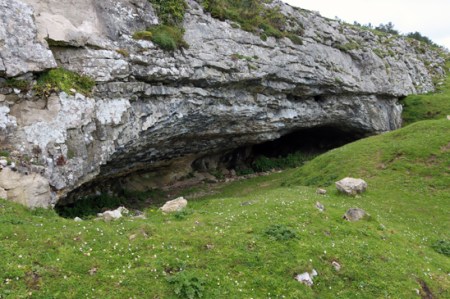


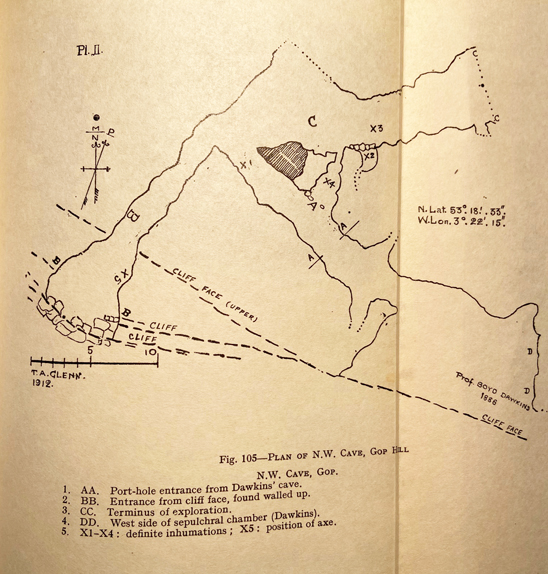


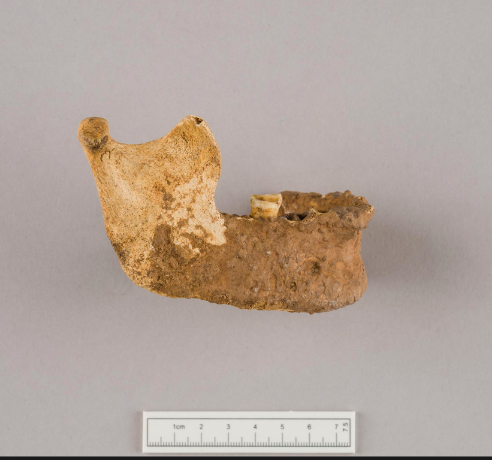
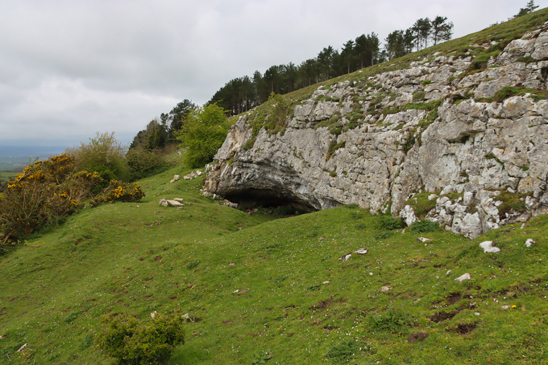 Frances Lynch suggests that the use of caves for burial, occurring in many areas at different periods “seems to be a matter of convenience rather than cultural preference” but there are alternative views on the matter. In his book on the materiality of stone – Christopher Tilley does not discuss caves, but he references almost every other aspect of stone as a natural material that becomes objectified by human uses and actions. He comments that social identity requires “specific concrete material points of reference in the form of landscapes, places, artefacts and other persons.” Topographic and other natural features are often used by humans to anchor and fix memory and establish places of meaning in landscapes. Carole Crumley highlights the phenomenological experience of features like caves, mountains and springs, and their role in connecting the mental with the material to create both individual and social identity. In their chapter on the uses of landscape features like caves and springs by the Maya in Mesoamerica, James Brady and Wendy Ashmore describe how caves, eternally damp and dripping water, were connected with the sacred and the ritualization of water. By appropriating and modifying such natural features, people have embedded them with meaning to form bridges between the natural, supernatural and the manufactured, blurring the differences to confer special status on these dark places where the dead might be deposited safely.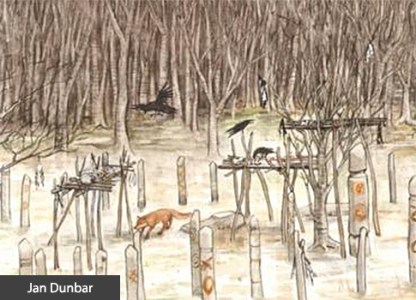
 In the contrast between the brightness of the light-coloured limestone reflecting in the sun, and the darkness of the hidden, secret interior there is a resemblance between the relationship between the visually striking chambered tomb and the sepulchre within. Not forgetting, of course, that there is an enormous cairn on top of the hill, just 43m (141ft) away from the cave, which may in itself have been a marker rather than a grave. The cairn is discussed in part 3.
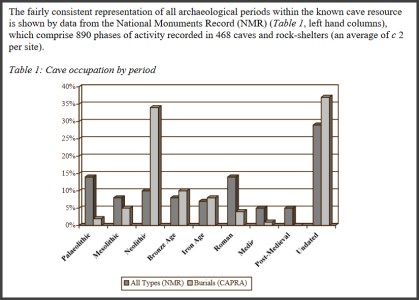


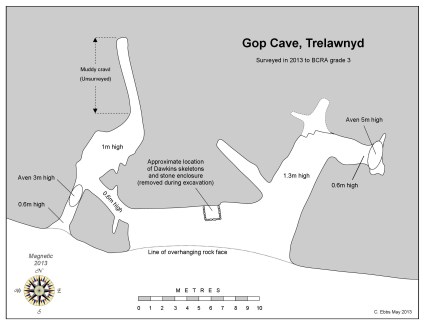


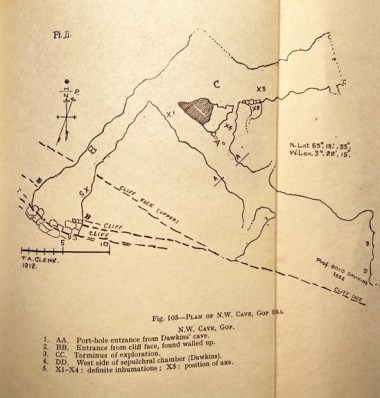
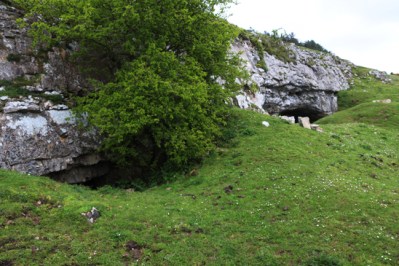


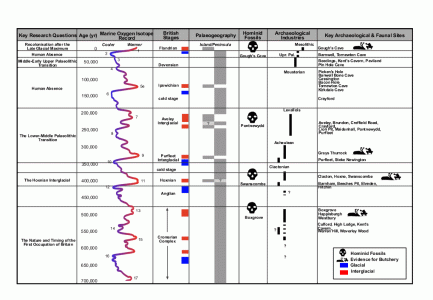


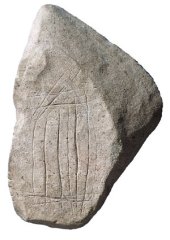

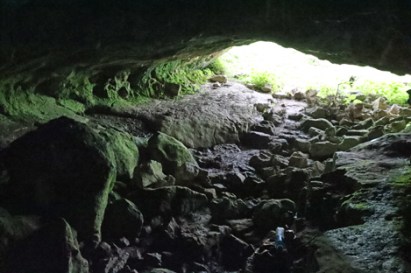


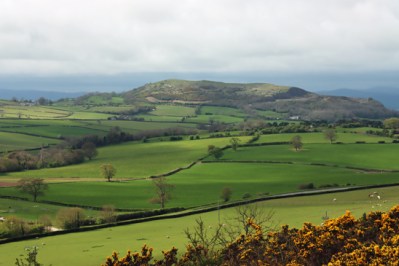

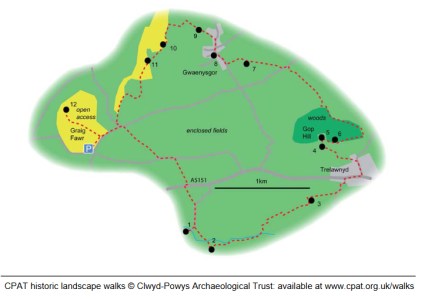
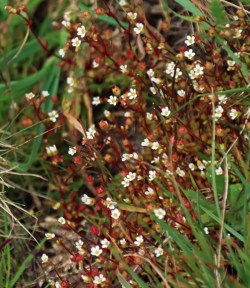
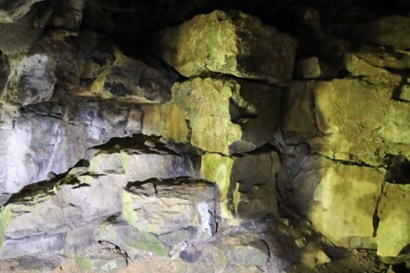

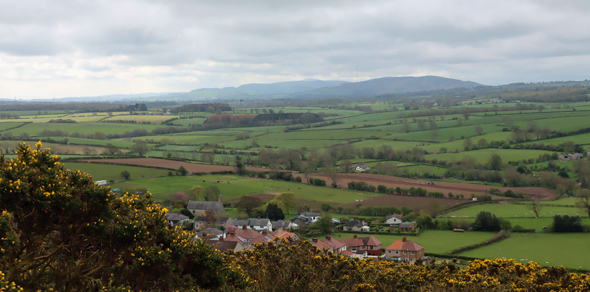


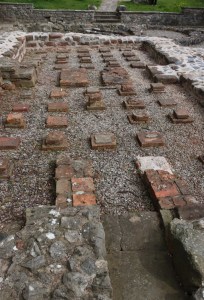


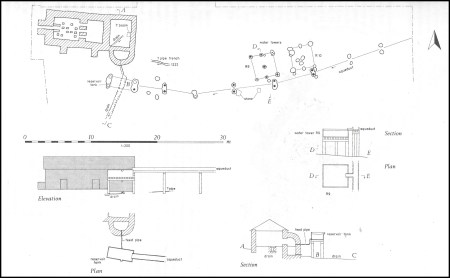


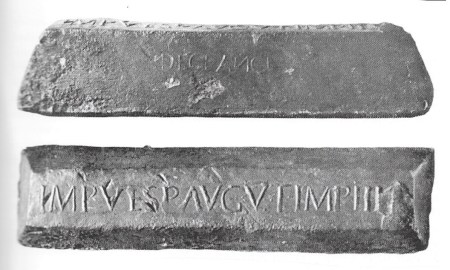


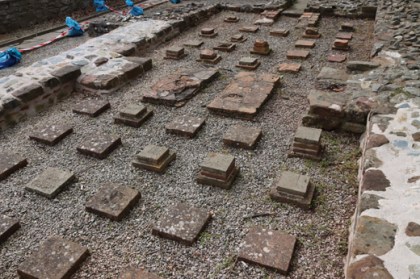




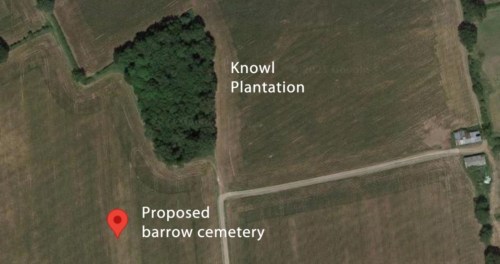
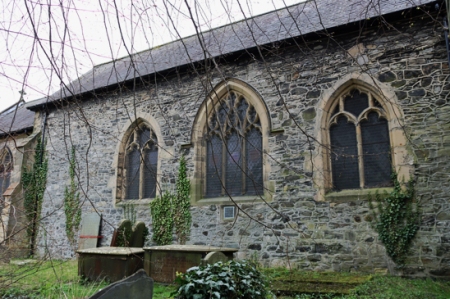


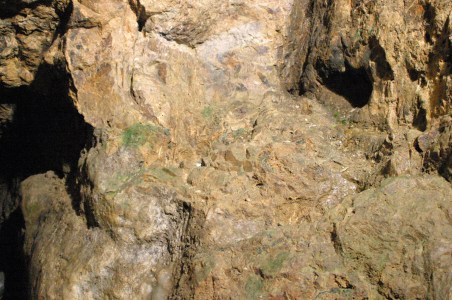
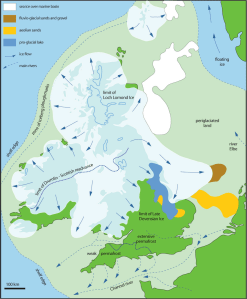





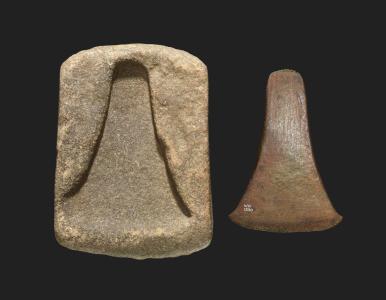


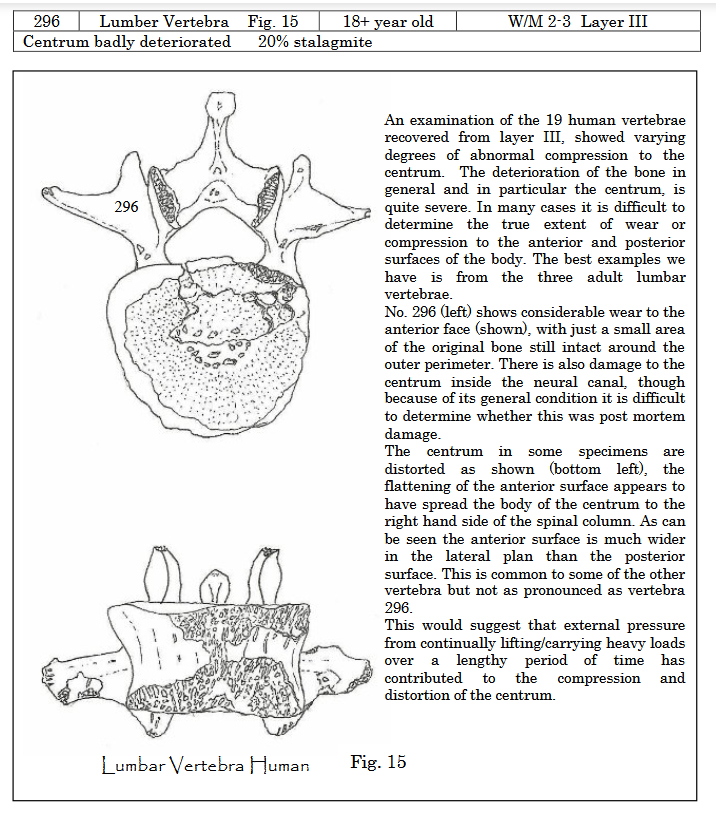




 Based in Churton