Author Archives: Andie

Friendly Friday: Wildflowers in my garden (a.k.a. weeds that I like)

I’ve never joined a blog challenge before, but I was invited to join this particular Friendly Friday  challenge and it is such a warm and super idea that I jumped at the chance.  Whoever hosts Friendly Friday declares a theme, and all those participating on their own blogs post something concerned with that theme.  It doesn’t have to be photographic.  It can, for example, be a recipe, poem, illustration or anything that can be posted on a blog.   This week’s host is forestwood, whose challenge is posted here.

I have chosen to select four wildflowers that I have permitted to run free in my garden.  Officially, they are weeds, but the choice to let one or two of them remain where they landed makes them part of my garden, and I choose to dignify them with the name wildflower rather than weed 🙂 Friday 2nd July, 21:53.

Weeds love my garden, and most of them are hauled out with extreme prejudice, using a mattock, spade or archaeological trowel, depending on how big they are and how deeply rooted.  I have become more of an expert on the annoying weeds than on those treasured flowers and shrubs that what I’ve so carefully planted, mainly because I am very intimate with what the weeds are doing underground.  The worst of my weeds have huge tubers that, even when the plant is small, have to be dug out rather than pulled out.  When I inherited my garden, it majored on ivy, holly and stinging nettles, and their unchecked spread are still a legacy problem, but some of the self-setters are much more welcome.

It has taken a long time to recover a rose bed full of mature rose bushes from giant holly trees and ground ivy but it is now looking beautiful, with two buddleias to provide additional colour and texture.  As I was pulling up some of the worst self-invited weedy offenders I recognized corn / common poppy leaves.  That bed had no poppies last year, meaning that these had blown in on the wind and settled down to establish themselves in amongst my roses.  Allowing poppies (Papaver rhoeas) to seed is always disastrous, because they spread like crazy and are so hard to remove in the long-term.  But I have a weakness for them and although I may be kicking myself this time next year, they are so glorious that right now I feel no regrets.  They are almost as tall as me, bright red with black centres, wending their way through the branches of a white rose.  This bed has been considerably disturbed in the last few years as we have restored it, and disturbed soil is a favoured habitat for the common poppy.  The effect is truly spectacular.  It has been used for medicinal uses throughout history in many cultures and is well known for its narcotic properties.


My second garden wildflower is also a newcomer to my garden.  It likes to set itself along the edges of rivers and around the edges of ponds and lakes, where it has a freshness and lightness that draws attention to both itself and the water that it frames.  It has small yellow flowers that cluster together and a decorative green leaf that is best known for capturing dewdrops and rain water which, trapped on the leaf, creates prisms of fabulous colour in the sun.   The sun had just vanished as I left the poppies, and the sudden clouds brought a sudden shower of good old English rain, but here they are:  Common Lady’s Mantle (Alchemilla vulgaris), a previously absent herbaceous perennial clustering in an uninvited fringe around my leaking pond with tiny yellow-green flowers and lobed pale green, slightly hairy leaves.  Connecting from one to the next by rhizomes, it is going to be a beast to eradicate from other parts of the garden, but it looks very good around the pond.   It was used for a number of medicinal purposes in the past (and may be in the present too).


A firm family favourite, which we have always encouraged into our gardens, is the red campion (Silene dioica).  I used to collect them in bunches as a child before we moved abroad, and I always associate them with good childhood things, like walking the family dog and running around without a care in the world.

Blasting off in all directions from the ground, they are truly exuberant, and their lovely pink flowers, here there and everywhere, warm the heart.  As shown here, the petals form five sets of two pairs, almost heart-shaped, with a green and white centre holding them together.  The stem is hairy.  They grow everywhere around the UK, particularly at home in woodland and in verges.  Their seeds spread from the dry capsule after the flowers have fallen, and they establish easily.  Flowers are male and female.  They look similar but grow on different plants.


Finally, Herb Robert (Geranium robertianum, a member of the geranium family) is an old favourite, and a real weed.  It pulls out very easily, and I have been dragging it up in bag-fulls all year, but I have allowed one or two to remain where they decided to set themselves, in some of the less formal parts of the garden, just because I like them.  I am probably making a rod for my own back, but given that they pull up so easily I will almost certainly forgive myself next year.  Little pink  and red-striped flowers sit on top of bright red stems, with deeply lobed leaves that are sometimes also fringed with red, and they spread across the ground in a joyful, albeit straggly network of colour.  I’ve never seen stems so very red as the ones here.  Also shown at the top of this post.


Sources:

de Sloover, J. and Goossens, M. (English translation Lucia Wildt).  Wild Herbs. A Field Guide.   David and Charles

Fletcher, N. 2004. Wild Flowers. Dorling Kindersley

Grey-Wilson, C. 1994.  Wild Flowers of Britain and Northwest Europe.  Dorling Kindersley

Raspberries and strawberries have arrived in Holt, and they are perfectly heavenly

I popped into Bellis in Holt to buy some compost, together with a few flowering pots of this and that in the garden centre on Monday and, blissfully, their own-grown raspberries and strawberries have arrived.  The taste of summer.

Raspberries are my favourites, but the strawberries, small and firm, are wonderful too, and both are being picked in the morning.  Super fresh.  If you are tempted by the strawberries, do go early.  On Monday they had sold out by 11am on Monday and although yesterday I was there at about 1015, they were vanishing fast.

Yesterday I bought a punnet of raspberries for myself and one each of raspberries and strawberries for my father.  By this morning, I had eaten the entire punnet of raspberries without any accessorizing (no sugar, no cream, no anything), and they were truly heavenly – sweet but with a tiny hint of sharpness.  I had the restraint not to eat the ones I had bought for Dad, but it took every ounce of self-discipline that I had 🙂

Dad had his raspberries in the evening with crème fraiche, which I can also recommend.  The slightly tart edge to the crème fraiche is a perfect complement to the sweetness of the fruit, less heavy and rich than ordinary cream, a visual delight and an absolute party on the taste buds.

I have been grazing on some of the strawberries this morning, much like I did on Smarties as a child, but there are plenty left over for a small dessert this evening.  Bliss.


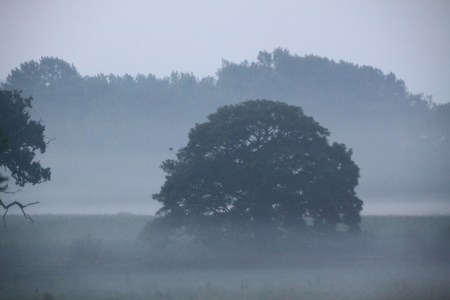
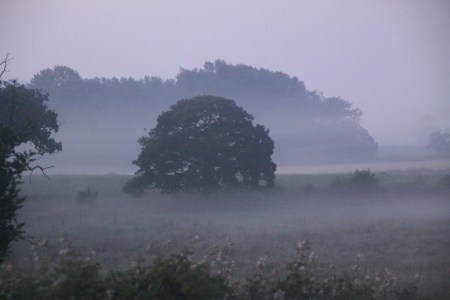
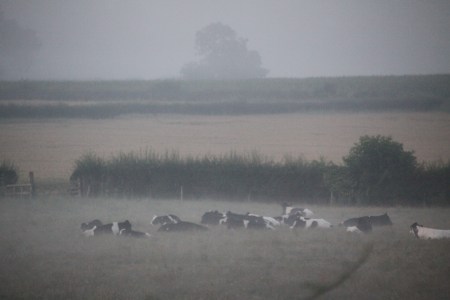
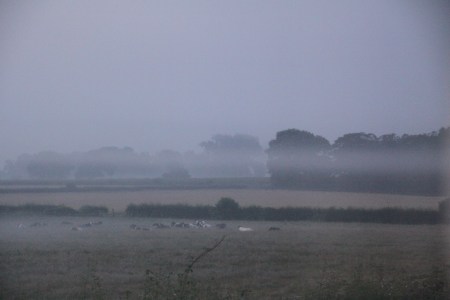
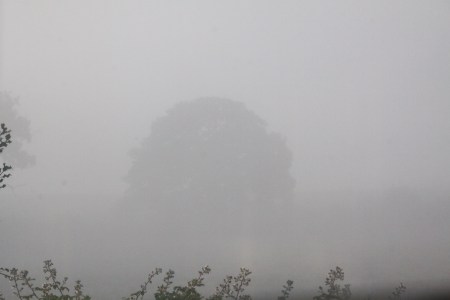
Marvellous mist – this morning’s view from my home office

I love the view over the fields, and have become fascinated both with the light on the big tree to the left, as well as the antics of the black and white cattle that rush, at certain times of day, from the field in front of the tree back to the farm at a fast canter, and at other times sit and mellow in the grass.  I had no idea that dairy herds could be so thoroughly interesting.  Today, however, is the first time that I have seen the view look as eternal as this, the light and mist creating a shifting continuum between pale grey and charcoal, with only faint hints, now and again, of darkest green.   I’ll let the landscape speak for itself, the photos taken between 4am and 6am.


Wildflowers at the Barnston Monument

Today we dropped in at the Barnston Monument (about which I wrote a couple of weeks ago), because every time I drove past it I saw a blast of bright colour – yellows blues, reds and bright whites on a deep green backdrop.  Phenomenal.  It is on one of the Barnston Estate fields, part of the new Monument Meadow Natural Burial Ground, which will replace the churchyard cemetery at St Chad’s in Farndon. The burial ground will have no markers, and caskets will be made of natural materials.  The car park, surrounded by small saplings, and the wooden pavilion are already in place.   We bumped into a lady having her lunch there.  I cannot think of a better place for it.

The photos are a bit fuzzy, because I only had the little camera that I keep in my handbag with me, but they are enough to give an idea of the beauty of the wild flower meadow at the moment.  The cornflowers are particularly superb, a dazzling, intense blue.


Sources:

Chester Standard
Barnston Estate near Farndon to build burial ground
https://www.chesterstandard.co.uk/news/18611529.barnston-estate-near-farndon-build-burial-ground/

Churton residents in 19th and early 20th Century directories

Commercial Directories, much like the telephone directories that most over-50s remember, list the names of people and their roles, organized by village or town name.  There are limitations to how useful the information contained in the directories actually are.  They do not, for example, provide the actual postal addresses such as house or road names.  Nor do they contain a complete listing of residents, just those who were deemed to be most relevant to community, commerce and local government.  In villages, these included, for example, gentry, clergy, businesses (including shops, joiners, wheelwrights, carriers and farms) and Post Offices.

To actually make use of such information, directory information needs to be tied into data supplied by other resources such as the national census, registers of births and deaths,  property deeds, local newspapers (both articles and adverts) and any surviving relevant accounting records.  But it seems worth including it here as a resource for anyone who, like me, is just starting out with research into the area, as well as for those trying to trace ancestors.

This is a copy-and-paste job, but  I did visit St Chad’s Church in Farndon and St John the Baptist Church in Aldford to see if I could match up any names in the directories with gravestones, and was able to find a few,  some of which are shown here.

I’ve had to cram in rather a lot of images, so I’ve kept them smallish, but you can click on any to expand them and read the text.

The directories used are  exclusively the ones listed on the Cheshire Directories website, and are as follows:

  • 1789 Cowdroy’s Directory of Cheshire
  • 1822-3 Pigot’s Directory of Cheshire
  • 1857 Post Office Directory of Cheshire
  • 1864 Morris & Co.’s Directory of Cheshire
  • 1871 Worrall’s Directory of Warrington
  • 1878 Post Office Directory of Cheshire
  • 1883 Slater’s Directory of Cheshire and Liverpool
  • 1902 Kelly’s Directory of Cheshire
  • 1906 Kelly’s Directory of Cheshire
  • 1910 Kelly’s Directory of Cheshire

The relevant details from each of the directories are listed below, in chronological order from earliest (1789) to latest (1910).

Cowdroy’s Directory of Cheshire 1789

N/A.  Churton (Churton by Aldford / Churton by Farndon) is not included.  Nor are Aldford or Farndon.

It is, however, an utterly fascinating read it its own right, which as usual contains a history of Cheshire (for f read s):  “THE magnitude and importance of this county will not be difputed, when the reader is told that its circumference is more than ‘200’ miles: To give an idea of its form, Speed has not unaptly compared it to the right wing of an eagle, ftretched forth from the furtheft point of Wirral hundred, and touching, with her firft feather, upon the confines of Yorkfhjre. – In the unhappy days of civil contention when England felt all the: horrors; of internefine feuds and domestic warfare (in the garb of religion) ftlalked over the face of the kingdom, this county was not without its share of the general calamity.”

Pigot’s Directory of Cheshire 1822-3

N/A.  Churton (Churton by Aldford / Churton by Farndon) is not included.  Nor are Aldford or Farndon.

Post Office Directory of Cheshire 1857

p.8
Aldford is a parish, comprising the townships of ALDFORD and CHURTON, and CHURTON HEATH, or BRUERA, BUERTON, and EDGERLEY.
CHURTON-BY-ALDFORD is a township, 2 miles southwest, with 251 inhabitants and an area of 572 acres

p.116-117
CHURTON-BY-FARNDON is a township and small village, partly in the parish of Famdon and partly in that of Aldford, distant 7 miles south-by-east from Chester and 1½ north Farndon; it consists principally of one long straggling street.  The remains of an ancient cross mark the boundary of the two parishes. The population, in 1851, was 148; the acreage, about 430. Major Barnston is lord of the manor; and he, and the Marquis of Westminster, and C. Galley, Esq. of Churton, are the chief landowners.

Private residents

  • Calley John, esq. Churton lodge
  • Parker Mr. William

Commercial

  • Baker James, farmer
  • Baker Moses, beer retailer
  • Barlow Geo, shoemaker & shopkeeper
  • Brown Mary (Mrs.), farmer
  • Clubbe George, wheelwright
  • Harrison Charles, shopkeeper
  • Huxley Joseph, farmer
  • Lawrence Peter, farmer
  • Letsom William, Red Lion
  • Nevell James, shoemaker
  • Parker John, farmer
  • Thomas William, blacksmith

Letters through Chester

Morris & Co.’s Directory of Cheshire 1864

p.45.
CHURTON-by-ALDFORD, is a township in Aldford parish, Great Boughton union containing, by the census of 1861, 217, inhabitants, and 572 acres; in the hundred of Broxton, South Cheshire, 7 miles south from Chester, adjoining Cllurton-by-Farndon, of which manor it forms a part. The Primitive Methodists have a chapel here. The Marquis of Westminster is lord of the manor.

Clergy and Gentry

  • Finley Hugh, Esq., The Lodge
  • Grace Mrs. Ann
  • Shankling Mr. Thomas

Trades and Professions.

  • Baker James, farmer,
  • Baker Moses, beer retailer
  • Ball Thomas, farmer
  • Brown George, farmer
  • Clubbe William, joiner
  • Logan Mr., Inland Revenue officer
  • Nevitt James, shopkeeper
  • Parker William, jun., farmer, The Grange
  • Thomas William, blacksmith
  • Warburton Samuel, baker and shopkeeper

The grave of Churton resident James Nevitt’s wife Mary, who died at the age of 39 in 1846, in the cemetery of St John the Baptist Church, Aldford

p.53.
CHURTON-by. FARNDON is a township in the parishes of Farndon and Aldford, the boundaries of which are marked by the remains of an ancient cross; 1½ miles north from Farndon, and 7 miles south-east from Chester, in Great Boughton union; containing, by the census of 1861, 128 inhabitants, and 432 acres. Major Barnston is lord of the manor.

Gentry

  • Parker John, Esq. Churton Hall
  • Parker, Mr William, Grange

Trade and Professions

  • Baker James, farmer
  • Baker Moses, beer retailer
  • Ball Thomas, farmer
  • Brown George, farmer
  • Clubbe George, wheelwright
  • Lawrence Peter, farmer
  • Nevitt James, shoemaker
  • Parker John, farmer
  • Thomas William, blacksmith
  • Williams Richard, Red Lion Inn

Letters through Chester.

Post Office Directory of Cheshire 1878

p.3. “The following is a list of Poor Law Unions . . .” Tarvin Union, (including):

  • Aldford
  • Churton-by-Aldford
  • Churton-by- Farndon
  • Farndon

p.3. “The following is a list of the hundreds, with the places contained In each:—
Hundred of Broxton (Higher division).— Aldersey, Aldford, Barton, Bickerton, Broxton, Bulkeley, Burwardsley, Caldecott, Garden, Cholmondeley, Chowley, Churton-by-Aldford, Churton-by-Farndon, Clutton, Coddington, Crewe, Egerton, Farndon, Grafton, Handley. Harthill, Horton-by-Malpas, Kingsmarsh, Stretton, and Tilston.”

p.14. Churton-By-Aldford is a township, 2 miles southwest. The Duke of Westminster is lord of the manor and principal landowner. The area is 672 acres; rateable value £935 ; the population in 1871 was 274. POST OFFICE.—Mrs. Hannah Clubb, receiver. Letters through Chester arrive at 7.30 a.m.; dispatched at 5.25 p.m. Farndon is the nearest money order office
Infant School, Miss Annie Jones, mistress

  • Maylor John, Churton lodge
  • Parker Henry, The Grange
  • Parker Thomas
  • Ball Thomas, farmer
  • Brown George, farmer
  • Hughes William ,shopkeeper
  • Parker John, farmer, beer retailer
  • Warburton Samuel, shopkeeper

p.186
FARNDON is a parish, comprising the townships of Barton, Churton-by-Farndon, Clutton, Crewe, King’s Marsh, and Farndon . . .

Churton is a township and small village, in the parishes of Farndon and Aldford, part called Churtonby-Farndon and part called Churton-by-Aldford, 7 miles south-by-east from Chester, a mile and a half north from Farndon and 5 west from Broxton railway station on the east bank of the Dee; it consists principally of one long straggling street. The remains of an ancient cross mark the boundary of the two parishes; the Primitive Methodists have a chapel here. Harry Barnston, esq. is lord of tbe manor for Churton-by-Farndon, and the Duke of Westminster of that of Churton-by-Aldford; the Duke of Westminster, Harry Barnston, esq. and John Maylor, esq. of Churton, are the chief landowners. The area is 432 acres; rateable value for Churton-by-Aldford £1,296 ; rateable value for Churton-by-Farndon £935; the population in 1871 was 123.

Letters through Chester. The nearest money order office is at Farndon INSURANCE AGENT.—Liverpool and London and Globe, Joseph Ball.

p.187

  • Maylor John, Churton lodge
  • Parker Thomas, sea. Churton house

Commercial

  • Ball Thomas, farmer
  • Brown George, farmer
  • Clubbe George, jun. Red Lion
  • Clubbe George, sen. wheelwright
  • Dutton John, joiner
  • Hawkes William, shopkeeper
  • Nevett James, shoe maker
  • Parker Henry, farmer, Grange
  • Parker John, farmer and beer retailer
  • Parker Thomas, farmer, Churton hall
  • Thomas William, blacksmith
  • Warburton Samuel, shopkeeper
  • Williamson Richard, farmer
  • Woolley Thomas, farmer

Slater’s Directory of Cheshire and Liverpool 1883

Churton by Aldford

Post Office, CHURTON-BY-ALDFORD, William Clube, Post Master.-Letters arrive from all parts (via Chester) at eleven morning, and are despatched at six evening.

Alphabetical Directory

  • Brown George, farmer, Churton by Aldford
  • Parker Henry, farmer, Churton, by Aldford
  • Thomas Lawrence, White Horse, Churton, by Aldford
  • Warburton Samuel, shopkeeper, Churton, by Aldford
  • Williamson Richard, farmer, Churton, by Aldford

Farmers

  • Ball Thomas
  • Brown George
  • Maylor John
  • Parker Henry
  • Parker Thomas
  • Williams Richd.

Lawrance Thomas of Churton, who died 15th December 1881, aged 23.  It is impossible to know, at this time, whether this was the Lawrance Thomas who is listed as being based at the White Horse, or a father or son.  At the age of 23 he seems young to have been the pub landlord.

Shopkeepers

  • Clube, Wm.

Taverns and Public Houses

  • White Horse, Lawrance Thomas

Dissenting Chapels

  • Methodist (primitive)


Churton by Farndon

Nobility, Gentry and Clergy

  • Maylor William, Esq. Churton lodge, Churton

Grocers and dealers in sundries

  • Warburton Samuel, Churton

Farmers

  • Ball Thomas
  • Brown George
  • Clubbe Thomas
  • Clubbe Williams
  • Parker Henry
  • Parker Thos. Junr.
  • Thomas Abraham
  • Williamson Richd.

p.216:  “Farndon comprises the townships of Barton, Churton by Farndon, Clutton and Crew and Farndon township.


Kelly’s Directory of Cheshire 1902

CHURTON-BY-ALDFORD is a township, on the road from Chester to Malpas, 5 miles south from Waverton station and 5 north-west from Broxton station, both on the Shrewsbury and Crewe section of the London and North Western railway. The Duke of Westminster is lord of the manor and principal landowner.  The area is 558 acres; rateable value, £928 ; the population in 1901 was 223.
Public Elementary School (infants), built in 1864 by Richard, and Marquess of Westminster, for 48 children ; average attendance, 20; Miss Mary Meredith, mistress; the school is in part supported by the Duke of Westminster
Post Office.—Joseph Smith, sub-postmaster. Letters through Chester arrive in summer at 7 a.m.; winter, 7.30 a.m. and dispatched at 6.10 p.m.  Postal orders are issued here, but not paid.  Farndon is the nearest money order and telegraph office, 2 miles distant.

  • Maylor, Mrs., Churton Lodge
  • Parker Thomas
  • Alwood John Farmer
  • Barlow Charles Shopkeeper
  • Parker James Beer Retailer
  • Smith Joseph Shopkeeper, Post Office
  • Warburton, Miss, Shopkeeper

George Clubbe died in 1841 and was buried in the cemetery of St Chad’s in Farndon. In the 1910 directory he is listed as a shopkeeper.  Edward Clubbe, presumably a close relative, is listed as a farmer.  The Clubbes appear in directory after directory for Churton, the earliest (from 1857) being William Clubbe, wheelwright.

CHURTON is a township and small village, on the east bank of the river Dee, in the parishes of Farndon and Aldford, of which part is called Churton-by-Farndon and the rest Churton-by-Aldford; it is 5 miles west from Broxton railway station, on the Shrewsbury and Chester section of the London and North Western railway, 7 south-by-east from Chester and a mile and a half north from Farndon. The village consists principally of one Iong straggling street. There is a Primitive Methodist chapel here, erected in 1833. Harry Barnston esq. M.P. who is lord of the manor of Churton-by-Farndon, the Duke of Westminster G.C.V.O. and Mrs. Maylor, of Churton, are the chief landowners.

The gravestone of Joseph Bartlem Edwards, who died in 1915 at age 54, and his wife Mary Elizabeth who died in 1958, age 84. The directory lists Joseph as simply Joseph B. St John the Baptist, Aldford

The area of Churton-by-Farndon is 445 acres; rateable value, £928; the population in 1901 was 126. Churton-by-Aldford township is given with Aldford.

  • Jackson Thomas Sibbersfield Hall

Commercial

  • Bellis bros farmers and fruit growers, Churton Hall and Farndon
  • Clubbe Edward, farmer
  • Clubbe George, Shopkeeper
  • Dutton Joshua, Joiner
  • Edwards Joseph B. farmer
  • Williamson Richard farmer
  • Williamson Samuel Holland farmer

Kelly’s Directory of Cheshire 1906

A sad gravestone. The children of beer retailer James and Martha Parker died in succession, Amy aged 16 in 1913, Elizabeth aged 32 in 1919 and Norman in 1922 aged 26. James and Martha themselves died in 1922 and 1928.

CHURTON-BY-ALDFORD is a township, on the road from Chester to Malpas, 5 miles south from Waverton station and 5 north-west from Broxton station, both on the Shrewsbury and Crewe section of the London and North Western railway. The Duke of Westminster is lord of the manor and principal landowner. The area is 574 acres; rateable value, ;£928 ; the population in 1901 was 223.

Public Elementary School (infants), built in 1864 by Richard, and Marquess of Westminster, for 48 children ; average attendance, 20; Miss Elizabeth Draper, mistress; the school is in part supported by the Duke of Westminster

Post Office.—Joseph Smith, sub-postmaster. Letters through Chester arrive in summer at 7 a.m.; winter, 7.30 a.m. and dispatched at 6.10 p.m. Farndon, 2 miles distant, is the nearest money order and telegraph office

  • McKindlay Andrew
  • Maylor Mrs. Churton lodge
  • Parker William,
  • Alwood John, farmer
  • Lawrence Thomas, shopkeeper
  • Lewis Edwin, farmer
  • Parker James, beer retailer
  • Powell Samuel, shopkeeper
  • Smith Joseph, shopkeeper. Post office

Gravestone (at St Chad’s Farndon) of Richard and Elizabeth Williamson. Richard, a farmer, is listed in the 1906 Kelly’s Directory of Cheshire.

CHURTON is a township and small village, on the east bank of the river Dee, in the parishes of Farndon and Aldford, of which part is caUed Churton-by-Farndon and the rest Churton-by-Aldford; it is 5 miles west from Broxton railway station, on the Shrewsbury and Chester section of the London and North Western railway, 7 south-by east from Chester and a mile and a half north from Farndon. The village consists principally of one long straggling street. There is a Primitive Methodist chapel here, erected in 1833. Harry Barnston esq. is lord of the manor of Churton-by-Farndon, and the Duke of Westminster, Harry Barnston esq. and Mrs. Maylor, of Churton, are the chief landowners. The area of Churton-by- Farndon is 445 acres; rateable value, £928; the population in 1901 was 126. Churton-by-Aldford township is given with Aldford.

  • Grossmann Alex, Sibbersfield Hall

Commercial

  • Bellis Bros, farmers & fruit growers, Churton Hall and at Farndon
  • Clubbe Edward, farmer
  • Clubbe George, shopkeeper
  • Dutton Joshua, joiner
  • Edwards Joseph B. farmer
  • Williamson Richard, farmer
  • Williamson Samuel Holland, Red Lion P.H

Kelly’s Directory of Cheshire 1910

CHURTON-BY-ALDFORD is a township, on the road from Chester to Malpas, 5 miles south from Waverton station and 5 north-west from Broxton station, both on the Shrewsbury and Crewe section of the London and North Western railway. The Duke of Westminster is lord of the manor and principal landowner. The area is 574 acres; rateable value, £928 ; the population in 1901 was 223.
Public Elementary School (infants), built in 1864 by Richard, and Marquess of Westminster, for 48 children ; average attendance, 26; Miss Elizabeth Draper, mistress; the school is in part supported by the Duke of Westminster
Post Office.—Joseph Smith, sub-postmaster. Letters through arrive at 7.15 a.m. ; sunday, callers only & dispatched at 7.40 p.m.; Sunday, 7.40 p.m. Farndon, 1¼  miles distant, is the nearest money order and telegraph office

  • Carr Austin Cooper, Kingsmead
  • McKindlay Andrew, Churton house
  • Maylor Mrs. Churton lodge
  • Allwood John, farmer
  • Lewis Annie (Mrs.), farmer
  • Parker James, beer retailer
  • Powell Margaret (Mrs.), shopkeeper
  • Smith Joseph, shopkeeper. Post office
  • Thomas Lawrence, shopkeeper
  • Thomas William, blacksmith

CHURTON is a township and small village, on the east bank of the river Dee, in the parishes of Farndon and Aldford, of which part is called Churton-by-Farndon and the rest Churton-by-Aldford; it is 5 miles west from Broxton railway station, on the Shrewsbury and Chester section of the London and North Western railway, 7 south-by-east from Chester and a mile and a half north from Farndon. The village consists principally of one Iong straggling street. There is a Primitive Methodist chapel here, erected in 1833. Harry Barnston esq. M.P. who is lord of the manor of Churton-by-Farndon, the Duke of Westminster G.C.V.O. and Mrs. Maylor, of Churton, are the chief landowners. The area of Churton-by-Farndon is 445 acres; rateable value, £928; the population in 1901 was 126. Churton-by-Aldford township is given with Aldford.

  • Bellis Brothers Limited, farmers and fruit growers, Churton hall; and at Farndon
  • Clubbe Edward, farmer
  • Clubbe George, shopkeeper
  • Dutton Joshua, joiner
  • Edwards Joseph B. farmer
  • Williamson Richard, farmer
  • Williamson Samuel Holland, Red Lion P.H.

Source:

Cheshire Directories. Working in Partnership. Cheshire East / Cheshire West and Chester
http://cheshiredirectories.manuscripteye.com/index.htm
Object histories in my garden #4: A Dinky Toy SEPECAT Jaguar

Not an adjective but a brand name, in this case dinky refers to Dinky Toys, a range of miniature toy vehicles, everything from engineering marvels like fighter planes such as this one, to life-like lawnmowers.  Dinky Toys were the brainchild of Frank Hornby, who was the innovator behind Hornby Trains and Meccano.  The Dinky Toys were made by Meccano Ltd.  They were produced in England between 1934 and 1979 at Meccano’s Binns Road factory in Liverpool.  They pre-dated other well known diecast brands, including the now better known miniature Corgi and Matchbox brands.
This particular object is a model of an Anglo-French SEPECAT Jaguar fighter plane, model number 731. The fighter on which the toy was modelled came into service in 1973, and the toy version was one of a series capitalizing on a new interest in modern warplanes.  It was one of the many curios pulled out of my garden during its ongoing revamp.  Most of the garden relics consist of fragments of decorated ceramic, but one or two are of particular interest (garden finds link).  Most of the later 20th Century items that we have found have been true rubbish, and every  object that we have found has been broken and was almost certainly dumped.  At first I thought that this toy was probably lost during play rather than deliberately disposed of, but on closer inspection it too is broken.

A promotional image of the Meccano Ltd. factory at Binns Road, Liverpool, taken from the back cover of the 1927 Hornby Book of Trains. Source: Brighton Toy Museum
The Dinky Toys company was the creation of Frank Hornby, whose name is forever associated with model train sets.  Hornby originally began with a vision of educating children wishing to teach  basic mechanical principles, which he translated into construction kits for children, the first of which were patented in 1901.  As Oliver Wainwright puts it,

With his “Mechanics Made Easy” sets he gave the system ultimate flexibility by punching holes on a regular grid across all of the pieces, allowing the parts to be bolted together as well as providing bearings for axles and gear shafts. Sold with a range of brass wheels and pulleys, gears and shaft collars, any number of complex mechanisms could be dreamt up – from bridges to cranes, to devices to ambush your unsuspecting sister.” 

The Meccano brand was launched in 1907, and went from strength to strength.   Hornby’s model train series came next, accompanied by all the accessories required to give them a real-life context.  The Hornby railway models, both mechanized and static, were so popular that Hornby’s next idea materialized itself as his Dinky Toy company, which was set up in 1934 to produce realistic model vehicles.  Wainwright again:

“The things he made didn’t look like toys, but precise versions of the real world, manufactured with exacting detail. His products were not packaged with the amoebic forms and infantilising colours of today’s toys, but gained their magical quality simply from taking things of fascination – industrial machines, trains, boats and planes – and shrinking them to the scale of 1:48, reducing the entire world to something that can fit in a box.”

The Dinky Toys were made from die-cast ZAMAK. Die casting is a manufacturing process that can be used to make geometrically complex metal parts in reusable molds called dies.  ZAMAK is a form of zinc alloy, described as follows on the DECO website:  “ZAMAK is a type of zinc alloy that consists of aluminum, magnesium, copper, and of course zinc. This alloy family contains copper, but is spelled with a K. This is because the acronym ZAMAK uses the German spelling: Zink, Magnesium, Aluminum, and Kupfer. That being said, ZAMAK is some times spelled ZAMAC with an English spelling. ZAMAK alloys are a separate family from the zinc aluminum (ZA) alloys although they both maintain a consistent composition of 4% aluminum.”

The Jaguar is 18cm long from nose to tail.  Although most of it is metal it also has small black plastic parts under the tail.  The top layer of paint is a fairly deep royal blue, and has slowly peeled off during its afterlife in my garden, revealing an undercoat of pale blue and the core dark metal grey beneath both. Comparing it with surviving examples online, it would have been painted with camouflage and other markings.  The whole thing is satisfyingly heavy to hold.  The canopy was spring-loaded to make it a moving part when depressed, and originally a plastic fighter pilot was positioned inside.  When the canopy spring was activated, it ejected the pilot.  Only a tiny piece of the canopy remains in situ, but the spring, a piece of cleverly bent metal, is intact and can be operated.  The plane once stood on three wheels, but all three wheels, plus the struts connecting them to the rest of the plane are now missing.  Two hollow spaces sit where the rear wheels would have been fitted.  The wheel struts were hinged so that the wheels could be folded into the main body of the plane.  There is a metal flap on the underside of the cockpit that may preserve the front wheel in situ, but cautious work to loosen it has failed and I really do not want to snap it.  The nose cone, originally black plastic, is missing.

Now if the garden would magically produce a Dinky Toy model 749, the delta-winged Avro Vulcan bomber (1955), I would be so happy.  I saw the XH558 Vulcan flying at Farnborough Airshow in 2014, and it was love at first sight.  Since then, I have fallen in love with the Vulcan all over again at Cosford Royal Air Force Museum, twice.  Irrespective of its ultimate purpose, it is a thing of awe and beauty.

For anyone new to this occasional series on objects extracted from my garden during everyday gardening activities, see the History in Garden Finds page.  These are not objects used in the garden, but objects, usually fragments, lost or disposed of in the garden and found during digging, troweling and planting.

Sources:

Books and articles

Wainwright, O. 2013. Frank Hornby:  The Man who put the World in a Box.  The Guardian, 15th May 2013
https://www.theguardian.com/artanddesign/architecture-design-blog/2013/may/15/frank-hornby-meccano-dinky-toys

Websites

Custompart.net
Die Casting
https://www.custompartnet.com/wu/die-casting

DECO
What is Zamak?
https://decoprod.com/zamak/

Dinky Site
Digital Museum
https://www.dinkysite.com/rare-dinky-toys

Wikipedia (very well referenced page)
Dinky Toys
https://en.wikipedia.org/wiki/Dinky_Toys#CITEREFGardinerO’Neill1996

Adventures with Churton Honesty Eggs – Ham Horns

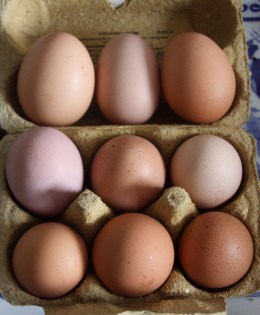
In a previous post I talked about the super honesty system in Churton that enables local people to buy free range Churton eggs from a barrow by the side of the road.   On that post I showed photos of how I used one of the eggs in a Middle Eastern lamb baharat, and another two to make a lovage and lime mayonnaise.  On this occasion it is all about ham horns.

This is the weather for al-fresco dining, and I love to eat outdoors so today I made a ham horn with salad for lunch.  The ham horn was an invention of my Mum’s and quite apart from the fact that I like to use Mum’s inventions, it is very easy to make and amazingly filling.  So filling, in fact, that I had to change my plans for my evening meal to something significantly smaller than originally planned.

A ham horn is quite simply a tube of ham stuffed with chopped eggs (and herbs if you fancy them) in mayonnaise.  Sometimes the simplest things are the most delicious.  The ham horn is supposed to be wider at one end than the other to give it the horn shape, and Mum’s were always proper horns, but mine always come out uncompromisingly pancake-shaped.

You can make ham horns with mayo from a jar, of course, but there is nothing that you can purchase in a supermarket that looks or tastes remotely like home-made mayonnaise, especially when additional flavours are added to give it an extra hit of something special.   Unlike the supermarket white mayo, a home made one based on eggs yolks, which are of course deep yellow, transforms the ingredients into a lovely primrose colour.  Mayonnaise is so quick and easy to make that it is well worth taking out five minutes to do it.  If you want a herb mayonnaise, the herbs have to be fresh; dried ones simply don’t work.  The only exception I have found is dried tarragon, which can be soaked in vinegar to release the flavour, and then both the vinegar and the dried tarragon can be used as part of the base for the mayonnaise.  Another way of adding flavour is to used flavoured oil, which can be home made.

I do my mayonnaise in a mini food processor.  Most mini processors have a hole in the lid for precisely this purpose, but mine is ancient and I had to drill a hole into it.  I know that some people use plastic blades for mayo, but I’ve never had any trouble with a metal blade.  I start with a good dollop of Dijon, Senf (German mustard) or tarragon mustard, with a good squeeze of lemon or lime juice or white wine vinegar (depending on what it is to accompany).  On this occasion it was Dijon mustard and lemon juice, with a good turn of black pepper and a sprinkling of sea salt.

The eggs are separated and the whites retained for a future use (and can be frozen).  I have the whites earmarked for a tempura dish, but they are also great for souffles and meringues.  I then chuck the eggs into the bottom of the food processor with the mustard, lemon juice and seasoning and give it a quick spin.  The trick, and it’s the only serious trick, is to add the oil terribly, terribly slowly.  I was using a  Filippo Berio “mild and lighter in colour” oil into which a few weeks ago I had added some sliced lemon, chilli, garlic and lovage, and was a gorgeous shade of sunshine yellow.  If you are new to making mayonnaise, I would suggest that you use olive oil (any) or sunflower oil rather than rapeseed, as the latter is much more difficult to emulsify (thicken).

When you begin to add the oil, the mix in the bottom of the food processor is a dark yellow (thanks to the yolks and mustard).  As you add the oil, in a very slow, very thin stream, the oil and egg yolks gradually emulsify and the dark yellow starts to lighten as the mayonnaise thickens.  This lightening process is the emulsification taking place.  The more oil you add, the thicker it gets.  I have occasionally become so engrossed in adding the oil that I’ve forgotten to stop now and again to check it for thickness, and have ended up with something that can be carved like butter!  On this occasion I stopped on time, with a nice, soft texture to which I added chopped herbs to the food processor and gave it a good pulse.

If, after tasting, you find that you want to add more lemon juice or wine vinegar to add a bit more acidity, just be aware (the second trick) that this will loosen the emulsion, so unless it was already very stiff, you may have to add more oil.  You can also add salt to help thicken it up (the third and final trick).  Do this incrementally so that it is not over-salty, and keep tasting as you do it, but it works.

You can use any herbs that you like, of course (parsley, spring onions, chives and dill are all good options, and tarragon is terrific), but I have recently discovered that lovage and coriander, both strong, highly  aromatic herbs, go superbly together in some contexts.  I’ve always been a fan of coriander in egg mayonnaise, ever since buying a gourmet sandwich in a Turkish café on Leather Lane, near where I worked in Clerkenwell (London), but the idea of lobbing in some lovage was new, and I was so pleased when it worked so well. Lovage is very powerful so be a bit careful with it.  In the mayonnaise, the flavour of the herbs is brought out by the lemon juice (or vinegar if using that instead) in the mayo.

To prevent the top forming a skin, I store my mayo in the fridge with the clingfilm actually resting on the surface until it is needed.  An hour before I am ready to assemble the ham horn, I take the mayonnaise out of the fridge and let it come to room temperature.  This is because it becomes more solid in the fridge, and at room temperature it loosens back to the original texture that it had when scooped out of the mini processor.   Just before assembly I peel the egg, chop it up and stir it into the mayo.

The ham I had to hand was thinly-sliced Italian porchetta, which has a lovely flavour but is ultra-thin and very difficult to extract in one piece from the wrapping.  A thicker ham would have  been better, but I didn’t have one.  So instead of a smooth, elegant horn, I ended up with a battered and patched flattened tube.  Still, it tasted delicious.

I made a salad from three types of lettuce that I grow in pots on the patio, and lots of herbs, again from patio pots, chosen with care because I didn’t want an unholy clash with the lovage and coriander in the mayo.  Parsley, oregano, sorrel, and mint accompanied the lettuce and were joined by some delicious little oval yellow tomatoes that Dad gets for me (brand name Natoora), that are tart instead of sickly sweet, and full of amazing flavour.  I like them straight from the fridge, ultra cold.  A dampened piece of kitchen roll laid over the top keeps everything fresh.  I always have a jar of home made French-style vinaigrette in the cupboard (mustard, white wine vinegar, olive oil, garlic clove, freshly ground black pepper, all given a seriously good shake), and I served that on the side to be stirred in at the last minute to prevent the salad going soggy.

When I had finished, and took it all out into the garden on a tray, I had a ham horn, a herb salad and chilled yellow baby tomatoes on a plate with the vinaigrette in a little dish on the side and a tall glass of lovely still lemonade, very cold (not home made but divine).  It was all rather delightful.

The Churton egg continues to rock.
If you want to check out more of my Churton egg adventures, click on
the Churton Eggs label in the right hand margin.
More will be added soon 🙂

Aldford and Churton-by-Aldford: The Talbot Hound and the Wheatsheaf

Wandering around Churton when I first arrived in the area, I was surprised to see the Talbot Hound on a number plaques.  In the village of Aldford to the north the Talbot hound is a very familiar character, shown on signage all over the village of Aldford, as it has been a symbol of the Grosvenor estates, of which the Eaton Hall estate is the family seat, since the late 16th Century.

In Churton, several examples of Talbot Hounds are to be found on the Churton-by-Aldford side of the village.  Churton-by-Aldford was affiliated to Aldford and the Eaton Hall estate.  At the same time, both the hound and a wheatsheaf can be seen incorporated into the the old school house wall, carved out of red sandstone in high relief.  The school house,  at the top end of Stannage Lane, was built in 1864 and paid for by the Eaton Hall estate,.

The boundary between Churton by Aldford to the north and Churton by Farndon to the south..  Click to enlarge the image.

So why was an Aldford emblem dotted around Churton?  Up until 2015 Churton was split into two townships, with Churton-by-Aldford to the north of Hob Lane and Pump Lane, and Churton-by-Farndon to the south of that line.  I will be posting about how this division arose shortly, looking at what it meant in everyday terms and how it is visible on maps and on the ground, but the short version is that Churton-by-Aldford was once a part of the Eaton Hall estate (some parts still are) and Churton-by-Farndon was not.  The Talbot hounds are one of the easily identifiable differentiators between the two halves of the village.

Talbot hounds are now extinct.  The hounds  were white, and characterized by large paws and a tail curled over the lower back.   They were used as hunting dogs, but is unclear exactly what prey they were employed to retrieve.  There is a lot of speculation about whether or not they were introduced by the Normans, where the name originated and whether they may have contributed some genetic material to modern hunting breeds, but most of this appears to lack any supporting data.  What seems to be without dispute is that the Talbot hound first appears on the Grosvenor family’s coat of arms in 1597.

The school was donated to the village by Robert Grosvenor, first Marquess of Westminster, 1767-1845 as a gift from the Eaton Hall estate.

The legend/text around the Talbot hound is centred within an oval frame that is sculpted into a garter with a buckle at its base, the Order of the Garter, which always reads HONI SOIT QUI MAL Y PENSE,.  This is Old French.  Broken down, the text can be translated as follows:

  • Honi – Old French conjugation of modern honnir, to shame, or to be contemptuous of
  • Soit – subjunctive of être, “be”
  • Qui – relative pronoun, “who”
  • Y – adverbial pronoun, “it”

the sense of which can be roughly translated as “shame on whoever thinks bad/evil here/there”  The Order of the Garter dates to Edward III (1327-77).   The Order was created when Edward III founded the college of St George at Windsor, reputedly modelled on the legend of King Arthur and his knights of the round table.  The new Order was associated with a small group of 25 knights headed by the king, each of whom was provided with a stall in the chapel, entitled the Order of the Garter.  It is unclear what the garter actually was, but one theory is that it was a device used to connect pieces of armour, and it was worn by all the knights concerned. The order is headed by the current sovereign (Sovereign of the Garter) who, since 1946, personally selects Knights of the Garter to honour those who have contributed to the nation or who have performed a particular personal service for the Sovereign.

The Talbot hound and the emblem of the Order of the Garter are topped with an earl’s coronet, showing four strawberry leaves and four silver balls or pearls above the rim, clear representatives of which are shown on the carving shown above.

The  Grosvenor family coat of arms already included a wheat-sheaf or Garf prior to the addition of the Talbot hound, probably from the 14th Century.  The Grosvenor family shares the wheatsheaf  symbol with the City/Palatine of Chester, where it refers to the Earls of Chester and to Cheshire.  It does not, as far as I know, appear on any other Churton buildings.

Sources:

Websites

Churton Parish Newsletter, September 2019
http://www.churtonparishcouncil.co.uk/Newsletter%20Sept%2019%202-3%20(1).pdf

College of St George, Windsor
https://www.stgeorges-windsor.org/about-st-georges/history/the-order-of-the-garter/

Grosvenor Estate
History Timeline – 1385-1390, 1597
https://www.grosvenorestate.com/about-us/heritage/history-timeline.aspx

Internet Archive
The institution, laws & ceremonies of the most noble Order of the Garter : work furnished with variety of matter, relating to honor and noblesse by Ashmole, Elias, 1617-1692
https://archive.org/details/gri_33125012878183/page/n9/mode/2up

Lawless French
https://www.lawlessfrench.com/expressions/honi-soit-qui-mal-y-pense/

London Remembers
Statue: Robert Grosvenor statue
https://www.londonremembers.com/memorials/robert-grosvenor-statue

Royal.uk
Order of the Garter
https://www.royal.uk/order-garter


Cheshire Proverbs 2: “Holt Lions, Farndon Bears, Churton Greyhounds and Alford Hares”

“Holt lions, Farndon bears
Churton greyhounds and Aldford hares”

J.C. Bridge  no.190, page 73

Joseph Bridge devotes over a page to the content of this very local proverb, but he focuses exclusively on the Holt lions and by the end of it neither he or I are any the wiser about what the bears, greyhounds and hares refer to, or what the overall meaning might be.

Title page of Ray’s “A Collection of English Proverbs.” Source: Royal Society.

Holt was originally in Cheshire, an English borough in Wales, so although it was the only of the villages to the west of the Dee, it was not entirely the odd one out in this list of local place-names. 

Previous writers suggested that the Holt Lions might refer to Roman tile and pottery works to the north of Holt.  John Ray’s A Collection of English Proverbs (1670), quoted in Bridge (p.x) provides a plausible if completely unverifiable example:  “I conjecture that the Roman name had been Castra Legionis, and the Welsh Castell Lleon, or the Castle of the Legion;  Because it was garrisoned by a detachment of the Legion at Chester.  The English borderers might easily mistake Lleon for the plural of Llew, which signifies a lion, and so call it the Castle of Lions.”  Bridge provides a convincing list of references that associate the two during the Middle Ages. The Reverend R.H. Morris’s The Diocesan  of History 1895 reinforces this message, saying that as late as the Elizabethan period the alternative name, Castrum Leonum or Castle of Lions was in general use and that its seal incorporated a Lion Rampant, suggesting that there was a heraldic link between Holt and lions.

None of this, however, accounts for the greyhounds, bears and hares, although Latham speculates that these too might have been associated with family coats of arms, now lost.  I originally wondered if the Churton greyhounds might refer to the hounds shown on Aldford road and house signs, but only a few of those are in Churton and are, anyway, much later in date.  Latham adds “It can be said in support of this suggestion however that the base of the font in Holt church, which dates from 1490, includes what appear to be carvings of all these
creatures.  This was examined by Mr. E. E. Dorling in 1908, and his findings were published in Vol. 24 of the Transactions of the Historical Soc. of Lanes. & Cheshire. He mentions a hart’s (not a hares) head with reference to the house of Stanley, and considers that the collared hound sitting in a panel on the font is ‘none other but the greyhound badge of King Henry VII’.”

Any ideas?  If you have more information, please get in touch.

For more about this Cheshire Proverbs series, see Cheshire Proverbs 1.


Sources:

Bridge, J.C. 1917. Proverbs, sayings and rhymes connected with the city and county palatine of Chester. Phillipson and Golder.

Latham, F.A.  1981. Farndon. The History of a Cheshire Village. Local History Group


Cheshire Proverbs 1, Introduction: “Old proverbs are the children of truth”

Frank Latham’s 1981 book Farndon mentions a Cheshire proverb about local place-names that he said was quoted in Joseph C. Bridge’s Cheshire Proverbs and Other Sayings and Rhymes Connected with the City an County Palatine of Chester, published by Phillipson and Golder (Chester) 1917.   That sounded like a great book  to have on hand, so I checked online.  It cost next to nothing, so I ordered one.  It has been a lot of fun since it arrived, although I continue to puzzle over what some of the proverbs and sayings actually mean.  Most of the proverbs are English, but as Bridge points out, the border along the Welsh Marches was fluid, and language, including proverbs and sayings, passed seamlessly between England and Wales in both directions.

Most of the proverbs have nothing to do with the Churton/Farndon/Holt/Aldford area, of course, but they are all fascinating and I thought that it would be fun to include some of them here from time to time.  In the subject heading I will number them in the order in which I post them but I will also include Bridge’s numbering and the page numbers on which they appear.   

Joseph C. Bridges was a conscientious researcher.  Professor of music at the University of Durham and organist of Chester Cathedral, he was anxious to preserve traditional aspects of rural language in Cheshire: 

“The spread of education in our country districts is very rapid, and the rustic population is undoubtedly ceasing to use homely dialect and wise saws.  It seems to me, therefore, that it is desirable, before it is too late, to collect together in handy form the concentrated shrewdness and sit of old Cheshire, especially as many of the sayings are merely colloquial, while others are scattered among books, some of which are out of print and difficult to obtain.”

He not only worked rigorously through previous books of English and Cheshire proverbs and glossaries to find local words and terms, but reviewed them in detail in the introduction to Cheshire Proverbs and Other Sayings, giving appreciative credit where it was due, while annihilating others.  Of the four main glossaries that he uses, he comments approvingly that they are “a perfect crescendo of good things” but of Robert Nixon’s Sayings and Prophecies he states curtly “I do not believe in them, and we have no proof that any such person ever existed.”  Some of his sources are remarkably early, including Heywood’s Dialogue of 1562 and Camden’s Britannia of 1586, both broadly contemporary with the very earliest buildings in Churton and Farndon.  Throughout the book Bridge refers back to those sources in which he has confidence for additional details and clarification.  At the end of the book the proverbs are listed in alphabetical order, by first word.  There is also an index of place names at the end.

The saying in the title of the post, “Old proverbs are the children of truth,” is from the Welsh “Plant gwirionedd yw hen diarebion“, and appears on one of the title pages, page viii.  The saying is one of those that is thankfully fully self-explanatory.  It is a rather nice one to start with here, particularly as Bridge used it to kick off his book. 

In another publication, an edition of the 19th Century journal Cambro-Briton dating to 1820, an anonymous author used the same proverb as a title for his thoughts on the role of proverbs:

Among the literary stores, so various and interesting, with which the Welsh language abounds, it cannot be deemed surprising that it should contain a valuable collection of proverbs.  This is a species of learning, which must have taken early root in most countries;  and it may be considered as embodying the most approved and current wisdom of the various nations, where it is found to prevail.  Its concise and sententious method of conveying instruction was also peculiarly adapted to that channel of oral tradition, by which it was anciently retained.

The study of proverbs is paremiology, a field of endeavour that was a new one on me:

The problem of defining a proverb appears to be as old as man’s interest in them. People who consciously used them or began to collect them in antiquity obviously needed to differentiate proverbs from other gnomic devices such as apothegms, maxims, aphorisms, quotations, etc. Not only did such great minds as Aristotle and Plato occupy themselves with the question of what constitutes a proverb, but early Greek paremiographers in particular wrestled with this seemingly insurmountable task as well. (Wolfgang Mieder).

Bridge clearly believes that some of the proverbs and sayings speak for themselves, but I really cannot make any sense at all of some of them.  I am hoping that others out there will have something to offer on the origin and meaning of some of these sayings when I post them.

To see the other proverbs in the series, which will be ongoing, you can click on the Cheshire Proverbs category in the right-hand margin.

Sources

Anonymous, 1820.  Plant gwirionedd yw hen diarebion. Welsh Proverbs.  The Cambro-Briton and General Celtic Repository, volume 1, p.130-131

Bridge, J.C. 1917,  Cheshire Proverbs and Other Sayings and Rhymes Connected with the City an County Palatine of Chester Phillipson and Golder (Chester)

Latham, F.A.  1981.  Farndon. The History of a Cheshire Village. Local History Group

Mieder, W. Popular Views of the Proverb. De Proverbio
https://deproverbio.com/popular-views-of-the-proverb/