Author Archives: Andie

Object histories from my garden #8 – Pieces of 19th century clay tobacco pipe

A photograph of the collection of clay pipe pieces from the garden

Clay pipes are ubiquitous in Britain.  The small collection from my garden, extracted from all over the garden over several months, is meagre but the fact that those bits were there at all is still interesting.  Like willow pattern ceramics, I would be very surprised if there are not clay pipe pieces scattered in almost every garden in Churton, Aldford, Farndon and Holt.

For anyone new to this occasional series on objects extracted from my garden during everyday gardening activities, see the History in Garden Finds page.  These are not objects used in the garden, but objects, usually fragments, lost or disposed of in the garden and found during digging, troweling and planting.

The pieces of clay pipe found in my garden are shown in the photo above left.  I suspect that we missed quite a lot when we first started digging out old beds and introducing new beds.  The stem fragments, which survive better than the more fragile pipe bowls (see diagram below right for terminology), are far easier to spot on a river bank where they have been washed back to their original white, than in gardens.  In fields and gardens, they are earth-encrusted and the broken pieces of shaft look almost no different from short pieces of twig.  I was used to looking for pipe pieces on the Thames foreshore, so at first did not notice them in the garden.  After I spotted a broken pipe bowl in the garden, I realized that they were there to be found and started looking for them.  Several more emerged, all pieces of stem, one including a mouthpiece.  Most of the rest of the photos in this post are taken from elsewhere to illustrate the points made in the text.  I found the Thames foreshore examples shown below when I lived in London.

Clay pipe terminology by D.A. Higgins. Source: National Pipe Archive http://www.pipearchive.co.uk/howto/date.html

A clay pipe consists of a long tube of white clay, which makes up the shaft, finishing in a bowl, which often has a small heel (also known as a  spur) to keep it upright when placed on a table.  As clay pipes were prone to snapping and could be easily replaced, their remains are littered throughout the country, turning up in fields, gardens, rivers and on building sites.  When I lived in London I found many decorated pieces on the Thames foreshore, including two complete short pipes, but all of the bits I’ve found in the garden have been completely unmarked by either decoration or manufacturers’ marks.

Clay pipes first started being produced at the end of the 16th century, in the wake of Walter Raleigh’s introduction of tobacco as a luxury item from Virginia.  Although tobacco was new in English society, it had been adopted on ships and was known in many parts of western Europe.  Its rapid success after Walter Raleigh introduced it was due to his launch of it into the upper echelons of society. Much the same happened with Chinese tea in the late 17th Century.  The Worshipful Company of Tobacco Pipe Makers and Tobacco Blenders was granted a charter by King James I in 1619 and although a duty on the sale of tobacco pipes imposed between 1695 and 1699 appears to have lead to a hiatus in clay pipe manufacturing, this did not prevent its success spreading.  It rapidly found its way from the wealthiest to less privileged households.

Decorated bowl from the Thames foreshore with spur and floral decoration down the seam and on the bowl

The pipe making industry had spread throughout England by the end of the 17th Century, when there were very few towns without at least one pipe maker, and there were over 1000 clay pipe makers in London alone.   As prices of tobacco fell and consumption expanded, the size of the pipe bowl increased.  There was another hiatus in pipe manufacturing around in the 18th Century, this time due to interruption of tobacco imports during the American War of Independence.  They came back into fashion in the 19th Century, when all sorts of decorations were applied, some of them real works of art.  These more rarefied pipes became more collectable and less disposable, although plain, unmarked pipes still dominated in the less wealthy echelons of society.  For many more examples of the sort of decoration that was fairly common, see the What The Victorians Threw Away website.

Makers’ marks. The two at the top are a single stem, with the name H. Dudnam from Plumstead clearly shown. At the bottom is a maker’s mark, EW, on the heel of a clay pipe bowl. All found on the Thames foreshore.

Some pipes were marked with the maker’s stamp, either on the shaft or on the base of the heel, enabling the manufacturer to be identified and a date to be assigned.  Some manufacturers became particularly popular, their names a guarantee of quality, and their pipes were priced accordingly. Pipe-making dynasties sometimes emerged, with the skills being passed from one generation to another.  There’s more about pipe marking on the National Pipe Archive website.

Longer pipes were more expensive than shorter pipes, because they more were difficult to make, and used more clay, although the shorter types were more practical, were easier to smoke without holding up, and were less prone to breakage.  However, longer pipes were preferred by connoisseurs as they cooled the smoke as it travelled from the bowl.  Other factors that commanded a higher price include the above-mentioned decorative embellishments, which became particularly popular during the 19th Century.  Some very special ones had elaborate sculptural elements, but are very unlikely to be found in agricultural village gardens.  A far greater number are unmarked in any way and are found everywhere, rural and urban.  Of course, where only small pieces are found, it is entirely possible that a different portion of the same shaft would have been marked and its bowl decorated; there is no way of knowing.

Clay pipes began to be replaced by wooden ones in the early 20th Century, and all were largely replaced by cigarettes in the mid 20th Century.

Clay pipes were made in moulds, although they had to be pierced with a long metal rod before being fired.  Any decoration or manufacturer mark was incorporated into the mould.  The mould seam can usually be seen on the pipe’s underside and the front and back of the bowl.  Often, the seam is disguised by being incorporated into a decorative motif, as shown in the thorn pipe photograph below where the seam becomes the stem of a plant and is flanked by leaves (click to expand to see the decoration on the bowl).

A short pipe that has little decorative bumps on the bowl and stem called “thorns” (pipes featuring this are referred to as thorn pipes).  This one also has a button mouth piece and decorative leaf motifs along the mould seam at the front of the bowl.  Found on the Thames foreshore.

The pipes were then left to dry before being fired in a kiln.  Before being shipped, the mouth piece, the very end of which was often defined by an additional ring of clay, was painted with red or, less usually, yellow wax to prevent the smoker’s lips sticking to the clay.  The wax, which presumably wore off quite quickly, didn’t do much to prevent damage to the teeth.  Habitual pipe-smoking led to damage to the teeth, as well as the lungs.  A Museum of London study of skeletal remains excavated from a Victorian cemetery in Whitechapel found that in many cases teeth had been worn down by pipe-smoking, with some having a circular hole when the jaws were closed, formed in two or four teeth.

The oldest objects to emerge from the garden so far have been later 19th Century, and that seems a probable date for these pieces too.  It is impossible to extrapolate from a single pipe bowl, but that one example is so simple and basic, that it was not something that would have been singled out by someone wealthy.  This was an everyday item, nothing special, like a lot of the decorated ceramics and embossed glass found in this garden.

Piece of a bowl with spur, and piece of a stem with button mouthpiece. From my garden in Churton

Having found many really fascinating examples on the Thames foreshore, the small crop of unmarked clay pipe remains from my garden seem a little underwhelming by comparison, but the pipe pieces tell a more localized story of their own.  Without a maker’s mark to work with, there’s not a lot to be said about these specific examples, and that’s rather frustrating because there has been a lot of great research that has helped to develop clay pipes as archaeological tools to understand the pipe-making industry, the tobacco industry, and how both shed light on economic and social history over the centuries of their usage.  Even simple questions of source and distribution are unanswerable when the maker cannot be identified.  On the other hand, these pieces fit in with the general theme of the 19th century objects from my garden, which all of which are nicely made and look good, are robustly made and standardized, and fairly low cost.  Still, they were nice-to-have, not must-have items and suggest that the people who lived in the house were sufficiently well off to indulge themselves from time to time.

Broseley Clay Tobacco Pipe Museum. Source: Visit Bridgnorth

I initially thought that at least some of the pipes from which the pieces came could have been made in Chester, where there were multiple pipe-makers, some of them producing pipes of very high quality that were in demand both within and outside the immediate area.  Many were exported in great volume up until the 18th Century.  An example is the clay pipe works where the Roman Gardens now stand, with the kilns lined up along the side of the city walls.  It turns out, however, that by the early 19th Century the manufacture of clay tobacco pipes in Chester had collapsed.  The main source of clay pipes in the general area in the 19th Century was Broseley in Shropshire, a few miles to the south of Telford, which had been producing clay pipes since the 18th Century.  The Broseley Pipeworks, for example, was established late in pipe-making history, in 1881, and only closed in 1957, now a small museum.  Realistically, unless I find something more diagnostic, there’s no way of knowing where these odds and ends originally came from.

The National Pipe Archive website has some great resources for finding out more about clay pipes and finding out date ranges for anything you may find with diagnostic markings: http://www.pipearchive.co.uk/index.html.  They have a “how to date” web page, on which they provide links to a range of typologies (images of clay pipes and their key characteristics with date ranges) at http://www.pipearchive.co.uk/howto/date.html.

For those in the Chester /northwest area, their typology for the northwest, which is impressively comprehensive, is at http://www.pipearchive.co.uk/pdfs/howto/Typologies/LIVNP_2014_01_100_CHESTER.pdf.  The same website also provides recommended resources for Cheshire pipe studies, which you may be able to find through a library or the Chester Archives, and some may be available online if you do a Google search on the name of the title:

The County list shown above is a bibliography (at http://www.pipearchive.co.uk/archives/british.html#CHESHIRE).

If you are in the Churton, Aldford, Farndon and Holt general area, and you have found clay pipe remains in your garden, especially if there are any type of markings at all, it would be great to hear from you.

For other objects in the series,
see the History in Garden Objects page


Sources:

Books and papers

Another photographs of Churton clay pipes from my garden

Ayto, E.G. 1994 (3rd edition). Clay Tobacco Pipes.  Shire Publications

Cessford, C. 2001.  The archaeology of the clay pipe and the study of smoking.  Assemblage,  Issue 6, August 2001
https://archaeologydataservice.ac.uk/archives/view/assemblage/html/6/index.html

Dagnall, R.  1987.  Chester Pipes in Rainford. Society of Clay Pipe Research, Newsletter no.15, July 1987, p.10-12
http://scpr.co/PDFs/Newsletters/SCPR15.pdf

Davey, P. 1985. Clay pipes from Norton Priory, Cheshire. In (ed. Davey, P.) The Archaeology of the Clay Tobacco Pipe IX. More Pipes from the Midlands and Southern England British Archaeological Reports British Series 146i and ii. p.157-236.

Nevell, M.D. 2015.  The industrial archaeology of Cheshire: an overview. Journal of the Chester Archaeological Society, 85 (IV), p.39-82
http://usir.salford.ac.uk/id/eprint/37519/
http://usir.salford.ac.uk/id/eprint/37519/1/Nevell%202015%20JCAS_ns_085_IndustrialArchaeologyInCheshire_textonly.pdf

Pearce, J. 2007.  Living in Victorian London: The Clay Pipe Evidence.
Part of an Arts and Humanities Research Council funded study ‘Living in Victorian London: Material Histories of Everyday Life in the Nineteenth-Century Metropolis’ Award Number AH/E002285/1 led by Dr Alastair Owens in the Department of Geography at Queen Mary, University of London
https://www.academia.edu/737367/Living_in_Victorian_London_The_Clay_Pipe_Evidence

Sandy, J. 2019.  Clay Pipe Making: The Victorian Way. Beachcombing Magazine, volume 11, March/April 2019
https://www.beachcombingmagazine.com/blogs/news/clay-pipe-making-the-victorian-way

Victoria County History 2003.  Late Georgian and Victorian Chester 1762-1914: The economy, 1762-1840, the demise of old Chester. A History of the County of Chester: Volume 5 Part 1, the City of Chester: General History and Topography. Originally published by Victoria County History, London, 2003, p.172-177.

Websites

The National Pipe Archive
http://www.pipearchive.co.uk/

Victorian smokers had rotten teeth to match lungs
MOLA
https://www.mola.org.uk/blog/victorian-smokers-had-rotten-teeth-match-lungs


The redevelopment of Chester Marketplace – more imminent changes

Yesterday I posted about the vision for the new shopping and parking complex in Chester based around the Town Hall and the former library (a.k.a. the Motor Works).  Today I wandered into another relevant website, which describes the upcoming move of the market to a new location in 2022.

This website is entitled Chester Market and can be found at https://newchester.market.  Their vision is captured in a poem of sorts on their home page.  Here’s an excerpt:

“Tune in to the modern vibe… and the tribes of butchers and bakers, artists and makers… Creating the reasons for trying and buying, playing and staying… Sharing and caring…for people and planet.
Balancing learning, entertaining…and playing tasting the best – not wasting what’s left…in our city we invest.
The heartbeat and art-beat of Chester combine… Reaching out and drawing in… The young and the old… the shy and the bold. Fathers and mothers… Significant others… 

Most of the website is a bit like that, full of chunky soundbites and big colourful blocks of texts and organic, leafy motifs (Matisse might have done a somewhat aggrieved double-take at bits of it).

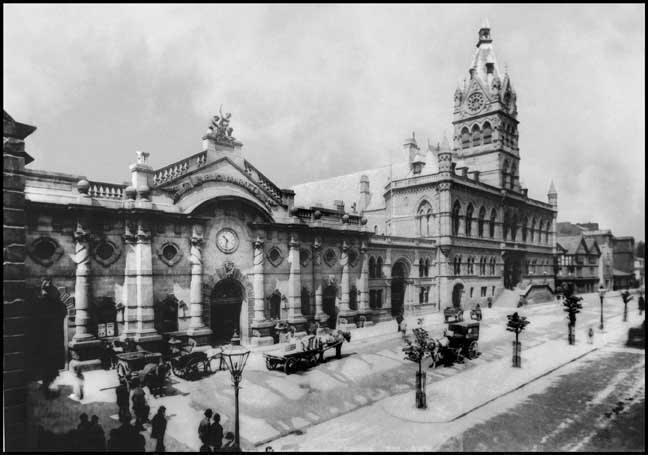
On the other hand, the history page has this wonderful photograph in its favour.

Here’s the description that goes with it, genuinely interesting if a tad brief:

Chester’s market charter was granted in 1159.  The markets were originally hosted on the streets and Rows, with the focus in Market Square, outside the current Forum entrance.

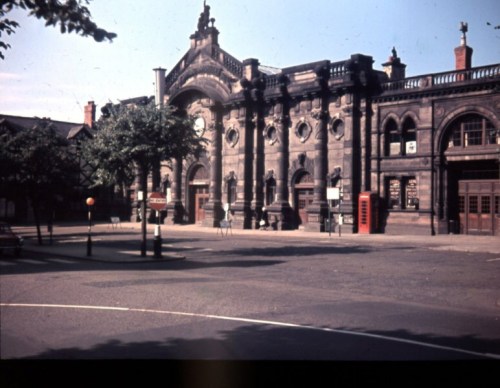
The first permanent building was the Exchange, built in the square in 1692 until it burned down in 1862. It was replaced by a grand Victorian construction in 1865, designed to complement the new Town Hall next door, although sadly this was demolished in 1967 and replaced by the current Forum building.

A second photograph below, from Wikipedia, but without attribution to an original source, is also excellent.  What it was replaced with was really bad, but even if it had been something halfway acceptable, the loss of this façade was tragic, a lapse of judgement and a thorough abdication of cultural responsibility.  Heritage was simply swept aside, and for what?  One wonders what went on behind closed doors.

The 1865 marketplace façade, next to the town hall, torn down in 1967. Absolute tragedy. Source: Chester ShoutWiki

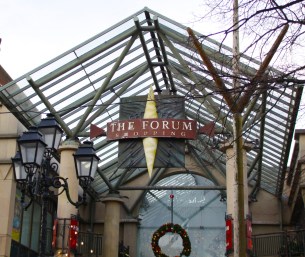
Quite by coincidence, a few weeks ago I took this photograph as I was attending the Local List  Workshop, and was on the lookout for anything slightly unusual or amusing.  This turned out to be the tragic sole remainder of that wonderful façade.

I am just hoping that the 2022 version of the market and town hall square heads us in the right direction.  Here’s their stated ambition:

“The vision driving the new market is to be a ‘modern traditional market’ that takes the best of the new breed of thriving city produce markets such as Borough Market in London, Barcelona market, combined with communal foodhall markets such as Altrincham and Liverpool’s Baltic.”

The entrance to the market as it looks at the moment

It’s a laudable ambition, but we will just have to see how it looks and feels when it comes to using itThe website states:  “Applications have now closed to trade at the new Chester Market. We expect to announce which traders have been successful over the summer.”  When the market moves, I sincerely hope that Mr Fernyhough the butcher, from where I buy game, is going with them.  I’ll ask him when I see him.

I am all in favour of a programme change for the more demoralized corners of Chester, including removal of some of the ugliest  previous attempts to revive it.  In this particular convergence of some great buildings, (Chester Cathedral, the Motor Works, the Town Hall and even the Story House) the space between them should be a vibrant and attractive place for people to enjoy, a  Cestrian piazza, so the hope is all there.  I am balancing optimism against past experience, but crossing fingers that the change will be substantially better, and will deliver something that everyone can feel good about.  

Architect’s impression of what the new marketplace will look like.  Source:  Chester Market website

The redevelopment of Chester Northgate: the imminent future

Architect’s view of two aspects of the new arcade, with the motor works at top.  Source: https://chesternorthgate.com

A couple of days ago I was trying to find out what the construction works were all about at the delightful Westminster Coach and Motor Car Works building next to the Town Hall on Northgate, its façade formerly fronting the library.  I found a whole website dedicated to the redevelopment of Northgate at https://chesternorthgate.com.

Too late to have any influence on the outcome, because the public consultation is over, but for those wondering what the redevelopment is going to look like, there are indications on the above site, including many more details and architects’ illustrations of what’s being planned.

It’s a matter of waiting and seeing what it looks like when it’s up, although one or two of the proposed new buildings seem completely out of keeping with Chester’s personality.  The new multi-storey car park, in particular, looks like a step in quite the wrong direction.

Architect’s view of the new car park. Source: https://chesternorthgate.com

The FAQs are well worth a look.  There’s also a history section with some interesting details about past developments intended to improve the marketplace itself.

Although there is always the worry that new shopping centres and arcades will concentrate shopping activities in new locations at the expense of older ones, I do hope that it brings renewed life to Chester.  The number of shop-fronts boarded up or simply abandoned in Chester is sad, including the former Browns/Debenhams, Patisserie Valerie, Edinburgh Woollen Mill and the entire of the Grade II listed St Werburgh’s Row.

Architect’s view of the new market place at the rear of the Town Hall.  The view below shows it as it is at the moment.  Source: https://chesternorthgate.com

A Chester Local List Workshop – what is local listing all about?

A few weeks ago, Chester Archaeological Society forwarded a request from Cheshire West and Chester (CWAC) for participants to attend a Local List Workshop.  I volunteered, but at that time I had only the fuzziest idea of what a local list actually is.  This post aims to clarify the subject of local lists and provides an account what happened during the fascinating Chester workshop.

A lot of county and city councils have programmes dedicated to local listing, and are running their own workshops and other forms of interaction with the public in order to launch their own local lists.  So what is a local list when it emerges from its burrow?

What Local Listing is not

The Grade 1 nationally-listed Chester Cathedral. Shame about the big purple sign, which completely destroys the first impression.  One of the lessons of Chester is that inappropriate signage and shop frontages can intrude very negatively on an otherwise beautiful city.

First, it’s useful to understand what local listing is not.  Local listing is not the same as the more familiar sense of the term listing, which is where a building or monument is “graded.”  Most of us are aware that when a building is officially listed and allocated a grade (Grade 1, grade 2 etc), it is given a special status and there are limits on what can be done to it and how it can be used.  Here’s part of the English Heritage explanation:  “Listing marks and celebrates a building’s special architectural and historic interest, and also brings it under the consideration of the planning system, so that it can be protected for future generations.  The older a building is, and the fewer the surviving examples of its kind, the more likely it is to be listed.”  There are currently 511 listed buildings (Grade 1, Grade 2* and Grade 2) in Chester City Ward alone.  Chester Cathedral, for example, is Grade 1 listed.  This is a national designation, and usually referred to as National Listing.

Local Listing

Local listing is different.  For a start, it is not a national designation and is not determined by a centralized national unit.  It is organized on a local basis by the council.  Here are some of the details on the Cheshire Local List Project website:

“In addition to the National designations, (including Listed Buildings, Scheduled Monuments, Registered Parks and Gardens and Registered Battlefields) local heritage can also be identified through the production of Local Heritage Lists of non-designated heritage assets. These enable the significance of any building or site on the list to be better taken into account in planning applications affecting the building or site or its setting.”

As I discovered when contesting a planning application in London a couple of years ago, one of the sticking points in objecting to any planning application is the concept of a “material consideration.”  A material consideration is something that a planning department takes into consideration when accepting or rejecting a planning application.  More to the point, anything that is not a material consideration is ignored when objections are made.  Local listing ensures that even those aspects of the built environment that are not nationally listed and have no grading are included as a matter of material consideration, which may make all the difference to communities attempting to care for their assets.

National, graded listing is designed to protect buildings and other sites, and ensures that when changes are proposed, a process of consultation takes place, but there are many other buildings, sites and objects that are not nationally listed, but nevertheless have an important role in communities, either because they contribute to community identity, or represent significant markers of local history.   As locally listed entities, these become subject to material consideration in the planning process.

The Cheshire Local List Project (CLLP) website goes on:

The Cheshire Local List gives importance to local heritage within the planning system, but also allows the expression of community identity, both through the list itself and through engagement in the research and designation process. It is a key component of conservation area management and Neighbourhood Plan development, and allows numerous stakeholders to better understand and appreciate the heritage of the county and its communities.

It would have been helpful if the word “listing” had been confined to national graded listing (such as when we refer to something as Grade 1-listed)  to avoid any confusion, but hey-ho, we’re stuck with it, and whatever it is called it is a really good idea, assuming that it is well implemented and becomes an integrated part of local planning procedures.  Local listing is a government initiative that sits at a level beneath graded listing, and is a much less formal designation, but could be just as important for communities if they work with councils to identify important local sites that cannot be nationally listed.  It puts the onus on councils to engage with the idea, but my hour on Google suggests that many have taken up the gauntlet.

The idea of the workshop

One of the Project’s aims is to be community-lead.  Here’s the official wording:  “We see the Cheshire Local List as a community-driven dataset. Rather than impose detailed criteria, which may be restrictive and exclusive, we have developed non-asset-specific criteria which we hope will enable local communities to define local heritage significance on their own terms.”

The term “community-driven” is often an indication that an organization intends to do nothing at all unless poked firmly in the ribs by some community-based pressure group, but here we had excellent James Dixon, Built Environment Officer (Conservation and Design) at CWAC, reaching out to Chester Archaeology Society, amongst other groups, for people to come and participate in a series of workshops.  The objective, ongoing, is to understand sensory experiences of small groups of people walking the same route through Chester to see how this might help to build an idea of what the concept of local listing might contribute to a city that already has 511 nationally designated listed buildings.   Rather than looking at the merit of individual buildings, this approach sought to develop an idea of how people respond to and interact with the city as a whole.

The approach is evidence-based.  Evidence-based approaches have become popular in all sorts of research that involves human interaction, including archaeology, social science and economic development as well as urban planning.  They have largely emerged from the basic idea of phenomenology – the way in which different living spaces are experienced and interpreted by individuals and communities – but are now a tool for developing  strategies or policies.  It takes the idea that how people live their lives and how they perceive their built, natural and cultural environment should influence what decisions should be made about those environments.  First, of course, is the requirement to understand people’s responses, both conscious and subconscious to the context under discussion, in this case the city of Chester.  In our workshop group at least, it produced some interesting results.

Another concept that has been incorporated into the Cheshire approach is “group value.”  This divorces heritage in its own right from other things we appreciate, such as assets, objects and spaces and how we experience all of these in a sensory way.  Valuable buildings are easy to put a finger on, describe and evaluate, but the open spaces in front of them, the odds and ends of  modern sculpture, ancient architectural lumps and bumps, and the occasional well-positioned tree or cobbled footpath are more difficult to evaluate.  And yet, they too are part of the heritage landscape, the built environment, the cultural context or whatever else we are calling it this year.  My above whinge about the purple sign in front of Chester Cathedral is just as important to people’s perception of how we move through our cultural space as the building we want to engage with, because signage is an attention grabber, and it manages expectations.

Archaeologists and historians are always flipping between what a site, building or object might have meant in the past and what it means in the present and how that distinction influences how we interpret the past.  That’s the archaeologist in me talking, but it works for any entity that we look back on from the perspective of time.  Cities and towns are accumulations, so we are reacting not to a single slice of time, but to an amalgamation that spans the oldest to the newest building and and is generally  experienced by the user (shopper, visitor, worker) as something that instead of having many multi-layered and multi-temporal identities, has one single identity in their own minds, in this case the identity of being Chester.

Because we humans are all so different from one another, a Chester identity is no single thing, because different people will respond to it in different ways depending on, for example, nationality, familiarity, personal interests, and the way in which they are intending to interact with it.  So Chester actually has multiple identities, each person perceiving the city as single cohesive entity but each doing so from a different perspective,  meaning that there are multiple identities of Chester, all of them compressing the complexities built up by time into a hurried present-day reality through which we pass, often in a tearing hurry.

In order to move beyond this sense of Chester being any single thing, James has come up with a method of directing participants in the workshop to look at Chester in an alternative way, something that had nothing to do with arranging its buildings chronologically or by function, but by asking us to think about how we reacted to different sensory aspects of it.

Participating in the workshop

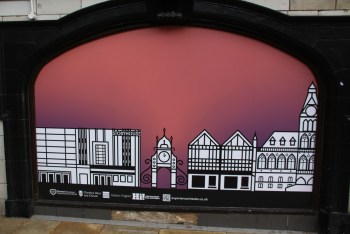
Post-Covid there are a lot of empty shops, looking abandoned and derelict, dragging down the image of their neighbouring shops. The entire of the St Werburgh Row is devoid of life, and tragic. This initiative, however, where empty shop windows are provided with imaginative Chester-themed boards is excellent, raising a smile. The one here is the former Patisserie Valerie on Bridge Street.

On the 18th of November, the 90 minute workshop started at the bottom of Bridge Street, where we received our instructions from James, an excellent, reassuring communicator who turns out to have a natural gift for herding cats.  From the bottom of Bridge Street to The Cross, and then from The Cross to the top of Northgate Street, the workshop set out to build an evidence base of sensory experiences including, for example, colour, sound, smell and texture, and more elusive concepts like fun and solitude.

James handed each of us a 6x4inch card, at the top of which was written a single word.  There were eight of us in the group, which was a good number for exploring some of the concepts, and enabled us to exchange notes on three occasions, once after we had walked Bridge Street, once after Northgate Street, and once in the town square, outside the town hall.  The topics were, in no order, were texture, colours, sound, stillness, views, words, and mine was fun.

There were Covid-aware latex gloves for those of us who wanted to explore texture by touch.  We could partner up with someone else, we could proceed en masse, or we could go off individually.  Apart from that we were given no direction so that the thoughts that came to us were not influenced in any way by James, or by the council’s objectives.

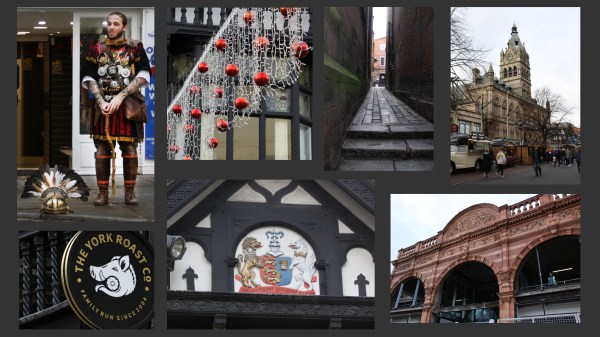
The idea was to write down words that occurred to us in relation to the given topic on the card.  I have to say my heart sank because I had no idea how I was supposed to interpret “fun,” but it was hugely enjoyable once I got into the swing of it.  The photos on this post are snaps that I took as I was walking around and thinking about my target word.  It came in very handy for consolidating my thinking as I went along.  If I had had a different word on my card, the photos would have been entirely different, which is an interesting thought in its own right.  For example, if I had had “stillness” or “texture,” both my words and photos would of course have been quite different.

The record cards

The keywords are clever, because they avoid simple reductionist descriptions based on liking or disliking, positives and negatives and instead focus on more nuanced responses and descriptions.

When he set us off on our own, James said that there was no right or wrong thing to write down, that the whole point was to let us react and write accordingly.  We had a card for Bridge Street and either the reverse side or a new card for Northgate Street.  One of mine is shown here, annotated to make it legible.  As well as capturing our thoughts so that we didn’t have to remember them, they helped us to marshal our thoughts when we gathered to discuss our findings.  We handed the record cards in at the end, so that James could collate them with those of other workshops.  The cards were an important part of the workshop.  Several of us had to apologize for our handwriting 🙂

Discussing the keywords

James was great at getting us together, on four separate occasions.  Two of the discussions were about what we had written on our record cards.  Here’s just a bit of  that, but I am sure that James received radically different comments when running different workshop groups, so this is just a sample of a sample.

In all the discussions it was clear is that we were all looking in different directions, and that’s partly because of the keywords, which directed attention to different parts of the built environment, and partly because of how we interpreted those keywords and what took our interest.

The Cross

Our first stop to exchange notes was at The Cross, where Bridge Street meets with the other three primary roads preserved from the legionary fortress, Eastgate Street, Watergate Street and Northgate Street.  We had at that stage walked only up Bridge Street.  James asked us what struck as what we found surprising about Bridge Street, within the parameters of the keywords on our cards.   I didn’t know anyone’s names, so these comments are all anonymous, and are shorter, simplified versions of what was discussed:

The Rows. There is a lot more stillness here than down on the streets, at least at the moment.  It makes for a nicer experience, but I am sure that the shops would prefer greater footfall.

Views:  As one looks up towards the Cross, the impression is of a great complexity pattern of walls and facades of buildings that forms an incredibly intricate pattern that frames the view from the floor up.  Some bits stick out, some don’t, and all the buildings have their own character, but they lead unambiguously to The Cross, along a road that is surprisingly wide given its Medieval past.  The rows give the whole thing a very distinctive feel, and means that the shops on those level are set back from the road. Everything converges on St Peter’s church, which is a big red sandstone building that draws the eye.  The path from one end to the other, seen as a view, is almost too much for the eye to make sense of.

Touches of colour in the old buildings above shop level stand out and are welcome.

Colours:  The biggest surprise was the contrast between the more or less uniform character of the builds above the shop frontages versus the brightly multi-coloured shop frontages themselves.  There were only a few details in colour on the older half-timbered buildings, which made the colour stand out.  Chester at street level is a torrent of colour, but when one captures a little of it in the buildings that soar above the shops, it is a lovely piece of deliciousness.

Sound:  In this area, the biggest surprise was what could not be heard.  There was such a cacophony of clinks, roadworks and street music, that the things that one could see going on around one, were lost in the other noise.  A pair of hard heels could be heard, but trainers and other soft-soled shoes were lost in the overall sound.  Even individual voices were difficult to make out.

Words:  At shop level the impact of words, in the form of text, was impossible to avoid, and overwhelming.  Branding and signage dominate, in a variety of lights and colours, and it is difficult to differentiate one from another.  Silent, in terms of audibility, they still manage to form a cacophony.

Different ideologies expressed in different building materials, different approaches, different design ideas,  different colours and textures.

Texture:  Texture occurs at every level.  It changes underfoot, but is most obvious in the walls, which are red sandstone, yellow sandstone, brick, wood, concrete and many other materials, which each has its own personality.  Decorative plasterwork is very distinctive and very fine, but not always noticed.  Each texture has its own character – granular, soft, smooth, slippery etc.  Each adds to the diversity of the buildings.

Stillness:  This one was rather sad in many ways at this point.  The main stillness was embedded in failed, closed-down shops.  There had been several before Covid, but there have been some tragic losses since.  These were all devoid of movement and interaction, dead areas that people walked past without looking.  More amusingly, anywhere not selling coffee had a certain stillness, by contrast to those places that were, which were busy, noisy and drew attention to themselves.

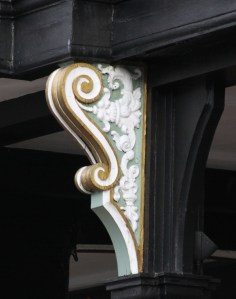
Fun:  There is not a lot of fun at foot level because it is all shops with unlovely frontages, but look up and there is a lot to make one smile in the decorative architectural elements that embellish the buildings, particularly the 19th century facades, a bit like excessively ornate wedding cake decoration, and improbable towers and incredibly ornate ironwork.  Often OTT, and very confident, these flourishes  are always very finely crafted.  They are both fine and truly great fun.

The Story House

The Story House is a thing of real ugliness, but even so I would defend it energetically if anyone were to threaten it because it is a monument to its era.  Not all heritage is pretty.  The same could be said for the telephone box in the foreground.  The bollards, however, at the edge of the road, were agreed by all to be cultural as well as physical barriers.

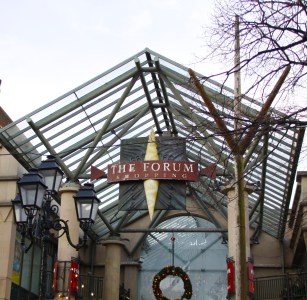
Our next stop was at the Story House.  Northgate Street had started out very like Bridge Street, with lots of engaging architecture similar to Bridge Street, again sitting on top of ordinary shop frontages, but as one proceeds, it opens out and there’s a lot of more architecture to see, some from more recent times, not all terribly positive.  The four most dominant buildings as one filters through the narrow entry to the market square are Chester Cathedral, the Town Hall, the Motor Works, and the Story House.  There is also a very conspicuous frontage to The Forum Shopping Centre, which incorporates the market.  At the moment, the Christmas market dominates the public space, closely clustered and overwhelmingly full of cooking smells.  We walked past the market and gathered in front of the Story House to discuss the walk up Northgate Street.

Inevitably and fascinatingly, we all talked about how interesting it was to compare the walk from the bottom of Bridge Street to The Cross with the walk from The Cross to the Story House.

Views:  This was a story of constriction within fairly narrow confines to a sense of release in the big space in front of the Market Square and the Town Hall, but it was also a story of disappointment.  The sense of being lead somewhere by views of trees beyond the narrow start of Northgate Street lead to nothing more than an untidy space that was undefined and offered nothing like the oasis that was suggested by the trees.  At this time of year, particularly, the trees lend very little because they are deciduous and have dropped all of their leaves untidily onto the ground.  The Christmas market did not improve matters.  The cathedral, to one side, was a pleasant presence but did not dominate.  The main dominating factor, in terms of being lead forward, was actually the Story House, not Chester’s most aesthetically pleasing building.  Beyond the Story House, the symmetry collapses and there is nothing to tempt one forward.

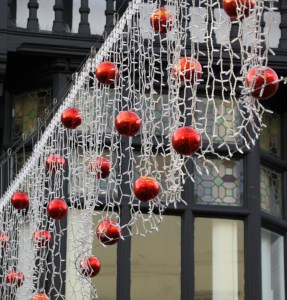
Colours:  This is so dependent, just as it was on Bridge Street, on where you happen to look.  Ground level is bright and full of aggressive colours, but although on Bridge Street these were very jarring, they are more restrained on Northgate Street.  Looking up things are far simpler with black and white facades, and reddish-brown brickwork that provide a warmer feel.  The Christmas decorations were felt, by everyone who expressed an opinion, to be just right, not overstated or understated, but entirely suitable for the job in hand.

Sound:  In contrast with Bridge Street, Northgate Street was a far richer audio experience.  There was tapping, humming, rattling, the sound of wheeled suitcases on cobbles, a bicycle, and more human traffic, as well as the inevitable street music.  The sound of heeled shoes versus trainers was again particularly noticeable.  Reaching the marketplace, the noise of people talking increased enormously, and there was more traffic.

Words:  The plethora of promotional messages at street level was again dominant.  It was all very urban and vibrant, but there was also text in the historic buildings above the shops, where there were other messages to be seen that were resonant of the past.

Textures:  There were so many textures to be seen including the old versus the new, tiles versus glass, wood versus brickwork and the incorporation of carvings and sculptures into building facades.  As well as buildings, there were plants and trees to take into account, including moss on cobbles next to the cathedral.

Stillness:  The cathedral, a former abbey, is an oasis of stillness in the city, and offers a gateway into an inner peace, including its gardens.  The interface between the city and the peace beyond is provided by the Abbey Gate, and was probably the only entirely still place in the part of Chester that we walked on that day.

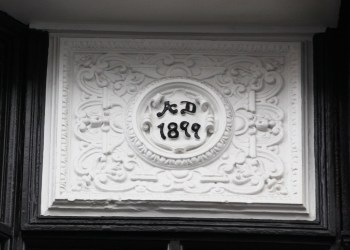
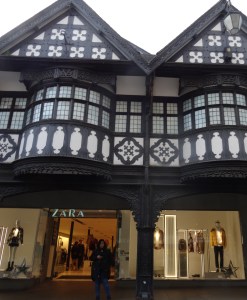
Fun:  Again there were a lot of excellent architectural details that were functionally unnecessary but expressed real exuberance.  Examples are the little sculptures in niches above the row of shops that includes Lakeland and Zara, little towers at the top of buildings and ornamental plasterwork on all sorts of buildings.  The overall impression of certain attention-grabbing buildings, like the town hall and the motor works lift the spirits, and both these draw attention to the positive impact of colour in building materials.

We did not, of course, explore internal spaces, but the idea of exploring interfaces between external spaces and internal spaces is an interesting one.  Little corridors leading from one space to another gave an almost secret feel to some of the city.

The good, the bad, and the highly nuanced

The other two discussions took place first in the public space in front of the Town Hall and the entrance to the market (The Forum Shopping Centre) and then at the point of Bridge Street where it becomes traffic-free and were less on what was on our cards than on our overall impressions.

Market / Town Hall Square

When we paused in front of the Town Hall, in what is usually an open area, we were asked what our impressions were of that public space.  The Christmas market was setting up, obscuring a sense of what it is like of most days of the week, but some interesting comments emerged.

Two of the dominant buildings, the Town Hall and the old Motor Works were exuberant, and were terrific examples of how whole buildings can express the enthusiasm and enjoyment (as well as ambition and pride) of those who created them.  They, together with the Story House and the Cathedral, surround the public open space.  The chap who was looking at “views” drew attention to how we had been funnelled from the lower end of Northgate Street, between buildings similar to those in Bridge Street into a space that, from a distance, with trees visible, had led to a sense of anticipation, but had very little to offer.  There were random odds and ends dotted around, leading to the sense that there was no cohesion in the space.  A very grubby Roman column here, a modern sculpture there, and an anti-terrorism barrier across the road.  I think that we all had the sense that nothing seemed properly integrated, and that a public space that might have had real potential was actually very drab, in spite of being surrounded by some great buildings, each of a very different but superb character.  We also looked at a bike rack that was very intrusive but could be placed somewhere less conspicuous and still be useful.  This was no piazza or plaza, and there was really nothing to celebrate.

The entrance to the indoor market.  A reminder of Chester’s Roman heritage, or just ugly?

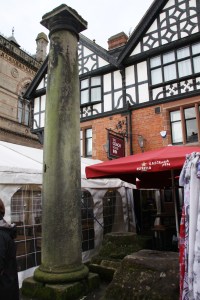
I found myself almost back to back with a Roman soldier who was explaining something to a small group of visitors. I love the soldiers, who certainly come under the heading of “fun,” because wherever they go they raise a smile, but these soldiers, whether giving guided tours to adults or leading long strings of children wearing cardboard armour and carrying cardboard Legio XX shields, are a terrific innovation.  Some of us were also facing a Roman column that usually looks a little forlorn and isolated, and for which I have affection, but on that day looked more than a little farcical hemmed in on all sides by the Christmas market.   In Chester, a great effort has been made to incorporate the city’s Roman past, and there are constant, excellent reminders that help to reinforce the fact that as well as the built environment, the buried environment also plays an important role.  But that column could do with a rethink and a clean.

Little flourishes are worth looking out for.

Although the keywords on the record cards avoid simplistic likes and dislikes, positives and negatives, we found that in discussions value judgements were inevitable, because for every example of “fun” there is probably a “dull” in the next street, and for every ten tactile and aesthetically enjoyable examples of “texture” there is probably an edifice of brutal concrete nearby (the Pepper Street multi-storey car park springs to mind for both examples).  One of the interesting things from the discussions was that there are so many positives that the negatives stand out as noticeable intrusions on the positives.  One of the workshop members pointed out that anti-terrorist bollards, for example, are not only very ugly with their modern appearance and big lights, but give a misleading sense that there are better bits and less desirable bits of the city, separating  areas in which one is safe and where there are good thing to visit from those which may be not quite as safe, and not quite as worth visiting.  Once this was pointed out, everyone agreed, and we all understood that the city should not be seen in terms of what lies within and  what lies beyond those bollards, but that the perception is difficult to avoid.

Upstairs or downstairs – where does the fun lie?

Response to the keywords is a hugely personal thing.  I am guessing that many workshops would be required to capture even a small sample of what an entire community might think and feel about their living environment.  I interpreted “fun” as anything that would make me smile spontaneously.  I automatically looked away from the street level shopfronts to the upper levels where time, imagination and skill have wrought wonders. Some shop road level frontages are better than others, but for me all are brash, most of them frightfully ugly, and I hate shopping anyway, so nothing fun is to be found there.  But I have friends for whom shopping is hugely enjoyable, and the bright lights and colourful window dressings are all part of the enjoyment, and some of them would be puzzled by me describing architectural exuberance and decorative flourishes as “fun.”  So my interpretation of fun, confined to the upper levels where history looks down at me and I look back at it, would not be someone else’s.

Pausing again on Bridge Street

We paused again on Bridge Street, just on the uphill side of the anti-terrorist bollards, to discuss our views.  We were on borrowed time, as we had eaten up most of our 90 minutes, but we were all eager to point out the negatives of our immediate environment, because we all wanted to see improvement to encourage businesses to invest in that part of town.  Everyone agreed that the anti-terrorist bollards seemed, again, to cut one part of the street from another, and that the area north of Bridge Street was rather more prestigious than that to the south of them.  We also looked at some truly awful shop frontages, text-heavy, with lurid colours, tacky.  We asked about planning permission for frontages, as we were standing in front of a particular shocker at the time, and it turns out that they are indeed subject to planning permission, but that some retail outlets do not follow the procedures.  There is a lot of work to check up on those who ignore the rules, and it takes even longer to enforce the violated regulations.

The future

James said that he will feed back to Chester Archaeological Society about the results of the workshops once they have all been completed, and I really look forward to that.  Particularly, it will be interesting to know the answer to James’s own question – what can the local list do that designated graded listing does not already do in somewhere like Chester, which has listed buildings everywhere you turn?

The good news, even before the workshops have been completed and their findings collated, is that the Local List facility is already up and running and you can nominate an “asset” for local listing if you feel that it has particular community value and should be taken into account when planning and other issues are raised that might place it under threat.  You can find out full details on the Chester Local List Project website at the following address:
https://local-heritage-list.org.uk/cheshire/guidance:

The Proposal Process

When you make a proposal or proposals for the Cheshire Local List, you will first have the option of creating and revising a draft that will not be reviewed until you submit it. When you submit your proposal, a Conservation Officer will check it to see if more information is needed. If so, it will come back to you for revision, and if not it will be moved forward for approval.

Make a proposal for the Cheshire Local List here

Approvals for nominations to the Cheshire Local List will be done by a panel of Conservation, Planning and Built Environment officers from Halton, Cheshire West and Chester and Cheshire East.

The final list will be put forward for formal adoption by each of the three boroughs in due course as part of the development of new Supplementary Planning Documents for local heritage.

The Assessment Criteria are here:
https://local-heritage-list.org.uk/cheshire/assessment-criteria

The top-level asset categories are Buildings; Parks & Gardens; Landmarks, Art Works and Way Finders; Other Sites, Structures & Landscapes, but see the following page for more information on each category:
https://local-heritage-list.org.uk/cheshire/assessment-criteria-asset-type

If or when I hear more about the project, I’ll post about it on the blog.

Adventures with Churton Honesty Eggs – Avgolemono soup

Avgolemono, meaning egg and lemon in modern Greek, is both a soup and a sauce. As a slightly thickened sauce it goes wonderfully with fish or chicken, but it sings at its most sublime as a soup, with a handful of white long-grain rice and gently simmered, and a handful of chopped parsley thrown in at the end.  It is an utterly divine and life-changing taste-bud experience.

I first had it on Kefalonia in 2004, preceding an equally divine order of flame-grilled octopus tentacles, sitting on the restaurant’s outdoor terrace, watching the sun set slowly and spectacularly over the hills, and although the wine was seriously rough around the edges, I cannot remember the last time that a meal felt so perfect in all its parts.  It was on Kefalonia that I fell head over heals in love with Greek cuisine, but that particular meal remains my favourite.

Sunset on Kefalonia, 2004

I have reproduced the meal many times since.  Frozen octopus tentacles were available prior to lockdown in a Portuguese shop in Wrexham.  When I lived in Aberdovey my father used to lob a pack in his rucksack for me, and it was always terribly exciting to collect it.  Octopus has to be tenderized before it can be eaten, and the freezer is one of the best ways to achieve this, so frozen octopus is always a good buy.  Not having ventured into that part of Wrexham since lockdown eased, and unable to get it anywhere else, I’ve had to abandon octopus for the time being, but the avgolemono soup needs no special ingredients.  It does need good quality ingredients, but not special ones, which is the usual story with Greek cooking.

The recipe that I first used for avgolemono is the one that I still use.  I bought The Complete Book of Greek Cooking by Rena Salaman and Jan Cutler on my return from Kefalonia, where there are two versions described.  I use the first version, on page 96, although I note that the second one, on page 99, is very like Rick Stein’s version if you’ve ever tried producing that.  The main difference is that the version that I use has egg yolks rather than whole eggs, as well as rice, whereas the other version uses whole eggs and has strips of chicken stirred into it rather than rice.

Here’s my preferred version of the two in the book, a perfect use for Churton Honesty Eggs (or any other eggs, of course 🙂 )

Serves 4

  • 900ml home-made chicken stock, (in my case made by poaching a lot of chicken in water with parsley , onion and peppercorns)
  • 50g white long-grain rice
  • 3 egg yolks
  • 30-60ml / 2-4 tablespoons of fresh lemon juice
  • 30ml / 2 tablespoons chopped parsley
  • salt and black pepper
  • Lemons slices and parsley sprigs to garnish
  1. Pour the stock into a pan and bring to simmering point, then add the drained rice.  Half cover and cook for about 12 minutes until the rice is just tender.  Season with salt and pepper.
  2. Whisk the egg yolks in a bowl, then add about 30ml/tbsp of the lemon juice, whisking all the time until the mixture is smooth and bubbly.  Add a ladleful of soup and whisk again
  3. Remove the soup from the heat and slowly add the egg mixture, whisking all the time.  The soup will turn a pretty lemon colour and will thicken slightly
  4. Taste and add more lemon juice if necessary.  Stir in the parsley.  Serve at once, without reheating, garnished with lemon slices and parsley sprigs.

Top tip:  The trick here is to add the egg mixture to the soup without it curdling.  Avoid whisking the mixture into boiling liquid.  It is safest to remove the soup from the heat entirely and then whisk in the mixture in a slow but steady stream.

The recipe advises against reheating to avoid curdling, but I prefer the soup hotter than it is at this point, so I heat it VERY slowly and carefully.

Don’t be tempted to skip the rice, even if it sounds a little odd, because it is really gorgeous, but must be cooked through.  12-15 minutes from when it enters the simmering water.  Rick Stein uses orzo instead, but I really don’t recommend it.  Far too solid and intrusive.

Churton Honesty Eggs

You can see my previous Churton egg adventures by clicking here.  Churton Honesty eggs are parked in a barrow by the side of the road, and operate on an honesty system where you drop coins into the barrow in return for the eggs.  You can hear the cockerel crowing, and he sounds like a fine fellow.  The eggs are excellent.


Valle Crucis Abbey #1 – An introduction to the Cistercians and Valle Crucis

Valle Crucis, founded in 1201, is a superb example of a ruined Cistercian abbey, located less than an hour’s drive from the Chester-Wrexham area, in a lovely valley on the edge of a quiet stream that flows into the Dee.  It has been extensively surveyed, the few documents relating to the site and its antecedents have been studied and the site has been excavated both in the 19th Century and in the 1970s.  Importantly, most of the main features of the core buildings are identifiable, and can be discussed in terms of how the monastery was planned and used.  All of  these resources form a good basis for understanding how Valle Crucis was established and used, and what happened to it after it was “suppressed” or decommissioned following Henry VIII’s dissolution of most of Britain’s monasteries.

This is the first of a series of posts looking at the monastery.  These posts are quite long.  Valle Crucis, is used in this series of posts to introduce not only this particular abbey, but also the ideas that lead to monasticism, different monastic orders and the  distinctive architecture that defines most of the monastic orders in Britain.

An “order” is a shared monastic tradition, a set of spiritual ideals often spelled out in considerable detail in rules that covered everything from how many times a day a monk should pray, communally or individually, to where and when they could speak, eat and sleep, and what work they should engage in.  All orders involve a degree of renunciation and isolation by communities of monks.  Monastic architecture reflects both the need to gather a community in one establishment, adhering to a single set of rules, and the need to divorce that establishment from the rest of the world.  Unlike monks, friars could leave the monastic community (friary) to preach and tend to the poor, and were often located in urban contexts, but other orders chose to confine themselves to an abbey to focus their attentions on worship and scholarly activities that celebrated God.  Some chose to locate themselves far from other human habitation.  All were what is now termed Catholic, and all owed allegiance to the Pope, as well as to the heads of their own order, and to the founders who endowed their properties with land and resources.  The religious orders of the 12th and 13th Centuries in Britain were differentiated from one another based not on their religious beliefs, but on their ideas about how best to worship and celebrate God.  They dedicated themselves to spirituality and worship in different ways, based on traditions established in the history of monasticism.

St Pachomius in St Shenouda Monastery, Egypt. Source: St Shenouda Monastery website

Monasticism grew out of an early tradition in 3rd-4th Century A.D. Egypt where the devout might abandon their communities to live as hermits in the desert hills and mountains, divorced from anyone else.  They had as their models St John the Baptist and Jesus, both of whom had engaged in devout isolation in the desert.  Hermits began to organize themselves into communities that focused on offering guidance and communal prayer whilst still offering isolation from the distractions of secular life.   In the 4th Century, former soldier Pachomius, having followed the eremitic path in the Egyptian desert to live the life of a hermit, heard a voice telling him to establish a community for hermits like himself, a coenobitic (“common living”) way of combining isolation from the outside world with communal support and guidance.  This acknowledged that whilst individuals might seek out a life divorced from the material, they could well need help to achieve the sort of enlightenment that they were seeking.  These communities were therefore sources of knowledge, wisdom and education as well as worship.   He established his monastery in Tabennisi in Egypt, and simultaneously began to develop the first set of formal rules for guiding life in a monastery, which grew over time.  The rules combined prayer, solitude and work in a communal and very isolated environment, a difficult balance to strike.  This  was successful and soon spread.  Monasteries began to appear throughout the Mediterranean from where they spread into Europe.

A 12th Century interpretation of St Benedict delivering his monastic rule in the 6th Century AD. Source: Wikipedia, via Monastery of St. Gilles, Nimes France (1129)

In 6th Century Italy, St Benedict developed another set of rules for monastic living that required not only individual prayer and communal worship, but outlined a strict regime of living that included eating merely for fuel rather than enjoyment, a largely vegetarian and very narrow diet, and the requirement for manual work, including contributing to building projects and labouring in the fields.  The concept of an abbey emerged, a religious establishment consisting of both a monastery and a church in a single complex, housing a community of monks who do not leave the premises.  St Benedict’s form of monasticism was popular and spread throughout Europe.

As Benedictine monasticism spread and developed its own personality over the centuries, the strictness of St Benedict’s rules was often abandoned to enable a much more comfortable lifestyle, with an emphasis on liturgy rather than work, a varied and rich diet that included meat, and an emphasis on glorifying God through rich works of art and generous patronage.  Some abbots became involved in religious and state politics beyond the abbey walls, and became influential in their own right, far from the unworldly vision of  monks that St Benedict had promoted.  In the 12th Century this more opulent version of Benedictine monasticism was epitomized by the Cluniac order of monks (named after their abbey at Cluny in France).  The Cluniac order was the apogee of this desire to express devotion through liturgy and art, the elaborate and rich monasteries home to opulent treasures, art works, tapestries and fabulous stained glass that were intended to both reflect and celebrate the glory of God, and the monks entertained lavishly, rubbing shoulders with the rich and powerful.  This trend sat ill with those who sought a simpler, modest, withdrawn and hard-working way of serving God, true to St Benedict.

Johann Petr Molitor, Cistercian monks, murals in the Capitular Hall, Cistercian Abbey Osek, North Bohemia, before 1756. Source: Wikipedia, from the Cistercian Abbey of Osek, North Bohemia

During the early Middle Ages, the Cistercians, named after their first abbey, the 1098 New Monastery at Cîteaux (Cistercium in Latin) in France, set about returning to the values of St Benedict, which led to the reformation of some branches of Benedictine-based monasticism.   New Cistercian abbeys were established as a network of child abbeys, each secondary to its own mother, and all owing allegiance to the founding house at its core, Cîteaux.  Each new abbey could spawn one or more other abbeys.  The third abbot of the new Cistercian order, Stephen Harding, wrestling with the problem of how to ensure that the Cistercian principles would not submit to similar decay, retained the Cluniac’s governing principle of the first abbey being the mother for all subsequent houses of the order, to ensure consistency and standardization throughout the order.  This contrasted with Benedictine abbeys that adhered to the same 6th Century monastic rules proposed by St Benedict, but were wholly independent of one another.

Harding’s own guidelines, building on those of St Benedict, also included obligations that had to be acted upon on a regular basis by the entire family of abbeys.  One of these was that all the same liturgies should be used in all abbeys.  A unique requirement was that all abbots should attend, annually, the General Chapter at Citeaux, a meeting of all the abbots that discussed changes, challenges and difficulties, and enforced discipline.  Another innovation was that when an existing abbey founded a new house, the mother abbey was obliged to arrange annual visits to its daughter houses to ensure that the standards, values and rules of the Cistercian order were being maintained.  In this way, for the 11th,12th and much of the 13th centuries, the Cistercians maintained control and uniformity over a vast family of monastic houses, including Valle Crucis.  The monks wore undyed habits, unlike the other Benedictine orders whose habits were dark brown or black.  Accordingly, they became commonly known as the White Monks.  

Citeaux Abbey. Source: Wikipedia

The Cistercians combined worship with hard work in remote places that encouraged contemplation, eliminated distractions and enabled focus on a communal but pared down livelihood that was far more in keeping with St Benedict’s more spartan ideals.  After Cîteaux, the most important Cistercian monastery, responsible for evangelizing on behalf of the Cistercians, was Clairvaux (founded 1115), which was the home base of abbot St Bernard.  St Bernard was a restless and vocal monastic propogandist of the 12th Century who, in contradiction to the rules of the order, travelled far and wide to bring the Cistercian message to the western world, and whose sayings are still widely quoted: “Arouse yourself, gird your loins, put aside idleness, grasp the nettle and do some hard work.”  He was an advocate of crusades, connected with monarchs, politicians and other religious hierarchy, promoted the cult of the Virgin Mary, and became an unexpected and influential celebrity and icon, the poster-child of the Cistercian message.  Gascoigne calls him “the most influential monk of the Middle Ages.”

St Bernard in his white robes holding a delightfully improbable demon at his feet.  Marcello Baschenis, c.1885. Source: Wikipedia

Very quickly, new Cistercian abbeys proliferated in Europe and across Britain, always in isolated locations, each connected as a daughter to its mother abbey, to which it owed homage and loyalty.  Clairvaux was the mother abbey for Whitland in south Wales, which was established by monks from Clairvaux itself.  Whitland in turn established other abbeys including Strata Marcella near Welshpool, and this abbey in turn established Valle Crucis.  It took 86 years from the foundation of Clairvaux until the foundation of Valle Crucis, but it was only four monastic steps from St Bernard, and that sense of proximity must have resonated at Valle Crucis, as with all the abbeys in Wales.

Every Cistercian abbot had to return from his abbey to Citeaux every year for what was known as the General Chapter, a great conference of abbots.  This was the case even for abbeys that were located overseas, and the British abbeys were subject to this costly and time-consuming annual trek.  Also on an annual basis, the abbot or his prior if he had one (the abbot’s second in command) would visit a given abbey’s daughter abbeys to ensure that everything was running according to the original Benedictine plan.  This led to a degree of standardization and adherence to the order’s rules that was not necessarily seen in the other orders.

The remains at Valle Crucis offer a great opportunity for discussing the main points of Cistercian architecture, life and economic strategy.  It is a site that reinforces many of the observations that have been made about Cistercian monastic traditions throughout Britain, but which is also interesting in its own right.  The Welsh abbeys provide a particular opportunity for considering how their circumstances may have differed from their English counterparts, due to a series of factors including the patronage of Welsh abbeys by the Welsh princes, the wars fought on monastic land by Edward I and Owain Glyndŵr, and the character of the landscape in which the abbeys were built.  Other orders will be discussed in the future.

Introducing Valle Crucis

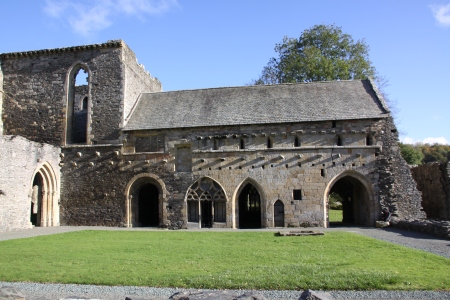
The East Range

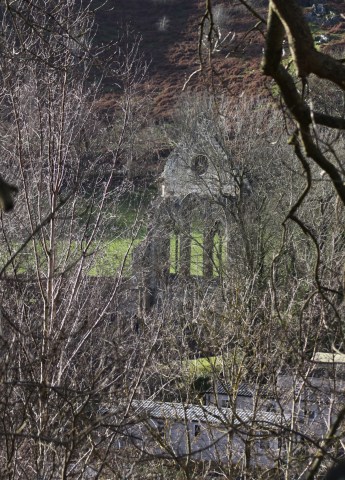
In 1201 bValle Crucis was built in a scenic valley beneath the Horseshoe Pass near Llangollen, on the banks of Nant Eglwyseg, a fast-moving stream that ran into the Dee and now feeds the Llangollen canal. 

Both choir (or quire) monks and lay brothers were housed at Valle Crucis.  The choir monks and lay brothers lived different lives.  Their refectories, dormitories and latrines were all quite separate, and their roles within the abbey were clearly delineated.  Although the lay brothers would worship in the church, they were confined to the nave and a screen separated them from the choir brothers.  The lay brothers ate more advantageously, as they needed a better diet to support them in their daily work.  Cistercian orders worshiped seven times a day and once at night, and engaged in scholarly pursuits, but were also expected to engage in manual labour, contributing to the work carried out by lay monks.  Lay monks (conversi) were illiterate and worked the land, but were resident at the monastery.  They had their own separate quarters for sleeping and eating, and were confined to a section of the church that was divided from the parts of the church used by the quire monks.  Their church worship was much less frequent than that undertaken by quire monks, as most of their day was taken up by agriculture, crafts and building works.

The name of Valle Crucis is Latin, meaning Valley of the Cross, a reference to the 9th Century inscribed Pillar of Eliseg that was erected to commemorate the ancestors of Concenn of Powys, a  Welsh chieftain who died on pilgrimage to Rome in 858.  Eliseg was Concenn’s great-grandfather.  The inscription is now illegible but was recorded in 1696 and lists great deeds of ancestors, presumably with a view to establishing an incontrovertible connection to the lands on which the cross was constructed.

Survey, excavation, restoration and modern research

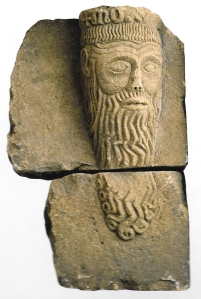
Carved head found in the refectory during excavations, and now rather a long way from home in the National Museum in Cardiff.  Source: Evans 2008, p.47

Documentary resources are few and far between for Valle Crucis, so other ways of exploring the history of the site have been employed.  The documentary archives of other monasteries and of related properties have helped to provide some additional information, but the documentary picture remains very threadbare.

Because of the architectural and functional standardization of monastic establishments, it has been possible to extrapolate the roles of much of the site’s key buildings by comparison to other Cistercian abbeys, but this only takes one so far.

Observing the above-ground architecture has taken matters a lot further, telling a story of a major fire forty years after the foundation of the abbey, and the changes in architectural direction that had to be taken as a result.  As the decades and centuries passed, changes in Cistercian values and ideas are captured in the architectural features and new decorative motifs.  This rich source of information has been supplemented by data that has come from the ground.

One of the illustrations from Butler’s 1970 excavations, published in 1976

One of the fads of the 19th Century was antiquarianism, the investigation of ancient sites of all ages.  Excavations became popular activities, although often hair-raising in the level of destruction achieved in the process of the pursuit of dazzling objects.  Valle Crucis did not escape this attention, and a series of archaeological excavations were carried out in both the middle of the 19th century, and in its latter half.   An anonymous letter to Archaeologia Cambrensis dating to 1863 by a visitor to Valle Crucis condemned the mid 19th Century excavations by W.W.E. Wynne, but the subsequent excavations by Harold Hughes appear to have been carried out with rather more integrity.

In 1970 the site was excavated by Lawrence Butler.  He reported on the findings, including the chronological sequences from the site, and full details of the pottery in 1976.  The pottery was limited in type and form but covered the full range of the site from construction to dissolution.  The faunal remains were analyzed by the ever excellent Graeme Barker as part of that project’s post-excavation work, to provide information about diet and economic activities, and his report was published in the same year.  The results of this particular project are of great interest as Butler found evidence of the earliest clearance of the site and was able to clarify details of fire, flood and alterations to the architecture in line both with these events and in response to the relaxation of Cistercian rules.

Because work has been concentrated on the core abbey buildings, it is less clear how the larger monastic precinct was organized.  This is the area surrounding and beyond the abbey’s heart, that were essential to the abbey’s economic survival, in which agricultural and activities took place, and in which vital supplies were stored for consumption or trade.  

Illustration from the 1895 excavation report by Harold Hughes.

Restoration work began with clearance of the site for excavation, but more ambitious work followed.  Sir Gilbert Scott, the renowned Victorian architect, was employed to repair the west front of the church in 1872, and Sir Theodore Martin restored part of the east end in 1896.  The difference in the stonework at the  and the site has been made safe for visitors.

After passing into the hands of the Ministry of Works in 1950, Valle Crucis was eventually transferred into the care of Cadw in 2008, which retains responsibility for the site.  Between them the site was made safe for visitors and Cadw has expended some effort on information signage to help visitors understand some of the site’s history.


How Valle Crucis and other Welsh abbeys were founded

12th Century links between Cistercian monasteries. Source: Evans, D.H. Valle Crucis Abbey (Cadw). Although Citeaux, the node for all Cistercian abbeys, established early new bases in France, it was Clairvaux under the lead of St Bernard that was responsible for the earliest new abbeys in Wales. Of these Whitland was the most important for the northward spread of monasticism. The green lines emanating from Savigny reflect the Savignac order, which merged with the Cistercians after only 20 years, in 1147. So although Basingwerk in the north and Neath in the south were founded as Savignac orders, after 1147 they were brought under the rule of the Cistercians at Citeaux.

Valley Crucis was at the northeastern end of a branch of a monastic chain that spread from south Wales to the north over a period of some 60 years during the 12th Century, building on a much older European monastic tradition.  The Cistercian order of monks spread through Wales during the 12th Century AD from the of Wales where it was established by monks from the French monastery Clairvaux, forming an eastern and a western chain of monasteries.

The first new Cistercian abbeys were established in Wales in the wake of the Norman conquest, the earliest at Tintern in 1131, and had a distinctly Anglo-Norman flavour.  However, a second strand of Cistercian monasticism spread in Wales.  It began at Whitland (Abaty Hendy-gwyn ar Daf), founded in 1140 by monks from St Bernard’s abbey at Clairvaux, second only to the Cistercians’ founding abbey at Citeaux.  Whitland spawned a series of abbeys that were funded by the native Welsh princes and were populated mainly by Welsh monks, a pura Wallia (Welsh Wales) version of Cistercian monasticism that nurtured Welsh literature and learning.  This spread into the poorer and more remote areas of Wales.

Valle Crucis was founded in 1201, the daughter house of Strata Marcella Abbey (Abaty Ystrad Marchell) near Welshpool, founded by Owain Cyfeiliog, prince of southern Powys, itself a daughter house of Whitland.   Establishing an abbey was an expensive undertaking, both in terms of its construction and providing it with the resources to ensure ongoing economic security. Accordingly, every new abbey required an endowment by a donor, someone with enough land and wealth to give some of it away in return for divine good will and the prayers offered by the monks for the souls of the donor and his family.  The donor usually required a guarantee that they would be buried within the abbey church, and that their family would be buried either within the church itself or within the monastery precinct.  Monks were considered to have a hotline to God.  Having dedicated their lives to Him, and living sin-free lives, they built up a surplus of virtue and influence that could be employed on behalf of the living in order to provide for them in the afterlife, an intercession to minimize the impact of sins committed in life.  Valle Crucis Abbey was founded by Prince Madog ap Gruffydd. 

Original sacristy entrance, 13th Century.

Prince Madog ap Gruffydd controlled the territory of Powys Fadog from the Tanat valley in the south to the edge of Chester from 1191 until his death in 1236, and was an ally of his cousin Llywelyn ap Iorwerth (Llywelyn the Great), prince of Gwynedd, d.1240.  In accordance both with tradition, and to fulfil the terms of his original financing and support of the abbey, he was buried in the abbey church at Valle Crucis, although the exact site of the grave has been lost.  The map above left shows the territorial divisions in Wales in 1267, with Powys Fadog bordering Chester, Gwynedd, southern Powys (Powys Wenwynwyn) and England. 

Valle Crucis was supplied with at least twelve monks (considered by St Benedict to be the minimum number for founding a monastery, following the twelve apostles), possibly thirteen, who were installed in temporary accommodation with a wooden church.  Work would have begun immediately on the stone church, the sacristy and the accommodation, and the 1970 excavation found unmistakeable signs of this work.

Choice of location

The map to the left (Ordnance Survey SJ24/34) shows the relative locations of Valle Crucis Abbey, the Pillar of Eliseg and Castell Dinas Brân, all a short drive from Llangollen, which was probably a large village that would have benefitted from the proximity of the monastery and its associated farms (known as granges).

Ordnance Survey map SJ24/34, showing the relative locations of Valle Crucis Abbey, the Pillar of Eliseg and Castell Dinas Brân (the latter not built until 1270, 69 years after the foundation of Valle Crucis)

The Cistercian ideal of a contemplative existence away from distractions meant that new abbeys were sited where monks could practise their devotions in relative seclusion, although not in complete isolation.  They were often near to well-established routes, and they always located themselves near to water that would be used for drinking, cooking, cleaning, ritual purification, as well as fishing and sometimes for powering water mills.  Abbeys were supposed to be economically self-sufficient, so abbeys still needed to be near enough to manors and villages to enable them to trade their produce, mainly agricultural, in exchange for the basics required for sustaining the abbey, both the choir monks (the dedicated monks within the monastery) and the conversi or lay brotherhood.

Although little is known about Llangollen in the late 12th Century, there was some type of settlement recorded there based around a church, and in 1284, Edward I granted the manor of Llangollen to Roger Mortimer, together with the rights for a weekly market and two annual fairs.  Llangollen was far enough away for monks to feel that they were isolated from civilization, but near enough to a village to enable contacts to be established if required for sourcing produce, raw materials and other goods.  The site of the abbey was clearly idyllic.  The following is an evocative excerpt from a paper by John Williams, who reported on the abbey in 1846 in the journal Archaeologia Cambrensis:  

Luxuriantly watered by a clear stream and sheltered by high hills, the sides of which are gracefully ornamented by trees, the place altogether appears as if especially intended to be the home of peace and happiness – a paradise for restored man, where he might securely worship his Creator and cultivate the graces of heaven implanted in his soul.

The sad remains of Strata Marcella Abbey, which supplied the founding monks of Valle Crucis.  Source: Coflein website – RCAHMW, taken by C.R. Musson, 2/1/1995.

The founding monks of Valle Crucis from Strata Marcella near Welshpool certainly thought so.  They moved the residents of the existing hamlet of Llanegwest to a new location in order to establish themselves in this particular paradise in the form of a fine abbey.  Llanegwest was probably a fairly tiny settlement, and it was relocated to Maelor Gymraeg (on the far northeastern border).  This was by no means unusual, and there are enough records of hamlets and villages being moved to make way for a monastic establishment for this to be seen as a fairly standard (if somewhat ruthless) act in the establishment of a new Cistercian abbey.

The fish pond at Valle Crucis

The Cistercians were renowned for their use of water, which in some abbeys included sophisticated networks of sunken drains that fed into and out of monastic buildings.  The siting of Valle Crucis next to the Eglwyseg was essential for sourcing water that was used for cooking, cleaning, washing, for use in rituals and for creating a fish pond and a drainage system to flush both the choir monks’ and lay brothers’ latrines.

The pond is an expanded version of the original one, and is the only one surviving in Wales.  As early Cistercians could not eat meat under St Benedict’s rules, except on certain nominated days, fish was often an important component of the diet.  As the rules relaxed, meat found its way into the diet on more than just special days, but in the early abbeys fish was often responsible for providing much-needed protein.

The latrines, located on the first floor at the end of the dormitories, were flushed by drains below, which diverted fast-moving stream water to clear waste back into the stream,  presumably downriver of the monastery.  Cleanliness was an important component of monastic life, with monks washing their hands before each meal, and latrines associated with the devil.

Pillar of Eliseg by David Parkes 1809. Source: National Library of Wales

Finally, the Pillar of Eliseg may or may not have influenced the location of the abbey, even though it provided the abbey with its name.  It is, however, entirely possible that the presence of the ancient cross as a clear and ancient statement of Christian affiliation would have been particularly attractive to the new abbot and his monks.  Perhaps more significantly, it was probably particularly resonant for the founder-patron of the abbey, Prince Madog ap Gruffydd, embedded as the monument was with memories of the past inhabitants of the region who sought to defend it against all-comers.  With the Marcher Lords at the borders and the English beyond, Madog probably felt a close affinity with Concenn and his predecessors.   The cross still stands to the north of the abbey, but is considerably shorter, with bits missing, including the top, base and arms of the cross.  In the view to the right by David Parkes, dated 1809, the remains of Valle Crucis are visible at the lower left of the image.

I had initially assumed that the siting of Valle Crucis took into account the proximity of Dinas Brân, a Medieval castle that was also located in the Vale of Llangollen and can be seen from the abbey.  The castle was not, however, built until 1270.

View from the interior of Valle Crucis. I find it hard to get my head around the idea that this and other very narrow views were all that the monks would have seen. They could not explore the environment in which their abbey was located, because they were confined to the monastic precinct.  They could merely see it, never truly experience it.


The remains of Valle Crucis

Valley Crucis provides a very useful template for understanding other monasteries in the Benedictine tradition, all incorporating a church and the main monastic buildings arranged around a square cloister, consisting of a walkway connecting the buildings around a garden or “garth.”

Cadw site plan, with photographs of mine added to show the relative location of some of the key features (click to expand).

Above is a site plan of Valle Crucis, which adopted the typical layout of a Benedictine abbey that the Cistercians had adopted, basing themselves on the Benedictine rule.  The earliest known abbey in Britain that adopted this basic layout was Glastonbury Abbey.  Part 2 will show this image again, and look at these and other features in detail, discussing how they reflect historical developments from the foundation of the abbey at the beginning of the 13th Century, via fire, flood, fluctuating fortunes and changing ideas to its dissolution in the mid 16th century.

As I mentioned at the start of this post, Valle Crucis is not merely of interest as a component of the Vale of Llangollen landscape, but is a useful representative of both Welsh and English Cistercian traditions.  It both exemplifies many of the historical details that have been assembled about Cistercian monasticism in Britain, and provides an impressive volume of data that both reinforces existing knowledge and adds to it.  Some of this will be explored further in the next three posts.

This post, Part 1, has introduced the Cistercian order and explained why Valle Crucis was located where it is.  The next post, part 2 looks at the organization of the abbey in terms of its purpose and how it was built to meet the needs of the monastic community, looking at each room in turn.   All parts are available, as they are written, by clicking on the following link: https://basedinchurton.co.uk/category/valley-crucis-abbey/


Sources for the Valle Crucis series

Resources that were of particular use are picked out in bold.

Books and papers

Anonymous (A. Traveller) 1863.  Valle Crucis Abbey – Correspondence To the Editor of Archaeologia Cambrensis.  Archaeologia Cambrensis, 3rd series, No.33, January 1863, p.68-72
https://journals.library.wales/view/2919943/2995788/67#?xywh=-1466%2C103%2C5111%2C3522

Aston, M. 2000. Monasteries in the Landscape.  Tempus

Barker, G. 1976.  Diet and Economy at Valle Crucis:  The Report on the Animal Bones.  Archaeologia Cambrensis 125 (1976), p.117-126

Butler, L.A.S. 1976.  Valle Crucis Abbey:  An Excavation in 1970.  Archaeologia Cambrensis 125 (1976), p.80-116
https://journals.library.wales/view/4718179/4747123/95#?xywh=-1521%2C-15%2C5975%2C3940

Burton, J. and Kerr, J. 2011.  The Cistercians in the Middle Ages.  Boydell Press

Burton, J. and Ströber, K. 2015.  Abbeys and Priories of Medieval Wales. University of Wales Press

Cantor, N. 2002. In the Wake of the Black Death and the World it Made.  Perennial

Carr, A.D. 1970. An Aristocracy in Decline: the Native Welsh Lords after the Edwardian Conquest.  Wesh History Review 5 (1970), p.103-29

Clwyd and Powys Archaeological Trust.  Historic Settlement Survey – Denbighshire – 2014.  Llangollen SJ 2150 4190, 105978.
https://cpat.org.uk/ycom/denbigh/llangollen.pdf

Coppack, G. 1990.  Abbeys and Priories. Batsford.

Davies, J. 2007 (3rd edition).  A History of Wales.  Penguin

Evans D.H. 2008, Valle Crucis Abbey, Cadw

Edwards, N. 2008.  The Pillar of Eliseg.  In: Evans D.H., Valle Crucis Abbey, Cadw

Gascoigne, B. 2004 (revised edition).  A Brief History of Christianity. Constable and Robinson

Greene, J.P. 1992.  Medieval Monasteries.  Leicester University Press

Gresham, C.A. 1968. Medieval stone carving in North Wales: Sepulchral slabs and effigies of the thirteenth and fourteenth centuries. University of Wales Press

Hughes, H. 1894, Valle Crucis Abbey. Archaeologia Cambrensis, 5th series, 11:43 (1894), p.69-85, 257-75
https://journals.library.wales/view/2919943/3009987/#?xywh=-853%2C-196%2C3885%2C3913

Hughes, H. 1895. Valle Crucis Abbey. Archaeologia Cambrensis, 5th series, 12:45 (1895), pp. 5-17
https://journals.library.wales/view/2919943/3010260/#?xywh=-853%2C-196%2C3885%2C3913

Huws, D. 2000.  Medieval welsh Manuscripts. University of Wales Press

Jenkins, G.H. 2007.  A Concise History of Wales.  Cambridge University Press

Jones, O.W. 2013. Historical writing in Medieval Wales.  PhD thesis, Bangor University
https://research.bangor.ac.uk/portal/files/20577287/null

Jones, O.W. 2020. The Most Excellent Princes: Geoffrey of Monmouth and Medieval Welsh
Historical Writing.  In Henley, G. and Smith, J.B. (eds.) A Companion to Geoffrey of Monmouth.  Brill

Kelley, J. 2006.  The Great Mortality.  An intimate history of the Black Death. Harper Perennial

Kerr, J. 2006. Life in the Medieval Cloister. Continuum

Lewis, S. 1849.  Holt in A Topographical Dictionary of Wales: ‘Heyop – Holyhead’, p.418-430.
Available on British History Online https://www.british-history.ac.uk/topographical-dict/wales/pp418-430#h3-0009

Long, J.F. 1992.  1147 Rejected: A study of Cistercian and Savignac Possessions in England and Wales 1127-1176.  Master of Arts Dissertation, University of Manitoba, December 1992

Miller, D. 2017.  Sing a New Song. The Spirit of Cistercian Liturgical Reform and the 1147 Hymnal. M.A. Thesis, Central European University, Budapest. https://www.etd.ceu.edu/2017/miller_dane.pdf

Morris, R.M. 1987. Bare Ruined Choirs. The Fate of a Welsh Abbey. Stanley Thornes Ltd.

Platt, C. 1984.  The Abbeys and Priories of Medieval England. Chancellor Press

Pratt, D. 2011.  Valle Crucis abbey:  lands and charters.  Denbighshire Historical Society Transactions

Price, G.V. 1952, Valle Crucis Abbey. Hugh Evans and Sons / The Brython Press

Rees, W. 1920.  The Black Death in England and Wales, as Exhibited in Manorial Documents.  Transactions of the Royal History Society.  vol.3, Dec.1920, p.115-135

Robinson, D. 2006.  The Cistercians in Wales. Architecture and Archaeology 1130-1540.  Society of Antiquaries London

Rogers, M. 1992.  The Marcher Lordship of Bromfield and Yale.  Unpublished PhD.  University College Wales, Aberystwyth.  Available on EThOS at
https://ethos.bl.uk/OrderDetails.do?uin=uk.bl.ethos.262474

Silvester, R.J., and Hankinson, R., 2015. The Monastic Granges of East Wales. The Scheduling Enhancement Programme: Welshpool. Clwyd-Powys Archaeological Trust (CPAT)

Southern, R.W. 1970. Western Society and the Church in the Middle Ages. Penguin

Stephenson, D. 2016. Medieval Powys.  Kingdom, Principality and Lordship 1132-1293. Boydell and Brewer

Ströber, K. 2008. Social Networks of Late Medieval Monasteries.  In Burton, J. and Ströber, K. Monastery and Society in the British Isles in the Late Medieval Period.  Boydell and Brewer

Venning, T. 2015 (second edition). The Kings and Queens of Wales. Amberley

Waddell, C., 1993. Towards a new provisional edition of the Statutes of the Cistercian General Chapter, c. 1119-1198. In (eds.) F. R. Swietek and J. Sommerfeldt.  Studiosorum Speculum: Studies in Honour of Louis J. Lekai.  Kalamazoo, p.384-419.

Williams, D. 1984.  The Welsh Cistercians.  Cyhoeddiadau Sistersiaidd

Williams, D. 1990.  Atlas of Cistercian Lands in Wales.  University of Wales Press

Williams, G. 1976 (second edition). The Welsh Church from Conquest to Reformation.  University of Wales Press

Williams, H., Smith, G, Crane D. and Watson, A.  2018.  The Smiling Abbot: Rediscovering a Unique Medieval Effigial Slab. Archaeological Journal, 175, 2, p.255-291
DOI: 10.1080/00665983.2017.1366705

Williams, J.  1846.  Valle Crucis Abbey.  Archaeologia Cambrensis, 1 , 1846 p.17-32, 151-153, 279-280
https://journals.library.wales/view/2919943/2989093/17#?xywh=-893%2C45%2C3900%2C3929

Wynne, W. W. E. 1848. Valle Crucis Abbey.  Archaeologia Cambrensis, 3:11 (1848), p.228-229
https://journals.library.wales/view/2919943/2991333/41#?xywh=-913%2C-241%2C3920%2C3949

Wynne, W. W. E. 1849. Excavations at Valle Crucis Abbey.  Archaeologia Cambrensis, 4:13 (1849), p.22-27
https://journals.library.wales/view/2919943/2991554/21#?xywh=-849%2C-1035%2C3920%2C3949

Wynne, W. W. E.  1851. Excavations at Valle Crucis Abbey.  Archaeologia Cambrensis, new series, 8 (1851), p.282-284
https://journals.library.wales/view/2919943/2990655/21#?xywh=-893%2C-221%2C3920%2C3949

Wynne, W. W. E. 1852. Excavations at Valle Crucis Abbey.  Archaeologia Cambrensis, new series, 10 (1852), pp. 93-96
https://journals.library.wales/view/2919943/2990849/12#?xywh=-893%2C-199%2C3900%2C3929

Yorke, T. 2004.  The English Abbey Explained.  Monasteries – Priories.  Countryside Books

Ziegler, P. 1969. The Black Death.  William Collins, Sons and Co.

Websites

Ancient and Medieval Architecture
Llantysilio – Valle Crucis Abbey
https://tinyurl.com/8fuybma9

ArchaeoDeath – Death and Memory, Past and Present (blog)
Valle Crucis – Reused Ruins, Water and Death In Absentia by Professor Howard Williams
https://howardwilliamsblog.wordpress.com/2014/02/12/valle-crucis-reused-ruins-water-and-death-in-absentia/
The Smiling abbot of Valle Crucis
https://howardwilliamsblog.wordpress.com/2016/03/31/the-smiling-abbot-of-valle-crucis-an-archaeodeath-exclusive/
Valle Crucis tags
https://howardwilliamsblog.wordpress.com/tag/valle-crucis/

Coflein
Valle Crucis
https://coflein.gov.uk/en/site/95205/

English Heritage
Valle Crucis Abbey
https://cadw.gov.wales/visit/places-to-visit/valle-crucis-abbey

An Essay on Cistercian Liturgy by Dr Julie Kerr
Cistercians in Yorkshire, University of Sheffield
www.dhi.ac.uk/cistercians/cistercian_life/spirituality/Liturgy/Cistercian_liturgy.pdf 

Monastic Wales
Valle Crucis (Abbey)
https://www.monasticwales.org/browsedb.php?func=showsite&siteID=35

The Cistercians in Yorkshire Project
https://www.dhi.ac.uk/cistercians/

WordProject
Psalms (audio readings)
https://www.wordproject.org/bibles/audio/01_english/b19.htm

afsdfsdfs

Two more 1898 mileposts on the Chester-Worthenbury turnpike route located

Regular readers of the blog will know that I am on a minor quest to check up on all the 1898 milestones that were recorded in the 2018 Milestone Society survey and see what sort of condition they are in.  A full set should run from Chester to Worthenbury and I am slowly assembling a photographic record of the survivors, hoping that all are eventually located.  Last week I located two of the ones that were missing from Chester to Churton, respectively at Huntington and Crook of Dee.  I have updated the main post in which I talk about the 1898 milestones, including the What3Words address for each, but here are last week’s photos for those who have already read that post.

The first, at Huntington, was standing on a neatly mowed street-side road on the northern side of a pedestrian crossing, very easy to spot if a car is not parked in front of it.  It is in beautiful condition, and it was nice to be able to get a good look at the maker’s mark and the back of the milepost, which is usually very difficult to see clearly.

Huntington milepost

The second, opposite Cheavely Cottages at Crook of Dee to the north of Aldford, was completely hidden from view when I went looking for it in the summer, and it is only thanks to a recent trimming of the shrubby hedge and the autumn leaf-fall that I was able to see it.  Even then, it was covered in tendrils of ivy that I pulled gently away to take photographs, and the lettering at the base is fully embedded in fallen leaves and general build-up of earth and twigs.  I would have liked to do more for it, but it is an incredibly dangerous section of the road, on a blind bend with no pavement or verge, just a foot or so of raised ground on which to perch.

Cheaveley Hall Cottages milepost


A visit to the Pontcysyllte Aqueduct near Llangollen – Thomas Telford’s iron trough 126ft over the Dee

It is without question a marvel of modern engineering and a remarkable sight, but what strikes most people when they first see the 1000ft (c.305m) Pontcysyllte  canal aqueduct is that the handrail along the pedestrian walkway 127ft (38.5m) over the river Dee is only a few steps away from the other side of the narrow canal trough, which has no handrail at all to separate a boat user from a straight drop into the valley bottom.  Until you lean over the towpath’s handrail and look straight down, 127ft is a rather abstract number.  The photograph on the right shows me crossing it on a 40ft narrowboat in the 1990s on a two week canal holiday.  What you cannot see are the white knuckles with which I am gripping the tiller for dear life, in spite of having absolutely no fear of heights, because there was absolutely nothing between me and that drop.  The aqueduct, Grade I listed, and a UNESCO World Heritage Site since 2009, is the longest and highest in Britain.  It’s a long way down.

The Pontcysyllte Aqueduct passing over the Dee valley at Trevor. Source: Dronepics Wales

Seen from below or from a distance, the Pontcysyllte aqueduct is a fabulous sight, not pretty but truly awe-inspiring, and it shows exactly what Pontcysyllte is:  an iron trough built on 18 vast tapering brick piers, with 19 arches.  It was all about function, nothing to do with aesthetics, and has no ornamentation to soften it, but the sheer ambition of it grips the imagination and makes one look beyond the factual details of the thing.  It really is superb.  There is a path leading down along the side of the approach to the aqueduct into the valley below, a long but well maintained track to the valley bottom, where you can walk along the Dee and get a long at the aqueduct from a distance.  That’s one for another day.

It was a beautiful day, absolutely flawless, with cerulean blue skies, a golden sun warming one’s face, and a brightness of autumnal colours that takes some beating.  After attending the Remembrance Day commemoration at the Churton war memorial, with a memorable and moving address, and a two-minute silence filled with birdsong, I collected the car first, the parent next, and we proceeded towards Trevor, on the A539 to Llangollen.  There’s a brown signpost pointing to the aqueduct’s pay-and-display car park at the Trevor Basin, which is the home of a number of canal boat companies today, but when it was built was used for the transhipment of coal, building stone, iron products, timber and bricks, much of which was brought to the canal wharf by horse-drawn waggons.

Map of the key canal features in the Vale of Llangollen. I have added a red arrow to show the best car park for Pontcysyllte. Click to enlarge. Source: Pontcysyllte Aqueduct & Canal World Heritage Site

Thomas Telford and his chosen team

Portrait of Thomas Telford, who chose to be painted with the Pontcysyllte aqueduct in the background. Engraved by W. Raddon from a painting by S. Lane.

The aqueduct (built (1794-1805) was part of the Ellesmere Canal project.  It is one of the many British civil engineering projects that has the names of Thomas Telford (1757-1834), ironmaster William “Merlin” Hazeldine (1763-1840) and master stonemason John Simpson (1755-1815) attached to it, three men who had brought their particular skills to many different joint projects and in doing so had developed an invaluable relationship of trust and mutual respect.

Thomas Telford started his career as a stone mason, working in London on buildings such as Somerset House, and had ambitions to develop his career as an architect.  When he became the County Surveyor for Shropshire, he worked on a great variety of building projects including, by his own estimation, 40 road bridges between 1790 and 1796, two of which employed iron in their construction.   Hazledine had initially trained as a millwright, but  his family owned a small foundry  and Hazeldine went on to grow his iron casting business with the large Coleham Foundry at Shrewsbury.  Hazledine and Telford, both Freemasons, had met at Salopian Lodge  in Shrewsbury in 1789 and become friends and professional collaborators.  On one of his earliest projects in Shrewsbury Telford hired a childhood friend Matthew Davidson to oversee works, and Davidson employed master stonemason John Simpson who worked on many of Telford’s projects. Telford described Simpson as “a treasure of talents and integrity.”

Although Telford is by far the best known of the three, he, Hazledine and Simpson worked together frequently on many different projects to produce some of the great civil engineering constructions of their era, mainly bridges.  All three were involved with the Pontcysyllte aqueduct, where  Matthew Davidson also joined them, but the story of the canal starts before any of them were recruited to work for the Ellesmere Canal project.

Background to the aqueduct

The Trevor Basin today.

The big name in canal construction was James Brindley (1716-1772), who was responsible for building over 365 miles of canals by the time he died.  Brindely realized that any inland waterway network would need to connect to all the great navigable rivers that connected to the sea, including the Thames, the Mersey, the Severn and the Trent, incorporating other important navigable rivers like the the Avon and the Dee.  Most of his canals were contour canals, wherever possible built on the level and avoiding slopes so that locks and lifts could be avoided.  The network was therefore a sprawling affair, but it revolutionized transport, avoiding roads that would become mired and impassable in winter, as well as unnavigable sections of rivers, and the riverine problems of drought and flood.  Water into and out of the canal system was regulated and therefore predictable, and allowed year-round transport.  The advantages became very clear very quickly, and manufacturing and trading businesses began to locate themselves at critical points on the canal network.  Eagerness to invest in infrastructure resulted in a canal boom in the late 1780s and 1790s.  Each new section of canal required an Act of Parliament, subject to Royal Assent, and Act after Act was passed as the network expanded.

The complex arrangement of the Ellesmere Canal and its branches is shown as a think blue winding line. The thick blue line is the Dee. The yellow lines are roads. Click to see a bigger version. Source: Wikipedia

In 1791 a proposal for a canal to link the Mersey at Netherpool (later renamed Ellesmere Canal) to the river Dee at Chester and the Severn at Shrewsbury was discussed by three Shropshire entrepreneurs, carrying mainly coal, iron and lime, supported by other goods as well.  It was decided that a branch would be needed to Wrexham and Ruabon and onwards, via Chirk, bypassing Oswestry at its west, to Shrewsbury in the south with a branch to Whitchurch in the east and another to Llanymynech.  Originally it was planned to run a branch from Ruabon to reach the Irenant slate quarries near Llantysilio, via Llangollen, but this was at first dropped and later revived for different reasons (discussed below).  That branch would in turn connect to the Montgomery Canal from Frankton Junction via Welshpool to Newtown in mid Wales (for carrying limestone, coal, timber, stone and slates).

This seriously ambitious plan found sufficient support for a surveyor to be hired and possible routes to be explored.   William Jessop, an experienced canal engineer, was hired to head up the project and oversee all of its different components.  After disagreements over the final route were resolved (albeit not to everyone’s satisfaction), the Ellesmere Canal proposal went through parliament and received its Royal Assent in April 1793.  There were still a lot of technical and logistical details to resolve, including how the canal was to cross the Dee and Ceiriog valleys.

It was clear that Jessop needed help, and although the internal promotion of William Turner was Jessop’s first choice, Telford was brought in without his input. It is not certain how Telford, increasingly bored with life as a county surveyor, managed to insert himself into this ambitious engineering project, but the canal was already generating considerable excitement in the area and it looks as though he heard of the position and sought the support of one of Britain’s most prominent industrialists, John Wilkinson, to help him secure it.  Jessop made it clear in his letters what he thought of having Telford, who he had never met, brought in against his wishes as his right hand man, and refused to attend the meeting that appointed Telford to the Ellesmere Canal Company.  In spite of this rocky start, Jessop and Telford seem to have hammered out a decent working relationship, with Jessop teaching Telford what he needed to know about canal construction, and Telford injecting some ideas into the project.  Like Jessop, Telford managed to broker a deal to enable him to carry out other projects when his personal presence was not necessary, and this enabled him to work on other civil engineering works whilst the Ellesmere Canal was being built.

Building the aqueduct

Work began at Netherpool on the Mersey, renamed Ellesmere Port, in 1793.  The 9-mile canal ran down the Wirral to meet the Dee at Chester, and went so well that it opened for traffic in 1795 and was an immediate success.  While this section was underway, discussions were underway about how the canal might cross the Dee.  The original idea presented to the directors by Jessop and Turner, and apparently not opposed by Telford, was a relatively low level stone channel crossing three stone arches, with step locks either side to manage the ascent to and descent from the level of the canal to the aqueduct.   This would have been an expensive option, requiring not only the locks but the management of the water that would feed the locks.  Even after this had been agreed in principle, concerns resulted in a new plan for an iron channel on stone columns.  It is likely that it was proposed by Telford and supported by Jessop partly because it would have reduced the cost as iron was lighter, easier to work and move, and cost less.  A sketch by Telford from March 1794 survives showing an early version of this aqueduct design.

Telford’s Grade 1 listed Longdon-on-Tern aqueduct in Shropshire, 1796. Source: Chris Allen, Wikimedia

In early 1795 Telford had the opportunity to try out a smaller, less ambitious version of the design at Longdon-on-Tern on the new Shrewsbury Canal, on which Telford was also working, as replacement for the incumbent engineer who had died mid-project.  Later in the same year he had built a fully navigable iron aqueduct on a canal that had none of the problems of leakage or shattering that had worried other engineers.  Whether or not this was taken into account by the directors of the Ellesmere Canal Company, they decided in the same year to go for the iron trough on immense stone piers that was eventually built.

Telford’s friend and frequent collaborator, master mason John Simpson soon joined him on the project.  Telford also brought in Matthew Davidson, his childhood friend of Telford, a stone mason, civil engineer and excellent organizer, to oversee the bridge works.  Telford and Davidson had worked successfully together on Telford’s Montford Bridge project of 1790 – 1792.  Shortly afterwards, William Hazledine arrived to establish an ironworks and take charge of the construction work for the iron ribs and the trough.  By assembling three men that he had worked with before and trusted absolutely, Telford was not only ensuring that the project was in good hands, but that he had a team who could operate in his absence. The foundation stone for the aqueduct was laid on 25th July 1795.

Jessop and Telford made wooden models to test the design for the trough, finding that 1000s of iron parts would be needed.  The cast iron for the aqueduct was made of cast iron that was produced in William Hazledine’s new iron foundry nearby at Plas Kynaston, Cefn Mawr.  Hazledine established the Plas Kynaston foundry to service the construction of the Pontcysyllte aqueduct, thereafter taking advantage of the canal network to carry his cast iron in segments to be transhipped by river or sea to where it was needed.  When he built the Eaton Hall Iron Bridge at Aldford on the river Dee (described on an earlier post) it was from Plas Kynaston that the iron was shipped by canal.

After 1801 Jessop was much less involved and Telford also had interests elsewhere, and Telford was also involved in other projects, leaving Davidson, Hazledine and Simpson to run with the project.  The piers rose steadily, each built in turn from south to north by, at the peak of the project, over 500 men.  Jessop had been desperately worried from the beginning by the dangers to workmen’s lives of such tall piers, and safety precautions were taken very seriously, with the loss of only one life.  The iron parts were manufactured as needed at Plas Kynaston, and were numbered according to the order in which they would be needed so that only pieces needed at any one time would be delivered to the site.  First, ribs of iron were fitted to the piers, and then the trough was bolted on top, after which a wooden towpath was fitted to the side.  The entire project was finished in 1805, and opened on a sunny afternoon on November 26th 1805 at a grandiose ceremony followed by a lavish feast.  The entire cost for the aqueduct project was £47,018, which in today’s money translates as around £617,855 (National Archives Currency Convertor).

Metalwork over and under the arch at the left-hand Rhos y Coed bridge.

Although not as visible in the finished design, iron was also used in the Chirk aqueduct on the Llangollen canal where ten semi-circular masonry arches were crossed by a water channel with an iron bed plate and brick sides sealed using hydraulic mortar.  As well as in the aqueducts, iron was used in various ancillary structures too.  for example, Bridge 29, Rhos y Coed, at the Trevor Basin has visible iron metalwork supplementing the stone arch, and iron was used to cap the weir at the Horseshoe Falls.

The role of the aqueduct

Map from Nicholson’s Guide to the Central canal system, showing the stump end (framed in orange) of the planned Ruabon to Chester section of the canal, which was never built and now houses the attractive Trevor boatyard where the visitor centre is located. Source: Nicholson 1989

The Pontcysyllte aqueduct was almost immediately  in danger of becoming something of a white elephant, because its original role as a direct route to Wrexham and Chester was never fulfilled.  The section that led past Trevor Basin over the aqueduct was supposed to run straight on to the west of Ruabon, via Wrexham and on to Chester where it would link with the Wirral stretch leading to the Mersey and to the  Dee and the Shropshire Union Canal.  All that is left of the Trevor-Ruabon-Wrexham-Chester branch is a stump end occupied by the Trevor Basin, where the car park is located.  This is clearly visible on Nicholson’s map left, where the main line of the canal comes to a sudden, abrupt end.

The abandonment of this important part of the original plan was due to both engineering problems and financial issues.  There were only  two obvious engineering options – an enormous tunnel or a series of locks climbing towards Wrexham and another descending into the Cheshire plain where the canal could run along the flat plain to Chester.  The tunnel would have been appallingly costly, and it was difficult to know how the locks, by no means a low-cost option themselves, could have been supplied with the sufficient water.  Although other technologies were considered, they were rejected for reasons of practicality and cost.  This left the problem of where the water was to come from to feed the rest of the Ellesmere Canal and its branches.

Horseshoe Falls

At the far end of the Llangollen canal is Telford’s great arc of a weir, today known as the “Horseshoe Falls,” marking the point at which the Dee begins to feed the Llangollen canal.  An original survey had considered using the water of the Dee as it fell from Snowndonia via Lake  Tegid at Bala and through the Vale of Llangollen as a water source for the canal.  The idea had been to link the canal to a slate works, feeding the canal at the same time.  This proposal was now revisited.  The owner of Lake Tegid gave his permission and the plan was actioned.  At the Horseshoe Falls the canal is fed with water from the Dee via a sluice and meter, and today carries over 11 million gallons of Dee water a day, emptying it into Hurleston reservoir, just north of Nantwich, where the Llangollen Canal meets the Shropshire Union Canal.  I will be posting more about the Horseshoe Falls weir on another day.  There is no turning point for vessels over 10ft long beyond Llangollen, so the final stretch is only used by minimal traffic today.

This means that the vast aqueduct, such a remarkable feat of civil engineering, would only ever lead to the relatively unimportant narrow section of canal and feeder to a complete dead end at Llantisilio after passing high through Llangollen.  This navigable channel is approached from the aqueduct by negotiating a sharp left-hand corner just beyond the exit of the trough.  Although this seems like a sad role for an aqueduct that should have carried many times the traffic that it eventually did, without the aqueduct there would have been no water to feed the rest of the system.

Even without the Ruabon – Chester link, those wishing to carry all their goods by canal were still able to connect to the main canal system, although to reach Chester they had to take a very long way round, and Wrexham was excluded completely.  The Llangollen canal still linked to the Shrophsire Union at its eastern end, from which the rest of the vast canal network could be reached.

  • Chester could still be reached by travelling the full length of the Llangollen canal to Hurleston Junction, just north of Nantwich, on the Shropshire Union Canal.  From here Chester was nearly 16 miles away.
  • Just to the north of Hurleston Junction was the Middlewich Branch, which headed east and linked to the Trent and Mersey Canal, from where Manchester, Stoke on Trent, the eastern Midlands and Yorkshire could all be reached.
  • In the opposite direction, from Hurleston Junction the Shropshire Union ran directly to Birmingham, which was a vast junction for canals in all directions, including London on the Thames and Gloucester on the Severn.

The Cefn Mawr railway viaduct, which opened in 1848.

Along the line that the original canal would have taken, a cast iron tramway was built to connect local collieries and ironworks with the canal, the iron supplied by Hazledine.  This made the Trevor Basin a particularly important hub of activity, taken delivery of bricks, tiles, coal, iron limestone, slate and sandstone for transhipping along the canal.  It was also a boatyard, with  working narrowboats being built and repaired by Hills Boatyard in the dry dock next to the Visitor Centre (now occupied by a floating take-away café).  Later, there was an interchange with the steam railway.

Visiting Pontcysyllte

A small pay-and-display car park is available for visitors at the Trevor Basin, now the home of some canal trip and holiday companies.  There is also a pub with outdoor seating, and a take-away small café on a little boat next to the visitor centre.  There is a lot of disabled parking provided for in the small car park, which is reached from the A539 in Trevor, clearly signposted with brown heritage signposting.   The aqueduct is a very short walk from the car park, and the towpath heads for miles in both directions.

If, before or after crossing the aqueduct, you are interested in finding out more about the general context of the aqueduct and its location in relation to other parts of the canal, at the Trevor Basin there is a visitor centre, a small but nicely put together display space.  As well as a map of the area that takes up a wall and shows all the main features of the landscape and the canal system itself, there is a display of some of the tools that were used in the construction of the aqueduct, which are startlingly basic, and photographs and artists’ impressions of some of the supporting works, including the foundry at Plas Kynaston.  There are ring folders full of additional information, including facts and figures, that you can look through.

Walking the aqueduct itself is not for everyone.  The towpath is rock solid, with a tall handrail on the valley side, but only wide enough for two people, so there is a lot of stopping still to allow others to pass and there is nothing to stop you falling into the canal.  The canal is only just over 6ft (1.8m) wide, and beyond that is an unrestricted (no handrail, no nothing) drop 127ft to the valley floor.  A couple who I passed told me that they were determined to walk the full length and back, but were conquering their fears to do so, and they were gripping firmly to the handrail.

An alternative to walking is to cross by boat.  There are a number of short cruises that leave the Trevor Basin and run for about 20 minutes before turning and coming back (depending on which one you take and the time of year).

For those with uncooperative legs, everything is on the flat, so it is a very good walk for those who find uphill sections of walks difficult.  After rainfall, towpaths always become a bit muddy, and can be slippery, but even though we’ve had some rainfall recently, it was fine.  The towpath between Trevor and Llangollen is beautiful, and a good choice if you can face the aqueduct.

I noticed that one of the passenger boats said that it was suitable for disabled passengers, but I would recommend getting in touch with them first to find out about timings, prices and suitability for different types of disability.

Sources

Books and papers

Glover, J.  2017.  Man Of Iron.  Thomas Telford and the Building of Britain. Bloomsbury

Lynn, P. A. 2019.  World Heritage Canal.  Thomas Telford and the Pontcysyllte Aqueduct.  Whittles Publishing.

Nicholson, R. 1989 (4th edition). Nicholson/Ordnance Survey Guide to the Waterways 2: Central. Robert Nicholson Publications and Ordnance Survey

Rolt, L.T.C. 1958, 2007.  Thomas Telford. The History Press.

Pattison, A.  n.d. William Hazledine (1763-1840): A Pioneering Shropshire Ironmaster.  West Midlands History https://historywm.com/articles/william-hazeldine-1763-1840  (Pattison’s full 278-page M.Phil, on which the article is based, is available here: https://etheses.bham.ac.uk/id/eprint/3358/1/Pattison12MPhil.pdf )

Websites

Canal and River Trust
Montgomery Canal
https://canalrivertrust.org.uk/enjoy-the-waterways/canal-and-river-network/montgomery-canal?gclid=CjwKCAiAp8iMBhAqEiwAJb94z7aIVzLoaYuqtwbDdRQsaUL73ssnmF_u1LpoURZmI9YxVUlrKi15whoCtxoQAvD_BwE

DronePics Wales
Pontcysyllte
https://dronepics.wales/pontcysyllte/

Engineering Timelines
Longdon-on-Tern aqueduct
http://www.engineering-timelines.com/scripts/engineeringItem.asp?id=308

Grace’s Guide to British Industrial History
James Brindley
https://www.gracesguide.co.uk/James_Brindley
William Hazledine
https://www.gracesguide.co.uk/William_Crosley_(1802-1838)
William Jessop
https://www.gracesguide.co.uk/William_Jessop

Pontcysyllte Aqueduct and Canal World Heritage Site
https://www.pontcysyllte-aqueduct.co.uk/


Object histories in my garden #7: Little fragments of willow pattern china – what are the stories?

Willow Pattern sherds found in a Churton garden

I defy any gardener, even in a modern home, to do any digging without finding a few pieces of willow pattern china.  It is so common that one barely notices it, whether it is found as garden fragments, encountered in antique shops or viewed as eBay listings.  It comes in all forms – plates, jugs, bowls, cups, saucers, tureens in all sorts of shapes and sizes, varying in quality from fine early examples to increasingly poor imitations as well as a few modern reinventions on fine china.  Early examples were hand-painted on porcelain, but as it became popular, transfers (described below) were used to cheaply replicate their finer predecessors.

Pieces of willow pattern found in a garden in Darland

The examples shown in the photo at above left were all found in my garden, and could date to any time between the 19th Century to relatively recent times.  None of them are fine porcelain, all stoneware, which means that they were built to be durable.  This does not mean that they were any less valued by their owners than finer bone china pieces, which are almost translucent, but either that their purchasers were unable to afford finer pieces, or that these were intended for everyday use.  In either case the sheer volume of china that we have dug out of the garden argues that if finer pieces were purchased, they were kept safely on display or only used for special occasions, because so far we have only found two finer pieces of translucent china.  It is a similar story with china dug out of a Darland garden by my parents (shown right).  In that early Georgian garden, belonging to a large house built by a prosperous land-owner, the pottery was all fairly coarse, although there is no reason to suppose that the owners did not purchase finer wares that were better cared for.

1930s willow pattern in red on white

In America, willow pattern is known as “blue willow,” but although the vast majority produced was in cobalt blue on white, there are also examples of red or brown, and even green on white, and there are some much later examples that were painted with multiple colours (and look both exceedingly odd and rather unpleasant).  Today willow pattern has fallen out of fashion, presumably because it is so formulaic and so commonplace, in spite of  attempts by some modern producers to reinvent it, but the history of willow pattern is an interesting one, even if the design itself has become rather tedious to the modern eye.

There are two strands to the invention of willow pattern, three stories to tell.  The first is how and when willow pattern developed, what influenced it, and why it became so ubiquitous.  The second story concerns the tale told by the pattern itself, which narrates a forbidden romance, a dictatorial father and an unwanted, ultimately vengeful suitor.

At the end I have a look at why the tale embedded into the willow pattern is fundamentally in opposition to Chinese morality, using two examples from Chinese literature.

I have already used the terms “china” and “porcelain,” and will go on to mention stoneware, so here are some quick and dirty definitions:

  • Ceramics:  all items made by clay and hardened by heat.  A generic term used interchangeably with pottery.
  • China:  another generic term, referring to ceramics that have a pure white fabric, of the sort first seen in Europe on items imported from China
  • Porcelain:  from the Italian “porcellana.”  Porcelain is made of fine-grained clay which is then fired at very high temperatures that causes a transformation of the material called vitrification.  It is very thin, and semi-translucent.
  • Pottery:  objects made of fired clay
  • Stoneware:  fired at much lower temperatures than porcelain using inferior clays, and made into much thicker fabrics without any translucence.  Similar to earthenware, which is also made with coarse clays but fired at a higher temperature than earthenware and is superior in quality.
  • Transfers (discussed in more detail below):  Replacing hand-painting to speed up the process of pottery manufacture, transfers produce a cheaper, less refined method of decorating ceramics.  A copperplate engraved with the required design is inked and pressed on to paper that, while still wet, is in turn pressed on to a ceramic surface.  The design left on the piece of pottery is the transfer.

The development and spread of the willow pattern design

This or a similar type of Nanking ware scene could have been the prototype for English willow pattern. Source: The Culture Concept Circle

I had always assumed that the willow pattern design was invented in China for the European export market in the late 18th Century, but this is not true.  It is certainly true that decorated china had been finding its way into Europe and America for two centuries before willow pattern was invented.  The East India Company began to purchase Chinese blue and white ceramics for the British market in the 16th Century when it was a luxury item.  It swiftly became very popular and continued to be in high demand even after the East India Company was deprived of its right to trade in 1833.  Private ships that began to import Chinese tea, still a high value import during the 19th Century, also brought back ceramics that were increasingly standardized and mass-produced for the European market.  Chinese producers had swiftly developed a sense of what themes, colours and designs Europeans and Americans liked, and they began to make them in great quantities.  Willow pattern was inspired by a type of blue and white porcelain called Nanking or Nankin Pattern.  It was made at Ching-te-chen / Jingdezhen and then sailed down the river Yangtze to the coastal port of Nanking from where it was shipped to Canton.  Canton was the main port at which foreign ships were allowed to trade, (the sole trading port until 1842) and here it was loaded on to European and American ships for the export market.  

An early design similar to the willow pattern on a creamware teapot.  Attributed to John Warburton, Staffordshire, England, c. 1800. Victoria and Albert Museum, London.  Source: Encyclopaedia Britannica

Although influenced by Nanking,  willow pattern was not imported from China; it was an English invention based on Chinese patterns.  The first version appears to have been produced in 1779 for Thomas Turner and his Caughley works in Shropshire, originally for a teapot, and then in the late 1780s on other objects, probably by apprentice Thomas Minton. 

Robert Copeland, in Spode’s Willow Pattern, acknowledges Caughley but points out that this was not the standard willow pattern, which he argues persuasively was developed by Josiah Spode, and initially called the Mandarin pattern.  It is not known if Turner, Minton or Spode had a particular story in mind when they began to produce their versions of the formulaic pattern, but a story soon emerged, and probably helped sales, raising the decoration from the level of a  mere pattern to the encapsulation of an exotic legend (albeit one thought up in an English porcelain factory).  It would otherwise be difficult to account for how popular the design became.  Other manufacturers also went on to make willow pattern.


The main features of the willow pattern design

The plates shown above exemplify the most common arrangement of the motifs that make up the willow pattern design, although there are sometimes minor variations.

A 19th century anonymous poem, of which there are numerous versions, summarizes the main themes as follows:

Two birds flying high,
A Chinese vessel, sailing by.
A bridge with three men, sometimes four,
A willow tree, hanging o’er.
A Chinese temple, there it stands,
Built upon the river sands.
An apple tree, with apples on,
A crooked fence to end my song.

The story behind the features on the plate can be fairly short or tediously long, but the essentials of the story can be summarized quite briefly.  Let’s have a closer look first at the main motifs that provide the cues for narrating the story.

The main anchoring feature of the composition is a two- or occasionally three-storey pagoda, usually just right-of-centre, approached by a path and a short flight of steps.  To the left of it is a smaller pagoda on the edge of the river.  A fence zig-zags across the front of the scene, blocking access to the approach path to the pagoda in its garden.

Behind the pagodas is a tree with big round discs that look like enormous pizzas.  Susan Ferguson has researched these and concludes that although they are usually referred to as apples (heaven help you if an apple of that size landed on you), and sometimes oranges, they are probably abstractions of circular spans of a Chinese conifer (needle clusters), a design that over the centuries has become so simplified that on the willow pattern the species of tree is completely unidentifiable.  In the absence of any other explanation that makes sense, I’m convinced.  A lush arboretum surrounds the pagoda.

A huge willow tree leans over the bridge, to the left of the pagoda, which gives the design its name, and usually has some sort of rosette- or round-shaped growths on the trunk.  Its long branches appear to blow lightly in the breeze.

The bridge crosses a narrow strait of water, met by a small building on the other side.  The bridge is being crossed by a woman at the front, a man in the middle holding a long thin box, and another man raising a stick at the rear.

Above left of the willow is a large expanse of water crossed by a man navigating a boat, heading towards the pagoda.  One or more cabins on the boat suggests that another person is inside.

In the distance at top left is an island with another pagoda, again surrounded by lush vegetation.

Overhead in the sky are a pair of birds facing each other, their wings spread to catch the breeze.

If the composition graces a plate, a tureen or a lid, the whole thing is usually circled with a loosely Chinese-themed geometric pattern, sometimes elaborated with leaves and flowers.  On teapots, cups and jugs only favoured portions of the entire composition may be shown.


The story of a forbidden romance and how to read a plate

The story is an invention, and English interpretation of scenes on Chinese export ceramics that had no such narrative.  It is probable that the story gained momentum as the willow pattern became more popular, becoming more elaborate over time.  The basics are these, although there are multiple alternatives:

  1. The pagoda, right-of-centre, the garden, and the weeping willow:  Once upon a time, there was a beautiful girl named Koong-see who lived in a palace in China, a delightful sprawling pagoda in lovely ornamental gardens, with cherry blossom, apple trees, willows, streams, wildlife and birdsong.  Hidden within the pagoda, she is in love with a lowly office clerk named Changwho serves her father, a mandarin (senior official), and is far beneath her social standing. They meet every night beneath the willow.  Forbidden to marry by the Mandarin, she and Chang are in despair.  Both console themselves by caring for the birds in the garden, to which they are devoted and which are, in turn, devoted to them
  2. The mandarin’s daughter is promised to a warrior duke against her wishes:  The Mandarin has arranged for Koong-see to be married to the warrior Duke (a Ta-jin), who is even now approaching.  Much older than Koong-see, he brings a treasure chest as a gift for his future bride.  Deaf to Koong-see’s pleas, her father insists on the marriage, erects a huge fence around the house and garden and imprisons her in a small pagoda overlooking the lake.  When the cherry blossom eventually blooms on the tree in the garden, the marriage will take place. 
  3. Three individuals are seen crossing the bridge.  When the Duke arrives, he, the Mandarin and guests celebrate with an excess of food and alcohol.  Chang enters the compound and seeing that the inebriated gathering has fallen asleep, he goes to Koong-see and they flee, taking with them the duke’s treasure, crossing the bridge over the river.  Koong-see is at the front, carrying a staff, the emblem of virtue.  Chang follows her, carrying the stolen treasure in a rectangular box.  They are pursued by the mandarin, brandishing a whip.  Sometimes a a fourth figure is shown, and this is the duke seeking to retrieve both his bride and, probably more importantly, his treasure.
  4. The pagoda in a distant land, top left.  Chang steals a small boat, and they couple sail to the north.  Having made good their escape, the couple sell the duke’s treasure and buy a pagoda in a distant place.  Having failed to find his daughter in spite of employing spies to track her down, the mandarin has the brilliant idea of releasing the birds that were so loved by Koong-see and Chang. The birds fly straight to the couple, with the mandarin’s warriors following close behind.  When the warriors discover the hideaway they set it alight. 
  5. The turtle doves in the sky.  Koong-see and Chang die in the flames, but unspecified gods looking down on the scene take pity on the devoted couple and transform them into birds so that they can remain together for eternity. 

The boat shown crossing the sea is alternatively interpreted as the approach of the duke, steered by a boatman, or as the departure of the lovers, steered by Chang.

An extended version, tears-and-all version of the tale, was published in The Family Friend, volume I, in 1849, and is extremely long-winded and tedious (as well as slightly sickly), but obviously pushed some of the right buttons in the 19th Century.  As well as the anonymous poem quoted above, there were a number of others as well, some of which are posted on the Potteries website here and the Willow Collectors website here.

Chinese morality versus English romanticism

The willow pattern design that grew out of these imports was not merely an English invention, but the romantic tale of runaway lovers that was developed to sell the design would almost certainly have offended Chinese morality.  The story was born of an unmistakeably western tradition, recognizable in the narrative concerns of star-crossed lovers, persecution by unwanted suitors and unreasonable parents, all of which are solidly  familiar from the Classical Greek tale of Hero and Leander, the 16th Century Os Lusíadas by Luís de Camões, Shakespeare’s 1597 Romeo and Juliet, and many, many more.

The Butterfly Lovers. Source: ShenYunShop

There are some tales from Chinese literature that are superficially somewhat similar, but a closer look at them reveals culturally significant differences.  Two good examples are “The Butterfly Lovers” and “Han Ping and His Wife.”  

The story of the butterfly lovers concerns a rather complicated story about a woman disguised as a man, Zhu Yingtai, and her unsuspecting friend Liang Shanbo who eventually fall in love with one another.   Although women were usually prevented from becoming scholars, Zhu was allowed to study in the guise of a young man.  She meets a fellow scholar, and they become close friends, studying together for the following three years.  Liang remains none the wiser, but Zhu begins to fall in love with him.   Although tolerant enough to allow his daughter to study as a man, Zhu’s father expects her to return when he writes to tell her that he is ill.  She departs, and Liang accompanies his dear friend for part of the route.  Although she drops hints about her true sex, Zhu is unable to reveal her secret to Liang directly and intend invents a sister to whom she proposes that Liang should become betrothed.  She offers to set up a meeting.  Liang eventually visits Zhu, and finds that there is no sister and that Zhu is a woman.  Liang realizes he loves Zhu and they are both overjoyed for a brief period, but Zhu now reveals that her father’s illness was a ruse and he has betrothed her to a wealthy merchant.  Liang leaves, heartbroken, and although he tries to lead a normal life, soon dies.  Zhu, meanwhile, is prepared for her wedding.  The wedding procession forms, its route due to pass Liang’s grave.  As they reach the grave, a great wind blows up, stopping the marriage party in its tracks.  Taking the opportunity to pay her final respects to Liang at his grave, she begs for the grave to swallow her too, and in response to her pleas, it opens up and takes her in.  Zhu and Liang rise as butterflies, and fly away together for eternity.  

A second tragic romance, from a collection of early legends (The Man Who Sold A Ghost), is the tale of Han Ping and his wife also concerns lovers who were transformed into birds following the successful completion of their suicide pact.  Han Ping and his wife were deeply in love.  Han Ping worked for Prince Xang as steward.  His wife was very beautiful and the king, inevitably attracted, took her for himself.   Han Ping’s anguished protests were answered with imprisonment and hard labour.  Eventually his wife managed to send Han Ping a letter, a cryptic message written using allusions to lay out her plan for suicide, which each carried out.  In a separate letter to the king, she requested burial alongside her husband, but this was denied her.  They were buried in the same cemetery but far apart.  All was not lost. Two trees sprung up overnight and within only days were tall and strong, leaning towards each other, their branches intertwining.  Two inseparable lovebirds nested in the branches of the entwined trees, the spirits of the wronged Han Ping and his  wife.

A silk bed covering from Canton, showing the type of artistic device used to represent clusters of fir spines.  This might be the source of the enormous disks in the trees behind the pagoda in the willow pattern design  Source: Ferguson 2017

Although Chinese literature has stories of star-crossed lovers, acting on a forbidden love was counter to Chinese ideas of obedience and arranged marriage and would never be celebrated.  In the first case, even though Zhu is in love with someone else, she obediently, albeit unhappily, accepts marriage.  The gods intervene to allow the couple to live together as butterflies, but only after Zhu has behaved with honour according to her father’s wishes.  Although the couple were not married, they came to represent fidelity in marriage.  In the story of Han Ping and his wife, the two are already married and it is only when the wife is dishonoured by the prince that they are reunited as birds, again demonstrating the power of marital fidelity.

All of this is far more subtle than the rather simplistic willow pattern narrative, which celebrates love conquering all, but ignores the Chinese morality that would have seen the willow pattern story and its outcome as abhorrent.  Daughterly disobedience and unmarried, prohibited love would have been a serious breach of decency and integrity.  Fleeing paternal control would have been unthinkable, particularly as it left behind and honourable and broken-hearted father.  The theft of the Duke’s treasure would have appalled most Chinese people; the Duke, after all, was not the bad guy in the scenario, because arranged marriages were perfectly normal and his gift to his prospective bride was a gesture of great generosity.  A happy-ever-after outcome for the disobedient and ungrateful runaways, even in the form of turtle doves, would not have been sanctioned by Chinese moralists or the authors of Chinese literature.

Stoneware and transfers

Mid 19th Century transferware willow pattern trivet. Source: Inessa-Stewart’s

All of the willow pattern from my garden is robust transferware.  We have found porcelain pieces in other designs, some of them very fine, but the vast majority of it, including all of the willow pattern, is transfers applied to stoneware and earthenware.  Porcelain, almost translucent, was time-consuming to produce, often shattered during production, was usually hand-decorated and was therefore expensive to buy.  Stoneware an earthenware were much easier to manufacture, fired at lower temperatures and not hand-painted.  These solid wares were far more robust and suitable for everyday domestic use.  

It is often possible to find the edge of the transfer on bigger pieces of transferware, as on this corner of a large 1930s red-on-white Royal Venton plate.

Replacing hand-painting to speed up the process of pottery manufacture in the second half of the 18th Century, transfers produce a cheaper, less refined method of decorating ceramics that could be produced by relatively unskilled workers rather than craft specialists.  Chinese-influenced ceramics, like many product that were once luxury products due to their exotic source and/or their expensive manufacturing process, began to be produced in inferior fabrics, became more affordable, and were therefore in more demand, both in Britain and America.  Once an appropriate fabric was developed, a quicker way of decorating the ceramics was required, and transfers were developed to meet this need.  A copperplate engraved with the required design is inked and pressed on to paper that, while still wet, is in turn pressed on to a ceramic surface.  The design left on the piece of pottery is the transfer.  The meeting of the demand for transfer wares was helped by the roll-out of the canal network and the improvement of trade networks that accompanied the Industrial Revolution.  

Final Comments

A more recent interpretation of willow pattern (microwave safe, dishwasher proof).  Although it is a nice, clean design, there is a gap in the fence in front of the path to the pagoda, which rather defeats the object (and is more evocative of an English country cottage than a defensive barrier to prevent a daughter escaping).

The history of the willow pattern design is far more interesting than the design itself and its narrative.  Some of the earliest patterns, evoking original Chinese designs, had considerable charm, but very soon a fairly rigid formula was developed that was repeated over and over again, with only a little occasional variation from one piece to the next.  As such it is more than a little tiresome.

It is anything but tiresome when the story emerges piece by piece from one’s garden, all of them minute fragments contributing to the house’s own narrative.  Over time, the people who lived here broke an awful lot of pottery!  The house, originally two neighbouring cottages, was probably occupied by families working for the local farms in the 19th and early 20th centuries, with a sign of increased prosperity when the two cottages were linked up to become a single building.   The earliest finds from the garden belong to the later 19th Century, well into the period when most willow pattern was stoneware.   Not the sort of thing that a farm labourer’s family would be able to indulge in, but probably affordable as Sunday Best for a slightly more affluent rural family.  I need to find out a lot more about who lived in the house before speculating further. 

Pealrich clock in the form of a willow pattern plate. Source: Amazon UK

It is interesting that willow pattern continues to be made and purchased.  The above picture shows a simplified version of the traditional formulaic design, much less elaborate than earlier versions, much cleaner but also more sterilized.  I would not have thought that it is  the sort of story that would carry much appeal today, but the design itself obviously continues to be attractive to a modern audience.  A quick search on Amazon produced willow pattern oven gloves, a willow pattern mug that could be personalized, an embroidery kit, a large tea set, a “collectible” thimble, a cushion cover and even a clock in the form of a willow pattern plate (shown left).  A company called PRSC specializes in “deconstructed” willow pattern products, which take the motifs and arrange them in aesthetically pleasing combinations that abandon the narrative completely.

Deconstructed willow pattern. Source: PRSC

In the 18th, 19th and early 20th centuries, willow pattern obviously spoke to something in people’s imaginations.  Perhaps the very standardization and mass-production of the design enabled the more exotic to become both familiar and comprehensible, even offering some level of reassurance by its very familiarity.  By developing new and improved ways of manufacturing pottery and decorating it, and taking advantage of new modes of transport and communication, potteries making ceramics in the English Midlands were able to spread willow pattern throughout the UK and into America.  A decorative phenomenon, it is difficult to account for its success, but a success it certainly was.  It has left a legacy that continues to attract collectors and re-interpreters alike.

For anyone new to this occasional series on objects extracted from my garden
during everyday gardening activities, see the History in Garden Finds page.
These are not objects used in the garden, but objects, usually fragments,
lost or disposed of in the garden and found during digging, troweling and planting.


Sources:

Books and papers

Copeland, R. 1999 (3rd edition). Spode’s Willow Pattern And Other Designs After the Chinese.  Studio Vista

Ferguson, S. 2017.  “Blue Willow”: Apples or Oranges?  Transferware Collectors Club Bulletin, 2017 Vol. XVIII No. 1.
https://www.transferwarecollectorsclub.org/bulletin_previews/articles/17_TCC_XVIII_No1_Blue_Willow_Apples_or_Oranges.pdf

Hsien-Yi, Y. and Yang, G. 1958.  The Man Who Sold A Ghost.  Foreign Language Press
Available online at:  https://www.bannedthought.net/China/MaoEra/Arts/Literature/TheManWhoSoldAGhost-ChineseTalesOfThe3rd-6thCenturies-1958.pdf

O’Hara.  P.  “The Willow Pattern That We Knew”: The Victorian Literature of Blue Willow.  Victorian Studies. Vol. 36, No. 4 (Summer, 1993), pp. 421-442
Available online with the academic site JSTOR digital library if you register (free): https://www.jstor.org/stable/3828644?seq=1

Websites

East India company at home 1757-1857, University College London
The Willow Pattern Case Study:  The Willow Pattern Explained
https://blogs.ucl.ac.uk/eicah/the-willow-pattern-dunham-massey/the-willow-pattern-case-study-the-willow-pattern-explained/comment-page-1/

Encyclopaedia Britannica
Willow pattern pottery
https://www.britannica.com/art/Willow-pattern#ref235738

Popular Culture in Modern China
The Butterfly Lovers – Response.  By Dr Liang Luo
http://chi430.blogspot.com/2014/01/the-butterfly-lovers-response.html

The Potteries – An A-Z of Stoke on Trent Potteries
The Willow Pattern Story
http://www.thepotteries.org/patterns/willow.html

Spode History
Spode and Willow Pattern. By Pam Woolliscroft
https://spodehistory.blogspot.com/2013/06/spode-and-willow.html

Transferware Collectors Club
What is transferware?
https://www.transferwarecollectorsclub.org/news-information/faqs

Victoria Gallery and Museum, University of Liverpool
Story of the Willow Pattern, 15 January 2021 by Amanda Draper
https://vgm.liverpool.ac.uk/blog/2021/willow-pattern/


For fun: Dolmades made with locally grown vine leaves

Whenever I see Ann Davidson, who runs the free magazine My Village News, we discuss gardens and she nearly always brings me cuttings and little plants grown from seed, of which a yellow dahlia is a particular favourite.  I haven’t seen her for a couple of months, but she remembered that I had said I would like to grow vines in the future, partly for the grapes but also for the vine leaves, which can be stuffed.  Yesterday I heard the doorbell go when I was in the shower, and by the time I emerged, no-one was there of course, but there was a bag in my parcel box with lots of vine leaves and several bunches of tiny red grapes.  The excitement!

Ann grows the vines herself in Bulkeley (probably best known as the home of The Bickerton Poacher, but perhaps that’s just me).  The vine is a variety called Black Hamburg (Vitis vinifera Schiava Grossa) that Ann found at Wroxeter Roman Vineyard (which lies partly over the Roman site of Viroconium Cornoviorum).   Wasting no time, I tried some of the grapes, which are tiny little explosions of massive flavour, utterly delectable, and I started looking at recipes for stuffed vine leaves (Greek dolmades).

I have had a love of Greek cooking for decades, due to the emphasis on quality ingredients and simple but big and well-matched flavours that taste, above all, fresh.  Dolmades were a feature of rural cooking, usually vegetarian, quick, easy and inexpensive to prepare, but full of taste.   In the vegetarian version the flavour comes from the onion, garlic, fresh herbs (including a selection from dill, mint, parsley, thyme, coriander, bay and oregano) and the stock in which the rice is cooked (which can be herb or vegetable stock).  In a meat-based version, the flavour comes mainly from the meat and a less lavish combination of herbs, but may have more spices  (such as cumin, paprika, fennel seed, nutmeg and cinnamon) and a vegetable-, herb- or meat-based stock.  The meat used is usually minced lamb or goat.  Coastal Greece and its islands have a shrubby, Mediterranean landscape that favours livestock that will browse on low quality vegetation.

Vine leaves are available in tins or vacuum-packed online and in some supermarkets, although I’ve never tried them.  Those need no preparation.  Ann’s, being fresh, needed to be softened a little, and the conventional wisdom of various recipes suggested that placing them in just-boiled water, taken off the heat, to poach for 5 minutes should do the trick, and it worked perfectly.  The green of the leaf becomes a little yellower in the hot water, in spite of lemon juice being added, but this is normal.

I didn’t have any lamb or goat mince, and at this time of year there are not enough herbs in the garden for a fully flavoured vegetarian version, but I did have some beef mince, so went with that.  I kept the spices and herbs simple:  ground cumin, dried oregano, plus fresh marjoram and a bay leaf from the garden and a heaped teaspoon of sun-dried tomato paste.

Onion and garlic are fried with raw long-grained rice, and when the rice begins to go golden, the mince is added.  Once the mince is browned, enough water is added to reach just below the top of the mince mix, and this is simmered off, so that a stodgy mix is left, and the rice has taken in some of the water to plump up a little.  At this stage I stirred in some chilli flakes, some cassia bark (a bit like cinnamon) and some paprika, just to give it a bit more pizazz.

You will need an oven-proof dish with a lid.  Place unused vine leaves on the base (the tatty ones or the ones that are too deeply lobed to hold the stuffing), and place tomato slices over the top.  The vine leaves and tomato slices act as a lining and trivet to prevent the dolmades from burning and impart flavour into the water or stock that you pour over before putting it into the oven.  I also added lemon slices to mine.

The rice mix is then added to the surface of the softened leaves.  The leaf is laid out with the untidy side facing upwards so that when stuffed it is the smooth side that shows.  Leave enough room for rice to continue expanding as it cooks.  The vine leaf is like a sycamore leaf, an upside-down heart.  I did mine by bringing together the two lobes of the heart across the mix, bringing in the two sides to cover it, and then pulling the pointed end over the top.  Place seam-side down on the tomato layer, and when all the dolmades are in, preferably tightly fitting.  I had a vine leaf left over, so aid it over the top, just for decorative effect.

Next add a  good glug of olive oil and the juice of half a lemon, then place an oven-proof plate or equivalent on top to prevent them unravelling when you add the water.  I used an all-metal pan lid.  Then pour over hot water or stock. This should reach the top of the dolmades.

Some people do theirs on the hob, some in the oven.  I did mine in a pre-heated oven at 190ºC (conventional oven).  Recipes vary on how you should proceed from here but I simply let mine cook for 40 minutes, checking every 10 minutes to make sure that the dolmades didn’t dry out.  There was still some liquid left at the end of the process, which will make an excellent stock, having incorporated not only the dolmades stuffing flavours, but the tomato and lemon from the base too.

Vegetarian dolmades are usually served slightly warm, at room temperature, or cold whereas meat ones are often served hot, but may also be warm or cold. I had mine straight out of the oven, but I cooked double what I needed to ensure that I would have half left over to try cold, and will be trying it tomorrow.  The photo at the bottom of the page shows a tidy display, but that was before I drizzled the stock over the top of the dolmades, just to add some more flavour and interest.  The tzatziki, recommended by every recipe I read, worked superbly.

Traditionally dolmades are served with lemon slices and tzatziki (mint in yogurt), and I served mine with both, as well as olives and a mixed herb salad with feta.  It was not, however, a Greek salad, but a very English garden salad with mint, buckler-leaf sorrel, little gem, sweet cicely, marjoram and a lot of lovage, with some cucumber.  I drizzled the whole lot with chilli oil and lemon juice, with lots of black pepper.

It was all a bit cobbled together but it was nevertheless a resounding success.  I would like to do it with lamb and a different combination of accompanying herbs, and I must have a go at a vegetarian version, but the beef version was really excellent and will remain in my repertoire.  Of course, I have now added a Black Hamburg vine to my must-have plant list!  A visit to the Wroxeter Roman Vineyard might not be a bad idea either 🙂

The vine leaves before being drizzled with the Chilli oil and lemon juice.

Thank you Ann!