
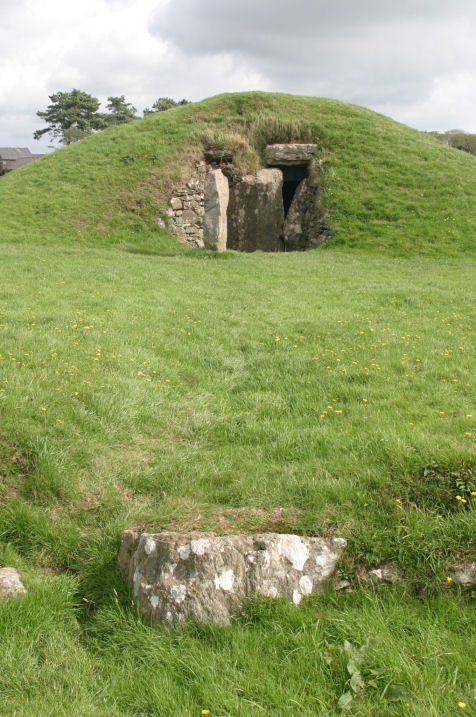
Bryn Celli Ddu, southeast Anglesey
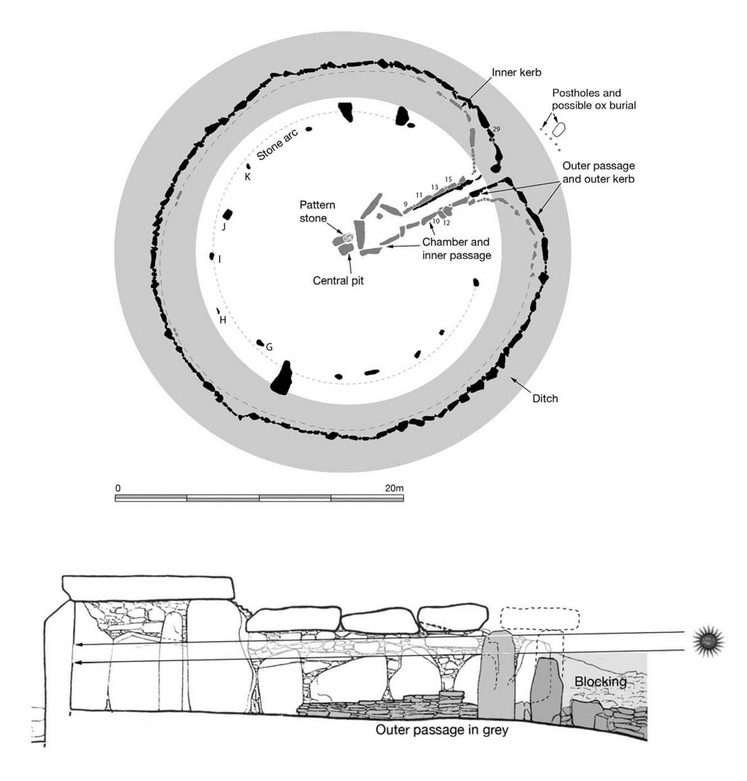
Plan of the Bryn Celli Ddu Neolithic tomb on Anglesey, by Steve Burrows, showing a section through the tomb and marking the line of the mid-summer solstice (typically on or around the 21st June), the longest day of the year, with the sun rising to filter through the passage, lighting up the chamber (see video at end). Image source: medievalheritage.eu
Today, 20th March 2026, is the Vernal Equinox which, astronomically speaking, is the first day of spring in the northern hemisphere. As my birthday, which falls towards the end of March, is usually accompanied by wind, rain and, on one memorable day on the M25, a snow blizzard that stopped traffic in its tracks, it usually takes me a while to accept that the longed-for spring really has actually arrived, in whatever guise it chooses to present itself. Fortunately, this year we have had some glorious spring days, two of which were spent with a happy heart at Little Moreton Hall and Moel Fammau, and the daffodils and hyacinths are fabulous.
Although there is plenty of evidence of archaeological sites being aligned to take advantage of specific astronomical events in Britain, particularly during the Neolithic and Early Bronze Age, most notoriously aligned to the mid-summer solstice, the phenological signs will have been of greater significance for the annual cyclical activities of hunters, farmers and traders, a period of evaluation and preparation following the completion of the winter’s work-streams. Marking multi-textured passages and cycles of time at different scales would have been of critical importance for making decisions and minimizing risk in seasonal livelihood management, but it was clearly incorporated into more spiritual and funerary aspects of life.
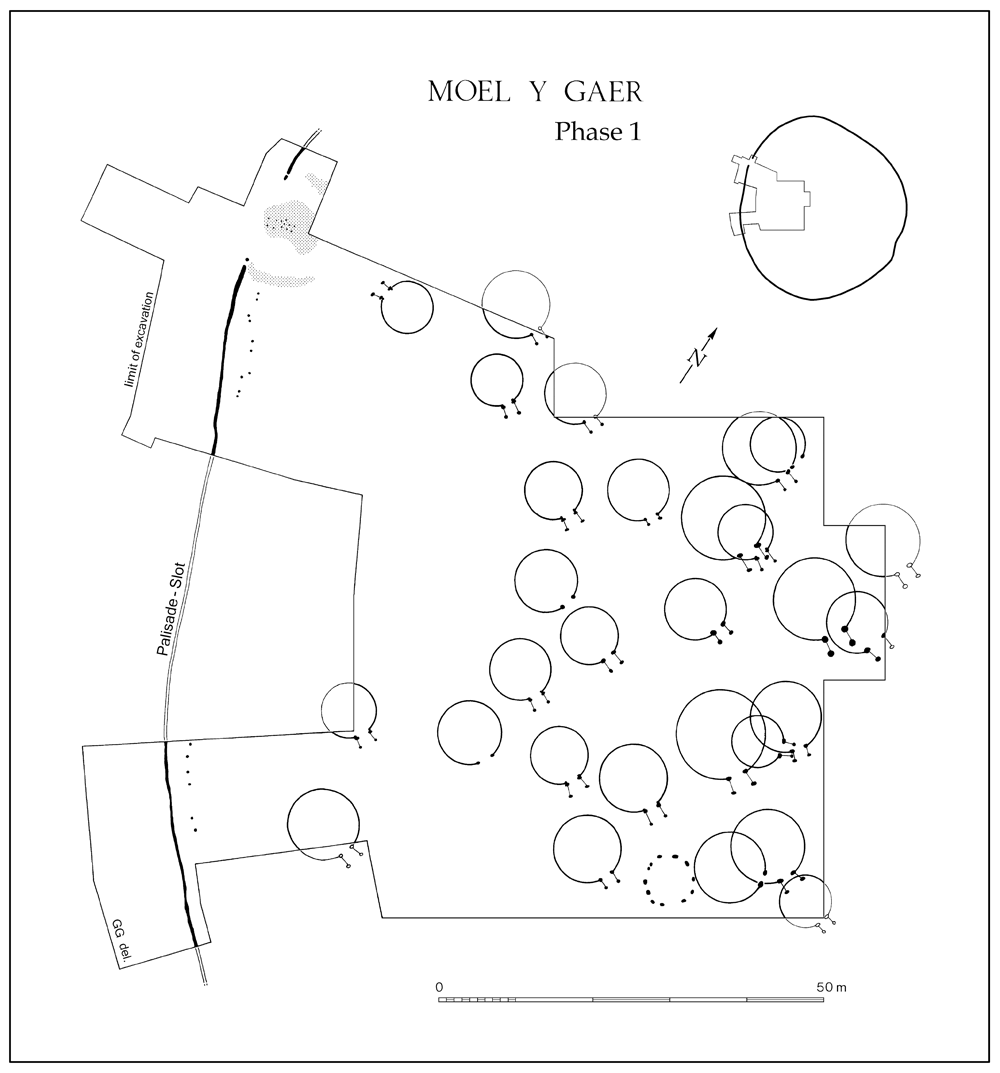
Section of the Iron Age hillfort Moel y Gaer Rhosesmor, on the Clwydian Range in northeast Wales, showing the orientation of roundhouses in Phase 1, with the majority of entrances with porches facing to the southeast. Although this orientation could be due to avoidance of prevailing winds, or to permit views across to the main hillfort entrance, it has been suggested that southeast roundhouse entrances may have allowed early morning entry of the sun into the house, moving around the interior to mark the passage of time throughout the day. Image source: Guilbert 2018
I have been reading throughout the winter about Britain’s Iron Age and, as always with archaeology and early history, the sense of different perceptions and experiences of linear, cyclical and punctuated time all working in complex relationships with one another, has been striking. The Iron Age does not provide as many hints about the ways in which communities connected with the cosmos as earlier periods, particularly in the Late Neolithic and Early Bronze Age. In spite of the lack of funerary and ceremonial data, however, in many parts of Iron Age Britain indications can be found that mark the passage of time. The agricultural basis of its livelihoods and the ideological and religious ideas that flowed around seasonal variations suggest two of probably multiple temporal schemes, the cyclical arrival and departure of seasons and the more cumulative course of those cyclical seasons every successive year as one generation eventually succeeded the next. More punctuated events are captured too, in the form of individual acts captured in the archaeological record, which themselves become part of how life was experienced.
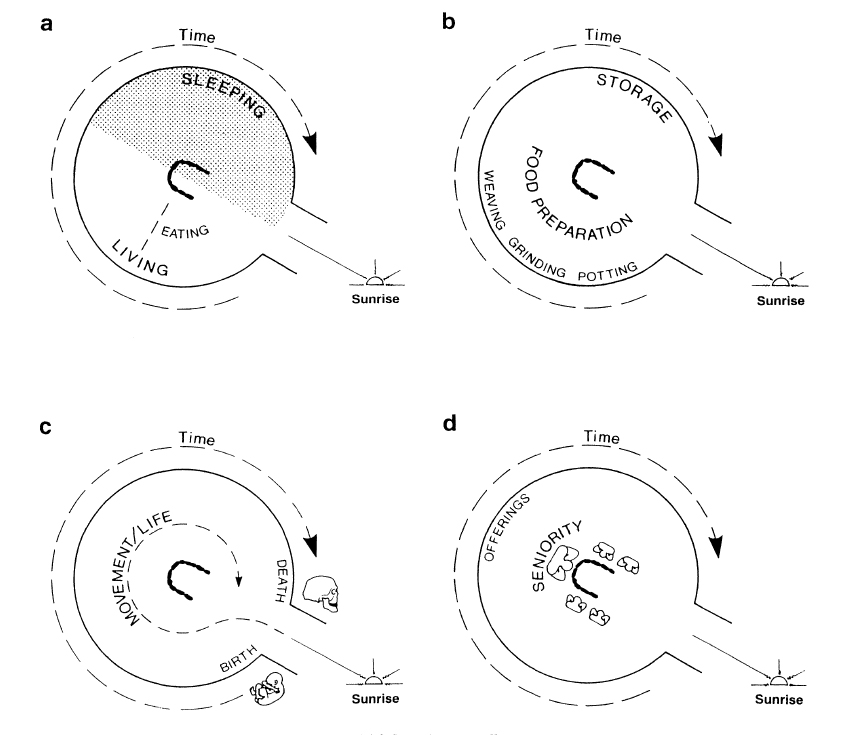
Alternative theories of roundhouse use by Parker Pearson and Sharpies 1999: “Interpretations of the use of space in British Iron Age roundhouses: (a) Fitzpatrick’s sunwise scheme (Fitzpatrick 1994); (b) an extension of Fitzpatrick’s scheme in the light of wheelhouse layout; (c) the sunwise pattern of movement within the house, including the metaphor of the human life cycle round the house; (d) the organization of seniority around the central hearth).” Source: Parker Pearson and Sharpies 1999, image drawn by Adrian Chadwick)
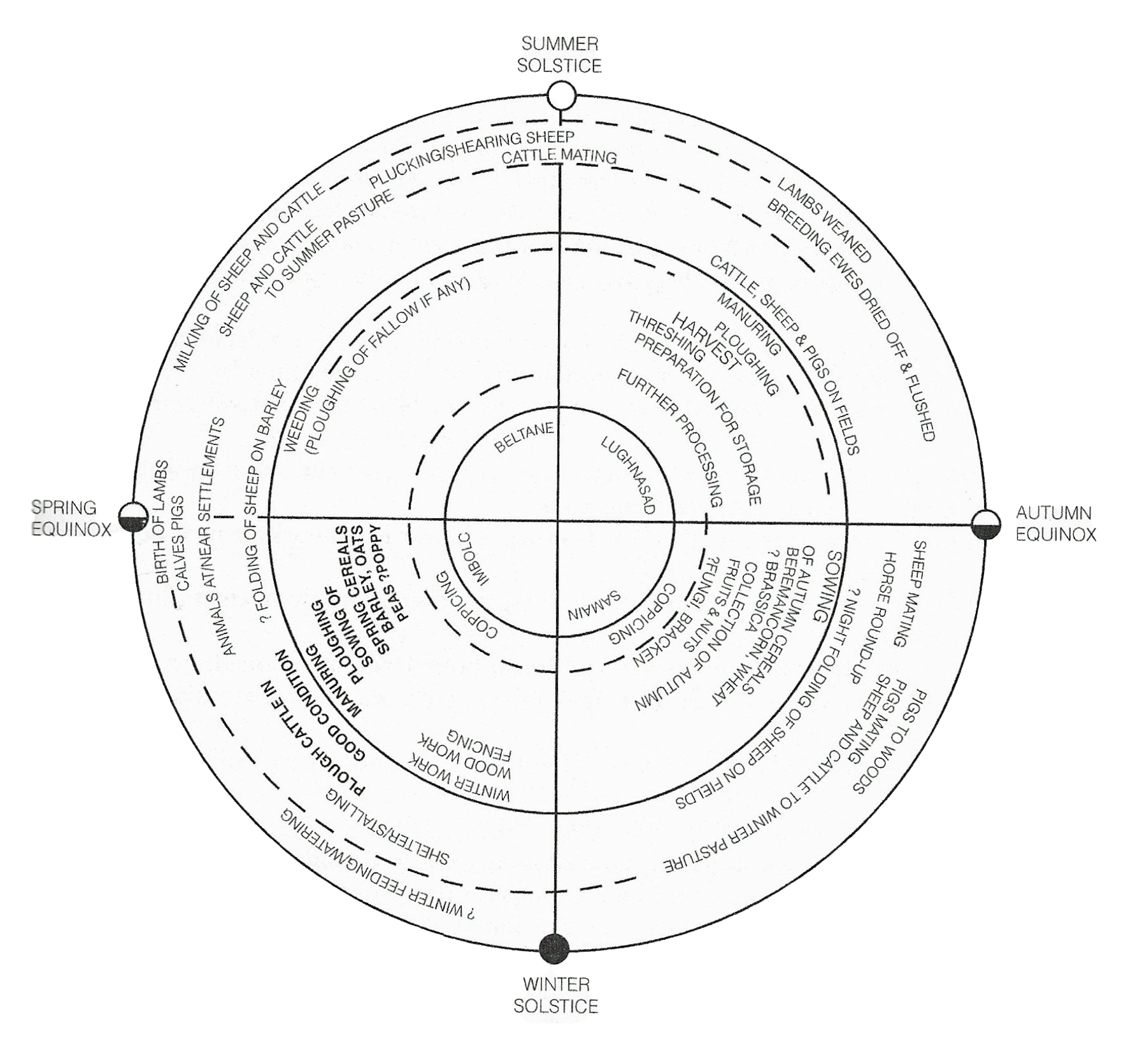
The farming year: a reconst5rcution based on evidence from settlements at Iron Age Danebury and region. Source: Cunliffe 2005, p.419, fig.16.5
There are three ways of defining seasons that are officially recognized as valid measurements of seasonal episodes: astronomical, meteorological and phenological. The technical, astronomical measurement of the seasons, based on and solstices. The equinoxes are the times of year when the sun appears directly over the equator, resulting in nearly equal proportions of day to night, and during the March equinox the sun appears to rise precisely in the east.
Where astronomical seasons are based on the strict observation of the arrival of equinoxes and solstices, meteorological seasons simply divide the year into four handy chunks of three months each, with spring occupying March, April and May. This means that whilst astronomical spring begins on 20th March, meteorological spring starts even earlier, on the 1st March, which seems ridiculously counter-intuitive, given that many of us are still shuddering from February’s machinations in spite of some of the pioneering courage of the brave early spring bulbs.
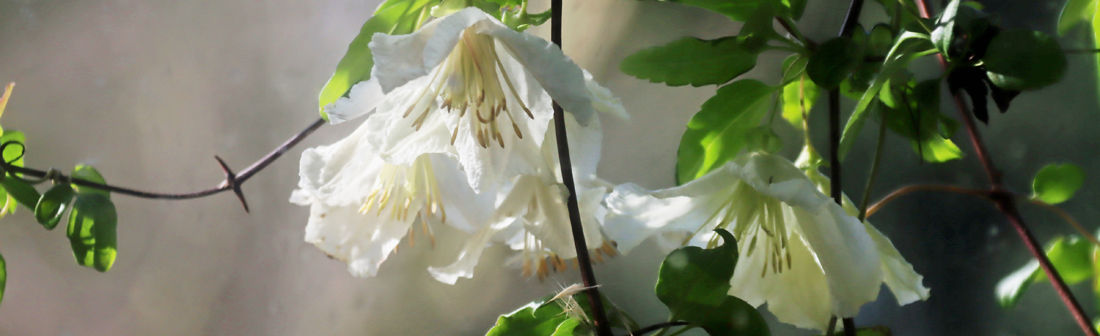
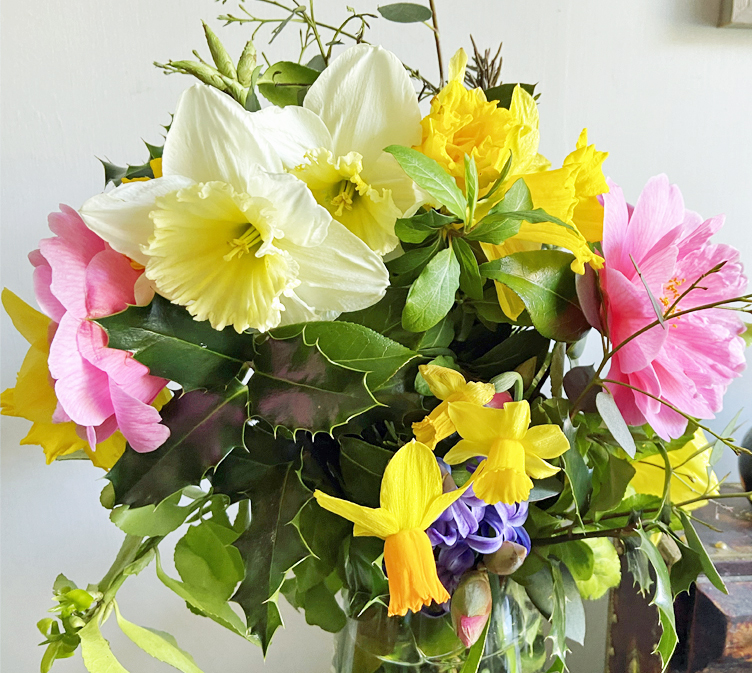 Phenological seasons are far more a matter of the senses, based on the observation of the natural world, with new shoots and bright new leaves accompanying bluebells, camellias and early blossom to give a finger-in-the-air impression of seasonal transformation. This year my early-flowering dwarf daffodils, crocuses and dwarf irises were even earlier than usual, arriving at the same time as the snowdrops in mid February, but all of them looked a little self-conscious and rather put out, surrounded by the decaying brown stems of last summer’s offerings, left as they were to shelter insect life. Spring felt more present when the camellias came into flower, and the rest of the daffodils decided to join their tiny relatives. The feeling that spring has or has not arrived is a phenological response to the eventual arrival of spring, and in the past had a direct impact on how people responded in every aspect of their lives.
It is interesting (and rather a relief) that even today in the modern west, where so many aspects of our existence are so standardized, regulated and thoroughly systematized we have three officially recognized ways of marking seasonal transitions, acknowledging their essentially liminal character.
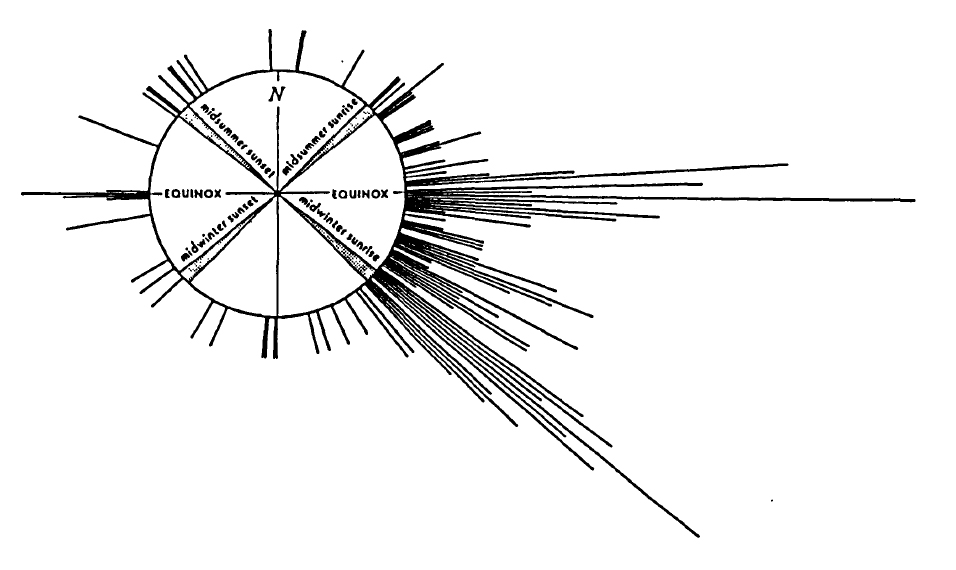
The orientation of Iron Age roundhouses, showing that the majority are orientated between the east and southeast. Source: Oswald 1997
Sources:
Books and papers:
Cunliffe, Barry 2005 (4th edition). Iron Age Communities in Britain. Routledge
Fitzpatrick, A., 1994. Outside in: the structure of an Early Iron Age house at Dunston Park, Thatcham, Berkshire. In Fitzpatrick and Morris (eds.), p.68-72.
Fitzpatrick, A. and E. Morris (eds.) 1994. The Iron Age in Wessex: Recent Work. Trust for Wessex
Archaeology.
Guilbert, Graeme. 2018. Historical Excavation and Survey of Hillforts in Wales: some critical issues. Internet Archaeology 48. https://intarch.ac.uk/journal/issue48/3/toc.html
Oswald, A., 1997. A doorway on the past: practical and mystic concerns in the orientation of roundhouse doorways. In Gwilt, A. and Haselgrove, C. (eds.), Reconstructing Iron Age Societies: New Approaches to the British Iron Age. Oxbow Monograph 71, p.87-95
Parker Pearson, Mike 1999. Food, Sex and Death: Cosmologies in the British Iron Age
with Particular Reference to East Yorkshire. Cambridge Archaeological Journal 9:1, p.43-69
Parker Pearson, Mike and N. Sharpies, with J. Mulville and H. Smith, 1999. Between Land and Sea: Excavations at Dun Vulan. Sheffield Academic Press
Websites:
Met Office
Understanding equinoxes and solstices
https://weather.metoffice.gov.uk/learn-about/weather/seasons/equinox-and-solstice
RCAHMW
Anglesey’s Neolithic tomb with a solar secret: ‘Here Comes the Sun’!
https://rcahmw.gov.uk/angleseys-neolithic-tomb-with-a-solar-secret-here-comes-the-sun/
Royal Museums Greenwich
What and when is the Autumn equinox?
https://www.rmg.co.uk/stories/time/what-when-autumnal-equinox?_gl=1*1hixw7w*_up*MQ..*_ga*MTExMTQ1NTc1LjE3NzEwNzc4NDY.*_ga_4MH5VEZTEK*czE3NzEwNzc4NDYkbzEkZzEkdDE3NzEwNzc5NTgkajE3JGwwJGgw*_ga_7JJ3J5DBF6*czE3NzEwNzc4NDYkbzEkZzEkdDE3NzEwNzc5NTgkajE3JGwwJGgw
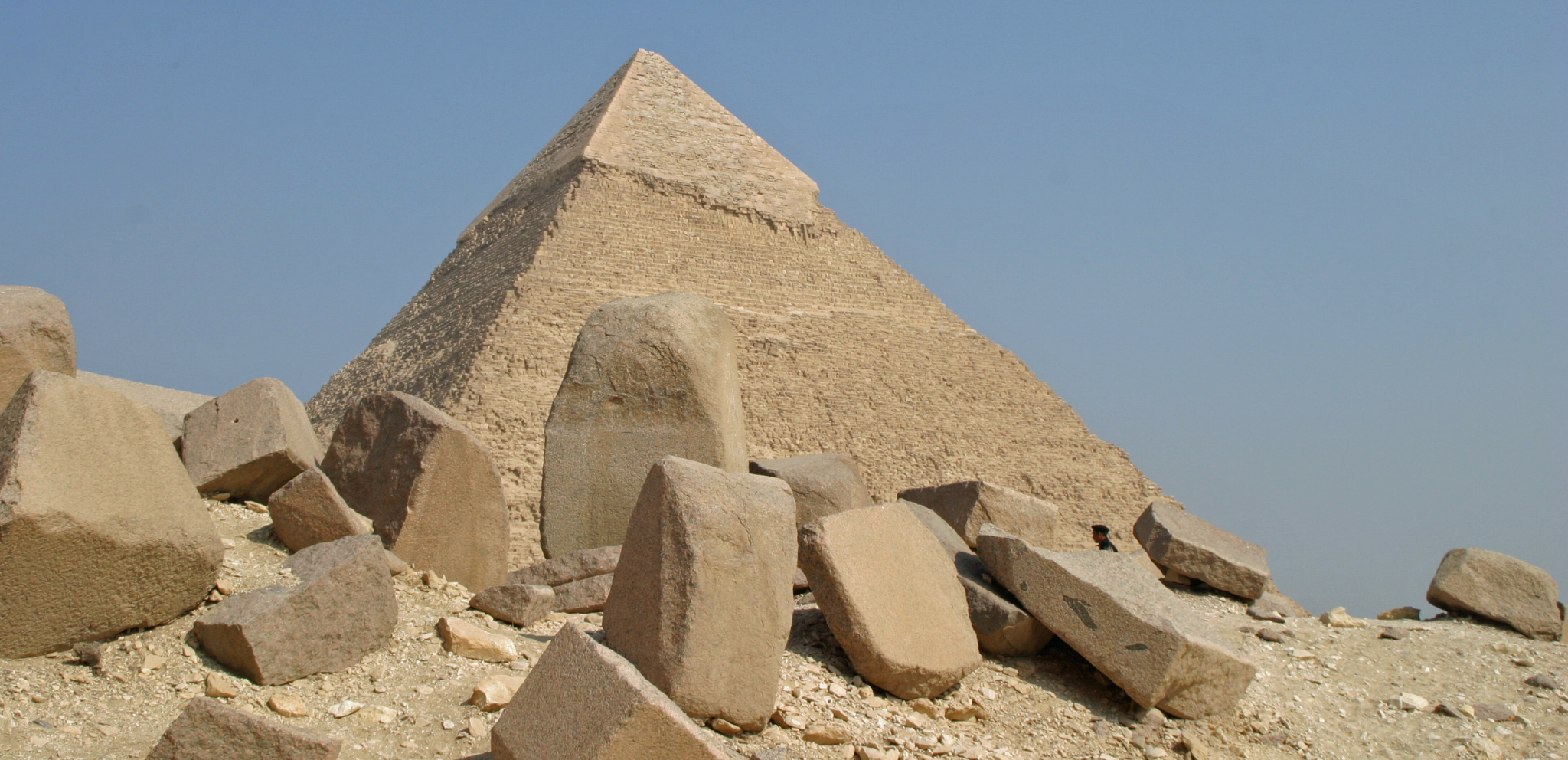
It is not much of a surprise that the pyramids of Egypt, together with the later obelisks, were pointing unambiguously at the sun, whatever the time of year.
 Based in Churton