
“As Bare as the Bishop of Chester”
J.C. Bridge, no.33, p.9

This comes from a poem that Bridge believes dates to the time of Edward IV (28 April 1442 – 9 April 1483), and he suggests that it may belong to the period between the 1460s and 70s. There are two versions of it surviving in contemporary manuscripts (which I have massaged into modern English).
Hearken to my tale that I shall show
For of such marvels I have heard four
If any of them be a lie that I tell after
I would I were as bare as the Bishop of Chester
The second version reads as follows:
Hearken to my message that I shall to you show
For of such marvels you have heard but few
If any of them be untrue that I shall tell you after,
Then become I as poor as the Bishop of Chester
As Bridge points out, this refers to the first Chester Bishopric at St John the Baptist’s, not the one founded by Henry VIII in 1541 that converted the dissolved Benedictine Abbey of St Werburgh to become Chester’s new cathedral.
A bit of background
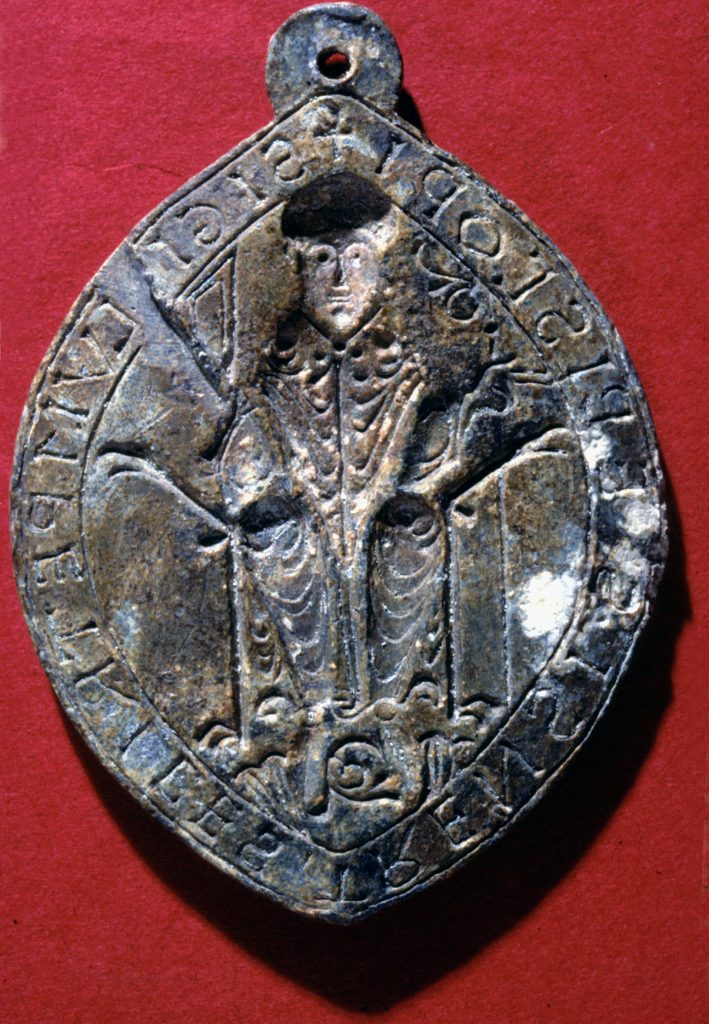
Lead seal mould of Peter, Bishop of Chester 1075-1085 (Chester Archaeology). Source: The Medieval Period Resource Assessment 2007
In the 11th century Archbishop of Canterbury Lanfranc decreed that bishops should locate themselves in the largest and most impressive provincial centre within their area of responsibility (called a see). Accordingly, in 1075 the Bishop Peter of Lichfield moved his power base to Chester and began to build a new cathedral commensurate with the importance of his status in his newly adopted town in a monumental Romanesque style, dedicated to St John the Baptist. Quite why he decided to build outside the walls could be explained in a number of ways, but may have had something to do with Hugh d’Avranches, the first Earl of Chester, who may already have had plans for an ecclesiastical institution within the city walls on an existing church site (St Werburgh’s Abbey, founded in 1093); or it may have been something to do with a shortage of space for such a large project. Whatever the reason, by establishing it where he did, on the site of a church that is thought to have been established in the 7th century, he provided his own foundation with a sense of longstanding religious heritage that reinforced its validity as a primary Christian house.
On the death of Bishop Peter in 1095, the role passed to Robert de Limsey. Bishop Robert abandoned the Chester cathedral in 1102, shifting the see to Coventry, probably to take advantage of the considerable wealth of the Priory of St Mary, which became a new cathedral. Work foundered on Chester’s St John’s Cathedral which, in spite of no incumbent bishop, retained its role, with subsequent bishops of Coventry and Lichfield terming themselves, when convenient, Bishop of Chester at least into the 16th century.
Work resumed on St John’s a century after the death of Bishop Peter, and was completed sometime in the late 1200s, becoming a successful collegiate church. It is to this period that the upper storeys belong. Today’s tower replaces the one that partially collapsed in 1881 after a lightning strike. The cathedral was included in the local pilgrimage route, along with the Abbey of St Werburgh, when it acquired what was claimed to be a relic of the true cross during the Crusades.
xxx
Back to the proverb

The glorious Romanesque interior of St John’s, Chester
There are four possible interpretations of the poem. The first is that posed by Bridge himself, which is that it was a “sarcastic” reference to the sheer wealth of the Bishops of Coventry and Lichfield. Douglas Jones highlights how the livings earned by those appointed to different roles at St John’s were doing very nicely, and were far more wealthy than all local churches other than the Rectory of St Mary’s. Between 1300 and 1430 six out of ninety-one canons of St John’s were presented by the King and three by the Prince of Wales, with twelve by the Pope. Twenty-seven were arranged by the Bishop, and when he was free to make his own choices, he “seems often to have regarded the prebendal status of the collegiate church as providing a source of additional pocket money for his relatives, his friends and his clerks” (Jones, p.17). Some of those appointed to St John’s rose to positions of great regional and national influence.
In a second possible scenario, the word “bare” could equate to “threadbare,” referring to the fact that the title of “Bishop of Chester” was no more than nominal, nothing more than the smoke and mirrors promoted by the bishopric of Coventry and Litchfield which, having abandoned Chester in favour of more profitable regions, had retained its rights over title to it, and had left St John’s as nothing more than a sinecure.
In a third possible interpretation, it is distinctly possible that it was a matter of considerable amusement within Chester that there was an ongoing quarrel between St John’s and St Werburgh’s, both wealthy institutions that stood above and over the general populace. In general, monastic institutions were obliged to pay an annual sum to the Bishopric, by whom they were overseen, and to whom they had to account for themselves. It was the ambition of many monasteries to escape both the financial obligation and the ongoing interference, and Chester had petitioned the pope for just such a relief. It was granted an exemption in 1363, but nothing at St Werburgh’s ever ran smoothly, and the ongoing fight to retain independence was always at odds with the interests of the Bishops, still nominally of St John’s, to resume its position of influence. This ongoing failure to entirely subdue St Werburgh’s and bring it back into the financial fold may also have been a source of amusement and comment amongst Chester’s populace about both St John’s and St Werburgh’s.

The cathedral in 1881 after the collapse of the top of the 16th century tower. Now in the Grosvenor Museum, Chester. Artist unknown.
The final possible interpretation (unless someone else has other ideas) could also refer to a loss of financial income for St John’s in the 15th century. Jones says that Owen Glyndŵr’s rebellion had had a considerable impact on ecclesiastical finances after 1430. It is again pure speculation, but it is possible that St John’s, like other ecclesiastical institutions in Chester, was suffering an unaccustomed shortage of funds, and that this was a source of some amusement in the local community.
In any one of these scenarios, the Bishop of Chester could be said to be “bare,” either in tones of irony due to his extreme wealth, or actually reflecting a documented change in the financial fortunes of Chester’s St John’s that was responded to in Chester with a distinct sense of schadenfreude.
xxx
Final Comments
I particularly like two aspects of this proverb. The first is that it recalls a part of Chester’s history that is often forgotten, which is that St John’s was not only established as a cathedral but continued to perform the role into the 16th century. Secondly, I love that this proverb is fundamentally embedded in what must have been a topic of real controversy in Chester: a bishopric that provided its various incumbents and administrators with a high wage, but whose leaders were absent, claiming rights over Chester and drawing status from it without being any part of the city. When St John’s and its employees went through less profitable times, there was probably very little sympathy in the city. In fact, there was almost certainly a distinct sense of justice having been served. Whether the proverb refers to greater or less profitable times, there is a distinct sense that the relationship between the St John’s and the City was often far from harmonious and that the bishops themselves were bare of any form of substance. However it may be interpreted, this proverb captures the fact that Chester’s ecclesiastical past was not merely a barely remarked upon fact of life, but something that was noticed and discussed, not always in favourable terms.
For more about J.C. Bridge and this Cheshire Proverbs series,
see Cheshire Proverbs 1.
For the other proverbs in the series, click on the Cheshire Proverbs label
in the right hand margin, or see the end of the Archaeology, Heritage and Art page, where they are listed.

The east end of St John’s, walled off from the main church after the Dissolution
Sources:
Books and papers
Boughton, Peter 1997. Picturesque Chester. The City in Art. Chester City Council and Phillimore
Bridge, J.C. 1917. Cheshire Proverbs and Other Sayings and Rhymes Connected with the City an County Palatine of Chester. Phillipson and Golder (Chester)
Carrington, Peter 1994. Book of Chester. B.T. Batsford / English Heritage
Jones, Douglas 1957. The Church in Chester 1300-1540. Chetham Society
Pevsner, Nikolaus and Edward Hubbard 1971. The Buildings of England: Cheshire. Penguin Books
Websites
St John the Baptist
A History of St John’s
https://stjohnschester.uk/history-of-st-johns-chester/
 Based in Churton