
Introduction

Brynkinalt, just outside Chirk
I went with a friend on a guided tour of the house, partly because it looked stunning, but also because I have been exploring the places with which Lady Eleanor Butler and Sarah Ponsonby might have had connections that either influenced or directly contributed to Plas Newydd. By “influence” I mean the decorative styles that could have had an impact on the way in which the decorative vision of Plas Newydd in Llangollen was born and developed. By “direct contribution” I mean the acquisition of the pieces of wood, glass, tiling, etc that make up the fabulous pastiche of decorative arts at Plas Newydd. Photographs were permitted outside, but banned in the interior (which is still a family home) so I have been unable to include anything much to supplement the descriptions below. xxx

Plas Newydd in Llangollen
Brynkinalt was of particular interest not only because, thanks to the excerpts from diaries and letters of Lady Eleanor and Miss Ponsonby, I knew that the ladies had been visitors to the house, but because reading up on the house informed me that it had been a Jacobean creation that had been radically altered in 1808 whilst the ladies were resident at Plas Newydd. If I understand Lady Eleanor correctly, she would not have been shy about asking for unwanted decorative features if they became available. My introductory piece about Plas Newydd is here, and the full series of five posts can be found here (including this one).
xxxx
Brynkinalt
The Coflein description of Brynkinalt, is as follows:

Brynkinalt, with the new wing added in 1808
[T]his 1612 building now forms the central portion of the present brick built hall. The additions of 1808 include the single-storey wings on either side of the south front, which were further lengthened to include a billiard room and conservatory on either side. Two conservatories, now gone, were inserted into the south front between the cross wings. The west front was extended northwards to include an extensive service wing. All the extensions were castellated and the entire building was stuccoed. Work began in 1928 and stopped during the war to be taken up again in the 1950’s to reduce or remove the nineteenth century additions: the stucco was removed, except at the end of the east wing, and the large service wing which housed the kitchen at the rear was demolished except for the outer range which remains.
Brynkinallt consists of two principal floors with recessed bays, forward wings and a central porch. The doorway is has a Gothic pointed arch with a studded oak door and crest over, set below a label mould which rises to a string which extends between floors completely around the front elevation. The windows are ogee-moulded behind a chamfered surround, mullioned and transomed: 5-light to the porch chamber, 4-light to the ground floor of the wings, 3-light above and 3-light without transoms to the attics.
The interior is largely in a heavy Classical style. Of specific interest is a fine marble seventeenth century chimneypiece with a heraldic over-mantel with carvings. There is a great stair hall of 1808, with a gallery, Tuscan columns
The description gives something of a sense of how much Brynkinalt has changed since it was built in 1612. The Great Hall, for example, replaced a courtyard surrounded by some 50 rooms, so as large as it is, the house is now much more modest than it was originally.

Brynkinalt from the rear, showing some of the gothic-style lancet windows installed in around 1808
The exterior retains much of its Jacobean appearance, albeit with the addition of some Gothic-inspired elaborations. Removal of most of the 19th century external rendering has restored the splendid brickwork to view on the most visible parts of the house, although there is still much to be done at the rear, which gives a very good sense of the task that has already been undertaken. The interior has been radically remodelled, with only the oak-panelled hall providing a sense of the Jacobean house. Nearly all of the other Jacobean decorative arts and furnishings vanished due to Lady Charlotte’s re-imagining of Brynkinalt, and although the current interior is attractive and imaginative, it retains only pockets of its Jacobean heritage and it is not known what was done with the stripped-out Jacobean interior when those rooms were replaced.
xxx
Links between the owners of the two houses

Anne Wellesley, Countess of Mornington, mother of Arthur Wellesley,who became the Duke of Wellington. Source: Wikipedia
The connections that tie these two houses together were very confusing at first. Family histories make my head spin, and not in an enjoyable way, but it was necessary to get to grips with the essentials. This was firstly because if the ladies were actively collecting when the house was being refurbished they might have benefitted from the unwanted decorative features and furnishings, and secondly because when Arthur Wellesely, the first Duke of Wellington, visited his grandmother Anne Hill-Trevor at Brynkinalt he also visited Eleanor and Sarah and, on at least one occasion, is said to have brought them decorative gifts.
The Viscountess Dungannon Anne Hill-Trevor (1715-1799), née Anne Stafford, wife of Arthur Hill-Trevor, the First Viscount of Dungannon (second creation, the first title having expired) lived at Brynkinalt and was partially responsible for introducing Lady Eleanor and Miss Ponsonby into local society, sharing both family and friends in Ireland with the two ladies. Anne’s daughter, also Anne (1742-1831), married the first Earl of Mornington, Garrett Welsley (1735-1781) with whom she had nine children, one of whom was Arthur Wellesley (1769-1852) who became the first Duke of Wellington. As mentioned above, Wellesley, before he was awarded his title, visited the ladies when on visits to his grandmother at Brynkinalt.

Dungannon (Brynkinalt) visits to Plas Newydd. Source: Copied from the Early Tourists in Wales website.
When the first Viscount died, Anne remained at Brynkinalt. Their only son having died, the title passed to one of their grandsons, who became the the second Viscount of Dungannon, another Arthur Hill-Trevor (1763-1837). It was his wife Charlotte (1763-1823) who initiated transformations of Brynkinalt, beginning in 1808, which removed much of the Jacobean architecture and interiors and added new kings featuring spacious rooms, large windows, tall ceilings, a plethora of ornamental columns and lightly coloured walls to replace dark panelling. Anne and Charlotte, between the date of Charlotte’s marriage (1795) and the first Viscountess Anne’s death (1799), were briefly contemporaries at Brynkinalt.
The diaries of Lady Eleanor report that even after Anne’s death in 1799 (the year that they received a gift of a cow from the estate, as well as venison and partridges sent with a messenger), visits to Brynkinalt continued. Elizabeth Mavor says that in 1805 “there were jaunts to Porkington, Brynkinalt [and] Aston,” and an earlier reference in the journal to playing cards at Brynkinalt suggest that they were still welcome visitors. Certainly in January 1805 they were at Brynkinalt when the journal provides a short account of meeting someone who had arrived in St Petersburg the day after the assassination of “Emperor Paul.” Other visits may well have coincided with the period in which Charlotte, the second Lady Dungannon (died 1823), was beginning to make her transformations in 1808. Mary Carryll, who had accompanied Lady Eleanor and Miss Ponsonby from Ireland as their servant and good friend, was on visiting terms with Lady Dungannon’s upper servants. The visits were probably less frequent, but there are clear indications that they continued, and Michael Freeman’s EArly Tourists in Wales website records that Lord and Lady Dungannon continued to visit the ladies at Plas Newydd.
xxx
Direct contributions?
The removal of Jacobean features by Lady Charlotte probably included panelling, overmantels, doors, and furnishings that would not have fitted into her hybridized Neoclassical vision. Unwanted carvings and furnishings could have been snapped up by local dealers and salvage companies, and some of it may have been purchased by private collectors. As I have already mentioned above, if there were items going spare, it seems entirely likely that Lady Eleanor would not have been at all shy about asking for any unwanted decorative items.

Library window in Plas Newydd, with wyvern closely resembling that of Brynkinalt in the landing window at Brynkinalt at bottom left.
Sadly, in spite of the strong suggestion of the timings of Brynkinalt being remodelled as a fashionable country house over the period when Plas Newydd was becoming a showcase for earlier decorative arts, it is impossible, from the very few remaining pieces of Jacobean carving left at Brynkinalt to do anything more than speculate that some stripped-out pieces of Brynkinalt carving may now adorn the walls of Plas Newydd.
The stained glass, however, may be another story. Plas Newydd is stuffed with stained glass fragments that are patchworked together to fit particular spaces (I have written about the stained glass here, based on the survey by Mostyn Lewis). There is one tiny corner of Plas Newydd, a single quarry/tiny pane of glass that suggests that a piece of Brynkinalt stained glass has found its way to Plas Newydd (see photo above). In the Plas Newydd library there is a black wyvern (dragon with two legs) with a gold crown around its neck, standing on a red cushion, which had formerly been framed in a gold lozenge. This is such a good match for one at the top of the Great Hall staircase at Brynkinalt that it seems likely that the Plas Newydd fragment does derive, however it was acquired, from Brynkinalt. It would be interesting to see if there are other connections of this sort between the stained glass fragments at Plas Newydd and the surviving stained glass panes at Brynkinalt.
xxx
Influence?

Strawberry Hill House, Twickenham. Source: Wikipedia
The absence of any formal research into any possible relationship between the two houses means that the evidence for direct influence is minimal at the moment, but the indirect influence in the form of the communication of ideas, could well be detected in Plas Newydd, and this lies in both the shape of the lancet windows and the stained glass.
When Plan Newydd is discussed, it is often in the same breath as Strawberry Hill in Twickenham, where Sir Hugh Walpole created an imaginative extravaganza to celebrate past styles, reinventing the Gothic to produce something that emulated architectural features but took a far more light-hearted, frivolous tone. The same comment was made on the Brynkinalt guided tour concerning the changes made by Charlotte, Viscountess of Dungannon. Lady Charlotte introduced Gothic-style window tracery in some rooms, arcading in the conservatory, castle-style turrets and crenellations, lending Gothic flourishes to a dominantly Neoclassical vision. Whether or not the Ladies ever saw images from Strawberry Hill is not clear at the moment. They had an a voracious appetite for experiencing the world vicariously via books and newspapers, so it is entirely possible. It is extremely likely, however, that they could have had first hand experience of the new Gothic windows and the other modifications at Brynkinalt.
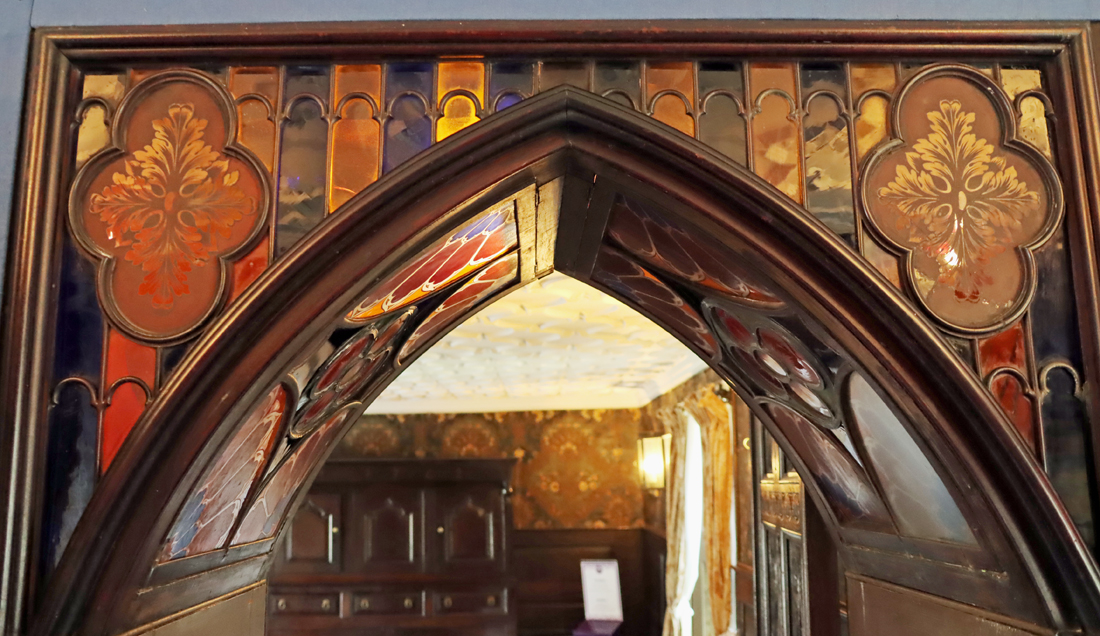
Library side of the prismatic arch, Plas Newydd
The most obvious potential influence on the stained glass is the large window on a landing at the top of the stairs leading from the Great Hall to the gallery, in which the glass is arranged in a similar way to that in the bedrooms at Plas Newydd. There are also over-door panels of stained glass that would have been good models for the “prismatic arch” between the dining room and library at Plas Newydd.
xxxxxx
General Yorke and George Hunter Robertson
Although General Yorke owned Plas Newydd between 1876 and 1890 and George Robertson owned it between 1890 and 1910, and both contributed to the decorative features of the house, it seems unlikely that either were linked in any material way with Brynkinalt. Any connections are likely to have been purely sociable. General Yorke was a member of the Yorke’s of Erddig, another aristocratic family on the Wales-England borders, so there may have been polite connections. George Robertson was a wealthy cotton trader from Liverpool, an outsider to the area with no previous links to Llangollen or Chirk. Although he was an important resident in Llangollen, there is no sign of any synergy between the two houses. In short, there is no indication that Brynkinalt or its owners had contributed anything to Plas Newydd after the deaths of Anne Hill-Trevor and Charlotte Hill-Trevor.
xxx
Final Comments

Closer view of the wyvern at Plas Newydd. Apologies for the poor quality of the image, which is partly behind a curtain and on the wrong side of a rope barrier.
It will require a far more detailed investigation than my quick visit to attempt to unravel whether the connections between the owners of the two houses resulted in the transfer of any of the decorative arts from Brynkinalt to Plas Newydd. At the moment the presence of any direct and indirect influences are purely speculative. It probably occurs to anyone reading this that the most obvious thing to do would be to contact the Brynkinalt office to see if they have any additional input on the subject. I did try, but received no reply, so if anyone else has anything to contribute on the subject, please do get in touch.
The visit to Brynkinalt was interesting in its own right, with a lovely exterior including a small formal garden that was meticulously manicured, and was showing splendid late summer colour. There are many treats in store for the visitor in the interior, but the feature that completely stole my heart was the tiny first floor stone-built conservatory overlooking the valley below, an extravaganza of floral bliss with arcades and pillars. The bougainvillea alone was wonderfully exotic. For movie enthusiasts, the house was the the setting for Lady Chatterley’s Lover, and the stories about how this happened and the steps required to make the house ready for filming are a real eye-opener. It was more than somewhat daunting to hear about the sheer amount of work and the corresponding costs associated with renovating and maintaining the building, and there is still much to be done, particularly to the exterior. It was a good couple of hours well spent, and I recommend one of their open days.
xxx

Panel on the rear of the house commemorating the 1808 alterations at Brynkinalt
Sources
Books and papers
Mavor, Elizabeth 1971, 2011 (2nd edition). The Ladies of Llangollen. A Study in Romantic Friendship. Moonrise Press.
Mavor, Elizabeth 1984. Life with the Ladies of Llangollen. Viking (hardback).
Websites
Age of Revolution – Making the World Over 1775-1848
Wellington’s Places: Brynkinalt Hall. Some Welsh and Irish connections. By Dr. Mick Crumplin
ageofrevolution.org/themes/society/wellingtons-places/
Based In Churton
Splendid stained glass patchworks at Plas Newydd, Llangollen (Plas Newydd #2)
https://basedinchurton.co.uk/2025/05/16/spendid-stained-glass-patchworks-at-plas-newydd-llangollen/
Introduction to Plas Newydd in Llangollen: A packed extravaganza of the decorative arts (#1)
https://basedinchurton.co.uk/category/llangollen/plas-newydd-llangollen/
Brynkinalt
Home page
https://www.brynkinalt.co.uk/
(Brief details are also included in Brynkinalt advertising leaflets)
Coflein
Brynkinalt; Brynkinallt Hall; Bryncunallt, Chirk
https://coflein.gov.uk/en/site/26866
Early Tourists in Wales
The Ladies of Llangollen
https://sublimewales.wordpress.com/attractions/mansions-and-grounds/ladies-of-llangollen/
Descriptions of Plas Newydd and the Ladies of Llangollen
https://sublimewales.wordpress.com/attractions/mansions-and-grounds/ladies-of-llangollen/descriptions-of-plas-newydd-and-the-ladies-of-llangollen/
Visitors to Plas Newydd
https://sublimewales.wordpress.com/attractions/mansions-and-grounds/ladies-of-llangollen/visitors-to-plas-newydd/
Plas Newydd: List of Visitors, Alphabetical Order
https://sublimewales.wordpress.com/attractions/mansions-and-grounds/ladies-of-llangollen/visitors-to-plas-newydd/plas-newydd-list-of-visitors-alphabetical-order/
xxx

 Based in Churton