
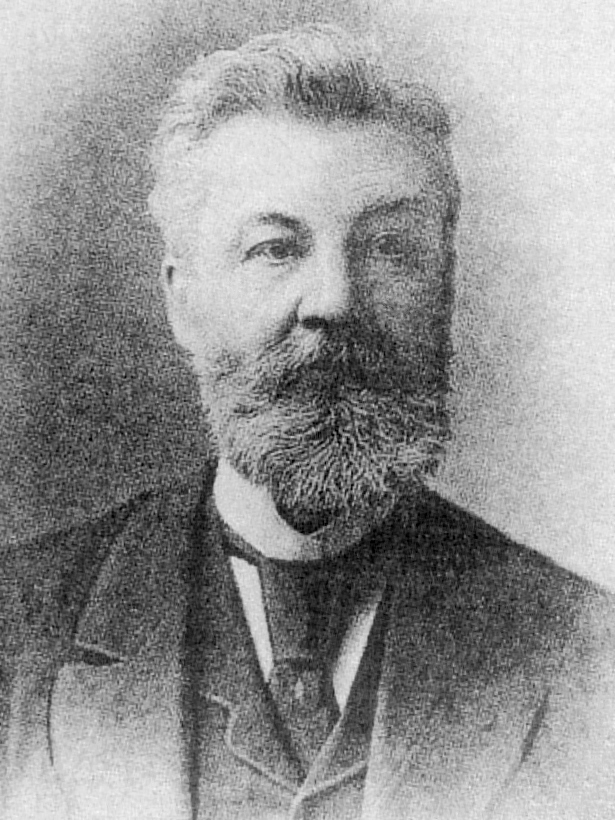
John Douglas. A photograph that apparently first appeared in “Building News” in 1890. Source: Wikipedia
For those who are interested in local heritage, it is probably not possible to live in or near Chester without knowing the name of the architect John Douglas. John Douglas (1830-1911) was a prolific architect, working right at the end of the Victorian era but demonstrating a fundamental affiliation with Victorian architectural ideals. According to Chantal’s research, between the buildings he built and those that he renovated and adapted, he contributed to over 500 buildings in Britain. Not much is known about him, but he trained in Lancashire where a new middle class, rising in both wealth and influence, was creating an unprecedented demand for domestic, commercial and civic architecture. His are some of the most imaginative and and engaging of Chester’s Victorian buildings, providing the city with an important additional layer of interest and texture. He was also responsible for other local buildings at Eaton Hall (including Eccleston), Aldford and Port Sunlight, as well as many other UK locations. Although never bowing to the past in his architectural inventions, Douglas incorporated elements of Chester’s earlier architectural styles into his unique creations, remaining sensitive to the original city whilst leaving a highly distinctive and creative legacy of his own.

Grosvenor Park Street
Our guide on the Heritage Open Day walk was Chantal Bradburn, art historian and head of Outreach at the University of Chester, who had done such a splendid job several days previously, introducing a large group of us to the Western Command at the Churchill Building. Called “John Douglas in Chester,” this was a brand new walk, and a great idea to add it to the many events offered last week. Instead of taking us on a route-march of every building that Douglas built in Chester, Chantal selected a representative few, which both captured different aspects of his work and at the same time demonstrated an underlying thread between them all. By choosing a careful sample of Douglas’s total Chester output, she was able to impart far more knowledge about both Douglas and the individual buildings than if she had tried to include more, although she did finish up the tour with recommendations for other buildings to inspect nearby. As with her Churchill Building talk, and perhaps even more so, it is impossible to do any sort of justice to all the facts that she imparted, and particularly to do any justice at all to her ability to contextualise the architecture within its social and economic environment, as well as discussing it in art-historical terms, so this is just a short taster of a really great guided walk.
We started at the lodge in the Grosvenor Park, an obviously Victorian take on the Tudor half-timbered buildings that partly define Chester’s heritage, commissioned by the Grosvenor estate to provide a touch of additional elegance to the second Marquess of Westminster’s 1867 philanthropic donation of the land to create a park.

Grosvenor Park Lodge
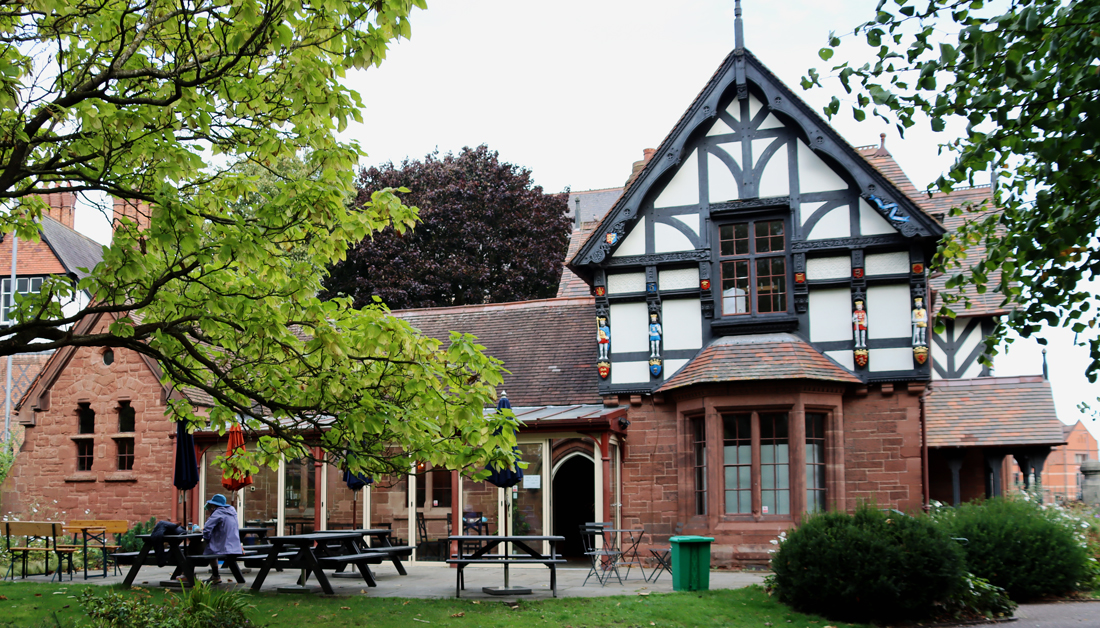
The Grosvenor Park Lodge by John Douglas

Grosvenor Park Lodge from the rear
xxx

Detail of carved woodwork on the Grosvenor Park Lodge: “Nobilitatis virtus non stemma character”
With Ruabon brick at its base and half-timbering at first floor level, it features sculptural elements and carvings that provide it with real charm. Douglas apparently thought it entirely appropriate to add a medieval-style sandstone extension to his building, which as Chantal pointed out, reflects the multi-period character of many of Chester’s buildings.
It became clear as we proceeded on the walk that this willingness to go with the flow of Chester architecture by echoing some of its variety and diversity, without ever trying to replicate it, was a key characteristic of Douglas’s approach. He always preferred local materials, and this too indicates a real wish to connect with Chester’s earlier architectural heritage. It’s great to see it being used as a café, providing a useful service on the edge of the park.
xxx

xxx
 Our next stop was just over the road, on Grosvenor Park Street. The 1872 Grade II* listed houses, numbers 6-11 on Grosvenor Park Street make up of a row of terraced houses and a Zion Chapel have long been a favourite of mine. Together they are a fabulous, wildly imaginative mixture of different elements all of Ruabon red brick, including gothic style features, turrets, and a dozen other twiddly bits. It is always wonderful to see how brick can be used to create elements that are more conventionally associated with stonework in this country. Whether the mullioned windows, some with original leading, let in a lot of light I doubt, but they are wonderfully ornamental. It was particularly interesting that Douglas built these houses on land that he owned, renting them out afterwards. He did not skimp on materials or architectural design in order to make a bigger profit. This set of buildings argues that he really cared about not only the quality of his own work, but about what he as an individual could contribute to Chester.FULL RUN HERE


xxx
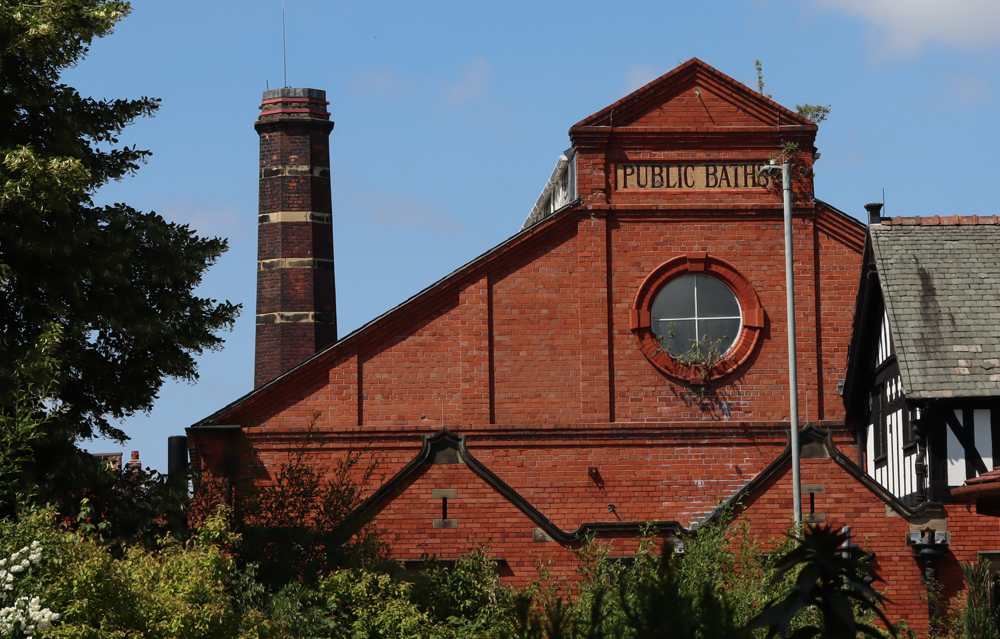 Perhaps one of his best known buildings in this part of extramural Chester is quite unlike either his lodge or his fantastic domestic extravaganza. However, as Chantal pointed out, the Chester Public Baths are still in proportion, a good fit with the domestic buildings in this part of Chester in spite of its being a public leisure facility. Chantal positioned the idea of swimming and the provision of a public baths in the social context of Victorian values and ideals, but made it clear that Douglas had put his own particular spin on the resulting building. Both practical and decorative, it is a very fine example of a building that is at once distinctively Victorian but also takes admired aspects from Chester’s past.


xxx
 Further down Bath Street, I would not have guessed at first sight that the Grade II listed buildings on the right were another Douglas innovation, but the signs are there when you pause to look more closely, and particularly when you have Chantal’s expertise to provide detailed knowledge and insights. Except for the building at the far south, nearest to the Baths, which is more typical of other Douglas buildings nearby, the main run of houses is built of buff sandstone, quite different in material, colour, and texture from other Douglas buildings and, for that matter, from anything else that I recall seeing in Chester. It dates to 1903, quite late in Douglas’s life, and perhaps this accounts for some of the distinctive features discussed by Chantal. There is an echo of the buildings on Grosvenor Park Street, but this has a much more monumental feeling to it and even with the decorative features and the short spires, seems less light-hearted and, in spite of the ornamental features, a little more monumental in feel.
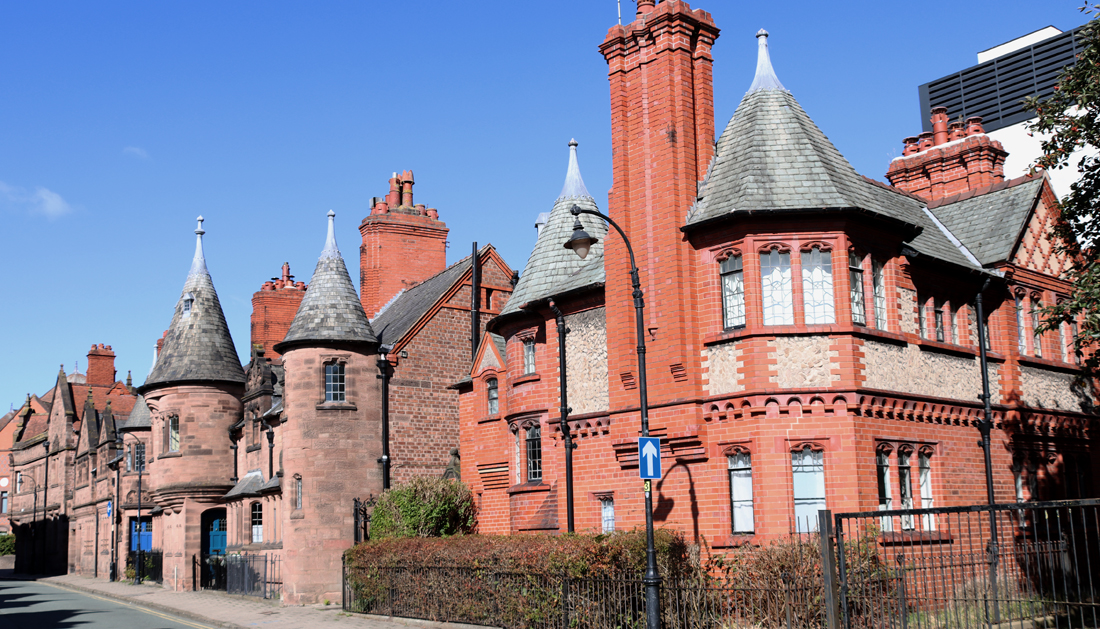
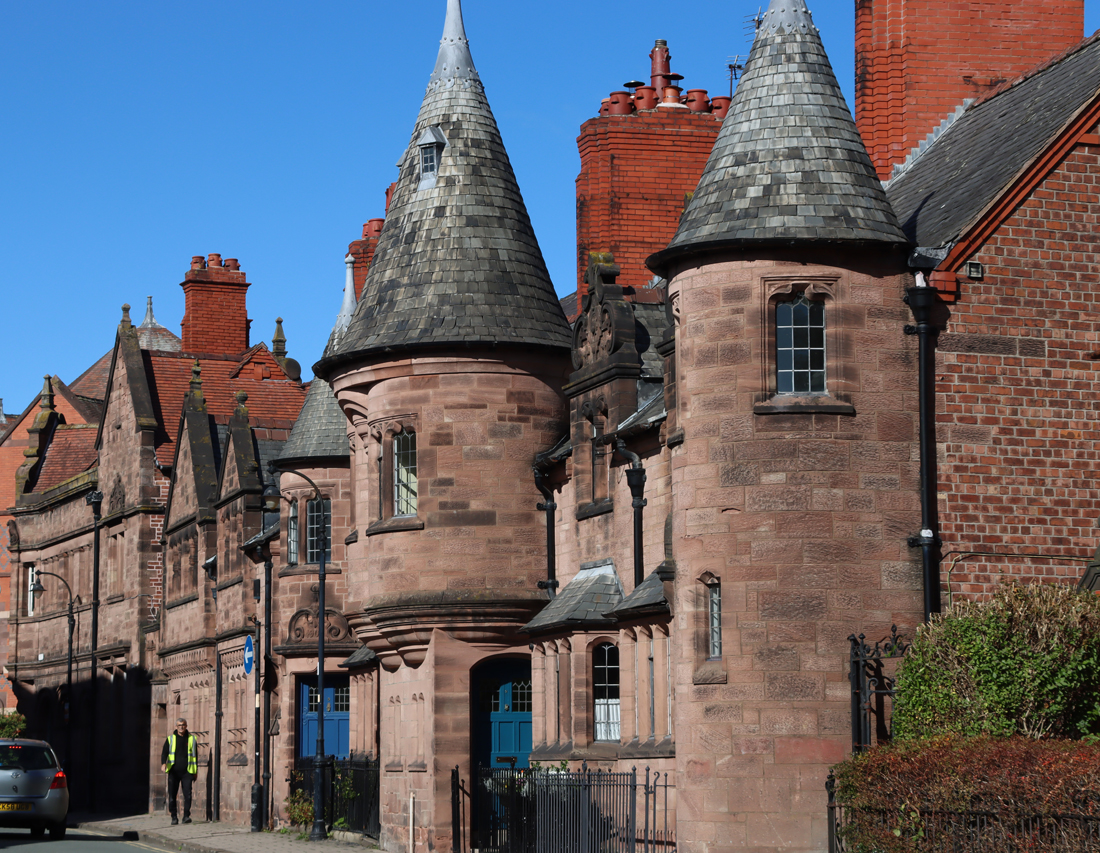
If you follow the building all the way round the corner you will see that the houses link to a building built by Douglas to house Prudential Assurance. It’s name today, Lombard House, reflects a later use by the eponymous bank. To the left of the entrance, just around the corner, there is a charming female statue inset into a niche holding a snake and book. This is Prudence, one of the four cardinal virtues (the others being Justice, Fortitude and Temperance), adopted by Prudential Assurance as their emblem in 1848 for her qualities of foresight, intelligence, thoughtfulness and knowledge. Although more traditionally shown with a mirror representing self-awareness, a book is also part of her iconography, representing knowledge, wisdom and and good judgement.
xxx

xxx
 Our final stop for the day took in two architectural features, bringing us into the city within the walls – the wrought iron extravaganza that sits on top of the Georgian East Gate, with its splendid clock, and the former Grosvenor Club building immediately to its west. These both speak of late Victorian Chester’s ambition and its delight in ornament and display, giving an unmistakeably Victorian sparkle to this part of the city. Chantal gave us details about the clock that I hadn’t heard before concerning its construction, as well as an entertaining factoid about the date of construction, reminding me that it is very easy to become complacent about even such a dominant landmark. I had known nothing about the Grosvenor Club (including its name and purpose) so this too was a learning curve.

The Grosvenor Club

The Grosvenor Club on the right with the rest of Eastgate Street taken from the top of the East Gate bridge, under the clock.
When the tour was over, and Chantal had pointed us at other Douglas buildings in the vicinity so that we could investigate further on our own, she was still surrounded by a group of people asking many questions, and this had been the trend of the entire walk, with tons of information being imparted and lots of questions following. Keep an eye open for this walk being offered in the future. It’s a good one!
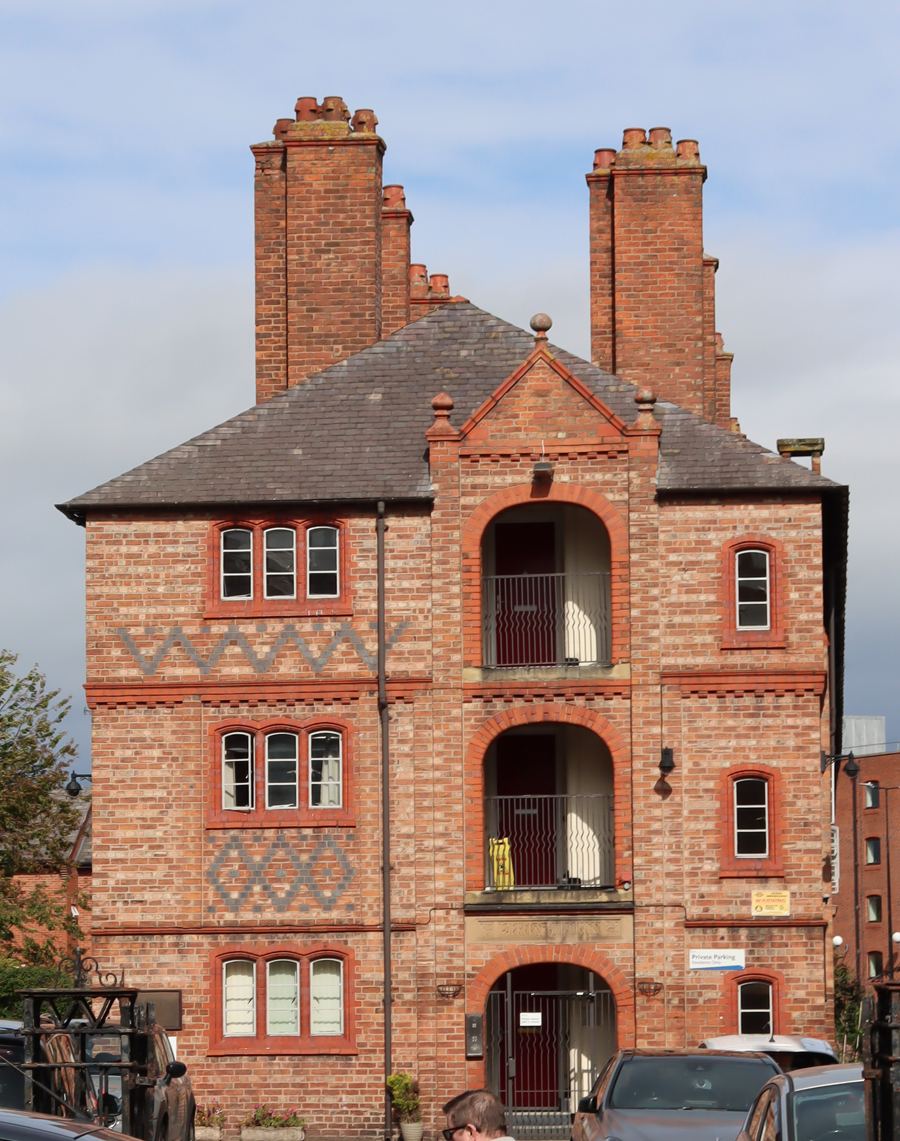
The nearby Parker’s Buildings
xxx

Grosvenor Park Lodge detail
Thinking about John Douglas and his work over the following few days, and looking up other examples of his work, his buildings generally aim to provide an attractive environment of well-being, based on the idea that past and present reinforce one another in a very comfortable and attractive way. Although many of the John Douglas buildings were impressive, and some of them were intended to be imposing, others were homes along streets that made use of vernacular features both from Chester, with inspiration taken from European cities, and from the medieval period onwards. His preference for local materials is clearly demonstrated, and his love of decorative features is a real celebration of life. He took a modern approach to architecture, incorporating traditional styles into his new interpretive schemes, as well as Germanic and French ideas that gave his work a rather more cosmopolitan edge than other architecture in the city, and in doing so added real value to Chester. The best of the Victorian architecture of Chester simply oozes a sense of excitement and self-confidence about their lived present and their anticipated future, and John Douglas reflects this unfurling era with real exuberance. His contributions to places like wealthy Eccleston and Aldford are also attractive, but perhaps Douglas is at his most appealing when contributing to Port Sunlight, the village built in the late 1880s by Lord Lever for his factory workers, contributing his skills with around 30 other architects, to create a very different type of community. It must have been a real pleasure to live in one of his remarkable houses. It is very nice to see that the ones that I have found to date seem to be very well maintained. It is only a shame that subsequent architectural projects in Chester have only occasionally managed to live up to both his high standards and his creativity.

 Based in Churton
#/media/File:John_Douglas_(architect).jpg)