
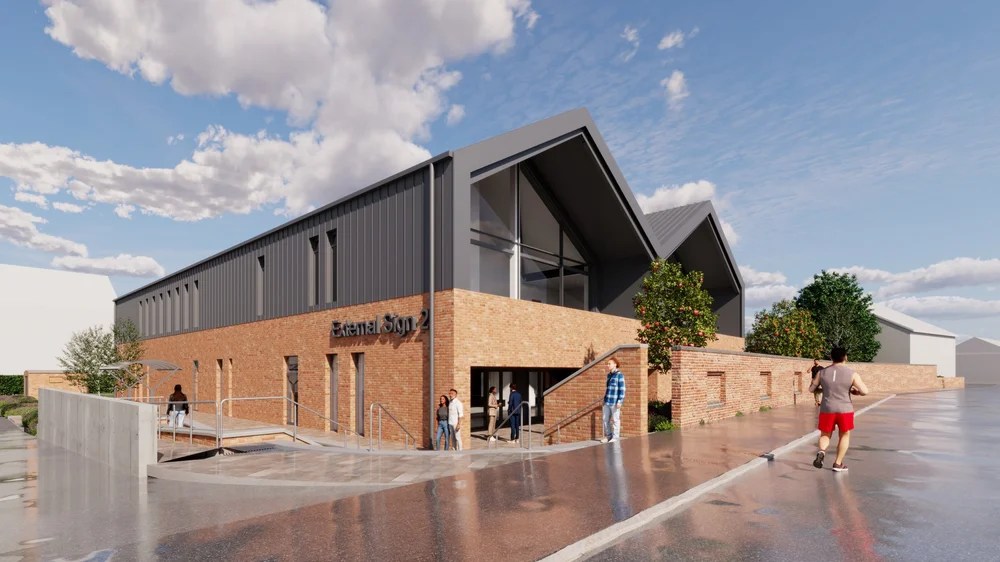
The Cheshire Archives building in Chester. Source: Cheshire Archives: A Story Shared
On Wednesday 17th September, as part of Heritage Open Day, Paul Newman from the Cheshire Archives and Tim Brown from the architectural firm Ellis Williams, explained to a well-attended audience at the Grosvenor Museum how the new archive project had been rolled out and what we can expect next year when the new Chester building opens. I am dying to get my hands on the Cheshire Lunatic Asylum records that they hold, having already written a long screed about the asylum between 1854 and 1870 (across four posts here), so I was attending the event with a real sense of anticipation.
The Cheshire Archives, which since 1986 have been located in Duke St in Chester, closed in 2022, having won a Lottery grant to build two brand new buildings. The former Duke Street premises of the Archives were in a set of lovely Victorian buildings, which were once warehouses of the legendary Browns Department Store, but the Archives were beginning to outgrow them. The archive collections go back to the mid 12th century, and continue to be added today, representing different aspects of community life, working and domestic, at different periods. As its role became more important, the Archive outgrew the building, with boxes that would reach 8km if laid end to end, and it had a number of environmental issues as well as providing less than ideal facilities for both staff and researchers. Targets to reach a larger and more diverse audience were difficult, and it became clear that a move was the only realistic solution.

The new Crewe Cheshire Archives building. Source: Cheshire’s Archive: A Story Shared
An initial investment of National Lottery money to explore the project in 2020 was successful, and a full National Lottery Fund grant was subsequently allocated, with work began in earnest in 2022. The locations in Crewe and Chester will spread the collection between east and west sides of Cheshire to provide accessible storage for the archive collections in conditions that are much more favourable. Outreach programmes will be more viable, reaching a much wider audience of different ages and backgrounds. Digital access will be much improved, with new ways to access local collections and historical data, including a postcode search and community-selected highlights referred to as “Gems.” At the same time, the salt mines in Winsford will continue to store other records, which are available to order to either location with a one-week turnaround. A permanent exhibition will be set up, and exhibition spaces will eventually be available for those using the archives. The new offices will open in 2026, and the project will continue as a measuring and monitoring exercise into 2027.

Location of the site on Lightfoot Street. Source: Cheshire West and Chester
The architectural firm Ellis Williams, who had undertaken the ambitious and successful conversion of Chester’s Story House, was appointed to develop both of the new buildings. Interestingly, although they have many of the same internal features, their appearance is very dissimilar. Both have very modern appearances, but each has been adapted to its own immediate neighbourhood. Initial design ideas were more radical, but certainly in the Chester case the emphasis soon shifted towards meeting planning requirements for some degree of continuity between the proposed new building and the surrounding architectural context and local character. Documents detailing some of the plans can be found here: https://www.cheshirestoryshared.org/home/the-plan
The new archive building in Chester will be located on the mainly residential Lightfoot Street, which runs along the railway line behind the Chester railway station. This has created some challenges in terms of accessibility, and the Council were unwilling to sell the entire site, so parking is confined to 35 spaces.

A low wall with indented panels on Chester Lightfoot Street, which separates the archive site from the road. Source: Google Maps.
The site is divided from the road by a low wall with indented sections, and it was a planning requirement that this should be preserved. The idea here is to knock through some of the indented panels, whilst leaving others in tact, replacing those that are to be knocked through with wrought iron artwork, so that the Archive site is visible through the panels, creating a linkage between both sides of the wall. There is a slight slope of around 2.5m downhill from the road level, which requires stairs and slopes to enable ease of access. Parking will include spaces for school coaches and there will be a loading bay at the rear. The shape of the building itself will echo the twin-gabled shape of railway sheds and platform roofs, but is super-modern in design, and it will feature an “active frontage,” a term that refers to the integration of the building with the street onto which it faces. Work began in 2017.
 Inside, the two-storey Chester building will be split between a public-facing space on the ground floor and a more staff-orientated space on the first floor. It will total 3000 sq ft (c.270 sq m). The ground floor foyer, which although north-facing should be light-filled, will be an exhibition space, and will include a theatre area with movable walls, lighting and seating, to ensure maximum flexibility. A help desk will be located at the rear. The research rooms will have desks for research, with a total of six computers available at any one time (most people apparently bring their own kit) and there will also be a chill-out area. The first floor will include, with archive storage in rolling racks, offices and meeting rooms. Energy considerations have been factored in, making best possible use of the available technologies, and various levels of security and fire-safety measures are part of the overall plans.
 The foundations have been established and work is underway on the lower level brickwork, whilst a steel frame and roof have also been erected. Archaeologists from Oxford Archaeology had been given time to carry out an assessment, but found very little of interest beyond sundry 19th century railway features. The resulting report can be found here.
The archives will probably be open for a 5-day week. I should have asked whether this was Monday to Friday, or whether a weekend day would also be included, but it did not occur to me at the time. I am really looking forward to visiting the new Cheshire Archives building when it opens in late summer 2026, and experimenting with some of their upcoming digital services. In the meantime there is a website showcasing some of the Archive’s activities at Cheshire’s Archives: A Story Shared.
Thanks very much to Paul Newman and Tim Brown for not only delivering a terrifically informative presentation but for answering the numerous audience questions.
 Based in Churton
Hi Andie,
Great post!
I’d assumed it was Monday – Friday opening, but you’re right it might not be. Before the Duke Street one closed, that was Tuesday – Friday with the occasional Saturday. The excitement mounts…:)
Clare
LikeLike
Thanks Clare, and agreed! Really looking forward to it. It sounded as though their opening times weren’t finalized, so it’s a matter of keeping an eye open nearer to the time. With two sites to run now, as well as the Winsford stores, I imagine that their budget will have to go further than before, but we’ll see!
LikeLike