
Introduction
 What a thoroughly enjoyable afternoon on Saturday 16th August organized by the Landscape of Neolithic Axes project, part of the Carneddau Landscape Partnership. The subject matter, “Landscape of Neolithic Axes,” focused on the production, distribution and role of axeheads made on stone sourced above Llanfairfechan and Penmaenmawr. These shaped and polished axeheads were distributed to locations all over Britain.
Penmaenmawr, which hosted the event, is a lively little village perched above the north Wales coast, with fabulous views out to the sea, which was particularly jewel-like on the sunny day of our visit. The sense of seascape and landscape merging almost seamlessly into one another, only faintly interrupted by the line of the village, was remarkable. Brown signposts to “Druid’s Circle” (Cefn Coch prehistoric stone circle) and the immediacy of the rocky hills just above were incredibly tempting, but we were headed for the Community Hall that was hosting a series of public lectures.
It was a very well attended event. The same three talks took place first in the morning starting at 10am, and then again in the afternoon at 2pm. That was extremely generous as it gave those of us coming from further away the chance to leave home at a reasonable time, and the afternoon talks sounded just as fresh as if they were being delivered for the first time.

A map of the area, showing all the key sites. From the temporary exhibition at Penmaenmawr Museum (click to enlarge)
Although outside visitors were invited to attend, the event was clearly organized, at least in part, in recognition of the volunteers and the community for all their support. Many of the attendees had been volunteers on the extensive survey and excavation work that took place not only on Graig Lwyd itself but on nearby outcrops formed of the same intrusive rock. The talks were designed to be fully accessible to all levels of familiarity with the subject, and were based not only on the latest local research, which has been conducted to the highest standards, but also on the most up to date academic findings in the rest of Britain and in Europe. It was a genuinely impressive and thoroughly riveting trio of talks.
Apologies for the quality of the photos that I took on my smartphone at the exhibition, and which are dotted throughout this post – I have been unable to improve them much, in spite of tinkering in Photoshop.
A quick note on Neolithic axeheads
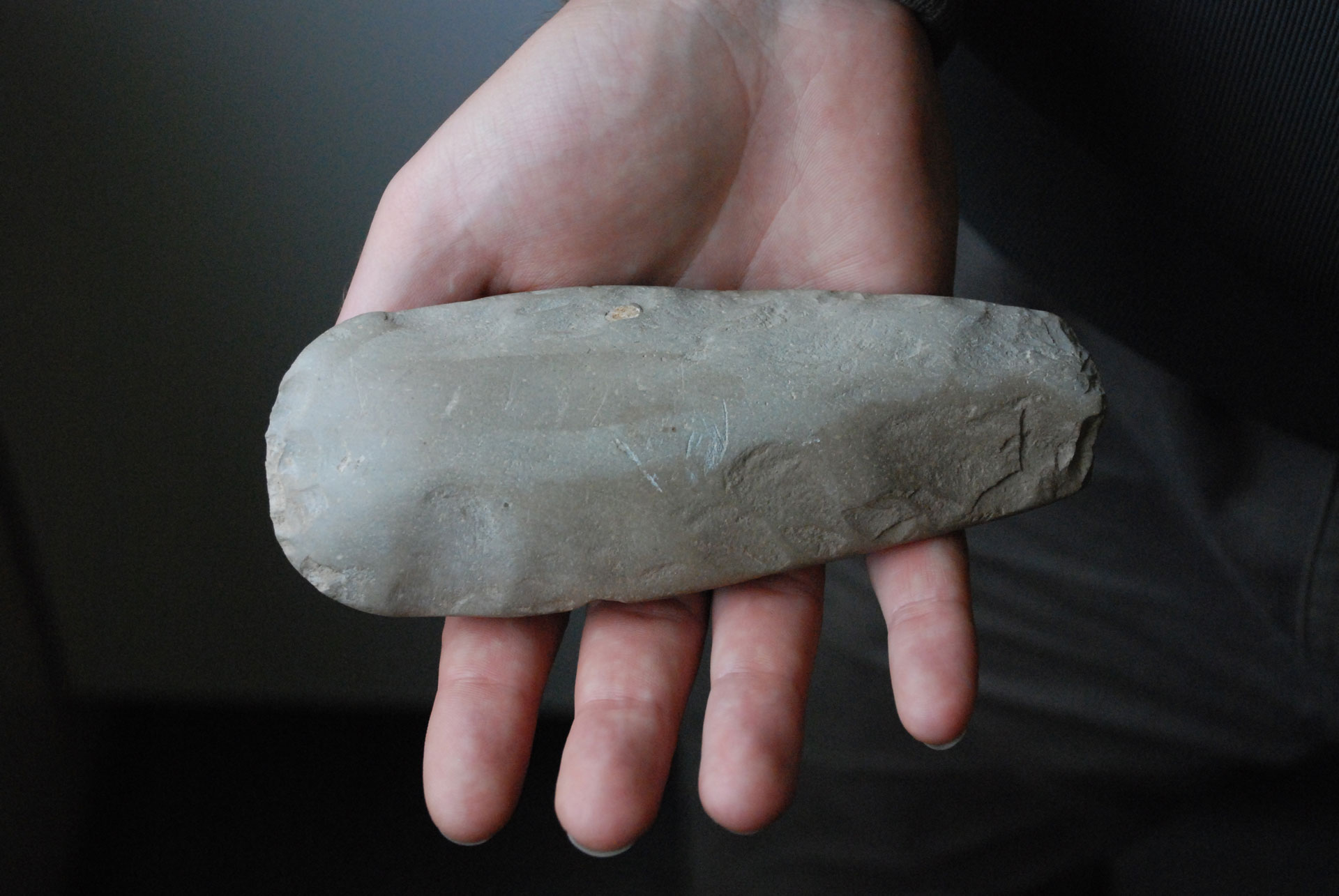
Polished Graig Lwyd Neolithic axehead. Photograph and copyright David Longley. Source: Carneddau Partnership
Just a quick note on the manufacture of axeheads for anyone reading this who is unfamiliar with the subject. The Neolithic spans the time period from around 6000-4500BC and in part of this period axeheads made of particular types of stone, found only in certain geographic areas, became an important type of commodity, traded throughout Britain. The stone axes made from the outcrops at Penmaenmawr and Llanfairfechan, a stone valued both for its durability and workability has been found all over Britain. The working of the stone and the networks that distributed them were complex, not only logistically but in terms of inter-community co-operation and the development of relationships. Axeheads, hafted on to wooden handles, were highly valued items, presumably not merely because of their value as utility tools, but as prestige items that were often difficult to obtain. This idea is reinforced by finds of axeheads that were never used, and by the fact that some were apparently deliberately broken to take them out of circulation.

Digitized image of a drawing of Graig Lwyd axeheads as published in RCAHMW Caernarvonshire Inventory Volume I : East, Figure 10, 1956. Source: RCAHMW
xxx
xxx
The talks
 There is, of course, no possibility of doing justice to the talks, and I have not tried to capture everything that was covered. I hope that I have managed to capture just a little flavour of some aspects of the research discussed by the three speakers in the very short sketches below. Thanks very much to the the three presenters who provided such a good summary of their work, the directions that their research is taking and how it all relates to the Penmaenmawr area.
xxx
Jane Kenney (Landscape of Neolithic Axes Project and Heneb)
About “The Landscape of Neolithic Axes Project”

Roughouts (part-completed axeheads) from the Graig Lwyd area. Photographed in the temporary exhibition at the Penmaenmawr Museum
Dr Kenney, who has been running the project, explained that this is the 6th and final year of the project that is part of the part of the Carneddau Landscape Partnership Scheme, the overarching objectives of which are to protect and conserve natural and cultural heritage, engaging local people and visitors with that heritage.
The project covers the important period 4000-2500BC that sees the arrival of the earliest farmers, pottery and new funerary monuments, who began to move into the territories of Mesolithic groups who hunted, collected plant foods and fished. Polished stone axe-heads were part of the new material assemblage that was required by these innovators. Although wooden handles rarely survive, it is clear from the few that do that axe and adze heads were intended to be hafted. The example on the poster at the top of the page, and also shown further down the page, is from Cumbria and is now at the British Museum. There were a number of places from which suitable stones were sourced and worked, and Graig Lwyd behind Penmaenmawr was one of these. The wide distribution of axe heads throughout Britain and Ireland reflects not only the functional value of this type of tool, but their social significance too.
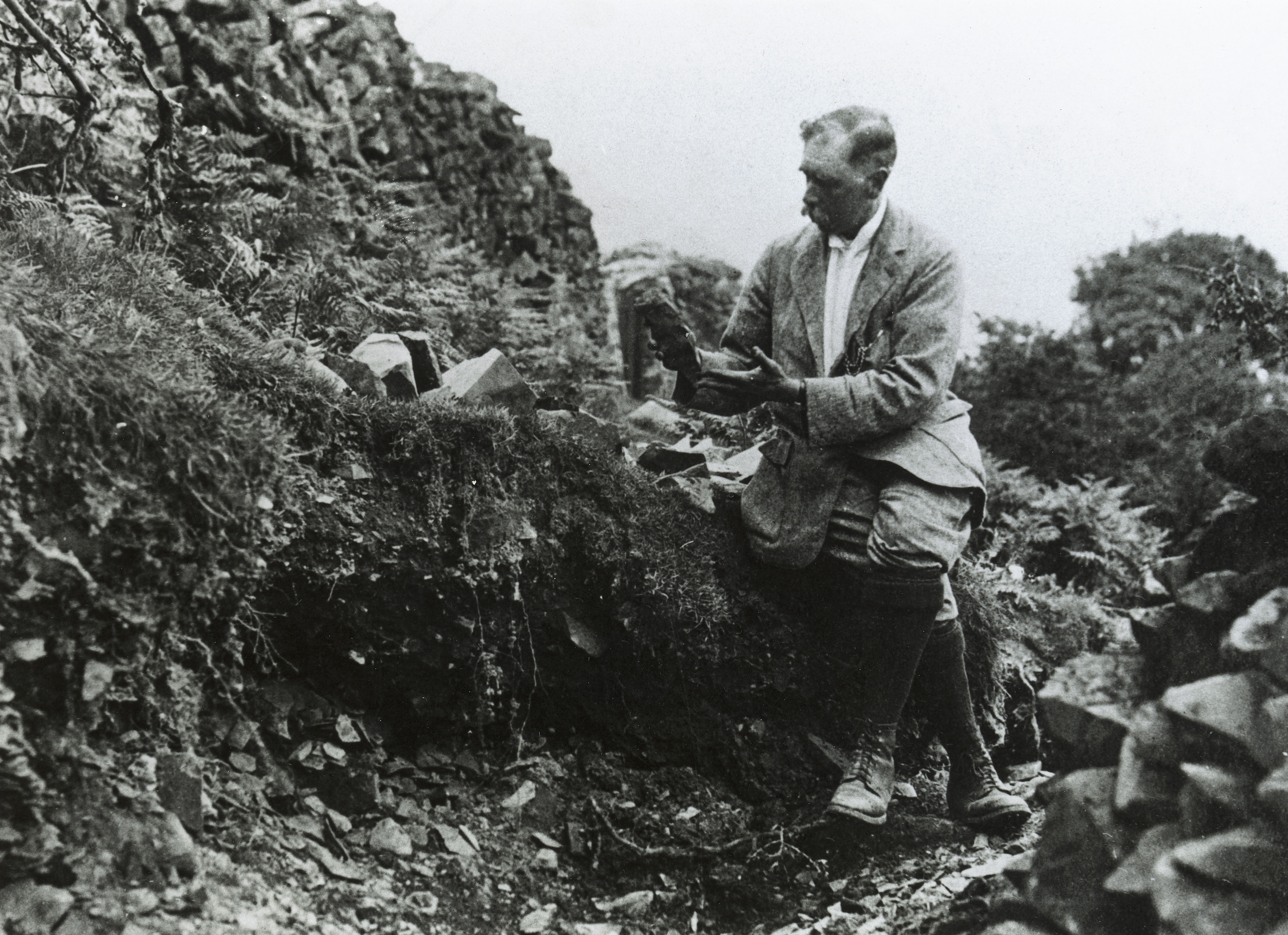
William Hazzledine Warren, who first discovered the Graig Lwyd site in 1821. Source: Peoples Collection Wales
Graig Lywyd was first discovered by Samuel Hazzledine Warren, who was both geologist and prehistorian, in 1919. He found literally tons of worked material at the outcrop known as Graig Lwyd, made on an igneous microdiorite called augite granophyre, a type of rock formed of liquid magma intrusions that has the combined virtues of being hard enough to use for chopping wood, but also has a structure suitable for knapping into the required shapes. He published his findings, starting over two centuries of archaeological research in the area.

Stone sources from around Penmaenmawr. From the temporary exhibition at the Penmaenmawr Museum. Click to enlarge.
The whole of Penmaenmawr is made out of this, with the rock around the exposed edges of Graig Lwyd and nearby outcrops, Dinas and Garreg Fawr, being the most suitable, precisely because they were so exposed, and after repeated freezing and thawing developed fractures that become scree that can be easily exploited. Graig Lwyd, Dinas and Garreg Fawr became a very important source with examples distributed all the across England and Wales with at least one present in Scotland too. Warren’s work was built upon by other independent local researchers, including David T. Jones with whom Kenney worked in the initial stages of the project to identify several possible sources of axe manufacturing.
As this became a wide-ranging landscape project, the team involved an army of volunteers to do the hard work, as well as children from local schools. Different approaches were taken to excavation, beginning with 1m sq test pits, with everything bagged by layer and pit. Even at this early stage trend became noticeable, with flakes dominating and roughouts being found but later stages of manufacture, including completed objects, absent. This was a pattern that was repeated at different outcrops. Bigger trenches were opened that provided more detailed information, some of it near the outcrops themselves but others further down slopes where material had travelled over the centuries. At the same time, more test pits were opened in newly identified areas. The test pits, which investigated below the surface, supplemented the surface finds and showed that there was much more to be found. As well as roughouts and waste materials, manufacturing tools like hammerstones were also found, helping to provide a more complete understanding of the manufacturing process.

Image showing the excavation of test pits forming part of the Carneddau Scheme. The workings were previously thought to be focussed only on the area of Graiglwyd axe factory but are now known to extend over a much wider area. Source: RCAHMW

Flint tool and flakes (waste materials from tool making) found at Maes-y- . Photographed at the temporary exhibition at the Penmaenmawr Museum
An exciting find above a a marshy area near Dinas that produced lots of axe-working debris and some finished axes may have been a settlement area, now called Maes y Bryn, where different activities took place. As well as axe debris, scattered over a wide area, there were lots of flint flakes scattered over the area, which are entirely consistent with a settlement site. The flints were mainly flakes, the waste from domestic tool manufacture, which were probably domestic.
As well as the Neolithic findings, there were Bronze Age and Iron Age discoveries as well. For example, not only has the Dinas outcrop produced plenty of Neolithic axe production data, but it has a very nice Iron Age hillfort on top, and there are plenty of Iron Age field systems in the area. The early and later medieval use of the land is also of considerable interest. The area clearly has a considerable amount of future potential, but for the immediate future the focus has to be on post-excavation work, with the challenge of dealing with the huge quantities of axe-making debris that was found: 163 buckets as of last year, and yet more of it this year!
The next talk, by PhD student Becky Vickers was a fascinating insight into how these 163+ buckets are beginning to be assessed.

Investigating a test pit in the Penmaenmawr-Llanfairfechan area. Source: RCAHMW
Becky Vickers (PhD candidate, University of Sheffield)
New research on Axe-Making
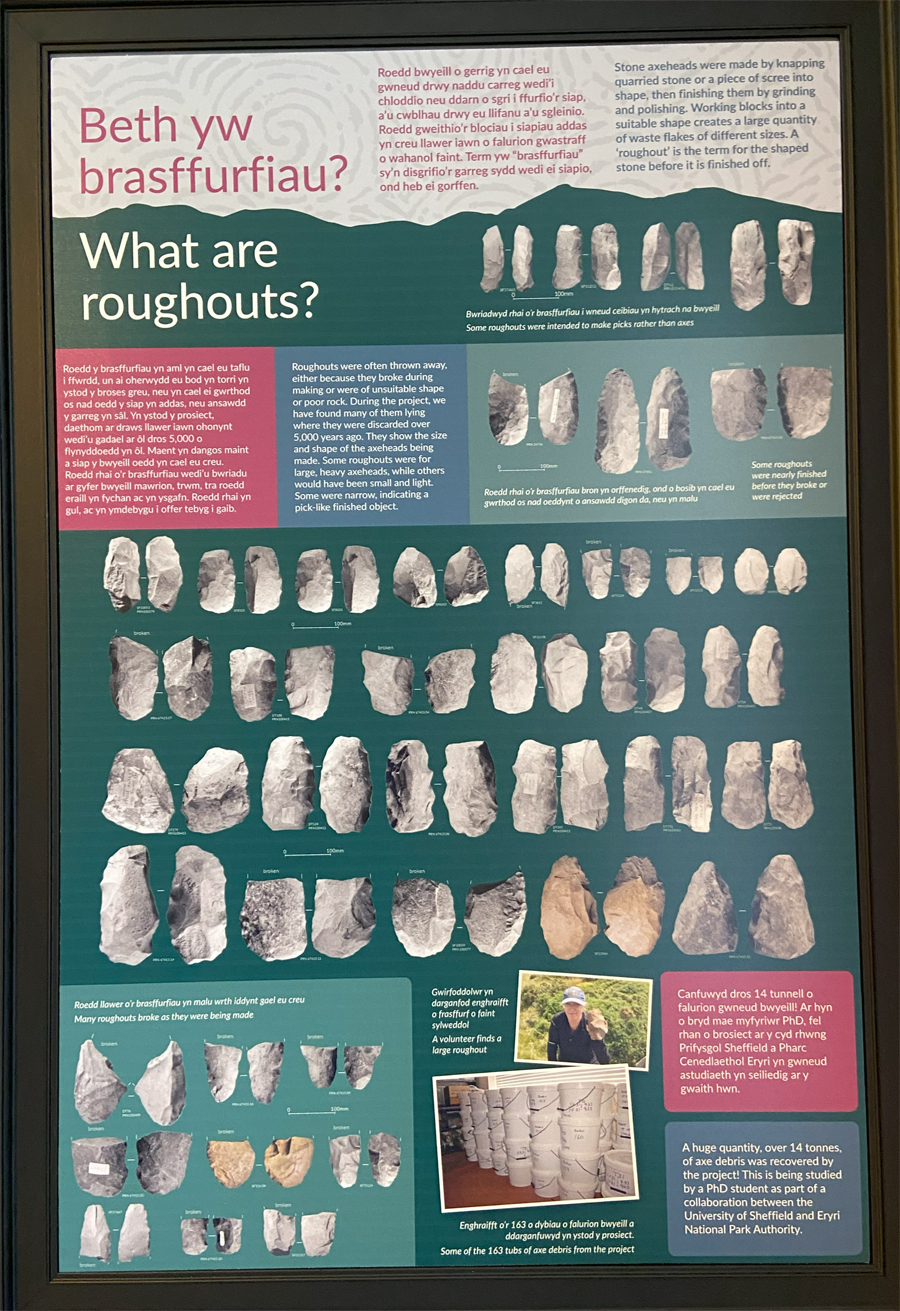
Poster from the exhibition at the Penmaenmawr Museum showing some of the varieties of tool found on the outcrops on the Penmaenmawr mountain
The moment I saw that this talk was on the programme I was looking forward to it. There are dozens of studies looking at flint and chert tool analysis and reconstruction, including how the waste flakes inform about the manufacturing process. The essence of the approach is to look at how basic raw materials undergo a process of reduction, using stone and organic tools (wood, bone, antler etc) to strike a stone directly or indirectly (e.g. hitting an antler-made tool with a hammer stone to create a particular form). It is a lot less common for other types of stone tools to be analyzed using similar methods and perspectives, gaining an understanding of them from raw material to finished product and, beyond manufacturing, how they were used.
This was the main thrust of the first part of the presentation by Becky Vickers, and it was immensely informative. She first took us through the anatomy of a tool and flakes, identifying key factors that indicate how the tools were made and how waste flakes can be distinguished from loose scree. Three main stages of reduction were identified after the raw material had been sourced, which represent a process from rough-out (rough shaping of a piece of stone), through clearly identifiable shape, to final product. Part of the research has been to study the waste flakes from the production process and the pieces of stone that were flaked away from what would become finished (or abandoned) tools. Waste flakes can be just as informative as roughouts and finished products about the manufacturing process, an essential part of the production process, helping to answer questions about how flakes changed through various stages and where these stages took place.
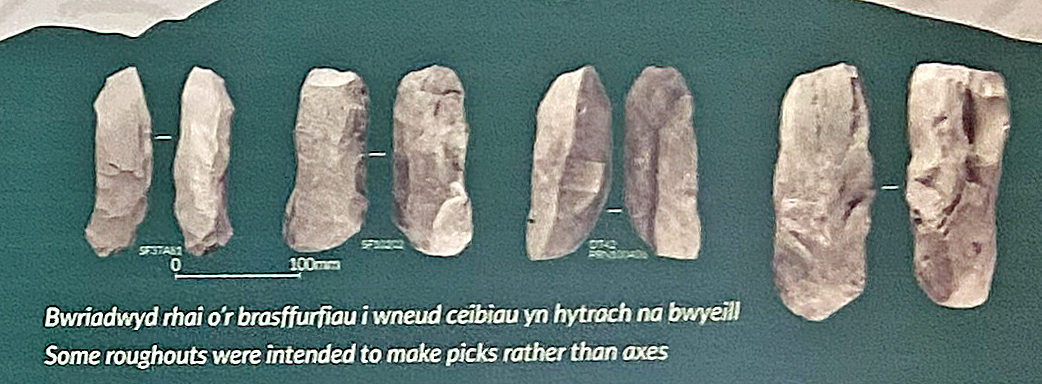
Not only axes were made at the sites. From an interpretation board at the temporary exhibition.
Similarly, one of the many interesting points picked out here (amongst far too many to list in this post) is that not all of the axes produced in the Graig Lwyd and related areas were of the most traditional axe form. Others were carved into shapes that could be used as both small and large general-purpose tools, as well as scrapers and picks. These give a sense of the versatility and different scales of the production process. The hammerstones that would have assisted with the reduction of the stone to form tools are very rare, suggesting that they were valued items that were carried from the site when the work was done.
The analysis of the objects found suggests that these different processes took place at different locations. Some of the initial work to create a tool from the raw material was found at the source of the stone. Roughouts, the initial shaping of the stone into a piece that resembles the final tool, were also found at the source of the stone, but after that further refinement took place elsewhere, perhaps initially in at temporary, seasonal settlement sites that may also have been used as bases for pastoral activities, and were perhaps finished in specialized workshop areas.

A few of the 163 tubs of artefacts and waste flakes found during the project. From the temporary exhibition at the Penmaenmawr Museum.
Another aspect of Becky Vickers’s work is experimental archaeology. She has been working with experimental archaeologists Dr James Dilley and videographer and photographer Emma Jones, who have all worked together to carry out, record and understand the implications of end-to-end production processes. See the video at the very end of this post. Attempting to reproduce the original methodology to complete a final tool have been of real value to Becky Vickers. enabling her to to adapt her ideas. Experiments showed that 1700-3000 small flakes could be produced from one tool, depending on the reduction process chosen. Interestingly, this is not at all well represented in the archaeological assemblage. Many of the smaller flakes are now missing, either washed away by the weather or missed in the archaeological process. Although she has over 163 huge tubs of finds to wade through, the job could have been much more challenging if all the very small waste flakes that must have been produced in the Neolithic had also been found!

Detail from an interpretation panel at the temporary exhibition
Sometimes is is clear that part-made axes deliberately destroyed, intentionally putting them out of action. This aspect of the research suggests that choices were being made about the suitability of a tool during the manufacturing process and, where an item was found to be wanting, it had to be disposed of in a particular way.
The analysis is to finish in spring 2016, and it will be very interesting to see some of the results.
We broke at this point for more tea and coffee. Following both of the above lectures, a variety of questions were posed by the audience, and it was interesting to note that many of them centred on how the axeheads fitted into not only industrial and economic aspects of life, but on the wider question of how they were involved in how societies and individuals defined themselves and how such objects became culturally embedded with their own particular signficance. It was handy, then, that the afternoon was wrapped up with the Headline Talk by one of Britain’s best known Neolithic specialists, Dr Alison Sheridan, who tackled these and other wide-ranging topics about axe manufacturing and the axe trade in Europe, Britain and Ireland.
Headline Talk: Alison Sheridan (Associate Researcher, National Museums of Scotland)
About the Wider World of the Axes

The Shulishader hafted axehead (Stornoway, Lewis). Source: National Museum of Scotland
After hearing about the Penmaenmawr landscape, and its role in the axe trade, Dr Sheridan introduced the wider picture, and offering insights into the social importance of axes in Britain and Europe.
On a practical front, the axehead is an essential component of the toolkit for land clearance and for cutting and shaping wood for making houses, boats, other tools and weapons. However, they were not all put to work. Some were not destined to chop anything. Both haft and axehead of the Shulishader axe, for example,found on the Isle of Lewis and dating c.3300-3000BC were beautifully shaped and seem to have been less for everyday use and more for display. Whether valued for their utilitarian use or for the prestigious character of the item itself, they demonstrated a high level of interconnection between communities. Some types of stone were obviously preferred and even when it was logistically challenging, items made of these preferred raw materials travelled over long networks. The Irish Stone Axe Project, for example, has found at least 9000 porcellanite axes in Ireland. The networks that distributed these tools presumably also helped to maintain social ties so that communities could support each other in times of need, for finding marriage partners, for exchanging ideas and for a great many other interconnections.

The distribution of axeheads from Penmaenmawr and Llanfairfechan across Britain. From the temporary exhibition at the Penmaenmawr Museum. Apologies that it is so lop-sided!
Dr Sheridan described how since the mid 1900s thin sections taken of rocks used for tool manufacture has enabled the study of mineral composition, helping to create a picture not only where these have been sourced, but how far these tools have travelled. Although there were a number of quarries in Wales, axes were also imported from elsewhere, including one in southwest Wales from the Italian Alps. The extent and complexity of these networks suggests that this was not just a case of economic models of supply and demand and factory-type production line manufacturing. Instead, Dr Sheridan argues that something more complicated was happening, with social and ideological factors driving production and movement.
In order to contextualize the axe trade, Dr Sheridan gave an overview of the establishment of farming and its associated new traditions with the arrival from Europe of livestock and crops. Much of her work has been informed by DNA analysis of human remains, which suggests several periods of migration, resulting in the widespread adoption of pioneering new methods of farming by indigenous hunting populations. Two strands in particular impacted Wales, one responsible for the types of megalithic tombs found on the west coasts of England, Wales and Scotland, and in Ireland and another responsible for the those who introduced the Carinated Bowl tradition. They brought with them not only new economic activities, pottery and funerary traditions, but new domestic architecture based on farmsteads and new tool types.

Jadeitite axe, Kincraigy (Raymoghy) found in Co. Donegal, Ireland. Source: National Museum of Ireland
One of the remarkable aspects of the network of European trade, exchange and communication that grew up around axeheads is the arrival of polished green Jadeitite axeheads from high in the Italian Alps, which have been found as far away as the Scottish borders, County Mayo in Ireland, the Black Sea and Morocco. These were special purpose objects that were never intended to be used. The edges can be translucent when ground thin, so that when held up to the light the edges display a halo, and they can be polished to an almost mirror-like surface. They were the subject of the pan-European Projet JADE headed by Professor Pierre Pétrequin, a three year project from 2007-2010 that has produced four volumes of findings. Dr Sheridan described how a strand of interesting ethnoarchaeological work has been carried out in Papua New Guinea to gain insights into axe productions, where the highest mountains, being closest to the Gods, were seen as the ideal source of rocks for tool manufacture. As Dr Sheridan said, every single axehead had an amazing biographical tale to tell, based on its perceived value as a prestige item.

Ehenside Tarn haft and axehead, Cumbria. Source: British Museum (POA.190.6)
One of the best-known sites for accessing the raw material for axeheads in Britain is Great Langdale in Cumbria, where a greenish rock was sought out. Dr Sheridan suggested that both the choice of stone and its treatment were influenced by Alpine axeheads in terms of colour, shape, aesthetic beauty as well as its ability to take polish. These were circulated long distance Britain and Ireland, with some performing a functional role whilst others seem to have performed a more ceremonial role. The Great Langdale quarries were very heard to reach. As with the Papua New Guinea example, the social value lies in the difficulty of obtaining stone in first place.
Dr Sheridan went on to describe other examples of British axehead finds, including the working of blue-green igneous riebeckite-felsite axeheads on Shetland, where people were making more axeheads than they could possibly use. One site alone, a Neolithic house, produced a very unusual find of 12 axeheads, perhaps amassed as wealth to be exchanged with other communities.
The obvious question in discussion of exchange networks, is what Neolithic axeheads were exchanged for. Dr Sheridan suggested that on the basis of evidence of extensive saltern production (salt made by evaporating sea water or brine from inland springs) axeheads could have been exchanged for salt. Salt has always been a trade commodity, and although it can be difficult to detect archaeologically, it is a very intriguing line of potential research.
Seen in the context of Dr Sheridan’s talk, the Penmaenmawr axeheads are part of a much wider series of Neolithic networks that produced and distributed not only utilitarian tools, but items of status and prestige that could be preserved and curated to become components of more esoteric value systems.
xxx
The Exhibition at the Penmaenmawr Museum

An incredibly helpful portion of an interpretation panel at the temporary exhibition in the museum explaining the geology of the Penmaenmawr and Llanfairfechan outcrops. Click to enlarge.
We had intended to arrive early enough to see the small exhibition on the same theme in the Penmaenmawr Museum, but the A55 crawled along at 30mph nearly the entire way, so we had arrived just in time to sit down with a complementary coffee and utterly delicious chocolate Hobnob. Fortunately we were fabulously lucky that some of the museum personnel were packing up at the end of the day, and one of their number generously allowed us in to see the exhibition after they should have closed for the day. Thank you Suryiah for letting us in! The exhibition was beautifully done. Seven interpretation boards covered the geology, the process of axe production on Graig Lwyd and other outcrops, the types of tool found, and provided a cabinet full of axes in various stages of construction, waste flakes and some flint implements to provide an excellent idea of the range of items that were being found on the mountain. Photographs of the interpretation boards and their beautiful photographs and illustrations have been used throughout this post. It will be good to go back and see the entire museum on another day.
xxx
Final Comments

The Graig Lwyd stone quarry as it looks today. Source: RCAHMW
It was a splendid afternoon of talks. If you have the chance to hear any of the researchers speak in the future, do take advantage of the opportunity! The lectures were being filmed, so hopefully they will become available online at some stage.
The sheer number of logos referencing so many organizations on the poster and on presentations says an awful lot about the complexities of funding and organizing something this complex, particularly in the long-term. Thanks so much not only to the funders, organizers and speakers, but to the volunteers who provided cups of tea and coffee (life-saving), glasses of water and luxury biscuits, and to all the people who enabled the exhibition to happen, including the museum staff. It was so well done. The long round of applause at the end of the event said it all, but it was also great to see people queuing up to thank the organisers on the way out.
My thanks also to Helen Anderson not only for driving us, but for letting me know that the event was taking place.
A few selected pieces of further reading
These are bits and pieces from my own reading, not anything recommended by the organizers of the event.
Books and papers
A short list of general introductory reading

Polished axehead from Graig Lwyd stone found on Anglesey. Source: Peoples Collection Wales
Burrow, Steve 2006. The Tomb Builders in Wales 4000-3000BC. National Museum of Wales
Edmonds, Mark 1995. Stone Tools and Society. Working Stone in Neolithic and Bronze Age Britain. Routledge
Malone, Caroline 2001. Neolithic Britain and Ireland. Tempus
Ray, Keith and Julian Thomas. Neolithic Britain. The Transformation of Social Worlds. Oxford University Press
Specific to Axehead Production (all available to view online)
Ennos, Roland and João Oliveira 2020. The mechanical properties of wood and the design of Neolithic stone axes. Journal of Lithic Studies. 8. p.11-24
https://www.researchgate.net/publication/359751898_The_mechanical_properties_of_wood_and_the_design_of_Neolithic_stone_axes
Pétrequin, Pierre and Alison Sheridan, Estelle Gauthier, Serge Cassen, Michel Errera,
Lutz Klassen 2015. Projet JADE 2. ‘Object-signs’ and social interpretations of Alpine jade axeheads in the European Neolithic: theory and methodology. In : T. Kerig and S. Shennan (eds.), Connecting networks . Oxford, Archaeopress, p.83-102
(Free to access, but you need a free Academia account):
https://www.academia.edu/13644414/PETREQUIN_P_SHERIDAN_et_al_2015_Projet_JADE_2_Object_signs_and_social_interpretations_of_Alpine_jade_axeheads_in_the_European_Neolithic_theory_and_methodology_in_T_Kerig_et_S_Shennan_ed_Connecting_networks_Oxford_Archaeopress_83_102
Sheridan, Alison and Gabriel Cooney, Eoin Grogan 1992. Stone Axe Studies in Ireland. Proceedings of the Prehistoric Society 58, 1992, p.389-416
https://core.ac.uk/reader/325992590
Topping, Peter 2010. 3 Neolithic Axe Quarries and Flint Mines: Towards an Ethnography of Prehistoric Extraction. In (eds.) Margaret Brewer-LaPorta, Adrian Burke and David Field. Ancient Mines and Quarries. A Trans-Atlantic Perspective. Oxbow Books, chapter 3.
(Free to access, but you need a free Academia account):
https://www.academia.edu/17310103/_2010_Neolithic_Axe_Quarries_and_Flint_Mines_Towards_an_Ethnography_of_Prehistoric_Extraction
Walker, Katherine 2015. Axe-heads and Identity: an investigation into the roles of imported
axe-heads in identity formation in Neolithic Britain. Unpublished PhD. University of Southampton, Faculty of Humanities (Archaeology), Volume 1 of 2
https://eprints.soton.ac.uk/383149/1/K.Walker%2520-%2520PhD%2520thesis.pdf
Williams, J.Ll.W. and Jane Kenney 2009. Graig Lwyd (Group VII) Lithic Assemblages from the Excavations at Parc Bryn Cegin, Llandygai, Gwynedd, Wales – Analysis and Interpretation. Internet Archaeology 26
https://intarch.ac.uk/journal/issue26/williams_index.html
Websites and YouTube videos
Gwynedd Archaeological Trust
Group VII Axe-working Sites and Stone Sources, Llanfairfechan, Conwy. Report and gazetteer. Project No. G2495. Cadw Report No. 1416. December 2017. By Jane Kenney
https://www.walesher1974.org/her/groups/GAT/media/GAT_Reports/GAT_report_1416_compressed.pdf
Landscape of Neolithic Axes: Report on fieldwork in 2021 at Llanfairfechan. Project No. G2495. Prepared for: Cadw. Report No. 1623. March 2022. By Jane Kenney and George Smith
walesher1974.org/her/groups/GAT/media/GAT_Reports/GATreport_1623_compressed_revised.pdf
Landscape of Neolithic Axes. Report on fieldwork in 2022 at Llanfairfechan. Project G2495. Prepared for: Cadw. Report No.1698. March 2023. By Jane Kenney and George Smith
https://walesher1974.org/her/groups/GAT/media/GAT_Reports/GATreport_1698_compressed.pdf
Heneb
Landscape of Neolithic Axes Project: Year 1 Test Pitting, Ty’n y Llwyfan, Llanfairfechan.
https://heneb.org.uk/wp-content/uploads/2024/11/fieldwork2019.pdf
Group VII Axe-working Sites and Stone Sources, Llanfairfechan, Conwy. Report and gazetteer. Project No. G2495. Prepared for: Cadw. Report No. 1416. December 2017. By
Jane Kenney
https://heneb.org.uk/wp-content/uploads/2024/11/initialsurvey.pdf
A Research Framework for the Archaeology of Wales
Neolithic and Earlier Bronze Age. Version 03; Final Refresh Document February 2017
www.archaeoleg.org.uk/pdf/review2017/neolithicreview2017.pdf
Carneddau Landscape Partnership
Conserving and celebrating the landscape of the Carneddau
(The Carneddau landscape is an area stretching across almost 220 square kilometres in Northen Snowdonia. Its mountain uplands are dominated by Carnedd Llywelyn and Carnedd Dafydd – two of Wales’ five 1,000m peaks)
https://carneddaupartnership.wales/
Landscape of Neolithic Axes
https://carneddaupartnership.wales/project/landscape-of-neolithic-axes/
Penmaenmawr Historical Society and Museum
https://www.penmaenmawrmuseum.co.uk/
xxx
See the website at www.ancientcraft.co.uk
xxx
 Based in Churton