

It is a very long time since I dug anything out of the garden worth posting about, but here’s a fun one from the other day. Unlike the gollywog sherd (object 9), which took me a moment to figure out (mainly because I was holding it upside down) this made itself understood as soon as I turned it over. It’s a very small piece, just 6cm long, but its provenance is beyond question: Llanfairpwllgwyngyllgogerychwyrndrobwllllantysiliogogogoch. This is the broken remnant of what was obviously a souvenir item from the village whose only claim to fame is having the longest place name in Europe. The village is located on Anglesey, next to the Menai Straits. The placename is marked on Ordnance Survey maps as Llanfair Pwllgwyngyll and local shorthand refers to it as Llanfairpwll, whilst a wider use as often Llanfair PG.

A souvenir from Llainfairpwill that may be the type of object from which the sherd in my garden came. Source: eBay
According to Wikipedia the name was an invention composed of local landscape features to produce the country’s longest railway sign and roughly translated means “[The] church of [St.] Mary (Llanfair) [of the] pool (pwll) of the white hazels (gwyn gyll) near to [lit. “over against”] the fierce whirlpool (y chwyrn drobwll) [and] the church of [St.] Tysilio (Llantysilio) of the red cave (gogo[f] goch)”. Various elements have occasionally been translated differently. The inventor remains anonymous, but obviously had a good grasp of local topography.
Souvenirs have been popular since the mid-18th century when travel became an important rite of passage for wealthy young men, but it became particularly popular after the Second World War when transport costs fell and travel became a popular activity for a much wide cross-section of society. “Simultaneously, the souvenir, gift, and keepsake industry was receiving a boost from the proliferation of new materials (like plastic) and the globalisation of mass production. Attractions of all sizes could now offer visitors custom merchandise–serving as sentimental keepsakes and promotional material.” (The Mint Museum of Toys).
I assumed that a web search would produce 100s of souvenir types showing the Llanfairpwll name, but in fact there are very few. The most popular appears to be a decorated Welsh hat (like a very large thimble with a rim), with the town name along the top of the rim and the town shield or other motif on the crown of the hat. That fits for this piece, which is completely flat except for a small upright piece that is difficult to explain in any other way. An example is shown above. Other icons that evoke specifically Welsh cultural identity in souvenirs are red dragons, love spoons, Celtic knotwork and occasionally harps (although the latter is perhaps more commonly associated with Ireland).
xxx
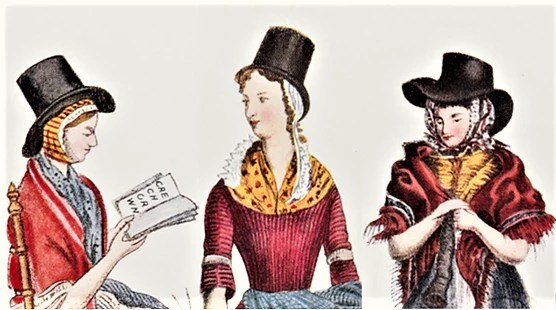
“Dull-wisgoedd Cymru / Cambrian Costumes” by Lady Llanover 1834. Excerpt from a postcard. Source: Amgueddfa Cymru / National Museum of Wales

Llanfairpwllch stationboard with the name framed in green and the approximate pronunciation below. Source: Wikipedia
For anyone new to this occasional series on objects extracted from my garden during everyday gardening activities, see the History in Garden Finds page. These are not objects used in the garden, but objects, usually fragments, lost or disposed of in the garden and found during digging, troweling and planting.
 Based in Churton
