
Introduction

The remains of the former church interior, with a tall arch that, now blocked with brick, once gave access to the tower
St Mary’s Parish Church in Birkenhead has a splendid claim to fame as one of the earliest churches to have cast iron tracery in its window openings, in place of the usual stone mullions and tracery. Although relentlessly Gothic Revival in style, it truly is a child of the Industrial Revolution.
St Mary’s sits over a part of the site occupied by the original medieval Birkenhead Priory. I have talked about the splendid remains of Birkenhead Priory, founded in the 12th century, and its ferry across the Mersey, the earliest one recorded, on an earlier post, Part 1, here. It is an absolute knock-out with a stunning vaulted chapter house, undercroft, remains of other parts of the monastic establishment and a small but very nice museum space.
A recent second visit to Birkenhead Priory, this time with the Chester Archaeological Society, was a good opportunity to re-familiarize myself with the much more recent stories of the 19th century St Mary’s Church, which is interesting in its own right. The tower, which is perfectly preserved with its clock mechanism visible from the stairwell, offers terrific views over the surrounding area whilst also serving as a memorial to those who died tragically during the sea trials of the submarine HMS Thetis.
St Mary’s Church

Plan of the Birkenhead Priory site, with the priory outlined in red, the now absent priory church outlined in orange and remains of the 1822 St Mary’s Church outlined in green. Source: Metropolitan Borough of Wirral leaflet (with my annotations in colour)
The site plan to the right shows the remains of the church framed in green. The medieval priory and its church are framed in red and orange respectively. The blue margin on the right is part of the Camell Laird’s shipyard, into which you can look from the tower of St Mary’s and watch the current shipbuilding activities. Church Street, right at the top of the image, post-dates the demolition of most of the church in 1970.
Although there are some stunning architectural survivals from the medieval priory, almost nothing remains of the priory church following the Dissolution. As you can see on the site plan to the right, the original priory church overlaps the site of St Mary’s. The Prior and his monks effectively handed over the keys to Henry VIII’s administrators and left peacefully. The need for a religious focus for the small community that remained, however, resulted in the consecration of the gorgeous monastic chapter house as a chapel (numbers 2, 3 on the plan, where the daily business of the priory had formerly taken place). It was only in the 19th century when Birkenhead began to grow into an industrial town, port and shipbuilding yards, with a rapidly expanding population, which was encouraged by the introduction of a steam ferry across the river Mersey, that the little chapel in the former chapter house became far too small for the needs of the Birkenhead community. As a result the decision was made to build a new church to meet the needs of this expanding population.

Thomas Rickman. Source: Wikipedia
The architect chosen for the task of building a new parish church for Birkenhead was Thomas Rickman, an interesting character whose 1817 book Attempt to Discriminate the Styles of English Architecture helped to promote the development of the Gothic Revival, of which he was himself an enthusiastic proponent. Having secured some commissions in the Liverpool area from iron foundry owner John Cragg, Rickman had established an architectural practice in Liverpool in 1817. The foundation stone of the new Parish Church of St Mary’s was laid in July 1819, was consecrated on the 17th December 1821 and opened in 1822, with a vicarage established on the probable site of the priory kitchen. Built of red sandstone, which inevitably blackened with industrial pollution over the decades, the church had a rectangular plan apparently without aisles, with a tower at the west end. Although bricked up today for structural stability, the tall arch in the east wall of the tower would have opened into the nave of the church.

St Mary’s church in the early 20th century on a splendid postcard showing the church and the former churchyard. Source: St Mary’s Birkenhead blog
The church was large for the available population, but the landowner Francis Richard Price apparently decided to future-proof his new building, correctly judging that the early influx of people was going to continue to expand. By 1832 the church was too small for the congregation and was expanded with a north transept (wing), followed by a south transept in 1835. You can see some of the decorative touches from the roof in the remaining pieces of masonry at the feet of the west walls.


Victorian burials took place mainly in the churchyard but prestigious individuals were interred within the monastic garth. The former monastic garth, the square green that formed the focus around which the most important monastic buildings were arranged, became a cemetery for important residents in the 19th century. It is here, for example, that the Laird family crypt is to be found. In 2024, at his request, the cremated ashes of Birkenhead Labour MP Frank Field, who served for 40 years, were buried next to the entrance to the chapter house. He is almost certainly the last who will be given permission to be interred there.

The dock for which the churchyard was sacrificed in the 1950s
The churchyard with its cemetery no longer survives. It was originally established in the Middle Ages, for the monastic community, but after the 16th century probably only saw intermittent usage. It was only as Birkenhead began to expand that it came back into general use. After the opening of St Mary’s it once again became an important cemetery for the local area, remaining in use until 1901, after which only those with family plots or in exceptional circumstances were permitted. In 1948 the parishes of St Mary’s and St Paul’s in Birkenhead joined forces, and St Paul’s was demolished. In the 1950s, as the neighbouring shipyard expanded and was desperate for more space, a commercial deal was made between Camell Lairds and the town council, in the face of protests, to purchase the churchyard for a new dock. Whatever remained of the medieval church, all but part of one arch, was taken down. Around 1100 burials, including those that had been brought over, with headstones, from St Paul’s were transferred from the churchyard to the new Landican cemetery in 1957-8, leaving only those within the garth of the monastic complex, and a handful in the immediate vicinity of the church and the priory. A tall wall was built to divide the site from the docks below.

Another angle on St Mary’s showing the exterior walls and the base of the tower, as well as the clock
 The Church tower has a number of notable features. The Victorian clock underwent restoration and was reinstalled in 1990, sponsored by local interests. From the top of the tower there are some stunning views, and you can peer into the fascinating Camell Laird’s shipyard and see the dry dock where the well-known and very controversial 1862 Alabama was built as a blockade runner for the Confederates in the American Civil War. However, the most notable aspect of the tower is its role as a memorial to the 99 men who died in 1939 on the submarine HMS Thetis.
The church was closed in 1974 and the majority of the church was taken down in 1977. Most of the fallen masonry remained after the demolition was presumably removed for recycling as building material, but some of the pieces of stonework that were less obviously adaptable for other building projects are laid along the remains of the inner west walls of the former nave.
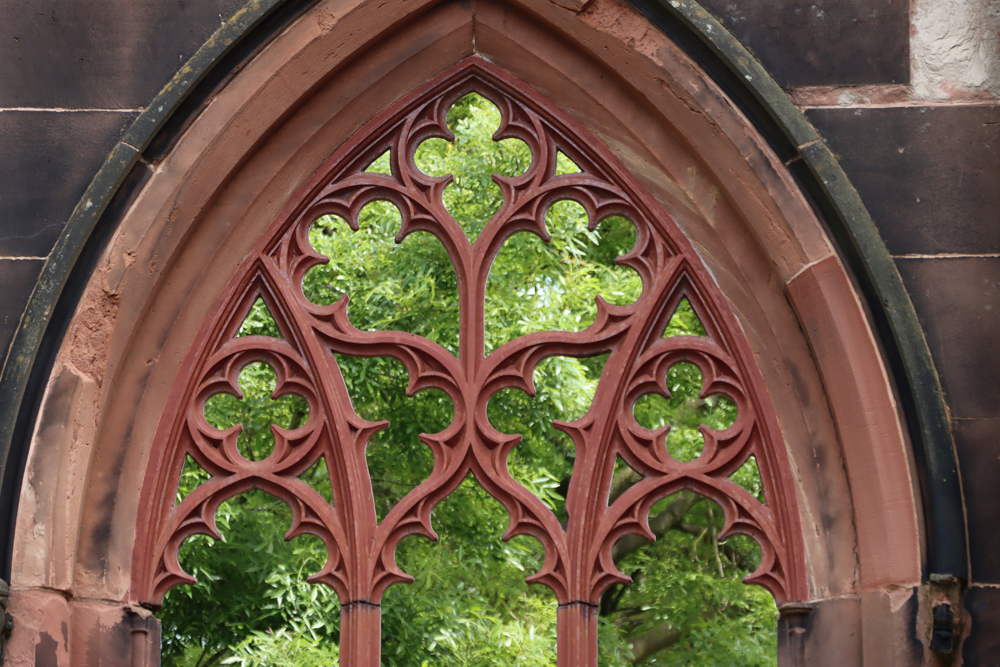
One of the splendid cast iron windows
xxx
HMS Thetis

HMS Thetis was salvaged, repaired and relaunched as HMS Thunderbolt, shown here. Source: Wikipedia
On 1st June 1939 a new submarine, the first of the new Titan class, left Cammell Laird’s shipyard in Birkenhead. This was her second set of sea trials, after her first went went very badly, and it was imperative that this time there should be no mistakes. There was great confidence when she put to sea, but only a few hours later sank 12 miles off the Great Orme in Liverpool Bay, with 103 men on board. This was twice the usual number of crew on board the HMS Thetis (N25), because as well as the standard Royal Navy crew of some 50 men that manned her, there were also engineers, members of the Admiralty and various others on board, including catering staff and other civilians, as she underwent sea trials. There were only four survivors, and it is partly due to their testimonies that the cause of the tragedy was pieced together.
 The submarine sailed safely down the Mersey towards Liverpool Bay, heading towards the Great Orme and accompanied by a tug boat named the Grebe Cock. An essential part of her sea trials was to dive and make way underwater. When the attempt to dive was made, in 150ft (46m) of water, the submarine was found to be too lightweight to submerge. A submarine can make additional weight by taking on water. Her internal compensating tanks were full, and it was decided to check the status of the six torpedo tubes and allow the two lowest ones to flood if they were empty. The torpedo tubes could be checked by means of a stop-cock. If, when turned, water leaked out, then the torpedo tube was full. If it did not, it was empty and could opened and inspected. In the aftermath of the disaster, it was found that the stop-cock of the fifth torpedo tube had been accidentally covered with enamel paint during final preparation for trials, and had hardened, preventing any water seeping out of the stop-cock to indicate that the torpedo tube was, in fact, full of water. Because it was believed that the tube was empty, the rear door was opened. In fact, the torpedo door was open to the sea and immediately thousands of gallons flooded into the submarine, forcing her down at the bow as the water began to fill the first two sections. Thereafter the 270ft (82m) submarine could not be refloated and it was a matter of escape or rescue before air ran out.

The memorial stairways in St Mary’s tower
Thereafter it is a complicated story, certainly not one for someone uninformed to tell, and the best website account I have found to date is the unfortunately named Great Disasters website, which includes accounts by the four survivors and witnesses from the inquiry. Alternatively, and much-recommended is really excellent 15-minute summary provided by a video, with original photographs and diagrams, presenting the harrowing story very clearly: The Raven’s Eye YouTube channel.
The submarine was recovered on the 3rd of September 1939, towed to Traeth Bychan beach, where she was grounded and the remaining bodies either buried in a mass grave in Maeshyfryd Cemetery in Holyhead. After the submarine was salvaged, repaired and renamed HMS Thunderbolt she was returned to active service in 1940. She was a successful vessel until 1943 when she was sunk off the coast of Sicily by an Italian corvette, with the loss of all hands.
The catalogue of errors both on board and on shore is dismally reminiscent of the sinking of Titanic, when one is familiar with the details of both horror stories. Human error, in design, in execution, in procedures and in response to technological failure, always seems to be a major factor in shipping and air disasters.
xxx
Final Comments
A visit to Birkenhead Priory is rewarding in its own right, but with the addition of the ruins of St Mary’s Church with its cast iron windows, and the tower, its memorial and its views. there is an awful lot to see, enjoy and learn.

There are some stunning views from the top of St Mary’s tower
xxx
Visiting Details
Details for visitors are in Part 1. Although Part 1 was posted in May last year, I have checked the details and nothing has changed in the meantime. There are also opening hours and a map on the Birkenhead Priory website.
xx
Sources
Leaflets
St Mary’s Parish Church 1819-1977, compiled by Tony Hughes
https://thebirkenheadpriory.org/wp-content/uploads/St-Marys-booklet.pdf
HMS Thetis, compiled by Les Black, March 2016. Produced by Birkenhead Priory
Websites
AHRNet
Rickman, Thomas 1776 – 1841
https://architecture.arthistoryresearch.net/architects/rickman-thomas
Graveyard Survey, St Mary’s Birkenhead, volume 1, 1977, Gill Chitty 1977
https://www.merseysidearchsoc.com/uploads/2/7/2/9/2729758/jmas_1_paper_5.pdf
Marshall University, Marshall Digital Scholar
CSS Alabama. An Illustrated History. Part 1: Building Ship No. 290. By Jack L. Dickinson. Fall 10-9-2017
https://civilwartalk.com/attachments/part-1-building-ship-no-290-pdf.296944/
An Online Archive for the Church of St. Mary’s & the Priory, Birkenhead Cheshire, including a listing of the monumental inscriptions from the old graveyard & Priory
History of the Priory and St. Mary’s Church Birkenhead
http://stmarysbirkenhead.blogspot.com/
The Raven’s Eye
Everything Went Wrong – The Tragedy of HMS Thetis – Submarine Disaster (1939)
https://www.youtube.com/watch?v=JEcW7WjRxY8


Over the wall from the former churchyard

I believe that this was the dry dock where the “Alabama” was built, seen from the top of St Mary’s tower

 Based in Churton
.png)