
Introduction
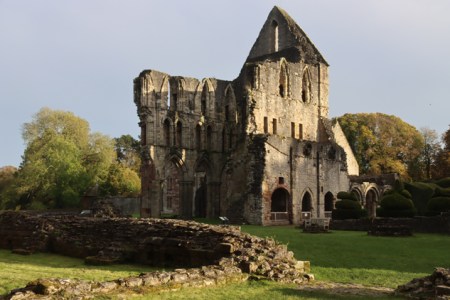
North transept
Because there is no sense of a physical division between the remains of Cluniac Wenlock Priory and the very picturesque village of Much Wenlock, the one blending into the other, the village and the priory make up a terrific visit between them. The little museum was closed when I was there, but this too is apparently well worth a visit.
The post-Conquest priory was established in the 11th century, at around 1082 by Roger de Montgomery. The term “priory” often denotes a smaller subset of a more impressive substantial abbey, but this is misleading here. Wenlock Priory is considerably substantial and its remains continue to impress. The term “priory” in this case refers to its status as a foundation belonging to the Cluniac order’s founding monastery at in France, discussed further below.
The ground plans of monastic establishments in Britain all conform to a basic formula, first established by the Benedictine order, and because most are ruined it is sometimes easy to miss the considerable variations that were built into the architecture by the different monastic orders that followed the Benedictines. This is clearly seen at Wenlock, where specific architectural features reflect a very different ideology from many of its competitors. These differentiating features are highlighted below.

Artist’s reconstruction of Wenlock Priory in the mid 15th century. My annotations, based on the above English Heritage site plan. There’s a nifty feature on the English Heritage site that allows you to overlay an aeriel photograph over this image by dragging it, to show how present and past related. Source: English Heritage
The original arrangement of the most important monastic buildings followed the Benedictine interpretation of their founder, the 6th century St Benedict of Nursia, in Italy. The formula required that the first building to be built was a church. This formed one side of a square cloister of essential buildings, all connected by a walkway that surrounded a green square, the garth. Other buildings would be erected later in a monastic establishment’s history, often around secondary and tertiary cloisters.
This basic layout is demonstrated at Wenlock Priory. The church was normally on the north side of the cloister, to protect the rest of the buildings from the worst of the weather and to provide light to the garth, and this is also true at Wenlock.
The rest of the cloister, main shown on the left in the reconstruction, consists of three ranges connected by a walkway. The east range essential administrative buildings: the chapter house and the book room a door leading up to the dormitory. The dormitory extended from the east range out to the south to become one side of a secondary cloister. The south range usually incorporated the refectory, as it does here, where the monks ate all their meals, as well as the kitchen and the warming room. The use of the west range varied from one order to another, and at Wenlock its use is uncertain.

Blind arcading in the Chapter House
Subsequent buildings, such as an infirmary, the prior’s lodging and land set aside for a cemetery, are often lost in ruined cemeteries, but thanks to the conversion of the prior’s lodging and infirmary into a private residence, these have been preserved (although are not open to visitors). This enables the larger layout of Wenlock to be understood, where this information has been lost in many other ruined sites. Other elements, such as boundary markers, and a gate-house are no longer visible, but the sites of tow important fishponds have been located.
==
The Cluniacs

A model representing the vast headquarters of the Cluniac order at Cluny in France as it was at its height. Source: Wikipedia, by Hannes72 CC BY-SA 3.0
The Cluniac Order was founded in 909 in the southern Burgundy area of France by the Duke of Aquitaine with the Abbey of Cluny. The new order was created partly as a response to the belief that the earlier Benedictine order had become lax in its monastic practices and also the belief that its senior personnel were frequently corrupt. However, although they took St Benedict’s Rules as their guideline, the Cluniac order did not follow the letter of St Benedict’s vision.
St Benedict had divided the workload of his monastic community into “ora et labora” (prayer and work). Different monastic orders each put different emphasis on these components. Work for the Cistercians, for example, meant both physical labour and time spent both learning and copying religious texts and religious law. For the Cluniacs, manual labour was not considered relevant, and study was rarely as significant as in other orders. Instead, their emphasis was on glorifying God and Christ via an emphasis on liturgy and displays of material wealth. Their elaborate architecture, stained glass, paintwork, artworks, rich vestments, priceless relics and other valuable objects, attracted wealthy patrons who related to this rich environment.
Early in its history the Cluniac order had secured independence from the local bishopric, which usually oversaw monastic establishments, and became answerable only to the papacy. This direct attachment to the ultimate divine authority on earth and the emphasis on liturgy and prayer were particularly attractive to endowments. The order’s rules laid down that those who granted endowments to the order were not permitted to dictate Cluniac management of their own houses. The Cluniacs became politically influential in France.

La Charité-sur-Loire, Burgundy, the mother house of Wenlock Priory. Photograph by Rolf Kranz. Source: Wikipedia CC BY-SA 4_0
All this ostentatious display of piety impressed patrons, but one shudders to think what St Benedict would have made of it all. The Cistercians, Savignacs and Carthusians all responded to the increasing materiality and conspicuous displays of wealth of both Cluniac and Benedictine orders with a different ideological and procedural way of life, already discussed on the blog in connection with Valle Crucis Abbey (Llangollen) and Basingwerk Abbey (Holywell). It was the Cluniac model that particularly repelled the break-away orders who sought isolation, humility and hard work as more appropriate ways of honouring their Christian beliefs. On the other hand, the Cluniac system of making all subsequent houses accountable to the mother house introduced an element of governance, together with the insistance of rule enforcement, that was not required by the Benedictines, and which helped to give the Cluniacs real cohesion, a system imitated and enforced in particular by the Cistercians.
Throughout England, following the Norman invasion and mainly between 1075 and 1175, the order began to spread throughout England, amounting to 36 new foundations, many of them very ambitious. The first was established in Lewes in Sussex in 1077 by William de Warenne. Bermondsey, now a part of southeast London followed soon afterwards. Wenlock was one of the next to be established in 1180, by Roger de Montgomery. The Cluniac order continued to be very successful, particularly in France.

The bronze effigy of Edward III in Westminster Cathedral
Because the priory it was subject to its mother abbey of Cluny in France, Wenlock was one of many French monasteries in Englan termed an “alien priory.” This became particularly relevant during the Hundred Years War under Edward III, which broke out in 1337. Alien priories were suspected of representing French interests in England. King Edward III (reigned 1327 – 1377) saw these alien priories not only as a political threat, but also as a source of income. Some were suppressed, with Edward confiscating their properties and lands, and others were ordered to pay an often crippling annual fee for survival. Wenlock was able to pull together the funds to pay, amounting to more than half of the priory’s total annual income, and in the late 13th century, took the decision to cut its links with its mother house, La Charité, to swear loyalty as English nationals to the Crown, and to pay a massive one-off fee to secure this new “denizen status.” Tensions remained, as La Charité was by no means ready to accept the situation, and the connection was not fully terminated until the end of the 15th century.
The Anglo-Saxon Monastery dedicated to St Milberga
Excavations have established that the Cluniac Wenlock Priory was established on the site of a much earlier monastery that had been established in around AD 675, closing in around the 10th century. Both monks and nuns worshiped at the monastery, with each having their set of buildings including their own churches. The monastery was dedicated to St Milburga, the patron saint of the original 7th century abbey, who continued to be venerated in the 12th century priory, just as at Chester the Anglo-Saxon St Werburgh was venerated in the Anglo-Norman Abbey of St Werburgh, now Chester Cathedral. As with most Anglo-Saxon saints, not a great deal is known about St Milburga. She was the eldest daughter of the King of Mercia, Merewalh, and was sent to be educated near Paris. She arrived at Wenlock in 687 to succeed the presiding abbess of the nunnery, where she remained for three decades. She became renowned for the miracles that she performed whilst at Wenlock. She was supposed to have resurrected a dead child, to have banished geese that devastated the region’s cultivated fields, but she is best known for having floated her veil on a sunbeam.
Entering the site today – orienting yourself

Entering the nave from the west, with the piers running from west to east, the outline of the porch on your left, and the north and south transepts either side
Today you enter the priory from the west end, where the grand entrance would have stood. This entrance was reserved for ceremonial occasions. The public would normally have entered via a stone porch on the north side of the nave, whereas the monks would have entered via one of two entrances opening into the south side. Entering from the west end gives you an excellent view of the church. In front of you are the bases of piers (multi-shafted columns), flanked by twin side aisles.
Next, you see two tall opposing stone constructions to left and right, the north and south transepts. Looking beyond the transepts, the church continues with a vast east end, with what would have been the choir, the presbytery and high altar and probably the shrine of st Mildeburge. Beyond this, in the 14th century, a small Lady Chapel was added. Although some publications refer to a “traditional cruciform shape,” referring to the cross-shape created by the east end, the west end and protruding transepts, most monastic churches have an east end much shorter than the nave, giving it more of the shape of the crucifix; the church at Wenlock is therefore not entirely traditional.

Chapter House
The nave of the church makes up the north wall of the main cloister, which lies to its south, so if you look to your right, you will see an archway leading through to the cloister. Buildings further along the line of the church, also to the right, are buildings that were built after the main cloister was established, including the infirmary and the prior’s lodging.
I started with a walk from one end of the church to the other, taking in both transepts, came back to the main cloister and then later went and had a look at the remains of the secondary cloister. I’ve used that visiting order in the description below.
The Church
A multi-phase construction
The location, next to Farley Brook, which runs into the Severn four miles to the south, was important for supplying water to the fish ponds and for the monastery’s own water supply and drainage system. The Anglo-Saxon church seems to have formed the foundations for Roger de Montgomery’s 1180 monastic church, after which a number of phases of construction can be identified.

The plan of Wenlock Priory. Source: McNeill 2020, English Heritage
The West End – the Nave, the Porch and the Upper Chamber
Entering from the west, you are following the approximate approach of the monks through their grand entrance, used only on special days of the religious calendar and for processions. The long 8-bay nave with its octagonal plinths, probably built during the mid-13th century, was used by visitors to the priory and provided a suitably impression processional space. Along the north wall, midway between the entrance and the crypt, was a porch that gave public access to the nave (the bottom courses of which mark its position), whilst the monks would usually enter from the cloister. The nave was divided from the crossing and the east end presbytery, which were confined to the monks, by a stone screen that no longer remains.
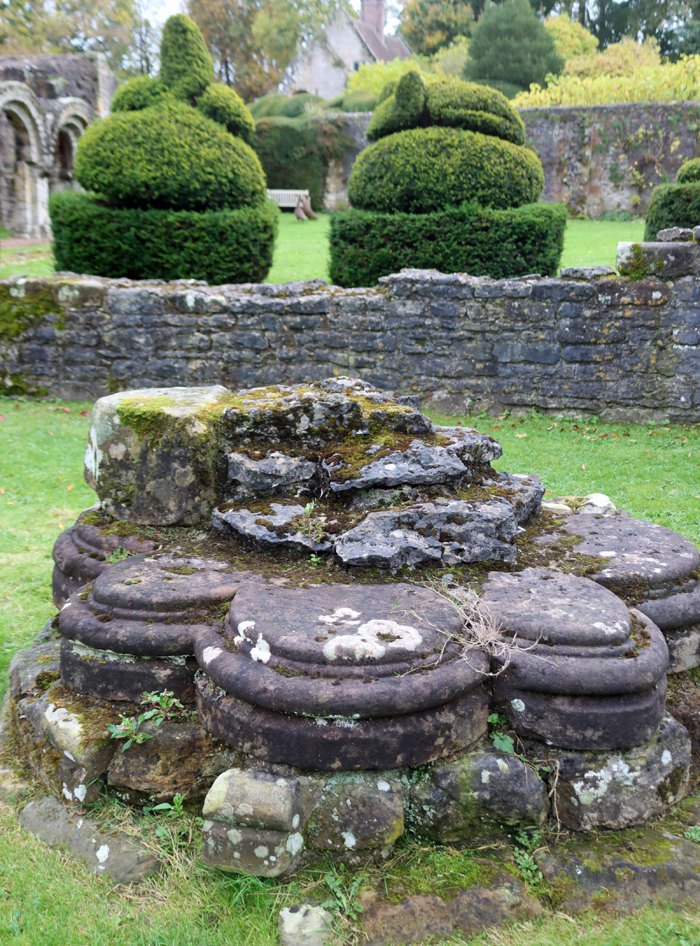
One of the pier bases in the nave of the priory church at the west end of the church, with the garth on the other sideof the ruined wall, the cloister visible to the left
A very unusual architectural feature is found at the south side of the nave next to the west entrance. A chamber sits over part of the south aisle, which is particularly low to accommodate the chamber above. It is not recorded what this chamber was for, and although there are several ideas about its possible use, there is nothing to help choose between them. The chamber is not open to the public.

The Upper Chamber, seen from the Cloister
Medieval tiles gathered together from around the site in the south aisle of the west transept.

Medieval tiles
The 3-storey Transepts and the Crypt
Flanking the crossing were two transepts, which give the priory its cruciform appearance. These were used for chapels on the ground floor, where masses were held for the deceased. There were three chapels in each transept.
The south transept

South Transept
The best preserved of the two transepts is the south transept, which was built in the 1230s and retains some attractive features of the 13th century church. The archers are supported on massive columns, each consisting of eight vertical shafts, themselves supported on plinths. The side walls seem massive and the reason is that above the level of the chapel arches they contained an internal passage, the triforium, and supported windows above, the clerestory, which allowed light into the south transept. The end wall at the south has two decorative blind arches.
The west wall has one of the special features of the priory: a set of narrow, pointed blind arches with two tiny blind arches between them, to hold candles. A channel carved into the stone of the central arch indicates that this once held a water pipe, and was probably used as part of the monks’ ritual cleansing prior to liturgies.

Unique feature in the west wall of the south transept
The north transept
Opposite the south transept, the north transept is less well preserved, but reflects the south transept. One of the chapels was excavated and revealed a skeleton accompanied by a ceramic chalice, thought to have been a medieval monk.
The crypt and possible sacristy
In the west wall there is a blocked entrance that once opened into a two-storey building, the remains of which can still be seen. The upper level shares a wall with the south transept and retains three arched recesses, possibly the sacristy. The lower level of was a vaulted crypt whose function remains unknown.
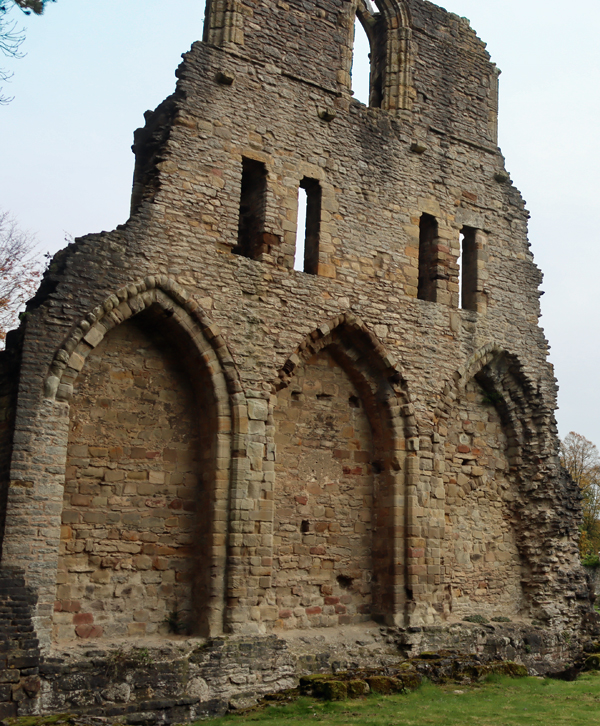
The possible sacristy, backing on to the north transept

The crypt below the possible sacristy
The East End, the Treasury and the Lady Chapel
By 1320 the church was 105m long. Divided from the west end of the church by a stone screen, the holy east end consists of 7 bays and was confined to the monks, and was where the high altar was located and where liturgies, masses for the souls of the dead and the Eucharist were performed. Behind the high altar it is thought that the shrine of St Milburga was probably retained. All that remains of the east end are the lowest tiers of wall and the plinths for the piers, but these manage to contribute to the sense of the sheer scale of the church as you look from one end to the other.

The Treasury
Just to the south of the presbytery was a seven-sided building now referred to as The Treasury, which is thought to have been built in the 15th century and was probably used to store valuable ritual items associated with special days in the religious calendar and the associated processions.
The Lady Chapel was a particular feature of 13th century churches when dedication to the Virgin Mary became an important feature of Christianity, and was frequently a somewhat untidy bolt-on to an existing arrangement. This is the case at Wenlock, where a small protrusion was added to the east end.
The Main Cloister
The Garth with the walkway and lavabo

Lavabo in the foreground, looking towards the south transept and the Upper Chamber
The garth, the central green around which the main cloister walkway (which does not survive) and the cloister buildings were arranged would have been the centre of the most important part of the priory in the medieval period. It could have served as a herb garden or as a peaceful area for contemplation. One of the oddities about the layout of the cloister at Wenlock, which is easier to see on the plan that it is on the ground, is that it is not a perfect square or rectangle. The refectory cuts across the south end of the garth at a distinct angle, which is out of keeping with the line of the church or with the other two ranges that make up the cloister buildings.

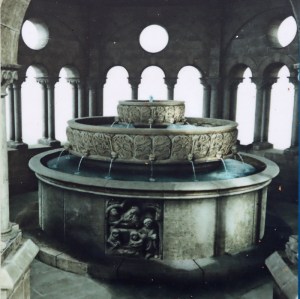
Artist’s reconstruction of the lavabo. Source: information board at Wenlock Priory
Today the main feature of the garth that survives in ruined form, but was once a magnificent feature unparalleled in England, is the late 12th century lavabo. Its remains were found during the 19th century, and although only a few elements were preserved intact, they give a good idea of how the lavabo would have appeared. It consisted of a fountain arrangement of two upper bowls and a lower basin all of which sat within an arched octagonal structure. It was decorated with carved panels whoing religious themes, two of which are now in the Much Wenlock Museum. This is where the monks washed before eating.
The garth’s modern topiary bushes were established in the 19th century. Opinion is divided about whether this is a positive addition or not, but it has become a component part of the site’s history.
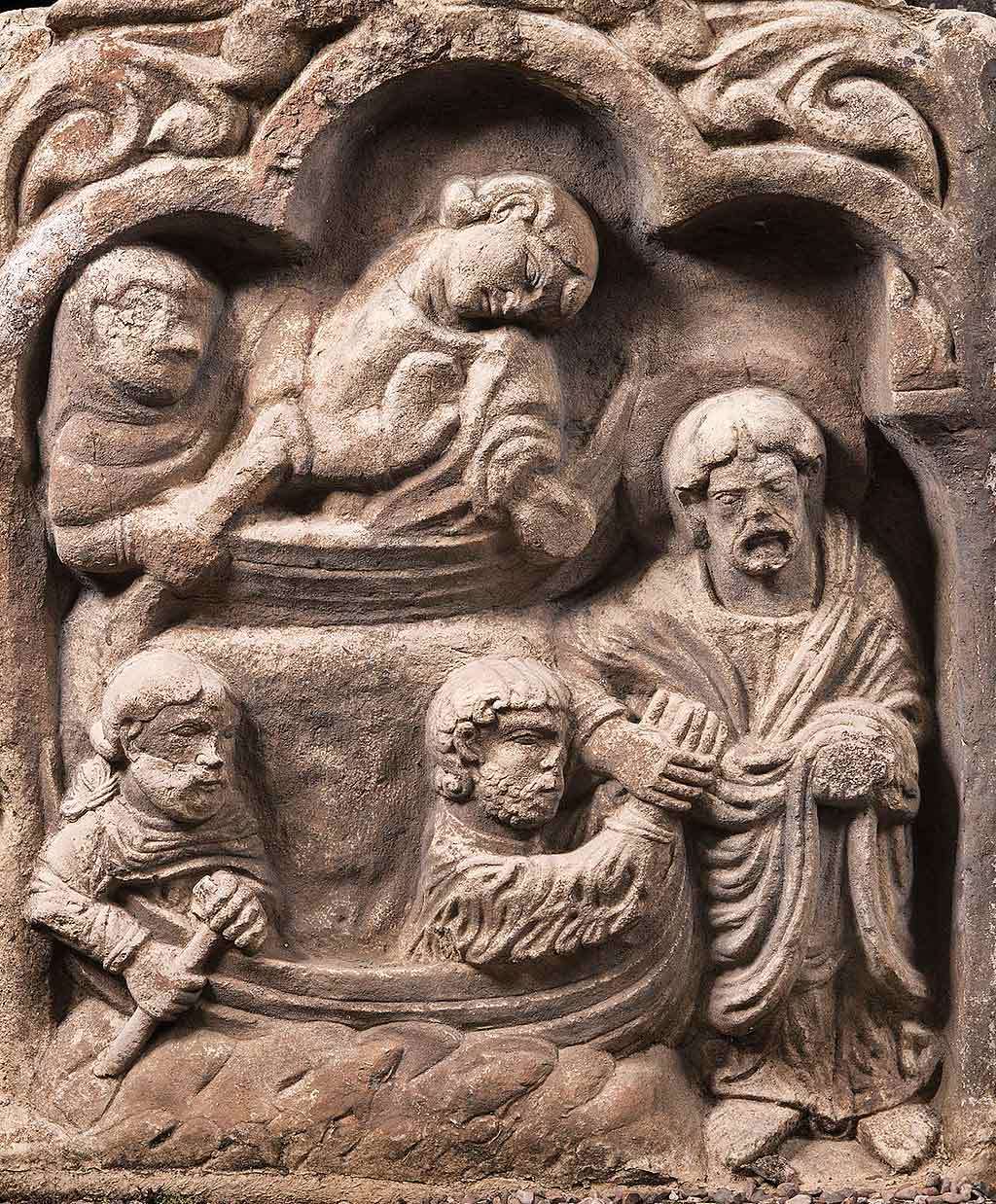
Lavabo carving of Christ with St Peter and St Andrew on the Sea of Galilee. Source: English Heritage
The covered walkway, with open arches that offered light and views of the garth, provided a link between all the cloister buildings that formed the heart of the monastic establishment, where most of the monks spent most of their lives. The walkway no longer survives. On three sides of the cloister, these are referred to as ranges. Part of the church nave made up the fourth side.
The East Range
The magnificent Chapter House
The Chapter House, dating from the 12th century, is the jewel in the crown of the abbey. Considerable investment was usually made in any order’s chapter house, where the community met daily to discuss the business of the monastery, but Cluniac chapter houses are characterized by their particularly elaborate architectural detail, which would have been picked out in full colour. The blind arcading, a decorative feature emulating window arches, is particularly characteristic of Cluniac sites, although it appears in the architecture of other orders too. Philip Wilkinson suggests that it was probably “one of the most magnificent rooms in Norman England” (p.35).

Entrance to the chapter house from the cloister

The Chapter House

Blind arcading in the Chapter House

Decorative features in the Chapter House

Romanesque lintel over blocked door in the Chapter House, probably moved here from a different part of the abbey

Decorative touches in the Chapter House

Imaginative reconstruction of how the Chapter House, with its painted arcading, might have looked. Source: English Heritage. See video at the end of the post.
The library with medieval floor tiles
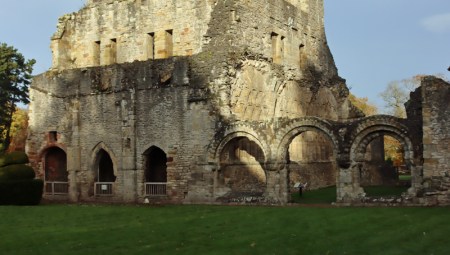
The library on the left, with the Chapter House to its right
Although many monasteries had a book cupboard, the book room at Wenlcock is particularly generous. The library dates to the 13th century, as does the central arch, but the other arches were added later. Thanks to pigeons, it has been necessary to put up netting to protect this space, but this also protects the tiles from other general wear and tear.
13th century tiles from around the site have been gathered together here, and laid down at random in order both to preserve them under a roof, and to display them to advantage. There are also two tombstones, also moved here from elsewhere, but their owners have not been identified.

Medieval tiles and tombstone, seen through netting that protects the tiles from pigeons
The South Range – the refectory
The south range was entirely taken up by the refectory, although only one wall survives. Sometimes refectories were built perpendicular to the cloister to allow inclusion of other buildings, but others were like this one, running along the side of the cloister with room at each end for a kitchen and a warming house (the latter a small heated room where the monks could spend a little time to warm through during harsh winters). An oddity is that the line of the refectory runs at an angle (see site plan above), meaning that the garth is not the conventional square or rectangle.
The West Range
The west range, which has now been lost, was used differently from one monastery to another, and could have been used for storage, for visitors, including pilgrims, and could also have been used as the prior’s quarters before a large dedicated building was completed in the 15th century to house the prior and infirmerer.
The Secondary Cloister and beyond
 All of the extant buildings that make up the remaining secondary cloister are off-limits to the public, having been sold off after the Dissolution closed it in 1540 but the exterior of the infirmary and prior’s lodging ranges are visible from the east end of the church. These are considerably modified from their 13th century origins, but are in the original positions of those buildings. Both are now part of a private residence.
Once the main cloister had been built in stone, further wooden buildings could be replaced by new stone versions. At Wenlock a secondary cloister was made up by another four ranges. On the north side was the Infirmary and the Infirmarer’s lodging. On the east side was a chapel and the prior’s lodging, the latrines were on the south side and on the west was the continuation of the dormitory that also overlapped with the main cloister as part of the latter’s east range.
At the end of the monks’ dormitory was also a non-standard building that is now known as the Chamber Block and Hall. The role of this is speculative but it is thought that it may have been reserved for high status visitors like the king, who is known to have visited the priory six times during his reign.
Further to the south and southwest there would also have been subsidiary service buildings including the brewery, bakery, stores and the buildings of the home farm.
Final Comments
 It is fairly unusual to have so much of the original site plan preserved in the remaining architecture, even where this only survives as a few courses of stonework. Wenlock Priory gives a much better idea of the complexity of well-endowed monastic establishments that many others around the country. In addition, the extravagance of the Cluniac Order is clearly visible in both the size and the architectural detail of Wenlock Priory.
At the same time, much of the understanding of Wenlock Priory and its Early Medieval predecessor comes from excavations, which were carried out in 1901, the early 1960s and during the 1980s, and these findings survive mainly in the form of excavation reports.
This mixture of what can be observed on the ground and what derives from excavations is typical of medieval monastic sites.
Visiting
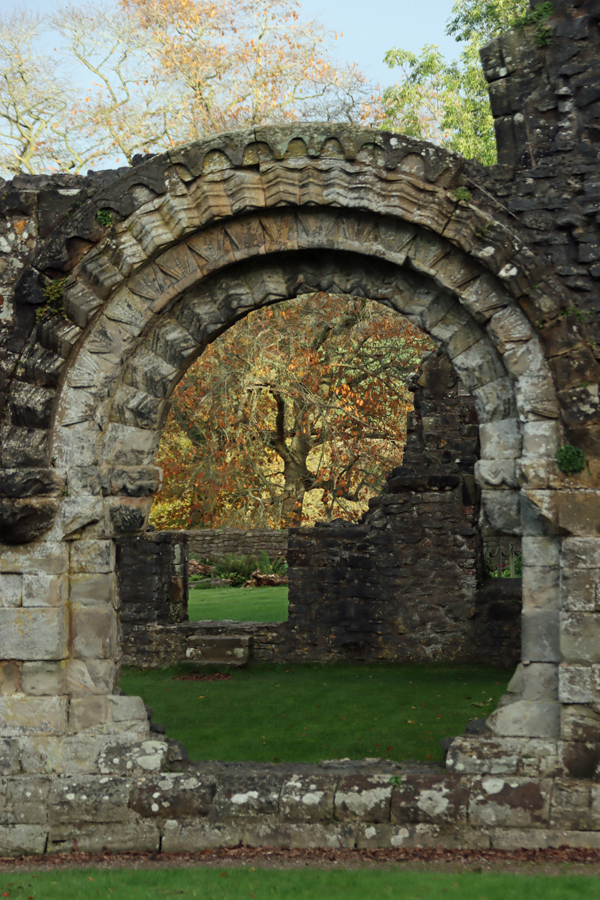
Entrance to the cloister
The Wenlock Priory is an attractive site beautifully maintained by English Heritage. The former Prior’s Lodging and the Infirmary are privately owned and cannot be visited but are but visible from the English Heritage site. There is a large car park. Details of ticket prices and parking fees are on the English Heritage website. The most recent version of the English Heritage guidebook (by John McNeill, 2020) has some excellent site plans, an artist’s reconstruction and photographs, available from the nice little gift shop, but also available through online retailers if you want to read up the full details in advance of a visit. The site is mainly all the level, and should be fully suitable for those with unwilliing legs. with a wary eye out for underfoot masonry.
Its postcode is TF13 6HS. Don’t forget to check the opening days and times of the Much Wenlock Museum, which is a separate entity, and located within the village itself.
The site is near to other attractions, making it a great visit for a day out. I visited Haughmond Abbey (built by Augustinian monks) and Wroxeter Roman City (posted about here) on the same day, and Ironbridge Gorge is a short drive away (although Ironbridge and its museums, posted about here, really take up a whole day in their own right). For those with time on their hands, a nice-looking walk in reasonable weather, recommended by English Heritage, takes you from Much Wenlock to the Ironbridge.
Sources
Books and papers

Wenlock Priory 1798 by R. Paddey. Source: Government Art Collection
Angold, M.J., George C. Baugh, Marjorie M. Chibnall, D.C. Cox, D.T.W.Price, Margaret Tomlinson, B.S. Trinder 1973, ‘Houses of Cluniac monks: Abbey, later Priory, of Wenlock‘, in A History of the County of Shropshire: Volume 2, ed. A T Gaydon, R B Pugh (London, 1973), British History Online
https://www.british-history.ac.uk/vch/salop/vol2/pp38-47
Burton, Janet 1994. Monastic and Religious Orders in Britain. Cambridge University Press
McNeill, John 2020. Wenlock Priory. English Heritage
Pinnell, Julie 1999. Wenlock Priory. English Heritage
Platt, Colin 1995 (2nd edition). The Abbeys and Priories of Medieval England. Chancellor Press
White, Carolinne 2008. The Rule of St Benedict. Penguin.
Wilkinson, Philip 2006. England’s Abbeys. Monastic Buildings and Culture. English Heritage
==
Websites
English Heritage
Wenlock Priory
https://www.english-heritage.org.uk/visit/places/wenlock-priory/
Walk: Wenlock Priory to the Iron Bridge Shropshire (4.5 miles/7.5km (2-3 hours walking, plus time to visit the properties)
https://www.english-heritage.org.uk/siteassets/home/members-area/exclusive-content/your-exclusive-content/walking-page-dec-20/wenlock-priory-to–the-iron-bridge-shropshire-v2.pdf
St Milburga
https://www.english-heritage.org.uk/visit/places/wenlock-priory/history/st-milburga/
Historic England
Wenlock Priory
https://historicengland.org.uk/listing/the-list/list-entry/1004779?section=official-list-entry
 Based in Churton

