
Introduction
 This time last year I wrote a short 3-part series about misericords in the Chester-Wrexham area, at St Werburgh’s Abbey (now Chester Cathedral), St Andrew’s Church in Bebbington and All Saints in Gresford. These are all terrific examples of misericords, in really excellent architectural contexts. On my way back from a short break in Shropshire in October I passed Tong, which I have been meaning to visit for years, so dropped in. Tong is on the A41, just where the road meets the M54, and the church, St Bartholomew’s is literally a couple of seconds off the A41. It is about an hour’s drive from the Chester area. It’s a very small, pretty village, and the collegiate church seems disproportionately large, but there was an inhabited castle here, and it was well used in both medieval and Tudor times. The unusual name Tong appears in Domesday as “Tuange.” Although there is no consensus on the subject, it may derive from a word meaning “fork in the river,” referring to a meeting place of two streams near the former castle.

Lady Isobel and Sir Fulke Pembrugge. Lady Isobel founded the church in 1409 on the death of her husband.
St Bartholomew’s is thought to have been the third church on the site. It was built by Royal License from 1409, the year of the death of crusader Sir Fulke de Pembrugge, by Lady Isabel Pembrugge, his second wife. It was finished by about 1430. Lady Isabel established it as a collegiate church, meaning that as well as the church there was a separate building that housed a small community of secular (non-monastic) priests. There were five at Tong, plus one or two clerks, who were employed to say masses for the soul of Sir Fulke de Pembrugge, in order to reduce his time in Purgatory, as well as prayers for other deceased souls. The priests also ran a school for village children and a hospital for the elderly and sick, slight ruins of which still survive. Both Sir Fulke and Lady Isabel are buried in the church in an elaborate tomb, shown above.
The style of the church is Perpendicular Gothic, with the Golden Chapel added 100 years later as an extension in 1510. It is possible that the arcading in the south side of the nave dated to an earlier, perhaps 13th century church, because the style is different, and could have been incorporated into the new church. Quite unusually, there are no projecting transepts, so the footprint of the church is not cruciform. An original porch projects from the nave, whilst on the opposite side a large vestry projects from the chancel. The rest of the church and its history will be discussed on a future post.
 Misericords are “mercy seats,” first employed in monastic establishments, and carved onto the underside of hinged seats in choir stalls. When the seat is down, it can be sat on as normal, but when leaning up against the back of the choir stall it has a little protrusion on which a monk or nun could prop themselves during some of the long daily offices that were typical of monastic and collegiate life. Many of these feature elaborate carved decoration. The earliest ones in Britain were carved in monasteries in the 13th century, and later on they found their way into collegiate establishments, cathedrals and, later still, parish churches. Whether in monastery, cathedral or church, they could include a variety of subjects, religious, classical, pagan, chivalric and naturalistic. You can read much more about them on my introductory post on the subject here and my round-up post here, looking at who might have been responsible for the themes chosen, who may have paid for the misericords, why they were contained within the most sacred part of the church and how they might be understood.
==
The misericords at St Bartholomew’s, Tong
The stone elements of the St Bartholomew’s choir, including the piscina (shallow basin used for cleaning communion and other vessels) in the sanctuary or chancel and sedilia (stone seat), also in the sanctuary all date to between 1410 and 1430. The oak choir stalls would have been inserted only after the stonework had been completed, probably towards the end of the 1420s.
T here are two sets of L-shaped eight choir stalls, facing each other with the entrance to the choir separating them. Originally each would have had a misericord and today there is only apparently one missing, with no subsequent replacements, with only some slight restoration work carried out. There are also with three-light traceried back panels, carved frieze, and desks, as well as carved bench ends, desk ends and carved poppy-heads, all dating to the early 15th century. The published guide to St Bartholomew’s adds that one of the bench-ends seems to be a much simpler and less skilled example, and was probably a later replacement for one that was damaged.
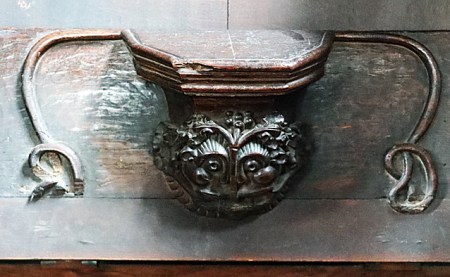 Most of the misericords are botanical, but there are other themes, some of them natural and some of them apparently pagan, such as the face above. Pagan faces, or grotesques, are not unusual, but although they are often difficult to interpret. Two show winged angels, one apparently in armour holding a shield, the other holding a book or coat of arms, and another apparently depicts a castle. These may be references to the family who built the church. Sir Fulke de Pembrugge, for example, was a crusader, and the family lived in the nearby castle.


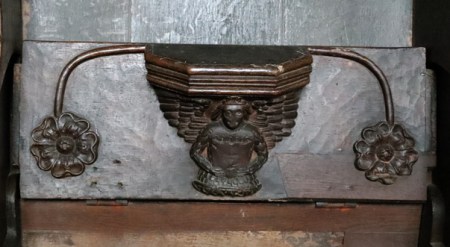


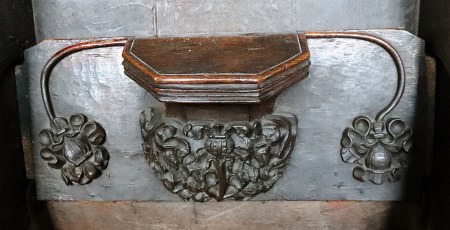


It is sod’s law that the last of the misericords shown above is the one most discussed in books and is the one that I took three attempts to photograph and still came out dismally. This is the only one that represents a specific scene: the New Testament story of the Annunciation. In the middle is a lily growing in a vessel with two blooms and, at its centre, Christ on the cross. This arrangement is flanked on one side by the Angel Gabriel and on the other by the Virgin Mary, each of whom hold pieces of a scroll that records the Angel’s greeting and Mary’s reply. The supporters may either represent doves of peace or the Holy Spirit.

Details of poppy heads (on the tops of bench ends and desk ends). Click to enlarge
There are numerous churches in the Midlands that could have provided the general idea for misericords at St Bartholomew’s. For a list of misericords elsewhere in the Midlands see Misericords of Midlands Churches page on the misericords.co.uk website. It is probable that many other misericords were lost when Henry VIII dissolved the monasteries.
===
Visiting
 Check the St Bartholomew’s Church website for up-to-date opening hours and events that may close it to the public, but at the time of writing it is open daily, and in the summer months runs heritage tours that do not need to be booked in advance. The church’s post code is TF11 8PW but Tong is almost impossible to miss, just seconds away from the A41 immediately before the M54 roundabout.
When there are no events, it is easy to park on the quiet road outside the church.
There is absolutely tons to see at the church, which is a feast for the eyes. The 1515 Golden Chapel alone is a remarkable thing with its fan vaulting, but the many other early Tudor monuments are also spectacular. See the church’s Heritage links on the above site to explore what it has to offer the visitor. There is also a guide book that you can purchase at the church for £2.00 (cash into an honesty box), at the time of writing, which is great value with excellent photographs and good explanatory text, although it skims over the choir carvings.
If you want to make a day trip of it, nearby is the marvelous RAF Museum at Cosford, around 10 minutes away, and the the small but attractive White Ladies Augustinian Priory, also around 10 minutes away.
Sources
See the end of Part 3 of my original series on misericords for sources on the general subject of medieval misericords.
The St Bartholemew’s misericords are referenced in the following works:
Books and papers
Anderson, M.D. 1954. Misericords. Medieval Life in English Woodcarving. Penguin Books
Anon, 2002. St Bartholomew’s Church, Tong, Shropshire. ISBN 1 872665 59 4.
(Almost no information about the misericords but some background information about the medieval church, to which the misericords date)
Grössinger, Christa. 2007. The World Upside-Down. English Misericords. Harvey Miller Publishers
Websites
St Bartholomew’s Church, Tong
https://tong-church.org.uk/
History (very top-level)
https://tong-church.org.uk/history/
Tong’s timeline
https://tong-church.org.uk/tong-parish/timeline/
Historic England
Church of St Bartholomew
https://historicengland.org.uk/listing/the-list/list-entry/1053606?section=official-list-entry
The Medieval Bestiary
Excerpts from Francis Bond, Wood Carvings in English Churches: Misericords (pages 208-214). This text is believed to be in the public domain. CHAPTER XVII: ON THE USE OF MISERICORDS – NOMENCLATURE
https://bestiary.ca/prisources/pstexts4837.htm
misericords.co.uk
Home page
https://misericords.co.uk/

 Based in Churton