
Introduction
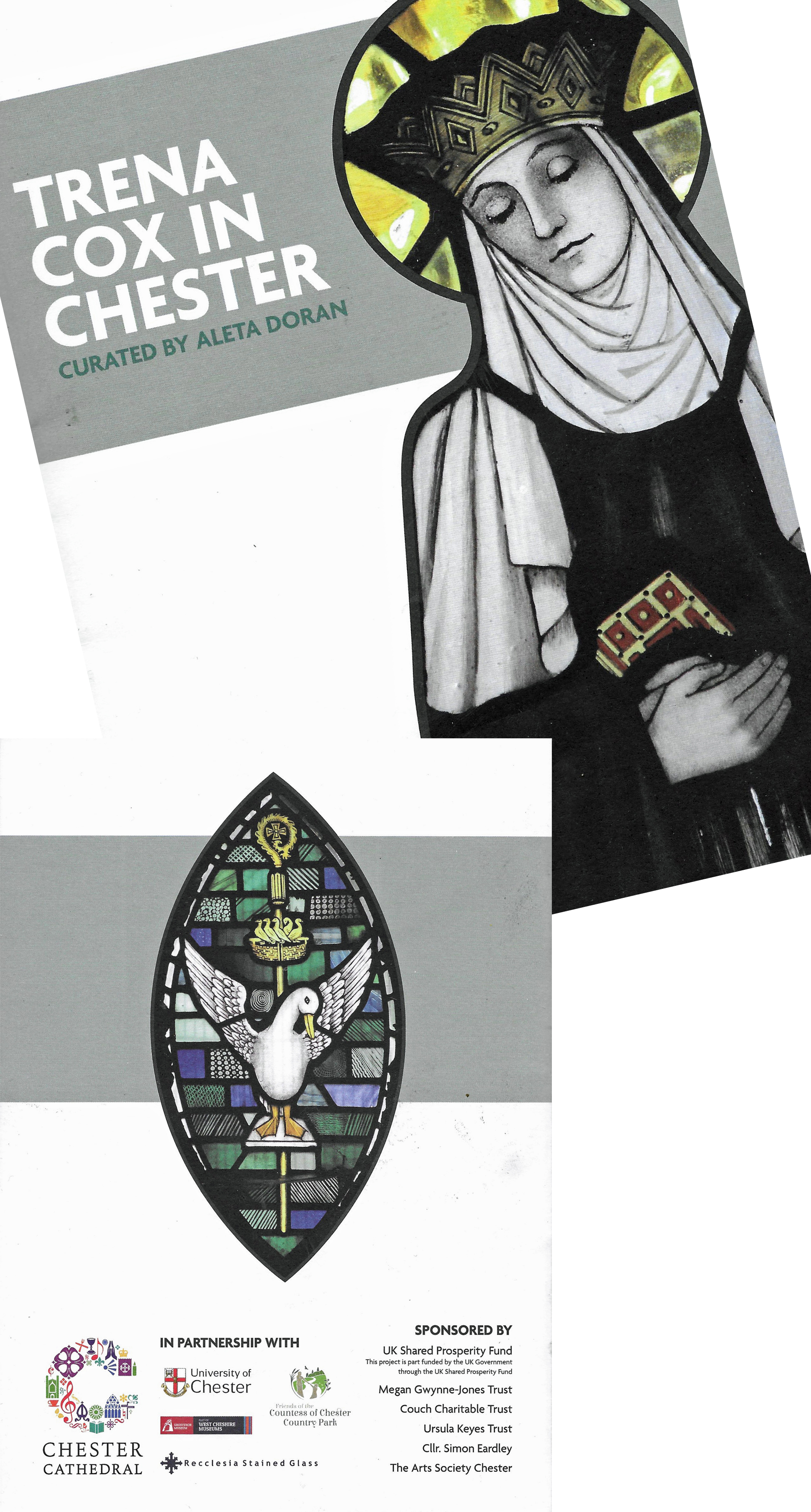 The new exhibition at Chester Cathedral, Trena Cox: Reflections 100, which is on until the 8th November 2024, a scarily short window of opportunity for visitors, has pulled out all the stops to create a really imaginative and absorbing examination of stained glass artist Trena Cox and an exploration of her legacy in more recent art works.
First, it was a new opportunity to learn more about an important local stained glass artist, a woman engaged in a form of art-craft that was usually the preserve of men. She is, for example, one of only two female stained glass artists represented in the cathedral, and she has nine windows, one large (the St Christopher window in the slype shown below) and eight small ones in the cloisters (four of which are shown further down).
To appeal to different preferences for experiencing exhibitions, there are downloadable audio guides, online information sources via QR codes and real-world interactive screens, as well as beautifully designed and displayed posters and original works of art employing diverse materials in multiple styles.

Detail of Emily Lawler’s “Flock of Five Geese.” The entire composition, referencing the story of St Werburgh and her miracle, is shown below.
Second, it was terrific to see how the four different parts of the exhibition explored different aspects of Trena Cox’s legacy, because this is as much about the art and ideas that Trena inspired as it is about her own work. In addition to well known artists in different types of medium, the pre-exhibition project headed out into the community to involved different groups, including school children. The sheer diversity of responses to Trena’s work is remarkable, many of them picking up not on the main themes of her work, but on the tiny details that make her work unique.
Third, it was fascinating to discover how the entire cathedral was employed in displaying the works on display, drawing visitors into different areas of the cathedral to experience new ideas in a medieval context. The abbey has small, intimate spaces as well as large lofty ones, and the trail makes good use of the architecture. By using the entire cathedral space, the art works could be separated, giving each one the opportunity to create its own impact.

The St Christopher window following restoration. Photograph by Helen Anderson (and copyright Helen Anderson)
Next, it was splendid to experience at first hand how beautifully the St Christopher window has been restored by Recclesia. I attended a Chester Archaeological Society visit, lead by Artist in Residence Aleta Doran who is also the exhibition’s curator, and although thought it was stunning then, it has since been restored and it was fabulous to see not only how it has been repaired and restored, but how new details have been revealed. This can be seen in the window itself, but is also the subject of a splendid video in the cloister that captures the work carried out.
Finally, I was with artist Helen Anderson, and we were given an informal tour of the exhibition by its curator, Artist in Residence Aleta Doran, who is always a joy for her knowledge and enthusiasm, which provided us with a terrific insight into how the entire exhibition came into being, a real learning curve into what it takes to pull together an exhibition that has so many aspects to it. A real logistical tour de force, as well as a visual treat.
===
Finding your way
 The exhibition is grouped into four different sections, each exploring a different aspect of Trena’s legacy. As you enter the cloisters from the reception area (free of charge at this time of year), there is an information board that points you to the left, but pause to investigate as it also has QR codes, one of which is a map of the route that you can download to your phone, another an audio guide that relates to the numbered posters and exhibits.
Don’t forget to pick up the booklet, the cover of which is shown at the top of the post, from the reception area. There is some very useful information about the exhibition, its contributors and its partners and sponsors, as well as QR codes to more information online.
Learning about Trena Cox
 The first part of the exhibition introduces the visitor to Trena Cox (1895-1980) using, depending on whether you downloaded the audio introduction, either posters or a combination of posters and Aleta’s audio tour. The posters are beautifully designed, framed in slender black frames that emulate the leaded frames of stained glass, showing photographs of Trena Cox glass from many locations, accompanied by isolated motifs taken from her glass works. The only known photograph of her was taken when she was a young teenager and shows a direct gaze and a certain fearlessness.
Born on the Wirral, Trena Cox trained at the Laird School of Art in Birkenhead, receiving a traditional introduction to a broad range of techniques and skills before switching to stained glass. There are over 150 stained glass pieces known, but others may remain to be found. Working mainly in the Cheshire and northeast Wales areas, her works are, however, in other areas, and most of them are in churches. Trena’s story, which has sometimes been a challenge for Aleta to discover, emerges from both the posters and the audio track and demonstrates not only Trena’s talent but her willingness to modify her style to suit the times.
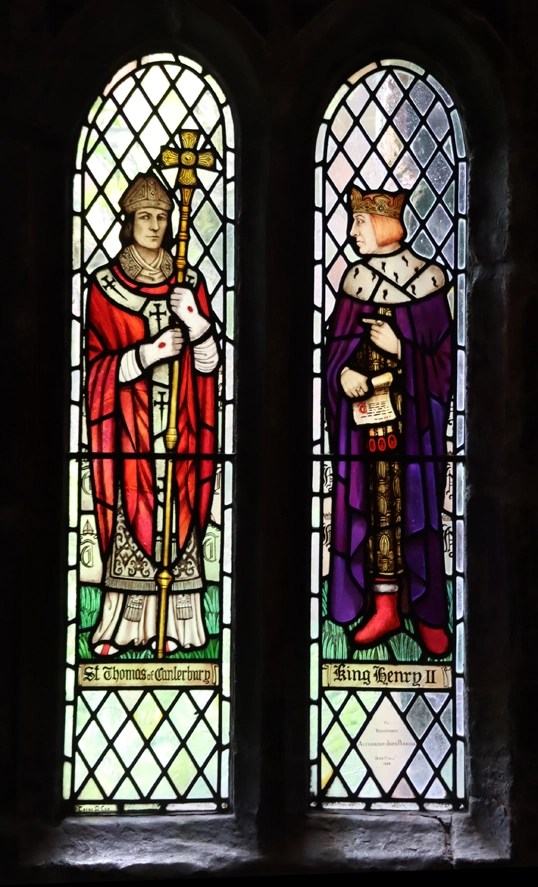
Trena Cox windows showing King Henry II on the right looking somewhat balefully toward Thomas Becket on the left
Trena Cox’s cathedral windows are an important part of the the exhibition and the route takes you first to those in the cloister (the walkway around the garden). The cloister was windowless until the arrival at the cathedral of Dean Frank Bennett, whose energy and enthusiasm created the stained glass sensation that we see today. Eight of Trena’s windows are small lights each side of a corner, in each case two above and two below. My favourites are the paired Henry II and Thomas Becket of Canterbury. There are other connections to St Thomas Becket within the cathedral, but what I particularly like about these two windows is the way that Henry looks out of his window towards Becket in his window, recreating something of the narrative of this impossibly difficult relationship, which resulted in the martyrdom of Becket, and a period of political difficulty for Henry II. You can almost hear Henry thinking “Will no-one rid me of this meddlesome priest?” (almost certainly apocryphal). There is a QR code on one of the information boards for finding out more about all of the cloister windows on the Chester Cathedral website.
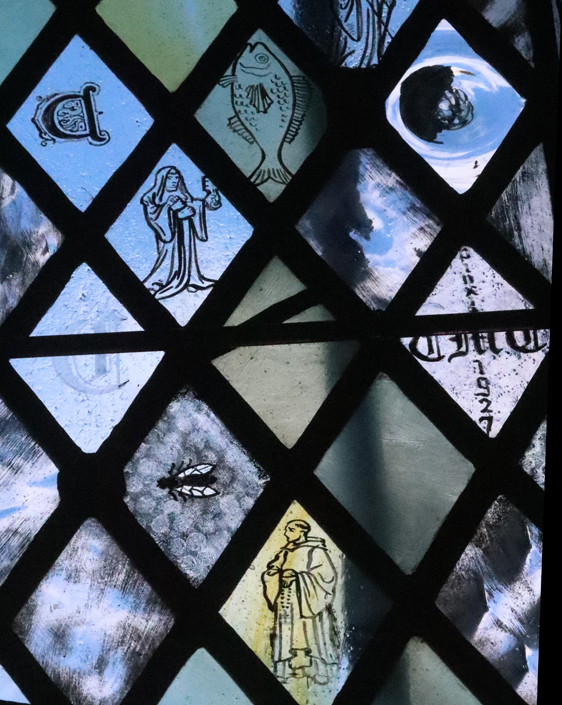
Detail of the St Christopher window shown at the end of the post, with Trena Cox’s signature and the bee surrounded by a pattern made of her fingerprints.
The recent restoration and professional cleaning of the main Trena Cox window in the cathedral, the St Christopher window in the slype, has returned from Recclesia with a glowing, incandescent and luminescent quality that is quite extraordinary. Whether or not this is your sort of aesthetic, this is an extraordinary piece with charming details full of symbolism. Minutiae that were not previously visible are now bright and sharp, and the richness of the entire composition can now be appreciated as Trena Cox first designed it. I particularly melted at how Trena’s fingerprints were incorporated into a pattern around the bee in the window. It was also revealed that the lead was used to create texture and relief at certain points, with St Christopher’s remarkable hair not merely painted on, but highlighted with sections of lead. There is an interactive display in the slype (corridor) next to the window which allows you to explore the imagery and symbolism of the window, which are extensive, and this really helps to open up the secondary stories.


Video showing the skilled work carried out on the St Christopher window by Recclesia Stained Glass
A video in the cloisters describes how the restoration work was carried out. It shows footage of the team at work, including the absolutely nail-biting process of putting the window back into its arches after restoration. Aleta says that it was just as bad watching it being taken out, but somehow the sense of being at the finishing line after all that hard work was horribly tense even on a video! But of course these people are experts and everything was fine. Microscope analysis of the stained glass shows how in one section of the glass, which had become damaged simply due to its age, the edges of some of the painted text had begun to deteriorate, so the restoration work was incredibly timely.
Trena Cox in today’s Community
One of the really creative parts of the exhibition, and an admirable requirement for a part of the funding for the exhibition, was that the local community should be given the opportunity to respond to Trena Cox’s stained glass art with art works of its own. I knew about this when I visited the Trena Cox windows with the Chester Archaeological Society, lead by Aleta, but was not at all clear about how this part of the project would manifest itself. What a super surprise to see the inventiveness and imagination produced by local community groups and schools! Here are some examples:
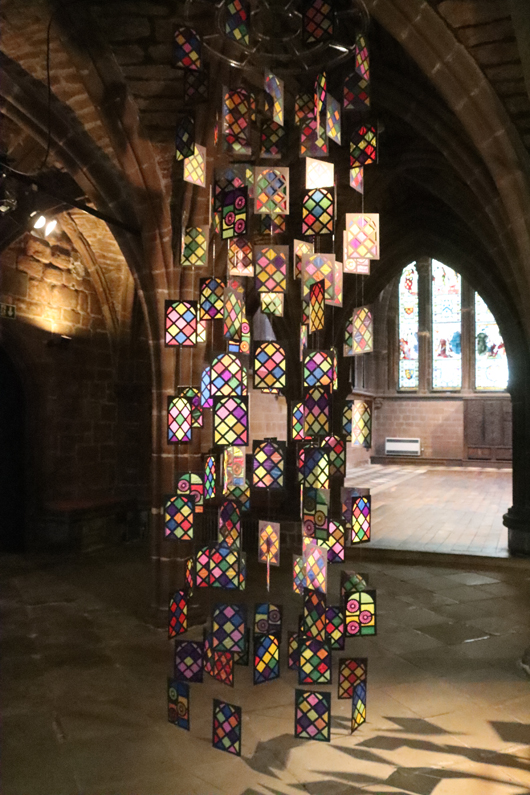
St Werburgh’s and St Columba’s Primary School

Heritage Engagement Window. During the 2024 Chester Heritage Festival in June, children as young as two years old painted panels that were incorporated into this splendid leaded panel, all based on the St Christopher window
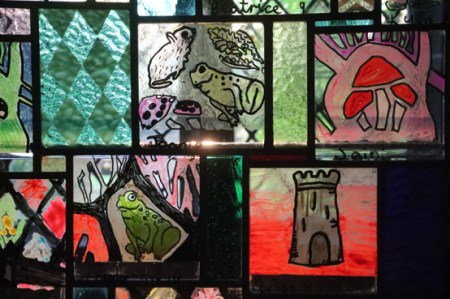
Detail of the above Heritage Engagement Window.
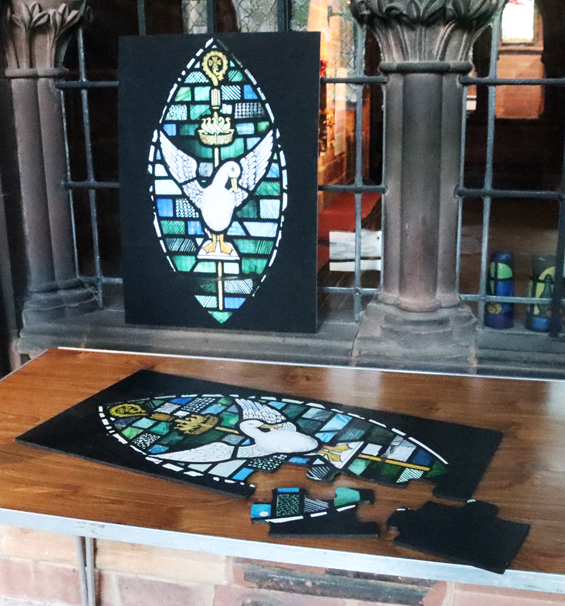
Jigsaw, a community artwork based on a Trena Cox window in St Werburgh’s Church, by 15 women of Chester
The Story of Stained Glass
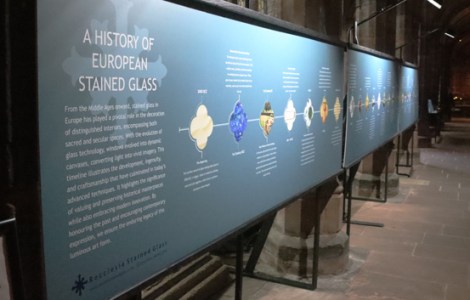
 The creation of stained glass is probably one of the most poorly understood areas of art, craft and design. Although it is widespread, and not only in religious buildings, its history and the processes of manufacture and repair are something of a mystery for most of us. The process of demystification has been very much assisted by an enormous but easily digested set of information boards that lead down one part of the cloister, charting the chronological history of the artistic and technical advances in stained glass development. It’s a real revelation and is beautifully written and designed.
Artistic responses to Trena Cox

In Our Hands by April Pebble Owens.
How current artists have responded to Trena Cox is one of the innovative aspects of the exhibition, not only helping to highlight some of the unique features of the original stained glass creations, but also inspiring and forging new creations. These new works of art, some in glass, others in paint and fabric, others engraved, some in mosaic, some in print, certainly demonstrate a wide range of skills but more importantly showcase the diversity of creative and empathetic responses to Trena Cox’s enormous catalogue of artistic expression. I have copied a few of these below, chosen simply to show some of the range of different ideas and interpretations that emerged. In the exhibition accompanying labels explain some of the ideas behind these works, one of which is shown below.

Tamsin Abbot. The Wolf Shall Dwell with the Lamb

Label explaining ideas behind the above panel by Tamsin Abbott. Each of the pieces on display in the exhibition is accompanied by a similar piece of explanatory text

By the River of Swirling Eddies by Linda Edwards, reminiscent of medieval bestiaries

Flock of Five Geese, by Emily Lawlor
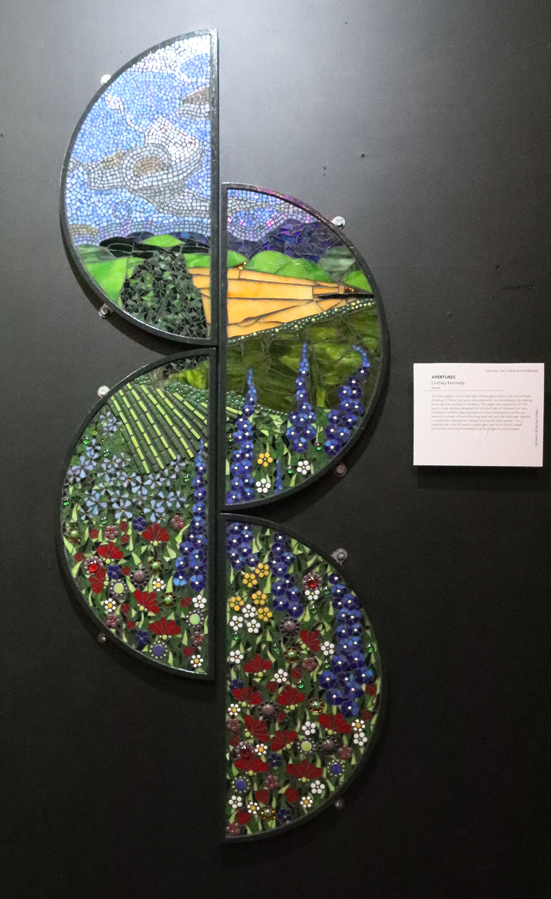
Apertures, by Lindsey Kennedy

Birds Without Borders by Gillian Curry
Final Thoughts

Detail of the St Christopher window
The idea for the exhibition was born around four years ago. Work has been concentrated in the last two years. There are so many different aspects to it that there it is difficult to do justice to it, but as a celebration of Trena Cox, of stained glass, and of how communities as well as individual artists can respond to an artist’s output, this was a revelation. Even more than the work of Trena Cox herself, I found the whole conceptualization of the exhibition with its multiple strands of knowledge transfer, and its outreach to the local community and other artists, truly engaging.
The exhibition works, and it works brilliantly. This was demonstrated perhaps more than anything else by the two elderly ladies who walked around it, arm in arm, discussing in depth all the modern responses to Trena Cox’s work. Neither knew much about art, but both were fully absorbed with the narrative of the exhibition, from Trena Cox herself to the evidence of her legacy. Splendid.

Detail of the newly restored St Christopher Window
Find out more
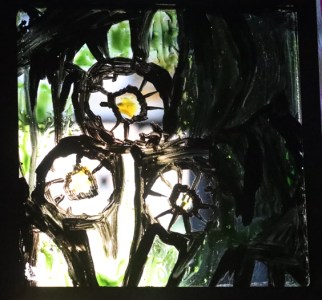
Detail of the Heritage Engagement Window
There is a “Trena Cox:Reflections 100” symposium, which has been arranged to coincide with the exhibition, on 25th October 2024:
“Using the life and legacy of Trena Cox as the focal point, attendees will hear from a variety of respected speakers from across the stained glass, heritage conservation, and art sectors. This evening keynote will conclude the day, looking at the past and future of women in stained glass.”
You can find details for the symposium on the Chester Cathedral website at:
https://chestercathedral.com/events/event/21607
You can follow Aleta Doran on Twitter (@StargazingAleta), or via her blog at https://www.aletadoran.co.uk/.
For those wishing to investigate further afield, Green Badge Guide Katie Crowther is leading a “Trena Cox:Reflections 100” walking tour of Chester on 3rd November to complement the exhibition:
This walk will be a chance to get out onto the streets of the city where Trena lived and worked from 1924 until her death in 1980. We’ll take a look at some of the buildings where her distinctive work can be seen today and learn more of their history. Trena was a passionate advocate for the preservation of her adopted home’s history and heritage. Along the walk, we’ll consider several of the streetscapes that changed quite dramatically during Trena’s time in Chester.
https://www.eventbrite.co.uk/e/trena-cox-reflections-100-chester-sunday-netwalk-tickets-1013497697897?utm-campaign=social&utm-content=attendeeshare&utm-medium=discovery&utm-term=listing&utm-source=wsa&aff=ebdsshwebmobile
The free booklet provided at the reception area also provides the following QR codes for those who want to find out more:
 ===
===
Websites with more information:
Chester Cathedral
Trena Cox: Reflections 100
https://chestercathedral.com/events/event/15207
The Trena Cox Project
By Aleta Doran, ongoing
https://www.aletadoran.co.uk/thetrenacoxproject
Recclesia Ltd
https://recclesia.com/
https://recclesiastainedglass.co.uk/
Chester Archaeological Society
An Interview with Chester Cathedral Artist in Residence Aleta Doran. For CAS, by Andie Byrnes, 7th July 2024
https://chesterarchaeolsociety.blog/2024/07/07/an-interview-with-chester-cathedral-artist-in-residence-aleta-doran/
Chester Archaeological Society visit to Chester Cathedral with Aleta Doran to learn about stained glass artist Trena Cox. For CAS, by Andie Byrnes June 13th 2024
https://chesterarchaeolsociety.blog/2024/06/13/our-visit-to-chester-cathedral-with-aleta-doran-to-learn-about-stained-glass-artist-trena-cox/
Based In Churton
A roof boss in Chester Cathedral: The Murder of Thomas Becket
https://basedinchurton.co.uk/2023/07/14/a-ceiling-boss-in-chester-cathedral-the-murder-of-thomas-becket/

 Based in Churton
Great stuff! Learnt even more about this exhibition reading this. I may have to go in again, now.
LikeLike
Excellent! Thanks very much for the feedback. I wrote it in a bit of a rush because the duration of the exhibition is so short.
LikeLike