
Introduction
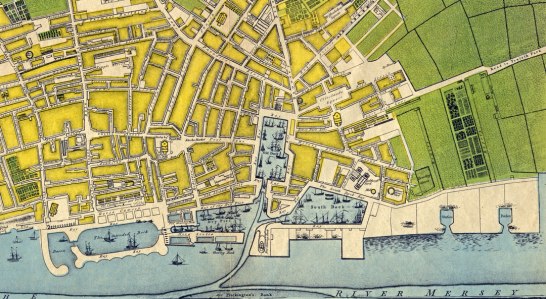
The Eyes map of Liverpool showing Old Dock on a previous tidal inlet and enclosed within the streets of an expanding Liverpool in 1765, 50 years after it first opened. Later docks were laid out along the foreshore. Source: National Museums Liverpool
Earlier in summer 2024 I went on the Old Dock tour in Liverpool when it was offered one Sunday. Old Dock, of which only one corner remains to be visited, was perhaps Liverpool’s most important commercial and civil engineering initiative at a time when Chester’s port was going into decline and Liverpool had the opportunity to become the trading centre for the northwest.

Old Dock, Liverpool
Old Dock in Liverpool, the first of Liverpool’s impressive network of enclosed docks, opened in 1715, to the design of civil engineer Thomas Steers. It is Europe’s oldest enclosed cargo-handling dock. What remains of Old Dock is underground, beneath the “Liverpool ONE” shopping centre. Its lock gates can no longer be visited, but remain under The Strand (the modern dual carriageway that runs along the line of the old foreshore). Only the northeastern corner of the dock is accessible to visitors, and has been provided with a gantry and information panels, and its history is presented to pre-booked groups by an excellent guide. I’ve added details about booking and the tour itself at the end of the post under “Visiting.” The following looks at some of the history of Old Dock.

The 1699 Howland Great Wet Dock in London. British Library HMNTS 10349.ff.9.. Source: Wikipedia
Old Dock was modelled on the Howland Great Wet Dock, shown right, built in 1699, which was built to shelter ships, mainly of the East India Company, in the days when ships over-wintering on the Thames were regularly subjected to both storm damage and piracy. It was surrounded by a double planting of trees to help protect the ships within and had shipbuilding dry docks at its entrance. It was a convenient place to carry out repairs and to ready ships for the upcoming season, but was not used for handling cargo so was not a commercial trading dock. The Howland Great Wet Dock was built in a rural space on the south of the Thames in what is now the residential Surrey Quays area of southeast London, and was replaced in the 18th century by Greenland Dock, which itself became part of the Surrey Commercial Docks.
The commercial argument for Old Dock
Liverpool was established by a charter of King John in 1207 and was provided with a castle in 1235. At this time, however, Chester was the main northwestern port, and Liverpool did not become a commercial giant until the 18th and 19th centuries, and this required some pioneering Victorian thinking and civil engineering before it really took off as one of Britain’s leading ports. Old Dock is at the heart of this story.
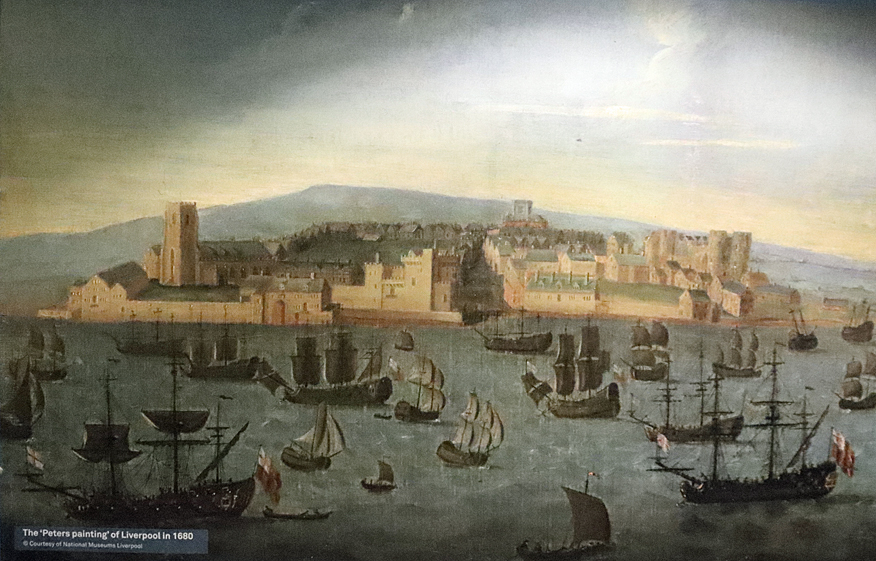
Painting of Liverpool in 1680, from the Old Dock display area. Unknown artist. The original is held by the National Maritime Museum. See more (and a better image) on ArtUK
Before the docks, the Mersey was not the easiest of rivers to use in an age of sail partly due to strong winds but also because of the twice-daily tidal events that swept down the estuary. An additional problem was that due to the dumping of rubbish and ships’ ballast along the river edges, deep-sea shipping was unable to approach the river banks to offload and reload. It could also become very busy with river traffic of all shapes and sizes. The handling of cargo on the Mersey was achieved by mooring ships in the main channel and loading and offloading them with lighters – unpowered boats into which the cargo was loaded by hand, then rowed to shore, and offloaded by hand. This could only be carried out between tidal events, confining the activity to around 5 hours a day. To empty a single ship averaging 150 tons could take between two and three weeks.
 The engineering success of the Howland dock enterprise inspired MP Thomas Johnson, who was both a successful merchant a slave trader, to approach one of the engineers probably responsible for the Howland dock, George Sorocold, to discuss the viability of a similar dock for Liverpool. Johnson, however, saw the greater potential of an enclosed inland dock, not for over-wintering ships but for creating a cargo-handling facility to radically improve speed and efficiency. Under The Dock Act of 1708 a Common Council of leading city figures was established to became trustees of the proposed dock, which they operated through council committees. The risk of doing it this way rather than as a private enterprise was that failure could have put the entire city finances in jeopardy. Thomas Steers from London was the civil engineer appointed in 1709 to make this a reality, only a decade after the opening of the Howland Great Wet Quay on which he had probably also worked. Initially costs had been estimated at £6000, but this was a serious underestimation and eventually the dock cost more than double this amount.
Building and opening the dock
The dock was lined with bricks in the upper sections with local red sandstone in the lower courses. I am accustomed to the later Surrey Commercial Docks in southeast London, where I used to live, which are lined with stone much like Liverpool’s Albert Dock, so the sight of a brick-lined dock seemed extraordinary to me. The bricks were made on site from local clays, with a dedicated kiln built for the task, and a special mortar was used to resist the incursion of water.

At the base of Old Dock, Liverpool
The result of all the investment, civil engineering and labour was Old Dock, which opened in 1715 at the mouth of a former tidal inlet or creek. Up to a hundred ships could be taken into the 3.5 acre dock via a 30ft wide entrance lock and could draw up against the quayside to offload without the use of lighters. Because of the tides, ships could only enter the dock at the top half of the tide, but a 1.5 acre tidal entrance basin was provided as a waiting area. By drawing ships up against the quayside, three weeks could be reduced to just one to two days. The proof of concept was soon confirmed.

The area around the dock was soon surrounded by residential, commercial, retail and service industry premises. Excerpt from a poster from the Old Dock exhibition area.
An entire new residential, commercial, retail and service industry quarter grew up around the dock, which became known as the Merchants’ Quarter. As well as homes, warehousing and other commercial facilities there were lodging houses for sailors, and less salubrious businesses that catered to their needs. This is a good illustration of the sort of process of urban sprawl that follows on from a specific industrial development.
Old Dock was such a notable success that new docks were soon opened, and the Liverpool foreshore began its transformation. During the 18th century South Dock, also built by Thomas Steers (later Salthouse Dock) opened 1753, George’s Dock opened 1771, King’s Dock opened and Queen’s Dock opened in 1796. It is a measure of the success of the dock concept, Old Dock having been established 53 years before Bristol’s first dock, that between 1772 and 1805 the total tonnage of shipping increased from 170,000 to 670,000, with foreign shipping increasing from 20,000 to 280,000. By the end of the 19th century 9% of all world trade passed through the Liverpool docks, and there were 120 acres of enclosed docks along 10km (7 miles) of Liverpool’s foreshore.
Closure of the dock

Old Dock, Liverpool
Old Dock itself closed in 1826 mainly because as ship sizes increased, in terms of width, length and depth, it became increasingly obsolete. It did not help either that the dock had become surrounded with other buildings and could not easily expand without considerable destruction. Instead, the development of docks beyond the existing foreshore seemed like a better option and this is what happened.
This new use of enclosed docks for cargo-handling was pioneered at Old Dock in Liverpool, creating the first revolution in cargo handling in the UK. To provide additional real estate for the rapidly growing city, most of the dock was infilled and built over, so this one remaining corner is a significant survivor from Liverpool’s early development as a major trading port.
Final Comments

Old Dock brickwork
Much of what is known about Liverpool’s earliest docks comes from the archaeological investigations that took place between 1976 and 2009. Old Dock was examined prior to the building of Liverpool One by Oxford Archaeology between 2001 and 2006. The remains of Old Dock are designated a site of Outstanding Universal Value.
It is difficult to over-emphasize how important London’s Howland Great Wet Dock and Liverpool’s Old Dock were to the development of maritime trade in Britain. With an enclosed dock designed by Thomas Steers, the Old Dock set Liverpool firmly on the path for trading success throughout the 18th century and the commercial and architectural triumphs of the Victorian period.
Visiting
Booking details, opening times, ticket prices and everything else you need to know are on the Old Dock Tour website.
At the time of writing the meeting point shown on one place on Google Maps is in a different location from the one that is shown on the Old Dock Tours website, and the latter is the correct one. I don’t know Liverpool at all and I was confused by the directions on the website, partly because I had no idea what a “Q-Park” might be when it escaped from its burrow, so I arrived early to make sure that I was in the right place, which was on the Thomas Steers Way entrance to the “Q-Park” (the Liverpool ONE car-park), on the left as you head up from the Mersey, near the base of the Sugar House Steps. Here’s the What3Words address for that location, which is traffic-free, but do check on the website or your ticket that this remains the same meeting place: https://what3words.com/found.farm.gent. Have your ticket handy to be checked, either printed out or on your device.
 This is a guided tour. You receive an excellent lecture as you walk to the dock via a wall-sized map of old Liverpool, and then stand on the gantry looking down into the dock. Our guide was informative, humorous and engaging, parting with a staggering amount of information in an easily digestible way. It is always a mark of how well a guide does when there are questions afterwards, people wanting to explore specific aspects of the story, and there were lots of questions. I used to live overlooking Greenland Dock in London, and the remnants of the Surrey Commercial Docks were my home for twenty years. Opposite was Canary Wharf, where the former East India and West India quays are preserved and the Museum of London Docklands is located. It was a real dock heritage experience, so it was particularly nice to go to Liverpool and have someone bring this particular old dock to such vivid life.
If you are dealing with unwilling legs, there is a flight of steps with a banister to hold onto. I forgot to count, but I would guess perhaps ten steps, down from the car park entrance into the dock area. There is then a gantry (metal walkway) across the remaining part of the dock, with high sides to hang on to. There is nowhere to sit, so a portable perch of some sort might be useful whilst you are listening to the talks.
I had not realized that it was the schools’ half term break. Half-term was a poor day to visit Liverpool, and on the tour there were two completely uncontrolled young children running around and yelling their heads off. A less child-intensive day would be better if it can be arranged. There’s not a lot for young children to see on this walk anyway, although an older child seemed to be enjoying it very much.
———

—–
Sources
Most of the above details came from the guided tour. I did not want to detract from that so I have not gone into greater detail here, but I did use some additional sources to check facts that I had not noted down at the time, and have provided some suggestions for further reading.
Books and Papers
Farrer, William, and Brownbill, J. (eds.) 1911. Liverpool: The docks, in “A History of the County of Lancaster: Volume 4,” p. 41-43. British History Online. Originally published by Victoria County History, London, 1911.
https://www.british-history.ac.uk/vch/lancs/vol4/pp41-43
Gregory, Richard A., Caroline Raynor, Mark H. Adams, Robert Philpott, Christine Howard-Davis, Nick Johnson, Vix Hughes, David A. Higgins 2014. Archaeology at the Waterfront vol 1: Liverpool Docks. Lancaster Imprints / Oxford Archaeology North
Stammers, M.K. 2007. Ships and port management at Liverpool before the opening of the first dock in 1715. Journal of the Historic Society of Lancashire and Cheshire, vol.56.
https://www.hslc.org.uk/journal/vol-156-2007/attachment/156-3-stammers/
Stephenson, Roderick A. 1955. The Liverpool Dock System. Transactions of the Liverpool Nautical Research Society, Volume 8 1953-55 (1955)
https://liverpoolnauticalresearchsociety.org/wp-content/uploads/2019/03/Article-The-Liverpool-Dock-System.pdf
Websites
National Museums Liverpool
Ten fascinating facts about Liverpool’s Old Dock
https://www.liverpoolmuseums.org.uk/stories/ten-fascinating-facts-about-liverpools-old-dock
Historic Liverpool
1846: Plan of the Liverpool Docks, by Jesse Hartley, Dock Surveyor
https://historic-liverpool.co.uk/old-maps-of-liverpool/1846-plan-liverpool-docks-jesse-hartley-dock-surveyor/#4/65.79/-74.43
The Liverpolitan
Old Dock: a different view. Wednesday, 18 November 2015
https://theliverpolitan.com/blog_old_dock_a_different_view.php
That’s How The Light Gets In blog
Liverpool Old Dock: Down to the bedrock
https://gerryco23.wordpress.com/2010/09/14/liverpool-old-dock-down-to-the-bedrock/
Liverpool World Heritage
LIVERPOOL MARITIME MERCANTILE CITY WORLD HERITAGE SITE MANAGEMENT PLAN 2017 – 2024. Prepared by LOCUS Consulting Ltd. Liverpool City Council
www.liverpoolworldheritage.com/wp-content/uploads/2018/09/pmd-486-liverpool-whs-management-plan-final-version-as-at-27-sep-2017.pdf
A Rotherhithe Blog
The Howland Great Wet Dock 1699-1807
http://russiadock.blogspot.com/2008/06/rotherhithe-heritage-2-howland-great.html
—–

 Based in Churton

