
Introduction

The cairn rising above the tree tops on Gop hill, with the cave visible as a dark line in the light limestone ridge below. Source: Coflein
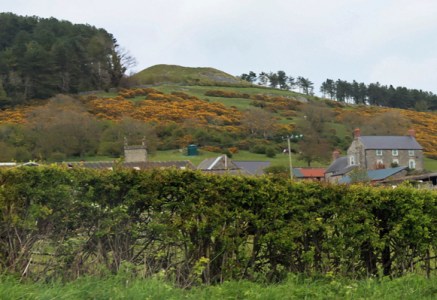
Gop Cairn is at an elevation of 250m (c.820ft) above sea level on the prow of a hill overlooking the Vale of Clwyd, just outside the village of Trelawnyd (formerly known as Newmarket). It is oval rather than round, and measures roughly 101m x 78m (331 x 255ft). It is the biggest man-made prehistoric mound in Wales, and in Britain as a whole it is second only to Silbury Hill in Wiltshire.
The cave has already been discussed in part 1 (Pleistocene and Mesolithic) and part 2 (Neolithic burials).
The Excavation

The plan of the cairn and excavations by Boyd Dawkins. Source: Boyd Dawkins 1901
Sir William Boyd Dawkins was hired by the landowner to excavate the cairn. Boyd Dawkins had a simple, though labour-intensive strategy. The plan that Boyd Dawkins made of the cairn shows the dip in the top that remains today. Boyd Dawkins speculates that this could have been caused when the cairn was later used as a source of raw materials for local drystone walling, or alternatively by subsidence due to the collapse of an underlying chamber.
Although there is a thin covering of vegetation today, the cairn was found to be built of chunks of limestone. Around the base of the cairn there seems to have been a more organized and well presented kerb of drystone walling. Ian Brown suggests that when first built, and during the period when it still retained importance, it may have “shown a dramatic whiteness set against a blue or darkening site.” The limestone ridge below, in which the cave is located and shown at the top of this post, certainly seems almost white in the sunshine, and the cairn may have had a similarly noticeable appearance, particularly given its great size.
Boyd Dawkins sunk a shaft (6ft 6 ins by 4ft / c.2m x 1.22m) vertically from the top of the cairn, which had to be shored up with timber to allow work to proceed safely. The shaft reached the former ground surface, which was formed of bedrock. A main “drift” (a mining term for a horizontal subterranean tunnel) was then tunnelled running 30ft (c.9m) to the northeast from the bottom of the vertical shaft towards the edge, followed by two shorter drifts. The hope was to find a burial chamber at the centre. It was not unreasonable to assume that there would be a burial chamber of some description. Although Neolithic chambered cairns are not common in northeast Wales (examples are Tyddyn Bleiddyn near St Asaph and Tan y Coed in the Dee valley), there are many Early Bronze Age round barrows with cists, and there are several stone-built burial sites and a stone row on the Great Orme to the west.
 Unfortunately, in spite of all the hard work, all that Boyd Dawkins and his team found were fragmented animal bones, which in spite of his considerable experience identifying animal remains, Boyd Dawkins was unable to identify with certainty: “hog, sheep or goat, and ox or horse, too fragmentary to be accurately determined.” Overall, the suggestion is that these were domesticated species that could have been herded or penned in the area.
No artefacts were found.
Conditions were obviously very difficult, as Boyd Dawkins states: “The timbering necessary for our work was not only very costly, but rendered it very difficult to observe the condition of the interior even in the small space which was excavated.” It is possible that the chamber, if there is one, is off-centre, and that any passage leading to it is in a different direction. Until further survey or excavation work is carried out, there is no means of telling what lies beneath the surface.
Dating the Cairn

Neolithic arrowheads found on Gop Hill. Source: Glenn 1935
Data for the dating of the cairn is circumstantial. Although domesticated animal species were found within the cairn, these could have been deposited at an any time from the Neolithic onwards. On the other hand, arrowheads and other Neolithic stone tools have been found on Gop Hill. According to T. Allen Glenn in 1935, Gop Hill was known locally as Bryn-y-Saethau, the Hill of Arrows, due to the large number of Neolithic arrowheads found there over the decades. Just below the cairn, just 43m (141ft) away, shown in the above photograph, is a shallow cave in the limestone ridge that contained Neolithic burials. There are ephemeral Neolithic sites nearby, identified by T. Allen Glenn during field walking during the 1920s, and there are other Neolithic cave sites in northeast Wales. At the same time, nothing significant relating to the Bronze Age has been found in the immediate area. Although Iron Age and Roman sites have been found in the area, Gop Cairn is not an Iron Age or Roman form of site, and there is no record of a medieval motte and bailey castle up on the hill. On balance, accepting that it remains speculative, it seems probable that it will turn out to be a Neolithic site if it is ever properly investigated.
Myth: “Baseless Theories”
 A local writer named Edward Parry, author of Royal Visits and Progresses into Wales, written in 1851, propagated the idea that Gop Hill and its cairn were connected with the battle between Boudicca and Suetonius Pauluins in A.D. 61. It is a bizarre theory, that Ellis Davies, under the subheading “Baseless Theories” says in 1949 was a “false derivation” based on one of the names of the Gop, Cop Paulini. It is otherwise incomprehensible why Parry should have come up with the theory, but it found its way into other pamphlets and local accounts. As Davies points out in a rather aggrieved tone, “It would not be necessary to refer to these absurd stories about the association of Boudicca with Gop and neighbourhood were it not for the fact that locally they still persist!”
The Beacon
In his 1949 book “The Prehistoric and Roman Remains of Flintshire,” Ellis Davies notes that in the 17th century there was a beacon on Gop Hill, the purpose of which was to send up an alarm, when necessary, should pirates be spotted off the coast. A small hut was built at the bottom of the cairn to store the combustible materials with which the fire would be lit.
Final Comments
It is a little ironic that there is such a lot to say about a rather small cave, and not a great deal to say about an absolutely enormous cairn on the prow of a hill that dominates the surrounding landscape. It seems clear from the burials in the cave beneath the cairn, dated by association with distinctive artefacts, and supported by stone tools found on the hill, that this was an important location during the Neolithic. It seems likely that the cairn could have belonged to the same period, but it is also possible that it could belong to the following earlier Bronze Age. Further investigation will be required to nail down the date of the site, and to establish if there are any additional structures, such as burial chambers, contained within.

Suggestions for the derivation of the name Gop. Source: Ellis Davies 1949, p.159
Sources and visiting details are shown in part 1
 Based in Churton