
 Although quite literally freezing cold, the sun was stunning yesterday so on the spur of the moment, having just run an errand to Rossett, I plotted a route to the National Waterways Museum at Ellesmere Port on the Wirral. It’s very easy to find, being just off the M53. I have been meaning to visit ever since I moved to this area. It is one of those places best done in dry weather, because there is as just as much, if not more, to see outside as indoors. Visitor information details are at the end.
Background History
 The museum occupies the 19th century canal and port complex, re-using the lovely brick-built buildings for exhibits and displays and using sections of the docks and basins for a number of fascinating canal and waterway vessels. Ellesmere Port was the largest Inland Waterway dock complex in the United Kingdom. The name Ellesmere Port refers to the town of Ellesmere, where many of the decisions about the Shropshire Union canal network were made. There was no Ellesmere Port until the port was established in 1796 as a small base at the Mersey end of the Shropshire Union Canal.
 The Shropshire Union Canal was one of a number of canals built at different times which, in 1846, were amalgamated into a single operational network. The earliest part of this network was the Nantwich to Canal section. The earliest part of the system was the Chester Canal which ran from Chester to Nantwich in 1772. It was not until 1793 that a section connecting Chester to the Mersey was built, with its terminus at Ellesmere Port. The section from Nantwich to Birmingham, the Birmingham and Liverpool Junction Canal, was the main north-south artery of this network, and was not completed until 1835, joining the national canal network for which Birmingham was the central hub.
 By 1802 as well as a series of locks with a lock keeper’s house, there was also three basins, wet and dry docks, a small wharf, a clerk’s house and a canal lighthouse. Over subsequent decades additional wharves were added and warehouses, workshops and sheds were built. A scheme by Thomas Telford for a dock and entrance for seagoing vessels was completed in 1843, significantly improving the port’s suitability for transhipping. During the 1850s the most important cargo was iron, followed by ceramics from the Potteries, and substantial facilities were provided for both.
 The opening of the Manchester Ship Canal in 1894, and the simultaneous improvement in facilities at Ellesmere Port significantly improved the prosperity of the port. Unfortunately this was something of a swansong for the canal port, and In 1921 the Shropshire Union Canal Company sold its fleet of barges and the commercial viability of the canal and the port for freight handling came to an end. The railways replaced the canals throughout Britain, with many of the former wharves and ports falling into disuse and dereliction. Ellesmere Port managed to survive until the 1950s and became a museum in the 1970s.
More details of the history of the port, (together with some of the business and industries it attracted, the development of the surrounding settlement and details of the drainage of Stanlow marshes by German prisoners of war in the First World War), are available in Vince Devine and Jo Clark’s excellent survey (see Sources at end).

The Museum
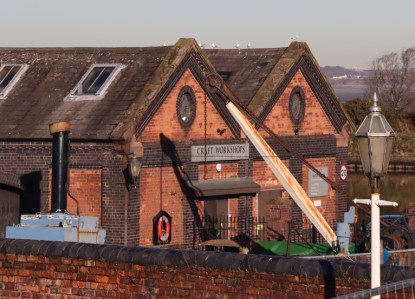 The derelict port buildings became a museum in the 1970s after a heroic effort by a group of volunteers, and is now a conservation area with nineteen Grade II listed buildings. It was originally known as the North West Museum of Inland Navigation and had various other names until it became The National Waterways Museum, with its emphasis on inland waterways, both rivers and canals, although coastal vessels are also included. As well as boats and exhibition and display spaces, the site is also home to the Waterways Archive, and education centre, conference facilities, a shop and café and other amenities, all located within the port buildings.

Map of the museum. Sorry it’s a bit crumpled, but there does not appear to be a clean version online. Click image to expand.
Entrance is via the ticket office that sits between the shop and the café. There is a 5 minute video to watch if required, and then access to the rest of the museum is on the other side of the shop, which sites on the side of the canal entrance to the port. There were obligingly two narrowboats moored further up the quayside, hemmed in with ice, and this is a very good place to orientate oneself with the help of the excellent map that comes with your entry ticket. It’s quite a complicated site, with several buildings containing exhibits, so the map is invaluable.
I started out by walking over the bridges towards the Exhibition Hall, former warehousing, taking in some of the historic boats moored up alongside the quays in the Upper Basin.


 The big former warehouse, called the Island Warehouse, has displays on two floors. The ground floor is a vast collection of objects connected to the waterways, including bits of engine, windlasses, tillers, rudders, sack barrows, buckets and lamps and a zillion other objects, parts and bits. There’s very little information on display, although a QR code promised more details about some of the objects via your smartphone (I had left mine in the car by accident).


A really wonderful find on the ground floor was a long glass cabinet containing a prehistoric log boat found in Baddiley Mere in Cheshire, and made of a single, hollowed-out trunk of oak. This is a nationally important object and it was splendid to see it. I had no idea it was at Ellesmere Port. Sadly, the cabinet was hemmed in on all sides with other objects. It was also covered in dust and the glass sides reflected the surroundings, so it was difficult to get close or see it properly and impossible to photograph well. I do wish that it was on the first floor exhibition area, where it could be seen and appreciated properly. According to the Heritage Gateway website, it is on loan from the Grosvenor Museum.

The prehistoric log canoe, which could be rather more conspicuously and sympathetically displayed.
—————-
 The first floor is a more formal exhibition area. There is a cut-away narrowboat called Friendship with its painted bow and stern and a tiny little cabin, the unimaginably small living quarters of the narrowboat’s operator and his family. A delightful pleasure boat, the 1954 Amaryllis, glows with glossy mahogany and polished brass. My favourite was an example of a long, slender boat called a “starvationer,” designed to run on the 46 miles (74km) of subterranean canal tunnels in the Duke of Bridgewater’s Worsley coal mines. Other cabinets have model boats and ships showing a range of different types and sizes. A couple of cabinets have examples of canal art associated with narrowboats. Items commonly found in the dock and canal port are included. There’s even a working model of the Anderton Boat Lift. Information boards provide plenty of detail.
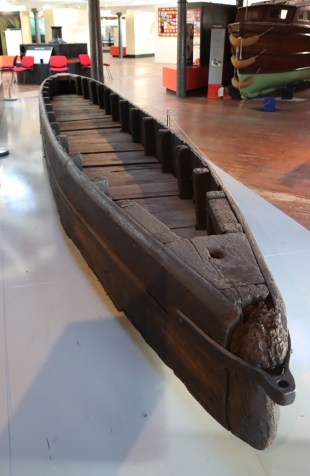
A “starvationer”

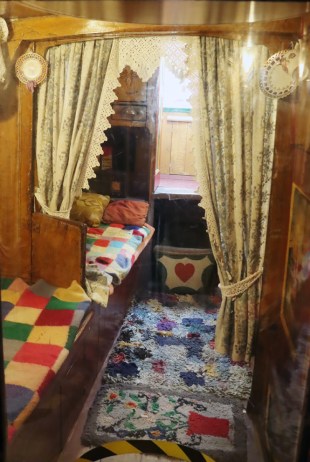


Sack chute

 Out on the other side of this building, back outside, there are more boats. Some of the boats that are usually out in the summer are under cover for winter, still visible but not as accessible. This is particularly true of the valuable wooden narrowboats like Gifford and the ice-breaker Marbury. Being under cover, they are also easier to work on. The ongoing care and repair of wooden boats is a major part of the out of season work at the museum, and there information boards explaining what is being done to each.

The ice-breaker “Marbury”
Walking to the left, a splendid ship hull rests in a giant covered cradle, the remains of the Mersey flat barge Mossdale. According to the signage she is the only surviving all-timber Mersey flat. She was initially named Ruby, in which guise she carried cargoes of up to 70 tons, towed by steam tug on canal, river and along the coast. In spite of her flat base she was very stable. She was sold in 1920, after which she carried pottery, grain, flour and sugar along the Bridgewater canal.

Mossdale
Beyond this is the splendid Pump House with its 69ft (21m) chimney built in 1873. This was closed to the public on the day I visited.


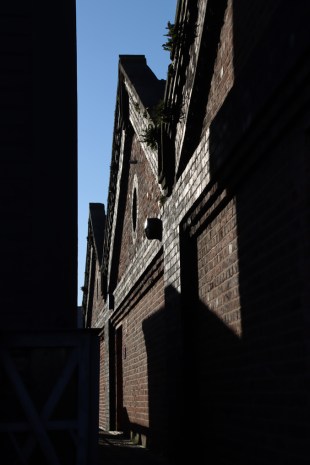
 Heading back, the next place to visit is Porters Row, four terraced houses, each one fitted out with furniture, accessories, wallpaper, technology and kitchen equipment that would have been found in dock workers’ homes of the 1830s, 1900s, 1920s and 1950s. This is such fun, a really evocative way of getting a sense of how past objects were deployed in ordinary homes, although some were clearly more prosperous than others, one with a piano, and more remarkably one with a organ!


Beyond and downhill (reached via a ramp, or by locks if you are in a boat) is the Lower Basin containing more boats, with the rather well disguised Holiday Inn hotel beyond.

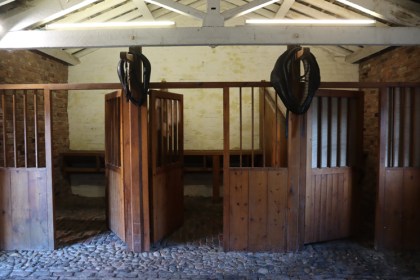
 Crossing to the other side of the port, there is another set of buildings that includes the old stables (for the horses that pulled the unpowered narrowboats), the blacksmith’s forge (still operational), and the Power Hall, which is a display of ship engines, one of which can be operated via a push-button.



FCB18 – a barge made of concrete
On the other side of the Power Hall are two more boats, one of which, the barge FCB18, is fascinatingly made of concrete, which is a crazily counter-intuitive concept. But there it is, happily afloat. The information signage says that she was built in 1944 during the war, which was a time of steel shortage. Concrete was readily available and cheap, and although steel was still required, only 18 tons was required, as opposed to the 56 for a steel barge with a carrying capacity of 200 tons. Unfortunately, the resulting barge was heavy, difficult to steer, and brittle.
The other boat is Basuto, looking like something built of rusty Meccano, but again, still afloat in a sea of green weed.

 Back up towards the exit is a sign pointing you to the slipway with its blue-painted wooden winch house, and from here you can see over to the channel that connects the Manchester Ship Canal to the River Weaver and Ellesmere Port. When you leave the museum, you can turn left along the road that passes between the museum and the car park, and walk along the channel’s edge towards the Holiday Inn, where there are some great swing bridges and more canal-side buildings, including a unique port lighthouse.


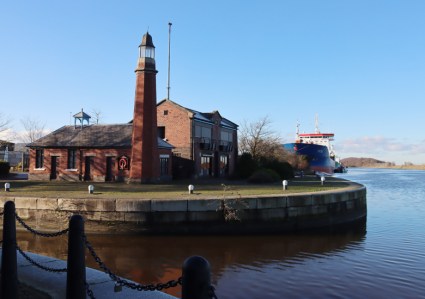

The above is just a sample – there’s lots to see. A great visit.
Visiting Information
 A dry day is preferable for a visit, because there is a lot to see outside, and the buildings themselves are part of the attraction. Opening times are on the Canal and River Trust website here. At the time of writing (January 2024) the entrance fee was £11.75 for an adult, which seems quite steep but the ticket lasts for a year, and I will certainly be making use of mine for another visit. Other entrance fees are on the museum’s website on the above link. There is a nicely presented shop with books, toys and canal-themed ornaments, and a bright, comfortable café. Outside there are plenty of picnic benches, and a play area. The museum was amazingly quiet. Given the bright sunshine I thought that it would be fairly busy, but the cold was obviously a deterrent, the docks being frozen solid.
 I was warned at the ticket office about icy surfaces, which takes on a particular resonance when you are walking along the edges of frozen expanses of water with almost no-one around. But they had done such a good job with the salt and grit that even in the cold shadows there was no ice on which to slip.
For those with unwilling legs, there are ramps nearly everywhere. In the Island Warehouse there is an elevator to the first floor, but this was out of order when I visited so it might be a good idea to phone first if you need it. There is a lot to see on the first floor, so it would be best to go when the elevator is working. The Pump House was closed, but this appears to be accessible only via a short flight of steps (5 or 6 steps). Otherwise, as far as I could see, the whole site seemed to be fully accessible for wheelchair users and those with unwilling legs.
Boat trips are available in the summer.

Sources
Books and papers
Vince Devine and Jo Clark. 2003. Ellesmere Port Archaeological Assessment. Cheshire Historic Towns Survey
http://www.cheshirearchaeology.org.uk/wp-content/uploads/2013/06/HTS_Arch_Assess_EllesmerePort.pdf
Websites
The Ellesmere Port Canal Port Trail
The Mersey Forest
https://www.merseyforest.org.uk/things-to-do/walks-bike-rides-and-more/walks/ellesmere-port-canal-port-trail/
The Shropshire Union Canal
The Canal and River Trust
https://canalrivertrust.org.uk/canals-and-rivers/shropshire-union-canal
Virtual Tour of the Museum
https://canalrivertrust.org.uk/things-to-do/museums-and-attractions/national-waterways-museum-ellesmere-port/virtual-tour-of-the-national-waterways-museum
History of the Shropshire Union Canals
The Shropshire Union Canal Society
https://shropshireunion.org.uk/shropshire-union/early-history-of-the-shropshire-union-canals/


Postcard of a photograph from the museum archives. Lovely to see all those Fellows, Morton and Clayton narrowboats lined up. A real canal legend.
 Based in Churton