

Caergwrle Castle. Source: RCAHMW
On the top of a small hill formed of sandstone and grit, with good surrounding views, and relying partly on steep drops for its primary defence, Caergwrle Castle is ruined but contains the remains of well-built stone walls and a defensive ditch that is still quite deep in spite of the build-up of both castle and natural debris.
Caergwrle Castle, also known as Hope Castle and Queen’s Hope, was started in 1278 by Dafydd ap Gruffydd with support from Edward I. Dafydd was the brother of the better known Llywellyn ap Gruffydd (or Llywellyn the Last) who was the last native Prince of Wales to be recognized by the English crown. Both Llywellyn and Dafydd were grandsons of Llywelyn the Great. For a description of the ongoing conflicts between the Welsh factions represented by Llywelyn the Great, his children and grandchildren on the one hand, and the English crown under Henry III and Edward I on the other, see the post on this blog, in which I have made a stab at summarizing the complex background history.

Caergwrle Castle, c.1795 by John Ingleby showing the natural defences provided by steep drops at the west and south. Source: National Library of Wales, via Wikipedia
Today the main visible features of the site consist of an outer double ditch and some surviving sections of curtain wall and towers. The loss of masonry was partly due to the slighting of the site in 1282 when Dafydd abandoned it, but it was also severely damaged by accidental fire in August 1283. Although it passed through various hands thereafter, no attempts to restore it were made, and much later it was subjected to extensive stone robbing for building projects in the valley below. Given the indignities imposed on the castle in the past, what remains today is really quite impressive. The main source for this post is John Manley’s 1994 Excavations at Caergwrle Castle, Clwyd, North Wales: 1988-1990 (full details and a link to the PDF in Sources at the end of the post).
Dafydd ap Gruffydd, Edward I and Caergwrle Castle

North Tower
The fortifications enclose an area some 110m x 120m. The scale of the castle is entirely consistent with its Welsh-built siblings of the 12th and 13th centuries. When compared with Edward I’s contemporary and enduring monsters at Flint, Rhuddlan and Denbigh, Caergwrle Castle looks very modest. The castle was started in 1278, just one year after the foundation of Edward’s first castles in Wales at Flint and Rhuddlan. Welsh political power under Llywelyn ap Gruffudd had been pushed back to Gwynedd in the west, and although Llywelyn was still permitted to hold the title Prince of Wales, with Edward’s consent, this title was nominal, a mere consolation prize, and Llywelyn’s territory, power and status had been terminally undermined after his defeat in 1276, agreed in the Treaty of Aberconwy.
Daffydd had been a wildcard in the Anglo-Welsh conflict. Embittered by being denied his rightful inheritance by his brother Llywelyn ap Gruffydd, in 1263 Daffyd sided with Edward’s father Henry III against Llywelyn. Welsh law of the period demanded that when a landholder died, his property should be divided between his heirs, but when Gruffydd ap Llywelyn died, Llywelyn seized control over land that should have been divided between all four brothers, and it is not surprising that Dafydd felt betrayed and infuriated by Llywelyn’s usurpation of his birthright.

Northeast Wales, showing the cantrefi of Rhwfoniog and Dyffryn Clwyd
Following his support of Edward, and in the aftermath of the Treaty of Aberconwy, Dafydd was rewarded by Edward with lands in northeast Wales (specifically the cantrefi of Rhwfoniog and Dyffryn Clwyd), but he was aggrieved that the treaty failed to grant him his ancestral lands in Gwynedd. Llywelyn was permitted to retain all of western Gwynedd, which Dafydd felt again denied him the territory that he should have inherited from their father. John Manley suggests that this was deliberate, encouraging a perpetual conflict between the two men, creating a psychological barrier that would discourage any attempt at an alliance between them against Edward, as well as a geographical buffer between Llywelyn’s Gwynedd and England. Edward contributed token funds to the construction of Caergwrle Castle, and may have loaned Dafydd architectural advisors to assist with the design. Manley draws a number of parallels between Edward’s castles and that of Caergwrle, including corner towers, D-shaped towers, and the massive walls.

Curtain wall between the north tower and the east tower
Any real hopes that Edward’s might have had that these measures might help to seal the peace were frustrated. Edward’s castles and the accompanying towns, all of which were being populated by English migrants, reinforced Edward’s foothold, and he must have known that the resentment generated by his annexation of Welsh land was a real risk. Although Caergwrle Castle was built with Edward’s blessing and aid, ostensibly to defend Dafydd’s newly acquired territories against potential hostilities from native aggressors, slippery Dafydd turned against Edward in 1282. Dafydd’s uprising must have taken Edward by surprise in a way that an uprising from Llywelyn or any of the other Welsh landholders might not have done.

The well
Confronted with his brother Dafydd’s rebellion, Llywelyn ap Gruffydd, stuck between a rock and a hard place, threw in his lot with his brother rather than honouring the peace treaty with Edward. He was killed in battle on 11th December in 1282. Dafydd adopted the title Prince of Wales but by early 1283, Edward I’s vast English army had hemmed in the Welsh heartland and Dafydd’s ambitions were clearly doomed.
In the event, Caergwrle escaped involvement in the rebellion. Although Edward sent a detachment to secure it, the castle had already been abandoned by Dafydd and “slighted ” (i.e. deliberately damaged to prevent easy re-use). Dafydd shifted first to Dolwyddelan Castle in southwest Conwy whilst the English took Bangor, Caer-yn-Arfon and Harlech. Castell-y-Bere, near the coast in mid-west Wales, was the last of the Welsh strongholds to withstand Edward’s armies, falling in April 1283. Faced with such a comprehensive annihilation, Dafydd fled. He was captured later that year and was tortured and put to death. The grizzly design of Dafydd’s death is some measure of how personally Edward had taken this new revolt. Llywelyn’s battlefield death was probably a lucky escape.
 Never one to waste a resource, Edward ordered repairs to be carried out to Caergwrle Castle, as he did at a number of the other Welsh-built castles that he conquered. This policy improved his grip on Wales at a cost that was minimal when compared to the eye-watering expense of his newly founded state-of-the-art castles. Manley gives details of the accounts kept by John of Lincoln at the castle between June and November 1282, recording payments to men working on the castle. Amongst the personnel receiving payments were officials, knights, archers, crossbowmen, carpenters, masons, diggers and sundry workmen. As with Edward’s newly established castles in Wales, Caergwrle’s restoration was to be accompanied by a new town and populated by English migrants. The road layout was established, and when the castle was gifted by Edward to his wife, Queen Eleanor, a licence to hold a market was granted, but the plans for an English migrant settlement at the foot of a newly fortified Welsh-built castle were never completed.
 In 1283 a fire broke out at the castle whilst Edward and Queen Eleanor were in residence, and even though excavations failed to produce evidence of a catastrophic fire, the castle was so badly damaged that it was apparently decided that additional resources should not be invested in extensive repairs. Even when Madog ap Llywelyn rebelled in 1294 the castle was not refortified. Madog, a distant cousin of Llywelyn, apparently undeterred by Edward’s uncompromising treatment of Dafydd, decided to test the king in one final 13th century uprising. The rebellion was suppressed. Nearly a century later the castle was ignored by both sides during the rebellion of Owain Glyndŵr in the early 1400s. During the 17th Century Civil War it was not one of the Welsh castles refortified for housing garrisons and storing supplies. In all these cases, it was probably decided that the castle was too ruinous, too small or in an unsuitable location – or a combination of all three.
Features of the 13th century castle

Caergwrle Castle. Plan showing the excavations 1988-1990 shaded in grey, the standing remains in black, and the outer enclosure to the east. Source: Manley 1994, Fig. 3, p.87
The main source of information about the castle is the 1994 report of the three-season excavation that took place between1988 and 1990 (see Sources at the end of the post). This detailed account by John Manley and contributors clarified the relationship between many of the visible and hidden remains to build up a partial picture of how the castle was designed and developed and what sort of diet the workers and inhabitants enjoyed.
The castle is strategically well positioned on a hilltop with near-vertical drops to the west and southwest. It sits above the river Alyn, and would have had excellent views over the surrounding area. Today the views are partially hidden by woodland. The river is not visible from the castle today, but runs along the base of the hill to its east, providing a readily available source of potable water during times of peace.

A suggested reconstruction of Caergwrle Castle from the east, showing the vulnerable aspect of the castle, defended with the help of a deep ditch. Source: Manley 1994, fig.23, p.129
As you approach the castle along the footpath from the road below, you find yourself confronted by a wooden stair-stile that crosses a ditch, as shown in the reconstruction on the left and on the plan below. This was once a double ditch, the outer one much shallower and less easy to see today. The ditches were an important component of the castle fortifications, providing protection on the side of the castle that was not protected by the steep drop.

The red dot shows the usual visitor entry to the castle, via the footpath that begins next to the war memorial. The yellow dot shows the usual exit, which allows you to walk back down via a footpath through the wooded area.
Having crossed the ditch, you enter with castle with the North Tower on your right, with a tiny section of curtain wall beyond; and the east-facing curtain wall on your left, with the round stone top of the well clearly visible at the foot of the wall. The wall is linked to the East Tower via the remains of an archway. Another small section of wall connects the East Tower to the South Tower. Opposite you, the original western curtain wall is missing in its entirety. Even given the ruinous nature of the castle, it is easy to see how solidly it was built, with thick, tall walls and impressively big towers, showing the influence of Edward’s architects and civil engineers.
Manley identifies six different styles of wall construction at Caergwrle. Masonry that could be most finely worked was used in prestigious areas and for specific architectural features, whereas internal walls, which would have been plastered anyway, were far less refined. Between the inner and outer wall faces, the interior was filled with rubble. A large quarry was identified to the northwest of the castle, and part of the hilltop itself was probably used during work to level the surfaces.
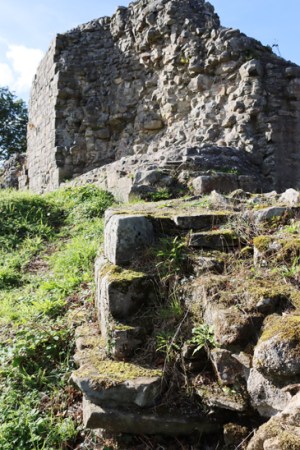 The North Tower, once D-shaped, is thought to have included a staircase and latrines. Below ground level was a storage basement or dungeon. Above, on the first floor, is evidence for a large fireplace. This is linked to the East Tower by a section of curtain wall terminating in an arch. The sandstone-faced well is clearly visible today, and right up against it excavations revealed that a lean-to building once stood against the wall. The once D-shaped East Tower, right on the edge of a steep slope down to the valley, was , and is also thought to have housed a latrine, as well as other chambers. The South Tower was a substantial round structure, although this is difficult to see from what remains today. Where the East Tower meets the section of curtain wall leading to the South Tower was a bread oven made of local sandstone, a common feature in medieval castles, its internal diameter around 3m. It is uncertain whether this belonged to Dafydd’s castle, or to Edward’s rebuild. The excavation discovery of mortar mixing and metal working areas as well as the very basic nature of the internal structures “make it difficult to imagine that the interior of Caergwrle castle looked like anything other than a building site between 1278 and 1283.”

Metal objects found at the site. Source: Manley 1994, fig15, p.113
Finds from the castle, found during the excavations included a small amount of medieval pottery, all hand coiled (none of it wheel-thrown), representing jugs, jars, pots and bowls. Comparisons with assemblages from Beeston Castle suggest a 13th century date, consistent with work carried out at Caergwrle by both Dafydd and Edward. Iron objects were few and far between but interesting, including construction materials, tools and weapons, and there were a few items of copper alloy. Five coins were found, including three from the reign of Edward I. Animal remains include cattle, sheep/goat (being difficult to distinguish archaeologically) and pig as well as wild species such as fish, bird and roe deer, suggesting a fairly broad range of meat dishes.
Combining all the data from the architecture and excavation, Manley conclude that Caergwrle was intended to be defended by spear “thrust or thrown” rather than by crossbow or longbow.
Visiting
 Caergwrle Castle is free of charge to access and is open all year round. It is a popular destination for local dog-walkers, families and children, in spite of a moderately steep route up from road level. There is no information about the castle at the site. The surviving display frames, probably erected following the excavations in the late 1990s, are still standing but are empty.
 Although the surrounding region is rural, the castle sits within woodland above a very built-up extended ribbon development of shops and housing along the busy Wrexham Road, and is easy to miss in the car. I used my Google SatNav to let me know when I was passing, which notified me just in time for me to spot a sign on the right (I was heading south to north) marking the way up. This way up is next to a conspicuous war memorial on the side of the road, just short of a Spar corner shop. You can find the pathway up on What3Words in your SatNav at ///fencing.chariots.prom. I parked on a nearby road, but I later noticed, when driving past it after my visit, that there was a car park for the High Street further along.
 The walk from the road up to the castle is trouble-free, but moderately steep, starting with a metalled ramp and then wood-boxed steps. although it only took me about 10 minutes, if that, to walk from bottom to top. It is probably slippery in wet weather. The top is grassy and the track to the castle is quite muddy at this time of year, and there is a stepped stile to climb into the castle. If taking unwilling legs into account, the steepness and stile might be deterrents, There is a seat half way up that may help if not already occupied.
I combined this short visit with a walk at the lovely Waun y Llyn country park, approximately 15 minutes away by car, providing some splendid views over the surrounding lowland hills on a fine day.
Sources
Books and papers
Davies, J. 2007 (3rd edition). A History of Wales. Penguin
Davis, Paul R. 2021. Towers of Defiance. The Castles and Fortifications o the Princes of Wales. Y Lolfa
King, D. J. Cathcart. 1974. Two Castles in Northern Powys: Dinas Bran and Caergwrle. Archaeologia Cambrensis 123.
https://journals.library.wales/view/4718179/4746669/152
Manley, John. 1994. Excavations at Caergwrle Castle, Clywd, North Wales: 1988-1990. Medieval Archaeology, 38
https://archaeologydataservice.ac.uk/archiveDS/archiveDownload?t=arch-769-1/dissemination/pdf/vol38/38_083_133.pdf
Websites
Aberdovey Londoner
Castell-y-Bere (1221-1295) in the Dysynni Valley. By Andie Byrnes, October 31st 2018
https://aberdoveylondoner.com/2018/10/31/a-visit-to-castell-y-bere-1221-1295-in-the-dysynni-valley/
Ancient and Medieval Architecture
Caergwrle – Castle. By Janusz Michalew.
https://medievalheritage.eu/en/main-page/heritage/wales/caergwrle-castle/
Cadw
Caergwrle Castle
https://cadw.gov.wales/visit/places-to-visit/caergwrle-castle
Coflein
Caergwrle Castle
https://coflein.gov.uk/en/site/95099/

 Based in Churton
