
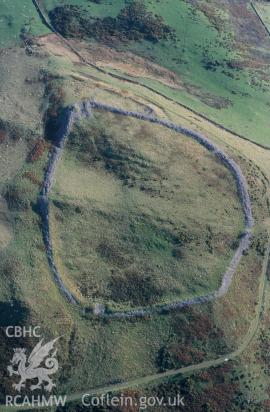
Caer Drewyn aerial photograph. The entrance at the top is at the northeast. Source: Cadw
Caer Drewyn is an Iron Age hillfort located a mile north of Corwen, with remarkable stone-built defences all around its perimeter, and terrific views in all directions. Every fortnight for two years I drove past Caer Drewyn on my way to my father’s in Rossett, and again on my way back to Aberdovey. It was so obviously a late prehistoric hillfort that I didn’t investigate what might be known about it for some time, but every time I passed I reminded myself that I really must find out if it was accessible to the general public. It is.
This post begins with a brief description of Caer Drewyn the Iron Age archaeological site (it is worth reading either this or another description before you visit, as there is no information signage at the site), and finishes with the the walk and views, from the car park via the farm track to the top, and back partly via the track, but also using a different, steep footpath that shortens the route.
If you use the What3Words app, which is invaluable for both locating a site and, most importantly, for giving an exact location to emergency services in the event of an accident at a site, you can find the hillfort at ///kitchen.quaking.segments.
Caer Drewyn

Willoughby Gardner’s 1922 sketch of the position of Caer Derwyn on the slope rather than around the peak of the spur.
Caer Drewyn is the most southerly of the well-known Clwydian range hillforts, The site is located on a spur projecting south and west into the Vale of Ederinion in the upper valley of the river Dee, some 800-985ft above sea level and, at its south, 500ft (152m) above the Dee floodplain. The aerial photo shown at the top of the post gives some idea of the way in which the site dips fairly steeply from east to west over two loosely defined natural terraces.
What differentiates Caer Drewyn from its Clwydian range peers is that instead of banks and ditches, it is defended by vast stone defences, spreading to beyond 15ft wide in places. The Caer Drewyn stone defences are remarkable in that they do not merely defend a particular weak point; they enclose the entire perimeter – and there is an awful lot of perimeter to defend (3 hectares / nearly 7.5 acres, measuring c.629ft / c.192m north-south by 705ft / 215m east-west). This sort of stone defence is not unique. There are a number of examples in Ceredigion and in south Merioneth (e.g. Craig yr Aderyn, and Castell y Gaer) both on or near the mid-west Wales coast, with which the area may have had contact via the route that follows a geological fault-line. Other similar examples are further afield in northwest Wales including the famous Tre’r Ceiri on the coast of the north Llyn Peninsula, which has a complete stone perimeter and includes very clearly visible hut circles within.
 Although parts of the stone walls were cleared of bracken and other vegetation in the late 19th and early 20th centuries, Caer Derwyn hillfort has not been excavated, so all knowledge is based on observation of the extant features. According to the Coflein website, the hillfort was probably developed over at least three phases.
The earliest phase is thought to have consisted of a smaller curvilinear earthwork at the northeast of the hillfort that stands today, and survives in part as an earthwork outside and to the east of Caer Drewyn. This can be seen on the aerial photograph at the very top of this post.
The next phase is the vast rubble-walled site that dominates the hill today. This later hillfort was defined by the stone rampart, which Willoughby Gardner describes in his 1922 paper as consisting “of a core of rubble stones, faced on either side with a wall of dry masonry.” These surviving patches of stone facing may suggest that the rampart may have been equipped with an inner wall-walk.
Instead of sitting around the peak of the spur, the hillfort actually sits on the slope, meaning that the interior can be seen from below. Like many hillforts, it is ideally located for visibility over the landscape, in this case with views over the surrounding area, including the valleys of the rivers Dee and Alwen, which meet just to the east, the Berwyns to the south and the north and east across to the rest of the Clwydian range. These views are wonderful on a clear, bright day. Toby Driver points out that in spite of the defences, the above-mentioned fact that the interior of the hillfort can be viewed from below somewhat undermines its strategic value.
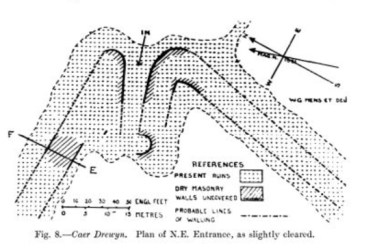
Willoughby Gardner’s 1922 plan of the northeast entrance of the hillfort
The hillfort could be approached from the west and the northeast, where the two entrances were in-turned, a typical feature of many hillforts that helps to control access to the interior. Willoughby Gardner says that there was a spring a short way down from the west entrance. The entrance in the northeast corner where the cairn is located, which is the highest point of the site and shown clearly bottom right of the aerial photo below, may have featured a guard chamber, another characteristic feature, suggested by the complex jumble of stone that implies at least one additional feature at the entrance. Willoughby Gardner estimates a 12ft diameter. So-called guard chambers are recesses in the entrance passages hillforts, mainly in north Wales and the Welsh Marches, but the name does not mean that the function of these recesses is actually understood, and they may have been used for some sort of religious or alternative function.
You can see circular dips dotted here and there in the walls. These may or may not be relatively modern features. They were there in 1887 when the Reverend Hugh Pritchard was investigating. One interpretation is that they could have been grouse butts (small enclosures used as grouse-shooting positions), but this is unsubstantiated. You can see some of them most clearly in the aerial image below.

Caer Drewyn showing northeast entrance, annex, and circular depressions in walls. Source: Peoples Collection Wales
The interior surface has been examined by Willoughby Gardner in 1922 and by the Engineering Archaeological Services (EAS) in 2006. Willoughby Gardner comments that there are circular structures within the hillfort. He casts doubt on them being original because in his experience wattle-and-daub or wood was the favoured material for hut circle construction. The EAS, acting on behalf of the Heather and Hillforts Landscape Partnership Scheme (Denbighshire County Council) carried out a topographical survey which identified eight possible hut platforms within the walls. Apparently aerial photographs taken in low winter light confirm hut-like shapes in the central and eastern parts of the enclosure. I had a poke around for anything resembling them on the ground, but could find nothing amongst the bracken. Winter, when the vegetation has died down a bit, would be a better time for that sort of optimistic activity.
To the south and southwest there are views over Corwen, the Berwyns and into the far distance. There is excellent line of sight from Caer Drewyn to other hilltops, some of which housed contemporary hillforts. I walked all the publicly accessible hillforts in the southern Merioneth area in mid west Wales a couple of years ago my write-ups here), and each of them had a clear line of sight to one or more neighbouring hillforts, which would make sense both for mutual support and maintaining lines of communication amongst friendly neighbours, and for keeping an eye on any hostile neighbours.
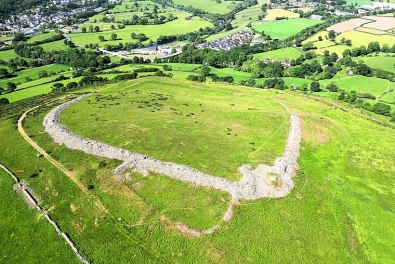
Caer Drewyn. Photograph by Llywelyn2000, CC BY-SA 4.0. Source: Mapcarta
A third phase apparently added a small trapezoidal annex to the north-east of the fort, which employs the earliest earthwork of the hillfort. In the aerial photograph above and to the right you can see one very clearly on the left, but there are others visible on some photographs, much fainter, which may also be hut circles. There is nothing to indicate a date, but Coflein suggests that it may have been added after the hillfort had gone out of use in the Romano-British period, presumably because of the possible hut circles, but it could equally have been much later.
Without excavation it is impossible to know how the interior of either earlier or later hillfort forms, or the annex were used, or to know for sure the period over which they were used.
 The term “hillfort,” combined with defensive structures such as banks, ditches, stone walls, defended entrances give the impression that these were built primarily for exclusively military purposes, but it is by no means certain that this was there only purpose or even, in some cases, their primary purpose. Secondary uses could include storage of agricultural output, protection for livestock, and a visible territorial marker in the landscape. There is no room here to enter into a discussion on the subject, but if you are interested have a look at Toby Driver’s 2018 online paper on the subject (free to access): New Perspectives on the Architecture and Function of Welsh Hillforts and Defended Settlements. Whatever their primary and secondary purposes, the sheer amount of work that goes into an enterprise like this, or a banked-and-ditch hillfort is considerable, and there was certainly a very desirable outcome in mind when a hillfort was embarked upon.
The site continues to be used for grazing sheep, and it is recorded that it was used as a hafod (seasonal grazing) in around 1600. It is reputed to have been used as temporary bases for Owain Gwynedd in the 12th century during his conflict with Henry II, and by Owain Glyndwr during his rebellion in 1400. There is no actual data to support either theory.
———-
Visiting details: parking, the walk and the views
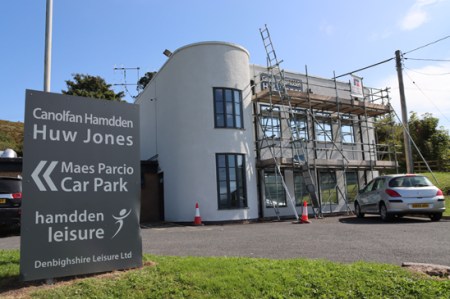 I was advised that it was acceptable to park at the Corwen Leisure Centre, just to the north of Corwen (via Green Lane from the A5, postcode LL21 9RW). When I arrived, there were only three other cars there, and no signage to indicate that parking was restricted. By the time I returned to the car a couple of hours later mine was the only car in the car park, so I didn’t feel that I was intruding.
Walking up to the road from the car park, turn left (east). There is no pavement, just a narrow grass verge, but you are going a very short distance, just a few metres, before a wide farm track is clearly signposted to Caer Drewyn on your left.
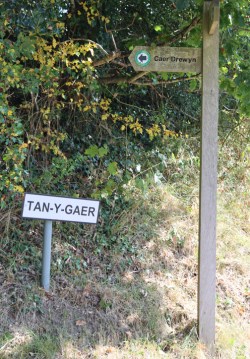
Follow the attractive track for a few minutes, past a couple of farm buildings on your right. You will reach a gate.

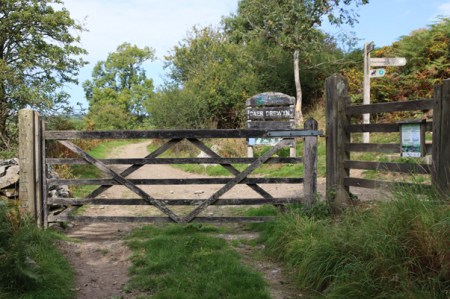
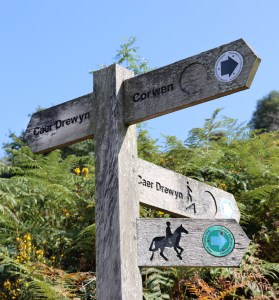
On the other side of the gate is another signpost that gives a few options.
—–
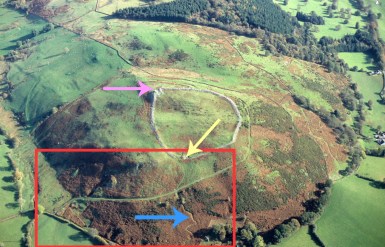
The red box shows part of the farm track taking the easy route up the side of the hill towards the highest part of the hillfort and the northeast entrance (pink arrow). The blue arrow shows the steep footpath that cuts off a corner of the easier route. The yellow arrow shows the lowest point of the hillfort, which is also an access/exit point. Click image to enlarge. Copyright CPAT. Source: Britnell and Sylvester 2018
For Caer Drewyn you can either turn left and follow the farm track, or go straight ahead on a very small footpath straight uphill, which intersects with the farm track at a much higher level. Looking at the aerial photo to the left, it should be possible, although I didn’t realize at the time, to cross over the farm track (or, if you are on the farm track turn left at the point where it intersects with the footpath) to go up to the very lowest point of the hillfort defences and the western entrance. I wouldn’t, myself, because I really enjoyed the views from the farm track. It would make a shorter and easier walk for anyone who follows the track to the northeast entrance but doesn’t want to do a full circuit of the hillfort, to follow one set of walls down to the bottom of the hillfort and exit back to the farm track or footpath via the lower entrance.
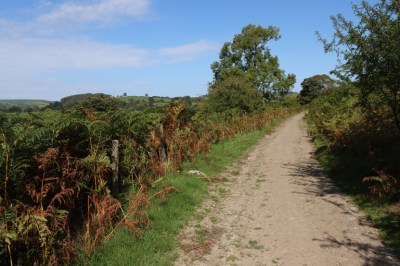 The farm track is the easy option, so I decided to follow this and, on my return journey, take the footpath down. I would strongly advise that you take the farm track either on your ascent or descent, because the views are so terrific, and you will miss some of them if you confine yourself to the footpath.
The farm track heads west for a short distance on the level, and then you will reach another signpost that points you right, uphill through a gate that has a walk-around on its right. Take the uphill option that takes you relatively gently across the side of the hill towards the northeast entrance. This is uphill all the way and although not particularly steep on the seethingly hot day on which I walked it, it was noticeable.



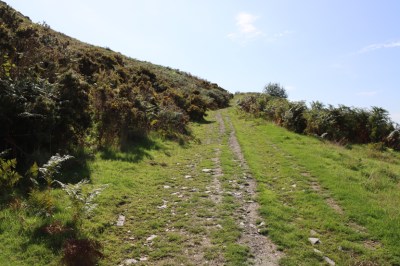


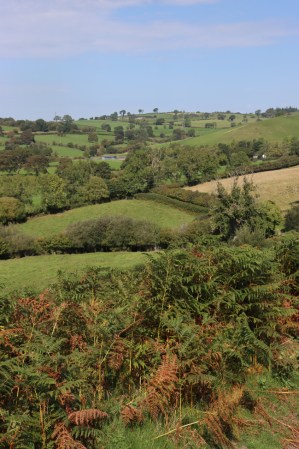
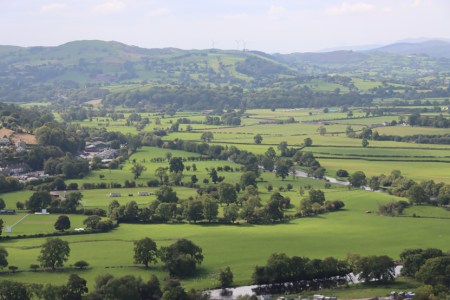
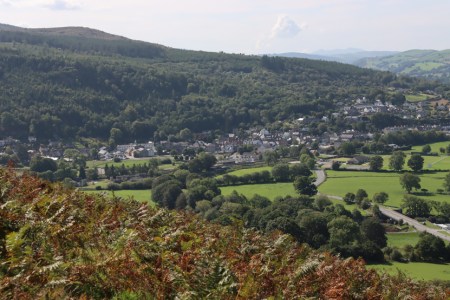
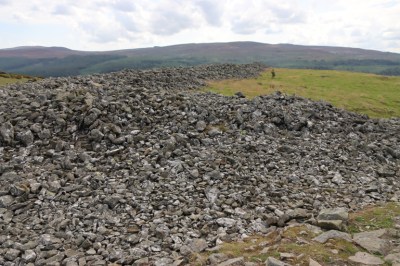
As you climb towards the top of the hill, you will suddenly see some stone rubble on the left, like a massive fallen drystone wall. This is the hillfort perimeter. Continue to follow the farm track, running parallel to the walls. You will eventually reach a gate, which is the end of the line. Ahead of you is a superb view to the east, and on your left, just a few metres behind you, is a mass of stonework including a roughly conical pile of stone which is a useful point to orient yourself. This is the northeast corner and marks the following in-turned entrance and possible guard house. From the cairn you can see for miles and miles around. The landscape is truly stunning. You can also see the stone defences heading out in both directions, plunging away to your right down the slope and following the ridge left before then, too, plunging downhill.
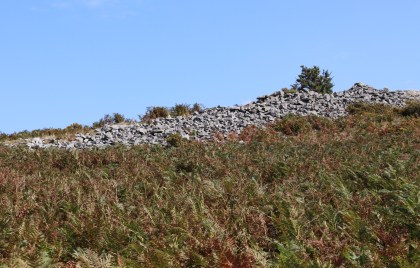
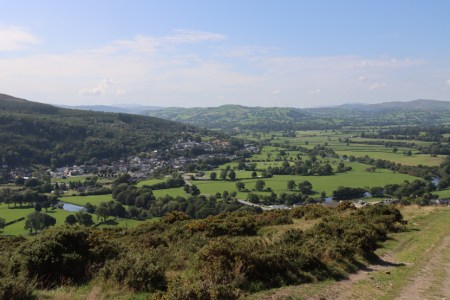
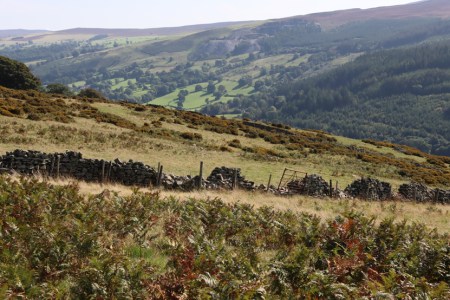
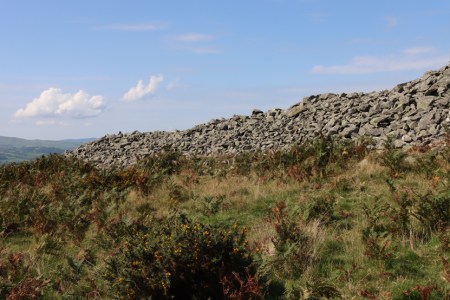
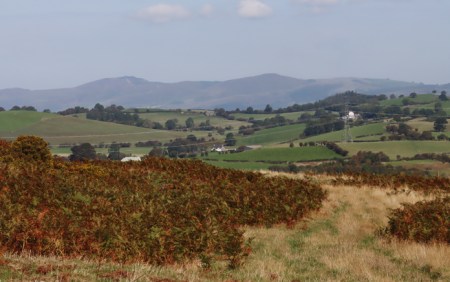

It is easy to walk the entire perimeter because all you have to do is follow the stone boundaries, but do take into account when you are heading downhill towards the far eastern extent, that you will have to walk all the way back up again if you want to do the full perimeter back to the cairn! Alternatively, head out of the well-worn exit at the bottom end of the hillfort to rejoin the farm track.
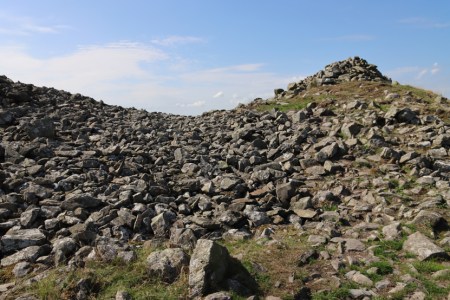
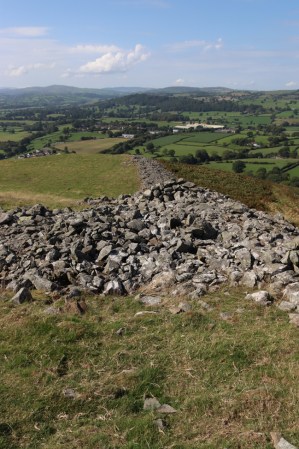
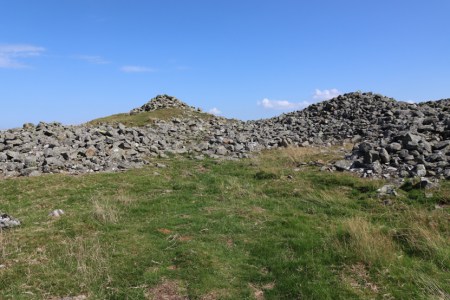

View over the enclosure towards the west

Looking back up the hill along the northern rampart
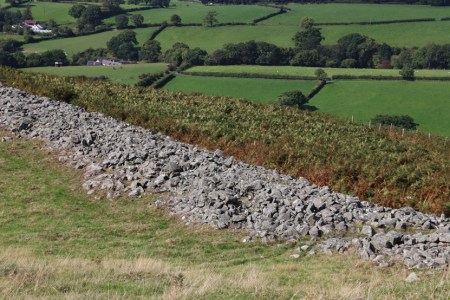

The interior showing the topographical tilt to the west
Although there are tracks inside the hillfort, many of them created by sheep, there are no formal pathways and if you leave the trackways, it is very uneven underfoot, with the danger of turning an ankle. I was wearing tried and tested breathable but very solid hiking trainers that are fabulous on hot days, but it would have been better to have worn summer-weight hiking boots with good ankle support.
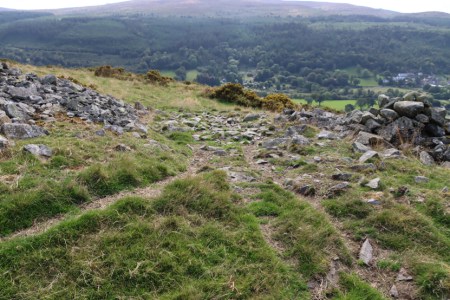
Well worn access to and exit from the hillfort at the bottom
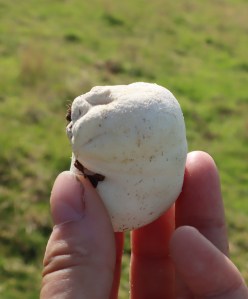
Puff ball
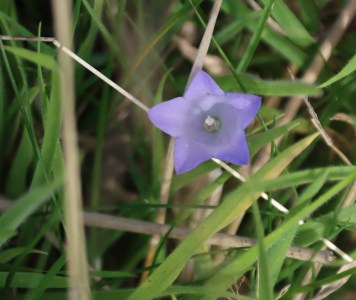
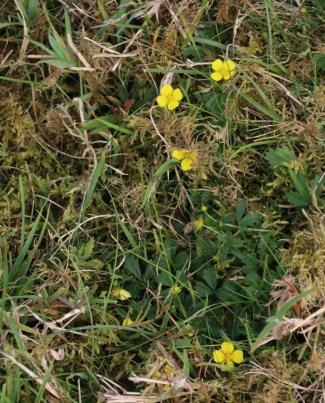
There is not a lot in the way of wildlife, but there is plenty of bright yellow gorse in flower at the moment. I found a perfect white puff-ball (mushroom) which I later cooked in garlic butter, and some other unidentifiable mushrooms. There were some very occasional and very pretty wild flowers, including some wonderful harebells dotted around, but there was little else to see at this time of year. Bird song was all around, but the singers were well hidden. Judging from the endless rabbit droppings, this is bunny nirvana. If you are interested in lichen, there seemed to my inexperienced eye to be many different types on the stone defences and the interior rocks and boulders and later that day I read on the Clwydian Range and Dee Valley AONB website that over 60 species of lichen were identified in a 1993-1994 study.

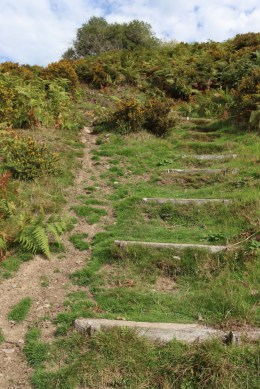
On the way down I kept a close eye out for a signpost for the footpath down, which chops off the corner that the farm track takes (the blue arrow on the above annotated photo). There is no full-sized signpost, just a little way-marker on the left/south that you need to look out for. There is a big boulder opposite, which is a useful landmark. The first part of the footpath, from the top, consists of some quite deep steps reinforced with wood. It then becomes a fairly steep narrow track – much steeper than it looks in my photographs below. I suspect that the whole thing becomes a muddy stream during wetter weather, as there are plenty of signs that water courses have made their way down. The footpath drops you at the gate back down to the road and the car park.

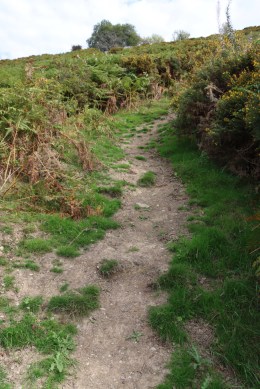
It only took me about half an hour to get up to the hillfort, with lots of stops to enjoy the spectacular scenery, take photos and top up with water. Once up there, you can spend as long as you like, of course, and it is a great place for a picnic. I had it to myself, even on a sunny Saturday.
Hopefully the photos will speak for themselves, but I recommend this as a far from strenuous walk, mixing fascinating late prehistoric heritage with terrific views. If you time your visit to coincide with stunning Rhug Chapel’s opening times (the chapel’s website is here), that would make a great second visit, just a ten minute drive away.
UPDATE:
After I posted about this walk, I found an official leaflet that includes a longer walk incorporating the hillfort, which looks really great. The relevant page is shown below, but you can download the entire leaflet, with some other really excellent-looking walks too at https://tinyurl.com/2fecwr8c.

——–
Sources
Books and papers
Bowden, M. 2006. ‘Guard Chambers’: An Unquestioned Assumption in British Iron Age Studies. Proceedings of the Prehistoric Society, 72, p.423-436 [NOT free to view]
https://www.cambridge.org/core/journals/proceedings-of-the-prehistoric-society/article/abs/guard-chambers-an-unquestioned-assumption-in-british-iron-age-studies/E6D627EE54566C400B07C0F42CB5F18C
Britnell W.J. and Silvester, R.J. 2018. Hillforts and Defended Enclosures of the Welsh Borderland. Intarch Issue 48 (2018). Iron Age Settlement in Wales. https://intarch.ac.uk/journal/issue48/7/index.html
Driver, Toby 2018. New Perspectives on the Architecture and Function of Welsh Hillforts and Defended Settlements. Intarch Issue 48 (2018). Iron Age Settlement in Wales. https://intarch.ac.uk/journal/issue48/9/toc.html
Gardner, Willoughby. (1922). The Ancient Hill Fort known as Caer Drewyn, Merionethshire. Archaeologia Cambrensis – The Journal of the Cambrian Archaeological Association. Vol. 77. Seventh Series. 2. Vol 77, p.108-125
Savory, H.N. 1958. Caer Drewyn. Archaeologia Cambrensis – The Journal of the Cambrian Archaeological Association. Vol 107, p.135-6
Websites
Clwydian Range and Dee Valley Area of Outstanding Natural Beauty
Hillfort: Caer Drewyn
https://www.clwydianrangeanddeevalleyaonb.org.uk/projects/hillfort-caer-drewyn/
Coflein
Caer Drewyn; Caer Drewen – Details
https://coflein.gov.uk/en/site/95431
Caer Drewyn; Caer Drewen – Images
https://coflein.gov.uk/en/site/95431/images
Tre’r Ceiri
https://coflein.gov.uk/en/site/95292
People’s Collection Wales
Caer Drewyn
https://www.peoplescollection.wales/items/5482
Aberdovey Londoner
Iron Age hillforts in South Merioneth
https://aberdoveylondoner.com/category/iron-age-hillforts-in-south-merioneth/
—–

The puff ball as a delicious minimalist starter. Divine.
 Based in Churton