


The Tŷ Mawr Country Park, just ten minutes south of Ruabon (LL14 3PE / What3Words ///disprove.dart.isolated) in the Vale of Llangollen, consists of walks through fenced fields, woodland tracks and views over the river Dee and the surrounding countryside. Most spectacularly, its starting point lies almost underneath the monumental stone-built Cefn railway viaduct, from where a circular walk begins, whilst a less formal there-and-back branch off a circular walk takes in the iron-built Pontcysyllte aqueduct.

Map on the outside of the visitor centre showing all the route options (click to enlarge). At far left is the Cefn viaduct and at far right is the Pontcysyllte aqueduct.
The circular walk begins and ends at the Tŷ Mawr car park (pay and display, but only £1.00 for the day at time of writing, and with two power points for electric cars), visitor centre and café (both closed when I visited yesterday, Wednesday 6th September), and toilets (which were open).
Behind the visitor centre there is a picnic area with excellent views over the countryside and the Cefn viaduct. There is also a small children’s farm with chickens, goats and other farmyard animals, and a children’s play area. The circular walk is a metalled pathway through small fields and woodland, which takes in the river Dee, with a small picnic area near a tiny “beach” and has a number of picnic areas. I haven’t found an online PDF of the map above, but you can download my photograph of it as a PDF here (sorry that the text is not particularly clear).
You can go either way around the walk, but the recommended route on the map fixed to the outside of the visitor centre is anticlockwise, which finishes at the Cefn viaduct and the memorial dovecot. Although there are some inclines, I would suggest that it is entirely suitable for those with unwilling legs. It was certainly okay for a group of women with pushchairs. It probably takes no more than half an hour to 40 minutes to walk, with stops to admire the river and the viaduct. There are occasional benches, a picnic area by the Dee and further picnic areas with lovely views at the top of the walk behind the visitor centre.
 The real star of the circular walk, missing off the leg to Pontcysyllte, is the Grade II listed Cefn viaduct, which can be seen around much of the circular walk. The walk goes right up to and along the base of the viaduct, which really is an awesome sight as you approach it and begin to get a sense of its scale. The Cefn viaduct was designed by civil engineer Henry Robertson, who had purchased the Brymbo Ironworks, and was built in yellow Cefn sandstone and red brick by contractor Thomas Brassey (to whom there is a chapel dedicated in Chester Cathedral). It was built surprisingly quickly over a two year period to carry the Shrewsbury and Chester Railway over the Dee valley. It opened in 1848, 43 years after the opening of Pontcysyllte, at a cost of £72,346. It has twenty one arches, nineteen of which are 60ft (18m) wide, and two of which, one at either end, are 30ft (9m) wide. If you approach the country park from the Ruabon direction, you will pass under one of the two narrow ones. The arches span 1508ft (466m) and at their most dizzying tower 147ft (45m) above the level of the river.
 The additional leg of the walk to the Pontcysyllte aqueduct along the path of the Dee is not suitable for anyone who cannot handle steps, as there is a flight down from the circular walk to near the level of the river, with no handrail. There is a signpost and small Pontcysyllte-themed bench indicating where you have to turn off the path down the stairs to a more informal section towards the aqueduct.


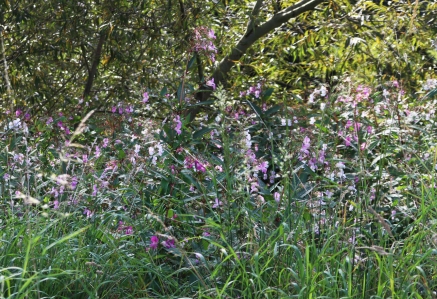
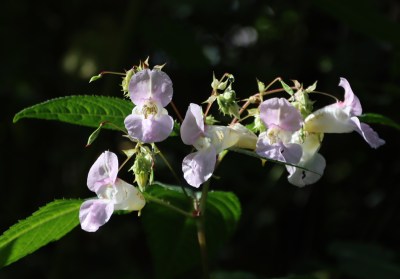 I enjoyed this more informal section, which after a wending track following the path of the Dee through woodland and open field leads to steps at the other end that take the walker to the level of the aqueduct and the Trevor Basin, with fully open visitor centre and other facilities (including boat trips across the aqueduct). The section along the river to Pontcysyllte will be highly seasonal, with different vegetation allowing or blocking views to the river, offering seasonally variable wildlife. Yesterday it was very attractive, with glimpses of the river through the tall plant life, and occasional tracks through the vegetation to get down to admire the river itself, much-used by dog walkers whose canine friends were doing a lot of swimming. The dominant floral element was Himalayan balsam, with orchid-like flowers in pinks and pinkish whites, which is terminally invasive, a complete monster which, given half a chance, takes over its entire environment, but is endlessly pretty and no bother at all in the massive acreage of the park.




Viewing point for the Pontcysyllte aqueduct
The narrow track follow a well sign-posted route, although there are only a few places where choices are required. When you reach the aqueduct viewing-point that is marked by a metal sculpture of a camera (which acts as a frame for taking photographs of Pontcysyllte) there is a choice to go straight on to the main steps, or turn right to approach the aqueduct from a different angle. If you are not interested in going up to the canal and aqueduct level but are happy to enjoy some terrific views of the remarkable structure from below, by the side of the river, go straight on. You can still change your mind and walk up to canal aqueduct level, but be warned that it’s a fairly long and steep flight. You can always drive back via the Trevor Basin, at the beginning of the aqueduct, where you can park up at the level of the aqueduct. A better option when you reach the “camera” is to turn right to go up a much shorter and less strenuous flight of steps, which brings you out onto a wooded path that both includes a viewing point and then delivers you to the canal, Trevor Basin and the aqueduct. You can then then return to Tŷ Mawr via the steeper staircase which is a lot easier going down than up, turning this final section into a circular walk.


The glorious aqueduct, built by Thomas Telford and opened in 1805, is always a joy. I have written up a summary of Pontcysyllte’s history and visitor information on a previous post. It is worth going on a bright, cloud-free day, because the views from the aqueduct down to the Dee valley are enhanced by the sun glinting off the water, and by the brightness of the green fields and trees that flank the river. The towpath along the aqueduct trough is quite narrow, but wide enough for people to pass one another. The iron railings are high to prevent accidental falls, but not so high that you cannot see over them. This really is one of the highlights of the area for visitors.


Once done with the aqueduct and Trevor Basin and the visitor centre, going down the longer set of steps to return back to Tŷ Mawr is a great option, walking down the side of the aqueduct and getting a real sense of its scale. The Dee is particularly delectable here too, bubbling over shallows and glistening in the sun. A great place to plonk down on the river bank and enjoy an ice cream.

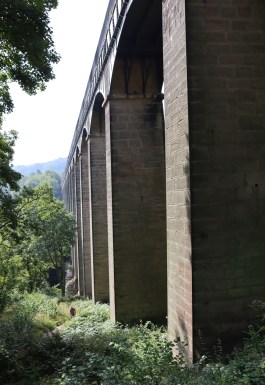



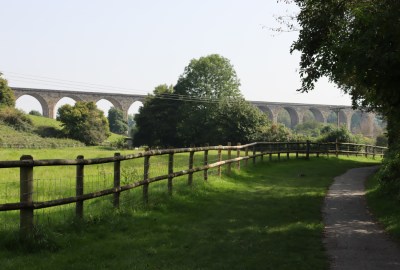 Having retraced your steps, and once back on the more formal circular walk, the star of the show is the Cefn viaduct that looms every close. There is an option to stop at a picnic area where a small beach is a great spot for admiring the river. There are tracks that let you walk just a little bit further along the river before heading back to the circular walk, or you can simply pause on the path, admire the view, and keep going up the slope towards the base of the viaduct. The viaduct is amazing. You can see it for most of the circular walk. At first just a few arches appear, and then gradually the entire 19-arch run of the stunning structure is revealed until you arrive at the top of the slope and at the foot of one of its enormous columns. Look up. Wow! At the very top of the arch at the top of the yellow stone-faced columns, the underside of the arches are formed of red brick-built, providing a contrast with the yellow Cefn sandstone.


There is a bench where you reach the viaduct, and a signpost. The left option continues the circular walk along the foot of the viaduct, which you will have to do anyway to return to the car park. The right option requires you to cross a stile, and allows you to walk just a few metres in order to see down to the feet of some of the arches in the river, albeit through the vegetation, and to stand right under one of the arches and get up close and personal with the stone work.

When you return to the last stretch of the circular walk, following the viaduct along its base, you eventually reach the attractive dovecot. This looks much older older than it is, rather like the 18th century example at Erddig, but it is modern, built in 1993 as a memorial.


It’s a short and largely undemanding but seriously enjoyable walk. Including the walk to Pontcysyllte, the walk only took about two hours to and from Tŷ Mawr car park, with lots of stops for photos and 10 minutes sitting overlooking the river at the foot of the aqueduct with a much-appreciated ice cream. Apart from the steps, it’s an easy walk, and there is much to see. I arrived at Tŷ Mawr at 11 and left shortly after 1pm, so it’s not a day-eater. A great place for a stroll, rather than a hike. Up-to-date visitor information is available on the Wrexham County Borough Council website.
The name Tŷ Mawr translates as “big house” or “great house.” There’s no sign of a house, and no mention of one on any of the websites that talk about the country park. Many old houses have been lost, but I can find no mention of one associated with the country park. Does anyone know if there was once a property associated with the site?


 Based in Churton