
 A previous post took a quick chronological hike through All Saints’ church in Gresford, which dates mainly from the 15th century but includes features dating back to the 13th century. As with many gothic churches, the exterior may be architecturally consistent with what is going on inside, but often has a rather different character that seems scarcely in keeping with the sacred, the holy and the peaceful ideas associated with a monument to the divine. The photographs on this page are a small selection from All Saints’ Church, dating to the 1400s or later, shown at random. If you want to visit the church, maps and visiting details are on the previous post.
 There is a lot of writing about gargoyles and grotesques, much of it descriptive, and there are some terrific books of photographs to show what these creatures looked like, but there are no definitive answers about what these external features were actually doing there. So far, a job description remains elusive.
 Gargoyles and grotesques each has a slightly different definition. Both are usually made of stone, and are high up on on or under the rooflines of church, cathedral and abbey, or clustered around windows and door openings. Some may be highly sculptural and elaborate, and others are less complex, but all make up a landscape of the unknown. They are all carved into fantastic forms, some fearsome, some weird, occasionally crude, and every now and again borderline pornographic. Gargoyles are usually grotesques, but not all grotesques are gargoyles. A gargoyle is a carving that draws water away from the building, spewing rainwater out through its mouth or rather more unusually its rear end via a water spout. A grotesque is any ecclesiastical carving that merits the term, something from another world, a creature from an alternative reality or a reality just out of sight, something of nightmares and fears. Some may be monsters of the imagination, some grotesquely distorted human faces, some composites of recognizably human and animal features, others simply odd.
 Grotesques and gargoyles occupy liminal spaces, between heaven and earth at the top of buildings, and at boundaries between interior and exterior at windows and doors. Notre Dame Cathedral in Paris is famous for its gargoyles and grotesques, and vividly demonstrates how in the bigger ecclesiastical constructions, many of these features are invisible from ground level and always would have been. This may imply that some of these creatures were intended not only for human audiences, but for supernatural observers too.
 One evocative piece of contemporary writing on the subject survives. The vigorous Cistercian monk, abbot and mystic Bernard of Clairvaux was unimpressed by gargoyles in the following oft-quoted 12th century piece, but what is interesting is that he seems to have been just as ignorant of their actual symbolic purpose as researchers today:
What are these fantastic monsters doing in the cloisters under the very eyes of the brothers as they read? What is the meaning of these unclean monkeys, strange savage lions and monsters? To what purpose are here placed these creatures, half beast, half man? I see several bodies with one head and several heads with one body. Here is a quadruped with a serpent’s head, there a fish with a quadruped’s head, then again an animal half horse, half goat … Surely if we do not blush for such absurdities we should at least regret what we have spent on them.
 Although different types have been identified and named, creating a terminology to enable discussion of the different forms that appear, this is a matter of categorization rather than comprehension. Identification of recurring themes such as hunky punks, chimeras, and sheela na gigs help to navigate the landscape of the grotesques, but do not explain what they are doing there. A number of explanatory approaches have been attempted, but these simply serve to underscore that there is no consensus on the role of grotesques and how they should be understood. Here are a few examples, in no particular order:
- Depictions of demons or heretics as a warning against sin and depravity , and as an aid to church teachings, to reinforce the campaign against sin
- Demons vanquished and expelled by the Church
- Illustrations of specific Christian texts
- A vivid contrast to the divine and the angelic: “The gargoyle is all body and no soul – a pure projector of filth, the opposite of the angel whose body is weightless and orifice-less” (Michael Camille).
- Representations of paganism
- Warnings to intruders not to violate the holy space within
- Figments of the imagination
- Critiques of human monstrosity, reflections of imperfections in humanity and the individual
- Devices to reinforce religious hierarchy: “These glimpses of the impossible, in their absurdity, work to safeguard the established order and whatever is promoted as normal and morally right” (Alex Woodcock)
- Copies of earlier forms that have lost their meaning over time
 Alex Woodcock comments: “If there is no definitive answer to the question fo why they are there, then it is because the carvings themselves are too full of possible meanings, and paradoxical ones at that, to be comfortably explained – and perhaps that is the point. In his book Medieval Religion and Its Anxieties, which looks at “the other Middle Ages”, Thomas Fudgé suggests, apart from St Bernard, we have no real way of reaching what people in the Middle Ages saw and thought they looked on grotesques: “It seems clear that viewing medieval art through modern yes is fatal and that creating artificial categories with the use of terms such as marginal, official, high, low, and so on when referring to art is a form of hegemony by posterity on the past.”
 Yet although they may not be marginal, in the pejorative sense of the word, the grotesque and the peculiar often do occupy the margins, not only in architecture, where they occupy distant spaces and boundaries, but also in illuminated manuscripts, rather like subversive or thought-provoking comments on the main message. This idea of the strange and inexplicable occupying the margins is explored by Michael Camille, in his book Image on the Edge. Here the margins are an active component of the core text, be that text an illuminated manuscript or an architectural narrative, or indeed a social situation.
 Fudgé traces a chronological trend within grotesques, describing 13th century gargoyles as terrifying, whilst in the 14th century “they took on comedic dimensions that by the fifteenth century gave way to amusement.” As Camille says, “The medieval image-world was, like medieval life itself, rigidly structured and hierarchical. For this reason, resisting, ridiculing, overturning and inverting it was not only possible. It was limitless.” During the process, fear was replaced by fun, and monstrous elements of human nature and activity became the targets of satire. Grotesques disappear during the Renaissance, when their role was apparently no longer relevant.
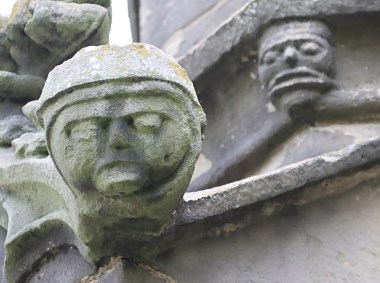
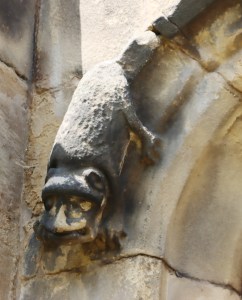
 The gargoyles and grotesques on the exterior at All Saints’ in Gresford are carved a mix of forms and sizes, and date to when the church was re-designed and given two new side aisles in the 1400s. Some of the grotesques look down from the roof and tower, a lot are arranged in a line above a string course just beneath the roof of the side aisles, whilst others sit on finial bases or above window corbels, much nearer to the observer, and perhaps most threatening, although as the photo to the left shows, not all of the carvings were fearsome monsters; some were unalarming representations of human faces. I have photographed all those that can be seen from ground level, some rather more successfully than others, and as a corpus it is quite a remarkable collection of images. Only a small selection are shown here. They are delightful to the modern eye, perhaps rather less so to the late Medieval church-goer.
——–
—–





There are more photographs, high quality images taken at the level of the gargoyles and grotesques, on the Images tab of the All Saints’s page on the Coflein website, together with images of statues amongst the pinnacles. See more too on the Archives page. Some of them provide an excellent overview of the imagery that exists at roof level.
Sources:
Camille, Michael 2019 (2nd edition). Image on the Edge. The Margins of Medieval Art. Reaktion Books.
Fudgé, Thomas, 2016. Medieval Religion and its Anxieties. History and Mystery in the Other Middle Ages. Palgrave Macmillan
Woodcock, Alex, 2011. Gargoyles and Grotesques. Shire Publications

 Based in Churton