
Part 3: What we know about Bryn yr Ellyllon (and the Mold Cape)

Detail of the Mold Cape showing not only the embossed decorative themes, resembling beads, but also the holes at the top, by means of which a textile garment and/or reinforcing copper pieces could have been attached.
In Part 1 of this four part series, the early Bronze Age sites of Bryn y Ffynon (Brymbo) and Bryn yr Ellyllon (Mold) were introduced, the circumstances of their discovery described, and the two graves were set in the context of some of the early Bronze Age sites in northeast Wales. Part 2 discussed the Bryn y Ffynon (Hill of the Well) burial, probably better known as the grave of “Brymbo Man,” one of the star exhibits in the Wrexham County Borough Museum.
This third post follows a very similar format to part 2, and takes a detailed look at Bryn yr Ellyllon, sometimes referred to as “the gold barrow,” a grave that as well as the Mold Cape produced remains of what is thought to have been a second cape, as well as around 300 amber beads, some interesting bronze and copper objects and some traces of textile.
Unlike Bryn y Ffynnon at Brymbo, where some of the skeletal remains are preserved and provide important information about the individual and the burial rituals, the remains of the individual found under the big cairn at Bryn yr Ellyllon (Hill of the Goblins/Sprites/Ghosts) just outside Mold in the Alyn valley, were disposed of at the time of the grave’s discovery. This means that nearly all the focus is on the limited information available from the grave’s construction and, more helpfully, what the accompanying artefacts may reveal if they are to be considered in terms of knowledge rather than art.

Approximate location of Bryn yr Ellyllon just outside Mold, and just off the A541 to Chester (now no longer extant). Source: Coflein (annotated)
This post is structured as follows:
- The grave, including both the primary and secondary burials
- The grave goods
- The skeleton
- Funerary rituals
- Dating
- Who was the owner of the Mold Cape? Was he or she important?
- How did the owner of the Mold Cape make a living?
- Final comments on Part 2
The bibliographic sources for all four parts can be found at the end of Part 1.
The cairn, the primary grave and the secondary burial

Source: Frances Lynch 2003, table 3, p.28
The original the site of Bryn yr Ellyllon is in a field behind a row of houses just outside Mold and just off the A541. The river Alyn runs only a short walk away, at the end of the field. The cist (burial chamber) was concealed beneath a stone cairn (circular mound of stones), revealed when the stones of the cairn were removed for use as raw material to fill in a hole at the side of the road. A geophysical survey carried out in 2013 may have identified the original site of the cairn, suggesting that it was around 25m in diameter. The cairn was quite a large one, but according to Frances Lynch’s summary of cairns and barrows in the Flintshire and Wrexham areas (see table right), it is by no means the largest. Nothing is known about how the cairn was built. It is worth noting that the nearby and broadly contemporary Llong barrow was not merely thrown together but constructed in deliberate layers, and may have been expanded over time, subsequent to the initial burial. A sense of design is a frequent feature of the cairns and barrows built over cists, but the data here has been lost.
Unlike Bryn y Ffynnon at Brymbo, where any burial mound failed to survive, the Bryn yr Ellyllon site near Mold was marked by a burial cairn that performed the role of a conspicuous visual prompt, a device that connected the living, the dead and the landscape. The importance of this visual device was ongoing, as demonstrated by the later, secondary cremation burial also deposited in the cairn. Throughout northeast Wales and other regions, the sheer number of these sites suggest that it was important to broadcast ideas that were widely understood, perhaps in connection with both ancestry and territory.
Underneath the cairn it is thought that there was almost certainly a stone-lined cist, what landowner John Langford referred to as a “rough vault,” which contained the burial. This excerpt from John Gage’s 1835 report explains the doubts about the exact nature of the discovery:
I think, from the details set forth by Mr. Clough as to the state in which the things were found, that the chief deposit must have been protected from crushing weight. Is it not therefore natural to suppose that some of the large stones were so disposed that they formed something of a rude cistvaen, such as is frequently found in carns (sic), and that the labourers employed in levelling the mound, being unconscious of what they were about, did not remark it?
A rarely mentioned secondary burial appears to have been made within the cairn itself. The secondary burial is described as being two to three yards (6-9ft / 1.8 – 2.7m) “from the spot where he [the primary burial] lay.” As well as the distance from the cist within what is thought to have been a 25m diameter cairn (which puts it well within the cairn’s diameter), another reason for thinking that this urn burial was deposited in the same cairn is Reverend Clough’s comment that “examples of cremation and inhumation of human bodies are sometimes met within the same barrow,” implying that in this case too, both of the burials were contained within the same cairn.

To provide some sense of how cairns and barrows could have complex use-histories, this plan shows Barrow 1 at Trelystan, Powys, with its total of 6 burials in addition to the initial central inhumation (without grave goods). Source: Neal Johnson 2017, p.131, figure 90 (bibliography is in part 1)
In the Early Bronze Age, the re-use of a cairn for additional burials within the cairn itself is an important component of its use-history, and a common feature of Early Bronze Age cairns and barrows (see Trelystan Barrow 1, left). The second burial consisted of an urn, broken to pieces by the workmen, “and more than a wheelbarrow full of the remnants of burnt bones and ashes with it” (Gage 1835). The bones were identified at the time of the discovery as human by an experienced local surgeon. A general understanding of the term “urn” at the time included large and distinctively shaped vessels found in later Early Bronze Age and earlier Middle Bronze Age cremation burials, containing the cremated remains. The burnt wood was described as “like a sponge,” which “when pressed, discharged a black fluid”. As above, re-use may have been connected with ancestry, or with the continued importance of monuments as indicators of land-holdings. It is not known how many individuals were represented by this cremation.
The grave goods in the main burial
Confining comments to the primary burial in the cist, rather than the secondary urn cremation burial, the individual buried in the grave was accompanied by some spectacular grave goods, the famous gold cape, some additional gold pieces that may have been part of a second cape, around 300 amber beads, some bronze fragments and some fragments of textile.
Objects were not necessarily seen as passive by those that buried them, but as something containing meaning both individually and as an assemblage of artefacts by virtue of their links to the living. Often these links will have been positive, linking the deceased to the landscape and the multi-layered experiences of living. If, on the other hand, the meaning came to be perceived as dangerous or inappropriate, imbuing objects with a certain spiritual energy, then certain objects may have been seen as better off laid to rest with the dead, allowing new identities and ideas to emerge. Either scenario, as well as many others, is possible here.
The capes
When you see the Mold Cape at the British Museum or in photographs, you are looking at the outcome of tenacious conservation and restoration work. The cape was found in pieces of feather-thin crushed gold. On discovery, the landowner and the workmen divided it amongst themselves. The gold turned out to represent two objects. The first turned out to be an item of clothing, rather like a short, tight-fitting poncho, that was made from a single sheet of gold, beaten out from a golf-ball sized ingot, and punched with repeating motifs that appear, at first glance, to be thousands of gold beads of different shapes and sizes, all of which looked like multiple strings of necklaces. This is a sophisticated form of skeuomorph (an item made in one material to look like an item made in another material). Skeuomorphs often capture in a new form an older craft (for example basket designs on pottery) or an expensive object captured in a less costly material (for example pottery vessels imitating stone vessels). In this case, however, one of the most elite materials, gold, was used to capture and evoke the essence of other elite materials that made up bead necklaces (such as amber, jet, and even faience). It is an extraordinary piece of display.

The cape with holes in the top and bottom pointed out.
When the cist was uncovered, the finders made references to textile, “a coarse cloth or serge” or “braiding,” to which the cape could have been attached via the holes in top and bottom to make a much more complex garment than we see today, perhaps full-length. It has been suggested that the cape could have been lined with either leather or textile: “properly speaking, it is an ornament that was attached to the body garment beneath by means of holes pierced through the edges” (John Gage, 1835).
The extreme thinness of the gold represents an attempt to make this valuable material go as far as possible, and may have been reinforced with copper or bronze in key places to help it to maintain its shape. Reverend Clough observed that there were pieces of copper in the grave, “upon which the gold had been rivetted with small nails, and which had served as a stiffening or inner case of the armour.” This fragility means that the cape would probably have been used only for special occasions. Its design would have confined the upper arms to the side of the body, allowing only the lower arms to move. This again argues that it could only realistically have been used for special occasions, because the activities in which the wearer could participate would have been minimal. The British Museum’s Neil MacGregor likens the craftsman who made the cape to a Cartier or Tiffany, a world-class artisan, designer and producer of luxury goods.

The pieces of what are thought to have been a second cape, showing a different punched design. Source: British Museum
Pieces of gold sheet that were not part of the cape were also found, featuring a different, simpler punched pattern, and it is thought that these may have been part of another cape. Stuart Needham’s reconstruction above shows how one of these pieces might have been incorporated into a cape design. There is no suggestion that other parts of the cape would have been present in the grave to make up a second entire cape; they clearly were not. Recent studies of other incomplete objects in Early Bronze Age graves, particularly jet necklaces and ceramics, have led to suggestions that objects could be split between the worlds of living and dead, functioning in each case as heirlooms. This is discussed further in Part 4.

Other gold pieces belonging to one or other of the capes, as well as the only surviving amber bead. Source: British Museum
The gold in the main cape weighs 700g /1 1/2 lbs, which makes it the heaviest single gold object in Early Bronze Age Britain. The gold may have been mined and saved, or objects already in existence may have been melted down for recycling into the cape. Gold was found in rivers and streams in Wales and Ireland, but to collect this amount would have taken a considerable amount of time. Archaeologist and metallurgy specialist Stuart Needham attempted to locate the source of the gold employed in the the Mold cape. A potential location is the Afon Trystion and its tributary Nant-y-lladron in the Berwyn Hills, which produced low yields of panned alluvial gold. The highest concentration of panned gold was near the headwaters of the Nant-y-lladron, not far from a cluster of sites at Moel Ty-uchaf. In spite of the low yields, which may have been due to the exhaustion of the gold in prehistory, this remains the most probable source at the moment.
The beads
It is thought that around 300 amber beads were discovered when the grave was uncovered. Only one of those beads survives, and is now in the British Museum. Jewellery became more common in prehistoric graves during the Early Bronze Age, and bead necklaces made of different materials were popular in richer graves. Exotic materials became very desirable, including gold, jet and amber.

The only remaining bead, out of around 300, of a necklace of amber beads. British Museum 1852,0615.1. Source: British Museum
Amber has specific properties, apart from its colour and translucency, that were almost certainly of particular interest to those who assembled and worked into wearable ornaments. Although it looks hard, it is quite soft and easily worked. According to the Getty Museum:
It has a melting-point range of 200 to 380°C, but it tends to burn rather than melt. Amber is amorphous in structure and, if broken, can produce a conchoidal, or shell-like, fracture. It is a poor conductor and thus feels warm to the touch in the cold, and cool in the heat. When friction is applied, amber becomes negatively charged and attracts lightweight particles such as pieces of straw, fluff, or dried leaves. Its ability to produce static electricity has fascinated observers from the earliest times . . . . As a result of the action of oxygen upon the organic material, amber will darken: a clear piece will become yellow; a honey-colored piece will become red, orange-red, or red-brown, and the surface progressively will become more opaque.
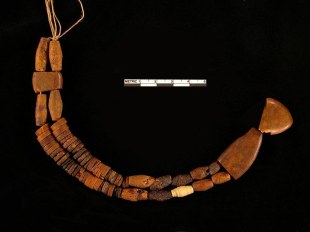
Photograph of amber beads from Shaw Cairn, Mellor (Stockport, Greater Manchester), which show spacer beads, dividing the necklace into two strings, and showing how the necklace could be fastened at the back. This stringing of the necklace does not claim to show how it would have looked in prehistory. Source (and more details about the site and the necklace): Mellor Archaeological Trust
It is not known whether the number of beads originally found were the total number that made up the original necklace, or if the original necklace consisted only of beads. Early Bronze Age amber and jet necklaces often included beads of other shape. Strings were often divided by spacer plates and had devices to connect both ends at the back of the neck. Although the necklace shown left, from Shaw Cairn in Greater Manchester, does not claim to represent the original arrangement of the beads found in that grave, it does show some of the usual features of an amber necklace, including the spacer plates, which in this case divided the necklace into two strings. The approximately 300 Bryn yr Ellyllon amber beads might originally have been strung into rather more strands, not unlike the arrangement of the Llong jet necklace shown further below. The lack of spacer plates and end-piece may suggest that like the pieces of a possible second cape, the Bryn yr Ellyllon beads represent only part of another necklace, and that both parts, one remaining in the world of the living to be supplemented by new beads, the other in the world of the dead, each taking on an individual role.
The nearest source of amber was the Baltic, although it may have been available along the east coast of England too, brought from the Baltic by the ice sheets of the previous glaciation, from where it eroded out of coastal cliff faces on to beaches below. Like the cape itself, its burial in the grave withdrew it from the world of the living, confining it to the realm of the dead. The amber would have looked sensational, particularly under sunshine or firelight. Whether imported from the Baltic or the east coast of England, amber can be classified as a luxury good.
The bronze fragments

Bronze pieces from Bryn yr Ellyllon. Source: British Museum
The sixteen bronze fragments form another partial jigsaw. Bronze, an alloy of tin and copper, was almost never used for the manufacture of jewellery during the Early Bronze Age, and these are more likely to be knives or similar hand-held weapons or tools. As already mentioned, Clough also surmised that some pieces of copper nailed to bits of gold may have helped to reinforce the flimsy cape.
The copper required to manufacture the bronze was sourced from the Great Orme, the most important copper mine in Wales, and is thought to have been the largest copper mine in northwest Europe from 1800-1600 BC. although estimates vary, its vital statistics are always remarkable. In the 1990s, Andrew Lewis estimated that 12,600 tons were excavated from the tunnels and 28,000 from the open cast mine. More tunnels have been found since then, so these estimates will have risen. To make bronze, a coper-tin alloy, copper was combined with tin, all of which came from southwest England, particularly Cornwall, and was traded to various parts of Europe as well as other parts of Britain. The dependency of bronze on both southwest English tin and northeast Wales copper, argues for some long-used routes along the coasts of west Wales and southwest England.

Copper alloy pieces from Bryn yr Ellyllon. Source: British Museum
The pieces of bronze were fragmented, but some are thought to have represented the business ends of tools or weapons. Bronze was only very rarely used for making ornaments. In the British Museum photograph above they have been arranged to show how at least one set of fragments could represent a curved blade. It is not known whether or not the objects were broken prior to their addition to the grave, or whether they represent either normal decay or rough handling when they were discovered. If they were blades, they may have been broken deliberately prior to deposition.
It has also been suggested that some of these bronze fragments may have formed a reinforcing backing for the gold.
Other objects?
The metal and amber objects were taken from the grave by the workmen, but what about any other grave goods? Apart from the known but lost skeletal remains, pieces of gold (some of which were taken away at the time and made into rings and breast pins), and some textiles remnants, there is no record of anything else in the grave. Although there is no way of knowing for sure, it is entirely possible that objects that would have been archaeologically valuable but would have seemed mundane to the Victorian discoverers, such as stone tools and pieces of pottery, may have been disposed of in the same rough and ready way as the skeleton. It is clear that in the Early Bronze Age, burials were often accompanied by partial objects as well as whole ones, and this type of fragmentary data, such as pottery sherds, may have been rejected by the grave’s finders.

An example of Early Bronze Age textile from Over Barrow, Cambridgeshire. Source: Cambridgeshire Archaeology Unit, via Current Archaeology magazine
The loss of the perishable textile remains is particularly agonizing, partly because perishable items in British prehistory are so rare. Linda Hurcombe refers to this lost dataset as “the missing majority” because the greater percentage of objects and domestic building materials in prehistoric Britain would have been perishable. The textile would have added invaluable knowledge not just on Bryn yr Ellyllon but on the subject of both textile manufacture and ceremonial garments in general. It is difficult to imagine that any garment that was attached to the cape would have been anything other than remarkable. Only one of the few known textile items from Britain was made of cow hair; the rest were made of plant materials, including wild nettle fibre, which produces a soft and silky texture, and cultivated flax, which produces linen.
Nothing can be done with these thoughts, except to acknowledge that the manner in which the site was discovered may have left us without other objects that could have contributed additional knowledge. With all sites we are dealing with partial information, but this is particularly worth bearing in mind for sites that were plundered rather than excavated, like Bryn yr Ellyllon.
The skeleton
A skeleton was found in the grave under the cairn in 1833, described by the landowner who saw it as “the bones of a man,” although he cannot possibly have known whether the bones represented male or female remains, the description suggests components of a recognizable skeleton, even if only the skull and a few additional bones. Reverend Clough describes how the cape
contained within it a considerable number of small bones, vertebrae etc, but none of them longer than from two to three inches. The scull [sic], of no unusual size, lay at the upper end, but no bones of the extremities were noticed.
The skeletal remains were disposed of at the time, potentially meaning that an enormous amount of information has been lost. The British Museum apparently holds “small fragments of skull remaining after laboratory analysis” (museum number 1881,0516.2). Whether this refers to the skeleton associated with the cape, or the second burial found nearby is not stated, but it is implied by the entry for the skull fragments on the Museum’s database, which describes the cape rather than the bones. There is no indication of what the “laboratory analysis” may have been.
The questions that remain unanswered include: whether the skeleton was male or female; whether there were any congenital defects; if he or she had experienced any injuries or illnesses during life; how old the person was at the time of death; the cause of death; or how well-built or tall he or she was. There is also no possibility of any scientific analysis of the sort potentially available for Brymbo Man, such as radiocarbon dating, DNA testing or oxygen isotope analysis.

The cape being positioned on a woman to demonstrate how it would have looked on someone of her size, male or female, and demonstrating how the upper arms would have been pinned down, leaving only the lower arms free to move. Source: British Museum
The only remaining clue about the physical character and appearance of the owner of the cape is the cape itself. It was small (18ins/46.5cm wide x 9ins/23.5cm high) and could not have been worn by someone of, for example, Brymbo Man’s stature. Instead, it must have been worn by a woman, a teenager or a man who was small in stature and build. In an era where the average age of death was much younger than today and children were expected to participate in work (as demonstrated by some of the tunnels at the Bronze Age Great Orme copper mine, into which only a child could fit) a teenager, male or female, was likely to be a fully functional member of society.
We know that there was a secondary burial within the cairn in the form of a burial urn containing a cremation, but what about the possibility of other less obviously identifiable burials within the cairn?
Funerary rituals

A snapshot from the Geophysical survey report, showing a summary interpretation of major features. Source: Tim Young, 2013
Reverend Clough noted that whatever remained of the human bones, there were no signs of fire. He suggests that because no extremities of the skeleton were observed where they would have been expected, “the figure had been doubled up.” These are the only statements that Clough makes on the subject but both are consistent with an Early Bronze Age crouched inhumation. The inability to analyze the bones means that it is not known whether the body was laid facing east or west; how the bones were arranged in the grave; whether any bones had been excluded or deliberately removed at a later date; whether the bones were arranged in a particular way; how the artefacts were positioned in relation to the body; and whether there was any ritual treatment of the bones like excarnation or de-fleshing (such as in the case of the Brymbo burial).
It is certain that the deposition of such a remarkable collection of grave goods with the dead was accompanied by formal ceremonies in which both the person and the objects were transitioned from the world of the living into the world of the dead. Many of the activities connected with this transition could well have place elsewhere, with only the final stages taking place at the cairn itself, and this itself may have been subject to various spiritually inspired activities to prepare it for its role.
The first task, other than any ceremonies to prepare the ground, would have been to source the slabs making up base, sides and capstone (stone lid) or other form of lid of the cist (stone chamber), and dig the hole that these stones were to line. The dead person could then be laid to rest. In the Early Bronze Age the body would be typically crouched, with knees to chest, laid on his or her side. The dead may have been clothed or covered, but the perishability of textiles means that this remains speculation. Grave goods could then be deposited with the dead, before the grave was covered with a lid, if used. If a lid was used, this was probably wood or another perishable material, because there is no record of it in any of the contemporary documents. The cairn could then be built over the top, often to a particular plan with layers distinguished within the construction. Each one of these steps, including layering the cairn, could have been accompanied with activities to mark each stage of the transition. When the cairn was finished, and was a feature of the landscape, it would have stood out as a new element in the landscape for some time before becoming integrated into human memory as a component of the landscape of the past and present.
Early Bronze Age grave goods vary from grave to grave, but it would be idle to deny that those in Bryn yr Ellyllon were anything other than remarkable. Even today, the surviving metalwork yells wealth, luxury and status, particularly as it was taken out of social and economic circulation by being deposited in the ground with the dead. Once buried, and not retrieved, these goods could not be inherited, gifted or traded, or even melted down and re-used. This magnificent collection was lost forever to the living, confined to the realm of the dead. The burial of such a magnificent and rare piece was a statement, an important ceremonial act, and probably incorporated a series of ritual activities, themselves tools of transition.
Dating
Although bone did survive in the cairn the majority of organic remains were disposed of at the time. The British Museum records having a piece of skull in its collection (museum number 1881,0516.2), but although I have been unable to find out anything about it, it appears to have been the only survivor, and this was clearly not used for radiocarbon dating (which requires partial sacrifice of the sample). Instead, a date range of 1900-1600 BC has been proposed for the site by Stuart Needham, based on comparison with objects at other sites that have more secure dating material. In spite of the embossed decoration on the cape, which might suggest a later date, the presence of jet, amber and the composition of the gold itself, as well as the organization of the burial, suggest an earlier date, perhaps in the final Early Bronze Age. This date, however, is not secure and could be modified by the discovery of comparable sites that might also produce more secure radiocarbon dates that could help assign a more directly comparable time-range.
Who was the owner of the Mold Cape? Was she/he important?
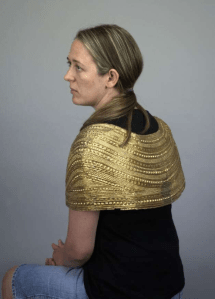
The cape being modelled, showing how upper arm movement would have been restricted. Source: British Museum
The short answer is certainly yes. The loss of anyone in a tight-knit community would have been a blow to a community where each individual was an important contributor to health, wealth, communal knowledge and well-being. However, the discovery of something so beautiful and luxurious as the cape has led to a lot of speculation about who or what its owner may have been. Leadership roles, both secular (chief/prince/king) and religious (priest), have been proposed. In each case the cape and other objects were suggested as the prehistoric equivalent of symbols of power or badges of office. The burial of Queen Elizabeth II is a good example of how a community might mark the transition from living to dead of an individual representing a prominent hierarchical position. Does the deposition of the Bryn yr Ellyllon capes, beads and bronze items represent a comparable situation, suggesting that the relationship between the person and the capes was so fundamental that the two could not be separated in death? Was each so bound up in the identity of the other that the capes and other goods could not be inherited by, or transferred to another person in the community?
Although these ideas of individual importance and hierarchical significance are entirely plausible, emphasising the role of the individual in an important role in a way very that equates to ways in which European society is arranged with political, social and religious leaders this may be an over-simplification based on modern experiences and expectations of monarchies, political entities and religious authorities. Not all societies, however, particularly small communities, are organized along the same lines, particularly when there is an enormous amount of inter-dependence of skills and economic activities that are not centrally organized. As I suggested in Part 2, Early Bronze Age burials may have been about a lot more than a single person. Even when a single individual takes up the central cist, secondary burials may be made within the burial cairn, and the original individual may represent an anchor for ideas about territory, ancestry and memory. Again, in the case of Bryn yr Ellyllon, there is the question of why not only one cape but two are thought to have been represented.
Some items in history acquire a meaning and value all of their own which transcend the time-limited personality or role of any given individual. Instead, these items help to define their role in relation to others (people, social/religious structures and political institutions) and even to frame ideas about the future. Examples of such objects that transcend either an individual or a specific role but represent unity are the Olympic flame, the Remembrance Day poppy, or a national flag. Burying a symbol may say a lot about what was happening in the world at that time, and less about the specifics of who was lying there, particularly given that two capes suggest not just that more than a single identity was involved.

Detail of an ivory box lid, showing Tutankhamen receiving flowers from his wife Ankhesenamun. Source: Wikipedia
The relationship between a dead person, the objects and the living world are complex. An illustration of this sort of complexity is the burial of the Pharaoh Tutankhamen in Egypt, who was also interred with objects of great richness and beauty, including exotic items unavailable locally, most of which were artistically characteristic of the preceding heretical Amarna period, of which Tutankhamen was the last male descendent. Even though Tutankhamen renounced his father’s heretical ideas, the king was tainted with his family’s recent past. The grave in which the king was deposited in a wadi (dry valley) reserved for royal burials was not the ambitious grave that Tutankhamen had been building for himself; that was appropriated by one of the officials who buried the king. Instead, the tomb in which he was buried was small, incomplete, very poorly decorated and vastly inferior to those belonging both to his ancestors and those who ruled subsequently. The highly distinctive Amarna style items that accompanied him may have been deposited with the king to dispose of them for good. It is very probable that many of the hastily assembled goods jumbled in the tiny tomb were inserted by those who wished to dispose of the discordant memories of the Amarna period with more speed than dignity. What are to us things of invaluable beauty so characteristic of the Amarna period were seen at that time as representing everything that the new governing elite wished to eliminate from history.
This is a very specific example, but it serves to illustrate how even very rich burials may have any number of themes running through them. Colin Harris and Adam Kaiser, for example, proposed in 2020 that some particularly rich burials may represent a form of conflict resolution, and offer a persuasive discussion, using Viking data as a test case.
Although it cannot be ruled out that the Bryn yr Ellyllon burial was of an important individual who had the cape made for herself or himself, it is by no means the only answer when the burying is done not by the dead but by the living according to criteria that has as much to do with the ideas incorporated in the objects themselves and their role in the community as a whole, of whom the dead might continue to be, or not continue to be a representative.
How did the owner of the Mold Cape make a living?

The Llong Necklace (a speculative recreation of the original design). Source: Curious Clwyd
Bryn yr Ellyllon was not the only site near Mold that produced exotic (non-local) and ornamental items. The nearby Llong grave near Bryn yr Ellyllon, where a multi-stranded necklace was found, this time made of jet (and some shale), contribute to the impression that this was an area where people could leverage their own resources to purchase luxury goods, and there may have been many aspects to their economic life to build such purchasing power.
Unlike Bryn y Ffynnon in Brymbo, which was on a hillside overlooking the valley of the river Alyn, Bryn yr Ellyllon sat in the river valley itself. This was a potentially good place for agrarian activity, but was also in easy reach of uplands that would have been ideal for livestock grazing. However, the investment in the cape, both in terms of acquisition of gold and particularly the specialized skill needed to work it argue that this was a high value item, and was the product of something other than localized farming activities. Similarly, the means to assemble 300 amber beads that were not available locally argues for considerable influence and resources that would enable negotiations to take place in trading transactions.
Looking around for a possible source of unusual wealth, the most obvious candidate to strike most writers is the Great Orme copper mining industry, and the networks that connected that industry to the world beyond north Wales. The copper mines were 40 miles (64km away), so not on the doorstep, which requires some form of explanation, but if the inhabitants of this area of the Alyn valley were also involved in agrarian and livestock management activities, aspects of both sedentism and mobility could have been incorporated into livelihoods that also included longer distance links.
Final Comments on Part 3
Both Bryn y Ffynnon (Brymbo) and Bryn yr Ellyllon have produced some unusual objects in association with primary cist burials in northeast Wales. These are not typical of the greater majority of sites in northeast Wales, but both serve to illustrate how disparate datasets offer different insights into the past. Without a skeleton, the cape still gives a sense of the dimensions of the wearer, but many other details have been lost. The objects themselves are so unusual that it is difficult to fit them into a general pattern of livelihoods and activities in northeast Wales, but they do represent substantially specialized skills and the ability to source unusual raw materials, both of which argue the ability of the community to accumulate a form of wealth. There are more questions than answers regarding the site, but although it appears to stand out, it must still be understood in the wider context of the Early Bronze Age of northeast Wales, which will be discussed further in Part 4 (upcoming).
Perhaps the biggest lesson of Bryn yr Ellyllon is that there are many reasons why rich objects may be buried in graves, and these are not all to do with the importance of an individual as a chief or priest, or other specific role. It is risky to draw conclusions of this sort, when there are many other possible explanations to consider.
The second important point that this site highlights is the importance of publication of any excavation activity. Excavation is by definition destructive, and what remains for posterity is the record of that excavation, which must be published in order to become available to researchers. Whereas Bryn y Ffynnon was subject to excavation by the National Museum of Wales, and published only a few years later in 1946, Bryn yr Ellyllon was ransacked in the early 1800s, not excavated. It it is only thanks to the Reverend Clough taking an interest that many of the grave goods were rescued, and to John Gage’s letter to Sir Henry Ellis, that we know what we do.
In the next and final part, part 4, some of the various strands are brought together, which discusses the sites in terms of key themes of the Early Bronze Age, and provides details of the museums where the objects from the two sites can be visited.
 Based in Churton
