
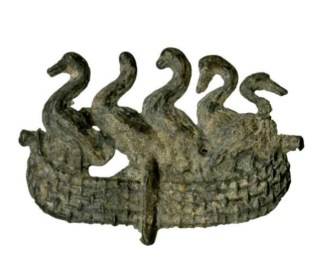
St Werburgh pilgrim badge, possibly 14th century, cast in lead alloy, purchased by the British Museum from a London dealer in curiosities, medals and coins. British Museum 1836,0610.73
Had you been a pilgrim in the middle ages, undertaking a journey to Chester to visit the miracle-performing shrine of St Werburgh, you might have been tempted to buy yourself a pilgrim’s badge to commemorate a job well done and to communicate your achievement to others. Most importantly, however, you would have had the opportunity to touch that badge to the saint’s shrine in order to absorb some of the saint’s divine power into the badge itself. That’s what you are looking at on the left – a pilgrim’s badge associated with the Abbey of St Werburgh, which would have been sold to pilgrims either as they arrived, or as they left via the gift shop. Badges like this were associated with many of the major shrines and could be added to an existing personal collection, representing the piety implied by many pilgrimages.
When I first came to live in the Chester area, just a couple of years ago, I knew the name St Werburgh and recognized that it was Anglo-Saxon, but it was a surprise to realize that she was a female saint, and that there was a pilgrim shrine dedicated to her in the former abbey (now the cathedral). Nor did I know that the pilgrims who came to visit the abbey might purchase a badge as a token of their visit, a pious badge of honour, sometimes the signal of the many discomforts or difficulties that had been overcome to enable a pilgrimage to be successfully completed.

Chester Cathedral, formerly St Werburgh’s Benedictine Abbey, from the east. Photograph by Stephen Hamilton.
What I particularly like about pilgrim badges is that there are so many threads to the story. An anonymous pilgrim once owned the above token of his or her journey to the shrine, now in the British Museum (albeit not on display). The British Museum purchased it in 1836 from a dealer in medals and coins called Harry Cureton. The story of this particular badge between the time of its manufacture to its purchase by a dealer before being accessioned into the British Museum’s collections is lost, but its story is embedded in other, much older histories, including the actions of the Anglo-Saxon queen who moved that saint from Staffordshire to Chester in the 10th century, and the subsequent centuries of pilgrim visits to the abbey to experience St Werburgh for themselves.
So who was the Anglo-Saxon saint, where was she from, why did she become central to Benedictine worship in Chester after her death, what is the geese-in-a-basket pilgrim badge all about, and what role did the shrine of St Werburgh play in the economic life of Chester’s abbey?
- St Werburgh and her family
- St Werburgh’s posthumous arrival in Chester
- St Werburgh in the Benedictine monastery of 1093
- The miracles of St Werburgh at the monastery
- The 14th century shrine
- Pilgrims to the shrine in the later Middle Ages – a nice little earner
- How pilgrim badges were made, sold, worn and used
- The Dissolution and subsequent events
- The shrine in the 19th century
- From Harry Cureton to the British Museum
- Final Comments
- Videos
- Sources
St Werburgh and her family
Werburgh was born a Mercian princess in around AD650. Her father was Wulfhere, king of Mercia and her mother Ermengild, who became a nun on the death of Wulfhere, first at Minster-in-Sheppey and then at Ely, where she succeeded her mother Seaxburgh as abbess. Werburgh was educated at home by Chad, who became Bishop of Lichfield. Although St Werburgh is depicted in a couple of the stained glass windows in the cathedral, these are modern, romanticized visualizations. There are no contemporary depictions, and apart from having an idea of what she may have worn, her appearance is unknown. Medieval accounts of her life probably incorporate older material, and almost certainly include quite a bit of myth and conjecture.

Saint Æthelreda of Ely from the 10th century Benedictional of St. Æthelwold, illuminated manuscript in the British Library. Source: Wikipedia
On the death of her father, Werburgh went as a nun to the convent of Ely founded by her great aunt Æthereda (also known as Æthelthryth), who became its abbess. St Æthelreda was the daughter of Anna, king of East Anglia, sister of Seaxburgh and the virgin wife of Egfrith, the king of Northumbria. Werburgh’s father was succeeded by his brother Æthelred, Werburgh’s uncle, who eventually asked Werburgh to take charge of and organize nunneries in the Midlands, including Weedon in Northamptonshire, Hanbury in Staffordshire and Threckingham in Lincolnshire (or alternatively Trentham in Staffordshire). She was so pure and good that she could hang her veil on a sunbeam. She died at Threckingham / Trentham in around 700, and was buried at Hanbury, at her own request. Unfortunately, the nuns at Threckingham were unwilling to release the remains, and a delegation was sent from Hanbury to retrieve her.
Saints were not canonized by the papacy until the 12th century, but had to be verified by bishops. The miracle that caused Werburgh to be recognized as a saint was an unusual one. Although there are a number of versions of the story, the differences are minor. One version says that St Werburgh had enjoyed watching a visiting flock of geese in a neighbouring meadow of the convent in which she was staying. One of them was particularly large and had a black ring of feathers around his neck. She became fond of him and called him Grayking. The convent steward, Hugh, had also noticed Grayking but his interest had little to do with aesthetically pleasing plumage. Angry with the geese for devastating his field of corn, Hugh soon had Grayking in the pot. One version says that Werburgh was away when this happened, and when she returned the remaining geese formed a delegation to inform her of the event and ask for her help. Werbugh acted immediately, ordering that the bones and feathers of the carcass should be gathered up. When she commanded the bones of the dead goose to rise again, they assembled themselves and Grayking was reborn.
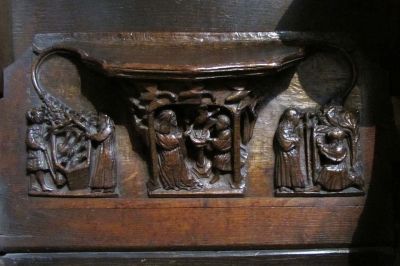
Late 14th century misericord in Chester Cathedral showing St Werburgh performing miracles. Photo by Stephen Hamilton. Source: Wikipedia
Dr Thomas Pickles (Senior Lecturer, Medieval History) recounts a slightly different version of the story in the video at the end of the post. He goes on to discuss why other similar stories in across Europe may have developed in response to sacrifices at the time of harvests, which may have became Christianized via labourers who worked the land belonging to religious organizations, giving the St Werburgh miracle story wider relevance.
Nine years after her burial, St Werburgh’s nephew Coelred, now King of Mercia, decided to move the saint to a less modest tomb in Hanbury. When she was removed from her coffin she was found to be “in whole and perfect form,” a certain mark of sainthood.
St Werburgh’s posthumous arrival in Chester

A 13th century imaginative representation of Æthelflæd. Source: Medieval Manuscripts blog
St Werburgh never visited Chester during her lifetime, and her arrival in the Anglo-Saxon burh (fortified settlement) in around 907, over 200 years after her death, requires another thread of history that starts, for the practical purposes of this post, with Alfred the Great, King of Wessex (848 – 899AD). Alfred’s daughter was the princess Æthelflæd who, at the age of around 15, was married for political reasons to Æthelred, king of Mercia. Æthelflæd grew up in a time of disruption and war, during the Viking incursions, and the associated competition for territory. She was also familiar with the arts of diplomacy and negotiation. She was well suited for the role of queen of Mercia. Although subordinate to her husband, with duties and responsibilities, she also had rights, privileges and a position of respect that she clearly built on, being recognized as partner to her husband in many of their joint enterprises, including the establishment of new burghs at Worcester and Gloucester, whilst improving existing towns such as Hereford and Winchcombe.
Æthelflæd’s father, Alfred the Great, died on 26th October 899, and was succeeded as King of Wessex by his eldest son, Edward the Elder, brother of Æthelflæd. Edward was forced to fight off a counter claim from his cousin Æthelwold. He was triumphant but was forced to address the situation again in 902 when Æthelwold unsuccessfully mounted another campaign against Edward. In the same year Æthelflæd’s mother died, probably in St Mary’s Abbey in Winchester, which she had founded, and a threat was made to the northwestern territory of Mercia at Chester. It was only now, when the vulnerability of the old town threatened the security of the kingdom of Mercia that it drew attention from Æthelred and his Æthelflæd. In the last decade of his life Æthelred suffered a recurring illness, and he had succumbed to a bout of this affliction when Chester came under threat. Æthelflæd assumed authority during the crisis.
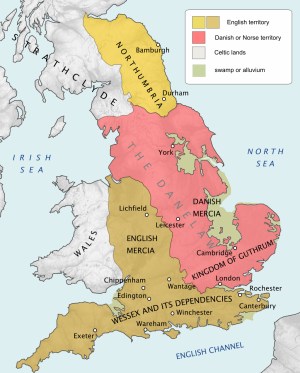
Kingdoms in England in AD878, by Hel-hama. Source: Wikipedia
In the 890s Chester was described in the Anglo-Saxon Charters as “a deserted city in Wirral.” It still had much of its Roman walls, but the interior was in ruins. Mercia had been a much larger and more powerful kingdom in its past, but the Viking (Scandinavian) invasions had taken control of the eastern reaches of the former kingdom. In the south, Wessex was the most powerful kingdom, whilst in the northeast the king of Northumbria still held land on the east half of the island, extending well into present-day Scotland. The Dane-controlled land ran down much of the east coast south of Northumbria, and there was a significant Scandinavian presence in Ireland.
It was from Ireland that the threat to Chester emerged. In 902 the Irish kings formed an alliance to rid themselves of the Vikings, capturing Norse Dublin and forcing many to leave as groups of refugees in need of new lands to colonize. One of these refugees was Ingimund, who lead one of these ousted groups onto Anglesey. Forcibly ejected by the Welsh, they followed the Dee inland towards Chester. According to one source, they requested a meeting with the Mercian royalty. With Æthelred still sick, Æthelflæd met with Ingimund who proposed a peaceful solution to the dilemma. Æthelflæd was pragmatically willing to negotiate a home for them on the north of the Wirral peninsula, perhaps believing that they might provide a protective buffer against other Viking interests seeking to find new territory to colonize. Here they could have lived in peace by farming and trading via the sea routes, but they had been settled for only a few years when Ingimund broke faith with Æthelflæd and began to amass troops. Hearing of the threat, Æthelflæd assembled forces of her ow within the Chester walls. The town was besieged but the Mercians emerged triumphant.
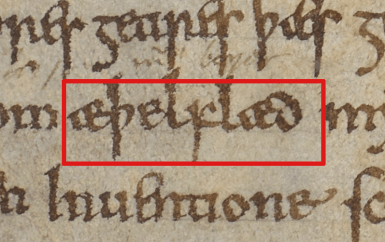
Æthelflaed’s name (spelled Æþelflæd), in the B-text of the Anglo-Saxon Chronicle: Cotton MS Tiberius A VI, f. 30r. Source: Medieval Manuscripts Blog
In 907 the Anglo-Saxon Charter says that Chester was “restored,” the work usually credited to Æthelflæd. With Æthelred temporarily restored to health, they couple established Chester as a new burgh within the 5m (16ft) tall walls encompassing an area of 26 hectares (65 acres). It was far bigger than their previous burhs, and represented a significant investment in the border town. At the same time, Æthelflæd took the decision to move the relics of St Werburgh from Hanbury to Chester. The timing was probably driven by the threat to the relics of St Werburgh at Hanbury by advancing Danish forces. This echoes Æthelflæd’s decision to move the relics of St Oswald from lands under Danish occupation, which took place under similar circumstances. The decision to move St Werburgh to Chester may have been motivated by the need to give Chester an authentic, stabilizing Christian focus with links back to a noble Mercian past. The creation of a prominent settlement in a vulnerable borderline position needed to attract people with the same features familiar from other towns.
According to St Weburgh monk Henry Bradshaw, writing in c.1513, but probably referencing much earlier sources, when the saint was removed to Chester, her body was found to be ‘resolued unto powder’, which was seen not in terms of decay or corruption of the remains, but as a divine miracle performed to protect the saint’s holy remains:
Lest the cruell gentils / and wiked myscreantes
With pollute handes full of corrupcion
Shulde touche her body / by indignation
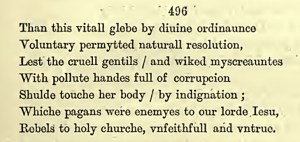
Excerpt from Henry Bradshaw’s “The Life of St Wereburge of Chester,” originally 1513, re-edited and published 1887
Although there is no incontrovertible data to support the presence of a church on the site of St Werburgh’s Abbey, there is a tradition that a wooden church dedicated to Saints Peter and Paul had been founded there by Æthelflæd’s father Wulfhere, King of Mercia, which would have housed her remains. This church would have been rededicated to St Werburgh when the saint became resident. Archaeological excavations produced pre-Norman building materials, but it is not possible to assign an early 10th century date to them. Wherever the church was located, the patronage of the queen ensured the initial success, and it received additional grants throughout the 10th century, including one from King Edgar in 958. In the 1086 Domesday survey records the monastery and its possessions, indicating that the Anglo-Saxon St Werburgh’s was upgraded from church to monastery sometime before that date.
In 911 Æthelred died of unknown causes probably related to his recurring illness. He was buried in Gloucester. Many previous royal widows of the period had retired to a convent to live out the rest of their lives. There was plenty of precedent in Æthelflæd’s own family for monastic service. One great aunt was the founder of Ely Abbey, another was the founder of Minster-in Sheppey abbey, and Æthelflæd’s own mother had retired on the death of Wulfhere to a nunnery, eventually becoming abbess of Ely. Æthelflæd, however, took the reigns of the Mercian government into her own hands, ruling as myrcna hlæfdige, Lady of the Mercians. The church-monastery of St Werburgh continued to house the saint’s remains, and seems to have survived the military action that took place in and around Chester following the Conquest.
St Werburgh in the Benedictine monastery of 1093

Coat of arms of Hugh d’Avranche. Source: Wikipedia
In 1093, only 27 years after the Norman Conquest, the abbey was refounded as an Anglo-Norman Benedictine abbey by the notorious knight and magnate Hugh d’Avranches, also known as Hugh Lupus. Hugh and been granted Chester as Earl by William I, and was one of the most powerful men in England. His appointment followed William I’s vengeful retaliation against Chester for two rebellions, which had left the city in disarray. Hugh’s task was to ensure that the city remained docile after William departed, serving the crown as the northenmost marcher town, a buffer zone between Wales and England, and an increasingly important commercial port.
There were many possible reasons for landowners to found monastic establishments, including convention (it was often seen as the duty of the nobility to promote religious houses), political maneovering, simple piety, and fear of the ever-approaching perils of the afterlife. Hugh’s decision to refound the abbey was probably two-fold. Whilst making a conspicuous contribution to a deeply resentful city for which he was now responsible, and in which he needed to maintain the peace, he was also looking after his own spiritual interests. He managed to secure one of the most high status bishops in the country, Anselm to come and supervise the project, and Anselm left his clerk Richard to become the first abbot. Hugh endowed his shiny new monastery with rich and prosperous lands to ensure its self-sufficiency. These were not merely charitable acts. Hugh Lupus, for example, was heading perilously towards the end of a far from virtuous life. John Hicklin, writing in 1852, gives an evocative summary of the situation:
Hugh Lupus, following the example of most of his predecessors, lived a life of the wildest luxury and rapine. At length, falling sick from the consequence of his excesses, and age and disease coming on, the old hardened soldier was struck with remorse; and—an expiation common enough in those days—the great Hugh Lupus took the cowl, retired in the last state of disease into the monastery, and in three days was no more.
By founding a monastery and committing himself to a brief period as a monk at the last possible moment, Hugh attempted to provide himself with some after-life insurance. The logic of this is somewhat difficult to compute today.

The curvilinear Romanesque remains of the abbey financed by Hugh Lupus, seen through a later gothic arch.
Monks were considered to be closer to Heaven than any other human on earth, and their prayers were thought to be heard with undiluted clarity by God. The idea of pleasing God by founding a monastery, and then reaching closer to Heaven by being buried within the monastic cloister seems suspiciously like inducement today, and one would have thought that God would have been wise to such manoeuvring. Given the sheer number of wealthy men and women founding abbeys and priories, however, this aspect of the matter does not appear to have occurred to them. Matters had became much more contractual during the 11th, when the idea of purgatory was taught in the church. This intermediate area between heaven and hell allowed redeemable sinners to suffer a hell-like experience to work off their crimes against Christianity before eventually entering Heaven. From this time onward, substantial efforts were made to negotiate for reduced time spent in purgatory, including the buying of “indulgences,” and gifts from the lower echelons to monasteries.
After the original endowment, the abbey continued to receive many properties over the centuries from wealthy local landowners, and smaller gifts in the wills of those who were not quite as well positioned, all attempting to win the good will of the monks, and through them, the divine. Those with less purchasing power would not anticipate having the same negotiating power, but every contribution might help. In the process of all this human fear and negotiations to minimize the inevitable punishments after death, monasteries became substantially wealthy, some of the richest landowners in the kingdom. Land was not, however, their only form of income. Not all monasteries were lucky enough to secure the bones, blood or hair of a saint that might attract pilgrims, but the abbey of St Werburgh still retained the bones of St Werburgh after its rebuild in 1093.
The miracles of St Werburgh at the abbey in Chester
Neither Goscelin de St-Bertin writing in the late 11th century, nor William of Malmesbury, writing in the 12th century were able to provide many details about the earlier miracles that St Werburgh was supposed to have performed at Chester, but William of Malmesbury has the following to say: “The merits of this virgin are proclaimed at Chester and her miracles extolled. Although she is promptly favourable to the petitions of all, she is especially quick to give heed to the prayers of women and children.” Her girdle, held by the abbey, was apparently particularly popular with pregnant women.

Basingwerk Abbey today
In 1500 a monk at St Werburgh’s Abbey wrote a life of St Werburgh in which he credits her with a miracle on behalf of Richard, Earl of Chester in around 1120. Richard made a pilgrimage to St Winifrede’s Well at Holywell in around 1120 but attacked by hostile Welsh men, he was forced to shelter at nearby Basingwerk Abbey. Before William, Constable of Chester, set forth to search for the earl, he prayed to St Werburgh, who parted the river Dee because no boat was available, permitting William and his men to walk across the river bed and rescue the earl. In another story, St Werburgh intervened during an unexpected Welsh attack on Chester. She blinded the attackers, forcing them to retreat. This military aspect to the saint is underlined by the tradition of taking the shrine on procession around the city when it was considered to be under threat, setting her down briefly on parts of the city walls.
In the 15th century the Welsh poets Maredudd ap Rhys and Guto’r Glyn called there, the one to pray to ease the pains in his legs, which was apparently a successful visit, and the other to pray for the alleviation of the ills of a friend.
The 14th century shrine

The reconstructed shrine of St Werburgh at the west end of the Lady Chapel in St Werburgh’s Cathedral, Chester. It was reassembled in the 19th Century from broken -up parts, and it is impossible to say how closely it resembles the original 14th century shrine. The warm lighting is as it would have been seen by candle-light.
Nearly 250 years after Hugh’s foundation, in around 1340 (just before the Black Death) a new red sandstone shrine was built for the saint, an elaborate gothic affair around 7ft (2.1m) tall, built to look like a chapel. The new shrine, on two levels, contained whatever remained of the relics in the upper layer, whilst the lower half was provided with niches into which pilgrims could fold themselves to get even closer to the spirituality of the saint. The top was decorated with statuettes for former Anglo-Saxon monarchs, most of whom are missing their heads today. Little carved animals formed a line around the middle, images of the natural world that were as much part of God’s creation as people. Today, the only one of these natural world carvings left is a tiny dog, scratching his ear with a hind leg. The shrine was also, in all likelihood, bedecked with elaborate precious stones, its architectural details finished in gold.
Although today it is located in the 13th century Lady Chapel, it was originally located in the easternmost bay of the presbytery, behind the high altar. The relics of the saint were encased very safely within the very top of the shrine, but the spiritual power of the bones themselves emanated from the relics, permeating the stone, so that touching the shrine was equivalent to touching the saint’s essence. This was a powerful concept, and a vibrant presence in the monastery. This substantial monument was a permanent fixture. There would be no carrying the shrine through the town in times of threat or stress.
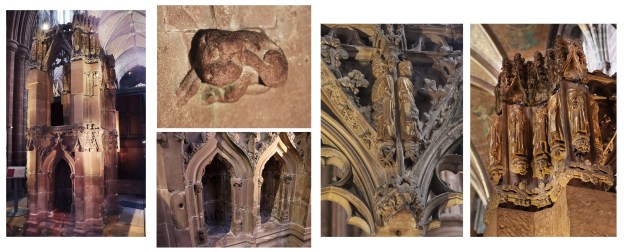
St Werburgh’s shrine showing the niches, the dog scratching it’s ear and gilded statuettes, some without their heads, of Anglo-Saxon kings. Click to enlarge
Pilgrims to the shrine in the later Middle Ages – a nice little earner
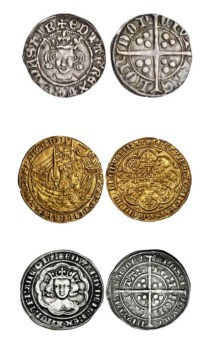
Mid 14th century coins. Source: Medieval Britain
Monks needed to make a living. Monastic communities became more expensive as the centuries rolled forward, as the trappings of seclusion and self-denial fell away towards the 16th century. Guests, who were not expected to pay for their upkeep, were always a drain on popular monastic establishments, and alms to the poor still had to be paid. Expenses too accrued from the management of extensive estates, including wages for bailiffs and labourers, repairs to buildings and boundaries, and the costs involved in agricultural production. Churches appropriated by the monastery for their incomes still involved costs, including the provision of an incumbent priest. St Werburgh’s was often involved in legal disputes with Chester citizens, and this too was costly. After the stricter earlier middle ages, standards began to slip in Benedictine monasteries. Abbots rolled out ambitious extension plans for the monastic church, and required larger and more luxurious quarters, which included spaces where VIP guests could be lavishly entertained, costly vanity projects that formed part of their legacy. Provisions became more luxurious and more expensive. The upkeep of a vast monastic architectural complex could be eye-watering, even without the occasional devastating fire or flood. Balancing the books was a constant headache for monastic establishments.

Cripples collecting healing oil at the shrine of St William of York, York Minster, North Choir Transept. Early 15th century. Source: The Becket Story (© Dean & Chapter York).
By the later middle ages, when imaginative ways of generating income were increasingly critical to monastic wellbeing, pilgrims were a great way of generating income. Pilgrimages were usually journeys of meaning, sometimes deeply spiritual and personal, characterized by any number of aspirations including cures for illnesses and defects, expressions of penitence, a wish to feel the presence of something holy, and the urge to give thanks for a prayer answered; but pilgrimages could also be timed to enjoy feasts, fairs and markets, and as such were not merely pious and spiritual, but could be a sociable and enjoyable liberation from the mundane. When pilgrims visited shrines, tombs and reliquaries to satisfy personal needs, the monastery expected pilgrims to show their gratitude to the saint and to Heaven by gifting a contribution to the monastic coffers in the form of “altarage.” This was usually money, but sometimes it took the form of valuable gifts.
Clusters of shrines were good news for everyone. Pilgrims to a particular shrine would frequently do the rounds of all the other major religious sites and shrines in the immediate area, as well as those further afield in the region, soaking up all the divinity available. In Chester itself, St Werburgh’s shrine was in competition with the miracle-performing Holy Rood (a sculpture of Christ on the cross) in St John’s the Baptist’s Church (next to the amphitheatre), which was reputed to include a piece of the true cross, reputed to have been found by Helen, the mother of the Emperor Constantine. It was installed in around 1250. Although St Werburgh became a secondary attraction after this date, the rood at St John’s was far better known and carried more weight because the power of the crucifix of Christ himself was rather more compelling to pilgrims than an Anglo-Saxon saint. It was to the Holy Rood of St John’s that Edward I took the nobility of Gwynedd men to swear fealty before himself and God.
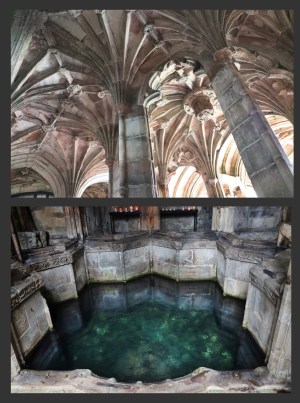
The glorious 15th century vaulting above the clear water of the inner reservoir of St Winifrede’s Well, Holywell.
Some shrines were more revered than others and had great pulling power, which could generate satisfying levels of income. The ownership of St Winifrede’s Well in Holywell (northeast Wales), for example, alternated between St Werburgh’s Abbey and Basingwerk Abbey just down the hill from the well, depending on whether the English or Welsh were in control of the area, and this represented a useful form of income for whichever abbey was in command of its resources. It is also probable that many of the pilgrims visiting Chester were en route to the Cathedral of St Asaph (Llanelwy), which contained the 6th century relics of the eponymous saint, renowned for his healing miracles, and St Winifrede’s sacred Well, enclosed by some superb gothic architecture. These were located 28 (45km) and 14 miles (22km) away from Chester respectively, and 16 miles (26km) from each other. The east-west pilgrim route between Holywell and St Asaph was well known by the later medieval period, making use of the Deva-Varis-Canovium-Segontium (Chester to Caernarfon) Roman road, which was crossed by Offa’s Dyke and took in the beautifully carved late 10th century Maen Achyfan cross, which still stands today. At St Winefrede’s Well, the nearby Cistercian monks of Basingwerk Abbey provided all the facilities that the pilgrims might need to make the most of the experience. The 7th century saint’s remains had actually been removed to Shrewsbury Abbey in 1138, but Holywell was the site of the miracle in which she died by beheading and was brought back to life, and was imbued with miraculous potency.
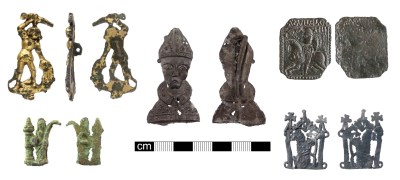
A selection of Medieval and post-Medieval pilgrim badges. Source: British Museum
Because pilgrims travelled to specific shrines, it is easy to think of pilgrimages exclusively in terms of destinations, but the act of making a pilgrimage was as much about the journey as the destination, and pilgrim routes could be both sociable experiences shared with like-minded individuals, and essential to the spiritual character of the undertaking. As pilgrim routes became fixed in the religious round, they became special places in the landscape, with identities of their own, and features that singled them out as part of the greater network of pilgrim experience.
Although St Werburgh’s Abbey would undoubtedly have preferred to be the most important of the local shrines, and would have done its best to attract pilgrims, it certainly benefited from the proximity of more fashionable and perhaps more relatable pilgrim destinations nearby, and the network of routes that connected them. The 14th century shrine was almost certainly built to jump on the bandwagon of pilgrim visits to Chester, and to provide a more impressive and inclusive experience for pilgrims, without losing the connection with the Anglo-Saxon past.

St Thomas Becket pilgrim badge. Source: Museum of London
There are no records surviving from St Werburgh’s to indicate what sort of income the monastery derived from pilgrims, but nearby St John the Baptist’s Holy Rood was the second most important source of three primary sources of income for the church, amounting to in excess of £50.00 per annum in the 14th century (the National Archives Currency Convertor equates this, for 1350, to £29,361 in modern money or, for example, 72 horses or 135 cows. This is half the value of the nationally important Ethelreda’s shrine at Ely, which in 1408/9 earned £19 9s 10d, and is a drop in the ocean to what St Thomas Becket’s shrines could attract from both British and western European pilgrims: £120 in 1411 and a staggering £360 in the Jubilee year of 1420, which equates to day to around £231,483, which could have purchased 83 horses or 620 cows. St Winifrede’s Well earned an annual revenue by the time of the Reformation of £157 15s 2d, which probably included the sale of indulgences.
Altarage was also payable on saints feast days by anyone attending the celebration. For St Werburgh, this day was 3rd February. Again, we have no records for St Werburgh, but at Selby Abbey in Yorkshire, which held a shrine of St Germain, the festival of the Burial of St German on the 1st October in 1446-1447 earned the abbey 16s.8d., and the offerings for the festival of the Death of the saint on 31st July earned 6s. The money-box (stipite) of St Germain accumulated £9. 14s 10d for the year. Again, these were useful contributions to an abbey’s financial resources, amounting to £6790 in modern money, which would purchase 14 horses or 27 cows.
St Werburgh’s would have been a long way down the pilgrimage and altarage income scale, but the earnings would still have been valuable.
How pilgrim badges were made, sold, worn and used
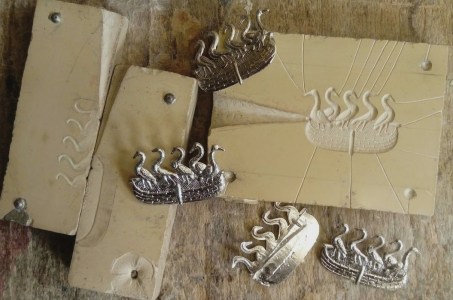
St Werburgh’s pilgrim badges being made in stone moulds. Photograph by Colin Torode of Lionheart Replicas, with my thanks to Colin for sending it to me.
Before badges were available, pilgrims might collect earth from around a shrine, or chip of small pieces off the shrine itself. Small vessels could be used to carry holy water or oils. Low-cost badges were a far more satisfying and permanent memento of a pilgrimage successfully undertaken, and first appear during the 12th century. Decorated metal ampullae too, were manufactured to hold liquids, but in smaller numbers. Wealthier pilgrims might order a custom-made item, which might be made of a more expensive material, but the less expensive materials are by far the most frequently represented in museum and personal collections. By the 15th century they might cost as little as a penny for twelve. One of the appealing aspects of the pilgrim badges is that the majority that survive today were clearly made for those who did not have much surplus cash to spend on souvenirs.
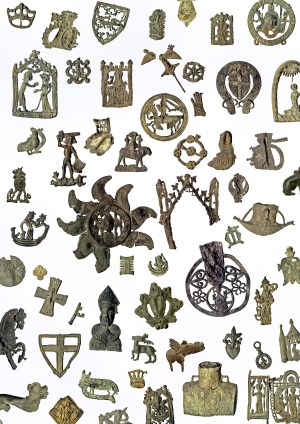
A selection of pilgrim badges. Source: The Digital Pilgrim website.
The badges were cast in moulds, which would have required careful crafting. The mould was usually made of stone, preferably limestone. A liquid alloy was poured into it to set, usually comingling lead with either pewter or tin. Lead was locally available, and the other ores were inexpensive and could be imported. Once solidified, the object was removed from its mould, trimmed, polished and was then ready to sell. The photograph above shows one of Colin Torode’s stone moulds, in use for making St Werburgh pilgrim badges for Lionheart Historical Pewter Replicas, which sells many replica pilgrim badges (I have their lovely St Werburgh geese-in-the-basket). See the brief video by the Digital Pilgrims Project at the end of the post to see how some of these objects were made.
The pilgrim badges were sold at the abbey gates, or in stalls in town markets. If purchased before a visit to the shrine, the pilgrim badge could be touched to the shrine, so that it would permeate the badge itself with its spiritual energy. It could then be dipped into a liquid to be swallowed as a health cure or rubbed onto a wound as a salve. Given its portability, it could also be carried back to someone who was unfit to make the pilgrimage so that they could benefit from the power of the shrine.
The pilgrim badges were usually worn with great pride, sewn on to items of outer clothing like hats or coats, or on bags. Over time, as they became familiar and were transferred from old to new clothing, they probably became apotropaic lucky talismans, as well as items of religious meaning. Sometimes they were pinned to walls of homes.
The Dissolution and subsequent events

The opening page of the Valor Ecclesiasticus, the beginning of the Dissolution of the monasteries, showing Henry VIII presiding over the nation’s extaordinary religious shake-up. Source: Wikipedia
Although Henry VIII ordered the dissolution of the abbey in 1536, its conversion into a cathedral saved it from wholescale destruction. Although it retained most of its key components, some features fell victim to reformers. Henry VIII’s withdrawal from the Catholic church was only realistically viable because of a movement in Europe that challenged what it saw as the papal hierarchy’s abuse of the core ideals of Christianity. In 1517, nearly 20 years before the Dissolution, Martin Luther at the University of Wittenberg in Germany, disgusted by the financial corruption of the papacy and the clergy, began to promote the emergence of a more honest, less moderated religion in which men and women could worship in their homes as well as in their churches and build a more direct relationship with Christ and God. The existence of Purgatory was rejected, the appeal to saints for their intercession was deemed idolatrous, religious images that had been the focal points of worship were condemned, and the role of the clergy as a bridge between people and God was challenged.
In England the reform movement was politically and socially necessary both to usher in Henry’s new era and to avoid the new religious house being labelled heretical. Using Martin Luther’s reforming as a launch pad, an older, purer version of religion was sought. As part of the process, effigies and saints were to be removed with extreme prejudice. Targets of this reforming zeal included emblems of the later Anglo-Saxon period as well as those of the medieval period. The 14th century shrine of St Werburgh really did not stand a chance. The shrine was dismantled and parts were used to build a tomb for the first bishop. Later, in 1635, elements were incorporated into an episcopal throne.
St Werburgh’s shrine in the 19th century

Sir Arthur William Blomfield at his drawing board. Source: Falklandsbiographies.org
When some pieces of the shrine were rediscovered in the 19th century, Sir Arthur Blomfield attempted a reconstruction, which is what stands in the Lady Chapel today. The small statues of the Saxon kings do survive, but their heads are missing; of the little figures that adorned it, only a dog scratching its ear with a hind leg now survives. It was reassembled in the Lady Chapel.
Although St Werburgh no longer attracts pilgrims, the well of St Winefrede at Holywell, near Basingwerk Abbey on the north Wales coast, still does. Although more usual in Catholic parts of Europe than in Anglican Britain, pilgrimage continues to offer the option of a spiritual journey today, and pilgrim badges continue to be collected by those who make the journey. The gift shop at St Winifrede’s well contains a wide and colourful selection of religious memorabilia. See the Encountering a Pilgrim’s Medal video at the end of the post for comments on a modern pilgrim badge.
From Harry Cureton to the British Museum
There’s one last thread to the story. According to the British Museum’s records, in 1836 it purchased the badge at the top of this post from one Henry (Harry) Osborne Cureton who conducted his trade in London variously as a curiosity dealer, a medallist and coin dealer. In the February 1851 edition of the Athenaeum an advert was placed, announcing that Cureton’s entire stock was being sold off due to his retirement. The British Museum’s web page about Harry Cureton suggests that that after this he may have been employ in some capacity at the Museum. If the British Museum was one of the buyers of the collection advertised in the Athenaeum, Cureton may have been hired to catalogue the objects, of which the St Werburgh pilgrim badge may have been one.
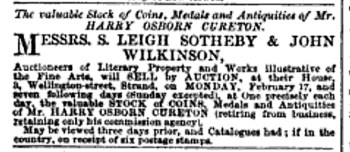
Athenaeum no.1215, February 8th 1851 advert by Messrs S. Leigh Sotheby and John Wilkinson for the sale at auction of Harry Osborn Cureton’s stock of coins, medals and antiquities. Source: Google Books
The badge is not on display at the British Museum, which is a shame but not terribly surprising. As the British Museum’s Fact Sheet explains, it’s collection totals at least 8 million objects, of which roughly roughly 80,000 (1%) are on public display at any one time, the rest remaining in storage.
Just as one expects pilgrims to travel, one expects pilgrim badges to travel. Margery Kempe, early 14th century wife, mother of fourteen children, visionary and pilgrim, managed to fit in pilgrimages to the Holy Land via Italy, to Santiago de Compostela in Spain, and to Danzig in Prussia. We have no idea where the owner of the St Werburgh badge might have worn it on his or her travels, but it is not at all surprising to find that it ended its travels in London.
Final Comments
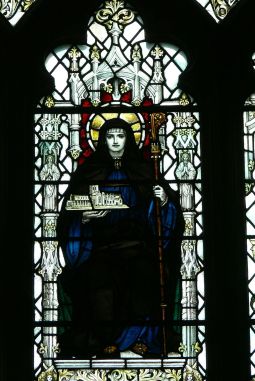
1916 window in St Werburgh’s in the refectory, showing an imaginative, romantic view of the saint. Photograph by Wolfgang Sauber. Source: Wikipedia
This post started with an image of geese in a basket, an emblem of St Werburgh that was cast and sold to pilgrims as a totem of their enterprising pilgrimage to the shrine of a Mercian princess, St Werburgh, within the abbey at Chester. By exploring the connection between a 7th century saint who was buried in Staffordshire and a 10th century Mercian queen who translated (transferred) the remains of the saint to Chester, we encounter the Viking colonisation of Britain. The new shrine containing the saint’s relics in Chester was a powerful new emblem of Christian faith, using affinity to the earlier Anglo-Saxon past to provide meaning and reassurance in the very turbulent present.
In 1093, when Hugh Lupus, first Earl of Chester decided to put his stamp on Chester and, at the same time, pave his way to a comfortable afterlife by founding an impressive Benedictine monastery, the saint was provided with a new home, echoing Æthelflæd’s own intentions. St Werburgh’s original Anglo-Saxon shrine was built to evoke both the past and the present, using history to provide a sense of continuity and stability as Chester entered a new era. Some of this sense of the present being reinforced by the past was carried forward into the 14th century shrine as well. St Werburgh went on to generate income for the monastery throughout the middle ages.

Pilgrims on the road to Canterbury. John Lydgate’s Prologue of the Siege of Thebes c. 1457–1460: Royal MS 18 D II, f. 148r.Few pilgrimages would have been so comfortably and elegantly undertaken. Source: British Library
A pilgrim badge, even if it was mass-produced and relatively inexpensive, was an attractive symbol, and one to wear with pride, but was not merely an inanimate souvenir. By touching it to the shrine, it became a conduit of spirituality, transmitting the essence, goodness and potentially curative powers of the saint within. In an era in which Christ was universally accepted as being embedded in the Eucharist via transubstantiation, a Church-given reality, the idea of objects like pilgrim badges as agents of transformation was not a theoretical matter but another everyday Christian reality. Intrinsically the badge had an active, multi-functional role as a medium of the shrine’s essence, and as a symbol of hope, piety, charity, perseverance and / or status. The medieval period offered pilgrims a fluid, multi-layered religious existence in which, if they were deserving, the secular and spiritual could mingle in certain places under certain conditions. In a sense, whilst the shrine cannot be divided and shared, the pilgrim badge, the emblem of the shrine and sometimes the vessel holding the essence of the shrine, is a way of dividing the shrine infinitely amongst those who invested it with their beliefs and hopes.

Detail of St Werburgh’s shrine
The static 14th century shrine and the multiple, travelling pilgrim badges were firmly linked. The shrine, unmoving, connected to a long-lost Anglo-Saxon past, was rooted to its particular spot. The pilgrim badges, by contrast, were all about the here and now, both for the craftsmen who made them and for the visiting pilgrims who purchased them. The shrine would have existed without the pilgrim badges, but the badges were dependent on both the shrine and the pilgrims. Whilst the memory was alive, the badge containing the memory remained a connected to the shrine via the pilgrim. The shrine, acting as the anchor for such experiences, stayed firmly put, but its tendrils extended into the secular world via the tales told by the pilgrims who had visited, encouraging others to replicate the experience.
At some point, the pilgrim badge was parted from the pilgrim. Perhaps the pilgrim died and it was inherited by one of his or her children. Later in its history it encountered another point of departure and re-entered into the world of commercial transactions. Eventually, it found its way into the ownership of a dealer in portable objects, like medals and coins, and in the 1860s was accessioned into the collection of the British Museum, where it is now buried in storage. Perhaps one day it will emerge to perform a role as a piece of valued heritage, but for the time being, it is divorced from any of the realities that it once served.

St Werburgh’s replica pilgrim badge made by Lionheart Historical Pewter Replicas (photograph from their website)
Quite apart from looking great on my favourite black coat, my own replica St Werburgh’s badge (shown right) can be seen as an aspect of the St Werburgh shrine’s new identity. Today the shrine finds itself as part of the discussion about modern contexts, including conservation, tourism, academic research and local history, where current perspectives reinvent churches, cathedrals and shrines in many different, novel ways, and contribute to ongoing narratives. My newly purchased badge has become part of that ongoing story. It’s a nice thought. The reassembled shrine in the Lady Chapel does not contain St Werburgh’s relics, but the saint remains irrefutably embedded into the fabric of the cathedral and is central to its identity.
—–_______—
Videos:
Why did St Werburgh of Chester Resurrect a Goose?
By Dr Thomas Pickles, University of Chester
—-
Video: Metal Casting – Pilgrim Badge
By the Digital Pilgrims Project
Video modern pilgrim token from Pilgrim Flask page
Piers Baker-Bates of the Open University talks about the value of his own pilgrimage memento

Click to play. Source: Open University
Staffordshire Moments: St Werburgh’s story
A tongue-in-cheek but remarkably effective version of St Werburgh’s story.
Sources:
Books and papers
 Blair, J. 2005. The Church in Anglo-Saxon Society. Oxford University Press
Bond, J. 2010. Monastic Landscapes. The History Press
Bradshaw, H. 1513 (edited and republished by Horstmann, C. 1887). The Life of St Werberge of Chester. The Early English Text Society
https://ia800208.us.archive.org/23/items/lifeofsaintwerbu00braduoft/lifeofsaintwerbu00braduoft.pdf
Burne, R.V.H. 1962. The Monks of Chester. The History of St Werburgh’s Abbey. SPCK
Clarke, C. 2011. Remembering Anglo-Saxon Mercia in late medieval and early modern Chester. In Clarke, C. (ed.) Mapping Medieval Chester: place and identity in an English borderland city c.1200-1500, p.201-218
Varnam, L. 2013. Sanctity and the City. Sacred Space in Henry Bradshaw,’s Life of St Werburge. In Clarke, C. (ed.) Mapping Medieval Chester: place and identity in an English borderland city c.1200-1500, p.114-130
Claassen, C. 2011. Waning pilgrimage paths and modern roadscapes: moving through landscape in northern Guerrero, Mexico. World Archaeology, vol.43, iss.3, p.493-504
Clarkson, T. 2018. Æthelflæd. The Lady of the Mercians. John Donald
Hahn, H.P. and Weiss, H. 2013. Introduction: Biographies, travels and itineraries of things. In Hahn, H.P and Weiss, H. (eds.) Mobility, Meaning and Transformations of Things. Shifting contexts of material culture through time and space. Oxbow Books
Hicklin, J. 1852. A History of Chester Cathedral with biographical notices of the Bishops and Deans. George Prichard
Jones, D. 1957. The Church in Chester 1300-1540. Chetham Society
Garland, L.M. 2005. Aspects of Welsh Saints’ Cults and Pilgrimage c.1066-1530. Unpublished PhD, Kings College London
Gilchrist, R. 2013. The materiality of medieval heirlooms: From biographical to sacred objects. In Hahn, H.P and Weiss, H. (eds.) Mobility, Meaning and Transformations of Things. Shifting contexts of material culture through time and space. Oxbow Books
Goscelin de St-Bertin 1974 (N. J. Munday, translator). The Life of St. Werburg by Goscelin. Friends of Chester Cathedral
Kempe, M. (translated with introduction by Windeatt, B. 1985) The Book of Margery Kempe. Penguin Classics
Locker, M.D. 2015. Landscapes of Pilgrimage in Medieval Britain. Archaeopress
Lynch, J.H. 1992. The Medieval Church. A Brief History. Longman.
Mason, D. 2007. Chester AD400-1066. From Roman Fortress to English Town. Tempus
Moreland, J. 2010. Archaeology, Theory and the Middle Ages. Understanding the Early Medieval Past. Duckworth.
Schmoelz, M. 2017. Pilgrimage in medieval East Anglia. A regional survey of the shrines and pilgrimages of Norfolk and Suffolk. Unpublished PhD, University of East Anglia
Tillotson, J.H. 1988. Monastery and Society in the Late Middle Ages. Selected Account Rolls from Selby Abbey, Yorkshire 1398-1537. The Boydell Press
Turner Camp, C. 2011. Inventing the Past in Henry Bradshaw’s ‘Life of St Werburge’, Exemplaria, vol.23, iss.3, p244-267
Webb, D. 2000. Pilgrimage in Medieval England. Hambledon and London
Whitehead, A. 2020. Mercia. The Rise and Fall of a Kingdom. Amberley
Websites
The Becket Story
Medieval pilgrimage
https://thebecketstory.org.uk/
British Library – Medieval Manuscripts Blog
Pilgrimages: Medieval Summer Holidays? By Chantry Westwell 29th July 2018
https://blogs.bl.uk/digitisedmanuscripts/2018/07/pilgrimages-medieval-summer-holidays.html
British Museum
St Werburgh Pilgrim Badge 1836,061.73
https://www.britishmuseum.org/collection/object/H_1836-0610-73
Fact Sheet: British Museum Collection
https://www.britishmuseum.org/sites/default/files/2019-10/fact_sheet_bm_collection.pdf
Harry Osborn Cureton
https://www.britishmuseum.org/collection/term/BIOG67986
The Electronic Sawyer
Online Catalogue of Anglo-Saxon Charters
https://esawyer.lib.cam.ac.uk/about/index.html
Kemble – The Anglo-Saxon Charters Website
Chester
http://dk.robinson.cam.ac.uk/node/25
Mapping Medieval Chester
Henry Bradshaw, Life of St Werburge by Catherine Clarke 2008
https://www.medievalchester.ac.uk/texts/introbradshaw.html
Medieval London
Pilgrim Badge
https://medievallondon.ace.fordham.edu/collections/show/28
Museum of London
Medieval pilgrim souvenirs
https://collections.museumoflondon.org.uk/online/group/19998.html
Paul Mellon Centre
The Digital Pilgrim Project
https://www.paul-mellon-centre.ac.uk/whats-on/forthcoming/digital-pilgrim-project
and sketchfab.com/britishmuseum/collections/digital-pilgrim
The Pilgrims Guide
Thomas Becket Badges: Developments and Interpretations of His Cult since the Twelfth Century
thepilgrimsguide.com/projects/thomas-becket-badges-developments-and-interpretations-of-his-cult-since-the-twelfth-century/
University of London. Department of History of Art
The Digital Pilgrim Project
https://www.hoart.cam.ac.uk/research/past-projects/the-digital-pilgrim-project
 Based in Churton


