

The approach to St Deiniol’s from the road.
Worthenbury, a small village on the border between England and Wales seems an unlikely location for a really superb Grade-1 listed Georgian church built on such an ambitious scale, but the two fit very well together. The village is picturesque, the scenery peaceful and the church stunning. It was built between between 1735 and 1739 by Richard Trubshaw, financed by the local Puleston family of Emral Hall, and the church was consecrated, with all due ceremony, by the Bishop of Chester on Palm Sunday 1739. It is thought to be one of the most impressive Georgian churches in Wales, if not the best. It has been beautifully maintained by its Worthenbury custodians.
 The church is dedicated to St Deiniol (pronounced day-nee-ol, the Welsh form of Daniel, died c.584). The saint has a certain local interest, although the details are far from clear. It is generally agreed that he was the son of St Dunawd, who may or may not have been the first abbot of a monastery at Bangor on Dee known today as Bangor Monachorum, meaning “Bangor of the Monks.” The origins of the monastery are buried in a cloud of myth, and it is by no means clear whether a monastery was actually built there. According to the Clwyd and Powys Archaeological Trust (CPAT) the name Bangor Monachorum actually appears in documents no earlier than 1607. Popular history has it that the current church of St Dunawd was built on its remains but I have seen no documentary or archaeological data to support this, meaning that there either isn’t any, or that it is doing a good job of hiding.
Rather than looking for solid data, here’s a brief version of the usual story of St Deiniol, paraphrased from the lengthy entries in the The Dictionary of Welsh Biography and the Oxford Dictionary of Saints. One version has it that St Dunawd joined forces with his three sons, one of whom was Deiniol, to found a monastery of on the banks of the Dee, at Bangor on Dee, becoming its first abbot. Another version suggests that Deiniol was the first abbot, having first established a parent monastery in Bangor in northwest Wales. Whatever the case, St Deiniol is best known for being a monk and bishop, who is credited by Bede for having established a monastery with over 2000 monks, the most famous in Britain at the time, nearly half of whom were slaughtered by the Anglo-Saxons. It is not entirely clear why he was canonized.
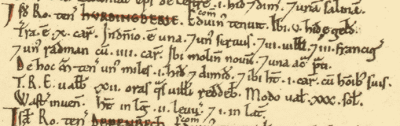
Domesday’s record of Hurdingberie (the Anglo-Saxon name for Worthenbury), highlighted in red. Source: Open Domesday
Worthenbury sits on the Anglo-Welsh border that lies around 10km southeast of Wrexham, and is 3km west of Bangor on Dee. The Worthenbury Brook runs a short distance to the south of the church. The village is surrounded by undulating fields. Probably a small nucleated settlement in the 10th century, it was apparently little bigger by the time of Domesday, when it appears under the name “Hurdingberie,” a name of Anglo-Saxon origin, and came under the tenancy of one “Robert, son of Hugh,” the Norman baron Robert FitzHugh, who held it from the crown, amongst many other properties. At the time of Domesday, 1086, its inhabitants consisted of 3 villagers, 1 slave and 4 “other” (information sourced from the Open Domesday project). Its holdings included 10 ploughlands, 2 lord’s plough teams, 4 men’s plough teams, a meadow of 1 acre and a mill. There are some beautiful medieval ridge-and-furrow fields in the vicinity, shown in the photograph below.

Worthenbury village. The church is at bottom left and ridge-and-furrow fields are at top right. Source: CPAT – photo 04-c-0049
It is thought that the first religious house on the site was a chapel, first mentioned in 1388, perhaps attached to the elusive monastery of Bangor Monachorum. In 1277 century Edward I (ruled 1272-1307), in the throes of his territorial disputes with Llywelyn ap Gruffyd, dispossessed the owner of Emral Hall, Emma Audley, who had married a Welsh prince, and moved her back to her family home in Shropshire. Worthenbury was at that time in Maelor Saesenag, and found itself shifting between English and Welsh ownership, depending on who was in the ascendancy. Edward gave Emral instead Sir Roger Puleston. The Pulestons came from near Newport in Shropshire, where they had settled during the reign of Henry III (ruled 1216-1272). They had Norman roots, had proven themselves in battle, and could be relied upon to stand up against Welsh hostilities in the frontier position in which Worthenbury found itself. Emral Hall remained in the Puleston family for over 700 years. The architect Robert Trubshaw was hired to remodel Emral Hall for the Puleston family, but even afterwards it retained many earlier features.
 Richard Trubshaw obviously did a good job for the Puleston family, because he was hired to build today’s church between 1735 and 1739 at a cost of £955.00. It is always difficult to know what a sum of money actually means in the past, but fortunately the National Archives has a currency convertor provides equivalents. In today’s money, £955 equates to £112,897. Alternatively, it was equivalent to the price of 139 horses or 205 head of cattle. The gothic architectural ideal had dominated British architecture for such a long time, that the Georgian aesthetic, when done this well, comes as a breath of fresh air. St Deiniol’s is a superb example of refined Georgian ideas.
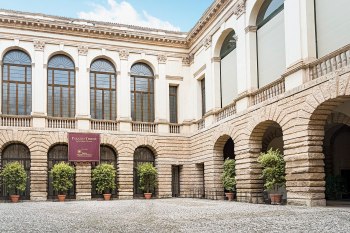
Palazzo Thiene, Vicenza, Italy 1542–1558. Source: Wikipedia
Georgian architecture is named for four kings named George who reigned in succession, from the accession of George I in 1714 to 1830, when George IV (“Prinny”) died. Georgian architectural principles, employed for domestic, institutional and ecclesiastical architecture, were typified by attractive symmetry, space and light, the latter requiring many large windows. Georgian architects were greatly influenced by the Renaissance architect Andrea Palladio (1508-1580), whose governmental palace, Palazzo Thiene, was characterized by vast, symmetrically aligned windows with semi-circular tops and is a clear antecedent of Georgian aesthetics.

The 3-storey church tower, showing the dramatic contrast of the creamy-coloured sandstone and the deep red brick
Trubshaw’s new church was established on the site of at least two pre-existing churches, one of wattle and daub in 544AD and another, in 1557, built of brick and timber, both belonging to the Bangor on Dee parish. Worthenbury only became the centre of its own parish in 1689 when Sir Roger Puleston succeeded in separating it from Bangor. Its rectory, at the opposite end of the village, had been built in 1657 by Judge Puleston for the minister to Worthenbury who was also tutor to the judge’s two sons. Whilst the new church was being built, the congregation worshipped at Emral Hall’s private chapel.
The footprint is that of a traditional church, with an east-west orientation. It includes the usual components of a bell tower, a nave for the public, and a chancel for the clergy with an altar, all beautifully preserved. The Georgian style simply yells a new type of self-confidence and a pride in the here-and-now. The semi-circular chancel, a revival of the Romanesque, is a particularly nice touch, softening the angles and giving the church a real air of distinction.
 The brickwork of the church was arranged in header-and-stretcher or Flemish bond (alternating long and short), and it was provided with a slated roof. The sandstone is from the Cefn Mawr quarries in north Wales, which produces yellow sandstone, varying in both colour and quality. The sandstone at St Deiniol’s is a very fine-grained creamy colour that contrasts beautifully with the warm red of the brick. The urn finials on the corners at the top of the tower are replicas of those at the main entrance to Emral Park, which are apparently now at Eccleston Church, on the Duke of Westminster’s estate. They support weather vanes. The finials mid-way along the balustrade are topped with crucifixes. The tower also has arched windows at top and bottom, and circular windows at centre, with radiating keystones. It was also fitted with blue-faced clock with golden numerals, made by Joyce’s of Whitchurch.
 Georgian churches, being so much newer than medieval predecessors, stand some hope of surviving changes of fashion and fortunately, the interior of St Deiniol’s church has been infinitely better respected than many of its predecessors. Many medieval churches have been disfigured on the inside, barely reconcilable with the original conception.Later architectural embellishments and the addition of inappropriate funerary monuments may disguise original beautiful lines, and the installation of modern paraphernalia can be ruinous to a church’s interior. Westminster Abbey, for example, retains much of its essential dignity on the exterior, but has been battered into often vulgar submission inside. St Deiniol’s retains its fine lines. It has a fabulous interior, retaining its extraordinary and lovely box-pews, which I have never seen before, each with a family crest painted on the side. These provide a sense of what it must have been like to form one of the congregation, all together in one space, but physically divided by family and status. Rather than the seating being lined up in rows, the boxes give a sense both of intimacy and social division. The box-pews of the Pulestons, the most important family, were those nearest the altar, and were furnished with chairs rather than pews, and hearths. One of these currently contains a small display showing the history of the church. The minister was allocated the pew below the three-tier pulpit. Less important families sat in the boxes behind these positions, and the church wardens were confined to the rear of the church. Some of the pews for the lower orders were not installed until 1810, and were sourced from Gresford parish church.
A gallery was added in 1830 to accommodate musicians and an organ, and displays the royal coat of arms. It is full-width, with tiered seating for the choir. It is supported on slender cast iron columns, and its panelled front displays the royal coat of arms.

——–
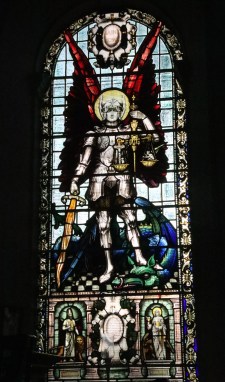 There are four stained glass windows. That in the south of the nave shows St Michael and is in memory of Captain Summers who died in the First World War and lived at Emral. To the south of the chancel is a window given by Catherine Theodosia Puleston, in memory of her parents and sisters. The origin of the east window is a somewhat muddled story. When Emma Corbet married Richard Puleston and moved into Emral, she recorded finding a collection of stained glass fragments and when she died in 1797, her will asked that the pieces should be made up into a new window at Worthenbury. Quite where the glass came from, or why the pieces were kept at Emral, is uncertain, although it is speculated that it may have come from from a 14th century window in Westminster College, or from the demolished Emral Hall chapel. Interestingly, the new window was built inside the original plain window. The small circular window was installed in 1913 in memory of Violet Parry, another connection with the Puleston family.
Don’t forget to look up. The plaster ceiling has been given some really fine baroque – rococo decorative features. As well as some attractive ornamentation it features a gilded dove and sunburst, and small grey clouds. My photograph makes it look rather brash, but from ground level, it looks charming.


Of the smaller fixtures and fittings, the vestry doors and small collecting boxes inscribed with “Remember the Poor” were made from wood that was rescued from the previous church. The font dates to around 1745, and above it is a shelf, which was designed to receive bread for the poor. This tradition survived up until 1939, when soup, cloth and coal were still distributed to those in need. The bells were cast in 1746, and were recast and hung in 1958. The rather battered cross in the chancel is the Emral Cross, formerly in the chapel in Emral Park, which was demolished in 1775. The two-tiered chandelier was installed in 1816, and the single-tiered chandelier was installed in 1898. there are numerous funerary memorials, mainly to members of the Puleston family, but other local families are also represented. Family connections to the church are also preserved in the three Puleston funerary hatchments set up along the west end of the church. Hatchments are diamond-shaped, made of wood, and contain the components of the coat of arms that has been earned by the deceased, and which he is entitled to display. There is modern lighting and heating, but it is very well done.

Large scale repairs were undertaken in 1851, which included re-roofing the building due to damage by deathwatch beetle.

Within the church, the earliest burial known is that of Mrs Anne Puleston, wife of John Puleston, dating to 1742. John Puleston was buried in 1746. The earliest of the churchyard’s graves cluster around the apse, made of yellow sandstone. The inscriptions are badly eroded and many are illegible, but a chest tomb of 1768 is the earliest of those that can be deciphered. There are a number of different styles of grave markers, including chests, table tombs and tablets, and they continue into the 19th century, indicating that people from surrounding villages were also buried there.
Emral Hall was sadly demolished in 1936, although the magnificent Jacobean ceiling of the banqueting hall, together with the mullion windows, were purchased by Sir William Clough-Ellis and installed in the town hall of of Portmeirion, where they remain preserved. Today Emral Park serves as a horse stud, dairy farm and caravan park.
The church no longer holds congregations, but this is of very recent date. It is anticipated that the church will be transferred to the jurisdiction of the Friends of Friendless Churches, who do such an excellent job of caring for churches without owners, amongst whom are those like St Deiniol’s, which are no longer in a position to pay the Anglican authorities for their services, but retain real value as heritage.
My sincere thanks to Catherine Starkey for arranging access during very icy weather, when the church would usually have been closed.
—-

East window
___


—–
Visiting:
 The church is no longer in active service for congregations, and at the time of writing it is expected that the Friends of Friendless Churches will take it over. This means that its opening times are uncertain at the moment, but these may be forthcoming. Local people have done a great job of keeping it open for visitors, and they very kindly opened it for me (with my sincere thanks) just before Christmas when, although it was usually open during the day, it had been temporarily closed due to the abysmal weather conditions.
It is easy to find. There is one road through Worthenbury, and the church is clearly visible heading north to south, on the right, and if you are heading south to north, it is at left on the right-hand corner past the bridge.
Thinking of it in terms of those with mobility issues, there are two steps leading up from the road through the gate into the churchyard, with a rail on the left as you face the church, and there are a small number of steps in the church itself.
Sources:
Books and papers:
Farmer, David. 2011 (5th edition, revised). The Oxford Dictionary of Saints. Oxford University Press.
Pamphlets:
Anon, n.d. The Parish Church of St Deiniol, Worthenbury. A Guide for Visitors.
Harrison, Sunter. 1990. Worthenbury Church, Emral Chapel and the Pulestons. Published privately.
Websites:
British Listed Buildings
Parish Church of St Deiniol
https://britishlistedbuildings.co.uk/300001705-parish-church-of-st-deiniol-willington-worthenbury#.Y8xxkHbP3IU
Clywd and Powys Archaeological Trust (CPAT). Historic Landscape Characterization, Maelor Saesneg. Wrexham County Borough
https://www.wrexham.gov.uk/sites/default/files/2020-09/worthenbury-cons-area-assessment.pdf
Clwyd and Powys Archaeological Trust (CPAT). Worthenbury: Historic Settlement Survey. Wrexham County Borough
https://cpat.org.uk/ycom/wrexham/worthenbury.pdf
Coflein
St Deiniol’s Church, Worthenbury
https://coflein.gov.uk/en/site/307972/
Dictionary of Welsh Biography
Dunawd
https://biography.wales/article/s-DUNA-BWR-0505
Deiniol
https://biography.wales/article/s-DEIN-IOL-0584
Open Domesday: Worthenbury
(by Powell-Smith, Anna)
https://opendomesday.org/place/SJ4246/worthenbury/
Puleston family, Emral, Flintshire
National Library of Wales
https://archives.library.wales/index.php/puleston-family-emral-flintshire
Worthenbury Conservation Area Assessment and Management Plan
Wrexham County Borough Council 2009
https://www.wrexham.gov.uk/sites/default/files/2020-09/worthenbury-cons-area-assessment.pdf

 Based in Churton
_-_courtyard.jpg)
The best yet in your historic buildings series. I hope people visit it in droves. It is both beautiful and remarkable. Local people should be congratulated on its lovely condition.
Glad you mentioned the desecration of Westminster Abbey .B.
LikeLike
Absolutely delighted to see our church history written up so beautifully . a great history lesson for us churchwardens . many thanks
LikeLike
I have visited St Deiniol’s, Worthenbury for many years. My Great Grandparents – John Bate 1865 -1935 & Frances Ellen Bate (nee Houlbrooke) 1868 -1951 are buried there. There is a tapestry in the Vestry in memory of them.
From my early visits I have been fascinated by the Church with its incredible “boxed pews” and all the stories my Grandparents told me.
LikeLike
I have visited St Deiniols with my Parents & Grandparents since a small child. My Great Grandparents, John Bate 1856 -1935 & Frances Ellen Bate nee Houlbrooke 1868 – 1951 are buried there. There is also a tapestry in the vestry in memory of them. I have very fond memories of the stories I was told.
It is a wonderful very special church & I am very sad that it is no longer used.
LikeLike