

Detail of an ivory box lid, showing Tutankhamen receiving flowers from his wife Ankhesenamun. Source: Wikipedia
Today in 1922, 26th November, Howard Carter broke the seals that protected the door to the tomb of a king called Tutankhamen, whose name had, until 1922, been known from only a handful of small, relatively insignificant objects. When he discovered the entrance to the tomb, Carter was full of hope that this was the longed-for culmination of his quest to find the only intact royal tomb in the Valley of the Kings in the religious centre of Egypt, now known as Luxor.
Peering through a small hole that he had broken through the door into the first chamber, and fearing that he would find yet another empty tomb robbed out in antiquity, the shimmering light of his candle picked out strange, shifting shapes, and the unmistakeable glitter of gold. Carter spent the next decade cataloguing and conserving the fabulous, the fascinating and the downright staggering. The king called Tutankhamen, little more than a name without a clearly understood identity, exploded into early 20th century consciousness and became an instant sensation.
In celebration of the centenary of this extraordinary find, the Royal Mint has released a Tutankhamen centenary £5.00 coin, and I am glad to see that Egyptologist and excellent author Joyce Tyldesley has published produced a new book about the king for 2022. Otherwise the celebration of what was, for better or worse, a very British discovery seems to have confined itself to a few magazine articles and some largely recycled television shows. Even in the wake of a somewhat lacklustre response to the annivrsary, it has been a good time to sit back and contemplate those heady days of the discovery 100 years ago, and to wonder why the entirety of the tomb’s contents remains unpublished today.
Although the intention with the posts on this blog is to confine myself mainly to local subjects, this time there is no connection with the Chester-Wrexham area, but as I retain a personal interest in Egypt’s archaeology I decided to throw caution to the winds and go off-topic. I started my working life as an archaeologist, but starvation forced me to find more predictable work. It was many years later that a trip to the Eastern and Western Deserts of Egypt made up my mind to return to university to do a PhD on Egyptian prehistory. I was based at UCL, where I formed a long and ongoing relationship with the wonderful Petrie Museum of Egyptian Archaeology in London. These, then, are my excuses for pure self-indulgence. The Tutankhamen story is a great one and continues to be a marvellous and constantly emerging insight both into the history, archaeology and art of Egypt, and into how research is done and how history is written.
Biban el-Muluk (“Gates of the Kings”)

Frontpiece of Volume 1 of Description de l’Egypt. Source: Wikipedia
The discovery of the tomb of Tutankhamen tomb by Howard Carter in 1922 begins with Napoleon Bonaparte’s invasion of Egypt in 1798. Along with his army, Napoleon sent his extraordinary team of “savants,” some 150 intellectuals and scientists who recorded everything they found about Egypt’s present and past. The books produced by Napoleon’s savants, complete with beautiful illustrations of Egypt’s Pharaonic heritage, were now circulating in western Europe and America and being received with rapture. Jumping on the bandwagon of this enthusiasm, museums started to send representatives to Egypt to secure items for their collections. Some of these agents were little better than treasure hunters. The objective was the discovery of beautiful objects to furnish museums, not the participation in historical research.
Less than a quarter of a century after Napoleon’s arrival in Egypt, the French scholar and polymath Jean François Champollion (1790-1832) used the trilingual text on the Rosetta Stone to crack the translation of the ancient Egyptian hieroglyphic script, unlocking the door to Egyptian religious beliefs, social organization, political dealings and wars. The year was 1822, a full century before the discovery of the tomb of Tutankhamen. Many more decades of research were required to build up a body of translated texts, from which ancient Egyptian history might begin to be articulated and understood.
Although the man who eventually discovered the tomb of Tutankhamen was Howard Carter (1874-1939), who was a very different proposition from the run-of-the-mill glory hunters who had so often preceded him, it was not Carter but the retired American lawyer Theodore Davis (1838-1915) who had first stab at finding an intact tomb in Biban el-Muluk, Gateway of the Kings, more popularly known today as the Valley of the Kings.

Panorama of the Valley of the Kings. Photograph by Nikola Smolenski. Source: Wikipedia
The Valley of the Kings is located on the east bank of the Nile at Luxor. It had been the burial place of many New Kingdom (c.1550-1099BC) kings of Egypt since about 1490BC when Thutomse I selected it as his burial place. The last king to be buried there was probably Ramesses X in around 1099BC. Between these two burial events, some 390 years apart, around 65 royal and noble individuals were entombed in the Valley, but all of the known royal tombs had been robbed for their treasures, an activity that began during the ancient Egyptian period. In spite of policing of the valley throughout the New Kingdom, and the promise of the death penalty for thieves, tomb robbery was endemic. Although some tombs were robbed via their entrances, other robbers had ignored the front doors, and instead tunnelled in from above or from the side to avoid detection.
Tomb robbery reached such a crisis point that In the 21st Dynasty (1070–945 BC, some 800 years after the death of Tutankhamen) the High Priests of the god Amen gathered together the mummified remains of the kings who had survived the tomb robbers, rewrapped them, provided them with labels and stored them safely in hidden tombs known today as caches. The bodies were, themselves, rarely of little interest to tomb robbers, who were seeking the rich, valuable and easily accessible treasures that accompanied the dead, particularly precious metals that could be melted down and sold on, or jewellery incorporating precious gems, that could be broken up and re-used.

The East Valley. Source: Wikipedia
Robbing tombs was not, unfortunately, confined to antiquity, and as western interest in Egyptian art developed, new objects began to appear in the antiquities markets of Cairo and Alexandria. Sir William Flinders Petrie, one of the pioneers of serious archaeological investigation in Egypt, was amongst those purchasing for research purposes, but others were hoovering up artefacts in much greater numbers to sell to both museums and private collectors. The sudden appearance on the market of all these objects, some of them truly remarkable, raised obvious questions about who was delivering them and where they were coming from. The burial grounds of the kings and nobles were all on the east bank of the Nile at Luxor, and nearby was a sprawling village. It emerged that some local families had become expert at locating tombs, mainly of the nobility, some of which lay beneath their homes, and when there became a demand for ancient Egyptian objects, began to empty tomb contents piece by piece to earn a living from the sales. By trickle-feeding objects into the antiquities market, they hoped to divert suspicion.
The possibility that there might remain an intact tomb was receding all the time. Those royal tombs that had been opened by the early 20th century revealed splendid architectural achievements and stunning decorative schemes, capturing complex religious ideas, but relatively few objects had been found. They hinted at former treasure troves, and that raised hopes in the minds of explorers. This was the specific dream of Theodore Davis when he began his excavations in the Valley of the Kings in 1902. Davis, a retired American lawyer, was granted the concession for the Valley of the Kings, in spite of his lack of archaeological training. A concession is a type of license to excavate, and the system still operates in Egypt today. When it is granted to an individual or institution, no-one else is permitted to excavate within the zone covered by the concession.

Funerary mask of Thuya. Source: Wikipedia
Davis was churning through the Valley of the Kings like a human bulldozer. In 1905, three years after he was awarded the concession, the dream of an intact royal tomb suddenly became a realistic proposition when Davis found the tomb of Yuya and his wife Thuya, numbered KV46 (KV standing for King’s Valley). Yuya and his wife Thuya were non-royal nobles who were allocated a burial space within the Valley of the Kings because they were parents of Tiye. Tiye became the wife of Amenhotep III, mother of Akhenaten and grandmother of Tutankhamen. The burial chamber of KV46 was was stuffed full of fabulous artefacts, an unambiguous but tantalizing indication that an intact royal tomb might yet be discovered. In total, Davis is credited with discovering 30 tombs between 1902 and 1914. He also found three items bearing the name of Tutankhamen, who appeared to be a missing king. One of these was found in 1907 in the unpromisingly named Pit 54, which contained abandoned objects relating directly to the burial of the king, including embalming materials and storage jars.

Howard Carter (1874 –1939). Source: Wikipedia
In the meantime, Howard Carter could merely watch the work in the Valley unfold and keep himself busy elsewhere. Carter was well respected in Egyptology circles both as an archaeologist and as a member of the Antiquities Service. He had gone to Egypt as an illustrator and watercolour painter and excelled at both. As an archaeologist he had trained under the most notable pioneer of archaeological techniques at that time, Sir William Flinders Petrie (1853–1942). He had moved on to become Inspector-General of Monuments of Upper Egypt, as a much-valued member of the Egyptian Antiquities Service from from 1900 to 1904, when he resigned on a point of principal over an argument with a French tourist. Carter remained in Egypt hoping for the right job to come along, hiring himself out in the interim for various projects, nibbling around the edges of ancient Egyptian exploration in Luxor. One of the more useful short-term appointments that he picked up was the recording the objects from the tomb of Yuya and Thuya, which gave him an intimate understanding of both the contents of the tomb, and the potential of the valley.

George Herbert, 5th Earl of Carnarvon. Source: Wikimedia Commons
In 1906 Carter began excavating for the Earl of Carnarvon, who was in Luxor for his health, Carnarvon had been digging on an amateur basis but had caught the archaeological bug and wanted to ally himself to a credible archaeologist who could help him to take his new interest on to a more viable and formal footing. Carter and Carnarvon watched the discoveries being made in the Valley of the Kings with envious eyes. After 12 years of excavation and discovery, Davis feared that the valley was exhausted. It was only on his death in 1915 that the concession came up for grabs, and Lord Carnarvon moved fast to secure it for himself and Carter.
The First World War interrupted all archaeological activity in Egypt, and Carter himself was employed as a diplomatic courier. However, by 1917 life had settled down sufficiently for him to resume full time archaeological work in Luxor. By the time that Carnarvon’s Valley of the Kings concession could be acted upon, Carter had a strategy. He suspected that the fugitive references on objects to a king called Tutankhamen found by Davis, were far more important than anyone had yet understood. Although various royal mummies had been identified in the 21st Dynasty caches, Tutankhamen was not amongst them. Carter believed that the objects represented an as yet undiscovered tomb, one that might have escaped the attention of the ancient Egyptian tomb robbers, and he was sure that he could find it by digging down to the bedrock of the valley.
KV62
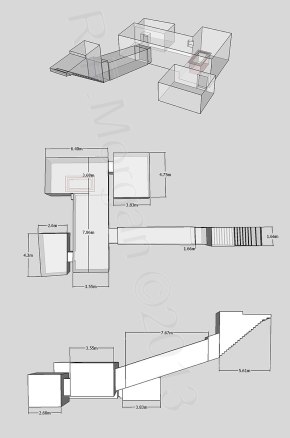
Isometric diagram showing the tomb of Tutankhamen, by R.F. Morgan. Source: Wikipedia
Carter’s first years of excavation in the valley were profoundly disappointing, both to himself as an archaeologist with hopes of making the ultimate discovery, and to Lord Carnarvon who was footing the bill. Carter was taking no chances, and wherever he started a new excavation, worked down to the bedrock, but the untouched tomb remained elusive. As Nick Reeves writes in The Complete Tutankhamun
Countless boys and men laboured to move thousands upon thousands of tones of limestone rubble by basked and hand-propelled Decauville railway. But finds were few.
In 1922, after five years of fruitless investment in Carter’s hunt for an intact tomb, Lord Carnarvon was wearied of failure but Carter was able to convince him to fund one last season. For Carter, knowing that he was the only person left believing that an intact tomb remained to be found, it was his last chance. Carnarvon did not bother travelling to Egypt for the excavation season, so when Carter found a partially concealed tomb entrance on found 4th November 1922, Carnarvon was at home at Highclere Castle in Hampshire.

Stephen Cross’s water flow diagram showing how flash floods cascaded into the central area where KV62, black dot on the far left, is located. Source: Stephen Cross (reference in Sources)
In the event, the tomb’s doorway had been hidden not by some devious ancient Egyptian method of concealment but by the prosaic deposition of layers of liquid mud carrying loose stone and other debris. Although it rains rarely in Luxor, when it does it, it does it properly, and the loose, dry sand, bits of stone and other surface materials dislodge instantly in the flash floods to become a thick, debris-bearing liquid that cascades down flood channels towards the floodplain below. At the end of the 18th Dynasty (c.1292 BC), a particularly fierce flash flood is thought to have plunged into the central area from different directions to where tombs KV55, KV62 (Tutankhamen) and KV63 are located. Where the channels met, in a less steeply inclined part of the valley, it slowed, depositing some of its muddy load, 1m (3ft) thick, whilst the rest continued downhill, flooding KV7 (Ramesses II) and the enormous KV5 (the sons of Ramesses II). The deposits then baked solid in the heat of the sun and looked very much like the surrounding natural bedrock. Another royal tomb, dating to the 19th Dynasty, had subsequently been excavated over the top of Tutankhamen’s tomb, but had not breached it. Huts dating to a later pharaoh were built over the top of both tombs, keeping the entrance of KV62 safe for centuries.
Carter’s policy of digging down through anything that stood in his way to reach the underlying bedrock was labour-intensive but rewarded him with the entrance to the tomb. The seals that Carter could see on the partially uncovered doorway to the tomb were badly worn and there was nothing on the visible section to identify who the owner might have been. Even though those seals were unbroken, there was absolutely no guarantee that the tomb was intact, because robbers might have tunnelled directly into the chambers. Frustratingly, Carter needed to notify Lord Carnarvon of the discovery, and await his arrival from England. He sent the following telegram to Carnarvon:
At last have made wonderful discovery in Valley; a magnificent tomb with seals intact; re-covered for your arrival; congratulations.
That night Carter wrote prosaically in his diary “Discovered tomb under tomb of Ramsses VI investigated same & found seals intact.” The following day, he began to put in place some basic infrastructure to prepare for the opening of the tomb. It must have been a period of terrible anxiety, but even with the limitations of travel in the early 1900s, Carnarvon and his daughter managed to arrive in Luxor less than three weeks later, on 23rd November 1922. Work resumed immediately.
Once the door was fully cleared, the names framed in cartouches announced that this was the tomb of Tutankhamen, vindication for Carter, who had searched for the king for 5 years. He must have been on Schrödinger-type tenterhooks, full of hope that he was about to make the biggest find in Egyptian archaeological history, but fearing that this was yet another robbed tomb. The passage on the other side of the door had been blocked with rubble by its builders to protect it from potential tomb robbers, and this had to be cleared. Another door was revealed.

Inner coffin of Tutankhamen in the Egyptian Museum, Cairo. Source: Wikipedia
On 26th November 1922, the second door was breached with a hole large to act as an inspection hatch. Carter was probably expecting to find another corridor on the other side, a long slender pathway with wide shallow steps, sloping gently downwards and possibly flanked by one or two side chambers until it eventually reached a burial chamber. These long, slender passage tombs, often with a dog-leg turn midway, were typical of a number of previous 18th Dynasty tombs. Carter made the small hole in the new door, and pushed his candle through:
At first I could see nothing, the hot air escaping from the chamber causing the candle to flicker, but presently, as my eyes grew accustomed to the light, details of the room within emerged slowly from the mist, strange animals, statues and gold – everywhere the glint of gold. For the moment – an eternity it must have seemed to the others standing by – I was struck dumb with amazement, and when Lord Carnarvon, unable to stand the suspense any longer, inquired anxiously, “can you see anything?” it was all I could do so get out the words, “Yes, wonderful things.”

Howard Carter with one of his team examining the remains of Tutankhamen. Photograph by Harry Burton. Source: Wikipedia
Electric light was soon installed, a metal gate replaced the wooden grille in front of the door and a small but illustrious team of specialists was assembled to carry out the long, slow work. Carter and his team continued to work in the tomb for six years, supervising the recording of the objects in situ, followed by their removal and accessioning into the Egyptian Museum in Cairo.
Now that he had found the tomb, Howard Carter was in no hurry. He was organized and conscientious, taking years to empty the tomb, maintaining detailed visual and written records as he proceeded. His diaries, notes and record cards are still available, digitized for online use by the Griffiths Institute. Perhaps the most immediately powerful record of the tomb content was provided by the photographer Harry Burton, who did a sublime job of capturing images of all that was found. His photographs are works of documentary art, forming a superlative record of how the objects in the tomb were deposited. Although the objects in glass cabinets in the Egyptian Museum in Cairo are beautiful, there is nothing like Burton’s photographs for understanding what the tomb looked like when it was found.

The antechamber of KV62 as it was found, photographed by Harry Burton. Source: Wikipedia
The tomb was emptied section by section. It would take Carter another decade before the job of recording, removing and conserving the objects in the tomb was complete. The sheer immensity of the task is hinted at by the photographs, but the simple fact that over 5000 objects had been crammed into that small set of rooms gives a better indication of the task facing Carter and his team. The sheer richness of the just the smaller objects found in the tomb are indicated by this list in the book The Complete Tutankhamun by Nicholas Reeves, on the contents page for Chapter 5:
Guardian Statues; Ritual Figures and Magical Objects; the shabtis; Little Golden Shrine; Wooden Funerary Models; Ritual Couches; Jewellery, amulets and regalia; Clothing and Textiles; Cosmetic Objects; Games and Game Boxes; Musical instruments; Writing materials and equipment; ‘Heirlooms’; Chariots and chariot equipment; weaponry; Sticks, staves and fans; Bends and headrests; Chairs and thrones; Boxes and chests; Tools and lamps; Metal and stone vessels.; Faïence and glass; Wine jars and other pottery; baskets; foodstuffs.

Pectoral with a translucent Libyan Desert Glass scarab at its centre. Source: Archaeology Wiki
Some of the objects were more unexpected than others. An iron dagger made of meteoric material that had presumably been found in the desert was included in the mummy bindings. A huge piece of Libyan Desert Glass, probably created during meteorite impacts on the desert sand, was incorporated into a stunning “pectoral,” a type of elaborate necklace that sat on the chest. These materials are very rare, and clearly had a unique intrinsic value in the 18th Dynasty.
That all of this remained in the tomb, with an awful lot more besides, is very surprising given that the tomb had been robbed twice during the period that the valley remained in use, probably not long after the tomb was first sealed, and certainly before the flash food at the end of the 18th Dynasty. Both incursions left evidence. The first robbery accessed the tomb via the entrance, after which the corridor between the entrance and the first internal door was blocked with rubble and the door re-sealed. The second robbers accessed the tomb via a tunnel excavated through the surrounding rock. Carter’s description of the scene resulting in the Annexe is evocative:
One [tomb robber] – there would probably not have been room for more than one – had crept into the chamber, and had then hastily but systematically ransacked its entire contents, emptying boxes, throwing things aside, piling them one upon another, and occasionally passing objects through the hole to his companions for closer examination in the outer chamber. He had done is work just about as thoroughly as an earthquake.
Carter estimated that some 60% of the jewellery was stolen, based on dockets made by the priests at the time of the burial which, when assembled, made up a form of inventory. It makes sense that the robbers would have focused only on the objects that were both very valuable and most easily portable. Items that could be easily sold on or melted down would have been prioritized. Gold might be chipped off larger objects, but the bigger the object, the more likely it was to be left behind. Still, a lot of small items and gold were left behind, so why did the robbers not return to complete the job? It seems most likely that they were discovered and then dealt with as usual, being subjected to torture before being put to death, both as punishment for desecrating a royal religious site, and as a warning to others. Once the tomb’s entrance was certainly resealed, the act of the muddy flood waters completed the job of disguising the entrance, until Carter came along.
A political time-bomb
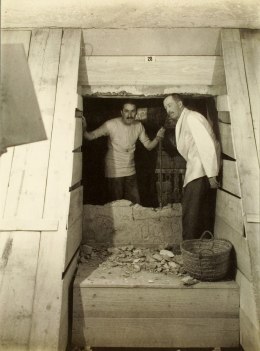
Howard Carter and Lord Carnarvon at the door of the burial chamber. Source: Wikimedia Commons
As the tomb’s fame gathered a momentum all of its own, it also became a ticking bomb. Lord Carnarvon, in a bid to simplify dealings with the media, made the colossal diplomatic error of signing a contract with The Times newspaper to grant them exclusive rights to the news emerging from the tomb, offending both Egyptian and international media outlets. Worse, it endowed the enterprise an unlooked for and very undesirable air of colonialist arrogance that gave the governing Egyptian nationalists all the ammunition they needed to draw attention to unwelcome foreign interference in Egyptian state affairs. To all intents and purposes, Carnarvon and Carter were hijacking access to Egypt’s own heritage. The tension was corrosive, and impacted the relationship between Carnarvon and Carter, who were deeply divided on how to deal with the situation.
When Lord Carnarvon died on 5th April 1923, aged 57, from an infected insect bite, Carter found himself without a buffer zone between himself and the various interested and aggrieved parties. He was no diplomat, and contrived to alienate all the key government and administrative officials whose support he should have been seeking. In a remarkable act of pique, Carter downed tools, stopped work, citing “the impossible restrictions and discourtesies of the Egyptian Public Works Department and its antiquity service.” It was a foolish move that not only infuriated the Egyptian authorities but gave them the leverage they needed to oust him. Carter had infringed the terms of the concession, and was now banned from the tomb. Legal action failed, and Carter left the country, leaving the Egyptian government to declare that it intended to continue the work itself.

Tourists gathered around the entrance of KV62 in 1923, the year after the discovery. Source: Wikipedia
Carter was only permitted to return after a national emergency was triggered by the murder of a British diplomat, followed by the downfall of the nationalist government and the renewal of firmer greater British control over Egypt. A new concession was granted in January 1925, but this time there was to be no exclusive deal with The Times, and there was to be no attempt to remove any of the tomb’s contents from Egypt. Carter died in 1939, only seven years after completing his work on the objects found in the tomb. He had been planning a six-volume publication of the tomb, but it never happened.
Howard Carter and Lord Carnarvon had found the tomb of Tutankhamen, and a well-chosen team of specialists examined and emptied it, but there was still considerable research required to learn about the king himself, and to learn more about what the objects in the tomb could impart to researchers about 18th Dynasty Egypt itself. Today, although many individual academic papers have been written by specialists in certain particular fields, like leather or jewellery, and dozens of coffee table books have been written, no single, centralized co-ordinated project based on the tomb has been masterminded. Although Tutankhamen the tourist attraction and work of art are very familiar, Tutankhamen the ultimate resource for primary research has somehow fallen between the gaps.
There are seriously strong arguments for getting to grips with the entire collection as a single co-ordinated project, leveraging worldwide specializations and skills, with research underpinned by a strong theoretical and methodological approach. Storing and exhibiting items is not the same as understanding them, and digging without publishing leads to dead ends. Carter died before he could publish is planned 6-volume treatise, and although subsequent researchers have published piecemeal research papers according to their research interests, no centralized project has been attempted. At the very least, an online relational database of the objects in the Tutankhamen inventory, listing all the existing publications based on it, would be a valuable resource, to complement the Griffith Institute’s excellent online databases of the original records made by Howard Carter, Harry Burton and others.
Final Comments
Howard Carter’s discovery of Tutankhamen, sponsored by Lord Carnarvon, remains a great story, well worth re-telling 100 years later. Carter died before he could publish his 6-part planned treatise on the tomb, which remains a gap that has yet to be filled. Even so, the discovery remains a sensational find, with works of art that even Carter could not have imagined finding, filling gallery after gallery at the Egyptian Museum in Cairo. Flipping through a book of pictures of the tomb, I continue to be amazed at how it could all have fitted into such a tiny set of spaces. Each piece is magnificent in its own right, and together the collection provides material confirmation of the story of the afterlife told in the hieroglyphic texts on tomb walls, building a vivid impression of the hopes and ambitions of ancient Egyptian royalty and nobility. In so many ways, Carter gave Tutankhamen an afterlife that the young king could never have imagined.
sdfsadfsad
Note: Tutankhamen versus Tutankhamun

The name of Tutankhamen. Source: pharaoh.se
Up until relatively recently the anglicized name of the king’s name was written as “Tutankhamun,” although Howard Carter spelled the name with an “e” instead of the more familiar “u” in his books about the tomb. Ancient Egyptian script omitted vowels, and a series of conventions were therefore used to make ancient Egyptian words pronounceable today. As standardization has become increasingly desirable, the new system of dealing with the problem of missing vowels is to use the letter “e” where no other clues are available.
To explain a little further for anyone interested in how this works, the process of anglicizing hieroglyphs goes through two steps. The first step, which you can see in the above image from the pharoah.se website, shows a line in italics, and this is called transliteration. A formalized set of characters and symbols are used to capture a writing system that may include elements not used in English (or German, French etc) but are recognizable to anyone studying ancient Egyptian texts. As you can see in the italicized line of transliteration above, as well as familiar alphabet characters there is an apostrophe and an “h” with a curved line under it. For publication and general chat, these are simplified into something that can be expressed using the English alphabet.

Alabaster vase from Gurob showing cartouches (name frames) of Tutankhamen. UC16021. Source: Petrie Museum of Egyptian Archaeology
In the case of Tutankhamen this breaks down as follows (keep looking back at the hieroglyphic name shown above, with transliteration and translation).
Tutankhamen’s name is composed of three separate words, which Carter wrote as Tut-Ankh-Amen but are today run together as Tutankhamun (older convention) or Tutankhamen (newer convention). The middle hieroglyph in “Tut” (the little bird) is transliterated as a “w”, and the “a” in ankh is a hieroglyph that has no real equivalent in English and is transliterated with the apostrophe symbol. The third element of his name, which is the name of the great god Amen, is actually transliterated “imn,” the “a” of Amen being a hieroglyph usually transliterated as an “i.” In older books that tradition was to add a “u” between the “m” an “n” to make Amun, which made it easy to pronounce, but an “e” is the new standard. As this one name illustrates, the business of transliterating ancient Egyptian names into modern equivalents has a long way to go before real standardization is achieved.
You may be puzzled because the name Amen is written first. The name of the king is always written in his cartouches in the order Amen-Tut-Ankh. This is because the name of the god always takes precedence over the name of the king. This is termed “honorific transposition.” But his name was Tut-Ankh-Amen. Go figure 🙂
Finally, Tutankhamen was actually born Tutankhaten, and changed his name on the death of his father Akhenaten. But that’s another story.
Sources
 This was written for fun, so I wrote most of it off the top of my head. I have, however, checked important details, dates and quotes in the books below. Any errors are of course my own.
Books and papers:
- Carter, Howard 1927, republished 2007. The Tomb of Tutankhamen. Max Press (with an introduction by John Romer)
- Carter, Howard and Mace, Arthur 1923, republished 2004. The Tomb of Tut Ankh Amen: Volume 1: Search Discovery and the Clearance of the Antechamber. Duckworth Egyptology
- Cross, Stephen. W., 2008. The hydrology of the Valley of the Kings. The Journal of Egyptian Archaeology, 94(1), 303–310.
- Frayling, Christopher 1993. Protecting Tutankhamun. Conservation Journal. July 1993, Issue 08
- Reeves, Nicholas 1990. The Complete Tutankhamun. The King, the tomb and the royal treasure. Thames and Hudson
- Tyldesley, Joyce 2013. Tutankhamen’s Curse: The developing history of an Egyptian king. Profile Books
- Tyldesley, Joyce 2022. Tutankhamun. Pharaoh-Icon-Enigma. Headline.
Websites:
Griffith Institute
http://www.griffith.ox.ac.uk
Harry Burton photographs
http://www.griffith.ox.ac.uk/gri/carter/gallery/
Excavation journals and diaries made by Howard Carter and Arthur Mace
http://www.griffith.ox.ac.uk/discoveringtut/journals-and-diaries/season-4/journal.html
Howard Carter watercolours, prior to the discovery of Tutankhamen. Griffith Institute.
http://www.griffith.ox.ac.uk/gri/Carter_birds.html
Mummy Bandage from Tutankhamun’s Embalming Cache (Pit 54) ca. 1336–1327 B.C.
https://www.metmuseum.org/art/collection/search/548838
The Amarna Project
https://www.amarnaproject.com/
The Theban Mapping Project
https://thebanmappingproject.com/
The Getty Conservation Institute: Conservation and Management of the Tomb of Tutankhamen (2009–2019)
https://www.getty.edu/conservation/our_projects/field_projects/tut/
Royal Mint Tutankhamun Centenary £5.00 coin
https://www.royalmint.com/shop/limited-editions/discovery-of-tutankhamuns-tomb/the-100th-anniversary-of-the-discovery-of-tutankhamuns-tomb-2022-5-brilliant-uncirculated-coin/
Egyptological
Libyan Desert Glass and the Breast Ornament of Tutankhamen
By Andie Byrnes. Published on Egyptological, September 9th 2011, Magazine Edition 2
http://lancastrian.net/kemet/2011/09/09/libyan-desert-glass-and-the-breast-ornament-of-tutankhamen-4291
 Based in Churton


.jpg)


